

#cryptoeducation
cryptoeducation
3.6M views
22,921 Discussing
Hot
Latest

·
--
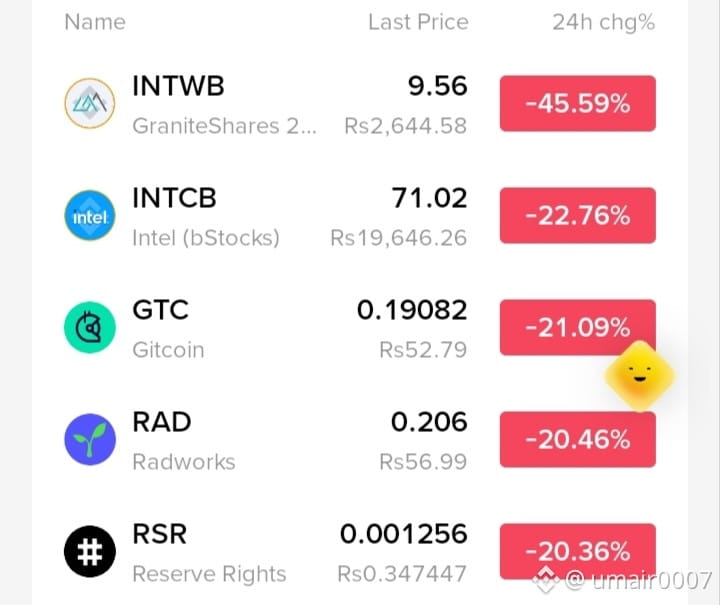
Today Losers : What These Coins Actually Do;
INTCB (Intel bStock): It represents shares of the Intel company. Intel gave its Q3 results on October 29 after the market closed, and chip shares were already falling on AI spending worries. (heygotrade) (mitrade)
INTWB: Probably a GraniteShares 2x leveraged product. If the share falls 10%, it can fall about 20%, which is why it dropped -45%.
$GTC
{spot}(GTCUSDT)
Gitcoin: A platform for funding open-source Ethereum projects. GTC is its governance token.
$RAD
{spot}(RADUSDT)
Radworks: The token of the Radicle network, which works on sharing code without a big central server.
$RSR
{spot}(RSRUSDT)
Reserve Rights: The token of the Reserve stablecoin system. It acts as insurance to keep the system stable.
Lessons to learn
A coin that rises 47% can fall just as fast.
Leveraged and tokenized stock products are risky for beginners.
Before buying any coin, understand its purpose, team, and risks.
.
.
This is only information, not financial advice.
.
.
#BİNANCE #crypto #cryptoeducation #TodayMarketAlert
Today Losers : What These Coins Actually Do;
INTCB (Intel bStock): It represents shares of the Intel company. Intel gave its Q3 results on October 29 after the market closed, and chip shares were already falling on AI spending worries. (heygotrade) (mitrade)
INTWB: Probably a GraniteShares 2x leveraged product. If the share falls 10%, it can fall about 20%, which is why it dropped -45%.
$GTC
Gitcoin: A platform for funding open-source Ethereum projects. GTC is its governance token.
$RAD
Radworks: The token of the Radicle network, which works on sharing code without a big central server.
$RSR
Reserve Rights: The token of the Reserve stablecoin system. It acts as insurance to keep the system stable.
Lessons to learn
A coin that rises 47% can fall just as fast.
Leveraged and tokenized stock products are risky for beginners.
Before buying any coin, understand its purpose, team, and risks.
.
.
This is only information, not financial advice.
.
.
#BİNANCE #crypto #cryptoeducation #TodayMarketAlert
1
741

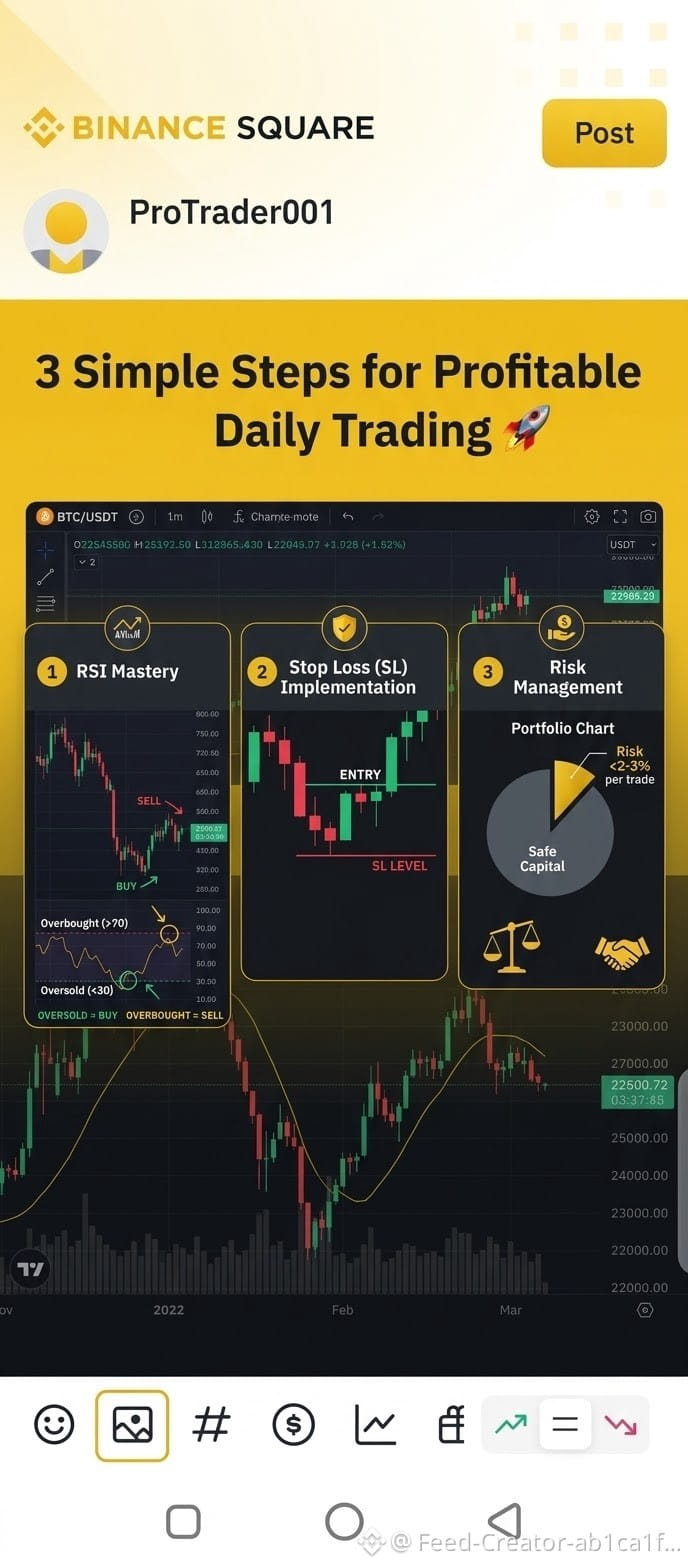
3 Simple Steps for Profitable Daily Trading 🚀
Do you want to make a daily profit in the crypto market but often end up with losses? 📉
Here are 3 golden rules you can follow to minimize your risks and maximize your profits:
Proper Use of RSI Indicator: Always look for entry points in the oversold zone and take profits in the overbought zone of the market.
Mandatory Stop Loss: Always use a stop loss in every trade to prevent massive losses during sudden market drops.
Avoid Greed (Risk Management): Never risk your entire portfolio on a single trade. Always trade with smart money management.
If you found these tips helpful, make sure to Like, Share, and Follow for more guides! 💡🔥
#BinanceSquare
#CryptoEducation
#TradingTips
#Binance
#CryptoTrading
#LearnAndEarn
72

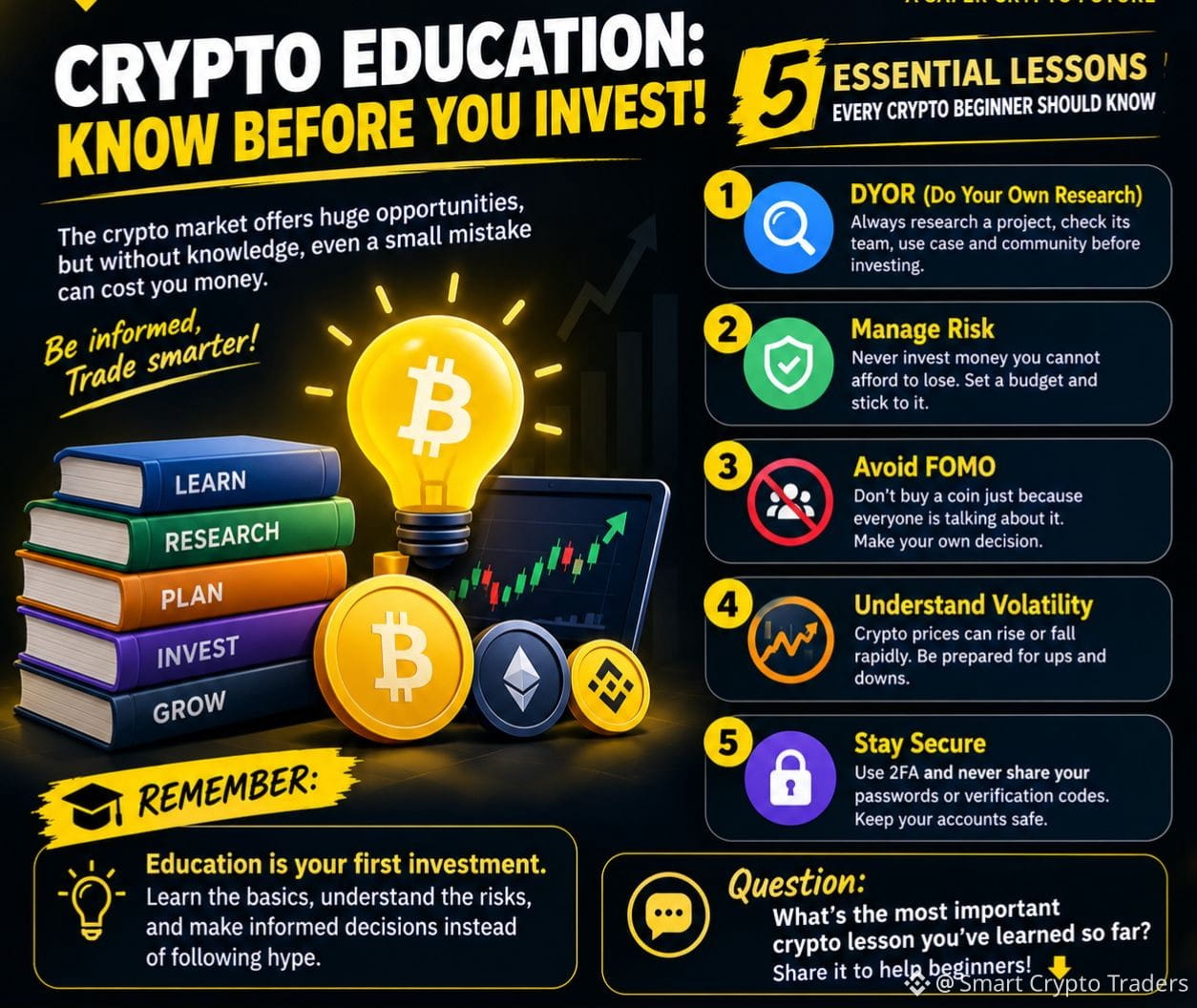
🎓 CRYPTO EDUCATION: KNOW BEFORE YOU INVEST! 🚀
The crypto market offers opportunities, but without knowledge, even a small mistake can cost you money. ⚠️
💡 5 Essential Lessons Every Crypto Beginner Should Know:
✅ DYOR: Always Do Your Own Research before investing.
✅ Manage Risk: Never invest money you cannot afford to lose.
✅ Avoid FOMO: Don't buy a coin just because everyone is talking about it.
✅ Understand Volatility: Crypto prices can rise or fall rapidly.
✅ Stay Secure: Use 2FA and never share your passwords or verification codes.
📚 Remember: Education is your first investment. Learn the basics, understand the risks, and make informed decisions instead of following hype.
💬 Question: What's the most important crypto lesson you've learned so far? Share it to help beginners! 👇
#CryptoEducation #Binance #CryptoAwareness #Bitcoin #RiskManagement
30

·
--
📉 One Thing That Surprised Me About Bitcoin!
When I first started learning about crypto, I honestly didn't realize how quickly Bitcoin's price could change.
One day it can be going up, and suddenly it can drop. I was curious about why this happens, so I started learning more.
Now I understand that things like buying and selling pressure, market news, and investor emotions can all affect crypto prices.
One thing I've learned so far is that just because Bitcoin is going up doesn't mean it will keep going up.
I'm still new to crypto, so I'm taking my time, learning the basics, and trying not to rush into trading.
💬 For those who have been in crypto for a while, what's one mistake you made as a beginner that others should avoid?
#Bitcoin #CryptoBeginners #cryptoeducation
81

📊 Bitcoin Market Education – $BTC
Bitcoin is one of the most popular cryptocurrencies in the world.
Before trading Bitcoin, always consider:
1. Market trend
2. Trading volume
3. Support and resistance
4. Risk management
Never invest money you cannot afford to lose.
What do you think about Bitcoin's future?
#Bitcoi #BTC #CryptoEducation
83

·
--
🚨 BEFORE YOU ENTER CRYPTO, READ THIS. It could save you from a costly mistake.
Most beginners think crypto is just about buying Bitcoin and waiting for the price to rise.
But there's much more you need to understand.
📚 5 things every crypto beginner should learn:
1️⃣ Bitcoin ($BTC ): Understand why Bitcoin was created and how its supply works.
2️⃣ Ethereum ($ETH ): Learn what smart contracts and decentralized applications actually do.
3️⃣ Stablecoins: Understand how assets like USDT are designed to maintain a stable value, and the risks involved.
4️⃣ Wallets: Learn the difference between an exchange account and a self-custody wallet.
5️⃣ Security: Never share your seed phrase. No legitimate support agent needs it.
⚠️ Remember:
Crypto is volatile. Scams, exchange risks and losses are real. Never invest just because someone on social media tells you to.
I want to make this page a place where beginners can understand crypto without complicated language.
👇 LET'S START A DISCUSSION:
What confuses you most about cryptocurrency?
A. Bitcoin and Ethereum
B. How crypto wallets work
C. How blockchain works
D. How to identify crypto scams
E. Everything — I'm a complete beginner!
I'll cover the most requested topic in my next post.
Follow for practical crypto education.
#BinanceSquare #bitcoin #Ethereum #cryptoeducation #blockchain

Follow me !
From Macro Ravi
44

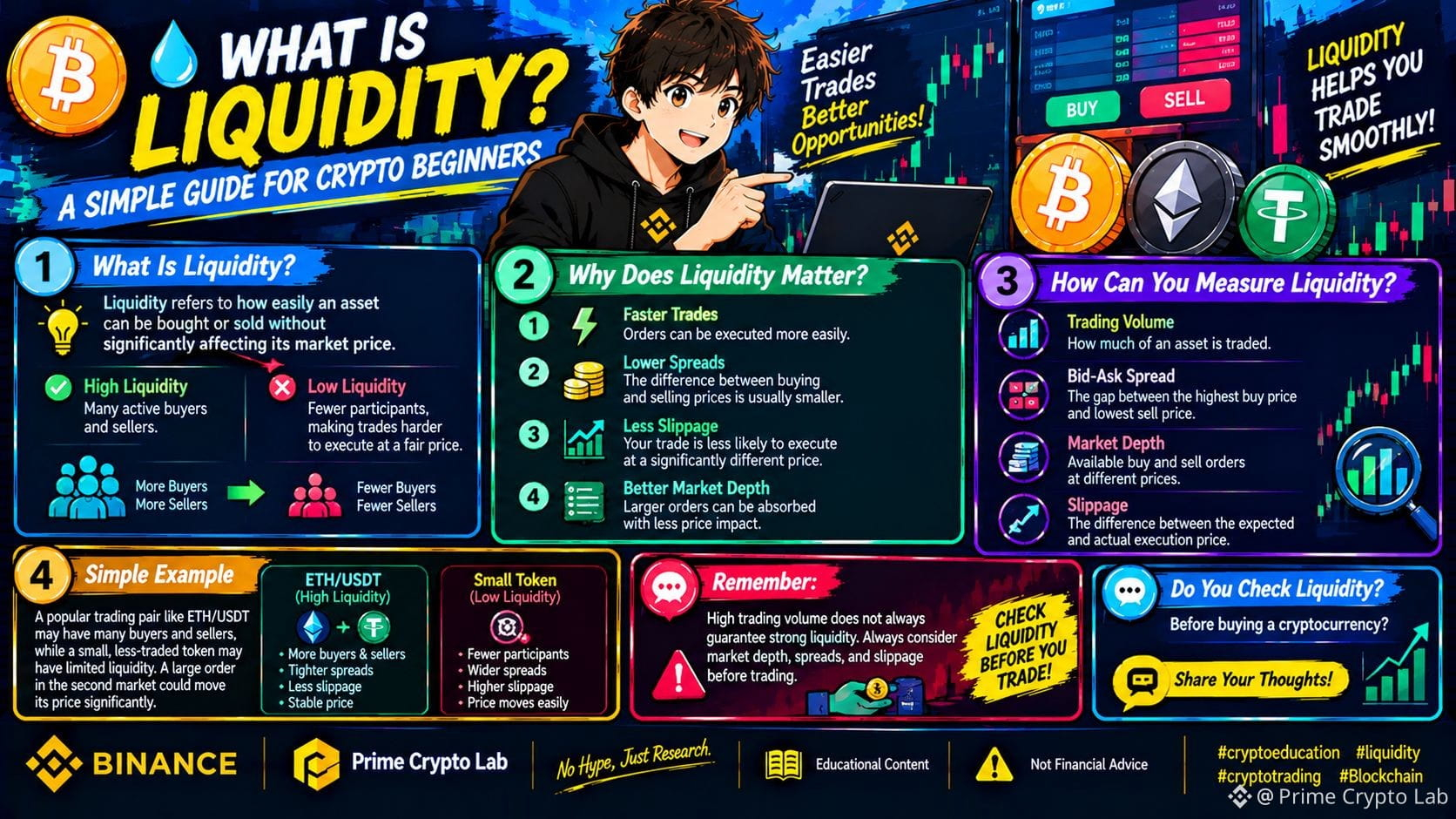
💧$BTC | What Is Liquidity? A Simple Guide for Crypto Beginners
Ever wondered why some cryptocurrencies are easier to buy and sell than others? The answer is often liquidity.
📚 What Is Liquidity?
Liquidity refers to how easily an asset can be bought or sold without significantly affecting its market price.
A highly liquid market has plenty of active buyers and sellers. An illiquid market has fewer participants, making trades harder to execute at a fair price.
🔍 Why Does Liquidity Matter?
1️⃣ Faster Trades: Orders can be executed more easily.
2️⃣ Lower Spreads: The difference between buying and selling prices is usually smaller.
3️⃣ Less Slippage: Your trade is less likely to execute at a significantly different price than expected.
4️⃣ Better Market Depth: Larger orders can be absorbed with less price impact.
📊 How Can You Measure Liquidity?
Trading Volume: How much of an asset is traded.
Bid-Ask Spread: The gap between the highest buy price and lowest sell price.
Market Depth: Available buy and sell orders at different prices.
Slippage: The difference between the expected and actual execution price.
💡 Simple Example:
A popular trading pair like $ETH /USDT may have many buyers and sellers, while a small, less-traded token may have limited liquidity. A large order in the second market could move its price significantly.
⚠️ Remember: High trading volume does not always guarantee strong liquidity. Always consider market depth, spreads, and slippage before trading.
💬 Do you check liquidity before buying a cryptocurrency? Share your thoughts!
Educational purposes only. Not financial advice.
#cryptoeducation #liquidity #cryptotrading #Blockchain
82

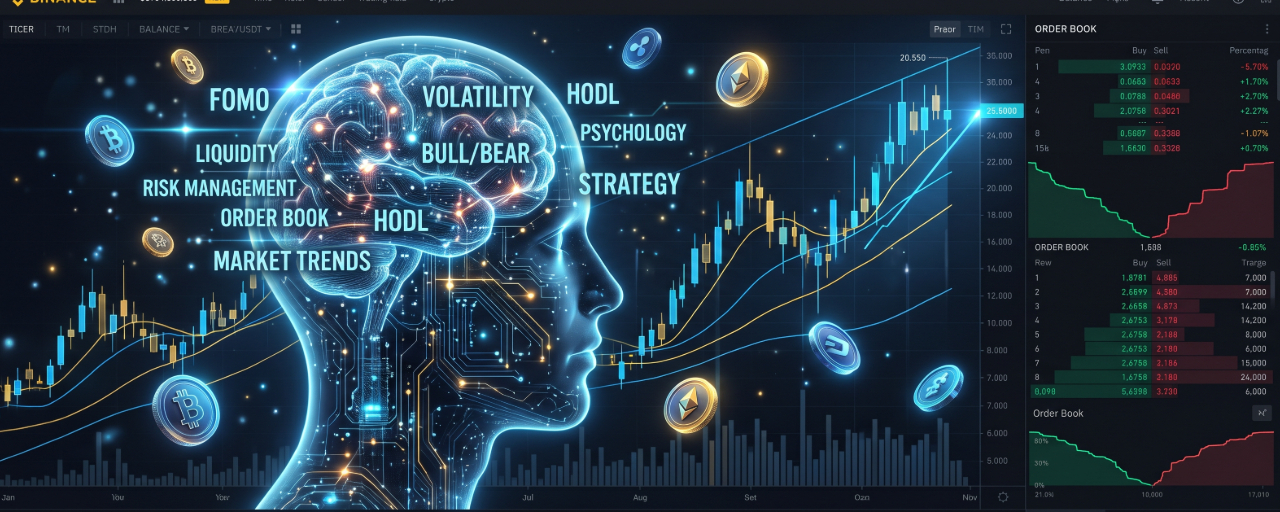
Article
STOP GAMBLING IN CRYPTO! 25+ TRADING TERMS YOU MUST UNDERSTAND BEFORE RISKING YOUR MONEYThe difference between a beginner and a disciplined trader isn't always capital. Sometimes, it's simply understanding what is happening behind the charts.
Every day, thousands of people enter the cryptocurrency market because they see Bitcoin pumping, an altcoin making 40% gains, or someone posting screenshots of enormous profits.
They open an exchange, buy a random coin, watch a few green candles and assume they understand trading.
But here's the reality:
The market doesn't reward excitement. It rewards preparation, execution, discipline and risk management.
When beginners see a green candle, experienced traders may be looking at liquidity, volume, order-book depth, funding rates, token unlocks and market structure.
When beginners ask, "Can this coin reach $1?", experienced investors may ask, "What is its circulating supply, market capitalization and fully diluted valuation?"
And when beginners panic during a market crash, disciplined traders already know their invalidation levels, maximum acceptable loss and exit strategy.
Today, let's break down the terminology that every serious crypto trader should understand.
This isn't about memorizing complicated words to sound professional. It's about learning how the market actually works.
━━━━━━━━━━━━━━━━━━━━
🏛️ MODULE 1: ORDER BOOKS, MARKET DEPTH & TRADE EXECUTION
Before you buy or sell any cryptocurrency, you need to understand how your orders interact with the market.
1. Order Book
An order book is a real-time list of outstanding buy and sell orders for a particular trading pair.
For example, imagine BTC/USDT is trading around $100,000.
The order book might look something like this:
SELL ORDERS (ASKS)
$100,100 — 2 BTC
$100,050 — 3 BTC
$100,020 — 5 BTC
BUY ORDERS (BIDS)
$99,990 — 4 BTC
$99,950 — 6 BTC
$99,900 — 8 BTC
The sell side represents people willing to sell at specific prices.
The buy side represents people willing to buy at specific prices.
Understanding this helps you see where liquidity is available and how much trading activity exists at different price levels.
However, remember that visible orders can be cancelled. An order book is useful information, not a guarantee of future price movement.
2. Bid, Ask and Spread
Three essential terms:
• BID: The highest price a buyer is currently willing to pay.
• ASK: The lowest price a seller is currently willing to accept.
• SPREAD: The difference between the best ask and best bid.
Example:
Best Bid = $99,990
Best Ask = $100,000
Spread = $10
A narrow spread generally indicates a more liquid market, while a wider spread can make entering and exiting positions more expensive.
For scalpers and high-frequency traders, even a small spread can significantly affect profitability.
3. Market Maker vs. Market Taker
This is one of the most misunderstood concepts in trading.
A MARKET MAKER generally provides liquidity by placing orders that rest in the order book.
A MARKET TAKER removes available liquidity by executing against existing orders.
Example:
You place a limit order to buy BTC at $99,000 while the market trades at $100,000.
Your order waits in the order book. You are generally acting as a maker.
However, if you place a market order and immediately buy from available sellers, you are a taker.
Important: A limit order is not automatically a maker order. A limit order that immediately matches existing liquidity can also be classified as a taker order.
Why does this matter?
Because many exchanges use different maker and taker fees. Understanding the difference can help reduce unnecessary trading costs.
4. Market Depth
Market depth describes the amount of available buy and sell liquidity at different price levels.
Imagine two cryptocurrencies:
Coin A has $5 million in buy and sell orders near its current price.
Coin B has only $30,000 in nearby orders.
A large market order could have a relatively small effect on Coin A but move Coin B's price dramatically.
This is why low-cap coins can experience extreme volatility.
5. Slippage
Slippage occurs when your executed trade price differs from the price you expected.
Example:
You want to buy $10,000 worth of a low-liquidity altcoin at $1.
But there aren't enough sellers at $1.
Your order fills at:
$1.00
$1.03
$1.06
$1.10
Your average execution price becomes higher than expected.
This is called slippage.
Slippage becomes particularly dangerous during:
• Sudden market crashes.
• Low-liquidity trading sessions.
• Major news announcements.
• Large market orders.
• Extremely volatile altcoin movements.
A coin can show impressive percentage gains on a chart while being surprisingly difficult to trade profitably.
━━━━━━━━━━━━━━━━━━━━
📊 MODULE 2: TOKENOMICS — WHY A CHEAP COIN ISN'T NECESSARILY A GOOD INVESTMENT
One of the biggest mistakes beginners make is judging a cryptocurrency by its unit price.
They see a coin worth $0.0001 and think it has enormous potential because it could reach $0.01.
But the price of one token tells you very little about the actual valuation of a project.
Professional investors pay attention to token supply, market capitalization, valuation and future dilution.
6. Circulating Supply
Circulating supply refers to the number of tokens currently available in the market.
For example:
Token price = $2
Circulating supply = 100 million
Market capitalization = $200 million.
The circulating supply is important because it helps determine how much of the project's token supply is already available to investors.
7. Total Supply
Total supply represents the number of tokens currently in existence, after accounting for tokens that have been burned.
It does not necessarily include every token that could ever be created.
8. Maximum Supply
Maximum supply is the maximum number of tokens that can ever exist, provided the protocol has a fixed supply cap.
Bitcoin is the classic example, with a maximum supply of 21 million BTC.
Not every cryptocurrency has a maximum supply.
Some projects use inflationary token models where new tokens can continue entering circulation.
9. Market Capitalization
Market capitalization is calculated as:
MARKET CAP = CURRENT PRICE × CIRCULATING SUPPLY
Example:
Token price = $5
Circulating supply = 50 million
Market cap = $250 million.
This is a better way of evaluating a project's market valuation than looking at its token price alone.
10. Fully Diluted Valuation (FDV)
FDV estimates the valuation of a cryptocurrency if its entire assumed token supply were circulating at the current price.
FDV = CURRENT PRICE × MAXIMUM SUPPLY
Where a maximum supply is not defined, total supply or another clearly stated supply assumption may be used.
Example:
Current price = $2
Circulating supply = 100 million
Total supply = 1 billion
Market Cap = $200 million
FDV = $2 billion
Notice something interesting?
The market cap is only $200 million, but the fully diluted valuation is $2 billion.
This means the currently circulating supply represents only 10% of the total supply.
That doesn't automatically mean the project is bad.
But it raises an important question:
What happens when the remaining tokens become available?
11. Token Unlocks and Vesting
Many crypto projects distribute tokens gradually to:
• Early investors.
• Founders and team members.
• Advisors.
• Ecosystem funds.
• Community incentives.
These tokens may be locked for a specific period and released according to a vesting schedule.
When a large quantity of previously locked tokens becomes available, the market may face increased potential selling pressure.
For example:
A project has 100 million circulating tokens.
Another 50 million tokens are scheduled to unlock next month.
That represents a potential 50% increase over the current circulating supply.
Not every unlocked token is immediately sold, but investors should understand the potential impact.
Before buying an altcoin, investigate:
Current circulating supply.Total and maximum supply.Upcoming unlock dates.Percentage of supply held by insiders.Long-term token distribution.
A strong project with poor token economics can still be a difficult investment.
━━━━━━━━━━━━━━━━━━━━
⚡ MODULE 3: FUTURES, LEVERAGE AND DERIVATIVES
Spot trading and futures trading are not the same thing.
In spot trading, you purchase an actual cryptocurrency.
In futures trading, you trade a contract whose value is linked to the underlying asset.
This introduces additional risks that beginners frequently underestimate.
12. Long Position
A long position means you are speculating that the price will increase.
Example:
You open a BTC long position at $100,000.
BTC increases to $103,000.
Your position gains value before fees and funding payments.
However, if BTC falls, your position loses value.
13. Short Position
A short position means you are speculating that the price will decrease.
Example:
You open a BTC short position at $100,000.
BTC falls to $95,000.
Your position gains value before fees and funding payments.
Shorting can be useful in bearish markets, but rapid upward movements can result in significant losses.
14. Leverage
Leverage allows you to control a position larger than your initial margin.
Example:
Your capital = $100
Leverage = 5x
Position size = $500
If the underlying asset increases by 3%, your approximate gross profit is:
$500 × 3% = $15.
That represents a 15% gain on your $100 margin, before fees and funding.
But what happens if the market falls by 3%?
Your approximate loss becomes $15, or 15% of your initial margin.
At 10x leverage, a 3% adverse move represents approximately 30% of the initial margin.
Leverage magnifies both profits and losses.
It does not make a bad trading strategy better.
15. Liquidation Price
Liquidation happens when your margin is no longer sufficient to support an open leveraged position.
The exchange may automatically close your position to prevent further losses.
Your exact liquidation price depends on:
• Leverage.
• Entry price.
• Margin mode.
• Maintenance margin.
• Position size.
• Trading fees and funding.
Cross margin and isolated margin also work differently.
ISOLATED MARGIN restricts the margin allocated to a particular position.
CROSS MARGIN uses available account margin to support positions, which can expose more of your balance to losses.
Never assume your liquidation price is simply a fixed percentage away from your entry.
16. Funding Rates
Perpetual futures contracts do not have a traditional expiration date.
Funding payments help keep their prices aligned with the underlying spot market.
There are two important conditions:
POSITIVE FUNDING RATE:
Long traders generally pay short traders.
NEGATIVE FUNDING RATE:
Short traders generally pay long traders.
A very high positive funding rate can suggest that long positioning is crowded.
Similarly, deeply negative funding may indicate excessive bearish positioning.
But funding rates are not standalone buy or sell signals.
A market can remain overleveraged for longer than expected.
17. Open Interest (OI)
Open interest represents the total number of outstanding derivative contracts that have not been closed or settled.
It helps traders understand activity in futures markets.
A few useful interpretations:
Price rising + OI rising:
New positions may be entering alongside the rally.
Price falling + OI rising:
New positions may be building during the decline.
Price rising + OI falling:
Short positions may be closing, contributing to the rally.
Price falling + OI falling:
Positions may be getting closed or liquidated.
These are interpretations, not guaranteed predictions. Always combine open interest with volume, funding and price action.
18. Liquidation Cascade
A liquidation cascade occurs when forced position closures trigger further price movement and additional liquidations.
Imagine BTC begins falling.
Leveraged long positions approach their liquidation prices.
The exchange closes those positions, creating additional selling pressure.
That selling pressure pushes BTC even lower, triggering more liquidations.
The same process can happen in reverse during a sharp rally.
This is one reason cryptocurrency markets can experience extremely violent movements within minutes.
━━━━━━━━━━━━━━━━━━━━
🐋 MODULE 4: LIQUIDITY, WHALES AND MARKET PSYCHOLOGY
Understanding market psychology is just as important as understanding technical indicators.
Large traders often need substantial liquidity to enter and exit their positions.
Retail traders, meanwhile, tend to place orders around obvious support, resistance and psychological price levels.
This creates interesting market behaviour.
19. Liquidity
Liquidity refers to how easily an asset can be bought or sold without significantly affecting its market price.
High-liquidity assets generally have:
• More trading activity.
• Deeper order books.
• Tighter bid-ask spreads.
• Greater ability to handle larger orders.
Low-liquidity assets can experience sharp price movements even when relatively little capital is traded.
This is particularly important when trading small-cap altcoins.
20. Liquidity Sweeps
A liquidity sweep happens when price moves beyond a visible high or low, triggering stop orders or other liquidity, before potentially reversing.
Example:
BTC has support around $95,000.
Many traders place stop-loss orders just below that level.
Price suddenly falls to $94,600, triggering stop orders, but then quickly recovers to $96,000.
Traders may interpret this as a liquidity sweep.
However, be careful with the terminology.
Not every wick below support is a deliberate stop hunt by a whale.
It can also result from normal market volatility, low liquidity or a sudden imbalance between buyers and sellers.
The important thing is to observe how price behaves after taking liquidity.
21. Stop-Loss
A stop-loss is an order or trading instruction designed to limit the loss on a position.
Example:
Entry price = $100
Stop-loss = $95
Your planned loss is approximately 5% of the position value, before fees and slippage.
A stop-loss protects you from allowing a small mistake to become a devastating loss.
However, stop orders are not guaranteed to execute at the exact trigger price during extreme volatility.
22. Take-Profit (TP)
A take-profit order helps close a position when it reaches a predefined profit target.
Example:
Entry = $100
TP1 = $105
TP2 = $110
TP3 = $120
A trader could close part of the position at each target rather than trying to predict the exact market top.
This is called scaling out.
It can help manage emotional decision-making.
23. Support and Resistance
SUPPORT is a price area where buying interest has historically been strong enough to slow or reverse a decline.
RESISTANCE is a price area where selling pressure has historically slowed or reversed an advance.
Neither is a guaranteed price barrier.
When support breaks, it may become resistance.
When resistance breaks, it may become support.
Traders often look for confirmation through volume, candle closes and retests rather than entering simply because price touches a line.
24. Breakout and Fakeout
A breakout occurs when price moves beyond an established support or resistance zone.
But not every breakout is genuine.
A fakeout occurs when price briefly moves beyond a key level but fails to sustain the movement and returns to its previous range.
Example:
BTC resistance = $100,000.
BTC moves to $101,000, attracting breakout buyers.
A few minutes later, it falls to $98,500.
Traders who entered without confirmation may become trapped.
This is why volume, market structure and confirmation matter.
━━━━━━━━━━━━━━━━━━━━
🧮 MODULE 5: RISK MANAGEMENT — THE DIFFERENCE BETWEEN SURVIVING AND BLOWING UP
This is arguably the most important module in the entire article.
You can understand every chart pattern, know every indicator and correctly identify promising cryptocurrencies.
But without risk management, a few bad trades can destroy your account.
25. Risk-to-Reward Ratio (R)
Risk-to-reward ratio compares the amount you are willing to lose against your potential profit.
Example:
You risk $10 to potentially make $30.
Risk = $10
Reward = $30
Your risk-to-reward ratio is 1:3.
This means you are targeting three dollars of potential profit for every dollar of planned risk.
A higher risk-to-reward ratio can reduce the win rate required to break even, assuming the planned outcomes are achieved.
26. Win Rate
Win rate tells you what percentage of your trades are profitable.
Example:
You make 20 trades.
12 are profitable.
8 are losses.
Your win rate is 60%.
But here's something beginners often misunderstand:
A high win rate does not automatically mean a profitable strategy.
Imagine:
You win $5 on each successful trade.
You lose $20 on each unsuccessful trade.
Even with a 60% win rate:
12 wins × $5 = $60
8 losses × $20 = $160
Net result = -$100 before fees.
A disciplined trader evaluates win rate together with average profit, average loss, fees and execution quality.
27. Position Sizing
Position sizing determines how much capital you allocate to a particular trade.
Suppose:
Trading account = $1,000
Maximum planned risk = 1%
Maximum acceptable loss = $10
Your entry is $100 and your stop-loss is $95.
The price difference is 5%.
To risk approximately $10:
Position size = $10 ÷ 5% = $200.
So, your position would be worth $200, rather than risking your entire $1,000 account.
This is a simplified calculation. Fees, slippage and funding must also be considered.
Position sizing is often more important than finding the perfect entry.
28. Risk of Ruin
Risk of ruin describes the possibility of losing so much capital that continuing to trade becomes impractical.
Consider two traders:
Trader A risks 20% of their account on each trade.
Trader B risks 1% per trade.
A series of consecutive losses can devastate Trader A's account, while Trader B has significantly more room to recover.
Remember:
Losing 50% of your portfolio requires a 100% gain just to return to your starting balance.
Protecting capital is not boring.
It is a survival strategy.
━━━━━━━━━━━━━━━━━━━━
🌐 MODULE 6: DEFI — UNDERSTANDING THE OTHER SIDE OF CRYPTO
Cryptocurrency isn't only about buying Bitcoin and trading altcoins.
Decentralized Finance (DeFi) introduces another world of financial applications built using blockchain networks and smart contracts.
29. Smart Contracts
Smart contracts are programs deployed on blockchains that execute when predefined conditions are met.
They can power:
• Decentralized exchanges.
• Lending protocols.
• Token swaps.
• Liquidity pools.
• Automated financial applications.
However, smart contracts can contain vulnerabilities.
A project being decentralized does not automatically make it safe.
30. Automated Market Maker (AMM)
An AMM is a mechanism used by decentralized exchanges to facilitate trades through liquidity pools rather than relying exclusively on traditional order books.
For example, an ETH/USDT pool contains ETH and USDT.
Traders can swap between these assets using the pool's pricing mechanism.
Liquidity providers deposit assets into the pool and may earn trading fees.
31. Impermanent Loss
Impermanent loss occurs when the relative prices of assets deposited into a liquidity pool change compared with simply holding those assets.
Example:
You deposit equal values of ETH and USDT into a liquidity pool.
ETH experiences a significant price increase.
The AMM adjusts the pool's asset ratio as traders trade against it.
When you withdraw, your combined holdings may be worth less than if you had simply held the original ETH and USDT.
That difference is commonly called impermanent loss.
Trading fees and other rewards may offset some or all of that loss, but they do not guarantee profitability.
32. TVL (Total Value Locked)
TVL represents the total value of assets deposited into a DeFi protocol.
A higher TVL can indicate substantial participation, but it does not automatically mean a protocol is secure or sustainable.
Always investigate:
• Smart-contract audits.
• Protocol history.
• Liquidity concentration.
• Token incentives.
• Security incidents.
• Withdrawal conditions.
Never deposit money into a protocol simply because its TVL is large.
━━━━━━━━━━━━━━━━━━━━
🧠 MODULE 7: HOW TO THINK LIKE A DISCIPLINED TRADER
Let's compare two different approaches.
RETAIL TRADER:
"I saw a coin pumping 30%. I need to buy before it goes higher."
DISCIPLINED TRADER:
"What is driving the movement? Is volume increasing? Where is the next resistance? Is liquidity sufficient? What is my invalidation level?"
RETAIL TRADER:
"This coin is only $0.001. It can easily reach $1."
DISCIPLINED TRADER:
"What is the circulating supply? What would its market cap be at $1? Is that valuation realistic?"
RETAIL TRADER:
"I lost money. I need another trade to recover it."
DISCIPLINED TRADER:
"My setup failed. My predefined risk limit was respected. I'll wait for the next opportunity."
RETAIL TRADER:
"This influencer says the coin will 100x."
DISCIPLINED TRADER:
"What evidence supports that valuation? What are the token unlocks, liquidity conditions and downside risks?"
The biggest difference is that one approach is based on emotional reactions, while the other is based on a repeatable process.
━━━━━━━━━━━━━━━━━━━━
🎯 THE DAILY CRYPTO TRADER CHECKLIST
Before entering any position, ask yourself these questions:
1. Market Direction
Is Bitcoin trending upward, downward or sideways?
What is happening on the daily and 4-hour timeframes?
2. Market Structure
Are we seeing higher highs and higher lows, or lower highs and lower lows?
Where are the important support and resistance zones?
3. Volume Confirmation
Is the movement supported by meaningful trading volume?
Is the price moving on genuine demand or relatively thin liquidity?
4. Derivatives Data
What is the current funding rate?
Is open interest increasing or decreasing?
Are leveraged positions becoming excessively crowded?
5. Tokenomics
Is the cryptocurrency facing major token unlocks?
Is its FDV significantly higher than its market capitalization?
Who holds the majority of the supply?
6. Risk Management
Where is my entry?
Where is my stop-loss?
What is my take-profit?
How much money am I willing to lose?
7. Emotional Control
Am I entering because I have a strategy, or because I am afraid of missing an opportunity?
Would I still take this trade if nobody had posted about it on social media?
If you cannot answer these questions, you may not be ready to enter the position.
━━━━━━━━━━━━━━━━━━━━
FINAL THOUGHT: THE MARKET DOESN'T CARE ABOUT YOUR EXPECTATIONS
Crypto trading is not a competition to find the next 100x coin.
It is a continuous process of identifying opportunities, evaluating probabilities, controlling risk and managing uncertainty.
You do not need to win every trade.
You do not need to predict every Bitcoin movement.
And you certainly do not need to trade every single day.
The goal is to develop a strategy that can survive different market conditions.
Learn the terminology. Understand the mechanics. Study the data. Control your emotions.
Most importantly, never confuse a lucky trade with actual trading skill.
A trader's first responsibility is not to make money. It is to stay in the game long enough to develop an edge.
👇 LET'S MAKE THIS INTERESTING:
Which of these concepts do you find the most difficult to understand?
Order Book & LiquidityMarket Cap & FDVFutures, Leverage & LiquidationsFunding Rates & Open InterestLiquidity Sweeps & Market StructureRisk Management & Position SizingDeFi & Impermanent Loss
Comment with your number.
I'll use the most requested topic for a deeper practical breakdown with real-world examples in the next educational post.
Learn before you trade. Protect before you profit.
#cryptoeducation #BinanceSquare #TradingForBeginners #CryptoTrading #RiskManagement
$ZEC | $LSK | $BLZ
STOP GAMBLING IN CRYPTO! 25+ TRADING TERMS YOU MUST UNDERSTAND BEFORE RISKING YOUR MONEY
The difference between a beginner and a disciplined trader isn't always capital. Sometimes, it's simply understanding what is happening behind the charts.
Every day, thousands of people enter the cryptocurrency market because they see Bitcoin pumping, an altcoin making 40% gains, or someone posting screenshots of enormous profits.
They open an exchange, buy a random coin, watch a few green candles and assume they understand trading.
But here's the reality:
The market doesn't reward excitement. It rewards preparation, execution, discipline and risk management.
When beginners see a green candle, experienced traders may be looking at liquidity, volume, order-book depth, funding rates, token unlocks and market structure.
When beginners ask, "Can this coin reach $1?", experienced investors may ask, "What is its circulating supply, market capitalization and fully diluted valuation?"
And when beginners panic during a market crash, disciplined traders already know their invalidation levels, maximum acceptable loss and exit strategy.
Today, let's break down the terminology that every serious crypto trader should understand.
This isn't about memorizing complicated words to sound professional. It's about learning how the market actually works.
━━━━━━━━━━━━━━━━━━━━
🏛️ MODULE 1: ORDER BOOKS, MARKET DEPTH & TRADE EXECUTION
Before you buy or sell any cryptocurrency, you need to understand how your orders interact with the market.
1. Order Book
An order book is a real-time list of outstanding buy and sell orders for a particular trading pair.
For example, imagine BTC/USDT is trading around $100,000.
The order book might look something like this:
SELL ORDERS (ASKS)
$100,100 — 2 BTC
$100,050 — 3 BTC
$100,020 — 5 BTC
BUY ORDERS (BIDS)
$99,990 — 4 BTC
$99,950 — 6 BTC
$99,900 — 8 BTC
The sell side represents people willing to sell at specific prices.
The buy side represents people willing to buy at specific prices.
Understanding this helps you see where liquidity is available and how much trading activity exists at different price levels.
However, remember that visible orders can be cancelled. An order book is useful information, not a guarantee of future price movement.
2. Bid, Ask and Spread
Three essential terms:
• BID: The highest price a buyer is currently willing to pay.
• ASK: The lowest price a seller is currently willing to accept.
• SPREAD: The difference between the best ask and best bid.
Example:
Best Bid = $99,990
Best Ask = $100,000
Spread = $10
A narrow spread generally indicates a more liquid market, while a wider spread can make entering and exiting positions more expensive.
For scalpers and high-frequency traders, even a small spread can significantly affect profitability.
3. Market Maker vs. Market Taker
This is one of the most misunderstood concepts in trading.
A MARKET MAKER generally provides liquidity by placing orders that rest in the order book.
A MARKET TAKER removes available liquidity by executing against existing orders.
Example:
You place a limit order to buy BTC at $99,000 while the market trades at $100,000.
Your order waits in the order book. You are generally acting as a maker.
However, if you place a market order and immediately buy from available sellers, you are a taker.
Important: A limit order is not automatically a maker order. A limit order that immediately matches existing liquidity can also be classified as a taker order.
Why does this matter?
Because many exchanges use different maker and taker fees. Understanding the difference can help reduce unnecessary trading costs.
4. Market Depth
Market depth describes the amount of available buy and sell liquidity at different price levels.
Imagine two cryptocurrencies:
Coin A has $5 million in buy and sell orders near its current price.
Coin B has only $30,000 in nearby orders.
A large market order could have a relatively small effect on Coin A but move Coin B's price dramatically.
This is why low-cap coins can experience extreme volatility.
5. Slippage
Slippage occurs when your executed trade price differs from the price you expected.
Example:
You want to buy $10,000 worth of a low-liquidity altcoin at $1.
But there aren't enough sellers at $1.
Your order fills at:
$1.00
$1.03
$1.06
$1.10
Your average execution price becomes higher than expected.
This is called slippage.
Slippage becomes particularly dangerous during:
• Sudden market crashes.
• Low-liquidity trading sessions.
• Major news announcements.
• Large market orders.
• Extremely volatile altcoin movements.
A coin can show impressive percentage gains on a chart while being surprisingly difficult to trade profitably.
━━━━━━━━━━━━━━━━━━━━
📊 MODULE 2: TOKENOMICS — WHY A CHEAP COIN ISN'T NECESSARILY A GOOD INVESTMENT
One of the biggest mistakes beginners make is judging a cryptocurrency by its unit price.
They see a coin worth $0.0001 and think it has enormous potential because it could reach $0.01.
But the price of one token tells you very little about the actual valuation of a project.
Professional investors pay attention to token supply, market capitalization, valuation and future dilution.
6. Circulating Supply
Circulating supply refers to the number of tokens currently available in the market.
For example:
Token price = $2
Circulating supply = 100 million
Market capitalization = $200 million.
The circulating supply is important because it helps determine how much of the project's token supply is already available to investors.
7. Total Supply
Total supply represents the number of tokens currently in existence, after accounting for tokens that have been burned.
It does not necessarily include every token that could ever be created.
8. Maximum Supply
Maximum supply is the maximum number of tokens that can ever exist, provided the protocol has a fixed supply cap.
Bitcoin is the classic example, with a maximum supply of 21 million BTC.
Not every cryptocurrency has a maximum supply.
Some projects use inflationary token models where new tokens can continue entering circulation.
9. Market Capitalization
Market capitalization is calculated as:
MARKET CAP = CURRENT PRICE × CIRCULATING SUPPLY
Example:
Token price = $5
Circulating supply = 50 million
Market cap = $250 million.
This is a better way of evaluating a project's market valuation than looking at its token price alone.
10. Fully Diluted Valuation (FDV)
FDV estimates the valuation of a cryptocurrency if its entire assumed token supply were circulating at the current price.
FDV = CURRENT PRICE × MAXIMUM SUPPLY
Where a maximum supply is not defined, total supply or another clearly stated supply assumption may be used.
Example:
Current price = $2
Circulating supply = 100 million
Total supply = 1 billion
Market Cap = $200 million
FDV = $2 billion
Notice something interesting?
The market cap is only $200 million, but the fully diluted valuation is $2 billion.
This means the currently circulating supply represents only 10% of the total supply.
That doesn't automatically mean the project is bad.
But it raises an important question:
What happens when the remaining tokens become available?
11. Token Unlocks and Vesting
Many crypto projects distribute tokens gradually to:
• Early investors.
• Founders and team members.
• Advisors.
• Ecosystem funds.
• Community incentives.
These tokens may be locked for a specific period and released according to a vesting schedule.
When a large quantity of previously locked tokens becomes available, the market may face increased potential selling pressure.
For example:
A project has 100 million circulating tokens.
Another 50 million tokens are scheduled to unlock next month.
That represents a potential 50% increase over the current circulating supply.
Not every unlocked token is immediately sold, but investors should understand the potential impact.
Before buying an altcoin, investigate:
Current circulating supply.Total and maximum supply.Upcoming unlock dates.Percentage of supply held by insiders.Long-term token distribution.
A strong project with poor token economics can still be a difficult investment.
━━━━━━━━━━━━━━━━━━━━
⚡ MODULE 3: FUTURES, LEVERAGE AND DERIVATIVES
Spot trading and futures trading are not the same thing.
In spot trading, you purchase an actual cryptocurrency.
In futures trading, you trade a contract whose value is linked to the underlying asset.
This introduces additional risks that beginners frequently underestimate.
12. Long Position
A long position means you are speculating that the price will increase.
Example:
You open a BTC long position at $100,000.
BTC increases to $103,000.
Your position gains value before fees and funding payments.
However, if BTC falls, your position loses value.
13. Short Position
A short position means you are speculating that the price will decrease.
Example:
You open a BTC short position at $100,000.
BTC falls to $95,000.
Your position gains value before fees and funding payments.
Shorting can be useful in bearish markets, but rapid upward movements can result in significant losses.
14. Leverage
Leverage allows you to control a position larger than your initial margin.
Example:
Your capital = $100
Leverage = 5x
Position size = $500
If the underlying asset increases by 3%, your approximate gross profit is:
$500 × 3% = $15.
That represents a 15% gain on your $100 margin, before fees and funding.
But what happens if the market falls by 3%?
Your approximate loss becomes $15, or 15% of your initial margin.
At 10x leverage, a 3% adverse move represents approximately 30% of the initial margin.
Leverage magnifies both profits and losses.
It does not make a bad trading strategy better.
15. Liquidation Price
Liquidation happens when your margin is no longer sufficient to support an open leveraged position.
The exchange may automatically close your position to prevent further losses.
Your exact liquidation price depends on:
• Leverage.
• Entry price.
• Margin mode.
• Maintenance margin.
• Position size.
• Trading fees and funding.
Cross margin and isolated margin also work differently.
ISOLATED MARGIN restricts the margin allocated to a particular position.
CROSS MARGIN uses available account margin to support positions, which can expose more of your balance to losses.
Never assume your liquidation price is simply a fixed percentage away from your entry.
16. Funding Rates
Perpetual futures contracts do not have a traditional expiration date.
Funding payments help keep their prices aligned with the underlying spot market.
There are two important conditions:
POSITIVE FUNDING RATE:
Long traders generally pay short traders.
NEGATIVE FUNDING RATE:
Short traders generally pay long traders.
A very high positive funding rate can suggest that long positioning is crowded.
Similarly, deeply negative funding may indicate excessive bearish positioning.
But funding rates are not standalone buy or sell signals.
A market can remain overleveraged for longer than expected.
17. Open Interest (OI)
Open interest represents the total number of outstanding derivative contracts that have not been closed or settled.
It helps traders understand activity in futures markets.
A few useful interpretations:
Price rising + OI rising:
New positions may be entering alongside the rally.
Price falling + OI rising:
New positions may be building during the decline.
Price rising + OI falling:
Short positions may be closing, contributing to the rally.
Price falling + OI falling:
Positions may be getting closed or liquidated.
These are interpretations, not guaranteed predictions. Always combine open interest with volume, funding and price action.
18. Liquidation Cascade
A liquidation cascade occurs when forced position closures trigger further price movement and additional liquidations.
Imagine BTC begins falling.
Leveraged long positions approach their liquidation prices.
The exchange closes those positions, creating additional selling pressure.
That selling pressure pushes BTC even lower, triggering more liquidations.
The same process can happen in reverse during a sharp rally.
This is one reason cryptocurrency markets can experience extremely violent movements within minutes.
━━━━━━━━━━━━━━━━━━━━
🐋 MODULE 4: LIQUIDITY, WHALES AND MARKET PSYCHOLOGY
Understanding market psychology is just as important as understanding technical indicators.
Large traders often need substantial liquidity to enter and exit their positions.
Retail traders, meanwhile, tend to place orders around obvious support, resistance and psychological price levels.
This creates interesting market behaviour.
19. Liquidity
Liquidity refers to how easily an asset can be bought or sold without significantly affecting its market price.
High-liquidity assets generally have:
• More trading activity.
• Deeper order books.
• Tighter bid-ask spreads.
• Greater ability to handle larger orders.
Low-liquidity assets can experience sharp price movements even when relatively little capital is traded.
This is particularly important when trading small-cap altcoins.
20. Liquidity Sweeps
A liquidity sweep happens when price moves beyond a visible high or low, triggering stop orders or other liquidity, before potentially reversing.
Example:
BTC has support around $95,000.
Many traders place stop-loss orders just below that level.
Price suddenly falls to $94,600, triggering stop orders, but then quickly recovers to $96,000.
Traders may interpret this as a liquidity sweep.
However, be careful with the terminology.
Not every wick below support is a deliberate stop hunt by a whale.
It can also result from normal market volatility, low liquidity or a sudden imbalance between buyers and sellers.
The important thing is to observe how price behaves after taking liquidity.
21. Stop-Loss
A stop-loss is an order or trading instruction designed to limit the loss on a position.
Example:
Entry price = $100
Stop-loss = $95
Your planned loss is approximately 5% of the position value, before fees and slippage.
A stop-loss protects you from allowing a small mistake to become a devastating loss.
However, stop orders are not guaranteed to execute at the exact trigger price during extreme volatility.
22. Take-Profit (TP)
A take-profit order helps close a position when it reaches a predefined profit target.
Example:
Entry = $100
TP1 = $105
TP2 = $110
TP3 = $120
A trader could close part of the position at each target rather than trying to predict the exact market top.
This is called scaling out.
It can help manage emotional decision-making.
23. Support and Resistance
SUPPORT is a price area where buying interest has historically been strong enough to slow or reverse a decline.
RESISTANCE is a price area where selling pressure has historically slowed or reversed an advance.
Neither is a guaranteed price barrier.
When support breaks, it may become resistance.
When resistance breaks, it may become support.
Traders often look for confirmation through volume, candle closes and retests rather than entering simply because price touches a line.
24. Breakout and Fakeout
A breakout occurs when price moves beyond an established support or resistance zone.
But not every breakout is genuine.
A fakeout occurs when price briefly moves beyond a key level but fails to sustain the movement and returns to its previous range.
Example:
BTC resistance = $100,000.
BTC moves to $101,000, attracting breakout buyers.
A few minutes later, it falls to $98,500.
Traders who entered without confirmation may become trapped.
This is why volume, market structure and confirmation matter.
━━━━━━━━━━━━━━━━━━━━
🧮 MODULE 5: RISK MANAGEMENT — THE DIFFERENCE BETWEEN SURVIVING AND BLOWING UP
This is arguably the most important module in the entire article.
You can understand every chart pattern, know every indicator and correctly identify promising cryptocurrencies.
But without risk management, a few bad trades can destroy your account.
25. Risk-to-Reward Ratio (R)
Risk-to-reward ratio compares the amount you are willing to lose against your potential profit.
Example:
You risk $10 to potentially make $30.
Risk = $10
Reward = $30
Your risk-to-reward ratio is 1:3.
This means you are targeting three dollars of potential profit for every dollar of planned risk.
A higher risk-to-reward ratio can reduce the win rate required to break even, assuming the planned outcomes are achieved.
26. Win Rate
Win rate tells you what percentage of your trades are profitable.
Example:
You make 20 trades.
12 are profitable.
8 are losses.
Your win rate is 60%.
But here's something beginners often misunderstand:
A high win rate does not automatically mean a profitable strategy.
Imagine:
You win $5 on each successful trade.
You lose $20 on each unsuccessful trade.
Even with a 60% win rate:
12 wins × $5 = $60
8 losses × $20 = $160
Net result = -$100 before fees.
A disciplined trader evaluates win rate together with average profit, average loss, fees and execution quality.
27. Position Sizing
Position sizing determines how much capital you allocate to a particular trade.
Suppose:
Trading account = $1,000
Maximum planned risk = 1%
Maximum acceptable loss = $10
Your entry is $100 and your stop-loss is $95.
The price difference is 5%.
To risk approximately $10:
Position size = $10 ÷ 5% = $200.
So, your position would be worth $200, rather than risking your entire $1,000 account.
This is a simplified calculation. Fees, slippage and funding must also be considered.
Position sizing is often more important than finding the perfect entry.
28. Risk of Ruin
Risk of ruin describes the possibility of losing so much capital that continuing to trade becomes impractical.
Consider two traders:
Trader A risks 20% of their account on each trade.
Trader B risks 1% per trade.
A series of consecutive losses can devastate Trader A's account, while Trader B has significantly more room to recover.
Remember:
Losing 50% of your portfolio requires a 100% gain just to return to your starting balance.
Protecting capital is not boring.
It is a survival strategy.
━━━━━━━━━━━━━━━━━━━━
🌐 MODULE 6: DEFI — UNDERSTANDING THE OTHER SIDE OF CRYPTO
Cryptocurrency isn't only about buying Bitcoin and trading altcoins.
Decentralized Finance (DeFi) introduces another world of financial applications built using blockchain networks and smart contracts.
29. Smart Contracts
Smart contracts are programs deployed on blockchains that execute when predefined conditions are met.
They can power:
• Decentralized exchanges.
• Lending protocols.
• Token swaps.
• Liquidity pools.
• Automated financial applications.
However, smart contracts can contain vulnerabilities.
A project being decentralized does not automatically make it safe.
30. Automated Market Maker (AMM)
An AMM is a mechanism used by decentralized exchanges to facilitate trades through liquidity pools rather than relying exclusively on traditional order books.
For example, an ETH/USDT pool contains ETH and USDT.
Traders can swap between these assets using the pool's pricing mechanism.
Liquidity providers deposit assets into the pool and may earn trading fees.
31. Impermanent Loss
Impermanent loss occurs when the relative prices of assets deposited into a liquidity pool change compared with simply holding those assets.
Example:
You deposit equal values of ETH and USDT into a liquidity pool.
ETH experiences a significant price increase.
The AMM adjusts the pool's asset ratio as traders trade against it.
When you withdraw, your combined holdings may be worth less than if you had simply held the original ETH and USDT.
That difference is commonly called impermanent loss.
Trading fees and other rewards may offset some or all of that loss, but they do not guarantee profitability.
32. TVL (Total Value Locked)
TVL represents the total value of assets deposited into a DeFi protocol.
A higher TVL can indicate substantial participation, but it does not automatically mean a protocol is secure or sustainable.
Always investigate:
• Smart-contract audits.
• Protocol history.
• Liquidity concentration.
• Token incentives.
• Security incidents.
• Withdrawal conditions.
Never deposit money into a protocol simply because its TVL is large.
━━━━━━━━━━━━━━━━━━━━
🧠 MODULE 7: HOW TO THINK LIKE A DISCIPLINED TRADER
Let's compare two different approaches.
RETAIL TRADER:
"I saw a coin pumping 30%. I need to buy before it goes higher."
DISCIPLINED TRADER:
"What is driving the movement? Is volume increasing? Where is the next resistance? Is liquidity sufficient? What is my invalidation level?"
RETAIL TRADER:
"This coin is only $0.001. It can easily reach $1."
DISCIPLINED TRADER:
"What is the circulating supply? What would its market cap be at $1? Is that valuation realistic?"
RETAIL TRADER:
"I lost money. I need another trade to recover it."
DISCIPLINED TRADER:
"My setup failed. My predefined risk limit was respected. I'll wait for the next opportunity."
RETAIL TRADER:
"This influencer says the coin will 100x."
DISCIPLINED TRADER:
"What evidence supports that valuation? What are the token unlocks, liquidity conditions and downside risks?"
The biggest difference is that one approach is based on emotional reactions, while the other is based on a repeatable process.
━━━━━━━━━━━━━━━━━━━━
🎯 THE DAILY CRYPTO TRADER CHECKLIST
Before entering any position, ask yourself these questions:
1. Market Direction
Is Bitcoin trending upward, downward or sideways?
What is happening on the daily and 4-hour timeframes?
2. Market Structure
Are we seeing higher highs and higher lows, or lower highs and lower lows?
Where are the important support and resistance zones?
3. Volume Confirmation
Is the movement supported by meaningful trading volume?
Is the price moving on genuine demand or relatively thin liquidity?
4. Derivatives Data
What is the current funding rate?
Is open interest increasing or decreasing?
Are leveraged positions becoming excessively crowded?
5. Tokenomics
Is the cryptocurrency facing major token unlocks?
Is its FDV significantly higher than its market capitalization?
Who holds the majority of the supply?
6. Risk Management
Where is my entry?
Where is my stop-loss?
What is my take-profit?
How much money am I willing to lose?
7. Emotional Control
Am I entering because I have a strategy, or because I am afraid of missing an opportunity?
Would I still take this trade if nobody had posted about it on social media?
If you cannot answer these questions, you may not be ready to enter the position.
━━━━━━━━━━━━━━━━━━━━
FINAL THOUGHT: THE MARKET DOESN'T CARE ABOUT YOUR EXPECTATIONS
Crypto trading is not a competition to find the next 100x coin.
It is a continuous process of identifying opportunities, evaluating probabilities, controlling risk and managing uncertainty.
You do not need to win every trade.
You do not need to predict every Bitcoin movement.
And you certainly do not need to trade every single day.
The goal is to develop a strategy that can survive different market conditions.
Learn the terminology. Understand the mechanics. Study the data. Control your emotions.
Most importantly, never confuse a lucky trade with actual trading skill.
A trader's first responsibility is not to make money. It is to stay in the game long enough to develop an edge.
👇 LET'S MAKE THIS INTERESTING:
Which of these concepts do you find the most difficult to understand?
Order Book & LiquidityMarket Cap & FDVFutures, Leverage & LiquidationsFunding Rates & Open InterestLiquidity Sweeps & Market StructureRisk Management & Position SizingDeFi & Impermanent Loss
Comment with your number.
I'll use the most requested topic for a deeper practical breakdown with real-world examples in the next educational post.
Learn before you trade. Protect before you profit.
#cryptoeducation #BinanceSquare #TradingForBeginners #CryptoTrading #RiskManagement
$ZEC | $LSK | $BLZ
433

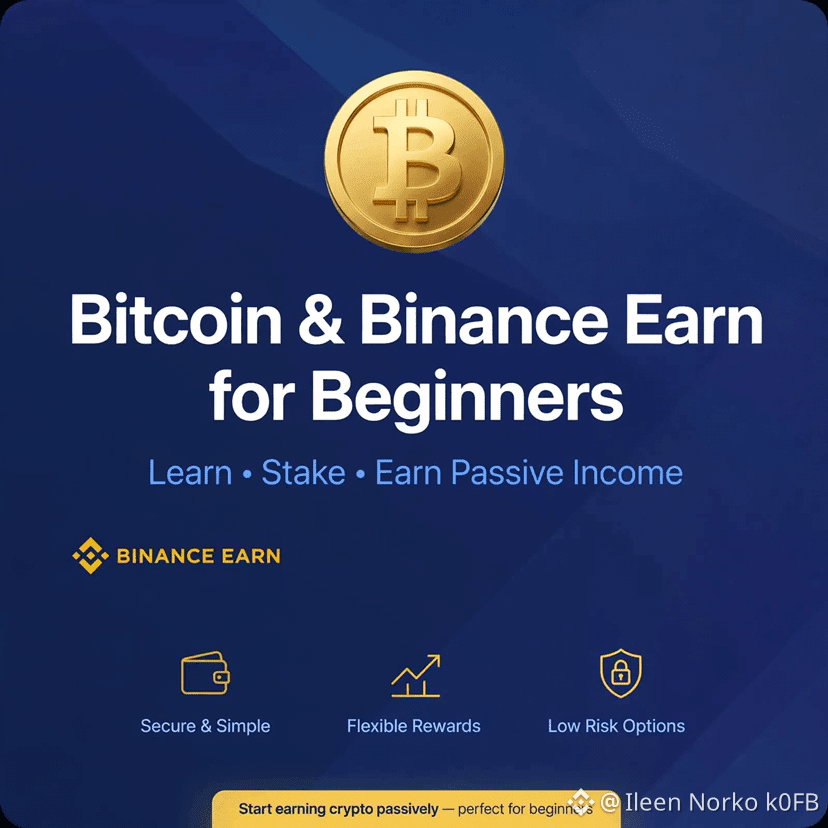
What is Binance Earn and how it helps beginners?
I started with just $5 and learned about Simple Earn, where you can earn up to 5% APR on USDC and other stablecoins.
It's safe, flexible and perfect for beginners who don't want to trade daily.
Have you tried Binance Earn?
#BinanceEarn #USDC #cryptoeducation #LearnAndEarn
I started with just $5 and learned about Simple Earn, where you can earn up to 5% APR on USDC and other stablecoins.
It's safe, flexible and perfect for beginners who don't want to trade daily.
Have you tried Binance Earn?
#BinanceEarn #USDC #cryptoeducation #LearnAndEarn
95

·
--
📊 Market Cap vs FDV: The Secret Metric Beginners Ignore
Do you know the difference between Market Cap and Fully Diluted Valuation (FDV)? If not, you might be buying a coin that will crash soon!
• Market Cap = Current Price × Circulating Supply (Coins in the market).
• FDV = Current Price × TOTAL Supply (Including locked coins).
If a project has a $10M Market Cap but a $1B FDV, it means 99% of the tokens are still locked! When those tokens unlock, the price will crash hard due to massive selling pressure.
Always check the FDV before buying! Did you know this trick? 👇
#CryptoEducation #MarketCap #TradingTips
46


Tomorrow, Oct 31, the Bitcoin whitepaper turns 18. Nine pages, published in 2008 by someone called Satoshi Nakamoto, in the middle of the worst banking crisis in decades. Here is what those nine pages said, in plain language.
The problem: every online payment needs a bank in the middle. The bank can reverse it, block it, charge for it, or fail. 2008 showed what happens when the middle fails.
The idea: a public record that thousands of computers keep at the same time, so nobody has to trust a single company. Each new page of the record is locked to the one before it, which is why it is called a chain.
The rule: only 21 million coins, ever, released on a fixed schedule that nobody can change. About 95% of them have already been mined. Compare that with any currency, where the supply grows every year.
Eighteen years later: the first block came in January 2009. The first real purchase was two pizzas for 10,000 BTC in 2010. Today spot ETFs hold Bitcoin for pension funds, and the network has never been down for more than a few hours.
What has not changed: nine pages, 21 million, no middle man. Everything else, the price, the noise, the cycles, is the world deciding what that idea is worth.
Have you read the whitepaper? It takes twenty minutes and it is free. Save this if you plan to.
Education only, not financial advice.
$BTC #Bitcoin #CryptoEducation #BitcoinWhitepaper

2
521
🔐 YOUR CRYPTO SECURITY MATTERS!
In the world of cryptocurrency, security should always come first.
Here are 5 important safety tips:
1. Never share your password.
2. Keep your 2FA enabled.
3. Never share your verification codes.
4. Beware of fake links and scams.
5. Always verify before taking action.
💡 Remember: Protecting your account is more important than chasing profits.
Stay Safe. Stay Smart. Stay Informed.
#Binance e #CryptoSecurity #BitcoinDunyamiz #blockchain n #cryptoeducation

83

·
--
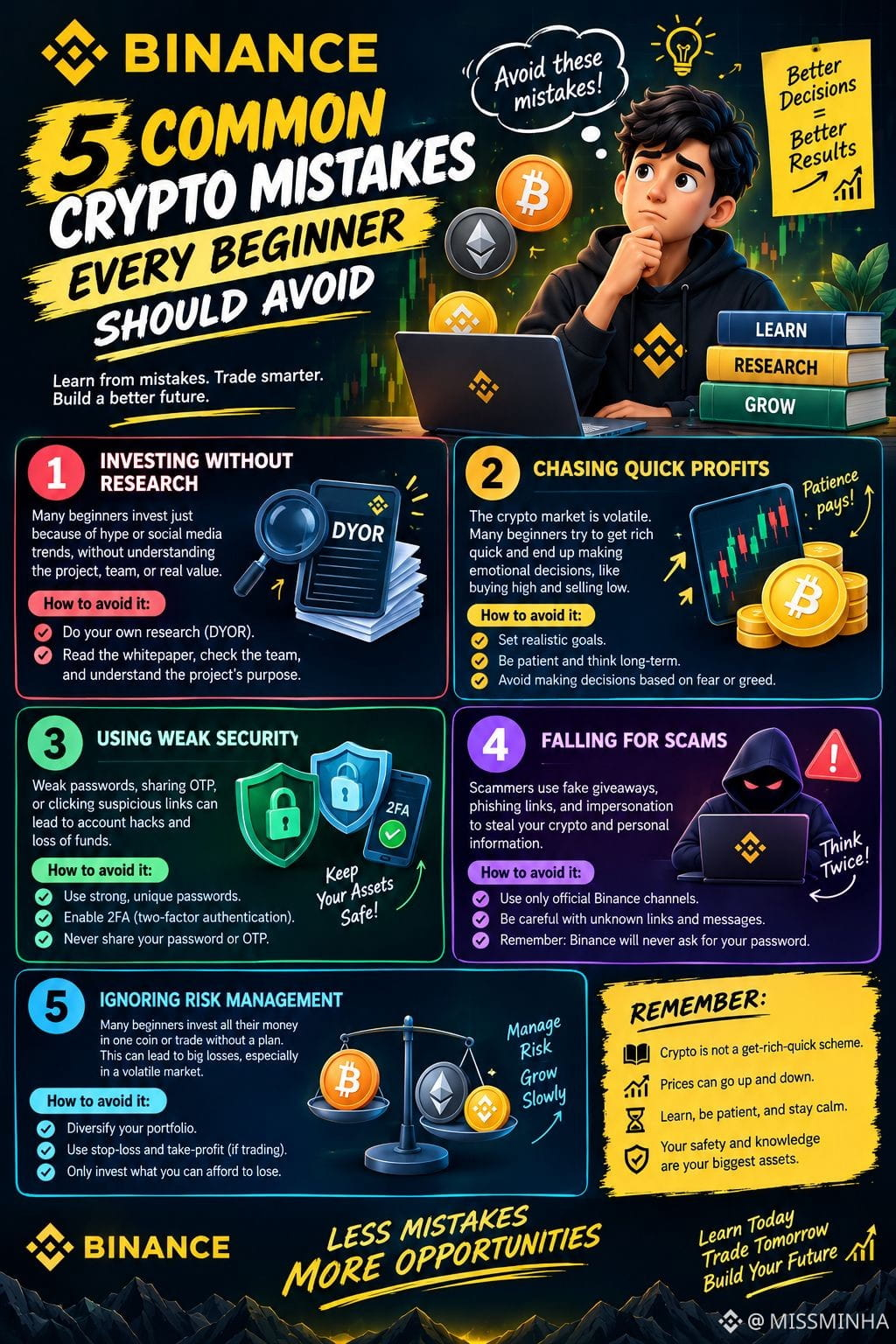
⚠️ 5 COMMON CRYPTO MISTAKES EVERY BEGINNER SHOULD AVOID!
Everyone starts somewhere, but a few mistakes can cost you more than you expect. 📉
Here are 5 mistakes every crypto beginner should watch out for:
1️⃣ Investing Without Research – Never buy a coin just because someone recommends it.
2️⃣ Chasing Quick Profits – Don't let greed control your decisions.
3️⃣ Using Weak Security – Protect your account with strong passwords and 2FA.
4️⃣ Falling for Scams – Stay away from fake giveaways and suspicious links.
5️⃣ Ignoring Risk Management – Never risk money you cannot afford to lose.
💡 Remember: Knowledge is your first investment. Be patient, stay alert, and make informed decisions.
🚀 Learn First. Think Smart. Trade Responsibly.
#Binance #CryptoEducation #CryptoTips #Bitcoin #Web3 #TradingTips #DYOR
61

·
--
🎓 CRYPTO KNOWLEDGE ACADEMY
Your Journey to Smarter Trading Starts Here!
Welcome to a new educational series designed to help you understand the cryptocurrency market, improve your trading skills, and make smarter financial decisions.
📚 Our 10-Part Series:
1. Understanding the Cryptocurrency Market
2. How Bitcoin and Blockchain Work
3. Technical Analysis for Beginners
4. Understanding Candlestick Patterns
5. Support and Resistance Explained
6. Risk Management Strategies
7. Trading Psychology and Emotional Control
8. Common Trading Mistakes to Avoid
9. Spot Trading vs. Futures Trading
10. Building a Smart and Sustainable Trading Strategy
💡 Knowledge is your greatest trading advantage.
📈 Learn, analyze, practice, and grow!
Follow the series and take your crypto knowledge to the next level.
#Binance #BinanceSquare #CryptoEducation #Trading #Bitcoin #Cryptocurrency
80

🚨 5 CRYPTO SCAMS EVERY BEGINNER SHOULD KNOW!
Scammers use different tricks to steal your money. Here are 5 common warning signs:
1️⃣ Phishing messages and fake websites
2️⃣ Fake investment platforms promising huge returns
3️⃣ People asking for crypto through emotional manipulation
4️⃣ Fake airdrops and giveaways
5️⃣ Impersonators pretending to be support staff or famous people
🛡️ Stay safe:
✅ Never share your recovery phrase.
✅ Verify websites and account details.
✅ Be skeptical of guaranteed profits.
💬 QUESTION: Have you ever encountered a suspicious crypto message?
A) Yes
B) No
C) Not sure
Comment A, B, or C! 👇
#CryptoSafety #CryptoScams #Bitcoin #CryptoEducation

87

·
--
📉 3 MISTAKES EVERY CRYPTO BEGINNER SHOULD AVOID!
Many beginners enter crypto hoping to make quick profits, but often overlook the basics.
❌ 1. Buying just because a coin is trending.
❌ 2. Investing money they cannot afford to lose.
❌ 3. Making emotional decisions during market volatility.
✅ A better approach:
Learn first, research every project, and decide your risk limit before entering a trade.
Remember: Protecting your capital is just as important as making profits.
What is the biggest lesson crypto has taught you? Share below! 👇
#CryptoEducation #TradingTips #Bitcoin #BinanceSquare
79

·
--
Bullish
What is Bitcoin, and why is everyone talking about it?🤑
Bitcoin ($BTC ) is the world's first widely adopted decentralized cryptocurrency.
Unlike traditional currencies, Bitcoin operates on a decentralized network called blockchain.
Here are three things every beginner should understand:
1. Bitcoin has a maximum supply of 21 million coins.
2. Transactions are recorded on a public blockchain.
3. Bitcoin's price can be highly volatile.
Remember: Understanding a cryptocurrency is more important than rushing into a trade.
Question: When did you first hear about Bitcoin?
#Bitcoin #CryptoEducation #EarningsSeason
{spot}(BTCUSDT)
What is Bitcoin, and why is everyone talking about it?🤑
Bitcoin ($BTC ) is the world's first widely adopted decentralized cryptocurrency.
Unlike traditional currencies, Bitcoin operates on a decentralized network called blockchain.
Here are three things every beginner should understand:
1. Bitcoin has a maximum supply of 21 million coins.
2. Transactions are recorded on a public blockchain.
3. Bitcoin's price can be highly volatile.
Remember: Understanding a cryptocurrency is more important than rushing into a trade.
Question: When did you first hear about Bitcoin?
#Bitcoin #CryptoEducation #EarningsSeason
Osama Al-Muntasir:
Bitcoin
8
1
28

💰 IN CRYPTO, DISCIPLINE CAN MATTER MORE THAN LUCK!
Everyone loves seeing their portfolio in profit, but the real challenge is managing risk when the market becomes unpredictable. 📉📈
A good trader doesn't need to win every trade. The goal is to make informed decisions, protect available capital, and learn from mistakes.
🎯 My trading principles:
🔹 Have a plan before entering a trade.
🔹 Set a stop-loss when appropriate.
🔹 Avoid emotional decisions.
🔹 Never use leverage without understanding the risks.
🔹 Remember that protecting capital matters!
The crypto market rewards patience, but it never guarantees profits.
🤔 Let's discuss: What's the most important lesson crypto trading has taught you?
#Binance #cryptoeducation #RiskManagement #tradingtips
4

·
--
🚀 3 Important Tips for Crypto Beginners!
Are you new to crypto? Here are 3 things every beginner should know:
📚 1. Learn the basics before investing. 🔒 2. Always protect your account and never share your OTP. ⚠️ 3. Never invest money you cannot afford to lose.
💡 Knowledge is more valuable than quick profits!
What is your best advice for someone starting their crypto journey? Share in the comments! 👇
#CryptoEducation #BitcoinETFs #CryptoBeginners
73

Demystifying Market Depth: How to Read Order Books and Measure True Crypto LiquidityWhen transitioning from a novice trader to an intermediate market participant, one of the most vital adjustments you can make is changing how you look at price action. Beginners typically rely exclusively on line or candlestick charts, which show historical price movement—what has already happened. Intermediate traders, however, look at the order book and market depth to understand what is likely to happen when large orders hit the exchange.
Market depth represents an exchange's ability to absorb large market orders without causing significant price fluctuations. It is a real-time window into supply and demand, revealing where buyers and sellers have placed their conditional orders. By understanding how to read market depth, traders can better estimate execution costs, detect potential manipulation, and navigate volatile market conditions with far greater precision.
---
### 1. The Anatomy of an Order Book
To understand market depth, you must first master its foundation: the order book. An order book is a real-time, continuously updated list of open buy and sell limit orders for a specific asset. It is split into two primary sides:
1. **The Bid Side (Buyers):** Located on the left or bottom (depending on the interface), bids represent traders offering to buy an asset at a specified price. Bids are sorted in descending order, with the highest bid price sitting at the very top.
2. **The Ask Side (Sellers):** Also known as the "offer" side, asks represent traders offering to sell an asset at a specified price. Asks are sorted in ascending order, with the lowest ask price sitting at the top.
The gap between the highest bid and the lowest ask is known as the **bid-ask spread**. In highly liquid markets, such as Bitcoin or Ethereum on major global exchanges, this spread is often just a fraction of a cent or a single tick size. In less liquid markets, such as micro-cap altcoins, the spread can be significantly wider, meaning you pay an immediate premium just to enter or exit a position using a market order.
The order book consists of **limit orders**—traders saying, "I want to buy/sell $X amount, but only if the price reaches $Y." When someone submits a **market order**, saying "I want to buy/sell $X amount immediately at the best available price," that market order matches against the existing limit orders in the book, consuming available liquidity.
---
### 2. How to Read a Market Depth Chart
While numerical order books list prices line-by-line, a **market depth chart** offers a visual representation of this data. It plots cumulative order volume along a horizontal price axis.
The chart is divided into two colored zones:
* **Green Curve (Cumulative Bids):** Displays the total amount of buying power available as price decreases.
* **Red Curve (Cumulative Asks):** Displays the total amount of selling pressure available as price increases.
#### Understanding Slope and Depth
* **Steep Slopes (Liquidity Walls):** A sudden, near-vertical rise in either curve indicates a massive cluster of limit orders concentrated at a specific price point. These are commonly referred to as "buy walls" or "sell walls."
* **Gradual Slopes:** A smooth, upward slope suggests liquidity is evenly distributed across a wide range of prices, indicating a healthier and less concentrated market environment.
When an asset approaches a massive **buy wall**, it means a large amount of capital is waiting to purchase the asset at that price level. In theory, price will struggle to drop below that point until all those limit orders are completely filled. Conversely, a massive **sell wall** acts as potential overhead resistance, requiring significant buying volume to breach.
---
### 3. Practical Execution: Slippage and Price Impact
One of the most practical applications of reading market depth is calculating **price impact** and **slippage** before executing a trade.
* **Slippage** occurs when a market order executes at a price different from the price expected when the trade was submitted.
* **Price Impact** refers to how much your own trade shifts the market price of the asset.
#### Practical Example:
Imagine you want to buy 50 units of a mid-cap crypto asset using a market order. The current top of the ask side is $100, but there are only 10 units available at $100.
The order book looks like this:
* Ask Level 1: 10 units at $100
* Ask Level 2: 15 units at $101
* Ask Level 3: 25 units at $103
If you click "Market Buy" for 50 units, the exchange engine fills your order sequentially:
1. It buys 10 units at $100 ($1,000)
2. It buys 15 units at $101 ($1,515)
3. It buys 25 units at $103 ($2,575)
Your total cost is $5,090, meaning your **average execution price** was $101.80 per unit, even though the displayed price when you clicked buy was $100. You experienced an average slippage of 1.8%. Furthermore, you consumed all liquidity up to $103, pushing the new market price of the asset up to $103 for the next trader.
By analyzing the market depth prior to execution, you can determine whether your order size is too large for the current order book and adjust your strategy—such as splitting the trade into smaller chunks over time or utilizing limit orders instead.
---
### 4. Advanced Order Book Dynamics: Illusions and Manipulation
While market depth provides valuable insight, intermediate traders must understand that the order book is not a static representation of true intent. Because limit orders can be canceled instantly at zero cost, market depth can sometimes be misleading.
#### 1. Spoofing and Fake Walls
Spoofing is an illegal or prohibited market manipulation tactic where a large trader or algorithmic bot places a massive limit order (e.g., a huge sell wall) with no intention of letting it execute. The goal is to create the illusion of heavy resistance, causing smaller traders to panic and sell their holdings. Once the price drops to the manipulator's desired entry zone, they cancel the fake sell wall and buy the asset at a discount.
#### 2. Iceberg Orders
Institutional participants rarely place massive limit orders directly on the order book, as doing so alerts the market to their intentions. Instead, they use **iceberg orders**. An iceberg order breaks a massive trade into small, visible slices. As soon as one visible slice is filled, another automatically takes its place. If a price level appears to have only 1 unit available but repeatedly absorbs dozens of market buys without moving, you are likely witnessing an iceberg buy order absorbing selling volume.
#### 3. Dynamic Automated Liquidity
In modern crypto markets, a vast majority of order book depth is provided by algorithmic Market Makers (MMs). These automated bots continuously update their bids and asks thousands of times per minute in response to broader market movements. During periods of sudden macro volatility, these algorithms can retract their orders in milliseconds, causing depth to evaporate instantly and leading to severe liquidity gaps.
---
### 5. Risks, Limitations, and Best Practices
Relying solely on market depth carries distinct risks that every trader must account for:
* **Liquidity Fragmentation:** Crypto trading takes place across dozens of centralized and decentralized venues. Excellent depth on one primary exchange does not guarantee global market liquidity, nor does it prevent price arbitrage across platforms.
* **Order Book Speed:** Algorithmic systems move faster than human perception. A wall visible on a depth chart can vanish a split second before a market order arrives.
* **Over-reliance on Static Levels:** Treat buy and sell walls as tentative indicators rather than guaranteed support or resistance levels.
#### Practical Best Practices:
1. **Match Order Type to Liquidity:** Always check market depth before executing large market orders. If the order book is thin, use patient limit orders or algorithmic TWAP (Time-Weighted Average Price) strategies.
2. **Look for Confirmation:** Never buy or sell solely because a large wall appeared on the depth chart. Look for confirmation across volume indicators, historical support/resistance, and general market momentum.
3. **Monitor Order Book Velocity:** Pay attention to how quickly orders are filled versus canceled. A wall that actively absorbs orders is far more meaningful than a wall that retreats whenever price approaches it.
---
### Conclusion
Market depth transforms how you view the crypto ecosystem by shifting your focus from historical price movements to live structural liquidity. By learning to interpret order books, identify slippage risks, and recognize common visual illusions like spoofing walls, you equip yourself with the tools required to trade more effectively and protect your capital from unnecessary execution drag.
#CryptoEducation #MarketDepth #TradingStrategy
Demystifying Market Depth: How to Read Order Books and Measure True Crypto Liquidity
When transitioning from a novice trader to an intermediate market participant, one of the most vital adjustments you can make is changing how you look at price action. Beginners typically rely exclusively on line or candlestick charts, which show historical price movement—what has already happened. Intermediate traders, however, look at the order book and market depth to understand what is likely to happen when large orders hit the exchange.
Market depth represents an exchange's ability to absorb large market orders without causing significant price fluctuations. It is a real-time window into supply and demand, revealing where buyers and sellers have placed their conditional orders. By understanding how to read market depth, traders can better estimate execution costs, detect potential manipulation, and navigate volatile market conditions with far greater precision.
---
### 1. The Anatomy of an Order Book
To understand market depth, you must first master its foundation: the order book. An order book is a real-time, continuously updated list of open buy and sell limit orders for a specific asset. It is split into two primary sides:
1. **The Bid Side (Buyers):** Located on the left or bottom (depending on the interface), bids represent traders offering to buy an asset at a specified price. Bids are sorted in descending order, with the highest bid price sitting at the very top.
2. **The Ask Side (Sellers):** Also known as the "offer" side, asks represent traders offering to sell an asset at a specified price. Asks are sorted in ascending order, with the lowest ask price sitting at the top.
The gap between the highest bid and the lowest ask is known as the **bid-ask spread**. In highly liquid markets, such as Bitcoin or Ethereum on major global exchanges, this spread is often just a fraction of a cent or a single tick size. In less liquid markets, such as micro-cap altcoins, the spread can be significantly wider, meaning you pay an immediate premium just to enter or exit a position using a market order.
The order book consists of **limit orders**—traders saying, "I want to buy/sell $X amount, but only if the price reaches $Y." When someone submits a **market order**, saying "I want to buy/sell $X amount immediately at the best available price," that market order matches against the existing limit orders in the book, consuming available liquidity.
---
### 2. How to Read a Market Depth Chart
While numerical order books list prices line-by-line, a **market depth chart** offers a visual representation of this data. It plots cumulative order volume along a horizontal price axis.
The chart is divided into two colored zones:
* **Green Curve (Cumulative Bids):** Displays the total amount of buying power available as price decreases.
* **Red Curve (Cumulative Asks):** Displays the total amount of selling pressure available as price increases.
#### Understanding Slope and Depth
* **Steep Slopes (Liquidity Walls):** A sudden, near-vertical rise in either curve indicates a massive cluster of limit orders concentrated at a specific price point. These are commonly referred to as "buy walls" or "sell walls."
* **Gradual Slopes:** A smooth, upward slope suggests liquidity is evenly distributed across a wide range of prices, indicating a healthier and less concentrated market environment.
When an asset approaches a massive **buy wall**, it means a large amount of capital is waiting to purchase the asset at that price level. In theory, price will struggle to drop below that point until all those limit orders are completely filled. Conversely, a massive **sell wall** acts as potential overhead resistance, requiring significant buying volume to breach.
---
### 3. Practical Execution: Slippage and Price Impact
One of the most practical applications of reading market depth is calculating **price impact** and **slippage** before executing a trade.
* **Slippage** occurs when a market order executes at a price different from the price expected when the trade was submitted.
* **Price Impact** refers to how much your own trade shifts the market price of the asset.
#### Practical Example:
Imagine you want to buy 50 units of a mid-cap crypto asset using a market order. The current top of the ask side is $100, but there are only 10 units available at $100.
The order book looks like this:
* Ask Level 1: 10 units at $100
* Ask Level 2: 15 units at $101
* Ask Level 3: 25 units at $103
If you click "Market Buy" for 50 units, the exchange engine fills your order sequentially:
1. It buys 10 units at $100 ($1,000)
2. It buys 15 units at $101 ($1,515)
3. It buys 25 units at $103 ($2,575)
Your total cost is $5,090, meaning your **average execution price** was $101.80 per unit, even though the displayed price when you clicked buy was $100. You experienced an average slippage of 1.8%. Furthermore, you consumed all liquidity up to $103, pushing the new market price of the asset up to $103 for the next trader.
By analyzing the market depth prior to execution, you can determine whether your order size is too large for the current order book and adjust your strategy—such as splitting the trade into smaller chunks over time or utilizing limit orders instead.
---
### 4. Advanced Order Book Dynamics: Illusions and Manipulation
While market depth provides valuable insight, intermediate traders must understand that the order book is not a static representation of true intent. Because limit orders can be canceled instantly at zero cost, market depth can sometimes be misleading.
#### 1. Spoofing and Fake Walls
Spoofing is an illegal or prohibited market manipulation tactic where a large trader or algorithmic bot places a massive limit order (e.g., a huge sell wall) with no intention of letting it execute. The goal is to create the illusion of heavy resistance, causing smaller traders to panic and sell their holdings. Once the price drops to the manipulator's desired entry zone, they cancel the fake sell wall and buy the asset at a discount.
#### 2. Iceberg Orders
Institutional participants rarely place massive limit orders directly on the order book, as doing so alerts the market to their intentions. Instead, they use **iceberg orders**. An iceberg order breaks a massive trade into small, visible slices. As soon as one visible slice is filled, another automatically takes its place. If a price level appears to have only 1 unit available but repeatedly absorbs dozens of market buys without moving, you are likely witnessing an iceberg buy order absorbing selling volume.
#### 3. Dynamic Automated Liquidity
In modern crypto markets, a vast majority of order book depth is provided by algorithmic Market Makers (MMs). These automated bots continuously update their bids and asks thousands of times per minute in response to broader market movements. During periods of sudden macro volatility, these algorithms can retract their orders in milliseconds, causing depth to evaporate instantly and leading to severe liquidity gaps.
---
### 5. Risks, Limitations, and Best Practices
Relying solely on market depth carries distinct risks that every trader must account for:
* **Liquidity Fragmentation:** Crypto trading takes place across dozens of centralized and decentralized venues. Excellent depth on one primary exchange does not guarantee global market liquidity, nor does it prevent price arbitrage across platforms.
* **Order Book Speed:** Algorithmic systems move faster than human perception. A wall visible on a depth chart can vanish a split second before a market order arrives.
* **Over-reliance on Static Levels:** Treat buy and sell walls as tentative indicators rather than guaranteed support or resistance levels.
#### Practical Best Practices:
1. **Match Order Type to Liquidity:** Always check market depth before executing large market orders. If the order book is thin, use patient limit orders or algorithmic TWAP (Time-Weighted Average Price) strategies.
2. **Look for Confirmation:** Never buy or sell solely because a large wall appeared on the depth chart. Look for confirmation across volume indicators, historical support/resistance, and general market momentum.
3. **Monitor Order Book Velocity:** Pay attention to how quickly orders are filled versus canceled. A wall that actively absorbs orders is far more meaningful than a wall that retreats whenever price approaches it.
---
### Conclusion
Market depth transforms how you view the crypto ecosystem by shifting your focus from historical price movements to live structural liquidity. By learning to interpret order books, identify slippage risks, and recognize common visual illusions like spoofing walls, you equip yourself with the tools required to trade more effectively and protect your capital from unnecessary execution drag.
#CryptoEducation #MarketDepth #TradingStrategy
138
Log in to explore more content
Join global crypto users on Binance Square
⚡️ Get latest and useful information about crypto.
💬 Trusted by the world’s largest crypto exchange.
👍 Discover real insights from verified creators.
Email / Phone number
Trending Topics
1
#UniswapA16zSeekDeFiExemptionFromIllinoisCryptoTax
16,156 views
626 Discussing
2
#HKDollarStablecoinHKDAPToLaunchOnSolana
10,569 views
370 Discussing
3
#$1.5BInLeveragedCryptoBetsLiquidated
27,852 views
227 Discussing
4
#TrezorSaysCryptoBilisSoldWalletMayContainMaliciousComponents
1,730 views
54 Discussing
5
#KOSPIFalls3.53%BackBelow6000
53,814 views
1,013 Discussing
6
#AmazonSharesFallAbout7%InPremarketTrading
24,138 views
538 Discussing
7
#USMidtermElections
216,102 views
2,279 Discussing
8
#StrategySTRCReaches$99.95ForFirstTimeIn165Days
16,888 views
93 Discussing
9
#BinanceWillListPredictPREDICT
80,009 views
1,323 Discussing
10
#SwitzerlandFirstSpotBitcoinETFExpectedToTradeInNovember
2,753 views
104 Discussing