

News Crypto IN
47 Publications

News Crypto IN
Signaler
Bloquer l’utilisateur
Research potential projects, and get the latest news from me about cryptocurrency
BP-EAF9097F5A81
3 Suivis
53 Abonnés
52 J’aime
Publications
Tous
Citations
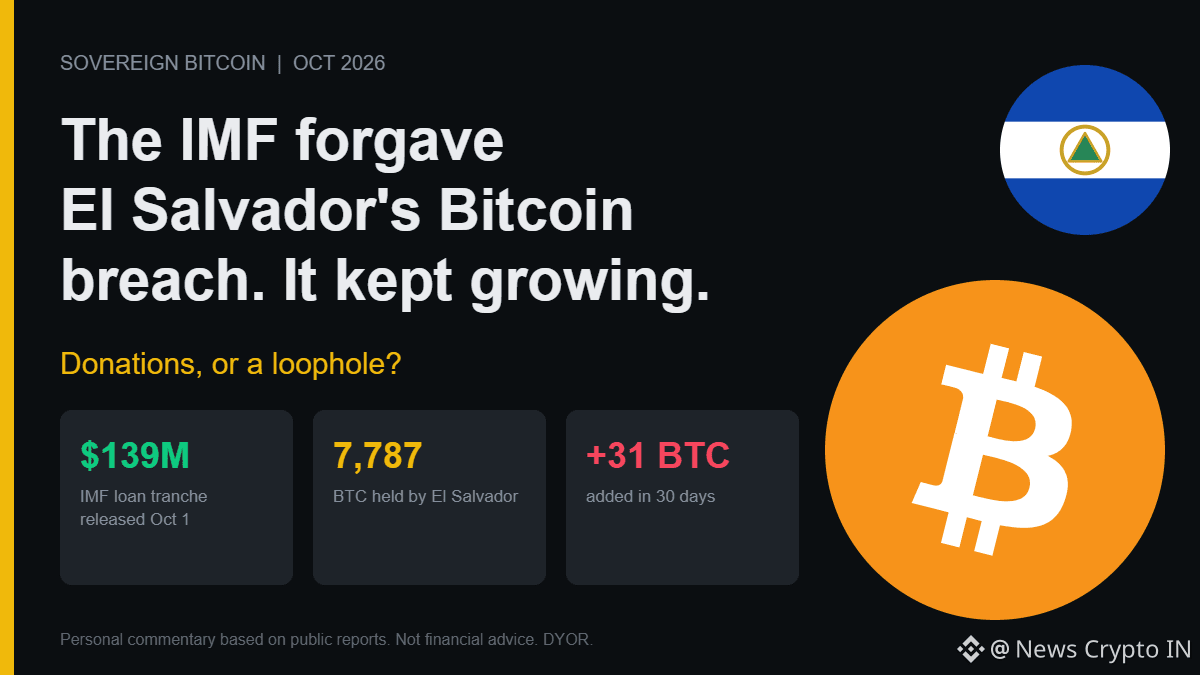
The IMF just released $139M to El Salvador, after formally waiving the country's breach of its Bitcoin limit. The board completed the second and third reviews of the $1.4B loan program on Oct 1. It acknowledged that El Salvador's Bitcoin holdings grew beyond the agreed cap, then forgave it.
The IMF's explanation: the extra $BTC came from private donations, not public funds. Its stated expectation is that there will be no further accumulation beyond those documented donations.
The awkward part: El Salvador's own Bitcoin tracker shows holdings around 7,787 BTC, with about 31 BTC added in the last 30 days and 8 in the past week. The donors haven't been publicly identified. So either the donations keep coming at roughly a coin a day, or the "no further accumulation" line is already being tested.
The fair read: this isn't a pro-Bitcoin pivot by the IMF. The $139M goes to El Salvador's treasury, not into Bitcoin. Control of the Chivo wallet has been handed to a private operator. And the IMF recorded the breach before forgiving it, which makes the cap stricter on paper, not looser.
When a sovereign Bitcoin stack keeps growing through anonymous "donations," is that a clever workaround, or a loophole the IMF chose not to look at?
#ElSalvador #IMF
The IMF just released $139M to El Salvador, after formally waiving the country's breach of its Bitcoin limit. The board completed the second and third reviews of the $1.4B loan program on Oct 1. It acknowledged that El Salvador's Bitcoin holdings grew beyond the agreed cap, then forgave it.
The IMF's explanation: the extra $BTC came from private donations, not public funds. Its stated expectation is that there will be no further accumulation beyond those documented donations.
The awkward part: El Salvador's own Bitcoin tracker shows holdings around 7,787 BTC, with about 31 BTC added in the last 30 days and 8 in the past week. The donors haven't been publicly identified. So either the donations keep coming at roughly a coin a day, or the "no further accumulation" line is already being tested.
The fair read: this isn't a pro-Bitcoin pivot by the IMF. The $139M goes to El Salvador's treasury, not into Bitcoin. Control of the Chivo wallet has been handed to a private operator. And the IMF recorded the breach before forgiving it, which makes the cap stricter on paper, not looser.
When a sovereign Bitcoin stack keeps growing through anonymous "donations," is that a clever workaround, or a loophole the IMF chose not to look at?
#ElSalvador #IMF
The IMF's explanation: the extra $BTC came from private donations, not public funds. Its stated expectation is that there will be no further accumulation beyond those documented donations.
The awkward part: El Salvador's own Bitcoin tracker shows holdings around 7,787 BTC, with about 31 BTC added in the last 30 days and 8 in the past week. The donors haven't been publicly identified. So either the donations keep coming at roughly a coin a day, or the "no further accumulation" line is already being tested.
The fair read: this isn't a pro-Bitcoin pivot by the IMF. The $139M goes to El Salvador's treasury, not into Bitcoin. Control of the Chivo wallet has been handed to a private operator. And the IMF recorded the breach before forgiving it, which makes the cap stricter on paper, not looser.
When a sovereign Bitcoin stack keeps growing through anonymous "donations," is that a clever workaround, or a loophole the IMF chose not to look at?
#ElSalvador #IMF
175
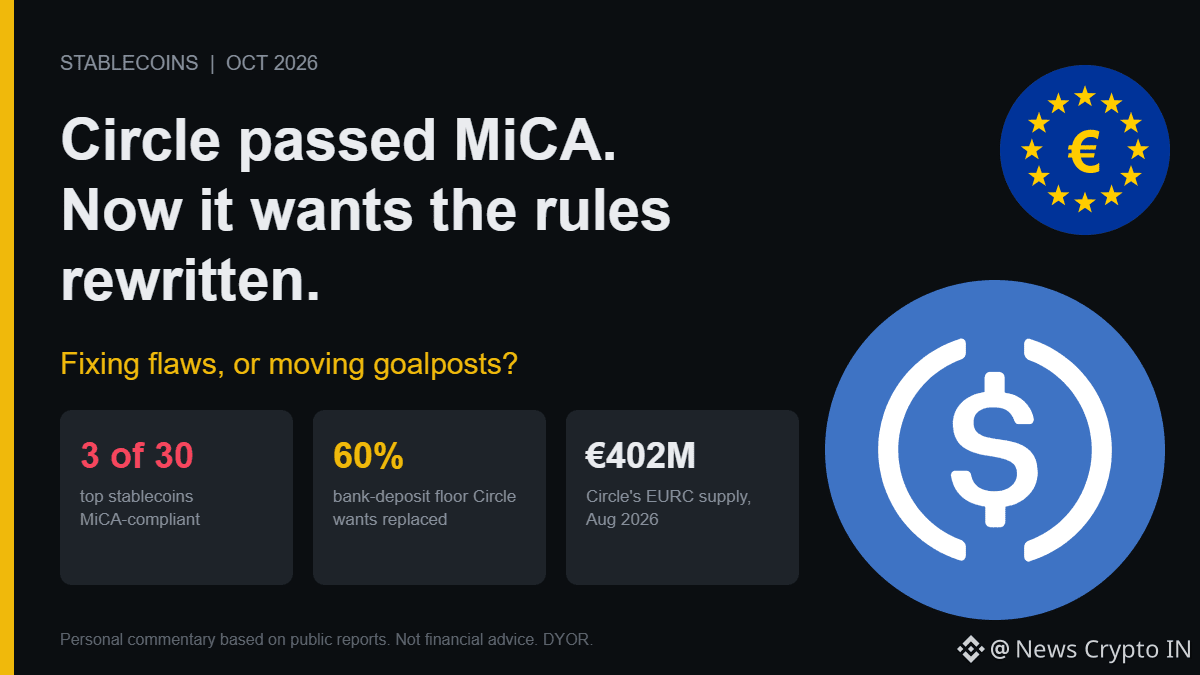
Only 3 of the top 30 stablecoins comply with Europe's MiCA rules: USDC, USDG and EURC. Two of those three are Circle's. And on Oct 1, Circle asked the European Commission to rewrite the rules anyway.
What Circle wants changed:
- Reserves: MiCA forces issuers to hold 30% of reserves as bank deposits, 60% for "significant" ones. Circle wants liquidity-based rules instead, plus looser concentration caps (35% per sovereign, 1.5% of a bank's assets per counterparty).
- Cross-border issuance: keep letting an EU-licensed entity issue the same token alongside affiliates abroad.
- Foreign recognition: let foreign-regulated stablecoins distribute through EU-licensed firms, modelled on the US GENIUS Act.
The cynical read writes itself: the company that already passed the test is lobbying to change the test, and every proposal happens to fit how a US-based global issuer operates.
But the reserve point has real history behind it. In March 2023, USDC briefly broke its peg because $3.3B of its reserves sat at Silicon Valley Bank when it failed. Forcing 60% of reserves into bank deposits puts more of a stablecoin's safety on the health of a few banks, the exact risk that already bit Circle once.
Is Circle fixing a genuine design flaw in MiCA, or using its compliant status to write the rules competitors will have to follow?
#Circle #MiCA
Only 3 of the top 30 stablecoins comply with Europe's MiCA rules: USDC, USDG and EURC. Two of those three are Circle's. And on Oct 1, Circle asked the European Commission to rewrite the rules anyway.
What Circle wants changed:
- Reserves: MiCA forces issuers to hold 30% of reserves as bank deposits, 60% for "significant" ones. Circle wants liquidity-based rules instead, plus looser concentration caps (35% per sovereign, 1.5% of a bank's assets per counterparty).
- Cross-border issuance: keep letting an EU-licensed entity issue the same token alongside affiliates abroad.
- Foreign recognition: let foreign-regulated stablecoins distribute through EU-licensed firms, modelled on the US GENIUS Act.
The cynical read writes itself: the company that already passed the test is lobbying to change the test, and every proposal happens to fit how a US-based global issuer operates.
But the reserve point has real history behind it. In March 2023, USDC briefly broke its peg because $3.3B of its reserves sat at Silicon Valley Bank when it failed. Forcing 60% of reserves into bank deposits puts more of a stablecoin's safety on the health of a few banks, the exact risk that already bit Circle once.
Is Circle fixing a genuine design flaw in MiCA, or using its compliant status to write the rules competitors will have to follow?
#Circle #MiCA
What Circle wants changed:
- Reserves: MiCA forces issuers to hold 30% of reserves as bank deposits, 60% for "significant" ones. Circle wants liquidity-based rules instead, plus looser concentration caps (35% per sovereign, 1.5% of a bank's assets per counterparty).
- Cross-border issuance: keep letting an EU-licensed entity issue the same token alongside affiliates abroad.
- Foreign recognition: let foreign-regulated stablecoins distribute through EU-licensed firms, modelled on the US GENIUS Act.
The cynical read writes itself: the company that already passed the test is lobbying to change the test, and every proposal happens to fit how a US-based global issuer operates.
But the reserve point has real history behind it. In March 2023, USDC briefly broke its peg because $3.3B of its reserves sat at Silicon Valley Bank when it failed. Forcing 60% of reserves into bank deposits puts more of a stablecoin's safety on the health of a few banks, the exact risk that already bit Circle once.
Is Circle fixing a genuine design flaw in MiCA, or using its compliant status to write the rules competitors will have to follow?
#Circle #MiCA
501
Partiellement vrai
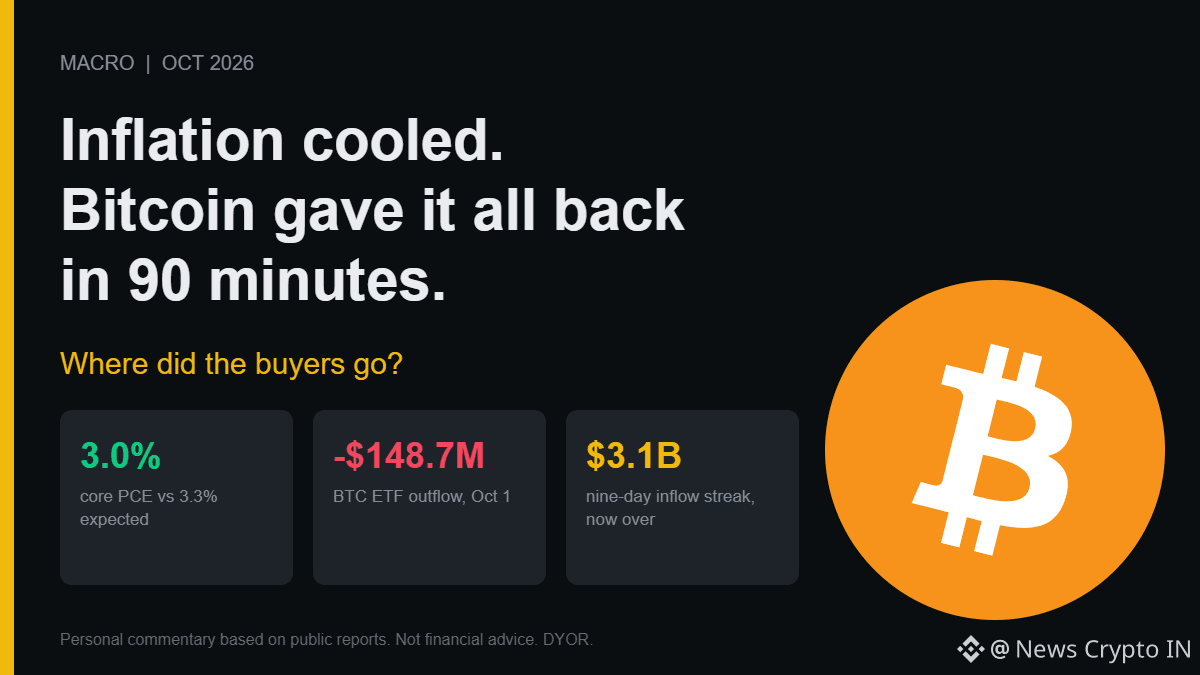
The macro data finally gave Bitcoin bulls what they wanted. August core PCE came in at 3.0% year over year, versus 3.3% expected. Softer inflation cut the odds of another Fed hike in October, and the 10-year yield dipped from about 5.23% to 5.20%.
$BTC spiked above $85,500 right after the release. Within about 90 minutes it was back below $83,500.
Then the ETF data landed. US spot Bitcoin ETFs posted a $148.7M net outflow on Oct 1, ending a nine-day, $3.1B inflow streak. Fidelity's FBTC alone saw $125.6M leave. Ether ETFs lost another $59.6M, a second straight day of outflows.
That's the uncomfortable combination: the best macro surprise in weeks, and the buyers who carried September stepped back the same day. A rally that can't hold through good news is telling you something about demand, not about the Fed.
One day of outflows doesn't end a trend. BTC still closed September up 6.4%. But if soft inflation can't keep BTC above $85K, what will?
#Bitcoin #PCE
The macro data finally gave Bitcoin bulls what they wanted. August core PCE came in at 3.0% year over year, versus 3.3% expected. Softer inflation cut the odds of another Fed hike in October, and the 10-year yield dipped from about 5.23% to 5.20%.
$BTC spiked above $85,500 right after the release. Within about 90 minutes it was back below $83,500.
Then the ETF data landed. US spot Bitcoin ETFs posted a $148.7M net outflow on Oct 1, ending a nine-day, $3.1B inflow streak. Fidelity's FBTC alone saw $125.6M leave. Ether ETFs lost another $59.6M, a second straight day of outflows.
That's the uncomfortable combination: the best macro surprise in weeks, and the buyers who carried September stepped back the same day. A rally that can't hold through good news is telling you something about demand, not about the Fed.
One day of outflows doesn't end a trend. BTC still closed September up 6.4%. But if soft inflation can't keep BTC above $85K, what will?
#Bitcoin #PCE
$BTC spiked above $85,500 right after the release. Within about 90 minutes it was back below $83,500.
Then the ETF data landed. US spot Bitcoin ETFs posted a $148.7M net outflow on Oct 1, ending a nine-day, $3.1B inflow streak. Fidelity's FBTC alone saw $125.6M leave. Ether ETFs lost another $59.6M, a second straight day of outflows.
That's the uncomfortable combination: the best macro surprise in weeks, and the buyers who carried September stepped back the same day. A rally that can't hold through good news is telling you something about demand, not about the Fed.
One day of outflows doesn't end a trend. BTC still closed September up 6.4%. But if soft inflation can't keep BTC above $85K, what will?
#Bitcoin #PCE
2
1.3k
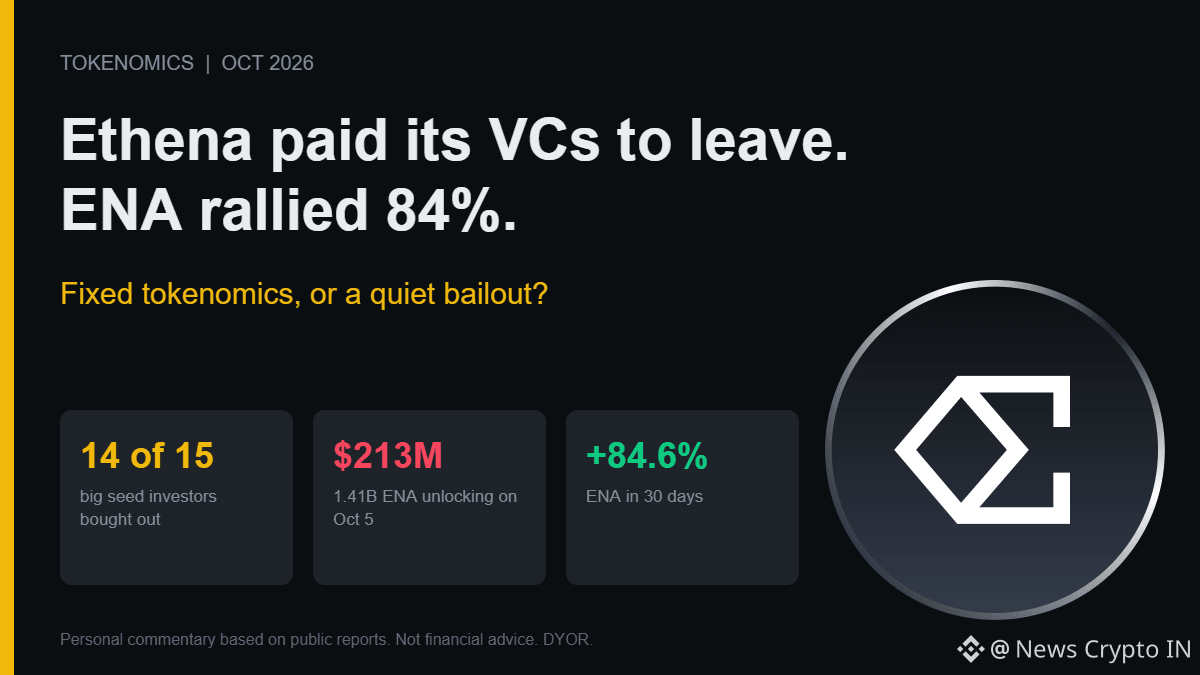
The Ethena Foundation quietly bought out its early investors, and $ENA is up 84.6% in 30 days.
Here's what happened: over two weeks, the Foundation bought all the locked tokens of 14 of its 15 largest seed investors through OTC deals. The selection rule is the interesting part. It targeted investors who had sold ENA after the October 2025 market peak. The terms weren't disclosed. Investors who never sold were offered a buyout at their original purchase price. None accepted.
The rest of the investor vesting now collapses into one event: about 1.41B ENA (~$213M) unlocks on Oct 5, after which the monthly unlock calendar disappears. Roughly 12% of supply stays locked, all team, ecosystem and Foundation.
The bull case is real: less monthly sell pressure, a clean cap table, and a proposed revenue-funded buyback once USDe grows.
The skeptical read: a foundation used its treasury to take out exactly the investors who were already selling, on terms nobody outside can see. Holders who stayed loyal got a lowball offer. And the market pumped on the removal of supply, not on new demand.
Is this a tokenomics fix other projects should copy, or a treasury-funded exit for the VCs who were heading for the door anyway?
#Ethena #Tokenomics
The Ethena Foundation quietly bought out its early investors, and $ENA is up 84.6% in 30 days.
Here's what happened: over two weeks, the Foundation bought all the locked tokens of 14 of its 15 largest seed investors through OTC deals. The selection rule is the interesting part. It targeted investors who had sold ENA after the October 2025 market peak. The terms weren't disclosed. Investors who never sold were offered a buyout at their original purchase price. None accepted.
The rest of the investor vesting now collapses into one event: about 1.41B ENA (~$213M) unlocks on Oct 5, after which the monthly unlock calendar disappears. Roughly 12% of supply stays locked, all team, ecosystem and Foundation.
The bull case is real: less monthly sell pressure, a clean cap table, and a proposed revenue-funded buyback once USDe grows.
The skeptical read: a foundation used its treasury to take out exactly the investors who were already selling, on terms nobody outside can see. Holders who stayed loyal got a lowball offer. And the market pumped on the removal of supply, not on new demand.
Is this a tokenomics fix other projects should copy, or a treasury-funded exit for the VCs who were heading for the door anyway?
#Ethena #Tokenomics
Here's what happened: over two weeks, the Foundation bought all the locked tokens of 14 of its 15 largest seed investors through OTC deals. The selection rule is the interesting part. It targeted investors who had sold ENA after the October 2025 market peak. The terms weren't disclosed. Investors who never sold were offered a buyout at their original purchase price. None accepted.
The rest of the investor vesting now collapses into one event: about 1.41B ENA (~$213M) unlocks on Oct 5, after which the monthly unlock calendar disappears. Roughly 12% of supply stays locked, all team, ecosystem and Foundation.
The bull case is real: less monthly sell pressure, a clean cap table, and a proposed revenue-funded buyback once USDe grows.
The skeptical read: a foundation used its treasury to take out exactly the investors who were already selling, on terms nobody outside can see. Holders who stayed loyal got a lowball offer. And the market pumped on the removal of supply, not on new demand.
Is this a tokenomics fix other projects should copy, or a treasury-funded exit for the VCs who were heading for the door anyway?
#Ethena #Tokenomics
150
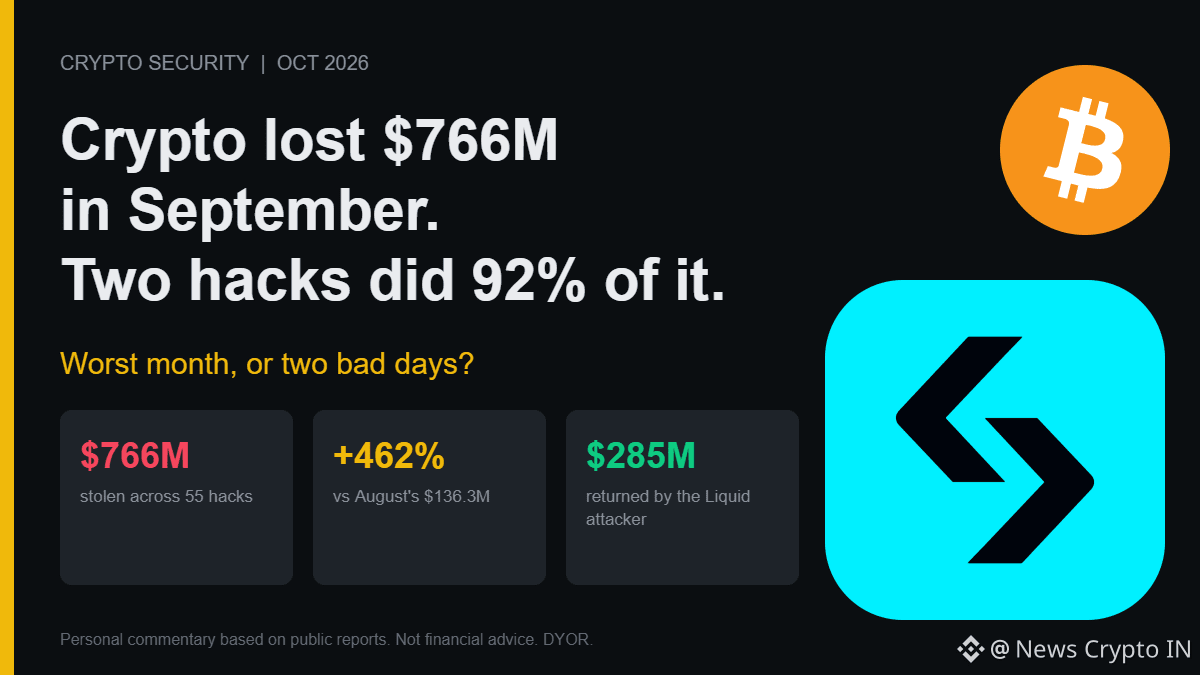
September was officially crypto's worst hack month of 2026: 55 major incidents and $766M stolen, according to PeckShield. That's up ~462% from August's $136.3M. CertiK puts the year-to-date total at 656 incidents and about $2.68B.
Now look at how concentrated it is. Two incidents, the Bitget hot-wallet breach ($387.5M, Sept 24) and the Liquid Network exploit (~$320M, Sept 6), make up 92% of the month's losses. The other 53 hacks combined account for roughly $60M (my math).
And the headline number overstates what's actually gone. The Liquid attacker returned about $285M, roughly 85% of what was taken. Net of the funds returned so far, September's real loss is closer to $470M (my math). Still terrible. Just not the number in the headlines.
Both big hits also came through doors audits don't cover. Bitget was breached via compromised third-party security software. Liquid's flaw was a validation bug in the Elements codebase that let an attacker mint about 4,000 unbacked L-BTC. Neither was a classic smart-contract bug.
So which story is true: an industry getting hacked more often, or an industry with a couple of catastrophic single points of failure?
#CryptoSecurity #PeckShield
September was officially crypto's worst hack month of 2026: 55 major incidents and $766M stolen, according to PeckShield. That's up ~462% from August's $136.3M. CertiK puts the year-to-date total at 656 incidents and about $2.68B.
Now look at how concentrated it is. Two incidents, the Bitget hot-wallet breach ($387.5M, Sept 24) and the Liquid Network exploit (~$320M, Sept 6), make up 92% of the month's losses. The other 53 hacks combined account for roughly $60M (my math).
And the headline number overstates what's actually gone. The Liquid attacker returned about $285M, roughly 85% of what was taken. Net of the funds returned so far, September's real loss is closer to $470M (my math). Still terrible. Just not the number in the headlines.
Both big hits also came through doors audits don't cover. Bitget was breached via compromised third-party security software. Liquid's flaw was a validation bug in the Elements codebase that let an attacker mint about 4,000 unbacked L-BTC. Neither was a classic smart-contract bug.
So which story is true: an industry getting hacked more often, or an industry with a couple of catastrophic single points of failure?
#CryptoSecurity #PeckShield
Now look at how concentrated it is. Two incidents, the Bitget hot-wallet breach ($387.5M, Sept 24) and the Liquid Network exploit (~$320M, Sept 6), make up 92% of the month's losses. The other 53 hacks combined account for roughly $60M (my math).
And the headline number overstates what's actually gone. The Liquid attacker returned about $285M, roughly 85% of what was taken. Net of the funds returned so far, September's real loss is closer to $470M (my math). Still terrible. Just not the number in the headlines.
Both big hits also came through doors audits don't cover. Bitget was breached via compromised third-party security software. Liquid's flaw was a validation bug in the Elements codebase that let an attacker mint about 4,000 unbacked L-BTC. Neither was a classic smart-contract bug.
So which story is true: an industry getting hacked more often, or an industry with a couple of catastrophic single points of failure?
#CryptoSecurity #PeckShield
653
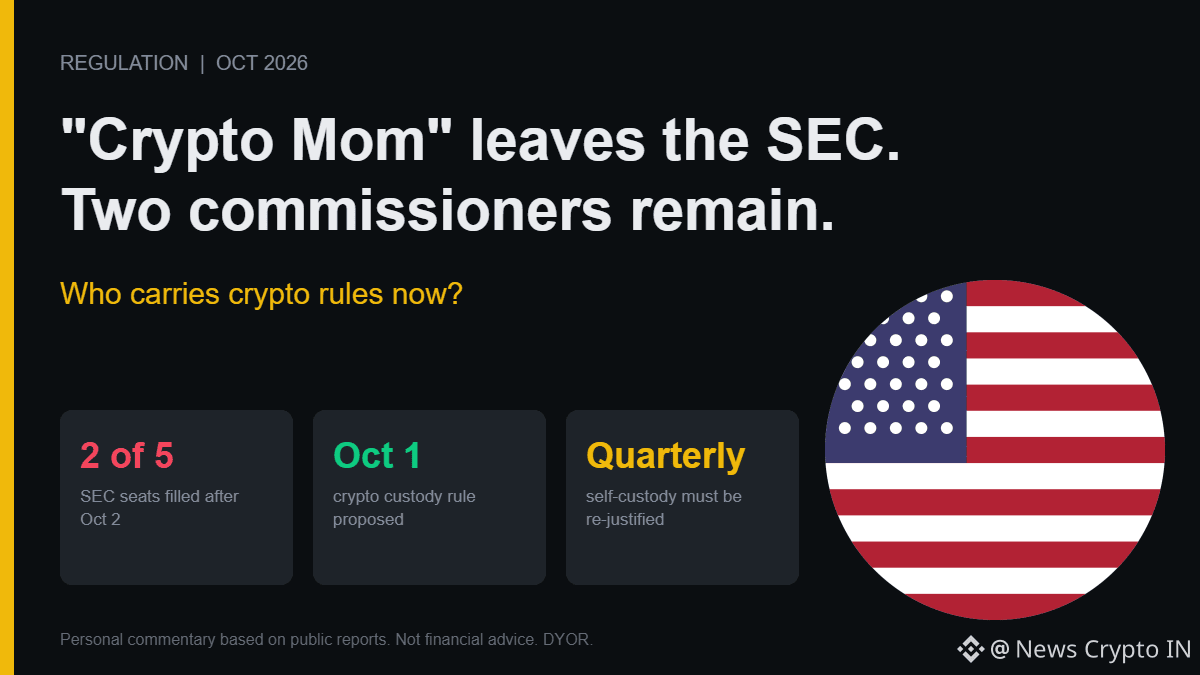
Hester Peirce, the SEC commissioner crypto nicknamed "Crypto Mom," leaves the agency today (Oct 2) for a law professorship. Her last act as Crypto Task Force chief: an Oct 1 proposal letting investment advisers and funds custody crypto, including self-custody in limited cases and state trust companies as custodians.
The custody rule is a real shift. Advisers could hold client crypto themselves when no permitted custodian is available for an asset, but they'd have to prove that for each asset and re-justify it every quarter. It's a door, not a free pass.
The bigger story is who's left. With Peirce gone, the SEC has two sitting commissioners out of five: Chair Paul Atkins and Mark Uyeda. Both lean crypto-friendly, so the direction likely doesn't reverse. But she was the one translating between industry legal teams and the rulemaking machine, and a lot is still pending: the broader crypto-asset framework, commodity-trust options deadlines, and the custody rewrite itself.
A two-person commission can still vote. What it loses is bandwidth and the person who knew this file best.
Does crypto policy at the SEC keep its momentum with two commissioners, or did the industry just lose its most effective insider?
#SEC #CryptoRegulation
Hester Peirce, the SEC commissioner crypto nicknamed "Crypto Mom," leaves the agency today (Oct 2) for a law professorship. Her last act as Crypto Task Force chief: an Oct 1 proposal letting investment advisers and funds custody crypto, including self-custody in limited cases and state trust companies as custodians.
The custody rule is a real shift. Advisers could hold client crypto themselves when no permitted custodian is available for an asset, but they'd have to prove that for each asset and re-justify it every quarter. It's a door, not a free pass.
The bigger story is who's left. With Peirce gone, the SEC has two sitting commissioners out of five: Chair Paul Atkins and Mark Uyeda. Both lean crypto-friendly, so the direction likely doesn't reverse. But she was the one translating between industry legal teams and the rulemaking machine, and a lot is still pending: the broader crypto-asset framework, commodity-trust options deadlines, and the custody rewrite itself.
A two-person commission can still vote. What it loses is bandwidth and the person who knew this file best.
Does crypto policy at the SEC keep its momentum with two commissioners, or did the industry just lose its most effective insider?
#SEC #CryptoRegulation
The custody rule is a real shift. Advisers could hold client crypto themselves when no permitted custodian is available for an asset, but they'd have to prove that for each asset and re-justify it every quarter. It's a door, not a free pass.
The bigger story is who's left. With Peirce gone, the SEC has two sitting commissioners out of five: Chair Paul Atkins and Mark Uyeda. Both lean crypto-friendly, so the direction likely doesn't reverse. But she was the one translating between industry legal teams and the rulemaking machine, and a lot is still pending: the broader crypto-asset framework, commodity-trust options deadlines, and the custody rewrite itself.
A two-person commission can still vote. What it loses is bandwidth and the person who knew this file best.
Does crypto policy at the SEC keep its momentum with two commissioners, or did the industry just lose its most effective insider?
#SEC #CryptoRegulation
204
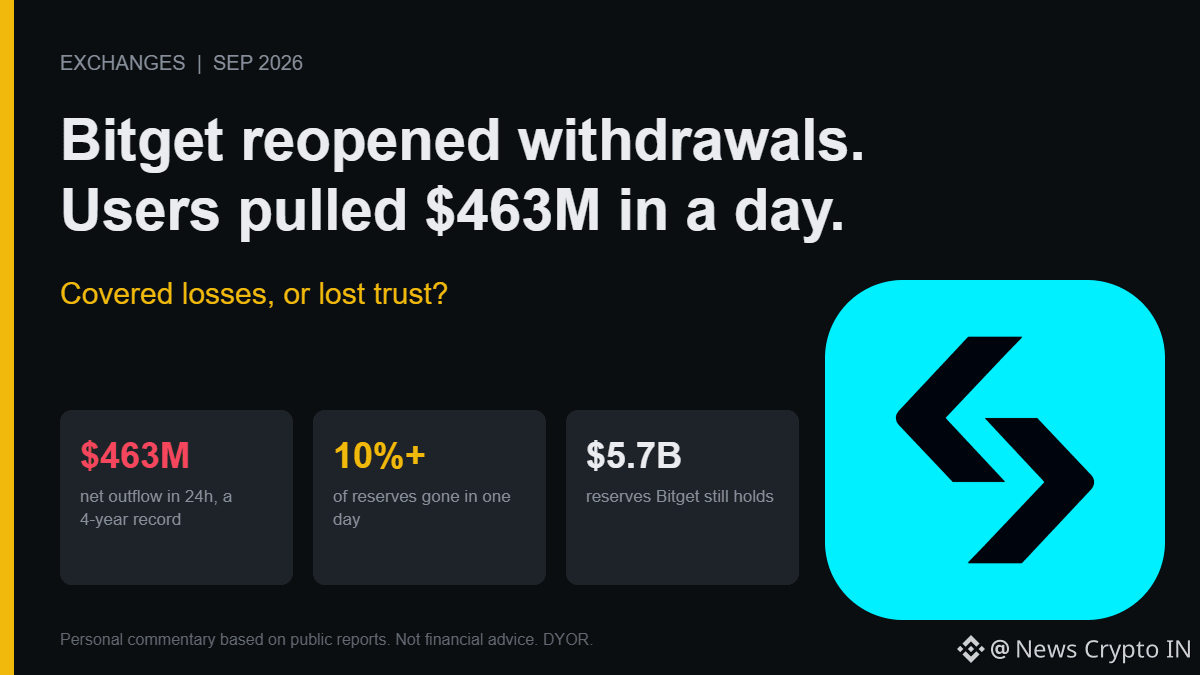
Bitget promised users they'd be made whole after the $387.5M hack. Then it reopened withdrawals, and users pulled $463M in 24 hours anyway.
That's the largest single-day outflow DefiLlama has recorded since it started tracking exchange proof-of-reserves four years ago. It's more than 10% of Bitget's reserves gone in one day. The exchange still holds about $5.7B, so this isn't insolvency, but it's a clear vote of no confidence.
Here's the part worth sitting with: the user losses were covered. Bitget's Protection Fund absorbed the hack. Nobody's balance was touched. And people left anyway, in greater numbers than the hack itself.
That's the real cost of a security breach. Not the stolen amount, but the trust. The Protection Fund has been drawn down and Bitget says it plans to top it back above $300M within seven days. Until then, the safety net that made users whole this time is thinner than it was a week ago.
Exchanges market insurance funds as "your money is safe here." The market just showed that users read a hack as a reason to leave, even when the fund works exactly as advertised.
If a fully covered hack still triggers a record run, what is an exchange insurance fund actually buying?
#Bitget #ProofOfReserves
Bitget promised users they'd be made whole after the $387.5M hack. Then it reopened withdrawals, and users pulled $463M in 24 hours anyway.
That's the largest single-day outflow DefiLlama has recorded since it started tracking exchange proof-of-reserves four years ago. It's more than 10% of Bitget's reserves gone in one day. The exchange still holds about $5.7B, so this isn't insolvency, but it's a clear vote of no confidence.
Here's the part worth sitting with: the user losses were covered. Bitget's Protection Fund absorbed the hack. Nobody's balance was touched. And people left anyway, in greater numbers than the hack itself.
That's the real cost of a security breach. Not the stolen amount, but the trust. The Protection Fund has been drawn down and Bitget says it plans to top it back above $300M within seven days. Until then, the safety net that made users whole this time is thinner than it was a week ago.
Exchanges market insurance funds as "your money is safe here." The market just showed that users read a hack as a reason to leave, even when the fund works exactly as advertised.
If a fully covered hack still triggers a record run, what is an exchange insurance fund actually buying?
#Bitget #ProofOfReserves
That's the largest single-day outflow DefiLlama has recorded since it started tracking exchange proof-of-reserves four years ago. It's more than 10% of Bitget's reserves gone in one day. The exchange still holds about $5.7B, so this isn't insolvency, but it's a clear vote of no confidence.
Here's the part worth sitting with: the user losses were covered. Bitget's Protection Fund absorbed the hack. Nobody's balance was touched. And people left anyway, in greater numbers than the hack itself.
That's the real cost of a security breach. Not the stolen amount, but the trust. The Protection Fund has been drawn down and Bitget says it plans to top it back above $300M within seven days. Until then, the safety net that made users whole this time is thinner than it was a week ago.
Exchanges market insurance funds as "your money is safe here." The market just showed that users read a hack as a reason to leave, even when the fund works exactly as advertised.
If a fully covered hack still triggers a record run, what is an exchange insurance fund actually buying?
#Bitget #ProofOfReserves
2
3.8k
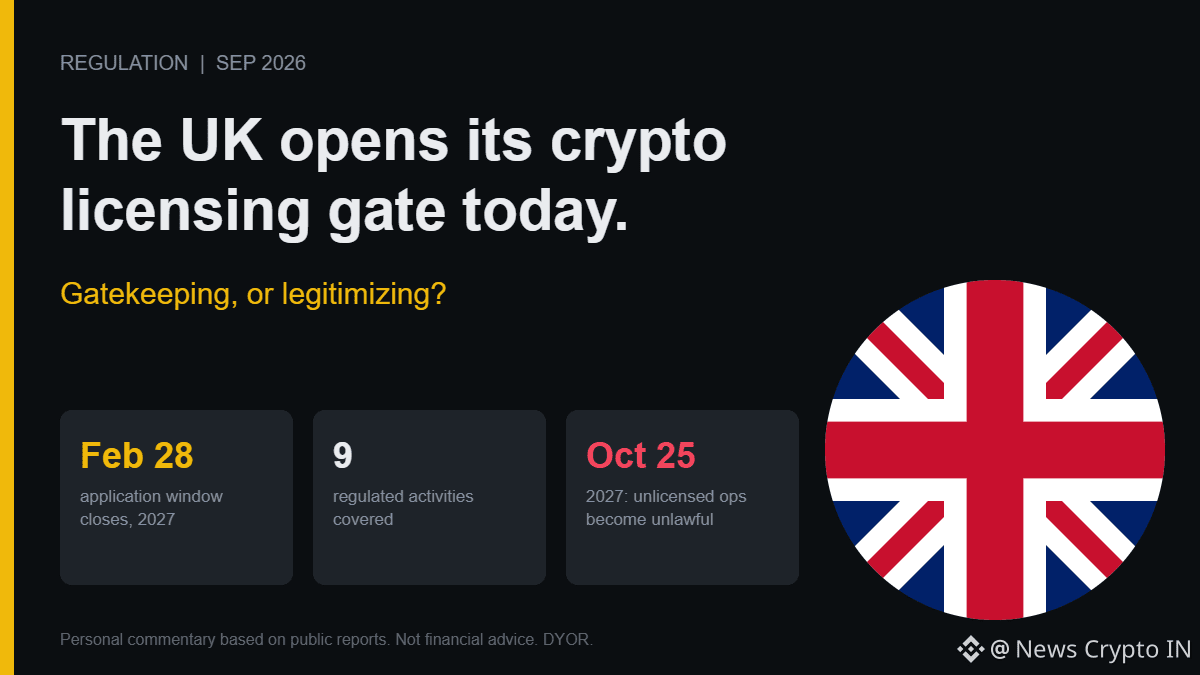
The UK opened its crypto authorisation gateway today (Sept 30). Firms have until Feb 28, 2027 to apply under FSMA for one of nine regulated activities: operating a trading platform, dealing as principal or agent, safeguarding cryptoassets, staking, and more. The new regime becomes fully binding Oct 25, 2027, after that, running an unauthorised regulated crypto activity reaching UK consumers is unlawful.
The detail that matters: existing UK registrations under the old Money Laundering Regulations do NOT convert automatically. Every firm already operating has to file for a brand-new FSMA authorisation, even the ones the FCA has been supervising for years.
There's a real safety net: firms that apply within the window can keep operating in the UK under "saving provisions" while the FCA reviews them. So this isn't an overnight ban. It's a long runway with a hard deadline at the end.
The part that gets skipped: the FCA's perimeter isn't UK-office-bound. Any firm anywhere reaching UK consumers can fall inside it. A US or Asia-based exchange with UK users may need this license just as much as a London startup.
Bulls call this legitimacy, a real regulator building a real pathway to operate. Skeptics call it a filter that only well-capitalized players can clear, the same compliance-cost story we've covered before with stablecoins.
Seventeen months to comply, or lose UK market access. Is that enough runway, or a slow-motion squeeze?
#FCA #CryptoRegulation
The UK opened its crypto authorisation gateway today (Sept 30). Firms have until Feb 28, 2027 to apply under FSMA for one of nine regulated activities: operating a trading platform, dealing as principal or agent, safeguarding cryptoassets, staking, and more. The new regime becomes fully binding Oct 25, 2027, after that, running an unauthorised regulated crypto activity reaching UK consumers is unlawful.
The detail that matters: existing UK registrations under the old Money Laundering Regulations do NOT convert automatically. Every firm already operating has to file for a brand-new FSMA authorisation, even the ones the FCA has been supervising for years.
There's a real safety net: firms that apply within the window can keep operating in the UK under "saving provisions" while the FCA reviews them. So this isn't an overnight ban. It's a long runway with a hard deadline at the end.
The part that gets skipped: the FCA's perimeter isn't UK-office-bound. Any firm anywhere reaching UK consumers can fall inside it. A US or Asia-based exchange with UK users may need this license just as much as a London startup.
Bulls call this legitimacy, a real regulator building a real pathway to operate. Skeptics call it a filter that only well-capitalized players can clear, the same compliance-cost story we've covered before with stablecoins.
Seventeen months to comply, or lose UK market access. Is that enough runway, or a slow-motion squeeze?
#FCA #CryptoRegulation
The detail that matters: existing UK registrations under the old Money Laundering Regulations do NOT convert automatically. Every firm already operating has to file for a brand-new FSMA authorisation, even the ones the FCA has been supervising for years.
There's a real safety net: firms that apply within the window can keep operating in the UK under "saving provisions" while the FCA reviews them. So this isn't an overnight ban. It's a long runway with a hard deadline at the end.
The part that gets skipped: the FCA's perimeter isn't UK-office-bound. Any firm anywhere reaching UK consumers can fall inside it. A US or Asia-based exchange with UK users may need this license just as much as a London startup.
Bulls call this legitimacy, a real regulator building a real pathway to operate. Skeptics call it a filter that only well-capitalized players can clear, the same compliance-cost story we've covered before with stablecoins.
Seventeen months to comply, or lose UK market access. Is that enough runway, or a slow-motion squeeze?
#FCA #CryptoRegulation
1.1k
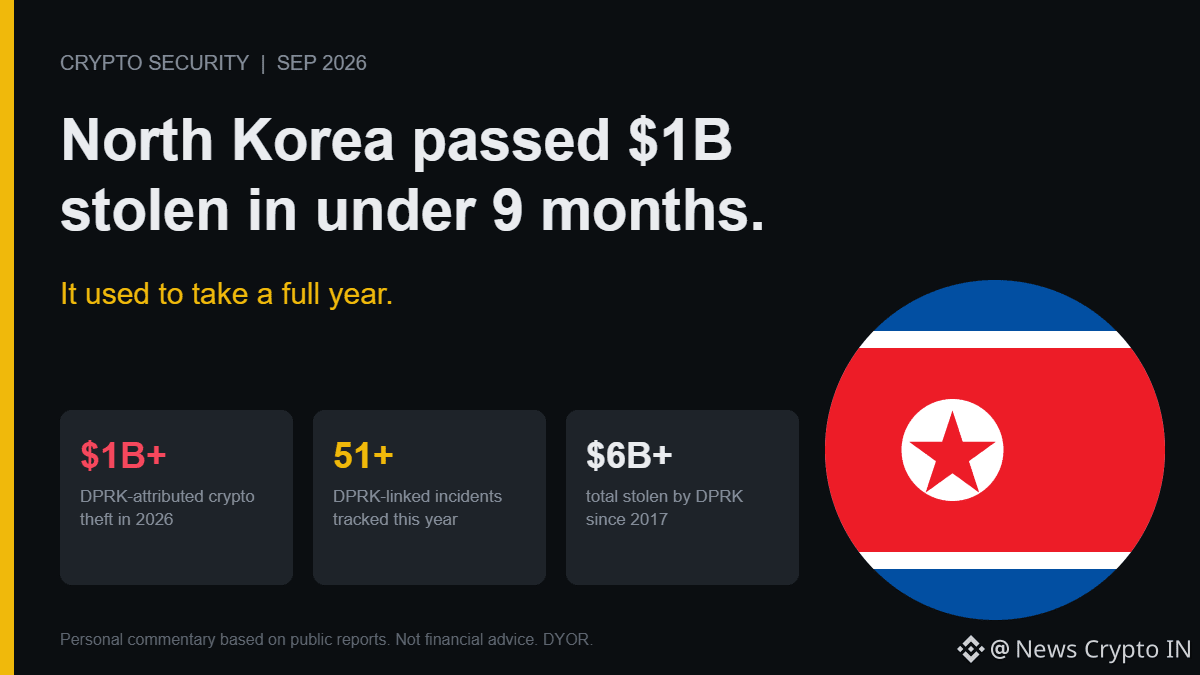
North Korea just crossed $1 billion in crypto theft for 2026, and did it in under 9 months. Last year that milestone took a full 12.
The Bitget hack ($387.5M, confirmed Sept 24) pushed the total over the line. Elliptic has tracked 51+ DPRK-linked incidents this year alone, part of a cumulative haul north of $6B since 2017. Another 2026 example: the Drift Protocol attack, where social engineering moved $285M out in 12 minutes.
The acceleration matters more than the total. A state actor getting faster at extracting nine-figure sums means the industry's security model isn't just losing dollars, it's losing the race. Exchanges harden one attack surface (hot wallets, smart contract audits), and the next hit comes through a different door: spoofed transfers, social engineering, insider access.
Not every attribution is airtight; Bitget's own CEO called the tactics "consistent with" DPRK groups, not confirmed Lazarus. But the pattern across 51 incidents this year is hard to wave away as coincidence.
At this pace, when does $1B/year in state-sponsored theft become a cost the industry just prices in, instead of a crisis?
#Lazarus #CryptoSecurity
North Korea just crossed $1 billion in crypto theft for 2026, and did it in under 9 months. Last year that milestone took a full 12.
The Bitget hack ($387.5M, confirmed Sept 24) pushed the total over the line. Elliptic has tracked 51+ DPRK-linked incidents this year alone, part of a cumulative haul north of $6B since 2017. Another 2026 example: the Drift Protocol attack, where social engineering moved $285M out in 12 minutes.
The acceleration matters more than the total. A state actor getting faster at extracting nine-figure sums means the industry's security model isn't just losing dollars, it's losing the race. Exchanges harden one attack surface (hot wallets, smart contract audits), and the next hit comes through a different door: spoofed transfers, social engineering, insider access.
Not every attribution is airtight; Bitget's own CEO called the tactics "consistent with" DPRK groups, not confirmed Lazarus. But the pattern across 51 incidents this year is hard to wave away as coincidence.
At this pace, when does $1B/year in state-sponsored theft become a cost the industry just prices in, instead of a crisis?
#Lazarus #CryptoSecurity
The Bitget hack ($387.5M, confirmed Sept 24) pushed the total over the line. Elliptic has tracked 51+ DPRK-linked incidents this year alone, part of a cumulative haul north of $6B since 2017. Another 2026 example: the Drift Protocol attack, where social engineering moved $285M out in 12 minutes.
The acceleration matters more than the total. A state actor getting faster at extracting nine-figure sums means the industry's security model isn't just losing dollars, it's losing the race. Exchanges harden one attack surface (hot wallets, smart contract audits), and the next hit comes through a different door: spoofed transfers, social engineering, insider access.
Not every attribution is airtight; Bitget's own CEO called the tactics "consistent with" DPRK groups, not confirmed Lazarus. But the pattern across 51 incidents this year is hard to wave away as coincidence.
At this pace, when does $1B/year in state-sponsored theft become a cost the industry just prices in, instead of a crisis?
#Lazarus #CryptoSecurity
1
1.3k
Vérifié
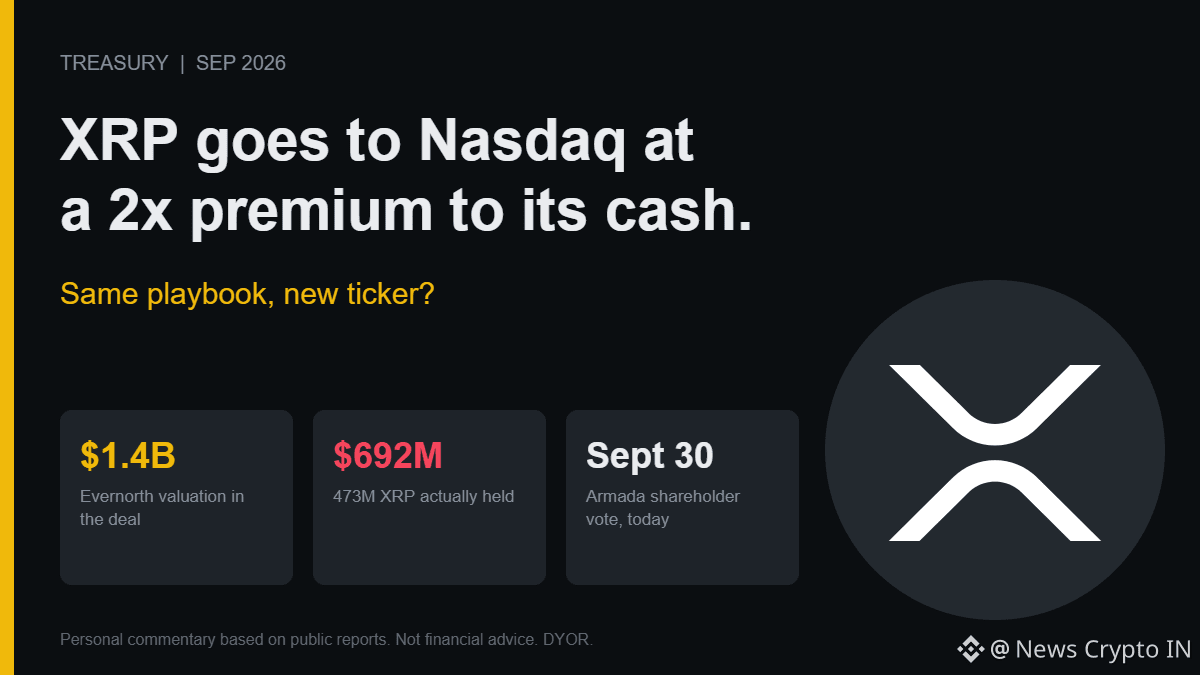
$XRP just got a very MSTR-style Nasdaq entry. Armada Acquisition Corp. II shareholders vote today (Sept 30) on merging with Evernorth, the XRP treasury company, to list as XRPN. The deal values Evernorth at $1.4B. Its actual holdings: 473M XRP, worth about $692M.
That's roughly a 2x premium to the XRP sitting on the balance sheet, the same treasury-premium playbook we just watched compress to 0.85x for Strategy and Bitcoin. Investors here include Ripple, Pantera, SBI Group, Arrington Capital, Kraken and GSR, so this isn't a fringe vehicle.
The pitch: XRPN gives US investors regulated equity exposure to XRP without touching an exchange. The catch: you're paying nearly double for that convenience, and premiums like this only hold up while retail keeps buying the wrapper faster than the underlying asset.
We already have the case study for what happens when that stops. Will XRPN's premium survive its first bad quarter, or follow Strategy's path toward 1x?
#XRP #Nasdaq
$XRP just got a very MSTR-style Nasdaq entry. Armada Acquisition Corp. II shareholders vote today (Sept 30) on merging with Evernorth, the XRP treasury company, to list as XRPN. The deal values Evernorth at $1.4B. Its actual holdings: 473M XRP, worth about $692M.
That's roughly a 2x premium to the XRP sitting on the balance sheet, the same treasury-premium playbook we just watched compress to 0.85x for Strategy and Bitcoin. Investors here include Ripple, Pantera, SBI Group, Arrington Capital, Kraken and GSR, so this isn't a fringe vehicle.
The pitch: XRPN gives US investors regulated equity exposure to XRP without touching an exchange. The catch: you're paying nearly double for that convenience, and premiums like this only hold up while retail keeps buying the wrapper faster than the underlying asset.
We already have the case study for what happens when that stops. Will XRPN's premium survive its first bad quarter, or follow Strategy's path toward 1x?
#XRP #Nasdaq
That's roughly a 2x premium to the XRP sitting on the balance sheet, the same treasury-premium playbook we just watched compress to 0.85x for Strategy and Bitcoin. Investors here include Ripple, Pantera, SBI Group, Arrington Capital, Kraken and GSR, so this isn't a fringe vehicle.
The pitch: XRPN gives US investors regulated equity exposure to XRP without touching an exchange. The catch: you're paying nearly double for that convenience, and premiums like this only hold up while retail keeps buying the wrapper faster than the underlying asset.
We already have the case study for what happens when that stops. Will XRPN's premium survive its first bad quarter, or follow Strategy's path toward 1x?
#XRP #Nasdaq
4
9
3.7k
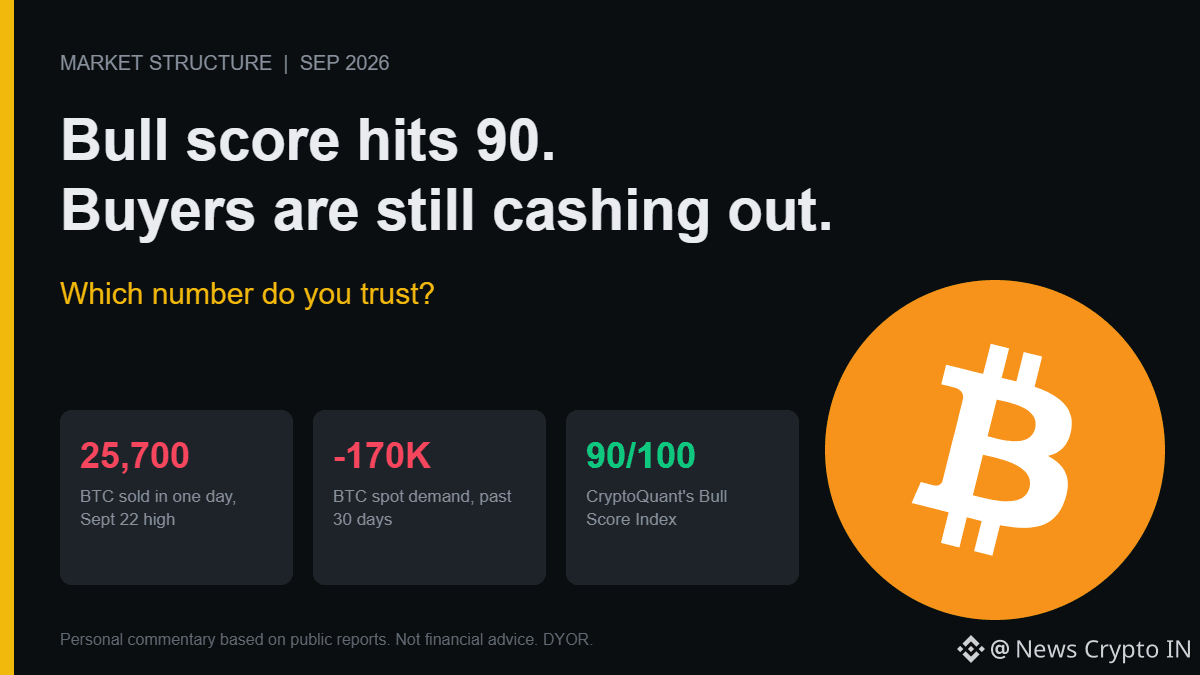
CryptoQuant's Bull Score Index for $BTC sits at 90 out of 100. That number alone would make you think this rally has room to run. Meanwhile, traders locked in 25,700 BTC of profit on Sept 22, the largest single-day realization this year, and recent buyers are sitting on 33% average unrealized profit, the widest cushion since December 2024.
Both facts are true at once, and that's exactly the problem with headline scores.
The Bull Score looks backward: BTC did close above its 365-day moving average, which historically confirms a new bull phase. But two other CryptoQuant metrics look forward, and they're flashing yellow. Spot demand contracted by about 170,000 BTC over the past 30 days. Futures demand growth, the speculative fuel for fast moves, collapsed 90% in 15 days.
BTC already gave back some of last week's gain, sliding from an eight-month high near $87,400 to about $83,300. That's not a crash. It's what happens when profit-taking outpaces fresh buying.
CryptoQuant's own read: "Without fresh demand, rallies struggle to extend." A score of 90 tells you the structure has been bullish. It doesn't tell you who's left to buy the next leg up.
If the people who bought this dip are already up 33% and start taking profit too, where does the next wave of demand come from?
#Bitcoin #CryptoQuant
CryptoQuant's Bull Score Index for $BTC sits at 90 out of 100. That number alone would make you think this rally has room to run. Meanwhile, traders locked in 25,700 BTC of profit on Sept 22, the largest single-day realization this year, and recent buyers are sitting on 33% average unrealized profit, the widest cushion since December 2024.
Both facts are true at once, and that's exactly the problem with headline scores.
The Bull Score looks backward: BTC did close above its 365-day moving average, which historically confirms a new bull phase. But two other CryptoQuant metrics look forward, and they're flashing yellow. Spot demand contracted by about 170,000 BTC over the past 30 days. Futures demand growth, the speculative fuel for fast moves, collapsed 90% in 15 days.
BTC already gave back some of last week's gain, sliding from an eight-month high near $87,400 to about $83,300. That's not a crash. It's what happens when profit-taking outpaces fresh buying.
CryptoQuant's own read: "Without fresh demand, rallies struggle to extend." A score of 90 tells you the structure has been bullish. It doesn't tell you who's left to buy the next leg up.
If the people who bought this dip are already up 33% and start taking profit too, where does the next wave of demand come from?
#Bitcoin #CryptoQuant
Both facts are true at once, and that's exactly the problem with headline scores.
The Bull Score looks backward: BTC did close above its 365-day moving average, which historically confirms a new bull phase. But two other CryptoQuant metrics look forward, and they're flashing yellow. Spot demand contracted by about 170,000 BTC over the past 30 days. Futures demand growth, the speculative fuel for fast moves, collapsed 90% in 15 days.
BTC already gave back some of last week's gain, sliding from an eight-month high near $87,400 to about $83,300. That's not a crash. It's what happens when profit-taking outpaces fresh buying.
CryptoQuant's own read: "Without fresh demand, rallies struggle to extend." A score of 90 tells you the structure has been bullish. It doesn't tell you who's left to buy the next leg up.
If the people who bought this dip are already up 33% and start taking profit too, where does the next wave of demand come from?
#Bitcoin #CryptoQuant
594
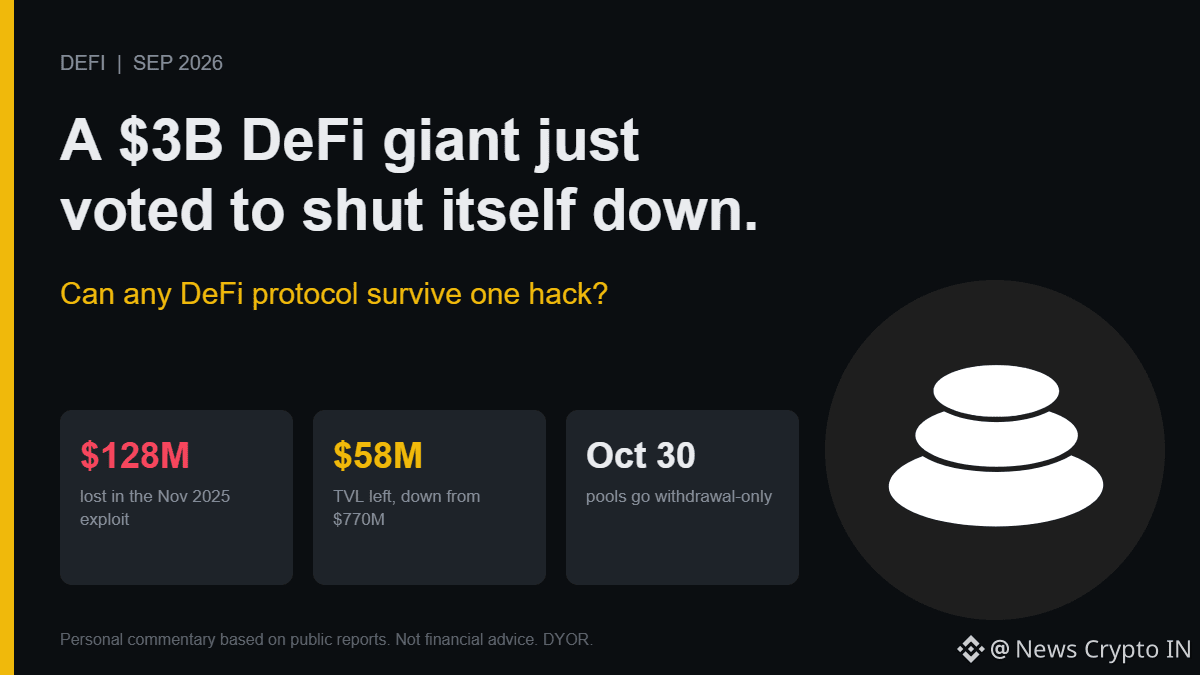
$BAL holders just voted to wind down Balancer, a protocol that once held $3B in TVL. BIP-928 passed. Pools stay open for withdrawals until Oct 30, and the V3 Vault pauses Nov 30.
The chain of events is brutal. Nov 3, 2025: an attacker exploits a rounding error in the "upscale" function of Composable Stable Pools, a precision-loss bug in how Solidity handles integer division at specific balance thresholds. $128M gone in one transaction. TVL drops 46% in a day, from $770M to $422M, and keeps bleeding to about $58M today. Monthly protocol revenue falls from $1.13M in October 2025 to $56,781 by August 2026. Balancer Labs, the corporate entity, shut down in March.
This wasn't a rug pull or a founder running off. It was audited code, a known team, years of operating history, and a math bug nobody caught until $128M was gone.
That's the uncomfortable read for DeFi generally: audits and reputation reduce risk, they don't remove it. A single exploit erased a $3B protocol's reason to exist, not because the treasury ran dry, but because users stopped trusting the pools enough to keep using them.
Balancer isn't the first "blue chip" DeFi protocol to fold after a hack, and it won't be the last.
If a protocol this established can be ended by one bug, what exactly does "battle-tested" mean in DeFi?
#Balancer #DeFi
$BAL holders just voted to wind down Balancer, a protocol that once held $3B in TVL. BIP-928 passed. Pools stay open for withdrawals until Oct 30, and the V3 Vault pauses Nov 30.
The chain of events is brutal. Nov 3, 2025: an attacker exploits a rounding error in the "upscale" function of Composable Stable Pools, a precision-loss bug in how Solidity handles integer division at specific balance thresholds. $128M gone in one transaction. TVL drops 46% in a day, from $770M to $422M, and keeps bleeding to about $58M today. Monthly protocol revenue falls from $1.13M in October 2025 to $56,781 by August 2026. Balancer Labs, the corporate entity, shut down in March.
This wasn't a rug pull or a founder running off. It was audited code, a known team, years of operating history, and a math bug nobody caught until $128M was gone.
That's the uncomfortable read for DeFi generally: audits and reputation reduce risk, they don't remove it. A single exploit erased a $3B protocol's reason to exist, not because the treasury ran dry, but because users stopped trusting the pools enough to keep using them.
Balancer isn't the first "blue chip" DeFi protocol to fold after a hack, and it won't be the last.
If a protocol this established can be ended by one bug, what exactly does "battle-tested" mean in DeFi?
#Balancer #DeFi
The chain of events is brutal. Nov 3, 2025: an attacker exploits a rounding error in the "upscale" function of Composable Stable Pools, a precision-loss bug in how Solidity handles integer division at specific balance thresholds. $128M gone in one transaction. TVL drops 46% in a day, from $770M to $422M, and keeps bleeding to about $58M today. Monthly protocol revenue falls from $1.13M in October 2025 to $56,781 by August 2026. Balancer Labs, the corporate entity, shut down in March.
This wasn't a rug pull or a founder running off. It was audited code, a known team, years of operating history, and a math bug nobody caught until $128M was gone.
That's the uncomfortable read for DeFi generally: audits and reputation reduce risk, they don't remove it. A single exploit erased a $3B protocol's reason to exist, not because the treasury ran dry, but because users stopped trusting the pools enough to keep using them.
Balancer isn't the first "blue chip" DeFi protocol to fold after a hack, and it won't be the last.
If a protocol this established can be ended by one bug, what exactly does "battle-tested" mean in DeFi?
#Balancer #DeFi
825
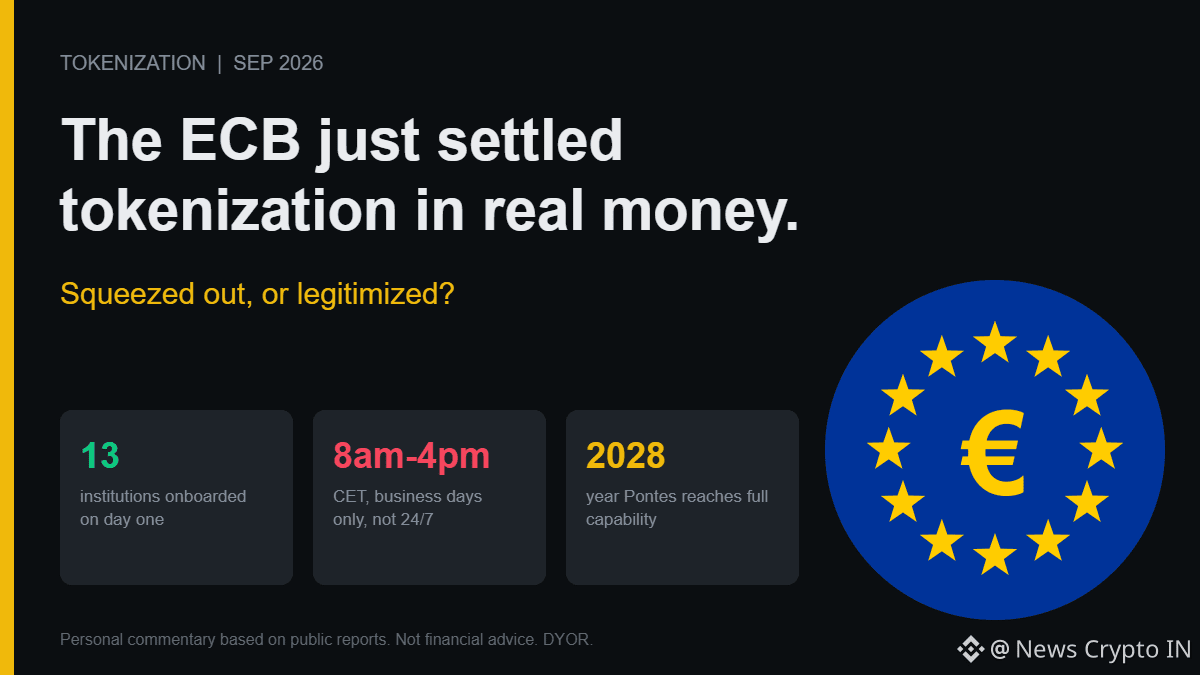
The ECB just switched on Pontes, a bridge that lets tokenized securities settle in actual central bank money. It went live Sept 21 with 13 institutions onboarded, including Deutsche Bank, Santander, Société Générale, KfW and the European Investment Bank, plus four ledger operators such as Clearstream. The ECB has also started preparing to invest a small part of its own funds in tokenized securities, settled through Pontes.
Why it matters: tokenized trades have mostly settled in commercial bank money or stablecoins, which carry credit risk big institutions dislike. A risk-free settlement asset was one of the biggest blockers. Pontes removes it, at least for wholesale players.
Now the caveats crypto Twitter will skip:
- It runs 8am to 4pm CET on business days. Not 24/7.
- Cash-leg finality is still anchored in the existing TARGET2 system.
- It's wholesale only, for banks and market infrastructure, not for retail.
- Full capability, with longer hours and more features, is targeted for 2028.
So this isn't "blockchain replaces banks." It's banks adopting blockchain on their own terms, with the central bank as the settlement layer.
The open question for stablecoins: if institutions can settle tokenized assets in central bank money, what is the wholesale use case for a private stablecoin? Retail and 24/7 still look like stablecoin territory (my read), but the institutional slice just got narrower.
Does central bank settlement squeeze stablecoins out of institutional finance, or does it legitimize the tokenization trade crypto has been selling?
#ECB #Tokenization
The ECB just switched on Pontes, a bridge that lets tokenized securities settle in actual central bank money. It went live Sept 21 with 13 institutions onboarded, including Deutsche Bank, Santander, Société Générale, KfW and the European Investment Bank, plus four ledger operators such as Clearstream. The ECB has also started preparing to invest a small part of its own funds in tokenized securities, settled through Pontes.
Why it matters: tokenized trades have mostly settled in commercial bank money or stablecoins, which carry credit risk big institutions dislike. A risk-free settlement asset was one of the biggest blockers. Pontes removes it, at least for wholesale players.
Now the caveats crypto Twitter will skip:
- It runs 8am to 4pm CET on business days. Not 24/7.
- Cash-leg finality is still anchored in the existing TARGET2 system.
- It's wholesale only, for banks and market infrastructure, not for retail.
- Full capability, with longer hours and more features, is targeted for 2028.
So this isn't "blockchain replaces banks." It's banks adopting blockchain on their own terms, with the central bank as the settlement layer.
The open question for stablecoins: if institutions can settle tokenized assets in central bank money, what is the wholesale use case for a private stablecoin? Retail and 24/7 still look like stablecoin territory (my read), but the institutional slice just got narrower.
Does central bank settlement squeeze stablecoins out of institutional finance, or does it legitimize the tokenization trade crypto has been selling?
#ECB #Tokenization
Why it matters: tokenized trades have mostly settled in commercial bank money or stablecoins, which carry credit risk big institutions dislike. A risk-free settlement asset was one of the biggest blockers. Pontes removes it, at least for wholesale players.
Now the caveats crypto Twitter will skip:
- It runs 8am to 4pm CET on business days. Not 24/7.
- Cash-leg finality is still anchored in the existing TARGET2 system.
- It's wholesale only, for banks and market infrastructure, not for retail.
- Full capability, with longer hours and more features, is targeted for 2028.
So this isn't "blockchain replaces banks." It's banks adopting blockchain on their own terms, with the central bank as the settlement layer.
The open question for stablecoins: if institutions can settle tokenized assets in central bank money, what is the wholesale use case for a private stablecoin? Retail and 24/7 still look like stablecoin territory (my read), but the institutional slice just got narrower.
Does central bank settlement squeeze stablecoins out of institutional finance, or does it legitimize the tokenization trade crypto has been selling?
#ECB #Tokenization
1
958
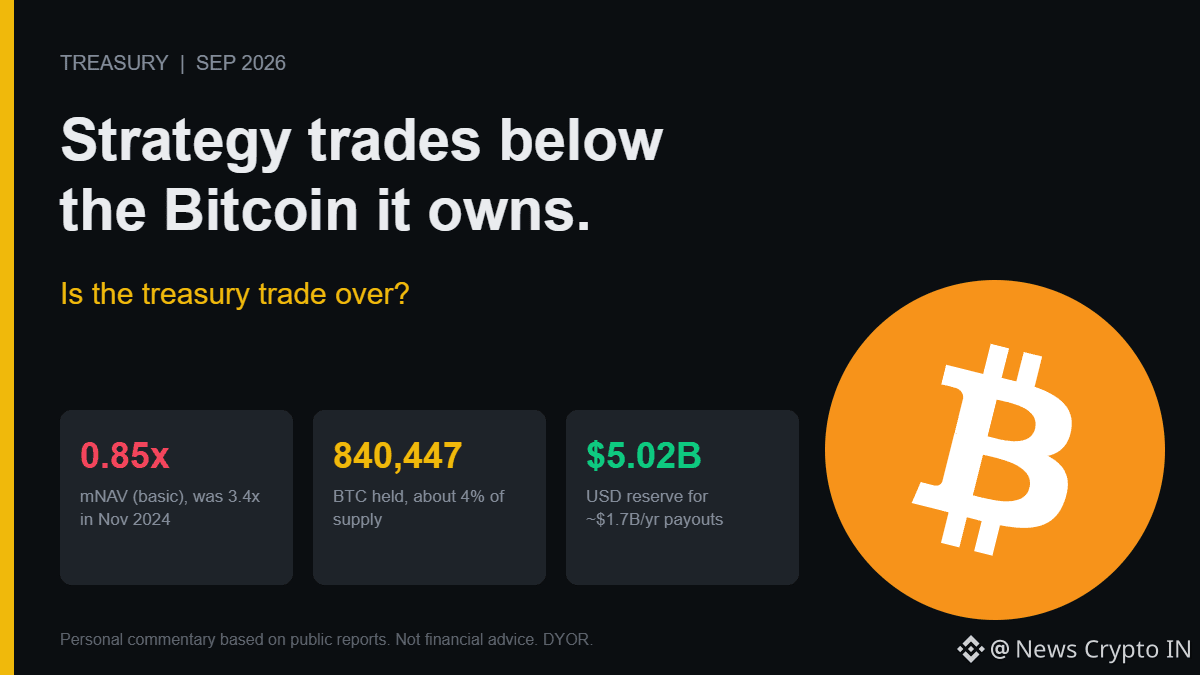
Strategy, the largest corporate holder of Bitcoin, now trades below the value of the Bitcoin it owns. Its basic mNAV was 0.85x on Sept 21, meaning the market prices the company about 15% under its BTC per share. In November 2024 that multiple was around 3.4x.
Why it matters: the whole treasury-company model runs on a premium. Sell stock above the value of your BTC, buy more $BTC, repeat. Below 1x, that flywheel runs backwards.
Strategy holds 840,447 BTC (about 4% of supply) and a $5.02B USD reserve. The reserve exists for a reason: roughly $15B of preferred stock, with about $1.7B a year in preferred dividends and debt interest. At that pace the reserve covers a bit under three years (my math).
The fair counterpoint: on an enterprise-value basis, which counts debt and preferred, mNAV is still about 1.11x. The picture depends on which measure you use, and nothing forces the company to sell Bitcoin today.
Still, the company that built the corporate-treasury playbook no longer has cheap equity to fund it. With spot ETFs taking in $2.39B last week, the marginal buyer looks more like an ETF than a treasury company (my read).
Does the biggest Bitcoin treasury still move the price, or is the treasury trade over?
#Strategy #Bitcoin
Strategy, the largest corporate holder of Bitcoin, now trades below the value of the Bitcoin it owns. Its basic mNAV was 0.85x on Sept 21, meaning the market prices the company about 15% under its BTC per share. In November 2024 that multiple was around 3.4x.
Why it matters: the whole treasury-company model runs on a premium. Sell stock above the value of your BTC, buy more $BTC , repeat. Below 1x, that flywheel runs backwards.
Strategy holds 840,447 BTC (about 4% of supply) and a $5.02B USD reserve. The reserve exists for a reason: roughly $15B of preferred stock, with about $1.7B a year in preferred dividends and debt interest. At that pace the reserve covers a bit under three years (my math).
The fair counterpoint: on an enterprise-value basis, which counts debt and preferred, mNAV is still about 1.11x. The picture depends on which measure you use, and nothing forces the company to sell Bitcoin today.
Still, the company that built the corporate-treasury playbook no longer has cheap equity to fund it. With spot ETFs taking in $2.39B last week, the marginal buyer looks more like an ETF than a treasury company (my read).
Does the biggest Bitcoin treasury still move the price, or is the treasury trade over?
#Strategy #Bitcoin
Why it matters: the whole treasury-company model runs on a premium. Sell stock above the value of your BTC, buy more $BTC , repeat. Below 1x, that flywheel runs backwards.
Strategy holds 840,447 BTC (about 4% of supply) and a $5.02B USD reserve. The reserve exists for a reason: roughly $15B of preferred stock, with about $1.7B a year in preferred dividends and debt interest. At that pace the reserve covers a bit under three years (my math).
The fair counterpoint: on an enterprise-value basis, which counts debt and preferred, mNAV is still about 1.11x. The picture depends on which measure you use, and nothing forces the company to sell Bitcoin today.
Still, the company that built the corporate-treasury playbook no longer has cheap equity to fund it. With spot ETFs taking in $2.39B last week, the marginal buyer looks more like an ETF than a treasury company (my read).
Does the biggest Bitcoin treasury still move the price, or is the treasury trade over?
#Strategy #Bitcoin
1
271
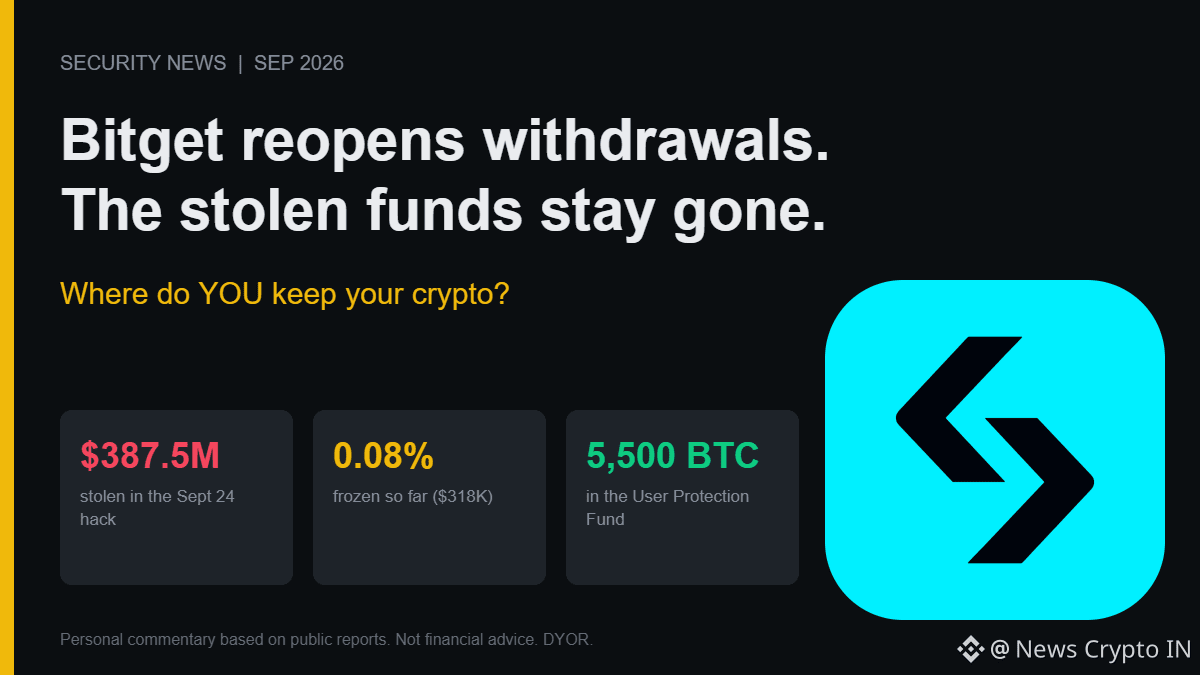
Bitget starts reopening withdrawals today after the $387.5M hack: $BTC first (Sept 28), ETH on Sept 29, USDT on Sept 30, and everything else by Oct 2. The exchange says its User Protection Fund, which holds 5,500 BTC, will cover the losses in full, and that user balances and cold wallets were not affected.
The recovery side is where it gets uncomfortable. Circle and Tether froze about $318K in stablecoins tied to the attack, less than 0.1% of what was stolen. Roughly $75M of the stolen $XRP sits in accounts that can't be frozen under XRP Ledger rules. Bitget is offering a 5% bounty on anything frozen or recovered.
The lesson isn't about one exchange. Hacks this size get paid out of a reserve fund, so users usually get made whole. The stolen money mostly doesn't come back.
POLL: Where do you keep most of your crypto?
1) Centralized exchange
2) Self-custody (hardware wallet)
3) Split between both
4) On-chain DeFi
Reply with your number and one line on why.
#Bitget #CryptoSecurity
Bitget starts reopening withdrawals today after the $387.5M hack: $BTC first (Sept 28), ETH on Sept 29, USDT on Sept 30, and everything else by Oct 2. The exchange says its User Protection Fund, which holds 5,500 BTC, will cover the losses in full, and that user balances and cold wallets were not affected.
The recovery side is where it gets uncomfortable. Circle and Tether froze about $318K in stablecoins tied to the attack, less than 0.1% of what was stolen. Roughly $75M of the stolen $XRP sits in accounts that can't be frozen under XRP Ledger rules. Bitget is offering a 5% bounty on anything frozen or recovered.
The lesson isn't about one exchange. Hacks this size get paid out of a reserve fund, so users usually get made whole. The stolen money mostly doesn't come back.
POLL: Where do you keep most of your crypto?
1) Centralized exchange
2) Self-custody (hardware wallet)
3) Split between both
4) On-chain DeFi
Reply with your number and one line on why.
#Bitget #CryptoSecurity
The recovery side is where it gets uncomfortable. Circle and Tether froze about $318K in stablecoins tied to the attack, less than 0.1% of what was stolen. Roughly $75M of the stolen $XRP sits in accounts that can't be frozen under XRP Ledger rules. Bitget is offering a 5% bounty on anything frozen or recovered.
The lesson isn't about one exchange. Hacks this size get paid out of a reserve fund, so users usually get made whole. The stolen money mostly doesn't come back.
POLL: Where do you keep most of your crypto?
1) Centralized exchange
2) Self-custody (hardware wallet)
3) Split between both
4) On-chain DeFi
Reply with your number and one line on why.
#Bitget #CryptoSecurity
1
492
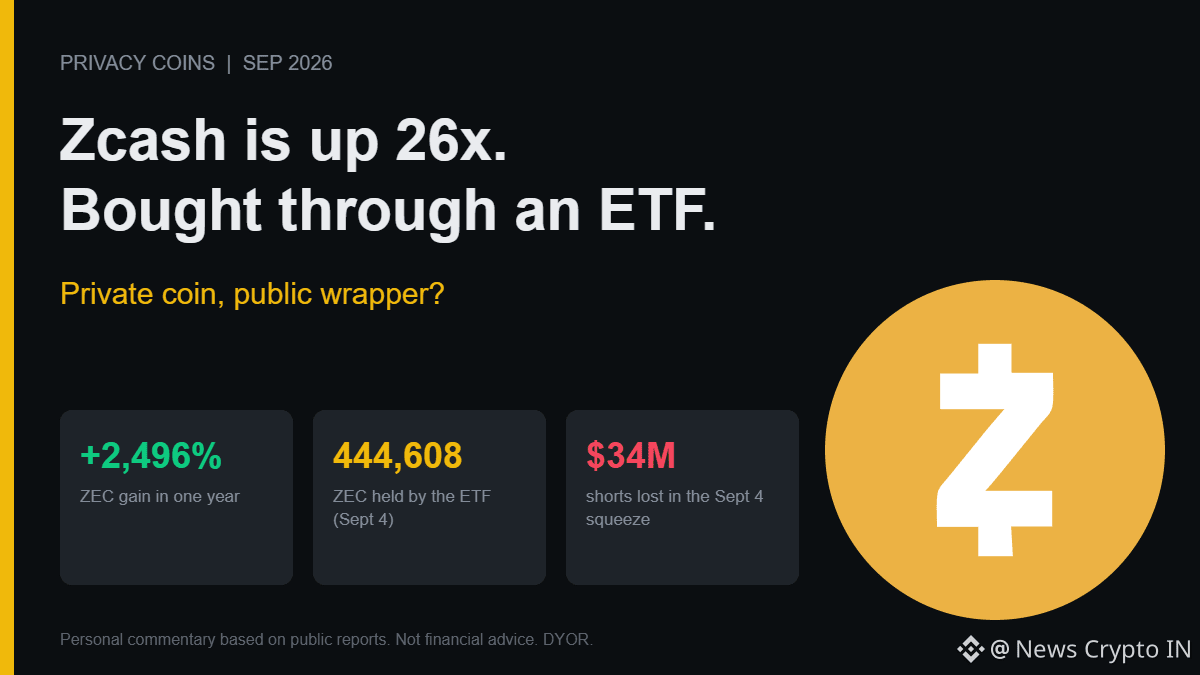
$ZEC is up roughly 2,496% in a year and touched $1,693 on Sept 26. Zcash at four figures was a joke twelve months ago.
Two things drove it. First, the Grayscale trust became a NYSE Arca ETF (ZCSH) on Aug 24, holding about 444,608 ZEC (~$463M) as of Sept 4. Second, the SEC closed its multi-year Zcash Foundation investigation in January with no enforcement action.
Notice the irony: the coin sold on financial privacy is now being bought through one of the most regulated, most documented wrappers in finance. The ETF buyer needs a brokerage account and KYC. The privacy is in the asset, not in the buyer.
That's not a knock, it's the mechanism. Institutional access ran the price, and it also means the marginal buyer is now a fund allocator, not a cypherpunk. Funds rotate. A story that lifts a coin about 26x ("AI surveillance fear," "privacy is the trade of the year") is usually priced in by the time it hits every trending list.
A run this steep is also leverage-fueled. On Sept 4, when ZEC hit $1,000, short sellers lost $34M in a single squeeze. Squeezes end when the shorts are gone, not when the fundamentals arrive.
ZEC is down about 6% today and is still among the most-searched coins on Binance Square. Is it a new asset class, or the year's most crowded trade?
#Zcash #PrivacyCoins
$ZEC is up roughly 2,496% in a year and touched $1,693 on Sept 26. Zcash at four figures was a joke twelve months ago.
Two things drove it. First, the Grayscale trust became a NYSE Arca ETF (ZCSH) on Aug 24, holding about 444,608 ZEC (~$463M) as of Sept 4. Second, the SEC closed its multi-year Zcash Foundation investigation in January with no enforcement action.
Notice the irony: the coin sold on financial privacy is now being bought through one of the most regulated, most documented wrappers in finance. The ETF buyer needs a brokerage account and KYC. The privacy is in the asset, not in the buyer.
That's not a knock, it's the mechanism. Institutional access ran the price, and it also means the marginal buyer is now a fund allocator, not a cypherpunk. Funds rotate. A story that lifts a coin about 26x ("AI surveillance fear," "privacy is the trade of the year") is usually priced in by the time it hits every trending list.
A run this steep is also leverage-fueled. On Sept 4, when ZEC hit $1,000, short sellers lost $34M in a single squeeze. Squeezes end when the shorts are gone, not when the fundamentals arrive.
ZEC is down about 6% today and is still among the most-searched coins on Binance Square. Is it a new asset class, or the year's most crowded trade?
#Zcash #PrivacyCoins
Two things drove it. First, the Grayscale trust became a NYSE Arca ETF (ZCSH) on Aug 24, holding about 444,608 ZEC (~$463M) as of Sept 4. Second, the SEC closed its multi-year Zcash Foundation investigation in January with no enforcement action.
Notice the irony: the coin sold on financial privacy is now being bought through one of the most regulated, most documented wrappers in finance. The ETF buyer needs a brokerage account and KYC. The privacy is in the asset, not in the buyer.
That's not a knock, it's the mechanism. Institutional access ran the price, and it also means the marginal buyer is now a fund allocator, not a cypherpunk. Funds rotate. A story that lifts a coin about 26x ("AI surveillance fear," "privacy is the trade of the year") is usually priced in by the time it hits every trending list.
A run this steep is also leverage-fueled. On Sept 4, when ZEC hit $1,000, short sellers lost $34M in a single squeeze. Squeezes end when the shorts are gone, not when the fundamentals arrive.
ZEC is down about 6% today and is still among the most-searched coins on Binance Square. Is it a new asset class, or the year's most crowded trade?
#Zcash #PrivacyCoins
1
182
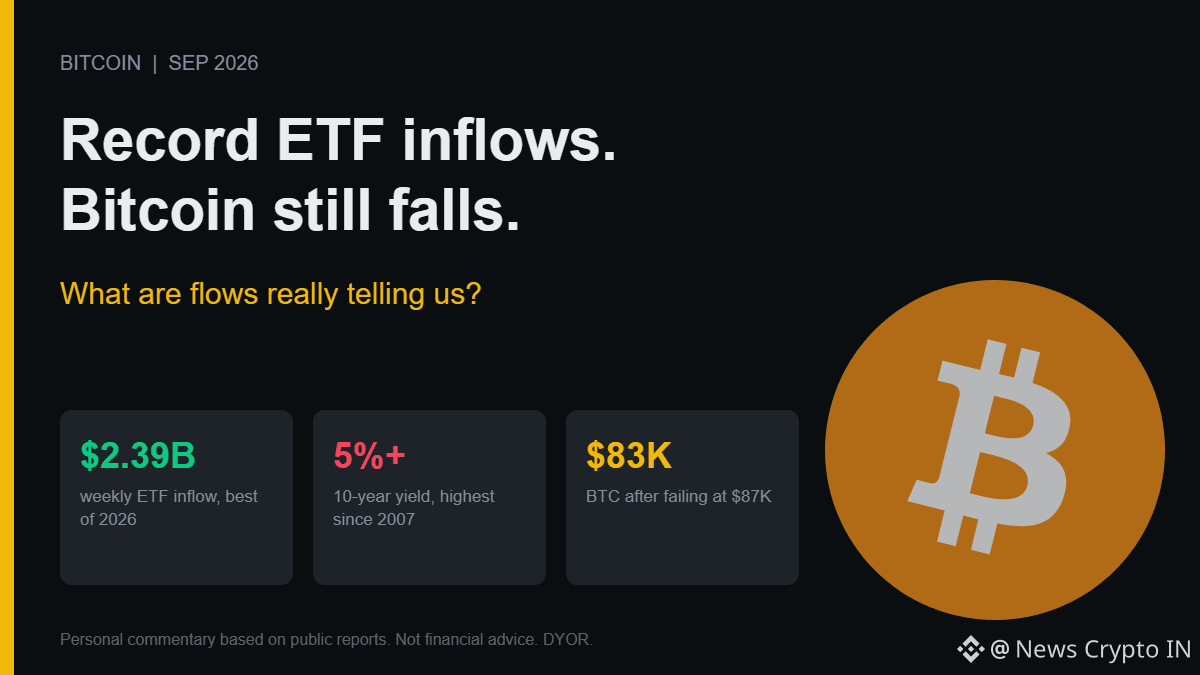
Bitcoin slipped to about $83K after failing to hold $87K, in the same week spot ETFs took in $2.39B, the best week of 2026. Record inflow, red candle. That's the paradox everyone is asking about.
Here's what the "ETF demand" story leaves out. The 10-year Treasury yield has pushed past 5%, a level last seen in 2007. Brent is near $106 after Trump rejected Iran's latest proposal on reopening the Strait of Hormuz. The dollar is stronger. None of those care how many ETF shares were created.
The read that explains both: ETF buyers are real, but they're absorbing supply from holders selling into the $84K-$87K zone. Fresh capital meets sellers, so price goes sideways to down instead of up. That isn't "no demand." It's demand equal to supply at that price.
Why it matters: ETF flow headlines are treated like a price signal. Flows tell you who is buying, not whether the buyer is winning. With a Treasury yield above 5%, every dollar into $BTC is a dollar giving up a safe yield, and the bar for holding it keeps rising.
One more gap to watch: Fear & Greed still reads 68 (Greed) while price is falling. Sentiment hasn't caught up with the tape.
If record flows can't lift price with yields above 5%, what can?
#BTCFallsBelow$83000 #BitcoinSpotETFs$2.39BWeeklyNetInflow
Bitcoin slipped to about $83K after failing to hold $87K, in the same week spot ETFs took in $2.39B, the best week of 2026. Record inflow, red candle. That's the paradox everyone is asking about.
Here's what the "ETF demand" story leaves out. The 10-year Treasury yield has pushed past 5%, a level last seen in 2007. Brent is near $106 after Trump rejected Iran's latest proposal on reopening the Strait of Hormuz. The dollar is stronger. None of those care how many ETF shares were created.
The read that explains both: ETF buyers are real, but they're absorbing supply from holders selling into the $84K-$87K zone. Fresh capital meets sellers, so price goes sideways to down instead of up. That isn't "no demand." It's demand equal to supply at that price.
Why it matters: ETF flow headlines are treated like a price signal. Flows tell you who is buying, not whether the buyer is winning. With a Treasury yield above 5%, every dollar into $BTC is a dollar giving up a safe yield, and the bar for holding it keeps rising.
One more gap to watch: Fear & Greed still reads 68 (Greed) while price is falling. Sentiment hasn't caught up with the tape.
If record flows can't lift price with yields above 5%, what can?
#BTCFallsBelow$83000 #BitcoinSpotETFs$2.39BWeeklyNetInflow
Here's what the "ETF demand" story leaves out. The 10-year Treasury yield has pushed past 5%, a level last seen in 2007. Brent is near $106 after Trump rejected Iran's latest proposal on reopening the Strait of Hormuz. The dollar is stronger. None of those care how many ETF shares were created.
The read that explains both: ETF buyers are real, but they're absorbing supply from holders selling into the $84K-$87K zone. Fresh capital meets sellers, so price goes sideways to down instead of up. That isn't "no demand." It's demand equal to supply at that price.
Why it matters: ETF flow headlines are treated like a price signal. Flows tell you who is buying, not whether the buyer is winning. With a Treasury yield above 5%, every dollar into $BTC is a dollar giving up a safe yield, and the bar for holding it keeps rising.
One more gap to watch: Fear & Greed still reads 68 (Greed) while price is falling. Sentiment hasn't caught up with the tape.
If record flows can't lift price with yields above 5%, what can?
#BTCFallsBelow$83000 #BitcoinSpotETFs$2.39BWeeklyNetInflow
BTC-0,55%
AGGETF-0,23%
1
191
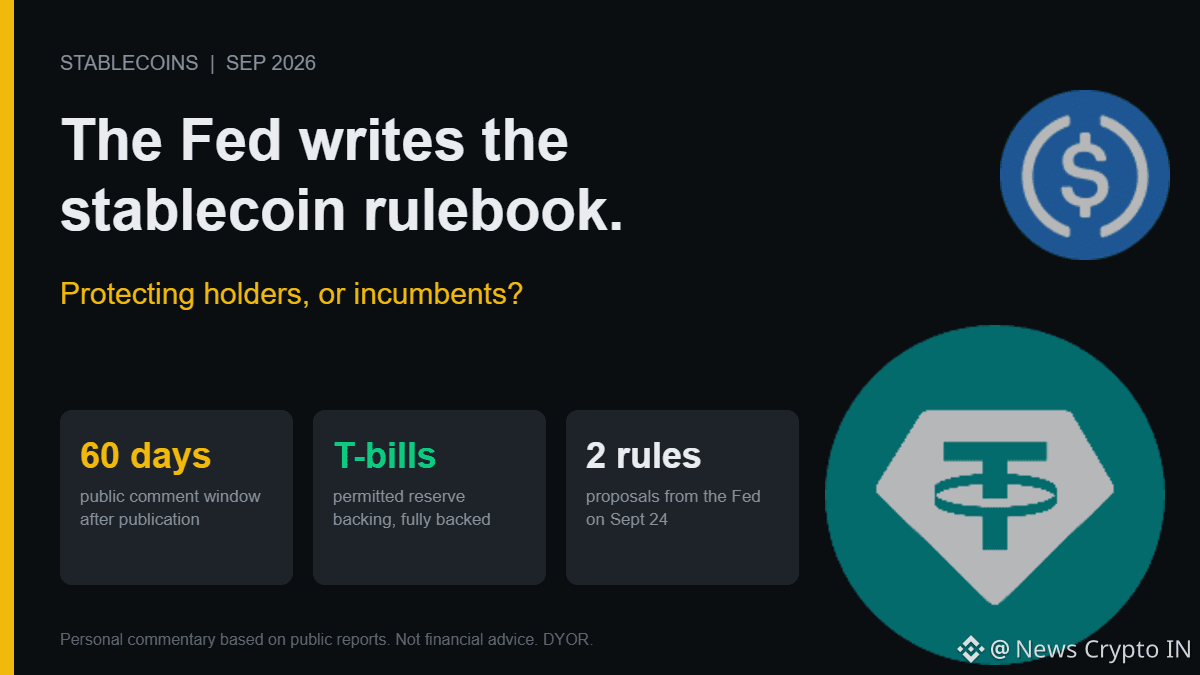
The Fed just put the first real GENIUS Act rule text on the table for stablecoin issuers, and it reads like a banking rulebook, not a crypto one.
Two proposals, announced Sept 24:
1. Reserves and capital: issuers must fully back tokens with permitted assets like short-term Treasury bills and other high-quality liquid assets, plus standardized capital requirements for credit and operational risk.
2. Applications: banks that want to issue must submit a business plan and financial information, with a formal process for appeals, hearings and final determinations.
The FDIC issued its own proposal for the institutions it supervises. Comments are open for 60 days after Federal Register publication.
Why this matters: yesterday I wrote about how fixed compliance costs favor big issuers. These proposals are what turns that forecast into rule text. Capital buffers and application dossiers are cheap for a bank with a compliance department and expensive for a crypto-native startup.
The upside is real: full T-bill backing and capital buffers make a stablecoin run less likely, and that's good for anyone parking money in one.
The open question is who ends up issuing the dollars. If the winners are bank-affiliated, "permissionless dollars" become "permitted dollars."
Are these rules protecting holders, or protecting incumbents? Both can be true.
#FedProposesPaymentStablecoinRules #GENIUSAct
The Fed just put the first real GENIUS Act rule text on the table for stablecoin issuers, and it reads like a banking rulebook, not a crypto one.
Two proposals, announced Sept 24:
1. Reserves and capital: issuers must fully back tokens with permitted assets like short-term Treasury bills and other high-quality liquid assets, plus standardized capital requirements for credit and operational risk.
2. Applications: banks that want to issue must submit a business plan and financial information, with a formal process for appeals, hearings and final determinations.
The FDIC issued its own proposal for the institutions it supervises. Comments are open for 60 days after Federal Register publication.
Why this matters: yesterday I wrote about how fixed compliance costs favor big issuers. These proposals are what turns that forecast into rule text. Capital buffers and application dossiers are cheap for a bank with a compliance department and expensive for a crypto-native startup.
The upside is real: full T-bill backing and capital buffers make a stablecoin run less likely, and that's good for anyone parking money in one.
The open question is who ends up issuing the dollars. If the winners are bank-affiliated, "permissionless dollars" become "permitted dollars."
Are these rules protecting holders, or protecting incumbents? Both can be true.
#FedProposesPaymentStablecoinRules #GENIUSAct
Two proposals, announced Sept 24:
1. Reserves and capital: issuers must fully back tokens with permitted assets like short-term Treasury bills and other high-quality liquid assets, plus standardized capital requirements for credit and operational risk.
2. Applications: banks that want to issue must submit a business plan and financial information, with a formal process for appeals, hearings and final determinations.
The FDIC issued its own proposal for the institutions it supervises. Comments are open for 60 days after Federal Register publication.
Why this matters: yesterday I wrote about how fixed compliance costs favor big issuers. These proposals are what turns that forecast into rule text. Capital buffers and application dossiers are cheap for a bank with a compliance department and expensive for a crypto-native startup.
The upside is real: full T-bill backing and capital buffers make a stablecoin run less likely, and that's good for anyone parking money in one.
The open question is who ends up issuing the dollars. If the winners are bank-affiliated, "permissionless dollars" become "permitted dollars."
Are these rules protecting holders, or protecting incumbents? Both can be true.
#FedProposesPaymentStablecoinRules #GENIUSAct
1
179
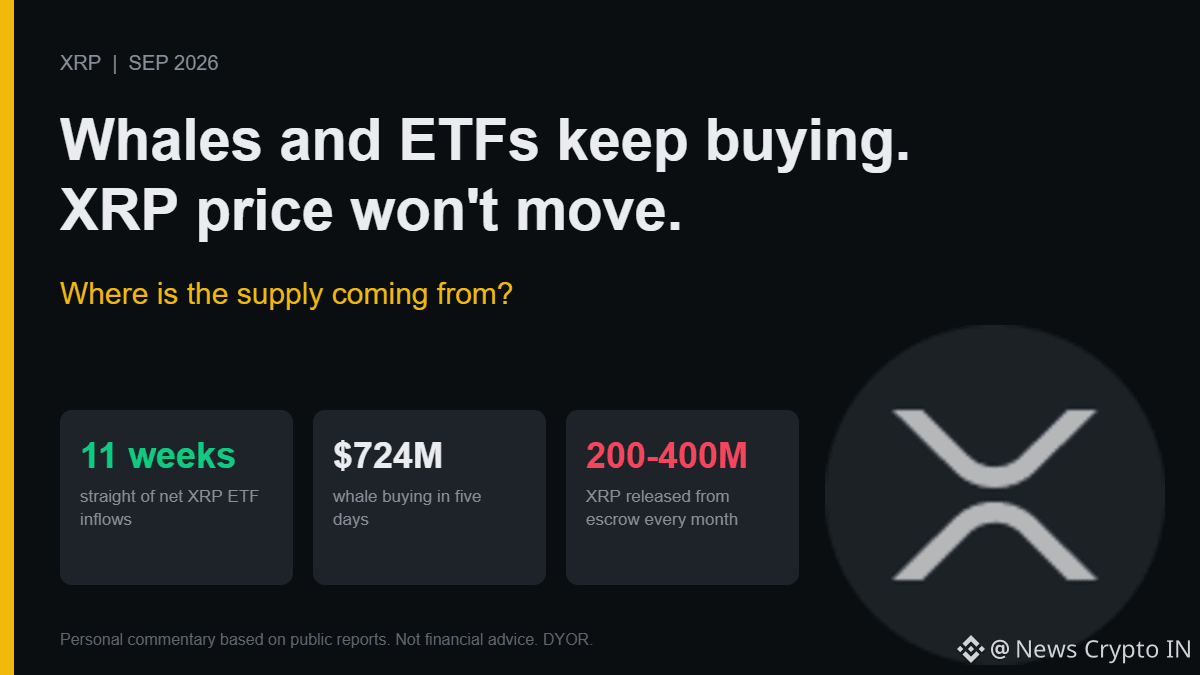
$XRP whales bought about 470M tokens (~$724M) in five days, and US spot XRP ETFs just logged their 11th straight week of net inflows: $75.59M last week, about $1.79B cumulative, roughly $2B in AUM across 7 funds. The price? Still defending $1.50, with $1.60 as first resistance.
So why isn't all that demand lifting it? Supply. Ripple's escrow releases 200-400M XRP into circulation every month. At ~$1.50 that's roughly $300-600M of supply per month, against about $325M/month of ETF inflows at last week's pace (my math). Ripple has historically re-locked a good chunk of what it unlocks, so not all of it gets sold, but the overhang is why "bullish flows" and "flat price" can coexist.
One more thing: whale buying and ETF inflows get reported as two separate confirmations, but they can partly be the same money moving between wallets, custodians and funds. More reports of activity isn't automatically more buyers.
Still, 11 straight weeks is a real streak, and $1.50 has held.
Bulls say supply is being absorbed. Bears say flows this strong should have moved the price by now. Which one is it?
#XRP #Ripple
$XRP whales bought about 470M tokens (~$724M) in five days, and US spot XRP ETFs just logged their 11th straight week of net inflows: $75.59M last week, about $1.79B cumulative, roughly $2B in AUM across 7 funds. The price? Still defending $1.50, with $1.60 as first resistance.
So why isn't all that demand lifting it? Supply. Ripple's escrow releases 200-400M XRP into circulation every month. At ~$1.50 that's roughly $300-600M of supply per month, against about $325M/month of ETF inflows at last week's pace (my math). Ripple has historically re-locked a good chunk of what it unlocks, so not all of it gets sold, but the overhang is why "bullish flows" and "flat price" can coexist.
One more thing: whale buying and ETF inflows get reported as two separate confirmations, but they can partly be the same money moving between wallets, custodians and funds. More reports of activity isn't automatically more buyers.
Still, 11 straight weeks is a real streak, and $1.50 has held.
Bulls say supply is being absorbed. Bears say flows this strong should have moved the price by now. Which one is it?
#XRP #Ripple
So why isn't all that demand lifting it? Supply. Ripple's escrow releases 200-400M XRP into circulation every month. At ~$1.50 that's roughly $300-600M of supply per month, against about $325M/month of ETF inflows at last week's pace (my math). Ripple has historically re-locked a good chunk of what it unlocks, so not all of it gets sold, but the overhang is why "bullish flows" and "flat price" can coexist.
One more thing: whale buying and ETF inflows get reported as two separate confirmations, but they can partly be the same money moving between wallets, custodians and funds. More reports of activity isn't automatically more buyers.
Still, 11 straight weeks is a real streak, and $1.50 has held.
Bulls say supply is being absorbed. Bears say flows this strong should have moved the price by now. Which one is it?
#XRP #Ripple
2
212
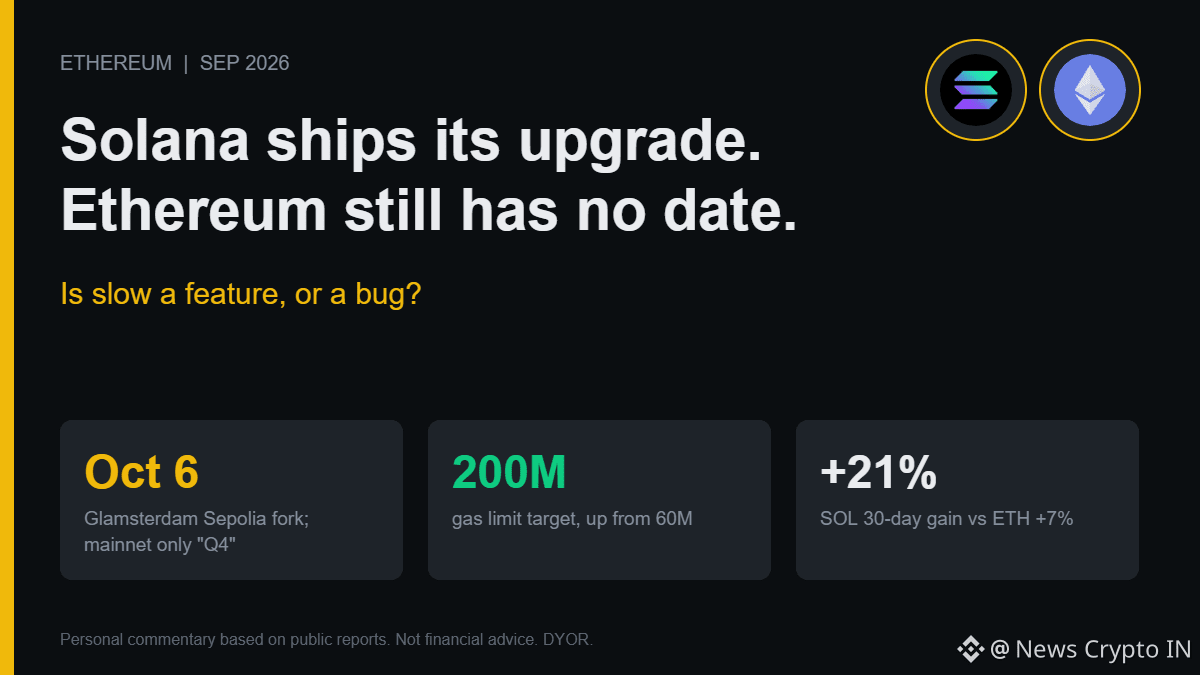
Same day, two very different roadmaps. Solana started activating its Alpenglow consensus rewrite on mainnet today. Ethereum's Glamsterdam still has no mainnet date: the Sepolia testnet fork is set for Oct 6, and mainnet is only "expected in Q4 2026."
What Glamsterdam promises is big: parallel transaction execution, enshrined proposer-builder separation, and a gas limit raised gradually from 60M toward 200M. On paper, it's Ethereum's answer to the throughput race.
The uncomfortable question: how long can "we ship when it's ready" stay a feature instead of a liability? Every slipped quarter is another one where faster chains market speed while $ETH's L1 scaling story lives on a roadmap.
The counterpoint: careful is the point. A network securing this much value can't afford to move as fast as newer chains. And money isn't fleeing: ETH funds took in $86.95M on Sept 25, extending a six-day buying streak, with ETH around $2,687.
But the past month's scoreboard tilts the other way: SOL is up about 21%, ETH about 7%. Roadmap credibility is a currency, and it depletes with each slipped date.
Which do you trust more: the chain that ships fast, or the chain that ships late?
#Ethereum #Glamsterdam
Same day, two very different roadmaps. Solana started activating its Alpenglow consensus rewrite on mainnet today. Ethereum's Glamsterdam still has no mainnet date: the Sepolia testnet fork is set for Oct 6, and mainnet is only "expected in Q4 2026."
What Glamsterdam promises is big: parallel transaction execution, enshrined proposer-builder separation, and a gas limit raised gradually from 60M toward 200M. On paper, it's Ethereum's answer to the throughput race.
The uncomfortable question: how long can "we ship when it's ready" stay a feature instead of a liability? Every slipped quarter is another one where faster chains market speed while $ETH 's L1 scaling story lives on a roadmap.
The counterpoint: careful is the point. A network securing this much value can't afford to move as fast as newer chains. And money isn't fleeing: ETH funds took in $86.95M on Sept 25, extending a six-day buying streak, with ETH around $2,687.
But the past month's scoreboard tilts the other way: SOL is up about 21%, ETH about 7%. Roadmap credibility is a currency, and it depletes with each slipped date.
Which do you trust more: the chain that ships fast, or the chain that ships late?
#Ethereum #Glamsterdam
What Glamsterdam promises is big: parallel transaction execution, enshrined proposer-builder separation, and a gas limit raised gradually from 60M toward 200M. On paper, it's Ethereum's answer to the throughput race.
The uncomfortable question: how long can "we ship when it's ready" stay a feature instead of a liability? Every slipped quarter is another one where faster chains market speed while $ETH 's L1 scaling story lives on a roadmap.
The counterpoint: careful is the point. A network securing this much value can't afford to move as fast as newer chains. And money isn't fleeing: ETH funds took in $86.95M on Sept 25, extending a six-day buying streak, with ETH around $2,687.
But the past month's scoreboard tilts the other way: SOL is up about 21%, ETH about 7%. Roadmap credibility is a currency, and it depletes with each slipped date.
Which do you trust more: the chain that ships fast, or the chain that ships late?
#Ethereum #Glamsterdam
1
220
Connectez-vous pour découvrir plus de contenu
Rejoignez la communauté mondiale des adeptes de cryptomonnaies sur Binance Square
⚡️ Suviez les dernières informations importantes sur les cryptomonnaies.
💬 Jugé digne de confiance par la plus grande plateforme d’échange de cryptomonnaies au monde.
👍 Découvrez les connaissances que partagent les créateurs vérifiés.
Adresse e-mail/Nº de téléphone