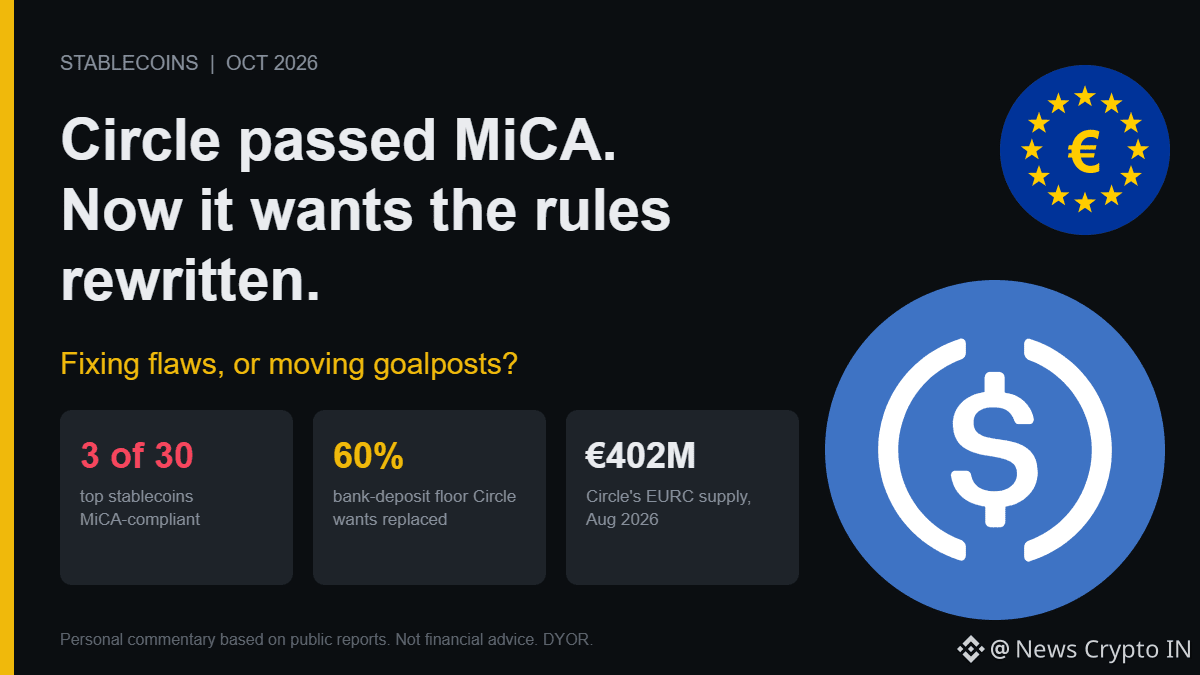
Only 3 of the top 30 stablecoins comply with Europe's MiCA rules: USDC, USDG and EURC. Two of those three are Circle's. And on Oct 1, Circle asked the European Commission to rewrite the rules anyway.
What Circle wants changed:
- Reserves: MiCA forces issuers to hold 30% of reserves as bank deposits, 60% for "significant" ones. Circle wants liquidity-based rules instead, plus looser concentration caps (35% per sovereign, 1.5% of a bank's assets per counterparty).
- Cross-border issuance: keep letting an EU-licensed entity issue the same token alongside affiliates abroad.
- Foreign recognition: let foreign-regulated stablecoins distribute through EU-licensed firms, modelled on the US GENIUS Act.
The cynical read writes itself: the company that already passed the test is lobbying to change the test, and every proposal happens to fit how a US-based global issuer operates.
But the reserve point has real history behind it. In March 2023, USDC briefly broke its peg because $3.3B of its reserves sat at Silicon Valley Bank when it failed. Forcing 60% of reserves into bank deposits puts more of a stablecoin's safety on the health of a few banks, the exact risk that already bit Circle once.
Is Circle fixing a genuine design flaw in MiCA, or using its compliant status to write the rules competitors will have to follow?
#Circle #MiCA
What Circle wants changed:
- Reserves: MiCA forces issuers to hold 30% of reserves as bank deposits, 60% for "significant" ones. Circle wants liquidity-based rules instead, plus looser concentration caps (35% per sovereign, 1.5% of a bank's assets per counterparty).
- Cross-border issuance: keep letting an EU-licensed entity issue the same token alongside affiliates abroad.
- Foreign recognition: let foreign-regulated stablecoins distribute through EU-licensed firms, modelled on the US GENIUS Act.
The cynical read writes itself: the company that already passed the test is lobbying to change the test, and every proposal happens to fit how a US-based global issuer operates.
But the reserve point has real history behind it. In March 2023, USDC briefly broke its peg because $3.3B of its reserves sat at Silicon Valley Bank when it failed. Forcing 60% of reserves into bank deposits puts more of a stablecoin's safety on the health of a few banks, the exact risk that already bit Circle once.
Is Circle fixing a genuine design flaw in MiCA, or using its compliant status to write the rules competitors will have to follow?
#Circle #MiCA