

#tokenbuybacks
tokenbuybacks
3,675 vues
16 mentions
Populaire
Récents


·
--
Haussier
#SECSaysDecentralizedTokenBuybacksNotInvestmentContracts
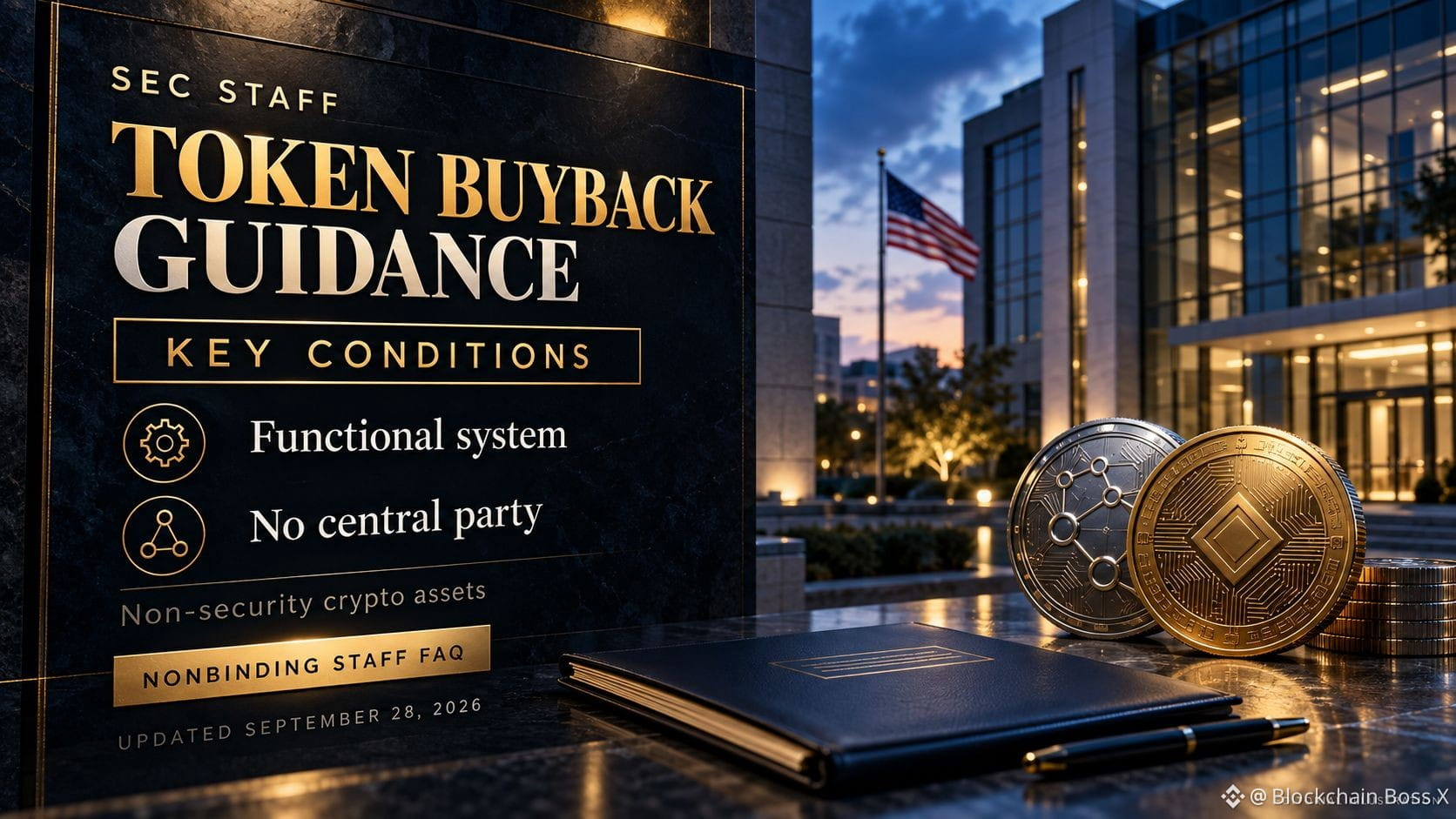
🇺🇸 SEC Staff Updates Token Buyback Guidance: Decentralization Matters
On September 28, SEC staff revised its crypto FAQ, adding an explicit condition to its buyback guidance: the network must be functional and have no central party.
The answer concerns non-security crypto assets. Under those conditions, announcing a buyback would not, in staff’s view, constitute a promise to perform the essential managerial efforts relevant to an investment-contract analysis.
For a network that is not yet functional, presenting a buyback as generating yield or returns could count as such a promise.
These FAQs are nonbinding staff guidance with no legal force. They do not establish a blanket exemption for token buybacks.
My take: I would examine who can change protocol rules, control treasury decisions or override governance outcomes. Those disclosures help readers understand how decisions are made; the word “decentralized” on a website provides little evidence by itself.
I would also assess buyback funding, whether purchases can continue and how repurchases compare with new token issuance. A large announced program may have a different economic effect from purchases consistently funded by ongoing activity.
Legal interpretation and token economics deserve separate attention. This update provides a more specific framework for discussion, while actual governance and execution remain worth investigating.
What evidence would you look for when assessing whether a crypto network has central control?
#SECSaysDecentralizedTokenBuybacksNotInvestmentContracts #CryptoRegulation #TokenBuybacks
$ETH $SOL $NEAR
#SECSaysDecentralizedTokenBuybacksNotInvestmentContracts
🇺🇸 SEC Staff Updates Token Buyback Guidance: Decentralization Matters
On September 28, SEC staff revised its crypto FAQ, adding an explicit condition to its buyback guidance: the network must be functional and have no central party.
The answer concerns non-security crypto assets. Under those conditions, announcing a buyback would not, in staff’s view, constitute a promise to perform the essential managerial efforts relevant to an investment-contract analysis.
For a network that is not yet functional, presenting a buyback as generating yield or returns could count as such a promise.
These FAQs are nonbinding staff guidance with no legal force. They do not establish a blanket exemption for token buybacks.
My take: I would examine who can change protocol rules, control treasury decisions or override governance outcomes. Those disclosures help readers understand how decisions are made; the word “decentralized” on a website provides little evidence by itself.
I would also assess buyback funding, whether purchases can continue and how repurchases compare with new token issuance. A large announced program may have a different economic effect from purchases consistently funded by ongoing activity.
Legal interpretation and token economics deserve separate attention. This update provides a more specific framework for discussion, while actual governance and execution remain worth investigating.
What evidence would you look for when assessing whether a crypto network has central control?
#SECSaysDecentralizedTokenBuybacksNotInvestmentContracts #CryptoRegulation #TokenBuybacks
$ETH $SOL $NEAR
🇺🇸 SEC Staff Updates Token Buyback Guidance: Decentralization Matters
On September 28, SEC staff revised its crypto FAQ, adding an explicit condition to its buyback guidance: the network must be functional and have no central party.
The answer concerns non-security crypto assets. Under those conditions, announcing a buyback would not, in staff’s view, constitute a promise to perform the essential managerial efforts relevant to an investment-contract analysis.
For a network that is not yet functional, presenting a buyback as generating yield or returns could count as such a promise.
These FAQs are nonbinding staff guidance with no legal force. They do not establish a blanket exemption for token buybacks.
My take: I would examine who can change protocol rules, control treasury decisions or override governance outcomes. Those disclosures help readers understand how decisions are made; the word “decentralized” on a website provides little evidence by itself.
I would also assess buyback funding, whether purchases can continue and how repurchases compare with new token issuance. A large announced program may have a different economic effect from purchases consistently funded by ongoing activity.
Legal interpretation and token economics deserve separate attention. This update provides a more specific framework for discussion, while actual governance and execution remain worth investigating.
What evidence would you look for when assessing whether a crypto network has central control?
#SECSaysDecentralizedTokenBuybacksNotInvestmentContracts #CryptoRegulation #TokenBuybacks
$ETH $SOL $NEAR
156

#SECSaysDecentralizedTokenBuybacksNotInvestment Contracts “SEC says token buybacks aren’t securities” is way too broad.
The actual guidance is conditional: functional network, non-security token, and no promise of yield/returns.
So are people celebrating regulatory clarity… or just reading the headline and skipping the conditions? 👀
#CryptoNewss #SEC #TokenBuybacks
#SECSaysDecentralizedTokenBuybacksNotInvestment Contracts “SEC says token buybacks aren’t securities” is way too broad.
The actual guidance is conditional: functional network, non-security token, and no promise of yield/returns.
So are people celebrating regulatory clarity… or just reading the headline and skipping the conditions? 👀
#CryptoNewss #SEC #TokenBuybacks
The actual guidance is conditional: functional network, non-security token, and no promise of yield/returns.
So are people celebrating regulatory clarity… or just reading the headline and skipping the conditions? 👀
#CryptoNewss #SEC #TokenBuybacks
1
31

A SEC deu luz verde para recompra de tokens em redes cripto, encerrando a era de Gary Gensler e esclarecendo o que protocolos podem e não podem fazer com seus ativos digitais. Isso abre caminho para estratégias de valorização mais seguras e alinhadas à regulamentação.
#SEC #TokenBuybacks #CryptoRegulation #BinanceSquare
Leia mais: https://decrypt.co/379412/morning-minute-sec-clears-token-buybacks-for-crypto-networks
A SEC deu luz verde para recompra de tokens em redes cripto, encerrando a era de Gary Gensler e esclarecendo o que protocolos podem e não podem fazer com seus ativos digitais. Isso abre caminho para estratégias de valorização mais seguras e alinhadas à regulamentação.
#SEC #TokenBuybacks #CryptoRegulation #BinanceSquare
Leia mais: https://decrypt.co/379412/morning-minute-sec-clears-token-buybacks-for-crypto-networks
#SEC #TokenBuybacks #CryptoRegulation #BinanceSquare
Leia mais: https://decrypt.co/379412/morning-minute-sec-clears-token-buybacks-for-crypto-networks

·
--
加密回购历史新高!项目方回购金额已达6.38亿美元,其中Hyperliquid贡献了3.7亿,Pump.fun贡献了2亿,占比近90%。SEC监管障碍也已清除,这对市场是大利好!$HYPER #TokenBuybacks #CryptoMarket
Crypto buybacks hitting record highs! Projects spent $638M on token buybacks, with Hyperliquid accounting for $370M and Pump.fun for $200M - nearly 90% total. SEC just cleared regulatory hurdles. Bullish news! $HYPER #TokenBuybacks #CryptoMarket
加密回购历史新高!项目方回购金额已达6.38亿美元,其中Hyperliquid贡献了3.7亿,Pump.fun贡献了2亿,占比近90%。SEC监管障碍也已清除,这对市场是大利好!$HYPER #TokenBuybacks #CryptoMarket
Crypto buybacks hitting record highs! Projects spent $638M on token buybacks, with Hyperliquid accounting for $370M and Pump.fun for $200M - nearly 90% total. SEC just cleared regulatory hurdles. Bullish news! $HYPER #TokenBuybacks #CryptoMarket
Crypto buybacks hitting record highs! Projects spent $638M on token buybacks, with Hyperliquid accounting for $370M and Pump.fun for $200M - nearly 90% total. SEC just cleared regulatory hurdles. Bullish news! $HYPER #TokenBuybacks #CryptoMarket
157

The Rise Of Massive Crypto Token Buybacks
Crypto projects hit a record $638 million in token buybacks this year. Hyperliquid and Pump.fun are leading the charge, driving nearly 90 percent of this massive volume.
#Hyperliquid #TokenBuybacks
The Rise Of Massive Crypto Token Buybacks
Crypto projects hit a record $638 million in token buybacks this year. Hyperliquid and Pump.fun are leading the charge, driving nearly 90 percent of this massive volume.
#Hyperliquid #TokenBuybacks
Crypto projects hit a record $638 million in token buybacks this year. Hyperliquid and Pump.fun are leading the charge, driving nearly 90 percent of this massive volume.
#Hyperliquid #TokenBuybacks
68

·
--
HYPE Token on the Rebound: What's Behind the Rise?Imagine you're about to give a big presentation at work, and you've been nervous about it all week. But then, you receive word that your company will not only provide you the resources you need but also will buy back your shares if they don't perform. That's what's happening in the world of HYPE cryptocurrency, thanks to strong quarterly revenue and token buybacks.
#CryptocurrencyMarket #TokenBuybacks
The concept of token buybacks is simple: it's when a company or organization that has issued a cryptocurrency buys back a portion of the circulating supply from holders. This can have several effects on the token's price: it increases the scarcity of the token, reduces the supply in circulation, and can lead to increased demand if investors believe the token has more value.
Let's take a look at hyperliquidity token (HYPE), which recently rebounded in price after strong quarterly revenue and token buybacks fueled the growth. According to data from crypto.news, Hyperliquid traded near $56.80, a significant increase from its previous low near $51. This price increase was accompanied by rising RWA (Relative Weighted Alpha) trading activity, a metric that can indicate investor confidence in the token.
The rising RWA trading activity also shows that more investors are becoming confident in Hyperliquid's strong fundamentals, such as its revenue growth and token buybacks. This increased confidence in the token is also reflected in the rising price, which has climbed above the $51 support area. As a result, HYPE price eyes a potential new high above $57.30.
The takeaway from this story is that investors should consider looking for cryptocurrencies that have strong fundamentals, such as revenue growth and token buybacks. These factors can drive up demand for the token and increase its price.
What do you think will happen next in the world of HYPE cryptocurrency? Will it continue to rise in price or will its momentum slow down?
HYPE Token on the Rebound: What's Behind the Rise?
Imagine you're about to give a big presentation at work, and you've been nervous about it all week. But then, you receive word that your company will not only provide you the resources you need but also will buy back your shares if they don't perform. That's what's happening in the world of HYPE cryptocurrency, thanks to strong quarterly revenue and token buybacks.
#CryptocurrencyMarket #TokenBuybacks
The concept of token buybacks is simple: it's when a company or organization that has issued a cryptocurrency buys back a portion of the circulating supply from holders. This can have several effects on the token's price: it increases the scarcity of the token, reduces the supply in circulation, and can lead to increased demand if investors believe the token has more value.
Let's take a look at hyperliquidity token (HYPE), which recently rebounded in price after strong quarterly revenue and token buybacks fueled the growth. According to data from crypto.news, Hyperliquid traded near $56.80, a significant increase from its previous low near $51. This price increase was accompanied by rising RWA (Relative Weighted Alpha) trading activity, a metric that can indicate investor confidence in the token.
The rising RWA trading activity also shows that more investors are becoming confident in Hyperliquid's strong fundamentals, such as its revenue growth and token buybacks. This increased confidence in the token is also reflected in the rising price, which has climbed above the $51 support area. As a result, HYPE price eyes a potential new high above $57.30.
The takeaway from this story is that investors should consider looking for cryptocurrencies that have strong fundamentals, such as revenue growth and token buybacks. These factors can drive up demand for the token and increase its price.
What do you think will happen next in the world of HYPE cryptocurrency? Will it continue to rise in price or will its momentum slow down?
#CryptocurrencyMarket #TokenBuybacks
The concept of token buybacks is simple: it's when a company or organization that has issued a cryptocurrency buys back a portion of the circulating supply from holders. This can have several effects on the token's price: it increases the scarcity of the token, reduces the supply in circulation, and can lead to increased demand if investors believe the token has more value.
Let's take a look at hyperliquidity token (HYPE), which recently rebounded in price after strong quarterly revenue and token buybacks fueled the growth. According to data from crypto.news, Hyperliquid traded near $56.80, a significant increase from its previous low near $51. This price increase was accompanied by rising RWA (Relative Weighted Alpha) trading activity, a metric that can indicate investor confidence in the token.
The rising RWA trading activity also shows that more investors are becoming confident in Hyperliquid's strong fundamentals, such as its revenue growth and token buybacks. This increased confidence in the token is also reflected in the rising price, which has climbed above the $51 support area. As a result, HYPE price eyes a potential new high above $57.30.
The takeaway from this story is that investors should consider looking for cryptocurrencies that have strong fundamentals, such as revenue growth and token buybacks. These factors can drive up demand for the token and increase its price.
What do you think will happen next in the world of HYPE cryptocurrency? Will it continue to rise in price or will its momentum slow down?
53

·
--
Article
A Rule That's Frozen DeFi Tokenomics Since 2021 Just Got Rewritten#SECSaysDecentralizedTokenBuybacksNotInvestmentContracts
For years, major DeFi protocols have quietly avoided one of the most obvious tools in their playbook — buying back and burning their own tokens — out of fear it would look too much like a corporate dividend to regulators. The SEC just addressed that fear directly.
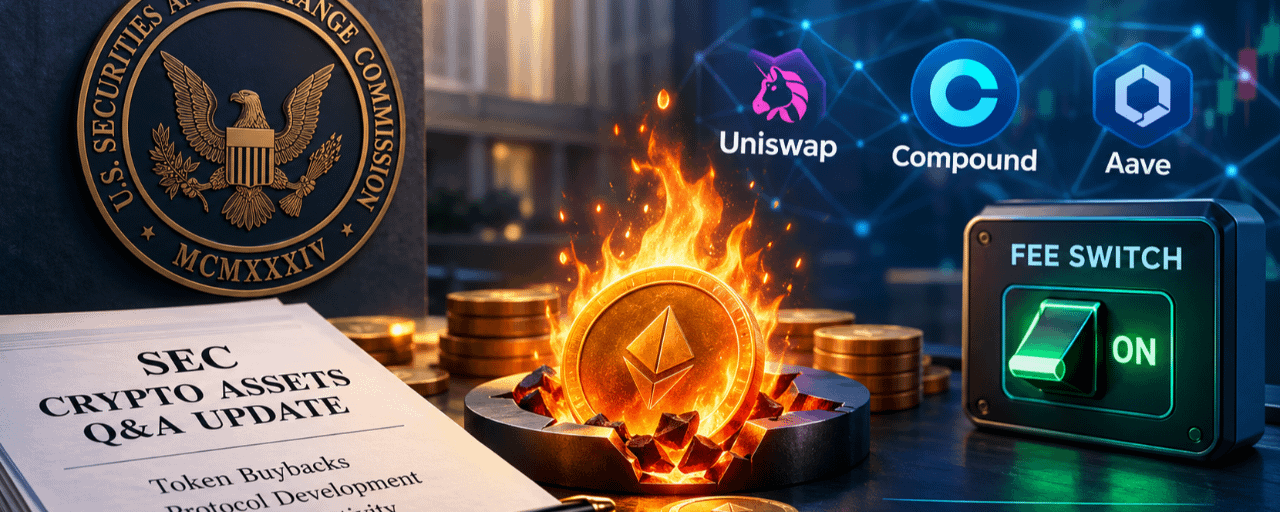
Here's what was clarified: the SEC's Division of Corporation Finance released an updated Q&A on crypto assets, addressing when token buybacks, ongoing protocol development, and marketing activity might constitute an "investment contract" under securities law. The core finding: announcing a buyback for an already-functioning, non-security token doesn't by itself trigger investment-contract status — even when that buyback distributes value back to holders. The guidance drew a clear line based on network maturity: the analysis differs for networks that aren't yet functional, where issuers pitching buybacks explicitly as a source of returns can still raise concerns. This lands against a backdrop worth understanding — since around 2021, the "buybacks equal shareholder distributions" interpretation had become so entrenched that protocols like Uniswap and Compound deliberately kept profit-sharing mechanisms, like Uniswap's long-dormant fee switch, switched off specifically to avoid regulatory exposure.
Why does this matter? Buybacks are one of the more direct ways a protocol can return value to token holders, similar to how public companies use share repurchases — but DeFi projects have largely avoided the mechanism for years due to exactly this kind of legal ambiguity. Clearer staff guidance, even at the non-binding level, could reopen a design space that's sat frozen for roughly half a decade, potentially prompting long-cautious protocols to revisit dormant fee-switch mechanisms and buyback proposals they'd previously shelved.
Whether this actually unlocks a wave of renewed buyback activity across major DeFi protocols, or whether teams stay cautious until this guidance is tested through an actual enforcement case, is something worth watching in the months ahead.
Could this be the moment dormant fee switches across DeFi finally get flipped back on? 🤔
#DeFi #SEC #TokenBuybacks #CryptoRegulation
A Rule That's Frozen DeFi Tokenomics Since 2021 Just Got Rewritten
#SECSaysDecentralizedTokenBuybacksNotInvestmentContracts
For years, major DeFi protocols have quietly avoided one of the most obvious tools in their playbook — buying back and burning their own tokens — out of fear it would look too much like a corporate dividend to regulators. The SEC just addressed that fear directly.
Here's what was clarified: the SEC's Division of Corporation Finance released an updated Q&A on crypto assets, addressing when token buybacks, ongoing protocol development, and marketing activity might constitute an "investment contract" under securities law. The core finding: announcing a buyback for an already-functioning, non-security token doesn't by itself trigger investment-contract status — even when that buyback distributes value back to holders. The guidance drew a clear line based on network maturity: the analysis differs for networks that aren't yet functional, where issuers pitching buybacks explicitly as a source of returns can still raise concerns. This lands against a backdrop worth understanding — since around 2021, the "buybacks equal shareholder distributions" interpretation had become so entrenched that protocols like Uniswap and Compound deliberately kept profit-sharing mechanisms, like Uniswap's long-dormant fee switch, switched off specifically to avoid regulatory exposure.
Why does this matter? Buybacks are one of the more direct ways a protocol can return value to token holders, similar to how public companies use share repurchases — but DeFi projects have largely avoided the mechanism for years due to exactly this kind of legal ambiguity. Clearer staff guidance, even at the non-binding level, could reopen a design space that's sat frozen for roughly half a decade, potentially prompting long-cautious protocols to revisit dormant fee-switch mechanisms and buyback proposals they'd previously shelved.
Whether this actually unlocks a wave of renewed buyback activity across major DeFi protocols, or whether teams stay cautious until this guidance is tested through an actual enforcement case, is something worth watching in the months ahead.
Could this be the moment dormant fee switches across DeFi finally get flipped back on? 🤔
#DeFi #SEC #TokenBuybacks #CryptoRegulation
For years, major DeFi protocols have quietly avoided one of the most obvious tools in their playbook — buying back and burning their own tokens — out of fear it would look too much like a corporate dividend to regulators. The SEC just addressed that fear directly.
Here's what was clarified: the SEC's Division of Corporation Finance released an updated Q&A on crypto assets, addressing when token buybacks, ongoing protocol development, and marketing activity might constitute an "investment contract" under securities law. The core finding: announcing a buyback for an already-functioning, non-security token doesn't by itself trigger investment-contract status — even when that buyback distributes value back to holders. The guidance drew a clear line based on network maturity: the analysis differs for networks that aren't yet functional, where issuers pitching buybacks explicitly as a source of returns can still raise concerns. This lands against a backdrop worth understanding — since around 2021, the "buybacks equal shareholder distributions" interpretation had become so entrenched that protocols like Uniswap and Compound deliberately kept profit-sharing mechanisms, like Uniswap's long-dormant fee switch, switched off specifically to avoid regulatory exposure.
Why does this matter? Buybacks are one of the more direct ways a protocol can return value to token holders, similar to how public companies use share repurchases — but DeFi projects have largely avoided the mechanism for years due to exactly this kind of legal ambiguity. Clearer staff guidance, even at the non-binding level, could reopen a design space that's sat frozen for roughly half a decade, potentially prompting long-cautious protocols to revisit dormant fee-switch mechanisms and buyback proposals they'd previously shelved.
Whether this actually unlocks a wave of renewed buyback activity across major DeFi protocols, or whether teams stay cautious until this guidance is tested through an actual enforcement case, is something worth watching in the months ahead.
Could this be the moment dormant fee switches across DeFi finally get flipped back on? 🤔
#DeFi #SEC #TokenBuybacks #CryptoRegulation
166

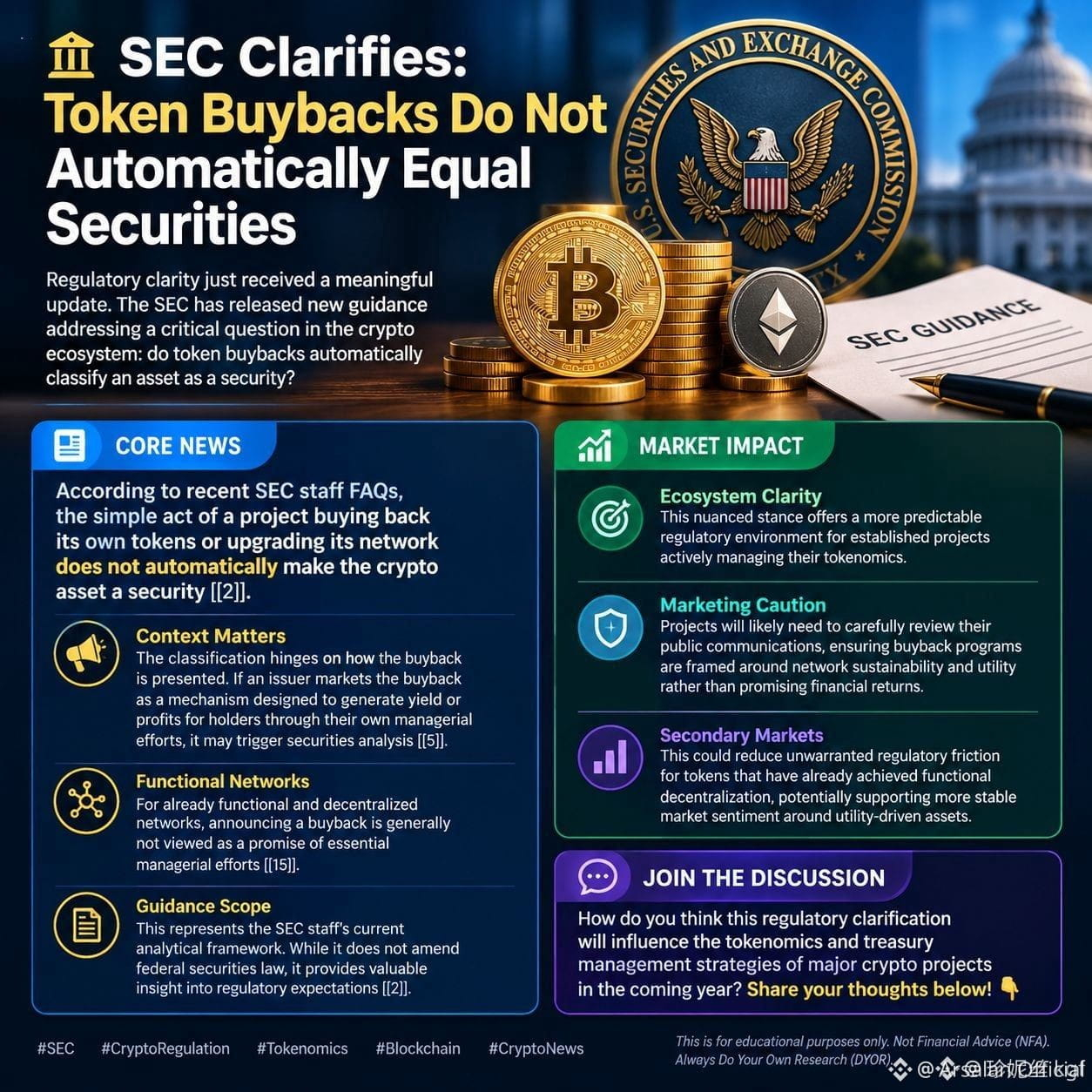
#SECSaysTokenBuybacksNotAutoSecurities The SEC’s Division of Corporation Finance issued new crypto FAQs clarifying that token buybacks and network upgrades do not automatically make a crypto asset a security. The guidance emphasizes that the legal analysis remains case-by-case, including how buybacks are presented to investors and whether they involve promises of profit.
The September 25 guidance is staff guidance, not a new SEC rule, but it provides additional clarity for crypto projects navigating U.S. securities laws.
#SEC #CryptoRegulation #TokenBuybacks #Crypto $BTC
{spot}(BTCUSDT)
#SECSaysTokenBuybacksNotAutoSecurities The SEC’s Division of Corporation Finance issued new crypto FAQs clarifying that token buybacks and network upgrades do not automatically make a crypto asset a security. The guidance emphasizes that the legal analysis remains case-by-case, including how buybacks are presented to investors and whether they involve promises of profit.
The September 25 guidance is staff guidance, not a new SEC rule, but it provides additional clarity for crypto projects navigating U.S. securities laws.
#SEC #CryptoRegulation #TokenBuybacks #Crypto $BTC
The September 25 guidance is staff guidance, not a new SEC rule, but it provides additional clarity for crypto projects navigating U.S. securities laws.
#SEC #CryptoRegulation #TokenBuybacks #Crypto $BTC
1
9

·
--
#SECSaysTokenBuybacksNotAutoSecurities
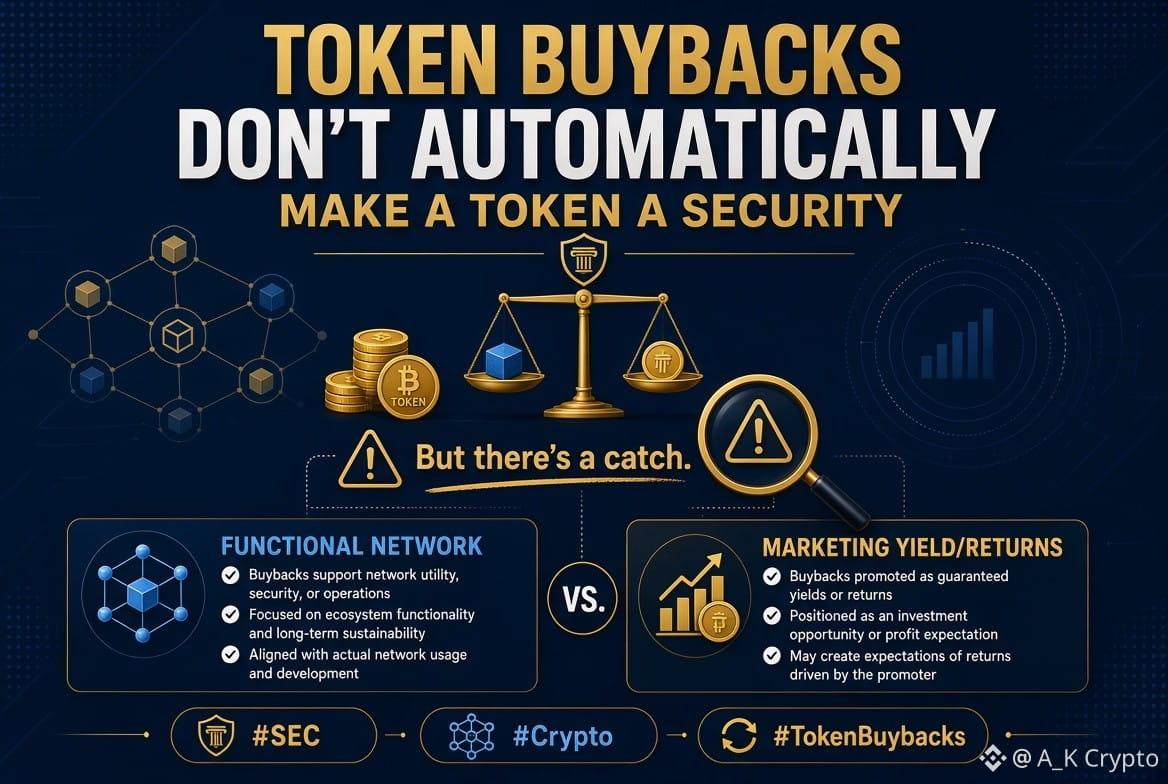
🚨 SEC: TOKEN BUYBACKS DON’T AUTOMATICALLY MAKE A TOKEN A SECURITY
The SEC’s latest crypto FAQs bring an important clarification: a buyback announcement for a non-security token on a functional network does not, by itself, create an investment contract.
If an unfinished project markets buybacks as a way to generate yield or returns for holders, the securities analysis can change.
📌 The key factor is how the buyback is presented and the specific facts of the project.
This gives crypto projects more clarity around token buybacks, but it’s not a blanket regulatory green light. The SEC staff guidance still depends on the network’s functionality and how projects communicate potential returns. For builders and token holders, the wording around buybacks may matter almost as much as the buyback itself.
#SEC #Crypto #TokenBuybacks #Bitcoin #BTC #DeFi #Regulation
#SECSaysTokenBuybacksNotAutoSecurities
🚨 SEC: TOKEN BUYBACKS DON’T AUTOMATICALLY MAKE A TOKEN A SECURITY
The SEC’s latest crypto FAQs bring an important clarification: a buyback announcement for a non-security token on a functional network does not, by itself, create an investment contract.
If an unfinished project markets buybacks as a way to generate yield or returns for holders, the securities analysis can change.
📌 The key factor is how the buyback is presented and the specific facts of the project.
This gives crypto projects more clarity around token buybacks, but it’s not a blanket regulatory green light. The SEC staff guidance still depends on the network’s functionality and how projects communicate potential returns. For builders and token holders, the wording around buybacks may matter almost as much as the buyback itself.
#SEC #Crypto #TokenBuybacks #Bitcoin #BTC #DeFi #Regulation
🚨 SEC: TOKEN BUYBACKS DON’T AUTOMATICALLY MAKE A TOKEN A SECURITY
The SEC’s latest crypto FAQs bring an important clarification: a buyback announcement for a non-security token on a functional network does not, by itself, create an investment contract.
If an unfinished project markets buybacks as a way to generate yield or returns for holders, the securities analysis can change.
📌 The key factor is how the buyback is presented and the specific facts of the project.
This gives crypto projects more clarity around token buybacks, but it’s not a blanket regulatory green light. The SEC staff guidance still depends on the network’s functionality and how projects communicate potential returns. For builders and token holders, the wording around buybacks may matter almost as much as the buyback itself.
#SEC #Crypto #TokenBuybacks #Bitcoin #BTC #DeFi #Regulation
54
·
--
Article
The SEC Just Answered a Question That's Followed Crypto Projects For Years#secsaysbuybacksupgradesdontmaketokensecurity
Token buybacks and ongoing development work have long lived in a legal gray zone — the SEC just gave projects some of the clearest guidance yet on where that line actually sits.
Here's what was clarified: on September 25/26, the SEC's Division of Corporation Finance updated its crypto FAQ, addressing a question many token teams have quietly worried about — does buying back your own token, or continuing to build after launch, turn that token into a security? The staff's answer: not automatically. If a blockchain network is already functional and its native token wasn't originally a security, announcing a buyback to manage treasury reserves, reduce supply, or burn tokens doesn't by itself create an "investment contract" under the Howey test. The same logic extends to ongoing work — maintaining, securing, or upgrading a live network generally doesn't count as the kind of "essential managerial effort" that ties a token's value to a central team's promises. The guidance also touched on liquid staking tokens, suggesting they can be treated as digital commodities rather than securities in many cases. Notably, the analysis flips for networks that aren't yet functional — if a team promotes a buyback there as a source of guaranteed returns, that framing can still trigger securities concerns. It's worth flagging: this is staff-level guidance, not a formal rule or court ruling, and it explicitly doesn't carry the force of law.
Why does this matter? Buybacks have become an increasingly common tool among crypto projects this year, with some newer proposals from L1 and DeFi protocols directly following corporate-style stock repurchase models. Regulatory ambiguity around whether this practice invites securities scrutiny has likely made some teams cautious about adopting it. Clearer staff guidance — even non-binding — gives projects more confidence to design tokenomics around buybacks and continued development without necessarily reopening the security-classification debate every time.
Whether this guidance holds up as market conditions and enforcement priorities shift, or whether it gets tested in an actual case down the line, is something only time will tell.
Does staff guidance like this offer real legal comfort, or is it just clarity until the next enforcement case tests it? 🤔
#SEC #CryptoRegulation #TokenBuybacks #Howey
$PHA $ARK $QI
{spot}(QIUSDT)
{future}(ARKUSDT)
{future}(PHAUSDT)
The SEC Just Answered a Question That's Followed Crypto Projects For Years
#secsaysbuybacksupgradesdontmaketokensecurity
Token buybacks and ongoing development work have long lived in a legal gray zone — the SEC just gave projects some of the clearest guidance yet on where that line actually sits.
Here's what was clarified: on September 25/26, the SEC's Division of Corporation Finance updated its crypto FAQ, addressing a question many token teams have quietly worried about — does buying back your own token, or continuing to build after launch, turn that token into a security? The staff's answer: not automatically. If a blockchain network is already functional and its native token wasn't originally a security, announcing a buyback to manage treasury reserves, reduce supply, or burn tokens doesn't by itself create an "investment contract" under the Howey test. The same logic extends to ongoing work — maintaining, securing, or upgrading a live network generally doesn't count as the kind of "essential managerial effort" that ties a token's value to a central team's promises. The guidance also touched on liquid staking tokens, suggesting they can be treated as digital commodities rather than securities in many cases. Notably, the analysis flips for networks that aren't yet functional — if a team promotes a buyback there as a source of guaranteed returns, that framing can still trigger securities concerns. It's worth flagging: this is staff-level guidance, not a formal rule or court ruling, and it explicitly doesn't carry the force of law.
Why does this matter? Buybacks have become an increasingly common tool among crypto projects this year, with some newer proposals from L1 and DeFi protocols directly following corporate-style stock repurchase models. Regulatory ambiguity around whether this practice invites securities scrutiny has likely made some teams cautious about adopting it. Clearer staff guidance — even non-binding — gives projects more confidence to design tokenomics around buybacks and continued development without necessarily reopening the security-classification debate every time.
Whether this guidance holds up as market conditions and enforcement priorities shift, or whether it gets tested in an actual case down the line, is something only time will tell.
Does staff guidance like this offer real legal comfort, or is it just clarity until the next enforcement case tests it? 🤔
#SEC #CryptoRegulation #TokenBuybacks #Howey
$PHA $ARK $QI
Token buybacks and ongoing development work have long lived in a legal gray zone — the SEC just gave projects some of the clearest guidance yet on where that line actually sits.
Here's what was clarified: on September 25/26, the SEC's Division of Corporation Finance updated its crypto FAQ, addressing a question many token teams have quietly worried about — does buying back your own token, or continuing to build after launch, turn that token into a security? The staff's answer: not automatically. If a blockchain network is already functional and its native token wasn't originally a security, announcing a buyback to manage treasury reserves, reduce supply, or burn tokens doesn't by itself create an "investment contract" under the Howey test. The same logic extends to ongoing work — maintaining, securing, or upgrading a live network generally doesn't count as the kind of "essential managerial effort" that ties a token's value to a central team's promises. The guidance also touched on liquid staking tokens, suggesting they can be treated as digital commodities rather than securities in many cases. Notably, the analysis flips for networks that aren't yet functional — if a team promotes a buyback there as a source of guaranteed returns, that framing can still trigger securities concerns. It's worth flagging: this is staff-level guidance, not a formal rule or court ruling, and it explicitly doesn't carry the force of law.
Why does this matter? Buybacks have become an increasingly common tool among crypto projects this year, with some newer proposals from L1 and DeFi protocols directly following corporate-style stock repurchase models. Regulatory ambiguity around whether this practice invites securities scrutiny has likely made some teams cautious about adopting it. Clearer staff guidance — even non-binding — gives projects more confidence to design tokenomics around buybacks and continued development without necessarily reopening the security-classification debate every time.
Whether this guidance holds up as market conditions and enforcement priorities shift, or whether it gets tested in an actual case down the line, is something only time will tell.
Does staff guidance like this offer real legal comfort, or is it just clarity until the next enforcement case tests it? 🤔
#SEC #CryptoRegulation #TokenBuybacks #Howey
$PHA $ARK $QI
SyedFaisal007:
hy anaya
1
10
9.7k

·
--
REAL CASH FLOWS RETURN $96.3M TO HOLDERS – $OSMO ALERT 📊
Hyperliquid, Pump.fun and EdgeX collectively repurchased $96.3 million of tokens for holders over the past 30 days. The moves suggest a shift toward tangible cash returns, potentially bolstering confidence among institutional participants. Market participants may reassess allocation between cash‑flow generators and growth‑stage projects.
The recent token repurchases highlight a maturing market where cash‑flow generation is gaining prominence. For assets like $OSMO, increased confidence in liquidity could support tighter spreads and modest price stability, but the reallocation of capital away from early‑stage projects may dampen speculative upside. Traders should monitor on‑chain buyback metrics and volume patterns on top‑tier exchanges to gauge whether the trend sustains broader market sentiment.
Not financial advice. Manage your risk.
#CryptoNews #TokenBuybacks #InstitutionalInvestor #DeFi #MarketDynamics
🔍
{spot}(OSMOUSDT)
REAL CASH FLOWS RETURN $96.3M TO HOLDERS – $OSMO ALERT 📊
Hyperliquid, Pump.fun and EdgeX collectively repurchased $96.3 million of tokens for holders over the past 30 days. The moves suggest a shift toward tangible cash returns, potentially bolstering confidence among institutional participants. Market participants may reassess allocation between cash‑flow generators and growth‑stage projects.
The recent token repurchases highlight a maturing market where cash‑flow generation is gaining prominence. For assets like $OSMO , increased confidence in liquidity could support tighter spreads and modest price stability, but the reallocation of capital away from early‑stage projects may dampen speculative upside. Traders should monitor on‑chain buyback metrics and volume patterns on top‑tier exchanges to gauge whether the trend sustains broader market sentiment.
Not financial advice. Manage your risk.
#CryptoNews #TokenBuybacks #InstitutionalInvestor #DeFi #MarketDynamics
🔍
Hyperliquid, Pump.fun and EdgeX collectively repurchased $96.3 million of tokens for holders over the past 30 days. The moves suggest a shift toward tangible cash returns, potentially bolstering confidence among institutional participants. Market participants may reassess allocation between cash‑flow generators and growth‑stage projects.
The recent token repurchases highlight a maturing market where cash‑flow generation is gaining prominence. For assets like $OSMO , increased confidence in liquidity could support tighter spreads and modest price stability, but the reallocation of capital away from early‑stage projects may dampen speculative upside. Traders should monitor on‑chain buyback metrics and volume patterns on top‑tier exchanges to gauge whether the trend sustains broader market sentiment.
Not financial advice. Manage your risk.
#CryptoNews #TokenBuybacks #InstitutionalInvestor #DeFi #MarketDynamics
🔍


139

·
--
Vérifié
Hyperliquid’s USDC Deal Shakes Up Stablecoin Profits 💸🔄
Revenue Shift to Hyperliquid 📈
➡️ Hyperliquid made USDC its Aligned Quote Asset with Coinbase and Circle.
➡️ The protocol now captures up to 90% of reserve income from USDC deposits — revenue that previously went mostly to Circle and Coinbase.
Big Money for HYPE Buybacks 🔥
➡️ Analysts estimate the deal could channel $135M–$160M annually to Hyperliquid for buybacks, based on ∼$5B in USDC on the platform.
➡️ If deposits grow, yield-sharing alone could add $300M–$500M in annual revenue.
➡️ HYPE is up nearly 10% in a week despite broader market weakness.
Squeeze on Circle & Coinbase ⚠️
➡️ Compass Point says the arrangement could cut $60M–$80M from Circle and Coinbase’s combined annual EBITDA.
➡️ At cunue Shift to Hyperliquid 📈
➡️ Hyperliquid made USDC its Aligned Quote Asset with Coinbase and Circle.
➡️ The protocol now captures up to 90% of reserve income from USDC deposits — revenue that previously went mostly to Circle and Coinbarrent rates, the $5.1B USDC supply generates ∼$180M gross profit for them — now largely redirected to Hyperliquid.
Domino Effect Risk � domino
➡️ Analysts warn other DeFi protocols like Polymarket and Jupiter may demand similar yield-sharing deals.
➡️ It also signals consolidation around dominant stablecoins like USDC, with fewer standalone alternatives like USDH gaining traction.
Bottom Line 🎯
➖Hyperliquid flipped the script: stablecoin yield now flows to the exchange, boosting HYPE and pressuring Circle/Coinbase margins. Other DeFi platforms may follow suit.
#️⃣#Hyperliquid #Stablecoins #CryptoNews #TokenBuybacks #DeFiRevenue
$HYPE
{future}(HYPEUSDT)
Hyperliquid’s USDC Deal Shakes Up Stablecoin Profits 💸🔄
Revenue Shift to Hyperliquid 📈
➡️ Hyperliquid made USDC its Aligned Quote Asset with Coinbase and Circle.
➡️ The protocol now captures up to 90% of reserve income from USDC deposits — revenue that previously went mostly to Circle and Coinbase.
Big Money for HYPE Buybacks 🔥
➡️ Analysts estimate the deal could channel $135M–$160M annually to Hyperliquid for buybacks, based on ∼$5B in USDC on the platform.
➡️ If deposits grow, yield-sharing alone could add $300M–$500M in annual revenue.
➡️ HYPE is up nearly 10% in a week despite broader market weakness.
Squeeze on Circle & Coinbase ⚠️
➡️ Compass Point says the arrangement could cut $60M–$80M from Circle and Coinbase’s combined annual EBITDA.
➡️ At cunue Shift to Hyperliquid 📈
➡️ Hyperliquid made USDC its Aligned Quote Asset with Coinbase and Circle.
➡️ The protocol now captures up to 90% of reserve income from USDC deposits — revenue that previously went mostly to Circle and Coinbarrent rates, the $5.1B USDC supply generates ∼$180M gross profit for them — now largely redirected to Hyperliquid.
Domino Effect Risk � domino
➡️ Analysts warn other DeFi protocols like Polymarket and Jupiter may demand similar yield-sharing deals.
➡️ It also signals consolidation around dominant stablecoins like USDC, with fewer standalone alternatives like USDH gaining traction.
Bottom Line 🎯
➖Hyperliquid flipped the script: stablecoin yield now flows to the exchange, boosting HYPE and pressuring Circle/Coinbase margins. Other DeFi platforms may follow suit.
#️⃣#Hyperliquid #Stablecoins #CryptoNews #TokenBuybacks #DeFiRevenue
$HYPE
Revenue Shift to Hyperliquid 📈
➡️ Hyperliquid made USDC its Aligned Quote Asset with Coinbase and Circle.
➡️ The protocol now captures up to 90% of reserve income from USDC deposits — revenue that previously went mostly to Circle and Coinbase.
Big Money for HYPE Buybacks 🔥
➡️ Analysts estimate the deal could channel $135M–$160M annually to Hyperliquid for buybacks, based on ∼$5B in USDC on the platform.
➡️ If deposits grow, yield-sharing alone could add $300M–$500M in annual revenue.
➡️ HYPE is up nearly 10% in a week despite broader market weakness.
Squeeze on Circle & Coinbase ⚠️
➡️ Compass Point says the arrangement could cut $60M–$80M from Circle and Coinbase’s combined annual EBITDA.
➡️ At cunue Shift to Hyperliquid 📈
➡️ Hyperliquid made USDC its Aligned Quote Asset with Coinbase and Circle.
➡️ The protocol now captures up to 90% of reserve income from USDC deposits — revenue that previously went mostly to Circle and Coinbarrent rates, the $5.1B USDC supply generates ∼$180M gross profit for them — now largely redirected to Hyperliquid.
Domino Effect Risk � domino
➡️ Analysts warn other DeFi protocols like Polymarket and Jupiter may demand similar yield-sharing deals.
➡️ It also signals consolidation around dominant stablecoins like USDC, with fewer standalone alternatives like USDH gaining traction.
Bottom Line 🎯
➖Hyperliquid flipped the script: stablecoin yield now flows to the exchange, boosting HYPE and pressuring Circle/Coinbase margins. Other DeFi platforms may follow suit.
#️⃣#Hyperliquid #Stablecoins #CryptoNews #TokenBuybacks #DeFiRevenue
$HYPE

8
787

·
--
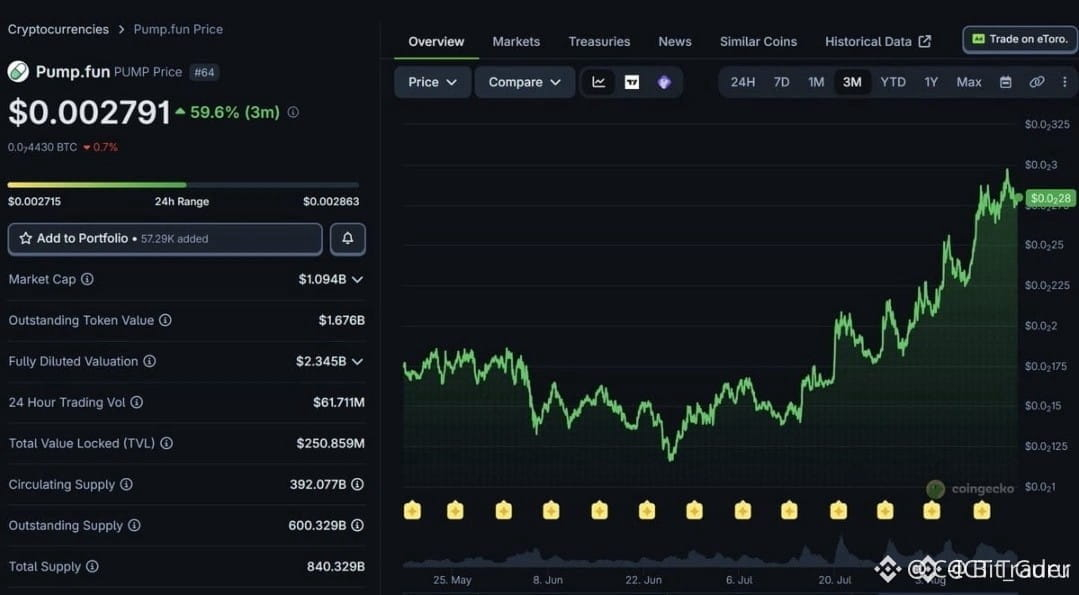
📈 $PUMP REVENUE ENGINE MEETS BUYBACK FLOW — THIS IS REAL ACCUMULATION FUEL 🦈
💡 This isn't your typical meme momentum. Pump.fun is quietly converting top-line revenue into structural demand — buybacks that shrink float while injecting buying pressure directly into the order book. That's a mechanism designed for high-conviction accumulation.
📊 In a market where most narratives rest on empty promises, actual cash flow backing a token economy is a different breed of signal. The setup here rewards patience, not FOMO chasing.
🤔 Which matters more to your entry — hype velocity or tokenomics with a self-funding bid? 💬
⚠️ Not financial advice. Always manage your risk. 🛡️
🏷️ #PUMP #TokenBuybacks #CryptoFundamentals #Altcoin #DeFi
🎯 🦈
📈 $PUMP REVENUE ENGINE MEETS BUYBACK FLOW — THIS IS REAL ACCUMULATION FUEL 🦈
💡 This isn't your typical meme momentum. Pump.fun is quietly converting top-line revenue into structural demand — buybacks that shrink float while injecting buying pressure directly into the order book. That's a mechanism designed for high-conviction accumulation.
📊 In a market where most narratives rest on empty promises, actual cash flow backing a token economy is a different breed of signal. The setup here rewards patience, not FOMO chasing.
🤔 Which matters more to your entry — hype velocity or tokenomics with a self-funding bid? 💬
⚠️ Not financial advice. Always manage your risk. 🛡️
🏷️ #PUMP #TokenBuybacks #CryptoFundamentals #Altcoin #DeFi
🎯 🦈
💡 This isn't your typical meme momentum. Pump.fun is quietly converting top-line revenue into structural demand — buybacks that shrink float while injecting buying pressure directly into the order book. That's a mechanism designed for high-conviction accumulation.
📊 In a market where most narratives rest on empty promises, actual cash flow backing a token economy is a different breed of signal. The setup here rewards patience, not FOMO chasing.
🤔 Which matters more to your entry — hype velocity or tokenomics with a self-funding bid? 💬
⚠️ Not financial advice. Always manage your risk. 🛡️
🏷️ #PUMP #TokenBuybacks #CryptoFundamentals #Altcoin #DeFi
🎯 🦈
48
Connectez-vous pour découvrir plus de contenu
Rejoignez la communauté mondiale des adeptes de cryptomonnaies sur Binance Square
⚡️ Suviez les dernières informations importantes sur les cryptomonnaies.
💬 Jugé digne de confiance par la plus grande plateforme d’échange de cryptomonnaies au monde.
👍 Découvrez les connaissances que partagent les créateurs vérifiés.
Adresse e-mail/Nº de téléphone
Sujets d’actualité
1
#EarningsSeason
27,970 vues
237 mentions
2
#BitgetHackerFailsToMoveStolenFunds
2,384 vues
135 mentions
3
#BitMineETHHoldingsTop6Million
5,557 vues
295 mentions
4
#StrategyAdds1666BTCHoldingsReach847666
4,875 vues
225 mentions
5
#NvidiaApproves$150BBuyback
2,758 vues
58 mentions
6
#OpenAIDelaysGPT6.1OverSafetyIssues
17,020 vues
544 mentions
7
#AMDToAcquireWorldLabsFor$8.2B
1,394 vues
50 mentions
8
#AnthropicIPOProspectusCouldValueItOver$2T
4,691 vues
74 mentions
9
#HackersDrainOver12.4MXRPFromDCENTWallets
32,281 vues
638 mentions
10
#SECSaysDecentralizedTokenBuybacksNotInvestmentContracts
2,743 vues
39 mentions