

#machineeconomy
machineeconomy
19,912 vues
275 mentions
Populaire
Récents

·
--
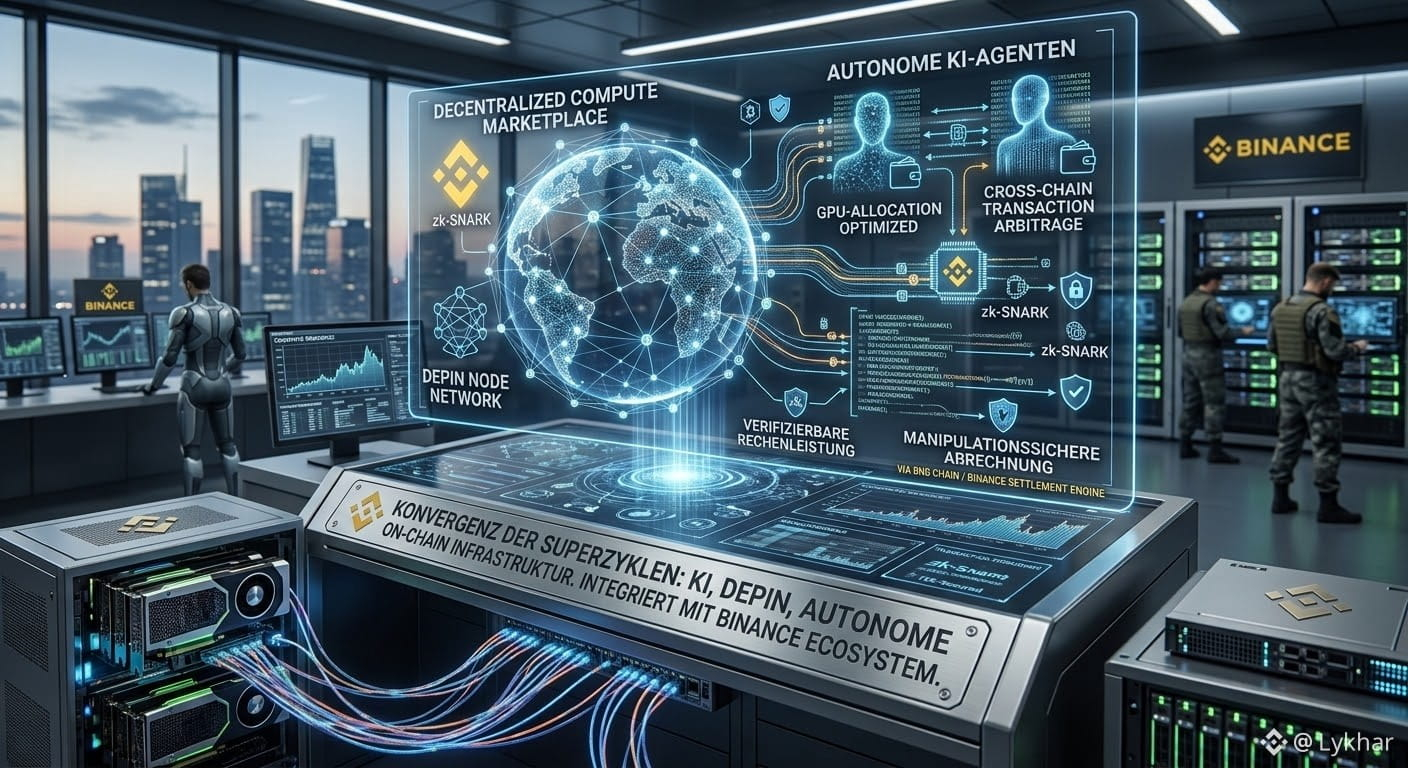
#Die Konvergenz der Superzyklen: Autonome KI-Agenten, DePIN und die nächste Generation dezentraler Rechenleistung
Die Grenzen zwischen reiner Software-Automatisierung, physikalischer Hardware und distributed ledgers lösen sich auf. Was lange als isolierte Entwicklungsstränge betrachtet wurde, verschmilzt zu einem symbiotischen Tech-Stack, der die Architektur digitaler Ökonomien neu definiert:
* DePIN als physisches Rückgrat der KI-Expansion: Der weltweite Hunger nach Compute-Ressourcen (GPUs, TPUs) stößt bei zentralisierten Hyperscalern an Kapazitäts- und Margengrenzen. Decentralized Physical Infrastructure Networks (DePIN) etablieren liquide, dezentrale Märkte für Bare-Metal-Rechenleistung, Zero-Knowledge-verifizierte Inferenz und dezentralen Datentransfer. Physische Hardware wird direkt über kryptografische Protokolle koordiniert und vergütet.
* On-Chain AI-Agents als primäre Marktteilnehmer: Autonome Software-Agenten entwickeln sich von passiven Analysewerkzeugen zu souveränen ökonomischen Akteuren. Ausgestattet mit programmierbaren Wallets steuern sie Liquiditätsströme, arbitrieren Arbitrage-Spreads in Mikrosekunden und optimieren cross-chain Transaktionspfade ohne menschliche Latenz.
* Kryptografische Verifizierbarkeit statt blindem Vertrauen: Mit dem rasanten Wachstum synthetischer Intelligenz wird algorithmische Integrität zum kritischen Engpass. Zero-Knowledge-Proofs (zk-SNARKs) und TEE-gestützte Umgebungen sichern ab, dass Inferenz-Modelle unverfälscht ausgeführt und Datenströme manipulationssicher abgerechnet werden.
Die Verbindung aus dezentralisierter Hardware-Allokation, kryptografischer Abrechnung und autonom agierender Maschinenintelligenz legt den Grundstein für eine hocheffiziente, selbststeuernde Infrastruktur. Echter strategischer Vorsprung entsteht dort, wo diese High-End-Technologien nahtlos ineinandergreifen.
#DeepTech #ArtificialIntelligence #DePIN #Web3Infrastructure #DistributedCompute #MachineEconomy
#Die Konvergenz der Superzyklen: Autonome KI-Agenten, DePIN und die nächste Generation dezentraler Rechenleistung
Die Grenzen zwischen reiner Software-Automatisierung, physikalischer Hardware und distributed ledgers lösen sich auf. Was lange als isolierte Entwicklungsstränge betrachtet wurde, verschmilzt zu einem symbiotischen Tech-Stack, der die Architektur digitaler Ökonomien neu definiert:
* DePIN als physisches Rückgrat der KI-Expansion: Der weltweite Hunger nach Compute-Ressourcen (GPUs, TPUs) stößt bei zentralisierten Hyperscalern an Kapazitäts- und Margengrenzen. Decentralized Physical Infrastructure Networks (DePIN) etablieren liquide, dezentrale Märkte für Bare-Metal-Rechenleistung, Zero-Knowledge-verifizierte Inferenz und dezentralen Datentransfer. Physische Hardware wird direkt über kryptografische Protokolle koordiniert und vergütet.
* On-Chain AI-Agents als primäre Marktteilnehmer: Autonome Software-Agenten entwickeln sich von passiven Analysewerkzeugen zu souveränen ökonomischen Akteuren. Ausgestattet mit programmierbaren Wallets steuern sie Liquiditätsströme, arbitrieren Arbitrage-Spreads in Mikrosekunden und optimieren cross-chain Transaktionspfade ohne menschliche Latenz.
* Kryptografische Verifizierbarkeit statt blindem Vertrauen: Mit dem rasanten Wachstum synthetischer Intelligenz wird algorithmische Integrität zum kritischen Engpass. Zero-Knowledge-Proofs (zk-SNARKs) und TEE-gestützte Umgebungen sichern ab, dass Inferenz-Modelle unverfälscht ausgeführt und Datenströme manipulationssicher abgerechnet werden.
Die Verbindung aus dezentralisierter Hardware-Allokation, kryptografischer Abrechnung und autonom agierender Maschinenintelligenz legt den Grundstein für eine hocheffiziente, selbststeuernde Infrastruktur. Echter strategischer Vorsprung entsteht dort, wo diese High-End-Technologien nahtlos ineinandergreifen.
#DeepTech #ArtificialIntelligence #DePIN #Web3Infrastructure #DistributedCompute #MachineEconomy
Die Grenzen zwischen reiner Software-Automatisierung, physikalischer Hardware und distributed ledgers lösen sich auf. Was lange als isolierte Entwicklungsstränge betrachtet wurde, verschmilzt zu einem symbiotischen Tech-Stack, der die Architektur digitaler Ökonomien neu definiert:
* DePIN als physisches Rückgrat der KI-Expansion: Der weltweite Hunger nach Compute-Ressourcen (GPUs, TPUs) stößt bei zentralisierten Hyperscalern an Kapazitäts- und Margengrenzen. Decentralized Physical Infrastructure Networks (DePIN) etablieren liquide, dezentrale Märkte für Bare-Metal-Rechenleistung, Zero-Knowledge-verifizierte Inferenz und dezentralen Datentransfer. Physische Hardware wird direkt über kryptografische Protokolle koordiniert und vergütet.
* On-Chain AI-Agents als primäre Marktteilnehmer: Autonome Software-Agenten entwickeln sich von passiven Analysewerkzeugen zu souveränen ökonomischen Akteuren. Ausgestattet mit programmierbaren Wallets steuern sie Liquiditätsströme, arbitrieren Arbitrage-Spreads in Mikrosekunden und optimieren cross-chain Transaktionspfade ohne menschliche Latenz.
* Kryptografische Verifizierbarkeit statt blindem Vertrauen: Mit dem rasanten Wachstum synthetischer Intelligenz wird algorithmische Integrität zum kritischen Engpass. Zero-Knowledge-Proofs (zk-SNARKs) und TEE-gestützte Umgebungen sichern ab, dass Inferenz-Modelle unverfälscht ausgeführt und Datenströme manipulationssicher abgerechnet werden.
Die Verbindung aus dezentralisierter Hardware-Allokation, kryptografischer Abrechnung und autonom agierender Maschinenintelligenz legt den Grundstein für eine hocheffiziente, selbststeuernde Infrastruktur. Echter strategischer Vorsprung entsteht dort, wo diese High-End-Technologien nahtlos ineinandergreifen.
#DeepTech #ArtificialIntelligence #DePIN #Web3Infrastructure #DistributedCompute #MachineEconomy
171

Ant International is collaborating with Visa and Mastercard to develop payment standards for autonomous AI agents. The initiative focuses on creating frameworks to identify and monitor software driven transactions.
#AIAgents #MachineEconomy
Ant International is collaborating with Visa and Mastercard to develop payment standards for autonomous AI agents. The initiative focuses on creating frameworks to identify and monitor software driven transactions.
#AIAgents #MachineEconomy
#AIAgents #MachineEconomy
5

·
--
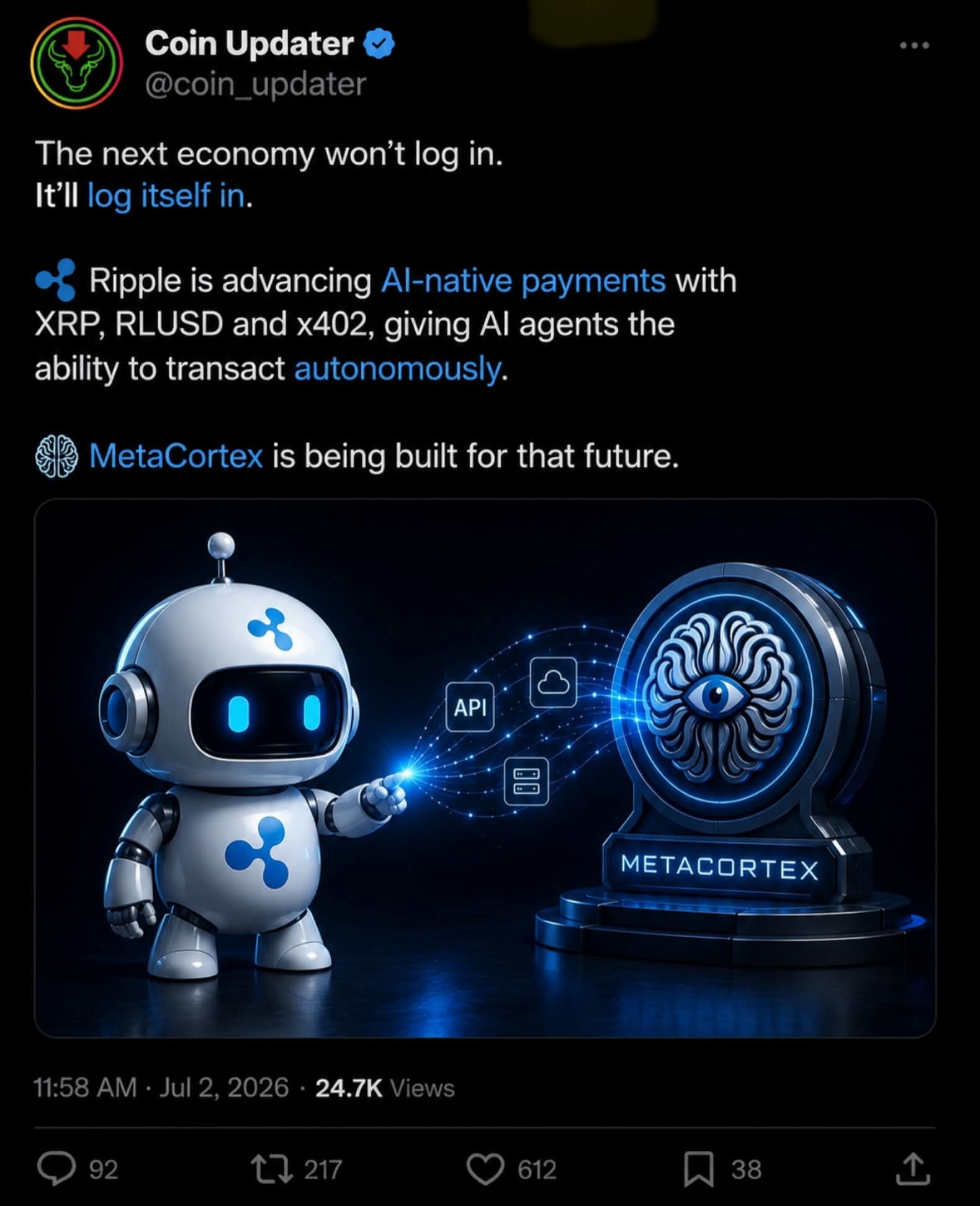
The internet is evolving. So is money.
AI is no longer just generating content—it’s beginning to transact, automate, and interact with the digital economy. Ripple’s work around XRP, RLUSD, and x402 shows where the industry is heading.
MetaCortex is built around that long-term vision: an intelligence layer for the machine economy, where AI agents, autonomous commerce, and programmable payments become the new standard.
The next wave of crypto won’t just be about assets. It’ll be about intelligence.
🧠 Follow the future. Follow
$XRP #AI #Crypto #xrp #MachineEconomy
Always do your own research. This is not financial advice.
The internet is evolving. So is money.
AI is no longer just generating content—it’s beginning to transact, automate, and interact with the digital economy. Ripple’s work around XRP, RLUSD, and x402 shows where the industry is heading.
MetaCortex is built around that long-term vision: an intelligence layer for the machine economy, where AI agents, autonomous commerce, and programmable payments become the new standard.
The next wave of crypto won’t just be about assets. It’ll be about intelligence.
🧠 Follow the future. Follow
$XRP #AI #Crypto #xrp #MachineEconomy
Always do your own research. This is not financial advice.
AI is no longer just generating content—it’s beginning to transact, automate, and interact with the digital economy. Ripple’s work around XRP, RLUSD, and x402 shows where the industry is heading.
MetaCortex is built around that long-term vision: an intelligence layer for the machine economy, where AI agents, autonomous commerce, and programmable payments become the new standard.
The next wave of crypto won’t just be about assets. It’ll be about intelligence.
🧠 Follow the future. Follow
$XRP #AI #Crypto #xrp #MachineEconomy
Always do your own research. This is not financial advice.
100

Solana's AI Agent Start Making Real Money
Are we watching the start of a machine-run economy on Solana?
Messari's Q1 report shows Solana's AI agents are past the testing phase. One game alone saw 1,171 agents make 490K trades in under a week, and the network's handled 15M agent payments.
Do you think machine-to-machine commerce onchain is the next big thing?
#AgentGDP #solana #AIAgents #Web3Revolution #MachineEconomy
Solana's AI Agent Start Making Real Money
Are we watching the start of a machine-run economy on Solana?
Messari's Q1 report shows Solana's AI agents are past the testing phase. One game alone saw 1,171 agents make 490K trades in under a week, and the network's handled 15M agent payments.
Do you think machine-to-machine commerce onchain is the next big thing?
#AgentGDP #solana #AIAgents #Web3Revolution #MachineEconomy
Are we watching the start of a machine-run economy on Solana?
Messari's Q1 report shows Solana's AI agents are past the testing phase. One game alone saw 1,171 agents make 490K trades in under a week, and the network's handled 15M agent payments.
Do you think machine-to-machine commerce onchain is the next big thing?
#AgentGDP #solana #AIAgents #Web3Revolution #MachineEconomy
109

·
--
Fabric Protocol近期热度显著上升,官方刚刚推出RoboPay,同时百万ROBO开发者赏金计划也已正式启动,两大动作将对项目发展和代币价值带来积极影响。
其独创的Pay-to-Actuate基础设施,正在加速机器经济生态的落地,不仅进一步拓展了$ROBO的 utility需求,也吸引了更多开发者参与生态建设。
当前数据:
价格:0.0105美元
24h交易量:676万美元
市值:2343万美元
看好机器经济赛道的朋友可以保持关注。
$ROBO #FabricProtocol #MachineEconomy
Fabric Protocol近期热度显著上升,官方刚刚推出RoboPay,同时百万ROBO开发者赏金计划也已正式启动,两大动作将对项目发展和代币价值带来积极影响。
其独创的Pay-to-Actuate基础设施,正在加速机器经济生态的落地,不仅进一步拓展了$ROBO 的 utility需求,也吸引了更多开发者参与生态建设。
当前数据:
价格:0.0105美元
24h交易量:676万美元
市值:2343万美元
看好机器经济赛道的朋友可以保持关注。
$ROBO #FabricProtocol #MachineEconomy
其独创的Pay-to-Actuate基础设施,正在加速机器经济生态的落地,不仅进一步拓展了$ROBO 的 utility需求,也吸引了更多开发者参与生态建设。
当前数据:
价格:0.0105美元
24h交易量:676万美元
市值:2343万美元
看好机器经济赛道的朋友可以保持关注。
$ROBO #FabricProtocol #MachineEconomy
62

最近Fabric Protocol ($ROBO) 市场热度明显上升,主要得益于两大核心进展:RoboPay正式上线,以及百万ROBO开发者赏金计划启动。这两件事无疑将对项目发展和代币价格带来积极影响。
从生态发展角度看,Fabric Protocol的Pay-to-Actuate基础设施正在加速机器经济生态的落地,随着更多开发者参与和应用场景落地,代币 utility需求也将持续提升。
当前数据:
价格:0.0105 USDT
24h交易量:6.76M USDT
市值:23.43M USDT,可以持续关注后续生态进展。
$ROBO #MachineEconomy #DePIN
最近Fabric Protocol ($ROBO ) 市场热度明显上升,主要得益于两大核心进展:RoboPay正式上线,以及百万ROBO开发者赏金计划启动。这两件事无疑将对项目发展和代币价格带来积极影响。
从生态发展角度看,Fabric Protocol的Pay-to-Actuate基础设施正在加速机器经济生态的落地,随着更多开发者参与和应用场景落地,代币 utility需求也将持续提升。
当前数据:
价格:0.0105 USDT
24h交易量:6.76M USDT
市值:23.43M USDT,可以持续关注后续生态进展。
$ROBO #MachineEconomy #DePIN
从生态发展角度看,Fabric Protocol的Pay-to-Actuate基础设施正在加速机器经济生态的落地,随着更多开发者参与和应用场景落地,代币 utility需求也将持续提升。
当前数据:
价格:0.0105 USDT
24h交易量:6.76M USDT
市值:23.43M USDT,可以持续关注后续生态进展。
$ROBO #MachineEconomy #DePIN
62

·
--
AI Agent 正在重塑链上经济,SlinkyLayer 则在构建支撑这一切的基础设施。
SlinkyLayer 是首个面向 AI 智能体的去中心化意图执行层,基于 x402 协议打造,让 AI Agent 能够无需 API 密钥、在链上按次付费地调用各类 API 服务。它还将信誉体系迁移至链上,为机器经济提供可信的交易与协作底座。
本轮 Seed 轮获得了 Animoca Brands、Draper Dragon、Cogitent Ventures、GravityX Capital、Kinetic Kollective 与 Levitate Labs 的共同参与,阵容相当豪华。
在 AI 原生应用加速爆发的当下,谁能率先打通"智能体—API—价值"的闭环,谁就握住了下一代机器经济的入口。SlinkyLayer 值得重点关注。
了解更多:https://slinkylayer.ai
#AI #MachineEconomy
AI Agent 正在重塑链上经济,SlinkyLayer 则在构建支撑这一切的基础设施。
SlinkyLayer 是首个面向 AI 智能体的去中心化意图执行层,基于 x402 协议打造,让 AI Agent 能够无需 API 密钥、在链上按次付费地调用各类 API 服务。它还将信誉体系迁移至链上,为机器经济提供可信的交易与协作底座。
本轮 Seed 轮获得了 Animoca Brands、Draper Dragon、Cogitent Ventures、GravityX Capital、Kinetic Kollective 与 Levitate Labs 的共同参与,阵容相当豪华。
在 AI 原生应用加速爆发的当下,谁能率先打通"智能体—API—价值"的闭环,谁就握住了下一代机器经济的入口。SlinkyLayer 值得重点关注。
了解更多:https://slinkylayer.ai
#AI #MachineEconomy
SlinkyLayer 是首个面向 AI 智能体的去中心化意图执行层,基于 x402 协议打造,让 AI Agent 能够无需 API 密钥、在链上按次付费地调用各类 API 服务。它还将信誉体系迁移至链上,为机器经济提供可信的交易与协作底座。
本轮 Seed 轮获得了 Animoca Brands、Draper Dragon、Cogitent Ventures、GravityX Capital、Kinetic Kollective 与 Levitate Labs 的共同参与,阵容相当豪华。
在 AI 原生应用加速爆发的当下,谁能率先打通"智能体—API—价值"的闭环,谁就握住了下一代机器经济的入口。SlinkyLayer 值得重点关注。
了解更多:https://slinkylayer.ai
#AI #MachineEconomy
9

·
--
What if a robot could earn crypto for you while you sleep? ☕🤖
XMAQUINA (DEUS) just surged over 31% in 24 hours, pushing its price to roughly $0.0315. But what is it? Think of it as a "DePIN" project — Decentralized Physical Infrastructure Network. In simple terms, XMAQUINA tokenizes ownership of real-world robots and automation hardware. Investors buy the token, the protocol buys machines (like coffee bots or factory arms), and the revenue generated by those machines flows back to token holders.
With a market cap around $16 million and $1 million in daily volume, it’s a small-cap gem gaining traction. The recent pump suggests growing interest in the "Machine Economy" narrative — where AI meets crypto. However, low liquidity means high volatility. Always research the hardware deployment roadmap before aping in.
#DePIN #MachineEconomy
Would you trust a robot to manage your passive income stream? 👇
What if a robot could earn crypto for you while you sleep? ☕🤖
XMAQUINA (DEUS) just surged over 31% in 24 hours, pushing its price to roughly $0.0315. But what is it? Think of it as a "DePIN" project — Decentralized Physical Infrastructure Network. In simple terms, XMAQUINA tokenizes ownership of real-world robots and automation hardware. Investors buy the token, the protocol buys machines (like coffee bots or factory arms), and the revenue generated by those machines flows back to token holders.
With a market cap around $16 million and $1 million in daily volume, it’s a small-cap gem gaining traction. The recent pump suggests growing interest in the "Machine Economy" narrative — where AI meets crypto. However, low liquidity means high volatility. Always research the hardware deployment roadmap before aping in.
#DePIN #MachineEconomy
Would you trust a robot to manage your passive income stream? 👇
XMAQUINA (DEUS) just surged over 31% in 24 hours, pushing its price to roughly $0.0315. But what is it? Think of it as a "DePIN" project — Decentralized Physical Infrastructure Network. In simple terms, XMAQUINA tokenizes ownership of real-world robots and automation hardware. Investors buy the token, the protocol buys machines (like coffee bots or factory arms), and the revenue generated by those machines flows back to token holders.
With a market cap around $16 million and $1 million in daily volume, it’s a small-cap gem gaining traction. The recent pump suggests growing interest in the "Machine Economy" narrative — where AI meets crypto. However, low liquidity means high volatility. Always research the hardware deployment roadmap before aping in.
#DePIN #MachineEconomy
Would you trust a robot to manage your passive income stream? 👇
DEUSETF+0,27%
116

·
--

Article
هل يقود الذكاء الاصطناعي العالم نحو المستقبل... أم نحو المجهول؟في حلقة جديدة من Dealflow Podcast، ناقش Martin El Khouri، المدير التجاري في peaq، مع RealMissAI مستقبل الاقتصاد الآلي وعالم قد تصبح فيه الآلات والذكاء الاصطناعي القوة المهيمنة.
📊 أبرز التساؤلات المطروحة:
🔹 ماذا يحدث عندما تبدأ الآلات باتخاذ القرارات الاقتصادية؟
🔹 هل سيخلق الذكاء الاصطناعي فرصًا جديدة أم يقضي على ملايين الوظائف؟
🔹 كيف ستتفاعل البلوكشين مع اقتصاد تقوده الآلات؟
🔹 هل نحن أمام يوتوبيا تقنية أم ديستوبيا رقمية؟
⚡ لماذا يهم هذا الموضوع؟
لم يعد الحديث عن الذكاء الاصطناعي مجرد فكرة مستقبلية، بل أصبح جزءًا من الواقع الاقتصادي الحالي. ومع تطور مشاريع مثل peaq واقتصاد الآلة (Machine Economy)، يعتقد البعض أن العقد القادم قد يشهد تحولًا جذريًا في طريقة العمل والإنتاج والتبادل الاقتصادي.
#ArtificialIntelligence #Blockchain #MachineEconomy #CryptoNews
هل يقود الذكاء الاصطناعي العالم نحو المستقبل... أم نحو المجهول؟
في حلقة جديدة من Dealflow Podcast، ناقش Martin El Khouri، المدير التجاري في peaq، مع RealMissAI مستقبل الاقتصاد الآلي وعالم قد تصبح فيه الآلات والذكاء الاصطناعي القوة المهيمنة.
📊 أبرز التساؤلات المطروحة:
🔹 ماذا يحدث عندما تبدأ الآلات باتخاذ القرارات الاقتصادية؟
🔹 هل سيخلق الذكاء الاصطناعي فرصًا جديدة أم يقضي على ملايين الوظائف؟
🔹 كيف ستتفاعل البلوكشين مع اقتصاد تقوده الآلات؟
🔹 هل نحن أمام يوتوبيا تقنية أم ديستوبيا رقمية؟
⚡ لماذا يهم هذا الموضوع؟
لم يعد الحديث عن الذكاء الاصطناعي مجرد فكرة مستقبلية، بل أصبح جزءًا من الواقع الاقتصادي الحالي. ومع تطور مشاريع مثل peaq واقتصاد الآلة (Machine Economy)، يعتقد البعض أن العقد القادم قد يشهد تحولًا جذريًا في طريقة العمل والإنتاج والتبادل الاقتصادي.
#ArtificialIntelligence #Blockchain #MachineEconomy #CryptoNews
📊 أبرز التساؤلات المطروحة:
🔹 ماذا يحدث عندما تبدأ الآلات باتخاذ القرارات الاقتصادية؟
🔹 هل سيخلق الذكاء الاصطناعي فرصًا جديدة أم يقضي على ملايين الوظائف؟
🔹 كيف ستتفاعل البلوكشين مع اقتصاد تقوده الآلات؟
🔹 هل نحن أمام يوتوبيا تقنية أم ديستوبيا رقمية؟
⚡ لماذا يهم هذا الموضوع؟
لم يعد الحديث عن الذكاء الاصطناعي مجرد فكرة مستقبلية، بل أصبح جزءًا من الواقع الاقتصادي الحالي. ومع تطور مشاريع مثل peaq واقتصاد الآلة (Machine Economy)، يعتقد البعض أن العقد القادم قد يشهد تحولًا جذريًا في طريقة العمل والإنتاج والتبادل الاقتصادي.
#ArtificialIntelligence #Blockchain #MachineEconomy #CryptoNews
2
385

·
--

Article
🚀 $PEAQ: A Blockchain que Vai Alimentar a Economia das Máquinas — e Por Que Você Precisa conhecer.O Futuro não pertence às corporações. Pertence às máquinas descentralizadas.
Imagine um mundo onde drones de entrega pagam sozinhos por serviços, robôs negociam contratos on-chain e dispositivos IoT geram renda passiva para quem os opera — tudo sem intermediários, sem bancos, sem burocracia.
Esse mundo já existe. E ele roda em $PEAQ.
🔗 O Que é $PEAQ?
peaq é uma blockchain Layer-1 compatível com EVM, construída especificamente para alimentar a Machine Economy — habilitando redes de infraestrutura física descentralizada (DePIN), IA física descentralizada (DePAI), DeFi nativo de máquinas e ativos do mundo real tokenizados.
O token nativo $PEAQ funciona como o ativo primário de utilidade e governança dentro de todo o ecossistema.
💎 Por Que PEAQ é Diferente de Qualquer Outra Crypto?
🤖 1. Infraestrutura Real, Não Apenas Promessa
O ecossistema peaq hospeda mais de 60 DePINs em 22 indústrias, protegendo milhões de dispositivos e máquinas on-chain por meio de uma infraestrutura de alto desempenho projetada para escalonamento no mundo real.
A rede registra $180 milhões em total value locked em carteiras de máquinas, com mais de 12.000 dispositivos ativos diariamente.
🔄 2. Interoperabilidade Total
A peaq opera como uma parachain Polkadot e introduz "Multi-Chain IDs", permitindo que um único robô ou dispositivo IoT interaja com múltiplas redes blockchain simultaneamente.
📉 3. Tokenomics Desinflacionária — Defesa Natural do Preço
O $PEAQ possui um modelo desinflacionário que começa com 3,5% de inflação anual, diminuindo 10% ao ano até estabilizar em 1%. Mais de 1,7 bilhão de PEAQ (~40% do supply) já está em staking, travando a liquidez e protegendo o preço.
🏛️ 4. Regulamentação — O Diferencial Institucional
A peaq assinou um Memorando de Entendimento com a VARA de Dubai — a autoridade reguladora de ativos virtuais — para desenvolver uma estrutura de robótica on-chain e máquinas tokenizadas, abrindo caminho para adoção institucional em escala global.
🤝 5. Casos de Uso Reais e Funcionando AGORA
Em maio de 2026, um robô de entrega realizou pagamentos autônomos em USDT on-chain usando o peaqOS — validando a tese de infraestrutura para comércio autônomo de máquinas. Além disso, a peaq lançou as "Initial Machine Offerings" (IMOs) em parceria com a CoinList para tokenizar robôs como ativos líquidos geradores de rendimento para milhões de usuários.
📈 O Setor Que Está Explodindo em 2026
Em 2026, a economia global passa por uma transformação profunda: infraestruturas físicas como drones logísticos, smart grids e dispositivos IoT são cada vez mais gerenciadas por redes descentralizadas de máquinas autônomas — e a peaq está na vanguarda dessa revolução.
Os anos de 2026-2027 verão a implantação comercial de robôs humanoides e robotaxis — e a peaq está idealmente posicionada para atendê-los. À medida que as redes de infraestrutura descentralizada crescem, as funções modulares da peaq oferecem utilidade plug-and-play para qualquer projeto do setor.
💰 Como Lucrar com $PEAQ ?
✅ Staking — Ganhe recompensas contribuindo para a segurança da rede
✅ Machine Yield — Conecte hardware (sensores, painéis solares, robôs) e receba rendimento
✅ Holding — Tokenomics desinflacionária favorece valorização no longo prazo
✅ DeFi — Participe do ecossistema de Machine DeFi em expansão
✅ IMOs — Invista em robôs tokenizados como ativos geradores de PEAQ
| #DePIN | #MachineEconomy | #Binance | #USStockFundsDrawRecord$119.2BInWeek #Crypto2026yield
🚀 $PEAQ: A Blockchain que Vai Alimentar a Economia das Máquinas — e Por Que Você Precisa conhecer.
O Futuro não pertence às corporações. Pertence às máquinas descentralizadas.
Imagine um mundo onde drones de entrega pagam sozinhos por serviços, robôs negociam contratos on-chain e dispositivos IoT geram renda passiva para quem os opera — tudo sem intermediários, sem bancos, sem burocracia.
Esse mundo já existe. E ele roda em $PEAQ .
🔗 O Que é $PEAQ ?
peaq é uma blockchain Layer-1 compatível com EVM, construída especificamente para alimentar a Machine Economy — habilitando redes de infraestrutura física descentralizada (DePIN), IA física descentralizada (DePAI), DeFi nativo de máquinas e ativos do mundo real tokenizados.
O token nativo $PEAQ funciona como o ativo primário de utilidade e governança dentro de todo o ecossistema.
💎 Por Que PEAQ é Diferente de Qualquer Outra Crypto?
🤖 1. Infraestrutura Real, Não Apenas Promessa
O ecossistema peaq hospeda mais de 60 DePINs em 22 indústrias, protegendo milhões de dispositivos e máquinas on-chain por meio de uma infraestrutura de alto desempenho projetada para escalonamento no mundo real.
A rede registra $180 milhões em total value locked em carteiras de máquinas, com mais de 12.000 dispositivos ativos diariamente.
🔄 2. Interoperabilidade Total
A peaq opera como uma parachain Polkadot e introduz "Multi-Chain IDs", permitindo que um único robô ou dispositivo IoT interaja com múltiplas redes blockchain simultaneamente.
📉 3. Tokenomics Desinflacionária — Defesa Natural do Preço
O $PEAQ possui um modelo desinflacionário que começa com 3,5% de inflação anual, diminuindo 10% ao ano até estabilizar em 1%. Mais de 1,7 bilhão de PEAQ (~40% do supply) já está em staking, travando a liquidez e protegendo o preço.
🏛️ 4. Regulamentação — O Diferencial Institucional
A peaq assinou um Memorando de Entendimento com a VARA de Dubai — a autoridade reguladora de ativos virtuais — para desenvolver uma estrutura de robótica on-chain e máquinas tokenizadas, abrindo caminho para adoção institucional em escala global.
🤝 5. Casos de Uso Reais e Funcionando AGORA
Em maio de 2026, um robô de entrega realizou pagamentos autônomos em USDT on-chain usando o peaqOS — validando a tese de infraestrutura para comércio autônomo de máquinas. Além disso, a peaq lançou as "Initial Machine Offerings" (IMOs) em parceria com a CoinList para tokenizar robôs como ativos líquidos geradores de rendimento para milhões de usuários.
📈 O Setor Que Está Explodindo em 2026
Em 2026, a economia global passa por uma transformação profunda: infraestruturas físicas como drones logísticos, smart grids e dispositivos IoT são cada vez mais gerenciadas por redes descentralizadas de máquinas autônomas — e a peaq está na vanguarda dessa revolução.
Os anos de 2026-2027 verão a implantação comercial de robôs humanoides e robotaxis — e a peaq está idealmente posicionada para atendê-los. À medida que as redes de infraestrutura descentralizada crescem, as funções modulares da peaq oferecem utilidade plug-and-play para qualquer projeto do setor.
💰 Como Lucrar com $PEAQ ?
✅ Staking — Ganhe recompensas contribuindo para a segurança da rede
✅ Machine Yield — Conecte hardware (sensores, painéis solares, robôs) e receba rendimento
✅ Holding — Tokenomics desinflacionária favorece valorização no longo prazo
✅ DeFi — Participe do ecossistema de Machine DeFi em expansão
✅ IMOs — Invista em robôs tokenizados como ativos geradores de PEAQ
| #DePIN | #MachineEconomy | #Binance | #USStockFundsDrawRecord$119.2BInWeek #Crypto2026yield
Imagine um mundo onde drones de entrega pagam sozinhos por serviços, robôs negociam contratos on-chain e dispositivos IoT geram renda passiva para quem os opera — tudo sem intermediários, sem bancos, sem burocracia.
Esse mundo já existe. E ele roda em $PEAQ .
🔗 O Que é $PEAQ ?
peaq é uma blockchain Layer-1 compatível com EVM, construída especificamente para alimentar a Machine Economy — habilitando redes de infraestrutura física descentralizada (DePIN), IA física descentralizada (DePAI), DeFi nativo de máquinas e ativos do mundo real tokenizados.
O token nativo $PEAQ funciona como o ativo primário de utilidade e governança dentro de todo o ecossistema.
💎 Por Que PEAQ é Diferente de Qualquer Outra Crypto?
🤖 1. Infraestrutura Real, Não Apenas Promessa
O ecossistema peaq hospeda mais de 60 DePINs em 22 indústrias, protegendo milhões de dispositivos e máquinas on-chain por meio de uma infraestrutura de alto desempenho projetada para escalonamento no mundo real.
A rede registra $180 milhões em total value locked em carteiras de máquinas, com mais de 12.000 dispositivos ativos diariamente.
🔄 2. Interoperabilidade Total
A peaq opera como uma parachain Polkadot e introduz "Multi-Chain IDs", permitindo que um único robô ou dispositivo IoT interaja com múltiplas redes blockchain simultaneamente.
📉 3. Tokenomics Desinflacionária — Defesa Natural do Preço
O $PEAQ possui um modelo desinflacionário que começa com 3,5% de inflação anual, diminuindo 10% ao ano até estabilizar em 1%. Mais de 1,7 bilhão de PEAQ (~40% do supply) já está em staking, travando a liquidez e protegendo o preço.
🏛️ 4. Regulamentação — O Diferencial Institucional
A peaq assinou um Memorando de Entendimento com a VARA de Dubai — a autoridade reguladora de ativos virtuais — para desenvolver uma estrutura de robótica on-chain e máquinas tokenizadas, abrindo caminho para adoção institucional em escala global.
🤝 5. Casos de Uso Reais e Funcionando AGORA
Em maio de 2026, um robô de entrega realizou pagamentos autônomos em USDT on-chain usando o peaqOS — validando a tese de infraestrutura para comércio autônomo de máquinas. Além disso, a peaq lançou as "Initial Machine Offerings" (IMOs) em parceria com a CoinList para tokenizar robôs como ativos líquidos geradores de rendimento para milhões de usuários.
📈 O Setor Que Está Explodindo em 2026
Em 2026, a economia global passa por uma transformação profunda: infraestruturas físicas como drones logísticos, smart grids e dispositivos IoT são cada vez mais gerenciadas por redes descentralizadas de máquinas autônomas — e a peaq está na vanguarda dessa revolução.
Os anos de 2026-2027 verão a implantação comercial de robôs humanoides e robotaxis — e a peaq está idealmente posicionada para atendê-los. À medida que as redes de infraestrutura descentralizada crescem, as funções modulares da peaq oferecem utilidade plug-and-play para qualquer projeto do setor.
💰 Como Lucrar com $PEAQ ?
✅ Staking — Ganhe recompensas contribuindo para a segurança da rede
✅ Machine Yield — Conecte hardware (sensores, painéis solares, robôs) e receba rendimento
✅ Holding — Tokenomics desinflacionária favorece valorização no longo prazo
✅ DeFi — Participe do ecossistema de Machine DeFi em expansão
✅ IMOs — Invista em robôs tokenizados como ativos geradores de PEAQ
| #DePIN | #MachineEconomy | #Binance | #USStockFundsDrawRecord$119.2BInWeek #Crypto2026yield
99


·
--

Article
Market Volume and Global LiquidityArtificial intelligence combined with distributed ledger technology is not anymore an imaginary event taking place in separate sandbox environments. Well into 2026, the tech is already operating in a highly dynamic machine-based market environment in which digital tokens signify computing power, data control, and model verification. From the market indicators perspective, the token $OPEN proves to be highly liquid in terms of large volumes being traded across major global exchanges such as Binance. The involvement of both the holders and traders indicates that trust is beginning to build in @Openledger AI blockchain architecture.#OpenLedger
Instead of pursuing speculative trends, the world has been busy buying up underlying assets for foundational layer projects. The sustained levels of transactions witnessed at leading digital asset exchanges prove that the network has been effectively serving the gap between high-throughput artificial intelligence processing and open ledger tracking.
Realities Behind Tracking Volume and Liquidity
Liquidity represents the primary circulation of any worthwhile public network. In order for an AI processing network, for example, to be successful, its underlying assets must have a sufficient amount of liquidity pools.
These consistent levels of daily trading volumes mean that the underlying network has a strong and robust level of liquidity available. Institutional and retail participation can coexist
without impacting market prices adversely.
This is due to the utility which goes much deeper than mere speculation. The token becomes the defacto settlement currency for local data training, efficient parameter fine-tuning, and autonomous agent cooperation. In this way, the trading volume witnessed on the global exchanges represents computational workloads in the real world as well as the usual spot market and derivatives trading. This diverse nature of demand leads to better distribution channels that insulate the project from the steep and sudden drop-offs often associated with meme coins or stand-alone utility tokens that lack the underlying infrastructure. The AI Infrastructure MoatThe old-world Web2 artificial intelligence landscape has always been centralized and closed-source. Large tech companies maintain vast computing clusters that train their huge neural networks with scraped public data to monetize their intelligence in closed black-boxes. People who contribute the text, images, and other specific knowledge used to improve these neural structures rarely get credited or compensated.+-----------------------------------------------------------------+
| GLOBAL OPEN TRADING CHARACTERISTICS |
+-----------------------------------------------------------------+
| Primary Venues : Binance, Kraken, Bybit |
| Market Support Status : Stable Consolidation Above Macro Floors |
| Ecosystem Sentiment : 76% Accumulation Bias |
| Core Asset Purpose : Gas Fees, Model Licensing, Attribution |
+-----------------------------------------------------------------+This protocol goes directly against this theory, proposing a special EVM-based blockchain layer designed to provide both data provenance and model tuning. This approach offers clear benefits compared to the traditional network structure, which are as follows: Proof of Attribution – the network employs mathematical modeling to establish the precise level of impact each training data packet makes on the ultimate result delivered by the finished model. Thus, the creator earns automatic payments proportional to the actual importance of his intellectual property. OpenLoRA Protocol – hosting of individual graphics processing units for each of thousands of unique domain-specific models is extremely costly. This problem is effectively solved by enabling several low-rank adaptation adapters to operate at the same time using one base pre-trained model.
This protocol goes directly against this theory, proposing a special EVM-based blockchain layer designed to provide both data provenance and model tuning. This approach offers clear benefits compared to the traditional network structure, which are as follows: Proof of Attribution – the network employs mathematical modeling to establish the precise level of impact each training data packet makes on the ultimate result delivered by the finished model. Thus, the creator earns automatic payments proportional to the actual importance of his intellectual property. OpenLoRA Protocol – hosting of individual graphics processing units for each of thousands of unique domain-specific models is extremely costly. This problem is effectively solved by enabling several low-rank adaptation adapters to operate at the same time using one base pre-trained model.
Indeed, this protocol disrupts the paradigm of operations by creating an entirely new blockchain infrastructure layer designed specifically for data provenance and model fine-tuning tasks. These have distinct advantages compared to more generic blockchains:
Proof of Attribution: By using mathematical modeling, the network determines precisely how impactful a specific training data packet is for producing final results. In this way, creators earn continuous automated revenue streams depending on the value of their intellectual property. OpenLoRA Architecture: Hosting thousands of individual GPUs just for running different domain-specific machine learning models is prohibitively expensive. The network addresses this problem by enabling multiple adapters to use the same pre-trained base model in parallel, maximizing resource utilization and efficiency while minimizing server costs.
The Marketplace Problem: With the creation of an efficient AI marketplace, the developers can immediately deploy and monetize any agent while making use of decentralized storage solutions to curate reliable datasets.
Such a powerful framework helps explain why market demand remains so strong in light of the current fiscal year. Indeed, long-term investors understand that as legislation becomes stricter around data copyright and opaque software outputs, there is significant value in compliance-friendly networks offering native auditing capabilities.
Strategic Integrations Behind the Network’s UtilityThe well-being of an on-chain ecosystem is dependent entirely on its connection to other important ecosystems. Over the past few months, a series of important backend innovations have gradually turned the platform from just another data registry into a functional, interconnected machine-to-machine economy. The innovations that the platform has made were not due to aggressive marketing efforts, but rather were aimed at ensuring maximum utility for the wider Web3 ecosystem. One such integration involved Injective, enabling the use of verifiable AI agents on the network. Automated agents are now able to complete decentralized finance transactions and rebalance assets using input data. However, unlike other automated bots, decisions made by the system leave an irrefutable record of where on the blockchain the data came from.
Moreover, the partnership with Story Protocol has resulted in an efficient legal registry for training data. While Story Protocol is responsible for the management of licensing and digital rights, this network takes care of the delivery loop and the continuous micropayments to the data providers. Such a system addresses one huge issue because today’s machine learning companies cannot function properly without a perfectly clean data source that would protect them from huge copyright claims from traditional publishing companies. The team used the ERC-4626 tokenized vault protocol for the facilitation of automated yield generation on different platforms. This way, the developers can easily create applications based on the existing network infrastructure without any custom integration processes.
Every scaling layer one network encounters structural issues as it transitions from the initial stages of its launch to full economic maturity. The important factor that should be kept under close watch for the coming months is the relationship between the organic utility of the platform versus structural token unlocks. A considerable number of tokens have been placed under strict multi-year vesting periods and, thus, prevent immediate supply inflation but guarantee a future structural issue. The main strategy for countering any future changes in the structural supply schedule is the development of utility sinks. Whenever the AI model deals with a live query or a complex dataset, the network will earn network fees. A certain percentage of net fees will be allocated to data providers, node operators, and staking rewards, while the rest will go toward supporting development within the ecosystem.
[ AI Inference Request Served ]
│
▼
[ Fees Collected in Native Token ]
│
┌────────────┴────────────┐
▼ ▼
[ Ecosystem Revenue ] [ Net Fees Distributed ]
│
┌─────────────────────────┼─────────────────────────┐
▼ ▼ ▼
[ Data Contributors ] [ Model Creators ] [ Network Stakers ]
The underlying sentiment among active spot buyers indicates a clear preference for accumulation during market consolidations. This behavior illustrates that market participants are evaluating the project based on structural infrastructure development rather than short-term price fluctuations. The transition from a speculative asset into a necessary backend utility network is a challenging path, but it is the only viable route to achieving a permanent position in the modern technology stack.
A Natural Horizon for Decentralized Intelligence
The convergence of machine learning and decentralized networks represents the next major technological evolutionary phase. As global organizations seek out cost-effective, auditable, and secure computing methods to train their proprietary automated workflows, generic financial blockchains will continue to fall short. They lack the specialized data tracking layers, storage coordination, and cost-effective GPU sharing setups needed to manage enterprise machine learning workloads.
The core sentiments of active purchasers of the spot reveal a distinct preference to hold during consolidation periods. This reflects the fact that market players are basing their analysis on the development of backend infrastructure rather than temporary changes in the token price. From a speculator asset to an essential utility network for a technology stack is a tough journey, yet this is the sole realistic way for a permanent place within it.
Natural Horizon of Decentralized Intelligence
Machine learning coupled with decentralized networks mark the next phase of technological evolution. Global corporations looking for effective, auditable, and affordable computing techniques to train their proprietary automated processes will keep being disappointed by generic financial blockchains. The reason for that is a lack of custom data tracking solutions, storage, and GPU pool optimization.
The proposed project will overcome these shortcomings in that it will create a fully functional, end-to-end stack specifically designed for data monetization and autonomous agent coordination. High trading indicators, high volume on exchanges, and abundant pools of global liquidity are testament to an ever-growing recognition of the technological barrier within the market. In ensuring that digital labor is accounted for and remunerated in a transparent manner, the platform is actively building the future necessary to accommodate this revolution in technology.
#OpenLedger #OPEN #DecentralizedAI #MachineEconomy
$OPEN
{spot}(OPENUSDT)
Market Volume and Global Liquidity
Artificial intelligence combined with distributed ledger technology is not anymore an imaginary event taking place in separate sandbox environments. Well into 2026, the tech is already operating in a highly dynamic machine-based market environment in which digital tokens signify computing power, data control, and model verification. From the market indicators perspective, the token $OPEN proves to be highly liquid in terms of large volumes being traded across major global exchanges such as Binance. The involvement of both the holders and traders indicates that trust is beginning to build in @OpenLedger AI blockchain architecture.#OpenLedger
Instead of pursuing speculative trends, the world has been busy buying up underlying assets for foundational layer projects. The sustained levels of transactions witnessed at leading digital asset exchanges prove that the network has been effectively serving the gap between high-throughput artificial intelligence processing and open ledger tracking.
Realities Behind Tracking Volume and Liquidity
Liquidity represents the primary circulation of any worthwhile public network. In order for an AI processing network, for example, to be successful, its underlying assets must have a sufficient amount of liquidity pools.
These consistent levels of daily trading volumes mean that the underlying network has a strong and robust level of liquidity available. Institutional and retail participation can coexist
without impacting market prices adversely.
This is due to the utility which goes much deeper than mere speculation. The token becomes the defacto settlement currency for local data training, efficient parameter fine-tuning, and autonomous agent cooperation. In this way, the trading volume witnessed on the global exchanges represents computational workloads in the real world as well as the usual spot market and derivatives trading. This diverse nature of demand leads to better distribution channels that insulate the project from the steep and sudden drop-offs often associated with meme coins or stand-alone utility tokens that lack the underlying infrastructure. The AI Infrastructure MoatThe old-world Web2 artificial intelligence landscape has always been centralized and closed-source. Large tech companies maintain vast computing clusters that train their huge neural networks with scraped public data to monetize their intelligence in closed black-boxes. People who contribute the text, images, and other specific knowledge used to improve these neural structures rarely get credited or compensated.+-----------------------------------------------------------------+
| GLOBAL OPEN TRADING CHARACTERISTICS |
+-----------------------------------------------------------------+
| Primary Venues : Binance, Kraken, Bybit |
| Market Support Status : Stable Consolidation Above Macro Floors |
| Ecosystem Sentiment : 76% Accumulation Bias |
| Core Asset Purpose : Gas Fees, Model Licensing, Attribution |
+-----------------------------------------------------------------+This protocol goes directly against this theory, proposing a special EVM-based blockchain layer designed to provide both data provenance and model tuning. This approach offers clear benefits compared to the traditional network structure, which are as follows: Proof of Attribution – the network employs mathematical modeling to establish the precise level of impact each training data packet makes on the ultimate result delivered by the finished model. Thus, the creator earns automatic payments proportional to the actual importance of his intellectual property. OpenLoRA Protocol – hosting of individual graphics processing units for each of thousands of unique domain-specific models is extremely costly. This problem is effectively solved by enabling several low-rank adaptation adapters to operate at the same time using one base pre-trained model.
This protocol goes directly against this theory, proposing a special EVM-based blockchain layer designed to provide both data provenance and model tuning. This approach offers clear benefits compared to the traditional network structure, which are as follows: Proof of Attribution – the network employs mathematical modeling to establish the precise level of impact each training data packet makes on the ultimate result delivered by the finished model. Thus, the creator earns automatic payments proportional to the actual importance of his intellectual property. OpenLoRA Protocol – hosting of individual graphics processing units for each of thousands of unique domain-specific models is extremely costly. This problem is effectively solved by enabling several low-rank adaptation adapters to operate at the same time using one base pre-trained model.
Indeed, this protocol disrupts the paradigm of operations by creating an entirely new blockchain infrastructure layer designed specifically for data provenance and model fine-tuning tasks. These have distinct advantages compared to more generic blockchains:
Proof of Attribution: By using mathematical modeling, the network determines precisely how impactful a specific training data packet is for producing final results. In this way, creators earn continuous automated revenue streams depending on the value of their intellectual property. OpenLoRA Architecture: Hosting thousands of individual GPUs just for running different domain-specific machine learning models is prohibitively expensive. The network addresses this problem by enabling multiple adapters to use the same pre-trained base model in parallel, maximizing resource utilization and efficiency while minimizing server costs.
The Marketplace Problem: With the creation of an efficient AI marketplace, the developers can immediately deploy and monetize any agent while making use of decentralized storage solutions to curate reliable datasets.
Such a powerful framework helps explain why market demand remains so strong in light of the current fiscal year. Indeed, long-term investors understand that as legislation becomes stricter around data copyright and opaque software outputs, there is significant value in compliance-friendly networks offering native auditing capabilities.
Strategic Integrations Behind the Network’s UtilityThe well-being of an on-chain ecosystem is dependent entirely on its connection to other important ecosystems. Over the past few months, a series of important backend innovations have gradually turned the platform from just another data registry into a functional, interconnected machine-to-machine economy. The innovations that the platform has made were not due to aggressive marketing efforts, but rather were aimed at ensuring maximum utility for the wider Web3 ecosystem. One such integration involved Injective, enabling the use of verifiable AI agents on the network. Automated agents are now able to complete decentralized finance transactions and rebalance assets using input data. However, unlike other automated bots, decisions made by the system leave an irrefutable record of where on the blockchain the data came from.
Moreover, the partnership with Story Protocol has resulted in an efficient legal registry for training data. While Story Protocol is responsible for the management of licensing and digital rights, this network takes care of the delivery loop and the continuous micropayments to the data providers. Such a system addresses one huge issue because today’s machine learning companies cannot function properly without a perfectly clean data source that would protect them from huge copyright claims from traditional publishing companies. The team used the ERC-4626 tokenized vault protocol for the facilitation of automated yield generation on different platforms. This way, the developers can easily create applications based on the existing network infrastructure without any custom integration processes.
Every scaling layer one network encounters structural issues as it transitions from the initial stages of its launch to full economic maturity. The important factor that should be kept under close watch for the coming months is the relationship between the organic utility of the platform versus structural token unlocks. A considerable number of tokens have been placed under strict multi-year vesting periods and, thus, prevent immediate supply inflation but guarantee a future structural issue. The main strategy for countering any future changes in the structural supply schedule is the development of utility sinks. Whenever the AI model deals with a live query or a complex dataset, the network will earn network fees. A certain percentage of net fees will be allocated to data providers, node operators, and staking rewards, while the rest will go toward supporting development within the ecosystem.
[ AI Inference Request Served ]
│
▼
[ Fees Collected in Native Token ]
│
┌────────────┴────────────┐
▼ ▼
[ Ecosystem Revenue ] [ Net Fees Distributed ]
│
┌─────────────────────────┼─────────────────────────┐
▼ ▼ ▼
[ Data Contributors ] [ Model Creators ] [ Network Stakers ]
The underlying sentiment among active spot buyers indicates a clear preference for accumulation during market consolidations. This behavior illustrates that market participants are evaluating the project based on structural infrastructure development rather than short-term price fluctuations. The transition from a speculative asset into a necessary backend utility network is a challenging path, but it is the only viable route to achieving a permanent position in the modern technology stack.
A Natural Horizon for Decentralized Intelligence
The convergence of machine learning and decentralized networks represents the next major technological evolutionary phase. As global organizations seek out cost-effective, auditable, and secure computing methods to train their proprietary automated workflows, generic financial blockchains will continue to fall short. They lack the specialized data tracking layers, storage coordination, and cost-effective GPU sharing setups needed to manage enterprise machine learning workloads.
The core sentiments of active purchasers of the spot reveal a distinct preference to hold during consolidation periods. This reflects the fact that market players are basing their analysis on the development of backend infrastructure rather than temporary changes in the token price. From a speculator asset to an essential utility network for a technology stack is a tough journey, yet this is the sole realistic way for a permanent place within it.
Natural Horizon of Decentralized Intelligence
Machine learning coupled with decentralized networks mark the next phase of technological evolution. Global corporations looking for effective, auditable, and affordable computing techniques to train their proprietary automated processes will keep being disappointed by generic financial blockchains. The reason for that is a lack of custom data tracking solutions, storage, and GPU pool optimization.
The proposed project will overcome these shortcomings in that it will create a fully functional, end-to-end stack specifically designed for data monetization and autonomous agent coordination. High trading indicators, high volume on exchanges, and abundant pools of global liquidity are testament to an ever-growing recognition of the technological barrier within the market. In ensuring that digital labor is accounted for and remunerated in a transparent manner, the platform is actively building the future necessary to accommodate this revolution in technology.
#OpenLedger #OPEN #DecentralizedAI #MachineEconomy
$OPEN
Instead of pursuing speculative trends, the world has been busy buying up underlying assets for foundational layer projects. The sustained levels of transactions witnessed at leading digital asset exchanges prove that the network has been effectively serving the gap between high-throughput artificial intelligence processing and open ledger tracking.
Realities Behind Tracking Volume and Liquidity
Liquidity represents the primary circulation of any worthwhile public network. In order for an AI processing network, for example, to be successful, its underlying assets must have a sufficient amount of liquidity pools.
These consistent levels of daily trading volumes mean that the underlying network has a strong and robust level of liquidity available. Institutional and retail participation can coexist
without impacting market prices adversely.
This is due to the utility which goes much deeper than mere speculation. The token becomes the defacto settlement currency for local data training, efficient parameter fine-tuning, and autonomous agent cooperation. In this way, the trading volume witnessed on the global exchanges represents computational workloads in the real world as well as the usual spot market and derivatives trading. This diverse nature of demand leads to better distribution channels that insulate the project from the steep and sudden drop-offs often associated with meme coins or stand-alone utility tokens that lack the underlying infrastructure. The AI Infrastructure MoatThe old-world Web2 artificial intelligence landscape has always been centralized and closed-source. Large tech companies maintain vast computing clusters that train their huge neural networks with scraped public data to monetize their intelligence in closed black-boxes. People who contribute the text, images, and other specific knowledge used to improve these neural structures rarely get credited or compensated.+-----------------------------------------------------------------+
| GLOBAL OPEN TRADING CHARACTERISTICS |
+-----------------------------------------------------------------+
| Primary Venues : Binance, Kraken, Bybit |
| Market Support Status : Stable Consolidation Above Macro Floors |
| Ecosystem Sentiment : 76% Accumulation Bias |
| Core Asset Purpose : Gas Fees, Model Licensing, Attribution |
+-----------------------------------------------------------------+This protocol goes directly against this theory, proposing a special EVM-based blockchain layer designed to provide both data provenance and model tuning. This approach offers clear benefits compared to the traditional network structure, which are as follows: Proof of Attribution – the network employs mathematical modeling to establish the precise level of impact each training data packet makes on the ultimate result delivered by the finished model. Thus, the creator earns automatic payments proportional to the actual importance of his intellectual property. OpenLoRA Protocol – hosting of individual graphics processing units for each of thousands of unique domain-specific models is extremely costly. This problem is effectively solved by enabling several low-rank adaptation adapters to operate at the same time using one base pre-trained model.
This protocol goes directly against this theory, proposing a special EVM-based blockchain layer designed to provide both data provenance and model tuning. This approach offers clear benefits compared to the traditional network structure, which are as follows: Proof of Attribution – the network employs mathematical modeling to establish the precise level of impact each training data packet makes on the ultimate result delivered by the finished model. Thus, the creator earns automatic payments proportional to the actual importance of his intellectual property. OpenLoRA Protocol – hosting of individual graphics processing units for each of thousands of unique domain-specific models is extremely costly. This problem is effectively solved by enabling several low-rank adaptation adapters to operate at the same time using one base pre-trained model.
Indeed, this protocol disrupts the paradigm of operations by creating an entirely new blockchain infrastructure layer designed specifically for data provenance and model fine-tuning tasks. These have distinct advantages compared to more generic blockchains:
Proof of Attribution: By using mathematical modeling, the network determines precisely how impactful a specific training data packet is for producing final results. In this way, creators earn continuous automated revenue streams depending on the value of their intellectual property. OpenLoRA Architecture: Hosting thousands of individual GPUs just for running different domain-specific machine learning models is prohibitively expensive. The network addresses this problem by enabling multiple adapters to use the same pre-trained base model in parallel, maximizing resource utilization and efficiency while minimizing server costs.
The Marketplace Problem: With the creation of an efficient AI marketplace, the developers can immediately deploy and monetize any agent while making use of decentralized storage solutions to curate reliable datasets.
Such a powerful framework helps explain why market demand remains so strong in light of the current fiscal year. Indeed, long-term investors understand that as legislation becomes stricter around data copyright and opaque software outputs, there is significant value in compliance-friendly networks offering native auditing capabilities.
Strategic Integrations Behind the Network’s UtilityThe well-being of an on-chain ecosystem is dependent entirely on its connection to other important ecosystems. Over the past few months, a series of important backend innovations have gradually turned the platform from just another data registry into a functional, interconnected machine-to-machine economy. The innovations that the platform has made were not due to aggressive marketing efforts, but rather were aimed at ensuring maximum utility for the wider Web3 ecosystem. One such integration involved Injective, enabling the use of verifiable AI agents on the network. Automated agents are now able to complete decentralized finance transactions and rebalance assets using input data. However, unlike other automated bots, decisions made by the system leave an irrefutable record of where on the blockchain the data came from.
Moreover, the partnership with Story Protocol has resulted in an efficient legal registry for training data. While Story Protocol is responsible for the management of licensing and digital rights, this network takes care of the delivery loop and the continuous micropayments to the data providers. Such a system addresses one huge issue because today’s machine learning companies cannot function properly without a perfectly clean data source that would protect them from huge copyright claims from traditional publishing companies. The team used the ERC-4626 tokenized vault protocol for the facilitation of automated yield generation on different platforms. This way, the developers can easily create applications based on the existing network infrastructure without any custom integration processes.
Every scaling layer one network encounters structural issues as it transitions from the initial stages of its launch to full economic maturity. The important factor that should be kept under close watch for the coming months is the relationship between the organic utility of the platform versus structural token unlocks. A considerable number of tokens have been placed under strict multi-year vesting periods and, thus, prevent immediate supply inflation but guarantee a future structural issue. The main strategy for countering any future changes in the structural supply schedule is the development of utility sinks. Whenever the AI model deals with a live query or a complex dataset, the network will earn network fees. A certain percentage of net fees will be allocated to data providers, node operators, and staking rewards, while the rest will go toward supporting development within the ecosystem.
[ AI Inference Request Served ]
│
▼
[ Fees Collected in Native Token ]
│
┌────────────┴────────────┐
▼ ▼
[ Ecosystem Revenue ] [ Net Fees Distributed ]
│
┌─────────────────────────┼─────────────────────────┐
▼ ▼ ▼
[ Data Contributors ] [ Model Creators ] [ Network Stakers ]
The underlying sentiment among active spot buyers indicates a clear preference for accumulation during market consolidations. This behavior illustrates that market participants are evaluating the project based on structural infrastructure development rather than short-term price fluctuations. The transition from a speculative asset into a necessary backend utility network is a challenging path, but it is the only viable route to achieving a permanent position in the modern technology stack.
A Natural Horizon for Decentralized Intelligence
The convergence of machine learning and decentralized networks represents the next major technological evolutionary phase. As global organizations seek out cost-effective, auditable, and secure computing methods to train their proprietary automated workflows, generic financial blockchains will continue to fall short. They lack the specialized data tracking layers, storage coordination, and cost-effective GPU sharing setups needed to manage enterprise machine learning workloads.
The core sentiments of active purchasers of the spot reveal a distinct preference to hold during consolidation periods. This reflects the fact that market players are basing their analysis on the development of backend infrastructure rather than temporary changes in the token price. From a speculator asset to an essential utility network for a technology stack is a tough journey, yet this is the sole realistic way for a permanent place within it.
Natural Horizon of Decentralized Intelligence
Machine learning coupled with decentralized networks mark the next phase of technological evolution. Global corporations looking for effective, auditable, and affordable computing techniques to train their proprietary automated processes will keep being disappointed by generic financial blockchains. The reason for that is a lack of custom data tracking solutions, storage, and GPU pool optimization.
The proposed project will overcome these shortcomings in that it will create a fully functional, end-to-end stack specifically designed for data monetization and autonomous agent coordination. High trading indicators, high volume on exchanges, and abundant pools of global liquidity are testament to an ever-growing recognition of the technological barrier within the market. In ensuring that digital labor is accounted for and remunerated in a transparent manner, the platform is actively building the future necessary to accommodate this revolution in technology.
#OpenLedger #OPEN #DecentralizedAI #MachineEconomy
$OPEN
1
3
227

INSTITUTIONAL PLAYBOOKS CONFIRM $USDC AND CRYPTO RAILS ARE POWERING AI PAYMENT AUTOMATION 🦈 ⚡
Institutional capital is quietly laying the structural groundwork for machine-to-machine automated settlement. Stablecoin rails like $USDC are emerging as the essential liquidity layer for autonomous AI agents requiring frictionless, programmatically settled payment channels. 🔍 💡
As traditional legacy networks attempt to adapt, institutional flow is prioritizing speed and cryptographic efficiency. Smart money views this convergence of artificial intelligence and on-chain liquidity as a massive structural shift in global order flow. 📊
🤔 How soon do you expect autonomous AI agents to dominate daily stablecoin transaction volume? 👇
⚠️ Not financial advice. Always manage your risk. 🛡️
🏷️ #USDC #AIPayments #Stablecoins #Crypto #MachineEconomy
🎯 🦈
INSTITUTIONAL PLAYBOOKS CONFIRM $USDC AND CRYPTO RAILS ARE POWERING AI PAYMENT AUTOMATION 🦈 ⚡
Institutional capital is quietly laying the structural groundwork for machine-to-machine automated settlement. Stablecoin rails like $USDC are emerging as the essential liquidity layer for autonomous AI agents requiring frictionless, programmatically settled payment channels. 🔍 💡
As traditional legacy networks attempt to adapt, institutional flow is prioritizing speed and cryptographic efficiency. Smart money views this convergence of artificial intelligence and on-chain liquidity as a massive structural shift in global order flow. 📊
🤔 How soon do you expect autonomous AI agents to dominate daily stablecoin transaction volume? 👇
⚠️ Not financial advice. Always manage your risk. 🛡️
🏷️ #USDC #AIPayments #Stablecoins #Crypto #MachineEconomy
🎯 🦈
Institutional capital is quietly laying the structural groundwork for machine-to-machine automated settlement. Stablecoin rails like $USDC are emerging as the essential liquidity layer for autonomous AI agents requiring frictionless, programmatically settled payment channels. 🔍 💡
As traditional legacy networks attempt to adapt, institutional flow is prioritizing speed and cryptographic efficiency. Smart money views this convergence of artificial intelligence and on-chain liquidity as a massive structural shift in global order flow. 📊
🤔 How soon do you expect autonomous AI agents to dominate daily stablecoin transaction volume? 👇
⚠️ Not financial advice. Always manage your risk. 🛡️
🏷️ #USDC #AIPayments #Stablecoins #Crypto #MachineEconomy
🎯 🦈
11
🚨 $USDC ARC MAINNET TURNS STABLECOINS INTO MACHINE ECONOMY FUEL 🚀
🧠 Arc mainnet is not just another payment lane; it is framing a settlement layer where agents can spend $USDC under rules, not just humans tapping wallets. 🌊 That turns stablecoin flow into programmable machine demand.
📌 If Economic OS launches tomorrow as the operating layer, watch for narrative rotation from simple transfers to autonomous spending rails. 💡 The real edge is whether developer warm-up and NY main stage translate into live volume, not just a keynote.
💬 Are you treating this as a long-term infrastructure bet or waiting for confirmed on-chain activity before positioning? 👇
⚠️ Not financial advice. Always manage your risk. 🛡️
🏷️ #USDC #Circle #Arc #MachineEconomy #Crypto
🎯 🦈
🚨 $USDC ARC MAINNET TURNS STABLECOINS INTO MACHINE ECONOMY FUEL 🚀
🧠 Arc mainnet is not just another payment lane; it is framing a settlement layer where agents can spend $USDC under rules, not just humans tapping wallets. 🌊 That turns stablecoin flow into programmable machine demand.
📌 If Economic OS launches tomorrow as the operating layer, watch for narrative rotation from simple transfers to autonomous spending rails. 💡 The real edge is whether developer warm-up and NY main stage translate into live volume, not just a keynote.
💬 Are you treating this as a long-term infrastructure bet or waiting for confirmed on-chain activity before positioning? 👇
⚠️ Not financial advice. Always manage your risk. 🛡️
🏷️ #USDC #Circle #Arc #MachineEconomy #Crypto
🎯 🦈
🧠 Arc mainnet is not just another payment lane; it is framing a settlement layer where agents can spend $USDC under rules, not just humans tapping wallets. 🌊 That turns stablecoin flow into programmable machine demand.
📌 If Economic OS launches tomorrow as the operating layer, watch for narrative rotation from simple transfers to autonomous spending rails. 💡 The real edge is whether developer warm-up and NY main stage translate into live volume, not just a keynote.
💬 Are you treating this as a long-term infrastructure bet or waiting for confirmed on-chain activity before positioning? 👇
⚠️ Not financial advice. Always manage your risk. 🛡️
🏷️ #USDC #Circle #Arc #MachineEconomy #Crypto
🎯 🦈
35
$USDC SETS THE RAILS FOR MACHINE AGENTS AS ARC MAINNET GOES LIVE 🦈⚡
📌 Circle's Arc mainnet is reframing $USDC from human transfers to programmable settlement for autonomous agents. The Economic OS launch points to a machine economy where rules, wallets, and stablecoin flows operate without manual intervention.
This is less about a token rally and more about infrastructure: automated spending, on-chain settlement, and agent-to-agent liquidity becoming real.
⚡ Watch whether developer activation and live-stream follow-through turn narrative into measurable chain activity. 👇 Is machine-driven $USDC flow the next adoption unlock, or still too early?
⚠️ Not financial advice. Always manage your risk. 🛡️
🏷️ #USDC #Arc #MachineEconomy #AgentWallets #Crypto
🎯 🦈
$USDC SETS THE RAILS FOR MACHINE AGENTS AS ARC MAINNET GOES LIVE 🦈⚡
📌 Circle's Arc mainnet is reframing $USDC from human transfers to programmable settlement for autonomous agents. The Economic OS launch points to a machine economy where rules, wallets, and stablecoin flows operate without manual intervention.
This is less about a token rally and more about infrastructure: automated spending, on-chain settlement, and agent-to-agent liquidity becoming real.
⚡ Watch whether developer activation and live-stream follow-through turn narrative into measurable chain activity. 👇 Is machine-driven $USDC flow the next adoption unlock, or still too early?
⚠️ Not financial advice. Always manage your risk. 🛡️
🏷️ #USDC #Arc #MachineEconomy #AgentWallets #Crypto
🎯 🦈
📌 Circle's Arc mainnet is reframing $USDC from human transfers to programmable settlement for autonomous agents. The Economic OS launch points to a machine economy where rules, wallets, and stablecoin flows operate without manual intervention.
This is less about a token rally and more about infrastructure: automated spending, on-chain settlement, and agent-to-agent liquidity becoming real.
⚡ Watch whether developer activation and live-stream follow-through turn narrative into measurable chain activity. 👇 Is machine-driven $USDC flow the next adoption unlock, or still too early?
⚠️ Not financial advice. Always manage your risk. 🛡️
🏷️ #USDC #Arc #MachineEconomy #AgentWallets #Crypto
🎯 🦈
11

·
--
AI inference costs are collapsing faster than anyone in crypto is pricing in. When the cost of running a frontier model drops 90% in 18 months, the bottleneck shifts from compute to settlement — and that is where blockchains quietly win.
The next wave of AI agents will not just answer queries. They will negotiate contracts, pay for data access, settle micro-transactions, and route payments across chains without human approval. Traditional payment rails cannot handle a $0.003 settlement at 4,000 TPS with finality in 2 seconds. Blockchains can.
The convergence is structural: $ETH as the settlement layer for agent-to-agent payments, $SOL for high-frequency micropayment flows, and $BNB for low-cost deployment of agent logic on-chain. Each captures a different slice of the machine economy stack.
The projects building payment primitives for non-human users — intent-based routing, gasless meta-transactions, streaming payments — are laying infrastructure that will not show up in TVL charts for another 12-18 months. By the time it is obvious, the rails will already be set.
The most important users of crypto in 2027 will not be humans. They will be AI agents with wallets, running autonomous economic loops at a scale and speed no human trader can match.
#AI #CryptoInfrastructure #Ethereum #Solana #MachineEconomy
AI inference costs are collapsing faster than anyone in crypto is pricing in. When the cost of running a frontier model drops 90% in 18 months, the bottleneck shifts from compute to settlement — and that is where blockchains quietly win.
The next wave of AI agents will not just answer queries. They will negotiate contracts, pay for data access, settle micro-transactions, and route payments across chains without human approval. Traditional payment rails cannot handle a $0.003 settlement at 4,000 TPS with finality in 2 seconds. Blockchains can.
The convergence is structural: $ETH as the settlement layer for agent-to-agent payments, $SOL for high-frequency micropayment flows, and $BNB for low-cost deployment of agent logic on-chain. Each captures a different slice of the machine economy stack.
The projects building payment primitives for non-human users — intent-based routing, gasless meta-transactions, streaming payments — are laying infrastructure that will not show up in TVL charts for another 12-18 months. By the time it is obvious, the rails will already be set.
The most important users of crypto in 2027 will not be humans. They will be AI agents with wallets, running autonomous economic loops at a scale and speed no human trader can match.
#AI #CryptoInfrastructure #Ethereum #Solana #MachineEconomy
The next wave of AI agents will not just answer queries. They will negotiate contracts, pay for data access, settle micro-transactions, and route payments across chains without human approval. Traditional payment rails cannot handle a $0.003 settlement at 4,000 TPS with finality in 2 seconds. Blockchains can.
The convergence is structural: $ETH as the settlement layer for agent-to-agent payments, $SOL for high-frequency micropayment flows, and $BNB for low-cost deployment of agent logic on-chain. Each captures a different slice of the machine economy stack.
The projects building payment primitives for non-human users — intent-based routing, gasless meta-transactions, streaming payments — are laying infrastructure that will not show up in TVL charts for another 12-18 months. By the time it is obvious, the rails will already be set.
The most important users of crypto in 2027 will not be humans. They will be AI agents with wallets, running autonomous economic loops at a scale and speed no human trader can match.
#AI #CryptoInfrastructure #Ethereum #Solana #MachineEconomy
97
·
--
AI agents are quietly becoming the most important users of crypto infrastructure. Not human traders. Not institutions. Autonomous programs that need settlement rails, collateral management, and programmable money to function.
Here is what most people miss: crypto was never just about disintermediating banks. It was about building financial infrastructure that does not require human identity to participate. Smart contracts execute regardless of who or what calls them. Chain state settles without knowing if the counterparty is a person or a model running on a GPU cluster.
The convergence is accelerating. AI agents need three things crypto provides better than TradFi: instant settlement, programmable escrow, and trustless coordination. $ETH is quietly becoming the settlement layer for machine-to-machine economic activity while $SOL handles high-frequency AI transaction rails.
$BTC remains the reserve asset — the collateral backing autonomous systems that need non-sovereign store of value. Think of it as the base layer of a machine economy.
Most traders are still pricing tokens based on human user adoption metrics. But the next demand wave will not come from a new exchange listing or ETF approval. It will come from autonomous agents that need to pay for compute, data, and coordination.
The question is not if AI agents become major crypto market participants. It is whether the chains ready for billions of micro-transactions per hour will capture that flow.
#AI #CryptoInfrastructure #Web3 #MachineEconomy #Blockchain
AI agents are quietly becoming the most important users of crypto infrastructure. Not human traders. Not institutions. Autonomous programs that need settlement rails, collateral management, and programmable money to function.
Here is what most people miss: crypto was never just about disintermediating banks. It was about building financial infrastructure that does not require human identity to participate. Smart contracts execute regardless of who or what calls them. Chain state settles without knowing if the counterparty is a person or a model running on a GPU cluster.
The convergence is accelerating. AI agents need three things crypto provides better than TradFi: instant settlement, programmable escrow, and trustless coordination. $ETH is quietly becoming the settlement layer for machine-to-machine economic activity while $SOL handles high-frequency AI transaction rails.
$BTC remains the reserve asset — the collateral backing autonomous systems that need non-sovereign store of value. Think of it as the base layer of a machine economy.
Most traders are still pricing tokens based on human user adoption metrics. But the next demand wave will not come from a new exchange listing or ETF approval. It will come from autonomous agents that need to pay for compute, data, and coordination.
The question is not if AI agents become major crypto market participants. It is whether the chains ready for billions of micro-transactions per hour will capture that flow.
#AI #CryptoInfrastructure #Web3 #MachineEconomy #Blockchain
Here is what most people miss: crypto was never just about disintermediating banks. It was about building financial infrastructure that does not require human identity to participate. Smart contracts execute regardless of who or what calls them. Chain state settles without knowing if the counterparty is a person or a model running on a GPU cluster.
The convergence is accelerating. AI agents need three things crypto provides better than TradFi: instant settlement, programmable escrow, and trustless coordination. $ETH is quietly becoming the settlement layer for machine-to-machine economic activity while $SOL handles high-frequency AI transaction rails.
$BTC remains the reserve asset — the collateral backing autonomous systems that need non-sovereign store of value. Think of it as the base layer of a machine economy.
Most traders are still pricing tokens based on human user adoption metrics. But the next demand wave will not come from a new exchange listing or ETF approval. It will come from autonomous agents that need to pay for compute, data, and coordination.
The question is not if AI agents become major crypto market participants. It is whether the chains ready for billions of micro-transactions per hour will capture that flow.
#AI #CryptoInfrastructure #Web3 #MachineEconomy #Blockchain
158

·
--
The current consumer AI model is a glorified subscription service. You pay a monthly fee, you prompt a centralized black box, and you receive an output. It is a static, read-only relationship. Institutional capital is completely looking past this.
The actual hyper-growth sector is Autonomous AI Agents equipped with cryptographic wallets.
We are moving from AI as a chatbot to AI as an independent economic actor. These on-chain agents do not wait for prompts. They actively scan smart contracts, identify arbitrage opportunities, execute complex multi-step trades, and use their own generated profits to seamlessly pay decentralized networks for more compute power. They are fully sovereign, self-sustaining financial entities.
The smart money is aggressively accumulating the underlying infrastructure that allows these AI agents to communicate, settle transactions, and deploy capital natively on public ledgers. The protocols building the routing layers and wallet architecture for these machine-to-machine economies are the ultimate apex predators of this cycle.
$FET $NEAR $WLD
#Write2Earn #AIAgents #Web3 #MachineEconomy
The current consumer AI model is a glorified subscription service. You pay a monthly fee, you prompt a centralized black box, and you receive an output. It is a static, read-only relationship. Institutional capital is completely looking past this.
The actual hyper-growth sector is Autonomous AI Agents equipped with cryptographic wallets.
We are moving from AI as a chatbot to AI as an independent economic actor. These on-chain agents do not wait for prompts. They actively scan smart contracts, identify arbitrage opportunities, execute complex multi-step trades, and use their own generated profits to seamlessly pay decentralized networks for more compute power. They are fully sovereign, self-sustaining financial entities.
The smart money is aggressively accumulating the underlying infrastructure that allows these AI agents to communicate, settle transactions, and deploy capital natively on public ledgers. The protocols building the routing layers and wallet architecture for these machine-to-machine economies are the ultimate apex predators of this cycle.
$FET $NEAR $WLD
#Write2Earn #AIAgents #Web3 #MachineEconomy
The actual hyper-growth sector is Autonomous AI Agents equipped with cryptographic wallets.
We are moving from AI as a chatbot to AI as an independent economic actor. These on-chain agents do not wait for prompts. They actively scan smart contracts, identify arbitrage opportunities, execute complex multi-step trades, and use their own generated profits to seamlessly pay decentralized networks for more compute power. They are fully sovereign, self-sustaining financial entities.
The smart money is aggressively accumulating the underlying infrastructure that allows these AI agents to communicate, settle transactions, and deploy capital natively on public ledgers. The protocols building the routing layers and wallet architecture for these machine-to-machine economies are the ultimate apex predators of this cycle.
$FET $NEAR $WLD
#Write2Earn #AIAgents #Web3 #MachineEconomy

1
517
·
--
The traditional financial apparatus was constructed exclusively for biological actors. KYC regulations, fiat bank accounts, and credit infrastructure require a verifiable physical identity. However, we are rapidly crossing a threshold where millions of autonomous AI agents will execute complex, high-frequency economic tasks on behalf of users. A legacy bank mathematically cannot issue a corporate credit card to a piece of code, leaving artificial intelligence entirely locked out of the legacy economy.
Institutional capital is aggressively front-running this bottleneck. We are tracking a massive structural rotation into the Autonomous Machine Economy. This is not about consumer-facing chatbots; it is about equipping artificial intelligence with sovereign cryptographic rails.
By outfitting AI agents with native Web3 wallets, they instantly transform into autonomous economic actors. They can permissionlessly pay for decentralized compute, negotiate API access, and execute multi-party micro-transactions at sub-second speeds, completely bypassing the friction of the fiat banking layer. The blockchain is not just a ledger; it is the native banking infrastructure for artificial intelligence.
This architectural fusion unlocks the final stage of global automation. The infrastructure protocols successfully building the settlement rails, decentralized inference networks, and trustless communication layers for these autonomous agents are quietly constructing the foundational bedrock for an economy where machines natively transact with machines.
$TAO $FET $NEAR
#Write2Earn #AI #MachineEconomy #Web3
The traditional financial apparatus was constructed exclusively for biological actors. KYC regulations, fiat bank accounts, and credit infrastructure require a verifiable physical identity. However, we are rapidly crossing a threshold where millions of autonomous AI agents will execute complex, high-frequency economic tasks on behalf of users. A legacy bank mathematically cannot issue a corporate credit card to a piece of code, leaving artificial intelligence entirely locked out of the legacy economy.
Institutional capital is aggressively front-running this bottleneck. We are tracking a massive structural rotation into the Autonomous Machine Economy. This is not about consumer-facing chatbots; it is about equipping artificial intelligence with sovereign cryptographic rails.
By outfitting AI agents with native Web3 wallets, they instantly transform into autonomous economic actors. They can permissionlessly pay for decentralized compute, negotiate API access, and execute multi-party micro-transactions at sub-second speeds, completely bypassing the friction of the fiat banking layer. The blockchain is not just a ledger; it is the native banking infrastructure for artificial intelligence.
This architectural fusion unlocks the final stage of global automation. The infrastructure protocols successfully building the settlement rails, decentralized inference networks, and trustless communication layers for these autonomous agents are quietly constructing the foundational bedrock for an economy where machines natively transact with machines.
$TAO $FET $NEAR
#Write2Earn #AI #MachineEconomy #Web3
Institutional capital is aggressively front-running this bottleneck. We are tracking a massive structural rotation into the Autonomous Machine Economy. This is not about consumer-facing chatbots; it is about equipping artificial intelligence with sovereign cryptographic rails.
By outfitting AI agents with native Web3 wallets, they instantly transform into autonomous economic actors. They can permissionlessly pay for decentralized compute, negotiate API access, and execute multi-party micro-transactions at sub-second speeds, completely bypassing the friction of the fiat banking layer. The blockchain is not just a ledger; it is the native banking infrastructure for artificial intelligence.
This architectural fusion unlocks the final stage of global automation. The infrastructure protocols successfully building the settlement rails, decentralized inference networks, and trustless communication layers for these autonomous agents are quietly constructing the foundational bedrock for an economy where machines natively transact with machines.
$TAO $FET $NEAR
#Write2Earn #AI #MachineEconomy #Web3

252

·
--
#CathieWoodandCZDiscussAIandStablecoins
Most people still think AI and crypto are separate narratives…
But Cathie Wood and Changpeng Zhao are pointing to the same direction:
👉 AI will drive massive transaction demand
👉 Stablecoins enable instant, low-cost, 24/7 payments
AI agents won’t wait for banks. They’ll use blockchain rails.
This is bigger than trading.
This is about building the financial layer of the machine economy.
Early builders win. Late adopters follow.
🔥$BITCOIN $ETH #Web3 $BNB #FutureOfFinance #CryptoAdoption #MachineEconomy
#CathieWoodandCZDiscussAIandStablecoins
Most people still think AI and crypto are separate narratives…
But Cathie Wood and Changpeng Zhao are pointing to the same direction:
👉 AI will drive massive transaction demand
👉 Stablecoins enable instant, low-cost, 24/7 payments
AI agents won’t wait for banks. They’ll use blockchain rails.
This is bigger than trading.
This is about building the financial layer of the machine economy.
Early builders win. Late adopters follow.
🔥$BITCOIN $ETH #Web3 $BNB #FutureOfFinance #CryptoAdoption #MachineEconomy
Most people still think AI and crypto are separate narratives…
But Cathie Wood and Changpeng Zhao are pointing to the same direction:
👉 AI will drive massive transaction demand
👉 Stablecoins enable instant, low-cost, 24/7 payments
AI agents won’t wait for banks. They’ll use blockchain rails.
This is bigger than trading.
This is about building the financial layer of the machine economy.
Early builders win. Late adopters follow.
🔥$BITCOIN $ETH #Web3 $BNB #FutureOfFinance #CryptoAdoption #MachineEconomy
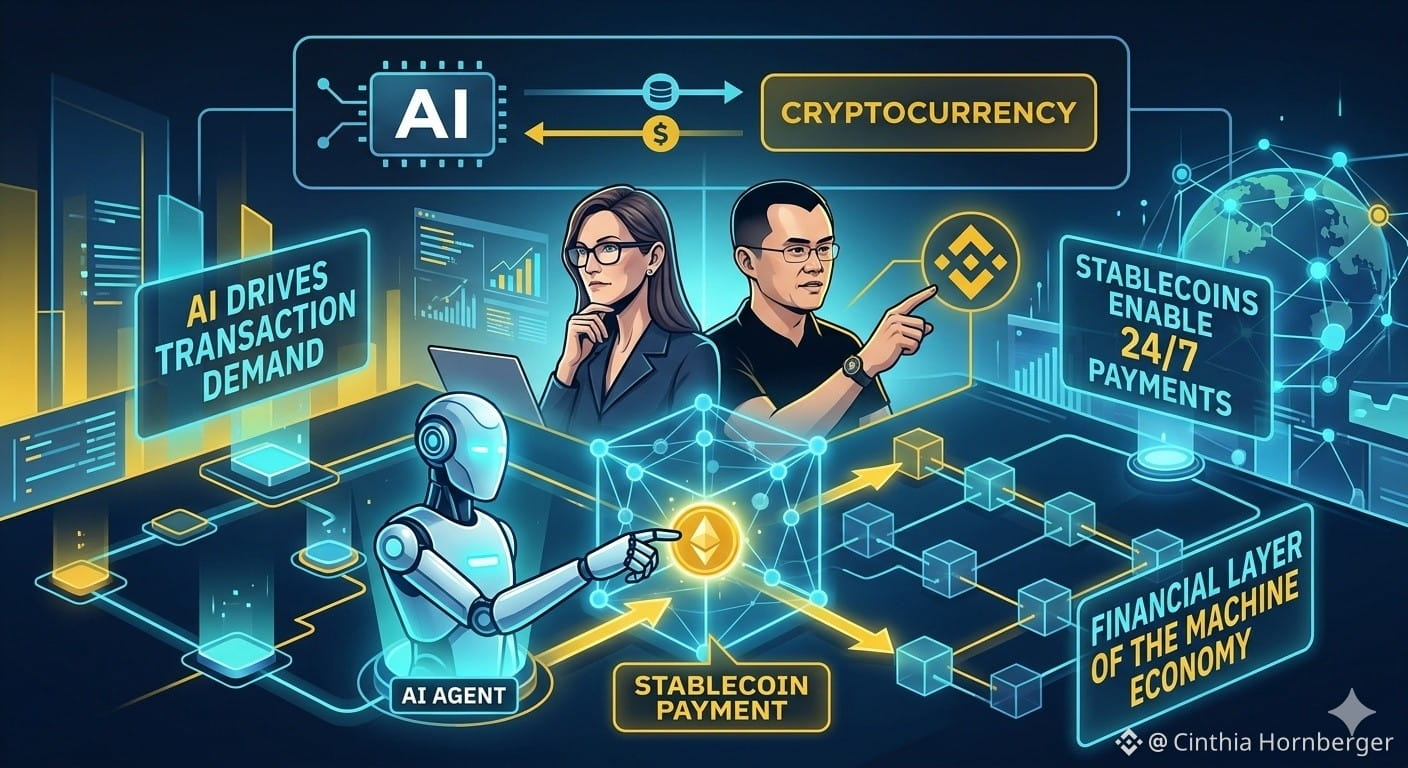
1
118

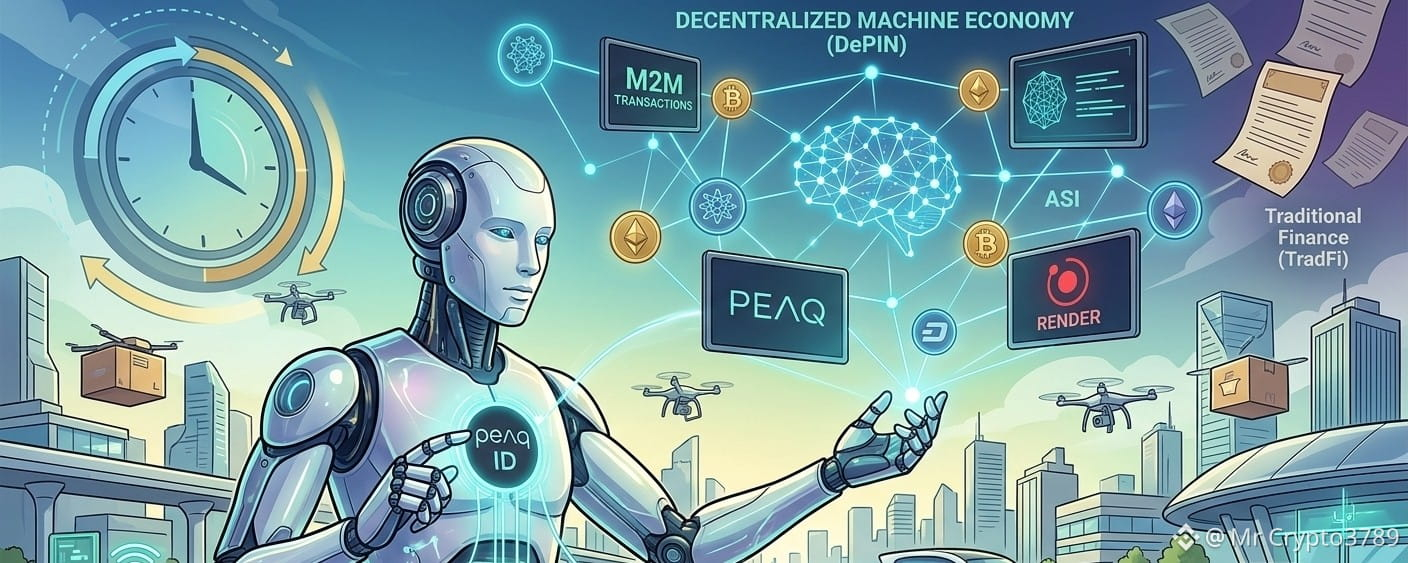
Article
A Rotação de Capital e a Emergência da Economia Pós-Humana: O Papel dos Trilhos Descentralizados...A Rotação de Capital e a Emergência da Economia Pós-Humana: O Papel dos Trilhos Descentralizados na Era da Robótica
A arquitetura financeira global atravessa uma ruptura estrutural silenciosa, impulsionada pelo esgotamento do modelo de endividamento público e pelo avanço exponencial da Inteligência Artificial (IA) e da robótica humanoide. Enquanto a análise macroeconômica tradicional concentra-se em oscilações de juros, inflação e tensões geopolíticas pontuais, o capital institucional começa a precificar um novo paradigma: a transição de uma economia baseada em forças de trabalho humanas para uma infraestrutura produtiva altamente automatizada e gerida por agentes autônomos.
O Colapso da Renda Fixa Soberana e a Rotação de Capital
O modelo econômico vigente nas últimas décadas sustentou-se na emissão contínua de títulos de dívida de longo prazo por parte de Estados soberanos. No entanto, a capacidade dos governos de honrar e rolar esses passivos sem expandir indefinidamente suas bases monetárias atingiu um limite crítico.
O custo de carregamento das dívidas públicas globais — evidenciado pelos mercados de Treasuries nos Estados Unidos e Eurobonds na Europa — pressiona as contas estatais, exigindo prêmios de risco cada vez maiores para atrair compradores. Diante da ameaça de diluição do poder de compra e da perda de eficiência dos modelos fiscais tradicionais, o capital privado e institucional demonstra uma preferência clara pela alocação em ativos tangíveis de tecnologia, capacidade computacional e automação física.
Em contraste com a estagnação da dívida soberana, aportes em data centers, redes de infraestrutura de dados e fabricantes de robótica humanoide registram valorações históricas e alta demanda em ofertas públicas e captações globais. O mercado financeiro sinaliza que a geração de valor futuro não dependerá mais da arrecadação tributária sob dinâmicas demográficas humanas lentas, mas sim da eficiência de sistemas autônomos de produção.
A Ineficiência dos Trilhos Tradicionais no Tempo das Máquinas
A produtividade humana evolui de forma linear e opera em ciclos econômicos trimestrais e anuais. A Inteligência Artificial e a robótica, por outro lado, expandem suas capacidades em progressão geométrica, com otimizações contínuas em questão de semanas.
Essa assimetria temporal expõe as limitações do sistema financeiro tradicional (TradFi). Mecanismos bancários convencionais, liquidações centralizadas e processos burocráticos operados por intervenção humana atuam como gargalos para interações de alta frequência. Uma economia composta por agentes computacionais e robôs exige redes operacionais com características fundamentais:
Operação Ininterrupta (24/7): Transações que ocorrem continuamente sem janelas de compensação bancária.
Execução Não Permissionada: Autonomia para realização de microoperações sem a necessidade de intermediação de terceiros.
Custo Marginal Próximo a Zero: Estruturas de microtransações viáveis para trocas contínuas de dados, energia e serviços.
É nesse ponto que a tecnologia blockchain deixa de ser um instrumento meramente especulativo e assume a função de infraestrutura financeira nativa para agentes não humanos.
Infraestrutura de Criptoativos na Vanguarda da Economia de Máquinas
Para que a integração entre IA, robótica e o mundo físico ocorra em escala industrial, uma nova camada de criptoativos e protocolos descentralizados (DePIN — Decentralized Physical Infrastructure Networks) torna-se indispensável. Três ativos estratégicos listados em grandes corretoras globais destacam-se como pilares dessa transformação:
+--------------------------------------------------------------------------------------+
| INFRAESTRUTURA PARA AGENTES AUTÔNOMOS |
+--------------------------+---------------------------+-------------------------------+
| PEAQ (Layer-1) | FETCH.AI / ASI (IA) | RENDER (Infra/GPU) |
| Identidade & M2M | Lógica & Agentes Virtuais| Processamento Gráfico & Visão |
+--------------------------+---------------------------+-------------------------------+
$PEAQ (PEAQ): A Camada Nativa de Identidade e Transações M2M
A peaq posiciona-se na vanguarda desse ecossistema como uma rede Layer-1 concebida especificamente para a Economia das Máquinas (Machine Economy). Enquanto fabricantes constroem as estruturas físicas de robôs humanoides, veículos autônomos e drones, a peaq fornece a infraestrutura digital necessária para a operação dessas unidades:
Identidade Digital Sovereign (peaq ID): Concede a cada dispositivo físico uma identidade única e descentralizada, permitindo que a máquina possua sua própria carteira digital e assine transações com validade jurídica e técnica.
Comunicação e Pagamento Machine-to-Machine (M2M): Habilita robôs a pagarem autonomamente por recargas de energia, peças, manutenção ou dados de navegação diretamente a outros robôs ou sensores, eliminando intermediários humanos.
Fetch.ai / ASI Alliance $FET
Atua na camada lógica e de software. O protocolo possibilita a criação de Agentes de IA Autônomos capazes de tomar decisões complexas, otimizar rotas comerciais, negociar serviços e executar estratégias operacionais em tempo real, integrando-se diretamente aos ativos físicos conectados à blockchain.
$RENDER Network (RENDER)
Fornece a infraestrutura de processamento gráfico (GPU) descentralizado. O treinamento de visões computacionais avançadas e a simulação de ambientes virtuais para robótica demandam poder computacional massivo. A Render conecta a oferta global de hardware ocioso à demanda de desenvolvedores de IA, reduzindo custos de escala.
Considerações Finais
A convergência entre a crise fiscal dos Estados e o avanço da automação acelera a transição para um modelo financeiro pós-humano. A blockchain não apenas preserva o capital contra a inflação monetária governamental, mas fornece a arquitetura necessária para que máquinas, robôs e algoritmos interajam e transacionem em velocidade global. Os projetos que constroem a ponte entre a infraestrutura física e os trilhos digitais não permissionados assumem a liderança técnica e econômica da próxima década.
#Crypto #ArtificialIntelligence #MachineEconomy #DePIN #peaq
A Rotação de Capital e a Emergência da Economia Pós-Humana: O Papel dos Trilhos Descentralizados...
A Rotação de Capital e a Emergência da Economia Pós-Humana: O Papel dos Trilhos Descentralizados na Era da Robótica
A arquitetura financeira global atravessa uma ruptura estrutural silenciosa, impulsionada pelo esgotamento do modelo de endividamento público e pelo avanço exponencial da Inteligência Artificial (IA) e da robótica humanoide. Enquanto a análise macroeconômica tradicional concentra-se em oscilações de juros, inflação e tensões geopolíticas pontuais, o capital institucional começa a precificar um novo paradigma: a transição de uma economia baseada em forças de trabalho humanas para uma infraestrutura produtiva altamente automatizada e gerida por agentes autônomos.
O Colapso da Renda Fixa Soberana e a Rotação de Capital
O modelo econômico vigente nas últimas décadas sustentou-se na emissão contínua de títulos de dívida de longo prazo por parte de Estados soberanos. No entanto, a capacidade dos governos de honrar e rolar esses passivos sem expandir indefinidamente suas bases monetárias atingiu um limite crítico.
O custo de carregamento das dívidas públicas globais — evidenciado pelos mercados de Treasuries nos Estados Unidos e Eurobonds na Europa — pressiona as contas estatais, exigindo prêmios de risco cada vez maiores para atrair compradores. Diante da ameaça de diluição do poder de compra e da perda de eficiência dos modelos fiscais tradicionais, o capital privado e institucional demonstra uma preferência clara pela alocação em ativos tangíveis de tecnologia, capacidade computacional e automação física.
Em contraste com a estagnação da dívida soberana, aportes em data centers, redes de infraestrutura de dados e fabricantes de robótica humanoide registram valorações históricas e alta demanda em ofertas públicas e captações globais. O mercado financeiro sinaliza que a geração de valor futuro não dependerá mais da arrecadação tributária sob dinâmicas demográficas humanas lentas, mas sim da eficiência de sistemas autônomos de produção.
A Ineficiência dos Trilhos Tradicionais no Tempo das Máquinas
A produtividade humana evolui de forma linear e opera em ciclos econômicos trimestrais e anuais. A Inteligência Artificial e a robótica, por outro lado, expandem suas capacidades em progressão geométrica, com otimizações contínuas em questão de semanas.
Essa assimetria temporal expõe as limitações do sistema financeiro tradicional (TradFi). Mecanismos bancários convencionais, liquidações centralizadas e processos burocráticos operados por intervenção humana atuam como gargalos para interações de alta frequência. Uma economia composta por agentes computacionais e robôs exige redes operacionais com características fundamentais:
Operação Ininterrupta (24/7): Transações que ocorrem continuamente sem janelas de compensação bancária.
Execução Não Permissionada: Autonomia para realização de microoperações sem a necessidade de intermediação de terceiros.
Custo Marginal Próximo a Zero: Estruturas de microtransações viáveis para trocas contínuas de dados, energia e serviços.
É nesse ponto que a tecnologia blockchain deixa de ser um instrumento meramente especulativo e assume a função de infraestrutura financeira nativa para agentes não humanos.
Infraestrutura de Criptoativos na Vanguarda da Economia de Máquinas
Para que a integração entre IA, robótica e o mundo físico ocorra em escala industrial, uma nova camada de criptoativos e protocolos descentralizados (DePIN — Decentralized Physical Infrastructure Networks) torna-se indispensável. Três ativos estratégicos listados em grandes corretoras globais destacam-se como pilares dessa transformação:
+--------------------------------------------------------------------------------------+
| INFRAESTRUTURA PARA AGENTES AUTÔNOMOS |
+--------------------------+---------------------------+-------------------------------+
| PEAQ (Layer-1) | FETCH.AI / ASI (IA) | RENDER (Infra/GPU) |
| Identidade & M2M | Lógica & Agentes Virtuais| Processamento Gráfico & Visão |
+--------------------------+---------------------------+-------------------------------+
$PEAQ (PEAQ): A Camada Nativa de Identidade e Transações M2M
A peaq posiciona-se na vanguarda desse ecossistema como uma rede Layer-1 concebida especificamente para a Economia das Máquinas (Machine Economy). Enquanto fabricantes constroem as estruturas físicas de robôs humanoides, veículos autônomos e drones, a peaq fornece a infraestrutura digital necessária para a operação dessas unidades:
Identidade Digital Sovereign (peaq ID): Concede a cada dispositivo físico uma identidade única e descentralizada, permitindo que a máquina possua sua própria carteira digital e assine transações com validade jurídica e técnica.
Comunicação e Pagamento Machine-to-Machine (M2M): Habilita robôs a pagarem autonomamente por recargas de energia, peças, manutenção ou dados de navegação diretamente a outros robôs ou sensores, eliminando intermediários humanos.
Fetch.ai / ASI Alliance $FET
Atua na camada lógica e de software. O protocolo possibilita a criação de Agentes de IA Autônomos capazes de tomar decisões complexas, otimizar rotas comerciais, negociar serviços e executar estratégias operacionais em tempo real, integrando-se diretamente aos ativos físicos conectados à blockchain.
$RENDER Network (RENDER)
Fornece a infraestrutura de processamento gráfico (GPU) descentralizado. O treinamento de visões computacionais avançadas e a simulação de ambientes virtuais para robótica demandam poder computacional massivo. A Render conecta a oferta global de hardware ocioso à demanda de desenvolvedores de IA, reduzindo custos de escala.
Considerações Finais
A convergência entre a crise fiscal dos Estados e o avanço da automação acelera a transição para um modelo financeiro pós-humano. A blockchain não apenas preserva o capital contra a inflação monetária governamental, mas fornece a arquitetura necessária para que máquinas, robôs e algoritmos interajam e transacionem em velocidade global. Os projetos que constroem a ponte entre a infraestrutura física e os trilhos digitais não permissionados assumem a liderança técnica e econômica da próxima década.
#Crypto #ArtificialIntelligence #MachineEconomy #DePIN #peaq
A arquitetura financeira global atravessa uma ruptura estrutural silenciosa, impulsionada pelo esgotamento do modelo de endividamento público e pelo avanço exponencial da Inteligência Artificial (IA) e da robótica humanoide. Enquanto a análise macroeconômica tradicional concentra-se em oscilações de juros, inflação e tensões geopolíticas pontuais, o capital institucional começa a precificar um novo paradigma: a transição de uma economia baseada em forças de trabalho humanas para uma infraestrutura produtiva altamente automatizada e gerida por agentes autônomos.
O Colapso da Renda Fixa Soberana e a Rotação de Capital
O modelo econômico vigente nas últimas décadas sustentou-se na emissão contínua de títulos de dívida de longo prazo por parte de Estados soberanos. No entanto, a capacidade dos governos de honrar e rolar esses passivos sem expandir indefinidamente suas bases monetárias atingiu um limite crítico.
O custo de carregamento das dívidas públicas globais — evidenciado pelos mercados de Treasuries nos Estados Unidos e Eurobonds na Europa — pressiona as contas estatais, exigindo prêmios de risco cada vez maiores para atrair compradores. Diante da ameaça de diluição do poder de compra e da perda de eficiência dos modelos fiscais tradicionais, o capital privado e institucional demonstra uma preferência clara pela alocação em ativos tangíveis de tecnologia, capacidade computacional e automação física.
Em contraste com a estagnação da dívida soberana, aportes em data centers, redes de infraestrutura de dados e fabricantes de robótica humanoide registram valorações históricas e alta demanda em ofertas públicas e captações globais. O mercado financeiro sinaliza que a geração de valor futuro não dependerá mais da arrecadação tributária sob dinâmicas demográficas humanas lentas, mas sim da eficiência de sistemas autônomos de produção.
A Ineficiência dos Trilhos Tradicionais no Tempo das Máquinas
A produtividade humana evolui de forma linear e opera em ciclos econômicos trimestrais e anuais. A Inteligência Artificial e a robótica, por outro lado, expandem suas capacidades em progressão geométrica, com otimizações contínuas em questão de semanas.
Essa assimetria temporal expõe as limitações do sistema financeiro tradicional (TradFi). Mecanismos bancários convencionais, liquidações centralizadas e processos burocráticos operados por intervenção humana atuam como gargalos para interações de alta frequência. Uma economia composta por agentes computacionais e robôs exige redes operacionais com características fundamentais:
Operação Ininterrupta (24/7): Transações que ocorrem continuamente sem janelas de compensação bancária.
Execução Não Permissionada: Autonomia para realização de microoperações sem a necessidade de intermediação de terceiros.
Custo Marginal Próximo a Zero: Estruturas de microtransações viáveis para trocas contínuas de dados, energia e serviços.
É nesse ponto que a tecnologia blockchain deixa de ser um instrumento meramente especulativo e assume a função de infraestrutura financeira nativa para agentes não humanos.
Infraestrutura de Criptoativos na Vanguarda da Economia de Máquinas
Para que a integração entre IA, robótica e o mundo físico ocorra em escala industrial, uma nova camada de criptoativos e protocolos descentralizados (DePIN — Decentralized Physical Infrastructure Networks) torna-se indispensável. Três ativos estratégicos listados em grandes corretoras globais destacam-se como pilares dessa transformação:
+--------------------------------------------------------------------------------------+
| INFRAESTRUTURA PARA AGENTES AUTÔNOMOS |
+--------------------------+---------------------------+-------------------------------+
| PEAQ (Layer-1) | FETCH.AI / ASI (IA) | RENDER (Infra/GPU) |
| Identidade & M2M | Lógica & Agentes Virtuais| Processamento Gráfico & Visão |
+--------------------------+---------------------------+-------------------------------+
$PEAQ (PEAQ): A Camada Nativa de Identidade e Transações M2M
A peaq posiciona-se na vanguarda desse ecossistema como uma rede Layer-1 concebida especificamente para a Economia das Máquinas (Machine Economy). Enquanto fabricantes constroem as estruturas físicas de robôs humanoides, veículos autônomos e drones, a peaq fornece a infraestrutura digital necessária para a operação dessas unidades:
Identidade Digital Sovereign (peaq ID): Concede a cada dispositivo físico uma identidade única e descentralizada, permitindo que a máquina possua sua própria carteira digital e assine transações com validade jurídica e técnica.
Comunicação e Pagamento Machine-to-Machine (M2M): Habilita robôs a pagarem autonomamente por recargas de energia, peças, manutenção ou dados de navegação diretamente a outros robôs ou sensores, eliminando intermediários humanos.
Fetch.ai / ASI Alliance $FET
Atua na camada lógica e de software. O protocolo possibilita a criação de Agentes de IA Autônomos capazes de tomar decisões complexas, otimizar rotas comerciais, negociar serviços e executar estratégias operacionais em tempo real, integrando-se diretamente aos ativos físicos conectados à blockchain.
$RENDER Network (RENDER)
Fornece a infraestrutura de processamento gráfico (GPU) descentralizado. O treinamento de visões computacionais avançadas e a simulação de ambientes virtuais para robótica demandam poder computacional massivo. A Render conecta a oferta global de hardware ocioso à demanda de desenvolvedores de IA, reduzindo custos de escala.
Considerações Finais
A convergência entre a crise fiscal dos Estados e o avanço da automação acelera a transição para um modelo financeiro pós-humano. A blockchain não apenas preserva o capital contra a inflação monetária governamental, mas fornece a arquitetura necessária para que máquinas, robôs e algoritmos interajam e transacionem em velocidade global. Os projetos que constroem a ponte entre a infraestrutura física e os trilhos digitais não permissionados assumem a liderança técnica e econômica da próxima década.
#Crypto #ArtificialIntelligence #MachineEconomy #DePIN #peaq
281
Connectez-vous pour découvrir plus de contenu
Rejoignez la communauté mondiale des adeptes de cryptomonnaies sur Binance Square
⚡️ Suviez les dernières informations importantes sur les cryptomonnaies.
💬 Jugé digne de confiance par la plus grande plateforme d’échange de cryptomonnaies au monde.
👍 Découvrez les connaissances que partagent les créateurs vérifiés.
Adresse e-mail/Nº de téléphone
Sujets d’actualité
1
#NFPWatch
10.9M vues
19,340 mentions
2
#BitcoinFundingRateTriplesTo10%
178,641 vues
1,232 mentions
3
#BitcoinSurpasses$86KUp2.99%
59,286 vues
117 mentions
4
#ZcashFalls21%FromSeptemberPeak
94,231 vues
870 mentions
5
#USSeptemberPayrollsAdd29KUnemploymentRises4.2%
75,895 vues
533 mentions
6
#XRPPostsFirstThreeGreenMonthsInQ3
65,445 vues
733 mentions
7
#BNBChainTokenizedStocksTop$1BAt30%Share
28,882 vues
38 mentions
8
#BitcoinRisesToward$85K
130,218 vues
158 mentions
9
#AmazonPlansToSell$8BNvidiaChips
8,328 vues
91 mentions
10
#NEARFallsToAround$4.70Down14%
51,039 vues
118 mentions