

MAICKY_
9.6k Posts

MAICKY_
Report
Block User
📊 Crypto Trader | Blockchain Enthusiast | Building wealth through innovation | #DeFi #Web3
Open Trade
Frequent Trader
1 Years
879 Following
31.3K+ Followers
19.2K+ Liked
Posts
Portfolio
All
Quotes
Videos
Live
·
--
🚨 FUTURES GAINERS ARE HEATING UP! 🚨
🔥 SOPH smashed +55.98%
⚡ IOST surged +32.07%
🚀 $WLD jumped +22.56%
💥 $BUSD climbed +20.67%
Momentum is clearly picking up… 👀
Which one moves next?
1️⃣ $SOPH 🚀
2️⃣ $IOST ⚡
3️⃣ $WLD 🔥
4️⃣ $B USD 💥
{future}(BUSDT)
🚨 FUTURES GAINERS ARE HEATING UP! 🚨
🔥 SOPH smashed +55.98%
⚡ IOST surged +32.07%
🚀 $WLD jumped +22.56%
💥 $BUSD climbed +20.67%
Momentum is clearly picking up… 👀
Which one moves next?
1️⃣ $SOPH 🚀
2️⃣ $IOST ⚡
3️⃣ $WLD 🔥
4️⃣ $B USD 💥
🔥 SOPH smashed +55.98%
⚡ IOST surged +32.07%
🚀 $WLD jumped +22.56%
💥 $BUSD climbed +20.67%
Momentum is clearly picking up… 👀
Which one moves next?
1️⃣ $SOPH 🚀
2️⃣ $IOST ⚡
3️⃣ $WLD 🔥
4️⃣ $B USD 💥
$BUSD — +20.67% 💥
0%
$WLD — +22.56% 🔥
88%
$IOST — +32.07% ⚡
0%
$SOPH — +55.98% 🚀
12%
8 votes • Voting closed
682
·
--

BULL_TRADER0
·
--
🚨🧧 BINANCE RED PACKET ALERT! 🧧🚨
🎁 A surprise is waiting! 👀🔥
💰 Red Packet hunters, are you ready? 😈⚡
👉 FOLLOW ME TO CLAIM IT! 🧧💸
🍀 One tap could bring a surprise
⚡ Fast hands might win BIG!
🧧❤️ Who’s ready to grab it? 👇🚀
$BNB
🎁 A surprise is waiting! 👀🔥
💰 Red Packet hunters, are you ready? 😈⚡
👉 FOLLOW ME TO CLAIM IT! 🧧💸
🍀 One tap could bring a surprise
⚡ Fast hands might win BIG!
🧧❤️ Who’s ready to grab it? 👇🚀
$BNB

5
46
·
--
🚨 FUTURES GAINERS ARE ON FIRE!
The market just printed a serious momentum burst, and the Futures Gainers board is showing some explosive moves.
🔥 Top movers spotted: • $AKE USDT → +53.76% | $0.012939
• $BULLA USDT → +50.49% | $0.028714
• MARSCOINUSDT → +46.73% | $0.09975
• USELESSUSDT → +46.60% | $0.14897
• $BR USDT → +41.69% | $0.29512
That’s not a normal green candle environment — this is high-volatility territory.
{future}(BRUSDT)
What catches my attention is how tightly packed these gains are. Multiple contracts pushing 40–50%+ in 24H usually means traders are aggressively rotating into momentum plays.
But here’s the danger 👀
After moves this violent, chasing the top can become extremely risky. The real test is whether these coins can hold their breakout zones after the initial pump, not simply how high the percentage counter goes.
📈 Momentum traders: watch for consolidation + breakout continuation.
📉 Late entries: beware of sharp profit-taking and liquidation cascades.
The leaderboard is screaming momentum, but the next move will decide who actually has strength.
Which one are you watching — AKE, BULLA, MARSCOIN, USELESS or BR? 🔥
🚨 FUTURES GAINERS ARE ON FIRE!
The market just printed a serious momentum burst, and the Futures Gainers board is showing some explosive moves.
🔥 Top movers spotted: • $AKE USDT → +53.76% | $0.012939
• $BULLA USDT → +50.49% | $0.028714
• MARSCOINUSDT → +46.73% | $0.09975
• USELESSUSDT → +46.60% | $0.14897
• $BR USDT → +41.69% | $0.29512
That’s not a normal green candle environment — this is high-volatility territory.
What catches my attention is how tightly packed these gains are. Multiple contracts pushing 40–50%+ in 24H usually means traders are aggressively rotating into momentum plays.
But here’s the danger 👀
After moves this violent, chasing the top can become extremely risky. The real test is whether these coins can hold their breakout zones after the initial pump, not simply how high the percentage counter goes.
📈 Momentum traders: watch for consolidation + breakout continuation.
📉 Late entries: beware of sharp profit-taking and liquidation cascades.
The leaderboard is screaming momentum, but the next move will decide who actually has strength.
Which one are you watching — AKE, BULLA, MARSCOIN, USELESS or BR? 🔥
The market just printed a serious momentum burst, and the Futures Gainers board is showing some explosive moves.
🔥 Top movers spotted: • $AKE USDT → +53.76% | $0.012939
• $BULLA USDT → +50.49% | $0.028714
• MARSCOINUSDT → +46.73% | $0.09975
• USELESSUSDT → +46.60% | $0.14897
• $BR USDT → +41.69% | $0.29512
That’s not a normal green candle environment — this is high-volatility territory.
What catches my attention is how tightly packed these gains are. Multiple contracts pushing 40–50%+ in 24H usually means traders are aggressively rotating into momentum plays.
But here’s the danger 👀
After moves this violent, chasing the top can become extremely risky. The real test is whether these coins can hold their breakout zones after the initial pump, not simply how high the percentage counter goes.
📈 Momentum traders: watch for consolidation + breakout continuation.
📉 Late entries: beware of sharp profit-taking and liquidation cascades.
The leaderboard is screaming momentum, but the next move will decide who actually has strength.
Which one are you watching — AKE, BULLA, MARSCOIN, USELESS or BR? 🔥
1️⃣ AKEUSDT — +53.76% 🚀
58%
2️⃣ BULLAUSDT — +50.49% 🔥
12%
3️⃣ MARSCOINUSDT — +46.73% ⚡
12%
4️⃣ USELESSUSDT — +46.60% 💥
18%
33 votes • Voting closed
1
3k
·
--
🚀 Futures Gainers are heating up!
$MAGMA US leads the board with a massive +57.77% in 24H, followed by $T USDT +36.76% and $FF USDT +32.61%.
Momentum is clearly aggressive—but after such sharp moves, volatility can hit fast. Watch the next breakout carefully!
Which token gained the most in 24H? 👇
#G20StatementCitesDigitalAssets #KuwaitAirDefensesRespondToIranianDroneAttacks
🚀 Futures Gainers are heating up!
$MAGMA US leads the board with a massive +57.77% in 24H, followed by $T USDT +36.76% and $FF USDT +32.61%.
Momentum is clearly aggressive—but after such sharp moves, volatility can hit fast. Watch the next breakout carefully!
Which token gained the most in 24H? 👇
#G20StatementCitesDigitalAssets #KuwaitAirDefensesRespondToIranianDroneAttacks
$MAGMA US leads the board with a massive +57.77% in 24H, followed by $T USDT +36.76% and $FF USDT +32.61%.
Momentum is clearly aggressive—but after such sharp moves, volatility can hit fast. Watch the next breakout carefully!
Which token gained the most in 24H? 👇
#G20StatementCitesDigitalAssets #KuwaitAirDefensesRespondToIranianDroneAttacks
1️⃣ MAGMAUS
33%
2️⃣ TUSDT
42%
3️⃣ FFUSDT
25%
4️⃣ UAIUSDT
0%
24 votes • Voting closed
1
2.3k
·
--
🔥 Alpha is heating up!
DEBIT leads the board with +18.88%, followed by BTR at +17.05% and $CRCLon at +10.04%.
Momentum is clearly building — but the real question is: which one moves next?
📊 Poll: Which token has the strongest setup?
$DEBIT
{alpha}(560x66661c7229901f568f16bd1551b3ba826f83ce49)
$BTR
{alpha}(560xfed13d0c40790220fbde712987079eda1ed75c51)
#USIranMilitaryClashesResume #USStocksCloseLowerAmazonSuedByFTC #XRPRises40%InTwoWeeksAsOpenInterestFalls #SaylorHintsStrategyBitcoinBuy
🔥 Alpha is heating up!
DEBIT leads the board with +18.88%, followed by BTR at +17.05% and $CRCLon at +10.04%.
Momentum is clearly building — but the real question is: which one moves next?
📊 Poll: Which token has the strongest setup?
$DEBIT
$BTR
#USIranMilitaryClashesResume #USStocksCloseLowerAmazonSuedByFTC #XRPRises40%InTwoWeeksAsOpenInterestFalls #SaylorHintsStrategyBitcoinBuy
DEBIT leads the board with +18.88%, followed by BTR at +17.05% and $CRCLon at +10.04%.
Momentum is clearly building — but the real question is: which one moves next?
📊 Poll: Which token has the strongest setup?
$DEBIT
$BTR
#USIranMilitaryClashesResume #USStocksCloseLowerAmazonSuedByFTC #XRPRises40%InTwoWeeksAsOpenInterestFalls #SaylorHintsStrategyBitcoinBuy
1. 🚀 DEBIT
42%
2. 🔥 BTR
50%
3. 💎 CRCLon
6%
4. ⚡ AGT
2%
48 votes • Voting closed
1
3.4k
·
--
I’ve been watching Dusk closely again, and honestly, my view is getting more interesting.
What caught my attention isn’t another roadmap promise. It’s the combination of DuskEVM, the security work, and the recent protocol improvements.
DuskEVM could be a big unlock because builders can approach the network through a familiar EVM environment instead of starting from zero. But I’m not counting testnet activity as adoption yet. The real question is whether developers actually stay and build.
Then there’s the security side. Fixing 39 findings, including 7 critical issues, is the kind of progress I take seriously. It reminds me that infrastructure doesn’t become institutional-grade just because the technology sounds impressive. It has to survive scrutiny.
The recent protocol changes also caught my eye. Better transaction handling, clearer execution rules, and stronger state-transition logic may not generate hype, but these are exactly the boring details that become extremely important when real money starts moving.
I’m still cautious.
Dusk looks closer to a usable financial infrastructure stack than it did before, but the hardest test hasn’t arrived yet: sustained real-world usage.
I want to see builders, users, liquidity, and institutions pushing the system under pressure.
That’s where my conviction either grows—or breaks.
@Dusk_Foundation $DUSK #dusk
I’ve been watching Dusk closely again, and honestly, my view is getting more interesting.
What caught my attention isn’t another roadmap promise. It’s the combination of DuskEVM, the security work, and the recent protocol improvements.
DuskEVM could be a big unlock because builders can approach the network through a familiar EVM environment instead of starting from zero. But I’m not counting testnet activity as adoption yet. The real question is whether developers actually stay and build.
Then there’s the security side. Fixing 39 findings, including 7 critical issues, is the kind of progress I take seriously. It reminds me that infrastructure doesn’t become institutional-grade just because the technology sounds impressive. It has to survive scrutiny.
The recent protocol changes also caught my eye. Better transaction handling, clearer execution rules, and stronger state-transition logic may not generate hype, but these are exactly the boring details that become extremely important when real money starts moving.
I’m still cautious.
Dusk looks closer to a usable financial infrastructure stack than it did before, but the hardest test hasn’t arrived yet: sustained real-world usage.
I want to see builders, users, liquidity, and institutions pushing the system under pressure.
That’s where my conviction either grows—or breaks.
@Dusk $DUSK #dusk
What caught my attention isn’t another roadmap promise. It’s the combination of DuskEVM, the security work, and the recent protocol improvements.
DuskEVM could be a big unlock because builders can approach the network through a familiar EVM environment instead of starting from zero. But I’m not counting testnet activity as adoption yet. The real question is whether developers actually stay and build.
Then there’s the security side. Fixing 39 findings, including 7 critical issues, is the kind of progress I take seriously. It reminds me that infrastructure doesn’t become institutional-grade just because the technology sounds impressive. It has to survive scrutiny.
The recent protocol changes also caught my eye. Better transaction handling, clearer execution rules, and stronger state-transition logic may not generate hype, but these are exactly the boring details that become extremely important when real money starts moving.
I’m still cautious.
Dusk looks closer to a usable financial infrastructure stack than it did before, but the hardest test hasn’t arrived yet: sustained real-world usage.
I want to see builders, users, liquidity, and institutions pushing the system under pressure.
That’s where my conviction either grows—or breaks.
@Dusk $DUSK #dusk
1
136
·
--
Verified
30D trade $DUSK 2.9K USDT
Dusk just had the kind of year that either becomes a case study or a warning, and I'm still not sure which.
Start with AEGIS. Auditors found a bug that let a single leaked signature forge new ones under the same key. On a consensus layer. That's not a bug, that's a loaded gun sitting in the codebase since mainnet. They also found a fee-binding gap where an attacker could intercept a transaction, redirect the refund, and mint value out of thin air — three exploit paths from one broken invariant. Thirty-nine fixes shipped. No evidence of prior exploitation, they say. I believe them, but "no evidence" isn't the same as "didn't happen."
Then the split screen: while security got rebuilt from the studs up, the actual product DuskEVM, Hedger, confidential Solidity contracts — is still sitting on testnet. Months after it was pitched as imminent.
So here's where i land: this was the year Dusk stopped being naive about its own attack surface. That's not nothing — it might be the most important thing that happened. But it bought safety, not readiness. The next real test isn't another audit. It's mainnet, under load, with money that isn't theirs.
@Dusk_Foundation #dusk $DUSK
$TAC $TMX
Dusk just had the kind of year that either becomes a case study or a warning, and I'm still not sure which.
Start with AEGIS. Auditors found a bug that let a single leaked signature forge new ones under the same key. On a consensus layer. That's not a bug, that's a loaded gun sitting in the codebase since mainnet. They also found a fee-binding gap where an attacker could intercept a transaction, redirect the refund, and mint value out of thin air — three exploit paths from one broken invariant. Thirty-nine fixes shipped. No evidence of prior exploitation, they say. I believe them, but "no evidence" isn't the same as "didn't happen."
Then the split screen: while security got rebuilt from the studs up, the actual product DuskEVM, Hedger, confidential Solidity contracts — is still sitting on testnet. Months after it was pitched as imminent.
So here's where i land: this was the year Dusk stopped being naive about its own attack surface. That's not nothing — it might be the most important thing that happened. But it bought safety, not readiness. The next real test isn't another audit. It's mainnet, under load, with money that isn't theirs.
@Dusk #dusk $DUSK
$TAC $TMX
Start with AEGIS. Auditors found a bug that let a single leaked signature forge new ones under the same key. On a consensus layer. That's not a bug, that's a loaded gun sitting in the codebase since mainnet. They also found a fee-binding gap where an attacker could intercept a transaction, redirect the refund, and mint value out of thin air — three exploit paths from one broken invariant. Thirty-nine fixes shipped. No evidence of prior exploitation, they say. I believe them, but "no evidence" isn't the same as "didn't happen."
Then the split screen: while security got rebuilt from the studs up, the actual product DuskEVM, Hedger, confidential Solidity contracts — is still sitting on testnet. Months after it was pitched as imminent.
So here's where i land: this was the year Dusk stopped being naive about its own attack surface. That's not nothing — it might be the most important thing that happened. But it bought safety, not readiness. The next real test isn't another audit. It's mainnet, under load, with money that isn't theirs.
@Dusk #dusk $DUSK
$TAC $TMX
🤷 Bugs were minor
50%
🟢 DuskEVM is live now
0%
🛡️ Safer,not yet proven ready
0%
🚀 Fully ready for mainnet
50%
2 votes • Voting closed
1
3
127
·
--
I’ve been digging into Dusk again lately, and I think the story is getting a bit more interesting.
What caught my attention is that the focus seems to be moving beyond just building the network and toward making it easier for developers to actually use. DuskEVM is a good example — bringing familiar Ethereum tooling into the picture could make the barrier to building much lower.
The less flashy protocol work matters too. Improvements around transaction handling and network reliability aren’t the kind of updates that create instant hype, but they’re exactly what I’d want to see if Dusk is serious about financial applications.
I’m still cautious, though.Testnets, integrations and staking numbers show progress, but they don’t automatically mean real adoption.
My view has definitely become more positive, but I’m waiting for one thing: sustained usage from developers and real financial activity.
If Dusk can turn the technical progress into actual production demand, that would change my conviction quite a bit.
@Dusk_Foundation #dusk $DUSK
{future}(DUSKUSDT)
I’ve been digging into Dusk again lately, and I think the story is getting a bit more interesting.
What caught my attention is that the focus seems to be moving beyond just building the network and toward making it easier for developers to actually use. DuskEVM is a good example — bringing familiar Ethereum tooling into the picture could make the barrier to building much lower.
The less flashy protocol work matters too. Improvements around transaction handling and network reliability aren’t the kind of updates that create instant hype, but they’re exactly what I’d want to see if Dusk is serious about financial applications.
I’m still cautious, though.Testnets, integrations and staking numbers show progress, but they don’t automatically mean real adoption.
My view has definitely become more positive, but I’m waiting for one thing: sustained usage from developers and real financial activity.
If Dusk can turn the technical progress into actual production demand, that would change my conviction quite a bit.
@Dusk #dusk $DUSK
What caught my attention is that the focus seems to be moving beyond just building the network and toward making it easier for developers to actually use. DuskEVM is a good example — bringing familiar Ethereum tooling into the picture could make the barrier to building much lower.
The less flashy protocol work matters too. Improvements around transaction handling and network reliability aren’t the kind of updates that create instant hype, but they’re exactly what I’d want to see if Dusk is serious about financial applications.
I’m still cautious, though.Testnets, integrations and staking numbers show progress, but they don’t automatically mean real adoption.
My view has definitely become more positive, but I’m waiting for one thing: sustained usage from developers and real financial activity.
If Dusk can turn the technical progress into actual production demand, that would change my conviction quite a bit.
@Dusk #dusk $DUSK
Bullish 💚
67%
🌨️🌨️🌨️
33%
bearish ♥️♥️
0%
🤧🤧🤧🤧
0%
3 votes • Voting closed
2
4
145
·
--
I've been watching Dusk for a few weeks now, and here's where my head's at.
DuskEVM's testnet finally opened to Solidity and Hardhat on August 10 — seven months after the mainnet date they originally promised. I'm not mad about the delay. I'm mad that it's still just a testnet while the clock keeps ticking on everyone's patience.
Then six days later, the bridge gets hit. Suspicious wallet activity, addresses recycled, services paused, Binance looped in. No funds lost, they say. Fine. But the timing is almost cinematic — the exact moment DuskEVM needs the bridge to carry momentum, it goes dark for a security review instead.
Meanwhile Aegis and Boreas quietly hardened the network underneath all of this, and Dusk Connect made wallet integration less painful for builders. Unglamorous, real, easy to miss.
And NPEX is still the only thing here that smells like actual usage real securities, real regulated venue, real euros. Nobody's stress-tested it yet.
So I'm not bullish. I'm not bearish. I'm watching for one thing: does DuskEVM go live holding real value before the next incident report drops. That's the only update that changes my mind.
@Dusk_Foundation #dusk $DUSK
{future}(DUSKUSDT)
$SPK
{future}(SPKUSDT)
$memes
{alpha}(560xf74548802f4c700315f019fde17178b392ee4444)
I've been watching Dusk for a few weeks now, and here's where my head's at.
DuskEVM's testnet finally opened to Solidity and Hardhat on August 10 — seven months after the mainnet date they originally promised. I'm not mad about the delay. I'm mad that it's still just a testnet while the clock keeps ticking on everyone's patience.
Then six days later, the bridge gets hit. Suspicious wallet activity, addresses recycled, services paused, Binance looped in. No funds lost, they say. Fine. But the timing is almost cinematic — the exact moment DuskEVM needs the bridge to carry momentum, it goes dark for a security review instead.
Meanwhile Aegis and Boreas quietly hardened the network underneath all of this, and Dusk Connect made wallet integration less painful for builders. Unglamorous, real, easy to miss.
And NPEX is still the only thing here that smells like actual usage real securities, real regulated venue, real euros. Nobody's stress-tested it yet.
So I'm not bullish. I'm not bearish. I'm watching for one thing: does DuskEVM go live holding real value before the next incident report drops. That's the only update that changes my mind.
@Dusk #dusk $DUSK
$SPK
$memes
DuskEVM's testnet finally opened to Solidity and Hardhat on August 10 — seven months after the mainnet date they originally promised. I'm not mad about the delay. I'm mad that it's still just a testnet while the clock keeps ticking on everyone's patience.
Then six days later, the bridge gets hit. Suspicious wallet activity, addresses recycled, services paused, Binance looped in. No funds lost, they say. Fine. But the timing is almost cinematic — the exact moment DuskEVM needs the bridge to carry momentum, it goes dark for a security review instead.
Meanwhile Aegis and Boreas quietly hardened the network underneath all of this, and Dusk Connect made wallet integration less painful for builders. Unglamorous, real, easy to miss.
And NPEX is still the only thing here that smells like actual usage real securities, real regulated venue, real euros. Nobody's stress-tested it yet.
So I'm not bullish. I'm not bearish. I'm watching for one thing: does DuskEVM go live holding real value before the next incident report drops. That's the only update that changes my mind.
@Dusk #dusk $DUSK
$SPK
$memes
Bullish 💚
58%
,,,,,,
0%
Bearish 💔💔💔
42%
,,,,,,
0%
12 votes • Voting closed
1
2
597
·
--
#dusk $DUSK @Dusk_Foundation
I’ve been digging into @Dusk_Foundation again, and honestly, I think the interesting part is no longer the privacy narrative.
It’s whether the recent upgrades can survive real usage.
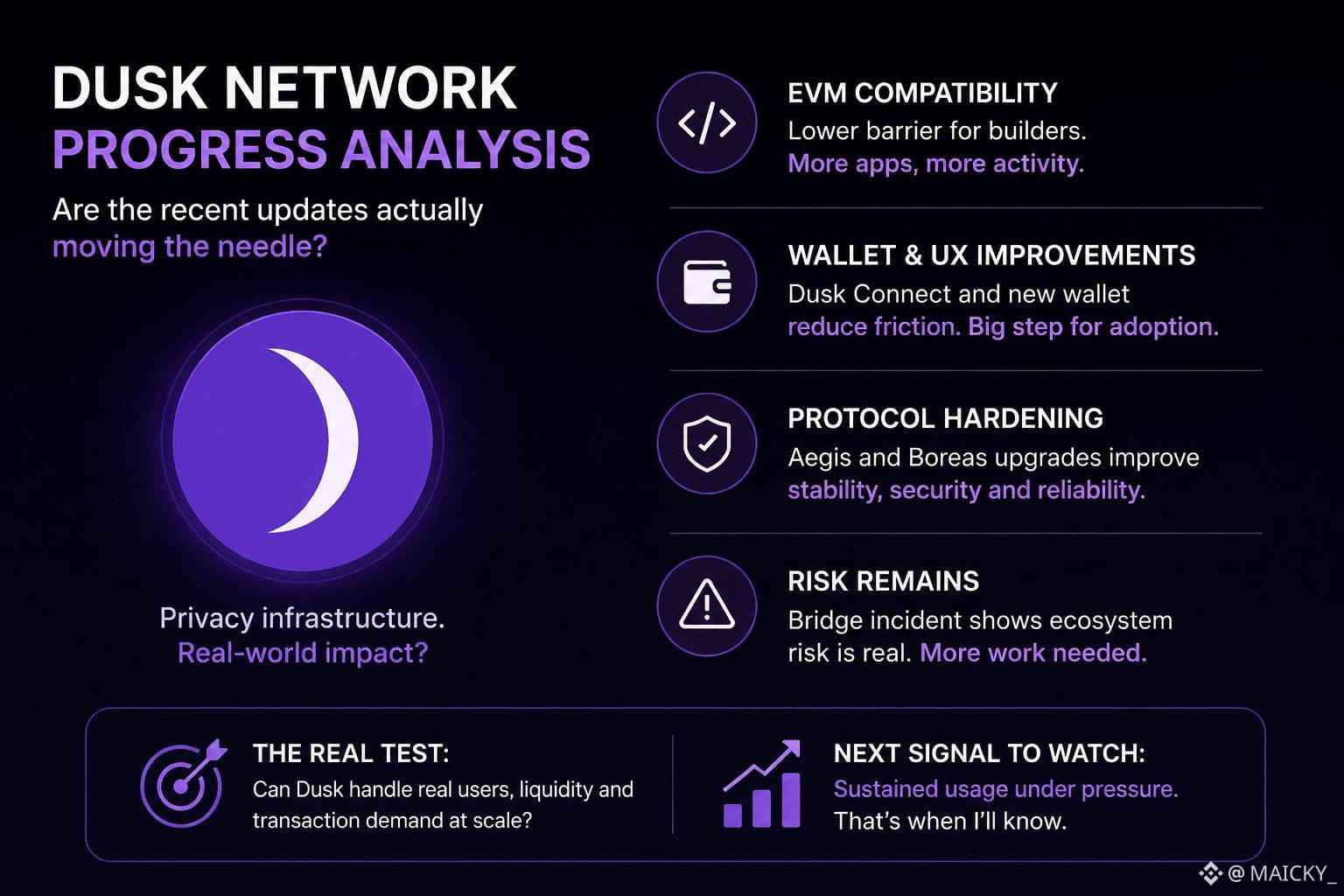
Dusk is moving toward a more accessible developer experience, with EVM support, wallet infrastructure, and continued protocol-level hardening. On paper, that looks like a strong combination.
But I keep coming back to one question:
Does this actually make Dusk more useful, or are we just stacking features on top of an unfinished system?
EVM compatibility can bring builders. Better wallets can reduce friction. Security work can improve reliability.
But none of those things matter much if the network struggles when users, liquidity, applications and transaction demand start scaling together.
That’s where I’m watching closely.
I’m also paying more attention to the difference between core-protocol risk and ecosystem risk. Recent security work and the bridge incident showed me that building privacy infrastructure is only one part of the problem. The connections around it need to be robust too.
So my view has shifted.
I’m more interested in Dusk than I was a few months ago, but I’m not ready to call it proven.
For me, the next meaningful signal isn’t another announcement.
It’s sustained usage under pressure.
That’s when I’ll know whether Dusk is becoming real infrastructure — or simply getting better at telling the story.
#dusk $DUSK @Dusk
I’ve been digging into @Dusk again, and honestly, I think the interesting part is no longer the privacy narrative.
It’s whether the recent upgrades can survive real usage.
Dusk is moving toward a more accessible developer experience, with EVM support, wallet infrastructure, and continued protocol-level hardening. On paper, that looks like a strong combination.
But I keep coming back to one question:
Does this actually make Dusk more useful, or are we just stacking features on top of an unfinished system?
EVM compatibility can bring builders. Better wallets can reduce friction. Security work can improve reliability.
But none of those things matter much if the network struggles when users, liquidity, applications and transaction demand start scaling together.
That’s where I’m watching closely.
I’m also paying more attention to the difference between core-protocol risk and ecosystem risk. Recent security work and the bridge incident showed me that building privacy infrastructure is only one part of the problem. The connections around it need to be robust too.
So my view has shifted.
I’m more interested in Dusk than I was a few months ago, but I’m not ready to call it proven.
For me, the next meaningful signal isn’t another announcement.
It’s sustained usage under pressure.
That’s when I’ll know whether Dusk is becoming real infrastructure — or simply getting better at telling the story.
I’ve been digging into @Dusk again, and honestly, I think the interesting part is no longer the privacy narrative.
It’s whether the recent upgrades can survive real usage.
Dusk is moving toward a more accessible developer experience, with EVM support, wallet infrastructure, and continued protocol-level hardening. On paper, that looks like a strong combination.
But I keep coming back to one question:
Does this actually make Dusk more useful, or are we just stacking features on top of an unfinished system?
EVM compatibility can bring builders. Better wallets can reduce friction. Security work can improve reliability.
But none of those things matter much if the network struggles when users, liquidity, applications and transaction demand start scaling together.
That’s where I’m watching closely.
I’m also paying more attention to the difference between core-protocol risk and ecosystem risk. Recent security work and the bridge incident showed me that building privacy infrastructure is only one part of the problem. The connections around it need to be robust too.
So my view has shifted.
I’m more interested in Dusk than I was a few months ago, but I’m not ready to call it proven.
For me, the next meaningful signal isn’t another announcement.
It’s sustained usage under pressure.
That’s when I’ll know whether Dusk is becoming real infrastructure — or simply getting better at telling the story.
2
154
·
--
I’ve been watching TermMax closely lately, and the recent updates make it feel like the product is finally moving beyond just “fixed-rate lending.”
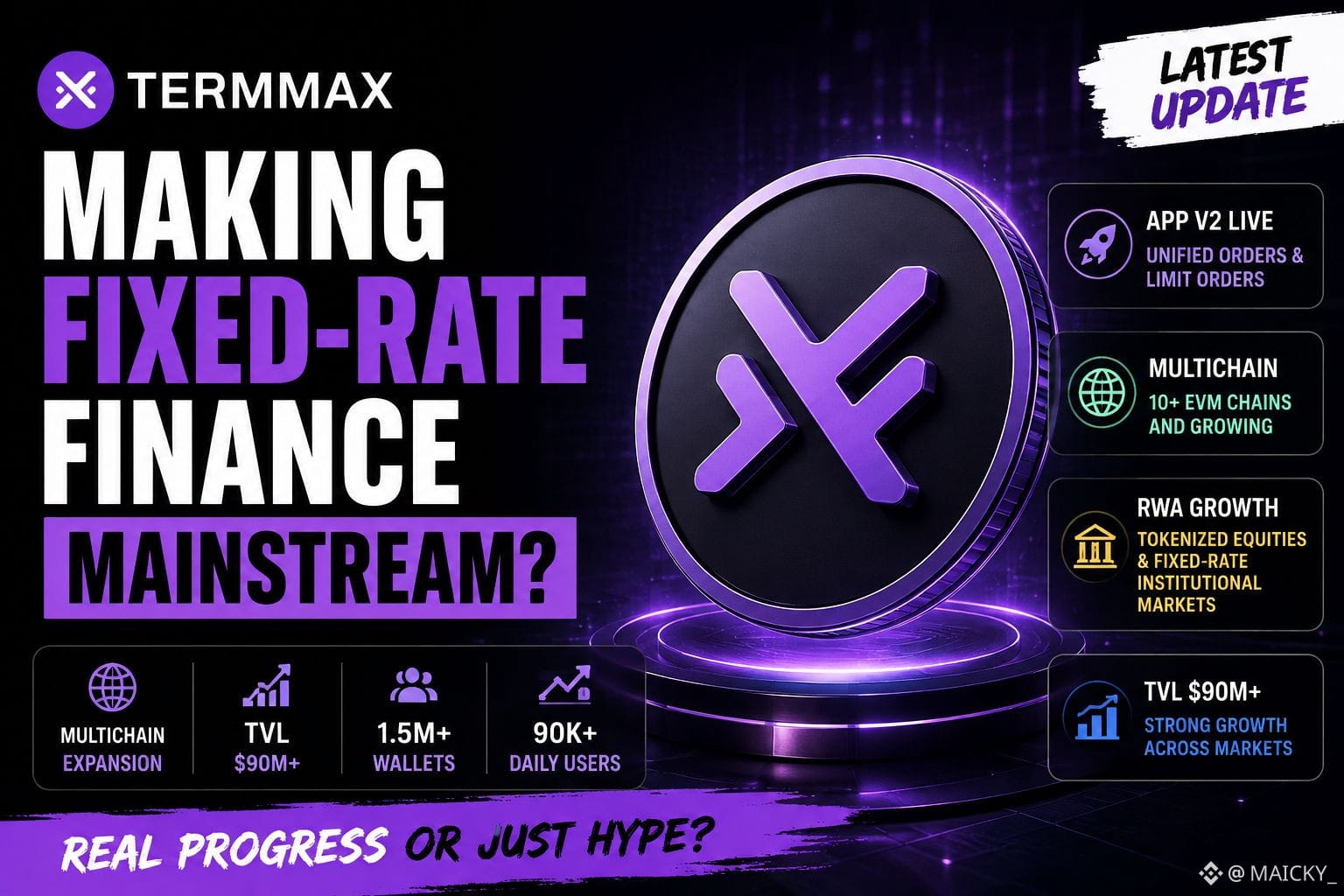
App V2 is live with unified orders, multichain markets, and limit orders across every market.That’s a meaningful UX upgrade, but the real test is whether it actually improves execution and liquidity rather than just making the interface cleaner.
The bigger shift is happening around the ecosystem: bStocks on BNB Chain, HyperEVM expansion,TermPrime becoming a fixed-rate venue on Canton, and tokenized equities going live on Robinhood Chain. These moves give TermMax more real use cases, but adoption still needs to prove itself beyond headline announcements.
TVL is now reported above $90M, with 1.5M+ registered wallets and 90K+ daily active users across 10 EVM chains. Those numbers are encouraging, but I’m more interested in how much activity remains once incentives and the upcoming token launch are no longer the main catalyst.
My confidence has improved because the updates are becoming more product-focused and increasingly connected to institutional and real-world markets. Still, TermMax needs to prove that liquidity, usage, and demand can survive beyond the current incentive cycle.
For me, sustained organic volume and healthy maturity/rollover activity would be the next milestones that could materially change my view.
@termmax #TermMax
$XPIN
{alpha}(560xd955c9ba56fb1ab30e34766e252a97ccce3d31a6)
$ONG
{future}(ONGUSDT)
$ENA
{future}(ENAUSDT)
I’ve been watching TermMax closely lately, and the recent updates make it feel like the product is finally moving beyond just “fixed-rate lending.”
App V2 is live with unified orders, multichain markets, and limit orders across every market.That’s a meaningful UX upgrade, but the real test is whether it actually improves execution and liquidity rather than just making the interface cleaner.
The bigger shift is happening around the ecosystem: bStocks on BNB Chain, HyperEVM expansion,TermPrime becoming a fixed-rate venue on Canton, and tokenized equities going live on Robinhood Chain. These moves give TermMax more real use cases, but adoption still needs to prove itself beyond headline announcements.
TVL is now reported above $90M, with 1.5M+ registered wallets and 90K+ daily active users across 10 EVM chains. Those numbers are encouraging, but I’m more interested in how much activity remains once incentives and the upcoming token launch are no longer the main catalyst.
My confidence has improved because the updates are becoming more product-focused and increasingly connected to institutional and real-world markets. Still, TermMax needs to prove that liquidity, usage, and demand can survive beyond the current incentive cycle.
For me, sustained organic volume and healthy maturity/rollover activity would be the next milestones that could materially change my view.
@TermMax #TermMax
$XPIN
$ONG
$ENA
App V2 is live with unified orders, multichain markets, and limit orders across every market.That’s a meaningful UX upgrade, but the real test is whether it actually improves execution and liquidity rather than just making the interface cleaner.
The bigger shift is happening around the ecosystem: bStocks on BNB Chain, HyperEVM expansion,TermPrime becoming a fixed-rate venue on Canton, and tokenized equities going live on Robinhood Chain. These moves give TermMax more real use cases, but adoption still needs to prove itself beyond headline announcements.
TVL is now reported above $90M, with 1.5M+ registered wallets and 90K+ daily active users across 10 EVM chains. Those numbers are encouraging, but I’m more interested in how much activity remains once incentives and the upcoming token launch are no longer the main catalyst.
My confidence has improved because the updates are becoming more product-focused and increasingly connected to institutional and real-world markets. Still, TermMax needs to prove that liquidity, usage, and demand can survive beyond the current incentive cycle.
For me, sustained organic volume and healthy maturity/rollover activity would be the next milestones that could materially change my view.
@TermMax #TermMax
$XPIN
$ONG
$ENA
2
4
477
·
--
@Dusk_Foundation #dusk $DUSK
I’ve been watching @Dusk_Foundation a bit more closely lately, and honestly, I think I was judging the progress too much from the outside.
The interesting part isn’t another feature being announced. It’s that Dusk is gradually making the network easier to actually build on.
DuskEVM gives developers a more familiar route into the ecosystem, while the wallet and connection tooling makes the user side less awkward. Those sound like small improvements, but they’re the kind of things that matter once real applications have to work end to end.
The security side also caught my attention. The AEGIS review resulted in 39 fixes, including 7 critical findings. The bridge issues were another reminder that the hardest risks aren’t always inside the core chain itself.
So I’m less interested in asking whether Dusk has good technology. I’m watching whether all these pieces can survive real usage.
My view has improved, but I’m not calling it proven yet.
What I want to see next is simple: real applications, real users, reliable infrastructure, and actual financial workflows running without the system becoming too complicated.
That’s the point where I’d seriously change my conviction on Dusk. $LAB
{future}(LABUSDT)
$BOME
{future}(BOMEUSDT)
@Dusk #dusk $DUSK
I’ve been watching @Dusk a bit more closely lately, and honestly, I think I was judging the progress too much from the outside.
The interesting part isn’t another feature being announced. It’s that Dusk is gradually making the network easier to actually build on.
DuskEVM gives developers a more familiar route into the ecosystem, while the wallet and connection tooling makes the user side less awkward. Those sound like small improvements, but they’re the kind of things that matter once real applications have to work end to end.
The security side also caught my attention. The AEGIS review resulted in 39 fixes, including 7 critical findings. The bridge issues were another reminder that the hardest risks aren’t always inside the core chain itself.
So I’m less interested in asking whether Dusk has good technology. I’m watching whether all these pieces can survive real usage.
My view has improved, but I’m not calling it proven yet.
What I want to see next is simple: real applications, real users, reliable infrastructure, and actual financial workflows running without the system becoming too complicated.
That’s the point where I’d seriously change my conviction on Dusk. $LAB
$BOME
I’ve been watching @Dusk a bit more closely lately, and honestly, I think I was judging the progress too much from the outside.
The interesting part isn’t another feature being announced. It’s that Dusk is gradually making the network easier to actually build on.
DuskEVM gives developers a more familiar route into the ecosystem, while the wallet and connection tooling makes the user side less awkward. Those sound like small improvements, but they’re the kind of things that matter once real applications have to work end to end.
The security side also caught my attention. The AEGIS review resulted in 39 fixes, including 7 critical findings. The bridge issues were another reminder that the hardest risks aren’t always inside the core chain itself.
So I’m less interested in asking whether Dusk has good technology. I’m watching whether all these pieces can survive real usage.
My view has improved, but I’m not calling it proven yet.
What I want to see next is simple: real applications, real users, reliable infrastructure, and actual financial workflows running without the system becoming too complicated.
That’s the point where I’d seriously change my conviction on Dusk. $LAB
$BOME
🚀 Bullish
0%
📈 Accumulation
0%
📉 More downside
0%
👀 Waiting
0%
0 votes • Voting closed
4
3
127
·
--
I’ve been looking at Dusk again, and my view has shifted a bit.
What caught my attention isn’t another roadmap promise. It’s the work happening around the parts that actually matter when you’re trying to turn infrastructure into something people can use.
DuskEVM, better dev tooling, protocol upgrades, and the recent security fixes all feel more meaningful to me than cosmetic updates.
But I’m still not ready to call it a win.
A testnet is easy to launch. The real test is whether developers stay, users show up, and the network holds up when activity and security pressure increase.
That’s what I’m watching with Dusk now.
Less hype, more proof.
@Dusk_Foundation #dusk $DUSK
{future}(DUSKUSDT)
$LAB $SYN
I’ve been looking at Dusk again, and my view has shifted a bit.
What caught my attention isn’t another roadmap promise. It’s the work happening around the parts that actually matter when you’re trying to turn infrastructure into something people can use.
DuskEVM, better dev tooling, protocol upgrades, and the recent security fixes all feel more meaningful to me than cosmetic updates.
But I’m still not ready to call it a win.
A testnet is easy to launch. The real test is whether developers stay, users show up, and the network holds up when activity and security pressure increase.
That’s what I’m watching with Dusk now.
Less hype, more proof.
@Dusk #dusk $DUSK
$LAB $SYN
What caught my attention isn’t another roadmap promise. It’s the work happening around the parts that actually matter when you’re trying to turn infrastructure into something people can use.
DuskEVM, better dev tooling, protocol upgrades, and the recent security fixes all feel more meaningful to me than cosmetic updates.
But I’m still not ready to call it a win.
A testnet is easy to launch. The real test is whether developers stay, users show up, and the network holds up when activity and security pressure increase.
That’s what I’m watching with Dusk now.
Less hype, more proof.
@Dusk #dusk $DUSK
$LAB $SYN
Bullish 💚
0%
Bearish ♥️
0%
Natural 🤕
0%
0 votes • Voting closed
1
116
·
--
Verified
I’ve been digging into @termmax again lately, and honestly, I think I was looking at the project a bit too narrowly before.
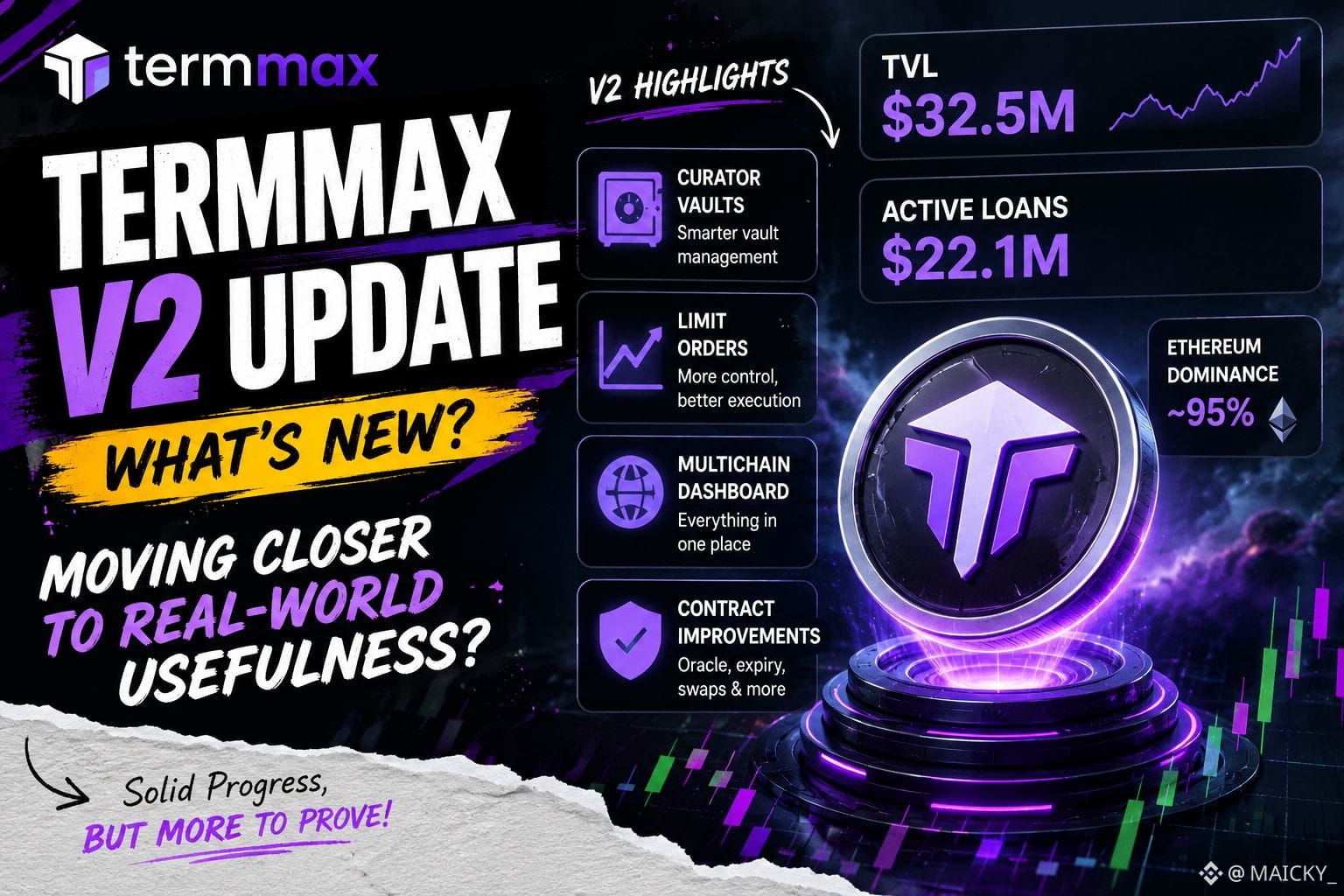
V2 is starting to make more sense to me. Curator vaults, limit orders and a unified multichain dashboard are small pieces individually, but together they make the product feel more usable.
The numbers are interesting too. TVL is around $32M, with roughly $22M in active loans. But most of that liquidity is still sitting on Ethereum, so I don’t think the adoption story is fully proven yet.
What caught my attention is that the team is also tightening the contract side, including oracle integrations, order expiry and swap-related fixes. That’s less flashy, but probably more important for a lending/trading protocol.
My confidence in TermMax has gone up a little, but I’m still watching the same thing: can these upgrades turn into deeper liquidity, broader usage and consistent activity?
That’s the part I’d need to see before calling this more than incremental progress.
@termmax #TermMax
$RE
{future}(REUSDT)
$LAB
{future}(LABUSDT)
I’ve been digging into @TermMax again lately, and honestly, I think I was looking at the project a bit too narrowly before.
V2 is starting to make more sense to me. Curator vaults, limit orders and a unified multichain dashboard are small pieces individually, but together they make the product feel more usable.
The numbers are interesting too. TVL is around $32M, with roughly $22M in active loans. But most of that liquidity is still sitting on Ethereum, so I don’t think the adoption story is fully proven yet.
What caught my attention is that the team is also tightening the contract side, including oracle integrations, order expiry and swap-related fixes. That’s less flashy, but probably more important for a lending/trading protocol.
My confidence in TermMax has gone up a little, but I’m still watching the same thing: can these upgrades turn into deeper liquidity, broader usage and consistent activity?
That’s the part I’d need to see before calling this more than incremental progress.
@TermMax #TermMax
$RE
$LAB
V2 is starting to make more sense to me. Curator vaults, limit orders and a unified multichain dashboard are small pieces individually, but together they make the product feel more usable.
The numbers are interesting too. TVL is around $32M, with roughly $22M in active loans. But most of that liquidity is still sitting on Ethereum, so I don’t think the adoption story is fully proven yet.
What caught my attention is that the team is also tightening the contract side, including oracle integrations, order expiry and swap-related fixes. That’s less flashy, but probably more important for a lending/trading protocol.
My confidence in TermMax has gone up a little, but I’m still watching the same thing: can these upgrades turn into deeper liquidity, broader usage and consistent activity?
That’s the part I’d need to see before calling this more than incremental progress.
@TermMax #TermMax
$RE
$LAB
1
5
729
·
--
I’ve been digging into Dusk again lately, and honestly, I think the recent progress is more interesting than the usual “big roadmap” talk.
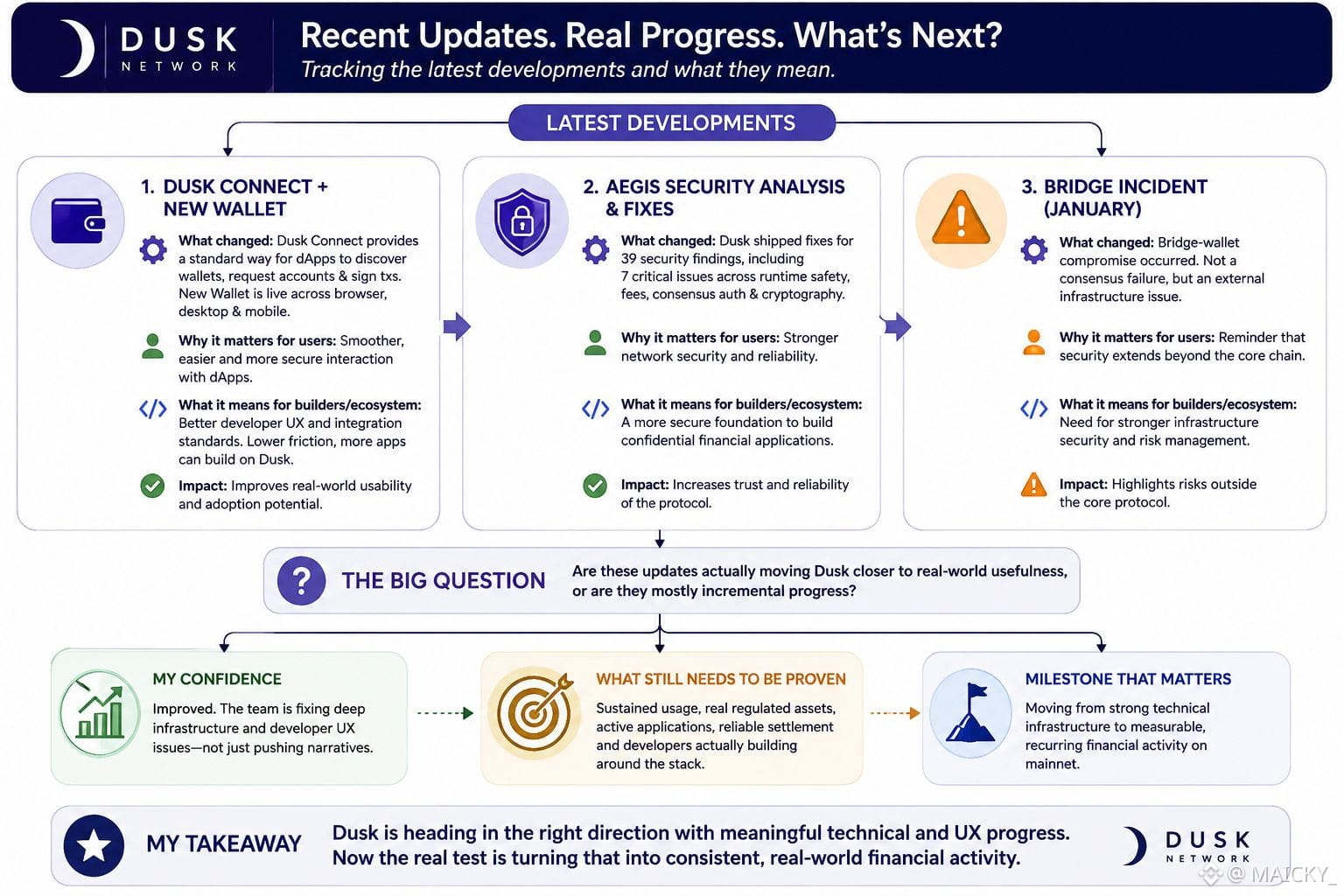
Dusk Connect and the new Wallet caught my attention because they’re working on a very practical problem: making it easier for apps, users, and developers to actually interact with the network. That sounds basic, but UX and wallet infrastructure can make or break adoption.
The AEGIS security work also stands out. Finding and fixing 39 issues, including 7 critical ones, is meaningful progress. At the same time, I don’t see that as a victory lap—it shows just how much security work is involved when you’re building infrastructure for financial use.
And the bridge incident is worth keeping in mind too. Even if the core consensus wasn’t the issue, it showed that real-world security goes beyond the blockchain itself.
So I’m more confident in the direction, but I’m still waiting for the harder proof: sustained usage, real applications, regulated assets and reliable settlement happening at scale.
For me, that’s the next big test. If Dusk can turn this technical progress into consistent real-world financial activity, my view changes significantly.
@Dusk_Foundation #dusk $DUSK
{future}(DUSKUSDT)
I’ve been digging into Dusk again lately, and honestly, I think the recent progress is more interesting than the usual “big roadmap” talk.
Dusk Connect and the new Wallet caught my attention because they’re working on a very practical problem: making it easier for apps, users, and developers to actually interact with the network. That sounds basic, but UX and wallet infrastructure can make or break adoption.
The AEGIS security work also stands out. Finding and fixing 39 issues, including 7 critical ones, is meaningful progress. At the same time, I don’t see that as a victory lap—it shows just how much security work is involved when you’re building infrastructure for financial use.
And the bridge incident is worth keeping in mind too. Even if the core consensus wasn’t the issue, it showed that real-world security goes beyond the blockchain itself.
So I’m more confident in the direction, but I’m still waiting for the harder proof: sustained usage, real applications, regulated assets and reliable settlement happening at scale.
For me, that’s the next big test. If Dusk can turn this technical progress into consistent real-world financial activity, my view changes significantly.
@Dusk #dusk $DUSK
Dusk Connect and the new Wallet caught my attention because they’re working on a very practical problem: making it easier for apps, users, and developers to actually interact with the network. That sounds basic, but UX and wallet infrastructure can make or break adoption.
The AEGIS security work also stands out. Finding and fixing 39 issues, including 7 critical ones, is meaningful progress. At the same time, I don’t see that as a victory lap—it shows just how much security work is involved when you’re building infrastructure for financial use.
And the bridge incident is worth keeping in mind too. Even if the core consensus wasn’t the issue, it showed that real-world security goes beyond the blockchain itself.
So I’m more confident in the direction, but I’m still waiting for the harder proof: sustained usage, real applications, regulated assets and reliable settlement happening at scale.
For me, that’s the next big test. If Dusk can turn this technical progress into consistent real-world financial activity, my view changes significantly.
@Dusk #dusk $DUSK
8
9
227
·
--
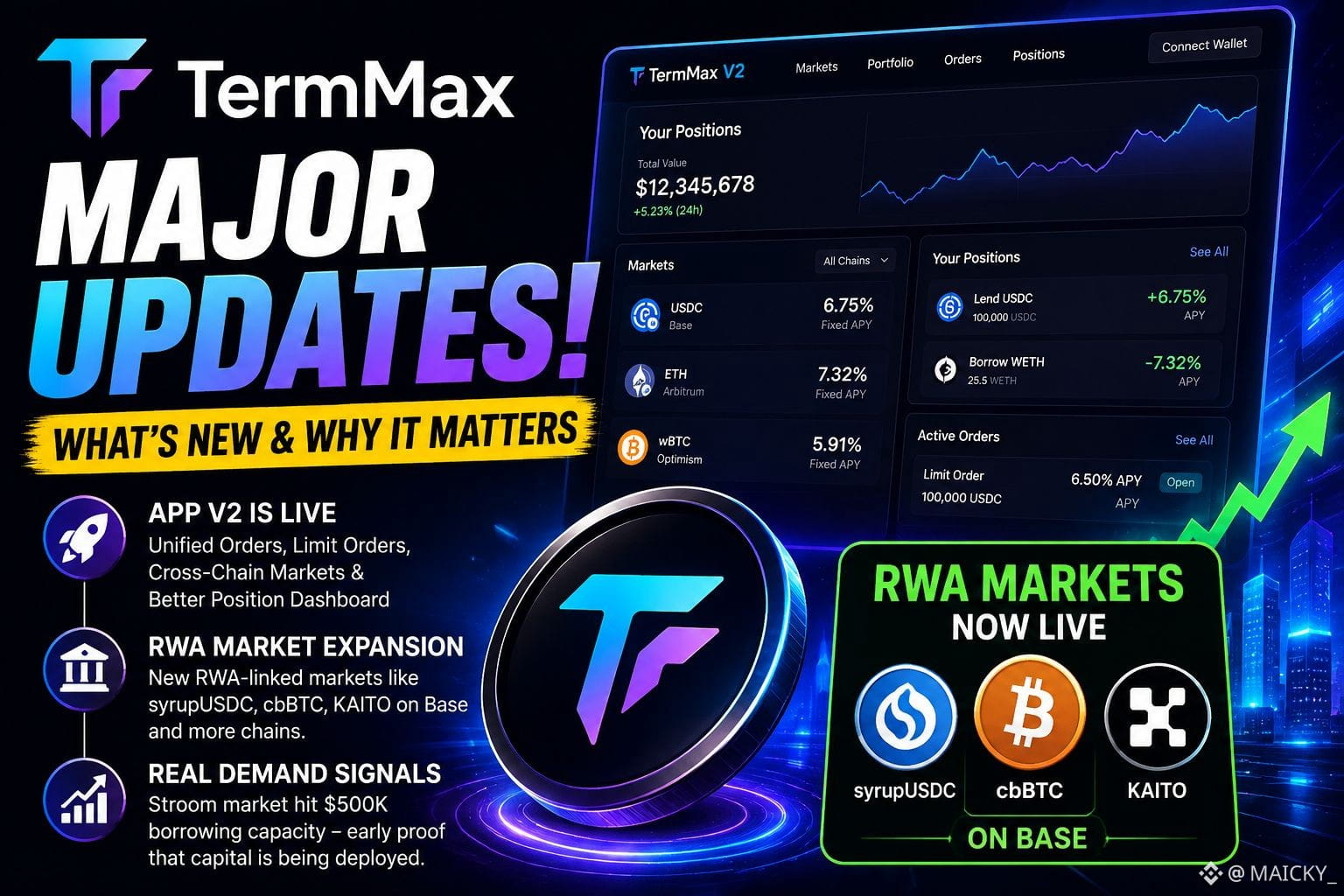
I’ve been watching @termmax closely again, and the latest progress feels more practical than purely narrative. App V2 is now live with unified orders, cross-chain market visibility, limit orders across markets, and a much cleaner position dashboard.
What matters here is less about adding another interface and more about reducing the friction around fixed-term positions. For users, comparing markets and managing debt across chains should be easier; for builders, the unified routing layer gives the ecosystem a more usable foundation.
The other development I’m paying attention to is the expansion into RWA-linked markets. TermMax now has markets around assets such as syrupUSDC, cbBTC and KAITO on Base, while its current app also shows RWA-focused borrowing opportunities and newer chains.
There’s also early evidence of actual demand rather than just announcements. A recent Stroom market on TermMax reportedly reached its $500K borrowing capacity, showing that integrations can translate into capital being deployed—but one filled market is still a small sample, not proof of broad adoption.
The bigger question for me is whether TermMax can turn all this market expansion into durable liquidity and repeat usage. Current third-party data still shows relatively modest protocol revenue compared with larger lending platforms, so scale and sustained activity remain important things to watch.
Overall, these updates have increased my confidence that TermMax is moving beyond incremental product building, especially on usability and RWA utility. What still needs proving is deeper liquidity, consistent volume and resilience across maturities; a sustained rise in real borrowing demand without relying heavily on incentives would materially change my view.
#TermMax @termmax
I’ve been watching @TermMax closely again, and the latest progress feels more practical than purely narrative. App V2 is now live with unified orders, cross-chain market visibility, limit orders across markets, and a much cleaner position dashboard.
What matters here is less about adding another interface and more about reducing the friction around fixed-term positions. For users, comparing markets and managing debt across chains should be easier; for builders, the unified routing layer gives the ecosystem a more usable foundation.
The other development I’m paying attention to is the expansion into RWA-linked markets. TermMax now has markets around assets such as syrupUSDC, cbBTC and KAITO on Base, while its current app also shows RWA-focused borrowing opportunities and newer chains.
There’s also early evidence of actual demand rather than just announcements. A recent Stroom market on TermMax reportedly reached its $500K borrowing capacity, showing that integrations can translate into capital being deployed—but one filled market is still a small sample, not proof of broad adoption.
The bigger question for me is whether TermMax can turn all this market expansion into durable liquidity and repeat usage. Current third-party data still shows relatively modest protocol revenue compared with larger lending platforms, so scale and sustained activity remain important things to watch.
Overall, these updates have increased my confidence that TermMax is moving beyond incremental product building, especially on usability and RWA utility. What still needs proving is deeper liquidity, consistent volume and resilience across maturities; a sustained rise in real borrowing demand without relying heavily on incentives would materially change my view.
#TermMax @TermMax
What matters here is less about adding another interface and more about reducing the friction around fixed-term positions. For users, comparing markets and managing debt across chains should be easier; for builders, the unified routing layer gives the ecosystem a more usable foundation.
The other development I’m paying attention to is the expansion into RWA-linked markets. TermMax now has markets around assets such as syrupUSDC, cbBTC and KAITO on Base, while its current app also shows RWA-focused borrowing opportunities and newer chains.
There’s also early evidence of actual demand rather than just announcements. A recent Stroom market on TermMax reportedly reached its $500K borrowing capacity, showing that integrations can translate into capital being deployed—but one filled market is still a small sample, not proof of broad adoption.
The bigger question for me is whether TermMax can turn all this market expansion into durable liquidity and repeat usage. Current third-party data still shows relatively modest protocol revenue compared with larger lending platforms, so scale and sustained activity remain important things to watch.
Overall, these updates have increased my confidence that TermMax is moving beyond incremental product building, especially on usability and RWA utility. What still needs proving is deeper liquidity, consistent volume and resilience across maturities; a sustained rise in real borrowing demand without relying heavily on incentives would materially change my view.
#TermMax @TermMax
1
3
287
·
--
#BTCPerpFundingRateHits20MonthHigh
🚨 #BTCPerpFundingRateHits20MonthHig
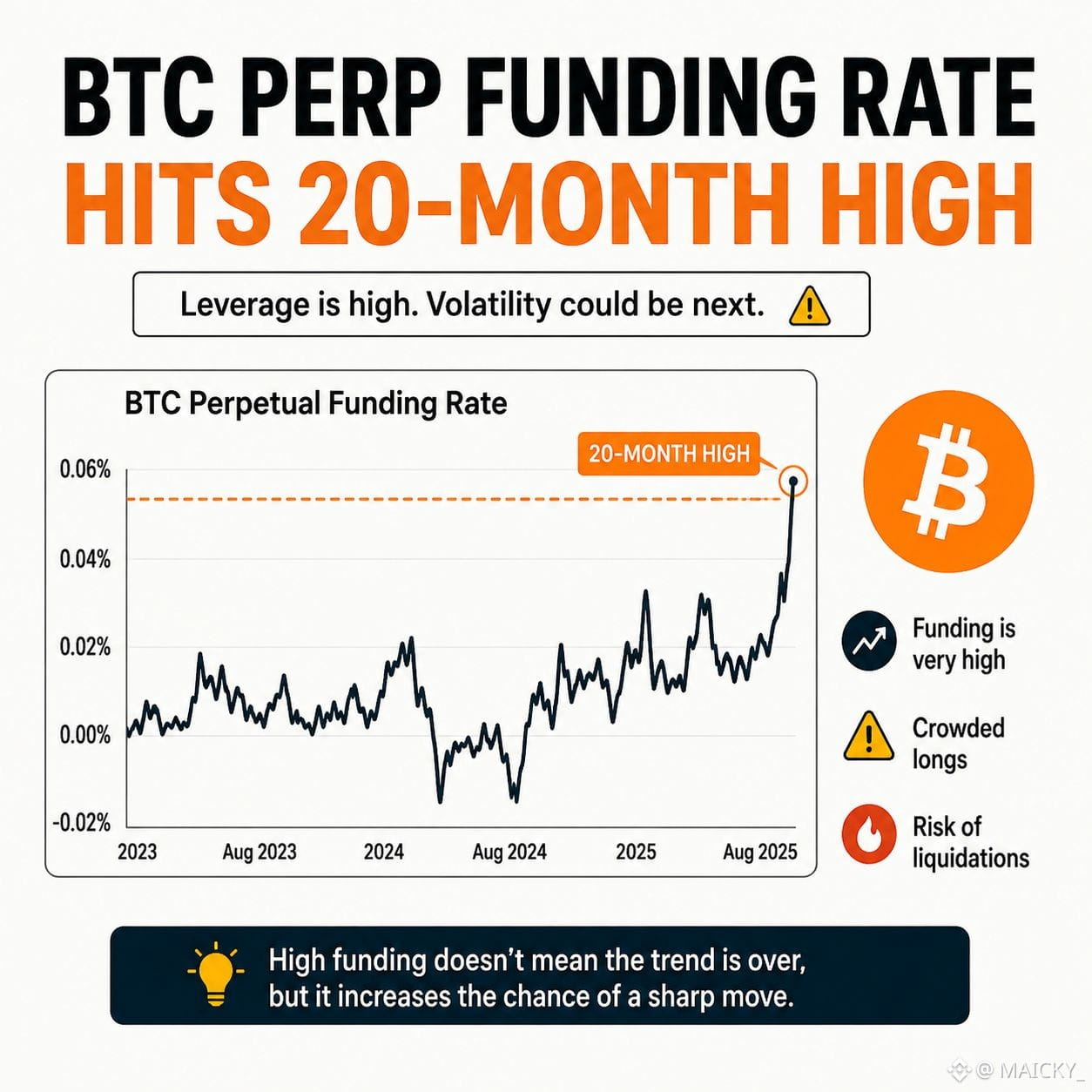
Bitcoin perpetual funding just hit a level we haven’t seen in 20 months.
That doesn’t automatically mean BTC has topped.
But it does tell me one thing: leverage is getting crowded.
When traders become heavily positioned on the same side, price doesn’t need a huge catalyst to move violently. A small pullback can start liquidations, liquidations can accelerate selling, and suddenly a “healthy” uptrend turns into a brutal flush.
The interesting part isn’t simply the funding number.
It’s what BTC does next.
If price keeps grinding higher while funding cools down, that could signal the market is absorbing leverage.
But if funding stays extremely elevated while price starts losing key support, I’d be watching closely for a leverage reset.
🔥 Bullish trend + controlled funding = healthier setup.
⚠️ Bullish trend + extreme funding = crowded trade.
The market can stay irrational longer than traders expect… but leverage eventually has to be paid for.
BTC doesn’t need to crash. It just needs enough volatility to punish the crowded side.
$LAYER $BTW $LAB
#BTCPerpFundingRateHits20MonthHigh
#BTCPerpFundingRateHits20MonthHigh
🚨 #BTCPerpFundingRateHits20MonthHig
Bitcoin perpetual funding just hit a level we haven’t seen in 20 months.
That doesn’t automatically mean BTC has topped.
But it does tell me one thing: leverage is getting crowded.
When traders become heavily positioned on the same side, price doesn’t need a huge catalyst to move violently. A small pullback can start liquidations, liquidations can accelerate selling, and suddenly a “healthy” uptrend turns into a brutal flush.
The interesting part isn’t simply the funding number.
It’s what BTC does next.
If price keeps grinding higher while funding cools down, that could signal the market is absorbing leverage.
But if funding stays extremely elevated while price starts losing key support, I’d be watching closely for a leverage reset.
🔥 Bullish trend + controlled funding = healthier setup.
⚠️ Bullish trend + extreme funding = crowded trade.
The market can stay irrational longer than traders expect… but leverage eventually has to be paid for.
BTC doesn’t need to crash. It just needs enough volatility to punish the crowded side.
$LAYER $BTW $LAB
#BTCPerpFundingRateHits20MonthHigh
🚨 #BTCPerpFundingRateHits20MonthHig
Bitcoin perpetual funding just hit a level we haven’t seen in 20 months.
That doesn’t automatically mean BTC has topped.
But it does tell me one thing: leverage is getting crowded.
When traders become heavily positioned on the same side, price doesn’t need a huge catalyst to move violently. A small pullback can start liquidations, liquidations can accelerate selling, and suddenly a “healthy” uptrend turns into a brutal flush.
The interesting part isn’t simply the funding number.
It’s what BTC does next.
If price keeps grinding higher while funding cools down, that could signal the market is absorbing leverage.
But if funding stays extremely elevated while price starts losing key support, I’d be watching closely for a leverage reset.
🔥 Bullish trend + controlled funding = healthier setup.
⚠️ Bullish trend + extreme funding = crowded trade.
The market can stay irrational longer than traders expect… but leverage eventually has to be paid for.
BTC doesn’t need to crash. It just needs enough volatility to punish the crowded side.
$LAYER $BTW $LAB
#BTCPerpFundingRateHits20MonthHigh
171
·
--
Verified
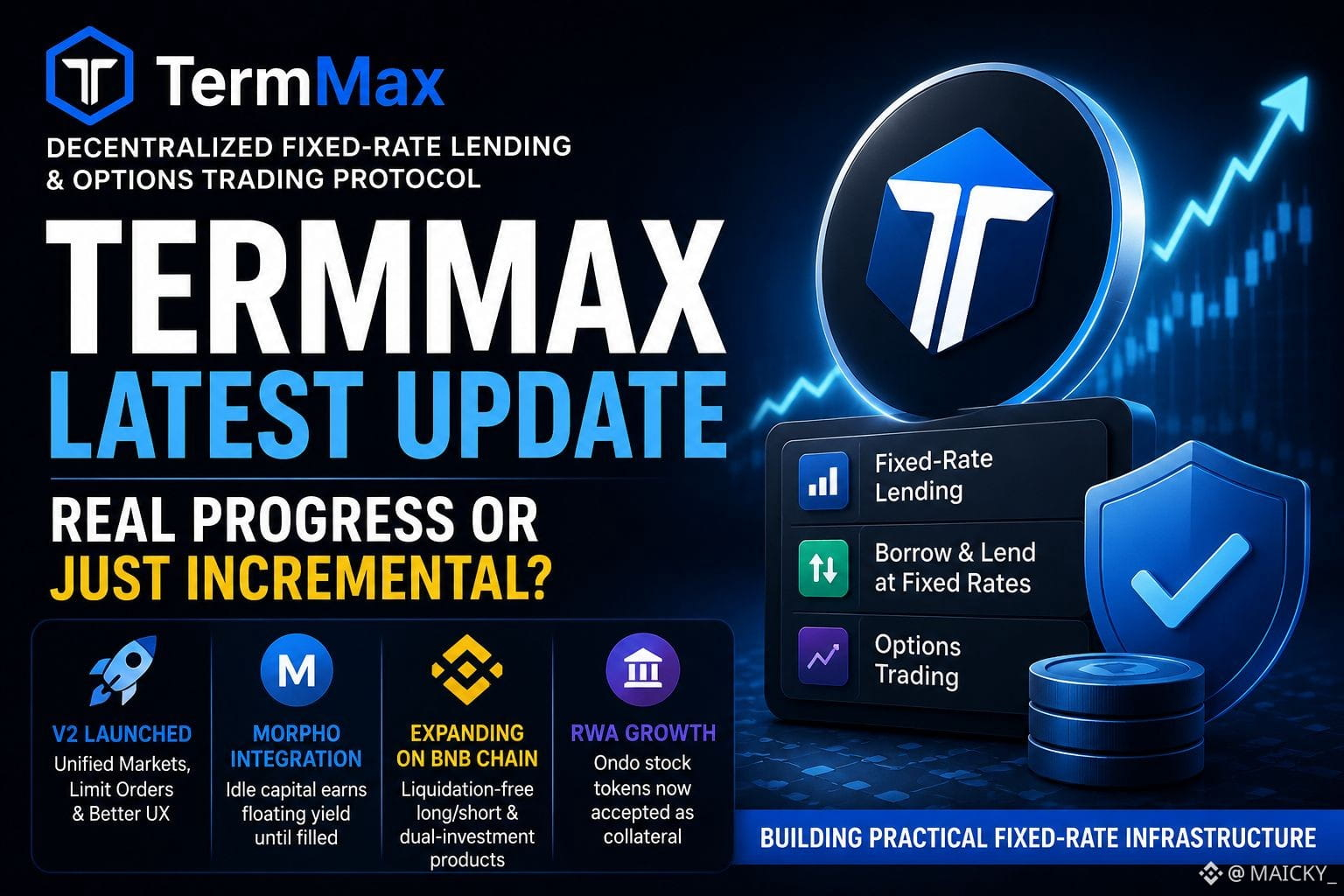
I’ve been watching TermMax again lately, and the biggest change for me is V2 becoming much more usable. The May 27 launch unified orders, markets across chains, and added limit orders across every market, reducing the friction around finding and executing fixed-rate positions.
The Morpho integration is another piece I find interesting. Unmatched TermMax limit-order capital can earn floating yield through Morpho until a fixed-rate order is filled, which directly addresses the problem of idle liquidity rather than just adding another integration for the sake of it.
TermMax is also pushing beyond basic lending with Alpha on BNB Chain, including liquidation-free long/short exposure and dual-investment products. The RWA direction is expanding too, with Ondo stock tokens being used as collateral for borrowing or lending markets.
But I’m still separating product progress from proven adoption. The architecture is becoming more practical, yet deeper liquidity, sustained usage and reliable execution across markets are what will determine whether this becomes genuinely useful infrastructure rather than another feature-heavy DeFi protocol.
My confidence has improved because the updates are solving real UX and capital-efficiency problems. What I still want to see is durable liquidity and usage without depending heavily on incentives; stronger evidence there would materially change my view on TermMax.
@termmax #TermMax
$TUT
{future}(TUTUSDT)
$CLO
{alpha}(560x81d3a238b02827f62b9f390f947d36d4a5bf89d2)
$EDEN
{future}(EDENUSDT)
I’ve been watching TermMax again lately, and the biggest change for me is V2 becoming much more usable. The May 27 launch unified orders, markets across chains, and added limit orders across every market, reducing the friction around finding and executing fixed-rate positions.
The Morpho integration is another piece I find interesting. Unmatched TermMax limit-order capital can earn floating yield through Morpho until a fixed-rate order is filled, which directly addresses the problem of idle liquidity rather than just adding another integration for the sake of it.
TermMax is also pushing beyond basic lending with Alpha on BNB Chain, including liquidation-free long/short exposure and dual-investment products. The RWA direction is expanding too, with Ondo stock tokens being used as collateral for borrowing or lending markets.
But I’m still separating product progress from proven adoption. The architecture is becoming more practical, yet deeper liquidity, sustained usage and reliable execution across markets are what will determine whether this becomes genuinely useful infrastructure rather than another feature-heavy DeFi protocol.
My confidence has improved because the updates are solving real UX and capital-efficiency problems. What I still want to see is durable liquidity and usage without depending heavily on incentives; stronger evidence there would materially change my view on TermMax.
@TermMax #TermMax
$TUT
$CLO
$EDEN
The Morpho integration is another piece I find interesting. Unmatched TermMax limit-order capital can earn floating yield through Morpho until a fixed-rate order is filled, which directly addresses the problem of idle liquidity rather than just adding another integration for the sake of it.
TermMax is also pushing beyond basic lending with Alpha on BNB Chain, including liquidation-free long/short exposure and dual-investment products. The RWA direction is expanding too, with Ondo stock tokens being used as collateral for borrowing or lending markets.
But I’m still separating product progress from proven adoption. The architecture is becoming more practical, yet deeper liquidity, sustained usage and reliable execution across markets are what will determine whether this becomes genuinely useful infrastructure rather than another feature-heavy DeFi protocol.
My confidence has improved because the updates are solving real UX and capital-efficiency problems. What I still want to see is durable liquidity and usage without depending heavily on incentives; stronger evidence there would materially change my view on TermMax.
@TermMax #TermMax
$TUT
$CLO
$EDEN
7
6
591
·
--
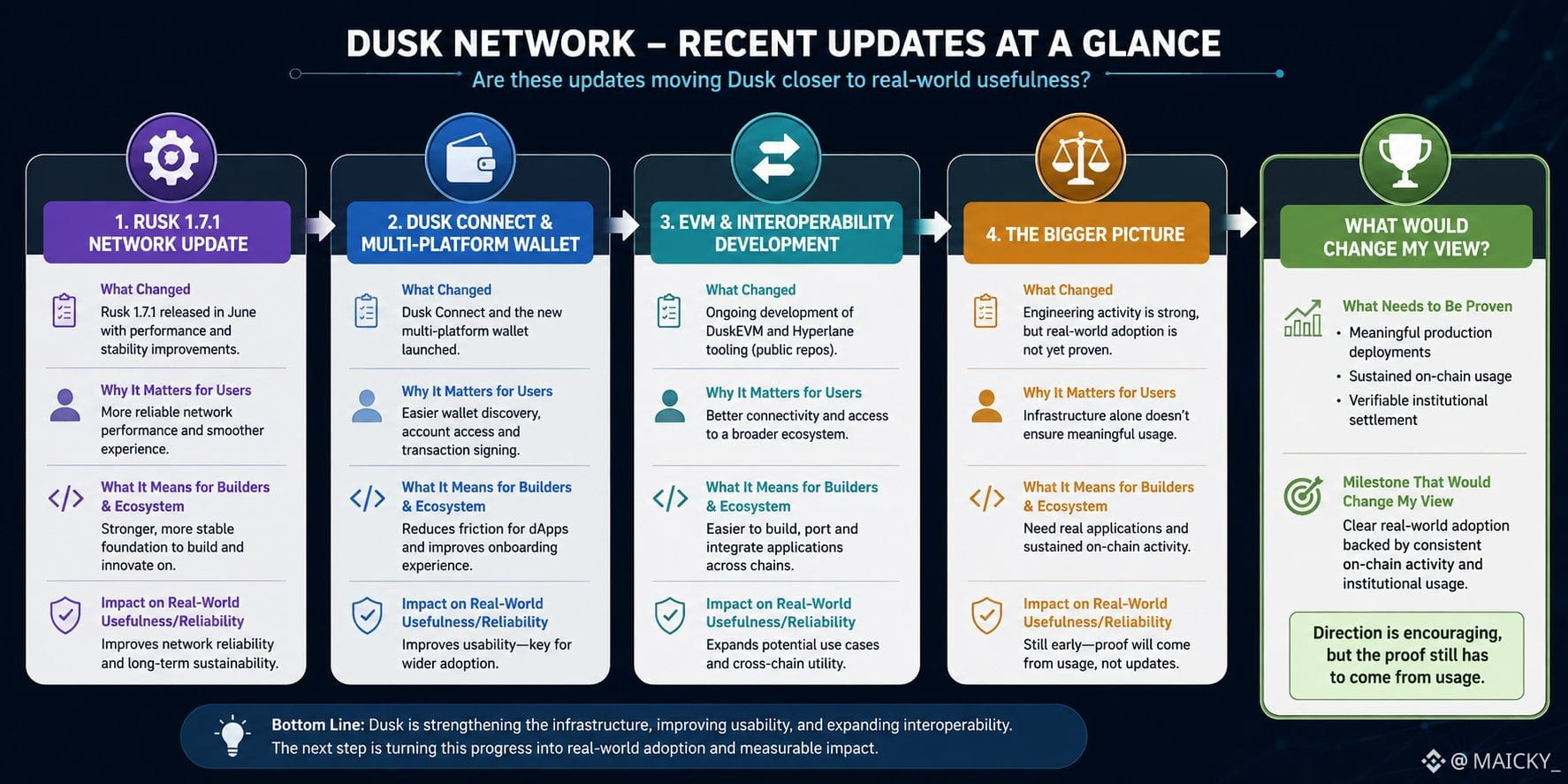
I’ve been watching Dusk closely again, and the recent progress looks more like infrastructure being hardened than a flashy headline. Rusk 1.7.1 shipped in June, while the wallet and core stack have continued receiving updates into July.
The bigger signal for me is the developer layer. Dusk Connect and the new multi-platform wallet are designed to make wallet discovery, account access and transaction signing easier for dApps, which directly removes some friction for builders.
I’m also paying attention to the EVM and interoperability work. Dusk’s public repositories show continued development around DuskEVM and Hyperlane tooling, suggesting the ecosystem is trying to make Dusk easier to build on and connect with—not just improve the base chain.
But I wouldn’t call this proof of real-world adoption yet. The recent engineering activity is meaningful, while the harder question remains whether developers actually deploy useful applications and whether institutional workflows generate sustained onchain activity.
My confidence has improved slightly because the pieces are becoming more usable, but I’m still waiting for stronger evidence beyond infrastructure progress. For me, meaningful production deployments, sustained usage and verifiable institutional settlement would materially change my view.
So the question remains: are these updates moving Dusk toward real-world usefulness, or are they still mostly incremental progress? Right now, I’d say the direction is encouraging—but the proof still has to come from usage.
#dusk @Dusk_Foundation $DUSK
{future}(DUSKUSDT)
I’ve been watching Dusk closely again, and the recent progress looks more like infrastructure being hardened than a flashy headline. Rusk 1.7.1 shipped in June, while the wallet and core stack have continued receiving updates into July.
The bigger signal for me is the developer layer. Dusk Connect and the new multi-platform wallet are designed to make wallet discovery, account access and transaction signing easier for dApps, which directly removes some friction for builders.
I’m also paying attention to the EVM and interoperability work. Dusk’s public repositories show continued development around DuskEVM and Hyperlane tooling, suggesting the ecosystem is trying to make Dusk easier to build on and connect with—not just improve the base chain.
But I wouldn’t call this proof of real-world adoption yet. The recent engineering activity is meaningful, while the harder question remains whether developers actually deploy useful applications and whether institutional workflows generate sustained onchain activity.
My confidence has improved slightly because the pieces are becoming more usable, but I’m still waiting for stronger evidence beyond infrastructure progress. For me, meaningful production deployments, sustained usage and verifiable institutional settlement would materially change my view.
So the question remains: are these updates moving Dusk toward real-world usefulness, or are they still mostly incremental progress? Right now, I’d say the direction is encouraging—but the proof still has to come from usage.
#dusk @Dusk $DUSK
The bigger signal for me is the developer layer. Dusk Connect and the new multi-platform wallet are designed to make wallet discovery, account access and transaction signing easier for dApps, which directly removes some friction for builders.
I’m also paying attention to the EVM and interoperability work. Dusk’s public repositories show continued development around DuskEVM and Hyperlane tooling, suggesting the ecosystem is trying to make Dusk easier to build on and connect with—not just improve the base chain.
But I wouldn’t call this proof of real-world adoption yet. The recent engineering activity is meaningful, while the harder question remains whether developers actually deploy useful applications and whether institutional workflows generate sustained onchain activity.
My confidence has improved slightly because the pieces are becoming more usable, but I’m still waiting for stronger evidence beyond infrastructure progress. For me, meaningful production deployments, sustained usage and verifiable institutional settlement would materially change my view.
So the question remains: are these updates moving Dusk toward real-world usefulness, or are they still mostly incremental progress? Right now, I’d say the direction is encouraging—but the proof still has to come from usage.
#dusk @Dusk $DUSK
3
3
136
·
--
@Dusk_Foundation #dusk $DUSK
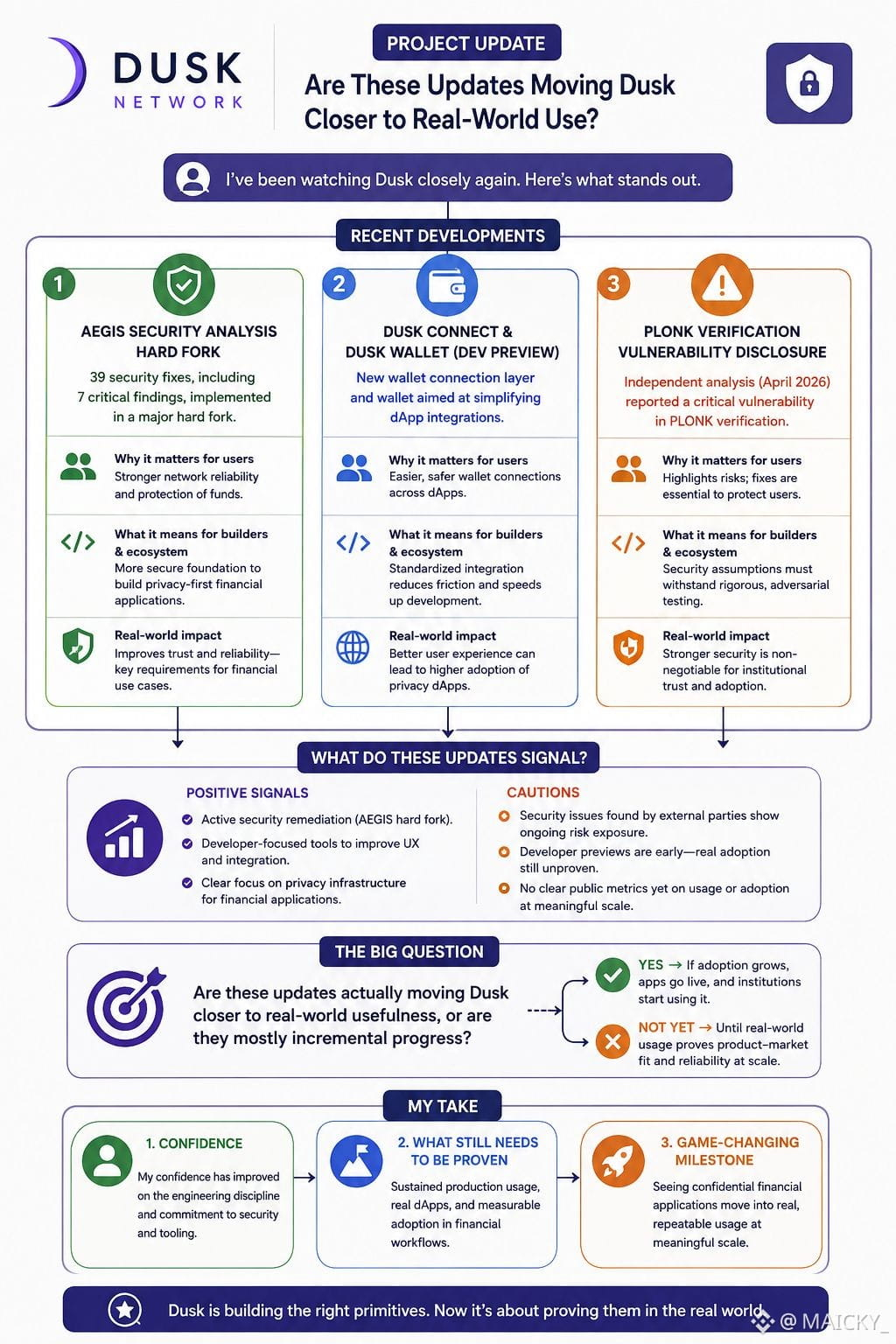
I’ve been watching @Dusk_Foundation closely again, and the latest progress makes the picture more interesting—but also more nuanced. The biggest step was AEGIS: 39 security fixes, including 7 critical findings, pushed into a major hard fork. That’s meaningful for reliability, but it also shows how much low-level risk still had to be removed from the live stack.
On the product side, Dusk Connect and the new Dusk Wallet are aimed at making dApps easier to use by giving developers a standard wallet-connection layer instead of forcing every app to build its own integration. That matters for builders, although both were introduced as developer previews, so real ecosystem adoption still needs to be demonstrated.
There’s also a more uncomfortable data point: an independent April analysis reported a critical PLONK verification vulnerability that could have enabled forged proofs. Dusk says the underlying fix landed in February, but the disclosure reinforces the same lesson as AEGIS: privacy infrastructure only becomes useful financial infrastructure when its security assumptions survive serious adversarial testing.
So my question remains: are these updates moving Dusk toward real-world usefulness, or are they mostly incremental progress? My confidence has improved on the engineering discipline, especially around remediation and tooling, but I’m still waiting for stronger proof of sustained production usage. The milestone that would materially change my view is seeing confidential financial applications move from technical readiness into repeatable, real-world usage at meaningful scale.
$GPS
{future}(GPSUSDT)
$TAG
{alpha}(560x208bf3e7da9639f1eaefa2de78c23396b0682025)
@Dusk #dusk $DUSK
I’ve been watching @Dusk closely again, and the latest progress makes the picture more interesting—but also more nuanced. The biggest step was AEGIS: 39 security fixes, including 7 critical findings, pushed into a major hard fork. That’s meaningful for reliability, but it also shows how much low-level risk still had to be removed from the live stack.
On the product side, Dusk Connect and the new Dusk Wallet are aimed at making dApps easier to use by giving developers a standard wallet-connection layer instead of forcing every app to build its own integration. That matters for builders, although both were introduced as developer previews, so real ecosystem adoption still needs to be demonstrated.
There’s also a more uncomfortable data point: an independent April analysis reported a critical PLONK verification vulnerability that could have enabled forged proofs. Dusk says the underlying fix landed in February, but the disclosure reinforces the same lesson as AEGIS: privacy infrastructure only becomes useful financial infrastructure when its security assumptions survive serious adversarial testing.
So my question remains: are these updates moving Dusk toward real-world usefulness, or are they mostly incremental progress? My confidence has improved on the engineering discipline, especially around remediation and tooling, but I’m still waiting for stronger proof of sustained production usage. The milestone that would materially change my view is seeing confidential financial applications move from technical readiness into repeatable, real-world usage at meaningful scale.
$GPS
$TAG
I’ve been watching @Dusk closely again, and the latest progress makes the picture more interesting—but also more nuanced. The biggest step was AEGIS: 39 security fixes, including 7 critical findings, pushed into a major hard fork. That’s meaningful for reliability, but it also shows how much low-level risk still had to be removed from the live stack.
On the product side, Dusk Connect and the new Dusk Wallet are aimed at making dApps easier to use by giving developers a standard wallet-connection layer instead of forcing every app to build its own integration. That matters for builders, although both were introduced as developer previews, so real ecosystem adoption still needs to be demonstrated.
There’s also a more uncomfortable data point: an independent April analysis reported a critical PLONK verification vulnerability that could have enabled forged proofs. Dusk says the underlying fix landed in February, but the disclosure reinforces the same lesson as AEGIS: privacy infrastructure only becomes useful financial infrastructure when its security assumptions survive serious adversarial testing.
So my question remains: are these updates moving Dusk toward real-world usefulness, or are they mostly incremental progress? My confidence has improved on the engineering discipline, especially around remediation and tooling, but I’m still waiting for stronger proof of sustained production usage. The milestone that would materially change my view is seeing confidential financial applications move from technical readiness into repeatable, real-world usage at meaningful scale.
$GPS
$TAG
5
2
418
Log in to explore more content
Join global crypto users on Binance Square
⚡️ Get latest and useful information about crypto.
💬 Trusted by the world’s largest crypto exchange.
👍 Discover real insights from verified creators.
Email / Phone number
Trending Topics
BitgetHackerMoves$83MStolenXRP
3,101 views
43 Discussing
On September 24, 2026, Bitget suffered a major security breach, with around $387M–$390M in assets reportedly stolen.
A big part of the stolen funds was $XRP .
Around 103M $XRP, worth roughly $157M–$160M at the time, was moved into five wallets controlled by the attacker.
By September 26, about 54M XRP ($83M) had already been moved out of three of those wallets.
Two wallets that each held around 20M XRP were almost completely emptied, while another was reduced to about 5.8M XRP.
That left roughly 49M XRP, worth around $75M at the time, still sitting in the original wallets.
The transfers also picked up overnight, with the funds being split across new wallets. Some reports say part of the XRP was later moved through THORChain toward Bitcoin.
Definitely a situation I’m keeping an eye on as the funds continue to move.
#BitgetHackerMoves$83MStolenXRP
jujucrypt
·5 Likes
·5.7k views
SOLSpotETFWeeklyInflow$188M
1,696 views
44 Discussing
StrategyStriveAdd2305BitcoinThisWeek
40,495 views
1,050 Discussing