
Sofia Ellen
843 Posts

Sofia Ellen
Report
Block User
Crypto analyst & trader | Market insights & strategies | Sharing updates to empower smarter investing | More on X: @Dollar_Print
Occasional Trader
1.2 Years
218 Following
9.5K+ Followers
3.5K+ Liked
Posts
All
Quotes
Videos
Live
·
--
Bearish
Crypto Market Downturn: Key Losers and Sentiment Shift
The cryptocurrency market has experienced notable declines in several altcoins over the past 24 hours. Among the top losers are STFX, which saw a significant 35.34% decrease, Elastos (ELA) with a 24.57% drop, and Throne (THN) declining by 22.41%. Other assets experiencing substantial losses include BinaryX (BNX) down 21.46%, Four (FORM) with a 20.87% loss, and Somnia (SOMI) falling 18.01%.
The broader market sentiment, as reflected by the Crypto Fear & Greed Index, currently registers at 44/100, indicating a state of "Fear" among investors. This cautious sentiment contributes to price volatility. General factors influencing these price drops include shifts in market sentiment, instances where supply outstrips demand, and large sell-offs by significant holders. Regulatory developments and broader macroeconomic conditions can also exert downward pressure on prices. The total cryptocurrency market capitalization has seen a slight decrease of 1.0% in the last 24 hours.
#VIXSurges12%
Crypto Market Downturn: Key Losers and Sentiment Shift
The cryptocurrency market has experienced notable declines in several altcoins over the past 24 hours. Among the top losers are STFX, which saw a significant 35.34% decrease, Elastos (ELA) with a 24.57% drop, and Throne (THN) declining by 22.41%. Other assets experiencing substantial losses include BinaryX (BNX) down 21.46%, Four (FORM) with a 20.87% loss, and Somnia (SOMI) falling 18.01%.
The broader market sentiment, as reflected by the Crypto Fear & Greed Index, currently registers at 44/100, indicating a state of "Fear" among investors. This cautious sentiment contributes to price volatility. General factors influencing these price drops include shifts in market sentiment, instances where supply outstrips demand, and large sell-offs by significant holders. Regulatory developments and broader macroeconomic conditions can also exert downward pressure on prices. The total cryptocurrency market capitalization has seen a slight decrease of 1.0% in the last 24 hours.
#VIXSurges12%
The cryptocurrency market has experienced notable declines in several altcoins over the past 24 hours. Among the top losers are STFX, which saw a significant 35.34% decrease, Elastos (ELA) with a 24.57% drop, and Throne (THN) declining by 22.41%. Other assets experiencing substantial losses include BinaryX (BNX) down 21.46%, Four (FORM) with a 20.87% loss, and Somnia (SOMI) falling 18.01%.
The broader market sentiment, as reflected by the Crypto Fear & Greed Index, currently registers at 44/100, indicating a state of "Fear" among investors. This cautious sentiment contributes to price volatility. General factors influencing these price drops include shifts in market sentiment, instances where supply outstrips demand, and large sell-offs by significant holders. Regulatory developments and broader macroeconomic conditions can also exert downward pressure on prices. The total cryptocurrency market capitalization has seen a slight decrease of 1.0% in the last 24 hours.
#VIXSurges12%
5
648
·
--
The market rewards patience more than panic. 📈
Stay consistent, keep learning, and let your strategy do the talking. 🚀
$METAB $NVDAB
The market rewards patience more than panic. 📈
Stay consistent, keep learning, and let your strategy do the talking. 🚀
$METAB $NVDAB
Stay consistent, keep learning, and let your strategy do the talking. 🚀
$METAB $NVDAB
3
134
·
--
$OPN Alert 🚀
OPN is showing strength above key support with buyers stepping in. A breakout could fuel the next leg higher.
🎯 Targets: 0.135 → 0.150 → 0.175
🛑 Risk Management: Keep a tight stop below support.
⚡ Momentum is building watch OPN closely.
#OPN
$OPN Alert 🚀
OPN is showing strength above key support with buyers stepping in. A breakout could fuel the next leg higher.
🎯 Targets: 0.135 → 0.150 → 0.175
🛑 Risk Management: Keep a tight stop below support.
⚡ Momentum is building watch OPN closely.
#OPN
OPN is showing strength above key support with buyers stepping in. A breakout could fuel the next leg higher.
🎯 Targets: 0.135 → 0.150 → 0.175
🛑 Risk Management: Keep a tight stop below support.
⚡ Momentum is building watch OPN closely.
#OPN
4
425

·
--
🎙️ In the vast sea of crypto, who’s the shore? There’s enlightenment in the depths of the candlesticks.
End
04 h 29 m 57 s
17.1k
27
35
·
--
$LABUSDT Trade Setup
Direction: LONG
Entry Zone:
0.205 – 0.215
Targets:
TP1: 0.235
TP2: 0.255
TP3: 0.285
Stop Loss:
0.189
Leverage: 5x–10x (safe range)
Quick Note:
If price loses 0.19 support, bullish setup invalidated and market could revisit 0.17 liquidity zone.
$LABUSDT Trade Setup
Direction: LONG
Entry Zone:
0.205 – 0.215
Targets:
TP1: 0.235
TP2: 0.255
TP3: 0.285
Stop Loss:
0.189
Leverage: 5x–10x (safe range)
Quick Note:
If price loses 0.19 support, bullish setup invalidated and market could revisit 0.17 liquidity zone.
Direction: LONG
Entry Zone:
0.205 – 0.215
Targets:
TP1: 0.235
TP2: 0.255
TP3: 0.285
Stop Loss:
0.189
Leverage: 5x–10x (safe range)
Quick Note:
If price loses 0.19 support, bullish setup invalidated and market could revisit 0.17 liquidity zone.
104
·
--
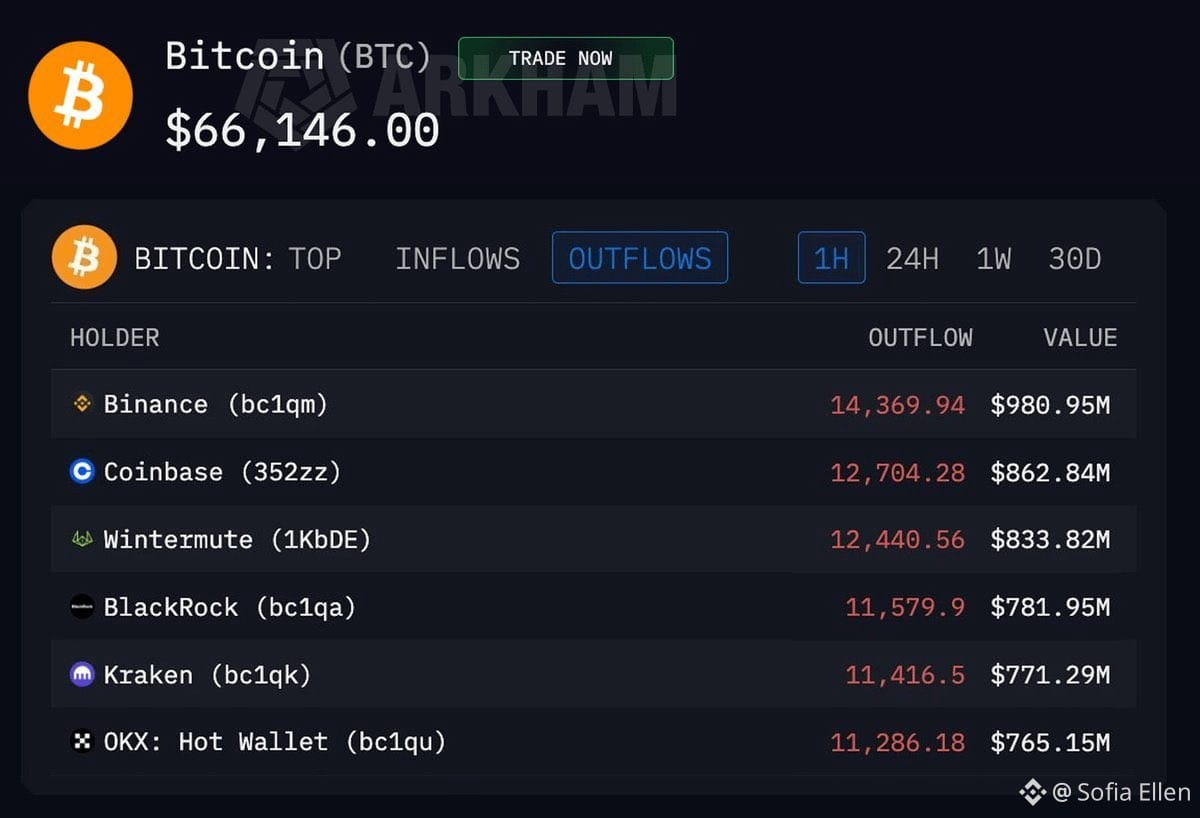
🚨 Market Alert: Something Big Is Unfolding…
Smart money is making aggressive moves just before the U.S. session kicks in — and it’s not subtle.
In a matter of minutes, massive Bitcoin flows flooded the market:
• Binance trimmed over 14K BTC
• Coinbase saw 12K+ BTC offloaded
• Wintermute shifted heavy inventory
• Even institutional giants are lightening positions
This isn’t random selling it’s strategic repositioning.
Over $3.7B worth of BTC moved in under 30 minutes. That kind of volume doesn’t whisper… it signals.
⚠️ When liquidity shifts this fast, volatility follows even faster.
Expect sharp swings, fakeouts, and aggressive price action.
Stay alert the next move won’t be slow.
$BTC
{spot}(BTCUSDT)
🚨 Market Alert: Something Big Is Unfolding…
Smart money is making aggressive moves just before the U.S. session kicks in — and it’s not subtle.
In a matter of minutes, massive Bitcoin flows flooded the market:
• Binance trimmed over 14K BTC
• Coinbase saw 12K+ BTC offloaded
• Wintermute shifted heavy inventory
• Even institutional giants are lightening positions
This isn’t random selling it’s strategic repositioning.
Over $3.7B worth of BTC moved in under 30 minutes. That kind of volume doesn’t whisper… it signals.
⚠️ When liquidity shifts this fast, volatility follows even faster.
Expect sharp swings, fakeouts, and aggressive price action.
Stay alert the next move won’t be slow.
$BTC
Smart money is making aggressive moves just before the U.S. session kicks in — and it’s not subtle.
In a matter of minutes, massive Bitcoin flows flooded the market:
• Binance trimmed over 14K BTC
• Coinbase saw 12K+ BTC offloaded
• Wintermute shifted heavy inventory
• Even institutional giants are lightening positions
This isn’t random selling it’s strategic repositioning.
Over $3.7B worth of BTC moved in under 30 minutes. That kind of volume doesn’t whisper… it signals.
⚠️ When liquidity shifts this fast, volatility follows even faster.
Expect sharp swings, fakeouts, and aggressive price action.
Stay alert the next move won’t be slow.
$BTC
4
12
430
·
--
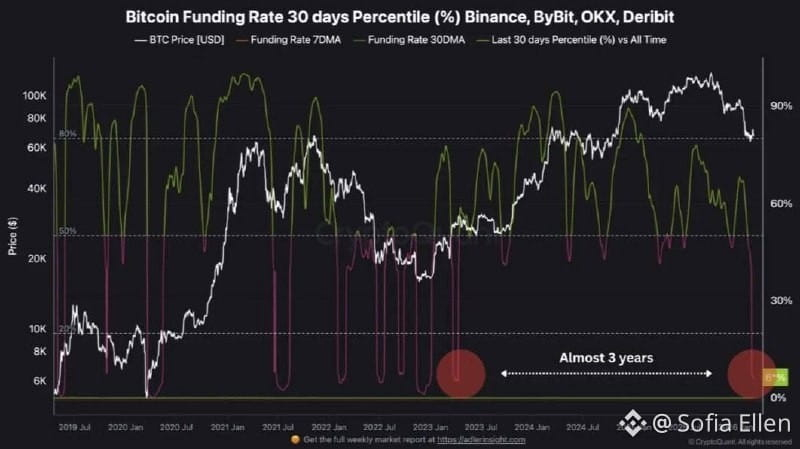
The Bitcoin funding rate has dropped to its lowest level since early 2023.
This suggests that very few traders are opening long positions, showing a strong wave of caution across the market.
Interestingly, history tells a different story. When funding rates fall to such extreme lows, it often means sentiment is overly bearish a condition that has previously appeared near market bottoms.
In simple terms: when most traders stop betting on upside, the market sometimes prepares for a reversal. 📉➡️📈
#BTC🔥🔥🔥🔥🔥
The Bitcoin funding rate has dropped to its lowest level since early 2023.
This suggests that very few traders are opening long positions, showing a strong wave of caution across the market.
Interestingly, history tells a different story. When funding rates fall to such extreme lows, it often means sentiment is overly bearish a condition that has previously appeared near market bottoms.
In simple terms: when most traders stop betting on upside, the market sometimes prepares for a reversal. 📉➡️📈
#BTC🔥🔥🔥🔥🔥
This suggests that very few traders are opening long positions, showing a strong wave of caution across the market.
Interestingly, history tells a different story. When funding rates fall to such extreme lows, it often means sentiment is overly bearish a condition that has previously appeared near market bottoms.
In simple terms: when most traders stop betting on upside, the market sometimes prepares for a reversal. 📉➡️📈
#BTC🔥🔥🔥🔥🔥
8
6
117
·
--
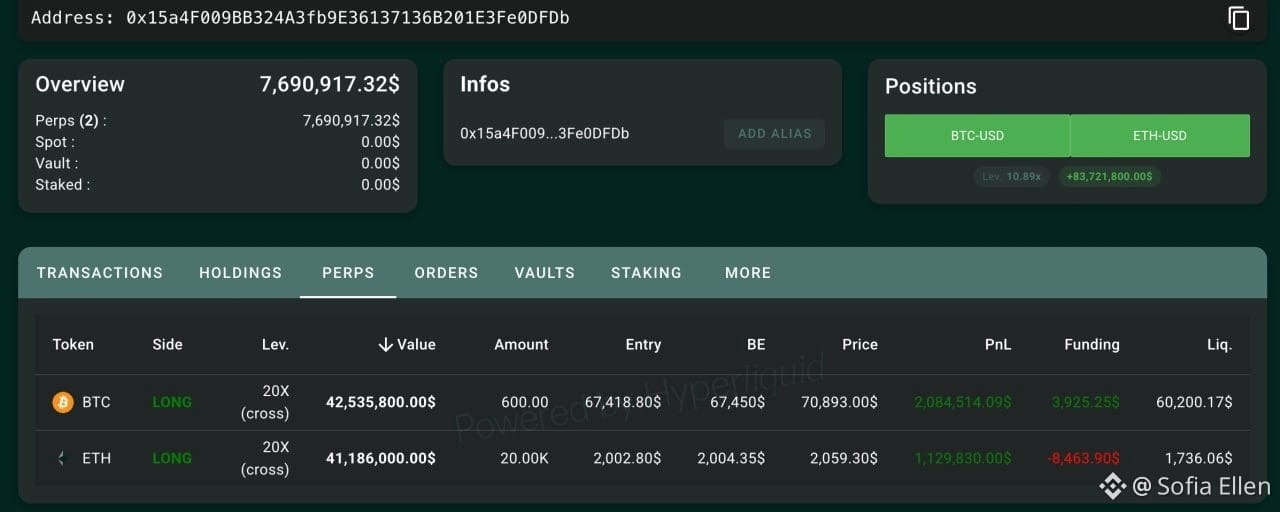
A massive whale move just hit the market. 🐋
Wallet 0x15a4 has opened 20x leveraged long positions on 600 $BTC (worth about $42.5M) and 20,000 $ETH (around $41.2M) on #Hyperliquid.
But that’s not all.
Roughly one hour ago, the same whale deployed $21M $USDC to accumulate 10,158 $ETH at an average price of $2,067.
Big leverage, big conviction. When whales place bets of this size, the market usually pays attention. 👀
A massive whale move just hit the market. 🐋
Wallet 0x15a4 has opened 20x leveraged long positions on 600 $BTC (worth about $42.5M) and 20,000 $ETH (around $41.2M) on #Hyperliquid.
But that’s not all.
Roughly one hour ago, the same whale deployed $21M $USDC to accumulate 10,158 $ETH at an average price of $2,067.
Big leverage, big conviction. When whales place bets of this size, the market usually pays attention. 👀
Wallet 0x15a4 has opened 20x leveraged long positions on 600 $BTC (worth about $42.5M) and 20,000 $ETH (around $41.2M) on #Hyperliquid.
But that’s not all.
Roughly one hour ago, the same whale deployed $21M $USDC to accumulate 10,158 $ETH at an average price of $2,067.
Big leverage, big conviction. When whales place bets of this size, the market usually pays attention. 👀
5
117
·
--
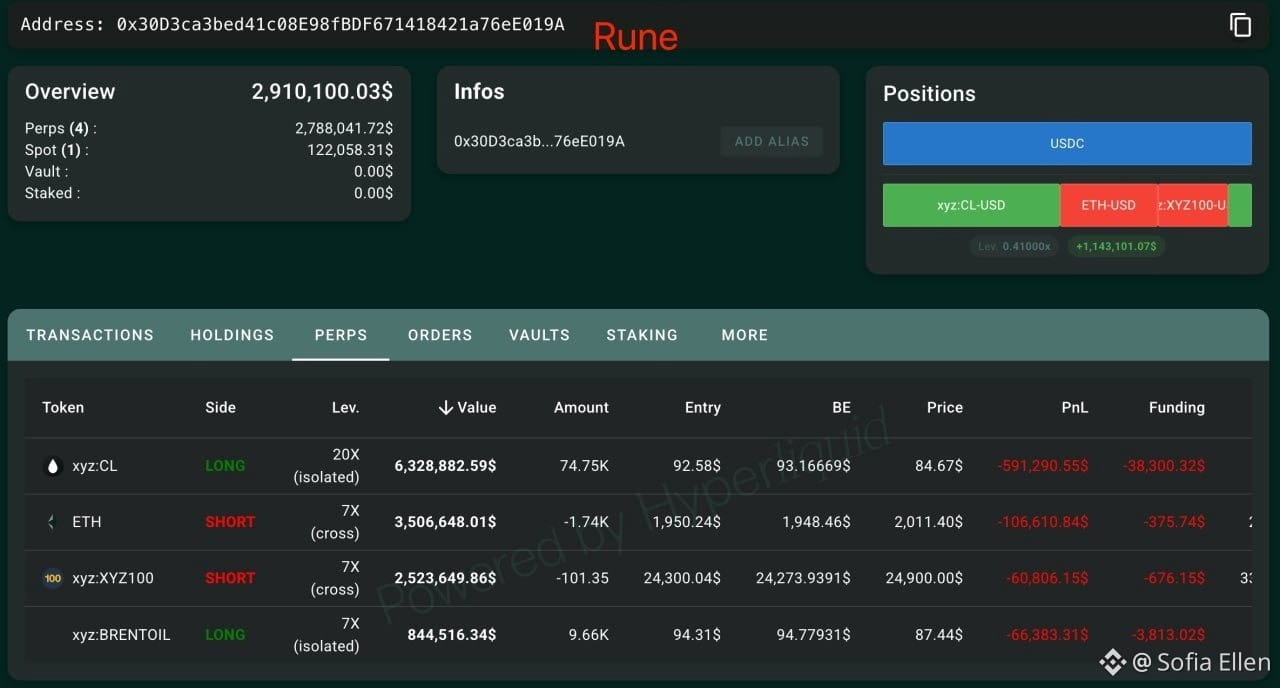
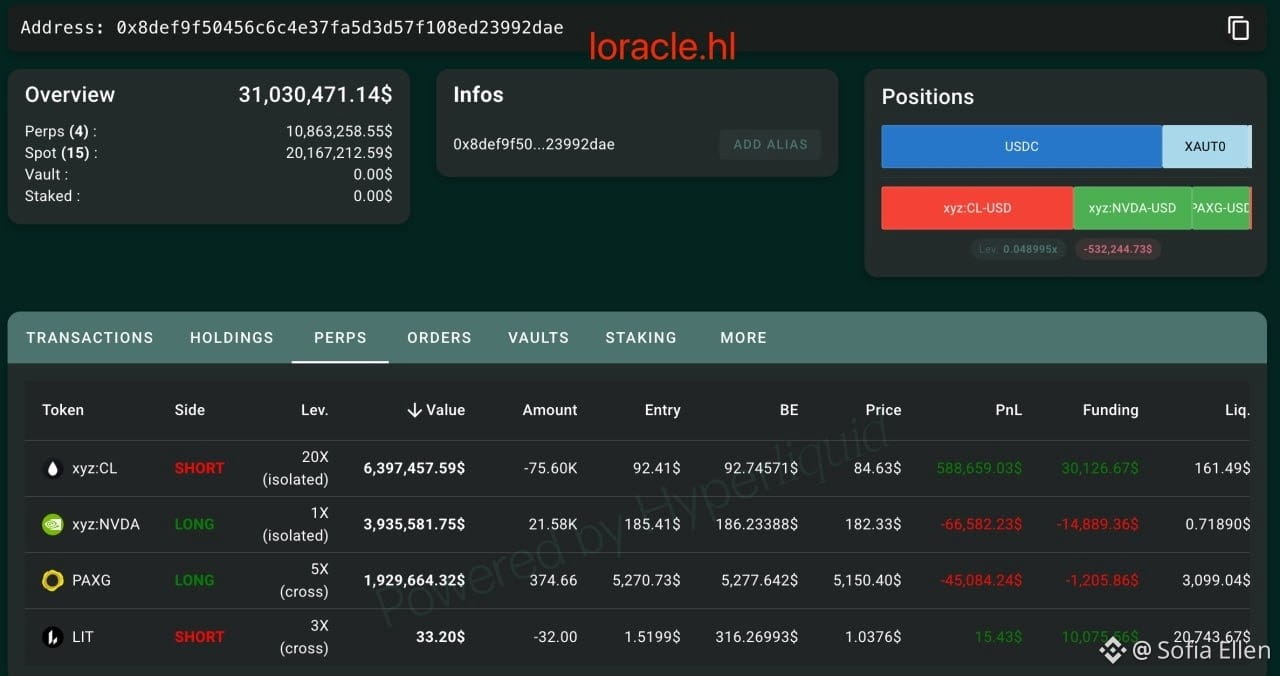
Just 24 hours can change everything in the market.
Trader Loracles.hl(), who opened a short position on #Oil, has successfully reversed a losing trade and is now sitting on a $588K profit.
On the other side, Rune(), holding a long position on #Oil, saw the opposite outcome — a profitable trade has now flipped into a $591K loss.
Markets move fast. One day you're ahead, the next day the tide turns.
Just 24 hours can change everything in the market.
Trader Loracles.hl(), who opened a short position on #Oil, has successfully reversed a losing trade and is now sitting on a $588K profit.
On the other side, Rune(), holding a long position on #Oil, saw the opposite outcome — a profitable trade has now flipped into a $591K loss.
Markets move fast. One day you're ahead, the next day the tide turns.
Trader Loracles.hl(), who opened a short position on #Oil, has successfully reversed a losing trade and is now sitting on a $588K profit.
On the other side, Rune(), holding a long position on #Oil, saw the opposite outcome — a profitable trade has now flipped into a $591K loss.
Markets move fast. One day you're ahead, the next day the tide turns.
14
12
102
·
--
🎙️ Profit in a bull market, accumulate chips in a bear market #BTC
End
05 h 59 m 44 s
5.4k
33
28
·
--

Article
Why Bitcoin Fell Toward $45,000: The Silent Rotation No One Is Talking AboutThe recent slide in Bitcoin’s price toward the $45,000 zone has triggered the usual wave of emotional reactions: panic from late buyers, celebration from short-sellers, and confusion from long-term holders. But the real driver behind this move isn’t a single piece of bad news or a sudden loss of belief in Bitcoin. What’s happening is more subtle and more structural.
Over the past few weeks, the market has been experiencing a silent rotation of capital. In simple terms, money is moving, but not leaving the crypto ecosystem entirely. Large players often rebalance exposure when Bitcoin reaches zones where risk-reward becomes asymmetric. After strong upside runs, Bitcoin becomes crowded. When too many traders are positioned on one side, the market naturally seeks to rebalance by pushing price lower to reset leverage and sentiment.
One underappreciated factor behind the drop is derivatives-driven pressure. Open interest in perpetual futures had climbed rapidly while funding rates remained elevated. This signals that a large portion of market participants were positioned long with borrowed money. In such environments, price doesn’t need a big bearish catalyst to fall. A modest sell-off can trigger liquidations, which then cascade into further forced selling. This creates a mechanical drop, not an emotional one. The move toward $45,000 fits the profile of a liquidity-driven unwind, not a fundamental breakdown.
Another layer to this move is macro capital rotation. As traditional markets adjust to changing expectations around interest rates and risk assets, some capital temporarily flows out of high-beta instruments like Bitcoin into lower-volatility vehicles. This doesn’t mean investors are abandoning Bitcoin as a long-term asset. It reflects short-term portfolio rebalancing. When risk appetite tightens, the most liquid assets are often the first to be trimmed because they are easiest to sell without slippage. Bitcoin, ironically, becomes a victim of its own liquidity.
There’s also a psychological component tied to round numbers and narrative fatigue. The $45,000 area is not just a technical zone; it’s a psychological checkpoint. When price fails to hold above widely discussed levels, the market narrative shifts from “buy the dip” to “wait for clarity.” This pause in conviction reduces spot buying pressure. Meanwhile, short-term traders step in to exploit momentum, pushing price further down in the short run even if the broader trend remains intact.
Importantly, this drawdown doesn’t signal structural weakness in Bitcoin’s network or adoption. On-chain activity, long-term holder behavior, and miner fundamentals remain relatively stable. What changed is short-term positioning, not long-term belief. Markets move in cycles of expansion and contraction. The contraction phase feels uncomfortable, but it is often the necessary reset that clears excess leverage and reopens room for healthier price discovery.
In practical terms, the move toward $45,000 represents a market detox. It flushes out overconfident leverage, cools down overheated sentiment, and tests where genuine demand actually sits. Historically, Bitcoin has spent significant time building bases after such resets. These phases don’t reward impatience, but they do reward disciplined positioning.
Bitcoin didn’t fall because its story failed. It fell because markets, by design, don’t move in straight lines. The drop to $45,000 is less about fear and more about the system recalibrating itself before the next meaningful move.
#BTC
Why Bitcoin Fell Toward $45,000: The Silent Rotation No One Is Talking About
The recent slide in Bitcoin’s price toward the $45,000 zone has triggered the usual wave of emotional reactions: panic from late buyers, celebration from short-sellers, and confusion from long-term holders. But the real driver behind this move isn’t a single piece of bad news or a sudden loss of belief in Bitcoin. What’s happening is more subtle and more structural.
Over the past few weeks, the market has been experiencing a silent rotation of capital. In simple terms, money is moving, but not leaving the crypto ecosystem entirely. Large players often rebalance exposure when Bitcoin reaches zones where risk-reward becomes asymmetric. After strong upside runs, Bitcoin becomes crowded. When too many traders are positioned on one side, the market naturally seeks to rebalance by pushing price lower to reset leverage and sentiment.
One underappreciated factor behind the drop is derivatives-driven pressure. Open interest in perpetual futures had climbed rapidly while funding rates remained elevated. This signals that a large portion of market participants were positioned long with borrowed money. In such environments, price doesn’t need a big bearish catalyst to fall. A modest sell-off can trigger liquidations, which then cascade into further forced selling. This creates a mechanical drop, not an emotional one. The move toward $45,000 fits the profile of a liquidity-driven unwind, not a fundamental breakdown.
Another layer to this move is macro capital rotation. As traditional markets adjust to changing expectations around interest rates and risk assets, some capital temporarily flows out of high-beta instruments like Bitcoin into lower-volatility vehicles. This doesn’t mean investors are abandoning Bitcoin as a long-term asset. It reflects short-term portfolio rebalancing. When risk appetite tightens, the most liquid assets are often the first to be trimmed because they are easiest to sell without slippage. Bitcoin, ironically, becomes a victim of its own liquidity.
There’s also a psychological component tied to round numbers and narrative fatigue. The $45,000 area is not just a technical zone; it’s a psychological checkpoint. When price fails to hold above widely discussed levels, the market narrative shifts from “buy the dip” to “wait for clarity.” This pause in conviction reduces spot buying pressure. Meanwhile, short-term traders step in to exploit momentum, pushing price further down in the short run even if the broader trend remains intact.
Importantly, this drawdown doesn’t signal structural weakness in Bitcoin’s network or adoption. On-chain activity, long-term holder behavior, and miner fundamentals remain relatively stable. What changed is short-term positioning, not long-term belief. Markets move in cycles of expansion and contraction. The contraction phase feels uncomfortable, but it is often the necessary reset that clears excess leverage and reopens room for healthier price discovery.
In practical terms, the move toward $45,000 represents a market detox. It flushes out overconfident leverage, cools down overheated sentiment, and tests where genuine demand actually sits. Historically, Bitcoin has spent significant time building bases after such resets. These phases don’t reward impatience, but they do reward disciplined positioning.
Bitcoin didn’t fall because its story failed. It fell because markets, by design, don’t move in straight lines. The drop to $45,000 is less about fear and more about the system recalibrating itself before the next meaningful move.
#BTC
Over the past few weeks, the market has been experiencing a silent rotation of capital. In simple terms, money is moving, but not leaving the crypto ecosystem entirely. Large players often rebalance exposure when Bitcoin reaches zones where risk-reward becomes asymmetric. After strong upside runs, Bitcoin becomes crowded. When too many traders are positioned on one side, the market naturally seeks to rebalance by pushing price lower to reset leverage and sentiment.
One underappreciated factor behind the drop is derivatives-driven pressure. Open interest in perpetual futures had climbed rapidly while funding rates remained elevated. This signals that a large portion of market participants were positioned long with borrowed money. In such environments, price doesn’t need a big bearish catalyst to fall. A modest sell-off can trigger liquidations, which then cascade into further forced selling. This creates a mechanical drop, not an emotional one. The move toward $45,000 fits the profile of a liquidity-driven unwind, not a fundamental breakdown.
Another layer to this move is macro capital rotation. As traditional markets adjust to changing expectations around interest rates and risk assets, some capital temporarily flows out of high-beta instruments like Bitcoin into lower-volatility vehicles. This doesn’t mean investors are abandoning Bitcoin as a long-term asset. It reflects short-term portfolio rebalancing. When risk appetite tightens, the most liquid assets are often the first to be trimmed because they are easiest to sell without slippage. Bitcoin, ironically, becomes a victim of its own liquidity.
There’s also a psychological component tied to round numbers and narrative fatigue. The $45,000 area is not just a technical zone; it’s a psychological checkpoint. When price fails to hold above widely discussed levels, the market narrative shifts from “buy the dip” to “wait for clarity.” This pause in conviction reduces spot buying pressure. Meanwhile, short-term traders step in to exploit momentum, pushing price further down in the short run even if the broader trend remains intact.
Importantly, this drawdown doesn’t signal structural weakness in Bitcoin’s network or adoption. On-chain activity, long-term holder behavior, and miner fundamentals remain relatively stable. What changed is short-term positioning, not long-term belief. Markets move in cycles of expansion and contraction. The contraction phase feels uncomfortable, but it is often the necessary reset that clears excess leverage and reopens room for healthier price discovery.
In practical terms, the move toward $45,000 represents a market detox. It flushes out overconfident leverage, cools down overheated sentiment, and tests where genuine demand actually sits. Historically, Bitcoin has spent significant time building bases after such resets. These phases don’t reward impatience, but they do reward disciplined positioning.
Bitcoin didn’t fall because its story failed. It fell because markets, by design, don’t move in straight lines. The drop to $45,000 is less about fear and more about the system recalibrating itself before the next meaningful move.
#BTC
5
84
·
--
#vanar $VANRY Exploring the Future of Web3 on Vanar Chain 🚀
The @vanar ecosystem represents a paradigm shift in how blockchain and AI intersect. Vanar Chain has been architected as an AI-native Layer-1 platform that doesn’t just execute transactions — it enables intelligent data reasoning directly on-chain. With innovative tools like Neutron for semantic data compression and Kayon, its decentralized AI engine, developers can build DApps that process rich on-chain data without relying on external oracles or cloud storage. This intrinsic intelligence positions Vanar as a foundational layer for next-gen Web3 applications that require real-time context and efficiency.
#vanar $VANRY Exploring the Future of Web3 on Vanar Chain 🚀
The @vanar ecosystem represents a paradigm shift in how blockchain and AI intersect. Vanar Chain has been architected as an AI-native Layer-1 platform that doesn’t just execute transactions — it enables intelligent data reasoning directly on-chain. With innovative tools like Neutron for semantic data compression and Kayon, its decentralized AI engine, developers can build DApps that process rich on-chain data without relying on external oracles or cloud storage. This intrinsic intelligence positions Vanar as a foundational layer for next-gen Web3 applications that require real-time context and efficiency.
The @vanar ecosystem represents a paradigm shift in how blockchain and AI intersect. Vanar Chain has been architected as an AI-native Layer-1 platform that doesn’t just execute transactions — it enables intelligent data reasoning directly on-chain. With innovative tools like Neutron for semantic data compression and Kayon, its decentralized AI engine, developers can build DApps that process rich on-chain data without relying on external oracles or cloud storage. This intrinsic intelligence positions Vanar as a foundational layer for next-gen Web3 applications that require real-time context and efficiency.
8
123
·
--
Why Vanar Chain Could Be the Next Big Infrastructure Play in Web3Most blockchains today are fast, but few are *smart*. That’s where @vanar stands out. Vanar Chain is being built as an AI-native Layer-1, designed to handle complex data, on-chain intelligence, and real-time interactions without pushing everything off-chain. This is a big deal for gaming, metaverse projects, and AI-driven DApps that need speed, low fees, and meaningful data processing on the blockchain itself.
The real value of $VANRY is not just in transactions, but in how it powers participation across the ecosystem — staking, governance, and network utility. As builders adopt Vanar Chain for scalable Web3 experiences, network activity naturally grows, creating organic demand around the token.
From a long-term perspective, Vanar’s focus on AI + blockchain infrastructure puts it in a unique narrative compared to typical L1s that only compete on TPS. If Vanar Chain continues onboarding real builders and real use cases, this could evolve into one of the more practical chains for next-gen Web3 applications.
#Vanar
Why Vanar Chain Could Be the Next Big Infrastructure Play in Web3
Most blockchains today are fast, but few are *smart*. That’s where @vanar stands out. Vanar Chain is being built as an AI-native Layer-1, designed to handle complex data, on-chain intelligence, and real-time interactions without pushing everything off-chain. This is a big deal for gaming, metaverse projects, and AI-driven DApps that need speed, low fees, and meaningful data processing on the blockchain itself.
The real value of $VANRY is not just in transactions, but in how it powers participation across the ecosystem — staking, governance, and network utility. As builders adopt Vanar Chain for scalable Web3 experiences, network activity naturally grows, creating organic demand around the token.
From a long-term perspective, Vanar’s focus on AI + blockchain infrastructure puts it in a unique narrative compared to typical L1s that only compete on TPS. If Vanar Chain continues onboarding real builders and real use cases, this could evolve into one of the more practical chains for next-gen Web3 applications.
#Vanar
The real value of $VANRY is not just in transactions, but in how it powers participation across the ecosystem — staking, governance, and network utility. As builders adopt Vanar Chain for scalable Web3 experiences, network activity naturally grows, creating organic demand around the token.
From a long-term perspective, Vanar’s focus on AI + blockchain infrastructure puts it in a unique narrative compared to typical L1s that only compete on TPS. If Vanar Chain continues onboarding real builders and real use cases, this could evolve into one of the more practical chains for next-gen Web3 applications.
#Vanar
5
123
·
--
Trade Setup (Context-Based, Not Hype):
Price is reacting around a well-defined value area. The mid-range VWAP/POC zone is acting as a magnet, while wicks on both sides show stop-hunting without follow-through. That tells us larger players are distributing risk, not chasing price.
Long Bias (Conditional):
A clean acceptance above the range high, followed by a shallow pullback with declining volume, opens a long toward the next liquidity pocket (previous equal highs / supply zone). Confirmation: RSI holding above the neutral band and spot CVD turning positive. Invalidation: fast rejection back into value with heavy sell volume.
Short Bias (Conditional):
Failure to hold above resistance and a return below value with expanding volume favors a fade back to the range low. Confirmation: bearish market structure shift on lower timeframes + volume expansion on breakdown. Invalidation: strong bid absorption and quick reclaim.
Risk:
Keep risk tight. This is a liquidity environment entries matter more than direction. Trade reactions, not predictions.
#BTC
Trade Setup (Context-Based, Not Hype):
Price is reacting around a well-defined value area. The mid-range VWAP/POC zone is acting as a magnet, while wicks on both sides show stop-hunting without follow-through. That tells us larger players are distributing risk, not chasing price.
Long Bias (Conditional):
A clean acceptance above the range high, followed by a shallow pullback with declining volume, opens a long toward the next liquidity pocket (previous equal highs / supply zone). Confirmation: RSI holding above the neutral band and spot CVD turning positive. Invalidation: fast rejection back into value with heavy sell volume.
Short Bias (Conditional):
Failure to hold above resistance and a return below value with expanding volume favors a fade back to the range low. Confirmation: bearish market structure shift on lower timeframes + volume expansion on breakdown. Invalidation: strong bid absorption and quick reclaim.
Risk:
Keep risk tight. This is a liquidity environment entries matter more than direction. Trade reactions, not predictions.
#BTC
Price is reacting around a well-defined value area. The mid-range VWAP/POC zone is acting as a magnet, while wicks on both sides show stop-hunting without follow-through. That tells us larger players are distributing risk, not chasing price.
Long Bias (Conditional):
A clean acceptance above the range high, followed by a shallow pullback with declining volume, opens a long toward the next liquidity pocket (previous equal highs / supply zone). Confirmation: RSI holding above the neutral band and spot CVD turning positive. Invalidation: fast rejection back into value with heavy sell volume.
Short Bias (Conditional):
Failure to hold above resistance and a return below value with expanding volume favors a fade back to the range low. Confirmation: bearish market structure shift on lower timeframes + volume expansion on breakdown. Invalidation: strong bid absorption and quick reclaim.
Risk:
Keep risk tight. This is a liquidity environment entries matter more than direction. Trade reactions, not predictions.
#BTC

5
116
·
--
🚀 NKN is among today’s gainers but here is what matters.
Price spikes fade fast without volume and structure. Watch if $NKN holds above intraday support after the first pullback. Strong continuation needs real bids, not just momentum traders. Chasers get trapped. Patience gets entries.
#AltcoinGainers
🚀 NKN is among today’s gainers but here is what matters.
Price spikes fade fast without volume and structure. Watch if $NKN holds above intraday support after the first pullback. Strong continuation needs real bids, not just momentum traders. Chasers get trapped. Patience gets entries.
#AltcoinGainers
Price spikes fade fast without volume and structure. Watch if $NKN holds above intraday support after the first pullback. Strong continuation needs real bids, not just momentum traders. Chasers get trapped. Patience gets entries.
#AltcoinGainers

7
117
Log in to explore more content
Join global crypto users on Binance Square
⚡️ Get latest and useful information about crypto.
💬 Trusted by the world’s largest crypto exchange.
👍 Discover real insights from verified creators.
Email / Phone number
Trending Topics
FedRateWatch
824,453 views
3,893 Discussing
Share & Win Traffic Reward in our Trending Hashtag Campaign
✨Topic: FOMC September, What's The Fed's Next Move?
👉How to Join:
Publish a short post or article with hashtag #FedRateWatch
Create content based on the below angles:
- August core CPI rose 0.3% month-over-month, and the odds of a 25bp hike this week are now close to 90%. Do you anticipate a rate hike this week? Is it a one-off, or the start of a longer hiking cycle?
- If the hike lands, how does it play out for BTC, tech stocks, and gold? Bullish or bearish?
- How are you planning to trade next? Share your BTC, stocks or gold trade/holdings with our trade sharing widget.
⏰Campaign Period:
- 2026-09-15 11:00 - 2026-09-17 3:00 UTC
🎁Reward:
- Qualified posts that comply with the above guidelines and contain more than 100 words will be reviewed and may receive a random traffic boost of 500 to 3,000 views. You will receive a notification from your feed secretary if your post is selected.
- Get a chance to have your article featured on Binance Square Official
Need ideas for your post? Visit the topic page #FedRateWatch or the Square Guide on How to Post for Better Reach.
Binance Square Official
·493 Likes
·1.1M views
BitcoinFalls4%
1,546 views
127 Discussing
SKHynixInTalksToMakeMemoryChipsInUS
0 views
3 Discussing