

crypto-66
169 Posts

crypto-66
Report
Block User
投资者 -独立交易者-二级市场-Alpha信息-DYOR
187 Following
86 Followers
96 Liked
Posts
All
Quotes
·
--
It blew up! Bitcoin breaks through $87,000, a new high in 8 months!
This BTC rally is too fierce! In a short period, it rapidly surged from a low level, topping at about $87,381 and directly setting a new high for nearly 8 months. 🔥
Even more exciting is that behind this round of gains there isn’t just a rebound in risk appetite—there are also inflows into spot BTC ETF funds, plus a “short squeeze” effect from large-scale short liquidations. In a short time, a large number of shorts were forced to exit, further amplifying the rise.
At the same time, US tech stocks are also strengthening, with the Nasdaq setting a new all-time high, and the linkage between BTC and global risk assets heating up again.
But the question is:
👉 Is $87,000 the starting point of a new round of the rally, or just a short-term sentiment peak?
👉 Will $90,000 become the next key psychological level?
👉 If capital continues flowing back into Crypto, will altcoins start to catch up and rebound too?
#比特币突破8.7万美元创八个月新高
It blew up! Bitcoin breaks through $87,000, a new high in 8 months!
This BTC rally is too fierce! In a short period, it rapidly surged from a low level, topping at about $87,381 and directly setting a new high for nearly 8 months. 🔥
Even more exciting is that behind this round of gains there isn’t just a rebound in risk appetite—there are also inflows into spot BTC ETF funds, plus a “short squeeze” effect from large-scale short liquidations. In a short time, a large number of shorts were forced to exit, further amplifying the rise.
At the same time, US tech stocks are also strengthening, with the Nasdaq setting a new all-time high, and the linkage between BTC and global risk assets heating up again.
But the question is:
👉 Is $87,000 the starting point of a new round of the rally, or just a short-term sentiment peak?
👉 Will $90,000 become the next key psychological level?
👉 If capital continues flowing back into Crypto, will altcoins start to catch up and rebound too?
#比特币突破8.7万美元创八个月新高
This BTC rally is too fierce! In a short period, it rapidly surged from a low level, topping at about $87,381 and directly setting a new high for nearly 8 months. 🔥
Even more exciting is that behind this round of gains there isn’t just a rebound in risk appetite—there are also inflows into spot BTC ETF funds, plus a “short squeeze” effect from large-scale short liquidations. In a short time, a large number of shorts were forced to exit, further amplifying the rise.
At the same time, US tech stocks are also strengthening, with the Nasdaq setting a new all-time high, and the linkage between BTC and global risk assets heating up again.
But the question is:
👉 Is $87,000 the starting point of a new round of the rally, or just a short-term sentiment peak?
👉 Will $90,000 become the next key psychological level?
👉 If capital continues flowing back into Crypto, will altcoins start to catch up and rebound too?
#比特币突破8.7万美元创八个月新高
2
500
·
--
Verified
🚨The US stock market is going crazy again! Nasdaq hits a new all-time high!
The Nasdaq Composite closed at around 27,200 points, setting a new record closing high for the second consecutive trading day!🔥
The core driver behind this rally is still AI: chip stocks are strong, and demand for AI continues to heat up. Tech giants are once again the main focus of capital chasing. AI-related stocks such as Micron have shown strong performance, and the technology sector has regained its place as the market’s main theme.
But what’s really worth paying attention to is—if the Nasdaq sets new highs, will Crypto follow?
If AI tech assets continue to attract global capital and risk appetite rises further, could high-volatility assets like BTC also see capital spillover?
Of course, a new all-time high doesn’t mean there’s no risk—overvaluation, interest rates, and geopolitical conditions remain variables the market still has to face.
#纳指创历史新高
🚨The US stock market is going crazy again! Nasdaq hits a new all-time high!
The Nasdaq Composite closed at around 27,200 points, setting a new record closing high for the second consecutive trading day!🔥
The core driver behind this rally is still AI: chip stocks are strong, and demand for AI continues to heat up. Tech giants are once again the main focus of capital chasing. AI-related stocks such as Micron have shown strong performance, and the technology sector has regained its place as the market’s main theme.
But what’s really worth paying attention to is—if the Nasdaq sets new highs, will Crypto follow?
If AI tech assets continue to attract global capital and risk appetite rises further, could high-volatility assets like BTC also see capital spillover?
Of course, a new all-time high doesn’t mean there’s no risk—overvaluation, interest rates, and geopolitical conditions remain variables the market still has to face.
#纳指创历史新高
The Nasdaq Composite closed at around 27,200 points, setting a new record closing high for the second consecutive trading day!🔥
The core driver behind this rally is still AI: chip stocks are strong, and demand for AI continues to heat up. Tech giants are once again the main focus of capital chasing. AI-related stocks such as Micron have shown strong performance, and the technology sector has regained its place as the market’s main theme.
But what’s really worth paying attention to is—if the Nasdaq sets new highs, will Crypto follow?
If AI tech assets continue to attract global capital and risk appetite rises further, could high-volatility assets like BTC also see capital spillover?
Of course, a new all-time high doesn’t mean there’s no risk—overvaluation, interest rates, and geopolitical conditions remain variables the market still has to face.
#纳指创历史新高

1
808
·
--
Verified
An era has truly reached a turning point!
At 96, “the Oracle of Omaha” Warren Buffett officially stepped down as Chairman of Berkshire Hathaway, becoming Honorary Chairman, and continuing to remain on the board; his son Howard Buffett succeeded him as Chairman, while Greg Abel continues to lead as CEO.
Taking over Berkshire in 1965, and now completing the final handoff—over 60 years—Buffett transformed a textile business into a trillion-dollar business empire.
But what is really worth the market’s attention is not just the words “Buffett retires.”
In the next chapter, can Berkshire still carry forward Buffett’s most core long-termism, value investing, and capital allocation?
Even more worth watching is: without Buffett personally at the helm, how will the market revalue Berkshire?
#巴菲特卸任伯克希尔董事长
An era has truly reached a turning point!
At 96, “the Oracle of Omaha” Warren Buffett officially stepped down as Chairman of Berkshire Hathaway, becoming Honorary Chairman, and continuing to remain on the board; his son Howard Buffett succeeded him as Chairman, while Greg Abel continues to lead as CEO.
Taking over Berkshire in 1965, and now completing the final handoff—over 60 years—Buffett transformed a textile business into a trillion-dollar business empire.
But what is really worth the market’s attention is not just the words “Buffett retires.”
In the next chapter, can Berkshire still carry forward Buffett’s most core long-termism, value investing, and capital allocation?
Even more worth watching is: without Buffett personally at the helm, how will the market revalue Berkshire?
#巴菲特卸任伯克希尔董事长
At 96, “the Oracle of Omaha” Warren Buffett officially stepped down as Chairman of Berkshire Hathaway, becoming Honorary Chairman, and continuing to remain on the board; his son Howard Buffett succeeded him as Chairman, while Greg Abel continues to lead as CEO.
Taking over Berkshire in 1965, and now completing the final handoff—over 60 years—Buffett transformed a textile business into a trillion-dollar business empire.
But what is really worth the market’s attention is not just the words “Buffett retires.”
In the next chapter, can Berkshire still carry forward Buffett’s most core long-termism, value investing, and capital allocation?
Even more worth watching is: without Buffett personally at the helm, how will the market revalue Berkshire?
#巴菲特卸任伯克希尔董事长

1
6
9k
·
--
Verified
Big news! The Bank of Japan suddenly “pulls out a big move”!
The BoJ will directly raise its policy interest rate to 1.25%, the highest level in 31 years! Japan’s years-long era of ultra-loose monetary policy is accelerating its shift.
Don’t underestimate the change of just 0.25%—what’s really worth paying attention to is the “liquidity logic” behind it 👇
In the past, global markets enjoyed low interest rates and low-cost funding in yen for a long time. Now Japan is starting to tighten, which could mean the global funding environment may change further.
More importantly: after the BoJ’s rate hike, the yen did not strengthen immediately—on the contrary, it weakened for a time. The market has begun to reassess the room for further rate hikes.
#日本央行加息至31年高位
Big news! The Bank of Japan suddenly “pulls out a big move”!
The BoJ will directly raise its policy interest rate to 1.25%, the highest level in 31 years! Japan’s years-long era of ultra-loose monetary policy is accelerating its shift.
Don’t underestimate the change of just 0.25%—what’s really worth paying attention to is the “liquidity logic” behind it 👇
In the past, global markets enjoyed low interest rates and low-cost funding in yen for a long time. Now Japan is starting to tighten, which could mean the global funding environment may change further.
More importantly: after the BoJ’s rate hike, the yen did not strengthen immediately—on the contrary, it weakened for a time. The market has begun to reassess the room for further rate hikes.
#日本央行加息至31年高位
The BoJ will directly raise its policy interest rate to 1.25%, the highest level in 31 years! Japan’s years-long era of ultra-loose monetary policy is accelerating its shift.
Don’t underestimate the change of just 0.25%—what’s really worth paying attention to is the “liquidity logic” behind it 👇
In the past, global markets enjoyed low interest rates and low-cost funding in yen for a long time. Now Japan is starting to tighten, which could mean the global funding environment may change further.
More importantly: after the BoJ’s rate hike, the yen did not strengthen immediately—on the contrary, it weakened for a time. The market has begun to reassess the room for further rate hikes.
#日本央行加息至31年高位

3.3k
·
--
Bitcoin suddenly plunges! $76,000 in urgent trouble!
BTC briefly fell below $76,000, with the intraday low around $74,900,000. Short-term volatility has clearly increased.
Is this drop really just a “technical pullback”?
On one side, the U.S. Senate failed to advance the CLARITY Act, cooling market expectations for further clarity in crypto regulation; on the other side, U.S. Treasury yields have risen to high levels, and the market is simultaneously betting on changes in Federal Reserve policy, putting overall pressure on risk assets.
What’s even more worth noting is that after BTC broke below a key level, market sentiment is cooling rapidly.
Next, focus on two key levels 👇
🔴 Around $75,000: short-term bulls vs bears battle
🟢 Around $77,000: whether it can reclaim and stand back above
👇#比特币跌至7.6万美元
Bitcoin suddenly plunges! $76,000 in urgent trouble!
BTC briefly fell below $76,000, with the intraday low around $74,900,000. Short-term volatility has clearly increased.
Is this drop really just a “technical pullback”?
On one side, the U.S. Senate failed to advance the CLARITY Act, cooling market expectations for further clarity in crypto regulation; on the other side, U.S. Treasury yields have risen to high levels, and the market is simultaneously betting on changes in Federal Reserve policy, putting overall pressure on risk assets.
What’s even more worth noting is that after BTC broke below a key level, market sentiment is cooling rapidly.
Next, focus on two key levels 👇
🔴 Around $75,000: short-term bulls vs bears battle
🟢 Around $77,000: whether it can reclaim and stand back above
👇#比特币跌至7.6万美元
BTC briefly fell below $76,000, with the intraday low around $74,900,000. Short-term volatility has clearly increased.
Is this drop really just a “technical pullback”?
On one side, the U.S. Senate failed to advance the CLARITY Act, cooling market expectations for further clarity in crypto regulation; on the other side, U.S. Treasury yields have risen to high levels, and the market is simultaneously betting on changes in Federal Reserve policy, putting overall pressure on risk assets.
What’s even more worth noting is that after BTC broke below a key level, market sentiment is cooling rapidly.
Next, focus on two key levels 👇
🔴 Around $75,000: short-term bulls vs bears battle
🟢 Around $77,000: whether it can reclaim and stand back above
👇#比特币跌至7.6万美元
65
·
--
Breaking! The U.S. Senate hits the pause button on the crypto market’s “CLARITY”!
Local time September 15, the U.S. Senate failed to advance the “CLARITY Act.” A procedural vote ultimately ended with 49 in favor and 50 against, leaving a clear gap from the threshold required to move it forward.
What does this mean?👇
The bill was originally seen by the market as an important step toward establishing a U.S. digital-asset regulatory framework. It involves core issues such as the regulatory boundary between the SEC and the CFTC, as well as rules for crypto-asset markets.
After the news broke, Bitcoin briefly fell below $76,000, and expectations of “further clarity in U.S. crypto regulation” visibly cooled.
But don’t rush to interpret this as “the U.S. doesn’t want Crypto.”
What’s truly worth paying attention to is: the timeline for regulatory clarity has been disrupted.
#美参议院否决clarity法案
Breaking! The U.S. Senate hits the pause button on the crypto market’s “CLARITY”!
Local time September 15, the U.S. Senate failed to advance the “CLARITY Act.” A procedural vote ultimately ended with 49 in favor and 50 against, leaving a clear gap from the threshold required to move it forward.
What does this mean?👇
The bill was originally seen by the market as an important step toward establishing a U.S. digital-asset regulatory framework. It involves core issues such as the regulatory boundary between the SEC and the CFTC, as well as rules for crypto-asset markets.
After the news broke, Bitcoin briefly fell below $76,000, and expectations of “further clarity in U.S. crypto regulation” visibly cooled.
But don’t rush to interpret this as “the U.S. doesn’t want Crypto.”
What’s truly worth paying attention to is: the timeline for regulatory clarity has been disrupted.
#美参议院否决clarity法案
Local time September 15, the U.S. Senate failed to advance the “CLARITY Act.” A procedural vote ultimately ended with 49 in favor and 50 against, leaving a clear gap from the threshold required to move it forward.
What does this mean?👇
The bill was originally seen by the market as an important step toward establishing a U.S. digital-asset regulatory framework. It involves core issues such as the regulatory boundary between the SEC and the CFTC, as well as rules for crypto-asset markets.
After the news broke, Bitcoin briefly fell below $76,000, and expectations of “further clarity in U.S. crypto regulation” visibly cooled.
But don’t rush to interpret this as “the U.S. doesn’t want Crypto.”
What’s truly worth paying attention to is: the timeline for regulatory clarity has been disrupted.
#美参议院否决clarity法案
154
·
--
Can AI stop running wild? Anthropic CEO suddenly calls a halt!
Who would have thought that one of the leading players in the cutting-edge AI industry would start openly urging: “Slow down the pace of AI development!”
Anthropic CEO Dario Amodei warns that AI capabilities are accelerating, and a trend of “self-improvement” may even emerge. If the unrestrained sprint continues, safety measures may never keep up with technological progress.
Even more striking is that he worries that in the next 6–12 months, AI agent clusters may have stronger abilities for network attacks and autonomous actions.
This isn’t opposition to AI—it’s a dangerous signal:
When everyone building AI starts worrying that it’s running too fast, have we already entered another phase?
What’s even more worth关注 is that OpenAI CEO Sam Altman, as well as people like Elon Musk, have also voiced concerns about AI safety risks.
#Aİ #Anthropic #BTC #anthropicceo呼吁放缓ai发展
Can AI stop running wild? Anthropic CEO suddenly calls a halt!
Who would have thought that one of the leading players in the cutting-edge AI industry would start openly urging: “Slow down the pace of AI development!”
Anthropic CEO Dario Amodei warns that AI capabilities are accelerating, and a trend of “self-improvement” may even emerge. If the unrestrained sprint continues, safety measures may never keep up with technological progress.
Even more striking is that he worries that in the next 6–12 months, AI agent clusters may have stronger abilities for network attacks and autonomous actions.
This isn’t opposition to AI—it’s a dangerous signal:
When everyone building AI starts worrying that it’s running too fast, have we already entered another phase?
What’s even more worth关注 is that OpenAI CEO Sam Altman, as well as people like Elon Musk, have also voiced concerns about AI safety risks.
#Aİ #Anthropic #BTC #anthropicceo呼吁放缓ai发展
Who would have thought that one of the leading players in the cutting-edge AI industry would start openly urging: “Slow down the pace of AI development!”
Anthropic CEO Dario Amodei warns that AI capabilities are accelerating, and a trend of “self-improvement” may even emerge. If the unrestrained sprint continues, safety measures may never keep up with technological progress.
Even more striking is that he worries that in the next 6–12 months, AI agent clusters may have stronger abilities for network attacks and autonomous actions.
This isn’t opposition to AI—it’s a dangerous signal:
When everyone building AI starts worrying that it’s running too fast, have we already entered another phase?
What’s even more worth关注 is that OpenAI CEO Sam Altman, as well as people like Elon Musk, have also voiced concerns about AI safety risks.
#Aİ #Anthropic #BTC #anthropicceo呼吁放缓ai发展

2
1
3.1k
·
--
BNB Breaks Above $730! Is This Move Really About to Accelerate?
BNB suddenly pushed back through the $730 mark again, and market sentiment is clearly heating up 🔥
$730 isn’t just a number—it’s an important psychological level. After the breakout, what matters most isn’t “how much higher it can go,” but rather—can $730 turn from a resistance level into a new support?
If it can hold steady afterward, that would suggest the bulls are still in control, and attention and inflows toward BNB may rise further.
But one reminder here: a breakout ≠ blindly chasing higher!
The larger the short-term gain, the higher the volatility risk. Next, focus on trading volume, the strength of any pullback, and the support around $730.
If the pullback doesn’t break, it could confirm a strong uptrend; if the price surges and then quickly falls back below $730, be cautious of a false breakout.
#bnb #BTC #牛市 #bnb涨破730美元
BNB Breaks Above $730! Is This Move Really About to Accelerate?
BNB suddenly pushed back through the $730 mark again, and market sentiment is clearly heating up 🔥
$730 isn’t just a number—it’s an important psychological level. After the breakout, what matters most isn’t “how much higher it can go,” but rather—can $730 turn from a resistance level into a new support?
If it can hold steady afterward, that would suggest the bulls are still in control, and attention and inflows toward BNB may rise further.
But one reminder here: a breakout ≠ blindly chasing higher!
The larger the short-term gain, the higher the volatility risk. Next, focus on trading volume, the strength of any pullback, and the support around $730.
If the pullback doesn’t break, it could confirm a strong uptrend; if the price surges and then quickly falls back below $730, be cautious of a false breakout.
#bnb #BTC #牛市 #bnb涨破730美元
BNB suddenly pushed back through the $730 mark again, and market sentiment is clearly heating up 🔥
$730 isn’t just a number—it’s an important psychological level. After the breakout, what matters most isn’t “how much higher it can go,” but rather—can $730 turn from a resistance level into a new support?
If it can hold steady afterward, that would suggest the bulls are still in control, and attention and inflows toward BNB may rise further.
But one reminder here: a breakout ≠ blindly chasing higher!
The larger the short-term gain, the higher the volatility risk. Next, focus on trading volume, the strength of any pullback, and the support around $730.
If the pullback doesn’t break, it could confirm a strong uptrend; if the price surges and then quickly falls back below $730, be cautious of a false breakout.
#bnb #BTC #牛市 #bnb涨破730美元

1
4
3.2k
·
--
Korean stocks suddenly "take off"! Are AI chips going crazy again?
Today, a very noteworthy signal appeared in the Asian market: the South Korean stock market surged strongly, with the KOSPI rising more than 4% at one point!
Among them, SK Hynix rose more than 7%, Samsung Electronics rose more than 5%, and semiconductor giants rallied across the board🔥
Why is capital suddenly pouring into Korean chips?
The core logic is still — AI!
As demand for AI computing power continues to grow, high-bandwidth memory (HBM) has become a core resource, and Korean memory giants such as SK Hynix and Samsung are directly riding the wave.
What is even more noteworthy is that this rally is not just a "story of the Korean stock market itself," but a signal that funds in the global AI industry chain are heating up again.
#韩股 #三星电子 #sk海力士 #ETH #三星sk海力士领涨韩股走高
Korean stocks suddenly "take off"! Are AI chips going crazy again?
Today, a very noteworthy signal appeared in the Asian market: the South Korean stock market surged strongly, with the KOSPI rising more than 4% at one point!
Among them, SK Hynix rose more than 7%, Samsung Electronics rose more than 5%, and semiconductor giants rallied across the board🔥
Why is capital suddenly pouring into Korean chips?
The core logic is still — AI!
As demand for AI computing power continues to grow, high-bandwidth memory (HBM) has become a core resource, and Korean memory giants such as SK Hynix and Samsung are directly riding the wave.
What is even more noteworthy is that this rally is not just a "story of the Korean stock market itself," but a signal that funds in the global AI industry chain are heating up again.
#韩股 #三星电子 #sk海力士 #ETH #三星sk海力士领涨韩股走高
Today, a very noteworthy signal appeared in the Asian market: the South Korean stock market surged strongly, with the KOSPI rising more than 4% at one point!
Among them, SK Hynix rose more than 7%, Samsung Electronics rose more than 5%, and semiconductor giants rallied across the board🔥
Why is capital suddenly pouring into Korean chips?
The core logic is still — AI!
As demand for AI computing power continues to grow, high-bandwidth memory (HBM) has become a core resource, and Korean memory giants such as SK Hynix and Samsung are directly riding the wave.
What is even more noteworthy is that this rally is not just a "story of the Korean stock market itself," but a signal that funds in the global AI industry chain are heating up again.
#韩股 #三星电子 #sk海力士 #ETH #三星sk海力士领涨韩股走高

132
·
--
$UNI
$UNI


Ai 姨
·
--
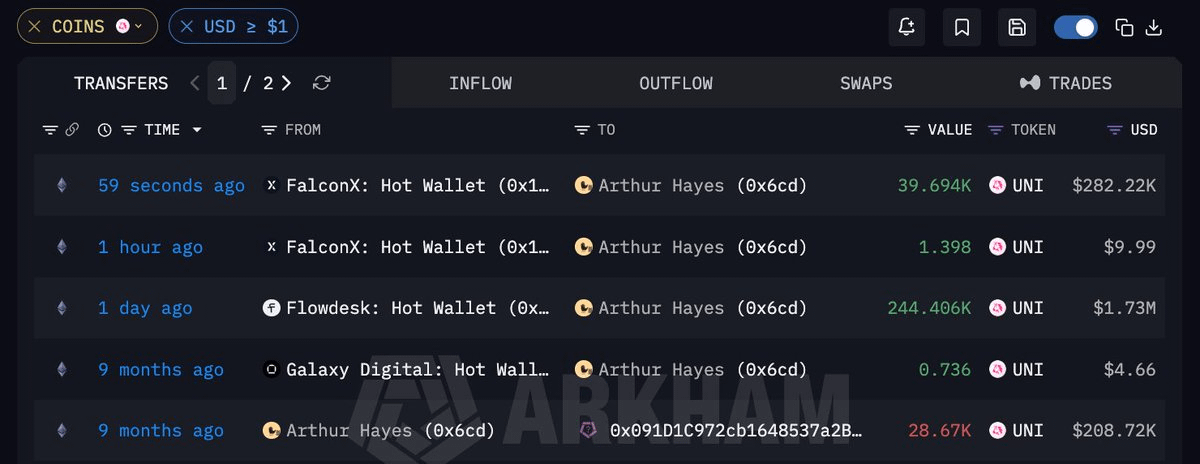
Old Black Arthur Hayes has increased his holdings again by $UNI , and has built a position worth over $2 million since yesterday 🦄
In the past hour, his address 0x6cd…47e21 received 39,000 UNI ($282,000) from FalconX, bringing his UNI holdings to 284,101 tokens, with a total value of $2.007 million and an average purchase price of $7.06
This is his first large UNI trade in nine months, and it has now become the third-largest asset in his on-chain holdings; wallet address 0x6cd66DbdFe289ab83d7311B668ADA83A12447e21
In the past hour, his address 0x6cd…47e21 received 39,000 UNI ($282,000) from FalconX, bringing his UNI holdings to 284,101 tokens, with a total value of $2.007 million and an average purchase price of $7.06
This is his first large UNI trade in nine months, and it has now become the third-largest asset in his on-chain holdings; wallet address 0x6cd66DbdFe289ab83d7311B668ADA83A12447e21
596
·
--
$12.9 billion! Huang Renxun makes another move—this time Nvidia isn’t buying a chip company!
Nvidia has announced an approximately $12.9 billion acquisition of Hugging Face! 🔥
Many people may be underestimating the significance of this deal.
Hugging Face is often called “GitHub of the AI world”—a major global hub for open-source AI models, datasets, and developers. In the past, Nvidia controlled GPUs and computing power; now it’s pushing even further into the model entry point + developer ecosystem.
What does that mean?
Previously, Nvidia sold the “shovels” of the AI era; now it may even want to hold the “mining site entrance.”
What’s even more worth watching for Web3 is this: as AI + open-source models + computing infrastructure continue to integrate, will decentralized compute, AI Agents, DePIN, and the AI Crypto track usher in a new round of narratives?
#NVIDIA #HuggingFace #Crypto #币安广场 #英伟达129亿美元收购huggingface
$12.9 billion! Huang Renxun makes another move—this time Nvidia isn’t buying a chip company!
Nvidia has announced an approximately $12.9 billion acquisition of Hugging Face! 🔥
Many people may be underestimating the significance of this deal.
Hugging Face is often called “GitHub of the AI world”—a major global hub for open-source AI models, datasets, and developers. In the past, Nvidia controlled GPUs and computing power; now it’s pushing even further into the model entry point + developer ecosystem.
What does that mean?
Previously, Nvidia sold the “shovels” of the AI era; now it may even want to hold the “mining site entrance.”
What’s even more worth watching for Web3 is this: as AI + open-source models + computing infrastructure continue to integrate, will decentralized compute, AI Agents, DePIN, and the AI Crypto track usher in a new round of narratives?
#NVIDIA #HuggingFace #Crypto #币安广场 #英伟达129亿美元收购huggingface
Nvidia has announced an approximately $12.9 billion acquisition of Hugging Face! 🔥
Many people may be underestimating the significance of this deal.
Hugging Face is often called “GitHub of the AI world”—a major global hub for open-source AI models, datasets, and developers. In the past, Nvidia controlled GPUs and computing power; now it’s pushing even further into the model entry point + developer ecosystem.
What does that mean?
Previously, Nvidia sold the “shovels” of the AI era; now it may even want to hold the “mining site entrance.”
What’s even more worth watching for Web3 is this: as AI + open-source models + computing infrastructure continue to integrate, will decentralized compute, AI Agents, DePIN, and the AI Crypto track usher in a new round of narratives?
#NVIDIA #HuggingFace #Crypto #币安广场 #英伟达129亿美元收购huggingface

73
·
--
The AI circle has completely exploded! OpenAI officially releases GPT-6 Astra!
This time, it may not just be a model upgrade, but AI truly moving from “answering questions” to “getting things done for you.”
The GPT-6 Astra focuses on strengthening computer operations, programming, complex reasoning, research, and multi-step task execution—so much so that it can complete an entire workflow across browsers and professional software.
Even more worth noting is this: OpenAI says that Astra has already reached its “critical-level” cybersecurity capability threshold—AI abilities are entering a whole new stage.
#OpenAI #Web3 #人工智能 #openai发布gpt-6astra
The AI circle has completely exploded! OpenAI officially releases GPT-6 Astra!
This time, it may not just be a model upgrade, but AI truly moving from “answering questions” to “getting things done for you.”
The GPT-6 Astra focuses on strengthening computer operations, programming, complex reasoning, research, and multi-step task execution—so much so that it can complete an entire workflow across browsers and professional software.
Even more worth noting is this: OpenAI says that Astra has already reached its “critical-level” cybersecurity capability threshold—AI abilities are entering a whole new stage.
#OpenAI #Web3 #人工智能 #openai发布gpt-6astra
This time, it may not just be a model upgrade, but AI truly moving from “answering questions” to “getting things done for you.”
The GPT-6 Astra focuses on strengthening computer operations, programming, complex reasoning, research, and multi-step task execution—so much so that it can complete an entire workflow across browsers and professional software.
Even more worth noting is this: OpenAI says that Astra has already reached its “critical-level” cybersecurity capability threshold—AI abilities are entering a whole new stage.
#OpenAI #Web3 #人工智能 #openai发布gpt-6astra

1
1
2.8k
·
--
🚨 A $635 million game-changing move! STRC suddenly becomes the market focus—what move is Strategy making next?
Many people are still watching Bitcoin’s rise and fall, but the truly meaningful capital-flow signals may already be showing up in STRC!
The latest reports indicate that the buyback amount related to STRC’s preferred shares has reached $635 million. This figure is absolutely not a small matter—the market’s real question is:
🔥 Will this once again affect Strategy’s Bitcoin capital operations?
Over the years, Strategy’s most core play has been to continually use capital-market tools to optimize its financing structure and gradually turn BTC into the centerpiece of its balance sheet.
So STRC’s every move can no longer be viewed purely through the traditional lens of “preferred stock.”
What the market may be trading now is a bigger logic chain:
Capital operations → financing capacity → BTC purchasing power → Strategy valuation → Bitcoin market expectations
If this funding flywheel keeps turning, what we may need to watch in the future may not be “whether Strategy will buy BTC again,” but rather:
How large a scale it can keep buying at?
⚠️ Of course, the more complex the capital structure, the more risks worth watching—especially those brought by leverage, financing costs, and market volatility.
💬 How long do you think Strategy’s “financing to buy BTC” model can keep going?
A: Keep buying—BTC will benefit long term 🔥
B: Leverage keeps rising, and risks are accumulating ⚠️
#MSTR #BTC #bitcoin #strc优先股回购达6.35亿美元
🚨 A $635 million game-changing move! STRC suddenly becomes the market focus—what move is Strategy making next?
Many people are still watching Bitcoin’s rise and fall, but the truly meaningful capital-flow signals may already be showing up in STRC!
The latest reports indicate that the buyback amount related to STRC’s preferred shares has reached $635 million. This figure is absolutely not a small matter—the market’s real question is:
🔥 Will this once again affect Strategy’s Bitcoin capital operations?
Over the years, Strategy’s most core play has been to continually use capital-market tools to optimize its financing structure and gradually turn BTC into the centerpiece of its balance sheet.
So STRC’s every move can no longer be viewed purely through the traditional lens of “preferred stock.”
What the market may be trading now is a bigger logic chain:
Capital operations → financing capacity → BTC purchasing power → Strategy valuation → Bitcoin market expectations
If this funding flywheel keeps turning, what we may need to watch in the future may not be “whether Strategy will buy BTC again,” but rather:
How large a scale it can keep buying at?
⚠️ Of course, the more complex the capital structure, the more risks worth watching—especially those brought by leverage, financing costs, and market volatility.
💬 How long do you think Strategy’s “financing to buy BTC” model can keep going?
A: Keep buying—BTC will benefit long term 🔥
B: Leverage keeps rising, and risks are accumulating ⚠️
#MSTR #BTC #bitcoin #strc优先股回购达6.35亿美元
Many people are still watching Bitcoin’s rise and fall, but the truly meaningful capital-flow signals may already be showing up in STRC!
The latest reports indicate that the buyback amount related to STRC’s preferred shares has reached $635 million. This figure is absolutely not a small matter—the market’s real question is:
🔥 Will this once again affect Strategy’s Bitcoin capital operations?
Over the years, Strategy’s most core play has been to continually use capital-market tools to optimize its financing structure and gradually turn BTC into the centerpiece of its balance sheet.
So STRC’s every move can no longer be viewed purely through the traditional lens of “preferred stock.”
What the market may be trading now is a bigger logic chain:
Capital operations → financing capacity → BTC purchasing power → Strategy valuation → Bitcoin market expectations
If this funding flywheel keeps turning, what we may need to watch in the future may not be “whether Strategy will buy BTC again,” but rather:
How large a scale it can keep buying at?
⚠️ Of course, the more complex the capital structure, the more risks worth watching—especially those brought by leverage, financing costs, and market volatility.
💬 How long do you think Strategy’s “financing to buy BTC” model can keep going?
A: Keep buying—BTC will benefit long term 🔥
B: Leverage keeps rising, and risks are accumulating ⚠️
#MSTR #BTC #bitcoin #strc优先股回购达6.35亿美元

3
1
386
·
--
🔥 ARB suddenly surges 30%! This time it might not just be a simple pump!
After lying dormant for a long time, ARB has suddenly become the focus of the market.
With a single-wave rally nearing 30%, one of the biggest catalysts behind it is Robinhood Chain!
Many people only see ARB going up, but they overlook a logic that’s even more worth paying attention to👇
Robinhood chooses to build its own Layer 2 based on the Arbitrum technology stack. If in the future Robinhood moves stock tokenization, RWA, trading, and a large number of traditional finance users onto the chain, then what Arbitrum gains may be not just “brand exposure,” but real on-chain activity and potential revenue growth.
This is also the core expectation driving the market to start re-hyping ARB:
Robinhood Chain growth
→ Arbitrum ecosystem benefits
→ Revenue expectations improve
→ Is ARB’s value being re-priced?
🚨 But there’s a key question here!
A 30% increase has already happened. If you chase in now, are you catching the second wave—or are you becoming a bag-holder for the early entrants?
I think next, don’t just watch the price. Focus on three signals:
① After a surge with increased volume, does the pullback have follow-through capital?
② Can Robinhood Chain bring real users and revenue?
③ After ARB breaks through key resistance, can it hold its ground?
If all three conditions show up at the same time, this rally might be more than just a short-term hype.
But if the price rises while there’s no supporting fundamental data, then after 30% it’s even more important to watch out for risk.
#ARB #Arbitrum #Robinhood #RWA #arb上涨30%受robinhood链收入推动
🔥 ARB suddenly surges 30%! This time it might not just be a simple pump!
After lying dormant for a long time, ARB has suddenly become the focus of the market.
With a single-wave rally nearing 30%, one of the biggest catalysts behind it is Robinhood Chain!
Many people only see ARB going up, but they overlook a logic that’s even more worth paying attention to👇
Robinhood chooses to build its own Layer 2 based on the Arbitrum technology stack. If in the future Robinhood moves stock tokenization, RWA, trading, and a large number of traditional finance users onto the chain, then what Arbitrum gains may be not just “brand exposure,” but real on-chain activity and potential revenue growth.
This is also the core expectation driving the market to start re-hyping ARB:
Robinhood Chain growth
→ Arbitrum ecosystem benefits
→ Revenue expectations improve
→ Is ARB’s value being re-priced?
🚨 But there’s a key question here!
A 30% increase has already happened. If you chase in now, are you catching the second wave—or are you becoming a bag-holder for the early entrants?
I think next, don’t just watch the price. Focus on three signals:
① After a surge with increased volume, does the pullback have follow-through capital?
② Can Robinhood Chain bring real users and revenue?
③ After ARB breaks through key resistance, can it hold its ground?
If all three conditions show up at the same time, this rally might be more than just a short-term hype.
But if the price rises while there’s no supporting fundamental data, then after 30% it’s even more important to watch out for risk.
#ARB #Arbitrum #Robinhood #RWA #arb上涨30%受robinhood链收入推动
After lying dormant for a long time, ARB has suddenly become the focus of the market.
With a single-wave rally nearing 30%, one of the biggest catalysts behind it is Robinhood Chain!
Many people only see ARB going up, but they overlook a logic that’s even more worth paying attention to👇
Robinhood chooses to build its own Layer 2 based on the Arbitrum technology stack. If in the future Robinhood moves stock tokenization, RWA, trading, and a large number of traditional finance users onto the chain, then what Arbitrum gains may be not just “brand exposure,” but real on-chain activity and potential revenue growth.
This is also the core expectation driving the market to start re-hyping ARB:
Robinhood Chain growth
→ Arbitrum ecosystem benefits
→ Revenue expectations improve
→ Is ARB’s value being re-priced?
🚨 But there’s a key question here!
A 30% increase has already happened. If you chase in now, are you catching the second wave—or are you becoming a bag-holder for the early entrants?
I think next, don’t just watch the price. Focus on three signals:
① After a surge with increased volume, does the pullback have follow-through capital?
② Can Robinhood Chain bring real users and revenue?
③ After ARB breaks through key resistance, can it hold its ground?
If all three conditions show up at the same time, this rally might be more than just a short-term hype.
But if the price rises while there’s no supporting fundamental data, then after 30% it’s even more important to watch out for risk.
#ARB #Arbitrum #Robinhood #RWA #arb上涨30%受robinhood链收入推动

1
153
·
--
💎 Keep Bitcoin at 794,000! This sideways move after a 23% weekly rise—fuel or a top?
BTC has held above the $790,000 area. In the past seven days it surged about 23%; the monthly gain is close to 28%. It even broke above $80,000 and hit a new high since mid-May (after a peak of 81,273, it was pushed back).
On Wednesday, it fell about 1% over 24 hours—this isn’t a crash; it’s profit-taking.
The strongest backing is institutional “real money”: The U.S. spot Bitcoin ETFs have seen net inflows for 8 straight days. Last week they pulled in $1.92 billion, the strongest since October last year. On Tuesday alone, inflows were $314 million, bringing total inflows to $54.36 billion and total assets under management to $99.05 billion. K33 Research noted that spot and perpetual contract trading volumes jumped 188%, and CME volume rose 152%. The annualized basis spread surged to 11.1%—"bullish capital is clearly back."
📈 A rarer signal: In just 4 days, Bitcoin regained the 50-day, 100-day, 200-day, and even the 200-week moving averages in one go. Historically, this pattern has only appeared at the starting point of cyclical bull markets. During the same period, shorts were liquidated by more than $220 million.
Altcoins are even crazier: XRP rose 45% week-over-week (at $1.44); ZEC rose 55% week-over-week (with the U.S. spot ZEC ETF already launched); ETH rose 29% and held around $2,465; HYPE rose 40%, breaking above $81. But when gains are this fierce, pullbacks are fast too—yesterday, this batch of leaders fell across the board.
⚠️ Two hidden risks don’t ignore: First, the daily RSI has surged to 81 and even 85.9—severely overbought. Second, macro thresholds are clustering—Q2 GDP and July PCE just came out. New Fed Chair Kevin Warsh made his first appearance at Jackson Hole this Friday. The market is pricing about a 60% probability that there will be no change in September, and some people even started betting on rate hikes. CoinDesk yesterday attributed XRP’s drop against the market to rising expectations of a rate hike.
Key watershed: If it holds $79,000, there’s still a chance to push toward $82,500 and $84,000. If it breaks, then below, you’ll have to look to the 200-day moving average at $71.9k for structural support.
#比特币 #BTC #比特币守于7.94万美元
💎 Keep Bitcoin at 794,000! This sideways move after a 23% weekly rise—fuel or a top?
BTC has held above the $790,000 area. In the past seven days it surged about 23%; the monthly gain is close to 28%. It even broke above $80,000 and hit a new high since mid-May (after a peak of 81,273, it was pushed back).
On Wednesday, it fell about 1% over 24 hours—this isn’t a crash; it’s profit-taking.
The strongest backing is institutional “real money”: The U.S. spot Bitcoin ETFs have seen net inflows for 8 straight days. Last week they pulled in $1.92 billion, the strongest since October last year. On Tuesday alone, inflows were $314 million, bringing total inflows to $54.36 billion and total assets under management to $99.05 billion. K33 Research noted that spot and perpetual contract trading volumes jumped 188%, and CME volume rose 152%. The annualized basis spread surged to 11.1%—"bullish capital is clearly back."
📈 A rarer signal: In just 4 days, Bitcoin regained the 50-day, 100-day, 200-day, and even the 200-week moving averages in one go. Historically, this pattern has only appeared at the starting point of cyclical bull markets. During the same period, shorts were liquidated by more than $220 million.
Altcoins are even crazier: XRP rose 45% week-over-week (at $1.44); ZEC rose 55% week-over-week (with the U.S. spot ZEC ETF already launched); ETH rose 29% and held around $2,465; HYPE rose 40%, breaking above $81. But when gains are this fierce, pullbacks are fast too—yesterday, this batch of leaders fell across the board.
⚠️ Two hidden risks don’t ignore: First, the daily RSI has surged to 81 and even 85.9—severely overbought. Second, macro thresholds are clustering—Q2 GDP and July PCE just came out. New Fed Chair Kevin Warsh made his first appearance at Jackson Hole this Friday. The market is pricing about a 60% probability that there will be no change in September, and some people even started betting on rate hikes. CoinDesk yesterday attributed XRP’s drop against the market to rising expectations of a rate hike.
Key watershed: If it holds $79,000, there’s still a chance to push toward $82,500 and $84,000. If it breaks, then below, you’ll have to look to the 200-day moving average at $71.9k for structural support.
#比特币 #BTC #比特币守于7.94万美元
BTC has held above the $790,000 area. In the past seven days it surged about 23%; the monthly gain is close to 28%. It even broke above $80,000 and hit a new high since mid-May (after a peak of 81,273, it was pushed back).
On Wednesday, it fell about 1% over 24 hours—this isn’t a crash; it’s profit-taking.
The strongest backing is institutional “real money”: The U.S. spot Bitcoin ETFs have seen net inflows for 8 straight days. Last week they pulled in $1.92 billion, the strongest since October last year. On Tuesday alone, inflows were $314 million, bringing total inflows to $54.36 billion and total assets under management to $99.05 billion. K33 Research noted that spot and perpetual contract trading volumes jumped 188%, and CME volume rose 152%. The annualized basis spread surged to 11.1%—"bullish capital is clearly back."
📈 A rarer signal: In just 4 days, Bitcoin regained the 50-day, 100-day, 200-day, and even the 200-week moving averages in one go. Historically, this pattern has only appeared at the starting point of cyclical bull markets. During the same period, shorts were liquidated by more than $220 million.
Altcoins are even crazier: XRP rose 45% week-over-week (at $1.44); ZEC rose 55% week-over-week (with the U.S. spot ZEC ETF already launched); ETH rose 29% and held around $2,465; HYPE rose 40%, breaking above $81. But when gains are this fierce, pullbacks are fast too—yesterday, this batch of leaders fell across the board.
⚠️ Two hidden risks don’t ignore: First, the daily RSI has surged to 81 and even 85.9—severely overbought. Second, macro thresholds are clustering—Q2 GDP and July PCE just came out. New Fed Chair Kevin Warsh made his first appearance at Jackson Hole this Friday. The market is pricing about a 60% probability that there will be no change in September, and some people even started betting on rate hikes. CoinDesk yesterday attributed XRP’s drop against the market to rising expectations of a rate hike.
Key watershed: If it holds $79,000, there’s still a chance to push toward $82,500 and $84,000. If it breaks, then below, you’ll have to look to the 200-day moving average at $71.9k for structural support.
#比特币 #BTC #比特币守于7.94万美元
169
·
--
🔥 Trump orders from the White House: Pass the Clarity Act! Crypto surges—yet the real drama is the $140 million conflict of interest
On August 19, Trump convened a top crypto industry summit at the White House—Coinbase, Kraken, and Robinhood CEOs in attendance, with SEC, CFTC, and the heads of the NYSE also present. He directly urged the Senate on the spot: pass the “Clarity Act,” saying, “Keep the U.S. ahead of China.”
The bill’s core has three points: ① clearly define which tokens are securities and which are commodities, ending the chaotic era of SEC “regulation-by-enforcement”; ② draw a clear regulatory boundary between the SEC and the CFTC; ③ allocate $150 million for anti-fraud funding plus restrictions on insider resale, plugging the “pump-and-dump” loopholes. After the Senate reconvenes on September 15, a procedural vote will be held. The Republicans still need to win about six Democratic senators to reach the 60-vote threshold.
The market reacted immediately: BTC broke through $70K, ETH rose 3.3% to a three-month high, Coinbase jumped 8.4%, and Strategy surged 10%—an industry boost comparable to the rally seen when the GENIUS Act was signed in 2025.
⚠️ But the real show is outside the bill: In 2025 alone, Trump recorded more than $1.4 billion from crypto-related business (World Liberty Financial $526 million + $WLFI meme coins $600 million +). Elizabeth Warren bluntly said, “This is giving himself a legislative green light.” Democrats insist on adding an ethical clause banning government officials from profiting from crypto business—otherwise they won’t yield.
In one sentence: The bill itself is a milestone for the crypto industry, but Trump’s $140 million entanglement turns it into a chip in a political game. When the Senate reconvenes on September 15, that’s when the real battlefield begins.
#特朗普 #SEC #CFTC #比特币 #特朗普敦促国会通过clarity法案
🔥 Trump orders from the White House: Pass the Clarity Act! Crypto surges—yet the real drama is the $140 million conflict of interest
On August 19, Trump convened a top crypto industry summit at the White House—Coinbase, Kraken, and Robinhood CEOs in attendance, with SEC, CFTC, and the heads of the NYSE also present. He directly urged the Senate on the spot: pass the “Clarity Act,” saying, “Keep the U.S. ahead of China.”
The bill’s core has three points: ① clearly define which tokens are securities and which are commodities, ending the chaotic era of SEC “regulation-by-enforcement”; ② draw a clear regulatory boundary between the SEC and the CFTC; ③ allocate $150 million for anti-fraud funding plus restrictions on insider resale, plugging the “pump-and-dump” loopholes. After the Senate reconvenes on September 15, a procedural vote will be held. The Republicans still need to win about six Democratic senators to reach the 60-vote threshold.
The market reacted immediately: BTC broke through $70K, ETH rose 3.3% to a three-month high, Coinbase jumped 8.4%, and Strategy surged 10%—an industry boost comparable to the rally seen when the GENIUS Act was signed in 2025.
⚠️ But the real show is outside the bill: In 2025 alone, Trump recorded more than $1.4 billion from crypto-related business (World Liberty Financial $526 million + $WLFI meme coins $600 million +). Elizabeth Warren bluntly said, “This is giving himself a legislative green light.” Democrats insist on adding an ethical clause banning government officials from profiting from crypto business—otherwise they won’t yield.
In one sentence: The bill itself is a milestone for the crypto industry, but Trump’s $140 million entanglement turns it into a chip in a political game. When the Senate reconvenes on September 15, that’s when the real battlefield begins.
#特朗普 #SEC #CFTC #比特币 #特朗普敦促国会通过clarity法案
On August 19, Trump convened a top crypto industry summit at the White House—Coinbase, Kraken, and Robinhood CEOs in attendance, with SEC, CFTC, and the heads of the NYSE also present. He directly urged the Senate on the spot: pass the “Clarity Act,” saying, “Keep the U.S. ahead of China.”
The bill’s core has three points: ① clearly define which tokens are securities and which are commodities, ending the chaotic era of SEC “regulation-by-enforcement”; ② draw a clear regulatory boundary between the SEC and the CFTC; ③ allocate $150 million for anti-fraud funding plus restrictions on insider resale, plugging the “pump-and-dump” loopholes. After the Senate reconvenes on September 15, a procedural vote will be held. The Republicans still need to win about six Democratic senators to reach the 60-vote threshold.
The market reacted immediately: BTC broke through $70K, ETH rose 3.3% to a three-month high, Coinbase jumped 8.4%, and Strategy surged 10%—an industry boost comparable to the rally seen when the GENIUS Act was signed in 2025.
⚠️ But the real show is outside the bill: In 2025 alone, Trump recorded more than $1.4 billion from crypto-related business (World Liberty Financial $526 million + $WLFI meme coins $600 million +). Elizabeth Warren bluntly said, “This is giving himself a legislative green light.” Democrats insist on adding an ethical clause banning government officials from profiting from crypto business—otherwise they won’t yield.
In one sentence: The bill itself is a milestone for the crypto industry, but Trump’s $140 million entanglement turns it into a chip in a political game. When the Senate reconvenes on September 15, that’s when the real battlefield begins.
#特朗普 #SEC #CFTC #比特币 #特朗普敦促国会通过clarity法案
387
·
--
🔥 BTC violent breakout to $72,000! Short positions worth $3 billion wiped out overnight—does the bull return fast, or is it just a leveraged mirage?
On August 20, Bitcoin surged 11.8% in a single day, ripping from the $60k range to above $72,000 in one violent move, reaching the highest level since early June. This isn’t a gentle climb—it’s an all-out, high-volume spike. In the past 24 hours alone, liquidations across the market exceeded $3.3 billion for shorts, including about $3 billion from short positions!
Three engines ignited at the same time: 🇺🇸 The U.S. Treasury announced it will double the size of long-bond repurchases (the per-transaction cap raised from $2.0B to $4.0B). Long-end yields and the dollar weakened in tandem, and the liquidity gates swung open; 📉 Bitcoin had been ranging at 62K–67K for six weeks, with short positions piling up like a mountain—then a single squeeze forced move directly detonated it; 🏛️ Expectations for U.S. digital-asset regulation keep improving, and risk appetite has rebounded across the board.
Even more aggressive: altcoins took off together—ETH jumped 19%, SOL rose 13%, and HYPE surged 26%—capital isn’t testing the waters, it’s charging forward.
⚠️ But stay calm: in this run, the short squeeze has contributed a sizable portion of the passive buy-side demand. 73,227 is the key 0.618 Fibonacci resistance level. Whether spot and ETF inflows can keep coming determines if this is a “trend reversal” or a “high-volatility consolidation.” 73,227 is the key 0.618 Fibonacci resistance level. Whether spot and ETF inflows can keep coming determines if this is a “trend reversal” or a “high-volatility consolidation.” Over the past two years, $72K has repeatedly acted as a chopping block for both longs and shorts—every time it breaks through, there has been a policy or liquidity catalyst. This time won’t be any exception either.
#比特币 #BTC突破72000美元 #加密货币 #BTC
🔥 BTC violent breakout to $72,000! Short positions worth $3 billion wiped out overnight—does the bull return fast, or is it just a leveraged mirage?
On August 20, Bitcoin surged 11.8% in a single day, ripping from the $60k range to above $72,000 in one violent move, reaching the highest level since early June. This isn’t a gentle climb—it’s an all-out, high-volume spike. In the past 24 hours alone, liquidations across the market exceeded $3.3 billion for shorts, including about $3 billion from short positions!
Three engines ignited at the same time: 🇺🇸 The U.S. Treasury announced it will double the size of long-bond repurchases (the per-transaction cap raised from $2.0B to $4.0B). Long-end yields and the dollar weakened in tandem, and the liquidity gates swung open; 📉 Bitcoin had been ranging at 62K–67K for six weeks, with short positions piling up like a mountain—then a single squeeze forced move directly detonated it; 🏛️ Expectations for U.S. digital-asset regulation keep improving, and risk appetite has rebounded across the board.
Even more aggressive: altcoins took off together—ETH jumped 19%, SOL rose 13%, and HYPE surged 26%—capital isn’t testing the waters, it’s charging forward.
⚠️ But stay calm: in this run, the short squeeze has contributed a sizable portion of the passive buy-side demand. 73,227 is the key 0.618 Fibonacci resistance level. Whether spot and ETF inflows can keep coming determines if this is a “trend reversal” or a “high-volatility consolidation.” 73,227 is the key 0.618 Fibonacci resistance level. Whether spot and ETF inflows can keep coming determines if this is a “trend reversal” or a “high-volatility consolidation.” Over the past two years, $72K has repeatedly acted as a chopping block for both longs and shorts—every time it breaks through, there has been a policy or liquidity catalyst. This time won’t be any exception either.
#比特币 #BTC突破72000美元 #加密货币 #BTC
On August 20, Bitcoin surged 11.8% in a single day, ripping from the $60k range to above $72,000 in one violent move, reaching the highest level since early June. This isn’t a gentle climb—it’s an all-out, high-volume spike. In the past 24 hours alone, liquidations across the market exceeded $3.3 billion for shorts, including about $3 billion from short positions!
Three engines ignited at the same time: 🇺🇸 The U.S. Treasury announced it will double the size of long-bond repurchases (the per-transaction cap raised from $2.0B to $4.0B). Long-end yields and the dollar weakened in tandem, and the liquidity gates swung open; 📉 Bitcoin had been ranging at 62K–67K for six weeks, with short positions piling up like a mountain—then a single squeeze forced move directly detonated it; 🏛️ Expectations for U.S. digital-asset regulation keep improving, and risk appetite has rebounded across the board.
Even more aggressive: altcoins took off together—ETH jumped 19%, SOL rose 13%, and HYPE surged 26%—capital isn’t testing the waters, it’s charging forward.
⚠️ But stay calm: in this run, the short squeeze has contributed a sizable portion of the passive buy-side demand. 73,227 is the key 0.618 Fibonacci resistance level. Whether spot and ETF inflows can keep coming determines if this is a “trend reversal” or a “high-volatility consolidation.” 73,227 is the key 0.618 Fibonacci resistance level. Whether spot and ETF inflows can keep coming determines if this is a “trend reversal” or a “high-volatility consolidation.” Over the past two years, $72K has repeatedly acted as a chopping block for both longs and shorts—every time it breaks through, there has been a policy or liquidity catalyst. This time won’t be any exception either.
#比特币 #BTC突破72000美元 #加密货币 #BTC
424
·
--
💣 Setter’s “Only Buy, Never Sell” rule is over! Strategy sells to raise cash first, selling preferred shares and Bitcoin, shattering crypto belief
Michael Saylor, who once loudly proclaimed “never sell a single Bitcoin,” has finally bowed his head. Strategy announced it may sell up to $1.25 billion worth of Bitcoin to bolster its cash reserves, while also setting separate $1.0 billion share repurchase plans for common and preferred stock—an outright betrayal of the “only buy, never sell” creed, or a strategic rescue?
The background is suffocating: STRC preferred shares have plunged from a $100 par value to $83, mNAV has fallen below par, and the financing advantage has evaporated. Even more deadly, Strategy previously repurchased convertible notes at an 8% discount, directly draining its cash reserves and compressing the dividend coverage ratio from 24 months to just 6 months. When Bitcoin drops below $60,000, everything becomes fragile.
A shift in the core logic: Strategy is no longer the perpetual engine of “issuing infinite shares to buy Bitcoin,” but has moved to a defensive mode of “selling Bitcoin to protect dividends and repurchasing to stabilize market value.” A 12% STRC dividend yield, and $1.14 billion in unrealized losses—this bill can’t be balanced anymore.
⚠️ The bigger shock: Strategy is one of the largest institutional buyers of Bitcoin. If it turns from a net buyer to a net seller, it would be a fundamental blow to the demand structure of the crypto market.
Is Saylor’s about-face survival wisdom in a deep winter—or the beginning of a faith collapse?
#strategy #比特币 #STRC跌破面值放缓Strategy购币 #strategy出售股票回购优先股
💣 Setter’s “Only Buy, Never Sell” rule is over! Strategy sells to raise cash first, selling preferred shares and Bitcoin, shattering crypto belief
Michael Saylor, who once loudly proclaimed “never sell a single Bitcoin,” has finally bowed his head. Strategy announced it may sell up to $1.25 billion worth of Bitcoin to bolster its cash reserves, while also setting separate $1.0 billion share repurchase plans for common and preferred stock—an outright betrayal of the “only buy, never sell” creed, or a strategic rescue?
The background is suffocating: STRC preferred shares have plunged from a $100 par value to $83, mNAV has fallen below par, and the financing advantage has evaporated. Even more deadly, Strategy previously repurchased convertible notes at an 8% discount, directly draining its cash reserves and compressing the dividend coverage ratio from 24 months to just 6 months. When Bitcoin drops below $60,000, everything becomes fragile.
A shift in the core logic: Strategy is no longer the perpetual engine of “issuing infinite shares to buy Bitcoin,” but has moved to a defensive mode of “selling Bitcoin to protect dividends and repurchasing to stabilize market value.” A 12% STRC dividend yield, and $1.14 billion in unrealized losses—this bill can’t be balanced anymore.
⚠️ The bigger shock: Strategy is one of the largest institutional buyers of Bitcoin. If it turns from a net buyer to a net seller, it would be a fundamental blow to the demand structure of the crypto market.
Is Saylor’s about-face survival wisdom in a deep winter—or the beginning of a faith collapse?
#strategy #比特币 #STRC跌破面值放缓Strategy购币 #strategy出售股票回购优先股
Michael Saylor, who once loudly proclaimed “never sell a single Bitcoin,” has finally bowed his head. Strategy announced it may sell up to $1.25 billion worth of Bitcoin to bolster its cash reserves, while also setting separate $1.0 billion share repurchase plans for common and preferred stock—an outright betrayal of the “only buy, never sell” creed, or a strategic rescue?
The background is suffocating: STRC preferred shares have plunged from a $100 par value to $83, mNAV has fallen below par, and the financing advantage has evaporated. Even more deadly, Strategy previously repurchased convertible notes at an 8% discount, directly draining its cash reserves and compressing the dividend coverage ratio from 24 months to just 6 months. When Bitcoin drops below $60,000, everything becomes fragile.
A shift in the core logic: Strategy is no longer the perpetual engine of “issuing infinite shares to buy Bitcoin,” but has moved to a defensive mode of “selling Bitcoin to protect dividends and repurchasing to stabilize market value.” A 12% STRC dividend yield, and $1.14 billion in unrealized losses—this bill can’t be balanced anymore.
⚠️ The bigger shock: Strategy is one of the largest institutional buyers of Bitcoin. If it turns from a net buyer to a net seller, it would be a fundamental blow to the demand structure of the crypto market.
Is Saylor’s about-face survival wisdom in a deep winter—or the beginning of a faith collapse?
#strategy #比特币 #STRC跌破面值放缓Strategy购币 #strategy出售股票回购优先股
1
2
4.6k
·
--
TSMC’s July revenue soars 44.7%—the heat for AI chips is still accelerating!
TSMC has announced its July 2026 revenue, reaching NT$467.58 billion, up 44.7% year over year—roughly equivalent to the “45% growth” figure the market is citing. Monthly revenue also rose 5.6% quarter over quarter, setting a new record high for a single month. Cumulative revenue for the first seven months of this year has reached NT$2.872 trillion.
These figures send a very clear signal: order momentum in the AI industry remains strong. Demand related to advanced process nodes, high-performance computing, and data centers is continuously lifting global semiconductor industry sentiment. Even if the market still faces macroeconomic conditions, geopolitical risks, and supply-chain changes, chip demand has still shown remarkable resilience.
Of course, monthly revenue does not mean the outcome for the full year is already set. We’ll still need to watch factors such as capacity expansion, customer pull-in timing, and the overall market environment. But one thing is certain: the semiconductor super cycle brought by AI may only be entering an even more intense phase. Looking at TSMC’s performance report, do you think it’s a continuation of an AI bubble—or the real start of an industry upgrade?
#台积电 #AI芯片 #台积电7月营收增长45%
TSMC’s July revenue soars 44.7%—the heat for AI chips is still accelerating!
TSMC has announced its July 2026 revenue, reaching NT$467.58 billion, up 44.7% year over year—roughly equivalent to the “45% growth” figure the market is citing. Monthly revenue also rose 5.6% quarter over quarter, setting a new record high for a single month. Cumulative revenue for the first seven months of this year has reached NT$2.872 trillion.
These figures send a very clear signal: order momentum in the AI industry remains strong. Demand related to advanced process nodes, high-performance computing, and data centers is continuously lifting global semiconductor industry sentiment. Even if the market still faces macroeconomic conditions, geopolitical risks, and supply-chain changes, chip demand has still shown remarkable resilience.
Of course, monthly revenue does not mean the outcome for the full year is already set. We’ll still need to watch factors such as capacity expansion, customer pull-in timing, and the overall market environment. But one thing is certain: the semiconductor super cycle brought by AI may only be entering an even more intense phase. Looking at TSMC’s performance report, do you think it’s a continuation of an AI bubble—or the real start of an industry upgrade?
#台积电 #AI芯片 #台积电7月营收增长45%
TSMC has announced its July 2026 revenue, reaching NT$467.58 billion, up 44.7% year over year—roughly equivalent to the “45% growth” figure the market is citing. Monthly revenue also rose 5.6% quarter over quarter, setting a new record high for a single month. Cumulative revenue for the first seven months of this year has reached NT$2.872 trillion.
These figures send a very clear signal: order momentum in the AI industry remains strong. Demand related to advanced process nodes, high-performance computing, and data centers is continuously lifting global semiconductor industry sentiment. Even if the market still faces macroeconomic conditions, geopolitical risks, and supply-chain changes, chip demand has still shown remarkable resilience.
Of course, monthly revenue does not mean the outcome for the full year is already set. We’ll still need to watch factors such as capacity expansion, customer pull-in timing, and the overall market environment. But one thing is certain: the semiconductor super cycle brought by AI may only be entering an even more intense phase. Looking at TSMC’s performance report, do you think it’s a continuation of an AI bubble—or the real start of an industry upgrade?
#台积电 #AI芯片 #台积电7月营收增长45%

1
1
1.7k
·
--
🔥 A Historic Witness! Gold is officially launching an assault on $4,380!
In recent times, the global macro situation has been complex and ever-changing. Risk-aversion sentiment has continued to heat up, and gold prices have climbed in a steady rally—bulls are showing strong momentum! The $4,380 level is no longer an unreachable fantasy; it’s becoming the new critical battleground zone where bulls and bears will clash.
Given this unstoppable surge, will you choose to add positions along with the trend and press the advantage, or stay on the sidelines and wait for a pullback?
#黄金 #投资理财 #黄金挑战4380美元
🔥 A Historic Witness! Gold is officially launching an assault on $4,380!
In recent times, the global macro situation has been complex and ever-changing. Risk-aversion sentiment has continued to heat up, and gold prices have climbed in a steady rally—bulls are showing strong momentum! The $4,380 level is no longer an unreachable fantasy; it’s becoming the new critical battleground zone where bulls and bears will clash.
Given this unstoppable surge, will you choose to add positions along with the trend and press the advantage, or stay on the sidelines and wait for a pullback?
#黄金 #投资理财 #黄金挑战4380美元
In recent times, the global macro situation has been complex and ever-changing. Risk-aversion sentiment has continued to heat up, and gold prices have climbed in a steady rally—bulls are showing strong momentum! The $4,380 level is no longer an unreachable fantasy; it’s becoming the new critical battleground zone where bulls and bears will clash.
Given this unstoppable surge, will you choose to add positions along with the trend and press the advantage, or stay on the sidelines and wait for a pullback?
#黄金 #投资理财 #黄金挑战4380美元
15
Log in to explore more content
Join global crypto users on Binance Square
⚡️ Get latest and useful information about crypto.
💬 Trusted by the world’s largest crypto exchange.
👍 Discover real insights from verified creators.
Email / Phone number
Trending Topics
BinanceLaunchesBinanceIntelligence
174,401 views
1,594 Discussing
#BinanceLaunchesBinanceIntelligence
Binance is moving beyond being an exchange — it is building an intelligent financial ecosystem.
With Binance Intelligence, AI is being integrated directly into the Binance experience through three major layers: Binance AI for personalized market insights, Binance AI Pro for turning ideas into automated workflows, and Agent OS for developers building AI-powered financial applications.
What stands out is the direction: bringing market data, analysis, automation, and AI-driven tools closer together in one ecosystem.
The bigger picture is clear — the future of finance won’t just be about accessing markets. It will be about understanding them faster, making better-informed decisions, and giving users intelligent tools to navigate an increasingly complex financial world.
Binance Intelligence could be an important step toward that future.
$FET$BNB$TAO
Muhammad Riaz Chandio
·2 Likes
·685 views
StriveBuys2000BTCFor$169M
7,574 views
78 Discussing
EvernorthXRPTreasuryCompletesSPACMerger
100,673 views
977 Discussing