


OCC issues significant interpretive letter, banks permitted to act as 'Riskless Intermediaries' for crypto assets.
The Office of the Comptroller of the Currency (OCC) officially released Interpretive Letter 1188 on Tuesday, opening a key door for national banks to enter the cryptocurrency market.
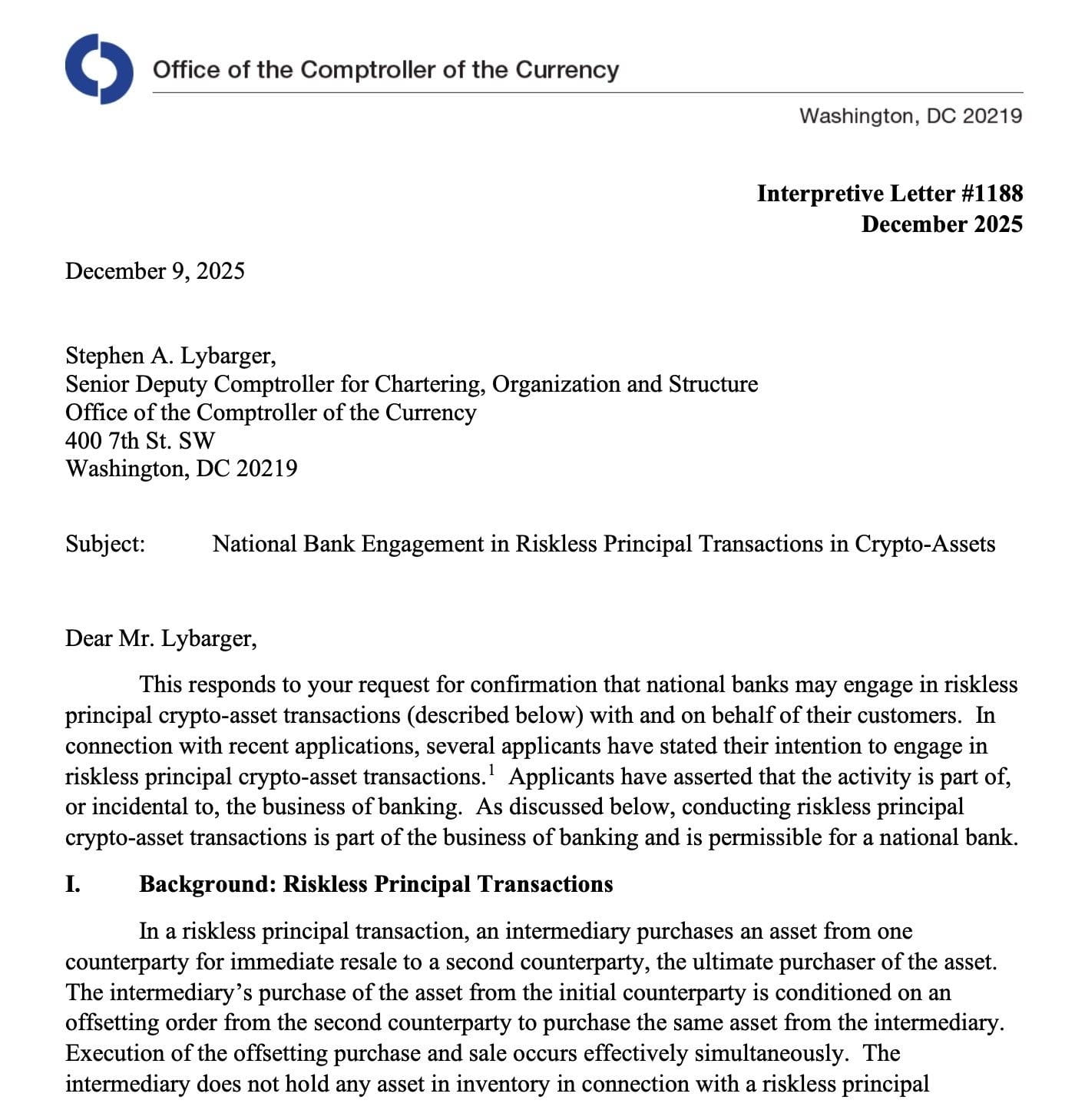 OCC issued Interpretive Letter 1188, indicating that national banks can participate in 'Riskless Principal' transactions of crypto assets. OCC
The document clearly states that national banks can participate in 'Riskless Principal' transactions of crypto assets, meaning banks are allowed to act as intermediaries for customers buying and selling cryptocurrencies without assuming the risk of asset price fluctuations.
In this model, banks will not list crypto assets in their inventory; in reality, they play a role similar to that of brokers or agents, only briefly holding assets in the rare case of settlement failures.
The release of this guidance symbolizes a decisive step forward in the process of incorporating crypto asset business into the traditional banking system. The OCC detailed in the letter the legal basis for such activities, viewing them as a natural extension of the 'Business of Banking'.
Regulators cited Section 24 of Volume 12 of the U.S. Code, pointing out that banks have long engaged in similar risk-free transactions in the securities market, and it is entirely reasonable to extend this logic to non-securities crypto assets.
For banks, this means they can leverage existing settlement and risk management infrastructure to explore new revenue sources without significantly increasing balance sheet risk.
Traditional financial giants are rushing in, with PNC and Bank of America taking the lead in crypto services.
With the regulatory red light turning green, traditional financial giants in the US have quickly taken action to integrate crypto services into their core businesses. PNC Bank announced shortly after the OCC guidance was released that it would become the first major US bank to offer direct Bitcoin trading services to eligible private banking clients through its own platform.
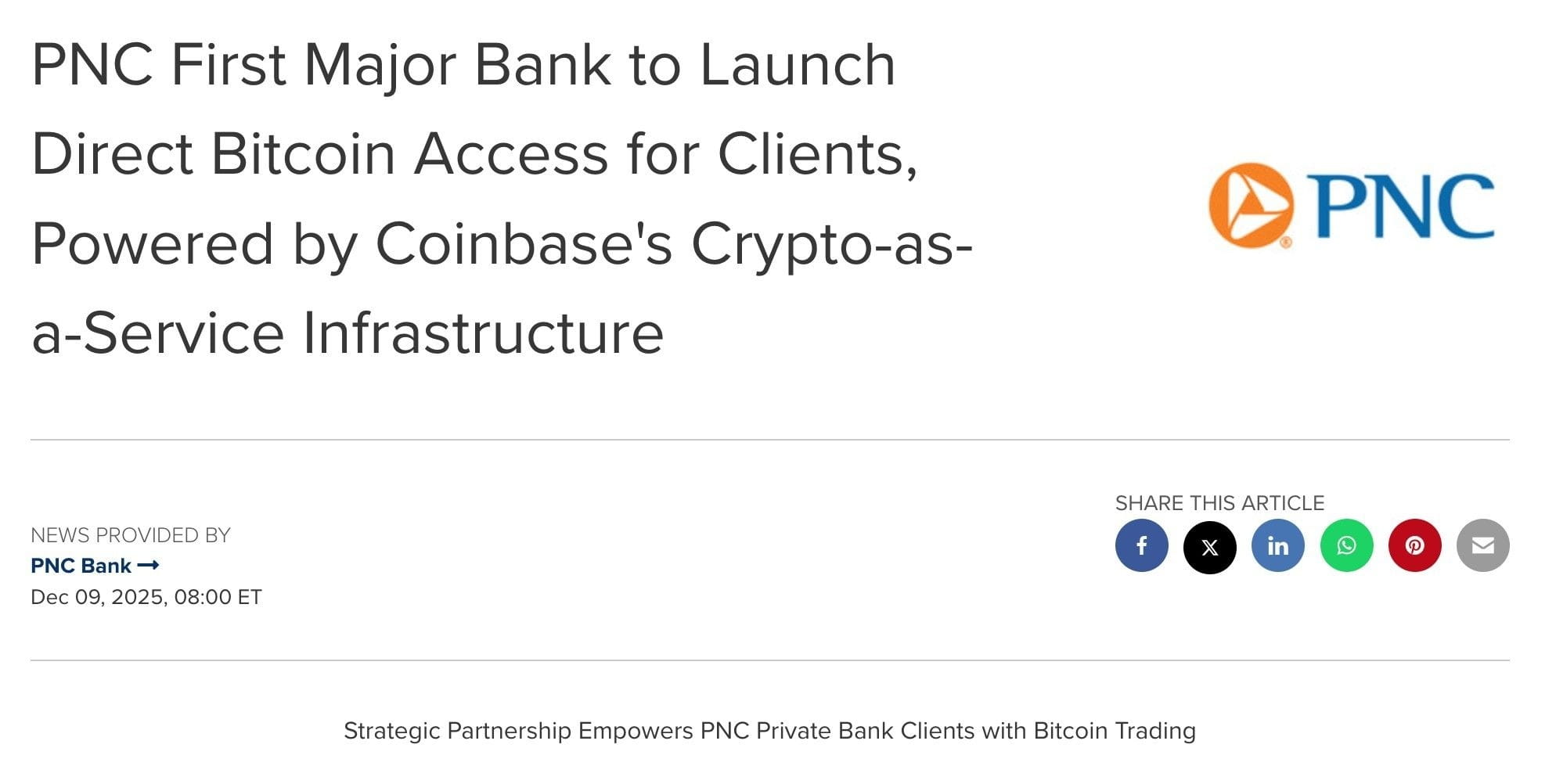 PNC announced that it has become the first major US bank to offer direct Bitcoin trading services to eligible private banking clients through its own platform. PR Newswire
This service is based on the strategic partnership established between PNC Bank and Coinbase in July, utilizing Coinbase's infrastructure as underlying support, allowing customers to securely buy, hold, and sell Bitcoin without leaving the banking system. PNC's initiative is seen as a milestone for traditional banks entering the crypto trading industry, breaking the past limitation where banks could only offer related ETFs or fund products, achieving true asset direct exposure.
Meanwhile, Bank of America also announced a significant policy adjustment last week, allowing its wealth management clients to allocate 1% to 4% of their portfolios to digital assets. This new regulation applies to Merrill, Bank of America Private Bank, and the Merrill Edge platform, directly granting over 15,000 financial advisors the authority to proactively recommend crypto assets to clients.
In the past, these advisors were often constrained by internal compliance policies that prevented them from touching the crypto industry, but the current open policy indicates that recognition of digital assets as a legitimate and necessary asset class is rapidly rising within banks. Analysts point out that this shift is consistent with the OCC's cancellation of the requirement for banks to obtain 'prior approval' for engaging in certain crypto businesses in March this year, as well as the issuance of interpretation letter No. 1186 in November that allows banks to hold a small number of crypto assets to pay for blockchain operating expenses (such as Gas fees), showing that the ongoing relaxation of the regulatory environment is injecting strong confidence into the market.
Regulatory logic shifts and risk control, clarifying the lines between securities and non-securities assets.
In the interpretation letter No. 1188 issued by the OCC, not only were banks granted operating permissions, but the regulatory logic was also meticulously sorted out, particularly in distinguishing between 'security-type' and 'non-security-type' crypto assets. The letter clearly stated that transactions involving risk-free parties dealing in crypto assets classified as securities have long been permitted under existing securities law; the focus of this interpretation letter is to explicitly extend this authority to non-security crypto assets.
However, openness does not mean laissez-faire. The OCC repeatedly emphasizes in the document that banks must establish risk controls as stringent as those in traditional financial businesses when engaging in such operations. This includes having robust cybersecurity protocols, anti-money laundering (AML) compliance procedures, and monitoring mechanisms for operational risks. Banks must confirm the legal compliance of each transaction before proceeding and ensure that the activity falls within the scope of their chartered powers.
The OCC conveyed a clear signal through this document: regulators support financial innovation, but the premise is that these innovations must be integrated into the regulated banking system, rather than growing wildly in an unregulated space. This strategy of 'banking' crypto activities aims to enhance the transparency and stability of the entire crypto market by introducing banking-level compliance standards, thereby protecting consumers from potential harm from unregulated entities.
Breaking free from 'Operation Choke Point 2.0', Coinbase and Circle's bank license applications are in the spotlight.
The OCC's policy shift has been widely interpreted by the industry as a concrete manifestation of the US government's transition from the 'Operation Choke Point 2.0' criticized during the Biden administration to the Trump administration's pro-cryptocurrency policies. Over the past few years, the crypto industry has complained that regulators pressured banks through informal means to sever ties with crypto companies.
However, with the Trump administration coming to power and promising to support the digital asset industry, the attitude of federal regulatory agencies has undergone a 180-degree turn. OCC Acting Director Jonathan Gould clearly stated in a public speech on December 8 that cryptocurrency companies seeking a federal bank charter should be treated the same as traditional financial institutions.
In this friendly regulatory atmosphere, 14 institutions have already submitted applications to the OCC for national trust bank charters, including crypto exchange giant Coinbase, stablecoin issuer Circle, and blockchain payment company Ripple. If these heavyweight companies can successfully obtain bank licenses, it will fundamentally change the competitive landscape of the crypto industry, allowing them to connect directly to the federal payment system, reducing reliance on third-party banks, and significantly improving capital operation efficiency.
Gould's remarks and the OCC's series of friendly guidelines have greatly increased the likelihood of approval for these applications. The market generally expects that as 2026 approaches, US regulators will continue to update their crypto asset framework, further eliminating barriers between traditional finance and digital assets, and the OCC's interpretation letter No. 1188 is undoubtedly a crucial piece of this financial transformation puzzle. Banks, fintech companies, and crypto-native enterprises will closely monitor subsequent regulatory dynamics, preparing for a more integrated new era of finance.
This article is authorized for reprint from (Crypto City)
More reports
Sony's push into dollar stablecoins faces backlash! The American Small Bank Alliance requests the OCC to reject Sony Bank's license application.
Global regulatory similarities and differences: a comprehensive interpretation of the four bottom lines and three major divergences in the crypto world.
Regulatory attitude shift! US banks granted permission to hold crypto for Gas fees, accelerating integration with on-chain finance.
