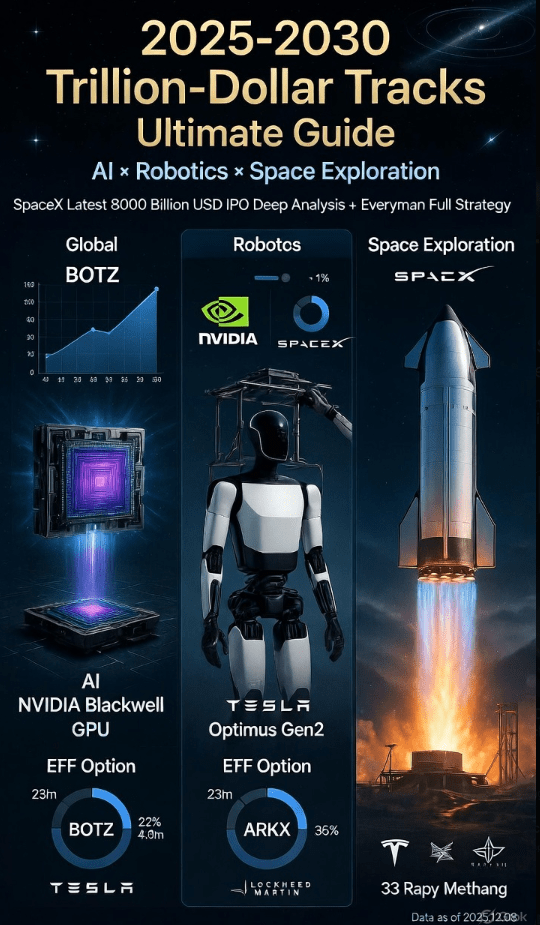
2025-2030 In-depth analysis of three frontier investment tracks: AI, robotics, and space exploration—opportunities, risks, and a guide for ordinary people to enter. At this juncture in December 2025, the global technology investment landscape is undergoing dramatic changes. According to Stanford University's latest AI Index report and McKinsey's Global Space Economy Outlook, the three tracks of AI, robotics, and space exploration are driving the trillion-dollar market reshaping at a compound annual growth rate (CAGR) exceeding 20%. These tracks are not only the playgrounds of tech giants (such as NVIDIA, Tesla, and SpaceX) but also “tickets” for ordinary investors to high returns. This article will deeply analyze the prospects, technology drivers, risk factors of each track, and explore how ordinary people can participate with low barriers based on the latest market dynamics (such as the rumor of SpaceX's valuation soaring to an $800 billion IPO). Data is sourced from authoritative institutions such as Goldman Sachs, ABI Research, and Bloomberg, aiming to provide actionable investment insights. 1. AI (Artificial Intelligence): The year of explosive growth from infrastructure to trillion-dollar application ecosystem market prospects and growth drivers
The AI track has shifted from the “generative AI boom” of 2024 to the “agent-based AI and deep industry integration” of 2025. Goldman Sachs predicts that global AI spending will reach $1.5 trillion in 2025, a year-on-year increase of 62%, with infrastructure (such as data centers and GPUs) accounting for over 50%. By 2030, AI will contribute $15.7 trillion to global GDP, with a CAGR of 24%. Key drivers include:
Technological leap: The maturity of multimodal large models (such as OpenAI's GPT-5 series) and edge AI chips is pushing AI from the cloud to the device side. Investment in the Asia-Pacific region is expected to skyrocket from $30 billion in 2025 to $110 billion by 2028, with Chinese companies like Baidu and Alibaba accelerating their catch-up.
Application landing: Medical AI (such as Google DeepMind's AlphaFold 3) is expected to reach a market size of $50 billion in 2025; financial AI risk control tools will enhance EBIT by more than 5% for high-performing companies. Private investment in generative AI reached $33.9 billion in 2024, with its share expected to exceed 50% in 2025.
Risks and challenges
Despite the bright prospects, AI faces the risk of a valuation bubble burst: the average P/E ratio is expected to drop by 20% in 2025, affected by the Fed's interest rate hikes and geopolitical factors (such as the US-China chip war). A regulatory storm is also on the horizon—59 federal AI regulations in the US by 2024, with global legislation mentioning AI increasing by 21.3%. In addition, data privacy breaches and employment displacement (expected to affect 800 million jobs by 2030) could trigger social backlash. Investment opportunities and ordinary people’s participation
Ordinary investors can diversify risks through ETFs to avoid individual stock volatility. Recommendations:
Core ETF: Global X Robotics & AI ETF (BOTZ), expense ratio 0.68%, covering NVIDIA and UiPath, with a YTD return exceeding 25% in 2025.
Individual stocks: NVIDIA (NVDA), GPU giant, with expected revenue exceeding $200 billion in 2025; Microsoft (MSFT), integrating Azure cloud AI, with a stable P/E ratio of 35 times.
Strategy: Allocate 5-10% of the portfolio, dollar-cost average into BOTZ, starting with 1000 yuan per month. Qualified investors may explore VC funds like Sequoia Capital's AI specialty, with a threshold of $100,000. Hold for more than 5 years, with expected annualized returns of 15-20%.
Key metrics for AI

2. Robotics: The “embodied intelligence” revolution led by humanoid robots. Market prospects and growth drivers
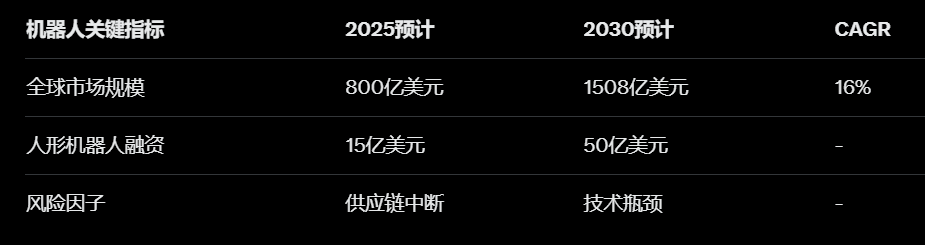
The robotics track is transitioning from industrial automation (with a market of $71.7 billion in 2024) to “embodied AI,” with ABI Research estimating that installation will reach 13 million units by 2030, with a market size of $150.8 billion and a CAGR of 16%. Financing in Q1 2025 has reached $2.26 billion, focusing on real-time sensor response and fleet software.
Technology drive: AI integration enables humanoid robots (like Tesla Optimus) to move from the laboratory to the factory. The agricultural robot market (such as John Deere's automated tractors) is expected to exceed $20 billion in 2025; medical surgical robots (like Intuitive Surgical's da Vinci system) are projected to grow 19% in annual revenue. Several IPOs are expected in 2025, including China's UBTECH (Unitree).
Commercialization acceleration: Warehouse AMR (autonomous mobile robots) is experiencing a CAGR of 19%, benefiting from the deployment of e-commerce giants like Amazon. By 2030, the exoskeleton market is expected to grow from $850 million to $2.2 billion, driving a 30% increase in manufacturing efficiency.
Risks and challenges
High R&D costs (over $500 million for a single humanoid robot development) and supply chain disruptions (such as chip shortages) are major pain points. Regulations such as the US CFIUS review of foreign investments may delay cross-border cooperation. In a recession, the financing environment tightens—VC investment is $7 billion in 2024, possibly fluctuating by 10% in 2025. Low technological maturity has also led to an early product recall rate of 15%. Investment opportunities and ordinary people’s participation
The robotics track is volatile, but ETFs are the preferred entry point. Recommendations:
Core ETF: ROBO Global Robotics & Automation ETF (ROBO), covering over 50 companies, with an expense ratio of 0.95%; ARK Autonomous Technology & Robotics ETF (ARKQ), heavily invested in Tesla, with expected returns of 18% in 2025.
Individual stocks: Intuitive Surgical (ISRG), a monopolist in surgical robots, with expected EPS growth of 25% in 2025; Tesla (TSLA), a catalyst for the Optimus project, with potential for valuation to double. Symbotic (SYM), a dark horse in warehouse automation.
Strategy: Start with small crowdfunding, such as investing in Locus Robotics on the StartEngine platform (minimum $100). Allocate 3-7% of the portfolio, monitor IPO dynamics, with a target annualized return of 12-18%.
Key metrics for robotics
3. Space Exploration: The trillion-dollar new frontier under the wave of commercialization—rumors of SpaceX's $800 billion IPO ignite the market. Market prospects and growth drivers
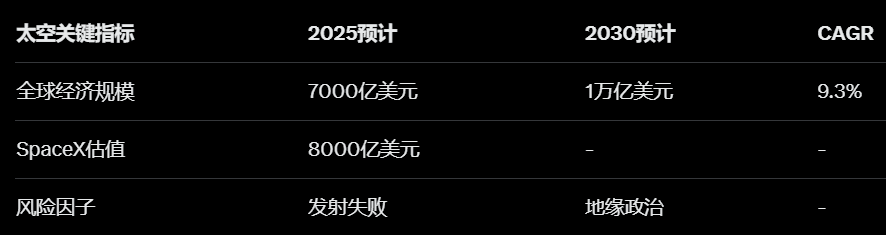
Space exploration is shifting from government projects to commercial dominance, with the global space economy at $613 billion in 2024, 78% of which is commercial. McKinsey predicts it will reach $800 billion by 2027, with nearly 330 lunar missions from 2025 to 2034, and investment increasing from $27 billion to $31 billion, with a CAGR of 9.3%.
Technology and business drive: Reusable rockets (such as SpaceX Starship) will reduce launch costs to $1000 per kilogram, AI optimizes autonomous exploration systems. The satellite communication market will be $35.8 billion in 2025, rising to $65.9 billion by 2032. The potential for resource extraction (such as lunar helium-3) is $1.8 trillion.
Latest hot topic: SpaceX valuation at $800 billion IPO: According to reports from The Wall Street Journal and Bloomberg on December 5-7, 2025, SpaceX is initiating a secondary share sale, targeting a valuation of up to $800 billion (doubling from $400 billion in July), with shares exceeding $400 each. This surpasses OpenAI (valued at $500 billion), making it the most valuable private company in the world. Starlink subscription users exceed 8 million, with an annual revenue run rate of $12-15 billion, covering 150 countries. CFO Bret Johnsen has informed investors that the board will discuss details on December 5 at Starbase, with a potential IPO scheduled for the end of 2026, possibly including a separate listing for Starlink. If a 5% share IPO is conducted, it will raise $40 billion, setting the record for the largest IPO in history (surpassing Saudi Aramco's $29 billion). This news ignited the market: by 2025, SpaceX has launched 152 Falcon 9 missions, and the Starlink V4 upgrade will further increase valuation. The Florida Starship launch pad has been approved, accelerating deep space missions.
Risks and challenges
High initial investment (over $1 billion for a single Starship test) and launch failure rates (approximately 5% in 2025) are core risks. Geopolitical competition (such as the US-China space race) and the space debris issue may lead to international friction. Regulatory uncertainty is high—FAA and international treaties may delay commercialization. In an economic downturn, private investment peaked at $70 billion in 2021-2022, with a potential 15% correction in 2025. Investment opportunities and ordinary people’s participation
SpaceX is not publicly listed, but there are rich indirect channels. Recommendations:
Core ETF: Procure Space ETF (UFO), covering satellite companies, with an expense ratio of 0.75%; ARK Space Exploration ETF (ARKX), heavily invested in Rocket Lab, with returns exceeding 20% in 2025.
Individual stocks: Rocket Lab (RKLB), a small rocket pioneer, with orders doubling in 2025; AST SpaceMobile (ASTS), space mobile communication; Lockheed Martin (LMT), a defense space supplier.
Strategy: Buy SpaceX shares through secondary markets like Forge or EquityZen (threshold of $50,000, for qualified investors). Start dollar-cost averaging into ETFs with 500 yuan per month. Allocate 4-8% of the portfolio, locking in the 2026 IPO bonus, with expected annualized returns of 15-25%.
Key metrics for space
Conclusion: Seizing the tracks, building future wealth portfolios. AI, robotics, and space exploration are not only at the forefront of technology but also the core engines of wealth reconstruction from 2025 to 2030. The rumors of SpaceX's $800 billion IPO serve as a catalyst, indicating that the space track will move from the fringe to the mainstream. Ordinary people do not need huge investments: starting from ETFs, diversifying 5-10% of their positions, combined with dollar-cost averaging and monitoring (such as SpaceX's 2026 listing), they can share in tenfold growth dividends. However, investment carries risks, and assessing risk tolerance and consulting advisors is crucial. The future belongs to the pioneers—are you ready to board? (Data as of December 8, 2025, market dynamics are in real-time flux)#SpaceX #美联储重启降息步伐 $BTC