

Wall Street’s sudden interest in Injective has felt a bit like watching a long-skeptical relative finally lean in at the dinner table and say, “Okay, tell me more.” For years, traditional finance circled around blockchain infrastructure with a combination of curiosity and caution. Now the atmosphere has shifted. The conversations are less about abstract potential and more about concrete integrations, regulatory readiness, and the possibility that on-chain markets might actually fit into the deeply rule-governed machinery of global finance. @Injective is one of the names that keeps resurfacing, not because it’s loud, but because the architecture quietly aligns with what institutions actually need: compliance pathways, deterministic execution, auditability, and a structure that doesn’t immediately spook risk teams.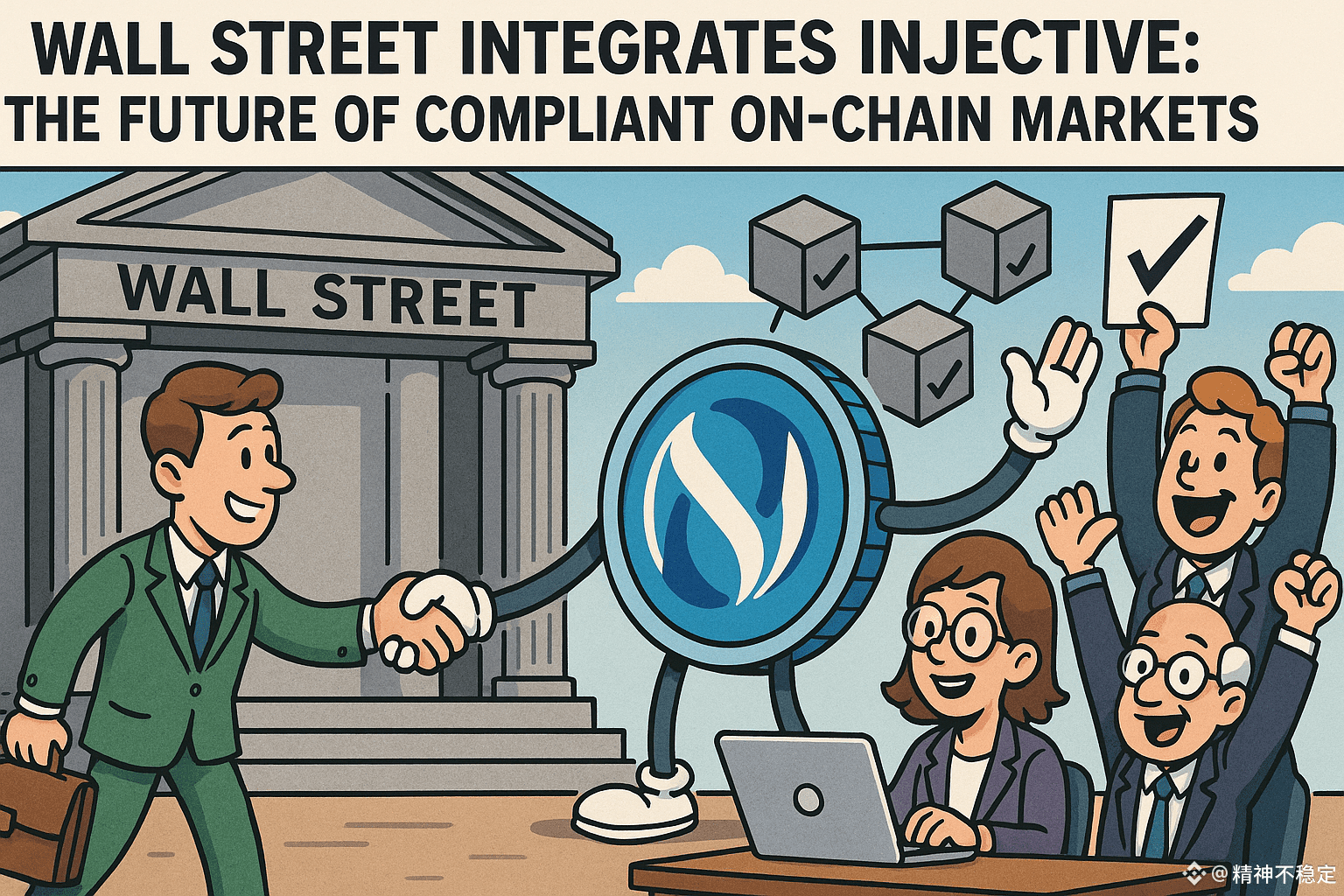
What makes this moment interesting is that Wall Street isn’t looking at crypto with the same wide-eyed speculation that defined 2017 or 2021. The questions are far more grounded now. Can trades settle instantly without breaking regulatory rules? Can derivatives live fully on-chain while still meeting reporting requirements? Can you build markets that behave like traditional venues but operate with blockchain’s transparency and efficiency? The industry seems to be inching toward yes, and @Injective appears to be part of that shift. Not the only part, of course—there are plenty of networks claiming institutional readiness—but Injective’s focus on exchange-specific logic has earned it a second glance.
There’s something almost ironic about how this is playing out. For years, crypto advocates pushed the idea of replacing Wall Street altogether. Now, many of the same technologies are being studied precisely because they may help the same institutions run cleaner, faster, and with fewer intermediaries. I’ve personally always found that overlap more interesting than the replacement narrative. Markets don’t need another revolution for the sake of spectacle. What they need are systems that fix the long-known inefficiencies: settlement lag, fragmentation, opacity, and costly layers of middle entities doing reconciliation. When I look at Injective, I don’t see a magic bullet. I see an alternative foundation where these annoyances can be redesigned from scratch.
Another part of why Injective is showing up in new institutional conversations is that compliance is finally being built into the logic, rather than bolted on as an afterthought. If you’ve ever interacted with a traditional trading desk, you know how much of the day is shaped by rules, internal checks, and legal guardrails. Blockchain infrastructure that doesn’t acknowledge that reality simply won’t get adopted. By contrast, networks built for verifiable on-chain order flow and predictable execution open the door to implementing the kinds of reporting and risk controls regulators expect. When people describe Injective as “designed for exchanges,” that’s what they mean: it’s structured like a marketplace, not as a general-purpose playground.
What’s also fueling interest is the broader global pivot toward tokenization. It isn’t just a buzzword anymore. Major asset managers, clearinghouses, and even governments are experimenting with tokenizing bonds, funds, real-world assets, and collateral. There’s a widespread recognition that if these systems are going to scale, they need infrastructure that isn’t fragile, expensive, or dependent on a dozen intermediaries to stay in sync. Injective’s fast finality and low-cost execution make it a candidate for that kind of experimentation. Institutions aren’t looking for the flashiest chain; they’re looking for something predictable.
Of course, this trend is being amplified by the regulatory environment shifting in subtle but important ways. Even when rules are unclear, the direction is moving toward creating frameworks rather than blocking progress entirely. That gives institutions the confidence to test the waters. For many, on-chain derivatives and compliance-aware marketplaces are easier entry points than consumer-facing crypto assets. They look familiar. They behave like the systems traders already know. And they offer operational gains that are hard to ignore.
I sometimes wonder if the timing here is less about technology suddenly “becoming ready” and more about sentiment cooling off enough for real engineering work to happen. When markets are euphoric, nobody asks whether infrastructure can support regulated clearing. When markets cool and the noise settles, the builders have room to refine the boring but necessary parts. Injective benefits from that quieter maturity. It isn’t trying to be everything at once. It’s more like a deliberately engineered piece of market plumbing, and in finance, plumbing is what determines whether anything can scale.
Another trend feeding into this is the rise of algorithmic strategies and automated market systems that operate more efficiently on-chain than they do across fragmented legacy rails. Funds operating these strategies want environments where settlement rules are transparent, execution doesn’t vary randomly, and slippage can be mathematically contained. On Injective, they see a place where the rules are encoded rather than implied. That predictability is appealing if you’re responsible for handling billions in trades.
Still, I think the real test will come from how these institutional integrations evolve over the next few years. Wall Street has a long history of experimenting with new infrastructure, only to revert back to legacy systems because they feel safer. If blockchain networks want to avoid that fate, they need to prove they can handle the headaches that don’t make headlines: KYC flows, disaster recovery, compliance audits, latency spikes, and multi-jurisdiction legal complexities. Injective’s progress is promising, but the proof will come from real volume and real regulatory sign-off.
Even with all the unknowns, this moment still feels different. People aren’t just talking in theory anymore.
. Pilots are underway. Teams that once dismissed blockchain entirely are now exploring specific implementations. Whether Injective becomes one of the core pillars of institutional on-chain markets remains to be seen, but its growing presence in these discussions says a lot about where the industry is headed.
In a way, this isn’t just about Injective. It’s about the slow merging of two worlds that spent a decade misunderstanding each other. Wall Street is learning that not all blockchain projects are trying to tear down the old system. And blockchain developers are realizing that regulation doesn’t have to be the enemy; it can be the structure that allows these technologies to reach their full potential.
If there’s a future where compliant on-chain markets become standard, it won’t arrive with fanfare. It will arrive quietly, through integrations, pilots, and infrastructure choices that feel almost mundane. Injective is one of the networks currently shaping that quiet shift. And maybe that’s exactly how this transformation was always meant to happen.
@Injective #Injective #injective $INJ

