
#cryptotax
cryptotax
635,427 views
1,611 Discussing
Hot
Latest

·
--
Bullish
🚨 FRANCE REJECTS NEW CRYPTO TAX PROPOSALS! 🇫🇷
France’s Senate has rejected three proposed crypto measures during discussions on the 2027 budget, offering relief to crypto holders.
🔴 Mandatory reporting of self-custody crypto holdings worth €100,000 or more.
🔴 Tax on gains from crypto-to-stablecoin conversions.
🔴 Extension of the exit tax to unrealized crypto gains when moving abroad
The proposals have been rejected by the Senate and are absent from the current text. However, France’s 2027 budget process is still ongoing, so the final outcome is not yet settled.
A significant development for crypto investors and financial privacy! 👏
Reference: "Cointelegraph – French Senate rejects €100K crypto wallet disclosure proposal" (https://cointelegraph.com/news/french-senate-rejects-disclosing-self-custodied-crypto-wallets-100k)
#France #CryptoNews #Bitcoin #CryptoTax #Stablecoins #BinanceSquare
$BTC $SSV $BLUR


125

·
--
Switzerland just ended an era.
The Swiss Federal Council approved 57 partner jurisdictions on November 25 for automatic exchange of cryptoasset information from 2028, under the OECD's Crypto-Asset Reporting Framework (CARF). Providers can start collecting data as early as January 1, 2027.
The list covers all EU states, the UK and several G20 countries; the full list wasn't published, and it's unclear whether the US made the cut. Switzerland has run the same exchange for bank accounts since 2018 — now crypto gets the same treatment. Hong Kong passed its own CARF law on November 13, reporting from January 1, 2027.
What changes now? Nothing in 2026 — collection starts in 2027, first exchanges in 2028, only to partners meeting confidentiality and data-security standards. Reporting targets exchanges and service providers, not your self-custodied wallet. But the message is clear: coins on a regulated exchange will eventually be visible to your tax authority.
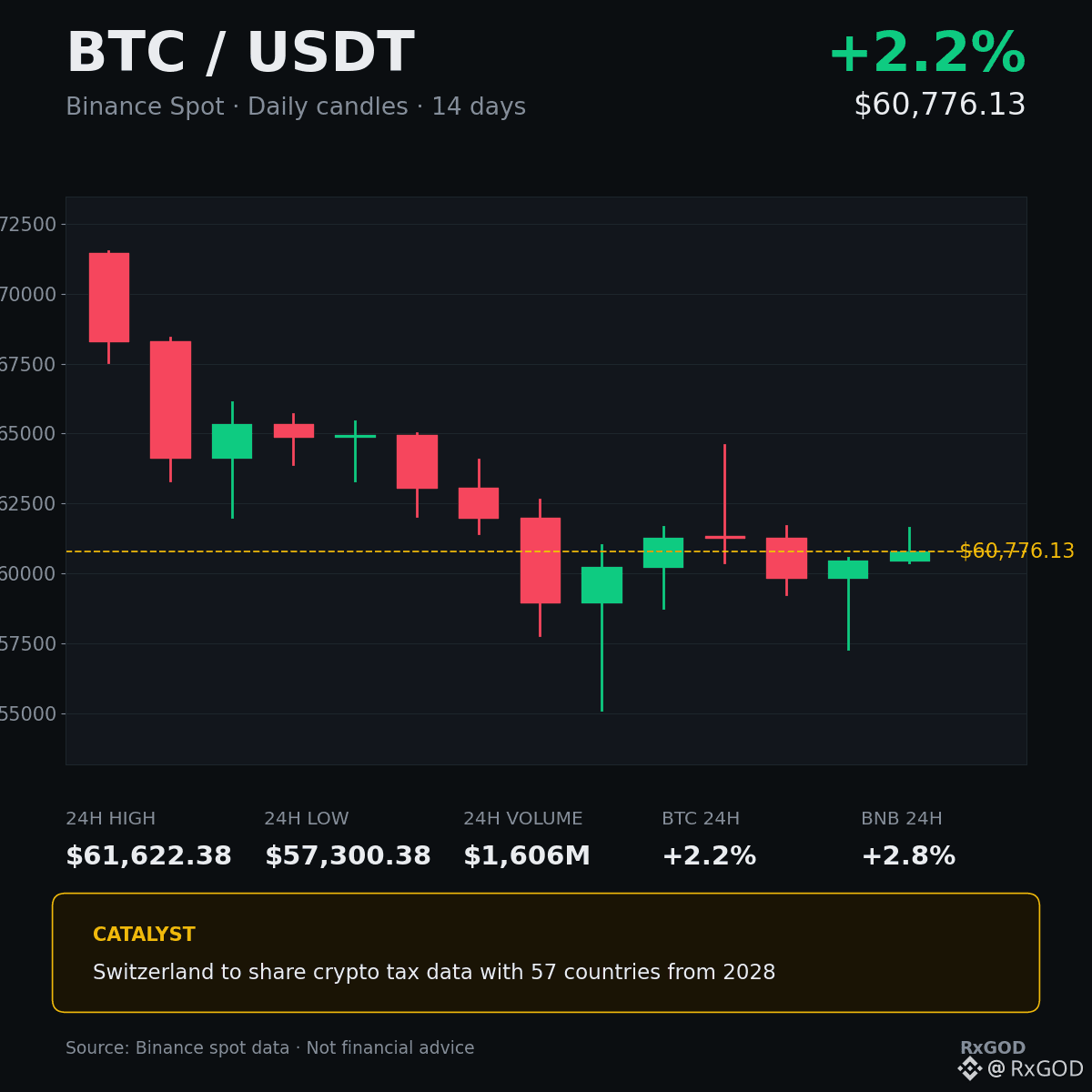
$BTC is steadying at $60,776 (+2.2% in 24h) after bouncing off the $57,300 post-PCE low — just 34% of its 14-day range ($55,130–$71,514), down 11% over two weeks. A relief bounce inside a downtrend, not a breakout. Fear & Greed reads 13, extreme fear.
So here's the real debate: is this transparency the price of mainstream adoption — a sign crypto has finally grown up? Or is it the moment self-custody and privacy tools matter more than ever?
Would you keep coins on an exchange knowing the data gets shared in 2028, or move to self-custody now? And does this make you more or less bullish on $BTC long term?
Not financial advice — DYOR.
#SwitzerlandCryptoTax #CryptoTax #ExtremeFear #CryptoNews

·
--
🇨🇭 Switzerland's Federal Council approved 57 partner jurisdictions, including all EU states and the UK, for automatic exchange of crypto account data under the OECD Crypto-Asset Reporting Framework (CARF). Exchanges could start from 2028, and crypto service providers will report on users who are tax residents of those partners.
Crypto tax transparency keeps going global.
#Switzerland #CARF #CryptoTax
Crypto tax transparency keeps going global.
#Switzerland #CARF #CryptoTax
43

·
--
Does the Cost Basis Method You Pick in Koinly Change Your Australian Crypto Tax Bill?$BTC | Does the cost basis method you pick in Koinly actually change your Australian crypto tax bill?
Yes, and often by more than the subscription costs. When you sell part of a stack bought at different prices, the parcel you treat as sold sets the gain. SatoshiMacro's Koinly review notes the software supports FIFO, LIFO and specific identification and can re-run the year to show which method legally produces the lowest tax. The catch is records.
## Why does the parcel you sell matter at all?
Australian CGT is calculated per parcel, not per coin. If you bought Bitcoin in five buys across three years, you hold five parcels with five different cost bases and five different holding periods. Sell part of that position and the ATO wants to know which parcel left.
Two things change depending on the answer. The size of the gain, because each parcel has a different cost base. And whether the 50 percent CGT discount applies, because that only covers assets held longer than 12 months by individuals and trusts. For SMSF trustees the equivalent is a one-third discount, which Koinly handles when the account is configured as an SMSF.
On the desk we called this lot selection. It was one of the first things a risk manager checked on any book that was being trimmed. Retail investors almost never think about it. They sell, the exchange shows a balance, and the gain is whatever the default method spits out in May.
## A worked example: same sale, three answers
Take a hypothetical holder with two Bitcoin parcels and a sale worth A$100,000.
Parcel A was bought for A$20,000 more than two years ago. Parcel B was bought for A$90,000 three months ago.
Sell Parcel A (which is what FIFO does by default): the gain is A$80,000. Held over 12 months, so the 50 percent discount applies. Taxable gain: A$40,000.
Sell Parcel B (which LIFO or a specific identification of that parcel would do): the gain is A$10,000. Held under 12 months, so no discount. Taxable gain: A$10,000.
Same coin. Same sale price. Same day. That is a A$30,000 difference in the figure that lands in your return at your marginal rate.
Now flip the market. If Bitcoin had fallen and the sale was worth A$80,000, Parcel B produces a A$10,000 capital loss you can use against other gains, while Parcel A still shows a discounted gain. The lowest-tax parcel is not always the newest one. It depends on price path and holding period together, which is exactly why a tool that re-runs the whole year under each method earns its keep.
## What does Koinly actually do here?
From the review, three features matter for this question.
First, method choice. Koinly supports FIFO, LIFO and specific identification, and you set it in step 3 of the workflow alongside the individual or SMSF account type.
Second, comparison. It can re-run the calculation under each method and show the tax outcome, so you see the gap before you lock anything in.
Third, discount handling. The 50 percent discount is applied automatically on parcels held over 12 months, and the myTax report gives you the capital gains, capital losses and ordinary income figures to type into the lodgement screens.
The pricing context is worth having in mind. The review lists Newbie at about AUD 64 a year for 100 transactions, Hodler at about AUD 103 for 1,000 and Trader at about AUD 165 for 3,000. A year of weekly DCA on one exchange with a few rebalances is 50 to 80 transactions, per the page, so most people who need this analysis sit in the cheapest paid tier. Against a five-figure swing in taxable gain, that is not a hard decision.
## Is picking the cheapest method each year allowed?
This is the part people get wrong. The method is not a dial you spin at EOFY.
My read is that the defensible position is simple: pick a method you can support with records, apply it consistently, and be able to show which parcel you treated as sold. Specific identification only works if your records show the parcel. If they cannot, FIFO is the conservative fallback.
The ATO is not short of data to check this against. As the review's FAQ explains, Koinly does not report to the ATO, but AUSTRAC-registered Australian exchanges supply transaction and identity data under the crypto asset data-matching program. Your exchange history already sits with the regulator. Your cost basis story needs to line up with it.
## What is the honest limitation?
Lot selection defers tax more often than it removes it. In the worked example, selling Parcel B leaves Parcel A in your wallet with its A$20,000 cost base. That gain is still there. You have chosen when to realise it, not whether.
Sometimes deferral is still worth a lot. Moving a gain into a year where your income is lower, or past the 12-month mark, is a real saving. But anyone who tells you a cost basis method makes tax disappear is selling something.
The second limitation is the data. Koinly's accuracy depends on the import. The review flags that bridges can double-count transactions if not configured carefully, and that newer chains may have limited coverage. A wrong cost base on one parcel breaks the comparison. Check the flagged transactions in step 2 before you trust any method comparison.
This is an estimate of how the mechanics work, not tax advice. If your position is large or you mix trading and investing, the investor versus trader question matters more than the parcel question, and that is a conversation for a registered tax agent.
## What would I actually do with a few weeks left in the calendar year?
We are well past the 31 October self-lodger deadline and seven months out from 30 June. That is the useful window. Nothing is due, so nothing is rushed.
What I would actually do: import every exchange and wallet now on the free plan, which previews up to 10,000 transactions before you pay. Look at your parcels for FY2026-27 so far. Note which ones cross the 12-month line before 30 June. Then, before any large sale between now and EOFY, run the method comparison first and decide which parcel goes, rather than finding out in July what the default chose for you.
The full review, including the tier table, the ratings breakdown and how Koinly compares with Summ and Syla, is here:
https://satoshimacro.com/reviews/crypto/koinly-review/?utm_source=binance_square&utm_medium=social&utm_campaign=autopilot_article
#SatoshiMacro #CryptoTax #Koinly #Bitcoin
Does the Cost Basis Method You Pick in Koinly Change Your Australian Crypto Tax Bill?
$BTC | Does the cost basis method you pick in Koinly actually change your Australian crypto tax bill?
Yes, and often by more than the subscription costs. When you sell part of a stack bought at different prices, the parcel you treat as sold sets the gain. SatoshiMacro's Koinly review notes the software supports FIFO, LIFO and specific identification and can re-run the year to show which method legally produces the lowest tax. The catch is records.
## Why does the parcel you sell matter at all?
Australian CGT is calculated per parcel, not per coin. If you bought Bitcoin in five buys across three years, you hold five parcels with five different cost bases and five different holding periods. Sell part of that position and the ATO wants to know which parcel left.
Two things change depending on the answer. The size of the gain, because each parcel has a different cost base. And whether the 50 percent CGT discount applies, because that only covers assets held longer than 12 months by individuals and trusts. For SMSF trustees the equivalent is a one-third discount, which Koinly handles when the account is configured as an SMSF.
On the desk we called this lot selection. It was one of the first things a risk manager checked on any book that was being trimmed. Retail investors almost never think about it. They sell, the exchange shows a balance, and the gain is whatever the default method spits out in May.
## A worked example: same sale, three answers
Take a hypothetical holder with two Bitcoin parcels and a sale worth A$100,000.
Parcel A was bought for A$20,000 more than two years ago. Parcel B was bought for A$90,000 three months ago.
Sell Parcel A (which is what FIFO does by default): the gain is A$80,000. Held over 12 months, so the 50 percent discount applies. Taxable gain: A$40,000.
Sell Parcel B (which LIFO or a specific identification of that parcel would do): the gain is A$10,000. Held under 12 months, so no discount. Taxable gain: A$10,000.
Same coin. Same sale price. Same day. That is a A$30,000 difference in the figure that lands in your return at your marginal rate.
Now flip the market. If Bitcoin had fallen and the sale was worth A$80,000, Parcel B produces a A$10,000 capital loss you can use against other gains, while Parcel A still shows a discounted gain. The lowest-tax parcel is not always the newest one. It depends on price path and holding period together, which is exactly why a tool that re-runs the whole year under each method earns its keep.
## What does Koinly actually do here?
From the review, three features matter for this question.
First, method choice. Koinly supports FIFO, LIFO and specific identification, and you set it in step 3 of the workflow alongside the individual or SMSF account type.
Second, comparison. It can re-run the calculation under each method and show the tax outcome, so you see the gap before you lock anything in.
Third, discount handling. The 50 percent discount is applied automatically on parcels held over 12 months, and the myTax report gives you the capital gains, capital losses and ordinary income figures to type into the lodgement screens.
The pricing context is worth having in mind. The review lists Newbie at about AUD 64 a year for 100 transactions, Hodler at about AUD 103 for 1,000 and Trader at about AUD 165 for 3,000. A year of weekly DCA on one exchange with a few rebalances is 50 to 80 transactions, per the page, so most people who need this analysis sit in the cheapest paid tier. Against a five-figure swing in taxable gain, that is not a hard decision.
## Is picking the cheapest method each year allowed?
This is the part people get wrong. The method is not a dial you spin at EOFY.
My read is that the defensible position is simple: pick a method you can support with records, apply it consistently, and be able to show which parcel you treated as sold. Specific identification only works if your records show the parcel. If they cannot, FIFO is the conservative fallback.
The ATO is not short of data to check this against. As the review's FAQ explains, Koinly does not report to the ATO, but AUSTRAC-registered Australian exchanges supply transaction and identity data under the crypto asset data-matching program. Your exchange history already sits with the regulator. Your cost basis story needs to line up with it.
## What is the honest limitation?
Lot selection defers tax more often than it removes it. In the worked example, selling Parcel B leaves Parcel A in your wallet with its A$20,000 cost base. That gain is still there. You have chosen when to realise it, not whether.
Sometimes deferral is still worth a lot. Moving a gain into a year where your income is lower, or past the 12-month mark, is a real saving. But anyone who tells you a cost basis method makes tax disappear is selling something.
The second limitation is the data. Koinly's accuracy depends on the import. The review flags that bridges can double-count transactions if not configured carefully, and that newer chains may have limited coverage. A wrong cost base on one parcel breaks the comparison. Check the flagged transactions in step 2 before you trust any method comparison.
This is an estimate of how the mechanics work, not tax advice. If your position is large or you mix trading and investing, the investor versus trader question matters more than the parcel question, and that is a conversation for a registered tax agent.
## What would I actually do with a few weeks left in the calendar year?
We are well past the 31 October self-lodger deadline and seven months out from 30 June. That is the useful window. Nothing is due, so nothing is rushed.
What I would actually do: import every exchange and wallet now on the free plan, which previews up to 10,000 transactions before you pay. Look at your parcels for FY2026-27 so far. Note which ones cross the 12-month line before 30 June. Then, before any large sale between now and EOFY, run the method comparison first and decide which parcel goes, rather than finding out in July what the default chose for you.
The full review, including the tier table, the ratings breakdown and how Koinly compares with Summ and Syla, is here:
https://satoshimacro.com/reviews/crypto/koinly-review/?utm_source=binance_square&utm_medium=social&utm_campaign=autopilot_article
#SatoshiMacro #CryptoTax #Koinly #Bitcoin
122


·
--
🇨🇭 Switzerland picks 57 jurisdictions for crypto tax data sharing
Switzerland's Federal Council has approved 57 potential partners for the automatic exchange of crypto-asset information, including all EU member states, the UK and several G20 countries.
Crypto service providers could begin collecting data from Jan. 1, 2027, with the first exchanges between tax authorities planned for 2028. The rules fall under the OECD's Crypto-Asset Reporting Framework (CARF), which requires exchanges to report customer identities, tax residency and transaction data.
⭐ The global crypto tax net keeps tightening: even Switzerland will share data, making it harder to keep digital assets out of view across borders.
#Switzerland #CryptoTax #CARF #Regulation

12
·
--
🇺🇦 Ukraine passes law legalizing crypto, taxing profits at 23%
Ukraine's parliament approved a crypto market regulation bill in its final reading on Wednesday with 271 votes, after three years of work. Individuals would pay 18% income tax plus a 5% military levy on net annual crypto profits, while crypto-to-crypto swaps are exempt and losses can be carried forward.
The main rules are set to take effect on July 1, 2027, pending the president's signature. The National Bank of Ukraine will share oversight with the securities regulator and supervise issuers of stablecoins pegged to a single official currency.
⭐ Another country gets a clear crypto rulebook, pulling trading into the formal system and paving the way for licensed exchanges and stablecoin issuers.
#Ukraine #CryptoRegulation #CryptoTax

22

🇯🇵 JAPAN STEPS UP CRYPTO TAX AUDITS AFTER FINDING $24.5 MILLION IN UNDECLARED INCOME!
Japan is preparing to increase scrutiny of cryptocurrency traders after uncovering significant undeclared income.
According to a November 23 CoinDesk report:
📊 Tokyo's tax bureau found more than 3.9 billion yen ($24.5 million) in undeclared crypto income.
📊 Authorities audited 91 crypto users.
📊 Around 1.2 billion yen ($7.5 million) in additional taxes was assessed.
🔍 What's changing in 2027?
Japan plans to receive annual crypto transaction information from participating foreign tax authorities under the OECD's Crypto-Asset Reporting Framework.
This will help authorities compare reported income with cross-border crypto trading activity.
The bigger message: Crypto transactions are becoming increasingly visible to tax authorities around the world.
💬 Should crypto taxation become more transparent globally, or could stricter reporting discourage adoption?
#CryptoTax #Japan #CryptoRegulation #bitcoin #CryptoNews

·
--
🇯🇵 Japan steps up crypto tax audits after finding $24.5 million in hidden income
Tokyo's regional tax bureau audited 91 crypto users last fiscal year, uncovering more than 3.9 billion yen ($24.5 million) in undeclared income and assessing about 1.2 billion yen in extra taxes, NHK reported. Many of those audited had filed no return at all. Tax offices plan to add specialists and new tools for digital transactions, and from 2027 Japan will receive yearly trading data from foreign tax authorities under the OECD's CARF.
⭐ Japanese traders using offshore exchanges will find it much harder to stay off the radar as cross-border crypto data sharing ramps up.
#Japan #CryptoTax #Regulation

70
·
--
Switzerland is preparing to share cryptocurrency data with 57 countries worldwide as early as 2028! Everything will operate under the OECD’s CARF standard: exchanges will collect information about users’ tax residency. No new taxes are being introduced, but oversight is becoming global and strict. The anonymity of assets is gradually disappearing.
For the market, this is a signal that the era of complete data freedom is coming to an end. Investors should prepare in advance for tighter regulation and carefully monitor compliance on exchanges.
Source: Bitcoinist
#Bitcoin #CryptoTax #Regulation
📊 $BTC: 61,008 USDT (+3.08% over 24h)
Switzerland is preparing to share cryptocurrency data with 57 countries worldwide as early as 2028! Everything will operate under the OECD’s CARF standard: exchanges will collect information about users’ tax residency. No new taxes are being introduced, but oversight is becoming global and strict. The anonymity of assets is gradually disappearing.
For the market, this is a signal that the era of complete data freedom is coming to an end. Investors should prepare in advance for tighter regulation and carefully monitor compliance on exchanges.
Source: Bitcoinist
#Bitcoin #CryptoTax #Regulation
📊 $BTC : 61,008 USDT (+3.08% over 24h)
For the market, this is a signal that the era of complete data freedom is coming to an end. Investors should prepare in advance for tighter regulation and carefully monitor compliance on exchanges.
Source: Bitcoinist
#Bitcoin #CryptoTax #Regulation
📊 $BTC : 61,008 USDT (+3.08% over 24h)

3

Ukraine passes crypto tax bill, expects +$330 million
- Ukraine passes crypto tax bill.
- Yaroslav Zhelezniak expects roughly $330 million in additional budget revenue.
- $330 million = 15 billion hryvnias.
- Timing unclear.
#BinanceSquare #CryptoNews #CryptoTax
$btc $eth
#vlikevn #Titanbot
Source: CoinDesk
- Ukraine passes crypto tax bill.
- Yaroslav Zhelezniak expects roughly $330 million in additional budget revenue.
- $330 million = 15 billion hryvnias.
- Timing unclear.
#BinanceSquare #CryptoNews #CryptoTax
$btc $eth
#vlikevn #Titanbot
Source: CoinDesk
170

·
--
🚨 **SWITZERLAND NO LONGER AN ANONYMOUS HAVEN? IMPORTANT NEWS FOR HOLDERS!**
Switzerland has just made a decision that could completely change the game for crypto taxation in the country. Here’s what you need to know:
• Switzerland has officially approved the sharing of tax data related to crypto assets with 57 jurisdictions around the world.
• The plan will begin rolling out in 2028 as part of an international effort to tighten oversight and crack down on digital asset tax evasion.
💡 **My Take:**
This signals that institutionalization is accelerating rapidly. Switzerland — long considered a “safe haven” — agreeing to make tax data transparent means the era of “staying anonymous to avoid taxes” is gradually coming to an end.
But don’t be too pessimistic! In practice, tighter legal frameworks and greater data transparency can actually pave the way for institutional capital (Smart Money) to enter the market with confidence, without worrying about unexpected legal hurdles. The market is evolving from the “Wild West” into a more professional, widely recognized digital economy.
What do you think of this move? Will this transparency help the market grow sustainably, or will it drive many players away? Share your thoughts below and let’s discuss! 👇
Don’t forget to **Follow** the channel for the latest and most relevant Crypto market news! 🚀
#CryptoNews #TrendingNews #BTC #ETH #CryptoTax
33

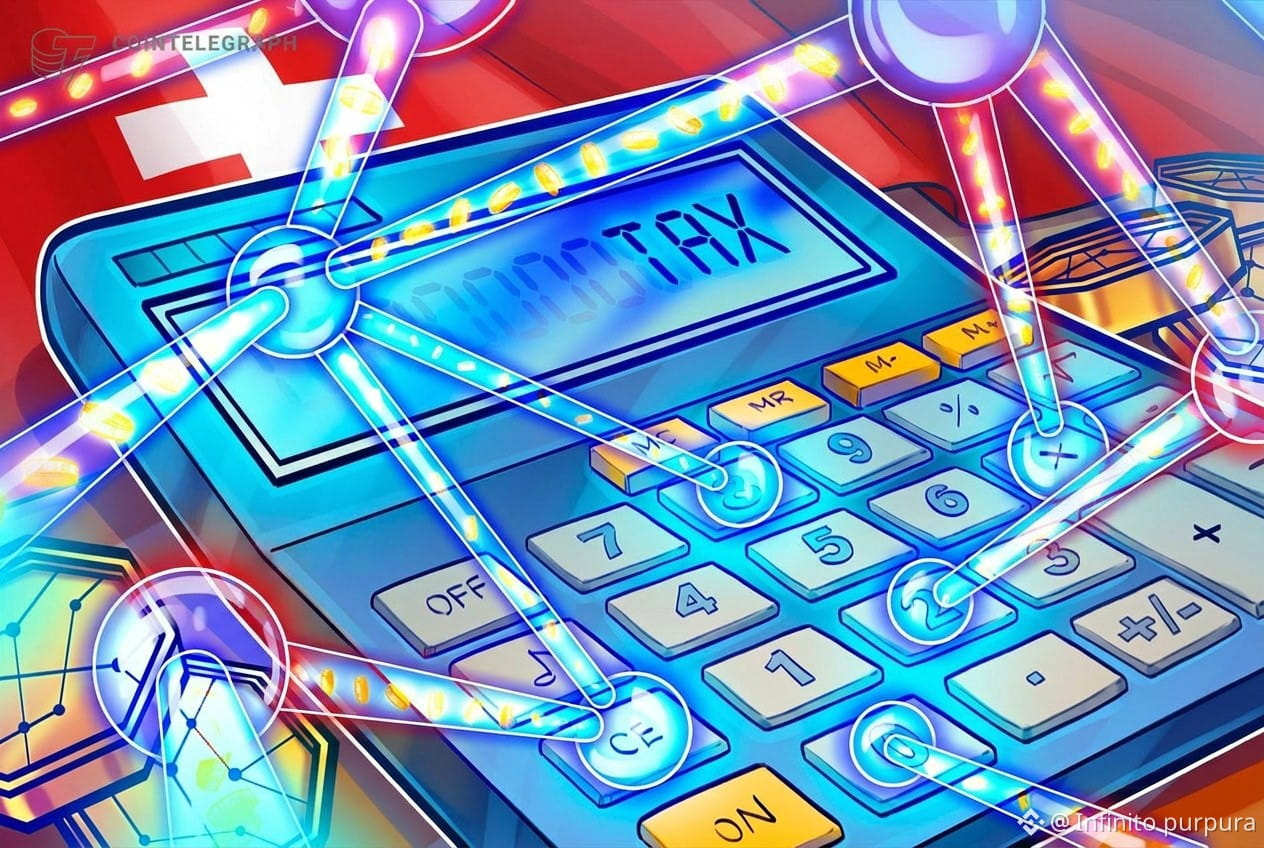
🚨 $BTC THE TAX AUTHORITY'S EYE: Switzerland approves 57 countries for data exchange
While most people think about local regulations, the real impact is global:
• Switzerland authorizes the automatic exchange of crypto data with 57 jurisdictions, including the EU, the UK, and several G20 countries, starting in 2028.
• Providers will have to start collecting customer information from January 1, 2027.
• A total of 76 jurisdictions worldwide have already committed to the OECD's CARF framework.
Do you think this measure will curb tax evasion or push users to seek more opaque havens? 👇
$BTC
#CryptoTax #Regulacion #Markets
8

·
--
Bullish
🇺🇦 Cryptocurrency in Ukraine is finally coming out of the gray zone!
The Verkhovna Rada passed bill No. 10225-д, which establishes rules for taxing cryptocurrencies.
💰 The main point — tax will be paid on profits, not on the entire sale amount.
Bought Bitcoin for $1,000, sold it for $1,500 — tax is calculated only on the $500 profit.
▪️ Standard rate — 23%.
▪️ Preferential 10% rate — for selling previously acquired crypto under special rules until the end of 2028.
▪️ Exchanging BTC for USDT — tax-free.
▪️ Small annual profits within the minimum wage threshold — tax-free.
📅 The new rules are planned to take effect on July 1, 2027, if the president signs the law.
But there’s another side to it: crypto exchanges will provide the tax authorities with information about users’ transactions.👀
#Ukraine #Crypto #Bitcoin #CryptoTax

1
304
·
--
$ETH | NFT flippers ask me about gas fees and royalties. The quieter trap is volume. On the desk, I see collectors assume the 50 percent CGT discount is automatic past 12 months. It is not, once trading frequency tips you into a business.
SatoshiMacro's NFT tax guide runs a worked example: a $50,000 gain held 24 months pays about $9,250 with the discount, versus $18,500 as business income with none. Same gain, double the tax. The guide flags 200+ trades a year as a marker the ATO watches for trader status.
My read: occasional collectors sit safely on capital account. Active flippers should model both outcomes first. It is a factors test, not a bright line, so treat this as a planning flag, not tax advice.
https://satoshimacro.com/guides/crypto/nft-tax-australia/?utm_source=binance_square&utm_medium=social&utm_campaign=autopilot_short-2
#SatoshiMacro #NFTTax #CryptoTax #Ethereum
65

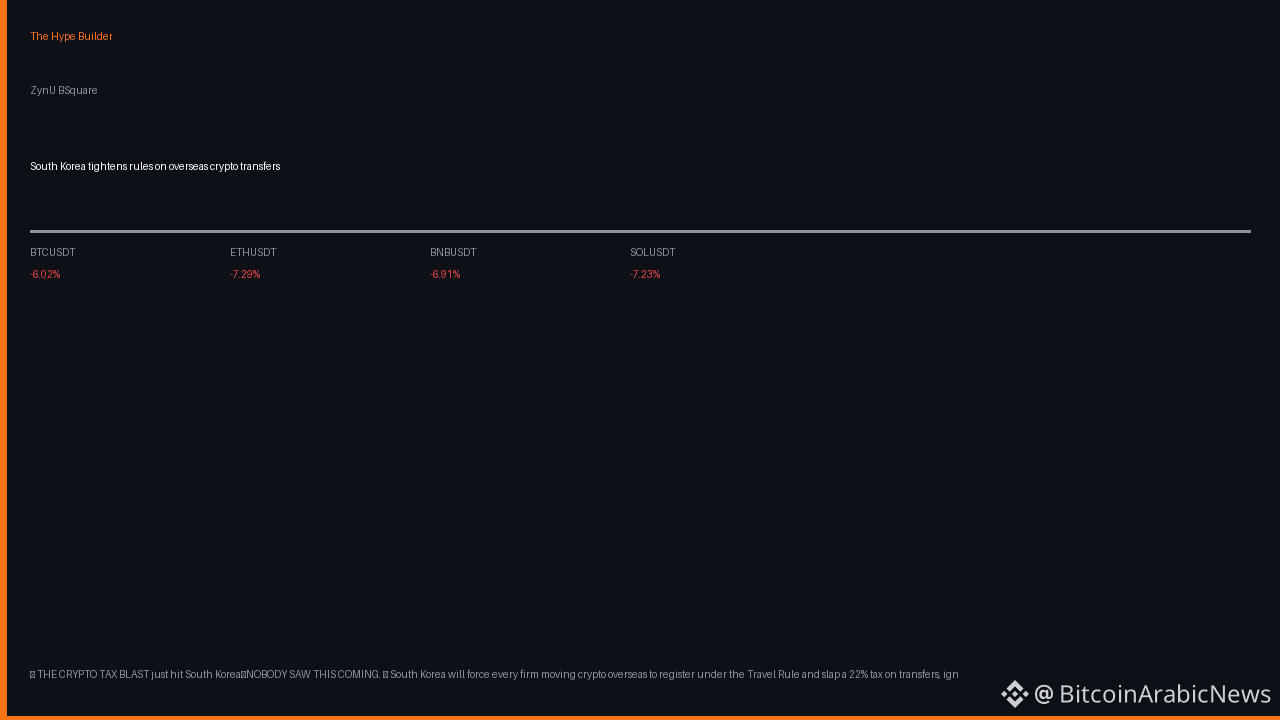
🔥 THE CRYPTO TAX BLAST just hit South Korea—NOBODY SAW THIS COMING.
📊 South Korea will force every firm moving crypto overseas to register under the Travel Rule and slap a 22% tax on transfers, igniting a regulatory firestorm. Market sentiment is already in Extreme Fear at 12/100, while BTC open interest sits at $5.75 B with longs holding 75% of positions and funding nudging bullish at +0.0025%. #CryptoTax #TravelRule #Regulation
💥 This crackdown could trigger massive outflows, pushing #BTC deeper into oversold territory (RSI 22.5) and dragging #BNB lower as institutional traders scramble to re‑balance exposure.
❓ Are you positioning for the wave, or will you watch your gains evaporate?
3

Rep Steven Horsford indicates a bipartisan crypto tax bill may pass the House before the current Congress ends. Achieving legislative clarity on taxation is a massive catalyst for institutional adoption and capital deployment.
#CryptoTax #USPolitics
Rep Steven Horsford indicates a bipartisan crypto tax bill may pass the House before the current Congress ends. Achieving legislative clarity on taxation is a massive catalyst for institutional adoption and capital deployment.
#CryptoTax #USPolitics
#CryptoTax #USPolitics
4
UK Proposes DeFi Tax Deferral
UK regulators are seeking to defer capital gains tax on DeFi lending and liquidity pool transfers until an economic disposal occurs. This move provides much needed clarity for institutional participants and prevents premature tax liabilities during liquidity provision.
#UK #CryptoTax
UK regulators are seeking to defer capital gains tax on DeFi lending and liquidity pool transfers until an economic disposal occurs. This move provides much needed clarity for institutional participants and prevents premature tax liabilities during liquidity provision.
#UK #CryptoTax

7
·
--
$BTC | On the desk the crypto tax mistake I see most is not about swaps. It is a cost base built wrong. Your cost base is the purchase price plus brokerage and transfer fees, not just the coin price. Not pooled either. SatoshiMacro's crypto CGT guide tracks cost base at the parcel level because the ATO expects each parcel dated and priced on its own. Its own worked example: $3,000 cost base, sold 14 months later for $5,000, a $2,000 gain halved to $1,000 taxable under the 50 percent discount. Leave the fees out of that $3,000 and the taxable figure comes out higher than it should. My read is most DIY trackers fail here, not on whether a swap counts as a disposal. General information, not tax advice.
https://satoshimacro.com/guides/crypto/crypto-capital-gains-tax-australia/?utm_source=binance_square&utm_medium=social&utm_campaign=autopilot_short-2
#SatoshiMacro #CryptoTax #CGT #Bitcoin
https://satoshimacro.com/guides/crypto/crypto-capital-gains-tax-australia/?utm_source=binance_square&utm_medium=social&utm_campaign=autopilot_short-2
#SatoshiMacro #CryptoTax #CGT #Bitcoin
69

·
--
⚖️ THE US WANTS TO GET CRYPTO TAXES DONE IN TIME!
On November 20, Congressman Steven Horsford said the US House of Representatives could still consider a bipartisan bill on digital asset taxation before the current Congress adjourns. After speaking with Ways and Means Committee Chairman Jason Smith, he said the proposal could be brought to a vote.
The Digital Asset Tax Certainty Act passed the relevant committee back in September, but a vote by the full House has not yet been scheduled. The bill sets out tax rules for crypto assets, including an exemption from recognizing gains or losses when paying certain network fees of up to $10.
The bill would also extend wash sale rules to traded digital assets. These are proposals, not tax rules currently in effect.
Source: The Block, November 20, 2026.
#CryptoTax #Regulation
117
·
--
$BTC | Most Australians open crypto tax software in October, months after the year that mattered closed out. FY2026-27 started 1 July, and if your year ran through any DeFi, that is the window where mistakes compound.
SatoshiMacro's review of Summ (Sydney-based, formerly CryptoTaxCalculator) flags why it earns its premium over Koinly on messy books: 3,500+ integrations covering 1,500+ DeFi protocols, lending and liquidity-pool events classified per ATO rules as they happen.
On the desk, for a heavy multi-chain year I run a second engine alongside it since the two disagree on bridging edge cases. Pricing runs AUD 99 to 299 a year.
My read: the premium pays off once DeFi gets genuinely messy, not for a simple spot book.
https://satoshimacro.com/reviews/crypto/summ-review/?utm_source=binance_square&utm_medium=social&utm_campaign=autopilot_short-2
#SatoshiMacro #CryptoTax #DeFi #Bitcoin
52
Log in to explore more content
Join global crypto users on Binance Square
⚡️ Get latest and useful information about crypto.
💬 Trusted by the world’s largest crypto exchange.
👍 Discover real insights from verified creators.
Email / Phone number
Trending Topics
1
#CanMarketsReboundAfterThanksgiving?
39,846 views
796 Discussing
2
#CouldSpaceX’sOrbitalDataCentersBoostAIChipDemand?
24,363 views
492 Discussing
3
#EvolveAtBinanceBlockchainWeek
691,281 views
7,903 Discussing
4
#CorePCEBeatLiftsFedHikeOdds
199,506 views
1,524 Discussing
5
#BitcoinAndStocksSlipAgainAmidTrump’sTariffPlans
240,847 views
2,271 Discussing
6
#JensenHuangSaysNvidiaDoesn’tNeedASuccessionPlan
114,916 views
1,355 Discussing
7
#NasdaqFuturesSlideMoreThan3%
50,550 views
443 Discussing
8
#USOctoberPCEPriceIndexAt0.3%MoM
57,580 views
438 Discussing
9
#BitcoinETFsPostRecord$4.94BNovemberOutflows
10,549 views
57 Discussing
10
#TetherInvestsInArgentinasLemon
21,897 views
264 Discussing