
#travelrule
travelrule
3,313 views
71 Discussing
Hot
Latest

·
--
📉 Thailand SEC Tightens Rules for Self-Custody Crypto Transfers
🇹🇭 Thailand’s Securities and Exchange Commission (SEC) has implemented a crypto Travel Rule requiring digital asset operators to verify the ownership or control of self-custody wallets when customers transfer crypto to or from them.
🔍 The move is designed to strengthen transaction monitoring, transparency, and regulatory compliance across Thailand’s digital asset market.
⚠️ For users, this could mean additional verification when moving crypto between exchanges and personal wallets.
What do you think: Will stricter self-custody rules improve crypto security, or reduce user privacy? 👀
#ThailandCrypto #CryptoRegulation #SelfCustody #TravelRule
📉 Thailand SEC Tightens Rules for Self-Custody Crypto Transfers
🇹🇭 Thailand’s Securities and Exchange Commission (SEC) has implemented a crypto Travel Rule requiring digital asset operators to verify the ownership or control of self-custody wallets when customers transfer crypto to or from them.
🔍 The move is designed to strengthen transaction monitoring, transparency, and regulatory compliance across Thailand’s digital asset market.
⚠️ For users, this could mean additional verification when moving crypto between exchanges and personal wallets.
What do you think: Will stricter self-custody rules improve crypto security, or reduce user privacy? 👀
#ThailandCrypto #CryptoRegulation #SelfCustody #TravelRule
🇹🇭 Thailand’s Securities and Exchange Commission (SEC) has implemented a crypto Travel Rule requiring digital asset operators to verify the ownership or control of self-custody wallets when customers transfer crypto to or from them.
🔍 The move is designed to strengthen transaction monitoring, transparency, and regulatory compliance across Thailand’s digital asset market.
⚠️ For users, this could mean additional verification when moving crypto between exchanges and personal wallets.
What do you think: Will stricter self-custody rules improve crypto security, or reduce user privacy? 👀
#ThailandCrypto #CryptoRegulation #SelfCustody #TravelRule

63

·
--
Did you know your crypto transactions might soon have a digital footprint for years to come? 🤔
THE CONCEPT: Thailand is rolling out a "Travel Rule" for crypto. Think of it like the wire transfer rules for traditional banking – it means exchanges will need to share sender and receiver info for crypto transfers. This is all about transparency and preventing illicit activities. #CryptoRegulation #TravelRule
THE REAL-WORLD EXAMPLE: Imagine sending crypto to a friend. Under the new Thai rule, the exchange you use will have to keep a record of who sent it, who received it, and for how long (in this case, five years!). This helps authorities track suspicious transactions, just like they can with bank transfers.
THE TAKEAWAY: While this might seem like a big brother move, it’s a step towards making crypto safer and more mainstream by increasing accountability. Stay informed about how regulations like this can impact your crypto journey. #CryptoEducation
What are your thoughts on crypto regulations like Thailand's Travel Rule? Let's discuss in the comments!
Did you know your crypto transactions might soon have a digital footprint for years to come? 🤔
THE CONCEPT: Thailand is rolling out a "Travel Rule" for crypto. Think of it like the wire transfer rules for traditional banking – it means exchanges will need to share sender and receiver info for crypto transfers. This is all about transparency and preventing illicit activities. #CryptoRegulation #TravelRule
THE REAL-WORLD EXAMPLE: Imagine sending crypto to a friend. Under the new Thai rule, the exchange you use will have to keep a record of who sent it, who received it, and for how long (in this case, five years!). This helps authorities track suspicious transactions, just like they can with bank transfers.
THE TAKEAWAY: While this might seem like a big brother move, it’s a step towards making crypto safer and more mainstream by increasing accountability. Stay informed about how regulations like this can impact your crypto journey. #CryptoEducation
What are your thoughts on crypto regulations like Thailand's Travel Rule? Let's discuss in the comments!
THE CONCEPT: Thailand is rolling out a "Travel Rule" for crypto. Think of it like the wire transfer rules for traditional banking – it means exchanges will need to share sender and receiver info for crypto transfers. This is all about transparency and preventing illicit activities. #CryptoRegulation #TravelRule
THE REAL-WORLD EXAMPLE: Imagine sending crypto to a friend. Under the new Thai rule, the exchange you use will have to keep a record of who sent it, who received it, and for how long (in this case, five years!). This helps authorities track suspicious transactions, just like they can with bank transfers.
THE TAKEAWAY: While this might seem like a big brother move, it’s a step towards making crypto safer and more mainstream by increasing accountability. Stay informed about how regulations like this can impact your crypto journey. #CryptoEducation
What are your thoughts on crypto regulations like Thailand's Travel Rule? Let's discuss in the comments!
3

Thailand's SEC is proposing new Travel Rule requirements that would force digital asset operators to collect and retain crypto transfer records for five years.
#ThailandSEC #TravelRule
Thailand's SEC is proposing new Travel Rule requirements that would force digital asset operators to collect and retain crypto transfer records for five years.
#ThailandSEC #TravelRule
#ThailandSEC #TravelRule
5

·
--
Thailand is starting to take things seriously! Officially implementing the encrypted Travel Rule: going forward, when withdrawing from a platform to a self-custody wallet, the proceeds from the transaction must first be verified to ensure the wallet belongs to you, and the transaction data must be retained for 5 years.
In plain terms, this is shutting down half the route for anonymous withdrawals; privacy enthusiasts are definitely not going to be happy. But from another perspective, this is Thailand aligning with FATF international standards. The clearer the rules, the more institutional capital dares to move in—this is actually a sign of normalization.
In the short term, retail users may find it troublesome and exit, and volatility is inevitable; but in the long run, regulatory compliance being implemented means another solid foundation for a bull market. Regulation isn’t a negative—it’s your entry ticket.
$BTC $ETH #TravelRule #crypto regulation
Thailand is starting to take things seriously! Officially implementing the encrypted Travel Rule: going forward, when withdrawing from a platform to a self-custody wallet, the proceeds from the transaction must first be verified to ensure the wallet belongs to you, and the transaction data must be retained for 5 years.
In plain terms, this is shutting down half the route for anonymous withdrawals; privacy enthusiasts are definitely not going to be happy. But from another perspective, this is Thailand aligning with FATF international standards. The clearer the rules, the more institutional capital dares to move in—this is actually a sign of normalization.
In the short term, retail users may find it troublesome and exit, and volatility is inevitable; but in the long run, regulatory compliance being implemented means another solid foundation for a bull market. Regulation isn’t a negative—it’s your entry ticket.
$BTC $ETH #TravelRule #crypto regulation
In plain terms, this is shutting down half the route for anonymous withdrawals; privacy enthusiasts are definitely not going to be happy. But from another perspective, this is Thailand aligning with FATF international standards. The clearer the rules, the more institutional capital dares to move in—this is actually a sign of normalization.
In the short term, retail users may find it troublesome and exit, and volatility is inevitable; but in the long run, regulatory compliance being implemented means another solid foundation for a bull market. Regulation isn’t a negative—it’s your entry ticket.
$BTC $ETH #TravelRule #crypto regulation
320

📜 Regulation 101: Understanding the Travel Rule
On June 30, 2026, Australia's Travel Rule takes effect July 1, joining 40+ countries implementing FATF Recommendation 16. The Travel Rule requires crypto exchanges to share sender and recipient information for transactions above a threshold — similar to traditional banking requirements.
For everyday users, this means exchanges may require additional verification for certain transfers. The goal is to prevent money laundering and illicit finance. Privacy-focused alternatives like decentralized exchanges and privacy coins may become more relevant as Travel Rule adoption grows.
📌 Key Takeaway:
The Travel Rule brings crypto closer to traditional banking compliance — a step toward mainstream adoption that also raises important privacy considerations.
#FATF #TravelRule #CryptoRegulation
#BinanceAlphaAlert
📜 Regulation 101: Understanding the Travel Rule
On June 30, 2026, Australia's Travel Rule takes effect July 1, joining 40+ countries implementing FATF Recommendation 16. The Travel Rule requires crypto exchanges to share sender and recipient information for transactions above a threshold — similar to traditional banking requirements.
For everyday users, this means exchanges may require additional verification for certain transfers. The goal is to prevent money laundering and illicit finance. Privacy-focused alternatives like decentralized exchanges and privacy coins may become more relevant as Travel Rule adoption grows.
📌 Key Takeaway:
The Travel Rule brings crypto closer to traditional banking compliance — a step toward mainstream adoption that also raises important privacy considerations.
#FATF #TravelRule #CryptoRegulation
#BinanceAlphaAlert
On June 30, 2026, Australia's Travel Rule takes effect July 1, joining 40+ countries implementing FATF Recommendation 16. The Travel Rule requires crypto exchanges to share sender and recipient information for transactions above a threshold — similar to traditional banking requirements.
For everyday users, this means exchanges may require additional verification for certain transfers. The goal is to prevent money laundering and illicit finance. Privacy-focused alternatives like decentralized exchanges and privacy coins may become more relevant as Travel Rule adoption grows.
📌 Key Takeaway:
The Travel Rule brings crypto closer to traditional banking compliance — a step toward mainstream adoption that also raises important privacy considerations.
#FATF #TravelRule #CryptoRegulation
#BinanceAlphaAlert
72

South Korea has officially “closed the loopholes” in how shark-vibe wallets like to split transactions. Could this be the reason behind $BTC turning around near the 63.914,2 USD mark?
South Korea has scrapped the 1 million won threshold for the Travel Rule, meaning all upcoming crypto transactions will be monitored. From a money-flow perspective, this tightening causes large capital to either pull back or go idle while it waits and watches. The immediate reaction showed when, at the time of writing, both $BTC (-2.00%) and $ETH (-2.76%) were in the red.
In my view, this cautious mindset right now can easily create those annoying liquidity-sweeping moves. Sharks may use the news to push prices even deeper, in order to scoop up cheap inventory. During this period, you guys should place orders with smaller volume, and watch for strong support instead of rushing to catch the bottom. We still can’t be sure whether the price has already formed a bottom. Good risk management is what will keep us in the game.
In this zone, would you choose LONG or SHORT for $BTC? Hit $BTC below and let’s review the chart together! 👇
#Bitcoin #TravelRule #Phaply #Crypto
South Korea has officially “closed the loopholes” in how shark-vibe wallets like to split transactions. Could this be the reason behind $BTC turning around near the 63.914,2 USD mark?
South Korea has scrapped the 1 million won threshold for the Travel Rule, meaning all upcoming crypto transactions will be monitored. From a money-flow perspective, this tightening causes large capital to either pull back or go idle while it waits and watches. The immediate reaction showed when, at the time of writing, both $BTC (-2.00%) and $ETH (-2.76%) were in the red.
In my view, this cautious mindset right now can easily create those annoying liquidity-sweeping moves. Sharks may use the news to push prices even deeper, in order to scoop up cheap inventory. During this period, you guys should place orders with smaller volume, and watch for strong support instead of rushing to catch the bottom. We still can’t be sure whether the price has already formed a bottom. Good risk management is what will keep us in the game.
In this zone, would you choose LONG or SHORT for $BTC ? Hit $BTC below and let’s review the chart together! 👇
#Bitcoin #TravelRule #Phaply #Crypto
South Korea has scrapped the 1 million won threshold for the Travel Rule, meaning all upcoming crypto transactions will be monitored. From a money-flow perspective, this tightening causes large capital to either pull back or go idle while it waits and watches. The immediate reaction showed when, at the time of writing, both $BTC (-2.00%) and $ETH (-2.76%) were in the red.
In my view, this cautious mindset right now can easily create those annoying liquidity-sweeping moves. Sharks may use the news to push prices even deeper, in order to scoop up cheap inventory. During this period, you guys should place orders with smaller volume, and watch for strong support instead of rushing to catch the bottom. We still can’t be sure whether the price has already formed a bottom. Good risk management is what will keep us in the game.
In this zone, would you choose LONG or SHORT for $BTC ? Hit $BTC below and let’s review the chart together! 👇
#Bitcoin #TravelRule #Phaply #Crypto
49

South Korea removes the 1 million won threshold, applying the Travel Rule to all crypto transfers
- South Korea eliminates the 1 million won threshold for the Travel Rule
- Requires sharing information applicable to all transfers between registered crypto service providers
- Goal: enhance transparency, prevent money laundering
- Impact: costs, procedures for crypto transactions
- #TravelRule #CryptoRegulation #SouthKorea
$btc $eth
#vlikevn #Titanbot
Source: CoinTelegraph
South Korea removes the 1 million won threshold, applying the Travel Rule to all crypto transfers
- South Korea eliminates the 1 million won threshold for the Travel Rule
- Requires sharing information applicable to all transfers between registered crypto service providers
- Goal: enhance transparency, prevent money laundering
- Impact: costs, procedures for crypto transactions
- #TravelRule #CryptoRegulation #SouthKorea
$btc $eth
#vlikevn #Titanbot
Source: CoinTelegraph
- South Korea eliminates the 1 million won threshold for the Travel Rule
- Requires sharing information applicable to all transfers between registered crypto service providers
- Goal: enhance transparency, prevent money laundering
- Impact: costs, procedures for crypto transactions
- #TravelRule #CryptoRegulation #SouthKorea
$btc $eth
#vlikevn #Titanbot
Source: CoinTelegraph
42

🚨 Cryptocurrency Travel Rule Guidelines 🧠
📊 | $BTC | $ETH | $BNB |
- Please follow, like, and comment on this post 📈
- Transactions between cryptocurrency exchanges may share personal identity information
- The Travel Rule is a banking standard from decades ago, and it is now reshaping the crypto market
- The rule requires exchanges to share user information when the transaction amount exceeds a certain threshold
- Implementation of this rule may have far-reaching effects on the cryptocurrency market 🔥
- The market may face downward pressure and panic-driven volatility due to the implementation of the Travel Rule
- Whales may respond to market changes by allocating funds or accumulating positions
- Large volatility is expected in the cryptocurrency market in the short term
- Or new market trends and investment opportunities may emerge
- Readers, how do you view the impact of the Travel Rule on the cryptocurrency market?
- Please continue to follow and comment on this post—let’s discuss the future of the cryptocurrency market
#Bitcoin #Crypto #TravelRule #Blockchain #Trading
🚨 Cryptocurrency Travel Rule Guidelines 🧠
📊 | $BTC | $ETH | $BNB |
- Please follow, like, and comment on this post 📈
- Transactions between cryptocurrency exchanges may share personal identity information
- The Travel Rule is a banking standard from decades ago, and it is now reshaping the crypto market
- The rule requires exchanges to share user information when the transaction amount exceeds a certain threshold
- Implementation of this rule may have far-reaching effects on the cryptocurrency market 🔥
- The market may face downward pressure and panic-driven volatility due to the implementation of the Travel Rule
- Whales may respond to market changes by allocating funds or accumulating positions
- Large volatility is expected in the cryptocurrency market in the short term
- Or new market trends and investment opportunities may emerge
- Readers, how do you view the impact of the Travel Rule on the cryptocurrency market?
- Please continue to follow and comment on this post—let’s discuss the future of the cryptocurrency market
#Bitcoin #Crypto #TravelRule #Blockchain #Trading
📊 | $BTC | $ETH | $BNB |
- Please follow, like, and comment on this post 📈
- Transactions between cryptocurrency exchanges may share personal identity information
- The Travel Rule is a banking standard from decades ago, and it is now reshaping the crypto market
- The rule requires exchanges to share user information when the transaction amount exceeds a certain threshold
- Implementation of this rule may have far-reaching effects on the cryptocurrency market 🔥
- The market may face downward pressure and panic-driven volatility due to the implementation of the Travel Rule
- Whales may respond to market changes by allocating funds or accumulating positions
- Large volatility is expected in the cryptocurrency market in the short term
- Or new market trends and investment opportunities may emerge
- Readers, how do you view the impact of the Travel Rule on the cryptocurrency market?
- Please continue to follow and comment on this post—let’s discuss the future of the cryptocurrency market
#Bitcoin #Crypto #TravelRule #Blockchain #Trading
141

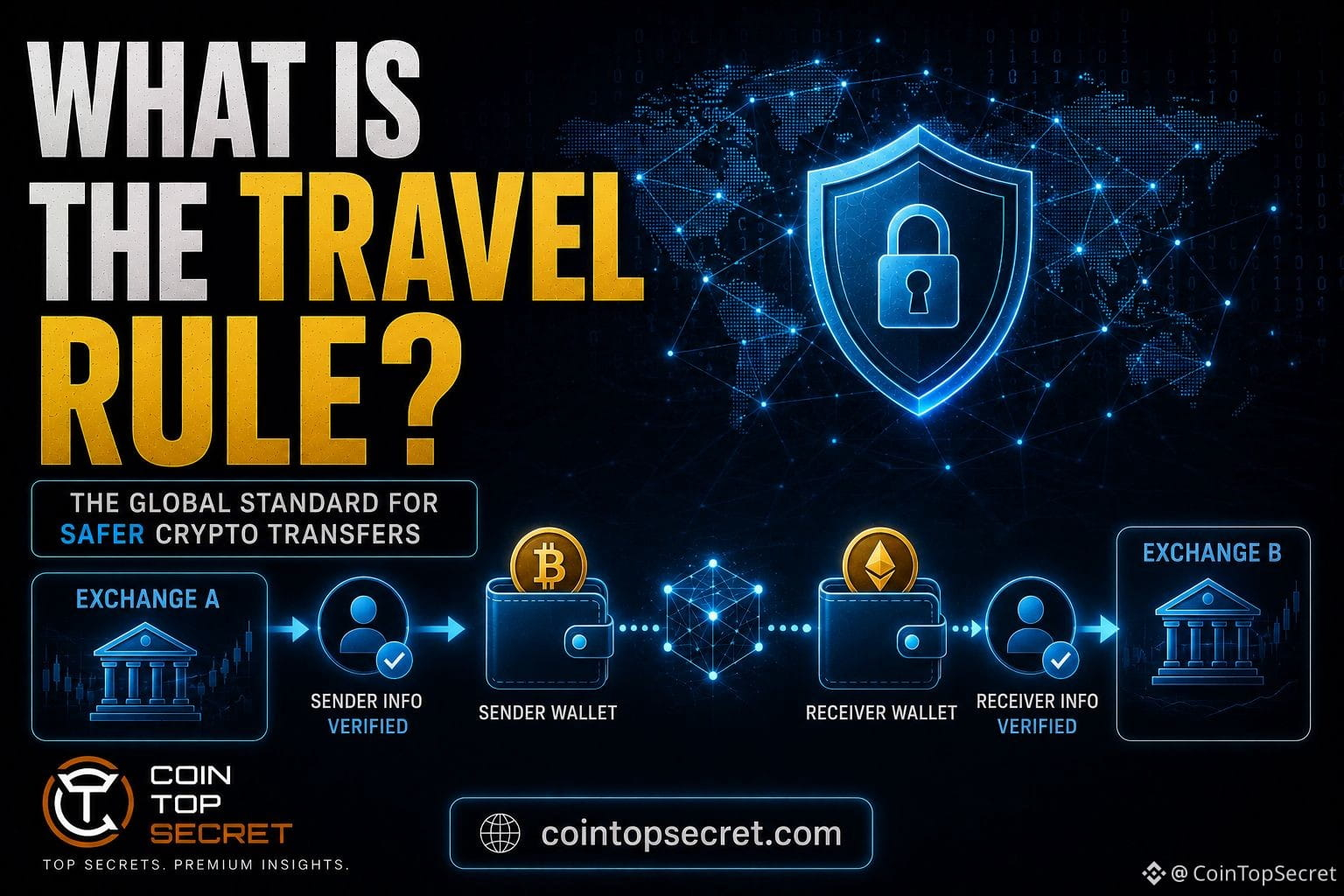
🔍 What Is the Crypto Travel Rule?
The Travel Rule is reshaping crypto compliance by requiring exchanges to share customer information for certain transactions.
📖 Read more:
https://cointopsecret.com/
#TravelRule #Crypto #AML #KYC #CryptoNews
🔍 What Is the Crypto Travel Rule?
The Travel Rule is reshaping crypto compliance by requiring exchanges to share customer information for certain transactions.
📖 Read more:
https://cointopsecret.com/
#TravelRule #Crypto #AML #KYC #CryptoNews
The Travel Rule is reshaping crypto compliance by requiring exchanges to share customer information for certain transactions.
📖 Read more:
https://cointopsecret.com/
#TravelRule #Crypto #AML #KYC #CryptoNews
15
📜 Compliance Corner: Australian Exchanges Gear Up for Travel Rule
On June 30, 2026, Australian crypto exchanges are implementing systems to comply with the Travel Rule taking effect July 1. The rule requires collecting beneficiary information for transfers, a significant operational change for platforms accustomed to pseudonymous transactions.
The cost of compliance will likely accelerate consolidation among smaller exchanges that lack resources. Larger, compliant platforms will benefit from the 'flight to quality' as users migrate to regulated venues.
📌 Key Takeaway:
Australia's Travel Rule will accelerate exchange consolidation, benefiting compliant platforms while raising the barrier to entry for smaller players.
#Australia #TravelRule #CryptoExchanges
#BinanceAlphaAlert
📜 Compliance Corner: Australian Exchanges Gear Up for Travel Rule
On June 30, 2026, Australian crypto exchanges are implementing systems to comply with the Travel Rule taking effect July 1. The rule requires collecting beneficiary information for transfers, a significant operational change for platforms accustomed to pseudonymous transactions.
The cost of compliance will likely accelerate consolidation among smaller exchanges that lack resources. Larger, compliant platforms will benefit from the 'flight to quality' as users migrate to regulated venues.
📌 Key Takeaway:
Australia's Travel Rule will accelerate exchange consolidation, benefiting compliant platforms while raising the barrier to entry for smaller players.
#Australia #TravelRule #CryptoExchanges
#BinanceAlphaAlert
On June 30, 2026, Australian crypto exchanges are implementing systems to comply with the Travel Rule taking effect July 1. The rule requires collecting beneficiary information for transfers, a significant operational change for platforms accustomed to pseudonymous transactions.
The cost of compliance will likely accelerate consolidation among smaller exchanges that lack resources. Larger, compliant platforms will benefit from the 'flight to quality' as users migrate to regulated venues.
📌 Key Takeaway:
Australia's Travel Rule will accelerate exchange consolidation, benefiting compliant platforms while raising the barrier to entry for smaller players.
#Australia #TravelRule #CryptoExchanges
#BinanceAlphaAlert
20

·
--
South Korea is set to scrap the crypto Travel Rule transaction threshold, and now even transfers as small as $10 will require identity checks?
The Korea FIU officially proposed at the FATF meeting to eliminate the minimum transaction threshold for the Travel Rule. This means all crypto transfers will need to verify the identities of both the sender and receiver. South Korea is already geared up for this change, expected to take effect in August, wiping the current threshold of 1 million KRW clean. Previously, exchanges were worried about the high costs, but it eventually shifted to a risk-based approach where operators set their own standards. The FATF itself admits that the global compliance situation for crypto AML isn't very optimistic, and places with high trading volumes often have the loosest regulations. If this proposal is followed by FATF members, global exchanges will have to conduct KYC for every tiny trade, and compliance costs are expected to double. For users, the transfer process might become longer and more cumbersome. However, on the flip side, the old trick of splitting transfers to evade scrutiny seems to be blocked now. #Crypto #Regulation #TravelRule
#Crypto #TravelRule
South Korea is set to scrap the crypto Travel Rule transaction threshold, and now even transfers as small as $10 will require identity checks?
The Korea FIU officially proposed at the FATF meeting to eliminate the minimum transaction threshold for the Travel Rule. This means all crypto transfers will need to verify the identities of both the sender and receiver. South Korea is already geared up for this change, expected to take effect in August, wiping the current threshold of 1 million KRW clean. Previously, exchanges were worried about the high costs, but it eventually shifted to a risk-based approach where operators set their own standards. The FATF itself admits that the global compliance situation for crypto AML isn't very optimistic, and places with high trading volumes often have the loosest regulations. If this proposal is followed by FATF members, global exchanges will have to conduct KYC for every tiny trade, and compliance costs are expected to double. For users, the transfer process might become longer and more cumbersome. However, on the flip side, the old trick of splitting transfers to evade scrutiny seems to be blocked now. #Crypto #Regulation #TravelRule
#Crypto #TravelRule
The Korea FIU officially proposed at the FATF meeting to eliminate the minimum transaction threshold for the Travel Rule. This means all crypto transfers will need to verify the identities of both the sender and receiver. South Korea is already geared up for this change, expected to take effect in August, wiping the current threshold of 1 million KRW clean. Previously, exchanges were worried about the high costs, but it eventually shifted to a risk-based approach where operators set their own standards. The FATF itself admits that the global compliance situation for crypto AML isn't very optimistic, and places with high trading volumes often have the loosest regulations. If this proposal is followed by FATF members, global exchanges will have to conduct KYC for every tiny trade, and compliance costs are expected to double. For users, the transfer process might become longer and more cumbersome. However, on the flip side, the old trick of splitting transfers to evade scrutiny seems to be blocked now. #Crypto #Regulation #TravelRule
#Crypto #TravelRule
4
🌏 Regulation Update: Australia Implements FATF Travel Rule
On June 30, 2026, Australia's crypto travel rule is set to take effect on July 1. The regulation requires Virtual Asset Service Providers (VASPs) to collect and share sender and recipient information for transactions above a certain threshold, aligning with FATF standards.
Australia joins a growing list of jurisdictions implementing the Travel Rule. While it adds compliance burdens for exchanges, it also legitimizes crypto by bringing it under the same regulatory framework as traditional finance.
📌 Key Takeaway:
Australia's Travel Rule marks another step toward mainstream crypto integration — compliance friction today paves the way for institutional adoption tomorrow.
#CryptoRegulation #Australia #TravelRule
#BinanceAlphaAlert
🌏 Regulation Update: Australia Implements FATF Travel Rule
On June 30, 2026, Australia's crypto travel rule is set to take effect on July 1. The regulation requires Virtual Asset Service Providers (VASPs) to collect and share sender and recipient information for transactions above a certain threshold, aligning with FATF standards.
Australia joins a growing list of jurisdictions implementing the Travel Rule. While it adds compliance burdens for exchanges, it also legitimizes crypto by bringing it under the same regulatory framework as traditional finance.
📌 Key Takeaway:
Australia's Travel Rule marks another step toward mainstream crypto integration — compliance friction today paves the way for institutional adoption tomorrow.
#CryptoRegulation #Australia #TravelRule
#BinanceAlphaAlert
On June 30, 2026, Australia's crypto travel rule is set to take effect on July 1. The regulation requires Virtual Asset Service Providers (VASPs) to collect and share sender and recipient information for transactions above a certain threshold, aligning with FATF standards.
Australia joins a growing list of jurisdictions implementing the Travel Rule. While it adds compliance burdens for exchanges, it also legitimizes crypto by bringing it under the same regulatory framework as traditional finance.
📌 Key Takeaway:
Australia's Travel Rule marks another step toward mainstream crypto integration — compliance friction today paves the way for institutional adoption tomorrow.
#CryptoRegulation #Australia #TravelRule
#BinanceAlphaAlert
20

AUSTRALIA'S TRAVEL RULE IS LIVE AND IT HITS $SYN HARD 🚨
60-100 words body: This regulation forces exchanges to collect extra data on every transfer. The crypto community is split—some call it necessary compliance, others say it strangles innovation. With the rule taking effect now, any delays or friction in the flow of $SYN could create immediate price reactions. Smart money often moves ahead of regulations, and this one is no different.
What's your take—does this kill the vibe or clean up the space?
Not financial advice. Always manage your risk.
#SYN #Regulation #CryptoNews #TravelRule
🔥
AUSTRALIA'S TRAVEL RULE IS LIVE AND IT HITS $SYN HARD 🚨
60-100 words body: This regulation forces exchanges to collect extra data on every transfer. The crypto community is split—some call it necessary compliance, others say it strangles innovation. With the rule taking effect now, any delays or friction in the flow of $SYN could create immediate price reactions. Smart money often moves ahead of regulations, and this one is no different.
What's your take—does this kill the vibe or clean up the space?
Not financial advice. Always manage your risk.
#SYN #Regulation #CryptoNews #TravelRule
🔥
60-100 words body: This regulation forces exchanges to collect extra data on every transfer. The crypto community is split—some call it necessary compliance, others say it strangles innovation. With the rule taking effect now, any delays or friction in the flow of $SYN could create immediate price reactions. Smart money often moves ahead of regulations, and this one is no different.
What's your take—does this kill the vibe or clean up the space?
Not financial advice. Always manage your risk.
#SYN #Regulation #CryptoNews #TravelRule
🔥
99

·
--
Bullish
🔒 Goodbye to anonymity? Europe introduces the "Travel Rule" regulation for crypto transfers
The global regulatory landscape is tightening its grip once again. The European Union has just officially launched a strict directive known as the "Travel Rule" (Travel Rule),
transforming the way digital asset transactions are processed across the continent.
📋 The new rules of the game:
Mandatory identification: From now on, regulated exchanges within the EU must collect and transmit the verified data of the sender and the recipient for every transaction, regardless of the amount.
Focus on cold wallets: Transfers to or from self-custody wallets (such as Ledger or Trezor) will go through automated risk filters if they exceed the limits set by financial service providers.
Market reaction: Although the measure is sparking debate in the community over privacy concerns, major investors in $BTC and stablecoins like $USDC view the legal clarity favorably, seeing it as a necessary step toward greater bank adoption.
⚓ The technical pulse: While the infrastructure adapts to Europe’s regulatory requirements, the price of $BTC is still testing the psychological resistance zone of $62,500, showing that the spot market had already absorbed much of this regulatory impact.
Do you think this level of oversight will help institutional adoption, or does it break the decentralized essence of the ecosystem? 👇
#CryptoRegulation #TravelRule #CryptoNews #Bitcoin #USDC/USDT #BTC #Binance #TradingCommunity
{future}(BNBUSDT)
{future}(BTCUSDT)
🔒 Goodbye to anonymity? Europe introduces the "Travel Rule" regulation for crypto transfers
The global regulatory landscape is tightening its grip once again. The European Union has just officially launched a strict directive known as the "Travel Rule" (Travel Rule),
transforming the way digital asset transactions are processed across the continent.
📋 The new rules of the game:
Mandatory identification: From now on, regulated exchanges within the EU must collect and transmit the verified data of the sender and the recipient for every transaction, regardless of the amount.
Focus on cold wallets: Transfers to or from self-custody wallets (such as Ledger or Trezor) will go through automated risk filters if they exceed the limits set by financial service providers.
Market reaction: Although the measure is sparking debate in the community over privacy concerns, major investors in $BTC and stablecoins like $USDC view the legal clarity favorably, seeing it as a necessary step toward greater bank adoption.
⚓ The technical pulse: While the infrastructure adapts to Europe’s regulatory requirements, the price of $BTC is still testing the psychological resistance zone of $62,500, showing that the spot market had already absorbed much of this regulatory impact.
Do you think this level of oversight will help institutional adoption, or does it break the decentralized essence of the ecosystem? 👇
#CryptoRegulation #TravelRule #CryptoNews #Bitcoin #USDC/USDT #BTC #Binance #TradingCommunity
The global regulatory landscape is tightening its grip once again. The European Union has just officially launched a strict directive known as the "Travel Rule" (Travel Rule),
transforming the way digital asset transactions are processed across the continent.
📋 The new rules of the game:
Mandatory identification: From now on, regulated exchanges within the EU must collect and transmit the verified data of the sender and the recipient for every transaction, regardless of the amount.
Focus on cold wallets: Transfers to or from self-custody wallets (such as Ledger or Trezor) will go through automated risk filters if they exceed the limits set by financial service providers.
Market reaction: Although the measure is sparking debate in the community over privacy concerns, major investors in $BTC and stablecoins like $USDC view the legal clarity favorably, seeing it as a necessary step toward greater bank adoption.
⚓ The technical pulse: While the infrastructure adapts to Europe’s regulatory requirements, the price of $BTC is still testing the psychological resistance zone of $62,500, showing that the spot market had already absorbed much of this regulatory impact.
Do you think this level of oversight will help institutional adoption, or does it break the decentralized essence of the ecosystem? 👇
#CryptoRegulation #TravelRule #CryptoNews #Bitcoin #USDC/USDT #BTC #Binance #TradingCommunity
22

·
--
Bullish
#southkoreaproposesbroadercryptotravelrule
🚨 South Korea Just Dropped a Major Crypto Bombshell: Broader Travel Rule Incoming! 🇰🇷💥 Hey #BinanceSquare fam, buckle up! South Korea is pushing to remove the 1M KRW (~$700) threshold entirely for the Crypto Travel Rule. That means every single transfer — even your small coffee-sized BTC moves — could soon require full sender/receiver data sharing between VASPs.Practiceguides.chambers Why this matters: Goal: Crack down on "smurfing" (structuring small transfers to dodge rules), tax evasion, and illicit flows. Impact: More KYC friction, slower transactions, and potentially higher compliance costs for exchanges like Upbit & Bithumb. Some are already pushing back hard.@apacfinstab Global ripple effect? This could set a precedent for stricter AML rules worldwide. Crypto winters taught us resilience, but regulations like this test true adoption. Is this smart oversight or overreach that could drive users offshore? Will it hurt Korea's vibrant retail scene or clean up the market for the long haul? Drop your thoughts below 👇 Bullish on stricter rules for legitimacy? Or worried about friction killing momentum? #SouthKoreaProposesBroaderCryptoTravelRule #CryptoRegulation #TravelRule
$BTC $ETH $DOLO
#southkoreaproposesbroadercryptotravelrule
🚨 South Korea Just Dropped a Major Crypto Bombshell: Broader Travel Rule Incoming! 🇰🇷💥 Hey #BinanceSquare fam, buckle up! South Korea is pushing to remove the 1M KRW (~$700) threshold entirely for the Crypto Travel Rule. That means every single transfer — even your small coffee-sized BTC moves — could soon require full sender/receiver data sharing between VASPs.Practiceguides.chambers Why this matters: Goal: Crack down on "smurfing" (structuring small transfers to dodge rules), tax evasion, and illicit flows. Impact: More KYC friction, slower transactions, and potentially higher compliance costs for exchanges like Upbit & Bithumb. Some are already pushing back hard.@apacfinstab Global ripple effect? This could set a precedent for stricter AML rules worldwide. Crypto winters taught us resilience, but regulations like this test true adoption. Is this smart oversight or overreach that could drive users offshore? Will it hurt Korea's vibrant retail scene or clean up the market for the long haul? Drop your thoughts below 👇 Bullish on stricter rules for legitimacy? Or worried about friction killing momentum? #SouthKoreaProposesBroaderCryptoTravelRule #CryptoRegulation #TravelRule
$BTC $ETH $DOLO
🚨 South Korea Just Dropped a Major Crypto Bombshell: Broader Travel Rule Incoming! 🇰🇷💥 Hey #BinanceSquare fam, buckle up! South Korea is pushing to remove the 1M KRW (~$700) threshold entirely for the Crypto Travel Rule. That means every single transfer — even your small coffee-sized BTC moves — could soon require full sender/receiver data sharing between VASPs.Practiceguides.chambers Why this matters: Goal: Crack down on "smurfing" (structuring small transfers to dodge rules), tax evasion, and illicit flows. Impact: More KYC friction, slower transactions, and potentially higher compliance costs for exchanges like Upbit & Bithumb. Some are already pushing back hard.@apacfinstab Global ripple effect? This could set a precedent for stricter AML rules worldwide. Crypto winters taught us resilience, but regulations like this test true adoption. Is this smart oversight or overreach that could drive users offshore? Will it hurt Korea's vibrant retail scene or clean up the market for the long haul? Drop your thoughts below 👇 Bullish on stricter rules for legitimacy? Or worried about friction killing momentum? #SouthKoreaProposesBroaderCryptoTravelRule #CryptoRegulation #TravelRule
$BTC $ETH $DOLO
1
488
📋 Global Standards: Travel Rule Adoption Accelerates Worldwide
On June 30, 2026, with Australia's Travel Rule taking effect July 1, momentum is building for global adoption of FATF Recommendation 16. Over 40 countries now require VASPs to share transaction data, up from just a handful in 2023.
The standardization benefits compliant businesses by creating clear operating frameworks. However, it also raises privacy concerns — the tension between regulatory transparency and pseudonymity remains crypto's defining policy debate.
📌 Key Takeaway:
The Travel Rule's rapid global adoption signals crypto's irreversible integration into regulated finance — privacy-preserving compliance solutions will be highly valuable.
#FATF #TravelRule #CryptoRegulation
#BinanceAlphaAlert
📋 Global Standards: Travel Rule Adoption Accelerates Worldwide
On June 30, 2026, with Australia's Travel Rule taking effect July 1, momentum is building for global adoption of FATF Recommendation 16. Over 40 countries now require VASPs to share transaction data, up from just a handful in 2023.
The standardization benefits compliant businesses by creating clear operating frameworks. However, it also raises privacy concerns — the tension between regulatory transparency and pseudonymity remains crypto's defining policy debate.
📌 Key Takeaway:
The Travel Rule's rapid global adoption signals crypto's irreversible integration into regulated finance — privacy-preserving compliance solutions will be highly valuable.
#FATF #TravelRule #CryptoRegulation
#BinanceAlphaAlert
On June 30, 2026, with Australia's Travel Rule taking effect July 1, momentum is building for global adoption of FATF Recommendation 16. Over 40 countries now require VASPs to share transaction data, up from just a handful in 2023.
The standardization benefits compliant businesses by creating clear operating frameworks. However, it also raises privacy concerns — the tension between regulatory transparency and pseudonymity remains crypto's defining policy debate.
📌 Key Takeaway:
The Travel Rule's rapid global adoption signals crypto's irreversible integration into regulated finance — privacy-preserving compliance solutions will be highly valuable.
#FATF #TravelRule #CryptoRegulation
#BinanceAlphaAlert
2

·
--
Korea plans to expand the scope of crypto travel rules, significantly lowering the threshold from 1 million KRW. On the surface, it looks like an upgrade in anti-money laundering measures, but for the average user, the real impact isn't on trading itself, but on the entire pipeline of moving funds from the blockchain to fiat accounts.
The Travel Rule adds each layer of verification, meaning: longer address verification processes when withdrawing from exchanges, more risk control pop-ups triggered during withdrawals, and the link to convert into fiat might get separately intercepted. These aren't isolated incidents, but the cumulative friction of the outflow channels.
Most people are only focused on the speed of on-chain transfers, but after the expansion of travel rules, the thing that really slows down isn't the transaction confirmation time, but every check between "having crypto in the wallet" and "this money can actually be spent."
When compliance checks extend from exchanges to the payment side, the choice of withdrawal paths is no longer just about the fees. The more critical metrics are: whether this path can be reliably navigated after passing audits, whether there are alternative options in case of failure, and what the conversion loss is from stablecoins to spending scenarios.
For users who continuously need to cash out and make purchases, sorting out the latter half of the fund flow—cashing out, exchanging, withdrawing, and spending—deserves more time than obsessing over the next entry point.
payall.pro has compiled references for different withdrawal and spending scenarios, helping you see in advance which path suits your cash flow rhythm better. #SouthKoreaCrypto #TravelRule
Korea plans to expand the scope of crypto travel rules, significantly lowering the threshold from 1 million KRW. On the surface, it looks like an upgrade in anti-money laundering measures, but for the average user, the real impact isn't on trading itself, but on the entire pipeline of moving funds from the blockchain to fiat accounts.
The Travel Rule adds each layer of verification, meaning: longer address verification processes when withdrawing from exchanges, more risk control pop-ups triggered during withdrawals, and the link to convert into fiat might get separately intercepted. These aren't isolated incidents, but the cumulative friction of the outflow channels.
Most people are only focused on the speed of on-chain transfers, but after the expansion of travel rules, the thing that really slows down isn't the transaction confirmation time, but every check between "having crypto in the wallet" and "this money can actually be spent."
When compliance checks extend from exchanges to the payment side, the choice of withdrawal paths is no longer just about the fees. The more critical metrics are: whether this path can be reliably navigated after passing audits, whether there are alternative options in case of failure, and what the conversion loss is from stablecoins to spending scenarios.
For users who continuously need to cash out and make purchases, sorting out the latter half of the fund flow—cashing out, exchanging, withdrawing, and spending—deserves more time than obsessing over the next entry point.
payall.pro has compiled references for different withdrawal and spending scenarios, helping you see in advance which path suits your cash flow rhythm better. #SouthKoreaCrypto #TravelRule
The Travel Rule adds each layer of verification, meaning: longer address verification processes when withdrawing from exchanges, more risk control pop-ups triggered during withdrawals, and the link to convert into fiat might get separately intercepted. These aren't isolated incidents, but the cumulative friction of the outflow channels.
Most people are only focused on the speed of on-chain transfers, but after the expansion of travel rules, the thing that really slows down isn't the transaction confirmation time, but every check between "having crypto in the wallet" and "this money can actually be spent."
When compliance checks extend from exchanges to the payment side, the choice of withdrawal paths is no longer just about the fees. The more critical metrics are: whether this path can be reliably navigated after passing audits, whether there are alternative options in case of failure, and what the conversion loss is from stablecoins to spending scenarios.
For users who continuously need to cash out and make purchases, sorting out the latter half of the fund flow—cashing out, exchanging, withdrawing, and spending—deserves more time than obsessing over the next entry point.
payall.pro has compiled references for different withdrawal and spending scenarios, helping you see in advance which path suits your cash flow rhythm better. #SouthKoreaCrypto #TravelRule
47

·
--
Most traders think the Travel Rule is a crypto exchange's worst nightmare, but it's actually a secret ally for savvy investors.
#TravelRule #CryptoAML #KYC
Every time a significant crypto transaction happens, your identifying information might travel with it, shared between platforms. What started as a decades-old banking standard is now reshaping the crypto landscape.
The Signal: The number of large transactions subject to the Travel Rule is increasing exponentially, according to on-chain data.
The Interpretation: As more whales and institutions come into compliance, the Travel Rule is forcing crypto exchanges to become cleaner and more transparent. This will attract more legitimate capital, driving the price upward.
The Watch List: Keep an eye on Binance's compliance progress, as they must now share user data under the Travel Rule.
The Travel Rule is turning the old world of crypto upside down. Will your wallet be ready for this new reality, or will you be left behind?
Most traders think the Travel Rule is a crypto exchange's worst nightmare, but it's actually a secret ally for savvy investors.
#TravelRule #CryptoAML #KYC
Every time a significant crypto transaction happens, your identifying information might travel with it, shared between platforms. What started as a decades-old banking standard is now reshaping the crypto landscape.
The Signal: The number of large transactions subject to the Travel Rule is increasing exponentially, according to on-chain data.
The Interpretation: As more whales and institutions come into compliance, the Travel Rule is forcing crypto exchanges to become cleaner and more transparent. This will attract more legitimate capital, driving the price upward.
The Watch List: Keep an eye on Binance's compliance progress, as they must now share user data under the Travel Rule.
The Travel Rule is turning the old world of crypto upside down. Will your wallet be ready for this new reality, or will you be left behind?
#TravelRule #CryptoAML #KYC
Every time a significant crypto transaction happens, your identifying information might travel with it, shared between platforms. What started as a decades-old banking standard is now reshaping the crypto landscape.
The Signal: The number of large transactions subject to the Travel Rule is increasing exponentially, according to on-chain data.
The Interpretation: As more whales and institutions come into compliance, the Travel Rule is forcing crypto exchanges to become cleaner and more transparent. This will attract more legitimate capital, driving the price upward.
The Watch List: Keep an eye on Binance's compliance progress, as they must now share user data under the Travel Rule.
The Travel Rule is turning the old world of crypto upside down. Will your wallet be ready for this new reality, or will you be left behind?
37

·
--

Article
Has Binance Australia started revealing user identities (Doxxing)?Recently, reports from Wu Blockchain have circulated stating that Binance Australia will begin enforcing mandatory requirements to collect "additional information" about the sender and recipient for any digital transfers made via the platform.
This news has sparked some anxiety and debate, but what's the technical truth behind the scenes? 👇
🛡️ What's the real story?
This isn't "Doxxing" or random targeting from the platform; it's an official and legal compliance with the "Travel Rule" mandated by the Australian Transaction Reports and Analysis Centre (AUSTRAC), where Australia is known for its strict stance and high scrutiny on the blockchain sector.
Has Binance Australia started revealing user identities (Doxxing)?
Recently, reports from Wu Blockchain have circulated stating that Binance Australia will begin enforcing mandatory requirements to collect "additional information" about the sender and recipient for any digital transfers made via the platform.
This news has sparked some anxiety and debate, but what's the technical truth behind the scenes? 👇
🛡️ What's the real story?
This isn't "Doxxing" or random targeting from the platform; it's an official and legal compliance with the "Travel Rule" mandated by the Australian Transaction Reports and Analysis Centre (AUSTRAC), where Australia is known for its strict stance and high scrutiny on the blockchain sector.
This news has sparked some anxiety and debate, but what's the technical truth behind the scenes? 👇
🛡️ What's the real story?
This isn't "Doxxing" or random targeting from the platform; it's an official and legal compliance with the "Travel Rule" mandated by the Australian Transaction Reports and Analysis Centre (AUSTRAC), where Australia is known for its strict stance and high scrutiny on the blockchain sector.
2
2
146

🚨 THAILAND SEC ENFORCES TRAVEL RULE ON SELF-CUSTODY WALLETS FOR $BTC TRADERS! 🔍
Regulatory friction is shifting directly toward fiat gateways rather than protocol-level consensus. 📊 Thailand SEC has mandated strict Travel Rule compliance for self-custody wallet transactions starting 2027, requiring full identity verification and five-year record retention across all regulated entities.
While private key ownership remains intact on-chain, institutional off-ramps are rapidly aligning with traditional banking standards. 💡 As compliance friction tightens around major fiat liquidity points, structural capital will increasingly prioritize fully compliant cross-border corridors.
💬 Will tightening gateway compliance accelerate institutional capital inflow or drive volume deeper into decentralized protocols? 👇
⚠️ Not financial advice. Always manage your risk. 🛡️
🏷️ #BTC #CryptoRegulation #SelfCustody #TravelRule #Crypto
📊 🛡️
🚨 THAILAND SEC ENFORCES TRAVEL RULE ON SELF-CUSTODY WALLETS FOR $BTC TRADERS! 🔍
Regulatory friction is shifting directly toward fiat gateways rather than protocol-level consensus. 📊 Thailand SEC has mandated strict Travel Rule compliance for self-custody wallet transactions starting 2027, requiring full identity verification and five-year record retention across all regulated entities.
While private key ownership remains intact on-chain, institutional off-ramps are rapidly aligning with traditional banking standards. 💡 As compliance friction tightens around major fiat liquidity points, structural capital will increasingly prioritize fully compliant cross-border corridors.
💬 Will tightening gateway compliance accelerate institutional capital inflow or drive volume deeper into decentralized protocols? 👇
⚠️ Not financial advice. Always manage your risk. 🛡️
🏷️ #BTC #CryptoRegulation #SelfCustody #TravelRule #Crypto
📊 🛡️
Regulatory friction is shifting directly toward fiat gateways rather than protocol-level consensus. 📊 Thailand SEC has mandated strict Travel Rule compliance for self-custody wallet transactions starting 2027, requiring full identity verification and five-year record retention across all regulated entities.
While private key ownership remains intact on-chain, institutional off-ramps are rapidly aligning with traditional banking standards. 💡 As compliance friction tightens around major fiat liquidity points, structural capital will increasingly prioritize fully compliant cross-border corridors.
💬 Will tightening gateway compliance accelerate institutional capital inflow or drive volume deeper into decentralized protocols? 👇
⚠️ Not financial advice. Always manage your risk. 🛡️
🏷️ #BTC #CryptoRegulation #SelfCustody #TravelRule #Crypto
📊 🛡️

9
Log in to explore more content
Join global crypto users on Binance Square
⚡️ Get latest and useful information about crypto.
💬 Trusted by the world’s largest crypto exchange.
👍 Discover real insights from verified creators.
Email / Phone number
Trending Topics
1
#FedRateWatch
329,462 views
1,949 Discussing
2
#BitcoinSlidesTo$76000
6,257 views
74 Discussing
3
#BitcoinReboundsTo$79K
53,916 views
371 Discussing
4
#StrategyMarketCapPassesFord
14,689 views
404 Discussing
5
#ClarityActOddsHalveOnPolymarket
12,838 views
315 Discussing
6
#US30YTreasuryYieldTops5.40%
13,191 views
254 Discussing
7
#BessentEndorsesFinalClarityActDraft
33,549 views
580 Discussing
8
#ZamaOpens16ConfidentialMorphoVaults
12,249 views
277 Discussing
9
#USDCOnChainVolumeTops$100Trillion
1,841 views
42 Discussing
10
#BitcoinSpotETFsNetInflow$160M
2,593 views
96 Discussing