

#tradingbasics
tradingbasics
33,163 views
508 Discussing
Hot
Latest

Market vs Limit order: which one to use? ⚖️
🟢 Market order – buys instantly at the current price. Fast, but in a volatile market you might pay more than expected.
🔵 Limit order – you set the price, and it fills only when the market reaches it. Slower, but you stay in control.
My rule: market when speed matters, limit when price matters.
Which do you use more? 👇
$BTC $BNB
#TradingBasics #CryptoForBeginners #BinanceSquare
Market vs Limit order: which one to use? ⚖️
🟢 Market order – buys instantly at the current price. Fast, but in a volatile market you might pay more than expected.
🔵 Limit order – you set the price, and it fills only when the market reaches it. Slower, but you stay in control.
My rule: market when speed matters, limit when price matters.
Which do you use more? 👇
$BTC $BNB
#TradingBasics #CryptoForBeginners #BinanceSquare
🟢 Market order – buys instantly at the current price. Fast, but in a volatile market you might pay more than expected.
🔵 Limit order – you set the price, and it fills only when the market reaches it. Slower, but you stay in control.
My rule: market when speed matters, limit when price matters.
Which do you use more? 👇
$BTC $BNB
#TradingBasics #CryptoForBeginners #BinanceSquare
88
·
--
You Saw the Price. You Placed the Trade. So Why Did You Pay More?
Here is a crypto concept every trader should understand: slippage.
Imagine a token is displayed at $1.00.
You place a market buy order, expecting to pay $1.00 per token. But your order executes at an average price of $1.03.
That difference is slippage.
Why can this happen?
🔹 Low liquidity: There may not be enough sellers at the displayed price.
🔹 Large orders: Your order may consume several price levels in the order book.
🔹 Fast markets: Prices can change between the moment you submit an order and when it executes.
Here is the important distinction:
Price impact is the effect your own order has on the market price. Slippage is the difference between the expected execution price and the actual execution price. They are related, but they are not identical.
Before trading, ask yourself three questions:
1. Is the market liquid enough for my order size?
2. Am I using a market order when a limit order would better suit my plan?
3. Have I checked the spread and estimated trading fees?
A limit order can help control the price you are willing to accept, but it may not execute at all.
Your turn: Have you ever received a worse execution price than expected? Was it caused by low liquidity, a fast-moving market, or a large order?
#cryptoeducation #tradingbasics #Liquidity #BinanceSquare
Educational content only. This is not a recommendation to buy or sell any asset.
$BTC $USDC $ETH
You Saw the Price. You Placed the Trade. So Why Did You Pay More?
Here is a crypto concept every trader should understand: slippage.
Imagine a token is displayed at $1.00.
You place a market buy order, expecting to pay $1.00 per token. But your order executes at an average price of $1.03.
That difference is slippage.
Why can this happen?
🔹 Low liquidity: There may not be enough sellers at the displayed price.
🔹 Large orders: Your order may consume several price levels in the order book.
🔹 Fast markets: Prices can change between the moment you submit an order and when it executes.
Here is the important distinction:
Price impact is the effect your own order has on the market price. Slippage is the difference between the expected execution price and the actual execution price. They are related, but they are not identical.
Before trading, ask yourself three questions:
1. Is the market liquid enough for my order size?
2. Am I using a market order when a limit order would better suit my plan?
3. Have I checked the spread and estimated trading fees?
A limit order can help control the price you are willing to accept, but it may not execute at all.
Your turn: Have you ever received a worse execution price than expected? Was it caused by low liquidity, a fast-moving market, or a large order?
#cryptoeducation #tradingbasics #Liquidity #BinanceSquare
Educational content only. This is not a recommendation to buy or sell any asset.
$BTC $USDC $ETH
Here is a crypto concept every trader should understand: slippage.
Imagine a token is displayed at $1.00.
You place a market buy order, expecting to pay $1.00 per token. But your order executes at an average price of $1.03.
That difference is slippage.
Why can this happen?
🔹 Low liquidity: There may not be enough sellers at the displayed price.
🔹 Large orders: Your order may consume several price levels in the order book.
🔹 Fast markets: Prices can change between the moment you submit an order and when it executes.
Here is the important distinction:
Price impact is the effect your own order has on the market price. Slippage is the difference between the expected execution price and the actual execution price. They are related, but they are not identical.
Before trading, ask yourself three questions:
1. Is the market liquid enough for my order size?
2. Am I using a market order when a limit order would better suit my plan?
3. Have I checked the spread and estimated trading fees?
A limit order can help control the price you are willing to accept, but it may not execute at all.
Your turn: Have you ever received a worse execution price than expected? Was it caused by low liquidity, a fast-moving market, or a large order?
#cryptoeducation #tradingbasics #Liquidity #BinanceSquare
Educational content only. This is not a recommendation to buy or sell any asset.
$BTC $USDC $ETH
141

#OrderTypes #TradingBasics
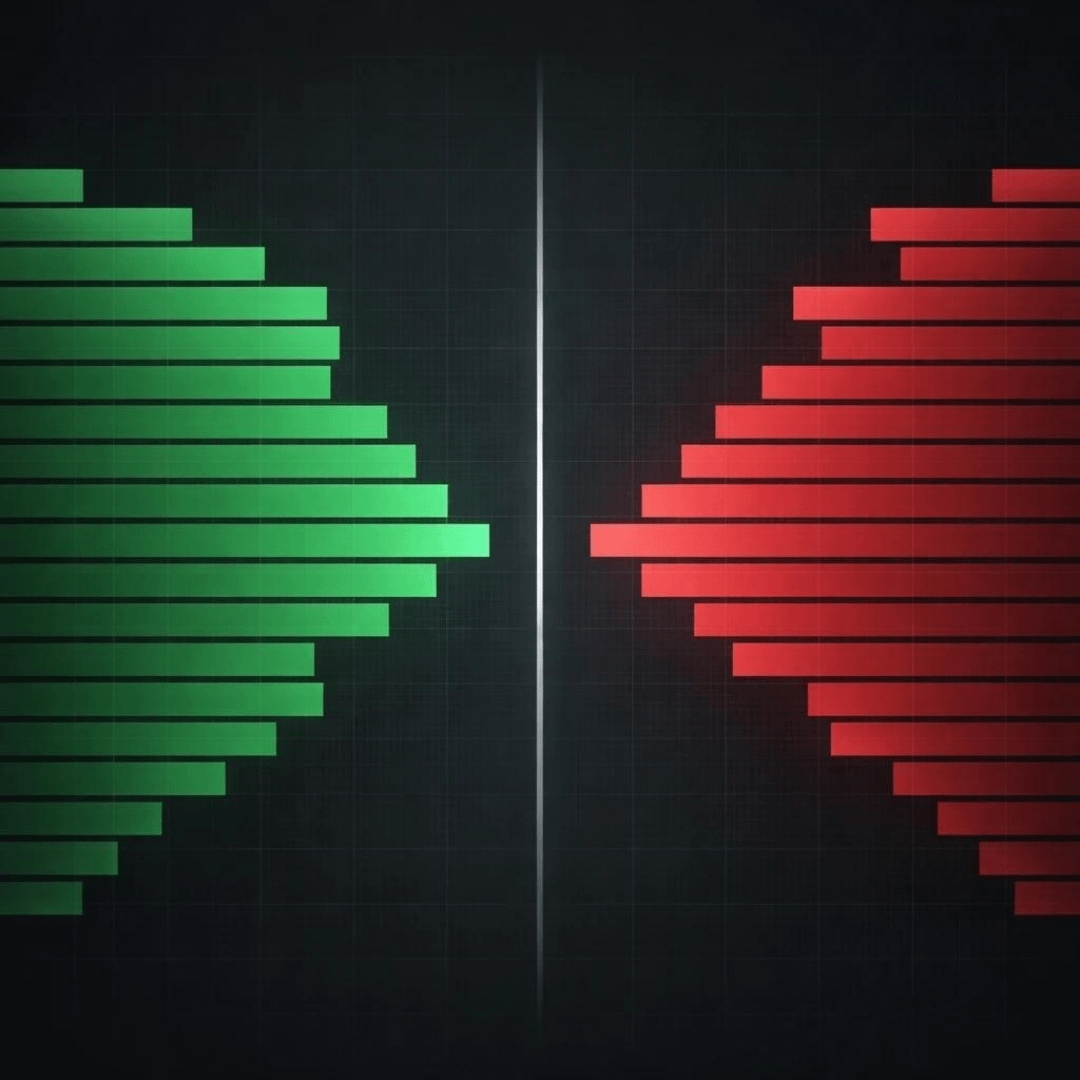
Displayed price: USD 100.
Market buy: seeks available offers; fill price can differ.
Buy limit at USD 100: sets a price ceiling; some or all of the order may remain unfilled.
Choose the instruction around the task.
You submit a buy limit at USD 100. Price briefly touches USD 100. Does the chart prove your entire order filled?
Answer: No. A price touch does not show the available quantity or your position in the order queue. Check the actual order status and fills.
Matching rules and time in force vary by venue. An order instruction does not predict direction.
#OrderTypes #TradingBasics
Displayed price: USD 100.
Market buy: seeks available offers; fill price can differ.
Buy limit at USD 100: sets a price ceiling; some or all of the order may remain unfilled.
Choose the instruction around the task.
You submit a buy limit at USD 100. Price briefly touches USD 100. Does the chart prove your entire order filled?
Answer: No. A price touch does not show the available quantity or your position in the order queue. Check the actual order status and fills.
Matching rules and time in force vary by venue. An order instruction does not predict direction.
Displayed price: USD 100.
Market buy: seeks available offers; fill price can differ.
Buy limit at USD 100: sets a price ceiling; some or all of the order may remain unfilled.
Choose the instruction around the task.
You submit a buy limit at USD 100. Price briefly touches USD 100. Does the chart prove your entire order filled?
Answer: No. A price touch does not show the available quantity or your position in the order queue. Check the actual order status and fills.
Matching rules and time in force vary by venue. An order instruction does not predict direction.
78

·
--
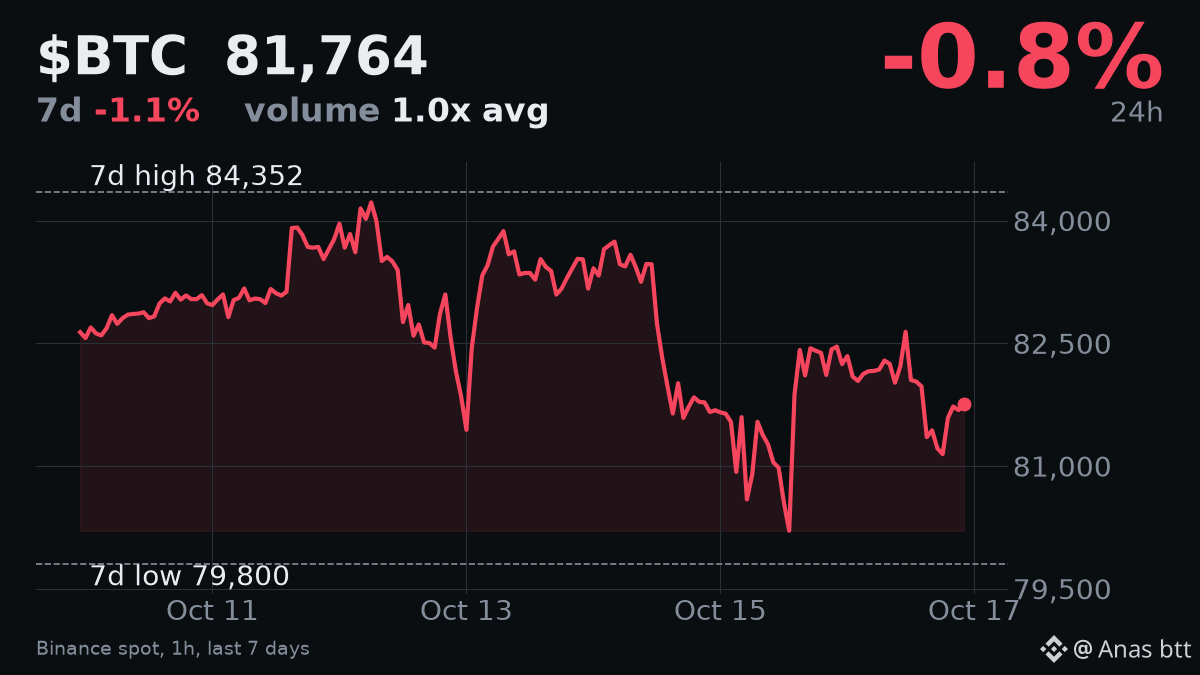
When $BTC is trading at $81,763, its 24-hour volume is $1.23 billion. This volume is 3.5% higher than its 7-day average. Volume shows how much an asset is traded.
When price makes a big move, especially breaking above a resistance level or to a new high, strong volume is important. High volume confirms that many traders are participating in the move, giving it more strength. If $BTC were to break past its 7-day high of $84,352 on low or average volume, it would be a warning sign. Such moves often fail because there is not enough conviction from buyers. Conversely, a price drop on very high volume can suggest strong selling pressure.
Always look for volume to confirm price action when key levels are tested. 📈
#VolumeAnalysis #TradingBasics
When $BTC is trading at $81,763, its 24-hour volume is $1.23 billion. This volume is 3.5% higher than its 7-day average. Volume shows how much an asset is traded.
When price makes a big move, especially breaking above a resistance level or to a new high, strong volume is important. High volume confirms that many traders are participating in the move, giving it more strength. If $BTC were to break past its 7-day high of $84,352 on low or average volume, it would be a warning sign. Such moves often fail because there is not enough conviction from buyers. Conversely, a price drop on very high volume can suggest strong selling pressure.
Always look for volume to confirm price action when key levels are tested. 📈
#VolumeAnalysis #TradingBasics
When price makes a big move, especially breaking above a resistance level or to a new high, strong volume is important. High volume confirms that many traders are participating in the move, giving it more strength. If $BTC were to break past its 7-day high of $84,352 on low or average volume, it would be a warning sign. Such moves often fail because there is not enough conviction from buyers. Conversely, a price drop on very high volume can suggest strong selling pressure.
Always look for volume to confirm price action when key levels are tested. 📈
#VolumeAnalysis #TradingBasics
52

·
--
Support & Resistance: the 2-minute beginner guide 📉📈
Ever wonder why $BTC keeps bouncing off the same price levels? That's support and resistance.
🟢 Support = a price zone where buyers tend to step in, so price often stops falling.
🔴 Resistance = a price zone where sellers tend to appear, so price often stops rising.
How to find them:
Open a daily chart.
Mark the price levels where the price reversed at least 2 to 3 times.
Draw a zone (a thin band), not one exact line.
How to use them:
• Price near support: watch for a bounce, with your stop just below the zone.
• Price near resistance: watch for rejection, or wait for a clean breakout and retest.
• When a resistance breaks, it often becomes new support.
⚠️ Never trade on one level alone. Combine it with volume and the bigger trend, and keep your risk small.
Do you use support and resistance in your trades? Tell me below 👇
Not financial advice. Do your own research.
#Binance #BinanceSquare #CryptoEducation #Bitcoin #TradingBasics
Support & Resistance: the 2-minute beginner guide 📉📈
Ever wonder why $BTC keeps bouncing off the same price levels? That's support and resistance.
🟢 Support = a price zone where buyers tend to step in, so price often stops falling.
🔴 Resistance = a price zone where sellers tend to appear, so price often stops rising.
How to find them:
Open a daily chart.
Mark the price levels where the price reversed at least 2 to 3 times.
Draw a zone (a thin band), not one exact line.
How to use them:
• Price near support: watch for a bounce, with your stop just below the zone.
• Price near resistance: watch for rejection, or wait for a clean breakout and retest.
• When a resistance breaks, it often becomes new support.
⚠️ Never trade on one level alone. Combine it with volume and the bigger trend, and keep your risk small.
Do you use support and resistance in your trades? Tell me below 👇
Not financial advice. Do your own research.
#Binance #BinanceSquare #CryptoEducation #Bitcoin #TradingBasics
Ever wonder why $BTC keeps bouncing off the same price levels? That's support and resistance.
🟢 Support = a price zone where buyers tend to step in, so price often stops falling.
🔴 Resistance = a price zone where sellers tend to appear, so price often stops rising.
How to find them:
Open a daily chart.
Mark the price levels where the price reversed at least 2 to 3 times.
Draw a zone (a thin band), not one exact line.
How to use them:
• Price near support: watch for a bounce, with your stop just below the zone.
• Price near resistance: watch for rejection, or wait for a clean breakout and retest.
• When a resistance breaks, it often becomes new support.
⚠️ Never trade on one level alone. Combine it with volume and the bigger trend, and keep your risk small.
Do you use support and resistance in your trades? Tell me below 👇
Not financial advice. Do your own research.
#Binance #BinanceSquare #CryptoEducation #Bitcoin #TradingBasics
88

·
--
Spot Trading vs. Futures Trading: Why Beginners Lose Money Fast ⚠️
Many new traders jump straight into Futures Trading attracted by high leverage, only to lose their entire balance in minutes.
Understanding the difference between Spot and Futures is critical before making your next trade:
Spot Trading (Buy & Hold) • When you buy crypto in Spot, you actually own the asset. • If the market goes down, you still hold the same amount of coins. You only experience "unrealized loss" until the price recovers. • Zero risk of liquidation!
Futures Trading (Leveraged Contracts) • You are not buying the actual asset; you are betting on whether the price will go UP or DOWN. • Leverage (e.g., 10x, 20x) multiplies both your potential profits AND losses. • High liquidation risk! A sudden 5% market drop with 20x leverage can wipe out 100% of your money instantly.
💡 Rule for Beginners:
Master Spot Trading first. Learn market trends, price action, and patience. Avoid Futures until you have at least 6-12 months of consistent trading experience.
Protect your portfolio, trade smart!
Found this helpful? Drop a like, follow for more daily guides, and share your thoughts below! 💬
#SpotVsFutures #CryptoEducation💡🚀 #BinanceSquare #TradingBasics #RiskManagement
Spot Trading vs. Futures Trading: Why Beginners Lose Money Fast ⚠️
Many new traders jump straight into Futures Trading attracted by high leverage, only to lose their entire balance in minutes.
Understanding the difference between Spot and Futures is critical before making your next trade:
Spot Trading (Buy & Hold) • When you buy crypto in Spot, you actually own the asset. • If the market goes down, you still hold the same amount of coins. You only experience "unrealized loss" until the price recovers. • Zero risk of liquidation!
Futures Trading (Leveraged Contracts) • You are not buying the actual asset; you are betting on whether the price will go UP or DOWN. • Leverage (e.g., 10x, 20x) multiplies both your potential profits AND losses. • High liquidation risk! A sudden 5% market drop with 20x leverage can wipe out 100% of your money instantly.
💡 Rule for Beginners:
Master Spot Trading first. Learn market trends, price action, and patience. Avoid Futures until you have at least 6-12 months of consistent trading experience.
Protect your portfolio, trade smart!
Found this helpful? Drop a like, follow for more daily guides, and share your thoughts below! 💬
#SpotVsFutures #CryptoEducation💡🚀 #BinanceSquare #TradingBasics #RiskManagement
Many new traders jump straight into Futures Trading attracted by high leverage, only to lose their entire balance in minutes.
Understanding the difference between Spot and Futures is critical before making your next trade:
Spot Trading (Buy & Hold) • When you buy crypto in Spot, you actually own the asset. • If the market goes down, you still hold the same amount of coins. You only experience "unrealized loss" until the price recovers. • Zero risk of liquidation!
Futures Trading (Leveraged Contracts) • You are not buying the actual asset; you are betting on whether the price will go UP or DOWN. • Leverage (e.g., 10x, 20x) multiplies both your potential profits AND losses. • High liquidation risk! A sudden 5% market drop with 20x leverage can wipe out 100% of your money instantly.
💡 Rule for Beginners:
Master Spot Trading first. Learn market trends, price action, and patience. Avoid Futures until you have at least 6-12 months of consistent trading experience.
Protect your portfolio, trade smart!
Found this helpful? Drop a like, follow for more daily guides, and share your thoughts below! 💬
#SpotVsFutures #CryptoEducation💡🚀 #BinanceSquare #TradingBasics #RiskManagement
82

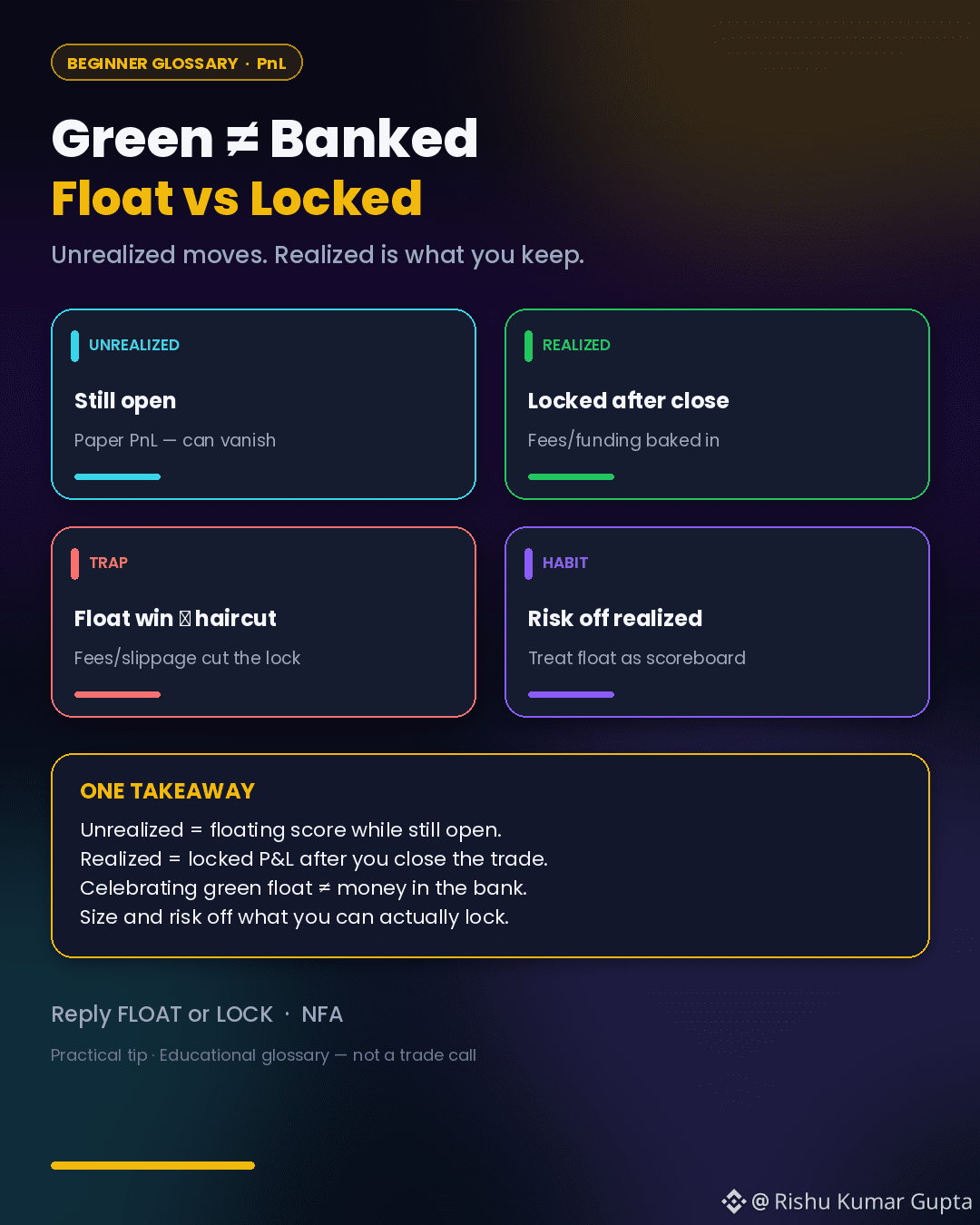
Green on the screen ≠ money in the bank.
Unrealized PnL moves while the trade is open. Realized PnL is what you lock when you close.
Trap: celebrating a floating win, then realizing less after fees/slippage.
Treat unrealized as a scoreboard. Size and risk off what you can actually lock.
Reply FLOAT or LOCK — which do you check first when sizing the next trade?
NFA — education only.
$BNB #BinanceSquare #TradingBasics #PnL
Green on the screen ≠ money in the bank.
Unrealized PnL moves while the trade is open. Realized PnL is what you lock when you close.
Trap: celebrating a floating win, then realizing less after fees/slippage.
Treat unrealized as a scoreboard. Size and risk off what you can actually lock.
Reply FLOAT or LOCK — which do you check first when sizing the next trade?
NFA — education only.
$BNB #BinanceSquare #TradingBasics #PnL
Unrealized PnL moves while the trade is open. Realized PnL is what you lock when you close.
Trap: celebrating a floating win, then realizing less after fees/slippage.
Treat unrealized as a scoreboard. Size and risk off what you can actually lock.
Reply FLOAT or LOCK — which do you check first when sizing the next trade?
NFA — education only.
$BNB #BinanceSquare #TradingBasics #PnL
43

·
--
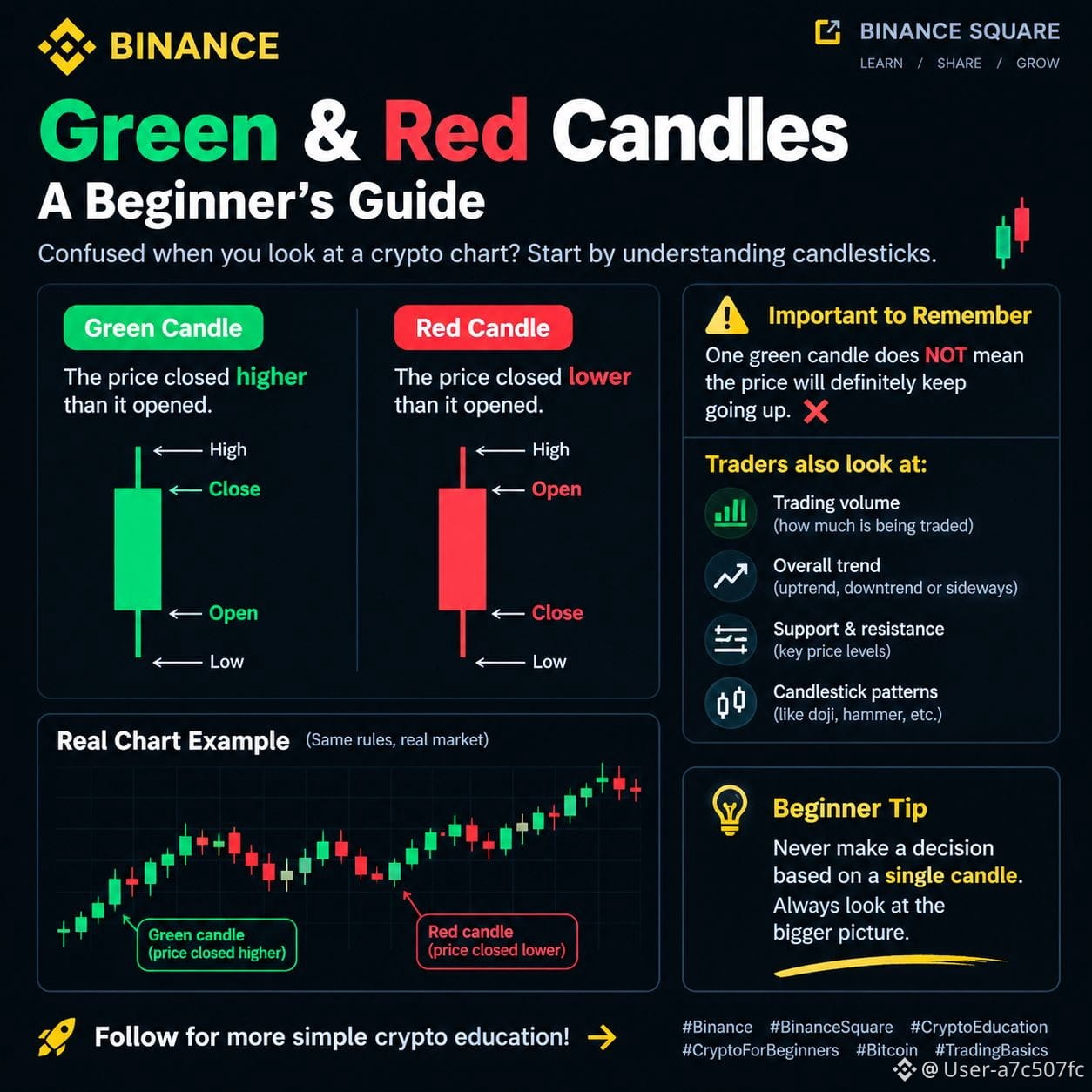
🟢🔴 Green & Red Candles — A Beginner’s Guide
Confused when you look at a crypto chart? Start by understanding candlesticks. 🕯️
🟢 Green candle: The price closed higher than it opened.
🔴 Red candle: The price closed lower than it opened.
But remember: one green candle does NOT mean the price will definitely keep going up. ❌
Before making any trading decision, traders usually look at other factors such as:
📊 Trading volume
📈 Overall trend
🧱 Support & resistance
🕯️ Candlestick patterns
💡 Beginner Tip: Never make a decision based on a single candle. Always look at the bigger picture.
Follow for more simple crypto education 🚀
#Binance #BinanceSquare #CryptoForBeginners #BTC #TradingBasics
🟢🔴 Green & Red Candles — A Beginner’s Guide
Confused when you look at a crypto chart? Start by understanding candlesticks. 🕯️
🟢 Green candle: The price closed higher than it opened.
🔴 Red candle: The price closed lower than it opened.
But remember: one green candle does NOT mean the price will definitely keep going up. ❌
Before making any trading decision, traders usually look at other factors such as:
📊 Trading volume
📈 Overall trend
🧱 Support & resistance
🕯️ Candlestick patterns
💡 Beginner Tip: Never make a decision based on a single candle. Always look at the bigger picture.
Follow for more simple crypto education 🚀
#Binance #BinanceSquare #CryptoForBeginners #BTC #TradingBasics
Confused when you look at a crypto chart? Start by understanding candlesticks. 🕯️
🟢 Green candle: The price closed higher than it opened.
🔴 Red candle: The price closed lower than it opened.
But remember: one green candle does NOT mean the price will definitely keep going up. ❌
Before making any trading decision, traders usually look at other factors such as:
📊 Trading volume
📈 Overall trend
🧱 Support & resistance
🕯️ Candlestick patterns
💡 Beginner Tip: Never make a decision based on a single candle. Always look at the bigger picture.
Follow for more simple crypto education 🚀
#Binance #BinanceSquare #CryptoForBeginners #BTC #TradingBasics
104

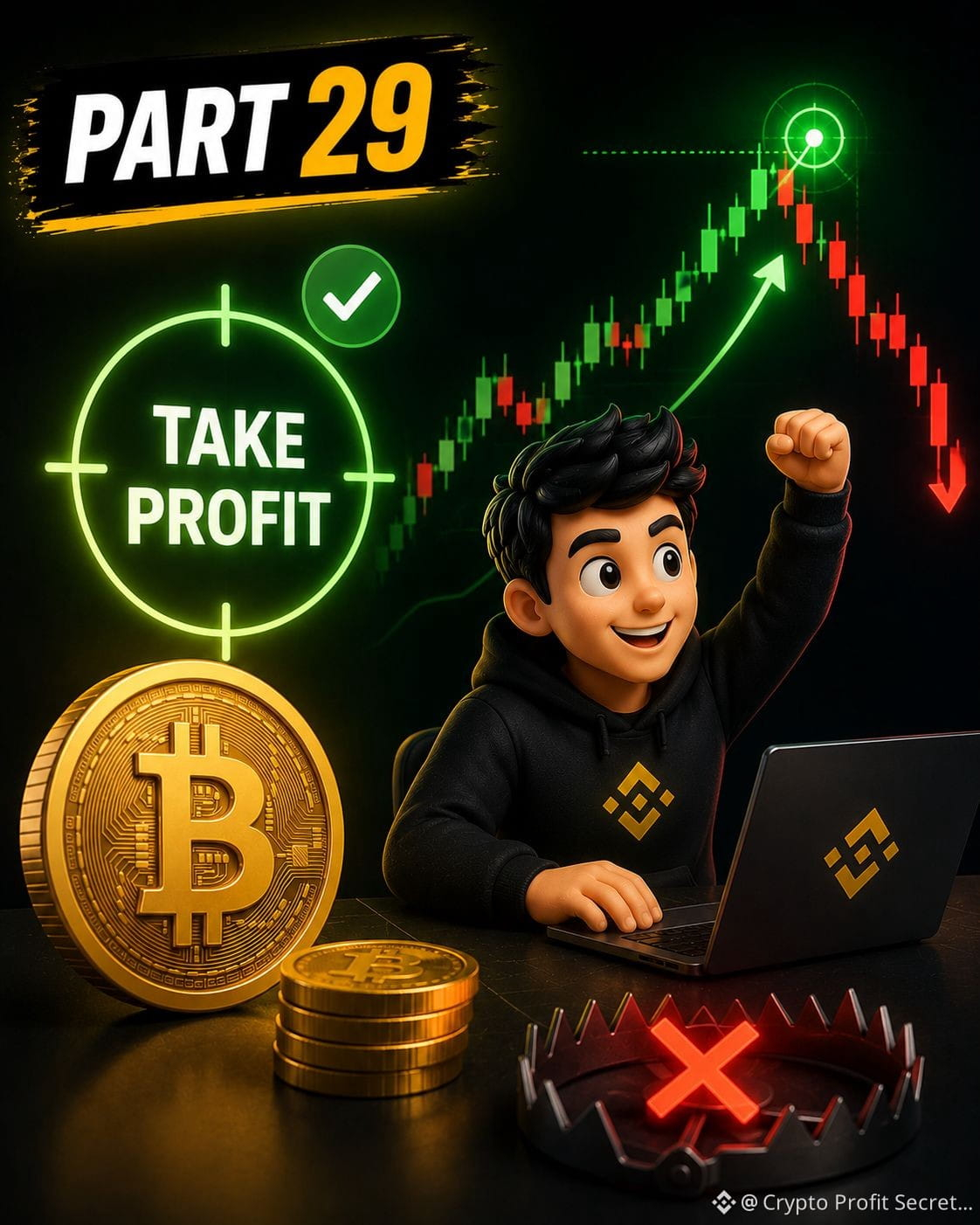
📚 Crypto Learning Series – Part 30
📰 News Dekho... Not Just Price
Many beginners trade by just looking at charts.
But news also has a big impact on the crypto market.
💡 ETF updates, regulations, partnerships, and economic events can change market trends.
📊 Check Before You Trade
✅ Any major crypto news?
✅ Is there an economic event today?
✅ Is the market sentiment positive or negative?
🧠 Simple Rule
Chart + News = Better Decision
🔑 Golden Rule
"Smart traders follow both charts and news."
#CryptoLearning #CryptoNews #BTC #BinanceSquare #TradingBasics $BTC
{spot}(BTCUSDT)
📚 Crypto Learning Series – Part 30
📰 News Dekho... Not Just Price
Many beginners trade by just looking at charts.
But news also has a big impact on the crypto market.
💡 ETF updates, regulations, partnerships, and economic events can change market trends.
📊 Check Before You Trade
✅ Any major crypto news?
✅ Is there an economic event today?
✅ Is the market sentiment positive or negative?
🧠 Simple Rule
Chart + News = Better Decision
🔑 Golden Rule
"Smart traders follow both charts and news."
#CryptoLearning #CryptoNews #BTC #BinanceSquare #TradingBasics $BTC
📰 News Dekho... Not Just Price
Many beginners trade by just looking at charts.
But news also has a big impact on the crypto market.
💡 ETF updates, regulations, partnerships, and economic events can change market trends.
📊 Check Before You Trade
✅ Any major crypto news?
✅ Is there an economic event today?
✅ Is the market sentiment positive or negative?
🧠 Simple Rule
Chart + News = Better Decision
🔑 Golden Rule
"Smart traders follow both charts and news."
#CryptoLearning #CryptoNews #BTC #BinanceSquare #TradingBasics $BTC

3
55

·
--
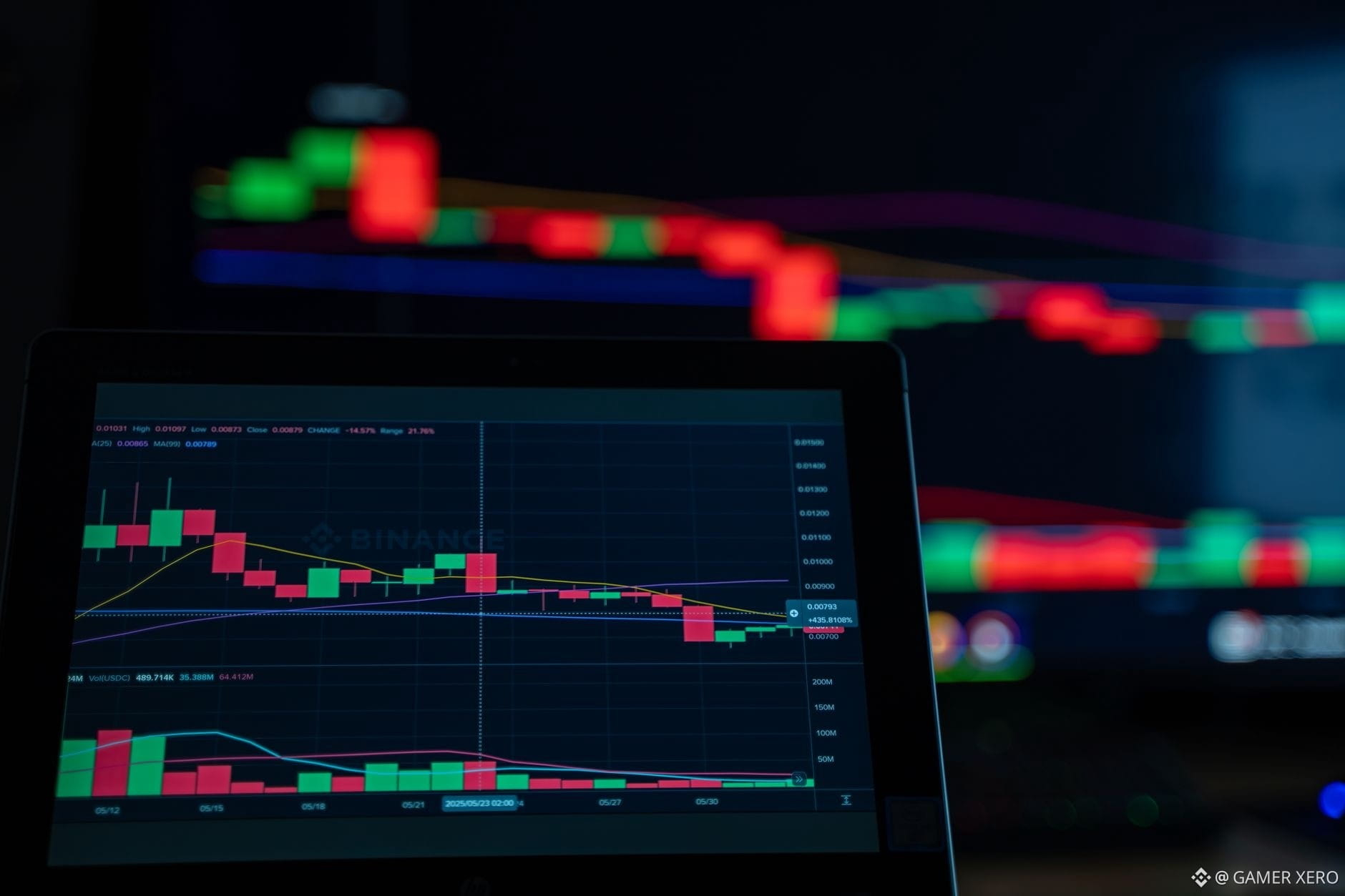
When the market’s moving sideways you’ll see a lot of “just hit the button” orders. Those are market orders – they guarantee you get filled, but the execution price can drift a few cents or even a few dollars when liquidity is thin. A limit order, on the other hand, lets you set the exact price you’re willing to trade at; if the market never reaches that level, the order simply stays open.
Try this on $BTC right now: the 24‑hour range is $63,880 – $65,025. If you want to buy a dip without chasing the current $64,825 price, place a limit buy at $64,200. Should the price pull back to that point, your order fills automatically, protecting you from a higher average entry. For a sell side, you could set a limit sell at $65,500 – a level just above today’s high – to capture upside without constantly watching the chart.
Using limits helps you control entry and exit points, reduces slippage, and keeps emotions in check. Have you tried setting a limit order this week, and how did it compare to a market order you placed?
#CryptoEducation #TradingBasics #LimitOrders #GAMERXERO
When the market’s moving sideways you’ll see a lot of “just hit the button” orders. Those are market orders – they guarantee you get filled, but the execution price can drift a few cents or even a few dollars when liquidity is thin. A limit order, on the other hand, lets you set the exact price you’re willing to trade at; if the market never reaches that level, the order simply stays open.
Try this on $BTC right now: the 24‑hour range is $63,880 – $65,025. If you want to buy a dip without chasing the current $64,825 price, place a limit buy at $64,200. Should the price pull back to that point, your order fills automatically, protecting you from a higher average entry. For a sell side, you could set a limit sell at $65,500 – a level just above today’s high – to capture upside without constantly watching the chart.
Using limits helps you control entry and exit points, reduces slippage, and keeps emotions in check. Have you tried setting a limit order this week, and how did it compare to a market order you placed?
#CryptoEducation #TradingBasics #LimitOrders #GAMERXERO
Try this on $BTC right now: the 24‑hour range is $63,880 – $65,025. If you want to buy a dip without chasing the current $64,825 price, place a limit buy at $64,200. Should the price pull back to that point, your order fills automatically, protecting you from a higher average entry. For a sell side, you could set a limit sell at $65,500 – a level just above today’s high – to capture upside without constantly watching the chart.
Using limits helps you control entry and exit points, reduces slippage, and keeps emotions in check. Have you tried setting a limit order this week, and how did it compare to a market order you placed?
#CryptoEducation #TradingBasics #LimitOrders #GAMERXERO
25
·
--
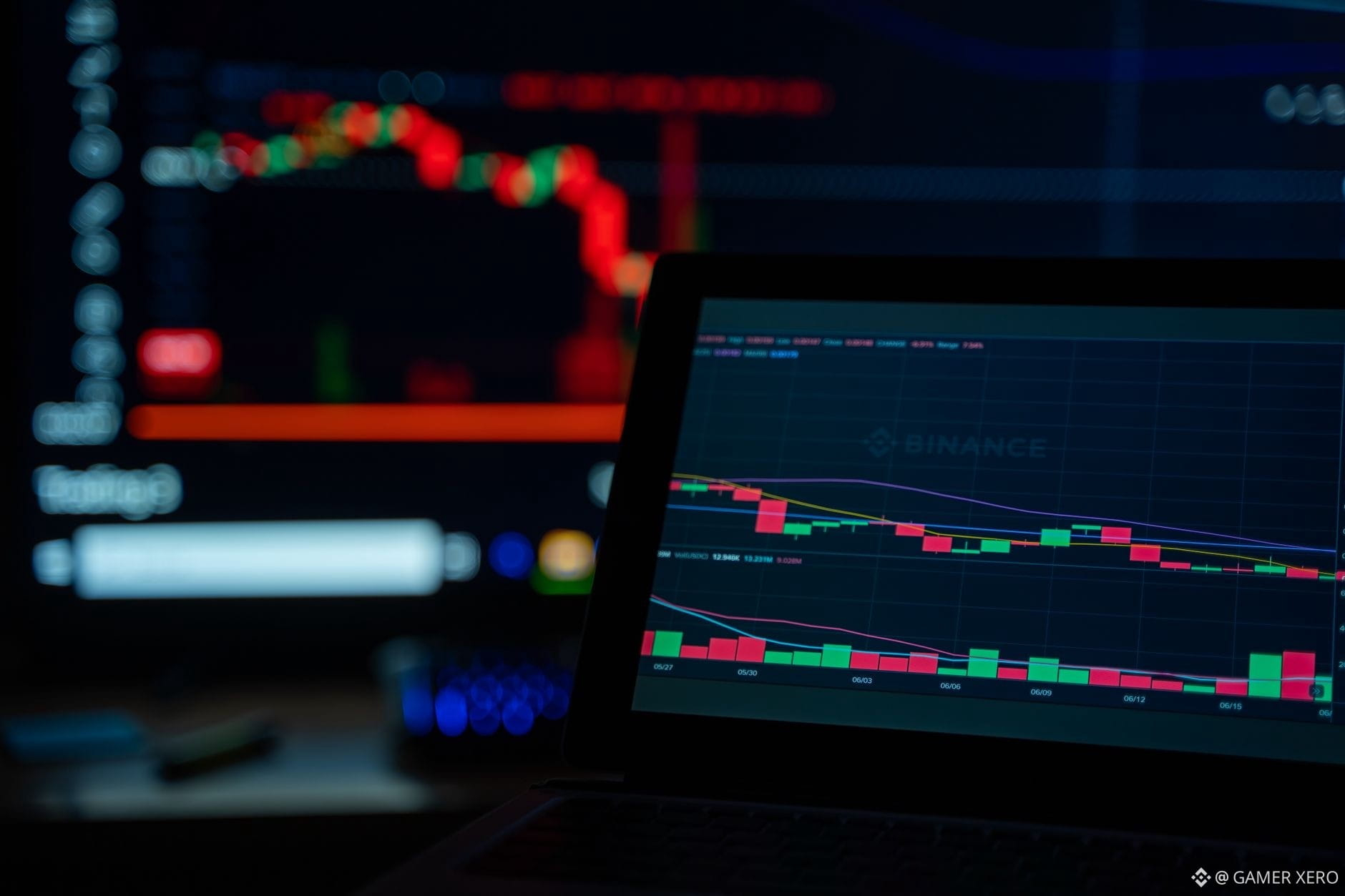
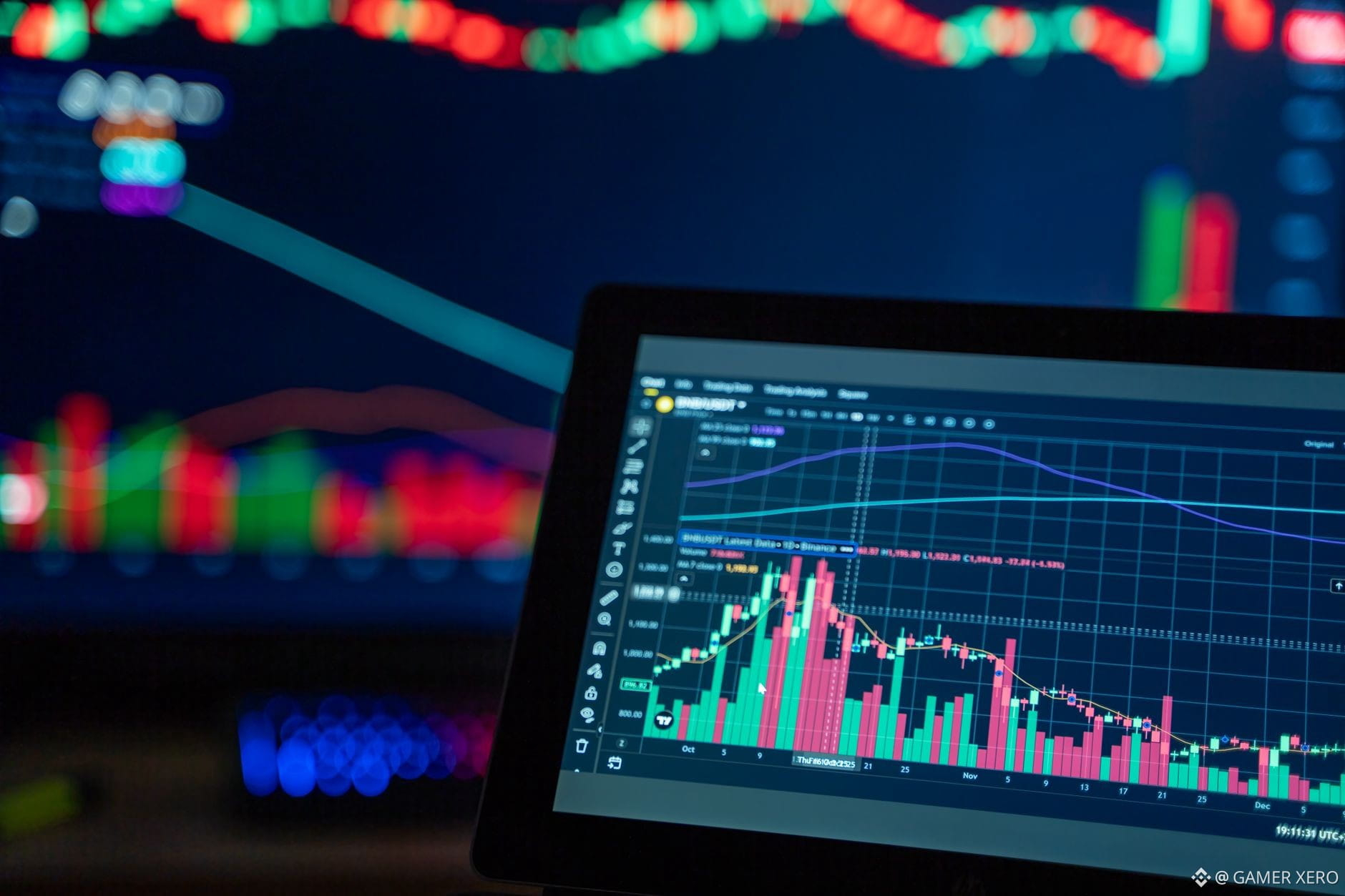
Seeing $BTC hug a $1,030‑wide 24 hour band around $64,490 on Binance? That tight range is perfect for a simple limit‑order exercise. A limit order lets you set the exact price you’re willing to trade, and the order sits in the book until the market reaches it. No need to watch the chart every second—your order does the waiting.
For a beginner, try this: on the current day $BTC’s low is $64,027 and the high is $65,059. Place a limit‑buy order a little above the low, say $64,100, with a modest amount you’re comfortable with. If price dips to that level, the order fills automatically; if it holds above, the order remains pending, protecting you from chasing a move. The same idea works on $ETH, whose 24 h range is $1,885‑$1,923. A limit‑sell at $1,920 could capture a small upside if the price climbs back toward the high.
Have you tried using limit orders in a narrow‑range market, and what results did you see?
#CryptoEducation #BinanceTips #TradingBasics #GAMERXERO
Seeing $BTC hug a $1,030‑wide 24 hour band around $64,490 on Binance? That tight range is perfect for a simple limit‑order exercise. A limit order lets you set the exact price you’re willing to trade, and the order sits in the book until the market reaches it. No need to watch the chart every second—your order does the waiting.
For a beginner, try this: on the current day $BTC ’s low is $64,027 and the high is $65,059. Place a limit‑buy order a little above the low, say $64,100, with a modest amount you’re comfortable with. If price dips to that level, the order fills automatically; if it holds above, the order remains pending, protecting you from chasing a move. The same idea works on $ETH , whose 24 h range is $1,885‑$1,923. A limit‑sell at $1,920 could capture a small upside if the price climbs back toward the high.
Have you tried using limit orders in a narrow‑range market, and what results did you see?
#CryptoEducation #BinanceTips #TradingBasics #GAMERXERO
For a beginner, try this: on the current day $BTC ’s low is $64,027 and the high is $65,059. Place a limit‑buy order a little above the low, say $64,100, with a modest amount you’re comfortable with. If price dips to that level, the order fills automatically; if it holds above, the order remains pending, protecting you from chasing a move. The same idea works on $ETH , whose 24 h range is $1,885‑$1,923. A limit‑sell at $1,920 could capture a small upside if the price climbs back toward the high.
Have you tried using limit orders in a narrow‑range market, and what results did you see?
#CryptoEducation #BinanceTips #TradingBasics #GAMERXERO
101
·
--
Watching the order book on Binance right now, $BTC trades at $65,114.38 and $ETH at $1,920.28. Most new traders jump straight to market orders, assuming faster fills, but that can leave you paying a few cents more per coin when the spread widens. A limit order lets you set the exact price you’re willing to pay, and the trade only executes if the market reaches that level.
Here’s a simple test: place a buy limit for 0.001 $BTC at $65,050. If the price dips below that level during the next hour, your order fills automatically; if it stays above, you keep the cash in your spot wallet and avoid a higher‑priced fill. Do the same on $ETH—set a limit at $1,910 for 0.05 ETH. You can watch the depth view, see existing sell walls, and choose a price just under the current market to increase the chance of execution without chasing the price.
The key takeaway is that limit orders give you price control and reduce slippage, especially in a tight 24‑hour range like today’s $BTC high $65,474 and low $64,826. Have you tried using limit orders for entry or exit, and what settings worked best for you?
#CryptoEducation #BinanceTips #TradingBasics #GAMERXERO
Watching the order book on Binance right now, $BTC trades at $65,114.38 and $ETH at $1,920.28. Most new traders jump straight to market orders, assuming faster fills, but that can leave you paying a few cents more per coin when the spread widens. A limit order lets you set the exact price you’re willing to pay, and the trade only executes if the market reaches that level.
Here’s a simple test: place a buy limit for 0.001 $BTC at $65,050. If the price dips below that level during the next hour, your order fills automatically; if it stays above, you keep the cash in your spot wallet and avoid a higher‑priced fill. Do the same on $ETH —set a limit at $1,910 for 0.05 ETH. You can watch the depth view, see existing sell walls, and choose a price just under the current market to increase the chance of execution without chasing the price.
The key takeaway is that limit orders give you price control and reduce slippage, especially in a tight 24‑hour range like today’s $BTC high $65,474 and low $64,826. Have you tried using limit orders for entry or exit, and what settings worked best for you?
#CryptoEducation #BinanceTips #TradingBasics #GAMERXERO
Here’s a simple test: place a buy limit for 0.001 $BTC at $65,050. If the price dips below that level during the next hour, your order fills automatically; if it stays above, you keep the cash in your spot wallet and avoid a higher‑priced fill. Do the same on $ETH —set a limit at $1,910 for 0.05 ETH. You can watch the depth view, see existing sell walls, and choose a price just under the current market to increase the chance of execution without chasing the price.
The key takeaway is that limit orders give you price control and reduce slippage, especially in a tight 24‑hour range like today’s $BTC high $65,474 and low $64,826. Have you tried using limit orders for entry or exit, and what settings worked best for you?
#CryptoEducation #BinanceTips #TradingBasics #GAMERXERO
41
·
--
{spot}(BTCUSDT)
📚 For beginners: what are Support and Resistance?
🔹 Support — a level that acts as a “floor” when the price falls. Like a floor—when the price drops to this level, buying usually strengthens and the price rises again.
🔹 Resistance — a level that acts as a “ceiling” when the price rises. Like a ceiling—when the price reaches this level, selling usually strengthens and the price may move down.
💡 Example: $BTC is currently trading around $77,419. Over the last 24 hours, the price bounced off the support level at $76,000 and moved closer to resistance at $77,597. If $76,000 is broken, the price may go lower; if it breaks $77,600, that could be a signal to rise.
⚠️ This is not financial advice—always do your own research (DYOR)
If this was helpful, hit the like 👍
$BTC #Support #Resistance #crypto#Binance #TradingBasics
🤔 **Have you heard of Support and Resistance before?**
📚 For beginners: what are Support and Resistance?
🔹 Support — a level that acts as a “floor” when the price falls. Like a floor—when the price drops to this level, buying usually strengthens and the price rises again.
🔹 Resistance — a level that acts as a “ceiling” when the price rises. Like a ceiling—when the price reaches this level, selling usually strengthens and the price may move down.
💡 Example: $BTC is currently trading around $77,419. Over the last 24 hours, the price bounced off the support level at $76,000 and moved closer to resistance at $77,597. If $76,000 is broken, the price may go lower; if it breaks $77,600, that could be a signal to rise.
⚠️ This is not financial advice—always do your own research (DYOR)
If this was helpful, hit the like 👍
$BTC #Support #Resistance #crypto#Binance #TradingBasics
🤔 **Have you heard of Support and Resistance before?**
🔹 Support — a level that acts as a “floor” when the price falls. Like a floor—when the price drops to this level, buying usually strengthens and the price rises again.
🔹 Resistance — a level that acts as a “ceiling” when the price rises. Like a ceiling—when the price reaches this level, selling usually strengthens and the price may move down.
💡 Example: $BTC is currently trading around $77,419. Over the last 24 hours, the price bounced off the support level at $76,000 and moved closer to resistance at $77,597. If $76,000 is broken, the price may go lower; if it breaks $77,600, that could be a signal to rise.
⚠️ This is not financial advice—always do your own research (DYOR)
If this was helpful, hit the like 👍
$BTC #Support #Resistance #crypto#Binance #TradingBasics
🤔 **Have you heard of Support and Resistance before?**
✅ Да, знаю и использую
50%
Слышал(а), но не понимаю
50%
❌ Впервые слышу
0%
2 votes • Voting closed
2
338
·
--
When the market hovers between a tight high‑low band, the first tool many traders reach for is a stop‑loss. It’s not a magic ticket, but a simple way to define the most you’re willing to lose on a trade and keep emotions out of the equation.
Imagine you’re watching $BTC at $80,823, just a few points above its 24‑hour low of $77,101. You decide the next bounce could take it toward the recent high of $82,300, so you enter a long position at $80,900. To protect yourself if the price turns, you set a stop‑loss a little below the low—say $77,500. If $BTC slides back, the order will trigger automatically, capping the loss without you needing to watch the chart 24/7.
The key is consistency: choose a stop‑loss distance that matches your risk tolerance and the asset’s volatility, then stick to it. How do you determine the right stop‑loss level for the coins you trade?
#CryptoEducation #TradingBasics #RiskManagement #GAMERXERO
When the market hovers between a tight high‑low band, the first tool many traders reach for is a stop‑loss. It’s not a magic ticket, but a simple way to define the most you’re willing to lose on a trade and keep emotions out of the equation.
Imagine you’re watching $BTC at $80,823, just a few points above its 24‑hour low of $77,101. You decide the next bounce could take it toward the recent high of $82,300, so you enter a long position at $80,900. To protect yourself if the price turns, you set a stop‑loss a little below the low—say $77,500. If $BTC slides back, the order will trigger automatically, capping the loss without you needing to watch the chart 24/7.
The key is consistency: choose a stop‑loss distance that matches your risk tolerance and the asset’s volatility, then stick to it. How do you determine the right stop‑loss level for the coins you trade?
#CryptoEducation #TradingBasics #RiskManagement #GAMERXERO
Imagine you’re watching $BTC at $80,823, just a few points above its 24‑hour low of $77,101. You decide the next bounce could take it toward the recent high of $82,300, so you enter a long position at $80,900. To protect yourself if the price turns, you set a stop‑loss a little below the low—say $77,500. If $BTC slides back, the order will trigger automatically, capping the loss without you needing to watch the chart 24/7.
The key is consistency: choose a stop‑loss distance that matches your risk tolerance and the asset’s volatility, then stick to it. How do you determine the right stop‑loss level for the coins you trade?
#CryptoEducation #TradingBasics #RiskManagement #GAMERXERO
85

·
--
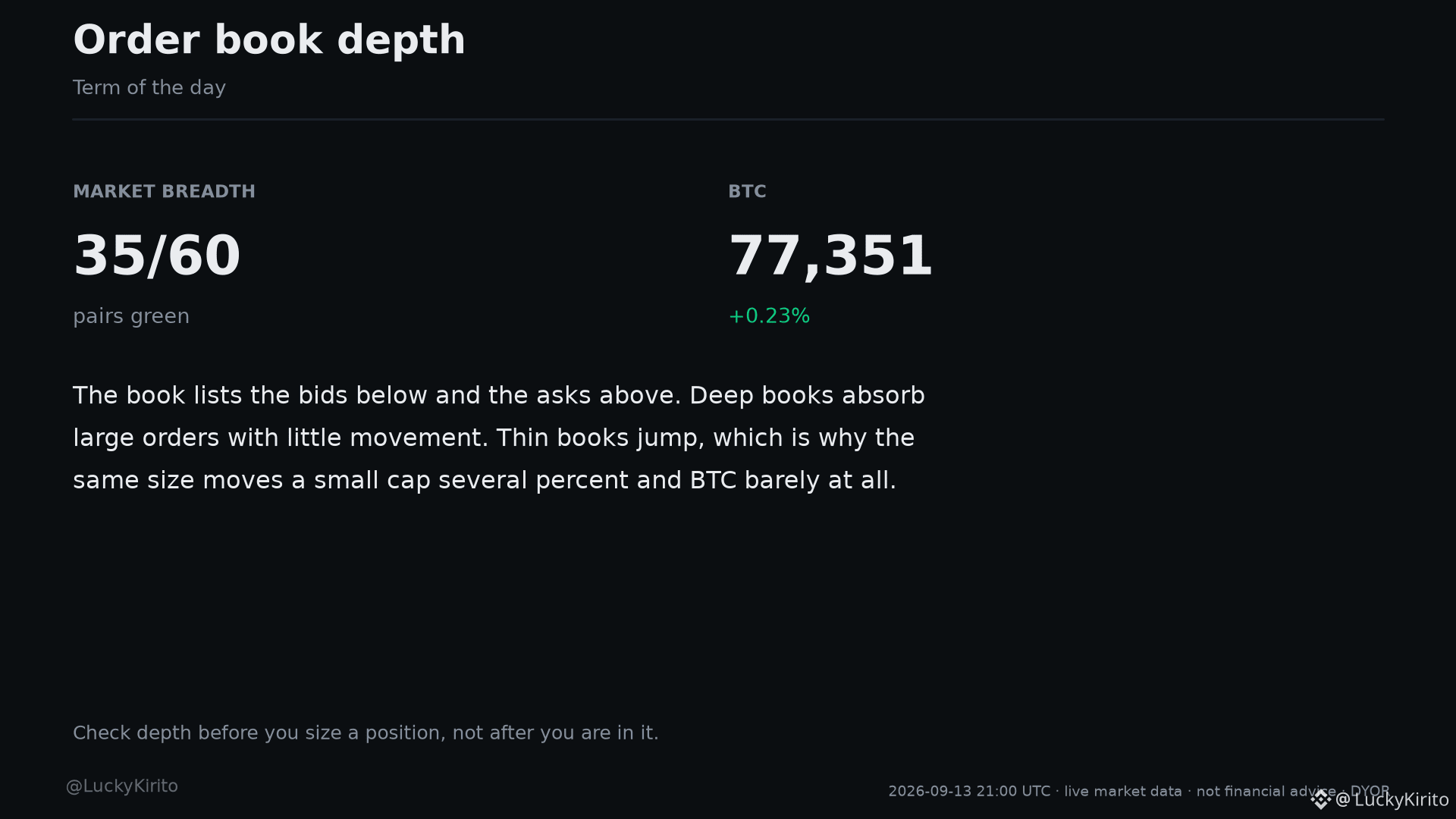
Term of the day: Order book depth.
Depth is how much size is resting near the current price.
The book lists the bids below and the asks above. Deep books absorb large orders with little movement. Thin books jump, which is why the same size moves a small cap several percent and BTC barely at all.
Check depth before you size a position, not after you are in it.
Right now: BTC at 77,351 (+0.23%), 35 of 60 liquid pairs green, LSK leading at +311.5%.
#Write2Earn #TradingBasics #CryptoEducation #TradingStrategy
Automated technical analysis, not financial advice. I am not responsible for your trades. DYOR.
Term of the day: Order book depth.
Depth is how much size is resting near the current price.
The book lists the bids below and the asks above. Deep books absorb large orders with little movement. Thin books jump, which is why the same size moves a small cap several percent and BTC barely at all.
Check depth before you size a position, not after you are in it.
Right now: BTC at 77,351 (+0.23%), 35 of 60 liquid pairs green, LSK leading at +311.5%.
#Write2Earn #TradingBasics #CryptoEducation #TradingStrategy
Automated technical analysis, not financial advice. I am not responsible for your trades. DYOR.
Depth is how much size is resting near the current price.
The book lists the bids below and the asks above. Deep books absorb large orders with little movement. Thin books jump, which is why the same size moves a small cap several percent and BTC barely at all.
Check depth before you size a position, not after you are in it.
Right now: BTC at 77,351 (+0.23%), 35 of 60 liquid pairs green, LSK leading at +311.5%.
#Write2Earn #TradingBasics #CryptoEducation #TradingStrategy
Automated technical analysis, not financial advice. I am not responsible for your trades. DYOR.
74

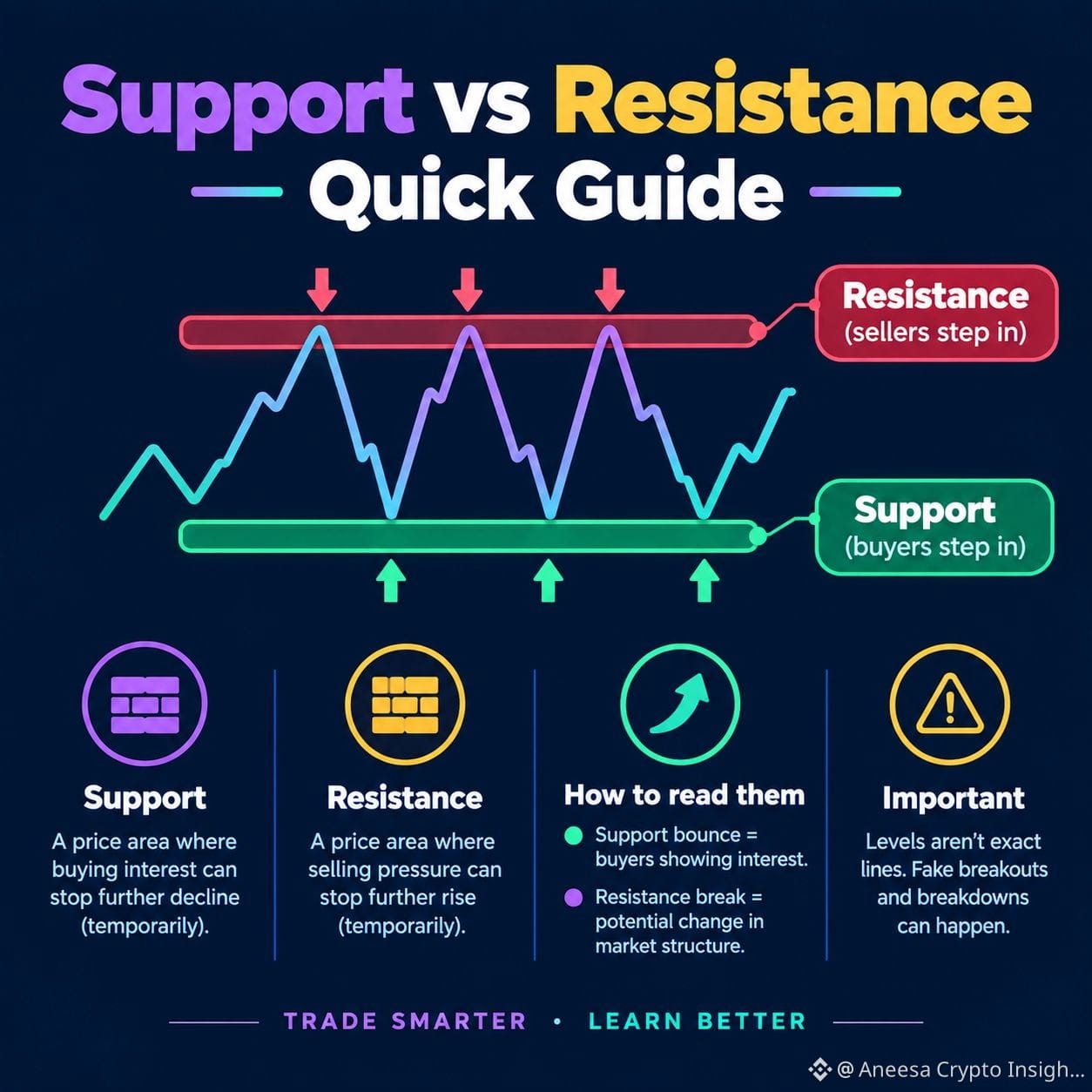
🎓 Support vs Resistance — Quick Guide
🧱 Support: A price level where buyers step in and may help stop the drop.
🧱 Resistance: A price level where sellers step in and may limit the rise.
💡 How to read them: ↗️ Bounce from support → buyers may be showing interest.
⬆️ Break above resistance → market structure may be changing.
⚠️ Remember: Levels aren’t perfect. Fake breaks and volatility are normal.
ℹ️ Not financial advice. DYOR.
👉 Follow Aneesa Crypto Insights for simple crypto education.
#CryptoEducation #SupportAndResistance #TradingBasics #crypto
🎓 Support vs Resistance — Quick Guide
🧱 Support: A price level where buyers step in and may help stop the drop.
🧱 Resistance: A price level where sellers step in and may limit the rise.
💡 How to read them: ↗️ Bounce from support → buyers may be showing interest.
⬆️ Break above resistance → market structure may be changing.
⚠️ Remember: Levels aren’t perfect. Fake breaks and volatility are normal.
ℹ️ Not financial advice. DYOR.
👉 Follow Aneesa Crypto Insights for simple crypto education.
#CryptoEducation #SupportAndResistance #TradingBasics #crypto
🧱 Support: A price level where buyers step in and may help stop the drop.
🧱 Resistance: A price level where sellers step in and may limit the rise.
💡 How to read them: ↗️ Bounce from support → buyers may be showing interest.
⬆️ Break above resistance → market structure may be changing.
⚠️ Remember: Levels aren’t perfect. Fake breaks and volatility are normal.
ℹ️ Not financial advice. DYOR.
👉 Follow Aneesa Crypto Insights for simple crypto education.
#CryptoEducation #SupportAndResistance #TradingBasics #crypto
68
·
--
If you have seen support and resistance used and nodded along, here it is properly.
These are the prices where a market has repeatedly stopped moving.
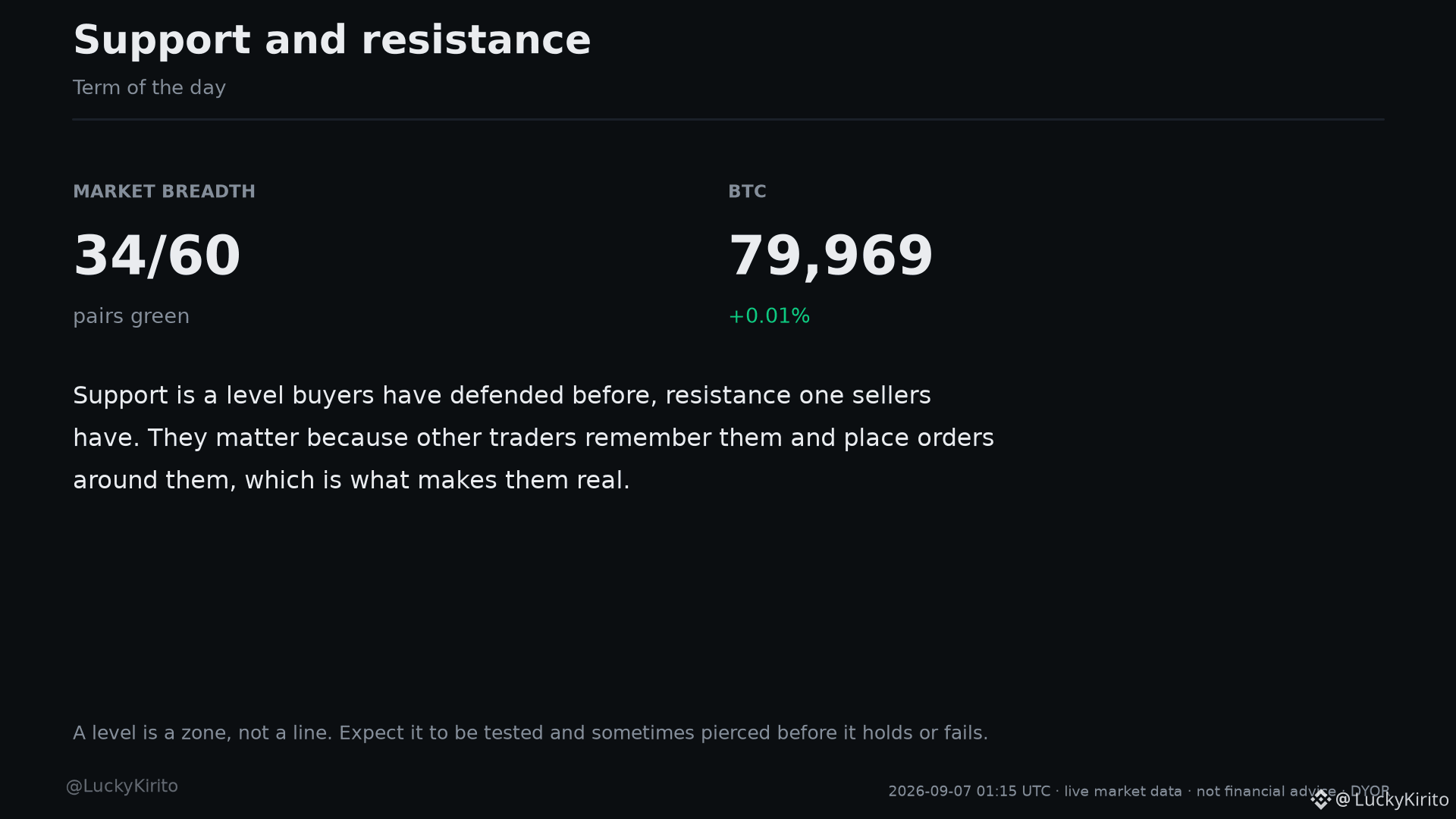
Support is a level buyers have defended before, resistance one sellers have. They matter because other traders remember them and place orders around them, which is what makes them real.
A level is a zone, not a line. Expect it to be tested and sometimes pierced before it holds or fails.
Right now: BTC at 79,969 (+0.01%), 34 of 60 liquid pairs green, RAY leading at +35.7%.
#Write2Earn #TradingTips #RiskManagement #TradingBasics
Automated technical analysis, not financial advice. I am not responsible for your trades. DYOR.
If you have seen support and resistance used and nodded along, here it is properly.
These are the prices where a market has repeatedly stopped moving.
Support is a level buyers have defended before, resistance one sellers have. They matter because other traders remember them and place orders around them, which is what makes them real.
A level is a zone, not a line. Expect it to be tested and sometimes pierced before it holds or fails.
Right now: BTC at 79,969 (+0.01%), 34 of 60 liquid pairs green, RAY leading at +35.7%.
#Write2Earn #TradingTips #RiskManagement #TradingBasics
Automated technical analysis, not financial advice. I am not responsible for your trades. DYOR.
These are the prices where a market has repeatedly stopped moving.
Support is a level buyers have defended before, resistance one sellers have. They matter because other traders remember them and place orders around them, which is what makes them real.
A level is a zone, not a line. Expect it to be tested and sometimes pierced before it holds or fails.
Right now: BTC at 79,969 (+0.01%), 34 of 60 liquid pairs green, RAY leading at +35.7%.
#Write2Earn #TradingTips #RiskManagement #TradingBasics
Automated technical analysis, not financial advice. I am not responsible for your trades. DYOR.
35
·
--
Worth saying plainly: trading without a stop.
A position with no stop has no defined loss, so the size of the loss gets decided by whatever the market does next and by how long you can bear to watch it.
Decide the invalidation level before you enter, and place the order when you place the entry. A stop you have to remember to use is not a stop.
Today's market makes the point: 牛来 is +47.1% while IOST is -55.8%, a spread of 103 points across the same 60 liquid pairs on the same day.
#Write2Earn #TradingBasics #CryptoEducation #TradingStrategy
Automated technical analysis, not financial advice. I am not responsible for your trades. DYOR.
Worth saying plainly: trading without a stop.
A position with no stop has no defined loss, so the size of the loss gets decided by whatever the market does next and by how long you can bear to watch it.
Decide the invalidation level before you enter, and place the order when you place the entry. A stop you have to remember to use is not a stop.
Today's market makes the point: 牛来 is +47.1% while IOST is -55.8%, a spread of 103 points across the same 60 liquid pairs on the same day.
#Write2Earn #TradingBasics #CryptoEducation #TradingStrategy
Automated technical analysis, not financial advice. I am not responsible for your trades. DYOR.
A position with no stop has no defined loss, so the size of the loss gets decided by whatever the market does next and by how long you can bear to watch it.
Decide the invalidation level before you enter, and place the order when you place the entry. A stop you have to remember to use is not a stop.
Today's market makes the point: 牛来 is +47.1% while IOST is -55.8%, a spread of 103 points across the same 60 liquid pairs on the same day.
#Write2Earn #TradingBasics #CryptoEducation #TradingStrategy
Automated technical analysis, not financial advice. I am not responsible for your trades. DYOR.

279
·
--
Worth knowing: what moving average actually means.
A moving average is the average close over a window, redrawn each bar.
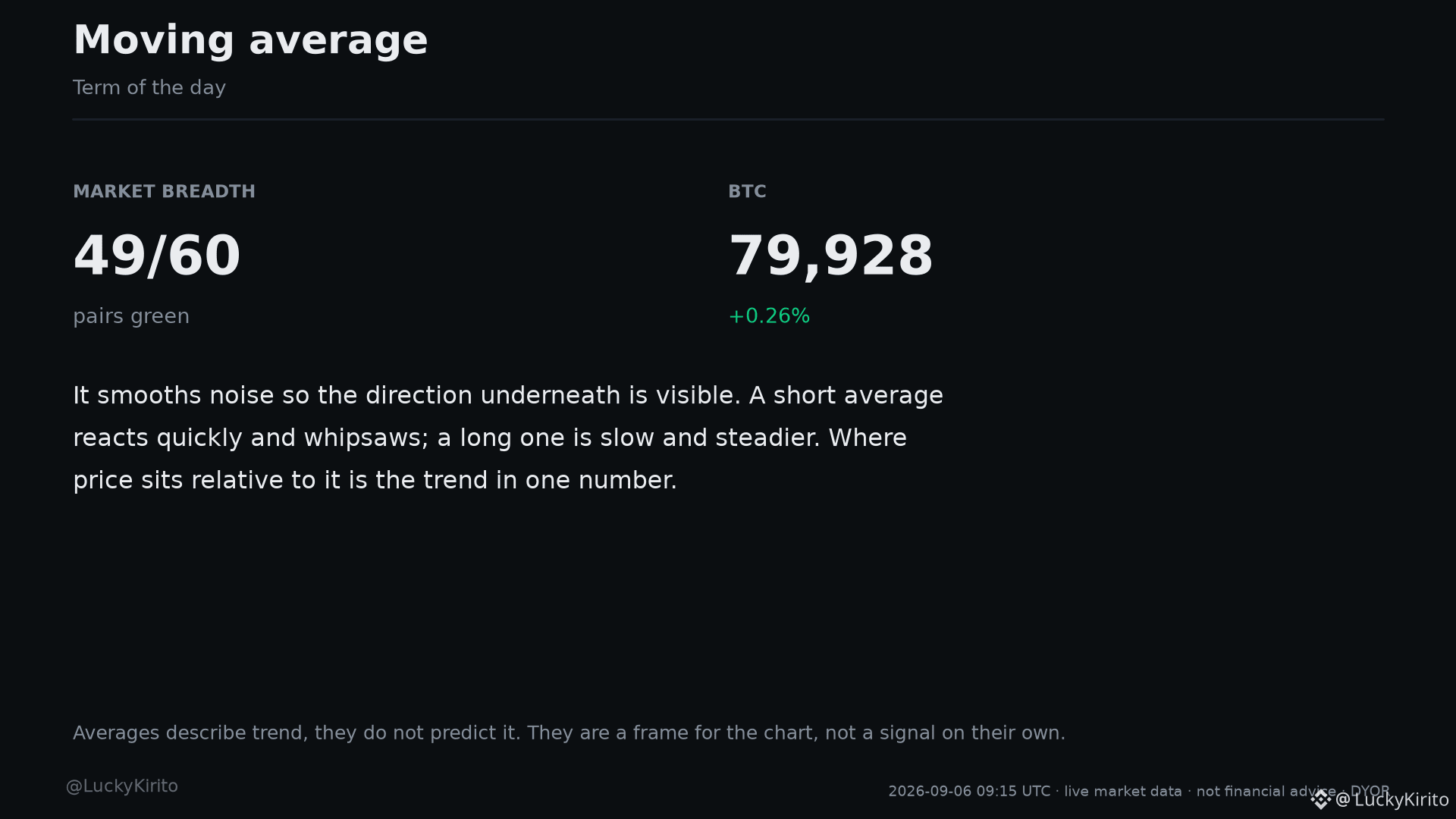
It smooths noise so the direction underneath is visible. A short average reacts quickly and whipsaws; a long one is slow and steadier. Where price sits relative to it is the trend in one number.
Averages describe trend, they do not predict it. They are a frame for the chart, not a signal on their own.
Right now: BTC at 79,928 (+0.26%), 49 of 60 liquid pairs green, ARB leading at +49.4%.
#Write2Earn #TradingBasics #CryptoEducation #TradingStrategy
Automated technical analysis, not financial advice. I am not responsible for your trades. DYOR.
Worth knowing: what moving average actually means.
A moving average is the average close over a window, redrawn each bar.
It smooths noise so the direction underneath is visible. A short average reacts quickly and whipsaws; a long one is slow and steadier. Where price sits relative to it is the trend in one number.
Averages describe trend, they do not predict it. They are a frame for the chart, not a signal on their own.
Right now: BTC at 79,928 (+0.26%), 49 of 60 liquid pairs green, ARB leading at +49.4%.
#Write2Earn #TradingBasics #CryptoEducation #TradingStrategy
Automated technical analysis, not financial advice. I am not responsible for your trades. DYOR.
A moving average is the average close over a window, redrawn each bar.
It smooths noise so the direction underneath is visible. A short average reacts quickly and whipsaws; a long one is slow and steadier. Where price sits relative to it is the trend in one number.
Averages describe trend, they do not predict it. They are a frame for the chart, not a signal on their own.
Right now: BTC at 79,928 (+0.26%), 49 of 60 liquid pairs green, ARB leading at +49.4%.
#Write2Earn #TradingBasics #CryptoEducation #TradingStrategy
Automated technical analysis, not financial advice. I am not responsible for your trades. DYOR.
47

📚 What Is a 24-Hour Trading Range?: Reading the high and low of a session
On July 31, 2026, Every crypto reports a 24-hour high and low — today $BTC traded between $63,832 and $65,164.
The distance between them is the session's range: a wide range signals volatility, a narrow one signals indecision and equilibrium.
📌 Key Takeaway:
Range analysis is a snapshot of the tug-of-war between buyers and sellers — the tighter the range, the closer the market is to choosing a side.
#Education #TradingBasics #CryptoMarkets
#BinanceAlphaAlert
📚 What Is a 24-Hour Trading Range?: Reading the high and low of a session
On July 31, 2026, Every crypto reports a 24-hour high and low — today $BTC traded between $63,832 and $65,164.
The distance between them is the session's range: a wide range signals volatility, a narrow one signals indecision and equilibrium.
📌 Key Takeaway:
Range analysis is a snapshot of the tug-of-war between buyers and sellers — the tighter the range, the closer the market is to choosing a side.
#Education #TradingBasics #CryptoMarkets
#BinanceAlphaAlert
On July 31, 2026, Every crypto reports a 24-hour high and low — today $BTC traded between $63,832 and $65,164.
The distance between them is the session's range: a wide range signals volatility, a narrow one signals indecision and equilibrium.
📌 Key Takeaway:
Range analysis is a snapshot of the tug-of-war between buyers and sellers — the tighter the range, the closer the market is to choosing a side.
#Education #TradingBasics #CryptoMarkets
#BinanceAlphaAlert
58
Log in to explore more content
Join global crypto users on Binance Square
⚡️ Get latest and useful information about crypto.
💬 Trusted by the world’s largest crypto exchange.
👍 Discover real insights from verified creators.
Email / Phone number
Trending Topics
1
#BitcoinSlipsBelow$80KAgain
264 views
18 Discussing
2
#ThailandLaunchesWORPTStablecoinToQRPaymentApp
50 views
28 Discussing
3
#StrategySkipsBitcoinPurchasesSpends$205MOnSTRCBuybacks
2,820 views
64 Discussing
4
#BitmineAdds10452ETH
27,464 views
487 Discussing
5
#SouthKoreaConsidersEducationTaxOnCryptoExchanges
17,095 views
399 Discussing
6
#OCCUrgesCommunityBanksToEnterStablecoinPayments
13,224 views
244 Discussing
7
#RippleWinsFullApprovalAsNationalTrustBank
16,329 views
253 Discussing
8
#AkashSelectsSolanaAsMigrationTarget
9,656 views
133 Discussing
9
#OndoToOpenSubscriptionsForOpenAIPreIPOTokenizedNotes
516 views
22 Discussing
10
#AnthropicTTMRevenueGrewAbout1200%
67,419 views
660 Discussing