

#polymarketfaketradingvideowsjreport
polymarketfaketradingvideowsjreport
128,705 views
712 Discussing
Hot
Latest

·
--
#PolymarketFakeTradingVideoWSJReport This news is super interesting, guys. Taking advantage of the fact that BINANCE opened a section called predictions, where users can invest money making predictions, it turns out that the creators of Polymarket allegedly used simulated/fake interfaces to make it seem like they were making big profitable bets, even though the trades weren't real. The Journal states that some creators received payments and that the content was made to look organic.
Money talks, as the saying goes; we’ll have to back that claim up in the coming days. $BTC
{future}(BTCUSDT)
#PolymarketFakeTradingVideoWSJReport This news is super interesting, guys. Taking advantage of the fact that BINANCE opened a section called predictions, where users can invest money making predictions, it turns out that the creators of Polymarket allegedly used simulated/fake interfaces to make it seem like they were making big profitable bets, even though the trades weren't real. The Journal states that some creators received payments and that the content was made to look organic.
Money talks, as the saying goes; we’ll have to back that claim up in the coming days. $BTC
Money talks, as the saying goes; we’ll have to back that claim up in the coming days. $BTC
2
115

·
--
The hashtag #PolymarketFakeTradingVideoWSJReport refers to a Wall Street Journal investigation published today alleging that some viral videos promoting Polymarket showed fake or simulated trades, not real user activity.
According to the report:
Polymarket allegedly paid social media creators to post videos showing large "winning" trades that were actually performed on mock or test versions of the platform rather than the live trading system.
Some creators told the Journal they were instructed not to disclose that the videos were sponsored and were provided with scripts. They reportedly earned around $2,000–$3,000 per month for producing this content.
The Journal says it reviewed more than 1,100 videos and identified signs that many of the trades shown were simulated rather than genuine.
Polymarket responded that it has policies to protect market integrity, conducts monitoring, and is carrying out an audit of its marketing practices.
What this means for crypto users:
These allegations concern marketing practices, not proof that Polymarket's prediction markets themselves were manipulated.
The claims are based on the Wall Street Journal's reporting and Polymarket has disputed aspects of the allegations while saying it is reviewing the matter.
The hashtag #PolymarketFakeTradingVideoWSJReport refers to a Wall Street Journal investigation published today alleging that some viral videos promoting Polymarket showed fake or simulated trades, not real user activity.
According to the report:
Polymarket allegedly paid social media creators to post videos showing large "winning" trades that were actually performed on mock or test versions of the platform rather than the live trading system.
Some creators told the Journal they were instructed not to disclose that the videos were sponsored and were provided with scripts. They reportedly earned around $2,000–$3,000 per month for producing this content.
The Journal says it reviewed more than 1,100 videos and identified signs that many of the trades shown were simulated rather than genuine.
Polymarket responded that it has policies to protect market integrity, conducts monitoring, and is carrying out an audit of its marketing practices.
What this means for crypto users:
These allegations concern marketing practices, not proof that Polymarket's prediction markets themselves were manipulated.
The claims are based on the Wall Street Journal's reporting and Polymarket has disputed aspects of the allegations while saying it is reviewing the matter.
According to the report:
Polymarket allegedly paid social media creators to post videos showing large "winning" trades that were actually performed on mock or test versions of the platform rather than the live trading system.
Some creators told the Journal they were instructed not to disclose that the videos were sponsored and were provided with scripts. They reportedly earned around $2,000–$3,000 per month for producing this content.
The Journal says it reviewed more than 1,100 videos and identified signs that many of the trades shown were simulated rather than genuine.
Polymarket responded that it has policies to protect market integrity, conducts monitoring, and is carrying out an audit of its marketing practices.
What this means for crypto users:
These allegations concern marketing practices, not proof that Polymarket's prediction markets themselves were manipulated.
The claims are based on the Wall Street Journal's reporting and Polymarket has disputed aspects of the allegations while saying it is reviewing the matter.
107

·
--
#polymarketfaketradingvideowsjreport #LINK
🚨 Polymarket Shock: WSJ reports many viral "easy profit" videos were allegedly staged, with influencers paid to promote fake winning trades and unrealistic gains.
⚠️ Lesson for traders: Don't chase social media hype. Most profits reportedly go to a small group of top accounts, while many retail users lose money.
📈 Trading Opportunity:
✅ BUY/ACCUMULATE: $BTC, $SOL, link — projects with strong adoption, real utility, and long-term growth potential.
❌ AVOID: Hype-driven bets and "guaranteed profit" schemes." click on the below yellow coin tag to go to desired trading page to go to desired trading page to get benefit trade ok." $BTC $LINK $SOL
{spot}(SOLUSDT)
{spot}(LINKUSDT)
{spot}(BTCUSDT)
#polymarketfaketradingvideowsjreport #LINK
🚨 Polymarket Shock: WSJ reports many viral "easy profit" videos were allegedly staged, with influencers paid to promote fake winning trades and unrealistic gains.
⚠️ Lesson for traders: Don't chase social media hype. Most profits reportedly go to a small group of top accounts, while many retail users lose money.
📈 Trading Opportunity:
✅ BUY/ACCUMULATE: $BTC , $SOL , link — projects with strong adoption, real utility, and long-term growth potential.
❌ AVOID: Hype-driven bets and "guaranteed profit" schemes." click on the below yellow coin tag to go to desired trading page to go to desired trading page to get benefit trade ok." $BTC $LINK $SOL
🚨 Polymarket Shock: WSJ reports many viral "easy profit" videos were allegedly staged, with influencers paid to promote fake winning trades and unrealistic gains.
⚠️ Lesson for traders: Don't chase social media hype. Most profits reportedly go to a small group of top accounts, while many retail users lose money.
📈 Trading Opportunity:
✅ BUY/ACCUMULATE: $BTC , $SOL , link — projects with strong adoption, real utility, and long-term growth potential.
❌ AVOID: Hype-driven bets and "guaranteed profit" schemes." click on the below yellow coin tag to go to desired trading page to go to desired trading page to get benefit trade ok." $BTC $LINK $SOL

1
5
569

·
--
#PolymarketFakeTradingVideoWSJReport
A new Wall Street Journal investigation has sparked serious debate across the prediction market industry.
According to the report, some social media videos promoting Polymarket allegedly showed simulated trades and winnings that were not real trades executed on the live platform. The investigation claims that creators were paid to produce content that appeared to show large profits, while some videos were created using test or mock environments resembling the actual platform.
The report raises important questions about transparency in influencer marketing, disclosure requirements, and how financial-style products are promoted to new users online. Critics argue that viewers may have been given an unrealistic impression of trading success, while supporters say prediction markets remain valuable tools for forecasting real-world events.
Polymarket has stated that it maintains market integrity standards and is reviewing the allegations. The company continues to expand its presence as prediction markets become increasingly mainstream.
What do you think?
Should platforms be held responsible for influencer content that portrays simulated profits as real trading results? Or is this simply another form of marketing that users should evaluate critically?
#Polymarket #PredictionMarkets #CryptoNews #Blockchain #Trading #Web3 #WallStreetJournal
#PolymarketFakeTradingVideoWSJReport
A new Wall Street Journal investigation has sparked serious debate across the prediction market industry.
According to the report, some social media videos promoting Polymarket allegedly showed simulated trades and winnings that were not real trades executed on the live platform. The investigation claims that creators were paid to produce content that appeared to show large profits, while some videos were created using test or mock environments resembling the actual platform.
The report raises important questions about transparency in influencer marketing, disclosure requirements, and how financial-style products are promoted to new users online. Critics argue that viewers may have been given an unrealistic impression of trading success, while supporters say prediction markets remain valuable tools for forecasting real-world events.
Polymarket has stated that it maintains market integrity standards and is reviewing the allegations. The company continues to expand its presence as prediction markets become increasingly mainstream.
What do you think?
Should platforms be held responsible for influencer content that portrays simulated profits as real trading results? Or is this simply another form of marketing that users should evaluate critically?
#Polymarket #PredictionMarkets #CryptoNews #Blockchain #Trading #Web3 #WallStreetJournal
A new Wall Street Journal investigation has sparked serious debate across the prediction market industry.
According to the report, some social media videos promoting Polymarket allegedly showed simulated trades and winnings that were not real trades executed on the live platform. The investigation claims that creators were paid to produce content that appeared to show large profits, while some videos were created using test or mock environments resembling the actual platform.
The report raises important questions about transparency in influencer marketing, disclosure requirements, and how financial-style products are promoted to new users online. Critics argue that viewers may have been given an unrealistic impression of trading success, while supporters say prediction markets remain valuable tools for forecasting real-world events.
Polymarket has stated that it maintains market integrity standards and is reviewing the allegations. The company continues to expand its presence as prediction markets become increasingly mainstream.
What do you think?
Should platforms be held responsible for influencer content that portrays simulated profits as real trading results? Or is this simply another form of marketing that users should evaluate critically?
#Polymarket #PredictionMarkets #CryptoNews #Blockchain #Trading #Web3 #WallStreetJournal

121

·
--
#opg $OPG
#PolymarketFakeTradingVideoWSJReport
Polymarket is facing mounting scrutiny over market integrity. A Wall Street Journal investigation found that just 0.1% of accounts captured 67% of all profits, with 70% of Polymarket users losing money (Crypto Times) , exposing a stark "sharks and fish" dynamic favoring professional firms. Separately, Columbia University researchers found wash trading — fake volume created by ghost accounts — peaked at nearly 60% of weekly volume in late 2024 (Crypto Bubble Tea) , artificially inflating odds that major outlets like the WSJ itself reported as credible. Polymarket also faced a 60 Minutes insider trading probe centered on nine connected accounts netting $2.4 million with a 98% win rate on U.S. military bets. (Sahm Capital) Regulatory and legal pressure is intensifying.
#opg $OPG
#PolymarketFakeTradingVideoWSJReport
Polymarket is facing mounting scrutiny over market integrity. A Wall Street Journal investigation found that just 0.1% of accounts captured 67% of all profits, with 70% of Polymarket users losing money (Crypto Times) , exposing a stark "sharks and fish" dynamic favoring professional firms. Separately, Columbia University researchers found wash trading — fake volume created by ghost accounts — peaked at nearly 60% of weekly volume in late 2024 (Crypto Bubble Tea) , artificially inflating odds that major outlets like the WSJ itself reported as credible. Polymarket also faced a 60 Minutes insider trading probe centered on nine connected accounts netting $2.4 million with a 98% win rate on U.S. military bets. (Sahm Capital) Regulatory and legal pressure is intensifying.
#PolymarketFakeTradingVideoWSJReport
Polymarket is facing mounting scrutiny over market integrity. A Wall Street Journal investigation found that just 0.1% of accounts captured 67% of all profits, with 70% of Polymarket users losing money (Crypto Times) , exposing a stark "sharks and fish" dynamic favoring professional firms. Separately, Columbia University researchers found wash trading — fake volume created by ghost accounts — peaked at nearly 60% of weekly volume in late 2024 (Crypto Bubble Tea) , artificially inflating odds that major outlets like the WSJ itself reported as credible. Polymarket also faced a 60 Minutes insider trading probe centered on nine connected accounts netting $2.4 million with a 98% win rate on U.S. military bets. (Sahm Capital) Regulatory and legal pressure is intensifying.
149

#PolymarketFakeTradingVideoWSJReport
Polymarket is a prediction market - a platform where people trade on the outcome of future events using money.
According to the report, creators allegedly used simulated / dummy Polymarket interfaces to make it look like they were placing huge profitable bets even though the trades were not real. The Journal says some creators were paid and that the content was made to look organic.
For real examples, in Binance you will see questions like:
Will $BTC hit $150k this year?
Will the Fed cut rates in July?
Will Team A beat Team B?
If a market says “Yes” = $0.65, it means the market is pricing a 65% chance of that event happening.
If you buy YES at $0.65 and the event happens, that share becomes $1.
If the event does not happen, it becomes $0.
Follow #Mahanadi for more updates 📰.
#PolymarketFakeTradingVideoWSJReport
Polymarket is a prediction market - a platform where people trade on the outcome of future events using money.
According to the report, creators allegedly used simulated / dummy Polymarket interfaces to make it look like they were placing huge profitable bets even though the trades were not real. The Journal says some creators were paid and that the content was made to look organic.
For real examples, in Binance you will see questions like:
Will $BTC hit $150k this year?
Will the Fed cut rates in July?
Will Team A beat Team B?
If a market says “Yes” = $0.65, it means the market is pricing a 65% chance of that event happening.
If you buy YES at $0.65 and the event happens, that share becomes $1.
If the event does not happen, it becomes $0.
Follow #Mahanadi for more updates 📰.
Polymarket is a prediction market - a platform where people trade on the outcome of future events using money.
According to the report, creators allegedly used simulated / dummy Polymarket interfaces to make it look like they were placing huge profitable bets even though the trades were not real. The Journal says some creators were paid and that the content was made to look organic.
For real examples, in Binance you will see questions like:
Will $BTC hit $150k this year?
Will the Fed cut rates in July?
Will Team A beat Team B?
If a market says “Yes” = $0.65, it means the market is pricing a 65% chance of that event happening.
If you buy YES at $0.65 and the event happens, that share becomes $1.
If the event does not happen, it becomes $0.
Follow #Mahanadi for more updates 📰.

What is Polymarket❔
From Digital Mahanadi
3
292

Verified
#polymarketfaketradingvideowsjreport
🚨 WSJ Just Dropped a BOMBSHELL on Polymarket – The "Easy Wins" You Saw? All FAKE 🔥
Thread:
You know those viral videos of college kids "stacking $50K" on Polymarket bets? Screaming "free money!" while their portfolio moons?
None of it was real. 😱
According to a massive WSJ investigation, Polymarket paid dozens of creators (mostly young influencers) $2K–$3K/month to film over 1,100 fake trading videos. They built clone websites, scripted the wins (including $900K in phony profits), hid the payments, and flooded social media to lure in users.
Total fake bets shown: $1.9 MILLION.
Meanwhile, reality check from WSJ: 67% of all profits on Polymarket go to just 0.1% of accounts (the sharks with algos). Most regular users get wrecked.
This is next-level deception in the prediction market gold rush.
3 coins/tokens to watch instead (real utility, not hype machines):
$BTC
BTC – The original king. Store of value + institutional adoption. When everything shakes out, Bitcoin stands. SOL – Fast, cheap, ecosystem exploding with real DeFi and memes that actually deliver volume. LINK – Chainlink oracles power real-world data for smart contracts. Underrated backbone of DeFi.
Moral of the story: If it looks too good to be true on social (especially paid "wins"), it probably is. DYOR harder than ever. Prediction markets can be fun, but treat them like Vegas — not a retirement plan.
What do you think — genius marketing or straight-up shady? Drop your thoughts 👇
#Polymarket #WSJ #CryptoScamAlert
$BTC
{future}(BTCUSDT)
$ETH
{future}(ETHUSDT)
#polymarketfaketradingvideowsjreport
🚨 WSJ Just Dropped a BOMBSHELL on Polymarket – The "Easy Wins" You Saw? All FAKE 🔥
Thread:
You know those viral videos of college kids "stacking $50K" on Polymarket bets? Screaming "free money!" while their portfolio moons?
None of it was real. 😱
According to a massive WSJ investigation, Polymarket paid dozens of creators (mostly young influencers) $2K–$3K/month to film over 1,100 fake trading videos. They built clone websites, scripted the wins (including $900K in phony profits), hid the payments, and flooded social media to lure in users.
Total fake bets shown: $1.9 MILLION.
Meanwhile, reality check from WSJ: 67% of all profits on Polymarket go to just 0.1% of accounts (the sharks with algos). Most regular users get wrecked.
This is next-level deception in the prediction market gold rush.
3 coins/tokens to watch instead (real utility, not hype machines):
$BTC
BTC – The original king. Store of value + institutional adoption. When everything shakes out, Bitcoin stands. SOL – Fast, cheap, ecosystem exploding with real DeFi and memes that actually deliver volume. LINK – Chainlink oracles power real-world data for smart contracts. Underrated backbone of DeFi.
Moral of the story: If it looks too good to be true on social (especially paid "wins"), it probably is. DYOR harder than ever. Prediction markets can be fun, but treat them like Vegas — not a retirement plan.
What do you think — genius marketing or straight-up shady? Drop your thoughts 👇
#Polymarket #WSJ #CryptoScamAlert
$BTC
$ETH
🚨 WSJ Just Dropped a BOMBSHELL on Polymarket – The "Easy Wins" You Saw? All FAKE 🔥
Thread:
You know those viral videos of college kids "stacking $50K" on Polymarket bets? Screaming "free money!" while their portfolio moons?
None of it was real. 😱
According to a massive WSJ investigation, Polymarket paid dozens of creators (mostly young influencers) $2K–$3K/month to film over 1,100 fake trading videos. They built clone websites, scripted the wins (including $900K in phony profits), hid the payments, and flooded social media to lure in users.
Total fake bets shown: $1.9 MILLION.
Meanwhile, reality check from WSJ: 67% of all profits on Polymarket go to just 0.1% of accounts (the sharks with algos). Most regular users get wrecked.
This is next-level deception in the prediction market gold rush.
3 coins/tokens to watch instead (real utility, not hype machines):
$BTC
BTC – The original king. Store of value + institutional adoption. When everything shakes out, Bitcoin stands. SOL – Fast, cheap, ecosystem exploding with real DeFi and memes that actually deliver volume. LINK – Chainlink oracles power real-world data for smart contracts. Underrated backbone of DeFi.
Moral of the story: If it looks too good to be true on social (especially paid "wins"), it probably is. DYOR harder than ever. Prediction markets can be fun, but treat them like Vegas — not a retirement plan.
What do you think — genius marketing or straight-up shady? Drop your thoughts 👇
#Polymarket #WSJ #CryptoScamAlert
$BTC
$ETH
1
6
4.1k

·
--
Bullish
# Shadow Volumes: WSJ Investigation Exposes Polymarket Deception
The narrative of crypto prediction platforms acting as flawless "truth machines" is facing intense scrutiny. A series of damning findings, highlighted by *The Wall Street Journal* and independent researchers, has pulled back the curtain on Polymarket, exposing a landscape rife with fabricated social media videos and heavily manipulated volume.
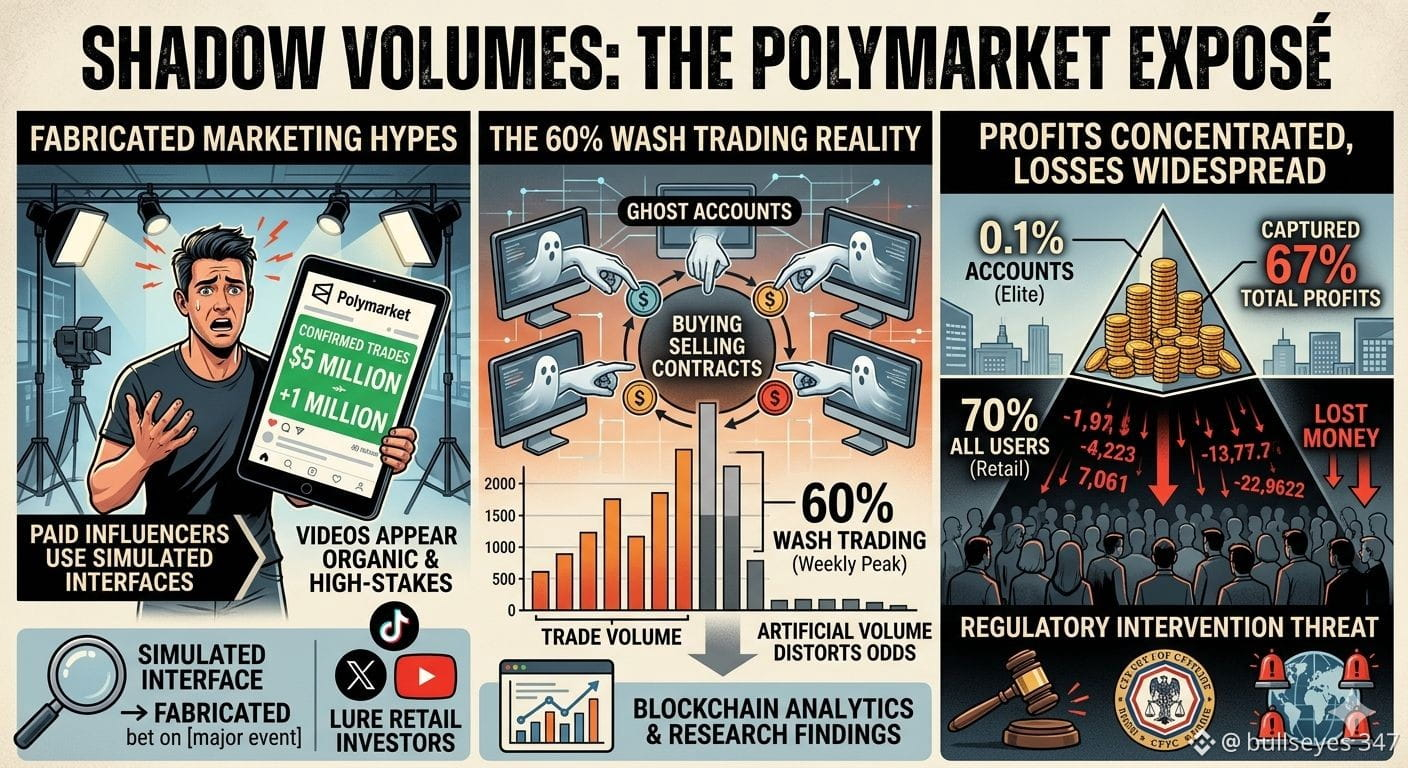
At the center of the outcry is how the platform has been marketed. According to reports, paid influencers and content creators allegedly used simulated, "dummy" user interfaces to record video content. To viewers on TikTok, X, and YouTube, these videos appeared to show organic, high-stakes traders placing massive, highly profitable bets. In reality, these trades were completely fabricated to lure retail users into a market where the odds were heavily stacked against them.
This manufactured hype aligns seamlessly with a deeper macroeconomic issue: Polymarket's data is heavily distorted by artificial activity. Blockchain analytics firms and university researchers uncovered that up to **60% of Polymarket's weekly volume** during major events consisted of **wash trading**—the illegal practice of ghost accounts repeatedly buying and selling the same contracts to simulate activity. Furthermore, data reveals that a mere **0.1% of accounts captured 67% of all platform profits**, while **70% of all users lost money**.
As global regulators view these revelations alongside ongoing insider trading probes, the exposure of paid, fake marketing videos may mark Polymarket’s tipping point from viral tech darling to a cautionary tale of digital market manipulation.
$TSLAB
{spot}(TSLABUSDT)
$BTC
{future}(BTCUSDT)
$ETH
{future}(ETHUSDT)
#SouthKoreaCryptoTaxPetitionReachesParliament
#PolymarketFakeTradingVideoWSJReport
#StrategySTRCDropsBelow$83Intraday
#VanceSeesNoEvidenceOfHormuzClosure
#TrumpSaysCollapseRiskDroveUSIranDeal
# Shadow Volumes: WSJ Investigation Exposes Polymarket Deception
The narrative of crypto prediction platforms acting as flawless "truth machines" is facing intense scrutiny. A series of damning findings, highlighted by *The Wall Street Journal* and independent researchers, has pulled back the curtain on Polymarket, exposing a landscape rife with fabricated social media videos and heavily manipulated volume.
At the center of the outcry is how the platform has been marketed. According to reports, paid influencers and content creators allegedly used simulated, "dummy" user interfaces to record video content. To viewers on TikTok, X, and YouTube, these videos appeared to show organic, high-stakes traders placing massive, highly profitable bets. In reality, these trades were completely fabricated to lure retail users into a market where the odds were heavily stacked against them.
This manufactured hype aligns seamlessly with a deeper macroeconomic issue: Polymarket's data is heavily distorted by artificial activity. Blockchain analytics firms and university researchers uncovered that up to **60% of Polymarket's weekly volume** during major events consisted of **wash trading**—the illegal practice of ghost accounts repeatedly buying and selling the same contracts to simulate activity. Furthermore, data reveals that a mere **0.1% of accounts captured 67% of all platform profits**, while **70% of all users lost money**.
As global regulators view these revelations alongside ongoing insider trading probes, the exposure of paid, fake marketing videos may mark Polymarket’s tipping point from viral tech darling to a cautionary tale of digital market manipulation.
$TSLAB
$BTC
$ETH
#SouthKoreaCryptoTaxPetitionReachesParliament
#PolymarketFakeTradingVideoWSJReport
#StrategySTRCDropsBelow$83Intraday
#VanceSeesNoEvidenceOfHormuzClosure
#TrumpSaysCollapseRiskDroveUSIranDeal
The narrative of crypto prediction platforms acting as flawless "truth machines" is facing intense scrutiny. A series of damning findings, highlighted by *The Wall Street Journal* and independent researchers, has pulled back the curtain on Polymarket, exposing a landscape rife with fabricated social media videos and heavily manipulated volume.
At the center of the outcry is how the platform has been marketed. According to reports, paid influencers and content creators allegedly used simulated, "dummy" user interfaces to record video content. To viewers on TikTok, X, and YouTube, these videos appeared to show organic, high-stakes traders placing massive, highly profitable bets. In reality, these trades were completely fabricated to lure retail users into a market where the odds were heavily stacked against them.
This manufactured hype aligns seamlessly with a deeper macroeconomic issue: Polymarket's data is heavily distorted by artificial activity. Blockchain analytics firms and university researchers uncovered that up to **60% of Polymarket's weekly volume** during major events consisted of **wash trading**—the illegal practice of ghost accounts repeatedly buying and selling the same contracts to simulate activity. Furthermore, data reveals that a mere **0.1% of accounts captured 67% of all platform profits**, while **70% of all users lost money**.
As global regulators view these revelations alongside ongoing insider trading probes, the exposure of paid, fake marketing videos may mark Polymarket’s tipping point from viral tech darling to a cautionary tale of digital market manipulation.
$TSLAB
$BTC
$ETH
#SouthKoreaCryptoTaxPetitionReachesParliament
#PolymarketFakeTradingVideoWSJReport
#StrategySTRCDropsBelow$83Intraday
#VanceSeesNoEvidenceOfHormuzClosure
#TrumpSaysCollapseRiskDroveUSIranDeal
152

Reports are making the rounds that some Polymarket-related videos may have shown simulated trades instead of real ones. The story is getting attention, and many are now watching for more details and responses from the platform.
#PolymarketFakeTradingVideoWSJReport
Reports are making the rounds that some Polymarket-related videos may have shown simulated trades instead of real ones. The story is getting attention, and many are now watching for more details and responses from the platform.
#PolymarketFakeTradingVideoWSJReport
#PolymarketFakeTradingVideoWSJReport
84

·
--
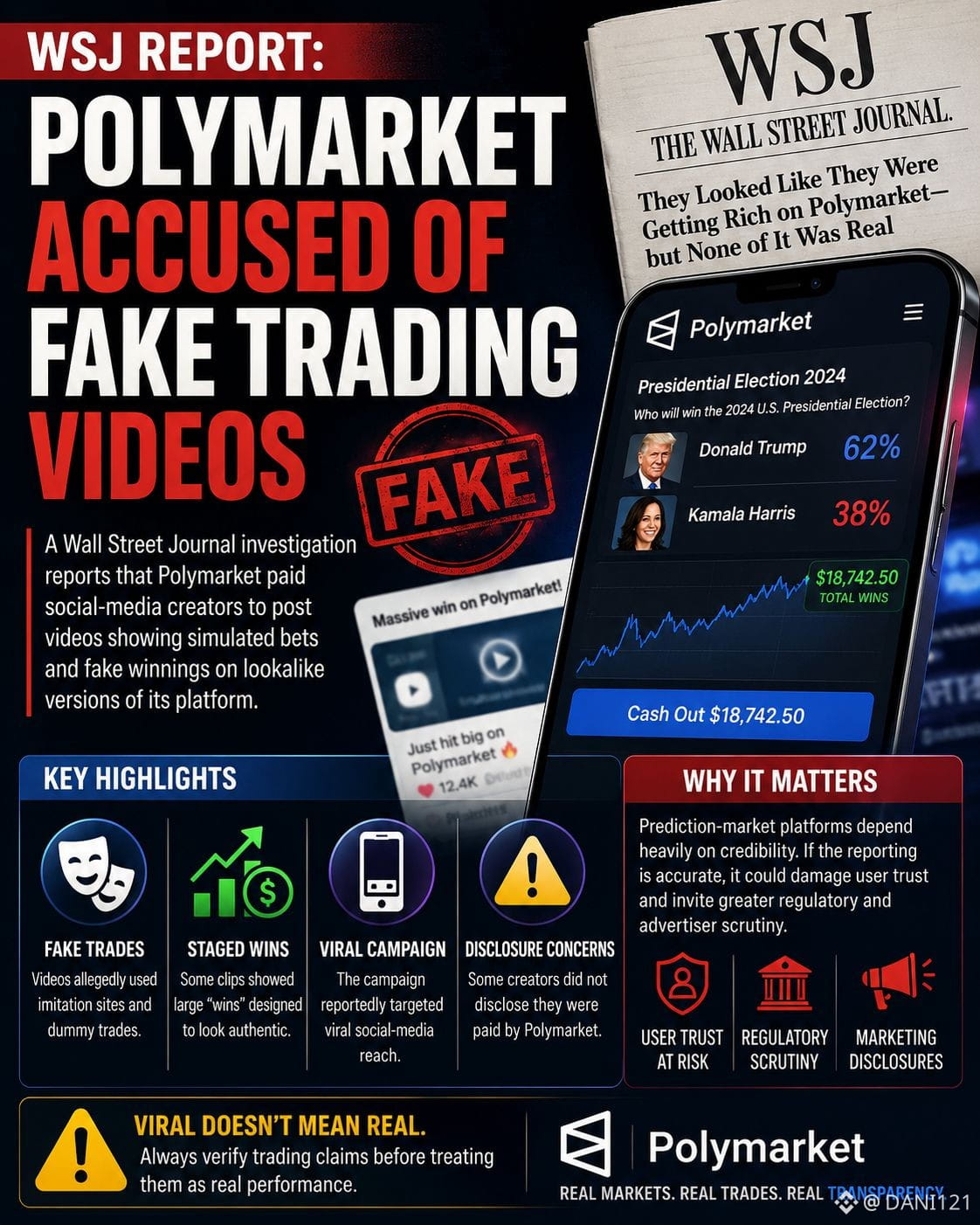
#PolymarketFakeTradingVideoWSJReport 🎥 WSJ Report: Polymarket Accused of Fake Trading Videos
A Wall Street Journal investigation reports that Polymarket paid social-media creators to post videos showing simulated bets and fake winnings on lookalike versions of its platform. The Journal reviewed more than 1,100 videos; the displayed trades were reportedly not real, and some creators did not disclose that they were paid. (Wall Street Journal)
Key Highlights
🎭 Videos allegedly used imitation sites and dummy trades.
💰 Some clips showed large “wins” designed to look authentic.
📱 The campaign reportedly targeted viral social-media reach.
⚠️ The report raises concerns around marketing disclosures, user trust, and regulatory scrutiny. (Wall Street Journal)
Why It Matters
Prediction-market platforms depend heavily on credibility: users need to distinguish real, auditable trading activity from promotional content. If the reporting is accurate, it could damage confidence in viral trading claims and increase attention from regulators and advertisers. (Wall Street Journal)
🚨 WSJ Report: Polymarket Accused of Fake Trading Videos
A Wall Street Journal investigation reports that Polymarket paid creators to post videos showing simulated bets and fake winnings on lookalike platforms.
🎭 Fake trades allegedly used
📱 1,100+ videos reviewed
💰 Large “wins” reportedly staged
⚠️ Trust and disclosure concerns rise
The report could increase scrutiny of crypto-platform marketing and remind users to verify viral trading claims before treating them as real performance.
#Polymarket #Crypto #PredictionMarkets #Trading #Blockchain #Web3 #CryptoNews #Regulation #Markets
#PolymarketFakeTradingVideoWSJReport 🎥 WSJ Report: Polymarket Accused of Fake Trading Videos
A Wall Street Journal investigation reports that Polymarket paid social-media creators to post videos showing simulated bets and fake winnings on lookalike versions of its platform. The Journal reviewed more than 1,100 videos; the displayed trades were reportedly not real, and some creators did not disclose that they were paid. (Wall Street Journal)
Key Highlights
🎭 Videos allegedly used imitation sites and dummy trades.
💰 Some clips showed large “wins” designed to look authentic.
📱 The campaign reportedly targeted viral social-media reach.
⚠️ The report raises concerns around marketing disclosures, user trust, and regulatory scrutiny. (Wall Street Journal)
Why It Matters
Prediction-market platforms depend heavily on credibility: users need to distinguish real, auditable trading activity from promotional content. If the reporting is accurate, it could damage confidence in viral trading claims and increase attention from regulators and advertisers. (Wall Street Journal)
🚨 WSJ Report: Polymarket Accused of Fake Trading Videos
A Wall Street Journal investigation reports that Polymarket paid creators to post videos showing simulated bets and fake winnings on lookalike platforms.
🎭 Fake trades allegedly used
📱 1,100+ videos reviewed
💰 Large “wins” reportedly staged
⚠️ Trust and disclosure concerns rise
The report could increase scrutiny of crypto-platform marketing and remind users to verify viral trading claims before treating them as real performance.
#Polymarket #Crypto #PredictionMarkets #Trading #Blockchain #Web3 #CryptoNews #Regulation #Markets
A Wall Street Journal investigation reports that Polymarket paid social-media creators to post videos showing simulated bets and fake winnings on lookalike versions of its platform. The Journal reviewed more than 1,100 videos; the displayed trades were reportedly not real, and some creators did not disclose that they were paid. (Wall Street Journal)
Key Highlights
🎭 Videos allegedly used imitation sites and dummy trades.
💰 Some clips showed large “wins” designed to look authentic.
📱 The campaign reportedly targeted viral social-media reach.
⚠️ The report raises concerns around marketing disclosures, user trust, and regulatory scrutiny. (Wall Street Journal)
Why It Matters
Prediction-market platforms depend heavily on credibility: users need to distinguish real, auditable trading activity from promotional content. If the reporting is accurate, it could damage confidence in viral trading claims and increase attention from regulators and advertisers. (Wall Street Journal)
🚨 WSJ Report: Polymarket Accused of Fake Trading Videos
A Wall Street Journal investigation reports that Polymarket paid creators to post videos showing simulated bets and fake winnings on lookalike platforms.
🎭 Fake trades allegedly used
📱 1,100+ videos reviewed
💰 Large “wins” reportedly staged
⚠️ Trust and disclosure concerns rise
The report could increase scrutiny of crypto-platform marketing and remind users to verify viral trading claims before treating them as real performance.
#Polymarket #Crypto #PredictionMarkets #Trading #Blockchain #Web3 #CryptoNews #Regulation #Markets
7
53

·
--
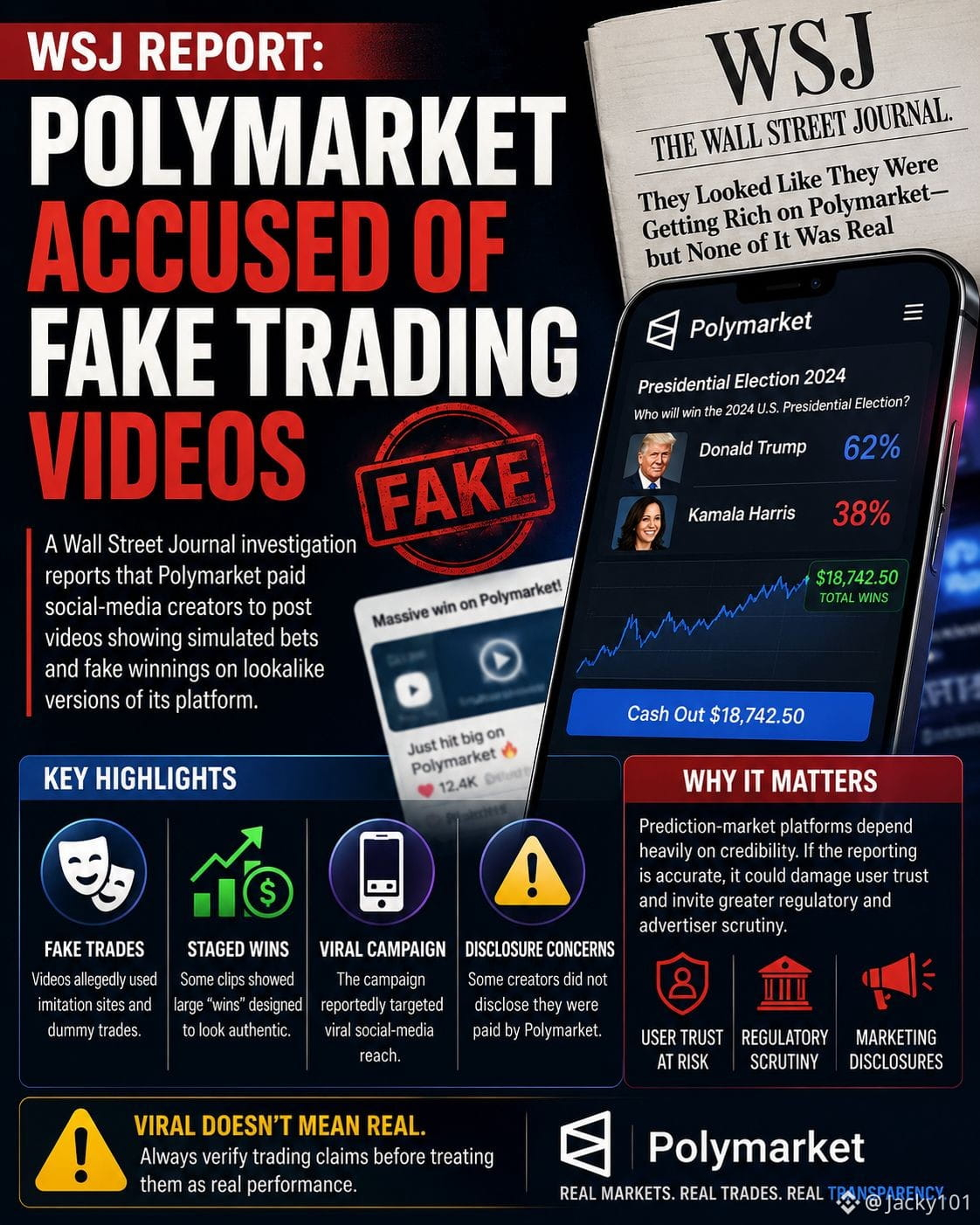
#polymarketfaketradingvideowsjreport 🎥 WSJ Report: Polymarket Accused of Fake Trading Videos
A Wall Street Journal investigation reports that Polymarket paid social-media creators to post videos showing simulated bets and fake winnings on lookalike versions of its platform. The Journal reviewed more than 1,100 videos; the displayed trades were reportedly not real, and some creators did not disclose that they were paid. (Wall Street Journal)
Key Highlights
🎭 Videos allegedly used imitation sites and dummy trades.
💰 Some clips showed large “wins” designed to look authentic.
📱 The campaign reportedly targeted viral social-media reach.
⚠️ The report raises concerns around marketing disclosures, user trust, and regulatory scrutiny. (Wall Street Journal)
Why It Matters
Prediction-market platforms depend heavily on credibility: users need to distinguish real, auditable trading activity from promotional content. If the reporting is accurate, it could damage confidence in viral trading claims and increase attention from regulators and advertisers. (Wall Street Journal)
🚨 WSJ Report: Polymarket Accused of Fake Trading Videos
A Wall Street Journal investigation reports that Polymarket paid creators to post videos showing simulated bets and fake winnings on lookalike platforms.
🎭 Fake trades allegedly used
📱 1,100+ videos reviewed
💰 Large “wins” reportedly staged
⚠️ Trust and disclosure concerns rise
The report could increase scrutiny of crypto-platform marketing and remind users to verify viral trading claims before treating them as real performance.
#Polymarket #Crypto #PredictionMarkets #Trading #Blockchain #Web3 #CryptoNews #Regulation #Markets
#polymarketfaketradingvideowsjreport 🎥 WSJ Report: Polymarket Accused of Fake Trading Videos
A Wall Street Journal investigation reports that Polymarket paid social-media creators to post videos showing simulated bets and fake winnings on lookalike versions of its platform. The Journal reviewed more than 1,100 videos; the displayed trades were reportedly not real, and some creators did not disclose that they were paid. (Wall Street Journal)
Key Highlights
🎭 Videos allegedly used imitation sites and dummy trades.
💰 Some clips showed large “wins” designed to look authentic.
📱 The campaign reportedly targeted viral social-media reach.
⚠️ The report raises concerns around marketing disclosures, user trust, and regulatory scrutiny. (Wall Street Journal)
Why It Matters
Prediction-market platforms depend heavily on credibility: users need to distinguish real, auditable trading activity from promotional content. If the reporting is accurate, it could damage confidence in viral trading claims and increase attention from regulators and advertisers. (Wall Street Journal)
🚨 WSJ Report: Polymarket Accused of Fake Trading Videos
A Wall Street Journal investigation reports that Polymarket paid creators to post videos showing simulated bets and fake winnings on lookalike platforms.
🎭 Fake trades allegedly used
📱 1,100+ videos reviewed
💰 Large “wins” reportedly staged
⚠️ Trust and disclosure concerns rise
The report could increase scrutiny of crypto-platform marketing and remind users to verify viral trading claims before treating them as real performance.
#Polymarket #Crypto #PredictionMarkets #Trading #Blockchain #Web3 #CryptoNews #Regulation #Markets
A Wall Street Journal investigation reports that Polymarket paid social-media creators to post videos showing simulated bets and fake winnings on lookalike versions of its platform. The Journal reviewed more than 1,100 videos; the displayed trades were reportedly not real, and some creators did not disclose that they were paid. (Wall Street Journal)
Key Highlights
🎭 Videos allegedly used imitation sites and dummy trades.
💰 Some clips showed large “wins” designed to look authentic.
📱 The campaign reportedly targeted viral social-media reach.
⚠️ The report raises concerns around marketing disclosures, user trust, and regulatory scrutiny. (Wall Street Journal)
Why It Matters
Prediction-market platforms depend heavily on credibility: users need to distinguish real, auditable trading activity from promotional content. If the reporting is accurate, it could damage confidence in viral trading claims and increase attention from regulators and advertisers. (Wall Street Journal)
🚨 WSJ Report: Polymarket Accused of Fake Trading Videos
A Wall Street Journal investigation reports that Polymarket paid creators to post videos showing simulated bets and fake winnings on lookalike platforms.
🎭 Fake trades allegedly used
📱 1,100+ videos reviewed
💰 Large “wins” reportedly staged
⚠️ Trust and disclosure concerns rise
The report could increase scrutiny of crypto-platform marketing and remind users to verify viral trading claims before treating them as real performance.
#Polymarket #Crypto #PredictionMarkets #Trading #Blockchain #Web3 #CryptoNews #Regulation #Markets
3
46

·
--
Bullish
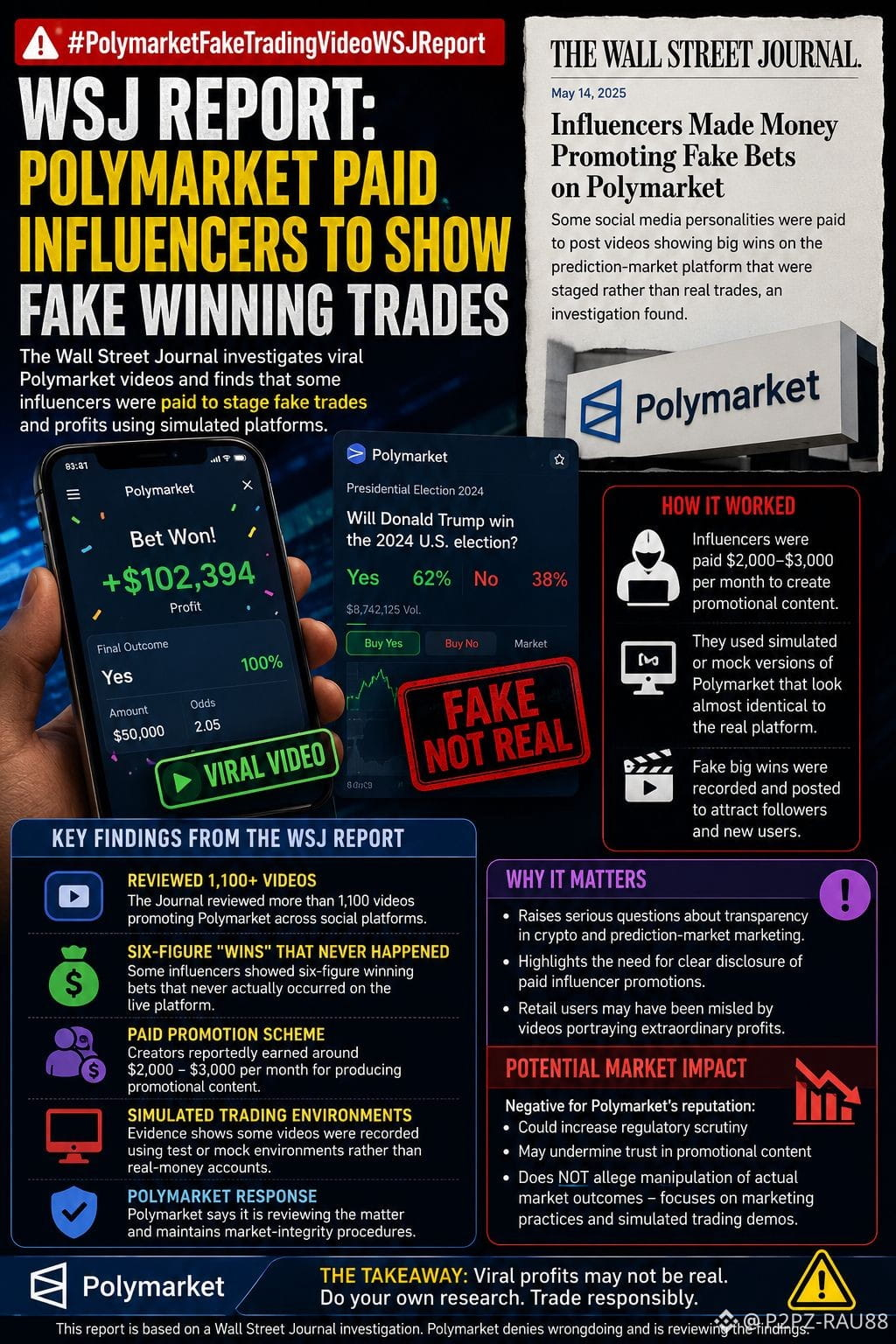
#PolymarketFakeTradingVideoWSJReport
A new report from the The Wall Street Journal alleges that some viral Polymarket social-media videos showing huge betting profits were staged rather than real trades. According to the investigation, creators were reportedly paid to simulate trades and winnings on mock versions of the platform that closely resembled the real interface.
The Wall Street Journal
Highlights from the report:
The Journal says it reviewed more than 1,100 videos promoting Polymarket across social platforms.
The Wall Street Journal
Some influencers allegedly showed six-figure winning bets that never actually occurred on the live platform.
The Wall Street Journal
Creators reportedly earned around $2,000–$3,000 per month for producing content.
The Wall Street Journal
The investigation found evidence that some videos were recorded using simulated or test environments rather than real-money accounts.
The Wall Street Journal
Polymarket stated that it is reviewing the matter and said it maintains market-integrity procedures.
The Wall Street Journal
📉 Why It Matters
The report raises concerns about:
Transparency in crypto and prediction-market marketing.
Disclosure of paid influencer promotions.
Whether retail users may have been misled by videos portraying extraordinary profits.
The Wall Street Journal
🎯 Potential Market Impact
The story is generally viewed as negative for Polymarket's reputation because it could increase regulatory scrutiny and undermine trust in promotional content. However, the report does not allege manipulation of actual market outcomes, focusing instead on marketing practices and simulated trading demonstrations.
The Wall Street Journal
Short headline version:
WSJ Report: Polymarket Paid Influencers to Showcase Fake Winning Trades, Raising Questions About Transparency and Marketing Practices.
#PolymarketFakeTradingVideoWSJReport
A new report from the The Wall Street Journal alleges that some viral Polymarket social-media videos showing huge betting profits were staged rather than real trades. According to the investigation, creators were reportedly paid to simulate trades and winnings on mock versions of the platform that closely resembled the real interface.
The Wall Street Journal
Highlights from the report:
The Journal says it reviewed more than 1,100 videos promoting Polymarket across social platforms.
The Wall Street Journal
Some influencers allegedly showed six-figure winning bets that never actually occurred on the live platform.
The Wall Street Journal
Creators reportedly earned around $2,000–$3,000 per month for producing content.
The Wall Street Journal
The investigation found evidence that some videos were recorded using simulated or test environments rather than real-money accounts.
The Wall Street Journal
Polymarket stated that it is reviewing the matter and said it maintains market-integrity procedures.
The Wall Street Journal
📉 Why It Matters
The report raises concerns about:
Transparency in crypto and prediction-market marketing.
Disclosure of paid influencer promotions.
Whether retail users may have been misled by videos portraying extraordinary profits.
The Wall Street Journal
🎯 Potential Market Impact
The story is generally viewed as negative for Polymarket's reputation because it could increase regulatory scrutiny and undermine trust in promotional content. However, the report does not allege manipulation of actual market outcomes, focusing instead on marketing practices and simulated trading demonstrations.
The Wall Street Journal
Short headline version:
WSJ Report: Polymarket Paid Influencers to Showcase Fake Winning Trades, Raising Questions About Transparency and Marketing Practices.
A new report from the The Wall Street Journal alleges that some viral Polymarket social-media videos showing huge betting profits were staged rather than real trades. According to the investigation, creators were reportedly paid to simulate trades and winnings on mock versions of the platform that closely resembled the real interface.
The Wall Street Journal
Highlights from the report:
The Journal says it reviewed more than 1,100 videos promoting Polymarket across social platforms.
The Wall Street Journal
Some influencers allegedly showed six-figure winning bets that never actually occurred on the live platform.
The Wall Street Journal
Creators reportedly earned around $2,000–$3,000 per month for producing content.
The Wall Street Journal
The investigation found evidence that some videos were recorded using simulated or test environments rather than real-money accounts.
The Wall Street Journal
Polymarket stated that it is reviewing the matter and said it maintains market-integrity procedures.
The Wall Street Journal
📉 Why It Matters
The report raises concerns about:
Transparency in crypto and prediction-market marketing.
Disclosure of paid influencer promotions.
Whether retail users may have been misled by videos portraying extraordinary profits.
The Wall Street Journal
🎯 Potential Market Impact
The story is generally viewed as negative for Polymarket's reputation because it could increase regulatory scrutiny and undermine trust in promotional content. However, the report does not allege manipulation of actual market outcomes, focusing instead on marketing practices and simulated trading demonstrations.
The Wall Street Journal
Short headline version:
WSJ Report: Polymarket Paid Influencers to Showcase Fake Winning Trades, Raising Questions About Transparency and Marketing Practices.

1
115

·
--
#PolymarketFakeTradingVideoWSJReport 🚨 Fake Profits? Real Controversy.
A new WSJ report claims that some social media creators were allegedly paid to showcase fake Polymarket trades and winnings, making them appear as real profits.
📊 According to the report, certain videos reportedly used simulated versions of the platform while presenting the trades as authentic.
⚡ The controversy is raising serious questions across the crypto community:
• Should platforms be responsible for influencer marketing practices?
• Can prediction markets maintain trust if promotional content is misleading?
• Will regulators take a closer look at user acquisition strategies?
👀 Despite the debate, prediction markets continue to attract growing attention and trading activity.
💬 What do you think?
Is this simply aggressive marketing...
OR
🚨 A serious trust issue for prediction markets?
👇 Share your opinion below.
#Polymarket #CryptoNews #PredictionMarkets #WSJ #Crypto #Blockchain #MarketUpdate #BinanceSquare #PolymarketFakeTradingVideoWSJReport
#PolymarketFakeTradingVideoWSJReport 🚨 Fake Profits? Real Controversy.
A new WSJ report claims that some social media creators were allegedly paid to showcase fake Polymarket trades and winnings, making them appear as real profits.
📊 According to the report, certain videos reportedly used simulated versions of the platform while presenting the trades as authentic.
⚡ The controversy is raising serious questions across the crypto community:
• Should platforms be responsible for influencer marketing practices?
• Can prediction markets maintain trust if promotional content is misleading?
• Will regulators take a closer look at user acquisition strategies?
👀 Despite the debate, prediction markets continue to attract growing attention and trading activity.
💬 What do you think?
Is this simply aggressive marketing...
OR
🚨 A serious trust issue for prediction markets?
👇 Share your opinion below.
#Polymarket #CryptoNews #PredictionMarkets #WSJ #Crypto #Blockchain #MarketUpdate #BinanceSquare #PolymarketFakeTradingVideoWSJReport
A new WSJ report claims that some social media creators were allegedly paid to showcase fake Polymarket trades and winnings, making them appear as real profits.
📊 According to the report, certain videos reportedly used simulated versions of the platform while presenting the trades as authentic.
⚡ The controversy is raising serious questions across the crypto community:
• Should platforms be responsible for influencer marketing practices?
• Can prediction markets maintain trust if promotional content is misleading?
• Will regulators take a closer look at user acquisition strategies?
👀 Despite the debate, prediction markets continue to attract growing attention and trading activity.
💬 What do you think?
Is this simply aggressive marketing...
OR
🚨 A serious trust issue for prediction markets?
👇 Share your opinion below.
#Polymarket #CryptoNews #PredictionMarkets #WSJ #Crypto #Blockchain #MarketUpdate #BinanceSquare #PolymarketFakeTradingVideoWSJReport
1
147

·
--
Bullish
Verified
#polymarketfaketradingvideowsjreport
What the heck. This is some serious FUD 🚨
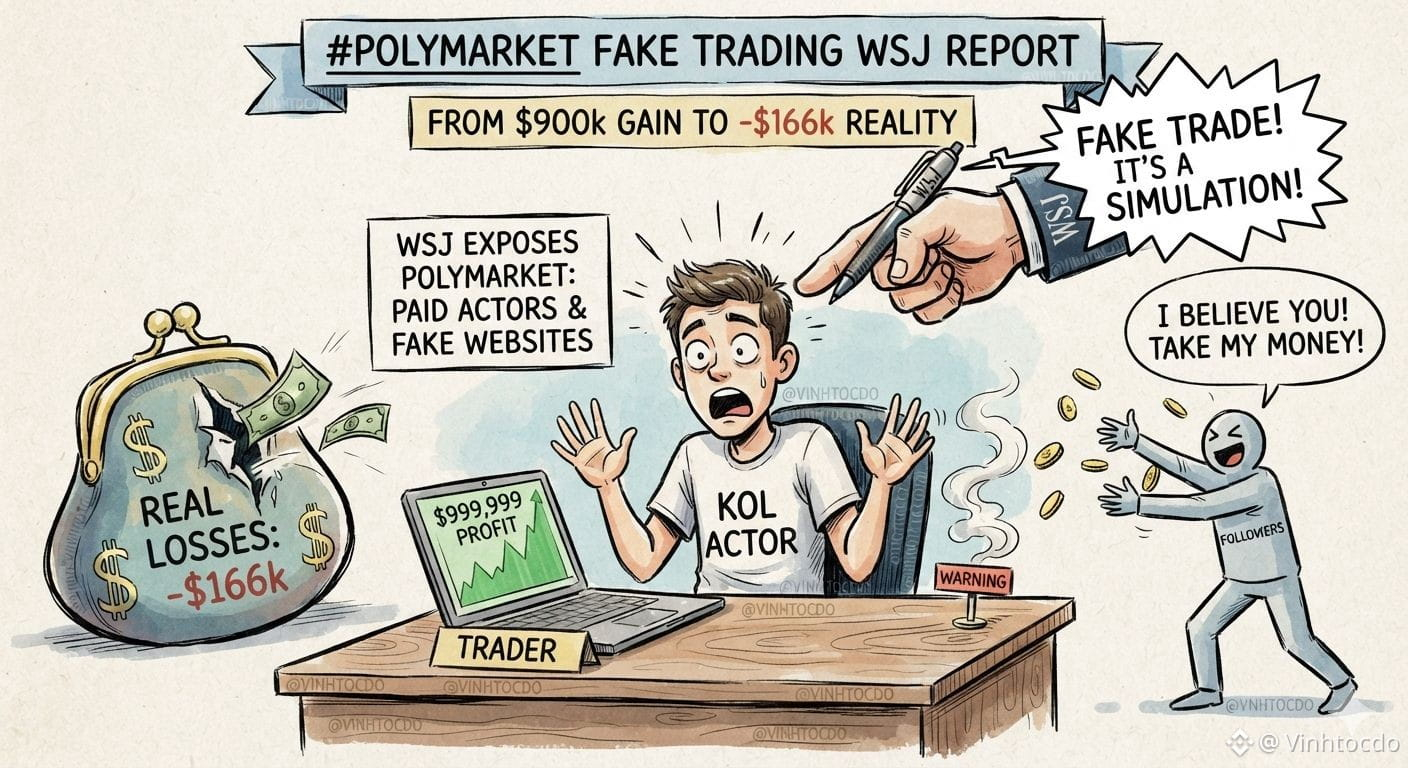
The Wall Street Journal just exposed Polymarket for paying KOLs to create fake trade videos to lure in noobs. They even made a fake website that looks exactly like the real one, splicing old clips together to stage a celebration of making hundreds of thousands. WSJ analyzed 118 clips boasting a $900k win, but in reality, they lost a whopping $166k! 📉
It's true that online you see all these big wins, but in reality, it’s just a bunch of "clowns" out there.
Be careful out there, fam!
Sign up on the exchange using code VINHTOCDO to support me! I’m not trying to scam anyone. ha ha ha. 😁
DYOR - Not financial advice! #NFA✅
#Polymarket_News #WSJ #VINHTOCDO $NVDAB
{spot}(NVDABUSDT)
$SPCXB
{spot}(SPCXBUSDT)
$TSLAB
{spot}(TSLABUSDT)
#polymarketfaketradingvideowsjreport
What the heck. This is some serious FUD 🚨
The Wall Street Journal just exposed Polymarket for paying KOLs to create fake trade videos to lure in noobs. They even made a fake website that looks exactly like the real one, splicing old clips together to stage a celebration of making hundreds of thousands. WSJ analyzed 118 clips boasting a $900k win, but in reality, they lost a whopping $166k! 📉
It's true that online you see all these big wins, but in reality, it’s just a bunch of "clowns" out there.
Be careful out there, fam!
Sign up on the exchange using code VINHTOCDO to support me! I’m not trying to scam anyone. ha ha ha. 😁
DYOR - Not financial advice! #NFA✅
#Polymarket_News #WSJ #VINHTOCDO $NVDAB
$SPCXB
$TSLAB
What the heck. This is some serious FUD 🚨
The Wall Street Journal just exposed Polymarket for paying KOLs to create fake trade videos to lure in noobs. They even made a fake website that looks exactly like the real one, splicing old clips together to stage a celebration of making hundreds of thousands. WSJ analyzed 118 clips boasting a $900k win, but in reality, they lost a whopping $166k! 📉
It's true that online you see all these big wins, but in reality, it’s just a bunch of "clowns" out there.
Be careful out there, fam!
Sign up on the exchange using code VINHTOCDO to support me! I’m not trying to scam anyone. ha ha ha. 😁
DYOR - Not financial advice! #NFA✅
#Polymarket_News #WSJ #VINHTOCDO $NVDAB
$SPCXB
$TSLAB
9
16
18.4k

What happens when viral trading wins aren't actually real?
A recent Wall Street Journal investigation alleges that some social media videos promoting huge wins on Polymarket were staged using simulated environments that looked like real trading screens. According to the report, creators were allegedly paid to showcase dramatic profits that never occurred on actual markets. �
Wall Street Journal
🎭 Fake screenshots.
📱 Viral videos.
💰 Massive "profits."
❓ But where does reality end and marketing begin?
The crypto industry has spent years fighting for credibility. That's why transparency matters more than ever. Real adoption isn't built on edited clips or manufactured success stories—it's built on education, innovation, and trust.
The biggest lesson isn't about one platform.
It's a reminder to every investor:
🔍 Verify before you believe.
📊 Research before you trade.
🧠 Don't let viral content replace due diligence.
In a world where attention is the most valuable currency, the smartest investors are the ones who question the story behind the screenshot.
The future of crypto belongs to transparency, not theatrics. 🚀
#CryptoNews #Polymarket #Blockchain #Web3 $BTC #Binance #CryptoCommunity #DigitalAssets #Trading #Investing #DYOR #FutureOfFinance #CryptoEducation #MarketInsights �#PolymarketFakeTradingVideoWSJReport
What happens when viral trading wins aren't actually real?
A recent Wall Street Journal investigation alleges that some social media videos promoting huge wins on Polymarket were staged using simulated environments that looked like real trading screens. According to the report, creators were allegedly paid to showcase dramatic profits that never occurred on actual markets. �
Wall Street Journal
🎭 Fake screenshots.
📱 Viral videos.
💰 Massive "profits."
❓ But where does reality end and marketing begin?
The crypto industry has spent years fighting for credibility. That's why transparency matters more than ever. Real adoption isn't built on edited clips or manufactured success stories—it's built on education, innovation, and trust.
The biggest lesson isn't about one platform.
It's a reminder to every investor:
🔍 Verify before you believe.
📊 Research before you trade.
🧠 Don't let viral content replace due diligence.
In a world where attention is the most valuable currency, the smartest investors are the ones who question the story behind the screenshot.
The future of crypto belongs to transparency, not theatrics. 🚀
#CryptoNews #Polymarket #Blockchain #Web3 $BTC #Binance #CryptoCommunity #DigitalAssets #Trading #Investing #DYOR #FutureOfFinance #CryptoEducation #MarketInsights �#PolymarketFakeTradingVideoWSJReport
A recent Wall Street Journal investigation alleges that some social media videos promoting huge wins on Polymarket were staged using simulated environments that looked like real trading screens. According to the report, creators were allegedly paid to showcase dramatic profits that never occurred on actual markets. �
Wall Street Journal
🎭 Fake screenshots.
📱 Viral videos.
💰 Massive "profits."
❓ But where does reality end and marketing begin?
The crypto industry has spent years fighting for credibility. That's why transparency matters more than ever. Real adoption isn't built on edited clips or manufactured success stories—it's built on education, innovation, and trust.
The biggest lesson isn't about one platform.
It's a reminder to every investor:
🔍 Verify before you believe.
📊 Research before you trade.
🧠 Don't let viral content replace due diligence.
In a world where attention is the most valuable currency, the smartest investors are the ones who question the story behind the screenshot.
The future of crypto belongs to transparency, not theatrics. 🚀
#CryptoNews #Polymarket #Blockchain #Web3 $BTC #Binance #CryptoCommunity #DigitalAssets #Trading #Investing #DYOR #FutureOfFinance #CryptoEducation #MarketInsights �#PolymarketFakeTradingVideoWSJReport
130


·
--
#polymarketfaketradingvideowsjreport 🚨 Prediction Markets Under Fire: Questions Raised About Influencer Marketing 🔥
A recent report has sparked controversy around how prediction markets are being promoted online.
According to allegations highlighted in media coverage, some influencers were reportedly paid to create content showcasing massive trading wins, raising concerns about transparency and whether viewers were getting the full picture.
📌 The bigger issue:
Social media often highlights the biggest winners while ignoring the thousands of losing trades that never make it into viral clips.
Whether it's crypto, stocks, sports betting, or prediction markets, flashy screenshots don't tell the whole story.
💡 Reality Check:$BTC
• Most traders underperform professional market participants.
• Risk management matters more than hype.
• No platform offers guaranteed profits.
• If it sounds like "free money," it's probably not.$ETH
Instead of chasing viral success stories, many investors continue focusing on projects with established utility and long-term adoption potential:
🟠 BTC – The leading digital asset with growing institutional adoption.
🔵 LINK – Critical infrastructure connecting real-world data to smart contracts.
🟣 SOL – A high-performance blockchain supporting a rapidly expanding ecosystem.
⚠️ Lesson of the day:
Never invest because of a screenshot.
Never buy because of an influencer.
Never assume someone else's profit is your opportunity.
Do your own research. Verify the facts. Protect your capital.
👇 What's your take?
Are influencer-driven trading promotions helping educate users, or creating unrealistic expectations for newcomers?#Crypto #Bitcoin #BTC #Solana
{spot}(ETHUSDT)
{spot}(BTCUSDT)
#polymarketfaketradingvideowsjreport 🚨 Prediction Markets Under Fire: Questions Raised About Influencer Marketing 🔥
A recent report has sparked controversy around how prediction markets are being promoted online.
According to allegations highlighted in media coverage, some influencers were reportedly paid to create content showcasing massive trading wins, raising concerns about transparency and whether viewers were getting the full picture.
📌 The bigger issue:
Social media often highlights the biggest winners while ignoring the thousands of losing trades that never make it into viral clips.
Whether it's crypto, stocks, sports betting, or prediction markets, flashy screenshots don't tell the whole story.
💡 Reality Check:$BTC
• Most traders underperform professional market participants.
• Risk management matters more than hype.
• No platform offers guaranteed profits.
• If it sounds like "free money," it's probably not.$ETH
Instead of chasing viral success stories, many investors continue focusing on projects with established utility and long-term adoption potential:
🟠 BTC – The leading digital asset with growing institutional adoption.
🔵 LINK – Critical infrastructure connecting real-world data to smart contracts.
🟣 SOL – A high-performance blockchain supporting a rapidly expanding ecosystem.
⚠️ Lesson of the day:
Never invest because of a screenshot.
Never buy because of an influencer.
Never assume someone else's profit is your opportunity.
Do your own research. Verify the facts. Protect your capital.
👇 What's your take?
Are influencer-driven trading promotions helping educate users, or creating unrealistic expectations for newcomers?#Crypto #Bitcoin #BTC #Solana
A recent report has sparked controversy around how prediction markets are being promoted online.
According to allegations highlighted in media coverage, some influencers were reportedly paid to create content showcasing massive trading wins, raising concerns about transparency and whether viewers were getting the full picture.
📌 The bigger issue:
Social media often highlights the biggest winners while ignoring the thousands of losing trades that never make it into viral clips.
Whether it's crypto, stocks, sports betting, or prediction markets, flashy screenshots don't tell the whole story.
💡 Reality Check:$BTC
• Most traders underperform professional market participants.
• Risk management matters more than hype.
• No platform offers guaranteed profits.
• If it sounds like "free money," it's probably not.$ETH
Instead of chasing viral success stories, many investors continue focusing on projects with established utility and long-term adoption potential:
🟠 BTC – The leading digital asset with growing institutional adoption.
🔵 LINK – Critical infrastructure connecting real-world data to smart contracts.
🟣 SOL – A high-performance blockchain supporting a rapidly expanding ecosystem.
⚠️ Lesson of the day:
Never invest because of a screenshot.
Never buy because of an influencer.
Never assume someone else's profit is your opportunity.
Do your own research. Verify the facts. Protect your capital.
👇 What's your take?
Are influencer-driven trading promotions helping educate users, or creating unrealistic expectations for newcomers?#Crypto #Bitcoin #BTC #Solana
75


·
--

Article
Chaos Across Crypto: $15M Exploit, Whale Shorts, Stablecoin Crackdown & Miner CapitulationI'm watching one of the most intense stretches of crypto headlines we've seen in weeks. From a multi-million-dollar MEV exploit to massive whale shorts and growing regulatory pressure, the market is sending mixed but powerful signals.
The biggest shock came from the infamous MEV bot JaredFromSubway, which was exploited for roughly $15 million. The attacker quickly moved funds through Tornado Cash, while the bot owner responded with a $1 million bounty for fund recovery and $50,000 for information leading to the hacker's identification. The incident is another reminder that even sophisticated on-chain operations remain vulnerable.
At the same time, a giant whale known as pension-usdt.eth is doubling down on bearish bets. After building a $47.6 million ETH short position, the trader added another $46 million short with 3x leverage, extending a remarkable streak of 23 consecutive winning trades. The market is paying close attention because this whale's track record has been difficult to ignore.
Regulation is also heating up. US regulators have proposed bank-style identity verification requirements for stablecoin issuers, signaling a future where stablecoin providers could be treated much more like traditional financial institutions.
Meanwhile, Bitcoin miners are showing signs of stress. Galaxy Research reports miners have entered a capitulation phase, with mining difficulty experiencing its largest decline since 2021. Historically, miner capitulation has often marked important periods of market transition.
Not all developments are bearish. Japan's National Commercial Enterprise Pension Fund plans to allocate 1% of assets to crypto in FY2026, adding another sign that institutional adoption continues to advance despite volatility.
And in DeFi, Coinbase's influence keeps expanding. On Morpho, USDC and cbBTC now account for more than half of all deposits, highlighting how deeply centralized exchange liquidity is integrating with decentralized finance.
Key Takeaways:
• $15M MEV exploit shakes confidence in automated trading infrastructure
• Legendary whale expands massive ETH short position
• Stablecoin regulation moves closer to banking standards
• Bitcoin miners enter capitulation phase amid profitability pressure
• Japanese pension fund prepares crypto allocation in 2026
• Coinbase ecosystem becomes dominant force within Morpho lending
• Gitcoin users warned after malicious wallet-draining code detected
Crypto never sleeps, and right now the market is balancing institutional adoption, regulatory pressure, security threats, and aggressive whale positioning all at the same time.
The question is simple: Is this the setup before the next major move, or the warning sign traders shouldn't ignore?
$BTC
{spot}(BTCUSDT)
$NVDAB
{spot}(NVDABUSDT)
$TSLAB
{spot}(TSLABUSDT)
#PolymarketFakeTradingVideoWSJReport #TrumpSaysCollapseRiskDroveUSIranDeal #THORChainRecoveryEntersFinalPhase
Chaos Across Crypto: $15M Exploit, Whale Shorts, Stablecoin Crackdown & Miner Capitulation
I'm watching one of the most intense stretches of crypto headlines we've seen in weeks. From a multi-million-dollar MEV exploit to massive whale shorts and growing regulatory pressure, the market is sending mixed but powerful signals.
The biggest shock came from the infamous MEV bot JaredFromSubway, which was exploited for roughly $15 million. The attacker quickly moved funds through Tornado Cash, while the bot owner responded with a $1 million bounty for fund recovery and $50,000 for information leading to the hacker's identification. The incident is another reminder that even sophisticated on-chain operations remain vulnerable.
At the same time, a giant whale known as pension-usdt.eth is doubling down on bearish bets. After building a $47.6 million ETH short position, the trader added another $46 million short with 3x leverage, extending a remarkable streak of 23 consecutive winning trades. The market is paying close attention because this whale's track record has been difficult to ignore.
Regulation is also heating up. US regulators have proposed bank-style identity verification requirements for stablecoin issuers, signaling a future where stablecoin providers could be treated much more like traditional financial institutions.
Meanwhile, Bitcoin miners are showing signs of stress. Galaxy Research reports miners have entered a capitulation phase, with mining difficulty experiencing its largest decline since 2021. Historically, miner capitulation has often marked important periods of market transition.
Not all developments are bearish. Japan's National Commercial Enterprise Pension Fund plans to allocate 1% of assets to crypto in FY2026, adding another sign that institutional adoption continues to advance despite volatility.
And in DeFi, Coinbase's influence keeps expanding. On Morpho, USDC and cbBTC now account for more than half of all deposits, highlighting how deeply centralized exchange liquidity is integrating with decentralized finance.
Key Takeaways:
• $15M MEV exploit shakes confidence in automated trading infrastructure
• Legendary whale expands massive ETH short position
• Stablecoin regulation moves closer to banking standards
• Bitcoin miners enter capitulation phase amid profitability pressure
• Japanese pension fund prepares crypto allocation in 2026
• Coinbase ecosystem becomes dominant force within Morpho lending
• Gitcoin users warned after malicious wallet-draining code detected
Crypto never sleeps, and right now the market is balancing institutional adoption, regulatory pressure, security threats, and aggressive whale positioning all at the same time.
The question is simple: Is this the setup before the next major move, or the warning sign traders shouldn't ignore?
$BTC
$NVDAB
$TSLAB
#PolymarketFakeTradingVideoWSJReport #TrumpSaysCollapseRiskDroveUSIranDeal #THORChainRecoveryEntersFinalPhase
The biggest shock came from the infamous MEV bot JaredFromSubway, which was exploited for roughly $15 million. The attacker quickly moved funds through Tornado Cash, while the bot owner responded with a $1 million bounty for fund recovery and $50,000 for information leading to the hacker's identification. The incident is another reminder that even sophisticated on-chain operations remain vulnerable.
At the same time, a giant whale known as pension-usdt.eth is doubling down on bearish bets. After building a $47.6 million ETH short position, the trader added another $46 million short with 3x leverage, extending a remarkable streak of 23 consecutive winning trades. The market is paying close attention because this whale's track record has been difficult to ignore.
Regulation is also heating up. US regulators have proposed bank-style identity verification requirements for stablecoin issuers, signaling a future where stablecoin providers could be treated much more like traditional financial institutions.
Meanwhile, Bitcoin miners are showing signs of stress. Galaxy Research reports miners have entered a capitulation phase, with mining difficulty experiencing its largest decline since 2021. Historically, miner capitulation has often marked important periods of market transition.
Not all developments are bearish. Japan's National Commercial Enterprise Pension Fund plans to allocate 1% of assets to crypto in FY2026, adding another sign that institutional adoption continues to advance despite volatility.
And in DeFi, Coinbase's influence keeps expanding. On Morpho, USDC and cbBTC now account for more than half of all deposits, highlighting how deeply centralized exchange liquidity is integrating with decentralized finance.
Key Takeaways:
• $15M MEV exploit shakes confidence in automated trading infrastructure
• Legendary whale expands massive ETH short position
• Stablecoin regulation moves closer to banking standards
• Bitcoin miners enter capitulation phase amid profitability pressure
• Japanese pension fund prepares crypto allocation in 2026
• Coinbase ecosystem becomes dominant force within Morpho lending
• Gitcoin users warned after malicious wallet-draining code detected
Crypto never sleeps, and right now the market is balancing institutional adoption, regulatory pressure, security threats, and aggressive whale positioning all at the same time.
The question is simple: Is this the setup before the next major move, or the warning sign traders shouldn't ignore?
$BTC
$NVDAB
$TSLAB
#PolymarketFakeTradingVideoWSJReport #TrumpSaysCollapseRiskDroveUSIranDeal #THORChainRecoveryEntersFinalPhase
2
46

Article
Why bStocks Matter ? How Binance Is Becoming the Financial Super App ?The financial industry is undergoing one of the most significant transformations in modern history.
For decades investing was fragmented.
Stocks were held in brokerage accounts.
Savings products lived at banks.
Crypto assets required separate exchanges and wallets.
Moving capital between these systems often involved delays, fees and unnecessary complexity.
Today those barriers are beginning to disappear.
The launch of Binance's stock-related initiatives and tokenized asset ecosystem signals something much bigger than a new product category. It reflects a broader vision: creating a unified platform where users can access crypto, traditional investments, payments, savings and on-chain finance from a single ecosystem.
In many ways this is the emergence of the financial super app.
The Rise of Tokenized Finance
Tokenization has become one of the most important trends in global finance.
According to research from Binance Research, Boston Consulting Group (BCG), and McKinsey, tokenized real-world assets (RWAs) represent one of the fastest-growing sectors in digital finance.
Tokenization allows traditional assets to be represented on blockchain networks, creating opportunities for:
Greater accessibilityFaster settlementImproved transparencyEnhanced liquidityProgrammable ownership
While early adoption focused on stablecoins the industry is increasingly exploring tokenized bonds, money market funds, commodities and equities.
This shift is attracting growing interest from both institutional and retail investors.
Why bStocks Are Important
The significance of tokenized stocks extends beyond simply offering another investment product.
Historically investors needed separate platforms for:
StocksETFsCryptoYield productsDigital wallets
Tokenized securities create the potential to bring these asset classes into a common infrastructure layer.
Instead of navigating multiple systems investors may eventually manage diverse portfolios through a single interface while benefiting from blockchain-based settlement and enhanced accessibility.
This represents a meaningful step toward the convergence of traditional and digital finance.
The Convergence of TradFi and DeFi
For years traditional finance (TradFi) and decentralized finance (DeFi) evolved separately.
Today those worlds are increasingly intersecting.
Several industry developments highlight this trend:
Stablecoins are becoming global settlement rails.Tokenized treasury products are attracting institutional capital.Real-world assets are moving on-chain.Traditional financial products are becoming more accessible through blockchain infrastructure.
According to data from DefiLlama, Binance Research and industry analysts the tokenized RWA sector has experienced substantial growth as institutions explore blockchain-based financial infrastructure.
This convergence is sometimes referred to as the emergence of "TriFi" the blending of TradFi, CeFi and DeFi into a unified financial ecosystem.
Why the Financial Super App Matters
Consumers increasingly expect simplicity.
In many parts of the world, people already use "super apps" that combine messaging, payments, shopping and financial services.
The same trend is beginning to emerge in investing.
Today Binance offers:
Spot tradingFutures tradingBinance EarnBinance PayWeb3 Wallet functionalityInstitutional productsEducational resourcesAI-powered toolsStock and ETF access for eligible users
The long-term vision is becoming clearer: one platform multiple financial services.
For users that means fewer barriers and greater flexibility.
Self-Custody and User Choice
Another important development is the growing integration between centralized platforms and self-custody solutions.
Through Web3 wallets and blockchain infrastructure users increasingly have the option to interact with both centralized and decentralized services.
This flexibility gives investors more control over how they access markets, manage assets and participate in emerging on-chain opportunities.
Rather than choosing between TradFi and DeFi users can increasingly access both.
The Bigger Picture
The significance of bStocks is not simply that stocks are becoming available on blockchain rails.
The bigger story is that financial services are converging.
The future investor may not distinguish between:
Crypto assetsStocksBondsStablecoinsTokenized real-world assets
Instead, all of these may exist within a single financial ecosystem accessible through one application and one account.
Final Thoughts
The launch of tokenized stock initiatives represents more than product expansion.
It highlights a broader shift in financial infrastructure where blockchain technology, traditional assets and decentralized networks increasingly work together.
As tokenization continues to grow and financial services become more interconnected, platforms capable of combining investing, payments, savings and digital ownership may define the next generation of finance.
For Binance bStocks are not simply another asset class.
They are another step toward becoming a true financial super app one that bridges the gap between traditional markets, crypto markets and the on-chain economy.
#JapanCorporatePensionFundAllocates1%ToCrypto #SouthKoreaCryptoTaxPetitionReachesParliament #PolymarketFakeTradingVideoWSJReport #MSCIGivesSpaceXLowestESGRatingCCC
Why bStocks Matter ? How Binance Is Becoming the Financial Super App ?
The financial industry is undergoing one of the most significant transformations in modern history.
For decades investing was fragmented.
Stocks were held in brokerage accounts.
Savings products lived at banks.
Crypto assets required separate exchanges and wallets.
Moving capital between these systems often involved delays, fees and unnecessary complexity.
Today those barriers are beginning to disappear.
The launch of Binance's stock-related initiatives and tokenized asset ecosystem signals something much bigger than a new product category. It reflects a broader vision: creating a unified platform where users can access crypto, traditional investments, payments, savings and on-chain finance from a single ecosystem.
In many ways this is the emergence of the financial super app.
The Rise of Tokenized Finance
Tokenization has become one of the most important trends in global finance.
According to research from Binance Research, Boston Consulting Group (BCG), and McKinsey, tokenized real-world assets (RWAs) represent one of the fastest-growing sectors in digital finance.
Tokenization allows traditional assets to be represented on blockchain networks, creating opportunities for:
Greater accessibilityFaster settlementImproved transparencyEnhanced liquidityProgrammable ownership
While early adoption focused on stablecoins the industry is increasingly exploring tokenized bonds, money market funds, commodities and equities.
This shift is attracting growing interest from both institutional and retail investors.
Why bStocks Are Important
The significance of tokenized stocks extends beyond simply offering another investment product.
Historically investors needed separate platforms for:
StocksETFsCryptoYield productsDigital wallets
Tokenized securities create the potential to bring these asset classes into a common infrastructure layer.
Instead of navigating multiple systems investors may eventually manage diverse portfolios through a single interface while benefiting from blockchain-based settlement and enhanced accessibility.
This represents a meaningful step toward the convergence of traditional and digital finance.
The Convergence of TradFi and DeFi
For years traditional finance (TradFi) and decentralized finance (DeFi) evolved separately.
Today those worlds are increasingly intersecting.
Several industry developments highlight this trend:
Stablecoins are becoming global settlement rails.Tokenized treasury products are attracting institutional capital.Real-world assets are moving on-chain.Traditional financial products are becoming more accessible through blockchain infrastructure.
According to data from DefiLlama, Binance Research and industry analysts the tokenized RWA sector has experienced substantial growth as institutions explore blockchain-based financial infrastructure.
This convergence is sometimes referred to as the emergence of "TriFi" the blending of TradFi, CeFi and DeFi into a unified financial ecosystem.
Why the Financial Super App Matters
Consumers increasingly expect simplicity.
In many parts of the world, people already use "super apps" that combine messaging, payments, shopping and financial services.
The same trend is beginning to emerge in investing.
Today Binance offers:
Spot tradingFutures tradingBinance EarnBinance PayWeb3 Wallet functionalityInstitutional productsEducational resourcesAI-powered toolsStock and ETF access for eligible users
The long-term vision is becoming clearer: one platform multiple financial services.
For users that means fewer barriers and greater flexibility.
Self-Custody and User Choice
Another important development is the growing integration between centralized platforms and self-custody solutions.
Through Web3 wallets and blockchain infrastructure users increasingly have the option to interact with both centralized and decentralized services.
This flexibility gives investors more control over how they access markets, manage assets and participate in emerging on-chain opportunities.
Rather than choosing between TradFi and DeFi users can increasingly access both.
The Bigger Picture
The significance of bStocks is not simply that stocks are becoming available on blockchain rails.
The bigger story is that financial services are converging.
The future investor may not distinguish between:
Crypto assetsStocksBondsStablecoinsTokenized real-world assets
Instead, all of these may exist within a single financial ecosystem accessible through one application and one account.
Final Thoughts
The launch of tokenized stock initiatives represents more than product expansion.
It highlights a broader shift in financial infrastructure where blockchain technology, traditional assets and decentralized networks increasingly work together.
As tokenization continues to grow and financial services become more interconnected, platforms capable of combining investing, payments, savings and digital ownership may define the next generation of finance.
For Binance bStocks are not simply another asset class.
They are another step toward becoming a true financial super app one that bridges the gap between traditional markets, crypto markets and the on-chain economy.
#JapanCorporatePensionFundAllocates1%ToCrypto #SouthKoreaCryptoTaxPetitionReachesParliament #PolymarketFakeTradingVideoWSJReport #MSCIGivesSpaceXLowestESGRatingCCC
For decades investing was fragmented.
Stocks were held in brokerage accounts.
Savings products lived at banks.
Crypto assets required separate exchanges and wallets.
Moving capital between these systems often involved delays, fees and unnecessary complexity.
Today those barriers are beginning to disappear.
The launch of Binance's stock-related initiatives and tokenized asset ecosystem signals something much bigger than a new product category. It reflects a broader vision: creating a unified platform where users can access crypto, traditional investments, payments, savings and on-chain finance from a single ecosystem.
In many ways this is the emergence of the financial super app.
The Rise of Tokenized Finance
Tokenization has become one of the most important trends in global finance.
According to research from Binance Research, Boston Consulting Group (BCG), and McKinsey, tokenized real-world assets (RWAs) represent one of the fastest-growing sectors in digital finance.
Tokenization allows traditional assets to be represented on blockchain networks, creating opportunities for:
Greater accessibilityFaster settlementImproved transparencyEnhanced liquidityProgrammable ownership
While early adoption focused on stablecoins the industry is increasingly exploring tokenized bonds, money market funds, commodities and equities.
This shift is attracting growing interest from both institutional and retail investors.
Why bStocks Are Important
The significance of tokenized stocks extends beyond simply offering another investment product.
Historically investors needed separate platforms for:
StocksETFsCryptoYield productsDigital wallets
Tokenized securities create the potential to bring these asset classes into a common infrastructure layer.
Instead of navigating multiple systems investors may eventually manage diverse portfolios through a single interface while benefiting from blockchain-based settlement and enhanced accessibility.
This represents a meaningful step toward the convergence of traditional and digital finance.
The Convergence of TradFi and DeFi
For years traditional finance (TradFi) and decentralized finance (DeFi) evolved separately.
Today those worlds are increasingly intersecting.
Several industry developments highlight this trend:
Stablecoins are becoming global settlement rails.Tokenized treasury products are attracting institutional capital.Real-world assets are moving on-chain.Traditional financial products are becoming more accessible through blockchain infrastructure.
According to data from DefiLlama, Binance Research and industry analysts the tokenized RWA sector has experienced substantial growth as institutions explore blockchain-based financial infrastructure.
This convergence is sometimes referred to as the emergence of "TriFi" the blending of TradFi, CeFi and DeFi into a unified financial ecosystem.
Why the Financial Super App Matters
Consumers increasingly expect simplicity.
In many parts of the world, people already use "super apps" that combine messaging, payments, shopping and financial services.
The same trend is beginning to emerge in investing.
Today Binance offers:
Spot tradingFutures tradingBinance EarnBinance PayWeb3 Wallet functionalityInstitutional productsEducational resourcesAI-powered toolsStock and ETF access for eligible users
The long-term vision is becoming clearer: one platform multiple financial services.
For users that means fewer barriers and greater flexibility.
Self-Custody and User Choice
Another important development is the growing integration between centralized platforms and self-custody solutions.
Through Web3 wallets and blockchain infrastructure users increasingly have the option to interact with both centralized and decentralized services.
This flexibility gives investors more control over how they access markets, manage assets and participate in emerging on-chain opportunities.
Rather than choosing between TradFi and DeFi users can increasingly access both.
The Bigger Picture
The significance of bStocks is not simply that stocks are becoming available on blockchain rails.
The bigger story is that financial services are converging.
The future investor may not distinguish between:
Crypto assetsStocksBondsStablecoinsTokenized real-world assets
Instead, all of these may exist within a single financial ecosystem accessible through one application and one account.
Final Thoughts
The launch of tokenized stock initiatives represents more than product expansion.
It highlights a broader shift in financial infrastructure where blockchain technology, traditional assets and decentralized networks increasingly work together.
As tokenization continues to grow and financial services become more interconnected, platforms capable of combining investing, payments, savings and digital ownership may define the next generation of finance.
For Binance bStocks are not simply another asset class.
They are another step toward becoming a true financial super app one that bridges the gap between traditional markets, crypto markets and the on-chain economy.
#JapanCorporatePensionFundAllocates1%ToCrypto #SouthKoreaCryptoTaxPetitionReachesParliament #PolymarketFakeTradingVideoWSJReport #MSCIGivesSpaceXLowestESGRatingCCC
193

·
--
🚀 $TNSR USDT LONG SIGNAL 🚀
📍 Entry: $0.0495 - $0.0505
🎯 Target 1: $0.0555
🎯 Target 2: $0.0600
🎯 Target 3: $0.0650
🛡️ Stop Loss: $0.0460
TNSR is showing strong bullish momentum after a sharp breakout and is consolidating near the highs. Holding above the $0.049 support zone could fuel another leg up toward fresh highs. 📈🔥
#SolanaProposalToDoubleSOLInflationDecay #TrumpSaysCollapseRiskDroveUSIranDeal StrategySTRCDropsBelow$83Intraday#PolymarketFakeTradingVideoWSJReport
{future}(TNSRUSDT)
🚀 $TNSR USDT LONG SIGNAL 🚀
📍 Entry: $0.0495 - $0.0505
🎯 Target 1: $0.0555
🎯 Target 2: $0.0600
🎯 Target 3: $0.0650
🛡️ Stop Loss: $0.0460
TNSR is showing strong bullish momentum after a sharp breakout and is consolidating near the highs. Holding above the $0.049 support zone could fuel another leg up toward fresh highs. 📈🔥
#SolanaProposalToDoubleSOLInflationDecay #TrumpSaysCollapseRiskDroveUSIranDeal StrategySTRCDropsBelow$83Intraday#PolymarketFakeTradingVideoWSJReport
📍 Entry: $0.0495 - $0.0505
🎯 Target 1: $0.0555
🎯 Target 2: $0.0600
🎯 Target 3: $0.0650
🛡️ Stop Loss: $0.0460
TNSR is showing strong bullish momentum after a sharp breakout and is consolidating near the highs. Holding above the $0.049 support zone could fuel another leg up toward fresh highs. 📈🔥
#SolanaProposalToDoubleSOLInflationDecay #TrumpSaysCollapseRiskDroveUSIranDeal StrategySTRCDropsBelow$83Intraday#PolymarketFakeTradingVideoWSJReport
2
190
Log in to explore more content
Join global crypto users on Binance Square
⚡️ Get latest and useful information about crypto.
💬 Trusted by the world’s largest crypto exchange.
👍 Discover real insights from verified creators.
Email / Phone number
Trending Topics
1
#BTCFallsBelow$83000
3,747 views
64 Discussing
2
#BitgetDetailsSecurityIncidentTimeline
0 views
0 Discussing
3
#BitcoinSpotETFs$2.39BWeeklyNetInflow
242 views
9 Discussing
4
#FedProposesPaymentStablecoinRules
16,733 views
375 Discussing
5
#ChinaMayLetAlibabaByteDanceBuyNvidiaChips
18,918 views
408 Discussing
6
#USChinaRelease$30BTariffCutProductLists
2,719 views
44 Discussing
7
#SKoreaFSCConsidersVirtualAssetMarketMaker
12,977 views
322 Discussing
8
#ChinaIndustrialProfitGrowthSlowsFourthMonth
12,716 views
314 Discussing
9
#BitwiseFilesFinalNEARSpotETFProspectus
131,250 views
1,903 Discussing
10
#BitgetHackerMoves$83MStolenXRP
42,087 views
184 Discussing