

#paypay
paypay
8,051 views
102 Discussing
Hot
Latest

·
--
Bullish
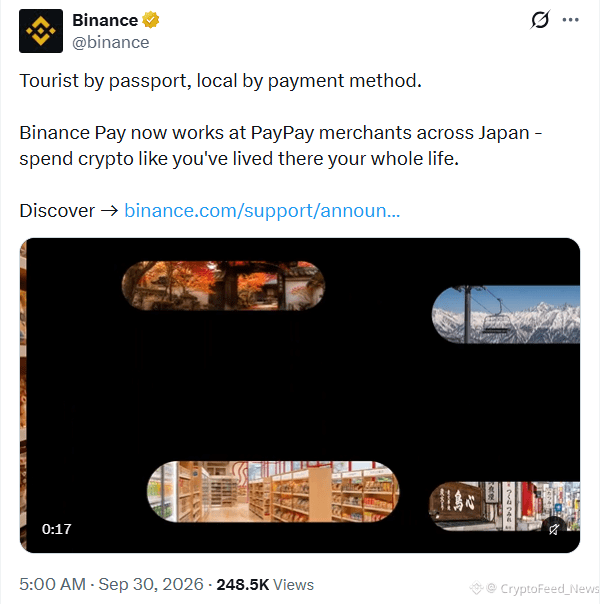
🇯🇵 #BinancePay Just Opened Japan's #PayPay Network to Crypto Tourists
Starting September 30, eligible overseas Binance Pay users can spend crypto at PayPay merchants across Japan.
Here's how it works:
💳 Scan a PayPay QR code to pay
💱 Crypto converts to Japanese yen at checkout
🏪 Merchants receive yen, not crypto
⛽ Zero gas fees at checkout
🎁 10% instant discount during the promotional period
The integration connects Binance Pay to millions of payment locations, from convenience stores to restaurants and shopping malls.
#japan $BNB $ETH $BTC
🇯🇵 #BinancePay Just Opened Japan's #PayPay Network to Crypto Tourists
Starting September 30, eligible overseas Binance Pay users can spend crypto at PayPay merchants across Japan.
Here's how it works:
💳 Scan a PayPay QR code to pay
💱 Crypto converts to Japanese yen at checkout
🏪 Merchants receive yen, not crypto
⛽ Zero gas fees at checkout
🎁 10% instant discount during the promotional period
The integration connects Binance Pay to millions of payment locations, from convenience stores to restaurants and shopping malls.
#japan $BNB $ETH $BTC
Starting September 30, eligible overseas Binance Pay users can spend crypto at PayPay merchants across Japan.
Here's how it works:
💳 Scan a PayPay QR code to pay
💱 Crypto converts to Japanese yen at checkout
🏪 Merchants receive yen, not crypto
⛽ Zero gas fees at checkout
🎁 10% instant discount during the promotional period
The integration connects Binance Pay to millions of payment locations, from convenience stores to restaurants and shopping malls.
#japan $BNB $ETH $BTC
76

·
--
Verified
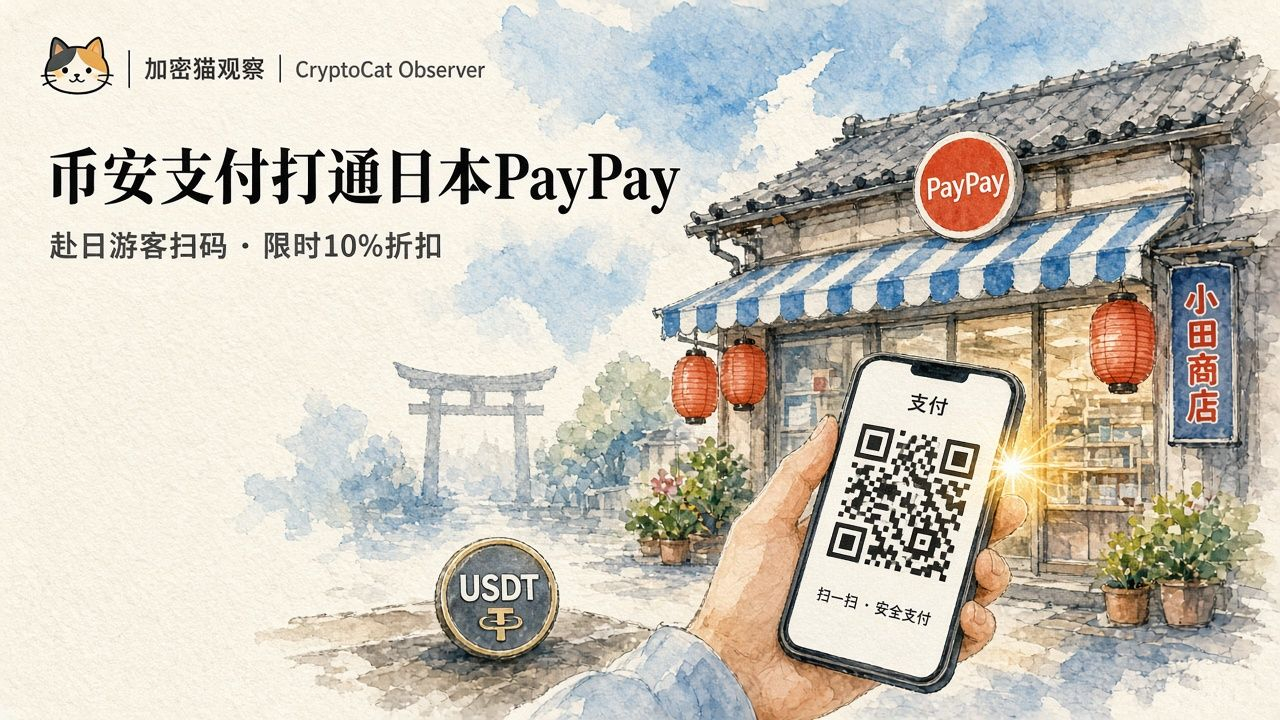
Binance announced on September 30: Japanese-bound international visitors can use the cryptocurrency asset balance in their Binance account to make payments directly at millions of merchants across Japan that support PayPay—either by scanning the merchant’s QR code or by showing a payment code for the merchant to scan, with no network fuel fees. At checkout, the assets are automatically converted to Japanese yen; merchants still receive yen. There is no need to open a local bank account or install an additional set of local payment tools.
To celebrate the launch, eligible Japan-bound visitors using Binance Pay at PayPay-supporting merchants can enjoy a limited-time 10% instant discount. This capability is connected to PayPay merchant channels via the Hivex payment network, so merchants do not need to integrate separately. Visitors can spend with crypto assets such as $USDT at most PayPay acceptance locations, covering everyday travel and consumption scenarios including convenience stores, restaurants, shopping malls, transportation stations, and even vending machines.
The feature is only available to Japan-bound visitors who have completed identity verification; it cannot be used by Japanese residents. Binance Pay itself is also only available to qualified users in supported regions for Binance.com. The discount period, applicable merchants, and regional availability are subject to the Binance Pay page and the official announcement dated September 30.
#USDT #币安支付 #PayPay does not constitute investment advice
Binance announced on September 30: Japanese-bound international visitors can use the cryptocurrency asset balance in their Binance account to make payments directly at millions of merchants across Japan that support PayPay—either by scanning the merchant’s QR code or by showing a payment code for the merchant to scan, with no network fuel fees. At checkout, the assets are automatically converted to Japanese yen; merchants still receive yen. There is no need to open a local bank account or install an additional set of local payment tools.
To celebrate the launch, eligible Japan-bound visitors using Binance Pay at PayPay-supporting merchants can enjoy a limited-time 10% instant discount. This capability is connected to PayPay merchant channels via the Hivex payment network, so merchants do not need to integrate separately. Visitors can spend with crypto assets such as $USDT at most PayPay acceptance locations, covering everyday travel and consumption scenarios including convenience stores, restaurants, shopping malls, transportation stations, and even vending machines.
The feature is only available to Japan-bound visitors who have completed identity verification; it cannot be used by Japanese residents. Binance Pay itself is also only available to qualified users in supported regions for Binance.com. The discount period, applicable merchants, and regional availability are subject to the Binance Pay page and the official announcement dated September 30.
#USDT #币安支付 #PayPay does not constitute investment advice
To celebrate the launch, eligible Japan-bound visitors using Binance Pay at PayPay-supporting merchants can enjoy a limited-time 10% instant discount. This capability is connected to PayPay merchant channels via the Hivex payment network, so merchants do not need to integrate separately. Visitors can spend with crypto assets such as $USDT at most PayPay acceptance locations, covering everyday travel and consumption scenarios including convenience stores, restaurants, shopping malls, transportation stations, and even vending machines.
The feature is only available to Japan-bound visitors who have completed identity verification; it cannot be used by Japanese residents. Binance Pay itself is also only available to qualified users in supported regions for Binance.com. The discount period, applicable merchants, and regional availability are subject to the Binance Pay page and the official announcement dated September 30.
#USDT #币安支付 #PayPay does not constitute investment advice
12
7.8k

·
--
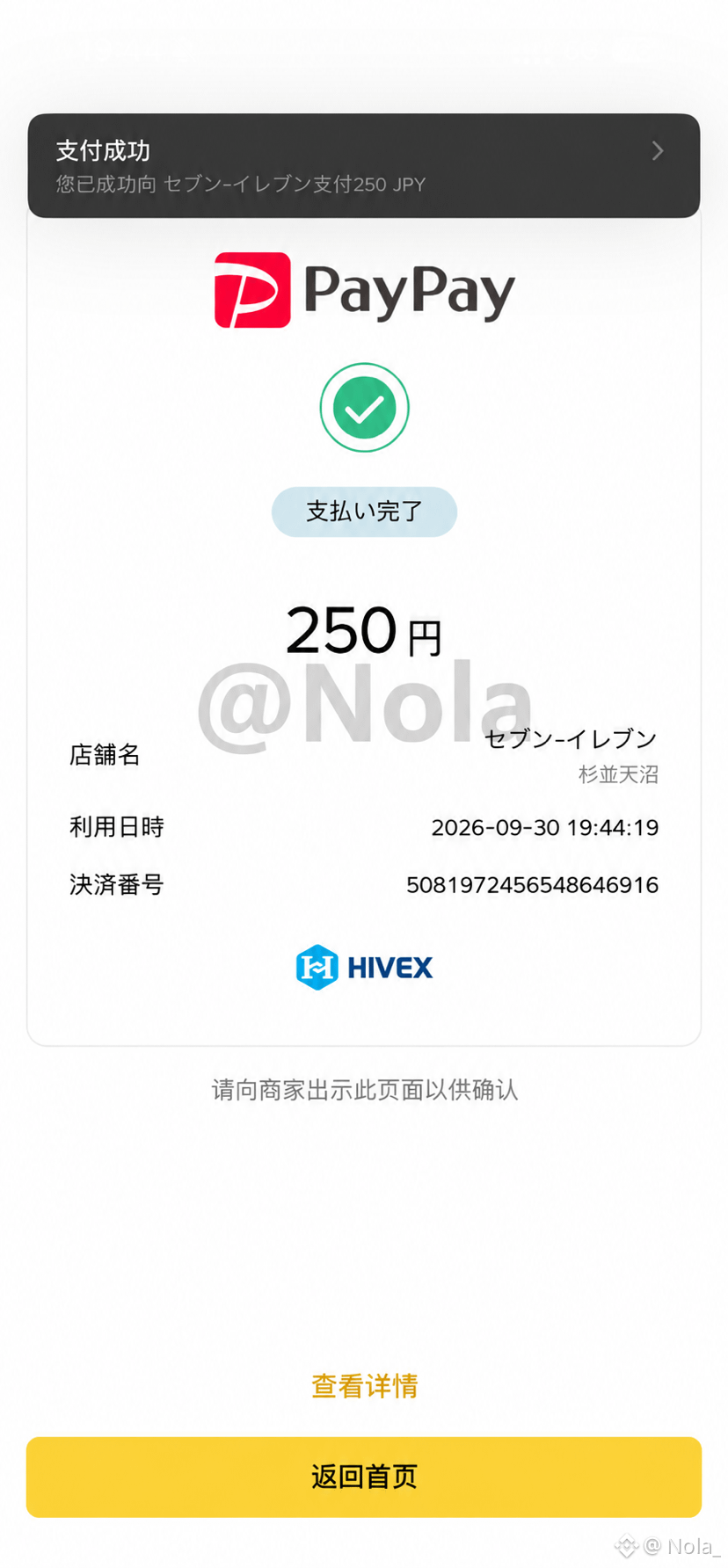
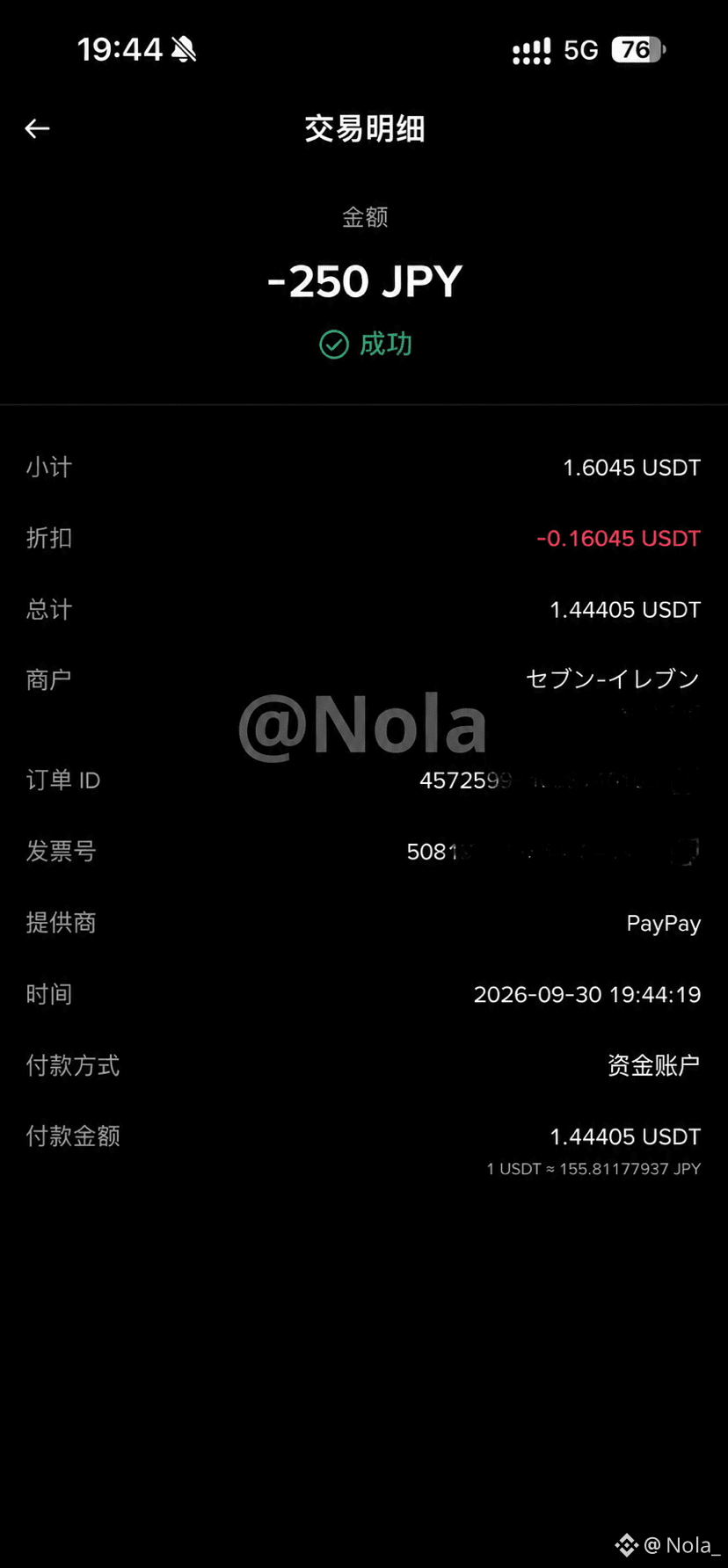
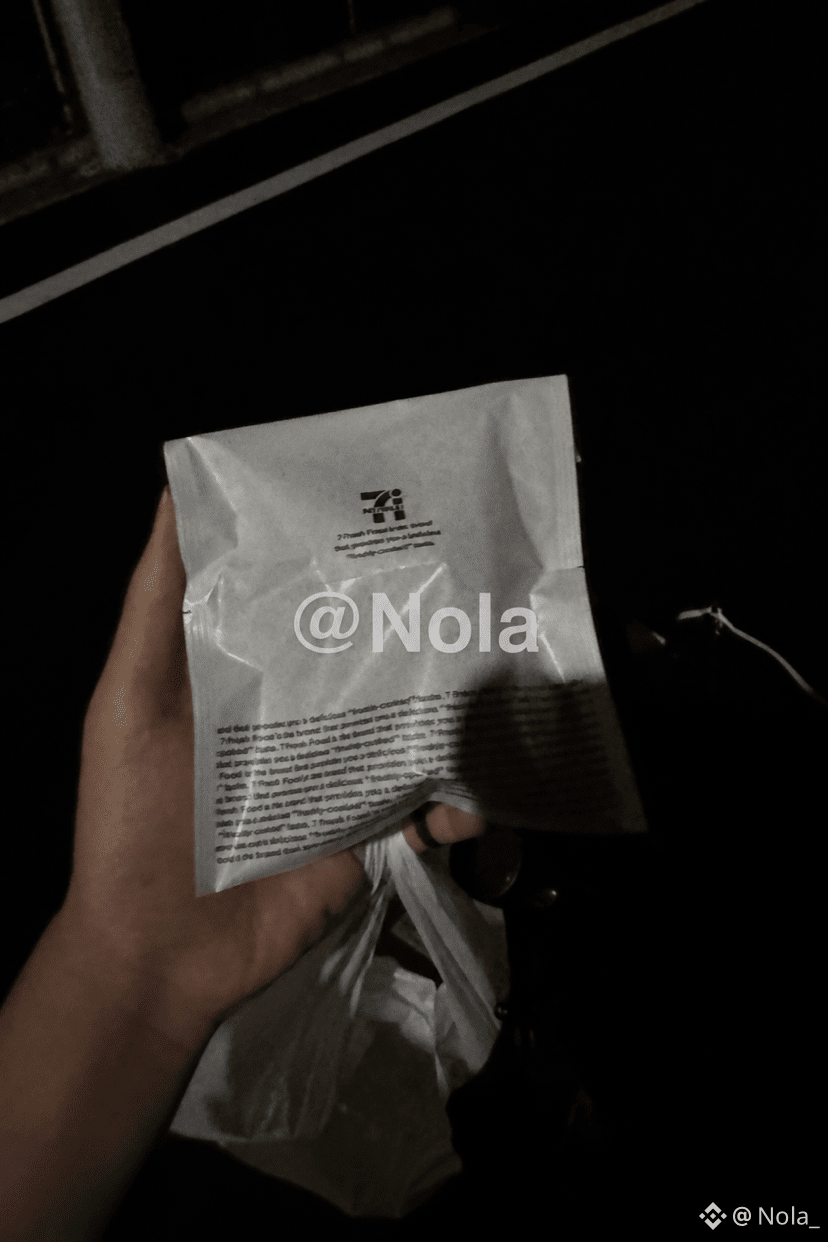
Today Binance enabled the feature to scan PayPay Japan QR codes for direct payments
I just went downstairs to 711 and tested it—scanned PayPay with Binance, and used USDT to buy a Nanachi chicken
Scan, pay—done in two seconds, super smooth. It even removes the PayPay step of entering the amount and confirming; it’s direct small-amount password-free payment
I used to always think USDT was just a string of numbers inside an exchange, but now it can actually be used at the convenience store downstairs to buy fried chicken
At this moment, it suddenly feels like the future is becoming real #paypay #Binance $BTC $ETH $BNB
Today Binance enabled the feature to scan PayPay Japan QR codes for direct payments
I just went downstairs to 711 and tested it—scanned PayPay with Binance, and used USDT to buy a Nanachi chicken
Scan, pay—done in two seconds, super smooth. It even removes the PayPay step of entering the amount and confirming; it’s direct small-amount password-free payment
I used to always think USDT was just a string of numbers inside an exchange, but now it can actually be used at the convenience store downstairs to buy fried chicken
At this moment, it suddenly feels like the future is becoming real #paypay #Binance $BTC $ETH $BNB
I just went downstairs to 711 and tested it—scanned PayPay with Binance, and used USDT to buy a Nanachi chicken
Scan, pay—done in two seconds, super smooth. It even removes the PayPay step of entering the amount and confirming; it’s direct small-amount password-free payment
I used to always think USDT was just a string of numbers inside an exchange, but now it can actually be used at the convenience store downstairs to buy fried chicken
At this moment, it suddenly feels like the future is becoming real #paypay #Binance $BTC $ETH $BNB
72

·
--
Verified
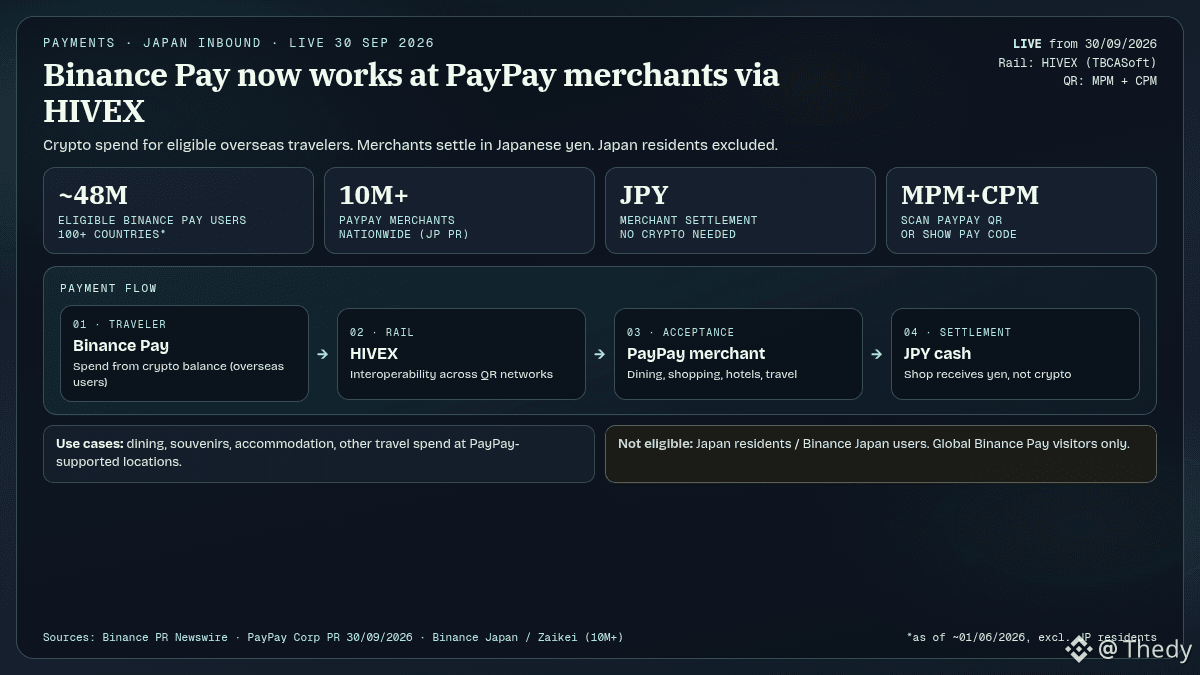
Japan inbound: Binance Pay enables PayPay merchants via HIVEX from 30/09.
FACTS (Binance PR Newswire + PayPay Corporation PR 30/09/2026)
Starting on September 30, 2026, eligible Binance Pay users traveling in Japan can pay at PayPay merchants (national network), via the HIVEX interoperability rail (TBCASoft). Approximately 48 million eligible Pay users in 100+ countries/regions (figure as of ~01/06/2026, excluding JP residents). Merchants receive settlement in Japanese yen; they do not need to hold crypto. QR modes: scan the merchant’s PayPay QR (MPM) or present the Binance payment code (CPM). Cited use cases: dining, shopping, lodging, travel expenses. Key eligibility point: Japan residents / Binance Japan users excluded. The Binance Japan release (Zaikei) mentions 10M+ PayPay points; the PR Newswire talks about “millions” of merchants.
INTERPRETATION
This is not a listing or a spot product. It’s a cashless bridge: crypto on the traveler’s side, yen on the merchant’s side, over one of the densest QR networks in the world. For the $BNB / Binance Pay ecosystem, the signal is real usage (inbound tourists) rather than a trading narrative. Reference spot (~09:55 UTC): $BTC ~83.6k, $BNB ~764, F&G 71 (Greed).
SCENARIOS
1. Progressive adoption: Pay volume in Japan rises with the tourist season, with no immediate price impact.
2. Asia showcase effect: other QR corridors (already mentioned for Binance Pay) gain credibility if the traveler experience is smooth.
3. Risk of confusion: many will read “PayPay × Binance” as a Binance Japan product. That’s not the case. Global Pay for visitors, not for JP residents.
Have you already been to Japan with a crypto wallet, or were you waiting for this kind of local QR rail?
$BNB $BTC
#BinancePay #PayPay #HIVEX
Japan inbound: Binance Pay enables PayPay merchants via HIVEX from 30/09.
FACTS (Binance PR Newswire + PayPay Corporation PR 30/09/2026)
Starting on September 30, 2026, eligible Binance Pay users traveling in Japan can pay at PayPay merchants (national network), via the HIVEX interoperability rail (TBCASoft). Approximately 48 million eligible Pay users in 100+ countries/regions (figure as of ~01/06/2026, excluding JP residents). Merchants receive settlement in Japanese yen; they do not need to hold crypto. QR modes: scan the merchant’s PayPay QR (MPM) or present the Binance payment code (CPM). Cited use cases: dining, shopping, lodging, travel expenses. Key eligibility point: Japan residents / Binance Japan users excluded. The Binance Japan release (Zaikei) mentions 10M+ PayPay points; the PR Newswire talks about “millions” of merchants.
INTERPRETATION
This is not a listing or a spot product. It’s a cashless bridge: crypto on the traveler’s side, yen on the merchant’s side, over one of the densest QR networks in the world. For the $BNB / Binance Pay ecosystem, the signal is real usage (inbound tourists) rather than a trading narrative. Reference spot (~09:55 UTC): $BTC ~83.6k, $BNB ~764, F&G 71 (Greed).
SCENARIOS
1. Progressive adoption: Pay volume in Japan rises with the tourist season, with no immediate price impact.
2. Asia showcase effect: other QR corridors (already mentioned for Binance Pay) gain credibility if the traveler experience is smooth.
3. Risk of confusion: many will read “PayPay × Binance” as a Binance Japan product. That’s not the case. Global Pay for visitors, not for JP residents.
Have you already been to Japan with a crypto wallet, or were you waiting for this kind of local QR rail?
$BNB $BTC
#BinancePay #PayPay #HIVEX
FACTS (Binance PR Newswire + PayPay Corporation PR 30/09/2026)
Starting on September 30, 2026, eligible Binance Pay users traveling in Japan can pay at PayPay merchants (national network), via the HIVEX interoperability rail (TBCASoft). Approximately 48 million eligible Pay users in 100+ countries/regions (figure as of ~01/06/2026, excluding JP residents). Merchants receive settlement in Japanese yen; they do not need to hold crypto. QR modes: scan the merchant’s PayPay QR (MPM) or present the Binance payment code (CPM). Cited use cases: dining, shopping, lodging, travel expenses. Key eligibility point: Japan residents / Binance Japan users excluded. The Binance Japan release (Zaikei) mentions 10M+ PayPay points; the PR Newswire talks about “millions” of merchants.
INTERPRETATION
This is not a listing or a spot product. It’s a cashless bridge: crypto on the traveler’s side, yen on the merchant’s side, over one of the densest QR networks in the world. For the $BNB / Binance Pay ecosystem, the signal is real usage (inbound tourists) rather than a trading narrative. Reference spot (~09:55 UTC): $BTC ~83.6k, $BNB ~764, F&G 71 (Greed).
SCENARIOS
1. Progressive adoption: Pay volume in Japan rises with the tourist season, with no immediate price impact.
2. Asia showcase effect: other QR corridors (already mentioned for Binance Pay) gain credibility if the traveler experience is smooth.
3. Risk of confusion: many will read “PayPay × Binance” as a Binance Japan product. That’s not the case. Global Pay for visitors, not for JP residents.
Have you already been to Japan with a crypto wallet, or were you waiting for this kind of local QR rail?
$BNB $BTC
#BinancePay #PayPay #HIVEX
87

·
--
1、Background: 7&i Strategic Adjustment Sends a New Signal
According to Bloomberg, 7-Eleven’s parent company, 7&i Holdings, is moving forward with plans to sell part of its equity to SoftBank Group and PayPay. The core of this move is not merely fundraising; it reflects 7&i’s intention to reallocate resources across retail, payments, and digital services. As a convenience-store giant, 7&i has long relied on its offline store network, supply-chain efficiency, and high-frequency consumption scenarios. However, in the current environment—marked by shifts in consumption patterns, the widespread adoption of digital payments, and upgrades in membership operations—traditional retail advantages alone can no longer sustain long-term growth elasticity.
SoftBank and PayPay represent capabilities in communications, tech investment, digital payments, and user ecosystems, respectively. By yielding some future control rights, 7&i indicates it values forming synergy with key partners more than strictly preserving independent operating boundaries. Such changes also reflect that large consumer companies are shifting from “asset-control” models to “ecosystem-synergy” models.
2、Analysis: Three Layers of Logic Behind the Equity Sale
First is the value of a digital payments gateway. Convenience stores are a typical high-frequency, low-amount consumption setting, naturally well-suited for mobile payments, points, membership benefits, coupons, and financial services layered together. If PayPay can be more deeply integrated with the 7-Eleven store system, it may improve payment penetration and increase user stickiness. Meanwhile, 7&i can leverage payment data to enhance user profiling, inventory management, and marketing efficiency.
Second is strategic synergy within the SoftBank ecosystem. SoftBank not only has capital strength, but also has deployments in communications, internet services, and AI-related initiatives. For 7&i, bringing in partners like this can help drive store digitalization, unmanned devices, intelligent replenishment, ad placements, and the commercialization of data. In retail, future competition will not just be about the number of stores, but about competing capabilities in data, efficiency, and user reach.
Third is management’s response to pressure from capital markets. Recently, global retail asset valuations have diverged significantly. Investors are paying more attention to asset returns, cash-flow quality, and business focus. Selling part of the equity can unlock asset value, and it can also signal that management is willing to optimize its structure and improve efficiency. The trade-off is that future decisions will need to balance the demands of more strategic shareholders.
3、Impact: Retail, Payments, and the Digital Economy Accelerate Their Convergence
For 7&i, the short-term effects may include improving its capital structure and strengthening expectations for collaboration with technology platforms. Over the medium to long term, the outcome will depend on whether synergy can truly be implemented. If cooperation remains limited to the capital level, market reaction may be limited. If it can integrate payments, membership, supply chains, and store operations into a unified system, the per-store efficiency and user value of 7-Eleven are likely to improve.
For SoftBank and PayPay, the convenience-store environment is an important entry point for expanding digital financial ecosystems. Offline, high-frequency transactions can help offset the slowdown in pure online traffic growth, and they also create richer scenarios for advertising, credit, points, and local-life services to develop on payment platforms.
For investors and observers of the crypto market, what is worth watching in this case is not a “convenience-store concept,” but the ongoing real-world business bet on digital infrastructure. Payment networks, data assets, user identities, and offline consumption scenarios are being repriced. With the development of stablecoins, on-chain payments, and traditional electronic wallets, retail payments in the future may further evolve toward lower cost, more real-time execution, and greater openness.
Overall, this adjustment by 7&i shows the pragmatic choices made by traditional retail giants in the face of a new cycle: sacrificing some control in exchange for ecosystem resources, technical capabilities, and growth potential. The key variable is whether collaboration can deliver actual operational improvements—not whether it merely remains a capital-market story.📌
#零售数字化 #PayPay #BinanceSquare
1、Background: 7&i Strategic Adjustment Sends a New Signal
According to Bloomberg, 7-Eleven’s parent company, 7&i Holdings, is moving forward with plans to sell part of its equity to SoftBank Group and PayPay. The core of this move is not merely fundraising; it reflects 7&i’s intention to reallocate resources across retail, payments, and digital services. As a convenience-store giant, 7&i has long relied on its offline store network, supply-chain efficiency, and high-frequency consumption scenarios. However, in the current environment—marked by shifts in consumption patterns, the widespread adoption of digital payments, and upgrades in membership operations—traditional retail advantages alone can no longer sustain long-term growth elasticity.
SoftBank and PayPay represent capabilities in communications, tech investment, digital payments, and user ecosystems, respectively. By yielding some future control rights, 7&i indicates it values forming synergy with key partners more than strictly preserving independent operating boundaries. Such changes also reflect that large consumer companies are shifting from “asset-control” models to “ecosystem-synergy” models.
2、Analysis: Three Layers of Logic Behind the Equity Sale
First is the value of a digital payments gateway. Convenience stores are a typical high-frequency, low-amount consumption setting, naturally well-suited for mobile payments, points, membership benefits, coupons, and financial services layered together. If PayPay can be more deeply integrated with the 7-Eleven store system, it may improve payment penetration and increase user stickiness. Meanwhile, 7&i can leverage payment data to enhance user profiling, inventory management, and marketing efficiency.
Second is strategic synergy within the SoftBank ecosystem. SoftBank not only has capital strength, but also has deployments in communications, internet services, and AI-related initiatives. For 7&i, bringing in partners like this can help drive store digitalization, unmanned devices, intelligent replenishment, ad placements, and the commercialization of data. In retail, future competition will not just be about the number of stores, but about competing capabilities in data, efficiency, and user reach.
Third is management’s response to pressure from capital markets. Recently, global retail asset valuations have diverged significantly. Investors are paying more attention to asset returns, cash-flow quality, and business focus. Selling part of the equity can unlock asset value, and it can also signal that management is willing to optimize its structure and improve efficiency. The trade-off is that future decisions will need to balance the demands of more strategic shareholders.
3、Impact: Retail, Payments, and the Digital Economy Accelerate Their Convergence
For 7&i, the short-term effects may include improving its capital structure and strengthening expectations for collaboration with technology platforms. Over the medium to long term, the outcome will depend on whether synergy can truly be implemented. If cooperation remains limited to the capital level, market reaction may be limited. If it can integrate payments, membership, supply chains, and store operations into a unified system, the per-store efficiency and user value of 7-Eleven are likely to improve.
For SoftBank and PayPay, the convenience-store environment is an important entry point for expanding digital financial ecosystems. Offline, high-frequency transactions can help offset the slowdown in pure online traffic growth, and they also create richer scenarios for advertising, credit, points, and local-life services to develop on payment platforms.
For investors and observers of the crypto market, what is worth watching in this case is not a “convenience-store concept,” but the ongoing real-world business bet on digital infrastructure. Payment networks, data assets, user identities, and offline consumption scenarios are being repriced. With the development of stablecoins, on-chain payments, and traditional electronic wallets, retail payments in the future may further evolve toward lower cost, more real-time execution, and greater openness.
Overall, this adjustment by 7&i shows the pragmatic choices made by traditional retail giants in the face of a new cycle: sacrificing some control in exchange for ecosystem resources, technical capabilities, and growth potential. The key variable is whether collaboration can deliver actual operational improvements—not whether it merely remains a capital-market story.📌
#零售数字化 #PayPay #BinanceSquare
According to Bloomberg, 7-Eleven’s parent company, 7&i Holdings, is moving forward with plans to sell part of its equity to SoftBank Group and PayPay. The core of this move is not merely fundraising; it reflects 7&i’s intention to reallocate resources across retail, payments, and digital services. As a convenience-store giant, 7&i has long relied on its offline store network, supply-chain efficiency, and high-frequency consumption scenarios. However, in the current environment—marked by shifts in consumption patterns, the widespread adoption of digital payments, and upgrades in membership operations—traditional retail advantages alone can no longer sustain long-term growth elasticity.
SoftBank and PayPay represent capabilities in communications, tech investment, digital payments, and user ecosystems, respectively. By yielding some future control rights, 7&i indicates it values forming synergy with key partners more than strictly preserving independent operating boundaries. Such changes also reflect that large consumer companies are shifting from “asset-control” models to “ecosystem-synergy” models.
2、Analysis: Three Layers of Logic Behind the Equity Sale
First is the value of a digital payments gateway. Convenience stores are a typical high-frequency, low-amount consumption setting, naturally well-suited for mobile payments, points, membership benefits, coupons, and financial services layered together. If PayPay can be more deeply integrated with the 7-Eleven store system, it may improve payment penetration and increase user stickiness. Meanwhile, 7&i can leverage payment data to enhance user profiling, inventory management, and marketing efficiency.
Second is strategic synergy within the SoftBank ecosystem. SoftBank not only has capital strength, but also has deployments in communications, internet services, and AI-related initiatives. For 7&i, bringing in partners like this can help drive store digitalization, unmanned devices, intelligent replenishment, ad placements, and the commercialization of data. In retail, future competition will not just be about the number of stores, but about competing capabilities in data, efficiency, and user reach.
Third is management’s response to pressure from capital markets. Recently, global retail asset valuations have diverged significantly. Investors are paying more attention to asset returns, cash-flow quality, and business focus. Selling part of the equity can unlock asset value, and it can also signal that management is willing to optimize its structure and improve efficiency. The trade-off is that future decisions will need to balance the demands of more strategic shareholders.
3、Impact: Retail, Payments, and the Digital Economy Accelerate Their Convergence
For 7&i, the short-term effects may include improving its capital structure and strengthening expectations for collaboration with technology platforms. Over the medium to long term, the outcome will depend on whether synergy can truly be implemented. If cooperation remains limited to the capital level, market reaction may be limited. If it can integrate payments, membership, supply chains, and store operations into a unified system, the per-store efficiency and user value of 7-Eleven are likely to improve.
For SoftBank and PayPay, the convenience-store environment is an important entry point for expanding digital financial ecosystems. Offline, high-frequency transactions can help offset the slowdown in pure online traffic growth, and they also create richer scenarios for advertising, credit, points, and local-life services to develop on payment platforms.
For investors and observers of the crypto market, what is worth watching in this case is not a “convenience-store concept,” but the ongoing real-world business bet on digital infrastructure. Payment networks, data assets, user identities, and offline consumption scenarios are being repriced. With the development of stablecoins, on-chain payments, and traditional electronic wallets, retail payments in the future may further evolve toward lower cost, more real-time execution, and greater openness.
Overall, this adjustment by 7&i shows the pragmatic choices made by traditional retail giants in the face of a new cycle: sacrificing some control in exchange for ecosystem resources, technical capabilities, and growth potential. The key variable is whether collaboration can deliver actual operational improvements—not whether it merely remains a capital-market story.📌
#零售数字化 #PayPay #BinanceSquare
15

🚨 $USDT BRIDGES MASS REAL-WORLD ADOPTION ACROSS MILLIONS OF JAPANESE MERCHANTS! ⚡
Real-world utility just unlocked a massive liquidity corridor in Asia. 🌊 Eligible international travelers visiting Japan can now spend $USDT across millions of merchant locations—from retail chains and taxis to vending machines—seamlessly settled in local currency via the HIVEX framework through a top-tier exchange payment rail.
💡 This is how structural crypto adoption actually looks: zero extra merchant onboarding required while friction for global stablecoin velocity vanishes. 📊 Millions of daily real-world touchpoints are quietly turning stablecoins into primary travel capital.
💬 Will stablecoin spending completely replace traditional foreign exchange for global travelers within the next two years? 👇
⚠️ Not financial advice. Always manage your risk. 🛡️
🏷️ #USDT #CryptoAdoption #Stablecoins #Crypto #PayPay
🔥 💎
🚨 $USDT BRIDGES MASS REAL-WORLD ADOPTION ACROSS MILLIONS OF JAPANESE MERCHANTS! ⚡
Real-world utility just unlocked a massive liquidity corridor in Asia. 🌊 Eligible international travelers visiting Japan can now spend $USDT across millions of merchant locations—from retail chains and taxis to vending machines—seamlessly settled in local currency via the HIVEX framework through a top-tier exchange payment rail.
💡 This is how structural crypto adoption actually looks: zero extra merchant onboarding required while friction for global stablecoin velocity vanishes. 📊 Millions of daily real-world touchpoints are quietly turning stablecoins into primary travel capital.
💬 Will stablecoin spending completely replace traditional foreign exchange for global travelers within the next two years? 👇
⚠️ Not financial advice. Always manage your risk. 🛡️
🏷️ #USDT #CryptoAdoption #Stablecoins #Crypto #PayPay
🔥 💎
Real-world utility just unlocked a massive liquidity corridor in Asia. 🌊 Eligible international travelers visiting Japan can now spend $USDT across millions of merchant locations—from retail chains and taxis to vending machines—seamlessly settled in local currency via the HIVEX framework through a top-tier exchange payment rail.
💡 This is how structural crypto adoption actually looks: zero extra merchant onboarding required while friction for global stablecoin velocity vanishes. 📊 Millions of daily real-world touchpoints are quietly turning stablecoins into primary travel capital.
💬 Will stablecoin spending completely replace traditional foreign exchange for global travelers within the next two years? 👇
⚠️ Not financial advice. Always manage your risk. 🛡️
🏷️ #USDT #CryptoAdoption #Stablecoins #Crypto #PayPay
🔥 💎
16

Binance Pay officially allows USDT spending on Japan’s PayPay!
- Binance Pay has officially launched for PayPay merchants across Japan.
- Starting from 30/09/2026, foreign tourists can use their crypto balance (USDT) to pay at checkout counters.
- Merchants still receive JPY and no opt-in registration is required.
- This is the first crypto payment service to reach the PayPay network via the HIVEX framework developed by TBCASoft.
#BinanceSquare #USDT #CryptoPayments #PayPay #Japan CryptoNews
$usdt
vlikevn Titanbot
Source: CoinGape
Binance Pay officially allows USDT spending on Japan’s PayPay!
- Binance Pay has officially launched for PayPay merchants across Japan.
- Starting from 30/09/2026, foreign tourists can use their crypto balance (USDT) to pay at checkout counters.
- Merchants still receive JPY and no opt-in registration is required.
- This is the first crypto payment service to reach the PayPay network via the HIVEX framework developed by TBCASoft.
#BinanceSquare #USDT #CryptoPayments #PayPay #Japan CryptoNews
$usdt
vlikevn Titanbot
Source: CoinGape
- Binance Pay has officially launched for PayPay merchants across Japan.
- Starting from 30/09/2026, foreign tourists can use their crypto balance (USDT) to pay at checkout counters.
- Merchants still receive JPY and no opt-in registration is required.
- This is the first crypto payment service to reach the PayPay network via the HIVEX framework developed by TBCASoft.
#BinanceSquare #USDT #CryptoPayments #PayPay #Japan CryptoNews
$usdt
vlikevn Titanbot
Source: CoinGape
2
Binance Pay for tourists using USDT to pay at PayPay stores in Japan
- Foreign users can use USDT to pay via Binance Pay at most PayPay merchants in Japan
- Transactions are processed through HIVEX; the store receives payment in yen
- Expanded service enabling real-world use of the USDT stablecoin in Japan
#BinanceSquare #CryptoNews #USDT #BinancePay #PayPay Japan
$usdt
vlikevn Titanbot
Source: CoinTelegraph
Binance Pay for tourists using USDT to pay at PayPay stores in Japan
- Foreign users can use USDT to pay via Binance Pay at most PayPay merchants in Japan
- Transactions are processed through HIVEX; the store receives payment in yen
- Expanded service enabling real-world use of the USDT stablecoin in Japan
#BinanceSquare #CryptoNews #USDT #BinancePay #PayPay Japan
$usdt
vlikevn Titanbot
Source: CoinTelegraph
- Foreign users can use USDT to pay via Binance Pay at most PayPay merchants in Japan
- Transactions are processed through HIVEX; the store receives payment in yen
- Expanded service enabling real-world use of the USDT stablecoin in Japan
#BinanceSquare #CryptoNews #USDT #BinancePay #PayPay Japan
$usdt
vlikevn Titanbot
Source: CoinTelegraph



·
--
🚨 A major step from Binance's partner in Japan!
PayPay, which owns a 40% stake in Binance Japan, aims to raise up to $1.1 billion through an initial public offering on the NASDAQ stock exchange.
The potential offering reflects the company's ambition to expand and enhance its presence in global markets, especially with the growing institutional interest in the digital assets and fintech sectors.
The entry of an entity linked to the Binance ecosystem into NASDAQ could be seen as an additional signal of the continued integration of the crypto sector with traditional financial markets.
#PayPay #Binance #NASDAQ #اكتتاب_عام #Crypto
#أسواق_عالمية
🚨 A major step from Binance's partner in Japan!
PayPay, which owns a 40% stake in Binance Japan, aims to raise up to $1.1 billion through an initial public offering on the NASDAQ stock exchange.
The potential offering reflects the company's ambition to expand and enhance its presence in global markets, especially with the growing institutional interest in the digital assets and fintech sectors.
The entry of an entity linked to the Binance ecosystem into NASDAQ could be seen as an additional signal of the continued integration of the crypto sector with traditional financial markets.
#PayPay #Binance #NASDAQ #اكتتاب_عام #Crypto
#أسواق_عالمية
PayPay, which owns a 40% stake in Binance Japan, aims to raise up to $1.1 billion through an initial public offering on the NASDAQ stock exchange.
The potential offering reflects the company's ambition to expand and enhance its presence in global markets, especially with the growing institutional interest in the digital assets and fintech sectors.
The entry of an entity linked to the Binance ecosystem into NASDAQ could be seen as an additional signal of the continued integration of the crypto sector with traditional financial markets.
#PayPay #Binance #NASDAQ #اكتتاب_عام #Crypto
#أسواق_عالمية
4
3.2k

·
--
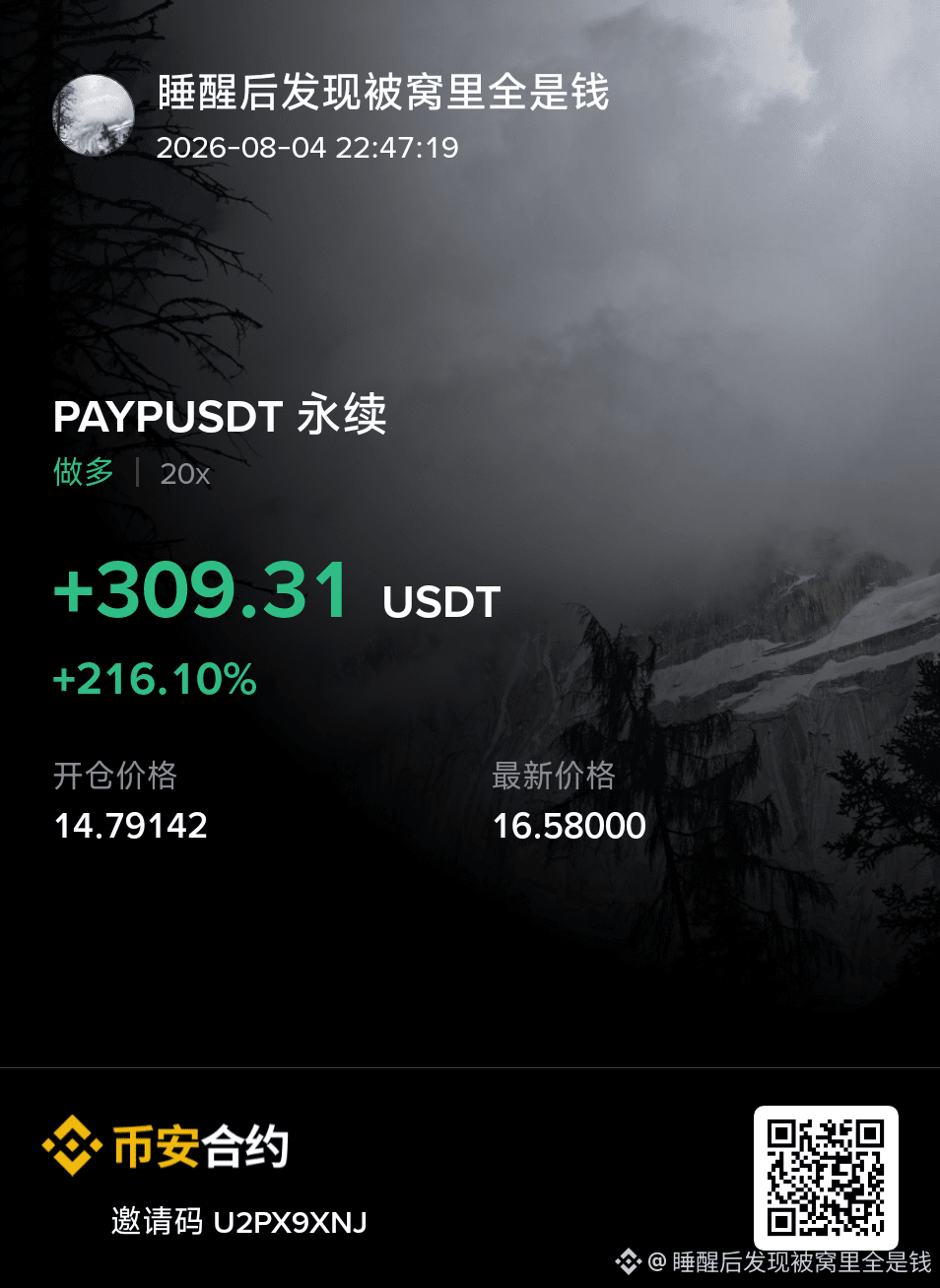
I’ve held this position for more than two months. Keep holding—let the profits soar #paypay
I’ve held this position for more than two months. Keep holding—let the profits soar #paypay
My Futures Portfolio
2 / 200
Minimum 10USDT
Public
7D PNL
(USDT)
-361.28
7D ROI
-16.92%
AUM
$4271.97
Win Rate
5.00%
78
Log in to explore more content
Join global crypto users on Binance Square
⚡️ Get latest and useful information about crypto.
💬 Trusted by the world’s largest crypto exchange.
👍 Discover real insights from verified creators.
Email / Phone number
Trending Topics
1
#BitcoinClears$85200
2,280 views
97 Discussing
2
#AltcoinSeasonIndexHoldsAbove60For5Days
16,326 views
641 Discussing
3
#USADPAdds90000JobsInSeptember
5,310 views
334 Discussing
4
#USCorePCEEasesTo3%InAugust
4,798 views
289 Discussing
5
#KospiPostsWorstQuarterSince2020
4,501 views
322 Discussing
6
#SECToClarifyOnChainFundraisingRules
12,124 views
498 Discussing
7
#UKFCAOpensCryptoFirmAuthorization
15,387 views
453 Discussing
8
#JapanMOFStudyGroupOnTokenizedGovtBonds
13,314 views
369 Discussing
9
#QNTRises287%
61,181 views
783 Discussing
10
#TrumpRejectsAIRulesForVoluntaryAudits
38,109 views
697 Discussing