

#liquidrestaking
liquidrestaking
37,104 views
283 Discussing
Hot
Latest

#bedrock $BR 🚀 A Comprehensive Look at the @Bedrock Project and the Anticipated Upgrade Bedrock 2.0
If you're looking to maximize the returns on your digital assets without locking them up, the Bedrock protocol is currently the hottest destination in the multi-asset Liquid Restaking sector.
💡 What does the project offer to investors?
• High Liquidity Flexibility: It allows you to earn excellent and compounded yields on major coins like Ethereum and Bitcoin while providing you with alternative tokens to use on other DeFi platforms.
• Support for DePIN Networks: The protocol integrates rewards from decentralized physical infrastructure networks to boost cumulative profits.
🔥 The Next Leap with Bedrock 2.0:
The ongoing upgrade aims to enhance security levels, improve smart contract efficiency, and expand partnerships to increase the utility and impact of the native token BR$ in the market.
❓ Share your predictions in the comments: How do you see the future of the Bedrock 2.0 project? Do you think the BR$ token will make a strong leap ahead?
*(Disclaimer: This post is for educational sharing in the Binance Square campaign and does not constitute direct financial advice. Always trade based on your own research DYOR).*
#Bedrock #BR #BinanceSquare# #LiquidRestaking
#bedrock $BR 🚀 A Comprehensive Look at the @Bedrock Project and the Anticipated Upgrade Bedrock 2.0
If you're looking to maximize the returns on your digital assets without locking them up, the Bedrock protocol is currently the hottest destination in the multi-asset Liquid Restaking sector.
💡 What does the project offer to investors?
• High Liquidity Flexibility: It allows you to earn excellent and compounded yields on major coins like Ethereum and Bitcoin while providing you with alternative tokens to use on other DeFi platforms.
• Support for DePIN Networks: The protocol integrates rewards from decentralized physical infrastructure networks to boost cumulative profits.
🔥 The Next Leap with Bedrock 2.0:
The ongoing upgrade aims to enhance security levels, improve smart contract efficiency, and expand partnerships to increase the utility and impact of the native token BR$ in the market.
❓ Share your predictions in the comments: How do you see the future of the Bedrock 2.0 project? Do you think the BR$ token will make a strong leap ahead?
*(Disclaimer: This post is for educational sharing in the Binance Square campaign and does not constitute direct financial advice. Always trade based on your own research DYOR).*
#Bedrock #BR #BinanceSquare# #LiquidRestaking
If you're looking to maximize the returns on your digital assets without locking them up, the Bedrock protocol is currently the hottest destination in the multi-asset Liquid Restaking sector.
💡 What does the project offer to investors?
• High Liquidity Flexibility: It allows you to earn excellent and compounded yields on major coins like Ethereum and Bitcoin while providing you with alternative tokens to use on other DeFi platforms.
• Support for DePIN Networks: The protocol integrates rewards from decentralized physical infrastructure networks to boost cumulative profits.
🔥 The Next Leap with Bedrock 2.0:
The ongoing upgrade aims to enhance security levels, improve smart contract efficiency, and expand partnerships to increase the utility and impact of the native token BR$ in the market.
❓ Share your predictions in the comments: How do you see the future of the Bedrock 2.0 project? Do you think the BR$ token will make a strong leap ahead?
*(Disclaimer: This post is for educational sharing in the Binance Square campaign and does not constitute direct financial advice. Always trade based on your own research DYOR).*
#Bedrock #BR #BinanceSquare# #LiquidRestaking
1
22

·
--
#bedrock $BR @Bedrock
🚀 I'm thrilled to have stumbled upon $BR – Bedrock
As a professional trader, I'm always on the lookout for projects that tackle real DeFi pain points, not just generating hype. Today, I'm excited to learn more and start building my position in Bedrock ($BR).
A brief overview of the project:
Bedrock is one of the most interesting multi-asset liquid restaking protocols on the market. It allows users to restake Bitcoin (brBTC/uniBTC), Ethereum, and IOTX while maintaining full liquidity. This way, BTC can finally work and generate yield in the DeFi ecosystem instead of sitting idle.
Non-custodial, solid partnerships (including RockX), the veBR mechanism for governance and incentives—everything is crafted thoughtfully with long-term value in mind.
I'm genuinely excited about this project. Finally, someone is doing it right: true utility + mechanics that reward long-term participants.
For me, this is one of those setups that could really surprise us in this cycle.
Who already knows about Bedrock? Share your thoughts 👇
#Bedrock #LiquidRestaking
#bedrock $BR @Bedrock
🚀 I'm thrilled to have stumbled upon $BR – Bedrock
As a professional trader, I'm always on the lookout for projects that tackle real DeFi pain points, not just generating hype. Today, I'm excited to learn more and start building my position in Bedrock ($BR ).
A brief overview of the project:
Bedrock is one of the most interesting multi-asset liquid restaking protocols on the market. It allows users to restake Bitcoin (brBTC/uniBTC), Ethereum, and IOTX while maintaining full liquidity. This way, BTC can finally work and generate yield in the DeFi ecosystem instead of sitting idle.
Non-custodial, solid partnerships (including RockX), the veBR mechanism for governance and incentives—everything is crafted thoughtfully with long-term value in mind.
I'm genuinely excited about this project. Finally, someone is doing it right: true utility + mechanics that reward long-term participants.
For me, this is one of those setups that could really surprise us in this cycle.
Who already knows about Bedrock? Share your thoughts 👇
#Bedrock #LiquidRestaking
🚀 I'm thrilled to have stumbled upon $BR – Bedrock
As a professional trader, I'm always on the lookout for projects that tackle real DeFi pain points, not just generating hype. Today, I'm excited to learn more and start building my position in Bedrock ($BR ).
A brief overview of the project:
Bedrock is one of the most interesting multi-asset liquid restaking protocols on the market. It allows users to restake Bitcoin (brBTC/uniBTC), Ethereum, and IOTX while maintaining full liquidity. This way, BTC can finally work and generate yield in the DeFi ecosystem instead of sitting idle.
Non-custodial, solid partnerships (including RockX), the veBR mechanism for governance and incentives—everything is crafted thoughtfully with long-term value in mind.
I'm genuinely excited about this project. Finally, someone is doing it right: true utility + mechanics that reward long-term participants.
For me, this is one of those setups that could really surprise us in this cycle.
Who already knows about Bedrock? Share your thoughts 👇
#Bedrock #LiquidRestaking
106

·
--
Bullish
🌐 The Future of Liquid Restaking: Why Bedrock 2.0 is a Game Changer! 🚀
The Liquid Restaking landscape is evolving rapidly, and @Bedrock is leading the charge with some incredibly powerful upgrades. If you are looking to maximize your crypto yields while keeping your capital liquid, here is why you need to keep $BR on your radar.
🔍 What Makes Bedrock Stand Out?
Bedrock is a premier Multi-Asset Liquid Restaking Protocol designed to bring institutional-grade security and optimized yields to both Bitcoin and Ethereum ecosystems.
With the rollout of Bedrock 2.0, the protocol has unlocked next-level efficiency:
Enhanced Capital Efficiency: Users can restake their assets to secure multiple networks simultaneously without locking up their liquidity.
Diversified Yield Streams: By using Bedrock, you aren't just earning standard staking rewards; you are tapping into multiple layers of passive income safely.
Top-Tier Security: Built with robust smart contracts and decentralized architecture, ensuring retail and institutional users can stake with absolute peace of mind.
📈 The Power of $BR Token
{future}(BRUSDT)
As the ecosystem expands, the utility and governance driving the protocol become even more vital. The momentum behind liquid restaking is undisputed, making Bedrock one of the most exciting ecosystems to watch this quarter.
💬 What are your thoughts on Bedrock 2.0? Are you already utilizing liquid restaking for your BTC or ETH? Let’s discuss in the comments below! 👇
#Bedrock #LiquidRestaking #CryptoYields #Web3
🌐 The Future of Liquid Restaking: Why Bedrock 2.0 is a Game Changer! 🚀
The Liquid Restaking landscape is evolving rapidly, and @Bedrock is leading the charge with some incredibly powerful upgrades. If you are looking to maximize your crypto yields while keeping your capital liquid, here is why you need to keep $BR on your radar.
🔍 What Makes Bedrock Stand Out?
Bedrock is a premier Multi-Asset Liquid Restaking Protocol designed to bring institutional-grade security and optimized yields to both Bitcoin and Ethereum ecosystems.
With the rollout of Bedrock 2.0, the protocol has unlocked next-level efficiency:
Enhanced Capital Efficiency: Users can restake their assets to secure multiple networks simultaneously without locking up their liquidity.
Diversified Yield Streams: By using Bedrock, you aren't just earning standard staking rewards; you are tapping into multiple layers of passive income safely.
Top-Tier Security: Built with robust smart contracts and decentralized architecture, ensuring retail and institutional users can stake with absolute peace of mind.
📈 The Power of $BR Token
As the ecosystem expands, the utility and governance driving the protocol become even more vital. The momentum behind liquid restaking is undisputed, making Bedrock one of the most exciting ecosystems to watch this quarter.
💬 What are your thoughts on Bedrock 2.0? Are you already utilizing liquid restaking for your BTC or ETH? Let’s discuss in the comments below! 👇
#Bedrock #LiquidRestaking #CryptoYields #Web3
The Liquid Restaking landscape is evolving rapidly, and @Bedrock is leading the charge with some incredibly powerful upgrades. If you are looking to maximize your crypto yields while keeping your capital liquid, here is why you need to keep $BR on your radar.
🔍 What Makes Bedrock Stand Out?
Bedrock is a premier Multi-Asset Liquid Restaking Protocol designed to bring institutional-grade security and optimized yields to both Bitcoin and Ethereum ecosystems.
With the rollout of Bedrock 2.0, the protocol has unlocked next-level efficiency:
Enhanced Capital Efficiency: Users can restake their assets to secure multiple networks simultaneously without locking up their liquidity.
Diversified Yield Streams: By using Bedrock, you aren't just earning standard staking rewards; you are tapping into multiple layers of passive income safely.
Top-Tier Security: Built with robust smart contracts and decentralized architecture, ensuring retail and institutional users can stake with absolute peace of mind.
📈 The Power of $BR Token
As the ecosystem expands, the utility and governance driving the protocol become even more vital. The momentum behind liquid restaking is undisputed, making Bedrock one of the most exciting ecosystems to watch this quarter.
💬 What are your thoughts on Bedrock 2.0? Are you already utilizing liquid restaking for your BTC or ETH? Let’s discuss in the comments below! 👇
#Bedrock #LiquidRestaking #CryptoYields #Web3
1
1
26
#bedrock $BR
{future}(BRUSDT)
Why Bedrock 2.0 Feels Like The Next Big Leap In Liquid Restaking 🚀
True Yield, Not Just Points
I’ve tried many restaking protocols, but @Bedrock actually delivers real yield instead of farming points forever. With Bedrock 2.0, your ETH and $BR stay liquid while earning across multiple AVSs. No lockup stress.
Simplicity Wins
Earlier DeFi was confusing. Bedrock 2.0 UI is clean. One click, stake, restake, done. Even beginners can understand where their is working without reading 20 docs.
Security First Approach
After so many hacks in crypto, Bedrock team focused heavily on audits and validator decentralization in v2. That gives me peace of mind holding ong term.
Cross-Chain Vision
Bedrock 2.0 is not stuck on one chain. ETH, BTC LSTs, and now multi-chain expansion makes more useful than most governance tokens. Real utility > hype.
Community Driven Growth
What I like most about @Bedrock is how they listen. Discord suggestions actually turn into features. This is rare in crypto. Community + strong tech = solid future.
My Take:
I’m not here for short pumps. I’m holding $BR because Bedrock 2.0 is solving a real problem: making restaking safe, simple, and profitable. If you’re still sleeping on liquid restaking, this is the project to watch.
#Bedrock #LiquidRestaking
#bedrock $BR
Why Bedrock 2.0 Feels Like The Next Big Leap In Liquid Restaking 🚀
True Yield, Not Just Points
I’ve tried many restaking protocols, but @Bedrock actually delivers real yield instead of farming points forever. With Bedrock 2.0, your ETH and $BR stay liquid while earning across multiple AVSs. No lockup stress.
Simplicity Wins
Earlier DeFi was confusing. Bedrock 2.0 UI is clean. One click, stake, restake, done. Even beginners can understand where their is working without reading 20 docs.
Security First Approach
After so many hacks in crypto, Bedrock team focused heavily on audits and validator decentralization in v2. That gives me peace of mind holding ong term.
Cross-Chain Vision
Bedrock 2.0 is not stuck on one chain. ETH, BTC LSTs, and now multi-chain expansion makes more useful than most governance tokens. Real utility > hype.
Community Driven Growth
What I like most about @Bedrock is how they listen. Discord suggestions actually turn into features. This is rare in crypto. Community + strong tech = solid future.
My Take:
I’m not here for short pumps. I’m holding $BR because Bedrock 2.0 is solving a real problem: making restaking safe, simple, and profitable. If you’re still sleeping on liquid restaking, this is the project to watch.
#Bedrock #LiquidRestaking
Why Bedrock 2.0 Feels Like The Next Big Leap In Liquid Restaking 🚀
True Yield, Not Just Points
I’ve tried many restaking protocols, but @Bedrock actually delivers real yield instead of farming points forever. With Bedrock 2.0, your ETH and $BR stay liquid while earning across multiple AVSs. No lockup stress.
Simplicity Wins
Earlier DeFi was confusing. Bedrock 2.0 UI is clean. One click, stake, restake, done. Even beginners can understand where their is working without reading 20 docs.
Security First Approach
After so many hacks in crypto, Bedrock team focused heavily on audits and validator decentralization in v2. That gives me peace of mind holding ong term.
Cross-Chain Vision
Bedrock 2.0 is not stuck on one chain. ETH, BTC LSTs, and now multi-chain expansion makes more useful than most governance tokens. Real utility > hype.
Community Driven Growth
What I like most about @Bedrock is how they listen. Discord suggestions actually turn into features. This is rare in crypto. Community + strong tech = solid future.
My Take:
I’m not here for short pumps. I’m holding $BR because Bedrock 2.0 is solving a real problem: making restaking safe, simple, and profitable. If you’re still sleeping on liquid restaking, this is the project to watch.
#Bedrock #LiquidRestaking
102

·
--
I used to think diversification in DeFi meant holding five different tokens.
It took a few expensive market cycles to realize that holding different assets doesn’t protect you if they all rely on the exact same underlying infrastructure.
In Liquid Restaking (LRTs), we have quietly built a massive concentration risk.
Everyone flags the yield; fewer flag the single point of failure.
If you lock your Bitcoin into a single protocol, you are completely at the mercy of its smart contracts.
If that one layer breaks, your capital goes down with it.
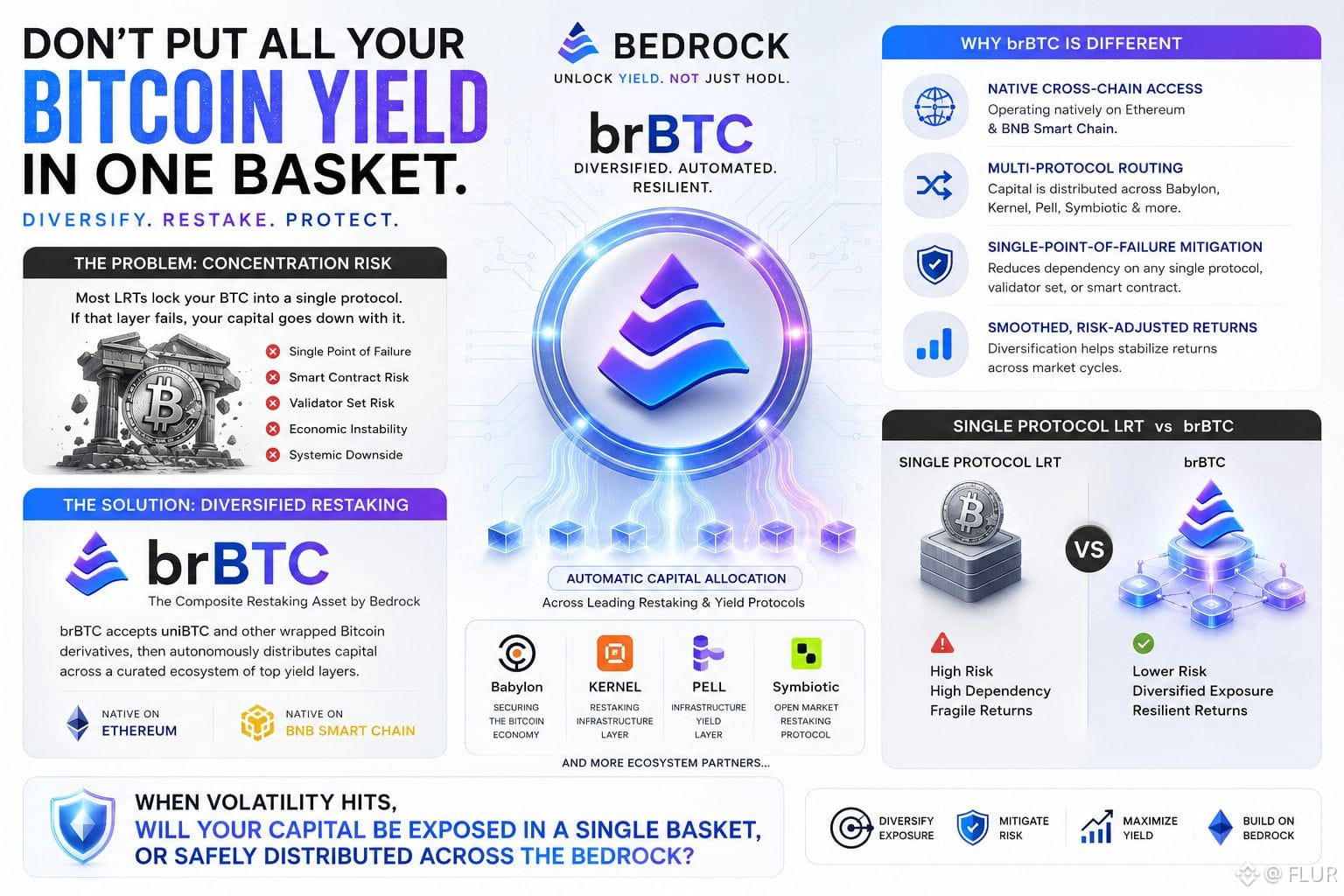
Bedrock alters this structural fragility through their composite asset, brBTC.
Launched natively across both the Ethereum mainnet and the BNB Smart Chain, brBTC fundamentally changes how capital efficiency behaves.
Instead of forcing you to guess which individual restaking network will survive, brBTC accepts deposits of uniBTC and other wrapped Bitcoin derivatives.
It then autonomously distributes that capital across a curated selection of external yield layers—including Babylon, Kernel, Pell, and Symbiotic simultaneously.
It transforms your Bitcoin into a multi-layered, automated coordination layer.
This isn't just about chasing a higher APY.
It’s about mitigating systemic downside.
Layering independent protocols together smooths out your return profile and heavily insulates your capital against a catastrophic single-protocol failure.
You stop acting like a short-term mercenary chasing a temporary emission pool and start acting like a structural allocator protected against network shocks.
The macro framework is straightforward:
✅ Native cross-chain access (Ethereum & BSC)
✅ Multi-protocol routing (Babylon, Kernel, Pell, Symbiotic)
✅ Systemic single-point-of-failure mitigation
✅ Smoothed, risk-adjusted return profiles
When the next volatility wave hits the market, will your capital be exposed in a single basket, or safely distributed across the bedrock?
@Bedrock
#Bedrock
$BR
{future}(BRUSDT)
$BTC
{future}(BTCUSDT)
#brBTC
#BTCFi
#LiquidRestaking
I used to think diversification in DeFi meant holding five different tokens.
It took a few expensive market cycles to realize that holding different assets doesn’t protect you if they all rely on the exact same underlying infrastructure.
In Liquid Restaking (LRTs), we have quietly built a massive concentration risk.
Everyone flags the yield; fewer flag the single point of failure.
If you lock your Bitcoin into a single protocol, you are completely at the mercy of its smart contracts.
If that one layer breaks, your capital goes down with it.
Bedrock alters this structural fragility through their composite asset, brBTC.
Launched natively across both the Ethereum mainnet and the BNB Smart Chain, brBTC fundamentally changes how capital efficiency behaves.
Instead of forcing you to guess which individual restaking network will survive, brBTC accepts deposits of uniBTC and other wrapped Bitcoin derivatives.
It then autonomously distributes that capital across a curated selection of external yield layers—including Babylon, Kernel, Pell, and Symbiotic simultaneously.
It transforms your Bitcoin into a multi-layered, automated coordination layer.
This isn't just about chasing a higher APY.
It’s about mitigating systemic downside.
Layering independent protocols together smooths out your return profile and heavily insulates your capital against a catastrophic single-protocol failure.
You stop acting like a short-term mercenary chasing a temporary emission pool and start acting like a structural allocator protected against network shocks.
The macro framework is straightforward:
✅ Native cross-chain access (Ethereum & BSC)
✅ Multi-protocol routing (Babylon, Kernel, Pell, Symbiotic)
✅ Systemic single-point-of-failure mitigation
✅ Smoothed, risk-adjusted return profiles
When the next volatility wave hits the market, will your capital be exposed in a single basket, or safely distributed across the bedrock?
@Bedrock
#Bedrock
$BR
$BTC
#brBTC
#BTCFi
#LiquidRestaking
It took a few expensive market cycles to realize that holding different assets doesn’t protect you if they all rely on the exact same underlying infrastructure.
In Liquid Restaking (LRTs), we have quietly built a massive concentration risk.
Everyone flags the yield; fewer flag the single point of failure.
If you lock your Bitcoin into a single protocol, you are completely at the mercy of its smart contracts.
If that one layer breaks, your capital goes down with it.
Bedrock alters this structural fragility through their composite asset, brBTC.
Launched natively across both the Ethereum mainnet and the BNB Smart Chain, brBTC fundamentally changes how capital efficiency behaves.
Instead of forcing you to guess which individual restaking network will survive, brBTC accepts deposits of uniBTC and other wrapped Bitcoin derivatives.
It then autonomously distributes that capital across a curated selection of external yield layers—including Babylon, Kernel, Pell, and Symbiotic simultaneously.
It transforms your Bitcoin into a multi-layered, automated coordination layer.
This isn't just about chasing a higher APY.
It’s about mitigating systemic downside.
Layering independent protocols together smooths out your return profile and heavily insulates your capital against a catastrophic single-protocol failure.
You stop acting like a short-term mercenary chasing a temporary emission pool and start acting like a structural allocator protected against network shocks.
The macro framework is straightforward:
✅ Native cross-chain access (Ethereum & BSC)
✅ Multi-protocol routing (Babylon, Kernel, Pell, Symbiotic)
✅ Systemic single-point-of-failure mitigation
✅ Smoothed, risk-adjusted return profiles
When the next volatility wave hits the market, will your capital be exposed in a single basket, or safely distributed across the bedrock?
@Bedrock
#Bedrock
$BR
$BTC
#brBTC
#BTCFi
#LiquidRestaking
1
147

·
--
I just joined Binance Square with zero followers and zero crypto knowledge. I'm going to document everything the wins, the losses, the confusion. Follow if you're also figuring this out.
Today I learned what liquid restaking actually means. Basically you stake your crypto to earn rewards BUT you also get a token representing your staked amount so your money isn't locked. You can still use it. Mind blown honestly.
Drop a 👋 if you're also a beginner. Let's not be confused #CryptoBeginners #LiquidRestaking #bedrocke $BR
I just joined Binance Square with zero followers and zero crypto knowledge. I'm going to document everything the wins, the losses, the confusion. Follow if you're also figuring this out.
Today I learned what liquid restaking actually means. Basically you stake your crypto to earn rewards BUT you also get a token representing your staked amount so your money isn't locked. You can still use it. Mind blown honestly.
Drop a 👋 if you're also a beginner. Let's not be confused #CryptoBeginners #LiquidRestaking #bedrocke $BR
Today I learned what liquid restaking actually means. Basically you stake your crypto to earn rewards BUT you also get a token representing your staked amount so your money isn't locked. You can still use it. Mind blown honestly.
Drop a 👋 if you're also a beginner. Let's not be confused #CryptoBeginners #LiquidRestaking #bedrocke $BR
1
61

·
--
This is exactly why the transition into @Bedrock Bedrock 2.0 is a massive shift for the ecosystem. It transforms passive crypto assets into intelligent, multi-yield capital engines. Instead of locking one dollar into a single strategy, Bedrock 2.0 allows a unified asset like brBTC to route across multiple major yield sources—such as Babylon, EigenLayer, Symbiotic, and Pell—simultaneously.
By utilizing institutional-grade strategy vaults (like the Delta-Neutral and Alpha vaults managed with top-tier HFT strategies), the protocol abstracts away complex quantitative management. Retail and institutional holders alike get optimized, market-neutral returns while keeping their liquidity liquid and adaptable across the wider DeFi space.
True innovation isn’t just about inventing more layers; it’s about making existing components cooperate flawlessly to maximize capital efficiency.
What are your thoughts on how liquid restaking is reshaping asset utility this year?
$BR #Bedrock #BTCFi #LiquidRestaking
#bedrock $BR
This is exactly why the transition into @Bedrock Bedrock 2.0 is a massive shift for the ecosystem. It transforms passive crypto assets into intelligent, multi-yield capital engines. Instead of locking one dollar into a single strategy, Bedrock 2.0 allows a unified asset like brBTC to route across multiple major yield sources—such as Babylon, EigenLayer, Symbiotic, and Pell—simultaneously.
By utilizing institutional-grade strategy vaults (like the Delta-Neutral and Alpha vaults managed with top-tier HFT strategies), the protocol abstracts away complex quantitative management. Retail and institutional holders alike get optimized, market-neutral returns while keeping their liquidity liquid and adaptable across the wider DeFi space.
True innovation isn’t just about inventing more layers; it’s about making existing components cooperate flawlessly to maximize capital efficiency.
What are your thoughts on how liquid restaking is reshaping asset utility this year?
$BR #Bedrock #BTCFi #LiquidRestaking
#bedrock $BR
By utilizing institutional-grade strategy vaults (like the Delta-Neutral and Alpha vaults managed with top-tier HFT strategies), the protocol abstracts away complex quantitative management. Retail and institutional holders alike get optimized, market-neutral returns while keeping their liquidity liquid and adaptable across the wider DeFi space.
True innovation isn’t just about inventing more layers; it’s about making existing components cooperate flawlessly to maximize capital efficiency.
What are your thoughts on how liquid restaking is reshaping asset utility this year?
$BR #Bedrock #BTCFi #LiquidRestaking
#bedrock $BR

2
1
101
Been watching @Bedrock build through 2026 and honestly impressed by how they’re approaching BTCFi 2.0.
Most projects just copy-paste Ethereum models to Bitcoin. Bedrock actually built uniBTC to keep Bitcoin liquid while staking. That’s solving a real problem instead of chasing hype.
Bedrock 2.0 feels like the next step - multi-asset restaking without forcing holders to choose between yield and liquidity. As someone who’s tried both CeFi and DeFi staking, this approach makes more sense for long term holders.
The concept of Proof of Staking Liquidity is interesting. Bitcoin finally gets to participate in DeFi without wrapping risks killing the upside.
What I like most: they allocated 20% of BR to community airdrops with no vesting. Most teams lock everything for VCs. This actually rewards users who use the protocol.
Still testing the app but the UX is cleaner than most restaking platforms I’ve used.
Curious to hear what others think - what’s your take on liquid restaking for Bitcoin?
#Bedrock $BR #BTCFi #LiquidRestaking #Bedrock2
@Bedrock #bedrock#
Been watching @Bedrock build through 2026 and honestly impressed by how they’re approaching BTCFi 2.0.
Most projects just copy-paste Ethereum models to Bitcoin. Bedrock actually built uniBTC to keep Bitcoin liquid while staking. That’s solving a real problem instead of chasing hype.
Bedrock 2.0 feels like the next step - multi-asset restaking without forcing holders to choose between yield and liquidity. As someone who’s tried both CeFi and DeFi staking, this approach makes more sense for long term holders.
The concept of Proof of Staking Liquidity is interesting. Bitcoin finally gets to participate in DeFi without wrapping risks killing the upside.
What I like most: they allocated 20% of BR to community airdrops with no vesting. Most teams lock everything for VCs. This actually rewards users who use the protocol.
Still testing the app but the UX is cleaner than most restaking platforms I’ve used.
Curious to hear what others think - what’s your take on liquid restaking for Bitcoin?
#Bedrock $BR #BTCFi #LiquidRestaking #Bedrock2
@Bedrock #bedrock#
Most projects just copy-paste Ethereum models to Bitcoin. Bedrock actually built uniBTC to keep Bitcoin liquid while staking. That’s solving a real problem instead of chasing hype.
Bedrock 2.0 feels like the next step - multi-asset restaking without forcing holders to choose between yield and liquidity. As someone who’s tried both CeFi and DeFi staking, this approach makes more sense for long term holders.
The concept of Proof of Staking Liquidity is interesting. Bitcoin finally gets to participate in DeFi without wrapping risks killing the upside.
What I like most: they allocated 20% of BR to community airdrops with no vesting. Most teams lock everything for VCs. This actually rewards users who use the protocol.
Still testing the app but the UX is cleaner than most restaking platforms I’ve used.
Curious to hear what others think - what’s your take on liquid restaking for Bitcoin?
#Bedrock $BR #BTCFi #LiquidRestaking #Bedrock2
@Bedrock #bedrock#
2
5
51

·
--
Bullish
Verified
--- The Real Play Behind Bedrock ($BR) 🤫---
Looking at the charts today, it’s obvious that retail investors are looking at Bedrock DAO purely for the high APY.
But they are completely missing the structural game happening underneath.
Here is the industry secret regular influencers won’t tell you: Bedrock's Proof of Staked Liquidity (PoSL) is intentionally designed as a filter.
By locking up capital through uniBTC and uniETH, it weeds out short-term paper hands and builds a floor of serious, long-term liquidity.
However, there is a massive hidden risk.
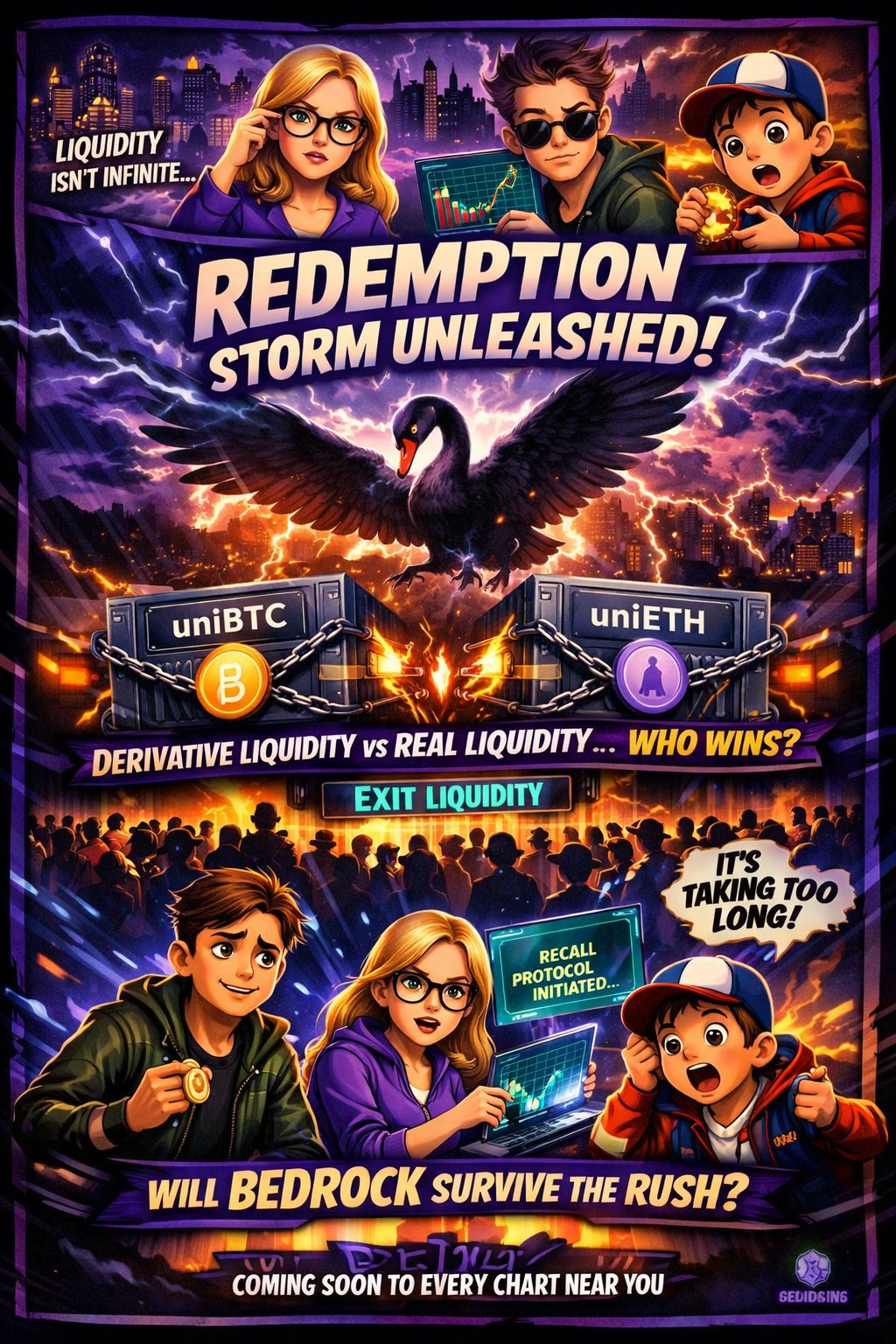
Derivative liquidity is not the same as underlying redemption liquidity.
While your receipt tokens trade freely, the actual BTC and ETH are deployed deep into external strategies.
If a black swan event hits and everyone rushes to redeem their real assets at once, recalling that capital takes time.
This creates a dangerous bottleneck.
In my experience, managing this exit liquidity during high-stress market conditions will make or break the protocol.
I’m monitoring the queues closely before going all-in.
What’s your move? Are you accumulating uniBTC on this dip, or playing it safe? Let me know below! 👇
#LiquidRestaking #BitcoinFi #defi #CryptoAnalysis #bedrock
$BR DYOR @Bedrock
--- The Real Play Behind Bedrock ($BR ) 🤫---
Looking at the charts today, it’s obvious that retail investors are looking at Bedrock DAO purely for the high APY.
But they are completely missing the structural game happening underneath.
Here is the industry secret regular influencers won’t tell you: Bedrock's Proof of Staked Liquidity (PoSL) is intentionally designed as a filter.
By locking up capital through uniBTC and uniETH, it weeds out short-term paper hands and builds a floor of serious, long-term liquidity.
However, there is a massive hidden risk.
Derivative liquidity is not the same as underlying redemption liquidity.
While your receipt tokens trade freely, the actual BTC and ETH are deployed deep into external strategies.
If a black swan event hits and everyone rushes to redeem their real assets at once, recalling that capital takes time.
This creates a dangerous bottleneck.
In my experience, managing this exit liquidity during high-stress market conditions will make or break the protocol.
I’m monitoring the queues closely before going all-in.
What’s your move? Are you accumulating uniBTC on this dip, or playing it safe? Let me know below! 👇
#LiquidRestaking #BitcoinFi #defi #CryptoAnalysis #bedrock
$BR DYOR @Bedrock
Looking at the charts today, it’s obvious that retail investors are looking at Bedrock DAO purely for the high APY.
But they are completely missing the structural game happening underneath.
Here is the industry secret regular influencers won’t tell you: Bedrock's Proof of Staked Liquidity (PoSL) is intentionally designed as a filter.
By locking up capital through uniBTC and uniETH, it weeds out short-term paper hands and builds a floor of serious, long-term liquidity.
However, there is a massive hidden risk.
Derivative liquidity is not the same as underlying redemption liquidity.
While your receipt tokens trade freely, the actual BTC and ETH are deployed deep into external strategies.
If a black swan event hits and everyone rushes to redeem their real assets at once, recalling that capital takes time.
This creates a dangerous bottleneck.
In my experience, managing this exit liquidity during high-stress market conditions will make or break the protocol.
I’m monitoring the queues closely before going all-in.
What’s your move? Are you accumulating uniBTC on this dip, or playing it safe? Let me know below! 👇
#LiquidRestaking #BitcoinFi #defi #CryptoAnalysis #bedrock
$BR DYOR @Bedrock

21
2
35
473

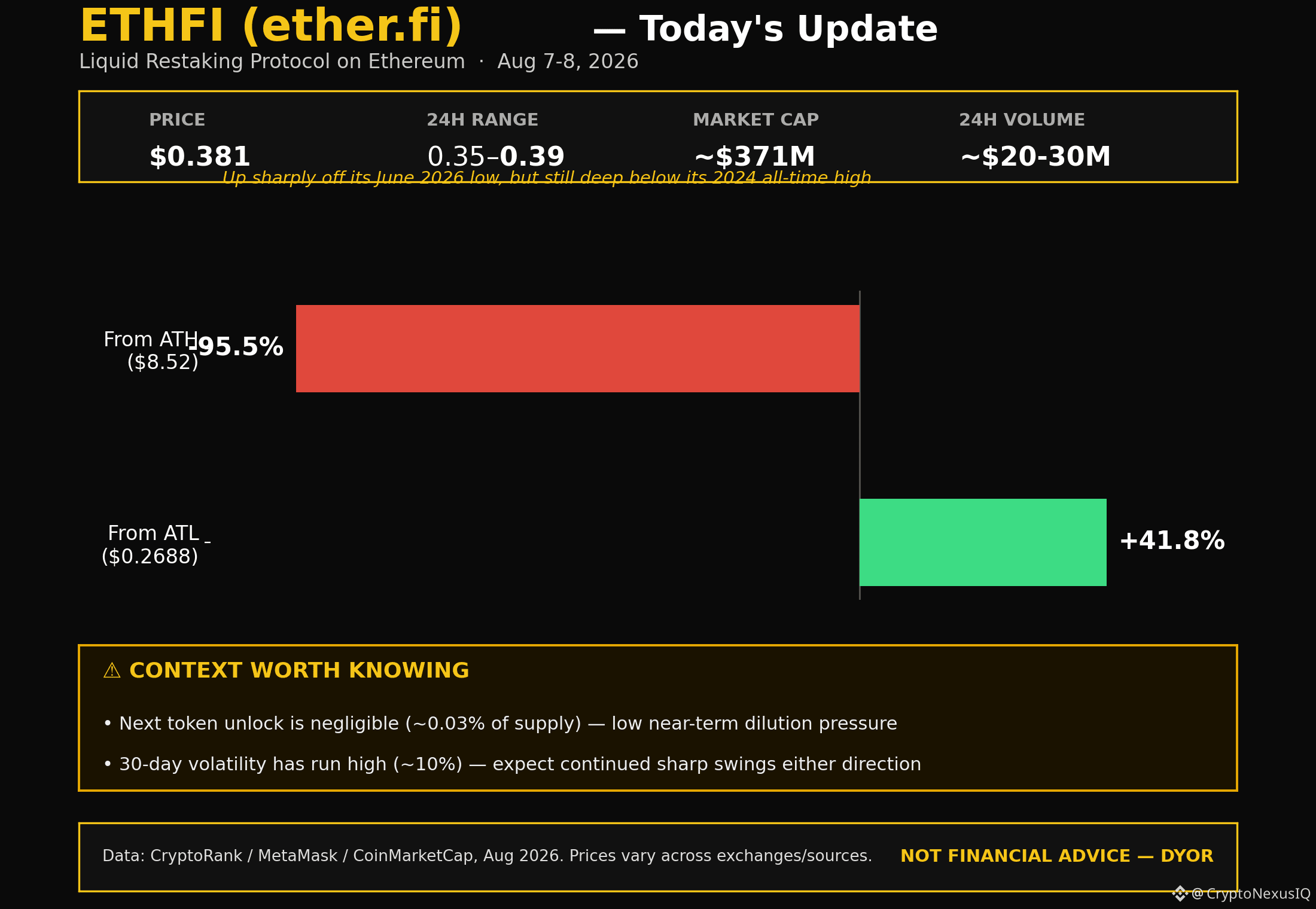
$ETHFI update — up sharply off its lows, still far from its highs
ether.fi ($ETHFI ) is trading around $0.381 today, with a 24h range of roughly $0.35–$0.39 and a market cap near $371M. Zoom out and the more interesting number is this: ETHFI is up about 42% from its June 2026 low of $0.2688 — a real recovery — but still sits about 95.5% below its all-time high of $8.52 set back in March 2024.
That gap tells the actual story here. This isn't a token riding a fresh narrative wave; it's climbing out of a deep hole after a rough stretch. ether.fi remains one of the larger liquid restaking protocols on Ethereum, letting users stake ETH and receive eETH — a liquid token that keeps earning yield while staying usable across DeFi.
One genuinely reassuring data point right now: the next scheduled token unlock is negligible, only about 0.03% of total supply. Unlike some of the other names we've covered, dilution isn't the near-term risk here. The risk that is live: 30-day volatility has been running high, around 10%, so don't mistake a calm week for a calm token — sharp moves in either direction remain the norm.
Bottom line: a token in recovery mode with light unlock pressure right now, but still carrying real distance from its highs and real volatility day to day.
#ETHFIUSDT #EtherFi #LiquidRestaking #Ethereum #Binance
{spot}(ETHFIUSDT)
$ETHFI update — up sharply off its lows, still far from its highs
ether.fi ($ETHFI ) is trading around $0.381 today, with a 24h range of roughly $0.35–$0.39 and a market cap near $371M. Zoom out and the more interesting number is this: ETHFI is up about 42% from its June 2026 low of $0.2688 — a real recovery — but still sits about 95.5% below its all-time high of $8.52 set back in March 2024.
That gap tells the actual story here. This isn't a token riding a fresh narrative wave; it's climbing out of a deep hole after a rough stretch. ether.fi remains one of the larger liquid restaking protocols on Ethereum, letting users stake ETH and receive eETH — a liquid token that keeps earning yield while staying usable across DeFi.
One genuinely reassuring data point right now: the next scheduled token unlock is negligible, only about 0.03% of total supply. Unlike some of the other names we've covered, dilution isn't the near-term risk here. The risk that is live: 30-day volatility has been running high, around 10%, so don't mistake a calm week for a calm token — sharp moves in either direction remain the norm.
Bottom line: a token in recovery mode with light unlock pressure right now, but still carrying real distance from its highs and real volatility day to day.
#ETHFIUSDT #EtherFi #LiquidRestaking #Ethereum #Binance
ether.fi ($ETHFI ) is trading around $0.381 today, with a 24h range of roughly $0.35–$0.39 and a market cap near $371M. Zoom out and the more interesting number is this: ETHFI is up about 42% from its June 2026 low of $0.2688 — a real recovery — but still sits about 95.5% below its all-time high of $8.52 set back in March 2024.
That gap tells the actual story here. This isn't a token riding a fresh narrative wave; it's climbing out of a deep hole after a rough stretch. ether.fi remains one of the larger liquid restaking protocols on Ethereum, letting users stake ETH and receive eETH — a liquid token that keeps earning yield while staying usable across DeFi.
One genuinely reassuring data point right now: the next scheduled token unlock is negligible, only about 0.03% of total supply. Unlike some of the other names we've covered, dilution isn't the near-term risk here. The risk that is live: 30-day volatility has been running high, around 10%, so don't mistake a calm week for a calm token — sharp moves in either direction remain the norm.
Bottom line: a token in recovery mode with light unlock pressure right now, but still carrying real distance from its highs and real volatility day to day.
#ETHFIUSDT #EtherFi #LiquidRestaking #Ethereum #Binance
110
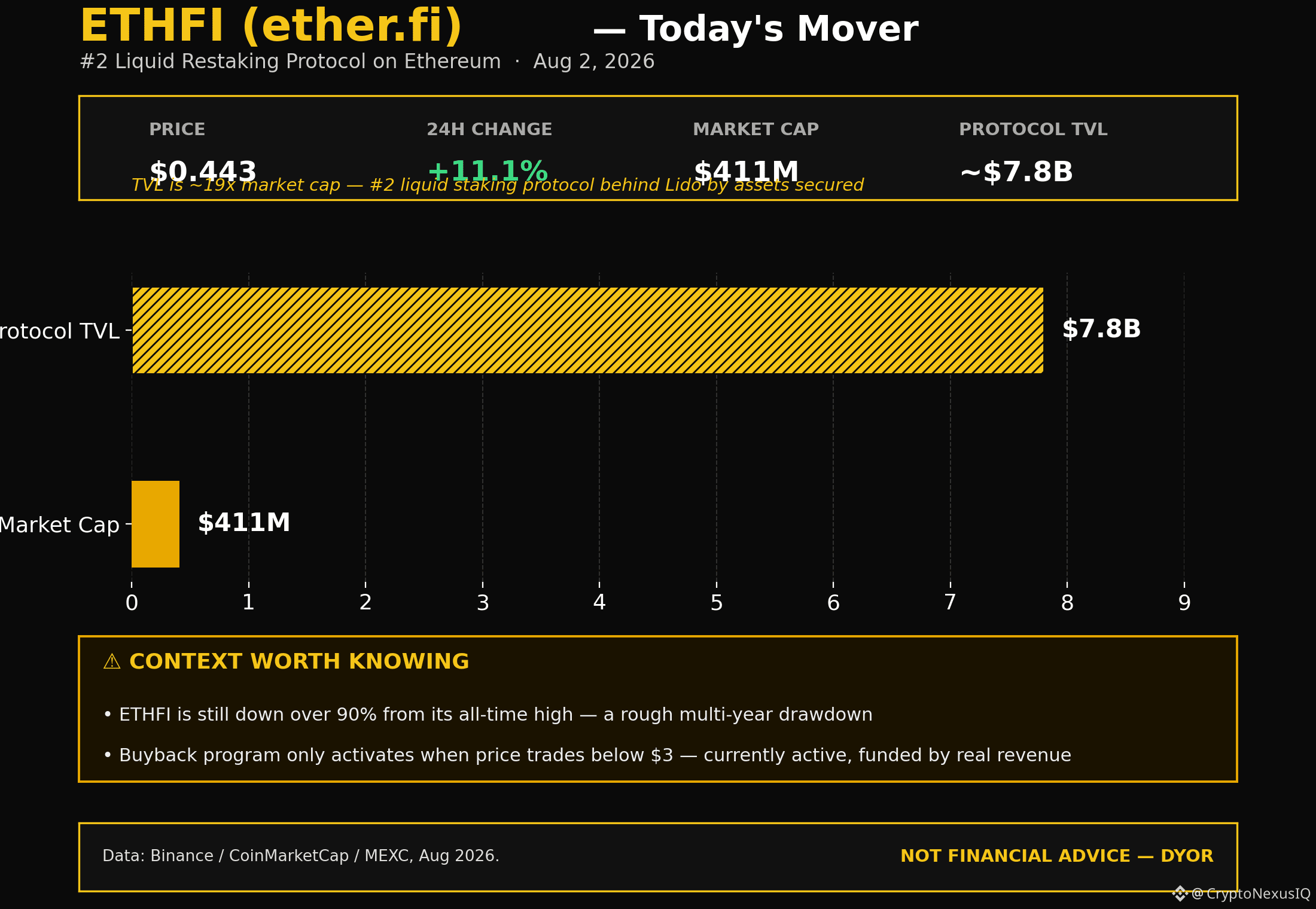
$ETHFI is up +11.1% today — the #2 liquid restaking protocol is moving with the sector
ether.fi ($ETHFI) is trading around $0.443, up +11.1% today, with a $411M market cap. It sits right behind Lido as the second-largest liquid staking/restaking protocol on Ethereum, managing roughly $7.8B in total value locked — meaning the protocol itself secures nearly 19x its own token's market cap in user assets.
What makes ether.fi distinct from just "another Lido": it leans into restaking (extra yield layered on top of base ETH staking) and has been shipping real products — a DeFi-native cash card, a $100M tokenized RWA vault built with Midas and Plume, and a $3B commitment to ETHGas for Ethereum blockspace markets. There's also a live buyback program: the DAO allocates up to $50M in treasury funds to repurchase ETHFI whenever it trades below $3, funded by actual protocol revenue rather than new token issuance — that's a real, if modest, demand mechanism sitting under the price right now.
Context worth knowing before you read this as a straightforward buy signal:
• ETHFI is still down more than 90% from its all-time high. This has been a long, painful drawdown for anyone who bought the top.
• Today's move lines up with a broader liquid-staking-sector rally (Lido moved similarly today) — this looks like sector-wide strength more than an ETHFI-specific headline.
• Restaking is a newer, more experimental niche than plain staking, which means slightly more protocol and competitive risk (Kelp DAO, Puffer Finance, and others are pushing into the same space).
Bottom line: solid fundamentals and real TVL, but today's pop is riding a sector-wide wave rather than ETHFI-specific news — worth knowing which one you're actually betting on.
#ETHFI #EtherFi #LiquidRestaking #Ethereum #Binance
{spot}(ETHFIUSDT)
$ETHFI is up +11.1% today — the #2 liquid restaking protocol is moving with the sector
ether.fi ($ETHFI ) is trading around $0.443, up +11.1% today, with a $411M market cap. It sits right behind Lido as the second-largest liquid staking/restaking protocol on Ethereum, managing roughly $7.8B in total value locked — meaning the protocol itself secures nearly 19x its own token's market cap in user assets.
What makes ether.fi distinct from just "another Lido": it leans into restaking (extra yield layered on top of base ETH staking) and has been shipping real products — a DeFi-native cash card, a $100M tokenized RWA vault built with Midas and Plume, and a $3B commitment to ETHGas for Ethereum blockspace markets. There's also a live buyback program: the DAO allocates up to $50M in treasury funds to repurchase ETHFI whenever it trades below $3, funded by actual protocol revenue rather than new token issuance — that's a real, if modest, demand mechanism sitting under the price right now.
Context worth knowing before you read this as a straightforward buy signal:
• ETHFI is still down more than 90% from its all-time high. This has been a long, painful drawdown for anyone who bought the top.
• Today's move lines up with a broader liquid-staking-sector rally (Lido moved similarly today) — this looks like sector-wide strength more than an ETHFI-specific headline.
• Restaking is a newer, more experimental niche than plain staking, which means slightly more protocol and competitive risk (Kelp DAO, Puffer Finance, and others are pushing into the same space).
Bottom line: solid fundamentals and real TVL, but today's pop is riding a sector-wide wave rather than ETHFI-specific news — worth knowing which one you're actually betting on.
#ETHFI #EtherFi #LiquidRestaking #Ethereum #Binance
ether.fi ($ETHFI ) is trading around $0.443, up +11.1% today, with a $411M market cap. It sits right behind Lido as the second-largest liquid staking/restaking protocol on Ethereum, managing roughly $7.8B in total value locked — meaning the protocol itself secures nearly 19x its own token's market cap in user assets.
What makes ether.fi distinct from just "another Lido": it leans into restaking (extra yield layered on top of base ETH staking) and has been shipping real products — a DeFi-native cash card, a $100M tokenized RWA vault built with Midas and Plume, and a $3B commitment to ETHGas for Ethereum blockspace markets. There's also a live buyback program: the DAO allocates up to $50M in treasury funds to repurchase ETHFI whenever it trades below $3, funded by actual protocol revenue rather than new token issuance — that's a real, if modest, demand mechanism sitting under the price right now.
Context worth knowing before you read this as a straightforward buy signal:
• ETHFI is still down more than 90% from its all-time high. This has been a long, painful drawdown for anyone who bought the top.
• Today's move lines up with a broader liquid-staking-sector rally (Lido moved similarly today) — this looks like sector-wide strength more than an ETHFI-specific headline.
• Restaking is a newer, more experimental niche than plain staking, which means slightly more protocol and competitive risk (Kelp DAO, Puffer Finance, and others are pushing into the same space).
Bottom line: solid fundamentals and real TVL, but today's pop is riding a sector-wide wave rather than ETHFI-specific news — worth knowing which one you're actually betting on.
#ETHFI #EtherFi #LiquidRestaking #Ethereum #Binance
85

·
--
Big Rewards Alert! Get ready to earn with Bedrock $BR on CreatorPad! 🚀
Looking for the next big thing in liquid restaking? Bedrock is offering a massive 600,000 $BR reward pool, and the Global Leaderboard Campaign is officially live! 🔥
Here is how you can secure your share of 300,000 $BR from the leaderboard:
1️⃣ Follow the project.
2️⃣ Post high-quality content.
3️⃣ Trade to qualify.
⚠️ Important Rules to Remember:
You must complete each task type at least once to qualify.
No bots, no suspicious engagement, and no cheating (they check!).
Red Packets/giveaways are excluded from rewards.
Leaderboard updates have a T+2 delay.
With over 45,000+ participants already in, the competition is heating up. Don't join late! 🏃♂️💨
#Bedrock #LiquidRestaking #CreatorPad #BR
Big Rewards Alert! Get ready to earn with Bedrock $BR on CreatorPad! 🚀
Looking for the next big thing in liquid restaking? Bedrock is offering a massive 600,000 $BR reward pool, and the Global Leaderboard Campaign is officially live! 🔥
Here is how you can secure your share of 300,000 $BR from the leaderboard:
1️⃣ Follow the project.
2️⃣ Post high-quality content.
3️⃣ Trade to qualify.
⚠️ Important Rules to Remember:
You must complete each task type at least once to qualify.
No bots, no suspicious engagement, and no cheating (they check!).
Red Packets/giveaways are excluded from rewards.
Leaderboard updates have a T+2 delay.
With over 45,000+ participants already in, the competition is heating up. Don't join late! 🏃♂️💨
#Bedrock #LiquidRestaking #CreatorPad #BR
Looking for the next big thing in liquid restaking? Bedrock is offering a massive 600,000 $BR reward pool, and the Global Leaderboard Campaign is officially live! 🔥
Here is how you can secure your share of 300,000 $BR from the leaderboard:
1️⃣ Follow the project.
2️⃣ Post high-quality content.
3️⃣ Trade to qualify.
⚠️ Important Rules to Remember:
You must complete each task type at least once to qualify.
No bots, no suspicious engagement, and no cheating (they check!).
Red Packets/giveaways are excluded from rewards.
Leaderboard updates have a T+2 delay.
With over 45,000+ participants already in, the competition is heating up. Don't join late! 🏃♂️💨
#Bedrock #LiquidRestaking #CreatorPad #BR
91


·
--
EVERYONE IS LOCKING UP THEIR CRYPTO FOR YIELD. 🔒
But what if that’s exactly how you miss the real bull run?
Every day, investors lock their BTC and ETH for 5% APY, but they lose their Liquidity. When the market pumps or dumps, their assets are trapped. They can't trade or take profit.
Traditional staking forces a bad choice: Earn yield OR keep your trading freedom.
This is where Bedrock changes the narrative.
It’s a multi-asset liquid restaking protocol that lets you do both:
💎 Multi-Asset Yield: Earn enhanced rewards on Ethereum, Bitcoin, and DePIN assets.
⚡ Retain Full Liquidity: Earn yield in the background while keeping the freedom to trade or exit anytime.
The campaign data speaks for itself:
📊 21,000+ participants already farming.
🎁 600,000 $BR rewards pool is live (June 1 – June 16).
The smart money isn't letting capital sit idle or trapped anymore.
Not locked. Maximum yield, maximum freedom. 📈
Are you farming $BR yet? Let me know below! 👇
$BR @Bedrock
{future}(BRUSDT)
#bedrock #LiquidRestaking #defi #BinanceSquare
EVERYONE IS LOCKING UP THEIR CRYPTO FOR YIELD. 🔒
But what if that’s exactly how you miss the real bull run?
Every day, investors lock their BTC and ETH for 5% APY, but they lose their Liquidity. When the market pumps or dumps, their assets are trapped. They can't trade or take profit.
Traditional staking forces a bad choice: Earn yield OR keep your trading freedom.
This is where Bedrock changes the narrative.
It’s a multi-asset liquid restaking protocol that lets you do both:
💎 Multi-Asset Yield: Earn enhanced rewards on Ethereum, Bitcoin, and DePIN assets.
⚡ Retain Full Liquidity: Earn yield in the background while keeping the freedom to trade or exit anytime.
The campaign data speaks for itself:
📊 21,000+ participants already farming.
🎁 600,000 $BR rewards pool is live (June 1 – June 16).
The smart money isn't letting capital sit idle or trapped anymore.
Not locked. Maximum yield, maximum freedom. 📈
Are you farming $BR yet? Let me know below! 👇
$BR @Bedrock
#bedrock #LiquidRestaking #defi #BinanceSquare
But what if that’s exactly how you miss the real bull run?
Every day, investors lock their BTC and ETH for 5% APY, but they lose their Liquidity. When the market pumps or dumps, their assets are trapped. They can't trade or take profit.
Traditional staking forces a bad choice: Earn yield OR keep your trading freedom.
This is where Bedrock changes the narrative.
It’s a multi-asset liquid restaking protocol that lets you do both:
💎 Multi-Asset Yield: Earn enhanced rewards on Ethereum, Bitcoin, and DePIN assets.
⚡ Retain Full Liquidity: Earn yield in the background while keeping the freedom to trade or exit anytime.
The campaign data speaks for itself:
📊 21,000+ participants already farming.
🎁 600,000 $BR rewards pool is live (June 1 – June 16).
The smart money isn't letting capital sit idle or trapped anymore.
Not locked. Maximum yield, maximum freedom. 📈
Are you farming $BR yet? Let me know below! 👇
$BR @Bedrock
#bedrock #LiquidRestaking #defi #BinanceSquare

Shahjee Traders1:
Bedrock allows Bitcoin to earn while staying ready for opportunities.
1
1
33

·
--
Article
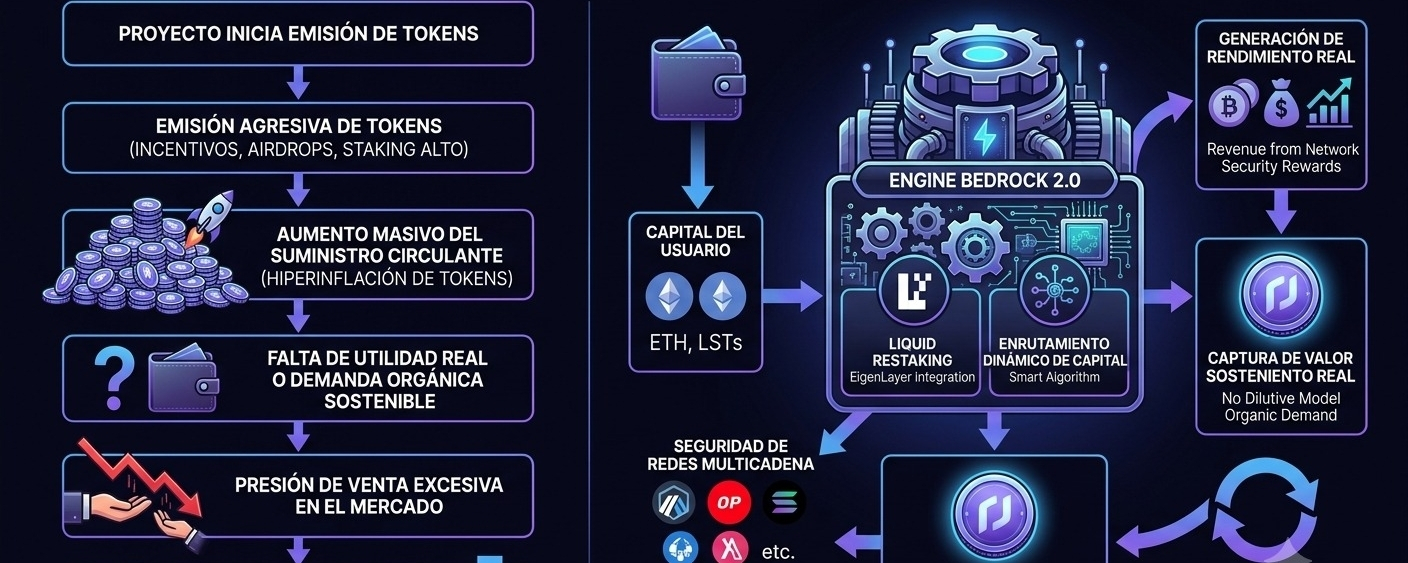
Real Yield in BTCfi vs. Inflated APYThe DeFi sector is going through an inevitable hangover: unsustainable yields backed solely by the uncontrolled issuance of tokens no longer convince mature capital. Institutional investors and long-term holders have learned the lesson and now prioritize real economic utility over short-term inflationary dilution.
In this market cleansing scenario, the evolution of BTCfi demands serious infrastructures that treat Bitcoin as a productive asset rather than merely speculative. This is where @Bedrock stands out with its transition to Bedrock 2.0. Instead of competing in a race of artificial subsidies that cannibalize the ecosystem's value, the protocol operates as an Intelligent Yield Engine.
Real Yield in BTCfi vs. Inflated APY
The DeFi sector is going through an inevitable hangover: unsustainable yields backed solely by the uncontrolled issuance of tokens no longer convince mature capital. Institutional investors and long-term holders have learned the lesson and now prioritize real economic utility over short-term inflationary dilution.
In this market cleansing scenario, the evolution of BTCfi demands serious infrastructures that treat Bitcoin as a productive asset rather than merely speculative. This is where @Bedrock stands out with its transition to Bedrock 2.0. Instead of competing in a race of artificial subsidies that cannibalize the ecosystem's value, the protocol operates as an Intelligent Yield Engine.
In this market cleansing scenario, the evolution of BTCfi demands serious infrastructures that treat Bitcoin as a productive asset rather than merely speculative. This is where @Bedrock stands out with its transition to Bedrock 2.0. Instead of competing in a race of artificial subsidies that cannibalize the ecosystem's value, the protocol operates as an Intelligent Yield Engine.
127

·
--
The corporate land grab for physical Bitcoin is quietly formatting the most brutal retail liquidation trap of this entire macro cycle.
While average retail accounts are panic-selling local support blocks out of pure emotion, massive institutions are using the current range consolidation to aggressively absorb every available spot wrapper. They aren't staring at the immediate 5-minute candle noise—they are securing structural supply dominance for the next decade.
But hoarding dead, stagnant supply inside cold storage is a dying infrastructure play. Stagnation is financial suicide when the entire network layer is shifting toward capital velocity.
This is exactly why smart money infrastructure is routing directly into @Bedrock 2.0 right now. Deploying your positions into the uniBTC pipeline ensures your underlying assets remain 100% fluid and responsive to immediate market setups, while continuously extracting high-end organic yield from the core BTCFi ecosystem.
Stop donating your hard-earned capital blocks to institutional desks during volatile flushes. Protect your liquidity parameters, track the on-chain metrics, and position your portfolio where capital efficiency is mathematically optimized.
#Bedrock #bitcoin #BTCFi #LiquidRestaking $BR $BTC
{spot}(BTCUSDT)
The corporate land grab for physical Bitcoin is quietly formatting the most brutal retail liquidation trap of this entire macro cycle.
While average retail accounts are panic-selling local support blocks out of pure emotion, massive institutions are using the current range consolidation to aggressively absorb every available spot wrapper. They aren't staring at the immediate 5-minute candle noise—they are securing structural supply dominance for the next decade.
But hoarding dead, stagnant supply inside cold storage is a dying infrastructure play. Stagnation is financial suicide when the entire network layer is shifting toward capital velocity.
This is exactly why smart money infrastructure is routing directly into @Bedrock 2.0 right now. Deploying your positions into the uniBTC pipeline ensures your underlying assets remain 100% fluid and responsive to immediate market setups, while continuously extracting high-end organic yield from the core BTCFi ecosystem.
Stop donating your hard-earned capital blocks to institutional desks during volatile flushes. Protect your liquidity parameters, track the on-chain metrics, and position your portfolio where capital efficiency is mathematically optimized.
#Bedrock #bitcoin #BTCFi #LiquidRestaking $BR $BTC
While average retail accounts are panic-selling local support blocks out of pure emotion, massive institutions are using the current range consolidation to aggressively absorb every available spot wrapper. They aren't staring at the immediate 5-minute candle noise—they are securing structural supply dominance for the next decade.
But hoarding dead, stagnant supply inside cold storage is a dying infrastructure play. Stagnation is financial suicide when the entire network layer is shifting toward capital velocity.
This is exactly why smart money infrastructure is routing directly into @Bedrock 2.0 right now. Deploying your positions into the uniBTC pipeline ensures your underlying assets remain 100% fluid and responsive to immediate market setups, while continuously extracting high-end organic yield from the core BTCFi ecosystem.
Stop donating your hard-earned capital blocks to institutional desks during volatile flushes. Protect your liquidity parameters, track the on-chain metrics, and position your portfolio where capital efficiency is mathematically optimized.
#Bedrock #bitcoin #BTCFi #LiquidRestaking $BR $BTC
1
1
151

The Bedrock 2.0 Ecosystem: A Breakthrough Step for Liquid Restaking
Recently, the community has been buzzing with some significant updates from the @Bedrock project. Personally, I really see the potential in the Bedrock 2.0 version, which promises to significantly optimize staking performance and expand safe access for DeFi users.
The sustainable development of the project shows a well-structured long-term roadmap. Keeping a close eye on the fluctuations and updates around token $BR not only helps us grasp governance value but also gives us a better understanding of the new features coming soon.
What are your highest expectations for this 2.0 upgrade? Will it create a new wave in the market? Let’s share our thoughts below!
#DeFi #LiquidRestaking #CryptoUpdate #bedrock $BR
The Bedrock 2.0 Ecosystem: A Breakthrough Step for Liquid Restaking
Recently, the community has been buzzing with some significant updates from the @Bedrock project. Personally, I really see the potential in the Bedrock 2.0 version, which promises to significantly optimize staking performance and expand safe access for DeFi users.
The sustainable development of the project shows a well-structured long-term roadmap. Keeping a close eye on the fluctuations and updates around token $BR not only helps us grasp governance value but also gives us a better understanding of the new features coming soon.
What are your highest expectations for this 2.0 upgrade? Will it create a new wave in the market? Let’s share our thoughts below!
#DeFi #LiquidRestaking #CryptoUpdate #bedrock $BR
Recently, the community has been buzzing with some significant updates from the @Bedrock project. Personally, I really see the potential in the Bedrock 2.0 version, which promises to significantly optimize staking performance and expand safe access for DeFi users.
The sustainable development of the project shows a well-structured long-term roadmap. Keeping a close eye on the fluctuations and updates around token $BR not only helps us grasp governance value but also gives us a better understanding of the new features coming soon.
What are your highest expectations for this 2.0 upgrade? Will it create a new wave in the market? Let’s share our thoughts below!
#DeFi #LiquidRestaking #CryptoUpdate #bedrock $BR
89

Partly True
Bitcoin Was Never Meant to Just Sit There — Bedrock Is Changing That💞💞
Most people still treat Bitcoin like a savings account they're afraid to touch. But what if your BTC could work for you across multiple chains simultaneously, without ever giving up custody? That's the exact problem @Bedrock and BR are solving, and they're doing it at a moment when the entire DeFi ecosystem is finally ready to absorb Bitcoin's liquidity at scale.
At the core of Bedrock's architecture is brBTC, the gateway into what the industry is now calling BTCFi 2.0. Built on the Babylon chain, uniBTC allows Bitcoin holders to restake their assets and earn yield that was simply inaccessible before — no wrapping through questionable bridges, no trusting centralized custodians with your stack. $BR powers the governance and incentive layer of this ecosystem, giving real utility to participants who want a say in how this infrastructure evolves. The backing of OKX Ventures and LongHash Ventures signals that serious capital has already done its due diligence here.
What makes @Bedrock particularly compelling right now is its multi-chain ambition. The protocol has expanded to Base, Aptos, BSC, and Mode networks, meaning brBTC liquidity isn't siloed into a single ecosystem — it flows where the yield opportunities are. For DeFi users who are tired of choosing between security and productivity with their Bitcoin, this cross-chain presence fundamentally changes the calculus. Your BTC doesn't have to choose between being safe and being useful.
The liquid restaking narrative has already proven itself with ETH, but Bitcoin's version of that story is still in its early chapters. @Bedrock is writing those chapters with infrastructure that's audited, multi-chain native, and backed by credible investors. If you've been waiting for a reason to put your idle Bitcoin to work without compromising on trust, $BR and brBTC deserve a serious look before this trade becomes crowded.
#Bedrock #BinanceSquare #LiquidRestaking
Bitcoin Was Never Meant to Just Sit There — Bedrock Is Changing That💞💞
Most people still treat Bitcoin like a savings account they're afraid to touch. But what if your BTC could work for you across multiple chains simultaneously, without ever giving up custody? That's the exact problem @Bedrock and BR are solving, and they're doing it at a moment when the entire DeFi ecosystem is finally ready to absorb Bitcoin's liquidity at scale.
At the core of Bedrock's architecture is brBTC, the gateway into what the industry is now calling BTCFi 2.0. Built on the Babylon chain, uniBTC allows Bitcoin holders to restake their assets and earn yield that was simply inaccessible before — no wrapping through questionable bridges, no trusting centralized custodians with your stack. $BR powers the governance and incentive layer of this ecosystem, giving real utility to participants who want a say in how this infrastructure evolves. The backing of OKX Ventures and LongHash Ventures signals that serious capital has already done its due diligence here.
What makes @Bedrock particularly compelling right now is its multi-chain ambition. The protocol has expanded to Base, Aptos, BSC, and Mode networks, meaning brBTC liquidity isn't siloed into a single ecosystem — it flows where the yield opportunities are. For DeFi users who are tired of choosing between security and productivity with their Bitcoin, this cross-chain presence fundamentally changes the calculus. Your BTC doesn't have to choose between being safe and being useful.
The liquid restaking narrative has already proven itself with ETH, but Bitcoin's version of that story is still in its early chapters. @Bedrock is writing those chapters with infrastructure that's audited, multi-chain native, and backed by credible investors. If you've been waiting for a reason to put your idle Bitcoin to work without compromising on trust, $BR and brBTC deserve a serious look before this trade becomes crowded.
#Bedrock #BinanceSquare #LiquidRestaking
Most people still treat Bitcoin like a savings account they're afraid to touch. But what if your BTC could work for you across multiple chains simultaneously, without ever giving up custody? That's the exact problem @Bedrock and BR are solving, and they're doing it at a moment when the entire DeFi ecosystem is finally ready to absorb Bitcoin's liquidity at scale.
At the core of Bedrock's architecture is brBTC, the gateway into what the industry is now calling BTCFi 2.0. Built on the Babylon chain, uniBTC allows Bitcoin holders to restake their assets and earn yield that was simply inaccessible before — no wrapping through questionable bridges, no trusting centralized custodians with your stack. $BR powers the governance and incentive layer of this ecosystem, giving real utility to participants who want a say in how this infrastructure evolves. The backing of OKX Ventures and LongHash Ventures signals that serious capital has already done its due diligence here.
What makes @Bedrock particularly compelling right now is its multi-chain ambition. The protocol has expanded to Base, Aptos, BSC, and Mode networks, meaning brBTC liquidity isn't siloed into a single ecosystem — it flows where the yield opportunities are. For DeFi users who are tired of choosing between security and productivity with their Bitcoin, this cross-chain presence fundamentally changes the calculus. Your BTC doesn't have to choose between being safe and being useful.
The liquid restaking narrative has already proven itself with ETH, but Bitcoin's version of that story is still in its early chapters. @Bedrock is writing those chapters with infrastructure that's audited, multi-chain native, and backed by credible investors. If you've been waiting for a reason to put your idle Bitcoin to work without compromising on trust, $BR and brBTC deserve a serious look before this trade becomes crowded.
#Bedrock #BinanceSquare #LiquidRestaking
12
5
718

·
--
Verified
#bedrock $BR
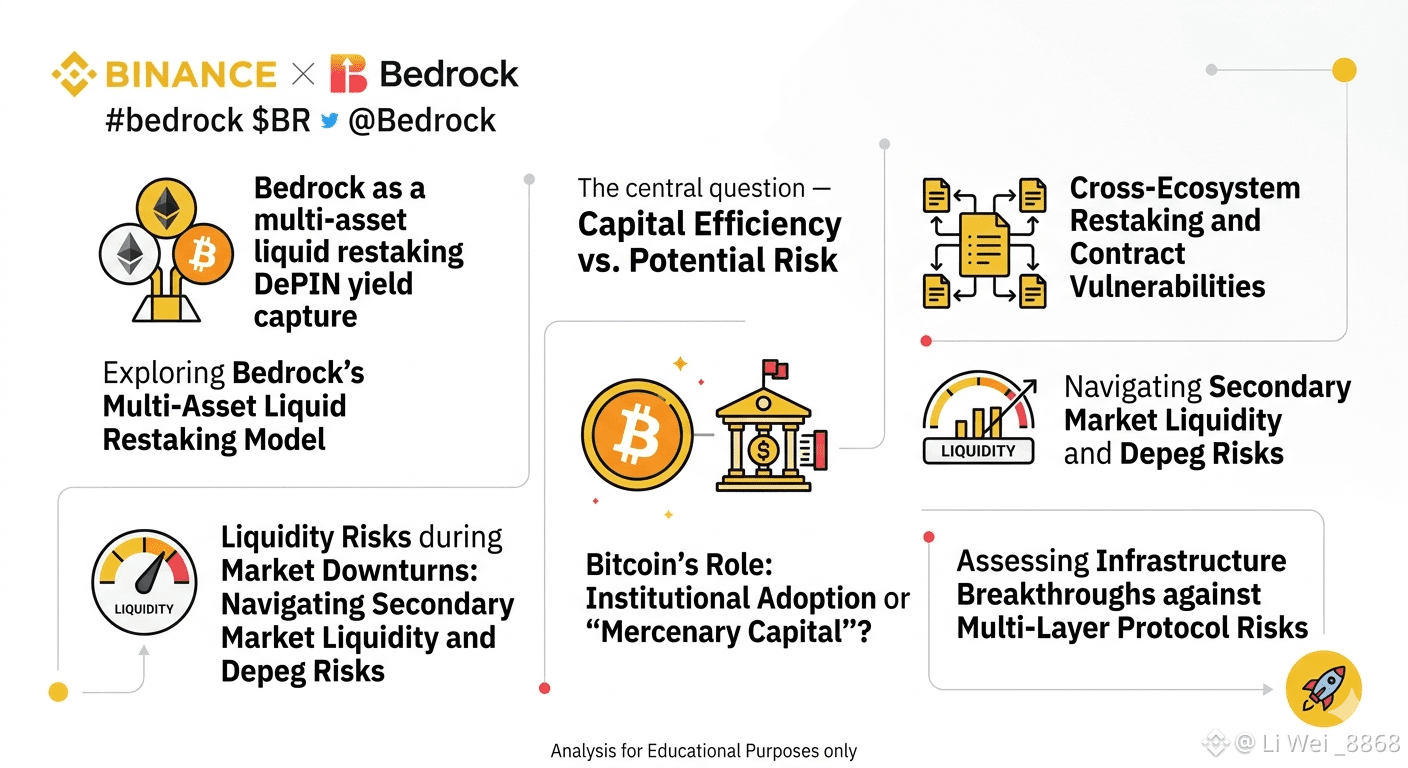
I’ve been diving into @Bedrock’s architecture as a multi-asset liquid restaking hub. Capturing yield across Ethereum, Bitcoin, and DePIN sounds like a crypto trifecta, but are we just stacking unpriced layers of risk? 🤔
Restaking derivative assets across different ecosystems multiplies smart contract vulnerabilities. If one underlying DePIN protocol or restaking layer faces an exploit, contagion ripples right back to your wrapped tokens.
The Bitcoin angle makes me stop and think. Bitcoiners prioritize security. Bedrock pushes BTC into high-yield DeFi, but wrapping native BTC sacrifices trustless sovereignty. Will institutional whales trust a multi-layer protocol long-term, or is this just mercenary capital chasing short-term incentives?
There is also the threat of a liquidity mirage. LRTs promise instant exits, but during market deleveraging, secondary liquidity dries up fast. If everyone runs for the exit, depeg risk becomes a very real threat.
The market seems obsessed with capital efficiency at all costs. Bedrock is a sophisticated confluence point, but sophistication isn't absolute safety. Are we seeing an infrastructure breakthrough or a complex tower of Lego blocks? Time will tell. Right 🚀
@Bedrock #BTCfi #LiquidRestaking
#bedrock $BR
I’ve been diving into @Bedrock’s architecture as a multi-asset liquid restaking hub. Capturing yield across Ethereum, Bitcoin, and DePIN sounds like a crypto trifecta, but are we just stacking unpriced layers of risk? 🤔
Restaking derivative assets across different ecosystems multiplies smart contract vulnerabilities. If one underlying DePIN protocol or restaking layer faces an exploit, contagion ripples right back to your wrapped tokens.
The Bitcoin angle makes me stop and think. Bitcoiners prioritize security. Bedrock pushes BTC into high-yield DeFi, but wrapping native BTC sacrifices trustless sovereignty. Will institutional whales trust a multi-layer protocol long-term, or is this just mercenary capital chasing short-term incentives?
There is also the threat of a liquidity mirage. LRTs promise instant exits, but during market deleveraging, secondary liquidity dries up fast. If everyone runs for the exit, depeg risk becomes a very real threat.
The market seems obsessed with capital efficiency at all costs. Bedrock is a sophisticated confluence point, but sophistication isn't absolute safety. Are we seeing an infrastructure breakthrough or a complex tower of Lego blocks? Time will tell. Right 🚀
@Bedrock #BTCfi #LiquidRestaking
I’ve been diving into @Bedrock’s architecture as a multi-asset liquid restaking hub. Capturing yield across Ethereum, Bitcoin, and DePIN sounds like a crypto trifecta, but are we just stacking unpriced layers of risk? 🤔
Restaking derivative assets across different ecosystems multiplies smart contract vulnerabilities. If one underlying DePIN protocol or restaking layer faces an exploit, contagion ripples right back to your wrapped tokens.
The Bitcoin angle makes me stop and think. Bitcoiners prioritize security. Bedrock pushes BTC into high-yield DeFi, but wrapping native BTC sacrifices trustless sovereignty. Will institutional whales trust a multi-layer protocol long-term, or is this just mercenary capital chasing short-term incentives?
There is also the threat of a liquidity mirage. LRTs promise instant exits, but during market deleveraging, secondary liquidity dries up fast. If everyone runs for the exit, depeg risk becomes a very real threat.
The market seems obsessed with capital efficiency at all costs. Bedrock is a sophisticated confluence point, but sophistication isn't absolute safety. Are we seeing an infrastructure breakthrough or a complex tower of Lego blocks? Time will tell. Right 🚀
@Bedrock #BTCfi #LiquidRestaking
94

#bedrock $BR
🔥 Bedrock 2.0 is not just an upgrade — it's a revolution in liquid restaking!
With @Bedrock, users can now restake $ETH , $IOTX & more to earn multi-layered rewards without sacrificing liquidity. The protocol's uniBTC & uniETH models are redefining how DeFi capital works for YOU.
$BR holders are at the center of this ecosystem — governance, fee sharing, and real utility backed by institutional-grade security.
This is not hype. This is infrastructure. 🏗️
#Bedrock #BR #LiquidRestaking #DeFi #BinanceSquare
#bedrock $BR
🔥 Bedrock 2.0 is not just an upgrade — it's a revolution in liquid restaking!
With @Bedrock, users can now restake $ETH , $IOTX & more to earn multi-layered rewards without sacrificing liquidity. The protocol's uniBTC & uniETH models are redefining how DeFi capital works for YOU.
$BR holders are at the center of this ecosystem — governance, fee sharing, and real utility backed by institutional-grade security.
This is not hype. This is infrastructure. 🏗️
#Bedrock #BR #LiquidRestaking #DeFi #BinanceSquare
🔥 Bedrock 2.0 is not just an upgrade — it's a revolution in liquid restaking!
With @Bedrock, users can now restake $ETH , $IOTX & more to earn multi-layered rewards without sacrificing liquidity. The protocol's uniBTC & uniETH models are redefining how DeFi capital works for YOU.
$BR holders are at the center of this ecosystem — governance, fee sharing, and real utility backed by institutional-grade security.
This is not hype. This is infrastructure. 🏗️
#Bedrock #BR #LiquidRestaking #DeFi #BinanceSquare
71

#bedrock $BR The evolution of liquid restaking is gaining significant momentum, and it is fascinating to see how the ecosystem is maturing with the development of Bedrock 2.0. By focusing on multi-asset utility across Ethereum, Bitcoin, and DePIN networks, the team is effectively bridging the gap between passive capital and active DeFi participation.
What stands out is the shift toward making Bitcoin liquidity more functional and productive, rather than letting it sit idle. As we look at the potential of $BR to streamline yield generation while maintaining asset flexibility, it is clear that @Bedrock is carving out a crucial niche in the infrastructure layer of the crypto space. I am keeping a close watch on how the governance model and the upcoming integration phases continue to unfold. The focus on sustainable, long-term ecosystem growth over short-term hype is a welcome development for serious participants.
#Bedrock #BTCFi #LiquidRestaking $BR
#bedrock $BR The evolution of liquid restaking is gaining significant momentum, and it is fascinating to see how the ecosystem is maturing with the development of Bedrock 2.0. By focusing on multi-asset utility across Ethereum, Bitcoin, and DePIN networks, the team is effectively bridging the gap between passive capital and active DeFi participation.
What stands out is the shift toward making Bitcoin liquidity more functional and productive, rather than letting it sit idle. As we look at the potential of $BR to streamline yield generation while maintaining asset flexibility, it is clear that @Bedrock is carving out a crucial niche in the infrastructure layer of the crypto space. I am keeping a close watch on how the governance model and the upcoming integration phases continue to unfold. The focus on sustainable, long-term ecosystem growth over short-term hype is a welcome development for serious participants.
#Bedrock #BTCFi #LiquidRestaking $BR
What stands out is the shift toward making Bitcoin liquidity more functional and productive, rather than letting it sit idle. As we look at the potential of $BR to streamline yield generation while maintaining asset flexibility, it is clear that @Bedrock is carving out a crucial niche in the infrastructure layer of the crypto space. I am keeping a close watch on how the governance model and the upcoming integration phases continue to unfold. The focus on sustainable, long-term ecosystem growth over short-term hype is a welcome development for serious participants.
#Bedrock #BTCFi #LiquidRestaking $BR
87
Log in to explore more content
Join global crypto users on Binance Square
⚡️ Get latest and useful information about crypto.
💬 Trusted by the world’s largest crypto exchange.
👍 Discover real insights from verified creators.
Email / Phone number
Trending Topics
1
#BitwiseFilesFinalNEARSpotETFProspectus
53,475 views
1,159 Discussing
2
#BitgetHackerMoves$83MStolenXRP
25,366 views
150 Discussing
3
#SOLSpotETFWeeklyInflow$188M
15,165 views
118 Discussing
4
#DogecoinETFsPostBiggestWeekSinceLaunch
38,877 views
847 Discussing
5
#StrategyStriveAdd2305BitcoinThisWeek
112,739 views
2,003 Discussing
6
#TrumpRejectsIranHormuzReopening
102,286 views
1,531 Discussing
7
#CircleTetherFreezeBitgetHackerWallet
96,237 views
1,429 Discussing
8
#SECSaysTokenBuybacksNotAutoSecurities
61,595 views
837 Discussing
9
#ChinaUSAgreeOn$30BTariffCut
4,953 views
44 Discussing
10
#CoinMarketCapCompletesCoinglassAcquisition
67,734 views
955 Discussing