
#defi
defi
58.3M views
312,875 Discussing
Hot
Latest

·
--
Verified
🍇 ENA: ETHENA’S BUYBACK FRAMEWORK IS NOW APPROVED — WHAT DOES IT MEAN?
Ethena has made a major change to ENA's token economics.
🔹 Governance approved a programmatic ENA buyback framework.
🔹 Buybacks are linked to USDe supply milestones, including a $7.5B threshold.
🔹 The October governance update reported USDe supply at $4.86B at publication.
🔹 This means the first $7.5B milestone had not yet been reached in that update.
The framework is approved, but milestone-based buybacks should not be confused with guaranteed ongoing purchases.
$ENA
{future}(ENAUSDT)
.
.
.
#Ethena #ENA #DeFi
Not financial advice. DYOR.
🍇 ENA: ETHENA’S BUYBACK FRAMEWORK IS NOW APPROVED — WHAT DOES IT MEAN?
Ethena has made a major change to ENA's token economics.
🔹 Governance approved a programmatic ENA buyback framework.
🔹 Buybacks are linked to USDe supply milestones, including a $7.5B threshold.
🔹 The October governance update reported USDe supply at $4.86B at publication.
🔹 This means the first $7.5B milestone had not yet been reached in that update.
The framework is approved, but milestone-based buybacks should not be confused with guaranteed ongoing purchases.
$ENA
.
.
.
#Ethena #ENA #DeFi
Not financial advice. DYOR.
2
1.1k

·
--
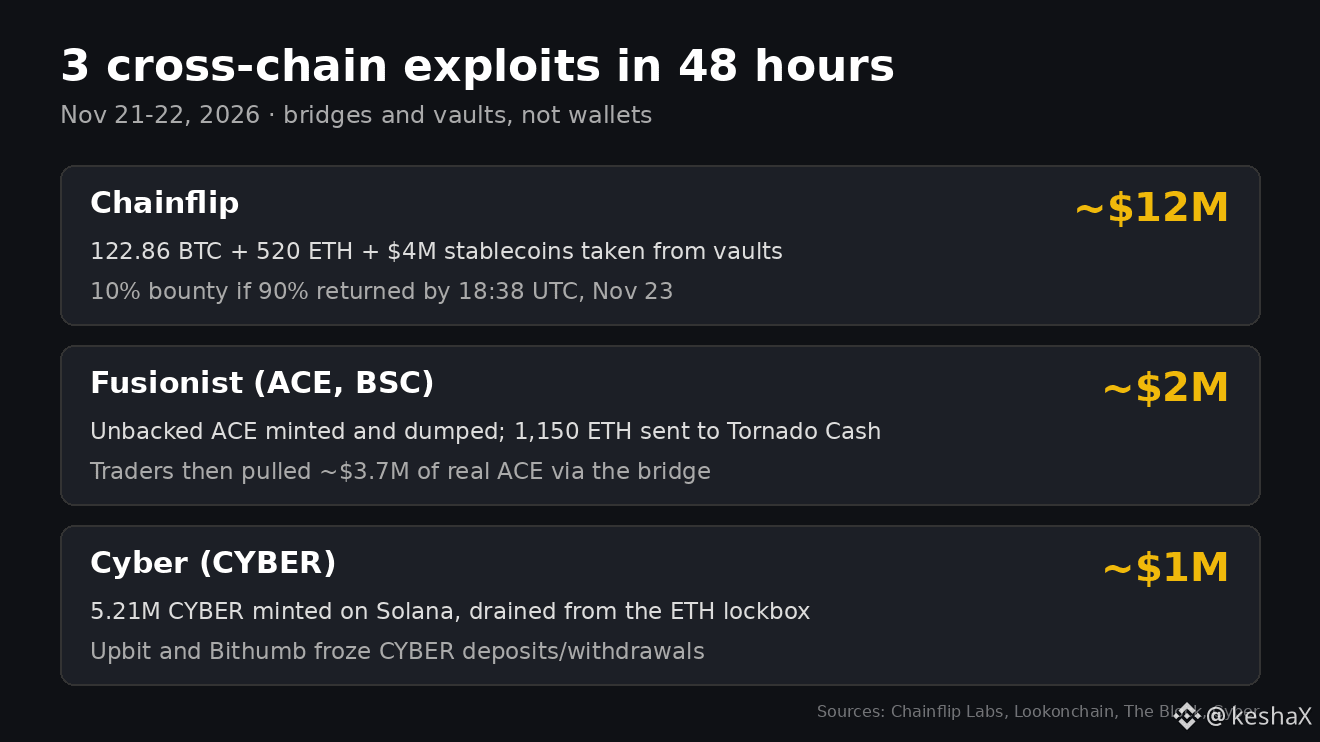
🚨 3 CROSS-CHAIN EXPLOITS IN 48 HOURS. ONE BOUNTY DEADLINE ENDS TONIGHT
While everyone watched the bounce, the weekend got expensive for cross-chain DeFi:
1. Chainflip: ~$12M taken from its vaults on Nov 21, including 122.86 BTC and 520 ETH. The team offers a 10% bounty if 90% comes back by 18:38 UTC today, and says it has already traced the attacker's validator and server.
2. Fusionist: an attacker minted unbacked $ACE on BSC, dumped it for ~$2M and pushed 1,150 ETH into Tornado Cash. Traders then pulled ~$3.7M of real ACE through the bridge.
3. Cyber: 5.21M $CYBER minted on Solana and released from the Ethereum lockbox two minutes later. Upbit and Bithumb froze deposits and withdrawals.
None of this touched user wallets. All of it hit the plumbing between chains.
My take: bridged versions of small caps are the weakest link right now. A token that lives on 3 chains has 3 doors to lock.
Will the Chainflip attacker take the 10% deal before 18:38 UTC: yes or no?
#CryptoSecurity #DeFi #Hack #Bridge
1
1.2k
·
--
🏺 $ENA : ETHENA’S BUYBACK FRAMEWORK HAS A KEY $7.5B MILESTONE!
Ethena’s latest governance updates highlight an important development:
- November 17: Ethena published its October governance report.
- USDe supply: Approximately $4.86 billion at the time of publication.
- Buyback framework: Governance approved a program linking ENA buybacks to USDe supply milestones.
- Activation threshold: The 14-day average USDe supply must reach $7.5 billion before the first buyback milestone activates.
- Risk transparency: Ethena also disclosed its backing composition and exchange-related exposure.
Can USDe growth bring Ethena closer to its buyback milestone?
$ENA
{future}(ENAUSDT)
.
.
.
#ENA #Ethena #DeFi
Not financial advice. DYOR.
🏺 $ENA : ETHENA’S BUYBACK FRAMEWORK HAS A KEY $7.5B MILESTONE!
Ethena’s latest governance updates highlight an important development:
- November 17: Ethena published its October governance report.
- USDe supply: Approximately $4.86 billion at the time of publication.
- Buyback framework: Governance approved a program linking ENA buybacks to USDe supply milestones.
- Activation threshold: The 14-day average USDe supply must reach $7.5 billion before the first buyback milestone activates.
- Risk transparency: Ethena also disclosed its backing composition and exchange-related exposure.
Can USDe growth bring Ethena closer to its buyback milestone?
$ENA
.
.
.
#ENA #Ethena #DeFi
Not financial advice. DYOR.
1
394

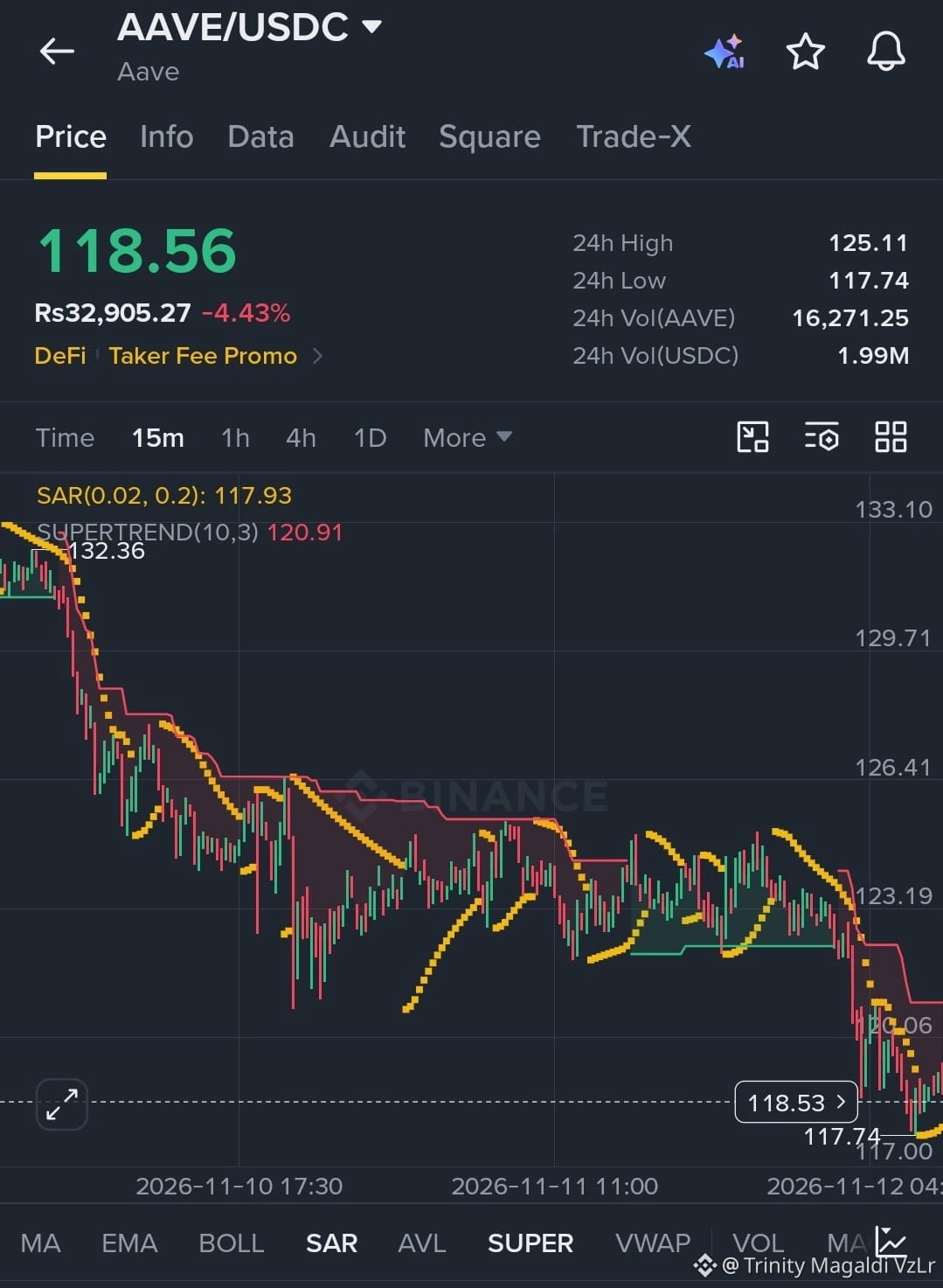
$AAVE AAVE is under serious selling pressure, down 4.43% to $118.56! Price is hovering near $117.74 support, while Supertrend at $120.91 signals bearish momentum. A breakdown could trigger further losses, but reclaiming resistance may spark recovery. Target: $125.00.
#AAVE #CryptoMarket #DeFi
$GIGGLE
{spot}(GIGGLEUSDT)
$RIVER
{future}(RIVERUSDT)
$AAVE AAVE is under serious selling pressure, down 4.43% to $118.56! Price is hovering near $117.74 support, while Supertrend at $120.91 signals bearish momentum. A breakdown could trigger further losses, but reclaiming resistance may spark recovery. Target: $125.00.
#AAVE #CryptoMarket #DeFi
$GIGGLE
$RIVER
#AAVE #CryptoMarket #DeFi
$GIGGLE
$RIVER
2
1.3k


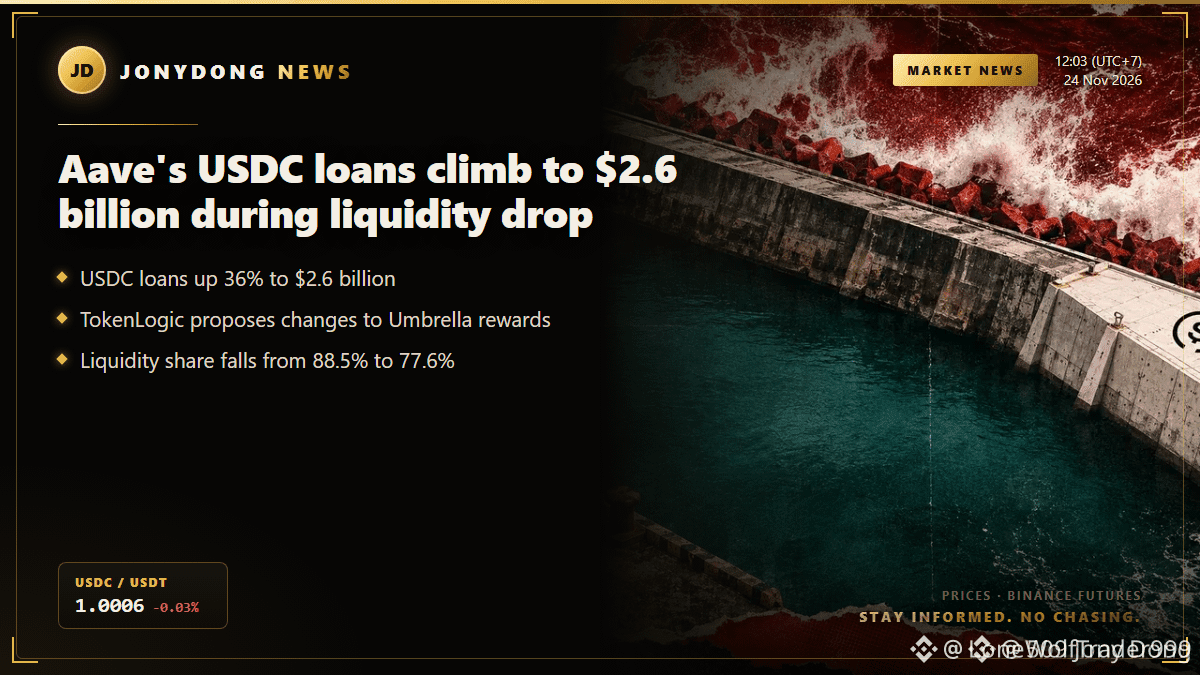
🦈 $USDC BORROWING SURGES TO 2.6 BILLION WHILE LIQUIDITY CUSHIONS THIN OUT! ⚡
Capital is flowing hard into $USDC debt markets as borrowing demand climbs past previous local baselines. 📊 Yet beneath the surface expansion, the ratio of liquid collateral backing these positions is quietly tapering off. 🔍
When leverage scales faster than the underlying liquidity cushion, order book dynamics shift and risk profiles tighten across the board. 💡 Are you adjusting your collateral ratios to weather a potential squeeze, or riding the momentum wave? 👇
⚠️ Not financial advice. Always manage your risk. 🛡️
🏷️ #USDC #Lending #DeFi #Crypto
🦈 💧
1

·
--
📰 Meteora says it has shared $2 billion in fees with its LP Army and community
Meteora's revenue-sharing model strengthens its appeal to liquidity providers, but reliance on volatile markets poses risks of impermanent loss. The post Meteora says it has shared $2 billion in fees with its LP Army and community appeared first on Crypto Briefing.
Source : Crypto Briefing
Time : 2026-11-23 19:42:44
Credit : estefano gomez
#defi
$MEME $USDC $MKR
Share your opinion in the comment section below

·
--
📰 Meteora says it has shared $2 billion in fees with its LP Army and community
Meteora's revenue-sharing model strengthens its appeal to liquidity providers, but reliance on volatile markets poses risks of impermanent loss. The post Meteora says it has shared $2 billion in fees with its LP Army and community appeared first on Crypto Briefing.
Source : Crypto Briefing
Time : 2026-11-23 19:42:44
Credit : estefano gomez
#defi
$MEME $USDC $MKR
Share your opinion in the comment section below
📰 Meteora says it has shared $2 billion in fees with its LP Army and community
Meteora's revenue-sharing model strengthens its appeal to liquidity providers, but reliance on volatile markets poses risks of impermanent loss. The post Meteora says it has shared $2 billion in fees with its LP Army and community appeared first on Crypto Briefing.
Source : Crypto Briefing
Time : 2026-11-23 19:42:44
Credit : estefano gomez
#defi
$MEME $USDC $MKR
Share your opinion in the comment section below
Meteora's revenue-sharing model strengthens its appeal to liquidity providers, but reliance on volatile markets poses risks of impermanent loss. The post Meteora says it has shared $2 billion in fees with its LP Army and community appeared first on Crypto Briefing.
Source : Crypto Briefing
Time : 2026-11-23 19:42:44
Credit : estefano gomez
#defi
$MEME $USDC $MKR
Share your opinion in the comment section below
7

·
--
Article
DeFi Summer 2020 vs Today: From Speculative Farms to Real YieldDEFI SUMMER 2020 VS TODAY: FROM SPECULATIVE FARMS TO REAL YIELD
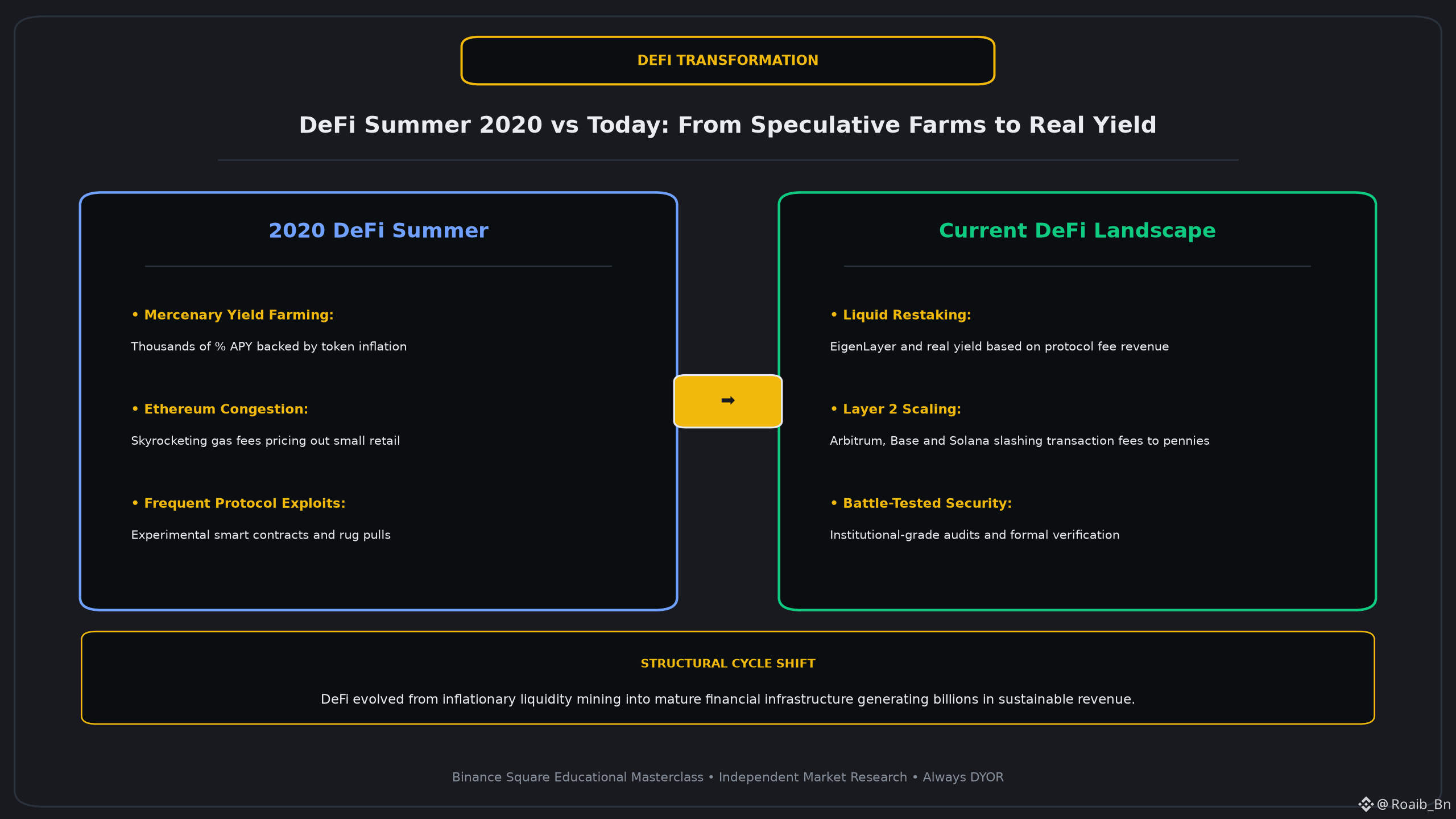
If you were active in the markets during the legendary DeFi Summer of 2020, you likely remember the sheer chaos and adrenaline of the food coin era. It was a period defined by rapid experimentation, where protocol launches happened every few hours and mercenary capital moved at lightning speed to capture four-digit yields. Fast forward to late 2026, and the landscape has undergone a total metamorphosis. Understanding this evolution is not just a history lesson; it is essential for any trader looking to distinguish between unsustainable hype and long-term value in the current market cycle.
THE ERA OF MERCENARY CAPITAL AND GAS WARS
Back in 2020, the decentralized finance narrative was driven almost entirely by liquidity mining. Protocols would distribute their native tokens to anyone providing liquidity, often resulting in astronomical APYs that were fundamentally backed by nothing more than token inflation. This was the birth of mercenary yield farming. While it created massive wealth for early adopters, it also led to a cycle of farm and dump mechanics that eventually crushed many retail participants. Ethereum was the only real game in town, and as activity surged, gas fees became a massive barrier to entry. We saw simple swaps costing hundreds of dollars, effectively pricing out everyone except the whales. It was a high stakes, experimental playground where smart contract exploits and rug pulls were a weekly occurrence.
THE SHIFT TO SUSTAINABILITY AND REAL REVENUE
The current DeFi ecosystem looks nothing like that chaotic origin story. Today, the focus has shifted from inflationary rewards to real yield which is revenue generated from actual protocol usage and platform fees. We have seen the rise of liquid restaking through platforms like EigenLayer, which allows $ETH holders to secure additional networks while earning yield based on security services rather than just printing new tokens. Furthermore, the infrastructure has scaled massively. With the dominance of Layer 2 solutions like Arbitrum and Base, and the high throughput performance of $SOL , transaction costs have been slashed to pennies. This has democratized access once again, but with a much higher level of security. Modern protocols now undergo institutional grade audits and formal verification, making the entire stack significantly more resilient than the experimental code of 2020.
STRATEGIC VERDICT FOR THE MODERN TRADER
For a disciplined trader, the takeaway is clear: the market has matured from a speculative casino into a legitimate financial layer. In 2020, you were betting on how long a farm could stay solvent before the inflation caught up with the price. In 2026, we are looking at protocol fee generation, treasury management, and the utility of restaking. While the 10,000 percent APYs are mostly gone, they have been replaced by sustainable, predictable returns that can be integrated into a professional portfolio. The risk profile has shifted from smart contract fragility to fundamental growth and adoption.
COMMUNITY DISCUSSION
Looking back at the evolution of these protocols, do you miss the high volatility excitement of the 2020 farming era, or do you prefer the stability and low fees of the modern Layer 2 and restaking landscape? Share your perspective in the comments.
DISCLAIMER
This analysis is for educational purposes only and does not constitute financial advice. The crypto market remains highly volatile. Always conduct your own research and manage your risk accordingly.
$ETH $SOL #BinanceSquare #DeFi
DeFi Summer 2020 vs Today: From Speculative Farms to Real Yield
DEFI SUMMER 2020 VS TODAY: FROM SPECULATIVE FARMS TO REAL YIELD
If you were active in the markets during the legendary DeFi Summer of 2020, you likely remember the sheer chaos and adrenaline of the food coin era. It was a period defined by rapid experimentation, where protocol launches happened every few hours and mercenary capital moved at lightning speed to capture four-digit yields. Fast forward to late 2026, and the landscape has undergone a total metamorphosis. Understanding this evolution is not just a history lesson; it is essential for any trader looking to distinguish between unsustainable hype and long-term value in the current market cycle.
THE ERA OF MERCENARY CAPITAL AND GAS WARS
Back in 2020, the decentralized finance narrative was driven almost entirely by liquidity mining. Protocols would distribute their native tokens to anyone providing liquidity, often resulting in astronomical APYs that were fundamentally backed by nothing more than token inflation. This was the birth of mercenary yield farming. While it created massive wealth for early adopters, it also led to a cycle of farm and dump mechanics that eventually crushed many retail participants. Ethereum was the only real game in town, and as activity surged, gas fees became a massive barrier to entry. We saw simple swaps costing hundreds of dollars, effectively pricing out everyone except the whales. It was a high stakes, experimental playground where smart contract exploits and rug pulls were a weekly occurrence.
THE SHIFT TO SUSTAINABILITY AND REAL REVENUE
The current DeFi ecosystem looks nothing like that chaotic origin story. Today, the focus has shifted from inflationary rewards to real yield which is revenue generated from actual protocol usage and platform fees. We have seen the rise of liquid restaking through platforms like EigenLayer, which allows $ETH holders to secure additional networks while earning yield based on security services rather than just printing new tokens. Furthermore, the infrastructure has scaled massively. With the dominance of Layer 2 solutions like Arbitrum and Base, and the high throughput performance of $SOL , transaction costs have been slashed to pennies. This has democratized access once again, but with a much higher level of security. Modern protocols now undergo institutional grade audits and formal verification, making the entire stack significantly more resilient than the experimental code of 2020.
STRATEGIC VERDICT FOR THE MODERN TRADER
For a disciplined trader, the takeaway is clear: the market has matured from a speculative casino into a legitimate financial layer. In 2020, you were betting on how long a farm could stay solvent before the inflation caught up with the price. In 2026, we are looking at protocol fee generation, treasury management, and the utility of restaking. While the 10,000 percent APYs are mostly gone, they have been replaced by sustainable, predictable returns that can be integrated into a professional portfolio. The risk profile has shifted from smart contract fragility to fundamental growth and adoption.
COMMUNITY DISCUSSION
Looking back at the evolution of these protocols, do you miss the high volatility excitement of the 2020 farming era, or do you prefer the stability and low fees of the modern Layer 2 and restaking landscape? Share your perspective in the comments.
DISCLAIMER
This analysis is for educational purposes only and does not constitute financial advice. The crypto market remains highly volatile. Always conduct your own research and manage your risk accordingly.
$ETH $SOL #BinanceSquare #DeFi
4


·
--

Article
Follow the Money: Seventy Thousand Depositors and Forty-Eight BorrowersIf you want to read whether this chain is running hot or cold from onchain money flows, or want to know who is standing next to you, this chapter covers two topics: who the depositors and borrowers of the Earn vault actually are, and whether the direction of money onchain can be used as a signal.
77,600 vs. 48
Chapter 5 said that Earn depositors stand on the other side of about thirty highly leveraged large wallets. This chapter counts both sides precisely.
The depositor side. Reading every position in the Steakhouse USDG vault through Morpho's public API: on November 2, the vault held about $522 million across 77,594 holding addresses. (In September, Merkl said more than 95,000 wallets had taken part in Earn. The two numbers measure different things: the first counts addresses that still hold a position, the second counts every wallet that has ever taken part.)
The borrower side. Combining the borrowers in the four looping markets where the vault's money sits (USDe, syrupUSDG, two mGLO markets, and spUSDG): 48 addresses have borrowed more than $100,000 each, about $458 million in total.
The money of more than seventy thousand depositors flows into one vault and is lent to forty-eight addresses. This is the standard structure of DeFi lending, and it is the single most important picture for understanding where money goes on this chain.
Depositors: Retail by Headcount, Not by Money
The 77,594 positions, ranked by size:
Top 10: Positions: 10; Share of vault assets: 12.7%Top 100: Positions: 100; Share of vault assets: 31.4%Top 1,000: Positions: 1,000; Share of vault assets: 63.9%Over $1 million: Positions: 48; Share of vault assets: —Over $100,000: Positions: 968; Share of vault assets: —Rank 11,001 and below: Positions: ~66,600; Share of vault assets: ~3% (about $230 each on average)
The position ranked 11,000th holds about $10,000. The roughly 66,600 addresses after it hold only about $15 million between them.
That makes Earn's user base a classic case of "the headcount is in the long tail, the money is at the top." Large numbers of users put in tens or hundreds of dollars to try it out. What actually carries the vault to $500 million is about a thousand accounts holding hundreds of thousands to millions of dollars each.
Public data cannot identify who is behind these addresses, nor separate Robinhood app users (who get 7%) from onchain users depositing directly (who get 4%). But judging by size, Earn's money looks more like "affluent brokerage clients" than "mass retail." That matters for predicting where the money goes when subsidies taper: large accounts are more sensitive to yield differences and quicker to move when the subsidy is cut.
Borrowers: A Handful of Wallets
The borrowing side is far more concentrated:
Largest single address: Total borrowed: ~$85.8 million; Share of borrowing in the four markets: 18.7%Top 10 addresses: Total borrowed: ~$336 million; Share of borrowing in the four markets: 73.2%Top 20 addresses: Total borrowed: ~$417 million; Share of borrowing in the four markets: 91.0%Addresses borrowing more than $100,000: Total borrowed: 48; Share of borrowing in the four markets: ~100%
Some features:
The largest borrower uses two kinds of collateral. Address 0x502d… has borrowed about $62.2 million in the USDe market and about $23.6 million in the syrupUSDG market, about $85.8 million in total, roughly 16% of the vault's assets.Ten addresses borrow across markets. For example, 0x086e… borrows in the USDe ($6.2 million), syrupUSDG ($9.1 million), and mGLO ($16 million) markets at once. They allocate leverage across different sources of yield, like a small fixed-income fund.They are ordinary wallets. We checked the four largest borrowing addresses. All are externally owned accounts (EOAs), not smart-contract vaults, and they have sent between 52 and 827 transactions each. In other words, this leverage is run directly by a few individuals or institutions, not by a product that can be audited.
The risk of seventy thousand depositors effectively rests on the risk management of twenty wallets. That does not mean these wallets are unprofessional; their LTV management (88–91%, right up against the 91.5% liquidation line) shows they know exactly what they are doing. The point is concentration: any decision by a top borrower (cutting back, switching collateral, being liquidated) directly changes the vault's utilization and the depositors' yield.
Can Money Flows Be Used as a Signal?
Many onchain analyses treat "net stablecoin inflows" as a leading indicator of activity: money comes in first, and trading follows. We tested that claim on this chain.
Method: for each day since mid-July, we calculated the change in stablecoins on the chain over the previous 7 days and correlated it with the change in DEX volume over the following 7 days relative to the 7 days before.
Results:
Correlation between the 7-day change in stablecoins and the change in DEX volume the following week: −0.05, essentially zero.Correlation between the 7-day change in stablecoins and the change in DEX volume in the same week: 0.32, a weak positive.
(The sample is 101 days with overlapping windows, roughly 15 independent weeks, so the conclusion is indicative only.)
On this chain, stablecoin inflows are not a leading indicator of trading. The earlier chapters explain why: most stablecoins on the chain sit in lending vaults (about $520 million in one vault, about $350 million of USDe posted in one market). They come in to earn interest, not to trade. Apply the experience of Ethereum or Solana here and you will misread it.
On this chain, more useful things to watch are:
Utilization and borrowing rates in lending markets: they directly reflect demand for leverage.Perpetual funding and open interest: they reflect the appetite to go long stocks (Chapter 8; funding rose clearly in October).The weekend premium on tokens: it reflects one-sided demand while the market is closed (Chapter 6).Subsidy budgets and renewals: they decide whether most deposits stay (Chapter 10).
The Limits of Copy-Trading
If there are only a few dozen borrowers and a thousand large depositors, can you just "follow the smart money"?
You can watch, but copying is not advisable:
You see positions, not intentions. An address adding leverage in the USDe market may be after Ethena's reward, or may be hedging a short somewhere else.Your costs are not theirs. You do not have large holders' round-trip costs, negotiated fees, or any extra rewards they may receive.In a concentrated market, copying moves the price. Follow a top borrower into the same market and your borrowing pushes up utilization, so every borrower (you included) pays more interest.
If You Are Watching Onchain Money
Look at structure, not totals. On this chain, rises and falls in total stablecoins say nothing about trading activity. Who is borrowing, who is depositing, and how many addresses it is concentrated in tell you where the risk is.Calculate a concentration measure for your vault. The largest borrower's share, the top 10 borrowers' share, and the share of the balance you can withdraw immediately: these three numbers tell you more about a vault's soundness than its yield does.Add the top borrowers' addresses to a watchlist. Changes in their LTVs and positions are leading signals for the vault's rates and risk.Do not carry over experience from other chains wholesale. On a chain dominated by lending, inflows are deposits, not trading.
Seventy thousand depositors think they are dealing with a vault. In fact they are dealing with twenty wallets. Understanding this table matters more than understanding the yield.
Sources for This Chapter
Morpho GraphQL API (November 2, 2026): vaultV2ByAddress(0xBeEf…09dd).positions (the first 11,000 of all 77,594 positions; pagination is capped at 10,000 skips); the top 100 borrowing addresses in each of the four looping markets (marketPositions)smarts inspect_address: type and transaction count of the four largest borrowing addresses (November 2, 2026)DefiLlama: daily stablecoin supply on the chain (stablecoincharts) and daily DEX volume (overview/dexs), July 15 to November 2, 2026Method: deposit distribution ranked by position size; borrowers' amounts combined by address across the four markets, counting only addresses that borrowed more than $100,000; correlation tests use 7-day windows, with overlapping samples
—
This is Chapter 12 of 14 from my new book Where the Yield Comes From, serialized one chapter a day. For research only; not investment advice.
Author: Blue Lotus
#DeFi #RobinhoodChain #Stablecoins #RWA
Follow the Money: Seventy Thousand Depositors and Forty-Eight Borrowers
If you want to read whether this chain is running hot or cold from onchain money flows, or want to know who is standing next to you, this chapter covers two topics: who the depositors and borrowers of the Earn vault actually are, and whether the direction of money onchain can be used as a signal.
77,600 vs. 48
Chapter 5 said that Earn depositors stand on the other side of about thirty highly leveraged large wallets. This chapter counts both sides precisely.
The depositor side. Reading every position in the Steakhouse USDG vault through Morpho's public API: on November 2, the vault held about $522 million across 77,594 holding addresses. (In September, Merkl said more than 95,000 wallets had taken part in Earn. The two numbers measure different things: the first counts addresses that still hold a position, the second counts every wallet that has ever taken part.)
The borrower side. Combining the borrowers in the four looping markets where the vault's money sits (USDe, syrupUSDG, two mGLO markets, and spUSDG): 48 addresses have borrowed more than $100,000 each, about $458 million in total.
The money of more than seventy thousand depositors flows into one vault and is lent to forty-eight addresses. This is the standard structure of DeFi lending, and it is the single most important picture for understanding where money goes on this chain.
Depositors: Retail by Headcount, Not by Money
The 77,594 positions, ranked by size:
Top 10: Positions: 10; Share of vault assets: 12.7%Top 100: Positions: 100; Share of vault assets: 31.4%Top 1,000: Positions: 1,000; Share of vault assets: 63.9%Over $1 million: Positions: 48; Share of vault assets: —Over $100,000: Positions: 968; Share of vault assets: —Rank 11,001 and below: Positions: ~66,600; Share of vault assets: ~3% (about $230 each on average)
The position ranked 11,000th holds about $10,000. The roughly 66,600 addresses after it hold only about $15 million between them.
That makes Earn's user base a classic case of "the headcount is in the long tail, the money is at the top." Large numbers of users put in tens or hundreds of dollars to try it out. What actually carries the vault to $500 million is about a thousand accounts holding hundreds of thousands to millions of dollars each.
Public data cannot identify who is behind these addresses, nor separate Robinhood app users (who get 7%) from onchain users depositing directly (who get 4%). But judging by size, Earn's money looks more like "affluent brokerage clients" than "mass retail." That matters for predicting where the money goes when subsidies taper: large accounts are more sensitive to yield differences and quicker to move when the subsidy is cut.
Borrowers: A Handful of Wallets
The borrowing side is far more concentrated:
Largest single address: Total borrowed: ~$85.8 million; Share of borrowing in the four markets: 18.7%Top 10 addresses: Total borrowed: ~$336 million; Share of borrowing in the four markets: 73.2%Top 20 addresses: Total borrowed: ~$417 million; Share of borrowing in the four markets: 91.0%Addresses borrowing more than $100,000: Total borrowed: 48; Share of borrowing in the four markets: ~100%
Some features:
The largest borrower uses two kinds of collateral. Address 0x502d… has borrowed about $62.2 million in the USDe market and about $23.6 million in the syrupUSDG market, about $85.8 million in total, roughly 16% of the vault's assets.Ten addresses borrow across markets. For example, 0x086e… borrows in the USDe ($6.2 million), syrupUSDG ($9.1 million), and mGLO ($16 million) markets at once. They allocate leverage across different sources of yield, like a small fixed-income fund.They are ordinary wallets. We checked the four largest borrowing addresses. All are externally owned accounts (EOAs), not smart-contract vaults, and they have sent between 52 and 827 transactions each. In other words, this leverage is run directly by a few individuals or institutions, not by a product that can be audited.
The risk of seventy thousand depositors effectively rests on the risk management of twenty wallets. That does not mean these wallets are unprofessional; their LTV management (88–91%, right up against the 91.5% liquidation line) shows they know exactly what they are doing. The point is concentration: any decision by a top borrower (cutting back, switching collateral, being liquidated) directly changes the vault's utilization and the depositors' yield.
Can Money Flows Be Used as a Signal?
Many onchain analyses treat "net stablecoin inflows" as a leading indicator of activity: money comes in first, and trading follows. We tested that claim on this chain.
Method: for each day since mid-July, we calculated the change in stablecoins on the chain over the previous 7 days and correlated it with the change in DEX volume over the following 7 days relative to the 7 days before.
Results:
Correlation between the 7-day change in stablecoins and the change in DEX volume the following week: −0.05, essentially zero.Correlation between the 7-day change in stablecoins and the change in DEX volume in the same week: 0.32, a weak positive.
(The sample is 101 days with overlapping windows, roughly 15 independent weeks, so the conclusion is indicative only.)
On this chain, stablecoin inflows are not a leading indicator of trading. The earlier chapters explain why: most stablecoins on the chain sit in lending vaults (about $520 million in one vault, about $350 million of USDe posted in one market). They come in to earn interest, not to trade. Apply the experience of Ethereum or Solana here and you will misread it.
On this chain, more useful things to watch are:
Utilization and borrowing rates in lending markets: they directly reflect demand for leverage.Perpetual funding and open interest: they reflect the appetite to go long stocks (Chapter 8; funding rose clearly in October).The weekend premium on tokens: it reflects one-sided demand while the market is closed (Chapter 6).Subsidy budgets and renewals: they decide whether most deposits stay (Chapter 10).
The Limits of Copy-Trading
If there are only a few dozen borrowers and a thousand large depositors, can you just "follow the smart money"?
You can watch, but copying is not advisable:
You see positions, not intentions. An address adding leverage in the USDe market may be after Ethena's reward, or may be hedging a short somewhere else.Your costs are not theirs. You do not have large holders' round-trip costs, negotiated fees, or any extra rewards they may receive.In a concentrated market, copying moves the price. Follow a top borrower into the same market and your borrowing pushes up utilization, so every borrower (you included) pays more interest.
If You Are Watching Onchain Money
Look at structure, not totals. On this chain, rises and falls in total stablecoins say nothing about trading activity. Who is borrowing, who is depositing, and how many addresses it is concentrated in tell you where the risk is.Calculate a concentration measure for your vault. The largest borrower's share, the top 10 borrowers' share, and the share of the balance you can withdraw immediately: these three numbers tell you more about a vault's soundness than its yield does.Add the top borrowers' addresses to a watchlist. Changes in their LTVs and positions are leading signals for the vault's rates and risk.Do not carry over experience from other chains wholesale. On a chain dominated by lending, inflows are deposits, not trading.
Seventy thousand depositors think they are dealing with a vault. In fact they are dealing with twenty wallets. Understanding this table matters more than understanding the yield.
Sources for This Chapter
Morpho GraphQL API (November 2, 2026): vaultV2ByAddress(0xBeEf…09dd).positions (the first 11,000 of all 77,594 positions; pagination is capped at 10,000 skips); the top 100 borrowing addresses in each of the four looping markets (marketPositions)smarts inspect_address: type and transaction count of the four largest borrowing addresses (November 2, 2026)DefiLlama: daily stablecoin supply on the chain (stablecoincharts) and daily DEX volume (overview/dexs), July 15 to November 2, 2026Method: deposit distribution ranked by position size; borrowers' amounts combined by address across the four markets, counting only addresses that borrowed more than $100,000; correlation tests use 7-day windows, with overlapping samples
—
This is Chapter 12 of 14 from my new book Where the Yield Comes From, serialized one chapter a day. For research only; not investment advice.
Author: Blue Lotus
#DeFi #RobinhoodChain #Stablecoins #RWA
184

·
--
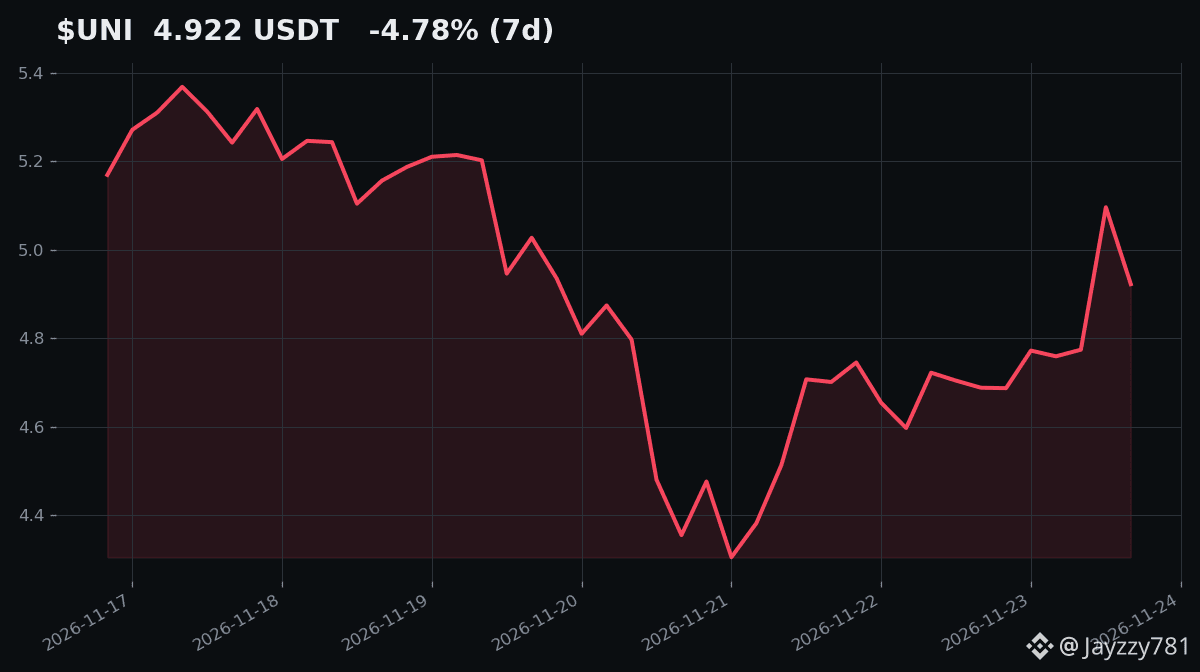
$UNI is holding up while the market cools — still up more than 3% at around $4.85 after tagging $5.31 earlier today, while $BTC sits flat near $61,200 and $BNB around $558.
The trigger is real news, not a rumour: OKX and Intercontinental Exchange launched round-the-clock trading of tokenised US securities today, routed through Uniswap v4 pools on X Layer, with 113 assets in a staged rollout. That puts the biggest DEX's plumbing at the centre of the tokenised-stocks story. It also comes on the back of v4 daily volume hitting $1.29 billion on 20 November, up 36% week on week.
But keep both feet on the ground. $UNI is still down roughly 23% over 30 days and about half its September high of $10.22 — this is a rebound, not a breakout yet. The 1-hour RSI is near 81, so the short-term move is stretched, and a headline launch is not the same as fees flowing: the proof comes over the next 24–48 hours, when we see whether real volume runs through those pools.
Levels to watch: hold above the $5.10 pivot and the swing high at $5.27 opens the door to $5.44. Lose $4.70 and the rebound story weakens fast.
Verdict: watch, don't chase. Let the tokenised-stock volumes confirm the story first.
Do you think tokenised stocks finally give $UNI a real use case — or is this just another headline pump?
#UNI #DeFi #TokenizedStocks
171

·
--
Verified
$SKY $BTC $ETH
wait, what?? 😳 a stablecoin protocol just had a very bad evening
reports say a Sky cofounder owes about 77 million USDS, withdrawals from the stUSDS pool are stuck, and he's thinking about selling SKY to institutions to pay it back. Upbit, Bithumb and Coinone flagged SKY and USDS and paused deposits.
the good news: USDS is still trading around $1. so far this looks like a liquidity squeeze, not a depeg. but if your funds are stuck, that is scary enough 🙈
i know this feeling a little too well. my portfolio is red and i can't always get out when i want to 😅 it's a reminder to check where your coins actually sit.
do you keep any money in DeFi yields, or only on exchanges? 👇
#BinanceSquare #DeFi #LosingTraderDiary

4
525


·
--
Bullish
The Wintermute Confidential $WBTC vault offers BTC holders new yield opportunities on Ethereum, with Armitage's active risk curation. Positions stay encrypted onchain.
Igor Igamberdiev, Head of Research at Wintermute:
"BTC has mostly sat onchain as collateral because there has rarely been meaningful yield to earn on it. The Wintermute Confidential WBTC vault gives WBTC holders a way to actually put it to work, pairing Armitage's active risk curation with a confidential-only design that has no public equivalent, so positions stay off the public record."
Earn on your BTC with your balance encrypted onchain: app.zama.org/earn
#Privacy #vaults #defi $ZAMA

1
333

Everyone's been glued to Bitcoin's $61K nap all day, and meanwhile UNI just quietly bounced 15% off Saturday's low.
Uniswap's sitting around $4.83 now — tagged $5.31 earlier, cooled off a bit, but still up ~3% on the day. Saturday it bottomed at $4.19. That's a proper bounce for the token of the biggest DEX in crypto, and barely anyone noticed.
$5.31 is the wall to clear next. Lose $4.63 and the bounce story gets shaky. BTC's holding ~$61,339 in the meantime, so the market's not exactly screaming risk-on yet.
Sometimes the quiet ones move first.
$UNI $BTC
#Uniswap #Crypto #DeFi
Not financial advice. DYOR.
2

·
--
Aerodrome's revenue is climbing — so why is $AERO still bleeding?
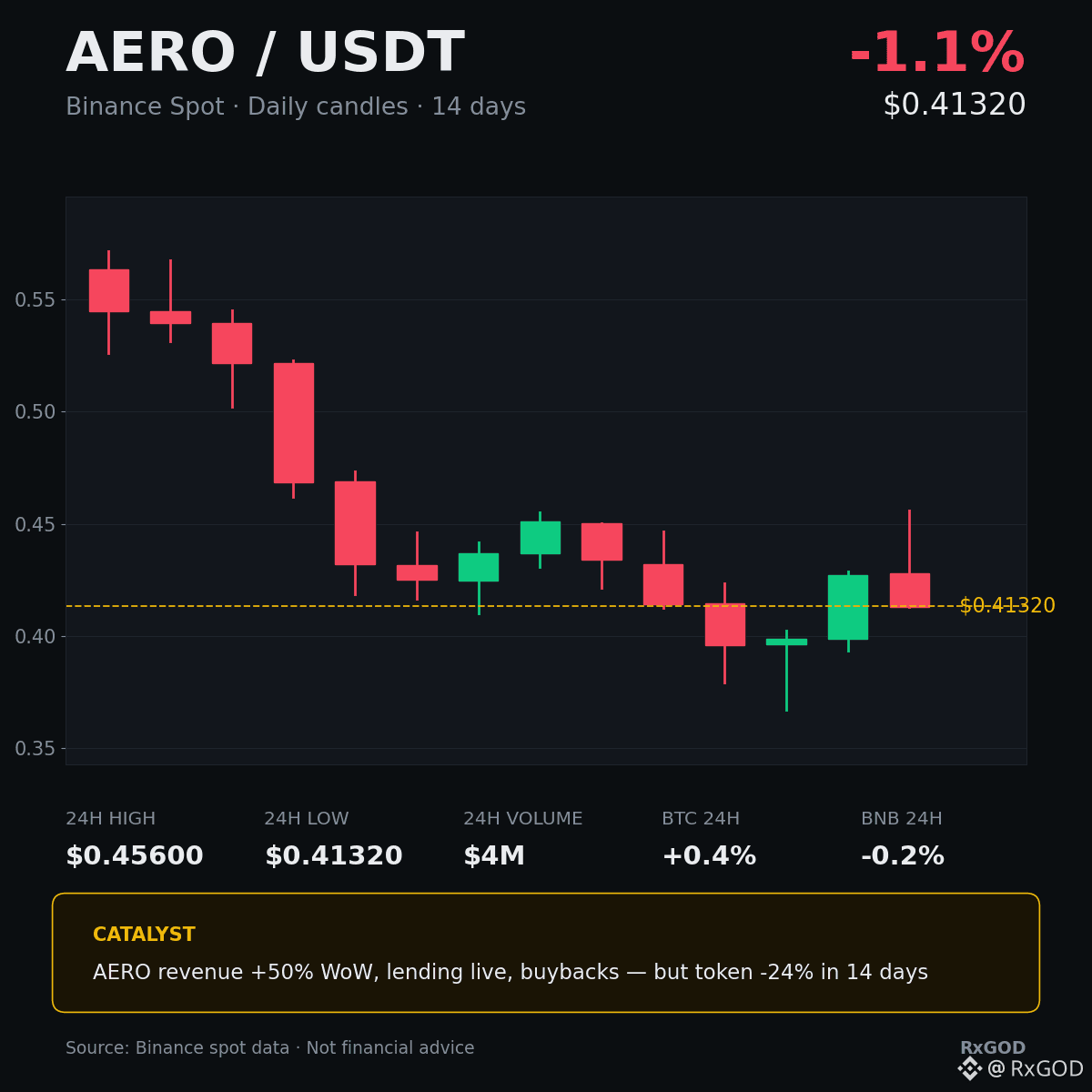
$AERO trades at $0.413, down 1.1% in 24 hours and sitting right at its daily low after being rejected at $0.456. The token is down 24% over the last 14 days and roughly 37% over 30 days. Yet the business underneath is moving the other way: weekly exchange revenue hit $2.07M for Nov 12–18, up about 50% from the $1.38M launch week. Revert Lend went live on Nov 20, letting liquidity providers borrow USDC against their LP positions without closing them. And the Aero Foundation staked another 503,000 AERO on Nov 19, bought with revenue-funded buybacks.
Here is the catch. The merger that created Aero was priced on roughly $275M of annual revenue. The protocol now runs at about $90M over the trailing 12 months — two-thirds lower. TVL has slipped from ~$393M to ~$280M in a month. The chart agrees with the skeptics: $AERO sits just 23% up its 14-day range, near the $0.367 low, with no sign of a reversal yet. $BTC, meanwhile, holds $61,092 in Extreme Fear (index 9).
Revenue growth is real, but so is the unwind of the merger premium. In this market, fundamentals rarely matter until the tape turns.
Is $AERO a value buy at $0.41 with revenue actually growing, or a value trap while the merger premium keeps unwinding? Which level do you watch first — a retest of the $0.37 low, or a reclaim of $0.50?
Not financial advice — DYOR.
#AERO #DeFi #CryptoNews #ExtremeFear
Aerodrome's revenue is climbing — so why is $AERO still bleeding?
$AERO trades at $0.413, down 1.1% in 24 hours and sitting right at its daily low after being rejected at $0.456. The token is down 24% over the last 14 days and roughly 37% over 30 days. Yet the business underneath is moving the other way: weekly exchange revenue hit $2.07M for Nov 12–18, up about 50% from the $1.38M launch week. Revert Lend went live on Nov 20, letting liquidity providers borrow USDC against their LP positions without closing them. And the Aero Foundation staked another 503,000 AERO on Nov 19, bought with revenue-funded buybacks.
Here is the catch. The merger that created Aero was priced on roughly $275M of annual revenue. The protocol now runs at about $90M over the trailing 12 months — two-thirds lower. TVL has slipped from ~$393M to ~$280M in a month. The chart agrees with the skeptics: $AERO sits just 23% up its 14-day range, near the $0.367 low, with no sign of a reversal yet. $BTC , meanwhile, holds $61,092 in Extreme Fear (index 9).
Revenue growth is real, but so is the unwind of the merger premium. In this market, fundamentals rarely matter until the tape turns.
Is $AERO a value buy at $0.41 with revenue actually growing, or a value trap while the merger premium keeps unwinding? Which level do you watch first — a retest of the $0.37 low, or a reclaim of $0.50?
Not financial advice — DYOR.
#AERO #DeFi #CryptoNews #ExtremeFear
52

·
--
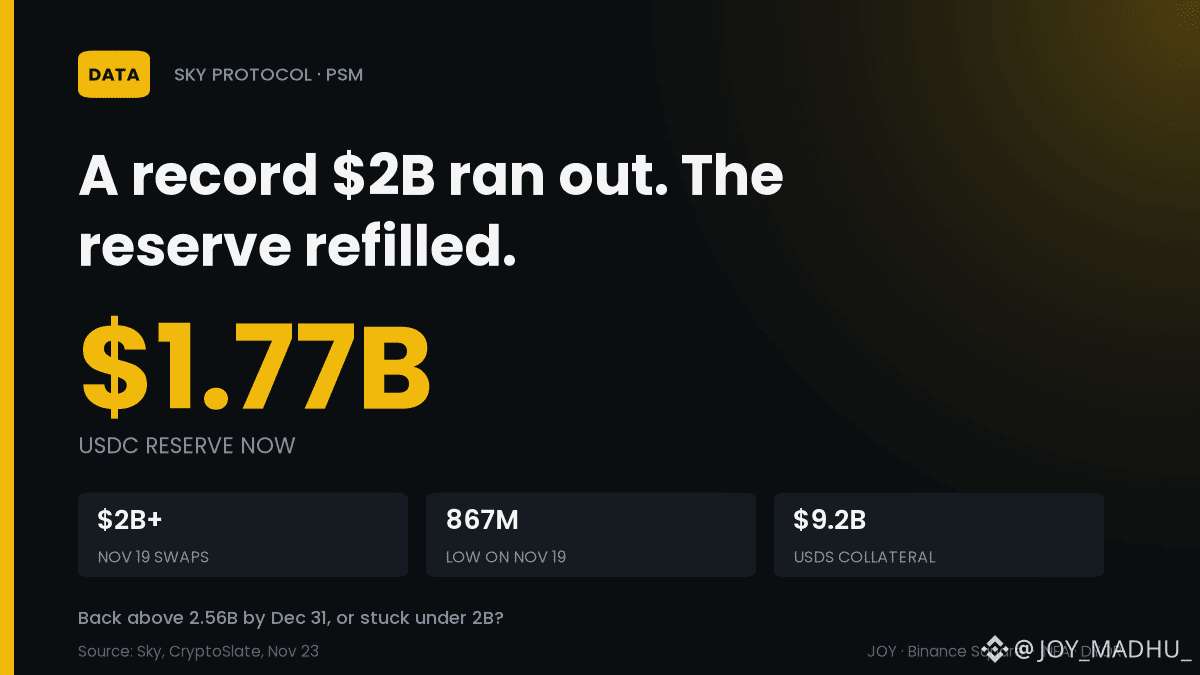
#SkyPSMUSDCLiquidityReboundsTo$1.77B
🔁 $2B Out in a Day, $1.77B Back: Sky's Reserve Refills
Sky's USDC swap reserve has rebuilt to $1.77B after a record outflow on Nov 19.
📊 Over $2B of USDS swapped to USDC 1:1 on Nov 19, a PSM record
📉 Reserve fell from 2.56B to 867M USDC within hours
📈 Now 1.77B USDC, over 28.4% of USDS + DAI supply
🏦 USDS backed by $9.2B collateral; swaps never paused, per Sky
Why it matters: the peg held, but a two-thirds drain in hours shows how fast a run tests a reserve.
Back above 2.56B by Dec 31, or stuck under 2B? 👇
$SKY $USDC
#SkyPSMUSDCLiquidityReboundsTo$1.77B #Stablecoins #DeFi
63

·
--
🥞 PancakeSwap dropped “Swap.” The product menu explains why.
The rebrand to Pancake comes with a broader product lineup across stocks, perpetuals and prediction markets, Cointelegraph reported. That makes $CAKE more interesting to follow as a product story. Which new feature gets used once the announcement scrolls out of the feed?
I’d compare it with $HYPE for on-chain perps and $JUP for an app that already goes beyond swaps. JUP was up 5.76% in 24h on Binance.
The metric I’d check next is simple: which product brings users back a second time? A launch spike only gives you the first half of that answer.
#Pancake #Cake #DeFi

1
245

·
--
⚠️ Sky cofounder weighs selling SKY to repay $77M as stUSDS pool runs dry
Sky (formerly MakerDAO) cofounder Rune Christensen admitted his own borrowing caused a withdrawal crunch in the roughly $159M stUSDS lending pool, now 99.99% utilized with depositor rates above 50%. He has repaid 3M USDS, still owes about 77M, and is exploring selling part of his SKY to institutions. Upbit, Bithumb and Coinone flagged SKY and USDS and halted deposits, while USDS is still holding near $1.
⭐ The episode puts liquidity and governance risk at one of DeFi's largest stablecoin protocols in the spotlight.
#DeFi #Sky #Stablecoins #USDS

1
207
·
--
🍃 $HYPE : HYPERLIQUID EXPANDS BEYOND CRYPTO TRADING!
Hyperliquid’s ecosystem is entering a new phase:
- November 14: Its Q3 report highlighted $190.9 million in protocol revenue.
- Trading activity: Open interest reached a reported record of $18.1 billion.
- Ecosystem growth: New applications continue launching across HyperEVM and HyperCore.
- New infrastructure: Kinetiq’s Elysium Layer 2 uses HYPE as its gas token.
- Risk update: Hong Kong’s SFC added Hyperliquid to its suspicious-platform alert list on November 18.
Can Hyperliquid balance ecosystem growth with regulatory challenges?
$HYPE
{future}(HYPEUSDT)
.
.
.
#HYPE #Hyperliquid #defi
Not financial advice. DYOR.
🍃 $HYPE : HYPERLIQUID EXPANDS BEYOND CRYPTO TRADING!
Hyperliquid’s ecosystem is entering a new phase:
- November 14: Its Q3 report highlighted $190.9 million in protocol revenue.
- Trading activity: Open interest reached a reported record of $18.1 billion.
- Ecosystem growth: New applications continue launching across HyperEVM and HyperCore.
- New infrastructure: Kinetiq’s Elysium Layer 2 uses HYPE as its gas token.
- Risk update: Hong Kong’s SFC added Hyperliquid to its suspicious-platform alert list on November 18.
Can Hyperliquid balance ecosystem growth with regulatory challenges?
$HYPE
.
.
.
#HYPE #Hyperliquid #defi
Not financial advice. DYOR.

378
Log in to explore more content
Join global crypto users on Binance Square
⚡️ Get latest and useful information about crypto.
💬 Trusted by the world’s largest crypto exchange.
👍 Discover real insights from verified creators.
Email / Phone number
Trending Topics
1
#Bitcoin'sReboundFadesBelow$60K
6,319 views
140 Discussing
2
#NVIDIAReinstatesJensenHuangasCEO
251,470 views
1,698 Discussing
3
#WillMarketsStageAThanksgivingReliefRally?
329,222 views
2,447 Discussing
4
#WillOctCorePCEShiftFedHikeExpectations?
116,458 views
1,196 Discussing
5
#EvolveAtBinanceBlockchainWeek
237,270 views
1,502 Discussing
6
#SouthKoreaBeginsCryptoProviderShareholderReviews
4,818 views
111 Discussing
7
#USAddsMegaspeedToEntityList
9,372 views
184 Discussing
8
#GrayscaleLaunches2xLeveragedZcashETF
6,203 views
124 Discussing
9
#StrategyValueFallsBelowItsBitcoinHoldings
4,999 views
128 Discussing
10
#CFTCRequiresAtLeast20%HaircutsOnBTCAndETHReserves
2,576 views
88 Discussing