

#cryptomacro
cryptomacro
394,086 views
1,828 Discussing
Hot
Latest


Article
⚡ Regulatory De-Escalation Clears Path for Institutional $BTC AbsorptionInstitutional balance sheets and regulatory pivots are realigning digital asset liquidity, setting up critical positioning across $BTC, $ETH, and $SOL. Macro headwinds from persistent sovereign bond yields continue to test speculative risk, yet structural tailwinds are shifting in favor of prime spot absorption.
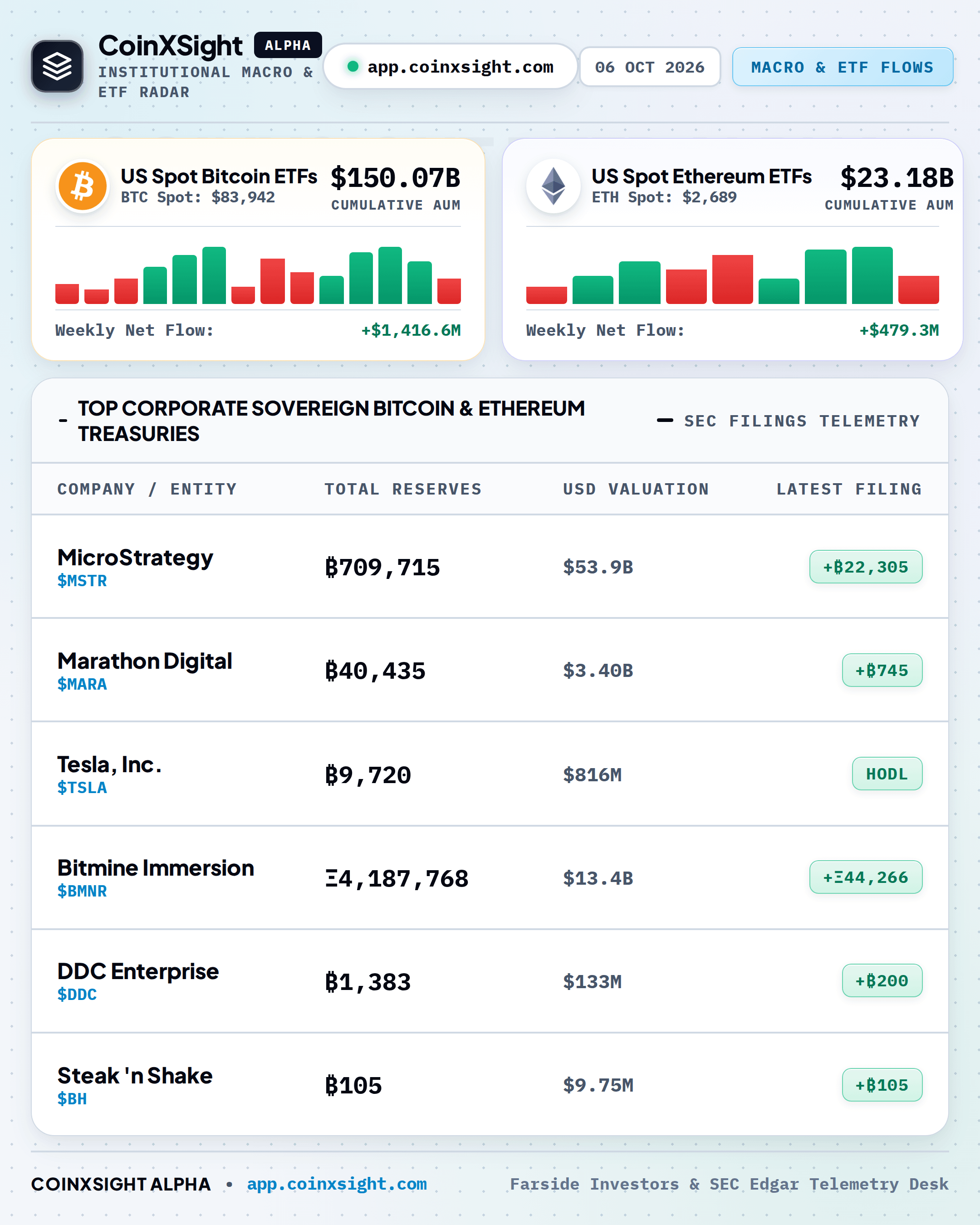
🔹 REGULATORY DE-ESCALATION ANCHORS THE DESK
The formal withdrawal of FinCEN unhosted wallet recordkeeping restrictions removes a multi-year regulatory headwind for institutional custodians, self-custody infrastructure, and tier-one prime brokers. Combined with progressive oversight architectures under consideration by the CFTC and softening sovereign employment prints, macroeconomic expectations are pivoting away from further policy tightening. Although elevated sovereign debt yields maintain persistent hurdle rates for broad market beta, corporate balance sheet expansion and institutional spot conduits establish durable buy-side absorption against macro duration drag.
🔹 VERIFIED MARKET TELEMETRY
Proprietary desk data reflects balanced leverage and controlled spot distribution across primary conduits:
• BTC spot price trades at $85,944.76, down -0.76% across $1.38B in 24-hour volume.
• ETH consolidates at $2,719.47, recording a -0.31% shift alongside $718.17M in volume.
• SOL hovers at $121.09, registering -0.13% on $189.22M in 24-hour volume.
• Total derivatives open interest stands at $7.91B with a balanced funding rate of +0.0053%.
• News synthesis confidence score prints at 82.0/100.
🔹 STRATEGIC TRADING NARRATIVE
With neutral funding rates and disciplined open interest, derivatives positioning reflects structural accumulation rather than unhedged leverage. Immediate capital flows continue concentrating in core blue-chip liquidity conduits, while broader market beta faces selective bifurcation. Tactical traders should monitor potential sovereign yield spikes and overhead order-book resistance that could provoke cascading long liquidations before programmatic monetary accommodation fully materializes.
Data & Telemetry: CoinXSight Intelligence Hub | Follow on Binance Square for daily alpha.
Risk Warning: Cryptocurrency trading carries substantial risk. This quantitative brief is for informational purposes only.
#BinanceSquare #CryptoMacro #CoinXSight
⚡ Regulatory De-Escalation Clears Path for Institutional $BTC Absorption
Institutional balance sheets and regulatory pivots are realigning digital asset liquidity, setting up critical positioning across $BTC , $ETH , and $SOL . Macro headwinds from persistent sovereign bond yields continue to test speculative risk, yet structural tailwinds are shifting in favor of prime spot absorption.

🔹 REGULATORY DE-ESCALATION ANCHORS THE DESK
The formal withdrawal of FinCEN unhosted wallet recordkeeping restrictions removes a multi-year regulatory headwind for institutional custodians, self-custody infrastructure, and tier-one prime brokers. Combined with progressive oversight architectures under consideration by the CFTC and softening sovereign employment prints, macroeconomic expectations are pivoting away from further policy tightening. Although elevated sovereign debt yields maintain persistent hurdle rates for broad market beta, corporate balance sheet expansion and institutional spot conduits establish durable buy-side absorption against macro duration drag.
🔹 VERIFIED MARKET TELEMETRY
Proprietary desk data reflects balanced leverage and controlled spot distribution across primary conduits:
• BTC spot price trades at $85,944.76, down -0.76% across $1.38B in 24-hour volume.
• ETH consolidates at $2,719.47, recording a -0.31% shift alongside $718.17M in volume.
• SOL hovers at $121.09, registering -0.13% on $189.22M in 24-hour volume.
• Total derivatives open interest stands at $7.91B with a balanced funding rate of +0.0053%.
• News synthesis confidence score prints at 82.0/100.
🔹 STRATEGIC TRADING NARRATIVE
With neutral funding rates and disciplined open interest, derivatives positioning reflects structural accumulation rather than unhedged leverage. Immediate capital flows continue concentrating in core blue-chip liquidity conduits, while broader market beta faces selective bifurcation. Tactical traders should monitor potential sovereign yield spikes and overhead order-book resistance that could provoke cascading long liquidations before programmatic monetary accommodation fully materializes.
Data & Telemetry: CoinXSight Intelligence Hub | Follow on Binance Square for daily alpha.
Risk Warning: Cryptocurrency trading carries substantial risk. This quantitative brief is for informational purposes only.
#BinanceSquare #CryptoMacro #CoinXSight

🔹 REGULATORY DE-ESCALATION ANCHORS THE DESK
The formal withdrawal of FinCEN unhosted wallet recordkeeping restrictions removes a multi-year regulatory headwind for institutional custodians, self-custody infrastructure, and tier-one prime brokers. Combined with progressive oversight architectures under consideration by the CFTC and softening sovereign employment prints, macroeconomic expectations are pivoting away from further policy tightening. Although elevated sovereign debt yields maintain persistent hurdle rates for broad market beta, corporate balance sheet expansion and institutional spot conduits establish durable buy-side absorption against macro duration drag.
🔹 VERIFIED MARKET TELEMETRY
Proprietary desk data reflects balanced leverage and controlled spot distribution across primary conduits:
• BTC spot price trades at $85,944.76, down -0.76% across $1.38B in 24-hour volume.
• ETH consolidates at $2,719.47, recording a -0.31% shift alongside $718.17M in volume.
• SOL hovers at $121.09, registering -0.13% on $189.22M in 24-hour volume.
• Total derivatives open interest stands at $7.91B with a balanced funding rate of +0.0053%.
• News synthesis confidence score prints at 82.0/100.
🔹 STRATEGIC TRADING NARRATIVE
With neutral funding rates and disciplined open interest, derivatives positioning reflects structural accumulation rather than unhedged leverage. Immediate capital flows continue concentrating in core blue-chip liquidity conduits, while broader market beta faces selective bifurcation. Tactical traders should monitor potential sovereign yield spikes and overhead order-book resistance that could provoke cascading long liquidations before programmatic monetary accommodation fully materializes.
Data & Telemetry: CoinXSight Intelligence Hub | Follow on Binance Square for daily alpha.
Risk Warning: Cryptocurrency trading carries substantial risk. This quantitative brief is for informational purposes only.
#BinanceSquare #CryptoMacro #CoinXSight
84

·
--
The DXY dollar index and crypto have an underappreciated inverse relationship that most traders overlook until it is too late.
When the dollar strengthens, risk assets — including crypto — face structural headwinds. Global dollar liquidity tightens. Emerging markets defend currencies. Capital repatriates to USD-denominated assets. The marginal dollar available to chase $BTC or $ETH shrinks.
The reverse is equally powerful. Dollar weakness expands the global money supply in dollar terms. Credit conditions loosen internationally. Risk appetite rises across equities, commodities, and crypto simultaneously. Historically, major crypto bull runs — 2017, 2020-2021 — aligned closely with periods of DXY weakness or rolling over from multi-year highs.
This does not mean crypto is merely a leveraged DXY trade. But it does mean macro liquidity conditions set the ceiling for how far a rally can extend. A sustained bull run against a structurally rising dollar is fighting upstream.
What to watch:
— DXY trend direction and key technical levels
— Fed rate expectations shifting the real yield differential
— Global M2 money supply expansion in dollar terms
— Emerging market capital flow direction
The best crypto setups tend to arrive when the dollar is under pressure and global liquidity is expanding — not just when the chart looks good. $SOL and smaller alts feel this amplified on both sides.
#CryptoMacro #Bitcoin #DXY #LiquidityCycle #CryptoInsights
The DXY dollar index and crypto have an underappreciated inverse relationship that most traders overlook until it is too late.
When the dollar strengthens, risk assets — including crypto — face structural headwinds. Global dollar liquidity tightens. Emerging markets defend currencies. Capital repatriates to USD-denominated assets. The marginal dollar available to chase $BTC or $ETH shrinks.
The reverse is equally powerful. Dollar weakness expands the global money supply in dollar terms. Credit conditions loosen internationally. Risk appetite rises across equities, commodities, and crypto simultaneously. Historically, major crypto bull runs — 2017, 2020-2021 — aligned closely with periods of DXY weakness or rolling over from multi-year highs.
This does not mean crypto is merely a leveraged DXY trade. But it does mean macro liquidity conditions set the ceiling for how far a rally can extend. A sustained bull run against a structurally rising dollar is fighting upstream.
What to watch:
— DXY trend direction and key technical levels
— Fed rate expectations shifting the real yield differential
— Global M2 money supply expansion in dollar terms
— Emerging market capital flow direction
The best crypto setups tend to arrive when the dollar is under pressure and global liquidity is expanding — not just when the chart looks good. $SOL and smaller alts feel this amplified on both sides.
#CryptoMacro #Bitcoin #DXY #LiquidityCycle #CryptoInsights
When the dollar strengthens, risk assets — including crypto — face structural headwinds. Global dollar liquidity tightens. Emerging markets defend currencies. Capital repatriates to USD-denominated assets. The marginal dollar available to chase $BTC or $ETH shrinks.
The reverse is equally powerful. Dollar weakness expands the global money supply in dollar terms. Credit conditions loosen internationally. Risk appetite rises across equities, commodities, and crypto simultaneously. Historically, major crypto bull runs — 2017, 2020-2021 — aligned closely with periods of DXY weakness or rolling over from multi-year highs.
This does not mean crypto is merely a leveraged DXY trade. But it does mean macro liquidity conditions set the ceiling for how far a rally can extend. A sustained bull run against a structurally rising dollar is fighting upstream.
What to watch:
— DXY trend direction and key technical levels
— Fed rate expectations shifting the real yield differential
— Global M2 money supply expansion in dollar terms
— Emerging market capital flow direction
The best crypto setups tend to arrive when the dollar is under pressure and global liquidity is expanding — not just when the chart looks good. $SOL and smaller alts feel this amplified on both sides.
#CryptoMacro #Bitcoin #DXY #LiquidityCycle #CryptoInsights
136

·
--
Article
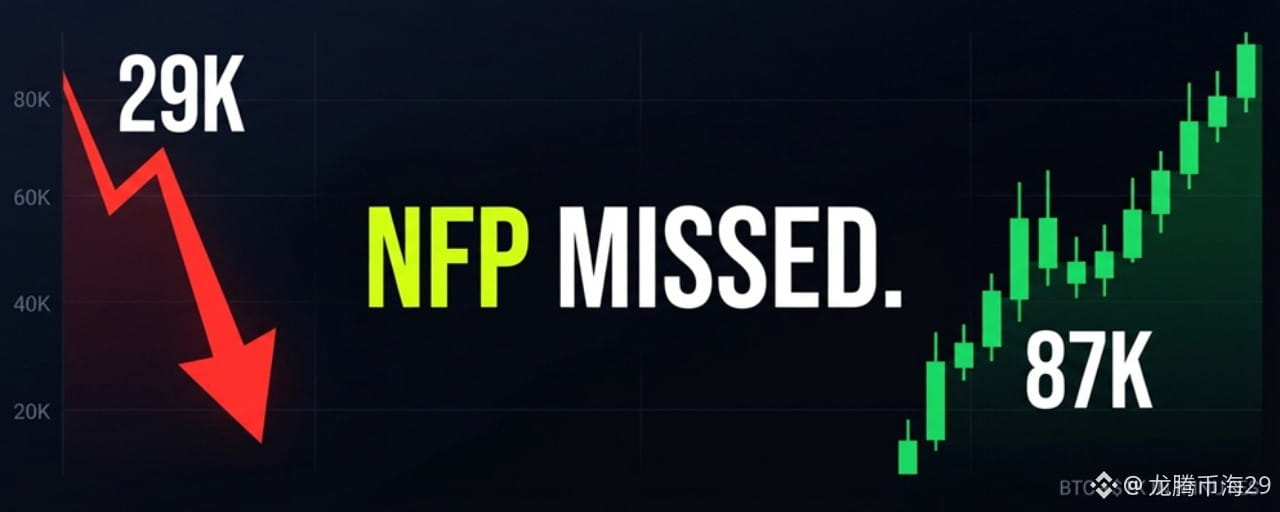
NFPWatch: Why Smart Crypto Traders Watch the Jobs Report Before They Touch a ChartMost crypto traders don't have a Bloomberg terminal. They have a phone, a Binance account, and roughly four minutes of patience before the next candle closes. So when someone says "watch NFP," the instinct is to nod politely and keep scrolling.
That instinct costs money.
Non-Farm Payrolls, the monthly U.S. jobs report that lands on the first Friday of most months at 8:30 a.m. Eastern, has become one of the few macro events that reliably moves Bitcoin, sometimes by a thousand dollars within seconds. On October 2, 2026, the September print came in at just 29,000 jobs added against an expected 89,000. Bitcoin had been grinding toward $86,000 overnight. Within minutes of the release, it spiked to roughly $87,200 before settling around $86,500, on track for a third straight weekly gain.
That's not a coincidence. That's a market pricing in Federal Reserve expectations in real time.
What NFPWatch Actually Means
The hashtag NFPWatch has become a shorthand on Binance Square for a specific kind of pre-trade ritual: checking the macro calendar before committing capital. It's not a tool you download. It's a discipline. And the community around it has grown to nearly 20,000 active posters, with over 11 million views on the tag alone.
Here's the logic. The Federal Reserve sets interest rates. Interest rates affect the dollar, Treasury yields, and risk appetite. Crypto, especially Bitcoin, trades at the far end of the risk spectrum. When the jobs report shows a weakening labor market, traders start betting the Fed will cut or hold rates rather than hike. Lower rate expectations usually weaken the dollar, push Treasury yields down, and give risk assets room to breathe. The opposite happens when the jobs number beats expectations: yields climb, the dollar strengthens, and Bitcoin often takes the hit.
That's the textbook version. Reality is messier.
The First Candle Lies
Experienced NFP traders will tell you the same thing: don't chase the first move. The initial spike or dump after the 8:30 release is often a liquidity grab, a violent shakeout designed to trigger stops before the real direction emerges. One Binance Square trader put it bluntly: "NFP days can move BTC fast… and then completely reverse."
A six-year review of Bitcoin's behavior around payroll releases found something uncomfortable for the NFP-is-everything crowd: the report is not a consistent standalone driver of BTC price action. Moves around the release window are mixed, often lack persistence, and frequently get overwhelmed by crypto-specific catalysts like liquidations, ETF flows, or exchange announcements.
So why bother watching?
Because context matters. NFP doesn't determine direction on its own, but it reshapes the macro backdrop that everything else trades against. If the jobs number comes in weak and Treasury yields fall, Bitcoin's environment improves. If yields stay stubbornly high despite weak data, something is wrong, and that's worth knowing before you size a position.
What to Watch Beyond the Headline
The headline payroll number is the headline for a reason. But it's rarely the whole story.
Unemployment rate. Wage growth. Revisions to prior months. The gap between the actual print and the consensus estimate. All of these feed into how the market interprets the number. On October 2, the September print missed badly at 29K versus 89K expected, but August and July were also revised lower, a combined 60,000 jobs erased from prior data. That cumulative weakness mattered more than the single month's miss.
Then there's the reaction function. Watch the dollar index. Watch the 10-year Treasury yield. If BTC spikes but DXY refuses to break down, the move probably won't hold. If BTC dumps but yields fall sharply, the sell-off may be a gift. One KuCoin trader described their NFP routine as sitting on their hands for the first few minutes, then watching DXY and yields "to see whether the initial BTC move has any real strength behind it."
The Risk Nobody Talks About
Weak jobs data sounds like good news for crypto. Weaker labor market, less pressure on the Fed, lower rates, risk assets rally. Simple.
But NFP days create a particular kind of trap: leveraged traders piling into the obvious direction right after the print, only to get flushed when the market reverses. A weak NFP doesn't guarantee Bitcoin goes up. If longs crowd in too aggressively, even a normal pullback becomes violent. One trader on Binance Square flagged exactly this after the October miss: "If traders start piling into leveraged longs after this move, even a normal pullback can become much more violent."
The lesson isn't to avoid NFP. It's to treat it as one input among several. Position size accordingly. Don't marry the first candle.
Why This Matters for Your Feed
If you're building an audience on Binance Square, NFPWatch the most reliable traffic drivers in the macro-crypto conversation. The tag pulls in traders who are actively looking for interpretation, not just headlines. They want to know what the number means, how the market is reacting, and what to watch next.
That's the gap worth filling. Not another "NFP is coming, stay tuned" post. A real read: the print, the yield reaction, the dollar response, the BTC structure after the dust settles. Add a chart. Ask a question. Reply to comments. The algorithm rewards discussion, not broadcasts.
The traders who build followings on Binance Square aren't the ones with the loudest calls. They're the ones who show up before the event, explain the setup, and stick around after the volatility to break down what actually happened. NFPWatch is a weekly opportunity to do exactly that.
The next jobs report is already on the calendar. The question is whether you'll be watching it, or watching your feed afterward wondering what you missed.
Sources
Bloomberg / Nexo. "Markets Today – October 2, 2026." Nexo, 2 Oct. 2026. (NFP +29K vs. 89K forecast; BTC reaction to $87K.)
CoinDesk / Marketbit. "Six Years of Bitcoin Data Show NFP Reports Are Not a Major Price Driver." CoinMarketCap Community, 8 Sept. 2026. (Six-year NFP-BTC correlation review.)
Binance Square. NFPWatch Binance, 2026. (Hashtag view counts and post volume.)
LiliOnChain. "Post NFP IS OUT AND THE NUMBER IS WILD." Binance Square, 2 Oct. 2026. (Trader commentary on weak NFP and leveraged-long risk.)
KAZ_0. "BTC and US Stocks After NFP — Watching the Market Reaction." KuCoin News, 3 Oct. 2026. (Trader routine: DXY and yield reaction after initial NFP volatility.)
TradingView / Investing.com. "Bitcoin Briefly Hits $87K as Weak US Jobs Data Sends Bond Yields Lower." 2 Oct. 2026. (NFP print details and BTC price action.)
#NFPWatch #CryptoMacro
NFPWatch: Why Smart Crypto Traders Watch the Jobs Report Before They Touch a Chart
Most crypto traders don't have a Bloomberg terminal. They have a phone, a Binance account, and roughly four minutes of patience before the next candle closes. So when someone says "watch NFP," the instinct is to nod politely and keep scrolling.
That instinct costs money.
Non-Farm Payrolls, the monthly U.S. jobs report that lands on the first Friday of most months at 8:30 a.m. Eastern, has become one of the few macro events that reliably moves Bitcoin, sometimes by a thousand dollars within seconds. On October 2, 2026, the September print came in at just 29,000 jobs added against an expected 89,000. Bitcoin had been grinding toward $86,000 overnight. Within minutes of the release, it spiked to roughly $87,200 before settling around $86,500, on track for a third straight weekly gain.
That's not a coincidence. That's a market pricing in Federal Reserve expectations in real time.
What NFPWatch Actually Means
The hashtag NFPWatch has become a shorthand on Binance Square for a specific kind of pre-trade ritual: checking the macro calendar before committing capital. It's not a tool you download. It's a discipline. And the community around it has grown to nearly 20,000 active posters, with over 11 million views on the tag alone.
Here's the logic. The Federal Reserve sets interest rates. Interest rates affect the dollar, Treasury yields, and risk appetite. Crypto, especially Bitcoin, trades at the far end of the risk spectrum. When the jobs report shows a weakening labor market, traders start betting the Fed will cut or hold rates rather than hike. Lower rate expectations usually weaken the dollar, push Treasury yields down, and give risk assets room to breathe. The opposite happens when the jobs number beats expectations: yields climb, the dollar strengthens, and Bitcoin often takes the hit.
That's the textbook version. Reality is messier.
The First Candle Lies
Experienced NFP traders will tell you the same thing: don't chase the first move. The initial spike or dump after the 8:30 release is often a liquidity grab, a violent shakeout designed to trigger stops before the real direction emerges. One Binance Square trader put it bluntly: "NFP days can move BTC fast… and then completely reverse."
A six-year review of Bitcoin's behavior around payroll releases found something uncomfortable for the NFP-is-everything crowd: the report is not a consistent standalone driver of BTC price action. Moves around the release window are mixed, often lack persistence, and frequently get overwhelmed by crypto-specific catalysts like liquidations, ETF flows, or exchange announcements.
So why bother watching?
Because context matters. NFP doesn't determine direction on its own, but it reshapes the macro backdrop that everything else trades against. If the jobs number comes in weak and Treasury yields fall, Bitcoin's environment improves. If yields stay stubbornly high despite weak data, something is wrong, and that's worth knowing before you size a position.
What to Watch Beyond the Headline
The headline payroll number is the headline for a reason. But it's rarely the whole story.
Unemployment rate. Wage growth. Revisions to prior months. The gap between the actual print and the consensus estimate. All of these feed into how the market interprets the number. On October 2, the September print missed badly at 29K versus 89K expected, but August and July were also revised lower, a combined 60,000 jobs erased from prior data. That cumulative weakness mattered more than the single month's miss.
Then there's the reaction function. Watch the dollar index. Watch the 10-year Treasury yield. If BTC spikes but DXY refuses to break down, the move probably won't hold. If BTC dumps but yields fall sharply, the sell-off may be a gift. One KuCoin trader described their NFP routine as sitting on their hands for the first few minutes, then watching DXY and yields "to see whether the initial BTC move has any real strength behind it."
The Risk Nobody Talks About
Weak jobs data sounds like good news for crypto. Weaker labor market, less pressure on the Fed, lower rates, risk assets rally. Simple.
But NFP days create a particular kind of trap: leveraged traders piling into the obvious direction right after the print, only to get flushed when the market reverses. A weak NFP doesn't guarantee Bitcoin goes up. If longs crowd in too aggressively, even a normal pullback becomes violent. One trader on Binance Square flagged exactly this after the October miss: "If traders start piling into leveraged longs after this move, even a normal pullback can become much more violent."
The lesson isn't to avoid NFP. It's to treat it as one input among several. Position size accordingly. Don't marry the first candle.
Why This Matters for Your Feed
If you're building an audience on Binance Square, NFPWatch the most reliable traffic drivers in the macro-crypto conversation. The tag pulls in traders who are actively looking for interpretation, not just headlines. They want to know what the number means, how the market is reacting, and what to watch next.
That's the gap worth filling. Not another "NFP is coming, stay tuned" post. A real read: the print, the yield reaction, the dollar response, the BTC structure after the dust settles. Add a chart. Ask a question. Reply to comments. The algorithm rewards discussion, not broadcasts.
The traders who build followings on Binance Square aren't the ones with the loudest calls. They're the ones who show up before the event, explain the setup, and stick around after the volatility to break down what actually happened. NFPWatch is a weekly opportunity to do exactly that.
The next jobs report is already on the calendar. The question is whether you'll be watching it, or watching your feed afterward wondering what you missed.
Sources
Bloomberg / Nexo. "Markets Today – October 2, 2026." Nexo, 2 Oct. 2026. (NFP +29K vs. 89K forecast; BTC reaction to $87K.)
CoinDesk / Marketbit. "Six Years of Bitcoin Data Show NFP Reports Are Not a Major Price Driver." CoinMarketCap Community, 8 Sept. 2026. (Six-year NFP-BTC correlation review.)
Binance Square. NFPWatch Binance, 2026. (Hashtag view counts and post volume.)
LiliOnChain. "Post NFP IS OUT AND THE NUMBER IS WILD." Binance Square, 2 Oct. 2026. (Trader commentary on weak NFP and leveraged-long risk.)
KAZ_0. "BTC and US Stocks After NFP — Watching the Market Reaction." KuCoin News, 3 Oct. 2026. (Trader routine: DXY and yield reaction after initial NFP volatility.)
TradingView / Investing.com. "Bitcoin Briefly Hits $87K as Weak US Jobs Data Sends Bond Yields Lower." 2 Oct. 2026. (NFP print details and BTC price action.)
#NFPWatch #CryptoMacro
That instinct costs money.
Non-Farm Payrolls, the monthly U.S. jobs report that lands on the first Friday of most months at 8:30 a.m. Eastern, has become one of the few macro events that reliably moves Bitcoin, sometimes by a thousand dollars within seconds. On October 2, 2026, the September print came in at just 29,000 jobs added against an expected 89,000. Bitcoin had been grinding toward $86,000 overnight. Within minutes of the release, it spiked to roughly $87,200 before settling around $86,500, on track for a third straight weekly gain.
That's not a coincidence. That's a market pricing in Federal Reserve expectations in real time.
What NFPWatch Actually Means
The hashtag NFPWatch has become a shorthand on Binance Square for a specific kind of pre-trade ritual: checking the macro calendar before committing capital. It's not a tool you download. It's a discipline. And the community around it has grown to nearly 20,000 active posters, with over 11 million views on the tag alone.
Here's the logic. The Federal Reserve sets interest rates. Interest rates affect the dollar, Treasury yields, and risk appetite. Crypto, especially Bitcoin, trades at the far end of the risk spectrum. When the jobs report shows a weakening labor market, traders start betting the Fed will cut or hold rates rather than hike. Lower rate expectations usually weaken the dollar, push Treasury yields down, and give risk assets room to breathe. The opposite happens when the jobs number beats expectations: yields climb, the dollar strengthens, and Bitcoin often takes the hit.
That's the textbook version. Reality is messier.
The First Candle Lies
Experienced NFP traders will tell you the same thing: don't chase the first move. The initial spike or dump after the 8:30 release is often a liquidity grab, a violent shakeout designed to trigger stops before the real direction emerges. One Binance Square trader put it bluntly: "NFP days can move BTC fast… and then completely reverse."
A six-year review of Bitcoin's behavior around payroll releases found something uncomfortable for the NFP-is-everything crowd: the report is not a consistent standalone driver of BTC price action. Moves around the release window are mixed, often lack persistence, and frequently get overwhelmed by crypto-specific catalysts like liquidations, ETF flows, or exchange announcements.
So why bother watching?
Because context matters. NFP doesn't determine direction on its own, but it reshapes the macro backdrop that everything else trades against. If the jobs number comes in weak and Treasury yields fall, Bitcoin's environment improves. If yields stay stubbornly high despite weak data, something is wrong, and that's worth knowing before you size a position.
What to Watch Beyond the Headline
The headline payroll number is the headline for a reason. But it's rarely the whole story.
Unemployment rate. Wage growth. Revisions to prior months. The gap between the actual print and the consensus estimate. All of these feed into how the market interprets the number. On October 2, the September print missed badly at 29K versus 89K expected, but August and July were also revised lower, a combined 60,000 jobs erased from prior data. That cumulative weakness mattered more than the single month's miss.
Then there's the reaction function. Watch the dollar index. Watch the 10-year Treasury yield. If BTC spikes but DXY refuses to break down, the move probably won't hold. If BTC dumps but yields fall sharply, the sell-off may be a gift. One KuCoin trader described their NFP routine as sitting on their hands for the first few minutes, then watching DXY and yields "to see whether the initial BTC move has any real strength behind it."
The Risk Nobody Talks About
Weak jobs data sounds like good news for crypto. Weaker labor market, less pressure on the Fed, lower rates, risk assets rally. Simple.
But NFP days create a particular kind of trap: leveraged traders piling into the obvious direction right after the print, only to get flushed when the market reverses. A weak NFP doesn't guarantee Bitcoin goes up. If longs crowd in too aggressively, even a normal pullback becomes violent. One trader on Binance Square flagged exactly this after the October miss: "If traders start piling into leveraged longs after this move, even a normal pullback can become much more violent."
The lesson isn't to avoid NFP. It's to treat it as one input among several. Position size accordingly. Don't marry the first candle.
Why This Matters for Your Feed
If you're building an audience on Binance Square, NFPWatch the most reliable traffic drivers in the macro-crypto conversation. The tag pulls in traders who are actively looking for interpretation, not just headlines. They want to know what the number means, how the market is reacting, and what to watch next.
That's the gap worth filling. Not another "NFP is coming, stay tuned" post. A real read: the print, the yield reaction, the dollar response, the BTC structure after the dust settles. Add a chart. Ask a question. Reply to comments. The algorithm rewards discussion, not broadcasts.
The traders who build followings on Binance Square aren't the ones with the loudest calls. They're the ones who show up before the event, explain the setup, and stick around after the volatility to break down what actually happened. NFPWatch is a weekly opportunity to do exactly that.
The next jobs report is already on the calendar. The question is whether you'll be watching it, or watching your feed afterward wondering what you missed.
Sources
Bloomberg / Nexo. "Markets Today – October 2, 2026." Nexo, 2 Oct. 2026. (NFP +29K vs. 89K forecast; BTC reaction to $87K.)
CoinDesk / Marketbit. "Six Years of Bitcoin Data Show NFP Reports Are Not a Major Price Driver." CoinMarketCap Community, 8 Sept. 2026. (Six-year NFP-BTC correlation review.)
Binance Square. NFPWatch Binance, 2026. (Hashtag view counts and post volume.)
LiliOnChain. "Post NFP IS OUT AND THE NUMBER IS WILD." Binance Square, 2 Oct. 2026. (Trader commentary on weak NFP and leveraged-long risk.)
KAZ_0. "BTC and US Stocks After NFP — Watching the Market Reaction." KuCoin News, 3 Oct. 2026. (Trader routine: DXY and yield reaction after initial NFP volatility.)
TradingView / Investing.com. "Bitcoin Briefly Hits $87K as Weak US Jobs Data Sends Bond Yields Lower." 2 Oct. 2026. (NFP print details and BTC price action.)
#NFPWatch #CryptoMacro
52
·
--
Crypto does not move on sentiment alone — it moves on global liquidity.
The correlation between global M2 money supply and total crypto market cap is one of the most consistent macro signals in this asset class. When central banks expand their balance sheets, capital searches for yield. Risk assets — equities, real estate, and especially crypto — absorb that liquidity. When tightening cycles drain the system, the same assets deflate.
This is why $BTC and $ETH tend to bottom 6–12 months after peak hawkishness, not when headlines turn bullish. The real bottom is set when the rate of liquidity destruction slows, not when it reverses.
What makes this cycle interesting: $BNB has demonstrated resilience as an exchange-native asset that partially decouples from pure liquidity flows due to utility demand. Altcoins do not front-run liquidity expansion — they confirm it.
The practical takeaway: watching the Fed funds rate alone is insufficient. Track global M2 (US + EU + China + Japan combined), the dollar index (DXY), and the 2-year Treasury yield spread. When all three begin compressing simultaneously, the on-ramp for risk assets is historically near.
Liquidity cycles do not care about project fundamentals in the short term. In the long term, fundamentals determine who survives to ride the next wave.
Know which phase you are in before sizing a position.
#CryptoMacro #Bitcoin #LiquidityCycle #GlobalM2 #CryptoMarkets
Crypto does not move on sentiment alone — it moves on global liquidity.
The correlation between global M2 money supply and total crypto market cap is one of the most consistent macro signals in this asset class. When central banks expand their balance sheets, capital searches for yield. Risk assets — equities, real estate, and especially crypto — absorb that liquidity. When tightening cycles drain the system, the same assets deflate.
This is why $BTC and $ETH tend to bottom 6–12 months after peak hawkishness, not when headlines turn bullish. The real bottom is set when the rate of liquidity destruction slows, not when it reverses.
What makes this cycle interesting: $BNB has demonstrated resilience as an exchange-native asset that partially decouples from pure liquidity flows due to utility demand. Altcoins do not front-run liquidity expansion — they confirm it.
The practical takeaway: watching the Fed funds rate alone is insufficient. Track global M2 (US + EU + China + Japan combined), the dollar index (DXY), and the 2-year Treasury yield spread. When all three begin compressing simultaneously, the on-ramp for risk assets is historically near.
Liquidity cycles do not care about project fundamentals in the short term. In the long term, fundamentals determine who survives to ride the next wave.
Know which phase you are in before sizing a position.
#CryptoMacro #Bitcoin #LiquidityCycle #GlobalM2 #CryptoMarkets
The correlation between global M2 money supply and total crypto market cap is one of the most consistent macro signals in this asset class. When central banks expand their balance sheets, capital searches for yield. Risk assets — equities, real estate, and especially crypto — absorb that liquidity. When tightening cycles drain the system, the same assets deflate.
This is why $BTC and $ETH tend to bottom 6–12 months after peak hawkishness, not when headlines turn bullish. The real bottom is set when the rate of liquidity destruction slows, not when it reverses.
What makes this cycle interesting: $BNB has demonstrated resilience as an exchange-native asset that partially decouples from pure liquidity flows due to utility demand. Altcoins do not front-run liquidity expansion — they confirm it.
The practical takeaway: watching the Fed funds rate alone is insufficient. Track global M2 (US + EU + China + Japan combined), the dollar index (DXY), and the 2-year Treasury yield spread. When all three begin compressing simultaneously, the on-ramp for risk assets is historically near.
Liquidity cycles do not care about project fundamentals in the short term. In the long term, fundamentals determine who survives to ride the next wave.
Know which phase you are in before sizing a position.
#CryptoMacro #Bitcoin #LiquidityCycle #GlobalM2 #CryptoMarkets
38

Article
🏛️ $BTC Stays Rangebound as Institutional Tokenization Hits Regulatory FrictionInstitutional capital pipelines are quietly deepening while spot crypto markets navigate neutral rangebound territory. Benchmark assets $BTC sits at $84,789.99, $ETH holds $2,693.51, and $SOL prints $120.20 as institutional allocators balance tokenization expansion against regulatory and custody friction.
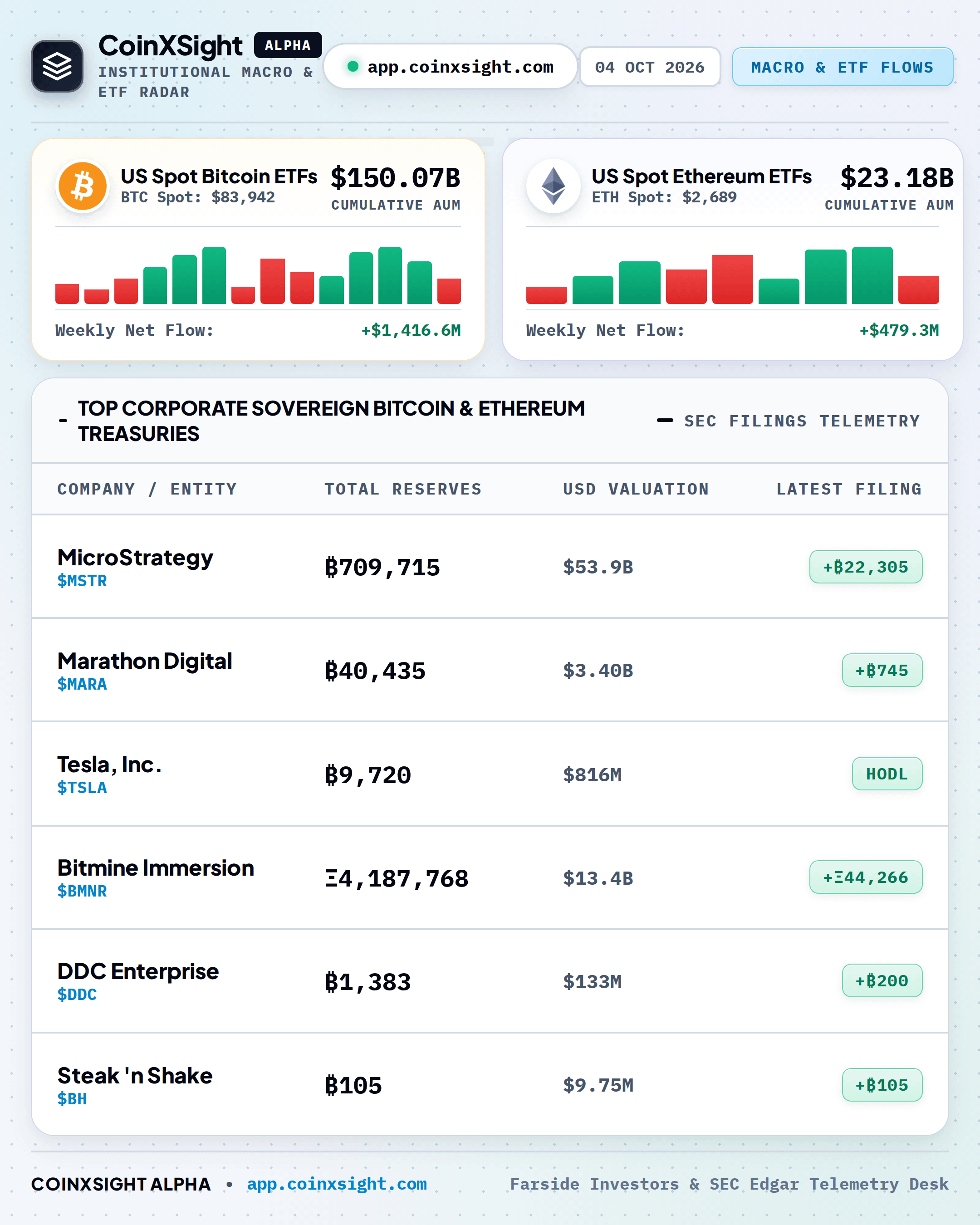
🔹 MACRO CATALYST: INSTITUTIONAL RWA MEETS REGULATORY FRICTION
The strategic alliance between BlackRock and Ondo Finance to tokenize model portfolios signals long-term spot absorption within regulated wealth rails. However, immediate capital velocity remains bottlenecked. Community banking associations are actively litigating against OCC crypto trust charters, threatening state-level resistance against digital asset custody. Compounding this, congressional gridlock continues to stall the Digital Asset Market Clarity Act in the Senate. Concurrently, discussions around executive federal AI appointments highlight the converging future of AI capital expenditures and tokenized infrastructure, yet broader risk appetite stays cautious amid sovereign yield uncertainty.
🔹 DESK TELEMETRY & MICROSTRUCTURE
CoinXSight telemetry confirms that derivatives participants and spot desks are maintaining a defensive posture rather than chasing topside expansion:
• Derivatives exposure remains anchored, with total crypto open interest at $7.62B and an average funding rate of +0.0036%, reflecting balanced positioning without speculative froth.
• Spot volumes show measured participation: $BTC generated $589.99M in 24-hour volume (+0.15%), $ETH saw $203.96M (+0.63%), and $SOL absorbed $104.42M (+1.02%).
• The CoinXSight synthesis engine assigns a 72.0/100 confidence score to this neutral macro consolidation regime, favoring sovereign settlement rails over high-beta alternatives.
🔹 TRADING DESK WATCHLIST
• Monitor legal developments in the community banks versus OCC litigation for sudden shifts in institutional on-ramp availability.
• Watch for sustained institutional inflows into tokenized model portfolio vehicles to gauge underlying balance-sheet demand.
• Maintain defensive exposure across decentralized custody models while persistent state-sponsored cybersecurity threats keep off-exchange risk premia elevated.
Risk Warning: Cryptocurrency trading carries substantial risk. This quantitative brief is for informational purposes only.
Data & Telemetry: CoinXSight Intelligence Hub | Follow on Binance Square for daily alpha.
#BinanceSquare #CryptoMacro #CoinXSight
🏛️ $BTC Stays Rangebound as Institutional Tokenization Hits Regulatory Friction
Institutional capital pipelines are quietly deepening while spot crypto markets navigate neutral rangebound territory. Benchmark assets $BTC sits at $84,789.99, $ETH holds $2,693.51, and $SOL prints $120.20 as institutional allocators balance tokenization expansion against regulatory and custody friction.

🔹 MACRO CATALYST: INSTITUTIONAL RWA MEETS REGULATORY FRICTION
The strategic alliance between BlackRock and Ondo Finance to tokenize model portfolios signals long-term spot absorption within regulated wealth rails. However, immediate capital velocity remains bottlenecked. Community banking associations are actively litigating against OCC crypto trust charters, threatening state-level resistance against digital asset custody. Compounding this, congressional gridlock continues to stall the Digital Asset Market Clarity Act in the Senate. Concurrently, discussions around executive federal AI appointments highlight the converging future of AI capital expenditures and tokenized infrastructure, yet broader risk appetite stays cautious amid sovereign yield uncertainty.
🔹 DESK TELEMETRY & MICROSTRUCTURE
CoinXSight telemetry confirms that derivatives participants and spot desks are maintaining a defensive posture rather than chasing topside expansion:
• Derivatives exposure remains anchored, with total crypto open interest at $7.62B and an average funding rate of +0.0036%, reflecting balanced positioning without speculative froth.
• Spot volumes show measured participation: $BTC generated $589.99M in 24-hour volume (+0.15%), $ETH saw $203.96M (+0.63%), and $SOL absorbed $104.42M (+1.02%).
• The CoinXSight synthesis engine assigns a 72.0/100 confidence score to this neutral macro consolidation regime, favoring sovereign settlement rails over high-beta alternatives.
🔹 TRADING DESK WATCHLIST
• Monitor legal developments in the community banks versus OCC litigation for sudden shifts in institutional on-ramp availability.
• Watch for sustained institutional inflows into tokenized model portfolio vehicles to gauge underlying balance-sheet demand.
• Maintain defensive exposure across decentralized custody models while persistent state-sponsored cybersecurity threats keep off-exchange risk premia elevated.
Risk Warning: Cryptocurrency trading carries substantial risk. This quantitative brief is for informational purposes only.
Data & Telemetry: CoinXSight Intelligence Hub | Follow on Binance Square for daily alpha.
#BinanceSquare #CryptoMacro #CoinXSight

🔹 MACRO CATALYST: INSTITUTIONAL RWA MEETS REGULATORY FRICTION
The strategic alliance between BlackRock and Ondo Finance to tokenize model portfolios signals long-term spot absorption within regulated wealth rails. However, immediate capital velocity remains bottlenecked. Community banking associations are actively litigating against OCC crypto trust charters, threatening state-level resistance against digital asset custody. Compounding this, congressional gridlock continues to stall the Digital Asset Market Clarity Act in the Senate. Concurrently, discussions around executive federal AI appointments highlight the converging future of AI capital expenditures and tokenized infrastructure, yet broader risk appetite stays cautious amid sovereign yield uncertainty.
🔹 DESK TELEMETRY & MICROSTRUCTURE
CoinXSight telemetry confirms that derivatives participants and spot desks are maintaining a defensive posture rather than chasing topside expansion:
• Derivatives exposure remains anchored, with total crypto open interest at $7.62B and an average funding rate of +0.0036%, reflecting balanced positioning without speculative froth.
• Spot volumes show measured participation: $BTC generated $589.99M in 24-hour volume (+0.15%), $ETH saw $203.96M (+0.63%), and $SOL absorbed $104.42M (+1.02%).
• The CoinXSight synthesis engine assigns a 72.0/100 confidence score to this neutral macro consolidation regime, favoring sovereign settlement rails over high-beta alternatives.
🔹 TRADING DESK WATCHLIST
• Monitor legal developments in the community banks versus OCC litigation for sudden shifts in institutional on-ramp availability.
• Watch for sustained institutional inflows into tokenized model portfolio vehicles to gauge underlying balance-sheet demand.
• Maintain defensive exposure across decentralized custody models while persistent state-sponsored cybersecurity threats keep off-exchange risk premia elevated.
Risk Warning: Cryptocurrency trading carries substantial risk. This quantitative brief is for informational purposes only.
Data & Telemetry: CoinXSight Intelligence Hub | Follow on Binance Square for daily alpha.
#BinanceSquare #CryptoMacro #CoinXSight
119

·
--
#FedOctoberRateHikeOddsFallTo17%
📊 Fed Rate Shift: October Hike Odds Fall to 17%!
With the U.S. labor market cooling off, futures markets now price an 83% chance the Fed keeps rates unchanged.
How are you positioning your crypto portfolio for October?
🟩 A) All-in Bullish ( $BTC to new local highs)
🟨 B) Cautiously Optimistic (DCA into major altcoins)
🟥 C) Bearish / Cash (Expecting a fakeout)
Vote & comment below 👇
#CryptoMacro
#FedOctoberRateHikeOddsFallTo17%
📊 Fed Rate Shift: October Hike Odds Fall to 17%!
With the U.S. labor market cooling off, futures markets now price an 83% chance the Fed keeps rates unchanged.
How are you positioning your crypto portfolio for October?
🟩 A) All-in Bullish ( $BTC to new local highs)
🟨 B) Cautiously Optimistic (DCA into major altcoins)
🟥 C) Bearish / Cash (Expecting a fakeout)
Vote & comment below 👇
#CryptoMacro
📊 Fed Rate Shift: October Hike Odds Fall to 17%!
With the U.S. labor market cooling off, futures markets now price an 83% chance the Fed keeps rates unchanged.
How are you positioning your crypto portfolio for October?
🟩 A) All-in Bullish ( $BTC to new local highs)
🟨 B) Cautiously Optimistic (DCA into major altcoins)
🟥 C) Bearish / Cash (Expecting a fakeout)
Vote & comment below 👇
#CryptoMacro
62

During U.S. trading hours, the Nasdaq Composite surged intraday, breaking through and approaching the 27,400 mark to set a new all-time high. This milestone highlights the market’s current enthusiasm for technology stocks and growth assets, but has also raised concerns about stretched valuations.
From a macroeconomic perspective, the U.S. stock market’s sustained one-way climb has become markedly disconnected from fundamental pressures, as benchmark interest rates remain elevated and the economic outlook uncertain. All-time highs driven by a handful of heavily weighted stocks often mask potential risks from tightening liquidity and slowing earnings growth.
For financial markets as a whole, the ongoing rally in U.S. stock indices has bolstered the resilience of Treasury yields and the U.S. dollar, putting some pressure on defensive and safe-haven assets. If upcoming earnings reports or macroeconomic data fall short of expectations, a pullback from elevated levels could trigger ripple effects across asset classes.
For the crypto market, represented by $BTC , record highs in technology stocks may provide some support for risk appetite in the short term, but the diversion of macroeconomic capital should not be overlooked. With funds continuing to be tied up in traditional high-yield assets, investors should be alert to the risk of a pullback if liquidity tightens further.
#Nasdaq #StockMarket #CryptoMacro
During U.S. trading hours, the Nasdaq Composite surged intraday, breaking through and approaching the 27,400 mark to set a new all-time high. This milestone highlights the market’s current enthusiasm for technology stocks and growth assets, but has also raised concerns about stretched valuations.
From a macroeconomic perspective, the U.S. stock market’s sustained one-way climb has become markedly disconnected from fundamental pressures, as benchmark interest rates remain elevated and the economic outlook uncertain. All-time highs driven by a handful of heavily weighted stocks often mask potential risks from tightening liquidity and slowing earnings growth.
For financial markets as a whole, the ongoing rally in U.S. stock indices has bolstered the resilience of Treasury yields and the U.S. dollar, putting some pressure on defensive and safe-haven assets. If upcoming earnings reports or macroeconomic data fall short of expectations, a pullback from elevated levels could trigger ripple effects across asset classes.
For the crypto market, represented by $BTC , record highs in technology stocks may provide some support for risk appetite in the short term, but the diversion of macroeconomic capital should not be overlooked. With funds continuing to be tied up in traditional high-yield assets, investors should be alert to the risk of a pullback if liquidity tightens further.
#Nasdaq #StockMarket #CryptoMacro
From a macroeconomic perspective, the U.S. stock market’s sustained one-way climb has become markedly disconnected from fundamental pressures, as benchmark interest rates remain elevated and the economic outlook uncertain. All-time highs driven by a handful of heavily weighted stocks often mask potential risks from tightening liquidity and slowing earnings growth.
For financial markets as a whole, the ongoing rally in U.S. stock indices has bolstered the resilience of Treasury yields and the U.S. dollar, putting some pressure on defensive and safe-haven assets. If upcoming earnings reports or macroeconomic data fall short of expectations, a pullback from elevated levels could trigger ripple effects across asset classes.
For the crypto market, represented by $BTC , record highs in technology stocks may provide some support for risk appetite in the short term, but the diversion of macroeconomic capital should not be overlooked. With funds continuing to be tied up in traditional high-yield assets, investors should be alert to the risk of a pullback if liquidity tightens further.
#Nasdaq #StockMarket #CryptoMacro
333

Article
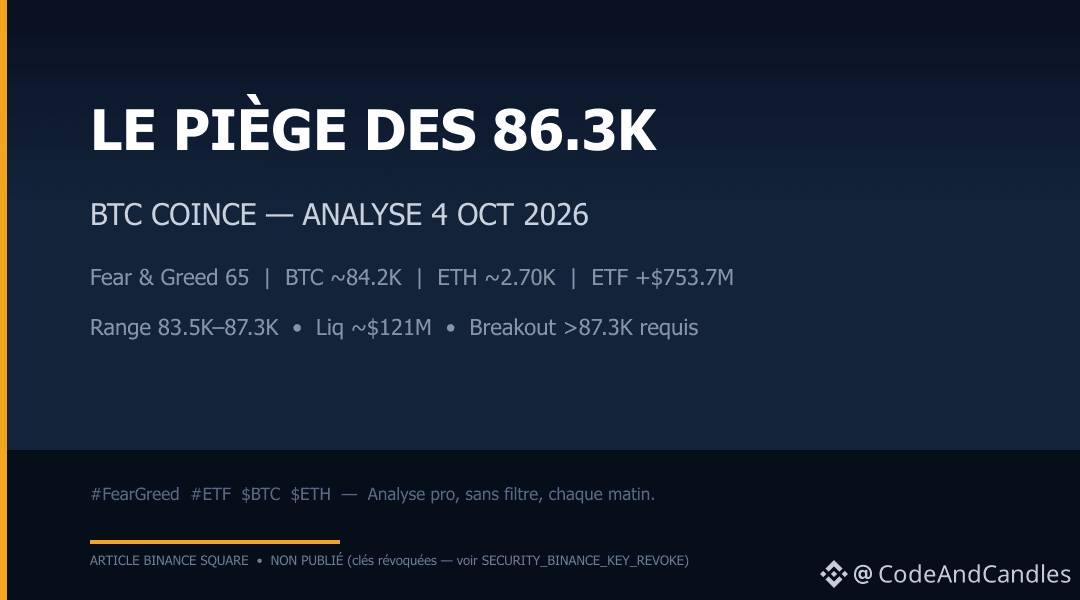
THE 86.7K TRAP — Uptober = a trap?BTC 86,679 $ (+2.3%) • ETH 2,753 $ (+1.2%) • F&G 70 • Vol. 89.4 Bds.$
• Bitcoin rides on the optimism of “Uptober” but F&G rises to 70: a sign that retail is entering FOMO BEFORE the peak. ETFs slow down (-94% on SOL/XRP) — institutional liquidity is pulling back.
• ETH +2.3% but without a breakout of $2,800: support $2,675 / resistance $2,765. Crypto cap 3.01 Tds — the market grows by fear, not by conviction.
• Fed hawkish (10Y 5.04%). A bad NFP and 86K becomes a wall, not a springboard.
→ You accumulate here, or wait for the retest at 83K? Comment. Follow for analysis in 30 min.
THE 86.7K TRAP — Uptober = a trap?
BTC 86,679 $ (+2.3%) • ETH 2,753 $ (+1.2%) • F&G 70 • Vol. 89.4 Bds.$
• Bitcoin rides on the optimism of “Uptober” but F&G rises to 70: a sign that retail is entering FOMO BEFORE the peak. ETFs slow down (-94% on SOL/XRP) — institutional liquidity is pulling back.
• ETH +2.3% but without a breakout of $2,800: support $2,675 / resistance $2,765. Crypto cap 3.01 Tds — the market grows by fear, not by conviction.
• Fed hawkish (10Y 5.04%). A bad NFP and 86K becomes a wall, not a springboard.
→ You accumulate here, or wait for the retest at 83K? Comment. Follow for analysis in 30 min.
• Bitcoin rides on the optimism of “Uptober” but F&G rises to 70: a sign that retail is entering FOMO BEFORE the peak. ETFs slow down (-94% on SOL/XRP) — institutional liquidity is pulling back.
• ETH +2.3% but without a breakout of $2,800: support $2,675 / resistance $2,765. Crypto cap 3.01 Tds — the market grows by fear, not by conviction.
• Fed hawkish (10Y 5.04%). A bad NFP and 86K becomes a wall, not a springboard.
→ You accumulate here, or wait for the retest at 83K? Comment. Follow for analysis in 30 min.
108

During today’s intraday FX market session, the U.S. Dollar Index (DXY) has shown clear rebound momentum, rising 0.50% on the day and climbing to the key level of 102.45. From a technical perspective, after hitting a local low, the DXY quickly surged upward, with the bulls attempting to rebuild the bottom support structure.
This move is technically significant: 102.45 is an important testing point for resistance along the upper boundary of the recent downward channel. After the market previously digested the easing expectations in full, short-term price action has seen a technical short-covering bounce. However, it is still within a larger-scale, wide-ranging consolidation zone and has not yet formed a reversal breakout.
The dollar’s short-term strength has driven a healthy differentiation across traditional assets: non-USD currencies have generally come under pressure, and U.S. Treasury yields have modestly moved in tandem upward. Nevertheless, regarding macro liquidity, the dollar’s rebound has not broken through the key intermediate-to-long-term pressure zone. Global risk appetite remains stable at a relatively healthy level.
For the crypto market, this is often a typical window for shakeouts and order-flow consolidation. $BTC has demonstrated exceptionally strong resilience during the dollar rebound; technical indicators suggest that spot buying is firmly positioned at key support levels. As long as the DXY fails to break through the key high-point resistance, the structural bullish trend in digital assets should continue to unfold.📈
#DXY #USD #CryptoMacro
During today’s intraday FX market session, the U.S. Dollar Index (DXY) has shown clear rebound momentum, rising 0.50% on the day and climbing to the key level of 102.45. From a technical perspective, after hitting a local low, the DXY quickly surged upward, with the bulls attempting to rebuild the bottom support structure.
This move is technically significant: 102.45 is an important testing point for resistance along the upper boundary of the recent downward channel. After the market previously digested the easing expectations in full, short-term price action has seen a technical short-covering bounce. However, it is still within a larger-scale, wide-ranging consolidation zone and has not yet formed a reversal breakout.
The dollar’s short-term strength has driven a healthy differentiation across traditional assets: non-USD currencies have generally come under pressure, and U.S. Treasury yields have modestly moved in tandem upward. Nevertheless, regarding macro liquidity, the dollar’s rebound has not broken through the key intermediate-to-long-term pressure zone. Global risk appetite remains stable at a relatively healthy level.
For the crypto market, this is often a typical window for shakeouts and order-flow consolidation. $BTC has demonstrated exceptionally strong resilience during the dollar rebound; technical indicators suggest that spot buying is firmly positioned at key support levels. As long as the DXY fails to break through the key high-point resistance, the structural bullish trend in digital assets should continue to unfold.📈
#DXY #USD #CryptoMacro
This move is technically significant: 102.45 is an important testing point for resistance along the upper boundary of the recent downward channel. After the market previously digested the easing expectations in full, short-term price action has seen a technical short-covering bounce. However, it is still within a larger-scale, wide-ranging consolidation zone and has not yet formed a reversal breakout.
The dollar’s short-term strength has driven a healthy differentiation across traditional assets: non-USD currencies have generally come under pressure, and U.S. Treasury yields have modestly moved in tandem upward. Nevertheless, regarding macro liquidity, the dollar’s rebound has not broken through the key intermediate-to-long-term pressure zone. Global risk appetite remains stable at a relatively healthy level.
For the crypto market, this is often a typical window for shakeouts and order-flow consolidation. $BTC has demonstrated exceptionally strong resilience during the dollar rebound; technical indicators suggest that spot buying is firmly positioned at key support levels. As long as the DXY fails to break through the key high-point resistance, the structural bullish trend in digital assets should continue to unfold.📈
#DXY #USD #CryptoMacro
93
According to the latest data from the CME FedWatch tool of the Chicago Mercantile Exchange, the market assigns a 77.9% probability to the Federal Reserve keeping interest rates unchanged in October, and a 22.1% probability to a 25-basis-point rate hike. By December, however, the probability of holding rates steady drops sharply to 11.4%, while the cumulative probability of a 25-basis-point hike rises to 62.3%. The probability of a 50-basis-point hike reaches 24.3%, and even a 2.1% chance is reported for a 75-basis-point hike.
This data clearly reflects deep concerns in the market that a renewed tightening policy is back. After the Federal Reserve restarted its rate-hiking cycle, traders are quickly repricing the policy path for the end of the year. What was originally expected to be a temporary pause in tightening may only be a brief respite, as anti-inflation pressure continues to force policymakers to maintain an extremely hawkish stance.
The continued rise in interest-rate expectations will directly put pressure on traditional financial assets. U.S. Treasury yields and the U.S. dollar index may receive stronger support, while the discount rate used to value risk assets increases, creating a hard-landing risk of further tightening in global liquidity conditions during the fourth quarter.
For the crypto market, the rekindling of high-rate expectations implies that incremental capital is unlikely to enter quickly. If an additional, above-expected rate hike occurs again in December, risk assets could face more severe liquidity outflows. Investors should be alert to the downside risk of a pullback and consolidation in the short term as macro sentiment remains under pressure $BTC .
#Fed #InterestRates #CryptoMacro
According to the latest data from the CME FedWatch tool of the Chicago Mercantile Exchange, the market assigns a 77.9% probability to the Federal Reserve keeping interest rates unchanged in October, and a 22.1% probability to a 25-basis-point rate hike. By December, however, the probability of holding rates steady drops sharply to 11.4%, while the cumulative probability of a 25-basis-point hike rises to 62.3%. The probability of a 50-basis-point hike reaches 24.3%, and even a 2.1% chance is reported for a 75-basis-point hike.
This data clearly reflects deep concerns in the market that a renewed tightening policy is back. After the Federal Reserve restarted its rate-hiking cycle, traders are quickly repricing the policy path for the end of the year. What was originally expected to be a temporary pause in tightening may only be a brief respite, as anti-inflation pressure continues to force policymakers to maintain an extremely hawkish stance.
The continued rise in interest-rate expectations will directly put pressure on traditional financial assets. U.S. Treasury yields and the U.S. dollar index may receive stronger support, while the discount rate used to value risk assets increases, creating a hard-landing risk of further tightening in global liquidity conditions during the fourth quarter.
For the crypto market, the rekindling of high-rate expectations implies that incremental capital is unlikely to enter quickly. If an additional, above-expected rate hike occurs again in December, risk assets could face more severe liquidity outflows. Investors should be alert to the downside risk of a pullback and consolidation in the short term as macro sentiment remains under pressure $BTC .
#Fed #InterestRates #CryptoMacro
This data clearly reflects deep concerns in the market that a renewed tightening policy is back. After the Federal Reserve restarted its rate-hiking cycle, traders are quickly repricing the policy path for the end of the year. What was originally expected to be a temporary pause in tightening may only be a brief respite, as anti-inflation pressure continues to force policymakers to maintain an extremely hawkish stance.
The continued rise in interest-rate expectations will directly put pressure on traditional financial assets. U.S. Treasury yields and the U.S. dollar index may receive stronger support, while the discount rate used to value risk assets increases, creating a hard-landing risk of further tightening in global liquidity conditions during the fourth quarter.
For the crypto market, the rekindling of high-rate expectations implies that incremental capital is unlikely to enter quickly. If an additional, above-expected rate hike occurs again in December, risk assets could face more severe liquidity outflows. Investors should be alert to the downside risk of a pullback and consolidation in the short term as macro sentiment remains under pressure $BTC .
#Fed #InterestRates #CryptoMacro
33

Article
🌐 Dovish Macro Signals Reshape Digital Asset Flows as $BTC Holds $84,660.11Macro tailwinds are recalibrating digital asset flows as $BTC trades at $84,660.11, while $ETH and $SOL reflect wider market dispersion. Softening labor indicators and moderating inflation prints in the United States are accelerating expectations for dovish monetary policy pivots, exerting downward pressure on sovereign bond yields and driving institutional liquidity toward premier digital assets.
🔹 MACRO FORCES & REGULATORY DISPERSION
• Decelerating macroeconomic conditions are forcing rate markets to price in Federal Reserve easing, providing structural support to hard-cap collateral.
• European oversight under MiCA maintains stringent reserve parameters for stablecoins, separating institutional compliance from speculative peripheral rails.
• Banking litigation surrounding federal trust charter approvals introduces policy frictions, yet institutional balance-sheet integration continues to expand.
• CoinXSight News Synthesis records an 82.0/100 confidence score on this broader shift toward a monetary easing regime.
🔹 MICROSTRUCTURE & DERIVATIVES BACKDROP
• $BTC holds steady at $84,660.11, registering a slight 24-hour change of -0.16% on $2.23B in verified spot volume after absorbing overhead resistance.
• Derivatives markets exhibit cautious positioning, with total open interest standing at $7.62B alongside a slightly negative average funding rate of -0.0019%, pointing to persistent short hedging.
• Large-cap altcoins show tactical divergence: $ETH registers $2,676.70 (-1.16% on $1.16B volume), while $SOL posts a modest gain to $118.99 (+0.11% on $387.29M volume).
🔹 PROTOCOL ATTRITION & FLIGHT TO QUALITY
• While mega-caps demonstrate resilient spot absorption, secondary layers face acute rationalization as speculative liquidity incentives exhaust unviable fee models.
• Capital allocation is consolidating aggressively into high-liquidity conduits, penalizing fragmented ecosystem bridges and reinforcing a flight toward tier-one institutional custody.
Data & Telemetry: CoinXSight Intelligence Hub | Follow on Binance Square for daily alpha.
Risk Warning: Cryptocurrency trading carries substantial risk. This quantitative brief is for informational purposes only.
#BinanceSquare #CryptoMacro #CoinXSight
🌐 Dovish Macro Signals Reshape Digital Asset Flows as $BTC Holds $84,660.11
Macro tailwinds are recalibrating digital asset flows as $BTC trades at $84,660.11, while $ETH and $SOL reflect wider market dispersion. Softening labor indicators and moderating inflation prints in the United States are accelerating expectations for dovish monetary policy pivots, exerting downward pressure on sovereign bond yields and driving institutional liquidity toward premier digital assets.

🔹 MACRO FORCES & REGULATORY DISPERSION
• Decelerating macroeconomic conditions are forcing rate markets to price in Federal Reserve easing, providing structural support to hard-cap collateral.
• European oversight under MiCA maintains stringent reserve parameters for stablecoins, separating institutional compliance from speculative peripheral rails.
• Banking litigation surrounding federal trust charter approvals introduces policy frictions, yet institutional balance-sheet integration continues to expand.
• CoinXSight News Synthesis records an 82.0/100 confidence score on this broader shift toward a monetary easing regime.
🔹 MICROSTRUCTURE & DERIVATIVES BACKDROP
• $BTC holds steady at $84,660.11, registering a slight 24-hour change of -0.16% on $2.23B in verified spot volume after absorbing overhead resistance.
• Derivatives markets exhibit cautious positioning, with total open interest standing at $7.62B alongside a slightly negative average funding rate of -0.0019%, pointing to persistent short hedging.
• Large-cap altcoins show tactical divergence: $ETH registers $2,676.70 (-1.16% on $1.16B volume), while $SOL posts a modest gain to $118.99 (+0.11% on $387.29M volume).
🔹 PROTOCOL ATTRITION & FLIGHT TO QUALITY
• While mega-caps demonstrate resilient spot absorption, secondary layers face acute rationalization as speculative liquidity incentives exhaust unviable fee models.
• Capital allocation is consolidating aggressively into high-liquidity conduits, penalizing fragmented ecosystem bridges and reinforcing a flight toward tier-one institutional custody.
Data & Telemetry: CoinXSight Intelligence Hub | Follow on Binance Square for daily alpha.
Risk Warning: Cryptocurrency trading carries substantial risk. This quantitative brief is for informational purposes only.
#BinanceSquare #CryptoMacro #CoinXSight

🔹 MACRO FORCES & REGULATORY DISPERSION
• Decelerating macroeconomic conditions are forcing rate markets to price in Federal Reserve easing, providing structural support to hard-cap collateral.
• European oversight under MiCA maintains stringent reserve parameters for stablecoins, separating institutional compliance from speculative peripheral rails.
• Banking litigation surrounding federal trust charter approvals introduces policy frictions, yet institutional balance-sheet integration continues to expand.
• CoinXSight News Synthesis records an 82.0/100 confidence score on this broader shift toward a monetary easing regime.
🔹 MICROSTRUCTURE & DERIVATIVES BACKDROP
• $BTC holds steady at $84,660.11, registering a slight 24-hour change of -0.16% on $2.23B in verified spot volume after absorbing overhead resistance.
• Derivatives markets exhibit cautious positioning, with total open interest standing at $7.62B alongside a slightly negative average funding rate of -0.0019%, pointing to persistent short hedging.
• Large-cap altcoins show tactical divergence: $ETH registers $2,676.70 (-1.16% on $1.16B volume), while $SOL posts a modest gain to $118.99 (+0.11% on $387.29M volume).
🔹 PROTOCOL ATTRITION & FLIGHT TO QUALITY
• While mega-caps demonstrate resilient spot absorption, secondary layers face acute rationalization as speculative liquidity incentives exhaust unviable fee models.
• Capital allocation is consolidating aggressively into high-liquidity conduits, penalizing fragmented ecosystem bridges and reinforcing a flight toward tier-one institutional custody.
Data & Telemetry: CoinXSight Intelligence Hub | Follow on Binance Square for daily alpha.
Risk Warning: Cryptocurrency trading carries substantial risk. This quantitative brief is for informational purposes only.
#BinanceSquare #CryptoMacro #CoinXSight
98
Article
📈 Sovereign Yields Retreat as $BTC Climbs +1.53% on Expanding Institutional RailsMacro pressure is finally softening as sovereign bond yields pull back, giving spot digital assets like $BTC, $ETH, and $SOL room to grind higher across active trading sessions. Institutional pipelines are widening alongside regulatory custody modernizations, anchoring a constructive narrative shift across global order books.
🔹 MACRO REPRIEVE AND INSTITUTIONAL PIPELINES
Treasury yields retreating from cycle highs has mitigated sovereign debt crowding-out effects, offering immediate breathing room for risk assets. Simultaneously, proposed regulatory modernization governing registered investment adviser custody is opening systematic allocation rails beyond passive exchange-traded products. CoinXSight news synthesis measures desk confidence at 78.0/100, driven by sovereign debt relief and corporate treasury expansion into public equity markets.
🔹 ON-CHAIN TELEMETRY AND SPOT FLOWS
Desk metrics show measured accumulation across primary assets without excessive leverage:
• Bitcoin is changing hands at $84,792.70, advancing +1.53% over the past 24 hours on $1.44B in volume.
• Ethereum prints $2,708.18, registering a +0.83% uptick with 24-hour volume reaching $703.34M.
• Solana trades at $118.85, up +0.71% on $253.81M in daily turnover.
• Total derivatives open interest stands at $7.41B with an average funding rate of +0.0039%, confirming that spot absorption, not overleveraged perpetual positioning, is guiding price discovery.
🔹 DESK WATCHLIST AND CATALYSTS
• The public review window for updated SEC custody rules under the Investment Advisers Act.
• Public trading debuts for corporate treasury vehicles on major US equity exchanges.
• Upcoming sovereign debt refinancing operations and their direct impact on global discount rates.
• Cross-chain smart contract security after localized protocol exploits pressured high-beta altcoin sentiment.
Data & Telemetry: CoinXSight Intelligence Hub | Follow on Binance Square for daily alpha.
Risk Warning: Cryptocurrency trading carries substantial risk. This quantitative brief is for informational purposes only.
#BinanceSquare #CryptoMacro #CoinXSight
📈 Sovereign Yields Retreat as $BTC Climbs +1.53% on Expanding Institutional Rails
Macro pressure is finally softening as sovereign bond yields pull back, giving spot digital assets like $BTC , $ETH , and $SOL room to grind higher across active trading sessions. Institutional pipelines are widening alongside regulatory custody modernizations, anchoring a constructive narrative shift across global order books.

🔹 MACRO REPRIEVE AND INSTITUTIONAL PIPELINES
Treasury yields retreating from cycle highs has mitigated sovereign debt crowding-out effects, offering immediate breathing room for risk assets. Simultaneously, proposed regulatory modernization governing registered investment adviser custody is opening systematic allocation rails beyond passive exchange-traded products. CoinXSight news synthesis measures desk confidence at 78.0/100, driven by sovereign debt relief and corporate treasury expansion into public equity markets.
🔹 ON-CHAIN TELEMETRY AND SPOT FLOWS
Desk metrics show measured accumulation across primary assets without excessive leverage:
• Bitcoin is changing hands at $84,792.70, advancing +1.53% over the past 24 hours on $1.44B in volume.
• Ethereum prints $2,708.18, registering a +0.83% uptick with 24-hour volume reaching $703.34M.
• Solana trades at $118.85, up +0.71% on $253.81M in daily turnover.
• Total derivatives open interest stands at $7.41B with an average funding rate of +0.0039%, confirming that spot absorption, not overleveraged perpetual positioning, is guiding price discovery.
🔹 DESK WATCHLIST AND CATALYSTS
• The public review window for updated SEC custody rules under the Investment Advisers Act.
• Public trading debuts for corporate treasury vehicles on major US equity exchanges.
• Upcoming sovereign debt refinancing operations and their direct impact on global discount rates.
• Cross-chain smart contract security after localized protocol exploits pressured high-beta altcoin sentiment.
Data & Telemetry: CoinXSight Intelligence Hub | Follow on Binance Square for daily alpha.
Risk Warning: Cryptocurrency trading carries substantial risk. This quantitative brief is for informational purposes only.
#BinanceSquare #CryptoMacro #CoinXSight

🔹 MACRO REPRIEVE AND INSTITUTIONAL PIPELINES
Treasury yields retreating from cycle highs has mitigated sovereign debt crowding-out effects, offering immediate breathing room for risk assets. Simultaneously, proposed regulatory modernization governing registered investment adviser custody is opening systematic allocation rails beyond passive exchange-traded products. CoinXSight news synthesis measures desk confidence at 78.0/100, driven by sovereign debt relief and corporate treasury expansion into public equity markets.
🔹 ON-CHAIN TELEMETRY AND SPOT FLOWS
Desk metrics show measured accumulation across primary assets without excessive leverage:
• Bitcoin is changing hands at $84,792.70, advancing +1.53% over the past 24 hours on $1.44B in volume.
• Ethereum prints $2,708.18, registering a +0.83% uptick with 24-hour volume reaching $703.34M.
• Solana trades at $118.85, up +0.71% on $253.81M in daily turnover.
• Total derivatives open interest stands at $7.41B with an average funding rate of +0.0039%, confirming that spot absorption, not overleveraged perpetual positioning, is guiding price discovery.
🔹 DESK WATCHLIST AND CATALYSTS
• The public review window for updated SEC custody rules under the Investment Advisers Act.
• Public trading debuts for corporate treasury vehicles on major US equity exchanges.
• Upcoming sovereign debt refinancing operations and their direct impact on global discount rates.
• Cross-chain smart contract security after localized protocol exploits pressured high-beta altcoin sentiment.
Data & Telemetry: CoinXSight Intelligence Hub | Follow on Binance Square for daily alpha.
Risk Warning: Cryptocurrency trading carries substantial risk. This quantitative brief is for informational purposes only.
#BinanceSquare #CryptoMacro #CoinXSight
143
Article
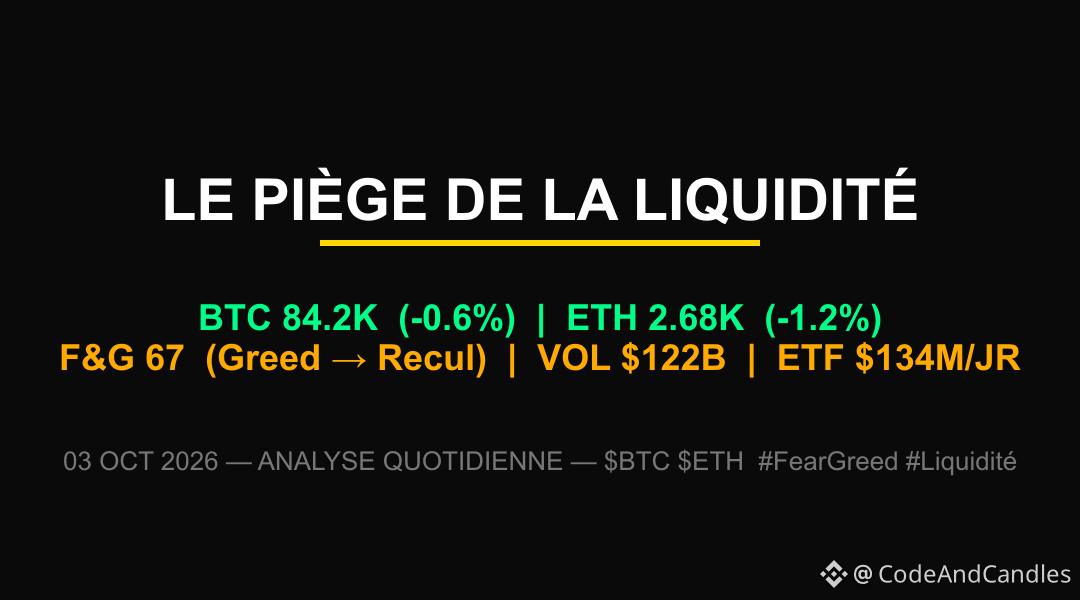
THE LIQUIDITY TRAP — BTC 84.2K | F&G 67 ON THE WAY DOWNTHE LIQUIDITY TRAP — BTC 84.2K, F&G 67 ON THE WAY DOWN BTC 84,176 (-0.6% / 24h) | ETH 2,680 (-1.2%) | Total crypto volume $122B | F&G 67 (Greed → pullback) | BTC dominance 57.2% • Volume $122B (+30% S1) but BTC is down: liquidity is moving in, the price is breaking out. ETFs are slowing ($134M/day vs $1B 8 days ago) — the buying engine is running out. • ETH -1.2% harder than BTC, BTC dominance rising: rotation is happening out of fear, not optimism. Oil >$100, 10Y ~5.04%, Fed hawkish = no macro support. • Liquidations $187M (29/09) — the market is already cleaned up; not enough for a breakout. Resistance 84.7K has held for 5 days. CTA → You: do you buy the dip or wait for a breakout above 87K? Comment. Follow for daily analysis — the trap closes when everyone thinks they’ve avoided it. $BTC $ETH #FearGreed #Liquidité #CryptoMacro #BTC84K
THE LIQUIDITY TRAP — BTC 84.2K | F&G 67 ON THE WAY DOWN
THE LIQUIDITY TRAP — BTC 84.2K, F&G 67 ON THE WAY DOWN BTC 84,176 (-0.6% / 24h) | ETH 2,680 (-1.2%) | Total crypto volume $122B | F&G 67 (Greed → pullback) | BTC dominance 57.2% • Volume $122B (+30% S1) but BTC is down: liquidity is moving in, the price is breaking out. ETFs are slowing ($134M/day vs $1B 8 days ago) — the buying engine is running out. • ETH -1.2% harder than BTC, BTC dominance rising: rotation is happening out of fear, not optimism. Oil >$100, 10Y ~5.04%, Fed hawkish = no macro support. • Liquidations $187M (29/09) — the market is already cleaned up; not enough for a breakout. Resistance 84.7K has held for 5 days. CTA → You: do you buy the dip or wait for a breakout above 87K? Comment. Follow for daily analysis — the trap closes when everyone thinks they’ve avoided it. $BTC $ETH #FearGreed #Liquidité #CryptoMacro #BTC84K
137

·
--
Why Everyone Watching $BNB and BTC Has Their Eyes on the NFP Print
Let's be honest — weeks like this are all about macro liquidity, and right now the whole market is waiting on the US Non-Farm Payrolls (NFP), Unemployment Rate & Average Hourly Earnings (Pre-NFP Initial Jobless Claims Today + US NFP Release Tomorrow at 12:30 UTC (6:00 PM IST)). Instead of guessing candles ahead of the print, I like to look straight at the hard numbers on the table.
Here is where the official numbers stand going into the release:
• Where we came from: Previous NFP: 142K Jobs Added | Unemployment Rate: 4.2% | Avg Hourly Earnings: +0.4% MoM (3.8% YoY)
• What Wall Street expects right now: Consensus Forecast: 145K–150K Jobs | Unemployment Rate Forecast: 4.2% | Wage Growth Forecast: +0.3% MoM
• Expected liquidity reaction: ±3.5% to ±6.0% high-velocity institutional orderbook expansion at 12:30 UTC release
What I'm personally watching most closely as the numbers hit the tape is headline non-farm payrolls (nfp) jobs added vs 145k–150k consensus forecast, along with us unemployment rate (u-3) tick vs 4.2% threshold & prior month revisions. Labor market cooling vs resilience dictates Fed rate-cut velocity, DXY strength, and institutional ETF inflows.
When a major print like NFP drops, the first few minutes are usually pure liquidity hunting across both sides of the orderbook on BNB around 769.71 and BTC. I'm letting the actual data print against consensus and watching how the Dollar Index (DXY) and US 10Y Treasury yields react before forming any bias.
How are you approaching this NFP window — sitting on your hands until the dust settles or watching spot flows live? Drop your thoughts below 👇
#BinanceSquare #CryptoMacro
Why Everyone Watching $BNB and BTC Has Their Eyes on the NFP Print
Let's be honest — weeks like this are all about macro liquidity, and right now the whole market is waiting on the US Non-Farm Payrolls (NFP), Unemployment Rate & Average Hourly Earnings (Pre-NFP Initial Jobless Claims Today + US NFP Release Tomorrow at 12:30 UTC (6:00 PM IST)). Instead of guessing candles ahead of the print, I like to look straight at the hard numbers on the table.
Here is where the official numbers stand going into the release:
• Where we came from: Previous NFP: 142K Jobs Added | Unemployment Rate: 4.2% | Avg Hourly Earnings: +0.4% MoM (3.8% YoY)
• What Wall Street expects right now: Consensus Forecast: 145K–150K Jobs | Unemployment Rate Forecast: 4.2% | Wage Growth Forecast: +0.3% MoM
• Expected liquidity reaction: ±3.5% to ±6.0% high-velocity institutional orderbook expansion at 12:30 UTC release
What I'm personally watching most closely as the numbers hit the tape is headline non-farm payrolls (nfp) jobs added vs 145k–150k consensus forecast, along with us unemployment rate (u-3) tick vs 4.2% threshold & prior month revisions. Labor market cooling vs resilience dictates Fed rate-cut velocity, DXY strength, and institutional ETF inflows.
When a major print like NFP drops, the first few minutes are usually pure liquidity hunting across both sides of the orderbook on BNB around 769.71 and BTC. I'm letting the actual data print against consensus and watching how the Dollar Index (DXY) and US 10Y Treasury yields react before forming any bias.
How are you approaching this NFP window — sitting on your hands until the dust settles or watching spot flows live? Drop your thoughts below 👇
#BinanceSquare #CryptoMacro
Let's be honest — weeks like this are all about macro liquidity, and right now the whole market is waiting on the US Non-Farm Payrolls (NFP), Unemployment Rate & Average Hourly Earnings (Pre-NFP Initial Jobless Claims Today + US NFP Release Tomorrow at 12:30 UTC (6:00 PM IST)). Instead of guessing candles ahead of the print, I like to look straight at the hard numbers on the table.
Here is where the official numbers stand going into the release:
• Where we came from: Previous NFP: 142K Jobs Added | Unemployment Rate: 4.2% | Avg Hourly Earnings: +0.4% MoM (3.8% YoY)
• What Wall Street expects right now: Consensus Forecast: 145K–150K Jobs | Unemployment Rate Forecast: 4.2% | Wage Growth Forecast: +0.3% MoM
• Expected liquidity reaction: ±3.5% to ±6.0% high-velocity institutional orderbook expansion at 12:30 UTC release
What I'm personally watching most closely as the numbers hit the tape is headline non-farm payrolls (nfp) jobs added vs 145k–150k consensus forecast, along with us unemployment rate (u-3) tick vs 4.2% threshold & prior month revisions. Labor market cooling vs resilience dictates Fed rate-cut velocity, DXY strength, and institutional ETF inflows.
When a major print like NFP drops, the first few minutes are usually pure liquidity hunting across both sides of the orderbook on BNB around 769.71 and BTC. I'm letting the actual data print against consensus and watching how the Dollar Index (DXY) and US 10Y Treasury yields react before forming any bias.
How are you approaching this NFP window — sitting on your hands until the dust settles or watching spot flows live? Drop your thoughts below 👇
#BinanceSquare #CryptoMacro
1
31
·
--
SOL & US NFP Labor Market & Macro Data Intelligence: Official Data Breakdown📊 $SOL & US NFP Labor Market & Macro Data Intelligence: Official Data Breakdown
The cryptocurrency market stands at a critical macroeconomic juncture as institutional traders brace for the imminent US Non-Farm Payrolls (NFP) report release at 12:30 UTC. SOL is trading at a live spot reference of 117.72 with a neutral 24-hour Relative Strength Index of 44. Quantitative orderbook metrics reveal institutional implied volatility pricing in a sharp expansion of ±3.5% to ±6.0% upon data publication.
Official Economic & On-Chain Data Metrics:
The macroeconomic landscape shows the previous NFP reading at 142K jobs added, against a current consensus forecast of 145K to 150K jobs. The Unemployment Rate previously logged 4.2%, with consensus holding steady at 4.2%. Average Hourly Earnings recorded +0.4% MoM (3.8% YoY) previously, with expectations pegged at +0.3% MoM. CME FedWatch probabilities reflect a 72.3% likelihood of a 25 basis point rate adjustment at the upcoming Fed meeting. Meanwhile, the US Dollar Index (DXY) holds near 101.81 after a 2.18% four-week gain, while US 10-Year Treasury Yields sit elevated at 5.31%.
Institutional flows and on-chain metrics show resilient underlying demand for SOL. Solana Spot ETFs recorded a net outflow of 11.1 million USD on September 30, following a net inflow of 5.44 million USD on September 29, bringing cumulative net inflows to 1.89 billion USD with total AUM reaching 1.56 billion USD across nine issuers. On-chain wallet analytics highlight that entities holding 10,000 SOL or more expanded by 1.58% over the past week, alongside a 4.91% decline in exchange reserves, confirming persistent institutional supply absorption.
Data-Driven Volatility Scenarios:
📈 Higher-than-Expected NFP (Above 150K): Triggers hawkish policy recalibration, boosting DXY and Treasury yields while exerting downside pressure on risk assets including SOL.
📉 Lower-than-Expected NFP (Below 145K): Eases monetary tightening expectations, dampening yields and providing macro tailwinds for upward crypto momentum.
↔️ In-Line NFP (145K to 150K): Results in contained market repricing, shifting focus toward wage growth trends and range-bound liquidity.
#BinanceSquare #CryptoMacro
SOL & US NFP Labor Market & Macro Data Intelligence: Official Data Breakdown
📊 $SOL & US NFP Labor Market & Macro Data Intelligence: Official Data Breakdown
The cryptocurrency market stands at a critical macroeconomic juncture as institutional traders brace for the imminent US Non-Farm Payrolls (NFP) report release at 12:30 UTC. SOL is trading at a live spot reference of 117.72 with a neutral 24-hour Relative Strength Index of 44. Quantitative orderbook metrics reveal institutional implied volatility pricing in a sharp expansion of ±3.5% to ±6.0% upon data publication.
Official Economic & On-Chain Data Metrics:
The macroeconomic landscape shows the previous NFP reading at 142K jobs added, against a current consensus forecast of 145K to 150K jobs. The Unemployment Rate previously logged 4.2%, with consensus holding steady at 4.2%. Average Hourly Earnings recorded +0.4% MoM (3.8% YoY) previously, with expectations pegged at +0.3% MoM. CME FedWatch probabilities reflect a 72.3% likelihood of a 25 basis point rate adjustment at the upcoming Fed meeting. Meanwhile, the US Dollar Index (DXY) holds near 101.81 after a 2.18% four-week gain, while US 10-Year Treasury Yields sit elevated at 5.31%.
Institutional flows and on-chain metrics show resilient underlying demand for SOL. Solana Spot ETFs recorded a net outflow of 11.1 million USD on September 30, following a net inflow of 5.44 million USD on September 29, bringing cumulative net inflows to 1.89 billion USD with total AUM reaching 1.56 billion USD across nine issuers. On-chain wallet analytics highlight that entities holding 10,000 SOL or more expanded by 1.58% over the past week, alongside a 4.91% decline in exchange reserves, confirming persistent institutional supply absorption.
Data-Driven Volatility Scenarios:
📈 Higher-than-Expected NFP (Above 150K): Triggers hawkish policy recalibration, boosting DXY and Treasury yields while exerting downside pressure on risk assets including SOL.
📉 Lower-than-Expected NFP (Below 145K): Eases monetary tightening expectations, dampening yields and providing macro tailwinds for upward crypto momentum.
↔️ In-Line NFP (145K to 150K): Results in contained market repricing, shifting focus toward wage growth trends and range-bound liquidity.
#BinanceSquare #CryptoMacro
The cryptocurrency market stands at a critical macroeconomic juncture as institutional traders brace for the imminent US Non-Farm Payrolls (NFP) report release at 12:30 UTC. SOL is trading at a live spot reference of 117.72 with a neutral 24-hour Relative Strength Index of 44. Quantitative orderbook metrics reveal institutional implied volatility pricing in a sharp expansion of ±3.5% to ±6.0% upon data publication.
Official Economic & On-Chain Data Metrics:
The macroeconomic landscape shows the previous NFP reading at 142K jobs added, against a current consensus forecast of 145K to 150K jobs. The Unemployment Rate previously logged 4.2%, with consensus holding steady at 4.2%. Average Hourly Earnings recorded +0.4% MoM (3.8% YoY) previously, with expectations pegged at +0.3% MoM. CME FedWatch probabilities reflect a 72.3% likelihood of a 25 basis point rate adjustment at the upcoming Fed meeting. Meanwhile, the US Dollar Index (DXY) holds near 101.81 after a 2.18% four-week gain, while US 10-Year Treasury Yields sit elevated at 5.31%.
Institutional flows and on-chain metrics show resilient underlying demand for SOL. Solana Spot ETFs recorded a net outflow of 11.1 million USD on September 30, following a net inflow of 5.44 million USD on September 29, bringing cumulative net inflows to 1.89 billion USD with total AUM reaching 1.56 billion USD across nine issuers. On-chain wallet analytics highlight that entities holding 10,000 SOL or more expanded by 1.58% over the past week, alongside a 4.91% decline in exchange reserves, confirming persistent institutional supply absorption.
Data-Driven Volatility Scenarios:
📈 Higher-than-Expected NFP (Above 150K): Triggers hawkish policy recalibration, boosting DXY and Treasury yields while exerting downside pressure on risk assets including SOL.
📉 Lower-than-Expected NFP (Below 145K): Eases monetary tightening expectations, dampening yields and providing macro tailwinds for upward crypto momentum.
↔️ In-Line NFP (145K to 150K): Results in contained market repricing, shifting focus toward wage growth trends and range-bound liquidity.
#BinanceSquare #CryptoMacro
1
48

·
--
Russian President Putin delivered an important speech at the 23rd annual meeting of the Valdai International Discussion Club on October 1. He made it clear that if the enclave of Kaliningrad, located on the Baltic coast, or other federal territories of Russia are attacked, Moscow will consider using all weapons in its arsenal. Previously, NATO had frequently held exercises in the region, and the Russian side had also issued stern warnings that if it were subjected to a blockade, it would defend its territory by any means, including nuclear weapons.
This statement significantly raises the intensity of geopolitical confrontation. As Kaliningrad, which connects Europe with Russia’s strategic strongholds, its trajectory is directly tied to the face-to-face military contest between NATO and Russia. Concerns in the market about a potential escalation in conflict are heating up again, and relatively stable geopolitical expectations are facing renewed reassessment.
From the perspective of traditional financial markets, such a harsh statement typically boosts safe-haven sentiment. Traditional safe-haven assets such as crude oil and gold may receive direct sentiment-driven support, while global stock markets and high-risk exposure assets could face increased pressure for short-term volatility, with investors often more inclined to wait and see.
For the crypto market, the spillover effects of escalating tensions need to be viewed dialectically. On the one hand, a contraction in risk appetite may cause short-term funds to retreat from risk assets such as $BTC ; on the other hand, extreme geopolitical stress may also reinforce some investors’ rationale for allocating to non-sovereign, decentralized assets. The subsequent direction of the market will still depend on whether the actual level of confrontation further escalates.
#Geopolitics #Valdai #CryptoMacro
Russian President Putin delivered an important speech at the 23rd annual meeting of the Valdai International Discussion Club on October 1. He made it clear that if the enclave of Kaliningrad, located on the Baltic coast, or other federal territories of Russia are attacked, Moscow will consider using all weapons in its arsenal. Previously, NATO had frequently held exercises in the region, and the Russian side had also issued stern warnings that if it were subjected to a blockade, it would defend its territory by any means, including nuclear weapons.
This statement significantly raises the intensity of geopolitical confrontation. As Kaliningrad, which connects Europe with Russia’s strategic strongholds, its trajectory is directly tied to the face-to-face military contest between NATO and Russia. Concerns in the market about a potential escalation in conflict are heating up again, and relatively stable geopolitical expectations are facing renewed reassessment.
From the perspective of traditional financial markets, such a harsh statement typically boosts safe-haven sentiment. Traditional safe-haven assets such as crude oil and gold may receive direct sentiment-driven support, while global stock markets and high-risk exposure assets could face increased pressure for short-term volatility, with investors often more inclined to wait and see.
For the crypto market, the spillover effects of escalating tensions need to be viewed dialectically. On the one hand, a contraction in risk appetite may cause short-term funds to retreat from risk assets such as $BTC ; on the other hand, extreme geopolitical stress may also reinforce some investors’ rationale for allocating to non-sovereign, decentralized assets. The subsequent direction of the market will still depend on whether the actual level of confrontation further escalates.
#Geopolitics #Valdai #CryptoMacro
This statement significantly raises the intensity of geopolitical confrontation. As Kaliningrad, which connects Europe with Russia’s strategic strongholds, its trajectory is directly tied to the face-to-face military contest between NATO and Russia. Concerns in the market about a potential escalation in conflict are heating up again, and relatively stable geopolitical expectations are facing renewed reassessment.
From the perspective of traditional financial markets, such a harsh statement typically boosts safe-haven sentiment. Traditional safe-haven assets such as crude oil and gold may receive direct sentiment-driven support, while global stock markets and high-risk exposure assets could face increased pressure for short-term volatility, with investors often more inclined to wait and see.
For the crypto market, the spillover effects of escalating tensions need to be viewed dialectically. On the one hand, a contraction in risk appetite may cause short-term funds to retreat from risk assets such as $BTC ; on the other hand, extreme geopolitical stress may also reinforce some investors’ rationale for allocating to non-sovereign, decentralized assets. The subsequent direction of the market will still depend on whether the actual level of confrontation further escalates.
#Geopolitics #Valdai #CryptoMacro
11
US President Donald Trump recently made a public statement on the situation in the Middle East, saying that the Iran issue will be resolved soon through whatever means. Meanwhile, on the evening of October 1, intense explosions were reported in Sana’a, Yemen, which also appeared to have been the result of an airstrike, indicating further spillover and escalation risks from geopolitical conflicts.
This tough stance, together with battlefield developments, shattered market expectations that the Middle East situation would cool down. The geopolitical conflict not only directly threatens the security of key shipping lanes, but also puts additional pressure on the already fragile global supply pattern for international crude oil, leaving the specter of stagflation lingering.
Risk-averse sentiment spread quickly into traditional financial markets. The US dollar index surged 0.64% in a single day to 102.102, while non-US currencies were under pressure across the board. The crude oil and commodity markets saw sharp volatility. The strengthening of dollar assets directly drained global markets’ risk appetite, and investors’ desire to seek safety clearly intensified.
As for crypto assets, tighter liquidity and a stronger US dollar have long been a source of valuation pressure. Major coins such as $BTC experienced short-term pressure amid macroeconomic uncertainty. If geopolitical tensions further worsen and boost inflation expectations, the crypto market may face even more severe liquidity squeezes and wide-ranging volatility. #Geopolitics #USD #CryptoMacro
US President Donald Trump recently made a public statement on the situation in the Middle East, saying that the Iran issue will be resolved soon through whatever means. Meanwhile, on the evening of October 1, intense explosions were reported in Sana’a, Yemen, which also appeared to have been the result of an airstrike, indicating further spillover and escalation risks from geopolitical conflicts.
This tough stance, together with battlefield developments, shattered market expectations that the Middle East situation would cool down. The geopolitical conflict not only directly threatens the security of key shipping lanes, but also puts additional pressure on the already fragile global supply pattern for international crude oil, leaving the specter of stagflation lingering.
Risk-averse sentiment spread quickly into traditional financial markets. The US dollar index surged 0.64% in a single day to 102.102, while non-US currencies were under pressure across the board. The crude oil and commodity markets saw sharp volatility. The strengthening of dollar assets directly drained global markets’ risk appetite, and investors’ desire to seek safety clearly intensified.
As for crypto assets, tighter liquidity and a stronger US dollar have long been a source of valuation pressure. Major coins such as $BTC experienced short-term pressure amid macroeconomic uncertainty. If geopolitical tensions further worsen and boost inflation expectations, the crypto market may face even more severe liquidity squeezes and wide-ranging volatility. #Geopolitics #USD #CryptoMacro
This tough stance, together with battlefield developments, shattered market expectations that the Middle East situation would cool down. The geopolitical conflict not only directly threatens the security of key shipping lanes, but also puts additional pressure on the already fragile global supply pattern for international crude oil, leaving the specter of stagflation lingering.
Risk-averse sentiment spread quickly into traditional financial markets. The US dollar index surged 0.64% in a single day to 102.102, while non-US currencies were under pressure across the board. The crude oil and commodity markets saw sharp volatility. The strengthening of dollar assets directly drained global markets’ risk appetite, and investors’ desire to seek safety clearly intensified.
As for crypto assets, tighter liquidity and a stronger US dollar have long been a source of valuation pressure. Major coins such as $BTC experienced short-term pressure amid macroeconomic uncertainty. If geopolitical tensions further worsen and boost inflation expectations, the crypto market may face even more severe liquidity squeezes and wide-ranging volatility. #Geopolitics #USD #CryptoMacro
172
During the current intraday foreign exchange trading session, the US Dollar Index (DXY) has seen violent fluctuations and a rapid drop of 15 points in the short term, while major non-USD currencies are generally under pressure and sell off. Among them, EUR/USD falls by 0.50% on the day, GBP/USD breaks below the 1.32 level, and NZD/USD also weakens in tandem, slipping below 0.56. Market volatility in the FX market shows a clear pattern of expansion.
This seemingly differentiated move reflects that the global liquidity environment and risk appetite are currently in a fragile reshaping phase. Large declines in non-USD currencies often indicate that safe-haven demand has not fully disappeared. Concerns about growth prospects for major economies and divergences in central bank policy remain heavy in the market.
From a macro-asset linkage perspective, the rapid breakdown of key FX levels may intensify the back-and-forth in cross-border capital flows, pushing up short-term volatility and suppressing the stability of cross-asset arbitrage trades. In a high-volatility environment, the pricing logic for bonds and commodities will also face a repricing of risk premia.
For the crypto market, turbulence in the fiat market does not necessarily translate into incremental inflows. If liquidity remains tight and risk-averse sentiment continues to dominate, risk assets such as $BTC may still need to be watched for near-term downside pressure caused by deleveraging. Blindly betting on capital overflow may carry an excessively high risk.
#DXY #ForexMarket #CryptoMacro
During the current intraday foreign exchange trading session, the US Dollar Index (DXY) has seen violent fluctuations and a rapid drop of 15 points in the short term, while major non-USD currencies are generally under pressure and sell off. Among them, EUR/USD falls by 0.50% on the day, GBP/USD breaks below the 1.32 level, and NZD/USD also weakens in tandem, slipping below 0.56. Market volatility in the FX market shows a clear pattern of expansion.
This seemingly differentiated move reflects that the global liquidity environment and risk appetite are currently in a fragile reshaping phase. Large declines in non-USD currencies often indicate that safe-haven demand has not fully disappeared. Concerns about growth prospects for major economies and divergences in central bank policy remain heavy in the market.
From a macro-asset linkage perspective, the rapid breakdown of key FX levels may intensify the back-and-forth in cross-border capital flows, pushing up short-term volatility and suppressing the stability of cross-asset arbitrage trades. In a high-volatility environment, the pricing logic for bonds and commodities will also face a repricing of risk premia.
For the crypto market, turbulence in the fiat market does not necessarily translate into incremental inflows. If liquidity remains tight and risk-averse sentiment continues to dominate, risk assets such as $BTC may still need to be watched for near-term downside pressure caused by deleveraging. Blindly betting on capital overflow may carry an excessively high risk.
#DXY #ForexMarket #CryptoMacro
This seemingly differentiated move reflects that the global liquidity environment and risk appetite are currently in a fragile reshaping phase. Large declines in non-USD currencies often indicate that safe-haven demand has not fully disappeared. Concerns about growth prospects for major economies and divergences in central bank policy remain heavy in the market.
From a macro-asset linkage perspective, the rapid breakdown of key FX levels may intensify the back-and-forth in cross-border capital flows, pushing up short-term volatility and suppressing the stability of cross-asset arbitrage trades. In a high-volatility environment, the pricing logic for bonds and commodities will also face a repricing of risk premia.
For the crypto market, turbulence in the fiat market does not necessarily translate into incremental inflows. If liquidity remains tight and risk-averse sentiment continues to dominate, risk assets such as $BTC may still need to be watched for near-term downside pressure caused by deleveraging. Blindly betting on capital overflow may carry an excessively high risk.
#DXY #ForexMarket #CryptoMacro
145

Article
⚡ Core PCE Drops to 3.0%: Smart Money Snaps $BTC Back to $85.3KMarket Bias: BULLISH | Institutional Score: 91/100 | Total OI: $7.36B
Cashtags: $BTC | $ETH | $SOL
🔹 EXECUTIVE MACRO & ETF TRANSMISSION
A decisive double-beat in U.S. inflation telemetry has triggered massive spot absorption, launching $BTC to $85,319.20 (+1.15%, 24h Low $82,900 -> High $85,514, Volume $1,362.6M) following aggressive dip-buying. While $ETH consolidates at $2,731.77 (-0.24%), relentless institutional ETF inflows continue to systematically lock up available spot float and neutralize exchange order book liquidity.
🔹 BREAKING CATALYST RADAR
• Disinflation Surprise Accelerates Fed Easing: U.S. Headline PCE cooled to 3.4% against 3.7% expected, while Core PCE dropped to 3.0% against 3.3% forecast. This broad 30 bps collapse below expectations shatters hawkish rate concerns and forces macro desks to pull forward rate-cut timelines.
• Macro Liquidity Unlocks as Dollar Softens: Sinking Treasury yields and a retreating DXY are reopening quantitative liquidity pipelines, driving asset allocators to rotate capital out of defensive cash and into top-tier crypto assets.
• Institutional Inflow Engine Sustains Squeeze: Spot Bitcoin ETFs logged an unrelenting $3.1B net accumulation run, mechanically sweeping exchange inventory while total derivatives positioning solidifies.
🔹 DERIVATIVES & LIQUIDITY REGIME
Leverage dynamics remain remarkably balanced, with aggregate Open Interest stabilizing at $7.36B. The average funding rate sits at an ultra-neutral 0.0062%, proving this rally is propelled by real programmatic spot accumulation rather than reckless perpetual leverage vulnerable to flash squeezes.
🔹 TRADER ACTIONABLE TAKEAWAY
Perp desks should resist chasing local impulse highs above $85,500 and focus on executing pullbacks near the $84,200 to $83,600 consolidation band with invalidation below $82,900. Spot accumulators should maintain patient positioning alongside $SOL at $122.31 (+0.99%) as macro tailwinds accelerate institutional market dominance.
Data & Telemetry: CoinXSight Intelligence Hub | Follow on Binance Square for daily alpha.
Risk Warning: Cryptocurrency trading carries substantial risk. This quantitative brief is for informational purposes only.
#BinanceSquare #CryptoMacro #CoinXSight
⚡ Core PCE Drops to 3.0%: Smart Money Snaps $BTC Back to $85.3K
Market Bias: BULLISH | Institutional Score: 91/100 | Total OI: $7.36B
Cashtags: $BTC | $ETH | $SOL
🔹 EXECUTIVE MACRO & ETF TRANSMISSION
A decisive double-beat in U.S. inflation telemetry has triggered massive spot absorption, launching $BTC to $85,319.20 (+1.15%, 24h Low $82,900 -> High $85,514, Volume $1,362.6M) following aggressive dip-buying. While $ETH consolidates at $2,731.77 (-0.24%), relentless institutional ETF inflows continue to systematically lock up available spot float and neutralize exchange order book liquidity.
🔹 BREAKING CATALYST RADAR
• Disinflation Surprise Accelerates Fed Easing: U.S. Headline PCE cooled to 3.4% against 3.7% expected, while Core PCE dropped to 3.0% against 3.3% forecast. This broad 30 bps collapse below expectations shatters hawkish rate concerns and forces macro desks to pull forward rate-cut timelines.
• Macro Liquidity Unlocks as Dollar Softens: Sinking Treasury yields and a retreating DXY are reopening quantitative liquidity pipelines, driving asset allocators to rotate capital out of defensive cash and into top-tier crypto assets.
• Institutional Inflow Engine Sustains Squeeze: Spot Bitcoin ETFs logged an unrelenting $3.1B net accumulation run, mechanically sweeping exchange inventory while total derivatives positioning solidifies.
🔹 DERIVATIVES & LIQUIDITY REGIME
Leverage dynamics remain remarkably balanced, with aggregate Open Interest stabilizing at $7.36B. The average funding rate sits at an ultra-neutral 0.0062%, proving this rally is propelled by real programmatic spot accumulation rather than reckless perpetual leverage vulnerable to flash squeezes.
🔹 TRADER ACTIONABLE TAKEAWAY
Perp desks should resist chasing local impulse highs above $85,500 and focus on executing pullbacks near the $84,200 to $83,600 consolidation band with invalidation below $82,900. Spot accumulators should maintain patient positioning alongside $SOL at $122.31 (+0.99%) as macro tailwinds accelerate institutional market dominance.
Data & Telemetry: CoinXSight Intelligence Hub | Follow on Binance Square for daily alpha.
Risk Warning: Cryptocurrency trading carries substantial risk. This quantitative brief is for informational purposes only.
#BinanceSquare #CryptoMacro #CoinXSight
Cashtags: $BTC | $ETH | $SOL
🔹 EXECUTIVE MACRO & ETF TRANSMISSION
A decisive double-beat in U.S. inflation telemetry has triggered massive spot absorption, launching $BTC to $85,319.20 (+1.15%, 24h Low $82,900 -> High $85,514, Volume $1,362.6M) following aggressive dip-buying. While $ETH consolidates at $2,731.77 (-0.24%), relentless institutional ETF inflows continue to systematically lock up available spot float and neutralize exchange order book liquidity.
🔹 BREAKING CATALYST RADAR
• Disinflation Surprise Accelerates Fed Easing: U.S. Headline PCE cooled to 3.4% against 3.7% expected, while Core PCE dropped to 3.0% against 3.3% forecast. This broad 30 bps collapse below expectations shatters hawkish rate concerns and forces macro desks to pull forward rate-cut timelines.
• Macro Liquidity Unlocks as Dollar Softens: Sinking Treasury yields and a retreating DXY are reopening quantitative liquidity pipelines, driving asset allocators to rotate capital out of defensive cash and into top-tier crypto assets.
• Institutional Inflow Engine Sustains Squeeze: Spot Bitcoin ETFs logged an unrelenting $3.1B net accumulation run, mechanically sweeping exchange inventory while total derivatives positioning solidifies.
🔹 DERIVATIVES & LIQUIDITY REGIME
Leverage dynamics remain remarkably balanced, with aggregate Open Interest stabilizing at $7.36B. The average funding rate sits at an ultra-neutral 0.0062%, proving this rally is propelled by real programmatic spot accumulation rather than reckless perpetual leverage vulnerable to flash squeezes.
🔹 TRADER ACTIONABLE TAKEAWAY
Perp desks should resist chasing local impulse highs above $85,500 and focus on executing pullbacks near the $84,200 to $83,600 consolidation band with invalidation below $82,900. Spot accumulators should maintain patient positioning alongside $SOL at $122.31 (+0.99%) as macro tailwinds accelerate institutional market dominance.
Data & Telemetry: CoinXSight Intelligence Hub | Follow on Binance Square for daily alpha.
Risk Warning: Cryptocurrency trading carries substantial risk. This quantitative brief is for informational purposes only.
#BinanceSquare #CryptoMacro #CoinXSight
80
Driven by the Federal Reserve refocusing its anti-inflation stance and reinforcing expectations of tightening, the U.S. dollar index rose nearly 2% month-on-month in September, marking its best single-month performance since March. Recently, a slew of policymakers, including Federal Reserve Bank of New York President William Williams, have issued increasingly hawkish signals, clearly indicating that another rate hike by year-end may be appropriate. Even though the latest PCE data came in slightly below expectations, a Middle East and geopolitical conflict has lifted energy prices, and the specter of a renewed rebound in inflation still looms.
This trend highlights the market’s re-pricing of the Fed’s likely decision to maintain a restrictive cycle over the long term. Traders have fully priced in the probability of a rate hike in December and are betting that policy interest rates will be tightened further by about 90 basis points over the next 12 months. At the same time, the yield on the U.S. 30-year Treasury reached its highest level since 2002 this week, reflecting the market’s harsh reassessment that neutral rates on the long end are rising.
The U.S. dollar’s strong rebound, along with the surge in Treasury yields, has directly squeezed liquidity for traditional risk assets. In September, with the exception of the yen, all G10 currencies weakened against the dollar across the board, showing that global capital is flowing back into dollar assets under the dual forces of risk aversion and high interest rates. Although some technical indicators suggest that bullish momentum in the dollar has entered an overbought zone, the downside pressure from shorts remains very weak given strong macro fundamentals.
For the cryptocurrency market, the continued tightening of dollar liquidity poses a serious mid-term drag. In an environment of high risk-free rates, institutional risk appetite has cooled significantly, and the upside potential for risk assets—led by $BTC —has been severely constrained. If the Fed’s rate-hike pace proceeds as scheduled, the liquidity crunch facing digital assets is likely to deepen further. Investors should remain highly vigilant about downside risks triggered by a pullback in macro liquidity.📉
#DXY #Fed #CryptoMacro
Driven by the Federal Reserve refocusing its anti-inflation stance and reinforcing expectations of tightening, the U.S. dollar index rose nearly 2% month-on-month in September, marking its best single-month performance since March. Recently, a slew of policymakers, including Federal Reserve Bank of New York President William Williams, have issued increasingly hawkish signals, clearly indicating that another rate hike by year-end may be appropriate. Even though the latest PCE data came in slightly below expectations, a Middle East and geopolitical conflict has lifted energy prices, and the specter of a renewed rebound in inflation still looms.
This trend highlights the market’s re-pricing of the Fed’s likely decision to maintain a restrictive cycle over the long term. Traders have fully priced in the probability of a rate hike in December and are betting that policy interest rates will be tightened further by about 90 basis points over the next 12 months. At the same time, the yield on the U.S. 30-year Treasury reached its highest level since 2002 this week, reflecting the market’s harsh reassessment that neutral rates on the long end are rising.
The U.S. dollar’s strong rebound, along with the surge in Treasury yields, has directly squeezed liquidity for traditional risk assets. In September, with the exception of the yen, all G10 currencies weakened against the dollar across the board, showing that global capital is flowing back into dollar assets under the dual forces of risk aversion and high interest rates. Although some technical indicators suggest that bullish momentum in the dollar has entered an overbought zone, the downside pressure from shorts remains very weak given strong macro fundamentals.
For the cryptocurrency market, the continued tightening of dollar liquidity poses a serious mid-term drag. In an environment of high risk-free rates, institutional risk appetite has cooled significantly, and the upside potential for risk assets—led by $BTC —has been severely constrained. If the Fed’s rate-hike pace proceeds as scheduled, the liquidity crunch facing digital assets is likely to deepen further. Investors should remain highly vigilant about downside risks triggered by a pullback in macro liquidity.📉
#DXY #Fed #CryptoMacro
This trend highlights the market’s re-pricing of the Fed’s likely decision to maintain a restrictive cycle over the long term. Traders have fully priced in the probability of a rate hike in December and are betting that policy interest rates will be tightened further by about 90 basis points over the next 12 months. At the same time, the yield on the U.S. 30-year Treasury reached its highest level since 2002 this week, reflecting the market’s harsh reassessment that neutral rates on the long end are rising.
The U.S. dollar’s strong rebound, along with the surge in Treasury yields, has directly squeezed liquidity for traditional risk assets. In September, with the exception of the yen, all G10 currencies weakened against the dollar across the board, showing that global capital is flowing back into dollar assets under the dual forces of risk aversion and high interest rates. Although some technical indicators suggest that bullish momentum in the dollar has entered an overbought zone, the downside pressure from shorts remains very weak given strong macro fundamentals.
For the cryptocurrency market, the continued tightening of dollar liquidity poses a serious mid-term drag. In an environment of high risk-free rates, institutional risk appetite has cooled significantly, and the upside potential for risk assets—led by $BTC —has been severely constrained. If the Fed’s rate-hike pace proceeds as scheduled, the liquidity crunch facing digital assets is likely to deepen further. Investors should remain highly vigilant about downside risks triggered by a pullback in macro liquidity.📉
#DXY #Fed #CryptoMacro
10
Log in to explore more content
Join global crypto users on Binance Square
⚡️ Get latest and useful information about crypto.
💬 Trusted by the world’s largest crypto exchange.
👍 Discover real insights from verified creators.
Email / Phone number
Trending Topics
1
#BinanceLaunchesBinanceIntelligence
345,047 views
2,807 Discussing
2
#BitcoinTargets2026OpenAt$87570
1,419 views
56 Discussing
3
#BitcoinRejectedAt$87KThirdTime
1,616 views
49 Discussing
4
#StrategyMarketCapSurpassesRumble
7,011 views
342 Discussing
5
#StriveBuys2000BTCFor$169M
12,959 views
117 Discussing
6
#EvernorthXRPTreasuryCompletesSPACMerger
159,836 views
1,574 Discussing
7
#ADAGains10%Above$0.27
62,543 views
257 Discussing
8
#ETHUp70%InQ3ButLiquidityFalls
355,631 views
2,539 Discussing
9
#EthStakingExitQueueHits2026High
146,130 views
1,672 Discussing
10
#FedOctoberHoldOdds82.3%
156,844 views
1,584 Discussing