
#cryptomarkets
cryptomarkets
7.4M views
20,546 Discussing
Hot
Latest

·
--
🔥 Crypto Rebounds After The Feds First Hike Since 2023.
Morning Minute: Crypto Rebounds After The Feds First Hike Since 2023
As for crypto, well, it briefly shrugged then rebounded. Bitcoin sat at $75,700 immediately after, and has since ground higher to $76,300. ETH and SOL were both green at $2,430 and $100, respectively. Hyperliquid was up 1% as well at $80. The recent alt darlings posted double-digit gains. ZEC jumped 12% to $1,350 and a new high; NEAR rallied +15%, LIT jumped +12%, and VVV continued its rally up +12%.
❓ What's your take is this the start of a bigger move or just noise? Drop it below.
$BTC $ETH
#EthereumUpgrade #AICryptoIntegration #CryptoMarkets
🔥 Crypto Rebounds After The Feds First Hike Since 2023.
Morning Minute: Crypto Rebounds After The Feds First Hike Since 2023
As for crypto, well, it briefly shrugged then rebounded. Bitcoin sat at $75,700 immediately after, and has since ground higher to $76,300. ETH and SOL were both green at $2,430 and $100, respectively. Hyperliquid was up 1% as well at $80. The recent alt darlings posted double-digit gains. ZEC jumped 12% to $1,350 and a new high; NEAR rallied +15%, LIT jumped +12%, and VVV continued its rally up +12%.
❓ What's your take is this the start of a bigger move or just noise? Drop it below.
$BTC $ETH
#EthereumUpgrade #AICryptoIntegration #CryptoMarkets
Morning Minute: Crypto Rebounds After The Feds First Hike Since 2023
As for crypto, well, it briefly shrugged then rebounded. Bitcoin sat at $75,700 immediately after, and has since ground higher to $76,300. ETH and SOL were both green at $2,430 and $100, respectively. Hyperliquid was up 1% as well at $80. The recent alt darlings posted double-digit gains. ZEC jumped 12% to $1,350 and a new high; NEAR rallied +15%, LIT jumped +12%, and VVV continued its rally up +12%.
❓ What's your take is this the start of a bigger move or just noise? Drop it below.
$BTC $ETH
#EthereumUpgrade #AICryptoIntegration #CryptoMarkets
105

·
--
Trump’s policy flip is faster than a pancake! Last year he was pushing for rate cuts, now his pick Walsh might lead the hike this week. Political pressure is coming either way. The Fed-White House "truce" is on shaky ground. History shows that maximum tightening is the dawn of easing. Rate hike expectations are rising, but this could be the bottom for crypto like Bitcoin. When the Fed gets politicized, buckle up for volatility - are you ready?
Trump's policy flip is faster than a pancake! Last year he was pushing for rate cuts, now his pick Walsh might lead the hike this week. Political pressure is coming either way. The Fed-White House "truce" is on shaky ground. History shows that maximum tightening is the dawn of easing. Rate hike expectations are rising, but this could be the bottom for crypto like Bitcoin. When the Fed gets politicized, buckle up for volatility - are you ready?
#FedPolicy #CryptoMarkets $BTC $ETH
Trump’s policy flip is faster than a pancake! Last year he was pushing for rate cuts, now his pick Walsh might lead the hike this week. Political pressure is coming either way. The Fed-White House "truce" is on shaky ground. History shows that maximum tightening is the dawn of easing. Rate hike expectations are rising, but this could be the bottom for crypto like Bitcoin. When the Fed gets politicized, buckle up for volatility - are you ready?
Trump's policy flip is faster than a pancake! Last year he was pushing for rate cuts, now his pick Walsh might lead the hike this week. Political pressure is coming either way. The Fed-White House "truce" is on shaky ground. History shows that maximum tightening is the dawn of easing. Rate hike expectations are rising, but this could be the bottom for crypto like Bitcoin. When the Fed gets politicized, buckle up for volatility - are you ready?
#FedPolicy #CryptoMarkets $BTC $ETH
Trump's policy flip is faster than a pancake! Last year he was pushing for rate cuts, now his pick Walsh might lead the hike this week. Political pressure is coming either way. The Fed-White House "truce" is on shaky ground. History shows that maximum tightening is the dawn of easing. Rate hike expectations are rising, but this could be the bottom for crypto like Bitcoin. When the Fed gets politicized, buckle up for volatility - are you ready?
#FedPolicy #CryptoMarkets $BTC $ETH
69

·
--
The structural supply picture in crypto has shifted in a way most traders are not pricing.
Exchange balances for major assets have been on a multi-year decline. $BTC exchange reserves are near multi-year lows. $ETH staking locks further compress circulating supply. $SOL validator delegation removes tokens from active float.
Here is what this means practically: the marginal seller is disappearing. When exchange reserves shrink, the inventory available for immediate sale drops. Any demand shock — an ETF inflow day, a sovereign allocation, a corporate treasury purchase — hits a thinner order book. Price moves are amplified on the upside because there is simply less supply sitting on exchanges ready to be sold.
The mistake is treating this as a short-term signal. Supply illiquidity is a structural condition. It compounds over months and years. Every token that moves to cold storage, every token staked, every token burned is removed from the active trading float. The price impact of that removal is non-linear.
The traders who understand this do not panic on 15% pullbacks. They recognize that the supply floor is rising beneath the market, and each cycle bottom is higher than the last because the available float keeps shrinking.
$BTC $ETH $SOL
#CryptoMarkets #OnChain #SupplyDynamics #Bitcoin #Ethereum
The structural supply picture in crypto has shifted in a way most traders are not pricing.
Exchange balances for major assets have been on a multi-year decline. $BTC exchange reserves are near multi-year lows. $ETH staking locks further compress circulating supply. $SOL validator delegation removes tokens from active float.
Here is what this means practically: the marginal seller is disappearing. When exchange reserves shrink, the inventory available for immediate sale drops. Any demand shock — an ETF inflow day, a sovereign allocation, a corporate treasury purchase — hits a thinner order book. Price moves are amplified on the upside because there is simply less supply sitting on exchanges ready to be sold.
The mistake is treating this as a short-term signal. Supply illiquidity is a structural condition. It compounds over months and years. Every token that moves to cold storage, every token staked, every token burned is removed from the active trading float. The price impact of that removal is non-linear.
The traders who understand this do not panic on 15% pullbacks. They recognize that the supply floor is rising beneath the market, and each cycle bottom is higher than the last because the available float keeps shrinking.
$BTC $ETH $SOL
#CryptoMarkets #OnChain #SupplyDynamics #Bitcoin #Ethereum
Exchange balances for major assets have been on a multi-year decline. $BTC exchange reserves are near multi-year lows. $ETH staking locks further compress circulating supply. $SOL validator delegation removes tokens from active float.
Here is what this means practically: the marginal seller is disappearing. When exchange reserves shrink, the inventory available for immediate sale drops. Any demand shock — an ETF inflow day, a sovereign allocation, a corporate treasury purchase — hits a thinner order book. Price moves are amplified on the upside because there is simply less supply sitting on exchanges ready to be sold.
The mistake is treating this as a short-term signal. Supply illiquidity is a structural condition. It compounds over months and years. Every token that moves to cold storage, every token staked, every token burned is removed from the active trading float. The price impact of that removal is non-linear.
The traders who understand this do not panic on 15% pullbacks. They recognize that the supply floor is rising beneath the market, and each cycle bottom is higher than the last because the available float keeps shrinking.
$BTC $ETH $SOL
#CryptoMarkets #OnChain #SupplyDynamics #Bitcoin #Ethereum
2
119

·
--
Volume tells the story when price action goes quiet 📊
$BTC absorbed 1.33 billion USDT while slipping just 1.45% — that's textbook two-way institutional flow, real size changing hands without structural breakdown. ETH followed suit with 572M USDT on a 1.29% dip, showing coordinated consolidation across majors rather than panic. Meanwhile ZEC printed 192.9M USDT on a 3.08% decline — unusually heavy volume for a privacy coin, suggesting event-driven repositioning or large block absorption. When majors compress on massive volume, it's often accumulation masquerading as drift.
The tape is digesting size, not dumping it. What's your read — institutional reloading or quiet distribution ahead of the next leg?
#Bitcoin #Ethereum #CryptoMarkets
Volume tells the story when price action goes quiet 📊
$BTC absorbed 1.33 billion USDT while slipping just 1.45% — that's textbook two-way institutional flow, real size changing hands without structural breakdown. ETH followed suit with 572M USDT on a 1.29% dip, showing coordinated consolidation across majors rather than panic. Meanwhile ZEC printed 192.9M USDT on a 3.08% decline — unusually heavy volume for a privacy coin, suggesting event-driven repositioning or large block absorption. When majors compress on massive volume, it's often accumulation masquerading as drift.
The tape is digesting size, not dumping it. What's your read — institutional reloading or quiet distribution ahead of the next leg?
#Bitcoin #Ethereum #CryptoMarkets
$BTC absorbed 1.33 billion USDT while slipping just 1.45% — that's textbook two-way institutional flow, real size changing hands without structural breakdown. ETH followed suit with 572M USDT on a 1.29% dip, showing coordinated consolidation across majors rather than panic. Meanwhile ZEC printed 192.9M USDT on a 3.08% decline — unusually heavy volume for a privacy coin, suggesting event-driven repositioning or large block absorption. When majors compress on massive volume, it's often accumulation masquerading as drift.
The tape is digesting size, not dumping it. What's your read — institutional reloading or quiet distribution ahead of the next leg?
#Bitcoin #Ethereum #CryptoMarkets
36

·
--
Everyone thinks the world’s lowest interest rate would automatically send crypto higher, but actually the threat of halting trade with deficit countries could create serious volatility first.
Traders who buy $BTC, $ETH, or $BNB on the headline alone risk getting caught between cheaper money and a sudden trade shock. It’s like pressing the accelerator while someone else pulls the handbrake.
1. Lower rates can make risk assets more attractive because borrowing becomes cheaper and liquidity improves. But “the lowest interest rate in the world” is a demand, not a confirmed policy.
2. Stopping trade with deficit countries could disrupt supply chains, raise prices, and keep inflation elevated. That may leave central banks less room to cut rates.
3. The common mistake is pricing in only the bullish half of the story. Watch what becomes actual policy, not just what gets said during negotiations.
Which force do you think would move crypto more: lower rates or escalating trade pressure?
#Bitcoin #CryptoMarkets #Trading
Everyone thinks the world’s lowest interest rate would automatically send crypto higher, but actually the threat of halting trade with deficit countries could create serious volatility first.
Traders who buy $BTC , $ETH , or $BNB on the headline alone risk getting caught between cheaper money and a sudden trade shock. It’s like pressing the accelerator while someone else pulls the handbrake.
1. Lower rates can make risk assets more attractive because borrowing becomes cheaper and liquidity improves. But “the lowest interest rate in the world” is a demand, not a confirmed policy.
2. Stopping trade with deficit countries could disrupt supply chains, raise prices, and keep inflation elevated. That may leave central banks less room to cut rates.
3. The common mistake is pricing in only the bullish half of the story. Watch what becomes actual policy, not just what gets said during negotiations.
Which force do you think would move crypto more: lower rates or escalating trade pressure?
#Bitcoin #CryptoMarkets #Trading
Traders who buy $BTC , $ETH , or $BNB on the headline alone risk getting caught between cheaper money and a sudden trade shock. It’s like pressing the accelerator while someone else pulls the handbrake.
1. Lower rates can make risk assets more attractive because borrowing becomes cheaper and liquidity improves. But “the lowest interest rate in the world” is a demand, not a confirmed policy.
2. Stopping trade with deficit countries could disrupt supply chains, raise prices, and keep inflation elevated. That may leave central banks less room to cut rates.
3. The common mistake is pricing in only the bullish half of the story. Watch what becomes actual policy, not just what gets said during negotiations.
Which force do you think would move crypto more: lower rates or escalating trade pressure?
#Bitcoin #CryptoMarkets #Trading

25

·
--
🇺🇸 FED PRESSURE: TRUMP DEMANDS RATE CUTS 🏛️
🔥 THE EXECUTIVE STATEMENT:
President Donald Trump has escalated public pressure on Federal Reserve Chair Kevin Warsh, calling current borrowing costs "boss-level ridiculous" and insisting the U.S. should hold the lowest interest rates globally.
• Trump's Stance: "Warsh will do what he's got to do", but demands immediate, aggressive rate cuts.
• The Fed's Reality: Inflation metrics remain elevated above the 2% target, creating a high-stakes standoff between executive economic policy and central bank independence.
💡 WHAT IS AT STAKE FOR CRYPTO MARKETS?
1️⃣ Liquidity Flood (If Rates Drop):
If political pressure eventually forces rate cuts, U.S. Treasury yields drop, pushing trillions in capital out of money market funds and directly into high-yield risk assets like Bitcoin, major Layer-1s, and speculative altcoins.
2️⃣ Inflationary Friction (If Fed Holds Firm):
If Fed Chair Warsh holds interest rates higher for longer to tame stubborn CPI numbers, short-term liquidity squeezes could trigger corrections across equity and crypto markets alike.
3️⃣ Macro Hedge Thesis:
Political friction over central bank policy reinforces $BTC’s narrative as an independent, decentralized store of value free from policy manipulation.
📊 TRADER DIRECTIVE:
Expect heightened volatility surrounding upcoming FOMC policy decisions and inflation data releases. High-leverage trades can easily get wiped out during political macro headlines—trade with defined risk! 🛡️
⚡ ALTCOIN RADAR WATCHLIST:
🚀 $FF
🌐 $PIPPIN
💬 Will Fed Chair Warsh bow to executive pressure and cut rates, or hold firm on inflation? Drop your take below! 👇
#MacroEconomy #FederalReserve #BinanceSquare #CryptoMarkets
🇺🇸 FED PRESSURE: TRUMP DEMANDS RATE CUTS 🏛️
🔥 THE EXECUTIVE STATEMENT:
President Donald Trump has escalated public pressure on Federal Reserve Chair Kevin Warsh, calling current borrowing costs "boss-level ridiculous" and insisting the U.S. should hold the lowest interest rates globally.
• Trump's Stance: "Warsh will do what he's got to do", but demands immediate, aggressive rate cuts.
• The Fed's Reality: Inflation metrics remain elevated above the 2% target, creating a high-stakes standoff between executive economic policy and central bank independence.
💡 WHAT IS AT STAKE FOR CRYPTO MARKETS?
1️⃣ Liquidity Flood (If Rates Drop):
If political pressure eventually forces rate cuts, U.S. Treasury yields drop, pushing trillions in capital out of money market funds and directly into high-yield risk assets like Bitcoin, major Layer-1s, and speculative altcoins.
2️⃣ Inflationary Friction (If Fed Holds Firm):
If Fed Chair Warsh holds interest rates higher for longer to tame stubborn CPI numbers, short-term liquidity squeezes could trigger corrections across equity and crypto markets alike.
3️⃣ Macro Hedge Thesis:
Political friction over central bank policy reinforces $BTC’s narrative as an independent, decentralized store of value free from policy manipulation.
📊 TRADER DIRECTIVE:
Expect heightened volatility surrounding upcoming FOMC policy decisions and inflation data releases. High-leverage trades can easily get wiped out during political macro headlines—trade with defined risk! 🛡️
⚡ ALTCOIN RADAR WATCHLIST:
🚀 $FF
🌐 $PIPPIN
💬 Will Fed Chair Warsh bow to executive pressure and cut rates, or hold firm on inflation? Drop your take below! 👇
#MacroEconomy #FederalReserve #BinanceSquare #CryptoMarkets
🔥 THE EXECUTIVE STATEMENT:
President Donald Trump has escalated public pressure on Federal Reserve Chair Kevin Warsh, calling current borrowing costs "boss-level ridiculous" and insisting the U.S. should hold the lowest interest rates globally.
• Trump's Stance: "Warsh will do what he's got to do", but demands immediate, aggressive rate cuts.
• The Fed's Reality: Inflation metrics remain elevated above the 2% target, creating a high-stakes standoff between executive economic policy and central bank independence.
💡 WHAT IS AT STAKE FOR CRYPTO MARKETS?
1️⃣ Liquidity Flood (If Rates Drop):
If political pressure eventually forces rate cuts, U.S. Treasury yields drop, pushing trillions in capital out of money market funds and directly into high-yield risk assets like Bitcoin, major Layer-1s, and speculative altcoins.
2️⃣ Inflationary Friction (If Fed Holds Firm):
If Fed Chair Warsh holds interest rates higher for longer to tame stubborn CPI numbers, short-term liquidity squeezes could trigger corrections across equity and crypto markets alike.
3️⃣ Macro Hedge Thesis:
Political friction over central bank policy reinforces $BTC’s narrative as an independent, decentralized store of value free from policy manipulation.
📊 TRADER DIRECTIVE:
Expect heightened volatility surrounding upcoming FOMC policy decisions and inflation data releases. High-leverage trades can easily get wiped out during political macro headlines—trade with defined risk! 🛡️
⚡ ALTCOIN RADAR WATCHLIST:
🚀 $FF
🌐 $PIPPIN
💬 Will Fed Chair Warsh bow to executive pressure and cut rates, or hold firm on inflation? Drop your take below! 👇
#MacroEconomy #FederalReserve #BinanceSquare #CryptoMarkets

1
149
·
--
Crypto Market Cycles Are Compressing — And Most Traders Are Still Using 4-Year Maps
The conventional wisdom says crypto runs on 4-year halving cycles. Buy the dip post-bear, ride the bull, exit near the top. Simple enough.
But something is changing.
Liquidity cycles are now driven by macro forces — Fed rate decisions, global M2 expansion, risk-on/risk-off flows — that operate on 12-to-18-month rhythms, not 4-year ones. Institutional players do not wait for halvings. They rotate based on real-yield differentials, dollar strength, and correlation with tech equities.
$BTC still anchors the broader cycle, but $ETH and $SOL are increasingly decoupling from halving narratives and coupling to protocol revenue cycles, ecosystem activity peaks, and upgrade-driven repricing events.
What this means practically:
— Cycle tops and bottoms are harder to time with calendar-based models
— Altcoin rotations are faster and more violent
— Holding through a cycle now requires conviction in fundamentals, not just patience
— Risk management matters more when the map keeps changing
The traders who adapt to cycle compression will outperform. The ones waiting for the old 4-year playbook to repeat may find themselves perpetually one step behind.
Study macro liquidity. Not just halvings.
#CryptoMarkets #MarketCycles #Bitcoin #CryptoStrategy #BinanceSquare
Crypto Market Cycles Are Compressing — And Most Traders Are Still Using 4-Year Maps
The conventional wisdom says crypto runs on 4-year halving cycles. Buy the dip post-bear, ride the bull, exit near the top. Simple enough.
But something is changing.
Liquidity cycles are now driven by macro forces — Fed rate decisions, global M2 expansion, risk-on/risk-off flows — that operate on 12-to-18-month rhythms, not 4-year ones. Institutional players do not wait for halvings. They rotate based on real-yield differentials, dollar strength, and correlation with tech equities.
$BTC still anchors the broader cycle, but $ETH and $SOL are increasingly decoupling from halving narratives and coupling to protocol revenue cycles, ecosystem activity peaks, and upgrade-driven repricing events.
What this means practically:
— Cycle tops and bottoms are harder to time with calendar-based models
— Altcoin rotations are faster and more violent
— Holding through a cycle now requires conviction in fundamentals, not just patience
— Risk management matters more when the map keeps changing
The traders who adapt to cycle compression will outperform. The ones waiting for the old 4-year playbook to repeat may find themselves perpetually one step behind.
Study macro liquidity. Not just halvings.
#CryptoMarkets #MarketCycles #Bitcoin #CryptoStrategy #BinanceSquare
The conventional wisdom says crypto runs on 4-year halving cycles. Buy the dip post-bear, ride the bull, exit near the top. Simple enough.
But something is changing.
Liquidity cycles are now driven by macro forces — Fed rate decisions, global M2 expansion, risk-on/risk-off flows — that operate on 12-to-18-month rhythms, not 4-year ones. Institutional players do not wait for halvings. They rotate based on real-yield differentials, dollar strength, and correlation with tech equities.
$BTC still anchors the broader cycle, but $ETH and $SOL are increasingly decoupling from halving narratives and coupling to protocol revenue cycles, ecosystem activity peaks, and upgrade-driven repricing events.
What this means practically:
— Cycle tops and bottoms are harder to time with calendar-based models
— Altcoin rotations are faster and more violent
— Holding through a cycle now requires conviction in fundamentals, not just patience
— Risk management matters more when the map keeps changing
The traders who adapt to cycle compression will outperform. The ones waiting for the old 4-year playbook to repeat may find themselves perpetually one step behind.
Study macro liquidity. Not just halvings.
#CryptoMarkets #MarketCycles #Bitcoin #CryptoStrategy #BinanceSquare
69

·
--

Article
Japan’s 25‑bp Rate Hike Sends Yen Tumbling, Bitcoin Surges 4.2% in 24 HoursThe Bank of Japan’s surprise 25‑basis‑point hike—its first in 31 years—sent the yen plunging 3.8% against the dollar, while $BTC leapt 4.2% to $73,400 in just 24 hours.
In the last 12 hours, on‑chain data shows a 12% spike in BTC inflows to exchanges, with a 35% increase in UTXO set size, signaling institutional capital flowing into the market.
Smart money is treating the BOJ move as a catalyst for a broader risk‑on rally. The 200‑day moving average for $BTC is holding at $71,200, and the 30‑day RSI is at 68, indicating a bullish bias. #BTC #CryptoMarkets #Yen
The next key level to watch is the $70,000 support zone; a break below could trigger a 15% retracement, while a bounce could push $BTC toward the $75,000 resistance that aligns with the 200‑day MA. #BTCUSD
Will the yen’s weakness and rising institutional inflows sustain $BTC’s upward trajectory, or will a sudden shift in global risk sentiment reverse the rally?
Japan’s 25‑bp Rate Hike Sends Yen Tumbling, Bitcoin Surges 4.2% in 24 Hours
The Bank of Japan’s surprise 25‑basis‑point hike—its first in 31 years—sent the yen plunging 3.8% against the dollar, while $BTC leapt 4.2% to $73,400 in just 24 hours.
In the last 12 hours, on‑chain data shows a 12% spike in BTC inflows to exchanges, with a 35% increase in UTXO set size, signaling institutional capital flowing into the market.
Smart money is treating the BOJ move as a catalyst for a broader risk‑on rally. The 200‑day moving average for $BTC is holding at $71,200, and the 30‑day RSI is at 68, indicating a bullish bias. #BTC #CryptoMarkets #Yen
The next key level to watch is the $70,000 support zone; a break below could trigger a 15% retracement, while a bounce could push $BTC toward the $75,000 resistance that aligns with the 200‑day MA. #BTCUSD
Will the yen’s weakness and rising institutional inflows sustain $BTC ’s upward trajectory, or will a sudden shift in global risk sentiment reverse the rally?
In the last 12 hours, on‑chain data shows a 12% spike in BTC inflows to exchanges, with a 35% increase in UTXO set size, signaling institutional capital flowing into the market.
Smart money is treating the BOJ move as a catalyst for a broader risk‑on rally. The 200‑day moving average for $BTC is holding at $71,200, and the 30‑day RSI is at 68, indicating a bullish bias. #BTC #CryptoMarkets #Yen
The next key level to watch is the $70,000 support zone; a break below could trigger a 15% retracement, while a bounce could push $BTC toward the $75,000 resistance that aligns with the 200‑day MA. #BTCUSD
Will the yen’s weakness and rising institutional inflows sustain $BTC ’s upward trajectory, or will a sudden shift in global risk sentiment reverse the rally?
92

·
--
Grounding it in today's actual price action instead of an invented "technical level": BTC is up modestly over the past 24 hours after rallying on the back of the Fed's 25 basis point rate hike, still about 39% below its October all-time high near $126K, and chopping between roughly $76.4K support and $77.2K–77.6K resistance overhead. That's a genuinely odd setup on its own — didn't need to manufacture outrage on top of it. Here's the post: (Bitcoin price today, BTC to USD live price, marketcap and chart | CoinDesk +2)
BTC just did something backwards: the Fed hikes, and crypto rallies anyway.
$BTC's holding $76K–77K, bouncing off that shelf with resistance stacked right above it. Still ~40% off October's $126K top. Rate hikes are supposed to wreck this asset class, not hand it a green candle.
$ETH and the alts still haven't picked a lane.
Repricing of risk, or shorts getting squeezed before the next leg down?
#bitcoin #CryptoMarkets #FedPolicy
{future}(BTCUSDT)
Grounding it in today's actual price action instead of an invented "technical level": BTC is up modestly over the past 24 hours after rallying on the back of the Fed's 25 basis point rate hike, still about 39% below its October all-time high near $126K, and chopping between roughly $76.4K support and $77.2K–77.6K resistance overhead. That's a genuinely odd setup on its own — didn't need to manufacture outrage on top of it. Here's the post: (Bitcoin price today, BTC to USD live price, marketcap and chart | CoinDesk +2)
BTC just did something backwards: the Fed hikes, and crypto rallies anyway.
$BTC's holding $76K–77K, bouncing off that shelf with resistance stacked right above it. Still ~40% off October's $126K top. Rate hikes are supposed to wreck this asset class, not hand it a green candle.
$ETH and the alts still haven't picked a lane.
Repricing of risk, or shorts getting squeezed before the next leg down?
#bitcoin #CryptoMarkets #FedPolicy
BTC just did something backwards: the Fed hikes, and crypto rallies anyway.
$BTC's holding $76K–77K, bouncing off that shelf with resistance stacked right above it. Still ~40% off October's $126K top. Rate hikes are supposed to wreck this asset class, not hand it a green candle.
$ETH and the alts still haven't picked a lane.
Repricing of risk, or shorts getting squeezed before the next leg down?
#bitcoin #CryptoMarkets #FedPolicy
67
·
--
The Layer 1 debate keeps missing the point. Everyone argues throughput and fees. The real question is whether execution should be bundled with consensus at all.
Modular chains bet that specialization wins: separate your consensus layer, your execution layer, your data availability layer, and let each optimize independently. The theory is that you get better security by focusing consensus on finality, better throughput by optimizing execution independently, and better data availability through dedicated sampling.
Monolithic chains bet that tight coupling gives you properties you can't decompose: atomic composability, single-state global settlement, and simpler mental models for developers.
The tradeoff is real. Modular designs gain flexibility but lose atomicity — if your swap crosses three layers, each adds latency and failure surface. Monolithic designs gain simplicity but cap their throughput at what one chain can validate.
$ETH made the modular bet early and is now stitching the pieces back together. $SOL went monolithic and proved the model works at scale. $BNB found a middle path — fast enough for DeFi composability, structured enough for institutional rails.
The market doesn't need one model to win. It needs each model to prove its thesis under stress. Execution environment specialization is where the real differentiation lives.
#Layer1 #BlockchainInfrastructure #CryptoMarkets #Web3
The Layer 1 debate keeps missing the point. Everyone argues throughput and fees. The real question is whether execution should be bundled with consensus at all.
Modular chains bet that specialization wins: separate your consensus layer, your execution layer, your data availability layer, and let each optimize independently. The theory is that you get better security by focusing consensus on finality, better throughput by optimizing execution independently, and better data availability through dedicated sampling.
Monolithic chains bet that tight coupling gives you properties you can't decompose: atomic composability, single-state global settlement, and simpler mental models for developers.
The tradeoff is real. Modular designs gain flexibility but lose atomicity — if your swap crosses three layers, each adds latency and failure surface. Monolithic designs gain simplicity but cap their throughput at what one chain can validate.
$ETH made the modular bet early and is now stitching the pieces back together. $SOL went monolithic and proved the model works at scale. $BNB found a middle path — fast enough for DeFi composability, structured enough for institutional rails.
The market doesn't need one model to win. It needs each model to prove its thesis under stress. Execution environment specialization is where the real differentiation lives.
#Layer1 #BlockchainInfrastructure #CryptoMarkets #Web3
Modular chains bet that specialization wins: separate your consensus layer, your execution layer, your data availability layer, and let each optimize independently. The theory is that you get better security by focusing consensus on finality, better throughput by optimizing execution independently, and better data availability through dedicated sampling.
Monolithic chains bet that tight coupling gives you properties you can't decompose: atomic composability, single-state global settlement, and simpler mental models for developers.
The tradeoff is real. Modular designs gain flexibility but lose atomicity — if your swap crosses three layers, each adds latency and failure surface. Monolithic designs gain simplicity but cap their throughput at what one chain can validate.
$ETH made the modular bet early and is now stitching the pieces back together. $SOL went monolithic and proved the model works at scale. $BNB found a middle path — fast enough for DeFi composability, structured enough for institutional rails.
The market doesn't need one model to win. It needs each model to prove its thesis under stress. Execution environment specialization is where the real differentiation lives.
#Layer1 #BlockchainInfrastructure #CryptoMarkets #Web3
77

·
--
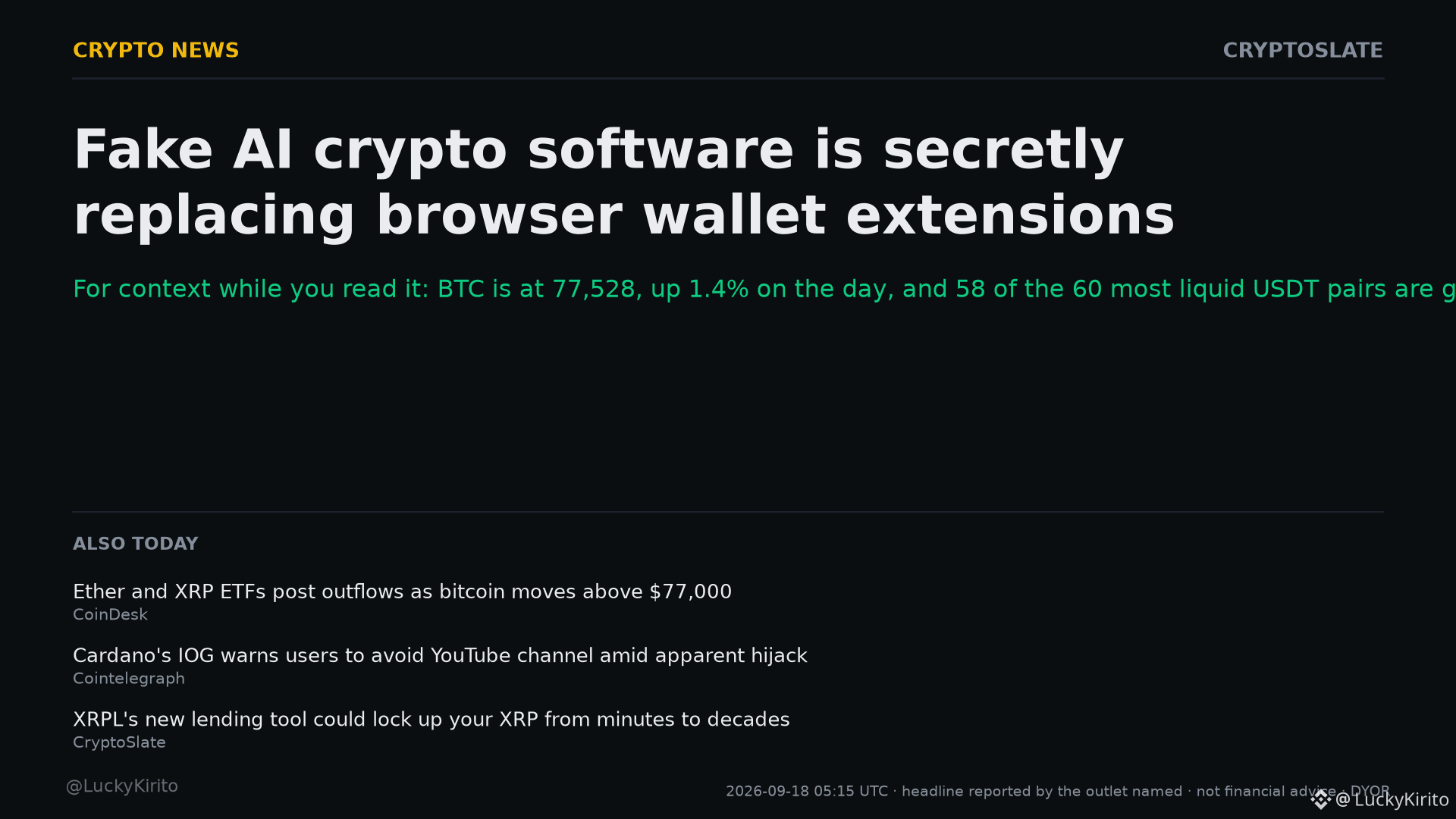
Out of CryptoSlate in the last hour:
Fake AI crypto software is secretly replacing browser wallet extensions
For context while you read it: BTC is at 77,528, up 1.4% on the day, and 58 of the 60 most liquid USDT pairs are green.
Worth reading in full at the source before drawing conclusions from a single line.
#Write2Earn #CryptoMarkets #Web3 #Altcoins
Automated technical analysis, not financial advice. I am not responsible for your trades. DYOR.
Out of CryptoSlate in the last hour:
Fake AI crypto software is secretly replacing browser wallet extensions
For context while you read it: BTC is at 77,528, up 1.4% on the day, and 58 of the 60 most liquid USDT pairs are green.
Worth reading in full at the source before drawing conclusions from a single line.
#Write2Earn #CryptoMarkets #Web3 #Altcoins
Automated technical analysis, not financial advice. I am not responsible for your trades. DYOR.
Fake AI crypto software is secretly replacing browser wallet extensions
For context while you read it: BTC is at 77,528, up 1.4% on the day, and 58 of the 60 most liquid USDT pairs are green.
Worth reading in full at the source before drawing conclusions from a single line.
#Write2Earn #CryptoMarkets #Web3 #Altcoins
Automated technical analysis, not financial advice. I am not responsible for your trades. DYOR.
10

·
--
Bullish
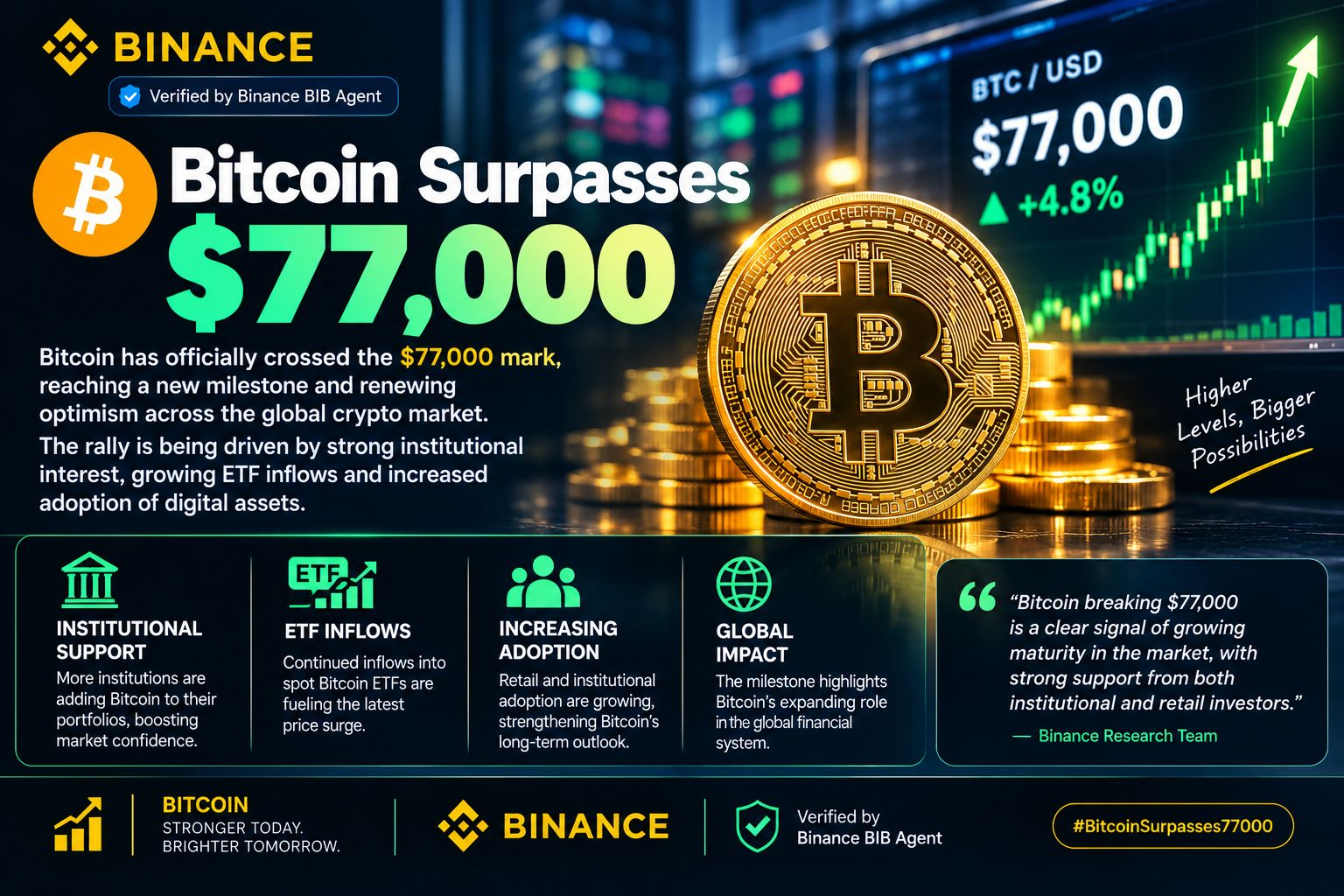
#BitcoinSurpasses$77000
$77K Becomes a Key Bitcoin Market Level
Bitcoin's move above $77,000 has placed the level back in focus for market participants.
Binance market reporting showed BTC reaching approximately $77,121 on September 17, while other recent market reports have placed Bitcoin near the $76,000-$78,000 area during periods of volatility.
That makes the $77,000 area useful as a reference point when describing recent price action, but it should not be treated as a guaranteed support or resistance level. Actual market behavior depends on trading volume, liquidity and new information.
The immediate story is therefore about Bitcoin reclaiming a major round-number threshold—not about predicting its next move.
#BitcoinSurpasses77000 #BTC #CryptoMarkets
$BTC
{future}(BTCUSDT)
$AVA
{future}(AVAUSDT)
$ARB
{future}(ARBUSDT)
#BitcoinSurpasses$77000
$77K Becomes a Key Bitcoin Market Level
Bitcoin's move above $77,000 has placed the level back in focus for market participants.
Binance market reporting showed BTC reaching approximately $77,121 on September 17, while other recent market reports have placed Bitcoin near the $76,000-$78,000 area during periods of volatility.
That makes the $77,000 area useful as a reference point when describing recent price action, but it should not be treated as a guaranteed support or resistance level. Actual market behavior depends on trading volume, liquidity and new information.
The immediate story is therefore about Bitcoin reclaiming a major round-number threshold—not about predicting its next move.
#BitcoinSurpasses77000 #BTC #CryptoMarkets
$BTC
$AVA
$ARB
$77K Becomes a Key Bitcoin Market Level
Bitcoin's move above $77,000 has placed the level back in focus for market participants.
Binance market reporting showed BTC reaching approximately $77,121 on September 17, while other recent market reports have placed Bitcoin near the $76,000-$78,000 area during periods of volatility.
That makes the $77,000 area useful as a reference point when describing recent price action, but it should not be treated as a guaranteed support or resistance level. Actual market behavior depends on trading volume, liquidity and new information.
The immediate story is therefore about Bitcoin reclaiming a major round-number threshold—not about predicting its next move.
#BitcoinSurpasses77000 #BTC #CryptoMarkets
$BTC
$AVA
$ARB
5
·
--
Mid-caps are running hard while majors consolidate 🔥
$ONE exploded 73% to 0.00178 on 37.1M USDT — that's parabolic momentum in a sharded Layer-1 that's been dormant for months, and the kind of breakout that signals rotation into forgotten infrastructure plays. AVA matched the energy with a 71% surge to 0.2665 on 26M volume, while NEAR carved out the most credible move of the trio — up 18% to 3.155 on a thick 224M USDT, showing institutional participation behind the rally. BTC and ETH are consolidating near flat, which tells you risk appetite is flowing downhill into small and mid-cap alts.
When low-float names go parabolic on thickening volume, it's either the start of a sector rotation or late-stage retail FOMO. NEAR's volume profile suggests the former — the others need confirmation. Watch how these hold into the next four-hour close.
Which breakout looks most durable to you — the parabolic micro-caps or NEAR's institutional tape? 👀
#NEAR #Bitcoin #Harmony #CryptoMarkets
Mid-caps are running hard while majors consolidate 🔥
$ONE exploded 73% to 0.00178 on 37.1M USDT — that's parabolic momentum in a sharded Layer-1 that's been dormant for months, and the kind of breakout that signals rotation into forgotten infrastructure plays. AVA matched the energy with a 71% surge to 0.2665 on 26M volume, while NEAR carved out the most credible move of the trio — up 18% to 3.155 on a thick 224M USDT, showing institutional participation behind the rally. BTC and ETH are consolidating near flat, which tells you risk appetite is flowing downhill into small and mid-cap alts.
When low-float names go parabolic on thickening volume, it's either the start of a sector rotation or late-stage retail FOMO. NEAR's volume profile suggests the former — the others need confirmation. Watch how these hold into the next four-hour close.
Which breakout looks most durable to you — the parabolic micro-caps or NEAR's institutional tape? 👀
#NEAR #Bitcoin #Harmony #CryptoMarkets
$ONE exploded 73% to 0.00178 on 37.1M USDT — that's parabolic momentum in a sharded Layer-1 that's been dormant for months, and the kind of breakout that signals rotation into forgotten infrastructure plays. AVA matched the energy with a 71% surge to 0.2665 on 26M volume, while NEAR carved out the most credible move of the trio — up 18% to 3.155 on a thick 224M USDT, showing institutional participation behind the rally. BTC and ETH are consolidating near flat, which tells you risk appetite is flowing downhill into small and mid-cap alts.
When low-float names go parabolic on thickening volume, it's either the start of a sector rotation or late-stage retail FOMO. NEAR's volume profile suggests the former — the others need confirmation. Watch how these hold into the next four-hour close.
Which breakout looks most durable to you — the parabolic micro-caps or NEAR's institutional tape? 👀
#NEAR #Bitcoin #Harmony #CryptoMarkets
250
·
--
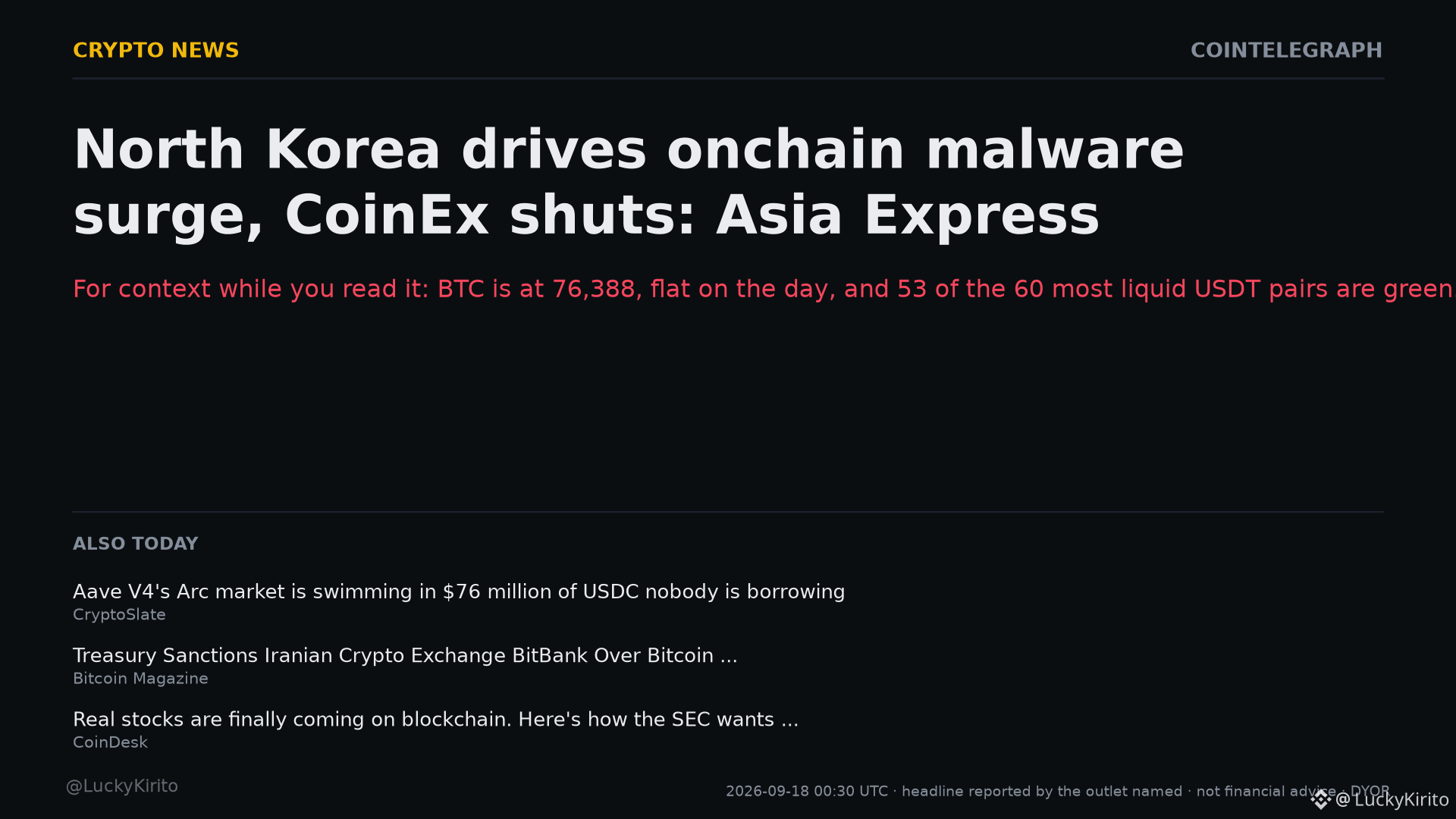
Cointelegraph is reporting this in the last hour:
North Korea drives onchain malware surge, CoinEx shuts: Asia Express
For context while you read it: BTC is at 76,388, flat on the day, and 53 of the 60 most liquid USDT pairs are green.
News like this usually shows up in volume before it shows up in trend. Watch the volume first.
#Write2Earn #MarketPulse #CryptoMarkets #Web3
Automated technical analysis, not financial advice. I am not responsible for your trades. DYOR.
Cointelegraph is reporting this in the last hour:
North Korea drives onchain malware surge, CoinEx shuts: Asia Express
For context while you read it: BTC is at 76,388, flat on the day, and 53 of the 60 most liquid USDT pairs are green.
News like this usually shows up in volume before it shows up in trend. Watch the volume first.
#Write2Earn #MarketPulse #CryptoMarkets #Web3
Automated technical analysis, not financial advice. I am not responsible for your trades. DYOR.
North Korea drives onchain malware surge, CoinEx shuts: Asia Express
For context while you read it: BTC is at 76,388, flat on the day, and 53 of the 60 most liquid USDT pairs are green.
News like this usually shows up in volume before it shows up in trend. Watch the volume first.
#Write2Earn #MarketPulse #CryptoMarkets #Web3
Automated technical analysis, not financial advice. I am not responsible for your trades. DYOR.
48

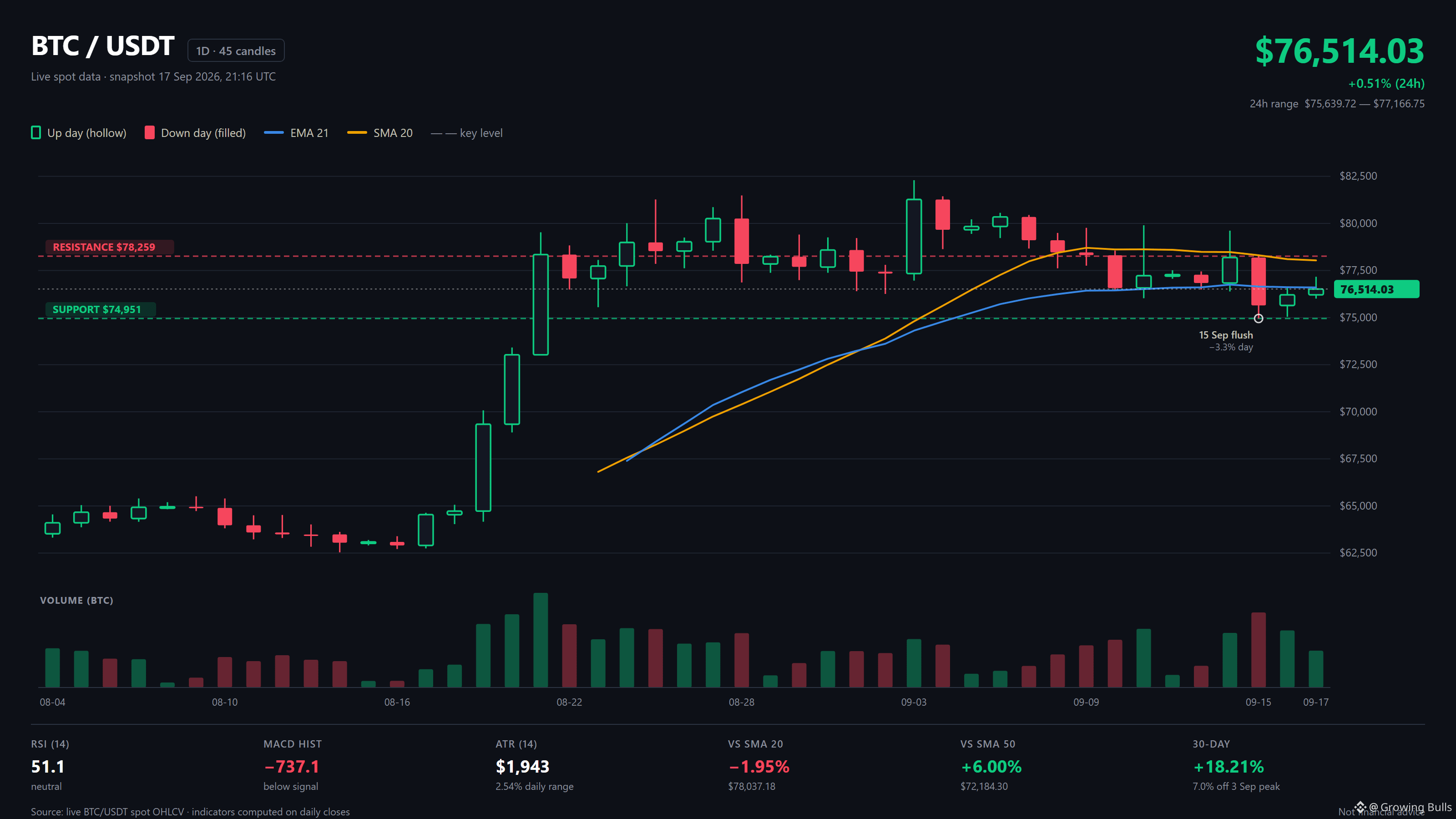
$BTC $76,514.03 (+0.51% / 24h)
Momentum rolled over. Structure still intact.
DAILY READ
RSI(14) 51.1 - neutral, no divergence
MACD hist -737 - below signal
Below SMA20 ($78,037) / above SMA50 ($72,184)
ATR(14) $1,943 = 2.54% daily range
Price is pinned between a flattening SMA20 above and a rising SMA50 below. That is compression, not a trend.
LEVELS
Resistance $78,259 - the 15 Sep open and SMA20 zone
Support $74,951 - the 15 Sep flush low, defended on 3,729 BTC, heaviest volume in two weeks
A daily close above $78,259 on rising volume says the flush was a shakeout. A close below $74,951 opens the path to $73K.
Up 18.2% over 30 days, flat over the last 7. Range until one side breaks.
Not financial advice. DYOR.
#Bitcoin #BTC #TechnicalAnalysis #CryptoMarkets
$BTC $76,514.03 (+0.51% / 24h)
Momentum rolled over. Structure still intact.
DAILY READ
RSI(14) 51.1 - neutral, no divergence
MACD hist -737 - below signal
Below SMA20 ($78,037) / above SMA50 ($72,184)
ATR(14) $1,943 = 2.54% daily range
Price is pinned between a flattening SMA20 above and a rising SMA50 below. That is compression, not a trend.
LEVELS
Resistance $78,259 - the 15 Sep open and SMA20 zone
Support $74,951 - the 15 Sep flush low, defended on 3,729 BTC, heaviest volume in two weeks
A daily close above $78,259 on rising volume says the flush was a shakeout. A close below $74,951 opens the path to $73K.
Up 18.2% over 30 days, flat over the last 7. Range until one side breaks.
Not financial advice. DYOR.
#Bitcoin #BTC #TechnicalAnalysis #CryptoMarkets
Momentum rolled over. Structure still intact.
DAILY READ
RSI(14) 51.1 - neutral, no divergence
MACD hist -737 - below signal
Below SMA20 ($78,037) / above SMA50 ($72,184)
ATR(14) $1,943 = 2.54% daily range
Price is pinned between a flattening SMA20 above and a rising SMA50 below. That is compression, not a trend.
LEVELS
Resistance $78,259 - the 15 Sep open and SMA20 zone
Support $74,951 - the 15 Sep flush low, defended on 3,729 BTC, heaviest volume in two weeks
A daily close above $78,259 on rising volume says the flush was a shakeout. A close below $74,951 opens the path to $73K.
Up 18.2% over 30 days, flat over the last 7. Range until one side breaks.
Not financial advice. DYOR.
#Bitcoin #BTC #TechnicalAnalysis #CryptoMarkets
52
Article
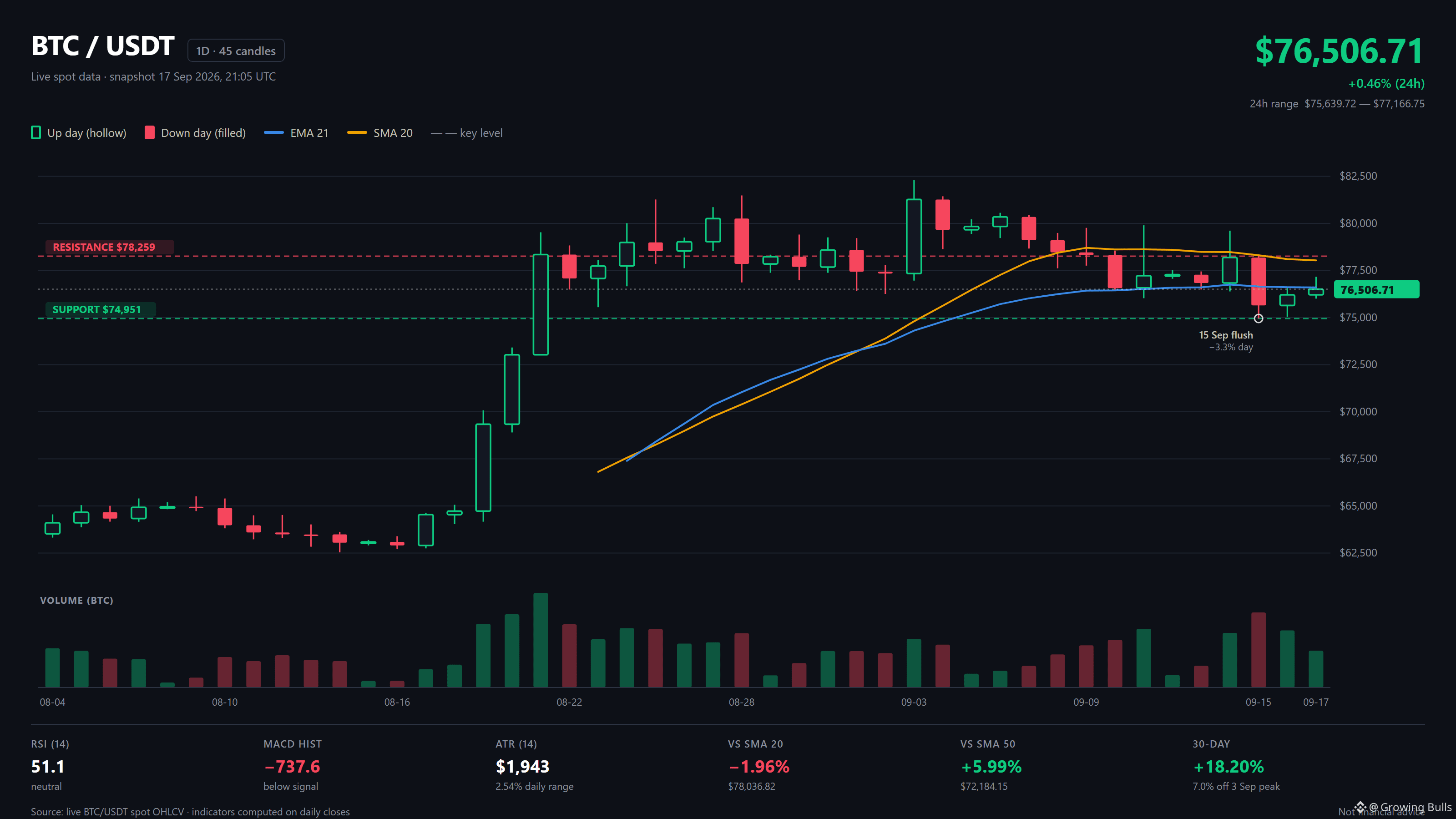
BTC at a Crossroads: Momentum Rolls Over, Structure HoldsBTC is holding $76.5K while its short-term momentum quietly rolls over. Here is what the live data actually says.
SNAPSHOT (17 Sep 2026, 21:05 UTC)
Price: $76,506.71 (+0.46% / 24h)
24h range: $75,639.72 - $77,166.75
24h spot volume: ~2,001 BTC (~$153M)
WHERE WE ARE
BTC is consolidating in the upper half of the range it built after the 19-21 Aug breakout, which carried price from ~$64.7K to ~$78.3K in three sessions. The 3 Sep spike to $82,292 is still the local high. We sit 7.0% below it.
DAILY TECHNICALS
RSI(14): 51.1 - dead neutral, no divergence
MACD: 875 vs signal 1,613, histogram -738 - momentum has rolled over
Price vs SMA20 ($78,036.82): -1.96%, below
Price vs SMA50 ($72,184.15): +5.99%, above
ATR(14): $1,943, a 2.54% average daily range
The read: short-term momentum is negative while the medium-term trend is still intact. Price is pinned between a flattening SMA20 above and a rising SMA50 below. That is compression, not a trend.
LEVELS THAT MATTER
Resistance $78,259 - the 15 Sep open and the SMA20 zone. A daily close above it flips the short-term structure back up.
Support $74,951 - the 15 Sep flush low. That candle fell 3.3% on 3,729 BTC, the heaviest volume in two weeks, and buyers defended it the next session.
Lose $74,951 and the next real shelf is the ~$73,000 breakout base from 20 Aug.
MARKET CONTEXT
Total crypto market cap: $2.63T (-1.54% / 24h)
BTC dominance: 58.16%
BTC is up 18.2% over 30 days but flat over the last 7 (-0.08%). The trend gave back its momentum, not its structure.
WHAT I AM WATCHING
A daily close above $78,259 on expanding volume would argue the 15 Sep flush was a shakeout rather than a top. A daily close below $74,951 opens the path toward $73K. Until one of those resolves, this is a range - and ranges reward patience over conviction.
Not financial advice. Always do your own research.
$BTC #Bitcoin #BTC #TechnicalAnalysis #CryptoMarkets
BTC at a Crossroads: Momentum Rolls Over, Structure Holds
BTC is holding $76.5K while its short-term momentum quietly rolls over. Here is what the live data actually says.
SNAPSHOT (17 Sep 2026, 21:05 UTC)
Price: $76,506.71 (+0.46% / 24h)
24h range: $75,639.72 - $77,166.75
24h spot volume: ~2,001 BTC (~$153M)
WHERE WE ARE
BTC is consolidating in the upper half of the range it built after the 19-21 Aug breakout, which carried price from ~$64.7K to ~$78.3K in three sessions. The 3 Sep spike to $82,292 is still the local high. We sit 7.0% below it.
DAILY TECHNICALS
RSI(14): 51.1 - dead neutral, no divergence
MACD: 875 vs signal 1,613, histogram -738 - momentum has rolled over
Price vs SMA20 ($78,036.82): -1.96%, below
Price vs SMA50 ($72,184.15): +5.99%, above
ATR(14): $1,943, a 2.54% average daily range
The read: short-term momentum is negative while the medium-term trend is still intact. Price is pinned between a flattening SMA20 above and a rising SMA50 below. That is compression, not a trend.
LEVELS THAT MATTER
Resistance $78,259 - the 15 Sep open and the SMA20 zone. A daily close above it flips the short-term structure back up.
Support $74,951 - the 15 Sep flush low. That candle fell 3.3% on 3,729 BTC, the heaviest volume in two weeks, and buyers defended it the next session.
Lose $74,951 and the next real shelf is the ~$73,000 breakout base from 20 Aug.
MARKET CONTEXT
Total crypto market cap: $2.63T (-1.54% / 24h)
BTC dominance: 58.16%
BTC is up 18.2% over 30 days but flat over the last 7 (-0.08%). The trend gave back its momentum, not its structure.
WHAT I AM WATCHING
A daily close above $78,259 on expanding volume would argue the 15 Sep flush was a shakeout rather than a top. A daily close below $74,951 opens the path toward $73K. Until one of those resolves, this is a range - and ranges reward patience over conviction.
Not financial advice. Always do your own research.
$BTC #Bitcoin #BTC #TechnicalAnalysis #CryptoMarkets
SNAPSHOT (17 Sep 2026, 21:05 UTC)
Price: $76,506.71 (+0.46% / 24h)
24h range: $75,639.72 - $77,166.75
24h spot volume: ~2,001 BTC (~$153M)
WHERE WE ARE
BTC is consolidating in the upper half of the range it built after the 19-21 Aug breakout, which carried price from ~$64.7K to ~$78.3K in three sessions. The 3 Sep spike to $82,292 is still the local high. We sit 7.0% below it.
DAILY TECHNICALS
RSI(14): 51.1 - dead neutral, no divergence
MACD: 875 vs signal 1,613, histogram -738 - momentum has rolled over
Price vs SMA20 ($78,036.82): -1.96%, below
Price vs SMA50 ($72,184.15): +5.99%, above
ATR(14): $1,943, a 2.54% average daily range
The read: short-term momentum is negative while the medium-term trend is still intact. Price is pinned between a flattening SMA20 above and a rising SMA50 below. That is compression, not a trend.
LEVELS THAT MATTER
Resistance $78,259 - the 15 Sep open and the SMA20 zone. A daily close above it flips the short-term structure back up.
Support $74,951 - the 15 Sep flush low. That candle fell 3.3% on 3,729 BTC, the heaviest volume in two weeks, and buyers defended it the next session.
Lose $74,951 and the next real shelf is the ~$73,000 breakout base from 20 Aug.
MARKET CONTEXT
Total crypto market cap: $2.63T (-1.54% / 24h)
BTC dominance: 58.16%
BTC is up 18.2% over 30 days but flat over the last 7 (-0.08%). The trend gave back its momentum, not its structure.
WHAT I AM WATCHING
A daily close above $78,259 on expanding volume would argue the 15 Sep flush was a shakeout rather than a top. A daily close below $74,951 opens the path toward $73K. Until one of those resolves, this is a range - and ranges reward patience over conviction.
Not financial advice. Always do your own research.
$BTC #Bitcoin #BTC #TechnicalAnalysis #CryptoMarkets
77
·
--
🔥 CFTC Opens Door for Crypto Apps to Offer Regulated Derivatives Access.
In the no-action letter, the agencys Market Participants Division said passive software providers can avoid registering as introducing brokers if they limit their role to front-end software and meet a list of conditions. That could matter for wallet developers and trading apps because broker registration can bring significant compliance requirements. The CFTC letter gives them a path to connect users to registered derivatives markets without acting as the intermediary handling the trade. The Division believes that a no-action position for all [passive software providers] on substantially the same terms as that provided to the software developer in Letter 26-09 is warranted, the CFTC letter said.
The letter covers software that lets users view market data, product offerings, and position information, and submit orders for CFTC-regulated derivatives, including event contracts and perpetual contracts, directly to registered entities. It extends relief first granted in March to Phantom Technologies, whose self-custody wallet was cleared to connect users to regulated derivatives markets without registering as a broker. Under Thursdays letter, staff will not recommend enforcement against passive software providers, or their relevant personnel, for failing to register as introducing brokers or associated persons if they stay within the covered activities and meet the letters conditions. Those conditions include user disclosures about relationships with registered entities, conflicts and fees; marketing policies; recordkeeping; insolvency or bankruptcy notices; and a filing agreeing to the terms.
❓ What's your take is this the start of a bigger move or just noise? Drop it below.
$BTC $ETH
#AICryptoIntegration #CryptoWallet #CryptoMarkets
🔥 CFTC Opens Door for Crypto Apps to Offer Regulated Derivatives Access.
In the no-action letter, the agencys Market Participants Division said passive software providers can avoid registering as introducing brokers if they limit their role to front-end software and meet a list of conditions. That could matter for wallet developers and trading apps because broker registration can bring significant compliance requirements. The CFTC letter gives them a path to connect users to registered derivatives markets without acting as the intermediary handling the trade. The Division believes that a no-action position for all [passive software providers] on substantially the same terms as that provided to the software developer in Letter 26-09 is warranted, the CFTC letter said.
The letter covers software that lets users view market data, product offerings, and position information, and submit orders for CFTC-regulated derivatives, including event contracts and perpetual contracts, directly to registered entities. It extends relief first granted in March to Phantom Technologies, whose self-custody wallet was cleared to connect users to regulated derivatives markets without registering as a broker. Under Thursdays letter, staff will not recommend enforcement against passive software providers, or their relevant personnel, for failing to register as introducing brokers or associated persons if they stay within the covered activities and meet the letters conditions. Those conditions include user disclosures about relationships with registered entities, conflicts and fees; marketing policies; recordkeeping; insolvency or bankruptcy notices; and a filing agreeing to the terms.
❓ What's your take is this the start of a bigger move or just noise? Drop it below.
$BTC $ETH
#AICryptoIntegration #CryptoWallet #CryptoMarkets
In the no-action letter, the agencys Market Participants Division said passive software providers can avoid registering as introducing brokers if they limit their role to front-end software and meet a list of conditions. That could matter for wallet developers and trading apps because broker registration can bring significant compliance requirements. The CFTC letter gives them a path to connect users to registered derivatives markets without acting as the intermediary handling the trade. The Division believes that a no-action position for all [passive software providers] on substantially the same terms as that provided to the software developer in Letter 26-09 is warranted, the CFTC letter said.
The letter covers software that lets users view market data, product offerings, and position information, and submit orders for CFTC-regulated derivatives, including event contracts and perpetual contracts, directly to registered entities. It extends relief first granted in March to Phantom Technologies, whose self-custody wallet was cleared to connect users to regulated derivatives markets without registering as a broker. Under Thursdays letter, staff will not recommend enforcement against passive software providers, or their relevant personnel, for failing to register as introducing brokers or associated persons if they stay within the covered activities and meet the letters conditions. Those conditions include user disclosures about relationships with registered entities, conflicts and fees; marketing policies; recordkeeping; insolvency or bankruptcy notices; and a filing agreeing to the terms.
❓ What's your take is this the start of a bigger move or just noise? Drop it below.
$BTC $ETH
#AICryptoIntegration #CryptoWallet #CryptoMarkets
31
·
--
The tape is fracturing between privacy plays and small-cap parabolic runs 📊
ZEC is absorbing serious institutional attention — up 9.10% to 1,458 on a staggering 725.5M USDT, the second-highest volume across all pairs behind only $BTC. That's not retail momentum; that's coordinated flow rotating into privacy infrastructure while majors drift sideways. Meanwhile, ONE detonated 168% higher to 0.00180 on 28.7M volume — classic low-float parabolic acceleration with heavy speculative chase. NEAR added 19.16% on 183M volume, showing mid-cap strength layered between the extremes.
The bifurcation is clear: either you're getting size in established privacy coins or you're hunting beta in small-cap breakouts. Range-bound majors are offering neither right now.
What's your read — is ZEC's volume signaling a sustained rotation, or just a short-term positioning squeeze? 🔍
#ZEC #Binance #CryptoTrending #CryptoMarkets
The tape is fracturing between privacy plays and small-cap parabolic runs 📊
ZEC is absorbing serious institutional attention — up 9.10% to 1,458 on a staggering 725.5M USDT, the second-highest volume across all pairs behind only $BTC . That's not retail momentum; that's coordinated flow rotating into privacy infrastructure while majors drift sideways. Meanwhile, ONE detonated 168% higher to 0.00180 on 28.7M volume — classic low-float parabolic acceleration with heavy speculative chase. NEAR added 19.16% on 183M volume, showing mid-cap strength layered between the extremes.
The bifurcation is clear: either you're getting size in established privacy coins or you're hunting beta in small-cap breakouts. Range-bound majors are offering neither right now.
What's your read — is ZEC's volume signaling a sustained rotation, or just a short-term positioning squeeze? 🔍
#ZEC #Binance #CryptoTrending #CryptoMarkets
ZEC is absorbing serious institutional attention — up 9.10% to 1,458 on a staggering 725.5M USDT, the second-highest volume across all pairs behind only $BTC . That's not retail momentum; that's coordinated flow rotating into privacy infrastructure while majors drift sideways. Meanwhile, ONE detonated 168% higher to 0.00180 on 28.7M volume — classic low-float parabolic acceleration with heavy speculative chase. NEAR added 19.16% on 183M volume, showing mid-cap strength layered between the extremes.
The bifurcation is clear: either you're getting size in established privacy coins or you're hunting beta in small-cap breakouts. Range-bound majors are offering neither right now.
What's your read — is ZEC's volume signaling a sustained rotation, or just a short-term positioning squeeze? 🔍
#ZEC #Binance #CryptoTrending #CryptoMarkets
360

#CryptoMarkets
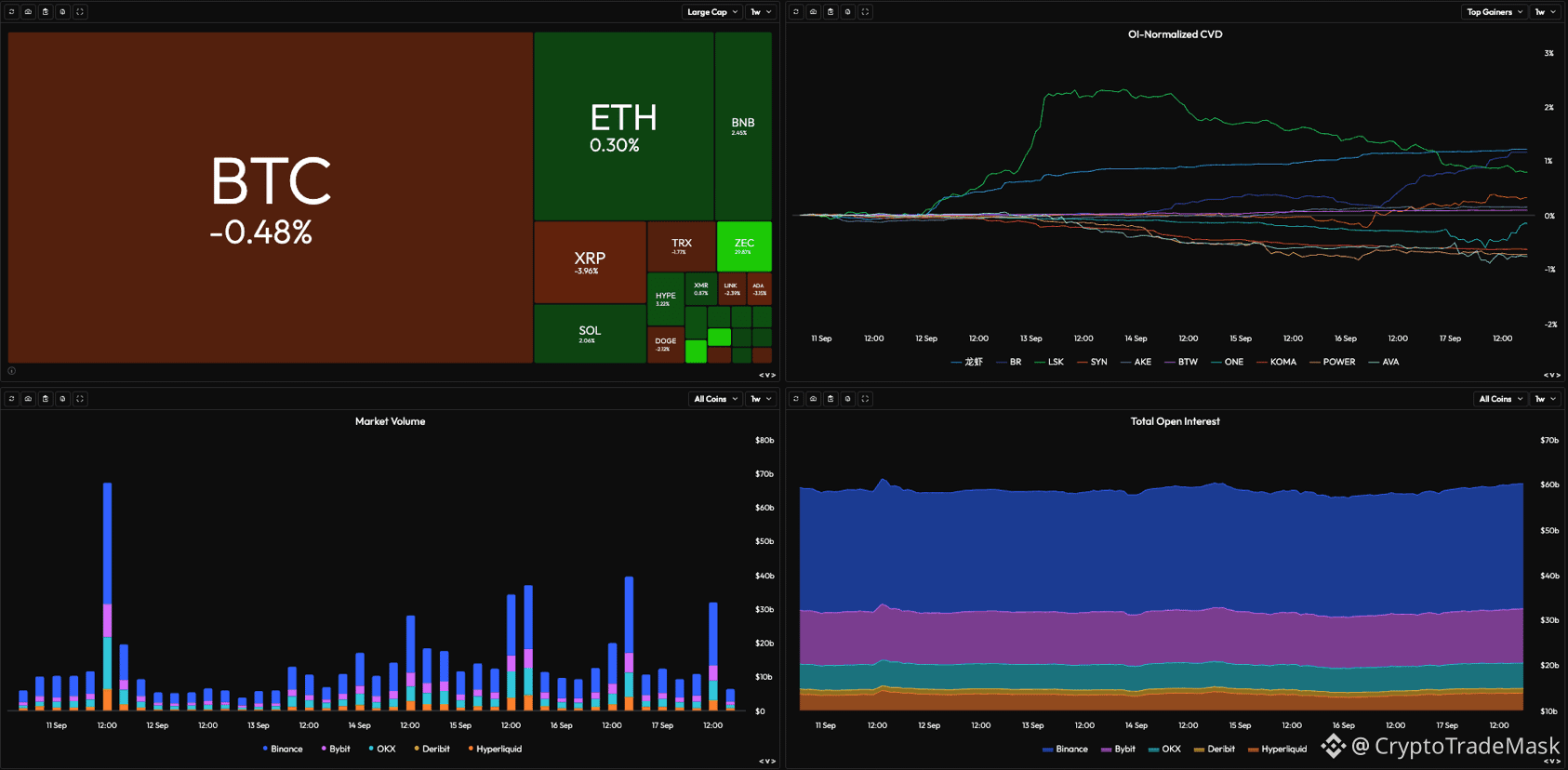
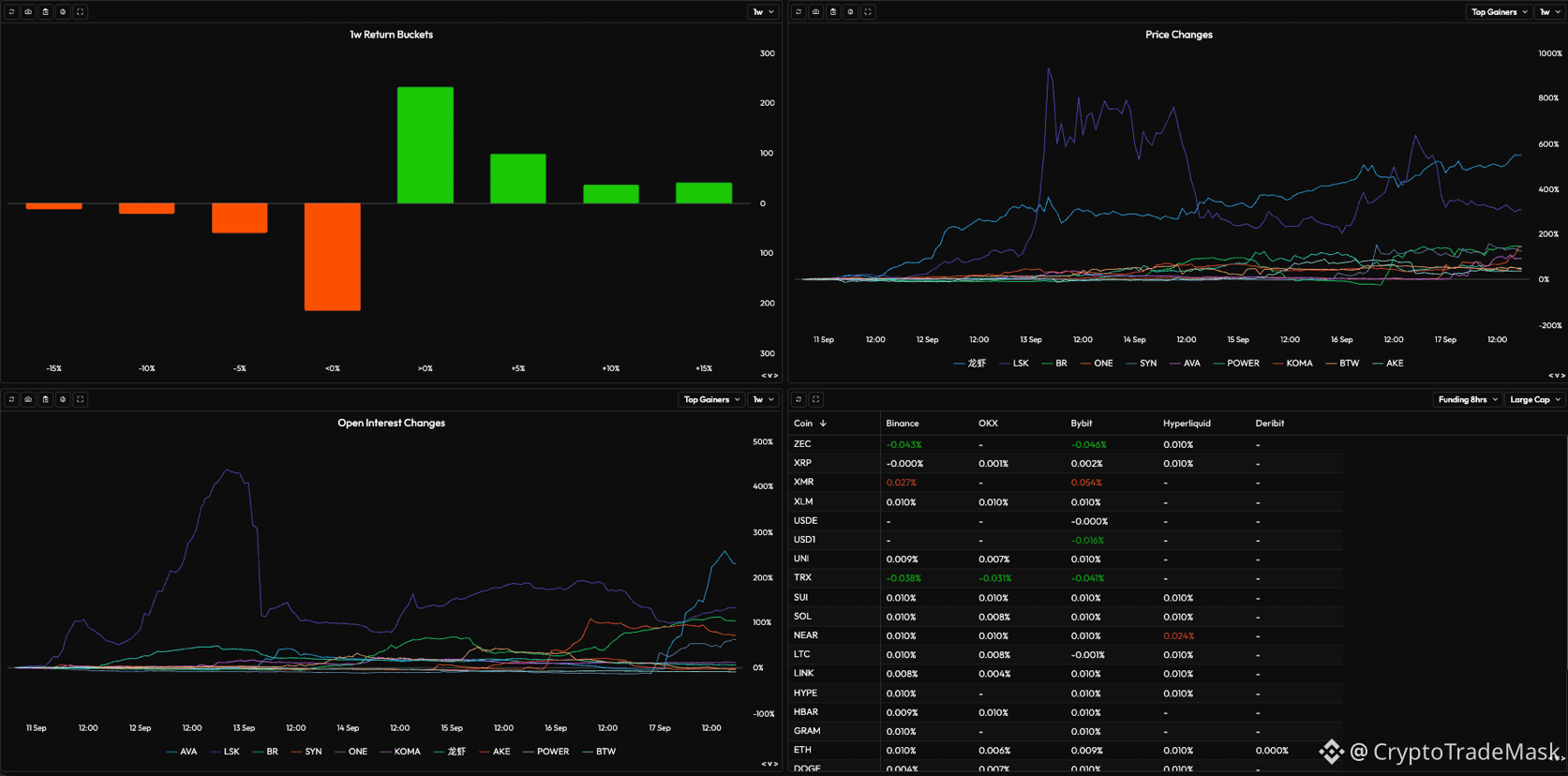
📊 Market Analysis: BTC Consolidation and a Local Surge in Altcoins
Recent metrics (September 11–17) reveal an interesting picture: the market is accumulating liquidity in preparation for the next major move.
🔑 Breaking down the key indicators:
1️⃣ $BTC & $ETH : Calm Before the Storm
Bitcoin (-0.48%) is trading sideways, while ETH (+0.30%) shows signs of mild support.
Most altcoins finished the week in the green (+5% to +10%), indicating overall market resilience.
2️⃣ Trading Volume and Open Interest (OI)
Peak trading volumes occurred on September 11–12 (exceeding $70B). Meanwhile, Open Interest remains stable above $60B and continues to rise.
What does this mean? Capital is not leaving the market; instead, leveraged positions continue to build up.
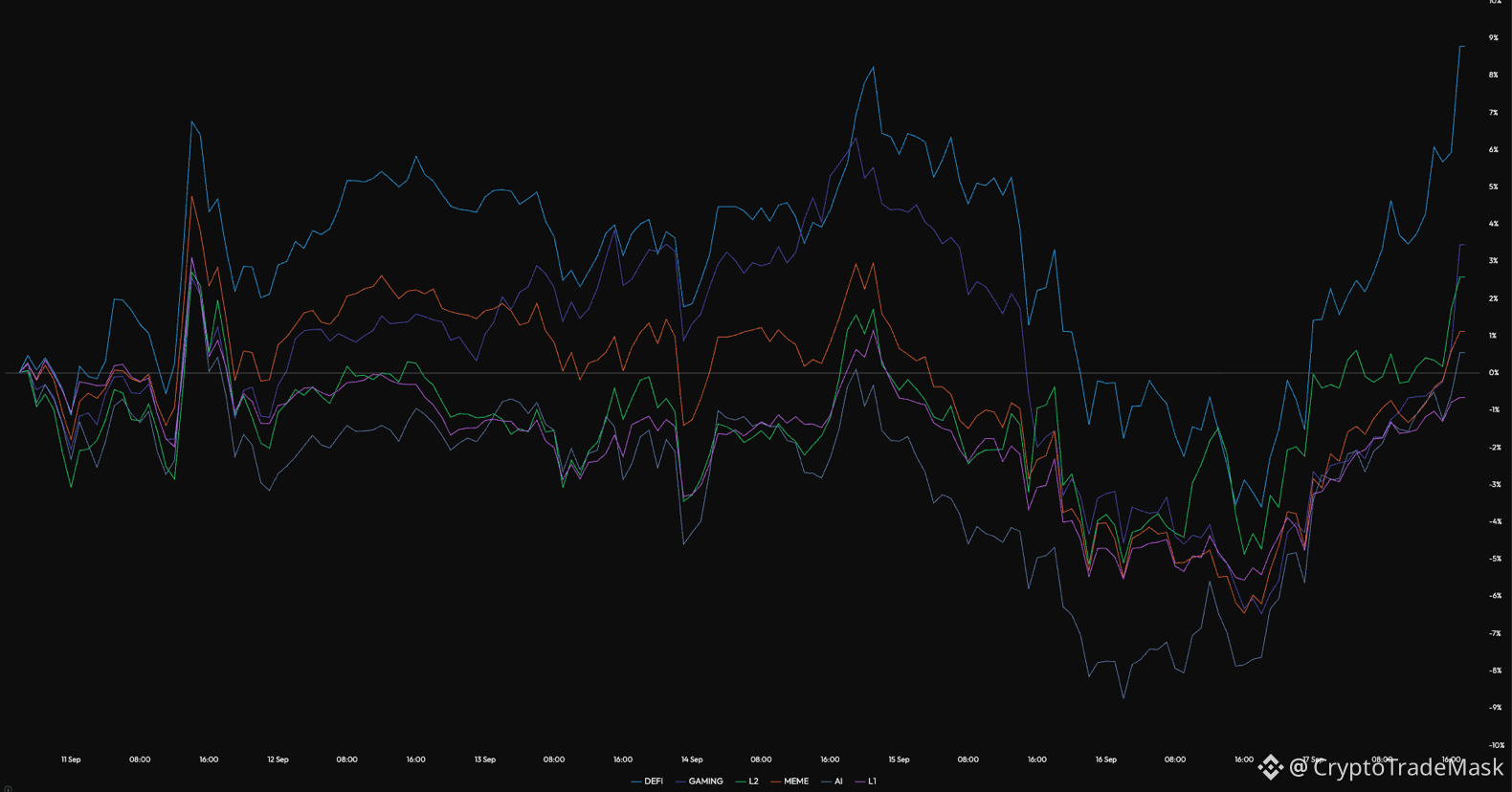
3️⃣ Sector-Specific Momentum
On September 17, all sectors saw a synchronized reversal following a local dip.
The AI, Meme, and L1 sectors are showing the strongest recovery momentum (gaining up to +8%–9% from their lows).
Funding rates across most exchanges remain neutral (~0.010%)—there is currently no sign of long-position overheating.
📊 Summary and Outlook:
We are witnessing a classic accumulation phase. While BTC moves sideways, activity has shifted to altcoins, where buyers are actively "buying the dip."
⚠️ Risks: High Open Interest means there remains a significant probability of long/short squeezes should BTC experience a sharp price movement. Stick to risk management and don't overleverage!
{future}(ETHUSDT)
{future}(BTCUSDT)
#CryptoMarkets
📊 Market Analysis: BTC Consolidation and a Local Surge in Altcoins
Recent metrics (September 11–17) reveal an interesting picture: the market is accumulating liquidity in preparation for the next major move.
🔑 Breaking down the key indicators:
1️⃣ $BTC & $ETH : Calm Before the Storm
Bitcoin (-0.48%) is trading sideways, while ETH (+0.30%) shows signs of mild support.
Most altcoins finished the week in the green (+5% to +10%), indicating overall market resilience.
2️⃣ Trading Volume and Open Interest (OI)
Peak trading volumes occurred on September 11–12 (exceeding $70B). Meanwhile, Open Interest remains stable above $60B and continues to rise.
What does this mean? Capital is not leaving the market; instead, leveraged positions continue to build up.
3️⃣ Sector-Specific Momentum
On September 17, all sectors saw a synchronized reversal following a local dip.
The AI, Meme, and L1 sectors are showing the strongest recovery momentum (gaining up to +8%–9% from their lows).
Funding rates across most exchanges remain neutral (~0.010%)—there is currently no sign of long-position overheating.
📊 Summary and Outlook:
We are witnessing a classic accumulation phase. While BTC moves sideways, activity has shifted to altcoins, where buyers are actively "buying the dip."
⚠️ Risks: High Open Interest means there remains a significant probability of long/short squeezes should BTC experience a sharp price movement. Stick to risk management and don't overleverage!
📊 Market Analysis: BTC Consolidation and a Local Surge in Altcoins
Recent metrics (September 11–17) reveal an interesting picture: the market is accumulating liquidity in preparation for the next major move.
🔑 Breaking down the key indicators:
1️⃣ $BTC & $ETH : Calm Before the Storm
Bitcoin (-0.48%) is trading sideways, while ETH (+0.30%) shows signs of mild support.
Most altcoins finished the week in the green (+5% to +10%), indicating overall market resilience.
2️⃣ Trading Volume and Open Interest (OI)
Peak trading volumes occurred on September 11–12 (exceeding $70B). Meanwhile, Open Interest remains stable above $60B and continues to rise.
What does this mean? Capital is not leaving the market; instead, leveraged positions continue to build up.
3️⃣ Sector-Specific Momentum
On September 17, all sectors saw a synchronized reversal following a local dip.
The AI, Meme, and L1 sectors are showing the strongest recovery momentum (gaining up to +8%–9% from their lows).
Funding rates across most exchanges remain neutral (~0.010%)—there is currently no sign of long-position overheating.
📊 Summary and Outlook:
We are witnessing a classic accumulation phase. While BTC moves sideways, activity has shifted to altcoins, where buyers are actively "buying the dip."
⚠️ Risks: High Open Interest means there remains a significant probability of long/short squeezes should BTC experience a sharp price movement. Stick to risk management and don't overleverage!
35

·
--
Verified
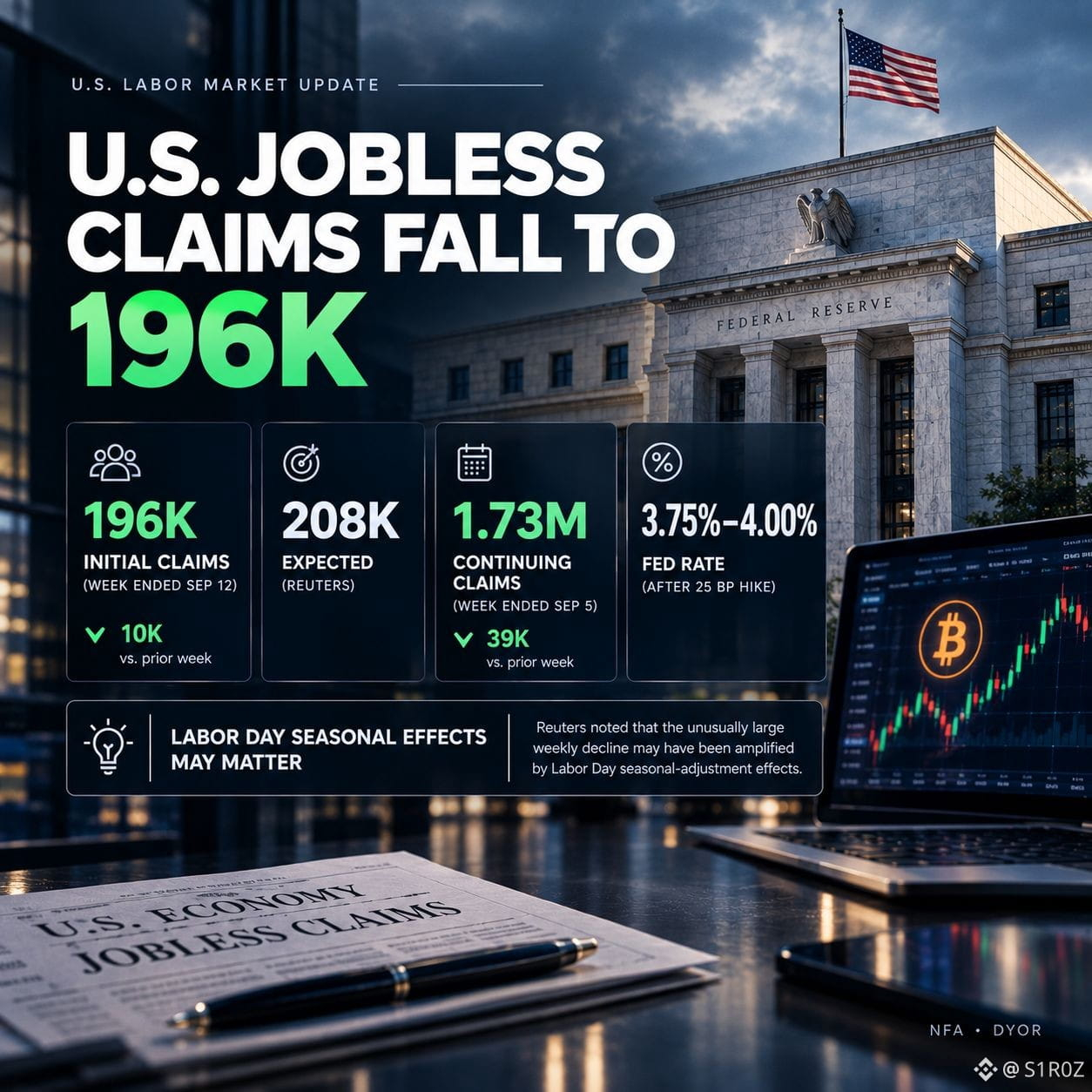
#usweeklyjoblessclaimsfallto196k
🚨 U.S. jobless claims just came in stronger than expected.
Initial claims fell 10,000 to 196,000 for the week ending September 12, below expectations of around 208,000.
Continuing claims also dropped to 1.73 million.
At first, stronger jobs data sounds bullish. But for crypto, it’s not that simple.
A resilient labor market gives the Fed less reason to rush toward easier financial conditions, especially after recently raising rates to 3.75%–4.00%.
So for $BTC, the bigger question isn't whether this number is bullish or bearish. It’s what it means for liquidity and the Fed’s next moves.
There’s a caveat too: Reuters noted that Labor Day-related seasonal effects may have amplified the weekly decline, so one report doesn't tell the whole story.
For traders, I’d watch the mix of jobs + inflation + Fed policy + liquidity.
❓Does stronger U.S. employment make you more cautious about near-term crypto liquidity?
Educational purposes only. Not financial advice. DYOR.
#USjobs #Fed #CryptoMarkets
#usweeklyjoblessclaimsfallto196k
🚨 U.S. jobless claims just came in stronger than expected.
Initial claims fell 10,000 to 196,000 for the week ending September 12, below expectations of around 208,000.
Continuing claims also dropped to 1.73 million.
At first, stronger jobs data sounds bullish. But for crypto, it’s not that simple.
A resilient labor market gives the Fed less reason to rush toward easier financial conditions, especially after recently raising rates to 3.75%–4.00%.
So for $BTC, the bigger question isn't whether this number is bullish or bearish. It’s what it means for liquidity and the Fed’s next moves.
There’s a caveat too: Reuters noted that Labor Day-related seasonal effects may have amplified the weekly decline, so one report doesn't tell the whole story.
For traders, I’d watch the mix of jobs + inflation + Fed policy + liquidity.
❓Does stronger U.S. employment make you more cautious about near-term crypto liquidity?
Educational purposes only. Not financial advice. DYOR.
#USjobs #Fed #CryptoMarkets
🚨 U.S. jobless claims just came in stronger than expected.
Initial claims fell 10,000 to 196,000 for the week ending September 12, below expectations of around 208,000.
Continuing claims also dropped to 1.73 million.
At first, stronger jobs data sounds bullish. But for crypto, it’s not that simple.
A resilient labor market gives the Fed less reason to rush toward easier financial conditions, especially after recently raising rates to 3.75%–4.00%.
So for $BTC, the bigger question isn't whether this number is bullish or bearish. It’s what it means for liquidity and the Fed’s next moves.
There’s a caveat too: Reuters noted that Labor Day-related seasonal effects may have amplified the weekly decline, so one report doesn't tell the whole story.
For traders, I’d watch the mix of jobs + inflation + Fed policy + liquidity.
❓Does stronger U.S. employment make you more cautious about near-term crypto liquidity?
Educational purposes only. Not financial advice. DYOR.
#USjobs #Fed #CryptoMarkets
19
Log in to explore more content
Join global crypto users on Binance Square
⚡️ Get latest and useful information about crypto.
💬 Trusted by the world’s largest crypto exchange.
👍 Discover real insights from verified creators.
Email / Phone number
Trending Topics
1
#NEARSurges26%Past$3.45
4,512 views
59 Discussing
2
#BOJHikesRatesTo31YearHigh
11,584 views
375 Discussing
3
#ChainlinkPowersBottomlinePaymentPlatform
15,398 views
418 Discussing
4
#DtcpayCompletes$25MSeriesA
217 views
16 Discussing
5
#InjectiveLaunchesINJOnSolana
501 views
43 Discussing
6
#StellarActivatesProtocol28At211TPS
23,729 views
539 Discussing
7
#SECGrantsInnovationExemptionForTokenizedStocks
19,736 views
437 Discussing
8
#XRPGains3%AsRippleAddsMPPSupport
17,284 views
337 Discussing
9
#SPGlobalToAcquireOpenZeppelin
9,859 views
215 Discussing
10
#WorldLaunchesSelfCustodyAppIn150Countries
5,579 views
121 Discussing