

#southkorea
southkorea
843,584 views
2,039 Discussing
Hot
Latest

·
--
🚨🔥 AI CHIP BOOM IS BACK — SOUTH KOREA JUST SENT A MASSIVE SIGNAL! 🇰🇷💻
💥 SK HYNIX PROFITS EXPLODE MORE THAN 7X!
The AI race is heating up again, and semiconductor stocks are grabbing the spotlight! 👀
📊 WHAT JUST HAPPENED?
🔹 🇰🇷 SK Hynix reported a more than sevenfold jump in quarterly profit.
🔹 📈 South Korea’s KOSPI surged as chip stocks rallied.
🔹 💻 Micron and other semiconductor stocks gained as AI optimism returned.
🔹 🇺🇸 Investors are watching major tech earnings and the Federal Reserve’s latest rate decision.
🔥 WHY DOES THIS MATTER?
⚡ AI needs powerful chips and high-bandwidth memory.
⚡ Strong earnings could support investor confidence in the AI boom.
⚡ BUT massive AI spending raises one BIG question: Can these companies turn huge investments into lasting profits?
🎯 THE NEXT BIG MOVE?
Will AI stocks continue their rally, or are investors getting too optimistic?
👇 WHAT’S YOUR VIEW?
🟢 BULLISH — AI chip stocks have more room to run! 🚀
🔴 BEARISH — The market is pricing in too much hype! ⚠️
💬 Drop your opinion below!
#AI #Crypto #Bitcoin #SouthKorea #SKHynix #Semiconductors #StockMarket #TechNews #BinanceSquare
📰 Source: Reuters, October 28, 2026.
Market commentary, not financial advice. DYOR.
$ETH $SOL $BTC

1
105

·
--
🚨 SOUTH KOREA CRYPTO TRADING SURGES 🇰🇷📈
Crypto trading volume on South Korea’s major exchanges jumped 56.5% in one week as investors watch the ongoing crypto-tax debate.
🔥 Korean crypto activity is rising while major overseas exchange volumes declined.
#crypto #SouthKorea #Bitcoin #trading #CryptoNews
Crypto trading volume on South Korea’s major exchanges jumped 56.5% in one week as investors watch the ongoing crypto-tax debate.
🔥 Korean crypto activity is rising while major overseas exchange volumes declined.
#crypto #SouthKorea #Bitcoin #trading #CryptoNews

75

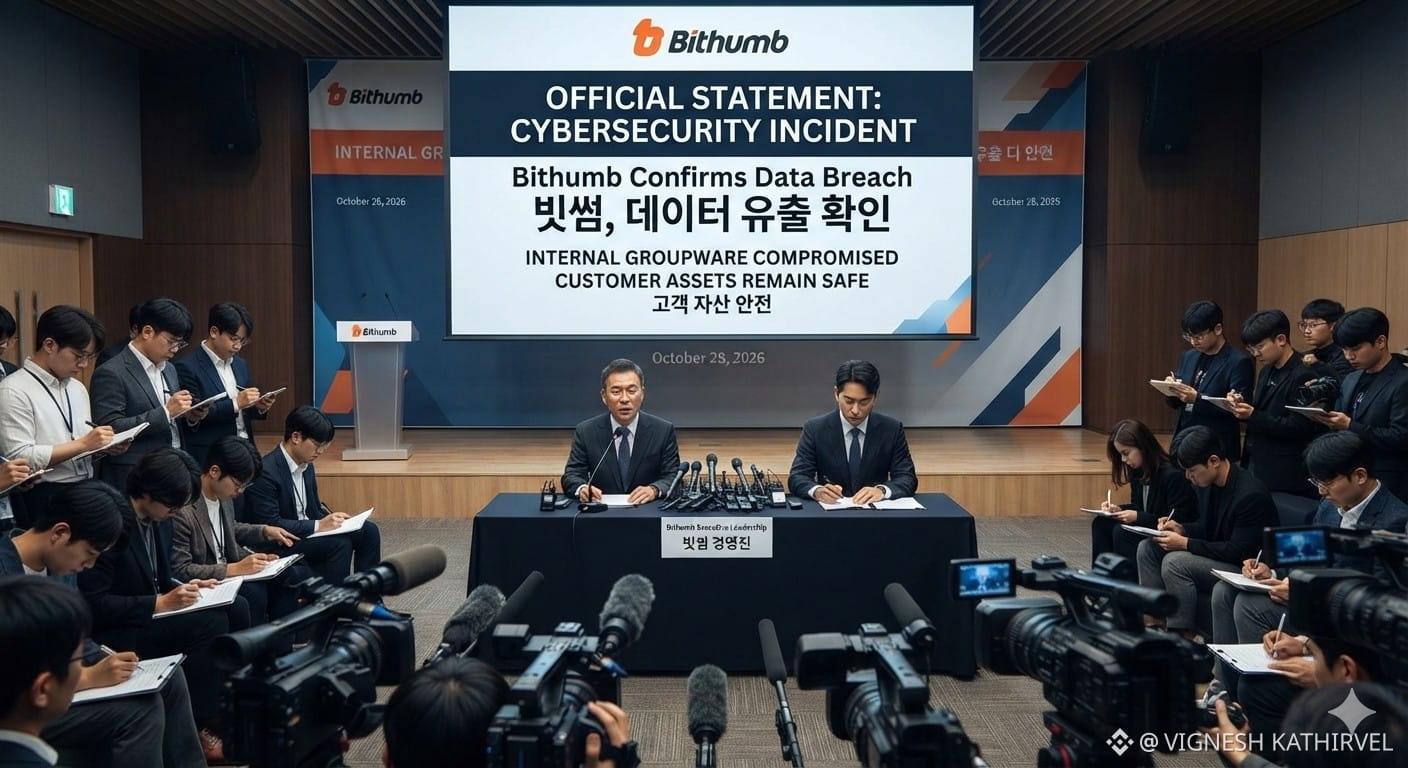
South Korea's second-largest cryptocurrency exchange, Bithumb, confirmed an unauthorized external intrusion into its internal employee mobile groupware system. The exchange stated that customer funds remain secure as the compromised network is segregated from main trading operations, amid a broader wave of cyberattacks affecting multiple South Korean financial entities.
#bitumb #SouthKorea
#bitumb #SouthKorea
1
70

·
--
South Korea eyes a 2029 start for its crypto tax, delaying implementation again.
A Blue House official confirmed on October 25 that “taxation of virtual assets is being discussed with a view to delaying implementation,” marking a fourth postponement. The most likely new start date is January 2029, when the United States is set to join the OECD’s Crypto‑Asset Reporting Framework (CARF) for data sharing.
The proposed levy is 22 % of gains above 2.5 million won (about $1,886) after acquisition costs are deducted. Lawmakers will amend the Income Tax Act during the tax‑law reform debate beginning in November, with a final decision expected between late November and early December.
A petition to postpone the tax for two years reached 50,000 signatures, warning that most crypto investors are facing heavy losses and that the tax could drive users to offshore platforms. Regulators have recently blocked 27 overseas exchanges, including KuCoin and MEXC.
Will further delays protect investors or weaken future tax compliance?
#SouthKorea #CryptoTax #OECD #VirtualAssets #FinTech

1
1
·
--
South Korea's 22% crypto tax might be pushed back again, this time to 2029 🇰🇷
Here's what's on the table:
• The tax: 22% on crypto gains above 2.5 million won per year (20% national + 2% local)
• Current start date: Jan 1, 2027, after three earlier delays
• The new bill: tax would start only after Korea begins sharing crypto data under the OECD's CARF framework. If that starts in 2027, the tax lands in 2029
The ruling Democratic Party filed the bill on Oct 16, and regulators have been meeting with the top exchanges since.
Why it matters: Korea is one of the biggest retail crypto markets in the world. Korean traders move coins like $XRP and $BTC on local exchanges, and a delay keeps that money active rather than pushing it offshore.
Should crypto gains be taxed like stocks, or is a delay the right call? 👇
#SouthKorea #CryptoTax #CryptoNews
4
·
--
🇰🇷 South Korea’s Crypto Tax Headlines: What Was Actually Confirmed?
A headline can spread quickly, but the official response matters just as much.
On October 26, South Korea’s Ministry of Finance and Economy clarified that it had not considered imposing the education tax on digital asset exchanges. The statement followed reports suggesting the tax could become relevant if exchanges were reclassified as financial businesses.
So, for now, this specific tax proposal should not be presented as a confirmed government policy.
The wider question remains: if crypto exchanges are eventually classified as financial businesses, how should existing tax rules apply to them?
For anyone following crypto regulation, the key lesson is simple: separate official statements from media reports and possible future scenarios.
What makes more sense to you: adapting existing financial tax rules for crypto exchanges, or creating a separate framework?
#CryptoRegulation #SouthKorea #CryptoPolicy

1
1

·
--
South Korea's crypto gains tax faces a fourth delay since 2020, with officials now targeting a 2029 start instead of January 2027.
The 22% tax on gains above 2.5M won remains law until parliament amends it, leaving traders in limbo on cost-basis rules for pre-tax holdings.
Will the National Assembly actually pass the delay this time?
#SouthKorea #CryptoTax $BTC
The 22% tax on gains above 2.5M won remains law until parliament amends it, leaving traders in limbo on cost-basis rules for pre-tax holdings.
Will the National Assembly actually pass the delay this time?
#SouthKorea #CryptoTax $BTC

15

·
--
Bullish
#southkoreaconsiderseducationtaxoncryptoexchanges
🚨 South Korea’s Proposed Education Tax: Could Crypto Exchanges Pass the Burden to Traders? 🇰🇷🔥
$ZEC
{future}(ZECUSDT)
🏛️ Financial Reclassification: Under the proposed Digital Asset Basic Act, South Korea is exploring reclassifying crypto exchanges as financial businesses, which would subject them to a new education tax calculated on operating revenue rather than net profits! 📊⚖️
$XRP
{future}(XRPUSDT)
💰 Heavy Corporate Burden: Preliminary estimates show major players could take a significant hit—Dunamu (operator of Upbit) faces roughly 10.2 billion won, while Bithumb could face about 3.2 billion won in potential taxes. 📉💼
$ETH
{future}(ETHUSDT)
⚡ Potential Fee Hikes: To offset these new corporate compliance costs, exchanges may choose to reduce fee discounts or increase trading fees, indirectly passing expenses down to everyday users. 💳⚠️
🌐 The Bigger Picture: While this is a tax on exchange businesses rather than direct user holdings, the final structure is still uncertain, raising concerns about whether stricter regulations could push Korean traders toward offshore platforms. 🚢🔍
Could this proposed tax squeeze retail traders and push volume away from local regulated exchanges? Let us know your thoughts below! 👇💬
#EthereumDropsBelow$2300 #BitmineAdds10452ETH #SouthKorea
#southkoreaconsiderseducationtaxoncryptoexchanges
🚨 South Korea’s Proposed Education Tax: Could Crypto Exchanges Pass the Burden to Traders? 🇰🇷🔥
$ZEC
🏛️ Financial Reclassification: Under the proposed Digital Asset Basic Act, South Korea is exploring reclassifying crypto exchanges as financial businesses, which would subject them to a new education tax calculated on operating revenue rather than net profits! 📊⚖️
$XRP
💰 Heavy Corporate Burden: Preliminary estimates show major players could take a significant hit—Dunamu (operator of Upbit) faces roughly 10.2 billion won, while Bithumb could face about 3.2 billion won in potential taxes. 📉💼
$ETH
⚡ Potential Fee Hikes: To offset these new corporate compliance costs, exchanges may choose to reduce fee discounts or increase trading fees, indirectly passing expenses down to everyday users. 💳⚠️
🌐 The Bigger Picture: While this is a tax on exchange businesses rather than direct user holdings, the final structure is still uncertain, raising concerns about whether stricter regulations could push Korean traders toward offshore platforms. 🚢🔍
Could this proposed tax squeeze retail traders and push volume away from local regulated exchanges? Let us know your thoughts below! 👇💬
#EthereumDropsBelow$2300 #BitmineAdds10452ETH #SouthKorea

2
1.4k

·
--
South Korea weighs education tax on crypto exchanges, potentially costing Upbit ~10.2B won and Bithumb ~3.2B won annually if reclassified as financial businesses.
The Digital Asset Basic Act could bring exchanges under the same 0.5–1% revenue-based tax as banks, regardless of profitability.
Will this accelerate exchange consolidation or push trading offshore?
#SouthKorea #CryptoRegulation $BTC
The Digital Asset Basic Act could bring exchanges under the same 0.5–1% revenue-based tax as banks, regardless of profitability.
Will this accelerate exchange consolidation or push trading offshore?
#SouthKorea #CryptoRegulation $BTC

Bismillah-Khan-0123:
Next BTC up
Or Down today
1
1
133

#southkoreaconsiderseducationtaxoncryptoexchanges
🚨 THE TAX EQUATION: KOREA TARGETS EXCHANGES 🚨
A massive new levy could squeeze the world's most active trading hub! Let’s break down Seoul's revenue proposal using pure math 🧮👇
(Financial Institution Status) + (1% Revenue Levy) = Squeezed Profit Margins 🇰🇷
Here is the exact formula behind this government push:
The Classification Variable:
(The Education Tax) = South Korea is considering classifying domestic crypto exchanges as traditional financial institutions. This move would force them to pay a national "education tax," treating digital asset platforms exactly like legacy banks.
The Cost Variable:
(The Revenue Hit) = Under the proposal, exchanges would pay a 0.5% tax on their first 10 billion KRW of revenue, and a heavy 1% tax on all revenue exceeding that mark.
The Asset Variable:
As platforms face higher operational costs, liquidity could shift across major networks:
$XRP
{future}(XRPUSDT)
: Historically dominating Korean retail volume, any increased fee structures to offset this tax could disrupt its massive local liquidity.
$SUI
{future}(SUIUSDT)
: Heavily traded on Upbit, a domestic exchange squeeze could throttle retail on-ramps for this Korean favorite.
$BNB
{future}(BNBUSDT)
: When domestic platforms get squeezed by heavy government revenue taxes, global offshore alternatives become far more attractive to retail traders.
Will these taxes crush the Korean crypto boom, or is it just the cost of mainstream adoption? Let's debate! 👇💬
#SouthKorea #cryptotax #KRW
#southkoreaconsiderseducationtaxoncryptoexchanges
🚨 THE TAX EQUATION: KOREA TARGETS EXCHANGES 🚨
A massive new levy could squeeze the world's most active trading hub! Let’s break down Seoul's revenue proposal using pure math 🧮👇
(Financial Institution Status) + (1% Revenue Levy) = Squeezed Profit Margins 🇰🇷
Here is the exact formula behind this government push:
The Classification Variable:
(The Education Tax) = South Korea is considering classifying domestic crypto exchanges as traditional financial institutions. This move would force them to pay a national "education tax," treating digital asset platforms exactly like legacy banks.
The Cost Variable:
(The Revenue Hit) = Under the proposal, exchanges would pay a 0.5% tax on their first 10 billion KRW of revenue, and a heavy 1% tax on all revenue exceeding that mark.
The Asset Variable:
As platforms face higher operational costs, liquidity could shift across major networks:
$XRP
: Historically dominating Korean retail volume, any increased fee structures to offset this tax could disrupt its massive local liquidity.
$SUI
: Heavily traded on Upbit, a domestic exchange squeeze could throttle retail on-ramps for this Korean favorite.
$BNB
: When domestic platforms get squeezed by heavy government revenue taxes, global offshore alternatives become far more attractive to retail traders.
Will these taxes crush the Korean crypto boom, or is it just the cost of mainstream adoption? Let's debate! 👇💬
#SouthKorea #cryptotax #KRW

2
2.1k

·
--
#SouthKoreaConsidersEducationTaxOnCryptoExchanges
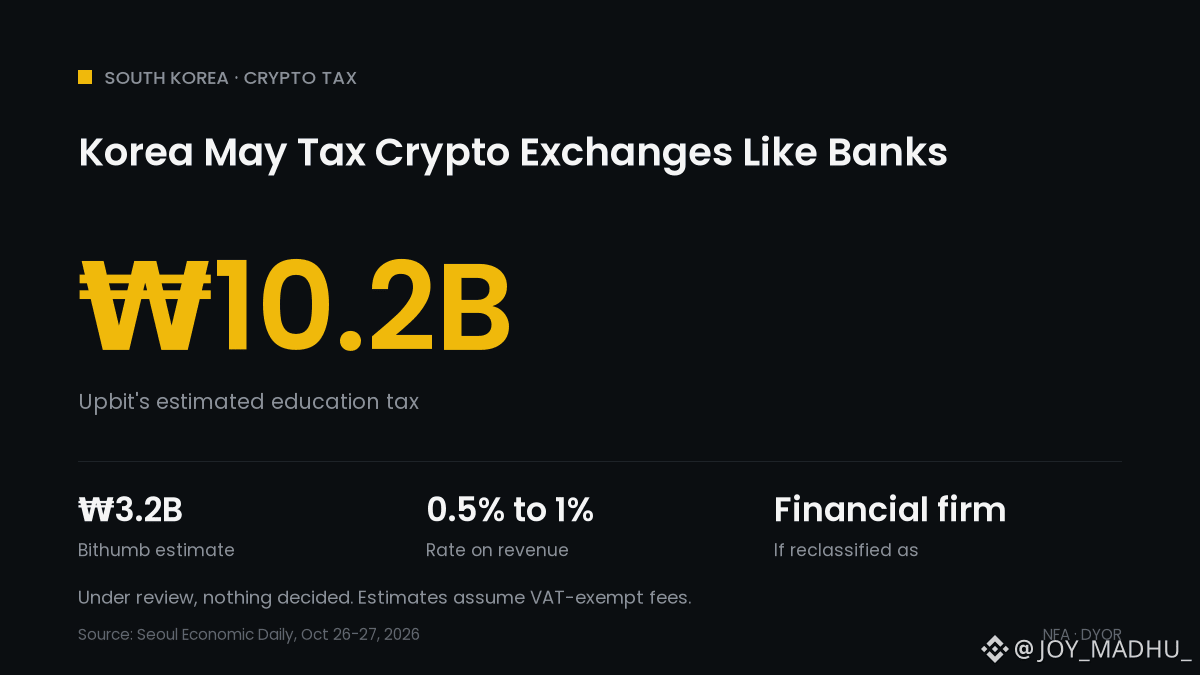
🇰🇷 Korea May Tax Crypto Exchanges Like Banks
🏛️ Seoul is weighing an education tax on exchanges if the Digital Asset Basic Act makes them financial businesses
📊 Today they count as information and communications firms, so they don't pay it
💸 Banks and insurers pay it on operating revenue, not profit: 0.5% up to 1 trillion won, 1% above that
🔍 Seoul Economic Daily estimate on 2025 revenue: Dunamu (Upbit) about 10.2B won, Bithumb about 3.2B won
⚖️ Those figures assume trading fees also become VAT-exempt
⚠️ Exchanges could narrow fee discounts or raise fees to cover it
What it means for crypto: becoming a regulated "financial" business brings legitimacy and new costs at the same time. For traders, it comes down to whether fees fall with the VAT exemption or rise with the tax. Nothing is decided yet.
Would you accept higher fees for a fully regulated exchange? 👇
$BTC
#CryptoNews #SouthKorea #CryptoTax #SouthKoreaConsidersEducationTaxOnCryptoExchanges
47

🇰🇷 SOUTH KOREA'S CRYPTO TAX DEBATE!
South Korea is considering whether crypto exchanges should face an education tax if they're reclassified as financial businesses. ⚖️ The proposal could affect exchange costs, fee structures, and the wider digital-asset industry. This is still under discussion—not a finalized tax rule.
{future}(BTCUSDT)
#SouthKorea #CryptoRegulation #Bitcoin #CryptoNews
🇰🇷 SOUTH KOREA'S CRYPTO TAX DEBATE!
South Korea is considering whether crypto exchanges should face an education tax if they're reclassified as financial businesses. ⚖️ The proposal could affect exchange costs, fee structures, and the wider digital-asset industry. This is still under discussion—not a finalized tax rule.
#SouthKorea #CryptoRegulation #Bitcoin #CryptoNews
1
55

·
--
🚨 Breaking: South Korea May Delay Crypto Tax Until 2029! 🇰🇷₿
South Korean Lawmakers Are Considering Delaying The Planned 22% Crypto Gains Tax From January 2027 To 2029.
📊 The Proposed Tax Would Apply To Annual Crypto Gains Exceeding 2.5 Million Korean Won.
🌍 Officials Cite Cross-Border Data-Sharing Challenges And Tax Reporting Concerns. However, The Delay Is Not Yet Finalized.
💥 Another Crypto Tax Delay? Investors Are Watching Closely!
#CryptoNews #SouthKorea #CryptoTaxReform @Binance_South_Asia @Binance_News @Binance_Square_Official $AMZNB
{spot}(AMZNBUSDT)
🚨 Breaking: South Korea May Delay Crypto Tax Until 2029! 🇰🇷₿
South Korean Lawmakers Are Considering Delaying The Planned 22% Crypto Gains Tax From January 2027 To 2029.
📊 The Proposed Tax Would Apply To Annual Crypto Gains Exceeding 2.5 Million Korean Won.
🌍 Officials Cite Cross-Border Data-Sharing Challenges And Tax Reporting Concerns. However, The Delay Is Not Yet Finalized.
💥 Another Crypto Tax Delay? Investors Are Watching Closely!
#CryptoNews #SouthKorea #CryptoTaxReform @Binance South Asia @Binance News @Binance Square Official $AMZNB
50

·
--
A fourth crypto tax delay? The fairness problem caught my eye. 😳
South Korea is weighing another postponement of its crypto gains tax—this time to 2029, according to CoinDesk.
Why? Officials worry domestic exchange users would bear the tax burden because the U.S. won’t share crypto trading data until 2029.
To me, that’s the real tension: taxing gains when access to trading data is uneven. ⚖️
Would you rather see another delay or have the tax start before that data gap closes?
#CryptoTax #SouthKorea #CryptoPolicy

30

·
--
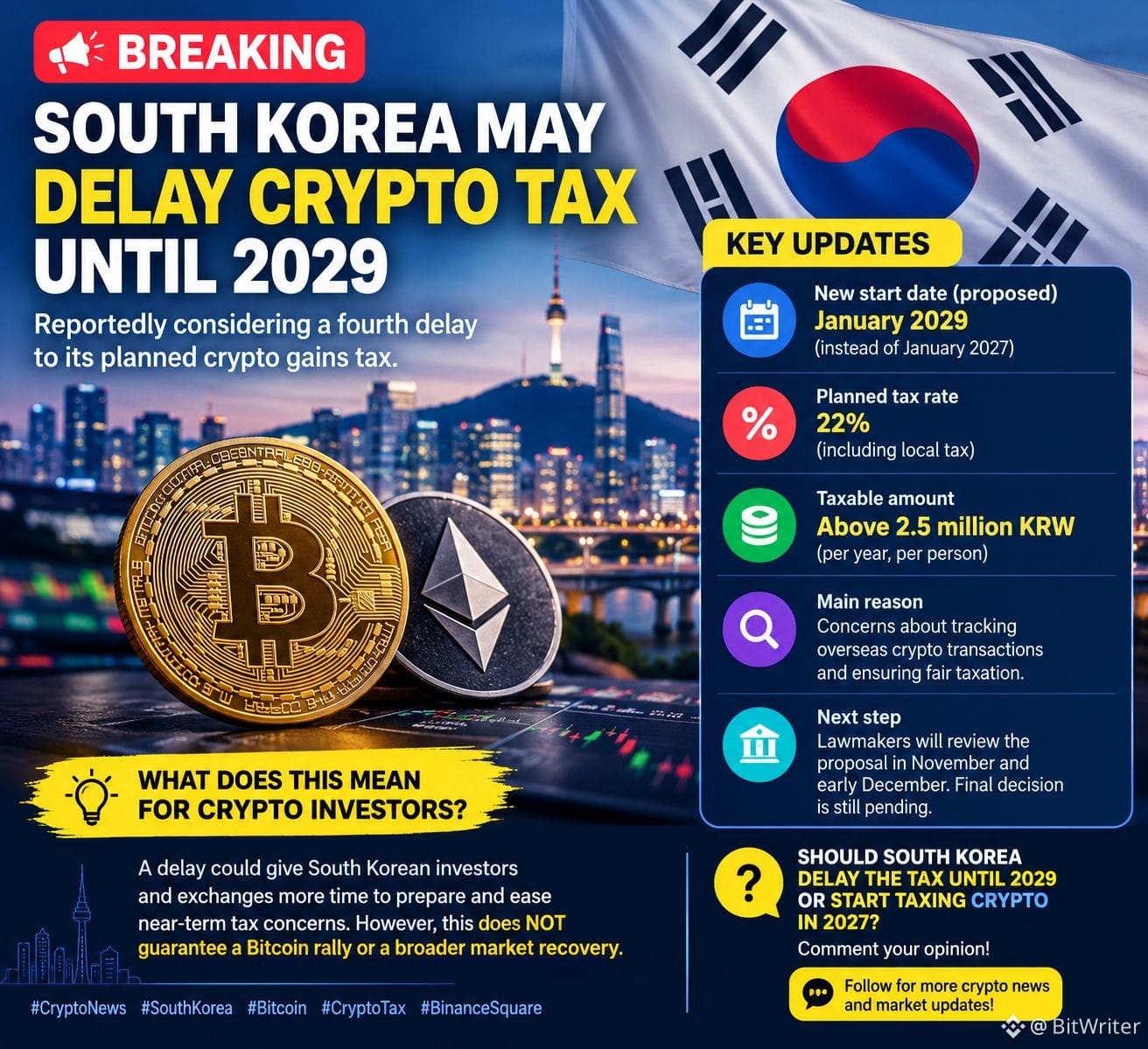
🚨 BREAKING: SOUTH KOREA MAY DELAY CRYPTO TAX UNTIL 2029! 🇰🇷
#SouthKoreaReportedlyWeighsFourthCryptoTaxDelay
South Korea is reportedly considering a fourth delay to its planned crypto gains tax, which is currently scheduled to begin in January 2027.
📌 What you need to know:
• The tax could be postponed until 2029.
• The planned rate is 22% on qualifying annual crypto gains above 2.5 million KRW.
• Officials are concerned about tracking overseas crypto transactions fairly.
• A final decision is still pending.
🔥 Another delay could give crypto investors more breathing room, but nothing is guaranteed until lawmakers finalize the decision.
👇 Crypto traders, what do you think?
Should South Korea delay the tax until 2029, or start taxing crypto in 2027?
#CryptoNews #SouthKorea
68

·
--
Bullish
#SouthKoreaReportedlyWeighsFourthCryptoTaxDelay
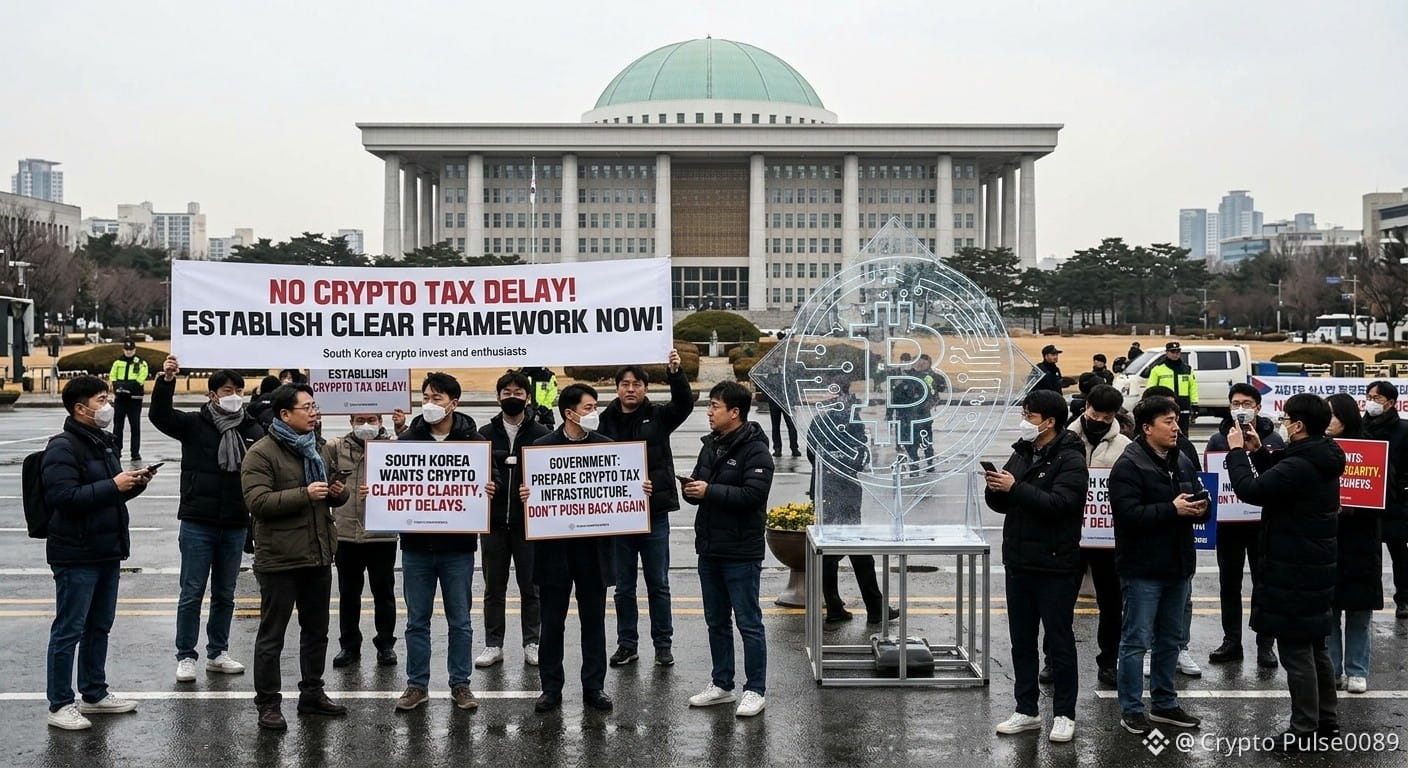
📊 MARKET NEWS: South Korea Weighs 4th Crypto Tax Delay Until 2029
South Korean financial authorities and lawmakers are reviewing proposals to delay the implementation of virtual asset taxation once again.
Core Highlights:
• Original Schedule: Proposed in 2020 for a 2022 rollout, now pushed multiple times.
• Primary Driver: Lack of cross-border tracking infrastructure and synchronization with the OECD’s Crypto-Asset Reporting Framework (CARF), expected globally around 2029.
• Impact: Gives South Korea’s high-volume retail and institutional marketmore time to operate without capital gains friction.
📌 Current Status: Needs final approval from South Korea's National Assembly.
What’s your stance on this? Bullish or neutral for the Asian market? 📈📉
#BinanceSquare #CryptoTaxation #SouthKorea #BTC #CryptoRegulation #SouthKoreaReportedlyWeighsFourthCryptoTaxDelay
$NEAR $GRASS $TIA
30
·
--
#SouthKoreaReportedlyWeighsFourthCryptoTaxDelay
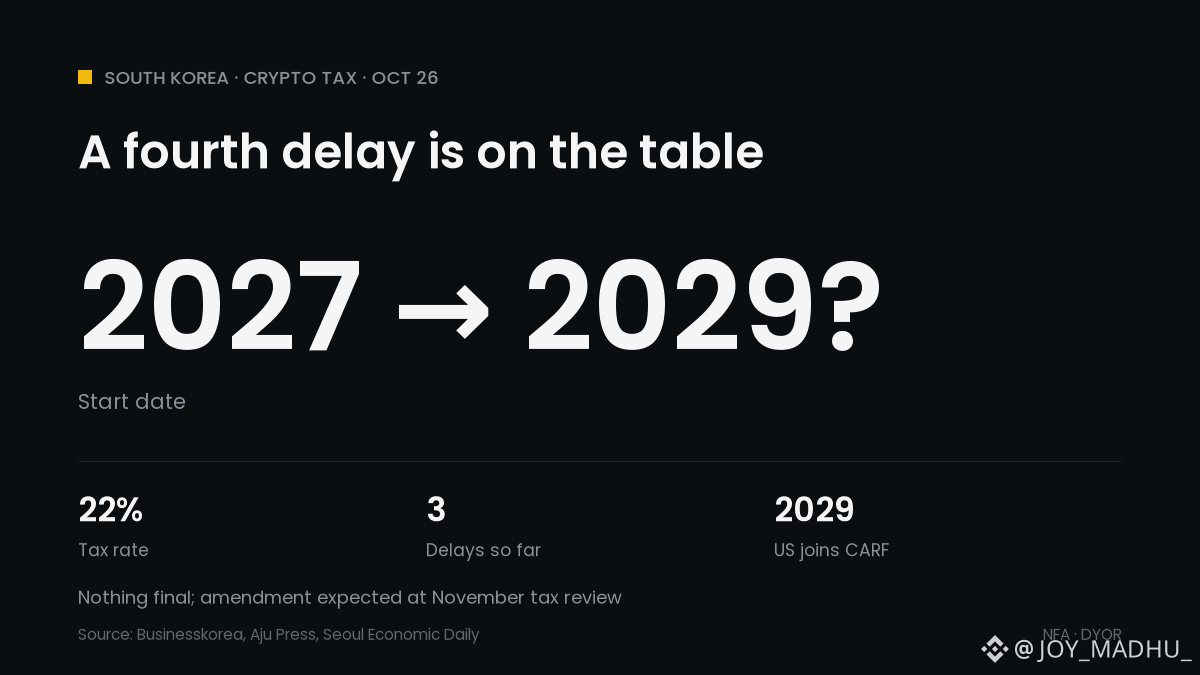
🇰🇷 Korea's Crypto Tax Could Be Delayed a Fourth Time
📅 Passed in 2020, it has never started: 2022, then 2023, then 2025, then Jan 1, 2027
🗓️ The new target being discussed is 2029
📊 The rule: 22% on yearly crypto gains above 2.5M won (~$1,890)
🌐 Main reason given: the US, about half the market, only joins the OECD's CARF data sharing in 2029
🗳️ Politics too: the first tax bill would land in May 2028, right after the April 2028 general election
⚠️ Nothing is final yet. The law needs an amendment, expected at the November tax review
What it means for crypto: another delay would keep Korea's big retail market untaxed for two more years, but each delay adds policy uncertainty. $BTC is near $80.4K.
Should Korea delay again or just start in 2027? 👇
$BTC
#CryptoNews #SouthKorea #CryptoTax #SouthKoreaReportedlyWeighsFourthCryptoTaxDelay
32

·
--
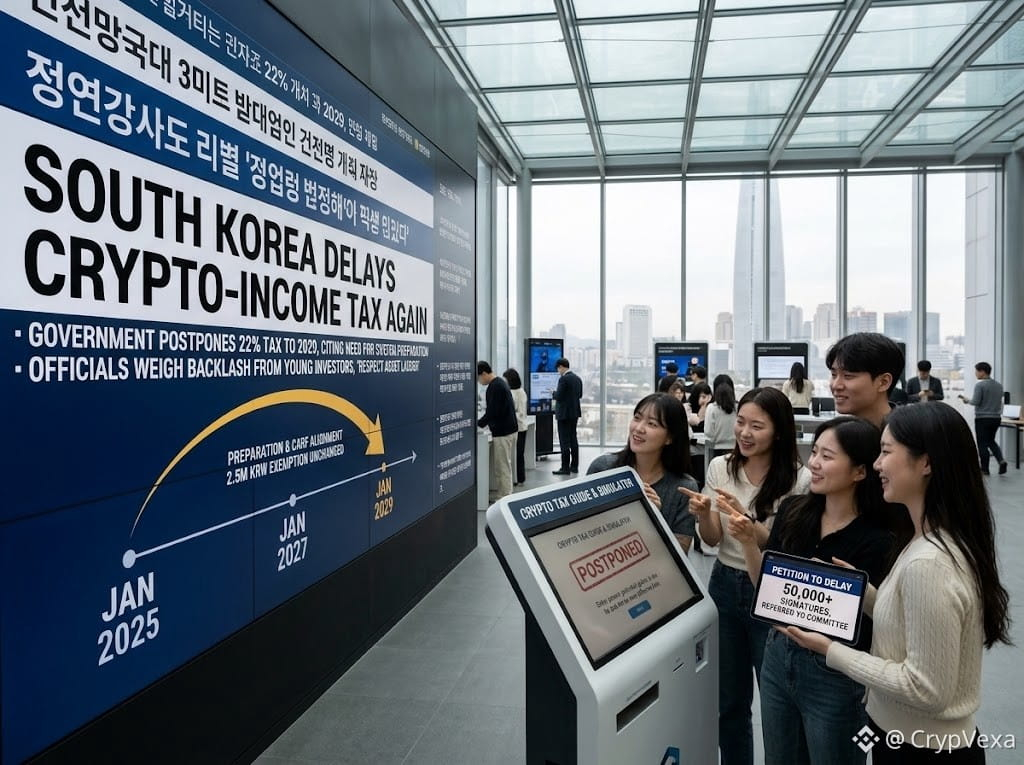
🇰🇷 South Korea May Delay Crypto Income Tax Again! 💰⚠️
South Korea is reportedly considering another delay to its planned crypto-income tax as officials weigh concerns about potential backlash from younger investors.
📅 Possible further postponement
💰 Crypto gains remain a major policy issue
👥 Younger investors are a key concern
⚖️ Officials are still weighing the policy
⚠️ The delay is reported, not confirmed, and the final timeline could still change.
📌 Any new implementation date will depend on the government’s final decision and legislation.
#SouthKorea #CryptoTax #Crypto #Bitcoin #Regulation
1
39
·
--
#SouthKoreaPlansToRegulateStablecoinsUnderFXLaw
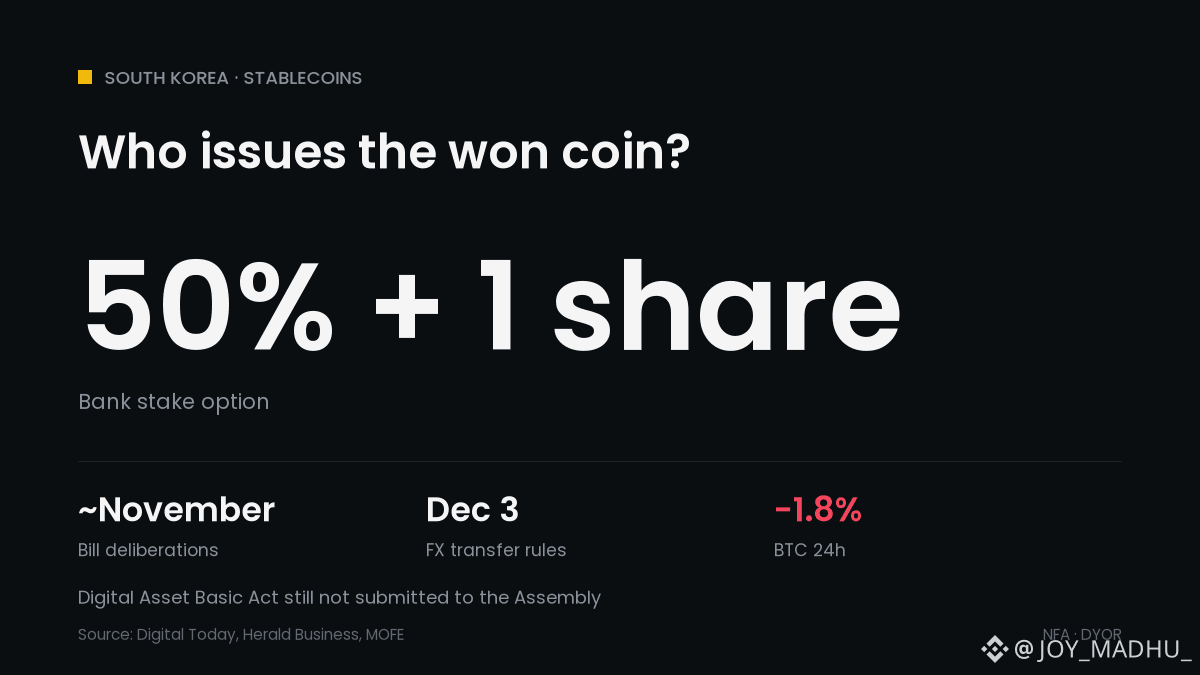
🇰🇷 Who Gets to Issue a Won Stablecoin? Korea's Last Big Fight
🏦 One option on the table: issuers must be consortiums where banks hold at least 50% plus one share
💻 Tech firms could still be the largest single shareholder
🗣️ Bank of Korea Governor Hyun Song Shin says he is "basically in favour" of private won stablecoins, led by banks
⚠️ FSC chair Lee Eog-weon says the Digital Asset Basic Act is in the "final stages of consultation"; no bill has reached lawmakers yet
📅 Lawmakers expect full deliberations around November, after the audit season
📅 Comments on the cross-border crypto transfer decree close today, with rules starting Dec 3
What it means for crypto: who issues the won coin decides how open Korea's market gets. Bitcoin is near $79.5K, down about 1.8% in 24 hours.
Banks first, or open to fintechs? 👇
$BTC $USDT
#CryptoNews #SouthKorea #Stablecoins #SouthKoreaPlansToRegulateStablecoinsUnderFXLaw
96

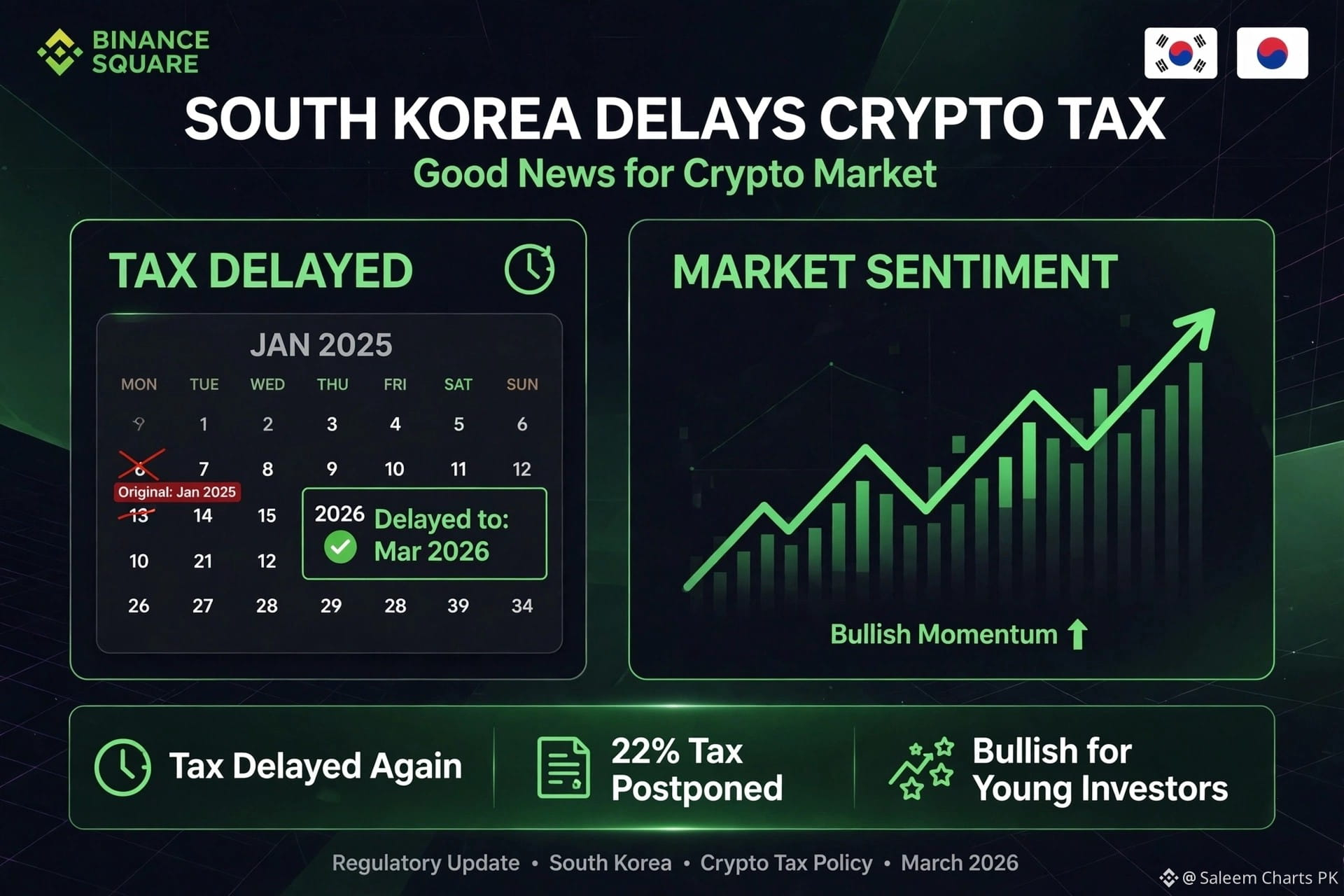
🚨 BREAKING: South Korea Delays Crypto Tax Again! 🇰🇷
Good News for Crypto Market - 25th Oct 2026
South Korea government has decided to delay the 22% crypto tax again, which was supposed to start in January. Officials fear backlash from young investors.
This tax was first planned for 2022, now delayed to March 2026.
Why is this Bullish?
✅ Young investors will continue trading
✅ Market sentiment remains positive
✅ Less selling pressure
Do you think this delay will pump the market?
#BTC #CryptoNews #SouthKorea #CryptoTax #Bullish #BinanceSquare
63
Log in to explore more content
Join global crypto users on Binance Square
⚡️ Get latest and useful information about crypto.
💬 Trusted by the world’s largest crypto exchange.
👍 Discover real insights from verified creators.
Email / Phone number
Trending Topics
1
#CanMicrosoftDeliverOnAI
540,297 views
3,587 Discussing
2
#CanGoogleDefindItsCore
327,484 views
2,535 Discussing
3
#EarningsSeason
6M views
29,815 Discussing
4
#BitcoinCoreIdentifiesThreeVulnerabilities
467 views
40 Discussing
5
#StrategyShareholdersApproveDailyDividends
407 views
28 Discussing
6
#FedLowerBoundRateDecisionAt3.75%
362 views
22 Discussing
7
#TokenizedGoldXAUaLaunchesOnSui
569 views
17 Discussing
8
#$10.9BBitcoinOptionsExpireFriday
2,818 views
99 Discussing
9
#ThailandSupremeCourtRulesBitcoinIsProperty
19,128 views
417 Discussing
10
#BitcoinSurpasses$81K
43,669 views
143 Discussing