

#robotaxi
robotaxi
138,228 views
603 Discussing
Hot
Latest
Tesla (TSLA) is around $404.22, down 1.4% today but still up about 5.3% this week.
Tesla’s story is shifting from selling cars to running a mobility network. Robotaxi and Cybercab could open a new revenue stream—but Q3 net income fell year over year, so execution matters more than promises now.
My lean: cautiously bullish while Robotaxi expands, but the next proof point is whether rides can become a profitable business.
Would you value Tesla as a carmaker—or as a future transport platform?
#TSLA #ROBOTAXI #CyberCab #AIStocks
34

·
--
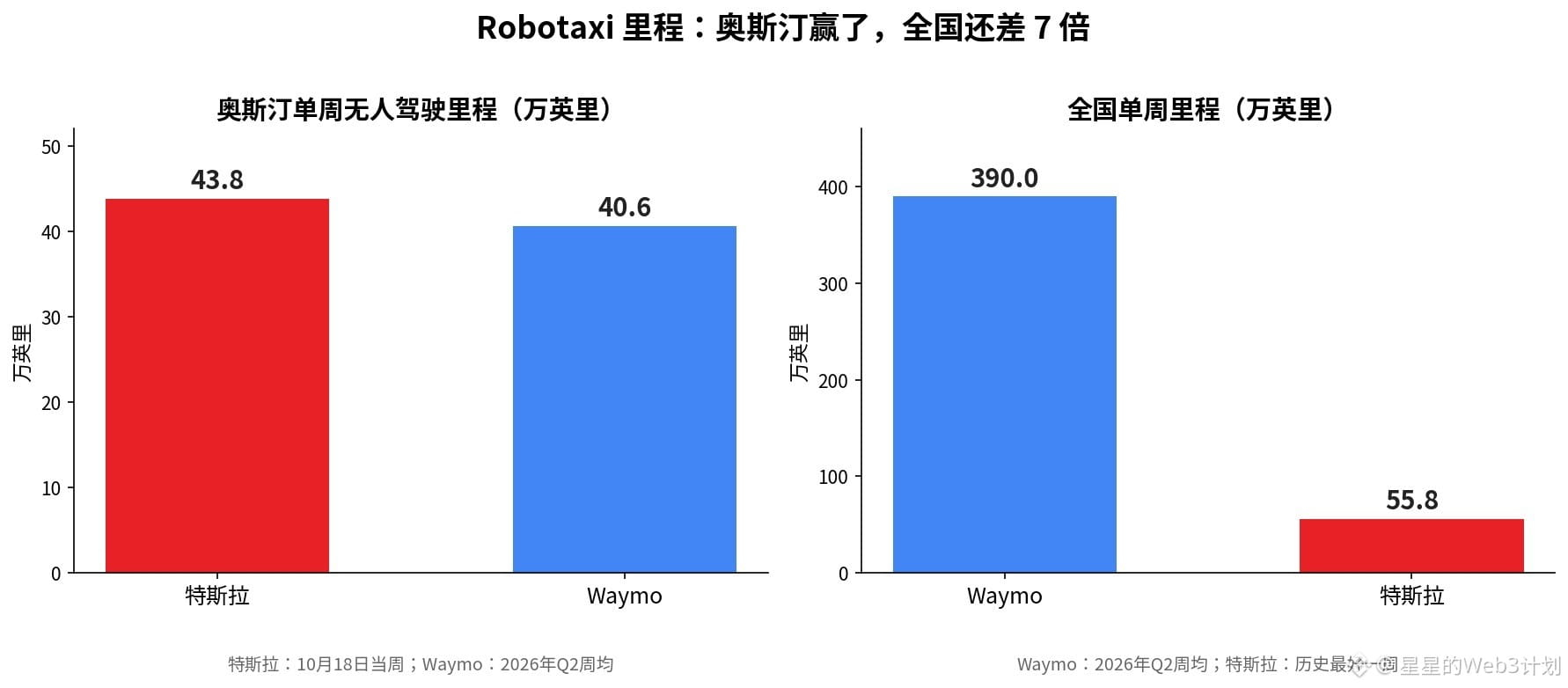
At 438,000 miles, Tesla beat Waymo in Austin for the first time.
But nationwide, Waymo does 3.9 million miles a week, while Tesla’s best week was just 558,000—a full 7x gap.
Tesla’s win in Austin came from comparing its best week with Waymo’s average from a few months ago.
On Tuesday, TSLA rose 4% to $407.46, making it the Magnificent Seven’s top performer in October.
Tesla’s Texas fleet has 1,051 vehicles. Cybercabs reached 544, passing the halfway mark for the first time, up from just 319 at the start of the month.
I think the Robotaxi story has shifted from “can it operate?” to “can it scale?” Winning one city doesn’t mean winning the whole battle. The thesis is invalidated if weekly miles in cities outside Austin can’t keep up, or if Cybercab deliveries are delayed again.
Are you betting that Tesla will roll out Robotaxis across the U.S. first, or that Waymo will hold on to its 7x lead?
$TSLA $GOOGL
#特斯拉 #Robotaxi
This is not investment advice. DYOR. Trading involves risk.
99

·
--
Article
Tesla Delivered Cybercab In Just Two WeeksTesla made good on its Cybercab promise in roughly two weeks, according to reports covering the rollout.
The speed matters more than the vehicle itself. A two-week ramp suggests the production and delivery pipeline for the dedicated robotaxi platform is moving faster than previous Tesla launches.
The open question is autonomy. A purpose-built two-seater with no steering wheel is only useful if the software behind it is ready for public roads without constant human oversight.
Tesla's broader bet is that autonomy is a fleet business, not a car business — and Cybercab is the first product shaped entirely around that idea.
Would you ride in a car with no steering wheel? $TSLA #Tesla #Cybercab #Robotaxi #BinanceSquare
Tesla Delivered Cybercab In Just Two Weeks
Tesla made good on its Cybercab promise in roughly two weeks, according to reports covering the rollout.
The speed matters more than the vehicle itself. A two-week ramp suggests the production and delivery pipeline for the dedicated robotaxi platform is moving faster than previous Tesla launches.
The open question is autonomy. A purpose-built two-seater with no steering wheel is only useful if the software behind it is ready for public roads without constant human oversight.
Tesla's broader bet is that autonomy is a fleet business, not a car business — and Cybercab is the first product shaped entirely around that idea.
Would you ride in a car with no steering wheel? $TSLA #Tesla #Cybercab #Robotaxi #BinanceSquare
70

·
--
Tesla TSLA: You’re not buying a car—you’re buying into a future it has yet to deliver
First, a look at the market (the latest closing price, from Friday, October 23, before the U.S. market opens tonight, Beijing time):
TSLA closed at $372.22, down $2.36 (-0.63%), versus a previous close of $374.58. Its 52-week range is $297.38–$498.83, putting the current price about 25% below its high. Its market cap is roughly $1.48 trillion. The stock is up 4.93% over the past five days, but remains down 17.23% year to date, making it the weakest of the Magnificent Seven this year—the car business is doing so-so, while the story keeps getting bigger.
The earnings report poured some cold water on the story: third-quarter net income was $787 million, down 43% year over year; revenue was $28.05 billion, essentially flat; operating income fell 56% to $718 million; and deliveries declined about 2%. Meanwhile, R&D spending rose 69% to $2.76 billion, and capital expenditure more than doubled to $4.73 billion. Where is all that money going? Two places: Optimus and Cybercab.
That’s the real focus of this piece. On the October 21 earnings call, Tesla confirmed that production of its first production-grade Optimus robots has begun at the Fremont factory, with external deliveries expected by the end of 2027. Musk also set a target of producing 20,000 units a week by the end of 2027—even if you discount that target, the direction has changed: from “selling cars” to “selling robot capacity.” Meanwhile, Cybercab sales to customers are set to begin by the end of 2026, starting in small volumes, with initial production going to Tesla’s own fleet. The Austin fleet has already grown eightfold in the 30 days since launch. The unsupervised version of FSD is scheduled to roll out in the second quarter of next year.
That’s why the disagreement is so stark: on October 19, ARK updated its model, giving a 2031 base-case price of $4,400 (with a bear case of $3,300 and a bull case of $5,000), with Robotaxi accounting for about 80% of enterprise value. By contrast, Seeking Alpha’s sum-of-the-parts valuation on October 26 put the stock at just $375—$285 for automotive and energy, and $90 for the AI bet—concluding that it was “fairly valued, with little upside.” On October 22, BofA reiterated its Buy rating and $460 price target. One stock, three different worldviews.
A technical level to watch: the current price is above the 50-day moving average of $364.01. In the short term, this is the line separating bulls from bears—if it doesn’t hold, the 4.93% gain over the past five days could evaporate quickly.
Let’s be clear about the risks: First, NHTSA is investigating Cybercab’s certification process. A car with no steering wheel or pedals doesn’t fit current federal standards, and the investigation’s outcome will determine whether it can legally be sold and driven on public roads. Second, ramping up Optimus production and achieving acceptable yields in hand assembly will be difficult; deliveries by the end of 2027 could still be delayed. Third, the unsupervised version of FSD has been postponed multiple times. Fourth, the valuation is still based on the future, and the stock is far more volatile than the broader market—especially around earnings, when its moves can be dramatic.
My take: TSLA is now a “future option”—the car business provides a floor, while Robotaxi and Optimus determine the ceiling. Buying at the current price means assuming that at least part of ARK’s worldview will come true; for those who don’t buy into that thesis, a fair valuation around $375 is the ceiling. It’s safer to watch and build a position in stages, adding after Cybercab deliveries begin at year-end and unsupervised FSD is rolled out, rather than going all in now.
$TSLA #特斯拉 #Robotaxi #人形机器人 #USStocks
Personal research only; not investment advice.
135

·
--
Article
STOCKS | Waymo Wins Approval to Expand Robotaxi Service Across 18 California CountiesWaymo has received approval from the California Public Utilities Commission to expand its robotaxi service across 18 counties in California. This authorization marks a significant step forward for the autonomous driving company, allowing it to operate in a much larger geographic area within the state.
According to Sina Finance, Waymo stated that the expansion will be conducted gradually and will be guided by a comprehensive safety framework. The company emphasized that safety remains its top priority as it increases its service footprint, ensuring that operations meet regulatory standards and customer expectations.
The approval comes at a time when Waymo is preparing to launch a driverless passenger service in San Diego later this summer. This upcoming launch is part of the company's broader effort to establish fully autonomous mobility solutions in key urban markets, aiming to provide safe, affordable, and efficient transportation options.
The move to expand across 18 counties reflects Waymo’s confidence in its technology and regulatory support, positioning it as a leader in the autonomous vehicle industry. More details are available in the official Binance Square post. #AutonomousVehicles #Robotaxi #Waymo
STOCKS | Waymo Wins Approval to Expand Robotaxi Service Across 18 California Counties
Waymo has received approval from the California Public Utilities Commission to expand its robotaxi service across 18 counties in California. This authorization marks a significant step forward for the autonomous driving company, allowing it to operate in a much larger geographic area within the state.
According to Sina Finance, Waymo stated that the expansion will be conducted gradually and will be guided by a comprehensive safety framework. The company emphasized that safety remains its top priority as it increases its service footprint, ensuring that operations meet regulatory standards and customer expectations.
The approval comes at a time when Waymo is preparing to launch a driverless passenger service in San Diego later this summer. This upcoming launch is part of the company's broader effort to establish fully autonomous mobility solutions in key urban markets, aiming to provide safe, affordable, and efficient transportation options.
The move to expand across 18 counties reflects Waymo’s confidence in its technology and regulatory support, positioning it as a leader in the autonomous vehicle industry. More details are available in the official Binance Square post. #AutonomousVehicles #Robotaxi #Waymo
44

·
--
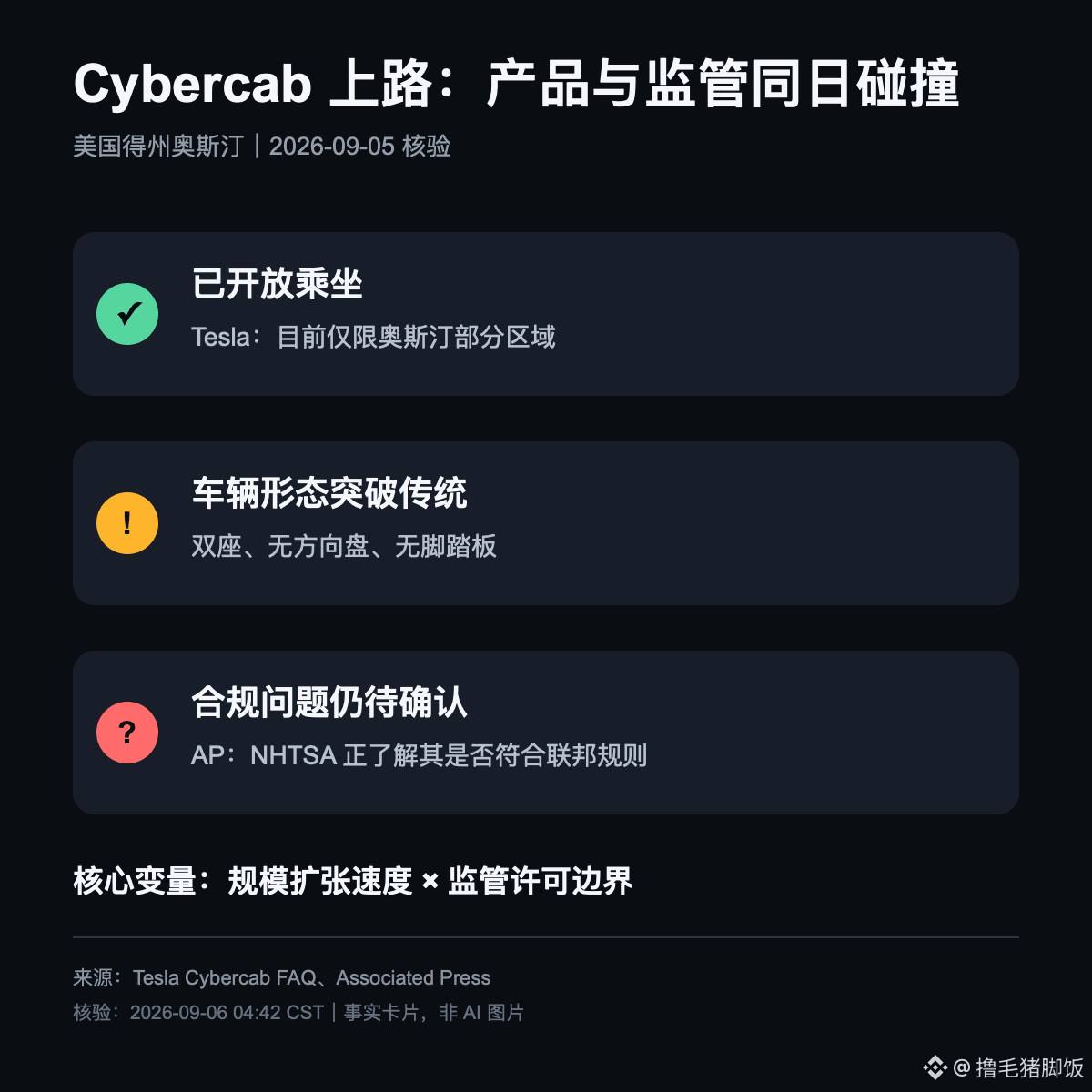
If a car has no steering wheel and no pedals, would you dare to ride in it?
This is no longer just a concept image. Tesla’s Cybercab is now open for rides in limited areas of Austin, but on the same day, regulatory concerns also came to the forefront.
I checked two sources:
• Tesla’s official Cybercab FAQ: the currently available area is still limited to parts of Austin
• Associated Press: the U.S. National Highway Traffic Safety Administration (NHTSA) is looking into whether vehicles of this kind, without steering wheels, side mirrors, or brake pedals, fully comply with federal rules
So the real point of this news is not that “autonomous driving has finally arrived,” but that the speed of product rollout is colliding head-on with the boundaries of regulatory approval.
For Tesla, the value of Cybercab is not just a new vehicle, but whether it can turn autonomous driving from a showcase into an operational network that can repeatedly charge fees and be replicated across cities.
Next, I will watch:
1️⃣ Whether Austin’s service area and order volume can continue to expand
2️⃣ Whether NHTSA issues remediation, exemptions, or other clear requirements
3️⃣ Whether driverless operations can be replicated in more cities
If the regulatory path becomes clear and operating data remains stable, this will increase the credibility of the Robotaxi business model; on the other hand, if there is any suspension, recall, or tighter licensing, the pace of expansion could be repriced.
Sources: Tesla official support page, Associated Press
Verification time: 2026-09-06 04:42 CST
Not investment advice.
#Tesla #TSLA #Robotaxi #美股
92
Tesla Robotaxi launches in Miami, with the stock price jumping 5.5% in a single day—reviving market imagination around the commercialization of autonomous driving.
From a narrative perspective, this isn’t just another “city pilot.” Miami’s urban layout, the complexity of its weather, and how it compares with the Austin pilot will all become key sample points for measuring Robotaxi’s real capabilities. If the expansion pace delivers as promised, the valuation logic for $TSLA will gradually shift from “automaker” to “transportation network.”
The takeaway for the crypto market is also quite direct: once the AI + autonomous driving story heats up again, on-chain sectors tied to DePIN, AI Agents, and RWA—especially those related to mobility data—typically follow the sentiment spillover. You may want to watch whether capital is rotating back from pure Meme trading toward a “real-world cash flow” narrative.
Don’t chase the price in the short term. Keep an eye on the release schedule of Robotaxi’s per-vehicle operating data—that is the anchor for how far this wave of sentiment can go.
#Tesla #Robotaxi #AI narrative
TSLA-2.38%
TSLAUS-1.90%
55

Partly True
$TSLA and robotaxi — here’s where the real fun begins 👀🔥
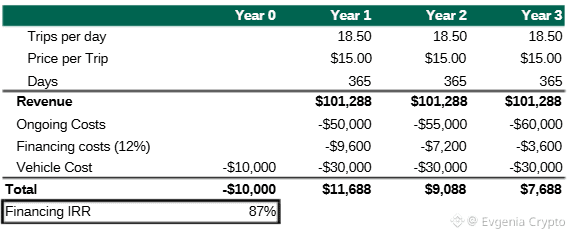
Citizens Bank believes that even with a cost of about $100K per robotaxi vehicle, Tesla robotaxis could generate roughly 87% annual returns.
The key point is that having no driver can cut the trip cost by more than half.
That means Tesla gains room to spend more on sensors and computing power, while still keeping very high profitability.
If these numbers are even close to reality, the robotaxi economics look extremely strong. 🤖
{future}(TSLAUSDT)
#TSLA #Tesla #Robotaxi
$TSLA and robotaxi — here’s where the real fun begins 👀🔥
Citizens Bank believes that even with a cost of about $100K per robotaxi vehicle, Tesla robotaxis could generate roughly 87% annual returns.
The key point is that having no driver can cut the trip cost by more than half.
That means Tesla gains room to spend more on sensors and computing power, while still keeping very high profitability.
If these numbers are even close to reality, the robotaxi economics look extremely strong. 🤖
#TSLA #Tesla #Robotaxi
1
1.2k

🚨 $TESL.ETF NEWS — CYBERCAB TAKES CENTER STAGE! 🤖🚕
Tesla’s new steering-wheel-free Cybercab is putting the spotlight back on its robotaxi and AI strategy.
But there’s a catch 👀 — U.S. regulators have opened an investigation into whether the unconventional vehicle meets federal safety standards.
For TSLA, autonomous driving could be the next major growth story—but regulation remains a key risk.
📈 Bulls are watching.
⚠️ Volatility could stay high.
#Tesla
{etf_us}(TESL.ETF)
#TSLA #Cybercab #Robotaxi #AI
🚨 $TESL.ETF NEWS — CYBERCAB TAKES CENTER STAGE! 🤖🚕
Tesla’s new steering-wheel-free Cybercab is putting the spotlight back on its robotaxi and AI strategy.
But there’s a catch 👀 — U.S. regulators have opened an investigation into whether the unconventional vehicle meets federal safety standards.
For TSLA, autonomous driving could be the next major growth story—but regulation remains a key risk.
📈 Bulls are watching.
⚠️ Volatility could stay high.
#Tesla
#TSLA #Cybercab #Robotaxi #AI
TSLAB-2.37%
TESLETF-4.78%
62

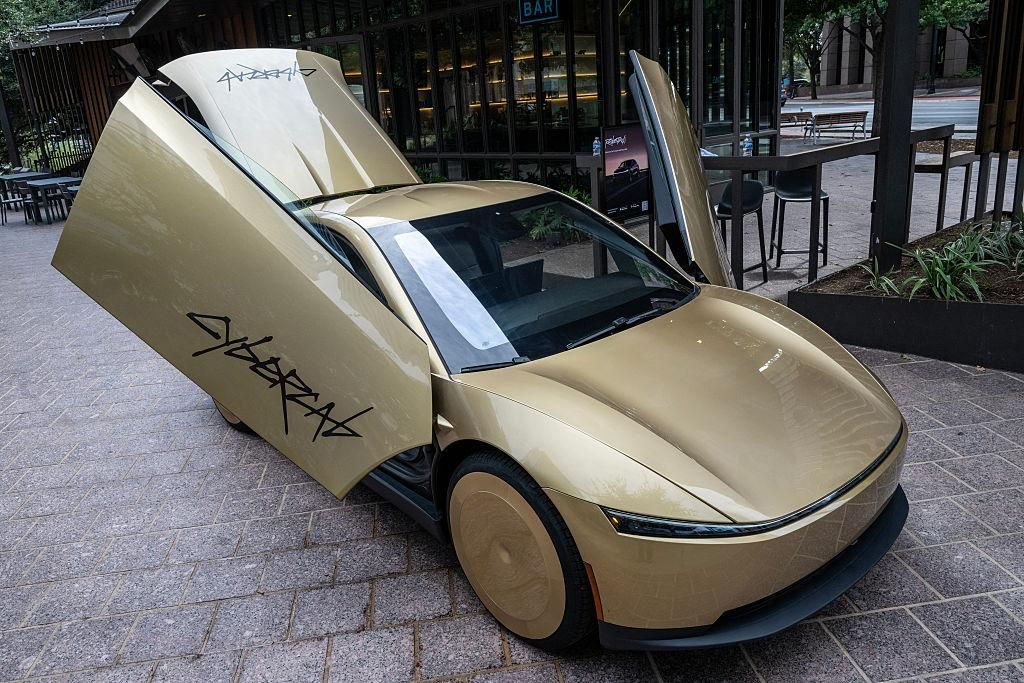
TESLA IS TESTING HOW FAR THE RULES CAN BE PUSHED
Tesla has just launched Cybercab into its robotaxi service in Austin, but only a few hours after the launch event, NHTSA opened an investigation into about 1,000 Cybercabs to determine what basis led Tesla to believe the vehicle meets federal safety standards.
The issue lies in Cybercab’s very design: no steering wheel, no pedals, no rearview mirrors, while most U.S. safety standards were built around human-driven vehicles.
Tesla is relying on the U.S. self-certification mechanism, but Zoox’s precedent shows that this path is far from simple. If NHTSA and Tesla disagree, the case could even turn into a legal battle.
My take: Cybercab is not just a test for FSD, but also a test of the U.S. legal system itself. Tesla wants to put large numbers of autonomous vehicles on the road at a pace faster than the law can adapt.
If Tesla wins, this could become a major precedent for robotaxis. If NHTSA wins, Cybercab’s expansion plan could be significantly delayed.
Is Tesla building the future — or forcing regulators to catch up?
Do you think Tesla will win the fight with NHTSA, or will Cybercab hit a regulatory roadblock?
NHTSA stands for the National Highway Traffic Safety Administration
#Tesla #CyberCab #ROBOTAXI $TSLA
{future}(TSLAUSDT)
TESLA IS TESTING HOW FAR THE RULES CAN BE PUSHED
Tesla has just launched Cybercab into its robotaxi service in Austin, but only a few hours after the launch event, NHTSA opened an investigation into about 1,000 Cybercabs to determine what basis led Tesla to believe the vehicle meets federal safety standards.
The issue lies in Cybercab’s very design: no steering wheel, no pedals, no rearview mirrors, while most U.S. safety standards were built around human-driven vehicles.
Tesla is relying on the U.S. self-certification mechanism, but Zoox’s precedent shows that this path is far from simple. If NHTSA and Tesla disagree, the case could even turn into a legal battle.
My take: Cybercab is not just a test for FSD, but also a test of the U.S. legal system itself. Tesla wants to put large numbers of autonomous vehicles on the road at a pace faster than the law can adapt.
If Tesla wins, this could become a major precedent for robotaxis. If NHTSA wins, Cybercab’s expansion plan could be significantly delayed.
Is Tesla building the future — or forcing regulators to catch up?
Do you think Tesla will win the fight with NHTSA, or will Cybercab hit a regulatory roadblock?
NHTSA stands for the National Highway Traffic Safety Administration
#Tesla #CyberCab #ROBOTAXI $TSLA
2
3.4k

·
--
Robotaxi just got a ticket! $75 parking fee hits Tesla's operating costs 😂 After ten years of AI training, we’ve got ourselves a parking violation champ, can't hold it in this time.
Which AI is still racking up unlicensed parking fines? Pay up, no dodging fines 2.
Follow me for the next wild moves, it’s gonna get crazier #特斯拉 #Robotaxi
Which AI is still racking up unlicensed parking fines? Pay up, no dodging fines 2.
Follow me for the next wild moves, it’s gonna get crazier #特斯拉 #Robotaxi
58
Tesla shares surged 5.5% during trading, and the trigger was Robotaxi services officially launching in Miami.
Market sentiment is very straightforward—people are not betting on today’s revenue, but on whether the “autonomous driving network” narrative can actually pan out. Miami is the second deployment city after Austin, and the expansion pace is faster than expected—this is the key to the stock price reaction.
A few points worth noting:
1) Operating scope and safety operator staffing are still in the human-supervision stage. Any real valuation re-rating will have to wait until full autonomy is achieved;
2) Tesla’s strategy differs from Waymo. Tesla is pursuing a pure vision plus FSD generalization approach. Once it works, the marginal cost can be significantly lower;
3) This kind of “embodied AI” narrative often spills over into the crypto market. Historically, there have been correlation effects with sectors related to DePIN, AI Agents, and RWA.
In the short term, Robotaxi remains story-driven. The three hard metrics to watch next are the number of deployment cities, order volume, and accident rate. Don’t just look at the candlestick chart—look at the data.
#Tesla #Robotaxi #AI
TSLA-2.38%
TSLAUS-1.90%
58

·
--
Tesla Robotaxi officially launched in Miami, and the stock price jumped 5.5% on the news—market sentiment was clearly ignited.
In this round of the autonomous driving story, the focus isn’t just Elon Musk’s grand promises, but the real-world monetization coming into place—moving from an Austin pilot to expanding into Miami, with a pace faster than many people expected.
Personal view:
- In the short term, this is sentiment-driven; the stock’s reaction is faster than the fundamentals
- In the medium term, watch the operating data: average daily orders per vehicle, accident rate, and unit economics model
- In the long run, the real moat lies in the FSD data feedback loop. Waymo’s approach is more route-heavy, while Tesla is lighter—but Tesla still needs regulatory approval to come through
It’s also worth noting the mapping to the crypto market—narratives around AI + DePIN and the robot economy often get reignited with each Tesla milestone. You might also want to take a quick look at on-chain related sectors and where the money flows.
The real question isn’t “can it run,” but “can it scale profitably.” Once it clears that hurdle, the valuation logic will be rewritten completely.
#Tesla #Robotaxi #AI
TSLA-2.38%
TSLAUS-1.90%
30

·
--
🚕 Tesla’s Cybercab story is getting interesting.
If the reported August Austin rollout happens, Tesla could move another step closer to turning fully autonomous, steering-wheel-free Robotaxis into a real commercial service.
That would be a major milestone for $TSLA and the broader FSD narrative.
But the key is execution: official confirmation, regulatory progress, safety, and actual paid rides matter more than speculation.
👀 Watch Tesla’s next announcements closely.
$TSLA #Tesla #Cybercab #Robotaxi #FSD
131

🚨 $UBER TRIMS WORKFORCE BY 10% TO PUSH $10B INTO ROBOTAXI INFRASTRUCTURE ⚡
Institutional capital reallocation in plain view. 🦈 $UBER is liquidating 3,300 legacy management and staff roles to channel over $10B directly into autonomous vehicle partnerships, effectively restructuring their operational footprint.
This strategic shift trades heavy labor overhead for high-margin tech infrastructure. 📊 Institutional order flow will now focus heavily on whether margin expansion can outpace the scaling timeline of autonomous technology.
💡 Smart money favors operational efficiency, but execution risk remains high during structural transitions. 💬 Do you see this autonomous pivot accelerating long-term earnings, or will technical hurdles cap upside momentum? 👇
⚠️ Not financial advice. Always manage your risk. 🛡️
🏷️ #UBER #Robotaxi #MarketStructure #Stocks
🎯 🦈
53


·
--
Tesla's Cybercab will make its official debut in Austin next week—no steering wheel, and no pedals. Nevada’s regulators had just, before that, loosened its grip on it in Las Vegas by allowing it to operate paid, driverless rides. This was supposed to be a fairly clean bullish story. But when the market opened on Monday, the entire rally from the previous week was fully given back.
$TSLAB hit a mid-session high of 366.42 last Friday, closed at 349.53 on Monday, then traded sideways for the following few days, and is now hovering around 349. The pricing window for this permission-related news is only a day and a bit. With the same news, bulls see it as a commercialization turning point; the seller’s money is treated as a one-time positive catalyst, and the gap in between is what this article is set to unpack.
That Nevada Department of Transportation Services vote raised Tesla’s cap on driverless taxi vehicles in Clark County from 10 to 5,000, effective for the next year. At the same meeting, Waymo and Uber also received licenses, but at a smaller scale. This is the ceiling for permissions—it’s a different thing from the number of vehicles already deployed. How big is the difference? Tesla’s own people put it more directly than anyone else. After the meeting, Cybercab chief engineer Eric Early said that 5,000 has always been the upper limit they were given. By this time next year, Tesla won’t be able to deploy 5,000 vehicles either; he said the bottleneck isn’t technology. He added that being able to do a little over 2,500 vehicles would already make them very satisfied. For a company’s chief engineer to proactively push down expectations on the very day it obtained the license—nobody says something like that casually.
The event scheduled for September 3 is set in Austin. What’s confirmed so far is that it will be invitation-only with the entire session livestreamed. Seats were given to the highest-scoring group of Robotaxi passengers from an in-app raffle. Tesla’s Model Y driverless cars have already been running for a while in several cities in Texas and Florida, and this event is more like inserting the Cybercab into a fleet that’s already in motion. The “getting it started” piece has happened long ago. A launch event that puts a new vehicle on stage, versus an operational change that can be recorded in the income statement—those should be two different prices in the stock market.
The reason behind Monday’s long black candle wasn’t actually about autonomous driving. News about a new round of auto tariffs weighed down the entire U.S. auto-plant sector. At the same time, China announced a recall covering nearly 3 million vehicles. The reason: after severe collisions and electrical circuit failures, the mechanical emergency door handles are not easy to find, which could block escape and rescue. The numbers look alarming, but the remediation is limited—OTA software pushes plus warning labels. The actual money being paid out is limited. This round of checks on hidden door handles targeted multiple automakers at the same time; Tesla is simply the largest by market size among them. In Monday’s drop, the sentiment drag was more than the bookkeeping loss on paper.
To judge how far robotaxis have progressed, mileage is the toughest set of data. Tesla’s Q2 earnings call revealed that cumulative supervised/unsupervised driving exceeded 380,000 miles. The company said that so far there hasn’t been any noteworthy accident. In the same metric for passenger-carrying, Waymo’s driverless ride miles by mid-year have already approached 200 million miles. The company said those miles can still keep rolling up by a large margin each week. Yet the gap between 380,000 and 200 million is a difference in scale, not the kind of small remaining segment left on a progress bar.
Robotaxis account for less than 0.5% of Tesla’s revenue last year, but in Morningstar’s valuation model they represent more than 30%. That firm’s current fair value estimate is $450—placing today’s price in the undervalued range. But this is a model from one institution; the market hasn’t formed that consensus. On the bullish side, the more aggressive view comes from Wedbush’s Dan Ives, with a $600 target price. His logic is that Tesla sells cars at near-cost prices to lock in the installed base, then recovers gross margin through software and mobility subscriptions.
The most specific argument from the bears comes from Gordon Johnson of GLJ. He counted an active Robotaxi fleet of only 31 vehicles; the number truly operating in an unsupervised manner is even smaller. They are all constrained within geofenced areas, and remote human staff are always ready to take over. He cites crowdsourced data to claim that on FSD v14, models like the AI4 need takeover about once every 40 miles. He then pulled up collision records over the past year involving safety drivers in the vehicle. His conclusion is that the market’s valuation for robotaxis and the level of revenue this business can generate right now are not on the same scale. His reliance on crowdsourced data is a soft spot, and Tesla also hasn’t provided better public numbers to rebut either the fleet size or the takeover interval.
I agree with Morningstar’s framework. Robotaxis are indeed the main driver of this stock’s valuation; the auto-selling portion can’t currently support that price. In Q2 revenue, the company hit a record high, but operating margin fell to 1.4%. Earnings per share were far below market expectations, and capital expenditures are still moving higher. The core business is having cash eaten away along the autonomous-driving line; the pace of monetization must outpace the pace of consumption. But on the timeline, I weigh Early’s statements more than Ives’s target price. For the $600 case, the subscription revenue and fleet revenue must bring gross margin back in next year. Early’s original wording indicates that the capacity and operations side aren’t ready yet—and that side can’t be accelerated by just writing code.
So on September 3, there is only one direction of signals that can change the judgment: whether there is a safety driver in the car, and whether the ride is actually paid. If either of those two points truly lands, Johnson’s argument will immediately weaken significantly, and Nevada’s 5,000-vehicle cap will shift from paper to a production-scheduling issue. If what’s unveiled on stage is a vehicle without a steering wheel, paired with a livestream segment, then September 3 is a launch event—not a commercialization timing milestone.
The downside risk cuts just as sharply in the opposite direction. Musk himself said on the call that safety is the biggest constraint right now; one serious accident with casualties can become a global headline. Bad news along this line doesn’t need to be proportional—one incident is enough. The string of updates tied to #Robotaxi over the next two weeks means that rather than fixating on daily ups and downs, it’s better to record the safety-driver issue in your notebook. Whether the valuation model can hold hinges on that single variable.
438

·
--
Gary Black recently gave Uber the biggest chance to popularize Robotaxi, not Tesla or Waymo. The unusual part of this judgment is that he’s not betting on the strongest players in autonomous driving technology; he’s betting on platforms that already have drivers, passengers, and dispatch networks. Uber can connect to multiple fleets at the same time and doesn’t have to single-handedly bear the costs of building cars, sensors, and operating across the entire city; however, $TSLAB and $GOOGLB , which correspond to Google’s parent company, hold core technology. Once scaling drives costs down, they may also bypass the platform and operate directly. My view is that Robotaxi competition early on is about technology, but later on it’s more like a battle over traffic gateways and fleet utilization rates. Uber’s advantage lies in its light-asset model and demand density; its weakness is that its bargaining power may be taken by the technology providers. In the end, whoever can control profit per kilometer wins.
#Robotaxi #自动驾驶 #US stock tech
#Robotaxi #自动驾驶 #US stock tech
36

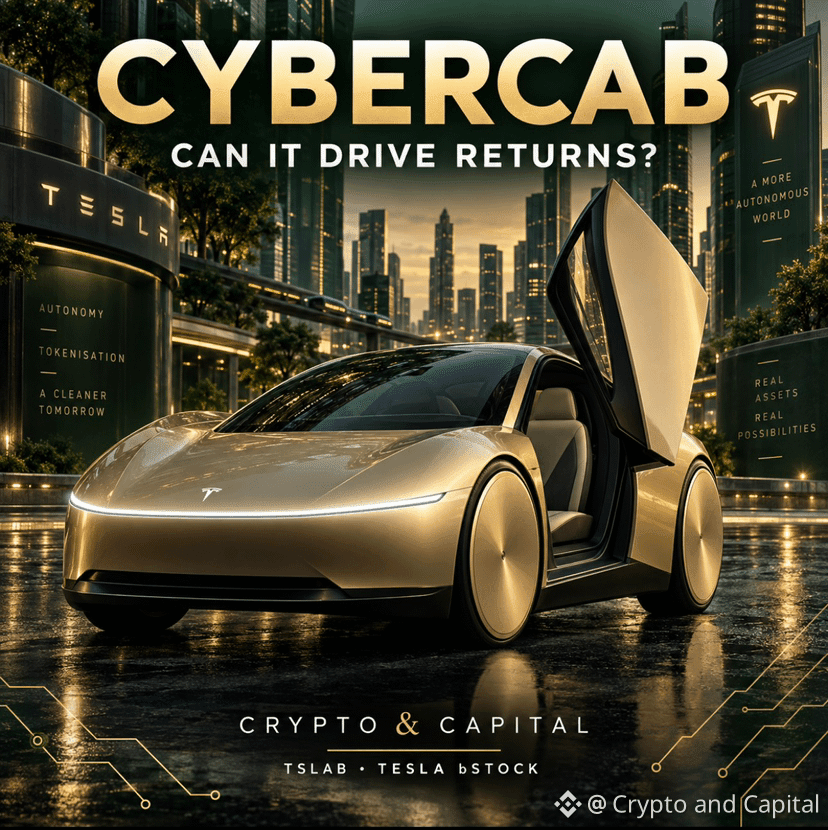
TESLA’S CYBERCAB: BIG OPPORTUNITY, BIG EXPECTATIONS
No steering wheel. No pedals. But can Cybercab steer Tesla toward sustainable profits?
Tesla launched its purpose-built robotaxi in Austin on 3 September, with more than 40 vehicles operating in limited areas. It is a real milestone, not yet proof of a profitable nationwide network.
For $TSLAB , Tesla’s tokenised bStock, the investment story goes beyond car sales: a successful robotaxi business could generate recurring revenue from paid rides.
Here are the signals worth watching:
🔸Safety and regulatory permission to expand
🔸Paid rides per vehicle—not just fleet size
🔸Profit after charging, cleaning, maintenance, insurance and support.
🔸Competition from established robotaxi operators.
🔸How much future success is already priced into Tesla.
The bull case: scalable autonomous transport creates a new earnings engine.
The bear case: expansion takes longer and costs more than investors expect.
One important distinction: $TESLAB provides economic exposure to Tesla, but it is NOT direct ownership of Tesla shares and does not give direct shareholder voting rights. Its price can also differ from the underlying stock, particularly when liquidity is thin or US markets are closed.
My take: watch commercial results, not just futuristic design. A breakthrough vehicle does not automatically make an investment a bargain.
Would you consider TSLAB now? Or wait for stronger robotaxi earnings evidence?
Follow Crypto & Capital for analysis beyond the hype.
Educational content only. Not financial advice. Availability is subject to jurisdiction and eligibility.
#Tesla #Cybercab #Robotaxi #TokenizedStocks
141

·
--
Bullish
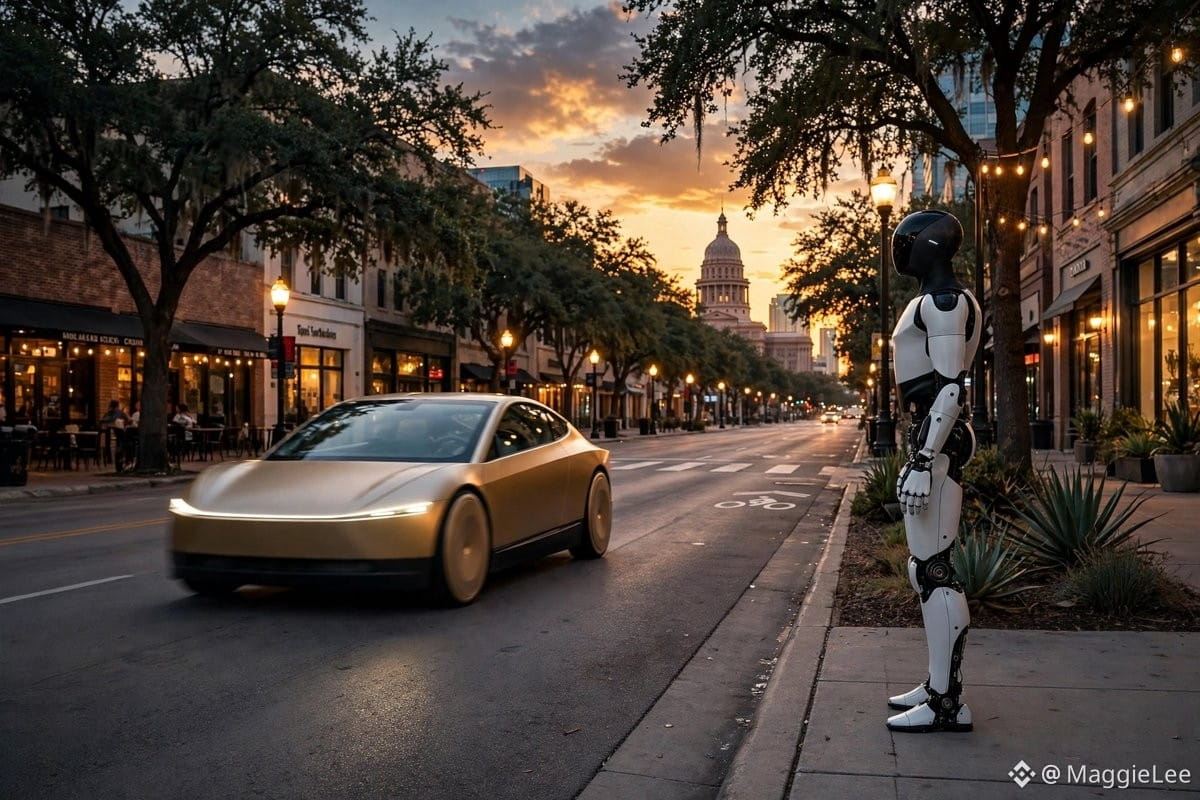
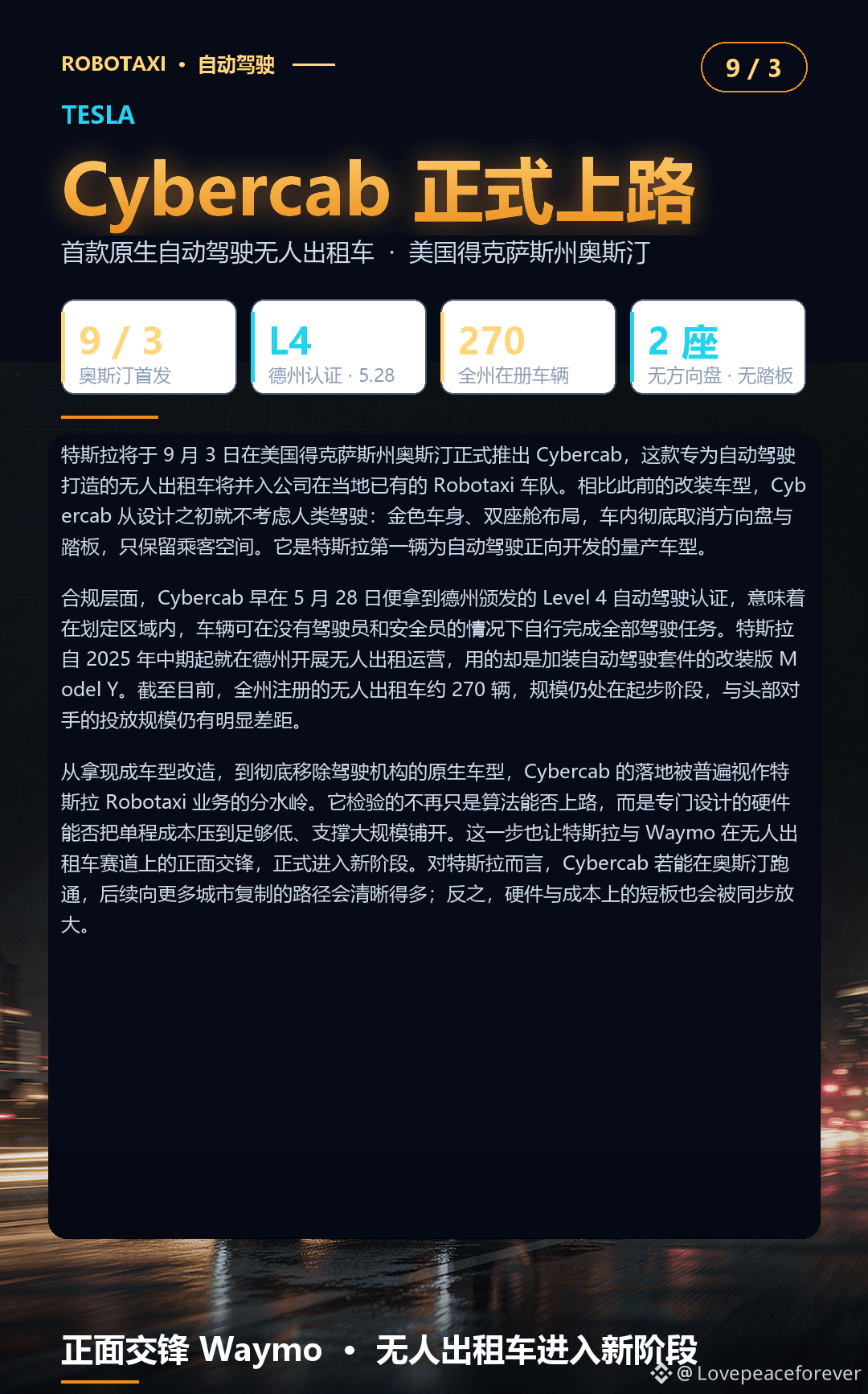
Tesla will officially launch its Cybercab, a driverless taxi designed specifically for autonomous driving, in Austin, Texas, on September 3 in the United States. The unmanned vehicle will be incorporated into the company’s existing local fleet of #ROBOTAXI vehicles. Compared with the previously converted models, Cybercab was not designed with human driving in mind from the very beginning: a gold exterior, a two-seat cockpit layout, and the complete removal of the steering wheel and pedals from inside the cabin—leaving only passenger space. It is Tesla’s first mass-produced model developed forward specifically for autonomous driving.
From a compliance standpoint, #CyberCab obtained Texas’s Level 4 autonomous driving certification as early as May 28, meaning that within designated areas, the vehicles can complete all driving tasks on their own without a driver or safety operator. Since mid-2025, Tesla has been operating driverless taxi services in Texas, but it has used converted Model Y versions equipped with add-on autonomous driving kits. To date, there are about 270 registered driverless taxis statewide, and the scale is still in its early stages, with a clear gap compared with the deployment volumes of leading competitors.
From converting existing models to deploying a native vehicle that completely removes driving controls, the rollout of Cybercab is widely seen as a watershed moment for Tesla’s Robotaxi business. It is not only a test of whether the algorithms can get on the road, but whether purpose-built hardware can drive the one-way cost down enough to support large-scale expansion. This step also brings Tesla into a direct face-off with Waymo in the driverless taxi market, officially entering a new phase. For Tesla, if Cybercab can succeed in Austin, the path to replicating it in more cities will become much clearer; conversely, any weaknesses in hardware and cost will be amplified at the same time.$TSLAB $SPCXB
303
Log in to explore more content
Join global crypto users on Binance Square
⚡️ Get latest and useful information about crypto.
💬 Trusted by the world’s largest crypto exchange.
👍 Discover real insights from verified creators.
Email / Phone number
Trending Topics
1
#$1.5BInLeveragedCryptoBetsLiquidated
6,939 views
104 Discussing
2
#KOSPIFalls3.53%BackBelow6000
17,473 views
468 Discussing
3
#AmazonSharesFallAbout7%InPremarketTrading
3,043 views
121 Discussing
4
#USMidtermElections
147,012 views
1,731 Discussing
5
#StrategySTRCReaches$99.95ForFirstTimeIn165Days
3,232 views
75 Discussing
6
#BinanceWillListPredictPREDICT
44,337 views
866 Discussing
7
#SwitzerlandFirstSpotBitcoinETFExpectedToTradeInNovember
1,690 views
84 Discussing
8
#StrategyReports$21BQ3OperatingProfit
1,747 views
44 Discussing
9
#TwoAddressesHoldingAbout1.28BUSDTFrozen
25,708 views
528 Discussing
10
#FirstDigitalBlacklistsAttackerAddressHoldingAbout3.4MFDUSD
789 views
19 Discussing