

币圈女菩萨
1k Posts

币圈女菩萨
 Square Verified
Report
Block User
我瞎说我的,您随意看

Macro KOL
22 Following
525 Followers
499 Liked
1 Badges
Posts
·
--
Intel’s most pressing need right now is to supply more Xeons, the CEO says, as demand for server CPUs is strong. I agree that this part of the business has recovered, but valuing Intel based only on server growth would overlook weakness in PCs and supply constraints.
Third-quarter data center and AI revenue rose 78% year over year, while PC-related business fell 5%. The CFO expects the PC slowdown to last at least through the first half of 2027. There is demand for servers, but chips still need to be made and delivered for revenue to keep growing.
The company’s fourth-quarter revenue guidance is $15 billion to $16 billion, below this quarter’s roughly $16.5 billion; adjusted gross margin guidance also falls from this quarter’s 44.1% to 38%.
2
1
1.6k
·
--
Verified
Strategy disclosed that it has already sold about $432 million worth of $BTC this year to pay some preferred stock dividends and buy back STRC. When it needs cash, it also draws on its Bitcoin reserves to support these financing instruments.
As of October 25, its holdings were still up 26% from the start of the year, so the broader trend of increasing its holdings remains intact. However, the board has also authorized selling coins to replenish its dollar reserves, pay dividends and interest, and repurchase related securities. These cash outlays will also constrain its budget for future Bitcoin purchases.
The $20.9 billion in digital asset gains disclosed by the company this time will be affected by fair value changes in coin prices and should not be treated directly as the cash budget for its next round of Bitcoin purchases.
2k
·
--
Verified
Binance has postponed the spot launch originally scheduled for 18:00 today for $PREDICT . The new time has yet to be announced. For those who participated in the Prime Sale and have already received a Key, plans to cash out tonight as originally intended will also need to be reconsidered.
The wallet’s previous rules stated that the actual tokens would be sent to Alpha accounts at TGE, and receiving a Key does not mean you already have tokens you can sell. Binance’s existing PREDICT pre-market perpetuals are still trading, but I wouldn’t simply multiply the contract price by the allocation amount and treat that as money recoverable from this event. The timing for selling through Binance Spot is still unknown, so proceeds can no longer be estimated using the original timeline.
The wallet’s previous rules stated that the actual tokens would be sent to Alpha accounts at TGE, and receiving a Key does not mean you already have tokens you can sell. Binance’s existing PREDICT pre-market perpetuals are still trading, but I wouldn’t simply multiply the contract price by the allocation amount and treat that as money recoverable from this event. The timing for selling through Binance Spot is still unknown, so proceeds can no longer be estimated using the original timeline.
1
2.2k
·
--
Verified
Americans spent 0.5% more in September, but after adjusting for higher prices, consumption barely grew. What worried me about last night's data was that consumption has already slowed while prices are still rising. $BTC It won't be easy to reverse this weakness by relying on expectations of rate cuts.
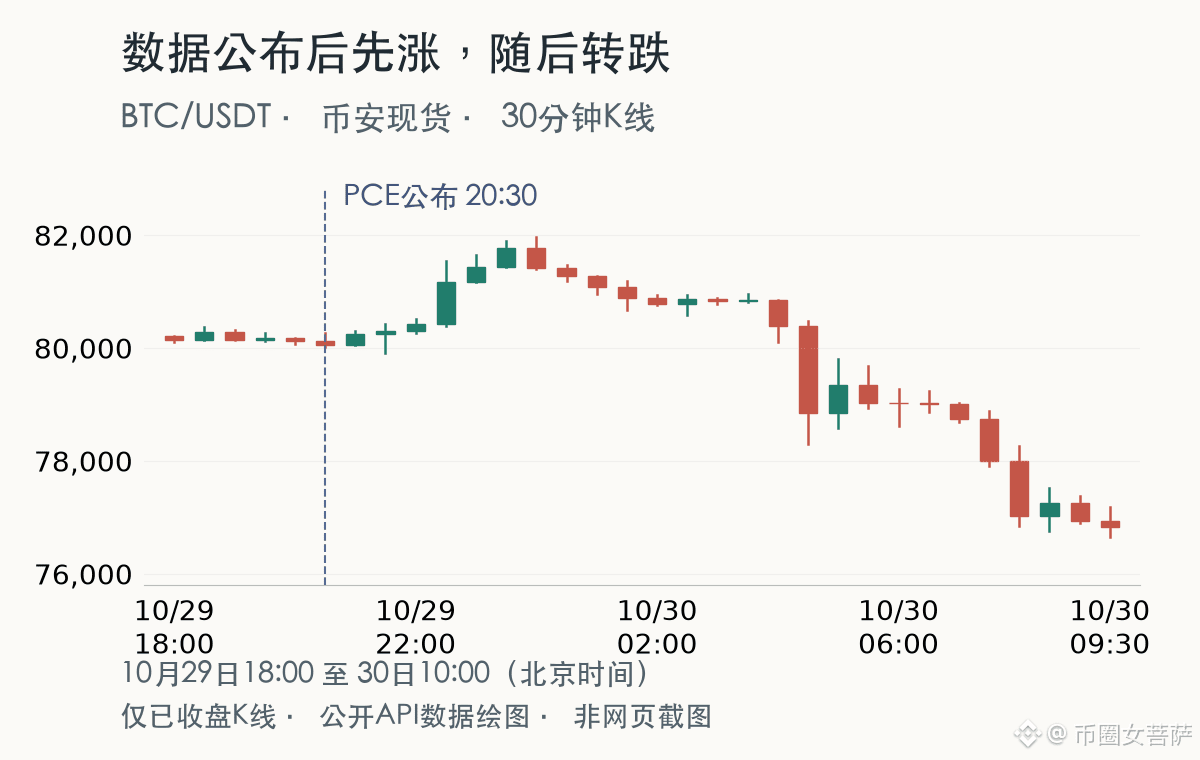
Binance spot prices initially rose to nearly $82,000 after the data was released, then turned lower early this morning and had fallen to around $77,000 by midmorning. I think any rebound over the next day or two is still likely to be pushed back down by selling. If prices can climb back above the roughly $80,000 level from before the data release and hold there, that would weaken this short-term view. Prices rose first and then fell, but the timing alone isn't enough to attribute the entire decline to PCE.
The PCE price index rose 3.6% year over year. Excluding food and energy, it was still up 0.3% month over month, the same as in August, so it's not accurate to say inflation is accelerating across the board. But consumption didn't increase significantly, and real disposable income also fell 0.3% that month, meaning consumers' purchasing power is weakening too.
1
1
1.4k
·
--
OpenAI investments added $207 million to Microsoft's net income this quarter, whereas they dragged it down by about $3.1 billion in the same period last year. Without last year's drag, this year's year-over-year net income growth looks stronger.
Under accounting standards, Microsoft's net income grew 32% in the quarter ended September 30; excluding the impact of OpenAI investments in both periods, it grew 18%. When estimating Microsoft's future earnings, I would put more weight on the latter growth rate, to avoid carrying forward the low comparison base created by last year's investment losses.
Azure revenue grew 48% year over year this quarter, and the group's operating profit grew 21%. The business itself is also making more money.
79
·
--
Bitcoin Core disclosed three vulnerabilities this time, and I’m more concerned about the one that can easily knock nodes offline. A malicious node may be able to exhaust the memory of a Windows, macOS, or BSD node running an affected version simply by connecting to it, causing it to crash. Linux is not affected by this particular vulnerability.
The vulnerability was officially rated medium severity, and fixes have been released in versions 29.5, 30.4, 31.2, and 32.1. How much price pressure this news will put on $BTC depends, in my view, more on the actual scope of the disruption and the progress of patching. The number of vulnerabilities disclosed, by itself, does not show how much the network was affected.
The rollback data file issue disclosed at the same time can also cause nodes to go offline, but the official assessment is that practical exploitation on 64-bit systems is unrealistic, so it was rated low severity. There’s another point to watch: 32-bit systems and nodes that store block files on FAT32 are still affected. Those setups cannot assume the problem is solved simply by upgrading.
79
·
--
In the third quarter, Google raised about $12.4 billion by issuing common stock, while share repurchases totaled zero. Cloud revenue doubled and operating income topped three times the year-earlier figure, but shareholder returns cannot be expected to grow at the same pace.
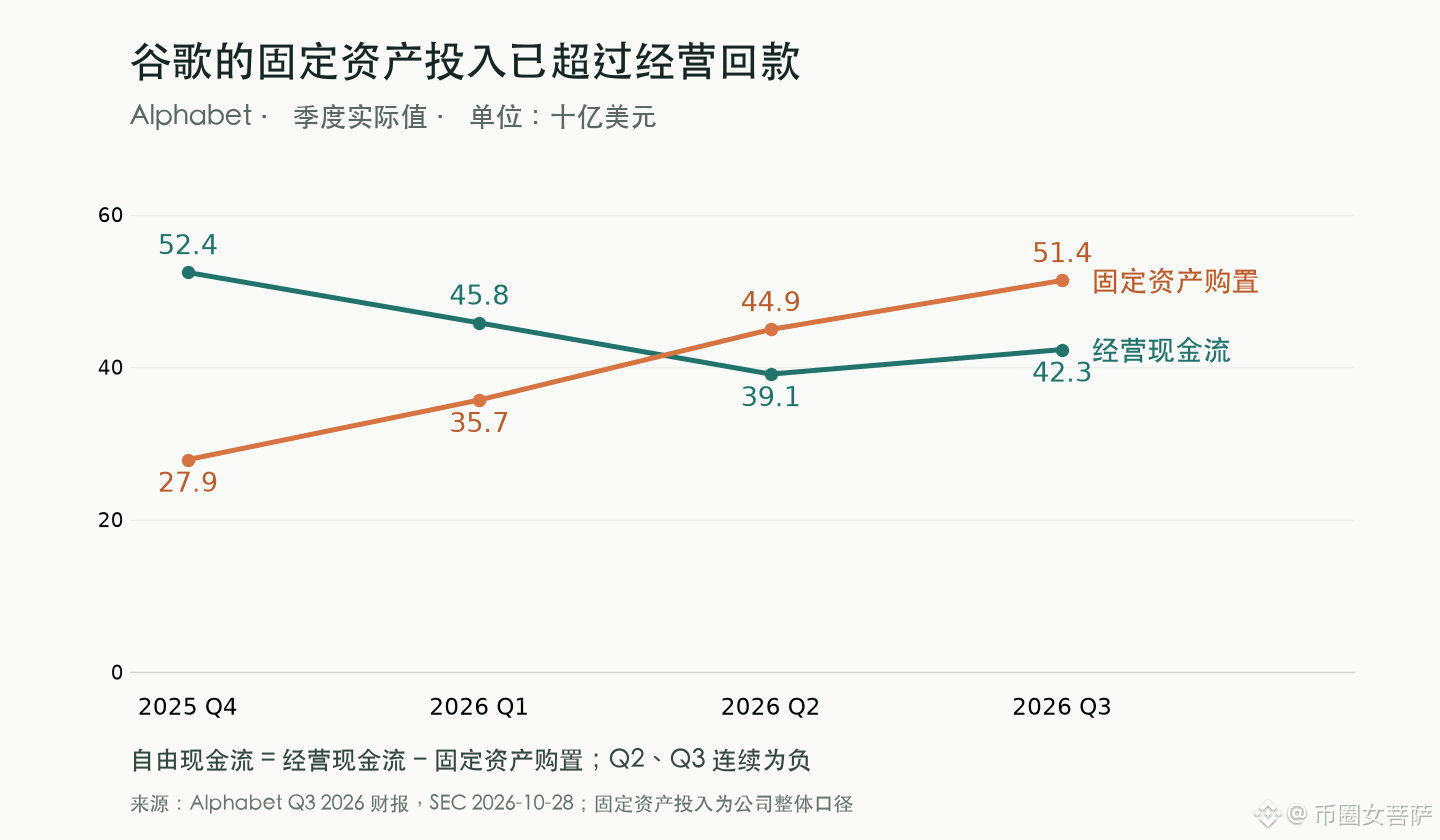
This quarter, Google generated about $42.3 billion in cash from operating activities and spent $51.4 billion on property and equipment. By the company’s measure, free cash flow was negative $9.1 billion. This was the second consecutive quarter of negative free cash flow, with expansion spending still exceeding cash generated by operations during the quarter.
In addition to issuing shares, the company also issued a batch of senior unsecured bonds this quarter, raising about $28.7 billion net. At quarter-end, it still had $265.1 billion in cash and marketable securities on its balance sheet, so its cash reserves remain substantial.
The 36 million newly issued shares represented about 0.3% of the total common shares outstanding at quarter-end, so the dilution was modest. What matters more for the valuation is that free cash flow continues to decline even as cloud profits grow.
142
·
--
For this $PREDICT PP points airdrop, getting your tokens early means permanently giving up 65% of your entitled allocation and receiving only the remaining 35%. To work out how much you can cash out by claiming early, you first need to deduct that 65%—you can’t calculate it based on the full allocation and pre-market contract prices. Alternatively, you can wait until the project’s one-year staking period is complete and receive 100%, but the token price a year from now is still unknown.
Predict.fun operates a prediction market on BNB Chain. This distribution covers allocations corresponding to existing PP points, with eligibility and amounts still subject to verification by the project. If you want to receive 35% on the day PREDICT launches, you must submit the claim-method form by 5 p.m. Beijing time today. Late submissions will be included in a later weekly batch.
The final deadline to submit the form is November 26 at 5 p.m. If you don’t choose an option by then, you’ll automatically be assigned the full-allocation option after one year of staking. Each person may submit the form only once, and submissions cannot be changed.
1
222
·
--
Datavault AI says it requested in June to transfer $BTC from its Biconomy account to an external account, but the transfer was still incomplete when it filed documents on October 26. A publicly traded company had previously treated these coins as a source of operating funds, yet its withdrawal has been stuck for months. I think that matters more than simply looking at how many BTC it disclosed.
These BTC came from last year’s transaction in which Scilex subscribed for shares in the company. The other party credited 1,309.04 BTC to it through an internal transfer on the platform. Datavault later sold some of the BTC back to Scilex, receiving about $40.5 million in cash; it remains uncertain whether the rest of the amount can be recovered.
The company now believes the transaction should not have been recognized as its own digital assets. It plans to reclassify the amount as a subscription receivable and offset it against shareholders’ equity, and to restate the financial statements for several periods. I wouldn’t count this kind of internal book transfer as additional spot BTC buying. For this treasury asset, I’d first look at how much of the amount can be recovered, and only then consider how much funding it can provide to the company.
149
·
--
Robinhood generated $173 million in revenue from prediction markets in the third quarter, surpassing the $120 million from crypto trading. Crypto trading revenue fell 55% year over year, but the company’s total revenue hit a record, and HOOD now has more sources of income.
Revenue from options and stock trading also grew 31% and 41%, respectively. What stands out to me is that even as crypto revenue slumped, the rest of the business combined to push total revenue up 12%. HOOD should be valued with these revenue streams considered separately; looking only at crypto prices is no longer enough.
However, record revenue hasn’t yet translated into higher earnings per share. Third-quarter adjusted EPS fell 3% year over year, while EPS under accounting standards declined 16%. The quarter included an unrealized loss, mainly related to the valuation of the company’s venture capital funds, so the entire decline under accounting standards shouldn’t be attributed to weaker day-to-day operations.
As its credit card loans grow, the company also has to set aside more for credit losses. In the third quarter, this provision rose from $26 million to $71 million. The company lowered the upper end of its full-year budgets for adjusted expenses and stock-based compensation, but those budgets exclude the credit loss provision.
92
·
--
The OSMO community is discussing taking 55.5 million $OSMO out of the community pool and transferring them to a burn address, bringing the cumulative amount burned to more than 100 million. The 100 million here is a cumulative target; the amount proposed for this round is 55.5 million.
These coins were originally not in circulation, but they could still be allocated through future governance proposals. I support permanently removing part of them, so holders will be less affected by one potential future release. Any benefit to the token price comes from reducing the number of coins that could be released in the future; it does not involve buying back OSMO from the market, nor would it remove 55.5 million coins from the current circulating supply on the day it is executed.
The proposal author says the target is to submit it on-chain on October 30, but what we see now is still a forum proposal and cannot be treated as already burned. If implemented as proposed, the community pool would still retain about 63.8 million OSMO and other assets; in the future, when funds need to be spent, the amount of OSMO reserves the community can draw on would also be reduced.
157
·
--
UPS completed planned reductions with its largest customer in the second quarter, and in the third quarter both revenue and adjusted operating profit in its U.S. domestic business increased. After handling fewer packages, has the business improved? Tonight’s earnings report provides new evidence.
Average daily package volume in the U.S. domestic segment fell by about 3.3% year over year, yet revenue rose 4.5%, and adjusted operating profit margin increased from 6.4% to 7%. I think this round of adjustments is starting to pay off. The decline in volume has not prevented this segment from generating more profit, and the support it provides for UPS’s stock price is more convincing than simply increasing package volume.
However, the group’s adjusted operating profit was still lower than the same period last year. In the supply chain solutions business, last year included a gain from a sale-leaseback transaction, which boosted the comparison base.
Restructuring still comes at a cost. The company expects related adjustment expenses of $1.4 billion to $1.6 billion this year, and the efficiency transformation is expected to continue through the fourth quarter of 2027. When assessing how much profit this round of adjustments can leave for shareholders, these expenses excluded from adjusted metrics also need to be taken into account.
80
·
--
Bitmine bought another 10,452 ETH last week and also repurchased 2.04 million of its own shares. It is still adding buying pressure to ETH, but the company is also willing to spend money on its own stock.
According to its October 26 announcement, as of the 25th it held about 6.05 million ETH, or 4.95% of the total supply, putting it within reach of its 5% target. Continued accumulation is good for ETH, but that target doesn’t tell us how much more it will buy once it gets there, and the announcement doesn’t say it will stop buying at 5%.
Management says it will consider repurchases when it believes the company’s stock is relatively undervalued. I think we need to keep judging this crypto treasury company’s support for ETH by how many coins it actually buys, rather than focusing only on its holdings nearing 5%. Buybacks don’t add buying pressure to ETH, but we also can’t conclude from this repurchase alone that it means the company bought that much less ETH. The company is spending money on both ETH and buybacks, and the announcement doesn’t say how much it plans to spend on ETH going forward.
84
·
--
Celestica (CLS) has set a revenue target of $40 billion for next year, nearly double this year’s expected revenue, while preparing to invest $1.5 billion to $2 billion in capital expenditures. The company is preparing capacity in advance based on customers’ demand forecasts for this year and next, but those forecasts should not yet be treated as revenue already secured.
In the third quarter, revenue from its cloud and connectivity business doubled year over year, while the company’s overall adjusted operating margin rose to 8.5% from 7.6% a year earlier. This expansion is backed by businesses that are already growing.
The company also lowered its free cash flow forecast for this year from $600 million to $460 million, explaining that the main reason was increased working-capital investment ahead of next year’s growth. Proceeds from its August share offering are also earmarked for working capital and capital expenditures. I think this cash flow downgrade looks more like spending in advance to support expansion, and is not inconsistent with the revenue already delivered and the improvement in adjusted operating margins.
The share offering increased the number of shares outstanding, so future profits will also have to be divided among more shares. If customers delay deployments, the additional capacity could sit idle and cash collection could slow. For expansion to benefit CLS’s share price, it will need to translate into higher deliveries and growth in earnings per share; the near-doubling of the revenue target alone is not enough to justify that.
1
119
·
--
Franklin plans to turn U.S. stock dividends into $BTC exposure. The two new ETFs are tickered FBEQ and FIBT. Investors who are primarily invested in stocks can gradually add Bitcoin exposure within the same portfolio, without having to reinvest dividends in stocks.
The indexes tracked by both funds initially allocate 5% to Bitcoin, then continue directing stock dividends into Bitcoin. At quarterly rebalancing, however, if BTC exposure exceeds 5%, it is reduced to 4.5%; if it has not exceeded 5%, it remains unchanged. If BTC rises more than stocks, that could trigger a reduction in the allocation, so reinvesting dividends won’t make the position grow indefinitely.
The funds will gain exposure through instruments such as Bitcoin ETPs, futures, and options, and may not buy Bitcoin directly. How much capital the products attract and which instruments they actually use will affect how much they contribute to demand for spot BTC. The filing submitted on October 22 confirms the product design, but it isn’t enough to determine how much additional buying demand has already been created.
If the funds can attract people who previously bought only stocks and are willing to allocate a small portion of their money to BTC, I think this design could help support Bitcoin’s long-term demand. But that support will depend on the funds growing over time. The fact that dividends will be invested continuously shouldn’t lead us to overlook the potential offsetting adjustments from quarterly reductions in the allocation.
174
·
--
BNB Chain is preparing to build another L1. Under the current plan, fees and staking will continue to use $BNB, with no new tradable token being issued. I think this choice is more beneficial to existing holders. If the new chain can build up trading and payment activity, demand for the token will still accrue to BNB.
For now, the chain is called New L1. It aims to support activities that require high speeds, such as high-frequency trading and real-time payments. The current development network has a block time of 200 milliseconds, but neither the public testnet nor the mainnet is open yet, and the bridge connecting it to BSC is still under development. Since public network data is not yet available, we can’t judge how much activity it will attract based on this speed metric alone.
To assess how much it could benefit BNB, we also need to distinguish where the activity comes from. If BSC’s existing users simply move over, BNB will be used on another chain, but overall demand may not increase. Attracting new applications and capital is more likely to increase demand for fees and staking. So I support continuing to use BNB, but once the new chain launches, if it mainly takes on trading that already takes place on BSC, we shouldn’t count demand on both chains twice.
BNB Chain is preparing to build another L1. Under the current plan, fees and staking will continue to use $BNB , with no new tradable token being issued. I think this choice is more beneficial to existing holders. If the new chain can build up trading and payment activity, demand for the token will still accrue to BNB.
For now, the chain is called New L1. It aims to support activities that require high speeds, such as high-frequency trading and real-time payments. The current development network has a block time of 200 milliseconds, but neither the public testnet nor the mainnet is open yet, and the bridge connecting it to BSC is still under development. Since public network data is not yet available, we can’t judge how much activity it will attract based on this speed metric alone.
To assess how much it could benefit BNB, we also need to distinguish where the activity comes from. If BSC’s existing users simply move over, BNB will be used on another chain, but overall demand may not increase. Attracting new applications and capital is more likely to increase demand for fees and staking. So I support continuing to use BNB, but once the new chain launches, if it mainly takes on trading that already takes place on BSC, we shouldn’t count demand on both chains twice.
221
·
--
The Fed meets first this week, with U.S. GDP and PCE data released afterward. That timing is a bit tricky for $BTC . The decision is due at 2 a.m. Beijing time on Thursday, followed by a press conference at 2:30 a.m. GDP and PCE data won’t be released until 8:30 p.m. that evening. Even if prices rise first in the early hours, the evening data could prompt the market to reassess.
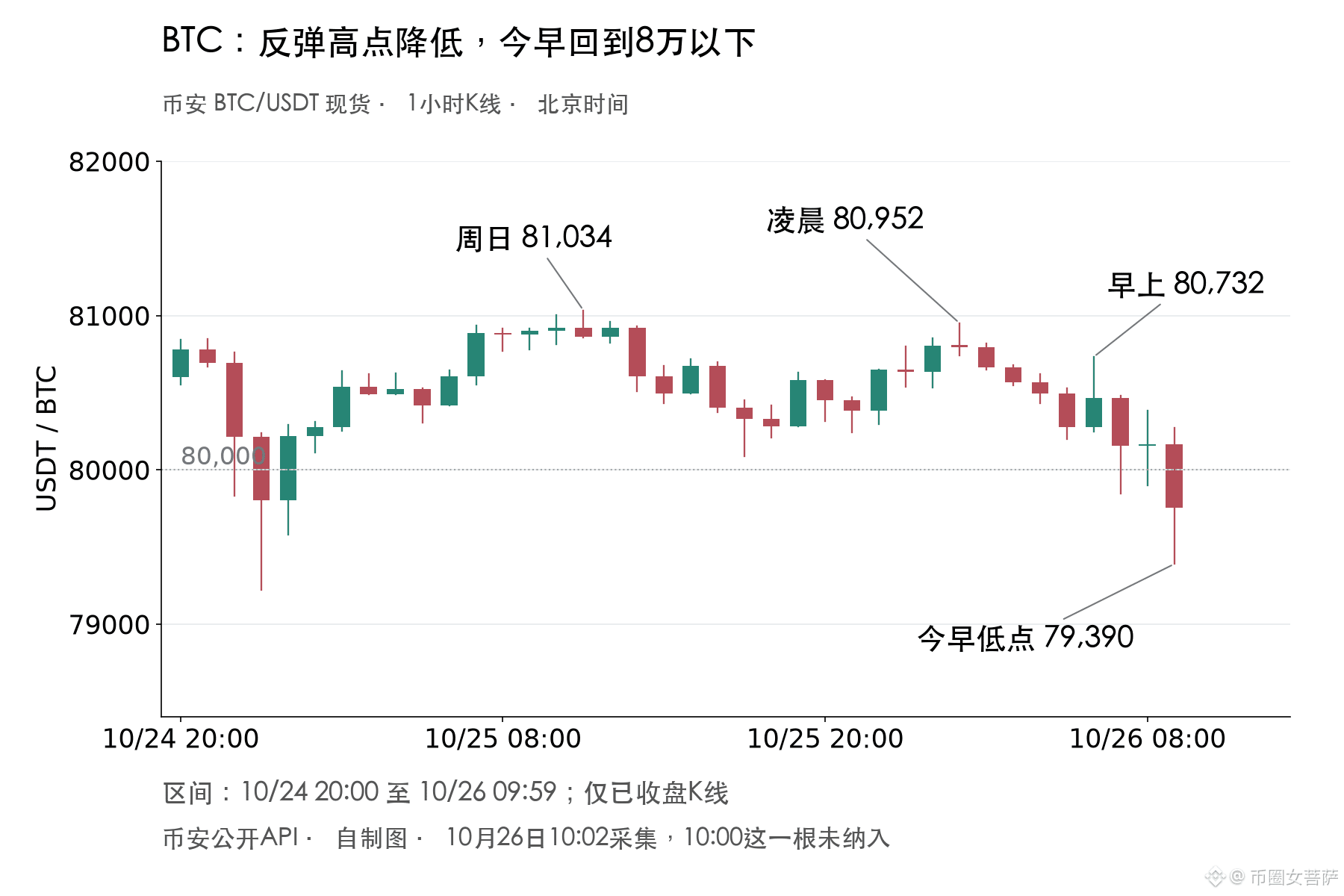
BTC’s rebound has also failed to hold. It returned to around 81,000 on Sunday, reached a high of 80,950 in the early hours today, and its morning rebound only got as far as 80,730 before it fell back to 79,390. It’s still below 80,000. I think the next day or two will remain weak, with rebounds likely to run into selling pressure. However, Saturday’s low hasn’t been breached, so it’s too soon to say that the decline is accelerating. If BTC can reclaim and hold around today’s early-hours rebound high of 80,950, this short-term view would need to be reconsidered.
If the press conference suggests there’s no rush to keep raising rates, BTC could rebound at first. But if tonight’s PCE data shows inflation accelerating again, concerns about interest rates that had just eased could return. With these two events only a little over a dozen hours apart, I think it’s too early to assume that the early-hours rally has fully priced in the bad news.
228
·
--
Western Digital spent about $1 billion on share buybacks this quarter, and on October 22 announced a 17% increase in its quarterly dividend. The buybacks were supported by operating cash flow, so I think it’s a good thing that money earned from selling hard drives is making its way back to shareholders.
It sold more storage capacity to cloud customers than in the same period last year, and the average selling price per unit of capacity rose by about 25%. Meanwhile, costs for its next-generation products are coming down, and the company’s overall adjusted gross margin has reached 58.1%. Customers are paying more while production costs are improving, so this wave of storage demand is already helping Western Digital earn more.
After capital expenditures, the company generated about $1.38 billion in free cash flow this quarter, enough to cover its buybacks and dividends paid during the period. It also repaid some convertible notes, however, and its cash balance actually fell from the previous quarter, so the entire $1.38 billion shouldn’t be treated as spare cash.
The company is targeting an adjusted gross margin of 60% to 61% next quarter. Price increases may not continue at this pace indefinitely, but if cost reductions for new products keep pace, the profits Western Digital earns from this demand cycle will be more sustainable—and its share price will have stronger earnings support.
86
·
--
South Korea was originally set to begin taxing crypto income next January, but a delay is now being discussed. Newsis quoted the presidential office today as saying that the matter is still under review and no decision has been made. If the tax is postponed, I think that would be good for South Korean investors who want to keep trading assets such as $BTC .
Under the National Tax Service’s current guidance, for coins already held before 2027, the tax basis can be whichever is higher: the actual purchase price or the market price at the end of 2026. If the year-end market price is higher, that price will be used as the basis when calculating taxable gains later, rather than carrying forward the lower cost basis from before the price increase. So it’s not possible to conclude, based solely on the fact that the tax is due to take effect next year, that South Korean holders will have to sell their coins en masse at the end of this year.
If the delay goes ahead, South Korean investors can put off taking on this tax burden, which would help them continue trading BTC. But continuing to trade is a far cry from putting new money into crypto, so I wouldn’t overestimate the impact of the delay news on coin prices.
With just over two months to go before the originally scheduled implementation, and the rules potentially changing, it’s quite a hassle for traders to plan around. If the tax is indeed postponed, it also needs to be made clear whether the provision using the market price at the end of 2026 as the tax basis will change as well.
1
527
·
--
On October 23, American Express announced that it would lay off about 3,500 employees alongside its earnings report. Layoffs can raise concerns about weakening consumer spending, but cardmember spending still grew 8% this quarter. Customers are still spending, while American Express is preparing to cut costs in its own operations. I think these layoffs need to be considered alongside the cost of cardmember benefits.
American Express’s net card fee revenue grew 16% in the third quarter, thanks both to higher fees on premium cards and to an increase in the number of customers with these cards. The premium card business remains attractive, but some of the additional annual fee revenue also has to go toward paying for cardmember benefits.
Companywide spending on cardmember services rose 36% this quarter. The company said this was mainly related to upgrades to the U.S. Platinum Card and customers using their benefits more. While we can’t use these two companywide figures to calculate Platinum Card profitability directly, the rapid growth in service costs still gives me some concern. As customers use more benefits, the company incurs higher costs, eating into some of the profit gains from annual fee increases.
The savings from layoffs have yet to show up in future results, so for now I wouldn’t translate the headcount reduction directly into additional profit. The company expects year-over-year growth in customer-related expenses to slow next quarter, partly because last year’s Platinum Card upgrade raised the comparison base. If card spending and fees continue to grow, slower expense growth could leave more room for profits—and give the stock an additional source of support from sustained earnings growth.
1
138
Log in to explore more content
Join global crypto users on Binance Square
⚡️ Get latest and useful information about crypto.
💬 Trusted by the world’s largest crypto exchange.
👍 Discover real insights from verified creators.
Email / Phone number
Trending Topics
BinanceReports80%Recoveryof$6.3BillioninLossesfromHackIncident
9,332 views
97 Discussing
Security Incident Update #2 (2026-10-30)
Binance Announcement
·956 Likes
·1.1M views
HeYiSaysWithdrawalsExpectedtoResumeWithin42Hours
16,421 views
322 Discussing
CZSaysCompensationIsinPlaceUsersAreProtected
15,981 views
250 Discussing