
#raas
raas
4,375 views
73 Discussing
Hot
Latest

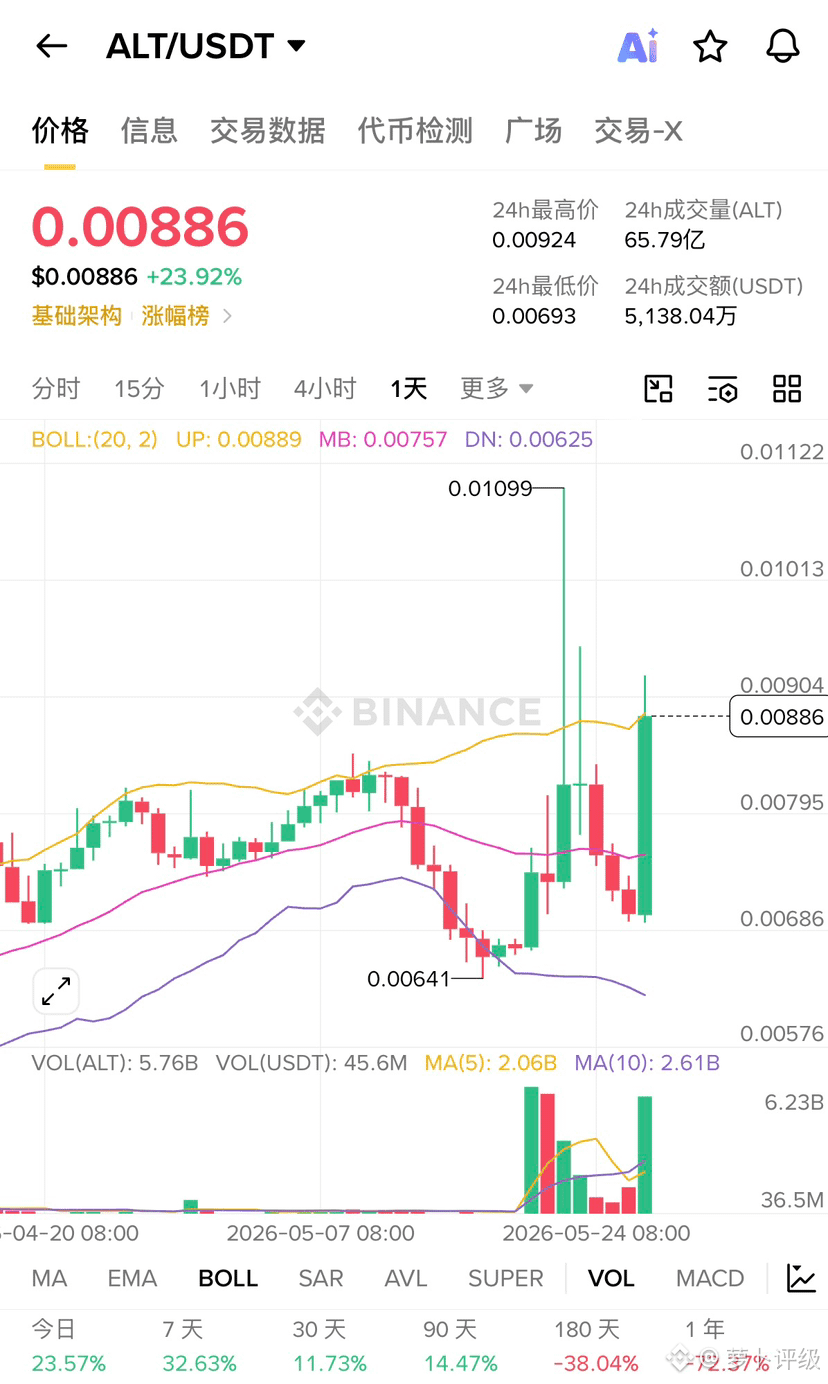
$ALT This wave has pulled up 23%+ in 24 hours, but the community is in a frenzy with bulls and bears clashing—some say it's an undervalued opportunity with the HyperEVM ecosystem, while others are accusing the project team of pump and dump. The project is focused on modular Rollup as a Service (RaaS), and they've been making moves: they just announced a partnership with Chain_GPT to bring AI agents into Web3, and they've added support for Solana, enabling real-time DeFi data and on-chain execution. On the other hand, AltLLM Chat and AltClaw, which are in collaboration with Arbitrum, are now live, and if you hold an ARB wallet, you can use them. Community sentiment is polarized; whether the price can hold steady will depend on the success of upcoming partnerships and changes in TVL.
#ALT #RaaS #AI #BNBChain
#ALT #RaaS #AI #BNBChain

$ESP This +28% move isn’t just a normal rebound.
As Espresso serves as the L2 global confirmation layer, today it saw an expanded volume of 11.9M, pulling through 0.08. The CG total market trading volume is close to 96% of the MC—capital is relocating into the infrastructure track.
Right now, longs vs. shorts aren’t arguing about whether prices go up or down; they’re debating the rotation logic behind the RaaS narrative. The 0.06–0.08 range has formed a new concentrated order/position zone, and volume confirms the effectiveness of the structure’s bottom.
Watch 0.085—the supply zone after the Feb ATH pullback. If it breaks above, this rebound upgrades into a structural reshaping; if it gets pushed back down, this bullish candle becomes a handoff/turnover bar, and we’ll wait for the next round.
When this kind of sudden volume surge hits the infrastructure track, is it institutions setting up positions or quant funds sweeping orders? Share your take in the comments.
#暗影萨满 #ESP #Infrastructure #RaaS
As Espresso serves as the L2 global confirmation layer, today it saw an expanded volume of 11.9M, pulling through 0.08. The CG total market trading volume is close to 96% of the MC—capital is relocating into the infrastructure track.
Right now, longs vs. shorts aren’t arguing about whether prices go up or down; they’re debating the rotation logic behind the RaaS narrative. The 0.06–0.08 range has formed a new concentrated order/position zone, and volume confirms the effectiveness of the structure’s bottom.
Watch 0.085—the supply zone after the Feb ATH pullback. If it breaks above, this rebound upgrades into a structural reshaping; if it gets pushed back down, this bullish candle becomes a handoff/turnover bar, and we’ll wait for the next round.
When this kind of sudden volume surge hits the infrastructure track, is it institutions setting up positions or quant funds sweeping orders? Share your take in the comments.
#暗影萨满 #ESP #Infrastructure #RaaS

📈$ALT Market heat fully explodes, funds rush in and drive the trend
On July 3, social media sentiment and Twitter discussion volume surged dramatically, with attention across the entire web rapidly spiking. Fueled by this hype, on July 4 Binance ALT futures trading volume jumped directly 10x. Speculative capital poured in, and with prices rising in tandem, FOMO sentiment in the market heated up significantly.
As an infrastructure-related token for Ethereum RaaS scaling, boosted further by the AI Agent and restaking narrative, the short-term flow advantage attracts a large number of retail investors and leveraged funds to enter. Market volatility continues to rise, and short-term upward momentum remains strong.
How long do you think this wave of high-heat trading can last? Can ALT kick off a new round of trend-driven rally?
#altcoins #Altlayer #RaaS #合约资金信号
On July 3, social media sentiment and Twitter discussion volume surged dramatically, with attention across the entire web rapidly spiking. Fueled by this hype, on July 4 Binance ALT futures trading volume jumped directly 10x. Speculative capital poured in, and with prices rising in tandem, FOMO sentiment in the market heated up significantly.
As an infrastructure-related token for Ethereum RaaS scaling, boosted further by the AI Agent and restaking narrative, the short-term flow advantage attracts a large number of retail investors and leveraged funds to enter. Market volatility continues to rise, and short-term upward momentum remains strong.
How long do you think this wave of high-heat trading can last? Can ALT kick off a new round of trend-driven rally?
#altcoins #Altlayer #RaaS #合约资金信号



Log in to explore more content