
#usweeklyinitialjoblessclaimsriseto206000
usweeklyinitialjoblessclaimsriseto206000
Hot
Latest




Verified
#USWeeklyInitialJoblessClaimsRiseTo206000
U.S. weekly initial jobless claims increased to 206,000, showing a slight rise in the number of Americans filing for unemployment benefits.
While the increase isn’t dramatic, it’s still a data point worth watching. A gradual weakening in the labor market could influence expectations around future Federal Reserve policy, interest rates, and ultimately risk assets like stocks and crypto.
For crypto traders, softer employment data can sometimes support the idea of easier monetary policy, but one report alone doesn’t tell the full story. Markets will also be watching inflation, payrolls, wages, and upcoming Fed signals.
In short, 206K claims are not a major shock, but they add another small piece to the bigger economic picture.
Keep an eye on market reaction rather than focusing only on the headline number.
DYOR and manage risk carefully.
$BTC
$SOL
$ZEC
U.S. weekly initial jobless claims increased to 206,000, showing a slight rise in the number of Americans filing for unemployment benefits.
While the increase isn’t dramatic, it’s still a data point worth watching. A gradual weakening in the labor market could influence expectations around future Federal Reserve policy, interest rates, and ultimately risk assets like stocks and crypto.
For crypto traders, softer employment data can sometimes support the idea of easier monetary policy, but one report alone doesn’t tell the full story. Markets will also be watching inflation, payrolls, wages, and upcoming Fed signals.
In short, 206K claims are not a major shock, but they add another small piece to the bigger economic picture.
Keep an eye on market reaction rather than focusing only on the headline number.
DYOR and manage risk carefully.
$BTC
$SOL
$ZEC

KHALIDTLM13 :
2

Verified
🌟 206K ISN'T THE STORY — WHAT COMES NEXT IS
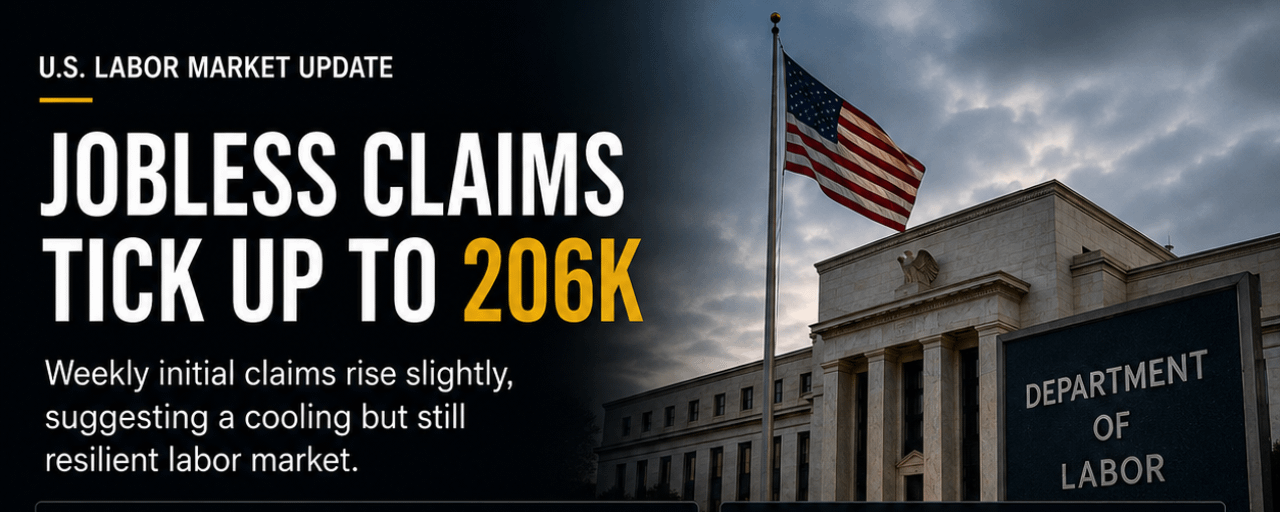
Initial jobless claims increased to 206,000, up 2,000 from the previous week's revised figure. The four-week average also moved higher to 207,250.
The labor market hasn't suddenly broken down, but traders are increasingly focused on whether future reports confirm a meaningful cooling trend.
For traders, the key is simple:
Don't make a major decision from one data point.
Track the trend, watch market reaction, and let $BTC, $ETH and $BNB confirm the sentiment.
#usweeklyinitialjoblessclaimsriseto206000
Initial jobless claims increased to 206,000, up 2,000 from the previous week's revised figure. The four-week average also moved higher to 207,250.
The labor market hasn't suddenly broken down, but traders are increasingly focused on whether future reports confirm a meaningful cooling trend.
For traders, the key is simple:
Don't make a major decision from one data point.
Track the trend, watch market reaction, and let $BTC, $ETH and $BNB confirm the sentiment.
#usweeklyinitialjoblessclaimsriseto206000
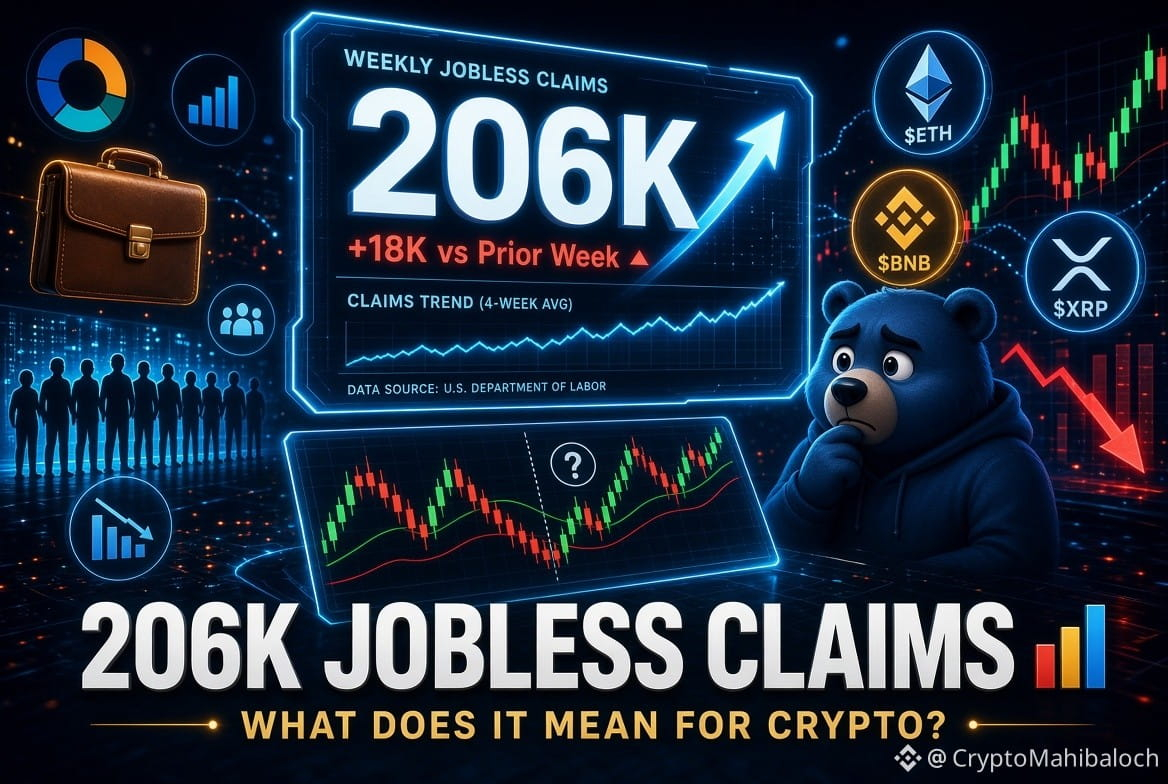
📊 206K CLAIMS — WHY SHOULD CRYPTO TRADERS CARE?
Weekly jobless claims rose to 206,000, adding another important piece to the economic picture.
The number itself isn't a dramatic shock, but markets are always looking for signals about employment, interest rates, liquidity, and overall risk appetite.
That’s where crypto comes in. Changes in macro expectations can influence volatility across $BTC, $ETH, $BNB and $XRP.
One data point doesn't decide the market — the trend and the market's reaction are what matter. 👀📈
#usweeklyinitialjoblessclaimsriseto206000
Weekly jobless claims rose to 206,000, adding another important piece to the economic picture.
The number itself isn't a dramatic shock, but markets are always looking for signals about employment, interest rates, liquidity, and overall risk appetite.
That’s where crypto comes in. Changes in macro expectations can influence volatility across $BTC, $ETH, $BNB and $XRP.
One data point doesn't decide the market — the trend and the market's reaction are what matter. 👀📈
#usweeklyinitialjoblessclaimsriseto206000

#usweeklyinitialjoblessclaimsriseto206000
🚨 U.S. JOBLESS CLAIMS RISE — BUT NO MAJOR LABOR WARNING YET
Weekly jobless claims rose 2,000 to 206K, while continuing claims increased to 1.779M. The labor market remains relatively stable, with layoffs still contained.
📊 Trader Take:
A resilient labor market gives the Fed more room to stay focused on inflation. That can keep pressure on yields, the dollar and risk assets like crypto, especially with services-price pressures still elevated.
🎯 TRADING VIEW: BUY
Near-term macro conditions lean bearish for crypto while the Fed remains focused on inflation. The upcoming jobs data will be the next major catalyst.
❓ Could stronger labor data trigger another crypto pullback? "CLICK ON THE BELOW YELLOW COIN TAG TO GO TO DESIRED TRADING PAGE TO GET BENEFIT TRADE"$USELESS $MARSCOIN
#USjobs #CryptoMarket
🚨 U.S. JOBLESS CLAIMS RISE — BUT NO MAJOR LABOR WARNING YET
Weekly jobless claims rose 2,000 to 206K, while continuing claims increased to 1.779M. The labor market remains relatively stable, with layoffs still contained.
📊 Trader Take:
A resilient labor market gives the Fed more room to stay focused on inflation. That can keep pressure on yields, the dollar and risk assets like crypto, especially with services-price pressures still elevated.
🎯 TRADING VIEW: BUY
Near-term macro conditions lean bearish for crypto while the Fed remains focused on inflation. The upcoming jobs data will be the next major catalyst.
❓ Could stronger labor data trigger another crypto pullback? "CLICK ON THE BELOW YELLOW COIN TAG TO GO TO DESIRED TRADING PAGE TO GET BENEFIT TRADE"$USELESS $MARSCOIN
#USjobs #CryptoMarket

Verified
#usweeklyinitialjoblessclaimsriseto206000
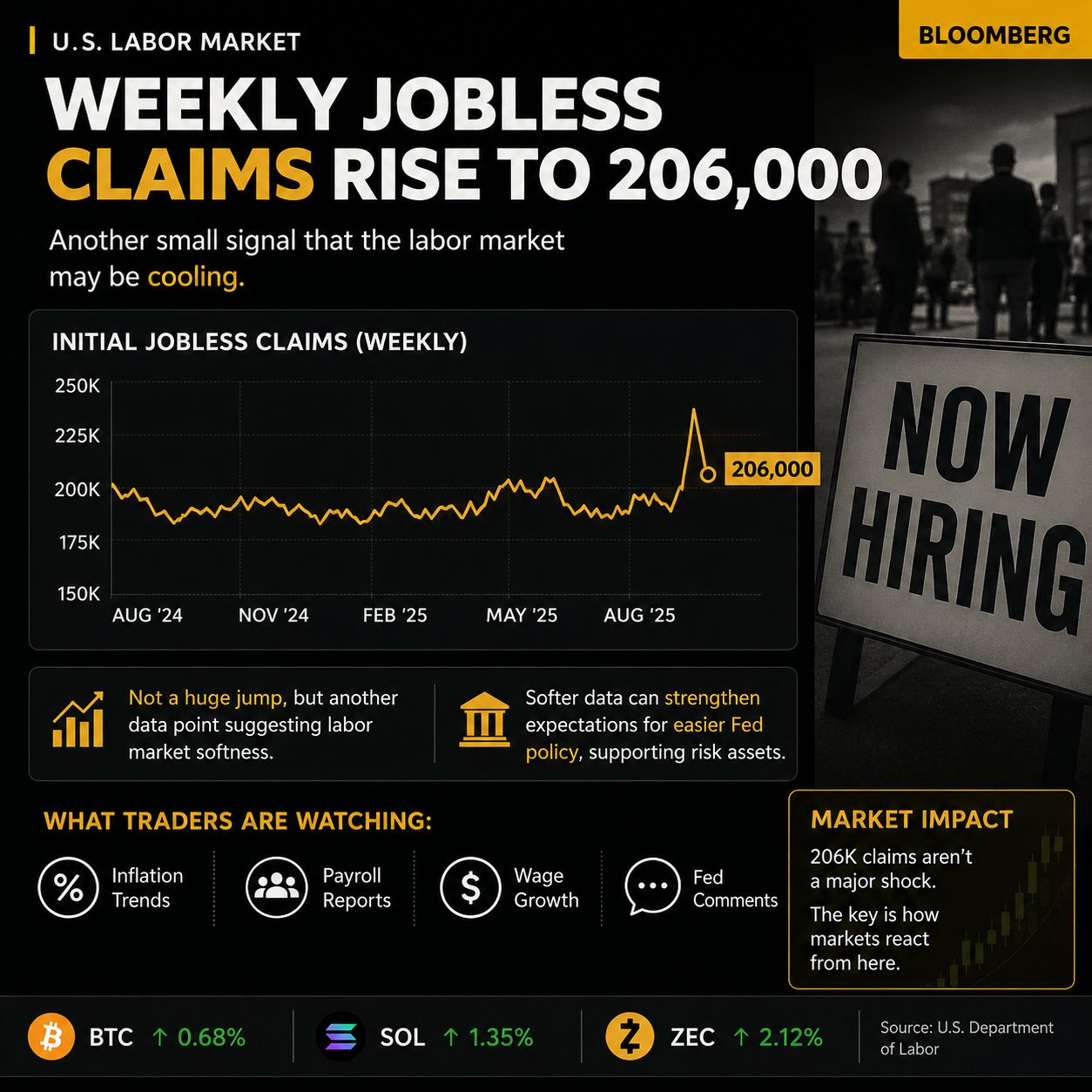
📊 U.S. weekly jobless claims rose to 206,000.
Not a huge jump, but it's another small signal that the labor market may be cooling.
For crypto traders, softer employment data can strengthen expectations for easier Fed policy, which can influence sentiment across risk assets like $BTC and $SOL .
That said, one report doesn't change the whole picture. Inflation, payrolls, wage growth and upcoming Fed comments will matter just as much.
For now, 206K claims aren't a major shock. They're simply another piece of the macro puzzle.
👀 The key is how markets react from here, not just the headline number.
$ZEC
#crypto #Bitcoin #Fed #Macro #trading
📊 U.S. weekly jobless claims rose to 206,000.
Not a huge jump, but it's another small signal that the labor market may be cooling.
For crypto traders, softer employment data can strengthen expectations for easier Fed policy, which can influence sentiment across risk assets like $BTC and $SOL .
That said, one report doesn't change the whole picture. Inflation, payrolls, wage growth and upcoming Fed comments will matter just as much.
For now, 206K claims aren't a major shock. They're simply another piece of the macro puzzle.
👀 The key is how markets react from here, not just the headline number.
$ZEC
#crypto #Bitcoin #Fed #Macro #trading

Verified
#usweeklyinitialjoblessclaimsriseto206000
The latest U.S. labor market puzzle piece just landed, and the signal is more mixed than dramatic!
Here is the quick breakdown:
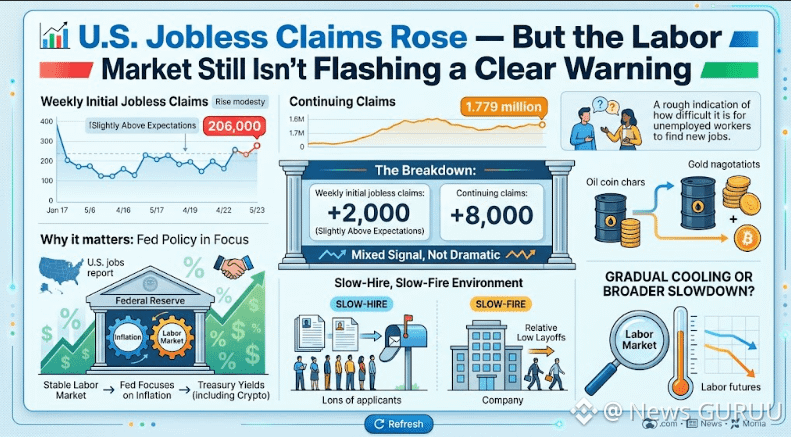
Weekly initial jobless claims edged up by 2,000 to reach 206,000.
This came in slightly above the expected 205,000.
Continuing claims also climbed by 8,000 to hit 1.779 million.
Despite these slight increases, claims are still relatively low. It seems we are stuck in a "slow-hire, slow-fire" reality where companies aren't aggressively adding to their teams, but they aren't doing widespread layoffs either.
Why it matters to your portfolio:
Because the labor market is staying relatively stable, it gives the Federal Reserve more room to keep its focus on fighting inflation. This is a big deal for the dollar, Treasury yields, and risk assets like crypto, because shifting expectations around future Fed rates can quickly change market liquidity and sentiment.
All eyes are on the upcoming U.S. jobs report as our next major test. Are we just cooling down gradually, or is this the start of a broader slowdown?
$SOL
$ZEC
$XRP
The latest U.S. labor market puzzle piece just landed, and the signal is more mixed than dramatic!
Here is the quick breakdown:
Weekly initial jobless claims edged up by 2,000 to reach 206,000.
This came in slightly above the expected 205,000.
Continuing claims also climbed by 8,000 to hit 1.779 million.
Despite these slight increases, claims are still relatively low. It seems we are stuck in a "slow-hire, slow-fire" reality where companies aren't aggressively adding to their teams, but they aren't doing widespread layoffs either.
Why it matters to your portfolio:
Because the labor market is staying relatively stable, it gives the Federal Reserve more room to keep its focus on fighting inflation. This is a big deal for the dollar, Treasury yields, and risk assets like crypto, because shifting expectations around future Fed rates can quickly change market liquidity and sentiment.
All eyes are on the upcoming U.S. jobs report as our next major test. Are we just cooling down gradually, or is this the start of a broader slowdown?
$SOL
$ZEC
$XRP


#USWeeklyInitialJoblessClaimsRiseTo206000
🚨🇺🇸 #USWeeklyInitialJoblessClaimsRiseTo206000 — U.S. LABOR MARKET REMAINS RESILIENT
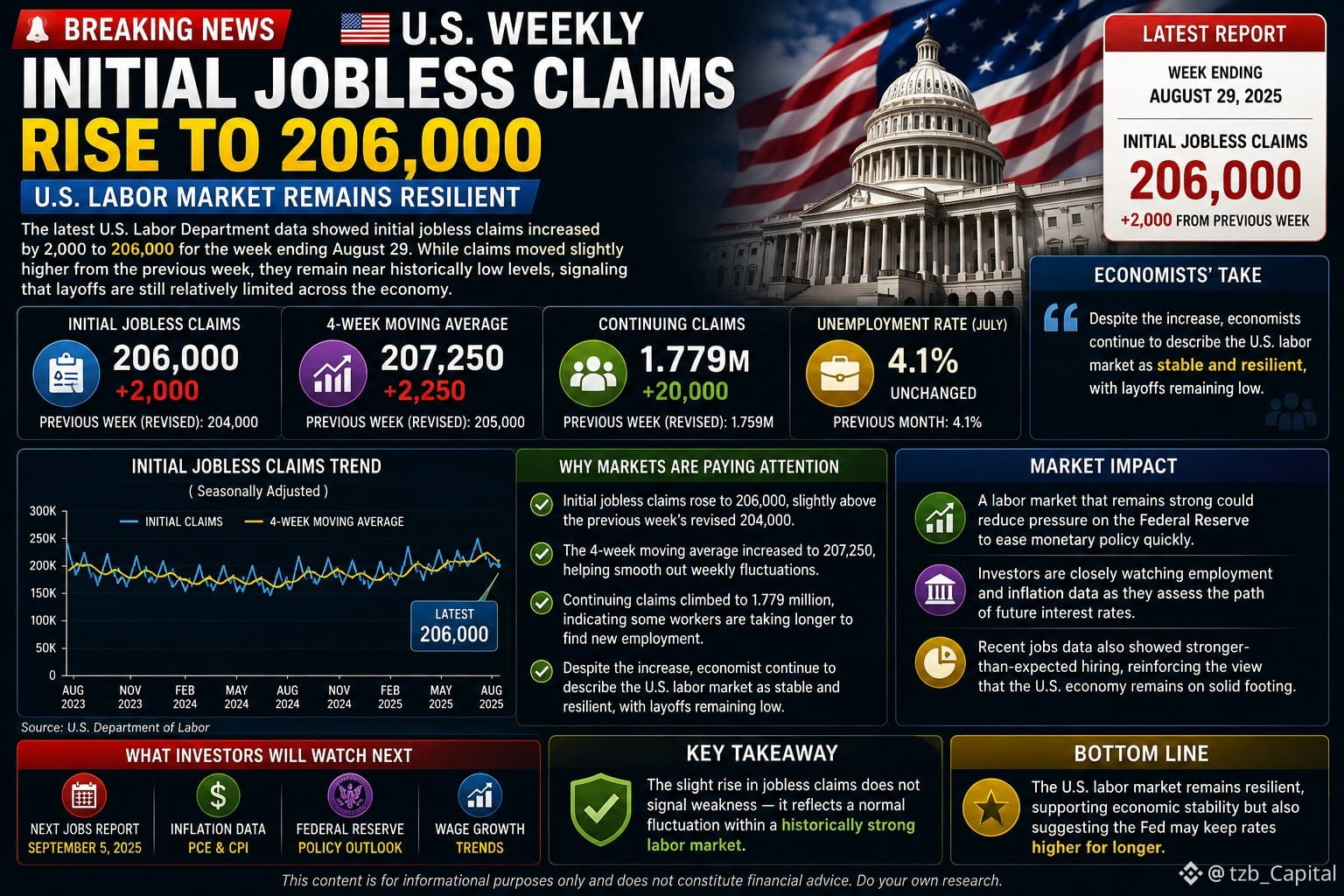
The latest U.S. Labor Department data showed initial jobless claims increased by 2,000 to 206,000 for the week ending August 29. While claims moved slightly higher from the previous week, they remain near historically low levels, signaling that layoffs are still relatively limited across the economy.
📊 Why markets are paying attention:
✅ Initial jobless claims rose to 206,000, slightly above the previous week's revised 204,000.
✅ The 4-week moving average increased to 207,250, helping smooth out weekly fluctuations.
✅ Continuing claims climbed to 1.779 million, indicating some workers are taking longer to find new employment.
✅ Despite the increase, economists continue to describe the U.S. labor market as stable and resilient, with layoffs remaining low.
📈 Market Impact
A labor market that remains strong could reduce pressure on the Federal Reserve to ease monetary policy quickly. Investors are closely watching employment and inflation data as they assess the path of future interest rates. Recent jobs data also showed stronger-than-expected hiring, reinforcing the view that the U.S. economy remains on solid footing.
$MARSCOIN $DASH $CATI
🚨🇺🇸 #USWeeklyInitialJoblessClaimsRiseTo206000 — U.S. LABOR MARKET REMAINS RESILIENT
The latest U.S. Labor Department data showed initial jobless claims increased by 2,000 to 206,000 for the week ending August 29. While claims moved slightly higher from the previous week, they remain near historically low levels, signaling that layoffs are still relatively limited across the economy.
📊 Why markets are paying attention:
✅ Initial jobless claims rose to 206,000, slightly above the previous week's revised 204,000.
✅ The 4-week moving average increased to 207,250, helping smooth out weekly fluctuations.
✅ Continuing claims climbed to 1.779 million, indicating some workers are taking longer to find new employment.
✅ Despite the increase, economists continue to describe the U.S. labor market as stable and resilient, with layoffs remaining low.
📈 Market Impact
A labor market that remains strong could reduce pressure on the Federal Reserve to ease monetary policy quickly. Investors are closely watching employment and inflation data as they assess the path of future interest rates. Recent jobs data also showed stronger-than-expected hiring, reinforcing the view that the U.S. economy remains on solid footing.
$MARSCOIN $DASH $CATI

#USWeeklyInitialJoblessClaimsRiseTo206000
The latest US Weekly Initial Jobless Claims data remains a pivotal macroeconomic indicator for crypto market participants. Recent prints showing claims hovering near the 200,000 to 210,000 range underscore a surprisingly resilient labor market. For digital asset traders, this metric is not merely about employment; it serves as a direct proxy for Federal Reserve policy expectations.
When jobless claims remain low, it signals that the economy can withstand higher interest rates for longer. This environment typically delays anticipated rate cuts, keeping traditional liquidity tight and acting as a near-term headwind for risk-on assets like Bitcoin and major altcoins. Institutional capital tends to remain cautious when the cost of capital stays elevated.
Conversely, any sustained upward trend in weekly claims would suggest meaningful labor market cooling. Such a shift could accelerate dovish monetary policy repricing, potentially unlocking fresh liquidity for speculative digital asset markets.
Traders should monitor the four-week moving average of these claims rather than reacting to single-week volatility. Filtering out the weekly noise allows for a clearer view of the underlying economic trajectory. As we navigate this complex macroeconomic landscape, aligning crypto exposure with broader global liquidity cycles remains a prudent risk management approach. Always conduct your own research and manage position sizes accordingly.
$MARSCOIN
$UAI
$FLOCK
The latest US Weekly Initial Jobless Claims data remains a pivotal macroeconomic indicator for crypto market participants. Recent prints showing claims hovering near the 200,000 to 210,000 range underscore a surprisingly resilient labor market. For digital asset traders, this metric is not merely about employment; it serves as a direct proxy for Federal Reserve policy expectations.
When jobless claims remain low, it signals that the economy can withstand higher interest rates for longer. This environment typically delays anticipated rate cuts, keeping traditional liquidity tight and acting as a near-term headwind for risk-on assets like Bitcoin and major altcoins. Institutional capital tends to remain cautious when the cost of capital stays elevated.
Conversely, any sustained upward trend in weekly claims would suggest meaningful labor market cooling. Such a shift could accelerate dovish monetary policy repricing, potentially unlocking fresh liquidity for speculative digital asset markets.
Traders should monitor the four-week moving average of these claims rather than reacting to single-week volatility. Filtering out the weekly noise allows for a clearer view of the underlying economic trajectory. As we navigate this complex macroeconomic landscape, aligning crypto exposure with broader global liquidity cycles remains a prudent risk management approach. Always conduct your own research and manage position sizes accordingly.
$MARSCOIN
$UAI
$FLOCK


#USWeeklyInitialJoblessClaimsRiseTo206000
U.S. JOBLESS CLAIMS RISE — MARKETS ON WATCH! 📊
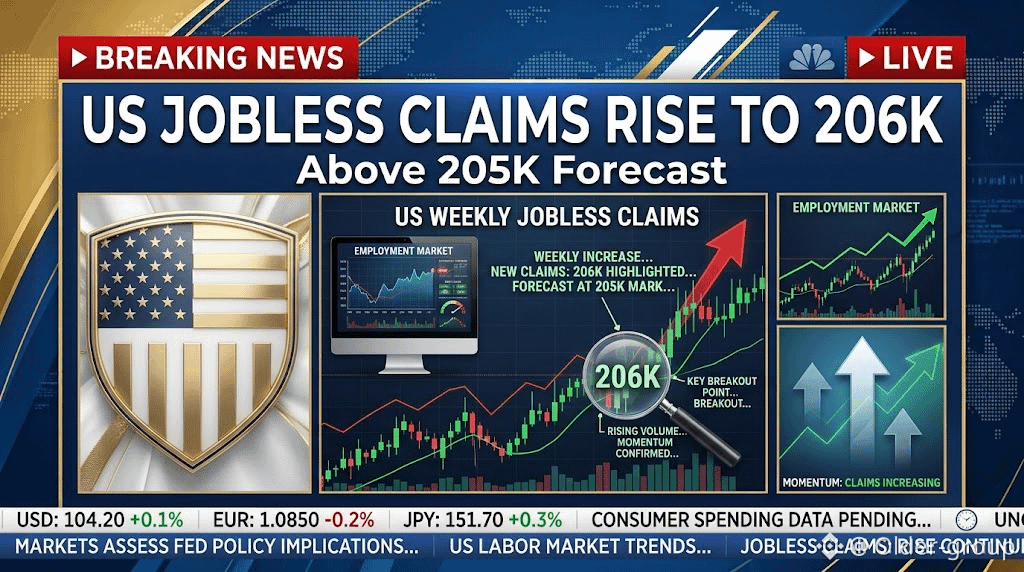
The latest U.S. data shows Initial Jobless Claims at 206K, slightly above the 205K forecast and up from 204K revised.
⚠️ A small upside surprise in claims can suggest some softening in the labor market, potentially adding pressure on the USD and influencing expectations around Fed policy.
🔥 Why Crypto Traders Should Care:
• Higher claims → potential labor-market cooling
• Cooling labor data → possible shift in Fed expectations
• Fed expectations → impact on USD, liquidity & crypto volatility
• BTC and major alts could react sharply around upcoming macro data
🎯 Trader Focus: Don’t trade the headline blindly. Watch BTC/ETH price action, DXY, Treasury yields and volume for confirmation before entering.
📈 Market Bias: SLIGHTLY BULLISH for Crypto — but NOT a guaranteed move.
⚡ Macro data can create volatility fast. Manage risk, wait for confirmation, and avoid overleveraging.
$MARSCOIN $4 $FLOCK
U.S. JOBLESS CLAIMS RISE — MARKETS ON WATCH! 📊
The latest U.S. data shows Initial Jobless Claims at 206K, slightly above the 205K forecast and up from 204K revised.
⚠️ A small upside surprise in claims can suggest some softening in the labor market, potentially adding pressure on the USD and influencing expectations around Fed policy.
🔥 Why Crypto Traders Should Care:
• Higher claims → potential labor-market cooling
• Cooling labor data → possible shift in Fed expectations
• Fed expectations → impact on USD, liquidity & crypto volatility
• BTC and major alts could react sharply around upcoming macro data
🎯 Trader Focus: Don’t trade the headline blindly. Watch BTC/ETH price action, DXY, Treasury yields and volume for confirmation before entering.
📈 Market Bias: SLIGHTLY BULLISH for Crypto — but NOT a guaranteed move.
⚡ Macro data can create volatility fast. Manage risk, wait for confirmation, and avoid overleveraging.
$MARSCOIN $4 $FLOCK


Picture this: you wake up to green candles across your portfolio, see jobless claims tick up to 206,000, and immediately assume the rate-cut liquidity floodgates are wide open.
Most traders rush to long every breakout during macro releases like this, only to get trapped by the vicious intraday reversal that usually follows. The real risk here is misinterpreting weak labor data as pure fuel for risk assets without looking under the hood.
When jobless claims rise, markets initially price in faster monetary easing, sending tokens like $ONDO and $ICP on sharp speculative runs. But in a high-greed environment, bad economic news is only bullish until the market realizes it actually signals real growth deceleration. If consumer strength deteriorates too fast, that liquidity narrative evaporates, leaving high-beta altcoins holding the bag while capital flees back into $USDT.
The playbook here is simple: watch whether institutional volume actually supports these macro-driven spikes before committing size.
Are you taking profit into this macro bounce or waiting for more confirmation?
#USWeeklyInitialJoblessClaimsRiseTo206000 #USAugustNonfarmPayrollsDueToday
Most traders rush to long every breakout during macro releases like this, only to get trapped by the vicious intraday reversal that usually follows. The real risk here is misinterpreting weak labor data as pure fuel for risk assets without looking under the hood.
When jobless claims rise, markets initially price in faster monetary easing, sending tokens like $ONDO and $ICP on sharp speculative runs. But in a high-greed environment, bad economic news is only bullish until the market realizes it actually signals real growth deceleration. If consumer strength deteriorates too fast, that liquidity narrative evaporates, leaving high-beta altcoins holding the bag while capital flees back into $USDT.
The playbook here is simple: watch whether institutional volume actually supports these macro-driven spikes before committing size.
Are you taking profit into this macro bounce or waiting for more confirmation?
#USWeeklyInitialJoblessClaimsRiseTo206000 #USAugustNonfarmPayrollsDueToday

موموصوصو:
شكلك علقت في صفقة بيع ياكذاب كل يوم توترون الناس لمنشورات فاضيه يامعفن يااناني تحب نفسك

Most traders celebrate weak labor data thinking rate cuts mean instant green candles, but historically, the initial shift is where leverage gets wiped out the hardest.
When the Fear and Greed index sits around 75 Greed, everyone tries to front-run the macro pivot by longing assets without checking liquidity conditions. The real trap is entering volatile tokens right into data prints, only to get stopped out before any real direction forms.
When initial claims push up to 206k, the market immediately prices in Fed easing, yet recessionary lag usually bites spot markets first. We often see high-beta plays like $ONDO and $NEIRO react wildly to short-term dollar weakness, while liquidity retreats back to stable reserves like $USDT before any sustainable breakout occurs. Rate cut expectations driven by a cooling labor market are rarely a straight line up; they tend to trigger choppy whipsaws that flush overexposed positions first.
How are you adjusting your spot and leverage exposure ahead of the upcoming labor prints?
#USWeeklyInitialJoblessClaimsRiseTo206000 #USAugustNonfarmPayrollsDueToday
When the Fear and Greed index sits around 75 Greed, everyone tries to front-run the macro pivot by longing assets without checking liquidity conditions. The real trap is entering volatile tokens right into data prints, only to get stopped out before any real direction forms.
When initial claims push up to 206k, the market immediately prices in Fed easing, yet recessionary lag usually bites spot markets first. We often see high-beta plays like $ONDO and $NEIRO react wildly to short-term dollar weakness, while liquidity retreats back to stable reserves like $USDT before any sustainable breakout occurs. Rate cut expectations driven by a cooling labor market are rarely a straight line up; they tend to trigger choppy whipsaws that flush overexposed positions first.
How are you adjusting your spot and leverage exposure ahead of the upcoming labor prints?
#USWeeklyInitialJoblessClaimsRiseTo206000 #USAugustNonfarmPayrollsDueToday

Have you noticed every trader suddenly became a labor economist the moment weekly jobless claims hit 206,000?
The painful part is watching people dump solid bags or chase a bounce they cannot even explain. Then they sit through another chop session wondering why they keep losing money on data they barely understand.
The crowd is treating 206k like a recession alarm. It is not. This is a modest rise, not a collapse in hiring, and yet the market is already pricing rate cuts as if they are locked in. Meanwhile sentiment is sitting at 75 in greed. That mix is how late buyers get trapped.
If you want a process instead of a reaction, park dry powder in $USDT until direction is confirmed. Let $BTC show the real reaction first. If it holds and yields ease, then you look at macro-linked names like $ONDO . If it rejects, you wait. You do not need a view in the first ten minutes. You need a rule for when you actually size in after the noise fades.
Most traders lose on jobs data because they trade the headline. The number is public. The edge is in the follow-through.
Where do you think this jobs print actually sends the market from here?
#USWeeklyInitialJoblessClaimsRiseTo206000 #USAugustNonfarmPayrollsDueToday #BitcoinEthereumHitMultiMonthHighs
The painful part is watching people dump solid bags or chase a bounce they cannot even explain. Then they sit through another chop session wondering why they keep losing money on data they barely understand.
The crowd is treating 206k like a recession alarm. It is not. This is a modest rise, not a collapse in hiring, and yet the market is already pricing rate cuts as if they are locked in. Meanwhile sentiment is sitting at 75 in greed. That mix is how late buyers get trapped.
If you want a process instead of a reaction, park dry powder in $USDT until direction is confirmed. Let $BTC show the real reaction first. If it holds and yields ease, then you look at macro-linked names like $ONDO . If it rejects, you wait. You do not need a view in the first ten minutes. You need a rule for when you actually size in after the noise fades.
Most traders lose on jobs data because they trade the headline. The number is public. The edge is in the follow-through.
Where do you think this jobs print actually sends the market from here?
#USWeeklyInitialJoblessClaimsRiseTo206000 #USAugustNonfarmPayrollsDueToday #BitcoinEthereumHitMultiMonthHighs


#USWeeklyInitialJoblessClaimsRiseTo206000
🇺🇸 U.S. JOBLESS CLAIMS RISE TO 206K
U.S. initial jobless claims increased by 2,000 to 206,000 for the week ending August 29, slightly above expectations. Despite the rise, claims remain historically low, suggesting the labor market is still relatively resilient.
📊 Why it matters for crypto:
A strong labor market can influence the Fed’s rate decisions, while any signs of weakening employment may affect expectations for monetary policy and liquidity.
👀 Traders will be watching the next U.S. jobs and inflation data closely.
#USWeeklyInitialJoblessClaims #Bitcoin #Crypto #Fed #USEconomy #Binance
#LululemonTumbles20%OnWeakGuidance #BitcoinETFsBiggestDailyInflowSinceJanuary #USAugustAvgHourlyEarningsRise3.1%
🇺🇸 U.S. JOBLESS CLAIMS RISE TO 206K
U.S. initial jobless claims increased by 2,000 to 206,000 for the week ending August 29, slightly above expectations. Despite the rise, claims remain historically low, suggesting the labor market is still relatively resilient.
📊 Why it matters for crypto:
A strong labor market can influence the Fed’s rate decisions, while any signs of weakening employment may affect expectations for monetary policy and liquidity.
👀 Traders will be watching the next U.S. jobs and inflation data closely.
#USWeeklyInitialJoblessClaims #Bitcoin #Crypto #Fed #USEconomy #Binance
#LululemonTumbles20%OnWeakGuidance #BitcoinETFsBiggestDailyInflowSinceJanuary #USAugustAvgHourlyEarningsRise3.1%

Everyone thinks a rise in weekly jobless claims to 206,000 is an automatic sell signal for crypto, but actually it often just shows the labor market cooling without breaking.
You know the feeling. Data hits, you panic-sell $BTC at the first dip, then it recovers while you're sitting in $USDT watching from the sidelines. That reaction is how traders lose money even in a greed market.
Think of these claims like checking your car's oil every week. A small uptick doesn't mean the engine is about to seize. 206k remains low by historical standards and fits a soft-landing story more than a recession. The real danger is ignoring the trend and treating every print as gospel while $ONDO and other rate-sensitive names keep doing their own thing.
Payrolls later this week will tell us more. Until then the common mistake is letting one number dictate your entire position.
What's your read on whether this cooling actually helps or hurts crypto from here?
#USWeeklyInitialJoblessClaimsRiseTo206000 #USAugustNonfarmPayrollsDueToday #BitcoinEthereumHitMultiMonthHighs
You know the feeling. Data hits, you panic-sell $BTC at the first dip, then it recovers while you're sitting in $USDT watching from the sidelines. That reaction is how traders lose money even in a greed market.
Think of these claims like checking your car's oil every week. A small uptick doesn't mean the engine is about to seize. 206k remains low by historical standards and fits a soft-landing story more than a recession. The real danger is ignoring the trend and treating every print as gospel while $ONDO and other rate-sensitive names keep doing their own thing.
Payrolls later this week will tell us more. Until then the common mistake is letting one number dictate your entire position.
What's your read on whether this cooling actually helps or hurts crypto from here?
#USWeeklyInitialJoblessClaimsRiseTo206000 #USAugustNonfarmPayrollsDueToday #BitcoinEthereumHitMultiMonthHighs


#usweeklyinitialjoblessclaimsriseto206000
U.S. initial jobless claims rose 2,000 to 206,000 for the week ending August 29, slightly above the 205,000 forecast. Continuing claims also increased to 1.779 million, while layoffs remain relatively low
#USJobs #Economy #FederalReserve #Crypto
$BTC
$ETH
$BNB
U.S. initial jobless claims rose 2,000 to 206,000 for the week ending August 29, slightly above the 205,000 forecast. Continuing claims also increased to 1.779 million, while layoffs remain relatively low
#USJobs #Economy #FederalReserve #Crypto
$BTC
$ETH
$BNB
💡 FROM JOBLESS CLAIMS TO CRYPTO — HERE'S THE CONNECTION
Why should a crypto trader care about jobless claims?
Because economic data can influence expectations for interest rates and liquidity, which can affect investor appetite for riskier assets.
This week's initial claims reached 206,000, just slightly above expectations.
But markets are forward-looking.
Keep $BTC, $BNB and $ETH in view while watching the next major economic numbers.
#usweeklyinitialjoblessclaimsriseto206000
Why should a crypto trader care about jobless claims?
Because economic data can influence expectations for interest rates and liquidity, which can affect investor appetite for riskier assets.
This week's initial claims reached 206,000, just slightly above expectations.
But markets are forward-looking.
Keep $BTC, $BNB and $ETH in view while watching the next major economic numbers.
#usweeklyinitialjoblessclaimsriseto206000

Verified
#usweeklyinitialjoblessclaimsriseto206000
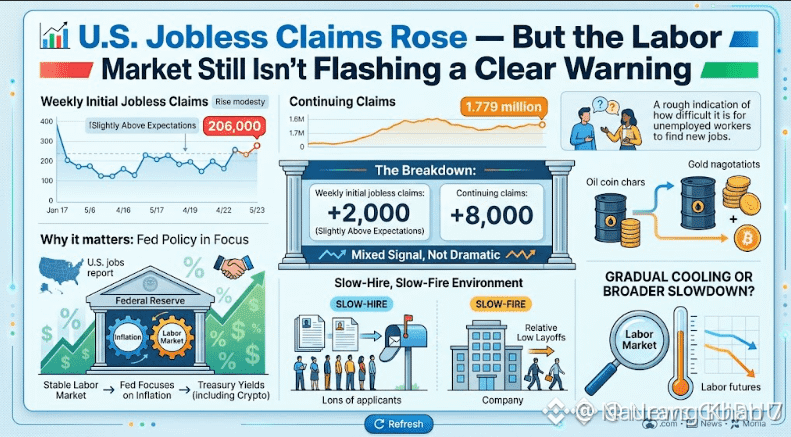
📊 U.S. Jobless Claims Rose — But the Labor Market Still Isn’t Flashing a Clear Warning
Another piece of the U.S. labor-market puzzle just landed, and the signal is more mixed than dramatic.
The breakdown:
Weekly initial jobless claims increased by 2,000 to 206,000, slightly above expectations of 205,000.
Continuing claims — a rough indication of how difficult it is for unemployed workers to find new jobs — also climbed by 8,000 to 1.779 million.
Despite the increase, claims remain relatively low, supporting the idea that the U.S. is still in a “slow-hire, slow-fire” environment: companies aren’t hiring aggressively, but widespread layoffs haven’t appeared either.
Why it matters:
For markets, this keeps attention firmly on the Federal Reserve.
A stable labor market gives policymakers more room to focus on inflation, especially as recent services data showed renewed price pressure. That matters for Treasury yields, the dollar and risk assets — including crypto — because expectations around future Fed rates can quickly shift liquidity and sentiment.
The next major test is the U.S. jobs report.
Is the labor market simply cooling gradually, or are we starting to see the first signs of a broader slowdown?
$MARSCOIN $USELESS $CHIP
📊 U.S. Jobless Claims Rose — But the Labor Market Still Isn’t Flashing a Clear Warning
Another piece of the U.S. labor-market puzzle just landed, and the signal is more mixed than dramatic.
The breakdown:
Weekly initial jobless claims increased by 2,000 to 206,000, slightly above expectations of 205,000.
Continuing claims — a rough indication of how difficult it is for unemployed workers to find new jobs — also climbed by 8,000 to 1.779 million.
Despite the increase, claims remain relatively low, supporting the idea that the U.S. is still in a “slow-hire, slow-fire” environment: companies aren’t hiring aggressively, but widespread layoffs haven’t appeared either.
Why it matters:
For markets, this keeps attention firmly on the Federal Reserve.
A stable labor market gives policymakers more room to focus on inflation, especially as recent services data showed renewed price pressure. That matters for Treasury yields, the dollar and risk assets — including crypto — because expectations around future Fed rates can quickly shift liquidity and sentiment.
The next major test is the U.S. jobs report.
Is the labor market simply cooling gradually, or are we starting to see the first signs of a broader slowdown?
$MARSCOIN $USELESS $CHIP
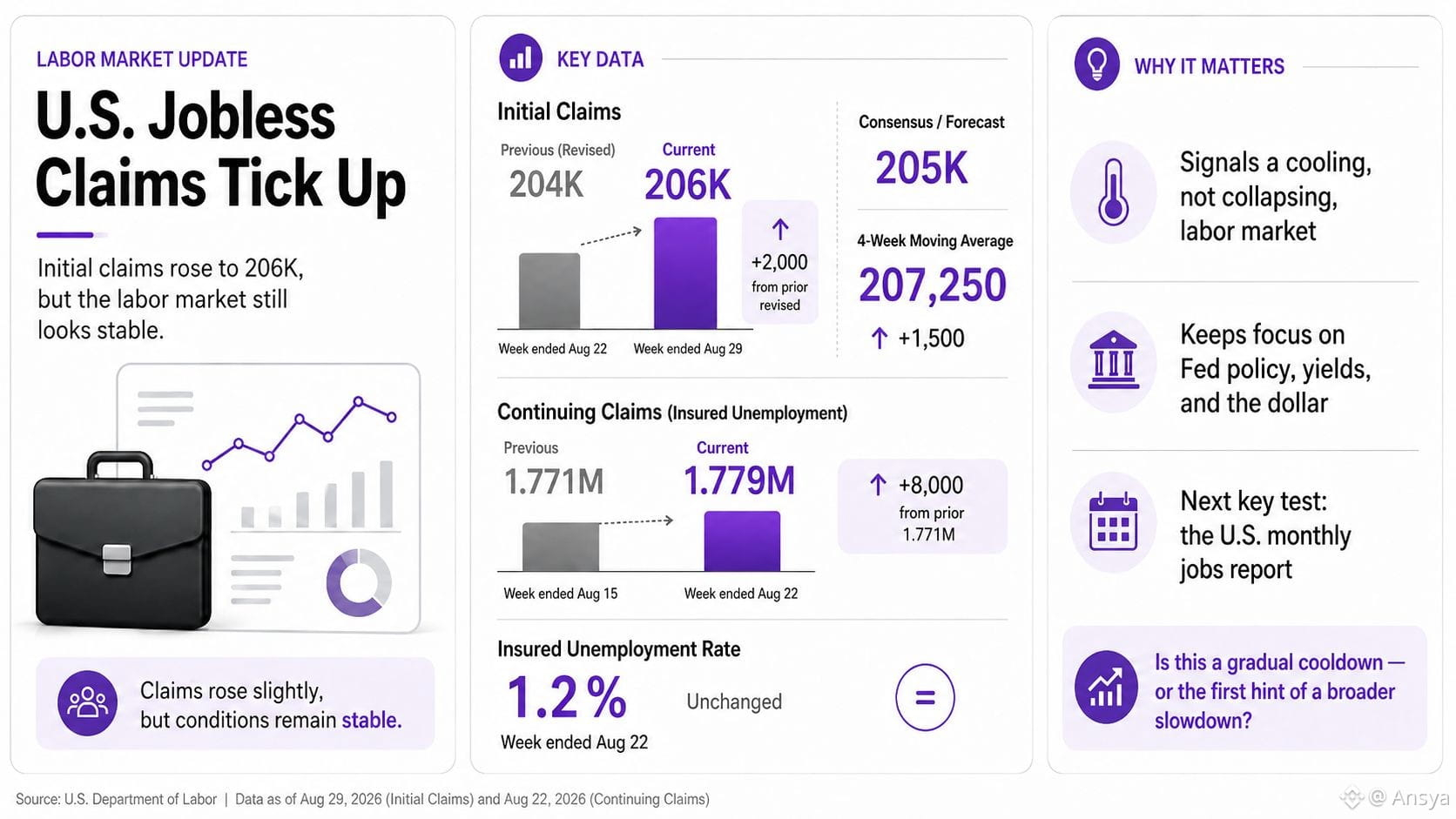
🐂 BTC BULLS HAVE ANOTHER MACRO NUMBER TO WATCH
Jobless claims rose modestly to 206,000, while the broader labor market continues to show resilience.
For Bitcoin traders, the important question isn't simply whether claims rose. It's whether future data confirms a broader cooling trend.
Different economic signals can produce very different expectations for rates and liquidity.
That's why $BTC , $ETH and $XRP could remain sensitive to upcoming macro releases. 📊
#usweeklyinitialjoblessclaimsriseto206000
Jobless claims rose modestly to 206,000, while the broader labor market continues to show resilience.
For Bitcoin traders, the important question isn't simply whether claims rose. It's whether future data confirms a broader cooling trend.
Different economic signals can produce very different expectations for rates and liquidity.
That's why $BTC , $ETH and $XRP could remain sensitive to upcoming macro releases. 📊
#usweeklyinitialjoblessclaimsriseto206000
🚦 THE JOB MARKET IS GIVING TRADERS A SUBTLE SIGNAL
206K claims isn't a shock — but it is another data point investors will add to the economic picture.
The labor market remains relatively resilient, while hiring conditions and future economic growth remain areas traders are monitoring.
That matters because macro expectations can influence liquidity and risk appetite.
Don't trade the headline alone. Trade the reaction and watch the trend.
#usweeklyinitialjoblessclaimsriseto206000
206K claims isn't a shock — but it is another data point investors will add to the economic picture.
The labor market remains relatively resilient, while hiring conditions and future economic growth remain areas traders are monitoring.
That matters because macro expectations can influence liquidity and risk appetite.
Don't trade the headline alone. Trade the reaction and watch the trend.
#usweeklyinitialjoblessclaimsriseto206000
Log in to explore more content