

#papertrade
papertrade
3,649 views
61 Discussing
Hot
Latest

·
--
🚀 $TREE SURGES TO TP1 – PAPER WIN UNVEILS SMART MONEY PLAY!
Entry: 0.03914 ⚡
Target: 0.04064 🚀
Stop Loss: 0.03814 ⚠️
The 1‑minute futures candles painted a clean demand block at 0.03914, where smart money snapped up liquidity and thrust $TREE up to 0.04064 in record time. 📊 The price danced off the block, confirming the paper entry’s edge.
A tight stop at 0.03814 kept risk under control, while the rapid target hit highlighted why a time‑boxed window is vital – the setup folded once the liquidity sweep faded. 🦈⚡
💬 Did you stick to the original plan or wait for a second wave?
⚠️ Not financial advice. Always manage your risk. 🛡️
🏷️ #TREE #PaperTrade #SmartMoney #Crypto
🦈 💎
5

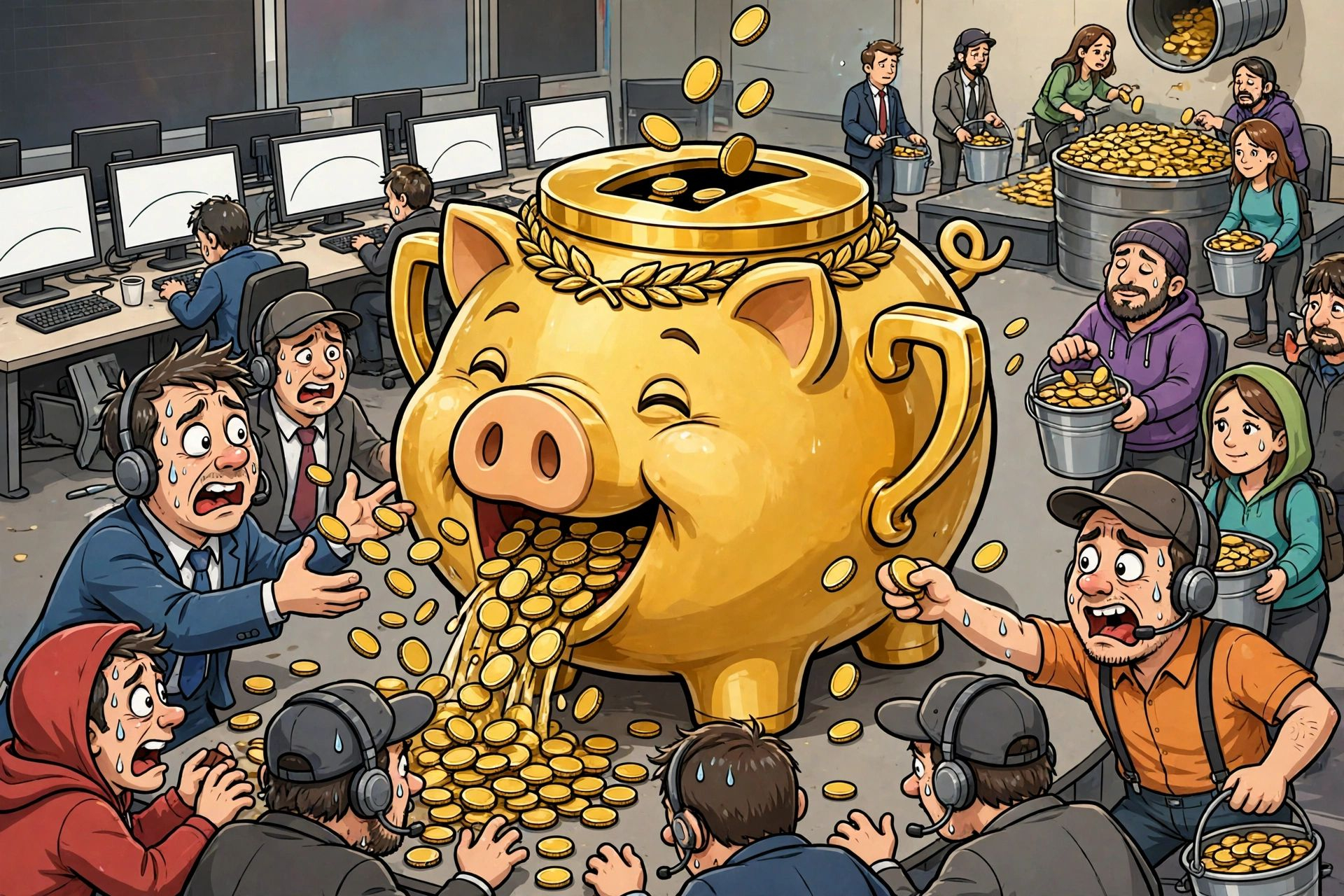
First, the impressive part: Papertrade brought in $8.94 million in 7 days, ranking fifth across all protocols. The only ones ahead are the four big names: Tether, Circle, Hyperliquid, and Pump.fun. And it all comes from betting on whether $BTC $ETH goes up or down. Pretty wild, right? Now for the ugly part: just two days ago, it was at $13.38 million on the same leaderboard—down by a third. Daily revenue peaked at $7.49 million, but by October 17 it was down to just $890,000. Trading volume has plunged 90% from its October 10 peak. And here’s the most painful twist: where does this revenue come from? A 2% closing fee, a 2% liquidation fee, and overflow above the pool’s $5 million cap—all paid out of the principal lost by liquidated traders. This so-called fifth-place ranking was built on other people’s losses. Pick a side in the comments: A) That’s a business model. B) That’s fleecing retail traders and paying out the proceeds. Sound off!
$SOL
#Papertrade #Revenue leaderboard
$SOL
#Papertrade #Revenue leaderboard
6

·
--
A new face worth remembering has appeared on the protocol revenue leaderboard.
According to reports, Papertrade generated approximately $8.94 million in revenue over the past 7 days, ranking fifth in total protocol revenue, behind only Tether, Circle, Hyperliquid, and Pump.fun. The sharp rise in revenue over a short period suggests that trading activity or fee capture accelerated significantly during this market move.
How to read this: Don’t mistake the 7-day rankings for a long-term moat. Dig deeper: Is the revenue coming from genuine trading or subsidy-driven activity? Is retention keeping pace with the peak? And are stablecoins and perpetuals protocols still dominating the top of the leaderboard? Once this high-revenue window closes, the rankings could quickly fall back.
#Papertrade #协议收入 #DeFi #CryptoMarket
1

·
--
【Market Flash】Changing the rules as soon as the funds arrive? Delphi Pagoulatos slams Papertrade: “It’s not exactly a rug pull—it’s basically entrapment!”
PAPER promised transfers and received $140 million in deposits, then changed its tune on October 19, saying “transfers are temporarily unavailable” to prevent manipulation. Meanwhile, distributions plunged from $1.3 million to $88,000.
Protecting users or cashing in on them? Comment 1 or 2!
$PAPER $HYPE $ETH
#Papertrade #Hyperliquid #DeFi
(Source: Unchained)
⚠️Risk warning: The above is shared for market information purposes only and does not constitute investment advice. Investing involves risk; exercise caution when entering the market.
327

“Lose money, get tokens” is basically casino cashback dressed up as tokenomics.
Papertrade is part of the Hyperliquid ecosystem, offering BTC and ETH perpetuals with up to 1,000x leverage. If you lose, they mint PAPER for you, which you can stake to earn a share of the USDC pool. Sounds like a consolation prize, but in practice it encourages you to lose even more.
The launch numbers were certainly impressive: an X news roundup put first-day revenue at around $25 million, while Laura Shin reported that it attracted $140 million in pre-deposits. Then, on October 19, the team announced that PAPER could not yet be transferred, with no timeline for when that would change. They said it was to prevent people from shorting it elsewhere to attack the project.
As a result, staking rewards plunged 93% overnight, daily revenue fell from several million to under $200,000, and TVL shrank from over $100 million to just over $30 million.
The wildest part is that they changed the rules three times in a single week: on the 17th, they raised the staking reward cap; on the 19th, they announced that tokens were non-transferable; and on the 20th, they added new fees and changed the emissions curve. The team even admitted that, apart from using Rollbit as a reference, they had basically no real-world data for the launch parameters.
In other words: the rules you saw when you deposited your money aren’t the rules you’re playing by now.
A non-transferable token only has value within the platform, and the platform decides what that value is. Put simply, PAPER right now is just casino points. If you’re thinking of farming it, ask yourself first: are you mining, or just paying tuition to the house?
#Papertrade #Hyperliquid
2
📉 Down 93% in a day: What does PaperTrade’s “cliff-drop” in staking revenue tell us?
PaperTrade has been back on the timeline these past couple of days, this time because the numbers look bad.
According to data shared by @ryandcrypto:
🔹 Staking revenue was about $2.1 million on Sunday
🔹 About $1.28 million on Monday
🔹 Just around $84,500 in the two hours before Tuesday’s close, down about 93% for the day
Another user, @ftosol, added a few more figures: traders’ cumulative P&L was about -$65 million, TVL had fallen about 40% from roughly $69 million, and open interest was down more than 80%.
For context: PaperTrade uses a “lose money to mint” model, where trading losses can be exchanged for PAPER. Stakers earn a share of the USDC generated from traders’ losses, and the contracts offer leverage of up to 1,000x. Citing risks such as oracle manipulation, the project team made PAPER non-transferable, and the volume-farming frenzy cooled off almost immediately.
My take:
A large part of that previous “daily revenue” in the millions was propped up by people deliberately losing money to get tokens. Once the tokens couldn’t be transferred or sold, that crowd left. It’s not that the platform suddenly got worse; the retreat of incentives has exposed the real demand.
When you see any “high-yield” project, first ask: Is this money coming from real users, or are they being lured in by token subsidies?
One more warning: lots of accounts on the timeline are copying and pasting the same “PAPER ICO free registration” promo. Don’t click links blindly—verify through official channels first.
Do you think the activity that remains after the hype fades can support PAPER’s value?
#PaperTrade #DeFi #永续合约 #CryptoSafety
1

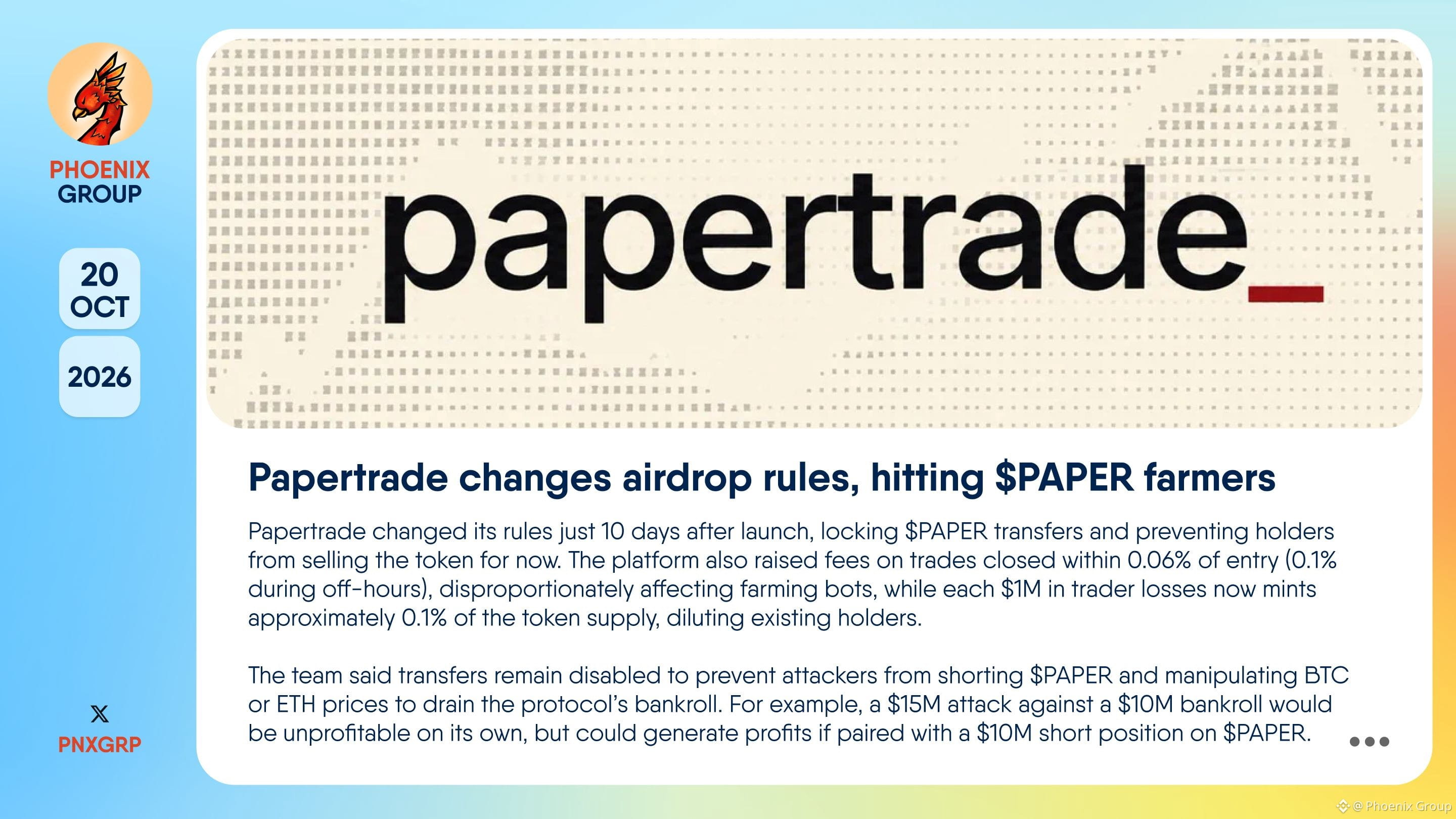
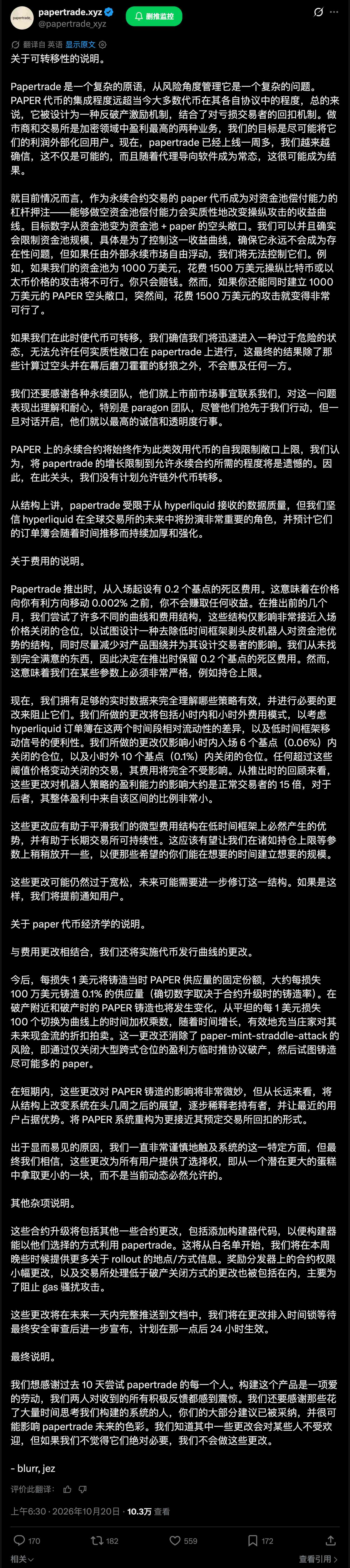
Papertrade changes airdrop rules, hitting $PAPER farmers
#Papertrade changed its rules just 10 days after launch, locking $PAPER transfers and preventing holders from selling the token for now. The platform also raised fees on trades closed within 0.06% of entry (0.1% during off-hours), disproportionately affecting farming bots, while each $1 million in trader losses now mints approximately 0.1% of the token supply, diluting existing holders. The team also introduced builder codes for developers and fixes against gas-griefing attacks.
The team said transfers remain disabled to prevent attackers from shorting $PAPER and manipulating BTC or ETH prices to drain the protocol’s bankroll. For example, a $15 million attack against a $10 million bankroll would be unprofitable on its own, but could generate profits if paired with a $10 million short position on $PAPER.
👉 x.com/papertrade_xyz/status/2112310325521399982
87

·
--
Papertrade changes the rules for mining through losses: $PAPER transfers blocked, existing users “slowly diluted”“The more you lose trading, the more coins you mine.” This design had been running for 10 days when the rules were changed.
Papertrade is a perpetuals DEX running on HyperEVM: users bet against Hyperliquid’s prices and the protocol’s bankroll, and money lost is used to mint $PAPER—effectively a rebate for losers. On the morning of October 20, Beijing time, the official team announced three changes in a lengthy post.
First, transfers. There are currently no plans to allow free transfers outside the contract. The reason is that once $PAPER can be shorted on external perpetual markets, attackers could profit on both sides by “shorting PAPER + manipulating the price of $BTC / $ETH to drain the bankroll.” The official team gave this example: with a $10 million bankroll, spending $15 million to manipulate the price would lose money; but if you could also place a $10 million PAPER short, the trade would become profitable.
Papertrade changes the rules for mining through losses: $PAPER transfers blocked, existing users “slowly diluted”
“The more you lose trading, the more coins you mine.” This design had been running for 10 days when the rules were changed.
Papertrade is a perpetuals DEX running on HyperEVM: users bet against Hyperliquid’s prices and the protocol’s bankroll, and money lost is used to mint $PAPER—effectively a rebate for losers. On the morning of October 20, Beijing time, the official team announced three changes in a lengthy post.
First, transfers. There are currently no plans to allow free transfers outside the contract. The reason is that once $PAPER can be shorted on external perpetual markets, attackers could profit on both sides by “shorting PAPER + manipulating the price of $BTC / $ETH to drain the bankroll.” The official team gave this example: with a $10 million bankroll, spending $15 million to manipulate the price would lose money; but if you could also place a $10 million PAPER short, the trade would become profitable.
155


·
--
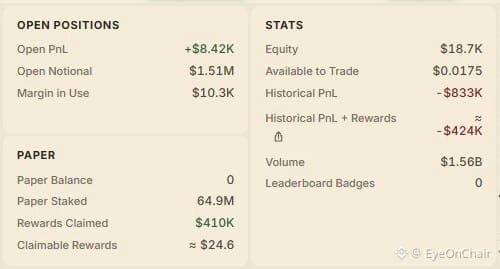
Now it's really interesting , Brother Machi has been putting papertrade_xyz through its paces, and the numbers are getting wild.
Since October 10, he’s generated around $1.56 BILLION in trading volume. But that activity hasn’t come cheap --- his realized trading losses have reached $833K, putting him at #10 on the loss leaderboard.
He did receive around 437K $PAPER tokens in airdrop rewards (405K tokens, according to the reported breakdown), but even after accounting for the rewards, his account is still showing a loss of roughly $424K.
Most of his action has been on $ETH longs, using leverage ranging from 50x all the way up to 1,000x, with 100x being the usual choice.
That’s some seriously aggressive trading. Machi has praised the #PaperTrade model himself, but the big question is whether the rewards can keep up with those losses.
Address: 0xad1215e79ed05c3e196a4e85066de41ec9004b41
1
297
·
--
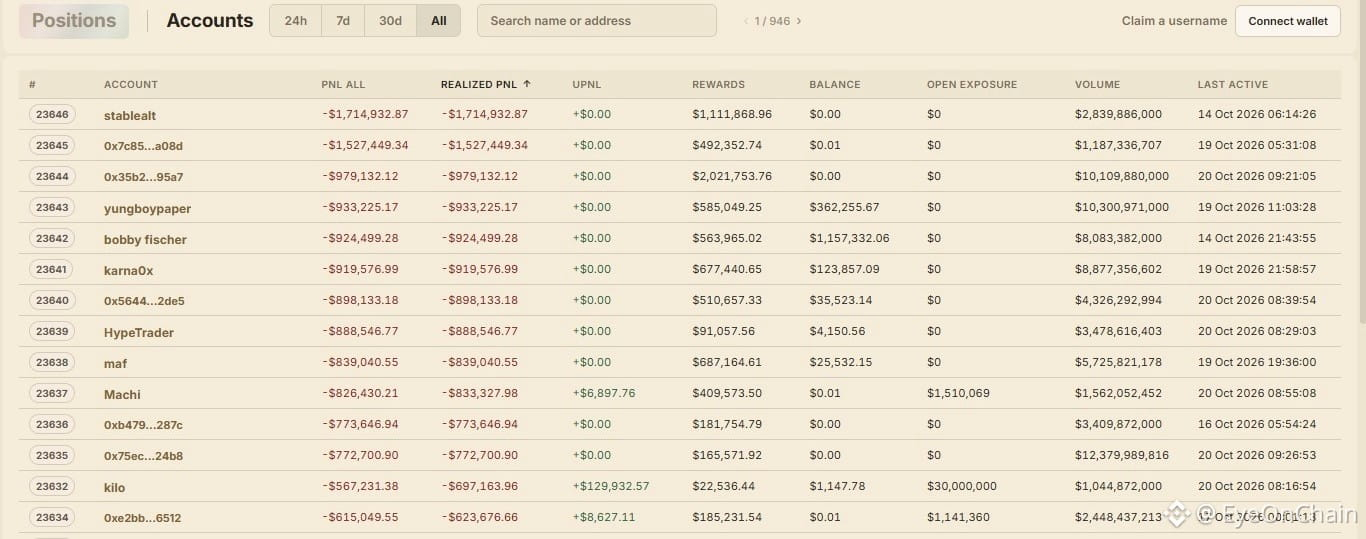
EVEN THE BIGGEST PAPERTRADE PLAYERS ARE STRUGGLING😬.
You’d think the traders doing billions in volume would be making good money, right? Well, the numbers tell a different story.
Out of the 25 biggest losers on #PaperTrade , 21 are still down overall even after collecting USDC staking rewards. Only 4 have managed to turn profitable.
And look at the scale of it… together, these traders generated $111.5 BILLION in trading volume, earned 2.06B $PAPER tokens (23.4% of the total supply), and claimed $11.61M in USDC rewards -- about 20.6% of all rewards distributed.
Billions in volume, millions in rewards… and most are still losing money. Sometimes, trading more doesn’t mean earning more.
2
344
🧻 Deliberately getting liquidated for tokens? Has Papertrade’s “loss mining” gone off the rails?
Papertrade, which has been making waves on HyperEVM lately, has a rather counterintuitive model: you can earn rewards by losing money.
It’s a synthetic perpetuals platform that launched around October 10, offering up to 1,000x leverage on BTC and ETH. Money you lose trading is used to mint PAPER tokens for you according to the rules. Staked PAPER earns a share of platform fees and losses exceeding the $5 million pool cap, paid out in USDC.
The numbers look pretty striking:
🔹 Stakers have received around $56.5 million in total
🔹 Nearly all PAPER is currently staked
🔹 Yet many users near the top of the loss leaderboard are still net losers, even after dividends
And here’s where the controversy starts: the team says PAPER transfers off-platform won’t be enabled in the short term. Their reasoning is that free transfers could let people manipulate the platform’s solvency by shorting it. They also announced a revised emission curve that favors new participants, and fee changes to combat bots.
The community is now split into two camps: one sees this as a pragmatic move to keep the project alive; the other feels that early users who “deliberately lost money to farm tokens” have been betrayed.
My take: packaging losses as “mining” still boils down to betting that future dividends will make up for your principal. The project team controls the rules and can change them at any time—that’s the biggest risk. With 1,000x leverage and tokens you can’t sell, ordinary users are probably better off staying away.
Would you deliberately lose money to earn token rewards? Or do you think this model is bound to collapse sooner or later? Let’s talk in the comments 👇
#Papertrade #Hyperliquid #永续合约 #DeFi
200
·
--
Papertrade has been live for barely ten days, and its daily revenue is already being touted as second only to Tether. It also gives 90% of trading fees back to losers. Sounds fiercely competitive, but with high-leverage synthetic perpetuals, hype comes fast—and fades just as quickly. The money is made through mechanism design; the ones who often lose are those going all-in to chase an airdrop.
#Papertrade #Hyperliquid #CryptoTrading
#Papertrade #Hyperliquid #CryptoTrading
3

·
--
GM☕️ I thought I could make a bundle off PAPER. Well, so much for that—the contract has been live for barely two days, and now trading is disabled again 😂
The project team is worried that someone might attack the liquidity pool while shorting PAPER, profiting on both sides. I understand the risk-management concerns, but from a player’s perspective, the expectation I had based on being able to sell later is now on hold again 🫠.
Oh well, I’ll put that dream of making a bundle on the back burner for now and keep slowly collecting Fee Rewards 🤡
#PAPERTRADE
110
·
--
🚨 $PAPERTRADE REVENUE PLUMMETS 83% AS PEAK VOLUME EVAPORATES BY 90%! 📉
The speculative storm is facing a sharp reality check on-chain. 📊 After recently challenging global heavyweights, $PAPERTRADE saw daily protocol revenue slide 83% to $890,000 as 24-hour volume shrank 43% to $54.23 billion.
The broader cooldown is striking: daily volume has bled 90% from its October 10 peak of $564.23 billion. 🌊 With transactions dropping 40% to 135,227 and new account creation sliding 53% to 622, retail velocity has paused while the market digests the initial euphoria.
💡 In volatile cycles, aggressive contractions like this separate structural utility from transient hype. 🤔 Is this just a healthy liquidity reset before the next wave, or is the speculative momentum spent? 👇
⚠️ Not financial advice. Always manage your risk. 🛡️
🏷️ #PAPERTRADE #DeFi #OnChain #CryptoData #MarketPulse
🔍 ⚖️
15

·
--
📰 Just 7 days after Papertrade launched, its nominal revenue according to DefiLlama reached $57.16 million, with daily revenue exceeding Circle’s for two consecutive days. Those are impressive numbers, but “revenue” here doesn’t consist entirely of regular trading fees.
🔥 A closer look at the figures reveals that revenue includes a 2% fee when traders close positions, a 2% liquidation fee charged when positions are liquidated, and surplus funds distributed to stakers once the liquidity pool exceeds $5 million. In other words, losses from liquidations are also counted as part of this dividend machine.
💡 Over those 7 days, about $52.76 million—92.3% of nominal revenue—was distributed to PAPER stakers, while the protocol retained about $4.4 million. Users who lose money also receive PAPER in proportion to their losses. Mechanically, it’s a bit like “lose your principal, get some tokens, then wait for dividends.”
⚠️ But whether the dividends can continue depends on traders continuing to get liquidated and the liquidity pool staying above $5 million. If liquidations become less frequent, or profitable traders withdraw their funds in large numbers, surplus distributions could stop. The high dividends may look tempting, but it’s worth understanding where they come from.
🤔 Would you consider this kind of dividend sustainable income, or more like a cycle that depends on new funds and liquidations?
#Papertrade #PAPER #DeFi #Derivatives
10

·
--
💸 $6.01M in daily revenue, surpassing Hyperliquid to rank third: Papertrade’s money is almost too hot to handle
Guys, this “casino” called Papertrade posted an outrageous report card last night—
First, the numbers (Foresight citing Lookonchain, as of the time of monitoring):
① $6.01 million in protocol revenue over 24 hours, surpassing Hyperliquid to rank third
② $910 billion in nominal daily trading volume
③ $28.4 billion in liquidations
Now the other side of the story (ChainCatcher): a trader wash-traded $2.84 billion on Papertrade, taking a net loss of $637,000.
What does this mean? Let’s break it down:
First, that $6.01 million is protocol revenue reported by data platforms, not audited profit. Given the high leverage and wash-trading incentives, whether this revenue is sustainable is an open question. Once the incentives stop, will trading volume and revenue be exposed for what they really are?
Second, $2.84 billion in wash trading and an actual loss of $637,000 puts the cost of wash trading at about 0.022% ($637,000 ÷ $2.84 billion, my own calculation). Someone was willing to lose $637,000 of real money to generate trading volume, which suggests the incentives behind the wash trading are worth that much. Take nominal trading volume with a grain of salt.
Third, this is the complete opposite of what was happening three days ago. In the early hours of October 11, this feed tracked “$8 billion in nominal volume that was actually PAPER wash trading, with users losing a total of $4.73 million.” Back then, everyone mocked the wash trading; today, it’s “$6.01 million in daily revenue, surpassing Hyperliquid.” The same protocol was mocked for wash trading three days ago, and today it ranks third by fee revenue. That reversal is a signal in itself: stop dismissing it with the two words “wash-trading scam.”
Bottom line: the $6.01 million in revenue recorded by data platforms isn’t made up, but its composition and sustainability still need to be examined—how much comes from genuine trading, and how much from wash-trading incentives? We won’t know until the incentives are turned off. If you’re thinking of jumping in, first figure out whether you’re trading or just handing the protocol fee money.
This is not investment advice.
What share of Papertrade’s $6.01 million do you think came from wash trading? See you in the comments 👇
#Papertrade #Hyperliquid
24

·
--
Bullish
About $3. That’s how much they nudged the price $ETH on Hyperliquid spot, and about $1.28 million left the Papertrade pool
Papertrade is an app on HyperEVM with up to 1000x leverage. It takes its trade prices from the midpoint between Hyperliquid’s best bid and ask. It has no price of its own
On launch day, October 10, one wallet:
1. With a 1000x long on Papertrade, bought about 6060 ETH on spot, pushing the price up by $3
2. Sold about 6590 ETH
3. Paid about $52000 in fees and took the winnings from the pool
Papertrade says the position limits at launch were too high; they’re already cutting them
Hyperliquid itself was just the price source here: the order book worked like an order book. $HYPE
{spot}(HYPEUSDT)
Over the day, by the way, +3.0%
There’s also a story going around about two wallets with $20 million in orders — for now, that’s just a claim from anonymous accounts on X, with no confirmation and no loss amount
Long story short, 1000x leverage on someone else’s price is a giveaway for anyone who knows how to move the order book
#Hyperliquid #Papertrade
About $3. That’s how much they nudged the price $ETH on Hyperliquid spot, and about $1.28 million left the Papertrade pool
Papertrade is an app on HyperEVM with up to 1000x leverage. It takes its trade prices from the midpoint between Hyperliquid’s best bid and ask. It has no price of its own
On launch day, October 10, one wallet:
1. With a 1000x long on Papertrade, bought about 6060 ETH on spot, pushing the price up by $3
2. Sold about 6590 ETH
3. Paid about $52000 in fees and took the winnings from the pool
Papertrade says the position limits at launch were too high; they’re already cutting them
Hyperliquid itself was just the price source here: the order book worked like an order book. $HYPE
Over the day, by the way, +3.0%
There’s also a story going around about two wallets with $20 million in orders — for now, that’s just a claim from anonymous accounts on X, with no confirmation and no loss amount
Long story short, 1000x leverage on someone else’s price is a giveaway for anyone who knows how to move the order book
#Hyperliquid #Papertrade

2
294
·
--
📰 PaperTrade co-founder Jez’s journey is pretty counterintuitive: he’s been liquidated multiple times, but also bounced back through spot trading. Looking back, his first piece of advice for ordinary traders isn’t “find a more accurate direction”—it’s to avoid rushing into derivatives.
He says that even if you get the direction right, 8x leverage can still turn random fluctuations into negative expected returns. Leverage also has a very practical downside: once you open a large position, it’s easy to keep adding to it. Honestly, getting the direction right doesn’t mean your account will survive long enough for your thesis to play out.
🔥 As for growing a small account, Jez’s answer is just as direct: focus on one or two opportunities you truly believe in. Diversification is more about protecting your account; it doesn’t necessarily help you grow it. But this approach clearly isn’t something everyone can copy. He stresses that strong conviction should come from understanding the asset—not from going all in because the chat is buzzing.
💡 He also advises against quitting your job just to trade. Treat your salary as a steady source of capital, and keep your powder dry until the right opportunity comes along. You can start by asking yourself: “If I could make only one trade this year, would I choose this one?” If the answer is no, it may just be a marginal opportunity.
👀 Jez believes it’s hard to talk people out of speculative urges in the market. Rather than pretending nobody will gamble, it’s better to build better products. He also spoke about his own shift from trading to building PaperTrade, and noted that spending a year or two on a project that doesn’t work out can sometimes hurt more than a bad trade.
🤔 This is his own journey, not a formula that works for everyone. Which do you agree with more: starting with spot and patiently waiting for opportunities, or concentrating your bets on assets you have strong conviction in?
#加密交易 #现货交易 #衍生品 #PaperTrade

24

·
--
A trader successfully manipulated the price of Ethereum (ETH) on Hyperliquid via Papertrade, a newly launched 1,000x leverage trading platform, netting $1.28 million. However, on Saturday evening, the same wallet was forcibly liquidated after holding 30 short positions for more than three hours, ultimately losing $450,000. The incident highlights the enormous risks of high-leverage trading and price manipulation.
$ETH #Papertrade #Hyperliquid #CryptoTrading
$ETH #Papertrade #Hyperliquid #CryptoTrading
157
Verified
A new exchange’s first lesson: Use $20 million to move a nine-figure market.
PaperTrade launched on HyperEVM just on the 10th, touting 1,000x leverage. The very next day, on-chain sleuths uncovered what appeared to be two wallets using roughly $20 million in $ETH buy orders on Hyperliquid to push the market up 0.1%, then turning around and cashing in on nine-figure longs on their own platform. The cheekiest part? The official docs themselves warned that this move “could be exploited”—a vulnerability that practically reported itself.
Even cheekier: the supposedly 1,000x-leveraged pool started with a balance of zero, meaning winners’ payouts depended entirely on losers depositing funds first. So are the people playing this game traders—or roulette players?
Pick a side: A) Smart strategy B) A pump-and-dump preview. Let the arguments begin in the comments. $BTC #Hyperliquid #PaperTrade
197
Log in to explore more content
Join global crypto users on Binance Square
⚡️ Get latest and useful information about crypto.
💬 Trusted by the world’s largest crypto exchange.
👍 Discover real insights from verified creators.
Email / Phone number
Trending Topics
1
#BinancePick
3.2M views
158,390 Discussing
2
#EarningsSeason
5.4M views
26,317 Discussing
3
#BitmineAdds10452ETH
259 views
26 Discussing
4
#SouthKoreaConsidersEducationTaxOnCryptoExchanges
589 views
44 Discussing
5
#OCCUrgesCommunityBanksToEnterStablecoinPayments
322 views
34 Discussing
6
#RippleWinsFullApprovalAsNationalTrustBank
335 views
32 Discussing
7
#AkashSelectsSolanaAsMigrationTarget
109 views
6 Discussing
8
#OndoToOpenSubscriptionsForOpenAIPreIPOTokenizedNotes
28 views
3 Discussing
9
#AnthropicTTMRevenueGrewAbout1200%
44,812 views
513 Discussing
10
#AnthropicS1ExpectedToday
36,547 views
402 Discussing