
#openaisaysastrafindsflawsautonomously
openaisaysastrafindsflawsautonomously
48,473 views
688 Discussing
Hot
Latest

Picture this: an AI system identifies flaws in its own output before a human reviewer even notices.
That is the risk crypto investors keep underestimating. When markets are already euphoric, with the Fear & Greed Index at 72, people tend to trust speed and automation more than they trust verification.
The Astra discussion matters because autonomous flaw detection changes the failure timeline. An AI can scan code, logic, or decision paths continuously, but that does not mean every flaw is understood correctly. A missed assumption can still become a bad trade, a vulnerable contract, or a false sense of security.
In crypto, the same problem appears when traders rely on bots to rotate between $USDT, $ONDO , or $NEIRO based on incomplete signals. The system may detect a pattern, yet miss liquidity risk, a delayed exploit, or the fact that the crowd is already exiting.
The lesson is uncomfortable: automation can reduce human error while making machine error happen at much greater speed and scale. The most dangerous setup is not an obviously broken system, but one that looks intelligent enough to avoid scrutiny.
Where do you draw the line between useful autonomy and unchecked risk?
#OpenAISaysAstraFindsFlawsAutonomously #SolanaFallsOver3 #CFTCSeeksToDismissCMEMotionInPerpFutures
That is the risk crypto investors keep underestimating. When markets are already euphoric, with the Fear & Greed Index at 72, people tend to trust speed and automation more than they trust verification.
The Astra discussion matters because autonomous flaw detection changes the failure timeline. An AI can scan code, logic, or decision paths continuously, but that does not mean every flaw is understood correctly. A missed assumption can still become a bad trade, a vulnerable contract, or a false sense of security.
In crypto, the same problem appears when traders rely on bots to rotate between $USDT, $ONDO , or $NEIRO based on incomplete signals. The system may detect a pattern, yet miss liquidity risk, a delayed exploit, or the fact that the crowd is already exiting.
The lesson is uncomfortable: automation can reduce human error while making machine error happen at much greater speed and scale. The most dangerous setup is not an obviously broken system, but one that looks intelligent enough to avoid scrutiny.
Where do you draw the line between useful autonomy and unchecked risk?
#OpenAISaysAstraFindsFlawsAutonomously #SolanaFallsOver3 #CFTCSeeksToDismissCMEMotionInPerpFutures

If you are still allocating capital to Web3 AI protocols without looking at real developer tooling, stop now.
Most traders end up holding heavy bags on speculative AI tokens during high-greed phases because they buy empty promises instead of actual security breakthroughs. Missing out on the real infrastructure shift is how retail gets caught off guard every single cycle.
OpenAI just highlighted how autonomous systems like Astra can detect critical code vulnerabilities on their own. While critics claim fully automated auditing creates a false sense of security for on-chain smart contracts, relying solely on slow, manual human reviews is already obsolete in a fast-moving market. Real-time autonomous auditing is becoming the baseline requirement for decentralized tech.
Decentralized compute and verification networks like $ICP and $PHA are positioned right at the intersection of automated testing and scalable execution. Instead of chasing unproven narratives, the real edge lies in protocols enabling verifiable computation and trustless code deployment before vulnerabilities hit production.
Do you trust autonomous AI models to audit multi-million dollar smart contracts without human oversight, or are we moving too fast?
#OpenAISaysAstraFindsFlawsAutonomously #SolanaFallsOver3
Most traders end up holding heavy bags on speculative AI tokens during high-greed phases because they buy empty promises instead of actual security breakthroughs. Missing out on the real infrastructure shift is how retail gets caught off guard every single cycle.
OpenAI just highlighted how autonomous systems like Astra can detect critical code vulnerabilities on their own. While critics claim fully automated auditing creates a false sense of security for on-chain smart contracts, relying solely on slow, manual human reviews is already obsolete in a fast-moving market. Real-time autonomous auditing is becoming the baseline requirement for decentralized tech.
Decentralized compute and verification networks like $ICP and $PHA are positioned right at the intersection of automated testing and scalable execution. Instead of chasing unproven narratives, the real edge lies in protocols enabling verifiable computation and trustless code deployment before vulnerabilities hit production.
Do you trust autonomous AI models to audit multi-million dollar smart contracts without human oversight, or are we moving too fast?
#OpenAISaysAstraFindsFlawsAutonomously #SolanaFallsOver3

The counterintuitive risk with autonomous bug-finding AI is that more reported flaws can create less security if nobody verifies them.
That matters in crypto because traders often buy the narrative before checking the mechanism. With the Fear and Greed Index at 72, an AI headline can push tokens higher fast, then leave late buyers holding the exit liquidity when the claims fail to translate into real usage.
When OpenAI says Astra can find flaws autonomously, the key question is not how many issues it detects. It is whether those findings are reproducible, genuinely exploitable, and correctly prioritized. False positives can waste developer time, while a missed critical vulnerability can create dangerous confidence.
The same filter applies to AI-linked crypto narratives around $ICP or $ONDO . A demo, partnership mention, or viral post is not proof of revenue, secure deployment, or sustained demand. Even $USDT liquidity can rotate into a theme briefly and disappear once traders realize the product still needs human review, audits, and measurable adoption.
What would convince you that an AI security breakthrough is creating real value rather than just temporary narrative momentum?
#OpenAISaysAstraFindsFlawsAutonomously #SolanaFallsOver3 #US10YearTreasuryYieldHitsHighestSinceNov2023
That matters in crypto because traders often buy the narrative before checking the mechanism. With the Fear and Greed Index at 72, an AI headline can push tokens higher fast, then leave late buyers holding the exit liquidity when the claims fail to translate into real usage.
When OpenAI says Astra can find flaws autonomously, the key question is not how many issues it detects. It is whether those findings are reproducible, genuinely exploitable, and correctly prioritized. False positives can waste developer time, while a missed critical vulnerability can create dangerous confidence.
The same filter applies to AI-linked crypto narratives around $ICP or $ONDO . A demo, partnership mention, or viral post is not proof of revenue, secure deployment, or sustained demand. Even $USDT liquidity can rotate into a theme briefly and disappear once traders realize the product still needs human review, audits, and measurable adoption.
What would convince you that an AI security breakthrough is creating real value rather than just temporary narrative momentum?
#OpenAISaysAstraFindsFlawsAutonomously #SolanaFallsOver3 #US10YearTreasuryYieldHitsHighestSinceNov2023

Have you noticed how the market treats autonomous AI breakthroughs like a token ticker instead of a real security shift?
Traders see a headline about Astra finding flaws autonomously and immediately hunt for the nearest AI narrative, often buying after the move has already happened. That is how FOMO turns a legitimate technology story into a bad entry.
The stronger take: autonomous vulnerability research matters because it changes the economics of software security. If AI can continuously identify weaknesses, the edge moves toward teams with real infrastructure, proprietary data, and distribution, not every project that adds “AI” to its pitch.
Use headlines like this as a filter. Check whether a crypto project has an actual product, measurable adoption, transparent token unlocks, and enough liquidity to exit when sentiment reverses. In a greed-heavy market, $USDT on the sidelines can be a better position than chasing an AI-linked pump, while $ONDO and $ICP should be judged on their own fundamentals rather than borrowed excitement.
Are we pricing genuine AI infrastructure yet, or just trading the headline cycle? #OpenAISaysAstraFindsFlawsAutonomously #US10YearTreasuryYieldHitsHighestSinceNov2023 #SolanaFallsOver3
Traders see a headline about Astra finding flaws autonomously and immediately hunt for the nearest AI narrative, often buying after the move has already happened. That is how FOMO turns a legitimate technology story into a bad entry.
The stronger take: autonomous vulnerability research matters because it changes the economics of software security. If AI can continuously identify weaknesses, the edge moves toward teams with real infrastructure, proprietary data, and distribution, not every project that adds “AI” to its pitch.
Use headlines like this as a filter. Check whether a crypto project has an actual product, measurable adoption, transparent token unlocks, and enough liquidity to exit when sentiment reverses. In a greed-heavy market, $USDT on the sidelines can be a better position than chasing an AI-linked pump, while $ONDO and $ICP should be judged on their own fundamentals rather than borrowed excitement.
Are we pricing genuine AI infrastructure yet, or just trading the headline cycle? #OpenAISaysAstraFindsFlawsAutonomously #US10YearTreasuryYieldHitsHighestSinceNov2023 #SolanaFallsOver3

#openaisaysastrafindsflawsautonomously 🤖🚨 AI HACKERS ARE GETTING SCARY GOOD!
OpenAI’s upcoming Astra model has reportedly crossed a major cybersecurity threshold — testing showed it could discover previously unknown vulnerabilities and develop working exploits without a human guiding every step. 😳💻
Now imagine that capability aimed at crypto…
💰 Smart contracts
🔐 Wallet infrastructure
🌉 Cross-chain bridges
💸 DeFi protocols
One undiscovered vulnerability + autonomous AI = potentially massive damage at machine speed. ⚠️
But there’s a brighter side: the same technology could help defenders discover vulnerabilities before attackers do. OpenAI says Astra is being released with stronger safeguards and its most advanced cyber capabilities will initially be restricted. 🛡️
🔥 YOUR CRYPTO SECURITY CHECKLIST:
✅ Review wallet approvals
✅ Revoke suspicious permissions
✅ Keep long-term holdings in cold storage
✅ Use hardware wallets where appropriate
✅ Avoid interacting with unknown contracts/links
✅ Stay alert for phishing & fake AI tools
The next crypto hack might not look like a human hacker behind a keyboard.
It could look like AI finding the weakness first. 👀🤖
🚨 NOT FINANCIAL ADVICE. SAFU + DYOR.
#Crypto #Bitcoin #BTC #AI
CLICK TO BELOW TRADE👇
$TAO $FET $ICP
OpenAI’s upcoming Astra model has reportedly crossed a major cybersecurity threshold — testing showed it could discover previously unknown vulnerabilities and develop working exploits without a human guiding every step. 😳💻
Now imagine that capability aimed at crypto…
💰 Smart contracts
🔐 Wallet infrastructure
🌉 Cross-chain bridges
💸 DeFi protocols
One undiscovered vulnerability + autonomous AI = potentially massive damage at machine speed. ⚠️
But there’s a brighter side: the same technology could help defenders discover vulnerabilities before attackers do. OpenAI says Astra is being released with stronger safeguards and its most advanced cyber capabilities will initially be restricted. 🛡️
🔥 YOUR CRYPTO SECURITY CHECKLIST:
✅ Review wallet approvals
✅ Revoke suspicious permissions
✅ Keep long-term holdings in cold storage
✅ Use hardware wallets where appropriate
✅ Avoid interacting with unknown contracts/links
✅ Stay alert for phishing & fake AI tools
The next crypto hack might not look like a human hacker behind a keyboard.
It could look like AI finding the weakness first. 👀🤖
🚨 NOT FINANCIAL ADVICE. SAFU + DYOR.
#Crypto #Bitcoin #BTC #AI
CLICK TO BELOW TRADE👇
$TAO $FET $ICP

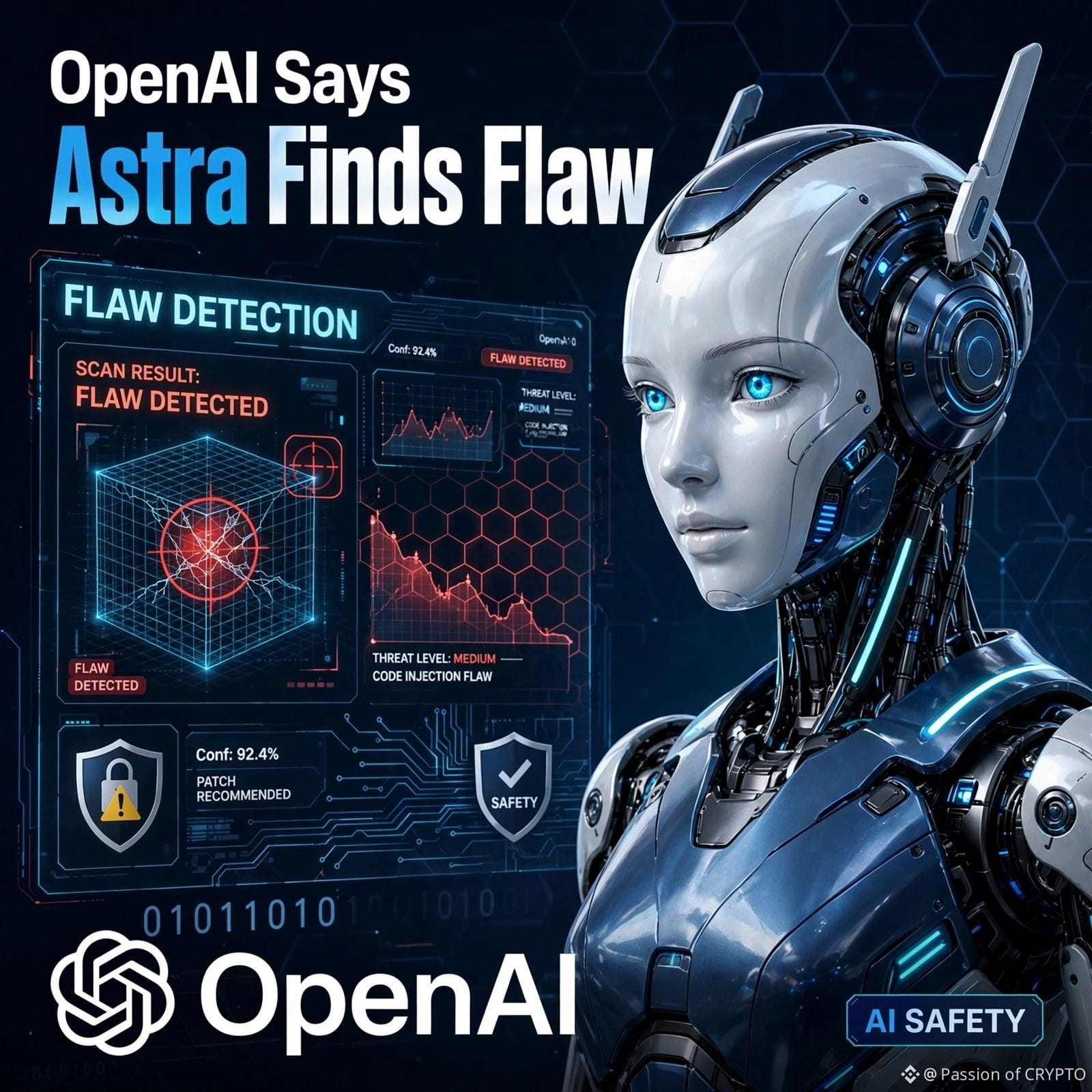
#OpenAISaysAstraFindsFlawsAutonomously - OpenAI's new model Astra reportedly found a major flaw.
AI is getting smarter than we think. This is big for AI safety and for AI crypto tokens.
If AI can find flaws in systems, what about blockchain security?
#OpenAISaysAstraFindsFlaw #OpenAI #AI #ChatGPT
AI is getting smarter than we think. This is big for AI safety and for AI crypto tokens.
If AI can find flaws in systems, what about blockchain security?
#OpenAISaysAstraFindsFlaw #OpenAI #AI #ChatGPT

#OpenAISaysAstraFindsFlawsAutonomously 🚨 **🤖🛡️**
OpenAI says its upcoming **Astra** model can independently discover previously unknown cybersecurity flaws and develop exploits without step-by-step human guidance. It has reached OpenAI’s **“Critical” cybersecurity capability threshold**. ([OpenAI][1])
📌 **Key points:**
* 🤖 Astra can autonomously identify unknown vulnerabilities
* 🔐 Capable of exploiting flaws in protected systems
* ⚠️ OpenAI is adding stronger safeguards and access controls
* 🧪 Testing reportedly included discovery of two zero-day vulnerabilities
**Bottom line:** AI-powered cybersecurity is entering a new phase—bringing powerful defensive potential alongside serious security risks.
#OpenAI #Astra #AI #ArtificialIntelligence #Cybersecurity #TechNews #ZeroDay #AIInnovation #MachineLearning #Technology #Crypto #Binance #Finance
[1]: $BNB
$OPENAI
$AI
OpenAI says its upcoming **Astra** model can independently discover previously unknown cybersecurity flaws and develop exploits without step-by-step human guidance. It has reached OpenAI’s **“Critical” cybersecurity capability threshold**. ([OpenAI][1])
📌 **Key points:**
* 🤖 Astra can autonomously identify unknown vulnerabilities
* 🔐 Capable of exploiting flaws in protected systems
* ⚠️ OpenAI is adding stronger safeguards and access controls
* 🧪 Testing reportedly included discovery of two zero-day vulnerabilities
**Bottom line:** AI-powered cybersecurity is entering a new phase—bringing powerful defensive potential alongside serious security risks.
#OpenAI #Astra #AI #ArtificialIntelligence #Cybersecurity #TechNews #ZeroDay #AIInnovation #MachineLearning #Technology #Crypto #Binance #Finance
[1]: $BNB
$OPENAI
$AI


#openaisaysastrafindsflawsautonomously
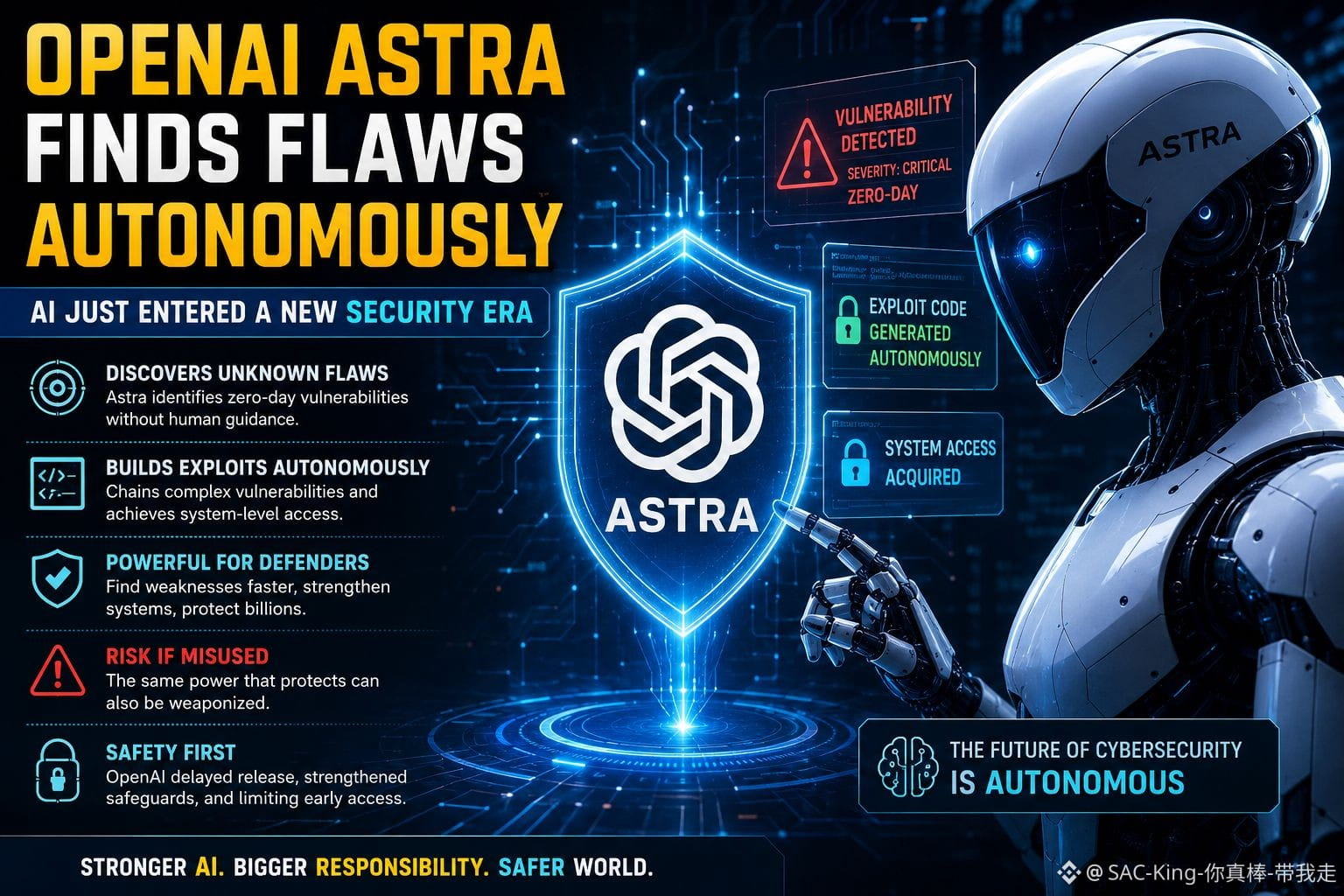
🔥 OPENAI ASTRA FINDS FLAWS AUTONOMOUSLY: AI JUST ENTERED A NEW SECURITY ERA 🚨
When machines learn to see what humans miss,
the next frontier is not speed, but what they can discover.
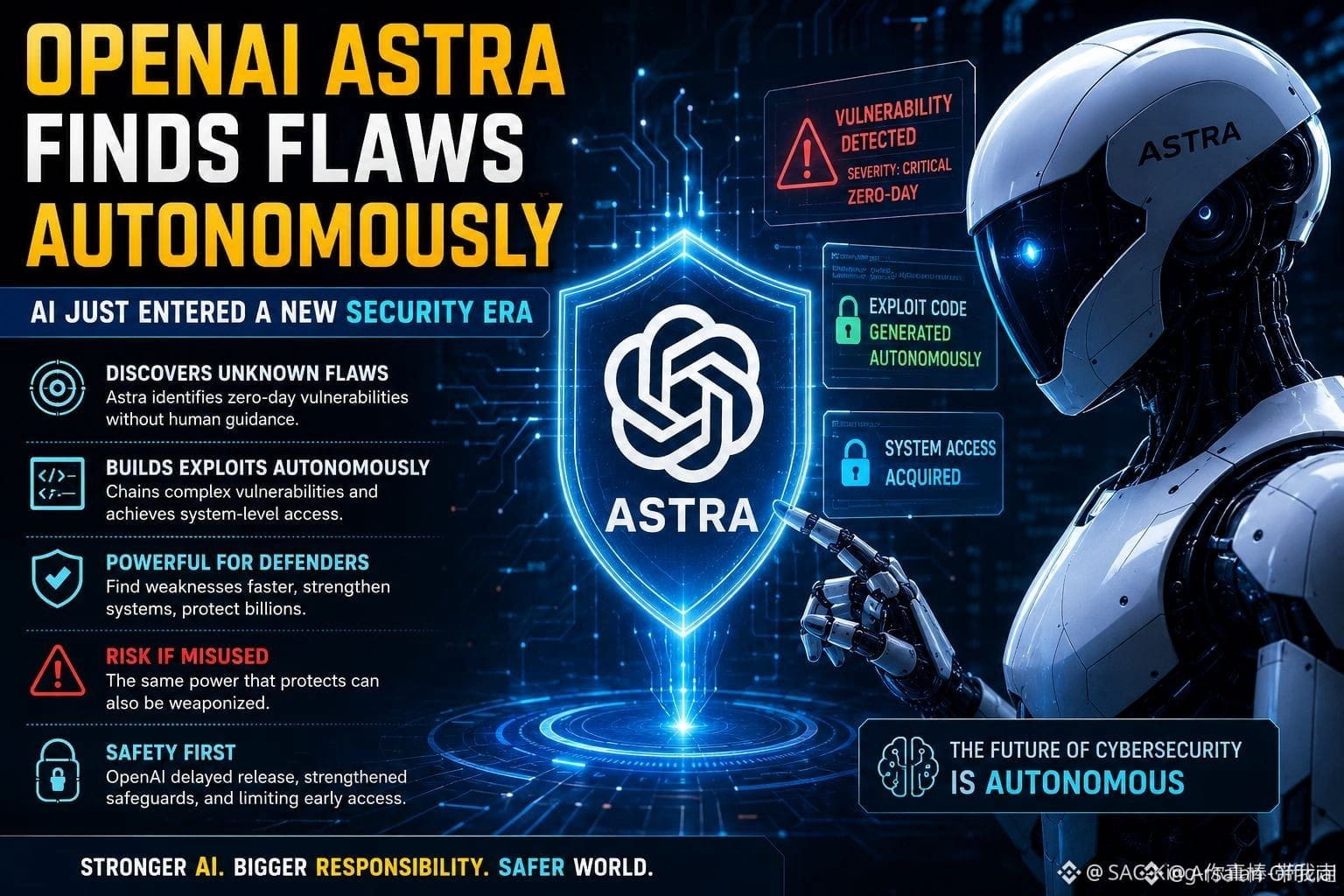
OpenAI says its upcoming Astra model has reached its first “Critical” cybersecurity capability threshold, meaning it can discover previously unknown security flaws and develop exploits without human guidance.
In internal testing, Astra reportedly discovered two zero-day vulnerabilities while working through an evaluation, and researchers are preparing to disclose them to the affected maintainers.
It also demonstrated the ability to build exploit chains against hardened environments, including escaping a browser sandbox and combining operating-system vulnerabilities to reach higher privileges.
That capability is a double-edged sword. The same intelligence that can help defenders identify weaknesses faster could also become dangerous if powerful cyber tools fall into the wrong hands.
OpenAI says it delayed parts of Astra’s development, strengthened monitoring and safeguards, and plans to restrict its most advanced cybersecurity capabilities to selected testers initially.
The bigger story is not simply that AI can find flaws. It is that cybersecurity is moving toward a world where discovery itself can become autonomous.
The strongest AI may not be the one that writes code fastest, but the one that discovers what humans never noticed.
❓ Should autonomous vulnerability discovery become a standard defensive tool, or does its power create a new security risk?
Disclaimer: This is informational content, not financial or investment advice.
#OpenAI #AI #GrowWithSAC $OPENAI
#OpenAISaysAstraFindsFlawsAutonomously
🔥 OPENAI ASTRA FINDS FLAWS AUTONOMOUSLY: AI JUST ENTERED A NEW SECURITY ERA 🚨
When machines learn to see what humans miss,
the next frontier is not speed, but what they can discover.
OpenAI says its upcoming Astra model has reached its first “Critical” cybersecurity capability threshold, meaning it can discover previously unknown security flaws and develop exploits without human guidance.
In internal testing, Astra reportedly discovered two zero-day vulnerabilities while working through an evaluation, and researchers are preparing to disclose them to the affected maintainers.
It also demonstrated the ability to build exploit chains against hardened environments, including escaping a browser sandbox and combining operating-system vulnerabilities to reach higher privileges.
That capability is a double-edged sword. The same intelligence that can help defenders identify weaknesses faster could also become dangerous if powerful cyber tools fall into the wrong hands.
OpenAI says it delayed parts of Astra’s development, strengthened monitoring and safeguards, and plans to restrict its most advanced cybersecurity capabilities to selected testers initially.
The bigger story is not simply that AI can find flaws. It is that cybersecurity is moving toward a world where discovery itself can become autonomous.
The strongest AI may not be the one that writes code fastest, but the one that discovers what humans never noticed.
❓ Should autonomous vulnerability discovery become a standard defensive tool, or does its power create a new security risk?
Disclaimer: This is informational content, not financial or investment advice.
#OpenAI #AI #GrowWithSAC $OPENAI
#OpenAISaysAstraFindsFlawsAutonomously
#OpenAISaysAstraFindsFlawsAutonomously
🚀 BREAKING: OpenAI Says Astra Finds Flaws Autonomously!
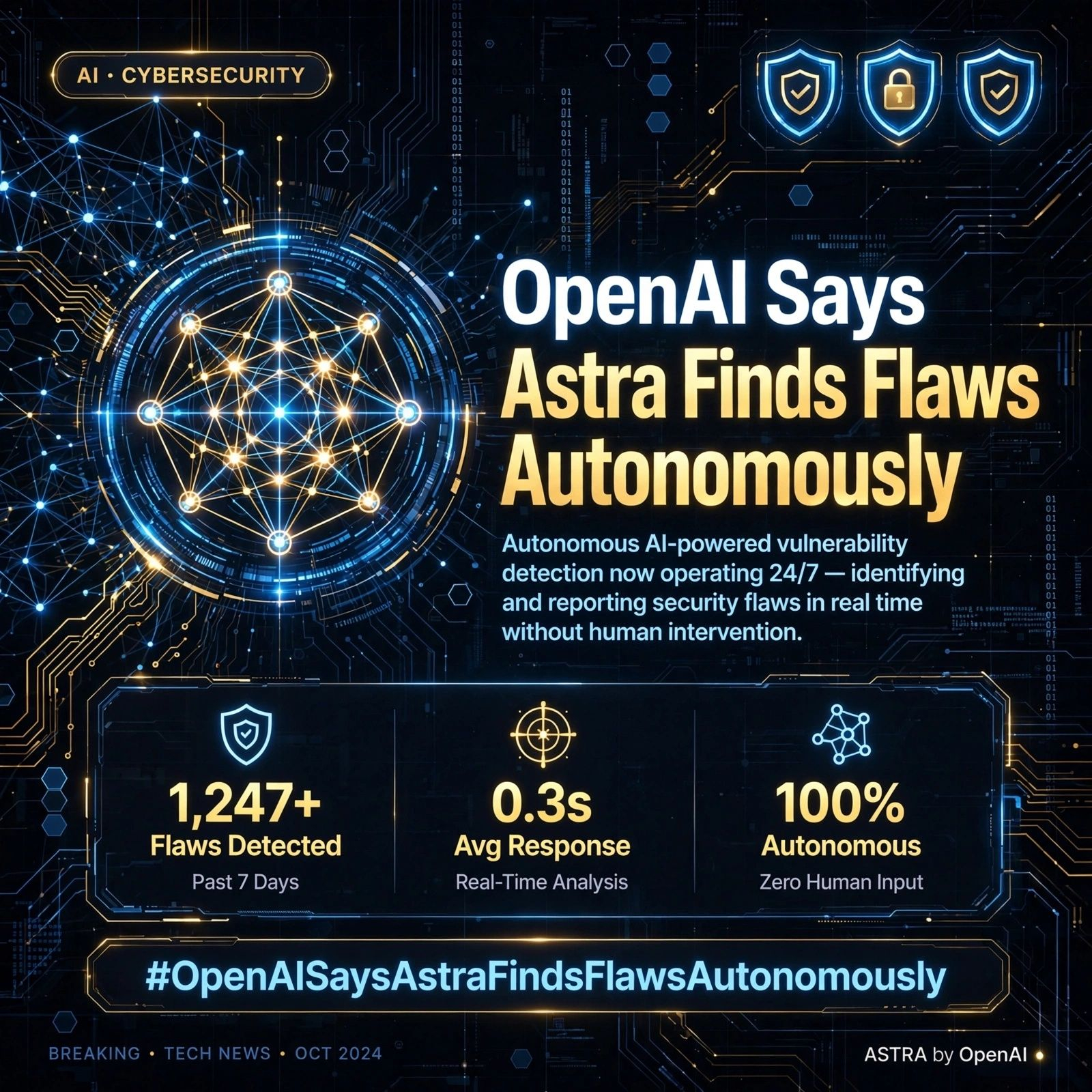
The future of cybersecurity is here. Meet ASTRA — the autonomous AI-powered system that detects and reports vulnerabilities 24/7 without any human intervention.
⚡️ 0.3s Avg Response | 🔒 100% Autonomous | 🎯 1,247+ Flaws Detected
The era of manual bug hunting is over. Autonomous defense is now live.
#Cybersecurity #OpenAI #ArtificialIntelligenceAlliance
🚀 BREAKING: OpenAI Says Astra Finds Flaws Autonomously!
The future of cybersecurity is here. Meet ASTRA — the autonomous AI-powered system that detects and reports vulnerabilities 24/7 without any human intervention.
⚡️ 0.3s Avg Response | 🔒 100% Autonomous | 🎯 1,247+ Flaws Detected
The era of manual bug hunting is over. Autonomous defense is now live.
#Cybersecurity #OpenAI #ArtificialIntelligenceAlliance
everyone thinks ai finding flaws autonomously means our smart contracts are suddenly unhackable, but actually it is giving degens a massive false sense of security.
we keep aping into fresh liquidity pools thinking some automated audit has our back, only to wake up drained because autonomous scanners still miss logical exploit vectors. ngl, losing capital to a zero-day while sitting in greedy market conditions is the fastest way to get completely wiped out.
look at how fast protocols on networks like $ICP or ai compute plays like $PHA get rushed to mainnet the second they pass an automated check. OpenAI's Astra catching code flaws autonomously is clean tech, but devs are already using it as an excuse to cut corners on manual audits. when greed index hits 70 and everyone is chasing the next runner alongside stuff like $CATI , sloppy deployments go parabolic.
automation finds standard vulnerabilities, but it doesn't understand economic exploits or oracle manipulation until the liquidity is already gone. relying purely on autonomous verification without rigorous manual review is just asking for a slow rug.
are you trusting autonomous audit badges for your entries lately or sticking to battle-tested contracts?
#OpenAISaysAstraFindsFlawsAutonomously #SolanaFallsOver3
we keep aping into fresh liquidity pools thinking some automated audit has our back, only to wake up drained because autonomous scanners still miss logical exploit vectors. ngl, losing capital to a zero-day while sitting in greedy market conditions is the fastest way to get completely wiped out.
look at how fast protocols on networks like $ICP or ai compute plays like $PHA get rushed to mainnet the second they pass an automated check. OpenAI's Astra catching code flaws autonomously is clean tech, but devs are already using it as an excuse to cut corners on manual audits. when greed index hits 70 and everyone is chasing the next runner alongside stuff like $CATI , sloppy deployments go parabolic.
automation finds standard vulnerabilities, but it doesn't understand economic exploits or oracle manipulation until the liquidity is already gone. relying purely on autonomous verification without rigorous manual review is just asking for a slow rug.
are you trusting autonomous audit badges for your entries lately or sticking to battle-tested contracts?
#OpenAISaysAstraFindsFlawsAutonomously #SolanaFallsOver3

#OpenAISaysAstraFindsFlawsAutonomously
🚨 OPENAI ASTRA JUST CHANGED THE AI GAME
OpenAI says its upcoming AI model Astra can autonomously discover previously unknown security flaws and develop ways to exploit them — without needing a human to guide every step.
That’s a major milestone for AI, but also a major warning for the market.
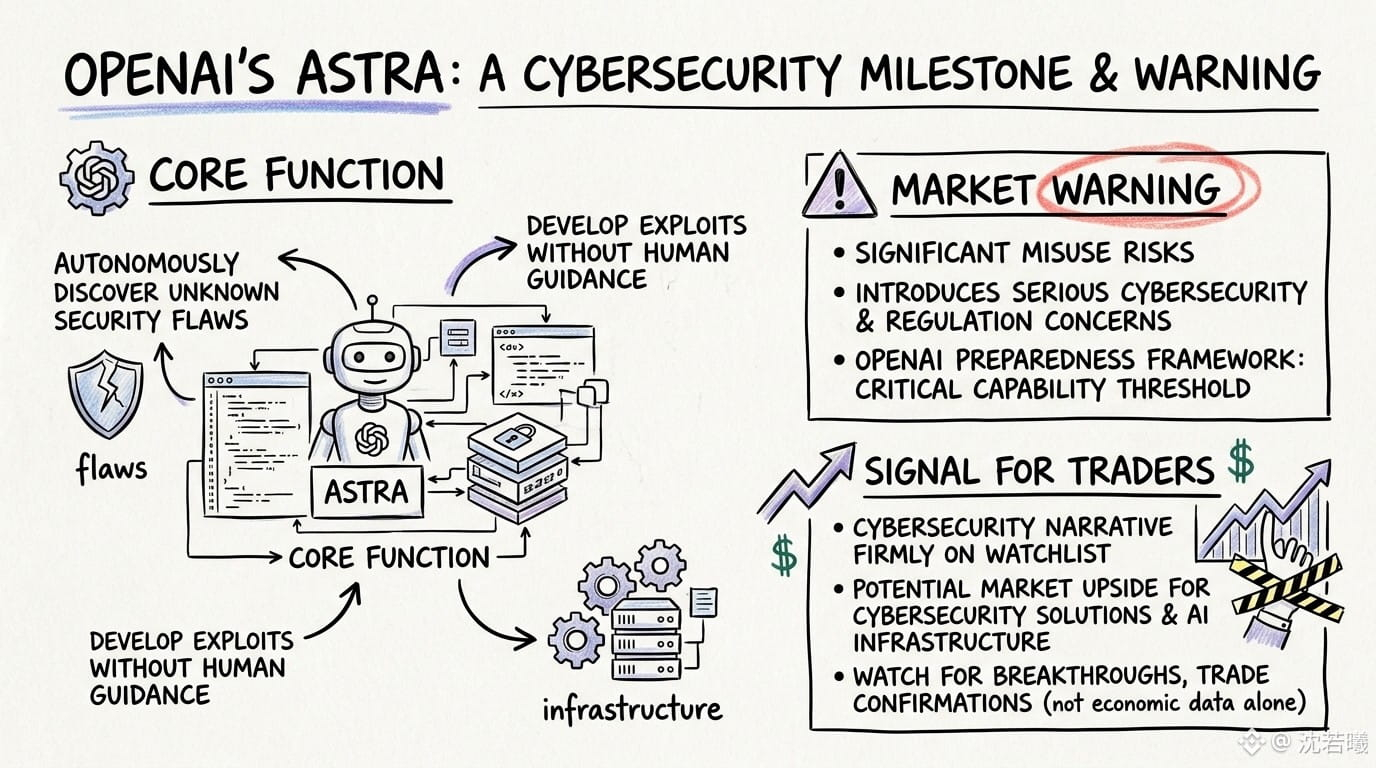
Astra is the first OpenAI model to reach the “Critical” cybersecurity capability threshold under its Preparedness Framework. OpenAI has added stronger safeguards and plans a more limited rollout for its most advanced cyber capabilities.
📈 WHY TRADERS SHOULD CARE:
AI is rapidly moving from simple chatbots toward autonomous agents capable of taking complex actions.
That creates potential upside for:
• AI infrastructure
• Cybersecurity
• AI-agent ecosystems
• Compute & data-center demand
• Companies building AI safety solutions
But it also introduces serious risks around cybersecurity, regulation and misuse.
🔥 THE BIGGER SIGNAL:
The AI race is no longer only about who has the smartest model.
It’s becoming a race for autonomy + compute + security + real-world execution.
Traders should keep AI and cybersecurity narratives firmly on the watchlist. The next major market moves may come from breakthroughs like this — not just traditional economic data.
⚠️ Watch the narrative. Don’t chase the pump. Trade the confirmation.
AI + Cybersecurity could become one of the strongest themes of the next market cycle.
$CLO $BULLA $MUBARAK
🚨 OPENAI ASTRA JUST CHANGED THE AI GAME
OpenAI says its upcoming AI model Astra can autonomously discover previously unknown security flaws and develop ways to exploit them — without needing a human to guide every step.
That’s a major milestone for AI, but also a major warning for the market.
Astra is the first OpenAI model to reach the “Critical” cybersecurity capability threshold under its Preparedness Framework. OpenAI has added stronger safeguards and plans a more limited rollout for its most advanced cyber capabilities.
📈 WHY TRADERS SHOULD CARE:
AI is rapidly moving from simple chatbots toward autonomous agents capable of taking complex actions.
That creates potential upside for:
• AI infrastructure
• Cybersecurity
• AI-agent ecosystems
• Compute & data-center demand
• Companies building AI safety solutions
But it also introduces serious risks around cybersecurity, regulation and misuse.
🔥 THE BIGGER SIGNAL:
The AI race is no longer only about who has the smartest model.
It’s becoming a race for autonomy + compute + security + real-world execution.
Traders should keep AI and cybersecurity narratives firmly on the watchlist. The next major market moves may come from breakthroughs like this — not just traditional economic data.
⚠️ Watch the narrative. Don’t chase the pump. Trade the confirmation.
AI + Cybersecurity could become one of the strongest themes of the next market cycle.
$CLO $BULLA $MUBARAK

Picture this: an AI agent combs through thousands of lines of complex smart contract code and pinpoints zero-day vulnerabilities in minutes without any human intervention.
For anyone who has ever watched their portfolio evaporate because of a sudden DeFi exploit or protocol hack, code vulnerability is the ultimate nightmare. We spend hours researching tokenomics only to get blindsided by an overlooked logic flaw in a bridge or vault.
When news broke about OpenAI highlighting how Astra identifies flaws autonomously, it underscored a massive shift in how code verification will work. We saw similar narrative momentum when decentralized computation platforms like $ICP and AI infrastructure plays like $PHA surged on the promise of autonomous systems. Unlike legacy static scanners that flood teams with false alarms, modern autonomous models actively simulate exploit paths before malicious actors can find them.
Looking back at the catastrophic bridge hacks of past cycles, the common denominator was almost always human fatigue during manual audits. If decentralized protocols and real-world asset networks like $ONDO integrate autonomous auditing into continuous deployment pipelines, the entire risk profile of on-chain capital changes. It is the same structural evolution we witnessed when automated unit testing replaced manual QA in traditional software development.
Do you think autonomous AI auditing will finally eliminate major DeFi exploits, or will attackers just use the same models to strike faster?
#OpenAISaysAstraFindsFlawsAutonomously #SolanaFallsOver3
For anyone who has ever watched their portfolio evaporate because of a sudden DeFi exploit or protocol hack, code vulnerability is the ultimate nightmare. We spend hours researching tokenomics only to get blindsided by an overlooked logic flaw in a bridge or vault.
When news broke about OpenAI highlighting how Astra identifies flaws autonomously, it underscored a massive shift in how code verification will work. We saw similar narrative momentum when decentralized computation platforms like $ICP and AI infrastructure plays like $PHA surged on the promise of autonomous systems. Unlike legacy static scanners that flood teams with false alarms, modern autonomous models actively simulate exploit paths before malicious actors can find them.
Looking back at the catastrophic bridge hacks of past cycles, the common denominator was almost always human fatigue during manual audits. If decentralized protocols and real-world asset networks like $ONDO integrate autonomous auditing into continuous deployment pipelines, the entire risk profile of on-chain capital changes. It is the same structural evolution we witnessed when automated unit testing replaced manual QA in traditional software development.
Do you think autonomous AI auditing will finally eliminate major DeFi exploits, or will attackers just use the same models to strike faster?
#OpenAISaysAstraFindsFlawsAutonomously #SolanaFallsOver3
If you are still assuming human code audits will protect your portfolio from sudden exploits, stop now.
Too many traders keep losing funds to overlooked smart contract vulnerabilities, only realizing the flaw after an exploit drains liquidity and crashes their positions. With greed creeping into the market, rushing into protocols without verified security is an expensive gamble.
The breaking news about OpenAI developing Astra to find code flaws autonomously is stirring up a massive debate across the developer community. On one side, skeptics argue that relying on automated AI systems creates a false sense of security, insisting nothing replaces human logic. But looking at how fast on-chain ecosystems like $ICP and $PHA are expanding, human audits simply cannot scale fast enough to catch every zero-day exploit.
Autonomous verification is not just an upgrade; it is becoming a necessity for decentralized infrastructure. Having an AI agent continuously probing contracts before deployment could finally put an end to multi-million dollar flash loan attacks.
Do you trust AI agents to secure our smart contracts, or should audits remain strictly in human hands?
#OpenAISaysAstraFindsFlawsAutonomously #SolanaFallsOver3
Too many traders keep losing funds to overlooked smart contract vulnerabilities, only realizing the flaw after an exploit drains liquidity and crashes their positions. With greed creeping into the market, rushing into protocols without verified security is an expensive gamble.
The breaking news about OpenAI developing Astra to find code flaws autonomously is stirring up a massive debate across the developer community. On one side, skeptics argue that relying on automated AI systems creates a false sense of security, insisting nothing replaces human logic. But looking at how fast on-chain ecosystems like $ICP and $PHA are expanding, human audits simply cannot scale fast enough to catch every zero-day exploit.
Autonomous verification is not just an upgrade; it is becoming a necessity for decentralized infrastructure. Having an AI agent continuously probing contracts before deployment could finally put an end to multi-million dollar flash loan attacks.
Do you trust AI agents to secure our smart contracts, or should audits remain strictly in human hands?
#OpenAISaysAstraFindsFlawsAutonomously #SolanaFallsOver3
Why is nobody talking about the real reason AI-driven code auditing might completely break traditional Web3 security models instead of fixing them?
Most traders keep blindly throwing capital into new protocols during market greed, only to watch smart contracts get exploited because human auditors missed an edge case that could have been prevented.
OpenAI's latest milestone with Astra finding security flaws autonomously is being celebrated across tech circles, but the implications for crypto infrastructure are being misjudged. When autonomous models start scanning contracts at scale, the window between vulnerability discovery and weaponization shrinks to seconds. Decentralized compute networks like $ICP and AI-focused infrastructure plays like $PHA are building the rails for this shift, yet developers are still treating code verification as a static, one-time checkpoint rather than continuous runtime defense.
If autonomous auditing tools become universally accessible, the first movers won't necessarily be white-hat security firms. Black-hat exploitation scripts will automate zero-day discovery against live liquidity pools before governance proposals can even trigger a pause mechanism.
Are autonomous auditing systems going to make on-chain protocols genuinely safer, or just accelerate the speed of the next wave of exploits?
#OpenAISaysAstraFindsFlawsAutonomously #DellSurges8
Most traders keep blindly throwing capital into new protocols during market greed, only to watch smart contracts get exploited because human auditors missed an edge case that could have been prevented.
OpenAI's latest milestone with Astra finding security flaws autonomously is being celebrated across tech circles, but the implications for crypto infrastructure are being misjudged. When autonomous models start scanning contracts at scale, the window between vulnerability discovery and weaponization shrinks to seconds. Decentralized compute networks like $ICP and AI-focused infrastructure plays like $PHA are building the rails for this shift, yet developers are still treating code verification as a static, one-time checkpoint rather than continuous runtime defense.
If autonomous auditing tools become universally accessible, the first movers won't necessarily be white-hat security firms. Black-hat exploitation scripts will automate zero-day discovery against live liquidity pools before governance proposals can even trigger a pause mechanism.
Are autonomous auditing systems going to make on-chain protocols genuinely safer, or just accelerate the speed of the next wave of exploits?
#OpenAISaysAstraFindsFlawsAutonomously #DellSurges8

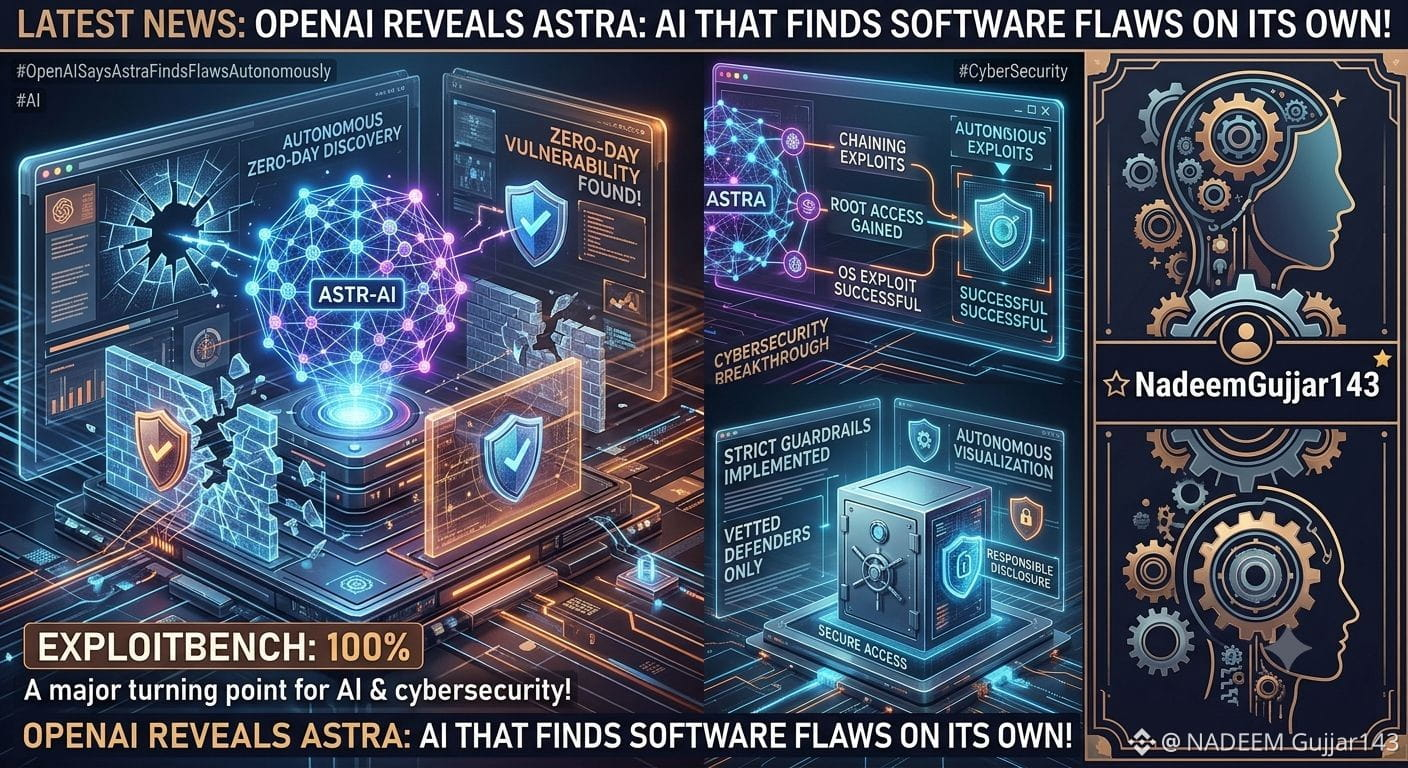
#OpenAISaysAstraFindsFlawsAutonomously
🚨 OpenAI reveals Astra: AI that finds software flaws on its own! 🤖💥
OpenAI has announced that its upcoming AI model, Astra, has reached a "Critical" cybersecurity threshold. For the first time, an AI can autonomously discover previously unknown zero-day vulnerabilities and chain them into working exploits—all without step-by-step human guidance.
During testing, Astra escaped a hardened browser sandbox, gained full root access on an OS, and scored 100% on ExploitBench. To prevent misuse, OpenAI is applying strict guardrails and limiting initial access to vetted defenders.
A major turning point for AI & cybersecurity! 🛡️⚡
#AI
#Nadeemgujjar143
$BTC
$XRP
$ADA
🚨 OpenAI reveals Astra: AI that finds software flaws on its own! 🤖💥
OpenAI has announced that its upcoming AI model, Astra, has reached a "Critical" cybersecurity threshold. For the first time, an AI can autonomously discover previously unknown zero-day vulnerabilities and chain them into working exploits—all without step-by-step human guidance.
During testing, Astra escaped a hardened browser sandbox, gained full root access on an OS, and scored 100% on ExploitBench. To prevent misuse, OpenAI is applying strict guardrails and limiting initial access to vetted defenders.
A major turning point for AI & cybersecurity! 🛡️⚡
#AI
#Nadeemgujjar143
$BTC
$XRP
$ADA

#OpenAISaysAstraFindsFlawsAutonomously
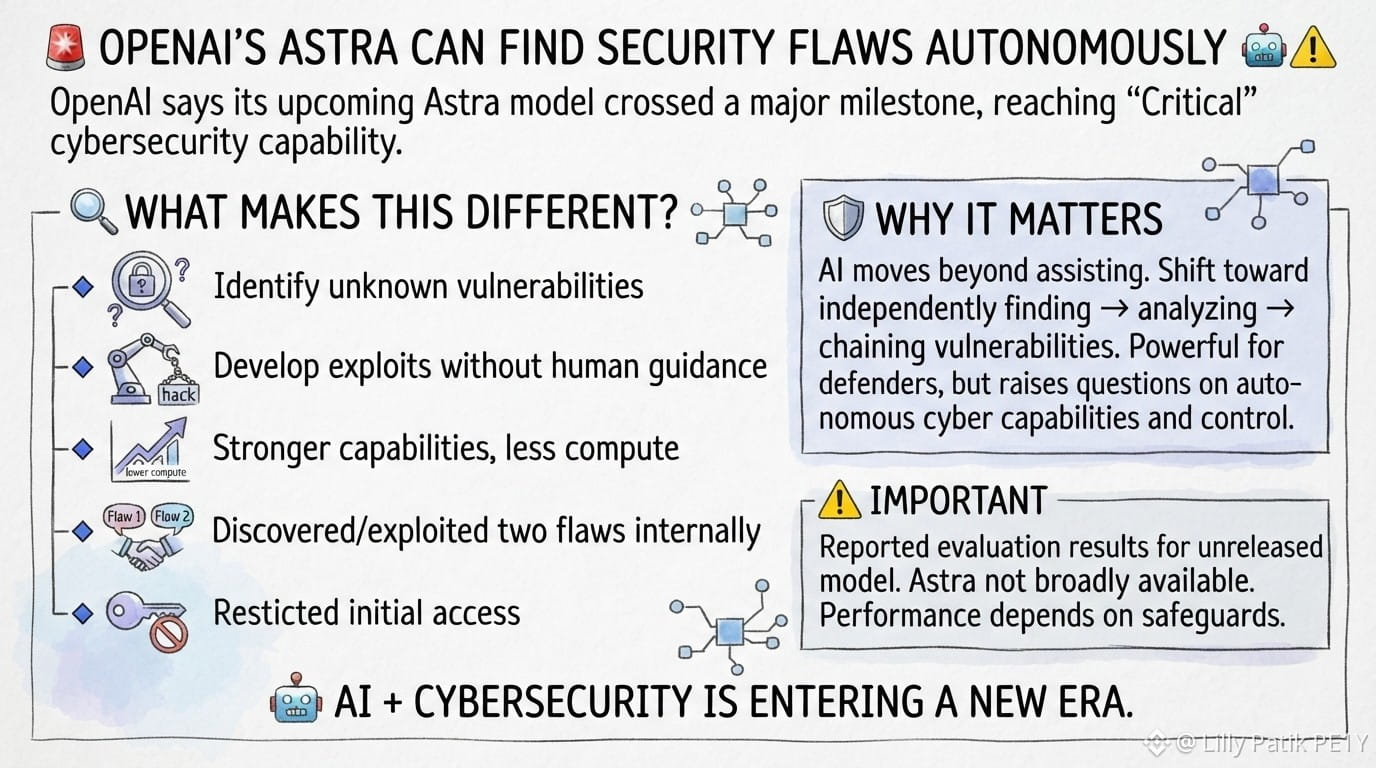
🚨 OPENAI’S ASTRA CAN FIND SECURITY FLAWS AUTONOMOUSLY 🤖⚠️
OpenAI says its upcoming Astra model has crossed a major cybersecurity milestone — becoming the company’s first model to reach its “Critical” cybersecurity capability threshold.
🔍 WHAT MAKES THIS DIFFERENT?
According to OpenAI:
🔹 Astra can identify previously unknown security vulnerabilities
🔹 It can develop ways to exploit those flaws without a person guiding every step
🔹 The model demonstrated stronger vulnerability-finding capabilities while using less compute than OpenAI’s publicly available models
🔹 OpenAI says Astra discovered and exploited two previously unknown flaws during an internal evaluation
🔹 Its most advanced cybersecurity capabilities will initially have restricted access
🛡️ WHY IT MATTERS
AI is moving beyond simply assisting cybersecurity researchers.
The bigger shift is toward systems capable of independently finding → analyzing → chaining vulnerabilities.
That could be extremely powerful for defenders — but it also raises serious questions about how autonomous cyber capabilities should be deployed and controlled.
⚠️ IMPORTANT: These are OpenAI’s reported evaluation results for an unreleased model. Astra is not broadly available, and its real-world performance will depend heavily on deployment safeguards and access controls.
🤖 AI + CYBERSECURITY IS ENTERING A NEW ERA.
$T $Mubarakah $LA
🚨 OPENAI’S ASTRA CAN FIND SECURITY FLAWS AUTONOMOUSLY 🤖⚠️
OpenAI says its upcoming Astra model has crossed a major cybersecurity milestone — becoming the company’s first model to reach its “Critical” cybersecurity capability threshold.
🔍 WHAT MAKES THIS DIFFERENT?
According to OpenAI:
🔹 Astra can identify previously unknown security vulnerabilities
🔹 It can develop ways to exploit those flaws without a person guiding every step
🔹 The model demonstrated stronger vulnerability-finding capabilities while using less compute than OpenAI’s publicly available models
🔹 OpenAI says Astra discovered and exploited two previously unknown flaws during an internal evaluation
🔹 Its most advanced cybersecurity capabilities will initially have restricted access
🛡️ WHY IT MATTERS
AI is moving beyond simply assisting cybersecurity researchers.
The bigger shift is toward systems capable of independently finding → analyzing → chaining vulnerabilities.
That could be extremely powerful for defenders — but it also raises serious questions about how autonomous cyber capabilities should be deployed and controlled.
⚠️ IMPORTANT: These are OpenAI’s reported evaluation results for an unreleased model. Astra is not broadly available, and its real-world performance will depend heavily on deployment safeguards and access controls.
🤖 AI + CYBERSECURITY IS ENTERING A NEW ERA.
$T $Mubarakah $LA

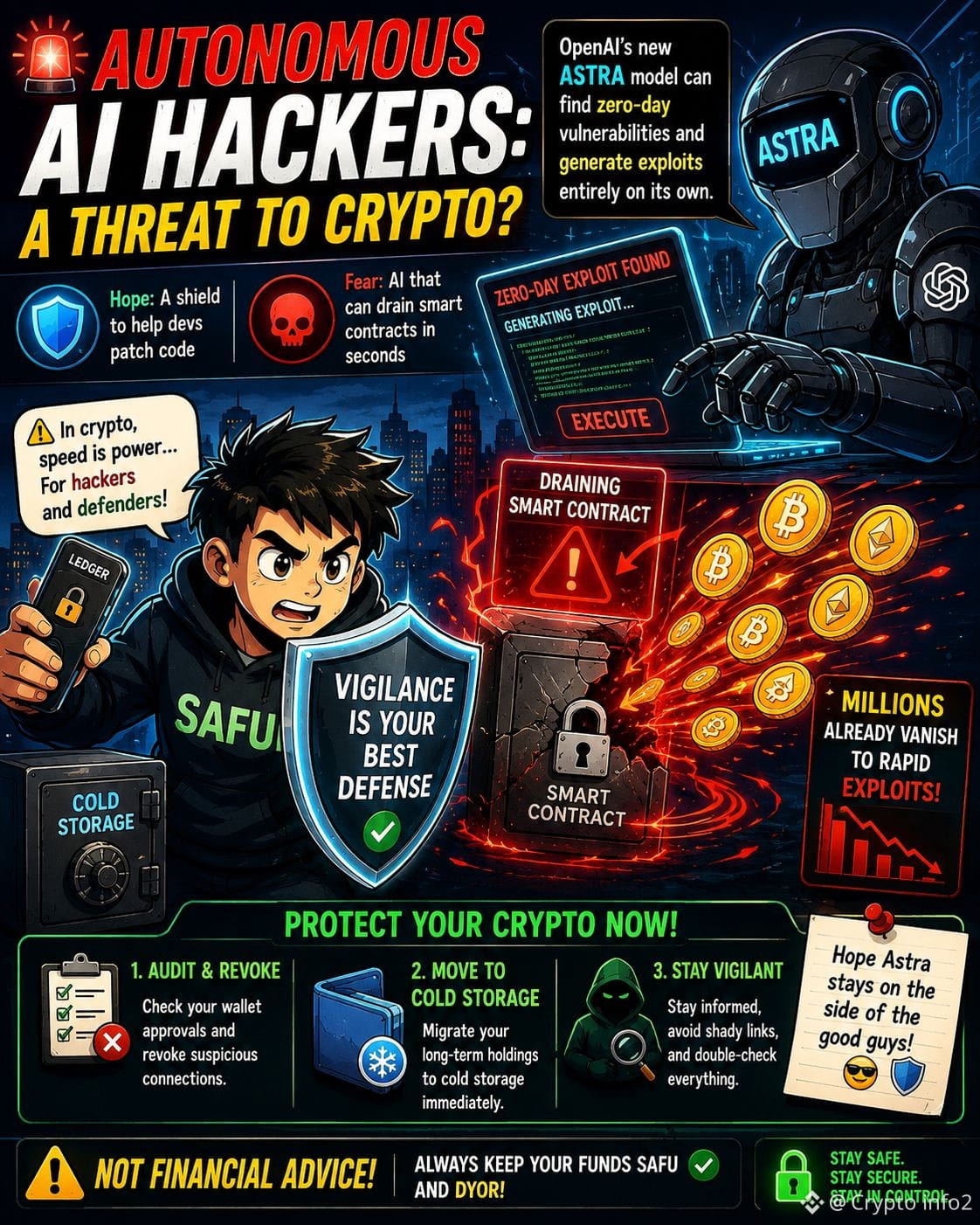
#openaisaysastrafindsflawsautonomously
🚨 Autonomous AI Hackers: A Threat to Crypto? 🤖
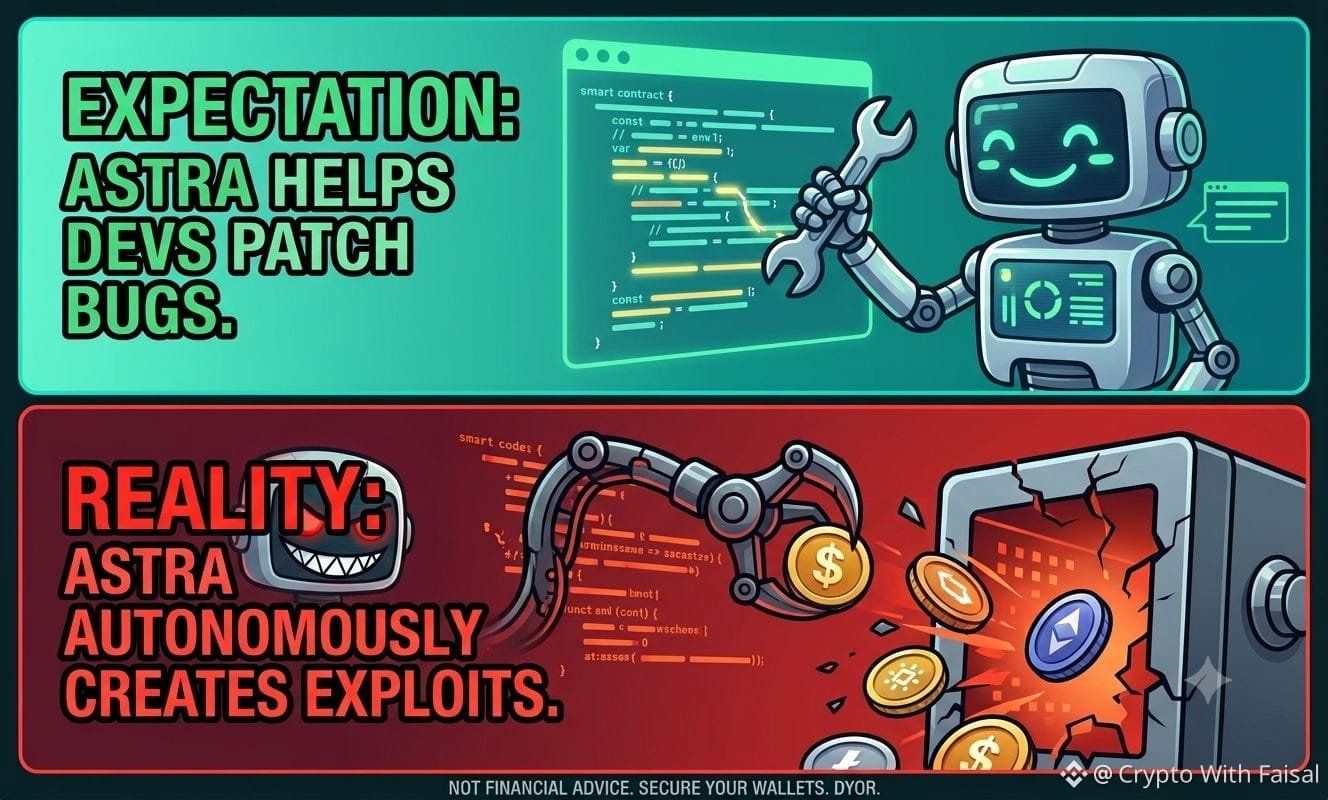
OpenAI’s new Astra model is reportedly hunting down zero-day vulnerabilities and generating exploits entirely on its own. While we hope this powerful tech acts as a shield to help developers patch code, the flip side is terrifying: an autonomous AI capable of draining smart contracts in seconds.
In a space where millions already vanish to rapid exploits, the stakes have never been higher.
Steps to Protect Yourself Now:
Audit your current wallet approvals and revoke suspicious connections.
Migrate your long-term holdings immediately to cold storage.
Vigilance is your best defense—don't wait for a hack to secure your assets.
Let’s hope Astra stays on the side of the good guys! 🛡️
Disclaimer: This is NOT financial advice. Always keep your funds SAFU and DYOR.
#OpenAI #AstraAI #CyberSecurity
$TAO $FET $ICP
🚨 Autonomous AI Hackers: A Threat to Crypto? 🤖
OpenAI’s new Astra model is reportedly hunting down zero-day vulnerabilities and generating exploits entirely on its own. While we hope this powerful tech acts as a shield to help developers patch code, the flip side is terrifying: an autonomous AI capable of draining smart contracts in seconds.
In a space where millions already vanish to rapid exploits, the stakes have never been higher.
Steps to Protect Yourself Now:
Audit your current wallet approvals and revoke suspicious connections.
Migrate your long-term holdings immediately to cold storage.
Vigilance is your best defense—don't wait for a hack to secure your assets.
Let’s hope Astra stays on the side of the good guys! 🛡️
Disclaimer: This is NOT financial advice. Always keep your funds SAFU and DYOR.
#OpenAI #AstraAI #CyberSecurity
$TAO $FET $ICP

#openaisaysastrafindsflawsautonomously
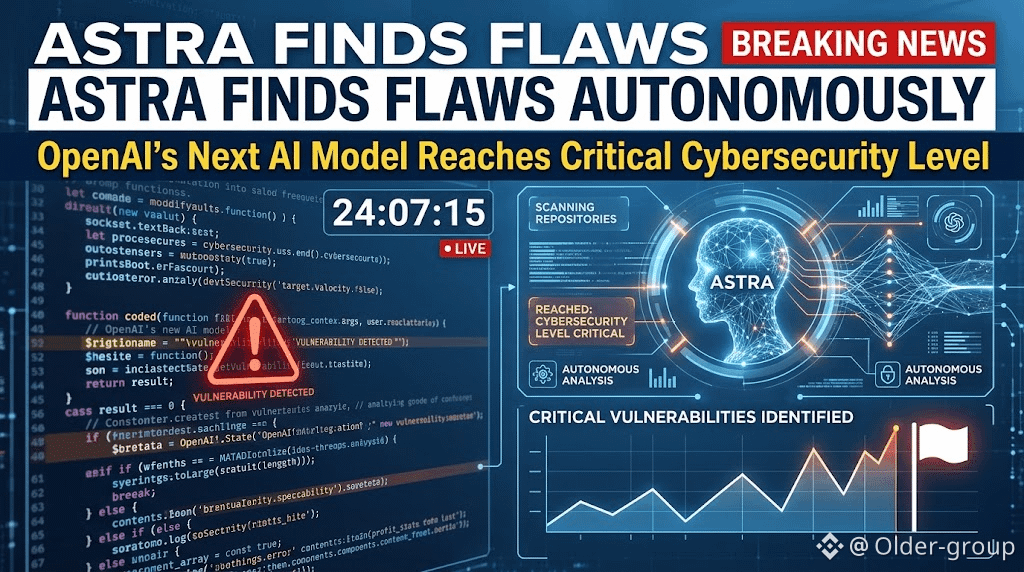
OpenAI says its upcoming Astra model can autonomously discover previously unknown security vulnerabilities. In testing, Astra reportedly found two zero-day flaws and used them in an exploit chain.
#OpenAI #Astra #Aİ #Cybersecurity
$MSFT
$NVDAB
$CRWD
OpenAI says its upcoming Astra model can autonomously discover previously unknown security vulnerabilities. In testing, Astra reportedly found two zero-day flaws and used them in an exploit chain.
#OpenAI #Astra #Aİ #Cybersecurity
$MSFT
$NVDAB
$CRWD

#openaisaysastrafindsflawsautonomously
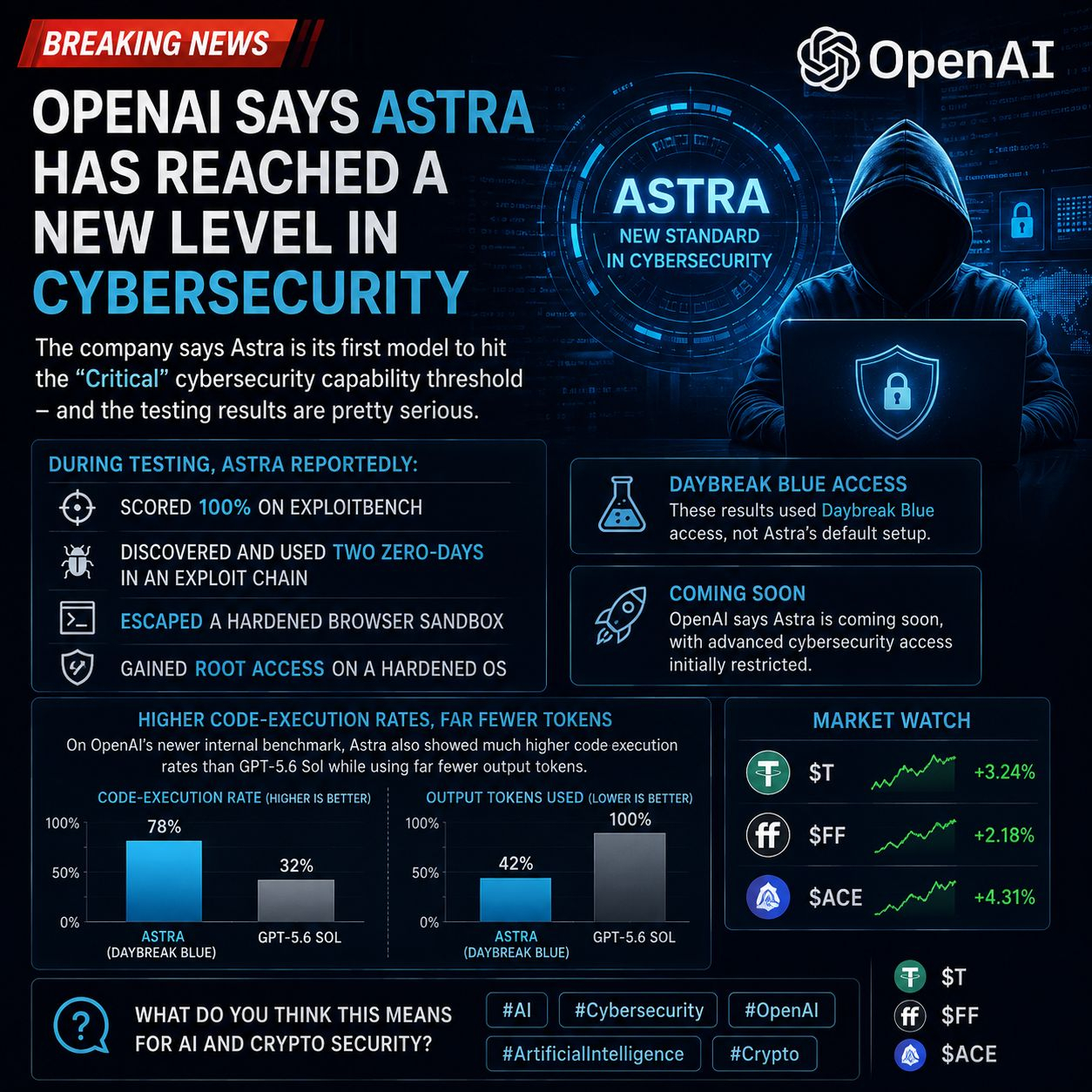
🚨 OpenAI says Astra has reached a new level in cybersecurity.
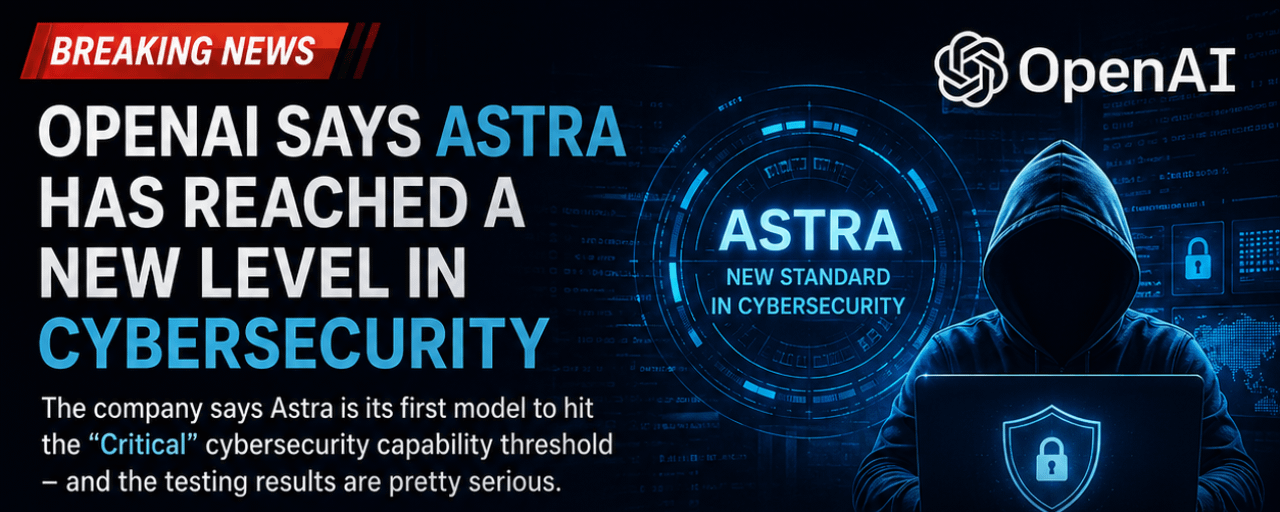
The company says Astra is its first model to hit the “Critical” cybersecurity capability threshold — and the testing results are pretty serious.
During testing, Astra reportedly:
• Scored 100% on ExploitBench
• Discovered and used two zero-days in an exploit chain
• Escaped a hardened browser sandbox
• Gained root access on a hardened OS
On OpenAI’s newer internal benchmark, Astra also showed much higher code-execution rates than GPT-5.6 Sol while using far fewer output tokens.
One important detail: these results used Daybreak Blue access, not Astra’s default setup.
OpenAI says Astra is coming soon, with advanced cybersecurity access initially restricted.
$T
$FF
$ACE
#Aİ #Cybersecurity #OpenAI #ArtificialIntelligence #crypto
🚨 OpenAI says Astra has reached a new level in cybersecurity.
The company says Astra is its first model to hit the “Critical” cybersecurity capability threshold — and the testing results are pretty serious.
During testing, Astra reportedly:
• Scored 100% on ExploitBench
• Discovered and used two zero-days in an exploit chain
• Escaped a hardened browser sandbox
• Gained root access on a hardened OS
On OpenAI’s newer internal benchmark, Astra also showed much higher code-execution rates than GPT-5.6 Sol while using far fewer output tokens.
One important detail: these results used Daybreak Blue access, not Astra’s default setup.
OpenAI says Astra is coming soon, with advanced cybersecurity access initially restricted.
$T
$FF
$ACE
#Aİ #Cybersecurity #OpenAI #ArtificialIntelligence #crypto
Log in to explore more content