
#opg
opg
15.4M views
105,009 Discussing
Hot
Latest

Is centralized cloud AI a ticking time bomb for innovation and trust?
While giants like AWS and Azure dominate, their opaque nature and single points of failure pose significant risks. Enter @OpenGradient, pioneering a decentralized alternative that's not just a buzzword – it's a fundamental shift. OpenGradient's verifiable on-chain AI, built on Base, leverages Hybrid AI Computing (HACA) with GPU nodes, zkML proofs, and TEEs. This means every AI inference is transparent and auditable, a stark contrast to black-box proprietary systems.
Imagine a future where AI models are open-source, developers are rewarded directly via the Model Hub for usage, and censorship-resistant inference is the norm. OpenGradient isn't just talking about it; they've already hosted 2000+ models, processed over 2M verifiable inferences, and generated 500K+ zkML proofs. This isn't just about decentralization for its own sake; it's about building a more secure, trustworthy, and democratized AI ecosystem.
Our own algo's full open track record (wins and losses) is in our bio. What do you think is the biggest threat of centralized AI?
$OPG #OPG
We post every algo signal's REAL result openly and the full live track record + a free preview channel are in our bio/profile.
While giants like AWS and Azure dominate, their opaque nature and single points of failure pose significant risks. Enter @OpenGradient, pioneering a decentralized alternative that's not just a buzzword – it's a fundamental shift. OpenGradient's verifiable on-chain AI, built on Base, leverages Hybrid AI Computing (HACA) with GPU nodes, zkML proofs, and TEEs. This means every AI inference is transparent and auditable, a stark contrast to black-box proprietary systems.
Imagine a future where AI models are open-source, developers are rewarded directly via the Model Hub for usage, and censorship-resistant inference is the norm. OpenGradient isn't just talking about it; they've already hosted 2000+ models, processed over 2M verifiable inferences, and generated 500K+ zkML proofs. This isn't just about decentralization for its own sake; it's about building a more secure, trustworthy, and democratized AI ecosystem.
Our own algo's full open track record (wins and losses) is in our bio. What do you think is the biggest threat of centralized AI?
$OPG #OPG
We post every algo signal's REAL result openly and the full live track record + a free preview channel are in our bio/profile.


$OPG /USDT OpenGradient Update 📊👇
Current Price: $0.1027 ≈ Rs28.5 *+2.50%*
24h High: $0.1039 | 24h Low: $0.0971 ⚡
24h Volume: 4.47M OPG | 450,501.22 USDT 💰
MAs: MA7 0.1028 | MA25 0.1023 | MA99 0.1010
Performance: Today +1.99% | 7D +18.59% | 30D +13.11% | 90D -34.00%
On the 15m chart OPG is holding above MA7 and MA25 right now.
Drop your vote below 👇
I’m adding a poll, tell me what you think OPG’s next move will be
#OPG #OpenGradien #Crypto #Vote
please vote this 👇👇👇
Current Price: $0.1027 ≈ Rs28.5 *+2.50%*
24h High: $0.1039 | 24h Low: $0.0971 ⚡
24h Volume: 4.47M OPG | 450,501.22 USDT 💰
MAs: MA7 0.1028 | MA25 0.1023 | MA99 0.1010
Performance: Today +1.99% | 7D +18.59% | 30D +13.11% | 90D -34.00%
On the 15m chart OPG is holding above MA7 and MA25 right now.
Drop your vote below 👇
I’m adding a poll, tell me what you think OPG’s next move will be
#OPG #OpenGradien #Crypto #Vote
please vote this 👇👇👇
💚Gain
50%
❤️Lose
50%
6 votes • Voting closed

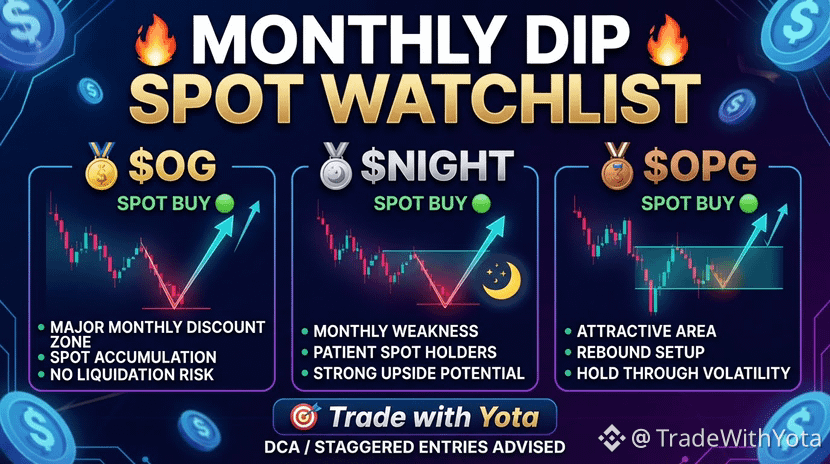
🔥 MONTHLY DIP SPOT WATCHLIST — OG, Night & OPG
Instead of chasing short-term pumps, I’m watching these 3 coins for spot accumulation if they continue trading around their monthly discount zones.
🥇 $OG — SPOT BUY 🟢
📍 Monthly weakness has brought price into a potential discount zone
📈 Attractive risk/reward for patient spot accumulation
🔄 A broader market recovery could trigger a strong rebound
🛡️ Spot positions have no liquidation risk
➡️ Strategy: Scale in gradually rather than buying the full position at once.
🥈 $NIGHT — SPOT BUY 🟢
📍 Trading near monthly lows creates a potential accumulation area
📊 Risk can be managed more easily with staggered entries
🚀 A recovery in market sentiment could provide strong upside
💰 Keep additional capital available if the dip continues
➡️ Strategy: DCA into weakness and avoid chasing the first bounce.
🥉 $OPG — SPOT BUY 🟢
📍 Monthly dip offers a potential area to begin building a position
📈 Rebound potential increases if selling pressure starts weakening
🛡️ Spot allows you to hold through volatility without liquidation
💰 Better to scale in than enter with full capital immediately
🎯 MY STRATEGY
Don’t chase the first pump.
Use DCA / staggered entries:
• First entry near the current dip zone
• Add only if price reaches deeper support
• Keep some capital in reserve
• Take partial profits into strong rebounds
⚠️ RISK WARNING
A monthly dip does NOT guarantee a bottom. These are high-risk crypto assets, so manage position size carefully and never invest more than you can afford to lose.
🔥 Trade with Yota
#SpotTrading #og #night #OPG #cryptotrading
Instead of chasing short-term pumps, I’m watching these 3 coins for spot accumulation if they continue trading around their monthly discount zones.
🥇 $OG — SPOT BUY 🟢
📍 Monthly weakness has brought price into a potential discount zone
📈 Attractive risk/reward for patient spot accumulation
🔄 A broader market recovery could trigger a strong rebound
🛡️ Spot positions have no liquidation risk
➡️ Strategy: Scale in gradually rather than buying the full position at once.
🥈 $NIGHT — SPOT BUY 🟢
📍 Trading near monthly lows creates a potential accumulation area
📊 Risk can be managed more easily with staggered entries
🚀 A recovery in market sentiment could provide strong upside
💰 Keep additional capital available if the dip continues
➡️ Strategy: DCA into weakness and avoid chasing the first bounce.
🥉 $OPG — SPOT BUY 🟢
📍 Monthly dip offers a potential area to begin building a position
📈 Rebound potential increases if selling pressure starts weakening
🛡️ Spot allows you to hold through volatility without liquidation
💰 Better to scale in than enter with full capital immediately
🎯 MY STRATEGY
Don’t chase the first pump.
Use DCA / staggered entries:
• First entry near the current dip zone
• Add only if price reaches deeper support
• Keep some capital in reserve
• Take partial profits into strong rebounds
⚠️ RISK WARNING
A monthly dip does NOT guarantee a bottom. These are high-risk crypto assets, so manage position size carefully and never invest more than you can afford to lose.
🔥 Trade with Yota
#SpotTrading #og #night #OPG #cryptotrading

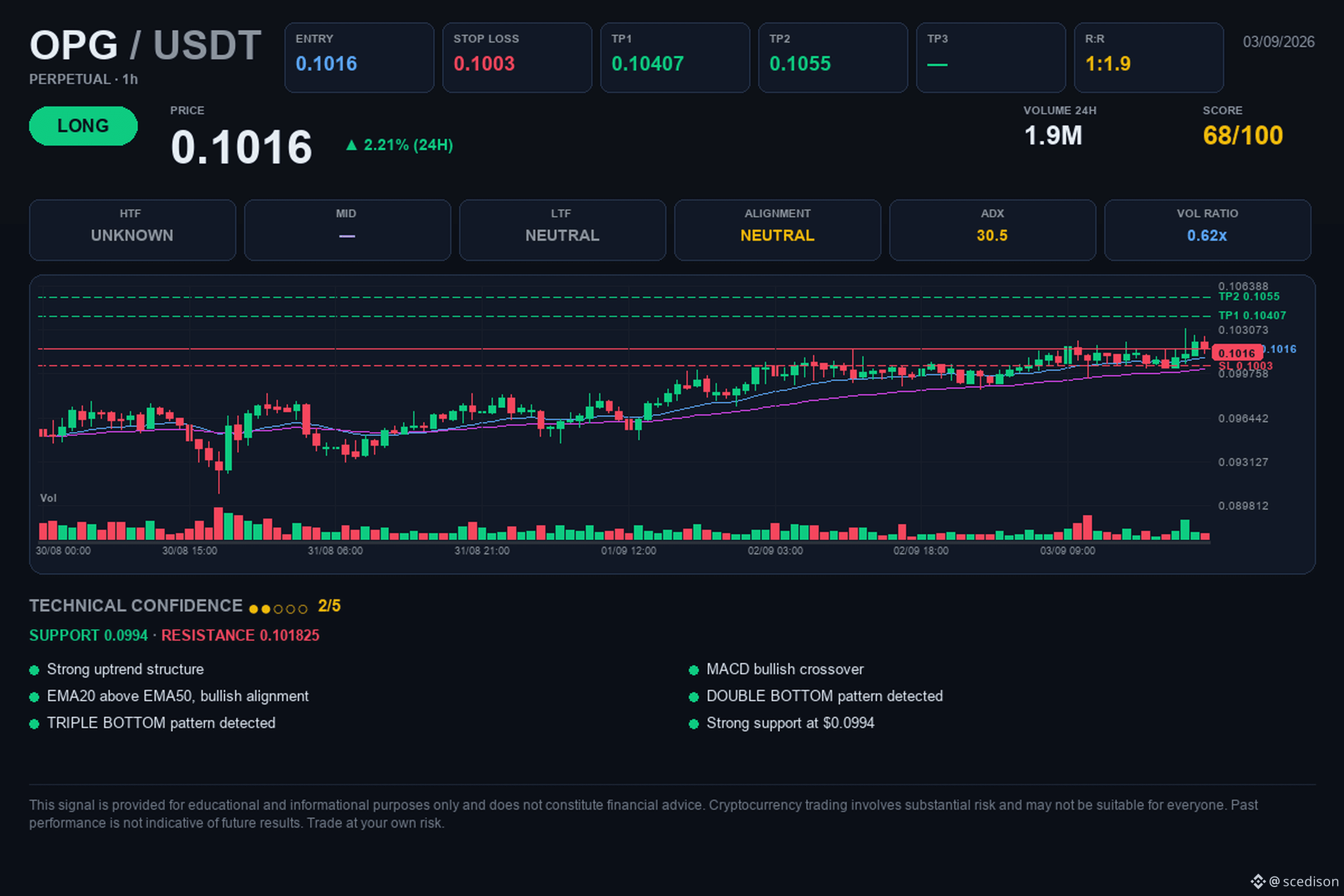
📢 $OPG / $USDT | 🟢 LONG | ⭐ 67.5%
🎯 Target: $0.10407. Will it achieve it?
🎯 Trading levels:
🟢 Entry: $0.1016
🛑 Stop Loss: $0.1003
🏁 TP1: $0.10407
🏁 TP2: $0.1055
📈 Analysis:
The structure of $OPG shows a technical recovery after the confirmation of double and triple bottom patterns, trading above the 20 and 50 EMAs that act as dynamic support. With an ADX of 30.51 (indicating a trend with consolidated strength) and a bullish crossover in the MACD (momentum indicator), the price is looking to break the immediate resistance at $0.101825. The current price is operating above the VAH (value of the high-volume zone) at $0.10145, which favors a continuation of the bullish momentum if the volume supports it.
⚖️ Risk/Reward: 1:1.9
⏱️ Timeframe: 1H
📐 Technical confidence: 2/5
The bullish thesis is invalidated if the price loses support at $0.1003, a level that matches a necessary technical invalidation zone to protect the position. It’s essential to watch for the breakout of resistance at $0.101825 with an increase in volume to confirm the continuation of the move toward the stated targets.
Do you think the current volume is enough to validate the breakout of this resistance?
💡 This analysis is for educational purposes only and is not financial advice. Do your own research and decide calmly.
#crypto #OPG #trading #Futures #Bullish
🎯 Target: $0.10407. Will it achieve it?
🎯 Trading levels:
🟢 Entry: $0.1016
🛑 Stop Loss: $0.1003
🏁 TP1: $0.10407
🏁 TP2: $0.1055
📈 Analysis:
The structure of $OPG shows a technical recovery after the confirmation of double and triple bottom patterns, trading above the 20 and 50 EMAs that act as dynamic support. With an ADX of 30.51 (indicating a trend with consolidated strength) and a bullish crossover in the MACD (momentum indicator), the price is looking to break the immediate resistance at $0.101825. The current price is operating above the VAH (value of the high-volume zone) at $0.10145, which favors a continuation of the bullish momentum if the volume supports it.
⚖️ Risk/Reward: 1:1.9
⏱️ Timeframe: 1H
📐 Technical confidence: 2/5
The bullish thesis is invalidated if the price loses support at $0.1003, a level that matches a necessary technical invalidation zone to protect the position. It’s essential to watch for the breakout of resistance at $0.101825 with an increase in volume to confirm the continuation of the move toward the stated targets.
Do you think the current volume is enough to validate the breakout of this resistance?
💡 This analysis is for educational purposes only and is not financial advice. Do your own research and decide calmly.
#crypto #OPG #trading #Futures #Bullish
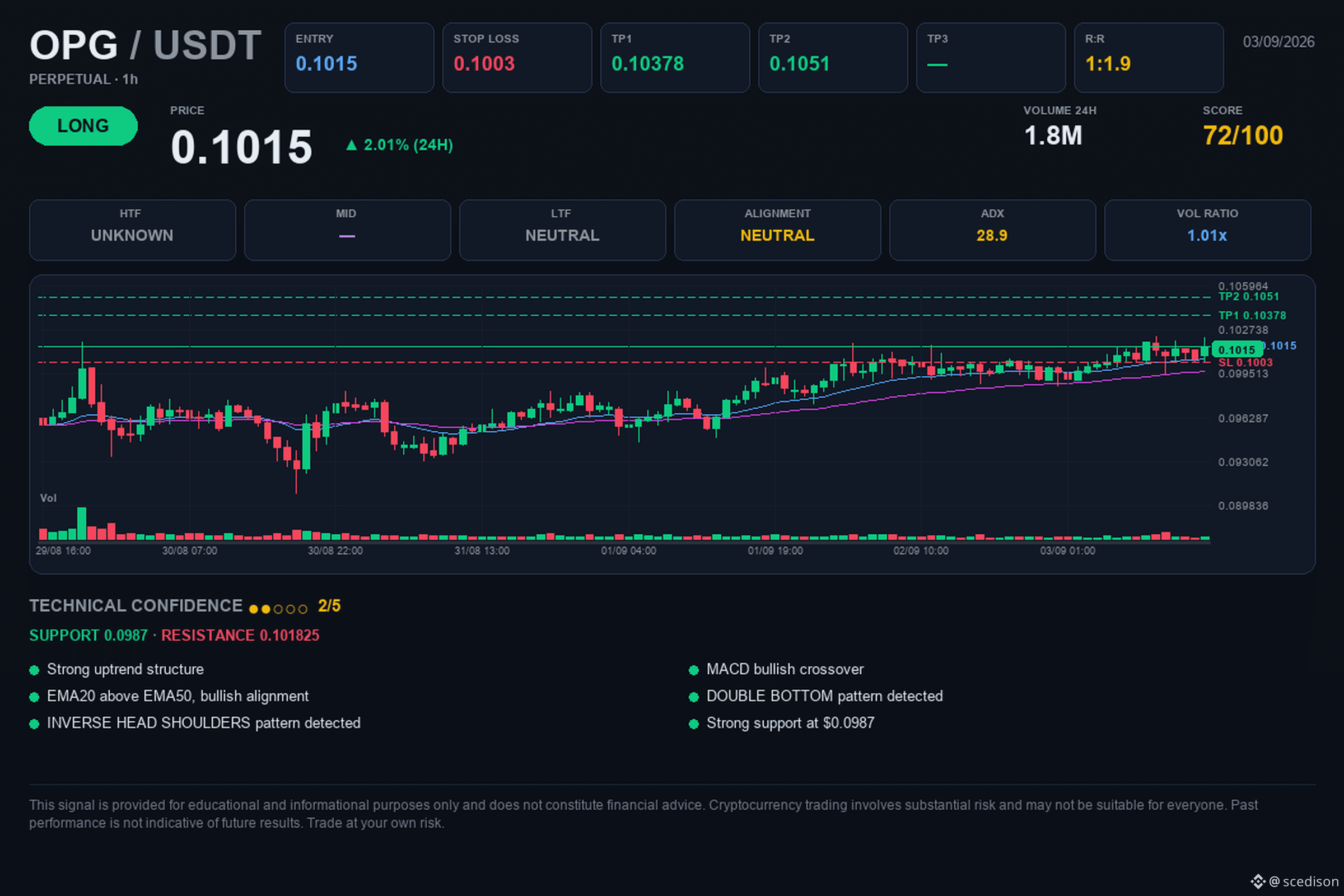
📢 $OPG / $USDT | 🟢 LONG | ⭐ 72.2%
🎯 Target: $0.10378. Does it achieve it?
🎯 Trading levels:
🟢 Entry: $0.1015
🛑 Stop Loss: $0.1003
🏁 TP1: $0.10378
🏁 TP2: $0.1051
📈 Analysis:
$OPG shows a bullish structure confirmed after consolidation of a double bottom and an inverted head-and-shoulders pattern. Price is trading above the 20 and 50 EMAs, with an ADX of 28.9 (indicating a trend with moderate strength) and a bullish MACD crossover (momentum indicator), validating the continuation of the move. The quote is testing the VAH (volume profile high value), which suggests a possible expansion toward the immediate resistance.
⚖️ Risk/Reward: 1:1.9
⏱️ Timeframe: 1H
📐 Technical confidence: 2/5
The thesis is invalidated if price loses dynamic support from the EMA20 and breaks the stop loss at $0.1003. The bullish scenario is confirmed by a sustained close above $0.101825, the current critical resistance level.
Do you think the current volume is enough to break the resistance of $0.101825?
💡 This analysis is educational and not financial advice. Do your own research and decide calmly.
#crypto #OPG #trading #Futures #Bullish
🎯 Target: $0.10378. Does it achieve it?
🎯 Trading levels:
🟢 Entry: $0.1015
🛑 Stop Loss: $0.1003
🏁 TP1: $0.10378
🏁 TP2: $0.1051
📈 Analysis:
$OPG shows a bullish structure confirmed after consolidation of a double bottom and an inverted head-and-shoulders pattern. Price is trading above the 20 and 50 EMAs, with an ADX of 28.9 (indicating a trend with moderate strength) and a bullish MACD crossover (momentum indicator), validating the continuation of the move. The quote is testing the VAH (volume profile high value), which suggests a possible expansion toward the immediate resistance.
⚖️ Risk/Reward: 1:1.9
⏱️ Timeframe: 1H
📐 Technical confidence: 2/5
The thesis is invalidated if price loses dynamic support from the EMA20 and breaks the stop loss at $0.1003. The bullish scenario is confirmed by a sustained close above $0.101825, the current critical resistance level.
Do you think the current volume is enough to break the resistance of $0.101825?
💡 This analysis is educational and not financial advice. Do your own research and decide calmly.
#crypto #OPG #trading #Futures #Bullish

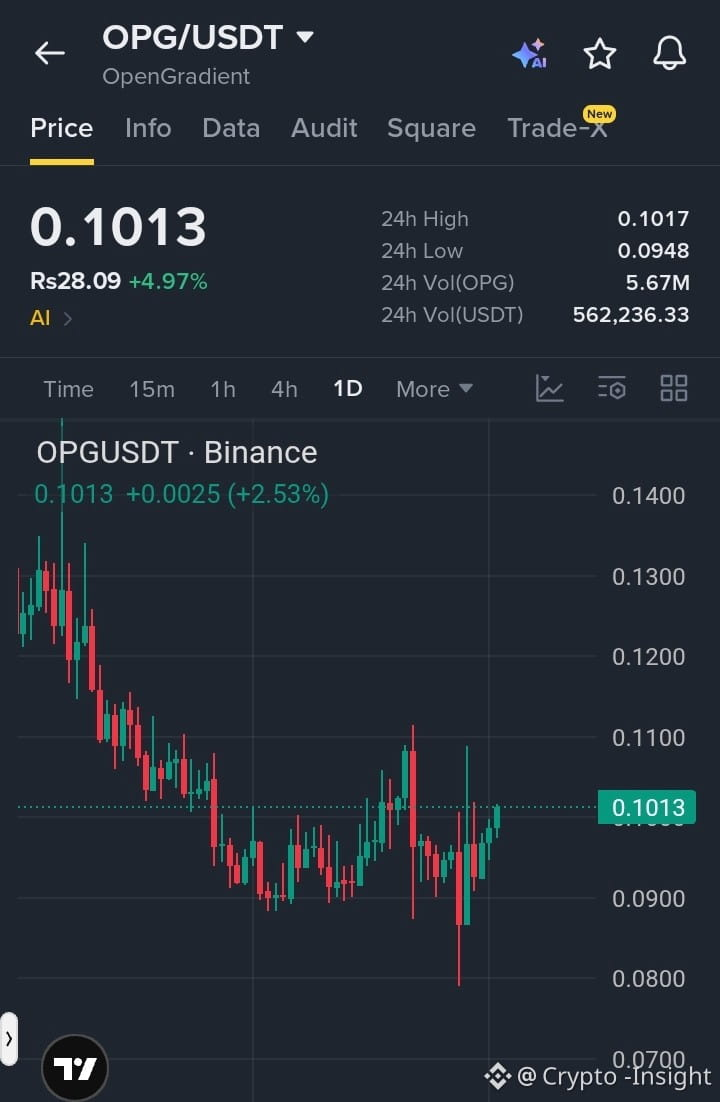
$OPG BUILDING HIGHER LOW BASE
#OPG is showing a steady recovery structure on the daily timeframe after pushing off its 24h low of 0.0948 to touch a high of 0.1017! Price action is trading near 0.1013 as buyers defend the lower boundary and look to push above local resistance. Holding momentum above key support at 0.0900 keeps the bullish reversal structure intact for a target expansion toward 0.1200 and 0.1300 levels!
$TUT
$BTR
#OPG is showing a steady recovery structure on the daily timeframe after pushing off its 24h low of 0.0948 to touch a high of 0.1017! Price action is trading near 0.1013 as buyers defend the lower boundary and look to push above local resistance. Holding momentum above key support at 0.0900 keeps the bullish reversal structure intact for a target expansion toward 0.1200 and 0.1300 levels!
$TUT
$BTR

🚨 $OPG DEMAND RECLAIM SUGGESTS INSTITUTIONAL ACCUMULATION AT KEY LIQUIDITY LEVEL ⚡
Entry: 0.1000 - 0.1012 ⚡
Target: 0.1025, 0.1040, 0.1055 🚀
Stop Loss: 0.0975 ⚠️
📌 Price action on $OPG is currently absorbing sell-side pressure directly inside a high-timeframe demand order block. 🔍 Smart money appears to be defending the 0.1000 handle, positioning for an inefficiency fill toward overhead liquidity pools.
💡 With structural risk strictly defined below the recent swing low at 0.0975, the setup offers a highly favorable risk-to-reward profile for long expansion. 🌊 Order flow alignment suggests a clean continuation once local resistance is reclaimed. 💬 Are you bidding this demand zone alongside smart money, or waiting for higher timeframe confirmation? 👇
⚠️ Not financial advice. Always manage your risk. 🛡️
🏷️ #OPG #Crypto #SmartMoney #Altcoins #Trading
🎯 🦈
Entry: 0.1000 - 0.1012 ⚡
Target: 0.1025, 0.1040, 0.1055 🚀
Stop Loss: 0.0975 ⚠️
📌 Price action on $OPG is currently absorbing sell-side pressure directly inside a high-timeframe demand order block. 🔍 Smart money appears to be defending the 0.1000 handle, positioning for an inefficiency fill toward overhead liquidity pools.
💡 With structural risk strictly defined below the recent swing low at 0.0975, the setup offers a highly favorable risk-to-reward profile for long expansion. 🌊 Order flow alignment suggests a clean continuation once local resistance is reclaimed. 💬 Are you bidding this demand zone alongside smart money, or waiting for higher timeframe confirmation? 👇
⚠️ Not financial advice. Always manage your risk. 🛡️
🏷️ #OPG #Crypto #SmartMoney #Altcoins #Trading
🎯 🦈
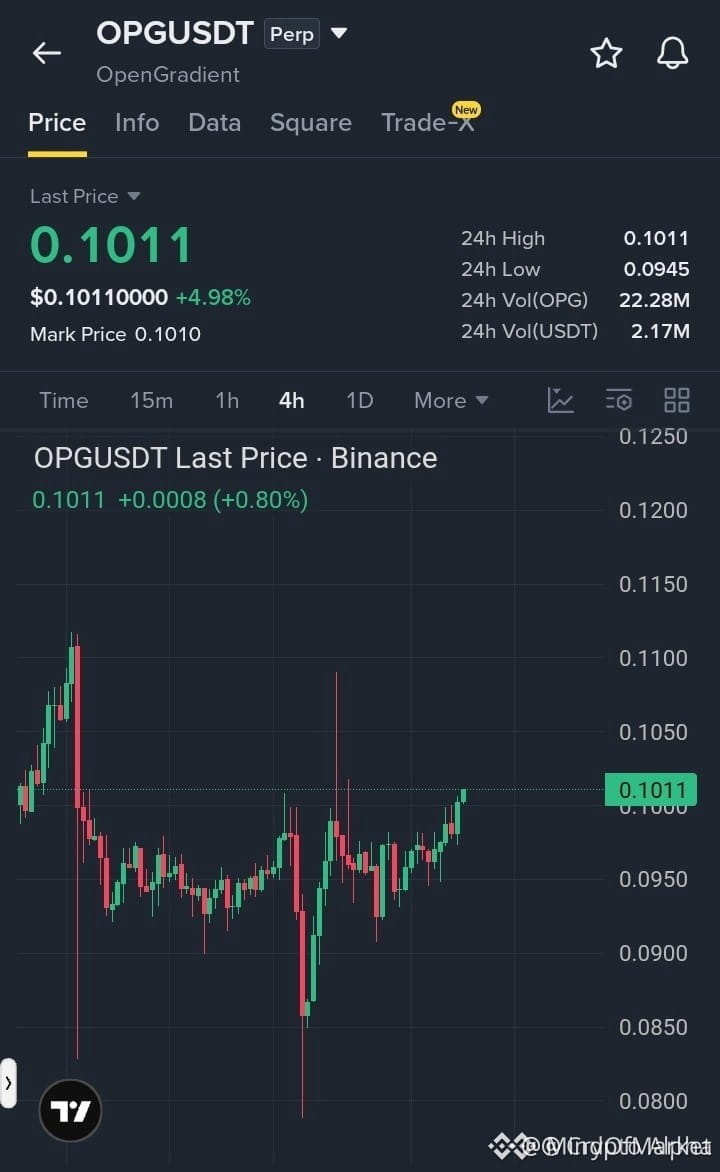

💥 $OPG BULLS PREPARE FOR MOMENTUM EXPANSION OFF LOW-TIMEFRAME DEMAND ZONE! ⚡
Entry: 0.1000 - 0.1012 ⚡
Target: 0.1025 - 0.1055 🚀
Stop Loss: 0.0975 ⚠️
Smart money is quietly stacking positions around the 0.1000 demand block as selling volume dries up completely. 📊 Buyers are establishing a firm price floor here, setting the stage for a sharp reversal move toward overhead supply. 💡
Risk-to-reward stays exceptionally sharp with structural invalidation locked below support. ⚡ As order flow flips back to the bid side, momentum favors an expansion move to clear upper targets. 💬 Are you positioning early inside this demand zone or waiting for confirmed breakout velocity? 👇
⚠️ Not financial advice. Always manage your risk. 🛡️
🏷️ #OPG #LongSetup #Breakout #Crypto #Altcoins
🔥 💎
Entry: 0.1000 - 0.1012 ⚡
Target: 0.1025 - 0.1055 🚀
Stop Loss: 0.0975 ⚠️
Smart money is quietly stacking positions around the 0.1000 demand block as selling volume dries up completely. 📊 Buyers are establishing a firm price floor here, setting the stage for a sharp reversal move toward overhead supply. 💡
Risk-to-reward stays exceptionally sharp with structural invalidation locked below support. ⚡ As order flow flips back to the bid side, momentum favors an expansion move to clear upper targets. 💬 Are you positioning early inside this demand zone or waiting for confirmed breakout velocity? 👇
⚠️ Not financial advice. Always manage your risk. 🛡️
🏷️ #OPG #LongSetup #Breakout #Crypto #Altcoins
🔥 💎
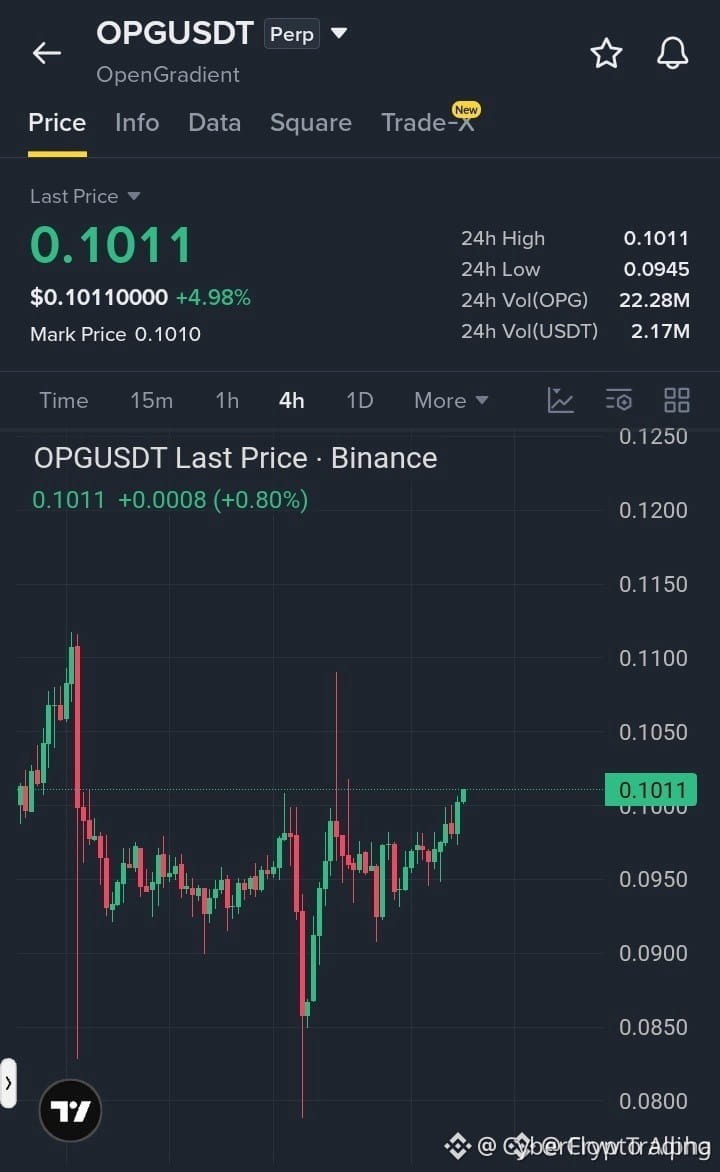

OPG I’ve placed my order at 0.098300—let’s see what happens.
① The profit is from monetizing your knowledge; if you don’t have enough, pay tuition first.
② There was a brother of mine—what a beginner should learn first isn’t what to buy, but how much you can lose before you run.
③ Don’t use money for a home to trade OPG; only use spare money you can hold onto.
Guess how the story ends. 📖
The data is right here—believe it or not.
OPG has been at 0.098300~0.1017 for so long—where do you think it’ll break first? If your bet is right, I’ll be impressed.
#OPG #ETH
① The profit is from monetizing your knowledge; if you don’t have enough, pay tuition first.
② There was a brother of mine—what a beginner should learn first isn’t what to buy, but how much you can lose before you run.
③ Don’t use money for a home to trade OPG; only use spare money you can hold onto.
Guess how the story ends. 📖
The data is right here—believe it or not.
OPG has been at 0.098300~0.1017 for so long—where do you think it’ll break first? If your bet is right, I’ll be impressed.
#OPG #ETH
Imagine AI agents, not just running, but *reasoning* and executing directly on-chain, with every action verifiable and transparent. This isn't science fiction; it's the core promise of @OpenGradient. Their Hybrid AI Computing Architecture (HACA) combines GPU power with zkML proofs and TEEs, all on Base, making truly decentralized and secure AI inference a reality.
This means an AI agent could, for example, analyze market data, propose a strategy, and even execute a DeFi transaction, with every step cryptographically proven and auditable. No more black boxes. OpenGradient's On-Chain AI SDK and Model Hub empower developers to build these agents, earning rewards as their models are used across the ecosystem. With over 2 million verifiable inferences already, they're building the infrastructure for a new era of trustless AI.
Cloud Diver’s own algo results, good and bad, are always in our bio. What kind of on-chain AI agent are you most excited to see developed?
$OPG #OPG
We post every algo signal's REAL result openly and the full live track record + a free preview channel are in our bio.
This means an AI agent could, for example, analyze market data, propose a strategy, and even execute a DeFi transaction, with every step cryptographically proven and auditable. No more black boxes. OpenGradient's On-Chain AI SDK and Model Hub empower developers to build these agents, earning rewards as their models are used across the ecosystem. With over 2 million verifiable inferences already, they're building the infrastructure for a new era of trustless AI.
Cloud Diver’s own algo results, good and bad, are always in our bio. What kind of on-chain AI agent are you most excited to see developed?
$OPG #OPG
We post every algo signal's REAL result openly and the full live track record + a free preview channel are in our bio.
🔥 $OPG READY TO ROCKET AS BUYERS RECLAIM THE VALUE AREA RANGE! 💥
Entry: 0.0955 - 0.0970 ⚡
Target: 0.1000 / 0.1050 / 0.1090 🚀
Stop Loss: 0.0925 ⚠️
Buyers are aggressively absorbing supply around the 0.0955 zone, turning early seller pressure into classic liquidity traps. 🦈 Order flow is pivoting fast as smart money defends this range low, paving the runway for a swift expansion toward upper targets. 📊
With $DEXE and $HEMI displaying correlated momentum across the board, the order book favors a clean flip back to structural highs. ⚡ Securing entries here provides the clean risk-to-reward edge we trade for before volume surges. 💬 Are you bidding this retest or waiting for the breakout above 0.1000? 👇
⚠️ Not financial advice. Always manage your risk. 🛡️
🏷️ #OPG #LongSetup #Breakout #Crypto #DEXE
🔥 💎
Entry: 0.0955 - 0.0970 ⚡
Target: 0.1000 / 0.1050 / 0.1090 🚀
Stop Loss: 0.0925 ⚠️
Buyers are aggressively absorbing supply around the 0.0955 zone, turning early seller pressure into classic liquidity traps. 🦈 Order flow is pivoting fast as smart money defends this range low, paving the runway for a swift expansion toward upper targets. 📊
With $DEXE and $HEMI displaying correlated momentum across the board, the order book favors a clean flip back to structural highs. ⚡ Securing entries here provides the clean risk-to-reward edge we trade for before volume surges. 💬 Are you bidding this retest or waiting for the breakout above 0.1000? 👇
⚠️ Not financial advice. Always manage your risk. 🛡️
🏷️ #OPG #LongSetup #Breakout #Crypto #DEXE
🔥 💎
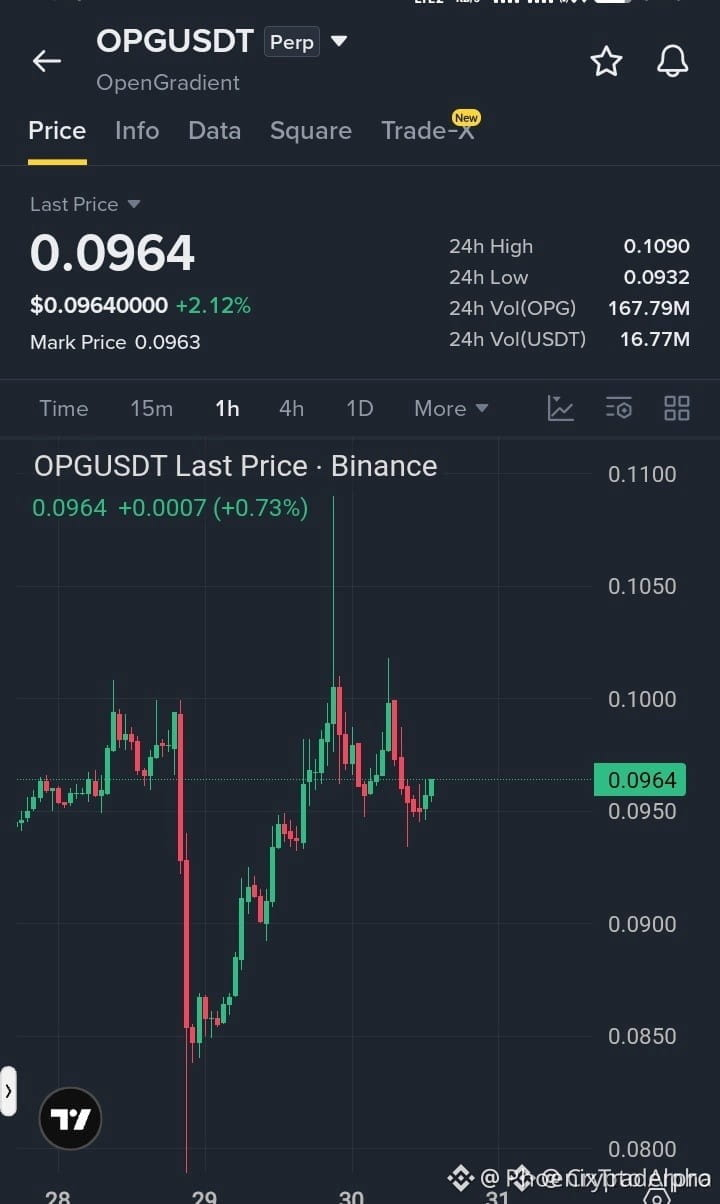

🚨 $OPG SELLER REJECTION AT 0.1090 MARKS EXHAUSTION BEFORE THE NEXT LIQUIDITY FLUSH! 📉
Entry: 0.0967 ⚡
Target: 0.0910 🔻
Stop Loss: 0.0985 🛑
📌 Bulls ran out of gas after a brutal seller wall slammed $OPG back down from the 0.1090 peak. Both the MA7 and MA99 are acting as heavy dynamic resistance overhead, pinning price action down while buying volume completely evaporates.
📊 Lower highs are stacking up cleanly on the chart, signaling total momentum exhaustion. A clean loss of fragile support at 0.0948 will trigger an accelerated slide straight into the key liquidity pool at 0.0910.
💡 Order flow shows clear seller control while buying pressure dries up entirely. 🤔 Are you positioning early for the breakdown or waiting for 0.0948 to give way? 👇
⚠️ Not financial advice. Always manage your risk. 🛡️
🏷️ #OPG #ShortSetup #Crypto #Bearish #Trading
🔻 🐻
Entry: 0.0967 ⚡
Target: 0.0910 🔻
Stop Loss: 0.0985 🛑
📌 Bulls ran out of gas after a brutal seller wall slammed $OPG back down from the 0.1090 peak. Both the MA7 and MA99 are acting as heavy dynamic resistance overhead, pinning price action down while buying volume completely evaporates.
📊 Lower highs are stacking up cleanly on the chart, signaling total momentum exhaustion. A clean loss of fragile support at 0.0948 will trigger an accelerated slide straight into the key liquidity pool at 0.0910.
💡 Order flow shows clear seller control while buying pressure dries up entirely. 🤔 Are you positioning early for the breakdown or waiting for 0.0948 to give way? 👇
⚠️ Not financial advice. Always manage your risk. 🛡️
🏷️ #OPG #ShortSetup #Crypto #Bearish #Trading
🔻 🐻
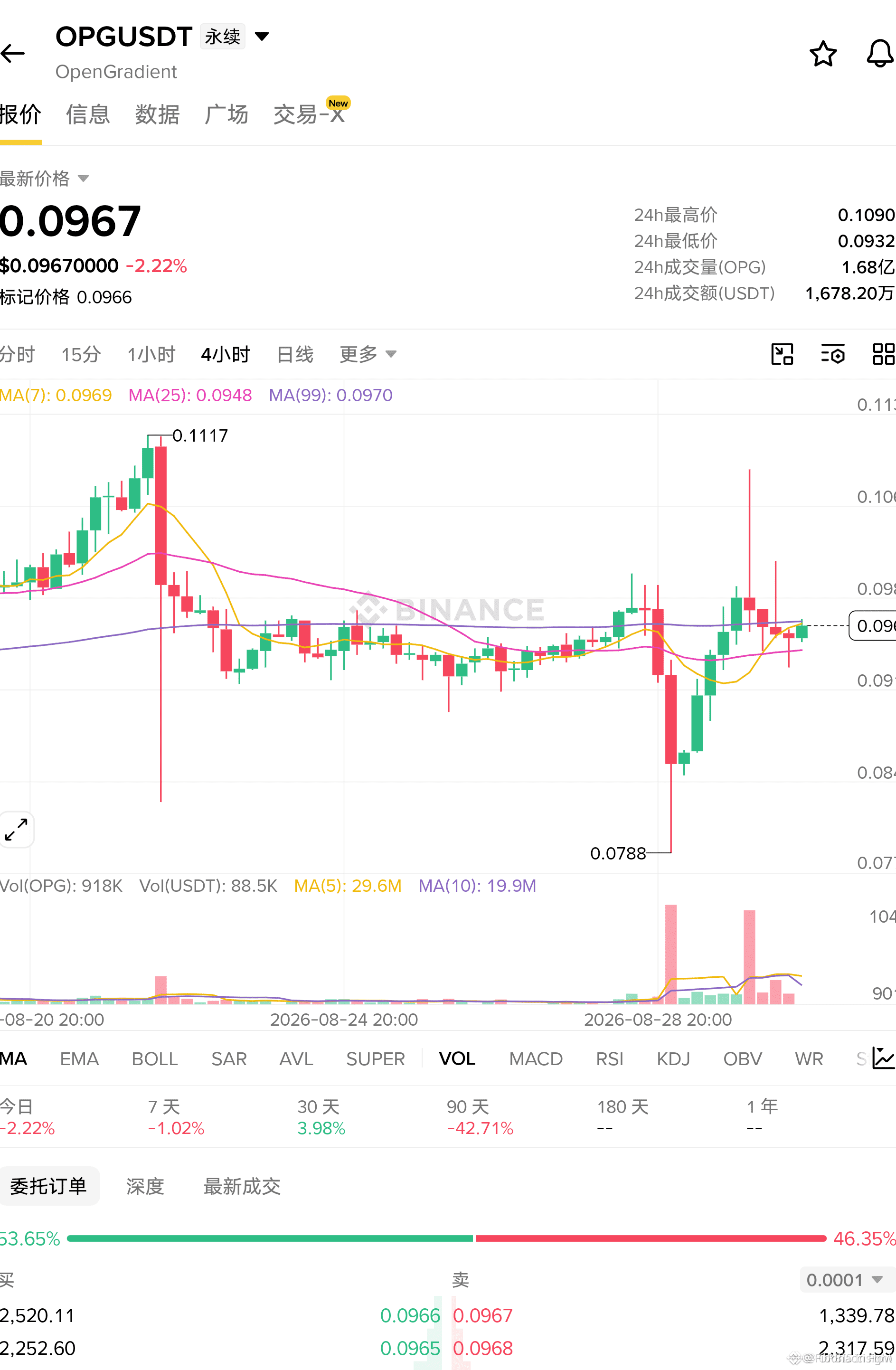

🚨 $OPG FACES HEAVY DISTRIBUTION AS MOVING AVERAGE RESISTANCE CRUSHES BULLISH MOMENTUM! 🐻
Entry: 0.0967 🛑
Target: 0.0910 📉
Stop Loss: 0.0985 ⚠️
The aggressive rejection at 0.1090 confirmed significant institutional supply, driving price back into a sequence of lower highs. 📊 Price action remains heavily compressed beneath the MA7 and MA99 dynamic resistance, signaling sustained overhead sell pressure.
Volume momentum has faded dramatically, exposing clear buyer exhaustion at these current levels. 🔍 A sustained loss of the key 0.0948 support pivot opens the path for a direct move down toward the 0.0910 demand zone.
💬 Are you capitalizing on this structural breakdown, or waiting for a sub-support trigger confirmation? 👇
⚠️ Not financial advice. Always manage your risk. 🛡️
🏷️ #OPG #ShortSetup #Crypto #Trading #MarketStructure
🐻 📉
Entry: 0.0967 🛑
Target: 0.0910 📉
Stop Loss: 0.0985 ⚠️
The aggressive rejection at 0.1090 confirmed significant institutional supply, driving price back into a sequence of lower highs. 📊 Price action remains heavily compressed beneath the MA7 and MA99 dynamic resistance, signaling sustained overhead sell pressure.
Volume momentum has faded dramatically, exposing clear buyer exhaustion at these current levels. 🔍 A sustained loss of the key 0.0948 support pivot opens the path for a direct move down toward the 0.0910 demand zone.
💬 Are you capitalizing on this structural breakdown, or waiting for a sub-support trigger confirmation? 👇
⚠️ Not financial advice. Always manage your risk. 🛡️
🏷️ #OPG #ShortSetup #Crypto #Trading #MarketStructure
🐻 📉
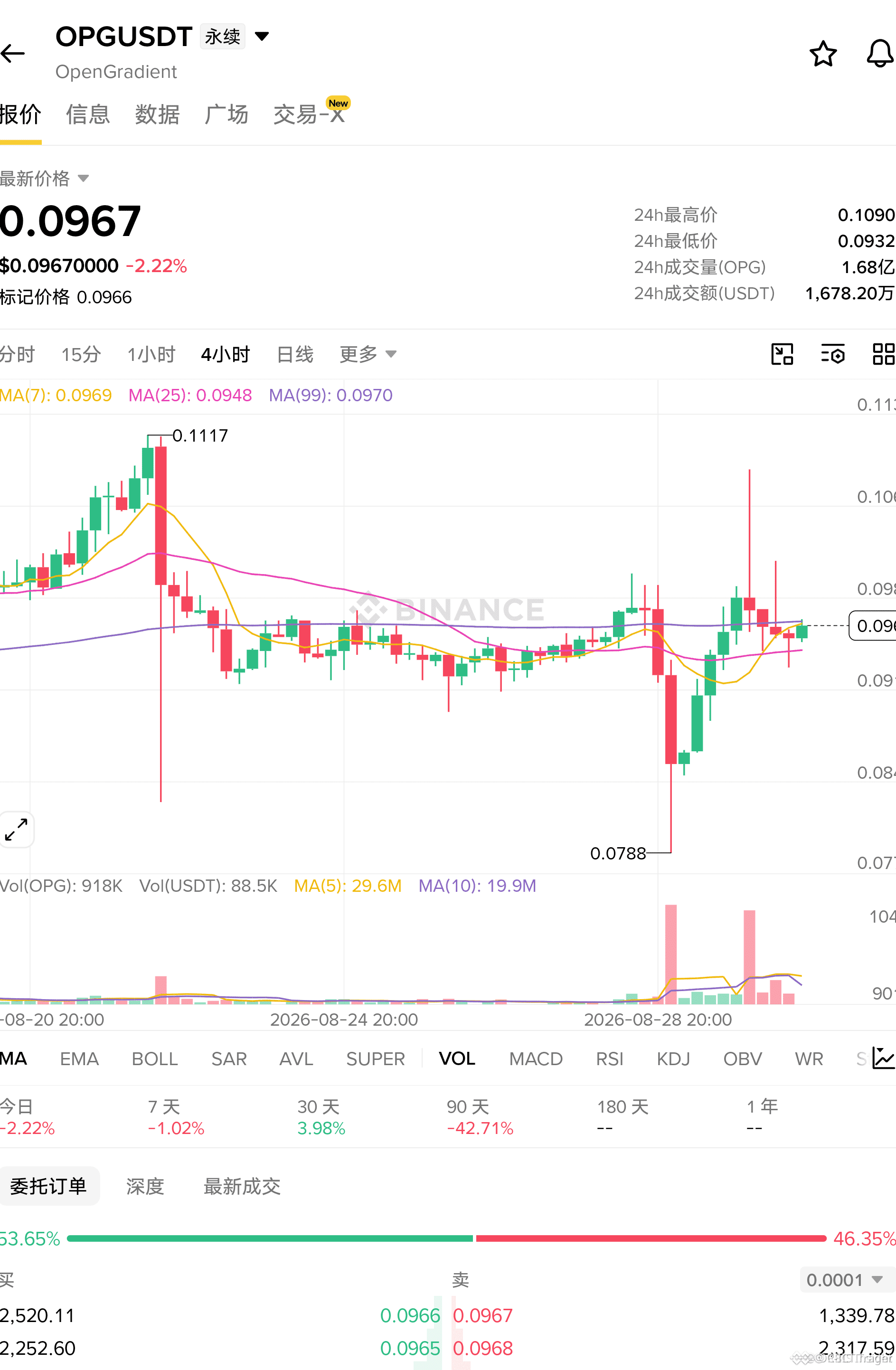
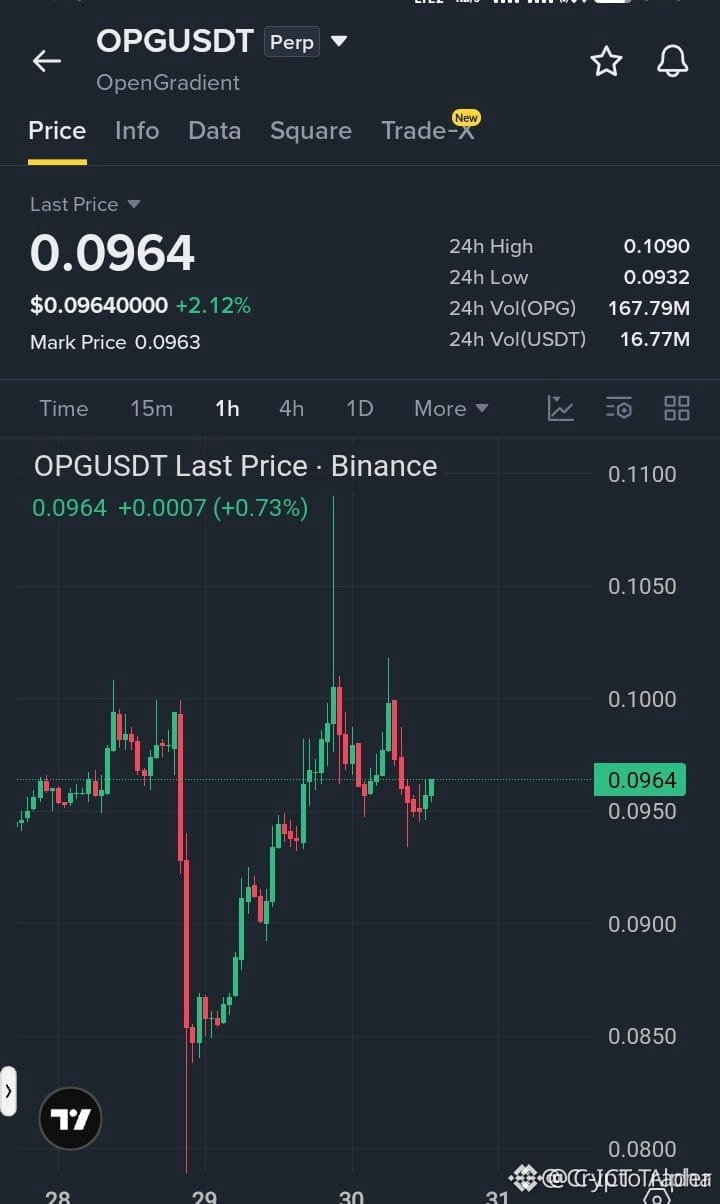
🚨 $OPG RECLAIMING RANGE VALUE AREA AS BUYERS PREPARE FOR NEXT LEG UP ⚡
Entry: 0.0955 - 0.0970 ⚡
Target: 0.1000 - 0.1090 🚀
Stop Loss: 0.0925 ⚠️
$OPG is printing a clean structural reclaim after absorbing sell-side liquidity beneath local range lows. Order flow indicates smart money defense at the lower demand block, laying the groundwork for upside expansion. 📊
As overhead fair value gaps remain unfilled, price action favors continuation into upper supply liquidity. Sustained momentum across correlated assets like $DEXE and $HEMI further strengthens this structural narrative. 🔍
💬 Are you positioning inside this demand zone or waiting for a high-timeframe structural breakout confirmation? 👇
⚠️ Not financial advice. Always manage your risk. 🛡️
🏷️ #OPG #DEXE #HEMI #Altcoins #Crypto
🎯 🦈
Entry: 0.0955 - 0.0970 ⚡
Target: 0.1000 - 0.1090 🚀
Stop Loss: 0.0925 ⚠️
$OPG is printing a clean structural reclaim after absorbing sell-side liquidity beneath local range lows. Order flow indicates smart money defense at the lower demand block, laying the groundwork for upside expansion. 📊
As overhead fair value gaps remain unfilled, price action favors continuation into upper supply liquidity. Sustained momentum across correlated assets like $DEXE and $HEMI further strengthens this structural narrative. 🔍
💬 Are you positioning inside this demand zone or waiting for a high-timeframe structural breakout confirmation? 👇
⚠️ Not financial advice. Always manage your risk. 🛡️
🏷️ #OPG #DEXE #HEMI #Altcoins #Crypto
🎯 🦈
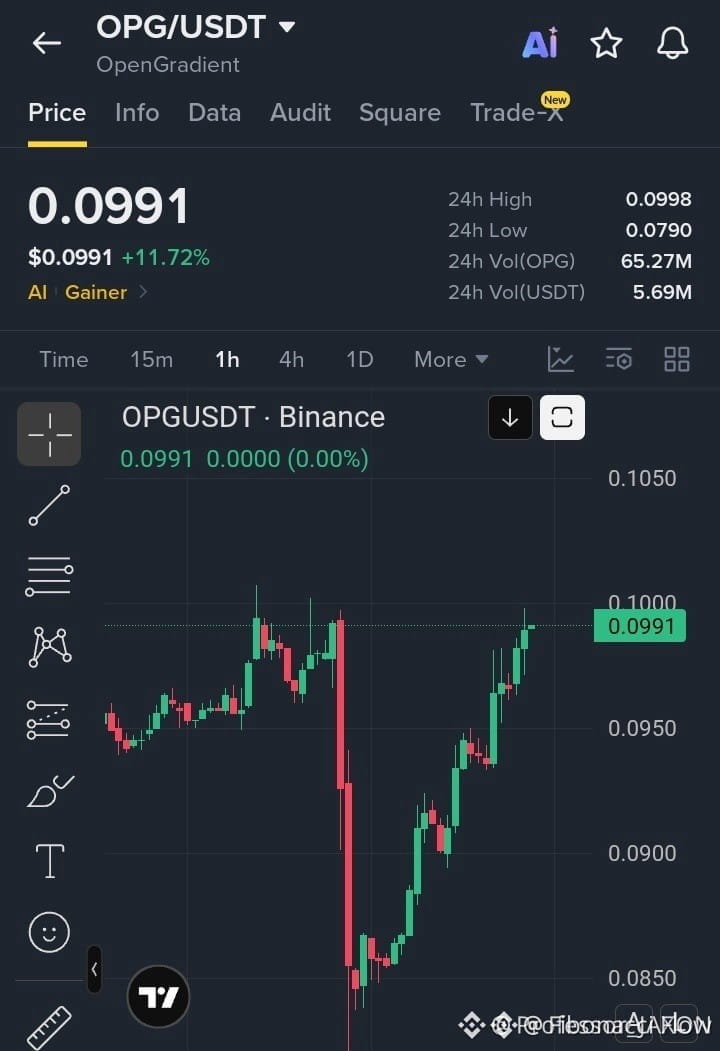
💥 $OPG CHARGES TOWARD NEW HIGHS AS BUYING VOLUME STAMPEDES PAST RESISTANCE! 🟢
Entry: 0.0960 - 0.0985 ⚡
Target 1: 0.1015 🎯
Target 2: 0.1050 🚀
Target 3: 0.1100 💥
Stop Loss: 0.0925 ⚠️
Buyers are aggressively stepping up their bids on $OPG , turning local resistance into a rock-solid demand zone. 📊 High-volume market orders are driving this structural shift, proving that smart money is actively accumulating ahead of the next leg up. ⚡
As long as price defends the lower order block, momentum favors an aggressive expansion through key overhead levels. 💡 Trailing stops after initial targets hit will lock in profits as liquidity sweeps higher. 💬 Are you riding this momentum to the top target or waiting for a deeper retest? 👇
⚠️ Not financial advice. Always manage your risk. 🛡️
🏷️ #OPG #LongSetup #Breakout #Crypto #Trading
🚀 ⚡
Entry: 0.0960 - 0.0985 ⚡
Target 1: 0.1015 🎯
Target 2: 0.1050 🚀
Target 3: 0.1100 💥
Stop Loss: 0.0925 ⚠️
Buyers are aggressively stepping up their bids on $OPG , turning local resistance into a rock-solid demand zone. 📊 High-volume market orders are driving this structural shift, proving that smart money is actively accumulating ahead of the next leg up. ⚡
As long as price defends the lower order block, momentum favors an aggressive expansion through key overhead levels. 💡 Trailing stops after initial targets hit will lock in profits as liquidity sweeps higher. 💬 Are you riding this momentum to the top target or waiting for a deeper retest? 👇
⚠️ Not financial advice. Always manage your risk. 🛡️
🏷️ #OPG #LongSetup #Breakout #Crypto #Trading
🚀 ⚡

🟢 $OPG COILS FOR AN EXPLOSIVE BREAKOUT AFTER SWEEPING SELLER LIQUIDITY! 🚀
Entry: 0.0985 - 0.1005 ⚡
Target: 0.1040 - 0.1130 🚀
Stop Loss: 0.0940 ⚠️
📌 Buyers are aggressively defending the 0.0985 demand pocket, absorbing sell-side pressure and locking in a tight compression base. 📊 Accumulation volume is creeping higher on lower timeframes, signaling institutional positioning right before the next expansion leg.
💡 Risk-to-reward favors the long side with defined invalidation right below 0.0940, making this a crisp, asymmetric setup for momentum traders. 💬 Are you bidding this demand zone or waiting for the breakout confirmation? 👇
⚠️ Not financial advice. Always manage your risk. 🛡️
🏷️ #OPG #LongSetup #Breakout #Crypto
🔥 💎
Entry: 0.0985 - 0.1005 ⚡
Target: 0.1040 - 0.1130 🚀
Stop Loss: 0.0940 ⚠️
📌 Buyers are aggressively defending the 0.0985 demand pocket, absorbing sell-side pressure and locking in a tight compression base. 📊 Accumulation volume is creeping higher on lower timeframes, signaling institutional positioning right before the next expansion leg.
💡 Risk-to-reward favors the long side with defined invalidation right below 0.0940, making this a crisp, asymmetric setup for momentum traders. 💬 Are you bidding this demand zone or waiting for the breakout confirmation? 👇
⚠️ Not financial advice. Always manage your risk. 🛡️
🏷️ #OPG #LongSetup #Breakout #Crypto
🔥 💎
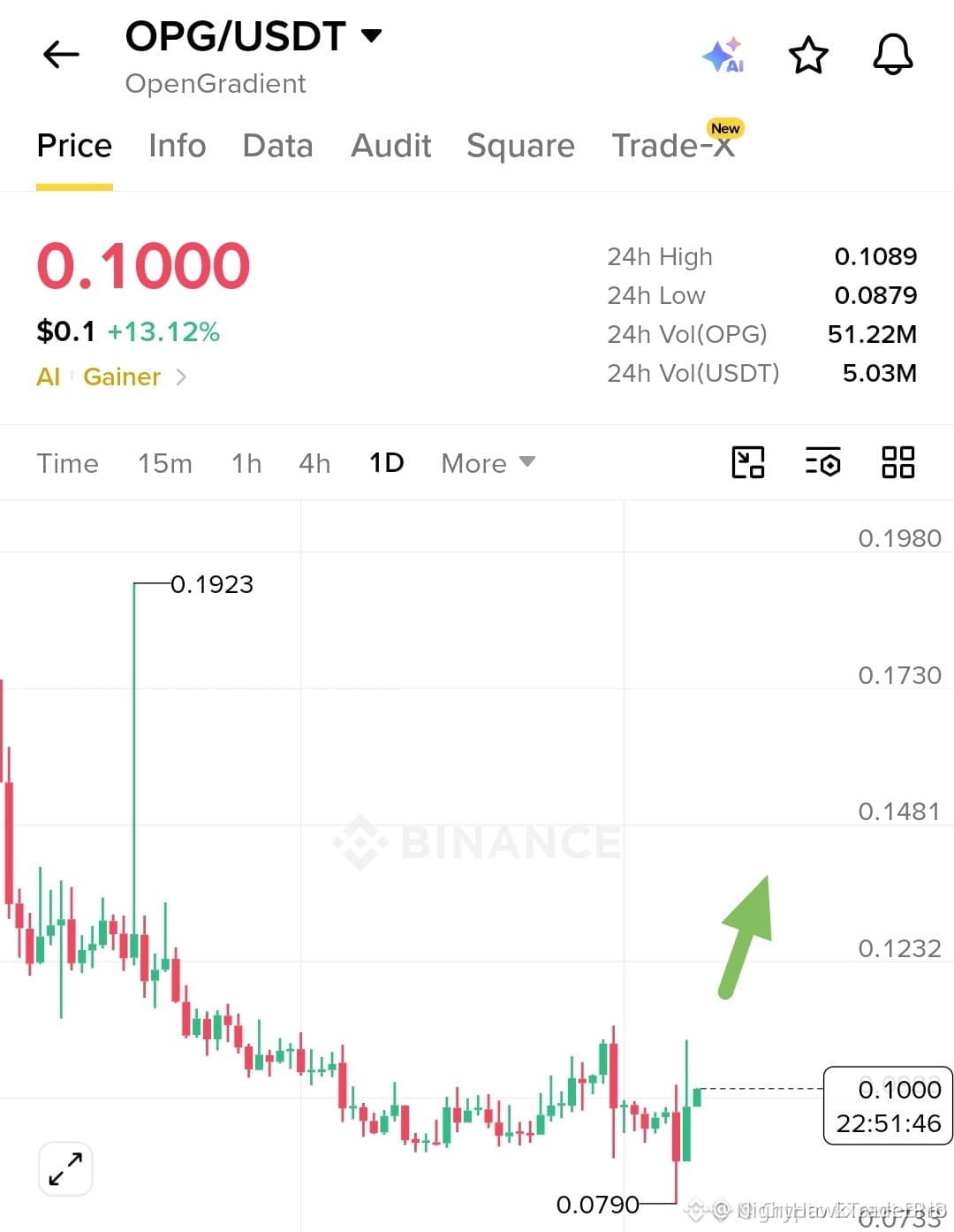
🚨 $OPG ABSORBING SELLER LIQUIDITY BEFORE DEMAND ZONE EXPANSION 🟢
Entry: $0.0985 - $0.1005 ⚡
Target: $0.1040 / $0.1080 / $0.1130 🚀
Stop Loss: $0.0940 ⚠️
Smart money is clearly consolidating around the $0.0985 – $0.1005 demand block, absorbing sell-side liquidity ahead of a potential structural pivot. 🔍 Lower-timeframe order flow shows persistent accumulation while seller pressure dries up near support. 📊
A clean hold above this zone opens the path to sweep resting upside liquidity targets up to $0.1130. 💡 Invalidation remains strictly defined beneath the structural low at $0.0940. 💬 Are you bidding this accumulation block or waiting for confirmation above $0.1040? 👇
⚠️ Not financial advice. Always manage your risk. 🛡️
🏷️ #OPG #LongSetup #Crypto #Trading
🎯 🦈
Entry: $0.0985 - $0.1005 ⚡
Target: $0.1040 / $0.1080 / $0.1130 🚀
Stop Loss: $0.0940 ⚠️
Smart money is clearly consolidating around the $0.0985 – $0.1005 demand block, absorbing sell-side liquidity ahead of a potential structural pivot. 🔍 Lower-timeframe order flow shows persistent accumulation while seller pressure dries up near support. 📊
A clean hold above this zone opens the path to sweep resting upside liquidity targets up to $0.1130. 💡 Invalidation remains strictly defined beneath the structural low at $0.0940. 💬 Are you bidding this accumulation block or waiting for confirmation above $0.1040? 👇
⚠️ Not financial advice. Always manage your risk. 🛡️
🏷️ #OPG #LongSetup #Crypto #Trading
🎯 🦈
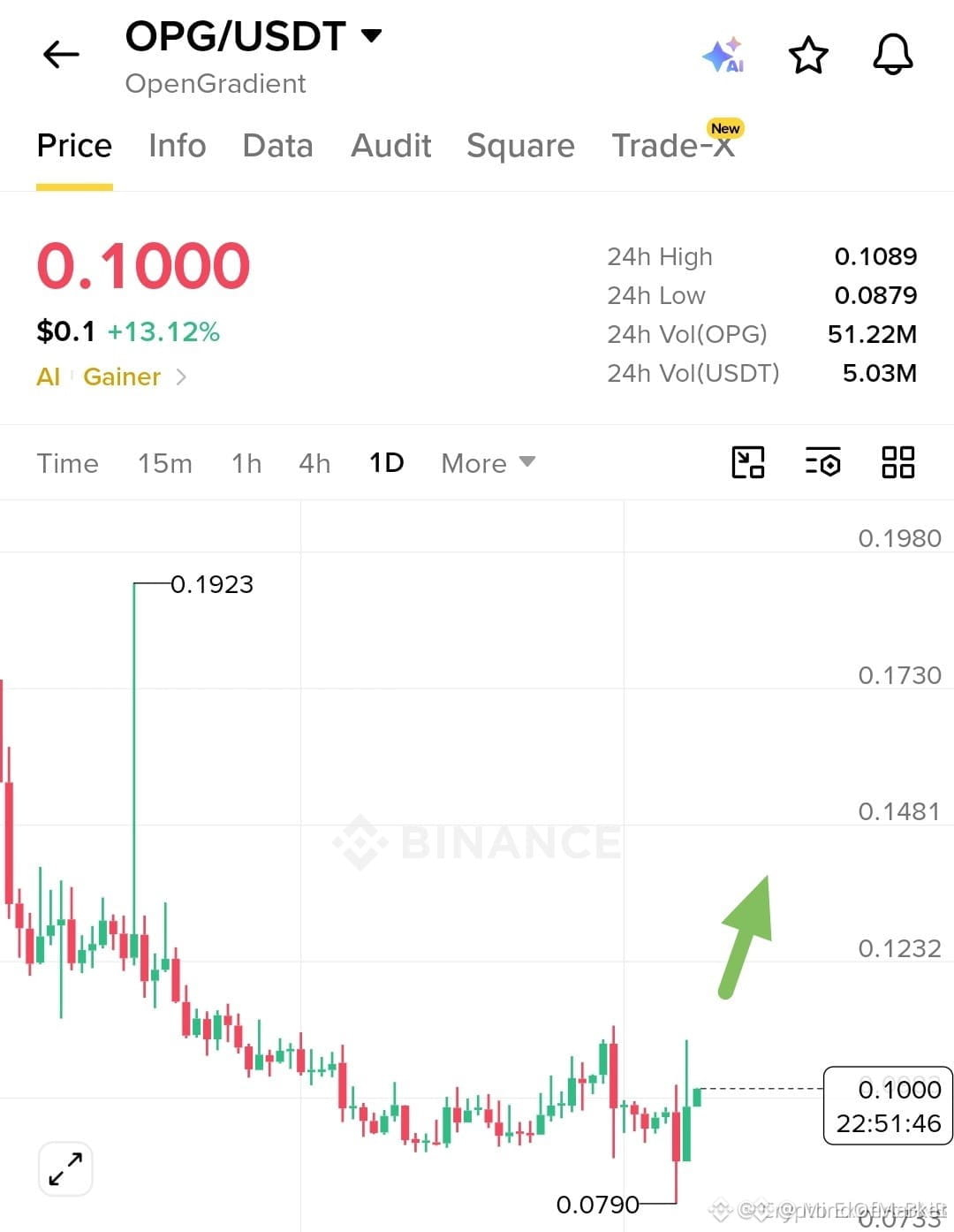

$OPG Long bias on the 1H (spot)
Setup looks constructive: ADX 34.3, RSI 58.2, MACD histogram confirming.
Entry zone: 0.097309 - 0.097895
Targets: 0.100143 / 0.102586 / 0.105029
Invalidation: 0.094036
Quality score 55/100 · 00:26 UTC
Not financial advice. DYOR.
$OPG #OPG
Setup looks constructive: ADX 34.3, RSI 58.2, MACD histogram confirming.
Entry zone: 0.097309 - 0.097895
Targets: 0.100143 / 0.102586 / 0.105029
Invalidation: 0.094036
Quality score 55/100 · 00:26 UTC
Not financial advice. DYOR.
$OPG #OPG
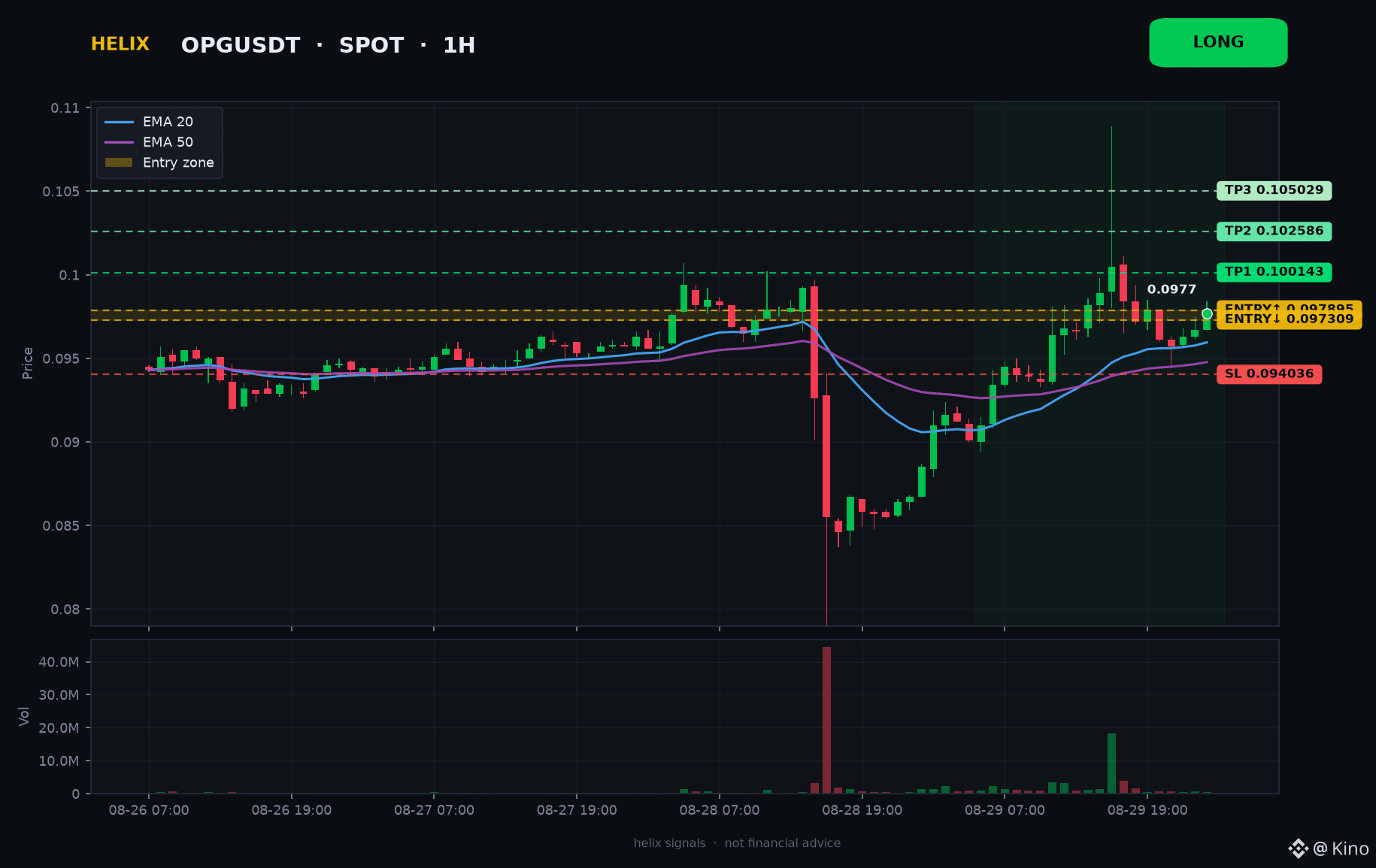
⚡ $OPG BREAKS RESISTANCE WITH AGGRESSIVE HIGHER LOWS SQUEEZING SHORT LIQUIDITY! 💥
Entry: 0.0970 - 0.1000 ⚡
Target: 0.1040 - 0.1090 - 0.1150 🚀
Stop Loss: 0.0930 ⚠️
Aggressive buy order flow is absorbing every dip on the 1H timeframe, printing a textbook ladder of higher lows into resistance. Short sellers are caught off-guard as persistent spot absorption keeps grinding price against overhead supply blocks. 📊
This tight structural compression is now unwinding into upward velocity, leaving overleveraged bears exposed to a swift liquidity sweep. 🔍 When order book resistance thins out this rapidly, upside expansion can print massive vertical candles in minutes. ⚡
💬 Are you bidding this momentum continuation or watching from the sidelines as liquidity gets cleared? 👇
⚠️ Not financial advice. Always manage your risk. 🛡️
🏷️ #OPG #LongSetup #Breakout #Crypto
🔥 💎
Entry: 0.0970 - 0.1000 ⚡
Target: 0.1040 - 0.1090 - 0.1150 🚀
Stop Loss: 0.0930 ⚠️
Aggressive buy order flow is absorbing every dip on the 1H timeframe, printing a textbook ladder of higher lows into resistance. Short sellers are caught off-guard as persistent spot absorption keeps grinding price against overhead supply blocks. 📊
This tight structural compression is now unwinding into upward velocity, leaving overleveraged bears exposed to a swift liquidity sweep. 🔍 When order book resistance thins out this rapidly, upside expansion can print massive vertical candles in minutes. ⚡
💬 Are you bidding this momentum continuation or watching from the sidelines as liquidity gets cleared? 👇
⚠️ Not financial advice. Always manage your risk. 🛡️
🏷️ #OPG #LongSetup #Breakout #Crypto
🔥 💎
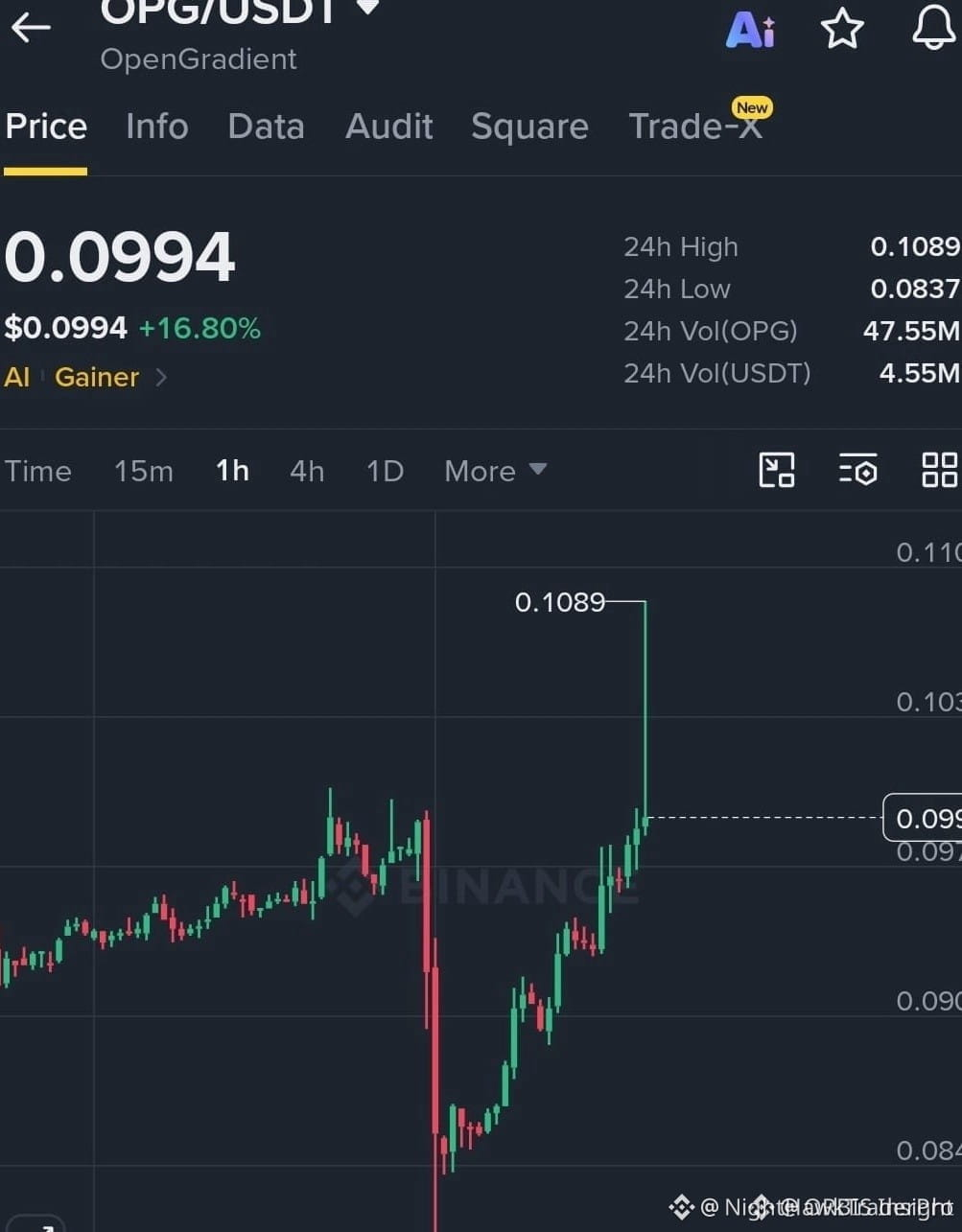

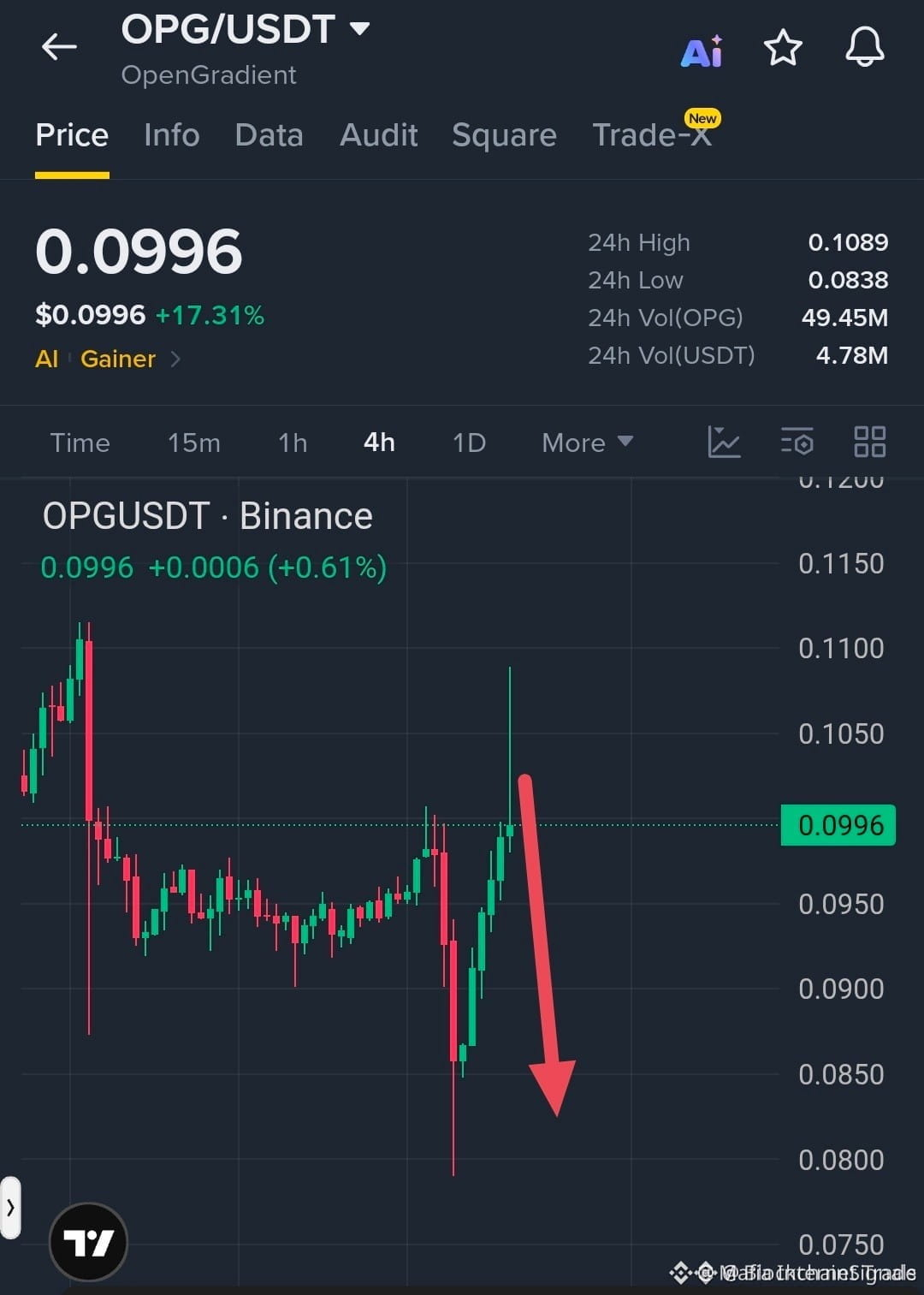
🔻 $OPG REJECTED AT PSYCHOLOGICAL RESISTANCE AS SELLERS PREPARE A DEEP PULLBACK! 🐻
Entry: 0.0990–0.1005 🔻
Target: 0.0950 / 0.0900 / 0.0850 🎯
Stop Loss: 0.1035 ⚠️
The recent relief rally on $OPG just slammed into a heavy supply ceiling near the 0.1000 mark, leaving a prominent upper wick that signals aggressive institutional selling. 🐻 Overhead liquidity has been tapped, and buyers are rapidly losing control of the order flow.
A decisive break under 0.0980 will likely trigger a sharp unwinding move, accelerating price straight toward lower structural support levels. 📉 With seller momentum mounting on the higher timeframes, the path of least resistance is pointing downward.
💡 Are you fading this move down to lower support or looking for a bid on the sweep? 👇
⚠️ Not financial advice. Always manage your risk. 🛡️
🏷️ #OPG #ShortSetup #Crypto #Trading #Bearish
📉 🩸
Entry: 0.0990–0.1005 🔻
Target: 0.0950 / 0.0900 / 0.0850 🎯
Stop Loss: 0.1035 ⚠️
The recent relief rally on $OPG just slammed into a heavy supply ceiling near the 0.1000 mark, leaving a prominent upper wick that signals aggressive institutional selling. 🐻 Overhead liquidity has been tapped, and buyers are rapidly losing control of the order flow.
A decisive break under 0.0980 will likely trigger a sharp unwinding move, accelerating price straight toward lower structural support levels. 📉 With seller momentum mounting on the higher timeframes, the path of least resistance is pointing downward.
💡 Are you fading this move down to lower support or looking for a bid on the sweep? 👇
⚠️ Not financial advice. Always manage your risk. 🛡️
🏷️ #OPG #ShortSetup #Crypto #Trading #Bearish
📉 🩸
Log in to explore more content