

#newton
newton
113,439 views
1,315 Discussing
Hot
Latest

·
--
Article
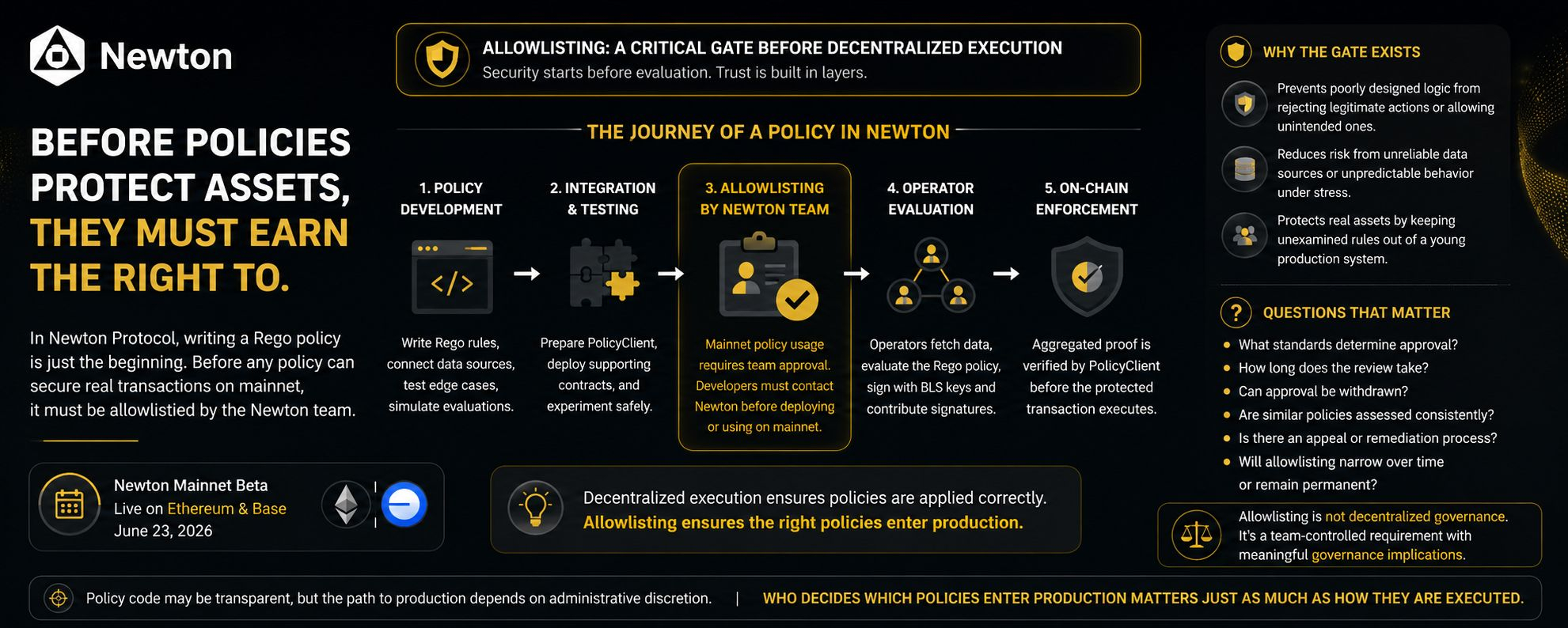
The Hidden Layer of Newton's Security Most People Overlook.Here's a more natural, conversational version that keeps the technical depth while sounding like a genuine personal analysis rather than a formal report.
I Thought Newton's Biggest Security Feature Was Its Policy Engine. I Was Wrong.
When I first started reading about Newton Protocol, I assumed the most important part of the architecture was the policy engine itself.
After all, that's where the authorization logic lives. Operators evaluate Rego policies, generate cryptographic proofs, and the PolicyClient verifies those proofs before a transaction is allowed to execute.
That seemed like the heart of the system.
But after spending more time with the documentation, I realized something important happens before any operator evaluates a single rule.
A policy first has to be allowed into the production environment.
That changed how I think about Newton's security model.
A developer can build a policy, test it locally, connect oracles, simulate different scenarios, and prepare everything for deployment. None of that automatically means the policy can secure real assets on mainnet.
According to Newton's deployment documentation, production policies must first be allowlisted by the Newton team.
At first, I saw that as a limitation.
Then I realized it solves a problem that cryptography alone can't.
Distributed operators can prove they all evaluated the same policy correctly.
They can't prove the policy was written responsibly.
They can't know whether a developer accidentally created a rule that blocks every transaction, approves something it shouldn't, depends on unreliable data, or behaves unpredictably when market conditions change.
Consensus is great at verifying execution.
It isn't designed to judge policy quality.
That's why I started looking at allowlisting as a separate security layer rather than just an administrative step.
In other words, Newton isn't only securing how policies are executed.
It's also trying to reduce the risk of which policies reach production in the first place.
That distinction feels more important than I initially thought.
It also highlights something interesting about decentralization.
People often assume that if execution is decentralized, then every part of the system must be decentralized too.
But Newton separates these responsibilities.
Developers are free to design policies.
The operator network evaluates approved policies.
The blockchain verifies the outcome.
And before all of that, there's a production admission process that decides which policies can actually protect live assets.
Each layer solves a different problem.
The policy engine focuses on authorization.
Operators focus on consistent evaluation.
Cryptographic proofs provide verifiable execution.
Allowlisting focuses on production risk.
None of those layers replace one another—they complement each other.
For a protocol that's still relatively early in its mainnet journey, that approach actually makes practical sense.
A single poorly designed authorization policy could freeze legitimate activity, approve transactions that shouldn't happen, or create unexpected failures across applications.
Finding those problems before real users are affected is far less expensive than fixing them afterward.
At the same time, this also raises questions that I think will become more important as Newton grows.
Will allowlisting always remain a team-managed process?
Could some parts of policy admission eventually become decentralized?
Will there be published review standards so developers know exactly what is expected before submitting a policy?
Could independent security audits become part of the approval process?
As the ecosystem expands, these questions matter because trust isn't built only through cryptographic proofs.
It's also built through transparent processes.
One thing that really stood out to me is that Newton's architecture doesn't rely on a single security mechanism.
Instead, it layers security at multiple stages.
Developers write policies.
Policies are reviewed before production.
Operators independently evaluate them.
BLS signatures create verifiable proofs.
The PolicyClient checks those proofs before any protected transaction moves forward.
Each step reduces a different category of risk.
The more I looked at it, the more I realized Newton isn't simply building a decentralized authorization network.
It's building a system where security starts before execution, continues during evaluation, and is verified before a transaction is allowed to happen.
For me, that was the biggest takeaway.
The most important security decision may not be how accurately a policy is evaluated.
It may be deciding which policies are trusted enough to enter production in the first place.
@NewtonProtocol #newton $NEWT
The Hidden Layer of Newton's Security Most People Overlook.
Here's a more natural, conversational version that keeps the technical depth while sounding like a genuine personal analysis rather than a formal report.
I Thought Newton's Biggest Security Feature Was Its Policy Engine. I Was Wrong.
When I first started reading about Newton Protocol, I assumed the most important part of the architecture was the policy engine itself.
After all, that's where the authorization logic lives. Operators evaluate Rego policies, generate cryptographic proofs, and the PolicyClient verifies those proofs before a transaction is allowed to execute.
That seemed like the heart of the system.
But after spending more time with the documentation, I realized something important happens before any operator evaluates a single rule.
A policy first has to be allowed into the production environment.
That changed how I think about Newton's security model.
A developer can build a policy, test it locally, connect oracles, simulate different scenarios, and prepare everything for deployment. None of that automatically means the policy can secure real assets on mainnet.
According to Newton's deployment documentation, production policies must first be allowlisted by the Newton team.
At first, I saw that as a limitation.
Then I realized it solves a problem that cryptography alone can't.
Distributed operators can prove they all evaluated the same policy correctly.
They can't prove the policy was written responsibly.
They can't know whether a developer accidentally created a rule that blocks every transaction, approves something it shouldn't, depends on unreliable data, or behaves unpredictably when market conditions change.
Consensus is great at verifying execution.
It isn't designed to judge policy quality.
That's why I started looking at allowlisting as a separate security layer rather than just an administrative step.
In other words, Newton isn't only securing how policies are executed.
It's also trying to reduce the risk of which policies reach production in the first place.
That distinction feels more important than I initially thought.
It also highlights something interesting about decentralization.
People often assume that if execution is decentralized, then every part of the system must be decentralized too.
But Newton separates these responsibilities.
Developers are free to design policies.
The operator network evaluates approved policies.
The blockchain verifies the outcome.
And before all of that, there's a production admission process that decides which policies can actually protect live assets.
Each layer solves a different problem.
The policy engine focuses on authorization.
Operators focus on consistent evaluation.
Cryptographic proofs provide verifiable execution.
Allowlisting focuses on production risk.
None of those layers replace one another—they complement each other.
For a protocol that's still relatively early in its mainnet journey, that approach actually makes practical sense.
A single poorly designed authorization policy could freeze legitimate activity, approve transactions that shouldn't happen, or create unexpected failures across applications.
Finding those problems before real users are affected is far less expensive than fixing them afterward.
At the same time, this also raises questions that I think will become more important as Newton grows.
Will allowlisting always remain a team-managed process?
Could some parts of policy admission eventually become decentralized?
Will there be published review standards so developers know exactly what is expected before submitting a policy?
Could independent security audits become part of the approval process?
As the ecosystem expands, these questions matter because trust isn't built only through cryptographic proofs.
It's also built through transparent processes.
One thing that really stood out to me is that Newton's architecture doesn't rely on a single security mechanism.
Instead, it layers security at multiple stages.
Developers write policies.
Policies are reviewed before production.
Operators independently evaluate them.
BLS signatures create verifiable proofs.
The PolicyClient checks those proofs before any protected transaction moves forward.
Each step reduces a different category of risk.
The more I looked at it, the more I realized Newton isn't simply building a decentralized authorization network.
It's building a system where security starts before execution, continues during evaluation, and is verified before a transaction is allowed to happen.
For me, that was the biggest takeaway.
The most important security decision may not be how accurately a policy is evaluated.
It may be deciding which policies are trusted enough to enter production in the first place.
@NewtonProtocol #newton $NEWT
I Thought Newton's Biggest Security Feature Was Its Policy Engine. I Was Wrong.
When I first started reading about Newton Protocol, I assumed the most important part of the architecture was the policy engine itself.
After all, that's where the authorization logic lives. Operators evaluate Rego policies, generate cryptographic proofs, and the PolicyClient verifies those proofs before a transaction is allowed to execute.
That seemed like the heart of the system.
But after spending more time with the documentation, I realized something important happens before any operator evaluates a single rule.
A policy first has to be allowed into the production environment.
That changed how I think about Newton's security model.
A developer can build a policy, test it locally, connect oracles, simulate different scenarios, and prepare everything for deployment. None of that automatically means the policy can secure real assets on mainnet.
According to Newton's deployment documentation, production policies must first be allowlisted by the Newton team.
At first, I saw that as a limitation.
Then I realized it solves a problem that cryptography alone can't.
Distributed operators can prove they all evaluated the same policy correctly.
They can't prove the policy was written responsibly.
They can't know whether a developer accidentally created a rule that blocks every transaction, approves something it shouldn't, depends on unreliable data, or behaves unpredictably when market conditions change.
Consensus is great at verifying execution.
It isn't designed to judge policy quality.
That's why I started looking at allowlisting as a separate security layer rather than just an administrative step.
In other words, Newton isn't only securing how policies are executed.
It's also trying to reduce the risk of which policies reach production in the first place.
That distinction feels more important than I initially thought.
It also highlights something interesting about decentralization.
People often assume that if execution is decentralized, then every part of the system must be decentralized too.
But Newton separates these responsibilities.
Developers are free to design policies.
The operator network evaluates approved policies.
The blockchain verifies the outcome.
And before all of that, there's a production admission process that decides which policies can actually protect live assets.
Each layer solves a different problem.
The policy engine focuses on authorization.
Operators focus on consistent evaluation.
Cryptographic proofs provide verifiable execution.
Allowlisting focuses on production risk.
None of those layers replace one another—they complement each other.
For a protocol that's still relatively early in its mainnet journey, that approach actually makes practical sense.
A single poorly designed authorization policy could freeze legitimate activity, approve transactions that shouldn't happen, or create unexpected failures across applications.
Finding those problems before real users are affected is far less expensive than fixing them afterward.
At the same time, this also raises questions that I think will become more important as Newton grows.
Will allowlisting always remain a team-managed process?
Could some parts of policy admission eventually become decentralized?
Will there be published review standards so developers know exactly what is expected before submitting a policy?
Could independent security audits become part of the approval process?
As the ecosystem expands, these questions matter because trust isn't built only through cryptographic proofs.
It's also built through transparent processes.
One thing that really stood out to me is that Newton's architecture doesn't rely on a single security mechanism.
Instead, it layers security at multiple stages.
Developers write policies.
Policies are reviewed before production.
Operators independently evaluate them.
BLS signatures create verifiable proofs.
The PolicyClient checks those proofs before any protected transaction moves forward.
Each step reduces a different category of risk.
The more I looked at it, the more I realized Newton isn't simply building a decentralized authorization network.
It's building a system where security starts before execution, continues during evaluation, and is verified before a transaction is allowed to happen.
For me, that was the biggest takeaway.
The most important security decision may not be how accurately a policy is evaluated.
It may be deciding which policies are trusted enough to enter production in the first place.
@NewtonProtocol #newton $NEWT
20
6
309

·
--
I caught myself hesitating while approving a routine payment this week. The amount was small, yet the uneasy part was realizing that the system cared only that the signature was valid, not whether the action still matched the intent behind it. The more I sit with that feeling, the more it seems that trust in digital systems is quietly shifting away from visible transactions and toward the invisible checkpoints that shape them beforehand. Projects such as @NewtonProtocol are interesting to me not because of another token narrative, but because they ask whether authorization itself should become programmable. If policies, permissions, and attestations can travel alongside execution, responsibility no longer ends with clicking “send”; it becomes shared across a deeper coordination layer. Perhaps I am reading too much into an early design choice. Builders and users will still have to decide which rules deserve enforcement and who gets to write them. Yet that tension feels profoundly human. Maybe the future of trust is not found in the transfers we celebrate on-chain, but in the quiet infrastructure that decides which transfers should happen at all. If so, will the most important part of a decentralized system be the transaction everyone sees, or the unseen layer that grants it permission?
#newt #Newt #newton $NEWT
{spot}(NEWTUSDT)
As onchain systems become more automated, where do you think trust will matter most?
I caught myself hesitating while approving a routine payment this week. The amount was small, yet the uneasy part was realizing that the system cared only that the signature was valid, not whether the action still matched the intent behind it. The more I sit with that feeling, the more it seems that trust in digital systems is quietly shifting away from visible transactions and toward the invisible checkpoints that shape them beforehand. Projects such as @NewtonProtocol are interesting to me not because of another token narrative, but because they ask whether authorization itself should become programmable. If policies, permissions, and attestations can travel alongside execution, responsibility no longer ends with clicking “send”; it becomes shared across a deeper coordination layer. Perhaps I am reading too much into an early design choice. Builders and users will still have to decide which rules deserve enforcement and who gets to write them. Yet that tension feels profoundly human. Maybe the future of trust is not found in the transfers we celebrate on-chain, but in the quiet infrastructure that decides which transfers should happen at all. If so, will the most important part of a decentralized system be the transaction everyone sees, or the unseen layer that grants it permission?
#newt #Newt #newton $NEWT
As onchain systems become more automated, where do you think trust will matter most?
#newt #Newt #newton $NEWT
As onchain systems become more automated, where do you think trust will matter most?
Faster transaction execution
0%
Programmable authorization
0%
Human oversight over autonomou
0%
Transparent attestations
0%
0 votes • Voting closed
11
5
388

🚀 Unlocking the Future of Verifiable On-Chain Automation with Newton ProtocolThe integration of Artificial Intelligence (AI) and blockchain technology is evolving rapidly, and newton protocol is leading this revolution from the front. With the recent launch of the Newton Mainnet Beta, the protocol is introducing a powerful, decentralized infrastructure layer designed to bring trust, security, and absolute transparency to AI-driven strategies and automated trading.
What Makes Newton Protocol Unique?
Unlike traditional centralized setups where AI operations happen behind closed doors, Newton protocol operates as an Actively Validated Service (AVS). It bridges the gap between transaction intent and final on-chain execution. By utilizing specialized tools like VaultKit, developers can create advanced trading and automation models while keeping the underlying logic completely protected through zero-knowledge parameters.
Why $NEWT Matters
At the core of this innovative ecosystem is the $NEWT token. It serves as the primary utility token powering the network, facilitating protocol service fees for all authorization and verification tasks. As real-world assets (RWAs) and institutional capital continue to migrate on-chain, having a private yet completely verifiable compliance layer becomes essential.
The Newton Mainnet Beta is a massive milestone that proves secure, policy-enforced on-chain automation is no longer just a theory—it is a reality. Keep a close eye on this project as it continues to reshape Web3 infrastructure!
#newton otocol
🚀 Unlocking the Future of Verifiable On-Chain Automation with Newton Protocol
The integration of Artificial Intelligence (AI) and blockchain technology is evolving rapidly, and newton protocol is leading this revolution from the front. With the recent launch of the Newton Mainnet Beta, the protocol is introducing a powerful, decentralized infrastructure layer designed to bring trust, security, and absolute transparency to AI-driven strategies and automated trading.
What Makes Newton Protocol Unique?
Unlike traditional centralized setups where AI operations happen behind closed doors, Newton protocol operates as an Actively Validated Service (AVS). It bridges the gap between transaction intent and final on-chain execution. By utilizing specialized tools like VaultKit, developers can create advanced trading and automation models while keeping the underlying logic completely protected through zero-knowledge parameters.
Why $NEWT Matters
At the core of this innovative ecosystem is the $NEWT token. It serves as the primary utility token powering the network, facilitating protocol service fees for all authorization and verification tasks. As real-world assets (RWAs) and institutional capital continue to migrate on-chain, having a private yet completely verifiable compliance layer becomes essential.
The Newton Mainnet Beta is a massive milestone that proves secure, policy-enforced on-chain automation is no longer just a theory—it is a reality. Keep a close eye on this project as it continues to reshape Web3 infrastructure!
#newton otocol
What Makes Newton Protocol Unique?
Unlike traditional centralized setups where AI operations happen behind closed doors, Newton protocol operates as an Actively Validated Service (AVS). It bridges the gap between transaction intent and final on-chain execution. By utilizing specialized tools like VaultKit, developers can create advanced trading and automation models while keeping the underlying logic completely protected through zero-knowledge parameters.
Why $NEWT Matters
At the core of this innovative ecosystem is the $NEWT token. It serves as the primary utility token powering the network, facilitating protocol service fees for all authorization and verification tasks. As real-world assets (RWAs) and institutional capital continue to migrate on-chain, having a private yet completely verifiable compliance layer becomes essential.
The Newton Mainnet Beta is a massive milestone that proves secure, policy-enforced on-chain automation is no longer just a theory—it is a reality. Keep a close eye on this project as it continues to reshape Web3 infrastructure!
#newton otocol
2
84

#newt $NEWT #NEWTProtocol Exploring the future of blockchain with @NewtonProtocol! The NEWT ecosystem is focused on building scalable and efficient Web3 infrastructure. Looking forward to seeing the progress of the Newton Mainnet Beta and the growth of the community. $NEWT #newton
#newt $NEWT #NEWTProtocol Exploring the future of blockchain with @NewtonProtocol! The NEWT ecosystem is focused on building scalable and efficient Web3 infrastructure. Looking forward to seeing the progress of the Newton Mainnet Beta and the growth of the community. $NEWT #newton
2
91

The Outlook for Newton on BinanceAs autonomous AI agents continue to scale across public blockchainsThe demand for underlying infrastructure that guarantees secure asset management will inevitably peak. Newton Protocol's strategy focuses on delivering practical, developer-ready tools rather than speculative marketing. For global crypto traders tracking the project on the Binance Price Directory, $NEWT represents an infrastructure-first play on the future of autonomous Web3 economies. While wide-scale enterprise adoption remains a long-term milestone, Newton’s core mechanism presents a highly practical solution to a pressing industry need.$NEWT
{future}(NEWTUSDT)
#newton
{future}(BNBUSDT)
@NewtonProtocol
{future}(BTCSTUSDT)
The Outlook for Newton on BinanceAs autonomous AI agents continue to scale across public blockchains
The demand for underlying infrastructure that guarantees secure asset management will inevitably peak. Newton Protocol's strategy focuses on delivering practical, developer-ready tools rather than speculative marketing. For global crypto traders tracking the project on the Binance Price Directory, $NEWT represents an infrastructure-first play on the future of autonomous Web3 economies. While wide-scale enterprise adoption remains a long-term milestone, Newton’s core mechanism presents a highly practical solution to a pressing industry need.$NEWT
#newton
@NewtonProtocol
#newton
@NewtonProtocol
1
85


·
--

Article
How to break the traditional crypto “iron rule”?Overturning perceptions! NEWT staking breaks the iron rule of the crypto world: high returns don’t necessarily mean locking assets.
Friends who stake should feel the same—there’s a kind of unwritten rule in the industry that’s been hard to break: if you want a high APY, you have to sacrifice asset flexibility.
In the past, no matter which blockchain staking you participated in, it was always the same compromise: assets are staked and locked, then you simply wait for rewards. Once you encounter a market opportunity and want to move your assets or cash out, you have no choice but to painfuly unlock, miss out on rewards, and then wait a long time for the unlocking period—everything is especially passive. I used to assume this was just the unavoidable cost of staking. $
How to break the traditional crypto “iron rule”?
Overturning perceptions! NEWT staking breaks the iron rule of the crypto world: high returns don’t necessarily mean locking assets.
Friends who stake should feel the same—there’s a kind of unwritten rule in the industry that’s been hard to break: if you want a high APY, you have to sacrifice asset flexibility.
In the past, no matter which blockchain staking you participated in, it was always the same compromise: assets are staked and locked, then you simply wait for rewards. Once you encounter a market opportunity and want to move your assets or cash out, you have no choice but to painfuly unlock, miss out on rewards, and then wait a long time for the unlocking period—everything is especially passive. I used to assume this was just the unavoidable cost of staking. $
Friends who stake should feel the same—there’s a kind of unwritten rule in the industry that’s been hard to break: if you want a high APY, you have to sacrifice asset flexibility.
In the past, no matter which blockchain staking you participated in, it was always the same compromise: assets are staked and locked, then you simply wait for rewards. Once you encounter a market opportunity and want to move your assets or cash out, you have no choice but to painfuly unlock, miss out on rewards, and then wait a long time for the unlocking period—everything is especially passive. I used to assume this was just the unavoidable cost of staking. $
1
2
368

·
--
Newton Protocol: A Promising Step Toward the Future of Web3I’m new to Web3, but I like exploring innovative projects. I hope Newton Protocol continues to grow and build a strong community and I enjoy discovering new blockchain projects and learning something new every day. Newton Protocol looks like an interesting project, and I’m excited to follow its future progress.
As I continue learning about blockchain, I believe that strong communities and active development are important for the success of any project. Newton Protocol appears to be moving in that direction by encouraging innovation and creating opportunities for developers and users. I look forward to seeing how the ecosystem grows and how new features will improve the overall experience.
I’m excited to follow future updates from @NewtonProtocol and learn more about the role of $NEWT in the ecosystem. Wishing the entire team continued success as they work toward building a stronger decentralized future. #newton #Binance #BTC走势分析
Newton Protocol: A Promising Step Toward the Future of Web3
I’m new to Web3, but I like exploring innovative projects. I hope Newton Protocol continues to grow and build a strong community and I enjoy discovering new blockchain projects and learning something new every day. Newton Protocol looks like an interesting project, and I’m excited to follow its future progress.
As I continue learning about blockchain, I believe that strong communities and active development are important for the success of any project. Newton Protocol appears to be moving in that direction by encouraging innovation and creating opportunities for developers and users. I look forward to seeing how the ecosystem grows and how new features will improve the overall experience.
I’m excited to follow future updates from @NewtonProtocol and learn more about the role of $NEWT in the ecosystem. Wishing the entire team continued success as they work toward building a stronger decentralized future. #newton #Binance #BTC走势分析
As I continue learning about blockchain, I believe that strong communities and active development are important for the success of any project. Newton Protocol appears to be moving in that direction by encouraging innovation and creating opportunities for developers and users. I look forward to seeing how the ecosystem grows and how new features will improve the overall experience.
I’m excited to follow future updates from @NewtonProtocol and learn more about the role of $NEWT in the ecosystem. Wishing the entire team continued success as they work toward building a stronger decentralized future. #newton #Binance #BTC走势分析
11

·
--
🚨( NEWTON PROTOCOL )
Then confusig version of the question shows up on @NewtonProtocol NewtonProtocol . Which operator result? Which quorum threshold? Which Rego path?
❓Which part actually cleared before execution?
❓which hesitation got compressed hard enough that workflow stopped treating it like hesitation at all?
👉🏻Useful minute dead.
$NEWT Aggregate BLS still looks cleaner than the operator hesitation.
👉🏻Newton kept the quorum.
👉🏻Not the doubt.
{future}(NEWTUSDT)
#newton #Newt
🚨( NEWTON PROTOCOL )
Then confusig version of the question shows up on @NewtonProtocol NewtonProtocol . Which operator result? Which quorum threshold? Which Rego path?
❓Which part actually cleared before execution?
❓which hesitation got compressed hard enough that workflow stopped treating it like hesitation at all?
👉🏻Useful minute dead.
$NEWT Aggregate BLS still looks cleaner than the operator hesitation.
👉🏻Newton kept the quorum.
👉🏻Not the doubt.
#newton #Newt
Then confusig version of the question shows up on @NewtonProtocol NewtonProtocol . Which operator result? Which quorum threshold? Which Rego path?
❓Which part actually cleared before execution?
❓which hesitation got compressed hard enough that workflow stopped treating it like hesitation at all?
👉🏻Useful minute dead.
$NEWT Aggregate BLS still looks cleaner than the operator hesitation.
👉🏻Newton kept the quorum.
👉🏻Not the doubt.
#newton #Newt
2
1
36

·
--
Article
Newton Protocol and the Curious Case of Brilliant Tech Chasing a Future That Hasnt Arrived YetI find myself circling back to a single, fundamental question when I think about @NewtonProtocol : what immediate, tangible pain is this technology easing for the average person today?
This isnt a critique. It's arguably the most critical hurdle any foundational technology must clear. History is littered with elegant solutions that failed, not because they were flawed, but because they were ahead of their time, solving problems the public didnt yet know they had.
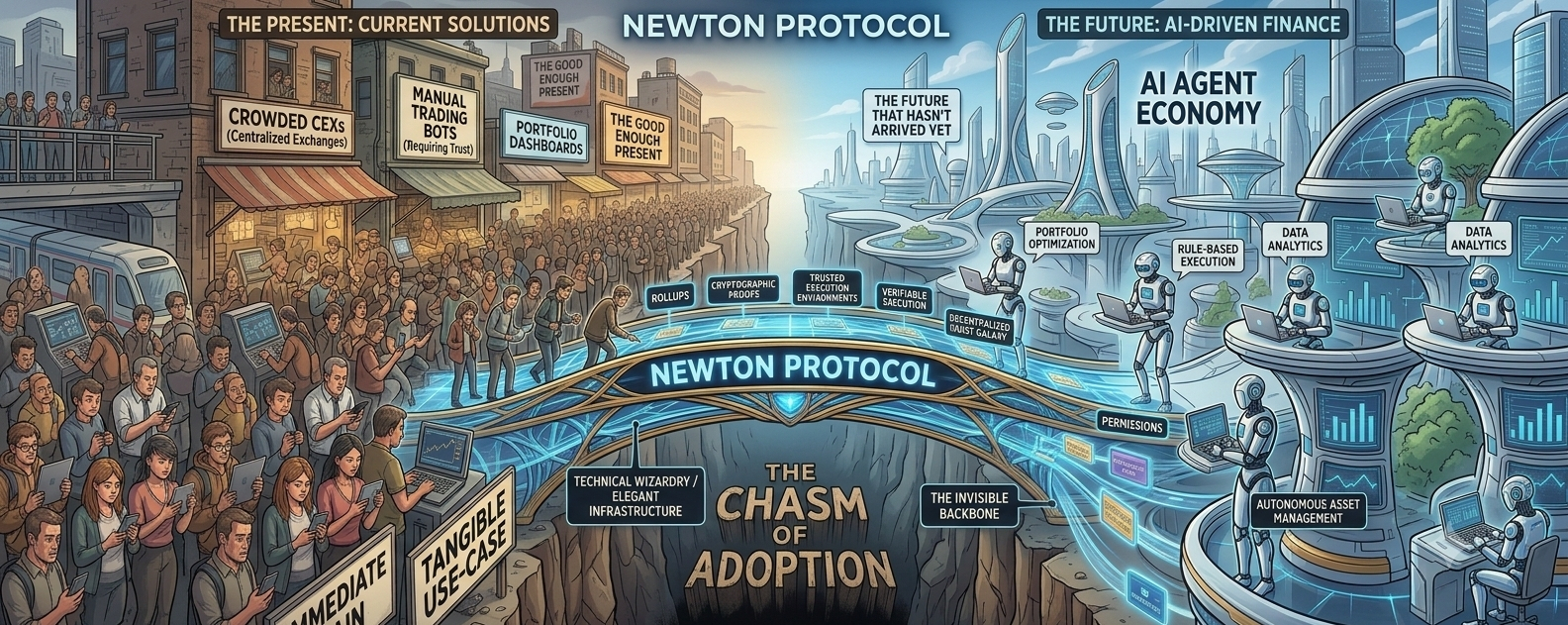
Newton Protocol occupies a truly unique space. It's not vying to be another DEX, lending protocol, or consumer-facing app. Instead, its ambition is to become an invisible backbone for a future where autonomous AI agents handle asset management, trade execution, portfolio optimization, and a host of financial tasks without needing a human "yes" at every step. It weaves together rollups, cryptographic proofs, trusted execution environments, and rule-based automation to make this AI-driven finance both secure and dependable. From a purely technical standpoint, that's a formidable goal.
However, markets are famously indifferent to impressive blueprints. Builders and coders naturally admire the architecture, the elegant security, the efficient processing, the clever cryptography. Users? Almost never. Most people can't articulate how cloud storage works, how payment networks finalize a transaction, or how encryption protects their bank balance. They just care that it works when they need it. Reliability trumps technical wizardry every time. This chasm between what technologists prize and what everyday users value might be Newton's steepest climb.
Crypto has an enduring love affair with infrastructure. Every bull run brings a new protocol touting a faster chain, a smarter consensus, a better scaling fix, or a stronger privacy shield. Many genuinely improve the ecosystem's underpinnings. Yet few become household names, because infrastructure rarely inspires passion on its own. It succeeds only when the apps built atop it make daily life noticeably simpler.
Newton seems to grasp this. Rather than pitching cryptography itself, it's aiming to foster an ecosystem where AI can act autonomously and safely, without users handing over the keys to their entire wallet. Theoretically, that's a significant step forward. AI becomes helpful without becoming a liability. The real question: do enough people currently face this as a problem?
Crypto users today already have access to trading bots, portfolio dashboards, copy-trading platforms, and centralized exchanges with ever more sophisticated automated features. Are these perfect? No. Do they require trust in third parties? Yes. Are there security vulnerabilities? Certainly. Yet millions continue using them. Why? Because they're familiar, convenient, and "good enough" for their current needs. History warns us that "good enough" is often the fiercest rival any new technology will encounter.
People rarely switch because a product is technically superior. They switch because the improvement is undeniable, usually through lower costs, vastly better convenience, or solving a deeply frustrating problem that existing tools can't touch. Newton is wagering that trust in AI automation will eventually morph into that kind of frustration. And perhaps it will.
As AI becomes more intertwined with financial decisions, users might grow increasingly uneasy granting unfettered access to opaque systems. At that point, verifiable execution and permission-based automation could shift from a "nice to have" to a "must have." That future seems plausible. The ambiguity lies in the when.
Being right too early often looks exactly like being wrong. Take cloud computing, electric vehicles, or even AI itself. All spent years dismissed before the world caught up. Infrastructure often spends a long period in limbo, waiting for the market to meet it. Newton might very well find itself in that waiting room.
Here's another wrinkle: Newton Protocol doesn't actually eliminate trust. It redistributes it. Crypto often simplifies this. Decentralization is portrayed as removing middlemen entirely. But real-world systems are messier. Trust rarely vanishes; it just changes shape. Instead of trusting a centralized automation provider, you're trusting governance mechanisms, validator incentives, cryptographic math, and smart contract logic. That's not inherently worse. In many cases, it could be preferable because the assumptions are transparent and verifiable. But will the average user appreciate that distinction? That's uncertain.
Perhaps Newton's biggest commercial hurdle isn't technical at all. It's human nature. We cling to habits with surprising tenacity. If someone already uses an exchange with built-in automation, getting them to learn about wallet permissions, decentralized execution, AI marketplaces, and staking is a tough sell. Even minor friction can dramatically stifle adoption.
Tech enthusiasts often underestimate how costly learning feels. Every new concept requires mental bandwidth. Every unfamiliar interface demands patience. Every extra click is a chance for someone to abandon the process. This doesn't mean decentralized automation can't win. It just means the user experience must eventually become so seamless that the underlying complexity fades into the background.
Ironically, Newton's initial traction might not come from retail users at all. Institutions often think differently. Big players, financial firms, enterprises, organizations managing substantial digital assets, prioritize auditability, compliance, verifiable execution, and controlled automation over sheer simplicity. They regularly pay a premium for systems that reduce operational ambiguity, because mistakes at scale are catastrophic. Retail users optimize for convenience. Institutions optimize for certainty. These incentives are worlds apart. If Newton gains traction, it might first prove its worth in environments where transparency has measurable value, then slowly trickle down to consumer apps.
Then there's the existential question every protocol faces. Can the network sustain itself after the initial hype fades? Early token incentives are great for kickstarting activity, but they can't be the foundation of long-term demand. Sustainability comes from genuine, organic usage. If AI agents eventually execute billions in productive financial tasks, the network's value becomes structural, not speculative. If not, even the most elegant tokenomics will struggle. No whitepaper can solve that puzzle. Only real-world adoption can.
Ultimately, that's the most honest lens to evaluate Newton Protocol. Not by asking if the tech is sophisticated. It clearly is. Not by asking if the vision is compelling. It certainly is. Instead, ask: is the world nearing the point where verifiable AI automation becomes something people actively seek out, not just something they admire from a distance? Those are very different stages of market maturity.
Newton might one day become an invisible layer powering autonomous finance, where AI executes complex strategies within clearly defined, cryptographically verifiable boundaries. If that future materializes, today's infrastructure will look remarkably prescient. But markets have always cared less about what technology can do than what people can't live without. That's why Newton Protocol's fate will likely be decided less by its cryptography and more by psychology.
Innovation doesn't win simply by being advanced. It wins when ordinary people decide that sticking with the old way is harder than embracing the new one. The tech can be brilliant. The architecture can be elegant. The vision can be years ahead. But in the end, every innovation faces the same quiet verdict: it's not about impressing engineers; it's about changing human behavior. That's the question Newton Protocol still has to answer. And like every meaningful shift, the market, not the whitepaper, will write the final chapter.
#newt $NEWT
{spot}(NEWTUSDT)
#newton #TradingTales #TradingSignals $CAKE
{spot}(CAKEUSDT)
$HMSTR
{spot}(HMSTRUSDT)
Newton Protocol and the Curious Case of Brilliant Tech Chasing a Future That Hasnt Arrived Yet
I find myself circling back to a single, fundamental question when I think about @NewtonProtocol : what immediate, tangible pain is this technology easing for the average person today?
This isnt a critique. It's arguably the most critical hurdle any foundational technology must clear. History is littered with elegant solutions that failed, not because they were flawed, but because they were ahead of their time, solving problems the public didnt yet know they had.
Newton Protocol occupies a truly unique space. It's not vying to be another DEX, lending protocol, or consumer-facing app. Instead, its ambition is to become an invisible backbone for a future where autonomous AI agents handle asset management, trade execution, portfolio optimization, and a host of financial tasks without needing a human "yes" at every step. It weaves together rollups, cryptographic proofs, trusted execution environments, and rule-based automation to make this AI-driven finance both secure and dependable. From a purely technical standpoint, that's a formidable goal.
However, markets are famously indifferent to impressive blueprints. Builders and coders naturally admire the architecture, the elegant security, the efficient processing, the clever cryptography. Users? Almost never. Most people can't articulate how cloud storage works, how payment networks finalize a transaction, or how encryption protects their bank balance. They just care that it works when they need it. Reliability trumps technical wizardry every time. This chasm between what technologists prize and what everyday users value might be Newton's steepest climb.
Crypto has an enduring love affair with infrastructure. Every bull run brings a new protocol touting a faster chain, a smarter consensus, a better scaling fix, or a stronger privacy shield. Many genuinely improve the ecosystem's underpinnings. Yet few become household names, because infrastructure rarely inspires passion on its own. It succeeds only when the apps built atop it make daily life noticeably simpler.
Newton seems to grasp this. Rather than pitching cryptography itself, it's aiming to foster an ecosystem where AI can act autonomously and safely, without users handing over the keys to their entire wallet. Theoretically, that's a significant step forward. AI becomes helpful without becoming a liability. The real question: do enough people currently face this as a problem?
Crypto users today already have access to trading bots, portfolio dashboards, copy-trading platforms, and centralized exchanges with ever more sophisticated automated features. Are these perfect? No. Do they require trust in third parties? Yes. Are there security vulnerabilities? Certainly. Yet millions continue using them. Why? Because they're familiar, convenient, and "good enough" for their current needs. History warns us that "good enough" is often the fiercest rival any new technology will encounter.
People rarely switch because a product is technically superior. They switch because the improvement is undeniable, usually through lower costs, vastly better convenience, or solving a deeply frustrating problem that existing tools can't touch. Newton is wagering that trust in AI automation will eventually morph into that kind of frustration. And perhaps it will.
As AI becomes more intertwined with financial decisions, users might grow increasingly uneasy granting unfettered access to opaque systems. At that point, verifiable execution and permission-based automation could shift from a "nice to have" to a "must have." That future seems plausible. The ambiguity lies in the when.
Being right too early often looks exactly like being wrong. Take cloud computing, electric vehicles, or even AI itself. All spent years dismissed before the world caught up. Infrastructure often spends a long period in limbo, waiting for the market to meet it. Newton might very well find itself in that waiting room.
Here's another wrinkle: Newton Protocol doesn't actually eliminate trust. It redistributes it. Crypto often simplifies this. Decentralization is portrayed as removing middlemen entirely. But real-world systems are messier. Trust rarely vanishes; it just changes shape. Instead of trusting a centralized automation provider, you're trusting governance mechanisms, validator incentives, cryptographic math, and smart contract logic. That's not inherently worse. In many cases, it could be preferable because the assumptions are transparent and verifiable. But will the average user appreciate that distinction? That's uncertain.
Perhaps Newton's biggest commercial hurdle isn't technical at all. It's human nature. We cling to habits with surprising tenacity. If someone already uses an exchange with built-in automation, getting them to learn about wallet permissions, decentralized execution, AI marketplaces, and staking is a tough sell. Even minor friction can dramatically stifle adoption.
Tech enthusiasts often underestimate how costly learning feels. Every new concept requires mental bandwidth. Every unfamiliar interface demands patience. Every extra click is a chance for someone to abandon the process. This doesn't mean decentralized automation can't win. It just means the user experience must eventually become so seamless that the underlying complexity fades into the background.
Ironically, Newton's initial traction might not come from retail users at all. Institutions often think differently. Big players, financial firms, enterprises, organizations managing substantial digital assets, prioritize auditability, compliance, verifiable execution, and controlled automation over sheer simplicity. They regularly pay a premium for systems that reduce operational ambiguity, because mistakes at scale are catastrophic. Retail users optimize for convenience. Institutions optimize for certainty. These incentives are worlds apart. If Newton gains traction, it might first prove its worth in environments where transparency has measurable value, then slowly trickle down to consumer apps.
Then there's the existential question every protocol faces. Can the network sustain itself after the initial hype fades? Early token incentives are great for kickstarting activity, but they can't be the foundation of long-term demand. Sustainability comes from genuine, organic usage. If AI agents eventually execute billions in productive financial tasks, the network's value becomes structural, not speculative. If not, even the most elegant tokenomics will struggle. No whitepaper can solve that puzzle. Only real-world adoption can.
Ultimately, that's the most honest lens to evaluate Newton Protocol. Not by asking if the tech is sophisticated. It clearly is. Not by asking if the vision is compelling. It certainly is. Instead, ask: is the world nearing the point where verifiable AI automation becomes something people actively seek out, not just something they admire from a distance? Those are very different stages of market maturity.
Newton might one day become an invisible layer powering autonomous finance, where AI executes complex strategies within clearly defined, cryptographically verifiable boundaries. If that future materializes, today's infrastructure will look remarkably prescient. But markets have always cared less about what technology can do than what people can't live without. That's why Newton Protocol's fate will likely be decided less by its cryptography and more by psychology.
Innovation doesn't win simply by being advanced. It wins when ordinary people decide that sticking with the old way is harder than embracing the new one. The tech can be brilliant. The architecture can be elegant. The vision can be years ahead. But in the end, every innovation faces the same quiet verdict: it's not about impressing engineers; it's about changing human behavior. That's the question Newton Protocol still has to answer. And like every meaningful shift, the market, not the whitepaper, will write the final chapter.
#newt $NEWT
#newton #TradingTales #TradingSignals $CAKE
$HMSTR
This isnt a critique. It's arguably the most critical hurdle any foundational technology must clear. History is littered with elegant solutions that failed, not because they were flawed, but because they were ahead of their time, solving problems the public didnt yet know they had.
Newton Protocol occupies a truly unique space. It's not vying to be another DEX, lending protocol, or consumer-facing app. Instead, its ambition is to become an invisible backbone for a future where autonomous AI agents handle asset management, trade execution, portfolio optimization, and a host of financial tasks without needing a human "yes" at every step. It weaves together rollups, cryptographic proofs, trusted execution environments, and rule-based automation to make this AI-driven finance both secure and dependable. From a purely technical standpoint, that's a formidable goal.
However, markets are famously indifferent to impressive blueprints. Builders and coders naturally admire the architecture, the elegant security, the efficient processing, the clever cryptography. Users? Almost never. Most people can't articulate how cloud storage works, how payment networks finalize a transaction, or how encryption protects their bank balance. They just care that it works when they need it. Reliability trumps technical wizardry every time. This chasm between what technologists prize and what everyday users value might be Newton's steepest climb.
Crypto has an enduring love affair with infrastructure. Every bull run brings a new protocol touting a faster chain, a smarter consensus, a better scaling fix, or a stronger privacy shield. Many genuinely improve the ecosystem's underpinnings. Yet few become household names, because infrastructure rarely inspires passion on its own. It succeeds only when the apps built atop it make daily life noticeably simpler.
Newton seems to grasp this. Rather than pitching cryptography itself, it's aiming to foster an ecosystem where AI can act autonomously and safely, without users handing over the keys to their entire wallet. Theoretically, that's a significant step forward. AI becomes helpful without becoming a liability. The real question: do enough people currently face this as a problem?
Crypto users today already have access to trading bots, portfolio dashboards, copy-trading platforms, and centralized exchanges with ever more sophisticated automated features. Are these perfect? No. Do they require trust in third parties? Yes. Are there security vulnerabilities? Certainly. Yet millions continue using them. Why? Because they're familiar, convenient, and "good enough" for their current needs. History warns us that "good enough" is often the fiercest rival any new technology will encounter.
People rarely switch because a product is technically superior. They switch because the improvement is undeniable, usually through lower costs, vastly better convenience, or solving a deeply frustrating problem that existing tools can't touch. Newton is wagering that trust in AI automation will eventually morph into that kind of frustration. And perhaps it will.
As AI becomes more intertwined with financial decisions, users might grow increasingly uneasy granting unfettered access to opaque systems. At that point, verifiable execution and permission-based automation could shift from a "nice to have" to a "must have." That future seems plausible. The ambiguity lies in the when.
Being right too early often looks exactly like being wrong. Take cloud computing, electric vehicles, or even AI itself. All spent years dismissed before the world caught up. Infrastructure often spends a long period in limbo, waiting for the market to meet it. Newton might very well find itself in that waiting room.
Here's another wrinkle: Newton Protocol doesn't actually eliminate trust. It redistributes it. Crypto often simplifies this. Decentralization is portrayed as removing middlemen entirely. But real-world systems are messier. Trust rarely vanishes; it just changes shape. Instead of trusting a centralized automation provider, you're trusting governance mechanisms, validator incentives, cryptographic math, and smart contract logic. That's not inherently worse. In many cases, it could be preferable because the assumptions are transparent and verifiable. But will the average user appreciate that distinction? That's uncertain.
Perhaps Newton's biggest commercial hurdle isn't technical at all. It's human nature. We cling to habits with surprising tenacity. If someone already uses an exchange with built-in automation, getting them to learn about wallet permissions, decentralized execution, AI marketplaces, and staking is a tough sell. Even minor friction can dramatically stifle adoption.
Tech enthusiasts often underestimate how costly learning feels. Every new concept requires mental bandwidth. Every unfamiliar interface demands patience. Every extra click is a chance for someone to abandon the process. This doesn't mean decentralized automation can't win. It just means the user experience must eventually become so seamless that the underlying complexity fades into the background.
Ironically, Newton's initial traction might not come from retail users at all. Institutions often think differently. Big players, financial firms, enterprises, organizations managing substantial digital assets, prioritize auditability, compliance, verifiable execution, and controlled automation over sheer simplicity. They regularly pay a premium for systems that reduce operational ambiguity, because mistakes at scale are catastrophic. Retail users optimize for convenience. Institutions optimize for certainty. These incentives are worlds apart. If Newton gains traction, it might first prove its worth in environments where transparency has measurable value, then slowly trickle down to consumer apps.
Then there's the existential question every protocol faces. Can the network sustain itself after the initial hype fades? Early token incentives are great for kickstarting activity, but they can't be the foundation of long-term demand. Sustainability comes from genuine, organic usage. If AI agents eventually execute billions in productive financial tasks, the network's value becomes structural, not speculative. If not, even the most elegant tokenomics will struggle. No whitepaper can solve that puzzle. Only real-world adoption can.
Ultimately, that's the most honest lens to evaluate Newton Protocol. Not by asking if the tech is sophisticated. It clearly is. Not by asking if the vision is compelling. It certainly is. Instead, ask: is the world nearing the point where verifiable AI automation becomes something people actively seek out, not just something they admire from a distance? Those are very different stages of market maturity.
Newton might one day become an invisible layer powering autonomous finance, where AI executes complex strategies within clearly defined, cryptographically verifiable boundaries. If that future materializes, today's infrastructure will look remarkably prescient. But markets have always cared less about what technology can do than what people can't live without. That's why Newton Protocol's fate will likely be decided less by its cryptography and more by psychology.
Innovation doesn't win simply by being advanced. It wins when ordinary people decide that sticking with the old way is harder than embracing the new one. The tech can be brilliant. The architecture can be elegant. The vision can be years ahead. But in the end, every innovation faces the same quiet verdict: it's not about impressing engineers; it's about changing human behavior. That's the question Newton Protocol still has to answer. And like every meaningful shift, the market, not the whitepaper, will write the final chapter.
#newt $NEWT
#newton #TradingTales #TradingSignals $CAKE
$HMSTR
5
1
175

·
--
Bullish
I checked my small $NEWT position again today and realized I wasn't thinking about price anymore. I was thinking about timing.
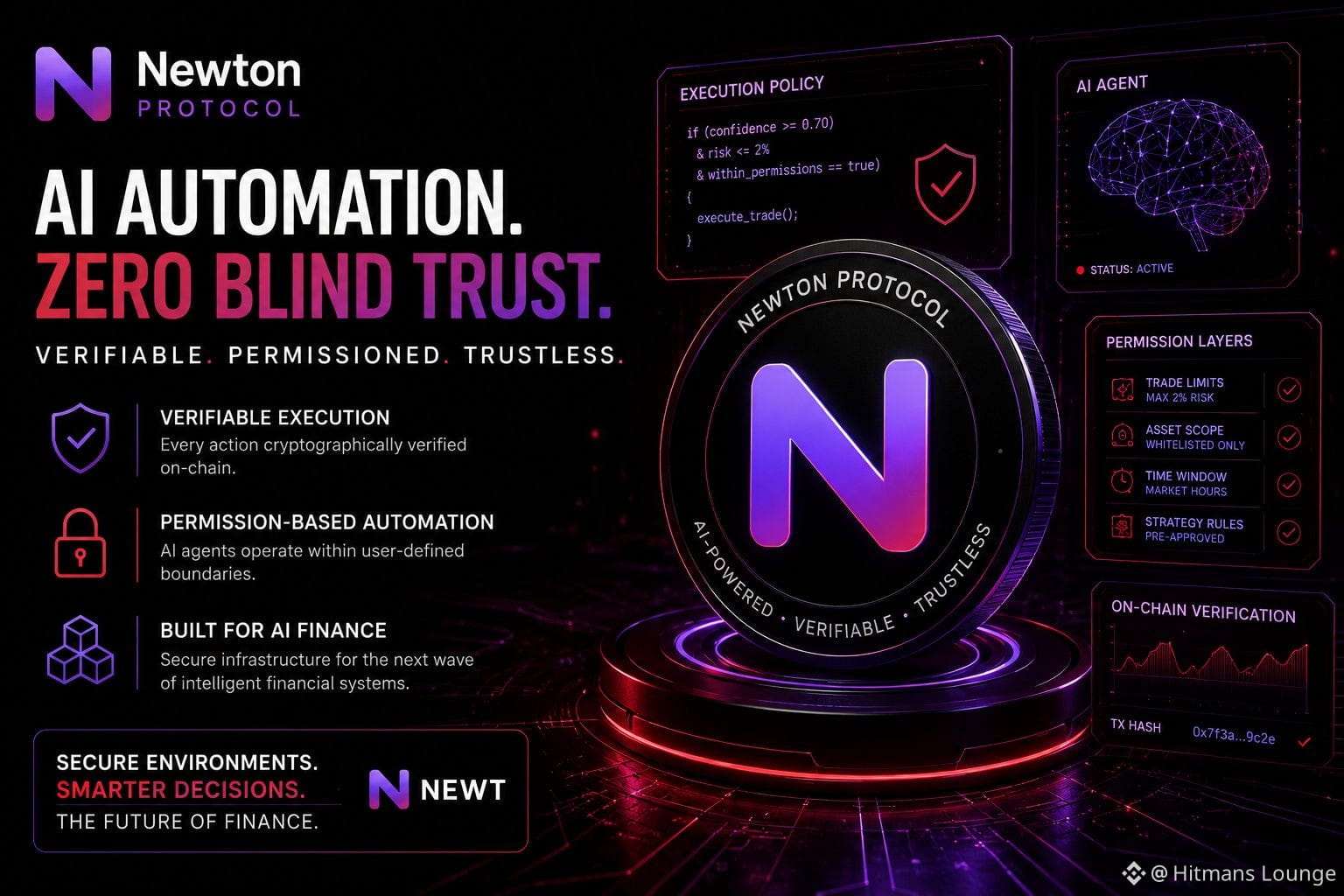
What keeps me interested in @NewtonProtocol isn't just secure AI automation—it's the idea that permissions can define when an AI is allowed to act, not just what it can do. That feels like an underrated difference.
Right now, most people using trading bots mainly care whether they make money. Very few ask how those decisions are verified or whether the bot stayed within the limits they intended. Maybe that's because today's tools are still "good enough."
That's why I'm still cautious. Great infrastructure doesn't automatically create demand. Users usually change habits only when the old approach becomes noticeably painful.
I could be early here, and I'm fine with that. If AI agents handle more financial decisions over the next few years, the ability to verify and constrain their actions might become far more valuable than the market currently prices in.
#NewtonProtocol #Newt #Newton #AI $NFP $TLM
I checked my small $NEWT position again today and realized I wasn't thinking about price anymore. I was thinking about timing.
What keeps me interested in @NewtonProtocol isn't just secure AI automation—it's the idea that permissions can define when an AI is allowed to act, not just what it can do. That feels like an underrated difference.
Right now, most people using trading bots mainly care whether they make money. Very few ask how those decisions are verified or whether the bot stayed within the limits they intended. Maybe that's because today's tools are still "good enough."
That's why I'm still cautious. Great infrastructure doesn't automatically create demand. Users usually change habits only when the old approach becomes noticeably painful.
I could be early here, and I'm fine with that. If AI agents handle more financial decisions over the next few years, the ability to verify and constrain their actions might become far more valuable than the market currently prices in.
#NewtonProtocol #Newt #Newton #AI $NFP $TLM
What keeps me interested in @NewtonProtocol isn't just secure AI automation—it's the idea that permissions can define when an AI is allowed to act, not just what it can do. That feels like an underrated difference.
Right now, most people using trading bots mainly care whether they make money. Very few ask how those decisions are verified or whether the bot stayed within the limits they intended. Maybe that's because today's tools are still "good enough."
That's why I'm still cautious. Great infrastructure doesn't automatically create demand. Users usually change habits only when the old approach becomes noticeably painful.
I could be early here, and I'm fine with that. If AI agents handle more financial decisions over the next few years, the ability to verify and constrain their actions might become far more valuable than the market currently prices in.
#NewtonProtocol #Newt #Newton #AI $NFP $TLM
19
7
375

·
--
Newton Protocol ecosystem.
is redefining the on-chain data verification process. Implementing security measures immediately in smart contracts before settlement helps the Newton Mainnet Beta network. safer
@NewtonProtocol
#Newton $NEWT
Newton Protocol ecosystem.
is redefining the on-chain data verification process. Implementing security measures immediately in smart contracts before settlement helps the Newton Mainnet Beta network. safer
@NewtonProtocol
#Newton $NEWT
is redefining the on-chain data verification process. Implementing security measures immediately in smart contracts before settlement helps the Newton Mainnet Beta network. safer
@NewtonProtocol
#Newton $NEWT
113

·
--
Article
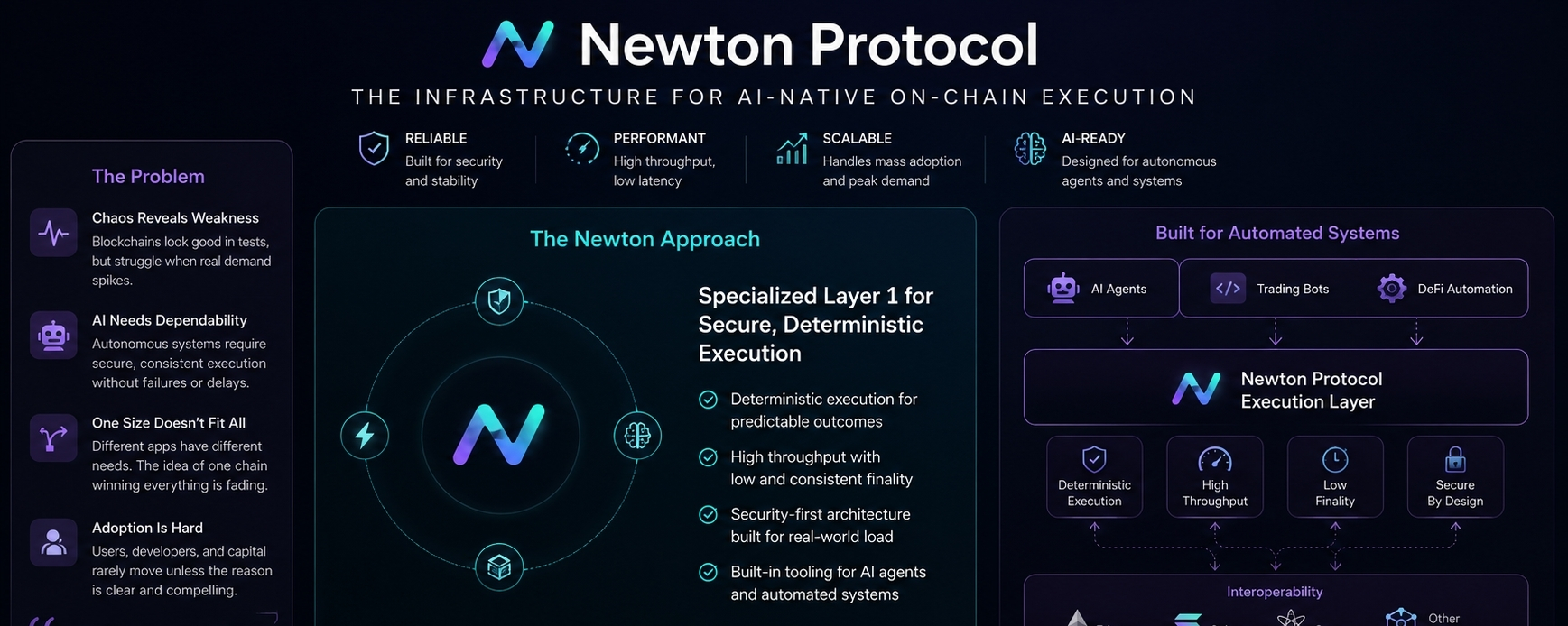
The Next Crypto Winner Won't Be the Loudest—That's Why Newton Protocol Caught My AttentionI don't really get excited every time a new Layer 1 shows up anymore. A few years ago I probably would have. Now I mostly read, close the tab, and move on. @NewtonProtocol Not because new chains are pointless, but because I've seen too many of them sound almost identical once you strip away the branding. Faster. Smarter. More scalable. Better for developers. Better for users. After a while, everything starts#Binance blending together.
Newton Protocol made me stop for a minute though. Not because I suddenly thought, "This is it." More because it seems to be looking at something that actually feels relevant. Everyone is talking about AI now. Honestly, the word has almost lost its meaning. It's everywhere. Every project somehow becomes an AI project overnight. So I tried to ignore that part and look underneath it.
What I kept coming back to wasn't the AI narrative. It was the idea that if automated systems are going to manage trades or make decisions on-chain, then the infrastructure behind them has to be dependable. That sounds obvious, but crypto has a habit of getting excited about what something can do before asking whether it can keep doing it once thousands of people rely on it.#newton
That's usually where things get interesting.
A blockchain doesn't really tell you who it is during quiet periods. It tells you during chaos. When activity suddenly doubles. When bots start fighting each other. When everyone wants their transaction included at the same time. That's when you find out what was actually built and what only looked good in benchmarks.
Solana is a good example of that. I've had days where using it felt almost effortless. Everything was quick and smooth, and it was easy to understand why people liked it so much. But we've also seen periods where heavy traffic exposed problems that weren't obvious before. I don't even hold that against Solana anymore. If anything, it's proof that real adoption is harder than designing a fast blockchain in theory.
Sometimes I wonder if we're still stuck chasing this idea that one chain eventually wins everything. I'm not sure I believe that anymore. Different applications need different things. Different users care about different trade-offs. Maybe several ecosystems end up sharing the work. Or maybe liquidity keeps clustering in the same places because that's just what liquidity does. Crypto loves elegant theories, but people usually take the path that asks the least from them.
That might end up being Newton's biggest challenge. Building technology is difficult, but convincing people to leave where they already are is something else entirely. Developers already have tools they know. Users already have wallets full of assets on existing networks. Capital doesn't move just because another chain has a cleaner design. There has to be a reason that feels real, not just technically correct.
I also noticed that Newton doesn't seem obsessed with trying to become everything at once. Maybe that's intentional. Maybe focusing on secure execution for automated systems is enough. Every project talks about solving every problem in crypto. Very few seem comfortable admitting they're only trying to solve one. I actually respect that more, assuming that's really the direction they stick to.
I still don't know what happens from here. Maybe the AI narrative fades and nobody cares anymore. Maybe automated on-chain systems become normal a few years from now, and projects that prepared for that quietly benefit. Both outcomes feel possible. That's probably why I'm still paying attention, even if I'm not convinced.
I've been around long enough to know that good ideas don't always win, and weak ideas sometimes survive much longer than they should.Crypto has never been as predictable as people pretend it is.
It might work. Or nobody shows up.
@NewtonProtocol $NEWT #NEWT
{future}(NEWTUSDT)
$LAB
{alpha}(560x7ec43cf65f1663f820427c62a5780b8f2e25593a)
$VANRY
{future}(VANRYUSDT)
The Next Crypto Winner Won't Be the Loudest—That's Why Newton Protocol Caught My Attention
I don't really get excited every time a new Layer 1 shows up anymore. A few years ago I probably would have. Now I mostly read, close the tab, and move on. @NewtonProtocol Not because new chains are pointless, but because I've seen too many of them sound almost identical once you strip away the branding. Faster. Smarter. More scalable. Better for developers. Better for users. After a while, everything starts#Binance blending together.
Newton Protocol made me stop for a minute though. Not because I suddenly thought, "This is it." More because it seems to be looking at something that actually feels relevant. Everyone is talking about AI now. Honestly, the word has almost lost its meaning. It's everywhere. Every project somehow becomes an AI project overnight. So I tried to ignore that part and look underneath it.
What I kept coming back to wasn't the AI narrative. It was the idea that if automated systems are going to manage trades or make decisions on-chain, then the infrastructure behind them has to be dependable. That sounds obvious, but crypto has a habit of getting excited about what something can do before asking whether it can keep doing it once thousands of people rely on it.#newton
That's usually where things get interesting.
A blockchain doesn't really tell you who it is during quiet periods. It tells you during chaos. When activity suddenly doubles. When bots start fighting each other. When everyone wants their transaction included at the same time. That's when you find out what was actually built and what only looked good in benchmarks.
Solana is a good example of that. I've had days where using it felt almost effortless. Everything was quick and smooth, and it was easy to understand why people liked it so much. But we've also seen periods where heavy traffic exposed problems that weren't obvious before. I don't even hold that against Solana anymore. If anything, it's proof that real adoption is harder than designing a fast blockchain in theory.
Sometimes I wonder if we're still stuck chasing this idea that one chain eventually wins everything. I'm not sure I believe that anymore. Different applications need different things. Different users care about different trade-offs. Maybe several ecosystems end up sharing the work. Or maybe liquidity keeps clustering in the same places because that's just what liquidity does. Crypto loves elegant theories, but people usually take the path that asks the least from them.
That might end up being Newton's biggest challenge. Building technology is difficult, but convincing people to leave where they already are is something else entirely. Developers already have tools they know. Users already have wallets full of assets on existing networks. Capital doesn't move just because another chain has a cleaner design. There has to be a reason that feels real, not just technically correct.
I also noticed that Newton doesn't seem obsessed with trying to become everything at once. Maybe that's intentional. Maybe focusing on secure execution for automated systems is enough. Every project talks about solving every problem in crypto. Very few seem comfortable admitting they're only trying to solve one. I actually respect that more, assuming that's really the direction they stick to.
I still don't know what happens from here. Maybe the AI narrative fades and nobody cares anymore. Maybe automated on-chain systems become normal a few years from now, and projects that prepared for that quietly benefit. Both outcomes feel possible. That's probably why I'm still paying attention, even if I'm not convinced.
I've been around long enough to know that good ideas don't always win, and weak ideas sometimes survive much longer than they should.Crypto has never been as predictable as people pretend it is.
It might work. Or nobody shows up.
@NewtonProtocol $NEWT #NEWT
$LAB
$VANRY
Newton Protocol made me stop for a minute though. Not because I suddenly thought, "This is it." More because it seems to be looking at something that actually feels relevant. Everyone is talking about AI now. Honestly, the word has almost lost its meaning. It's everywhere. Every project somehow becomes an AI project overnight. So I tried to ignore that part and look underneath it.
What I kept coming back to wasn't the AI narrative. It was the idea that if automated systems are going to manage trades or make decisions on-chain, then the infrastructure behind them has to be dependable. That sounds obvious, but crypto has a habit of getting excited about what something can do before asking whether it can keep doing it once thousands of people rely on it.#newton
That's usually where things get interesting.
A blockchain doesn't really tell you who it is during quiet periods. It tells you during chaos. When activity suddenly doubles. When bots start fighting each other. When everyone wants their transaction included at the same time. That's when you find out what was actually built and what only looked good in benchmarks.
Solana is a good example of that. I've had days where using it felt almost effortless. Everything was quick and smooth, and it was easy to understand why people liked it so much. But we've also seen periods where heavy traffic exposed problems that weren't obvious before. I don't even hold that against Solana anymore. If anything, it's proof that real adoption is harder than designing a fast blockchain in theory.
Sometimes I wonder if we're still stuck chasing this idea that one chain eventually wins everything. I'm not sure I believe that anymore. Different applications need different things. Different users care about different trade-offs. Maybe several ecosystems end up sharing the work. Or maybe liquidity keeps clustering in the same places because that's just what liquidity does. Crypto loves elegant theories, but people usually take the path that asks the least from them.
That might end up being Newton's biggest challenge. Building technology is difficult, but convincing people to leave where they already are is something else entirely. Developers already have tools they know. Users already have wallets full of assets on existing networks. Capital doesn't move just because another chain has a cleaner design. There has to be a reason that feels real, not just technically correct.
I also noticed that Newton doesn't seem obsessed with trying to become everything at once. Maybe that's intentional. Maybe focusing on secure execution for automated systems is enough. Every project talks about solving every problem in crypto. Very few seem comfortable admitting they're only trying to solve one. I actually respect that more, assuming that's really the direction they stick to.
I still don't know what happens from here. Maybe the AI narrative fades and nobody cares anymore. Maybe automated on-chain systems become normal a few years from now, and projects that prepared for that quietly benefit. Both outcomes feel possible. That's probably why I'm still paying attention, even if I'm not convinced.
I've been around long enough to know that good ideas don't always win, and weak ideas sometimes survive much longer than they should.Crypto has never been as predictable as people pretend it is.
It might work. Or nobody shows up.
@NewtonProtocol $NEWT #NEWT
$LAB
$VANRY
86
36
600

·
--
Article
#NEWT $ NEWTThe blockchain landscape is evolving at a breakneck pace, shifting away from pure speculation toward real-world utility, scalability, and robust infrastructure. As decentralized applications (dApps) become more complex and data-heavy, the underlying networks must offer more than just basic transaction processing. They need to provide a complete ecosystem that can handle hig$h throughput, maintain top-tier security, and support seamless integration. This is exactly where the Newton Protocol steps in as a major game-changer.
At the absolute core of this project is the Newton Mainnet, a purpose-built blockchain architecture engineered to support the next generation of decentralized economic systems. Unlike traditional legacy networks that suffer from high congestion, unpredictable gas fees, and sluggish confirmation times, the Newton Mainnet focuses on delivering a highly optimized foundation. By utilizing advanced consensus mechanisms and a specialized architecture, it addresses the classic blockchain trilemma—achieving a fine balance between security, decentralization, and high scalability.
Furthermore, a blockchain is only as strong as its native asset ecosystem. The $NEWT token serves as the crucial economic backbone of the entire network #newton #NEWT
#NEWT $ NEWT
The blockchain landscape is evolving at a breakneck pace, shifting away from pure speculation toward real-world utility, scalability, and robust infrastructure. As decentralized applications (dApps) become more complex and data-heavy, the underlying networks must offer more than just basic transaction processing. They need to provide a complete ecosystem that can handle hig$h throughput, maintain top-tier security, and support seamless integration. This is exactly where the Newton Protocol steps in as a major game-changer.
At the absolute core of this project is the Newton Mainnet, a purpose-built blockchain architecture engineered to support the next generation of decentralized economic systems. Unlike traditional legacy networks that suffer from high congestion, unpredictable gas fees, and sluggish confirmation times, the Newton Mainnet focuses on delivering a highly optimized foundation. By utilizing advanced consensus mechanisms and a specialized architecture, it addresses the classic blockchain trilemma—achieving a fine balance between security, decentralization, and high scalability.
Furthermore, a blockchain is only as strong as its native asset ecosystem. The $NEWT token serves as the crucial economic backbone of the entire network #newton #NEWT
At the absolute core of this project is the Newton Mainnet, a purpose-built blockchain architecture engineered to support the next generation of decentralized economic systems. Unlike traditional legacy networks that suffer from high congestion, unpredictable gas fees, and sluggish confirmation times, the Newton Mainnet focuses on delivering a highly optimized foundation. By utilizing advanced consensus mechanisms and a specialized architecture, it addresses the classic blockchain trilemma—achieving a fine balance between security, decentralization, and high scalability.
Furthermore, a blockchain is only as strong as its native asset ecosystem. The $NEWT token serves as the crucial economic backbone of the entire network #newton #NEWT
67

·
--
Bullish
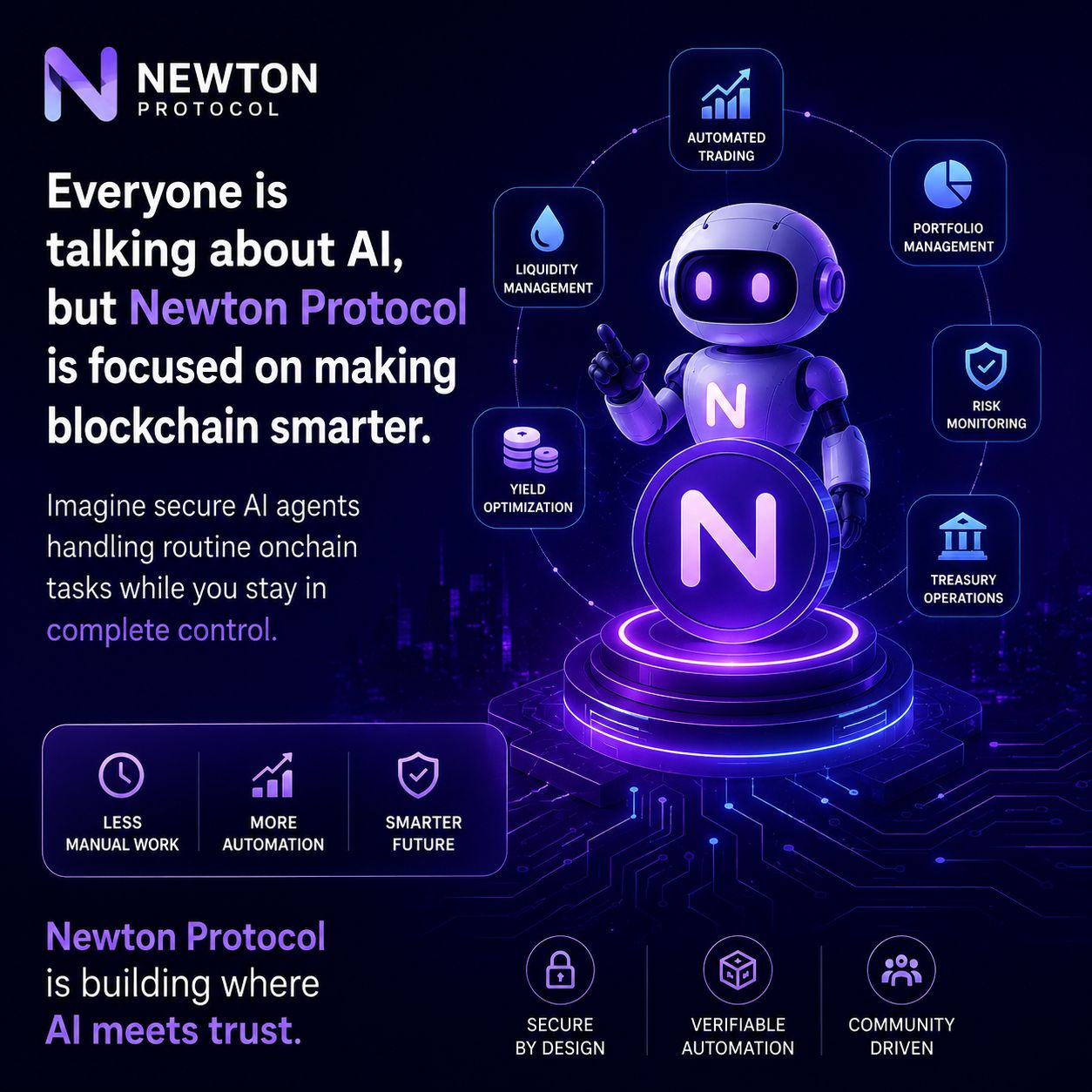
@NewtonProtocol Everyone is talking about AI, but #Newton Protocol is focused on making blockchain smarter.
Imagine secure AI agents handling routine onchain tasks while you stay in complete control.
Less manual work. More automation. A smarter future for blockchain.
Newton Protocol is building where AI meets trust.
$NEWT
{spot}(NEWTUSDT)
@NewtonProtocol Everyone is talking about AI, but #Newton Protocol is focused on making blockchain smarter.
Imagine secure AI agents handling routine onchain tasks while you stay in complete control.
Less manual work. More automation. A smarter future for blockchain.
Newton Protocol is building where AI meets trust.
$NEWT
Imagine secure AI agents handling routine onchain tasks while you stay in complete control.
Less manual work. More automation. A smarter future for blockchain.
Newton Protocol is building where AI meets trust.
$NEWT
28
36
5.4k

·
--
Verified
Article
Finding Long-Term Value While Everyone Chases Trending CoinsToday $VANRY and $YFI are everywhere on my timeline. Every refresh brings another token making headlines because of a sudden price movement or growing community excitement. I enjoy following those trends because they help me understand what is happening in the crypto market. But after spending months learning about blockchain projects, I realized that the projects I continue following are not always the loudest ones. They are the ones building practical solutions, and that's exactly why @NewtonProtocol has earned my attention.
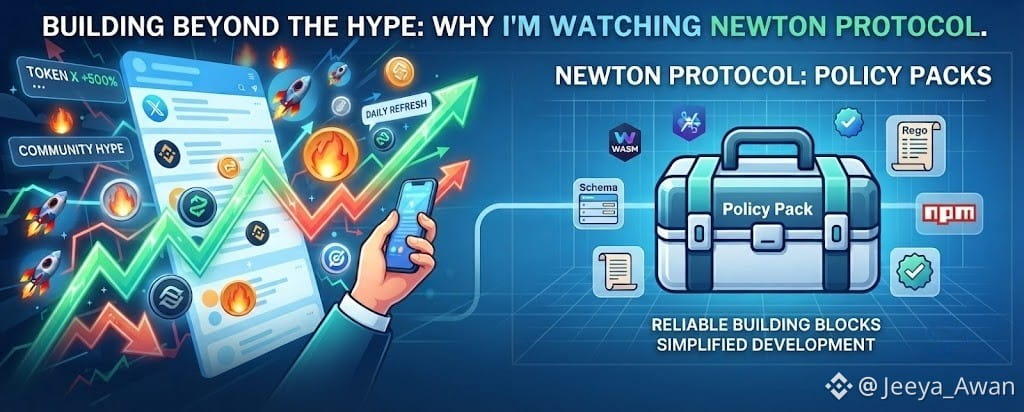
Whenever I explore a new protocol, I ask myself a simple question: "Will this still be useful after today's market excitement is over?" While researching Newton Protocol, I found something that immediately stood out, Policy Packs. Instead of forcing every developer to build complex data oracles from scratch, Newton provides ready-made policy packs with deployed WASM oracles, typed schemas, Rego templates, npm bindings, and verified deployment metadata. That instantly made me appreciate the project because it focuses on reducing unnecessary work while maintaining reliability.
This reminded me of my own daily routine. Whether I'm preparing university work or researching blockchain technology, I rarely begin from an empty page. I always start with trusted resources, organize them, customize them, and then build something that fits my needs. Newton Protocol follows a similar philosophy. Policy Packs provide a dependable starting point while still allowing developers to configure parameters, upload required API secrets, and adapt policies to their own applications.
Another reason I continue following Newton Protocol is the flexibility it offers. Different packs can be combined without creating conflicts because every pack keeps its own namespace. That thoughtful structure makes large policy systems easier to understand and maintain. Instead of worrying about data collisions, developers can focus on building secure applications.
I also appreciate that Newton supports both browser-based workflows through the dashboard and command-line tools for developers who prefer automation. Everyone can choose the workflow that matches their experience without sacrificing the same deployment standards.
For me, blockchain adoption depends on tools that make development simpler instead of more complicated. Newton Protocol feels like it was designed with that mindset. While many projects focus on short-term attention, Newton is building infrastructure that developers can rely on for the long term. That's why, even while I keep an eye on today's trending coins, Newton Protocol remains one of the projects I genuinely enjoy following and learning about.
#Newt #newton $NEWT
{spot}(NEWTUSDT)
Finding Long-Term Value While Everyone Chases Trending Coins
Today $VANRY and $YFI are everywhere on my timeline. Every refresh brings another token making headlines because of a sudden price movement or growing community excitement. I enjoy following those trends because they help me understand what is happening in the crypto market. But after spending months learning about blockchain projects, I realized that the projects I continue following are not always the loudest ones. They are the ones building practical solutions, and that's exactly why @NewtonProtocol has earned my attention.
Whenever I explore a new protocol, I ask myself a simple question: "Will this still be useful after today's market excitement is over?" While researching Newton Protocol, I found something that immediately stood out, Policy Packs. Instead of forcing every developer to build complex data oracles from scratch, Newton provides ready-made policy packs with deployed WASM oracles, typed schemas, Rego templates, npm bindings, and verified deployment metadata. That instantly made me appreciate the project because it focuses on reducing unnecessary work while maintaining reliability.
This reminded me of my own daily routine. Whether I'm preparing university work or researching blockchain technology, I rarely begin from an empty page. I always start with trusted resources, organize them, customize them, and then build something that fits my needs. Newton Protocol follows a similar philosophy. Policy Packs provide a dependable starting point while still allowing developers to configure parameters, upload required API secrets, and adapt policies to their own applications.
Another reason I continue following Newton Protocol is the flexibility it offers. Different packs can be combined without creating conflicts because every pack keeps its own namespace. That thoughtful structure makes large policy systems easier to understand and maintain. Instead of worrying about data collisions, developers can focus on building secure applications.
I also appreciate that Newton supports both browser-based workflows through the dashboard and command-line tools for developers who prefer automation. Everyone can choose the workflow that matches their experience without sacrificing the same deployment standards.
For me, blockchain adoption depends on tools that make development simpler instead of more complicated. Newton Protocol feels like it was designed with that mindset. While many projects focus on short-term attention, Newton is building infrastructure that developers can rely on for the long term. That's why, even while I keep an eye on today's trending coins, Newton Protocol remains one of the projects I genuinely enjoy following and learning about.
#Newt #newton $NEWT
Whenever I explore a new protocol, I ask myself a simple question: "Will this still be useful after today's market excitement is over?" While researching Newton Protocol, I found something that immediately stood out, Policy Packs. Instead of forcing every developer to build complex data oracles from scratch, Newton provides ready-made policy packs with deployed WASM oracles, typed schemas, Rego templates, npm bindings, and verified deployment metadata. That instantly made me appreciate the project because it focuses on reducing unnecessary work while maintaining reliability.
This reminded me of my own daily routine. Whether I'm preparing university work or researching blockchain technology, I rarely begin from an empty page. I always start with trusted resources, organize them, customize them, and then build something that fits my needs. Newton Protocol follows a similar philosophy. Policy Packs provide a dependable starting point while still allowing developers to configure parameters, upload required API secrets, and adapt policies to their own applications.
Another reason I continue following Newton Protocol is the flexibility it offers. Different packs can be combined without creating conflicts because every pack keeps its own namespace. That thoughtful structure makes large policy systems easier to understand and maintain. Instead of worrying about data collisions, developers can focus on building secure applications.
I also appreciate that Newton supports both browser-based workflows through the dashboard and command-line tools for developers who prefer automation. Everyone can choose the workflow that matches their experience without sacrificing the same deployment standards.
For me, blockchain adoption depends on tools that make development simpler instead of more complicated. Newton Protocol feels like it was designed with that mindset. While many projects focus on short-term attention, Newton is building infrastructure that developers can rely on for the long term. That's why, even while I keep an eye on today's trending coins, Newton Protocol remains one of the projects I genuinely enjoy following and learning about.
#Newt #newton $NEWT
39
21
311

Article
Revolutionizing the Web3 Landscape with Newton Protocol and Mainnet BetaThe blockchain ecosystem is constantly evolving, and at the forefront of this technological shift is @NewtonProtocol Designed to offer a highly secure, scalable, and efficient infrastructure, the protocol aims to redefine how decentralized applications (dApps) and smart contracts operate in the Web3 era, removing common technical bottlenecks.
The Impact of #Newton Mainnet Beta
The launch of the Newton Mainnet Beta marks a significant milestone for the project and the broader crypto community. This phase is crucial for testing and enhancing network stability, throughput, and security under real-world conditions. By significantly lowering gas fees and maximizing transaction speeds, the Mainnet Beta provides an optimal environment for both developers and users to build and interact seamlessly.
The Power of $NEWT Token
At the heart of this high-performance ecosystem is its native utility token, $NEWT. It serves as the primary fuel driving the network, utilized for transaction fees, staking, and decentralized governance. As more projects deploy on the Mainnet Beta, the utility and adoption of the token continue to grow steadily. For anyone tracking the future of blockchain innovation, keeping a close eye on this development is highly essential.
To stay updated with their latest advancements, official announcements, and community events, make sure to follow their verified account: @NewtonProtocol
#Newt $NEWT
Revolutionizing the Web3 Landscape with Newton Protocol and Mainnet Beta
The blockchain ecosystem is constantly evolving, and at the forefront of this technological shift is @NewtonProtocol Designed to offer a highly secure, scalable, and efficient infrastructure, the protocol aims to redefine how decentralized applications (dApps) and smart contracts operate in the Web3 era, removing common technical bottlenecks.
The Impact of #Newton Mainnet Beta
The launch of the Newton Mainnet Beta marks a significant milestone for the project and the broader crypto community. This phase is crucial for testing and enhancing network stability, throughput, and security under real-world conditions. By significantly lowering gas fees and maximizing transaction speeds, the Mainnet Beta provides an optimal environment for both developers and users to build and interact seamlessly.
The Power of $NEWT Token
At the heart of this high-performance ecosystem is its native utility token, $NEWT . It serves as the primary fuel driving the network, utilized for transaction fees, staking, and decentralized governance. As more projects deploy on the Mainnet Beta, the utility and adoption of the token continue to grow steadily. For anyone tracking the future of blockchain innovation, keeping a close eye on this development is highly essential.
To stay updated with their latest advancements, official announcements, and community events, make sure to follow their verified account: @NewtonProtocol
#Newt $NEWT
The Impact of #Newton Mainnet Beta
The launch of the Newton Mainnet Beta marks a significant milestone for the project and the broader crypto community. This phase is crucial for testing and enhancing network stability, throughput, and security under real-world conditions. By significantly lowering gas fees and maximizing transaction speeds, the Mainnet Beta provides an optimal environment for both developers and users to build and interact seamlessly.
The Power of $NEWT Token
At the heart of this high-performance ecosystem is its native utility token, $NEWT . It serves as the primary fuel driving the network, utilized for transaction fees, staking, and decentralized governance. As more projects deploy on the Mainnet Beta, the utility and adoption of the token continue to grow steadily. For anyone tracking the future of blockchain innovation, keeping a close eye on this development is highly essential.
To stay updated with their latest advancements, official announcements, and community events, make sure to follow their verified account: @NewtonProtocol
#Newt $NEWT
29

·
--
Bearish
Today's trending coins like $VANRY and $YFI , always catch my attention, and I like seeing which projects the community is excited about. Still, I usually end up researching infrastructure instead of short-term trends, and that's how @NewtonProtocol became one of the projects I genuinely appreciate. Learning about multiple data oracles changed the way I think about onchain decisions. In my daily routine, I often compare several sources before trusting any information, so Newton's approach makes perfect sense to me. Different oracle outputs stay organized, can be merged without conflicts, and are evaluated together through a single policy before reaching an allow or deny result. That focus on accuracy and structured decision-making is exactly what I look for in blockchain technology, which is why I keep using and following Newton Protocol closely.
#newt #newton $NEWT
Today's trending coins like $VANRY and $YFI , always catch my attention, and I like seeing which projects the community is excited about. Still, I usually end up researching infrastructure instead of short-term trends, and that's how @NewtonProtocol became one of the projects I genuinely appreciate. Learning about multiple data oracles changed the way I think about onchain decisions. In my daily routine, I often compare several sources before trusting any information, so Newton's approach makes perfect sense to me. Different oracle outputs stay organized, can be merged without conflicts, and are evaluated together through a single policy before reaching an allow or deny result. That focus on accuracy and structured decision-making is exactly what I look for in blockchain technology, which is why I keep using and following Newton Protocol closely.
#newt #newton $NEWT
#newt #newton $NEWT
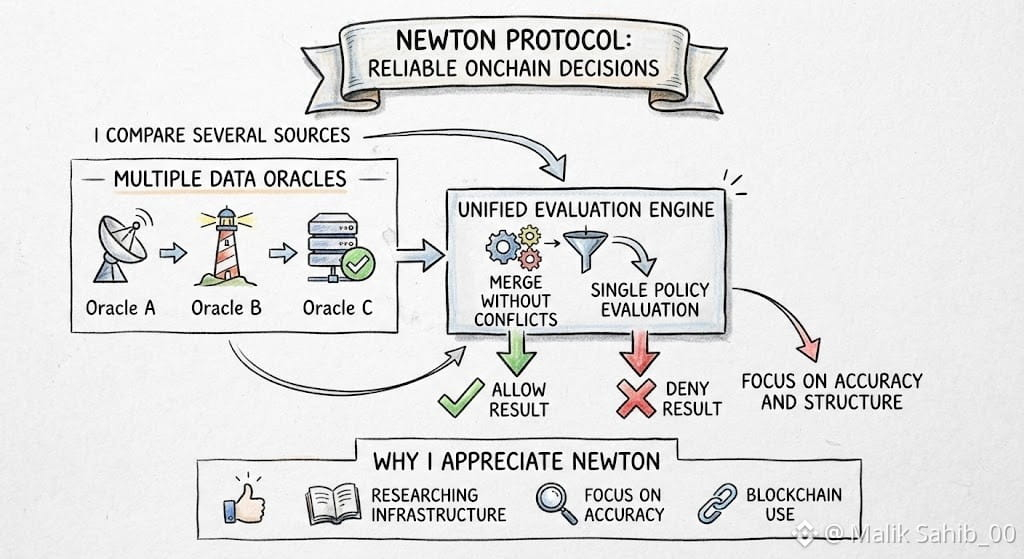
4
2
229

·
--
Article
What Happens When Blockchain Starts Working for You?For years, blockchain has promised to reshape the internet. We've gained decentralized finance, self-custody wallets, NFTs, and countless decentralized applications. Yet despite all this innovation, one thing hasn't changed: users still spend too much time manually managing everything.
Every token swap requires confirmation.
Every staking reward needs to be claimed.
Every yield opportunity demands constant monitoring.
Every cross-chain transfer takes multiple steps.
The future of Web3 shouldn't be about doing more work. It should be about achieving more with less effort.
Imagine opening your wallet in the morning and discovering that your assets have already been optimized according to the rules you personally approved. Your idle funds have automatically moved to better yield opportunities. Your staking rewards have been compounded. Your portfolio has been rebalanced. Transactions were executed only within the limits you defined, while you remained fully in control.
This is where blockchain evolves from being a platform you use into an ecosystem that actively works for you.
That future is exactly the direction @NewtonProtocol is helping build.
Rather than expecting users to monitor markets around the clock, Newton Protocol introduces intelligent on-chain automation. Instead of repeatedly performing the same routine actions, users can establish permissions and let trusted automated agents execute predefined tasks on their behalf.
The key difference is simple: automation without sacrificing ownership.
Unlike traditional financial services that require handing over custody of your assets, Newton Protocol is designed around user sovereignty. Your wallet stays yours. Your assets remain under your control. Automation only operates according to the permissions you explicitly define.
This creates a much more practical Web3 experience.
Picture a DeFi position that automatically protects itself from unnecessary risks.
Imagine liquidity moving efficiently across protocols as market conditions change.
Think about subscription payments, recurring investments, token swaps, or yield strategies happening automatically instead of relying on reminders or manual execution.
As blockchain adoption grows, these kinds of automated workflows won't feel like luxury features—they'll become expectations.
Developers also benefit from this evolution.
Instead of building isolated decentralized applications, they can design services that interact intelligently across multiple protocols. Automation becomes part of the infrastructure itself, allowing dApps to provide smoother user experiences while reducing friction at every step.
The impact extends beyond DeFi.
Gaming assets could be managed automatically.
DAO participation could become smarter.
On-chain identities could trigger personalized actions.
AI-powered assistants could interact with blockchain securely through permissioned automation.
Every sector of Web3 stands to become more efficient when repetitive actions no longer depend on users being online every minute of the day.
This represents a major shift in how people think about blockchain.
The first generation of crypto focused on ownership.
The second generation expanded into decentralized applications.
The next generation focuses on intelligent execution.
Blockchain becomes proactive instead of reactive.
Users stop chasing opportunities because their on-chain strategies are already prepared to respond.
Newton Protocol is positioning itself at the center of this transformation by providing infrastructure that connects automation, AI, wallets, and decentralized applications in a secure, user-controlled environment.
As artificial intelligence becomes increasingly integrated into digital services, blockchain needs an equally intelligent execution layer. Trustless automation has the potential to bridge that gap, making decentralized technology accessible not only to experienced crypto users but also to everyday people who simply want their digital assets to work efficiently.
The real success of Web3 won't be measured by how many transactions users perform each day.
It will be measured by how little they need to think about routine tasks while maintaining complete ownership of their assets.
When blockchain starts working for you instead of making you work for it, the entire user experience changes.
That future is no longer just an idea.
With projects like Newton Protocol , it's already beginning to take shape.
The smartest blockchain isn't the one that asks you to do more—it's the one that quietly helps you accomplish more while keeping you in control.
$NEWT #Newt #newton @NewtonProtocol
What Happens When Blockchain Starts Working for You?
For years, blockchain has promised to reshape the internet. We've gained decentralized finance, self-custody wallets, NFTs, and countless decentralized applications. Yet despite all this innovation, one thing hasn't changed: users still spend too much time manually managing everything.
Every token swap requires confirmation.
Every staking reward needs to be claimed.
Every yield opportunity demands constant monitoring.
Every cross-chain transfer takes multiple steps.
The future of Web3 shouldn't be about doing more work. It should be about achieving more with less effort.
Imagine opening your wallet in the morning and discovering that your assets have already been optimized according to the rules you personally approved. Your idle funds have automatically moved to better yield opportunities. Your staking rewards have been compounded. Your portfolio has been rebalanced. Transactions were executed only within the limits you defined, while you remained fully in control.
This is where blockchain evolves from being a platform you use into an ecosystem that actively works for you.
That future is exactly the direction @NewtonProtocol is helping build.
Rather than expecting users to monitor markets around the clock, Newton Protocol introduces intelligent on-chain automation. Instead of repeatedly performing the same routine actions, users can establish permissions and let trusted automated agents execute predefined tasks on their behalf.
The key difference is simple: automation without sacrificing ownership.
Unlike traditional financial services that require handing over custody of your assets, Newton Protocol is designed around user sovereignty. Your wallet stays yours. Your assets remain under your control. Automation only operates according to the permissions you explicitly define.
This creates a much more practical Web3 experience.
Picture a DeFi position that automatically protects itself from unnecessary risks.
Imagine liquidity moving efficiently across protocols as market conditions change.
Think about subscription payments, recurring investments, token swaps, or yield strategies happening automatically instead of relying on reminders or manual execution.
As blockchain adoption grows, these kinds of automated workflows won't feel like luxury features—they'll become expectations.
Developers also benefit from this evolution.
Instead of building isolated decentralized applications, they can design services that interact intelligently across multiple protocols. Automation becomes part of the infrastructure itself, allowing dApps to provide smoother user experiences while reducing friction at every step.
The impact extends beyond DeFi.
Gaming assets could be managed automatically.
DAO participation could become smarter.
On-chain identities could trigger personalized actions.
AI-powered assistants could interact with blockchain securely through permissioned automation.
Every sector of Web3 stands to become more efficient when repetitive actions no longer depend on users being online every minute of the day.
This represents a major shift in how people think about blockchain.
The first generation of crypto focused on ownership.
The second generation expanded into decentralized applications.
The next generation focuses on intelligent execution.
Blockchain becomes proactive instead of reactive.
Users stop chasing opportunities because their on-chain strategies are already prepared to respond.
Newton Protocol is positioning itself at the center of this transformation by providing infrastructure that connects automation, AI, wallets, and decentralized applications in a secure, user-controlled environment.
As artificial intelligence becomes increasingly integrated into digital services, blockchain needs an equally intelligent execution layer. Trustless automation has the potential to bridge that gap, making decentralized technology accessible not only to experienced crypto users but also to everyday people who simply want their digital assets to work efficiently.
The real success of Web3 won't be measured by how many transactions users perform each day.
It will be measured by how little they need to think about routine tasks while maintaining complete ownership of their assets.
When blockchain starts working for you instead of making you work for it, the entire user experience changes.
That future is no longer just an idea.
With projects like Newton Protocol , it's already beginning to take shape.
The smartest blockchain isn't the one that asks you to do more—it's the one that quietly helps you accomplish more while keeping you in control.
$NEWT #Newt #newton @NewtonProtocol
Every token swap requires confirmation.
Every staking reward needs to be claimed.
Every yield opportunity demands constant monitoring.
Every cross-chain transfer takes multiple steps.
The future of Web3 shouldn't be about doing more work. It should be about achieving more with less effort.
Imagine opening your wallet in the morning and discovering that your assets have already been optimized according to the rules you personally approved. Your idle funds have automatically moved to better yield opportunities. Your staking rewards have been compounded. Your portfolio has been rebalanced. Transactions were executed only within the limits you defined, while you remained fully in control.
This is where blockchain evolves from being a platform you use into an ecosystem that actively works for you.
That future is exactly the direction @NewtonProtocol is helping build.
Rather than expecting users to monitor markets around the clock, Newton Protocol introduces intelligent on-chain automation. Instead of repeatedly performing the same routine actions, users can establish permissions and let trusted automated agents execute predefined tasks on their behalf.
The key difference is simple: automation without sacrificing ownership.
Unlike traditional financial services that require handing over custody of your assets, Newton Protocol is designed around user sovereignty. Your wallet stays yours. Your assets remain under your control. Automation only operates according to the permissions you explicitly define.
This creates a much more practical Web3 experience.
Picture a DeFi position that automatically protects itself from unnecessary risks.
Imagine liquidity moving efficiently across protocols as market conditions change.
Think about subscription payments, recurring investments, token swaps, or yield strategies happening automatically instead of relying on reminders or manual execution.
As blockchain adoption grows, these kinds of automated workflows won't feel like luxury features—they'll become expectations.
Developers also benefit from this evolution.
Instead of building isolated decentralized applications, they can design services that interact intelligently across multiple protocols. Automation becomes part of the infrastructure itself, allowing dApps to provide smoother user experiences while reducing friction at every step.
The impact extends beyond DeFi.
Gaming assets could be managed automatically.
DAO participation could become smarter.
On-chain identities could trigger personalized actions.
AI-powered assistants could interact with blockchain securely through permissioned automation.
Every sector of Web3 stands to become more efficient when repetitive actions no longer depend on users being online every minute of the day.
This represents a major shift in how people think about blockchain.
The first generation of crypto focused on ownership.
The second generation expanded into decentralized applications.
The next generation focuses on intelligent execution.
Blockchain becomes proactive instead of reactive.
Users stop chasing opportunities because their on-chain strategies are already prepared to respond.
Newton Protocol is positioning itself at the center of this transformation by providing infrastructure that connects automation, AI, wallets, and decentralized applications in a secure, user-controlled environment.
As artificial intelligence becomes increasingly integrated into digital services, blockchain needs an equally intelligent execution layer. Trustless automation has the potential to bridge that gap, making decentralized technology accessible not only to experienced crypto users but also to everyday people who simply want their digital assets to work efficiently.
The real success of Web3 won't be measured by how many transactions users perform each day.
It will be measured by how little they need to think about routine tasks while maintaining complete ownership of their assets.
When blockchain starts working for you instead of making you work for it, the entire user experience changes.
That future is no longer just an idea.
With projects like Newton Protocol , it's already beginning to take shape.
The smartest blockchain isn't the one that asks you to do more—it's the one that quietly helps you accomplish more while keeping you in control.
$NEWT #Newt #newton @NewtonProtocol
11

·
--
Bullish
Spent some time this week thinking about why DeFi protocols still get wrecked even with all the audits. Honestly, the problem isn't just smart contract bugs. It's that there's no real layer filtering what goes IN before it actually executes on-chain. That's what got me looking harder at $NEWT . Newton Protocol is building something the space genuinely needs right now: a pre-transaction compliance and security layer. Their zk Permissions architecture checks who's transacting and whether they're policy-compliant BEFORE the transaction even hits the chain. Not after the damage. Before it happens.
The thing is, with MiCA enforcement tightening and institutions slowly circling DeFi, this kind of architecture isn't optional anymore. It's becoming table stakes for real adoption.I feel like most traders are sleeping on this because "compliance" sounds boring. But tbh, the protocols that survive the next regulatory wave will be the ones that built proper permission layers early. That's just how this plays out historically.
$NEWT is positioning right where institutions need to land. That's a real thesis to me. Who else is watching pre-transaction security plays right now?
#newton #Newt #NewtonProtocol @NewtonProtocol
Spent some time this week thinking about why DeFi protocols still get wrecked even with all the audits. Honestly, the problem isn't just smart contract bugs. It's that there's no real layer filtering what goes IN before it actually executes on-chain. That's what got me looking harder at $NEWT . Newton Protocol is building something the space genuinely needs right now: a pre-transaction compliance and security layer. Their zk Permissions architecture checks who's transacting and whether they're policy-compliant BEFORE the transaction even hits the chain. Not after the damage. Before it happens.
The thing is, with MiCA enforcement tightening and institutions slowly circling DeFi, this kind of architecture isn't optional anymore. It's becoming table stakes for real adoption.I feel like most traders are sleeping on this because "compliance" sounds boring. But tbh, the protocols that survive the next regulatory wave will be the ones that built proper permission layers early. That's just how this plays out historically.
$NEWT is positioning right where institutions need to land. That's a real thesis to me. Who else is watching pre-transaction security plays right now?
#newton #Newt #NewtonProtocol @NewtonProtocol
The thing is, with MiCA enforcement tightening and institutions slowly circling DeFi, this kind of architecture isn't optional anymore. It's becoming table stakes for real adoption.I feel like most traders are sleeping on this because "compliance" sounds boring. But tbh, the protocols that survive the next regulatory wave will be the ones that built proper permission layers early. That's just how this plays out historically.
$NEWT is positioning right where institutions need to land. That's a real thesis to me. Who else is watching pre-transaction security plays right now?
#newton #Newt #NewtonProtocol @NewtonProtocol
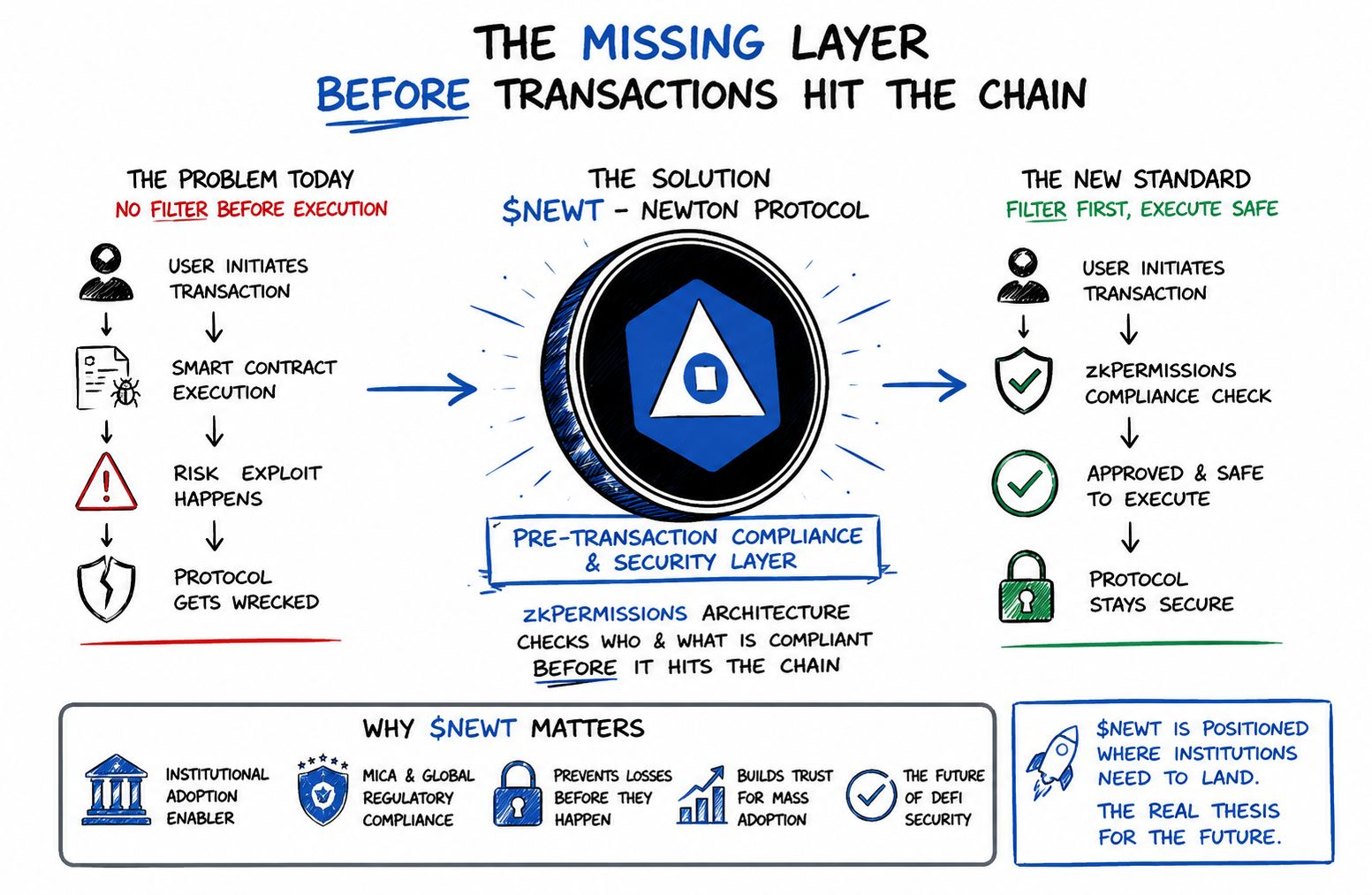
97
38
377

#newt $NEWT @NewtonProtocol
What keeps me interested in Newton Protocol is not just the AI angle — it is the governance question underneath it.
Once a protocol allows autonomous financial agents to act on-chain, the real issue is no longer only speed or automation. It becomes: who writes the rules, who enforces them, and who gets the final say when something needs to be stopped?
That is what makes projects like Newton worth watching. In autonomous finance, governance is not a side topic. It is the core product.
Because when machines can move capital, governance is no longer just about voting. It is about legitimacy.
#newt $NEWT @NewtonProtocol
What keeps me interested in Newton Protocol is not just the AI angle — it is the governance question underneath it.
Once a protocol allows autonomous financial agents to act on-chain, the real issue is no longer only speed or automation. It becomes: who writes the rules, who enforces them, and who gets the final say when something needs to be stopped?
That is what makes projects like Newton worth watching. In autonomous finance, governance is not a side topic. It is the core product.
Because when machines can move capital, governance is no longer just about voting. It is about legitimacy.
What keeps me interested in Newton Protocol is not just the AI angle — it is the governance question underneath it.
Once a protocol allows autonomous financial agents to act on-chain, the real issue is no longer only speed or automation. It becomes: who writes the rules, who enforces them, and who gets the final say when something needs to be stopped?
That is what makes projects like Newton worth watching. In autonomous finance, governance is not a side topic. It is the core product.
Because when machines can move capital, governance is no longer just about voting. It is about legitimacy.
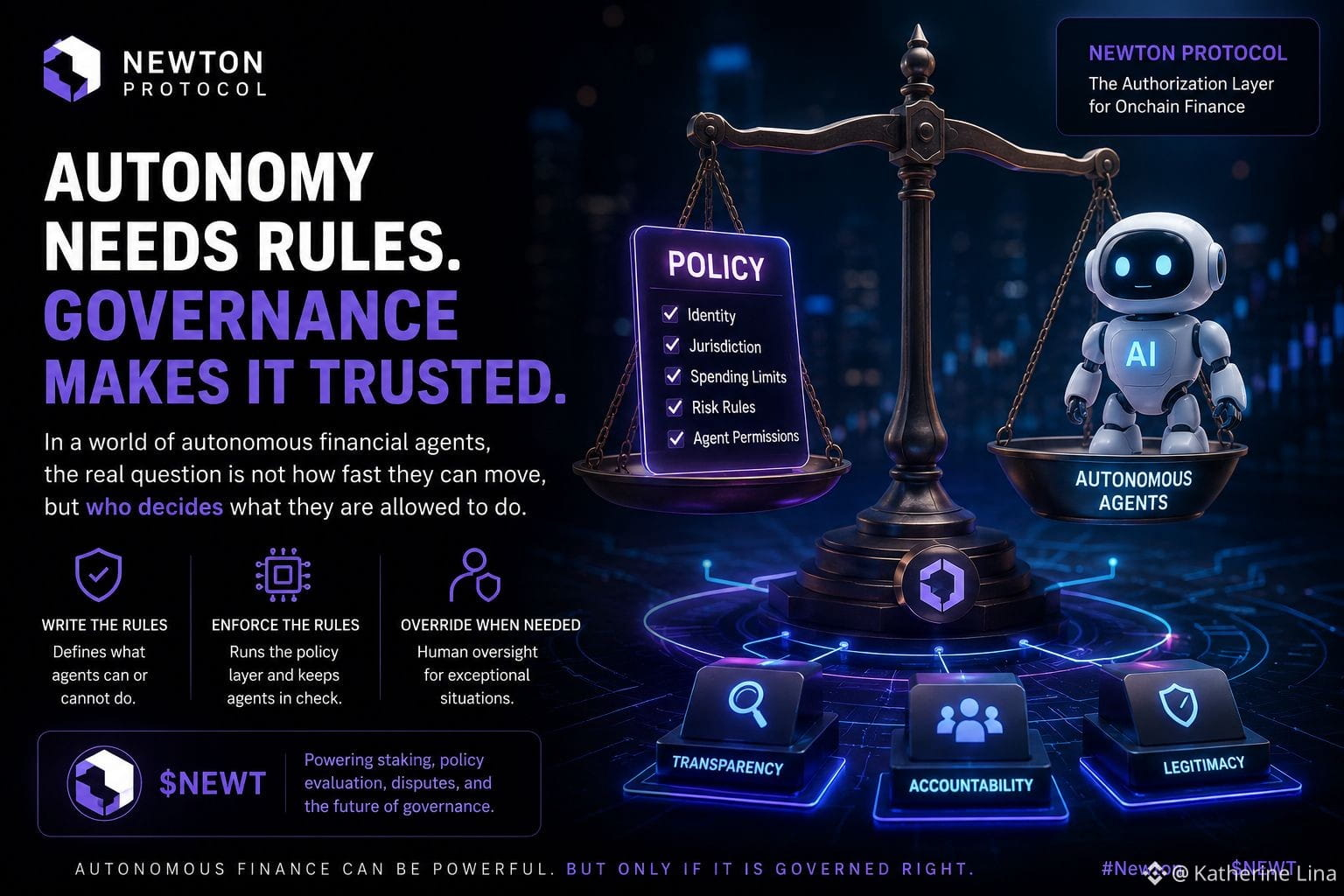
30
1
14
325
Log in to explore more content
Join global crypto users on Binance Square
⚡️ Get latest and useful information about crypto.
💬 Trusted by the world’s largest crypto exchange.
👍 Discover real insights from verified creators.
Email / Phone number
Trending Topics
1
#BNBSurpasses$790
17,761 views
143 Discussing
2
#ZamaRises15.99%ToIntradayHigh$0.09
15,626 views
105 Discussing
3
#BitcoinSpotETFsDraw$6.34BInflowsInQ3
5,718 views
90 Discussing
4
#EthereumValidatorExitQueueJumps392%
90,385 views
902 Discussing
5
#IMFApprovesElSalvador$138MWithBitcoinWaiver
13,121 views
62 Discussing
6
#SECHaltsCryptoETFReviewsAmidFundingLapse
254,549 views
1,781 Discussing
7
#ZcashETFPostsFirstWeeklyOutflow$93.6M
94,874 views
254 Discussing
8
#GreekPoliceBustCryptoScamRingArrest17
375,639 views
2,432 Discussing
9
#BitcoinRejectedAt$87K
221,916 views
318 Discussing
10
#FedOctoberRateHikeOddsFallTo17%
381,283 views
2,541 Discussing