

#koreakosdaqrulesriskcryptotreasuryfirmdelisting
koreakosdaqrulesriskcryptotreasuryfirmdelisting
167,377 views
1,369 Discussing
Hot
Latest

#KoreaKOSDAQRulesRiskCryptoTreasuryFirmDelisting #KoreaKOSDAQRulesRiskCryptoTreasuryFirmDelisting means that new, stricter listing rules on South Korea's Korea Exchange KOSDAQ market could put some crypto treasury companies at risk of being delisted.
A crypto treasury company is a publicly listed firm that holds a large portion of its assets in cryptocurrencies (such as Bitcoin) or has shifted its primary business toward managing crypto reserves.
Key implications:
🇰🇷 South Korea has tightened KOSDAQ listing standards, including higher market-capitalization requirements and stricter rules for companies that no longer meet listing criteria.
⚠️ Crypto treasury firms with weak fundamentals, low market value, or a major shift away from their original business could face delisting reviews.
📉 Shares of affected companies may come under pressure due to the uncertainty.
🪙 The news is not directly bearish for Bitcoin or the broader crypto market. It mainly affects specific listed companies that may fail to meet KOSDAQ's stricter standards rather than cryptocurrencies themselves.
#KoreaKOSDAQRulesRiskCryptoTreasuryFirmDelisting #KoreaKOSDAQRulesRiskCryptoTreasuryFirmDelisting means that new, stricter listing rules on South Korea's Korea Exchange KOSDAQ market could put some crypto treasury companies at risk of being delisted.
A crypto treasury company is a publicly listed firm that holds a large portion of its assets in cryptocurrencies (such as Bitcoin) or has shifted its primary business toward managing crypto reserves.
Key implications:
🇰🇷 South Korea has tightened KOSDAQ listing standards, including higher market-capitalization requirements and stricter rules for companies that no longer meet listing criteria.
⚠️ Crypto treasury firms with weak fundamentals, low market value, or a major shift away from their original business could face delisting reviews.
📉 Shares of affected companies may come under pressure due to the uncertainty.
🪙 The news is not directly bearish for Bitcoin or the broader crypto market. It mainly affects specific listed companies that may fail to meet KOSDAQ's stricter standards rather than cryptocurrencies themselves.
A crypto treasury company is a publicly listed firm that holds a large portion of its assets in cryptocurrencies (such as Bitcoin) or has shifted its primary business toward managing crypto reserves.
Key implications:
🇰🇷 South Korea has tightened KOSDAQ listing standards, including higher market-capitalization requirements and stricter rules for companies that no longer meet listing criteria.
⚠️ Crypto treasury firms with weak fundamentals, low market value, or a major shift away from their original business could face delisting reviews.
📉 Shares of affected companies may come under pressure due to the uncertainty.
🪙 The news is not directly bearish for Bitcoin or the broader crypto market. It mainly affects specific listed companies that may fail to meet KOSDAQ's stricter standards rather than cryptocurrencies themselves.
78

·
--
South Korea’s KOSDAQ flags crypto companies with a red card, fear index at 16, $BTC —why isn’t it rebounding?
Binaance Square’s trending topic #KoreaKOSDAQRulesRiskCryptoTreasuryFirmDelisting is spreading. The Korea KOSDAQ exchange has clearly restricted crypto finance companies’ listings and continued operations. What does this mean for one of Asia’s largest retail crypto markets? It’s not just a handful of companies in trouble—it’s a credit contraction across the entire fiat-crypto channel in the region.
The contribution of the Korean market to global crypto liquidity has been seriously underestimated. Trading volumes on exchanges like Upbit and Bithumb rank among the top globally. When Korean regulators begin tightening the interface between traditional finance and crypto, the routes for capital to spill over get compressed. This isn’t a short-term negative headline—it’s a medium-term, structural contraction. $BTC ’s deadness near 59k is partly because Asian buy-side demand hesitated over the past 48 hours.
Geopolitical easing hasn’t brought a rebound; regulatory tightening has, in a very real way, drained liquidity. A quantitative system’s evaluation criteria are singular: is money voting with real cash?
Let’s look at CoinRadar’s quantitative system reading for $BTC right now:
🔹 Trend score 3.5/10 — Under macro and regulatory pressure, Asia’s capital is heavily in a wait-and-see mood; the short-term trend lacks upward momentum
🔹 Confirmation score -3.8/10 — Strongly negative confirmation. The regulatory event + ETF outflows have led to ongoing withdrawal of in-market funds, and no signs of inflows have been observed yet
🔹 Positioning suggestion: No position / wait. In an environment with Fear & Greed index at 16 and a deeply negative confirmation score, any attempt to “bet on Asian capital returning” is asymmetric risk
Until the confirmation score turns positive, the narrative is just noise—it’s not direction.
Do you think this Korean regulatory red card will trigger follow-through in other Asian markets, or will it ultimately be absorbed by crypto-native capital?
⚠ The above is for information sharing only and does not constitute investment advice. Crypto markets are highly volatile—please make your own independent judgment and assume the risks yourself.
#BTC #韩国监管 #CoinRadar #quantitative analysis
South Korea’s KOSDAQ flags crypto companies with a red card, fear index at 16, $BTC —why isn’t it rebounding?
Binaance Square’s trending topic #KoreaKOSDAQRulesRiskCryptoTreasuryFirmDelisting is spreading. The Korea KOSDAQ exchange has clearly restricted crypto finance companies’ listings and continued operations. What does this mean for one of Asia’s largest retail crypto markets? It’s not just a handful of companies in trouble—it’s a credit contraction across the entire fiat-crypto channel in the region.
The contribution of the Korean market to global crypto liquidity has been seriously underestimated. Trading volumes on exchanges like Upbit and Bithumb rank among the top globally. When Korean regulators begin tightening the interface between traditional finance and crypto, the routes for capital to spill over get compressed. This isn’t a short-term negative headline—it’s a medium-term, structural contraction. $BTC ’s deadness near 59k is partly because Asian buy-side demand hesitated over the past 48 hours.
Geopolitical easing hasn’t brought a rebound; regulatory tightening has, in a very real way, drained liquidity. A quantitative system’s evaluation criteria are singular: is money voting with real cash?
Let’s look at CoinRadar’s quantitative system reading for $BTC right now:
🔹 Trend score 3.5/10 — Under macro and regulatory pressure, Asia’s capital is heavily in a wait-and-see mood; the short-term trend lacks upward momentum
🔹 Confirmation score -3.8/10 — Strongly negative confirmation. The regulatory event + ETF outflows have led to ongoing withdrawal of in-market funds, and no signs of inflows have been observed yet
🔹 Positioning suggestion: No position / wait. In an environment with Fear & Greed index at 16 and a deeply negative confirmation score, any attempt to “bet on Asian capital returning” is asymmetric risk
Until the confirmation score turns positive, the narrative is just noise—it’s not direction.
Do you think this Korean regulatory red card will trigger follow-through in other Asian markets, or will it ultimately be absorbed by crypto-native capital?
⚠ The above is for information sharing only and does not constitute investment advice. Crypto markets are highly volatile—please make your own independent judgment and assume the risks yourself.
#BTC #韩国监管 #CoinRadar #quantitative analysis
Binaance Square’s trending topic #KoreaKOSDAQRulesRiskCryptoTreasuryFirmDelisting is spreading. The Korea KOSDAQ exchange has clearly restricted crypto finance companies’ listings and continued operations. What does this mean for one of Asia’s largest retail crypto markets? It’s not just a handful of companies in trouble—it’s a credit contraction across the entire fiat-crypto channel in the region.
The contribution of the Korean market to global crypto liquidity has been seriously underestimated. Trading volumes on exchanges like Upbit and Bithumb rank among the top globally. When Korean regulators begin tightening the interface between traditional finance and crypto, the routes for capital to spill over get compressed. This isn’t a short-term negative headline—it’s a medium-term, structural contraction. $BTC ’s deadness near 59k is partly because Asian buy-side demand hesitated over the past 48 hours.
Geopolitical easing hasn’t brought a rebound; regulatory tightening has, in a very real way, drained liquidity. A quantitative system’s evaluation criteria are singular: is money voting with real cash?
Let’s look at CoinRadar’s quantitative system reading for $BTC right now:
🔹 Trend score 3.5/10 — Under macro and regulatory pressure, Asia’s capital is heavily in a wait-and-see mood; the short-term trend lacks upward momentum
🔹 Confirmation score -3.8/10 — Strongly negative confirmation. The regulatory event + ETF outflows have led to ongoing withdrawal of in-market funds, and no signs of inflows have been observed yet
🔹 Positioning suggestion: No position / wait. In an environment with Fear & Greed index at 16 and a deeply negative confirmation score, any attempt to “bet on Asian capital returning” is asymmetric risk
Until the confirmation score turns positive, the narrative is just noise—it’s not direction.
Do you think this Korean regulatory red card will trigger follow-through in other Asian markets, or will it ultimately be absorbed by crypto-native capital?
⚠ The above is for information sharing only and does not constitute investment advice. Crypto markets are highly volatile—please make your own independent judgment and assume the risks yourself.
#BTC #韩国监管 #CoinRadar #quantitative analysis
111

·
--
Korea Legalized Corporate Crypto. Now One Treasury Firm Might Get Delisted Anyway{future}(BTCUSDT)
For nine years, South Korean corporations weren't even allowed to put cryptocurrency on their balance sheets. That ban lifted in January, capped at 5% of shareholder equity annually, and a wave of companies rushed in to copy Michael Saylor's Bitcoin treasury playbook. Six months later, one of the most prominent examples is fighting to avoid being thrown off the exchange entirely, and not because regulators came after its crypto holdings, but because its business fell apart underneath them.
BitMax, a Korean firm that rebranded itself as a digital asset treasury, had its stock trading suspended by the Korea Exchange in March after report after report of financial trouble: $52 million in net losses for a single quarter, total debt up over 1,500% in nine months, and a research budget gutted by two-thirds. Then came the part that actually rattled people. A Korean newspaper found the company had moved its entire Bitcoin stockpile off secure cold storage at Kookmin Bank's custody arm and onto Binance, Bybit, and other overseas exchanges. BitMax insists it hasn't sold a single coin, framing the move as security diversification rather than a precursor to liquidation. Market watchers aren't entirely convinced, and the Korea Exchange hasn't ruled out a formal delisting order.
What makes this moment particularly unforgiving is timing. South Korea's exchange regulator is mid-overhaul of its entire delisting framework, raising the market cap threshold for KOSDAQ survival from 15 billion won to 20 billion won starting July 1, with another jump to 30 billion won set for January. The number of companies delisted annually has already nearly quintupled since 2023, and the exchange expects as many as 220 firms to face removal risk this year alone. That dragnet doesn't carve out exceptions for companies just because their core asset happens to be Bitcoin.
That's the real tension crypto treasury firms are running into, in Korea and abroad. A mid-year report from 21Shares found that of the largest eighteen Bitcoin treasury vehicles tracked globally, thirteen are now trading below the actual value of the crypto sitting on their books, a gap that's pushed weaker players into forced selling just to stay solvent. Nakamoto Holdings sold Bitcoin at a roughly 40% loss to fund operations. MARA liquidated over 15,000 BTC to retire debt. Even Strategy, the company that started this entire trend, made its first Bitcoin sale in four years.
None of that erases the legal opening Korea just created. Institutional crypto exposure is now sanctioned policy, and spot Bitcoin ETF approval is reportedly on a fast track. But BitMax's situation is the clearest sign yet that holding crypto on a balance sheet doesn't insulate a company from the ordinary mechanics of staying listed. A falling stock price, mounting debt, and a stretched business model can sink a "digital asset treasury" exactly the same way they'd sink anyone else.
{future}(MSTRUSDT)
#KoreaKOSDAQRulesRiskCryptoTreasuryFirmDelisting
Korea Legalized Corporate Crypto. Now One Treasury Firm Might Get Delisted Anyway
For nine years, South Korean corporations weren't even allowed to put cryptocurrency on their balance sheets. That ban lifted in January, capped at 5% of shareholder equity annually, and a wave of companies rushed in to copy Michael Saylor's Bitcoin treasury playbook. Six months later, one of the most prominent examples is fighting to avoid being thrown off the exchange entirely, and not because regulators came after its crypto holdings, but because its business fell apart underneath them.
BitMax, a Korean firm that rebranded itself as a digital asset treasury, had its stock trading suspended by the Korea Exchange in March after report after report of financial trouble: $52 million in net losses for a single quarter, total debt up over 1,500% in nine months, and a research budget gutted by two-thirds. Then came the part that actually rattled people. A Korean newspaper found the company had moved its entire Bitcoin stockpile off secure cold storage at Kookmin Bank's custody arm and onto Binance, Bybit, and other overseas exchanges. BitMax insists it hasn't sold a single coin, framing the move as security diversification rather than a precursor to liquidation. Market watchers aren't entirely convinced, and the Korea Exchange hasn't ruled out a formal delisting order.
What makes this moment particularly unforgiving is timing. South Korea's exchange regulator is mid-overhaul of its entire delisting framework, raising the market cap threshold for KOSDAQ survival from 15 billion won to 20 billion won starting July 1, with another jump to 30 billion won set for January. The number of companies delisted annually has already nearly quintupled since 2023, and the exchange expects as many as 220 firms to face removal risk this year alone. That dragnet doesn't carve out exceptions for companies just because their core asset happens to be Bitcoin.
That's the real tension crypto treasury firms are running into, in Korea and abroad. A mid-year report from 21Shares found that of the largest eighteen Bitcoin treasury vehicles tracked globally, thirteen are now trading below the actual value of the crypto sitting on their books, a gap that's pushed weaker players into forced selling just to stay solvent. Nakamoto Holdings sold Bitcoin at a roughly 40% loss to fund operations. MARA liquidated over 15,000 BTC to retire debt. Even Strategy, the company that started this entire trend, made its first Bitcoin sale in four years.
None of that erases the legal opening Korea just created. Institutional crypto exposure is now sanctioned policy, and spot Bitcoin ETF approval is reportedly on a fast track. But BitMax's situation is the clearest sign yet that holding crypto on a balance sheet doesn't insulate a company from the ordinary mechanics of staying listed. A falling stock price, mounting debt, and a stretched business model can sink a "digital asset treasury" exactly the same way they'd sink anyone else.
#KoreaKOSDAQRulesRiskCryptoTreasuryFirmDelisting
BitMax, a Korean firm that rebranded itself as a digital asset treasury, had its stock trading suspended by the Korea Exchange in March after report after report of financial trouble: $52 million in net losses for a single quarter, total debt up over 1,500% in nine months, and a research budget gutted by two-thirds. Then came the part that actually rattled people. A Korean newspaper found the company had moved its entire Bitcoin stockpile off secure cold storage at Kookmin Bank's custody arm and onto Binance, Bybit, and other overseas exchanges. BitMax insists it hasn't sold a single coin, framing the move as security diversification rather than a precursor to liquidation. Market watchers aren't entirely convinced, and the Korea Exchange hasn't ruled out a formal delisting order.
What makes this moment particularly unforgiving is timing. South Korea's exchange regulator is mid-overhaul of its entire delisting framework, raising the market cap threshold for KOSDAQ survival from 15 billion won to 20 billion won starting July 1, with another jump to 30 billion won set for January. The number of companies delisted annually has already nearly quintupled since 2023, and the exchange expects as many as 220 firms to face removal risk this year alone. That dragnet doesn't carve out exceptions for companies just because their core asset happens to be Bitcoin.
That's the real tension crypto treasury firms are running into, in Korea and abroad. A mid-year report from 21Shares found that of the largest eighteen Bitcoin treasury vehicles tracked globally, thirteen are now trading below the actual value of the crypto sitting on their books, a gap that's pushed weaker players into forced selling just to stay solvent. Nakamoto Holdings sold Bitcoin at a roughly 40% loss to fund operations. MARA liquidated over 15,000 BTC to retire debt. Even Strategy, the company that started this entire trend, made its first Bitcoin sale in four years.
None of that erases the legal opening Korea just created. Institutional crypto exposure is now sanctioned policy, and spot Bitcoin ETF approval is reportedly on a fast track. But BitMax's situation is the clearest sign yet that holding crypto on a balance sheet doesn't insulate a company from the ordinary mechanics of staying listed. A falling stock price, mounting debt, and a stretched business model can sink a "digital asset treasury" exactly the same way they'd sink anyone else.
#KoreaKOSDAQRulesRiskCryptoTreasuryFirmDelisting
BTC+1.03%
MSTRUS-0.29%
48

·
--
Bearish
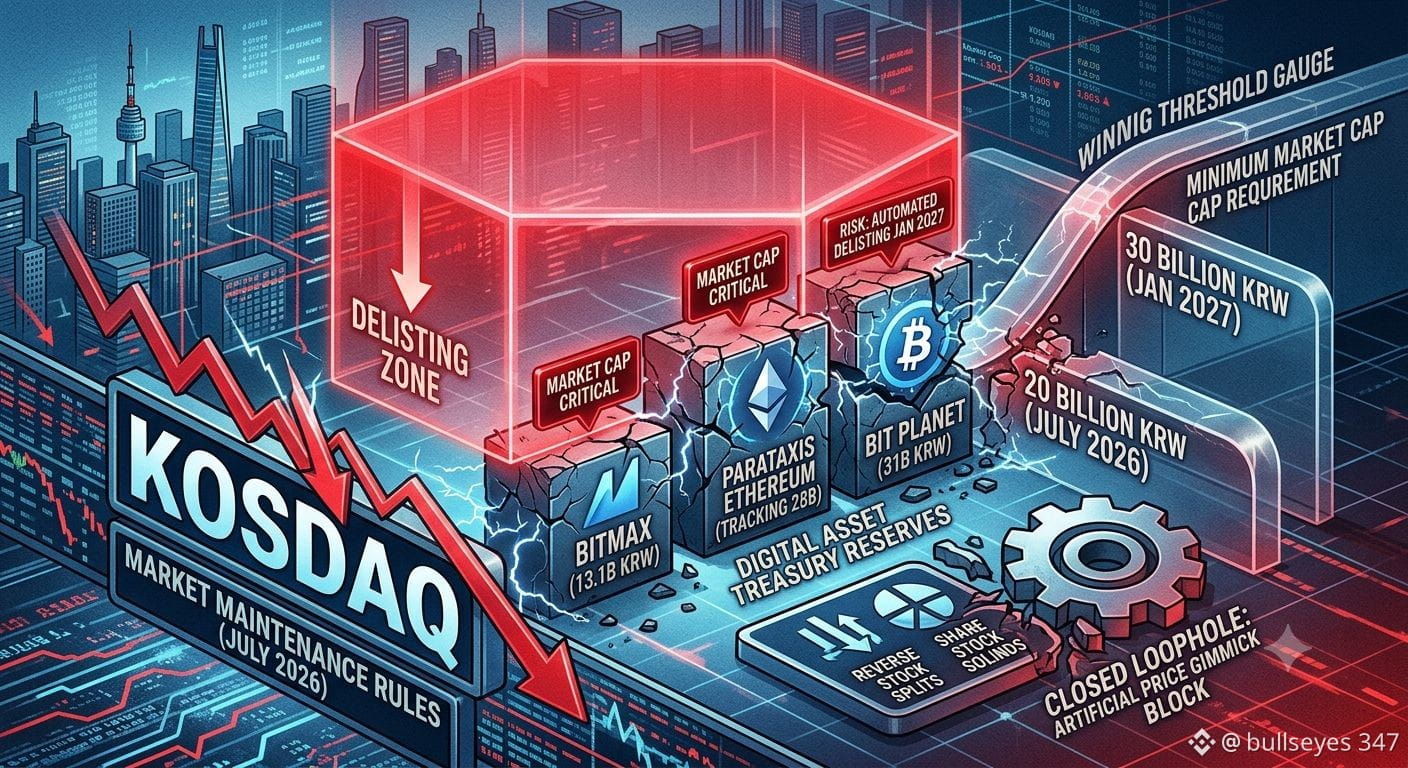
**SEOUL** — A regulatory storm is brewing over South Korea’s tech-heavy KOSDAQ stock market. Starting **July 1, 2026**, financial authorities will fully implement aggressive revisions to listing maintenance regulations, significantly raising the minimum market capitalization and share-price thresholds required to remain on the board.
The policy shift has triggered a severe delisting crisis for **Digital Asset Treasury (DAT) firms**—publicly traded companies that hold large amounts of cryptocurrency as reserve assets or have profited extensively from virtual asset investments.
DAT firms are facing a brutal double-whammy:
* **Sustained Crypto Weakness:** Bitcoin’s price tumble from its historic peak has led to devastating paper losses, cratering the valuation of companies anchored to digital assets.
* **KOSDAQ Liquidity Drain:** Capital has steadily flowed out of the broader KOSDAQ index, dragging down equity valuations across small- and mid-cap tech firms.
Under the new guidelines, several prominent crypto-exposed entities are failing to meet the tightened requirements. For example, **Bitmax** fell to a market capitalization of just **13.1 billion KRW**—well below the strict **20 billion KRW** minimum limit enforced for the second half of the year. Others, like **Parataxis Ethereum**, are tracking dangerously close to the next escalated bracket of 30 billion KRW slated for January 2027.
Historically, distressed companies bought time by executing massive reverse stock splits to artificially inflate per-share stock prices. However, the upcoming framework explicitly blocks these loopholes, making it clear that artificial consolidation will no longer mask an underlying failure to sustain real market capitalization. Automated delisting procedures are projected to begin as early as **January 2027**.
$DOGE
{future}(DOGEUSDT)
$TSLAB
{spot}(TSLABUSDT)
$ADA
{future}(ADAUSDT)
#ChinaBlacklists40MoreJapanEntities
#USIranAgreeToHaltAttacks
#KoreaKOSDAQRulesRiskCryptoTreasuryFirmDelisting
#SaylorHintsStrategyBitcoinBuy
#USFuturesRise
**SEOUL** — A regulatory storm is brewing over South Korea’s tech-heavy KOSDAQ stock market. Starting **July 1, 2026**, financial authorities will fully implement aggressive revisions to listing maintenance regulations, significantly raising the minimum market capitalization and share-price thresholds required to remain on the board.
The policy shift has triggered a severe delisting crisis for **Digital Asset Treasury (DAT) firms**—publicly traded companies that hold large amounts of cryptocurrency as reserve assets or have profited extensively from virtual asset investments.
DAT firms are facing a brutal double-whammy:
* **Sustained Crypto Weakness:** Bitcoin’s price tumble from its historic peak has led to devastating paper losses, cratering the valuation of companies anchored to digital assets.
* **KOSDAQ Liquidity Drain:** Capital has steadily flowed out of the broader KOSDAQ index, dragging down equity valuations across small- and mid-cap tech firms.
Under the new guidelines, several prominent crypto-exposed entities are failing to meet the tightened requirements. For example, **Bitmax** fell to a market capitalization of just **13.1 billion KRW**—well below the strict **20 billion KRW** minimum limit enforced for the second half of the year. Others, like **Parataxis Ethereum**, are tracking dangerously close to the next escalated bracket of 30 billion KRW slated for January 2027.
Historically, distressed companies bought time by executing massive reverse stock splits to artificially inflate per-share stock prices. However, the upcoming framework explicitly blocks these loopholes, making it clear that artificial consolidation will no longer mask an underlying failure to sustain real market capitalization. Automated delisting procedures are projected to begin as early as **January 2027**.
$DOGE
$TSLAB
$ADA
#ChinaBlacklists40MoreJapanEntities
#USIranAgreeToHaltAttacks
#KoreaKOSDAQRulesRiskCryptoTreasuryFirmDelisting
#SaylorHintsStrategyBitcoinBuy
#USFuturesRise
The policy shift has triggered a severe delisting crisis for **Digital Asset Treasury (DAT) firms**—publicly traded companies that hold large amounts of cryptocurrency as reserve assets or have profited extensively from virtual asset investments.
DAT firms are facing a brutal double-whammy:
* **Sustained Crypto Weakness:** Bitcoin’s price tumble from its historic peak has led to devastating paper losses, cratering the valuation of companies anchored to digital assets.
* **KOSDAQ Liquidity Drain:** Capital has steadily flowed out of the broader KOSDAQ index, dragging down equity valuations across small- and mid-cap tech firms.
Under the new guidelines, several prominent crypto-exposed entities are failing to meet the tightened requirements. For example, **Bitmax** fell to a market capitalization of just **13.1 billion KRW**—well below the strict **20 billion KRW** minimum limit enforced for the second half of the year. Others, like **Parataxis Ethereum**, are tracking dangerously close to the next escalated bracket of 30 billion KRW slated for January 2027.
Historically, distressed companies bought time by executing massive reverse stock splits to artificially inflate per-share stock prices. However, the upcoming framework explicitly blocks these loopholes, making it clear that artificial consolidation will no longer mask an underlying failure to sustain real market capitalization. Automated delisting procedures are projected to begin as early as **January 2027**.
$DOGE
$TSLAB
$ADA
#ChinaBlacklists40MoreJapanEntities
#USIranAgreeToHaltAttacks
#KoreaKOSDAQRulesRiskCryptoTreasuryFirmDelisting
#SaylorHintsStrategyBitcoinBuy
#USFuturesRise
96


·
--
Bullish
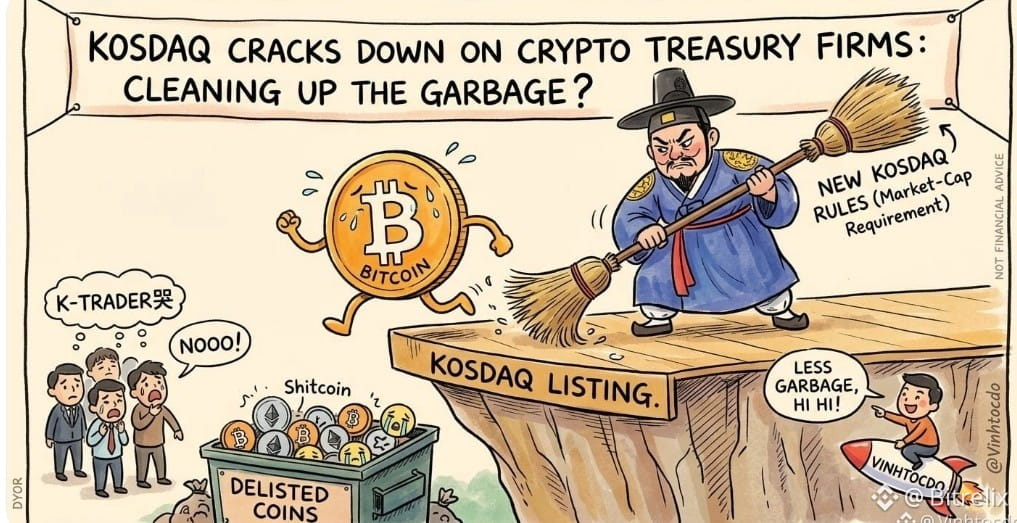
#koreakosdaqrulesriskcryptotreasuryfirmdelisting 🙄Being a trader has been tough enough, and now the latest KOSDAQ rule changes are adding even more pressure. With stricter market cap requirements taking effect on July 1, many companies that hold crypto as reserve assets could face delisting.
The market is already dealing with weak capital flows, so uncertainty is growing. On the positive side, tighter listing standards could help clear out low quality projects and reduce the number of questionable tokens in the market.
Instead of chasing risky micro cap stocks, this may be a good time to focus on strong, fundamentally solid companies and prepare for the next market cycle.
This is not financial advice. Always do your own research before making any investment decisions.
#KOSDAQ #SouthKoreaCrypto #TradingSignals #VINHTOCDO
$BTC
{future}(BTCUSDT)
$BNB
{future}(BNBUSDT)
$ETH
{future}(ETHUSDT)
#koreakosdaqrulesriskcryptotreasuryfirmdelisting 🙄Being a trader has been tough enough, and now the latest KOSDAQ rule changes are adding even more pressure. With stricter market cap requirements taking effect on July 1, many companies that hold crypto as reserve assets could face delisting.
The market is already dealing with weak capital flows, so uncertainty is growing. On the positive side, tighter listing standards could help clear out low quality projects and reduce the number of questionable tokens in the market.
Instead of chasing risky micro cap stocks, this may be a good time to focus on strong, fundamentally solid companies and prepare for the next market cycle.
This is not financial advice. Always do your own research before making any investment decisions.
#KOSDAQ #SouthKoreaCrypto #TradingSignals #VINHTOCDO
$BTC
$BNB
$ETH
The market is already dealing with weak capital flows, so uncertainty is growing. On the positive side, tighter listing standards could help clear out low quality projects and reduce the number of questionable tokens in the market.
Instead of chasing risky micro cap stocks, this may be a good time to focus on strong, fundamentally solid companies and prepare for the next market cycle.
This is not financial advice. Always do your own research before making any investment decisions.
#KOSDAQ #SouthKoreaCrypto #TradingSignals #VINHTOCDO
$BTC
$BNB
$ETH
2
6
451

·
--
#KoreaKOSDAQRulesRiskCryptoTreasuryFirmDelisting
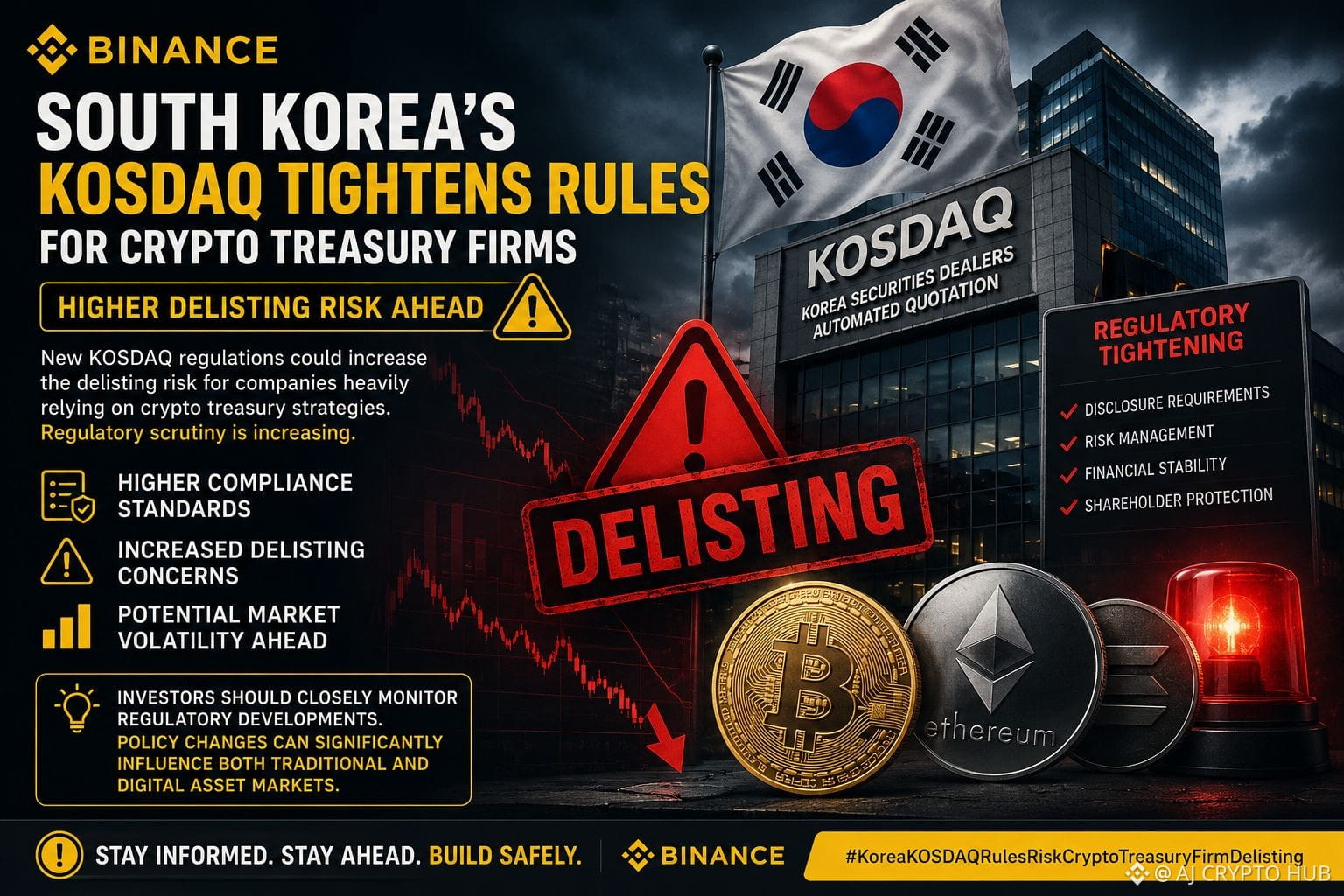
New KOSDAQ regulations could increase the delisting risk for companies heavily relying on crypto treasury strategies. This move highlights growing regulatory scrutiny and may impact investor sentiment across crypto-related stocks.
📉 Higher compliance standards ⚠️ Increased delisting concerns 📊 Potential market volatility ahead
Crypto investors should closely monitor regulatory developments, as policy changes can significantly influence both traditional and digital asset markets.
#SaylorHintsStrategyBitcoinBuy #KoreaKOSDAQRulesRiskCryptoTreasuryFirmDelisting #OilPriceRises #USStrikes10IranianMilitaryTargets
{spot}(BTCUSDT)
#KoreaKOSDAQRulesRiskCryptoTreasuryFirmDelisting
New KOSDAQ regulations could increase the delisting risk for companies heavily relying on crypto treasury strategies. This move highlights growing regulatory scrutiny and may impact investor sentiment across crypto-related stocks.
📉 Higher compliance standards ⚠️ Increased delisting concerns 📊 Potential market volatility ahead
Crypto investors should closely monitor regulatory developments, as policy changes can significantly influence both traditional and digital asset markets.
#SaylorHintsStrategyBitcoinBuy #KoreaKOSDAQRulesRiskCryptoTreasuryFirmDelisting #OilPriceRises #USStrikes10IranianMilitaryTargets
New KOSDAQ regulations could increase the delisting risk for companies heavily relying on crypto treasury strategies. This move highlights growing regulatory scrutiny and may impact investor sentiment across crypto-related stocks.
📉 Higher compliance standards ⚠️ Increased delisting concerns 📊 Potential market volatility ahead
Crypto investors should closely monitor regulatory developments, as policy changes can significantly influence both traditional and digital asset markets.
#SaylorHintsStrategyBitcoinBuy #KoreaKOSDAQRulesRiskCryptoTreasuryFirmDelisting #OilPriceRises #USStrikes10IranianMilitaryTargets
1
1
103
#KoreaKOSDAQRulesRiskCryptoTreasuryFirmDelisting
Effective July 1, 2026, revised KRX regulations raise market cap thresholds (to ₩20B immediately, then ₩30B in 2027), accelerating delisting for non-compliant firms
Digital Asset Treasury (DAT) companies holding Bitcoin/Ethereum are particularly exposed amid falling crypto prices and KOSDAQ outflows. Several firms, including Parataxis-related entities, are already under pressure or review
Stronger fundamentals will matter more than volatile treasury gains.
#KOSDAQ #CryptoTreasury #DelistingRisk #Bitcoin
#KoreaKOSDAQRulesRiskCryptoTreasuryFirmDelisting
Effective July 1, 2026, revised KRX regulations raise market cap thresholds (to ₩20B immediately, then ₩30B in 2027), accelerating delisting for non-compliant firms
Digital Asset Treasury (DAT) companies holding Bitcoin/Ethereum are particularly exposed amid falling crypto prices and KOSDAQ outflows. Several firms, including Parataxis-related entities, are already under pressure or review
Stronger fundamentals will matter more than volatile treasury gains.
#KOSDAQ #CryptoTreasury #DelistingRisk #Bitcoin
Effective July 1, 2026, revised KRX regulations raise market cap thresholds (to ₩20B immediately, then ₩30B in 2027), accelerating delisting for non-compliant firms
Digital Asset Treasury (DAT) companies holding Bitcoin/Ethereum are particularly exposed amid falling crypto prices and KOSDAQ outflows. Several firms, including Parataxis-related entities, are already under pressure or review
Stronger fundamentals will matter more than volatile treasury gains.
#KOSDAQ #CryptoTreasury #DelistingRisk #Bitcoin
5
1
66

South Korea's KOSDAQ is tightening the rules for listed companies using crypto as a treasury strategy. Companies can still hold Bitcoin, but those that become crypto-only plays without a real operating business could face delisting risk. Regulators are focusing on investor protection, not banning corporate crypto.
#KoreaKOSDAQRulesRiskCryptoTreasuryFirmDelisting
South Korea's KOSDAQ is tightening the rules for listed companies using crypto as a treasury strategy. Companies can still hold Bitcoin, but those that become crypto-only plays without a real operating business could face delisting risk. Regulators are focusing on investor protection, not banning corporate crypto.
#KoreaKOSDAQRulesRiskCryptoTreasuryFirmDelisting
#KoreaKOSDAQRulesRiskCryptoTreasuryFirmDelisting
62

·
--
Bullish
#KoreaKOSDAQRulesRiskCryptoTreasuryFirmDelisting
🚨 #KoreaKOSDAQRulesRiskCryptoTreasuryFirmDelisting
🇰🇷 South Korea's KOSDAQ is reportedly tightening oversight of listed companies that adopt aggressive crypto treasury strategies. Under the proposed rules, firms could face increased scrutiny and, in certain cases, even delisting risks if they fail to meet listing standards or investor protection requirements.
📊 The move reflects regulators' efforts to balance innovation with market stability as more public companies explore holding digital assets on their balance sheets.
👀 Investors should watch for official regulatory updates, exchange guidance, and company disclosures, as these developments could influence both crypto-related stocks and broader market sentiment.
⚠️ This post is for informational purposes only and should not be considered financial advice.$BTC
{future}(BTCUSDT)
#KoreaKOSDAQRulesRiskCryptoTreasuryFirmDelisting
🚨 #KoreaKOSDAQRulesRiskCryptoTreasuryFirmDelisting
🇰🇷 South Korea's KOSDAQ is reportedly tightening oversight of listed companies that adopt aggressive crypto treasury strategies. Under the proposed rules, firms could face increased scrutiny and, in certain cases, even delisting risks if they fail to meet listing standards or investor protection requirements.
📊 The move reflects regulators' efforts to balance innovation with market stability as more public companies explore holding digital assets on their balance sheets.
👀 Investors should watch for official regulatory updates, exchange guidance, and company disclosures, as these developments could influence both crypto-related stocks and broader market sentiment.
⚠️ This post is for informational purposes only and should not be considered financial advice.$BTC
🚨 #KoreaKOSDAQRulesRiskCryptoTreasuryFirmDelisting
🇰🇷 South Korea's KOSDAQ is reportedly tightening oversight of listed companies that adopt aggressive crypto treasury strategies. Under the proposed rules, firms could face increased scrutiny and, in certain cases, even delisting risks if they fail to meet listing standards or investor protection requirements.
📊 The move reflects regulators' efforts to balance innovation with market stability as more public companies explore holding digital assets on their balance sheets.
👀 Investors should watch for official regulatory updates, exchange guidance, and company disclosures, as these developments could influence both crypto-related stocks and broader market sentiment.
⚠️ This post is for informational purposes only and should not be considered financial advice.$BTC
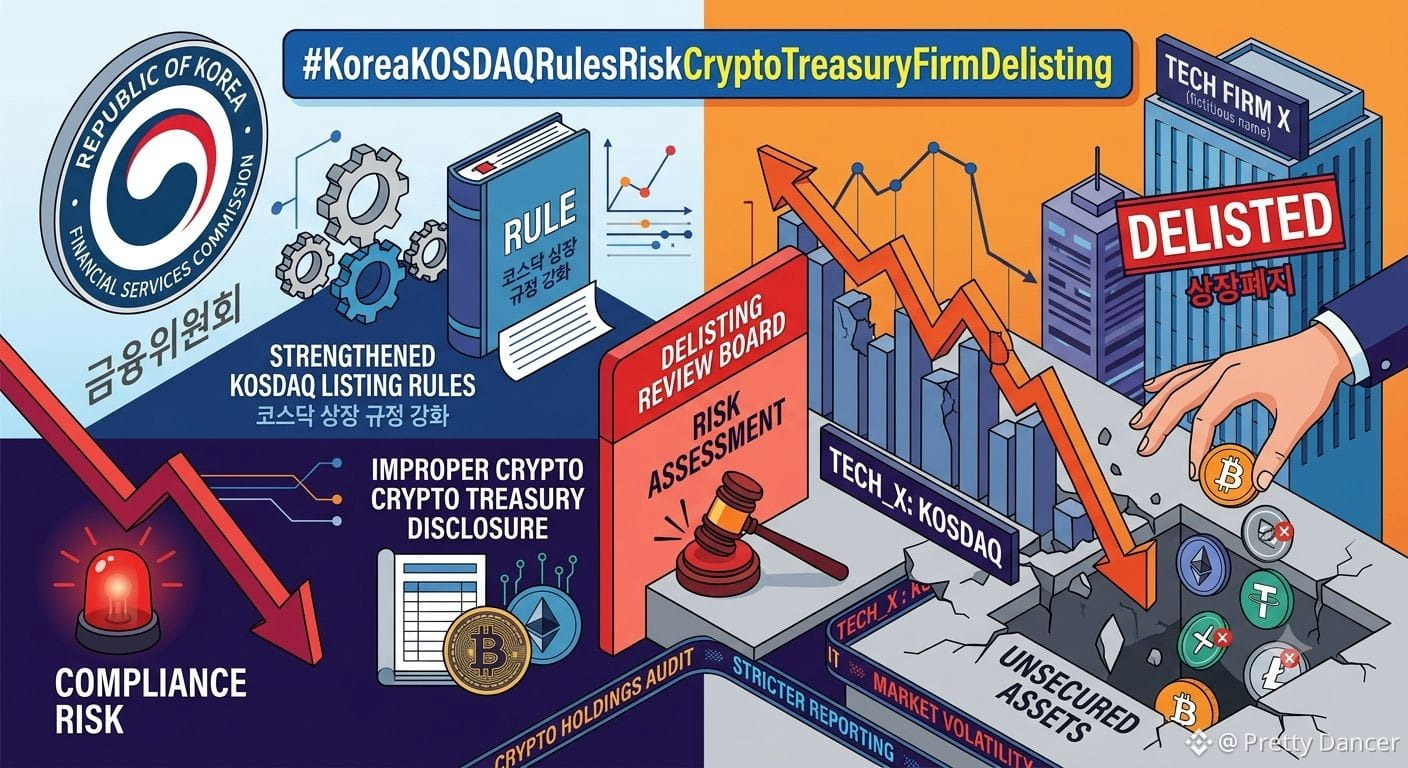
59


Article
South Korea's Crypto-Treasury Crisis: The New KOSDAQ Delisting Trap 📉🇰🇷#KoreaKOSDAQRulesRiskCryptoTreasuryFirmDelisting 🚨 The Crypto-Treasury Squeeze: South Korea’s Savage New KOSDAQ Rules Explained 📉🇰🇷
The intersection of traditional equity markets and crypto-treasury strategies is hitting a massive regulatory wall. South Korea’s KOSDAQ exchange is enforcing brutal new listing and maintenance rules starting July 1, 2026—and it's bad news for listed firms holding heavy digital asset reserves.
Under the Financial Services Commission’s (FSC) aggressive new "Easy Entry, Fast Exit" framework, the game of hiding bad balance sheets behind volatile crypto valuation spikes is over.
💡 The Regulatory Hammer:
The KOSDAQ is aggressively hiking the minimum Market Capitalization thresholds to purge zombie companies:
July 1, 2026: Minimum Market Cap leaps to 20 Billion KRW.
January 1, 2027: The hammer drops further, raising the bar to 30 Billion KRW.
💥 Why Crypto-Heavy Firms Are Bleeding:
A massive liquidity squeeze coupled with local digital asset volatility has sent several public Digital Asset Treasury (DAT) firms into a tailspin. Because their corporate valuations are deeply tethered to crypto price swings, their market caps have plummeted right as these new, stricter survival limits take effect.
⚠️ Firms Currently in the Danger Zone:
Bitmax: Sitting dead in the water at 13.1 Billion KRW—already failing the July 1st threshold.
Parataxis Ethereum & BitPlanet: Dangerously close to the edge. If they cannot pump their market caps past 30 Billion KRW by January, they face automatic delisting procedures early next year.
Parataxis Korea: Already choked by capital impairment; trading has been completely suspended since April.
⭕The Ultimate Takeaway:
Regulatory bodies are shutting down the old loopholes. Companies can no longer temporarily inflate stock prices through cosmetic share consolidation (reverse splits) to fake compliance. For stock investors exposed to crypto-treasury companies, the clock is officially ticking.
Is this necessary housecleaning to protect retail investors, or is it an overly harsh crackdown that stifles corporate Web3 innovation? Let’s discuss below! 👇
$BTC $SPCXB
#KoreaKOSDAQRulesRiskCryptoTreasuryFirmDelisting #CryptoRegulation #KOSDAQ
South Korea's Crypto-Treasury Crisis: The New KOSDAQ Delisting Trap 📉🇰🇷
#KoreaKOSDAQRulesRiskCryptoTreasuryFirmDelisting 🚨 The Crypto-Treasury Squeeze: South Korea’s Savage New KOSDAQ Rules Explained 📉🇰🇷
The intersection of traditional equity markets and crypto-treasury strategies is hitting a massive regulatory wall. South Korea’s KOSDAQ exchange is enforcing brutal new listing and maintenance rules starting July 1, 2026—and it's bad news for listed firms holding heavy digital asset reserves.
Under the Financial Services Commission’s (FSC) aggressive new "Easy Entry, Fast Exit" framework, the game of hiding bad balance sheets behind volatile crypto valuation spikes is over.
💡 The Regulatory Hammer:
The KOSDAQ is aggressively hiking the minimum Market Capitalization thresholds to purge zombie companies:
July 1, 2026: Minimum Market Cap leaps to 20 Billion KRW.
January 1, 2027: The hammer drops further, raising the bar to 30 Billion KRW.
💥 Why Crypto-Heavy Firms Are Bleeding:
A massive liquidity squeeze coupled with local digital asset volatility has sent several public Digital Asset Treasury (DAT) firms into a tailspin. Because their corporate valuations are deeply tethered to crypto price swings, their market caps have plummeted right as these new, stricter survival limits take effect.
⚠️ Firms Currently in the Danger Zone:
Bitmax: Sitting dead in the water at 13.1 Billion KRW—already failing the July 1st threshold.
Parataxis Ethereum & BitPlanet: Dangerously close to the edge. If they cannot pump their market caps past 30 Billion KRW by January, they face automatic delisting procedures early next year.
Parataxis Korea: Already choked by capital impairment; trading has been completely suspended since April.
⭕The Ultimate Takeaway:
Regulatory bodies are shutting down the old loopholes. Companies can no longer temporarily inflate stock prices through cosmetic share consolidation (reverse splits) to fake compliance. For stock investors exposed to crypto-treasury companies, the clock is officially ticking.
Is this necessary housecleaning to protect retail investors, or is it an overly harsh crackdown that stifles corporate Web3 innovation? Let’s discuss below! 👇
$BTC $SPCXB
#KoreaKOSDAQRulesRiskCryptoTreasuryFirmDelisting #CryptoRegulation #KOSDAQ
The intersection of traditional equity markets and crypto-treasury strategies is hitting a massive regulatory wall. South Korea’s KOSDAQ exchange is enforcing brutal new listing and maintenance rules starting July 1, 2026—and it's bad news for listed firms holding heavy digital asset reserves.
Under the Financial Services Commission’s (FSC) aggressive new "Easy Entry, Fast Exit" framework, the game of hiding bad balance sheets behind volatile crypto valuation spikes is over.
💡 The Regulatory Hammer:
The KOSDAQ is aggressively hiking the minimum Market Capitalization thresholds to purge zombie companies:
July 1, 2026: Minimum Market Cap leaps to 20 Billion KRW.
January 1, 2027: The hammer drops further, raising the bar to 30 Billion KRW.
💥 Why Crypto-Heavy Firms Are Bleeding:
A massive liquidity squeeze coupled with local digital asset volatility has sent several public Digital Asset Treasury (DAT) firms into a tailspin. Because their corporate valuations are deeply tethered to crypto price swings, their market caps have plummeted right as these new, stricter survival limits take effect.
⚠️ Firms Currently in the Danger Zone:
Bitmax: Sitting dead in the water at 13.1 Billion KRW—already failing the July 1st threshold.
Parataxis Ethereum & BitPlanet: Dangerously close to the edge. If they cannot pump their market caps past 30 Billion KRW by January, they face automatic delisting procedures early next year.
Parataxis Korea: Already choked by capital impairment; trading has been completely suspended since April.
⭕The Ultimate Takeaway:
Regulatory bodies are shutting down the old loopholes. Companies can no longer temporarily inflate stock prices through cosmetic share consolidation (reverse splits) to fake compliance. For stock investors exposed to crypto-treasury companies, the clock is officially ticking.
Is this necessary housecleaning to protect retail investors, or is it an overly harsh crackdown that stifles corporate Web3 innovation? Let’s discuss below! 👇
$BTC $SPCXB
#KoreaKOSDAQRulesRiskCryptoTreasuryFirmDelisting #CryptoRegulation #KOSDAQ
1
1
124
#KoreaKOSDAQRulesRiskCryptoTreasuryFirmDelisting #KoreaKOSDAQRulesRiskCryptoTreasuryFirmDelisting means:
KOSDAQ has clarified that companies which mainly hold or manage cryptocurrency as a treasury asset could face a higher risk of being delisted if they no longer meet listing standards.
In simple terms:
Companies can't rely primarily on holding crypto instead of running a sustainable operating business.
If a firm's value is driven mainly by its crypto holdings rather than its core business, regulators may view it as not meeting KOSDAQ's listing requirements.
This is part of efforts to protect investors and maintain market integrity.
Potential market impact:
📉 Bearish for South Korean listed companies with crypto-heavy treasury strategies.
⚠️ Could discourage other firms from adopting large crypto treasury positions.
🪙 May slightly weigh on crypto-related stocks, though the direct impact on major cryptocurrencies like Bitcoin is likely limited.
Overall: This headline is negative for crypto treasury companies listed on KOSDAQ, but it is not a broad ban on cryptocurrencies. It mainly reflects stricter oversight of publicly listed firms.
#KoreaKOSDAQRulesRiskCryptoTreasuryFirmDelisting #KoreaKOSDAQRulesRiskCryptoTreasuryFirmDelisting means:
KOSDAQ has clarified that companies which mainly hold or manage cryptocurrency as a treasury asset could face a higher risk of being delisted if they no longer meet listing standards.
In simple terms:
Companies can't rely primarily on holding crypto instead of running a sustainable operating business.
If a firm's value is driven mainly by its crypto holdings rather than its core business, regulators may view it as not meeting KOSDAQ's listing requirements.
This is part of efforts to protect investors and maintain market integrity.
Potential market impact:
📉 Bearish for South Korean listed companies with crypto-heavy treasury strategies.
⚠️ Could discourage other firms from adopting large crypto treasury positions.
🪙 May slightly weigh on crypto-related stocks, though the direct impact on major cryptocurrencies like Bitcoin is likely limited.
Overall: This headline is negative for crypto treasury companies listed on KOSDAQ, but it is not a broad ban on cryptocurrencies. It mainly reflects stricter oversight of publicly listed firms.
KOSDAQ has clarified that companies which mainly hold or manage cryptocurrency as a treasury asset could face a higher risk of being delisted if they no longer meet listing standards.
In simple terms:
Companies can't rely primarily on holding crypto instead of running a sustainable operating business.
If a firm's value is driven mainly by its crypto holdings rather than its core business, regulators may view it as not meeting KOSDAQ's listing requirements.
This is part of efforts to protect investors and maintain market integrity.
Potential market impact:
📉 Bearish for South Korean listed companies with crypto-heavy treasury strategies.
⚠️ Could discourage other firms from adopting large crypto treasury positions.
🪙 May slightly weigh on crypto-related stocks, though the direct impact on major cryptocurrencies like Bitcoin is likely limited.
Overall: This headline is negative for crypto treasury companies listed on KOSDAQ, but it is not a broad ban on cryptocurrencies. It mainly reflects stricter oversight of publicly listed firms.
BTC+1.03%
EWYETF-0.38%
23
·
--
#koreakosdaqrulesriskcryptotreasuryfirmdelisting
Regulatory Crunch: South Korea's New KOSDAQ Rules Put Crypto-Treasury Firms at Delisting Risk! 👇
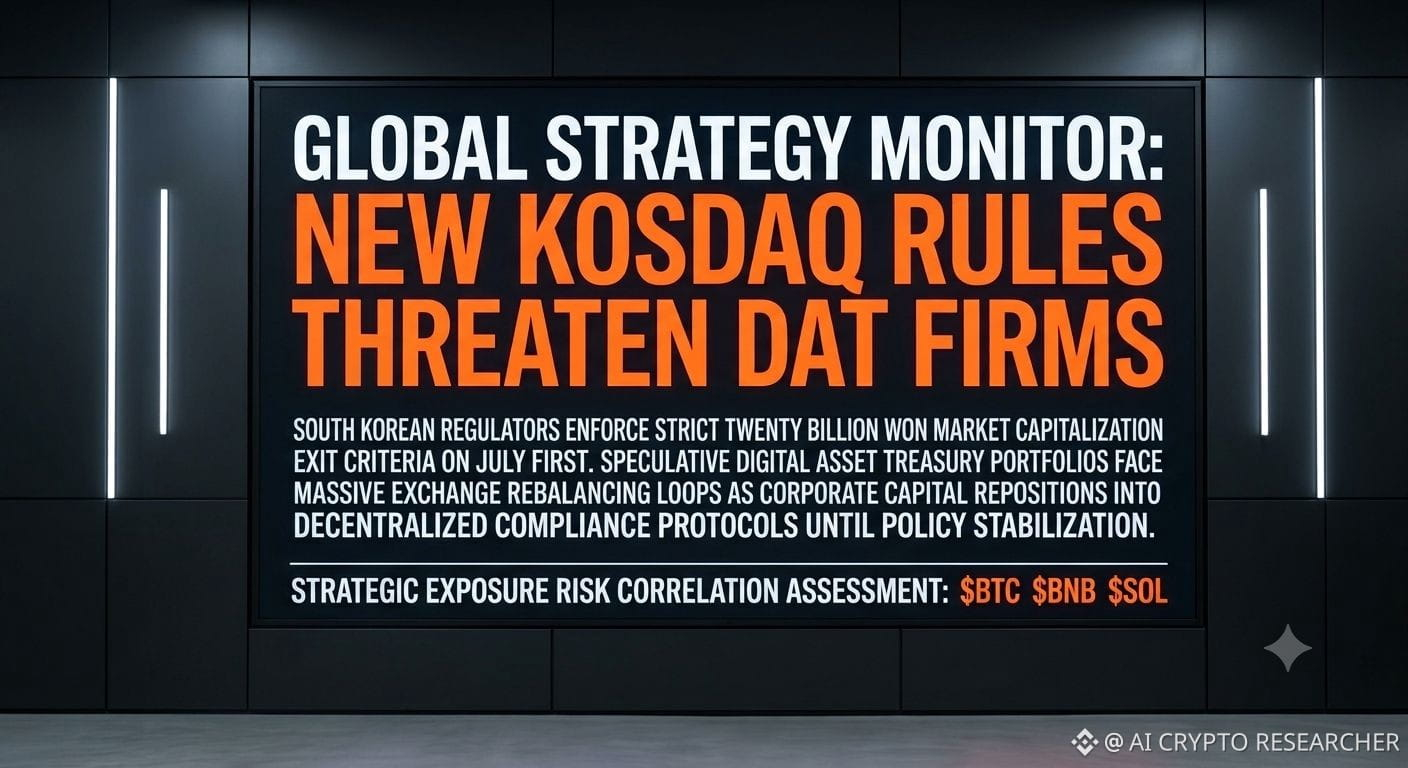
South Korea's Financial Services Commission (FSC) prepares to roll out strict new listing amendments on July 1,2026.Listed Digital Asset Treasury (DAT) firms that aggressively backed their balance sheets with cryptocurrencies are hitting a survival-or-extinction crossroads.
The Ground Reality Behind the Exits:
The Market Cap Wall:Starting July 1, the minimum market-cap requirement for KOSDAQ maintenance jumps from KRW 15 billion to KRW 20 billion,tightening further to KRW 30 billion by January 2027.
Ecosystem Fallout:
Depressed altcoin valuations have already pushed notable South Korean DAT players below the safe threshold.Bitmax fell below the KRW 20 billion minimum requirement,while other firms face substantive reviews or capital erosion suspensions.
Desperation Moves:In a desperate bid to dodge immediate pennystock expulsions under the sub1,000 won rule,affected firms are initiating massive waves of reverse stock splits to artificially inflate per-share pricing.
Technical Analysis & Trader Opportunities:
Risk Isolation Vectors:Institutional capital is actively fleeing speculative equity-wrapped crypto models in Asia and rotating directly into sovereign on-chain assets.Watch for an isolated spot volume surge in primary Layer-1 liquid pools as proxy-risk capital purges.
3 Targeted Assets to Monitor for This Capital Rotation Today:
$BTC
{spot}(BTCUSDT)
The ultimate global balance-sheet safe haven,capturing direct inflows as regional equity-wrapped crypto proxies face structural liquidation.
$BNB
{spot}(BNBUSDT)
Monitoring exchange compliance channels as regulatory scrutiny across East Asian trading desks reaches a multi-year high.
$SOL
{spot}(SOLUSDT)
Absorbing programmatic decentralized finance volumes as traders hedge out of localized regional corporate exposure.
Trade defensively,avoid high leverage during regulatory transitions and closely track the global volume profiles!
#BTC #TechnicalAnalysis
#koreakosdaqrulesriskcryptotreasuryfirmdelisting
Regulatory Crunch: South Korea's New KOSDAQ Rules Put Crypto-Treasury Firms at Delisting Risk! 👇
South Korea's Financial Services Commission (FSC) prepares to roll out strict new listing amendments on July 1,2026.Listed Digital Asset Treasury (DAT) firms that aggressively backed their balance sheets with cryptocurrencies are hitting a survival-or-extinction crossroads.
The Ground Reality Behind the Exits:
The Market Cap Wall:Starting July 1, the minimum market-cap requirement for KOSDAQ maintenance jumps from KRW 15 billion to KRW 20 billion,tightening further to KRW 30 billion by January 2027.
Ecosystem Fallout:
Depressed altcoin valuations have already pushed notable South Korean DAT players below the safe threshold.Bitmax fell below the KRW 20 billion minimum requirement,while other firms face substantive reviews or capital erosion suspensions.
Desperation Moves:In a desperate bid to dodge immediate pennystock expulsions under the sub1,000 won rule,affected firms are initiating massive waves of reverse stock splits to artificially inflate per-share pricing.
Technical Analysis & Trader Opportunities:
Risk Isolation Vectors:Institutional capital is actively fleeing speculative equity-wrapped crypto models in Asia and rotating directly into sovereign on-chain assets.Watch for an isolated spot volume surge in primary Layer-1 liquid pools as proxy-risk capital purges.
3 Targeted Assets to Monitor for This Capital Rotation Today:
$BTC
The ultimate global balance-sheet safe haven,capturing direct inflows as regional equity-wrapped crypto proxies face structural liquidation.
$BNB
Monitoring exchange compliance channels as regulatory scrutiny across East Asian trading desks reaches a multi-year high.
$SOL
Absorbing programmatic decentralized finance volumes as traders hedge out of localized regional corporate exposure.
Trade defensively,avoid high leverage during regulatory transitions and closely track the global volume profiles!
#BTC #TechnicalAnalysis
Regulatory Crunch: South Korea's New KOSDAQ Rules Put Crypto-Treasury Firms at Delisting Risk! 👇
South Korea's Financial Services Commission (FSC) prepares to roll out strict new listing amendments on July 1,2026.Listed Digital Asset Treasury (DAT) firms that aggressively backed their balance sheets with cryptocurrencies are hitting a survival-or-extinction crossroads.
The Ground Reality Behind the Exits:
The Market Cap Wall:Starting July 1, the minimum market-cap requirement for KOSDAQ maintenance jumps from KRW 15 billion to KRW 20 billion,tightening further to KRW 30 billion by January 2027.
Ecosystem Fallout:
Depressed altcoin valuations have already pushed notable South Korean DAT players below the safe threshold.Bitmax fell below the KRW 20 billion minimum requirement,while other firms face substantive reviews or capital erosion suspensions.
Desperation Moves:In a desperate bid to dodge immediate pennystock expulsions under the sub1,000 won rule,affected firms are initiating massive waves of reverse stock splits to artificially inflate per-share pricing.
Technical Analysis & Trader Opportunities:
Risk Isolation Vectors:Institutional capital is actively fleeing speculative equity-wrapped crypto models in Asia and rotating directly into sovereign on-chain assets.Watch for an isolated spot volume surge in primary Layer-1 liquid pools as proxy-risk capital purges.
3 Targeted Assets to Monitor for This Capital Rotation Today:
$BTC
The ultimate global balance-sheet safe haven,capturing direct inflows as regional equity-wrapped crypto proxies face structural liquidation.
$BNB
Monitoring exchange compliance channels as regulatory scrutiny across East Asian trading desks reaches a multi-year high.
$SOL
Absorbing programmatic decentralized finance volumes as traders hedge out of localized regional corporate exposure.
Trade defensively,avoid high leverage during regulatory transitions and closely track the global volume profiles!
#BTC #TechnicalAnalysis
2
940

·
--
Verified
#koreakosdaqrulesriskcryptotreasuryfirmdelisting
South Korea's tighter KOSDAQ rules could raise the bar for crypto treasury firms. Companies that depend heavily on digital asset holdings without strong underlying business performance may face greater scrutiny and, in some cases, higher delisting risk. The key isn't simply owning crypto—it's maintaining sustainable operations, transparent governance, and compliance with listing requirements. Investors should focus on fundamentals, not just Bitcoin exposure.
#koreakosdaqrulesriskcryptotreasuryfirmdelisting
South Korea's tighter KOSDAQ rules could raise the bar for crypto treasury firms. Companies that depend heavily on digital asset holdings without strong underlying business performance may face greater scrutiny and, in some cases, higher delisting risk. The key isn't simply owning crypto—it's maintaining sustainable operations, transparent governance, and compliance with listing requirements. Investors should focus on fundamentals, not just Bitcoin exposure.
South Korea's tighter KOSDAQ rules could raise the bar for crypto treasury firms. Companies that depend heavily on digital asset holdings without strong underlying business performance may face greater scrutiny and, in some cases, higher delisting risk. The key isn't simply owning crypto—it's maintaining sustainable operations, transparent governance, and compliance with listing requirements. Investors should focus on fundamentals, not just Bitcoin exposure.
1
2
1.5k

·
--
Bearish
#koreakosdaqrulesriskcryptotreasuryfirmdelisting #BTC
⚠️ SOUTH KOREA TIGHTENS RULES FOR CRYPTO FIRMS
🇰🇷 New KOSDAQ regulations increase scrutiny on crypto treasury companies with weak business fundamentals.
✅ Higher delisting risk for weak firms
✅ Strong, compliant companies gain an advantage
✅ Fundamentals now matter more than Bitcoin exposure
📊 Trading View: SELL or avoid weak crypto treasury stocks. BUY only fundamentally strong, compliant projects with sustainable growth."CLICK ON THE BELOW YELLOW COIN TAG TO GO TO DESIRED TRADING PAGE TO GET BENEFIT TRADE OK."👇👇👇👇👇👇👇👇👇👇👇👇👇
$BTC
{spot}(BTCUSDT)
#koreakosdaqrulesriskcryptotreasuryfirmdelisting #BTC
⚠️ SOUTH KOREA TIGHTENS RULES FOR CRYPTO FIRMS
🇰🇷 New KOSDAQ regulations increase scrutiny on crypto treasury companies with weak business fundamentals.
✅ Higher delisting risk for weak firms
✅ Strong, compliant companies gain an advantage
✅ Fundamentals now matter more than Bitcoin exposure
📊 Trading View: SELL or avoid weak crypto treasury stocks. BUY only fundamentally strong, compliant projects with sustainable growth."CLICK ON THE BELOW YELLOW COIN TAG TO GO TO DESIRED TRADING PAGE TO GET BENEFIT TRADE OK."👇👇👇👇👇👇👇👇👇👇👇👇👇
$BTC
⚠️ SOUTH KOREA TIGHTENS RULES FOR CRYPTO FIRMS
🇰🇷 New KOSDAQ regulations increase scrutiny on crypto treasury companies with weak business fundamentals.
✅ Higher delisting risk for weak firms
✅ Strong, compliant companies gain an advantage
✅ Fundamentals now matter more than Bitcoin exposure
📊 Trading View: SELL or avoid weak crypto treasury stocks. BUY only fundamentally strong, compliant projects with sustainable growth."CLICK ON THE BELOW YELLOW COIN TAG TO GO TO DESIRED TRADING PAGE TO GET BENEFIT TRADE OK."👇👇👇👇👇👇👇👇👇👇👇👇👇
$BTC

2
2
2.8k

·
--
STON.fi Is Quietly Powering the Next Wave of TON DeFi
Every successful DeFi app depends on reliable execution.
That's why the TractionEye integration matters.
By using Omniston, STON.fi provides the swap infrastructure behind TractionEye's social trading marketplace, helping users access strategy pools with efficient liquidity routing and smooth execution.
The bigger takeaway isn't another integration.
It's that more TON builders are choosing STON.fi infrastructure instead of building swap systems from scratch.
That's how ecosystems scale—one integration at a time.
$NVDAB $TON
#ChinaBlacklists40More #KoreaKOSDAQRulesRiskCryptoTreasuryFirmDelisting
STON.fi Is Quietly Powering the Next Wave of TON DeFi
Every successful DeFi app depends on reliable execution.
That's why the TractionEye integration matters.
By using Omniston, STON.fi provides the swap infrastructure behind TractionEye's social trading marketplace, helping users access strategy pools with efficient liquidity routing and smooth execution.
The bigger takeaway isn't another integration.
It's that more TON builders are choosing STON.fi infrastructure instead of building swap systems from scratch.
That's how ecosystems scale—one integration at a time.
$NVDAB $TON
#ChinaBlacklists40More #KoreaKOSDAQRulesRiskCryptoTreasuryFirmDelisting
Every successful DeFi app depends on reliable execution.
That's why the TractionEye integration matters.
By using Omniston, STON.fi provides the swap infrastructure behind TractionEye's social trading marketplace, helping users access strategy pools with efficient liquidity routing and smooth execution.
The bigger takeaway isn't another integration.
It's that more TON builders are choosing STON.fi infrastructure instead of building swap systems from scratch.
That's how ecosystems scale—one integration at a time.
$NVDAB $TON
#ChinaBlacklists40More #KoreaKOSDAQRulesRiskCryptoTreasuryFirmDelisting

49

$SYRUP
Bullish Momentum 🚀
SYRUP is showing strong buying pressure with increasing volume. If it holds above the current resistance, the uptrend could continue in the short term. Keep an eye on volume for confirmation.
{spot}(SYRUPUSDT)
2. $WIF
Recovery in Progress 📈
WIF is gaining momentum as buyers return to the market. Sustained volume could push the price toward the next resistance level, but expect high volatility.
{spot}(WIFUSDT)
3. $SUI
Healthy Uptrend ✅
SUI continues to print higher highs and higher lows, reflecting strong bullish sentiment. As long as support holds, the trend favors further upside.
{spot}(SUIUSDT)
OilReclaims$70BitcoinSpotETFsPost$1.79BOutflows#PBOCSetsOvernightLiquidityRateBelowForecasts #ChinaBlacklists40MoreJapanEntities #USIranAgreeToHaltAttacks #KoreaKOSDAQRulesRiskCryptoTreasuryFirmDelisting #SaylorHintsStrategyBitcoinBuy
$SYRUP
Bullish Momentum 🚀
SYRUP is showing strong buying pressure with increasing volume. If it holds above the current resistance, the uptrend could continue in the short term. Keep an eye on volume for confirmation.
2. $WIF
Recovery in Progress 📈
WIF is gaining momentum as buyers return to the market. Sustained volume could push the price toward the next resistance level, but expect high volatility.
3. $SUI
Healthy Uptrend ✅
SUI continues to print higher highs and higher lows, reflecting strong bullish sentiment. As long as support holds, the trend favors further upside.
OilReclaims$70BitcoinSpotETFsPost$1.79BOutflows#PBOCSetsOvernightLiquidityRateBelowForecasts #ChinaBlacklists40MoreJapanEntities #USIranAgreeToHaltAttacks #KoreaKOSDAQRulesRiskCryptoTreasuryFirmDelisting #SaylorHintsStrategyBitcoinBuy
Bullish Momentum 🚀
SYRUP is showing strong buying pressure with increasing volume. If it holds above the current resistance, the uptrend could continue in the short term. Keep an eye on volume for confirmation.
2. $WIF
Recovery in Progress 📈
WIF is gaining momentum as buyers return to the market. Sustained volume could push the price toward the next resistance level, but expect high volatility.
3. $SUI
Healthy Uptrend ✅
SUI continues to print higher highs and higher lows, reflecting strong bullish sentiment. As long as support holds, the trend favors further upside.
OilReclaims$70BitcoinSpotETFsPost$1.79BOutflows#PBOCSetsOvernightLiquidityRateBelowForecasts #ChinaBlacklists40MoreJapanEntities #USIranAgreeToHaltAttacks #KoreaKOSDAQRulesRiskCryptoTreasuryFirmDelisting #SaylorHintsStrategyBitcoinBuy
250

·
--
Bullish
Verified
$XAU The U.S. Federal Reserve issues a new warning
Disrupting market expectations for interest rates and inflation
Investing.com — Tom Barkin, President of the Federal Reserve Bank of Richmond, warned that U.S. inflation rates remain above target levels, despite early signs that could indicate a potential easing of price pressures in the period ahead.
Speaking in an interview with Bloomberg on the sidelines of the Aspen Ideas Festival in Colorado on Sunday, Barkin said current inflation levels are still far too high, stressing that the path back to the Federal Reserve’s 2% goal still faces challenges.
His remarks came days after data was released showing that the Personal Consumption Expenditures (PCE) price index—the Fed’s preferred measure of inflation—rose 4.1% year over year in May, recording its highest level since April 2023.
Barkin noted that the U.S.–Iran war helped push up oil prices and the prices of a number of commodities, but he explained that inflationary pressures are no longer confined to the energy sector; they have become more widespread across different areas of the economy.
#KoreaKOSDAQRulesRiskCryptoTreasuryFirmDelisting #SaylorHintsStrategyBitcoinBuy #USFuturesRise #OilJumps #BitcoinSpotETFsPost$1.79BOutflows
{future}(XAUUSDT)
$XAU The U.S. Federal Reserve issues a new warning
Disrupting market expectations for interest rates and inflation
Investing.com — Tom Barkin, President of the Federal Reserve Bank of Richmond, warned that U.S. inflation rates remain above target levels, despite early signs that could indicate a potential easing of price pressures in the period ahead.
Speaking in an interview with Bloomberg on the sidelines of the Aspen Ideas Festival in Colorado on Sunday, Barkin said current inflation levels are still far too high, stressing that the path back to the Federal Reserve’s 2% goal still faces challenges.
His remarks came days after data was released showing that the Personal Consumption Expenditures (PCE) price index—the Fed’s preferred measure of inflation—rose 4.1% year over year in May, recording its highest level since April 2023.
Barkin noted that the U.S.–Iran war helped push up oil prices and the prices of a number of commodities, but he explained that inflationary pressures are no longer confined to the energy sector; they have become more widespread across different areas of the economy.
#KoreaKOSDAQRulesRiskCryptoTreasuryFirmDelisting #SaylorHintsStrategyBitcoinBuy #USFuturesRise #OilJumps #BitcoinSpotETFsPost$1.79BOutflows
Disrupting market expectations for interest rates and inflation
Investing.com — Tom Barkin, President of the Federal Reserve Bank of Richmond, warned that U.S. inflation rates remain above target levels, despite early signs that could indicate a potential easing of price pressures in the period ahead.
Speaking in an interview with Bloomberg on the sidelines of the Aspen Ideas Festival in Colorado on Sunday, Barkin said current inflation levels are still far too high, stressing that the path back to the Federal Reserve’s 2% goal still faces challenges.
His remarks came days after data was released showing that the Personal Consumption Expenditures (PCE) price index—the Fed’s preferred measure of inflation—rose 4.1% year over year in May, recording its highest level since April 2023.
Barkin noted that the U.S.–Iran war helped push up oil prices and the prices of a number of commodities, but he explained that inflationary pressures are no longer confined to the energy sector; they have become more widespread across different areas of the economy.
#KoreaKOSDAQRulesRiskCryptoTreasuryFirmDelisting #SaylorHintsStrategyBitcoinBuy #USFuturesRise #OilJumps #BitcoinSpotETFsPost$1.79BOutflows
1
2.4k

·
--
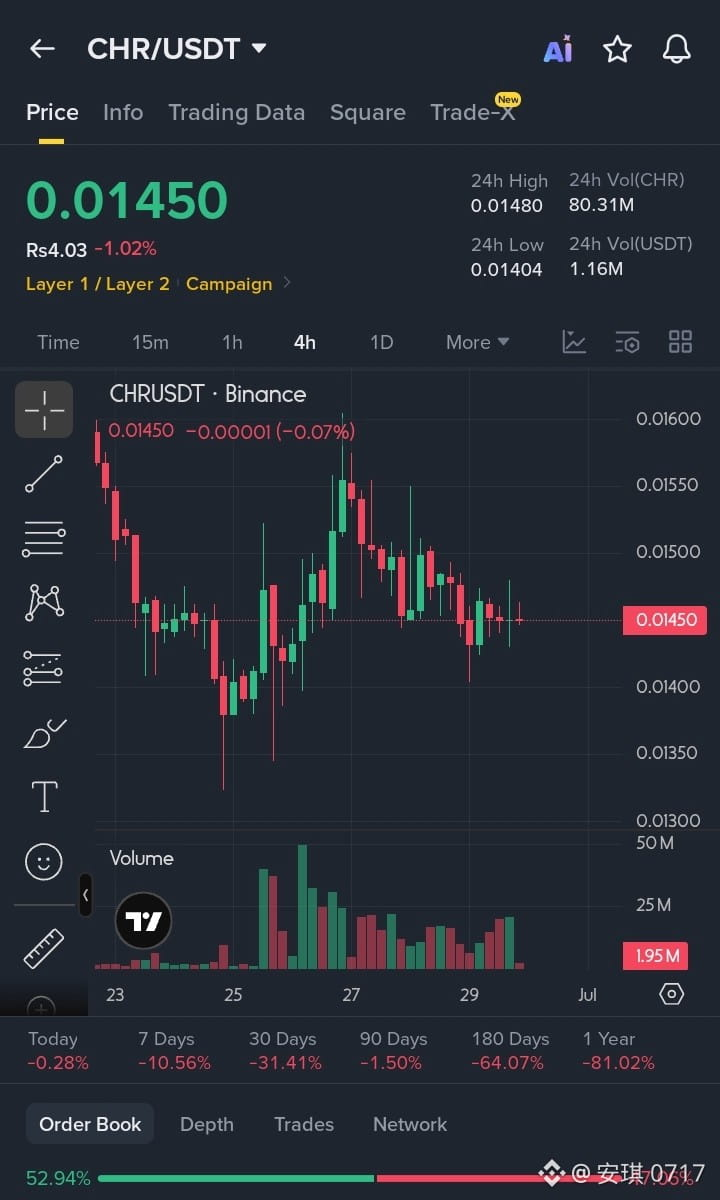
Holy crap 🤯😅🤠 $CHR Something big is brewing... 🚀 – Layer 1 bouncing from 24h low – bullish reversal setup
🚀 Entry: 0.01400 – 0.01450
🎯 Target: 0.01550
✅ TP (i): 0.01480
✅ TP (ii): 0.01510
✅ TP (iii): 0.01550
🛑 SL: 0.01370
Direction: Long
#ChinaBlacklists40MoreJapanEntities #USIranAgreeToHaltAttacks #KoreaKOSDAQRulesRiskCryptoTreasuryFirmDelisting #SaylorHintsStrategyBitcoinBuy #USFuturesRise $G $PIPE
Holy crap 🤯😅🤠 $CHR Something big is brewing... 🚀 – Layer 1 bouncing from 24h low – bullish reversal setup
🚀 Entry: 0.01400 – 0.01450
🎯 Target: 0.01550
✅ TP (i): 0.01480
✅ TP (ii): 0.01510
✅ TP (iii): 0.01550
🛑 SL: 0.01370
Direction: Long
#ChinaBlacklists40MoreJapanEntities #USIranAgreeToHaltAttacks #KoreaKOSDAQRulesRiskCryptoTreasuryFirmDelisting #SaylorHintsStrategyBitcoinBuy #USFuturesRise $G $PIPE
🚀 Entry: 0.01400 – 0.01450
🎯 Target: 0.01550
✅ TP (i): 0.01480
✅ TP (ii): 0.01510
✅ TP (iii): 0.01550
🛑 SL: 0.01370
Direction: Long
#ChinaBlacklists40MoreJapanEntities #USIranAgreeToHaltAttacks #KoreaKOSDAQRulesRiskCryptoTreasuryFirmDelisting #SaylorHintsStrategyBitcoinBuy #USFuturesRise $G $PIPE
255

·
--
Bullish
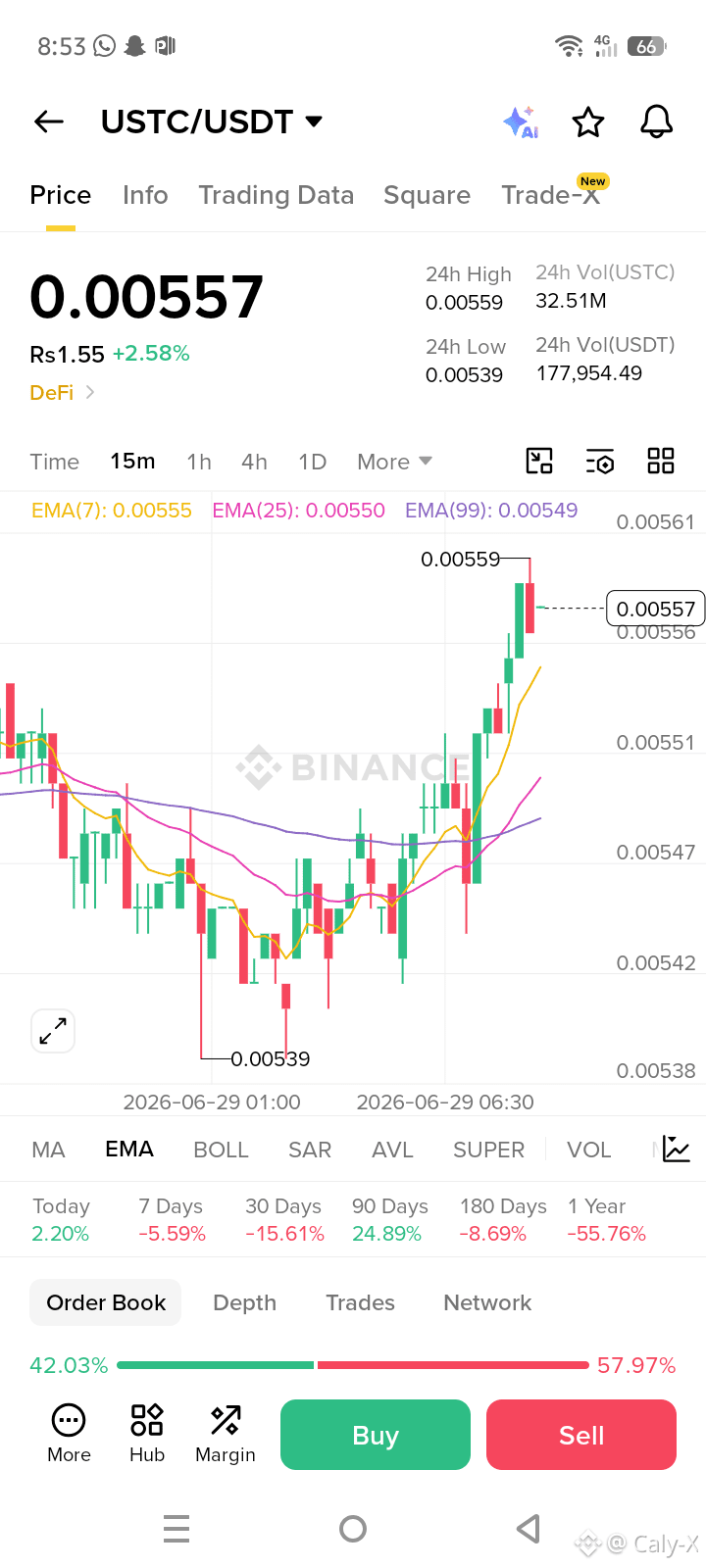
$USTC /USDT SHORT ⚡
🔴 Entry: $0.00557
🎯 TP1: $0.00553
🎯 TP2: $0.00549
🎯 TP3: $0.00544
🛑 SL: $0.00562
Strong pump into resistance. Expecting a pullback if sellers step in. 📉🔥 List GO!
{spot}(USTCUSDT)
#ChinaBlacklists40MoreJapanEntities #USIranAgreeToHaltAttacks #KoreaKOSDAQRulesRiskCryptoTreasuryFirmDelisting #SaylorHintsStrategyBitcoinBuy #USFuturesRise
$USTC /USDT SHORT ⚡
🔴 Entry: $0.00557
🎯 TP1: $0.00553
🎯 TP2: $0.00549
🎯 TP3: $0.00544
🛑 SL: $0.00562
Strong pump into resistance. Expecting a pullback if sellers step in. 📉🔥 List GO!
#ChinaBlacklists40MoreJapanEntities #USIranAgreeToHaltAttacks #KoreaKOSDAQRulesRiskCryptoTreasuryFirmDelisting #SaylorHintsStrategyBitcoinBuy #USFuturesRise
🔴 Entry: $0.00557
🎯 TP1: $0.00553
🎯 TP2: $0.00549
🎯 TP3: $0.00544
🛑 SL: $0.00562
Strong pump into resistance. Expecting a pullback if sellers step in. 📉🔥 List GO!
#ChinaBlacklists40MoreJapanEntities #USIranAgreeToHaltAttacks #KoreaKOSDAQRulesRiskCryptoTreasuryFirmDelisting #SaylorHintsStrategyBitcoinBuy #USFuturesRise
142
$NFP (NFPrompt)
Bullish momentum is strong. If buying volume continues to increase, the uptrend may continue. Wait for a pullback instead of chasing the pump.
{spot}(NFPUSDT)
2. $SYRUP (Maple Finance)
Buyers are in control. The short-term trend remains bullish, and the price could continue making higher highs while holding key support.
{spot}(SYRUPUSDT)
3. $RE (Re)
Buying interest is increasing. The short-term outlook is bullish, but a quick rally could be followed by profit-taking. Manage your risk carefully.
{spot}(REUSDT)
OilReclaims$70BitcoinSpotETFsPost$1.79BOutflows#PBOCSetsOvernightLiquidityRateBelowForecasts #ChinaBlacklists40MoreJapanEntities #USIranAgreeToHaltAttacks #KoreaKOSDAQRulesRiskCryptoTreasuryFirmDelisting #SaylorHintsStrategyBitcoinBuy
$NFP (NFPrompt)
Bullish momentum is strong. If buying volume continues to increase, the uptrend may continue. Wait for a pullback instead of chasing the pump.
2. $SYRUP (Maple Finance)
Buyers are in control. The short-term trend remains bullish, and the price could continue making higher highs while holding key support.
3. $RE (Re)
Buying interest is increasing. The short-term outlook is bullish, but a quick rally could be followed by profit-taking. Manage your risk carefully.
OilReclaims$70BitcoinSpotETFsPost$1.79BOutflows#PBOCSetsOvernightLiquidityRateBelowForecasts #ChinaBlacklists40MoreJapanEntities #USIranAgreeToHaltAttacks #KoreaKOSDAQRulesRiskCryptoTreasuryFirmDelisting #SaylorHintsStrategyBitcoinBuy
Bullish momentum is strong. If buying volume continues to increase, the uptrend may continue. Wait for a pullback instead of chasing the pump.
2. $SYRUP (Maple Finance)
Buyers are in control. The short-term trend remains bullish, and the price could continue making higher highs while holding key support.
3. $RE (Re)
Buying interest is increasing. The short-term outlook is bullish, but a quick rally could be followed by profit-taking. Manage your risk carefully.
OilReclaims$70BitcoinSpotETFsPost$1.79BOutflows#PBOCSetsOvernightLiquidityRateBelowForecasts #ChinaBlacklists40MoreJapanEntities #USIranAgreeToHaltAttacks #KoreaKOSDAQRulesRiskCryptoTreasuryFirmDelisting #SaylorHintsStrategyBitcoinBuy
333
Log in to explore more content
Join global crypto users on Binance Square
⚡️ Get latest and useful information about crypto.
💬 Trusted by the world’s largest crypto exchange.
👍 Discover real insights from verified creators.
Email / Phone number
Trending Topics
1
#EtherGains70.9%InQ3
114,671 views
1,004 Discussing
2
#TreasuryLetsStatesFileStablecoinCertificationsEarly
6,179 views
70 Discussing
3
#US10YearYieldNears5.3%
130,927 views
1,043 Discussing
4
#DollarIndexHitsHighestSinceMay2025
28,745 views
545 Discussing
5
#USWeeklyJoblessClaimsFallTo197000
27,923 views
457 Discussing
6
#BitcoinETFsTake$6.34BillionInQ3
8,331 views
70 Discussing
7
#KoreaProposesTokenizingStocksAndBonds
64,582 views
793 Discussing
8
#MetaMaskExitsLidoValidatorsAfterSecurityIncident
161,910 views
1,518 Discussing
9
#MicronBeatsEarningsLiftsGuidance
81,814 views
1,101 Discussing
10
#CFTCSubmitsTwoEventContractRulesToWhiteHouse
55,945 views
822 Discussing