
#kimi
kimi
1,710 views
68 Discussing
Hot
Latest
·
--
What moves people most about a community
is not how many nice things are said.
It is that you can feel
that someone is truly building it and caring for it.
That is the beginning of all long-term value.
The growth of Kimi Ai
comes from everyone who takes part in it.
Maybe it starts with voluntarily locking up tokens.
Maybe the seeds of success were already planted in a meeting room at 3 a.m.
#kimi ai
What moves people most about a community
is not how many nice things are said.
It is that you can feel
that someone is truly building it and caring for it.
That is the beginning of all long-term value.
The growth of Kimi Ai
comes from everyone who takes part in it.
Maybe it starts with voluntarily locking up tokens.
Maybe the seeds of success were already planted in a meeting room at 3 a.m.
#kimi ai
is not how many nice things are said.
It is that you can feel
that someone is truly building it and caring for it.
That is the beginning of all long-term value.
The growth of Kimi Ai
comes from everyone who takes part in it.
Maybe it starts with voluntarily locking up tokens.
Maybe the seeds of success were already planted in a meeting room at 3 a.m.
#kimi ai
133
·
--
$KIMI IPO RUMOR SHAKES THE AI SECTOR — THEN OFFICIALS SAY NOT TRUE ⚡
Headline-grabbing IPO rumors are rarely clean. A $3B Hong Kong filing from the Darkside of the Moon would have been a landmark event for the AI narrative — but the project just stepped in to kill the story. 📊
That denial matters more than the rumor itself. In absence of confirmation, markets trade the residual expectation: whether the AI funding wave finds another public listing vehicle. 🔍 Smart money treats these headline flips as volatility traps — prices spike on hope, then retrace on official word. 🌊
The key is watching how AI-linked assets digest this contradiction. ⚡ Are you fading the rumor or waiting for the real filing? 👇
⚠️ Not financial advice. Always manage your risk. 🛡️
🏷️ #KIMI #AI #IPO #CryptoNews #MarketStructure
🦈 💡
$KIMI IPO RUMOR SHAKES THE AI SECTOR — THEN OFFICIALS SAY NOT TRUE ⚡
Headline-grabbing IPO rumors are rarely clean. A $3B Hong Kong filing from the Darkside of the Moon would have been a landmark event for the AI narrative — but the project just stepped in to kill the story. 📊
That denial matters more than the rumor itself. In absence of confirmation, markets trade the residual expectation: whether the AI funding wave finds another public listing vehicle. 🔍 Smart money treats these headline flips as volatility traps — prices spike on hope, then retrace on official word. 🌊
The key is watching how AI-linked assets digest this contradiction. ⚡ Are you fading the rumor or waiting for the real filing? 👇
⚠️ Not financial advice. Always manage your risk. 🛡️
🏷️ #KIMI #AI #IPO #CryptoNews #MarketStructure
🦈 💡
Headline-grabbing IPO rumors are rarely clean. A $3B Hong Kong filing from the Darkside of the Moon would have been a landmark event for the AI narrative — but the project just stepped in to kill the story. 📊
That denial matters more than the rumor itself. In absence of confirmation, markets trade the residual expectation: whether the AI funding wave finds another public listing vehicle. 🔍 Smart money treats these headline flips as volatility traps — prices spike on hope, then retrace on official word. 🌊
The key is watching how AI-linked assets digest this contradiction. ⚡ Are you fading the rumor or waiting for the real filing? 👇
⚠️ Not financial advice. Always manage your risk. 🛡️
🏷️ #KIMI #AI #IPO #CryptoNews #MarketStructure
🦈 💡
6

🚨 $KIMI $3B HONG KONG IPO RUMOR HITS THE TAPE — FACT OR FICTION? 💥
The rumor mill just went into overdrive as Darkside of the Moon (Kimi) is reportedly prepping a Hong Kong IPO filing this month with a $3B raise on the table. But the project hit back fast, calling the report untrue. 🦈 That kind of headline whiplash creates serious two-way liquidity for anyone watching the AI narrative space.
Whether or not the filing ever lands, the reaction alone tells you the story: AI plays are commanding heavy flows, and every fresh headline moves the tape. 📊 This is a news-driven market, so the edge belongs to traders who respect uncertainty instead of chasing the loudest rumor. 💡
💬 When a high-profile denial hits a hot narrative, do you trade the volatility spike or wait for the official filing? 👇
⚠️ Not financial advice. Always manage your risk. 🛡️
🏷️ #KIMI #IPO #AI #MarketSentiment #CryptoNews
🎯 🦈
🚨 $KIMI $3B HONG KONG IPO RUMOR HITS THE TAPE — FACT OR FICTION? 💥
The rumor mill just went into overdrive as Darkside of the Moon (Kimi) is reportedly prepping a Hong Kong IPO filing this month with a $3B raise on the table. But the project hit back fast, calling the report untrue. 🦈 That kind of headline whiplash creates serious two-way liquidity for anyone watching the AI narrative space.
Whether or not the filing ever lands, the reaction alone tells you the story: AI plays are commanding heavy flows, and every fresh headline moves the tape. 📊 This is a news-driven market, so the edge belongs to traders who respect uncertainty instead of chasing the loudest rumor. 💡
💬 When a high-profile denial hits a hot narrative, do you trade the volatility spike or wait for the official filing? 👇
⚠️ Not financial advice. Always manage your risk. 🛡️
🏷️ #KIMI #IPO #AI #MarketSentiment #CryptoNews
🎯 🦈
The rumor mill just went into overdrive as Darkside of the Moon (Kimi) is reportedly prepping a Hong Kong IPO filing this month with a $3B raise on the table. But the project hit back fast, calling the report untrue. 🦈 That kind of headline whiplash creates serious two-way liquidity for anyone watching the AI narrative space.
Whether or not the filing ever lands, the reaction alone tells you the story: AI plays are commanding heavy flows, and every fresh headline moves the tape. 📊 This is a news-driven market, so the edge belongs to traders who respect uncertainty instead of chasing the loudest rumor. 💡
💬 When a high-profile denial hits a hot narrative, do you trade the volatility spike or wait for the official filing? 👇
⚠️ Not financial advice. Always manage your risk. 🛡️
🏷️ #KIMI #IPO #AI #MarketSentiment #CryptoNews
🎯 🦈
15

·
--
$KIMI K3 JUST BEAT ANTHROPIC'S OPUS IN AI BENCHMARKS 🔥
This benchmark data from an independent analyst shows the Kimi K3 model surpassing Anthropic's Opus 4.8, forcing U.S. labs to accelerate Opus 5 and GPT-6 releases. The gap between GPT-5.6 Sol and K3 is now negligible — meaning the next generation is coming sooner than expected.
When AI models leapfrog each other, the underlying narrative for AI-focused crypto projects strengthens. This kind of competitive pressure typically drives capital into the sector as anticipation builds. Are you positioned for the next wave?
Not financial advice. Always manage your risk.
#KIMI #AI #CryptoAI #Breakthrough #Narrative
🔥
$KIMI K3 JUST BEAT ANTHROPIC'S OPUS IN AI BENCHMARKS 🔥
This benchmark data from an independent analyst shows the Kimi K3 model surpassing Anthropic's Opus 4.8, forcing U.S. labs to accelerate Opus 5 and GPT-6 releases. The gap between GPT-5.6 Sol and K3 is now negligible — meaning the next generation is coming sooner than expected.
When AI models leapfrog each other, the underlying narrative for AI-focused crypto projects strengthens. This kind of competitive pressure typically drives capital into the sector as anticipation builds. Are you positioned for the next wave?
Not financial advice. Always manage your risk.
#KIMI #AI #CryptoAI #Breakthrough #Narrative
🔥
This benchmark data from an independent analyst shows the Kimi K3 model surpassing Anthropic's Opus 4.8, forcing U.S. labs to accelerate Opus 5 and GPT-6 releases. The gap between GPT-5.6 Sol and K3 is now negligible — meaning the next generation is coming sooner than expected.
When AI models leapfrog each other, the underlying narrative for AI-focused crypto projects strengthens. This kind of competitive pressure typically drives capital into the sector as anticipation builds. Are you positioned for the next wave?
Not financial advice. Always manage your risk.
#KIMI #AI #CryptoAI #Breakthrough #Narrative
🔥
273

·
--
Valuation of the Dark Side of the Moon: $5 billion — Repricing after Kimi K3’s success
News: The Dark Side of the Moon is pushing forward with the final round of financing before an IPO, targeting a pre-investment valuation of $5 billion.
Looking back at the controversial April piece, “100 Hours Undercover as a Kimi Insider”:
- No KPIs, no hierarchy, no attendance requirements
- Researchers can sleep in naturally, and meetings can last for hours
- The team constantly debates around the model, with resources absolutely tilted toward the model
At the time, it was questioned as a “well-packaged PR article.” But after the release of Kimi K3, these organizational details began to take on a new interpretation: for a Foundation Model company, putting R&D at the highest priority may really be the optimal solution.
What’s truly worth关注 isn’t the label of “no KPIs,” but how the entire organization operates around a single shared goal.
AI company valuations are not only about model capability, but also organizational efficiency.
#Kimi #月之暗面 #AI #中国AI
Valuation of the Dark Side of the Moon: $5 billion — Repricing after Kimi K3’s success
News: The Dark Side of the Moon is pushing forward with the final round of financing before an IPO, targeting a pre-investment valuation of $5 billion.
Looking back at the controversial April piece, “100 Hours Undercover as a Kimi Insider”:
- No KPIs, no hierarchy, no attendance requirements
- Researchers can sleep in naturally, and meetings can last for hours
- The team constantly debates around the model, with resources absolutely tilted toward the model
At the time, it was questioned as a “well-packaged PR article.” But after the release of Kimi K3, these organizational details began to take on a new interpretation: for a Foundation Model company, putting R&D at the highest priority may really be the optimal solution.
What’s truly worth关注 isn’t the label of “no KPIs,” but how the entire organization operates around a single shared goal.
AI company valuations are not only about model capability, but also organizational efficiency.
#Kimi #月之暗面 #AI #中国AI
News: The Dark Side of the Moon is pushing forward with the final round of financing before an IPO, targeting a pre-investment valuation of $5 billion.
Looking back at the controversial April piece, “100 Hours Undercover as a Kimi Insider”:
- No KPIs, no hierarchy, no attendance requirements
- Researchers can sleep in naturally, and meetings can last for hours
- The team constantly debates around the model, with resources absolutely tilted toward the model
At the time, it was questioned as a “well-packaged PR article.” But after the release of Kimi K3, these organizational details began to take on a new interpretation: for a Foundation Model company, putting R&D at the highest priority may really be the optimal solution.
What’s truly worth关注 isn’t the label of “no KPIs,” but how the entire organization operates around a single shared goal.
AI company valuations are not only about model capability, but also organizational efficiency.
#Kimi #月之暗面 #AI #中国AI
9

·
--
🚨 $KIMI SHRINKS 2.78T PARAMETERS INTO 8GB RAM — WITHOUT A GPU! 💥
🔍 This open-source experiment challenges every assumption about inference scaling. A 176KB pure C99 project runs Kimi K3's 1.56TB weight set on just 8GB of memory by streaming expert weights from NVMe storage on demand. 💡
The magic is MoE sparse activation — only 16 of 896 experts are active per layer. So the developer trades flash storage bandwidth for RAM, treating disk like a slow extension of memory. 📊 The tradeoff is brutal: one token every 32.7 seconds. That's not production-ready, but it's a structural blueprint for ultra-low-cost inference infrastructure.
The bigger signal is direction. 📉 As hardware bottlenecks force creative engineering, efficiency becomes the next narrative. Are we building the plumbing for the next wave of decentralized AI? 💬
⚠️ Not financial advice. Always manage your risk. 🛡️
🏷️ #KIMI #AI #MoE #OpenSource #Crypto
💡 🔥
🚨 $KIMI SHRINKS 2.78T PARAMETERS INTO 8GB RAM — WITHOUT A GPU! 💥
🔍 This open-source experiment challenges every assumption about inference scaling. A 176KB pure C99 project runs Kimi K3's 1.56TB weight set on just 8GB of memory by streaming expert weights from NVMe storage on demand. 💡
The magic is MoE sparse activation — only 16 of 896 experts are active per layer. So the developer trades flash storage bandwidth for RAM, treating disk like a slow extension of memory. 📊 The tradeoff is brutal: one token every 32.7 seconds. That's not production-ready, but it's a structural blueprint for ultra-low-cost inference infrastructure.
The bigger signal is direction. 📉 As hardware bottlenecks force creative engineering, efficiency becomes the next narrative. Are we building the plumbing for the next wave of decentralized AI? 💬
⚠️ Not financial advice. Always manage your risk. 🛡️
🏷️ #KIMI #AI #MoE #OpenSource #Crypto
💡 🔥
🔍 This open-source experiment challenges every assumption about inference scaling. A 176KB pure C99 project runs Kimi K3's 1.56TB weight set on just 8GB of memory by streaming expert weights from NVMe storage on demand. 💡
The magic is MoE sparse activation — only 16 of 896 experts are active per layer. So the developer trades flash storage bandwidth for RAM, treating disk like a slow extension of memory. 📊 The tradeoff is brutal: one token every 32.7 seconds. That's not production-ready, but it's a structural blueprint for ultra-low-cost inference infrastructure.
The bigger signal is direction. 📉 As hardware bottlenecks force creative engineering, efficiency becomes the next narrative. Are we building the plumbing for the next wave of decentralized AI? 💬
⚠️ Not financial advice. Always manage your risk. 🛡️
🏷️ #KIMI #AI #MoE #OpenSource #Crypto
💡 🔥
34

·
--
#kimi k3#
Moon’s Dark Side co-founder, will release open-source Kimi k3. Wow— the world’s number one large language model is going open-source. How does this not kill OpenAI and Claude Code’s closed-source offerings? $BABA
{future}(BABAUSDT)
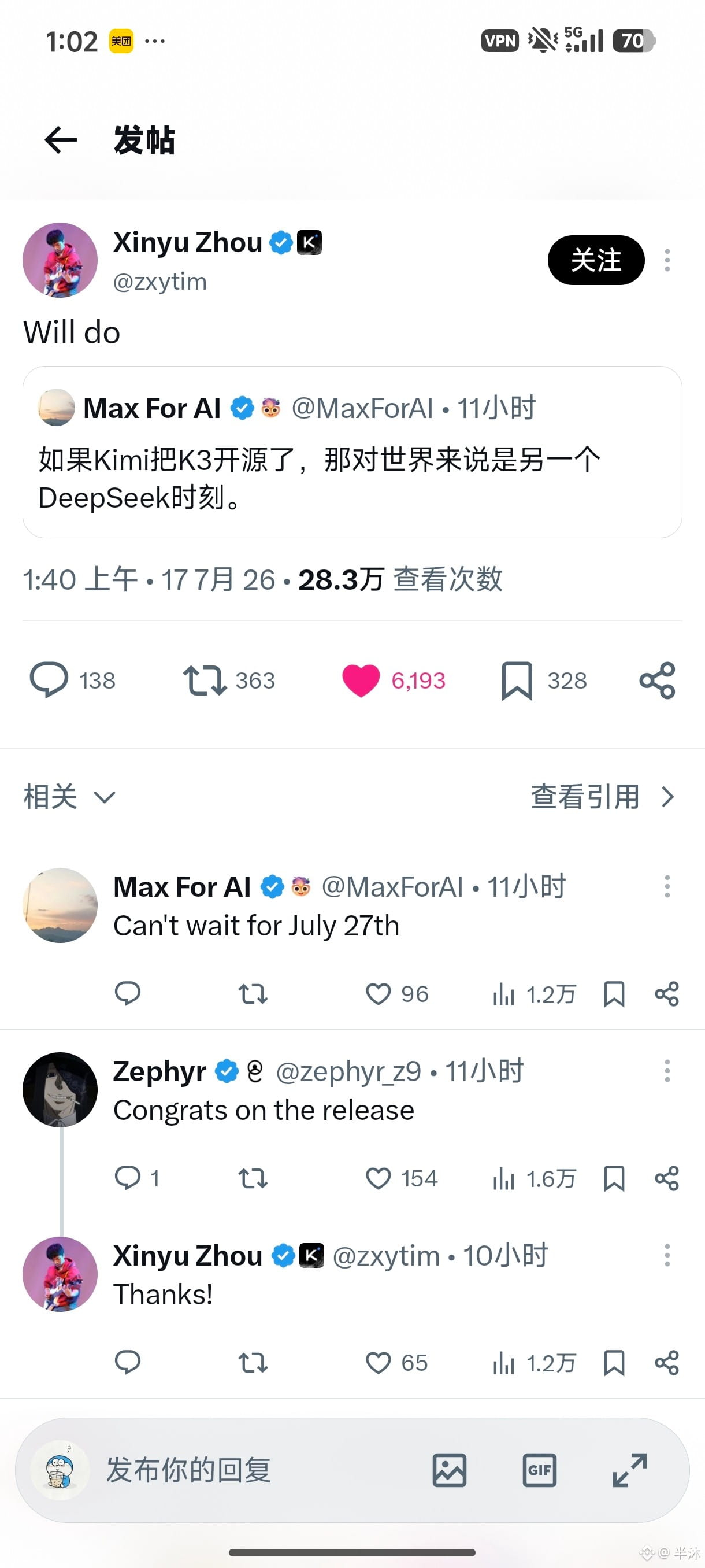
#kimi k3#
Moon’s Dark Side co-founder, will release open-source Kimi k3. Wow— the world’s number one large language model is going open-source. How does this not kill OpenAI and Claude Code’s closed-source offerings? $BABA
Moon’s Dark Side co-founder, will release open-source Kimi k3. Wow— the world’s number one large language model is going open-source. How does this not kill OpenAI and Claude Code’s closed-source offerings? $BABA
2
111
·
--
🚨 $KIMI RUMORED FOR $3B HONG KONG IPO — WILL SMART MONEY ROTATE INTO AI? 💥
📊 Moonshot AI — the team behind the Kimi assistant — is reportedly preparing its Hong Kong IPO filing as early as this month, with market chatter pointing to a $3B raise. 🔍 Until the company confirms, treat this as an intelligence event: institutional appetite assigning a valuation to frontier AI infrastructure.
💡 For the crypto tape, the follow-through signal is narrative spillover. When private-market heavyweights queue up for AI exposure, risk-on capital often rotates toward AI-linked digital assets ahead of official confirmation. ⏳ This is a catalyst watch, not a done deal.
💬 Could a confirmed filing pull fresh institutional flows into AI-narrative tokens before month-end? 👇
⚠️ Not financial advice. Always manage your risk. 🛡️
🏷️ #KIMI #IPO #AI #Crypto #InstitutionalFlow
🦈 💎
🚨 $KIMI RUMORED FOR $3B HONG KONG IPO — WILL SMART MONEY ROTATE INTO AI? 💥
📊 Moonshot AI — the team behind the Kimi assistant — is reportedly preparing its Hong Kong IPO filing as early as this month, with market chatter pointing to a $3B raise. 🔍 Until the company confirms, treat this as an intelligence event: institutional appetite assigning a valuation to frontier AI infrastructure.
💡 For the crypto tape, the follow-through signal is narrative spillover. When private-market heavyweights queue up for AI exposure, risk-on capital often rotates toward AI-linked digital assets ahead of official confirmation. ⏳ This is a catalyst watch, not a done deal.
💬 Could a confirmed filing pull fresh institutional flows into AI-narrative tokens before month-end? 👇
⚠️ Not financial advice. Always manage your risk. 🛡️
🏷️ #KIMI #IPO #AI #Crypto #InstitutionalFlow
🦈 💎
📊 Moonshot AI — the team behind the Kimi assistant — is reportedly preparing its Hong Kong IPO filing as early as this month, with market chatter pointing to a $3B raise. 🔍 Until the company confirms, treat this as an intelligence event: institutional appetite assigning a valuation to frontier AI infrastructure.
💡 For the crypto tape, the follow-through signal is narrative spillover. When private-market heavyweights queue up for AI exposure, risk-on capital often rotates toward AI-linked digital assets ahead of official confirmation. ⏳ This is a catalyst watch, not a done deal.
💬 Could a confirmed filing pull fresh institutional flows into AI-narrative tokens before month-end? 👇
⚠️ Not financial advice. Always manage your risk. 🛡️
🏷️ #KIMI #IPO #AI #Crypto #InstitutionalFlow
🦈 💎
3
$KIMI EYES $3B HONG KONG IPO — CRYPTO LIQUIDITY ON NOTICE 🦈 🌊
A $3 billion IPO is more than a milestone — it's a liquidity magnet. 🌊 When equity desks marshal that much dry powder, that capital has to come from somewhere, and speculative risk pools like crypto tend to feel the suction first.
💡 Smart money positions weeks ahead of filings like this. If Hong Kong's appetite for AI stories stays hot, expect rotation pressure on Asian crypto flows — watch stablecoin inflows and BTC dominance for the tell. 🔍
The listing is unconfirmed, but markets price anticipation long before the ink dries. 💬 Does a $3B equity draw drain crypto's bid, or does the AI halo lift every boat? 👇
⚠️ Not financial advice. Always manage your risk. 🛡️
🏷️ #KIMI #HongKongIPO #LiquidityFlow #AI #Crypto
🦈 💎
$KIMI EYES $3B HONG KONG IPO — CRYPTO LIQUIDITY ON NOTICE 🦈 🌊
A $3 billion IPO is more than a milestone — it's a liquidity magnet. 🌊 When equity desks marshal that much dry powder, that capital has to come from somewhere, and speculative risk pools like crypto tend to feel the suction first.
💡 Smart money positions weeks ahead of filings like this. If Hong Kong's appetite for AI stories stays hot, expect rotation pressure on Asian crypto flows — watch stablecoin inflows and BTC dominance for the tell. 🔍
The listing is unconfirmed, but markets price anticipation long before the ink dries. 💬 Does a $3B equity draw drain crypto's bid, or does the AI halo lift every boat? 👇
⚠️ Not financial advice. Always manage your risk. 🛡️
🏷️ #KIMI #HongKongIPO #LiquidityFlow #AI #Crypto
🦈 💎
A $3 billion IPO is more than a milestone — it's a liquidity magnet. 🌊 When equity desks marshal that much dry powder, that capital has to come from somewhere, and speculative risk pools like crypto tend to feel the suction first.
💡 Smart money positions weeks ahead of filings like this. If Hong Kong's appetite for AI stories stays hot, expect rotation pressure on Asian crypto flows — watch stablecoin inflows and BTC dominance for the tell. 🔍
The listing is unconfirmed, but markets price anticipation long before the ink dries. 💬 Does a $3B equity draw drain crypto's bid, or does the AI halo lift every boat? 👇
⚠️ Not financial advice. Always manage your risk. 🛡️
🏷️ #KIMI #HongKongIPO #LiquidityFlow #AI #Crypto
🦈 💎
11
·
--
Kimi K3 is a model from the “tough and doesn’t talk much” crowd. Not only is the front-end excellent, but to a certain extent its back-end performance also surpasses Fable5 and GPT-5.6 Sol.
Test result: Using GPT-5.6 Sol, find and fix 6 defects, then have Fable5 and Kimi K3 each conduct a review. Fable5 says “it’s ready to submit,” while Kimi K3 spots a serious PostgreSQL jsonb validation issue.
Regarding the controversy over Kimi Code’s harness—some say it isn’t done well, but the core logic is “a model company builds models.” As harness becomes less important, the model’s built-in capabilities are eating up the value of the harness.
This is actually the direction in which AI toolchains are evolving:
• harness is an add-on rules system; when the model’s ability is weak, it needs to make up the gap
• when the model itself becomes strong enough, harness shifts from being a “necessity” to a “constraint”
• Kimi’s built-in vertical capabilities—like its Tianyancha-style lookup—are more damaging than relying on a generic harness
China’s real-world AI model capabilities are narrowing the gap with, and in some scenarios even surpassing, Silicon Valley’s top players. Don’t just look at benchmark scores—look at the results of actual code reviews.
#AI #Kimi #大模型 #code review
Kimi K3 is a model from the “tough and doesn’t talk much” crowd. Not only is the front-end excellent, but to a certain extent its back-end performance also surpasses Fable5 and GPT-5.6 Sol.
Test result: Using GPT-5.6 Sol, find and fix 6 defects, then have Fable5 and Kimi K3 each conduct a review. Fable5 says “it’s ready to submit,” while Kimi K3 spots a serious PostgreSQL jsonb validation issue.
Regarding the controversy over Kimi Code’s harness—some say it isn’t done well, but the core logic is “a model company builds models.” As harness becomes less important, the model’s built-in capabilities are eating up the value of the harness.
This is actually the direction in which AI toolchains are evolving:
• harness is an add-on rules system; when the model’s ability is weak, it needs to make up the gap
• when the model itself becomes strong enough, harness shifts from being a “necessity” to a “constraint”
• Kimi’s built-in vertical capabilities—like its Tianyancha-style lookup—are more damaging than relying on a generic harness
China’s real-world AI model capabilities are narrowing the gap with, and in some scenarios even surpassing, Silicon Valley’s top players. Don’t just look at benchmark scores—look at the results of actual code reviews.
#AI #Kimi #大模型 #code review
Test result: Using GPT-5.6 Sol, find and fix 6 defects, then have Fable5 and Kimi K3 each conduct a review. Fable5 says “it’s ready to submit,” while Kimi K3 spots a serious PostgreSQL jsonb validation issue.
Regarding the controversy over Kimi Code’s harness—some say it isn’t done well, but the core logic is “a model company builds models.” As harness becomes less important, the model’s built-in capabilities are eating up the value of the harness.
This is actually the direction in which AI toolchains are evolving:
• harness is an add-on rules system; when the model’s ability is weak, it needs to make up the gap
• when the model itself becomes strong enough, harness shifts from being a “necessity” to a “constraint”
• Kimi’s built-in vertical capabilities—like its Tianyancha-style lookup—are more damaging than relying on a generic harness
China’s real-world AI model capabilities are narrowing the gap with, and in some scenarios even surpassing, Silicon Valley’s top players. Don’t just look at benchmark scores—look at the results of actual code reviews.
#AI #Kimi #大模型 #code review
48

$KIMI - LARGEST CHINESE AI MODEL LAUNCHES THIS WEEK 🔥
Entry: Not available 🔥
Target: Not available 🚀
Stop Loss: Not available ⚠️
The Dark Side of the Moon (Kimi) project is dropping Kimi K3 in the coming days — a 20-30 trillion parameter open-weight model that beats Opus 4.8 on mainstream benchmarks. This is the biggest AI model out of China and it's free to download.
Anthropic and OpenAI just got a serious wake-up call. The release is already creating buzz and I'm watching related AI tokens for volume shifts. Which AI projects are you tracking for the next move?
Not financial advice. Always manage your risk.
#KIMI #AI #Crypto #OpenWeight #AIModels
💎
$KIMI - LARGEST CHINESE AI MODEL LAUNCHES THIS WEEK 🔥
Entry: Not available 🔥
Target: Not available 🚀
Stop Loss: Not available ⚠️
The Dark Side of the Moon (Kimi) project is dropping Kimi K3 in the coming days — a 20-30 trillion parameter open-weight model that beats Opus 4.8 on mainstream benchmarks. This is the biggest AI model out of China and it's free to download.
Anthropic and OpenAI just got a serious wake-up call. The release is already creating buzz and I'm watching related AI tokens for volume shifts. Which AI projects are you tracking for the next move?
Not financial advice. Always manage your risk.
#KIMI #AI #Crypto #OpenWeight #AIModels
💎
Entry: Not available 🔥
Target: Not available 🚀
Stop Loss: Not available ⚠️
The Dark Side of the Moon (Kimi) project is dropping Kimi K3 in the coming days — a 20-30 trillion parameter open-weight model that beats Opus 4.8 on mainstream benchmarks. This is the biggest AI model out of China and it's free to download.
Anthropic and OpenAI just got a serious wake-up call. The release is already creating buzz and I'm watching related AI tokens for volume shifts. Which AI projects are you tracking for the next move?
Not financial advice. Always manage your risk.
#KIMI #AI #Crypto #OpenWeight #AIModels
💎
33
MOONSHOT AI DECLARES ALL THIRD-PARTY FINANCING FRAUD - $KIMI 🔥
The company has uncovered multiple schemes where institutions used its name to solicit fake financing deals. All capital raises are handled directly — no external advisors or pre-committed quotas. This isn't just a legal notice; it's a liquidity event for sentiment.
The statement explicitly denies ever providing proof-of-asset documents or locking quotas. Any claim of holding secured Moonshot shares is fraudulent. Are you verifying your deal sources before committing capital?
Not financial advice. Always manage your risk.
#KIMI #ScamAlert #FraudWarning #DueDiligence #Crypto
💎
MOONSHOT AI DECLARES ALL THIRD-PARTY FINANCING FRAUD - $KIMI 🔥
The company has uncovered multiple schemes where institutions used its name to solicit fake financing deals. All capital raises are handled directly — no external advisors or pre-committed quotas. This isn't just a legal notice; it's a liquidity event for sentiment.
The statement explicitly denies ever providing proof-of-asset documents or locking quotas. Any claim of holding secured Moonshot shares is fraudulent. Are you verifying your deal sources before committing capital?
Not financial advice. Always manage your risk.
#KIMI #ScamAlert #FraudWarning #DueDiligence #Crypto
💎
The company has uncovered multiple schemes where institutions used its name to solicit fake financing deals. All capital raises are handled directly — no external advisors or pre-committed quotas. This isn't just a legal notice; it's a liquidity event for sentiment.
The statement explicitly denies ever providing proof-of-asset documents or locking quotas. Any claim of holding secured Moonshot shares is fraudulent. Are you verifying your deal sources before committing capital?
Not financial advice. Always manage your risk.
#KIMI #ScamAlert #FraudWarning #DueDiligence #Crypto
💎
4
$KIMI ARR HITS $300M AND VALUATION DOUBLES TO $31.5B ❗
This is the kind of revenue acceleration that usually precedes a massive price discovery cycle. ARR crossing $300M in mid-June with 70% coming from API revenue shows real product-market fit — similar to what Anthropic looked like early on.
A $31.5B pre-money valuation says the smart money is betting on continued dominance in the AI space. Developer API calls are increasing, overseas paid users are growing, and the price system is shifting with model iterations. That's a recipe for sustained demand.
Do you think this signals a breakout for AI tokens, or is the valuation already baked in?
Not financial advice. Always manage your risk.
#KIMI #AI #Funding #Bullish #Crypto
🔥
$KIMI ARR HITS $300M AND VALUATION DOUBLES TO $31.5B ❗
This is the kind of revenue acceleration that usually precedes a massive price discovery cycle. ARR crossing $300M in mid-June with 70% coming from API revenue shows real product-market fit — similar to what Anthropic looked like early on.
A $31.5B pre-money valuation says the smart money is betting on continued dominance in the AI space. Developer API calls are increasing, overseas paid users are growing, and the price system is shifting with model iterations. That's a recipe for sustained demand.
Do you think this signals a breakout for AI tokens, or is the valuation already baked in?
Not financial advice. Always manage your risk.
#KIMI #AI #Funding #Bullish #Crypto
🔥
This is the kind of revenue acceleration that usually precedes a massive price discovery cycle. ARR crossing $300M in mid-June with 70% coming from API revenue shows real product-market fit — similar to what Anthropic looked like early on.
A $31.5B pre-money valuation says the smart money is betting on continued dominance in the AI space. Developer API calls are increasing, overseas paid users are growing, and the price system is shifting with model iterations. That's a recipe for sustained demand.
Do you think this signals a breakout for AI tokens, or is the valuation already baked in?
Not financial advice. Always manage your risk.
#KIMI #AI #Funding #Bullish #Crypto
🔥
35
·
--
Yáng Zhílín: Why didn’t he stay in the United States?
During his PhD at CMU, he interned at both Google Brain and Meta AI. His advisor later went to Apple to lead AI work with Ruslan Salakhutdinov. In 2023, he chose to return to China to start a business.
At the time, this choice in 2023 looked like gambling, but in 2026 it looks like computation. The U.S. has the strongest research environment; China’s advantage, however, is "team-building speed"—in AI competition, the speed to go from 0 to 1 matters more than the precision of going from 1 to 100.
Yang Zhílín’s return to China wasn’t abandoning U.S. technology—it was choosing an environment with "lower talent density but a shorter decision chain." Kimi K3’s 896-expert MoE and self-evolving kernel optimization don’t require more geniuses; they require an organization that can test and iterate quickly, and also shut down quickly when a path is wrong.
Choosing the battlefield is just as important as choosing the weapon.
#Kimi #杨植麟 #AI
Yáng Zhílín: Why didn’t he stay in the United States?
During his PhD at CMU, he interned at both Google Brain and Meta AI. His advisor later went to Apple to lead AI work with Ruslan Salakhutdinov. In 2023, he chose to return to China to start a business.
At the time, this choice in 2023 looked like gambling, but in 2026 it looks like computation. The U.S. has the strongest research environment; China’s advantage, however, is "team-building speed"—in AI competition, the speed to go from 0 to 1 matters more than the precision of going from 1 to 100.
Yang Zhílín’s return to China wasn’t abandoning U.S. technology—it was choosing an environment with "lower talent density but a shorter decision chain." Kimi K3’s 896-expert MoE and self-evolving kernel optimization don’t require more geniuses; they require an organization that can test and iterate quickly, and also shut down quickly when a path is wrong.
Choosing the battlefield is just as important as choosing the weapon.
#Kimi #杨植麟 #AI
During his PhD at CMU, he interned at both Google Brain and Meta AI. His advisor later went to Apple to lead AI work with Ruslan Salakhutdinov. In 2023, he chose to return to China to start a business.
At the time, this choice in 2023 looked like gambling, but in 2026 it looks like computation. The U.S. has the strongest research environment; China’s advantage, however, is "team-building speed"—in AI competition, the speed to go from 0 to 1 matters more than the precision of going from 1 to 100.
Yang Zhílín’s return to China wasn’t abandoning U.S. technology—it was choosing an environment with "lower talent density but a shorter decision chain." Kimi K3’s 896-expert MoE and self-evolving kernel optimization don’t require more geniuses; they require an organization that can test and iterate quickly, and also shut down quickly when a path is wrong.
Choosing the battlefield is just as important as choosing the weapon.
#Kimi #杨植麟 #AI
20
·
--
Day after day, one step at a time: Why can Kimi build K3? Yang Xinyu lists four sins among its peers
① Arrogance: Veteran teams believe the AI war is over and that they’ve already won.
② Impatience: Young labs lack solid fundamentals, and when they can’t keep up, they quickly pivot.
③ Cowardice: Their strength isn’t weak, but they’re afraid to set their sights on being #1 in the industry.
④ Misaligned goals: Everyone is fighting for personal credit, and no one truly cares whether the company can build AGI.
Yang Xinyu says what’s most different about the Dark Side of the Moon is that the founding team still has an intense drive to pursue AGI.
He also shared “Kimi’s Five Precepts”:
- Model companies should build models
- Do Research and publish papers through experiments
- When training models, look at metrics
- Don’t force it if it doesn’t work
- Don’t YOLO
In plain terms: tell fewer stories, do more experiments. Train by data, stop failing fast, and don’t rely on intuition to place big bets.
These four sins and five precepts are really about the same thing: most AI companies fail because they’re too eager to be “the boss,” not because they’re determined to “do the right work.” Kimi’s differentiation isn’t that it’s smarter—it’s that it’s more restrained.
#Kimi #K3 #AI
Day after day, one step at a time: Why can Kimi build K3? Yang Xinyu lists four sins among its peers
① Arrogance: Veteran teams believe the AI war is over and that they’ve already won.
② Impatience: Young labs lack solid fundamentals, and when they can’t keep up, they quickly pivot.
③ Cowardice: Their strength isn’t weak, but they’re afraid to set their sights on being #1 in the industry.
④ Misaligned goals: Everyone is fighting for personal credit, and no one truly cares whether the company can build AGI.
Yang Xinyu says what’s most different about the Dark Side of the Moon is that the founding team still has an intense drive to pursue AGI.
He also shared “Kimi’s Five Precepts”:
- Model companies should build models
- Do Research and publish papers through experiments
- When training models, look at metrics
- Don’t force it if it doesn’t work
- Don’t YOLO
In plain terms: tell fewer stories, do more experiments. Train by data, stop failing fast, and don’t rely on intuition to place big bets.
These four sins and five precepts are really about the same thing: most AI companies fail because they’re too eager to be “the boss,” not because they’re determined to “do the right work.” Kimi’s differentiation isn’t that it’s smarter—it’s that it’s more restrained.
#Kimi #K3 #AI
① Arrogance: Veteran teams believe the AI war is over and that they’ve already won.
② Impatience: Young labs lack solid fundamentals, and when they can’t keep up, they quickly pivot.
③ Cowardice: Their strength isn’t weak, but they’re afraid to set their sights on being #1 in the industry.
④ Misaligned goals: Everyone is fighting for personal credit, and no one truly cares whether the company can build AGI.
Yang Xinyu says what’s most different about the Dark Side of the Moon is that the founding team still has an intense drive to pursue AGI.
He also shared “Kimi’s Five Precepts”:
- Model companies should build models
- Do Research and publish papers through experiments
- When training models, look at metrics
- Don’t force it if it doesn’t work
- Don’t YOLO
In plain terms: tell fewer stories, do more experiments. Train by data, stop failing fast, and don’t rely on intuition to place big bets.
These four sins and five precepts are really about the same thing: most AI companies fail because they’re too eager to be “the boss,” not because they’re determined to “do the right work.” Kimi’s differentiation isn’t that it’s smarter—it’s that it’s more restrained.
#Kimi #K3 #AI
28

🚨 $KIMI AI UNICORN AT $50B – THE NEXT MEGA MOMENTUM PLAY? 💎
💡 The Dark Side of the Moon’s flagship model is reportedly in Pre-IPO talks at a $50B valuation. That’s not just hype – it’s smart money positioning for the next AI wave. 📊 When AI giants start bidding at these levels, early speculative tokens often lead the charge in crypto.
⚡ Volume is already whispering on decentralized order books. This isn’t a retail pump – it’s institutional scent. 💬 Are you front-running the AI narrative before the crowd wakes up, or waiting for confirmation? 👇
⚠️ Not financial advice. Always manage your risk. 🛡️
🏷️ #KIMI #AI #PreIPO #Momentum #Crypto
🔥 🦈
🚨 $KIMI AI UNICORN AT $50B – THE NEXT MEGA MOMENTUM PLAY? 💎
💡 The Dark Side of the Moon’s flagship model is reportedly in Pre-IPO talks at a $50B valuation. That’s not just hype – it’s smart money positioning for the next AI wave. 📊 When AI giants start bidding at these levels, early speculative tokens often lead the charge in crypto.
⚡ Volume is already whispering on decentralized order books. This isn’t a retail pump – it’s institutional scent. 💬 Are you front-running the AI narrative before the crowd wakes up, or waiting for confirmation? 👇
⚠️ Not financial advice. Always manage your risk. 🛡️
🏷️ #KIMI #AI #PreIPO #Momentum #Crypto
🔥 🦈
💡 The Dark Side of the Moon’s flagship model is reportedly in Pre-IPO talks at a $50B valuation. That’s not just hype – it’s smart money positioning for the next AI wave. 📊 When AI giants start bidding at these levels, early speculative tokens often lead the charge in crypto.
⚡ Volume is already whispering on decentralized order books. This isn’t a retail pump – it’s institutional scent. 💬 Are you front-running the AI narrative before the crowd wakes up, or waiting for confirmation? 👇
⚠️ Not financial advice. Always manage your risk. 🛡️
🏷️ #KIMI #AI #PreIPO #Momentum #Crypto
🔥 🦈
62
·
--
Kimi K3 went live and within 48 hours pushed the compute cluster to its limits, so individual memberships are now paused.
This isn’t a “product is too popular” kind of achievement announcement. It’s a real-time snapshot of an imbalance between AI compute supply and demand.
Behind Kimi, a large amount of GPU usage comes from Alibaba Cloud—and it also often grabs resources from the Qwen team. Alibaba Cloud grew over 40% last quarter. Even before the K3 launch, it was already a monster quarterly performer as the largest cloud service provider in the Asia-Pacific.
What does this mean?
1. Compute power is the hard bottleneck in the AI arms race; it can’t be solved by “slowly expanding capacity.”
2. Cloud providers’ GPU production capacity is being consumed down to the bone by large model companies.
3. In the future, an AI company’s moat may not be model capability, but its ability to supply compute.
Kimi also adjusted its membership system: the main product and Kimi Code benefits are sold separately. Translation: compute is no longer enough, so they’ve started to allocate it more precisely.
The AI industry’s hunger for compute is far from reaching its peak. Whoever controls compute supply will control the oil of the AI era.
#AI #算力 #Kimi #Alibaba Cloud
Kimi K3 went live and within 48 hours pushed the compute cluster to its limits, so individual memberships are now paused.
This isn’t a “product is too popular” kind of achievement announcement. It’s a real-time snapshot of an imbalance between AI compute supply and demand.
Behind Kimi, a large amount of GPU usage comes from Alibaba Cloud—and it also often grabs resources from the Qwen team. Alibaba Cloud grew over 40% last quarter. Even before the K3 launch, it was already a monster quarterly performer as the largest cloud service provider in the Asia-Pacific.
What does this mean?
1. Compute power is the hard bottleneck in the AI arms race; it can’t be solved by “slowly expanding capacity.”
2. Cloud providers’ GPU production capacity is being consumed down to the bone by large model companies.
3. In the future, an AI company’s moat may not be model capability, but its ability to supply compute.
Kimi also adjusted its membership system: the main product and Kimi Code benefits are sold separately. Translation: compute is no longer enough, so they’ve started to allocate it more precisely.
The AI industry’s hunger for compute is far from reaching its peak. Whoever controls compute supply will control the oil of the AI era.
#AI #算力 #Kimi #Alibaba Cloud
This isn’t a “product is too popular” kind of achievement announcement. It’s a real-time snapshot of an imbalance between AI compute supply and demand.
Behind Kimi, a large amount of GPU usage comes from Alibaba Cloud—and it also often grabs resources from the Qwen team. Alibaba Cloud grew over 40% last quarter. Even before the K3 launch, it was already a monster quarterly performer as the largest cloud service provider in the Asia-Pacific.
What does this mean?
1. Compute power is the hard bottleneck in the AI arms race; it can’t be solved by “slowly expanding capacity.”
2. Cloud providers’ GPU production capacity is being consumed down to the bone by large model companies.
3. In the future, an AI company’s moat may not be model capability, but its ability to supply compute.
Kimi also adjusted its membership system: the main product and Kimi Code benefits are sold separately. Translation: compute is no longer enough, so they’ve started to allocate it more precisely.
The AI industry’s hunger for compute is far from reaching its peak. Whoever controls compute supply will control the oil of the AI era.
#AI #算力 #Kimi #Alibaba Cloud
57
·
--
Howard Lutnick: Kimi K3 still lags behind the U.S.’s leading AI models.
The U.S.’s lead comes from “the world’s most outstanding innovators and technical experts.”
Translate this line: It’s not the chip export ban that makes you fall behind—it's the density of talent.
Liang Wenfeng uses a 10-month break-even pricing strategy to seize the market, but if the gap in underlying model capabilities continues to exist, you can’t win the price war on your moat. China’s AI bottleneck isn’t in pricing strategy—it’s in securing computing power and consolidating talent.
#AI #Kimi #China-U.S. science and technology
Howard Lutnick: Kimi K3 still lags behind the U.S.’s leading AI models.
The U.S.’s lead comes from “the world’s most outstanding innovators and technical experts.”
Translate this line: It’s not the chip export ban that makes you fall behind—it's the density of talent.
Liang Wenfeng uses a 10-month break-even pricing strategy to seize the market, but if the gap in underlying model capabilities continues to exist, you can’t win the price war on your moat. China’s AI bottleneck isn’t in pricing strategy—it’s in securing computing power and consolidating talent.
#AI #Kimi #China-U.S. science and technology
The U.S.’s lead comes from “the world’s most outstanding innovators and technical experts.”
Translate this line: It’s not the chip export ban that makes you fall behind—it's the density of talent.
Liang Wenfeng uses a 10-month break-even pricing strategy to seize the market, but if the gap in underlying model capabilities continues to exist, you can’t win the price war on your moat. China’s AI bottleneck isn’t in pricing strategy—it’s in securing computing power and consolidating talent.
#AI #Kimi #China-U.S. science and technology
15
·
--
$KIMI OPENS WEIGHTS ON JULY 27 — 2.8T PARAMETER MODEL TESTS LIQUIDITY ZONE 📉
Entry: (not provided)
Target: (not provided)
Stop Loss: (not provided)
Moonshot AI unveiled Kimi K3 with 2.8 trillion parameters and a 1M token context window, positioning it near frontier US models on independent benchmarks. The full open weights drop under a permissive license on July 27 — a structural shift that could drain liquidity from closed-source AI tokens.
Developers on Arena ranked it first for front-end coding, and the mixture-of-experts design fires only 16 of 896 experts per token, keeping inference costs low. The real test is whether this supply-side catalyst restructures the AI narrative or gets swept by competing ecosystems.
Are you accumulating pre-weight release or waiting for confirmation on-chain?
Not financial advice. Always manage your risk.
#KIMI #AI #OpenSource #Crypto
🔥
$KIMI OPENS WEIGHTS ON JULY 27 — 2.8T PARAMETER MODEL TESTS LIQUIDITY ZONE 📉
Entry: (not provided)
Target: (not provided)
Stop Loss: (not provided)
Moonshot AI unveiled Kimi K3 with 2.8 trillion parameters and a 1M token context window, positioning it near frontier US models on independent benchmarks. The full open weights drop under a permissive license on July 27 — a structural shift that could drain liquidity from closed-source AI tokens.
Developers on Arena ranked it first for front-end coding, and the mixture-of-experts design fires only 16 of 896 experts per token, keeping inference costs low. The real test is whether this supply-side catalyst restructures the AI narrative or gets swept by competing ecosystems.
Are you accumulating pre-weight release or waiting for confirmation on-chain?
Not financial advice. Always manage your risk.
#KIMI #AI #OpenSource #Crypto
🔥
Entry: (not provided)
Target: (not provided)
Stop Loss: (not provided)
Moonshot AI unveiled Kimi K3 with 2.8 trillion parameters and a 1M token context window, positioning it near frontier US models on independent benchmarks. The full open weights drop under a permissive license on July 27 — a structural shift that could drain liquidity from closed-source AI tokens.
Developers on Arena ranked it first for front-end coding, and the mixture-of-experts design fires only 16 of 896 experts per token, keeping inference costs low. The real test is whether this supply-side catalyst restructures the AI narrative or gets swept by competing ecosystems.
Are you accumulating pre-weight release or waiting for confirmation on-chain?
Not financial advice. Always manage your risk.
#KIMI #AI #OpenSource #Crypto
🔥
14
$KIMI DEMAND EXPLODES: GPU CAPACITY REACHED LIMIT IN 48 HOURS 🚨
Moonshot AI paused new Kimi K3 subscriptions after a massive demand surge pushed GPU capacity to the limit within 48 hours. The 2.8 trillion-parameter model with a 1 million-token context window saw unprecedented interest right after its launch on Jul 16.
Existing subscriptions remain active while Moonshot directs all computing power to current members. The company plans to reopen access in batches with no confirmed timeline. This kind of operational bottleneck often signals real user adoption rather than hype.
Is this a signal that AI infrastructure demand is outpacing supply at record speed?
Not financial advice. Always manage your risk.
#KIMI #AI #GPU #DemandSurge #Crypto
🔥
$KIMI DEMAND EXPLODES: GPU CAPACITY REACHED LIMIT IN 48 HOURS 🚨
Moonshot AI paused new Kimi K3 subscriptions after a massive demand surge pushed GPU capacity to the limit within 48 hours. The 2.8 trillion-parameter model with a 1 million-token context window saw unprecedented interest right after its launch on Jul 16.
Existing subscriptions remain active while Moonshot directs all computing power to current members. The company plans to reopen access in batches with no confirmed timeline. This kind of operational bottleneck often signals real user adoption rather than hype.
Is this a signal that AI infrastructure demand is outpacing supply at record speed?
Not financial advice. Always manage your risk.
#KIMI #AI #GPU #DemandSurge #Crypto
🔥
Moonshot AI paused new Kimi K3 subscriptions after a massive demand surge pushed GPU capacity to the limit within 48 hours. The 2.8 trillion-parameter model with a 1 million-token context window saw unprecedented interest right after its launch on Jul 16.
Existing subscriptions remain active while Moonshot directs all computing power to current members. The company plans to reopen access in batches with no confirmed timeline. This kind of operational bottleneck often signals real user adoption rather than hype.
Is this a signal that AI infrastructure demand is outpacing supply at record speed?
Not financial advice. Always manage your risk.
#KIMI #AI #GPU #DemandSurge #Crypto
🔥
29
Log in to explore more content
Join global crypto users on Binance Square
⚡️ Get latest and useful information about crypto.
💬 Trusted by the world’s largest crypto exchange.
👍 Discover real insights from verified creators.
Email / Phone number
Trending Topics
1
#AIStocksWhatNext
1.1M views
7,347 Discussing
2
#USWeighsPromotingDollarStablecoinsAbroad
7 views
5 Discussing
3
#US10YTreasuryYieldHits19YearHigh
311 views
35 Discussing
4
#SpotBitcoinETFsInflow$2.31BInFourDays
103 views
13 Discussing
5
#BitcoinRejectedAt$87,300Twice
0 views
0 Discussing
6
#BCHJumps28%OnCMEFuturesListing
36,135 views
804 Discussing
7
#WallStreetEarningsRevisionsTurnBearish
25,876 views
587 Discussing
8
#DollarIndexReclaims101
21,556 views
515 Discussing
9
#21SharesLaunchesEuropesFirstZcashETP
64,261 views
1,280 Discussing
10
#CardanoJoinsX402PaymentStandard
39,682 views
904 Discussing