

#etfbitcoin
etfbitcoin
1.2M views
742 Discussing
Hot
Latest

·
--
On the same day, Bitcoin ETFs were still seeing buying while Ethereum ETFs were being abandoned—and the gap is widening.
The facts: U.S. spot Bitcoin ETFs recorded net inflows of $17.07 million on Oct. 29 (U.S. time), their fourth consecutive day of inflows (SoSoValue data via PANews & KuCoin, Oct. 30). BlackRock IBIT +$12.8 million, Fidelity FBTC +$10.53 million, and Bitwise BITB +$8.76 million—offset by outflows from Grayscale Mini (-$15.35 million) and WisdomTree (-$3.84 million). In contrast, spot Ethereum ETFs saw $105.5 million in outflows on the same day, their fourth consecutive day of outflows as well: BlackRock ETHA -$71.7 million, ETHB staking -$15.6 million, Grayscale ETHE -$15.54 million, with only Fidelity FETH seeing inflows (+$2.9 million). Total ETH outflows for October reached $1.45 billion—the largest monthly outflow on record.
My take: This is a divergence, not a mass exodus from crypto. Institutions are still distinguishing between BTC and ETH: they have enough confidence in BTC to keep buying, even though the amount is down from $137 million the previous day—momentum is weakening. ETH, by contrast, has been abandoned throughout October, and this monthly record confirms that the pressure is structural, not just one bad day. Important note: These flows are from the Oct. 29 session, before the full-blown panic following the Binance hack—so tomorrow’s data will show whether BTC’s streak of inflows holds.
What I’m watching: ETF flows from the Oct. 30 session, due out tomorrow; whether BTC holds above the morning low of $76,527; and whether ETH outflows finally slow down.
What do you think—does this divergence mean BTC is increasingly viewed as a defensive asset in crypto, or is ETH just being washed out before it bounces back?
This is my analysis, not financial advice—always DYOR.
#ETFBitcoin #Ethereum $BTC $ETH
2
·
--
Three consecutive days of inflows finally turned October’s Bitcoin ETF flows positive — even though the price is still stuck around $80,100.
Facts: U.S. spot Bitcoin ETFs recorded net inflows of $137.3 million in the Oct. 28 session (Farside data via KuCoin, Oct. 29; confirmed by SoSoValue via PANews): $136 million for IBIT and $1.3 million for BITB, with zero for the rest. The three-day total was about $424 million, turning October’s cumulative flows positive by around $111 million. Ether ETFs went the other way: $21.4 million in outflows that same day, including -$44.8 million for ETHA.
My take: This isn’t institutional euphoria; it’s gradual buying at lower prices — and the contrast is what’s interesting: BTC was bought for three consecutive days while ETH was left behind. But flows alone aren’t enough to lift prices: BTC is still below the $81,700 resistance, so I see these inflows as support, not a catalyst for a rally.
What I’m watching: whether inflows continue through the weekend, the U.S. GDP and PCE data tonight at 19:30 WIB, and whether BTC can reclaim $81,700.
What do you think — is October’s turnaround into positive territory the start of an institutional recovery, or just a pause before outflows resume?
This is my analysis, not financial advice — always DYOR.
#ETFBitcoin #ArusInstitusional $BTC $ETH
1
·
--
Bitcoin is now part of core portfolios—not as a major bet, but as a tightly controlled 2% slice.
Facts: VanEck launched the Wealth Builder ETF (WBMO) on the NYSE (announced Oct. 27, reported by Cointelegraph on Oct. 27). It’s an actively managed, multi-asset fund—stocks, bonds, gold, and real assets—with a target Bitcoin allocation of 2%, within a 1–5% range, through a spot Bitcoin ETP rather than direct BTC holdings. The net expense ratio is 0.26% per year, and its BTC position at launch was about 1.89%, held through VanEck’s own Bitcoin ETF (HODL).
My take: this is a different kind of adoption from a standard spot ETF. Bitcoin here isn’t a return driver, but a purchasing-power hedge within a core portfolio—and the 5% cap is the most interesting part: a BTC rally won’t be allowed to make it dominant, while the 1% floor keeps the position meaningful. With BTC around $81,200 after the Fed decision, I read this as a sign that institutions are increasingly comfortable placing BTC in core portfolios, but in a disciplined allocation.
What I’m watching: whether other asset managers copy this “BTC as a small slice of a core portfolio” structure, and whether the still-new WBMO fund grows beyond its modest starting size.
What do you think: is a 2% allocation too small to make a difference, or just right for a core portfolio?
This is my analysis, not financial advice—always DYOR.
#ETFBitcoin #Investasi $BTC
1
·
--
Money has flowed into Bitcoin ETFs for two days in a row — and October, which was bleeding, is now nearly back to break-even.
The facts: U.S. spot Bitcoin ETFs recorded net inflows of $176 million on Tuesday, Oct. 27 (SoSoValue data, reported by Cointelegraph, PANews, and TokenPost on Oct. 28). BlackRock’s IBIT led with $151 million, followed by Fidelity’s FBTC with $24.5 million, while the other 10 products saw no flows — none had outflows. Add Monday’s $110 million and the two-day total comes to $286 million, cutting October’s outflows to just around $26 million, after $774 million flowed out last Thursday and Friday. By contrast, Ether ETFs saw outflows of $60.2 million on Tuesday and $149 million over two days. The Fear & Greed Index is at 51, still neutral.
My take: this isn’t euphoria; it’s a selective return of institutional buyers — and the selectivity matters. BTC, at around $81,436 this afternoon, looks to me to be supported by these flows ahead of the Fed decision on Oct. 29 at 01:00 WIB, while ETH, which has seen outflows for four consecutive weeks, hasn’t shown the same signs. But two days haven’t reversed the trend: these flows have only filled the hole, not built an advantage.
What I’m watching: whether inflows continue on Wednesday and Thursday, and whether the Fed’s tone strengthens or undermines this institutional comeback.
What do you think — are these two days of inflows the start of institutions returning, or just a pause before outflows resume?
This is my analysis, not financial advice — always DYOR.
#ETFBitcoin #ArusInstitusional $BTC
15
·
--
The $244 billion asset manager is now selling Bitcoin as part of an “all-in-one” portfolio — not as a standalone crypto product.
The facts: VanEck launched the Wealth Builder ETF (NYSE: WBMO) on Oct. 27 (announced Tuesday; reported by CoinTelegraph and Bitcoin Magazine on Oct. 27). This actively managed ETF combines stocks, bonds, and real assets, with a target Bitcoin allocation of 2% — within an allowed range of 1–5% — through a spot Bitcoin ETP, rather than holding BTC directly. The gross expense ratio is 0.33% (net 0.26% after fee waivers). The product expands on the Wealth Builder portfolio model, which was previously available only through financial advisers.
My take: this is adoption through the “default” route. Investors who never intended to buy BTC now have BTC exposure through a single diversified product — and that’s how BTC gets into advisers’ portfolios without requiring ideological conviction. Let’s be honest about the limitations: the exposure is through an ETP, not directly held BTC, and if BTC falls sharply, bonds and gold can cushion the losses, but they can’t prevent them. BTC itself is around $80,710 this morning, while the market holds its breath ahead of the Fed’s decision on Oct. 29 at 01:00 WIB.
What I’m watching: WBMO’s initial inflows, whether other asset managers copy this multi-asset format with Bitcoin, and the Fed’s tone on Oct. 29.
What do you think: will Bitcoin entering through packages like this speed up adoption, or will it mean people never truly understand BTC?
This is my analysis, not financial advice — always DYOR.
#ETFBitcoin #Portofolio $BTC
102
·
--
Switzerland has just given Bitcoin its most “official” retail route in Europe — and its structure differs from most European Bitcoin products.
The facts: Swiss regulator FINMA announced on Oct. 20 that it had approved the country’s first retail ETF to invest directly in Bitcoin. Its manager, BIT Asset Management, confirmed on Oct. 22 that the product — the Bitcoin Fund ETF, ticker BBIT — is scheduled to begin trading on the SIX Swiss Exchange in November 2026 (reported by Cointelegraph on Oct. 23 and confirmed by several outlets on Oct. 26). The public offering is only available in Switzerland.
My take: what sets BBIT apart isn’t the ETF label, but its legal structure. Most European Bitcoin products are debt-based ETPs, which carry issuer risk. BBIT is a Swiss collective investment scheme: Bitcoin is held directly, its assets are segregated from the management company (“ring-fenced”), and there are no derivatives or securities lending, according to the company. FINMA even granted an exemption from risk-diversification rules, citing Bitcoin’s long trading history and volume — but still labeled it an “alternative fund with special risks” and warned about its volatility.
What I’m watching: whether trading gets off to a smooth start in November, and whether other fund providers that have already applied follow suit — because that will determine whether this becomes a new gateway or just a symbolic one-off product. BTC itself is around $80,856 this morning, while markets hold their breath ahead of the Fed’s decision on Oct. 29 at 01:00 WIB.
What do you think: is a “ring-fenced” structure like this enough to attract retail investors who have been hesitant so far, or will they keep waiting for a similar product in their own country?
This is my analysis, not financial advice — always DYOR.
#ETFBitcoin #Swiss $BTC
41
·
--
Stock dividends can become Bitcoin—without selling the stocks. That’s the idea behind Franklin Templeton’s new ETFs.
The facts: Franklin Templeton registered two ETFs with Nasdaq (SEC filing dated Oct. 22): the Franklin US Equity Bitcoin DRIP Index ETF (FBEQ) and the Franklin US Innovation Bitcoin DRIP Index ETF (FIBT). Their structure is 95% stocks and 5% Bitcoin—stock dividends are redirected into Bitcoin exposure instead of being paid out in cash. Annual fees are 0.09% and 0.19%. Important: there’s no launch date yet, so these aren’t available to buy.
My take: This isn’t about Bitcoin ETFs anymore; it’s about a new way in. Traditional stock investors can build BTC exposure using their own dividends, without the hassle of buying coins directly. The impact is gradual but recurring with every dividend season—not a one-time buying wave. With BTC still hovering around $79,953 ahead of the Fed, I see products like this as a sign that institutions are getting more creative, not more aggressive.
What I’m watching: the official launch date and whether other asset managers copy this dividend-to-BTC structure.
What do you think—does this kind of approach make Bitcoin easier to adopt, or does it move people further away from holding the coins directly?
This is my analysis, not financial advice—always DYOR.
#ETFBitcoin #Investasi $BTC
15
·
--
Everyone is focused on the massive outflows on Thursday and Friday, while Bitcoin ETFs actually ended the week in positive territory — and that’s what matters more.
The facts: US spot Bitcoin ETFs closed the Oct. 19–23 week with around $301 million in net inflows (CoinTelegraph, Oct. 26; Farside Investors data), ending two consecutive weeks of outflows. The pattern was uneven: $1.08 billion flowed in Monday through Wednesday, then $774 million flowed out on Thursday and Friday as BTC slid to around $80,000. Ether ETFs went the other way, with around $221 million in outflows for the fourth consecutive week.
My take: This isn’t a sign that institutions are uniformly bullish — it’s a sign they’re being tactical. They bought in as prices rose to $84,777, then pulled out as soon as prices reversed. What’s interesting is the contrast: BTC is still trusted enough to hold for a full week, while ETH has been abandoned for four straight weeks. I read BTC at around $80,580 today as still being in a phase of figuring out its direction, not recovering.
What I’m watching: whether inflows resume this week, and whether ETH outflows finally slow ahead of the Fed’s Oct. 29 decision.
What do you think: are these positive weekly flows a sign that institutions are confident again, or just a pause before outflows resume?
This is my analysis, not financial advice — always DYOR.
#ETFBitcoin #ArusInstitusional $BTC
28

Bitcoin ETFs are still shaking up the crypto market in 2026
The year 2026 marks a significant milestone for Bitcoin adoption thanks to the growing success of Bitcoin ETFs (Exchange-Traded Funds). These financial products allow investors to gain exposure to Bitcoin without having to buy or store the cryptocurrency directly.
Since their launch, Bitcoin ETFs have attracted billions of dollars in investments from both retail traders and major financial institutions. This strong demand helps bolster Bitcoin's credibility among the public and traditional markets.
One of the main advantages of ETFs is their simplicity. Investors can buy ETF shares through their regular brokerage accounts without worrying about managing digital wallets or securing private keys. This accessibility encourages new players to enter the market.
Furthermore, the influx of institutional capital supports market liquidity and could positively impact Bitcoin's price in the long run. Many analysts believe that this trend is one of the major drivers of growth in the crypto ecosystem.
However, like any investment, Bitcoin ETFs come with risks related to market volatility. Investors should conduct their own research and assess their risk tolerance before diving in.
As global adoption of digital assets continues to progress, Bitcoin ETFs are emerging as a crucial bridge between traditional finance and the world of cryptocurrencies.
#Bitcoin #ETFBitcoin #Fintech #Crypto #Write2Earn
1
134

ETF netted $2.8 billion in 6 days, but why has $BTC still been stuck around the $84.109 mark instead of breaking out?
In Thursday’s session, ETF inflows slipped to $191 million—marking the third consecutive day that buying momentum slowed. After injecting more than $2.6 billion earlier, big funds such as BlackRock or Fidelity often pause right when price hits a technical resistance level. On the CME, narrowing futures yield differentials reduced incentives for hedging funds to push new positions.
To be blunt: institutional money is being cautious and not in a rush. If you’re trading futures and looking only at the overall accumulated flow, then FOMO-ing into high leverage right now is exactly stepping into a two-sided sweep trap. $BTC is currently at $84.109,2 with a tight range—so you need to monitor how price reacts in this area before deploying more capital.
For this zone, are you going LONG or SHORT on $BTC? Hit $BTC below and check the chart with me! 👇
#Bitcoin #BTC #ETFBitcoin #Crypto
ETF netted $2.8 billion in 6 days, but why has $BTC still been stuck around the $84.109 mark instead of breaking out?
In Thursday’s session, ETF inflows slipped to $191 million—marking the third consecutive day that buying momentum slowed. After injecting more than $2.6 billion earlier, big funds such as BlackRock or Fidelity often pause right when price hits a technical resistance level. On the CME, narrowing futures yield differentials reduced incentives for hedging funds to push new positions.
To be blunt: institutional money is being cautious and not in a rush. If you’re trading futures and looking only at the overall accumulated flow, then FOMO-ing into high leverage right now is exactly stepping into a two-sided sweep trap. $BTC is currently at $84.109,2 with a tight range—so you need to monitor how price reacts in this area before deploying more capital.
For this zone, are you going LONG or SHORT on $BTC ? Hit $BTC below and check the chart with me! 👇
#Bitcoin #BTC #ETFBitcoin #Crypto

252

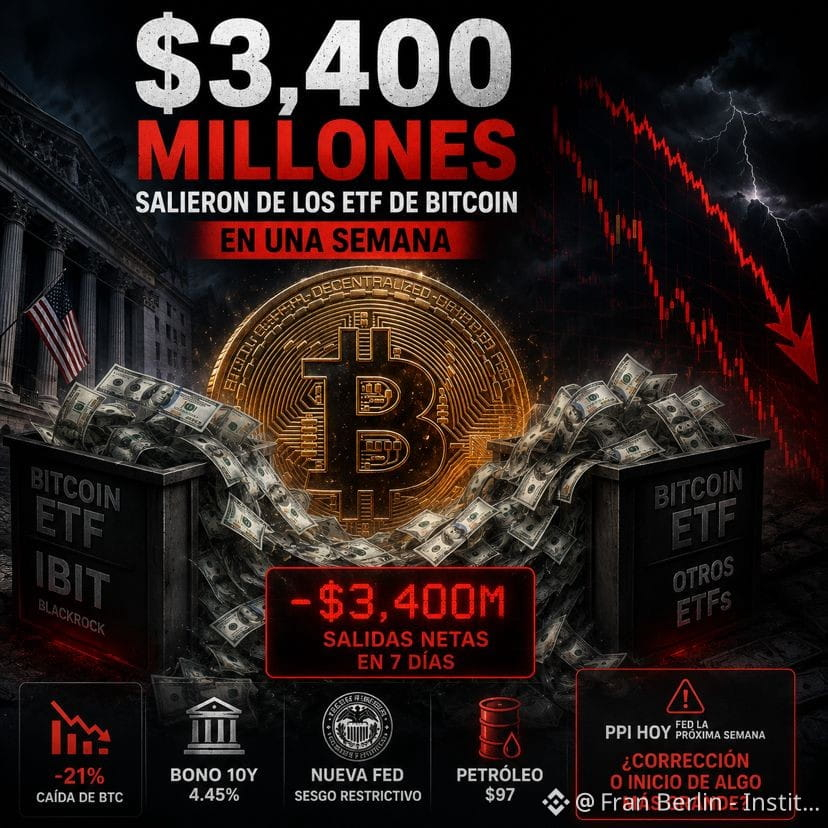
😱 $3.4 billion flowed out of Bitcoin ETFs in a week. Is this the end of the institutional cycle or just a tactical pause?
The week ending in early June 2026 marked the worst week in the history of Bitcoin spot ETFs.
$3.4 billion in net outflows over seven days. The largest weekly exodus since these products launched in January 2024. In total, over $4.4 billion $USDT exited in 13 consecutive days of withdrawals, coinciding with a 21% drop in the price of $BTC .
Institutional panic? Not exactly.
75% of the outflows came from a single fund: the IBIT of #blackRock . This was mostly hedge funds unwinding base arbitrage positions, not structural allocators selling their long-term holdings.
In other words: it's not that institutions are leaving Bitcoin. It's that arbitrage traders, who jumped in when the basis was high, are cashing out now that it’s no longer profitable.
The macro context explains it: the 10-year Treasury bond near 4.45%, a new Fed chair with a restrictive bias, and oil hovering around $97 due to tensions with Iran. In that environment, a non-yielding asset like Bitcoin struggles against the opportunity cost.
Today the PPI is released in the U.S. 🇺🇸 Next week, the Fed will make decisions. These two events will determine if this was a technical correction or the start of a deeper bearish phase.
How are you positioned for what's coming?
#bitcoin #ETFbitcoin #InstitutoBlockchain #FranBerlin
{spot}(BTCUSDT)
{spot}(USDCUSDT)
😱 $3.4 billion flowed out of Bitcoin ETFs in a week. Is this the end of the institutional cycle or just a tactical pause?
The week ending in early June 2026 marked the worst week in the history of Bitcoin spot ETFs.
$3.4 billion in net outflows over seven days. The largest weekly exodus since these products launched in January 2024. In total, over $4.4 billion $USDT exited in 13 consecutive days of withdrawals, coinciding with a 21% drop in the price of $BTC .
Institutional panic? Not exactly.
75% of the outflows came from a single fund: the IBIT of #blackRock . This was mostly hedge funds unwinding base arbitrage positions, not structural allocators selling their long-term holdings.
In other words: it's not that institutions are leaving Bitcoin. It's that arbitrage traders, who jumped in when the basis was high, are cashing out now that it’s no longer profitable.
The macro context explains it: the 10-year Treasury bond near 4.45%, a new Fed chair with a restrictive bias, and oil hovering around $97 due to tensions with Iran. In that environment, a non-yielding asset like Bitcoin struggles against the opportunity cost.
Today the PPI is released in the U.S. 🇺🇸 Next week, the Fed will make decisions. These two events will determine if this was a technical correction or the start of a deeper bearish phase.
How are you positioned for what's coming?
#bitcoin #ETFbitcoin #InstitutoBlockchain #FranBerlin
1
570

·
--
BTC ETF sees a massive outflow of $6.4 billion in just one month! Is winter here or just a washout?
In the last 30 days, Bitcoin spot ETFs have faced an outflow of $6.4 billion, hitting a historic high 📉 But is this truly the onset of a 'crypto winter'? Or is it just the big players accumulating on the dip? The key lies in distinguishing between panic withdrawals vs strategic shifts. Don't panic, let's analyze the data first!
#BITCOIN #BTC #ETFBITCOIN
32

·
--
#ETFbitcoin #BTC☀
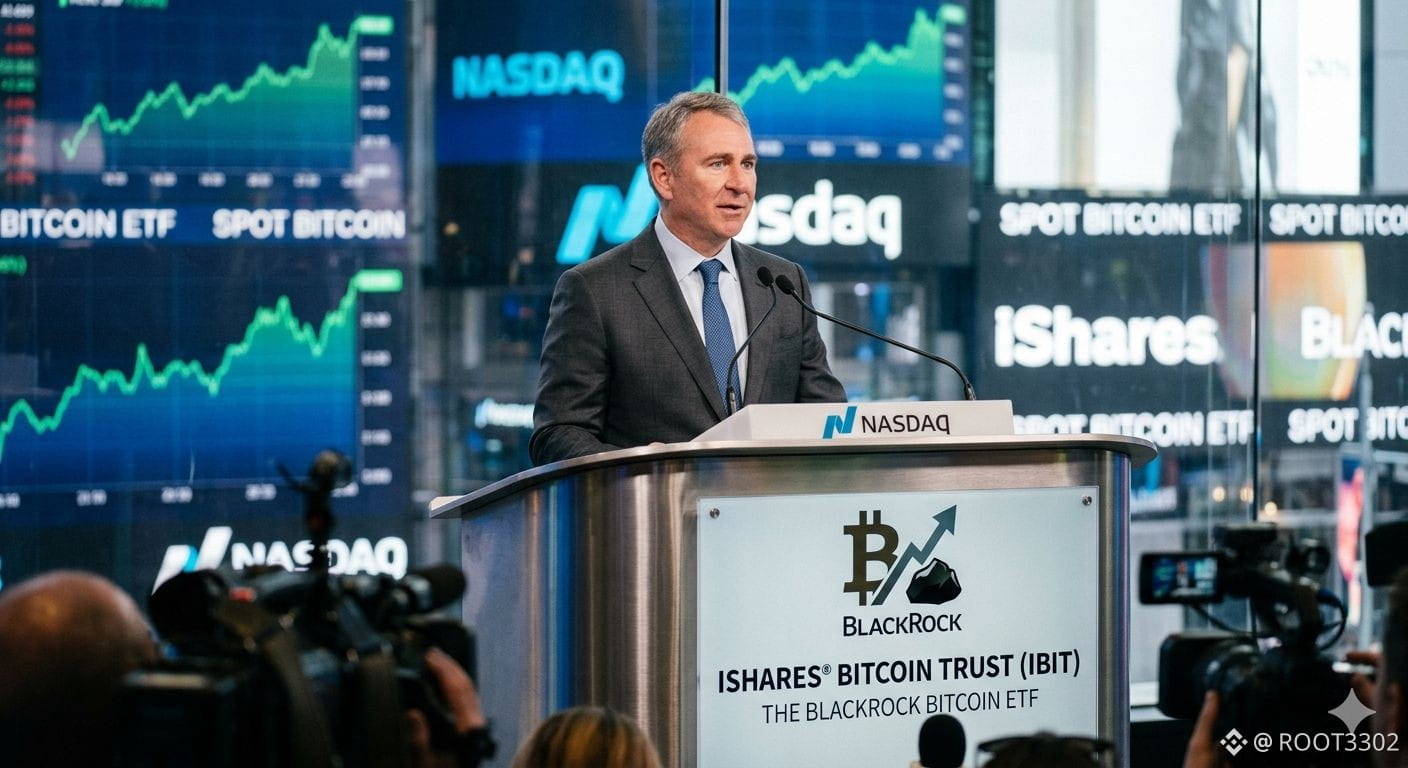
🔴 BlackRock has filed a new amendment for its yield-generating Bitcoin ETF (BITA). According to Bloomberg analyst Eric Balchunas, its launch could happen very soon.
$BTC
#etf
{future}(BTCUSDT)
#ETFbitcoin #BTC☀
🔴 BlackRock has filed a new amendment for its yield-generating Bitcoin ETF (BITA). According to Bloomberg analyst Eric Balchunas, its launch could happen very soon.
$BTC
#etf
🔴 BlackRock has filed a new amendment for its yield-generating Bitcoin ETF (BITA). According to Bloomberg analyst Eric Balchunas, its launch could happen very soon.
$BTC
#etf
248

·
--
Bullish
📢 CURRENT MARKET SENTIMENT 🚀
Market sentiment is currently being driven by a powerful combination of price momentum, institutional inflows into ETFs, and a rise in social media euphoria. If the Fear and Greed Index is marking "Extreme Greed," it suggests the rally is mature and could be vulnerable to a correction or short-term consolidation.
Keep an eye on Bitcoin ETF inflows over the next 24–48 hours: a slowdown or reversal of inflows could be the first sign that institutional demand is losing steam, which could cool down euphoric sentiment.
#ETFbitcoin #CryptoNews #BitcoinOpenInterestFallsToTwoMonthLow #BTC #BitcoinRises23.6%Weekly $BTC
{future}(BTCUSDT)
📢 CURRENT MARKET SENTIMENT 🚀
Market sentiment is currently being driven by a powerful combination of price momentum, institutional inflows into ETFs, and a rise in social media euphoria. If the Fear and Greed Index is marking "Extreme Greed," it suggests the rally is mature and could be vulnerable to a correction or short-term consolidation.
Keep an eye on Bitcoin ETF inflows over the next 24–48 hours: a slowdown or reversal of inflows could be the first sign that institutional demand is losing steam, which could cool down euphoric sentiment.
#ETFbitcoin #CryptoNews #BitcoinOpenInterestFallsToTwoMonthLow #BTC #BitcoinRises23.6%Weekly $BTC

107

💼 Wall Street is grabbing Crypto ETFs: The giant Bank of America shows its hand!\nProof of massive institutional adoption just dropped. The latest 13F regulatory filing for Q1 from Bank of America reveals that the bank holds nearly $53 million in crypto ETF and associated stock assets. Unsurprisingly, BlackRock's Bitcoin ETF (IBIT) dominates their portfolio with a major position valued at around $37 million.\nWhile traditional finance (TradFi) giants secure their positions in major assets, the crypto market is gearing up for a profound technological shift. The influx of Wall Street capital stabilizes the ecosystem and creates fertile ground for next-gen infrastructures.\nThe logical next step: The rise of decentralized AI infrastructures.\nThis institutionalization of Bitcoin validates the maturity of blockchain and now directs savvy investors' eyes towards concrete use cases, particularly the convergence with Artificial Intelligence. It's precisely in this light that the @OpenLedger project makes complete sense.\nBy developing an AI blockchain designed to unlock liquidity and securely monetize data, models, and autonomous agents, #OpenLedger positions itself as the essential infrastructure of tomorrow. The arrival of banking giants into Spot ETFs proves that the overall structure is strengthening. For conservative traders, it’s the perfect time to observe foundational projects like the $OPEN token, which provide real utility to Web3.\n👇 In light of Wall Street's massive entry, do you think AI-related altcoins will outperform the rest of the market? Let me know your thoughts in the comments!\n#OpenLedger #BinanceSquare #CryptoAI #WallStreet #ETFBitcoin $OPEN
💼 Wall Street is grabbing Crypto ETFs: The giant Bank of America shows its hand!\nProof of massive institutional adoption just dropped. The latest 13F regulatory filing for Q1 from Bank of America reveals that the bank holds nearly $53 million in crypto ETF and associated stock assets. Unsurprisingly, BlackRock's Bitcoin ETF (IBIT) dominates their portfolio with a major position valued at around $37 million.\nWhile traditional finance (TradFi) giants secure their positions in major assets, the crypto market is gearing up for a profound technological shift. The influx of Wall Street capital stabilizes the ecosystem and creates fertile ground for next-gen infrastructures.\nThe logical next step: The rise of decentralized AI infrastructures.\nThis institutionalization of Bitcoin validates the maturity of blockchain and now directs savvy investors' eyes towards concrete use cases, particularly the convergence with Artificial Intelligence. It's precisely in this light that the @OpenLedger project makes complete sense.\nBy developing an AI blockchain designed to unlock liquidity and securely monetize data, models, and autonomous agents, #OpenLedger positions itself as the essential infrastructure of tomorrow. The arrival of banking giants into Spot ETFs proves that the overall structure is strengthening. For conservative traders, it’s the perfect time to observe foundational projects like the $OPEN token, which provide real utility to Web3.\n👇 In light of Wall Street's massive entry, do you think AI-related altcoins will outperform the rest of the market? Let me know your thoughts in the comments!\n#OpenLedger #BinanceSquare #CryptoAI #WallStreet #ETFBitcoin $OPEN
144

Bitcoin ETFs attract $1.08 billion in 3 days, but not enough for a strong rally
- Bitcoin ETFs attracted $1.08 billion over the past 3 days.
- However, ETF inflows have yet to reach the $235 million per day needed for previous strong rallies.
- According to CoinDesk's analysis, current inflows are not large enough to drive a sharp rise in BTC's price.
#BitcoinETF #BTC #CryptoMarket #ETFBitcoin
$btc
#vlikevn Titanbot
Source: CoinDesk


What did the SEC just say that caused BTC to skyrocket by hundreds of dollars?
This tweet from Gensler, the most hated SEC leader, was reflected in the price of $BTC in real time, jumping $500. why? Look what he said: "
1 ⃣Those who provide crypto asset investments/services may not comply with applicable laws, including federal securities laws. Investors in cryptoasset securities should understand that they may be deprived of critical information and other important protections related to their investments.
2 ⃣Investing in crypto assets can also be extremely risky and often highly volatile. Many major platforms and crypto assets have gone bankrupt and/or lost value. Cryptoasset investments continue to face significant risks.
3⃣Fraudsters continue to take advantage of the growing popularity of crypto-assets to lure retail investors into scams. These investments continue to be rife with fraud – fake token offerings, Ponzi and pyramid schemes, and outright theft where project promoters disappear with investors’ money. "
Does this tone sound familiar? Isn't it like your head teacher, Naobi Nao, who knew he couldn't control your puppy love but was unwilling to fail when you were studying?
The outside world also interprets it this way:
The development of cryptocurrency, which Gensler tried his best to hinder, will take a big step forward, but seeing that it is about to fail, he can only be unwilling to throw a bucket of dirty water in the end. However, we’re happy to see it, and you’ll be even happier if you hold $BTC or $STX.
All kinds of news are pointing to the same result: the time for fireworks 🎉 is getting closer and closer.
#ETFbitcoin #BTC #etf

14
7
69.9k

BlackRock's Bitcoin ETF (IBIT) Becomes the Highest-Grossing Fund, Surpassing Long-Standing ETFs
BlackRock's immediate fund #ETFbitcoin , the iShares Bitcoin Trust (IBIT), has become the highest-grossing exchange-traded fund (ETF) of this asset management group just 21 months after its launch. IBIT has surpassed products that have been operational for more than two decades from BlackRock.
Incredible Achievement and Huge Capital Inflows
With total assets approaching $100 billion USD (currently at $98.47 billion USD), IBIT generates approximately $244.5 million USD in annual revenue for #BlackRock . Bloomberg analyst Eric Balchunas commented that this achievement is "ridiculous" when compared to traditional ETFs that have existed for 25 years. IBIT is on track to reach $100 billion USD in just 435 days, much faster than Vanguard's VOO fund (which took 2,011 days).
Pratik Kala, Head of Research at Apollo Crypto, noted that this milestone "removes any doubt about the risk appetite for Bitcoin," indicating huge demand from both institutional and retail investors.
Bitcoin's Structural Advantage
Experts believe that Bitcoin ETFs will be the "clear leaders" compared to traditional funds due to Bitcoin's structural advantages: low supply, scarcity, and potential to disrupt finance. Last week, IBIT attracted $1.8 billion USD out of a total of $3.2 billion USD in capital flowing into U.S. spot Bitcoin ETFs.
Despite concerns about correlation with risk markets, the success and asset scale of IBIT are believed to mitigate volatility during corrections. IBIT is reinforcing Bitcoin's position as a mature asset. #anh_ba_cong
{future}(BTCUSDT)
{spot}(BNBUSDT)
BlackRock's Bitcoin ETF (IBIT) Becomes the Highest-Grossing Fund, Surpassing Long-Standing ETFs
BlackRock's immediate fund #ETFbitcoin , the iShares Bitcoin Trust (IBIT), has become the highest-grossing exchange-traded fund (ETF) of this asset management group just 21 months after its launch. IBIT has surpassed products that have been operational for more than two decades from BlackRock.
Incredible Achievement and Huge Capital Inflows
With total assets approaching $100 billion USD (currently at $98.47 billion USD), IBIT generates approximately $244.5 million USD in annual revenue for #BlackRock . Bloomberg analyst Eric Balchunas commented that this achievement is "ridiculous" when compared to traditional ETFs that have existed for 25 years. IBIT is on track to reach $100 billion USD in just 435 days, much faster than Vanguard's VOO fund (which took 2,011 days).
Pratik Kala, Head of Research at Apollo Crypto, noted that this milestone "removes any doubt about the risk appetite for Bitcoin," indicating huge demand from both institutional and retail investors.
Bitcoin's Structural Advantage
Experts believe that Bitcoin ETFs will be the "clear leaders" compared to traditional funds due to Bitcoin's structural advantages: low supply, scarcity, and potential to disrupt finance. Last week, IBIT attracted $1.8 billion USD out of a total of $3.2 billion USD in capital flowing into U.S. spot Bitcoin ETFs.
Despite concerns about correlation with risk markets, the success and asset scale of IBIT are believed to mitigate volatility during corrections. IBIT is reinforcing Bitcoin's position as a mature asset. #anh_ba_cong

2
5.5k
·
--
Bullish
📌 CURRENT MARKET SENTIMENT 🚀
Market sentiment is currently bullish, but overheated. Powerful institutional inflows provide fundamental strength, but the reading of "Extreme Greed" and the polarized conversation on social media warn of a possible consolidation or pullback in the short term. Keep an eye on the daily Bitcoin ETF flow data over the next 24-48 hours; a sudden shift toward outflows could be the catalyst for a change in sentiment.
#CryptoNews #BinanceNews #MinutosFOMC~ #CriptoNoticias #ETFbitcoin

122


Article
Bitcoin ETFs: $4.4 Billion Evaporated in 13 Days — Situation AnalysisJune 2026: The market just navigated through a rough patch. Between May 15 and June 3, US spot Bitcoin ETFs recorded 13 consecutive days of net outflows. A historic record that pushed the 2026 balance sheet into negative territory for the first time since their launch in early 2024.
📊 Key figures from the purge
In total, $4.4 billion has been pulled from financial products, directly impacting BTC's price:
Exit distribution: BlackRock (IBIT) concentrated 75% of the outflows (-$3.3 billion), followed by Fidelity (FBTC, -$456 million) and Grayscale (GBTC, -$303 million).
Bitcoin ETFs: $4.4 Billion Evaporated in 13 Days — Situation Analysis
June 2026: The market just navigated through a rough patch. Between May 15 and June 3, US spot Bitcoin ETFs recorded 13 consecutive days of net outflows. A historic record that pushed the 2026 balance sheet into negative territory for the first time since their launch in early 2024.
📊 Key figures from the purge
In total, $4.4 billion has been pulled from financial products, directly impacting BTC's price:
Exit distribution: BlackRock (IBIT) concentrated 75% of the outflows (-$3.3 billion), followed by Fidelity (FBTC, -$456 million) and Grayscale (GBTC, -$303 million).
📊 Key figures from the purge
In total, $4.4 billion has been pulled from financial products, directly impacting BTC's price:
Exit distribution: BlackRock (IBIT) concentrated 75% of the outflows (-$3.3 billion), followed by Fidelity (FBTC, -$456 million) and Grayscale (GBTC, -$303 million).
34
Log in to explore more content
Join global crypto users on Binance Square
⚡️ Get latest and useful information about crypto.
💬 Trusted by the world’s largest crypto exchange.
👍 Discover real insights from verified creators.
Email / Phone number
Trending Topics
1
#OpenAICutsFundraisingTargetBy$10B
3 views
21 Discussing
2
#ASICHasReceivedNoPredictionMarketApplications
1,150 views
71 Discussing
3
#RecallAnnouncesLiquidationPlansToBurn35.86%OfSupply
138 views
3 Discussing
4
#TetherReports$191.5BInQ3Reserves
63 views
4 Discussing
5
#UniswapA16zSeekDeFiExemptionFromIllinoisCryptoTax
50,873 views
1,042 Discussing
6
#HKDollarStablecoinHKDAPToLaunchOnSolana
36,683 views
669 Discussing
7
#$1.5BInLeveragedCryptoBetsLiquidated
70,281 views
283 Discussing
8
#TrezorSaysCryptoBilisSoldWalletMayContainMaliciousComponents
6,013 views
94 Discussing
9
#KOSPIFalls3.53%BackBelow6000
84,194 views
1,260 Discussing
10
#AmazonSharesFallAbout7%InPremarketTrading
44,264 views
711 Discussing