
#cryptoglossary
cryptoglossary
21,490 views
91 Discussing
Hot
Latest

📚 The Ultimate Crypto Glossary: 10 Essential Terms Every Trader Should Know
On July 2, 2026, navigating the $2.18T crypto market requires understanding the language.
1. Market Cap — total value of a coin (price × supply). 2. Volume — amount traded in 24 hours. 3. Dominance — BTC's share of total market (55.8%). 4. Liquidity — ease of trading without price impact. 5. Support/Resistance — price levels where buying/selling concentrates.
6. Halving — BTC's supply cut every 4 years. 7. DeFi — decentralized finance. 8. Stablecoin — asset pegged to $1. 9. Layer-1/Layer-2 — base chain vs scaling solution. 10. RWA — real-world asset tokenization.
📌 Key Takeaway:
Mastering crypto terminology transforms noise into signal — understanding these 10 terms gives you a foundation for informed decision-making.
#CryptoGlossary #Education
#BinanceAlphaAlert
On July 2, 2026, navigating the $2.18T crypto market requires understanding the language.
1. Market Cap — total value of a coin (price × supply). 2. Volume — amount traded in 24 hours. 3. Dominance — BTC's share of total market (55.8%). 4. Liquidity — ease of trading without price impact. 5. Support/Resistance — price levels where buying/selling concentrates.
6. Halving — BTC's supply cut every 4 years. 7. DeFi — decentralized finance. 8. Stablecoin — asset pegged to $1. 9. Layer-1/Layer-2 — base chain vs scaling solution. 10. RWA — real-world asset tokenization.
📌 Key Takeaway:
Mastering crypto terminology transforms noise into signal — understanding these 10 terms gives you a foundation for informed decision-making.
#CryptoGlossary #Education
#BinanceAlphaAlert

🚀 Lost in the Crypto World? Beginner's Crypto Glossary 📚
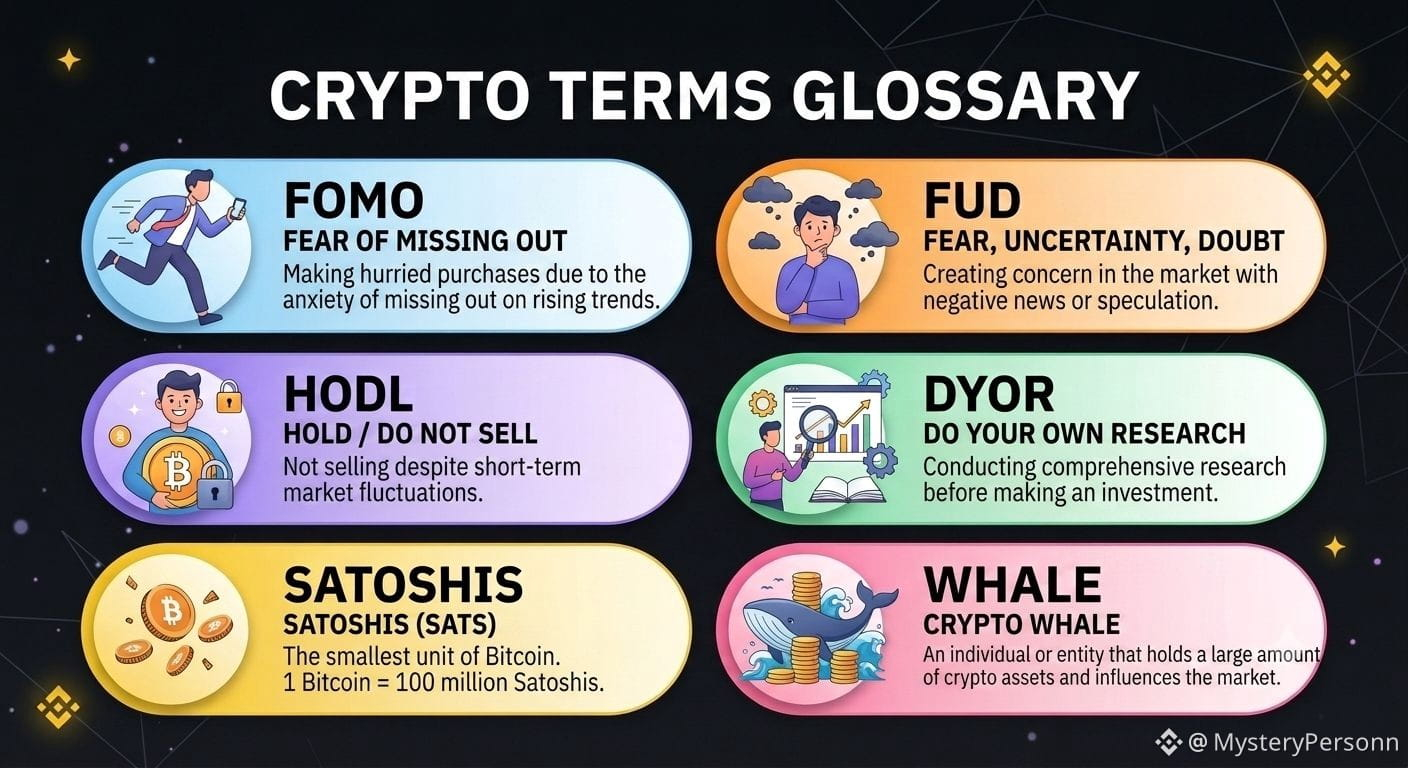
Are you new to the crypto market and feeling overwhelmed by all the jargon? Don't worry, you're not alone! 😅 Today, I'm breaking down 6 essential crypto terms every beginner should know.
Save this post so you can check it whenever you need! Here is what you need to know:
🔍 **DYOR (Do Your Own Research):**
Never buy based on hype or someone else's advice. Always do your own thorough research before investing!
💎 **HODL (Hold On for Dear Life):**
A long-term strategy of holding onto your assets through market fluctuations instead of panic selling.
😱 **FOMO (Fear of Missing Out):**
Rushing to buy an asset just because the price is skyrocketing, out of fear of missing potential gains. Usually leads to buying at the top!
😟 **FUD (Fear, Uncertainty, Doubt):**
Negative or exaggerated news spread to create market panic and lower prices. Stay rational!
🐋 **WHALE:**
An individual or entity that holds massive amounts of cryptocurrency and has the power to influence market trends.
🪙 **SATS (Satoshis):**
The smallest unit of Bitcoin (0.00000001 BTC). 1 Bitcoin consists of 100 million Satoshis!
***
Which of these terms did you learn first? Let me know in the comments below! 👇
$BTC $ETH $BNB #BinanceSquare #Crypto101 #DYOR #HODL #CryptoGlossary
Are you new to the crypto market and feeling overwhelmed by all the jargon? Don't worry, you're not alone! 😅 Today, I'm breaking down 6 essential crypto terms every beginner should know.
Save this post so you can check it whenever you need! Here is what you need to know:
🔍 **DYOR (Do Your Own Research):**
Never buy based on hype or someone else's advice. Always do your own thorough research before investing!
💎 **HODL (Hold On for Dear Life):**
A long-term strategy of holding onto your assets through market fluctuations instead of panic selling.
😱 **FOMO (Fear of Missing Out):**
Rushing to buy an asset just because the price is skyrocketing, out of fear of missing potential gains. Usually leads to buying at the top!
😟 **FUD (Fear, Uncertainty, Doubt):**
Negative or exaggerated news spread to create market panic and lower prices. Stay rational!
🐋 **WHALE:**
An individual or entity that holds massive amounts of cryptocurrency and has the power to influence market trends.
🪙 **SATS (Satoshis):**
The smallest unit of Bitcoin (0.00000001 BTC). 1 Bitcoin consists of 100 million Satoshis!
***
Which of these terms did you learn first? Let me know in the comments below! 👇
$BTC $ETH $BNB #BinanceSquare #Crypto101 #DYOR #HODL #CryptoGlossary

: Market Cap vs. Coin Price
Don't just look at a coin's price. A coin worth $1 can be bigger than a coin worth $100. Always check the Market Cap (Price × Total Supply). It shows the true size and financial strength of a cryptocurrency project.
#CryptoEducation #BinanceSquare #CryptoGlossary #larning $BNB
(Educational purposes only)
Don't just look at a coin's price. A coin worth $1 can be bigger than a coin worth $100. Always check the Market Cap (Price × Total Supply). It shows the true size and financial strength of a cryptocurrency project.
#CryptoEducation #BinanceSquare #CryptoGlossary #larning $BNB
(Educational purposes only)






Log in to explore more content