Binance Square
#cocacolasuspendsfairlifeusproductionaftercyberattack

cocacolasuspendsfairlifeusproductionaftercyberattack

533 views
8 Discussing
Vinhtocdo
·
--
Bearish
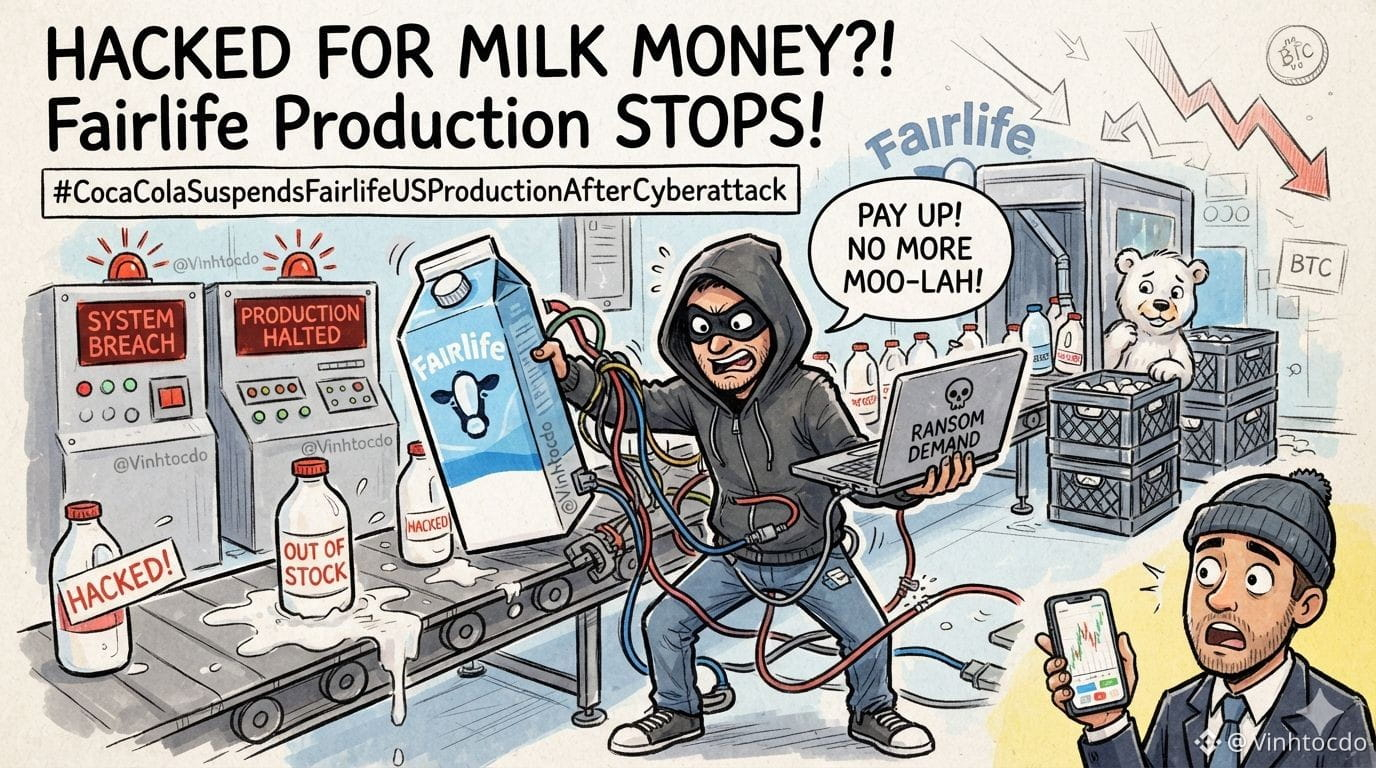
#CocaColaSuspendsFairlifeUSProductionAfterCyberattack 🥛 Hack a dairy line to demand ransom, huh, guys? 💸 Coca-Cola has just stopped producing Fairlife milk in the US because hackers paid a visit. Not even kid’s milk is safe for them—are they thinking of escaping with a bottle of milk contraption or what? 😂 This hacker is weird: instead of hacking exchanges, they hack a milk factory. Are they planning to demand ransom in BTC, or a few million liters of ultrafiltered milk? 📉 What should traders do right now? Check whether you’re holding KO shares or a token from the “milk” ecosystem. Sit tight and see if the money flows into the “soft drinks” ecosystem. 🚨 This is not financial advice. New referral code to install: VINHTOCDO #CocaCola #Hacked #USstock #VINHTOCDO $NVDAB {spot}(NVDABUSDT) $MUB {spot}(MUBUSDT) $SPCXB {spot}(SPCXBUSDT)
#CocaColaSuspendsFairlifeUSProductionAfterCyberattack
🥛 Hack a dairy line to demand ransom, huh, guys? 💸
Coca-Cola has just stopped producing Fairlife milk in the US because hackers paid a visit. Not even kid’s milk is safe for them—are they thinking of escaping with a bottle of milk contraption or what? 😂
This hacker is weird: instead of hacking exchanges, they hack a milk factory. Are they planning to demand ransom in BTC, or a few million liters of ultrafiltered milk?
📉 What should traders do right now?
Check whether you’re holding KO shares or a token from the “milk” ecosystem. Sit tight and see if the money flows into the “soft drinks” ecosystem.
🚨 This is not financial advice.
New referral code to install: VINHTOCDO
#CocaCola #Hacked #USstock #VINHTOCDO
$NVDAB
$MUB
$SPCXB
MUB-5.09%
SPCXB-7.99%
KOUS-0.80%
Article
Why Panic Sell Crypto When Centralized Infrastructure Fails?Why is everyone panic-selling their portfolios when centralized real-world infrastructure is the thing that is actually broken? Most investors react to market fear by sitting on their hands or panic-selling, missing the massive structural shift happening right under their noses. They watch their purchasing power erode while traditional supply chains crumble from basic cyber threats. The recent production halt at Coca-Cola's Fairlife facilities due to a cyberattack is a wake-up call. It highlights how vulnerable centralized physical systems are to single points of failure. While the crowd flees to the safety of $USDT out of habit, the smart move is to identify the protocols building the decentralized alternative. Decentralized physical infrastructure and computing are no longer speculative niches; they are becoming the necessary redundancies for global industries. To navigate this shift, you need a clear playbook. First, stop looking at crypto as just digital currency and start evaluating projects that provide actual utility to physical systems. Look at decentralized computing networks like $RENDER that distribute workloads globally, making them immune to localized cyberattacks. Second, allocate a portion of your portfolio to infrastructure plays that automate trust, like layer-2 networks such as $OP that can secure supply chain data without relying on a single corporate server. How are you positioning your portfolio to hedge against these growing real-world supply chain vulnerabilities? #CocaColaSuspendsFairlifeUSProductionAfterCyberattack #ChipStocksFallOnAISpendingWorries

Why Panic Sell Crypto When Centralized Infrastructure Fails?

Why is everyone panic-selling their portfolios when centralized real-world infrastructure is the thing that is actually broken?
Most investors react to market fear by sitting on their hands or panic-selling, missing the massive structural shift happening right under their noses. They watch their purchasing power erode while traditional supply chains crumble from basic cyber threats.
The recent production halt at Coca-Cola's Fairlife facilities due to a cyberattack is a wake-up call. It highlights how vulnerable centralized physical systems are to single points of failure. While the crowd flees to the safety of $USDT out of habit, the smart move is to identify the protocols building the decentralized alternative. Decentralized physical infrastructure and computing are no longer speculative niches; they are becoming the necessary redundancies for global industries.
To navigate this shift, you need a clear playbook. First, stop looking at crypto as just digital currency and start evaluating projects that provide actual utility to physical systems. Look at decentralized computing networks like $RENDER that distribute workloads globally, making them immune to localized cyberattacks. Second, allocate a portion of your portfolio to infrastructure plays that automate trust, like layer-2 networks such as $OP that can secure supply chain data without relying on a single corporate server.
How are you positioning your portfolio to hedge against these growing real-world supply chain vulnerabilities?
#CocaColaSuspendsFairlifeUSProductionAfterCyberattack #ChipStocksFallOnAISpendingWorries
#spacexclosesbelowipopricefirsttime Jul 16, 2026 | $SPCX $131.11 | Below the $135 IPO price for the first time {stock_us}(SPCX.US) SpaceX closed at $131.11 — its first close below the $135 IPO debut price — after Starship V3 aborted mid-engine ignition. Elon confirmed 2 Raptor engines will be replaced; next attempt "early next week." Three things to watch: Starship delays now have a market price. Every hardware hiccup hits the stock directly. At ~110x forward revenue, there's zero room for execution errors. Lockup expiry is the elephant. 95% of shares are still locked — ~911M employee shares could flood the market after the first earnings report. The stock hasn't faced its real supply test yet. The macro backdrop is hostile. Fed rate hikes ×3, Iran war uncertainty, broad tech selloff. SpaceX is a high-beta stock in a tightening cycle. The $85.7B IPO — the largest in history — is underwater in a month. That's a brutal signal for the upcoming AI mega-IPOs (OpenAI, Anthropic, Databricks). Not financial advice. Lockup expiries are historically volatile. Great company ≠ great stock at any price. #SpaceXFalls4%AfterStarshipTestScrubbed #ChipStocksFallOnAISpendingWorries #CocaColaSuspendsFairlifeUSProductionAfterCyberattack #AsianStocksFallForSecondDay
#spacexclosesbelowipopricefirsttime

Jul 16, 2026 | $SPCX $131.11 | Below the $135 IPO price for the first time

SpaceX closed at $131.11 — its first close below the $135 IPO debut price — after Starship V3 aborted mid-engine ignition. Elon confirmed 2 Raptor engines will be replaced; next attempt "early next week."

Three things to watch:

Starship delays now have a market price. Every hardware hiccup hits the stock directly. At ~110x forward revenue, there's zero room for execution errors.

Lockup expiry is the elephant. 95% of shares are still locked — ~911M employee shares could flood the market after the first earnings report. The stock hasn't faced its real supply test yet.

The macro backdrop is hostile. Fed rate hikes ×3, Iran war uncertainty, broad tech selloff. SpaceX is a high-beta stock in a tightening cycle.

The $85.7B IPO — the largest in history — is underwater in a month. That's a brutal signal for the upcoming AI mega-IPOs (OpenAI, Anthropic, Databricks).

Not financial advice. Lockup expiries are historically volatile. Great company ≠ great stock at any price.

#SpaceXFalls4%AfterStarshipTestScrubbed #ChipStocksFallOnAISpendingWorries #CocaColaSuspendsFairlifeUSProductionAfterCyberattack #AsianStocksFallForSecondDay
Article
ZEC (Zcash) Short Bast of Luck 🍀$ZEC {spot}(ZECUSDT) ZEC (Zcash) is a privacy-focused cryptocurrency that allows users to choose between transparent and shielded transactions using zero-knowledge cryptography. It is known for offering stronger transaction privacy than many other cryptocurrencies. Current outlook: 🟢 Strong support from its privacy technology and long history.📈 A break above key resistance could attract more buyers.⚠️ Regulatory concerns around privacy coins may limit adoption in some regions.💡 Overall, ZEC is considered a higher-risk asset with potential for volatility. Short-term bias: Neutral to slightly bullish, provided Bitcoin remains strong. $ZEC #follow Like plZ #FootballSeason2026 #HyperliquidFalls10.28% #SpaceXShortInterestHits29%OfFloat #KioxiaFalls10%MarketCapHalvesFromJunePeak #CocaColaSuspendsFairlifeUSProductionAfterCyberattack

ZEC (Zcash) Short Bast of Luck 🍀

$ZEC
ZEC (Zcash) is a privacy-focused cryptocurrency that allows users to choose between transparent and shielded transactions using zero-knowledge cryptography. It is known for offering stronger transaction privacy than many other cryptocurrencies.
Current outlook:
🟢 Strong support from its privacy technology and long history.📈 A break above key resistance could attract more buyers.⚠️ Regulatory concerns around privacy coins may limit adoption in some regions.💡 Overall, ZEC is considered a higher-risk asset with potential for volatility.
Short-term bias: Neutral to slightly bullish, provided Bitcoin remains strong. $ZEC #follow Like plZ
#FootballSeason2026 #HyperliquidFalls10.28% #SpaceXShortInterestHits29%OfFloat #KioxiaFalls10%MarketCapHalvesFromJunePeak #CocaColaSuspendsFairlifeUSProductionAfterCyberattack
Binance News
·
--
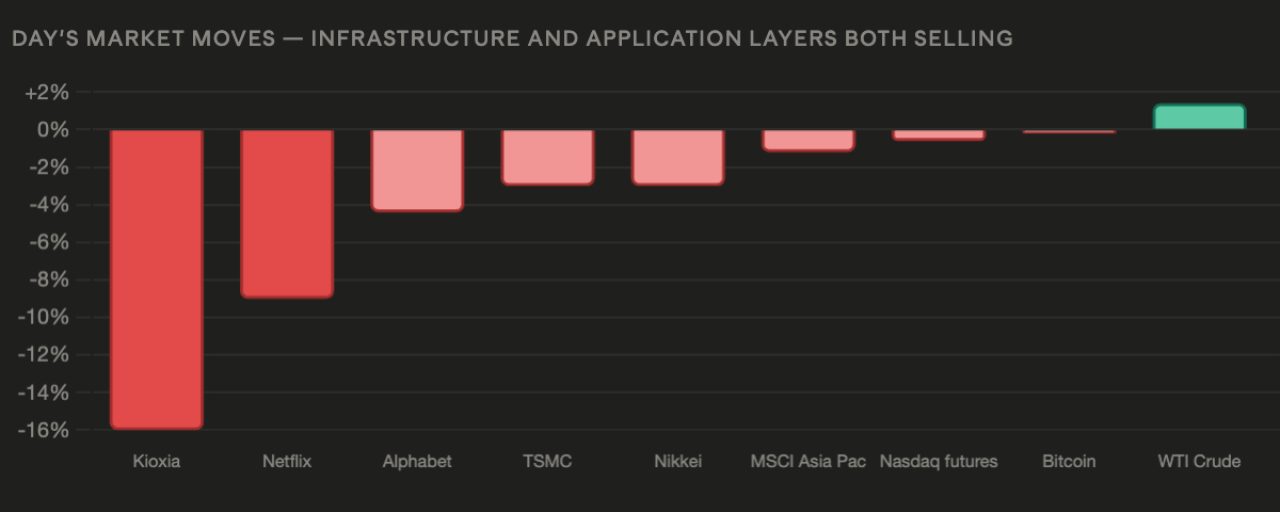
Chip Selloff Enters Its Second Day — Kioxia Down 50% From Peak, TSMC Drops Despite Solid Earnings
Asian equities fell for a second consecutive session Friday as a deepening chipmaker selloff raised mounting concern that massive AI investments may not justify current valuations. The MSCI Asia Pacific Index dropped 1.2% and Japan's Nikkei 225 retreated approximately 3% — its second severe session in as many days. Kioxia sank as much as 16% intraday, extending losses to more than 50% from last month's record high. TSMC dropped more than 3% as a solid earnings outlook was overshadowed by a higher spending forecast. The Philadelphia Semiconductor Index has now dropped approximately 19% from its June peak. Bitcoin held relatively firm at $63,945, down just 0.2%, as Brent crude rebounded above $85 — up 12% on the week — and gold rose 0.4% to $3,991.The Valuation Reckoning — $725 Billion in AI Spending Under ScrutinyThe core question driving the semiconductor selloff is precise: the four biggest US AI operators are expected to spend more than $725 billion this year alone on AI infrastructure. The market is now asking whether those investments will generate returns sufficient to justify the valuations embedded in every company in the AI supply chain — from GPU manufacturers to memory chipmakers to the hyperscalers themselves. Matt Maley, chief market strategist at Miller Tabak, said chip stocks are showing meaningful cracks and need a strong rebound soon or it will raise real warning flags — a characterization that captures exactly how the market is treating the Philadelphia Semiconductor Index's 19% decline from June's peak.TSMC's earnings provided the clearest illustration of the valuation dilemma. The company reported solid results — June revenue up 68% year-on-year, Q2 first-half revenue up 35.6% — but the stock fell more than 3% because TSMC simultaneously raised its spending forecast. A company growing revenue 68% year-on-year and increasing capital expenditure is doing exactly what it should during a demand boom — but if investors are questioning whether the demand boom is sustainable at the application layer, then higher capex becomes a risk amplifier rather than a confidence signal.Kioxia's 16% intraday decline extending losses to more than 50% from last month's record high is the most extreme single-stock illustration of how quickly AI euphoria can convert to AI skepticism in memory and storage names. Kioxia's trajectory — from record high to down 50% in one month — mirrors the broader pattern of the AI trade across the Japanese semiconductor complex.Netflix's 9% Drop — Another AI ROI WarningNetflix shares fell 9% in extended trading after forecasting a second quarter of slowing sales growth — sending Nasdaq 100 futures down 0.6%. The Netflix miss is relevant to the semiconductor selloff through a specific mechanism: Netflix is one of the largest AI model deployment companies in consumer entertainment, and slower-than-expected revenue growth at a company with massive AI content and recommendation system investments raises the same question that hyperscaler chip spending raises — are the AI application economics justifying the infrastructure investment? A second consecutive quarter of slowing sales growth at Netflix while AI content costs are rising is exactly the kind of data point that makes investors question AI ROI across the board.Alphabet sank 4.4% on a separate but related signal — Google was reported to be months behind schedule on delivering its most powerful flagship AI model. The two developments together — Netflix's AI investment not producing accelerating revenue and Google's flagship AI model delayed — are the application-layer confirmation of what the semiconductor selloff had been pricing at the infrastructure layer: the AI revenue conversion timeline is longer than the market had assumed when pricing semiconductor companies at their June peaks.The Yen — 40-Year Low and Intervention WarningJapan's Finance Minister Satsuki Katayama renewed her warning of possible currency intervention as the yen hovered near a 40-year low at 162.40 per dollar. Daiwa Securities strategist Yugo Tsuboi noted that investors may be using the Japanese market to hedge semiconductor concerns with South Korea closed — meaning part of the Nikkei's severity is technical positioning rather than purely fundamental Japan-specific selling.The yen at 162.40 is the July 2024 carry trade unwind replay setup that Bitcoin analysts have been flagging since JGB yields hit a 30-year high at 2.85% earlier in the month. A BOJ intervention or rapid yen appreciation from 162 would trigger carry trade unwinding — the same mechanism that sent Bitcoin from $65,000 to $50,000 in a single week in July 2024. Goldman Sachs has maintained its preference for yen carry trades despite rising JGB yields — but at 162 per dollar with the Finance Minister issuing intervention warnings, the spread that makes the carry trade viable is approaching a level where forced unwinds become probable rather than theoretical.Brent at $85, Gold Near $4,000 — The Inflation and Safety Trade Simultaneously ActiveBrent crude above $85 per barrel — up 12% on the week, its largest weekly gain since April — represents the definitive end of the disinflationary oil channel that had made Tuesday's 3.8% CPI reading constructive. Five consecutive days of US strikes on Iran have thinned Hormuz shipping traffic to the point where the Strait's closure is no longer an abstract supply risk — it is a present reality affecting the one-fifth of global oil and gas supplies that flowed through the waterway before the conflict began 136 days ago.Gold rising 0.4% to $3,991 — approaching $4,000 again — is operating simultaneously through the safe-haven channel from geopolitical uncertainty and the inflation hedge channel from Brent's 12% weekly surge. The combination of Brent at $85 and gold near $4,000 heading into the FOMC July 28-29 is the most challenging inflation backdrop the Fed has faced since the June hawkish pivot — arriving at the meeting with oil meaningfully higher than it was when the June dot plot was published.Bitcoin at $63,945 — the Relative Strength SignalBitcoin's 0.2% decline to $63,945 against a backdrop of Nikkei −3%, TSMC −3%, Kioxia −16%, and Nasdaq futures −0.6% is the week's most understated signal. Every prior correlation shock this quarter — the June KOSPI crashes, SpaceX's bond sale selloff, the July ceasefire collapse — produced Bitcoin declines of 2-5% in the same sessions. A 0.2% decline in Friday's environment suggests that the structural bottom signals — 9-year exchange supply low, 79% LTH supply, 43-month realized P&L low, $197 million in weekly ETF inflows — are providing a more durable floor than the macro headwinds are currently capable of breaking through.
Article
The myth of decentralized smart contract securityMost people think decentralized smart contracts are inherently safer than legacy corporate databases, but they actually expose your funds to the exact same centralized point-of-failure risks. We have all watched a promising position evaporate in minutes because of a protocol exploit we never saw coming. It is the ultimate frustration in crypto, doing all your fundamental research only to get wiped out by a single line of bad code. The recent cybersecurity breach that forced a halt in production for a major dairy brand shows how vulnerable interconnected systems are, and the Web3 space is no different. When you bridge assets or lock liquidity in Layer 2 networks like $OP or $ARB, you are not just betting on the technology. You are trusting that the admin keys, upgradeable contracts, and validators do not have a single backdoor waiting to be exploited. In crypto, we call this dependency risk. Just like a physical factory relying on a compromised IT network, a decentralized app often relies on external data feeds. If an attacker manipulates these feeds, they can drain millions in seconds, causing panic selling that even affects stable assets like $USDT. How do you personally evaluate the smart contract risk of a project before buying in? #CocaColaSuspendsFairlifeUSProductionAfterCyberattack #ChipStocksFallOnAISpendingWorries

The myth of decentralized smart contract security

Most people think decentralized smart contracts are inherently safer than legacy corporate databases, but they actually expose your funds to the exact same centralized point-of-failure risks. We have all watched a promising position evaporate in minutes because of a protocol exploit we never saw coming. It is the ultimate frustration in crypto, doing all your fundamental research only to get wiped out by a single line of bad code.
The recent cybersecurity breach that forced a halt in production for a major dairy brand shows how vulnerable interconnected systems are, and the Web3 space is no different. When you bridge assets or lock liquidity in Layer 2 networks like $OP or $ARB , you are not just betting on the technology. You are trusting that the admin keys, upgradeable contracts, and validators do not have a single backdoor waiting to be exploited.
In crypto, we call this dependency risk. Just like a physical factory relying on a compromised IT network, a decentralized app often relies on external data feeds. If an attacker manipulates these feeds, they can drain millions in seconds, causing panic selling that even affects stable assets like $USDT.
How do you personally evaluate the smart contract risk of a project before buying in?
#CocaColaSuspendsFairlifeUSProductionAfterCyberattack #ChipStocksFallOnAISpendingWorries
·
--
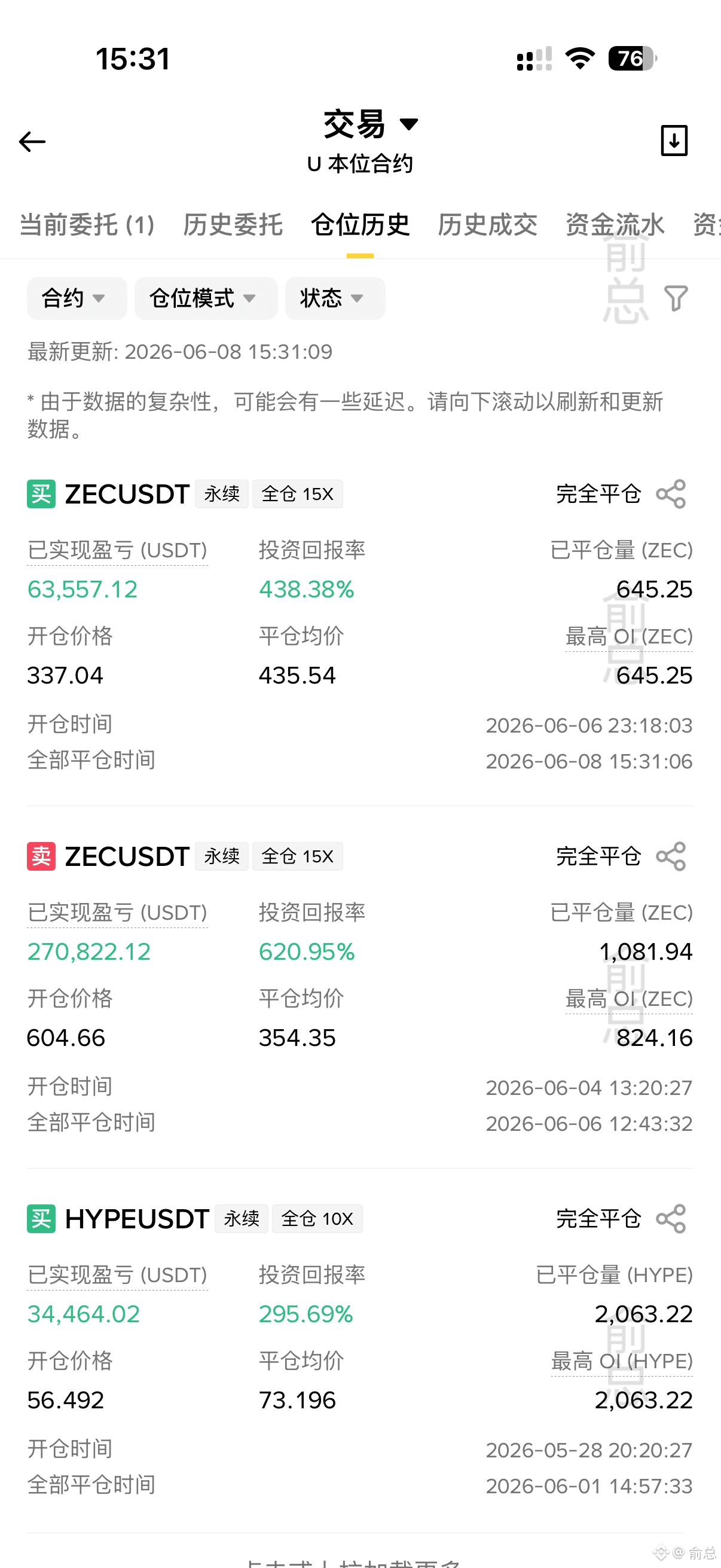
Ten days, three directions, all of them taken. What impresses me most about this trade isn’t how much money it made—it’s the rhythm. Long and short switching back and forth, three different assets, three different time windows—he got it all. $ETH First, HYPE goes—he took it for four days, and when it reached the level, he exited. Then he immediately flipped to open a short on ZEC—held for two days; he entered with more than 600, exited with over 300. The short was just closed, and he opened a long on ZEC again right away—entered with over 300, exited with over 400, once again profitable. #CocaColaSuspendsFairlifeUSProductionAfterCyberattack $ZEC You’ll notice a detail—the short position was closed at midday on June 6, while the long was opened that night on June 6. There were only about ten-odd hours in between. That means within the same stretch of market action, he finished the drop first, then turned around on the spot and took another bite of the rebound. This isn’t just luck running into a one-way market. Anyone can make money in a one-way trend; the real challenge is whether you dare to enter when the direction is switching, and once you’ve reached your level, whether you’re willing to leave. He finished taking profit on HYPE without being greedy, finished the short on ZEC without hesitation, and opened the long on ZEC without holding back. The positions held in the middle are the most grinding. Prices sweep back and forth; the tighter you watch, the easier it is to get thrown off. But these trades clearly weren’t derailed by that middle volatility—take what should be taken, and switch when it’s time. Being able to go long isn’t a real skill by itself. Being able to short isn’t either. Understanding how to eat both directions within the same market segment is what truly means you understand the market’s temper. $HYPE
Ten days, three directions, all of them taken.
What impresses me most about this trade isn’t how much money it made—it’s the rhythm. Long and short switching back and forth, three different assets, three different time windows—he got it all. $ETH
First, HYPE goes—he took it for four days, and when it reached the level, he exited. Then he immediately flipped to open a short on ZEC—held for two days; he entered with more than 600, exited with over 300. The short was just closed, and he opened a long on ZEC again right away—entered with over 300, exited with over 400, once again profitable. #CocaColaSuspendsFairlifeUSProductionAfterCyberattack $ZEC
You’ll notice a detail—the short position was closed at midday on June 6, while the long was opened that night on June 6. There were only about ten-odd hours in between. That means within the same stretch of market action, he finished the drop first, then turned around on the spot and took another bite of the rebound.
This isn’t just luck running into a one-way market. Anyone can make money in a one-way trend; the real challenge is whether you dare to enter when the direction is switching, and once you’ve reached your level, whether you’re willing to leave.
He finished taking profit on HYPE without being greedy, finished the short on ZEC without hesitation, and opened the long on ZEC without holding back.
The positions held in the middle are the most grinding. Prices sweep back and forth; the tighter you watch, the easier it is to get thrown off. But these trades clearly weren’t derailed by that middle volatility—take what should be taken, and switch when it’s time.
Being able to go long isn’t a real skill by itself. Being able to short isn’t either. Understanding how to eat both directions within the same market segment is what truly means you understand the market’s temper. $HYPE
Log in to explore more content
Join global crypto users on Binance Square
⚡️ Get latest and useful information about crypto.
💬 Trusted by the world’s largest crypto exchange.
👍 Discover real insights from verified creators.
Email / Phone number