

#cftcupdatesguidanceontokenizedassets
cftcupdatesguidanceontokenizedassets
Hot
Latest

·
--
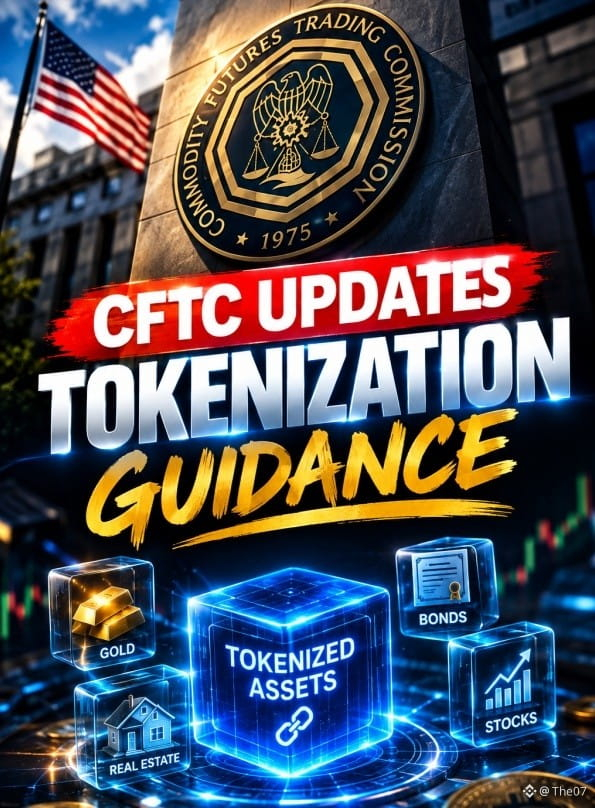
🚨 BREAKING: CFTC UPDATES TOKENIZATION GUIDANCE
The CFTC just updated its crypto guidance, clarifying that regulated firms may use tokenized versions of permitted assets under certain conditions. 🏦⛓️
The agency also confirmed that qualifying blockchain-based records can satisfy certain regulatory recordkeeping requirements.
This is another major step toward bringing tokenization and blockchain infrastructure deeper into traditional financial markets. 🌎
Tokenized assets are moving closer to the mainstream.
The real question: How big could the tokenization market become by 2029? 👀
#CFTC #blockchain #bitcoin
#cftcupdatesguidanceontokenizedassets
🚨 BREAKING: CFTC UPDATES TOKENIZATION GUIDANCE
The CFTC just updated its crypto guidance, clarifying that regulated firms may use tokenized versions of permitted assets under certain conditions. 🏦⛓️
The agency also confirmed that qualifying blockchain-based records can satisfy certain regulatory recordkeeping requirements.
This is another major step toward bringing tokenization and blockchain infrastructure deeper into traditional financial markets. 🌎
Tokenized assets are moving closer to the mainstream.
The real question: How big could the tokenization market become by 2029? 👀
#CFTC #blockchain #bitcoin
#cftcupdatesguidanceontokenizedassets
The CFTC just updated its crypto guidance, clarifying that regulated firms may use tokenized versions of permitted assets under certain conditions. 🏦⛓️
The agency also confirmed that qualifying blockchain-based records can satisfy certain regulatory recordkeeping requirements.
This is another major step toward bringing tokenization and blockchain infrastructure deeper into traditional financial markets. 🌎
Tokenized assets are moving closer to the mainstream.
The real question: How big could the tokenization market become by 2029? 👀
#CFTC #blockchain #bitcoin
#cftcupdatesguidanceontokenizedassets
3
1.6k

#cftcupdatesguidanceontokenizedassets
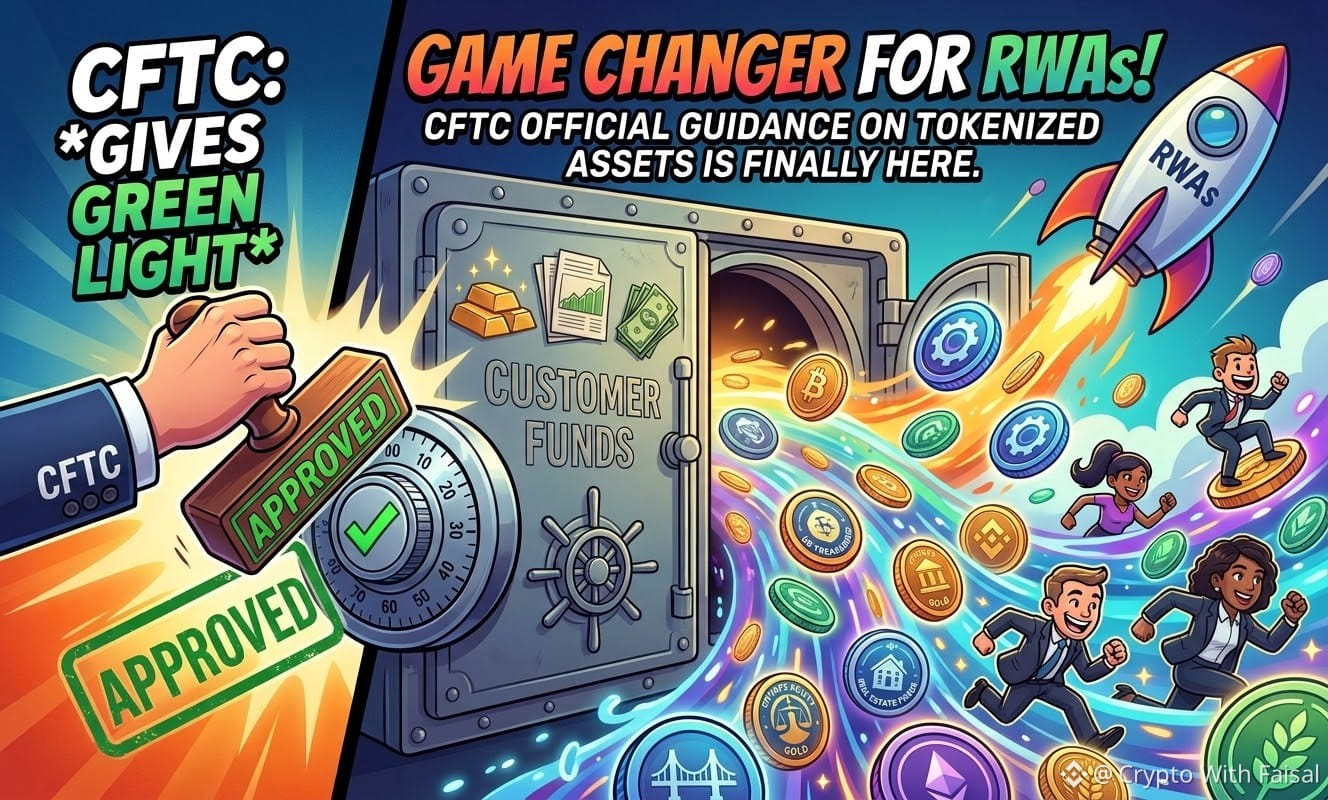
🔥 HUGE NEWS FOR RWAs! CFTC JUST DROPPED NEW GUIDANCE! 🔥
The U.S. Commodity Futures Trading Commission (CFTC) is officially accelerating crypto adoption while Congress stalls! Here is what you need to know about their latest move:
✅ Tokenized Funds Approved: Regulated firms are now permitted to invest customer funds into tokenized versions of approved assets. The condition? These tokens must grant the exact same legal and economic rights as their traditional counterparts.
✅ Blockchain for Records: The CFTC explicitly stated they will not object to authorized entities using blockchain technology to maintain their official regulatory recordkeeping.
✅ Why Now? Following the U.S. Senate's failure to advance the CLARITY Act, agencies are stepping up. CFTC Chair Michael Selig pushed this update to deliver genuine regulatory clarity to the digital asset space.
With the tokenized Real-World Asset (RWA) market already hitting a massive $46 Billion, this green light from a top U.S. regulator could spark a tidal wave of institutional liquidity.
👇 What’s your take?
Will this be the catalyst for traditional finance to go all-in on blockchain? Drop your thoughts below! 🚀
#RWA #CFTC #Tokenization
$ETH
{future}(ETHUSDT)
$LINK
{future}(LINKUSDT)
$ONDO
{future}(ONDOUSDT)
#cftcupdatesguidanceontokenizedassets
🔥 HUGE NEWS FOR RWAs! CFTC JUST DROPPED NEW GUIDANCE! 🔥
The U.S. Commodity Futures Trading Commission (CFTC) is officially accelerating crypto adoption while Congress stalls! Here is what you need to know about their latest move:
✅ Tokenized Funds Approved: Regulated firms are now permitted to invest customer funds into tokenized versions of approved assets. The condition? These tokens must grant the exact same legal and economic rights as their traditional counterparts.
✅ Blockchain for Records: The CFTC explicitly stated they will not object to authorized entities using blockchain technology to maintain their official regulatory recordkeeping.
✅ Why Now? Following the U.S. Senate's failure to advance the CLARITY Act, agencies are stepping up. CFTC Chair Michael Selig pushed this update to deliver genuine regulatory clarity to the digital asset space.
With the tokenized Real-World Asset (RWA) market already hitting a massive $46 Billion, this green light from a top U.S. regulator could spark a tidal wave of institutional liquidity.
👇 What’s your take?
Will this be the catalyst for traditional finance to go all-in on blockchain? Drop your thoughts below! 🚀
#RWA #CFTC #Tokenization
$ETH
$LINK
$ONDO
🔥 HUGE NEWS FOR RWAs! CFTC JUST DROPPED NEW GUIDANCE! 🔥
The U.S. Commodity Futures Trading Commission (CFTC) is officially accelerating crypto adoption while Congress stalls! Here is what you need to know about their latest move:
✅ Tokenized Funds Approved: Regulated firms are now permitted to invest customer funds into tokenized versions of approved assets. The condition? These tokens must grant the exact same legal and economic rights as their traditional counterparts.
✅ Blockchain for Records: The CFTC explicitly stated they will not object to authorized entities using blockchain technology to maintain their official regulatory recordkeeping.
✅ Why Now? Following the U.S. Senate's failure to advance the CLARITY Act, agencies are stepping up. CFTC Chair Michael Selig pushed this update to deliver genuine regulatory clarity to the digital asset space.
With the tokenized Real-World Asset (RWA) market already hitting a massive $46 Billion, this green light from a top U.S. regulator could spark a tidal wave of institutional liquidity.
👇 What’s your take?
Will this be the catalyst for traditional finance to go all-in on blockchain? Drop your thoughts below! 🚀
#RWA #CFTC #Tokenization
$ETH
$LINK
$ONDO
Feed-Creator-b972dbf4d AVGINYATA:
Aum Namo Narayana++
Wow this is great.Amalgation of Tradiotional assets and digital assets with instantaneous settlements in 24/7 markets.We will witness trillions of $ flowing in.
2
1
3
431

🚨 Tokenization Watch
CFTC guidance on tokenized assets deserves attention.
The next crypto wave may involve more than cryptocurrencies.
Real-world assets could increasingly interact with blockchain networks.
$BTC $ETH $LINK and $SOL remain key names in the space.
🔎 Tokenization + regulation = a story worth following.
#cftcupdatesguidanceontokenizedassets
🚨 Tokenization Watch
CFTC guidance on tokenized assets deserves attention.
The next crypto wave may involve more than cryptocurrencies.
Real-world assets could increasingly interact with blockchain networks.
$BTC $ETH $LINK and $SOL remain key names in the space.
🔎 Tokenization + regulation = a story worth following.
#cftcupdatesguidanceontokenizedassets
CFTC guidance on tokenized assets deserves attention.
The next crypto wave may involve more than cryptocurrencies.
Real-world assets could increasingly interact with blockchain networks.
$BTC $ETH $LINK and $SOL remain key names in the space.
🔎 Tokenization + regulation = a story worth following.
#cftcupdatesguidanceontokenizedassets
104

·
--
Bullish
CFTC Guidance Just Made Tokenized
Here's Why It Matters
Big regulatory shift flying under the radar: the CFTC has confirmed that firms under its oversight can use tokenized assets and blockchain-based recordkeeping under existing rules — no new legislation required.
This isn't just a policy footnote. It's the CFTC formally telling the derivatives industry: tokenization is compatible with the current regulatory framework, today.
What's actually in the guidance:
🔹 Tokenized assets can be used as collateral in futures and swaps trading
🔹 Covers 5 critical areas: eligible assets, legal enforceability, custody/segregation, valuation, and operational risk
🔹 A parallel pilot program now allows BTC,ETH, and payment stablecoins as margin collateral for futures commission merchants
🔹 Builds on the CFTC's "Crypto Sprint" initiative and the GENIUS Act's stablecoin framework
Why this matters for traders:
This is the kind of quiet infrastructure change that precedes bigger institutional inflows. When regulators clarify that crypto rails can plug into existing TradFi collateral systems, it lowers the barrier for institutions sitting on the sidelines.
Real-world asset (RWA) tokenization has been one of the most talked-about narratives in crypto this year — this guidance gives it real regulatory footing rather than just hype.
My take: Watch how exchanges and custodians respond over the next few weeks. If major players start integrating tokenized collateral workflows, that's the tell this guidance has real teeth.
What do you think — does regulatory clarity like this move the market, or is it already priced in? Drop your thoughts below 👇
$BTC $ETH
{spot}(BTCUSDT)
{spot}(ETHUSDT)
#RWA #CryptoRegulation #TokenizedAssets#CFTCUpdatesGuidanceOnTokenizedAssets
CFTC Guidance Just Made Tokenized
Here's Why It Matters
Big regulatory shift flying under the radar: the CFTC has confirmed that firms under its oversight can use tokenized assets and blockchain-based recordkeeping under existing rules — no new legislation required.
This isn't just a policy footnote. It's the CFTC formally telling the derivatives industry: tokenization is compatible with the current regulatory framework, today.
What's actually in the guidance:
🔹 Tokenized assets can be used as collateral in futures and swaps trading
🔹 Covers 5 critical areas: eligible assets, legal enforceability, custody/segregation, valuation, and operational risk
🔹 A parallel pilot program now allows BTC,ETH, and payment stablecoins as margin collateral for futures commission merchants
🔹 Builds on the CFTC's "Crypto Sprint" initiative and the GENIUS Act's stablecoin framework
Why this matters for traders:
This is the kind of quiet infrastructure change that precedes bigger institutional inflows. When regulators clarify that crypto rails can plug into existing TradFi collateral systems, it lowers the barrier for institutions sitting on the sidelines.
Real-world asset (RWA) tokenization has been one of the most talked-about narratives in crypto this year — this guidance gives it real regulatory footing rather than just hype.
My take: Watch how exchanges and custodians respond over the next few weeks. If major players start integrating tokenized collateral workflows, that's the tell this guidance has real teeth.
What do you think — does regulatory clarity like this move the market, or is it already priced in? Drop your thoughts below 👇
$BTC $ETH
#RWA #CryptoRegulation #TokenizedAssets#CFTCUpdatesGuidanceOnTokenizedAssets
Here's Why It Matters
Big regulatory shift flying under the radar: the CFTC has confirmed that firms under its oversight can use tokenized assets and blockchain-based recordkeeping under existing rules — no new legislation required.
This isn't just a policy footnote. It's the CFTC formally telling the derivatives industry: tokenization is compatible with the current regulatory framework, today.
What's actually in the guidance:
🔹 Tokenized assets can be used as collateral in futures and swaps trading
🔹 Covers 5 critical areas: eligible assets, legal enforceability, custody/segregation, valuation, and operational risk
🔹 A parallel pilot program now allows BTC,ETH, and payment stablecoins as margin collateral for futures commission merchants
🔹 Builds on the CFTC's "Crypto Sprint" initiative and the GENIUS Act's stablecoin framework
Why this matters for traders:
This is the kind of quiet infrastructure change that precedes bigger institutional inflows. When regulators clarify that crypto rails can plug into existing TradFi collateral systems, it lowers the barrier for institutions sitting on the sidelines.
Real-world asset (RWA) tokenization has been one of the most talked-about narratives in crypto this year — this guidance gives it real regulatory footing rather than just hype.
My take: Watch how exchanges and custodians respond over the next few weeks. If major players start integrating tokenized collateral workflows, that's the tell this guidance has real teeth.
What do you think — does regulatory clarity like this move the market, or is it already priced in? Drop your thoughts below 👇
$BTC $ETH
#RWA #CryptoRegulation #TokenizedAssets#CFTCUpdatesGuidanceOnTokenizedAssets
7
·
--
$#CFTCUpdatesGuidanceOnTokenizedAssets This builds on the CFTC's earlier guidance allowing tokenized assets to be used as collateral in futures and swaps. �
$#CFTCUpdatesGuidanceOnTokenizedAssets This builds on the CFTC's earlier guidance allowing tokenized assets to be used as collateral in futures and swaps. �
6

·
--
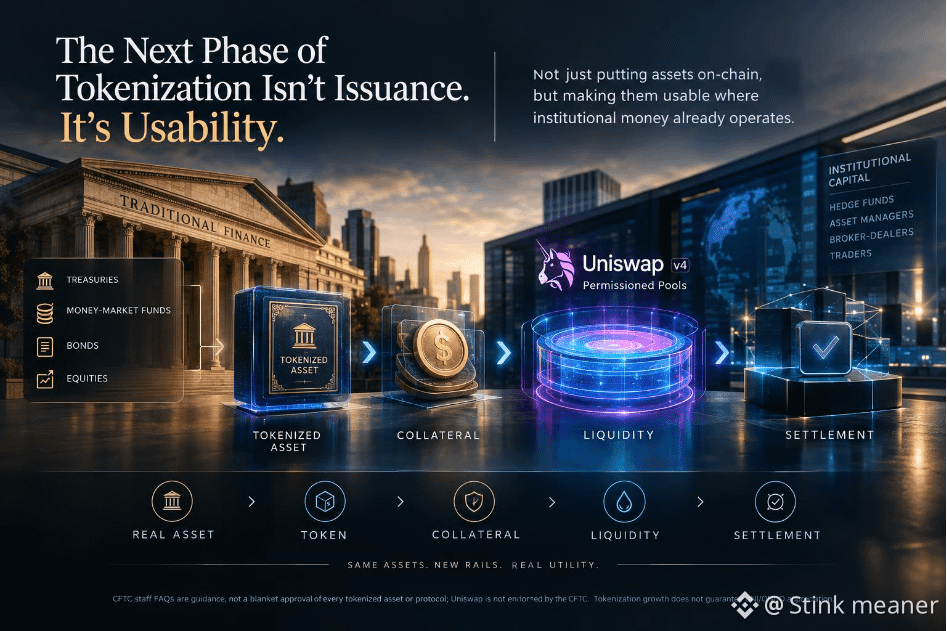
🏦 The next phase of tokenization isn't putting assets on-chain. It's making them usable where institutional money already operates...🔥
#cftcupdatesguidanceontokenizedassets
Yesterday, CFTC staff updated its crypto FAQs on two very specific issues: tokenized versions of permitted customer investments and the use of blockchain for regulated recordkeeping.
That matters because the agency's existing guidance already covers tokenized versions of assets such as Treasuries, money-market funds, bonds and equities as potential collateral — provided they satisfy strict requirements around liquidity, custody, legal enforceability and risk.
Now look at the other side of the market.
Uniswap's v4 Permissioned Pools are designed to let regulated/tokenized assets access AMM liquidity while enforcing issuer allowlists directly on-chain. Tokenized equities are already available through Uniswap's products.
So the architecture is starting to look like:
REAL ASSET → TOKEN → COLLATERAL → LIQUIDITY → SETTLEMENT
That's a much bigger development than simply “putting stocks on blockchain.”
My read: the next phase of tokenization is not issuance. It's making tokenized assets usable inside the financial system.
$UNI $ONDO
Acknowledge: CFTC staff FAQs are guidance, not a blanket approval of every tokenized asset or protocol; Uniswap is not endorsed by the CFTC. Tokenization growth does not guarantee UNI/ONDO appreciation.
#CFTCUpdatesGuidanceOnTokenizedAssets #CFTC #blockchain #RWA
🏦 The next phase of tokenization isn't putting assets on-chain. It's making them usable where institutional money already operates...🔥
#cftcupdatesguidanceontokenizedassets
Yesterday, CFTC staff updated its crypto FAQs on two very specific issues: tokenized versions of permitted customer investments and the use of blockchain for regulated recordkeeping.
That matters because the agency's existing guidance already covers tokenized versions of assets such as Treasuries, money-market funds, bonds and equities as potential collateral — provided they satisfy strict requirements around liquidity, custody, legal enforceability and risk.
Now look at the other side of the market.
Uniswap's v4 Permissioned Pools are designed to let regulated/tokenized assets access AMM liquidity while enforcing issuer allowlists directly on-chain. Tokenized equities are already available through Uniswap's products.
So the architecture is starting to look like:
REAL ASSET → TOKEN → COLLATERAL → LIQUIDITY → SETTLEMENT
That's a much bigger development than simply “putting stocks on blockchain.”
My read: the next phase of tokenization is not issuance. It's making tokenized assets usable inside the financial system.
$UNI $ONDO
Acknowledge: CFTC staff FAQs are guidance, not a blanket approval of every tokenized asset or protocol; Uniswap is not endorsed by the CFTC. Tokenization growth does not guarantee UNI/ONDO appreciation.
#CFTCUpdatesGuidanceOnTokenizedAssets #CFTC #blockchain #RWA
#cftcupdatesguidanceontokenizedassets
Yesterday, CFTC staff updated its crypto FAQs on two very specific issues: tokenized versions of permitted customer investments and the use of blockchain for regulated recordkeeping.
That matters because the agency's existing guidance already covers tokenized versions of assets such as Treasuries, money-market funds, bonds and equities as potential collateral — provided they satisfy strict requirements around liquidity, custody, legal enforceability and risk.
Now look at the other side of the market.
Uniswap's v4 Permissioned Pools are designed to let regulated/tokenized assets access AMM liquidity while enforcing issuer allowlists directly on-chain. Tokenized equities are already available through Uniswap's products.
So the architecture is starting to look like:
REAL ASSET → TOKEN → COLLATERAL → LIQUIDITY → SETTLEMENT
That's a much bigger development than simply “putting stocks on blockchain.”
My read: the next phase of tokenization is not issuance. It's making tokenized assets usable inside the financial system.
$UNI $ONDO
Acknowledge: CFTC staff FAQs are guidance, not a blanket approval of every tokenized asset or protocol; Uniswap is not endorsed by the CFTC. Tokenization growth does not guarantee UNI/ONDO appreciation.
#CFTCUpdatesGuidanceOnTokenizedAssets #CFTC #blockchain #RWA
4
149

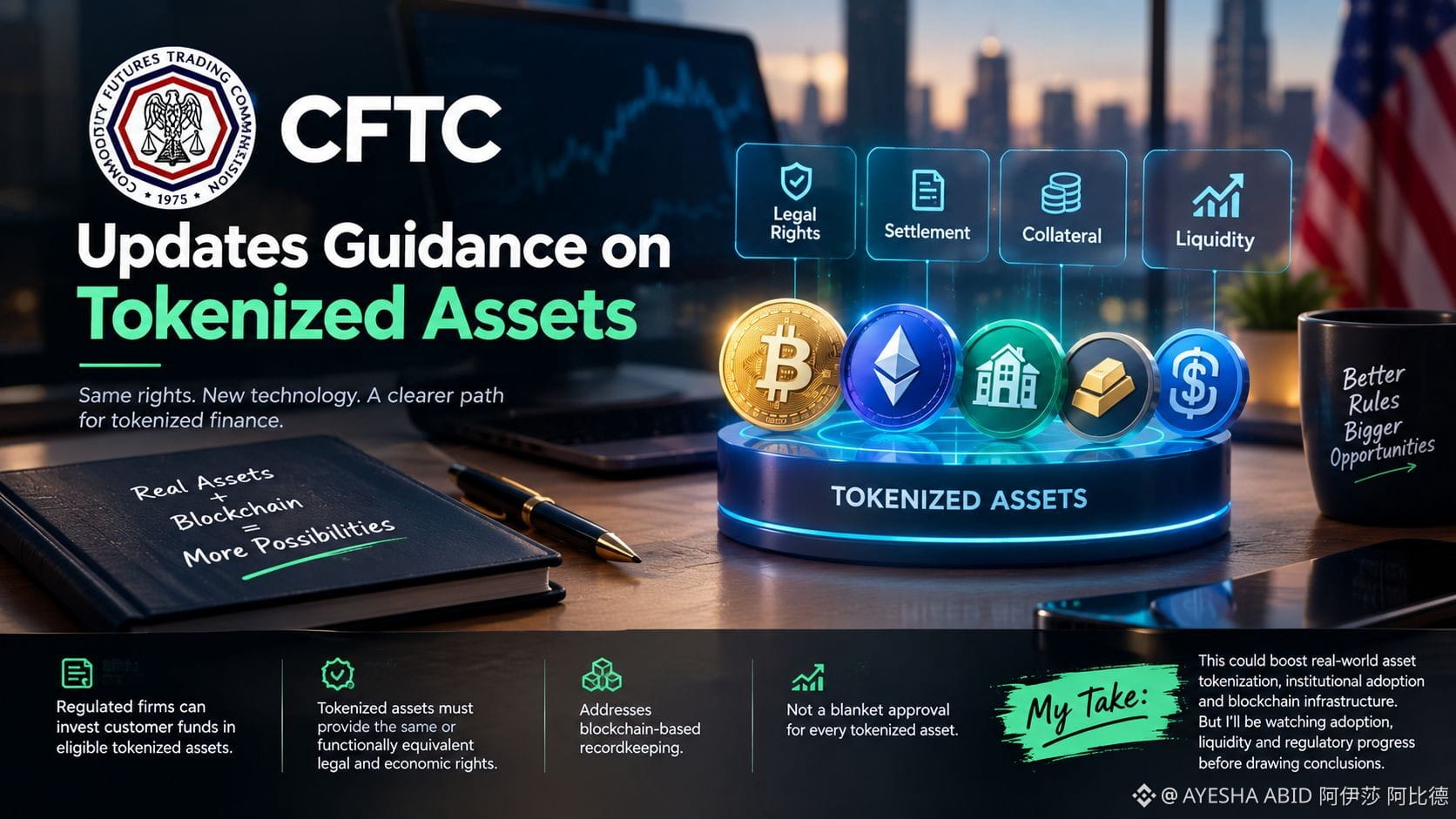
What if traditional financial assets could move on blockchain without losing their existing legal rights? The CFTC’s latest update brings that possibility closer to mainstream finance.
On September 24, 2026, the US Commodity Futures Trading Commission updated its guidance, clarifying that regulated firms can invest customer funds in eligible tokenized versions of permitted assets. The tokenized assets must provide the same or functionally equivalent legal and economic rights as their traditional forms. The agency also addressed blockchain based recordkeeping.
This matters because tokenization is not just about putting assets on chain. It could change how financial markets handle settlement, collateral, recordkeeping and liquidity. However, this guidance is not blanket approval for every tokenized asset.
My take: This is an important development for real world asset tokenization, institutional crypto adoption and blockchain infrastructure. I would watch adoption, trading volume, liquidity and regulatory developments before drawing conclusions about any token’s price. Clearer rules may support growth, but execution and investor protections still matter.
$ONDO $ETH $USDC
{future}(ETHUSDT)
{future}(ONDOUSDT)
The opportunity is worth watching, but the details will determine how far it goes.
Do you think tokenized real world assets will become a major part of traditional finance?
#Tranding #Crypto #Write2Earn #AyeshaAbid
#CFTCUpdatesGuidanceOnTokenizedAssets
What if traditional financial assets could move on blockchain without losing their existing legal rights? The CFTC’s latest update brings that possibility closer to mainstream finance.
On September 24, 2026, the US Commodity Futures Trading Commission updated its guidance, clarifying that regulated firms can invest customer funds in eligible tokenized versions of permitted assets. The tokenized assets must provide the same or functionally equivalent legal and economic rights as their traditional forms. The agency also addressed blockchain based recordkeeping.
This matters because tokenization is not just about putting assets on chain. It could change how financial markets handle settlement, collateral, recordkeeping and liquidity. However, this guidance is not blanket approval for every tokenized asset.
My take: This is an important development for real world asset tokenization, institutional crypto adoption and blockchain infrastructure. I would watch adoption, trading volume, liquidity and regulatory developments before drawing conclusions about any token’s price. Clearer rules may support growth, but execution and investor protections still matter.
$ONDO $ETH $USDC
The opportunity is worth watching, but the details will determine how far it goes.
Do you think tokenized real world assets will become a major part of traditional finance?
#Tranding #Crypto #Write2Earn #AyeshaAbid
#CFTCUpdatesGuidanceOnTokenizedAssets
On September 24, 2026, the US Commodity Futures Trading Commission updated its guidance, clarifying that regulated firms can invest customer funds in eligible tokenized versions of permitted assets. The tokenized assets must provide the same or functionally equivalent legal and economic rights as their traditional forms. The agency also addressed blockchain based recordkeeping.
This matters because tokenization is not just about putting assets on chain. It could change how financial markets handle settlement, collateral, recordkeeping and liquidity. However, this guidance is not blanket approval for every tokenized asset.
My take: This is an important development for real world asset tokenization, institutional crypto adoption and blockchain infrastructure. I would watch adoption, trading volume, liquidity and regulatory developments before drawing conclusions about any token’s price. Clearer rules may support growth, but execution and investor protections still matter.
$ONDO $ETH $USDC
The opportunity is worth watching, but the details will determine how far it goes.
Do you think tokenized real world assets will become a major part of traditional finance?
#Tranding #Crypto #Write2Earn #AyeshaAbid
#CFTCUpdatesGuidanceOnTokenizedAssets
2
195

#CFTCUpdatesGuidanceOnTokenizedAssets
🚨 CFTC TAKES ANOTHER STEP TOWARD BLOCKCHAIN-BASED FINANCE
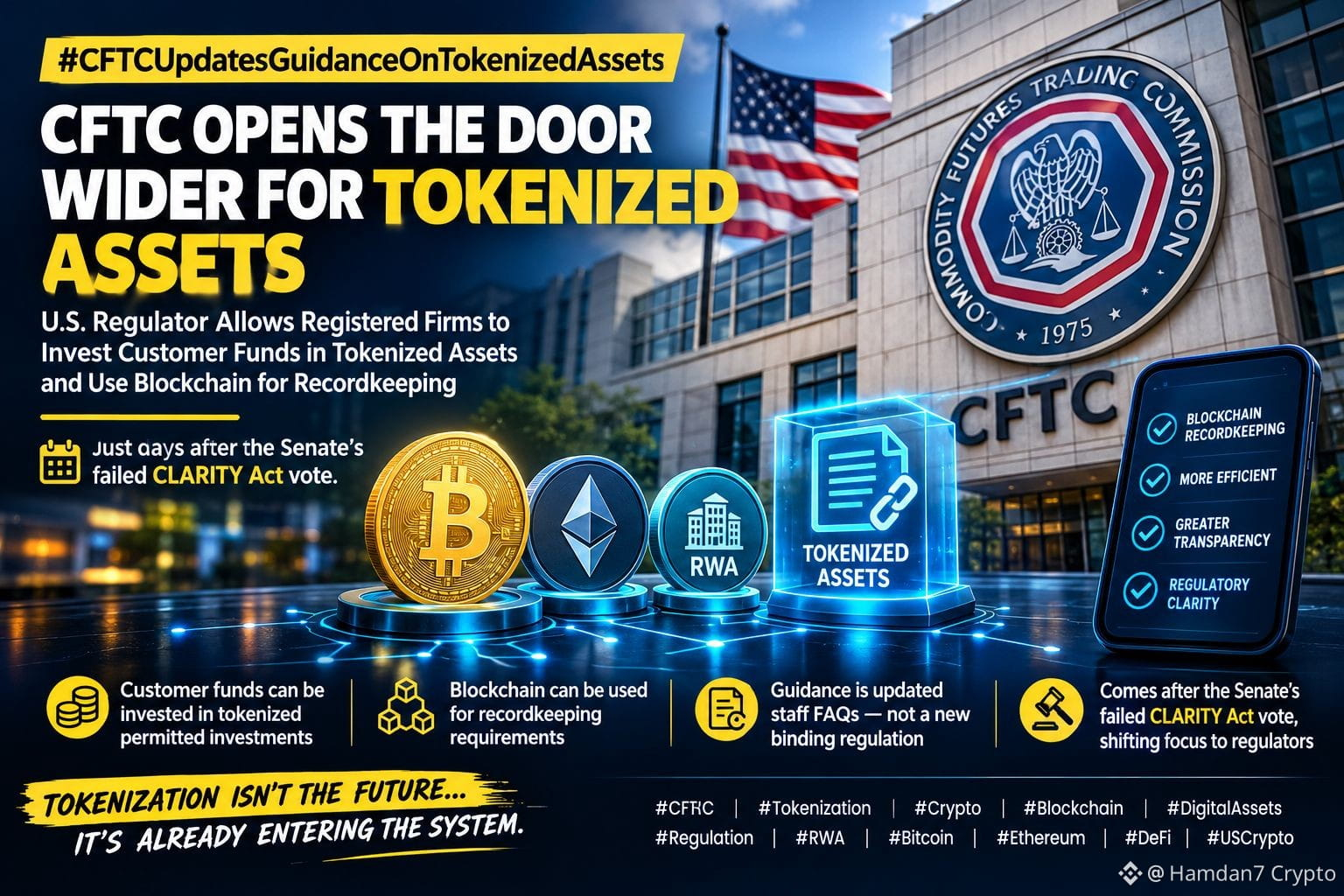
The U.S. Commodity Futures Trading Commission has updated its crypto guidance, addressing how registered firms can use tokenized forms of permitted investments and blockchain technology for regulatory recordkeeping.
Under the updated guidance, customer funds may be invested in tokenized versions of permitted assets, provided the tokenized asset gives holders legal and economic rights that are the same as, or functionally equivalent to, the traditional asset.
🔗 The CFTC also clarified that blockchain technology can be used to satisfy certain recordkeeping requirements, bringing distributed-ledger infrastructure further into the regulated financial system.
⚡ WHY IT MATTERS
This is more than just a crypto update. It shows how tokenization is increasingly being incorporated into existing financial-market infrastructure rather than being treated as a separate system.
The development comes shortly after the U.S. Senate failed to advance the CLARITY Act, shifting attention toward what regulators such as the CFTC and SEC can do through existing authorities and guidance.
📌 Importantly, the CFTC says these are updated staff FAQs — they do not create new binding regulations. The guidance focuses on providing greater clarity for regulated firms operating with digital assets and blockchain technology.
🇺🇸 Tokenization is moving deeper into traditional finance — and U.S. regulators are increasingly defining how that transition can happen.
#CFTC #Crypto #Tokenization #Blockchain #DigitalAssets #CryptoRegulation #Bitcoin #Ethereum #DeFi #RWA #TokenizedAssets #USCrypto
#CFTCUpdatesGuidanceOnTokenizedAssets
🚨 CFTC TAKES ANOTHER STEP TOWARD BLOCKCHAIN-BASED FINANCE
The U.S. Commodity Futures Trading Commission has updated its crypto guidance, addressing how registered firms can use tokenized forms of permitted investments and blockchain technology for regulatory recordkeeping.
Under the updated guidance, customer funds may be invested in tokenized versions of permitted assets, provided the tokenized asset gives holders legal and economic rights that are the same as, or functionally equivalent to, the traditional asset.
🔗 The CFTC also clarified that blockchain technology can be used to satisfy certain recordkeeping requirements, bringing distributed-ledger infrastructure further into the regulated financial system.
⚡ WHY IT MATTERS
This is more than just a crypto update. It shows how tokenization is increasingly being incorporated into existing financial-market infrastructure rather than being treated as a separate system.
The development comes shortly after the U.S. Senate failed to advance the CLARITY Act, shifting attention toward what regulators such as the CFTC and SEC can do through existing authorities and guidance.
📌 Importantly, the CFTC says these are updated staff FAQs — they do not create new binding regulations. The guidance focuses on providing greater clarity for regulated firms operating with digital assets and blockchain technology.
🇺🇸 Tokenization is moving deeper into traditional finance — and U.S. regulators are increasingly defining how that transition can happen.
#CFTC #Crypto #Tokenization #Blockchain #DigitalAssets #CryptoRegulation #Bitcoin #Ethereum #DeFi #RWA #TokenizedAssets #USCrypto
🚨 CFTC TAKES ANOTHER STEP TOWARD BLOCKCHAIN-BASED FINANCE
The U.S. Commodity Futures Trading Commission has updated its crypto guidance, addressing how registered firms can use tokenized forms of permitted investments and blockchain technology for regulatory recordkeeping.
Under the updated guidance, customer funds may be invested in tokenized versions of permitted assets, provided the tokenized asset gives holders legal and economic rights that are the same as, or functionally equivalent to, the traditional asset.
🔗 The CFTC also clarified that blockchain technology can be used to satisfy certain recordkeeping requirements, bringing distributed-ledger infrastructure further into the regulated financial system.
⚡ WHY IT MATTERS
This is more than just a crypto update. It shows how tokenization is increasingly being incorporated into existing financial-market infrastructure rather than being treated as a separate system.
The development comes shortly after the U.S. Senate failed to advance the CLARITY Act, shifting attention toward what regulators such as the CFTC and SEC can do through existing authorities and guidance.
📌 Importantly, the CFTC says these are updated staff FAQs — they do not create new binding regulations. The guidance focuses on providing greater clarity for regulated firms operating with digital assets and blockchain technology.
🇺🇸 Tokenization is moving deeper into traditional finance — and U.S. regulators are increasingly defining how that transition can happen.
#CFTC #Crypto #Tokenization #Blockchain #DigitalAssets #CryptoRegulation #Bitcoin #Ethereum #DeFi #RWA #TokenizedAssets #USCrypto
39
🏛️ CFTC Moves on Tokenized Assets
The CFTC is updating guidance around tokenized assets.
That could bring more clarity to blockchain-based financial products.
Tokenization is expanding beyond simple crypto trading.
$BTC $ETH $LINK and $BNB remain key assets in the wider ecosystem.
Clearer rules could shape how institutions use blockchain technology.
🔎 The next phase of crypto may be built around real-world assets on-chain.
#cftcupdatesguidanceontokenizedassets
🏛️ CFTC Moves on Tokenized Assets
The CFTC is updating guidance around tokenized assets.
That could bring more clarity to blockchain-based financial products.
Tokenization is expanding beyond simple crypto trading.
$BTC $ETH $LINK and $BNB remain key assets in the wider ecosystem.
Clearer rules could shape how institutions use blockchain technology.
🔎 The next phase of crypto may be built around real-world assets on-chain.
#cftcupdatesguidanceontokenizedassets
The CFTC is updating guidance around tokenized assets.
That could bring more clarity to blockchain-based financial products.
Tokenization is expanding beyond simple crypto trading.
$BTC $ETH $LINK and $BNB remain key assets in the wider ecosystem.
Clearer rules could shape how institutions use blockchain technology.
🔎 The next phase of crypto may be built around real-world assets on-chain.
#cftcupdatesguidanceontokenizedassets
22

·
--
#CFTCUpdatesGuidanceOnTokenizedAssets
CFTC Updates Guidance On Tokenized Assets — Big Win For Crypto!
The CFTC just made a major move!
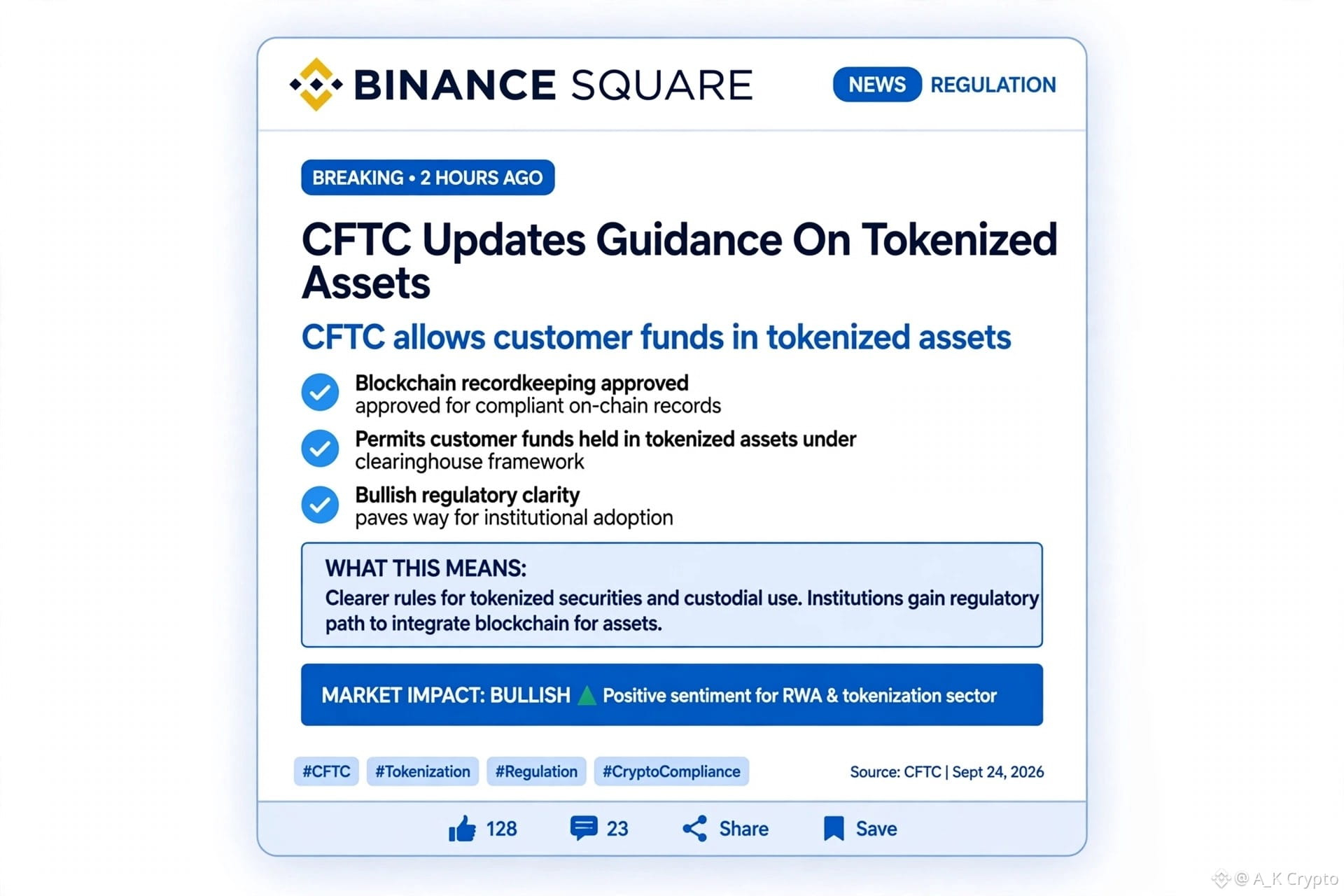
On Sep 24, the US Commodity Futures Trading Commission clarified that regulated firms CAN invest customer funds in tokenized assets — as long as the token gives the same legal & economic rights as the traditional asset.
And that's not all — CFTC also said firms can use blockchain for official recordkeeping. No need for off-chain backup if it's a private chain. For public chains, just need proper backup controls.
This comes right after Senate failed to pass the CLARITY Act. While Congress stalls, CFTC is pushing forward with real rules.
Tokenized RWA market just hit $46B — with funds leading $34.7B. This guidance opens the door for more institutional flow.
This is regulatory clarity we actually needed.
CFTC is basically saying tokenized = traditional asset if rights are same. Huge for adoption. Futures merchants, clearing houses can now put customer money into tokenized treasuries, money market funds, etc. And on-chain records being officially recognized? That's a massive endorsement for blockchain infrastructure. Short-term bullish for tokenization plays like $LINK , $ONDO , $ETH .
Bullish for crypto long-term.
#CFTC #TokenizedAssets #RWA #CryptoNews #BinanceSquare
{spot}(ETHUSDT)
{spot}(ONDOUSDT)
{spot}(LINKUSDT)
#CFTCUpdatesGuidanceOnTokenizedAssets
CFTC Updates Guidance On Tokenized Assets — Big Win For Crypto!
The CFTC just made a major move!
On Sep 24, the US Commodity Futures Trading Commission clarified that regulated firms CAN invest customer funds in tokenized assets — as long as the token gives the same legal & economic rights as the traditional asset.
And that's not all — CFTC also said firms can use blockchain for official recordkeeping. No need for off-chain backup if it's a private chain. For public chains, just need proper backup controls.
This comes right after Senate failed to pass the CLARITY Act. While Congress stalls, CFTC is pushing forward with real rules.
Tokenized RWA market just hit $46B — with funds leading $34.7B. This guidance opens the door for more institutional flow.
This is regulatory clarity we actually needed.
CFTC is basically saying tokenized = traditional asset if rights are same. Huge for adoption. Futures merchants, clearing houses can now put customer money into tokenized treasuries, money market funds, etc. And on-chain records being officially recognized? That's a massive endorsement for blockchain infrastructure. Short-term bullish for tokenization plays like $LINK , $ONDO , $ETH .
Bullish for crypto long-term.
#CFTC #TokenizedAssets #RWA #CryptoNews #BinanceSquare
CFTC Updates Guidance On Tokenized Assets — Big Win For Crypto!
The CFTC just made a major move!
On Sep 24, the US Commodity Futures Trading Commission clarified that regulated firms CAN invest customer funds in tokenized assets — as long as the token gives the same legal & economic rights as the traditional asset.
And that's not all — CFTC also said firms can use blockchain for official recordkeeping. No need for off-chain backup if it's a private chain. For public chains, just need proper backup controls.
This comes right after Senate failed to pass the CLARITY Act. While Congress stalls, CFTC is pushing forward with real rules.
Tokenized RWA market just hit $46B — with funds leading $34.7B. This guidance opens the door for more institutional flow.
This is regulatory clarity we actually needed.
CFTC is basically saying tokenized = traditional asset if rights are same. Huge for adoption. Futures merchants, clearing houses can now put customer money into tokenized treasuries, money market funds, etc. And on-chain records being officially recognized? That's a massive endorsement for blockchain infrastructure. Short-term bullish for tokenization plays like $LINK , $ONDO , $ETH .
Bullish for crypto long-term.
#CFTC #TokenizedAssets #RWA #CryptoNews #BinanceSquare
124

·
--
#CFTCUpdatesGuidanceOnTokenizedAssets
CFTC Updates Guidance on Tokenized Assets and Blockchain Records
The U.S. Commodity Futures Trading Commission (CFTC) updated its FAQs on September 24, 2026, providing additional guidance on how registered derivatives firms can use tokenized assets and blockchain technology. �
CFTC
The updated guidance addresses two key areas:
Tokenized customer funds: Certain permitted investments may be held in tokenized form, subject to applicable requirements.
Blockchain recordkeeping: Registered entities may use blockchain-based records to satisfy regulatory recordkeeping obligations when the relevant requirements are met. �
BigGo Finance +1
The CFTC said the update builds on earlier guidance concerning tokenized collateral and digital assets accepted as margin collateral. The agency first issued dedicated tokenized-collateral guidance in December 2025. �
CFTC +1
The move is another step toward integrating blockchain infrastructure into traditional derivatives markets, particularly for collateral management, settlement and recordkeeping. CFTC Chairman Michael Selig has also recently discussed broader market tokenization and 24/7 trading as areas regulators and market participants need to prepare for. �
cryptorank.io
Market impact: The clarification could make it easier for regulated derivatives firms to incorporate tokenized financial assets into existing market infrastructure while maintaining compliance with CFTC requirements.$NVDA.US $AAPL.US
#CFTCUpdatesGuidanceOnTokenizedAssets
CFTC Updates Guidance on Tokenized Assets and Blockchain Records
The U.S. Commodity Futures Trading Commission (CFTC) updated its FAQs on September 24, 2026, providing additional guidance on how registered derivatives firms can use tokenized assets and blockchain technology. �
CFTC
The updated guidance addresses two key areas:
Tokenized customer funds: Certain permitted investments may be held in tokenized form, subject to applicable requirements.
Blockchain recordkeeping: Registered entities may use blockchain-based records to satisfy regulatory recordkeeping obligations when the relevant requirements are met. �
BigGo Finance +1
The CFTC said the update builds on earlier guidance concerning tokenized collateral and digital assets accepted as margin collateral. The agency first issued dedicated tokenized-collateral guidance in December 2025. �
CFTC +1
The move is another step toward integrating blockchain infrastructure into traditional derivatives markets, particularly for collateral management, settlement and recordkeeping. CFTC Chairman Michael Selig has also recently discussed broader market tokenization and 24/7 trading as areas regulators and market participants need to prepare for. �
cryptorank.io
Market impact: The clarification could make it easier for regulated derivatives firms to incorporate tokenized financial assets into existing market infrastructure while maintaining compliance with CFTC requirements.$NVDA.US $AAPL.US
CFTC Updates Guidance on Tokenized Assets and Blockchain Records
The U.S. Commodity Futures Trading Commission (CFTC) updated its FAQs on September 24, 2026, providing additional guidance on how registered derivatives firms can use tokenized assets and blockchain technology. �
CFTC
The updated guidance addresses two key areas:
Tokenized customer funds: Certain permitted investments may be held in tokenized form, subject to applicable requirements.
Blockchain recordkeeping: Registered entities may use blockchain-based records to satisfy regulatory recordkeeping obligations when the relevant requirements are met. �
BigGo Finance +1
The CFTC said the update builds on earlier guidance concerning tokenized collateral and digital assets accepted as margin collateral. The agency first issued dedicated tokenized-collateral guidance in December 2025. �
CFTC +1
The move is another step toward integrating blockchain infrastructure into traditional derivatives markets, particularly for collateral management, settlement and recordkeeping. CFTC Chairman Michael Selig has also recently discussed broader market tokenization and 24/7 trading as areas regulators and market participants need to prepare for. �
cryptorank.io
Market impact: The clarification could make it easier for regulated derivatives firms to incorporate tokenized financial assets into existing market infrastructure while maintaining compliance with CFTC requirements.$NVDA.US $AAPL.US
NVDAUS+0.29%
AAPLUS-0.12%
1
18
·
--
Article
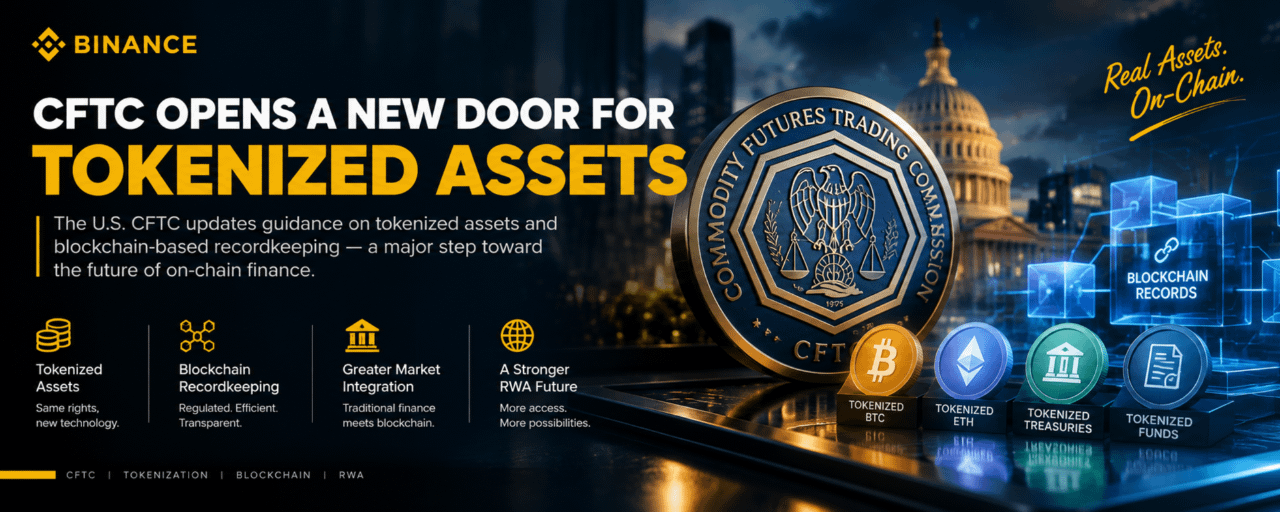
CFTC Updates Tokenized Asset Rules — Blockchain Moves Deeper Into Finance#cftcupdatesguidanceontokenizedassets
The U.S. Commodity Futures Trading Commission has updated its guidance on tokenized assets and blockchain-based recordkeeping, giving regulated derivatives firms clearer rules for integrating blockchain technology into existing financial-market infrastructure.
🔹 What Changed?
Under the September 24 update, the CFTC clarified that certain Futures Commission Merchants (FCMs) and Derivatives Clearing Organizations (DCOs) can invest customer funds in tokenized versions of permitted assets.
The key requirement is that the tokenized asset must provide holders with the same or functionally equivalent legal and economic rights as the traditional asset it represents.
In simple terms:
Traditional asset → Tokenized representation → Blockchain infrastructure
The underlying rights still matter. Putting an asset on a blockchain does not automatically change its regulatory treatment.
⛓️ Blockchain Recordkeeping
Another important part of the update concerns recordkeeping.
The CFTC said qualifying regulated entities can use blockchain or distributed-ledger records to satisfy certain regulatory recordkeeping obligations, rather than maintaining an additional off-chain copy simply because the records are stored on-chain.
However, firms using public networks still need to ensure that required records can be retrieved and provided to regulators, including if the network or a block explorer becomes unavailable.
💰 Why Tokenization Matters
Tokenization can potentially make traditional financial assets easier to transfer and integrate with digital-market infrastructure.
Possible benefits include:
🔹 Faster settlement
🔹 Programmable financial assets
🔹 Greater interoperability with blockchain systems
🔹 More efficient collateral management
🔹 Potentially broader access to financial infrastructure
🔹 24/7 on-chain market infrastructure
The CFTC has already been developing frameworks around tokenized collateral, stablecoins and digital assets in derivatives markets, so this latest update builds on an existing regulatory direction rather than appearing in isolation.
⚠️ What It Does NOT Mean
This does not mean every tokenized asset is automatically approved or that every crypto project receives regulatory clearance.
The underlying asset, legal rights, custody arrangements, liquidity, valuation and applicable regulatory requirements still matter.
👀 The Bigger Picture
The most interesting part of this development isn't simply another crypto regulation headline.
It's the possibility of traditional financial infrastructure gradually moving onto blockchain rails.
If tokenized Treasuries, funds, collateral and other financial instruments become increasingly integrated with regulated markets, blockchain could become less of a separate financial ecosystem and more of an underlying infrastructure layer for traditional finance.
For crypto investors, the key theme to watch is therefore tokenization + regulation + institutional adoption.
The next phase of blockchain adoption may not just be about new tokens — it could be about putting existing financial assets on-chain. ⛓️📈
#BinanceSquareTalks #crypto
CFTC Updates Tokenized Asset Rules — Blockchain Moves Deeper Into Finance
#cftcupdatesguidanceontokenizedassets
The U.S. Commodity Futures Trading Commission has updated its guidance on tokenized assets and blockchain-based recordkeeping, giving regulated derivatives firms clearer rules for integrating blockchain technology into existing financial-market infrastructure.
🔹 What Changed?
Under the September 24 update, the CFTC clarified that certain Futures Commission Merchants (FCMs) and Derivatives Clearing Organizations (DCOs) can invest customer funds in tokenized versions of permitted assets.
The key requirement is that the tokenized asset must provide holders with the same or functionally equivalent legal and economic rights as the traditional asset it represents.
In simple terms:
Traditional asset → Tokenized representation → Blockchain infrastructure
The underlying rights still matter. Putting an asset on a blockchain does not automatically change its regulatory treatment.
⛓️ Blockchain Recordkeeping
Another important part of the update concerns recordkeeping.
The CFTC said qualifying regulated entities can use blockchain or distributed-ledger records to satisfy certain regulatory recordkeeping obligations, rather than maintaining an additional off-chain copy simply because the records are stored on-chain.
However, firms using public networks still need to ensure that required records can be retrieved and provided to regulators, including if the network or a block explorer becomes unavailable.
💰 Why Tokenization Matters
Tokenization can potentially make traditional financial assets easier to transfer and integrate with digital-market infrastructure.
Possible benefits include:
🔹 Faster settlement
🔹 Programmable financial assets
🔹 Greater interoperability with blockchain systems
🔹 More efficient collateral management
🔹 Potentially broader access to financial infrastructure
🔹 24/7 on-chain market infrastructure
The CFTC has already been developing frameworks around tokenized collateral, stablecoins and digital assets in derivatives markets, so this latest update builds on an existing regulatory direction rather than appearing in isolation.
⚠️ What It Does NOT Mean
This does not mean every tokenized asset is automatically approved or that every crypto project receives regulatory clearance.
The underlying asset, legal rights, custody arrangements, liquidity, valuation and applicable regulatory requirements still matter.
👀 The Bigger Picture
The most interesting part of this development isn't simply another crypto regulation headline.
It's the possibility of traditional financial infrastructure gradually moving onto blockchain rails.
If tokenized Treasuries, funds, collateral and other financial instruments become increasingly integrated with regulated markets, blockchain could become less of a separate financial ecosystem and more of an underlying infrastructure layer for traditional finance.
For crypto investors, the key theme to watch is therefore tokenization + regulation + institutional adoption.
The next phase of blockchain adoption may not just be about new tokens — it could be about putting existing financial assets on-chain. ⛓️📈
#BinanceSquareTalks #crypto
The U.S. Commodity Futures Trading Commission has updated its guidance on tokenized assets and blockchain-based recordkeeping, giving regulated derivatives firms clearer rules for integrating blockchain technology into existing financial-market infrastructure.
🔹 What Changed?
Under the September 24 update, the CFTC clarified that certain Futures Commission Merchants (FCMs) and Derivatives Clearing Organizations (DCOs) can invest customer funds in tokenized versions of permitted assets.
The key requirement is that the tokenized asset must provide holders with the same or functionally equivalent legal and economic rights as the traditional asset it represents.
In simple terms:
Traditional asset → Tokenized representation → Blockchain infrastructure
The underlying rights still matter. Putting an asset on a blockchain does not automatically change its regulatory treatment.
⛓️ Blockchain Recordkeeping
Another important part of the update concerns recordkeeping.
The CFTC said qualifying regulated entities can use blockchain or distributed-ledger records to satisfy certain regulatory recordkeeping obligations, rather than maintaining an additional off-chain copy simply because the records are stored on-chain.
However, firms using public networks still need to ensure that required records can be retrieved and provided to regulators, including if the network or a block explorer becomes unavailable.
💰 Why Tokenization Matters
Tokenization can potentially make traditional financial assets easier to transfer and integrate with digital-market infrastructure.
Possible benefits include:
🔹 Faster settlement
🔹 Programmable financial assets
🔹 Greater interoperability with blockchain systems
🔹 More efficient collateral management
🔹 Potentially broader access to financial infrastructure
🔹 24/7 on-chain market infrastructure
The CFTC has already been developing frameworks around tokenized collateral, stablecoins and digital assets in derivatives markets, so this latest update builds on an existing regulatory direction rather than appearing in isolation.
⚠️ What It Does NOT Mean
This does not mean every tokenized asset is automatically approved or that every crypto project receives regulatory clearance.
The underlying asset, legal rights, custody arrangements, liquidity, valuation and applicable regulatory requirements still matter.
👀 The Bigger Picture
The most interesting part of this development isn't simply another crypto regulation headline.
It's the possibility of traditional financial infrastructure gradually moving onto blockchain rails.
If tokenized Treasuries, funds, collateral and other financial instruments become increasingly integrated with regulated markets, blockchain could become less of a separate financial ecosystem and more of an underlying infrastructure layer for traditional finance.
For crypto investors, the key theme to watch is therefore tokenization + regulation + institutional adoption.
The next phase of blockchain adoption may not just be about new tokens — it could be about putting existing financial assets on-chain. ⛓️📈
#BinanceSquareTalks #crypto
14


The CFTC has issued new guidance concerning tokenized assets, signaling a significant development in regulatory clarity for this burgeoning sector. This move is crucial as it provides a framework for how these digital representations of real-world assets will be treated under existing financial regulations.
This guidance is expected to foster greater institutional adoption and innovation within the tokenized asset space. By offering clearer rules, the CFTC aims to mitigate risks, enhance market integrity, and protect investors. The market will likely react positively, potentially leading to increased investment and development in platforms and protocols that support tokenized assets. This could also pave the way for more sophisticated financial products and services built on blockchain technology.
Disclaimer: This content is for informational purposes only and does not constitute financial advice.
#CFTCUpdatesGuidanceOnTokenizedAssets
The CFTC has issued new guidance concerning tokenized assets, signaling a significant development in regulatory clarity for this burgeoning sector. This move is crucial as it provides a framework for how these digital representations of real-world assets will be treated under existing financial regulations.
This guidance is expected to foster greater institutional adoption and innovation within the tokenized asset space. By offering clearer rules, the CFTC aims to mitigate risks, enhance market integrity, and protect investors. The market will likely react positively, potentially leading to increased investment and development in platforms and protocols that support tokenized assets. This could also pave the way for more sophisticated financial products and services built on blockchain technology.
Disclaimer: This content is for informational purposes only and does not constitute financial advice.
#CFTCUpdatesGuidanceOnTokenizedAssets
This guidance is expected to foster greater institutional adoption and innovation within the tokenized asset space. By offering clearer rules, the CFTC aims to mitigate risks, enhance market integrity, and protect investors. The market will likely react positively, potentially leading to increased investment and development in platforms and protocols that support tokenized assets. This could also pave the way for more sophisticated financial products and services built on blockchain technology.
Disclaimer: This content is for informational purposes only and does not constitute financial advice.
#CFTCUpdatesGuidanceOnTokenizedAssets
5
🔥 Tokenization Gets Regulatory Attention
The CFTC is addressing tokenized assets in updated guidance.
This is another sign that blockchain finance is evolving.
From securities to real-world assets, more value can move on-chain.
$ETH $LINK $BNB and $SOL are part of this broader ecosystem.
🚀 The tokenization story is getting bigger.
#cftcupdatesguidanceontokenizedassets
🔥 Tokenization Gets Regulatory Attention
The CFTC is addressing tokenized assets in updated guidance.
This is another sign that blockchain finance is evolving.
From securities to real-world assets, more value can move on-chain.
$ETH $LINK $BNB and $SOL are part of this broader ecosystem.
🚀 The tokenization story is getting bigger.
#cftcupdatesguidanceontokenizedassets
The CFTC is addressing tokenized assets in updated guidance.
This is another sign that blockchain finance is evolving.
From securities to real-world assets, more value can move on-chain.
$ETH $LINK $BNB and $SOL are part of this broader ecosystem.
🚀 The tokenization story is getting bigger.
#cftcupdatesguidanceontokenizedassets
14

#CFTCUpdatesGuidanceOnTokenizedAssets
🚨🇺🇸 CFTC JUST MADE A BIG MOVE FOR TOKENIZATION! 🔥
The U.S. CFTC has updated its guidance around tokenized assets and blockchain-based recordkeeping.
👀 Why am I watching this?
🏦 Traditional finance + Blockchain
🔗 More clarity around tokenized assets
🌍 RWA adoption narrative getting stronger
⚡ Another signal that regulated markets are moving closer to on-chain infrastructure
This isn’t a signal to blindly buy anything.
I’m watching $RWA + tokenization projects for the next wave of momentum. 👀📈
🔥 Is tokenization becoming the next major crypto narrative?
{alpha}(560x9c8b5ca345247396bdfac0395638ca9045c6586e)
$LAB
{future}(LABUSDT)
$DEXE
{spot}(DEXEUSDT)
DYOR • Manage Risk ⚠️
#Crypto #RWA #Tokenization #CFTC
#CFTCUpdatesGuidanceOnTokenizedAssets
🚨🇺🇸 CFTC JUST MADE A BIG MOVE FOR TOKENIZATION! 🔥
The U.S. CFTC has updated its guidance around tokenized assets and blockchain-based recordkeeping.
👀 Why am I watching this?
🏦 Traditional finance + Blockchain
🔗 More clarity around tokenized assets
🌍 RWA adoption narrative getting stronger
⚡ Another signal that regulated markets are moving closer to on-chain infrastructure
This isn’t a signal to blindly buy anything.
I’m watching $RWA + tokenization projects for the next wave of momentum. 👀📈
🔥 Is tokenization becoming the next major crypto narrative?
$LAB
$DEXE
DYOR • Manage Risk ⚠️
#Crypto #RWA #Tokenization #CFTC
🚨🇺🇸 CFTC JUST MADE A BIG MOVE FOR TOKENIZATION! 🔥
The U.S. CFTC has updated its guidance around tokenized assets and blockchain-based recordkeeping.
👀 Why am I watching this?
🏦 Traditional finance + Blockchain
🔗 More clarity around tokenized assets
🌍 RWA adoption narrative getting stronger
⚡ Another signal that regulated markets are moving closer to on-chain infrastructure
This isn’t a signal to blindly buy anything.
I’m watching $RWA + tokenization projects for the next wave of momentum. 👀📈
🔥 Is tokenization becoming the next major crypto narrative?
$LAB
$DEXE
DYOR • Manage Risk ⚠️
#Crypto #RWA #Tokenization #CFTC
273

·
--
🚨 CFTC JUST UPDATED ITS CRYPTO GUIDANCE
Tokenized assets + blockchain records are getting clearer regulatory treatment in U.S. derivatives markets. 🔥
Is tokenization becoming the next major crypto narrative? 👀
#Tokenization #CFTCUpdatesGuidanceOnTokenizedAssets
#BinanceWillListHyperliquid(HYPE) $ZEN
🚨 CFTC JUST UPDATED ITS CRYPTO GUIDANCE
Tokenized assets + blockchain records are getting clearer regulatory treatment in U.S. derivatives markets. 🔥
Is tokenization becoming the next major crypto narrative? 👀
#Tokenization #CFTCUpdatesGuidanceOnTokenizedAssets
#BinanceWillListHyperliquid(HYPE) $ZEN
Tokenized assets + blockchain records are getting clearer regulatory treatment in U.S. derivatives markets. 🔥
Is tokenization becoming the next major crypto narrative? 👀
#Tokenization #CFTCUpdatesGuidanceOnTokenizedAssets
#BinanceWillListHyperliquid(HYPE) $ZEN

188

CFTC JUST MOVED ON TOKENIZED ASSETS
Traditional finance + blockchain are getting closer. 👀
The U.S. CFTC has updated its guidance around tokenized assets and blockchain use by regulated derivatives firms.
🔹 Tokenized versions of permitted assets may be used in certain regulated activities
🔹 Tokenized assets must preserve the same or functionally equivalent legal & economic rights
🔹 Blockchain-based recordkeeping can be used under the updated framework
🔹 Certain qualifying tokenized assets may support margin requirements
🔥 Why this matters:
This could accelerate the connection between Real-World Assets (RWA) and regulated financial markets.
Tokenization isn't just a crypto narrative anymore — regulators are increasingly addressing how blockchain-based assets can fit into existing financial infrastructure.
👀 Could this be another major step toward institutional tokenization?#CFTCUpdatesGuidanceOnTokenizedAssets
CFTC JUST MOVED ON TOKENIZED ASSETS
Traditional finance + blockchain are getting closer. 👀
The U.S. CFTC has updated its guidance around tokenized assets and blockchain use by regulated derivatives firms.
🔹 Tokenized versions of permitted assets may be used in certain regulated activities
🔹 Tokenized assets must preserve the same or functionally equivalent legal & economic rights
🔹 Blockchain-based recordkeeping can be used under the updated framework
🔹 Certain qualifying tokenized assets may support margin requirements
🔥 Why this matters:
This could accelerate the connection between Real-World Assets (RWA) and regulated financial markets.
Tokenization isn't just a crypto narrative anymore — regulators are increasingly addressing how blockchain-based assets can fit into existing financial infrastructure.
👀 Could this be another major step toward institutional tokenization?#CFTCUpdatesGuidanceOnTokenizedAssets
Traditional finance + blockchain are getting closer. 👀
The U.S. CFTC has updated its guidance around tokenized assets and blockchain use by regulated derivatives firms.
🔹 Tokenized versions of permitted assets may be used in certain regulated activities
🔹 Tokenized assets must preserve the same or functionally equivalent legal & economic rights
🔹 Blockchain-based recordkeeping can be used under the updated framework
🔹 Certain qualifying tokenized assets may support margin requirements
🔥 Why this matters:
This could accelerate the connection between Real-World Assets (RWA) and regulated financial markets.
Tokenization isn't just a crypto narrative anymore — regulators are increasingly addressing how blockchain-based assets can fit into existing financial infrastructure.
👀 Could this be another major step toward institutional tokenization?#CFTCUpdatesGuidanceOnTokenizedAssets
31
·
--
#CFTCUpdatesGuidanceOnTokenizedAssets
The U.S. Commodity Futures Trading Commission (CFTC) issued a major regulatory update on September 24, 2026, officially giving regulated derivatives firms the green light to invest customer funds into tokenized forms of permitted assets. [1, 2]
The agency also formally confirmed that it will allow firms to use blockchain and distributed ledger technology ($DLTR.US
{stock_us}(DLTR.US)
) for regulatory record keeping.
$AAPLB
{spot}(AAPLBUSDT)
$NVDA.US
{stock_us}(NVDA.US)
#CFTCUpdatesGuidanceOnTokenizedAssets
The U.S. Commodity Futures Trading Commission (CFTC) issued a major regulatory update on September 24, 2026, officially giving regulated derivatives firms the green light to invest customer funds into tokenized forms of permitted assets. [1, 2]
The agency also formally confirmed that it will allow firms to use blockchain and distributed ledger technology ($DLTR.US
) for regulatory record keeping.
$AAPLB
$NVDA.US
The U.S. Commodity Futures Trading Commission (CFTC) issued a major regulatory update on September 24, 2026, officially giving regulated derivatives firms the green light to invest customer funds into tokenized forms of permitted assets. [1, 2]
The agency also formally confirmed that it will allow firms to use blockchain and distributed ledger technology ($DLTR.US
) for regulatory record keeping.
$AAPLB
$NVDA.US
NVDAUS+0.29%
AAPLB-0.08%
111

·
--
Bullish
#CFTCUpdatesGuidanceOnTokenizedAssets CFTC Updates Guidance on Tokenized Assets!
The U.S. Commodity Futures Trading Commission (CFTC) has released updated guidance and FAQs regarding tokenized assets and blockchain recordkeeping:
Tokenized Permitted Investments: Authorized companies can now invest customer funds in tokenized forms of assets, as long as the tokenized versions offer identical or functionally equivalent legal and economic rights to traditional assets.
Blockchain Recordkeeping: The regulator has no objection to authorized firms using blockchain technology to maintain required records.
The Bigger Picture: These updates mark a major step toward bringing regulatory clarity to the digital asset space as financial institutions increasingly bridge traditional finance with blockchain rails.
#CryptoRegulations #Tokenization #Blockchain #Web3 $BTC $BNB $USDC
#CFTCUpdatesGuidanceOnTokenizedAssets CFTC Updates Guidance on Tokenized Assets!
The U.S. Commodity Futures Trading Commission (CFTC) has released updated guidance and FAQs regarding tokenized assets and blockchain recordkeeping:
Tokenized Permitted Investments: Authorized companies can now invest customer funds in tokenized forms of assets, as long as the tokenized versions offer identical or functionally equivalent legal and economic rights to traditional assets.
Blockchain Recordkeeping: The regulator has no objection to authorized firms using blockchain technology to maintain required records.
The Bigger Picture: These updates mark a major step toward bringing regulatory clarity to the digital asset space as financial institutions increasingly bridge traditional finance with blockchain rails.
#CryptoRegulations #Tokenization #Blockchain #Web3 $BTC $BNB $USDC
The U.S. Commodity Futures Trading Commission (CFTC) has released updated guidance and FAQs regarding tokenized assets and blockchain recordkeeping:
Tokenized Permitted Investments: Authorized companies can now invest customer funds in tokenized forms of assets, as long as the tokenized versions offer identical or functionally equivalent legal and economic rights to traditional assets.
Blockchain Recordkeeping: The regulator has no objection to authorized firms using blockchain technology to maintain required records.
The Bigger Picture: These updates mark a major step toward bringing regulatory clarity to the digital asset space as financial institutions increasingly bridge traditional finance with blockchain rails.
#CryptoRegulations #Tokenization #Blockchain #Web3 $BTC $BNB $USDC
88

·
--
🚨 #CFTCUpdatesGuidanceOnTokenizedAssets — tokenized finance just got another regulatory green light.
The CFTC has updated its crypto and blockchain FAQs to clarify that regulated firms can use tokenized versions of otherwise permitted investments for customer funds, while also recognizing certain blockchain-based recordkeeping practices.
That may sound technical, but the market implication is big:
Tokenized Treasuries + tokenized collateral + blockchain settlement = deeper institutional RWA adoption.
The guidance also builds on earlier CFTC work around tokenized collateral and digital assets used as margin, showing that U.S. regulators are increasingly defining how traditional financial assets can move onchain rather than treating tokenization as a fringe experiment.
For the RWA narrative, this is another important step.
More regulatory clarity → easier institutional participation → more demand for tokenized assets and onchain settlement infrastructure.
That puts names tied to RWA, tokenization and DeFi rails back on the radar.
The question is no longer whether TradFi comes onchain — it’s how fast. 👀
{future}(XAUUSDT)
{future}(ZECUSDT)
{future}(XAGUSDT)
$XAU $ZEC $XAG
#BitgetSays$352MAffectedInHack #BinanceWillListHyperliquid(HYPE) #BrazilOrdersReportingOf$10KSelfCustodyTransfers #FedProposesRulesForBankIssuedStablecoins
🚨 #CFTCUpdatesGuidanceOnTokenizedAssets — tokenized finance just got another regulatory green light.
The CFTC has updated its crypto and blockchain FAQs to clarify that regulated firms can use tokenized versions of otherwise permitted investments for customer funds, while also recognizing certain blockchain-based recordkeeping practices.
That may sound technical, but the market implication is big:
Tokenized Treasuries + tokenized collateral + blockchain settlement = deeper institutional RWA adoption.
The guidance also builds on earlier CFTC work around tokenized collateral and digital assets used as margin, showing that U.S. regulators are increasingly defining how traditional financial assets can move onchain rather than treating tokenization as a fringe experiment.
For the RWA narrative, this is another important step.
More regulatory clarity → easier institutional participation → more demand for tokenized assets and onchain settlement infrastructure.
That puts names tied to RWA, tokenization and DeFi rails back on the radar.
The question is no longer whether TradFi comes onchain — it’s how fast. 👀
$XAU $ZEC $XAG
#BitgetSays$352MAffectedInHack #BinanceWillListHyperliquid(HYPE) #BrazilOrdersReportingOf$10KSelfCustodyTransfers #FedProposesRulesForBankIssuedStablecoins
The CFTC has updated its crypto and blockchain FAQs to clarify that regulated firms can use tokenized versions of otherwise permitted investments for customer funds, while also recognizing certain blockchain-based recordkeeping practices.
That may sound technical, but the market implication is big:
Tokenized Treasuries + tokenized collateral + blockchain settlement = deeper institutional RWA adoption.
The guidance also builds on earlier CFTC work around tokenized collateral and digital assets used as margin, showing that U.S. regulators are increasingly defining how traditional financial assets can move onchain rather than treating tokenization as a fringe experiment.
For the RWA narrative, this is another important step.
More regulatory clarity → easier institutional participation → more demand for tokenized assets and onchain settlement infrastructure.
That puts names tied to RWA, tokenization and DeFi rails back on the radar.
The question is no longer whether TradFi comes onchain — it’s how fast. 👀
$XAU $ZEC $XAG
#BitgetSays$352MAffectedInHack #BinanceWillListHyperliquid(HYPE) #BrazilOrdersReportingOf$10KSelfCustodyTransfers #FedProposesRulesForBankIssuedStablecoins
1
321
Log in to explore more content
Join global crypto users on Binance Square
⚡️ Get latest and useful information about crypto.
💬 Trusted by the world’s largest crypto exchange.
👍 Discover real insights from verified creators.
Email / Phone number
Trending Topics
1
#BitcoinSpotETFsNetInflow$191M
269 views
53 Discussing
2
#CFTCUpdatesGuidanceOnTokenizedAssets
6,795 views
377 Discussing
3
#BitgetSays$352MAffectedInHack
1,099 views
27 Discussing
4
#BinanceWillListHyperliquid(HYPE)
184,258 views
2,975 Discussing
5
#BrazilOrdersReportingOf$10KSelfCustodyTransfers
590 views
29 Discussing
6
#FedProposesRulesForBankIssuedStablecoins
7,986 views
306 Discussing
7
#OndoFinanceSoughtSaleAfterFoundersDeath
6,041 views
207 Discussing
8
#FedOctoberRateHikeOddsRiseTo69.7%
70,503 views
1,287 Discussing
9
#BitcoinFallsBelow$83,000
4,912 views
20 Discussing
10
#BitcoinFallsToAround$84,600ThisWeek
0 views
0 Discussing