

#cftcupdatesguidanceontokenizedassets
cftcupdatesguidanceontokenizedassets
Hot
Latest

·
--
Article
A Failed Senate Vote Just Pushed a US Regulator to Act on Its Own#cftcupdatesguidanceontokenizedassets
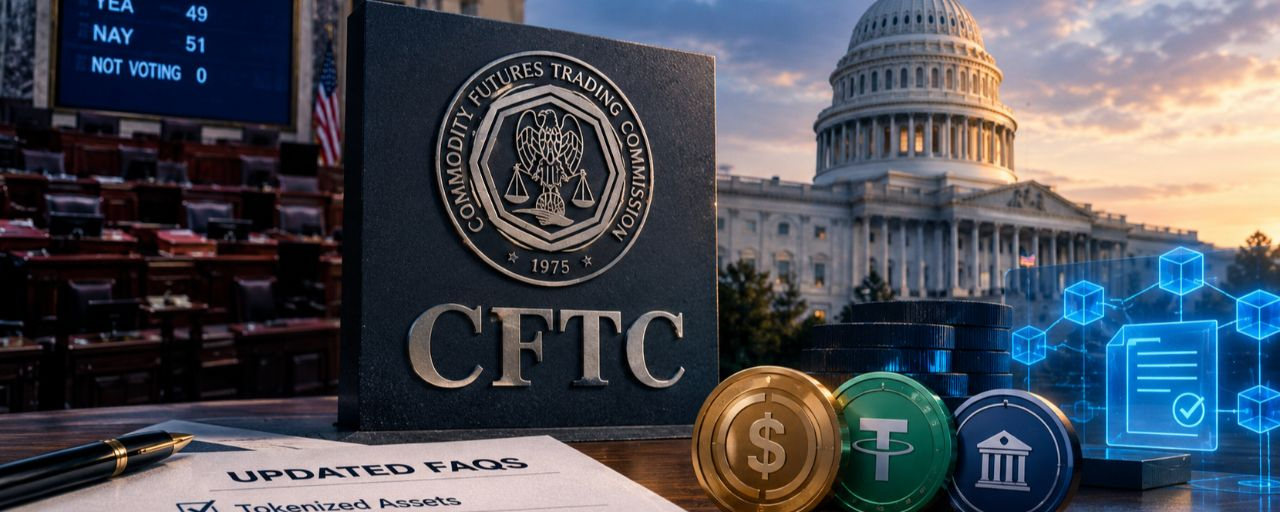
The CFTC just expanded its crypto guidance — against the backdrop of Congress failing to advance new legislation.
Here's the sequence: on September 24, the Commodity Futures Trading Commission's staff released updated FAQs clarifying two practical questions for regulated derivatives firms.
First, firms can now invest customer funds in tokenized versions of assets that were already permissible under existing rules — think tokenized Treasuries or money market funds — provided the token gives holders legal and economic rights functionally equivalent to the traditional asset.
Second, the agency confirmed that blockchain or distributed ledger systems can satisfy existing recordkeeping requirements, as long as records remain reliable, accessible, and producible, with backup controls in place for network outages.
The update builds on CFTC guidance issued in December 2025 around tokenized collateral. It also arrives just days after the U.S. Senate failed to advance the Digital Asset Market Clarity Act, which would have provided a clearer statutory framework for CFTC oversight of crypto spot markets.
The CFTC's latest move instead works within its existing authority — meaning regulated firms get additional guidance without waiting for Congress to pass new legislation.
The timing is notable as the broader tokenized real-world asset market has grown to roughly $46 billion.
Why does this matter?
Regulatory clarity can be important for institutional adoption because large financial firms typically need defined rules before committing significant resources to new infrastructure.
A regulator using existing frameworks while Congress remains divided points to one possible path for crypto regulation: administrative guidance may shape adoption before comprehensive legislation arrives.
But there's a trade-off.
Guidance can move faster and adapt more easily. Legislation can provide a more durable statutory foundation.
Whether this administrative approach proves durable — or whether the industry still needs dedicated legislation — remains an open question.
Does regulatory clarity built through guidance carry the same weight as clarity built through law? 🤔
#CFTC #Tokenization #RWA #CryptoRegulation
Not financial advice. Do your own research.
$QNT $QI $XPL
{future}(XPLUSDT)
{spot}(QIUSDT)
{future}(QNTUSDT)
A Failed Senate Vote Just Pushed a US Regulator to Act on Its Own
#cftcupdatesguidanceontokenizedassets
The CFTC just expanded its crypto guidance — against the backdrop of Congress failing to advance new legislation.
Here's the sequence: on September 24, the Commodity Futures Trading Commission's staff released updated FAQs clarifying two practical questions for regulated derivatives firms.
First, firms can now invest customer funds in tokenized versions of assets that were already permissible under existing rules — think tokenized Treasuries or money market funds — provided the token gives holders legal and economic rights functionally equivalent to the traditional asset.
Second, the agency confirmed that blockchain or distributed ledger systems can satisfy existing recordkeeping requirements, as long as records remain reliable, accessible, and producible, with backup controls in place for network outages.
The update builds on CFTC guidance issued in December 2025 around tokenized collateral. It also arrives just days after the U.S. Senate failed to advance the Digital Asset Market Clarity Act, which would have provided a clearer statutory framework for CFTC oversight of crypto spot markets.
The CFTC's latest move instead works within its existing authority — meaning regulated firms get additional guidance without waiting for Congress to pass new legislation.
The timing is notable as the broader tokenized real-world asset market has grown to roughly $46 billion.
Why does this matter?
Regulatory clarity can be important for institutional adoption because large financial firms typically need defined rules before committing significant resources to new infrastructure.
A regulator using existing frameworks while Congress remains divided points to one possible path for crypto regulation: administrative guidance may shape adoption before comprehensive legislation arrives.
But there's a trade-off.
Guidance can move faster and adapt more easily. Legislation can provide a more durable statutory foundation.
Whether this administrative approach proves durable — or whether the industry still needs dedicated legislation — remains an open question.
Does regulatory clarity built through guidance carry the same weight as clarity built through law? 🤔
#CFTC #Tokenization #RWA #CryptoRegulation
Not financial advice. Do your own research.
$QNT $QI $XPL
The CFTC just expanded its crypto guidance — against the backdrop of Congress failing to advance new legislation.
Here's the sequence: on September 24, the Commodity Futures Trading Commission's staff released updated FAQs clarifying two practical questions for regulated derivatives firms.
First, firms can now invest customer funds in tokenized versions of assets that were already permissible under existing rules — think tokenized Treasuries or money market funds — provided the token gives holders legal and economic rights functionally equivalent to the traditional asset.
Second, the agency confirmed that blockchain or distributed ledger systems can satisfy existing recordkeeping requirements, as long as records remain reliable, accessible, and producible, with backup controls in place for network outages.
The update builds on CFTC guidance issued in December 2025 around tokenized collateral. It also arrives just days after the U.S. Senate failed to advance the Digital Asset Market Clarity Act, which would have provided a clearer statutory framework for CFTC oversight of crypto spot markets.
The CFTC's latest move instead works within its existing authority — meaning regulated firms get additional guidance without waiting for Congress to pass new legislation.
The timing is notable as the broader tokenized real-world asset market has grown to roughly $46 billion.
Why does this matter?
Regulatory clarity can be important for institutional adoption because large financial firms typically need defined rules before committing significant resources to new infrastructure.
A regulator using existing frameworks while Congress remains divided points to one possible path for crypto regulation: administrative guidance may shape adoption before comprehensive legislation arrives.
But there's a trade-off.
Guidance can move faster and adapt more easily. Legislation can provide a more durable statutory foundation.
Whether this administrative approach proves durable — or whether the industry still needs dedicated legislation — remains an open question.
Does regulatory clarity built through guidance carry the same weight as clarity built through law? 🤔
#CFTC #Tokenization #RWA #CryptoRegulation
Not financial advice. Do your own research.
$QNT $QI $XPL
2
2.4k

·
--
#cftcupdatesguidanceontokenizedassets
📜 Major Regulatory Win: CFTC Issues Updated Guidance on Tokenized Assets ⚡🌐
The U.S. Commodity Futures Trading Commission (CFTC) officially updated its regulatory guidance regarding tokenized assets and blockchain technology!
Following stalled digital asset legislation in Congress, the CFTC is stepping up to provide clear operational boundaries for registered crypto and derivatives firms looking to bring Real-World Assets (RWAs) on-chain.
📌 Breakdown of Key Guidance Updates
📜 Legal & Economic Equivalence: Registered entities (such as FCMs and DCOs) are permitted to invest customer funds in tokenized forms, provided the token grants holders legal and economic rights functionally equivalent to the traditional underlying asset.
⛓️ On-Chain Recordkeeping Allowed: The CFTC confirmed it will not object to firms using blockchain ledger technology to satisfy mandatory recordkeeping duties, eliminating the necessity for duplicate legacy systems.
🏛️ Regulatory Drive: CFTC leadership stated the update is part of a broader push to give Wall Street and the crypto industry clear, workable rules for institutional adoption.
⚡ Operational Efficiency: By digitizing traditional assets and recordkeeping on-chain, institutions can speed up settlement times and optimize capital efficiency across trading venues.
🌐 What This Means for Real-World Assets (RWA)
Institutional Green Light: Traditional financial institutions can now confidently tokenize treasuries, money market funds, and traditional securities under a recognized framework.
RWA Sector Growth: Tokens operating in the RWA ecosystem (like $ONDO) stand to benefit as regulatory friction drops for institutional funds moving on-chain.
Bridge to Wall Street: The ruling creates a structured bridge between legacy financial systems and DeFi liquidity pools.
Does this CFTC guidance mark the official beginning of Wall Street's multi-trillion-dollar RWA migration? Share your take below! 💬👇
#FedOctoberRateHikeOddsRiseTo69.7%
#cftcupdatesguidanceontokenizedassets
📜 Major Regulatory Win: CFTC Issues Updated Guidance on Tokenized Assets ⚡🌐
The U.S. Commodity Futures Trading Commission (CFTC) officially updated its regulatory guidance regarding tokenized assets and blockchain technology!
Following stalled digital asset legislation in Congress, the CFTC is stepping up to provide clear operational boundaries for registered crypto and derivatives firms looking to bring Real-World Assets (RWAs) on-chain.
📌 Breakdown of Key Guidance Updates
📜 Legal & Economic Equivalence: Registered entities (such as FCMs and DCOs) are permitted to invest customer funds in tokenized forms, provided the token grants holders legal and economic rights functionally equivalent to the traditional underlying asset.
⛓️ On-Chain Recordkeeping Allowed: The CFTC confirmed it will not object to firms using blockchain ledger technology to satisfy mandatory recordkeeping duties, eliminating the necessity for duplicate legacy systems.
🏛️ Regulatory Drive: CFTC leadership stated the update is part of a broader push to give Wall Street and the crypto industry clear, workable rules for institutional adoption.
⚡ Operational Efficiency: By digitizing traditional assets and recordkeeping on-chain, institutions can speed up settlement times and optimize capital efficiency across trading venues.
🌐 What This Means for Real-World Assets (RWA)
Institutional Green Light: Traditional financial institutions can now confidently tokenize treasuries, money market funds, and traditional securities under a recognized framework.
RWA Sector Growth: Tokens operating in the RWA ecosystem (like $ONDO) stand to benefit as regulatory friction drops for institutional funds moving on-chain.
Bridge to Wall Street: The ruling creates a structured bridge between legacy financial systems and DeFi liquidity pools.
Does this CFTC guidance mark the official beginning of Wall Street's multi-trillion-dollar RWA migration? Share your take below! 💬👇
#FedOctoberRateHikeOddsRiseTo69.7%
📜 Major Regulatory Win: CFTC Issues Updated Guidance on Tokenized Assets ⚡🌐
The U.S. Commodity Futures Trading Commission (CFTC) officially updated its regulatory guidance regarding tokenized assets and blockchain technology!
Following stalled digital asset legislation in Congress, the CFTC is stepping up to provide clear operational boundaries for registered crypto and derivatives firms looking to bring Real-World Assets (RWAs) on-chain.
📌 Breakdown of Key Guidance Updates
📜 Legal & Economic Equivalence: Registered entities (such as FCMs and DCOs) are permitted to invest customer funds in tokenized forms, provided the token grants holders legal and economic rights functionally equivalent to the traditional underlying asset.
⛓️ On-Chain Recordkeeping Allowed: The CFTC confirmed it will not object to firms using blockchain ledger technology to satisfy mandatory recordkeeping duties, eliminating the necessity for duplicate legacy systems.
🏛️ Regulatory Drive: CFTC leadership stated the update is part of a broader push to give Wall Street and the crypto industry clear, workable rules for institutional adoption.
⚡ Operational Efficiency: By digitizing traditional assets and recordkeeping on-chain, institutions can speed up settlement times and optimize capital efficiency across trading venues.
🌐 What This Means for Real-World Assets (RWA)
Institutional Green Light: Traditional financial institutions can now confidently tokenize treasuries, money market funds, and traditional securities under a recognized framework.
RWA Sector Growth: Tokens operating in the RWA ecosystem (like $ONDO) stand to benefit as regulatory friction drops for institutional funds moving on-chain.
Bridge to Wall Street: The ruling creates a structured bridge between legacy financial systems and DeFi liquidity pools.
Does this CFTC guidance mark the official beginning of Wall Street's multi-trillion-dollar RWA migration? Share your take below! 💬👇
#FedOctoberRateHikeOddsRiseTo69.7%

1
2.4k

·
--
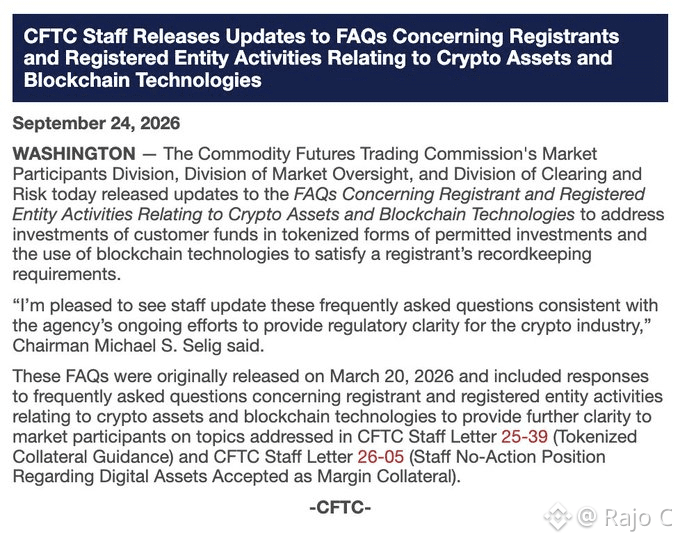
#cftcupdatesguidanceontokenizedassets NEW: CFTC staff updated its crypto FAQs to address customer funds invested in tokenized assets
and the use of blockchain technology to satisfy recordkeeping requirements.
Chairman Michael Selig says the changes are part of the agency’s efforts to provide “regulatory clarity for the crypto industry.”$CC $PHA $ARK
#cftcupdatesguidanceontokenizedassets NEW: CFTC staff updated its crypto FAQs to address customer funds invested in tokenized assets
and the use of blockchain technology to satisfy recordkeeping requirements.
Chairman Michael Selig says the changes are part of the agency’s efforts to provide “regulatory clarity for the crypto industry.”$CC $PHA $ARK
and the use of blockchain technology to satisfy recordkeeping requirements.
Chairman Michael Selig says the changes are part of the agency’s efforts to provide “regulatory clarity for the crypto industry.”$CC $PHA $ARK
1
1.2k

·
--
#cftcupdatesguidanceontokenizedassets
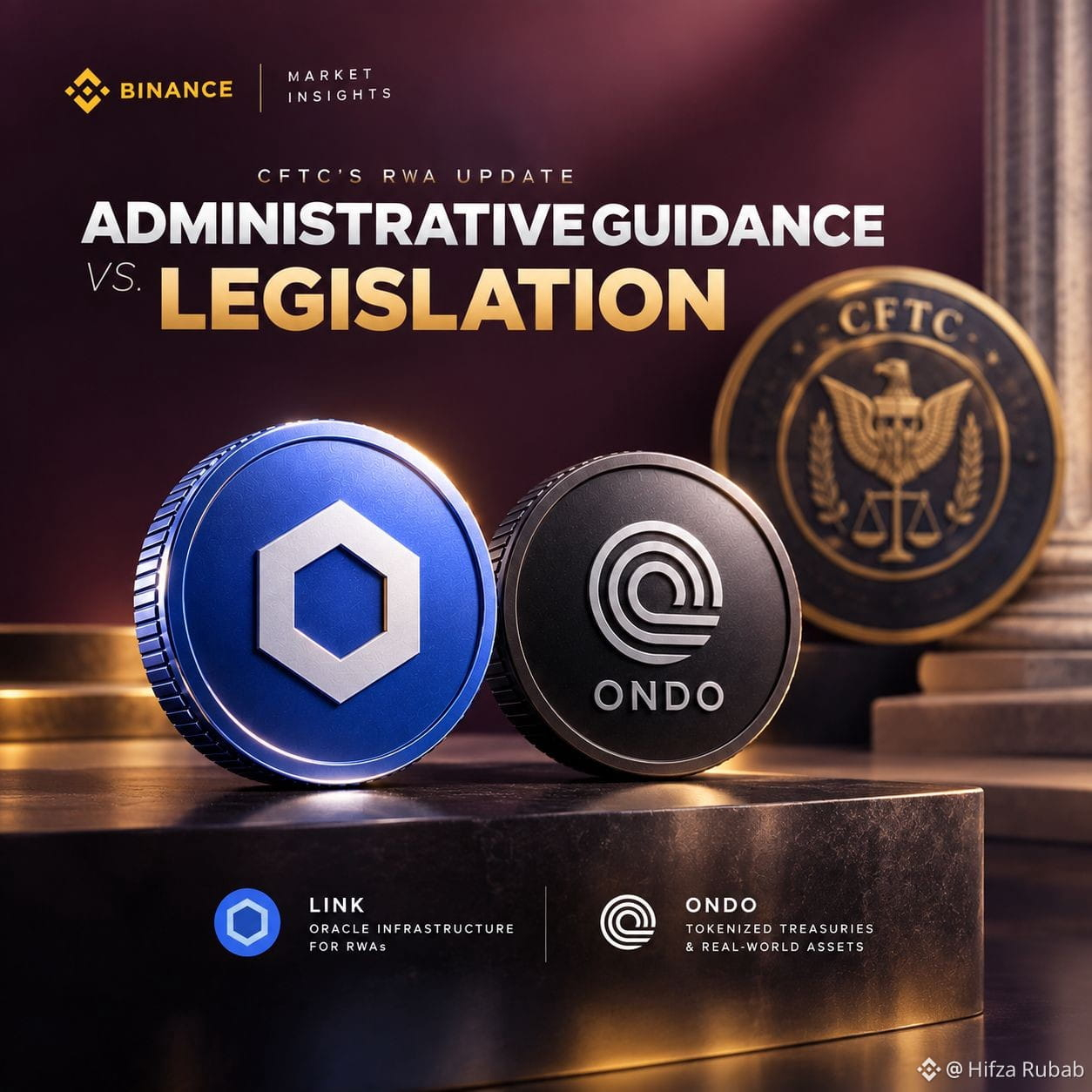
🏛️ ADMINISTRATIVE GUIDANCE VS. LEGISLATION: CFTC’S RWA UPDATE! 🌐⚡
While Congress remains stalled on new crypto legislation, the CFTC has issued updated guidance for regulated derivatives firms!
🏛️ Regulated entities can now invest customer funds into tokenized Treasuries/MMFs and utilize blockchain for official recordkeeping. 📊💡
Key Takeaways : 🔑💡
Immediate Operational Clarity: Firms get practical rules under existing CFTC authority without waiting for stalled Senate bills.
RWA Ecosystem Expansion: Accelerates institutional deployment into the $46B tokenized real-world asset (RWA) market.
Administrative Trade-off: Agency guidance offers rapid adaptability, but lacks the permanent legal stability of federal legislation.
Featured Tokens :
Chainlink ($LINK ) 🌐: Essential oracle infrastructure connecting off-chain RWAs and traditional assets to blockchain networks.
Ondo Finance ($ONDO ) 🏛️: A leader in bringing institutional-grade tokenized Treasuries and real-world assets on-chain.
💬 What's your take? Does administrative guidance provide enough confidence for Wall Street, or is federal law strictly required? Share below! 👇💭✨
#CFTCUpdatesGuidanceOnTokenizedAssets
#BitgetSays$352MAffectedInHack
#BitcoinSpotETFsNetInflow$191M
#BrazilOrdersReportingOf$10KSelfCustodyTransfers
{spot}(ONDOUSDT)
{spot}(LINKUSDT)
#cftcupdatesguidanceontokenizedassets
🏛️ ADMINISTRATIVE GUIDANCE VS. LEGISLATION: CFTC’S RWA UPDATE! 🌐⚡
While Congress remains stalled on new crypto legislation, the CFTC has issued updated guidance for regulated derivatives firms!
🏛️ Regulated entities can now invest customer funds into tokenized Treasuries/MMFs and utilize blockchain for official recordkeeping. 📊💡
Key Takeaways : 🔑💡
Immediate Operational Clarity: Firms get practical rules under existing CFTC authority without waiting for stalled Senate bills.
RWA Ecosystem Expansion: Accelerates institutional deployment into the $46B tokenized real-world asset (RWA) market.
Administrative Trade-off: Agency guidance offers rapid adaptability, but lacks the permanent legal stability of federal legislation.
Featured Tokens :
Chainlink ($LINK ) 🌐: Essential oracle infrastructure connecting off-chain RWAs and traditional assets to blockchain networks.
Ondo Finance ($ONDO ) 🏛️: A leader in bringing institutional-grade tokenized Treasuries and real-world assets on-chain.
💬 What's your take? Does administrative guidance provide enough confidence for Wall Street, or is federal law strictly required? Share below! 👇💭✨
#CFTCUpdatesGuidanceOnTokenizedAssets
#BitgetSays$352MAffectedInHack
#BitcoinSpotETFsNetInflow$191M
#BrazilOrdersReportingOf$10KSelfCustodyTransfers
🏛️ ADMINISTRATIVE GUIDANCE VS. LEGISLATION: CFTC’S RWA UPDATE! 🌐⚡
While Congress remains stalled on new crypto legislation, the CFTC has issued updated guidance for regulated derivatives firms!
🏛️ Regulated entities can now invest customer funds into tokenized Treasuries/MMFs and utilize blockchain for official recordkeeping. 📊💡
Key Takeaways : 🔑💡
Immediate Operational Clarity: Firms get practical rules under existing CFTC authority without waiting for stalled Senate bills.
RWA Ecosystem Expansion: Accelerates institutional deployment into the $46B tokenized real-world asset (RWA) market.
Administrative Trade-off: Agency guidance offers rapid adaptability, but lacks the permanent legal stability of federal legislation.
Featured Tokens :
Chainlink ($LINK ) 🌐: Essential oracle infrastructure connecting off-chain RWAs and traditional assets to blockchain networks.
Ondo Finance ($ONDO ) 🏛️: A leader in bringing institutional-grade tokenized Treasuries and real-world assets on-chain.
💬 What's your take? Does administrative guidance provide enough confidence for Wall Street, or is federal law strictly required? Share below! 👇💭✨
#CFTCUpdatesGuidanceOnTokenizedAssets
#BitgetSays$352MAffectedInHack
#BitcoinSpotETFsNetInflow$191M
#BrazilOrdersReportingOf$10KSelfCustodyTransfers
Mohsin 7777:
How are you😊I like and share all of your posts. So please like and share my posts too. 😉🥰 Shar please 🫡🫡
1
8
6.5k
·
--
#cftcupdatesguidanceontokenizedassets The US CFTC now allows regulated firms to invest customer funds in tokenized assets, as long as tokens offer the same legal and economic rights as traditional forms. Blockchain can be used for compliance records.$KMNO $BTR $GRASS
#cftcupdatesguidanceontokenizedassets The US CFTC now allows regulated firms to invest customer funds in tokenized assets, as long as tokens offer the same legal and economic rights as traditional forms. Blockchain can be used for compliance records.$KMNO $BTR $GRASS

1
2.2k

·
--
#cftcupdatesguidanceontokenizedassets
⚖️ Regulatory Shift: CFTC Updates Guidance on Tokenized Assets
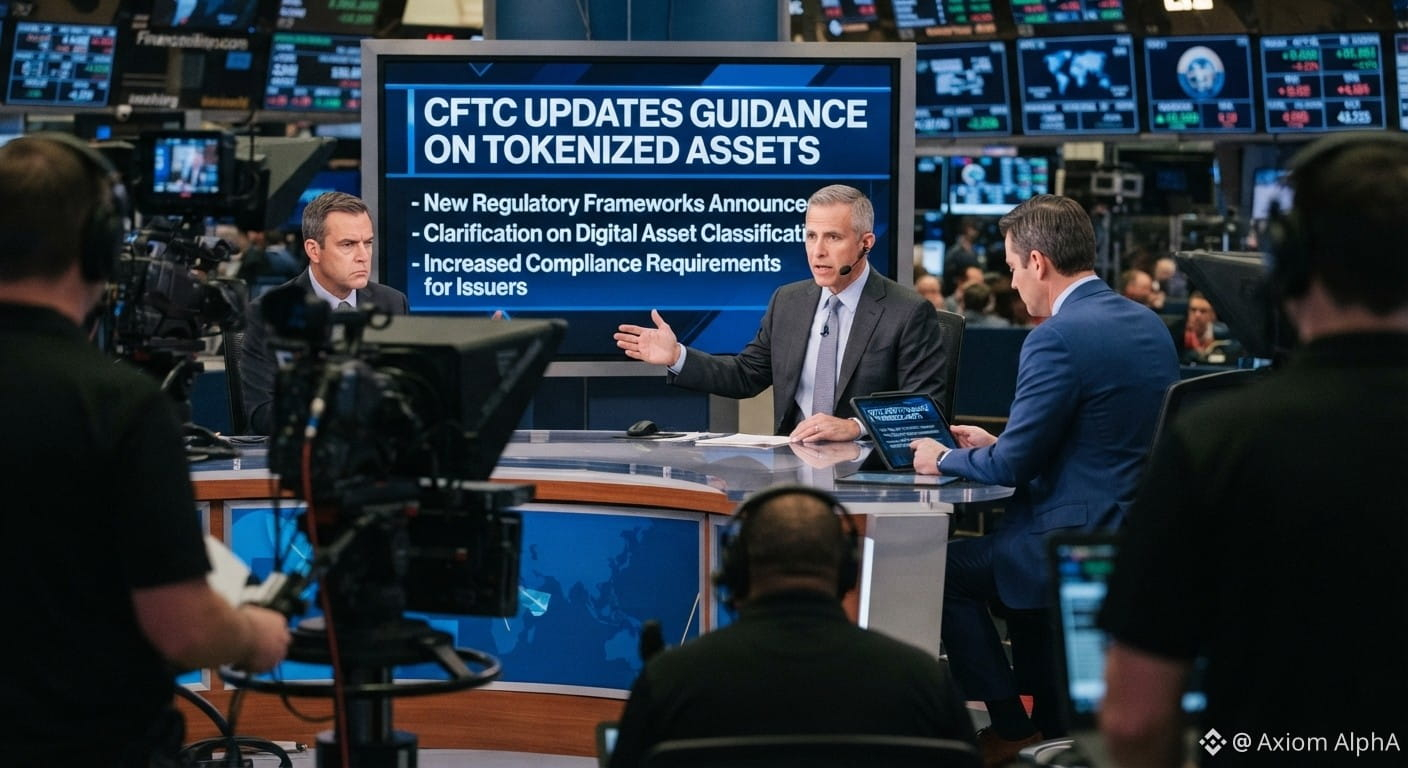
The Regulatory Update: The regulatory landscape for digital assets is evolving rapidly as the CFTC releases updated guidance focusing on tokenized assets, clearer compliance requirements for issuers, and refined digital asset classifications. As institutional adoption grows, these regulatory frameworks aim to bring greater transparency and structure to on-chain financial products.
What This Means for the Market: Clearer regulatory frameworks are a double-edged sword: while they impose stricter compliance requirements, they also pave the way for institutional capital to enter the tokenized asset and real-world asset (RWA) sectors with higher confidence. Markets are closely watching how protocols adapt to these new guidelines.
Highlighted Tradeable Coins to Watch:
$BTC (Bitcoin): The macro baseline asset; tracking broader institutional risk sentiment as regulatory news unfolds across the traditional and digital finance sectors.
$ETH (Ethereum): The leading infrastructure layer for tokenized assets and smart contracts, directly impacted by shifts in regulatory compliance and institutional adoption.
$SOL (Solana): A high-performance network frequently utilized for fast tokenization experiments and high-throughput financial applications.
How do you think these new regulatory guidelines will impact the future of tokenized assets? Let's discuss in the comments below! 👇
{spot}(BTCUSDT)
{spot}(ETHUSDT)
{spot}(SOLUSDT)
#CFTC #TokenizedAssets #CryptoRegulation #DigitalAssets
#cftcupdatesguidanceontokenizedassets
⚖️ Regulatory Shift: CFTC Updates Guidance on Tokenized Assets
The Regulatory Update: The regulatory landscape for digital assets is evolving rapidly as the CFTC releases updated guidance focusing on tokenized assets, clearer compliance requirements for issuers, and refined digital asset classifications. As institutional adoption grows, these regulatory frameworks aim to bring greater transparency and structure to on-chain financial products.
What This Means for the Market: Clearer regulatory frameworks are a double-edged sword: while they impose stricter compliance requirements, they also pave the way for institutional capital to enter the tokenized asset and real-world asset (RWA) sectors with higher confidence. Markets are closely watching how protocols adapt to these new guidelines.
Highlighted Tradeable Coins to Watch:
$BTC (Bitcoin): The macro baseline asset; tracking broader institutional risk sentiment as regulatory news unfolds across the traditional and digital finance sectors.
$ETH (Ethereum): The leading infrastructure layer for tokenized assets and smart contracts, directly impacted by shifts in regulatory compliance and institutional adoption.
$SOL (Solana): A high-performance network frequently utilized for fast tokenization experiments and high-throughput financial applications.
How do you think these new regulatory guidelines will impact the future of tokenized assets? Let's discuss in the comments below! 👇
#CFTC #TokenizedAssets #CryptoRegulation #DigitalAssets
⚖️ Regulatory Shift: CFTC Updates Guidance on Tokenized Assets
The Regulatory Update: The regulatory landscape for digital assets is evolving rapidly as the CFTC releases updated guidance focusing on tokenized assets, clearer compliance requirements for issuers, and refined digital asset classifications. As institutional adoption grows, these regulatory frameworks aim to bring greater transparency and structure to on-chain financial products.
What This Means for the Market: Clearer regulatory frameworks are a double-edged sword: while they impose stricter compliance requirements, they also pave the way for institutional capital to enter the tokenized asset and real-world asset (RWA) sectors with higher confidence. Markets are closely watching how protocols adapt to these new guidelines.
Highlighted Tradeable Coins to Watch:
$BTC (Bitcoin): The macro baseline asset; tracking broader institutional risk sentiment as regulatory news unfolds across the traditional and digital finance sectors.
$ETH (Ethereum): The leading infrastructure layer for tokenized assets and smart contracts, directly impacted by shifts in regulatory compliance and institutional adoption.
$SOL (Solana): A high-performance network frequently utilized for fast tokenization experiments and high-throughput financial applications.
How do you think these new regulatory guidelines will impact the future of tokenized assets? Let's discuss in the comments below! 👇
#CFTC #TokenizedAssets #CryptoRegulation #DigitalAssets
2
1.6k


#cftcupdatesguidanceontokenizedassets
CFTC Updates Tokenization Guidance: What Changes for Regulated Firms?
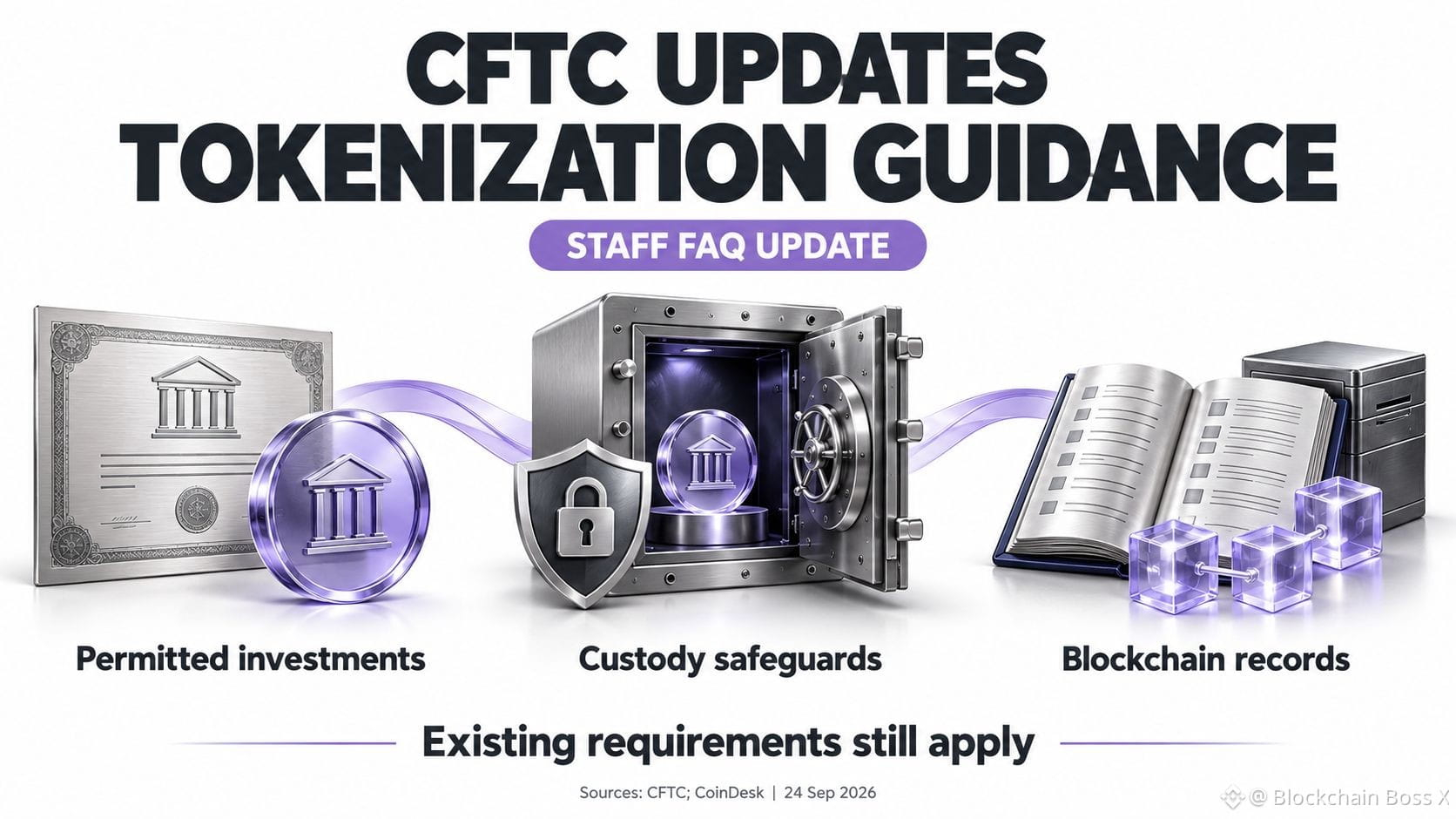
On September 24, 2026, CFTC staff updated its crypto and blockchain FAQs, addressing how regulated firms can invest customer funds in tokenized assets and use blockchains for regulatory recordkeeping.
The investment guidance covers tokenized versions of already permitted assets. Holders must retain equivalent legal and economic rights, and applicable custody requirements still matter.
Blockchain records can also satisfy recordkeeping obligations. For public, permissionless networks, firms need controls that let them retain and produce records even during outages or other disruptions. This update explains how existing requirements apply to these activities.
My take: The practical benefit is a clearer basis for institutions to evaluate tokenized products and their compliance systems. Enforceable rights, custody and dependable records remain central to that assessment.
The next test is execution: whether firms use these structures consistently, improve settlement and reconciliation, and deliver benefits that justify implementation costs.
For investors, those developments would offer stronger evidence of adoption than policy headlines alone. Any benefit to a particular blockchain or token would still depend on actual usage and how value flows to its holders.
What would best demonstrate progress: more institutional users, lower operating costs, or stronger investor protections?
#CFTCUpdatesGuidanceOnTokenizedAssets #Tokenization #RWA
$QI $QNT $XPL
{future}(QNTUSDT)
{future}(XPLUSDT)
{spot}(QIUSDT)
#cftcupdatesguidanceontokenizedassets
CFTC Updates Tokenization Guidance: What Changes for Regulated Firms?
On September 24, 2026, CFTC staff updated its crypto and blockchain FAQs, addressing how regulated firms can invest customer funds in tokenized assets and use blockchains for regulatory recordkeeping.
The investment guidance covers tokenized versions of already permitted assets. Holders must retain equivalent legal and economic rights, and applicable custody requirements still matter.
Blockchain records can also satisfy recordkeeping obligations. For public, permissionless networks, firms need controls that let them retain and produce records even during outages or other disruptions. This update explains how existing requirements apply to these activities.
My take: The practical benefit is a clearer basis for institutions to evaluate tokenized products and their compliance systems. Enforceable rights, custody and dependable records remain central to that assessment.
The next test is execution: whether firms use these structures consistently, improve settlement and reconciliation, and deliver benefits that justify implementation costs.
For investors, those developments would offer stronger evidence of adoption than policy headlines alone. Any benefit to a particular blockchain or token would still depend on actual usage and how value flows to its holders.
What would best demonstrate progress: more institutional users, lower operating costs, or stronger investor protections?
#CFTCUpdatesGuidanceOnTokenizedAssets #Tokenization #RWA
$QI $QNT $XPL
CFTC Updates Tokenization Guidance: What Changes for Regulated Firms?
On September 24, 2026, CFTC staff updated its crypto and blockchain FAQs, addressing how regulated firms can invest customer funds in tokenized assets and use blockchains for regulatory recordkeeping.
The investment guidance covers tokenized versions of already permitted assets. Holders must retain equivalent legal and economic rights, and applicable custody requirements still matter.
Blockchain records can also satisfy recordkeeping obligations. For public, permissionless networks, firms need controls that let them retain and produce records even during outages or other disruptions. This update explains how existing requirements apply to these activities.
My take: The practical benefit is a clearer basis for institutions to evaluate tokenized products and their compliance systems. Enforceable rights, custody and dependable records remain central to that assessment.
The next test is execution: whether firms use these structures consistently, improve settlement and reconciliation, and deliver benefits that justify implementation costs.
For investors, those developments would offer stronger evidence of adoption than policy headlines alone. Any benefit to a particular blockchain or token would still depend on actual usage and how value flows to its holders.
What would best demonstrate progress: more institutional users, lower operating costs, or stronger investor protections?
#CFTCUpdatesGuidanceOnTokenizedAssets #Tokenization #RWA
$QI $QNT $XPL
2
878

·
--
Bullish
#cftcupdatesguidanceontokenizedassets CFTC Updates Guidance on Tokenized Assets Key Takeaways for the Market
The regulatory landscape for digital assets is maturing The CFTC’s latest guidance on tokenized assets brings much needed clarity to the intersection of blockchain technology and traditional commodity markets
The Core News
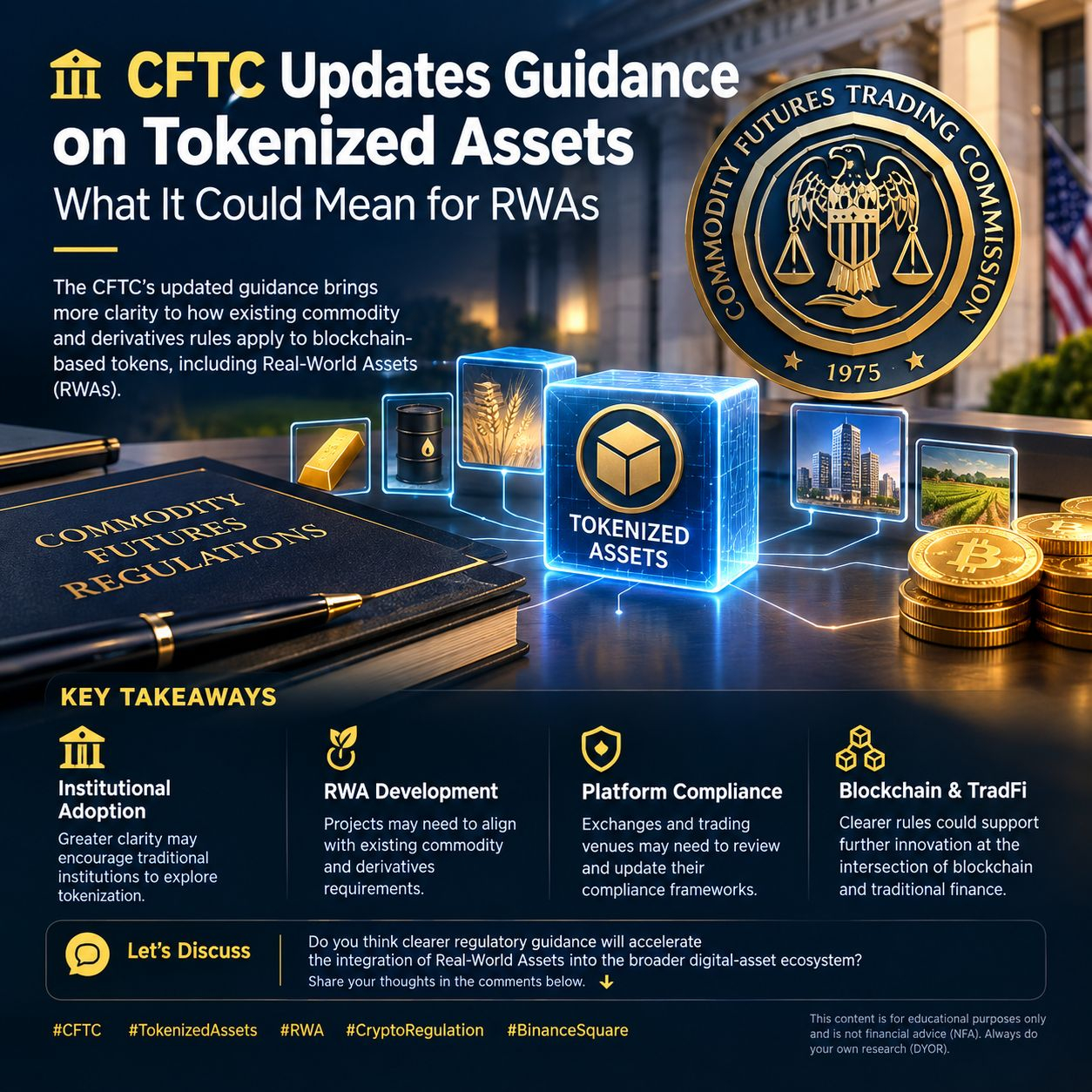
The U.S. Commodity Futures Trading Commission CFTC has released updated guidance regarding the regulatory treatment of tokenized assets. This new framework clarifies how existing commodity and derivatives regulations apply to blockchainn based tokens, with a specific focus on Real World Assets (RWAs). The primary goals of this update are to enhance market integrity ensure proper platform registration and protect investors while supporting responsible technological innovation.
Potential Market Impact
Here is an objective look at how this regulatory update could influence the broader ecosystem
Institutional Clarity Reduced regulatory ambiguity often encourages traditional financial institutions to further explore on chain asset tokenization, as compliance pathways become more defined.
RWA Ecosystem Alignment Protocols and projects focused on Real World Assets will need to align with these updated standards. This could help differentiate fully compliant projects from unregulated ones, potentially shifting institutional focus toward verified platforms.
Exchange & Platform Compliance Trading platforms and decentralized exchanges facilitating the swap of tokenized commodities may need to carefully review and update their operational frameworks to meet the CFTC's new expectations.
Let’s Discuss
How do you think updated regulatory frameworks will influence the long term adoption and integration of Real-World Assets (RWAs) in the crypto ecosystem? Share your perspective in the comments below
#CFTC #TokenizedAssets #RWA #CryptoRegulation #BinanceSquare
This is for educational purposes only. Not Financial Advice (NFA). Always Do Your Own Research (DYOR).
$FET $JTO
{future}(JTOUSDT)
{future}(FETUSDT)
#cftcupdatesguidanceontokenizedassets CFTC Updates Guidance on Tokenized Assets Key Takeaways for the Market
The regulatory landscape for digital assets is maturing The CFTC’s latest guidance on tokenized assets brings much needed clarity to the intersection of blockchain technology and traditional commodity markets
The Core News
The U.S. Commodity Futures Trading Commission CFTC has released updated guidance regarding the regulatory treatment of tokenized assets. This new framework clarifies how existing commodity and derivatives regulations apply to blockchainn based tokens, with a specific focus on Real World Assets (RWAs). The primary goals of this update are to enhance market integrity ensure proper platform registration and protect investors while supporting responsible technological innovation.
Potential Market Impact
Here is an objective look at how this regulatory update could influence the broader ecosystem
Institutional Clarity Reduced regulatory ambiguity often encourages traditional financial institutions to further explore on chain asset tokenization, as compliance pathways become more defined.
RWA Ecosystem Alignment Protocols and projects focused on Real World Assets will need to align with these updated standards. This could help differentiate fully compliant projects from unregulated ones, potentially shifting institutional focus toward verified platforms.
Exchange & Platform Compliance Trading platforms and decentralized exchanges facilitating the swap of tokenized commodities may need to carefully review and update their operational frameworks to meet the CFTC's new expectations.
Let’s Discuss
How do you think updated regulatory frameworks will influence the long term adoption and integration of Real-World Assets (RWAs) in the crypto ecosystem? Share your perspective in the comments below
#CFTC #TokenizedAssets #RWA #CryptoRegulation #BinanceSquare
This is for educational purposes only. Not Financial Advice (NFA). Always Do Your Own Research (DYOR).
$FET $JTO
The regulatory landscape for digital assets is maturing The CFTC’s latest guidance on tokenized assets brings much needed clarity to the intersection of blockchain technology and traditional commodity markets
The Core News
The U.S. Commodity Futures Trading Commission CFTC has released updated guidance regarding the regulatory treatment of tokenized assets. This new framework clarifies how existing commodity and derivatives regulations apply to blockchainn based tokens, with a specific focus on Real World Assets (RWAs). The primary goals of this update are to enhance market integrity ensure proper platform registration and protect investors while supporting responsible technological innovation.
Potential Market Impact
Here is an objective look at how this regulatory update could influence the broader ecosystem
Institutional Clarity Reduced regulatory ambiguity often encourages traditional financial institutions to further explore on chain asset tokenization, as compliance pathways become more defined.
RWA Ecosystem Alignment Protocols and projects focused on Real World Assets will need to align with these updated standards. This could help differentiate fully compliant projects from unregulated ones, potentially shifting institutional focus toward verified platforms.
Exchange & Platform Compliance Trading platforms and decentralized exchanges facilitating the swap of tokenized commodities may need to carefully review and update their operational frameworks to meet the CFTC's new expectations.
Let’s Discuss
How do you think updated regulatory frameworks will influence the long term adoption and integration of Real-World Assets (RWAs) in the crypto ecosystem? Share your perspective in the comments below
#CFTC #TokenizedAssets #RWA #CryptoRegulation #BinanceSquare
This is for educational purposes only. Not Financial Advice (NFA). Always Do Your Own Research (DYOR).
$FET $JTO
2.3k

#CFTCUpdatesGuidanceOnTokenizedAssets
The US Commodity Futures Trading Commission (CFTC) updated its guidance on tokenized assets and blockchain based recordkeeping on September 24, 2026.
Regulated derivatives firms can invest customer funds in tokenized versions of permitted traditional assets, provided the token gives holders the same. It functionally accepts legal and economic rights as the underlying asset.
The CFTC also clarified that qualifying blockchain based records can satisfy certain recordkeeping requirements.
$BTC
{future}(BTCUSDT)
$BNB
{future}(BNBUSDT)
#CFTCUpdatesGuidanceOnTokenizedAssets
The US Commodity Futures Trading Commission (CFTC) updated its guidance on tokenized assets and blockchain based recordkeeping on September 24, 2026.
Regulated derivatives firms can invest customer funds in tokenized versions of permitted traditional assets, provided the token gives holders the same. It functionally accepts legal and economic rights as the underlying asset.
The CFTC also clarified that qualifying blockchain based records can satisfy certain recordkeeping requirements.
$BTC
$BNB
The US Commodity Futures Trading Commission (CFTC) updated its guidance on tokenized assets and blockchain based recordkeeping on September 24, 2026.
Regulated derivatives firms can invest customer funds in tokenized versions of permitted traditional assets, provided the token gives holders the same. It functionally accepts legal and economic rights as the underlying asset.
The CFTC also clarified that qualifying blockchain based records can satisfy certain recordkeeping requirements.
$BTC
$BNB

CFTC 📰
From Digital Mahanadi
2
43

·
--
Article
CFTC Tokenization Guidance: What Changes for Blockchain Finance#cftcupdatesguidanceontokenizedassets
CFTC Clarifies How Tokenized Assets Fit Into Existing Rules
The U.S. Commodity Futures Trading Commission is giving the tokenization market a clearer look at how blockchain-based assets can fit within existing regulatory frameworks.
On September 24, CFTC staff updated its crypto FAQs to address two areas that are becoming increasingly relevant as traditional financial markets move onto blockchain infrastructure: tokenized versions of permitted investments and blockchain-based recordkeeping.
One of the key points is that tokenizing an asset does not necessarily mean creating an entirely new regulatory category.
Under the clarification, a tokenized version of a permitted investment can qualify when the token provides holders with the same or functionally equivalent legal and economic rights as the underlying traditional asset.
That distinction is important for the broader real-world asset (RWA) sector.
A Treasury, fund interest, or another permitted investment can potentially be represented through a blockchain-based token without the token itself automatically becoming a fundamentally different product from the underlying asset. The legal and economic rights attached to the token remain central to how it is treated.
In other words, the blockchain is not necessarily what determines the regulatory status. What the token represents and what rights it provides can matter more.
Blockchain as infrastructure
The CFTC's update also addresses the use of blockchain or distributed ledger technology for certain recordkeeping requirements.
Qualifying regulated firms may be able to use DLT-based systems for applicable records, provided they can meet the relevant requirements, including the ability to retrieve and produce records when required.
That could be meaningful for financial institutions exploring blockchain not just as a settlement layer, but as part of their broader market infrastructure.
Instead of treating blockchain as a separate financial system, the emerging approach increasingly looks at where the technology can operate within existing regulatory and operational frameworks.
Why this matters for tokenization
Tokenization has often been discussed as a bridge between traditional finance and blockchain markets.
The appeal is straightforward: traditional assets could potentially gain blockchain-based features such as programmable transfers, automated settlement, and more transparent ownership records.
But regulatory treatment remains one of the major pieces of the puzzle.
The CFTC clarification doesn't mean every tokenized asset is automatically approved or treated the same way. The underlying asset, the rights attached to the token, the structure of the product, and the applicable regulatory requirements still matter.
That makes the distinction between tokenization and regulatory approval particularly important.
A blockchain representation of an existing asset is not, by itself, a guarantee that the product can be freely offered, traded, or used across regulated markets.
The bigger question is adoption
For the RWA sector, the more interesting question may now be how these principles translate into actual market infrastructure.
If regulated firms can increasingly use blockchain for asset representation, settlement, and recordkeeping while maintaining existing legal and compliance requirements, tokenization could move further from experimentation toward practical financial-market applications.
But execution will matter.
The technology needs to work alongside custody, compliance, reporting, liquidity, and existing market rules. The legal rights represented by the token also need to remain clear.
So while the CFTC update adds useful regulatory clarity, it is better viewed as part of the broader process of integrating blockchain into regulated markets rather than as a blanket green light for tokenized assets.
What matters now is whether regulated institutions can turn that clarity into real-world infrastructure and products.
#CFTC #RWA #Tokenization #Crypto #Blockchain
CFTC Tokenization Guidance: What Changes for Blockchain Finance
#cftcupdatesguidanceontokenizedassets
CFTC Clarifies How Tokenized Assets Fit Into Existing Rules
The U.S. Commodity Futures Trading Commission is giving the tokenization market a clearer look at how blockchain-based assets can fit within existing regulatory frameworks.
On September 24, CFTC staff updated its crypto FAQs to address two areas that are becoming increasingly relevant as traditional financial markets move onto blockchain infrastructure: tokenized versions of permitted investments and blockchain-based recordkeeping.
One of the key points is that tokenizing an asset does not necessarily mean creating an entirely new regulatory category.
Under the clarification, a tokenized version of a permitted investment can qualify when the token provides holders with the same or functionally equivalent legal and economic rights as the underlying traditional asset.
That distinction is important for the broader real-world asset (RWA) sector.
A Treasury, fund interest, or another permitted investment can potentially be represented through a blockchain-based token without the token itself automatically becoming a fundamentally different product from the underlying asset. The legal and economic rights attached to the token remain central to how it is treated.
In other words, the blockchain is not necessarily what determines the regulatory status. What the token represents and what rights it provides can matter more.
Blockchain as infrastructure
The CFTC's update also addresses the use of blockchain or distributed ledger technology for certain recordkeeping requirements.
Qualifying regulated firms may be able to use DLT-based systems for applicable records, provided they can meet the relevant requirements, including the ability to retrieve and produce records when required.
That could be meaningful for financial institutions exploring blockchain not just as a settlement layer, but as part of their broader market infrastructure.
Instead of treating blockchain as a separate financial system, the emerging approach increasingly looks at where the technology can operate within existing regulatory and operational frameworks.
Why this matters for tokenization
Tokenization has often been discussed as a bridge between traditional finance and blockchain markets.
The appeal is straightforward: traditional assets could potentially gain blockchain-based features such as programmable transfers, automated settlement, and more transparent ownership records.
But regulatory treatment remains one of the major pieces of the puzzle.
The CFTC clarification doesn't mean every tokenized asset is automatically approved or treated the same way. The underlying asset, the rights attached to the token, the structure of the product, and the applicable regulatory requirements still matter.
That makes the distinction between tokenization and regulatory approval particularly important.
A blockchain representation of an existing asset is not, by itself, a guarantee that the product can be freely offered, traded, or used across regulated markets.
The bigger question is adoption
For the RWA sector, the more interesting question may now be how these principles translate into actual market infrastructure.
If regulated firms can increasingly use blockchain for asset representation, settlement, and recordkeeping while maintaining existing legal and compliance requirements, tokenization could move further from experimentation toward practical financial-market applications.
But execution will matter.
The technology needs to work alongside custody, compliance, reporting, liquidity, and existing market rules. The legal rights represented by the token also need to remain clear.
So while the CFTC update adds useful regulatory clarity, it is better viewed as part of the broader process of integrating blockchain into regulated markets rather than as a blanket green light for tokenized assets.
What matters now is whether regulated institutions can turn that clarity into real-world infrastructure and products.
#CFTC #RWA #Tokenization #Crypto #Blockchain
CFTC Clarifies How Tokenized Assets Fit Into Existing Rules
The U.S. Commodity Futures Trading Commission is giving the tokenization market a clearer look at how blockchain-based assets can fit within existing regulatory frameworks.
On September 24, CFTC staff updated its crypto FAQs to address two areas that are becoming increasingly relevant as traditional financial markets move onto blockchain infrastructure: tokenized versions of permitted investments and blockchain-based recordkeeping.
One of the key points is that tokenizing an asset does not necessarily mean creating an entirely new regulatory category.
Under the clarification, a tokenized version of a permitted investment can qualify when the token provides holders with the same or functionally equivalent legal and economic rights as the underlying traditional asset.
That distinction is important for the broader real-world asset (RWA) sector.
A Treasury, fund interest, or another permitted investment can potentially be represented through a blockchain-based token without the token itself automatically becoming a fundamentally different product from the underlying asset. The legal and economic rights attached to the token remain central to how it is treated.
In other words, the blockchain is not necessarily what determines the regulatory status. What the token represents and what rights it provides can matter more.
Blockchain as infrastructure
The CFTC's update also addresses the use of blockchain or distributed ledger technology for certain recordkeeping requirements.
Qualifying regulated firms may be able to use DLT-based systems for applicable records, provided they can meet the relevant requirements, including the ability to retrieve and produce records when required.
That could be meaningful for financial institutions exploring blockchain not just as a settlement layer, but as part of their broader market infrastructure.
Instead of treating blockchain as a separate financial system, the emerging approach increasingly looks at where the technology can operate within existing regulatory and operational frameworks.
Why this matters for tokenization
Tokenization has often been discussed as a bridge between traditional finance and blockchain markets.
The appeal is straightforward: traditional assets could potentially gain blockchain-based features such as programmable transfers, automated settlement, and more transparent ownership records.
But regulatory treatment remains one of the major pieces of the puzzle.
The CFTC clarification doesn't mean every tokenized asset is automatically approved or treated the same way. The underlying asset, the rights attached to the token, the structure of the product, and the applicable regulatory requirements still matter.
That makes the distinction between tokenization and regulatory approval particularly important.
A blockchain representation of an existing asset is not, by itself, a guarantee that the product can be freely offered, traded, or used across regulated markets.
The bigger question is adoption
For the RWA sector, the more interesting question may now be how these principles translate into actual market infrastructure.
If regulated firms can increasingly use blockchain for asset representation, settlement, and recordkeeping while maintaining existing legal and compliance requirements, tokenization could move further from experimentation toward practical financial-market applications.
But execution will matter.
The technology needs to work alongside custody, compliance, reporting, liquidity, and existing market rules. The legal rights represented by the token also need to remain clear.
So while the CFTC update adds useful regulatory clarity, it is better viewed as part of the broader process of integrating blockchain into regulated markets rather than as a blanket green light for tokenized assets.
What matters now is whether regulated institutions can turn that clarity into real-world infrastructure and products.
#CFTC #RWA #Tokenization #Crypto #Blockchain
·
--
#cftcupdatesguidanceontokenizedassets
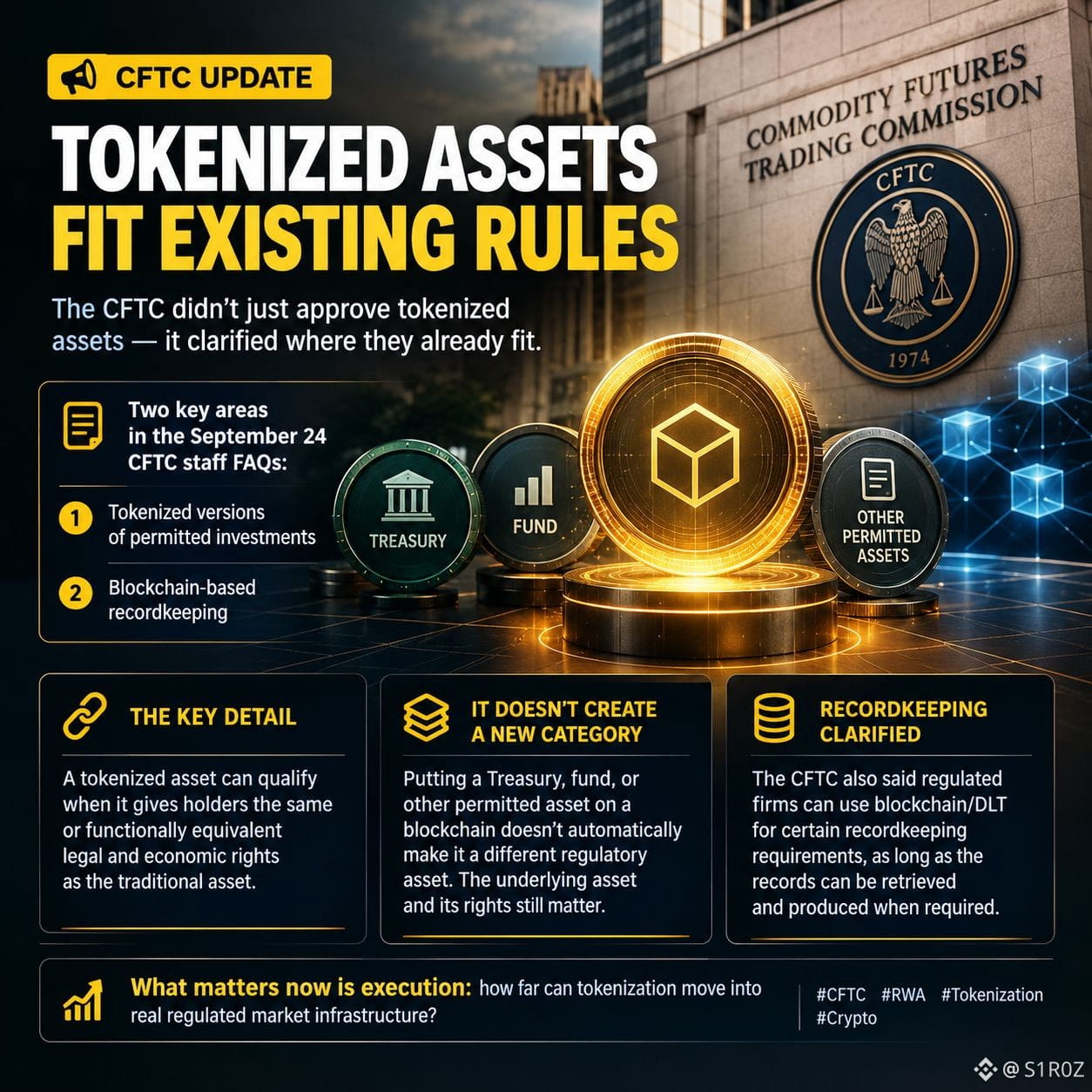
🚨 The CFTC didn’t just approve tokenized assets — it clarified where they already fit.
On September 24, CFTC staff updated its crypto FAQs to address two areas: tokenized versions of permitted investments and blockchain-based recordkeeping.
The detail that matters most:
A tokenized asset can qualify when it gives holders the same or functionally equivalent legal and economic rights as the traditional asset.
So putting a Treasury, fund, or other permitted asset on a blockchain doesn’t automatically create a new regulatory category. The underlying asset and its rights still matter.
The CFTC also clarified that qualifying regulated firms can use blockchain/DLT for certain recordkeeping requirements, subject to being able to retrieve and produce the records when required.
What matters now is execution: can tokenized assets actually move deeper into regulated market infrastructure?
#CFTC #RWA #Tokenization
#cftcupdatesguidanceontokenizedassets
🚨 The CFTC didn’t just approve tokenized assets — it clarified where they already fit.
On September 24, CFTC staff updated its crypto FAQs to address two areas: tokenized versions of permitted investments and blockchain-based recordkeeping.
The detail that matters most:
A tokenized asset can qualify when it gives holders the same or functionally equivalent legal and economic rights as the traditional asset.
So putting a Treasury, fund, or other permitted asset on a blockchain doesn’t automatically create a new regulatory category. The underlying asset and its rights still matter.
The CFTC also clarified that qualifying regulated firms can use blockchain/DLT for certain recordkeeping requirements, subject to being able to retrieve and produce the records when required.
What matters now is execution: can tokenized assets actually move deeper into regulated market infrastructure?
#CFTC #RWA #Tokenization
🚨 The CFTC didn’t just approve tokenized assets — it clarified where they already fit.
On September 24, CFTC staff updated its crypto FAQs to address two areas: tokenized versions of permitted investments and blockchain-based recordkeeping.
The detail that matters most:
A tokenized asset can qualify when it gives holders the same or functionally equivalent legal and economic rights as the traditional asset.
So putting a Treasury, fund, or other permitted asset on a blockchain doesn’t automatically create a new regulatory category. The underlying asset and its rights still matter.
The CFTC also clarified that qualifying regulated firms can use blockchain/DLT for certain recordkeeping requirements, subject to being able to retrieve and produce the records when required.
What matters now is execution: can tokenized assets actually move deeper into regulated market infrastructure?
#CFTC #RWA #Tokenization
2

·
--
Bullish
#CFTCUpdatesGuidanceOnTokenizedAssets
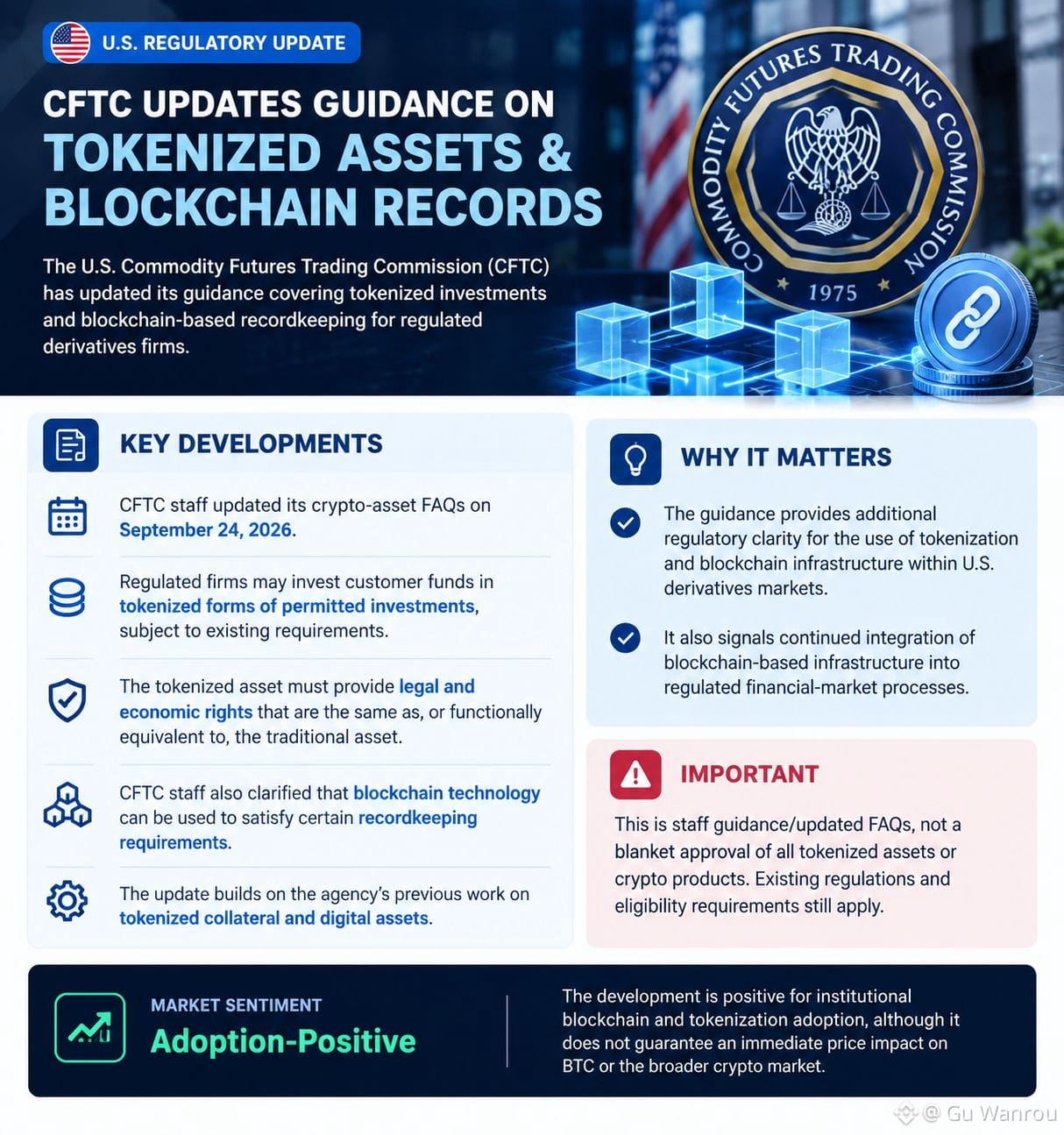
🇺🇸🔗 CFTC UPDATES GUIDANCE ON TOKENIZED ASSETS & BLOCKCHAIN RECORDS
The U.S. Commodity Futures Trading Commission (CFTC) has updated its guidance covering tokenized investments and blockchain-based recordkeeping for regulated derivatives firms.
📊 KEY DEVELOPMENTS:
• CFTC staff updated its crypto-asset FAQs on September 24, 2026
• Regulated firms may invest customer funds in tokenized forms of permitted investments, subject to existing requirements
• The tokenized asset must provide legal and economic rights that are the same as, or functionally equivalent to, the traditional asset
• CFTC staff also clarified that blockchain technology can be used to satisfy certain recordkeeping requirements
• The update builds on the agency’s previous work on tokenized collateral and digital assets
💡 WHY IT MATTERS:
The guidance provides additional regulatory clarity for the use of tokenization and blockchain infrastructure within U.S. derivatives markets.
It also signals continued integration of blockchain-based infrastructure into regulated financial-market processes.
⚠️ IMPORTANT:
This is staff guidance/updated FAQs, not a blanket approval of all tokenized assets or crypto products. Existing regulations and eligibility requirements still apply.
📈 MARKET SENTIMENT: Adoption-Positive
The development is positive for institutional blockchain and tokenization adoption, although it does not guarantee an immediate price impact on BTC or the broader crypto market.
$QNT
{future}(QNTUSDT)
$VELODROME
{future}(VELODROMEUSDT)
$JOE
{future}(JOEUSDT)
#CFTCUpdatesGuidanceOnTokenizedAssets
🇺🇸🔗 CFTC UPDATES GUIDANCE ON TOKENIZED ASSETS & BLOCKCHAIN RECORDS
The U.S. Commodity Futures Trading Commission (CFTC) has updated its guidance covering tokenized investments and blockchain-based recordkeeping for regulated derivatives firms.
📊 KEY DEVELOPMENTS:
• CFTC staff updated its crypto-asset FAQs on September 24, 2026
• Regulated firms may invest customer funds in tokenized forms of permitted investments, subject to existing requirements
• The tokenized asset must provide legal and economic rights that are the same as, or functionally equivalent to, the traditional asset
• CFTC staff also clarified that blockchain technology can be used to satisfy certain recordkeeping requirements
• The update builds on the agency’s previous work on tokenized collateral and digital assets
💡 WHY IT MATTERS:
The guidance provides additional regulatory clarity for the use of tokenization and blockchain infrastructure within U.S. derivatives markets.
It also signals continued integration of blockchain-based infrastructure into regulated financial-market processes.
⚠️ IMPORTANT:
This is staff guidance/updated FAQs, not a blanket approval of all tokenized assets or crypto products. Existing regulations and eligibility requirements still apply.
📈 MARKET SENTIMENT: Adoption-Positive
The development is positive for institutional blockchain and tokenization adoption, although it does not guarantee an immediate price impact on BTC or the broader crypto market.
$QNT
$VELODROME
$JOE
🇺🇸🔗 CFTC UPDATES GUIDANCE ON TOKENIZED ASSETS & BLOCKCHAIN RECORDS
The U.S. Commodity Futures Trading Commission (CFTC) has updated its guidance covering tokenized investments and blockchain-based recordkeeping for regulated derivatives firms.
📊 KEY DEVELOPMENTS:
• CFTC staff updated its crypto-asset FAQs on September 24, 2026
• Regulated firms may invest customer funds in tokenized forms of permitted investments, subject to existing requirements
• The tokenized asset must provide legal and economic rights that are the same as, or functionally equivalent to, the traditional asset
• CFTC staff also clarified that blockchain technology can be used to satisfy certain recordkeeping requirements
• The update builds on the agency’s previous work on tokenized collateral and digital assets
💡 WHY IT MATTERS:
The guidance provides additional regulatory clarity for the use of tokenization and blockchain infrastructure within U.S. derivatives markets.
It also signals continued integration of blockchain-based infrastructure into regulated financial-market processes.
⚠️ IMPORTANT:
This is staff guidance/updated FAQs, not a blanket approval of all tokenized assets or crypto products. Existing regulations and eligibility requirements still apply.
📈 MARKET SENTIMENT: Adoption-Positive
The development is positive for institutional blockchain and tokenization adoption, although it does not guarantee an immediate price impact on BTC or the broader crypto market.
$QNT
$VELODROME
$JOE
22

·
--
#CFTCUpdatesGuidanceOnTokenizedAssets $NVDA.US
{stock_us}(NVDA.US)
#CFTCUpdatesGuidanceOnTokenizedAssets $NVDA.US
BREAKING: CFTC allows tokenized assets! 🚀
US brokers can now invest customer funds in TOKENIZED assets & keep records on-chain.
- Tokenized money market funds, stocks, debt allowed
- Must have same legal rights as traditional asset
- On-chain recordkeeping officially approved
- Guidance came after CLARITY Act failed in Senate
Tokenized RWA market already hit $46B!
Funds: $34.7B | Commodities: $7.7B | Stocks: $3.5B
$NVDA.US tokenized stocks is next big narrative!
Are you bullish on tokenized NVDA?
#NVDA #CFTC #Tokenization #RWA #CryptoNews
#CFTCUpdatesGuidanceOnTokenizedAssets $NVDA.US
#CFTCUpdatesGuidanceOnTokenizedAssets $NVDA.US
BREAKING: CFTC allows tokenized assets! 🚀
US brokers can now invest customer funds in TOKENIZED assets & keep records on-chain.
- Tokenized money market funds, stocks, debt allowed
- Must have same legal rights as traditional asset
- On-chain recordkeeping officially approved
- Guidance came after CLARITY Act failed in Senate
Tokenized RWA market already hit $46B!
Funds: $34.7B | Commodities: $7.7B | Stocks: $3.5B
$NVDA.US tokenized stocks is next big narrative!
Are you bullish on tokenized NVDA?
#NVDA #CFTC #Tokenization #RWA #CryptoNews
#CFTCUpdatesGuidanceOnTokenizedAssets $NVDA.US
BREAKING: CFTC allows tokenized assets! 🚀
US brokers can now invest customer funds in TOKENIZED assets & keep records on-chain.
- Tokenized money market funds, stocks, debt allowed
- Must have same legal rights as traditional asset
- On-chain recordkeeping officially approved
- Guidance came after CLARITY Act failed in Senate
Tokenized RWA market already hit $46B!
Funds: $34.7B | Commodities: $7.7B | Stocks: $3.5B
$NVDA.US tokenized stocks is next big narrative!
Are you bullish on tokenized NVDA?
#NVDA #CFTC #Tokenization #RWA #CryptoNews
NVDAUS+0.11%
92

·
--
#CFTCUpdatesGuidanceOnTokenizedAssets
The CFTC has rolled out new guidance that lets crypto count as real collateral in the derivatives market. Bitcoin, Ether and stablecoins like $USDC can now be used by futures brokers as margin — basically a security deposit traders put up to cover potential losses. The regulator also cleared the way for tokenized real-world assets (like Treasury money market funds) to be used the same way, as long as firms can prove legal ownership and proper custody. It's a small but important step: crypto is slowly being treated less like an outsider and more like a normal financial tool inside regulated markets.
{spot}(USDCUSDT)
AT THE END
Daily market breakdowns, plain language, zero hype — that's the deal. Follow along so you don't miss tomorrow's update, and drop a like if this helped. 🙌
#CFTCUpdatesGuidanceOnTokenizedAssets
The CFTC has rolled out new guidance that lets crypto count as real collateral in the derivatives market. Bitcoin, Ether and stablecoins like $USDC can now be used by futures brokers as margin — basically a security deposit traders put up to cover potential losses. The regulator also cleared the way for tokenized real-world assets (like Treasury money market funds) to be used the same way, as long as firms can prove legal ownership and proper custody. It's a small but important step: crypto is slowly being treated less like an outsider and more like a normal financial tool inside regulated markets.
AT THE END
Daily market breakdowns, plain language, zero hype — that's the deal. Follow along so you don't miss tomorrow's update, and drop a like if this helped. 🙌
The CFTC has rolled out new guidance that lets crypto count as real collateral in the derivatives market. Bitcoin, Ether and stablecoins like $USDC can now be used by futures brokers as margin — basically a security deposit traders put up to cover potential losses. The regulator also cleared the way for tokenized real-world assets (like Treasury money market funds) to be used the same way, as long as firms can prove legal ownership and proper custody. It's a small but important step: crypto is slowly being treated less like an outsider and more like a normal financial tool inside regulated markets.
AT THE END
Daily market breakdowns, plain language, zero hype — that's the deal. Follow along so you don't miss tomorrow's update, and drop a like if this helped. 🙌
80
·
--
Bullish
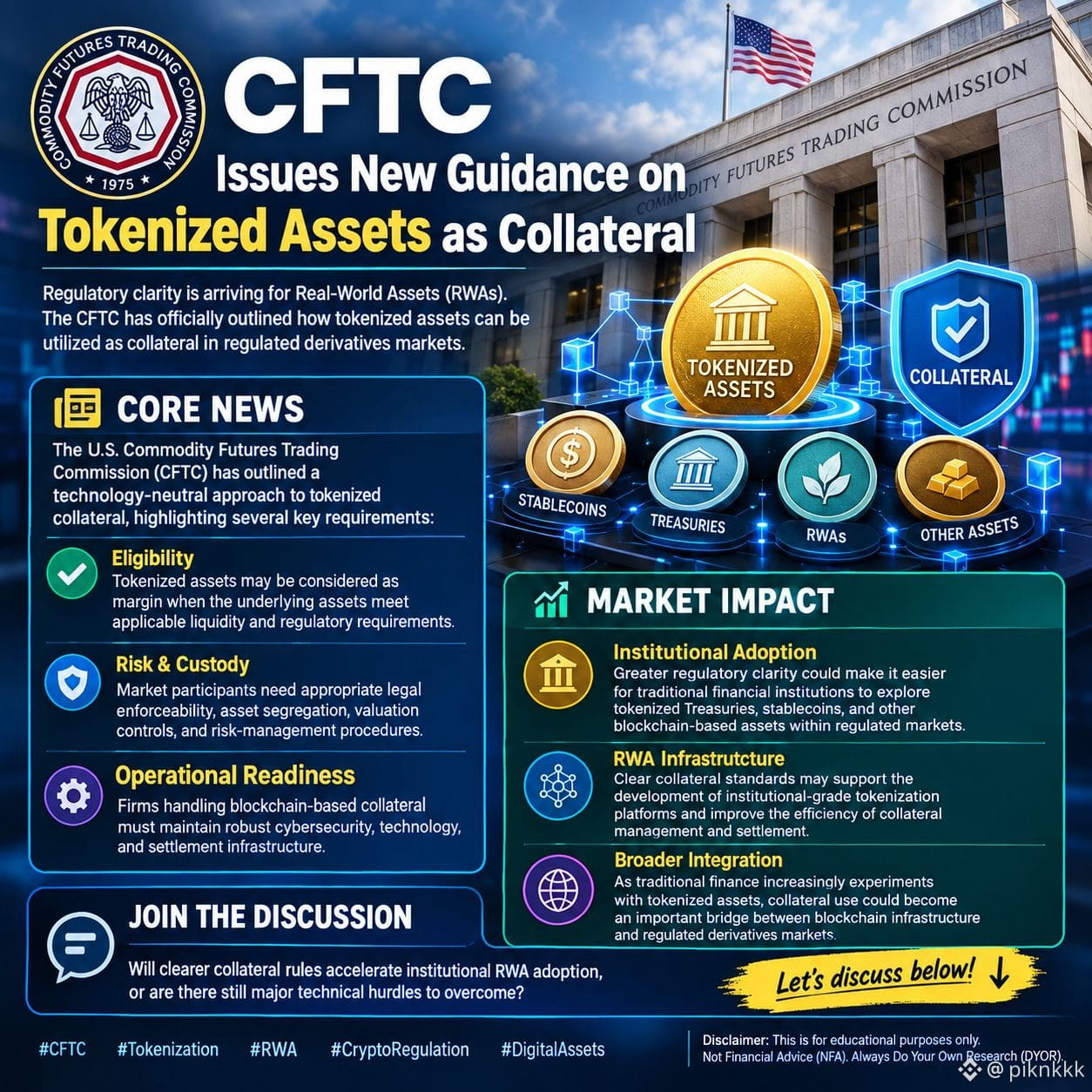
#cftcupdatesguidanceontokenizedassets 🏛️ CFTC Issues New Guidance on Tokenized Assets as Collateral
Regulatory clarity is arriving for Real-World Assets (RWAs). The CFTC has officially outlined how tokenized assets can be utilized as collateral in regulated derivatives markets.
📰 Core News
The Commodity Futures Trading Commission (CFTC) recently released updated guidance confirming a technology-neutral approach to tokenized collateral. Key takeaways include:
• Eligibility Tokenized assets can serve as margin if the underlying asset is highly liquid and meets existing regulatory standards.
•Risk & Custody Firms must ensure legal enforceability, proper asset segregation, and apply appropriate valuation haircuts.
• Operational Readiness Robust cybersecurity and technical frameworks are mandatory to handle blockchain-based settlements safely.
📊 Market Impact
•Institutional Adoption Clear rules reduce regulatory uncertainty, potentially encouraging traditional financial institutions to integrate tokenized Treasuries, stablecoins, and other RWAs into their trading operations.
•Ecosystem Growth This framework could accelerate the development of compliant, institutional-grade tokenization platforms, enhancing market liquidity through faster and more efficient settlement capabilities.
💬 What are your thoughts?
Do you believe clear collateral guidelines will be the main catalyst for the next wave of RWA tokenization, or are there still major technical hurdles to overcome? Let’s discuss below! 👇
#CFTC #Tokenization #RWA #CryptoRegulation #DigitalAssets
This is for educational purposes only. Not Financial Advice (NFA). Always Do Your Own Research (DYOR).
$QNT $KMNO $ENA
{future}(ENAUSDT)
{future}(KMNOUSDT)
{future}(QNTUSDT)
#cftcupdatesguidanceontokenizedassets 🏛️ CFTC Issues New Guidance on Tokenized Assets as Collateral
Regulatory clarity is arriving for Real-World Assets (RWAs). The CFTC has officially outlined how tokenized assets can be utilized as collateral in regulated derivatives markets.
📰 Core News
The Commodity Futures Trading Commission (CFTC) recently released updated guidance confirming a technology-neutral approach to tokenized collateral. Key takeaways include:
• Eligibility Tokenized assets can serve as margin if the underlying asset is highly liquid and meets existing regulatory standards.
•Risk & Custody Firms must ensure legal enforceability, proper asset segregation, and apply appropriate valuation haircuts.
• Operational Readiness Robust cybersecurity and technical frameworks are mandatory to handle blockchain-based settlements safely.
📊 Market Impact
•Institutional Adoption Clear rules reduce regulatory uncertainty, potentially encouraging traditional financial institutions to integrate tokenized Treasuries, stablecoins, and other RWAs into their trading operations.
•Ecosystem Growth This framework could accelerate the development of compliant, institutional-grade tokenization platforms, enhancing market liquidity through faster and more efficient settlement capabilities.
💬 What are your thoughts?
Do you believe clear collateral guidelines will be the main catalyst for the next wave of RWA tokenization, or are there still major technical hurdles to overcome? Let’s discuss below! 👇
#CFTC #Tokenization #RWA #CryptoRegulation #DigitalAssets
This is for educational purposes only. Not Financial Advice (NFA). Always Do Your Own Research (DYOR).
$QNT $KMNO $ENA
Regulatory clarity is arriving for Real-World Assets (RWAs). The CFTC has officially outlined how tokenized assets can be utilized as collateral in regulated derivatives markets.
📰 Core News
The Commodity Futures Trading Commission (CFTC) recently released updated guidance confirming a technology-neutral approach to tokenized collateral. Key takeaways include:
• Eligibility Tokenized assets can serve as margin if the underlying asset is highly liquid and meets existing regulatory standards.
•Risk & Custody Firms must ensure legal enforceability, proper asset segregation, and apply appropriate valuation haircuts.
• Operational Readiness Robust cybersecurity and technical frameworks are mandatory to handle blockchain-based settlements safely.
📊 Market Impact
•Institutional Adoption Clear rules reduce regulatory uncertainty, potentially encouraging traditional financial institutions to integrate tokenized Treasuries, stablecoins, and other RWAs into their trading operations.
•Ecosystem Growth This framework could accelerate the development of compliant, institutional-grade tokenization platforms, enhancing market liquidity through faster and more efficient settlement capabilities.
💬 What are your thoughts?
Do you believe clear collateral guidelines will be the main catalyst for the next wave of RWA tokenization, or are there still major technical hurdles to overcome? Let’s discuss below! 👇
#CFTC #Tokenization #RWA #CryptoRegulation #DigitalAssets
This is for educational purposes only. Not Financial Advice (NFA). Always Do Your Own Research (DYOR).
$QNT $KMNO $ENA
1.1k

Article
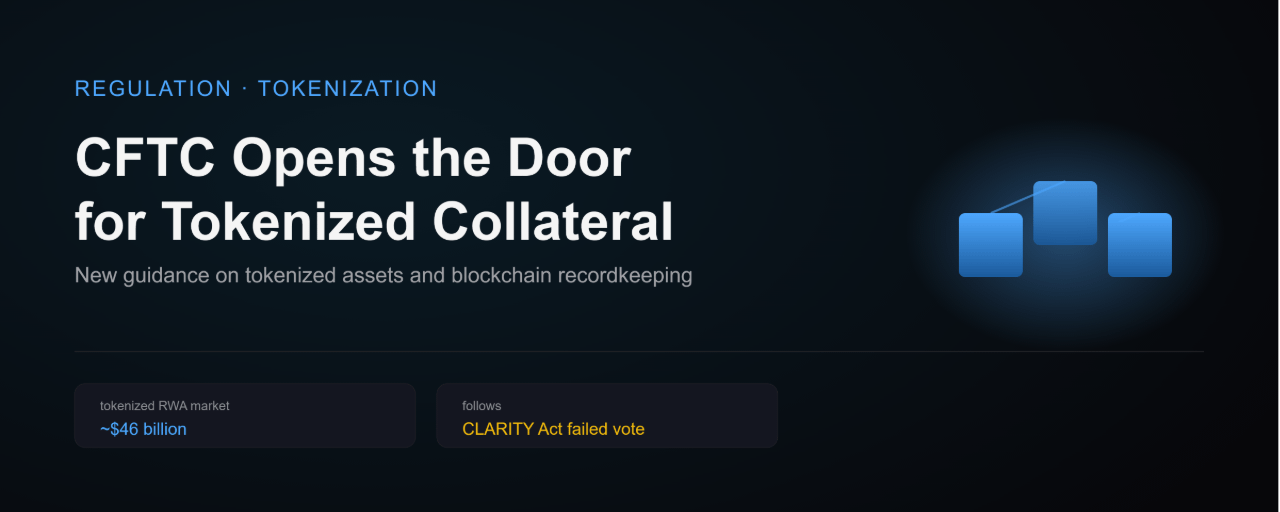
CFTC Opens the Door for Tokenized Collateral and On-Chain Recordkeeping.$QNT [ ](https://www.binance.com/en/trade/QNTUSDT?contentId=370401573053047)$QI [ ](https://www.binance.com/en/trade/QIUSDT?contentId=370401573053047)$XPL
The Commodity Futures Trading Commission (CFTC) updated its guidance on September 24, giving regulated derivatives firms a clearer legal pathway to use tokenized assets and blockchain-based recordkeeping — a move that lands just days after the Senate failed to advance the CLARITY Act.
What actually changed
The update covers two practical questions facing regulated firms under CFTC oversight:
1. Tokenized collateral is now explicitly allowed. Firms can invest customer funds in tokenized versions of already-permitted assets — but only if the tokenized form grants holders "legal and economic rights that are the same or functionally equivalent" to the traditional version. This isn't a new asset class; it's a clarification that tokenization is a change in form, not a reason to exclude an otherwise-permissible asset. Regulation 1.25, which limits which assets customer funds can be invested in, still applies in full — tokenization doesn't loosen that restriction.
2. Blockchain can now serve as the official record. Regulated entities can use blockchain or distributed ledger systems to satisfy Regulation 1.31 recordkeeping requirements, as long as records remain reliable, accessible, and producible on request. Firms no longer need to maintain a separate off-chain copy purely because a record already exists on-chain — though those using public, permissionless networks still need backup systems to keep records retrievable during outages or disruptions.
The regulatory backdrop
This didn't happen in a vacuum. Just days earlier, the Senate's cloture vote on the Digital Asset Market Clarity (CLARITY) Act failed — the bill that would have given the CFTC clear statutory authority over crypto spot markets and created a comprehensive federal framework. With Congress unlikely to pass market-structure legislation before 2027, CFTC Chairman Michael Selig said the update was part of ongoing efforts "to provide regulatory clarity for the crypto industry" in the meantime. SEC Chair Paul Atkins echoed a similar sentiment before the failed vote, saying his agency was "ready, willing, and able" to propose its own crypto rules absent congressional action — the SEC already proposed rules on crypto-asset investment contracts back in August.
In short: with Congress stalled, both major regulators are advancing what they can through existing administrative authority rather than waiting for new legislation.
Why this matters for the tokenization narrative
This lands as the tokenized real-world asset (RWA) market has grown to roughly $46 billion. Clearer collateral rules give regulated derivatives firms — futures commission merchants (FCMs) and clearing organizations (DCOs) — a legitimate route to use tokenized assets for swap margin, an option beyond cash or Treasuries for meeting uncleared swap obligations. That's meaningful plumbing work, even if it doesn't generate headline price action on its own.
One important caveat
The CFTC guidance itself notes it does not create new enforceable rights, amend existing rules, or guarantee protection from future enforcement action — it's staff interpretation of how current rules apply, not new law. The core distinction the agency draws remains firm: tokenized versions of already-permitted financial instruments are treated differently than standalone cryptocurrencies, which still don't qualify under customer investment rules.
The bigger picture
Combined with Hong Kong's push toward 24/7 wholesale CBDC settlement, Cardano joining the x402 AI payment standard, and Canary's staked SEI ETF filing — all stories we've covered recently — this CFTC update fits a broader global pattern: regulators and institutions building the compliance infrastructure for tokenized finance piece by piece, even as comprehensive legislation stalls. The RWA tokenization narrative keeps gaining structural support, one incremental regulatory clarification at a time.
#CFTCUpdatesGuidanceOnTokenizedAssets #RWA #CryptoRegulation
{future}(XPLUSDT)
{spot}(QIUSDT)
{future}(QNTUSDT)
CFTC Opens the Door for Tokenized Collateral and On-Chain Recordkeeping.
$QNT $QI $XPL
The Commodity Futures Trading Commission (CFTC) updated its guidance on September 24, giving regulated derivatives firms a clearer legal pathway to use tokenized assets and blockchain-based recordkeeping — a move that lands just days after the Senate failed to advance the CLARITY Act.
What actually changed
The update covers two practical questions facing regulated firms under CFTC oversight:
1. Tokenized collateral is now explicitly allowed. Firms can invest customer funds in tokenized versions of already-permitted assets — but only if the tokenized form grants holders "legal and economic rights that are the same or functionally equivalent" to the traditional version. This isn't a new asset class; it's a clarification that tokenization is a change in form, not a reason to exclude an otherwise-permissible asset. Regulation 1.25, which limits which assets customer funds can be invested in, still applies in full — tokenization doesn't loosen that restriction.
2. Blockchain can now serve as the official record. Regulated entities can use blockchain or distributed ledger systems to satisfy Regulation 1.31 recordkeeping requirements, as long as records remain reliable, accessible, and producible on request. Firms no longer need to maintain a separate off-chain copy purely because a record already exists on-chain — though those using public, permissionless networks still need backup systems to keep records retrievable during outages or disruptions.
The regulatory backdrop
This didn't happen in a vacuum. Just days earlier, the Senate's cloture vote on the Digital Asset Market Clarity (CLARITY) Act failed — the bill that would have given the CFTC clear statutory authority over crypto spot markets and created a comprehensive federal framework. With Congress unlikely to pass market-structure legislation before 2027, CFTC Chairman Michael Selig said the update was part of ongoing efforts "to provide regulatory clarity for the crypto industry" in the meantime. SEC Chair Paul Atkins echoed a similar sentiment before the failed vote, saying his agency was "ready, willing, and able" to propose its own crypto rules absent congressional action — the SEC already proposed rules on crypto-asset investment contracts back in August.
In short: with Congress stalled, both major regulators are advancing what they can through existing administrative authority rather than waiting for new legislation.
Why this matters for the tokenization narrative
This lands as the tokenized real-world asset (RWA) market has grown to roughly $46 billion. Clearer collateral rules give regulated derivatives firms — futures commission merchants (FCMs) and clearing organizations (DCOs) — a legitimate route to use tokenized assets for swap margin, an option beyond cash or Treasuries for meeting uncleared swap obligations. That's meaningful plumbing work, even if it doesn't generate headline price action on its own.
One important caveat
The CFTC guidance itself notes it does not create new enforceable rights, amend existing rules, or guarantee protection from future enforcement action — it's staff interpretation of how current rules apply, not new law. The core distinction the agency draws remains firm: tokenized versions of already-permitted financial instruments are treated differently than standalone cryptocurrencies, which still don't qualify under customer investment rules.
The bigger picture
Combined with Hong Kong's push toward 24/7 wholesale CBDC settlement, Cardano joining the x402 AI payment standard, and Canary's staked SEI ETF filing — all stories we've covered recently — this CFTC update fits a broader global pattern: regulators and institutions building the compliance infrastructure for tokenized finance piece by piece, even as comprehensive legislation stalls. The RWA tokenization narrative keeps gaining structural support, one incremental regulatory clarification at a time.
#CFTCUpdatesGuidanceOnTokenizedAssets #RWA #CryptoRegulation
The Commodity Futures Trading Commission (CFTC) updated its guidance on September 24, giving regulated derivatives firms a clearer legal pathway to use tokenized assets and blockchain-based recordkeeping — a move that lands just days after the Senate failed to advance the CLARITY Act.
What actually changed
The update covers two practical questions facing regulated firms under CFTC oversight:
1. Tokenized collateral is now explicitly allowed. Firms can invest customer funds in tokenized versions of already-permitted assets — but only if the tokenized form grants holders "legal and economic rights that are the same or functionally equivalent" to the traditional version. This isn't a new asset class; it's a clarification that tokenization is a change in form, not a reason to exclude an otherwise-permissible asset. Regulation 1.25, which limits which assets customer funds can be invested in, still applies in full — tokenization doesn't loosen that restriction.
2. Blockchain can now serve as the official record. Regulated entities can use blockchain or distributed ledger systems to satisfy Regulation 1.31 recordkeeping requirements, as long as records remain reliable, accessible, and producible on request. Firms no longer need to maintain a separate off-chain copy purely because a record already exists on-chain — though those using public, permissionless networks still need backup systems to keep records retrievable during outages or disruptions.
The regulatory backdrop
This didn't happen in a vacuum. Just days earlier, the Senate's cloture vote on the Digital Asset Market Clarity (CLARITY) Act failed — the bill that would have given the CFTC clear statutory authority over crypto spot markets and created a comprehensive federal framework. With Congress unlikely to pass market-structure legislation before 2027, CFTC Chairman Michael Selig said the update was part of ongoing efforts "to provide regulatory clarity for the crypto industry" in the meantime. SEC Chair Paul Atkins echoed a similar sentiment before the failed vote, saying his agency was "ready, willing, and able" to propose its own crypto rules absent congressional action — the SEC already proposed rules on crypto-asset investment contracts back in August.
In short: with Congress stalled, both major regulators are advancing what they can through existing administrative authority rather than waiting for new legislation.
Why this matters for the tokenization narrative
This lands as the tokenized real-world asset (RWA) market has grown to roughly $46 billion. Clearer collateral rules give regulated derivatives firms — futures commission merchants (FCMs) and clearing organizations (DCOs) — a legitimate route to use tokenized assets for swap margin, an option beyond cash or Treasuries for meeting uncleared swap obligations. That's meaningful plumbing work, even if it doesn't generate headline price action on its own.
One important caveat
The CFTC guidance itself notes it does not create new enforceable rights, amend existing rules, or guarantee protection from future enforcement action — it's staff interpretation of how current rules apply, not new law. The core distinction the agency draws remains firm: tokenized versions of already-permitted financial instruments are treated differently than standalone cryptocurrencies, which still don't qualify under customer investment rules.
The bigger picture
Combined with Hong Kong's push toward 24/7 wholesale CBDC settlement, Cardano joining the x402 AI payment standard, and Canary's staked SEI ETF filing — all stories we've covered recently — this CFTC update fits a broader global pattern: regulators and institutions building the compliance infrastructure for tokenized finance piece by piece, even as comprehensive legislation stalls. The RWA tokenization narrative keeps gaining structural support, one incremental regulatory clarification at a time.
#CFTCUpdatesGuidanceOnTokenizedAssets #RWA #CryptoRegulation
307
·
--
#cftcupdatesguidanceontokenizedassets
The CFTC's latest tokenization update is less about crypto tokens — and more about financial plumbing.
On Sept. 24, CFTC staff updated its crypto FAQs to address tokenized forms of permitted investments and the use of blockchain technology for regulatory recordkeeping.
Here's the important part:
A tokenized version doesn't simply qualify because it's on a blockchain. The token has to provide the same or functionally equivalent legal and economic rights as the underlying traditional asset.
So this isn't a blanket approval of tokenized assets.
It's something more practical: blockchain infrastructure is being fitted into existing regulated-market processes.
That matters because tokenization eventually has to solve more than issuance. It needs custody, valuation, segregation, recordkeeping and settlement to work inside regulated markets.
For me, that's the part worth watching.
Does tokenization become truly transformative when regulators stop treating the blockchain as the unusual part of the system?
#Tokenization #CFTC #RWA
#cftcupdatesguidanceontokenizedassets
The CFTC's latest tokenization update is less about crypto tokens — and more about financial plumbing.
On Sept. 24, CFTC staff updated its crypto FAQs to address tokenized forms of permitted investments and the use of blockchain technology for regulatory recordkeeping.
Here's the important part:
A tokenized version doesn't simply qualify because it's on a blockchain. The token has to provide the same or functionally equivalent legal and economic rights as the underlying traditional asset.
So this isn't a blanket approval of tokenized assets.
It's something more practical: blockchain infrastructure is being fitted into existing regulated-market processes.
That matters because tokenization eventually has to solve more than issuance. It needs custody, valuation, segregation, recordkeeping and settlement to work inside regulated markets.
For me, that's the part worth watching.
Does tokenization become truly transformative when regulators stop treating the blockchain as the unusual part of the system?
#Tokenization #CFTC #RWA
The CFTC's latest tokenization update is less about crypto tokens — and more about financial plumbing.
On Sept. 24, CFTC staff updated its crypto FAQs to address tokenized forms of permitted investments and the use of blockchain technology for regulatory recordkeeping.
Here's the important part:
A tokenized version doesn't simply qualify because it's on a blockchain. The token has to provide the same or functionally equivalent legal and economic rights as the underlying traditional asset.
So this isn't a blanket approval of tokenized assets.
It's something more practical: blockchain infrastructure is being fitted into existing regulated-market processes.
That matters because tokenization eventually has to solve more than issuance. It needs custody, valuation, segregation, recordkeeping and settlement to work inside regulated markets.
For me, that's the part worth watching.
Does tokenization become truly transformative when regulators stop treating the blockchain as the unusual part of the system?
#Tokenization #CFTC #RWA
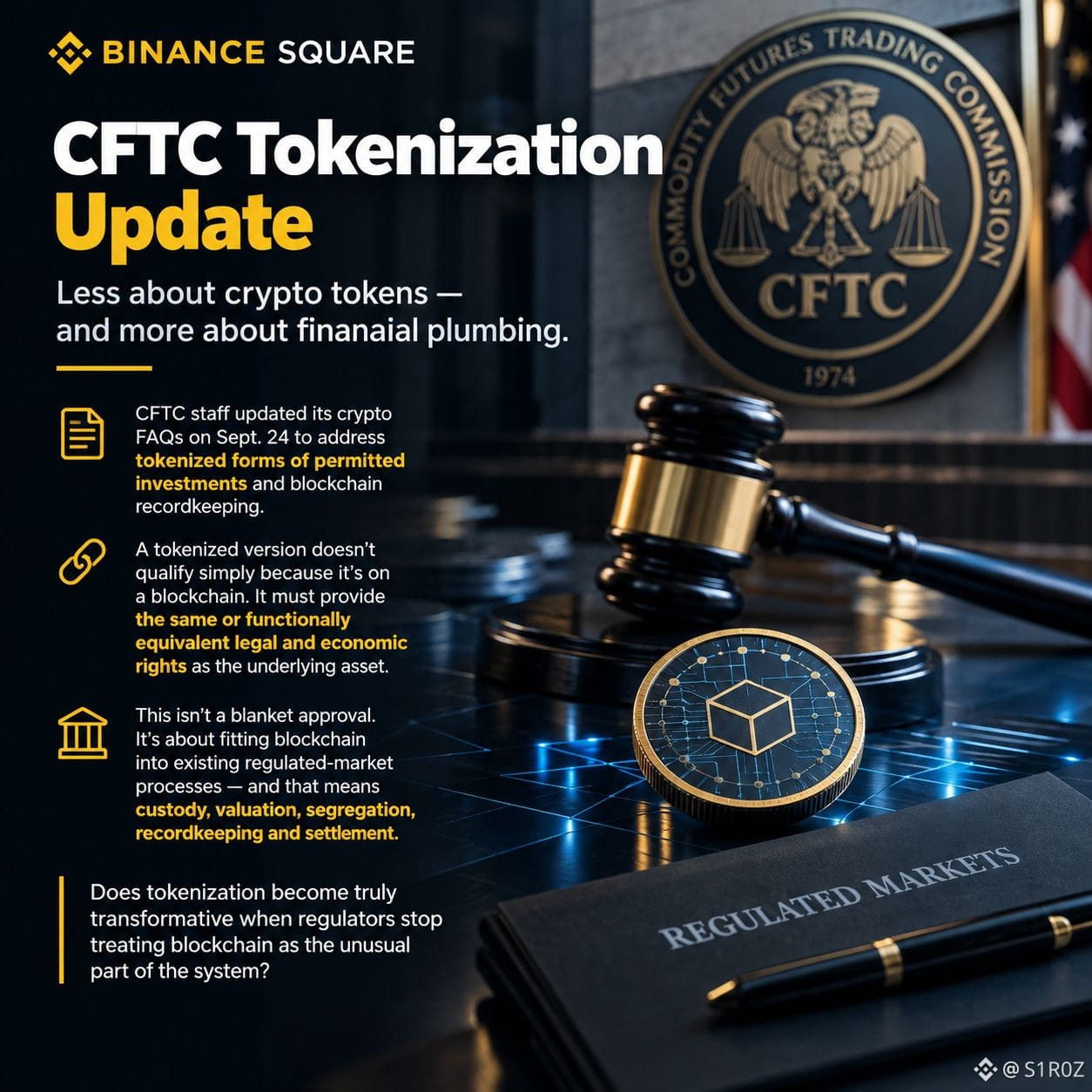
2
77
·
--
#CFTCUpdatesGuidanceOnTokenizedAssets
🚨 CFTC UPDATES TOKENIZED ASSET GUIDANCE 🔥
The CFTC has updated its guidance on tokenized assets and blockchain-based recordkeeping, signaling continued regulatory acceptance of blockchain infrastructure in U.S. derivatives markets.
Under the updated guidance, eligible regulated firms may invest customer funds in tokenized versions of permitted assets, provided the tokenized asset gives holders the same or functionally equivalent legal and economic rights as the traditional asset.
📈 Tokenization is moving deeper into traditional finance.
🌐 Blockchain infrastructure is gaining regulatory recognition.
🔥 This could be a major step toward broader on-chain markets.
Bullish for the RWA + tokenization narrative? 👀
#CFTC #Tokenization #RWA #Crypto
#CFTCUpdatesGuidanceOnTokenizedAssets
🚨 CFTC UPDATES TOKENIZED ASSET GUIDANCE 🔥
The CFTC has updated its guidance on tokenized assets and blockchain-based recordkeeping, signaling continued regulatory acceptance of blockchain infrastructure in U.S. derivatives markets.
Under the updated guidance, eligible regulated firms may invest customer funds in tokenized versions of permitted assets, provided the tokenized asset gives holders the same or functionally equivalent legal and economic rights as the traditional asset.
📈 Tokenization is moving deeper into traditional finance.
🌐 Blockchain infrastructure is gaining regulatory recognition.
🔥 This could be a major step toward broader on-chain markets.
Bullish for the RWA + tokenization narrative? 👀
#CFTC #Tokenization #RWA #Crypto
🚨 CFTC UPDATES TOKENIZED ASSET GUIDANCE 🔥
The CFTC has updated its guidance on tokenized assets and blockchain-based recordkeeping, signaling continued regulatory acceptance of blockchain infrastructure in U.S. derivatives markets.
Under the updated guidance, eligible regulated firms may invest customer funds in tokenized versions of permitted assets, provided the tokenized asset gives holders the same or functionally equivalent legal and economic rights as the traditional asset.
📈 Tokenization is moving deeper into traditional finance.
🌐 Blockchain infrastructure is gaining regulatory recognition.
🔥 This could be a major step toward broader on-chain markets.
Bullish for the RWA + tokenization narrative? 👀
#CFTC #Tokenization #RWA #Crypto
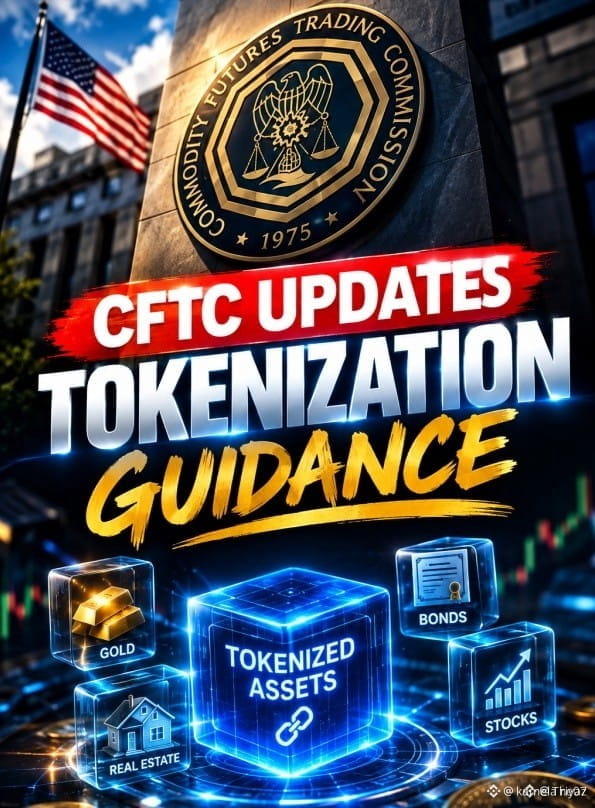
1
31

·
--
#CFTCUpdatesGuidanceOnTokenizedAssets
The U.S Commodity Futures Trading Commission's (CFTC) landmark update to its crypto and blockchain FAQs.
Headline: The CFTC is giving institutional Real World Assets (RWAs) a massive green light 🚦📈
The CFTC just updated its regulatory guidance, officially allowing registered institutions (FCMs and DCOs) to invest customer funds into tokenized assets—provided they carry equivalent legal and economic rights to traditional assets under Regulation 1.25. Even better? They’ve confirmed that on-chain, blockchain-native recordkeeping is now compliant, removing the need for duplicate off-chain paper trails.
#CFTCUpdatesGuidanceOnTokenizedAssets #BinanceWillListHyperliquid(HYPE) #TokenizedAssests
#BinanceSquareFamily
#CFTCUpdatesGuidanceOnTokenizedAssets
The U.S Commodity Futures Trading Commission's (CFTC) landmark update to its crypto and blockchain FAQs.
Headline: The CFTC is giving institutional Real World Assets (RWAs) a massive green light 🚦📈
The CFTC just updated its regulatory guidance, officially allowing registered institutions (FCMs and DCOs) to invest customer funds into tokenized assets—provided they carry equivalent legal and economic rights to traditional assets under Regulation 1.25. Even better? They’ve confirmed that on-chain, blockchain-native recordkeeping is now compliant, removing the need for duplicate off-chain paper trails.
#CFTCUpdatesGuidanceOnTokenizedAssets #BinanceWillListHyperliquid(HYPE) #TokenizedAssests
#BinanceSquareFamily
The U.S Commodity Futures Trading Commission's (CFTC) landmark update to its crypto and blockchain FAQs.
Headline: The CFTC is giving institutional Real World Assets (RWAs) a massive green light 🚦📈
The CFTC just updated its regulatory guidance, officially allowing registered institutions (FCMs and DCOs) to invest customer funds into tokenized assets—provided they carry equivalent legal and economic rights to traditional assets under Regulation 1.25. Even better? They’ve confirmed that on-chain, blockchain-native recordkeeping is now compliant, removing the need for duplicate off-chain paper trails.
#CFTCUpdatesGuidanceOnTokenizedAssets #BinanceWillListHyperliquid(HYPE) #TokenizedAssests
#BinanceSquareFamily
63

#CFTCUpdatesGuidanceOnTokenizedAssets 🇺🇸 CFTC Just Gave Tokenization a Regulatory Boost — While Congress Stalls
Something important is happening in U.S. crypto regulation.
On September 24, the CFTC updated its staff FAQs to clarify how regulated firms can use tokenized versions of permitted assets and blockchain/DLT for recordkeeping under existing requirements.
Commodity Futures Trading Commission
🔹 Tokenized assets can potentially be used when they provide legal & economic rights equivalent to the underlying permitted asset.
🔹 Blockchain-based records can satisfy certain recordkeeping requirements if they remain reliable, accessible and producible, with appropriate backup controls.
Commodity Futures Trading Commission
The timing is notable.
Just 9 days earlier, the Senate failed to advance the Digital Asset Market Clarity Act (H.R. 3633) in a 49–50 procedural vote. This was a vote to invoke cloture and move forward—not a final vote to enact the bill.
U.S. Senate Daily Press +1
💡 Why investors should care:
Congressional legislation would provide a broader statutory framework. But regulatory guidance can still give financial institutions practical clarity today, potentially making tokenized Treasuries, funds and other real-world assets easier to integrate into regulated markets.
The bigger story isn't just crypto prices.
It's whether traditional finance is gradually moving onto blockchain infrastructure.
👀 Tokenization may be becoming a regulatory story — not just a crypto narrative.
#CFTC #Tokenization #CryptoRegulation #blockchain #DigitalAssets #QNT #QI #XPL
Not financial advice. DYOR.
Sources CFTC official release + U.S. Senate Daily Press.
#CFTCUpdatesGuidanceOnTokenizedAssets 🇺🇸 CFTC Just Gave Tokenization a Regulatory Boost — While Congress Stalls
Something important is happening in U.S. crypto regulation.
On September 24, the CFTC updated its staff FAQs to clarify how regulated firms can use tokenized versions of permitted assets and blockchain/DLT for recordkeeping under existing requirements.
Commodity Futures Trading Commission
🔹 Tokenized assets can potentially be used when they provide legal & economic rights equivalent to the underlying permitted asset.
🔹 Blockchain-based records can satisfy certain recordkeeping requirements if they remain reliable, accessible and producible, with appropriate backup controls.
Commodity Futures Trading Commission
The timing is notable.
Just 9 days earlier, the Senate failed to advance the Digital Asset Market Clarity Act (H.R. 3633) in a 49–50 procedural vote. This was a vote to invoke cloture and move forward—not a final vote to enact the bill.
U.S. Senate Daily Press +1
💡 Why investors should care:
Congressional legislation would provide a broader statutory framework. But regulatory guidance can still give financial institutions practical clarity today, potentially making tokenized Treasuries, funds and other real-world assets easier to integrate into regulated markets.
The bigger story isn't just crypto prices.
It's whether traditional finance is gradually moving onto blockchain infrastructure.
👀 Tokenization may be becoming a regulatory story — not just a crypto narrative.
#CFTC #Tokenization #CryptoRegulation #blockchain #DigitalAssets #QNT #QI #XPL
Not financial advice. DYOR.
Sources CFTC official release + U.S. Senate Daily Press.
Something important is happening in U.S. crypto regulation.
On September 24, the CFTC updated its staff FAQs to clarify how regulated firms can use tokenized versions of permitted assets and blockchain/DLT for recordkeeping under existing requirements.
Commodity Futures Trading Commission
🔹 Tokenized assets can potentially be used when they provide legal & economic rights equivalent to the underlying permitted asset.
🔹 Blockchain-based records can satisfy certain recordkeeping requirements if they remain reliable, accessible and producible, with appropriate backup controls.
Commodity Futures Trading Commission
The timing is notable.
Just 9 days earlier, the Senate failed to advance the Digital Asset Market Clarity Act (H.R. 3633) in a 49–50 procedural vote. This was a vote to invoke cloture and move forward—not a final vote to enact the bill.
U.S. Senate Daily Press +1
💡 Why investors should care:
Congressional legislation would provide a broader statutory framework. But regulatory guidance can still give financial institutions practical clarity today, potentially making tokenized Treasuries, funds and other real-world assets easier to integrate into regulated markets.
The bigger story isn't just crypto prices.
It's whether traditional finance is gradually moving onto blockchain infrastructure.
👀 Tokenization may be becoming a regulatory story — not just a crypto narrative.
#CFTC #Tokenization #CryptoRegulation #blockchain #DigitalAssets #QNT #QI #XPL
Not financial advice. DYOR.
Sources CFTC official release + U.S. Senate Daily Press.
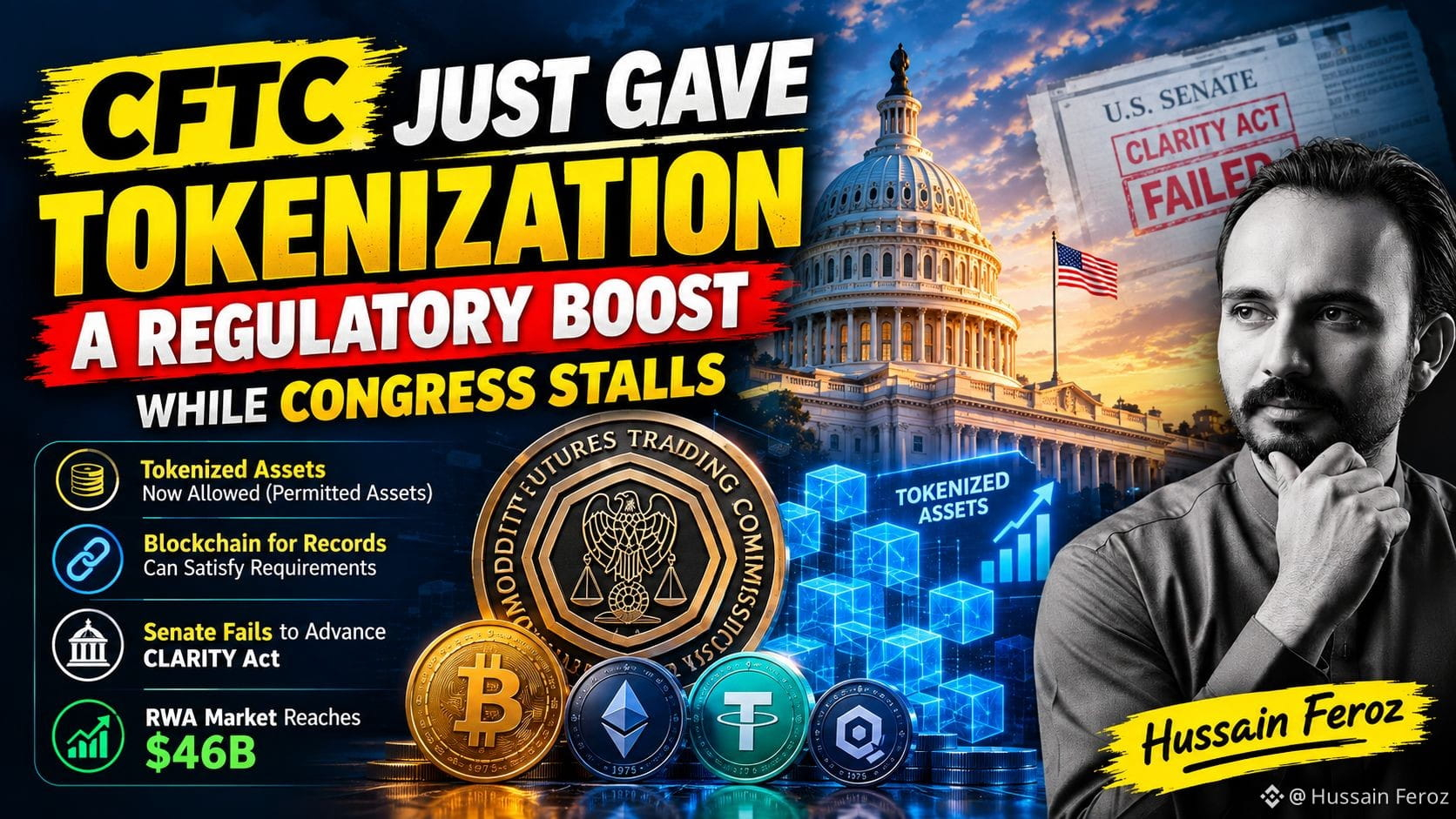
1
422
Log in to explore more content
Join global crypto users on Binance Square
⚡️ Get latest and useful information about crypto.
💬 Trusted by the world’s largest crypto exchange.
👍 Discover real insights from verified creators.
Email / Phone number
Trending Topics
1
#QNTRises39%
13,874 views
716 Discussing
2
#EthereumBreaksAbove$2700
1,582 views
76 Discussing
3
#BitgetBreachForgedRequestsNotStolenKeys
12,445 views
557 Discussing
4
#BitcoinSpotETFsTurnNetPositiveYTD
7,802 views
448 Discussing
5
#GrayscaleZcashETFHits$1BNetAssets
1,093 views
38 Discussing
6
#BitcoinSpotETFsNetInflow$191M
6,733 views
175 Discussing
7
#CFTCUpdatesGuidanceOnTokenizedAssets
46,245 views
1,445 Discussing
8
#BitgetSays$352MAffectedInHack
17,161 views
93 Discussing
9
#BinanceWillListHyperliquid(HYPE)
263,132 views
4,010 Discussing
10
#BrazilOrdersReportingOf$10KSelfCustodyTransfers
6,480 views
55 Discussing