
#401k
401k
86,949 views
318 Discussing
Hot
Latest


Article
🔥 Trump’s Crypto 401(k) Plan Reaches the Finish Line: When Can You Invest?The bridge between traditional retirement savings and the digital asset economy is about to open wide.
A highly anticipated final rule from the U.S. Labor Department has officially reached the White House for its final review. This marks the absolute last regulatory checkpoint before the rule is formally published and enacted, bringing a long-awaited shift to American retirement portfolios.
The new framework is designed to completely shield employers from legal liability if they choose to add alternative assets—specifically cryptocurrency, private equity, and real estate—to their company-sponsored 401(k) lineups.
Clearing the Legal Hurdles for Employers
For years, everyday savers have wanted direct exposure to crypto inside their tax-advantaged accounts, but corporate legal teams have blocked the move. Under previous regulatory guidance, employers feared massive class-action lawsuits if they offered highly volatile alternative assets and those assets suffered a downturn.
This incoming rule flips the script. By providing a strict regulatory safe harbor, the administration is giving corporate plan sponsors the green light to diversify traditional retirement menus. Once published, the fear of legal retaliation will largely dissipate, paving the way for institutional adoption at the workplace level.
Timeline: When Can Savers Actually Buy In?
While the rule is in its final steps, access won't happen overnight. Here is how the rollout timeline is expected to play out:
The Final White House Review: This process typically takes anywhere from a few weeks to a couple of months. Given the advanced stage, official publication is expected in the near term.The Institutional Lag: Once the rule is published, major asset managers (like Fidelity and Vanguard) and corporate boards must update their investment policies.The Retail Launch: Expect forward-thinking tech companies and crypto-native firms to offer these options first, with broader corporate adoption rolling out incrementally over the next 12 to 18 months.
The Portfolio Shift: Freedom vs. Fiduciary Risk
This regulatory shift represents a massive ideological victory for financial freedom, but it will undoubtedly spark fierce debate among financial planners.
On one hand, letting savers allocate even a tiny fraction (like 1% to 5%) of their paycheck directly into blue-chip digital assets could drastically boost long-term wealth compounding. On the other hand, mixing highly volatile, 24/7 crypto markets into traditional "set-it-and-forget-it" retirement accounts will require a massive wave of investor education to prevent emotional panic selling during market downturns.
The Bigger Picture
This policy marks a massive structural turning point for institutional crypto adoption. Forcing trillions of dollars in traditional retirement capital into the digital asset pipeline will create a permanent, programmatic source of spot market demand.
Would you add Crypto to your corporate 401(k) if your boss gave you the option, or do you prefer keeping retirement and crypto completely separate? Sound off in the comments below!
NFA
#CryptoNews #401k #Bitcoin #Retirement #USMidtermsCouldShakeUpUS-IranTies
🔥 Trump’s Crypto 401(k) Plan Reaches the Finish Line: When Can You Invest?
The bridge between traditional retirement savings and the digital asset economy is about to open wide.
A highly anticipated final rule from the U.S. Labor Department has officially reached the White House for its final review. This marks the absolute last regulatory checkpoint before the rule is formally published and enacted, bringing a long-awaited shift to American retirement portfolios.
The new framework is designed to completely shield employers from legal liability if they choose to add alternative assets—specifically cryptocurrency, private equity, and real estate—to their company-sponsored 401(k) lineups.
Clearing the Legal Hurdles for Employers
For years, everyday savers have wanted direct exposure to crypto inside their tax-advantaged accounts, but corporate legal teams have blocked the move. Under previous regulatory guidance, employers feared massive class-action lawsuits if they offered highly volatile alternative assets and those assets suffered a downturn.
This incoming rule flips the script. By providing a strict regulatory safe harbor, the administration is giving corporate plan sponsors the green light to diversify traditional retirement menus. Once published, the fear of legal retaliation will largely dissipate, paving the way for institutional adoption at the workplace level.
Timeline: When Can Savers Actually Buy In?
While the rule is in its final steps, access won't happen overnight. Here is how the rollout timeline is expected to play out:
The Final White House Review: This process typically takes anywhere from a few weeks to a couple of months. Given the advanced stage, official publication is expected in the near term.The Institutional Lag: Once the rule is published, major asset managers (like Fidelity and Vanguard) and corporate boards must update their investment policies.The Retail Launch: Expect forward-thinking tech companies and crypto-native firms to offer these options first, with broader corporate adoption rolling out incrementally over the next 12 to 18 months.
The Portfolio Shift: Freedom vs. Fiduciary Risk
This regulatory shift represents a massive ideological victory for financial freedom, but it will undoubtedly spark fierce debate among financial planners.
On one hand, letting savers allocate even a tiny fraction (like 1% to 5%) of their paycheck directly into blue-chip digital assets could drastically boost long-term wealth compounding. On the other hand, mixing highly volatile, 24/7 crypto markets into traditional "set-it-and-forget-it" retirement accounts will require a massive wave of investor education to prevent emotional panic selling during market downturns.
The Bigger Picture
This policy marks a massive structural turning point for institutional crypto adoption. Forcing trillions of dollars in traditional retirement capital into the digital asset pipeline will create a permanent, programmatic source of spot market demand.
Would you add Crypto to your corporate 401(k) if your boss gave you the option, or do you prefer keeping retirement and crypto completely separate? Sound off in the comments below!
NFA
#CryptoNews #401k #Bitcoin #Retirement #USMidtermsCouldShakeUpUS-IranTies
A highly anticipated final rule from the U.S. Labor Department has officially reached the White House for its final review. This marks the absolute last regulatory checkpoint before the rule is formally published and enacted, bringing a long-awaited shift to American retirement portfolios.
The new framework is designed to completely shield employers from legal liability if they choose to add alternative assets—specifically cryptocurrency, private equity, and real estate—to their company-sponsored 401(k) lineups.
Clearing the Legal Hurdles for Employers
For years, everyday savers have wanted direct exposure to crypto inside their tax-advantaged accounts, but corporate legal teams have blocked the move. Under previous regulatory guidance, employers feared massive class-action lawsuits if they offered highly volatile alternative assets and those assets suffered a downturn.
This incoming rule flips the script. By providing a strict regulatory safe harbor, the administration is giving corporate plan sponsors the green light to diversify traditional retirement menus. Once published, the fear of legal retaliation will largely dissipate, paving the way for institutional adoption at the workplace level.
Timeline: When Can Savers Actually Buy In?
While the rule is in its final steps, access won't happen overnight. Here is how the rollout timeline is expected to play out:
The Final White House Review: This process typically takes anywhere from a few weeks to a couple of months. Given the advanced stage, official publication is expected in the near term.The Institutional Lag: Once the rule is published, major asset managers (like Fidelity and Vanguard) and corporate boards must update their investment policies.The Retail Launch: Expect forward-thinking tech companies and crypto-native firms to offer these options first, with broader corporate adoption rolling out incrementally over the next 12 to 18 months.
The Portfolio Shift: Freedom vs. Fiduciary Risk
This regulatory shift represents a massive ideological victory for financial freedom, but it will undoubtedly spark fierce debate among financial planners.
On one hand, letting savers allocate even a tiny fraction (like 1% to 5%) of their paycheck directly into blue-chip digital assets could drastically boost long-term wealth compounding. On the other hand, mixing highly volatile, 24/7 crypto markets into traditional "set-it-and-forget-it" retirement accounts will require a massive wave of investor education to prevent emotional panic selling during market downturns.
The Bigger Picture
This policy marks a massive structural turning point for institutional crypto adoption. Forcing trillions of dollars in traditional retirement capital into the digital asset pipeline will create a permanent, programmatic source of spot market demand.
Would you add Crypto to your corporate 401(k) if your boss gave you the option, or do you prefer keeping retirement and crypto completely separate? Sound off in the comments below!
NFA
#CryptoNews #401k #Bitcoin #Retirement #USMidtermsCouldShakeUpUS-IranTies
1
1
596

·
--
DOL’s crypto-friendly 401(k) rule hits White House review — retirement menus may get clearer alts path.
On November 5, 2026, the U.S. Department of Labor’s final rule on fiduciary duties for selecting designated investment alternatives (RIN 1210-AC38) arrived at White House OIRA for EO 12866 review. The package is logged as economically significant and covers how 401(k) fiduciaries can document a process when considering alternative assets that can include crypto, private equity, and real estate.
The March proposal sketched a safe harbor under ERISA if committees weigh performance, fees, liquidity, valuation, benchmarks, and complexity. Publication would not force plans to offer $btc or other digital assets — it would lower litigation risk for employers that follow the process. OIRA clearance is the last interagency step before a Federal Register release; the final text and effective date are still unpublished.
#Bitcoin #401k #Crypto
DYOR. Not financial advice.
{spot}(BTCUSDT)
DOL’s crypto-friendly 401(k) rule hits White House review — retirement menus may get clearer alts path.
On November 5, 2026, the U.S. Department of Labor’s final rule on fiduciary duties for selecting designated investment alternatives (RIN 1210-AC38) arrived at White House OIRA for EO 12866 review. The package is logged as economically significant and covers how 401(k) fiduciaries can document a process when considering alternative assets that can include crypto, private equity, and real estate.
The March proposal sketched a safe harbor under ERISA if committees weigh performance, fees, liquidity, valuation, benchmarks, and complexity. Publication would not force plans to offer $btc or other digital assets — it would lower litigation risk for employers that follow the process. OIRA clearance is the last interagency step before a Federal Register release; the final text and effective date are still unpublished.
#Bitcoin #401k #Crypto
DYOR. Not financial advice.
On November 5, 2026, the U.S. Department of Labor’s final rule on fiduciary duties for selecting designated investment alternatives (RIN 1210-AC38) arrived at White House OIRA for EO 12866 review. The package is logged as economically significant and covers how 401(k) fiduciaries can document a process when considering alternative assets that can include crypto, private equity, and real estate.
The March proposal sketched a safe harbor under ERISA if committees weigh performance, fees, liquidity, valuation, benchmarks, and complexity. Publication would not force plans to offer $btc or other digital assets — it would lower litigation risk for employers that follow the process. OIRA clearance is the last interagency step before a Federal Register release; the final text and effective date are still unpublished.
#Bitcoin #401k #Crypto
DYOR. Not financial advice.

47

·
--
Crypto in your 401(k) just got closer.
The Trump administration is moving closer to allowing crypto in 401(k) retirement plans (The Block, Nov 6).
Same day: spot crypto ETFs saw over $500M in net outflows and BTC sits near $76K.
My take: retirement-plan access is a slow-burn demand story, not a short-term catalyst. Policy headlines are positive, but flows are still leaving.
If it passes, the first beneficiaries are likely the big-cap names with ETFs.
Would you want crypto inside your retirement account: yes or no, and how much?
$BTC $ETH
#Bitcoin #401k #CryptoRegulation
Not financial advice.
Crypto in your 401(k) just got closer.
The Trump administration is moving closer to allowing crypto in 401(k) retirement plans (The Block, Nov 6).
Same day: spot crypto ETFs saw over $500M in net outflows and BTC sits near $76K.
My take: retirement-plan access is a slow-burn demand story, not a short-term catalyst. Policy headlines are positive, but flows are still leaving.
If it passes, the first beneficiaries are likely the big-cap names with ETFs.
Would you want crypto inside your retirement account: yes or no, and how much?
$BTC $ETH
#Bitcoin #401k #CryptoRegulation
Not financial advice.
The Trump administration is moving closer to allowing crypto in 401(k) retirement plans (The Block, Nov 6).
Same day: spot crypto ETFs saw over $500M in net outflows and BTC sits near $76K.
My take: retirement-plan access is a slow-burn demand story, not a short-term catalyst. Policy headlines are positive, but flows are still leaving.
If it passes, the first beneficiaries are likely the big-cap names with ETFs.
Would you want crypto inside your retirement account: yes or no, and how much?
$BTC $ETH
#Bitcoin #401k #CryptoRegulation
Not financial advice.


·
--
🔑 CRYPTO IS KNOCKING ON AMERICA'S $10.8 TRILLION RETIREMENT DOOR
The US Department of Labor has sent its final rule opening 401(k) plans to crypto and other alternative assets to the White House for final review. The Office of Information and Regulatory Affairs logged the package on November 5 under RIN 1210-AC38, "Fiduciary Duties In Selecting Designated Investment Alternatives". OIRA review is the last checkpoint before publication in the Federal Register.
🔹 WHAT IT DOES
The rule gives plan fiduciaries a legal safe harbor for adding actively managed vehicles holding digital assets, private equity and real estate to 401(k) menus, through a documented six-factor process covering performance, fees, liquidity, valuation, benchmarks and complexity. It follows President Trump's August 7, 2025 executive order and the DOL's March proposal, which rescinded the 2022 guidance that told fiduciaries to exercise "extreme care" before touching crypto.
🔹 WHY IT MATTERS
Americans hold $10.8 trillion in 401(k) plans. Even a 2% allocation would mean roughly $216 billion of potential fresh inflows. Retirement money moves slowly, but once it moves, it stays. This is structural demand, not a headline pump.
⚠️ HONEST RISKS
The final text is not public yet, OIRA has no deadline, and review can take weeks. No plan is forced to offer crypto, and no dollar flows until the rule is published and employers actually adopt it. Do not price this in as done.
The door to America's retirement savings is opening. Slowly, but it is opening.
🐂 or 🐻: does 401(k) money change Bitcoin's game, or is this priced in already?
📌 Sharing personal opinions only, not financial advice or a recommendation to buy/sell. Crypto is highly risky; DYOR and you are solely responsible. No coin promotion.
$BTC #Bitcoin #401k #Crypto #Binance
🔑 CRYPTO IS KNOCKING ON AMERICA'S $10.8 TRILLION RETIREMENT DOOR
The US Department of Labor has sent its final rule opening 401(k) plans to crypto and other alternative assets to the White House for final review. The Office of Information and Regulatory Affairs logged the package on November 5 under RIN 1210-AC38, "Fiduciary Duties In Selecting Designated Investment Alternatives". OIRA review is the last checkpoint before publication in the Federal Register.
🔹 WHAT IT DOES
The rule gives plan fiduciaries a legal safe harbor for adding actively managed vehicles holding digital assets, private equity and real estate to 401(k) menus, through a documented six-factor process covering performance, fees, liquidity, valuation, benchmarks and complexity. It follows President Trump's August 7, 2025 executive order and the DOL's March proposal, which rescinded the 2022 guidance that told fiduciaries to exercise "extreme care" before touching crypto.
🔹 WHY IT MATTERS
Americans hold $10.8 trillion in 401(k) plans. Even a 2% allocation would mean roughly $216 billion of potential fresh inflows. Retirement money moves slowly, but once it moves, it stays. This is structural demand, not a headline pump.
⚠️ HONEST RISKS
The final text is not public yet, OIRA has no deadline, and review can take weeks. No plan is forced to offer crypto, and no dollar flows until the rule is published and employers actually adopt it. Do not price this in as done.
The door to America's retirement savings is opening. Slowly, but it is opening.
🐂 or 🐻: does 401(k) money change Bitcoin's game, or is this priced in already?
📌 Sharing personal opinions only, not financial advice or a recommendation to buy/sell. Crypto is highly risky; DYOR and you are solely responsible. No coin promotion.
$BTC #Bitcoin #401k #Crypto #Binance
The US Department of Labor has sent its final rule opening 401(k) plans to crypto and other alternative assets to the White House for final review. The Office of Information and Regulatory Affairs logged the package on November 5 under RIN 1210-AC38, "Fiduciary Duties In Selecting Designated Investment Alternatives". OIRA review is the last checkpoint before publication in the Federal Register.
🔹 WHAT IT DOES
The rule gives plan fiduciaries a legal safe harbor for adding actively managed vehicles holding digital assets, private equity and real estate to 401(k) menus, through a documented six-factor process covering performance, fees, liquidity, valuation, benchmarks and complexity. It follows President Trump's August 7, 2025 executive order and the DOL's March proposal, which rescinded the 2022 guidance that told fiduciaries to exercise "extreme care" before touching crypto.
🔹 WHY IT MATTERS
Americans hold $10.8 trillion in 401(k) plans. Even a 2% allocation would mean roughly $216 billion of potential fresh inflows. Retirement money moves slowly, but once it moves, it stays. This is structural demand, not a headline pump.
⚠️ HONEST RISKS
The final text is not public yet, OIRA has no deadline, and review can take weeks. No plan is forced to offer crypto, and no dollar flows until the rule is published and employers actually adopt it. Do not price this in as done.
The door to America's retirement savings is opening. Slowly, but it is opening.
🐂 or 🐻: does 401(k) money change Bitcoin's game, or is this priced in already?
📌 Sharing personal opinions only, not financial advice or a recommendation to buy/sell. Crypto is highly risky; DYOR and you are solely responsible. No coin promotion.
$BTC #Bitcoin #401k #Crypto #Binance
AVCI3503:
ordan bana olurmu
1
3
1k

Crypto's path into America's retirement accounts just hit its final checkpoint — I'm watching the clock now, not the headline.
The Labor Department sent its final 401(k) rule to the White House on Thursday; OIRA logged it November 5 — the last step before publication.
What it changes: fiduciaries get a safe harbor if they weigh six factors — performance, fees, liquidity, valuation, benchmarks, complexity — before adding crypto to a plan menu. Nothing is forced — each employer still chooses. It carries out Trump's August 2025 order.
OIRA has up to 90 days to finish. Pushback is real — three Democratic lawmakers want it withdrawn, and one crypto option charges about 1% a year, vs 0.03–0.10% for a typical S&P 500 index fund.
$BTC flat near $75.9K tonight — no visible reaction yet.
Would you take a crypto option in your 401(k) tomorrow — or is retirement money off limits?
NFA, DYOR.
$BTC #CryptoNews #Regulation #401k
Crypto's path into America's retirement accounts just hit its final checkpoint — I'm watching the clock now, not the headline.
The Labor Department sent its final 401(k) rule to the White House on Thursday; OIRA logged it November 5 — the last step before publication.
What it changes: fiduciaries get a safe harbor if they weigh six factors — performance, fees, liquidity, valuation, benchmarks, complexity — before adding crypto to a plan menu. Nothing is forced — each employer still chooses. It carries out Trump's August 2025 order.
OIRA has up to 90 days to finish. Pushback is real — three Democratic lawmakers want it withdrawn, and one crypto option charges about 1% a year, vs 0.03–0.10% for a typical S&P 500 index fund.
$BTC flat near $75.9K tonight — no visible reaction yet.
Would you take a crypto option in your 401(k) tomorrow — or is retirement money off limits?
NFA, DYOR.
$BTC #CryptoNews #Regulation #401k
The Labor Department sent its final 401(k) rule to the White House on Thursday; OIRA logged it November 5 — the last step before publication.
What it changes: fiduciaries get a safe harbor if they weigh six factors — performance, fees, liquidity, valuation, benchmarks, complexity — before adding crypto to a plan menu. Nothing is forced — each employer still chooses. It carries out Trump's August 2025 order.
OIRA has up to 90 days to finish. Pushback is real — three Democratic lawmakers want it withdrawn, and one crypto option charges about 1% a year, vs 0.03–0.10% for a typical S&P 500 index fund.
$BTC flat near $75.9K tonight — no visible reaction yet.
Would you take a crypto option in your 401(k) tomorrow — or is retirement money off limits?
NFA, DYOR.
$BTC #CryptoNews #Regulation #401k

·
--
Traders on X are buzzing: the rule that could bring crypto into US 401(k)s just reached the White House for final review. 👀
The Labor Department sent its final rule to OIRA on Nov 5 (Bloomberg Law). It gives plan fiduciaries a legal safe harbor to add crypto and other alternatives to retirement menus.
Why it matters: $10.8T sits in US 401(k)s. A 2% allocation would mean about $216B of fresh demand (per Sweep). Review is not approval, and no plan has to offer $BTC.
Is retirement money the next big buyer, or already priced in? 👇
Not financial advice. DYOR.
#crypto #401k #Bitcoin
Traders on X are buzzing: the rule that could bring crypto into US 401(k)s just reached the White House for final review. 👀
The Labor Department sent its final rule to OIRA on Nov 5 (Bloomberg Law). It gives plan fiduciaries a legal safe harbor to add crypto and other alternatives to retirement menus.
Why it matters: $10.8T sits in US 401(k)s. A 2% allocation would mean about $216B of fresh demand (per Sweep). Review is not approval, and no plan has to offer $BTC .
Is retirement money the next big buyer, or already priced in? 👇
Not financial advice. DYOR.
#crypto #401k #Bitcoin
The Labor Department sent its final rule to OIRA on Nov 5 (Bloomberg Law). It gives plan fiduciaries a legal safe harbor to add crypto and other alternatives to retirement menus.
Why it matters: $10.8T sits in US 401(k)s. A 2% allocation would mean about $216B of fresh demand (per Sweep). Review is not approval, and no plan has to offer $BTC .
Is retirement money the next big buyer, or already priced in? 👇
Not financial advice. DYOR.
#crypto #401k #Bitcoin
27

Big news for crypto and retirement savings 🇺🇸
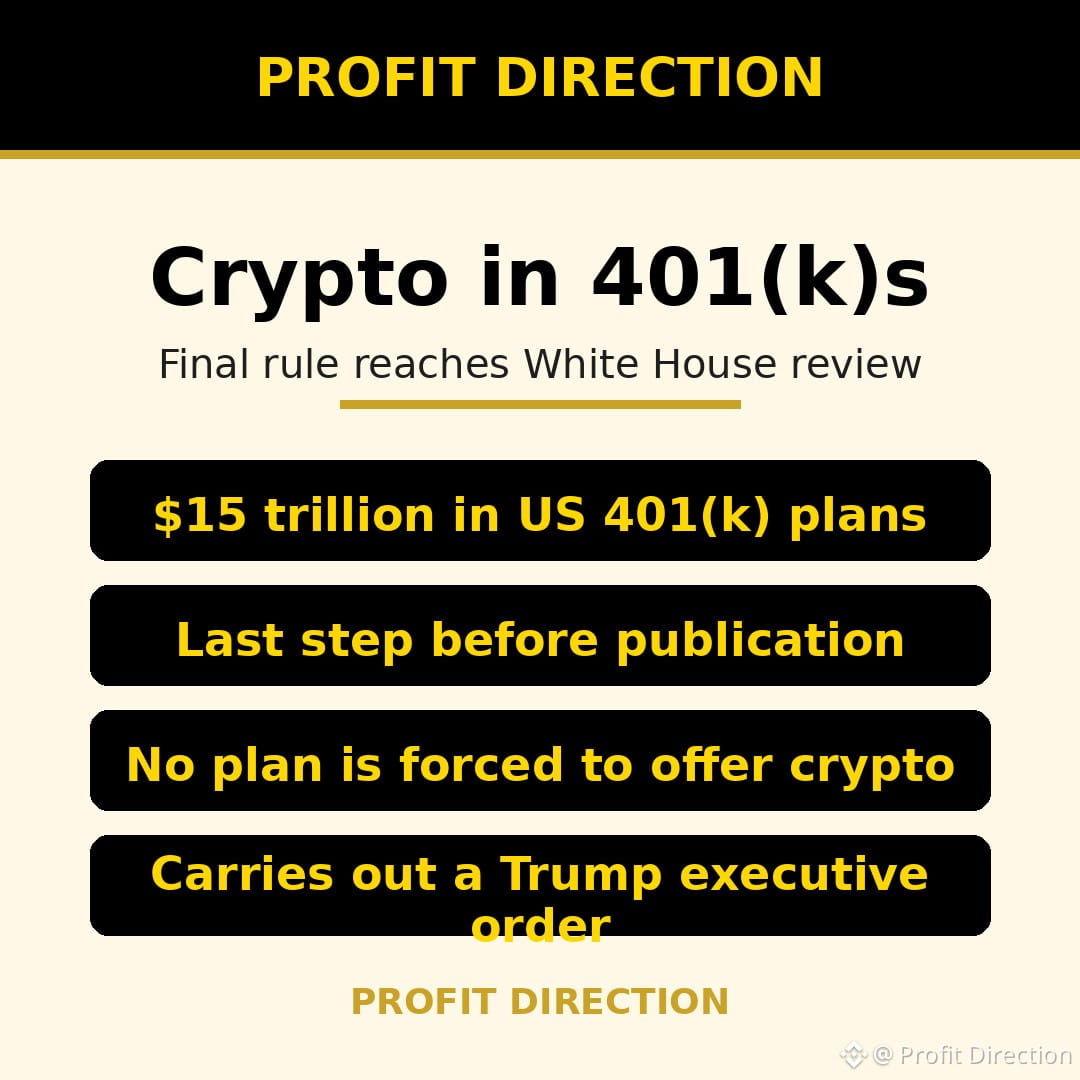
A final US Labor Department rule that would let employers add crypto to 401(k) retirement plans has reached the White House for review — the last step before it is published. The rule carries out a Trump executive order.
Why does this matter?
US 401(k) plans hold about $15 trillion. If the rule is published and employers choose to offer crypto, it could open a huge new pool of long-term money to Bitcoin and crypto — though no plan is forced to offer it, and the White House review can take up to 90 days.
This is not a buy or sell call, and nothing changes overnight. But it is a real step toward crypto sitting inside everyday retirement accounts, not just on trading apps.
Analysis Only — Not Financial Advice (NFA). Trading involves risk.
Follow Profit Direction for more signals, best signals and market updates. Share your opinion in the comments.
Do you think crypto belongs in retirement savings, or is it too risky for a 401(k)?
#CryptoNews #Bitcoin #401k #Crypto
Big news for crypto and retirement savings 🇺🇸
A final US Labor Department rule that would let employers add crypto to 401(k) retirement plans has reached the White House for review — the last step before it is published. The rule carries out a Trump executive order.
Why does this matter?
US 401(k) plans hold about $15 trillion. If the rule is published and employers choose to offer crypto, it could open a huge new pool of long-term money to Bitcoin and crypto — though no plan is forced to offer it, and the White House review can take up to 90 days.
This is not a buy or sell call, and nothing changes overnight. But it is a real step toward crypto sitting inside everyday retirement accounts, not just on trading apps.
Analysis Only — Not Financial Advice (NFA). Trading involves risk.
Follow Profit Direction for more signals, best signals and market updates. Share your opinion in the comments.
Do you think crypto belongs in retirement savings, or is it too risky for a 401(k)?
#CryptoNews #Bitcoin #401k #Crypto
A final US Labor Department rule that would let employers add crypto to 401(k) retirement plans has reached the White House for review — the last step before it is published. The rule carries out a Trump executive order.
Why does this matter?
US 401(k) plans hold about $15 trillion. If the rule is published and employers choose to offer crypto, it could open a huge new pool of long-term money to Bitcoin and crypto — though no plan is forced to offer it, and the White House review can take up to 90 days.
This is not a buy or sell call, and nothing changes overnight. But it is a real step toward crypto sitting inside everyday retirement accounts, not just on trading apps.
Analysis Only — Not Financial Advice (NFA). Trading involves risk.
Follow Profit Direction for more signals, best signals and market updates. Share your opinion in the comments.
Do you think crypto belongs in retirement savings, or is it too risky for a 401(k)?
#CryptoNews #Bitcoin #401k #Crypto
59

·
--
🚨 NEW: A US rule that would make it easier to include crypto in 401(k) retirement plans has reached the White House for final review, Bloomberg Law reports.
#bitcoin #crypto #Cryptocurrency #401K #CryptoNews #BTC #Blockchain #InstitutionalAdoption #Binance
🚨 NEW: A US rule that would make it easier to include crypto in 401(k) retirement plans has reached the White House for final review, Bloomberg Law reports.
#bitcoin #crypto #Cryptocurrency #401K #CryptoNews #BTC #Blockchain #InstitutionalAdoption #Binance
#bitcoin #crypto #Cryptocurrency #401K #CryptoNews #BTC #Blockchain #InstitutionalAdoption #Binance

1
4

·
--
Guys!! The rules for getting crypto into U.S. retirement plans have made it to the White House doorstep!!!
On November 5, the U.S. Department of Labor sent the final rule to the White House for review (reported by multiple outlets): it implements the August 2025 executive order, giving fiduciaries a safe-harbor framework for including alternative assets (including crypto) in 401(k) plans. Note: it does NOT require every plan to add crypto. It says you can evaluate it based on six factors, such as performance, fees, and liquidity. The total value of U.S. 401(k) plans is around $10.8 trillion, so of course the narrative is huge.
Seriously, being sent for review ≠ already being in retirement accounts!!! Even after it passes review, it’ll take more time for plans to actually offer these products. Don’t use “it’s going into 401(k)s any minute now” as an excuse to chase the rally this weekend and call it a day, haha.
CoinGecko: Bitcoin is around $76,100, ETH around $2,247, and the Fear & Greed Index is still at 25~
Do you think this is more of a sentiment boost, or another case of “the promised catalyst is nowhere near being realized”?
$BTC $ETH
#401k #退休金 #Crypto
Guys!! The rules for getting crypto into U.S. retirement plans have made it to the White House doorstep!!!
On November 5, the U.S. Department of Labor sent the final rule to the White House for review (reported by multiple outlets): it implements the August 2025 executive order, giving fiduciaries a safe-harbor framework for including alternative assets (including crypto) in 401(k) plans. Note: it does NOT require every plan to add crypto. It says you can evaluate it based on six factors, such as performance, fees, and liquidity. The total value of U.S. 401(k) plans is around $10.8 trillion, so of course the narrative is huge.
Seriously, being sent for review ≠ already being in retirement accounts!!! Even after it passes review, it’ll take more time for plans to actually offer these products. Don’t use “it’s going into 401(k)s any minute now” as an excuse to chase the rally this weekend and call it a day, haha.
CoinGecko: Bitcoin is around $76,100, ETH around $2,247, and the Fear & Greed Index is still at 25~
Do you think this is more of a sentiment boost, or another case of “the promised catalyst is nowhere near being realized”?
$BTC $ETH
#401k #退休金 #Crypto
On November 5, the U.S. Department of Labor sent the final rule to the White House for review (reported by multiple outlets): it implements the August 2025 executive order, giving fiduciaries a safe-harbor framework for including alternative assets (including crypto) in 401(k) plans. Note: it does NOT require every plan to add crypto. It says you can evaluate it based on six factors, such as performance, fees, and liquidity. The total value of U.S. 401(k) plans is around $10.8 trillion, so of course the narrative is huge.
Seriously, being sent for review ≠ already being in retirement accounts!!! Even after it passes review, it’ll take more time for plans to actually offer these products. Don’t use “it’s going into 401(k)s any minute now” as an excuse to chase the rally this weekend and call it a day, haha.
CoinGecko: Bitcoin is around $76,100, ETH around $2,247, and the Fear & Greed Index is still at 25~
Do you think this is more of a sentiment boost, or another case of “the promised catalyst is nowhere near being realized”?
$BTC $ETH
#401k #退休金 #Crypto
303

·
--
The U.S. Department of Labor has sent its final rule on “adding crypto to 401(k)s” to the White House for review.
In plain English: If plan administrators want to add BTC, ETH, or even other digital assets to their retirement-plan menus, they can get a safe-harbor shield—as long as they meet six prudence criteria: performance, fees, liquidity, valuation, benchmarks, and complexity. It doesn’t force you to buy anything; it gives employers and plan managers a legal umbrella that says, “Don’t sue me too hard if things go wrong.”
Warren and Sanders are still warning, “Don’t gamble ordinary people’s retirement savings on volatility.” But the rule has already reached OIRA, so it’s not far from becoming official. In a $10.8 trillion 401(k) market, even opening a narrow crack is more useful than a hundred meme coins piling onto the on-chain narrative.
That same week, you can see the other side of the story: regulators are pushing some exchanges out of the dollar system while also bringing crypto into Americans’ retirement accounts. That’s not contradictory—it’s a division of labor: shut down dirty channels, open clean ones. Anyone who believes “the U.S. is banning crypto across the board” is still living in a 2022 slide deck.
Retail investors, don’t celebrate just yet. Getting onto the menu ≠ your company will add the option; adding the option ≠ it becomes a default holding; a default holding ≠ you can buy the dip. The first to benefit will still be ETFs and custodial products that can make it through the custody, recordkeeping, and compliance pipelines. Altcoins in retirement plans? Any one of liquidity, valuation, or track record could knock them out.
In a nutshell: the macro narrative is widening, but the door at the individual level is still narrow. Don’t mistake “rule submitted for review” for “retirement plans are about to buy BTC in bulk”—that’s marketing spin, not capital flow.
#Bitcoin #401k
The U.S. Department of Labor has sent its final rule on “adding crypto to 401(k)s” to the White House for review.
In plain English: If plan administrators want to add BTC, ETH, or even other digital assets to their retirement-plan menus, they can get a safe-harbor shield—as long as they meet six prudence criteria: performance, fees, liquidity, valuation, benchmarks, and complexity. It doesn’t force you to buy anything; it gives employers and plan managers a legal umbrella that says, “Don’t sue me too hard if things go wrong.”
Warren and Sanders are still warning, “Don’t gamble ordinary people’s retirement savings on volatility.” But the rule has already reached OIRA, so it’s not far from becoming official. In a $10.8 trillion 401(k) market, even opening a narrow crack is more useful than a hundred meme coins piling onto the on-chain narrative.
That same week, you can see the other side of the story: regulators are pushing some exchanges out of the dollar system while also bringing crypto into Americans’ retirement accounts. That’s not contradictory—it’s a division of labor: shut down dirty channels, open clean ones. Anyone who believes “the U.S. is banning crypto across the board” is still living in a 2022 slide deck.
Retail investors, don’t celebrate just yet. Getting onto the menu ≠ your company will add the option; adding the option ≠ it becomes a default holding; a default holding ≠ you can buy the dip. The first to benefit will still be ETFs and custodial products that can make it through the custody, recordkeeping, and compliance pipelines. Altcoins in retirement plans? Any one of liquidity, valuation, or track record could knock them out.
In a nutshell: the macro narrative is widening, but the door at the individual level is still narrow. Don’t mistake “rule submitted for review” for “retirement plans are about to buy BTC in bulk”—that’s marketing spin, not capital flow.
#Bitcoin #401k
In plain English: If plan administrators want to add BTC, ETH, or even other digital assets to their retirement-plan menus, they can get a safe-harbor shield—as long as they meet six prudence criteria: performance, fees, liquidity, valuation, benchmarks, and complexity. It doesn’t force you to buy anything; it gives employers and plan managers a legal umbrella that says, “Don’t sue me too hard if things go wrong.”
Warren and Sanders are still warning, “Don’t gamble ordinary people’s retirement savings on volatility.” But the rule has already reached OIRA, so it’s not far from becoming official. In a $10.8 trillion 401(k) market, even opening a narrow crack is more useful than a hundred meme coins piling onto the on-chain narrative.
That same week, you can see the other side of the story: regulators are pushing some exchanges out of the dollar system while also bringing crypto into Americans’ retirement accounts. That’s not contradictory—it’s a division of labor: shut down dirty channels, open clean ones. Anyone who believes “the U.S. is banning crypto across the board” is still living in a 2022 slide deck.
Retail investors, don’t celebrate just yet. Getting onto the menu ≠ your company will add the option; adding the option ≠ it becomes a default holding; a default holding ≠ you can buy the dip. The first to benefit will still be ETFs and custodial products that can make it through the custody, recordkeeping, and compliance pipelines. Altcoins in retirement plans? Any one of liquidity, valuation, or track record could knock them out.
In a nutshell: the macro narrative is widening, but the door at the individual level is still narrow. Don’t mistake “rule submitted for review” for “retirement plans are about to buy BTC in bulk”—that’s marketing spin, not capital flow.
#Bitcoin #401k

150

·
--
【Can retirement plans buy crypto now? U.S. 401(k) crypto rules sent to the White House, expected to take effect by the end of Q1 next year】
On November 5, the U.S. Department of Labor sent the final rule allowing 401(k) retirement plans to allocate funds to crypto and other alternative assets to the White House for review. It is expected to clear review in 60 to 90 days and take effect around the end of Q1 2027. The rule only gives plan administrators a “safe harbor” process for evaluating investments based on six factors: performance, fees, liquidity, valuation, benchmarks, and complexity. It does not require any plan to include crypto.
$BTC
#401k #养老金 #CryptoRegulation
【Can retirement plans buy crypto now? U.S. 401(k) crypto rules sent to the White House, expected to take effect by the end of Q1 next year】
On November 5, the U.S. Department of Labor sent the final rule allowing 401(k) retirement plans to allocate funds to crypto and other alternative assets to the White House for review. It is expected to clear review in 60 to 90 days and take effect around the end of Q1 2027. The rule only gives plan administrators a “safe harbor” process for evaluating investments based on six factors: performance, fees, liquidity, valuation, benchmarks, and complexity. It does not require any plan to include crypto.
$BTC
#401k #养老金 #CryptoRegulation
On November 5, the U.S. Department of Labor sent the final rule allowing 401(k) retirement plans to allocate funds to crypto and other alternative assets to the White House for review. It is expected to clear review in 60 to 90 days and take effect around the end of Q1 2027. The rule only gives plan administrators a “safe harbor” process for evaluating investments based on six factors: performance, fees, liquidity, valuation, benchmarks, and complexity. It does not require any plan to include crypto.
$BTC
#401k #养老金 #CryptoRegulation
15

Big news: The U.S. Department of Labor has sent its final rule on crypto in 401(k) plans to the White House. On November 5, the final version, titled “The Duties of a Fiduciary in Selecting Designated Investment Alternatives,” formally entered OIRA review—the last step before publication. The key provision gives employers a “safe harbor”: if they follow a process that considers six factors—performance, fees, liquidity, valuation, benchmarks, and complexity—they can add private equity, real estate, or crypto to their retirement plan menus without fear of being sued. Note: No one will be required to offer crypto. BTC and ETH will likely be first, while smaller coins will face a higher bar. U.S. 401(k) plans hold $10.8 trillion; even 2% flowing in would amount to $216 billion. OIRA review can take up to 90 days, so we’ll know in 2027. #401k #CryptoRegulation
Big news: The U.S. Department of Labor has sent its final rule on crypto in 401(k) plans to the White House. On November 5, the final version, titled “The Duties of a Fiduciary in Selecting Designated Investment Alternatives,” formally entered OIRA review—the last step before publication. The key provision gives employers a “safe harbor”: if they follow a process that considers six factors—performance, fees, liquidity, valuation, benchmarks, and complexity—they can add private equity, real estate, or crypto to their retirement plan menus without fear of being sued. Note: No one will be required to offer crypto. BTC and ETH will likely be first, while smaller coins will face a higher bar. U.S. 401(k) plans hold $10.8 trillion; even 2% flowing in would amount to $216 billion. OIRA review can take up to 90 days, so we’ll know in 2027. #401k #CryptoRegulation
362

·
--
🏛️ Markets are panicking, but Washington is quietly opening the door to crypto: the final rule on crypto assets in 401(k)s has been sent to the White House for final review!
📌 Facts:
• The U.S. Department of Labor’s final rule, “Fiduciary Duties in Selecting Designated Investment Alternatives,” was submitted to OIRA on November 5. Its status is pending, with no statutory deadline.
• The March proposal set out six evaluation factors: performance, fees, liquidity, valuation, benchmarks, and complexity. Employers that follow the process may qualify for a legal safe harbor.
• No plan is required to include crypto, and no specific currencies are named.
• The total size of the 401(k) market is about $10.8 trillion (ICI, as of the end of June).
📉 But reality is harsh: BTC is trading sideways around $75,800, and the Fear & Greed Index is at 25 (Extreme Fear). News of White House review has barely moved prices.
🧠 My take: This is a long-term narrative, not a catalyst for tomorrow’s market. Actual adoption will depend on the final text, whether employers are willing to offer these options, and whether products have reliable daily pricing. BTC/ETH are most likely to benefit first; the bar will be higher for smaller coins.
👉 Do you think opening up 401(k)s is the start of this bullish news being priced in, or just another story that “sounds great”? Let’s discuss in the comments.
$BTC $ETH
#加密市场 #401k #Regulation
Personal opinion only; not investment advice
🏛️ Markets are panicking, but Washington is quietly opening the door to crypto: the final rule on crypto assets in 401(k)s has been sent to the White House for final review!
📌 Facts:
• The U.S. Department of Labor’s final rule, “Fiduciary Duties in Selecting Designated Investment Alternatives,” was submitted to OIRA on November 5. Its status is pending, with no statutory deadline.
• The March proposal set out six evaluation factors: performance, fees, liquidity, valuation, benchmarks, and complexity. Employers that follow the process may qualify for a legal safe harbor.
• No plan is required to include crypto, and no specific currencies are named.
• The total size of the 401(k) market is about $10.8 trillion (ICI, as of the end of June).
📉 But reality is harsh: BTC is trading sideways around $75,800, and the Fear & Greed Index is at 25 (Extreme Fear). News of White House review has barely moved prices.
🧠 My take: This is a long-term narrative, not a catalyst for tomorrow’s market. Actual adoption will depend on the final text, whether employers are willing to offer these options, and whether products have reliable daily pricing. BTC/ETH are most likely to benefit first; the bar will be higher for smaller coins.
👉 Do you think opening up 401(k)s is the start of this bullish news being priced in, or just another story that “sounds great”? Let’s discuss in the comments.
$BTC $ETH
#加密市场 #401k #Regulation
Personal opinion only; not investment advice
📌 Facts:
• The U.S. Department of Labor’s final rule, “Fiduciary Duties in Selecting Designated Investment Alternatives,” was submitted to OIRA on November 5. Its status is pending, with no statutory deadline.
• The March proposal set out six evaluation factors: performance, fees, liquidity, valuation, benchmarks, and complexity. Employers that follow the process may qualify for a legal safe harbor.
• No plan is required to include crypto, and no specific currencies are named.
• The total size of the 401(k) market is about $10.8 trillion (ICI, as of the end of June).
📉 But reality is harsh: BTC is trading sideways around $75,800, and the Fear & Greed Index is at 25 (Extreme Fear). News of White House review has barely moved prices.
🧠 My take: This is a long-term narrative, not a catalyst for tomorrow’s market. Actual adoption will depend on the final text, whether employers are willing to offer these options, and whether products have reliable daily pricing. BTC/ETH are most likely to benefit first; the bar will be higher for smaller coins.
👉 Do you think opening up 401(k)s is the start of this bullish news being priced in, or just another story that “sounds great”? Let’s discuss in the comments.
$BTC $ETH
#加密市场 #401k #Regulation
Personal opinion only; not investment advice

3

U.S. 401(k) proposal opens the door to altcoins, but barriers remain
- The proposal does not exclude altcoins and smaller cryptocurrencies
- Experts say they still face challenges in being included in retirement plans
- The RSS source has not provided any further details
#BinanceSquare #CryptoNews #401k #Altcoins #Regulation
$btc $eth
vlikevn Titanbot
Source: CoinTelegraph
U.S. 401(k) proposal opens the door to altcoins, but barriers remain
- The proposal does not exclude altcoins and smaller cryptocurrencies
- Experts say they still face challenges in being included in retirement plans
- The RSS source has not provided any further details
#BinanceSquare #CryptoNews #401k #Altcoins #Regulation
$btc $eth
vlikevn Titanbot
Source: CoinTelegraph
- The proposal does not exclude altcoins and smaller cryptocurrencies
- Experts say they still face challenges in being included in retirement plans
- The RSS source has not provided any further details
#BinanceSquare #CryptoNews #401k #Altcoins #Regulation
$btc $eth
vlikevn Titanbot
Source: CoinTelegraph
250

The clickbait is back: BTC is coming to 401(k)s.
The reality is less exciting. The Labor Department sent the final rule, “Fiduciary Duties In Selecting Designated Investment Alternatives” (RIN 1210-AC38), to the White House OIRA. It was logged on November 5, according to Bloomberg Law. This is the final review before publication, not an order taking effect.
What the rule does is give fiduciaries a process-based safe harbor—the proposal outlined six factors: performance, fees, liquidity, valuation, benchmarks, and complexity—reducing the risk of lawsuits after adding alternative assets (including crypto, private equity, and real estate) to investment menus. It does not require any plan to offer crypto, nor does it mean pension funds will start buying spot assets tomorrow.
The beneficiaries are obvious: asset managers seeking to get products listed, product wrappers, and advisory fees. For anything to actually make it onto an investment menu, it still has to clear employer committees, fee negotiations, and liquidity terms. Don’t price an OIRA receipt as a trillion-dollar inflow.
#401k #Regulation
The clickbait is back: BTC is coming to 401(k)s.
The reality is less exciting. The Labor Department sent the final rule, “Fiduciary Duties In Selecting Designated Investment Alternatives” (RIN 1210-AC38), to the White House OIRA. It was logged on November 5, according to Bloomberg Law. This is the final review before publication, not an order taking effect.
What the rule does is give fiduciaries a process-based safe harbor—the proposal outlined six factors: performance, fees, liquidity, valuation, benchmarks, and complexity—reducing the risk of lawsuits after adding alternative assets (including crypto, private equity, and real estate) to investment menus. It does not require any plan to offer crypto, nor does it mean pension funds will start buying spot assets tomorrow.
The beneficiaries are obvious: asset managers seeking to get products listed, product wrappers, and advisory fees. For anything to actually make it onto an investment menu, it still has to clear employer committees, fee negotiations, and liquidity terms. Don’t price an OIRA receipt as a trillion-dollar inflow.
#401k #Regulation
The reality is less exciting. The Labor Department sent the final rule, “Fiduciary Duties In Selecting Designated Investment Alternatives” (RIN 1210-AC38), to the White House OIRA. It was logged on November 5, according to Bloomberg Law. This is the final review before publication, not an order taking effect.
What the rule does is give fiduciaries a process-based safe harbor—the proposal outlined six factors: performance, fees, liquidity, valuation, benchmarks, and complexity—reducing the risk of lawsuits after adding alternative assets (including crypto, private equity, and real estate) to investment menus. It does not require any plan to offer crypto, nor does it mean pension funds will start buying spot assets tomorrow.
The beneficiaries are obvious: asset managers seeking to get products listed, product wrappers, and advisory fees. For anything to actually make it onto an investment menu, it still has to clear employer committees, fee negotiations, and liquidity terms. Don’t price an OIRA receipt as a trillion-dollar inflow.
#401k #Regulation
2

Almost 5 a.m., scrolling through my phone, I came across a big one: the U.S. Department of Labor’s final rule on crypto in 401(k)s was formally sent to the White House for review on November 5.
This is the last hurdle—the White House reviews it, and then it can be published in the Federal Register. The rule gives employers a “safe harbor”: if they follow the process for adding crypto, private equity, and real estate to their 401(k) menus, they won’t be held liable if something goes wrong. But it doesn’t require any company to offer them; that’s up to the employer.
How big is the pool? U.S. 401(k)s hold a total of $10.8 trillion. Someone did the math: even if just 2% comes in, that’s $216 billion.
By comparison, right now: $BTC is still hovering around 75.9K, and ETFs saw another $530 million flow out on Thursday alone. Short-term holders are selling at a loss; long-term players are laying the groundwork.
Once pension money comes in, it’s slow, long-term money—real fuel for a long bull market. Or maybe the rule hasn’t taken effect yet, and employers aren’t required to adopt it, so don’t count the pension money before it arrives? Pick a side in the comments.
$BTC $ETH $SOL
#401k #养老金 #Bitcoin
Almost 5 a.m., scrolling through my phone, I came across a big one: the U.S. Department of Labor’s final rule on crypto in 401(k)s was formally sent to the White House for review on November 5.
This is the last hurdle—the White House reviews it, and then it can be published in the Federal Register. The rule gives employers a “safe harbor”: if they follow the process for adding crypto, private equity, and real estate to their 401(k) menus, they won’t be held liable if something goes wrong. But it doesn’t require any company to offer them; that’s up to the employer.
How big is the pool? U.S. 401(k)s hold a total of $10.8 trillion. Someone did the math: even if just 2% comes in, that’s $216 billion.
By comparison, right now: $BTC is still hovering around 75.9K, and ETFs saw another $530 million flow out on Thursday alone. Short-term holders are selling at a loss; long-term players are laying the groundwork.
Once pension money comes in, it’s slow, long-term money—real fuel for a long bull market. Or maybe the rule hasn’t taken effect yet, and employers aren’t required to adopt it, so don’t count the pension money before it arrives? Pick a side in the comments.
$BTC $ETH $SOL
#401k #养老金 #Bitcoin
This is the last hurdle—the White House reviews it, and then it can be published in the Federal Register. The rule gives employers a “safe harbor”: if they follow the process for adding crypto, private equity, and real estate to their 401(k) menus, they won’t be held liable if something goes wrong. But it doesn’t require any company to offer them; that’s up to the employer.
How big is the pool? U.S. 401(k)s hold a total of $10.8 trillion. Someone did the math: even if just 2% comes in, that’s $216 billion.
By comparison, right now: $BTC is still hovering around 75.9K, and ETFs saw another $530 million flow out on Thursday alone. Short-term holders are selling at a loss; long-term players are laying the groundwork.
Once pension money comes in, it’s slow, long-term money—real fuel for a long bull market. Or maybe the rule hasn’t taken effect yet, and employers aren’t required to adopt it, so don’t count the pension money before it arrives? Pick a side in the comments.
$BTC $ETH $SOL
#401k #养老金 #Bitcoin
9

·
--
America’s 401(k) plans are one step closer to holding crypto — and they’re worth $10.8 trillion.
The facts: The U.S. Department of Labor’s final rule paving the way for alternative assets — including crypto — in 401(k) retirement plans reached the White House for final review on Nov. 5 (The Block, Nov. 6; confirmed by Bitcoin Magazine, BeInCrypto, and crypto.news). The rule gives fund managers a legal “safe harbor” when adding crypto to their investment menus, provided they meet six criteria: performance, fees, liquidity, valuation, benchmarks, and complexity. This is the final stage before publication — but the final text hasn’t been published, and no retirement plan will be required to offer crypto. U.S. 401(k) assets totaled $10.8 trillion at the end of June (ICI).
My take: This isn’t a catalyst for tomorrow’s prices — it’s about a door slowly opening. White House review could take up to 90 days, and each employer is still free to choose its own menu. But the direction is clear: after the “extreme care” guidance was rescinded last May, crypto is now being treated as an asset that can be considered, rather than one that must be avoided. With BTC still around $75,880 after Thursday’s drop, I see news like this as a long-term foundation, not a trigger for a rally.
What I’m watching: the outcome of the White House review, the final text of the rule, and whether major fund managers start preparing crypto-based 401(k) products.
What do you think: is pension fund investment in crypto healthy adoption, or does it bring new risks for savers?
This is my analysis, not financial advice — always DYOR.
#401k #AdopsiCrypto $BTC
America’s 401(k) plans are one step closer to holding crypto — and they’re worth $10.8 trillion.
The facts: The U.S. Department of Labor’s final rule paving the way for alternative assets — including crypto — in 401(k) retirement plans reached the White House for final review on Nov. 5 (The Block, Nov. 6; confirmed by Bitcoin Magazine, BeInCrypto, and crypto.news). The rule gives fund managers a legal “safe harbor” when adding crypto to their investment menus, provided they meet six criteria: performance, fees, liquidity, valuation, benchmarks, and complexity. This is the final stage before publication — but the final text hasn’t been published, and no retirement plan will be required to offer crypto. U.S. 401(k) assets totaled $10.8 trillion at the end of June (ICI).
My take: This isn’t a catalyst for tomorrow’s prices — it’s about a door slowly opening. White House review could take up to 90 days, and each employer is still free to choose its own menu. But the direction is clear: after the “extreme care” guidance was rescinded last May, crypto is now being treated as an asset that can be considered, rather than one that must be avoided. With BTC still around $75,880 after Thursday’s drop, I see news like this as a long-term foundation, not a trigger for a rally.
What I’m watching: the outcome of the White House review, the final text of the rule, and whether major fund managers start preparing crypto-based 401(k) products.
What do you think: is pension fund investment in crypto healthy adoption, or does it bring new risks for savers?
This is my analysis, not financial advice — always DYOR.
#401k #AdopsiCrypto $BTC
The facts: The U.S. Department of Labor’s final rule paving the way for alternative assets — including crypto — in 401(k) retirement plans reached the White House for final review on Nov. 5 (The Block, Nov. 6; confirmed by Bitcoin Magazine, BeInCrypto, and crypto.news). The rule gives fund managers a legal “safe harbor” when adding crypto to their investment menus, provided they meet six criteria: performance, fees, liquidity, valuation, benchmarks, and complexity. This is the final stage before publication — but the final text hasn’t been published, and no retirement plan will be required to offer crypto. U.S. 401(k) assets totaled $10.8 trillion at the end of June (ICI).
My take: This isn’t a catalyst for tomorrow’s prices — it’s about a door slowly opening. White House review could take up to 90 days, and each employer is still free to choose its own menu. But the direction is clear: after the “extreme care” guidance was rescinded last May, crypto is now being treated as an asset that can be considered, rather than one that must be avoided. With BTC still around $75,880 after Thursday’s drop, I see news like this as a long-term foundation, not a trigger for a rally.
What I’m watching: the outcome of the White House review, the final text of the rule, and whether major fund managers start preparing crypto-based 401(k) products.
What do you think: is pension fund investment in crypto healthy adoption, or does it bring new risks for savers?
This is my analysis, not financial advice — always DYOR.
#401k #AdopsiCrypto $BTC
25

·
--

Article
New Debate on Introducing Cryptocurrencies into U.S. 401(k) Retirement Plans!Senators Elizabeth Warren and Bernie Sanders are pushing to halt a proposed regulatory rule from the U.S. Department of Labor that could make it easier for fund managers to consider alternative assets, including cryptocurrencies, in 401(k) retirement plans.
⚖️ Opponents argue that the rule may reduce some safeguards and push savers towards riskier and more costly investments.
New Debate on Introducing Cryptocurrencies into U.S. 401(k) Retirement Plans!
Senators Elizabeth Warren and Bernie Sanders are pushing to halt a proposed regulatory rule from the U.S. Department of Labor that could make it easier for fund managers to consider alternative assets, including cryptocurrencies, in 401(k) retirement plans.
⚖️ Opponents argue that the rule may reduce some safeguards and push savers towards riskier and more costly investments.
⚖️ Opponents argue that the rule may reduce some safeguards and push savers towards riskier and more costly investments.
2
108

·
--
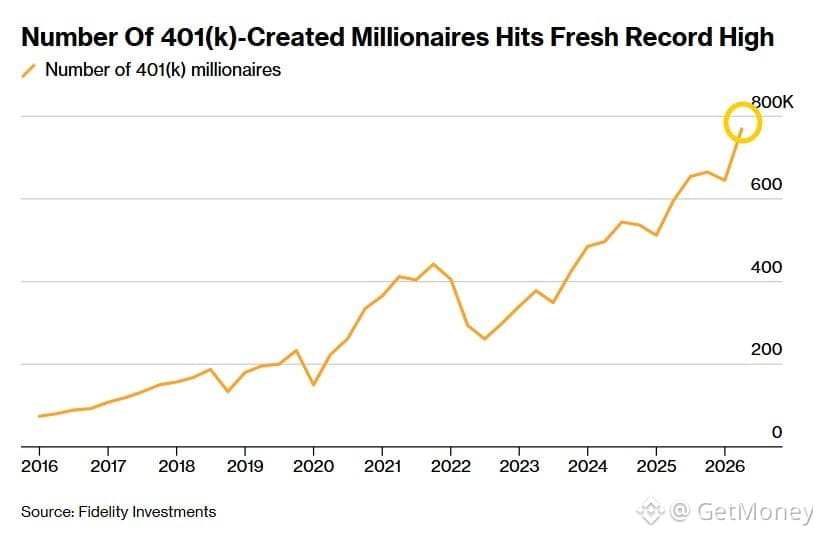
📰 In U.S. 401(k) retirement accounts, 769,000 people have already become millionaires, and this number has just hit a new all-time high.
Honestly, this is pretty striking. A lot of people talk about investing and immediately bring up crypto, stocks, and AI, but it turns out the most “silent” retirement accounts are slowly building a group of truly high-net-worth individuals.
🔥 A 401(k) doesn’t usually get much attention, but its power lies in long-term, steady, automatic contributions. You don’t need to watch the market every day, and you don’t need to chase trends. Over time, compound interest starts doing the work for you.
👀 That 769,000 figure is not just a statistic; it feels more like a reminder: a lot of wealth isn’t created by one or two big moves, but by saving a little bit over decades. It may not sound very exciting, but that’s just how reality works.
🤔 What do you think is the most easily underestimated right now: long-term regular investing, or the short-term opportunities everyone is chasing?
#401k #退休账户 #美国 #financial management
📰 In U.S. 401(k) retirement accounts, 769,000 people have already become millionaires, and this number has just hit a new all-time high.
Honestly, this is pretty striking. A lot of people talk about investing and immediately bring up crypto, stocks, and AI, but it turns out the most “silent” retirement accounts are slowly building a group of truly high-net-worth individuals.
🔥 A 401(k) doesn’t usually get much attention, but its power lies in long-term, steady, automatic contributions. You don’t need to watch the market every day, and you don’t need to chase trends. Over time, compound interest starts doing the work for you.
👀 That 769,000 figure is not just a statistic; it feels more like a reminder: a lot of wealth isn’t created by one or two big moves, but by saving a little bit over decades. It may not sound very exciting, but that’s just how reality works.
🤔 What do you think is the most easily underestimated right now: long-term regular investing, or the short-term opportunities everyone is chasing?
#401k #退休账户 #美国 #financial management
Honestly, this is pretty striking. A lot of people talk about investing and immediately bring up crypto, stocks, and AI, but it turns out the most “silent” retirement accounts are slowly building a group of truly high-net-worth individuals.
🔥 A 401(k) doesn’t usually get much attention, but its power lies in long-term, steady, automatic contributions. You don’t need to watch the market every day, and you don’t need to chase trends. Over time, compound interest starts doing the work for you.
👀 That 769,000 figure is not just a statistic; it feels more like a reminder: a lot of wealth isn’t created by one or two big moves, but by saving a little bit over decades. It may not sound very exciting, but that’s just how reality works.
🤔 What do you think is the most easily underestimated right now: long-term regular investing, or the short-term opportunities everyone is chasing?
#401k #退休账户 #美国 #financial management
82

·
--
Evening Crypto Briefing (November 7):
1️⃣ According to The Block, the Trump administration is advancing rules that could allow crypto assets in 401(k) retirement plans. The rules have been sent to the White House for final review.
2️⃣ Driven by unrealized Bitcoin gains, Strive posted a Q3 profit of about $509 million.
3️⃣ Bitcoin Core developers proposed a “tripwire” mechanism that would render BTC stolen by quantum attackers unusable, sparking debate.
4️⃣ Nasdaq approved the listing of Canary’s staked INJ ETF. INJ is up about 14% this week (CoinDesk).
5️⃣ A data leak at Gnosis Pay affected customer information; funds were reportedly not compromised.
BTC is trading around $76,000, with market sentiment cautious. This is for informational purposes only and does not constitute investment advice.
#加密货币 #比特币 #401k $BTC $INJ
Evening Crypto Briefing (November 7):
1️⃣ According to The Block, the Trump administration is advancing rules that could allow crypto assets in 401(k) retirement plans. The rules have been sent to the White House for final review.
2️⃣ Driven by unrealized Bitcoin gains, Strive posted a Q3 profit of about $509 million.
3️⃣ Bitcoin Core developers proposed a “tripwire” mechanism that would render BTC stolen by quantum attackers unusable, sparking debate.
4️⃣ Nasdaq approved the listing of Canary’s staked INJ ETF. INJ is up about 14% this week (CoinDesk).
5️⃣ A data leak at Gnosis Pay affected customer information; funds were reportedly not compromised.
BTC is trading around $76,000, with market sentiment cautious. This is for informational purposes only and does not constitute investment advice.
#加密货币 #比特币 #401k $BTC $INJ
1️⃣ According to The Block, the Trump administration is advancing rules that could allow crypto assets in 401(k) retirement plans. The rules have been sent to the White House for final review.
2️⃣ Driven by unrealized Bitcoin gains, Strive posted a Q3 profit of about $509 million.
3️⃣ Bitcoin Core developers proposed a “tripwire” mechanism that would render BTC stolen by quantum attackers unusable, sparking debate.
4️⃣ Nasdaq approved the listing of Canary’s staked INJ ETF. INJ is up about 14% this week (CoinDesk).
5️⃣ A data leak at Gnosis Pay affected customer information; funds were reportedly not compromised.
BTC is trading around $76,000, with market sentiment cautious. This is for informational purposes only and does not constitute investment advice.
#加密货币 #比特币 #401k $BTC $INJ

237
Log in to explore more content
Join global crypto users on Binance Square
⚡️ Get latest and useful information about crypto.
💬 Trusted by the world’s largest crypto exchange.
👍 Discover real insights from verified creators.
Email / Phone number
Trending Topics
1
#JobsReportRaisesHikeOdds
281,793 views
2,183 Discussing
2
#CPITestsDecemberRateOutlook
32,596 views
412 Discussing
3
#BitcoinRebounds$75KAsChipsLead
22,944 views
231 Discussing
4
#US Data Center Rules May Constrain AI Expansion
43,293 views
159 Discussing
5
#ARKPlans14ThematicETFsCoveringAIAndTokenizedMarkets
321 views
11 Discussing
6
#WillAnthropicListOnTime
71,459 views
880 Discussing
7
#WillUS-IranTensionsBoostSafe-HavenDemand?
17,621 views
166 Discussing
8
#BitcoinETFsSee$412MNetOutflows
4,773 views
46 Discussing
9
#HKSFCPlansToRestrictCryptoAndExchangeTerms
16,061 views
276 Discussing
10
#TradFiForBeginners
44,271 views
654 Discussing