
ABEERA RYK
4k Publicações

ABEERA RYK
Aberto ao trading
Trader Frequente
9.1 mês(es)
361 A seguir
11.2K+ Seguidores
1.9K+ Gostaram
Publicações
Portfólio
Tudo
Cotações
Em direto
$MARA USDT está mostrando um forte momentum de alta, negociando por volta de 11,889 com um ganho de 4,96%. Os compradores estão firmemente ativos e o movimento está ganhando atenção do mercado. Se o preço continuar sustentando acima dos níveis atuais, outro impulso para cima pode se desenvolver com um volume ainda mais forte por trás. A estrutura continua construtiva enquanto a pressão de compra permanece forte. Os traders devem monitorar de perto o suporte e o momentum, pois a continuidade da força pode acelerar o próximo grande movimento a partir daqui agora.
#SaudiHaltsSouthernEnergySitesAfterAttacks #YenBreaks155NearingYearHigh #USIranTradeTankerStrikesEscalate #CanadaTariffsOnUSTakeEffect #ZcashRises45%WeeklyToHighestSince2016
#SaudiHaltsSouthernEnergySitesAfterAttacks #YenBreaks155NearingYearHigh #USIranTradeTankerStrikesEscalate #CanadaTariffsOnUSTakeEffect #ZcashRises45%WeeklyToHighestSince2016
$ALLO s disparando com forte impulso bullish, a rota está explodindo com um momentum massivo, negociando em torno de US$ 0.00023 e mostrando um ganho incrível de 117,9%. Os compradores claramente estão dominando esse movimento, tornando a ROUTE a melhor performer da lista. Um avanço tão poderoso pode atrair grande atenção e volume. Os traders devem observar se o momentum continua ou se começa uma retração brusca. O movimento atual é altamente volátil, então perseguir o preço sem uma gestão de risco adequada pode ser perigoso., negociando em torno de US$ 0.000751 e ganhando 30,82%. Os compradores entraram com força, empurrando o token significativamente mais alto e chamando atenção. Os traders estão observando se a ALKIMI consegue sustentar esse momentum e construir mais uma perna para cima. Uma continuidade pode trazer aumento de volume, enquanto uma reversão súbita pode disparar realização de lucros. Dado o movimento acentuado, a volatilidade está elevada e os traders devem gerenciar o risco com cuidado antes de tomar qualquer decisão.
#IMFSaysElSalvadorBTCNoPublicFunds #SideSwapSuspendsLiquidServices #EightChineseFinancialFirmsRaise360BYuan #IranToSetRestrictedZoneNearHormuz #USIranTradeTankerStrikesEscalate
#IMFSaysElSalvadorBTCNoPublicFunds #SideSwapSuspendsLiquidServices #EightChineseFinancialFirmsRaise360BYuan #IranToSetRestrictedZoneNearHormuz #USIranTradeTankerStrikesEscalate
$GRVT USDT está sendo negociado em torno de 0.16104, em queda de 1.60%. A pressão de venda continua visível, mas esta área pode se tornar importante para uma possível recuperação. Se os compradores defenderem o nível atual e o volume aumentar, a GRVT pode reverter bruscamente. Os traders estão atentos à confirmação, porque uma mudança repentina de momentum pode transformar a fraqueza atual em uma forte recuperação.
#ZECHitsANewAllTimeHigh #LululemonTumbles20%OnWeakGuidance #BitcoinETFsBiggestDailyInflowSinceJanuary #USAugustAvgHourlyEarningsRise3.1% #USAugustNonfarmPayrollsDueToday
#ZECHitsANewAllTimeHigh #LululemonTumbles20%OnWeakGuidance #BitcoinETFsBiggestDailyInflowSinceJanuary #USAugustAvgHourlyEarningsRise3.1% #USAugustNonfarmPayrollsDueToday
$ARMB USDT está subindo com forte impulso, negociando perto de 250.74 e avançando 3.89%. Os compradores estão mostrando confiança, enquanto o preço mantém sua pressão de alta. Se essa força continuar e os níveis atuais se mantiverem, outro movimento de alta poderá acontecer rapidamente. Os traders estão acompanhando de perto ARMUSDT, pois o aumento do impulso pode atrair novo interesse de compra.
#BitcoinETFsBiggestDailyInflowSinceJanuary #USAugustAvgHourlyEarningsRise3.1% #BitcoinEthereumHitMultiMonthHighs #AdobeSharesFall3%OnCEOTransition #USWeeklyInitialJoblessClaimsRiseTo206000
#BitcoinETFsBiggestDailyInflowSinceJanuary #USAugustAvgHourlyEarningsRise3.1% #BitcoinEthereumHitMultiMonthHighs #AdobeSharesFall3%OnCEOTransition #USWeeklyInitialJoblessClaimsRiseTo206000
$SOL USDT está mostrando forte impulso de alta, negociando perto de US$ 104,63 com um ganho de +4,23%. O volume de US$ 1,31 bi confirma forte participação por trás do movimento. Os compradores estão empurrando a Solana em direção a zonas de resistência mais elevadas, e a força contínua acima de US$ 105 pode acelerar a narrativa de rompimento. O impulso atualmente permanece firmemente inclinado para os compradores.
#PredictionMarketsPutCLARITYAct2026OddsAt15% #EtherXRPETFInflowStreaksEnd #CFTCScrutinizesPredictionMarketAffiliates #USGainsControlOfVenezuelanOilFields #SECNewCryptoRulesAimToBringFirmsBackToUS
#PredictionMarketsPutCLARITYAct2026OddsAt15% #EtherXRPETFInflowStreaksEnd #CFTCScrutinizesPredictionMarketAffiliates #USGainsControlOfVenezuelanOilFields #SECNewCryptoRulesAimToBringFirmsBackToUS
$UNI está sendo negociado a 5.8522, ganhando um impressionante 2.41% com um volume negociado de US$ 40.39M. Enquanto várias das principais criptomoedas enfrentam perdas, a UNI está demonstrando forte momentum de alta. Os compradores parecem confiantes, já que o preço continua em território positivo. O valor em USD perto de US$ 5.84 permanece como um nível importante para traders acompanhando a tendência. Se o impulso e o volume continuarem aumentando, a UNI pode estender seu movimento de alta. Esse desempenho forte está atraindo atenção durante uma sessão de mercado volátil. Atualmente, a UNI se destaca como uma das moedas mais fortes nos dados de mercado exibidos.
#SolanaFallsOver3% #OpenAISaysAstraFindsFlawsAutonomously #KuwaitAirDefensesRespondToIranianDroneAttacks #DellRisesNearly9%GitLabJumps20%AfterHours #OpenAISaysAstraFindsFlawsAutonomously
#SolanaFallsOver3% #OpenAISaysAstraFindsFlawsAutonomously #KuwaitAirDefensesRespondToIranianDroneAttacks #DellRisesNearly9%GitLabJumps20%AfterHours #OpenAISaysAstraFindsFlawsAutonomously
$AXL USDT está enfrentando forte pressão vendedora, negociando em torno de $0.04206 e em queda de 5.07%. Os vendedores atualmente controlam a estrutura de curto prazo. Se os compradores não conseguirem defender esta área, o momentum de baixa poderá acelerar rapidamente. Os traders devem observar o suporte de perto, pois uma ruptura pode desencadear maior volatilidade e outro movimento acentuado de queda na próxima sessão.
#WTIOilRisesAsOpenInterestShrinks #EtherETFsExtendInflowStreakTo11Days #XRPRises40%InTwoWeeksAsOpenInterestFalls #XRPRises40%InTwoWeeksAsOpenInterestFalls #HangSengFalls1%
#WTIOilRisesAsOpenInterestShrinks #EtherETFsExtendInflowStreakTo11Days #XRPRises40%InTwoWeeksAsOpenInterestFalls #XRPRises40%InTwoWeeksAsOpenInterestFalls #HangSengFalls1%
$SOL está sendo negociado a US$ 102,83, com queda de 3,53%, e valor de mercado em torno de US$ 60,21 bi. A SOL está apresentando a maior queda entre esses principais ativos. Os vendedores atualmente dominam a estrutura de curto prazo. Os compradores precisam defender o suporte e gerar um forte repique; caso contrário, a pressão contínua pode levar a SOL a novas mínimas de curto prazo.
#IranStrikesUSBasesInJordan #RussiaStartsLargeScaleDigitalRubleRolloutSep1 #USCanadaTradeWarDeepens #ChinaPropertyStocksJumpOnNewMortgageRules #SaylorHintsStrategyBitcoinBuy
#IranStrikesUSBasesInJordan #RussiaStartsLargeScaleDigitalRubleRolloutSep1 #USCanadaTradeWarDeepens #ChinaPropertyStocksJumpOnNewMortgageRules #SaylorHintsStrategyBitcoinBuy
O $PIEVERSE USDT também está sendo arrastado na queda, sendo negociado em torno de US$ 1.03732 com uma queda de 5,06%. Os ursos estão mantendo um forte controle enquanto o preço permanece sob pressão. A área de US$ 1.03 é a zona-chave para observar. Uma forte reação dos compradores pode provocar uma recuperação, enquanto a continuação das vendas pode abrir caminho para mais desvantagem.
#GoldFalls3.24%ThisWeek #TrumpReachesVenezuelaOilDealOn17Fields #AfghanistanTalibanReportedlyBansCryptoNationwide #XRPETFsBiggestWeeklyHaulOf2026 #BitcoinSpotETFEnds9DayInflowStreak
#GoldFalls3.24%ThisWeek #TrumpReachesVenezuelaOilDealOn17Fields #AfghanistanTalibanReportedlyBansCryptoNationwide #XRPETFsBiggestWeeklyHaulOf2026 #BitcoinSpotETFEnds9DayInflowStreak
🚨$BTC $78,522.4 está negociando por trade, 2,14% em queda. Com volume de $195,34M, a pressão de venda é perceptível. Agora, o mercado está de olho nesse nível: se os compradores defenderem o suporte, uma recuperação é possível; caso contrário, pode haver mais volatilidade de queda no BTC.
#CaliforniaBillWouldBarOfficialMemeCoins #GoldRisesAbout14%InAugust #QatarExtendsLNGForceMajeureByOneMonth #TaiwanTAIEXRetakes46500OnChipRally #KospiFallsAsAITradingEuphoriaCools
#CaliforniaBillWouldBarOfficialMemeCoins #GoldRisesAbout14%InAugust #QatarExtendsLNGForceMajeureByOneMonth #TaiwanTAIEXRetakes46500OnChipRally #KospiFallsAsAITradingEuphoriaCools
$DKNG está sendo negociado perto de US$ 24,60, em queda de 1%. O mercado está mostrando uma leve pressão de venda, com os ursos atualmente controlando o movimento de curto prazo. Os traders vão observar se a DKNG consegue manter esse nível e atrair compradores. Uma recuperação forte pode rapidamente fazer a tendência voltar para cima.
#BankOfKoreaHikesRatesTo3% #XRPLeadsCryptoPullbackDropsNearly7% #DollarPostsBiggestGainInNearlyFourWeeks
#BankOfKoreaHikesRatesTo3% #XRPLeadsCryptoPullbackDropsNearly7% #DollarPostsBiggestGainInNearlyFourWeeks
$TRUMP USDT O Perp está sendo negociado por volta de US$ 2,1619, abaixo de 0,41%, com aproximadamente US$ 304,46M de volume. O par está sob uma leve pressão de venda, mas o alto volume indica forte atividade do mercado. A área de US$ 2,16 continua sendo importante para a próxima direção. Uma recuperação pode atrair compradores, enquanto a fraqueza contínua pode manter os vendedores no controle.
#CryptoFearGreedIndexHits74 #KoreaMemoryChipStocksReverseLate #BrentWTICrudeFallOver3% #BrentWTICrudeFallOver3% #KOSPIRisesNearly1%
#CryptoFearGreedIndexHits74 #KoreaMemoryChipStocksReverseLate #BrentWTICrudeFallOver3% #BrentWTICrudeFallOver3% #KOSPIRisesNearly1%
Transações $TRUMP USDT perto de US$ 2,292, em queda acentuada de 4,14%, com aproximadamente US$ 332,4M de volume. É o pior desempenho entre os cinco ativos mostrados. A queda destaca forte pressão de venda no curto prazo e volatilidade elevada. Os compradores precisam estabilizar o preço rapidamente para evitar mais uma perna de queda. Uma recuperação forte poderia criar uma reversão rápida de momentum, mas a rejeição contínua manteria os vendedores firmemente no controle.
#SamsungSKHynixLeveragedETFsPostFirstMonthlyOutflow #KazakhstanCutsOilOutputForecastTo96MTons #ZECBreaksKeyResistanceUp75.5% #ThailandToExpandSECDigitalAssetProbePowers #HKJulyGoldNetExportsToMainland56.193Tons
#SamsungSKHynixLeveragedETFsPostFirstMonthlyOutflow #KazakhstanCutsOilOutputForecastTo96MTons #ZECBreaksKeyResistanceUp75.5% #ThailandToExpandSECDigitalAssetProbePowers #HKJulyGoldNetExportsToMainland56.193Tons
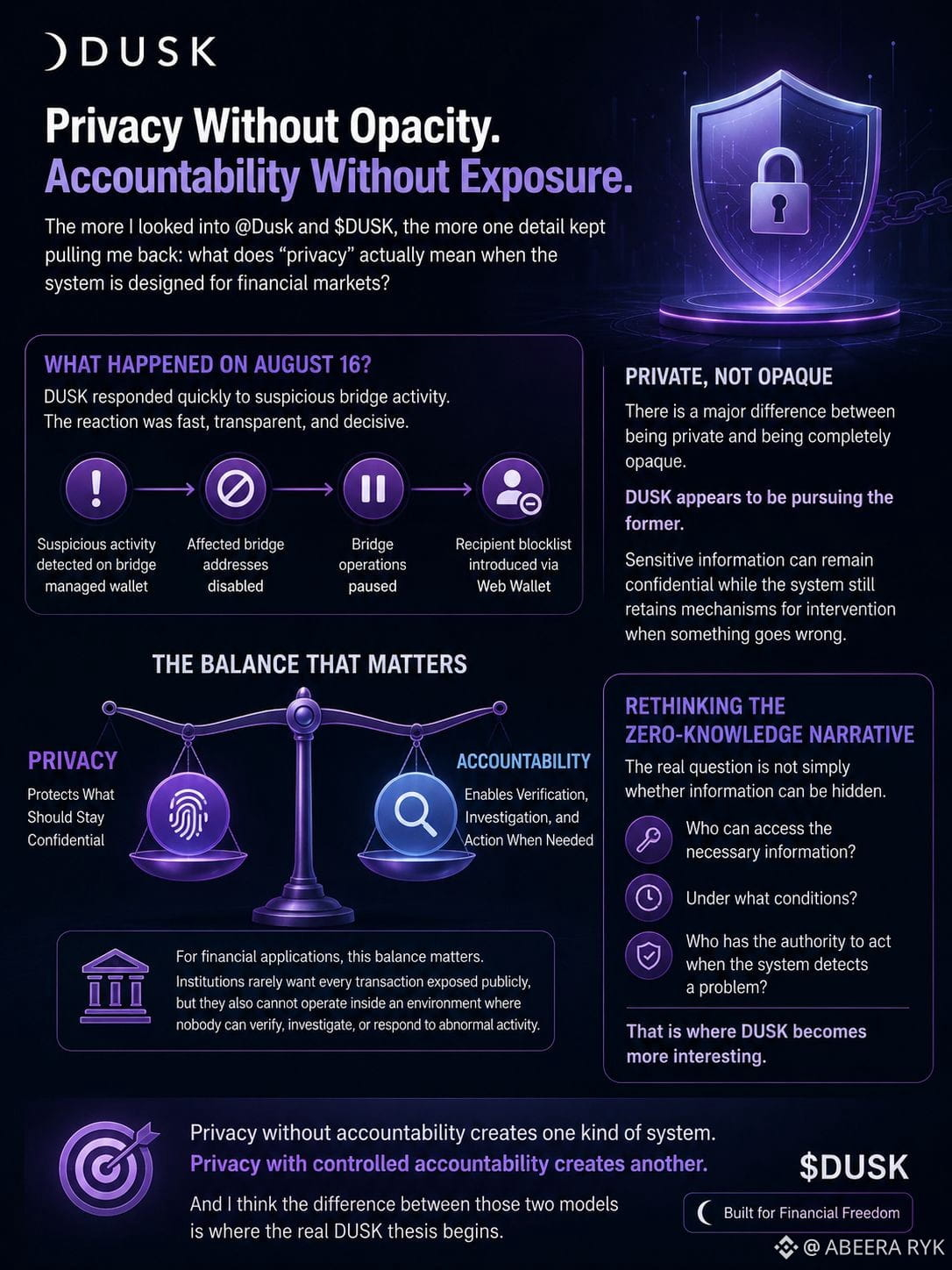
Quanto mais eu investigava @Dusk e $DUSK , mais um detalhe me puxava de volta: o que “privacidade” realmente significa quando o sistema é projetado para mercados financeiros?
No começo, o conceito de Hedger soou como mais uma história familiar de zero conhecimento. Proteger informações sensíveis, provar o que precisa ser provado e evitar expor tudo na cadeia.
Então eu analisei como a rede respondeu a uma atividade suspeita de ponte em 16 de agosto.
A reação foi rápida. Os endereços de ponte afetados foram desativados, as operações da ponte foram pausadas e uma lista de bloqueio de destinatários foi introduzida via Web Wallet para restringir transferências para endereços sinalizados.
Isso mudou como eu enxerguei a arquitetura.
Porque existe uma grande diferença entre ser privado e ser completamente opaco.
A DUSK parece estar perseguindo a primeira opção.
A parte interessante é o equilíbrio: informações sensíveis podem permanecer confidenciais, enquanto o sistema ainda mantém mecanismos para intervenção quando algo dá errado. Para aplicações financeiras, essa distinção importa. Instituições raramente querem que cada transação seja exposta publicamente, mas também não podem operar com conforto em um ambiente em que ninguém consegue verificar, investigar ou responder a atividades anormais.
Isso me fez repensar a narrativa de zero conhecimento em torno da DUSK.
A pergunta real não é apenas se a informação pode ser ocultada.
É quem pode acessar as informações necessárias, em quais condições, e quem tem a autoridade para agir quando o sistema detecta um problema.
É aí que a DUSK se torna ainda mais interessante para mim.
Privacidade sem responsabilização cria um tipo de sistema.
Privacidade com responsabilização controlada cria outro.
E eu acho que a diferença entre esses dois modelos é onde começa a tese real da DUSK.
#dusk
No começo, o conceito de Hedger soou como mais uma história familiar de zero conhecimento. Proteger informações sensíveis, provar o que precisa ser provado e evitar expor tudo na cadeia.
Então eu analisei como a rede respondeu a uma atividade suspeita de ponte em 16 de agosto.
A reação foi rápida. Os endereços de ponte afetados foram desativados, as operações da ponte foram pausadas e uma lista de bloqueio de destinatários foi introduzida via Web Wallet para restringir transferências para endereços sinalizados.
Isso mudou como eu enxerguei a arquitetura.
Porque existe uma grande diferença entre ser privado e ser completamente opaco.
A DUSK parece estar perseguindo a primeira opção.
A parte interessante é o equilíbrio: informações sensíveis podem permanecer confidenciais, enquanto o sistema ainda mantém mecanismos para intervenção quando algo dá errado. Para aplicações financeiras, essa distinção importa. Instituições raramente querem que cada transação seja exposta publicamente, mas também não podem operar com conforto em um ambiente em que ninguém consegue verificar, investigar ou responder a atividades anormais.
Isso me fez repensar a narrativa de zero conhecimento em torno da DUSK.
A pergunta real não é apenas se a informação pode ser ocultada.
É quem pode acessar as informações necessárias, em quais condições, e quem tem a autoridade para agir quando o sistema detecta um problema.
É aí que a DUSK se torna ainda mais interessante para mim.
Privacidade sem responsabilização cria um tipo de sistema.
Privacidade com responsabilização controlada cria outro.
E eu acho que a diferença entre esses dois modelos é onde começa a tese real da DUSK.
#dusk
Verificado
#dusk $DUSK @Dusk Quanto mais tempo eu passo investigando o $DUSK , menos eu penso que a sua história de privacidade seja simplesmente sobre ocultar informação.
Eu entrei na pesquisa do CreatorPad esperando mais uma narrativa familiar de conhecimento zero: mais confidencialidade, menos exposição e tecnologia desenhada para manter a atividade financeira sensível em segredo.
Então comecei a observar com mais atenção como o sistema se comporta quando algo realmente dá errado.
Isso me fez parar.
Ações recentes de segurança de pontes (bridges) em torno de atividades suspeitas me mostraram um lado do design que é fácil de ignorar ao ler apenas as descrições técnicas. Endereços de ponte afetados foram restringidos, as operações da ponte foram pausadas e controles do destinatário foram usados para impedir transferências em direção a endereços sinalizados.
Para mim, a questão interessante não é se isso torna o DUSK privado ou não. É o que isso nos diz sobre o tipo de privacidade que está sendo construído.
Isso parece muito mais uma confidencialidade seletiva do que uma anonimidade absoluta. A informação pode permanecer protegida durante a atividade normal, enquanto o sistema ainda preserva mecanismos para intervenção quando segurança ou conformidade exigem.
Essa distinção importa enormemente para a infraestrutura financeira.
Se eu abordar o DUSK esperando anonimato no estilo Monero, o modelo parece fundamentalmente diferente. Mas se eu o encarar como infraestrutura para mercados financeiros regulados, o design começa a fazer bem mais sentido.
A pergunta mais profunda que estou fazendo agora é: quem pode acessar essa visibilidade, em quais condições e quanta autoridade existe por trás da camada de privacidade.
É aí que a verdadeira tese do DUSK se torna interessante para mim.
Privacidade nem sempre é sobre tornar tudo invisível.
Às vezes, é sobre decidir exatamente quem pode ver o quê — e quando.
Eu entrei na pesquisa do CreatorPad esperando mais uma narrativa familiar de conhecimento zero: mais confidencialidade, menos exposição e tecnologia desenhada para manter a atividade financeira sensível em segredo.
Então comecei a observar com mais atenção como o sistema se comporta quando algo realmente dá errado.
Isso me fez parar.
Ações recentes de segurança de pontes (bridges) em torno de atividades suspeitas me mostraram um lado do design que é fácil de ignorar ao ler apenas as descrições técnicas. Endereços de ponte afetados foram restringidos, as operações da ponte foram pausadas e controles do destinatário foram usados para impedir transferências em direção a endereços sinalizados.
Para mim, a questão interessante não é se isso torna o DUSK privado ou não. É o que isso nos diz sobre o tipo de privacidade que está sendo construído.
Isso parece muito mais uma confidencialidade seletiva do que uma anonimidade absoluta. A informação pode permanecer protegida durante a atividade normal, enquanto o sistema ainda preserva mecanismos para intervenção quando segurança ou conformidade exigem.
Essa distinção importa enormemente para a infraestrutura financeira.
Se eu abordar o DUSK esperando anonimato no estilo Monero, o modelo parece fundamentalmente diferente. Mas se eu o encarar como infraestrutura para mercados financeiros regulados, o design começa a fazer bem mais sentido.
A pergunta mais profunda que estou fazendo agora é: quem pode acessar essa visibilidade, em quais condições e quanta autoridade existe por trás da camada de privacidade.
É aí que a verdadeira tese do DUSK se torna interessante para mim.
Privacidade nem sempre é sobre tornar tudo invisível.
Às vezes, é sobre decidir exatamente quem pode ver o quê — e quando.

$RED completa a lista de momentum das cinco moedas mostrada no screenshot fornecido, e embora tenha o menor ganho percentual entre essas cinco, o movimento ainda é significativo.
O preço exibido é aproximadamente US$ 0.1071, enquanto a RED está mostrando um ganho de +21.57%.
Um ganho acima de 20% é suficiente para atrair atenção séria do mercado, especialmente quando acontece junto com movimentos fortes de vários outros tokens. A RED pode estar em quinto lugar nesta lista específica, mas isso não torna sua alta insignificante.
O screenshot cria um ranking interessante: BOME está em alta de 59.20%, NEIRO 32.72%, RE 24.36%, PNUT 23.43% e RED 21.57%. Todos os ativos mostrados estão em território positivo, sugerindo um momentum forte nesta seleção.
Para a RED, o problema mais importante agora é saber se os compradores conseguem manter a pressão.
Aumentos rápidos de preço costumam gerar duas reações opostas. Traders de momentum podem perseguir o movimento porque não querem perder a continuação do upside, enquanto detentores mais antigos podem começar a realizar lucros. Se a pressão de venda ficar mais forte do que a demanda nova, o rali pode perder o momentum rapidamente.
O preço exibido da RED de US$ 0.1071 fornece o ponto de referência atual do screenshot, enquanto o número de +21.57% mostra o quão agressivamente o token se moveu.
O que torna essa configuração interessante é a psicologia mais ampla do mercado. Quando vários tokens começam a registrar ganhos de dois dígitos ao mesmo tempo, a atenção pode girar rapidamente entre eles. Traders podem migrar para o ativo que parecer ter o momentum mais forte.
Portanto, a RED faz parte de uma história de momentum bem maior, em vez de um movimento isolado.
A próxima fase importa mais do que o primeiro salto.
A RED consegue manter os ganhos, atrair demanda contínua e estabelecer uma faixa de negociação mais forte?
Por enquanto, a mensagem do screenshot é direta: a RED está em movimento, o momentum é visível e os traders têm um motivo para observar o que acontece a seguir.
#CFTCSeeksInputOnComputeDerivatives #EliLillyRises5.3%ToRecordHigh #CryptoRally #FOMCWatch #FedMinutesShowNoSupportForRateCuts
O preço exibido é aproximadamente US$ 0.1071, enquanto a RED está mostrando um ganho de +21.57%.
Um ganho acima de 20% é suficiente para atrair atenção séria do mercado, especialmente quando acontece junto com movimentos fortes de vários outros tokens. A RED pode estar em quinto lugar nesta lista específica, mas isso não torna sua alta insignificante.
O screenshot cria um ranking interessante: BOME está em alta de 59.20%, NEIRO 32.72%, RE 24.36%, PNUT 23.43% e RED 21.57%. Todos os ativos mostrados estão em território positivo, sugerindo um momentum forte nesta seleção.
Para a RED, o problema mais importante agora é saber se os compradores conseguem manter a pressão.
Aumentos rápidos de preço costumam gerar duas reações opostas. Traders de momentum podem perseguir o movimento porque não querem perder a continuação do upside, enquanto detentores mais antigos podem começar a realizar lucros. Se a pressão de venda ficar mais forte do que a demanda nova, o rali pode perder o momentum rapidamente.
O preço exibido da RED de US$ 0.1071 fornece o ponto de referência atual do screenshot, enquanto o número de +21.57% mostra o quão agressivamente o token se moveu.
O que torna essa configuração interessante é a psicologia mais ampla do mercado. Quando vários tokens começam a registrar ganhos de dois dígitos ao mesmo tempo, a atenção pode girar rapidamente entre eles. Traders podem migrar para o ativo que parecer ter o momentum mais forte.
Portanto, a RED faz parte de uma história de momentum bem maior, em vez de um movimento isolado.
A próxima fase importa mais do que o primeiro salto.
A RED consegue manter os ganhos, atrair demanda contínua e estabelecer uma faixa de negociação mais forte?
Por enquanto, a mensagem do screenshot é direta: a RED está em movimento, o momentum é visível e os traders têm um motivo para observar o que acontece a seguir.
#CFTCSeeksInputOnComputeDerivatives #EliLillyRises5.3%ToRecordHigh #CryptoRally #FOMCWatch #FedMinutesShowNoSupportForRateCuts
$PNUT está mostrando outro forte surto de impulso, e os números exibidos no print tornam o movimento impossível de ignorar.
O token aparece em aproximadamente US$ 0.0511, com um ganho reportado de +23,43%. Isso coloca a PNUT em quarto lugar entre as cinco moedas mostradas, logo atrás da RE e à frente da RED.
Um movimento acima de 23% pode rapidamente transformar a atenção do mercado. Traders de momentum tendem a observar ativos que começam a superar de repente, porque uma forte movimentação de preço pode criar mais liquidez e especulação.
Mas o movimento da PNUT também destaca uma parte importante dos mercados cripto: ganhos percentuais podem mudar o sentimento extremamente rápido.
Quando um ativo sobe mais de 20%, traders que antes estavam neutros podem, de repente, se interessar. Ao mesmo tempo, detentores que entraram antes podem começar a considerar se a alta é uma oportunidade para realizar lucros. Isso cria uma batalha potencialmente intensa entre compradores recém-chegados e vendedores existentes.
O print mostra a PNUT negociando perto de US$ 0.0511. A variação percentual exibida é +23,43%, o que a coloca entre um grupo de cinco ativos com forte impulso de alta.
BOME lidera o grupo com +59,20%, seguida por NEIRO com +32,72%, RE com +24,36%, PNUT com +23,43% e RED com +21,57%.
Essa comparação é importante porque mostra que a PNUT não é o movimento mais forte nesse recorte específico, mas ainda está confortavelmente dentro do grupo de alto desempenho.
A história de verdade começa depois da alta inicial. A PNUT consegue manter o nível mais alto, ou a pressão de realização de lucros vai reduzir o momentum?
Ganhos percentuais fortes podem atrair atenção, mas a força sustentável exige demanda contínua.
Por enquanto, o print envia uma mensagem clara para a PNUT: compradores estão ativos, o momentum é forte e o mercado está observando.
O próximo movimento pode definir se isso vira apenas um pico temporário ou algo muito mais interessante.
#CFTCSeeksInputOnComputeDerivatives #EliLillyRises5.3%ToRecordHigh #CryptoRally #FOMCWatch #AdnocPlansToTrimAsiaCrudeShipments
O token aparece em aproximadamente US$ 0.0511, com um ganho reportado de +23,43%. Isso coloca a PNUT em quarto lugar entre as cinco moedas mostradas, logo atrás da RE e à frente da RED.
Um movimento acima de 23% pode rapidamente transformar a atenção do mercado. Traders de momentum tendem a observar ativos que começam a superar de repente, porque uma forte movimentação de preço pode criar mais liquidez e especulação.
Mas o movimento da PNUT também destaca uma parte importante dos mercados cripto: ganhos percentuais podem mudar o sentimento extremamente rápido.
Quando um ativo sobe mais de 20%, traders que antes estavam neutros podem, de repente, se interessar. Ao mesmo tempo, detentores que entraram antes podem começar a considerar se a alta é uma oportunidade para realizar lucros. Isso cria uma batalha potencialmente intensa entre compradores recém-chegados e vendedores existentes.
O print mostra a PNUT negociando perto de US$ 0.0511. A variação percentual exibida é +23,43%, o que a coloca entre um grupo de cinco ativos com forte impulso de alta.
BOME lidera o grupo com +59,20%, seguida por NEIRO com +32,72%, RE com +24,36%, PNUT com +23,43% e RED com +21,57%.
Essa comparação é importante porque mostra que a PNUT não é o movimento mais forte nesse recorte específico, mas ainda está confortavelmente dentro do grupo de alto desempenho.
A história de verdade começa depois da alta inicial. A PNUT consegue manter o nível mais alto, ou a pressão de realização de lucros vai reduzir o momentum?
Ganhos percentuais fortes podem atrair atenção, mas a força sustentável exige demanda contínua.
Por enquanto, o print envia uma mensagem clara para a PNUT: compradores estão ativos, o momentum é forte e o mercado está observando.
O próximo movimento pode definir se isso vira apenas um pico temporário ou algo muito mais interessante.
#CFTCSeeksInputOnComputeDerivatives #EliLillyRises5.3%ToRecordHigh #CryptoRally #FOMCWatch #AdnocPlansToTrimAsiaCrudeShipments
$RE é outro nome que exige atenção no print do mercado, com um movimento poderoso que o coloca firmemente entre os melhores desempenhos do dia exibidos.
O preço exibido é aproximadamente US$ 0.5310, acompanhado por um ganho de +24.36%. Isso coloca a RE em terceiro entre os cinco ativos visíveis no print, atrás de BOME e NEIRO.
Um ganho acima de 24% é significativo porque mostra que os compradores estiveram dispostos a empurrar o token consideravelmente mais alto dentro do período exibido. Esses movimentos frequentemente atraem uma nova onda de traders que não estavam prestando atenção antes da ruptura.
Mas o momento sempre levanta uma segunda pergunta: o movimento consegue continuar?
Quando um token sobe rapidamente, o mercado vira uma batalha entre duas forças. Novos compradores querem entrar na tendência, enquanto compradores mais antigos podem ver o rali como uma oportunidade de garantir lucros. O equilíbrio entre esses dois grupos pode determinar se o movimento evolui para uma força sustentada ou se reverte rapidamente.
O preço exibido da RE de US$ 0.5310 também torna a variação percentual mais fácil de apreciar. Um aumento de 24.36% nesse nível representa uma mudança substancial no valor de mercado ao longo do período exibido.
O que torna o print especialmente interessante é que a RE está cercada por vários outros fortes desempenhos. BOME está em +59.20%, NEIRO +32.72%, PNUT +23.43% e RED +21.57%. Isso cria um quadro claro de forte momentum em múltiplos tokens.
Portanto, a RE não está apenas subindo isoladamente. Ela está participando de um ambiente mais amplo de alta volatilidade.
O ponto-chave agora é a confirmação. Os traders vão querer ver se os compradores continuam ativos após o impulso inicial e se o token consegue sustentar seus ganhos.
Uma coisa é certa a partir do print: a RE não está mais se movendo em silêncio.
Um movimento de +24.36% já é o suficiente para colocá-la firmemente no radar.
#CryptoRally #FOMCWatch #EliLillyRises5.3%ToRecordHigh #CFTCSeeksInputOnComputeDerivatives #AdnocPlansToTrimAsiaCrudeShipments
O preço exibido é aproximadamente US$ 0.5310, acompanhado por um ganho de +24.36%. Isso coloca a RE em terceiro entre os cinco ativos visíveis no print, atrás de BOME e NEIRO.
Um ganho acima de 24% é significativo porque mostra que os compradores estiveram dispostos a empurrar o token consideravelmente mais alto dentro do período exibido. Esses movimentos frequentemente atraem uma nova onda de traders que não estavam prestando atenção antes da ruptura.
Mas o momento sempre levanta uma segunda pergunta: o movimento consegue continuar?
Quando um token sobe rapidamente, o mercado vira uma batalha entre duas forças. Novos compradores querem entrar na tendência, enquanto compradores mais antigos podem ver o rali como uma oportunidade de garantir lucros. O equilíbrio entre esses dois grupos pode determinar se o movimento evolui para uma força sustentada ou se reverte rapidamente.
O preço exibido da RE de US$ 0.5310 também torna a variação percentual mais fácil de apreciar. Um aumento de 24.36% nesse nível representa uma mudança substancial no valor de mercado ao longo do período exibido.
O que torna o print especialmente interessante é que a RE está cercada por vários outros fortes desempenhos. BOME está em +59.20%, NEIRO +32.72%, PNUT +23.43% e RED +21.57%. Isso cria um quadro claro de forte momentum em múltiplos tokens.
Portanto, a RE não está apenas subindo isoladamente. Ela está participando de um ambiente mais amplo de alta volatilidade.
O ponto-chave agora é a confirmação. Os traders vão querer ver se os compradores continuam ativos após o impulso inicial e se o token consegue sustentar seus ganhos.
Uma coisa é certa a partir do print: a RE não está mais se movendo em silêncio.
Um movimento de +24.36% já é o suficiente para colocá-la firmemente no radar.
#CryptoRally #FOMCWatch #EliLillyRises5.3%ToRecordHigh #CFTCSeeksInputOnComputeDerivatives #AdnocPlansToTrimAsiaCrudeShipments
$NEIRO está fazendo um movimento sério, e os números no print fornecido imediatamente se destacam.
O preço exibido é aproximadamente US$ 0.00008388, enquanto o token mostra um ganho de +32,72%. Isso coloca a NEIRO em segundo lugar entre as cinco moedas visíveis no print, atrás da BOME e à frente de RE, PNUT e RED.
Um movimento acima de 30% pode mudar dramaticamente a forma como os traders enxergam um ativo. De repente, um token que estava quieto na lista de observação pode se tornar uma das oportunidades mais comentadas do mercado. Mas com essa atenção vem um ambiente de negociação completamente diferente.
O impulso atrai compradores, enquanto ganhos rápidos também incentivam detentores existentes a realizarem lucros. Isso cria uma batalha entre uma demanda nova e a pressão de venda. A próxima fase se torna especialmente importante, porque manter o impulso após um grande rompimento geralmente é mais difícil do que iniciá-lo.
O desempenho exibido da NEIRO é particularmente interessante porque ela não está se movendo sozinha. Vários outros tokens no print também estão registrando ganhos fortes. Isso sugere que o segmento de mercado representado aqui está vivenciando um interesse especulativo amplo, e não que a NEIRO seja o único ativo atraindo atenção.
Ainda assim, +32,72% é um movimento importante e merece atenção. A questão crucial é o que acontece depois da empolgação inicial. A atividade de negociação continua forte, ou o movimento começa a perder impulso?
O próprio preço, em torno de US$ 0.00008388, pode parecer extremamente pequeno numericamente, mas a variação percentual demonstra por que apenas o preço unitário diz muito pouco aos traders sobre o desempenho.
A NEIRO está atualmente mostrando forte momentum de acordo com o print. O próximo capítulo vai depender de os compradores continuarem defendendo o movimento.
Uma alta fica muito mais interessante quando consegue provar que a demanda não é apenas emocional, mas persistente.
Por enquanto, a NEIRO definitivamente entrou no foco.
#CFTCSeeksInputOnComputeDerivatives #EliLillyRises5.3%ToRecordHigh #CryptoRally #FOMCWatch #AdnocPlansToTrimAsiaCrudeShipments
O preço exibido é aproximadamente US$ 0.00008388, enquanto o token mostra um ganho de +32,72%. Isso coloca a NEIRO em segundo lugar entre as cinco moedas visíveis no print, atrás da BOME e à frente de RE, PNUT e RED.
Um movimento acima de 30% pode mudar dramaticamente a forma como os traders enxergam um ativo. De repente, um token que estava quieto na lista de observação pode se tornar uma das oportunidades mais comentadas do mercado. Mas com essa atenção vem um ambiente de negociação completamente diferente.
O impulso atrai compradores, enquanto ganhos rápidos também incentivam detentores existentes a realizarem lucros. Isso cria uma batalha entre uma demanda nova e a pressão de venda. A próxima fase se torna especialmente importante, porque manter o impulso após um grande rompimento geralmente é mais difícil do que iniciá-lo.
O desempenho exibido da NEIRO é particularmente interessante porque ela não está se movendo sozinha. Vários outros tokens no print também estão registrando ganhos fortes. Isso sugere que o segmento de mercado representado aqui está vivenciando um interesse especulativo amplo, e não que a NEIRO seja o único ativo atraindo atenção.
Ainda assim, +32,72% é um movimento importante e merece atenção. A questão crucial é o que acontece depois da empolgação inicial. A atividade de negociação continua forte, ou o movimento começa a perder impulso?
O próprio preço, em torno de US$ 0.00008388, pode parecer extremamente pequeno numericamente, mas a variação percentual demonstra por que apenas o preço unitário diz muito pouco aos traders sobre o desempenho.
A NEIRO está atualmente mostrando forte momentum de acordo com o print. O próximo capítulo vai depender de os compradores continuarem defendendo o movimento.
Uma alta fica muito mais interessante quando consegue provar que a demanda não é apenas emocional, mas persistente.
Por enquanto, a NEIRO definitivamente entrou no foco.
#CFTCSeeksInputOnComputeDerivatives #EliLillyRises5.3%ToRecordHigh #CryptoRally #FOMCWatch #AdnocPlansToTrimAsiaCrudeShipments
$BOME está de repente mostrando por que moedas meme podem se tornar extremamente voláteis quando a atenção do mercado muda para elas.
De acordo com o print de mercado fornecido, BOME está sendo negociada por volta de US$ 0.0012136, registrando um impressionante ganho de +59,20%. Entre as moedas visíveis no print, BOME tem a maior variação percentual, ficando claramente no topo desta lista específica.
Uma alta de quase 60% em um curto período imediatamente altera a psicologia do mercado em torno de um token. Traders que antes ignoravam BOME podem começar a observar volume, liquidez e momentum com muito mais atenção. Ao mesmo tempo, detentores existentes podem ficar mais ativos, porque uma alta forte frequentemente cria tanto confiança quanto pressão para realização de lucros.
A parte interessante não é apenas o percentual em si. A questão maior é se esse movimento representa uma especulação temporária ou uma demanda sustentada. Moedas meme podem se mover extremamente rápido porque suas valorizações são fortemente influenciadas por atenção, atividade da comunidade e momentum de negociação.
O print mostra BOME superando NEIRO, RE, PNUT e RED durante o período exibido. Isso faz com que BOME seja o destaque entre esses cinco ativos.
No entanto, uma forte candle verde não significa automaticamente que o próximo movimento será mais alto. Ralis rápidos também podem gerar uma volatilidade agressiva em ambos os sentidos. Traders acompanhando BOME devem, portanto, prestar atenção a se a atividade de compra continua após a alta inicial.
Para mim, o sinal mais interessante é a magnitude do movimento. +59,20% não é uma flutuação diária comum. É o tipo de movimento que pode rapidamente recolocar um token no foco.
BOME claramente está se movendo rápido agora. O verdadeiro teste é se o momentum consegue sobreviver depois que a empolgação esfria.
#CFTCSeeksInputOnComputeDerivatives #CryptoRally #EliLillyRises5.3%ToRecordHigh #FOMCWatch #FedMinutesShowNoSupportForRateCuts
De acordo com o print de mercado fornecido, BOME está sendo negociada por volta de US$ 0.0012136, registrando um impressionante ganho de +59,20%. Entre as moedas visíveis no print, BOME tem a maior variação percentual, ficando claramente no topo desta lista específica.
Uma alta de quase 60% em um curto período imediatamente altera a psicologia do mercado em torno de um token. Traders que antes ignoravam BOME podem começar a observar volume, liquidez e momentum com muito mais atenção. Ao mesmo tempo, detentores existentes podem ficar mais ativos, porque uma alta forte frequentemente cria tanto confiança quanto pressão para realização de lucros.
A parte interessante não é apenas o percentual em si. A questão maior é se esse movimento representa uma especulação temporária ou uma demanda sustentada. Moedas meme podem se mover extremamente rápido porque suas valorizações são fortemente influenciadas por atenção, atividade da comunidade e momentum de negociação.
O print mostra BOME superando NEIRO, RE, PNUT e RED durante o período exibido. Isso faz com que BOME seja o destaque entre esses cinco ativos.
No entanto, uma forte candle verde não significa automaticamente que o próximo movimento será mais alto. Ralis rápidos também podem gerar uma volatilidade agressiva em ambos os sentidos. Traders acompanhando BOME devem, portanto, prestar atenção a se a atividade de compra continua após a alta inicial.
Para mim, o sinal mais interessante é a magnitude do movimento. +59,20% não é uma flutuação diária comum. É o tipo de movimento que pode rapidamente recolocar um token no foco.
BOME claramente está se movendo rápido agora. O verdadeiro teste é se o momentum consegue sobreviver depois que a empolgação esfria.
#CFTCSeeksInputOnComputeDerivatives #CryptoRally #EliLillyRises5.3%ToRecordHigh #FOMCWatch #FedMinutesShowNoSupportForRateCuts
Inicia sessão para explorar mais conteúdos