

Zaira malik
26 ပို့စ်များ

Zaira malik
တိုင်ကြားမည်
သုံးစွဲသူကို ဘလော့မည်
I am a full-time crypto trader. I share daily market updates and technical analysis.
I really like looking for the big trends and crypto trading setups.
1 ဖော်လိုလုပ်ထားသည်
17 ဖော်လိုလုပ်သူများ
51 လိုက်ခ်လုပ်ထားသည်
ပို့စ်များ
ပုံသေထားသည်
·
--
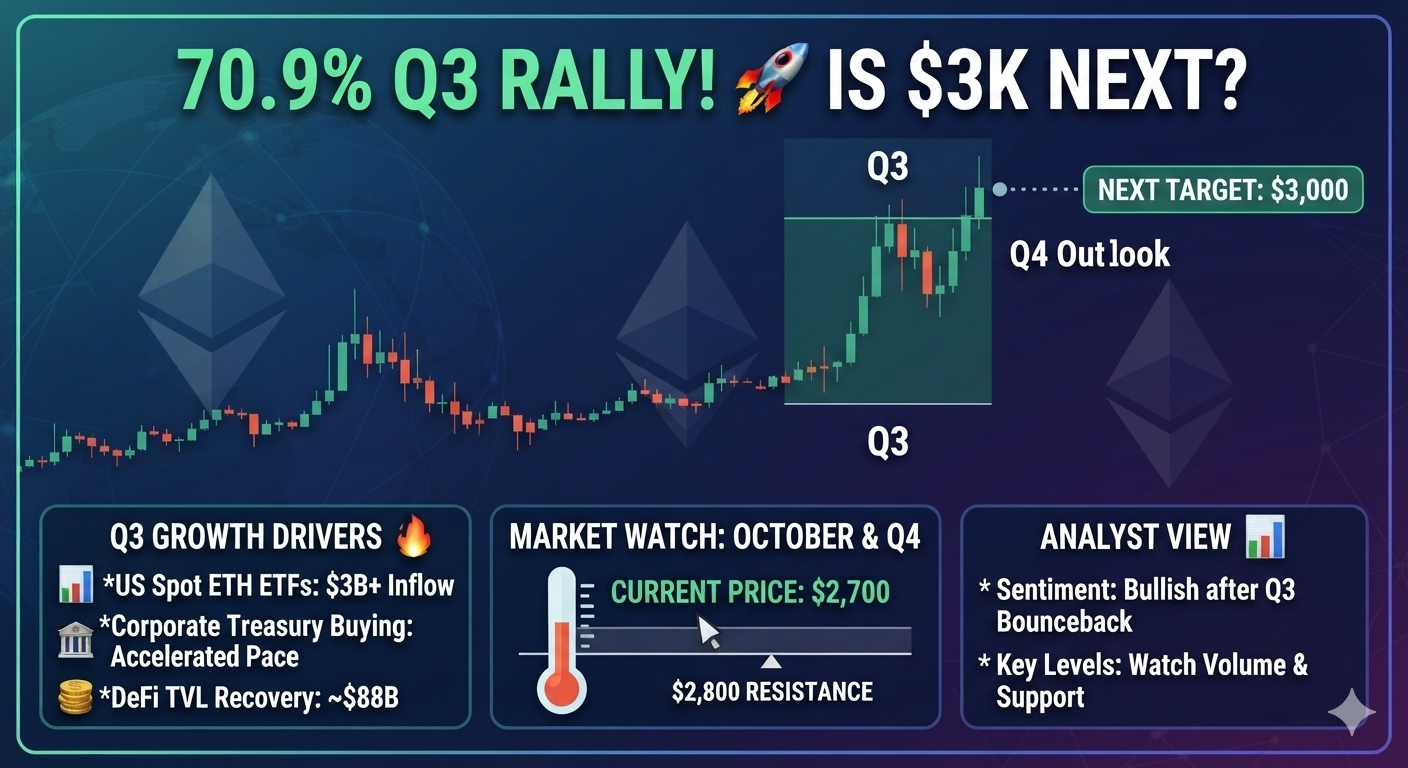
#ethergains70.9%inq3 ETH +70.9% in Q3 🚀 Is $3K Next?
I see that Ethereum has just posted a *70.9% quarterly rally bouncing back strongly after a weak first half of 2026.
🔥 What fueled the move?
• US Spot ETH ETFs drew about $3B+ in Q3
• Corporate treasuries sped up ETH buying
• DeFi activity recovered with TVL climbing to about $88B
ETH entered October near $2,700 and traders are now watching the $2,800 resistance closely. I think a steady breakout might bring the $3,000 level into view.
📊 Key levels: Resistance: $2,800 → $3,000 | Watch support and volume.
Do you think ETH can reclaim $3,000, in Q4? Share your view!
#cryptotrading #altcoins #Khan62 #Web3 $ETH $AAVE $LINK
{future}(LINKUSDT)
{future}(AAVEUSDT)
{future}(ETHUSDT)
#ethergains70.9%inq3 ETH +70.9% in Q3 🚀 Is $3K Next?
I see that Ethereum has just posted a *70.9% quarterly rally bouncing back strongly after a weak first half of 2026.
🔥 What fueled the move?
• US Spot ETH ETFs drew about $3B+ in Q3
• Corporate treasuries sped up ETH buying
• DeFi activity recovered with TVL climbing to about $88B
ETH entered October near $2,700 and traders are now watching the $2,800 resistance closely. I think a steady breakout might bring the $3,000 level into view.
📊 Key levels: Resistance: $2,800 → $3,000 | Watch support and volume.
Do you think ETH can reclaim $3,000, in Q4? Share your view!
#cryptotrading #altcoins #Khan62 #Web3 $ETH $AAVE $LINK
I see that Ethereum has just posted a *70.9% quarterly rally bouncing back strongly after a weak first half of 2026.
🔥 What fueled the move?
• US Spot ETH ETFs drew about $3B+ in Q3
• Corporate treasuries sped up ETH buying
• DeFi activity recovered with TVL climbing to about $88B
ETH entered October near $2,700 and traders are now watching the $2,800 resistance closely. I think a steady breakout might bring the $3,000 level into view.
📊 Key levels: Resistance: $2,800 → $3,000 | Watch support and volume.
Do you think ETH can reclaim $3,000, in Q4? Share your view!
#cryptotrading #altcoins #Khan62 #Web3 $ETH $AAVE $LINK
3
1
4
15.1k
ပုံသေထားသည်
·
--
စိစစ်အတည်ပြုထားသည်
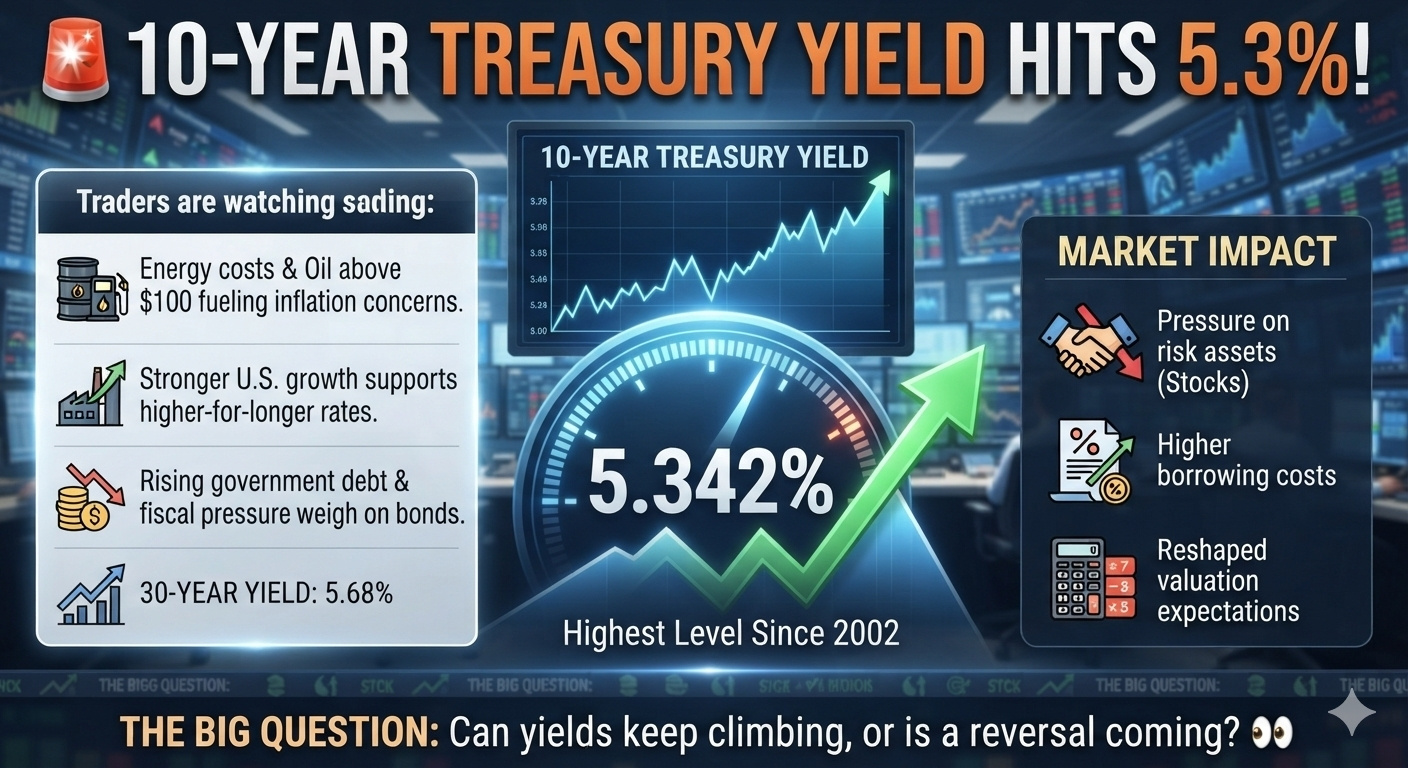
#us10yearyieldnears5.3% 🚨 10-YEAR TREASURY YIELD HITS 5.3%!
The U.S. 10-Year Treasury yield has jumped above 5.3% hitting 5.342%—the level since 2002.
Why are traders paying attention?
🔹 Energy costs and oil prices, above $100 are keeping inflation worries fresh.
🔹 Stronger U.S. Economic growth is supporting the idea of interest rates for longer.
🔹 Rising government debt and fiscal strain are putting pressure on bonds.
🔹 The 30-Year Treasury yield has also moved up now near around 5.59%.
Higher yields can push down risk assets increase borrowing costs and shift how investors value stocks and other investments.
The key question: Will Treasury yields keep rising or will a major shift happen before the year ends? It's still not clear. 👀 #crypto #trading #Khan62 #Macro $SOL · $BNB · $XRP
{future}(XRPUSDT)
{future}(BNBUSDT)
{future}(SOLUSDT)
#us10yearyieldnears5.3% 🚨 10-YEAR TREASURY YIELD HITS 5.3%!
The U.S. 10-Year Treasury yield has jumped above 5.3% hitting 5.342%—the level since 2002.
Why are traders paying attention?
🔹 Energy costs and oil prices, above $100 are keeping inflation worries fresh.
🔹 Stronger U.S. Economic growth is supporting the idea of interest rates for longer.
🔹 Rising government debt and fiscal strain are putting pressure on bonds.
🔹 The 30-Year Treasury yield has also moved up now near around 5.59%.
Higher yields can push down risk assets increase borrowing costs and shift how investors value stocks and other investments.
The key question: Will Treasury yields keep rising or will a major shift happen before the year ends? It's still not clear. 👀 #crypto #trading #Khan62 #Macro $SOL · $BNB · $XRP
The U.S. 10-Year Treasury yield has jumped above 5.3% hitting 5.342%—the level since 2002.
Why are traders paying attention?
🔹 Energy costs and oil prices, above $100 are keeping inflation worries fresh.
🔹 Stronger U.S. Economic growth is supporting the idea of interest rates for longer.
🔹 Rising government debt and fiscal strain are putting pressure on bonds.
🔹 The 30-Year Treasury yield has also moved up now near around 5.59%.
Higher yields can push down risk assets increase borrowing costs and shift how investors value stocks and other investments.
The key question: Will Treasury yields keep rising or will a major shift happen before the year ends? It's still not clear. 👀 #crypto #trading #Khan62 #Macro $SOL · $BNB · $XRP
2
5
14.8k
·
--
စိစစ်အတည်ပြုထားသည်
#anthropictargetsipoassoonasmidnovember 🚨 Anthropics IPO Might Change the Way People Talk About AI!
Anthropic is said to be planning an IPO in November 2026. The talks suggest that the company could be valued at than trillion dollar. It might also raise much as 100 billion dollar. According to Reuters the company made 4.6 billion dollar in revenue in 2025. However the company had a loss because of the costs related to accounting and operations.
🔥 Why people who trade stocks are paying attention:
• Valuations for AI companies could be tested
• Nvidia is reportedly thinking about investing up to $10 billion
• Broadcom has agreed to give money for chips
• The IPO might affect the flow of money, into AI stocks
Will Anthropics entrance change the way people talk about AI? Let us know what you think!
#Khan62 #AI #NVIDIA #IP
{future}(MSFTUSDT)
{future}(AVGOUSDT)
{future}(NVDAUSDT)
$NVDA $AVGO $MSFT
#anthropictargetsipoassoonasmidnovember 🚨 Anthropics IPO Might Change the Way People Talk About AI!
Anthropic is said to be planning an IPO in November 2026. The talks suggest that the company could be valued at than trillion dollar. It might also raise much as 100 billion dollar. According to Reuters the company made 4.6 billion dollar in revenue in 2025. However the company had a loss because of the costs related to accounting and operations.
🔥 Why people who trade stocks are paying attention:
• Valuations for AI companies could be tested
• Nvidia is reportedly thinking about investing up to $10 billion
• Broadcom has agreed to give money for chips
• The IPO might affect the flow of money, into AI stocks
Will Anthropics entrance change the way people talk about AI? Let us know what you think!
#Khan62 #AI #NVIDIA #IP
$NVDA $AVGO $MSFT
Anthropic is said to be planning an IPO in November 2026. The talks suggest that the company could be valued at than trillion dollar. It might also raise much as 100 billion dollar. According to Reuters the company made 4.6 billion dollar in revenue in 2025. However the company had a loss because of the costs related to accounting and operations.
🔥 Why people who trade stocks are paying attention:
• Valuations for AI companies could be tested
• Nvidia is reportedly thinking about investing up to $10 billion
• Broadcom has agreed to give money for chips
• The IPO might affect the flow of money, into AI stocks
Will Anthropics entrance change the way people talk about AI? Let us know what you think!
#Khan62 #AI #NVIDIA #IP
$NVDA $AVGO $MSFT
216
·
--
စိစစ်အတည်ပြုထားသည်
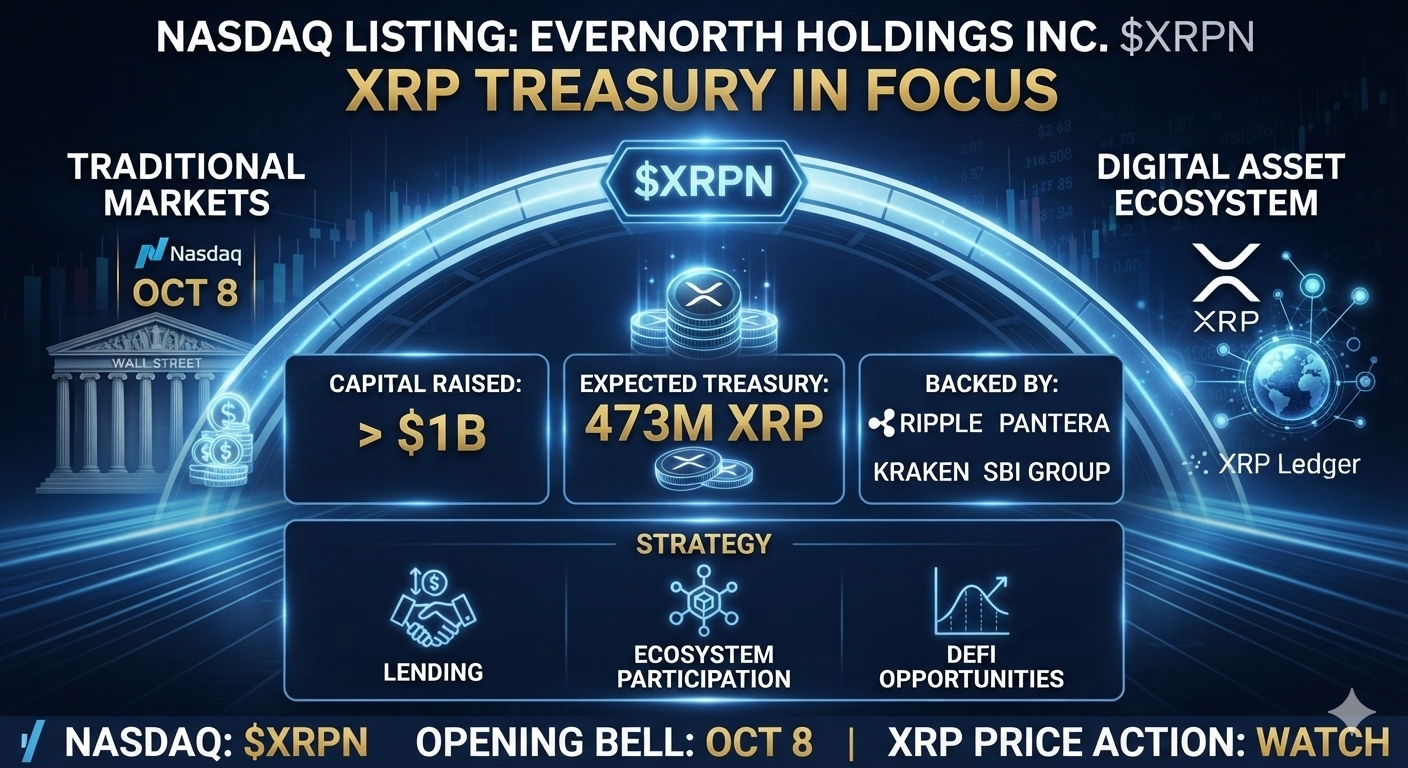
#evernorthplansnasdaqlistingoct8 🚨 XRPN Is Coming to Nasdaq. XRP Treasury in Focus!
I see Evernorth Holdings set to begin trading on Nasdaq under $XRPN on October 8 after the planned closing on October 7.
💰 Why traders are watching:
• Over $1B in capital raised
• Expected treasury of 473M XRP
• Backed by Ripple, Pantera Capital, Kraken, SBI Group and others
• Strategy focuses on raising XRP per share through lending, ecosystem participation and DeFi opportunities
I believe this could create a bridge, between traditional markets and XRP exposure.
📊 Key watch: XRPN listing + XRP price action.
Will XRPN increase attention toward XRP? Share your thoughts! 👀#xrp #altcoins #cryptotrading #Khan62 $XRP $ETH $XLM
{future}(ETHUSDT)
{future}(XRPUSDT)
{future}(XLMUSDT)
#evernorthplansnasdaqlistingoct8 🚨 XRPN Is Coming to Nasdaq. XRP Treasury in Focus!
I see Evernorth Holdings set to begin trading on Nasdaq under $XRPN on October 8 after the planned closing on October 7.
💰 Why traders are watching:
• Over $1B in capital raised
• Expected treasury of 473M XRP
• Backed by Ripple, Pantera Capital, Kraken, SBI Group and others
• Strategy focuses on raising XRP per share through lending, ecosystem participation and DeFi opportunities
I believe this could create a bridge, between traditional markets and XRP exposure.
📊 Key watch: XRPN listing + XRP price action.
Will XRPN increase attention toward XRP? Share your thoughts! 👀#xrp #altcoins #cryptotrading #Khan62 $XRP $ETH $XLM
I see Evernorth Holdings set to begin trading on Nasdaq under $XRPN on October 8 after the planned closing on October 7.
💰 Why traders are watching:
• Over $1B in capital raised
• Expected treasury of 473M XRP
• Backed by Ripple, Pantera Capital, Kraken, SBI Group and others
• Strategy focuses on raising XRP per share through lending, ecosystem participation and DeFi opportunities
I believe this could create a bridge, between traditional markets and XRP exposure.
📊 Key watch: XRPN listing + XRP price action.
Will XRPN increase attention toward XRP? Share your thoughts! 👀#xrp #altcoins #cryptotrading #Khan62 $XRP $ETH $XLM
1
1.9k
·
--
#NEARFallsToAround$4.70Down14% 🚨 NEAR Drops 14 Percent. Support Is Now Important!
NEAR had a lot of selling going down from $5.54 to about $4.70 after a report of a 3.8 Million dolar to 4 Million dollar exploit involving NEAR Intents.
⚠️ Important point: The event affected the -chain service but the main NEAR blockchain is said to be safe.
📊 Levels to watch:
• $4.69 to $4.74: support
• $4.80 to $4.95: Recovery area
• $4.40 to $4.30: Possible drop if support fails
The selling shows how fast news about security can cause people to pull back from risk.
🔥 Traders: Is $4.70 a place to bounce back or might NEAR go down to $4.30?
Give your thoughts below!
#Near #Khan62 #altcoins #defi $NEAR $BTC $ETH
{future}(BTCUSDT)
{future}(NEARUSDT)
{future}(ETHUSDT)
#NEARFallsToAround$4.70Down14% 🚨 NEAR Drops 14 Percent. Support Is Now Important!
NEAR had a lot of selling going down from $5.54 to about $4.70 after a report of a 3.8 Million dolar to 4 Million dollar exploit involving NEAR Intents.
⚠️ Important point: The event affected the -chain service but the main NEAR blockchain is said to be safe.
📊 Levels to watch:
• $4.69 to $4.74: support
• $4.80 to $4.95: Recovery area
• $4.40 to $4.30: Possible drop if support fails
The selling shows how fast news about security can cause people to pull back from risk.
🔥 Traders: Is $4.70 a place to bounce back or might NEAR go down to $4.30?
Give your thoughts below!
#Near #Khan62 #altcoins #defi $NEAR $BTC $ETH
NEAR had a lot of selling going down from $5.54 to about $4.70 after a report of a 3.8 Million dolar to 4 Million dollar exploit involving NEAR Intents.
⚠️ Important point: The event affected the -chain service but the main NEAR blockchain is said to be safe.
📊 Levels to watch:
• $4.69 to $4.74: support
• $4.80 to $4.95: Recovery area
• $4.40 to $4.30: Possible drop if support fails
The selling shows how fast news about security can cause people to pull back from risk.
🔥 Traders: Is $4.70 a place to bounce back or might NEAR go down to $4.30?
Give your thoughts below!
#Near #Khan62 #altcoins #defi $NEAR $BTC $ETH
175
·
--
#dollarindexhitshighestsincemay2025 🚨 DXY Reaches 101.81: Emerging Markets Feeling Pressure
The U.S. Dollar Index briefly climbed to 101.81. This is the level seen since May 2025. Rising Treasury yields and oil prices above $100 add pressure.
🌎 Why EM traders should watch:
• A stronger dollar can cause capital to leave risk assets.
• Weaker EM currencies raise the cost of imported goods.
• Debt that is measured in dollars becomes costlier to pay.
• Economies that import oil feel more strain because energy costs rise.
The dollar rally in September has already altered liquidity. This makes FX, bonds, commodities and crypto more sensitive, to U.S. Rates.
📊 Key items to watch: DXY, Treasury yields, oil and EM currencies.
How will EM markets respond?
#Khan62 #Macro #crypto #trading $BTC $ETH $SOL
{future}(SOLUSDT)
{future}(ETHUSDT)
{future}(BTCUSDT)
#dollarindexhitshighestsincemay2025 🚨 DXY Reaches 101.81: Emerging Markets Feeling Pressure
The U.S. Dollar Index briefly climbed to 101.81. This is the level seen since May 2025. Rising Treasury yields and oil prices above $100 add pressure.
🌎 Why EM traders should watch:
• A stronger dollar can cause capital to leave risk assets.
• Weaker EM currencies raise the cost of imported goods.
• Debt that is measured in dollars becomes costlier to pay.
• Economies that import oil feel more strain because energy costs rise.
The dollar rally in September has already altered liquidity. This makes FX, bonds, commodities and crypto more sensitive, to U.S. Rates.
📊 Key items to watch: DXY, Treasury yields, oil and EM currencies.
How will EM markets respond?
#Khan62 #Macro #crypto #trading $BTC $ETH $SOL
The U.S. Dollar Index briefly climbed to 101.81. This is the level seen since May 2025. Rising Treasury yields and oil prices above $100 add pressure.
🌎 Why EM traders should watch:
• A stronger dollar can cause capital to leave risk assets.
• Weaker EM currencies raise the cost of imported goods.
• Debt that is measured in dollars becomes costlier to pay.
• Economies that import oil feel more strain because energy costs rise.
The dollar rally in September has already altered liquidity. This makes FX, bonds, commodities and crypto more sensitive, to U.S. Rates.
📊 Key items to watch: DXY, Treasury yields, oil and EM currencies.
How will EM markets respond?
#Khan62 #Macro #crypto #trading $BTC $ETH $SOL
621
·
--
#BitcoinETFsTake$6.34BillionInQ3 🚨 Bitcoin ETFs Just Had a $6.34B Quarter!
Institutional demand came back strongly in Q3 with U.S. Spot Bitcoin ETFs recording approximately $6.34B in net inflows—this was their strongest quarter of 2026.
📊 Monthly flow:
July: +$172M
• August: +$3.52
• September: +$2.65B
Bitcoin also went up by, around 42.7% while spot Ether ETFs got $3.05B and XRP ETFs added $308M.
The last day had a $149M outflow but the quarterly flows were still very positive.
🔥 Institutional money is clearly changing the crypto markets.
Do you think Bitcoin ETF demand can keep helping Bitcoin in Q4? Share your opinion!
#BTC #Khan62 #xrp #cryptotrading $BTC $ETH $XRP
{future}(BTCUSDT)
{future}(ETHUSDT)
{future}(XRPUSDT)
#BitcoinETFsTake$6.34BillionInQ3 🚨 Bitcoin ETFs Just Had a $6.34B Quarter!
Institutional demand came back strongly in Q3 with U.S. Spot Bitcoin ETFs recording approximately $6.34B in net inflows—this was their strongest quarter of 2026.
📊 Monthly flow:
July: +$172M
• August: +$3.52
• September: +$2.65B
Bitcoin also went up by, around 42.7% while spot Ether ETFs got $3.05B and XRP ETFs added $308M.
The last day had a $149M outflow but the quarterly flows were still very positive.
🔥 Institutional money is clearly changing the crypto markets.
Do you think Bitcoin ETF demand can keep helping Bitcoin in Q4? Share your opinion!
#BTC #Khan62 #xrp #cryptotrading $BTC $ETH $XRP
Institutional demand came back strongly in Q3 with U.S. Spot Bitcoin ETFs recording approximately $6.34B in net inflows—this was their strongest quarter of 2026.
📊 Monthly flow:
July: +$172M
• August: +$3.52
• September: +$2.65B
Bitcoin also went up by, around 42.7% while spot Ether ETFs got $3.05B and XRP ETFs added $308M.
The last day had a $149M outflow but the quarterly flows were still very positive.
🔥 Institutional money is clearly changing the crypto markets.
Do you think Bitcoin ETF demand can keep helping Bitcoin in Q4? Share your opinion!
#BTC #Khan62 #xrp #cryptotrading $BTC $ETH $XRP
52
·
--
#koreaproposestokenizingstocksandbonds 🚨 Crypto Meets Prediction Markets: A New Battlefront
Prediction markets are getting closer to crypto, derivatives and traditional finance.
⚖️ Regulation: The CFTC and state regulators are still discussing whether event contracts should be under federal derivatives rules or state gambling laws.
🔹 Kalshi: CFTC-regulated exchange
🔹 Polymarket: Crypto-on-chain infrastructure
🔹 Web3: USDC settlement, smart contracts and transparent markets
🔹 Perpetuals: Event-based trading is growing beyond simple yes/no contracts
For traders this could bring new markets chances, for liquidity and new regulatory risks.
📊 Watch: $HYPE , $COINB , $BTC .
Do prediction markets become the big part of the crypto trading world?
#crypto #Khan62 #trading #cryptotrading
{future}(BTCUSDT)
{future}(COINUSDT)
{future}(HYPEUSDT)
#koreaproposestokenizingstocksandbonds 🚨 Crypto Meets Prediction Markets: A New Battlefront
Prediction markets are getting closer to crypto, derivatives and traditional finance.
⚖️ Regulation: The CFTC and state regulators are still discussing whether event contracts should be under federal derivatives rules or state gambling laws.
🔹 Kalshi: CFTC-regulated exchange
🔹 Polymarket: Crypto-on-chain infrastructure
🔹 Web3: USDC settlement, smart contracts and transparent markets
🔹 Perpetuals: Event-based trading is growing beyond simple yes/no contracts
For traders this could bring new markets chances, for liquidity and new regulatory risks.
📊 Watch: $HYPE , $COINB , $BTC .
Do prediction markets become the big part of the crypto trading world?
#crypto #Khan62 #trading #cryptotrading
Prediction markets are getting closer to crypto, derivatives and traditional finance.
⚖️ Regulation: The CFTC and state regulators are still discussing whether event contracts should be under federal derivatives rules or state gambling laws.
🔹 Kalshi: CFTC-regulated exchange
🔹 Polymarket: Crypto-on-chain infrastructure
🔹 Web3: USDC settlement, smart contracts and transparent markets
🔹 Perpetuals: Event-based trading is growing beyond simple yes/no contracts
For traders this could bring new markets chances, for liquidity and new regulatory risks.
📊 Watch: $HYPE , $COINB , $BTC .
Do prediction markets become the big part of the crypto trading world?
#crypto #Khan62 #trading #cryptotrading
181
·
--
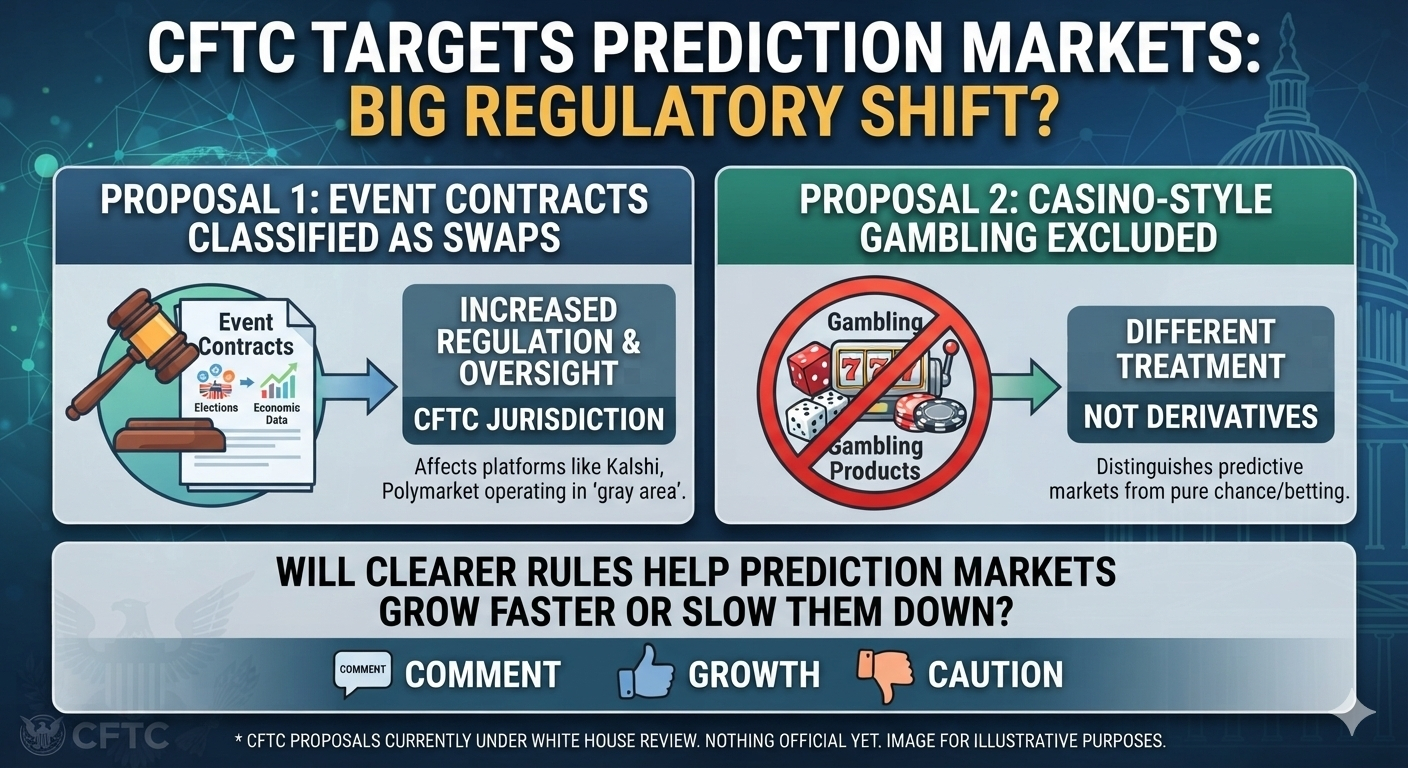
#cftcsubmitstwoeventcontractrulestowhitehouse 🚨 CFTC Targets Prediction Markets: Big Regulatory Shift?
A big change in U.S. Regulation is bringing prediction markets into the focus.
The Commodity Futures Trading Commission or CFTC has sent two rule proposals about event contracts to the White House for review.
One proposal would classify some event contracts as swaps. That means they would fall under rules possibly making them more regulated.
Another proposal would keep casino-style gambling products out of the swap definition. That could mean these types of products aren’t treated the same as derivatives.
These changes could affect how platf
orms like Kalshi and Polymarket run their services. Now those platforms are trying to operate in a gray area of the law.
The rules are still being reviewed. Nothing is official yet.. The direction matters.
For people who trade crypto or look at assets the outcome of this review could affect how event-based contracts grow in the United States.
💬 Will clearer rules, from the government help prediction markets grow faster?. Could it slow things down? Let us know what you think.
#crypto #trading #Khan62 #blockchain $HYPE $COIN $BTC
{future}(HYPEUSDT)
{future}(COINUSDT)
{future}(BTCUSDT)
#cftcsubmitstwoeventcontractrulestowhitehouse 🚨 CFTC Targets Prediction Markets: Big Regulatory Shift?
A big change in U.S. Regulation is bringing prediction markets into the focus.
The Commodity Futures Trading Commission or CFTC has sent two rule proposals about event contracts to the White House for review.
One proposal would classify some event contracts as swaps. That means they would fall under rules possibly making them more regulated.
Another proposal would keep casino-style gambling products out of the swap definition. That could mean these types of products aren’t treated the same as derivatives.
These changes could affect how platf
orms like Kalshi and Polymarket run their services. Now those platforms are trying to operate in a gray area of the law.
The rules are still being reviewed. Nothing is official yet.. The direction matters.
For people who trade crypto or look at assets the outcome of this review could affect how event-based contracts grow in the United States.
💬 Will clearer rules, from the government help prediction markets grow faster?. Could it slow things down? Let us know what you think.
#crypto #trading #Khan62 #blockchain $HYPE $COIN $BTC
A big change in U.S. Regulation is bringing prediction markets into the focus.
The Commodity Futures Trading Commission or CFTC has sent two rule proposals about event contracts to the White House for review.
One proposal would classify some event contracts as swaps. That means they would fall under rules possibly making them more regulated.
Another proposal would keep casino-style gambling products out of the swap definition. That could mean these types of products aren’t treated the same as derivatives.
These changes could affect how platf
orms like Kalshi and Polymarket run their services. Now those platforms are trying to operate in a gray area of the law.
The rules are still being reviewed. Nothing is official yet.. The direction matters.
For people who trade crypto or look at assets the outcome of this review could affect how event-based contracts grow in the United States.
💬 Will clearer rules, from the government help prediction markets grow faster?. Could it slow things down? Let us know what you think.
#crypto #trading #Khan62 #blockchain $HYPE $COIN $BTC
2.9k
·
--
#TreasuryLetsStatesFileStablecoinCertificationsEarly 🚨 Stablecoin Rules Are Moving Forward
A big change in regulation might soon affect how smaller stablecoin companies work in the U.S.
The Treasury’s GENIUS Act plan lets issuers with $10B or less in stablecoins out to possibly follow state-level rules.. Those state rules must be very similar, to the federal ones.
🔹 Some states can start setting up their rules now
🔹 The federal rules are still being built
🔹 The $10B limit is a cutoff point
🔹 Clear rules could shift how stablecoins grow and how the market is shaped
For people trading crypto this is something to keep an eye on.
💬 Will clearer rules help more people use crypto?
{future}(ETHUSDT)
{future}(AAVEUSDT)
#Khan62 #crypto #ETH #defi $ETH $AAVE $LINK
{future}(LINKUSDT)
#TreasuryLetsStatesFileStablecoinCertificationsEarly 🚨 Stablecoin Rules Are Moving Forward
A big change in regulation might soon affect how smaller stablecoin companies work in the U.S.
The Treasury’s GENIUS Act plan lets issuers with $10B or less in stablecoins out to possibly follow state-level rules.. Those state rules must be very similar, to the federal ones.
🔹 Some states can start setting up their rules now
🔹 The federal rules are still being built
🔹 The $10B limit is a cutoff point
🔹 Clear rules could shift how stablecoins grow and how the market is shaped
For people trading crypto this is something to keep an eye on.
💬 Will clearer rules help more people use crypto?
#Khan62 #crypto #ETH #defi $ETH $AAVE $LINK
A big change in regulation might soon affect how smaller stablecoin companies work in the U.S.
The Treasury’s GENIUS Act plan lets issuers with $10B or less in stablecoins out to possibly follow state-level rules.. Those state rules must be very similar, to the federal ones.
🔹 Some states can start setting up their rules now
🔹 The federal rules are still being built
🔹 The $10B limit is a cutoff point
🔹 Clear rules could shift how stablecoins grow and how the market is shaped
For people trading crypto this is something to keep an eye on.
💬 Will clearer rules help more people use crypto?
#Khan62 #crypto #ETH #defi $ETH $AAVE $LINK
53
·
--
#ukfcaopenscryptofirmauthorization 🚨 UK JUST OPENED THE DOOR TO CRYPTO REGULATION! 🇬🇧
The FCA has opened a crypto authorization gateway giving firms until February 28 2027 to apply.
🔹 Existing MLR registrations do not automatically become authorization.
🔹 Exchanges, custodians, stablecoin issuers and staking providers must apply.
🔹 Firms applying on time may receive protection for crypto.
🔹 The new regime is scheduled for October 25 2027.
🔹 FCA reviews will focus on safeguarding, consumer protection, market integrity and financial resilience.
I think clearer rules, for crypto markets could reshape how firms operate in the UK.
I wonder if this will attract institutional crypto activity? 👀
#crypto #defi #Khan62 #trading
$BNB · $XRP · $AAVE
{future}(BNBUSDT)
{future}(XRPUSDT)
{future}(AAVEUSDT)
#ukfcaopenscryptofirmauthorization 🚨 UK JUST OPENED THE DOOR TO CRYPTO REGULATION! 🇬🇧
The FCA has opened a crypto authorization gateway giving firms until February 28 2027 to apply.
🔹 Existing MLR registrations do not automatically become authorization.
🔹 Exchanges, custodians, stablecoin issuers and staking providers must apply.
🔹 Firms applying on time may receive protection for crypto.
🔹 The new regime is scheduled for October 25 2027.
🔹 FCA reviews will focus on safeguarding, consumer protection, market integrity and financial resilience.
I think clearer rules, for crypto markets could reshape how firms operate in the UK.
I wonder if this will attract institutional crypto activity? 👀
#crypto #defi #Khan62 #trading
$BNB · $XRP · $AAVE
The FCA has opened a crypto authorization gateway giving firms until February 28 2027 to apply.
🔹 Existing MLR registrations do not automatically become authorization.
🔹 Exchanges, custodians, stablecoin issuers and staking providers must apply.
🔹 Firms applying on time may receive protection for crypto.
🔹 The new regime is scheduled for October 25 2027.
🔹 FCA reviews will focus on safeguarding, consumer protection, market integrity and financial resilience.
I think clearer rules, for crypto markets could reshape how firms operate in the UK.
I wonder if this will attract institutional crypto activity? 👀
#crypto #defi #Khan62 #trading
$BNB · $XRP · $AAVE
951
·
--
#cftcsubmitstwoeventcontractrulestowhitehouse 🚨 The CFTC is changing the rules for prediction markets!
A big regulatory shift is. Traders need to pay attention. 👀
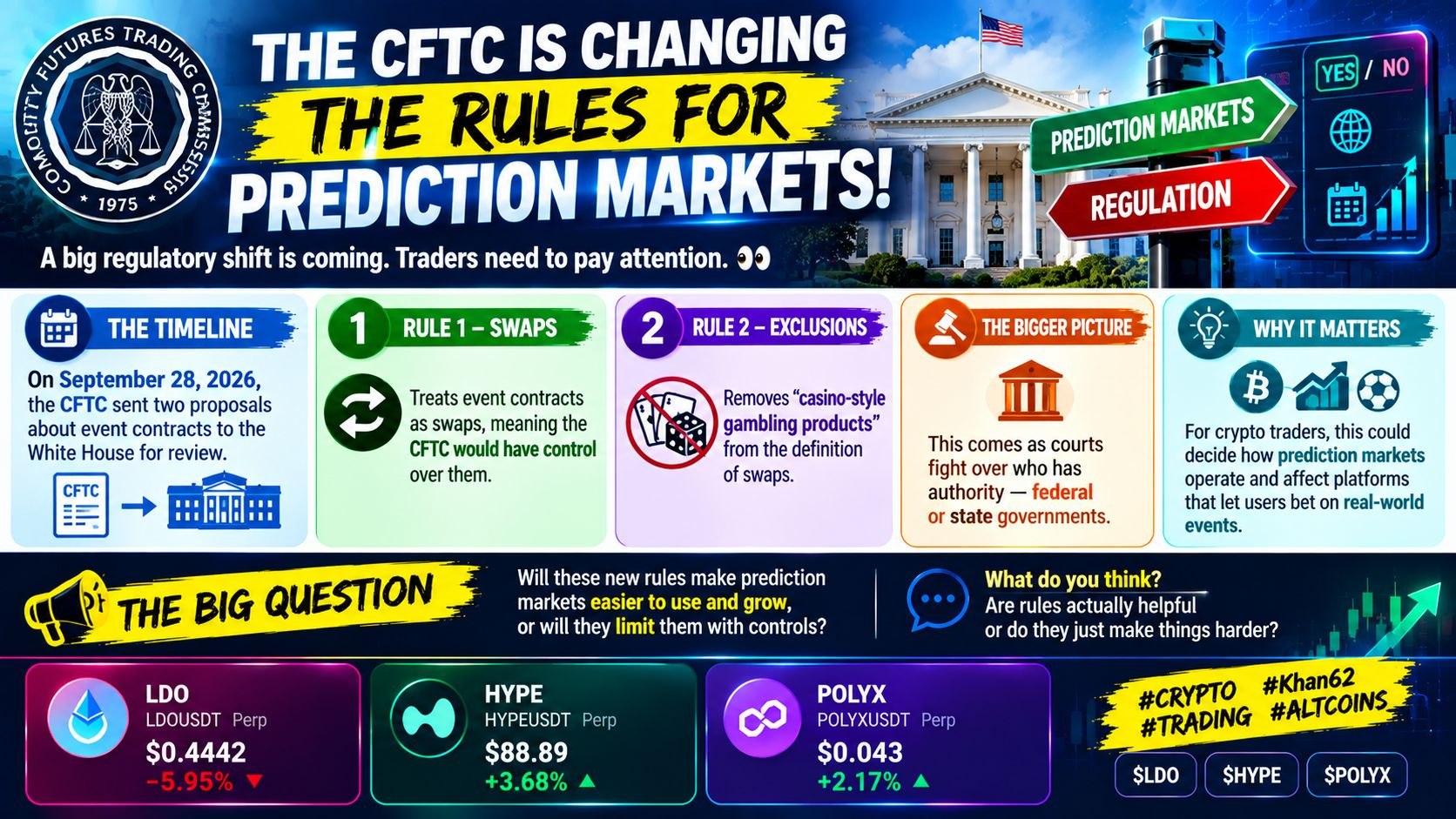
On September 28 the CFTC sent two proposals about event contracts to the White House for review.
🔹 One proposal says event contracts should be treated as swaps meaning the CFTC would have control, over them.
🔹 The other proposal wants to remove "casino-style gambling products" from the definition of swaps.
🔹 This comes as courts fight over who has authority. State governments.
For people trading in crypto this could decide how prediction markets are allowed to operate. It might affect platforms that let users bet on real-world events.
The big question is this: will these new rules make prediction markets easier to use and grow or will they limit them with controls?
What do you think? Are rules actually helpful or do they just make things harder?
#crypto #Khan62 #trading #altcoins
$LDO
{future}(LDOUSDT)
$HYPE · $POLYX
{future}(HYPEUSDT)
{future}(POLYXUSDT)
#cftcsubmitstwoeventcontractrulestowhitehouse 🚨 The CFTC is changing the rules for prediction markets!
A big regulatory shift is. Traders need to pay attention. 👀
On September 28 the CFTC sent two proposals about event contracts to the White House for review.
🔹 One proposal says event contracts should be treated as swaps meaning the CFTC would have control, over them.
🔹 The other proposal wants to remove "casino-style gambling products" from the definition of swaps.
🔹 This comes as courts fight over who has authority. State governments.
For people trading in crypto this could decide how prediction markets are allowed to operate. It might affect platforms that let users bet on real-world events.
The big question is this: will these new rules make prediction markets easier to use and grow or will they limit them with controls?
What do you think? Are rules actually helpful or do they just make things harder?
#crypto #Khan62 #trading #altcoins
$LDO
$HYPE · $POLYX
A big regulatory shift is. Traders need to pay attention. 👀
On September 28 the CFTC sent two proposals about event contracts to the White House for review.
🔹 One proposal says event contracts should be treated as swaps meaning the CFTC would have control, over them.
🔹 The other proposal wants to remove "casino-style gambling products" from the definition of swaps.
🔹 This comes as courts fight over who has authority. State governments.
For people trading in crypto this could decide how prediction markets are allowed to operate. It might affect platforms that let users bet on real-world events.
The big question is this: will these new rules make prediction markets easier to use and grow or will they limit them with controls?
What do you think? Are rules actually helpful or do they just make things harder?
#crypto #Khan62 #trading #altcoins
$LDO
$HYPE · $POLYX
277
·
--
#metamaskexitslidovalidatorsaftersecurityincident 🚨 METAMASK STAKING EXITS ETHEREUM VALIDATORS AFTER SECURITY INCIDENT!
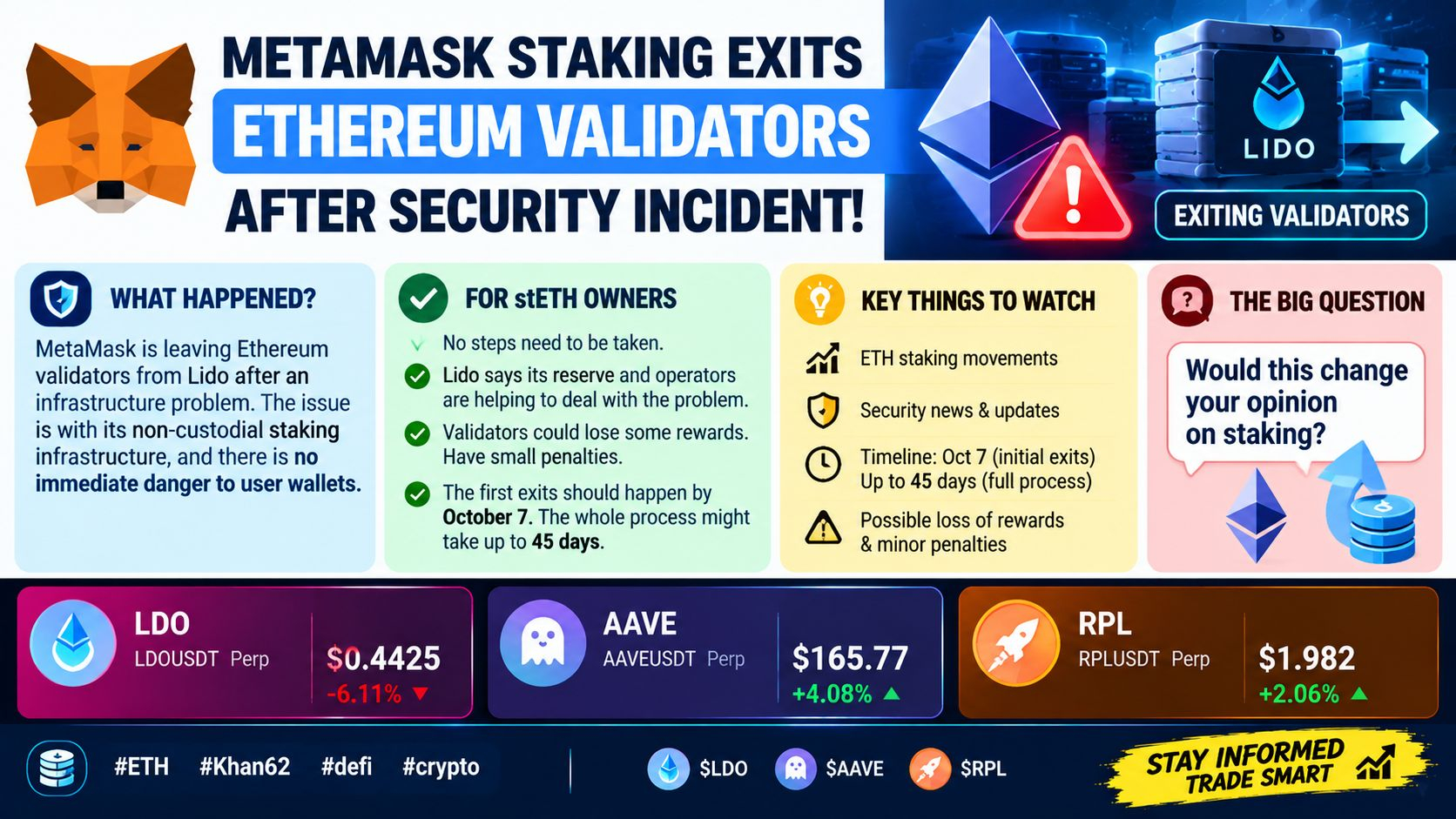
MetaMask is leaving Ethereum validators from Lido after an infrastructure problem. MetaMask says the problem is with its non-custodial staking infrastructure and there is no immediate danger to user wallets.
For stETH owners:
🔹 No steps need to be taken.
🔹 Lido says its reserve and operators are helping to deal with the problem.
🔹 Validators could lose some rewards. Have small penalties.
🔹 The first exits should happen by October 7. The whole process might take, up to 45 days.
Traders need to pay attention to ETH staking movements and security news.
Would this change your opinion on staking?
#ETH #Khan62 #defi #crypto
· $LDO · $AAVE · $RPL ·
{future}(LDOUSDT)
{future}(AAVEUSDT)
{future}(RPLUSDT)
#metamaskexitslidovalidatorsaftersecurityincident 🚨 METAMASK STAKING EXITS ETHEREUM VALIDATORS AFTER SECURITY INCIDENT!
MetaMask is leaving Ethereum validators from Lido after an infrastructure problem. MetaMask says the problem is with its non-custodial staking infrastructure and there is no immediate danger to user wallets.
For stETH owners:
🔹 No steps need to be taken.
🔹 Lido says its reserve and operators are helping to deal with the problem.
🔹 Validators could lose some rewards. Have small penalties.
🔹 The first exits should happen by October 7. The whole process might take, up to 45 days.
Traders need to pay attention to ETH staking movements and security news.
Would this change your opinion on staking?
#ETH #Khan62 #defi #crypto
· $LDO · $AAVE · $RPL ·
MetaMask is leaving Ethereum validators from Lido after an infrastructure problem. MetaMask says the problem is with its non-custodial staking infrastructure and there is no immediate danger to user wallets.
For stETH owners:
🔹 No steps need to be taken.
🔹 Lido says its reserve and operators are helping to deal with the problem.
🔹 Validators could lose some rewards. Have small penalties.
🔹 The first exits should happen by October 7. The whole process might take, up to 45 days.
Traders need to pay attention to ETH staking movements and security news.
Would this change your opinion on staking?
#ETH #Khan62 #defi #crypto
· $LDO · $AAVE · $RPL ·
1
4
2.9k
·
--
တစ်စိတ်တစ်ပိုင်း မှန်ကန်
#ecbtotestaiagentsindigitaleuropayments 🚨 AI AGENTS COULD SOON PAY WITH DIGITAL EUROS!
The European Central Bank is looking into a way for AI agents to make payments. All within set limits. This isn’t theory. It’s being tested for real.
🔹 Mandates tell the AI agent what it’s allowed to spend. No surprises. No overreach.
🔹 Tokens can lock down who the agent can pay, how much it can. How often. Think of it like giving a kid a debit card with rules.
🔹 Real-time checks happen every time a payment is made. The system verifies if the rules are being followed. If not it stops the payment.
🔹 Some payments need a human to confirm. Like when you’re buying something.. Others, especially small or routine ones could go through without anyone stepping in.
🔹 Payments are level. The AI could wait until a delivery arrives or a project milestone is hit before sending money.
For traders this is huge. It mixes AI, digital payments, stablecoins, tokenized assets and smart shopping. All in one flow.
Could agentic payments be the missing link, between AI and real money? Maybe.. If so we’re getting closer every day. 👇 #AI #blockchain #Khan62 #Web3 $LINK $ONDO $XLM
{future}(LINKUSDT)
{future}(ONDOUSDT)
{future}(XLMUSDT)
#ecbtotestaiagentsindigitaleuropayments 🚨 AI AGENTS COULD SOON PAY WITH DIGITAL EUROS!
The European Central Bank is looking into a way for AI agents to make payments. All within set limits. This isn’t theory. It’s being tested for real.
🔹 Mandates tell the AI agent what it’s allowed to spend. No surprises. No overreach.
🔹 Tokens can lock down who the agent can pay, how much it can. How often. Think of it like giving a kid a debit card with rules.
🔹 Real-time checks happen every time a payment is made. The system verifies if the rules are being followed. If not it stops the payment.
🔹 Some payments need a human to confirm. Like when you’re buying something.. Others, especially small or routine ones could go through without anyone stepping in.
🔹 Payments are level. The AI could wait until a delivery arrives or a project milestone is hit before sending money.
For traders this is huge. It mixes AI, digital payments, stablecoins, tokenized assets and smart shopping. All in one flow.
Could agentic payments be the missing link, between AI and real money? Maybe.. If so we’re getting closer every day. 👇 #AI #blockchain #Khan62 #Web3 $LINK $ONDO $XLM
The European Central Bank is looking into a way for AI agents to make payments. All within set limits. This isn’t theory. It’s being tested for real.
🔹 Mandates tell the AI agent what it’s allowed to spend. No surprises. No overreach.
🔹 Tokens can lock down who the agent can pay, how much it can. How often. Think of it like giving a kid a debit card with rules.
🔹 Real-time checks happen every time a payment is made. The system verifies if the rules are being followed. If not it stops the payment.
🔹 Some payments need a human to confirm. Like when you’re buying something.. Others, especially small or routine ones could go through without anyone stepping in.
🔹 Payments are level. The AI could wait until a delivery arrives or a project milestone is hit before sending money.
For traders this is huge. It mixes AI, digital payments, stablecoins, tokenized assets and smart shopping. All in one flow.
Could agentic payments be the missing link, between AI and real money? Maybe.. If so we’re getting closer every day. 👇 #AI #blockchain #Khan62 #Web3 $LINK $ONDO $XLM
1
2
2.4k
·
--
စိစစ်အတည်ပြုထားသည်
#qntfallsover40%frommorninghigh 🚨 QNT JUST GOT HIT BY A PROFIT-TAKING WAVE!
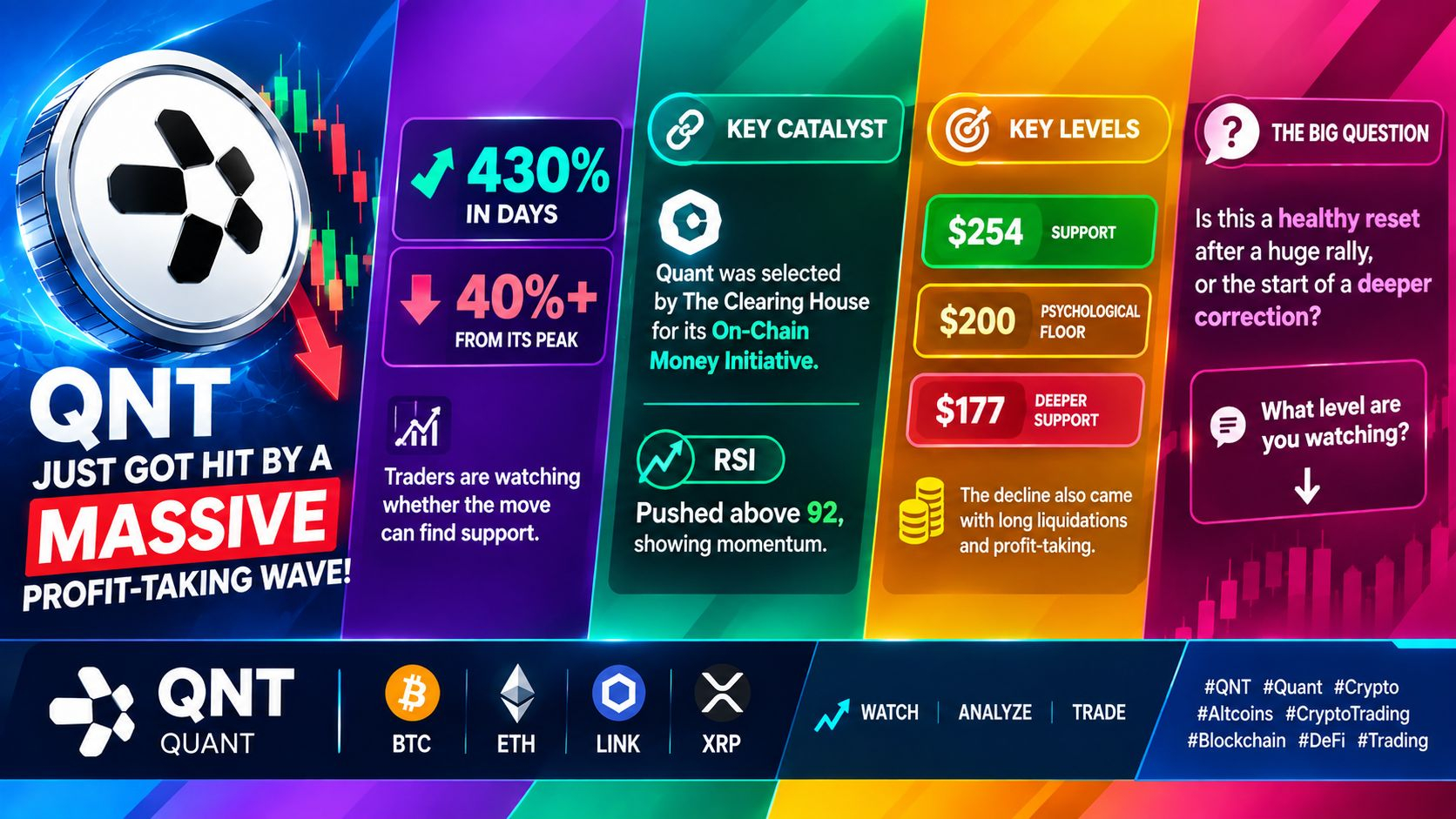
QNT exploded 430% in days then crashed than 40% from its peak. Traders ar
e watching whether the move can find support.
🔹 Catalyst: Quant was selected by The Clearing House for its On-Chain Money Initiative.
🔹 RSI pushed above 92 showing momentum.
🔹 Key levels: $254 support, $200 floor and $177 deeper support.
🔹 The decline also came with liquidations and profit‑taking.
The big question: Is this a reset, after a huge rally or the start of a deeper correction?
What level are you watching? 👇 #Khan62 #crypto #altcoins #CryptoTrading #blockchain #DeFi #Trading.$QNT $LINK · $XRP
{future}(XRPUSDT)
{future}(QNTUSDT)
{future}(LINKUSDT)
#qntfallsover40%frommorninghigh 🚨 QNT JUST GOT HIT BY A PROFIT-TAKING WAVE!
QNT exploded 430% in days then crashed than 40% from its peak. Traders ar
e watching whether the move can find support.
🔹 Catalyst: Quant was selected by The Clearing House for its On-Chain Money Initiative.
🔹 RSI pushed above 92 showing momentum.
🔹 Key levels: $254 support, $200 floor and $177 deeper support.
🔹 The decline also came with liquidations and profit‑taking.
The big question: Is this a reset, after a huge rally or the start of a deeper correction?
What level are you watching? 👇 #Khan62 #crypto #altcoins #CryptoTrading #blockchain #DeFi #Trading.$QNT $LINK · $XRP
QNT exploded 430% in days then crashed than 40% from its peak. Traders ar
e watching whether the move can find support.
🔹 Catalyst: Quant was selected by The Clearing House for its On-Chain Money Initiative.
🔹 RSI pushed above 92 showing momentum.
🔹 Key levels: $254 support, $200 floor and $177 deeper support.
🔹 The decline also came with liquidations and profit‑taking.
The big question: Is this a reset, after a huge rally or the start of a deeper correction?
What level are you watching? 👇 #Khan62 #crypto #altcoins #CryptoTrading #blockchain #DeFi #Trading.$QNT $LINK · $XRP
1
4
6.9k
·
--
စိစစ်အတည်ပြုထားသည်
#chainlinklaunchesccip2withenterpriseverification 🚨 CHAINLINK UPGRADED CROSS-CHAIN SECURITY!
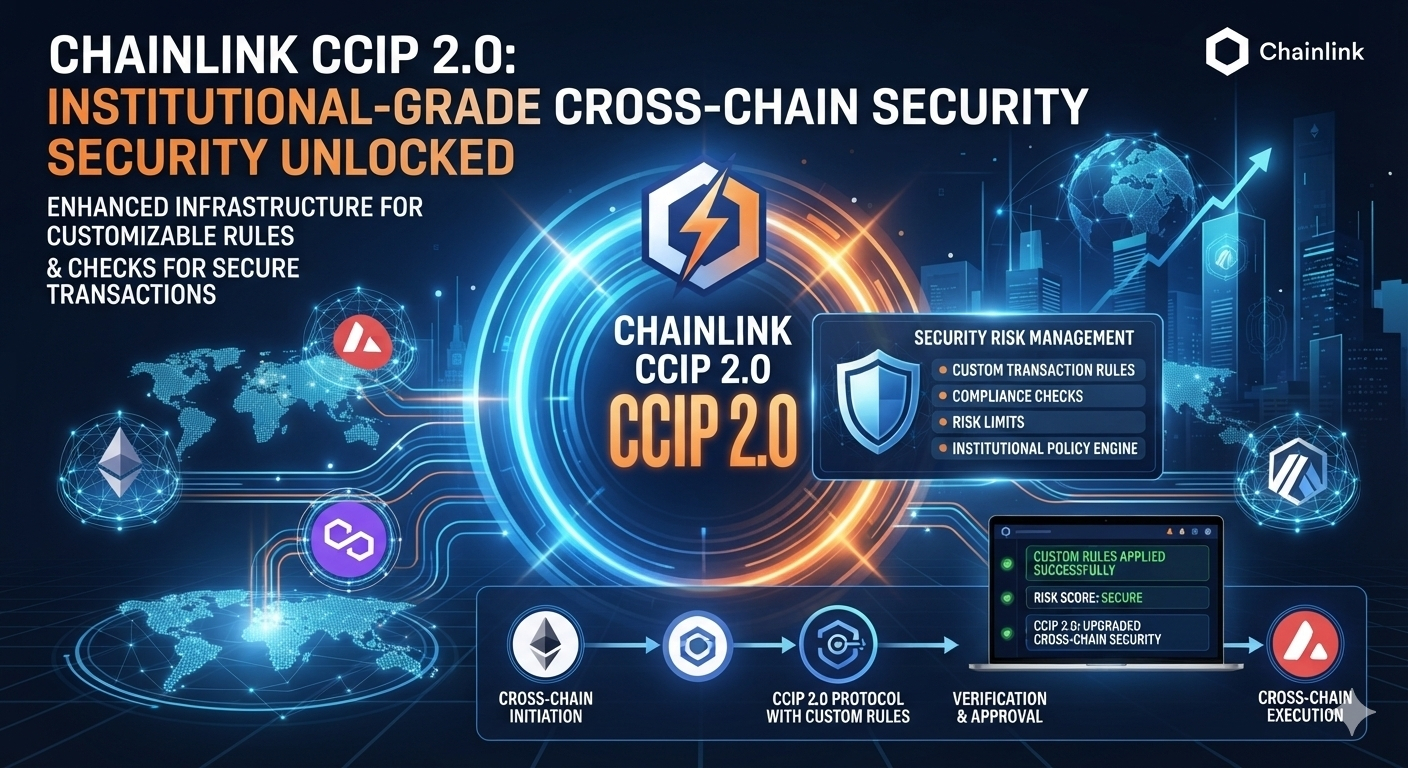
Chainlink CCIP 2.0 is taking -chain infrastructure to the next level. This update is making it easier for institutions to use blockchain technology. The big change is that companies can now add their rules and checks before any transaction goes through.
🔹 Cross-Chain Verifiers (CCVs) allow institutions to use their validators. This means they can check and approve transfers in their way.
🔹 The Automated Compliance Engine (ACE) can automatically apply rules. It checks for KYC, AML transaction limits and sanctions.
🔹 Configurable finality gives issuers control. They can choose how fast a transaction settles or how strong the checks should be.
🔹 All current CCIP users have been moved to this version without disruption.
For traders this is important. More programmable cross-chain tools can support tokenized assets, stablecoins and real-world asset activity on blockchains.
Is CCIP 2.0 a step, toward mainstream RWA adoption? 👇#Khan62 #LINK #Web3 #altcoins $LINK $AAVE $ONDO
{future}(LINKUSDT)
{future}(AAVEUSDT)
{future}(ONDOUSDT)
#chainlinklaunchesccip2withenterpriseverification 🚨 CHAINLINK UPGRADED CROSS-CHAIN SECURITY!
Chainlink CCIP 2.0 is taking -chain infrastructure to the next level. This update is making it easier for institutions to use blockchain technology. The big change is that companies can now add their rules and checks before any transaction goes through.
🔹 Cross-Chain Verifiers (CCVs) allow institutions to use their validators. This means they can check and approve transfers in their way.
🔹 The Automated Compliance Engine (ACE) can automatically apply rules. It checks for KYC, AML transaction limits and sanctions.
🔹 Configurable finality gives issuers control. They can choose how fast a transaction settles or how strong the checks should be.
🔹 All current CCIP users have been moved to this version without disruption.
For traders this is important. More programmable cross-chain tools can support tokenized assets, stablecoins and real-world asset activity on blockchains.
Is CCIP 2.0 a step, toward mainstream RWA adoption? 👇#Khan62 #LINK #Web3 #altcoins $LINK $AAVE $ONDO
Chainlink CCIP 2.0 is taking -chain infrastructure to the next level. This update is making it easier for institutions to use blockchain technology. The big change is that companies can now add their rules and checks before any transaction goes through.
🔹 Cross-Chain Verifiers (CCVs) allow institutions to use their validators. This means they can check and approve transfers in their way.
🔹 The Automated Compliance Engine (ACE) can automatically apply rules. It checks for KYC, AML transaction limits and sanctions.
🔹 Configurable finality gives issuers control. They can choose how fast a transaction settles or how strong the checks should be.
🔹 All current CCIP users have been moved to this version without disruption.
For traders this is important. More programmable cross-chain tools can support tokenized assets, stablecoins and real-world asset activity on blockchains.
Is CCIP 2.0 a step, toward mainstream RWA adoption? 👇#Khan62 #LINK #Web3 #altcoins $LINK $AAVE $ONDO
1
1
1.4k
·
--
#fedproposespaymentstablecoinrules FED’S STABLECOIN RULES: A BIG CRYPTO SIGNAL
The Federal Reserve has announced two rulemaking packages to carry out the GENIUS Act placing payment stablecoins under rules.
Key points:
• 100 percent reserve backing with assets, such as short‑term Treasuries.
• Capital and risk controls.
• Redemption and reporting requirements.
• A dedicated approval process, for banks supervised by the Federal Reserve that want to issue stablecoins.
• Public comments will stay open for sixty days.
For traders this could be important because stablecoins link banking, dollar liquidity, exchanges and on‑chain payments.
Could stablecoin adoption speed up? What effect could this have on BTC. Altcoins? Share your view!..#stablecoin #crypto #cryptotrading #TradingSignals
$BTC $ETH $BNB
{future}(BTCUSDT)
{future}(ETHUSDT)
{future}(BNBUSDT)
#fedproposespaymentstablecoinrules FED’S STABLECOIN RULES: A BIG CRYPTO SIGNAL
The Federal Reserve has announced two rulemaking packages to carry out the GENIUS Act placing payment stablecoins under rules.
Key points:
• 100 percent reserve backing with assets, such as short‑term Treasuries.
• Capital and risk controls.
• Redemption and reporting requirements.
• A dedicated approval process, for banks supervised by the Federal Reserve that want to issue stablecoins.
• Public comments will stay open for sixty days.
For traders this could be important because stablecoins link banking, dollar liquidity, exchanges and on‑chain payments.
Could stablecoin adoption speed up? What effect could this have on BTC. Altcoins? Share your view!..#stablecoin #crypto #cryptotrading #TradingSignals
$BTC $ETH $BNB
The Federal Reserve has announced two rulemaking packages to carry out the GENIUS Act placing payment stablecoins under rules.
Key points:
• 100 percent reserve backing with assets, such as short‑term Treasuries.
• Capital and risk controls.
• Redemption and reporting requirements.
• A dedicated approval process, for banks supervised by the Federal Reserve that want to issue stablecoins.
• Public comments will stay open for sixty days.
For traders this could be important because stablecoins link banking, dollar liquidity, exchanges and on‑chain payments.
Could stablecoin adoption speed up? What effect could this have on BTC. Altcoins? Share your view!..#stablecoin #crypto #cryptotrading #TradingSignals
$BTC $ETH $BNB
456
·
--
စိစစ်အတည်ပြုထားသည်
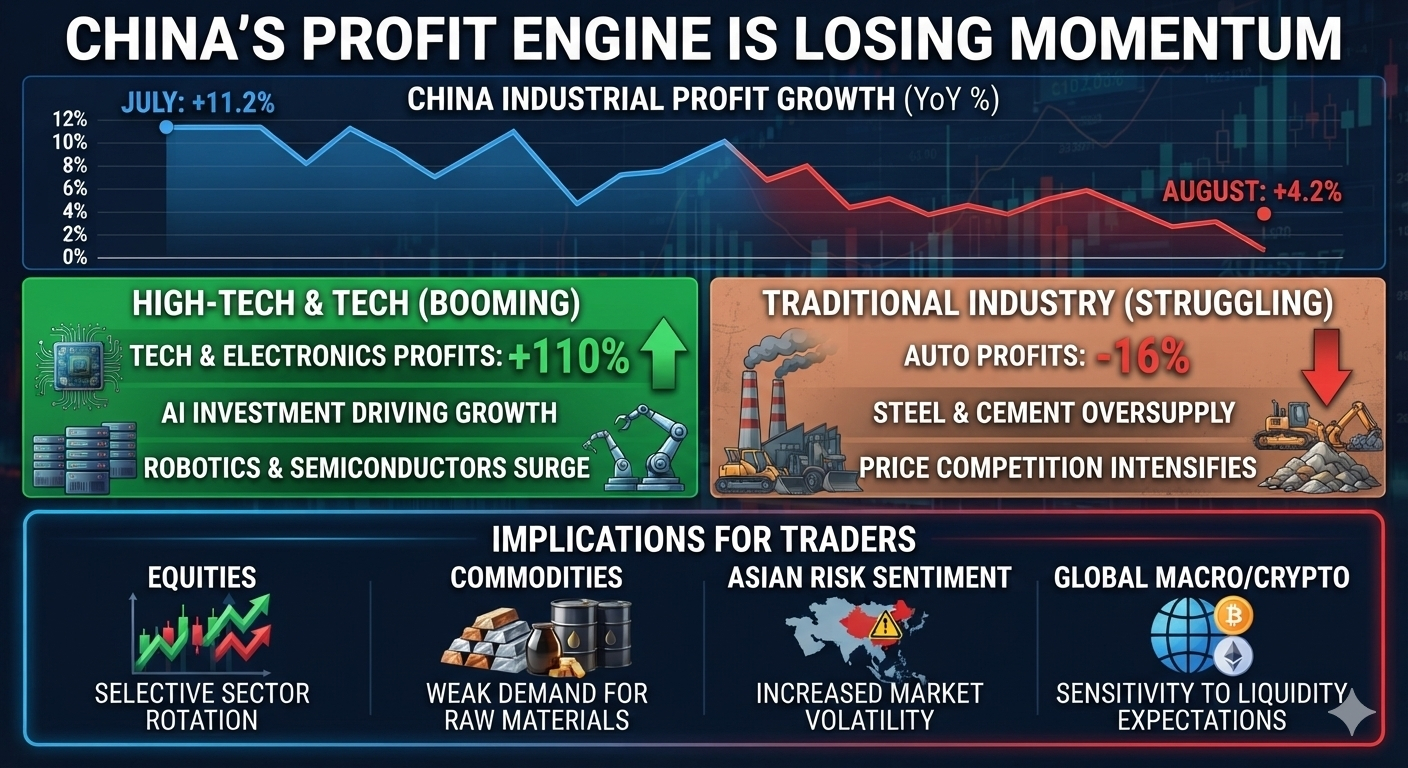
#chinaindustrialprofitgrowthslowsfourthmonth CHINA’S PROFIT ENGINE IS LOSING MOMENTUM
China’s industrial profits went up 4.2% compared to last year in August, which is much lower than the 11.2% increase in July.
This is important for markets.
• Profits from January to August: 5.27 trillion yuan, 15.7%
• Tech and electronics profits: up 110%
• Auto profits: down 16%
• Industrial revenue: up 6.6%
The numbers show a clear difference: AI and high-tech manufacturing are still doing very well but traditional industries are struggling with less demand, too much supply and a lot of price competition.
For traders keep an eye on equities, commodities, Asian risk sentiment and how crypto reacts to expectations, about global money supply.
Is China’s AI boom strong to make up for the overall slowdown? Share your thoughts.#china #Bitcoin #crypto #CryptoTrading #GlobalMarkets #StockMarket #Ethereum #altcoins
$NEO $VET $BTC
{future}(BTCUSDT)
{future}(VETUSDT)
{future}(NEOUSDT)
#chinaindustrialprofitgrowthslowsfourthmonth CHINA’S PROFIT ENGINE IS LOSING MOMENTUM
China’s industrial profits went up 4.2% compared to last year in August, which is much lower than the 11.2% increase in July.
This is important for markets.
• Profits from January to August: 5.27 trillion yuan, 15.7%
• Tech and electronics profits: up 110%
• Auto profits: down 16%
• Industrial revenue: up 6.6%
The numbers show a clear difference: AI and high-tech manufacturing are still doing very well but traditional industries are struggling with less demand, too much supply and a lot of price competition.
For traders keep an eye on equities, commodities, Asian risk sentiment and how crypto reacts to expectations, about global money supply.
Is China’s AI boom strong to make up for the overall slowdown? Share your thoughts.#china #Bitcoin #crypto #CryptoTrading #GlobalMarkets #StockMarket #Ethereum #altcoins
$NEO $VET $BTC
China’s industrial profits went up 4.2% compared to last year in August, which is much lower than the 11.2% increase in July.
This is important for markets.
• Profits from January to August: 5.27 trillion yuan, 15.7%
• Tech and electronics profits: up 110%
• Auto profits: down 16%
• Industrial revenue: up 6.6%
The numbers show a clear difference: AI and high-tech manufacturing are still doing very well but traditional industries are struggling with less demand, too much supply and a lot of price competition.
For traders keep an eye on equities, commodities, Asian risk sentiment and how crypto reacts to expectations, about global money supply.
Is China’s AI boom strong to make up for the overall slowdown? Share your thoughts.#china #Bitcoin #crypto #CryptoTrading #GlobalMarkets #StockMarket #Ethereum #altcoins
$NEO $VET $BTC
2
1
2.1k
·
--
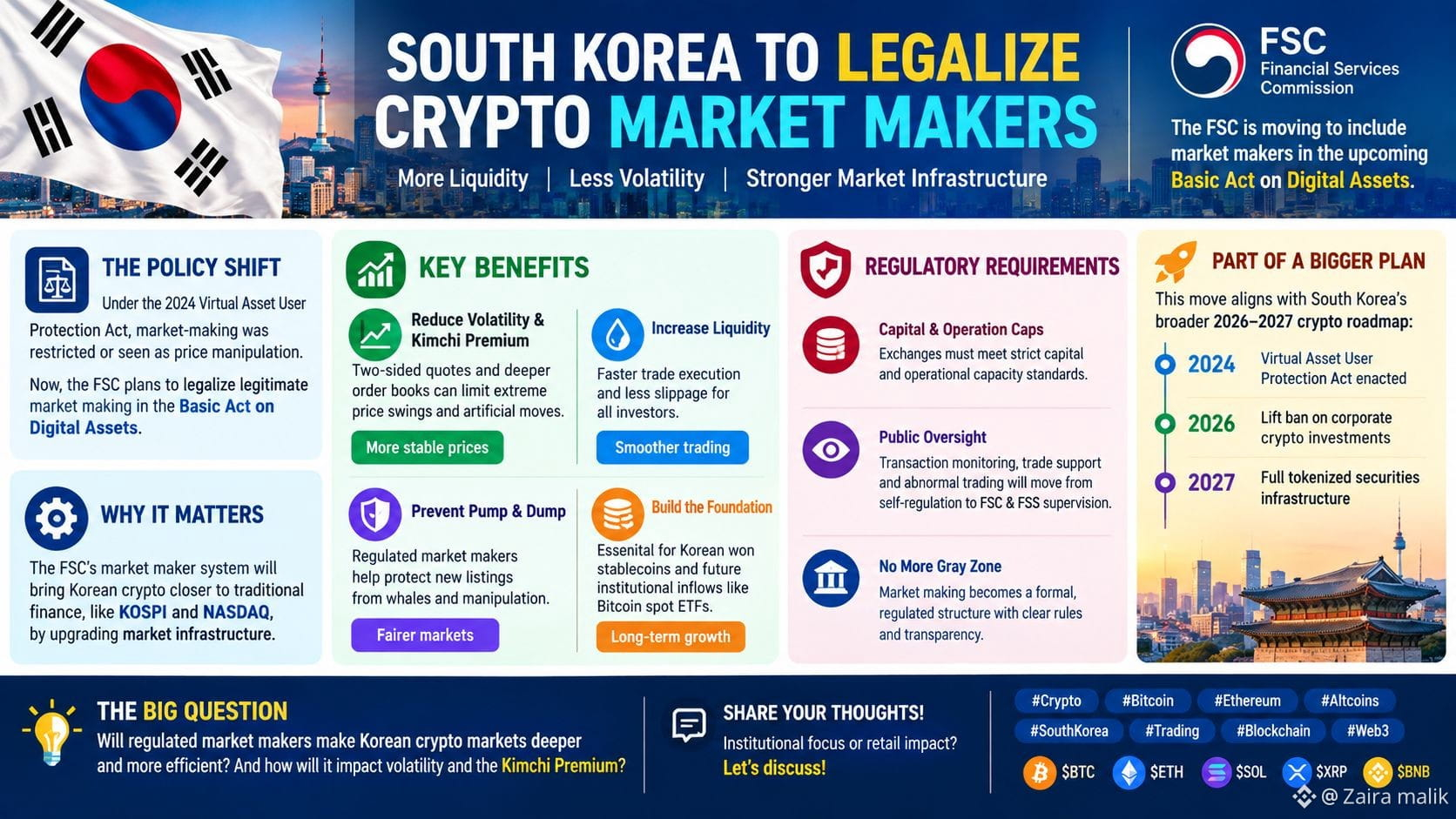
#skoreafscconsidersvirtualassetmarketmaker KOREA'S CRYPTO MARKET MAY SEE MORE LIQUIDITY
South Korea is creating a digital-asset plan while officials are making sure that trading is fair and the market is honest.
A market-maker system might change the way crypto markets work in South Korea:
• Having offers to buy and sell could make order books more filled.
• More liquidity could make it easier to trade without price changes.
• Better checking could stop tricks.
• High-quality systems could help more people use crypto.
For people who trade the message is clear: rules are getting strict more open and more organized.
Would regulated market makers make South Koreas crypto markets better and more efficient? What do you think will happen to price changes overall?
#BTC #ETH #altcoins #cryptotrading
$ETH $SOL $BNB
{future}(ETHUSDT)
{future}(SOLUSDT)
{future}(BNBUSDT)
#skoreafscconsidersvirtualassetmarketmaker KOREA'S CRYPTO MARKET MAY SEE MORE LIQUIDITY
South Korea is creating a digital-asset plan while officials are making sure that trading is fair and the market is honest.
A market-maker system might change the way crypto markets work in South Korea:
• Having offers to buy and sell could make order books more filled.
• More liquidity could make it easier to trade without price changes.
• Better checking could stop tricks.
• High-quality systems could help more people use crypto.
For people who trade the message is clear: rules are getting strict more open and more organized.
Would regulated market makers make South Koreas crypto markets better and more efficient? What do you think will happen to price changes overall?
#BTC #ETH #altcoins #cryptotrading
$ETH $SOL $BNB
South Korea is creating a digital-asset plan while officials are making sure that trading is fair and the market is honest.
A market-maker system might change the way crypto markets work in South Korea:
• Having offers to buy and sell could make order books more filled.
• More liquidity could make it easier to trade without price changes.
• Better checking could stop tricks.
• High-quality systems could help more people use crypto.
For people who trade the message is clear: rules are getting strict more open and more organized.
Would regulated market makers make South Koreas crypto markets better and more efficient? What do you think will happen to price changes overall?
#BTC #ETH #altcoins #cryptotrading
$ETH $SOL $BNB
2
4
4.9k
·
--
စိစစ်အတည်ပြုထားသည်
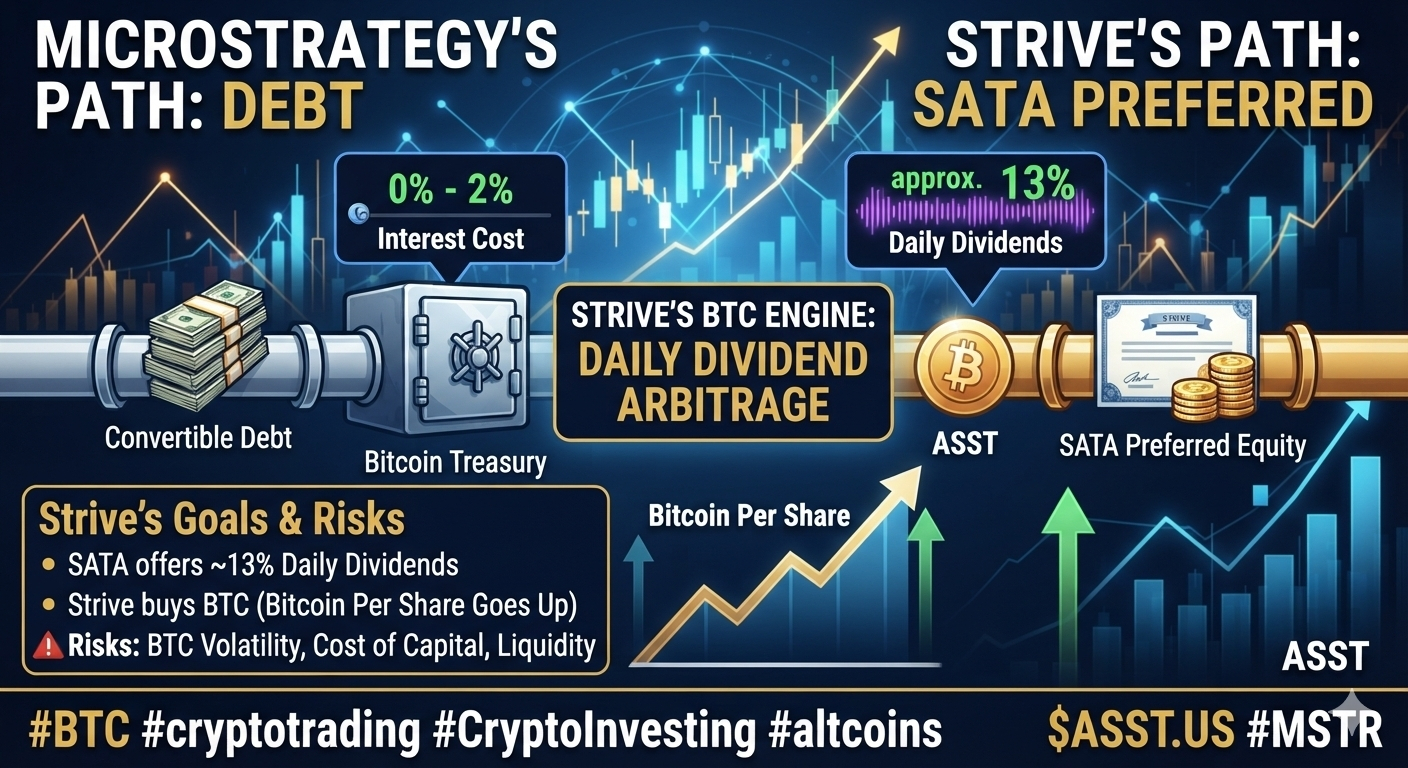
#strategystriveadd2305bitcointhisweek 🔥 STRIVE'S BTC ENGINE: A Different Way to Stack Bitcoin
Strive (NASDAQ: ASST) is going a way than MicroStrategy.
Of mostly using convertible debt Strive uses SATA preferred equity to get money and buy Bitcoin.
The main idea is:
• SATA offers about 13% dividends, given every day.
• Strive puts money into BTC.
• The plan is to make Bitcoin per share go up.
But people who trade should keep an eye on the risks: Bitcoin is very unstable preferred stock has costs there might not be liquidity and whether Bitcoin gains are more than the costs of financing.
It is an experiment, with the treasury.
Can Strives SATA model change how treasuries are handled? Let me know what you think below!
#BTC #cryptotrading #CryptoInvesting #altcoins
$ASST.US
{stock_us}(ASST.US)
{future}(MSTRUSDT)
$MSTR $SOL
{future}(SOLUSDT)
#strategystriveadd2305bitcointhisweek 🔥 STRIVE'S BTC ENGINE: A Different Way to Stack Bitcoin
Strive (NASDAQ: ASST) is going a way than MicroStrategy.
Of mostly using convertible debt Strive uses SATA preferred equity to get money and buy Bitcoin.
The main idea is:
• SATA offers about 13% dividends, given every day.
• Strive puts money into BTC.
• The plan is to make Bitcoin per share go up.
But people who trade should keep an eye on the risks: Bitcoin is very unstable preferred stock has costs there might not be liquidity and whether Bitcoin gains are more than the costs of financing.
It is an experiment, with the treasury.
Can Strives SATA model change how treasuries are handled? Let me know what you think below!
#BTC #cryptotrading #CryptoInvesting #altcoins
$ASST.US
$MSTR $SOL
Strive (NASDAQ: ASST) is going a way than MicroStrategy.
Of mostly using convertible debt Strive uses SATA preferred equity to get money and buy Bitcoin.
The main idea is:
• SATA offers about 13% dividends, given every day.
• Strive puts money into BTC.
• The plan is to make Bitcoin per share go up.
But people who trade should keep an eye on the risks: Bitcoin is very unstable preferred stock has costs there might not be liquidity and whether Bitcoin gains are more than the costs of financing.
It is an experiment, with the treasury.
Can Strives SATA model change how treasuries are handled? Let me know what you think below!
#BTC #cryptotrading #CryptoInvesting #altcoins
$ASST.US
$MSTR $SOL
2
5
3.9k
Log in to explore more content
Join global crypto users on Binance Square
⚡️ Get latest and useful information about crypto.
💬 Trusted by the world’s largest crypto exchange.
👍 Discover real insights from verified creators.
အီးမေးလ် / ဖုန်းနံပါတ်
ရေပန်းစားနေသော ခေါင်းစဉ်များ
BitcoinRejectedAt$87K
13,594 views
45 Discussing
$BTC Update 🚨 🐼 Skip THIS Warning at Your Own Risk ⚠️
BTC is knocking on 87K like it already owns the place 😂Bulls are awake… but BTC usually likes to shake a few people out before the real move.
Overall, BTC is breaking out and the higher-timeframe picture is still bullish. The 4H and daily structure are strong, price is holding above the major averages, and momentum is still supporting the move.
83K was honestly a beautiful buy location. That was the area where risk/reward made sense. Anyone who bought there is already sitting enjoying profit
Now come to main
BTC is sitting right under the previous high around 87K. So I would not be surprised if we first see a little downside liquidity grab, flush some late longs, and then BTC decides whether it wants the real breakout.
For today’s scalp, This is my Plan 👇
BTC SHORT scalp Entry: 86,550–86,900
TP1: 85,650
TP2: 84,850
TP3: 84,050
SL: 87,800
I only like this if we get a proper rejection near the highs. No blind shorting.
For the bigger picture, I’m still bullish as long as the 82.5K–83K area keeps holding. If BTC gets a clean breakout and starts accepting above 87.4K, then this whole short idea is invalid and the next bullish leg becomes much more interesting.
SO BASICALLY OCTOBER HISTORICAL IS BULLISH MONTH FOR BITCOIN.
ALWAYS DYOR
Panda Traders
·နှစ်သက်မှု 30 ခု
·12.8k views
FedOctoberRateHikeOddsFallTo17%
11,841 views
237 Discussing
NvidiaHitsRecordHighUp2.4%
2,118 views
147 Discussing