
MARRY_1
258 Publications

MARRY_1
27 Suivis
1.1K+ Abonnés
126 J’aime
Publications
@Dusk I've been looking at Dusk Network, and the part that stayed with me wasn't simply that it calls itself a privacy blockchain. I started wondering why privacy becomes so complicated once financial activity moves onto a public ledger.
The more I researched, the more obvious the tension felt. Blockchains are built around visibility, yet real financial systems often depend on keeping certain details away from public view. A company may need to prove something happened without revealing every number behind it. A participant may want programmable agreements without turning their entire financial history into an open book.
That's where Dusk became interesting to me. Its layer-1 architecture, Confidential Security Contract standard, and confidential smart contracts seem aimed at this uncomfortable gap between transparency and confidentiality. I like that the problem is practical rather than purely technical.
I also found myself thinking about how difficult adoption could be. Privacy infrastructure has to satisfy developers, businesses, regulators, and users at the same time. Good technology alone won't settle those competing demands.
For now, I'm not drawing big conclusions. I'm simply keeping Dusk on my radar because the question it is tackling feels increasingly relevant: how much should a financial blockchain reveal, and to whom?
@Dusk $DUSK #dusk
The more I researched, the more obvious the tension felt. Blockchains are built around visibility, yet real financial systems often depend on keeping certain details away from public view. A company may need to prove something happened without revealing every number behind it. A participant may want programmable agreements without turning their entire financial history into an open book.
That's where Dusk became interesting to me. Its layer-1 architecture, Confidential Security Contract standard, and confidential smart contracts seem aimed at this uncomfortable gap between transparency and confidentiality. I like that the problem is practical rather than purely technical.
I also found myself thinking about how difficult adoption could be. Privacy infrastructure has to satisfy developers, businesses, regulators, and users at the same time. Good technology alone won't settle those competing demands.
For now, I'm not drawing big conclusions. I'm simply keeping Dusk on my radar because the question it is tackling feels increasingly relevant: how much should a financial blockchain reveal, and to whom?
@Dusk $DUSK #dusk
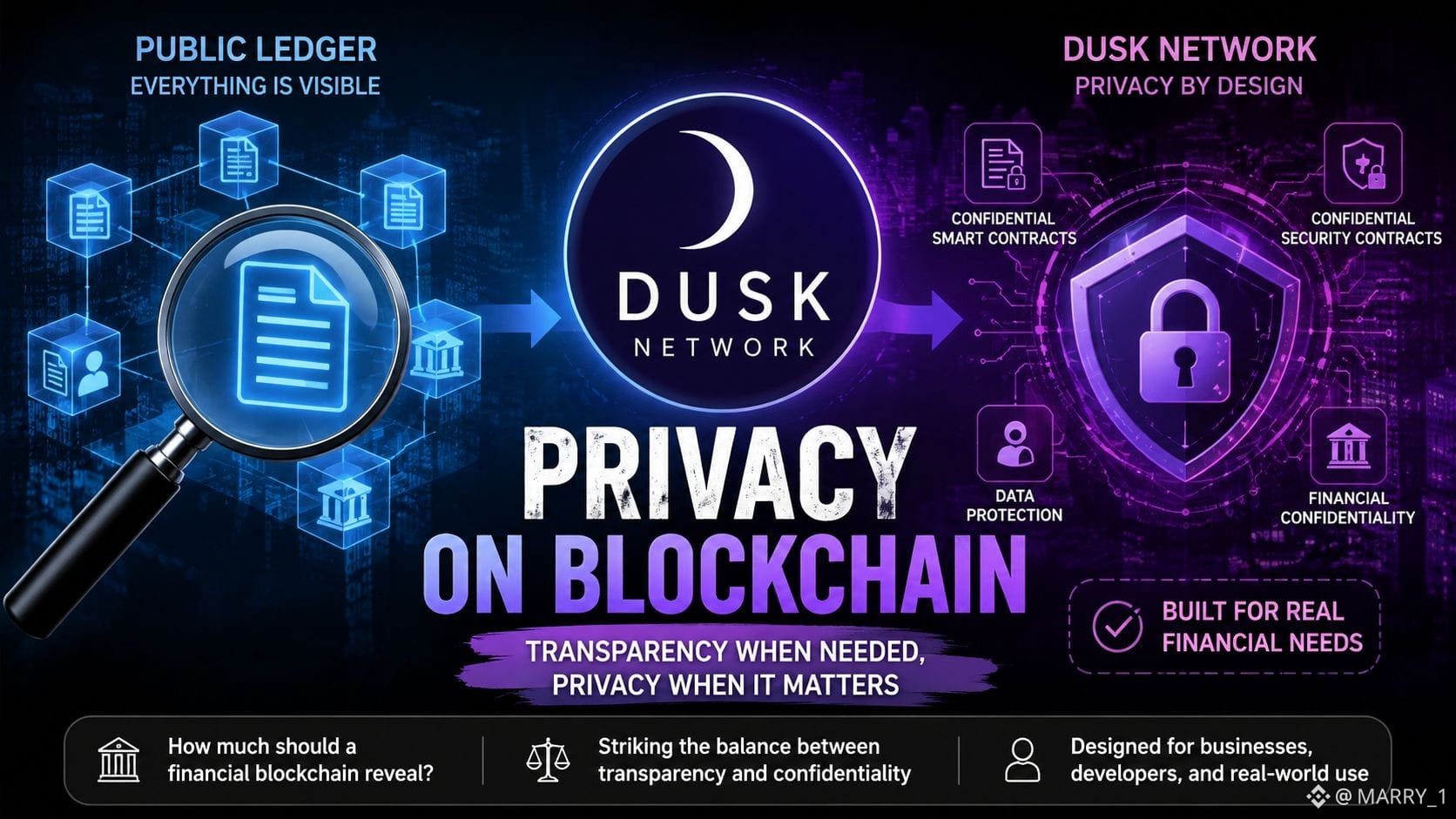
@Dusk I've been looking at Dusk Network from a slightly different angle lately. What pulled me in wasn't the word “privacy” by itself, but the awkward question underneath it: how can blockchain become useful for serious financial activity if everything is permanently exposed?
The more I thought about it, the more practical the problem became. A financial institution may want the benefits of a shared ledger, but it probably doesn't want every transaction, balance, or sensitive detail sitting in full public view. Dusk is trying to work around that tension at the protocol level, with confidential smart contracts and its Confidential Security Contract (XSC) standard.
While researching it, I found myself questioning an assumption I often see in crypto: that maximum transparency is always better. For payments and speculation, maybe. For real financial infrastructure, I'm not so sure.
What interests me about Dusk is that privacy isn't treated as a cosmetic feature. It's closer to the foundation.
But I’m not ready to overlook the difficult part. Adoption, regulation, developer experience, scalability, and competition will ultimately decide whether the idea works outside a technical demo.
That uncertainty is exactly why I’m continuing to follow Dusk. I want to see whether its approach can survive contact with real financial use.
@Dusk $DUSK #dusk
The more I thought about it, the more practical the problem became. A financial institution may want the benefits of a shared ledger, but it probably doesn't want every transaction, balance, or sensitive detail sitting in full public view. Dusk is trying to work around that tension at the protocol level, with confidential smart contracts and its Confidential Security Contract (XSC) standard.
While researching it, I found myself questioning an assumption I often see in crypto: that maximum transparency is always better. For payments and speculation, maybe. For real financial infrastructure, I'm not so sure.
What interests me about Dusk is that privacy isn't treated as a cosmetic feature. It's closer to the foundation.
But I’m not ready to overlook the difficult part. Adoption, regulation, developer experience, scalability, and competition will ultimately decide whether the idea works outside a technical demo.
That uncertainty is exactly why I’m continuing to follow Dusk. I want to see whether its approach can survive contact with real financial use.
@Dusk $DUSK #dusk
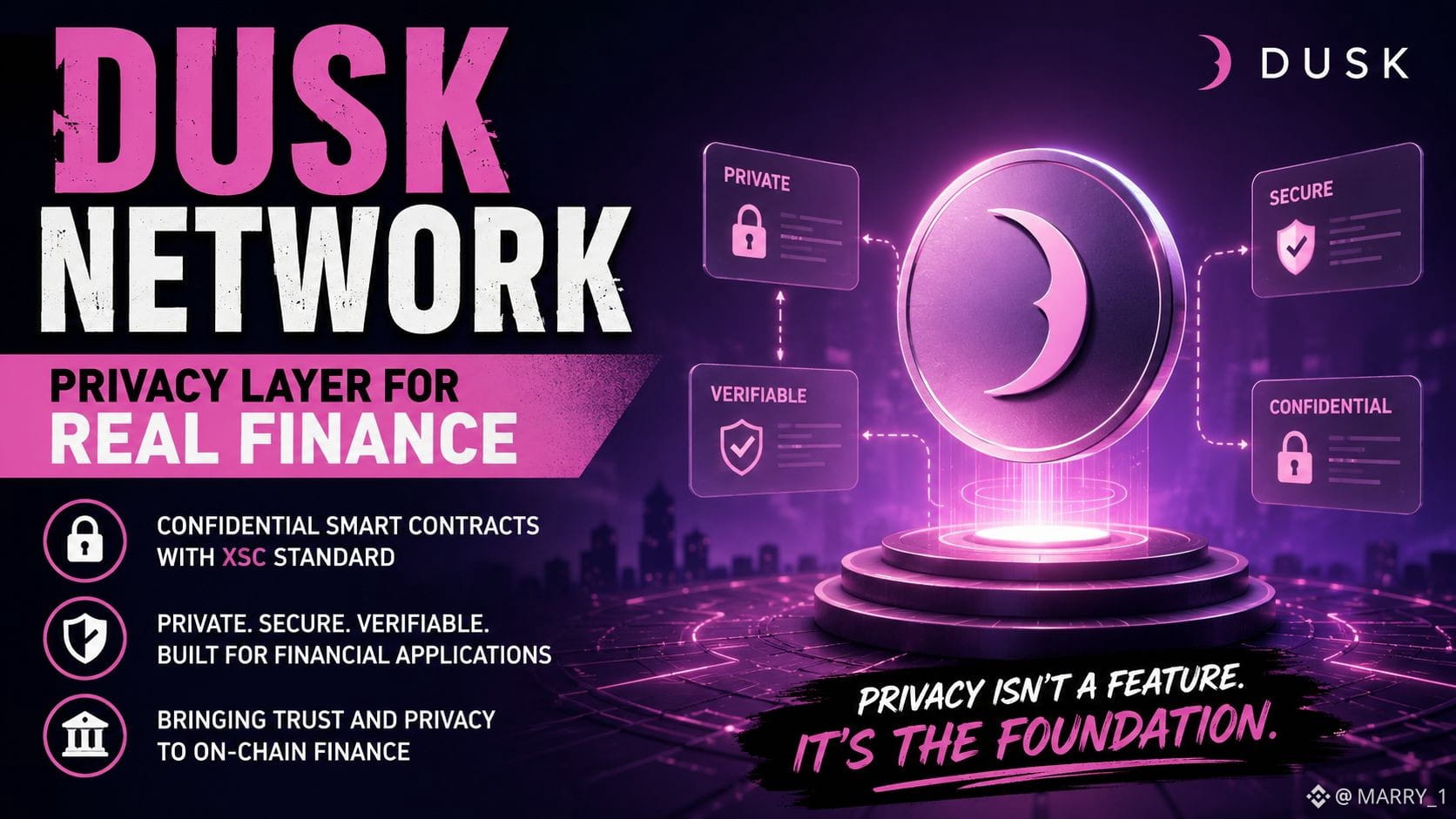
@Dusk I’ve been looking at Dusk Network from a different angle lately.
The interesting part isn’t simply that it is a privacy-focused Layer-1. It’s the financial problem sitting underneath it.
DeFi gave us transparent markets, but transparency can become a liability. Large positions are visible. Trading intentions can be exposed. Borrowers can be liquidated during temporary volatility. Liquidity can disappear when incentives dry up.
I keep wondering whether financial infrastructure really needs everyone to see everything.
Dusk is built around confidential smart contracts and its Confidential Security Contract standard, aiming to let financial activity remain verifiable without making every detail publicly exposed.
That matters because privacy can change behavior.
A borrower may want liquidity without selling an asset. An institution may need to manage a position without broadcasting its strategy. A market participant may need settlement and verification without revealing its entire balance sheet.
I also think this is where Dusk faces its hardest test.
Privacy alone isn’t enough. Financial systems still need accountability, liquidity, security, and credible risk management. Too much secrecy can create problems of its own.
So I’m less interested in whether Dusk can become “the next big chain.”
I’m more interested in whether confidential infrastructure can make on-chain finance practical for activities that currently stay off-chain.
If it can, the value proposition becomes much quieter—and potentially much more important.
Not more speculation.
More control.
More discretion.
And, ultimately, better financial infrastructure.
@Dusk $DUSK #dusk
The interesting part isn’t simply that it is a privacy-focused Layer-1. It’s the financial problem sitting underneath it.
DeFi gave us transparent markets, but transparency can become a liability. Large positions are visible. Trading intentions can be exposed. Borrowers can be liquidated during temporary volatility. Liquidity can disappear when incentives dry up.
I keep wondering whether financial infrastructure really needs everyone to see everything.
Dusk is built around confidential smart contracts and its Confidential Security Contract standard, aiming to let financial activity remain verifiable without making every detail publicly exposed.
That matters because privacy can change behavior.
A borrower may want liquidity without selling an asset. An institution may need to manage a position without broadcasting its strategy. A market participant may need settlement and verification without revealing its entire balance sheet.
I also think this is where Dusk faces its hardest test.
Privacy alone isn’t enough. Financial systems still need accountability, liquidity, security, and credible risk management. Too much secrecy can create problems of its own.
So I’m less interested in whether Dusk can become “the next big chain.”
I’m more interested in whether confidential infrastructure can make on-chain finance practical for activities that currently stay off-chain.
If it can, the value proposition becomes much quieter—and potentially much more important.
Not more speculation.
More control.
More discretion.
And, ultimately, better financial infrastructure.
@Dusk $DUSK #dusk
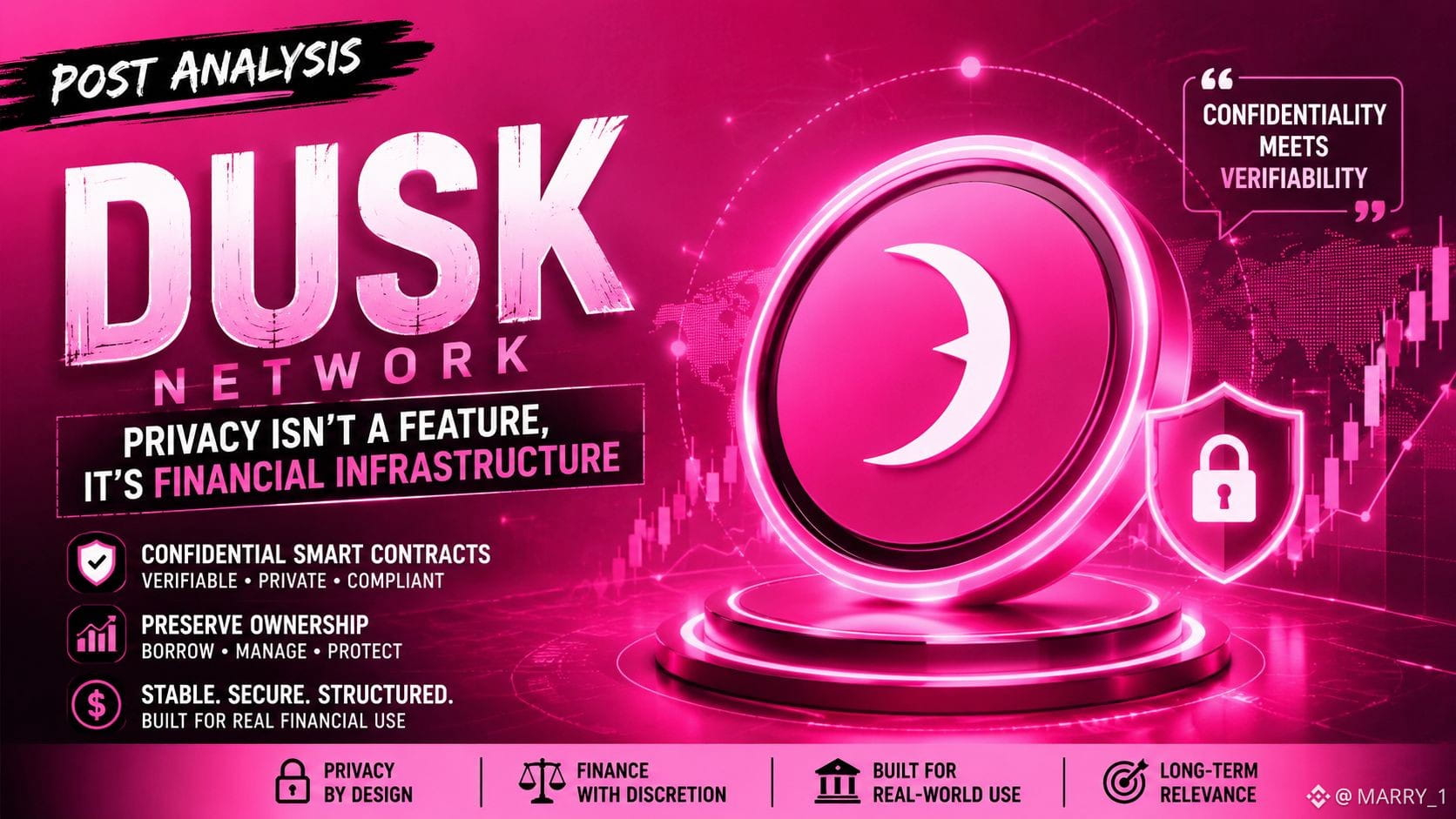
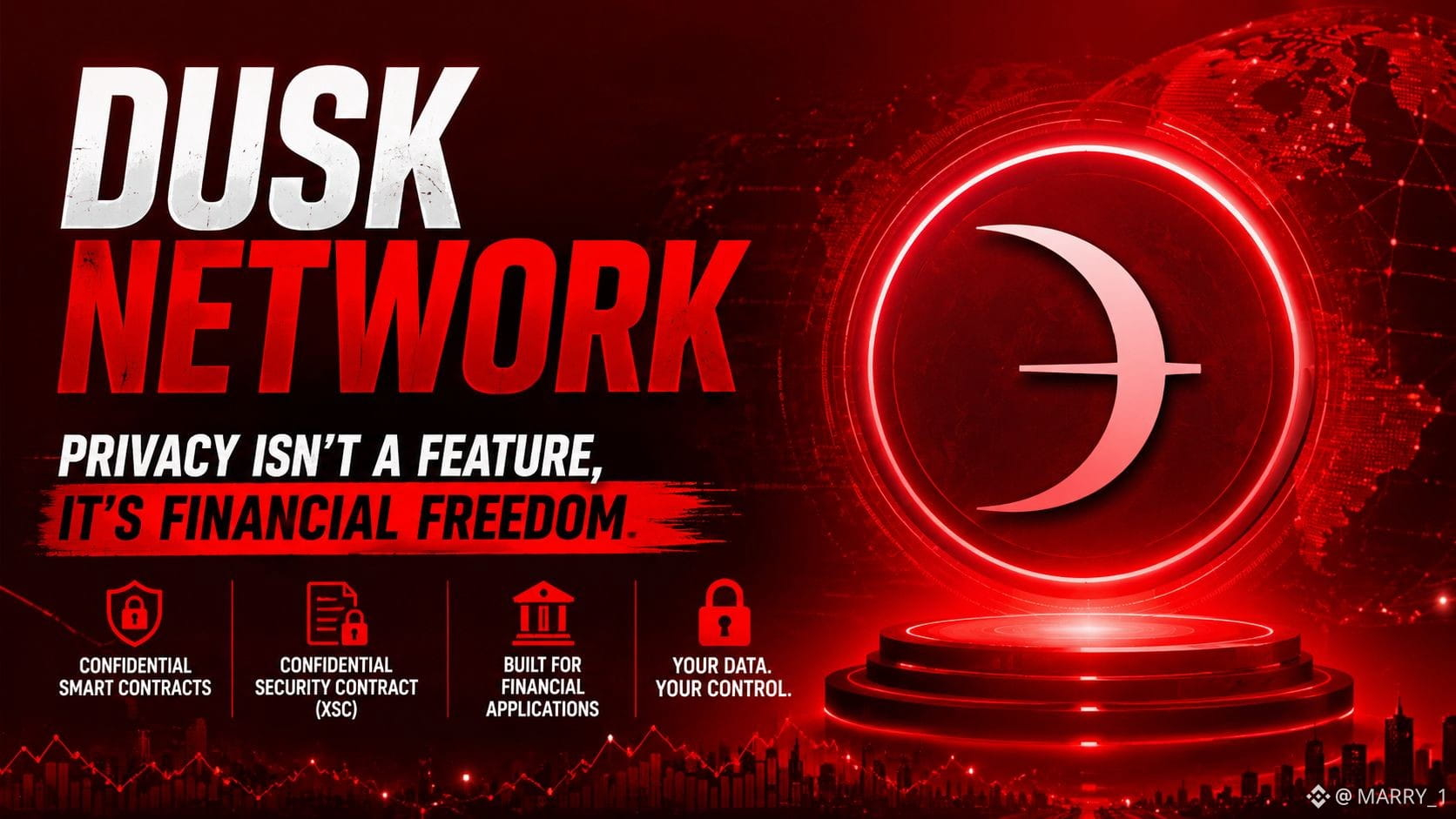
@Dusk I've been digging into Dusk Network, and what first pulled me in wasn't another promise of faster transactions or bigger markets. It was the decision to build around privacy for financial applications. That made me pause, because I've often thought of blockchain transparency as an unquestioned virtue.
The more I research financial systems, the more complicated that assumption feels. DeFi can make positions, collateral, and activity visible to everyone, but visibility can also create problems. Large positions may become targets, strategies can be copied, and sensitive financial information can expose participants to unnecessary pressure. Forced selling and fragile liquidity only make those weaknesses more obvious.
Dusk approaches this through a privacy-focused layer-1 and its Confidential Security Contract standard, aiming to let financial applications use confidential smart contracts. What interests me is the balance being attempted: preserving verifiable rules without requiring every detail to become public.
I also keep thinking about the economic side. Good infrastructure should help people manage ownership and liabilities, not constantly push them toward more activity. Privacy could become useful in that quieter sense.
Still, execution is the hard part. Confidential finance has to satisfy real requirements around verification, accountability, regulation, and adoption. That tension is exactly why I'm continuing to watch Dusk. I don't see a finished answer yet, but I see a worthwhile question.
@Dusk $DUSK #dusk
The more I research financial systems, the more complicated that assumption feels. DeFi can make positions, collateral, and activity visible to everyone, but visibility can also create problems. Large positions may become targets, strategies can be copied, and sensitive financial information can expose participants to unnecessary pressure. Forced selling and fragile liquidity only make those weaknesses more obvious.
Dusk approaches this through a privacy-focused layer-1 and its Confidential Security Contract standard, aiming to let financial applications use confidential smart contracts. What interests me is the balance being attempted: preserving verifiable rules without requiring every detail to become public.
I also keep thinking about the economic side. Good infrastructure should help people manage ownership and liabilities, not constantly push them toward more activity. Privacy could become useful in that quieter sense.
Still, execution is the hard part. Confidential finance has to satisfy real requirements around verification, accountability, regulation, and adoption. That tension is exactly why I'm continuing to watch Dusk. I don't see a finished answer yet, but I see a worthwhile question.
@Dusk $DUSK #dusk
@Dusk $DUSK #dusk
I keep coming back to one uncomfortable question in DeFi: what happens when transparency becomes a liability?
Dusk Network is interesting because it starts there—not with another race for yield, but with the limits of making every financial action visible.
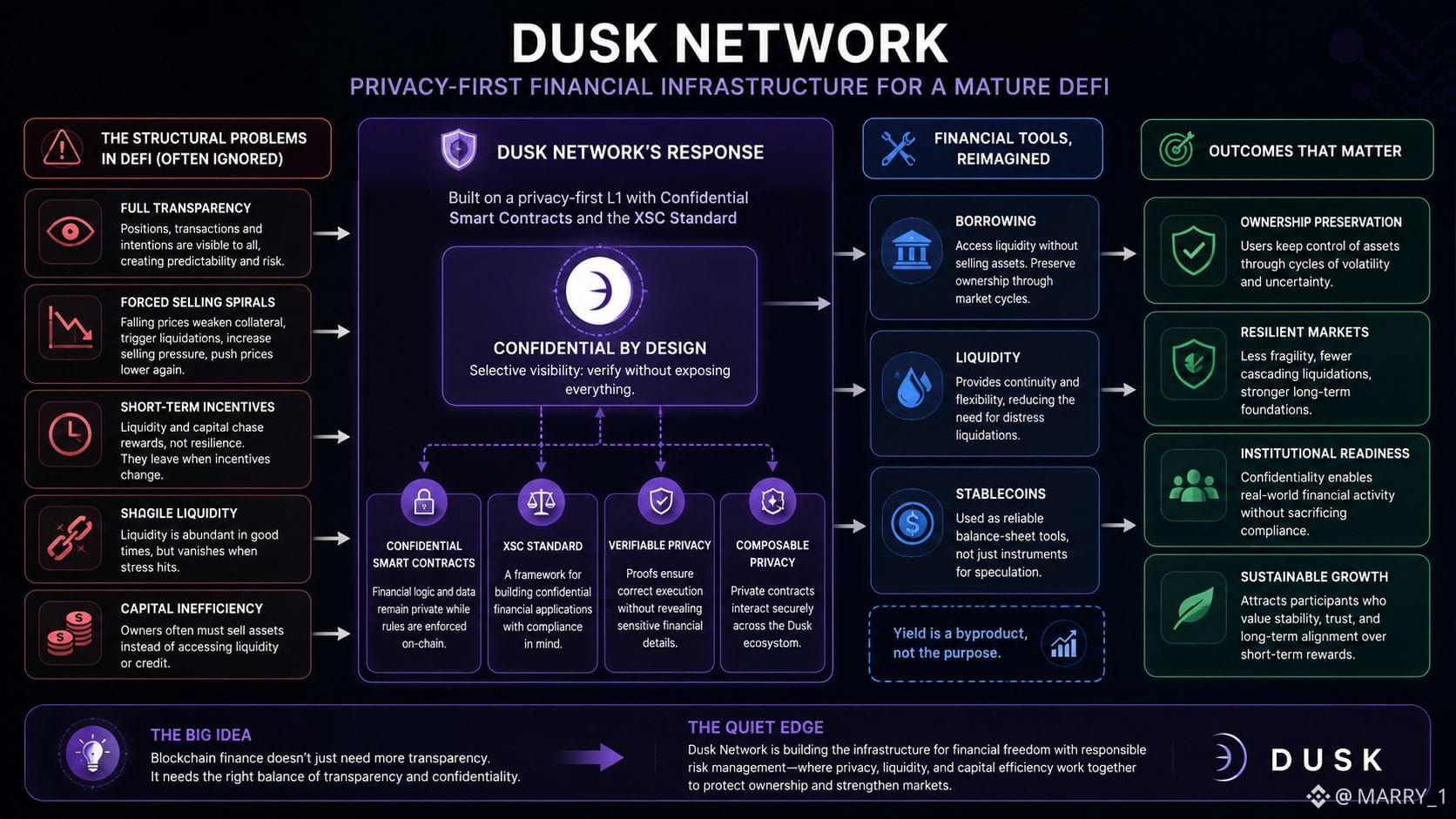
In DeFi, transparency creates trust, but it can also create predictable behavior. Positions become targets. Large transactions reveal intentions. Liquidity disappears when conditions turn ugly. And when collateral falls, forced selling can turn a temporary shock into a deeper spiral.
I think this is where Dusk’s privacy-focused architecture deserves attention.
Its layer-1 network and Confidential Security Contract (XSC) standard are designed around confidential financial applications and smart contracts. The bigger idea is selective visibility: financial activity can remain verifiable without exposing everything to everyone.
That matters beyond privacy itself.
I see borrowing as potentially useful for preserving ownership rather than maximizing leverage. I see liquidity as protection against being forced to sell at the worst possible moment. I see stablecoins as balance-sheet tools before speculative instruments.
The trade-off is real: privacy must not become opacity, and confidential systems still need accountability.
But perhaps that tension is exactly the point.
If blockchain finance is going to mature, it may need less obsession with what can be made public—and more thought about what genuinely needs to remain private.
Dusk is betting on that distinction. The real test comes when markets get uncomfortable.
I keep coming back to one uncomfortable question in DeFi: what happens when transparency becomes a liability?
Dusk Network is interesting because it starts there—not with another race for yield, but with the limits of making every financial action visible.
In DeFi, transparency creates trust, but it can also create predictable behavior. Positions become targets. Large transactions reveal intentions. Liquidity disappears when conditions turn ugly. And when collateral falls, forced selling can turn a temporary shock into a deeper spiral.
I think this is where Dusk’s privacy-focused architecture deserves attention.
Its layer-1 network and Confidential Security Contract (XSC) standard are designed around confidential financial applications and smart contracts. The bigger idea is selective visibility: financial activity can remain verifiable without exposing everything to everyone.
That matters beyond privacy itself.
I see borrowing as potentially useful for preserving ownership rather than maximizing leverage. I see liquidity as protection against being forced to sell at the worst possible moment. I see stablecoins as balance-sheet tools before speculative instruments.
The trade-off is real: privacy must not become opacity, and confidential systems still need accountability.
But perhaps that tension is exactly the point.
If blockchain finance is going to mature, it may need less obsession with what can be made public—and more thought about what genuinely needs to remain private.
Dusk is betting on that distinction. The real test comes when markets get uncomfortable.
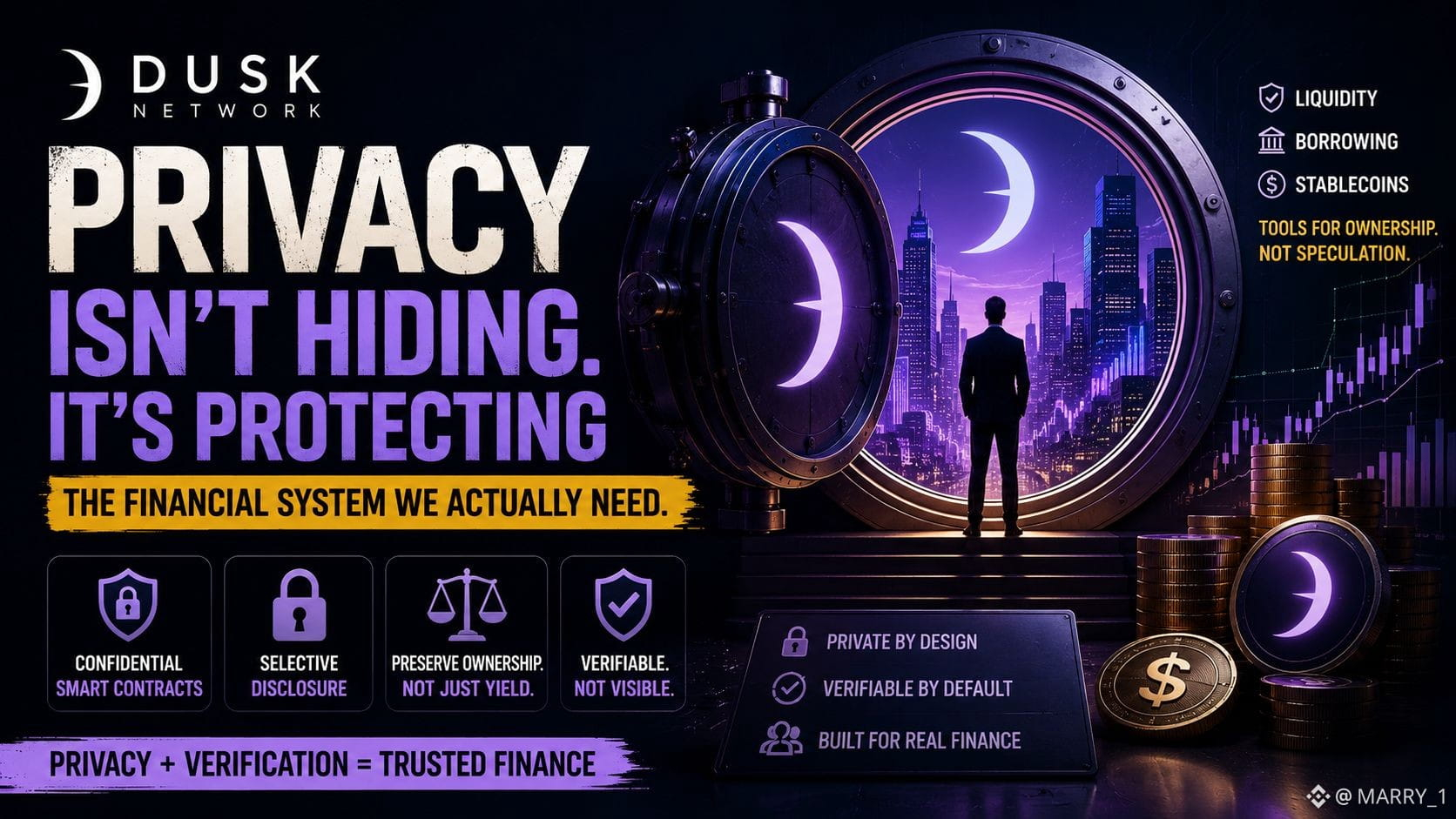
@Dusk I've been reading about Dusk Network again, and I keep coming back to something that feels easy to miss. The interesting part may not be privacy itself, but what privacy changes about the way financial information can move onchain.
Most blockchains treat transparency almost like a default virtue. Everyone can see the activity, the balances, and often the relationships between transactions. That works well until the information being exposed is actually commercially sensitive.
This is where Dusk gets more interesting to me. Its focus on confidential smart contracts and the Confidential Security Contract standard seems less about making everything invisible and more about deciding what really needs to be revealed.
I could be wrong, but I think that is a much harder problem than simply saying "private blockchain." Financial systems still need rules, verification, and accountability. They just don't necessarily need every detail sitting in public view forever.
What I'm watching is whether Dusk can make that balance feel natural. Privacy that creates friction probably won't get very far, while transparency without boundaries can create its own problems.
The more I think about it, the bigger question seems to be whether blockchains can become useful for serious financial activity without forcing institutions to expose information they would normally keep confidential.
I'm still waiting to see how Dusk handles that tension in practice. Maybe the real breakthrough isn't hiding financial activity, but making selective visibility possible. Is that the more important direction for onchain finance?
@Dusk $DUSK #dusk
Most blockchains treat transparency almost like a default virtue. Everyone can see the activity, the balances, and often the relationships between transactions. That works well until the information being exposed is actually commercially sensitive.
This is where Dusk gets more interesting to me. Its focus on confidential smart contracts and the Confidential Security Contract standard seems less about making everything invisible and more about deciding what really needs to be revealed.
I could be wrong, but I think that is a much harder problem than simply saying "private blockchain." Financial systems still need rules, verification, and accountability. They just don't necessarily need every detail sitting in public view forever.
What I'm watching is whether Dusk can make that balance feel natural. Privacy that creates friction probably won't get very far, while transparency without boundaries can create its own problems.
The more I think about it, the bigger question seems to be whether blockchains can become useful for serious financial activity without forcing institutions to expose information they would normally keep confidential.
I'm still waiting to see how Dusk handles that tension in practice. Maybe the real breakthrough isn't hiding financial activity, but making selective visibility possible. Is that the more important direction for onchain finance?
@Dusk $DUSK #dusk
$SNDK is moving fast, and this is where I’d be watching carefully.
Price: $1,812.96
Support: $1,780–1,800
Resistance: $1,850
Next target: $1,950–2,000
The important thing here is momentum. $SNDK has already made a powerful move, so chasing the green candle is not the part that interests me. I’m watching whether price can hold above $1,800 and then attack $1,850 with volume. A clean breakout above resistance could open the door toward $1,950 and potentially $2,000.
If $1,780 fails, I’d become much more cautious because a sharp rally can retrace quickly.
#ChinaJulyOutputRetailInvestmentAllMiss #CMESeptemberHikeOddsFallTo30.6% #IsraelStrikesLebanonKillsHezbollahCommander #CardanoSplitsDijkstraUpgradeIntoTwoPhases #SECReviewsSix3xLeveragedCommodityETFs
Price: $1,812.96
Support: $1,780–1,800
Resistance: $1,850
Next target: $1,950–2,000
The important thing here is momentum. $SNDK has already made a powerful move, so chasing the green candle is not the part that interests me. I’m watching whether price can hold above $1,800 and then attack $1,850 with volume. A clean breakout above resistance could open the door toward $1,950 and potentially $2,000.
If $1,780 fails, I’d become much more cautious because a sharp rally can retrace quickly.
#ChinaJulyOutputRetailInvestmentAllMiss #CMESeptemberHikeOddsFallTo30.6% #IsraelStrikesLebanonKillsHezbollahCommander #CardanoSplitsDijkstraUpgradeIntoTwoPhases #SECReviewsSix3xLeveragedCommodityETFs
$MU looks like it wants another leg higher, but $1,050 is the level I’m watching.
Price: $1,025.15
Support: $1,000–1,010
Resistance: $1,050
Next target: $1,100–1,150
The setup is simple: holding above $1,000 keeps the bullish structure alive. If MU breaks $1,050 convincingly, I’d watch $1,100 next. Above that, $1,150 becomes the next psychological zone.
But after such a strong move, a pullback toward support would not automatically mean weakness. Sometimes the healthier move is simply consolidation before the next breakout.
#ChinaJulyOutputRetailInvestmentAllMiss #CMESeptemberHikeOddsFallTo30.6% #IsraelStrikesLebanonKillsHezbollahCommander #CardanoSplitsDijkstraUpgradeIntoTwoPhases #SECReviewsSix3xLeveragedCommodityETFs
Price: $1,025.15
Support: $1,000–1,010
Resistance: $1,050
Next target: $1,100–1,150
The setup is simple: holding above $1,000 keeps the bullish structure alive. If MU breaks $1,050 convincingly, I’d watch $1,100 next. Above that, $1,150 becomes the next psychological zone.
But after such a strong move, a pullback toward support would not automatically mean weakness. Sometimes the healthier move is simply consolidation before the next breakout.
#ChinaJulyOutputRetailInvestmentAllMiss #CMESeptemberHikeOddsFallTo30.6% #IsraelStrikesLebanonKillsHezbollahCommander #CardanoSplitsDijkstraUpgradeIntoTwoPhases #SECReviewsSix3xLeveragedCommodityETFs
$NVDA is the quiet one on this list, but that does not mean I’m ignoring it.
Price: $225.04
Support: $220–222
Resistance: $230
Next target: $240–250
For me, $230 is the trigger zone. If $NVDA can reclaim and hold above it, momentum could accelerate toward $240 and then $250.
The interesting part is that NVDA doesn't need a huge percentage move to change the chart structure. A clean breakout can quickly turn resistance into support.
If $220 breaks decisively, I’d step back and wait for a new base rather than forcing the trade.
#ChinaJulyOutputRetailInvestmentAllMiss #CMESeptemberHikeOddsFallTo30.6% #IsraelStrikesLebanonKillsHezbollahCommander #SECCancelsCryptoRulemakingMeeting #SECReviewsSix3xLeveragedCommodityETFs
Price: $225.04
Support: $220–222
Resistance: $230
Next target: $240–250
For me, $230 is the trigger zone. If $NVDA can reclaim and hold above it, momentum could accelerate toward $240 and then $250.
The interesting part is that NVDA doesn't need a huge percentage move to change the chart structure. A clean breakout can quickly turn resistance into support.
If $220 breaks decisively, I’d step back and wait for a new base rather than forcing the trade.
#ChinaJulyOutputRetailInvestmentAllMiss #CMESeptemberHikeOddsFallTo30.6% #IsraelStrikesLebanonKillsHezbollahCommander #SECCancelsCryptoRulemakingMeeting #SECReviewsSix3xLeveragedCommodityETFs
$TSLA is the one I would approach differently here.
Price: $339.95
Support: $330–335
Resistance: $350
Next target: $365–380
Tesla is sitting near a psychological $350 barrier. A clean break and hold above $350 could bring $365 first, followed by the $380 area.
But the risk is obvious: if buyers fail around $350 and price falls below $330, momentum could cool quickly.
So I’m not interested in blindly chasing $TSLA here. I’m watching the reaction around $350. That level should tell us whether this is continuation or simply another failed push higher.
#ChinaJulyOutputRetailInvestmentAllMiss #CMESeptemberHikeOddsFallTo30.6% #IsraelStrikesLebanonKillsHezbollahCommander #CardanoSplitsDijkstraUpgradeIntoTwoPhases #SECCancelsCryptoRulemakingMeeting
Price: $339.95
Support: $330–335
Resistance: $350
Next target: $365–380
Tesla is sitting near a psychological $350 barrier. A clean break and hold above $350 could bring $365 first, followed by the $380 area.
But the risk is obvious: if buyers fail around $350 and price falls below $330, momentum could cool quickly.
So I’m not interested in blindly chasing $TSLA here. I’m watching the reaction around $350. That level should tell us whether this is continuation or simply another failed push higher.
#ChinaJulyOutputRetailInvestmentAllMiss #CMESeptemberHikeOddsFallTo30.6% #IsraelStrikesLebanonKillsHezbollahCommander #CardanoSplitsDijkstraUpgradeIntoTwoPhases #SECCancelsCryptoRulemakingMeeting
$SPCX is probably the most explosive setup on this list right now.
Price: $145.84
Support: $140–142
Resistance: $150
Next target: $165
$150 is the obvious battle zone. $SPCX recently pushed close to that level, and the stock has shown unusually strong momentum after recovering from below $105. A decisive break above $150 could put $165 into focus.
But this is also where I would respect volatility. If $150 rejects hard, $140 becomes the first level I’d watch. Losing $135 would weaken the short-term structure considerably.
For me, $SPCX is not about predicting the next candle. It is about watching whether buyers can finally turn $150 from resistance into support.
#ChinaJulyOutputRetailInvestmentAllMiss #CMESeptemberHikeOddsFallTo30.6% #IsraelStrikesLebanonKillsHezbollahCommander #CardanoSplitsDijkstraUpgradeIntoTwoPhases #SECCancelsCryptoRulemakingMeeting
Price: $145.84
Support: $140–142
Resistance: $150
Next target: $165
$150 is the obvious battle zone. $SPCX recently pushed close to that level, and the stock has shown unusually strong momentum after recovering from below $105. A decisive break above $150 could put $165 into focus.
But this is also where I would respect volatility. If $150 rejects hard, $140 becomes the first level I’d watch. Losing $135 would weaken the short-term structure considerably.
For me, $SPCX is not about predicting the next candle. It is about watching whether buyers can finally turn $150 from resistance into support.
#ChinaJulyOutputRetailInvestmentAllMiss #CMESeptemberHikeOddsFallTo30.6% #IsraelStrikesLebanonKillsHezbollahCommander #CardanoSplitsDijkstraUpgradeIntoTwoPhases #SECCancelsCryptoRulemakingMeeting
Dusk Network: The Part of DeFi I Think Gets Overlooked
I've been thinking about @Dusk Network from a slightly different angle. The interesting part isn't simply that it brings privacy to a blockchain. It's why financial applications might actually need privacy in the first place.
DeFi was built around transparency, but complete transparency can create its own problems. When everyone can see a position, a balance, or a large transaction, that information can influence behavior. Traders react, liquidity moves, and borrowers can sometimes end up selling assets simply because market conditions turned against them.
That is where Dusk becomes interesting to me. Its layer-1 is designed around confidential smart contracts and the Confidential Security Contract standard, with financial applications in mind. The idea isn't necessarily to hide everything. It is to make information available where it is needed without making every financial detail public by default.
I think that distinction matters. Good financial infrastructure should not encourage people to constantly react to what everyone else can see.
Borrowing, liquidity, and stablecoins can be useful for managing a balance sheet, preserving ownership, and creating breathing room during volatile periods. The goal doesn't always have to be extracting another percentage of yield.
Dusk still has plenty to prove. Privacy introduces trade-offs around usability, compliance, transparency, and adoption.
For me, that is what makes the project worth watching. Its real test is whether financial privacy can create calmer, more durable on-chain markets—not simply another reason to chase returns.
@Dusk $DUSK #dusk
I've been thinking about @Dusk Network from a slightly different angle. The interesting part isn't simply that it brings privacy to a blockchain. It's why financial applications might actually need privacy in the first place.
DeFi was built around transparency, but complete transparency can create its own problems. When everyone can see a position, a balance, or a large transaction, that information can influence behavior. Traders react, liquidity moves, and borrowers can sometimes end up selling assets simply because market conditions turned against them.
That is where Dusk becomes interesting to me. Its layer-1 is designed around confidential smart contracts and the Confidential Security Contract standard, with financial applications in mind. The idea isn't necessarily to hide everything. It is to make information available where it is needed without making every financial detail public by default.
I think that distinction matters. Good financial infrastructure should not encourage people to constantly react to what everyone else can see.
Borrowing, liquidity, and stablecoins can be useful for managing a balance sheet, preserving ownership, and creating breathing room during volatile periods. The goal doesn't always have to be extracting another percentage of yield.
Dusk still has plenty to prove. Privacy introduces trade-offs around usability, compliance, transparency, and adoption.
For me, that is what makes the project worth watching. Its real test is whether financial privacy can create calmer, more durable on-chain markets—not simply another reason to chase returns.
@Dusk $DUSK #dusk
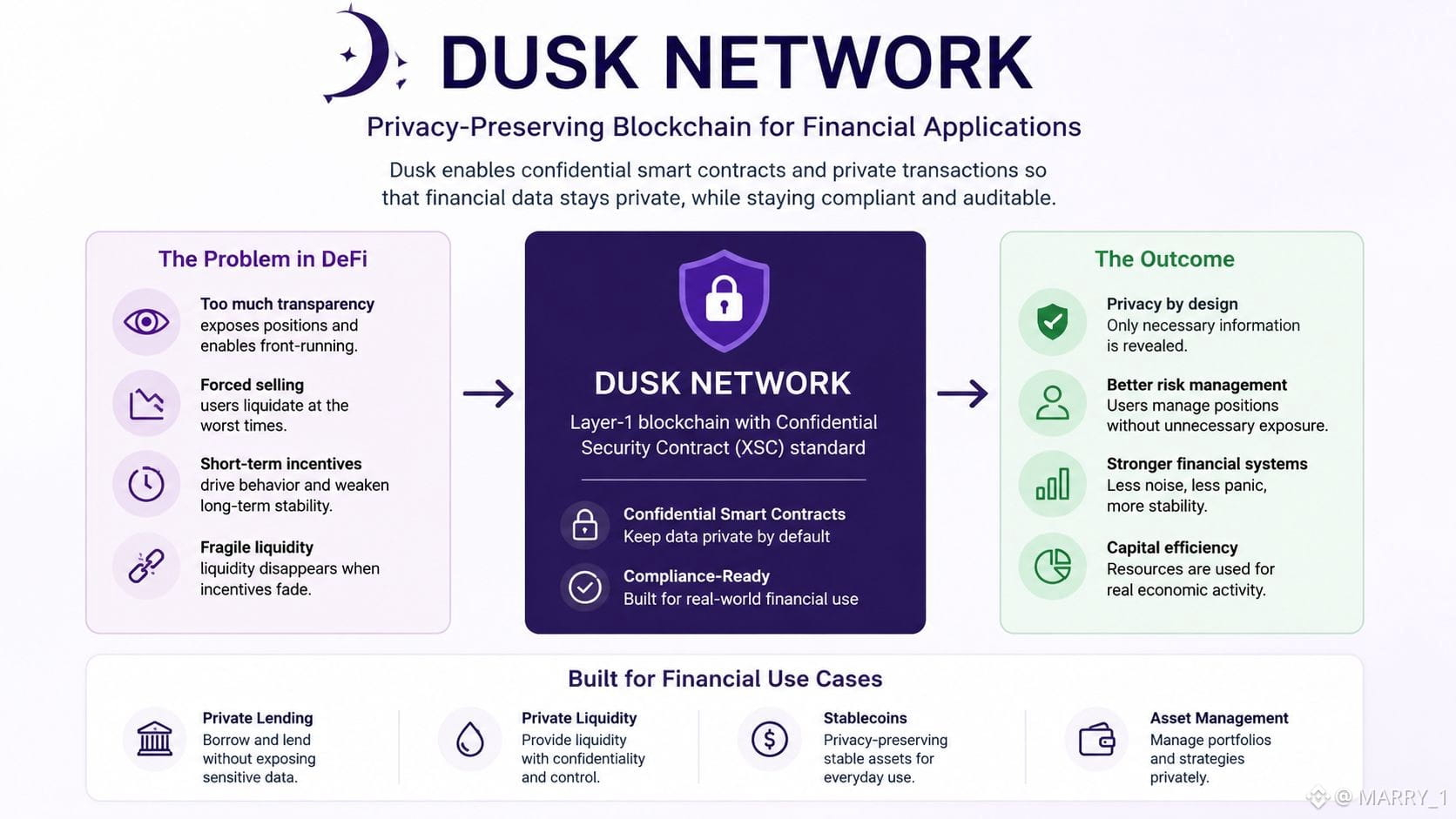
@Dusk I keep coming back to Dusk because I think its real story is bigger than “privacy blockchain.”
DeFi has become very good at moving capital.
But I think we still underestimate how often that movement becomes a problem.
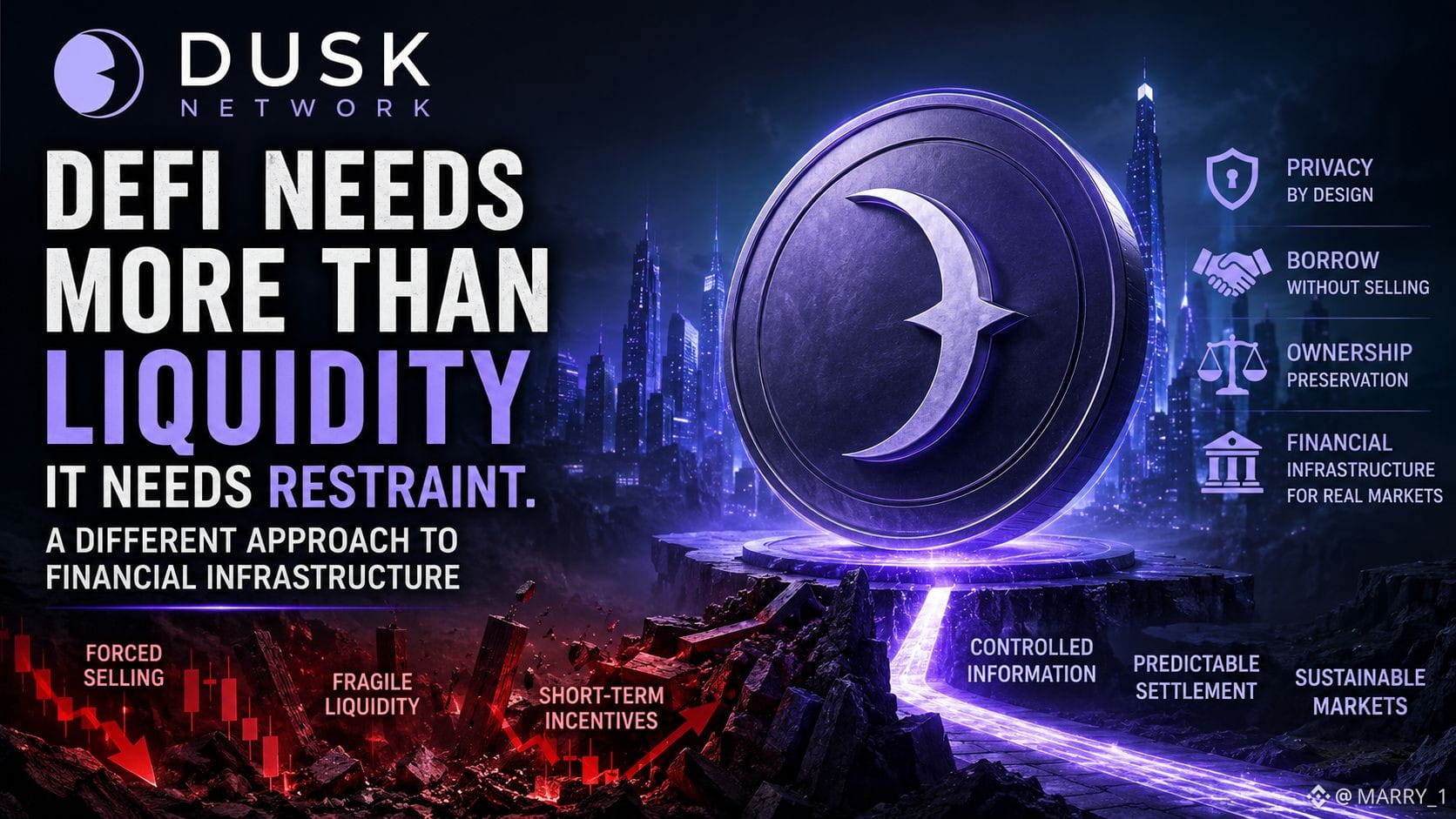
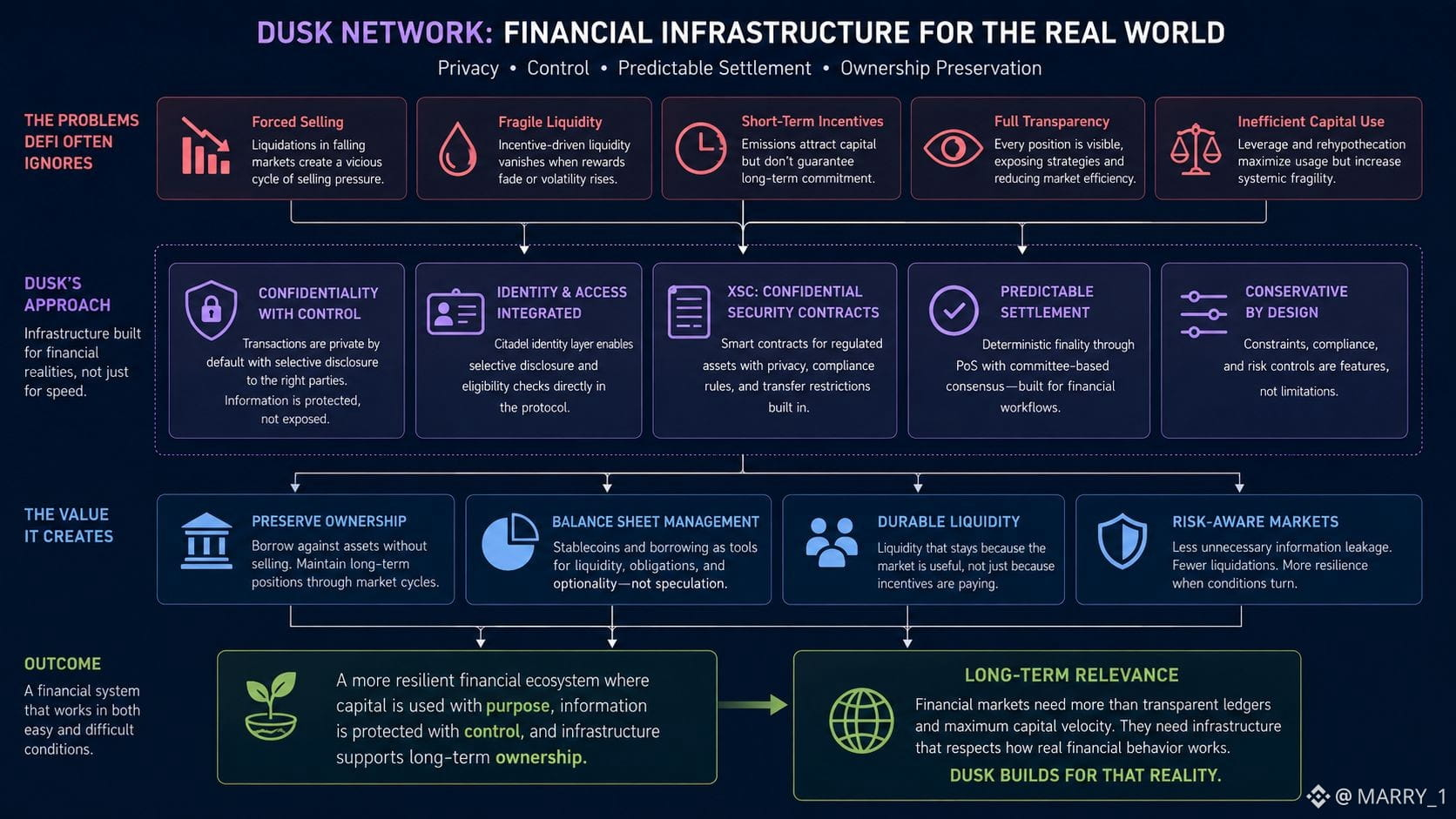
When markets turn, leverage can trigger forced selling. Liquidity can disappear when incentives fall. Borrowers may have to sell assets they wanted to keep. And transparent blockchains can reveal financial positions that traditional markets would normally protect.
That’s where Dusk gets interesting to me.
I see its design less as a race for maximum activity and more as an attempt to build financial infrastructure around restraint.
Privacy matters because financial information has value.
Borrowing matters because liquidity should not always require giving up ownership.
Stablecoins matter because they can help manage a balance sheet without constantly changing the underlying position.
And liquidity should ideally exist because the market is useful—not simply because someone is paying participants to stay.
I don’t think Dusk needs to promise everything.
Its stronger argument is quieter:
Build financial rails that still make sense when markets become difficult.
That’s the part I’ll be watching.
@Dusk $DUSK #dusk
DeFi has become very good at moving capital.
But I think we still underestimate how often that movement becomes a problem.
When markets turn, leverage can trigger forced selling. Liquidity can disappear when incentives fall. Borrowers may have to sell assets they wanted to keep. And transparent blockchains can reveal financial positions that traditional markets would normally protect.
That’s where Dusk gets interesting to me.
I see its design less as a race for maximum activity and more as an attempt to build financial infrastructure around restraint.
Privacy matters because financial information has value.
Borrowing matters because liquidity should not always require giving up ownership.
Stablecoins matter because they can help manage a balance sheet without constantly changing the underlying position.
And liquidity should ideally exist because the market is useful—not simply because someone is paying participants to stay.
I don’t think Dusk needs to promise everything.
Its stronger argument is quieter:
Build financial rails that still make sense when markets become difficult.
That’s the part I’ll be watching.
@Dusk $DUSK #dusk
$CAP is starting to heat up.
Trading around $0.06846, $CAP is showing a solid +3.89% move. The key now is whether buyers can push through the next resistance zone.
Support: $0.0660–$0.0670
Resistance: $0.0710–$0.0730
Next Target: $0.0780–$0.0800
A clean break above $0.073 could bring momentum traders back into the game. Watch the volume closely—$CAP could get interesting if buyers keep control.
#SECReviewsSix3xLeveragedCommodityETFs #USToPressNationsToPickUSOrChinaAICoalition #SP500TopsRecord7800 #SP500EarningsBeatExpectations #LMECopperStocksFall42DaysLongestSince2014
Trading around $0.06846, $CAP is showing a solid +3.89% move. The key now is whether buyers can push through the next resistance zone.
Support: $0.0660–$0.0670
Resistance: $0.0710–$0.0730
Next Target: $0.0780–$0.0800
A clean break above $0.073 could bring momentum traders back into the game. Watch the volume closely—$CAP could get interesting if buyers keep control.
#SECReviewsSix3xLeveragedCommodityETFs #USToPressNationsToPickUSOrChinaAICoalition #SP500TopsRecord7800 #SP500EarningsBeatExpectations #LMECopperStocksFall42DaysLongestSince2014
$BASED is waking up fast.
With a strong +8.95% move, BASED is already showing aggressive buying pressure. The question is whether this momentum can turn into a breakout.
Support: $0.0790–$0.0810
Resistance: $0.0860–$0.0890
Next Target: $0.0950–$0.1000
If $BASED clears $0.089 with strong volume, the psychological $0.10 level becomes the obvious target. This is one to keep firmly on the radar.
#SECReviewsSix3xLeveragedCommodityETFs #USToPressNationsToPickUSOrChinaAICoalition #SP500TopsRecord7800 #SP500EarningsBeatExpectations #LMECopperStocksFall42DaysLongestSince2014
With a strong +8.95% move, BASED is already showing aggressive buying pressure. The question is whether this momentum can turn into a breakout.
Support: $0.0790–$0.0810
Resistance: $0.0860–$0.0890
Next Target: $0.0950–$0.1000
If $BASED clears $0.089 with strong volume, the psychological $0.10 level becomes the obvious target. This is one to keep firmly on the radar.
#SECReviewsSix3xLeveragedCommodityETFs #USToPressNationsToPickUSOrChinaAICoalition #SP500TopsRecord7800 #SP500EarningsBeatExpectations #LMECopperStocksFall42DaysLongestSince2014
$BTW is making the strongest move in this group.
Up 10.38%, $BTW is showing serious short-term momentum. Now comes the important part: can buyers defend the breakout and push toward the next resistance?
Support: $0.305–$0.315
Resistance: $0.335–$0.345
Next Target: $0.365–$0.380
A decisive move above $0.345 could accelerate the trend toward $0.38. Momentum is clearly with the buyers right now, but support must hold.
#SECReviewsSix3xLeveragedCommodityETFs #USToPressNationsToPickUSOrChinaAICoalition #SP500TopsRecord7800 #LMECopperStocksFall42DaysLongestSince2014 #BNBChainToActivatePasteurHardFork
Up 10.38%, $BTW is showing serious short-term momentum. Now comes the important part: can buyers defend the breakout and push toward the next resistance?
Support: $0.305–$0.315
Resistance: $0.335–$0.345
Next Target: $0.365–$0.380
A decisive move above $0.345 could accelerate the trend toward $0.38. Momentum is clearly with the buyers right now, but support must hold.
#SECReviewsSix3xLeveragedCommodityETFs #USToPressNationsToPickUSOrChinaAICoalition #SP500TopsRecord7800 #LMECopperStocksFall42DaysLongestSince2014 #BNBChainToActivatePasteurHardFork
$我踏马来了 — $0.0091952
This one is quietly building attention.
Trading around $0.009195, the coin is up 1.73%. It hasn't moved as aggressively as some others here, which makes the next breakout level especially important.
Support: $0.0088–$0.0090
Resistance: $0.0095–$0.0098
Next Target: $0.0105–$0.0110
A clean reclaim of $0.0098 could open the door toward the psychological $0.01+ zone. Watch for volume expansion before chasing the move.
#SECReviewsSix3xLeveragedCommodityETFs #USToPressNationsToPickUSOrChinaAICoalition #SP500TopsRecord7800 #SP500EarningsBeatExpectations #LMECopperStocksFall42DaysLongestSince2014
This one is quietly building attention.
Trading around $0.009195, the coin is up 1.73%. It hasn't moved as aggressively as some others here, which makes the next breakout level especially important.
Support: $0.0088–$0.0090
Resistance: $0.0095–$0.0098
Next Target: $0.0105–$0.0110
A clean reclaim of $0.0098 could open the door toward the psychological $0.01+ zone. Watch for volume expansion before chasing the move.
#SECReviewsSix3xLeveragedCommodityETFs #USToPressNationsToPickUSOrChinaAICoalition #SP500TopsRecord7800 #SP500EarningsBeatExpectations #LMECopperStocksFall42DaysLongestSince2014
$SKYAI is showing serious momentum.
Up 10.71%, SKYAI currently has the biggest gain among these five. The next battle is around the $0.073–$0.075 area.
Support: $0.0660–$0.0680
Resistance: $0.0730–$0.0750
Next Target: $0.0800–$0.0850
If buyers break and hold above $0.075, $SKYAI could quickly enter the $0.08+ zone. Momentum is strong, but confirmation matters.
#SECReviewsSix3xLeveragedCommodityETFs #SP500TopsRecord7800 #SP500EarningsBeatExpectations #LMECopperStocksFall42DaysLongestSince2014 #BNBChainToActivatePasteurHardFork
Up 10.71%, SKYAI currently has the biggest gain among these five. The next battle is around the $0.073–$0.075 area.
Support: $0.0660–$0.0680
Resistance: $0.0730–$0.0750
Next Target: $0.0800–$0.0850
If buyers break and hold above $0.075, $SKYAI could quickly enter the $0.08+ zone. Momentum is strong, but confirmation matters.
#SECReviewsSix3xLeveragedCommodityETFs #SP500TopsRecord7800 #SP500EarningsBeatExpectations #LMECopperStocksFall42DaysLongestSince2014 #BNBChainToActivatePasteurHardFork
@Dusk I've been watching Dusk Network from the angle of what privacy needs to look like when blockchains start handling financial activity. The interesting part is what that actually means.
What I keep coming back to is that financial privacy may be less about hiding everything and more about controlling what parties are allowed to see. That matters when institutions still need compliance and selective disclosure.
Dusk's Confidential Security Contract standard makes this interesting because it puts confidentiality to smart contracts. That's a different problem from adding privacy around existing transactions.
I'm still unsure how much this matters until real applications use it in practice. A privacy system can still struggle if developers find it difficult to build with or users have little reason to change.
I could be wrong, but I think the overlooked narrative is that privacy may become infrastructure rather than a feature. If financial applications need different visibility for users, institutions, regulators, and counterparties, that flexibility could become important.
I'm more interested in seeing how Dusk balances confidentiality with accountability. Could programmable privacy eventually become as important to financial blockchains as programmable money itself, eventually?
@Dusk $DUSK #dusk
$COW
$CYS
What I keep coming back to is that financial privacy may be less about hiding everything and more about controlling what parties are allowed to see. That matters when institutions still need compliance and selective disclosure.
Dusk's Confidential Security Contract standard makes this interesting because it puts confidentiality to smart contracts. That's a different problem from adding privacy around existing transactions.
I'm still unsure how much this matters until real applications use it in practice. A privacy system can still struggle if developers find it difficult to build with or users have little reason to change.
I could be wrong, but I think the overlooked narrative is that privacy may become infrastructure rather than a feature. If financial applications need different visibility for users, institutions, regulators, and counterparties, that flexibility could become important.
I'm more interested in seeing how Dusk balances confidentiality with accountability. Could programmable privacy eventually become as important to financial blockchains as programmable money itself, eventually?
@Dusk $DUSK #dusk
$COW
$CYS
🎯 Privacy as infrastructure
100%
💰 Price speculation
0%
⛏️ Mining rewards
0%
🚀 Faster trading
0%
1 Votes • Vote fermé
$AKE is waking up. +43.64% is not a quiet move.
Price: 0.010212
Support: 0.0095–0.0098
Resistance: 0.0110
Next targets: 0.0118 → 0.0125 → 0.0135
If $AKE breaks and holds above 0.0110, momentum could accelerate fast. The key is whether buyers can defend the breakout instead of giving back the move.
$AKE bulls have the spotlight. Watch the breakout.
#UkraineSaysOdesaBlackSeaPortsEffectivelyClosed #SP500SlipsFridayThirdStraightWeeklyGain #AnthropicIPOMeetingsSkipFinancialsValuation #KalshiOrderedToSuspendWashingtonOperations #ProCapFilesBitcoinTreasuryDiscountETF
Price: 0.010212
Support: 0.0095–0.0098
Resistance: 0.0110
Next targets: 0.0118 → 0.0125 → 0.0135
If $AKE breaks and holds above 0.0110, momentum could accelerate fast. The key is whether buyers can defend the breakout instead of giving back the move.
$AKE bulls have the spotlight. Watch the breakout.
#UkraineSaysOdesaBlackSeaPortsEffectivelyClosed #SP500SlipsFridayThirdStraightWeeklyGain #AnthropicIPOMeetingsSkipFinancialsValuation #KalshiOrderedToSuspendWashingtonOperations #ProCapFilesBitcoinTreasuryDiscountETF
Connectez-vous pour découvrir plus de contenu