

OLISEY
64 Publications

OLISEY
Signaler
Bloquer l’utilisateur
Web3 Marketing & Growth | Content Writing | Holder of $BNB $SOL $WKC $GTAN $TWD
Ouvert au trading
11 mois
11 Suivis
16 Abonnés
29 J’aime
Publications
Portefeuille
Tous
Citations
Vidéos
·
--
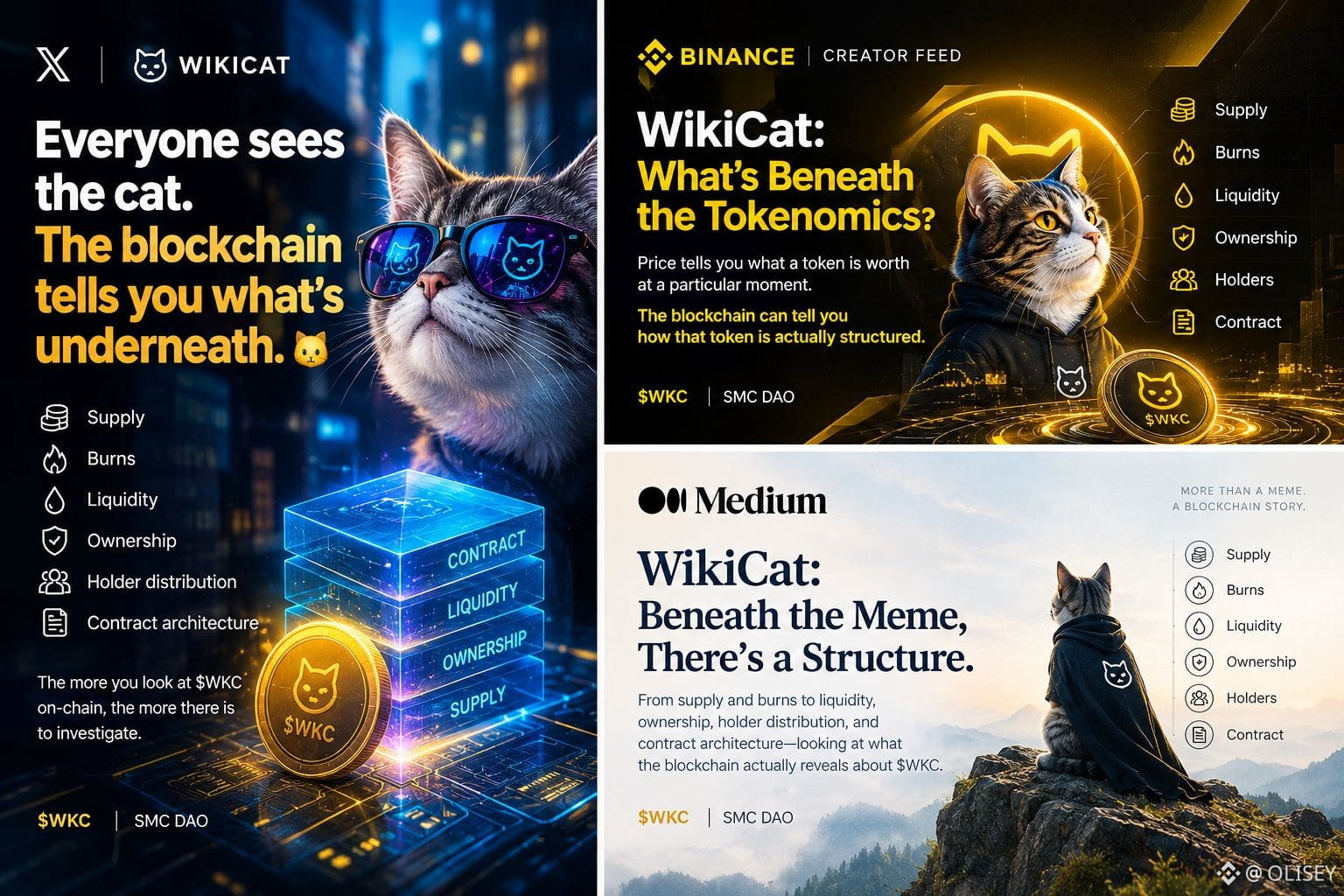
Everyone sees the cat. The blockchain tells you what's underneath. 🐱
The more you look behind WikiCat, the more there is to investigate. 🐱
Supply structure. Burns. Liquidity. Renounced ownership. Contract architecture. A growing wallet base.
The cat may be the meme.
But the structure is the story.
Explore. Research. Learn. Build.
$WKC | SMC DAO🚀🚀😁
[ ] Written by: SOLOMON OLISEY
[ ] Follow on X: @Seshiro_SmcDao
$BNB #BNB_Market_Update
{spot}(BNBUSDT)
Everyone sees the cat. The blockchain tells you what's underneath. 🐱
The more you look behind WikiCat, the more there is to investigate. 🐱
Supply structure. Burns. Liquidity. Renounced ownership. Contract architecture. A growing wallet base.
The cat may be the meme.
But the structure is the story.
Explore. Research. Learn. Build.
$WKC | SMC DAO🚀🚀😁
[ ] Written by: SOLOMON OLISEY
[ ] Follow on X: @Seshiro_SmcDao
$BNB #BNB_Market_Update
The more you look behind WikiCat, the more there is to investigate. 🐱
Supply structure. Burns. Liquidity. Renounced ownership. Contract architecture. A growing wallet base.
The cat may be the meme.
But the structure is the story.
Explore. Research. Learn. Build.
$WKC | SMC DAO🚀🚀😁
[ ] Written by: SOLOMON OLISEY
[ ] Follow on X: @Seshiro_SmcDao
$BNB #BNB_Market_Update
76
·
--
Article
WikiCat: The Foundation Behind the CatIn cryptocurrency, a project can be easy to recognize without being easy to understand.
You see the name.
You see the symbol.
You see the community.
You see the memes.
But before forming an opinion about a project, there is a more important question:
What is actually behind it?
WikiCat ($WKC) is a good example of why that question matters.
At first glance, WikiCat looks like what many people would expect from a cat-themed crypto project.
But its documented history starts from a somewhat different place.
WikiCat started as an educational experiment
According to WikiCat's own documentation, WikiCat was created by Sir Mapy for the SMC DAO community and launched on March 20, 2022, on BNB Chain.
Its original purpose was not simply to create another token.
WikiCat's documentation describes it as an educational experiment designed to help members of the SMC DAO community learn about cryptocurrency and blockchain technology.
That gives the project an important starting point.
Before WikiCat became a recognizable community token, it was connected to a simple idea:
Learn by participating.
Instead of only talking about blockchain technology, the community could create and interact with an actual blockchain token.
That token became WikiCat.
The original structure
WikiCat's project documentation states that the token launched with an original maximum supply of 1 quadrillion WKC.
According to that documentation, approximately 30% of the supply was sent to a burn wallet at deployment, while the remaining supply was made available through PancakeSwap.
The same documentation states that no tokens were reserved for Sir Mapy or another individual, that ownership was renounced, and that the original transaction structure included a 2% tax, with 1% directed toward burning.
The project also states that its initial liquidity was approximately $700 in BNB, with liquidity locked for two years and subsequently sent to a dead wallet when the lock expired.
These are important pieces of WikiCat's documented origin story, but they should be understood in the proper context: these particular historical details come from the project's own documentation.
BNB Chain is part of the identity
WikiCat operates on BNB Chain, making it part of a much larger environment of decentralized applications, tokens, wallets, exchanges, and Web3 communities.
The current WikiCat community channel identifies the project as a BNB Chain token created by Sir Mapy for SMC DAO and publishes the contract address:
0x6Ec90334d89dBdc89E08A133271be3d104128Edb
That address matters.
In crypto, a ticker alone is not enough to identify an asset safely. The same symbol can exist across different networks or represent different tokens.
For that reason, serious discussion of WikiCat should identify the asset by its name, ticker, network, and contract address, rather than simply saying “WKC.”
WikiCat and SMC DAO
The WikiCat story also cannot be separated completely from SMC DAO.
SMC DAO's own community handbook identifies WikiCat among its projects and describes it as a BNB Chain meme coin created by Sir Mapy for the SMC DAO community.
That makes the relationship more specific than simply saying that two unrelated crypto communities happen to know each other.
WikiCat originated within the SMC DAO community.
Over time, the broader SMC DAO environment has developed beyond individual tokens.
Its current platform describes a digital community focused on the digital economy and provides educational material, research, courses, quizzes, community interaction, rewards, badges, and news.
This creates a larger context around WikiCat.
The token is one component.
The community is another.
The infrastructure being developed around that community is another.
The ecosystem became bigger than the original experiment
This is perhaps the most interesting part of the story.
A project that began as an educational token can evolve as the community around it develops.
SMC DAO's 2026 reporting describes continued development around products and initiatives including Peniwallet, Peniremit, StableNaira, the SMC DAO App, payment infrastructure, wallet infrastructure, blockchain infrastructure, education, research, and security.
This does not mean every product automatically gives WKC utility.
That distinction matters.
It means that WikiCat now exists inside a broader environment that is doing considerably more than simply maintaining a token.
That is the ecosystem story we should investigate.
The community has grown
Community size is another part of the current WikiCat picture.
SMC DAO reported in August 2026 that WikiCat had surpassed 176,000 wallet holders.
An early-September on-chain/index snapshot reported approximately 178,570 holders.
Those numbers should be interpreted carefully.
A wallet address is not automatically a unique human being.
One person can control multiple wallets, while some wallets can belong to exchanges, contracts, or other entities.
So the appropriate statement is not:
“178,000 people own WikiCat.”
The defensible statement is:
Recent reports place the WikiCat holder count in the range of roughly 176,000–179,000 wallet addresses.
That is still a significant community metric, while avoiding a claim the data cannot prove.
WKC's current market picture
Market data provides another snapshot of where WikiCat stands.
As of September 23, 2026, CoinGecko's historical data places WikiCat's market capitalization at approximately $38.45 million.
CoinRanking reports a similar figure of approximately $37.96 million.
The small difference is normal when comparing different market-data providers because their data collection and timing can differ.
More importantly, these numbers are a snapshot.
They should never be treated as permanent characteristics of the project.
Crypto markets change continuously.
Price changes.
Volume changes.
Market capitalization changes.
Holder counts change.
Therefore, responsible WikiCat content should always attach a date to market data rather than presenting a temporary measurement as an eternal fact.
There is also a developing utility story
The broader SMC DAO ecosystem has begun connecting WKC with other forms of digital infrastructure.
One example comes from SMC DAO's April 2026 review of Peniremit.
SMC DAO reported that during testing, WikiCat was the preferred payment token among its 35 dedicated testers, compared with USDT.
That is an interesting development because it moves the conversation away from simply asking what WKC represents and toward asking how the token can be incorporated into an ecosystem's products.
But the number needs to be interpreted correctly.
Thirty-five testers do not represent mass adoption.
They represent a reported testing group.
So the meaningful observation is not:
“WikiCat has become a globally adopted payment currency.”
There is no evidence for that conclusion.
The meaningful observation is:
SMC DAO has reported experimentation with WKC as a payment token within Peniremit's testing environment.
That is evidence of experimentation, not proof of widespread adoption.
Where Binance fits into the story
There is an important distinction here.
WikiCat can be discussed on Binance Creator Feed, but that does not mean WKC is listed for Spot trading on Binance Exchange.
Binance currently maintains a dedicated Wiki Cat information page and explicitly states that WKC is not available for Spot trading on the Binance Exchange.
Binance's information also describes a route involving Binance Wallet and decentralized-exchange liquidity where supported.
That distinction is essential.
A responsible creator should never turn the existence of a Binance information page into the claim that Binance has officially listed WKC for Spot trading.
The accurate story is simpler:
WikiCat exists within the Binance information ecosystem, while its current Spot-listing status is different from its availability through Web3 wallet/DEX routes.
That is the level of precision crypto content needs.
So what exactly is WikiCat?
At the simplest level:
WikiCat is a BNB Chain token known as WKC, created by Sir Mapy for the SMC DAO community and launched on March 20, 2022.
But that sentence only gives us the beginning.
The larger story is that WikiCat originated as an educational experiment and subsequently became part of a broader community ecosystem.
That ecosystem now includes educational resources, research, community infrastructure, wallet initiatives, payment initiatives, and other digital-economy projects associated with SMC DAO.
At the same time, WKC remains a cryptocurrency asset operating in a highly competitive and volatile market.
Those two realities can exist at the same time.
The ecosystem can grow.
The community can grow.
Products can be developed.
And the token can still face the same market risks that affect other crypto assets.
Understanding both sides is important.
The WikiCat story is bigger than the meme—but the evidence matters
It is tempting to summarize WikiCat with a simple slogan:
“It's not a meme. It's an ecosystem.”
But that statement is too simplistic.
The better story is more precise.
WikiCat has a meme-oriented identity.
It began as an educational experiment.
It was created for the SMC DAO community.
It operates on BNB Chain.
It has developed a substantial reported wallet-holder base.
It exists within a broader SMC DAO ecosystem that has expanded into education, research, wallets, payments, and digital-economy infrastructure.
And the community is continuing to build around it.
Those are the pieces.
The narrative comes from connecting them.
That is what makes WikiCat interesting.
Not a promise.
Not a price prediction.
Not a guarantee of future success.
A story.
A community.
A token.
An ecosystem.
And a project that began with something remarkably simple:
teach people about crypto by giving them something real to participate in.
The cat was the entry point.
The community became the story.
And the ecosystem is the chapter we are watching now.
The meme may be what people notice first.
The story is what they discover next.
Explore. Research. Learn. Build.
$WKC | SMC DAO | WikiCat 🚀🚀😁
[ ] Written by: SOLOMON OLISEY
[ ] Follow on X: @Seshiro_SmcDao
$BNB #bnb #WikiCat
WikiCat: The Foundation Behind the Cat
In cryptocurrency, a project can be easy to recognize without being easy to understand.
You see the name.
You see the symbol.
You see the community.
You see the memes.
But before forming an opinion about a project, there is a more important question:
What is actually behind it?
WikiCat ($WKC) is a good example of why that question matters.
At first glance, WikiCat looks like what many people would expect from a cat-themed crypto project.
But its documented history starts from a somewhat different place.
WikiCat started as an educational experiment
According to WikiCat's own documentation, WikiCat was created by Sir Mapy for the SMC DAO community and launched on March 20, 2022, on BNB Chain.
Its original purpose was not simply to create another token.
WikiCat's documentation describes it as an educational experiment designed to help members of the SMC DAO community learn about cryptocurrency and blockchain technology.
That gives the project an important starting point.
Before WikiCat became a recognizable community token, it was connected to a simple idea:
Learn by participating.
Instead of only talking about blockchain technology, the community could create and interact with an actual blockchain token.
That token became WikiCat.
The original structure
WikiCat's project documentation states that the token launched with an original maximum supply of 1 quadrillion WKC.
According to that documentation, approximately 30% of the supply was sent to a burn wallet at deployment, while the remaining supply was made available through PancakeSwap.
The same documentation states that no tokens were reserved for Sir Mapy or another individual, that ownership was renounced, and that the original transaction structure included a 2% tax, with 1% directed toward burning.
The project also states that its initial liquidity was approximately $700 in BNB, with liquidity locked for two years and subsequently sent to a dead wallet when the lock expired.
These are important pieces of WikiCat's documented origin story, but they should be understood in the proper context: these particular historical details come from the project's own documentation.
BNB Chain is part of the identity
WikiCat operates on BNB Chain, making it part of a much larger environment of decentralized applications, tokens, wallets, exchanges, and Web3 communities.
The current WikiCat community channel identifies the project as a BNB Chain token created by Sir Mapy for SMC DAO and publishes the contract address:
0x6Ec90334d89dBdc89E08A133271be3d104128Edb
That address matters.
In crypto, a ticker alone is not enough to identify an asset safely. The same symbol can exist across different networks or represent different tokens.
For that reason, serious discussion of WikiCat should identify the asset by its name, ticker, network, and contract address, rather than simply saying “WKC.”
WikiCat and SMC DAO
The WikiCat story also cannot be separated completely from SMC DAO.
SMC DAO's own community handbook identifies WikiCat among its projects and describes it as a BNB Chain meme coin created by Sir Mapy for the SMC DAO community.
That makes the relationship more specific than simply saying that two unrelated crypto communities happen to know each other.
WikiCat originated within the SMC DAO community.
Over time, the broader SMC DAO environment has developed beyond individual tokens.
Its current platform describes a digital community focused on the digital economy and provides educational material, research, courses, quizzes, community interaction, rewards, badges, and news.
This creates a larger context around WikiCat.
The token is one component.
The community is another.
The infrastructure being developed around that community is another.
The ecosystem became bigger than the original experiment
This is perhaps the most interesting part of the story.
A project that began as an educational token can evolve as the community around it develops.
SMC DAO's 2026 reporting describes continued development around products and initiatives including Peniwallet, Peniremit, StableNaira, the SMC DAO App, payment infrastructure, wallet infrastructure, blockchain infrastructure, education, research, and security.
This does not mean every product automatically gives WKC utility.
That distinction matters.
It means that WikiCat now exists inside a broader environment that is doing considerably more than simply maintaining a token.
That is the ecosystem story we should investigate.
The community has grown
Community size is another part of the current WikiCat picture.
SMC DAO reported in August 2026 that WikiCat had surpassed 176,000 wallet holders.
An early-September on-chain/index snapshot reported approximately 178,570 holders.
Those numbers should be interpreted carefully.
A wallet address is not automatically a unique human being.
One person can control multiple wallets, while some wallets can belong to exchanges, contracts, or other entities.
So the appropriate statement is not:
“178,000 people own WikiCat.”
The defensible statement is:
Recent reports place the WikiCat holder count in the range of roughly 176,000–179,000 wallet addresses.
That is still a significant community metric, while avoiding a claim the data cannot prove.
WKC's current market picture
Market data provides another snapshot of where WikiCat stands.
As of September 23, 2026, CoinGecko's historical data places WikiCat's market capitalization at approximately $38.45 million.
CoinRanking reports a similar figure of approximately $37.96 million.
The small difference is normal when comparing different market-data providers because their data collection and timing can differ.
More importantly, these numbers are a snapshot.
They should never be treated as permanent characteristics of the project.
Crypto markets change continuously.
Price changes.
Volume changes.
Market capitalization changes.
Holder counts change.
Therefore, responsible WikiCat content should always attach a date to market data rather than presenting a temporary measurement as an eternal fact.
There is also a developing utility story
The broader SMC DAO ecosystem has begun connecting WKC with other forms of digital infrastructure.
One example comes from SMC DAO's April 2026 review of Peniremit.
SMC DAO reported that during testing, WikiCat was the preferred payment token among its 35 dedicated testers, compared with USDT.
That is an interesting development because it moves the conversation away from simply asking what WKC represents and toward asking how the token can be incorporated into an ecosystem's products.
But the number needs to be interpreted correctly.
Thirty-five testers do not represent mass adoption.
They represent a reported testing group.
So the meaningful observation is not:
“WikiCat has become a globally adopted payment currency.”
There is no evidence for that conclusion.
The meaningful observation is:
SMC DAO has reported experimentation with WKC as a payment token within Peniremit's testing environment.
That is evidence of experimentation, not proof of widespread adoption.
Where Binance fits into the story
There is an important distinction here.
WikiCat can be discussed on Binance Creator Feed, but that does not mean WKC is listed for Spot trading on Binance Exchange.
Binance currently maintains a dedicated Wiki Cat information page and explicitly states that WKC is not available for Spot trading on the Binance Exchange.
Binance's information also describes a route involving Binance Wallet and decentralized-exchange liquidity where supported.
That distinction is essential.
A responsible creator should never turn the existence of a Binance information page into the claim that Binance has officially listed WKC for Spot trading.
The accurate story is simpler:
WikiCat exists within the Binance information ecosystem, while its current Spot-listing status is different from its availability through Web3 wallet/DEX routes.
That is the level of precision crypto content needs.
So what exactly is WikiCat?
At the simplest level:
WikiCat is a BNB Chain token known as WKC, created by Sir Mapy for the SMC DAO community and launched on March 20, 2022.
But that sentence only gives us the beginning.
The larger story is that WikiCat originated as an educational experiment and subsequently became part of a broader community ecosystem.
That ecosystem now includes educational resources, research, community infrastructure, wallet initiatives, payment initiatives, and other digital-economy projects associated with SMC DAO.
At the same time, WKC remains a cryptocurrency asset operating in a highly competitive and volatile market.
Those two realities can exist at the same time.
The ecosystem can grow.
The community can grow.
Products can be developed.
And the token can still face the same market risks that affect other crypto assets.
Understanding both sides is important.
The WikiCat story is bigger than the meme—but the evidence matters
It is tempting to summarize WikiCat with a simple slogan:
“It's not a meme. It's an ecosystem.”
But that statement is too simplistic.
The better story is more precise.
WikiCat has a meme-oriented identity.
It began as an educational experiment.
It was created for the SMC DAO community.
It operates on BNB Chain.
It has developed a substantial reported wallet-holder base.
It exists within a broader SMC DAO ecosystem that has expanded into education, research, wallets, payments, and digital-economy infrastructure.
And the community is continuing to build around it.
Those are the pieces.
The narrative comes from connecting them.
That is what makes WikiCat interesting.
Not a promise.
Not a price prediction.
Not a guarantee of future success.
A story.
A community.
A token.
An ecosystem.
And a project that began with something remarkably simple:
teach people about crypto by giving them something real to participate in.
The cat was the entry point.
The community became the story.
And the ecosystem is the chapter we are watching now.
The meme may be what people notice first.
The story is what they discover next.
Explore. Research. Learn. Build.
$WKC | SMC DAO | WikiCat 🚀🚀😁
[ ] Written by: SOLOMON OLISEY
[ ] Follow on X: @Seshiro_SmcDao
$BNB #bnb #WikiCat
You see the name.
You see the symbol.
You see the community.
You see the memes.
But before forming an opinion about a project, there is a more important question:
What is actually behind it?
WikiCat ($WKC) is a good example of why that question matters.
At first glance, WikiCat looks like what many people would expect from a cat-themed crypto project.
But its documented history starts from a somewhat different place.
WikiCat started as an educational experiment
According to WikiCat's own documentation, WikiCat was created by Sir Mapy for the SMC DAO community and launched on March 20, 2022, on BNB Chain.
Its original purpose was not simply to create another token.
WikiCat's documentation describes it as an educational experiment designed to help members of the SMC DAO community learn about cryptocurrency and blockchain technology.
That gives the project an important starting point.
Before WikiCat became a recognizable community token, it was connected to a simple idea:
Learn by participating.
Instead of only talking about blockchain technology, the community could create and interact with an actual blockchain token.
That token became WikiCat.
The original structure
WikiCat's project documentation states that the token launched with an original maximum supply of 1 quadrillion WKC.
According to that documentation, approximately 30% of the supply was sent to a burn wallet at deployment, while the remaining supply was made available through PancakeSwap.
The same documentation states that no tokens were reserved for Sir Mapy or another individual, that ownership was renounced, and that the original transaction structure included a 2% tax, with 1% directed toward burning.
The project also states that its initial liquidity was approximately $700 in BNB, with liquidity locked for two years and subsequently sent to a dead wallet when the lock expired.
These are important pieces of WikiCat's documented origin story, but they should be understood in the proper context: these particular historical details come from the project's own documentation.
BNB Chain is part of the identity
WikiCat operates on BNB Chain, making it part of a much larger environment of decentralized applications, tokens, wallets, exchanges, and Web3 communities.
The current WikiCat community channel identifies the project as a BNB Chain token created by Sir Mapy for SMC DAO and publishes the contract address:
0x6Ec90334d89dBdc89E08A133271be3d104128Edb
That address matters.
In crypto, a ticker alone is not enough to identify an asset safely. The same symbol can exist across different networks or represent different tokens.
For that reason, serious discussion of WikiCat should identify the asset by its name, ticker, network, and contract address, rather than simply saying “WKC.”
WikiCat and SMC DAO
The WikiCat story also cannot be separated completely from SMC DAO.
SMC DAO's own community handbook identifies WikiCat among its projects and describes it as a BNB Chain meme coin created by Sir Mapy for the SMC DAO community.
That makes the relationship more specific than simply saying that two unrelated crypto communities happen to know each other.
WikiCat originated within the SMC DAO community.
Over time, the broader SMC DAO environment has developed beyond individual tokens.
Its current platform describes a digital community focused on the digital economy and provides educational material, research, courses, quizzes, community interaction, rewards, badges, and news.
This creates a larger context around WikiCat.
The token is one component.
The community is another.
The infrastructure being developed around that community is another.
The ecosystem became bigger than the original experiment
This is perhaps the most interesting part of the story.
A project that began as an educational token can evolve as the community around it develops.
SMC DAO's 2026 reporting describes continued development around products and initiatives including Peniwallet, Peniremit, StableNaira, the SMC DAO App, payment infrastructure, wallet infrastructure, blockchain infrastructure, education, research, and security.
This does not mean every product automatically gives WKC utility.
That distinction matters.
It means that WikiCat now exists inside a broader environment that is doing considerably more than simply maintaining a token.
That is the ecosystem story we should investigate.
The community has grown
Community size is another part of the current WikiCat picture.
SMC DAO reported in August 2026 that WikiCat had surpassed 176,000 wallet holders.
An early-September on-chain/index snapshot reported approximately 178,570 holders.
Those numbers should be interpreted carefully.
A wallet address is not automatically a unique human being.
One person can control multiple wallets, while some wallets can belong to exchanges, contracts, or other entities.
So the appropriate statement is not:
“178,000 people own WikiCat.”
The defensible statement is:
Recent reports place the WikiCat holder count in the range of roughly 176,000–179,000 wallet addresses.
That is still a significant community metric, while avoiding a claim the data cannot prove.
WKC's current market picture
Market data provides another snapshot of where WikiCat stands.
As of September 23, 2026, CoinGecko's historical data places WikiCat's market capitalization at approximately $38.45 million.
CoinRanking reports a similar figure of approximately $37.96 million.
The small difference is normal when comparing different market-data providers because their data collection and timing can differ.
More importantly, these numbers are a snapshot.
They should never be treated as permanent characteristics of the project.
Crypto markets change continuously.
Price changes.
Volume changes.
Market capitalization changes.
Holder counts change.
Therefore, responsible WikiCat content should always attach a date to market data rather than presenting a temporary measurement as an eternal fact.
There is also a developing utility story
The broader SMC DAO ecosystem has begun connecting WKC with other forms of digital infrastructure.
One example comes from SMC DAO's April 2026 review of Peniremit.
SMC DAO reported that during testing, WikiCat was the preferred payment token among its 35 dedicated testers, compared with USDT.
That is an interesting development because it moves the conversation away from simply asking what WKC represents and toward asking how the token can be incorporated into an ecosystem's products.
But the number needs to be interpreted correctly.
Thirty-five testers do not represent mass adoption.
They represent a reported testing group.
So the meaningful observation is not:
“WikiCat has become a globally adopted payment currency.”
There is no evidence for that conclusion.
The meaningful observation is:
SMC DAO has reported experimentation with WKC as a payment token within Peniremit's testing environment.
That is evidence of experimentation, not proof of widespread adoption.
Where Binance fits into the story
There is an important distinction here.
WikiCat can be discussed on Binance Creator Feed, but that does not mean WKC is listed for Spot trading on Binance Exchange.
Binance currently maintains a dedicated Wiki Cat information page and explicitly states that WKC is not available for Spot trading on the Binance Exchange.
Binance's information also describes a route involving Binance Wallet and decentralized-exchange liquidity where supported.
That distinction is essential.
A responsible creator should never turn the existence of a Binance information page into the claim that Binance has officially listed WKC for Spot trading.
The accurate story is simpler:
WikiCat exists within the Binance information ecosystem, while its current Spot-listing status is different from its availability through Web3 wallet/DEX routes.
That is the level of precision crypto content needs.
So what exactly is WikiCat?
At the simplest level:
WikiCat is a BNB Chain token known as WKC, created by Sir Mapy for the SMC DAO community and launched on March 20, 2022.
But that sentence only gives us the beginning.
The larger story is that WikiCat originated as an educational experiment and subsequently became part of a broader community ecosystem.
That ecosystem now includes educational resources, research, community infrastructure, wallet initiatives, payment initiatives, and other digital-economy projects associated with SMC DAO.
At the same time, WKC remains a cryptocurrency asset operating in a highly competitive and volatile market.
Those two realities can exist at the same time.
The ecosystem can grow.
The community can grow.
Products can be developed.
And the token can still face the same market risks that affect other crypto assets.
Understanding both sides is important.
The WikiCat story is bigger than the meme—but the evidence matters
It is tempting to summarize WikiCat with a simple slogan:
“It's not a meme. It's an ecosystem.”
But that statement is too simplistic.
The better story is more precise.
WikiCat has a meme-oriented identity.
It began as an educational experiment.
It was created for the SMC DAO community.
It operates on BNB Chain.
It has developed a substantial reported wallet-holder base.
It exists within a broader SMC DAO ecosystem that has expanded into education, research, wallets, payments, and digital-economy infrastructure.
And the community is continuing to build around it.
Those are the pieces.
The narrative comes from connecting them.
That is what makes WikiCat interesting.
Not a promise.
Not a price prediction.
Not a guarantee of future success.
A story.
A community.
A token.
An ecosystem.
And a project that began with something remarkably simple:
teach people about crypto by giving them something real to participate in.
The cat was the entry point.
The community became the story.
And the ecosystem is the chapter we are watching now.
The meme may be what people notice first.
The story is what they discover next.
Explore. Research. Learn. Build.
$WKC | SMC DAO | WikiCat 🚀🚀😁
[ ] Written by: SOLOMON OLISEY
[ ] Follow on X: @Seshiro_SmcDao
$BNB #bnb #WikiCat
72
·
--
Baissier
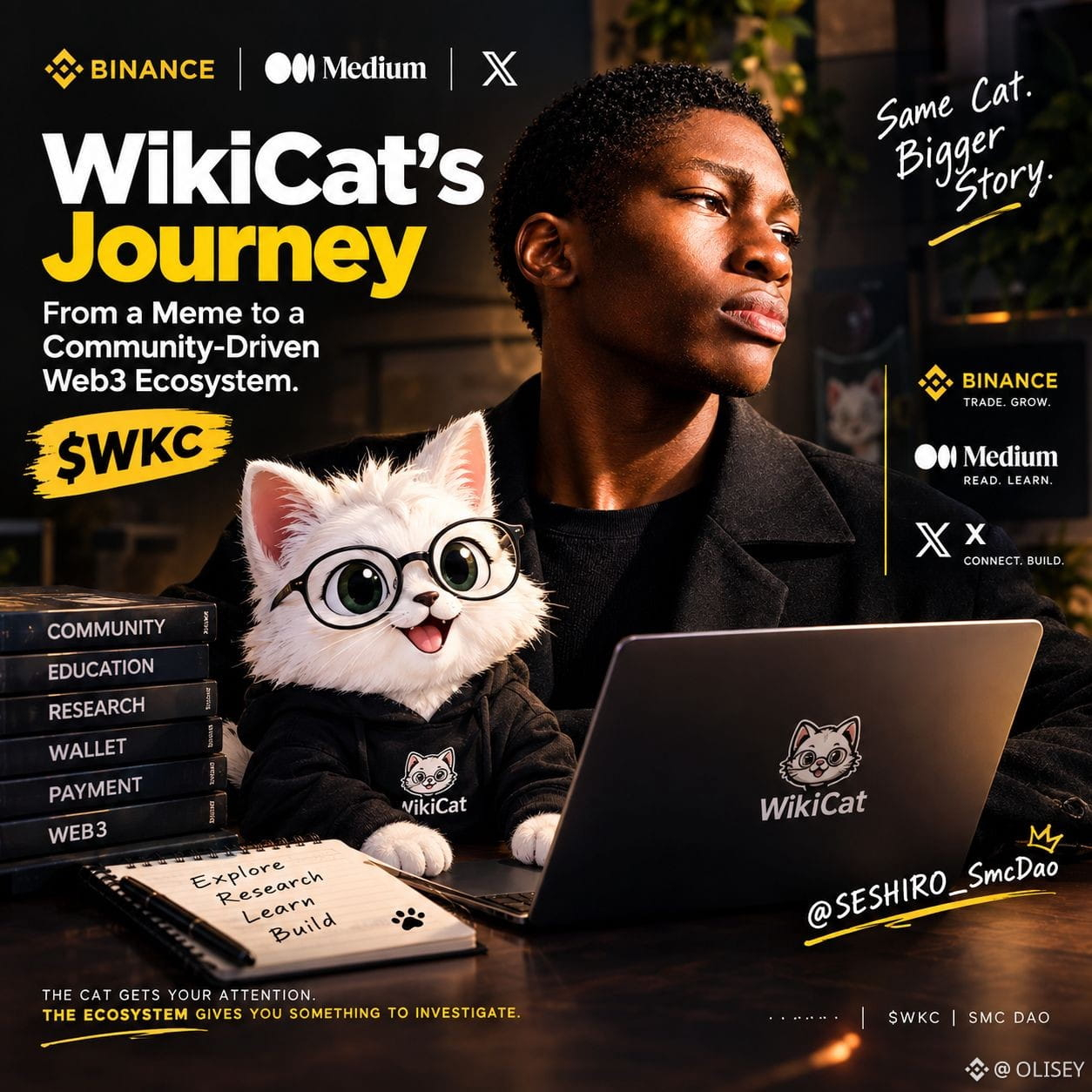
Everyone sees the cat.
Not everyone looks at what is behind it. 😽😾
WikiCat ($WKC) launched on BNB Chain on March 20, 2022, created by Sir Mapy for the SMC DAO community.
But here's the part that makes the story interesting:
WikiCat didn't begin as just a meme.
Its own documentation describes its origin as an educational experiment—giving the community a practical way to learn about crypto and blockchain.
Four years later, the story has grown.
WKC now sits within the broader SMC DAO ecosystem, alongside community, education, research, wallet, payment, and digital-economy initiatives.
Recent reports place the WikiCat holder base around 176K–179K wallet addresses.
That's not the same thing as 179K individual people.
It's a blockchain metric.
And that's exactly how we should talk about it.
No exaggerated promises.
No “guaranteed” future.
No pretending that market price tells the entire story.
Just the facts, the development, the community, and the questions worth asking.
Because maybe the interesting question isn't:
“Is WikiCat just another meme token?”
Maybe it's:
“What happens when a token that started as an educational experiment grows alongside the community that created it?”
That's the story I'm following.
The cat gets your attention.
The ecosystem gives you something to investigate.
Explore. Research. Learn. Build.
$WKC | SMC DAO🚀🚀😁
[ ] Written by: SOLOMON OLISEY
[ ] Follow on X: @Seshiro_SmcDao
$BNB #BNB_Market_Update
{spot}(BNBUSDT)
Everyone sees the cat.
Not everyone looks at what is behind it. 😽😾
WikiCat ($WKC) launched on BNB Chain on March 20, 2022, created by Sir Mapy for the SMC DAO community.
But here's the part that makes the story interesting:
WikiCat didn't begin as just a meme.
Its own documentation describes its origin as an educational experiment—giving the community a practical way to learn about crypto and blockchain.
Four years later, the story has grown.
WKC now sits within the broader SMC DAO ecosystem, alongside community, education, research, wallet, payment, and digital-economy initiatives.
Recent reports place the WikiCat holder base around 176K–179K wallet addresses.
That's not the same thing as 179K individual people.
It's a blockchain metric.
And that's exactly how we should talk about it.
No exaggerated promises.
No “guaranteed” future.
No pretending that market price tells the entire story.
Just the facts, the development, the community, and the questions worth asking.
Because maybe the interesting question isn't:
“Is WikiCat just another meme token?”
Maybe it's:
“What happens when a token that started as an educational experiment grows alongside the community that created it?”
That's the story I'm following.
The cat gets your attention.
The ecosystem gives you something to investigate.
Explore. Research. Learn. Build.
$WKC | SMC DAO🚀🚀😁
[ ] Written by: SOLOMON OLISEY
[ ] Follow on X: @Seshiro_SmcDao
$BNB #BNB_Market_Update
Not everyone looks at what is behind it. 😽😾
WikiCat ($WKC) launched on BNB Chain on March 20, 2022, created by Sir Mapy for the SMC DAO community.
But here's the part that makes the story interesting:
WikiCat didn't begin as just a meme.
Its own documentation describes its origin as an educational experiment—giving the community a practical way to learn about crypto and blockchain.
Four years later, the story has grown.
WKC now sits within the broader SMC DAO ecosystem, alongside community, education, research, wallet, payment, and digital-economy initiatives.
Recent reports place the WikiCat holder base around 176K–179K wallet addresses.
That's not the same thing as 179K individual people.
It's a blockchain metric.
And that's exactly how we should talk about it.
No exaggerated promises.
No “guaranteed” future.
No pretending that market price tells the entire story.
Just the facts, the development, the community, and the questions worth asking.
Because maybe the interesting question isn't:
“Is WikiCat just another meme token?”
Maybe it's:
“What happens when a token that started as an educational experiment grows alongside the community that created it?”
That's the story I'm following.
The cat gets your attention.
The ecosystem gives you something to investigate.
Explore. Research. Learn. Build.
$WKC | SMC DAO🚀🚀😁
[ ] Written by: SOLOMON OLISEY
[ ] Follow on X: @Seshiro_SmcDao
$BNB #BNB_Market_Update
307
·
--
Article
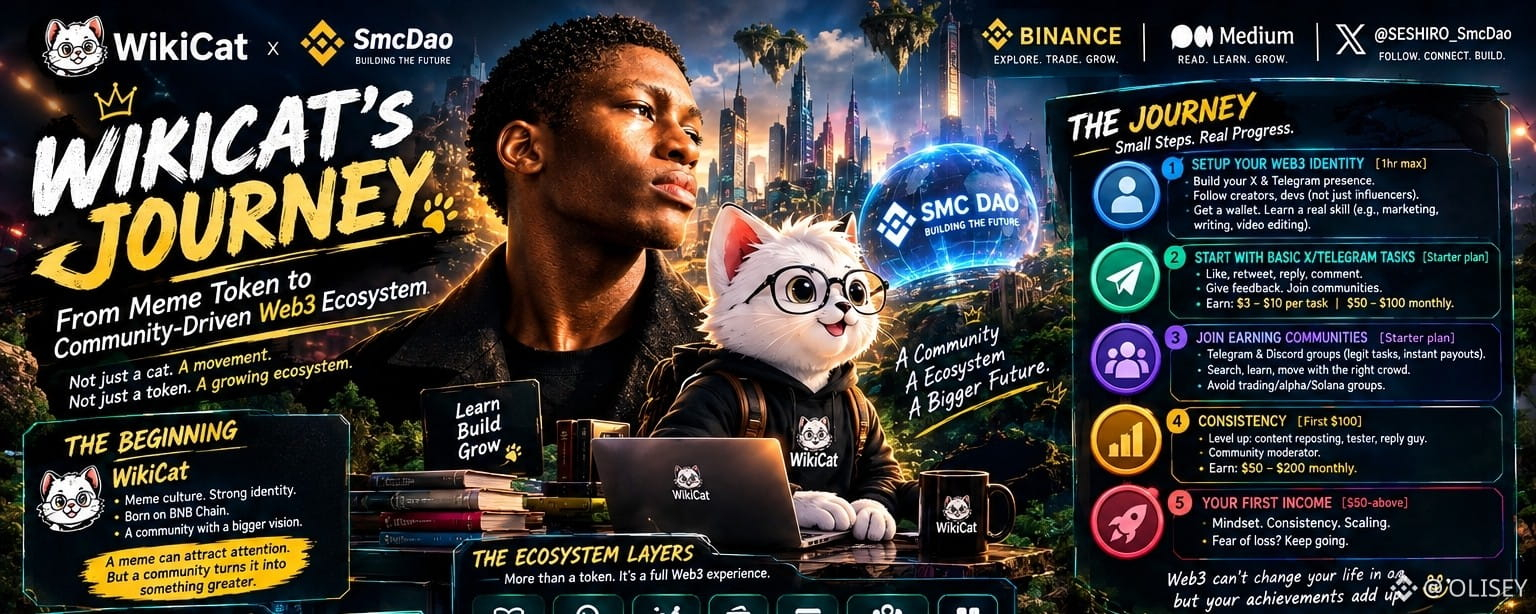
[ ] WikiCat: From Meme Token to Community-Driven Web3 EcosystemThere is a point in every crypto project where the market stops asking only one question:
“What is the token?”
And starts asking:
“What is being built around it?”
That distinction matters.
It's because crypto has produced thousands of tokens that attracted attention for a few days, weeks, or even months.You know attention alone does not create an ecosystem. An ecosystem requires people.
[ ] It requires participation.
[ ] It requires infrastructure.
It requires products, education, community coordination, experimentation, and—most importantly, continued development after the initial excitement fades.This is where the WikiCat story becomes more interesting.
The Beginning: WikiCat
WikiCat ($WKC) emerged on BNB Chain as a community-oriented crypto project with a strong meme identity.
[ ] The cat theme is focused.
[ ] The meme culture is obvious.
Reducing WikiCat to the visual language of a meme coin misses the larger story that has developed around the project.
[ ] A meme can attract someone's attention.
[ ] A community determines whether that attention becomes participation.
Participation is what gives a token ecosystem its very own identity.
WikiCat's journey has increasingly become connected with the wider SmcDao ecosystem, where the focus extends beyond simply having a token listed on a decentralized exchange.
The Bigger question Becomes: What can a Community Build around that Token?
From Token to Ecosystem
This is where SmcDao enters the story.
SmcDao describes itself as a digital community focused on capturing value from the digital economy. The ecosystem has expanded around community engagement, education, research, analytics, wallets, payments, and other Web3-oriented products, it changes the way WikiCat can be viewed.
Instead of seeing $WKC as an isolated asset, it can be understood as one component inside a larger ecosystem. Now that distinction is important. Well, successful digital communities are rarely built around one feature. It develops layers; and,One layer brings people in.
[ ] Another teaches them.
[ ] Another gives them tools.
[ ] Another gives them ways to interact.
[ ] Another creates information and analytics.
[ ] Another helps the community coordinate.
That is the Direction in which the SmcDao Ecosystem has been Developing.
The Community is Part of the Product
Now, one of the most interesting characteristics of community-driven crypto projects is that the community isn't simply an audience. It becomes part of the system.
[ ] People research.
[ ] People create content.
[ ] People discuss developments.
[ ] People participate in governance and community activities.
[ ] People test products.
[ ] People educate newcomers.
[ ] People create narratives around the ecosystem.
And these activities compound. That's why the phrase “community-driven” matters. It is not supposed to mean that every community member has the same role. It means the ecosystem's identity is shaped by participation, development, rather than by a traditional company-and-customer relationship alone.
WikiCat's identity has therefore evolved alongside its community.
[ ] The cat is the symbol.
[ ] The token is a digital asset.
But the Community is what gives the Symbol Meaning.
SMC DAO: The Bigger Picture
Now, WikiCat is one of the recognizable faces and powerhouse of the ecosystem, SmcDao represents the larger environment surrounding it. The ecosystem includes multiple projects and tokens, alongside products designed around community participation and the vast digital economy.
Among the ecosystem's well-known projects are WikiCat, OciCat, Water Rabbit, BTC Dragon, Giant Token, The Word Token, and other community-oriented tokens. Each project can have its own identity.
The larger ecosystem creates an opportunity for these projects to exist within a shared community environment.
That is considerably different from launching a token and leaving it to compete for attention in an enormous market.
The ecosystem approach attempts to create connections between projects, users, information, and infrastructure.
That is Where the Long-term Story becomes more important than the Short-term Narrative.
Infrastructure Changes the Conversation
Crypto users eventually learn an important lesson: A Token alone is not an Ecosystem.
[ ] You need infrastructure.
[ ] You need ways for people to access information.
[ ] You need wallets.
[ ] You need analytics.
[ ] You need educational material.
[ ] You need communication channels.
[ ] You need payment infrastructure.
[ ] You need applications.
[ ] You need communities.
And, you need people who can actually use these systems. SmcDao have been building around several of these areas.
The SMC DAO App, for example, has been positioned as a central community environment where users can access educational content, research, tutorials, quizzes, community interaction, badges, and other ecosystem information. Now while, forcing every part of the community experience to exist on disconnected platforms, an ecosystem can gradually create its own environment.
It's an Important Evolution.
Information is becoming Infrastructure
Another important part of the story is analytics.
Crypto is an information-heavy environment.
[ ] Token supply.
[ ] Holder numbers.
[ ] Market capitalization.
[ ] Burns.
[ ] Transactions.
[ ] Liquidity.
[ ] Developer activity.
[ ] Contract information.
These are not simply numbers. It help communities understand what is happening.
SMC Stats was developed around this idea: By bringing ecosystem token information into a unified analytical environment and using blockchain data to provide visibility into different projects. It matters because transparency is becoming increasingly important in Web3.
The more complicated an ecosystem becomes, the more important it becomes for participants to have access to understandable information.
Every community should not have to depend entirely on rumors.
[ ] It should be able to investigate.
[ ] It should be able to compare.
[ ] It should be able to learn.
And Lastly, It should be able to Form its Own Conclusions.
WikiCat and the Psychology of Community
There is another reason meme-based projects continue to attract attention.
[ ] They are easy to understand.
While, a complicated financial protocol can require hours of explanation before someone understands its purpose.
[ ] A cat?
Everyone understands a cat. Maybe, that simplicity creates an entry point. Just that, simplicity can become a weakness if there is nothing behind the identity. This is where WikiCat's development becomes important.
The question is no longer simply:
“Is the cat funny?”
The more interesting question is: “What happens when the community behind the cat starts building?”
[ ] The meme attracts attention.
[ ] The ecosystem has to earn continued attention.
It is the Transition from Meme Culture to Community Culture.
Why does BNB Chain Matter
WikiCat operates within the BNB chain environment. That places it inside one of the larger ecosystems in the cryptocurrency industry, where decentralized applications, tokens, wallets, exchanges, and Web3 communities interact. For users entering crypto through BNB Chain, projects like WikiCat can therefore become part of a much larger exploration of the ecosystem.
But this also means WikiCat exists in a highly competitive environment. That consistent development matters and helps even more.
[ ] There are countless tokens.
[ ] There are countless communities.
[ ] There are countless narratives.
[ ] A recognizable identity helps.
[ ] Community helps.
[ ] Products help.
[ ] Education helps.
[ ] Transparency helps.
Every Project is Competing for Attention, That makes Differentiation Important.
The Binance Connection
This brings us to something important about the broader crypto experience.Crypto isn't one website.
[ ] It is not one blockchain.
[ ] It is not one token.
It is an enormous network of exchanges, wallets, protocols, applications, communities, and decentralized ecosystems.
For someone trying to understand that the world, centralized exchanges can serve as one of the gateways into the broader cryptocurrency market an example: Binance is one of the world's major cryptocurrency platforms, and its ecosystem provides access to a wide range of crypto-related products and markets. It makes Binance relevant to the broader story—not because WikiCat should be presented as officially connected to Binance without evidence, but because people exploring crypto ecosystems need places where they can learn about and interact with the wider market.
So if someone discovers WikiCat through the community, the journey does not necessarily have to end with WikiCat.
[ ] They can start learning about BNB Chain.
[ ] They can explore different Web3 ecosystems.
[ ] They can research other digital assets.
[ ] They can learn about wallets and decentralized applications.
[ ] They can study market structure.
[ ] They can explore established crypto platforms such as Binance.
The word explicitly is: Explore.
[ ] Not blindly follow.
[ ] Not blindly buy.
[ ] Explore.
[ ] Research.
[ ] Learn.
[ ] Understand.
Then, make Informed Decisions.
The Bigger WikiCat Narrative
This is why I would hesitate to describe WikiCat simply as another meme token.
The meme identity is real.
It's not just, only one layer of the story; underneath the meme is a community, around the community is an ecosystem, around the ecosystem are products, education, analytics, wallets, payment initiatives, and other experiments. Even, around all of it is the broader Web3 economy. Which is a much more interesting narrative. The cryptocurrency industry is gradually moving beyond the era where simply creating a token is enough. Users are becoming more sophisticated.
They ask harder questions like:
Who is building?
What is being built?
How transparent is the project?
What infrastructure exists?
What does the community actually do?
How long has the ecosystem remained active?
What happens when the hype disappears?
These are better questions than simply:
“When moon?”
The Market will always Create Noise
[ ] There will always be hype in crypto.
[ ] There will always be price movements.
[ ] There will always be influencers.
[ ] There will always be new tokens.
[ ] There will always be another narrative promising to become the next big thing.
But communities that survive have to deal with something much harder than hype: "Consistency"
[ ] Can they continue developing?
[ ] Can they educate new users?
[ ] Can they maintain community participation?
[ ] Can they create useful infrastructure?
[ ] Can they communicate transparently?
[ ] Can they adapt when the market changes?
Those questions determine whether an ecosystem becomes more than a temporary trend. That is exactly why WikiCat is worth watching as part of the wider SmcDao story.
Not because anyone can guarantee what its market value will become. It's because the more interesting experiment is happening underneath the price chart. It is the experiment of turning community attention into a functioning digital ecosystem.
Not all can.
The Meme was the Beginning
Every major community has an origin story.
For WikiCat, the cat is part of that story.
[ ] It creates recognition.
[ ] It creates culture.
[ ] It creates something people can rally around.
But a symbol alone can not build an ecosystem.
[ ] People do.
[ ] Developers do.
[ ] Researchers do.
[ ] Creators do.
[ ] Users do.
[ ] Communities do.
That is why the next chapter of WikiCat should not be judged solely by how loud the meme becomes. It should be judged by what the community consistently builds every moment.
The SmcDao ecosystem represents the broader environment in which that development is taking place.
The wider crypto market—including platforms such as Binance—represents the enormous digital economy surrounding it.
So now, the better question isn't:
“Is WikiCat just another meme or another cat?”
Perhaps the better definite question is:
“What can a community build when the meme is only the beginning?”
[ ] That is the story worth following.
[ ] The meme was the beginning.
[ ] The movement is the story.
[ ] The next chapter is still being written.
Explore. Research. Learn. Build.
$WKC | SmcDao😁😁😁😁
[ ] Written by: SOLOMON OLISEY.
[ ] Follow on X: @Seshiro_SmcDao
#MEME #CAT #WikiCat
$BNB
{spot}(BNBUSDT)
[ ] WikiCat: From Meme Token to Community-Driven Web3 Ecosystem
There is a point in every crypto project where the market stops asking only one question:
“What is the token?”
And starts asking:
“What is being built around it?”
That distinction matters.
It's because crypto has produced thousands of tokens that attracted attention for a few days, weeks, or even months.You know attention alone does not create an ecosystem. An ecosystem requires people.
[ ] It requires participation.
[ ] It requires infrastructure.
It requires products, education, community coordination, experimentation, and—most importantly, continued development after the initial excitement fades.This is where the WikiCat story becomes more interesting.
The Beginning: WikiCat
WikiCat ($WKC) emerged on BNB Chain as a community-oriented crypto project with a strong meme identity.
[ ] The cat theme is focused.
[ ] The meme culture is obvious.
Reducing WikiCat to the visual language of a meme coin misses the larger story that has developed around the project.
[ ] A meme can attract someone's attention.
[ ] A community determines whether that attention becomes participation.
Participation is what gives a token ecosystem its very own identity.
WikiCat's journey has increasingly become connected with the wider SmcDao ecosystem, where the focus extends beyond simply having a token listed on a decentralized exchange.
The Bigger question Becomes: What can a Community Build around that Token?
From Token to Ecosystem
This is where SmcDao enters the story.
SmcDao describes itself as a digital community focused on capturing value from the digital economy. The ecosystem has expanded around community engagement, education, research, analytics, wallets, payments, and other Web3-oriented products, it changes the way WikiCat can be viewed.
Instead of seeing $WKC as an isolated asset, it can be understood as one component inside a larger ecosystem. Now that distinction is important. Well, successful digital communities are rarely built around one feature. It develops layers; and,One layer brings people in.
[ ] Another teaches them.
[ ] Another gives them tools.
[ ] Another gives them ways to interact.
[ ] Another creates information and analytics.
[ ] Another helps the community coordinate.
That is the Direction in which the SmcDao Ecosystem has been Developing.
The Community is Part of the Product
Now, one of the most interesting characteristics of community-driven crypto projects is that the community isn't simply an audience. It becomes part of the system.
[ ] People research.
[ ] People create content.
[ ] People discuss developments.
[ ] People participate in governance and community activities.
[ ] People test products.
[ ] People educate newcomers.
[ ] People create narratives around the ecosystem.
And these activities compound. That's why the phrase “community-driven” matters. It is not supposed to mean that every community member has the same role. It means the ecosystem's identity is shaped by participation, development, rather than by a traditional company-and-customer relationship alone.
WikiCat's identity has therefore evolved alongside its community.
[ ] The cat is the symbol.
[ ] The token is a digital asset.
But the Community is what gives the Symbol Meaning.
SMC DAO: The Bigger Picture
Now, WikiCat is one of the recognizable faces and powerhouse of the ecosystem, SmcDao represents the larger environment surrounding it. The ecosystem includes multiple projects and tokens, alongside products designed around community participation and the vast digital economy.
Among the ecosystem's well-known projects are WikiCat, OciCat, Water Rabbit, BTC Dragon, Giant Token, The Word Token, and other community-oriented tokens. Each project can have its own identity.
The larger ecosystem creates an opportunity for these projects to exist within a shared community environment.
That is considerably different from launching a token and leaving it to compete for attention in an enormous market.
The ecosystem approach attempts to create connections between projects, users, information, and infrastructure.
That is Where the Long-term Story becomes more important than the Short-term Narrative.
Infrastructure Changes the Conversation
Crypto users eventually learn an important lesson: A Token alone is not an Ecosystem.
[ ] You need infrastructure.
[ ] You need ways for people to access information.
[ ] You need wallets.
[ ] You need analytics.
[ ] You need educational material.
[ ] You need communication channels.
[ ] You need payment infrastructure.
[ ] You need applications.
[ ] You need communities.
And, you need people who can actually use these systems. SmcDao have been building around several of these areas.
The SMC DAO App, for example, has been positioned as a central community environment where users can access educational content, research, tutorials, quizzes, community interaction, badges, and other ecosystem information. Now while, forcing every part of the community experience to exist on disconnected platforms, an ecosystem can gradually create its own environment.
It's an Important Evolution.
Information is becoming Infrastructure
Another important part of the story is analytics.
Crypto is an information-heavy environment.
[ ] Token supply.
[ ] Holder numbers.
[ ] Market capitalization.
[ ] Burns.
[ ] Transactions.
[ ] Liquidity.
[ ] Developer activity.
[ ] Contract information.
These are not simply numbers. It help communities understand what is happening.
SMC Stats was developed around this idea: By bringing ecosystem token information into a unified analytical environment and using blockchain data to provide visibility into different projects. It matters because transparency is becoming increasingly important in Web3.
The more complicated an ecosystem becomes, the more important it becomes for participants to have access to understandable information.
Every community should not have to depend entirely on rumors.
[ ] It should be able to investigate.
[ ] It should be able to compare.
[ ] It should be able to learn.
And Lastly, It should be able to Form its Own Conclusions.
WikiCat and the Psychology of Community
There is another reason meme-based projects continue to attract attention.
[ ] They are easy to understand.
While, a complicated financial protocol can require hours of explanation before someone understands its purpose.
[ ] A cat?
Everyone understands a cat. Maybe, that simplicity creates an entry point. Just that, simplicity can become a weakness if there is nothing behind the identity. This is where WikiCat's development becomes important.
The question is no longer simply:
“Is the cat funny?”
The more interesting question is: “What happens when the community behind the cat starts building?”
[ ] The meme attracts attention.
[ ] The ecosystem has to earn continued attention.
It is the Transition from Meme Culture to Community Culture.
Why does BNB Chain Matter
WikiCat operates within the BNB chain environment. That places it inside one of the larger ecosystems in the cryptocurrency industry, where decentralized applications, tokens, wallets, exchanges, and Web3 communities interact. For users entering crypto through BNB Chain, projects like WikiCat can therefore become part of a much larger exploration of the ecosystem.
But this also means WikiCat exists in a highly competitive environment. That consistent development matters and helps even more.
[ ] There are countless tokens.
[ ] There are countless communities.
[ ] There are countless narratives.
[ ] A recognizable identity helps.
[ ] Community helps.
[ ] Products help.
[ ] Education helps.
[ ] Transparency helps.
Every Project is Competing for Attention, That makes Differentiation Important.
The Binance Connection
This brings us to something important about the broader crypto experience.Crypto isn't one website.
[ ] It is not one blockchain.
[ ] It is not one token.
It is an enormous network of exchanges, wallets, protocols, applications, communities, and decentralized ecosystems.
For someone trying to understand that the world, centralized exchanges can serve as one of the gateways into the broader cryptocurrency market an example: Binance is one of the world's major cryptocurrency platforms, and its ecosystem provides access to a wide range of crypto-related products and markets. It makes Binance relevant to the broader story—not because WikiCat should be presented as officially connected to Binance without evidence, but because people exploring crypto ecosystems need places where they can learn about and interact with the wider market.
So if someone discovers WikiCat through the community, the journey does not necessarily have to end with WikiCat.
[ ] They can start learning about BNB Chain.
[ ] They can explore different Web3 ecosystems.
[ ] They can research other digital assets.
[ ] They can learn about wallets and decentralized applications.
[ ] They can study market structure.
[ ] They can explore established crypto platforms such as Binance.
The word explicitly is: Explore.
[ ] Not blindly follow.
[ ] Not blindly buy.
[ ] Explore.
[ ] Research.
[ ] Learn.
[ ] Understand.
Then, make Informed Decisions.
The Bigger WikiCat Narrative
This is why I would hesitate to describe WikiCat simply as another meme token.
The meme identity is real.
It's not just, only one layer of the story; underneath the meme is a community, around the community is an ecosystem, around the ecosystem are products, education, analytics, wallets, payment initiatives, and other experiments. Even, around all of it is the broader Web3 economy. Which is a much more interesting narrative. The cryptocurrency industry is gradually moving beyond the era where simply creating a token is enough. Users are becoming more sophisticated.
They ask harder questions like:
Who is building?
What is being built?
How transparent is the project?
What infrastructure exists?
What does the community actually do?
How long has the ecosystem remained active?
What happens when the hype disappears?
These are better questions than simply:
“When moon?”
The Market will always Create Noise
[ ] There will always be hype in crypto.
[ ] There will always be price movements.
[ ] There will always be influencers.
[ ] There will always be new tokens.
[ ] There will always be another narrative promising to become the next big thing.
But communities that survive have to deal with something much harder than hype: "Consistency"
[ ] Can they continue developing?
[ ] Can they educate new users?
[ ] Can they maintain community participation?
[ ] Can they create useful infrastructure?
[ ] Can they communicate transparently?
[ ] Can they adapt when the market changes?
Those questions determine whether an ecosystem becomes more than a temporary trend. That is exactly why WikiCat is worth watching as part of the wider SmcDao story.
Not because anyone can guarantee what its market value will become. It's because the more interesting experiment is happening underneath the price chart. It is the experiment of turning community attention into a functioning digital ecosystem.
Not all can.
The Meme was the Beginning
Every major community has an origin story.
For WikiCat, the cat is part of that story.
[ ] It creates recognition.
[ ] It creates culture.
[ ] It creates something people can rally around.
But a symbol alone can not build an ecosystem.
[ ] People do.
[ ] Developers do.
[ ] Researchers do.
[ ] Creators do.
[ ] Users do.
[ ] Communities do.
That is why the next chapter of WikiCat should not be judged solely by how loud the meme becomes. It should be judged by what the community consistently builds every moment.
The SmcDao ecosystem represents the broader environment in which that development is taking place.
The wider crypto market—including platforms such as Binance—represents the enormous digital economy surrounding it.
So now, the better question isn't:
“Is WikiCat just another meme or another cat?”
Perhaps the better definite question is:
“What can a community build when the meme is only the beginning?”
[ ] That is the story worth following.
[ ] The meme was the beginning.
[ ] The movement is the story.
[ ] The next chapter is still being written.
Explore. Research. Learn. Build.
$WKC | SmcDao😁😁😁😁
[ ] Written by: SOLOMON OLISEY.
[ ] Follow on X: @Seshiro_SmcDao
#MEME #CAT #WikiCat
$BNB
“What is the token?”
And starts asking:
“What is being built around it?”
That distinction matters.
It's because crypto has produced thousands of tokens that attracted attention for a few days, weeks, or even months.You know attention alone does not create an ecosystem. An ecosystem requires people.
[ ] It requires participation.
[ ] It requires infrastructure.
It requires products, education, community coordination, experimentation, and—most importantly, continued development after the initial excitement fades.This is where the WikiCat story becomes more interesting.
The Beginning: WikiCat
WikiCat ($WKC) emerged on BNB Chain as a community-oriented crypto project with a strong meme identity.
[ ] The cat theme is focused.
[ ] The meme culture is obvious.
Reducing WikiCat to the visual language of a meme coin misses the larger story that has developed around the project.
[ ] A meme can attract someone's attention.
[ ] A community determines whether that attention becomes participation.
Participation is what gives a token ecosystem its very own identity.
WikiCat's journey has increasingly become connected with the wider SmcDao ecosystem, where the focus extends beyond simply having a token listed on a decentralized exchange.
The Bigger question Becomes: What can a Community Build around that Token?
From Token to Ecosystem
This is where SmcDao enters the story.
SmcDao describes itself as a digital community focused on capturing value from the digital economy. The ecosystem has expanded around community engagement, education, research, analytics, wallets, payments, and other Web3-oriented products, it changes the way WikiCat can be viewed.
Instead of seeing $WKC as an isolated asset, it can be understood as one component inside a larger ecosystem. Now that distinction is important. Well, successful digital communities are rarely built around one feature. It develops layers; and,One layer brings people in.
[ ] Another teaches them.
[ ] Another gives them tools.
[ ] Another gives them ways to interact.
[ ] Another creates information and analytics.
[ ] Another helps the community coordinate.
That is the Direction in which the SmcDao Ecosystem has been Developing.
The Community is Part of the Product
Now, one of the most interesting characteristics of community-driven crypto projects is that the community isn't simply an audience. It becomes part of the system.
[ ] People research.
[ ] People create content.
[ ] People discuss developments.
[ ] People participate in governance and community activities.
[ ] People test products.
[ ] People educate newcomers.
[ ] People create narratives around the ecosystem.
And these activities compound. That's why the phrase “community-driven” matters. It is not supposed to mean that every community member has the same role. It means the ecosystem's identity is shaped by participation, development, rather than by a traditional company-and-customer relationship alone.
WikiCat's identity has therefore evolved alongside its community.
[ ] The cat is the symbol.
[ ] The token is a digital asset.
But the Community is what gives the Symbol Meaning.
SMC DAO: The Bigger Picture
Now, WikiCat is one of the recognizable faces and powerhouse of the ecosystem, SmcDao represents the larger environment surrounding it. The ecosystem includes multiple projects and tokens, alongside products designed around community participation and the vast digital economy.
Among the ecosystem's well-known projects are WikiCat, OciCat, Water Rabbit, BTC Dragon, Giant Token, The Word Token, and other community-oriented tokens. Each project can have its own identity.
The larger ecosystem creates an opportunity for these projects to exist within a shared community environment.
That is considerably different from launching a token and leaving it to compete for attention in an enormous market.
The ecosystem approach attempts to create connections between projects, users, information, and infrastructure.
That is Where the Long-term Story becomes more important than the Short-term Narrative.
Infrastructure Changes the Conversation
Crypto users eventually learn an important lesson: A Token alone is not an Ecosystem.
[ ] You need infrastructure.
[ ] You need ways for people to access information.
[ ] You need wallets.
[ ] You need analytics.
[ ] You need educational material.
[ ] You need communication channels.
[ ] You need payment infrastructure.
[ ] You need applications.
[ ] You need communities.
And, you need people who can actually use these systems. SmcDao have been building around several of these areas.
The SMC DAO App, for example, has been positioned as a central community environment where users can access educational content, research, tutorials, quizzes, community interaction, badges, and other ecosystem information. Now while, forcing every part of the community experience to exist on disconnected platforms, an ecosystem can gradually create its own environment.
It's an Important Evolution.
Information is becoming Infrastructure
Another important part of the story is analytics.
Crypto is an information-heavy environment.
[ ] Token supply.
[ ] Holder numbers.
[ ] Market capitalization.
[ ] Burns.
[ ] Transactions.
[ ] Liquidity.
[ ] Developer activity.
[ ] Contract information.
These are not simply numbers. It help communities understand what is happening.
SMC Stats was developed around this idea: By bringing ecosystem token information into a unified analytical environment and using blockchain data to provide visibility into different projects. It matters because transparency is becoming increasingly important in Web3.
The more complicated an ecosystem becomes, the more important it becomes for participants to have access to understandable information.
Every community should not have to depend entirely on rumors.
[ ] It should be able to investigate.
[ ] It should be able to compare.
[ ] It should be able to learn.
And Lastly, It should be able to Form its Own Conclusions.
WikiCat and the Psychology of Community
There is another reason meme-based projects continue to attract attention.
[ ] They are easy to understand.
While, a complicated financial protocol can require hours of explanation before someone understands its purpose.
[ ] A cat?
Everyone understands a cat. Maybe, that simplicity creates an entry point. Just that, simplicity can become a weakness if there is nothing behind the identity. This is where WikiCat's development becomes important.
The question is no longer simply:
“Is the cat funny?”
The more interesting question is: “What happens when the community behind the cat starts building?”
[ ] The meme attracts attention.
[ ] The ecosystem has to earn continued attention.
It is the Transition from Meme Culture to Community Culture.
Why does BNB Chain Matter
WikiCat operates within the BNB chain environment. That places it inside one of the larger ecosystems in the cryptocurrency industry, where decentralized applications, tokens, wallets, exchanges, and Web3 communities interact. For users entering crypto through BNB Chain, projects like WikiCat can therefore become part of a much larger exploration of the ecosystem.
But this also means WikiCat exists in a highly competitive environment. That consistent development matters and helps even more.
[ ] There are countless tokens.
[ ] There are countless communities.
[ ] There are countless narratives.
[ ] A recognizable identity helps.
[ ] Community helps.
[ ] Products help.
[ ] Education helps.
[ ] Transparency helps.
Every Project is Competing for Attention, That makes Differentiation Important.
The Binance Connection
This brings us to something important about the broader crypto experience.Crypto isn't one website.
[ ] It is not one blockchain.
[ ] It is not one token.
It is an enormous network of exchanges, wallets, protocols, applications, communities, and decentralized ecosystems.
For someone trying to understand that the world, centralized exchanges can serve as one of the gateways into the broader cryptocurrency market an example: Binance is one of the world's major cryptocurrency platforms, and its ecosystem provides access to a wide range of crypto-related products and markets. It makes Binance relevant to the broader story—not because WikiCat should be presented as officially connected to Binance without evidence, but because people exploring crypto ecosystems need places where they can learn about and interact with the wider market.
So if someone discovers WikiCat through the community, the journey does not necessarily have to end with WikiCat.
[ ] They can start learning about BNB Chain.
[ ] They can explore different Web3 ecosystems.
[ ] They can research other digital assets.
[ ] They can learn about wallets and decentralized applications.
[ ] They can study market structure.
[ ] They can explore established crypto platforms such as Binance.
The word explicitly is: Explore.
[ ] Not blindly follow.
[ ] Not blindly buy.
[ ] Explore.
[ ] Research.
[ ] Learn.
[ ] Understand.
Then, make Informed Decisions.
The Bigger WikiCat Narrative
This is why I would hesitate to describe WikiCat simply as another meme token.
The meme identity is real.
It's not just, only one layer of the story; underneath the meme is a community, around the community is an ecosystem, around the ecosystem are products, education, analytics, wallets, payment initiatives, and other experiments. Even, around all of it is the broader Web3 economy. Which is a much more interesting narrative. The cryptocurrency industry is gradually moving beyond the era where simply creating a token is enough. Users are becoming more sophisticated.
They ask harder questions like:
Who is building?
What is being built?
How transparent is the project?
What infrastructure exists?
What does the community actually do?
How long has the ecosystem remained active?
What happens when the hype disappears?
These are better questions than simply:
“When moon?”
The Market will always Create Noise
[ ] There will always be hype in crypto.
[ ] There will always be price movements.
[ ] There will always be influencers.
[ ] There will always be new tokens.
[ ] There will always be another narrative promising to become the next big thing.
But communities that survive have to deal with something much harder than hype: "Consistency"
[ ] Can they continue developing?
[ ] Can they educate new users?
[ ] Can they maintain community participation?
[ ] Can they create useful infrastructure?
[ ] Can they communicate transparently?
[ ] Can they adapt when the market changes?
Those questions determine whether an ecosystem becomes more than a temporary trend. That is exactly why WikiCat is worth watching as part of the wider SmcDao story.
Not because anyone can guarantee what its market value will become. It's because the more interesting experiment is happening underneath the price chart. It is the experiment of turning community attention into a functioning digital ecosystem.
Not all can.
The Meme was the Beginning
Every major community has an origin story.
For WikiCat, the cat is part of that story.
[ ] It creates recognition.
[ ] It creates culture.
[ ] It creates something people can rally around.
But a symbol alone can not build an ecosystem.
[ ] People do.
[ ] Developers do.
[ ] Researchers do.
[ ] Creators do.
[ ] Users do.
[ ] Communities do.
That is why the next chapter of WikiCat should not be judged solely by how loud the meme becomes. It should be judged by what the community consistently builds every moment.
The SmcDao ecosystem represents the broader environment in which that development is taking place.
The wider crypto market—including platforms such as Binance—represents the enormous digital economy surrounding it.
So now, the better question isn't:
“Is WikiCat just another meme or another cat?”
Perhaps the better definite question is:
“What can a community build when the meme is only the beginning?”
[ ] That is the story worth following.
[ ] The meme was the beginning.
[ ] The movement is the story.
[ ] The next chapter is still being written.
Explore. Research. Learn. Build.
$WKC | SmcDao😁😁😁😁
[ ] Written by: SOLOMON OLISEY.
[ ] Follow on X: @Seshiro_SmcDao
#MEME #CAT #WikiCat
$BNB
881
·
--
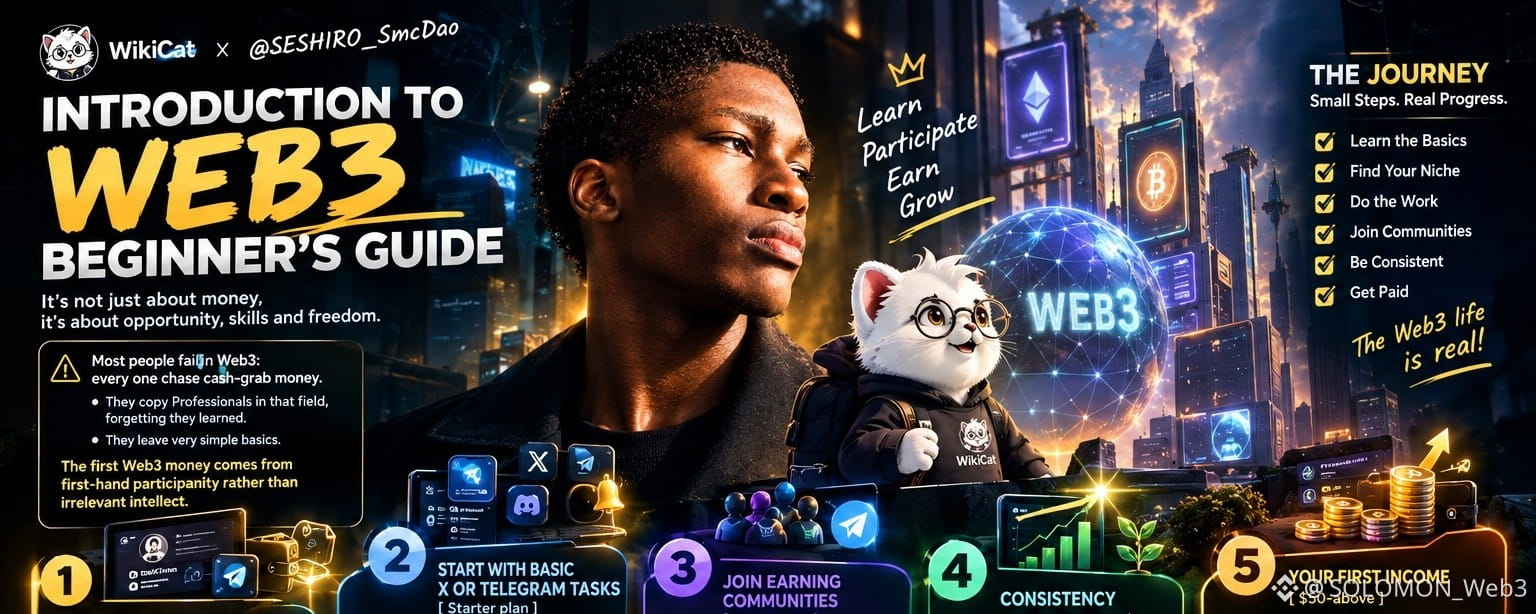
Article
INTRODUCTION TO WEB3 BEGINNER'S GUIDEMost people fail in Web3: every one chase cash-grab money.
[ ] They copy Profesionals in that field, forgetting they learned.
[ ] They leave very simple basics.
The first Web3 money comes from first-hand participation rather than irrelevant intellect.
1. Setup your Web3 identity [ 1hr max ]
Don't pick professionals on X, Telegram with followers; look for Creators, Devs, and pick a simple niche like: Content Writing, Content Strategist, Web3 Marketing.
Also, that bio created use it on X, Telegram. Get a wallet and an actual skill like: Digital Marketing, Video Editing.
Don't pick any designer niches too, Saturated.
This is your starter plan as a beginner before being a total professional at it.
2. Start with basic X or Telegram Tasks [ Starter plan ]
Projects pay beginners to:
[ ] Like, retweet, reply, comment.
[ ] Give feedback.
[ ] Join Communities and be Active.
Most will pay some won’t, but just being a part of it always matters; But.
Pays:
[ ] $3-$10 per task.
[ ] $50-$100 monthly.
It's not that simple, but it depends on a whole lot.
[ ] Look for Web3 Opportunities
[ ] Follow on X, Discord, and Telegram.
[ ] Follow Big Community-Driven Pages on X, Discord for: daily tasks, testnets, bounties, reply guys, or gals.
[ ] Turn on Notifications and always be Active.
In Web3 Early~Opportunity.
3. Join Earning Communities
[ Starter plan ]
[ ] Telegram and Discord Server/Group: Legit Tasks, Instant Payouts, Starter Roles; These are vast but depend on your community.
[ ] Search, Research, and Learn alone but always Move with the right Crowd.
[ ] Avoid these Starters Mindset: Trading, Alpha Solana Groups; Especially Solana Communities. Leading Starters astray.
As a starter there's no reason to spend what you can't get back; unless you are greed. Web3 never asks from you.
4. Consistency [ Starter plan: First $100 ]
[ ] Level up [ Beginner Skillset ]: Content reposting, Tester, Reply guy, Community moderator.
[ ] Pays within these ranges: $50-$200 monthly,
5. Your First Income [ $50-above ]
The truth starts with your mindset.
[ ] What changed.
[ ] Your consistency.
[ ] Your scaling.
[ ] Fear of constant loss after consistent working.
Web3 can't change your life in a day but, your achievements after being: Early, Active, Consistent, Touching Opportunities after Opportunities.😁😁😁😁
[ ] Written by: SOLOMON OLISEY
[ ] Follow on X: @Seshiro_SmcDao
$BNB #Web3 #crypto
{spot}(BNBUSDT)
INTRODUCTION TO WEB3 BEGINNER'S GUIDE
Most people fail in Web3: every one chase cash-grab money.
[ ] They copy Profesionals in that field, forgetting they learned.
[ ] They leave very simple basics.
The first Web3 money comes from first-hand participation rather than irrelevant intellect.
1. Setup your Web3 identity [ 1hr max ]
Don't pick professionals on X, Telegram with followers; look for Creators, Devs, and pick a simple niche like: Content Writing, Content Strategist, Web3 Marketing.
Also, that bio created use it on X, Telegram. Get a wallet and an actual skill like: Digital Marketing, Video Editing.
Don't pick any designer niches too, Saturated.
This is your starter plan as a beginner before being a total professional at it.
2. Start with basic X or Telegram Tasks [ Starter plan ]
Projects pay beginners to:
[ ] Like, retweet, reply, comment.
[ ] Give feedback.
[ ] Join Communities and be Active.
Most will pay some won’t, but just being a part of it always matters; But.
Pays:
[ ] $3-$10 per task.
[ ] $50-$100 monthly.
It's not that simple, but it depends on a whole lot.
[ ] Look for Web3 Opportunities
[ ] Follow on X, Discord, and Telegram.
[ ] Follow Big Community-Driven Pages on X, Discord for: daily tasks, testnets, bounties, reply guys, or gals.
[ ] Turn on Notifications and always be Active.
In Web3 Early~Opportunity.
3. Join Earning Communities
[ Starter plan ]
[ ] Telegram and Discord Server/Group: Legit Tasks, Instant Payouts, Starter Roles; These are vast but depend on your community.
[ ] Search, Research, and Learn alone but always Move with the right Crowd.
[ ] Avoid these Starters Mindset: Trading, Alpha Solana Groups; Especially Solana Communities. Leading Starters astray.
As a starter there's no reason to spend what you can't get back; unless you are greed. Web3 never asks from you.
4. Consistency [ Starter plan: First $100 ]
[ ] Level up [ Beginner Skillset ]: Content reposting, Tester, Reply guy, Community moderator.
[ ] Pays within these ranges: $50-$200 monthly,
5. Your First Income [ $50-above ]
The truth starts with your mindset.
[ ] What changed.
[ ] Your consistency.
[ ] Your scaling.
[ ] Fear of constant loss after consistent working.
Web3 can't change your life in a day but, your achievements after being: Early, Active, Consistent, Touching Opportunities after Opportunities.😁😁😁😁
[ ] Written by: SOLOMON OLISEY
[ ] Follow on X: @Seshiro_SmcDao
$BNB #Web3 #crypto
[ ] They copy Profesionals in that field, forgetting they learned.
[ ] They leave very simple basics.
The first Web3 money comes from first-hand participation rather than irrelevant intellect.
1. Setup your Web3 identity [ 1hr max ]
Don't pick professionals on X, Telegram with followers; look for Creators, Devs, and pick a simple niche like: Content Writing, Content Strategist, Web3 Marketing.
Also, that bio created use it on X, Telegram. Get a wallet and an actual skill like: Digital Marketing, Video Editing.
Don't pick any designer niches too, Saturated.
This is your starter plan as a beginner before being a total professional at it.
2. Start with basic X or Telegram Tasks [ Starter plan ]
Projects pay beginners to:
[ ] Like, retweet, reply, comment.
[ ] Give feedback.
[ ] Join Communities and be Active.
Most will pay some won’t, but just being a part of it always matters; But.
Pays:
[ ] $3-$10 per task.
[ ] $50-$100 monthly.
It's not that simple, but it depends on a whole lot.
[ ] Look for Web3 Opportunities
[ ] Follow on X, Discord, and Telegram.
[ ] Follow Big Community-Driven Pages on X, Discord for: daily tasks, testnets, bounties, reply guys, or gals.
[ ] Turn on Notifications and always be Active.
In Web3 Early~Opportunity.
3. Join Earning Communities
[ Starter plan ]
[ ] Telegram and Discord Server/Group: Legit Tasks, Instant Payouts, Starter Roles; These are vast but depend on your community.
[ ] Search, Research, and Learn alone but always Move with the right Crowd.
[ ] Avoid these Starters Mindset: Trading, Alpha Solana Groups; Especially Solana Communities. Leading Starters astray.
As a starter there's no reason to spend what you can't get back; unless you are greed. Web3 never asks from you.
4. Consistency [ Starter plan: First $100 ]
[ ] Level up [ Beginner Skillset ]: Content reposting, Tester, Reply guy, Community moderator.
[ ] Pays within these ranges: $50-$200 monthly,
5. Your First Income [ $50-above ]
The truth starts with your mindset.
[ ] What changed.
[ ] Your consistency.
[ ] Your scaling.
[ ] Fear of constant loss after consistent working.
Web3 can't change your life in a day but, your achievements after being: Early, Active, Consistent, Touching Opportunities after Opportunities.😁😁😁😁
[ ] Written by: SOLOMON OLISEY
[ ] Follow on X: @Seshiro_SmcDao
$BNB #Web3 #crypto
102
·
--
X Narrative — WikiCat × SMC DAO
STOP CALLING WIKICAT “JUST A MEME.” 🐾
A meme can create attention.
A movement creates participation.
That distinction matters.
WikiCat started as a token on BNB Chain, but the bigger story is what has been developing around it: a community, an ecosystem, infrastructure, education, products, and an expanding digital economy built under the SMC DAO vision.
The market will always move.
Charts will rise.
Charts will fall.
People will celebrate the highs and question the lows.
Written by: SOLOMON OLISEY
Follow on X: Seshiro_SmcDao
$BNB #bnb #WikiCat
X Narrative — WikiCat × SMC DAO
STOP CALLING WIKICAT “JUST A MEME.” 🐾
A meme can create attention.
A movement creates participation.
That distinction matters.
WikiCat started as a token on BNB Chain, but the bigger story is what has been developing around it: a community, an ecosystem, infrastructure, education, products, and an expanding digital economy built under the SMC DAO vision.
The market will always move.
Charts will rise.
Charts will fall.
People will celebrate the highs and question the lows.
Written by: SOLOMON OLISEY
Follow on X: Seshiro_SmcDao
$BNB #bnb #WikiCat
STOP CALLING WIKICAT “JUST A MEME.” 🐾
A meme can create attention.
A movement creates participation.
That distinction matters.
WikiCat started as a token on BNB Chain, but the bigger story is what has been developing around it: a community, an ecosystem, infrastructure, education, products, and an expanding digital economy built under the SMC DAO vision.
The market will always move.
Charts will rise.
Charts will fall.
People will celebrate the highs and question the lows.
Written by: SOLOMON OLISEY
Follow on X: Seshiro_SmcDao
$BNB #bnb #WikiCat
90
·
--
STOP CALLING WIKICAT “JUST A MEME.” 🐾
“Here is why WikiCat is interesting → here is the ecosystem developing around it → here is why access to established crypto infrastructure matters → Binance is one of the platforms people can use to explore the broader market.”
This in this video is a mobile app or also known as a utility app called Peniwallet.
The app is used for SmcDao Tokens Swap, Spray, conversion, and a lot more.
This is the dev showing us how it works.
In my next post, which is an article, that comprises of everything you need to know about this ecosystem.
$BNB #WikiCat #wikicat
STOP CALLING WIKICAT “JUST A MEME.” 🐾
“Here is why WikiCat is interesting → here is the ecosystem developing around it → here is why access to established crypto infrastructure matters → Binance is one of the platforms people can use to explore the broader market.”
This in this video is a mobile app or also known as a utility app called Peniwallet.
The app is used for SmcDao Tokens Swap, Spray, conversion, and a lot more.
This is the dev showing us how it works.
In my next post, which is an article, that comprises of everything you need to know about this ecosystem.
$BNB #WikiCat #wikicat
“Here is why WikiCat is interesting → here is the ecosystem developing around it → here is why access to established crypto infrastructure matters → Binance is one of the platforms people can use to explore the broader market.”
This in this video is a mobile app or also known as a utility app called Peniwallet.
The app is used for SmcDao Tokens Swap, Spray, conversion, and a lot more.
This is the dev showing us how it works.
In my next post, which is an article, that comprises of everything you need to know about this ecosystem.
$BNB #WikiCat #wikicat
122
·
--
Haussier
STOP CALLING WIKICAT “JUST A MEME.” 🐾
A meme can create attention.
A movement creates participation.
That distinction matters.
I
WikiCat started as a token on BNB Chain, but the bigger story is what has been developing around it: a community, an ecosystem, infrastructure, education, products, and an expanding digital economy built under the SMC DAO vision.
will
The market will always move.
Charts will rise.
Charts will fall.
People will celebrate the highs and question the lows.
But a serious community can not be measured by one candle.
It is measured by what continues being built when the excitement disappears.
be
That is where WikiCat becomes interesting.
The SMC ecosystem has been developing beyond the token itself—bringing together community tools, analytics, wallets, education,payments, and other digital-economy infrastructure. SMC DAO describes its broader vision as building a valuable digital community where people learn, participate and capture value from the digital economy.
making
And WikiCat’s community is evolving with it.
The community has increasingly been directed toward the SMC DAO App as its central environment for communication, learning and participation.
That is the part people should watch.
Not simply:
“How high can $WKC go?”
But:
“What can thousands of people build when they move in the same direction?”
Eventually, every meme reaches a moment where the joke is no longer the most interesting part.
more
The community becomes the story.
The ecosystem becomes the story.
The infrastructure becomes the story.
And the movement becomes bigger than the ticker.
content on WikiCat.
🐾 WikiCat is not asking you to believe in a meme.
It is asking you to watch what happens when a community decides to build.
The meme was the beginning.
The movement is the story.
$BNB $WKC #BNB_Market_Update 🚀🚀🚀🚀🚀
{spot}(BNBUSDT)
STOP CALLING WIKICAT “JUST A MEME.” 🐾
A meme can create attention.
A movement creates participation.
That distinction matters.
I
WikiCat started as a token on BNB Chain, but the bigger story is what has been developing around it: a community, an ecosystem, infrastructure, education, products, and an expanding digital economy built under the SMC DAO vision.
will
The market will always move.
Charts will rise.
Charts will fall.
People will celebrate the highs and question the lows.
But a serious community can not be measured by one candle.
It is measured by what continues being built when the excitement disappears.
be
That is where WikiCat becomes interesting.
The SMC ecosystem has been developing beyond the token itself—bringing together community tools, analytics, wallets, education,payments, and other digital-economy infrastructure. SMC DAO describes its broader vision as building a valuable digital community where people learn, participate and capture value from the digital economy.
making
And WikiCat’s community is evolving with it.
The community has increasingly been directed toward the SMC DAO App as its central environment for communication, learning and participation.
That is the part people should watch.
Not simply:
“How high can $WKC go?”
But:
“What can thousands of people build when they move in the same direction?”
Eventually, every meme reaches a moment where the joke is no longer the most interesting part.
more
The community becomes the story.
The ecosystem becomes the story.
The infrastructure becomes the story.
And the movement becomes bigger than the ticker.
content on WikiCat.
🐾 WikiCat is not asking you to believe in a meme.
It is asking you to watch what happens when a community decides to build.
The meme was the beginning.
The movement is the story.
$BNB $WKC #BNB_Market_Update 🚀🚀🚀🚀🚀
A meme can create attention.
A movement creates participation.
That distinction matters.
I
WikiCat started as a token on BNB Chain, but the bigger story is what has been developing around it: a community, an ecosystem, infrastructure, education, products, and an expanding digital economy built under the SMC DAO vision.
will
The market will always move.
Charts will rise.
Charts will fall.
People will celebrate the highs and question the lows.
But a serious community can not be measured by one candle.
It is measured by what continues being built when the excitement disappears.
be
That is where WikiCat becomes interesting.
The SMC ecosystem has been developing beyond the token itself—bringing together community tools, analytics, wallets, education,payments, and other digital-economy infrastructure. SMC DAO describes its broader vision as building a valuable digital community where people learn, participate and capture value from the digital economy.
making
And WikiCat’s community is evolving with it.
The community has increasingly been directed toward the SMC DAO App as its central environment for communication, learning and participation.
That is the part people should watch.
Not simply:
“How high can $WKC go?”
But:
“What can thousands of people build when they move in the same direction?”
Eventually, every meme reaches a moment where the joke is no longer the most interesting part.
more
The community becomes the story.
The ecosystem becomes the story.
The infrastructure becomes the story.
And the movement becomes bigger than the ticker.
content on WikiCat.
🐾 WikiCat is not asking you to believe in a meme.
It is asking you to watch what happens when a community decides to build.
The meme was the beginning.
The movement is the story.
$BNB $WKC #BNB_Market_Update 🚀🚀🚀🚀🚀

1
63
·
--
Haussier
On BNB Chain, $WKC carries its own highs, lows, and learnings. But the point isn't the chart. It's the people, the believers, the builders. That's what transforms a ticker into a culture. And the question becomes, how far can a community take it?
On BNB Chain, $WKC carries not just a community of 180k and soaring. It's going to build something somewhere, that place only SmcDao can do and our belief as one will stand out
. Not as a meme nor movement but, as a belief.
#BNB_Market_Update #wikicat
{spot}(BNBUSDT)
On BNB Chain, $WKC carries its own highs, lows, and learnings. But the point isn't the chart. It's the people, the believers, the builders. That's what transforms a ticker into a culture. And the question becomes, how far can a community take it?
On BNB Chain, $WKC carries not just a community of 180k and soaring. It's going to build something somewhere, that place only SmcDao can do and our belief as one will stand out
. Not as a meme nor movement but, as a belief.
#BNB_Market_Update #wikicat
On BNB Chain, $WKC carries not just a community of 180k and soaring. It's going to build something somewhere, that place only SmcDao can do and our belief as one will stand out
. Not as a meme nor movement but, as a belief.
#BNB_Market_Update #wikicat
1
76
·
--
🔥 2 DOWN, 3 TO GO — 10,000 USDC LOADING...
Just cracked Word 2: BREAKOUT after nailing Word 1: DRIVE!
The method? Brute-force elimination. The mindset? Never stop grinding.
DRIVE → BREAKOUT → ??? → ??? → ???
Theme: "Fueling the Next Rally"
Every word is a step closer to that 10,000 USDC prize pool. Every yellow tile is data. Every gray tile is progress.
To everyone still stuck:
Eliminate aggressively
Test every letter position
Trust the process
The next word drops in 22 hours. I'll be ready.
Are you?
#BinanceWordOfTheDay #FuelingTheNextRally #CryptoPuzzle #BREAKOUT
🔥 2 DOWN, 3 TO GO — 10,000 USDC LOADING...
Just cracked Word 2: BREAKOUT after nailing Word 1: DRIVE!
The method? Brute-force elimination. The mindset? Never stop grinding.
DRIVE → BREAKOUT → ??? → ??? → ???
Theme: "Fueling the Next Rally"
Every word is a step closer to that 10,000 USDC prize pool. Every yellow tile is data. Every gray tile is progress.
To everyone still stuck:
Eliminate aggressively
Test every letter position
Trust the process
The next word drops in 22 hours. I'll be ready.
Are you?
#BinanceWordOfTheDay #FuelingTheNextRally #CryptoPuzzle #BREAKOUT
Just cracked Word 2: BREAKOUT after nailing Word 1: DRIVE!
The method? Brute-force elimination. The mindset? Never stop grinding.
DRIVE → BREAKOUT → ??? → ??? → ???
Theme: "Fueling the Next Rally"
Every word is a step closer to that 10,000 USDC prize pool. Every yellow tile is data. Every gray tile is progress.
To everyone still stuck:
Eliminate aggressively
Test every letter position
Trust the process
The next word drops in 22 hours. I'll be ready.
Are you?
#BinanceWordOfTheDay #FuelingTheNextRally #CryptoPuzzle #BREAKOUT
1
150
·
--
Partiellement vrai
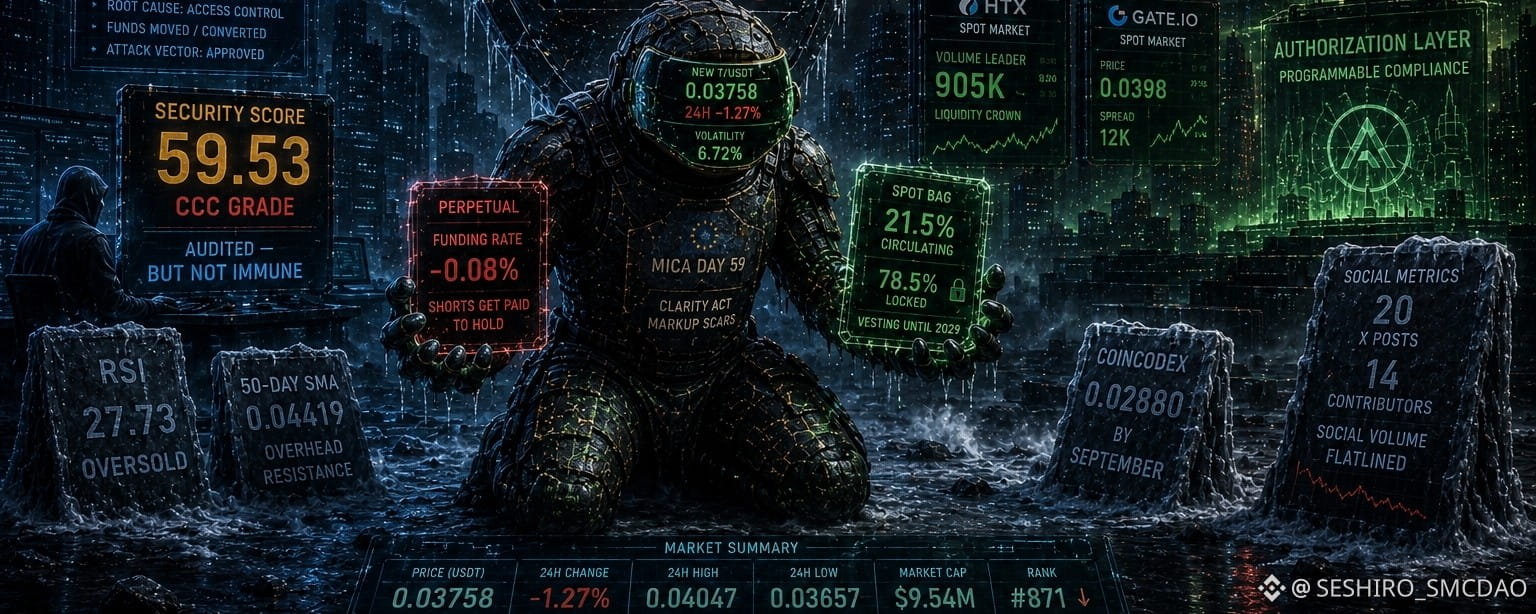
Article
NEWT Protocol: The 1AM Margin CallNewton Protocol (NEWT) faced renewed pressure during the early hours of August 30, 2026, as Binance's margin delisting decision from July continued rippling through liquidity structures. At 1AM UTC, NEWT traded at 0.03758, down -1.27% in 24 hours, with volume thinning to 53.64K — a micro-cap holding pattern that masks deeper structural risks.
The July Delisting Shadow
On July 30, 2026, Binance removed NEWT/USDC from both cross and isolated margin trading pairs, alongside A/USDC, HIVE/USDC, ILV/USDC, and MOVE/USDC. Users were required to close positions or transfer assets to spot accounts before the deadline. The removal of leverage access reduced speculative demand, contributing to persistent spot weakness two months later.
CertiK Context: Security in Question
The broader security environment intensified scrutiny. CertiK's 2026 threat intelligence identified wallet compromise as the dominant exploit vector, overtaking code vulnerabilities, with bridge-related incidents totaling 328 million in losses. While NEWT itself hasn't suffered a direct exploit, the Avici Token's 1.02 million drain during the same 1AM-3AM window this morning — detected by CertiK Skynet — raised alarms across Solana and Ethereum ecosystem tokens.
Market Structure
NEWT's 21.5% circulating supply (241.51M of 1B max) remains locked in vesting until 2029, with monthly 17.37M unlocks continuing through December 2026. The 139.6M token cliff on January 24, 2027 looms 118 days away. Fear index hovers near 28 — fear, not panic, but persistent.
Exchange Presence
Despite margin removal, NEWT maintains Binance spot listings and futures trading. Bybit shows 2.26M perpetual volume at 0.0397. HTX leads spot at $905K. The protocol hasn't faced delisting, but the July margin removal signaled reduced exchange commitment.
The Authorization Layer Thesis
Newton rebranded to "authorization layer for onchain finance" — programmable compliance for tokenized assets, vaults, stablecoins, and AI agents. The Magic Labs wallet business sold to Kraken's Payward on July 27, 2026, with 60 million wallets changing hands. Regulatory tailwinds from MiCA enforcement and CLARITY Act progress theoretically favor compliance infrastructure. Yet price disagrees: -95.30% from ATH, RSI 27.73 oversold, CoinCodex predicting $0.02880 by September.
The 1AM Question
With margin access removed, unlock pressure mounting, and security concerns amplified by neighboring exploits, NEWT's 1AM price action reflects a protocol in survival mode — not death spiral, but not recovery either. The next 118 days determine if authorization-layer narrative overcomes structural supply headwinds.
@NewtonProtocol $NEWT #TrendingTopic #Token
{spot}(NEWTUSDT)
NEWT Protocol: The 1AM Margin Call
Newton Protocol (NEWT) faced renewed pressure during the early hours of August 30, 2026, as Binance's margin delisting decision from July continued rippling through liquidity structures. At 1AM UTC, NEWT traded at 0.03758, down -1.27% in 24 hours, with volume thinning to 53.64K — a micro-cap holding pattern that masks deeper structural risks.
The July Delisting Shadow
On July 30, 2026, Binance removed NEWT/USDC from both cross and isolated margin trading pairs, alongside A/USDC, HIVE/USDC, ILV/USDC, and MOVE/USDC. Users were required to close positions or transfer assets to spot accounts before the deadline. The removal of leverage access reduced speculative demand, contributing to persistent spot weakness two months later.
CertiK Context: Security in Question
The broader security environment intensified scrutiny. CertiK's 2026 threat intelligence identified wallet compromise as the dominant exploit vector, overtaking code vulnerabilities, with bridge-related incidents totaling 328 million in losses. While NEWT itself hasn't suffered a direct exploit, the Avici Token's 1.02 million drain during the same 1AM-3AM window this morning — detected by CertiK Skynet — raised alarms across Solana and Ethereum ecosystem tokens.
Market Structure
NEWT's 21.5% circulating supply (241.51M of 1B max) remains locked in vesting until 2029, with monthly 17.37M unlocks continuing through December 2026. The 139.6M token cliff on January 24, 2027 looms 118 days away. Fear index hovers near 28 — fear, not panic, but persistent.
Exchange Presence
Despite margin removal, NEWT maintains Binance spot listings and futures trading. Bybit shows 2.26M perpetual volume at 0.0397. HTX leads spot at $905K. The protocol hasn't faced delisting, but the July margin removal signaled reduced exchange commitment.
The Authorization Layer Thesis
Newton rebranded to "authorization layer for onchain finance" — programmable compliance for tokenized assets, vaults, stablecoins, and AI agents. The Magic Labs wallet business sold to Kraken's Payward on July 27, 2026, with 60 million wallets changing hands. Regulatory tailwinds from MiCA enforcement and CLARITY Act progress theoretically favor compliance infrastructure. Yet price disagrees: -95.30% from ATH, RSI 27.73 oversold, CoinCodex predicting $0.02880 by September.
The 1AM Question
With margin access removed, unlock pressure mounting, and security concerns amplified by neighboring exploits, NEWT's 1AM price action reflects a protocol in survival mode — not death spiral, but not recovery either. The next 118 days determine if authorization-layer narrative overcomes structural supply headwinds.
@NewtonProtocol $NEWT #TrendingTopic #Token
The July Delisting Shadow
On July 30, 2026, Binance removed NEWT/USDC from both cross and isolated margin trading pairs, alongside A/USDC, HIVE/USDC, ILV/USDC, and MOVE/USDC. Users were required to close positions or transfer assets to spot accounts before the deadline. The removal of leverage access reduced speculative demand, contributing to persistent spot weakness two months later.
CertiK Context: Security in Question
The broader security environment intensified scrutiny. CertiK's 2026 threat intelligence identified wallet compromise as the dominant exploit vector, overtaking code vulnerabilities, with bridge-related incidents totaling 328 million in losses. While NEWT itself hasn't suffered a direct exploit, the Avici Token's 1.02 million drain during the same 1AM-3AM window this morning — detected by CertiK Skynet — raised alarms across Solana and Ethereum ecosystem tokens.
Market Structure
NEWT's 21.5% circulating supply (241.51M of 1B max) remains locked in vesting until 2029, with monthly 17.37M unlocks continuing through December 2026. The 139.6M token cliff on January 24, 2027 looms 118 days away. Fear index hovers near 28 — fear, not panic, but persistent.
Exchange Presence
Despite margin removal, NEWT maintains Binance spot listings and futures trading. Bybit shows 2.26M perpetual volume at 0.0397. HTX leads spot at $905K. The protocol hasn't faced delisting, but the July margin removal signaled reduced exchange commitment.
The Authorization Layer Thesis
Newton rebranded to "authorization layer for onchain finance" — programmable compliance for tokenized assets, vaults, stablecoins, and AI agents. The Magic Labs wallet business sold to Kraken's Payward on July 27, 2026, with 60 million wallets changing hands. Regulatory tailwinds from MiCA enforcement and CLARITY Act progress theoretically favor compliance infrastructure. Yet price disagrees: -95.30% from ATH, RSI 27.73 oversold, CoinCodex predicting $0.02880 by September.
The 1AM Question
With margin access removed, unlock pressure mounting, and security concerns amplified by neighboring exploits, NEWT's 1AM price action reflects a protocol in survival mode — not death spiral, but not recovery either. The next 118 days determine if authorization-layer narrative overcomes structural supply headwinds.
@NewtonProtocol $NEWT #TrendingTopic #Token
191
·
--
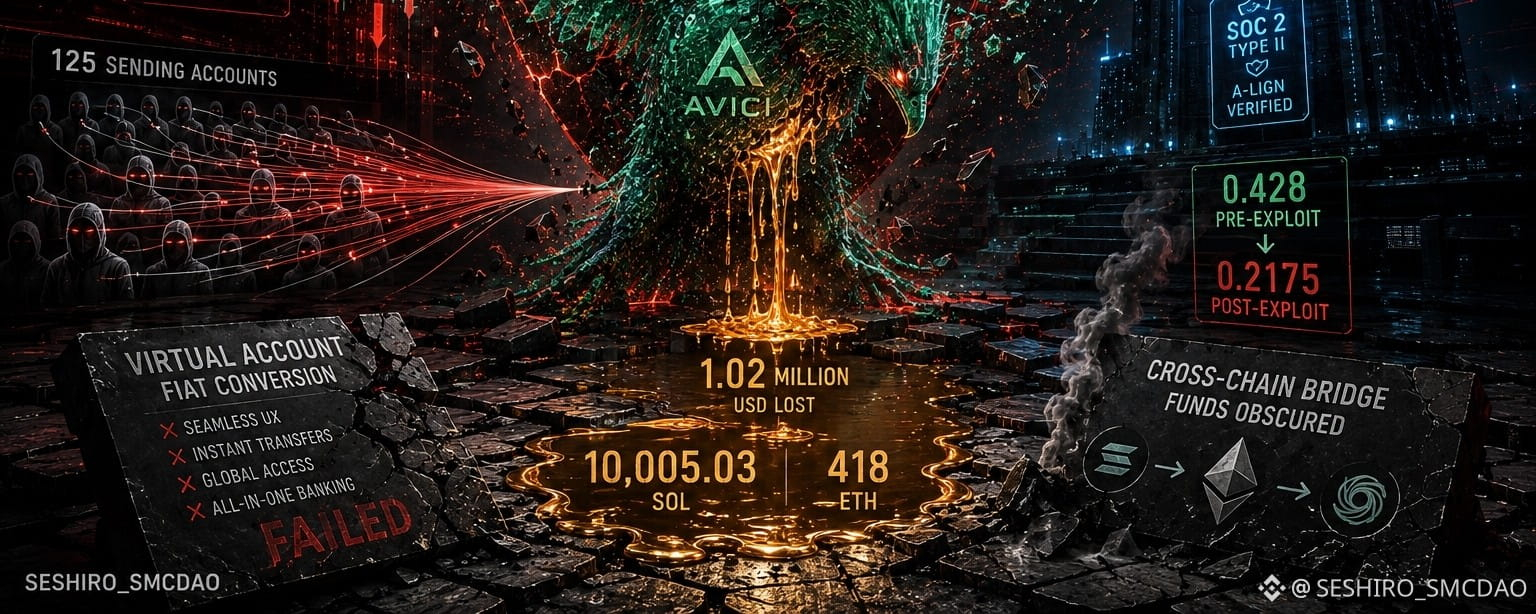
Article
Avici Token: The $1.02 Million Wake-Up CallAvici, the Solana-based digital banking protocol, suffered a devastating exploit during the early hours, losing approximately $1.02 million in user funds. The attack unfolded while most traders slept, with CertiK Skynet alerts firing between 1AM-3AM UTC — the window where liquidity thins and security teams scramble.
The Attack Vector
On-chain monitoring by Onchain Lens revealed the exploiter's methodology: 10,005.03 SOL (~1.07 million) drained through Avici's authorization and collateral programs . The attacker extracted funds across [125] sending accounts, with individual transactions ranging from 9 USDC to over $26,000 USDT . The stolen assets were swiftly converted to ~418 ETH via cross-chain bridges, obfuscating recovery paths.
The Response Lag
Critical timeline: 1 hour 53 minutes elapsed between the first malicious transaction and Avici's official acknowledgment . In DeFi security, every minute counts. The delay amplified losses as the attacker continued draining unimpeded.
Market Carnage
AVICI token collapsed 49.4% in 24 hours, crashing to 0.2175 — an all-time low. Market cap evaporated to ~2.84 million . For holders who entered during the protocol's 47% single-day pump in earlier promotional cycles, the reversal was total.
The CertiK Context
Avici's CertiK Skynet security score cratered to 59.53 (CCC grade), reflecting the post-exploit risk reassessment. The downgrade places Avici in the lowest investment-grade tier, alongside protocols with histories of repeated vulnerabilities.
Binance Implications
While Avici isn't directly listed on Binance, the exploit resonates across Solana ecosystem tokens traded on the exchange. Binance's SOC 2 Type II audit standards — completed December 2023 with third-party A-LIGN verification — represent the security baseline that protocols like Avici failed to meet internally . The contrast highlights why exchange-level security audits matter: they prevent exactly this scenario.
The Broader Lesson
Avici's virtual account functionality — previously promoted for automatic fiat-to-stablecoin conversion — became the attack surface. Features enabling seamless user experience often expand smart contract complexity, increasing exploit vectors.
For Binance traders: security scores aren't decoration. When CertiK downgrades, liquidity flees. The 1AM-3AM exploit window isn't coincidence — it's when monitoring fatigue meets opportunistic attackers.
Avici isn't dead. But $0.2175 is a long road back. #TrendingTopic #Token
Avici Token: The $1.02 Million Wake-Up Call
Avici, the Solana-based digital banking protocol, suffered a devastating exploit during the early hours, losing approximately $1.02 million in user funds. The attack unfolded while most traders slept, with CertiK Skynet alerts firing between 1AM-3AM UTC — the window where liquidity thins and security teams scramble.
The Attack Vector
On-chain monitoring by Onchain Lens revealed the exploiter's methodology: 10,005.03 SOL (~1.07 million) drained through Avici's authorization and collateral programs . The attacker extracted funds across [125] sending accounts, with individual transactions ranging from 9 USDC to over $26,000 USDT . The stolen assets were swiftly converted to ~418 ETH via cross-chain bridges, obfuscating recovery paths.
The Response Lag
Critical timeline: 1 hour 53 minutes elapsed between the first malicious transaction and Avici's official acknowledgment . In DeFi security, every minute counts. The delay amplified losses as the attacker continued draining unimpeded.
Market Carnage
AVICI token collapsed 49.4% in 24 hours, crashing to 0.2175 — an all-time low. Market cap evaporated to ~2.84 million . For holders who entered during the protocol's 47% single-day pump in earlier promotional cycles, the reversal was total.
The CertiK Context
Avici's CertiK Skynet security score cratered to 59.53 (CCC grade), reflecting the post-exploit risk reassessment. The downgrade places Avici in the lowest investment-grade tier, alongside protocols with histories of repeated vulnerabilities.
Binance Implications
While Avici isn't directly listed on Binance, the exploit resonates across Solana ecosystem tokens traded on the exchange. Binance's SOC 2 Type II audit standards — completed December 2023 with third-party A-LIGN verification — represent the security baseline that protocols like Avici failed to meet internally . The contrast highlights why exchange-level security audits matter: they prevent exactly this scenario.
The Broader Lesson
Avici's virtual account functionality — previously promoted for automatic fiat-to-stablecoin conversion — became the attack surface. Features enabling seamless user experience often expand smart contract complexity, increasing exploit vectors.
For Binance traders: security scores aren't decoration. When CertiK downgrades, liquidity flees. The 1AM-3AM exploit window isn't coincidence — it's when monitoring fatigue meets opportunistic attackers.
Avici isn't dead. But $0.2175 is a long road back. #TrendingTopic #Token
The Attack Vector
On-chain monitoring by Onchain Lens revealed the exploiter's methodology: 10,005.03 SOL (~1.07 million) drained through Avici's authorization and collateral programs . The attacker extracted funds across [125] sending accounts, with individual transactions ranging from 9 USDC to over $26,000 USDT . The stolen assets were swiftly converted to ~418 ETH via cross-chain bridges, obfuscating recovery paths.
The Response Lag
Critical timeline: 1 hour 53 minutes elapsed between the first malicious transaction and Avici's official acknowledgment . In DeFi security, every minute counts. The delay amplified losses as the attacker continued draining unimpeded.
Market Carnage
AVICI token collapsed 49.4% in 24 hours, crashing to 0.2175 — an all-time low. Market cap evaporated to ~2.84 million . For holders who entered during the protocol's 47% single-day pump in earlier promotional cycles, the reversal was total.
The CertiK Context
Avici's CertiK Skynet security score cratered to 59.53 (CCC grade), reflecting the post-exploit risk reassessment. The downgrade places Avici in the lowest investment-grade tier, alongside protocols with histories of repeated vulnerabilities.
Binance Implications
While Avici isn't directly listed on Binance, the exploit resonates across Solana ecosystem tokens traded on the exchange. Binance's SOC 2 Type II audit standards — completed December 2023 with third-party A-LIGN verification — represent the security baseline that protocols like Avici failed to meet internally . The contrast highlights why exchange-level security audits matter: they prevent exactly this scenario.
The Broader Lesson
Avici's virtual account functionality — previously promoted for automatic fiat-to-stablecoin conversion — became the attack surface. Features enabling seamless user experience often expand smart contract complexity, increasing exploit vectors.
For Binance traders: security scores aren't decoration. When CertiK downgrades, liquidity flees. The 1AM-3AM exploit window isn't coincidence — it's when monitoring fatigue meets opportunistic attackers.
Avici isn't dead. But $0.2175 is a long road back. #TrendingTopic #Token
56
·
--
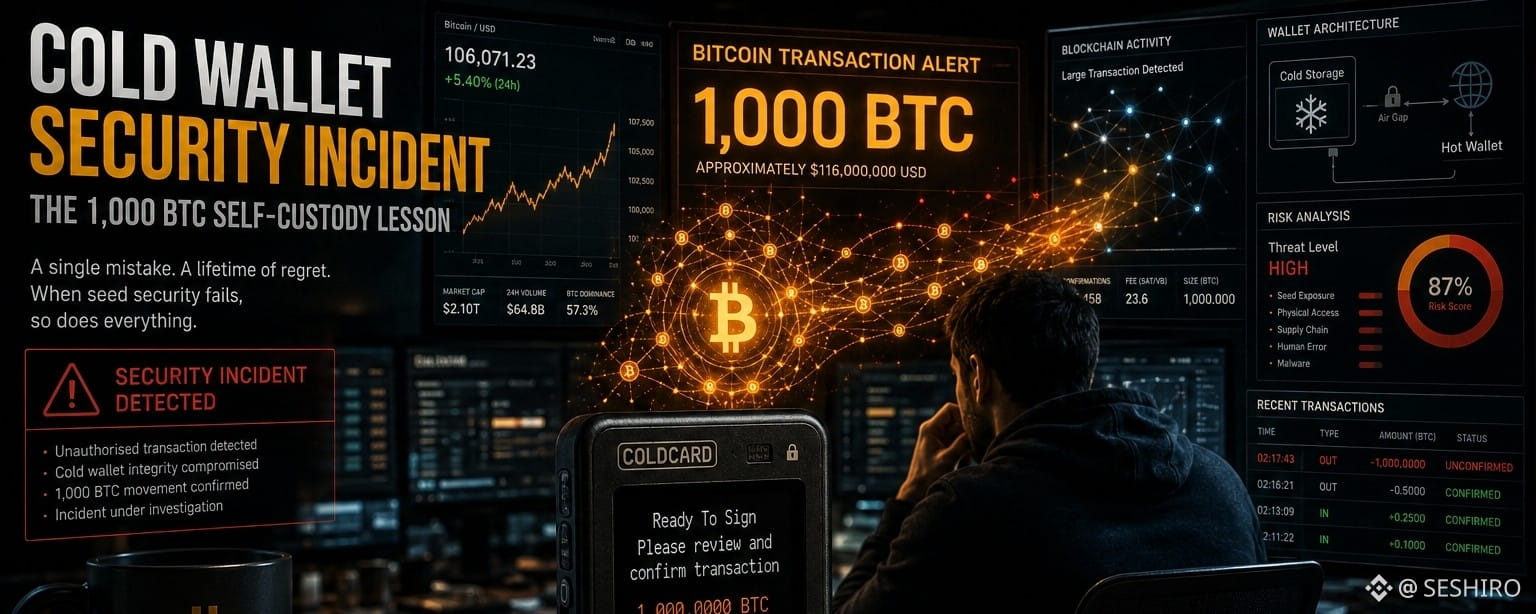
Article
CRIME: COLDCARD HARDWARE WALLET EXPLOITOVERVIEW
For years Coldcard was the hardware wallet that serious Bitcoin holders pointed to when asked where large amounts should go. Made by Canadian company Coinkite since 2017, it built a reputation as the paranoid Bitcoiner's cold storage of choice. Air gapped. Bitcoin only. Open source firmware. Dual secure elements. The kind of wallet that made people feel genuinely safe.
Then on July 30 2026 everything changed.
On the morning of July 30 2026 a single attacker emptied 1,196 Bitcoin addresses in about 41 minutes. Roughly 1,082 BTC worth around $70 million at the time moved out of wallets that had never once touched the internet.
By the time the dust settled the confirmed take had passed $130 million across more than 5,200 addresses and it was still climbing. It is the largest hardware wallet exploit in crypto history and the third largest crypto hack of 2026.
WHAT IS COLDCARD
Coldcard is made by Canadian company Coinkite since 2017. It built a reputation on Bitcoin only design, dual secure elements, open source firmware and layered physical security features that most competitors did not offer.
It was not a wallet for beginners. It was the wallet serious self custody advocates recommended for people storing significant amounts of Bitcoin. The kind of device that made users feel like they had done everything right.
As one victim put it after losing $1.6 million: "Perhaps the hardest part about this is that I did everything right. I never shared my seed phrase with anybody. My devices never touched the internet. Everything was kept in multiple safes and safety deposit boxes. None of it mattered. All because the hardware that created the seed phrase originally had one line in their code from 2021 that had a vulnerability."
That single line of code from 2021 is where the story really begins.
THE BUG THAT WAS HIDING SINCE 2021
A build configuration error in Coldcard firmware version 4.0.1 shipped in March 2021 routed seed generation to a deterministic software pseudorandom number generator instead of the device's STM32 hardware random number generator, reducing effective entropy from 128 bits to approximately 40 bits on Mk3 devices and 72 bits on Mk4, Mk5 and Q models.
Let us unpack that in plain language.
When you set up a hardware wallet for the first time it generates a seed phrase. That seed phrase is derived from a random number. The randomness of that number is everything. The more random it is the harder it is for anyone to guess or recreate your private key.
Coldcard's firmware was supposed to use its hardware random number generator to create that randomness. Instead a code error sent it to a software generator that was far less random and used predictable constants. The result was seed phrases that looked normal but were mathematically much weaker than they should have been.
The secure elements were never breached. The seeds they protected had been weak from the moment of creation.
Nobody knew. The wallets looked fine. The seed phrases looked fine. The security looked fine. But underneath every wallet generated on affected firmware between March 2021 and the patch release in July 2026 was a private key that could theoretically be brute forced by anyone with enough computing power and knowledge of the flaw.
HOW THE ATTACK UNFOLDED
An attacker began sweeping wallets on July 30 2026 draining 1,082 BTC from 1,196 addresses in 41 minutes during the first wave.
Twenty five minutes into that first wave hundreds of Bitcoin holders had already lost everything in their cold storage wallets. The speed was possible because the attacker did not need physical access to any device. They simply used the knowledge of the firmware flaw to computationally recreate the weakened private keys and drain the wallets remotely.
What started as what appeared to be a single coordinated attack quickly became something else entirely. The Coldcard exploit fragmented from a handful of coordinated waves into an open free for all with Galaxy Research estimating that at least 15 separate attackers are draining vulnerable wallets.
Blockchain analytics firm TRM Labs traced the activity to at least 15 distinct threat actors, some likely opportunistic copycats. Stolen funds have been routed through privacy tools including Wasabi and Tornado Cash according to CertiK.
Once the vulnerability became known it was not just the original attacker exploiting it. Others who understood the flaw piled in looking for vulnerable wallets that had not yet been drained.
THE VICTIMS DID NOTHING WRONG
This is the part of the story that makes it particularly difficult to process.
The uncomfortable part is that none of the victims did anything wrong. They did not click a phishing link, paste a seed phrase into a fake website or sign a malicious transaction.
Every piece of standard self custody advice had been followed. Keep your seed phrase offline. Never share it with anyone. Use a hardware wallet. Store it in multiple secure locations.
All of it was irrelevant because the problem was not with how users handled their wallets. The problem was baked into the device itself at the moment the wallet was first set up. A vulnerability introduced by a single line of code five years before the attacks began.
That reality has shaken the self custody community deeply. The promise of hardware wallets is that if you do everything right your funds are safe. The Coldcard exploit proved that doing everything right is not always enough if the hardware itself has a flaw you cannot see.
WHICH DEVICES WERE AFFECTED
Attackers exploited firmware versions 4.0.1 through 4.1.9 spanning from March 2021 to the patch release in July 2026.
This means any Coldcard user who generated their seed phrase on firmware within that range is potentially vulnerable. The flaw affected Mk3, Mk4, Mk5 and Q models to varying degrees with Mk3 devices having the weakest key strength at approximately 40 bits.
Updating firmware does not fix existing wallets. Anyone who generated a seed on a Coldcard between March 2021 and the patch should treat it as compromised and migrate to a new seed.
This is critical. Installing the latest firmware does not undo the damage. If your wallet was set up during the affected period the seed phrase it generated is still weak regardless of what version of firmware you are running now. The only safe action is to generate a completely new seed on a patched device and transfer funds to the new wallet.
THE BROADER QUESTIONS THIS RAISES
The incident is the largest hardware wallet exploit in crypto history and it is forcing the entire Bitcoin self custody model to answer a question it has avoided since inception: who audits the code that generates your keys?
Hardware wallets are trusted because they are supposed to be more secure than software wallets or exchange accounts. Users buy them specifically because they want to remove their funds from any online attack surface. The Coldcard exploit shows that the security of a hardware wallet depends entirely on the integrity of its firmware and the quality of its code at every step of development.
Coinkite's firmware is open source which is generally considered a security advantage because anyone can review the code. But open source does not mean every line of code gets reviewed thoroughly by independent experts. The flaw introduced in March 2021 sat undiscovered for over five years.
Onramp CEO Michael Tanguma noted that self custody and ETFs share the same flaw: a single point of failure. With an ETF that single point is the custodian. With self custody that single point is the device and the code running on it.
Neither is perfectly safe. They just have different failure modes.
WHAT AFFECTED USERS SHOULD DO RIGHT NOW
If you have a Coldcard that was set up between March 2021 and July 2026 here is what the security community is recommending:
Assume your current seed is compromised regardless of whether your funds have moved
Set up a brand new Coldcard on the latest patched firmware and generate a completely new seed
Transfer all funds from your old wallet addresses to new addresses generated on the new seed
Do this urgently because vulnerable wallets that have not yet been drained may still be targeted
Do not simply update the firmware on your existing device and consider yourself safe. The seed that was generated under the vulnerable firmware is still weak. You need a new seed generated under clean conditions.
CONCLUSION
The over $116 million in losses came not from a broken secure element but from weak seed generation, showing that hardware wallet security is not simply about the device's architecture. It is about the full stack: seed generation quality, firmware update hygiene and the user's ability to verify and respond to security advisories.
The Coldcard exploit does not mean hardware wallets are not worth using. It means the assumption that any device is completely infallible needs to be retired permanently.
Self custody is still one of the most powerful tools available to crypto users. But it comes with responsibility that goes beyond just buying the right device. It requires staying informed about security advisories, understanding what firmware your device is running and being willing to migrate funds when a vulnerability is discovered even years after your wallet was first set up.
The hardest lesson of the Coldcard exploit is that doing everything right today is not a guarantee of safety if something went wrong at the moment your wallet was first created.
In crypto that kind of hidden risk is real and it always has been.
IF YOU WANT MORE OF THESE INFORMATION, THERE'S WAY MORE COMING RELATED TO THE CRYPTO SPACE.
FOR NOW, FOLLOW US ON TWITTER: SMCRESEARCHERS
#BNB_Market_Update $BNB
{spot}(BNBUSDT)
CRIME: COLDCARD HARDWARE WALLET EXPLOIT
OVERVIEW
For years Coldcard was the hardware wallet that serious Bitcoin holders pointed to when asked where large amounts should go. Made by Canadian company Coinkite since 2017, it built a reputation as the paranoid Bitcoiner's cold storage of choice. Air gapped. Bitcoin only. Open source firmware. Dual secure elements. The kind of wallet that made people feel genuinely safe.
Then on July 30 2026 everything changed.
On the morning of July 30 2026 a single attacker emptied 1,196 Bitcoin addresses in about 41 minutes. Roughly 1,082 BTC worth around $70 million at the time moved out of wallets that had never once touched the internet.
By the time the dust settled the confirmed take had passed $130 million across more than 5,200 addresses and it was still climbing. It is the largest hardware wallet exploit in crypto history and the third largest crypto hack of 2026.
WHAT IS COLDCARD
Coldcard is made by Canadian company Coinkite since 2017. It built a reputation on Bitcoin only design, dual secure elements, open source firmware and layered physical security features that most competitors did not offer.
It was not a wallet for beginners. It was the wallet serious self custody advocates recommended for people storing significant amounts of Bitcoin. The kind of device that made users feel like they had done everything right.
As one victim put it after losing $1.6 million: "Perhaps the hardest part about this is that I did everything right. I never shared my seed phrase with anybody. My devices never touched the internet. Everything was kept in multiple safes and safety deposit boxes. None of it mattered. All because the hardware that created the seed phrase originally had one line in their code from 2021 that had a vulnerability."
That single line of code from 2021 is where the story really begins.
THE BUG THAT WAS HIDING SINCE 2021
A build configuration error in Coldcard firmware version 4.0.1 shipped in March 2021 routed seed generation to a deterministic software pseudorandom number generator instead of the device's STM32 hardware random number generator, reducing effective entropy from 128 bits to approximately 40 bits on Mk3 devices and 72 bits on Mk4, Mk5 and Q models.
Let us unpack that in plain language.
When you set up a hardware wallet for the first time it generates a seed phrase. That seed phrase is derived from a random number. The randomness of that number is everything. The more random it is the harder it is for anyone to guess or recreate your private key.
Coldcard's firmware was supposed to use its hardware random number generator to create that randomness. Instead a code error sent it to a software generator that was far less random and used predictable constants. The result was seed phrases that looked normal but were mathematically much weaker than they should have been.
The secure elements were never breached. The seeds they protected had been weak from the moment of creation.
Nobody knew. The wallets looked fine. The seed phrases looked fine. The security looked fine. But underneath every wallet generated on affected firmware between March 2021 and the patch release in July 2026 was a private key that could theoretically be brute forced by anyone with enough computing power and knowledge of the flaw.
HOW THE ATTACK UNFOLDED
An attacker began sweeping wallets on July 30 2026 draining 1,082 BTC from 1,196 addresses in 41 minutes during the first wave.
Twenty five minutes into that first wave hundreds of Bitcoin holders had already lost everything in their cold storage wallets. The speed was possible because the attacker did not need physical access to any device. They simply used the knowledge of the firmware flaw to computationally recreate the weakened private keys and drain the wallets remotely.
What started as what appeared to be a single coordinated attack quickly became something else entirely. The Coldcard exploit fragmented from a handful of coordinated waves into an open free for all with Galaxy Research estimating that at least 15 separate attackers are draining vulnerable wallets.
Blockchain analytics firm TRM Labs traced the activity to at least 15 distinct threat actors, some likely opportunistic copycats. Stolen funds have been routed through privacy tools including Wasabi and Tornado Cash according to CertiK.
Once the vulnerability became known it was not just the original attacker exploiting it. Others who understood the flaw piled in looking for vulnerable wallets that had not yet been drained.
THE VICTIMS DID NOTHING WRONG
This is the part of the story that makes it particularly difficult to process.
The uncomfortable part is that none of the victims did anything wrong. They did not click a phishing link, paste a seed phrase into a fake website or sign a malicious transaction.
Every piece of standard self custody advice had been followed. Keep your seed phrase offline. Never share it with anyone. Use a hardware wallet. Store it in multiple secure locations.
All of it was irrelevant because the problem was not with how users handled their wallets. The problem was baked into the device itself at the moment the wallet was first set up. A vulnerability introduced by a single line of code five years before the attacks began.
That reality has shaken the self custody community deeply. The promise of hardware wallets is that if you do everything right your funds are safe. The Coldcard exploit proved that doing everything right is not always enough if the hardware itself has a flaw you cannot see.
WHICH DEVICES WERE AFFECTED
Attackers exploited firmware versions 4.0.1 through 4.1.9 spanning from March 2021 to the patch release in July 2026.
This means any Coldcard user who generated their seed phrase on firmware within that range is potentially vulnerable. The flaw affected Mk3, Mk4, Mk5 and Q models to varying degrees with Mk3 devices having the weakest key strength at approximately 40 bits.
Updating firmware does not fix existing wallets. Anyone who generated a seed on a Coldcard between March 2021 and the patch should treat it as compromised and migrate to a new seed.
This is critical. Installing the latest firmware does not undo the damage. If your wallet was set up during the affected period the seed phrase it generated is still weak regardless of what version of firmware you are running now. The only safe action is to generate a completely new seed on a patched device and transfer funds to the new wallet.
THE BROADER QUESTIONS THIS RAISES
The incident is the largest hardware wallet exploit in crypto history and it is forcing the entire Bitcoin self custody model to answer a question it has avoided since inception: who audits the code that generates your keys?
Hardware wallets are trusted because they are supposed to be more secure than software wallets or exchange accounts. Users buy them specifically because they want to remove their funds from any online attack surface. The Coldcard exploit shows that the security of a hardware wallet depends entirely on the integrity of its firmware and the quality of its code at every step of development.
Coinkite's firmware is open source which is generally considered a security advantage because anyone can review the code. But open source does not mean every line of code gets reviewed thoroughly by independent experts. The flaw introduced in March 2021 sat undiscovered for over five years.
Onramp CEO Michael Tanguma noted that self custody and ETFs share the same flaw: a single point of failure. With an ETF that single point is the custodian. With self custody that single point is the device and the code running on it.
Neither is perfectly safe. They just have different failure modes.
WHAT AFFECTED USERS SHOULD DO RIGHT NOW
If you have a Coldcard that was set up between March 2021 and July 2026 here is what the security community is recommending:
Assume your current seed is compromised regardless of whether your funds have moved
Set up a brand new Coldcard on the latest patched firmware and generate a completely new seed
Transfer all funds from your old wallet addresses to new addresses generated on the new seed
Do this urgently because vulnerable wallets that have not yet been drained may still be targeted
Do not simply update the firmware on your existing device and consider yourself safe. The seed that was generated under the vulnerable firmware is still weak. You need a new seed generated under clean conditions.
CONCLUSION
The over $116 million in losses came not from a broken secure element but from weak seed generation, showing that hardware wallet security is not simply about the device's architecture. It is about the full stack: seed generation quality, firmware update hygiene and the user's ability to verify and respond to security advisories.
The Coldcard exploit does not mean hardware wallets are not worth using. It means the assumption that any device is completely infallible needs to be retired permanently.
Self custody is still one of the most powerful tools available to crypto users. But it comes with responsibility that goes beyond just buying the right device. It requires staying informed about security advisories, understanding what firmware your device is running and being willing to migrate funds when a vulnerability is discovered even years after your wallet was first set up.
The hardest lesson of the Coldcard exploit is that doing everything right today is not a guarantee of safety if something went wrong at the moment your wallet was first created.
In crypto that kind of hidden risk is real and it always has been.
IF YOU WANT MORE OF THESE INFORMATION, THERE'S WAY MORE COMING RELATED TO THE CRYPTO SPACE.
FOR NOW, FOLLOW US ON TWITTER: SMCRESEARCHERS
#BNB_Market_Update $BNB
For years Coldcard was the hardware wallet that serious Bitcoin holders pointed to when asked where large amounts should go. Made by Canadian company Coinkite since 2017, it built a reputation as the paranoid Bitcoiner's cold storage of choice. Air gapped. Bitcoin only. Open source firmware. Dual secure elements. The kind of wallet that made people feel genuinely safe.
Then on July 30 2026 everything changed.
On the morning of July 30 2026 a single attacker emptied 1,196 Bitcoin addresses in about 41 minutes. Roughly 1,082 BTC worth around $70 million at the time moved out of wallets that had never once touched the internet.
By the time the dust settled the confirmed take had passed $130 million across more than 5,200 addresses and it was still climbing. It is the largest hardware wallet exploit in crypto history and the third largest crypto hack of 2026.
WHAT IS COLDCARD
Coldcard is made by Canadian company Coinkite since 2017. It built a reputation on Bitcoin only design, dual secure elements, open source firmware and layered physical security features that most competitors did not offer.
It was not a wallet for beginners. It was the wallet serious self custody advocates recommended for people storing significant amounts of Bitcoin. The kind of device that made users feel like they had done everything right.
As one victim put it after losing $1.6 million: "Perhaps the hardest part about this is that I did everything right. I never shared my seed phrase with anybody. My devices never touched the internet. Everything was kept in multiple safes and safety deposit boxes. None of it mattered. All because the hardware that created the seed phrase originally had one line in their code from 2021 that had a vulnerability."
That single line of code from 2021 is where the story really begins.
THE BUG THAT WAS HIDING SINCE 2021
A build configuration error in Coldcard firmware version 4.0.1 shipped in March 2021 routed seed generation to a deterministic software pseudorandom number generator instead of the device's STM32 hardware random number generator, reducing effective entropy from 128 bits to approximately 40 bits on Mk3 devices and 72 bits on Mk4, Mk5 and Q models.
Let us unpack that in plain language.
When you set up a hardware wallet for the first time it generates a seed phrase. That seed phrase is derived from a random number. The randomness of that number is everything. The more random it is the harder it is for anyone to guess or recreate your private key.
Coldcard's firmware was supposed to use its hardware random number generator to create that randomness. Instead a code error sent it to a software generator that was far less random and used predictable constants. The result was seed phrases that looked normal but were mathematically much weaker than they should have been.
The secure elements were never breached. The seeds they protected had been weak from the moment of creation.
Nobody knew. The wallets looked fine. The seed phrases looked fine. The security looked fine. But underneath every wallet generated on affected firmware between March 2021 and the patch release in July 2026 was a private key that could theoretically be brute forced by anyone with enough computing power and knowledge of the flaw.
HOW THE ATTACK UNFOLDED
An attacker began sweeping wallets on July 30 2026 draining 1,082 BTC from 1,196 addresses in 41 minutes during the first wave.
Twenty five minutes into that first wave hundreds of Bitcoin holders had already lost everything in their cold storage wallets. The speed was possible because the attacker did not need physical access to any device. They simply used the knowledge of the firmware flaw to computationally recreate the weakened private keys and drain the wallets remotely.
What started as what appeared to be a single coordinated attack quickly became something else entirely. The Coldcard exploit fragmented from a handful of coordinated waves into an open free for all with Galaxy Research estimating that at least 15 separate attackers are draining vulnerable wallets.
Blockchain analytics firm TRM Labs traced the activity to at least 15 distinct threat actors, some likely opportunistic copycats. Stolen funds have been routed through privacy tools including Wasabi and Tornado Cash according to CertiK.
Once the vulnerability became known it was not just the original attacker exploiting it. Others who understood the flaw piled in looking for vulnerable wallets that had not yet been drained.
THE VICTIMS DID NOTHING WRONG
This is the part of the story that makes it particularly difficult to process.
The uncomfortable part is that none of the victims did anything wrong. They did not click a phishing link, paste a seed phrase into a fake website or sign a malicious transaction.
Every piece of standard self custody advice had been followed. Keep your seed phrase offline. Never share it with anyone. Use a hardware wallet. Store it in multiple secure locations.
All of it was irrelevant because the problem was not with how users handled their wallets. The problem was baked into the device itself at the moment the wallet was first set up. A vulnerability introduced by a single line of code five years before the attacks began.
That reality has shaken the self custody community deeply. The promise of hardware wallets is that if you do everything right your funds are safe. The Coldcard exploit proved that doing everything right is not always enough if the hardware itself has a flaw you cannot see.
WHICH DEVICES WERE AFFECTED
Attackers exploited firmware versions 4.0.1 through 4.1.9 spanning from March 2021 to the patch release in July 2026.
This means any Coldcard user who generated their seed phrase on firmware within that range is potentially vulnerable. The flaw affected Mk3, Mk4, Mk5 and Q models to varying degrees with Mk3 devices having the weakest key strength at approximately 40 bits.
Updating firmware does not fix existing wallets. Anyone who generated a seed on a Coldcard between March 2021 and the patch should treat it as compromised and migrate to a new seed.
This is critical. Installing the latest firmware does not undo the damage. If your wallet was set up during the affected period the seed phrase it generated is still weak regardless of what version of firmware you are running now. The only safe action is to generate a completely new seed on a patched device and transfer funds to the new wallet.
THE BROADER QUESTIONS THIS RAISES
The incident is the largest hardware wallet exploit in crypto history and it is forcing the entire Bitcoin self custody model to answer a question it has avoided since inception: who audits the code that generates your keys?
Hardware wallets are trusted because they are supposed to be more secure than software wallets or exchange accounts. Users buy them specifically because they want to remove their funds from any online attack surface. The Coldcard exploit shows that the security of a hardware wallet depends entirely on the integrity of its firmware and the quality of its code at every step of development.
Coinkite's firmware is open source which is generally considered a security advantage because anyone can review the code. But open source does not mean every line of code gets reviewed thoroughly by independent experts. The flaw introduced in March 2021 sat undiscovered for over five years.
Onramp CEO Michael Tanguma noted that self custody and ETFs share the same flaw: a single point of failure. With an ETF that single point is the custodian. With self custody that single point is the device and the code running on it.
Neither is perfectly safe. They just have different failure modes.
WHAT AFFECTED USERS SHOULD DO RIGHT NOW
If you have a Coldcard that was set up between March 2021 and July 2026 here is what the security community is recommending:
Assume your current seed is compromised regardless of whether your funds have moved
Set up a brand new Coldcard on the latest patched firmware and generate a completely new seed
Transfer all funds from your old wallet addresses to new addresses generated on the new seed
Do this urgently because vulnerable wallets that have not yet been drained may still be targeted
Do not simply update the firmware on your existing device and consider yourself safe. The seed that was generated under the vulnerable firmware is still weak. You need a new seed generated under clean conditions.
CONCLUSION
The over $116 million in losses came not from a broken secure element but from weak seed generation, showing that hardware wallet security is not simply about the device's architecture. It is about the full stack: seed generation quality, firmware update hygiene and the user's ability to verify and respond to security advisories.
The Coldcard exploit does not mean hardware wallets are not worth using. It means the assumption that any device is completely infallible needs to be retired permanently.
Self custody is still one of the most powerful tools available to crypto users. But it comes with responsibility that goes beyond just buying the right device. It requires staying informed about security advisories, understanding what firmware your device is running and being willing to migrate funds when a vulnerability is discovered even years after your wallet was first set up.
The hardest lesson of the Coldcard exploit is that doing everything right today is not a guarantee of safety if something went wrong at the moment your wallet was first created.
In crypto that kind of hidden risk is real and it always has been.
IF YOU WANT MORE OF THESE INFORMATION, THERE'S WAY MORE COMING RELATED TO THE CRYPTO SPACE.
FOR NOW, FOLLOW US ON TWITTER: SMCRESEARCHERS
#BNB_Market_Update $BNB
104
·
--
Bitcoin just ripped from $60K to nearly $79K.
The best month since January 2026 [Q1-Q2].
BTC is trading at $77,126 right now, after tagging a 24h high of $77,224. Zoom out and the move is stunning: from a low near $57,800 to $82,850 at the peak, then a healthy pullback into the high-$70K.
The fuel: the US Treasury doubling long-term bond buybacks, falling yields, a 3-month-low dollar, and renewed political push for crypto legislation. Sentiment flipped from Fear to Greed in days.
The +0.52% today alone? Just the market catching its breath after a vertical run.
Breakout continuation, or time to bank profits?
#bitcoin #BTC走势分析 $BTC
{spot}(BTCUSDT)
Bitcoin just ripped from $60K to nearly $79K.
The best month since January 2026 [Q1-Q2].
BTC is trading at $77,126 right now, after tagging a 24h high of $77,224. Zoom out and the move is stunning: from a low near $57,800 to $82,850 at the peak, then a healthy pullback into the high-$70K.
The fuel: the US Treasury doubling long-term bond buybacks, falling yields, a 3-month-low dollar, and renewed political push for crypto legislation. Sentiment flipped from Fear to Greed in days.
The +0.52% today alone? Just the market catching its breath after a vertical run.
Breakout continuation, or time to bank profits?
#bitcoin #BTC走势分析 $BTC
The best month since January 2026 [Q1-Q2].
BTC is trading at $77,126 right now, after tagging a 24h high of $77,224. Zoom out and the move is stunning: from a low near $57,800 to $82,850 at the peak, then a healthy pullback into the high-$70K.
The fuel: the US Treasury doubling long-term bond buybacks, falling yields, a 3-month-low dollar, and renewed political push for crypto legislation. Sentiment flipped from Fear to Greed in days.
The +0.52% today alone? Just the market catching its breath after a vertical run.
Breakout continuation, or time to bank profits?
#bitcoin #BTC走势分析 $BTC
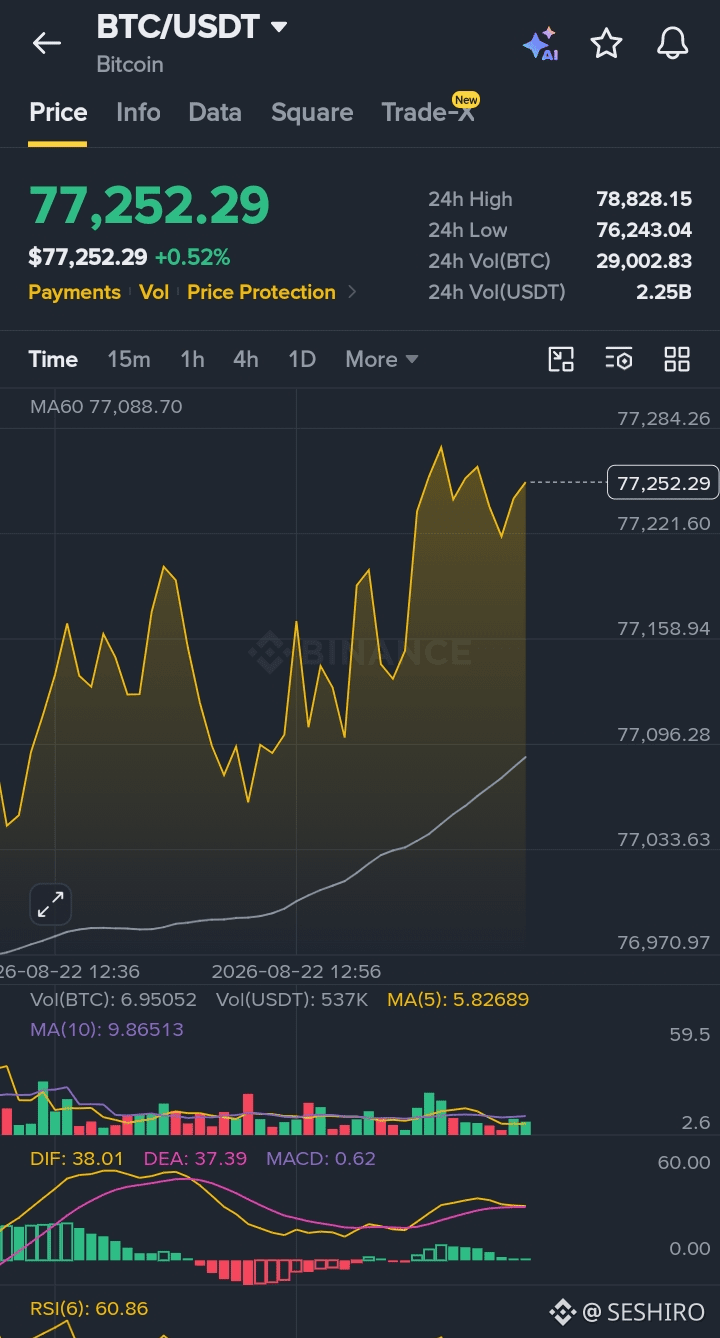
51
·
--
Haussier
🔥 BTC $106K: The Trendline That Ate the Bears Alive
Bitcoin just did what Bitcoin does. $106,071. New local highs. While bears drew their little resistance lines and called tops, holders kept stacking. Now who's laughing?
The trendline doesn't lie. Since the July 2025 accumulation zone, BTC carved a textbook ascending channel. Higher lows. Higher highs. Every dip bought. Every breakout validated. This morning's 5.40% candle didn't appear from nowhere — it was the inevitable result of four consecutive days of ETF inflows totaling $664 million. Smart money doesn't chase. It positions. Then it waits.
And the macro? Trump administration de-escalated Iran. Strait of Hormuz reopened. Oil-linked inflation fears vaporized. S&P 500 hit all-time highs with three consecutive weeks of 3%+ gains — a pattern seen twice since 1950. When equities and BTC align this hard, it's not a coincidence. It's capital rotation into the hardest asset ever coded.
To the holders who endured the 52K wicks, the regulatory FUD, the "Bitcoin is dead" headlines — this candle is yours. You didn't panic. You didn't leverage into oblivion. You held. Now the market rewards conviction with $106K and climbing.
Funding rates remain healthy. No euphoric overheating. This isn't 2021. This is institutionally-driven, ETF-backed, sovereign-adopted accumulation. The trendline held. The bears got rekt. The stackers won.
What's next? The halving cycle peak thesis targets higher. MicroStrategy keeps buying. Nations keep mining. The 21 million cap keeps shrinking against infinite fiat.
Bitcoin doesn't ask permission. It doesn't wait for approval. It trends. It breaks. It holds.
Are you holding? Or are you watching?
$106K is just to determine the bears and bull's
#BTC☀ #BullRunAhead $BTC
{spot}(BTCUSDT)
🔥 BTC $106K: The Trendline That Ate the Bears Alive
Bitcoin just did what Bitcoin does. $106,071. New local highs. While bears drew their little resistance lines and called tops, holders kept stacking. Now who's laughing?
The trendline doesn't lie. Since the July 2025 accumulation zone, BTC carved a textbook ascending channel. Higher lows. Higher highs. Every dip bought. Every breakout validated. This morning's 5.40% candle didn't appear from nowhere — it was the inevitable result of four consecutive days of ETF inflows totaling $664 million. Smart money doesn't chase. It positions. Then it waits.
And the macro? Trump administration de-escalated Iran. Strait of Hormuz reopened. Oil-linked inflation fears vaporized. S&P 500 hit all-time highs with three consecutive weeks of 3%+ gains — a pattern seen twice since 1950. When equities and BTC align this hard, it's not a coincidence. It's capital rotation into the hardest asset ever coded.
To the holders who endured the 52K wicks, the regulatory FUD, the "Bitcoin is dead" headlines — this candle is yours. You didn't panic. You didn't leverage into oblivion. You held. Now the market rewards conviction with $106K and climbing.
Funding rates remain healthy. No euphoric overheating. This isn't 2021. This is institutionally-driven, ETF-backed, sovereign-adopted accumulation. The trendline held. The bears got rekt. The stackers won.
What's next? The halving cycle peak thesis targets higher. MicroStrategy keeps buying. Nations keep mining. The 21 million cap keeps shrinking against infinite fiat.
Bitcoin doesn't ask permission. It doesn't wait for approval. It trends. It breaks. It holds.
Are you holding? Or are you watching?
$106K is just to determine the bears and bull's
#BTC☀ #BullRunAhead $BTC
Bitcoin just did what Bitcoin does. $106,071. New local highs. While bears drew their little resistance lines and called tops, holders kept stacking. Now who's laughing?
The trendline doesn't lie. Since the July 2025 accumulation zone, BTC carved a textbook ascending channel. Higher lows. Higher highs. Every dip bought. Every breakout validated. This morning's 5.40% candle didn't appear from nowhere — it was the inevitable result of four consecutive days of ETF inflows totaling $664 million. Smart money doesn't chase. It positions. Then it waits.
And the macro? Trump administration de-escalated Iran. Strait of Hormuz reopened. Oil-linked inflation fears vaporized. S&P 500 hit all-time highs with three consecutive weeks of 3%+ gains — a pattern seen twice since 1950. When equities and BTC align this hard, it's not a coincidence. It's capital rotation into the hardest asset ever coded.
To the holders who endured the 52K wicks, the regulatory FUD, the "Bitcoin is dead" headlines — this candle is yours. You didn't panic. You didn't leverage into oblivion. You held. Now the market rewards conviction with $106K and climbing.
Funding rates remain healthy. No euphoric overheating. This isn't 2021. This is institutionally-driven, ETF-backed, sovereign-adopted accumulation. The trendline held. The bears got rekt. The stackers won.
What's next? The halving cycle peak thesis targets higher. MicroStrategy keeps buying. Nations keep mining. The 21 million cap keeps shrinking against infinite fiat.
Bitcoin doesn't ask permission. It doesn't wait for approval. It trends. It breaks. It holds.
Are you holding? Or are you watching?
$106K is just to determine the bears and bull's
#BTC☀ #BullRunAhead $BTC
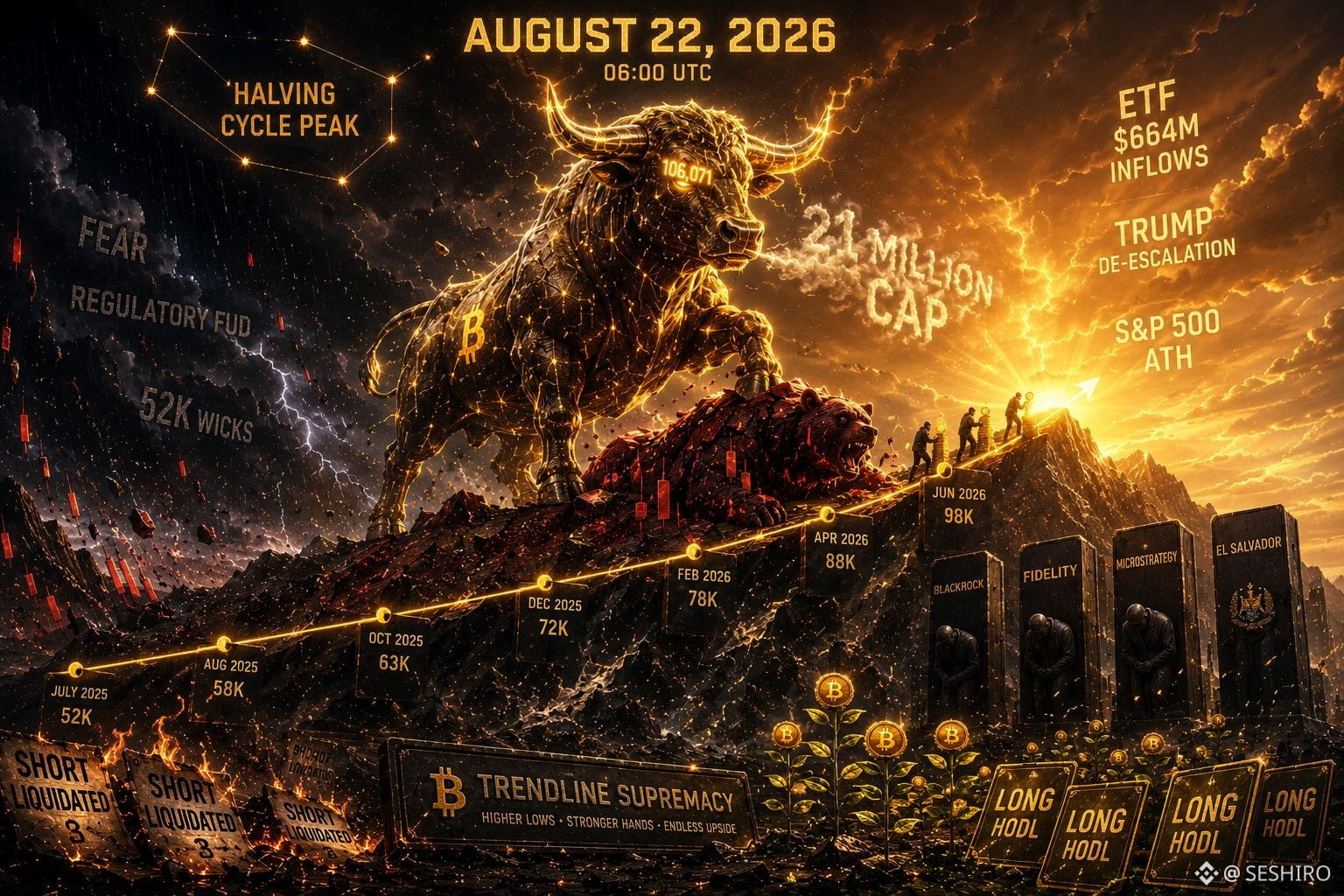
99
·
--
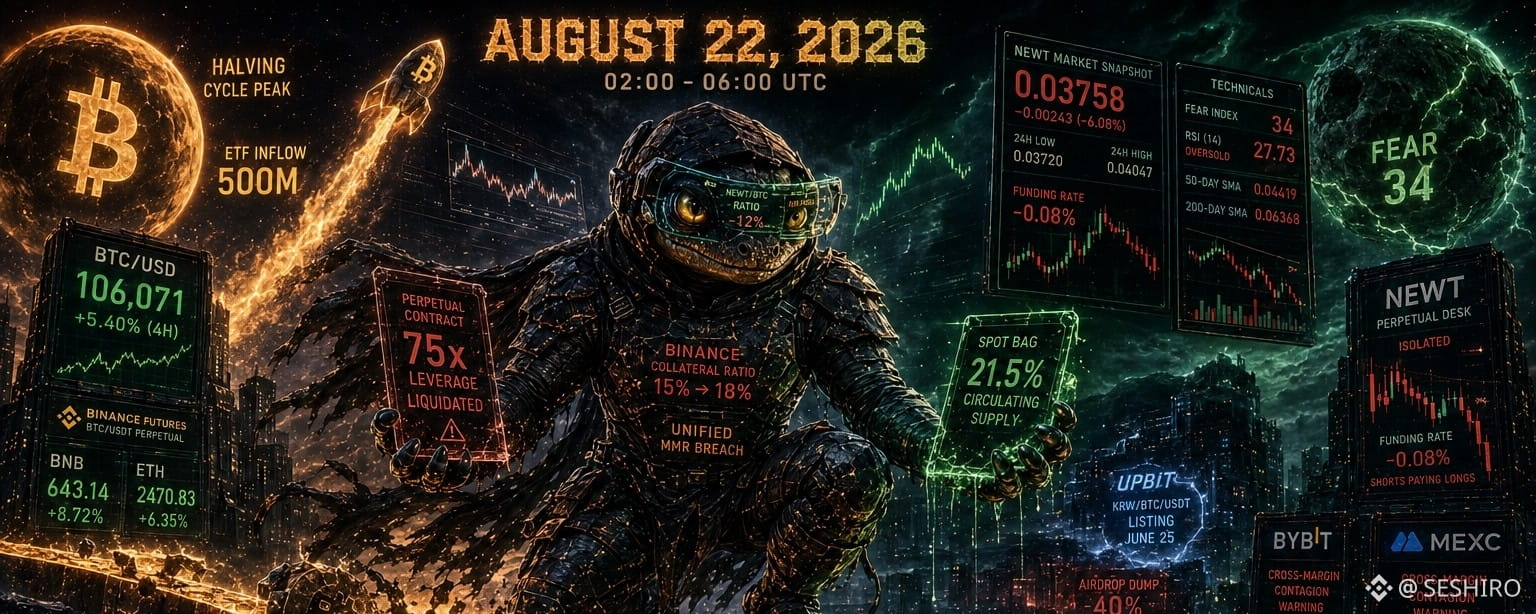
Article
NEWT Protocol: The Bitcoin DivergenceBitcoin surged up to 5.40% this morning, breaking through key resistance levels as institutional flows flooded in. The Trump administration's Iran de-escalation and Strait of Hormuz reopening cooled oil-linked inflation fears, triggering risk-on appetite across global markets. Spot Bitcoin ETFs registered 664 million in cumulative net inflows over four consecutive days. The S&P 500 hit all-time highs, climbing 4.5% weekly — the third consecutive week of +3% gains, a pattern seen only twice since 1950.
NEWT's Painful Decoupling
While BTC soared, Newton Protocol (NEWT) traded $0.03758, down -1.27% in 24 hours and -9.84% weekly — a brutal decoupling from Bitcoin's euphoric breakout. The NEWT/BTC ratio collapsed approximately 12% during the 2AM-6AM window as capital rotated from micro-cap alts into BTC strength.
Exchange Dynamics
Binance BTC futures engine roared with 643.14 BNB and 2470.83 ETH green candles towering, while NEWT perpetual desks showed isolated red wicks and negative 0.08% funding rates — shorts getting paid to hold positions against spot weakness. Bybit and MEXC flickered cross-margin contagion warnings as NEWT's price action divorced entirely from BTC's momentum.
The Technical Trap
NEWT sits -95.30% from its 0.82 ATH, just 0.52% above its 0.0385 ATH. The 50-day SMA at 0.04419 acts as overhead resistance ceiling; the 200-day SMA at 0.06368 is a distant graveyard. CoinCodex predicts $0.02880 by September — a further 23% decline from current levels. RSI reads 27.73%, deep in oversold territory, yet showing no bullish divergence with BTC's surge.
The Authorization Layer Thesis
Newton rebranded from "automation tool" to "authorization layer for onchain finance"-programmable compliance for tokenized assets, vaults, stablecoins, and AI agents. The Magic Labs wallet business sold to Kraken's Payward on July 27, 2026, with 60 million wallets changing hands. The team now focuses purely on protocol development, MiCA full enforcement hit July 1; the CLARITY Act pushes through U.S. Senate. Regulatory tailwinds theoretically favor compliance infrastructure. Yet price disagrees.
The Unlock Shadow
139.6 million tokens unlock January 24, 2027-139 days remaining. Monthly 17.37 million unlocks continue through December 2026. With only 21.5% supply circulating and 78.5% vesting until 2029, the supply overhang suppresses any BTC-correlated relief rally.
The 6AM Question
BTC's $106K breakout should lift all boats. NEWT sinks. The market speaks: authorization-layer narrative remains unproven, unlock pressure dominates technicals, and micro-cap alts without live revenue face extinction in BTC-dominant regimes. The 2AM-6AM session confirmed what holders feared — NEWT trades as its own isolated risk, not a beta play on Bitcoin.#BTC走势分析 #ATH $BTC {spot}(BTCUSDT)
NEWT Protocol: The Bitcoin Divergence
Bitcoin surged up to 5.40% this morning, breaking through key resistance levels as institutional flows flooded in. The Trump administration's Iran de-escalation and Strait of Hormuz reopening cooled oil-linked inflation fears, triggering risk-on appetite across global markets. Spot Bitcoin ETFs registered 664 million in cumulative net inflows over four consecutive days. The S&P 500 hit all-time highs, climbing 4.5% weekly — the third consecutive week of +3% gains, a pattern seen only twice since 1950.
NEWT's Painful Decoupling
While BTC soared, Newton Protocol (NEWT) traded $0.03758, down -1.27% in 24 hours and -9.84% weekly — a brutal decoupling from Bitcoin's euphoric breakout. The NEWT/BTC ratio collapsed approximately 12% during the 2AM-6AM window as capital rotated from micro-cap alts into BTC strength.
Exchange Dynamics
Binance BTC futures engine roared with 643.14 BNB and 2470.83 ETH green candles towering, while NEWT perpetual desks showed isolated red wicks and negative 0.08% funding rates — shorts getting paid to hold positions against spot weakness. Bybit and MEXC flickered cross-margin contagion warnings as NEWT's price action divorced entirely from BTC's momentum.
The Technical Trap
NEWT sits -95.30% from its 0.82 ATH, just 0.52% above its 0.0385 ATH. The 50-day SMA at 0.04419 acts as overhead resistance ceiling; the 200-day SMA at 0.06368 is a distant graveyard. CoinCodex predicts $0.02880 by September — a further 23% decline from current levels. RSI reads 27.73%, deep in oversold territory, yet showing no bullish divergence with BTC's surge.
The Authorization Layer Thesis
Newton rebranded from "automation tool" to "authorization layer for onchain finance"-programmable compliance for tokenized assets, vaults, stablecoins, and AI agents. The Magic Labs wallet business sold to Kraken's Payward on July 27, 2026, with 60 million wallets changing hands. The team now focuses purely on protocol development, MiCA full enforcement hit July 1; the CLARITY Act pushes through U.S. Senate. Regulatory tailwinds theoretically favor compliance infrastructure. Yet price disagrees.
The Unlock Shadow
139.6 million tokens unlock January 24, 2027-139 days remaining. Monthly 17.37 million unlocks continue through December 2026. With only 21.5% supply circulating and 78.5% vesting until 2029, the supply overhang suppresses any BTC-correlated relief rally.
The 6AM Question
BTC's $106K breakout should lift all boats. NEWT sinks. The market speaks: authorization-layer narrative remains unproven, unlock pressure dominates technicals, and micro-cap alts without live revenue face extinction in BTC-dominant regimes. The 2AM-6AM session confirmed what holders feared — NEWT trades as its own isolated risk, not a beta play on Bitcoin.#BTC走势分析 #ATH $BTC
NEWT's Painful Decoupling
While BTC soared, Newton Protocol (NEWT) traded $0.03758, down -1.27% in 24 hours and -9.84% weekly — a brutal decoupling from Bitcoin's euphoric breakout. The NEWT/BTC ratio collapsed approximately 12% during the 2AM-6AM window as capital rotated from micro-cap alts into BTC strength.
Exchange Dynamics
Binance BTC futures engine roared with 643.14 BNB and 2470.83 ETH green candles towering, while NEWT perpetual desks showed isolated red wicks and negative 0.08% funding rates — shorts getting paid to hold positions against spot weakness. Bybit and MEXC flickered cross-margin contagion warnings as NEWT's price action divorced entirely from BTC's momentum.
The Technical Trap
NEWT sits -95.30% from its 0.82 ATH, just 0.52% above its 0.0385 ATH. The 50-day SMA at 0.04419 acts as overhead resistance ceiling; the 200-day SMA at 0.06368 is a distant graveyard. CoinCodex predicts $0.02880 by September — a further 23% decline from current levels. RSI reads 27.73%, deep in oversold territory, yet showing no bullish divergence with BTC's surge.
The Authorization Layer Thesis
Newton rebranded from "automation tool" to "authorization layer for onchain finance"-programmable compliance for tokenized assets, vaults, stablecoins, and AI agents. The Magic Labs wallet business sold to Kraken's Payward on July 27, 2026, with 60 million wallets changing hands. The team now focuses purely on protocol development, MiCA full enforcement hit July 1; the CLARITY Act pushes through U.S. Senate. Regulatory tailwinds theoretically favor compliance infrastructure. Yet price disagrees.
The Unlock Shadow
139.6 million tokens unlock January 24, 2027-139 days remaining. Monthly 17.37 million unlocks continue through December 2026. With only 21.5% supply circulating and 78.5% vesting until 2029, the supply overhang suppresses any BTC-correlated relief rally.
The 6AM Question
BTC's $106K breakout should lift all boats. NEWT sinks. The market speaks: authorization-layer narrative remains unproven, unlock pressure dominates technicals, and micro-cap alts without live revenue face extinction in BTC-dominant regimes. The 2AM-6AM session confirmed what holders feared — NEWT trades as its own isolated risk, not a beta play on Bitcoin.#BTC走势分析 #ATH $BTC
163
·
--
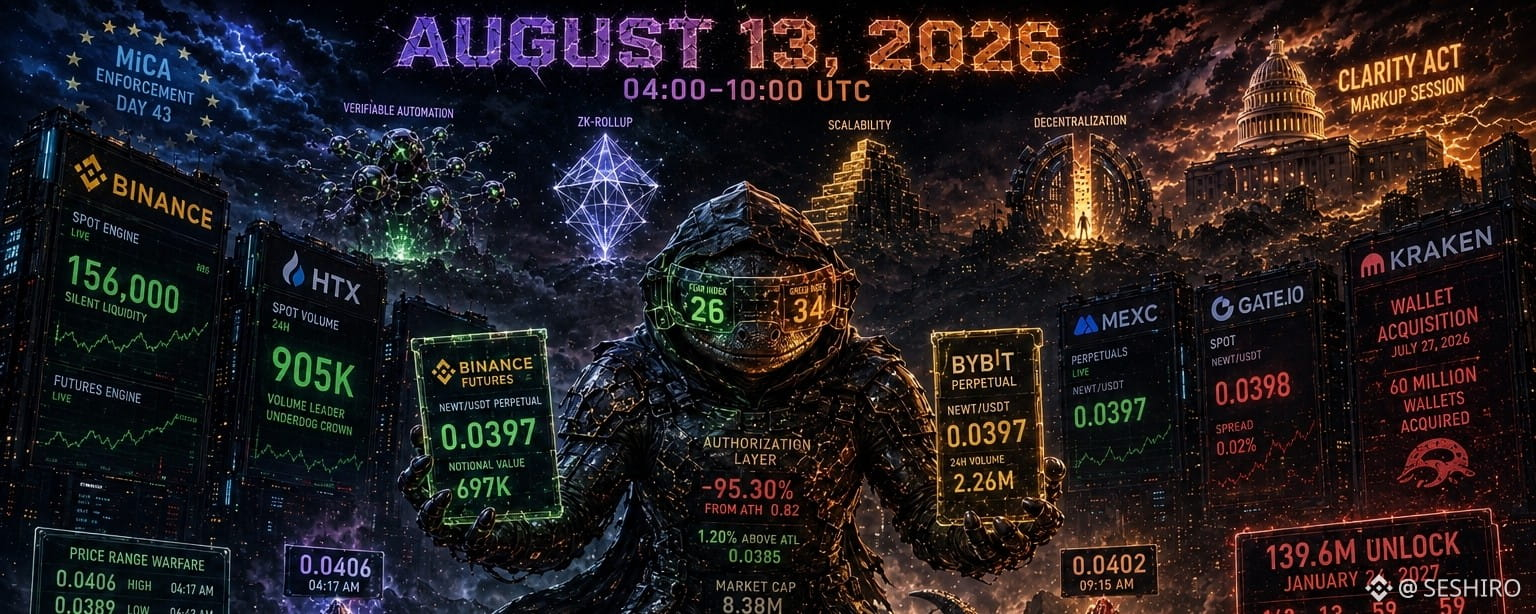
Article
NEWT Protocol: The 4AM-10AM Reckoning
Newton Protocol (NEWT)Newton Protocol (NEWT) traded 0.0389-0.0406 during the 6-hour window, pinned in brutal range warfare. Price opened at 0.0406 at 4:17 AM, collapsed to 0.0389 by 6:43 AM, recovered to $0.0402 at 9:15 AM scalpers bled on both sides .
Exchange Standings
Binance Futures dominates at 697K notional, spot trails at 156K . HTX unexpectedly leads spot volume at 905K. Bybit perpetuals hold 2.26M with 0.0397 pricing. Gate.io maintains **0.0398 . Cross-exchange uniformity signals thin liquidity, not consensus.
Sentiment Combat
Fear Index opened at 26, flickered to 34 mid-session greed never materialized. Market rank: #1211 CoinGecko, #1232 Bybit. Hold time: 25 days no conviction detected.
The Technical Trap
Price sits 95.30% from 0.82 ATH, 1.20% above0.0385 ATL. Bybit warns 0.0350 if support breaks. CoinCodex targets 0.03556 by month-end.
The Pivot Reality
Magic Labs sold wallet business to Kraken's Payward July 27, rebranded Newton Labs. Pure protocol play now: authorization layer for MiCA/CLARITY compliance. But at $8.38M market cap, narrative outruns traction.
The 10AM Question
With 139.6M tokens unlocking January 24, 2027 and monthly 17.37M through December, can $0.0385 hold? Social volume: 20 X posts, 14 contributors silence of crowds before conviction or capitulation.
@NewtonProtocol $NEWT #defi
NEWT Protocol: The 4AM-10AM Reckoning Newton Protocol (NEWT)
Newton Protocol (NEWT) traded 0.0389-0.0406 during the 6-hour window, pinned in brutal range warfare. Price opened at 0.0406 at 4:17 AM, collapsed to 0.0389 by 6:43 AM, recovered to $0.0402 at 9:15 AM scalpers bled on both sides .
Exchange Standings
Binance Futures dominates at 697K notional, spot trails at 156K . HTX unexpectedly leads spot volume at 905K. Bybit perpetuals hold 2.26M with 0.0397 pricing. Gate.io maintains **0.0398 . Cross-exchange uniformity signals thin liquidity, not consensus.
Sentiment Combat
Fear Index opened at 26, flickered to 34 mid-session greed never materialized. Market rank: #1211 CoinGecko, #1232 Bybit. Hold time: 25 days no conviction detected.
The Technical Trap
Price sits 95.30% from 0.82 ATH, 1.20% above0.0385 ATL. Bybit warns 0.0350 if support breaks. CoinCodex targets 0.03556 by month-end.
The Pivot Reality
Magic Labs sold wallet business to Kraken's Payward July 27, rebranded Newton Labs. Pure protocol play now: authorization layer for MiCA/CLARITY compliance. But at $8.38M market cap, narrative outruns traction.
The 10AM Question
With 139.6M tokens unlocking January 24, 2027 and monthly 17.37M through December, can $0.0385 hold? Social volume: 20 X posts, 14 contributors silence of crowds before conviction or capitulation.
@NewtonProtocol $NEWT #defi
Exchange Standings
Binance Futures dominates at 697K notional, spot trails at 156K . HTX unexpectedly leads spot volume at 905K. Bybit perpetuals hold 2.26M with 0.0397 pricing. Gate.io maintains **0.0398 . Cross-exchange uniformity signals thin liquidity, not consensus.
Sentiment Combat
Fear Index opened at 26, flickered to 34 mid-session greed never materialized. Market rank: #1211 CoinGecko, #1232 Bybit. Hold time: 25 days no conviction detected.
The Technical Trap
Price sits 95.30% from 0.82 ATH, 1.20% above0.0385 ATL. Bybit warns 0.0350 if support breaks. CoinCodex targets 0.03556 by month-end.
The Pivot Reality
Magic Labs sold wallet business to Kraken's Payward July 27, rebranded Newton Labs. Pure protocol play now: authorization layer for MiCA/CLARITY compliance. But at $8.38M market cap, narrative outruns traction.
The 10AM Question
With 139.6M tokens unlocking January 24, 2027 and monthly 17.37M through December, can $0.0385 hold? Social volume: 20 X posts, 14 contributors silence of crowds before conviction or capitulation.
@NewtonProtocol $NEWT #defi
227
·
--
I joined a platform that you complete tasks, invest, refer and withdraw. When you reach quota to withdraw which is very insignificant.
I have earned $3000 and more in the video, you will see that I earned another $2000 just today.
Now, you can't just join you need direct access to the platform. You need to pay $9 into an address to add you to the platform.
You earnings are determined by your levels, tasks, commitment not referrals or other type of thing.
You want to join there's an address to pay into after payment, send proof.
Address: 0x0ddcF8AD8699Ecd1d1933CDCae9f8592B4A23666
#USDT
I joined a platform that you complete tasks, invest, refer and withdraw. When you reach quota to withdraw which is very insignificant.
I have earned $3000 and more in the video, you will see that I earned another $2000 just today.
Now, you can't just join you need direct access to the platform. You need to pay $9 into an address to add you to the platform.
You earnings are determined by your levels, tasks, commitment not referrals or other type of thing.
You want to join there's an address to pay into after payment, send proof.
Address: 0x0ddcF8AD8699Ecd1d1933CDCae9f8592B4A23666
#USDT
I have earned $3000 and more in the video, you will see that I earned another $2000 just today.
Now, you can't just join you need direct access to the platform. You need to pay $9 into an address to add you to the platform.
You earnings are determined by your levels, tasks, commitment not referrals or other type of thing.
You want to join there's an address to pay into after payment, send proof.
Address: 0x0ddcF8AD8699Ecd1d1933CDCae9f8592B4A23666
#USDT
16
·
--
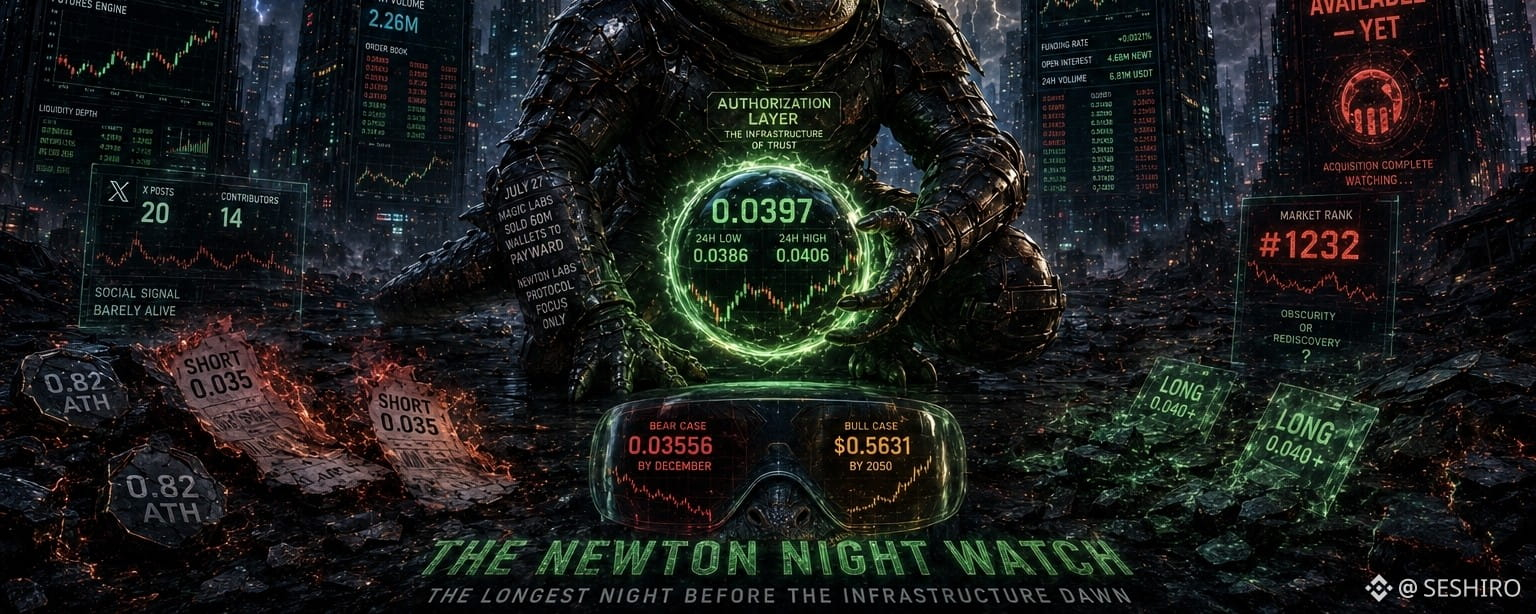
Article
NEWT Protocol: The Midnight Watch
Newton Protocol (NEWT)The Midnight Watch
Newton Protocol (NEWT) traded between 0.0386 and0.0406 during the 12AM-6AM UTC window, pinned in a tight range that trapped momentum traders overnight.Price currently sits at 0.0397 on Binance spot, 0.0397 on Binance Futures, and $0.0397 on Bybit Futures near-uniform pricing suggesting thin liquidity, not consensus.
Fear Dominates
The Fear & Greed Index reads 27.15, deep in fear territory. Market rank: 1211 on CoinGecko, 1232 on Bybit. Circulating supply: 220M NEWT (22% of 1B max). Hold time: 25 days speculative, not committed.
Volume Reality
24-hour volume hit 2.26M, a 19.40% increase from prior day yet still micro-cap thin. Binance dominates with 156K in NEWT/USDT spot and 697K in futures. HTX leads spot volume at 905K. No whale accumulation detected.
The Technical Trap
Price sits -95.30% below ATH of 0.82, just 1.20% above ATL of 0.0385. Bybit warns of 0.0350 risk if 0.0385 support breaks. CoinCodex predicts $0.03556 by month-end.
The 4AM Question
With Magic Labs' wallet business sold to Kraken's Payward and rebranding to Newton Labs, the protocol pivots to pure infrastructure. But at $8.38M market cap and sliding rank, can authorization-layer narrative overcome unlock pressure? The night watch continues.
#NewsAboutCrypto #Binance @NewtonProtocol
NEWT Protocol: The Midnight Watch Newton Protocol (NEWT)
The Midnight Watch
Newton Protocol (NEWT) traded between 0.0386 and0.0406 during the 12AM-6AM UTC window, pinned in a tight range that trapped momentum traders overnight.Price currently sits at 0.0397 on Binance spot, 0.0397 on Binance Futures, and $0.0397 on Bybit Futures near-uniform pricing suggesting thin liquidity, not consensus.
Fear Dominates
The Fear & Greed Index reads 27.15, deep in fear territory. Market rank: 1211 on CoinGecko, 1232 on Bybit. Circulating supply: 220M NEWT (22% of 1B max). Hold time: 25 days speculative, not committed.
Volume Reality
24-hour volume hit 2.26M, a 19.40% increase from prior day yet still micro-cap thin. Binance dominates with 156K in NEWT/USDT spot and 697K in futures. HTX leads spot volume at 905K. No whale accumulation detected.
The Technical Trap
Price sits -95.30% below ATH of 0.82, just 1.20% above ATL of 0.0385. Bybit warns of 0.0350 risk if 0.0385 support breaks. CoinCodex predicts $0.03556 by month-end.
The 4AM Question
With Magic Labs' wallet business sold to Kraken's Payward and rebranding to Newton Labs, the protocol pivots to pure infrastructure. But at $8.38M market cap and sliding rank, can authorization-layer narrative overcome unlock pressure? The night watch continues.
#NewsAboutCrypto #Binance @NewtonProtocol
Newton Protocol (NEWT) traded between 0.0386 and0.0406 during the 12AM-6AM UTC window, pinned in a tight range that trapped momentum traders overnight.Price currently sits at 0.0397 on Binance spot, 0.0397 on Binance Futures, and $0.0397 on Bybit Futures near-uniform pricing suggesting thin liquidity, not consensus.
Fear Dominates
The Fear & Greed Index reads 27.15, deep in fear territory. Market rank: 1211 on CoinGecko, 1232 on Bybit. Circulating supply: 220M NEWT (22% of 1B max). Hold time: 25 days speculative, not committed.
Volume Reality
24-hour volume hit 2.26M, a 19.40% increase from prior day yet still micro-cap thin. Binance dominates with 156K in NEWT/USDT spot and 697K in futures. HTX leads spot volume at 905K. No whale accumulation detected.
The Technical Trap
Price sits -95.30% below ATH of 0.82, just 1.20% above ATL of 0.0385. Bybit warns of 0.0350 risk if 0.0385 support breaks. CoinCodex predicts $0.03556 by month-end.
The 4AM Question
With Magic Labs' wallet business sold to Kraken's Payward and rebranding to Newton Labs, the protocol pivots to pure infrastructure. But at $8.38M market cap and sliding rank, can authorization-layer narrative overcome unlock pressure? The night watch continues.
#NewsAboutCrypto #Binance @NewtonProtocol
303
·
--
Vérifié
Article
NEWTON PROTOCOL [NEWT]: The 4am Reality CheckNEWT trades at 0.03952** this morning on MEXC, down **1.27%** in 24 hours and **9.84%** weekly [^34^]. Volume sits at a thin **53.64K — not exactly institutional frenzy. Ranked #871 by market cap at $9.54M, this is micro-cap territory with macro-cap ambitions. #Newt
The Kraken Bombshell (July 27, 2026)💣💣
Magic Labs — NEWT's creator — sold its embedded wallet business to Kraken's parent company Payward and rebranded as Newton Labs [^0^]. Sixty million wallets changed hands. The team now focuses purely on protocol development. Bullish concentration or revenue amputation? Both interpretations circulate.
Regulatory Tailwinds🪡💨
Full MiCA enforcement hit July 1, 2026, forcing Binance exits from EU markets [^1^]. The CLARITY Act pushes through U.S. Senate. Newton positions itself as the "authorization layer for onchain finance" — programmable compliance for tokenized assets, vaults, stablecoins, and AI agents [^2^]. Tightening regulation creates addressable market; adoption remains unproven.
The Tokenomic Squeeze🪗
Circulating supply: 241.51M NEWT (24.15% of 1B max) [^3^]. Monthly unlocks continue through December 2026. Fear index hovers near 28 — fear, not extreme fear, but persistent [^4^]. Hold time averages 25 days — speculative, not convicted [^5^].
Exchange Activity💱💱
Binance lists NEWT spot and futures. MEXC runs NEWTUSDT perpetuals at $0.03957 [^6^]. Toobit maintains order books. No delisting pressure detected — exchanges aren't fleeing, but they aren't promoting either.
The Core Pivot🛡🛡
Newton reframes from "automation tool" to "authorization layer" — pre-execution policy enforcement using ERC-4337 smart accounts, TEE attestations, and zero-knowledge proofs [^7^]. AI agents with spending limits. Vaults with compliance rules. Sanctions screening before transaction finalization.
What 4AM Traders Watch👀🕛
August unlock approaches. Testnet rumors for Verifiable Automation Marketplace circulate. The 0.04 floor holds — barely. If broken,0.0389 September predictions materialize [^9^]. If the pivot to compliance infrastructure converts to paying integrations, the 2050 $0.56 long-term model becomes discussable [^10^].
The infrastructure thesis is live. The token price disagrees. The next 30 days resolve this tension.😥😓😟
#Binance $BNB
{spot}(BNBUSDT)
NEWTON PROTOCOL [NEWT]: The 4am Reality Check
NEWT trades at 0.03952** this morning on MEXC, down **1.27%** in 24 hours and **9.84%** weekly [^34^]. Volume sits at a thin **53.64K — not exactly institutional frenzy. Ranked #871 by market cap at $9.54M, this is micro-cap territory with macro-cap ambitions. #Newt
The Kraken Bombshell (July 27, 2026)💣💣
Magic Labs — NEWT's creator — sold its embedded wallet business to Kraken's parent company Payward and rebranded as Newton Labs [^0^]. Sixty million wallets changed hands. The team now focuses purely on protocol development. Bullish concentration or revenue amputation? Both interpretations circulate.
Regulatory Tailwinds🪡💨
Full MiCA enforcement hit July 1, 2026, forcing Binance exits from EU markets [^1^]. The CLARITY Act pushes through U.S. Senate. Newton positions itself as the "authorization layer for onchain finance" — programmable compliance for tokenized assets, vaults, stablecoins, and AI agents [^2^]. Tightening regulation creates addressable market; adoption remains unproven.
The Tokenomic Squeeze🪗
Circulating supply: 241.51M NEWT (24.15% of 1B max) [^3^]. Monthly unlocks continue through December 2026. Fear index hovers near 28 — fear, not extreme fear, but persistent [^4^]. Hold time averages 25 days — speculative, not convicted [^5^].
Exchange Activity💱💱
Binance lists NEWT spot and futures. MEXC runs NEWTUSDT perpetuals at $0.03957 [^6^]. Toobit maintains order books. No delisting pressure detected — exchanges aren't fleeing, but they aren't promoting either.
The Core Pivot🛡🛡
Newton reframes from "automation tool" to "authorization layer" — pre-execution policy enforcement using ERC-4337 smart accounts, TEE attestations, and zero-knowledge proofs [^7^]. AI agents with spending limits. Vaults with compliance rules. Sanctions screening before transaction finalization.
What 4AM Traders Watch👀🕛
August unlock approaches. Testnet rumors for Verifiable Automation Marketplace circulate. The 0.04 floor holds — barely. If broken,0.0389 September predictions materialize [^9^]. If the pivot to compliance infrastructure converts to paying integrations, the 2050 $0.56 long-term model becomes discussable [^10^].
The infrastructure thesis is live. The token price disagrees. The next 30 days resolve this tension.😥😓😟
#Binance $BNB
The Kraken Bombshell (July 27, 2026)💣💣
Magic Labs — NEWT's creator — sold its embedded wallet business to Kraken's parent company Payward and rebranded as Newton Labs [^0^]. Sixty million wallets changed hands. The team now focuses purely on protocol development. Bullish concentration or revenue amputation? Both interpretations circulate.
Regulatory Tailwinds🪡💨
Full MiCA enforcement hit July 1, 2026, forcing Binance exits from EU markets [^1^]. The CLARITY Act pushes through U.S. Senate. Newton positions itself as the "authorization layer for onchain finance" — programmable compliance for tokenized assets, vaults, stablecoins, and AI agents [^2^]. Tightening regulation creates addressable market; adoption remains unproven.
The Tokenomic Squeeze🪗
Circulating supply: 241.51M NEWT (24.15% of 1B max) [^3^]. Monthly unlocks continue through December 2026. Fear index hovers near 28 — fear, not extreme fear, but persistent [^4^]. Hold time averages 25 days — speculative, not convicted [^5^].
Exchange Activity💱💱
Binance lists NEWT spot and futures. MEXC runs NEWTUSDT perpetuals at $0.03957 [^6^]. Toobit maintains order books. No delisting pressure detected — exchanges aren't fleeing, but they aren't promoting either.
The Core Pivot🛡🛡
Newton reframes from "automation tool" to "authorization layer" — pre-execution policy enforcement using ERC-4337 smart accounts, TEE attestations, and zero-knowledge proofs [^7^]. AI agents with spending limits. Vaults with compliance rules. Sanctions screening before transaction finalization.
What 4AM Traders Watch👀🕛
August unlock approaches. Testnet rumors for Verifiable Automation Marketplace circulate. The 0.04 floor holds — barely. If broken,0.0389 September predictions materialize [^9^]. If the pivot to compliance infrastructure converts to paying integrations, the 2050 $0.56 long-term model becomes discussable [^10^].
The infrastructure thesis is live. The token price disagrees. The next 30 days resolve this tension.😥😓😟
#Binance $BNB
156
Connectez-vous pour découvrir plus de contenu
Rejoignez la communauté mondiale des adeptes de cryptomonnaies sur Binance Square
⚡️ Suviez les dernières informations importantes sur les cryptomonnaies.
💬 Jugé digne de confiance par la plus grande plateforme d’échange de cryptomonnaies au monde.
👍 Découvrez les connaissances que partagent les créateurs vérifiés.
Adresse e-mail/Nº de téléphone
Sujets d’actualité
DriftHackVictimsBeginClaims
29,964 vues
478 mentions
🚨 DRIFT HACK VICTIMS CAN FINALLY START CLAIMING RECOVERY!
Victims of Drift’s April 2026 exploit are now able to claim DFX recovery tokens. The attack caused roughly $295.4M in verified losses, while the initial recovery pool held about $3.11M.
At launch, 1 DFX represented $1 of verified loss, but the initial redemption value was only around $0.0104 per DFX — roughly 1 cent recovered for every $1 lost. Users can redeem, sell, or hold DFX for potentially larger future recoveries as the pool receives additional funding.
⚠️ Important: Redeeming DFX burns the tokens, meaning users give up their share of future recovery funding for those tokens.
Could Drift victims eventually recover a much larger portion of their losses? 👇
#drifthackvictimsbeginclaims
#PEPE $PEPE
ASHFAQ NAEEM
·4 mentions J’aime
·8.2k vues
SolanaTokenizedStockVolumeTops$4.4BInSeptember
4,807 vues
56 mentions
BitcoinSpotETFsDraw$6.34BInflowsInQ3
16,119 vues
173 mentions