
天天天徐
568 Posts

天天天徐
Open Trade
Occasional Trader
10.3 Months
0 Following
24 Followers
21 Liked
Posts
Portfolio
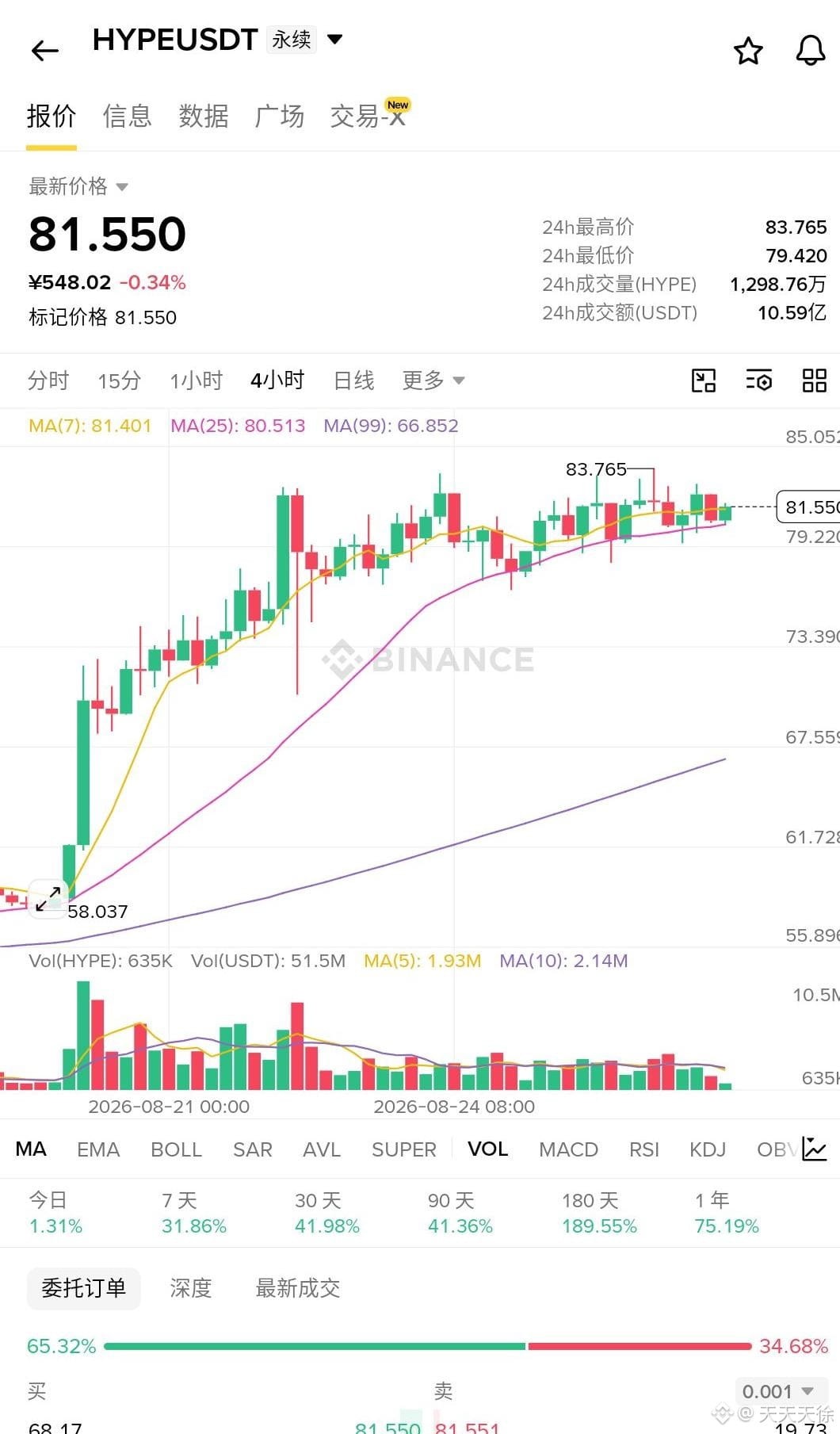
$HYPE bearish; the order book has already pulled up the old bones of the shorts early—don’t expect anyone to take the bag. The sell orders press the buys down hard. The buy-side thickness is nowhere near enough even to make up a fraction of the sell wall. The price can’t be pushed past the middle of today’s range; looking at spot depth, it’s all overhead selling pressure with no real support. On the futures side, the deferred contract price is discounting the spot, and open interest is contracting as well. The leveraged longs end up backing down first—this match is the shorts’ home turf.
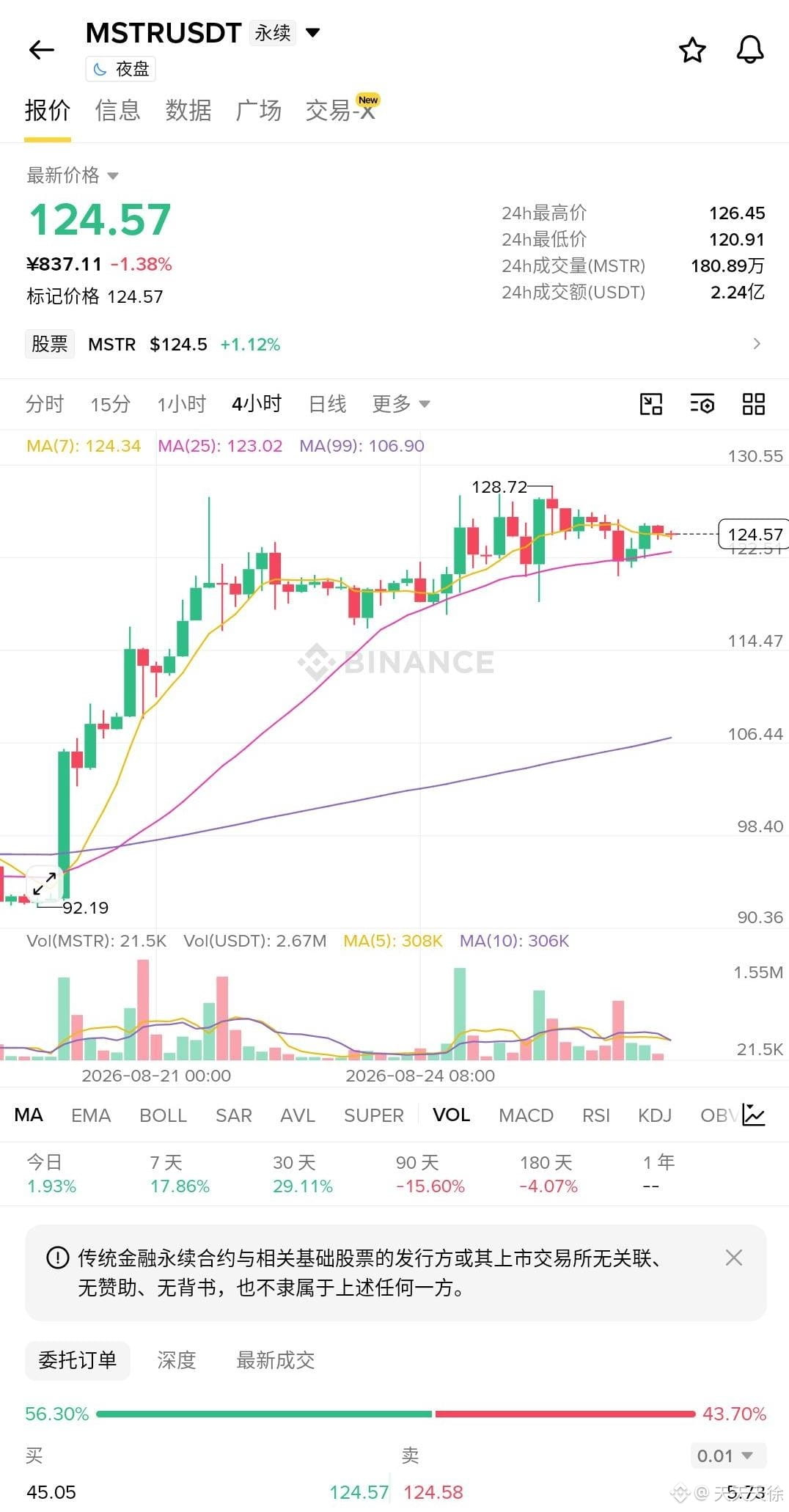
Around MSTR 124.5, in the past 24 hours it’s down 1.2%, and over the past 4 hours there are 6 K-lines with 5 bearish ones—looks like it may break downward. But the real focus of this selloff is: positions are being cut, while big players are absorbing.
Open interest for the contracts shrank by 9.1% in a day. Nearly all the selling pressure is leveraged floating profit being shaken out. In the same window, whale accounts increased their long exposure for 7 hours by nearly 40%. Now about 60% of accounts are on the long side, and long positions have climbed to 60% too. When it drops, the main force is adding—what’s being cut is mainly small retail positions. This is a washout, not a distribution.
The order book is also on the long side: spot buys 1 at 3404 versus spot sells 1 at 2416. The buy side is pressing down on the sell side by 1.4x. In terms of taker activity, the active-buy orders are still 51.8%. Funding rate remains positive at +0.08%, so longs haven’t broken down. Price is trading right along MA50 at 124.3, and the pullback level is right under your eyes.
Around 124.3, look to go long. The first target is 126.45, the 24-hour high. Stop loss if it loses 120.9—below the 24-hour low. If that breaks, it means the support is fake and the whales are catching a falling knife. If the funding flips negative and whale long exposure turns down, immediately reverse—don’t hold and fight it.
#mstr $MSTR
Open interest for the contracts shrank by 9.1% in a day. Nearly all the selling pressure is leveraged floating profit being shaken out. In the same window, whale accounts increased their long exposure for 7 hours by nearly 40%. Now about 60% of accounts are on the long side, and long positions have climbed to 60% too. When it drops, the main force is adding—what’s being cut is mainly small retail positions. This is a washout, not a distribution.
The order book is also on the long side: spot buys 1 at 3404 versus spot sells 1 at 2416. The buy side is pressing down on the sell side by 1.4x. In terms of taker activity, the active-buy orders are still 51.8%. Funding rate remains positive at +0.08%, so longs haven’t broken down. Price is trading right along MA50 at 124.3, and the pullback level is right under your eyes.
Around 124.3, look to go long. The first target is 126.45, the 24-hour high. Stop loss if it loses 120.9—below the 24-hour low. If that breaks, it means the support is fake and the whales are catching a falling knife. If the funding flips negative and whale long exposure turns down, immediately reverse—don’t hold and fight it.
#mstr $MSTR
$CL 多, don't talk to me about fluctuations—4-hour structure signals up, daily is aligned in the same direction. Price is grinding just below the 83.23 day high; it’s only one step away. Pull back to 80.0 to go long. First target 83.2 to break and refresh the previous high. Stop loss 76.8, placed outside the 79.65 structure. As for the 83.2 top—I think it's there to be broken.
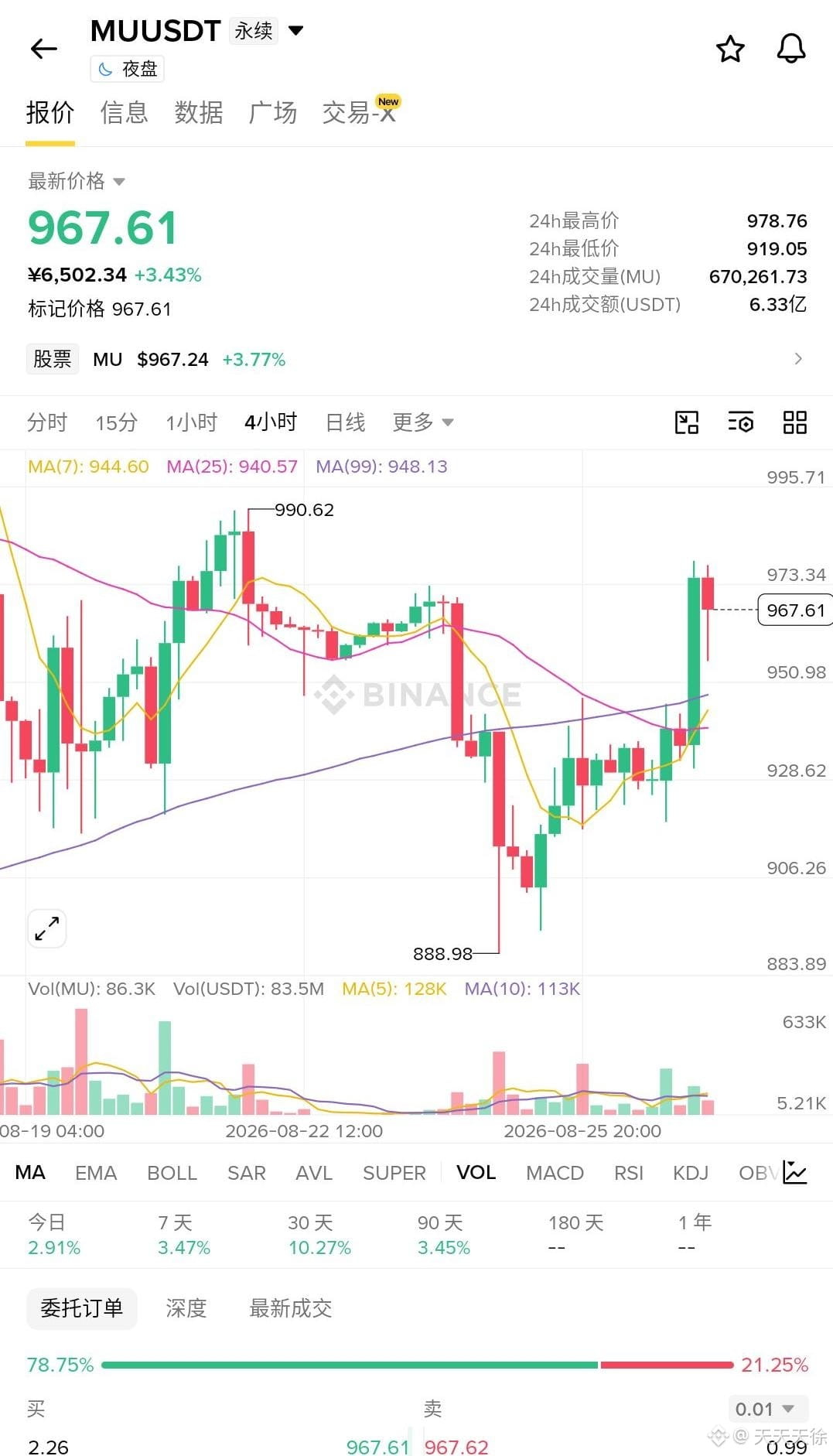
MU 24-hour move: up 3.4%, sweeping from 919 all the way to a peak at 978. Now at 967 it’s hanging around the intraday high zone, with the moving averages all beneath the price. But the rhythm is off—15-minute price just broke below the MA20, and the momentum from the push upward is already fading.
More importantly, it’s about the funds. In the last 7 hours, contract open interest has dropped 3.28%, yet the price is still clinging to the high: leverage is unwinding in batches, not entering. The ratio of active-bid buying is only 48.7%; sell orders are pressing down on buy orders. For spot, net inflow from large orders is zero—within 630 million in transactions, there’s no sign of big money coming in. Even though the funding rate is still positive, it has fallen below the 8-period average; longs don’t look very eager to keep paying interest.
So my take: this push higher was built by leveraged positioning, and the fuel is running out. I’m looking to short around 967; a rebound that fails to break above 978 would be the confirmation. Targets first: MA50 at 956. If it breaks down, then look at 940.
Conditions for a viewpoint reversal: open interest turns back to increasing; the active buy order flow returns to 50% or more; and price breaks out above 978 with volume. If two out of the three happen, it means new longs have truly entered—then shorts should immediately cut losses and exit.
#mu $MU
More importantly, it’s about the funds. In the last 7 hours, contract open interest has dropped 3.28%, yet the price is still clinging to the high: leverage is unwinding in batches, not entering. The ratio of active-bid buying is only 48.7%; sell orders are pressing down on buy orders. For spot, net inflow from large orders is zero—within 630 million in transactions, there’s no sign of big money coming in. Even though the funding rate is still positive, it has fallen below the 8-period average; longs don’t look very eager to keep paying interest.
So my take: this push higher was built by leveraged positioning, and the fuel is running out. I’m looking to short around 967; a rebound that fails to break above 978 would be the confirmation. Targets first: MA50 at 956. If it breaks down, then look at 940.
Conditions for a viewpoint reversal: open interest turns back to increasing; the active buy order flow returns to 50% or more; and price breaks out above 978 with volume. If two out of the three happen, it means new longs have truly entered—then shorts should immediately cut losses and exit.
#mu $MU
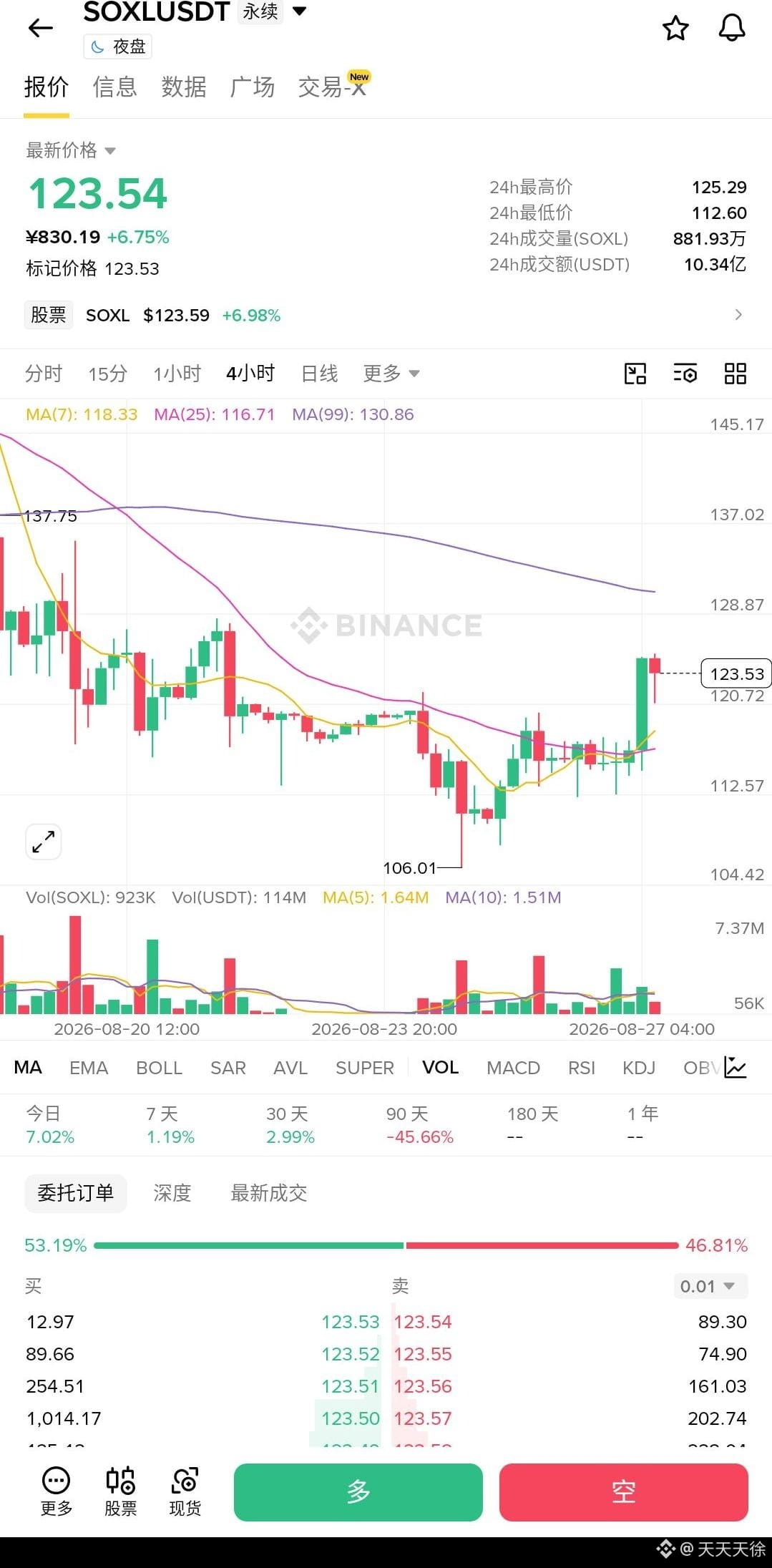
SOXL rallied from 113 to the 125 peak in one sweep. Over 4 hours there were 6 candlesticks with five yang and one yin, net up 8.69%. The price is already more than three points above the MA50—everyone can see it’s rising. But the futures side looks a bit different: the open interest position count actually got cut by 4.18% over 7 hours, and the funding rate is still sitting in negative territory. The price is pushing up, but leverage isn’t keeping up.
This move in price is being pushed by active buy orders: the buy-side fill ratio is 66.3%, volume increased by about 50% over 7 hours, and in the spot order book, the bid depth at level 1 is pressing while the ask at level 1 is being held down. Combined with the negative funding rate and the reduced open-interest position count, what it reads as isn’t that new longs don’t have money—it looks like shorts are getting squeezed. Shorts are paying back, and the tripled-leverage product gets squeezed the hardest.
The whales’ long/short ratio is 4.75 and they’re still adding (+3.93%), in line with the big players’ direction. But net positions are decreasing, suggesting that near the highs some people are taking profits. That doesn’t necessarily mean a reversal—it just means don’t expect it to go straight up without turning back.
Bullish. Pull back to 120.9—if it doesn’t break, keep holding long. First target: poke above the 24h high at 125.3; if it breaks, then look higher. Risk: after the short squeeze ends, the funding rate turns positive and the open-interest position count expands again, but the price can’t make a new high—when the active buy order ratio falls below 50%, it’s time to stop. #soxl $SOXL
This move in price is being pushed by active buy orders: the buy-side fill ratio is 66.3%, volume increased by about 50% over 7 hours, and in the spot order book, the bid depth at level 1 is pressing while the ask at level 1 is being held down. Combined with the negative funding rate and the reduced open-interest position count, what it reads as isn’t that new longs don’t have money—it looks like shorts are getting squeezed. Shorts are paying back, and the tripled-leverage product gets squeezed the hardest.
The whales’ long/short ratio is 4.75 and they’re still adding (+3.93%), in line with the big players’ direction. But net positions are decreasing, suggesting that near the highs some people are taking profits. That doesn’t necessarily mean a reversal—it just means don’t expect it to go straight up without turning back.
Bullish. Pull back to 120.9—if it doesn’t break, keep holding long. First target: poke above the 24h high at 125.3; if it breaks, then look higher. Risk: after the short squeeze ends, the funding rate turns positive and the open-interest position count expands again, but the price can’t make a new high—when the active buy order ratio falls below 50%, it’s time to stop. #soxl $SOXL
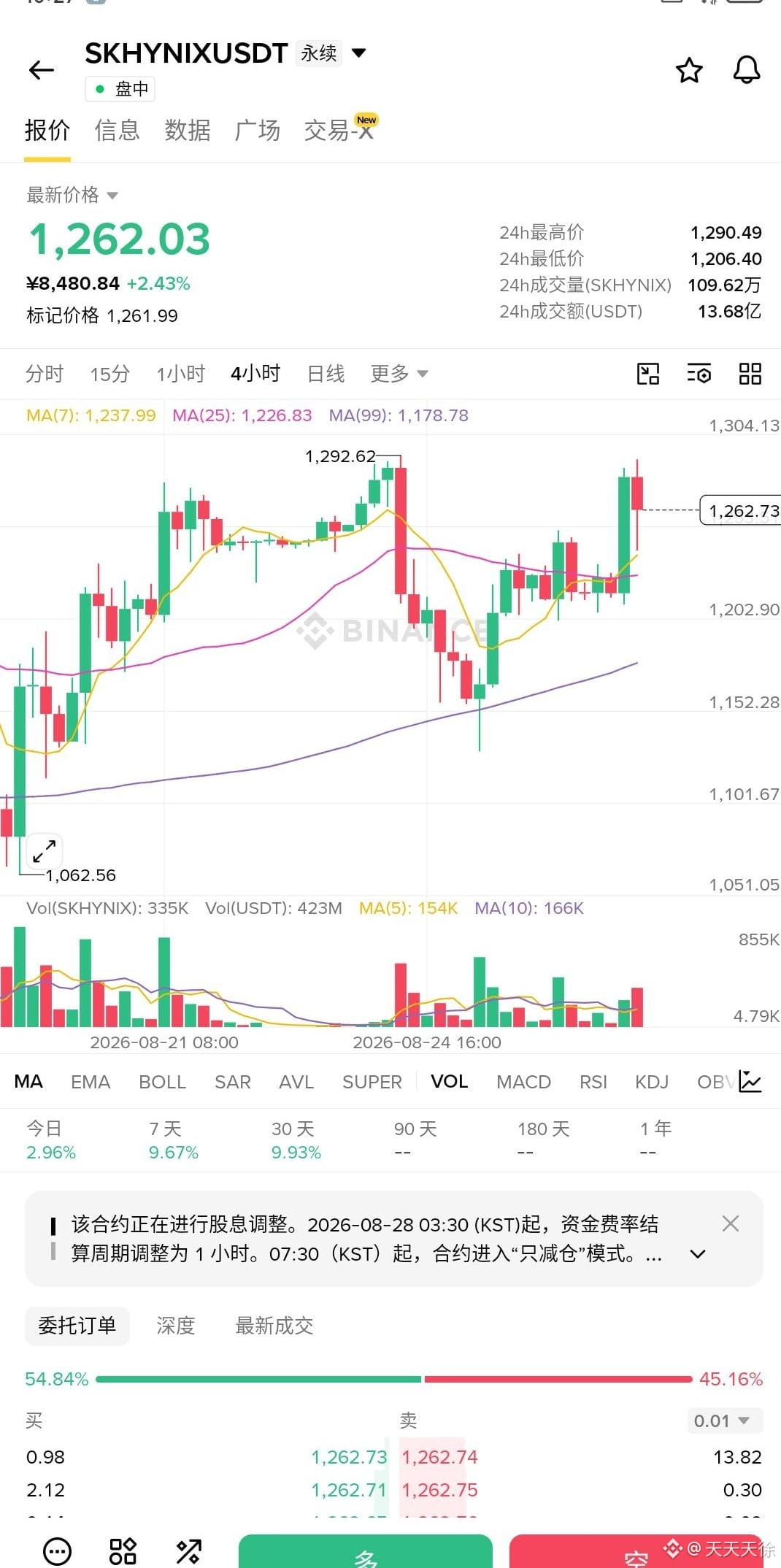
SK hynix bullish outlook: momentum is currently in an acceleration phase—within 4 hours, 6 K-line candles net rose 3.86%, and the daily chart synchronized with a 3.86% gain. It swept up from the 1206 low to the 1290 high. This kind of slope is called a trend, not a rebound. Pull back to the 1242 moving average and go long directly. First target: break the 24-hour high at 1300. Second target: 1340. Stop loss: 1190.
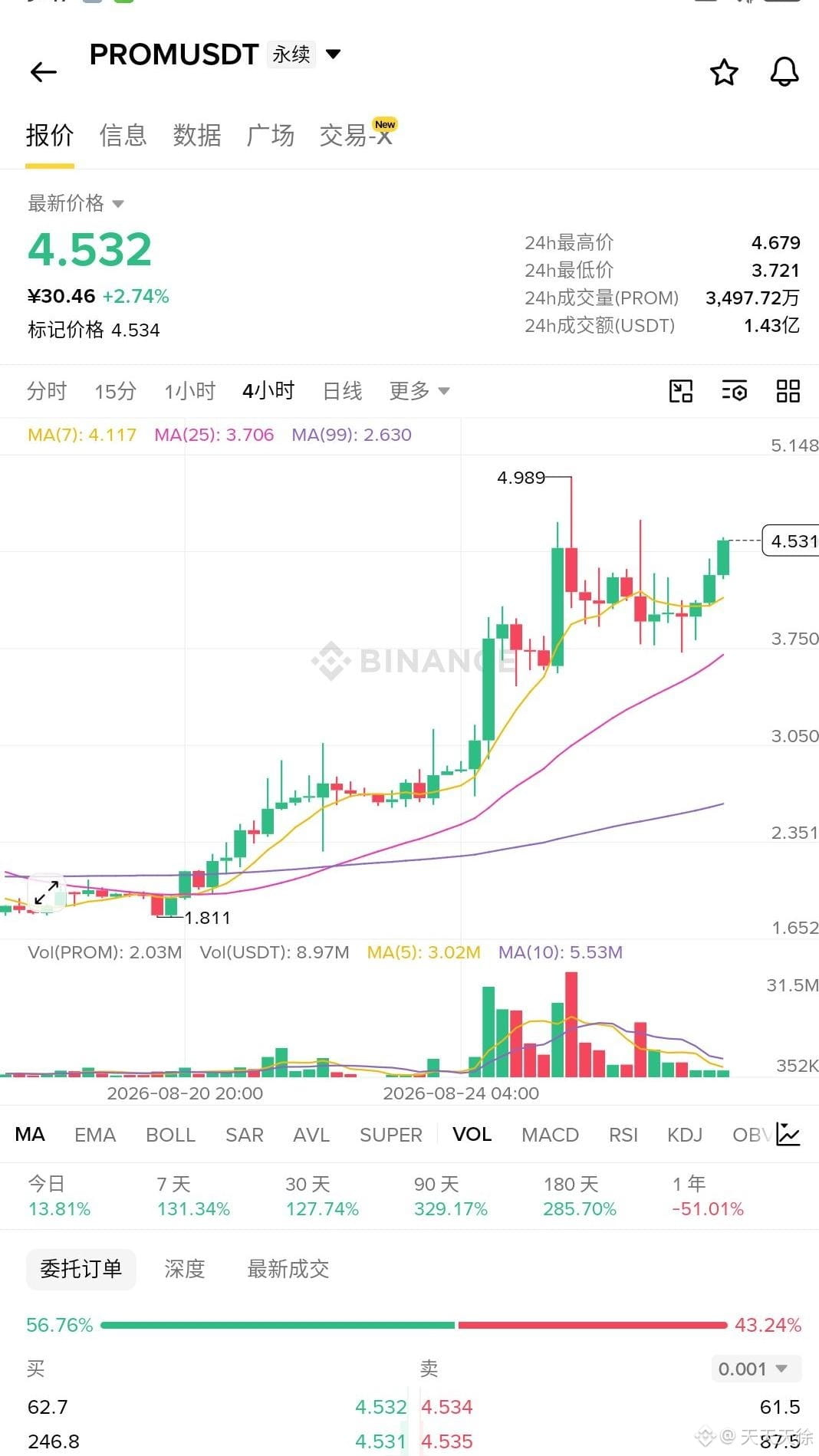
PROM moves first; spot depth will speak for itself: buy 1—4864 lots holding down sell 1—3699, eating orders and buying the book 2.18x to crush. Depth can’t be faked. Go long at 4.50; first target 4.68 to hit the 24h high, second target 4.98 to rebound to the pre-pullback high; stop loss 4.25, structure closes off. The order book is on the buy side, and price is surging. The structure for a 7-day doubling isn’t finished yet—this short is fuel to burn.
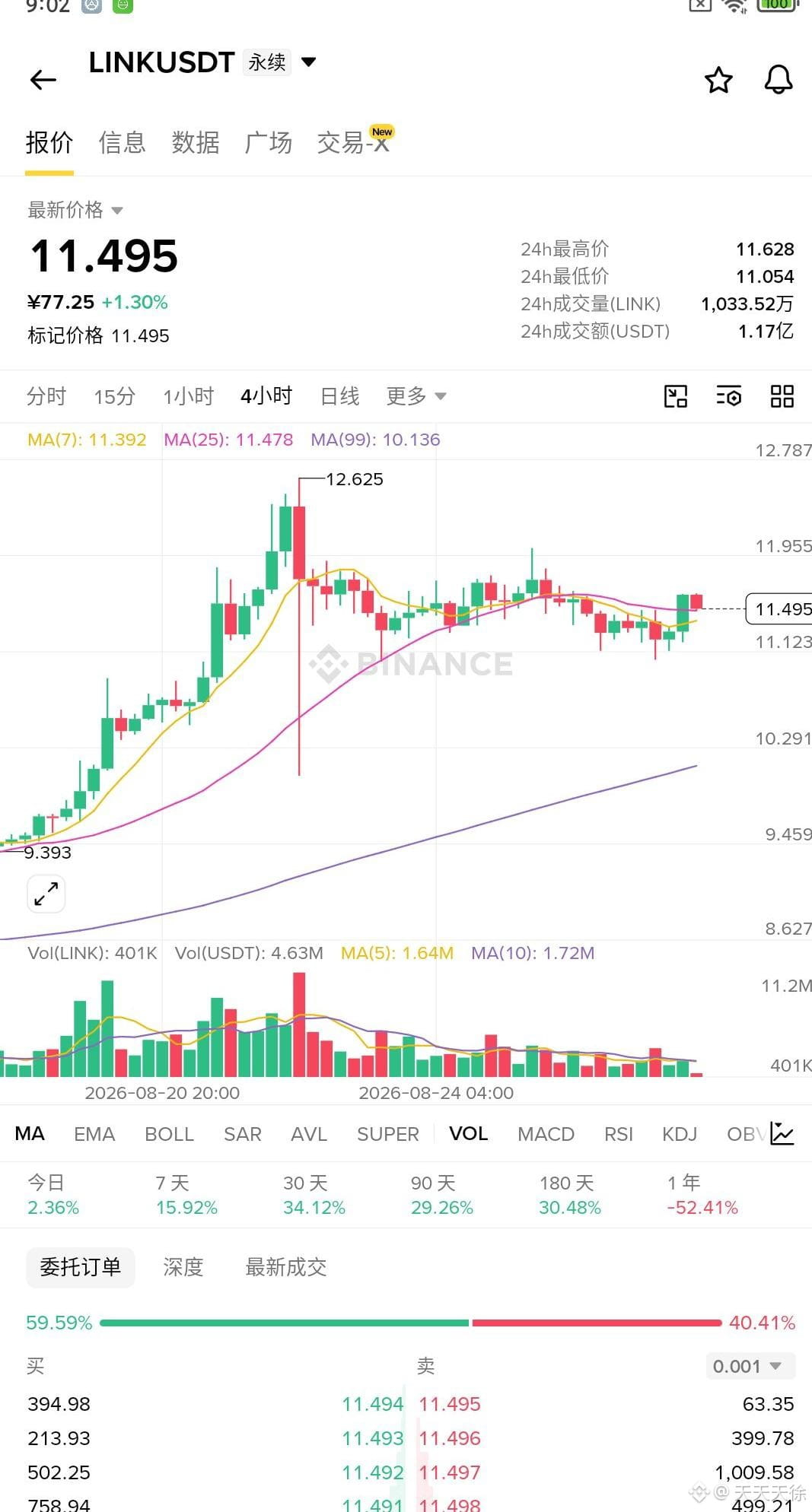
$LINK Bearish! The contract side has already knelt— the futures price has fallen into negative basis, and even longs won’t give a premium. They sell off aggressively, pressing the active buy orders to the ground. The buy-side share can’t even reach half, and yet they keep hitting—making it shrink further. On-chain leverage lending has contracted sharply, while liabilities are still in negative growth. The batch of long buyers who borrowed money has already pulled out.
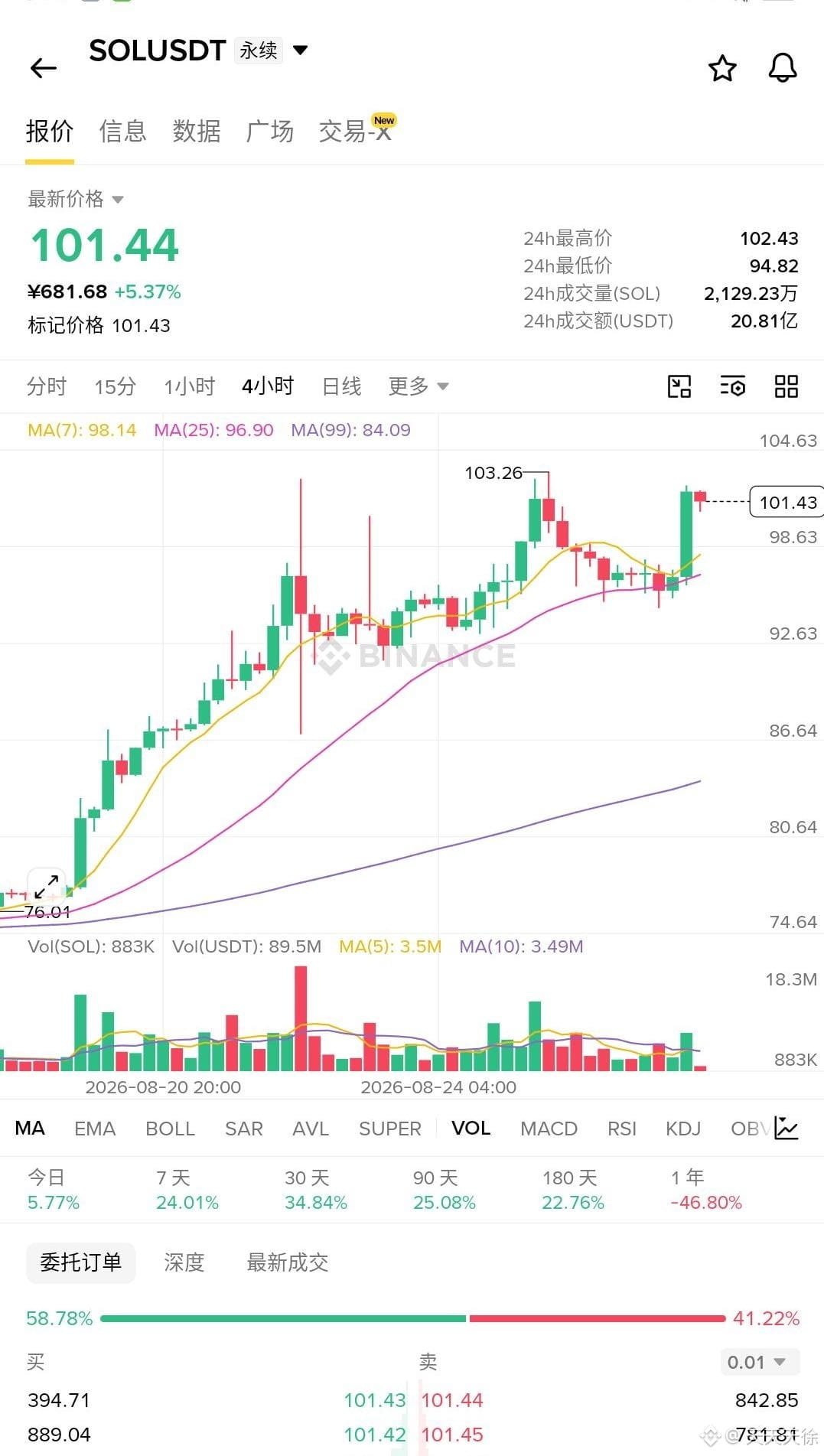
$SOL It’s a sure bet for longs—no suspense. The funding rate is eight out of eight positive, and they’re all trading above the moving average. Open interest is increasing by 6.82% day by day. The longs are even paying carry to hold the position, not showing any signs of backing off—this leverage isn’t overheated. This kind of structure doesn’t leave shorts a way out. Don’t chase. Go long around 99.0. First target: 104.5, breaking the previous high of 103.26. Second target: 108.0. Set stop loss at 93.0; if it falls below the three-day low of 93.22, exit.
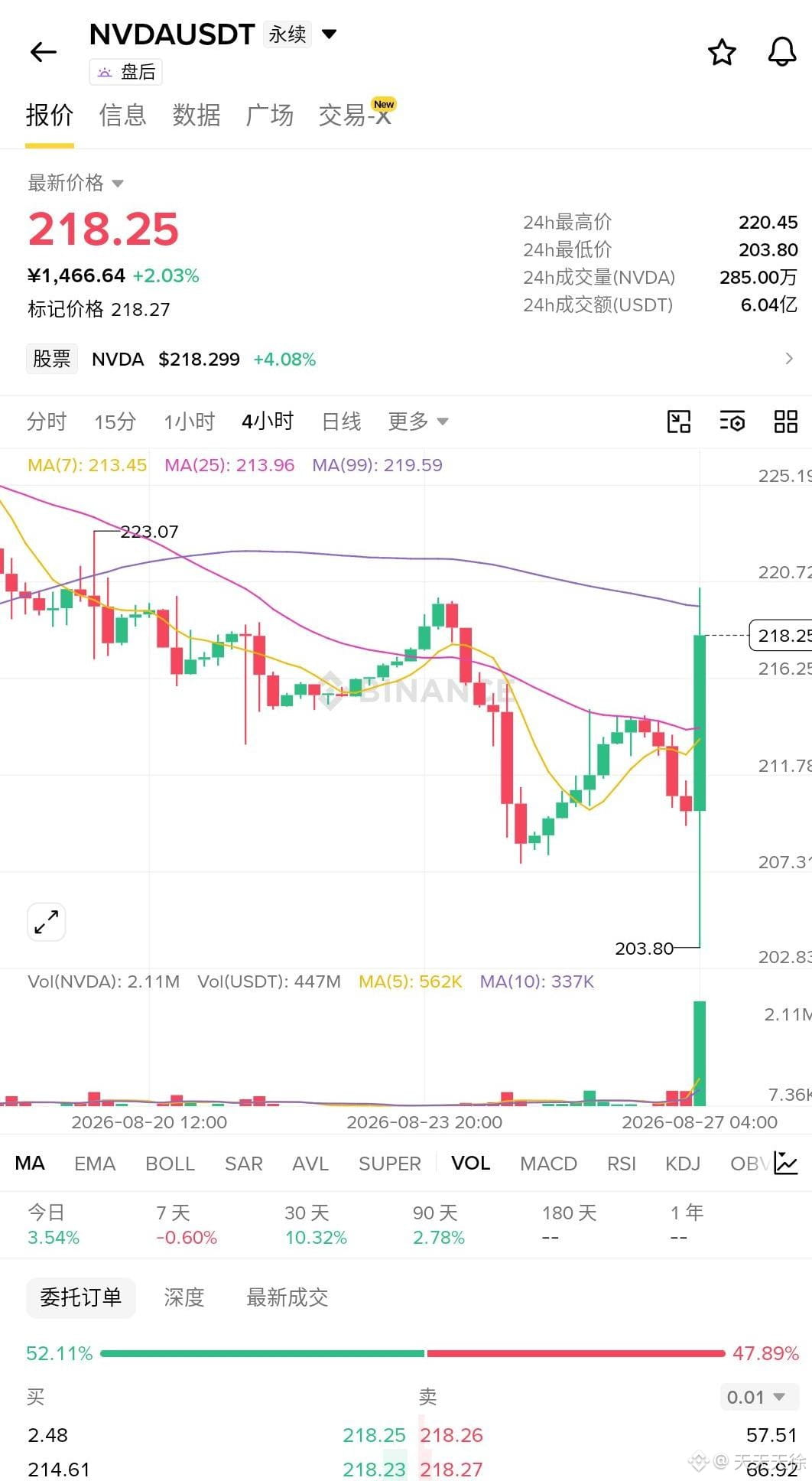
NVDA went from 211 to 220 in the past four hours; it’s currently at 218. All moving averages have been broken, and the 4-hour timeframe is marked UP—yet at the same time, the futures open-position volume exploded by 46% over a 7-hour period. Price is up and positions are up; textbook says new long positions have entered. But if you open the order book, the script doesn’t quite add up.
In the aggressive trades, buy orders account for only 40.3%. The sell volume is 4652 versus buy volume 3143. Sixty percent of the taker activity is being “smashed” out. The fee rate over the last 8 hours averages only 0.012%, and the current price has basically reset to zero. The longs aren’t even willing to pay a premium on a single move. Over the past 7 hours, trading activity has also been cut by 54%. The driving force behind this rally isn’t aggressive buying pressure—it’s short covering plus new shorts stacking OI at high levels.
The only decent long signal across the whole market is the whales: the whale account shows 68.6% posting long orders, and long positions have still been increased by 28% over the past 7 hours. But what it ran into is the spot order-book wall where sell volume is slightly higher than buy volume, and the price is stuck just under the 24h high at 220.45—it can’t get through. No matter how good the fundamentals are, if the order book is selling, go by the order book.
So my stance: bearish, and I will short. This isn’t a reversal—it’s new shorts being built up at a high level, waiting for a trigger. The reversal conditions are clear too: if it breaks above 220.45 on increased volume, the aggressive buy volume returns to 55% or higher, and the fee rate turns positive—then it means longs truly are taking the other side. I will flip long immediately. Until then, I’ll short around 218 with a stop loss above 221.
#nvda $NVDA
In the aggressive trades, buy orders account for only 40.3%. The sell volume is 4652 versus buy volume 3143. Sixty percent of the taker activity is being “smashed” out. The fee rate over the last 8 hours averages only 0.012%, and the current price has basically reset to zero. The longs aren’t even willing to pay a premium on a single move. Over the past 7 hours, trading activity has also been cut by 54%. The driving force behind this rally isn’t aggressive buying pressure—it’s short covering plus new shorts stacking OI at high levels.
The only decent long signal across the whole market is the whales: the whale account shows 68.6% posting long orders, and long positions have still been increased by 28% over the past 7 hours. But what it ran into is the spot order-book wall where sell volume is slightly higher than buy volume, and the price is stuck just under the 24h high at 220.45—it can’t get through. No matter how good the fundamentals are, if the order book is selling, go by the order book.
So my stance: bearish, and I will short. This isn’t a reversal—it’s new shorts being built up at a high level, waiting for a trigger. The reversal conditions are clear too: if it breaks above 220.45 on increased volume, the aggressive buy volume returns to 55% or higher, and the fee rate turns positive—then it means longs truly are taking the other side. I will flip long immediately. Until then, I’ll short around 218 with a stop loss above 221.
#nvda $NVDA
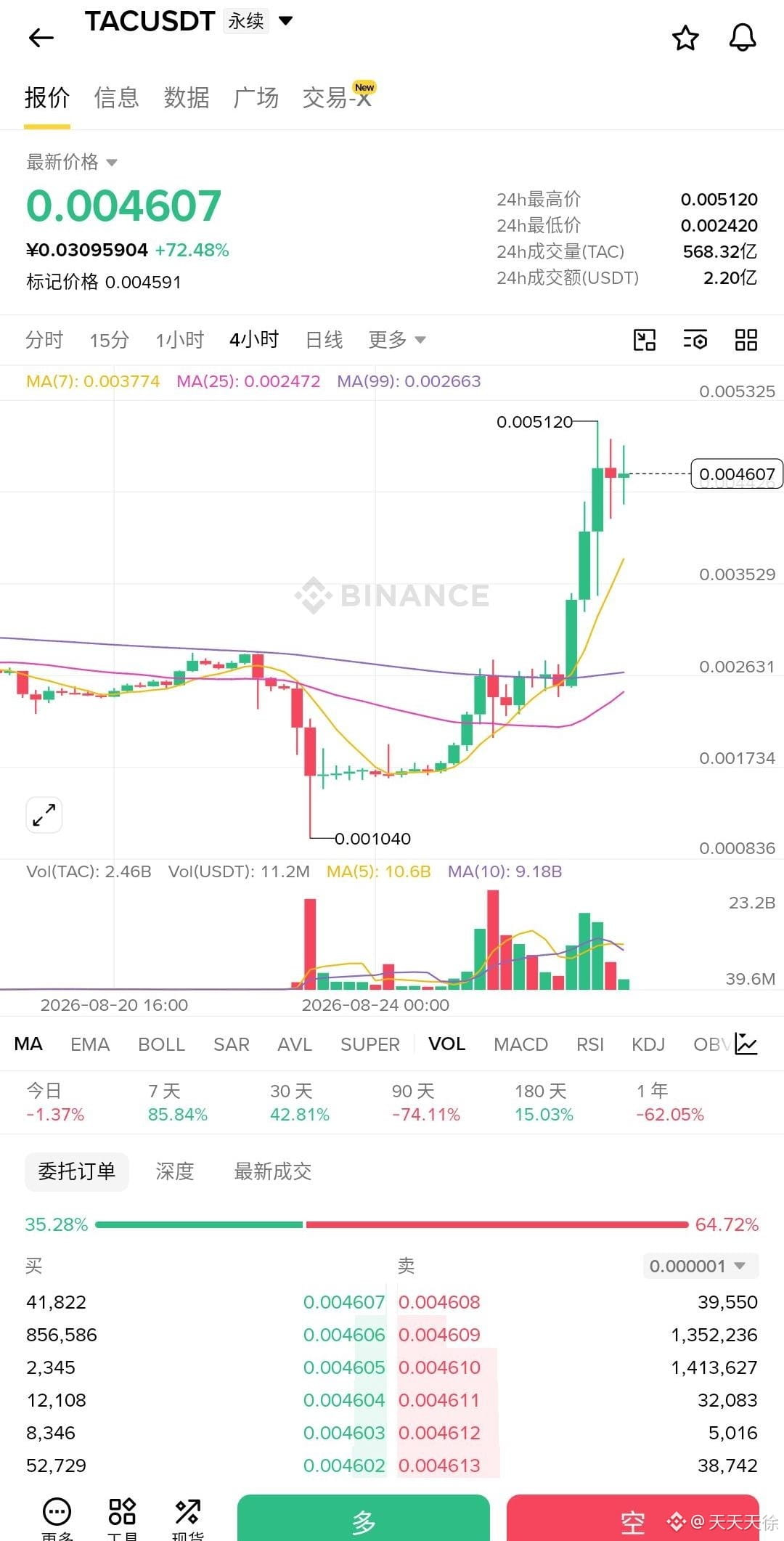
$TAC Bears — A market value of twenty million is just a facade made of paper. The circulating shares are less than half of the issued total; with full circulation, the valuation would be multiplied several times. Four days ago it just set a historical low, having fallen more than 90% from its peak. This three-day rally of nearly three times is all driven by derivative/contract funds hard-buying; the other half of the chips is still locked and not yet listed. When the lockup period ends, supply will be unsealed. On the contract side, order-flow is inverted and fees have turned positive; the cost basis for long positions is being driven up—sooner or later, this valuation will deflate.
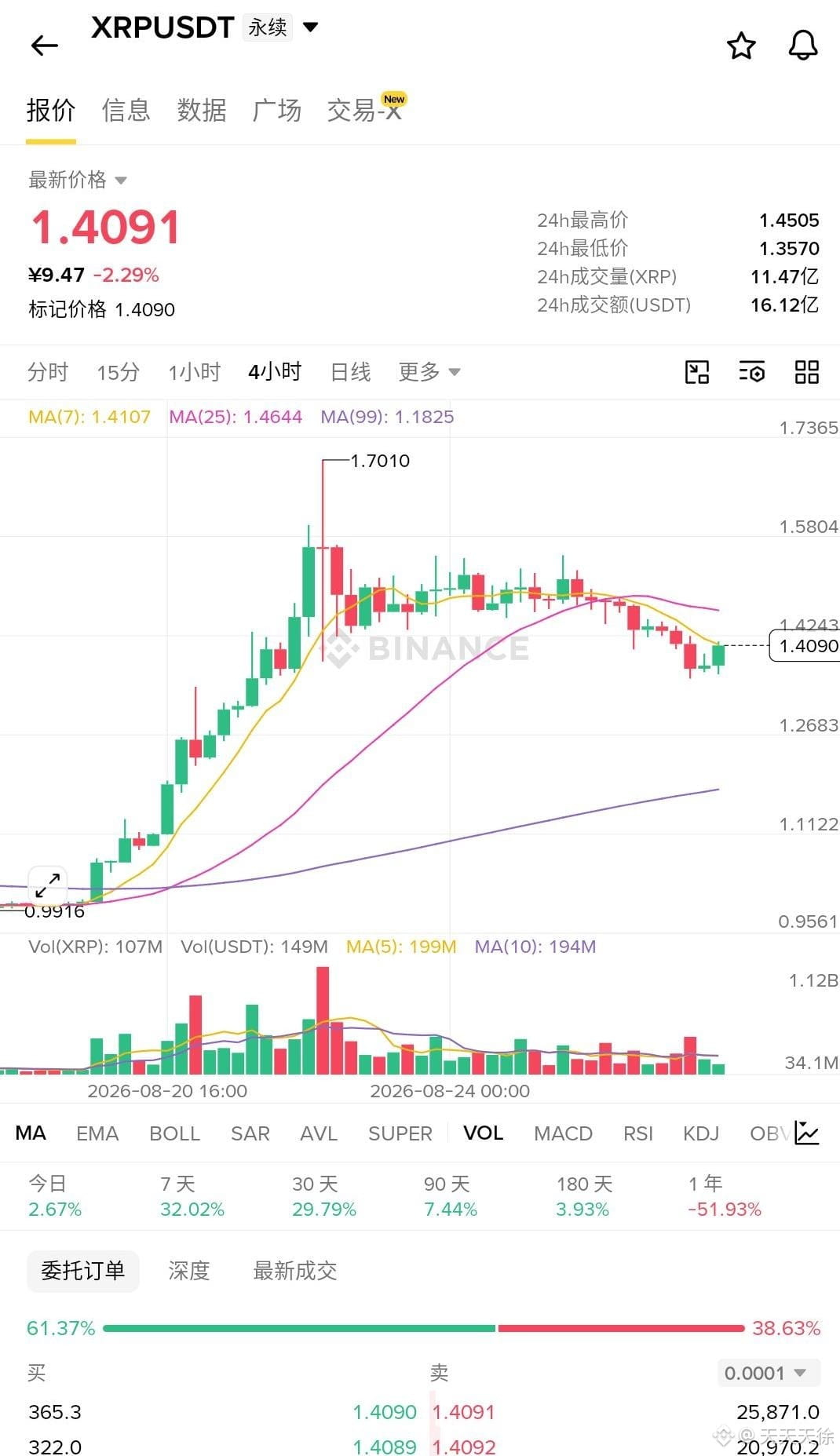
XRP bounced back from 1.357 to 1.41. Right now, spot buyers are taking orders at about twice the size of the sell-side books—this rebound looks pretty aggressive. But the real players—leveraged capital—none of them have come back. Futures open interest is still being cut inside bear capitulation; the funding rate is hovering around 0.01% with no premium. The basis has even flipped negative. And the whale accounts’ long positions have shrunk by 2.61% over the past 7 hours. Prices are rising, but longs are withdrawing—this is the most glaring mismatch.
A +40% move over the week has been propped up by leverage consensus on the derivatives side. Now that consensus is breaking: OI has slid from 480 million to 450 million, and the 4-hour setup has been directly marked as exhausting. Spot big orders have been net outflow for over 3 hours, totaling more than 100 million; over 12 candlesticks, there hasn’t been a single one with net inflow. This buying pressure is essentially small-to-mid spot orders adding while shorts are covering—lifting the market. Up above, the sell wall at 1.45–1.55 is still sitting there. Without leveraged money stepping in, the rebound is just a “get out” wave.
Bear case: short at 1.40–1.41. First target is 1.357; if it breaks, go with it lower. When does the reversal happen? If the funding rate turns clearly positive, open interest rebuilds, spot big orders flip red to green in a sustained streak, or if price recovers 1.47 and rallies with increased positioning—then exit, don’t fight it.
#xrp $XRP
A +40% move over the week has been propped up by leverage consensus on the derivatives side. Now that consensus is breaking: OI has slid from 480 million to 450 million, and the 4-hour setup has been directly marked as exhausting. Spot big orders have been net outflow for over 3 hours, totaling more than 100 million; over 12 candlesticks, there hasn’t been a single one with net inflow. This buying pressure is essentially small-to-mid spot orders adding while shorts are covering—lifting the market. Up above, the sell wall at 1.45–1.55 is still sitting there. Without leveraged money stepping in, the rebound is just a “get out” wave.
Bear case: short at 1.40–1.41. First target is 1.357; if it breaks, go with it lower. When does the reversal happen? If the funding rate turns clearly positive, open interest rebuilds, spot big orders flip red to green in a sustained streak, or if price recovers 1.47 and rallies with increased positioning—then exit, don’t fight it.
#xrp $XRP
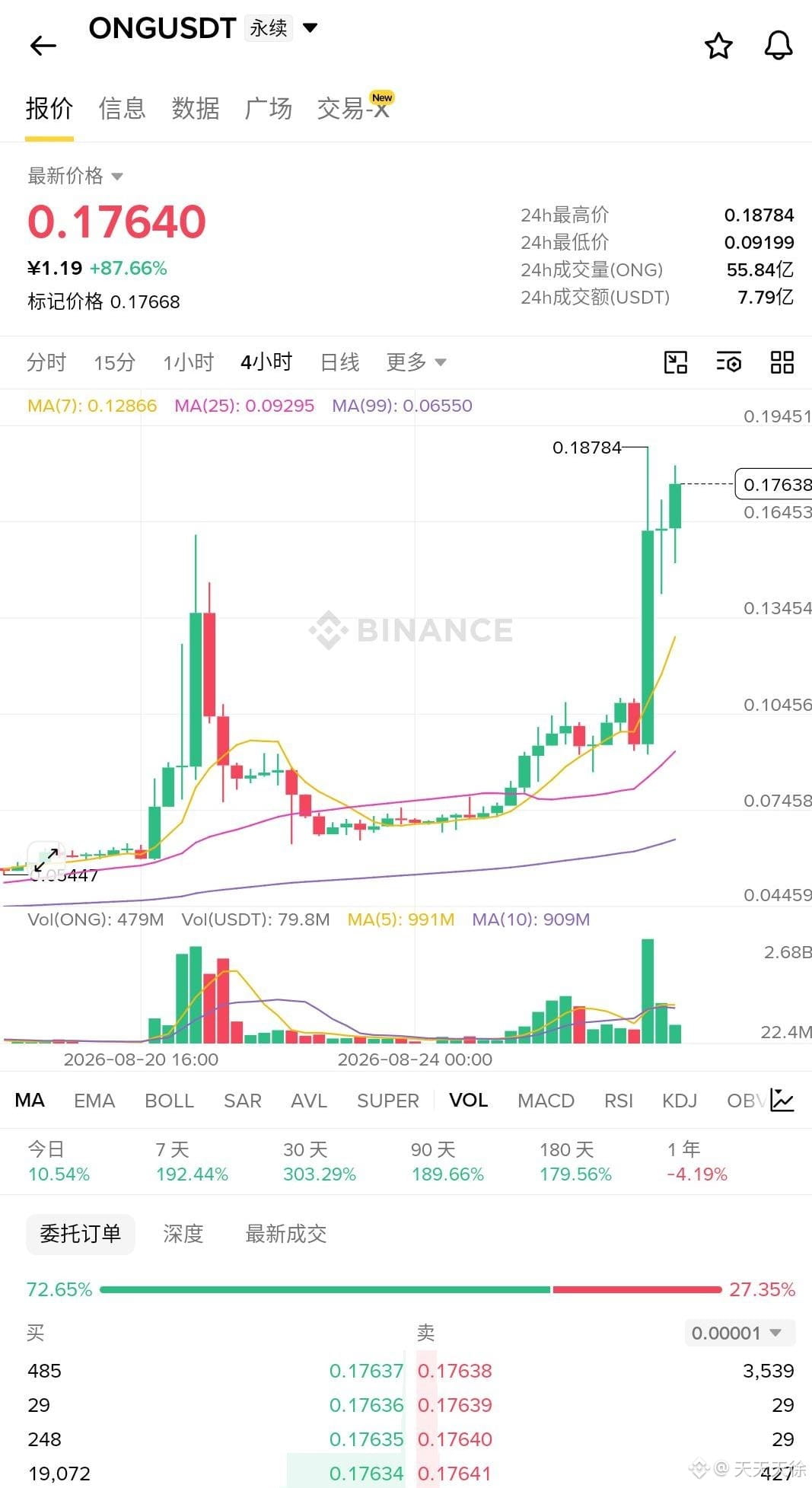
There are $ONG of these—this is how you should play small-cap “demon coins”: rank 174, market cap under 100 million, up 209.64% in 7 days while still hugging the high, the contract order book is locked tight to keep the bull run strong; daily position size grows by 19.68%, and funding rates are down 0.87%—with shorts even paying to raise the bid. This kind of market will only keep breathing, not go out. Buy when it pulls back to the 15-minute 20-day moving average at 0.16. First target: 0.1878, breaking above the 1-day high. Second target: 0.207. Stop loss: 0.14—if it breaks, get out.
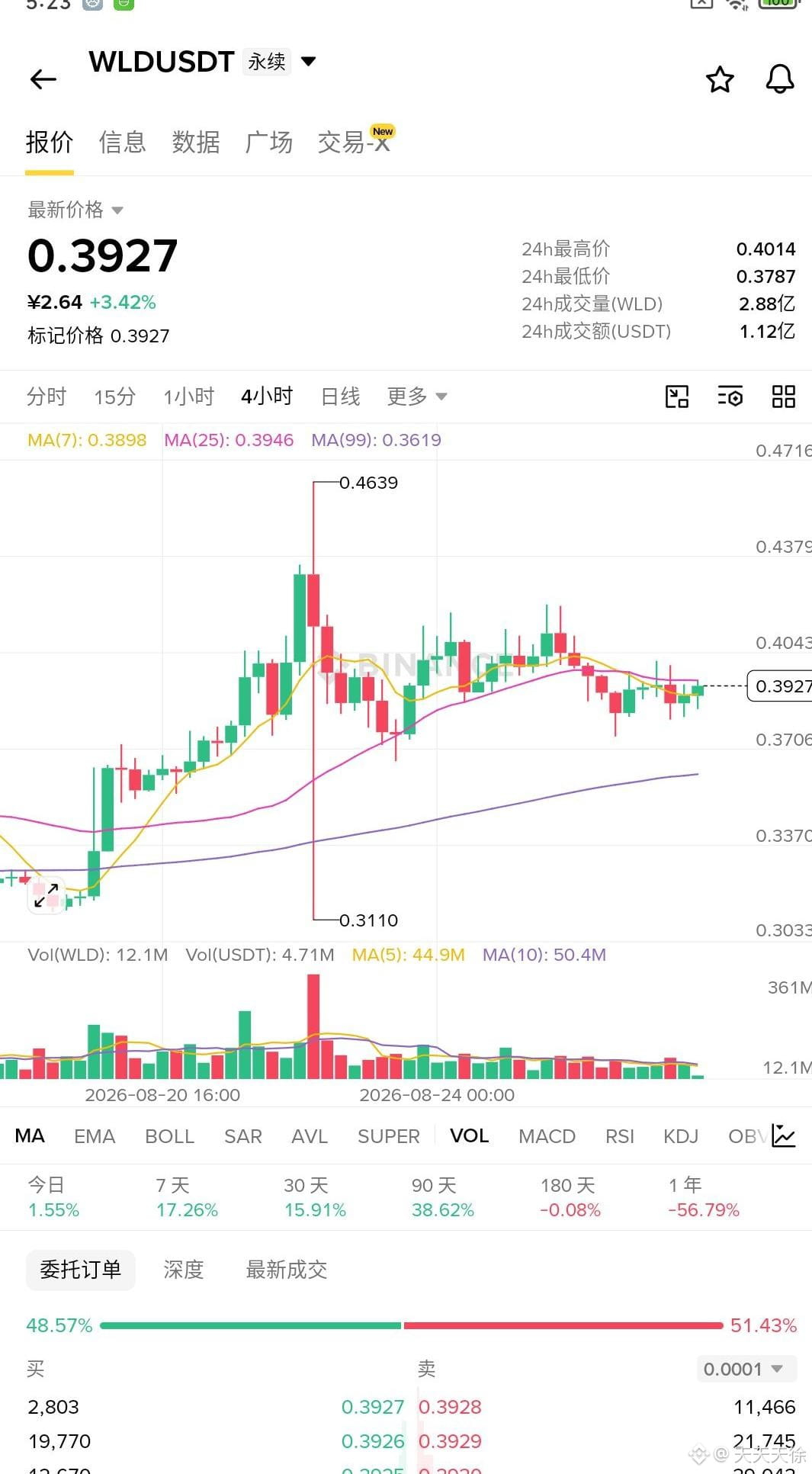
WLD spot lending amount surges 12 hours in a row, up 1446%, with the long/short leverage ratio spiking to 29x. Anyone chasing longs at this 0.39 level isn’t someone who has big chips—it's a retail trader borrowing money and leveraging up. First figure out whose money this is; only then does the price discussion matter.
Over seven days, the price climbed from 0.311 to 0.39, a solid +22.9%. But the futures side is pulling back: open interest was cut by 5.3% in a single day, and the four-hour structure was judged as directly exhausting. The OI quadrant lands in bear_capitulation—what’s rising is turnover within existing positions, not new capital entering. At the same time, large spot orders net flowed out for five consecutive K-lines, totaling $2.25 million. Even whale long positions shrank by 1% over the past seven hours. The order book shows sell pressure overwhelming buys (0.616).
Big money is distributing, retail is using leverage to catch the dump—that's the long structure I least want to touch. With 29x leverage, when it rises it's fuel; when it falls, it's the trigger for a chain liquidation. I think this rebound is at its late stage. If you short, first look at 0.375; if it breaks down, watch 0.366.
There’s only one reversal condition: futures open interest turns around and adds positions, spot large orders switch back to net inflows, and the price holds above 0.40. If the money truly comes back, I’ll go long again. Until then, I only stand with the shorts. #wld $WLD
Over seven days, the price climbed from 0.311 to 0.39, a solid +22.9%. But the futures side is pulling back: open interest was cut by 5.3% in a single day, and the four-hour structure was judged as directly exhausting. The OI quadrant lands in bear_capitulation—what’s rising is turnover within existing positions, not new capital entering. At the same time, large spot orders net flowed out for five consecutive K-lines, totaling $2.25 million. Even whale long positions shrank by 1% over the past seven hours. The order book shows sell pressure overwhelming buys (0.616).
Big money is distributing, retail is using leverage to catch the dump—that's the long structure I least want to touch. With 29x leverage, when it rises it's fuel; when it falls, it's the trigger for a chain liquidation. I think this rebound is at its late stage. If you short, first look at 0.375; if it breaks down, watch 0.366.
There’s only one reversal condition: futures open interest turns around and adds positions, spot large orders switch back to net inflows, and the price holds above 0.40. If the money truly comes back, I’ll go long again. Until then, I only stand with the shorts. #wld $WLD
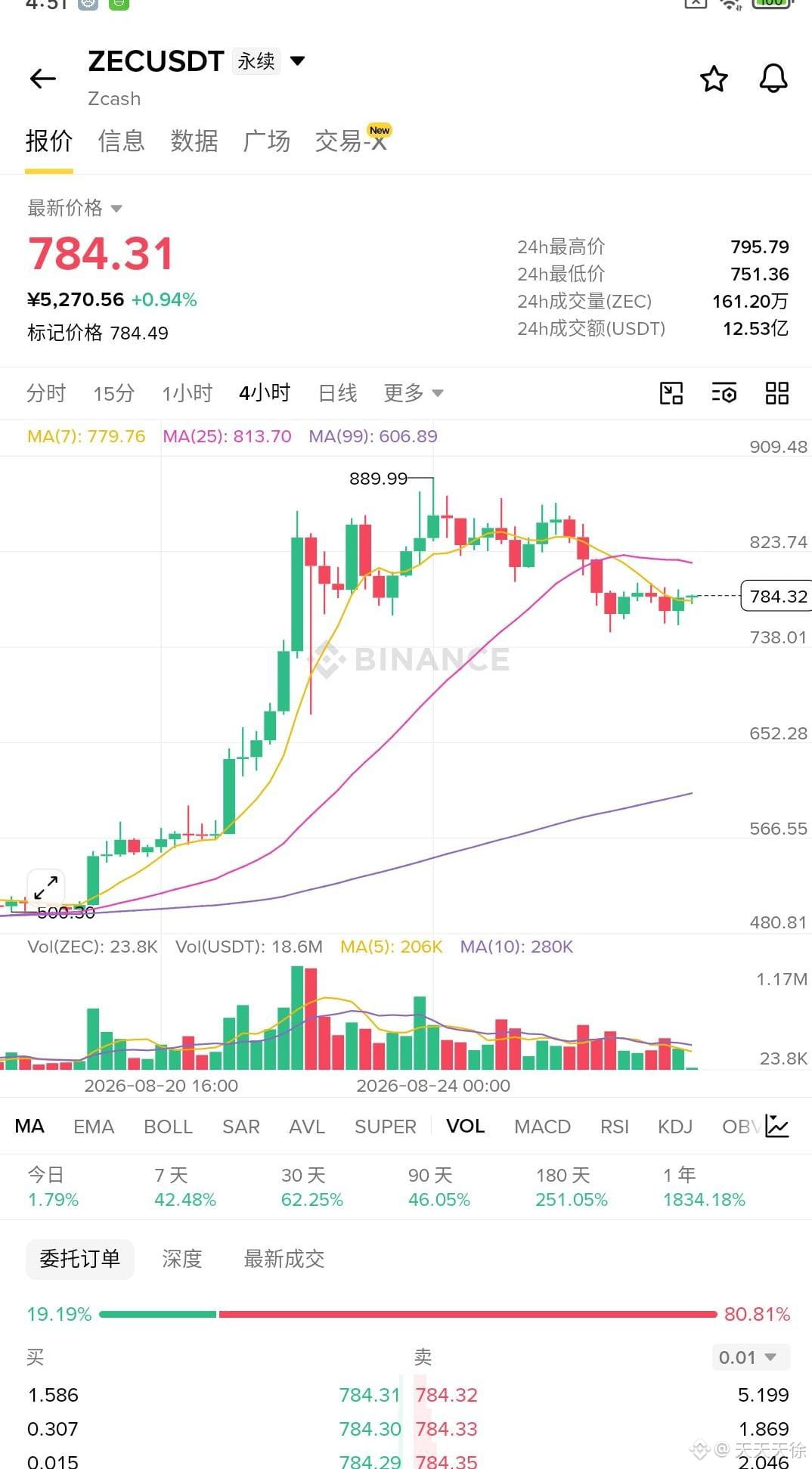
ZEC bounces back from 784—I don’t smell the taste of new money; I smell the scent of short covering. The price climbed from 751, but over the past day, contract open interest was cut by 6.19%. On the contract side, the four-hour assessment immediately labeled it as exhausting—bounce after bounce, no one is opening fresh long positions.
The “ceiling” overhead is also clear: the 24h high at 795.95 is pressed right against my forehead. Over the past two days, two attempts to touch 795 were both slapped down. RSI and MFI are both above 83.
That move from 501 to 890 is already over. What we’re in now is the sell-off pullback phase after the parabola-type run has finished.
In the data, the only bullish evidence is that the whale’s long positions increased by 3.66% over 7 hours—but that’s a minority bet. On the account level, only 34% are holding long orders. In the spot order book, active sell orders are four times the buy orders—money really is moving out.
I’m short. I enter around 784: the first target is the previous low at 751. If it breaks, I’ll look toward 720. There’s only one scenario where I admit I’m wrong: a breakout above 800 with volume that comes together with rising open interest, and spot large orders flipping from negative to positive. Then I’ll switch back to longs. Until then, every rebound is just there to be used for shorting. #zec $ZEC
The “ceiling” overhead is also clear: the 24h high at 795.95 is pressed right against my forehead. Over the past two days, two attempts to touch 795 were both slapped down. RSI and MFI are both above 83.
That move from 501 to 890 is already over. What we’re in now is the sell-off pullback phase after the parabola-type run has finished.
In the data, the only bullish evidence is that the whale’s long positions increased by 3.66% over 7 hours—but that’s a minority bet. On the account level, only 34% are holding long orders. In the spot order book, active sell orders are four times the buy orders—money really is moving out.
I’m short. I enter around 784: the first target is the previous low at 751. If it breaks, I’ll look toward 720. There’s only one scenario where I admit I’m wrong: a breakout above 800 with volume that comes together with rising open interest, and spot large orders flipping from negative to positive. Then I’ll switch back to longs. Until then, every rebound is just there to be used for shorting. #zec $ZEC
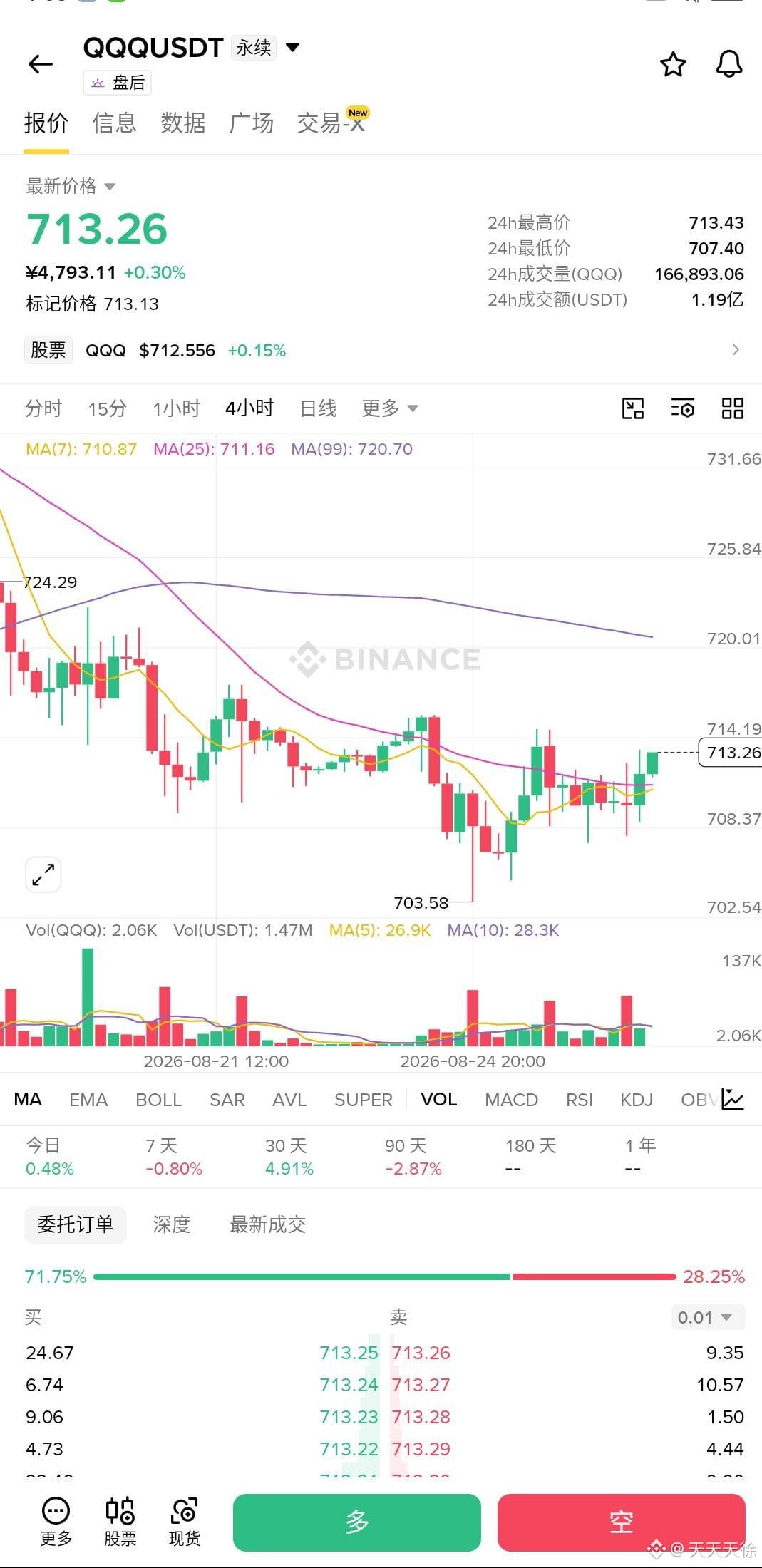
QQQ bearish—don’t be fooled by those red candles on the 4-hour chart. The 24h high at 713.4 is right on your forehead; any rise is grinding upward, not surging. The tape leads: the contract’s active buy orders are down to just 46.9%; sell orders are pressing against buy orders, driving them down. Over the past 7 hours, trading activity has been cut by 36%, and the pushing power is already gone. The fee rate is effectively zero, so the bulls don’t even have the desire to keep chasing orders. In the spot market’s top-20 order book, the sell wall is thicker than the buy wall. Net inflow of large orders is zero—going higher near the highs is handing out knives to chase-long players. The longer the range-bound box is磨ing, the harder the drop will be. Air force assemble! ⬇️⬇️⬇️
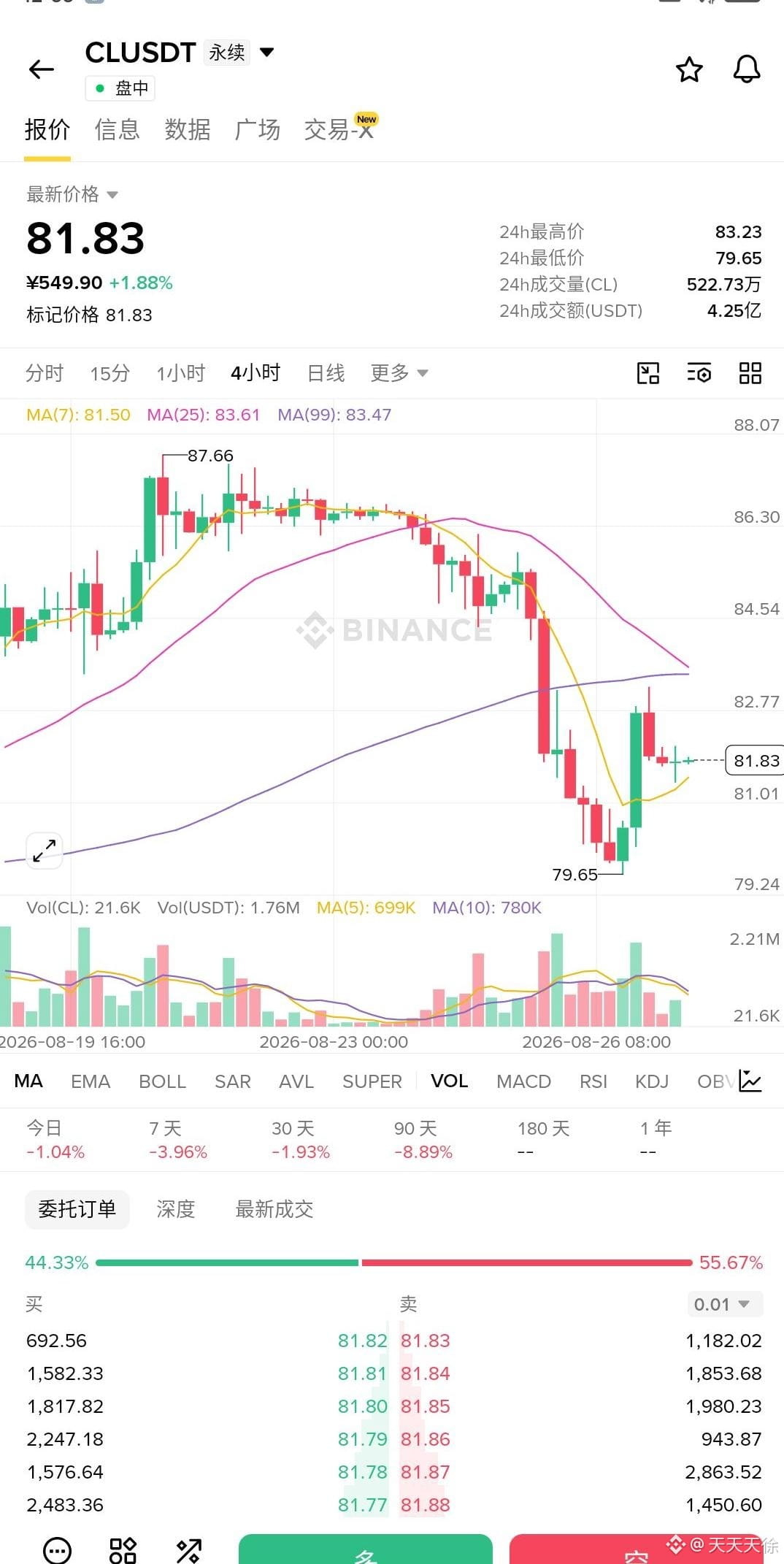
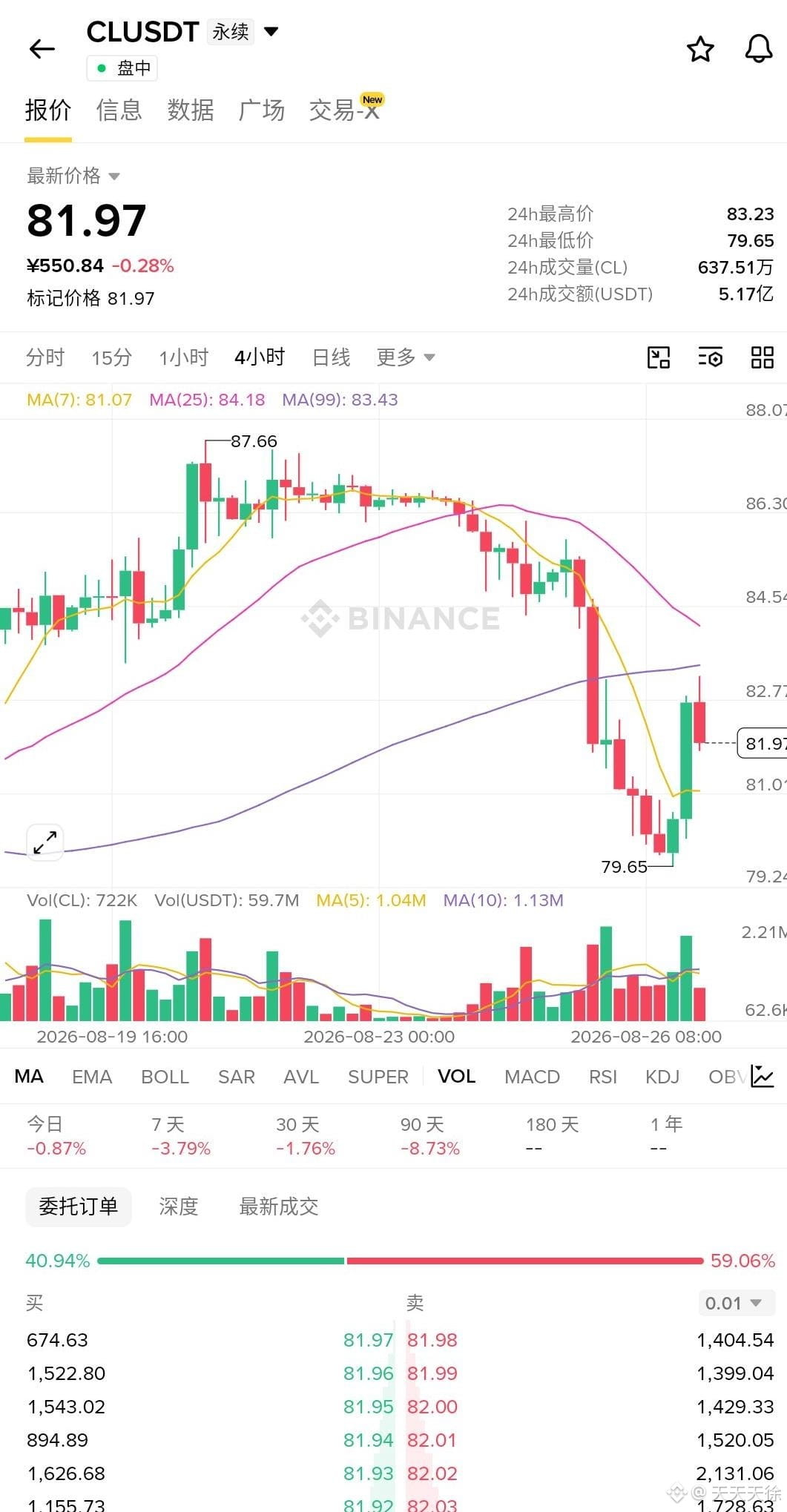
For now, don’t look at the price—look at the position size. CL’s daily open interest has been cut by 15.88%, dropping from 207 million to 174 million. A drop from 84.7 to 82—this wave of main selling pressure has basically been fully cleared. But the price hasn’t continued to collapse; instead, it’s just been grinding around 82.
Money has started moving back in: the value of 7-hour contracts’ open interest is up +2.53% again, with active buy orders making up 56.1%, and buy volume jumping 109.69% month-on-month. The fuel for the selloff is burned out—now what’s lighting the fuse is the active buy side. The funding rate is still stuck in negative territory, meaning shorts on the market are effectively paying to hold; the fuse has already been lit.
There are also warning signs on the other side: the whales’ 7-hour long positions shrank by 6.36%. In the spot order book, sell volume is pressing down on buy volume (depth ratio 0.80), which is not a one-sided surge. Still, the fact that the main selling pressure has been cleared is more solid—so this time, I’m standing with the longs.
The initial target: the 15-minute 20-period moving average at 82.39. If price holds steady, then look for the 24h high at 83.23. The only reversal condition: if it falls back below the prior low at 79.65, it would indicate the washout isn’t finished and the long thesis is invalid. Before that breaks, the shorts’ money is the longs’ fuel.
#cl $CL
Money has started moving back in: the value of 7-hour contracts’ open interest is up +2.53% again, with active buy orders making up 56.1%, and buy volume jumping 109.69% month-on-month. The fuel for the selloff is burned out—now what’s lighting the fuse is the active buy side. The funding rate is still stuck in negative territory, meaning shorts on the market are effectively paying to hold; the fuse has already been lit.
There are also warning signs on the other side: the whales’ 7-hour long positions shrank by 6.36%. In the spot order book, sell volume is pressing down on buy volume (depth ratio 0.80), which is not a one-sided surge. Still, the fact that the main selling pressure has been cleared is more solid—so this time, I’m standing with the longs.
The initial target: the 15-minute 20-period moving average at 82.39. If price holds steady, then look for the 24h high at 83.23. The only reversal condition: if it falls back below the prior low at 79.65, it would indicate the washout isn’t finished and the long thesis is invalid. Before that breaks, the shorts’ money is the longs’ fuel.
#cl $CL
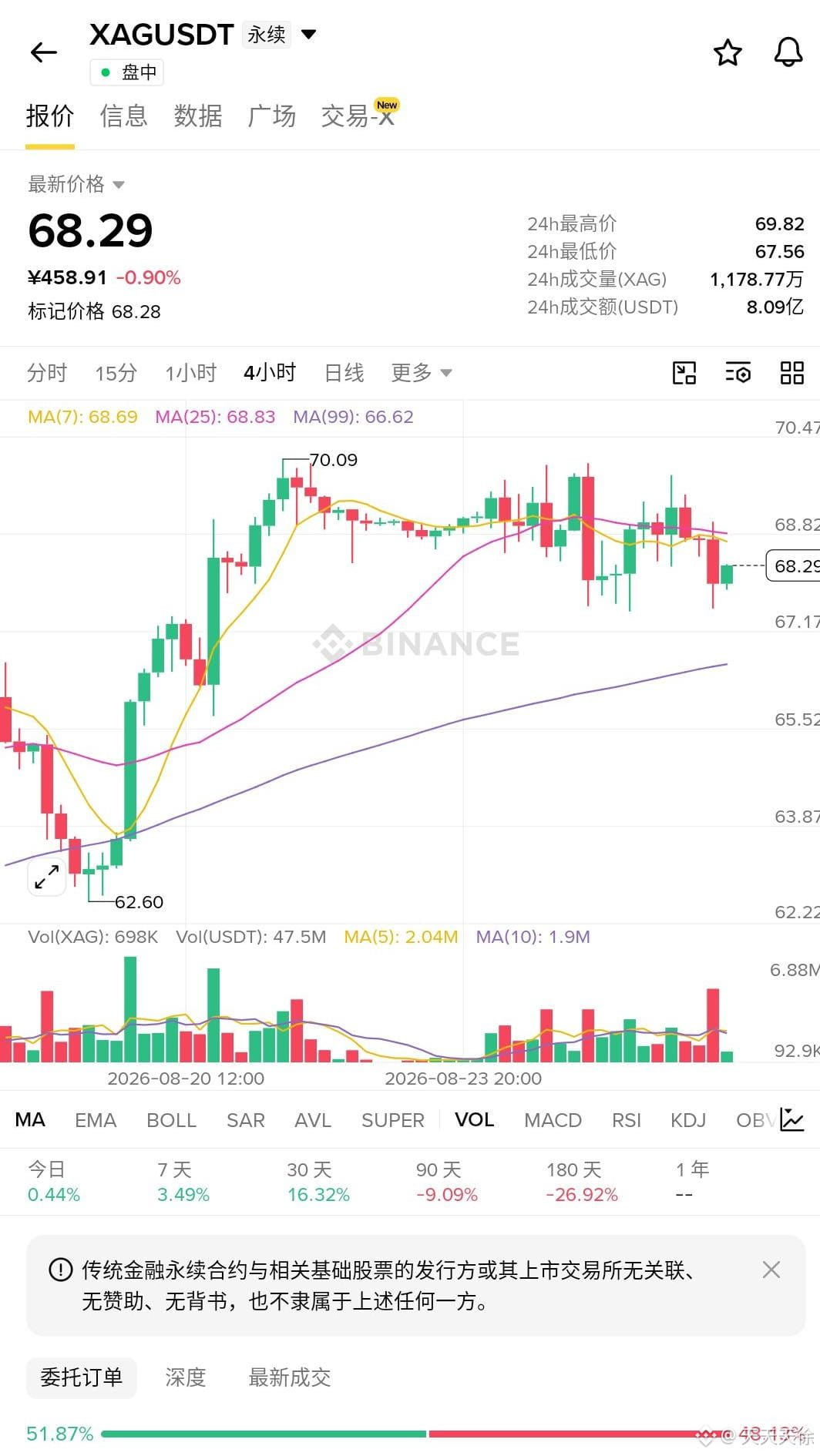
$XAG ——Yes, this whale’s bullish “order-book” façade is just for show! It’s true that 70% of the account positions are long, but over the past seven hours the bullish side stubbornly pulled its exposure back by nearly six percentage points. The long/short ratio is supported by more than two-and-a-half times, yet what’s propping it up is mostly empty shells. Across the whole market, 70% of accounts are also long; big players and retail traders are squeezing into the same side, and no one dares to run first. In the last four hours, among the six candles, five are bearish, and price is being pinned under the mid-term moving averages—whoever catches the last baton ends up paying the bill.
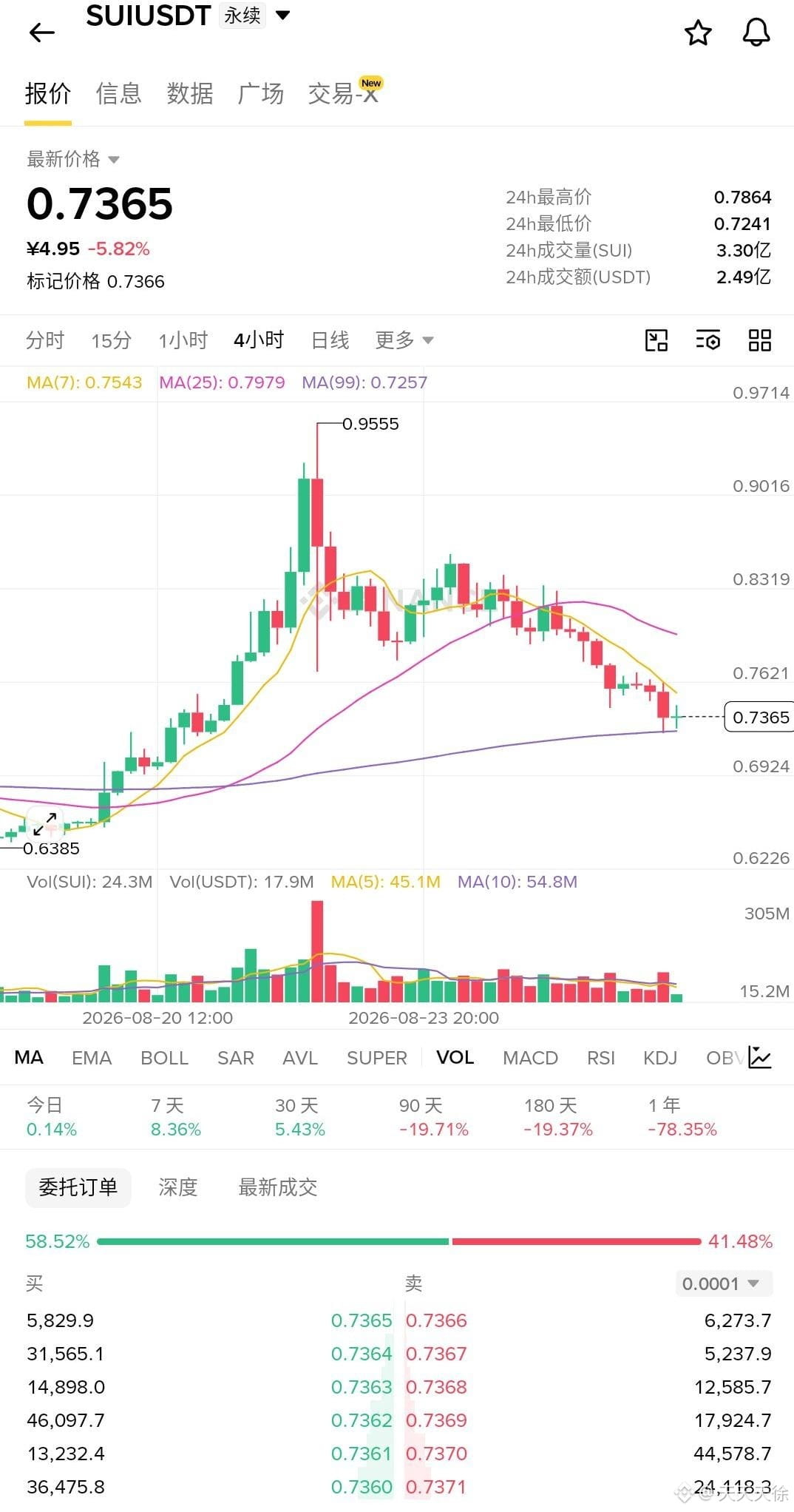
SUI is now at 0.737, just one layer of paper away from the 1-day low of 0.7241, with a 24-hour move of -5.94%. And the more the futures market falls, the more aggressive it gets: passive sell orders are 58.6%, and even though open interest has been up for 7 hours, price is rising against the trend by 2.77%—the one smashing the market is a brand-new short opened just moments ago.
On the other side, everything is the opposite: whale long positions have expanded by 3.09% over 7 hours and account for 74.6%. Spot active buying is 1.477x the sell orders, and across the 20 price levels, bid size is 1.545x ask size. The price is pinned on the floor; big players are catching, the order book is absorbing—but only retail in the futures market is driving it down.
Here’s the contradiction: when it drops to the support level, what’s being sold is new short positions, while what’s being bought is the whales and the spot market. From 0.9555 down to 0.7241, longs’ momentum was wiped out early; open interest and the quadrant have also shifted to bear capitulation—those who wanted to cut have already cut, and the remaining shorts are all new positions entered.
So at this level, I’m bullish. If 0.7241 holds, this wave of chasing shorts could be the fuel. The initial target is to revisit the 50 MA around 0.75. The risk is clear as well: spot large orders have still been net outflow for 3 hours, totaling 149 million. If price breaks below 0.7241, I’ll switch to a short immediately—no lingering.
#sui $SUI
On the other side, everything is the opposite: whale long positions have expanded by 3.09% over 7 hours and account for 74.6%. Spot active buying is 1.477x the sell orders, and across the 20 price levels, bid size is 1.545x ask size. The price is pinned on the floor; big players are catching, the order book is absorbing—but only retail in the futures market is driving it down.
Here’s the contradiction: when it drops to the support level, what’s being sold is new short positions, while what’s being bought is the whales and the spot market. From 0.9555 down to 0.7241, longs’ momentum was wiped out early; open interest and the quadrant have also shifted to bear capitulation—those who wanted to cut have already cut, and the remaining shorts are all new positions entered.
So at this level, I’m bullish. If 0.7241 holds, this wave of chasing shorts could be the fuel. The initial target is to revisit the 50 MA around 0.75. The risk is clear as well: spot large orders have still been net outflow for 3 hours, totaling 149 million. If price breaks below 0.7241, I’ll switch to a short immediately—no lingering.
#sui $SUI
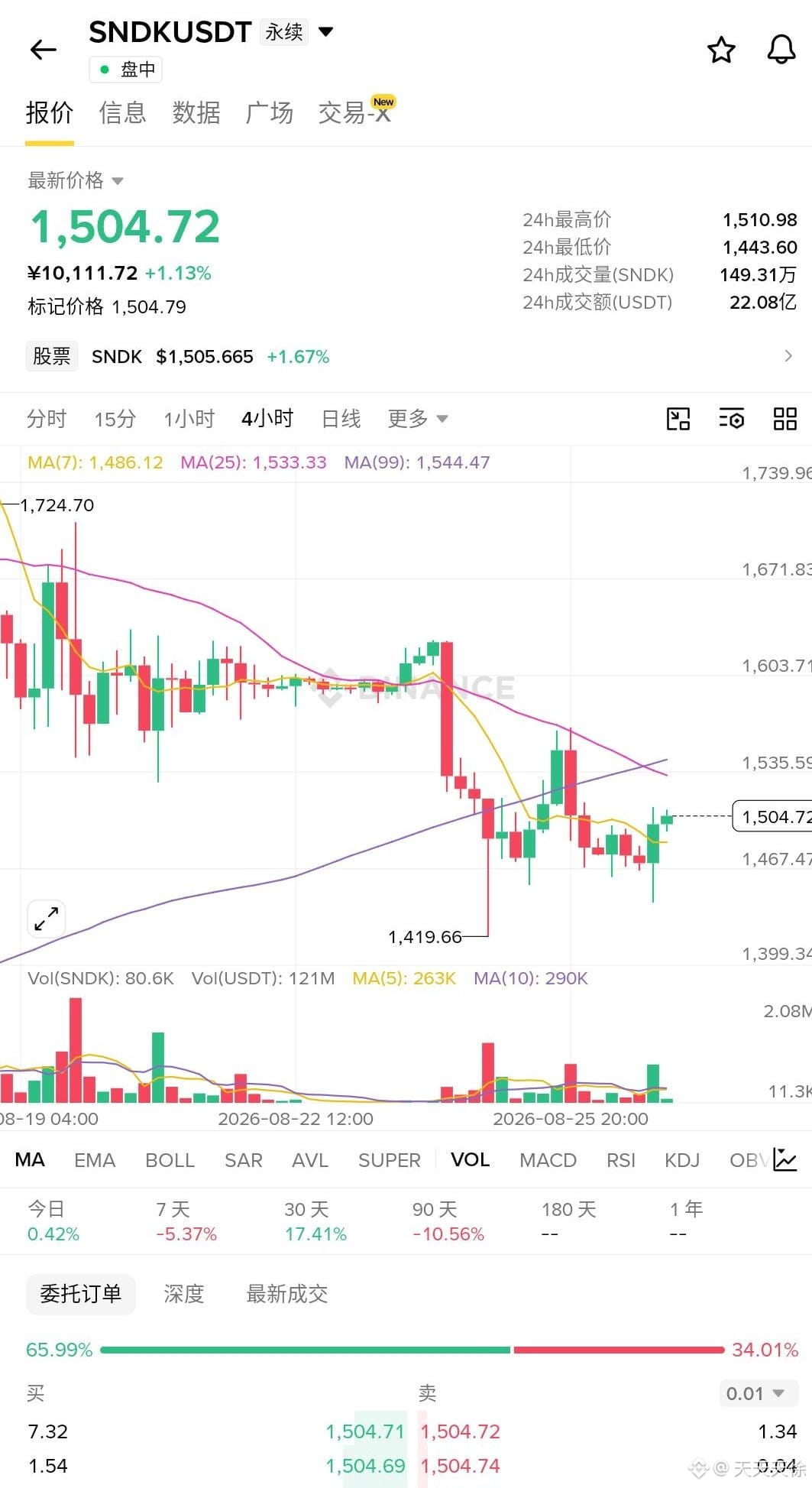
$SNDK bounced back to the top—spot market has twenty price levels on offer; sell volume is suppressing buy volume by more than three times. The ceiling is right at the 24h high of 1511. After three yin and three yang candles over four hours, they still can’t grind out a new high; a flattening of the structure is the most straightforward evidence. In the futures order book, aggressive sell orders are pushing through buy orders (52.5% vs 47.5%). Over a seven-hour span, whale accounts cut their long positions by 22.6%. Meanwhile, large spot orders show net inflow reaching zero—there’s no capital to take the rebound, so it won’t last. Once the 1444 low is broken, that’s when the bears will truly take the stage.
Log in to explore more content