

星途科技资讯
885 Posts

星途科技资讯
Report
Block User
Open Trade
Frequent Trader
2.7 Years
244 Following
82 Followers
586 Liked
Posts
Portfolio
All
Quotes
PINNED
·
--
Verified
Nvidia’s latest earnings report is a blockbuster: AI is no longer just a concept—it’s become a business worth hundreds of billions of dollars
Nvidia’s latest earnings report sent a powerful signal:
In the quarter ended July 26, 2026, Nvidia generated $96.2 billion in revenue, up 106% year over year. Data center revenue reached $89 billion, up 117%.
{web3_wallet_create}(560x50c2be4b3958c358e2654c6dabb4feb9e1cc7777)
What do these figures mean?
Until recently, discussions about AI focused mainly on how powerful large language models could become and whether AI applications would take off. Now, the market is answering with real money:
Computing power, data centers, cloud services, and enterprise AI have entered a phase of large-scale commercialization.
{web3_wallet_create}(560xe797e34845f5c23b1f578c7c49a101fca4137777)
Even more noteworthy is the growing share of revenue coming from data centers. The AI race isn’t just about building a chatbot; it’s a competition across an entire value chain spanning chips, servers, power, networking, cloud platforms, and industry-specific software.
That’s also why the AI boom can move tech stocks around the world:
At its core, this isn’t the story of a single company, but a new cycle of investment in infrastructure.
{web3_wallet_create}(10xcf91b70017eabde82c9671e30e5502d312ea6eb2)
But the brighter the earnings report, the higher the market’s expectations for future growth, profit margins, and capital spending. AI remains one of the main themes in global capital markets, but with expectations so high, every earnings report from here on will face closer scrutiny.
#英伟达 #股票财报季 $NVDAB
Source: Nvidia’s fiscal 2027 second-quarter earnings announcement.
Disclaimer: The above is for market analysis only and does not constitute investment advice.
Nvidia’s latest earnings report is a blockbuster: AI is no longer just a concept—it’s become a business worth hundreds of billions of dollars
Nvidia’s latest earnings report sent a powerful signal:
In the quarter ended July 26, 2026, Nvidia generated $96.2 billion in revenue, up 106% year over year. Data center revenue reached $89 billion, up 117%.
What do these figures mean?
Until recently, discussions about AI focused mainly on how powerful large language models could become and whether AI applications would take off. Now, the market is answering with real money:
Computing power, data centers, cloud services, and enterprise AI have entered a phase of large-scale commercialization.
Even more noteworthy is the growing share of revenue coming from data centers. The AI race isn’t just about building a chatbot; it’s a competition across an entire value chain spanning chips, servers, power, networking, cloud platforms, and industry-specific software.
That’s also why the AI boom can move tech stocks around the world:
At its core, this isn’t the story of a single company, but a new cycle of investment in infrastructure.
But the brighter the earnings report, the higher the market’s expectations for future growth, profit margins, and capital spending. AI remains one of the main themes in global capital markets, but with expectations so high, every earnings report from here on will face closer scrutiny.
#英伟达 #股票财报季 $NVDAB
Source: Nvidia’s fiscal 2027 second-quarter earnings announcement.
Disclaimer: The above is for market analysis only and does not constitute investment advice.
21
67
24.6k
·
--
South Korean stocks stage a major rebound! KOSPI surges 6.63% to reclaim 6,000, SK hynix jumps nearly 11%
On October 28, South Korea’s KOSPI closed up 6.63% at 6,012.44, returning above 6,000 for the first time in 10 trading days and posting its biggest single-day gain in nearly three months.
Key drivers: Anthropic’s move toward an IPO buoyed sentiment toward AI semiconductors; SK hynix reported record third-quarter results and announced an additional KRW 60 trillion in shareholder returns. SK hynix rose nearly 11%, while Samsung Electronics gained more than 9%. Foreign investors and institutions were net buyers for a second consecutive day, and a buy-sidecar mechanism was triggered briefly during the session.
{web3_wallet_create}(560x50c2be4b3958c358e2654c6dabb4feb9e1cc7777)
{web3_wallet_create}(560xe797e34845f5c23b1f578c7c49a101fca4137777)
{web3_wallet_create}(10xcf91b70017eabde82c9671e30e5502d312ea6eb2)
Disclaimer: This is a summary of publicly available market information and does not constitute investment advice.
$BTC #KOSPI大涨6.63%重返6000点 $SKHYB
South Korean stocks stage a major rebound! KOSPI surges 6.63% to reclaim 6,000, SK hynix jumps nearly 11%
On October 28, South Korea’s KOSPI closed up 6.63% at 6,012.44, returning above 6,000 for the first time in 10 trading days and posting its biggest single-day gain in nearly three months.
Key drivers: Anthropic’s move toward an IPO buoyed sentiment toward AI semiconductors; SK hynix reported record third-quarter results and announced an additional KRW 60 trillion in shareholder returns. SK hynix rose nearly 11%, while Samsung Electronics gained more than 9%. Foreign investors and institutions were net buyers for a second consecutive day, and a buy-sidecar mechanism was triggered briefly during the session.
Disclaimer: This is a summary of publicly available market information and does not constitute investment advice.
$BTC #KOSPI大涨6.63%重返6000点 $SKHYB
29
·
--
Robinhood earnings shock: Crypto revenue halves, shares plunge over 8% before market open
After the market closed on October 27, Robinhood (HOOD), the “retail investor barometer” of the U.S. stock market, released its Q3 2026 earnings report. Shares plunged more than 8.4% in premarket trading amid weakness in its crypto business and earnings that fell short of expectations.
Key financial results:
1. Crypto business takes a major hit: Q3 crypto trading revenue plunged 55% year over year to just $120 million; crypto trading volume also fell 38%. This laid bare the company’s heavy reliance on crypto market conditions for revenue.
2. Earnings miss expectations: GAAP earnings per share (EPS) came in at $0.51, below the market forecast of $0.55 and down 16% year over year.
3. Rising cost pressures: Operating costs rose 16% year over year, outpacing revenue growth and severely squeezing profit margins.
{web3_wallet_create}(560x50c2be4b3958c358e2654c6dabb4feb9e1cc7777)
{web3_wallet_create}(560xe797e34845f5c23b1f578c7c49a101fca4137777)
{web3_wallet_create}(10xcf91b70017eabde82c9671e30e5502d312ea6eb2)
Crypto market perspective:
As one of the U.S. stock market’s most prominent “crypto concept stocks,” Robinhood’s earnings report offers an excellent window into traditional investors’ sentiment toward the crypto market. The sharp plunge in crypto revenue confirms that liquidity in the market has dried up. As retail trading enthusiasm wanes, platforms that rely on trading fees for revenue—whether in the stock market or the crypto market—are going through a winter.
Disclaimer: This is a summary of publicly available earnings information and market analysis only, and does not constitute investment advice.
$BTC #Robinhood财报发布后股价跌8.4% #股票财报季
Robinhood earnings shock: Crypto revenue halves, shares plunge over 8% before market open
After the market closed on October 27, Robinhood (HOOD), the “retail investor barometer” of the U.S. stock market, released its Q3 2026 earnings report. Shares plunged more than 8.4% in premarket trading amid weakness in its crypto business and earnings that fell short of expectations.
Key financial results:
1. Crypto business takes a major hit: Q3 crypto trading revenue plunged 55% year over year to just $120 million; crypto trading volume also fell 38%. This laid bare the company’s heavy reliance on crypto market conditions for revenue.
2. Earnings miss expectations: GAAP earnings per share (EPS) came in at $0.51, below the market forecast of $0.55 and down 16% year over year.
3. Rising cost pressures: Operating costs rose 16% year over year, outpacing revenue growth and severely squeezing profit margins.
Crypto market perspective:
As one of the U.S. stock market’s most prominent “crypto concept stocks,” Robinhood’s earnings report offers an excellent window into traditional investors’ sentiment toward the crypto market. The sharp plunge in crypto revenue confirms that liquidity in the market has dried up. As retail trading enthusiasm wanes, platforms that rely on trading fees for revenue—whether in the stock market or the crypto market—are going through a winter.
Disclaimer: This is a summary of publicly available earnings information and market analysis only, and does not constitute investment advice.
$BTC #Robinhood财报发布后股价跌8.4% #股票财报季
35
·
--
BTC climbs above $81,400! Key resistance overcome as bulls and bears face off ahead of FOMC
October 28 — Bitcoin extended its rebound and is currently trading at $81,483, up more than 1% over the past 24 hours. It has successfully moved above the $81,400 level, which had repeatedly capped gains, marking a substantial shift in market structure.
Key market developments:
After breaking below $81,300, the level had turned into resistance. Price has now reclaimed it, signaling a break through short-term pressure. However, roughly 874,000 BTC are concentrated in the $81,000–$82,500 range above, so beware of selling pressure from holders looking to break even as the rebound continues.
Fund flow signals:
On-chain data shows net outflows from exchanges of about 14,942 BTC in a single day, the highest in five weeks, suggesting immediate selling pressure has eased somewhat ahead of FOMC. On the ETF front, there were net inflows of $110.3 million on October 26, but funds remain heavily concentrated in IBIT, indicating that demand has yet to broaden evenly.
Key levels:
Upside target: If BTC can hold above $81,400, the next resistance is at $82,500. A breakout would open the door to a larger recovery.
Downside support: $80,000 remains the immediate line of defense. If it fails, the $79,000 area will be the next zone to watch.
{web3_wallet_create}(560x50c2be4b3958c358e2654c6dabb4feb9e1cc7777)
{web3_wallet_create}(560xe797e34845f5c23b1f578c7c49a101fca4137777)
{web3_wallet_create}(10xcf91b70017eabde82c9671e30e5502d312ea6eb2)
With the FOMC decision imminent, trading above a key level does not in itself confirm a trend reversal. The market's ability to absorb supply in the heavily concentrated overhead zone is the key thing to watch next.
Disclaimer: This is solely a summary of public data and an analysis of market conditions; it does not constitute investment advice. $BTC #比特币突破8.1万美元 #行情分析📈
BTC climbs above $81,400! Key resistance overcome as bulls and bears face off ahead of FOMC
October 28 — Bitcoin extended its rebound and is currently trading at $81,483, up more than 1% over the past 24 hours. It has successfully moved above the $81,400 level, which had repeatedly capped gains, marking a substantial shift in market structure.
Key market developments:
After breaking below $81,300, the level had turned into resistance. Price has now reclaimed it, signaling a break through short-term pressure. However, roughly 874,000 BTC are concentrated in the $81,000–$82,500 range above, so beware of selling pressure from holders looking to break even as the rebound continues.
Fund flow signals:
On-chain data shows net outflows from exchanges of about 14,942 BTC in a single day, the highest in five weeks, suggesting immediate selling pressure has eased somewhat ahead of FOMC. On the ETF front, there were net inflows of $110.3 million on October 26, but funds remain heavily concentrated in IBIT, indicating that demand has yet to broaden evenly.
Key levels:
Upside target: If BTC can hold above $81,400, the next resistance is at $82,500. A breakout would open the door to a larger recovery.
Downside support: $80,000 remains the immediate line of defense. If it fails, the $79,000 area will be the next zone to watch.
With the FOMC decision imminent, trading above a key level does not in itself confirm a trend reversal. The market's ability to absorb supply in the heavily concentrated overhead zone is the key thing to watch next.
Disclaimer: This is solely a summary of public data and an analysis of market conditions; it does not constitute investment advice. $BTC #比特币突破8.1万美元 #行情分析📈
156
·
--
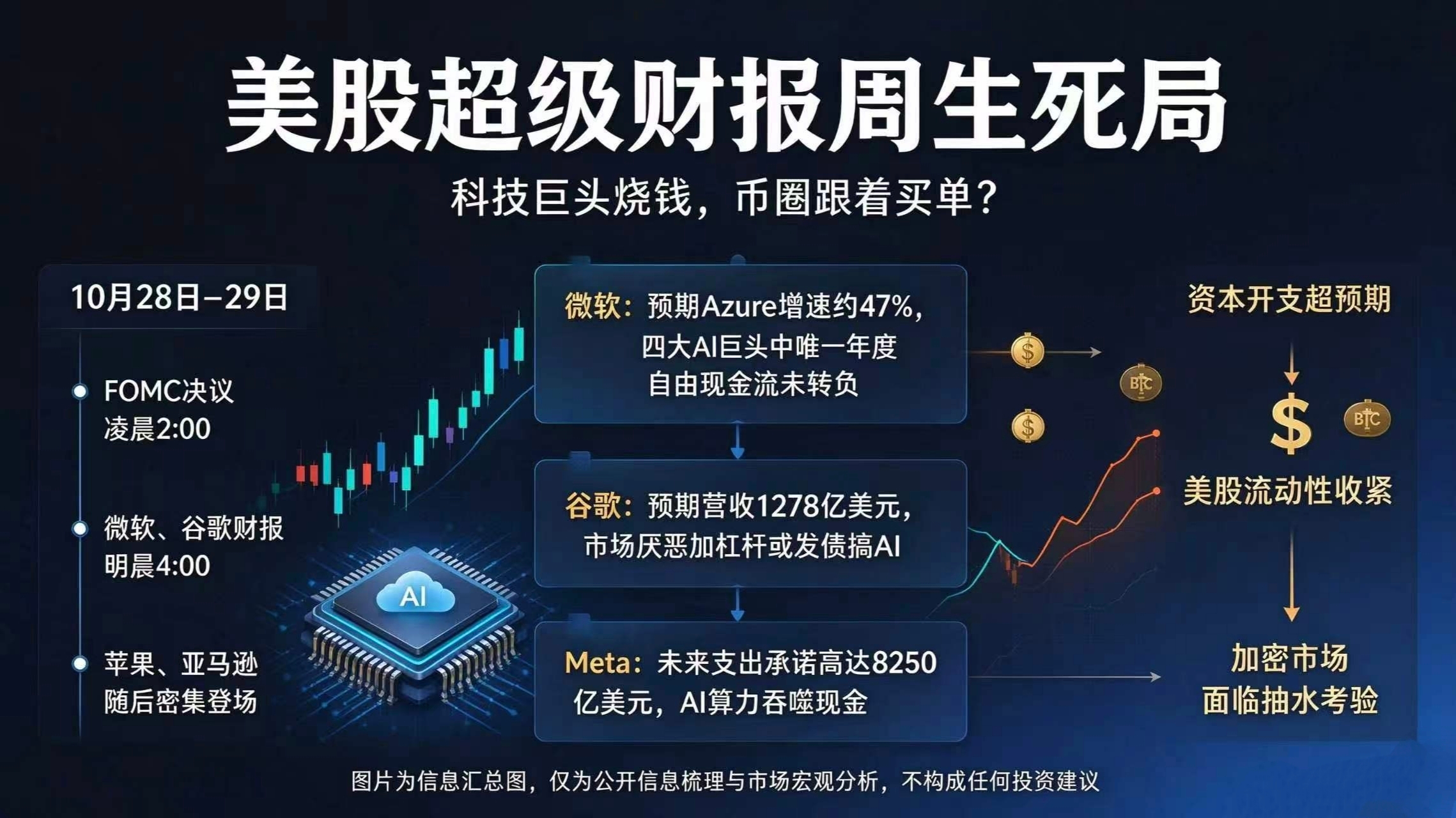
The U.S. Stocks “Super Earnings Week” Showdown: Tech Giants Burn Cash—Will Crypto Pay the Price?
October 28–29 marks the most pivotal “super week” of the U.S. Q3 earnings season, with giants including Microsoft, Google, Apple, and Amazon set to report in quick succession—all in the same window as the FOMC decision.
The key tensions traders need to watch:
Microsoft (tomorrow at 4:00 a.m.): The market’s biggest hope. Expectations are for Azure cloud growth to reach around 47%. Microsoft is also the only one of the four major AI players whose annual free cash flow has not yet turned negative. If capital spending exceeds expectations, the “AI is burning cash” narrative could spark another sell-off in tech stocks.
Google (tomorrow at 4:00 a.m.): Revenue is expected to come in at 127.8 billion. Its free cash flow turned negative in a rare reversal previously (-5.9 billion), and the market is now highly averse to the idea of it “taking on leverage or issuing debt to fund AI.”
The macro link to crypto: Tech giants are devouring cash to power AI computing, with Meta, for example, committing to as much as 825 billion in future spending. If these giants report disappointing results or announce further increases in capital spending, liquidity in U.S. equity markets will tighten further. The crypto market, already seeing ETF outflows, will face an even tougher liquidity-drain test.
{web3_wallet_create}(560x50c2be4b3958c358e2654c6dabb4feb9e1cc7777)
{web3_wallet_create}(560xe797e34845f5c23b1f578c7c49a101fca4137777)
{web3_wallet_create}(10xcf91b70017eabde82c9671e30e5502d312ea6eb2)
Tonight brings not only the Fed’s “starting gun” (2:00 a.m.), but also the tech giants’ “cards on the table.” Will capital seek safety, or pile into AI? Short-term volatility is bound to be intense.
Disclaimer: This is solely a summary of publicly available information and macro market analysis, and does not constitute investment advice.
#股票财报季 #微软财报能否兑现ai红利 #FOMC $MSFTB $GOOGLB
The U.S. Stocks “Super Earnings Week” Showdown: Tech Giants Burn Cash—Will Crypto Pay the Price?
October 28–29 marks the most pivotal “super week” of the U.S. Q3 earnings season, with giants including Microsoft, Google, Apple, and Amazon set to report in quick succession—all in the same window as the FOMC decision.
The key tensions traders need to watch:
Microsoft (tomorrow at 4:00 a.m.): The market’s biggest hope. Expectations are for Azure cloud growth to reach around 47%. Microsoft is also the only one of the four major AI players whose annual free cash flow has not yet turned negative. If capital spending exceeds expectations, the “AI is burning cash” narrative could spark another sell-off in tech stocks.
Google (tomorrow at 4:00 a.m.): Revenue is expected to come in at 127.8 billion. Its free cash flow turned negative in a rare reversal previously (-5.9 billion), and the market is now highly averse to the idea of it “taking on leverage or issuing debt to fund AI.”
The macro link to crypto: Tech giants are devouring cash to power AI computing, with Meta, for example, committing to as much as 825 billion in future spending. If these giants report disappointing results or announce further increases in capital spending, liquidity in U.S. equity markets will tighten further. The crypto market, already seeing ETF outflows, will face an even tougher liquidity-drain test.
Tonight brings not only the Fed’s “starting gun” (2:00 a.m.), but also the tech giants’ “cards on the table.” Will capital seek safety, or pile into AI? Short-term volatility is bound to be intense.
Disclaimer: This is solely a summary of publicly available information and macro market analysis, and does not constitute investment advice.
#股票财报季 #微软财报能否兑现ai红利 #FOMC $MSFTB $GOOGLB
27
·
--
Samsung goes straight for the jugular: New ad folds a sliced green apple, mocking iPhone Duo’s “Creasegate”
On October 27, Samsung released a new ad for the Galaxy Z Fold8, taking direct aim at Apple’s first foldable, the iPhone Duo. The ad is packed with barbs.
The mockery is pretty direct:
Visual jab: A sliced green apple with a “new” label folds in on itself, alluding to the iPhone Duo.
Specs showdown: The Galaxy Z Fold8 is 9.7 mm thick when folded—1.6 mm thinner than the iPhone Duo. It weighs 201 g, making it 53 g lighter.
Hitting a sore spot: The ad pokes fun at recent reports that dust getting into the iPhone Duo’s hinge can stop it from closing properly, as well as inner-screen failures (“Creasegate”). The Z Fold8 passed the same durability test.
{web3_wallet_create}(560x50c2be4b3958c358e2654c6dabb4feb9e1cc7777)
{web3_wallet_create}(560xe797e34845f5c23b1f578c7c49a101fca4137777)
{web3_wallet_create}(10xcf91b70017eabde82c9671e30e5502d312ea6eb2)
The closing tagline reads: “Years ahead in Foldables,” reminding viewers that Samsung entered the foldable-phone market back in 2019.
For context: Screen failures were reported during the iPhone Duo’s first week on sale. An iFixit teardown suggested the issue might lie with the hinge: the central support bar may not retract properly when the phone is closed, putting too much pressure on the screen. With this ad, Samsung is rubbing salt into Apple’s PR wound.
Disclaimer: This is only a roundup of publicly available information and does not constitute investment advice.
#三星 #iPhoneDuo #折叠屏 $AAPLB
Samsung goes straight for the jugular: New ad folds a sliced green apple, mocking iPhone Duo’s “Creasegate”
On October 27, Samsung released a new ad for the Galaxy Z Fold8, taking direct aim at Apple’s first foldable, the iPhone Duo. The ad is packed with barbs.
The mockery is pretty direct:
Visual jab: A sliced green apple with a “new” label folds in on itself, alluding to the iPhone Duo.
Specs showdown: The Galaxy Z Fold8 is 9.7 mm thick when folded—1.6 mm thinner than the iPhone Duo. It weighs 201 g, making it 53 g lighter.
Hitting a sore spot: The ad pokes fun at recent reports that dust getting into the iPhone Duo’s hinge can stop it from closing properly, as well as inner-screen failures (“Creasegate”). The Z Fold8 passed the same durability test.
The closing tagline reads: “Years ahead in Foldables,” reminding viewers that Samsung entered the foldable-phone market back in 2019.
For context: Screen failures were reported during the iPhone Duo’s first week on sale. An iFixit teardown suggested the issue might lie with the hinge: the central support bar may not retract properly when the phone is closed, putting too much pressure on the screen. With this ad, Samsung is rubbing salt into Apple’s PR wound.
Disclaimer: This is only a roundup of publicly available information and does not constitute investment advice.
#三星 #iPhoneDuo #折叠屏 $AAPLB
3
68
·
--
Hong Kong’s RWA breakthrough: secondary trading of tokenized funds goes live, with a regulatory framework on par with ETFs
The Hong Kong Securities and Futures Commission recently formally approved secondary market trading of tokenized funds, clarifying that they are subject to a regulatory framework similar to that for ETFs. This means RWA assets have officially moved from being “held on-chain” to becoming “tradable digital securities.”
Key highlights:
First to launch globally: Two tokenized money market funds (HKD and USD) managed by China Asset Management (Hong Kong) became the first public funds globally approved for secondary trading on a licensed VATP (Cheetah Trading).
24/7 trading: Breaking away from traditional trading hours, the funds support round-the-clock matching alongside real-time settlement, significantly improving capital efficiency.
“Dual-track” model and risk controls: Primary-market subscriptions and redemptions serve as a liquidity backstop, while prices are determined through secondary-market matching. Regulators require real-time iNAV references, pop-up alerts when price deviations exceed 0.5%, a five-minute cooling-off period, and market-making arrangements.
{web3_wallet_create}(560x50c2be4b3958c358e2654c6dabb4feb9e1cc7777)
{web3_wallet_create}(560xe797e34845f5c23b1f578c7c49a101fca4137777)
{web3_wallet_create}(10xcf91b70017eabde82c9671e30e5502d312ea6eb2)
Despite the upgraded liquidity mechanisms, investors should remain alert to insufficient liquidity outside traditional trading hours, price fragmentation across platforms, and the risk of premiums or discounts on underlying assets during extreme market conditions.
Disclaimer: This is a summary of publicly available information only and does not constitute investment advice.
$BTC #RWA #香港代币化基金二级交易类ETF监管
Hong Kong’s RWA breakthrough: secondary trading of tokenized funds goes live, with a regulatory framework on par with ETFs
The Hong Kong Securities and Futures Commission recently formally approved secondary market trading of tokenized funds, clarifying that they are subject to a regulatory framework similar to that for ETFs. This means RWA assets have officially moved from being “held on-chain” to becoming “tradable digital securities.”
Key highlights:
First to launch globally: Two tokenized money market funds (HKD and USD) managed by China Asset Management (Hong Kong) became the first public funds globally approved for secondary trading on a licensed VATP (Cheetah Trading).
24/7 trading: Breaking away from traditional trading hours, the funds support round-the-clock matching alongside real-time settlement, significantly improving capital efficiency.
“Dual-track” model and risk controls: Primary-market subscriptions and redemptions serve as a liquidity backstop, while prices are determined through secondary-market matching. Regulators require real-time iNAV references, pop-up alerts when price deviations exceed 0.5%, a five-minute cooling-off period, and market-making arrangements.
Despite the upgraded liquidity mechanisms, investors should remain alert to insufficient liquidity outside traditional trading hours, price fragmentation across platforms, and the risk of premiums or discounts on underlying assets during extreme market conditions.
Disclaimer: This is a summary of publicly available information only and does not constitute investment advice.
$BTC #RWA #香港代币化基金二级交易类ETF监管
1
130
·
--
U.S. government cashes out $627 million! FTX creditors “sold Anthropic too soon,” missing out on $3.3 billion?
According to Anthropic’s latest S-1 prospectus, the U.S. government has sold 4.45 million shares of Anthropic confiscated from FTX executives, including Caroline Ellison, for $627 million. All of the proceeds have been deposited into FTX’s bankruptcy estate to repay creditors.
{web3_wallet_create}(560x50c2be4b3958c358e2654c6dabb4feb9e1cc7777)
{web3_wallet_create}(560xe797e34845f5c23b1f578c7c49a101fca4137777)
{web3_wallet_create}(10xcf91b70017eabde82c9671e30e5502d312ea6eb2)
But this was an extremely “painful” cash-out. Based on Anthropic’s pre-IPO valuation of as much as $1.5 trillion, those shares would now be worth about $3.94 billion. In seeking liquidity as quickly as possible, FTX creditors missed out on more than $3.3 billion in potential gains.
Disclaimer: This is only a summary of publicly available information and does not constitute investment advice.
$BTC #美国政府出售FTX关联Anthropic股份获6.27亿美元
U.S. government cashes out $627 million! FTX creditors “sold Anthropic too soon,” missing out on $3.3 billion?
According to Anthropic’s latest S-1 prospectus, the U.S. government has sold 4.45 million shares of Anthropic confiscated from FTX executives, including Caroline Ellison, for $627 million. All of the proceeds have been deposited into FTX’s bankruptcy estate to repay creditors.
But this was an extremely “painful” cash-out. Based on Anthropic’s pre-IPO valuation of as much as $1.5 trillion, those shares would now be worth about $3.94 billion. In seeking liquidity as quickly as possible, FTX creditors missed out on more than $3.3 billion in potential gains.
Disclaimer: This is only a summary of publicly available information and does not constitute investment advice.
$BTC #美国政府出售FTX关联Anthropic股份获6.27亿美元
3
190
·
--
Holding $BTC 0.2 USDT
Xiaomi building homes for 12,000 yuan/sq.m. and selling them internally? Crypto bros: How many BTC could that buy?
On October 25, Xiaomi’s “Optics Valley Dream Home” residential project in Wuhan officially went on sale. It has 297 units, with an average registered price of 13,800 yuan per square meter (the rumored internal price for employees is around 12,000 yuan). The homes are available exclusively to full-time Xiaomi employees and are not being sold to the public.
A trader’s perspective:
At its core, this is a targeted employee benefit enabled by a tech giant’s industrial resources: employees get discounted “real-world assets.” But in today’s macroeconomic context, the contrast is striking:
Domestic tech giants are offering employees homes at low prices, while overseas tech giants such as MicroStrategy are issuing debt like crazy to accumulate BTC. On one side is the tangible, long-term value of bricks and mortar; on the other, the liquidity dynamics of digital gold.
{web3_wallet_create}(560x50c2be4b3958c358e2654c6dabb4feb9e1cc7777)
{web3_wallet_create}(560xe797e34845f5c23b1f578c7c49a101fca4137777)
{web3_wallet_create}(10xcf91b70017eabde82c9671e30e5502d312ea6eb2)
If you had 1 million yuan, would you pay cash for a home offered internally by a major tech company in a second-tier city, or go all in on digital assets? Tell us what you’d really choose in the comments.
Disclaimer: This is only a roundup of public information and an analysis of market narratives. It does not constitute investment advice.
#小米 #资产配置 $BTC
Xiaomi building homes for 12,000 yuan/sq.m. and selling them internally? Crypto bros: How many BTC could that buy?
On October 25, Xiaomi’s “Optics Valley Dream Home” residential project in Wuhan officially went on sale. It has 297 units, with an average registered price of 13,800 yuan per square meter (the rumored internal price for employees is around 12,000 yuan). The homes are available exclusively to full-time Xiaomi employees and are not being sold to the public.
A trader’s perspective:
At its core, this is a targeted employee benefit enabled by a tech giant’s industrial resources: employees get discounted “real-world assets.” But in today’s macroeconomic context, the contrast is striking:
Domestic tech giants are offering employees homes at low prices, while overseas tech giants such as MicroStrategy are issuing debt like crazy to accumulate BTC. On one side is the tangible, long-term value of bricks and mortar; on the other, the liquidity dynamics of digital gold.
If you had 1 million yuan, would you pay cash for a home offered internally by a major tech company in a second-tier city, or go all in on digital assets? Tell us what you’d really choose in the comments.
Disclaimer: This is only a roundup of public information and an analysis of market narratives. It does not constitute investment advice.
#小米 #资产配置 $BTC
131
·
--
Epic shareholder returns! SK hynix pledges 100 trillion won to shareholders as AI memory “cash cow” goes into overdrive
On October 28, alongside its Q3 earnings report, SK hynix unveiled a record-breaking shareholder return plan: returning approximately 100 trillion won (about $75 billion) to shareholders in fiscal 2026—seven times last year’s amount and the largest such payout in South Korean corporate history.
How will this enormous sum be distributed?
At least 30 trillion won in cash dividends, including a Q3 dividend of 20,000 won per share, which includes a special dividend of 10,000 won per share reflecting investment gains from Kioxia.
At least 60 trillion won in share buybacks and cancellations. The company approved a 20 trillion won buyback on the day, with approximately 10 trillion won allocated to shareholder returns and fully canceled.
Where does the confidence come from?
The explosive growth in demand for AI memory (HBM) means SK hynix is expected to generate as much as 200 trillion won in free cash flow this year. The company has explicitly committed to using more than 50% of its free cash flow for shareholder returns, raising its target from the previous “within a 50% range” to “more than 50%.”
The market responded: Q3 earnings showed a sharp year-over-year jump in operating profit. The stock’s after-hours gains in the U.S. briefly widened to 3%, while reports put its early-morning gains in South Korea at over 6%.
{web3_wallet_create}(560x50c2be4b3958c358e2654c6dabb4feb9e1cc7777)
{web3_wallet_create}(560xe797e34845f5c23b1f578c7c49a101fca4137777)
{web3_wallet_create}(10xcf91b70017eabde82c9671e30e5502d312ea6eb2)
This is about more than dividends. When a memory giant returns the extraordinary cash generated during the AI cycle on a massive scale through “dividends + buybacks with share cancellation,” it is essentially signaling to the market that the monetization phase for AI computing infrastructure has arrived—and that shareholder value is now being reassessed with real money.
Disclaimer: This is a summary of publicly available information and market analysis only, and does not constitute investment advice.
#SK海力士拟追加约450亿美元股东回报 #美股财报季来袭 $SKHYB
Epic shareholder returns! SK hynix pledges 100 trillion won to shareholders as AI memory “cash cow” goes into overdrive
On October 28, alongside its Q3 earnings report, SK hynix unveiled a record-breaking shareholder return plan: returning approximately 100 trillion won (about $75 billion) to shareholders in fiscal 2026—seven times last year’s amount and the largest such payout in South Korean corporate history.
How will this enormous sum be distributed?
At least 30 trillion won in cash dividends, including a Q3 dividend of 20,000 won per share, which includes a special dividend of 10,000 won per share reflecting investment gains from Kioxia.
At least 60 trillion won in share buybacks and cancellations. The company approved a 20 trillion won buyback on the day, with approximately 10 trillion won allocated to shareholder returns and fully canceled.
Where does the confidence come from?
The explosive growth in demand for AI memory (HBM) means SK hynix is expected to generate as much as 200 trillion won in free cash flow this year. The company has explicitly committed to using more than 50% of its free cash flow for shareholder returns, raising its target from the previous “within a 50% range” to “more than 50%.”
The market responded: Q3 earnings showed a sharp year-over-year jump in operating profit. The stock’s after-hours gains in the U.S. briefly widened to 3%, while reports put its early-morning gains in South Korea at over 6%.
This is about more than dividends. When a memory giant returns the extraordinary cash generated during the AI cycle on a massive scale through “dividends + buybacks with share cancellation,” it is essentially signaling to the market that the monetization phase for AI computing infrastructure has arrived—and that shareholder value is now being reassessed with real money.
Disclaimer: This is a summary of publicly available information and market analysis only, and does not constitute investment advice.
#SK海力士拟追加约450亿美元股东回报 #美股财报季来袭 $SKHYB

1
138
·
--
Google drops its trump card! The Genie 4 world model can hold real-time conversations—but don’t get carried away just yet.
On October 27, Google DeepMind officially unveiled its most powerful world model yet, Genie 4. This upgrade is a big leap forward:
For the first time, it natively generates audio and supports real-time conversations, with characters improvising responses based on your actions;
You can use natural language while it’s running to change the weather or switch camera angles in real time;
Physics simulation has improved significantly, and the duration of a single interaction has doubled to 2 minutes.
Gemini acts as the “director,” responsible for planning.
But note: This is currently only a research preview, available only to invited testers and, later, AI Ultra subscribers—not the general public.
{web3_wallet_create}(560x50c2be4b3958c358e2654c6dabb4feb9e1cc7777)
{web3_wallet_create}(560xe797e34845f5c23b1f578c7c49a101fca4137777)
{web3_wallet_create}(10xcf91b70017eabde82c9671e30e5502d312ea6eb2)
A trader’s perspective: The tech giants’ race to build AI world models is fueled by an enormous appetite for computing power and energy. With macro liquidity already tight, this level of technological advancement will further reinforce the narrative of “AI sucking up all the resources.” Watch how tech stocks move tonight and how they correlate with the AI sector.
Disclaimer: This is only a summary of public information and an analysis of the tech narrative; it does not constitute investment advice. Crypto assets are highly volatile. Please make your own decisions.
#谷歌 $GOOGLB
Google drops its trump card! The Genie 4 world model can hold real-time conversations—but don’t get carried away just yet.
On October 27, Google DeepMind officially unveiled its most powerful world model yet, Genie 4. This upgrade is a big leap forward:
For the first time, it natively generates audio and supports real-time conversations, with characters improvising responses based on your actions;
You can use natural language while it’s running to change the weather or switch camera angles in real time;
Physics simulation has improved significantly, and the duration of a single interaction has doubled to 2 minutes.
Gemini acts as the “director,” responsible for planning.
But note: This is currently only a research preview, available only to invited testers and, later, AI Ultra subscribers—not the general public.
A trader’s perspective: The tech giants’ race to build AI world models is fueled by an enormous appetite for computing power and energy. With macro liquidity already tight, this level of technological advancement will further reinforce the narrative of “AI sucking up all the resources.” Watch how tech stocks move tonight and how they correlate with the AI sector.
Disclaimer: This is only a summary of public information and an analysis of the tech narrative; it does not constitute investment advice. Crypto assets are highly volatile. Please make your own decisions.
#谷歌 $GOOGLB

1
80
·
--
OCC calls on community banks: Issue stablecoins, enter through subsidiaries
On October 26, the U.S. Office of the Comptroller of the Currency (OCC) publicly called on X for community banks interested in doing so to consider applying to become payment stablecoin issuers, or entering the market through subsidiaries. The next day, Comptroller Gould confirmed: “Community banks have a role to play in the future of payments.”
Three hard constraints: They must operate through subsidiaries; insured national banks cannot issue stablecoins directly. Starting January 18, 2027, issuing without approval will carry criminal penalties. The application process is not yet open and cannot begin until the OMB approves it.
{web3_wallet_create}(560x50c2be4b3958c358e2654c6dabb4feb9e1cc7777)
{web3_wallet_create}(560xe797e34845f5c23b1f578c7c49a101fca4137777)
{web3_wallet_create}(10xcf91b70017eabde82c9671e30e5502d312ea6eb2)
The backdrop is intriguing: ICBA sued the OCC in early October, alleging that the agency’s issuance of trust charters to crypto companies created unfair competition. The OCC’s response is straightforward—**bring community banks to the table, rather than leave stablecoin payments to large banks and crypto companies**. The playing field is being forcibly leveled.
Disclaimer: This is only a summary of publicly available regulatory information and does not constitute investment advice.
#稳定币 #OCC敦促社区银行进军稳定币支付 $USDC
OCC calls on community banks: Issue stablecoins, enter through subsidiaries
On October 26, the U.S. Office of the Comptroller of the Currency (OCC) publicly called on X for community banks interested in doing so to consider applying to become payment stablecoin issuers, or entering the market through subsidiaries. The next day, Comptroller Gould confirmed: “Community banks have a role to play in the future of payments.”
Three hard constraints: They must operate through subsidiaries; insured national banks cannot issue stablecoins directly. Starting January 18, 2027, issuing without approval will carry criminal penalties. The application process is not yet open and cannot begin until the OMB approves it.
The backdrop is intriguing: ICBA sued the OCC in early October, alleging that the agency’s issuance of trust charters to crypto companies created unfair competition. The OCC’s response is straightforward—**bring community banks to the table, rather than leave stablecoin payments to large banks and crypto companies**. The playing field is being forcibly leveled.
Disclaimer: This is only a summary of publicly available regulatory information and does not constitute investment advice.
#稳定币 #OCC敦促社区银行进军稳定币支付 $USDC
2
94
·
--
Microsoft earnings countdown: Azure growth is the only answer, with $50 billion in capital spending awaiting returns
Microsoft will release its FY2027 Q1 earnings before dawn on October 29, Beijing time. The market expects revenue of $90.63 billion and adjusted EPS of $4.71, but there is really only one key question: Can Azure maintain a growth floor of 45%?
Azure grew 43% last quarter, with annualized revenue topping $100 billion for the first time. Management guided to 44%–45% growth this quarter, while Wall Street has revised its estimates up to 44%–46%. Bank of America expects 44.8%, and Wells Fargo sees growth reaching 46%. The 45% mark has shifted from an “optimistic scenario” to a passing grade: merely meeting the low end is not enough; growth near the high end is needed to show that AI investments are generating returns.
Cost pressures are just as clear: Capital spending is expected to exceed $50 billion this quarter, with full-year guidance of $255 billion–$260 billion. Gross margin has gradually declined from 71% to around 68%. Copilot has more than 30 million paid seats, but enterprise renewals and expansions will be the real test of whether AI software can be monetized.
{web3_wallet_create}(560x50c2be4b3958c358e2654c6dabb4feb9e1cc7777)
{web3_wallet_create}(560xe797e34845f5c23b1f578c7c49a101fca4137777)
{web3_wallet_create}(10xcf91b70017eabde82c9671e30e5502d312ea6eb2)
If Azure growth comes in below 44%, alongside elevated capital spending, the narrative of “AI dividends coming to fruition” will be called into question.
Disclaimer: This is only a summary of publicly available information and does not constitute investment advice.
#股票财报季 #微软财报能否兑现ai红利 $MSFTB
Microsoft earnings countdown: Azure growth is the only answer, with $50 billion in capital spending awaiting returns
Microsoft will release its FY2027 Q1 earnings before dawn on October 29, Beijing time. The market expects revenue of $90.63 billion and adjusted EPS of $4.71, but there is really only one key question: Can Azure maintain a growth floor of 45%?
Azure grew 43% last quarter, with annualized revenue topping $100 billion for the first time. Management guided to 44%–45% growth this quarter, while Wall Street has revised its estimates up to 44%–46%. Bank of America expects 44.8%, and Wells Fargo sees growth reaching 46%. The 45% mark has shifted from an “optimistic scenario” to a passing grade: merely meeting the low end is not enough; growth near the high end is needed to show that AI investments are generating returns.
Cost pressures are just as clear: Capital spending is expected to exceed $50 billion this quarter, with full-year guidance of $255 billion–$260 billion. Gross margin has gradually declined from 71% to around 68%. Copilot has more than 30 million paid seats, but enterprise renewals and expansions will be the real test of whether AI software can be monetized.
If Azure growth comes in below 44%, alongside elevated capital spending, the narrative of “AI dividends coming to fruition” will be called into question.
Disclaimer: This is only a summary of publicly available information and does not constitute investment advice.
#股票财报季 #微软财报能否兑现ai红利 $MSFTB
4
46
·
--
Verified
Google’s earnings report drops tonight: Cloud is surging, but free cash flow is its biggest weakness
Google will release its Q3 earnings report in the early hours of October 29, Beijing time. The market expects revenue of $127.8 billion, up 25% year over year.
The real tension in its core business isn’t revenue—it’s whether “spending to buy growth” can become a virtuous cycle. Cloud is the biggest bright spot, with the market expecting growth of over 90%. JPMorgan has even raised its forecast to 100%, implying revenue of about $30.3 billion. But free cash flow turned negative for the first time ever in Q2, while full-year capital expenditure guidance stands at a hefty $195–205 billion, nearly double the prior year.
{web3_wallet_create}(560x50c2be4b3958c358e2654c6dabb4feb9e1cc7777)
{web3_wallet_create}(560xe797e34845f5c23b1f578c7c49a101fca4137777)
{web3_wallet_create}(10xcf91b70017eabde82c9671e30e5502d312ea6eb2)
If cloud growth holds above 90%, it would show that AI investment is paying off. If growth falls short of expectations or capital expenditure guidance is raised again, the “resilience” narrative around the core business will come under question. The FOMC decision also falls within the same window, so tonight’s combination of macroeconomic and earnings volatility is bound to be anything but quiet.
Disclaimer: This is a summary of publicly available information only and does not constitute investment advice.
$GOOGLB #fomc #谷歌财报能否守住基本盘
Google’s earnings report drops tonight: Cloud is surging, but free cash flow is its biggest weakness
Google will release its Q3 earnings report in the early hours of October 29, Beijing time. The market expects revenue of $127.8 billion, up 25% year over year.
The real tension in its core business isn’t revenue—it’s whether “spending to buy growth” can become a virtuous cycle. Cloud is the biggest bright spot, with the market expecting growth of over 90%. JPMorgan has even raised its forecast to 100%, implying revenue of about $30.3 billion. But free cash flow turned negative for the first time ever in Q2, while full-year capital expenditure guidance stands at a hefty $195–205 billion, nearly double the prior year.
If cloud growth holds above 90%, it would show that AI investment is paying off. If growth falls short of expectations or capital expenditure guidance is raised again, the “resilience” narrative around the core business will come under question. The FOMC decision also falls within the same window, so tonight’s combination of macroeconomic and earnings volatility is bound to be anything but quiet.
Disclaimer: This is a summary of publicly available information only and does not constitute investment advice.
$GOOGLB #fomc #谷歌财报能否守住基本盘
4
1
19
13.9k
·
--
The FOMC meeting is underway: a 90.6% chance of holding steady—what is the market waiting for?
The Federal Reserve's October FOMC policy meeting (27th-28th) has officially begun, and the latest decision will be announced at 2:00 a.m. tomorrow night. According to CME data, the probability of keeping interest rates unchanged this time is as high as 90.6%.
The real suspense is not today, but in the post-meeting statement and Powell's speech: will expectations for a December rate hike continue to build? At present, major funds have entered a wait-and-see mode, and market volatility may expand at any time—keep a close eye on the macro "starter pistol" at 2:00 a.m.
{web3_wallet_create}(560x50c2be4b3958c358e2654c6dabb4feb9e1cc7777)
{web3_wallet_create}(560xe797e34845f5c23b1f578c7c49a101fca4137777)
{web3_wallet_create}(10xcf91b70017eabde82c9671e30e5502d312ea6eb2)
Disclaimer: This is only a compilation of public data and does not constitute investment advice.
$BTC #FOMC #FOMC会议
The FOMC meeting is underway: a 90.6% chance of holding steady—what is the market waiting for?
The Federal Reserve's October FOMC policy meeting (27th-28th) has officially begun, and the latest decision will be announced at 2:00 a.m. tomorrow night. According to CME data, the probability of keeping interest rates unchanged this time is as high as 90.6%.
The real suspense is not today, but in the post-meeting statement and Powell's speech: will expectations for a December rate hike continue to build? At present, major funds have entered a wait-and-see mode, and market volatility may expand at any time—keep a close eye on the macro "starter pistol" at 2:00 a.m.
Disclaimer: This is only a compilation of public data and does not constitute investment advice.
$BTC #FOMC #FOMC会议
3
227
·
--
Can you now scan a QR code in Thailand to pay in baht with USDT? Yes, but with restrictions.
Thailand’s digital wallet WORPT has launched, allowing foreign tourists to convert USDT/USDC into Thai baht and pay local merchants via PromptPay QR codes. Merchants receive only baht and don’t handle cryptocurrency.
But note: this is not a full-scale rollout. WORPT is currently in Thailand’s SEC-regulated “Tourist DigiPay” sandbox, with KYC and anti-money laundering monitoring. The testing period can last up to 18 months, and the official launch is scheduled for November. Partners include Tether, The Mall Group, and Visa. A Visa prepaid card will also be introduced later, allowing users to scan and pay or swipe using the same baht balance.
{web3_wallet_create}(560x50c2be4b3958c358e2654c6dabb4feb9e1cc7777)
{web3_wallet_create}(560xe797e34845f5c23b1f578c7c49a101fca4137777)
{web3_wallet_create}(10xcf91b70017eabde82c9671e30e5502d312ea6eb2)
Additional context: Thailand’s SEC has also proposed a daily transfer limit of 5 million baht for stablecoins, with transfers allowed only between accounts belonging to the same person. The direction is clear: compliant channels are opening, with monitoring keeping pace.
Disclaimer: This is a summary of publicly available information and does not constitute investment advice.
#泰国推出WORPT稳定币QR支付应用 #WORPT
Can you now scan a QR code in Thailand to pay in baht with USDT? Yes, but with restrictions.
Thailand’s digital wallet WORPT has launched, allowing foreign tourists to convert USDT/USDC into Thai baht and pay local merchants via PromptPay QR codes. Merchants receive only baht and don’t handle cryptocurrency.
But note: this is not a full-scale rollout. WORPT is currently in Thailand’s SEC-regulated “Tourist DigiPay” sandbox, with KYC and anti-money laundering monitoring. The testing period can last up to 18 months, and the official launch is scheduled for November. Partners include Tether, The Mall Group, and Visa. A Visa prepaid card will also be introduced later, allowing users to scan and pay or swipe using the same baht balance.
Additional context: Thailand’s SEC has also proposed a daily transfer limit of 5 million baht for stablecoins, with transfers allowed only between accounts belonging to the same person. The direction is clear: compliant channels are opening, with monitoring keeping pace.
Disclaimer: This is a summary of publicly available information and does not constitute investment advice.
#泰国推出WORPT稳定币QR支付应用 #WORPT
17
·
--
BTC Falls Below $80,000: $175 Million Liquidated in One Day, December Rate-Hike Odds Surge to 68%
On October 26, Bitcoin fell below $80,000 intraday, reaching a low of $79,330 and approaching its lowest level since mid-September. Over the past 24 hours, $175 million in positions were liquidated across the crypto market. Long positions accounted for $106 million, or more than 60% of the total, making bullish traders the hardest hit.
Macroeconomic pressure is the main cause. CME data shows a 90.6% probability that the Federal Reserve will hold rates steady in October, while the probability of a cumulative 25-basis-point rate hike by December has risen to 67.5%. Markets are pricing in tighter liquidity in advance. Meanwhile, U.S. spot Bitcoin ETFs recorded net outflows of $635.6 million on October 22—their largest single-day outflow since June—and the Coinbase Bitcoin Premium Index has remained negative for 33 consecutive days, reflecting persistently weak U.S. spot buying.
{spot}(BTCUSDT)
{web3_wallet_create}(560x50c2be4b3958c358e2654c6dabb4feb9e1cc7777)
{web3_wallet_create}(10xcf91b70017eabde82c9671e30e5502d312ea6eb2)
Key levels: $79,000 is short-term support below, with $78,000 as the next line of defense. Above, Bitcoin needs to hold above $82,000 before momentum can be said to be improving; $83,000 is both a technical and psychological hurdle.
Disclaimer: The above is only a summary of publicly available data and an analysis of market developments, and does not constitute investment advice. Crypto assets are highly volatile. Make your own decisions and bear the consequences of your own gains or losses.
$BTC #比特币再度跌破8万美元
BTC Falls Below $80,000: $175 Million Liquidated in One Day, December Rate-Hike Odds Surge to 68%
On October 26, Bitcoin fell below $80,000 intraday, reaching a low of $79,330 and approaching its lowest level since mid-September. Over the past 24 hours, $175 million in positions were liquidated across the crypto market. Long positions accounted for $106 million, or more than 60% of the total, making bullish traders the hardest hit.
Macroeconomic pressure is the main cause. CME data shows a 90.6% probability that the Federal Reserve will hold rates steady in October, while the probability of a cumulative 25-basis-point rate hike by December has risen to 67.5%. Markets are pricing in tighter liquidity in advance. Meanwhile, U.S. spot Bitcoin ETFs recorded net outflows of $635.6 million on October 22—their largest single-day outflow since June—and the Coinbase Bitcoin Premium Index has remained negative for 33 consecutive days, reflecting persistently weak U.S. spot buying.
Key levels: $79,000 is short-term support below, with $78,000 as the next line of defense. Above, Bitcoin needs to hold above $82,000 before momentum can be said to be improving; $83,000 is both a technical and psychological hurdle.
Disclaimer: The above is only a summary of publicly available data and an analysis of market developments, and does not constitute investment advice. Crypto assets are highly volatile. Make your own decisions and bear the consequences of your own gains or losses.
$BTC #比特币再度跌破8万美元
62
·
--
An ancient whale with a cost basis of $0.31 is dumping ETH onto exchanges
According to on-chain monitoring, an ancient whale who participated in the 2015 ETH 1CO transferred another 3,000 ETH (about $6.94 million) to exchanges in the past 24 hours. This is part of a series of consecutive moves. The whale’s cost basis is astonishingly low at just $0.31, and they still hold about 47,000 ETH.
Meanwhile, two whales that had been dormant for three years suddenly woke up and deposited 2,571 BTC, worth over $200 million, into Coinbase Prime. Long-dormant holdings are starting to move. With liquidity already fragile, who will absorb this potential selling pressure?
{web3_wallet_create}(10xcf91b70017eabde82c9671e30e5502d312ea6eb2)
{web3_wallet_create}(560xe797e34845f5c23b1f578c7c49a101fca4137777)
{future}(ETHUSDT)
Disclaimer: The above is a compilation of publicly available on-chain data and is shared for informational purposes only. It does not constitute investment advice. Crypto assets are highly volatile. Make your own decisions and assume full responsibility for any gains or losses.
#ETH🔥🔥🔥🔥🔥🔥 $ETH
An ancient whale with a cost basis of $0.31 is dumping ETH onto exchanges
According to on-chain monitoring, an ancient whale who participated in the 2015 ETH 1CO transferred another 3,000 ETH (about $6.94 million) to exchanges in the past 24 hours. This is part of a series of consecutive moves. The whale’s cost basis is astonishingly low at just $0.31, and they still hold about 47,000 ETH.
Meanwhile, two whales that had been dormant for three years suddenly woke up and deposited 2,571 BTC, worth over $200 million, into Coinbase Prime. Long-dormant holdings are starting to move. With liquidity already fragile, who will absorb this potential selling pressure?
Disclaimer: The above is a compilation of publicly available on-chain data and is shared for informational purposes only. It does not constitute investment advice. Crypto assets are highly volatile. Make your own decisions and assume full responsibility for any gains or losses.
#ETH🔥🔥🔥🔥🔥🔥 $ETH
1
8
·
--
$175 million liquidated in a single day! BTC holds the $80K line as the market awaits the Fed’s “starting gun”
Over the past 24 hours, $175 million in positions were liquidated across the market, including $106 million in long positions. It was another day of longs getting crushed. BTC seesaws around the $80K mark, while total market capitalization slips slightly to $2.68 trillion.
The real pressure is coming from macro factors: the Fed’s rate decision is imminent, and the market is pricing in a 90.6% chance of no rate cut. Meanwhile, Arthur Hayes has closed all directional positions, and ETF funds continue to flow out.
{web3_wallet_create}(560x50c2be4b3958c358e2654c6dabb4feb9e1cc7777)
With macro uncertainty and tightening liquidity piling on, $80,000 has become a meat grinder for bulls and bears alike. Keep your hands off the buttons and wait for the winds to shift.
{web3_wallet_create}(560xe797e34845f5c23b1f578c7c49a101fca4137777)
{web3_wallet_create}(10xcf91b70017eabde82c9671e30e5502d312ea6eb2)
Disclaimer: The above is only a summary of publicly available data and an analysis of market conditions, and does not constitute investment advice. Crypto assets are highly volatile. Make your own decisions and bear the associated risks.
$BTC #美联储何时降息? #爆仓了
$175 million liquidated in a single day! BTC holds the $80K line as the market awaits the Fed’s “starting gun”
Over the past 24 hours, $175 million in positions were liquidated across the market, including $106 million in long positions. It was another day of longs getting crushed. BTC seesaws around the $80K mark, while total market capitalization slips slightly to $2.68 trillion.
The real pressure is coming from macro factors: the Fed’s rate decision is imminent, and the market is pricing in a 90.6% chance of no rate cut. Meanwhile, Arthur Hayes has closed all directional positions, and ETF funds continue to flow out.
With macro uncertainty and tightening liquidity piling on, $80,000 has become a meat grinder for bulls and bears alike. Keep your hands off the buttons and wait for the winds to shift.
Disclaimer: The above is only a summary of publicly available data and an analysis of market conditions, and does not constitute investment advice. Crypto assets are highly volatile. Make your own decisions and bear the associated risks.
$BTC #美联储何时降息? #爆仓了
2
197
·
--
Strategy didn’t buy Bitcoin, spending $205 million on STRC buybacks instead
Strategy paused Bitcoin purchases and sales last week (10.19–10.25), keeping its holdings at 848,517 BTC. During the same period, it spent $204.9 million to buy back 2.068 million shares of STRC preferred stock.
This wasn’t an isolated move: throughout October, Strategy spent about $664 million on STRC buybacks, compared with just $72.3 million on Bitcoin purchases. The core rationale is that when STRC trades below its $100 par value, buying back shares at a discount can reduce future preferred dividend costs. While Bitcoin is trading sideways, cutting predictable cash outflows is more financially prudent than continuing to add to its holdings.
{web3_wallet_create}(560x50c2be4b3958c358e2654c6dabb4feb9e1cc7777)
{web3_wallet_create}(560xe797e34845f5c23b1f578c7c49a101fca4137777)
{web3_wallet_create}(10xcf91b70017eabde82c9671e30e5502d312ea6eb2)
Disclaimer: This is only a summary of publicly available information and does not constitute investment advice. $MSTRB #Strategy未购比特币斥资2.05亿美元回购STRC
Strategy didn’t buy Bitcoin, spending $205 million on STRC buybacks instead
Strategy paused Bitcoin purchases and sales last week (10.19–10.25), keeping its holdings at 848,517 BTC. During the same period, it spent $204.9 million to buy back 2.068 million shares of STRC preferred stock.
This wasn’t an isolated move: throughout October, Strategy spent about $664 million on STRC buybacks, compared with just $72.3 million on Bitcoin purchases. The core rationale is that when STRC trades below its $100 par value, buying back shares at a discount can reduce future preferred dividend costs. While Bitcoin is trading sideways, cutting predictable cash outflows is more financially prudent than continuing to add to its holdings.
Disclaimer: This is only a summary of publicly available information and does not constitute investment advice. $MSTRB #Strategy未购比特币斥资2.05亿美元回购STRC
MSTRB+2.00%
STRCUS-0.06%
65
Log in to explore more content
Join global crypto users on Binance Square
⚡️ Get latest and useful information about crypto.
💬 Trusted by the world’s largest crypto exchange.
👍 Discover real insights from verified creators.
Email / Phone number