
Powerpei
1.3k Posts

Powerpei
 Square Verified+
Report
Block User
独立开发者
DeFi基础设施 & AI交易工具深度分析
自研Web3资产监控软件
美股港股实战洞见
X:@PWenzhen76938 没有任何小号,请勿上当!
Open Trade
Frequent Trader
3.1 Years
1.2K+ Following
41.9K+ Followers
34.6K+ Liked
Posts
Portfolio
All
Quotes
Videos
Live
PINNED
·
--
I joined Binance Square in November last year.
Back then, I saw Yingge promoting the Creator Platform, so I hopped on.
I have to say, Yingge is kind of my benefactor.
I should say she’s a benefactor for a lot of small retail investors. Everyone who knows her knows she’s very capable and also easygoing (and the key is, she’s also beautiful).
The deepest impression I have is when I ran into some small problems and went to ask Yingge for advice—I was afraid I wouldn’t do it well. Yingge told me: Just be yourself.
After that, I met Cy, who also gave me a lot of help and guidance.
I didn’t think too much. I just adjusted the content I usually posted to align more with the task direction.
Bit by bit, I managed to get a few first-place rankings; in total, I think it added up to nearly $10,000.
To be honest, that number isn’t that big, but the advantage is the low barrier to entry.
You don’t need 100,000 followers. You don’t need to grind data every day. If your writing is good, you still have a chance to get on the leaderboard.
Even now, I still update posts every day. Occasionally, when I see creator tasks that fit, I’ll join in.
Not grinding, but it’s pretty interesting.
Compared to writing on X for half a day just to get a few likes, Square at least gives you positive feedback—you write something and you can actually earn money.
#币安广场
I joined Binance Square in November last year.
Back then, I saw Yingge promoting the Creator Platform, so I hopped on.
I have to say, Yingge is kind of my benefactor.
I should say she’s a benefactor for a lot of small retail investors. Everyone who knows her knows she’s very capable and also easygoing (and the key is, she’s also beautiful).
The deepest impression I have is when I ran into some small problems and went to ask Yingge for advice—I was afraid I wouldn’t do it well. Yingge told me: Just be yourself.
After that, I met Cy, who also gave me a lot of help and guidance.
I didn’t think too much. I just adjusted the content I usually posted to align more with the task direction.
Bit by bit, I managed to get a few first-place rankings; in total, I think it added up to nearly $10,000.
To be honest, that number isn’t that big, but the advantage is the low barrier to entry.
You don’t need 100,000 followers. You don’t need to grind data every day. If your writing is good, you still have a chance to get on the leaderboard.
Even now, I still update posts every day. Occasionally, when I see creator tasks that fit, I’ll join in.
Not grinding, but it’s pretty interesting.
Compared to writing on X for half a day just to get a few likes, Square at least gives you positive feedback—you write something and you can actually earn money.
#币安广场
Back then, I saw Yingge promoting the Creator Platform, so I hopped on.
I have to say, Yingge is kind of my benefactor.
I should say she’s a benefactor for a lot of small retail investors. Everyone who knows her knows she’s very capable and also easygoing (and the key is, she’s also beautiful).
The deepest impression I have is when I ran into some small problems and went to ask Yingge for advice—I was afraid I wouldn’t do it well. Yingge told me: Just be yourself.
After that, I met Cy, who also gave me a lot of help and guidance.
I didn’t think too much. I just adjusted the content I usually posted to align more with the task direction.
Bit by bit, I managed to get a few first-place rankings; in total, I think it added up to nearly $10,000.
To be honest, that number isn’t that big, but the advantage is the low barrier to entry.
You don’t need 100,000 followers. You don’t need to grind data every day. If your writing is good, you still have a chance to get on the leaderboard.
Even now, I still update posts every day. Occasionally, when I see creator tasks that fit, I’ll join in.
Not grinding, but it’s pretty interesting.
Compared to writing on X for half a day just to get a few likes, Square at least gives you positive feedback—you write something and you can actually earn money.
#币安广场
33
1
46
23.1k
·
--
ZEC has been trending on the hot search for several days, and today its volume increased again by another chunk. Firo, XMR, and Dash are following along too.
I think this round of privacy coins is a bit different from before.
Grayscale has launched a spot ETF product (ZCSH), giving institutions a compliant entry.
Paradigm also publicly said that Zcash is a privacy complement to Bitcoin.
Plus, NU7 was approved unanimously. Block time was cut from 75 seconds down to 25 seconds, and the halving didn’t slash anything. With funding channels, a narrative, and the technology still upgrading—those three things are colliding at once.
Also, the SEC released a framework for on-chain stock trading, and NEAR, ARB, UNI, APT, and INJ all surged together.
Everyone’s guessing which traditional assets will first get pushed on-chain and hit whose head. I’ve talked about UNI before: on Robinhood Chain, the tokenized stock volume is feeding the protocol’s revenue, and that logic is still there.
PIEVERSE is also surging today—it’s for AI agent payment and bookkeeping. MON is still hovering around in the trending topics.
Overall, it’s pretty clear where capital preference is going today.
The ones with a story and channels are rising; the ones driven purely by hype haven’t moved much.
High volatility—don’t chase the price. DYOR
$ZEC
ZEC has been trending on the hot search for several days, and today its volume increased again by another chunk. Firo, XMR, and Dash are following along too.
I think this round of privacy coins is a bit different from before.
Grayscale has launched a spot ETF product (ZCSH), giving institutions a compliant entry.
Paradigm also publicly said that Zcash is a privacy complement to Bitcoin.
Plus, NU7 was approved unanimously. Block time was cut from 75 seconds down to 25 seconds, and the halving didn’t slash anything. With funding channels, a narrative, and the technology still upgrading—those three things are colliding at once.
Also, the SEC released a framework for on-chain stock trading, and NEAR, ARB, UNI, APT, and INJ all surged together.
Everyone’s guessing which traditional assets will first get pushed on-chain and hit whose head. I’ve talked about UNI before: on Robinhood Chain, the tokenized stock volume is feeding the protocol’s revenue, and that logic is still there.
PIEVERSE is also surging today—it’s for AI agent payment and bookkeeping. MON is still hovering around in the trending topics.
Overall, it’s pretty clear where capital preference is going today.
The ones with a story and channels are rising; the ones driven purely by hype haven’t moved much.
High volatility—don’t chase the price. DYOR
$ZEC
I think this round of privacy coins is a bit different from before.
Grayscale has launched a spot ETF product (ZCSH), giving institutions a compliant entry.
Paradigm also publicly said that Zcash is a privacy complement to Bitcoin.
Plus, NU7 was approved unanimously. Block time was cut from 75 seconds down to 25 seconds, and the halving didn’t slash anything. With funding channels, a narrative, and the technology still upgrading—those three things are colliding at once.
Also, the SEC released a framework for on-chain stock trading, and NEAR, ARB, UNI, APT, and INJ all surged together.
Everyone’s guessing which traditional assets will first get pushed on-chain and hit whose head. I’ve talked about UNI before: on Robinhood Chain, the tokenized stock volume is feeding the protocol’s revenue, and that logic is still there.
PIEVERSE is also surging today—it’s for AI agent payment and bookkeeping. MON is still hovering around in the trending topics.
Overall, it’s pretty clear where capital preference is going today.
The ones with a story and channels are rising; the ones driven purely by hype haven’t moved much.
High volatility—don’t chase the price. DYOR
$ZEC
2
3k
·
--
Verified
NEAR pulled off a run today around the $2.65 mark—up about 12% over the past 24 hours.
Both CoinMarketCap and CoinGecko hot searches are showing it.
The direct cause is Confidential Intents.
This is NEAR’s privacy cross-chain channel. The TVL has just crossed $70 million. After passing that threshold, a milestone airdrop called “NEAR @3.33” gets triggered. The 333,000 locked tokens have already been snapshotted—eligible users can go claim them.
Also, the privacy narrative has been heating up across the board recently. ZEC is rising in sync, and THORWallet has also picked up privacy-based swaps. When a few things line up like this, attention and volume both jump.
I didn’t chase this wave.
I only noticed after it had already moved up. Chasing tops isn’t my style. But I think the NEAR direction of privacy cross-chain is worth keeping an eye on—watch whether the TVL is genuinely stickier, or if it’s just a one-time rush for the airdrop.
High volatility—don’t get carried away. DYOR.
$NEAR
{spot}(NEARUSDT)
NEAR pulled off a run today around the $2.65 mark—up about 12% over the past 24 hours.
Both CoinMarketCap and CoinGecko hot searches are showing it.
The direct cause is Confidential Intents.
This is NEAR’s privacy cross-chain channel. The TVL has just crossed $70 million. After passing that threshold, a milestone airdrop called “NEAR @3.33” gets triggered. The 333,000 locked tokens have already been snapshotted—eligible users can go claim them.
Also, the privacy narrative has been heating up across the board recently. ZEC is rising in sync, and THORWallet has also picked up privacy-based swaps. When a few things line up like this, attention and volume both jump.
I didn’t chase this wave.
I only noticed after it had already moved up. Chasing tops isn’t my style. But I think the NEAR direction of privacy cross-chain is worth keeping an eye on—watch whether the TVL is genuinely stickier, or if it’s just a one-time rush for the airdrop.
High volatility—don’t get carried away. DYOR.
$NEAR
Both CoinMarketCap and CoinGecko hot searches are showing it.
The direct cause is Confidential Intents.
This is NEAR’s privacy cross-chain channel. The TVL has just crossed $70 million. After passing that threshold, a milestone airdrop called “NEAR @3.33” gets triggered. The 333,000 locked tokens have already been snapshotted—eligible users can go claim them.
Also, the privacy narrative has been heating up across the board recently. ZEC is rising in sync, and THORWallet has also picked up privacy-based swaps. When a few things line up like this, attention and volume both jump.
I didn’t chase this wave.
I only noticed after it had already moved up. Chasing tops isn’t my style. But I think the NEAR direction of privacy cross-chain is worth keeping an eye on—watch whether the TVL is genuinely stickier, or if it’s just a one-time rush for the airdrop.
High volatility—don’t get carried away. DYOR.
$NEAR
1
2.5k
·
--
Verified
Arc mainnet launched today
I just tried it in my Binance wallet and it feels smoother than I expected
Open your Binance wallet—Arc network is already there
You can directly find it in the popular assets list; tap in and you can buy
No need to add an RPC in the middle, no manual bridging, no hunting for links everywhere
You can immediately view popular memes—pretty convenient
//
If you’ve set up a new chain yourself, you’ll know
Check the Chain ID, find the RPC, bridge over USDC, confirm it arrived, then find the transaction entry (this morning a few friends tried to cross-chain from other wallets but couldn’t find the cross-chain asset—where did it go) Just these steps alone can deter half the people
Binance wallet skips all of that
It gives you ready-made entry points—probably the shortest way to participate in the Arc route right now
//
Let me clarify: Arc itself isn’t another EVM-compatible L1
Circle made it
The core is native issuance of USDC and its cross-chain circulation
The stablecoin doesn’t come from bridging over from another chain—it’s native on-chain. Gas is also in USDC (have to say the structure is very smooth—speed for farming/apeing is fast) So it naturally ties together DeFi, payments, and cross-chain scenarios
It’s not trying to recreate a Meme chain, though memes will definitely run on it too
————
First wave of wallets integrated with Arc: Binance Wallet, MetaMask, Ledger, Kraken, Fireblocks, Upbit
They can be used directly on the mainnet on day one—these are the ones. Binance Wallet is one of them
This time window itself is valuable
Next, zero service fees
Binance Wallet—limited time for 7 days
When trading Arc chain assets via the wallet, the service fee is zero
Covers Meme, DeFi, and cross-chain asset trading. This is a limited-time campaign, not a permanent policy. In the first few days after the new chain launched, asset inflows are the most intense
All kinds of projects are popping up. Trading costs are also zero
With these two windows overlapping, the lowest-friction way to test is this week: should you buy into a certain pool? Try with a small position—no extra service fee
If you want to sweep a round during the window, don’t delay my own plan
Start by taking a small position to test the waters
See which pools on Arc have real depth, and which are still just empty shells
In the popular assets list, if there’s something worth following—I’ll send a separate post about day one of the new chain. Anything can show up
Bullish scams, fake listings, and air pools will all appear
Check liquidity, taxes, and permissions in the contract first before making a move. Don’t go all-in—keep some buffer. On-chain trading has risks. Participate rationally, make your own judgment, don’t get carried away. DYOR
Arc mainnet launched today
I just tried it in my Binance wallet and it feels smoother than I expected
Open your Binance wallet—Arc network is already there
You can directly find it in the popular assets list; tap in and you can buy
No need to add an RPC in the middle, no manual bridging, no hunting for links everywhere
You can immediately view popular memes—pretty convenient
//
If you’ve set up a new chain yourself, you’ll know
Check the Chain ID, find the RPC, bridge over USDC, confirm it arrived, then find the transaction entry (this morning a few friends tried to cross-chain from other wallets but couldn’t find the cross-chain asset—where did it go) Just these steps alone can deter half the people
Binance wallet skips all of that
It gives you ready-made entry points—probably the shortest way to participate in the Arc route right now
//
Let me clarify: Arc itself isn’t another EVM-compatible L1
Circle made it
The core is native issuance of USDC and its cross-chain circulation
The stablecoin doesn’t come from bridging over from another chain—it’s native on-chain. Gas is also in USDC (have to say the structure is very smooth—speed for farming/apeing is fast) So it naturally ties together DeFi, payments, and cross-chain scenarios
It’s not trying to recreate a Meme chain, though memes will definitely run on it too
————
First wave of wallets integrated with Arc: Binance Wallet, MetaMask, Ledger, Kraken, Fireblocks, Upbit
They can be used directly on the mainnet on day one—these are the ones. Binance Wallet is one of them
This time window itself is valuable
Next, zero service fees
Binance Wallet—limited time for 7 days
When trading Arc chain assets via the wallet, the service fee is zero
Covers Meme, DeFi, and cross-chain asset trading. This is a limited-time campaign, not a permanent policy. In the first few days after the new chain launched, asset inflows are the most intense
All kinds of projects are popping up. Trading costs are also zero
With these two windows overlapping, the lowest-friction way to test is this week: should you buy into a certain pool? Try with a small position—no extra service fee
If you want to sweep a round during the window, don’t delay my own plan
Start by taking a small position to test the waters
See which pools on Arc have real depth, and which are still just empty shells
In the popular assets list, if there’s something worth following—I’ll send a separate post about day one of the new chain. Anything can show up
Bullish scams, fake listings, and air pools will all appear
Check liquidity, taxes, and permissions in the contract first before making a move. Don’t go all-in—keep some buffer. On-chain trading has risks. Participate rationally, make your own judgment, don’t get carried away. DYOR
I just tried it in my Binance wallet and it feels smoother than I expected
Open your Binance wallet—Arc network is already there
You can directly find it in the popular assets list; tap in and you can buy
No need to add an RPC in the middle, no manual bridging, no hunting for links everywhere
You can immediately view popular memes—pretty convenient
//
If you’ve set up a new chain yourself, you’ll know
Check the Chain ID, find the RPC, bridge over USDC, confirm it arrived, then find the transaction entry (this morning a few friends tried to cross-chain from other wallets but couldn’t find the cross-chain asset—where did it go) Just these steps alone can deter half the people
Binance wallet skips all of that
It gives you ready-made entry points—probably the shortest way to participate in the Arc route right now
//
Let me clarify: Arc itself isn’t another EVM-compatible L1
Circle made it
The core is native issuance of USDC and its cross-chain circulation
The stablecoin doesn’t come from bridging over from another chain—it’s native on-chain. Gas is also in USDC (have to say the structure is very smooth—speed for farming/apeing is fast) So it naturally ties together DeFi, payments, and cross-chain scenarios
It’s not trying to recreate a Meme chain, though memes will definitely run on it too
————
First wave of wallets integrated with Arc: Binance Wallet, MetaMask, Ledger, Kraken, Fireblocks, Upbit
They can be used directly on the mainnet on day one—these are the ones. Binance Wallet is one of them
This time window itself is valuable
Next, zero service fees
Binance Wallet—limited time for 7 days
When trading Arc chain assets via the wallet, the service fee is zero
Covers Meme, DeFi, and cross-chain asset trading. This is a limited-time campaign, not a permanent policy. In the first few days after the new chain launched, asset inflows are the most intense
All kinds of projects are popping up. Trading costs are also zero
With these two windows overlapping, the lowest-friction way to test is this week: should you buy into a certain pool? Try with a small position—no extra service fee
If you want to sweep a round during the window, don’t delay my own plan
Start by taking a small position to test the waters
See which pools on Arc have real depth, and which are still just empty shells
In the popular assets list, if there’s something worth following—I’ll send a separate post about day one of the new chain. Anything can show up
Bullish scams, fake listings, and air pools will all appear
Check liquidity, taxes, and permissions in the contract first before making a move. Don’t go all-in—keep some buffer. On-chain trading has risks. Participate rationally, make your own judgment, don’t get carried away. DYOR

3
8
9.5k
·
--
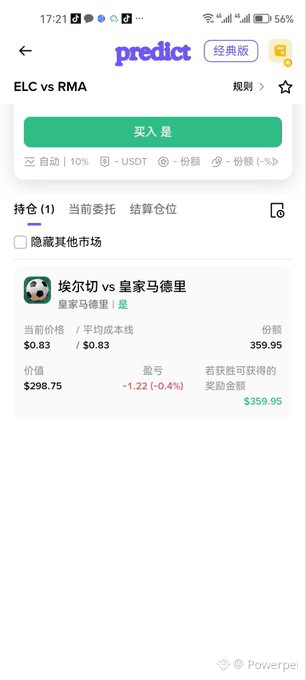
Tonight Elche vs Real Madrid, midweek makeup match
Elche this season has failed to win in five rounds, conceded a bunch of goals, and sits second from the bottom
Real Madrid just beat Inter in the Champions League, and have also been picking up points in the league. Mbappé is in great form
No reason to hesitate—I’m backing Real Madrid to win
The only thing worth considering is how many goals Elche will concede—Elche’s defense has picked up a bit recently. In the last match away from home they managed a draw, so they probably won’t get completely blown open. But Real Madrid’s attacking firepower is there; they should be able to get the ball out and create chances with ease.
I lean toward Real Madrid winning + a big game over 2.5 goals
This week happens to have Champions League, Europa League, AFC Champions League, and the top five European leagues all colliding—so the market should be the hottest stretch of the year. Watching football is great, but it’s better to get in on the action yourself:
The Binance Wallet @BinanceWallet Football PNL Grand Tournament is still ongoing. If your trading points reach over 3.19, you can get on the leaderboard. There’s a prize pool of 100,000 U to split, with a single-person maximum of 10,000 U
Invite friends to go for the leaderboard together—friends automatically get a 5% fee discount! Remember to activate first; after activation you’ll receive a 10% rebate. Rebates are paid out in USDT. You can check it anytime on the invitation page and claim it anytime—it never expires.
📍 Binance Wallet App → Predictfun mini program → Assets → Invite Friends → Activate the Referral Program
Trading tournament registration address
[https://web3.binance.com/zh-CN/activity/predict-tc/single/Soccer-PnL](https://web3.binance.com/zh-CN/activity/predict-tc/single/Soccer-PnL)
My invitation link (deep thanks), get 5% fee refund immediately:
https://web3.binance.com/zh-CN/activity/prediction-referral?ref=GERD9PED
Tonight Elche vs Real Madrid, midweek makeup match
Elche this season has failed to win in five rounds, conceded a bunch of goals, and sits second from the bottom
Real Madrid just beat Inter in the Champions League, and have also been picking up points in the league. Mbappé is in great form
No reason to hesitate—I’m backing Real Madrid to win
The only thing worth considering is how many goals Elche will concede—Elche’s defense has picked up a bit recently. In the last match away from home they managed a draw, so they probably won’t get completely blown open. But Real Madrid’s attacking firepower is there; they should be able to get the ball out and create chances with ease.
I lean toward Real Madrid winning + a big game over 2.5 goals
This week happens to have Champions League, Europa League, AFC Champions League, and the top five European leagues all colliding—so the market should be the hottest stretch of the year. Watching football is great, but it’s better to get in on the action yourself:
The Binance Wallet @Binance Wallet Football PNL Grand Tournament is still ongoing. If your trading points reach over 3.19, you can get on the leaderboard. There’s a prize pool of 100,000 U to split, with a single-person maximum of 10,000 U
Invite friends to go for the leaderboard together—friends automatically get a 5% fee discount! Remember to activate first; after activation you’ll receive a 10% rebate. Rebates are paid out in USDT. You can check it anytime on the invitation page and claim it anytime—it never expires.
📍 Binance Wallet App → Predictfun mini program → Assets → Invite Friends → Activate the Referral Program
Trading tournament registration address
https://web3.binance.com/zh-CN/activity/predict-tc/single/Soccer-PnL
My invitation link (deep thanks), get 5% fee refund immediately:
https://web3.binance.com/zh-CN/activity/prediction-referral?ref=GERD9PED
Elche this season has failed to win in five rounds, conceded a bunch of goals, and sits second from the bottom
Real Madrid just beat Inter in the Champions League, and have also been picking up points in the league. Mbappé is in great form
No reason to hesitate—I’m backing Real Madrid to win
The only thing worth considering is how many goals Elche will concede—Elche’s defense has picked up a bit recently. In the last match away from home they managed a draw, so they probably won’t get completely blown open. But Real Madrid’s attacking firepower is there; they should be able to get the ball out and create chances with ease.
I lean toward Real Madrid winning + a big game over 2.5 goals
This week happens to have Champions League, Europa League, AFC Champions League, and the top five European leagues all colliding—so the market should be the hottest stretch of the year. Watching football is great, but it’s better to get in on the action yourself:
The Binance Wallet @Binance Wallet Football PNL Grand Tournament is still ongoing. If your trading points reach over 3.19, you can get on the leaderboard. There’s a prize pool of 100,000 U to split, with a single-person maximum of 10,000 U
Invite friends to go for the leaderboard together—friends automatically get a 5% fee discount! Remember to activate first; after activation you’ll receive a 10% rebate. Rebates are paid out in USDT. You can check it anytime on the invitation page and claim it anytime—it never expires.
📍 Binance Wallet App → Predictfun mini program → Assets → Invite Friends → Activate the Referral Program
Trading tournament registration address
https://web3.binance.com/zh-CN/activity/predict-tc/single/Soccer-PnL
My invitation link (deep thanks), get 5% fee refund immediately:
https://web3.binance.com/zh-CN/activity/prediction-referral?ref=GERD9PED
1
7
1.4k
·
--
PONS surged to $0.97 at the beginning of September, and now it's back to $0.53. It’s already cut nearly half from the peak.
The volume is still there, but the hype has clearly dropped by a notch.
I think the logic here is very simple.
PONS’ price is propped up by buybacks. The buybacks rely on transaction fees. And the transaction fees come from the hype around issuing and trading tokens on the Robinhood Chain. As long as the hype is there, buybacks are there, and the price has a floor. When the hype fades, no deflation model can save it.
The current issue is:
Robinhood Chain’s 90-day gas fee exemption expires on September 30.
Once free gas stops, the cost of issuing tokens won’t be zero anymore. By then, will the daily token-issuing volume still be able to hold up the current level? I have my doubts.
A 45% pullback is either just a correction or a change of direction—let’s see what happens by the end of the month.
Crypto markets are extremely volatile. The above is my personal observation, not investment advice.
$PONS
PONS surged to $0.97 at the beginning of September, and now it's back to $0.53. It’s already cut nearly half from the peak.
The volume is still there, but the hype has clearly dropped by a notch.
I think the logic here is very simple.
PONS’ price is propped up by buybacks. The buybacks rely on transaction fees. And the transaction fees come from the hype around issuing and trading tokens on the Robinhood Chain. As long as the hype is there, buybacks are there, and the price has a floor. When the hype fades, no deflation model can save it.
The current issue is:
Robinhood Chain’s 90-day gas fee exemption expires on September 30.
Once free gas stops, the cost of issuing tokens won’t be zero anymore. By then, will the daily token-issuing volume still be able to hold up the current level? I have my doubts.
A 45% pullback is either just a correction or a change of direction—let’s see what happens by the end of the month.
Crypto markets are extremely volatile. The above is my personal observation, not investment advice.
$PONS
The volume is still there, but the hype has clearly dropped by a notch.
I think the logic here is very simple.
PONS’ price is propped up by buybacks. The buybacks rely on transaction fees. And the transaction fees come from the hype around issuing and trading tokens on the Robinhood Chain. As long as the hype is there, buybacks are there, and the price has a floor. When the hype fades, no deflation model can save it.
The current issue is:
Robinhood Chain’s 90-day gas fee exemption expires on September 30.
Once free gas stops, the cost of issuing tokens won’t be zero anymore. By then, will the daily token-issuing volume still be able to hold up the current level? I have my doubts.
A 45% pullback is either just a correction or a change of direction—let’s see what happens by the end of the month.
Crypto markets are extremely volatile. The above is my personal observation, not investment advice.
$PONS
2
1
2
7.8k
·
--
Verified
LSK surged to nearly 2 yesterday—then got hammered back down. It’s now fluctuating between 0.5 and 0.8
I looked into what actually happened
Three things hit at the same time
The Lisk main chain was shut down on October 31. It wasn’t an upgrade—it was a shutdown. Any coins on-chain, staked positions, and assets in DeFi will simply be gone if they aren’t withdrawn when they expire
Bridging back to Ethereum takes 7 to 8 days, and staked assets must be unlocked first, then you wait another 3 days. There isn’t much time left for procrastinators.
The DAO approved a burn proposal. 100 million LSK were burned, cutting total supply from 400 million to 300 million—one quarter is gone.
The project itself is pivoting. It’s no longer doing a public chain; instead, it’s shifting to enterprise treasury management—putting fiat and stablecoins under a single backend
LSK becomes a platform loyalty token
Shutdown chain + supply cut + a narrative pivot—three catalysts landing together. With high futures leverage, the shorts were basically squeezed out directly. That spike during the day wasn’t pulled up by retail.
But after hitting 2, the retracement was brutal too. This kind of market move comes fast and leaves fast—it feels more like event pricing than fundamentals playing out.
//
I’m not going to chase this. The event is already out in the open, and the supply contraction is already set. The price that needs to reflect it has probably already done one round. Whether there will be another wave later depends on whether new money comes in to take over the narrative—not on the burn itself.
If you still hold LSK that’s staked on the original chain—no matter what happens with the price, move your coins out first. October 31 is a hard deadline. Unlocking + bridging + buffering means you should leave at least two weeks.
Crypto volatility is extremely high. The above is just my observations of the chart, not investment advice $LSK
LSK surged to nearly 2 yesterday—then got hammered back down. It’s now fluctuating between 0.5 and 0.8
I looked into what actually happened
Three things hit at the same time
The Lisk main chain was shut down on October 31. It wasn’t an upgrade—it was a shutdown. Any coins on-chain, staked positions, and assets in DeFi will simply be gone if they aren’t withdrawn when they expire
Bridging back to Ethereum takes 7 to 8 days, and staked assets must be unlocked first, then you wait another 3 days. There isn’t much time left for procrastinators.
The DAO approved a burn proposal. 100 million LSK were burned, cutting total supply from 400 million to 300 million—one quarter is gone.
The project itself is pivoting. It’s no longer doing a public chain; instead, it’s shifting to enterprise treasury management—putting fiat and stablecoins under a single backend
LSK becomes a platform loyalty token
Shutdown chain + supply cut + a narrative pivot—three catalysts landing together. With high futures leverage, the shorts were basically squeezed out directly. That spike during the day wasn’t pulled up by retail.
But after hitting 2, the retracement was brutal too. This kind of market move comes fast and leaves fast—it feels more like event pricing than fundamentals playing out.
//
I’m not going to chase this. The event is already out in the open, and the supply contraction is already set. The price that needs to reflect it has probably already done one round. Whether there will be another wave later depends on whether new money comes in to take over the narrative—not on the burn itself.
If you still hold LSK that’s staked on the original chain—no matter what happens with the price, move your coins out first. October 31 is a hard deadline. Unlocking + bridging + buffering means you should leave at least two weeks.
Crypto volatility is extremely high. The above is just my observations of the chart, not investment advice $LSK
I looked into what actually happened
Three things hit at the same time
The Lisk main chain was shut down on October 31. It wasn’t an upgrade—it was a shutdown. Any coins on-chain, staked positions, and assets in DeFi will simply be gone if they aren’t withdrawn when they expire
Bridging back to Ethereum takes 7 to 8 days, and staked assets must be unlocked first, then you wait another 3 days. There isn’t much time left for procrastinators.
The DAO approved a burn proposal. 100 million LSK were burned, cutting total supply from 400 million to 300 million—one quarter is gone.
The project itself is pivoting. It’s no longer doing a public chain; instead, it’s shifting to enterprise treasury management—putting fiat and stablecoins under a single backend
LSK becomes a platform loyalty token
Shutdown chain + supply cut + a narrative pivot—three catalysts landing together. With high futures leverage, the shorts were basically squeezed out directly. That spike during the day wasn’t pulled up by retail.
But after hitting 2, the retracement was brutal too. This kind of market move comes fast and leaves fast—it feels more like event pricing than fundamentals playing out.
//
I’m not going to chase this. The event is already out in the open, and the supply contraction is already set. The price that needs to reflect it has probably already done one round. Whether there will be another wave later depends on whether new money comes in to take over the narrative—not on the burn itself.
If you still hold LSK that’s staked on the original chain—no matter what happens with the price, move your coins out first. October 31 is a hard deadline. Unlocking + bridging + buffering means you should leave at least two weeks.
Crypto volatility is extremely high. The above is just my observations of the chart, not investment advice $LSK
2
3
2.7k
·
--
I went through next week’s calendar. It’s fairly flat.
No supergiant earnings reports.
No new catalysts that could move the index.
There’s a Lennar earnings report—an ireal estate company—but not many people are watching.
If you don’t trade real estate, skip it.
The only thing with a real story is a nuclear energy company.
◇
Holtec, ticker code HNUC. Plans to set the price around 9/17, and list on Nasdaq on 9/18.
50M shares, the range is $15–$18, with a midpoint valuation of roughly $10B.
Led by JPM and Goldman.
This isn’t a PPT nuclear-power company.
Founded in 1986. Has supplied equipment to more than 150 reactors worldwide, over 200 patents, and three domestic manufacturing bases.
They’re now pushing small modular reactors (SMRs), and they’re also managing the restart of the Palisades nuclear power plant.
With energy prices high and the grid and compute capacity all fighting for electricity, a nuclear power IPO is a smart timing choice.
But it has almost no impact on the broader market. You can treat it as a theme, not as an event trade.
//
What truly drives the tape is just one thing.
On Wednesday: the FOMC.
They meet 9/15–16, with the decision due at 2:00 PM on the 16th.
This time they’ll include the SEP and the dot plot—so it’s a big meeting.
Current target rate: 3.50%–3.75%.
At the July meeting, the vote was 9:3 in favor of adding more—three people already wanted to hike.
The market is currently pricing a very high probability of a 25bp hike.
The hike is already priced in by about 90%.
The issue isn’t whether they’ll hike.
The issue is what “Washington” (the Fed) says after the hike, how the dot plot gets drawn, and whether the wording changes. Those are what create the volatility.
My view: next week isn’t a theme week. It’s a settlement week.
Get the hike out of the way.
Clear out the options expiration.
Friday is the quarterly options expiration date.
Institutions need to rebalance and hedge—regardless of the fundamentals, the market will have noise.
————
In situations like this, it’s easiest to see cases where price doesn’t match the headlines.
The decision could meet expectations and still drop sharply.
Because it’s “sell the fact.”
Oil might be down only a couple dollars and still jump.
Because short-covering.
Don’t try to use the news to explain every single K-line.
In settlement weeks, the volatility often has nothing to do with the narrative—it’s about positioning.
My own approach: no new positions next week.
Wait for this round of noise to pass.
The better-looking opportunities are likely further out.
Later macro data, the big tech earnings season, or a sudden change in the Middle East.
Those are the real things that can change direction.
Next week is basically just going through the motions.
Don’t let intraday swings shake you.
The above is just my personal perspective and doesn’t constitute investment advice. DYOR #美联储何时降息?
I went through next week’s calendar. It’s fairly flat.
No supergiant earnings reports.
No new catalysts that could move the index.
There’s a Lennar earnings report—an ireal estate company—but not many people are watching.
If you don’t trade real estate, skip it.
The only thing with a real story is a nuclear energy company.
◇
Holtec, ticker code HNUC. Plans to set the price around 9/17, and list on Nasdaq on 9/18.
50M shares, the range is $15–$18, with a midpoint valuation of roughly $10B.
Led by JPM and Goldman.
This isn’t a PPT nuclear-power company.
Founded in 1986. Has supplied equipment to more than 150 reactors worldwide, over 200 patents, and three domestic manufacturing bases.
They’re now pushing small modular reactors (SMRs), and they’re also managing the restart of the Palisades nuclear power plant.
With energy prices high and the grid and compute capacity all fighting for electricity, a nuclear power IPO is a smart timing choice.
But it has almost no impact on the broader market. You can treat it as a theme, not as an event trade.
//
What truly drives the tape is just one thing.
On Wednesday: the FOMC.
They meet 9/15–16, with the decision due at 2:00 PM on the 16th.
This time they’ll include the SEP and the dot plot—so it’s a big meeting.
Current target rate: 3.50%–3.75%.
At the July meeting, the vote was 9:3 in favor of adding more—three people already wanted to hike.
The market is currently pricing a very high probability of a 25bp hike.
The hike is already priced in by about 90%.
The issue isn’t whether they’ll hike.
The issue is what “Washington” (the Fed) says after the hike, how the dot plot gets drawn, and whether the wording changes. Those are what create the volatility.
My view: next week isn’t a theme week. It’s a settlement week.
Get the hike out of the way.
Clear out the options expiration.
Friday is the quarterly options expiration date.
Institutions need to rebalance and hedge—regardless of the fundamentals, the market will have noise.
————
In situations like this, it’s easiest to see cases where price doesn’t match the headlines.
The decision could meet expectations and still drop sharply.
Because it’s “sell the fact.”
Oil might be down only a couple dollars and still jump.
Because short-covering.
Don’t try to use the news to explain every single K-line.
In settlement weeks, the volatility often has nothing to do with the narrative—it’s about positioning.
My own approach: no new positions next week.
Wait for this round of noise to pass.
The better-looking opportunities are likely further out.
Later macro data, the big tech earnings season, or a sudden change in the Middle East.
Those are the real things that can change direction.
Next week is basically just going through the motions.
Don’t let intraday swings shake you.
The above is just my personal perspective and doesn’t constitute investment advice. DYOR #美联储何时降息?
No supergiant earnings reports.
No new catalysts that could move the index.
There’s a Lennar earnings report—an ireal estate company—but not many people are watching.
If you don’t trade real estate, skip it.
The only thing with a real story is a nuclear energy company.
◇
Holtec, ticker code HNUC. Plans to set the price around 9/17, and list on Nasdaq on 9/18.
50M shares, the range is $15–$18, with a midpoint valuation of roughly $10B.
Led by JPM and Goldman.
This isn’t a PPT nuclear-power company.
Founded in 1986. Has supplied equipment to more than 150 reactors worldwide, over 200 patents, and three domestic manufacturing bases.
They’re now pushing small modular reactors (SMRs), and they’re also managing the restart of the Palisades nuclear power plant.
With energy prices high and the grid and compute capacity all fighting for electricity, a nuclear power IPO is a smart timing choice.
But it has almost no impact on the broader market. You can treat it as a theme, not as an event trade.
//
What truly drives the tape is just one thing.
On Wednesday: the FOMC.
They meet 9/15–16, with the decision due at 2:00 PM on the 16th.
This time they’ll include the SEP and the dot plot—so it’s a big meeting.
Current target rate: 3.50%–3.75%.
At the July meeting, the vote was 9:3 in favor of adding more—three people already wanted to hike.
The market is currently pricing a very high probability of a 25bp hike.
The hike is already priced in by about 90%.
The issue isn’t whether they’ll hike.
The issue is what “Washington” (the Fed) says after the hike, how the dot plot gets drawn, and whether the wording changes. Those are what create the volatility.
My view: next week isn’t a theme week. It’s a settlement week.
Get the hike out of the way.
Clear out the options expiration.
Friday is the quarterly options expiration date.
Institutions need to rebalance and hedge—regardless of the fundamentals, the market will have noise.
————
In situations like this, it’s easiest to see cases where price doesn’t match the headlines.
The decision could meet expectations and still drop sharply.
Because it’s “sell the fact.”
Oil might be down only a couple dollars and still jump.
Because short-covering.
Don’t try to use the news to explain every single K-line.
In settlement weeks, the volatility often has nothing to do with the narrative—it’s about positioning.
My own approach: no new positions next week.
Wait for this round of noise to pass.
The better-looking opportunities are likely further out.
Later macro data, the big tech earnings season, or a sudden change in the Middle East.
Those are the real things that can change direction.
Next week is basically just going through the motions.
Don’t let intraday swings shake you.
The above is just my personal perspective and doesn’t constitute investment advice. DYOR #美联储何时降息?
1
4
908
·
--
The AI encryption line has changed
Last year, if your name had “AI,” it went up. This year, the machine needs compute power, needs a network—and it also has to pay for itself.
Trading is still hot. But the number of projects that can reliably get protocol revenue is small enough to count on one hand.
I look at it in three layers.
◇
Shovel layer
DePIN.GPU’s Render, Akash, io.net, Aethir, and the wireless side’s Helium. Compute infrastructure with revenue from enterprise customers is one thing; projects that only rely on mining for emissions are still just concepts.
Smart market layer
Bittensor (TAO). Subnet output provides inference and data. External users pay to use it—not just renting out GPUs. There are very few that can produce quarterly service fees in the tens of millions of dollars.
Agent payment layer
Agents hold wallets to buy APIs and GPUs using stablecoins. What truly runs is the payment track (x402, USDC micro-payments). The number of “transactions” can reach hundreds of millions, but that’s settlement volume—not token profit.
► After going through these three questions, most projects get filtered out: Do the ones paying belong to AI companies, or are insiders just farming incentives? Is the revenue stablecoins or pure point/account-credit loop? As usage increases, will the token be locked and burned, or just treated as a narrative ticket?
◇
In 2026, it’s worth looking at compute networks, wireless networks, the payment rails, and a small number of model markets with external customers. Most AI Agent coin trading is active, but revenue is thin. A sector being hot doesn’t mean every coin is worth this price.
Personal judgment only; not investment advice. Data should be taken from each project’s official sources.
The AI encryption line has changed
Last year, if your name had “AI,” it went up. This year, the machine needs compute power, needs a network—and it also has to pay for itself.
Trading is still hot. But the number of projects that can reliably get protocol revenue is small enough to count on one hand.
I look at it in three layers.
◇
Shovel layer
DePIN.GPU’s Render, Akash, io.net, Aethir, and the wireless side’s Helium. Compute infrastructure with revenue from enterprise customers is one thing; projects that only rely on mining for emissions are still just concepts.
Smart market layer
Bittensor (TAO). Subnet output provides inference and data. External users pay to use it—not just renting out GPUs. There are very few that can produce quarterly service fees in the tens of millions of dollars.
Agent payment layer
Agents hold wallets to buy APIs and GPUs using stablecoins. What truly runs is the payment track (x402, USDC micro-payments). The number of “transactions” can reach hundreds of millions, but that’s settlement volume—not token profit.
► After going through these three questions, most projects get filtered out: Do the ones paying belong to AI companies, or are insiders just farming incentives? Is the revenue stablecoins or pure point/account-credit loop? As usage increases, will the token be locked and burned, or just treated as a narrative ticket?
◇
In 2026, it’s worth looking at compute networks, wireless networks, the payment rails, and a small number of model markets with external customers. Most AI Agent coin trading is active, but revenue is thin. A sector being hot doesn’t mean every coin is worth this price.
Personal judgment only; not investment advice. Data should be taken from each project’s official sources.
Last year, if your name had “AI,” it went up. This year, the machine needs compute power, needs a network—and it also has to pay for itself.
Trading is still hot. But the number of projects that can reliably get protocol revenue is small enough to count on one hand.
I look at it in three layers.
◇
Shovel layer
DePIN.GPU’s Render, Akash, io.net, Aethir, and the wireless side’s Helium. Compute infrastructure with revenue from enterprise customers is one thing; projects that only rely on mining for emissions are still just concepts.
Smart market layer
Bittensor (TAO). Subnet output provides inference and data. External users pay to use it—not just renting out GPUs. There are very few that can produce quarterly service fees in the tens of millions of dollars.
Agent payment layer
Agents hold wallets to buy APIs and GPUs using stablecoins. What truly runs is the payment track (x402, USDC micro-payments). The number of “transactions” can reach hundreds of millions, but that’s settlement volume—not token profit.
► After going through these three questions, most projects get filtered out: Do the ones paying belong to AI companies, or are insiders just farming incentives? Is the revenue stablecoins or pure point/account-credit loop? As usage increases, will the token be locked and burned, or just treated as a narrative ticket?
◇
In 2026, it’s worth looking at compute networks, wireless networks, the payment rails, and a small number of model markets with external customers. Most AI Agent coin trading is active, but revenue is thin. A sector being hot doesn’t mean every coin is worth this price.
Personal judgment only; not investment advice. Data should be taken from each project’s official sources.
1
1.2k
·
--
Over the past 24 hours I’ve been watching the market closely, and the most direct takeaway is one thing: the money isn’t being scattered randomly—it’s being competed for on three chains for the same kind of business.
Use Meme order books to trade US stock sentiment.
On the Robinhood Chain, I’m most convinced about PONS. It’s not just another cat/dog coin—it’s the busiest launchpad token on this new chain.
Trading volume stacks up to nearly $100M, suggesting everyone is buying on the question of whether “token-issuance cash flow” will end up flowing back to the platform token.
There’s controversy over the authenticity of the binding, but my view is: in the short term, hype decides.
On Solana, STONK is a latecomer trying to catch up.
StonkFun can pair with tokenized stocks, and then connect to Raydium—making the story more complete than just launching meme dogs. Its market cap surged by more than a hundred million in a day. It feels more like Solana doesn’t want to let Robinhood own the “meme coin + stock” narrative.
On BNB, the “cow came” coin is the wildest. It uses a movie pun on “the bull market is here” (“牛市来了”). It’s being pushed by both the Chinese spot order book and derivatives contracts—with the thinnest logic, but the harshest order book.
I treat coins like these as a barometer for market temperature, not as long-term holdings. On the same line, CASHCAT is the old leader, while 4Stock / 7Stock are accessories that map US stocks into trading pairs and dividends.
The former already captured the first wave of dividends; the latter is keeping the narrative alive with ongoing support. My view is simple: this isn’t fundamentals-driven rotation—it’s three chains fighting over who can turn the “stocks” topic into a casino.
PONS and STONK add an extra layer of fee logic compared to pure memes, so it’s worth taking a look at the flow. Coins like “cow came” are only suitable for quick in-and-out. Once the launch volume drops, this wave will fade. $PONS
Over the past 24 hours I’ve been watching the market closely, and the most direct takeaway is one thing: the money isn’t being scattered randomly—it’s being competed for on three chains for the same kind of business.
Use Meme order books to trade US stock sentiment.
On the Robinhood Chain, I’m most convinced about PONS. It’s not just another cat/dog coin—it’s the busiest launchpad token on this new chain.
Trading volume stacks up to nearly $100M, suggesting everyone is buying on the question of whether “token-issuance cash flow” will end up flowing back to the platform token.
There’s controversy over the authenticity of the binding, but my view is: in the short term, hype decides.
On Solana, STONK is a latecomer trying to catch up.
StonkFun can pair with tokenized stocks, and then connect to Raydium—making the story more complete than just launching meme dogs. Its market cap surged by more than a hundred million in a day. It feels more like Solana doesn’t want to let Robinhood own the “meme coin + stock” narrative.
On BNB, the “cow came” coin is the wildest. It uses a movie pun on “the bull market is here” (“牛市来了”). It’s being pushed by both the Chinese spot order book and derivatives contracts—with the thinnest logic, but the harshest order book.
I treat coins like these as a barometer for market temperature, not as long-term holdings. On the same line, CASHCAT is the old leader, while 4Stock / 7Stock are accessories that map US stocks into trading pairs and dividends.
The former already captured the first wave of dividends; the latter is keeping the narrative alive with ongoing support. My view is simple: this isn’t fundamentals-driven rotation—it’s three chains fighting over who can turn the “stocks” topic into a casino.
PONS and STONK add an extra layer of fee logic compared to pure memes, so it’s worth taking a look at the flow. Coins like “cow came” are only suitable for quick in-and-out. Once the launch volume drops, this wave will fade. $PONS
Use Meme order books to trade US stock sentiment.
On the Robinhood Chain, I’m most convinced about PONS. It’s not just another cat/dog coin—it’s the busiest launchpad token on this new chain.
Trading volume stacks up to nearly $100M, suggesting everyone is buying on the question of whether “token-issuance cash flow” will end up flowing back to the platform token.
There’s controversy over the authenticity of the binding, but my view is: in the short term, hype decides.
On Solana, STONK is a latecomer trying to catch up.
StonkFun can pair with tokenized stocks, and then connect to Raydium—making the story more complete than just launching meme dogs. Its market cap surged by more than a hundred million in a day. It feels more like Solana doesn’t want to let Robinhood own the “meme coin + stock” narrative.
On BNB, the “cow came” coin is the wildest. It uses a movie pun on “the bull market is here” (“牛市来了”). It’s being pushed by both the Chinese spot order book and derivatives contracts—with the thinnest logic, but the harshest order book.
I treat coins like these as a barometer for market temperature, not as long-term holdings. On the same line, CASHCAT is the old leader, while 4Stock / 7Stock are accessories that map US stocks into trading pairs and dividends.
The former already captured the first wave of dividends; the latter is keeping the narrative alive with ongoing support. My view is simple: this isn’t fundamentals-driven rotation—it’s three chains fighting over who can turn the “stocks” topic into a casino.
PONS and STONK add an extra layer of fee logic compared to pure memes, so it’s worth taking a look at the flow. Coins like “cow came” are only suitable for quick in-and-out. Once the launch volume drops, this wave will fade. $PONS
1
2.1k
·
--
Verified
Not watching individual stocks this week
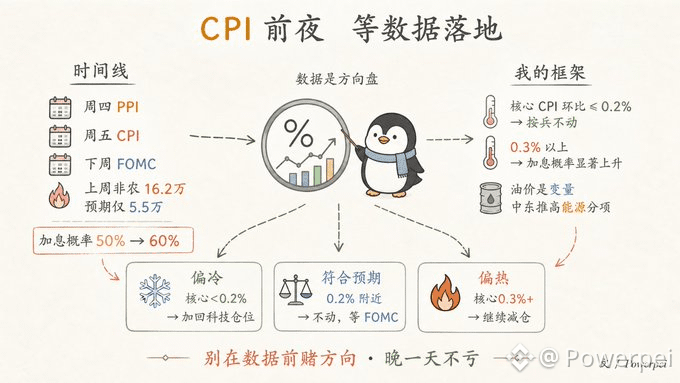
Thursday PPI, Friday CPI, and next Wednesday/Thursday FOMC
The final set of inflation readings before the September rate decision—every position decision has to get around it.
Last week’s Non-Farm Payrolls: 162k, vs. expectations of only 55k—pushed the probability of a September hike from 50% to 60% directly.
Employment has already lit the fuse. Next we just look to see which way CPI pushes.
//
The framework I use is simple
Core CPI month-on-month stays below 0.2%, and I mostly remain on standby.
At 0.3% or higher, the probability of a rate hike rises significantly.
This threshold isn’t a Fed quote, but it matches the direction of Waller’s remarks on September 3rd, and traders are broadly using it.
There’s also one variable: oil prices.
The situation in the Middle East has lifted the energy component. Even if core is mild, overall CPI could still be pushed up another layer.
——
In terms of execution, I’ve already thought through three scenarios
Somewhat cool: core below 0.2%. I’ll consider adding back the tech positions I previously reduced.
In line with expectations: core around 0.2%. I won’t move—wait until the FOMC comes out.
Somewhat hot: core at 0.3% or above. Continue trimming positions—at minimum, don’t add.
My current stance is defensive.
The probability of a rate hike is already 60%. I don’t want to bet on the direction before CPI comes out. I’ll wait for the data to land—being a day late isn’t a loss.
Data and expectations should be judged by the actual figures announced. The above is for personal analysis only and does not constitute any investment advice #美联储何时降息?
Not watching individual stocks this week
Thursday PPI, Friday CPI, and next Wednesday/Thursday FOMC
The final set of inflation readings before the September rate decision—every position decision has to get around it.
Last week’s Non-Farm Payrolls: 162k, vs. expectations of only 55k—pushed the probability of a September hike from 50% to 60% directly.
Employment has already lit the fuse. Next we just look to see which way CPI pushes.
//
The framework I use is simple
Core CPI month-on-month stays below 0.2%, and I mostly remain on standby.
At 0.3% or higher, the probability of a rate hike rises significantly.
This threshold isn’t a Fed quote, but it matches the direction of Waller’s remarks on September 3rd, and traders are broadly using it.
There’s also one variable: oil prices.
The situation in the Middle East has lifted the energy component. Even if core is mild, overall CPI could still be pushed up another layer.
——
In terms of execution, I’ve already thought through three scenarios
Somewhat cool: core below 0.2%. I’ll consider adding back the tech positions I previously reduced.
In line with expectations: core around 0.2%. I won’t move—wait until the FOMC comes out.
Somewhat hot: core at 0.3% or above. Continue trimming positions—at minimum, don’t add.
My current stance is defensive.
The probability of a rate hike is already 60%. I don’t want to bet on the direction before CPI comes out. I’ll wait for the data to land—being a day late isn’t a loss.
Data and expectations should be judged by the actual figures announced. The above is for personal analysis only and does not constitute any investment advice #美联储何时降息?
Thursday PPI, Friday CPI, and next Wednesday/Thursday FOMC
The final set of inflation readings before the September rate decision—every position decision has to get around it.
Last week’s Non-Farm Payrolls: 162k, vs. expectations of only 55k—pushed the probability of a September hike from 50% to 60% directly.
Employment has already lit the fuse. Next we just look to see which way CPI pushes.
//
The framework I use is simple
Core CPI month-on-month stays below 0.2%, and I mostly remain on standby.
At 0.3% or higher, the probability of a rate hike rises significantly.
This threshold isn’t a Fed quote, but it matches the direction of Waller’s remarks on September 3rd, and traders are broadly using it.
There’s also one variable: oil prices.
The situation in the Middle East has lifted the energy component. Even if core is mild, overall CPI could still be pushed up another layer.
——
In terms of execution, I’ve already thought through three scenarios
Somewhat cool: core below 0.2%. I’ll consider adding back the tech positions I previously reduced.
In line with expectations: core around 0.2%. I won’t move—wait until the FOMC comes out.
Somewhat hot: core at 0.3% or above. Continue trimming positions—at minimum, don’t add.
My current stance is defensive.
The probability of a rate hike is already 60%. I don’t want to bet on the direction before CPI comes out. I’ll wait for the data to land—being a day late isn’t a loss.
Data and expectations should be judged by the actual figures announced. The above is for personal analysis only and does not constitute any investment advice #美联储何时降息?
2
3.3k
·
--
Verified
ZEC is rising again today. The price is around 1160 to 1185, up more than 15% over the past 24 hours, and it briefly touched 1200 intraday.
Its market cap is nearing $19 billion, ranking it in the top ten. It is now the largest privacy coin by market cap.
Several factors are driving this move.
The most direct one is the ETF. Grayscale’s spot Zcash ETF was listed on the U.S. stock market on August 25, and its size has already reached hundreds of millions of dollars.
Institutions can buy ZEC through compliant products, and funds have been flowing in steadily. This is the strongest catalyst for this rally.
Then the privacy narrative returned.
As AI surveillance gets stronger and tax compliance pressure keeps rising, the market has started to reprice “selective privacy.” The share of ZEC’s shielded pool has already risen to around 30%.
Unlike Monero, ZEC is optional—ordinary transactions are transparent, and you enter the shielded pool when privacy is needed. In a compliance-heavy environment, this flexibility has instead become a selling point.
There is also a restoration of confidence.
In mid-year, the Orchard pool raised serious concerns about a vulnerability, and the price dropped. Later, the team urgently fixed it and rolled out the Ironwood upgrade, moving funds to a new shielded pool. The market interpreted this crisis response as “able to survive and still upgrade.”
There is also a short squeeze in the near term. The price rose too quickly, and shorts in the futures market were liquidated, further amplifying volatility. Trading volume looks especially large, and that is part of the reason.
Volatility is very high, so don’t chase the price. The above is market commentary, not investment advice. $ZEC
{spot}(ZECUSDT)
ZEC is rising again today. The price is around 1160 to 1185, up more than 15% over the past 24 hours, and it briefly touched 1200 intraday.
Its market cap is nearing $19 billion, ranking it in the top ten. It is now the largest privacy coin by market cap.
Several factors are driving this move.
The most direct one is the ETF. Grayscale’s spot Zcash ETF was listed on the U.S. stock market on August 25, and its size has already reached hundreds of millions of dollars.
Institutions can buy ZEC through compliant products, and funds have been flowing in steadily. This is the strongest catalyst for this rally.
Then the privacy narrative returned.
As AI surveillance gets stronger and tax compliance pressure keeps rising, the market has started to reprice “selective privacy.” The share of ZEC’s shielded pool has already risen to around 30%.
Unlike Monero, ZEC is optional—ordinary transactions are transparent, and you enter the shielded pool when privacy is needed. In a compliance-heavy environment, this flexibility has instead become a selling point.
There is also a restoration of confidence.
In mid-year, the Orchard pool raised serious concerns about a vulnerability, and the price dropped. Later, the team urgently fixed it and rolled out the Ironwood upgrade, moving funds to a new shielded pool. The market interpreted this crisis response as “able to survive and still upgrade.”
There is also a short squeeze in the near term. The price rose too quickly, and shorts in the futures market were liquidated, further amplifying volatility. Trading volume looks especially large, and that is part of the reason.
Volatility is very high, so don’t chase the price. The above is market commentary, not investment advice. $ZEC
Its market cap is nearing $19 billion, ranking it in the top ten. It is now the largest privacy coin by market cap.
Several factors are driving this move.
The most direct one is the ETF. Grayscale’s spot Zcash ETF was listed on the U.S. stock market on August 25, and its size has already reached hundreds of millions of dollars.
Institutions can buy ZEC through compliant products, and funds have been flowing in steadily. This is the strongest catalyst for this rally.
Then the privacy narrative returned.
As AI surveillance gets stronger and tax compliance pressure keeps rising, the market has started to reprice “selective privacy.” The share of ZEC’s shielded pool has already risen to around 30%.
Unlike Monero, ZEC is optional—ordinary transactions are transparent, and you enter the shielded pool when privacy is needed. In a compliance-heavy environment, this flexibility has instead become a selling point.
There is also a restoration of confidence.
In mid-year, the Orchard pool raised serious concerns about a vulnerability, and the price dropped. Later, the team urgently fixed it and rolled out the Ironwood upgrade, moving funds to a new shielded pool. The market interpreted this crisis response as “able to survive and still upgrade.”
There is also a short squeeze in the near term. The price rose too quickly, and shorts in the futures market were liquidated, further amplifying volatility. Trading volume looks especially large, and that is part of the reason.
Volatility is very high, so don’t chase the price. The above is market commentary, not investment advice. $ZEC
8
3.1k
·
--
U.S. stocks will be closed on Monday for Labor Day.
That mood from Friday’s close needs to cool off for three days.
When I was watching the tape on Friday, I already felt something was off.
The broad market was falling, but storage and optical communications were surging.
SanDisk, Micron, SK Hynix, Marvell, Coherent—this whole lineup was being aggressively bid.
The AI hardware theme still hasn’t finished running; the signal is loud enough.
But think about it: the broad market is down while the sector is up. That means the market is making two completely opposite trades on the same day.
Are you really going to carry that kind of split through a three-day holiday unchanged? I don’t really buy it.
//
On Monday, A-shares open first, while U.S. stocks stay closed.
I think domestic storage, optical modules, and semiconductor equipment will most likely gap up, and they might even run for a bit—but I won’t chase.
The reason is simple: what A-shares are trading on Monday is the U.S. market that has already played out, not the U.S. market that is about to open.
The mapped-over trade pops first, but the U.S. market hasn’t given its answer yet.
That middle stretch is the easiest place to get hit.
I’ve taken that loss before.
Before a holiday, a sector rallied in U.S. stocks. On Monday, A-shares mapped it with a gap up, and I chased in. Then on Tuesday, when U.S. stocks opened, the move was immediately sold into, and A-shares followed lower.
A one-day shift in rhythm turns profit into cost.
——
The real test comes when U.S. stocks open on Tuesday.
There have been three days without continuous quotes—only news and imagination building on top of each other.
Once New York opens, the market has to digest three things in a very short time:
► Friday’s nonfarm payrolls—employment was too strong, rate-hike odds are rising, and that still hasn’t been fully priced in
► The geopolitical and oil-price developments that intensified over the weekend
► Expectations for next week’s CPI and what may differ from them
What I’m most worried about is the first one.
The nonfarm data is right there, but the market chose to selectively ignore it Friday afternoon and chase storage and optical communications instead.
A three-day holiday is enough for the market to think this through.
If rate expectations get revised higher on Tuesday’s open, then the names that rose the most on Friday are the ones most likely to be sold first. I’ve seen this pattern more than once: the more extreme the divergence before the holiday, the harsher the reversal after it.
//
So I’m staying put this weekend.
On Monday, I’ll see how A-shares price the mood, but I won’t chase the mapped trade.
On Tuesday, I’ll see how U.S. stocks reprice rates and inflation—that’s the real direction.
These three days in between are not a vacuum; they’re deferred risk. The money that rushes to take a stance is often the first money to get harvested.
#美股
U.S. stocks will be closed on Monday for Labor Day.
That mood from Friday’s close needs to cool off for three days.
When I was watching the tape on Friday, I already felt something was off.
The broad market was falling, but storage and optical communications were surging.
SanDisk, Micron, SK Hynix, Marvell, Coherent—this whole lineup was being aggressively bid.
The AI hardware theme still hasn’t finished running; the signal is loud enough.
But think about it: the broad market is down while the sector is up. That means the market is making two completely opposite trades on the same day.
Are you really going to carry that kind of split through a three-day holiday unchanged? I don’t really buy it.
//
On Monday, A-shares open first, while U.S. stocks stay closed.
I think domestic storage, optical modules, and semiconductor equipment will most likely gap up, and they might even run for a bit—but I won’t chase.
The reason is simple: what A-shares are trading on Monday is the U.S. market that has already played out, not the U.S. market that is about to open.
The mapped-over trade pops first, but the U.S. market hasn’t given its answer yet.
That middle stretch is the easiest place to get hit.
I’ve taken that loss before.
Before a holiday, a sector rallied in U.S. stocks. On Monday, A-shares mapped it with a gap up, and I chased in. Then on Tuesday, when U.S. stocks opened, the move was immediately sold into, and A-shares followed lower.
A one-day shift in rhythm turns profit into cost.
——
The real test comes when U.S. stocks open on Tuesday.
There have been three days without continuous quotes—only news and imagination building on top of each other.
Once New York opens, the market has to digest three things in a very short time:
► Friday’s nonfarm payrolls—employment was too strong, rate-hike odds are rising, and that still hasn’t been fully priced in
► The geopolitical and oil-price developments that intensified over the weekend
► Expectations for next week’s CPI and what may differ from them
What I’m most worried about is the first one.
The nonfarm data is right there, but the market chose to selectively ignore it Friday afternoon and chase storage and optical communications instead.
A three-day holiday is enough for the market to think this through.
If rate expectations get revised higher on Tuesday’s open, then the names that rose the most on Friday are the ones most likely to be sold first. I’ve seen this pattern more than once: the more extreme the divergence before the holiday, the harsher the reversal after it.
//
So I’m staying put this weekend.
On Monday, I’ll see how A-shares price the mood, but I won’t chase the mapped trade.
On Tuesday, I’ll see how U.S. stocks reprice rates and inflation—that’s the real direction.
These three days in between are not a vacuum; they’re deferred risk. The money that rushes to take a stance is often the first money to get harvested.
#美股
That mood from Friday’s close needs to cool off for three days.
When I was watching the tape on Friday, I already felt something was off.
The broad market was falling, but storage and optical communications were surging.
SanDisk, Micron, SK Hynix, Marvell, Coherent—this whole lineup was being aggressively bid.
The AI hardware theme still hasn’t finished running; the signal is loud enough.
But think about it: the broad market is down while the sector is up. That means the market is making two completely opposite trades on the same day.
Are you really going to carry that kind of split through a three-day holiday unchanged? I don’t really buy it.
//
On Monday, A-shares open first, while U.S. stocks stay closed.
I think domestic storage, optical modules, and semiconductor equipment will most likely gap up, and they might even run for a bit—but I won’t chase.
The reason is simple: what A-shares are trading on Monday is the U.S. market that has already played out, not the U.S. market that is about to open.
The mapped-over trade pops first, but the U.S. market hasn’t given its answer yet.
That middle stretch is the easiest place to get hit.
I’ve taken that loss before.
Before a holiday, a sector rallied in U.S. stocks. On Monday, A-shares mapped it with a gap up, and I chased in. Then on Tuesday, when U.S. stocks opened, the move was immediately sold into, and A-shares followed lower.
A one-day shift in rhythm turns profit into cost.
——
The real test comes when U.S. stocks open on Tuesday.
There have been three days without continuous quotes—only news and imagination building on top of each other.
Once New York opens, the market has to digest three things in a very short time:
► Friday’s nonfarm payrolls—employment was too strong, rate-hike odds are rising, and that still hasn’t been fully priced in
► The geopolitical and oil-price developments that intensified over the weekend
► Expectations for next week’s CPI and what may differ from them
What I’m most worried about is the first one.
The nonfarm data is right there, but the market chose to selectively ignore it Friday afternoon and chase storage and optical communications instead.
A three-day holiday is enough for the market to think this through.
If rate expectations get revised higher on Tuesday’s open, then the names that rose the most on Friday are the ones most likely to be sold first. I’ve seen this pattern more than once: the more extreme the divergence before the holiday, the harsher the reversal after it.
//
So I’m staying put this weekend.
On Monday, I’ll see how A-shares price the mood, but I won’t chase the mapped trade.
On Tuesday, I’ll see how U.S. stocks reprice rates and inflation—that’s the real direction.
These three days in between are not a vacuum; they’re deferred risk. The money that rushes to take a stance is often the first money to get harvested.
#美股
1
2
1.5k
·
--
Verified
MARSCOIN is now listed on Binance spot
Trading starts at 9:00 PM tonight for three pairs: USDT, USDC, and TRY. Deposits open one hour earlier, and withdrawals only open at 9:00 PM tomorrow
I clicked the Seed tag
Binance itself marked it as high risk, and its volatility is higher than that of ordinary listings
After the news came out, the price surged directly by 50% to 80%, and the market cap briefly reached between 170 and 190 million. Now the price is bouncing between 0.13 and 0.18, and the differences are pretty large across data sources
There’s already activity on-chain
An early address has a cost basis of about 0.00133, with unrealized profit exceeding $2 million. After the announcement, it started selling in small amounts, and there are still about 10.44 million coins left
It’s a classic play: Binance lures up the price and early holders unload their chips. This script is way too common
Withdrawals only open tomorrow night, meaning the coins on-chain tonight can’t be sold on Binance. But the sell pressure inside Binance mainly depends on the amount that was deposited earlier and the hedging on the derivatives side
The Seed tag isn’t free
High volatility—don’t chase, and don’t go heavy. $MarsCoin
MARSCOIN is now listed on Binance spot
Trading starts at 9:00 PM tonight for three pairs: USDT, USDC, and TRY. Deposits open one hour earlier, and withdrawals only open at 9:00 PM tomorrow
I clicked the Seed tag
Binance itself marked it as high risk, and its volatility is higher than that of ordinary listings
After the news came out, the price surged directly by 50% to 80%, and the market cap briefly reached between 170 and 190 million. Now the price is bouncing between 0.13 and 0.18, and the differences are pretty large across data sources
There’s already activity on-chain
An early address has a cost basis of about 0.00133, with unrealized profit exceeding $2 million. After the announcement, it started selling in small amounts, and there are still about 10.44 million coins left
It’s a classic play: Binance lures up the price and early holders unload their chips. This script is way too common
Withdrawals only open tomorrow night, meaning the coins on-chain tonight can’t be sold on Binance. But the sell pressure inside Binance mainly depends on the amount that was deposited earlier and the hedging on the derivatives side
The Seed tag isn’t free
High volatility—don’t chase, and don’t go heavy. $MarsCoin
Trading starts at 9:00 PM tonight for three pairs: USDT, USDC, and TRY. Deposits open one hour earlier, and withdrawals only open at 9:00 PM tomorrow
I clicked the Seed tag
Binance itself marked it as high risk, and its volatility is higher than that of ordinary listings
After the news came out, the price surged directly by 50% to 80%, and the market cap briefly reached between 170 and 190 million. Now the price is bouncing between 0.13 and 0.18, and the differences are pretty large across data sources
There’s already activity on-chain
An early address has a cost basis of about 0.00133, with unrealized profit exceeding $2 million. After the announcement, it started selling in small amounts, and there are still about 10.44 million coins left
It’s a classic play: Binance lures up the price and early holders unload their chips. This script is way too common
Withdrawals only open tomorrow night, meaning the coins on-chain tonight can’t be sold on Binance. But the sell pressure inside Binance mainly depends on the amount that was deposited earlier and the hedging on the derivatives side
The Seed tag isn’t free
High volatility—don’t chase, and don’t go heavy. $MarsCoin
2
2.4k
·
--
EGLD directly surged nearly 30% yesterday.
Before that, it had been churning in the 3.4 to 3.9 range for several days with not much movement.
Then on September 2nd, it suddenly saw a big volume spike—jumping in one move from around 4 to 5.2 and 5.3. Today it even briefly touched as high as 5.5.
Over the past two days, it’s been more active on the gainers list than SUI.
Now the price is fluctuating around 5.2. Looking downward, 4.8 to 5.0 is the first support. Below that, the next levels are 4.5 and 4.0. If it can break above 5.5, the next target is likely around 5.8 to 6.0.
In the short term, it has reclaimed several moving averages, and momentum looks relatively strong.
But with a move this big in a single day, the probability of a pullback isn’t small either. Chasing in like this could easily mean getting caught in the retracement. If you wait, you might also worry it will keep running.
My habit is: I don’t chase these sharply-rising ones. I wait for a pullback, then check for confirmation of support. If 4.8 to 5.0 can hold, it means the buying is real. If it can’t hold, then I keep waiting.
Volatility is high—don’t over-allocate, and don’t let emotions drive you.
EGLD directly surged nearly 30% yesterday.
Before that, it had been churning in the 3.4 to 3.9 range for several days with not much movement.
Then on September 2nd, it suddenly saw a big volume spike—jumping in one move from around 4 to 5.2 and 5.3. Today it even briefly touched as high as 5.5.
Over the past two days, it’s been more active on the gainers list than SUI.
Now the price is fluctuating around 5.2. Looking downward, 4.8 to 5.0 is the first support. Below that, the next levels are 4.5 and 4.0. If it can break above 5.5, the next target is likely around 5.8 to 6.0.
In the short term, it has reclaimed several moving averages, and momentum looks relatively strong.
But with a move this big in a single day, the probability of a pullback isn’t small either. Chasing in like this could easily mean getting caught in the retracement. If you wait, you might also worry it will keep running.
My habit is: I don’t chase these sharply-rising ones. I wait for a pullback, then check for confirmation of support. If 4.8 to 5.0 can hold, it means the buying is real. If it can’t hold, then I keep waiting.
Volatility is high—don’t over-allocate, and don’t let emotions drive you.
Before that, it had been churning in the 3.4 to 3.9 range for several days with not much movement.
Then on September 2nd, it suddenly saw a big volume spike—jumping in one move from around 4 to 5.2 and 5.3. Today it even briefly touched as high as 5.5.
Over the past two days, it’s been more active on the gainers list than SUI.
Now the price is fluctuating around 5.2. Looking downward, 4.8 to 5.0 is the first support. Below that, the next levels are 4.5 and 4.0. If it can break above 5.5, the next target is likely around 5.8 to 6.0.
In the short term, it has reclaimed several moving averages, and momentum looks relatively strong.
But with a move this big in a single day, the probability of a pullback isn’t small either. Chasing in like this could easily mean getting caught in the retracement. If you wait, you might also worry it will keep running.
My habit is: I don’t chase these sharply-rising ones. I wait for a pullback, then check for confirmation of support. If 4.8 to 5.0 can hold, it means the buying is real. If it can’t hold, then I keep waiting.
Volatility is high—don’t over-allocate, and don’t let emotions drive you.
3
1.8k
·
--
Partly True
The moment the CPI was released yesterday, QQQ took a direct dive of nearly 1% within 15 minutes.
For me, this kind of data-driven short-term fluctuation has always been the most uncomfortable.
You get the direction right, but you didn’t manage to place a trade in time—either because you missed the entry, or your position was too small—so you just watched the price move past.
On Binance Wallet, the prediction market offers a game that fits this scenario pretty well: 15-minute Up & Down trading for SPY and QQQ.
The logic is simple:
You decide whether SPY or QQQ will rise or fall over the next 15 minutes—choose Up or Down. You don’t need to analyze individual stocks; you just make a call based on the short-term direction of the market index.
CPI data, Non-Farm Payrolls, FOMC statements
Whenever major data comes out, the market’s short-term reaction is often easier to predict than its long-term impact.
When the macro direction is clear, this kind of tool is actually much less stressful than perpetual futures.
👉 Binance Wallet → Up & Down → SPY / QQQ
For reference only, not investment advice. DYOR $QQQ @BinanceWallet
{future}(QQQUSDT)
The moment the CPI was released yesterday, QQQ took a direct dive of nearly 1% within 15 minutes.
For me, this kind of data-driven short-term fluctuation has always been the most uncomfortable.
You get the direction right, but you didn’t manage to place a trade in time—either because you missed the entry, or your position was too small—so you just watched the price move past.
On Binance Wallet, the prediction market offers a game that fits this scenario pretty well: 15-minute Up & Down trading for SPY and QQQ.
The logic is simple:
You decide whether SPY or QQQ will rise or fall over the next 15 minutes—choose Up or Down. You don’t need to analyze individual stocks; you just make a call based on the short-term direction of the market index.
CPI data, Non-Farm Payrolls, FOMC statements
Whenever major data comes out, the market’s short-term reaction is often easier to predict than its long-term impact.
When the macro direction is clear, this kind of tool is actually much less stressful than perpetual futures.
👉 Binance Wallet → Up & Down → SPY / QQQ
For reference only, not investment advice. DYOR $QQQ @Binance Wallet
For me, this kind of data-driven short-term fluctuation has always been the most uncomfortable.
You get the direction right, but you didn’t manage to place a trade in time—either because you missed the entry, or your position was too small—so you just watched the price move past.
On Binance Wallet, the prediction market offers a game that fits this scenario pretty well: 15-minute Up & Down trading for SPY and QQQ.
The logic is simple:
You decide whether SPY or QQQ will rise or fall over the next 15 minutes—choose Up or Down. You don’t need to analyze individual stocks; you just make a call based on the short-term direction of the market index.
CPI data, Non-Farm Payrolls, FOMC statements
Whenever major data comes out, the market’s short-term reaction is often easier to predict than its long-term impact.
When the macro direction is clear, this kind of tool is actually much less stressful than perpetual futures.
👉 Binance Wallet → Up & Down → SPY / QQQ
For reference only, not investment advice. DYOR $QQQ @Binance Wallet
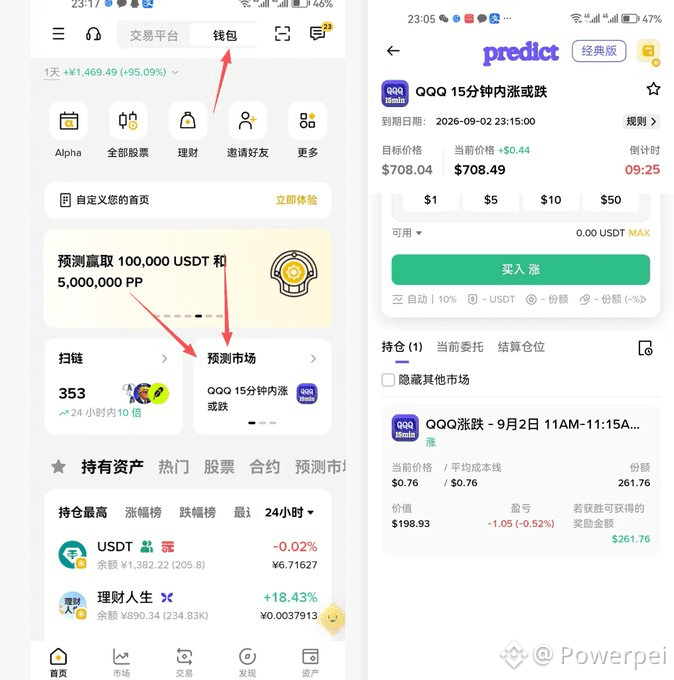
2
2.1k
·
--
UNI has been pretty strong these past couple of days.
The price moved from a little over 5 to around 6.
In 24 hours it’s up roughly 10%, and over the week it’s up more than 30%. You can see it on both Binance and OKX’s trending search lists.
The catalysts aren’t complicated either.
On Robinhood Chain, trading volume has surged—daily DEX volume has pushed past $1 billion. Uniswap is the biggest DEX there, and its fees have also risen along with it.
Then there’s the UNIfication mechanism, which takes protocol revenue to buy back and burn UNI. The higher the trading volume, the more gets burned, meaning less supply. The logic is pretty straightforward.
On top of that, with RWA, tokenized assets’ trading volume is also growing, and Uniswap has a solid share in this segment.
With several lines of momentum pushing at the same time, it’s been moving fairly strongly.
//
FIL is moving too.
It jumped from around 0.77 to above 0.80. Over the past 24 hours it’s up about 10% to 16%. Trading volume has clearly expanded, and open interest on the derivatives side is also rising.
But this FIL move doesn’t have any particularly explosive headline news. It feels more like when the broader market is weak, capital is rotating to find places to move—FIL just happened to break through a resistance zone it had been stuck at for a while. Technical rebound plus incoming funds is what lifted it.
The Filecoin Onchain Cloud narrative is still there, but it isn’t the direct reason for this pump.
Looking at the two together, both are doing relatively well in this round of DeFi plus infrastructure.
Volatility is pretty high for both—don’t chase. Manage take-profit and stop-loss.
$UNI $FIL
{spot}(FILUSDT)
UNI has been pretty strong these past couple of days.
The price moved from a little over 5 to around 6.
In 24 hours it’s up roughly 10%, and over the week it’s up more than 30%. You can see it on both Binance and OKX’s trending search lists.
The catalysts aren’t complicated either.
On Robinhood Chain, trading volume has surged—daily DEX volume has pushed past $1 billion. Uniswap is the biggest DEX there, and its fees have also risen along with it.
Then there’s the UNIfication mechanism, which takes protocol revenue to buy back and burn UNI. The higher the trading volume, the more gets burned, meaning less supply. The logic is pretty straightforward.
On top of that, with RWA, tokenized assets’ trading volume is also growing, and Uniswap has a solid share in this segment.
With several lines of momentum pushing at the same time, it’s been moving fairly strongly.
//
FIL is moving too.
It jumped from around 0.77 to above 0.80. Over the past 24 hours it’s up about 10% to 16%. Trading volume has clearly expanded, and open interest on the derivatives side is also rising.
But this FIL move doesn’t have any particularly explosive headline news. It feels more like when the broader market is weak, capital is rotating to find places to move—FIL just happened to break through a resistance zone it had been stuck at for a while. Technical rebound plus incoming funds is what lifted it.
The Filecoin Onchain Cloud narrative is still there, but it isn’t the direct reason for this pump.
Looking at the two together, both are doing relatively well in this round of DeFi plus infrastructure.
Volatility is pretty high for both—don’t chase. Manage take-profit and stop-loss.
$UNI $FIL
The price moved from a little over 5 to around 6.
In 24 hours it’s up roughly 10%, and over the week it’s up more than 30%. You can see it on both Binance and OKX’s trending search lists.
The catalysts aren’t complicated either.
On Robinhood Chain, trading volume has surged—daily DEX volume has pushed past $1 billion. Uniswap is the biggest DEX there, and its fees have also risen along with it.
Then there’s the UNIfication mechanism, which takes protocol revenue to buy back and burn UNI. The higher the trading volume, the more gets burned, meaning less supply. The logic is pretty straightforward.
On top of that, with RWA, tokenized assets’ trading volume is also growing, and Uniswap has a solid share in this segment.
With several lines of momentum pushing at the same time, it’s been moving fairly strongly.
//
FIL is moving too.
It jumped from around 0.77 to above 0.80. Over the past 24 hours it’s up about 10% to 16%. Trading volume has clearly expanded, and open interest on the derivatives side is also rising.
But this FIL move doesn’t have any particularly explosive headline news. It feels more like when the broader market is weak, capital is rotating to find places to move—FIL just happened to break through a resistance zone it had been stuck at for a while. Technical rebound plus incoming funds is what lifted it.
The Filecoin Onchain Cloud narrative is still there, but it isn’t the direct reason for this pump.
Looking at the two together, both are doing relatively well in this round of DeFi plus infrastructure.
Volatility is pretty high for both—don’t chase. Manage take-profit and stop-loss.
$UNI $FIL
3
7
8.4k
·
--
Verified
Cut rates? Nobody’s buying
The market is now talking about whether to add 25 basis points on September 16th
Current rate: 3.50%–3.75%
According to the latest CME FedWatch data, the probability of a rate hike is about 67%
Not changing it is about 33%
A rate cut is close to zero
//
Kalshi and Polymarket are slightly lower: the probability of a hike is just over 50%, and holding steady is about 40%
First, let’s make one thing clear
67% is not the Fed’s decision
It’s the market placing a bet
A week ago, this figure was only 35%
After the Jackson Hole speech, it jumped to 57% in one day
Then oil prices rose, short-term bond yields also went up, and the figure was pushed to above 60%
In a month, it swung by 20 percentage points
Even the market itself hasn’t figured it out
——
My own view is that they will hike
The reason is simple
This round of higher oil prices wasn’t pulled up by demand—it was driven by geopolitical risk
What does the Fed fear most? Inflation expectations running away
As long as oil prices don’t come back down, Powell in September will find it very hard to choose to hold steady
Because holding steady would be telling the market: we can accept energy-driven inflation
He can’t say that
But if the August nonfarm payrolls suddenly collapses, that’s a different story
Hikes colliding with a recession would make the market look far worse than it does now
Next, watch three things: nonfarm payrolls, inflation data, and oil prices
If employment cools, the probability of a hike will fall back
If oil keeps rising, this number will go even higher
Don’t pick sides too early
Follow the data.
#美联储何时降息?
Cut rates? Nobody’s buying
The market is now talking about whether to add 25 basis points on September 16th
Current rate: 3.50%–3.75%
According to the latest CME FedWatch data, the probability of a rate hike is about 67%
Not changing it is about 33%
A rate cut is close to zero
//
Kalshi and Polymarket are slightly lower: the probability of a hike is just over 50%, and holding steady is about 40%
First, let’s make one thing clear
67% is not the Fed’s decision
It’s the market placing a bet
A week ago, this figure was only 35%
After the Jackson Hole speech, it jumped to 57% in one day
Then oil prices rose, short-term bond yields also went up, and the figure was pushed to above 60%
In a month, it swung by 20 percentage points
Even the market itself hasn’t figured it out
——
My own view is that they will hike
The reason is simple
This round of higher oil prices wasn’t pulled up by demand—it was driven by geopolitical risk
What does the Fed fear most? Inflation expectations running away
As long as oil prices don’t come back down, Powell in September will find it very hard to choose to hold steady
Because holding steady would be telling the market: we can accept energy-driven inflation
He can’t say that
But if the August nonfarm payrolls suddenly collapses, that’s a different story
Hikes colliding with a recession would make the market look far worse than it does now
Next, watch three things: nonfarm payrolls, inflation data, and oil prices
If employment cools, the probability of a hike will fall back
If oil keeps rising, this number will go even higher
Don’t pick sides too early
Follow the data.
#美联储何时降息?
The market is now talking about whether to add 25 basis points on September 16th
Current rate: 3.50%–3.75%
According to the latest CME FedWatch data, the probability of a rate hike is about 67%
Not changing it is about 33%
A rate cut is close to zero
//
Kalshi and Polymarket are slightly lower: the probability of a hike is just over 50%, and holding steady is about 40%
First, let’s make one thing clear
67% is not the Fed’s decision
It’s the market placing a bet
A week ago, this figure was only 35%
After the Jackson Hole speech, it jumped to 57% in one day
Then oil prices rose, short-term bond yields also went up, and the figure was pushed to above 60%
In a month, it swung by 20 percentage points
Even the market itself hasn’t figured it out
——
My own view is that they will hike
The reason is simple
This round of higher oil prices wasn’t pulled up by demand—it was driven by geopolitical risk
What does the Fed fear most? Inflation expectations running away
As long as oil prices don’t come back down, Powell in September will find it very hard to choose to hold steady
Because holding steady would be telling the market: we can accept energy-driven inflation
He can’t say that
But if the August nonfarm payrolls suddenly collapses, that’s a different story
Hikes colliding with a recession would make the market look far worse than it does now
Next, watch three things: nonfarm payrolls, inflation data, and oil prices
If employment cools, the probability of a hike will fall back
If oil keeps rising, this number will go even higher
Don’t pick sides too early
Follow the data.
#美联储何时降息?
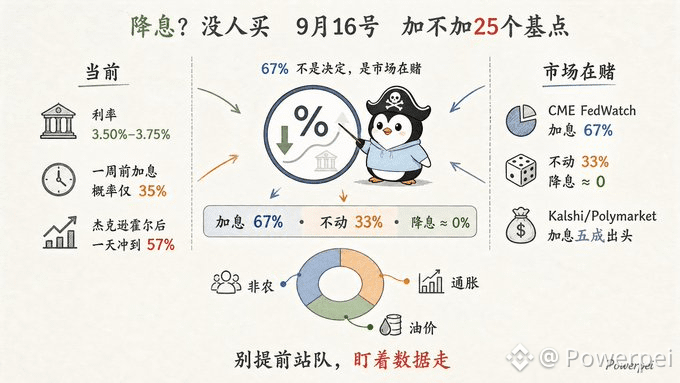
2.8k
·
--
SKR recently surged to second place on CoinGecko search trends.
In the past 24 hours, the price increase is often 130%–180%, and at some points the trading volume exceeded $200 million.
It’s the native token for Seeker, Solana’s second-generation Web3 phone.
Seeker is the follow-up model to Saga, with a hardware-level Seed Vault wallet, a standalone dApp Store, device verification, and an economic model all integrated together.
SKR is the governance and incentive token for this whole ecosystem.
Staking to Guardian nodes earns inflation rewards (0% commission in the early launch period, paid out every 48 hours), participating in governance, incentives for the dApp store, and reward allocations for users and developers.
Total supply is about 10 billion tokens. When it launched in January this year, nearly 2 billion tokens were airdropped to Seeker phone users and Season 1 developers.
A recent catalyst is the wrap-up of the Seeker Summer event, along with reward distributions.
My view on this kind of token has always been very straightforward: the ceiling for a mobile-ecosystem token depends on how many phones get sold and whether there are things people actually use in the dApp Store.
Solana’s phone line has indeed iterated from Saga to Seeker, but up to now, no Web3 phone has really broken out a killer use case.
The “hardware-locked-to-a-token” model sounds like a neat closed loop, but in reality, most users buy the phone mainly for the airdrops.
Once the airdrop is done and the event ends, the moment of verification arrives.
Will people stay using the phone—or sell their tokens.
Mid- and small-cap tokens are extremely volatile. The above is market observation, not investment advice.
SKR recently surged to second place on CoinGecko search trends.
In the past 24 hours, the price increase is often 130%–180%, and at some points the trading volume exceeded $200 million.
It’s the native token for Seeker, Solana’s second-generation Web3 phone.
Seeker is the follow-up model to Saga, with a hardware-level Seed Vault wallet, a standalone dApp Store, device verification, and an economic model all integrated together.
SKR is the governance and incentive token for this whole ecosystem.
Staking to Guardian nodes earns inflation rewards (0% commission in the early launch period, paid out every 48 hours), participating in governance, incentives for the dApp store, and reward allocations for users and developers.
Total supply is about 10 billion tokens. When it launched in January this year, nearly 2 billion tokens were airdropped to Seeker phone users and Season 1 developers.
A recent catalyst is the wrap-up of the Seeker Summer event, along with reward distributions.
My view on this kind of token has always been very straightforward: the ceiling for a mobile-ecosystem token depends on how many phones get sold and whether there are things people actually use in the dApp Store.
Solana’s phone line has indeed iterated from Saga to Seeker, but up to now, no Web3 phone has really broken out a killer use case.
The “hardware-locked-to-a-token” model sounds like a neat closed loop, but in reality, most users buy the phone mainly for the airdrops.
Once the airdrop is done and the event ends, the moment of verification arrives.
Will people stay using the phone—or sell their tokens.
Mid- and small-cap tokens are extremely volatile. The above is market observation, not investment advice.
In the past 24 hours, the price increase is often 130%–180%, and at some points the trading volume exceeded $200 million.
It’s the native token for Seeker, Solana’s second-generation Web3 phone.
Seeker is the follow-up model to Saga, with a hardware-level Seed Vault wallet, a standalone dApp Store, device verification, and an economic model all integrated together.
SKR is the governance and incentive token for this whole ecosystem.
Staking to Guardian nodes earns inflation rewards (0% commission in the early launch period, paid out every 48 hours), participating in governance, incentives for the dApp store, and reward allocations for users and developers.
Total supply is about 10 billion tokens. When it launched in January this year, nearly 2 billion tokens were airdropped to Seeker phone users and Season 1 developers.
A recent catalyst is the wrap-up of the Seeker Summer event, along with reward distributions.
My view on this kind of token has always been very straightforward: the ceiling for a mobile-ecosystem token depends on how many phones get sold and whether there are things people actually use in the dApp Store.
Solana’s phone line has indeed iterated from Saga to Seeker, but up to now, no Web3 phone has really broken out a killer use case.
The “hardware-locked-to-a-token” model sounds like a neat closed loop, but in reality, most users buy the phone mainly for the airdrops.
Once the airdrop is done and the event ends, the moment of verification arrives.
Will people stay using the phone—or sell their tokens.
Mid- and small-cap tokens are extremely volatile. The above is market observation, not investment advice.
1
2.6k
·
--
PONS is really making waves lately
CoinGecko’s search interest ranks #1 over the past 3 hours; it’s doubled over 24 hours, nearly 6x over 7 days, with a new price high and market cap reaching $200 million
It’s a token launch platform on the Robinhood Chain
Users can create a fixed-supply token in one click using their own wallet, while also deploying a liquidity pool with locked liquidity. The platform doesn’t touch your funds
What I find interesting is the deflationary design
A portion of the trading fees goes back to the protocol, and most of it is used for automatic buybacks and to burn PONS. So far, it has burned nearly 30% of the total supply
The platform has launched hundreds of thousands of tokens in total, and trading volume is also not small
This indicates that usage is real
It’s not inflated by airdrops; there are actual people creating tokens there and trading them
But I’ll say this: the deflation mechanism looks good only if trading volume can hold up. Right now, hype is at the top—fees are high, burns are fast, the price is rising, and hype is even higher
That’s a positive feedback loop. The problem is that when things go the other way, it’s just as fast. Once trading volume drops, the burn rate slows, and the narrative won’t stand
The window for meme token launch platforms is always short
Pumpfun got popular; now PONS is taking the baton. Whether it can retain users depends on whether the platform has anything left once the hype fades
Crypto markets are extremely volatile. The above is market observation, not investment advice.
$PUMP
PONS is really making waves lately
CoinGecko’s search interest ranks #1 over the past 3 hours; it’s doubled over 24 hours, nearly 6x over 7 days, with a new price high and market cap reaching $200 million
It’s a token launch platform on the Robinhood Chain
Users can create a fixed-supply token in one click using their own wallet, while also deploying a liquidity pool with locked liquidity. The platform doesn’t touch your funds
What I find interesting is the deflationary design
A portion of the trading fees goes back to the protocol, and most of it is used for automatic buybacks and to burn PONS. So far, it has burned nearly 30% of the total supply
The platform has launched hundreds of thousands of tokens in total, and trading volume is also not small
This indicates that usage is real
It’s not inflated by airdrops; there are actual people creating tokens there and trading them
But I’ll say this: the deflation mechanism looks good only if trading volume can hold up. Right now, hype is at the top—fees are high, burns are fast, the price is rising, and hype is even higher
That’s a positive feedback loop. The problem is that when things go the other way, it’s just as fast. Once trading volume drops, the burn rate slows, and the narrative won’t stand
The window for meme token launch platforms is always short
Pumpfun got popular; now PONS is taking the baton. Whether it can retain users depends on whether the platform has anything left once the hype fades
Crypto markets are extremely volatile. The above is market observation, not investment advice.
$PUMP
CoinGecko’s search interest ranks #1 over the past 3 hours; it’s doubled over 24 hours, nearly 6x over 7 days, with a new price high and market cap reaching $200 million
It’s a token launch platform on the Robinhood Chain
Users can create a fixed-supply token in one click using their own wallet, while also deploying a liquidity pool with locked liquidity. The platform doesn’t touch your funds
What I find interesting is the deflationary design
A portion of the trading fees goes back to the protocol, and most of it is used for automatic buybacks and to burn PONS. So far, it has burned nearly 30% of the total supply
The platform has launched hundreds of thousands of tokens in total, and trading volume is also not small
This indicates that usage is real
It’s not inflated by airdrops; there are actual people creating tokens there and trading them
But I’ll say this: the deflation mechanism looks good only if trading volume can hold up. Right now, hype is at the top—fees are high, burns are fast, the price is rising, and hype is even higher
That’s a positive feedback loop. The problem is that when things go the other way, it’s just as fast. Once trading volume drops, the burn rate slows, and the narrative won’t stand
The window for meme token launch platforms is always short
Pumpfun got popular; now PONS is taking the baton. Whether it can retain users depends on whether the platform has anything left once the hype fades
Crypto markets are extremely volatile. The above is market observation, not investment advice.
$PUMP
4
4
3.7k
Log in to explore more content
Join global crypto users on Binance Square
⚡️ Get latest and useful information about crypto.
💬 Trusted by the world’s largest crypto exchange.
👍 Discover real insights from verified creators.
Email / Phone number
Trending Topics
BOJRaisesRatesTo31YearHigh
80,278 views
1,266 Discussing
#bojraisesratesto31yearhigh
🇯🇵 BOJ Raised Rates. So Why Did the Yen FALL?
Imagine borrowing a currency whose central bank just raised rates…
…and that currency still gets weaker. 😂
On Sept. 18, the BOJ raised rates 25bp to 1.25%, the highest level in 31 years.
The vote? 7–2.
But USD/JPY jumped as high as 158.05 as traders questioned how aggressive the next hikes will be.
BUT HERE’S WHAT MANY PEOPLE MISS 👀
The market wasn't simply trading the hike.
It was trading the guidance gap.
The 25bp move was widely expected. What mattered was whether BOJ Governor Ueda would signal a clear path for more tightening.
He didn't commit to a preset pace.
Meanwhile, the U.S.–Japan rate gap remains wide enough to keep the carry-trade story alive: cheap-yen funding can still compete with higher-yielding assets elsewhere.
And then came the crypto twist:
BTC rebounded ~5.9% toward $81K after the BOJ decision.
So:
BOJ tightening ≠ automatic crypto selloff.
But there is another risk.
If USD/JPY pushes higher, intervention concerns can intensify. If the yen suddenly strengthens, crowded carry positions could unwind quickly.
🧠 Square Insight:
Markets don't trade the rate hike. They trade the gap between what was expected and what was delivered.
Do you think the next BOJ move will finally break the carry trade?
Market commentary only. Not financial advice.
#BOJ #JapaneseYen #CarryTrade
$BTC
TuilaNamKy
·2 Likes
·3.5k views
BuffettStepsDownAsBerkshireChairman
36,344 views
596 Discussing
XRPExchangeReservesHitSevenYearLow
41,268 views
559 Discussing