
Myron
360 Posts

Myron
Report
Block User
ex- incubator, specialize in operation management.
Writing on Airdrop/Yields.
All platform: @Myronhimself
Open Trade

USD1 Holder
Occasional Trader
5.6 Years
10 Following
629 Followers
755 Liked
Posts
Portfolio
All
Quotes
PINNED
·
--
Article
What is the annual return of staking-type airdrops? Reviewing and summarizing the airdrop layout strategy from Q1 to Q3 2025With the completion of the token issuance for Aster $ASTER , the only remaining unissued token agreements I am still participating in are basically Ethena’s Converge ecosystem agreements: Strata, Terminal, Ethereal. If Converge can officially launch in Q4 2025, this year’s airdrop returns will truly be perfect!
2025 Q2/Q3, this is my airdrop harvest festival. Based on the amount of funds deposited & the duration of occupied funds, the annualized return of most agreements is approximately +20% to +25%. A small number of agreements have additional incentives such as mouth-feeding and referrals that can further increase the yield (thank you to those who are willing to accept my content output). There are also individual agreements with a yield of @10%. However, overall, the pure airdrop returns this year have brought me nearly +25% annualized.
What is the annual return of staking-type airdrops? Reviewing and summarizing the airdrop layout strategy from Q1 to Q3 2025
With the completion of the token issuance for Aster $ASTER , the only remaining unissued token agreements I am still participating in are basically Ethena’s Converge ecosystem agreements: Strata, Terminal, Ethereal. If Converge can officially launch in Q4 2025, this year’s airdrop returns will truly be perfect!
2025 Q2/Q3, this is my airdrop harvest festival. Based on the amount of funds deposited & the duration of occupied funds, the annualized return of most agreements is approximately +20% to +25%. A small number of agreements have additional incentives such as mouth-feeding and referrals that can further increase the yield (thank you to those who are willing to accept my content output). There are also individual agreements with a yield of @10%. However, overall, the pure airdrop returns this year have brought me nearly +25% annualized.
2025 Q2/Q3, this is my airdrop harvest festival. Based on the amount of funds deposited & the duration of occupied funds, the annualized return of most agreements is approximately +20% to +25%. A small number of agreements have additional incentives such as mouth-feeding and referrals that can further increase the yield (thank you to those who are willing to accept my content output). There are also individual agreements with a yield of @10%. However, overall, the pure airdrop returns this year have brought me nearly +25% annualized.
1
1.2k
·
--
Bullish
Partly True
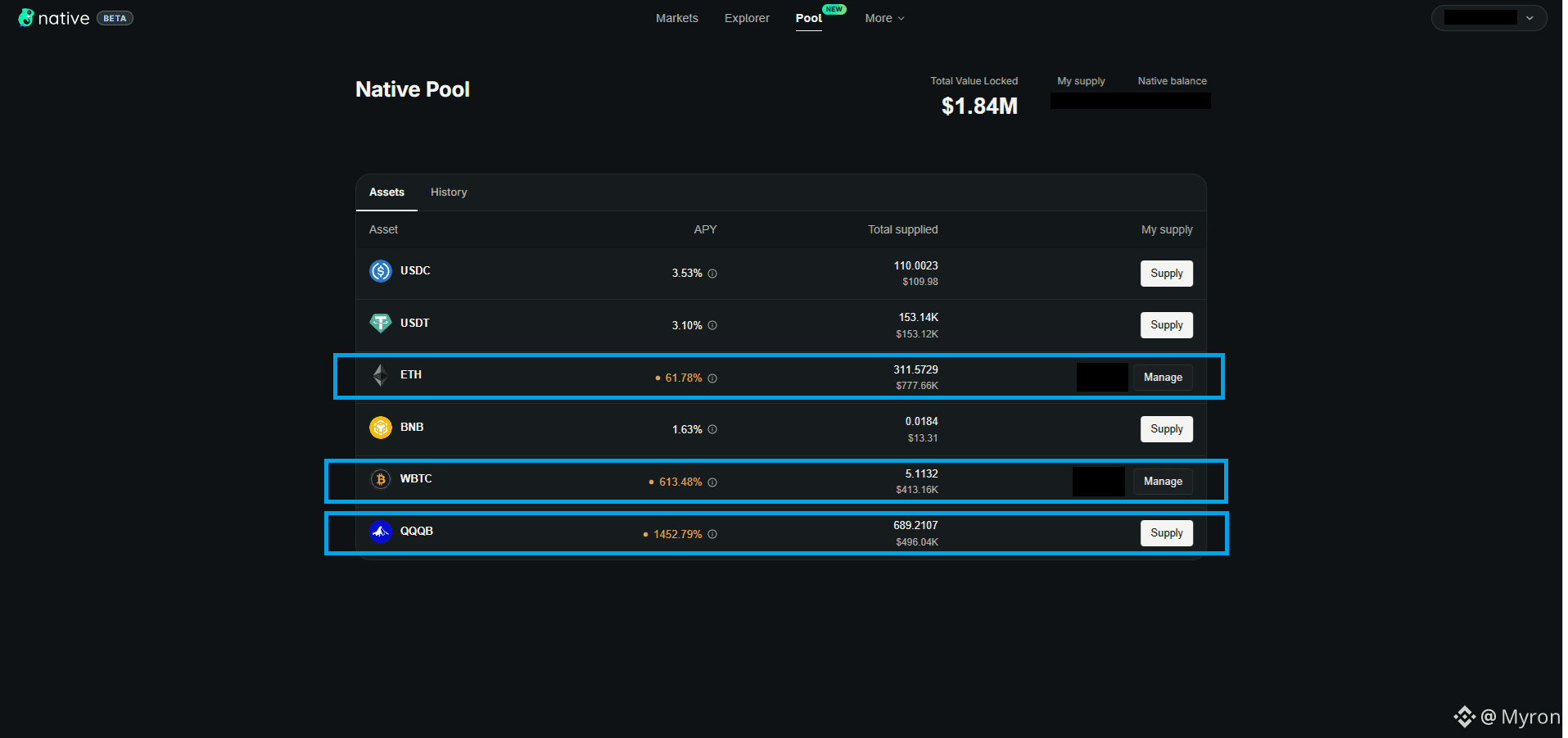
Native Pool Liquidity Incentive Rule Changes (Cancel Annualized Cap), current $ETH 61% APY、 $WBTC 613% APY、 $QQQB 1452% APY
Native made two core changes:
➤ The ETH and WBTC pools now use a $1000 per-day per-pool subsidy calculation
➤ Added bStocks QQQB deposits & incentives
Under the previous annualized cap design, converting the per-day per-pool subsidy would be ~ $1072.
After changing to a $1000 per-day per-pool subsidy, the remaining fractions on both sides are invested into the newly added QQQB pool, leaving a $143 per-day subsidy.
QQQB’s current annualized is as high as 1452% APY; incentives run until 9/17 as well, following @BNB_Chain .
I took a look at ListaDAO’s QQQB collateral—it’s $1.1M, which isn’t small. It’s worth keeping an eye on whether this batch of funds will come over to take Native incentives.
-
● The above content does not constitute investment advice (NFA). Please act according to your own risk tolerance. DYOR and participate in the investment market cautiously.
● The attached images are sourced from Native
#native #QQQB #WBTC #ETH
{spot}(ETHUSDT)
{spot}(WBTCUSDT)
{spot}(QQQBUSDT)
Native Pool Liquidity Incentive Rule Changes (Cancel Annualized Cap), current $ETH 61% APY、 $WBTC 613% APY、 $QQQB 1452% APY
Native made two core changes:
➤ The ETH and WBTC pools now use a $1000 per-day per-pool subsidy calculation
➤ Added bStocks QQQB deposits & incentives
Under the previous annualized cap design, converting the per-day per-pool subsidy would be ~ $1072.
After changing to a $1000 per-day per-pool subsidy, the remaining fractions on both sides are invested into the newly added QQQB pool, leaving a $143 per-day subsidy.
QQQB’s current annualized is as high as 1452% APY; incentives run until 9/17 as well, following @BNB_Chain .
I took a look at ListaDAO’s QQQB collateral—it’s $1.1M, which isn’t small. It’s worth keeping an eye on whether this batch of funds will come over to take Native incentives.
-
● The above content does not constitute investment advice (NFA). Please act according to your own risk tolerance. DYOR and participate in the investment market cautiously.
● The attached images are sourced from Native
#native #QQQB #WBTC #ETH
Native made two core changes:
➤ The ETH and WBTC pools now use a $1000 per-day per-pool subsidy calculation
➤ Added bStocks QQQB deposits & incentives
Under the previous annualized cap design, converting the per-day per-pool subsidy would be ~ $1072.
After changing to a $1000 per-day per-pool subsidy, the remaining fractions on both sides are invested into the newly added QQQB pool, leaving a $143 per-day subsidy.
QQQB’s current annualized is as high as 1452% APY; incentives run until 9/17 as well, following @BNB_Chain .
I took a look at ListaDAO’s QQQB collateral—it’s $1.1M, which isn’t small. It’s worth keeping an eye on whether this batch of funds will come over to take Native incentives.
-
● The above content does not constitute investment advice (NFA). Please act according to your own risk tolerance. DYOR and participate in the investment market cautiously.
● The attached images are sourced from Native
#native #QQQB #WBTC #ETH
2
2.7k
·
--
Bullish
【Reminder|Binance Wallet Saturn Points Campaign: If you applied for the Strata srUSDat pool, don't forget to connect your wallet to the Strata dApp link & bind your invite code (+10% Boost)】
Long story short: The Binance Wallet x Saturn wealth management campaign is not only about accumulating Saturn airdrop points. If you participate in Strata srUSDat, you can actually accumulate Strata airdrop points as well.
Saturn and Strata have not issued tokens yet!
We recommend manually connecting your wallet once via the Strata dApp to make sure your Strata dashboard shows your points and ranking. Then, binding an invite code also gives you +10% Points Boost (very important! There’s no equivalent gain by simply staking on the Binance Wallet side). If you need the link, I’ll put it in the comments section below.
-
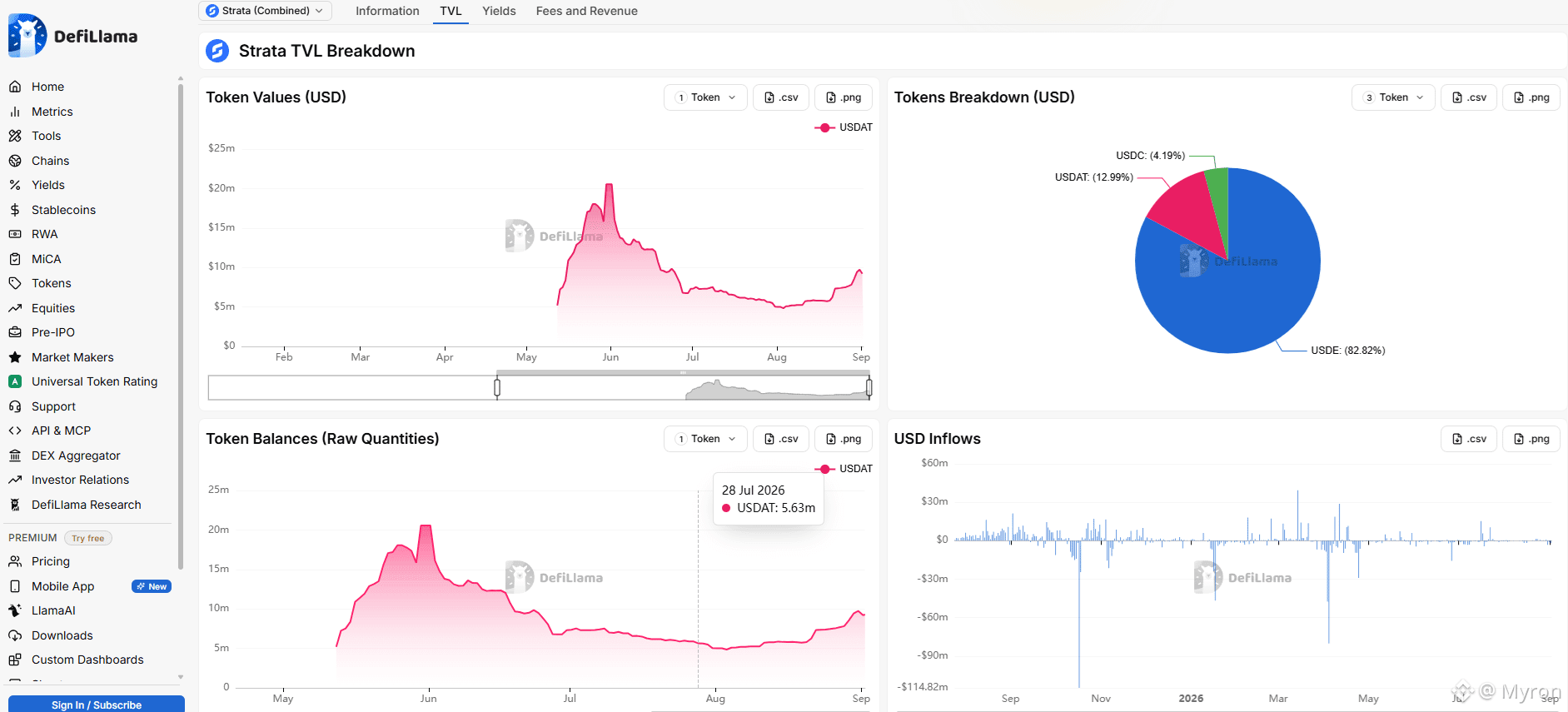
Over the past few days, I noticed the number of users shown on the Strata dashboard has been climbing rapidly. It’s currently approaching 10,000. On closer look, I found that since the Binance Wallet launched its wealth management campaign, Strata’s USDat Balances peak increased by about +73% (8/31)??
➤ Total Users: ~9,400 → currently 9,922
➤ USDat Balances: 5.63m → currently 9.21m (+63.59% Boost)
I think the key factor is that originally, Strata srUSDat could only earn 30x Strata + 1x Saturn, but the Binance Wallet campaign turns 1x Saturn into 3x Saturn. That may effectively motivate many people to choose to add more srUSDat via the Binance Wallet.
(Meanwhile, $STRC has recovered, strengthening everyone’s expectations for STRCFi.)
That said, I still need to emphasize: In the past, Strata got its start alongside Ethena USDe, and its protocol’s locked amount is now far below its peak. That means the timing of its airdrop expectations, in my view, might even be later than Saturn’s (which came later).
But since you’ve already staked srUSDat, there’s no harm in going back to its home interface, connect once, and bind an invite code to get a 10% bonus.
-
● The above content is not investment advice (NFA). Please make decisions based on your own risk tolerance. DYOR and participate in the investment market cautiously.
● The attached image is from DefiLlama
#Saturn #BinanceWallet #USDat #strata
{stock_us}(STRC.US)
【Reminder|Binance Wallet Saturn Points Campaign: If you applied for the Strata srUSDat pool, don't forget to connect your wallet to the Strata dApp link & bind your invite code (+10% Boost)】
Long story short: The Binance Wallet x Saturn wealth management campaign is not only about accumulating Saturn airdrop points. If you participate in Strata srUSDat, you can actually accumulate Strata airdrop points as well.
Saturn and Strata have not issued tokens yet!
We recommend manually connecting your wallet once via the Strata dApp to make sure your Strata dashboard shows your points and ranking. Then, binding an invite code also gives you +10% Points Boost (very important! There’s no equivalent gain by simply staking on the Binance Wallet side). If you need the link, I’ll put it in the comments section below.
-
Over the past few days, I noticed the number of users shown on the Strata dashboard has been climbing rapidly. It’s currently approaching 10,000. On closer look, I found that since the Binance Wallet launched its wealth management campaign, Strata’s USDat Balances peak increased by about +73% (8/31)??
➤ Total Users: ~9,400 → currently 9,922
➤ USDat Balances: 5.63m → currently 9.21m (+63.59% Boost)
I think the key factor is that originally, Strata srUSDat could only earn 30x Strata + 1x Saturn, but the Binance Wallet campaign turns 1x Saturn into 3x Saturn. That may effectively motivate many people to choose to add more srUSDat via the Binance Wallet.
(Meanwhile, $STRC has recovered, strengthening everyone’s expectations for STRCFi.)
That said, I still need to emphasize: In the past, Strata got its start alongside Ethena USDe, and its protocol’s locked amount is now far below its peak. That means the timing of its airdrop expectations, in my view, might even be later than Saturn’s (which came later).
But since you’ve already staked srUSDat, there’s no harm in going back to its home interface, connect once, and bind an invite code to get a 10% bonus.
-
● The above content is not investment advice (NFA). Please make decisions based on your own risk tolerance. DYOR and participate in the investment market cautiously.
● The attached image is from DefiLlama
#Saturn #BinanceWallet #USDat #strata
Long story short: The Binance Wallet x Saturn wealth management campaign is not only about accumulating Saturn airdrop points. If you participate in Strata srUSDat, you can actually accumulate Strata airdrop points as well.
Saturn and Strata have not issued tokens yet!
We recommend manually connecting your wallet once via the Strata dApp to make sure your Strata dashboard shows your points and ranking. Then, binding an invite code also gives you +10% Points Boost (very important! There’s no equivalent gain by simply staking on the Binance Wallet side). If you need the link, I’ll put it in the comments section below.
-
Over the past few days, I noticed the number of users shown on the Strata dashboard has been climbing rapidly. It’s currently approaching 10,000. On closer look, I found that since the Binance Wallet launched its wealth management campaign, Strata’s USDat Balances peak increased by about +73% (8/31)??
➤ Total Users: ~9,400 → currently 9,922
➤ USDat Balances: 5.63m → currently 9.21m (+63.59% Boost)
I think the key factor is that originally, Strata srUSDat could only earn 30x Strata + 1x Saturn, but the Binance Wallet campaign turns 1x Saturn into 3x Saturn. That may effectively motivate many people to choose to add more srUSDat via the Binance Wallet.
(Meanwhile, $STRC has recovered, strengthening everyone’s expectations for STRCFi.)
That said, I still need to emphasize: In the past, Strata got its start alongside Ethena USDe, and its protocol’s locked amount is now far below its peak. That means the timing of its airdrop expectations, in my view, might even be later than Saturn’s (which came later).
But since you’ve already staked srUSDat, there’s no harm in going back to its home interface, connect once, and bind an invite code to get a 10% bonus.
-
● The above content is not investment advice (NFA). Please make decisions based on your own risk tolerance. DYOR and participate in the investment market cautiously.
● The attached image is from DefiLlama
#Saturn #BinanceWallet #USDat #strata
1
1
467
·
--
Bullish
Partly True
HertzFlow trading feature launched one week ago: the total profit/loss converted into an annualized return rate for the USD 1 treasury is approximately 7.5% (estimated from the first week’s data).
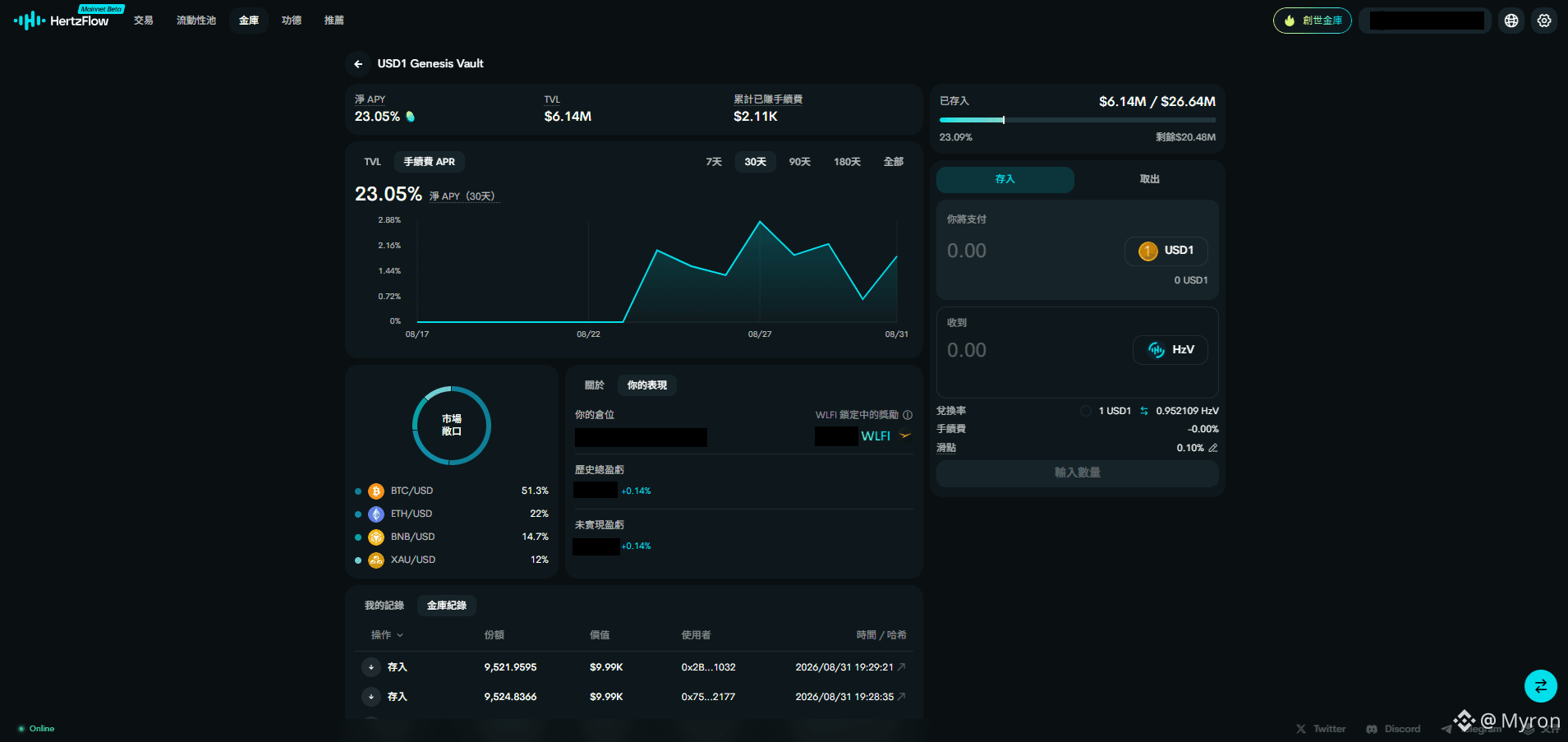
Excluding the incentives from $WLFI of ~20% APY, and looking solely at the original收益 of the Hertzflow treasury strategy: over these seven days, the unrealized profit/loss is +0.14%.
This suggests that during this period, the counterparty’s profit/loss was more favorable to liquidity providers, but it may be limited by the fact that the feature is just newly launched and still lacks fee revenue. It still has a gap from the official expected 8%–16% annualized return.
Judging purely by the fee income of individual liquidity pools:
➤ $BTC approximately 1%–2% APR
➤ $ETH approximately 1%–3% APR
➤ BNB approximately 1%–4% APR
In other words, the counterparty for LPs (traders) is skewed toward losses.
For this part, the official added “trader unrealized P/L” to the information page of each individual pool, so you can immediately see the traders’ situation. From what we can see now, traders are in a loss position, concentrated in BTC.
However, don’t forget: what the treasury reports are unrealized profit/losses. That means if the market swings significantly in the future, this number could change drastically.
Oh, one more thing: I just noticed the XAU/USD pool has also launched, and it’s already been incorporated into the treasury strategy.
-
At the moment, to participate in HertzFlow mainnet trading, you need an invite code for access. If you’re interested, you can try: MYRON1
Let’s be early market makers together!
-
● The above content does not constitute investment advice (NFA). Please make decisions based on your own risk tolerance. DYOR and participate in the investment market cautiously.
● All images are taken from HertzFlow
#hertzflow #XAU #Airdrops #BNBChain
{spot}(USD1USDT)
{spot}(BNBUSDT)
{spot}(WLFIUSDT)
HertzFlow trading feature launched one week ago: the total profit/loss converted into an annualized return rate for the USD 1 treasury is approximately 7.5% (estimated from the first week’s data).
Excluding the incentives from $WLFI of ~20% APY, and looking solely at the original收益 of the Hertzflow treasury strategy: over these seven days, the unrealized profit/loss is +0.14%.
This suggests that during this period, the counterparty’s profit/loss was more favorable to liquidity providers, but it may be limited by the fact that the feature is just newly launched and still lacks fee revenue. It still has a gap from the official expected 8%–16% annualized return.
Judging purely by the fee income of individual liquidity pools:
➤ $BTC approximately 1%–2% APR
➤ $ETH approximately 1%–3% APR
➤ BNB approximately 1%–4% APR
In other words, the counterparty for LPs (traders) is skewed toward losses.
For this part, the official added “trader unrealized P/L” to the information page of each individual pool, so you can immediately see the traders’ situation. From what we can see now, traders are in a loss position, concentrated in BTC.
However, don’t forget: what the treasury reports are unrealized profit/losses. That means if the market swings significantly in the future, this number could change drastically.
Oh, one more thing: I just noticed the XAU/USD pool has also launched, and it’s already been incorporated into the treasury strategy.
-
At the moment, to participate in HertzFlow mainnet trading, you need an invite code for access. If you’re interested, you can try: MYRON1
Let’s be early market makers together!
-
● The above content does not constitute investment advice (NFA). Please make decisions based on your own risk tolerance. DYOR and participate in the investment market cautiously.
● All images are taken from HertzFlow
#hertzflow #XAU #Airdrops #BNBChain
Excluding the incentives from $WLFI of ~20% APY, and looking solely at the original收益 of the Hertzflow treasury strategy: over these seven days, the unrealized profit/loss is +0.14%.
This suggests that during this period, the counterparty’s profit/loss was more favorable to liquidity providers, but it may be limited by the fact that the feature is just newly launched and still lacks fee revenue. It still has a gap from the official expected 8%–16% annualized return.
Judging purely by the fee income of individual liquidity pools:
➤ $BTC approximately 1%–2% APR
➤ $ETH approximately 1%–3% APR
➤ BNB approximately 1%–4% APR
In other words, the counterparty for LPs (traders) is skewed toward losses.
For this part, the official added “trader unrealized P/L” to the information page of each individual pool, so you can immediately see the traders’ situation. From what we can see now, traders are in a loss position, concentrated in BTC.
However, don’t forget: what the treasury reports are unrealized profit/losses. That means if the market swings significantly in the future, this number could change drastically.
Oh, one more thing: I just noticed the XAU/USD pool has also launched, and it’s already been incorporated into the treasury strategy.
-
At the moment, to participate in HertzFlow mainnet trading, you need an invite code for access. If you’re interested, you can try: MYRON1
Let’s be early market makers together!
-
● The above content does not constitute investment advice (NFA). Please make decisions based on your own risk tolerance. DYOR and participate in the investment market cautiously.
● All images are taken from HertzFlow
#hertzflow #XAU #Airdrops #BNBChain
1
2
1k
·
--
Bearish
Partly True
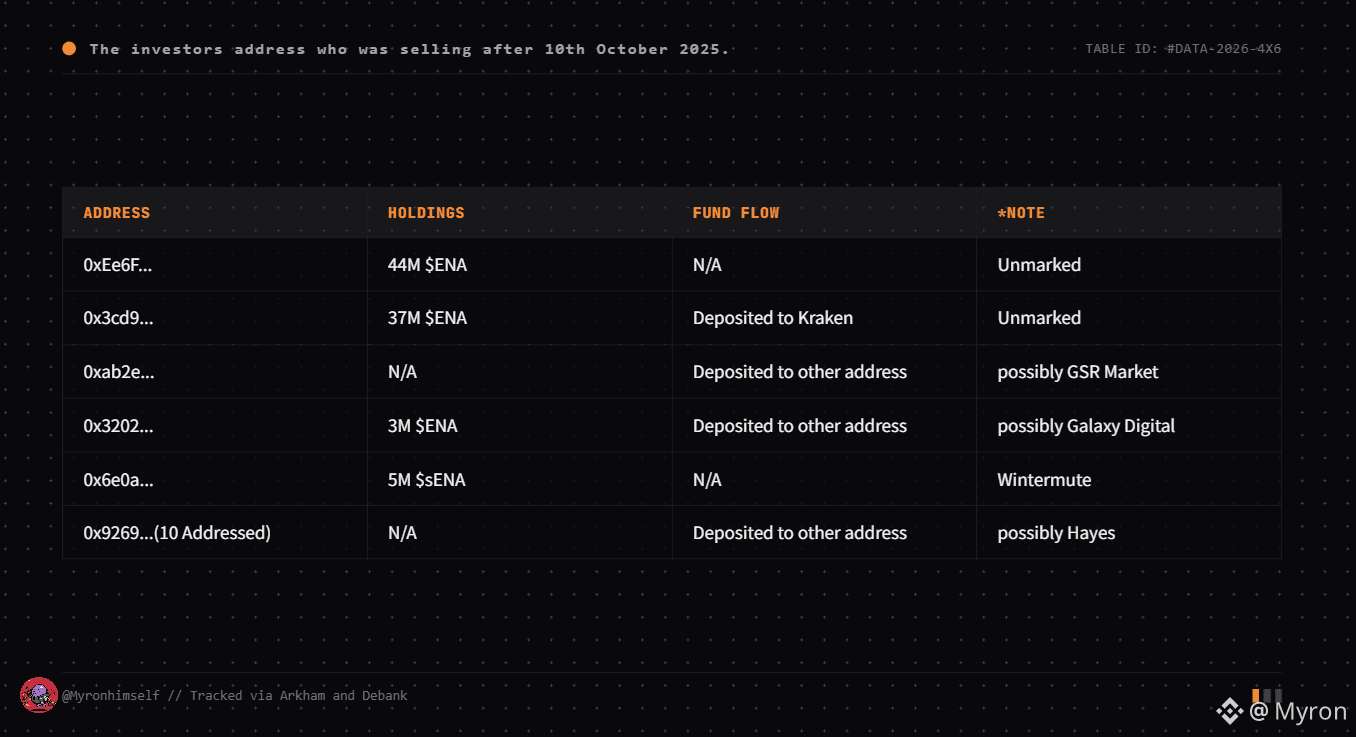
Which Ethena seed investors sold $ENA tokens after 2025/10/11?
With nothing to do during the holidays, I used Arkham + DeBank to organize the list of Ethena Foundation’s seed investors announced recently (Group i)
*Note: Group i = Investors who sold even a single token following the market cycle peak on 10 October 2025.
Based on the behavior of these addresses and their current holdings, we can also roughly gauge how large the potential future sell-off could be?
-
Related explanation:
In the original list, there is a column that lists about 10 addresses at once (representing addresses 0x9269...). These addresses share similar transaction patterns and have balances that are also close. The earliest outgoing transfer goes to an address with a high degree of interaction with Arthur Hayes, while the most recent incoming transfer is to an OTC trading platform called Flowdesk.
In addition, two more should be viewed separately:
➤ 0xab2e...: subsequent outgoing transfers continue to enter addresses suspected to be linked to GSR
➤ 0x3202...: trace back to the source of the tokens, pointing to an address suspected to be linked to Galaxy Digital
The only address that Ethena specifically mentioned as having “sold $ENA after 2025/10/11, but declined the OTC acquisition offer for this round” is the Wintermute wallet (0x6e0a...), which Arkham tags as a well-known market maker—and currently this address holds a staked version of sENA.
-
● The above is not investment advice (NFA). Please act according to your own risk tolerance. DYOR and participate in the investment market cautiously
#ethena #ENA将解锁走势如何 #sena #Airdrops
{spot}(ENAUSDT)
Which Ethena seed investors sold $ENA tokens after 2025/10/11?
With nothing to do during the holidays, I used Arkham + DeBank to organize the list of Ethena Foundation’s seed investors announced recently (Group i)
*Note: Group i = Investors who sold even a single token following the market cycle peak on 10 October 2025.
Based on the behavior of these addresses and their current holdings, we can also roughly gauge how large the potential future sell-off could be?
-
Related explanation:
In the original list, there is a column that lists about 10 addresses at once (representing addresses 0x9269...). These addresses share similar transaction patterns and have balances that are also close. The earliest outgoing transfer goes to an address with a high degree of interaction with Arthur Hayes, while the most recent incoming transfer is to an OTC trading platform called Flowdesk.
In addition, two more should be viewed separately:
➤ 0xab2e...: subsequent outgoing transfers continue to enter addresses suspected to be linked to GSR
➤ 0x3202...: trace back to the source of the tokens, pointing to an address suspected to be linked to Galaxy Digital
The only address that Ethena specifically mentioned as having “sold $ENA after 2025/10/11, but declined the OTC acquisition offer for this round” is the Wintermute wallet (0x6e0a...), which Arkham tags as a well-known market maker—and currently this address holds a staked version of sENA.
-
● The above is not investment advice (NFA). Please act according to your own risk tolerance. DYOR and participate in the investment market cautiously
#ethena #ENA将解锁走势如何 #sena #Airdrops
With nothing to do during the holidays, I used Arkham + DeBank to organize the list of Ethena Foundation’s seed investors announced recently (Group i)
*Note: Group i = Investors who sold even a single token following the market cycle peak on 10 October 2025.
Based on the behavior of these addresses and their current holdings, we can also roughly gauge how large the potential future sell-off could be?
-
Related explanation:
In the original list, there is a column that lists about 10 addresses at once (representing addresses 0x9269...). These addresses share similar transaction patterns and have balances that are also close. The earliest outgoing transfer goes to an address with a high degree of interaction with Arthur Hayes, while the most recent incoming transfer is to an OTC trading platform called Flowdesk.
In addition, two more should be viewed separately:
➤ 0xab2e...: subsequent outgoing transfers continue to enter addresses suspected to be linked to GSR
➤ 0x3202...: trace back to the source of the tokens, pointing to an address suspected to be linked to Galaxy Digital
The only address that Ethena specifically mentioned as having “sold $ENA after 2025/10/11, but declined the OTC acquisition offer for this round” is the Wintermute wallet (0x6e0a...), which Arkham tags as a well-known market maker—and currently this address holds a staked version of sENA.
-
● The above is not investment advice (NFA). Please act according to your own risk tolerance. DYOR and participate in the investment market cautiously
#ethena #ENA将解锁走势如何 #sena #Airdrops
7
3
1.5k
·
--
Bullish
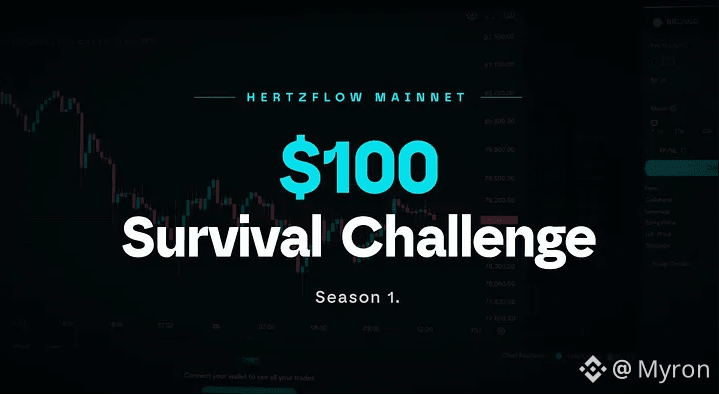
A trader with a proven track record should be quite suitable to join the HertzFlow Survival Challenge. The registration deadline is 8/31.
HertzFlow provides $100 trading principal into a wallet. After the event ends, any remaining funds go to the participating contestants.
In other words, participants only need to bring their own new wallet address. The official will then provide starting capital + a trading whitelist + leaderboard rewards. Of course, the trading process will also accumulate Merit airdrop points.
*Note: Participants must provide $BNB as the on-chain transaction fee.
-
The event rules are as follows:
➤ Event duration
A half-month competition period: 9/1–9/14
➤ Trading rules
At least one trade per day is required. You must share a PnL screenshot on X or the Binance Square.
*Note: You have three chances to miss.
➤ Leaderboard rewards
The top 10 can split an additional $5000 $USD1
-
That said, HertzFlow is still pretty talented on the marketing side~
$10,000 + $5,000 = $15,000. Not only can it attract a batch of potential early trading users, but it can also spread the platform’s recognition through the profit-and-loss sharing rules. The leverage effect should be quite strong.
On the other hand, the official will most likely actively drive traffic to the traders’ posts and shares. The rules also include items for Binance Square live streams. If my memory serves me right, Binance Square has been quite proactive in pushing the trading livestream competition track in the past one or two years—so there might be a traffic boost.
So honestly, it feels like this is tailored for traders who are good at analysis. It’s definitely worth applying—too bad I only started taking the event rules seriously way too late 👻
-
If you weren’t selected for the participant list, or you simply want to try it out first and practice, welcome to use the invitation code to get access to the trading feature whitelist: MYRON1
Let’s be early market makers!
-
● The information above does not constitute investment advice (NFA). Users should act according to their own risk tolerance; DYOR and participate in the investment market with caution.
● Images are sourced from HertzFlow
#hertzflow #BNBChain #Airdrops #USD1
{spot}(BNBUSDT)
A trader with a proven track record should be quite suitable to join the HertzFlow Survival Challenge. The registration deadline is 8/31.
HertzFlow provides $100 trading principal into a wallet. After the event ends, any remaining funds go to the participating contestants.
In other words, participants only need to bring their own new wallet address. The official will then provide starting capital + a trading whitelist + leaderboard rewards. Of course, the trading process will also accumulate Merit airdrop points.
*Note: Participants must provide $BNB as the on-chain transaction fee.
-
The event rules are as follows:
➤ Event duration
A half-month competition period: 9/1–9/14
➤ Trading rules
At least one trade per day is required. You must share a PnL screenshot on X or the Binance Square.
*Note: You have three chances to miss.
➤ Leaderboard rewards
The top 10 can split an additional $5000 $USD1
-
That said, HertzFlow is still pretty talented on the marketing side~
$10,000 + $5,000 = $15,000. Not only can it attract a batch of potential early trading users, but it can also spread the platform’s recognition through the profit-and-loss sharing rules. The leverage effect should be quite strong.
On the other hand, the official will most likely actively drive traffic to the traders’ posts and shares. The rules also include items for Binance Square live streams. If my memory serves me right, Binance Square has been quite proactive in pushing the trading livestream competition track in the past one or two years—so there might be a traffic boost.
So honestly, it feels like this is tailored for traders who are good at analysis. It’s definitely worth applying—too bad I only started taking the event rules seriously way too late 👻
-
If you weren’t selected for the participant list, or you simply want to try it out first and practice, welcome to use the invitation code to get access to the trading feature whitelist: MYRON1
Let’s be early market makers!
-
● The information above does not constitute investment advice (NFA). Users should act according to their own risk tolerance; DYOR and participate in the investment market with caution.
● Images are sourced from HertzFlow
#hertzflow #BNBChain #Airdrops #USD1
HertzFlow provides $100 trading principal into a wallet. After the event ends, any remaining funds go to the participating contestants.
In other words, participants only need to bring their own new wallet address. The official will then provide starting capital + a trading whitelist + leaderboard rewards. Of course, the trading process will also accumulate Merit airdrop points.
*Note: Participants must provide $BNB as the on-chain transaction fee.
-
The event rules are as follows:
➤ Event duration
A half-month competition period: 9/1–9/14
➤ Trading rules
At least one trade per day is required. You must share a PnL screenshot on X or the Binance Square.
*Note: You have three chances to miss.
➤ Leaderboard rewards
The top 10 can split an additional $5000 $USD1
-
That said, HertzFlow is still pretty talented on the marketing side~
$10,000 + $5,000 = $15,000. Not only can it attract a batch of potential early trading users, but it can also spread the platform’s recognition through the profit-and-loss sharing rules. The leverage effect should be quite strong.
On the other hand, the official will most likely actively drive traffic to the traders’ posts and shares. The rules also include items for Binance Square live streams. If my memory serves me right, Binance Square has been quite proactive in pushing the trading livestream competition track in the past one or two years—so there might be a traffic boost.
So honestly, it feels like this is tailored for traders who are good at analysis. It’s definitely worth applying—too bad I only started taking the event rules seriously way too late 👻
-
If you weren’t selected for the participant list, or you simply want to try it out first and practice, welcome to use the invitation code to get access to the trading feature whitelist: MYRON1
Let’s be early market makers!
-
● The information above does not constitute investment advice (NFA). Users should act according to their own risk tolerance; DYOR and participate in the investment market with caution.
● Images are sourced from HertzFlow
#hertzflow #BNBChain #Airdrops #USD1
1
2
450
·
--
Bearish
Verified
Ethena has been talking about fee conversion governance voting for a year, and it’s finally here—does the recent trend of $ENA look reasonable?
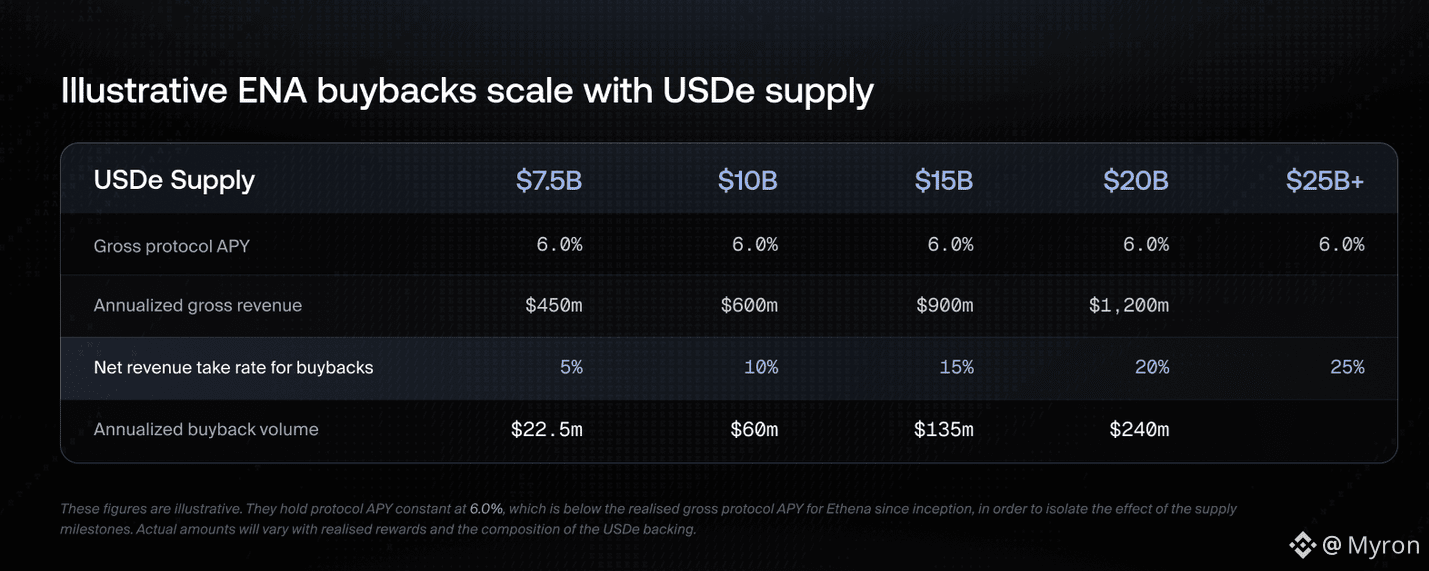
Yesterday (8/27), Ethena announced changes to the token release schedule for the currently unreleased tokens, and also released information about its token buyback.
Well, no wonder Hayes stopped the long-term, steady selling that had been happening this month and suddenly switched to adding positions and publicly calling bullish. Under yesterday’s official X post, there were tons of comments pointing out ENA’s abnormal rally in the near term—claiming that insiders are cutting in line and snatching up the community’s attention.
Honestly, every time this coin suddenly spikes—whether it’s earlier than the broader market’s move or clearly above the average market gain—an official “good news” announcement will inevitably follow shortly afterward. Do they really not care about users at all?
-
Key points from yesterday’s announcement:
➤ Changes to the token unlock schedule
The Ethena Foundation will acquire investors’ shares of tokens that are still locked but are willing to sell, via over-the-counter transactions. However, some investors who have long held onto their unlocked tokens without selling did not accept the acquisition offer.
Going forward, the unlocks will be concentrated into a single release on 10/5. Only 12% of the team-related allocation will continue to wait for unlock according to the original schedule.
➤ Fee conversion governance voting is live
After approval, the buyback ratio will be based on the USDe supply target, with the first target being 7.5B USDe.
The funding source for the buyback is 95% of net revenue from all business lines; only 5% is retained for protocol growth.
➤ Ethena Labs’ intellectual property and earnings will be transferred to the Ethena Foundation
This mainly transfers rights to a specific legal entity and does not affect ordinary users. Detailed information will be announced in October.
-
Summary
Actually, not long ago, some creators started posting ads on X. At that time, you could already guess Ethena had new moves coming. Sure enough, it suddenly pumped—very clearly different from the overall market trend.
I still won’t recommend proactively adding to ENA. Plainly put, even if there are profits, you’re basically eating the tail-end scraps left over by insiders. The risk and reward don’t match.
If you already have USDe, just use it as usual. Treat the ENA airdrop as free money—but from what it looks like now, the only thing you can really “play” is Meridian’s mPerps incentives.
-
● The above does not constitute investment advice (NFA). Users should make decisions according to their own risk tolerance. Please DYOR and participate cautiously in the investment market.
● The attached image is sourced from Ethena
#Ethena #ENA将解锁走势如何 #USDe $ENA #Meridian
{spot}(ENAUSDT)
Ethena has been talking about fee conversion governance voting for a year, and it’s finally here—does the recent trend of $ENA look reasonable?
Yesterday (8/27), Ethena announced changes to the token release schedule for the currently unreleased tokens, and also released information about its token buyback.
Well, no wonder Hayes stopped the long-term, steady selling that had been happening this month and suddenly switched to adding positions and publicly calling bullish. Under yesterday’s official X post, there were tons of comments pointing out ENA’s abnormal rally in the near term—claiming that insiders are cutting in line and snatching up the community’s attention.
Honestly, every time this coin suddenly spikes—whether it’s earlier than the broader market’s move or clearly above the average market gain—an official “good news” announcement will inevitably follow shortly afterward. Do they really not care about users at all?
-
Key points from yesterday’s announcement:
➤ Changes to the token unlock schedule
The Ethena Foundation will acquire investors’ shares of tokens that are still locked but are willing to sell, via over-the-counter transactions. However, some investors who have long held onto their unlocked tokens without selling did not accept the acquisition offer.
Going forward, the unlocks will be concentrated into a single release on 10/5. Only 12% of the team-related allocation will continue to wait for unlock according to the original schedule.
➤ Fee conversion governance voting is live
After approval, the buyback ratio will be based on the USDe supply target, with the first target being 7.5B USDe.
The funding source for the buyback is 95% of net revenue from all business lines; only 5% is retained for protocol growth.
➤ Ethena Labs’ intellectual property and earnings will be transferred to the Ethena Foundation
This mainly transfers rights to a specific legal entity and does not affect ordinary users. Detailed information will be announced in October.
-
Summary
Actually, not long ago, some creators started posting ads on X. At that time, you could already guess Ethena had new moves coming. Sure enough, it suddenly pumped—very clearly different from the overall market trend.
I still won’t recommend proactively adding to ENA. Plainly put, even if there are profits, you’re basically eating the tail-end scraps left over by insiders. The risk and reward don’t match.
If you already have USDe, just use it as usual. Treat the ENA airdrop as free money—but from what it looks like now, the only thing you can really “play” is Meridian’s mPerps incentives.
-
● The above does not constitute investment advice (NFA). Users should make decisions according to their own risk tolerance. Please DYOR and participate cautiously in the investment market.
● The attached image is sourced from Ethena
#Ethena #ENA将解锁走势如何 #USDe $ENA #Meridian
Yesterday (8/27), Ethena announced changes to the token release schedule for the currently unreleased tokens, and also released information about its token buyback.
Well, no wonder Hayes stopped the long-term, steady selling that had been happening this month and suddenly switched to adding positions and publicly calling bullish. Under yesterday’s official X post, there were tons of comments pointing out ENA’s abnormal rally in the near term—claiming that insiders are cutting in line and snatching up the community’s attention.
Honestly, every time this coin suddenly spikes—whether it’s earlier than the broader market’s move or clearly above the average market gain—an official “good news” announcement will inevitably follow shortly afterward. Do they really not care about users at all?
-
Key points from yesterday’s announcement:
➤ Changes to the token unlock schedule
The Ethena Foundation will acquire investors’ shares of tokens that are still locked but are willing to sell, via over-the-counter transactions. However, some investors who have long held onto their unlocked tokens without selling did not accept the acquisition offer.
Going forward, the unlocks will be concentrated into a single release on 10/5. Only 12% of the team-related allocation will continue to wait for unlock according to the original schedule.
➤ Fee conversion governance voting is live
After approval, the buyback ratio will be based on the USDe supply target, with the first target being 7.5B USDe.
The funding source for the buyback is 95% of net revenue from all business lines; only 5% is retained for protocol growth.
➤ Ethena Labs’ intellectual property and earnings will be transferred to the Ethena Foundation
This mainly transfers rights to a specific legal entity and does not affect ordinary users. Detailed information will be announced in October.
-
Summary
Actually, not long ago, some creators started posting ads on X. At that time, you could already guess Ethena had new moves coming. Sure enough, it suddenly pumped—very clearly different from the overall market trend.
I still won’t recommend proactively adding to ENA. Plainly put, even if there are profits, you’re basically eating the tail-end scraps left over by insiders. The risk and reward don’t match.
If you already have USDe, just use it as usual. Treat the ENA airdrop as free money—but from what it looks like now, the only thing you can really “play” is Meridian’s mPerps incentives.
-
● The above does not constitute investment advice (NFA). Users should make decisions according to their own risk tolerance. Please DYOR and participate cautiously in the investment market.
● The attached image is sourced from Ethena
#Ethena #ENA将解锁走势如何 #USDe $ENA #Meridian
1
2.5k
·
--
Bullish
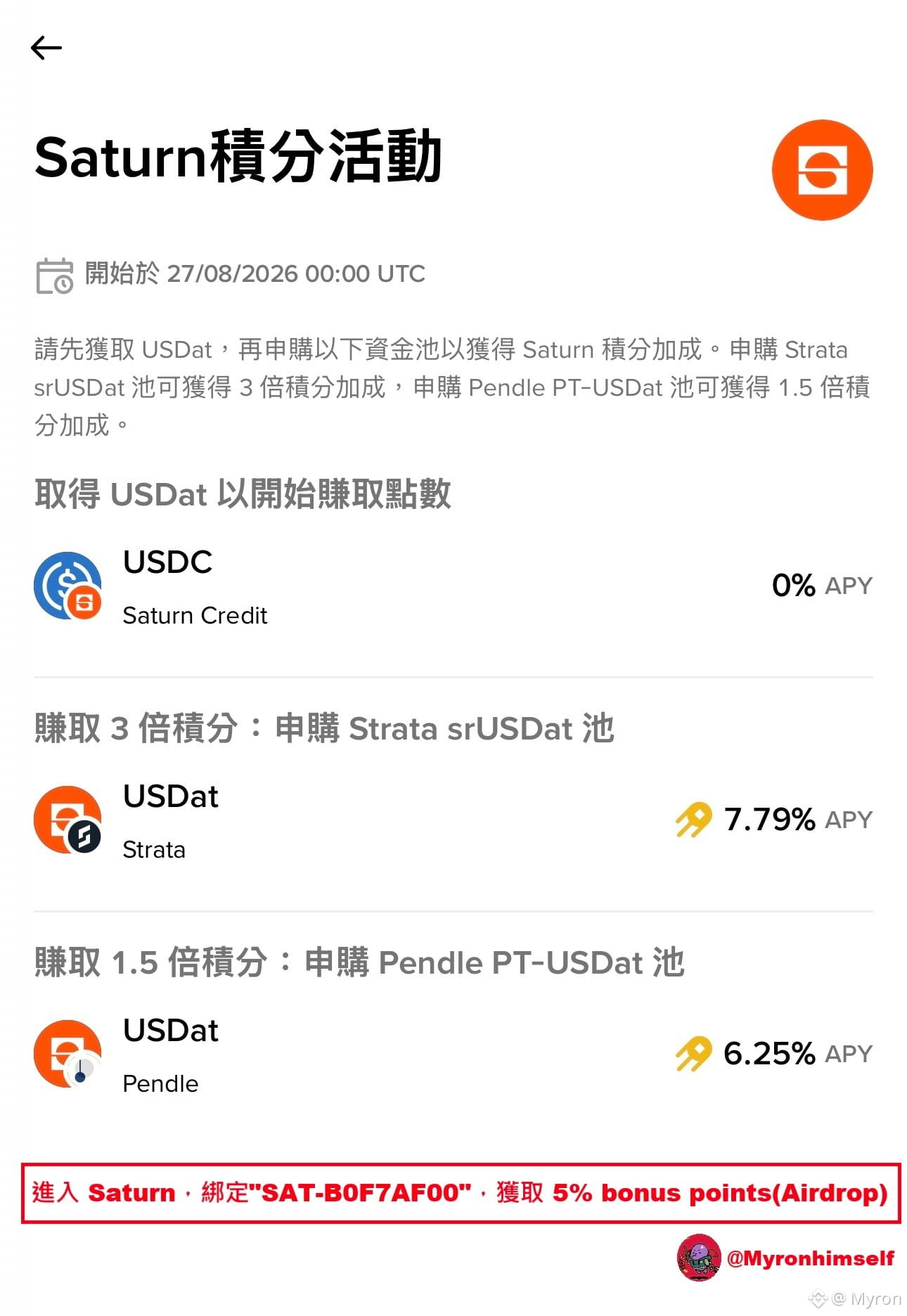
【Saturn x Binance Wallet, STRCFi finally launches an exchange wallet rewards campaign!】
It’s likely that Saturn will conduct a token airdrop in Q4. At that time, expanding users through the exchange wallet side and warming up the event also makes a lot of sense.
Season 2 is scheduled to end on 2026/12/8. In other words, the period for cultivating this airdrop campaign is roughly just a little over three months remaining.
*Note: The Binance Wallet event page shows that the token rewards will be available for claiming after Saturn Season 2 ends.
-
What’s even more interesting is that the event products it offers are srUSDat (Strata) and USDat PT (Pendle), not its own flagship sUSDat.
It feels like both Binance Wallet and Saturn have made some concessions to each other.
First, let’s understand Saturn’s product line:
“Users deposit USDC → receive USDat → can stake it to get sUSDat.”
In the original process, USDat is actually more like a transitional intermediary. Holding it alone only earns airdrop points—you can’t get the underlying yield.
And it’s sUSDat that’s the source of user earnings, earning STRC preferred dividends first.
So Saturn is basically providing event participation users with yield-related derivative assets of USDat (rather than the underlying) to meet Binance Wallet’s wealth-management needs. In essence, srUSDat and USDat PT are both minted through USDat—it's just that they are wrapped using another protocol (Strata or Pendle).
By ensuring users can get the base yield, while also boosting the points rewards: originally, when users staked themselves on Strata to obtain srUSDat, they only got 1x Saturn Points. Now, through the Binance Wallet campaign, it becomes 3x.
And Pendle PT originally had no points-based rewards, but now, through the Binance Wallet campaign, users can still get 1.5x Saturn Points.
So why say that Binance Wallet has also made a concession?
Primarily because the Saturn market for Pendle actually exists on BNB Chain, but the campaign only provides Ethereum—effectively giving up the opportunity to boost BNB Chain.
I’ve participated since Saturn launched, and I’m finally seeing it come to fruition—pretty exciting.
If you’re planning to join, feel free to use the invite code “SAT-B0F7AF00” to get a 5% bonus effect on airdrop points!
-
● The above content does not constitute investment advice (NFA). Users should act according to their own risk tolerance. DYOR, participate in the investment market carefully.
#saturn #BinanceWallet #STRC #PENDLE $STRC
{future}(STRCUSDT)
【Saturn x Binance Wallet, STRCFi finally launches an exchange wallet rewards campaign!】
It’s likely that Saturn will conduct a token airdrop in Q4. At that time, expanding users through the exchange wallet side and warming up the event also makes a lot of sense.
Season 2 is scheduled to end on 2026/12/8. In other words, the period for cultivating this airdrop campaign is roughly just a little over three months remaining.
*Note: The Binance Wallet event page shows that the token rewards will be available for claiming after Saturn Season 2 ends.
-
What’s even more interesting is that the event products it offers are srUSDat (Strata) and USDat PT (Pendle), not its own flagship sUSDat.
It feels like both Binance Wallet and Saturn have made some concessions to each other.
First, let’s understand Saturn’s product line:
“Users deposit USDC → receive USDat → can stake it to get sUSDat.”
In the original process, USDat is actually more like a transitional intermediary. Holding it alone only earns airdrop points—you can’t get the underlying yield.
And it’s sUSDat that’s the source of user earnings, earning STRC preferred dividends first.
So Saturn is basically providing event participation users with yield-related derivative assets of USDat (rather than the underlying) to meet Binance Wallet’s wealth-management needs. In essence, srUSDat and USDat PT are both minted through USDat—it's just that they are wrapped using another protocol (Strata or Pendle).
By ensuring users can get the base yield, while also boosting the points rewards: originally, when users staked themselves on Strata to obtain srUSDat, they only got 1x Saturn Points. Now, through the Binance Wallet campaign, it becomes 3x.
And Pendle PT originally had no points-based rewards, but now, through the Binance Wallet campaign, users can still get 1.5x Saturn Points.
So why say that Binance Wallet has also made a concession?
Primarily because the Saturn market for Pendle actually exists on BNB Chain, but the campaign only provides Ethereum—effectively giving up the opportunity to boost BNB Chain.
I’ve participated since Saturn launched, and I’m finally seeing it come to fruition—pretty exciting.
If you’re planning to join, feel free to use the invite code “SAT-B0F7AF00” to get a 5% bonus effect on airdrop points!
-
● The above content does not constitute investment advice (NFA). Users should act according to their own risk tolerance. DYOR, participate in the investment market carefully.
#saturn #BinanceWallet #STRC #PENDLE $STRC
It’s likely that Saturn will conduct a token airdrop in Q4. At that time, expanding users through the exchange wallet side and warming up the event also makes a lot of sense.
Season 2 is scheduled to end on 2026/12/8. In other words, the period for cultivating this airdrop campaign is roughly just a little over three months remaining.
*Note: The Binance Wallet event page shows that the token rewards will be available for claiming after Saturn Season 2 ends.
-
What’s even more interesting is that the event products it offers are srUSDat (Strata) and USDat PT (Pendle), not its own flagship sUSDat.
It feels like both Binance Wallet and Saturn have made some concessions to each other.
First, let’s understand Saturn’s product line:
“Users deposit USDC → receive USDat → can stake it to get sUSDat.”
In the original process, USDat is actually more like a transitional intermediary. Holding it alone only earns airdrop points—you can’t get the underlying yield.
And it’s sUSDat that’s the source of user earnings, earning STRC preferred dividends first.
So Saturn is basically providing event participation users with yield-related derivative assets of USDat (rather than the underlying) to meet Binance Wallet’s wealth-management needs. In essence, srUSDat and USDat PT are both minted through USDat—it's just that they are wrapped using another protocol (Strata or Pendle).
By ensuring users can get the base yield, while also boosting the points rewards: originally, when users staked themselves on Strata to obtain srUSDat, they only got 1x Saturn Points. Now, through the Binance Wallet campaign, it becomes 3x.
And Pendle PT originally had no points-based rewards, but now, through the Binance Wallet campaign, users can still get 1.5x Saturn Points.
So why say that Binance Wallet has also made a concession?
Primarily because the Saturn market for Pendle actually exists on BNB Chain, but the campaign only provides Ethereum—effectively giving up the opportunity to boost BNB Chain.
I’ve participated since Saturn launched, and I’m finally seeing it come to fruition—pretty exciting.
If you’re planning to join, feel free to use the invite code “SAT-B0F7AF00” to get a 5% bonus effect on airdrop points!
-
● The above content does not constitute investment advice (NFA). Users should act according to their own risk tolerance. DYOR, participate in the investment market carefully.
#saturn #BinanceWallet #STRC #PENDLE $STRC
1
565
·
--
Bullish
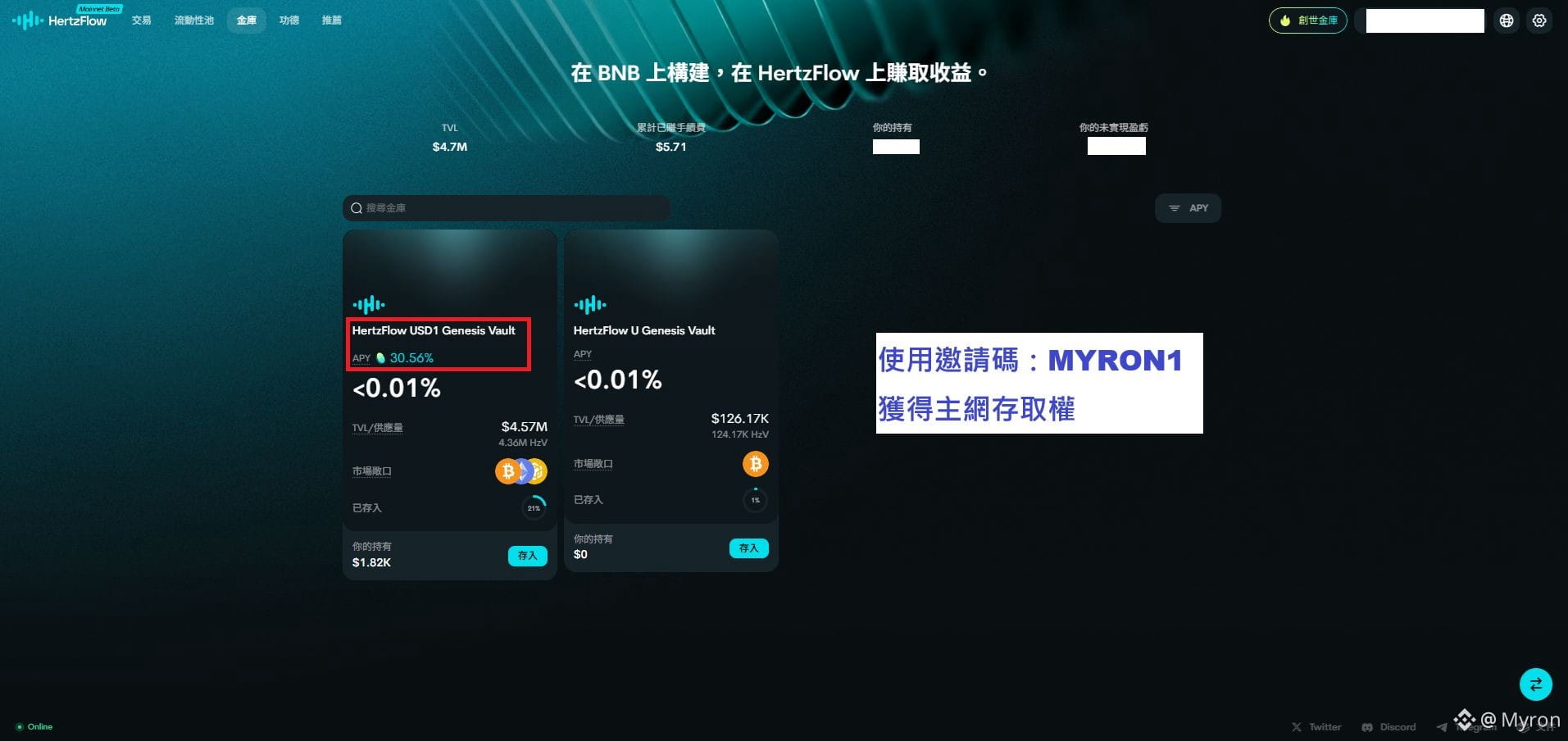
HertzFlow Mainnet Trading Feature Goes Live, Along With a New Round of 390K $WLFI Incentives (Current 30% APY)
As expected, once the BNB Chain mainnet trading feature officially opened, a new set of incentives was rolled out to encourage deposit behavior.
While the official post says there’s no hard cap, the treasury page shows an upper limit of $22.2M. Below are the annualized figures corresponding to each total amount (estimates; may fluctuate):
$5.5M (25% APY)
$11.1M (10.8% APY)
$16.65M (7.2% APY)
$22.2M (5.4% APY)
Please note that the annualized rates listed above only reflect WLFI’s subsidized incentive—excluding trading fees and profits/losses from traders. Therefore, the actual annualized return may be higher.
Most importantly, this round of incentives is only for users who deposit funds between 8/24 and 8/31 to share the pool!
If you want to participate in HertzFlow mainnet right now, you need an invitation code to gain access. Interested friends can try: MYRON1
Let’s be early market makers!
-
● The above content does not constitute investment advice (NFA). Users should operate based on their own risk tolerance. DYOR and participate in the investment market cautiously.
● The attached images are sourced from HertzFlow
#hertzflow #BNBChain #WLFI #Airdrop
{spot}(USD1USDT)
{spot}(BNBUSDT)
{spot}(WLFIUSDT)
HertzFlow Mainnet Trading Feature Goes Live, Along With a New Round of 390K $WLFI Incentives (Current 30% APY)
As expected, once the BNB Chain mainnet trading feature officially opened, a new set of incentives was rolled out to encourage deposit behavior.
While the official post says there’s no hard cap, the treasury page shows an upper limit of $22.2M. Below are the annualized figures corresponding to each total amount (estimates; may fluctuate):
$5.5M (25% APY)
$11.1M (10.8% APY)
$16.65M (7.2% APY)
$22.2M (5.4% APY)
Please note that the annualized rates listed above only reflect WLFI’s subsidized incentive—excluding trading fees and profits/losses from traders. Therefore, the actual annualized return may be higher.
Most importantly, this round of incentives is only for users who deposit funds between 8/24 and 8/31 to share the pool!
If you want to participate in HertzFlow mainnet right now, you need an invitation code to gain access. Interested friends can try: MYRON1
Let’s be early market makers!
-
● The above content does not constitute investment advice (NFA). Users should operate based on their own risk tolerance. DYOR and participate in the investment market cautiously.
● The attached images are sourced from HertzFlow
#hertzflow #BNBChain #WLFI #Airdrop
As expected, once the BNB Chain mainnet trading feature officially opened, a new set of incentives was rolled out to encourage deposit behavior.
While the official post says there’s no hard cap, the treasury page shows an upper limit of $22.2M. Below are the annualized figures corresponding to each total amount (estimates; may fluctuate):
$5.5M (25% APY)
$11.1M (10.8% APY)
$16.65M (7.2% APY)
$22.2M (5.4% APY)
Please note that the annualized rates listed above only reflect WLFI’s subsidized incentive—excluding trading fees and profits/losses from traders. Therefore, the actual annualized return may be higher.
Most importantly, this round of incentives is only for users who deposit funds between 8/24 and 8/31 to share the pool!
If you want to participate in HertzFlow mainnet right now, you need an invitation code to gain access. Interested friends can try: MYRON1
Let’s be early market makers!
-
● The above content does not constitute investment advice (NFA). Users should operate based on their own risk tolerance. DYOR and participate in the investment market cautiously.
● The attached images are sourced from HertzFlow
#hertzflow #BNBChain #WLFI #Airdrop
1
1
547
·
--
Bullish
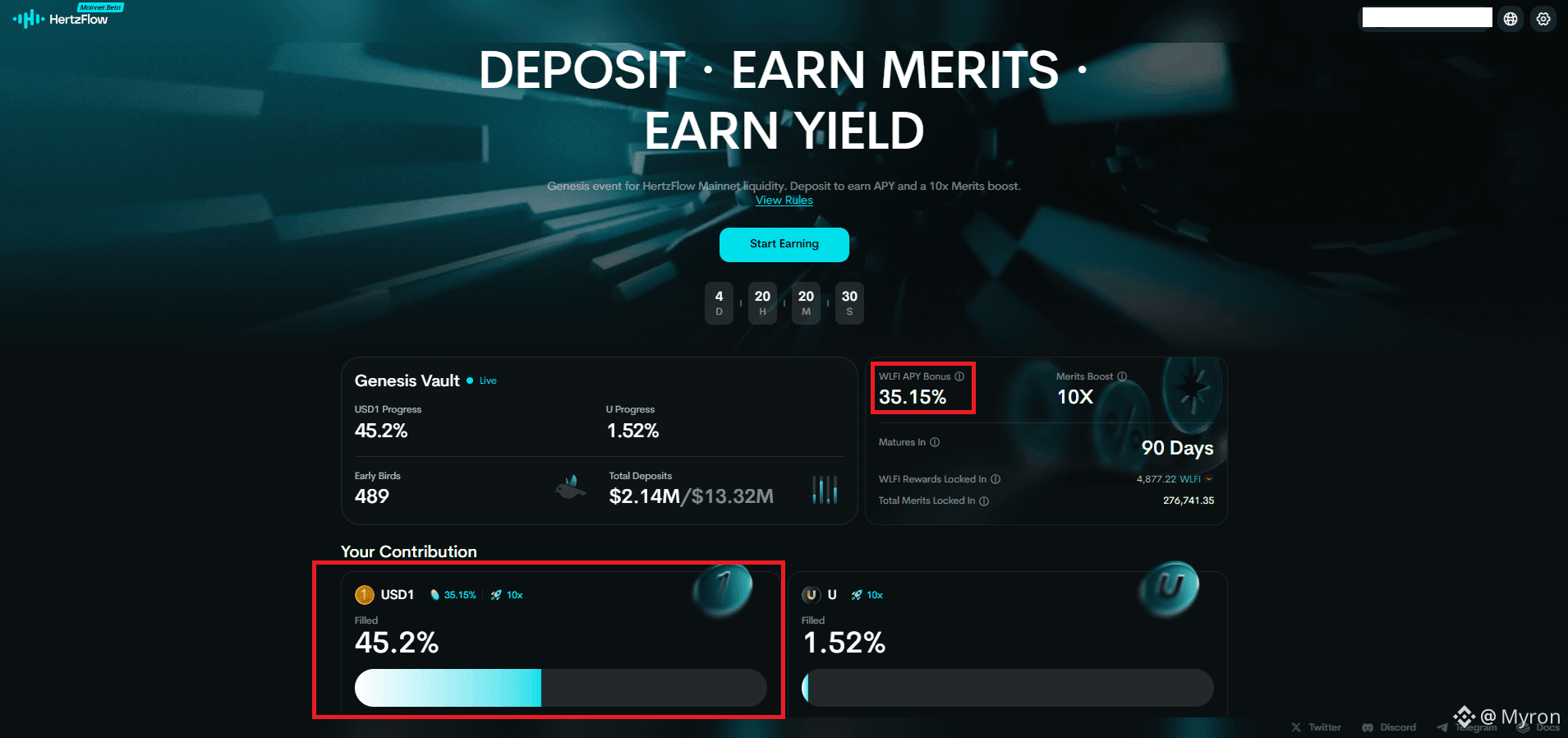
HertzFlow injects Genesis Vault Incentives $WLFI , with the current APY reaching as high as 35%.
In cases where pre-staking rewards are unclear, HertzFlow goes straight in with a strong move—adding an extra 230K WLFI to the USD1 pool.
Since both the pool and incentives are fixed amounts, roughly estimating it, when the USD1 pool reaches 100% staked amount, the subsidized WLFI APY is still about 15%.
At that time, combined with the earnings after the mainnet trading feature goes live, it’s quite competitive in the current market.
However, it’s important to note that the rewards are distributed after 90 days, so the actual cash return depends on the token price when you claim.
Currently, the USD1 pool’s overall staked amount is around 45%. I’m planning to move a bit of the USD1 I have on the CEX into HertzFlow to grab an early whitelist spot plus WLFI rewards!
Also, the team has hinted that using a Binance wallet to participate could work—so you can follow that and see if there’s any benefit later.
Staking is done on BNB Chain ~
-
● The above content does not constitute investment advice (NFA). Users should act according to their own risk tolerance. DYOR—please participate cautiously in the investment market.
● The attached images are taken from HertzFlow.
#HertzFlow #BNBChain #WLFI #USD1 $BNB
{spot}(BNBUSDT)
{spot}(USD1USDT)
{spot}(WLFIUSDT)
HertzFlow injects Genesis Vault Incentives $WLFI , with the current APY reaching as high as 35%.
In cases where pre-staking rewards are unclear, HertzFlow goes straight in with a strong move—adding an extra 230K WLFI to the USD1 pool.
Since both the pool and incentives are fixed amounts, roughly estimating it, when the USD1 pool reaches 100% staked amount, the subsidized WLFI APY is still about 15%.
At that time, combined with the earnings after the mainnet trading feature goes live, it’s quite competitive in the current market.
However, it’s important to note that the rewards are distributed after 90 days, so the actual cash return depends on the token price when you claim.
Currently, the USD1 pool’s overall staked amount is around 45%. I’m planning to move a bit of the USD1 I have on the CEX into HertzFlow to grab an early whitelist spot plus WLFI rewards!
Also, the team has hinted that using a Binance wallet to participate could work—so you can follow that and see if there’s any benefit later.
Staking is done on BNB Chain ~
-
● The above content does not constitute investment advice (NFA). Users should act according to their own risk tolerance. DYOR—please participate cautiously in the investment market.
● The attached images are taken from HertzFlow.
#HertzFlow #BNBChain #WLFI #USD1 $BNB
In cases where pre-staking rewards are unclear, HertzFlow goes straight in with a strong move—adding an extra 230K WLFI to the USD1 pool.
Since both the pool and incentives are fixed amounts, roughly estimating it, when the USD1 pool reaches 100% staked amount, the subsidized WLFI APY is still about 15%.
At that time, combined with the earnings after the mainnet trading feature goes live, it’s quite competitive in the current market.
However, it’s important to note that the rewards are distributed after 90 days, so the actual cash return depends on the token price when you claim.
Currently, the USD1 pool’s overall staked amount is around 45%. I’m planning to move a bit of the USD1 I have on the CEX into HertzFlow to grab an early whitelist spot plus WLFI rewards!
Also, the team has hinted that using a Binance wallet to participate could work—so you can follow that and see if there’s any benefit later.
Staking is done on BNB Chain ~
-
● The above content does not constitute investment advice (NFA). Users should act according to their own risk tolerance. DYOR—please participate cautiously in the investment market.
● The attached images are taken from HertzFlow.
#HertzFlow #BNBChain #WLFI #USD1 $BNB
Myron
·
--
【HertzFlow mainnet goes live—should you participate in the Genesis Vault pre-staking?】
If nothing unexpected happens, the name “HertzFlow” should show up frequently in the algorithm feeds of Chinese crypto users in the second half of the year.
First, YZi Labs’ investment and incubation implies that support for the BSC ecosystem won’t be lacking. Second, the founding team itself consists of Chinese-language opinion leaders, and their Chinese-language promotional channels are diverse.
However, KOL promotion is one thing—the actual results still need to be observed.
Based on the results from roughly the first 24 hours after the mainnet launch, only about 300 addresses have participated in deposits, with total deposits of approximately 1.5M USD (about 11% of the total deposit cap).
-
As for the reason, I believe it’s still because the incentive factors for pre-staking aren’t obvious enough.
At present, users can only know that after participating in pre-staking, if they continue to stake their assets for 90 days, they will be able to receive 10x Merits (airdrop points).
But the truly important figure—the annualized return rate—remains unknown, because it depends on factors such as how active the HertzFlow mainnet’s transaction features are and how funds flow.
Evidently, the team is aware of this. Today, the founder “Crypto Veda” published a long post addressing potential community questions, including: “Based on reference similar-model agreements, we believe that an expected 8% to 16% APY is reasonable.”
Of course, providing liquidity to Perps DEXs is nothing new, but the effectiveness of LPs’ returns is still largely tied to traders’ profitability—so it becomes a balancing act of give and take.
Another factor is timing: we’re still in a bear market. It’s hard to say how much trading appetite the market currently has that can be satisfied, or when trading volume might increase significantly. This is itself a major challenge for HertzFlow in choosing to launch at this moment.
-
Back to the question: Is it worth participating in the Genesis Vault?
Personally, I think that at the current stage, $USD1 $U whether on the exchange or on the wallet side, there’s already decent room for earnings—this is one of the reasons users may hesitate to participate in HertzFlow.
Also, based on the current scale of participation, users likely don’t need to deploy large positions just to grab early momentum—that’s more of a competitive consideration.
So I think it’s safer to treat this as a small-capital participation: put in a spot check if you want. By taking an early whitelist for upcoming trading functionality, you might even be able to secure a bit of the early advantage.
At least, they mentioned that the fee consumption before token issuance will be offset by issuing discount vouchers after the token launch.
-
#hertzflow #YZILabs #Airdrop
If nothing unexpected happens, the name “HertzFlow” should show up frequently in the algorithm feeds of Chinese crypto users in the second half of the year.
First, YZi Labs’ investment and incubation implies that support for the BSC ecosystem won’t be lacking. Second, the founding team itself consists of Chinese-language opinion leaders, and their Chinese-language promotional channels are diverse.
However, KOL promotion is one thing—the actual results still need to be observed.
Based on the results from roughly the first 24 hours after the mainnet launch, only about 300 addresses have participated in deposits, with total deposits of approximately 1.5M USD (about 11% of the total deposit cap).
-
As for the reason, I believe it’s still because the incentive factors for pre-staking aren’t obvious enough.
At present, users can only know that after participating in pre-staking, if they continue to stake their assets for 90 days, they will be able to receive 10x Merits (airdrop points).
But the truly important figure—the annualized return rate—remains unknown, because it depends on factors such as how active the HertzFlow mainnet’s transaction features are and how funds flow.
Evidently, the team is aware of this. Today, the founder “Crypto Veda” published a long post addressing potential community questions, including: “Based on reference similar-model agreements, we believe that an expected 8% to 16% APY is reasonable.”
Of course, providing liquidity to Perps DEXs is nothing new, but the effectiveness of LPs’ returns is still largely tied to traders’ profitability—so it becomes a balancing act of give and take.
Another factor is timing: we’re still in a bear market. It’s hard to say how much trading appetite the market currently has that can be satisfied, or when trading volume might increase significantly. This is itself a major challenge for HertzFlow in choosing to launch at this moment.
-
Back to the question: Is it worth participating in the Genesis Vault?
Personally, I think that at the current stage, $USD1 $U whether on the exchange or on the wallet side, there’s already decent room for earnings—this is one of the reasons users may hesitate to participate in HertzFlow.
Also, based on the current scale of participation, users likely don’t need to deploy large positions just to grab early momentum—that’s more of a competitive consideration.
So I think it’s safer to treat this as a small-capital participation: put in a spot check if you want. By taking an early whitelist for upcoming trading functionality, you might even be able to secure a bit of the early advantage.
At least, they mentioned that the fee consumption before token issuance will be offset by issuing discount vouchers after the token launch.
-
#hertzflow #YZILabs #Airdrop
1
83
·
--
Bullish
【Binance Wallet Native Ends Its Q3 Campaign—Redemption Method and Current Annualized Yield?】
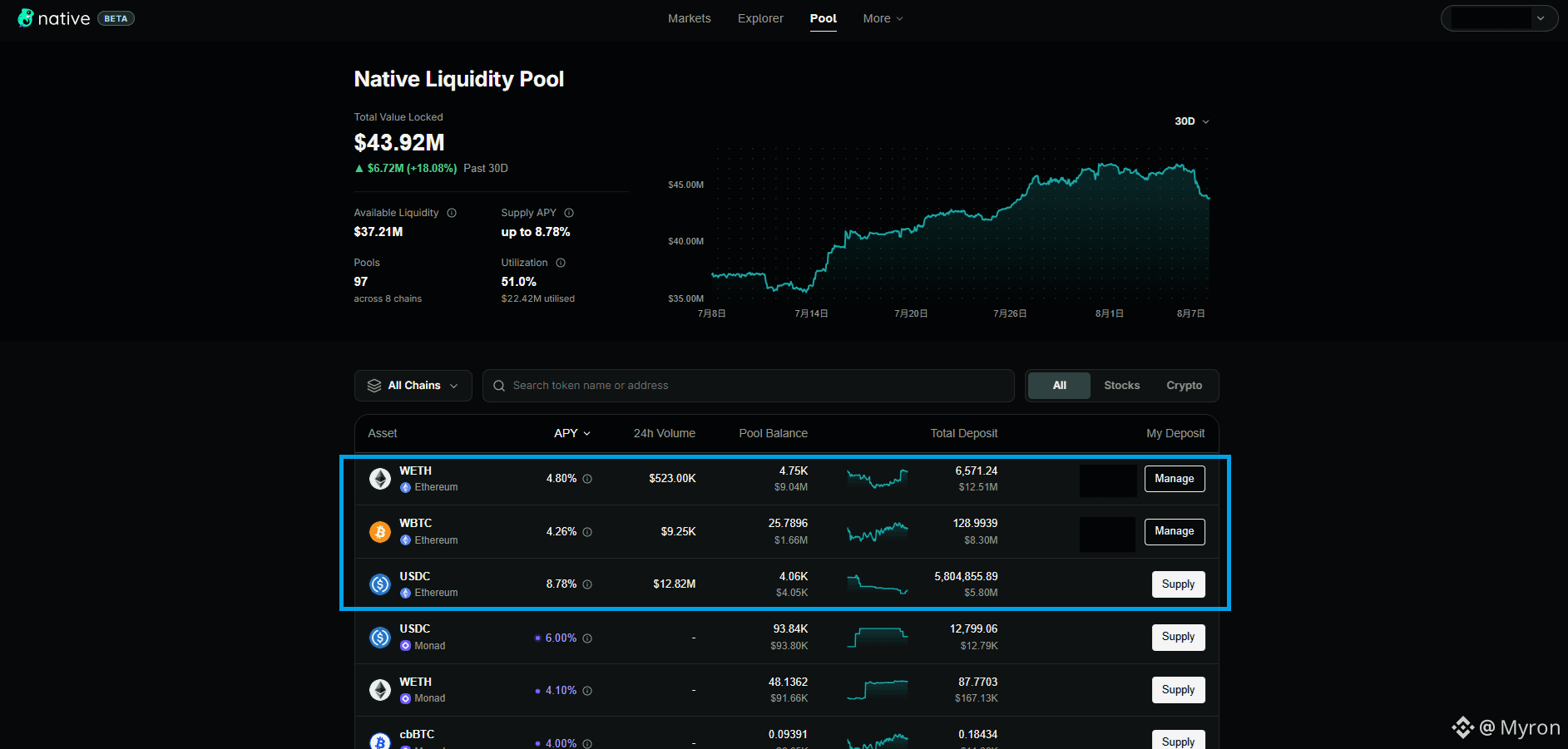
The Native x Binance Wallet earning campaign didn’t renew. My $BTC $ETH has been staked there for about half a year (3/25~8/7). When I checked again, after reverting to Native’s native annualized yield, both are in the 4%–5% APY range.
Last night, I noticed that a lot of people were already redeeming on the Binance Wallet campaign page. Maybe they’re worried that after the campaign ends, they won’t be able to find the redemption page? (APY surged from 4% to 8%.)
If it’s WETH, you can see the redeem button directly from the Binance Wallet assets page. If it’s WBTC, you’ll need to manually go to the Native page to redeem.
➤ The steps are as follows—click in this order:
Assets → Decentralized Finance → the web icon next to Native → Launch App → Pool
After connecting your wallet, you can see your staked assets on the Pool page and handle the redemption there.
The same steps can be done on both mobile and web.
➤ As for whether to keep staking, I’ll observe:
1. Whether other DeFi options in the current market offer more competitive annualized returns (5%+)
2. The usage rate and liquidity of the Native DEX
Based on current data, liquidity and usage seem fairly balanced. At this stage, it probably won’t be easy to encounter a situation where you can’t withdraw. However, Native redemptions have a built-in 3-day processing period.
From what I’ve heard about their liquidity: it’s primarily routed to major DeFi platforms or CEXs’ wallets (MM) for trading, rather than directly connecting to retail users. That part is up to everyone’s own judgment on whether to keep providing liquidity.
-
● The above content does not constitute investment advice (NFA). Users should act according to their own risk tolerance. DYOR and participate in the investment market cautiously.
● The attached images are sourced from Native.
● Binance Wallet 30% fee discount: MYRONC
#BinanceWallet #native #BTC #ETH
{spot}(ETHUSDT)
{spot}(WBTCUSDT)
【Binance Wallet Native Ends Its Q3 Campaign—Redemption Method and Current Annualized Yield?】
The Native x Binance Wallet earning campaign didn’t renew. My $BTC $ETH has been staked there for about half a year (3/25~8/7). When I checked again, after reverting to Native’s native annualized yield, both are in the 4%–5% APY range.
Last night, I noticed that a lot of people were already redeeming on the Binance Wallet campaign page. Maybe they’re worried that after the campaign ends, they won’t be able to find the redemption page? (APY surged from 4% to 8%.)
If it’s WETH, you can see the redeem button directly from the Binance Wallet assets page. If it’s WBTC, you’ll need to manually go to the Native page to redeem.
➤ The steps are as follows—click in this order:
Assets → Decentralized Finance → the web icon next to Native → Launch App → Pool
After connecting your wallet, you can see your staked assets on the Pool page and handle the redemption there.
The same steps can be done on both mobile and web.
➤ As for whether to keep staking, I’ll observe:
1. Whether other DeFi options in the current market offer more competitive annualized returns (5%+)
2. The usage rate and liquidity of the Native DEX
Based on current data, liquidity and usage seem fairly balanced. At this stage, it probably won’t be easy to encounter a situation where you can’t withdraw. However, Native redemptions have a built-in 3-day processing period.
From what I’ve heard about their liquidity: it’s primarily routed to major DeFi platforms or CEXs’ wallets (MM) for trading, rather than directly connecting to retail users. That part is up to everyone’s own judgment on whether to keep providing liquidity.
-
● The above content does not constitute investment advice (NFA). Users should act according to their own risk tolerance. DYOR and participate in the investment market cautiously.
● The attached images are sourced from Native.
● Binance Wallet 30% fee discount: MYRONC
#BinanceWallet #native #BTC #ETH
The Native x Binance Wallet earning campaign didn’t renew. My $BTC $ETH has been staked there for about half a year (3/25~8/7). When I checked again, after reverting to Native’s native annualized yield, both are in the 4%–5% APY range.
Last night, I noticed that a lot of people were already redeeming on the Binance Wallet campaign page. Maybe they’re worried that after the campaign ends, they won’t be able to find the redemption page? (APY surged from 4% to 8%.)
If it’s WETH, you can see the redeem button directly from the Binance Wallet assets page. If it’s WBTC, you’ll need to manually go to the Native page to redeem.
➤ The steps are as follows—click in this order:
Assets → Decentralized Finance → the web icon next to Native → Launch App → Pool
After connecting your wallet, you can see your staked assets on the Pool page and handle the redemption there.
The same steps can be done on both mobile and web.
➤ As for whether to keep staking, I’ll observe:
1. Whether other DeFi options in the current market offer more competitive annualized returns (5%+)
2. The usage rate and liquidity of the Native DEX
Based on current data, liquidity and usage seem fairly balanced. At this stage, it probably won’t be easy to encounter a situation where you can’t withdraw. However, Native redemptions have a built-in 3-day processing period.
From what I’ve heard about their liquidity: it’s primarily routed to major DeFi platforms or CEXs’ wallets (MM) for trading, rather than directly connecting to retail users. That part is up to everyone’s own judgment on whether to keep providing liquidity.
-
● The above content does not constitute investment advice (NFA). Users should act according to their own risk tolerance. DYOR and participate in the investment market cautiously.
● The attached images are sourced from Native.
● Binance Wallet 30% fee discount: MYRONC
#BinanceWallet #native #BTC #ETH
2
324
·
--
Bearish
Verified
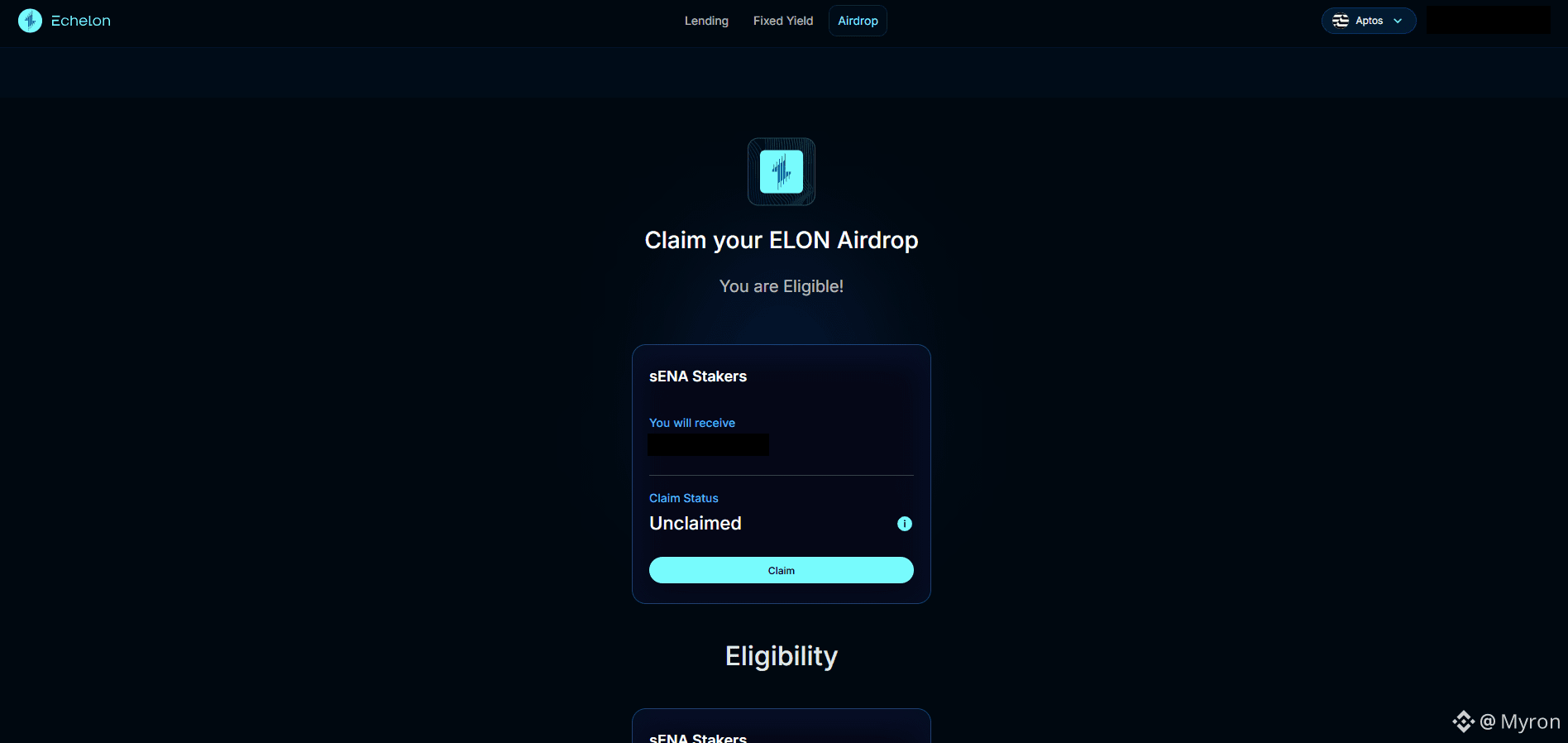
Echelon’s quarterly airdrop for Ethena sENA holders is finally claimable, but once claimed—where can you sell it??
This Ethena ecosystem airdrop is truly a dead-end: staking $ENA is nothing short of bad luck. It places absolutely no constraints on the partner projects.
According to the original rules, after Echelon completed the initial token issuance, the sENA airdrop allocations would be claimable each quarter. But it keeps delaying the quarterly airdrops. When I went to check the details, they only replied, “Delayed—no definite time for claiming.”
Just found out it’s claimable now, then checked—on-chain there’s basically no liquidity available to sell. On the Aptos chain, the only place to trade $ELON is Thala Swap, and the liquidity left is only around $1K.
According to CoinMarketCap, only four small or mid-sized exchanges support $ELON (Binance Alpha is on BNB Chain, different from the chain where the airdrop was distributed). This team really has no floor…
-
● The above content is not investment advice (NFA). Please act according to your own risk tolerance and DYOR carefully before participating in the market.
● The accompanying images are sourced from Echelon
#Echelon #ethena #ENA质押 #elon $APT
{spot}(ENAUSDT)
{spot}(APTUSDT)
Echelon’s quarterly airdrop for Ethena sENA holders is finally claimable, but once claimed—where can you sell it??
This Ethena ecosystem airdrop is truly a dead-end: staking $ENA is nothing short of bad luck. It places absolutely no constraints on the partner projects.
According to the original rules, after Echelon completed the initial token issuance, the sENA airdrop allocations would be claimable each quarter. But it keeps delaying the quarterly airdrops. When I went to check the details, they only replied, “Delayed—no definite time for claiming.”
Just found out it’s claimable now, then checked—on-chain there’s basically no liquidity available to sell. On the Aptos chain, the only place to trade $ELON is Thala Swap, and the liquidity left is only around $1K.
According to CoinMarketCap, only four small or mid-sized exchanges support $ELON (Binance Alpha is on BNB Chain, different from the chain where the airdrop was distributed). This team really has no floor…
-
● The above content is not investment advice (NFA). Please act according to your own risk tolerance and DYOR carefully before participating in the market.
● The accompanying images are sourced from Echelon
#Echelon #ethena #ENA质押 #elon $APT
This Ethena ecosystem airdrop is truly a dead-end: staking $ENA is nothing short of bad luck. It places absolutely no constraints on the partner projects.
According to the original rules, after Echelon completed the initial token issuance, the sENA airdrop allocations would be claimable each quarter. But it keeps delaying the quarterly airdrops. When I went to check the details, they only replied, “Delayed—no definite time for claiming.”
Just found out it’s claimable now, then checked—on-chain there’s basically no liquidity available to sell. On the Aptos chain, the only place to trade $ELON is Thala Swap, and the liquidity left is only around $1K.
According to CoinMarketCap, only four small or mid-sized exchanges support $ELON (Binance Alpha is on BNB Chain, different from the chain where the airdrop was distributed). This team really has no floor…
-
● The above content is not investment advice (NFA). Please act according to your own risk tolerance and DYOR carefully before participating in the market.
● The accompanying images are sourced from Echelon
#Echelon #ethena #ENA质押 #elon $APT
3
2
1.1k
·
--
Bearish
Velvet Perps Trading Competition—Is this initiative here to trick $VELVET staked users?
I originally wanted to praise it: VelvetX supports on-chain trading with zero gas fees on BNB Chain and Robinhood Chain, so you don’t have to specially hit $BNB $ETH in order to trade.
But before the token airdrop campaign worth over $1M was set to end before 8/10, it suddenly launched a contract trading competition (ending 8/9). The prize pool is 75M GEMS (airdropped points), distributed to the top 25 users based on trading volume and PNL.
It wants to get everyone to trade at high frequency through the airdrop campaign, while it happily collects trading fees. However, this initiative will relatively dilute user points from people who stake tokens, hold official NFTs, or create vault strategies—pretty hilarious.
Let’s compare the points leaderboard for Epoch 11:
The 75M airdrop points from the Perps Trading Competition roughly corresponds to about a 1% airdrop prize pool—meaning around $10,000 worth of value—but in practice it can’t simply be recorded as equivalent value, because what’s actually happening is just point inflation.
They ran a “sprint” campaign: not even a cash prize pool—just further minting points to dilute the points of users who aren’t trading. Honestly, that’s a genius plan, huh? Haha
-
● The above does not constitute investment advice (NFA). Users should act according to their own risk tolerance. DYOR and participate in the investment market cautiously.
● The attached images are sourced from Velvet X
#Velvet #BNBChain #robinhoodchain #BNB
{spot}(ETHUSDT)
{spot}(BNBUSDT)
{alpha}(560x8b194370825e37b33373e74a41009161808c1488)
Velvet Perps Trading Competition—Is this initiative here to trick $VELVET staked users?
I originally wanted to praise it: VelvetX supports on-chain trading with zero gas fees on BNB Chain and Robinhood Chain, so you don’t have to specially hit $BNB $ETH in order to trade.
But before the token airdrop campaign worth over $1M was set to end before 8/10, it suddenly launched a contract trading competition (ending 8/9). The prize pool is 75M GEMS (airdropped points), distributed to the top 25 users based on trading volume and PNL.
It wants to get everyone to trade at high frequency through the airdrop campaign, while it happily collects trading fees. However, this initiative will relatively dilute user points from people who stake tokens, hold official NFTs, or create vault strategies—pretty hilarious.
Let’s compare the points leaderboard for Epoch 11:
The 75M airdrop points from the Perps Trading Competition roughly corresponds to about a 1% airdrop prize pool—meaning around $10,000 worth of value—but in practice it can’t simply be recorded as equivalent value, because what’s actually happening is just point inflation.
They ran a “sprint” campaign: not even a cash prize pool—just further minting points to dilute the points of users who aren’t trading. Honestly, that’s a genius plan, huh? Haha
-
● The above does not constitute investment advice (NFA). Users should act according to their own risk tolerance. DYOR and participate in the investment market cautiously.
● The attached images are sourced from Velvet X
#Velvet #BNBChain #robinhoodchain #BNB
I originally wanted to praise it: VelvetX supports on-chain trading with zero gas fees on BNB Chain and Robinhood Chain, so you don’t have to specially hit $BNB $ETH in order to trade.
But before the token airdrop campaign worth over $1M was set to end before 8/10, it suddenly launched a contract trading competition (ending 8/9). The prize pool is 75M GEMS (airdropped points), distributed to the top 25 users based on trading volume and PNL.
It wants to get everyone to trade at high frequency through the airdrop campaign, while it happily collects trading fees. However, this initiative will relatively dilute user points from people who stake tokens, hold official NFTs, or create vault strategies—pretty hilarious.
Let’s compare the points leaderboard for Epoch 11:
The 75M airdrop points from the Perps Trading Competition roughly corresponds to about a 1% airdrop prize pool—meaning around $10,000 worth of value—but in practice it can’t simply be recorded as equivalent value, because what’s actually happening is just point inflation.
They ran a “sprint” campaign: not even a cash prize pool—just further minting points to dilute the points of users who aren’t trading. Honestly, that’s a genius plan, huh? Haha
-
● The above does not constitute investment advice (NFA). Users should act according to their own risk tolerance. DYOR and participate in the investment market cautiously.
● The attached images are sourced from Velvet X
#Velvet #BNBChain #robinhoodchain #BNB

1
1
570
·
--
Bullish
【How feasible is hedging JPY against the USD using leverage on HertzFlow?】
So today I liquidated my Web2 JPY position—held for about half a year—with an annualized return rate of ~5.5%.
Strictly speaking, at the beginning of the year when I was doing asset allocation, my thinking for foreign-currency holdings was more like: hold mostly cryptocurrencies with USD-pegged stablecoins, and look for an instrument that hedges USD risk to some extent.
Even though, over the past two years, international conditions and currency policy seem to have reduced the strength of the negative correlation between JPY and USD compared to the past, the opposite direction still exists—so there is some incentive for risk diversification.
However, in practice, the divergence in FX pricing is still a bit large. For example, when I use Cathay, the online banking buy-JPY option offers things like loyal-customer discounts and digital discounts. To get the best exchange rate, it’s usually only worth operating if you deposit a certain amount of assets and obtain VIP status.
-
Back to HertzFlow—pulled up its chart (USD/JPY):
➤ The lowest point appears on 2/12 ($152)
➤ The highest point appears on 7/30 ($163)
The swing from the low to the high is about 7%. Typical single-day volatility is around 0.5%~1%, but occasionally there are sudden spikes of 2%~4%.
Overall, it seems to me that if you’re a long-term holder using currency risk hedging as the goal, opening leverage of 5x~10x is relatively manageable—for instance, over the past few days the U.S. has actively intervened in the JPY exchange rate. That kind of extremely rare historical event is still something you can hold through.
Even though HertzFlow’s standard mode leverage can be set up to 50x, and ultra-high leverage can go up to 200x, in practice I think 20x~30x is probably the upper limit for short-term day trading—roughly about a 3% maneuvering buffer.
If it were me, the next time I encounter a relatively sweet entry price, I’d probably participate with 10x leverage. Looking at the annualized amplification, it’s quite something—though over longer time horizons, accumulating funding fees might still be significant.
Also, HertzFlow should be getting close to launching on the BSC mainnet, so it might be worth keeping an eye out for any potential airdrop opportunities.
-
● The above does not constitute investment advice (NFA). Users should act according to their own risk tolerance. DYOR and participate in the investment market cautiously.
● The attached image is sourced from HertzFlow
● HertzFlow 5% fee discount: MYRONC
#hertzflow #美日2011年来首次联合干预日元 #日元急涨 $BNB
{spot}(BNBUSDT)
【How feasible is hedging JPY against the USD using leverage on HertzFlow?】
So today I liquidated my Web2 JPY position—held for about half a year—with an annualized return rate of ~5.5%.
Strictly speaking, at the beginning of the year when I was doing asset allocation, my thinking for foreign-currency holdings was more like: hold mostly cryptocurrencies with USD-pegged stablecoins, and look for an instrument that hedges USD risk to some extent.
Even though, over the past two years, international conditions and currency policy seem to have reduced the strength of the negative correlation between JPY and USD compared to the past, the opposite direction still exists—so there is some incentive for risk diversification.
However, in practice, the divergence in FX pricing is still a bit large. For example, when I use Cathay, the online banking buy-JPY option offers things like loyal-customer discounts and digital discounts. To get the best exchange rate, it’s usually only worth operating if you deposit a certain amount of assets and obtain VIP status.
-
Back to HertzFlow—pulled up its chart (USD/JPY):
➤ The lowest point appears on 2/12 ($152)
➤ The highest point appears on 7/30 ($163)
The swing from the low to the high is about 7%. Typical single-day volatility is around 0.5%~1%, but occasionally there are sudden spikes of 2%~4%.
Overall, it seems to me that if you’re a long-term holder using currency risk hedging as the goal, opening leverage of 5x~10x is relatively manageable—for instance, over the past few days the U.S. has actively intervened in the JPY exchange rate. That kind of extremely rare historical event is still something you can hold through.
Even though HertzFlow’s standard mode leverage can be set up to 50x, and ultra-high leverage can go up to 200x, in practice I think 20x~30x is probably the upper limit for short-term day trading—roughly about a 3% maneuvering buffer.
If it were me, the next time I encounter a relatively sweet entry price, I’d probably participate with 10x leverage. Looking at the annualized amplification, it’s quite something—though over longer time horizons, accumulating funding fees might still be significant.
Also, HertzFlow should be getting close to launching on the BSC mainnet, so it might be worth keeping an eye out for any potential airdrop opportunities.
-
● The above does not constitute investment advice (NFA). Users should act according to their own risk tolerance. DYOR and participate in the investment market cautiously.
● The attached image is sourced from HertzFlow
● HertzFlow 5% fee discount: MYRONC
#hertzflow #美日2011年来首次联合干预日元 #日元急涨 $BNB
So today I liquidated my Web2 JPY position—held for about half a year—with an annualized return rate of ~5.5%.
Strictly speaking, at the beginning of the year when I was doing asset allocation, my thinking for foreign-currency holdings was more like: hold mostly cryptocurrencies with USD-pegged stablecoins, and look for an instrument that hedges USD risk to some extent.
Even though, over the past two years, international conditions and currency policy seem to have reduced the strength of the negative correlation between JPY and USD compared to the past, the opposite direction still exists—so there is some incentive for risk diversification.
However, in practice, the divergence in FX pricing is still a bit large. For example, when I use Cathay, the online banking buy-JPY option offers things like loyal-customer discounts and digital discounts. To get the best exchange rate, it’s usually only worth operating if you deposit a certain amount of assets and obtain VIP status.
-
Back to HertzFlow—pulled up its chart (USD/JPY):
➤ The lowest point appears on 2/12 ($152)
➤ The highest point appears on 7/30 ($163)
The swing from the low to the high is about 7%. Typical single-day volatility is around 0.5%~1%, but occasionally there are sudden spikes of 2%~4%.
Overall, it seems to me that if you’re a long-term holder using currency risk hedging as the goal, opening leverage of 5x~10x is relatively manageable—for instance, over the past few days the U.S. has actively intervened in the JPY exchange rate. That kind of extremely rare historical event is still something you can hold through.
Even though HertzFlow’s standard mode leverage can be set up to 50x, and ultra-high leverage can go up to 200x, in practice I think 20x~30x is probably the upper limit for short-term day trading—roughly about a 3% maneuvering buffer.
If it were me, the next time I encounter a relatively sweet entry price, I’d probably participate with 10x leverage. Looking at the annualized amplification, it’s quite something—though over longer time horizons, accumulating funding fees might still be significant.
Also, HertzFlow should be getting close to launching on the BSC mainnet, so it might be worth keeping an eye out for any potential airdrop opportunities.
-
● The above does not constitute investment advice (NFA). Users should act according to their own risk tolerance. DYOR and participate in the investment market cautiously.
● The attached image is sourced from HertzFlow
● HertzFlow 5% fee discount: MYRONC
#hertzflow #美日2011年来首次联合干预日元 #日元急涨 $BNB
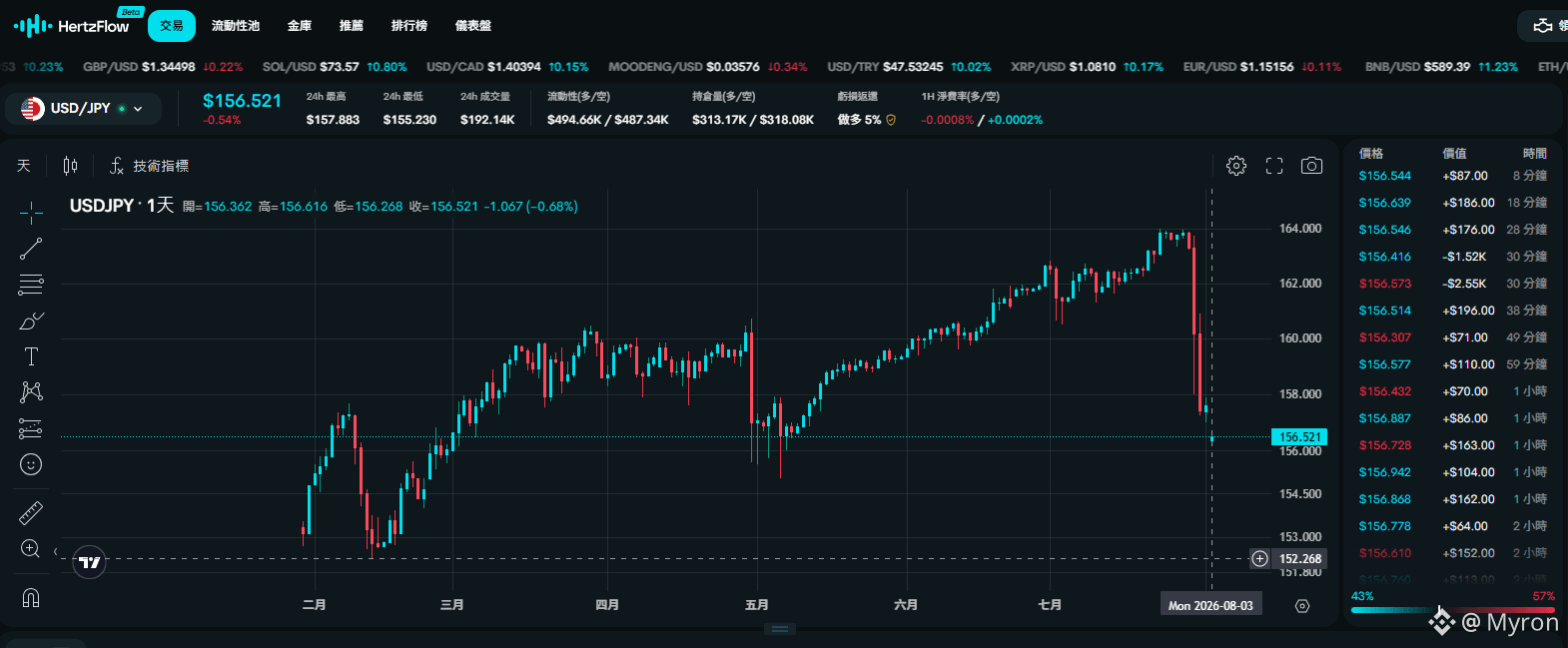
1
249
·
--
Bullish
【Renaiss July Limited-Ediiton Card Packs vs. Regular Card Packs: Are the Limited Packs Still Worth Snatching?】
After sorting out the data for the @renaissprotocol 7 July limited-edition card packs yesterday, I compared it with the overall data and found: “Regular (non-limited) card packs have significantly higher purchase events and purchase amounts than the historical average.”
Here are a few inferences worth watching going forward:
1. Renaiss users’ interest in non-limited card packs is continuing to grow
2. Non-limited card packs may have wider circulation. If pack openers don’t immediately sell back to the official, users may have opportunities to buy the cards they want on the secondary market
3. The supply of limited-edition card packs might be increased
-
➤ What this means for users
I think the biggest impact will be the growth in supply of cards from non-limited card packs.
Given the increase in absolute supply, if pack openers choose to sell on the secondary market instead of selling directly back to the official through the buyback mechanism, then in theory users will be more likely than before to find the cards they want on the secondary market.
➤ What this means for the official
Here I would make a bold operational decision: “Try increasing the supply of limited-edition card packs.”
So far, Renaiss has maintained the principle that each limited-edition card pack release is 1,000 packs. If we treat “the limited-edition card pack sell-through speed (sold out)” as one determining factor, and also treat “the limited-edition card packs’ share of the total data for that month” as another determining factor, then I believe these two factors have already met the conditions to attempt increasing the supply—for example, increasing from 1,000 to 1,500 (+50%)—to test whether user demand for non-limited card packs has already been met.
-
Summary
Personally, I think the growth in data for non-limited card packs is currently a favorable factor. If it can also successfully boost the activity and liquidity of the secondary market, it will likely improve users’ confidence in holding cards long-term as well.
This will have positive contributing factors for future initiatives, whether it’s the launch of the staking mechanism or long-term improvements in trading circulation efficiency, and it will align even more with the value proposition of on-chain collectibles.
But is it actually the case that Renaiss users prefer redeeming directly for the physical cards?
-
● The above content is not investment advice (NFA). Please operate according to your own risk tolerance. DYOR and participate in the investment market cautiously.
#renaiss #RWA #BSC $BNB
{spot}(BNBUSDT)
【Renaiss July Limited-Ediiton Card Packs vs. Regular Card Packs: Are the Limited Packs Still Worth Snatching?】
After sorting out the data for the @Renaiss Collectibles 7 July limited-edition card packs yesterday, I compared it with the overall data and found: “Regular (non-limited) card packs have significantly higher purchase events and purchase amounts than the historical average.”
Here are a few inferences worth watching going forward:
1. Renaiss users’ interest in non-limited card packs is continuing to grow
2. Non-limited card packs may have wider circulation. If pack openers don’t immediately sell back to the official, users may have opportunities to buy the cards they want on the secondary market
3. The supply of limited-edition card packs might be increased
-
➤ What this means for users
I think the biggest impact will be the growth in supply of cards from non-limited card packs.
Given the increase in absolute supply, if pack openers choose to sell on the secondary market instead of selling directly back to the official through the buyback mechanism, then in theory users will be more likely than before to find the cards they want on the secondary market.
➤ What this means for the official
Here I would make a bold operational decision: “Try increasing the supply of limited-edition card packs.”
So far, Renaiss has maintained the principle that each limited-edition card pack release is 1,000 packs. If we treat “the limited-edition card pack sell-through speed (sold out)” as one determining factor, and also treat “the limited-edition card packs’ share of the total data for that month” as another determining factor, then I believe these two factors have already met the conditions to attempt increasing the supply—for example, increasing from 1,000 to 1,500 (+50%)—to test whether user demand for non-limited card packs has already been met.
-
Summary
Personally, I think the growth in data for non-limited card packs is currently a favorable factor. If it can also successfully boost the activity and liquidity of the secondary market, it will likely improve users’ confidence in holding cards long-term as well.
This will have positive contributing factors for future initiatives, whether it’s the launch of the staking mechanism or long-term improvements in trading circulation efficiency, and it will align even more with the value proposition of on-chain collectibles.
But is it actually the case that Renaiss users prefer redeeming directly for the physical cards?
-
● The above content is not investment advice (NFA). Please operate according to your own risk tolerance. DYOR and participate in the investment market cautiously.
#renaiss #RWA #BSC $BNB
After sorting out the data for the @Renaiss Collectibles 7 July limited-edition card packs yesterday, I compared it with the overall data and found: “Regular (non-limited) card packs have significantly higher purchase events and purchase amounts than the historical average.”
Here are a few inferences worth watching going forward:
1. Renaiss users’ interest in non-limited card packs is continuing to grow
2. Non-limited card packs may have wider circulation. If pack openers don’t immediately sell back to the official, users may have opportunities to buy the cards they want on the secondary market
3. The supply of limited-edition card packs might be increased
-
➤ What this means for users
I think the biggest impact will be the growth in supply of cards from non-limited card packs.
Given the increase in absolute supply, if pack openers choose to sell on the secondary market instead of selling directly back to the official through the buyback mechanism, then in theory users will be more likely than before to find the cards they want on the secondary market.
➤ What this means for the official
Here I would make a bold operational decision: “Try increasing the supply of limited-edition card packs.”
So far, Renaiss has maintained the principle that each limited-edition card pack release is 1,000 packs. If we treat “the limited-edition card pack sell-through speed (sold out)” as one determining factor, and also treat “the limited-edition card packs’ share of the total data for that month” as another determining factor, then I believe these two factors have already met the conditions to attempt increasing the supply—for example, increasing from 1,000 to 1,500 (+50%)—to test whether user demand for non-limited card packs has already been met.
-
Summary
Personally, I think the growth in data for non-limited card packs is currently a favorable factor. If it can also successfully boost the activity and liquidity of the secondary market, it will likely improve users’ confidence in holding cards long-term as well.
This will have positive contributing factors for future initiatives, whether it’s the launch of the staking mechanism or long-term improvements in trading circulation efficiency, and it will align even more with the value proposition of on-chain collectibles.
But is it actually the case that Renaiss users prefer redeeming directly for the physical cards?
-
● The above content is not investment advice (NFA). Please operate according to your own risk tolerance. DYOR and participate in the investment market cautiously.
#renaiss #RWA #BSC $BNB
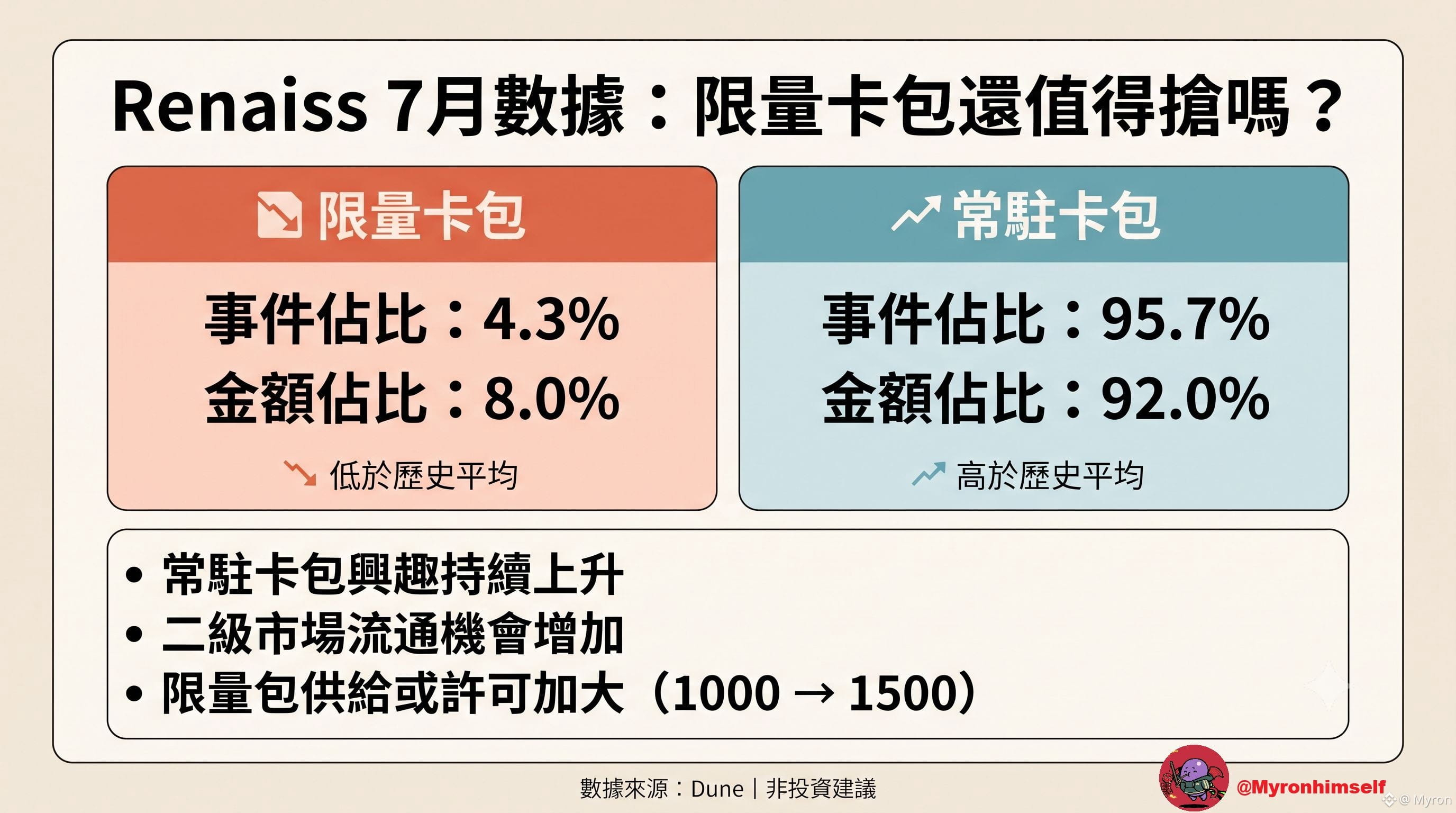
1
1
451
·
--
Bullish
【Renaissance: How much real revenue was generated by four limited card pack sales in July?】
This month, aside from the third week where no limited card pack was released, @renaissprotocol all the other four weeks had new card packs available for users to purchase. Based on the buyback ratio estimates from earlier posts, the platform’s real revenue from new card pack sales doesn’t seem as outstanding as I expected.
July limited card packs overview:
➤ World Cup Pack (7/3)
➤ Champion Pack (7/10)
➤ Trinity Pack (7/23)
➤ Emerald Pack (7/31)
All are priced at $100, and all have a quantity of 1,000, though the grand prize value differs slightly.
Gross revenue from the card packs:
4 x 1,000 packs x $100 = $400,000
Since the immediate buyback is at 90% of the price, using this calculation:
➤ If the buyback ratio is 90%, the platform’s net retained profit is $76,000
➤ If the buyback ratio is 80%, the platform’s net retained profit is $112,000
*Note 1: According to earlier posts, based on Renaiss Dune dashboard data, the platform’s long-term buyback ratio for users’ card pack openings is about 85%~90%.
*Note 2: Based on the limited card pack opening page, the Expected Value falls around $103~$105, so the actual profit may be a bit lower
-
● The above content does not constitute investment advice (NFA). Please proceed based on your own risk tolerance. DYOR and participate in the market cautiously
#renaiss #RWA #BNBChain #TCG $BNB
【Renaissance: How much real revenue was generated by four limited card pack sales in July?】
This month, aside from the third week where no limited card pack was released, @Renaiss Collectibles all the other four weeks had new card packs available for users to purchase. Based on the buyback ratio estimates from earlier posts, the platform’s real revenue from new card pack sales doesn’t seem as outstanding as I expected.
July limited card packs overview:
➤ World Cup Pack (7/3)
➤ Champion Pack (7/10)
➤ Trinity Pack (7/23)
➤ Emerald Pack (7/31)
All are priced at $100, and all have a quantity of 1,000, though the grand prize value differs slightly.
Gross revenue from the card packs:
4 x 1,000 packs x $100 = $400,000
Since the immediate buyback is at 90% of the price, using this calculation:
➤ If the buyback ratio is 90%, the platform’s net retained profit is $76,000
➤ If the buyback ratio is 80%, the platform’s net retained profit is $112,000
*Note 1: According to earlier posts, based on Renaiss Dune dashboard data, the platform’s long-term buyback ratio for users’ card pack openings is about 85%~90%.
*Note 2: Based on the limited card pack opening page, the Expected Value falls around $103~$105, so the actual profit may be a bit lower
-
● The above content does not constitute investment advice (NFA). Please proceed based on your own risk tolerance. DYOR and participate in the market cautiously
#renaiss #RWA #BNBChain #TCG $BNB
This month, aside from the third week where no limited card pack was released, @Renaiss Collectibles all the other four weeks had new card packs available for users to purchase. Based on the buyback ratio estimates from earlier posts, the platform’s real revenue from new card pack sales doesn’t seem as outstanding as I expected.
July limited card packs overview:
➤ World Cup Pack (7/3)
➤ Champion Pack (7/10)
➤ Trinity Pack (7/23)
➤ Emerald Pack (7/31)
All are priced at $100, and all have a quantity of 1,000, though the grand prize value differs slightly.
Gross revenue from the card packs:
4 x 1,000 packs x $100 = $400,000
Since the immediate buyback is at 90% of the price, using this calculation:
➤ If the buyback ratio is 90%, the platform’s net retained profit is $76,000
➤ If the buyback ratio is 80%, the platform’s net retained profit is $112,000
*Note 1: According to earlier posts, based on Renaiss Dune dashboard data, the platform’s long-term buyback ratio for users’ card pack openings is about 85%~90%.
*Note 2: Based on the limited card pack opening page, the Expected Value falls around $103~$105, so the actual profit may be a bit lower
-
● The above content does not constitute investment advice (NFA). Please proceed based on your own risk tolerance. DYOR and participate in the market cautiously
#renaiss #RWA #BNBChain #TCG $BNB
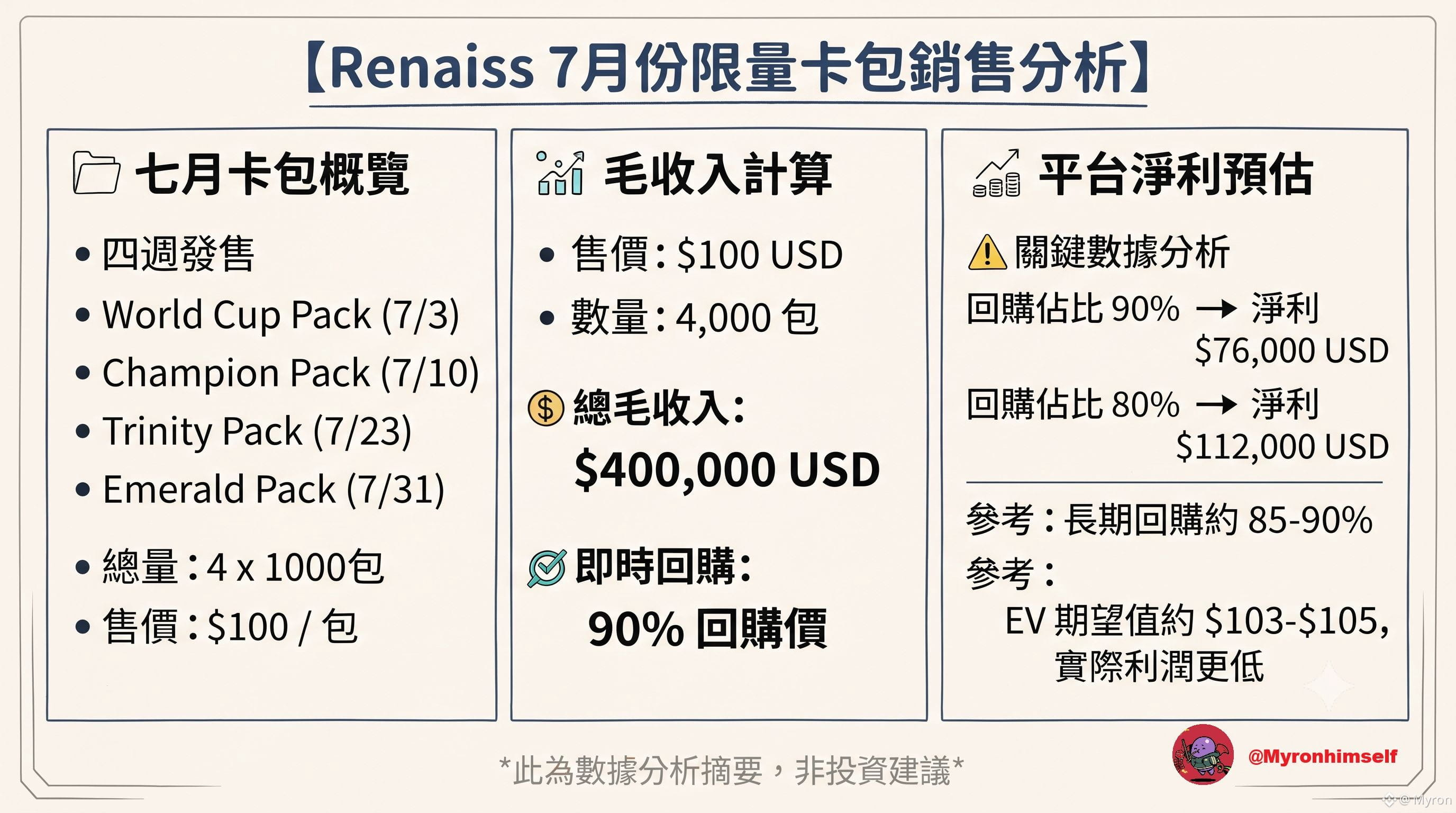
1
1
445
·
--
【Meridian Liquidity Provider(MLP)What Is It, Along With 30x Ethena $ENA Airdrop Points?】
Meridian launches the MLP Vault as scheduled. This is the second step after Ethereal was rebranded as Meridian and shifted its primary usage to the Robinhood Chain.
Understanding the MLP Vault isn’t difficult. The main reason it feels complex is that it involves multiple entities:
➤ Core concept
Users deposit $USDE into the MLP Vault = providing liquidity to the Meridian Perps Market.
However, the execution is handled through a centrally managed vault model, so costs will be incurred.
➤ Costs
Performance fee: 30% of profit (does not affect principal) & 1% annualized management fee (unrelated to performance)
➤ Entities involved
Kappa Labs, Neutral Trade, Meridian, Accountable
Accountable YieldApp = user operation interface for the MLP vault ( + verification system)
Meridian = trading venue
Kappa Labs = market maker; operates the MLP Vault funds for market making and hedging
Neutral Trade = trading infrastructure; the execution venue for hedging strategies
➤ User returns
1. Returns from market making and hedging strategies
2. 30x Ethena ENA airdrop points
3. Meridian airdrop points (allocated to mPerps at 20%)
*Note: During the pre-staking phase, depositing into the MLP Vault earns USDe rewards—could it be targeting the same APY as sUSDe?
-
Summary
From the perspective of Ethena airdrop points, 30x Ethena Points is currently the highest multiplier for single-asset staking with USDe—equivalent to targeting LP double-asset liquidity.
But to some extent, providing liquidity on a DEX is essentially taking the other side of traders. When traders make big profits, liquidity providers may end up losing money. The MLP Vault uses hedging strategies to mitigate risk, but you still need to watch how effective it actually is.
In addition, its costs are not cheap. After the strategy is running in real life, it’s necessary to observe whether the annualized return performance is truly worth it.
Based on the current participation level of nearly 30%, market interest doesn’t seem especially hot (the cap is 1m USDe).
The author thinks the main deciding point is probably whether people want to farm Meridian points through this.
-
● The above does not constitute investment advice (NFA). Please act according to your own risk tolerance, and do your own research (DYOR) and participate cautiously.
● The attached images are sourced from Meridian
#Meridian #Airdrops #ethena #robinhoodchain $HOOD
{future}(HOODUSDT)
{spot}(ENAUSDT)
【Meridian Liquidity Provider(MLP)What Is It, Along With 30x Ethena $ENA Airdrop Points?】
Meridian launches the MLP Vault as scheduled. This is the second step after Ethereal was rebranded as Meridian and shifted its primary usage to the Robinhood Chain.
Understanding the MLP Vault isn’t difficult. The main reason it feels complex is that it involves multiple entities:
➤ Core concept
Users deposit $USDE into the MLP Vault = providing liquidity to the Meridian Perps Market.
However, the execution is handled through a centrally managed vault model, so costs will be incurred.
➤ Costs
Performance fee: 30% of profit (does not affect principal) & 1% annualized management fee (unrelated to performance)
➤ Entities involved
Kappa Labs, Neutral Trade, Meridian, Accountable
Accountable YieldApp = user operation interface for the MLP vault ( + verification system)
Meridian = trading venue
Kappa Labs = market maker; operates the MLP Vault funds for market making and hedging
Neutral Trade = trading infrastructure; the execution venue for hedging strategies
➤ User returns
1. Returns from market making and hedging strategies
2. 30x Ethena ENA airdrop points
3. Meridian airdrop points (allocated to mPerps at 20%)
*Note: During the pre-staking phase, depositing into the MLP Vault earns USDe rewards—could it be targeting the same APY as sUSDe?
-
Summary
From the perspective of Ethena airdrop points, 30x Ethena Points is currently the highest multiplier for single-asset staking with USDe—equivalent to targeting LP double-asset liquidity.
But to some extent, providing liquidity on a DEX is essentially taking the other side of traders. When traders make big profits, liquidity providers may end up losing money. The MLP Vault uses hedging strategies to mitigate risk, but you still need to watch how effective it actually is.
In addition, its costs are not cheap. After the strategy is running in real life, it’s necessary to observe whether the annualized return performance is truly worth it.
Based on the current participation level of nearly 30%, market interest doesn’t seem especially hot (the cap is 1m USDe).
The author thinks the main deciding point is probably whether people want to farm Meridian points through this.
-
● The above does not constitute investment advice (NFA). Please act according to your own risk tolerance, and do your own research (DYOR) and participate cautiously.
● The attached images are sourced from Meridian
#Meridian #Airdrops #ethena #robinhoodchain $HOOD
Meridian launches the MLP Vault as scheduled. This is the second step after Ethereal was rebranded as Meridian and shifted its primary usage to the Robinhood Chain.
Understanding the MLP Vault isn’t difficult. The main reason it feels complex is that it involves multiple entities:
➤ Core concept
Users deposit $USDE into the MLP Vault = providing liquidity to the Meridian Perps Market.
However, the execution is handled through a centrally managed vault model, so costs will be incurred.
➤ Costs
Performance fee: 30% of profit (does not affect principal) & 1% annualized management fee (unrelated to performance)
➤ Entities involved
Kappa Labs, Neutral Trade, Meridian, Accountable
Accountable YieldApp = user operation interface for the MLP vault ( + verification system)
Meridian = trading venue
Kappa Labs = market maker; operates the MLP Vault funds for market making and hedging
Neutral Trade = trading infrastructure; the execution venue for hedging strategies
➤ User returns
1. Returns from market making and hedging strategies
2. 30x Ethena ENA airdrop points
3. Meridian airdrop points (allocated to mPerps at 20%)
*Note: During the pre-staking phase, depositing into the MLP Vault earns USDe rewards—could it be targeting the same APY as sUSDe?
-
Summary
From the perspective of Ethena airdrop points, 30x Ethena Points is currently the highest multiplier for single-asset staking with USDe—equivalent to targeting LP double-asset liquidity.
But to some extent, providing liquidity on a DEX is essentially taking the other side of traders. When traders make big profits, liquidity providers may end up losing money. The MLP Vault uses hedging strategies to mitigate risk, but you still need to watch how effective it actually is.
In addition, its costs are not cheap. After the strategy is running in real life, it’s necessary to observe whether the annualized return performance is truly worth it.
Based on the current participation level of nearly 30%, market interest doesn’t seem especially hot (the cap is 1m USDe).
The author thinks the main deciding point is probably whether people want to farm Meridian points through this.
-
● The above does not constitute investment advice (NFA). Please act according to your own risk tolerance, and do your own research (DYOR) and participate cautiously.
● The attached images are sourced from Meridian
#Meridian #Airdrops #ethena #robinhoodchain $HOOD
1
380
·
--
Bullish
【Let Velvet Unicorn AI devise a sprint strategy for the $VELVET airdrop—what behind-the-scenes will it reveal?】
Velvet’s 2.7m $VELVET airdrop event has less than two weeks left. Let’s see what details—beyond the rules—that the official AI-recommended strategy includes:
1. Per-transaction settings
➤ $500~$2000
➤ ≤ 0.5% transaction fee
➤ ≤ 0.3% slippage
➤ 5~15 minute trade interval
2. Daily trading cadence
➤ 8~12 trades
➤ $5,000~$10,000 trading volume
➤ Trading windows: UTC 08:00-12:00 or 18:00-22:00
3. Risk monitoring
➤ Total daily losses > 3%: immediately close positions to cut losses
➤ Close positions before bed to avoid holding overnight
➤ Past 24h price volatility is ~18%; if there’s a major pullback (> 10%), pause trading volume
4. Automation recommendations
Use a TG Bot or Blocknative to set up automated trading scripts
5. Key points for ranking contribution
➤ Number of trades
Velvet’s airdrop will weight both “trade count” and “total trading volume,” ensuring at least 8+ valid completed trades per day
➤ Total trading volume
Keep it ≥ 5,000 USDC; below that will reduce ranking weight
➤ Avoid single large trades
A one-time 5k+ USDC buy will be seen as “volume farming,” but it will increase slippage and transaction fees—instead, it will score worse
-
Author’s view
From Velvet Unicorn’s strategy, we can see that it believes that in addition to trading volume, the number of trades is also one of the core factors for the airdrop.
Even if users don’t trust the platform’s own AI inference, I think a diversified trading approach is still a viable strategy. For example, one of Velvet’s features is support for users who trade frequently—trading meme-coin related assets. These newly listed tokens often have limited liquidity, so making many small trades can better diversify and reduce slippage risk.
Overall, it suggests that the per-trade amount should be set according to the specific token (this article is for Robinhood Chain’s $PONS). This part can be provided in the initial instruction as the chain or token you want it to execute the strategy on.
What’s more surprising is that it also recommends trading time windows. If those are based on data pulled from its own platform’s trading activity, then that’s especially valuable.
But to sum it up: whether the airdrop rewards can really cover trading costs is hard to say. I’d suggest only participating if trading itself is already profitable (treating the airdrop as extra rewards?).
-
#Velvet #Airdrops
{alpha}(560x8b194370825e37b33373e74a41009161808c1488)
【Let Velvet Unicorn AI devise a sprint strategy for the $VELVET airdrop—what behind-the-scenes will it reveal?】
Velvet’s 2.7m $VELVET airdrop event has less than two weeks left. Let’s see what details—beyond the rules—that the official AI-recommended strategy includes:
1. Per-transaction settings
➤ $500~$2000
➤ ≤ 0.5% transaction fee
➤ ≤ 0.3% slippage
➤ 5~15 minute trade interval
2. Daily trading cadence
➤ 8~12 trades
➤ $5,000~$10,000 trading volume
➤ Trading windows: UTC 08:00-12:00 or 18:00-22:00
3. Risk monitoring
➤ Total daily losses > 3%: immediately close positions to cut losses
➤ Close positions before bed to avoid holding overnight
➤ Past 24h price volatility is ~18%; if there’s a major pullback (> 10%), pause trading volume
4. Automation recommendations
Use a TG Bot or Blocknative to set up automated trading scripts
5. Key points for ranking contribution
➤ Number of trades
Velvet’s airdrop will weight both “trade count” and “total trading volume,” ensuring at least 8+ valid completed trades per day
➤ Total trading volume
Keep it ≥ 5,000 USDC; below that will reduce ranking weight
➤ Avoid single large trades
A one-time 5k+ USDC buy will be seen as “volume farming,” but it will increase slippage and transaction fees—instead, it will score worse
-
Author’s view
From Velvet Unicorn’s strategy, we can see that it believes that in addition to trading volume, the number of trades is also one of the core factors for the airdrop.
Even if users don’t trust the platform’s own AI inference, I think a diversified trading approach is still a viable strategy. For example, one of Velvet’s features is support for users who trade frequently—trading meme-coin related assets. These newly listed tokens often have limited liquidity, so making many small trades can better diversify and reduce slippage risk.
Overall, it suggests that the per-trade amount should be set according to the specific token (this article is for Robinhood Chain’s $PONS). This part can be provided in the initial instruction as the chain or token you want it to execute the strategy on.
What’s more surprising is that it also recommends trading time windows. If those are based on data pulled from its own platform’s trading activity, then that’s especially valuable.
But to sum it up: whether the airdrop rewards can really cover trading costs is hard to say. I’d suggest only participating if trading itself is already profitable (treating the airdrop as extra rewards?).
-
#Velvet #Airdrops
Velvet’s 2.7m $VELVET airdrop event has less than two weeks left. Let’s see what details—beyond the rules—that the official AI-recommended strategy includes:
1. Per-transaction settings
➤ $500~$2000
➤ ≤ 0.5% transaction fee
➤ ≤ 0.3% slippage
➤ 5~15 minute trade interval
2. Daily trading cadence
➤ 8~12 trades
➤ $5,000~$10,000 trading volume
➤ Trading windows: UTC 08:00-12:00 or 18:00-22:00
3. Risk monitoring
➤ Total daily losses > 3%: immediately close positions to cut losses
➤ Close positions before bed to avoid holding overnight
➤ Past 24h price volatility is ~18%; if there’s a major pullback (> 10%), pause trading volume
4. Automation recommendations
Use a TG Bot or Blocknative to set up automated trading scripts
5. Key points for ranking contribution
➤ Number of trades
Velvet’s airdrop will weight both “trade count” and “total trading volume,” ensuring at least 8+ valid completed trades per day
➤ Total trading volume
Keep it ≥ 5,000 USDC; below that will reduce ranking weight
➤ Avoid single large trades
A one-time 5k+ USDC buy will be seen as “volume farming,” but it will increase slippage and transaction fees—instead, it will score worse
-
Author’s view
From Velvet Unicorn’s strategy, we can see that it believes that in addition to trading volume, the number of trades is also one of the core factors for the airdrop.
Even if users don’t trust the platform’s own AI inference, I think a diversified trading approach is still a viable strategy. For example, one of Velvet’s features is support for users who trade frequently—trading meme-coin related assets. These newly listed tokens often have limited liquidity, so making many small trades can better diversify and reduce slippage risk.
Overall, it suggests that the per-trade amount should be set according to the specific token (this article is for Robinhood Chain’s $PONS). This part can be provided in the initial instruction as the chain or token you want it to execute the strategy on.
What’s more surprising is that it also recommends trading time windows. If those are based on data pulled from its own platform’s trading activity, then that’s especially valuable.
But to sum it up: whether the airdrop rewards can really cover trading costs is hard to say. I’d suggest only participating if trading itself is already profitable (treating the airdrop as extra rewards?).
-
#Velvet #Airdrops
1
262
·
--
Bearish
Partly True
Meridian (formerly Ethereal) urges users to withdraw or transfer assets from the Ethereal dApp as soon as possible. Is the “Ethena ecosystem project” ultimately just a dream?
Earlier, Meridian said it will shut down Ethereal and advised users to move their assets to the official newly built Meridian dApp in advance. In the future, Robinhood Chain will be the primary network used.
This move seems to indirectly confirm the alleged report released before Terminal was shut down: “Ethena has already stopped preparing its own Converge-specific chain and the development of ecosystem projects.”
Back in 2024, Meridian’s predecessor, Ethereal, was the so-called ecosystem project at Ethena’s launch. At the time, many users generally believed Ethereal was nearly identical to Ethena’s own native project.
Now that even it has decided to officially migrate to the Robinhood mainnet, it also symbolizes the end of the Ethena ecosystem.
-
Ethereal → Meridian: key timeline points:
➤ Meridian has opened prediction market trading
➤ On 2026/7/28, Ethereal Perps will enter “close-only mode,” meaning you can’t open new positions
➤ Next week, the MLP (Meridian Liquidity Provider) Vault will open for pre-staking, and you can earn rewards including: USDe, Ethena, Meridian
➤ Next week will be the last time Ethereal Points are distributed; going forward, points data will be displayed on Meridian
➤ In the coming weeks, Meridian Perps will officially launch on Robinhood Chain
Put simply: the original functionality of Ethereal will be fully re-listed on Meridian. The difference is that assets will move from the Ethereal Chain to Robinhood Chain.
-
For now, you can already deposit USDe directly into Meridian. It will automatically bridge the USDe to Robinhood Chain, which suggests that with the closure of the Ethereal DEX, the Ethereal Chain will most likely be shut down sooner or later.
I’ve already bridged the USDe stuck on the Ethereal Chain to BSC via Stargate (with the lowest fees). After that, you can seamlessly store it into Binance.
Everyone is also advised to handle your assets on the Ethereal Chain as soon as possible!
-
● The above content does not constitute investment advice (NFA). Users should act according to their own risk tolerance. DYOR and participate in the market cautiously.
● The attached images are sourced from Meridian
#Meridian #robinhoodchain #USDe #Ethena $ENA
{spot}(ENAUSDT)
Meridian (formerly Ethereal) urges users to withdraw or transfer assets from the Ethereal dApp as soon as possible. Is the “Ethena ecosystem project” ultimately just a dream?
Earlier, Meridian said it will shut down Ethereal and advised users to move their assets to the official newly built Meridian dApp in advance. In the future, Robinhood Chain will be the primary network used.
This move seems to indirectly confirm the alleged report released before Terminal was shut down: “Ethena has already stopped preparing its own Converge-specific chain and the development of ecosystem projects.”
Back in 2024, Meridian’s predecessor, Ethereal, was the so-called ecosystem project at Ethena’s launch. At the time, many users generally believed Ethereal was nearly identical to Ethena’s own native project.
Now that even it has decided to officially migrate to the Robinhood mainnet, it also symbolizes the end of the Ethena ecosystem.
-
Ethereal → Meridian: key timeline points:
➤ Meridian has opened prediction market trading
➤ On 2026/7/28, Ethereal Perps will enter “close-only mode,” meaning you can’t open new positions
➤ Next week, the MLP (Meridian Liquidity Provider) Vault will open for pre-staking, and you can earn rewards including: USDe, Ethena, Meridian
➤ Next week will be the last time Ethereal Points are distributed; going forward, points data will be displayed on Meridian
➤ In the coming weeks, Meridian Perps will officially launch on Robinhood Chain
Put simply: the original functionality of Ethereal will be fully re-listed on Meridian. The difference is that assets will move from the Ethereal Chain to Robinhood Chain.
-
For now, you can already deposit USDe directly into Meridian. It will automatically bridge the USDe to Robinhood Chain, which suggests that with the closure of the Ethereal DEX, the Ethereal Chain will most likely be shut down sooner or later.
I’ve already bridged the USDe stuck on the Ethereal Chain to BSC via Stargate (with the lowest fees). After that, you can seamlessly store it into Binance.
Everyone is also advised to handle your assets on the Ethereal Chain as soon as possible!
-
● The above content does not constitute investment advice (NFA). Users should act according to their own risk tolerance. DYOR and participate in the market cautiously.
● The attached images are sourced from Meridian
#Meridian #robinhoodchain #USDe #Ethena $ENA
Earlier, Meridian said it will shut down Ethereal and advised users to move their assets to the official newly built Meridian dApp in advance. In the future, Robinhood Chain will be the primary network used.
This move seems to indirectly confirm the alleged report released before Terminal was shut down: “Ethena has already stopped preparing its own Converge-specific chain and the development of ecosystem projects.”
Back in 2024, Meridian’s predecessor, Ethereal, was the so-called ecosystem project at Ethena’s launch. At the time, many users generally believed Ethereal was nearly identical to Ethena’s own native project.
Now that even it has decided to officially migrate to the Robinhood mainnet, it also symbolizes the end of the Ethena ecosystem.
-
Ethereal → Meridian: key timeline points:
➤ Meridian has opened prediction market trading
➤ On 2026/7/28, Ethereal Perps will enter “close-only mode,” meaning you can’t open new positions
➤ Next week, the MLP (Meridian Liquidity Provider) Vault will open for pre-staking, and you can earn rewards including: USDe, Ethena, Meridian
➤ Next week will be the last time Ethereal Points are distributed; going forward, points data will be displayed on Meridian
➤ In the coming weeks, Meridian Perps will officially launch on Robinhood Chain
Put simply: the original functionality of Ethereal will be fully re-listed on Meridian. The difference is that assets will move from the Ethereal Chain to Robinhood Chain.
-
For now, you can already deposit USDe directly into Meridian. It will automatically bridge the USDe to Robinhood Chain, which suggests that with the closure of the Ethereal DEX, the Ethereal Chain will most likely be shut down sooner or later.
I’ve already bridged the USDe stuck on the Ethereal Chain to BSC via Stargate (with the lowest fees). After that, you can seamlessly store it into Binance.
Everyone is also advised to handle your assets on the Ethereal Chain as soon as possible!
-
● The above content does not constitute investment advice (NFA). Users should act according to their own risk tolerance. DYOR and participate in the market cautiously.
● The attached images are sourced from Meridian
#Meridian #robinhoodchain #USDe #Ethena $ENA
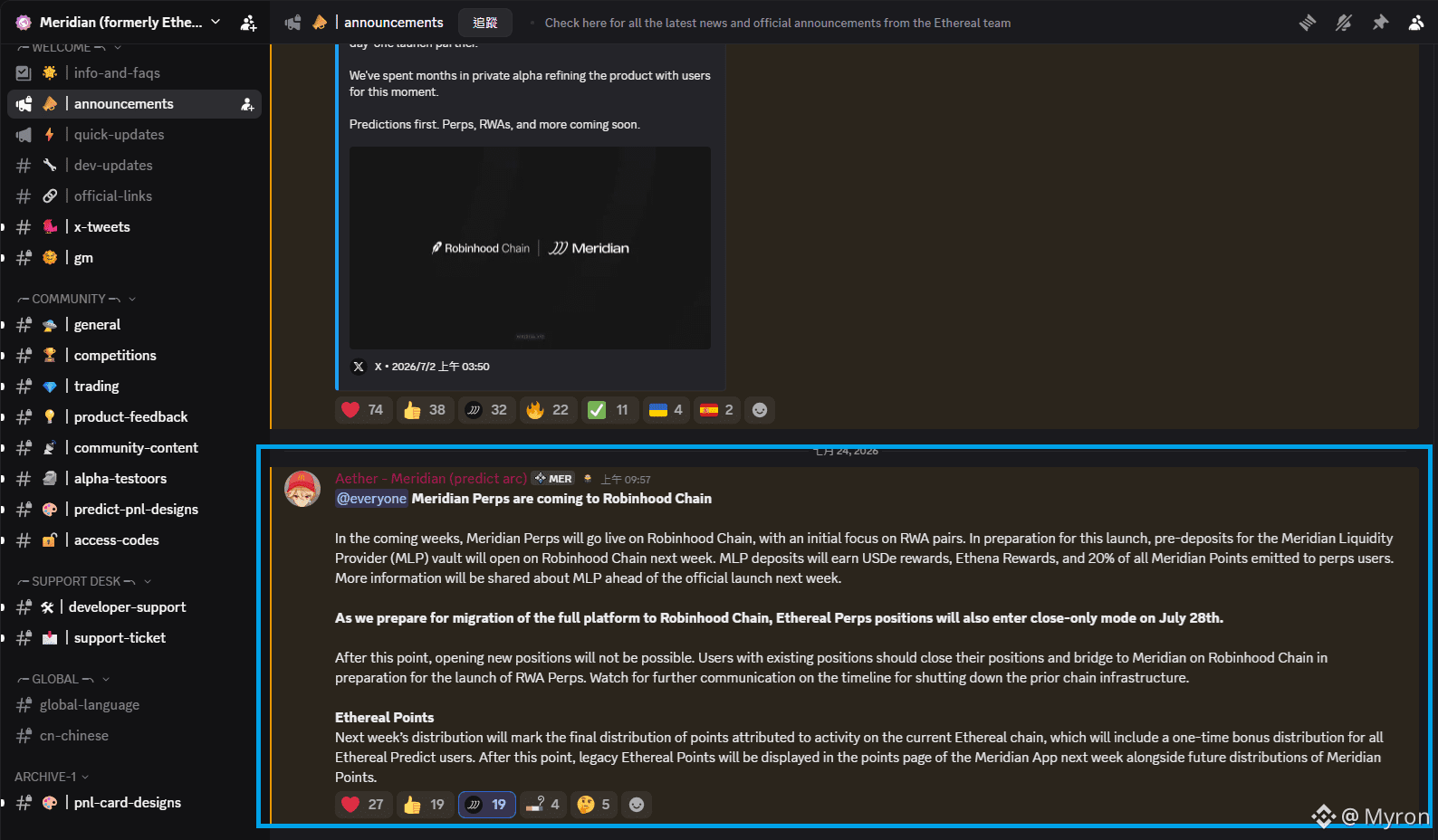
1
657
·
--
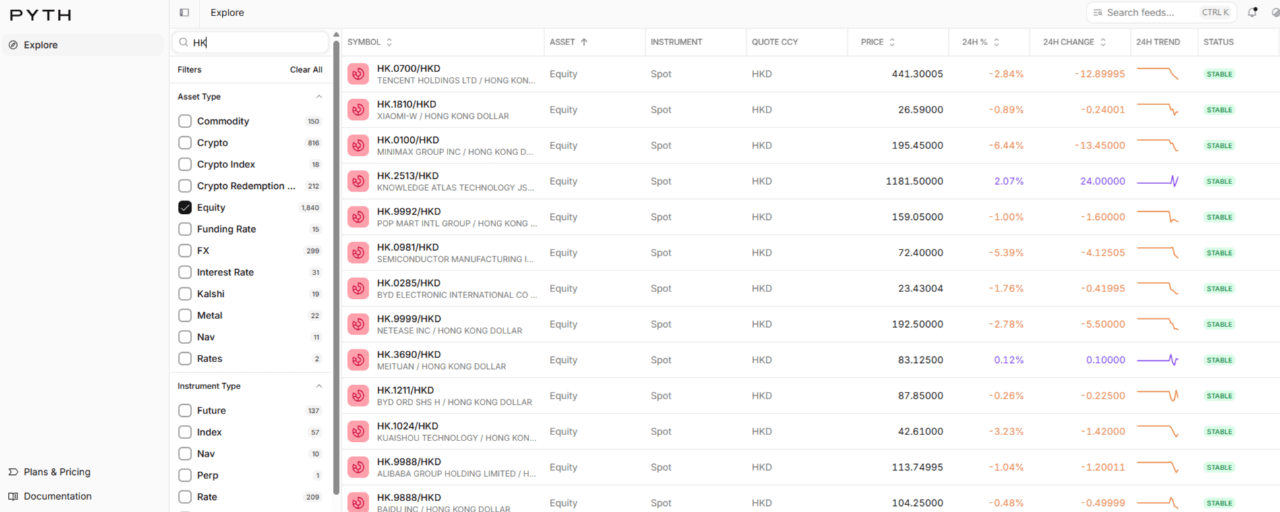
Article
Based on an analysis of oracle information sources, which asset categories might HertzFlow take on the trading demand for?Yesterday, we mentioned that the @HertzFlow_xyz documentation indicates that the official team mainly uses Pyth Network’s price feeds to support the vision of “everything can be traded.”
After careful comparison, it turns out that compared to Chainlink and Redstone, Pyth is indeed superior in fetching data across a wider range of assets. Here are the trading asset needs it may unlock:
1. Thinly traded U.S. stocks and regional stocks
When it comes to stock price feeds, Pyth supports up to 1,840 different types of stocks, giving it an absolute advantage in quantity. Chainlink, on the other hand, focuses on mainstream U.S. stocks and Ondo assets, taking a more specialized approach. RedStone is different: for tokenized assets, it mainly supports large institutions such as Securitize’s BUIDL.
Based on an analysis of oracle information sources, which asset categories might HertzFlow take on the trading demand for?
Yesterday, we mentioned that the @HertzFlow documentation indicates that the official team mainly uses Pyth Network’s price feeds to support the vision of “everything can be traded.”
After careful comparison, it turns out that compared to Chainlink and Redstone, Pyth is indeed superior in fetching data across a wider range of assets. Here are the trading asset needs it may unlock:
1. Thinly traded U.S. stocks and regional stocks
When it comes to stock price feeds, Pyth supports up to 1,840 different types of stocks, giving it an absolute advantage in quantity. Chainlink, on the other hand, focuses on mainstream U.S. stocks and Ondo assets, taking a more specialized approach. RedStone is different: for tokenized assets, it mainly supports large institutions such as Securitize’s BUIDL.
After careful comparison, it turns out that compared to Chainlink and Redstone, Pyth is indeed superior in fetching data across a wider range of assets. Here are the trading asset needs it may unlock:
1. Thinly traded U.S. stocks and regional stocks
When it comes to stock price feeds, Pyth supports up to 1,840 different types of stocks, giving it an absolute advantage in quantity. Chainlink, on the other hand, focuses on mainstream U.S. stocks and Ondo assets, taking a more specialized approach. RedStone is different: for tokenized assets, it mainly supports large institutions such as Securitize’s BUIDL.
4
1
517
Log in to explore more content
Join global crypto users on Binance Square
⚡️ Get latest and useful information about crypto.
💬 Trusted by the world’s largest crypto exchange.
👍 Discover real insights from verified creators.
Email / Phone number
Trending Topics
BitcoinSurpasses$77000
8,930 views
145 Discussing
$BTC is ripping higher despite it all. 🚀
Today marked the first rate hike in over 3 years, while the CLARITY Act stalled again yesterday.
Setup big long again - thank me later
Entry : $75500 - $76500
Stoploss : $74900
Take profit : $77000 - $78000
Get ready for a crazy growth cycle. 🔥
TF_bnb
·16 Likes
·6.6k views
ParadigmDisclosesZECHolding
30,286 views
662 Discussing
BitcoinETFsShed$450M
19,230 views
175 Discussing