Binance Square

Mrs_Rose

image
Verified Creator
Open Trade
XRP Holder
XRP Holder
Frequent Trader
1.4 Years
Passionate about stocks, charts, and profit || Trader by profession, success by strategy || Since 2018 || 7 years of experience
200 Following
49.7K+ Followers
89.3K+ Liked
25.3K+ Shared
All Content
Portfolio
PINNED
--
Bullish
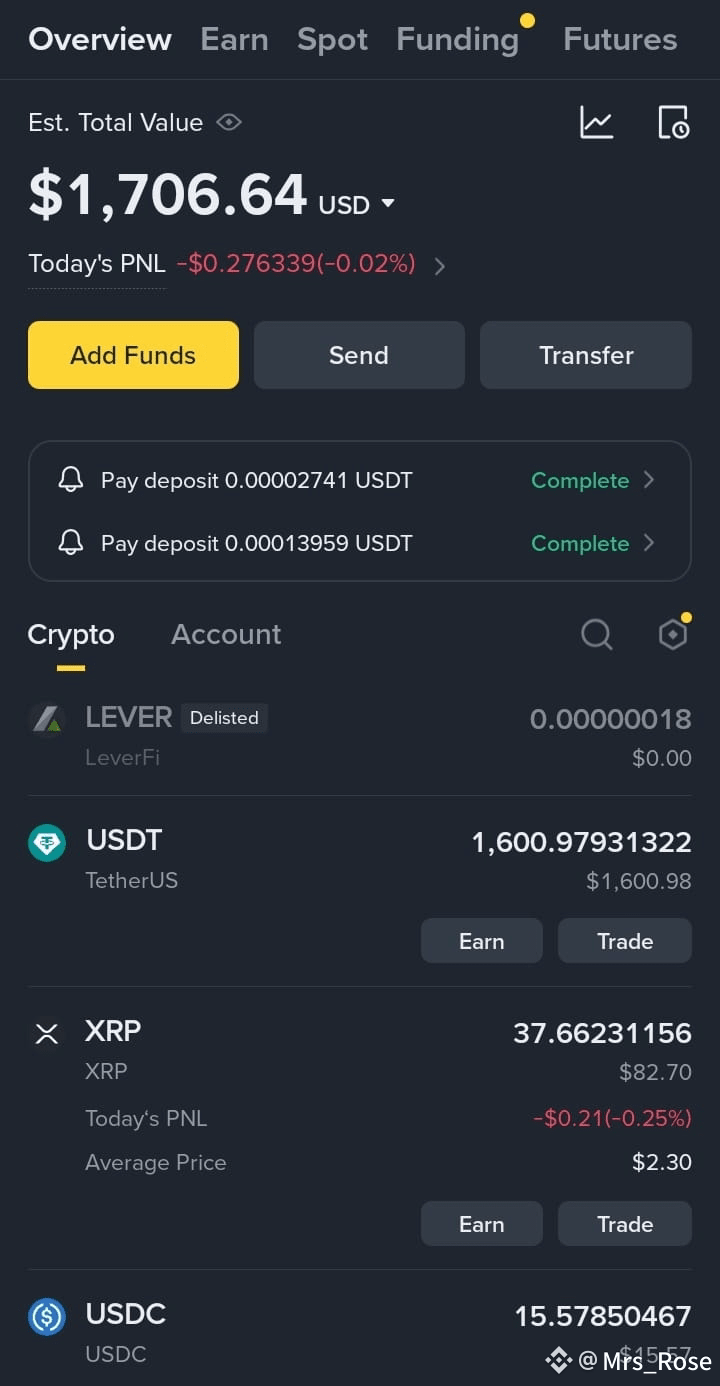
🔥How I Earned $1700 Dollars on Binance Without Investing Anything🚨 Guys! Earning on Binance without any initial capital is absolutely possible, but it requires consistency, patience, and an understanding of the tools Binance already provides. Many beginners expect thirty to fifty dollars a day from the start, but that is not how the system works. What actually works is using the platform in a strategic and disciplined way. 1. Binance Square Content Rewards Creating valuable posts on Binance Square is one of the most practical and reliable ways to earn from zero. When you share meaningful insights, market observations, or educational content, your engagement turns into small daily rewards. In the beginning the amounts are modest, but with consistent posting and a growing audience, it becomes a steady five to ten dollars per day. 2. Learn and Earn Programs Binance frequently releases educational lessons with short quizzes that reward you in crypto. These modules are simple, beginner friendly and provide guaranteed payouts whenever they are active. For someone starting from nothing, this is the most accessible way to earn immediately. 3. Referral Commissions By sharing your referral link, you can build a source of long term passive income. Every time someone you refer trades on Binance, you receive a small commission. This is not fast income, but with time it becomes a consistent and predictable reward stream. 4. Airdrops and Event Rewards Binance regularly hosts campaigns, promotional events, and free giveaways. Participating in these adds small but meaningful amounts to your total earnings over time. If you are starting from scratch, the most effective approach is to treat each of these opportunities as small steady bonuses rather than expecting daily guaranteed income. Individually they may look small, but when combined consistently they can grow into something substantial. That is exactly how I turned zero investment into 1706 dollars by simply using the platforms and programs that Binance already offers. $BTC {spot}(BTCUSDT) $BNB {spot}(BNBUSDT)
🔥How I Earned $1700 Dollars on Binance Without Investing Anything🚨

Guys! Earning on Binance without any initial capital is absolutely possible, but it requires consistency, patience, and an understanding of the tools Binance already provides. Many beginners expect thirty to fifty dollars a day from the start, but that is not how the system works. What actually works is using the platform in a strategic and disciplined way.

1. Binance Square Content Rewards
Creating valuable posts on Binance Square is one of the most practical and reliable ways to earn from zero. When you share meaningful insights, market observations, or educational content, your engagement turns into small daily rewards. In the beginning the amounts are modest, but with consistent posting and a growing audience, it becomes a steady five to ten dollars per day.

2. Learn and Earn Programs
Binance frequently releases educational lessons with short quizzes that reward you in crypto. These modules are simple, beginner friendly and provide guaranteed payouts whenever they are active. For someone starting from nothing, this is the most accessible way to earn immediately.

3. Referral Commissions
By sharing your referral link, you can build a source of long term passive income. Every time someone you refer trades on Binance, you receive a small commission. This is not fast income, but with time it becomes a consistent and predictable reward stream.

4. Airdrops and Event Rewards
Binance regularly hosts campaigns, promotional events, and free giveaways. Participating in these adds small but meaningful amounts to your total earnings over time.

If you are starting from scratch, the most effective approach is to treat each of these opportunities as small steady bonuses rather than expecting daily guaranteed income. Individually they may look small, but when combined consistently they can grow into something substantial. That is exactly how I turned zero investment into 1706 dollars by simply using the platforms and programs that Binance already offers.
$BTC
$BNB
PINNED
--
Bullish
$BNB /USDT Strong Bullish Rally Continue To FRESH Bounce !🔥🚀 {spot}(BNBUSDT) $BNB is trading at 901.6 after bouncing from 871.3 and nearly touching the 904.3 resistance. Momentum is positive with solid trading volume, and price action suggests BNB is building strength for a possible push toward new highs. Entry: 890 – 900 Targets: 1. Target 1: 920 2. Target 2: 940 3. Target 3: 970 Stop Loss: 870 Key Levels: Support: 871 / 855 Resistance: 904 / 920 / 940 Pivot: 895 Pro Tip: BNB tends to move steadily compared to high-volatility alts. A breakout above 904 with volume confirmation can offer a strong continuation trade, but trailing stops are recommended to protect gains if momentum fades. #BNBBreaksATH
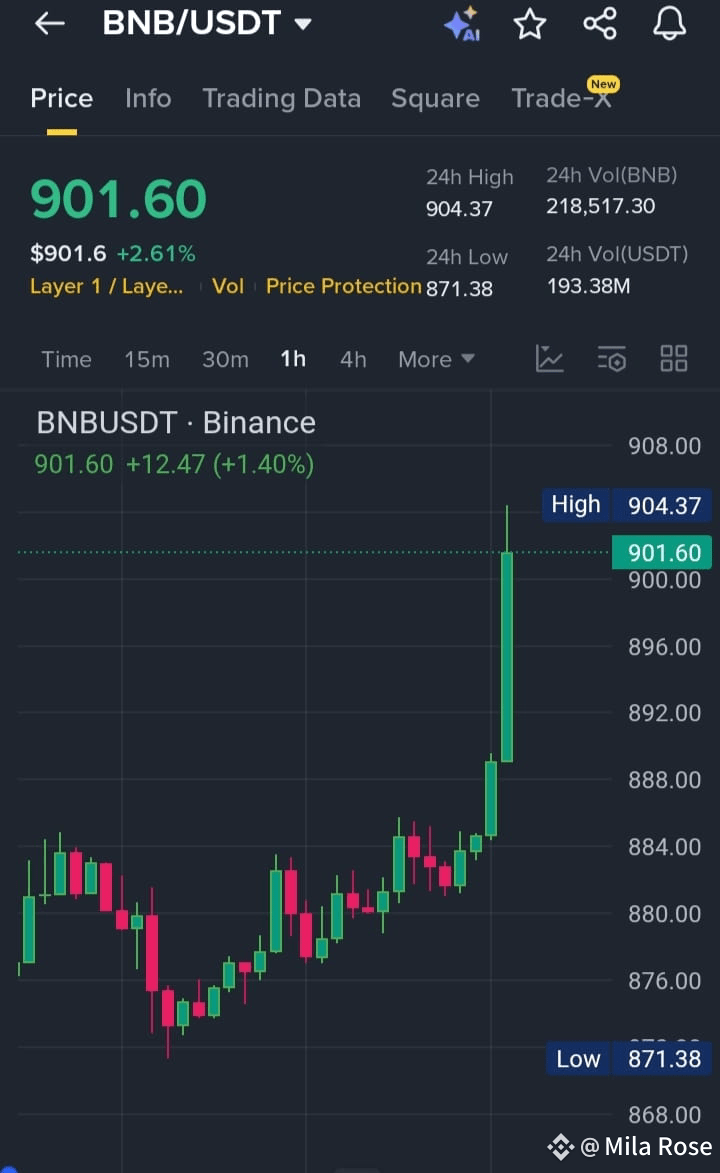
$BNB /USDT Strong Bullish Rally Continue To FRESH Bounce !🔥🚀


$BNB is trading at 901.6 after bouncing from 871.3 and nearly touching the 904.3 resistance. Momentum is positive with solid trading volume, and price action suggests BNB is building strength for a possible push toward new highs.

Entry:
890 – 900

Targets:

1. Target 1: 920

2. Target 2: 940

3. Target 3: 970

Stop Loss:
870

Key Levels:
Support: 871 / 855
Resistance: 904 / 920 / 940
Pivot: 895

Pro Tip:
BNB tends to move steadily compared to high-volatility alts. A breakout above 904 with volume confirmation can offer a strong continuation trade, but trailing stops are recommended to protect gains if momentum fades.

#BNBBreaksATH
Design Trade-Offs in Oracle Networks: What APRO PrioritizesI’ve noticed that most oracle discussions sound like people are shopping for perfection. Fastest updates, lowest cost, highest accuracy, maximum decentralization, widest coverage, zero downtime. But oracle networks don’t work like that. Every serious design is a set of trade-offs, and what matters is whether those trade-offs are honest, consistent, and aligned with how DeFi actually behaves under stress. Speed versus safety is the most obvious tension. “Real-time” sounds like a protective feature, yet in volatile conditions, speed can turn noise into execution. If an oracle publishes every twitch in thin liquidity, it might be fresh but not stable. That’s why I think the real question isn’t “how fast can you update,” but “when is speed worth the risk?” Oracle design has to decide whether it wants to be a firehose or a filter. Cost versus verification is another trade-off people underestimate. Deep verification on-chain is expensive. Minimal verification is cheap but fragile. Many networks end up compromising by verifying less as they scale, which quietly shifts risk onto users. The better approach is to move heavy work off-chain, keep on-chain checks lean, and treat verification as a layered process rather than a single expensive moment. Decentralization versus coordination is the quiet one. You can add participants and still end up with centralized risk if everyone depends on the same sources, the same infrastructure, or the same incentives. In oracle systems, decentralization isn’t just a headcount. It’s whether truth can be captured by one behavior pattern. Coordination matters because the output is a network product, not a single node’s opinion. This is where APRO-Oracle becomes interesting from a priorities standpoint. APRO’s architecture suggests it prioritizes trust standards that survive scale more than it prioritizes being the fastest feed on a dashboard. The two-layer model is a good example: separating sourcing/aggregation from validation/final consensus. That’s a choice to introduce structure and fault isolation rather than collapsing everything into one layer for speed. Multi-source aggregation reflects a similar priority. It favors representativeness over single-venue precision. In calm markets, that can look like overkill. In stressed markets, it’s often the difference between stable execution and distorted outcomes. @APRO-Oracle seems to treat aggregation not as a “nice-to-have,” but as a defense against local liquidity distortions becoming global truth. The push vs pull model shows another trade-off choice: universal broadcasting versus contextual delivery. Always pushing updates can feel “more real-time,” but it can also create unnecessary overhead and amplify noise. Supporting pull-based requests allows protocols to prioritize precision at high-stakes moments, which is a more disciplined way to treat truth when not every decision needs a constant stream. Cross-chain expansion introduces trade-offs between breadth and consistency. Many networks expand quickly and accept that standards will vary by chain. That creates fragmentation risk—truth that behaves differently depending on where it lands. APRO’s emphasis on cross-chain consistency suggests a priority: expanding without letting “verified” mean something different on different networks. Then there’s incentives, which are not a side feature but the engine behind every trade-off. If speed is rewarded, participants will optimize for speed. If correctness and reliability are rewarded, discipline becomes rational. APRO’s native token, $AT, sits in that coordination layer as the mechanism that can keep participation sustainable and standards enforced, especially when the system is under load and the work becomes harder. From where I’m sitting, what APRO prioritizes is less about chasing the most impressive single metric and more about balancing them in a way that reduces downstream damage. It’s trying to avoid the common oracle failure mode: looking perfect in calm conditions, then becoming brittle in edge cases. The real test of priorities is how a network behaves when it must choose between being available and being correct, between being fast and being stable, between expanding coverage and maintaining standards. No oracle can avoid these decisions. The question is whether the network has a philosophy that makes those choices predictable. If APRO’s priorities hold, the result won’t be flashy. It will be fewer weird liquidations, fewer unexplained divergences across chains, fewer moments where everything looked “real-time” but execution still felt wrong. In DeFi, that kind of quiet predictability is usually the best proof that the trade-offs were made in the right direction. #APRO $AT {spot}(ATUSDT)

Design Trade-Offs in Oracle Networks: What APRO Prioritizes

I’ve noticed that most oracle discussions sound like people are shopping for perfection. Fastest updates, lowest cost, highest accuracy, maximum decentralization, widest coverage, zero downtime. But oracle networks don’t work like that. Every serious design is a set of trade-offs, and what matters is whether those trade-offs are honest, consistent, and aligned with how DeFi actually behaves under stress.

Speed versus safety is the most obvious tension. “Real-time” sounds like a protective feature, yet in volatile conditions, speed can turn noise into execution. If an oracle publishes every twitch in thin liquidity, it might be fresh but not stable. That’s why I think the real question isn’t “how fast can you update,” but “when is speed worth the risk?” Oracle design has to decide whether it wants to be a firehose or a filter.

Cost versus verification is another trade-off people underestimate. Deep verification on-chain is expensive. Minimal verification is cheap but fragile. Many networks end up compromising by verifying less as they scale, which quietly shifts risk onto users. The better approach is to move heavy work off-chain, keep on-chain checks lean, and treat verification as a layered process rather than a single expensive moment.

Decentralization versus coordination is the quiet one. You can add participants and still end up with centralized risk if everyone depends on the same sources, the same infrastructure, or the same incentives. In oracle systems, decentralization isn’t just a headcount. It’s whether truth can be captured by one behavior pattern. Coordination matters because the output is a network product, not a single node’s opinion.

This is where APRO-Oracle becomes interesting from a priorities standpoint. APRO’s architecture suggests it prioritizes trust standards that survive scale more than it prioritizes being the fastest feed on a dashboard. The two-layer model is a good example: separating sourcing/aggregation from validation/final consensus. That’s a choice to introduce structure and fault isolation rather than collapsing everything into one layer for speed.

Multi-source aggregation reflects a similar priority. It favors representativeness over single-venue precision. In calm markets, that can look like overkill. In stressed markets, it’s often the difference between stable execution and distorted outcomes. @APRO Oracle seems to treat aggregation not as a “nice-to-have,” but as a defense against local liquidity distortions becoming global truth.

The push vs pull model shows another trade-off choice: universal broadcasting versus contextual delivery. Always pushing updates can feel “more real-time,” but it can also create unnecessary overhead and amplify noise. Supporting pull-based requests allows protocols to prioritize precision at high-stakes moments, which is a more disciplined way to treat truth when not every decision needs a constant stream.

Cross-chain expansion introduces trade-offs between breadth and consistency. Many networks expand quickly and accept that standards will vary by chain. That creates fragmentation risk—truth that behaves differently depending on where it lands. APRO’s emphasis on cross-chain consistency suggests a priority: expanding without letting “verified” mean something different on different networks.

Then there’s incentives, which are not a side feature but the engine behind every trade-off. If speed is rewarded, participants will optimize for speed. If correctness and reliability are rewarded, discipline becomes rational. APRO’s native token, $AT , sits in that coordination layer as the mechanism that can keep participation sustainable and standards enforced, especially when the system is under load and the work becomes harder.

From where I’m sitting, what APRO prioritizes is less about chasing the most impressive single metric and more about balancing them in a way that reduces downstream damage. It’s trying to avoid the common oracle failure mode: looking perfect in calm conditions, then becoming brittle in edge cases.

The real test of priorities is how a network behaves when it must choose between being available and being correct, between being fast and being stable, between expanding coverage and maintaining standards. No oracle can avoid these decisions. The question is whether the network has a philosophy that makes those choices predictable.

If APRO’s priorities hold, the result won’t be flashy. It will be fewer weird liquidations, fewer unexplained divergences across chains, fewer moments where everything looked “real-time” but execution still felt wrong. In DeFi, that kind of quiet predictability is usually the best proof that the trade-offs were made in the right direction.

#APRO $AT
--
Bullish
Here's the biggest opportunity..! $DOGS is showing strong bullish momentum after a sharp impulsive move. The market is consolidating near the highs, which indicates buyers are absorbing selling pressure rather than allowing a deep pullback. Structure remains favorable for continuation as long as demand holds. {future}(DOGSUSDT) Targets (TP) TP1: 0.0000540 TP2: 0.0000585 TP3: 0.0000640 Stop Loss (SL) SL: 0.0000410 Risk Management Use strict position sizing, avoid overleveraging, and trail stop loss after TP1 to protect gains and manage downside risk. #BTC90kChristmas #StrategyBTCPurchase #WriteToEarnUpgrade #BinanceAlphaAlert
Here's the biggest opportunity..! $DOGS is showing strong bullish momentum after a sharp impulsive move. The market is consolidating near the highs, which indicates buyers are absorbing selling pressure rather than allowing a deep pullback. Structure remains favorable for continuation as long as demand holds.


Targets (TP)
TP1: 0.0000540
TP2: 0.0000585
TP3: 0.0000640

Stop Loss (SL)
SL: 0.0000410

Risk Management
Use strict position sizing, avoid overleveraging, and trail stop loss after TP1 to protect gains and manage downside risk.

#BTC90kChristmas #StrategyBTCPurchase #WriteToEarnUpgrade #BinanceAlphaAlert
--
Bullish
Guys.! Here's an Opportunity...$IRYS has delivered a strong impulsive breakout followed by tight consolidation near the highs. The pullback remains shallow, showing that buyers are absorbing supply rather than allowing a deeper correction. Market structure stays bullish with demand clearly stepping in on dips. {future}(IRYSUSDT) Targets (TP) TP1: 0.0380 TP2: 0.0425 TP3: 0.0480 Stop Loss (SL) SL: 0.0270 #BTC90kChristmas #StrategyBTCPurchase #BinanceAlphaAlert #BinanceHODLerYB
Guys.! Here's an Opportunity...$IRYS has delivered a strong impulsive breakout followed by tight consolidation near the highs. The pullback remains shallow, showing that buyers are absorbing supply rather than allowing a deeper correction. Market structure stays bullish with demand clearly stepping in on dips.


Targets (TP)
TP1: 0.0380
TP2: 0.0425
TP3: 0.0480

Stop Loss (SL)
SL: 0.0270

#BTC90kChristmas #StrategyBTCPurchase #BinanceAlphaAlert #BinanceHODLerYB
--
Bearish
Guys.! $CVX USDT is showing signs of exhaustion after a sharp upside move. Price failed to sustain above the recent high and is now printing rejection, suggesting distribution at higher levels. Momentum indicators are cooling off, and volume expansion on pullbacks hints at sellers stepping in. From a structure perspective, price is trading below the short term resistance zone while forming lower highs on lower timeframes. This setup favors a corrective move toward key demand levels before any healthy continuation. {future}(CVXUSDT) Trade Plan Short below the resistance zone confirmation Targets TP1: 2.00 TP2: 1.88 TP3: 1.75 Stop Loss SL: Above 2.45 Risk Management Risk only 1 to 2 percent per trade. Avoid overleveraging and wait for confirmation before entry. #CVXUSDT #BTC90kChristmas #StrategyBTCPurchase #WriteToEarnUpgrade
Guys.! $CVX USDT is showing signs of exhaustion after a sharp upside move. Price failed to sustain above the recent high and is now printing rejection, suggesting distribution at higher levels. Momentum indicators are cooling off, and volume expansion on pullbacks hints at sellers stepping in.

From a structure perspective, price is trading below the short term resistance zone while forming lower highs on lower timeframes. This setup favors a corrective move toward key demand levels before any healthy continuation.


Trade Plan
Short below the resistance zone confirmation

Targets
TP1: 2.00
TP2: 1.88
TP3: 1.75

Stop Loss
SL: Above 2.45

Risk Management
Risk only 1 to 2 percent per trade. Avoid overleveraging and wait for confirmation before entry.

#CVXUSDT #BTC90kChristmas #StrategyBTCPurchase #WriteToEarnUpgrade
--
Bullish
Dear Family...❤️$PIPPIN is trading with strong bullish momentum after a clean expansion from the base. The pullback remains shallow and controlled, indicating buyers are defending higher demand zones. As long as this structure holds, the probability favors further upside continuation. {future}(PIPPINUSDT) Targets (TP) TP1: 0.545 TP2: 0.600 TP3: 0.680 Stop Loss (SL) SL: 0.390 Risk Management Keep risk per trade limited, avoid chasing entries at highs, and trail stop loss after TP1 to protect profits and reduce downside risk. #BTC90kChristmas #StrategyBTCPurchase #WriteToEarnUpgrade #CPIWatch
Dear Family...❤️$PIPPIN is trading with strong bullish momentum after a clean expansion from the base. The pullback remains shallow and controlled, indicating buyers are defending higher demand zones. As long as this structure holds, the probability favors further upside continuation.


Targets (TP)
TP1: 0.545
TP2: 0.600
TP3: 0.680

Stop Loss (SL)
SL: 0.390

Risk Management
Keep risk per trade limited, avoid chasing entries at highs, and trail stop loss after TP1 to protect profits and reduce downside risk.

#BTC90kChristmas #StrategyBTCPurchase #WriteToEarnUpgrade #CPIWatch
--
Bullish
Guys.! Look at this move patiently..! $1000BONK is showing aggressive bullish strength after a sharp impulsive breakout. The pullback has been shallow and well controlled, indicating strong buyer demand at higher levels. Market structure remains firmly bullish, favoring continuation rather than a deeper correction. {future}(1000BONKUSDT) Targets (TP) TP1: 0.01280 TP2: 0.01420 TP3: 0.01600 Stop Loss (SL) SL: 0.00980 Risk Management Use disciplined position sizing, avoid chasing extended candles, and trail stop loss after TP1 to protect capital and lock in profits. #BTC90kChristmas #StrategyBTCPurchase #WriteToEarnUpgrade
Guys.! Look at this move patiently..! $1000BONK is showing aggressive bullish strength after a sharp impulsive breakout. The pullback has been shallow and well controlled, indicating strong buyer demand at higher levels. Market structure remains firmly bullish, favoring continuation rather than a deeper correction.


Targets (TP)
TP1: 0.01280
TP2: 0.01420
TP3: 0.01600

Stop Loss (SL)
SL: 0.00980

Risk Management
Use disciplined position sizing, avoid chasing extended candles, and trail stop loss after TP1 to protect capital and lock in profits.

#BTC90kChristmas #StrategyBTCPurchase #WriteToEarnUpgrade
--
Bullish
Hii Guys! Look at this Setup Carefully..!👋$ZEC is consolidating after a strong rebound, holding firmly above a key demand zone. The pullback remains shallow and controlled, which suggests sellers are losing momentum while buyers continue to defend higher levels. The overall structure still favors continuation toward the upper resistance range. {future}(ZECUSDT) Targets (TP) TP1: 520 TP2: 540 TP3: 565 Stop Loss (SL) SL: 495 Risk Management Risk only a small portion of capital per trade, avoid overleveraging during consolidation, and trail stop loss after TP1 to protect gains. #BTC90kChristmas #StrategyBTCPurchase #WriteToEarnUpgrade #BinanceAlphaAlert
Hii Guys! Look at this Setup Carefully..!👋$ZEC is consolidating after a strong rebound, holding firmly above a key demand zone. The pullback remains shallow and controlled, which suggests sellers are losing momentum while buyers continue to defend higher levels. The overall structure still favors continuation toward the upper resistance range.


Targets (TP)
TP1: 520
TP2: 540
TP3: 565

Stop Loss (SL)
SL: 495

Risk Management
Risk only a small portion of capital per trade, avoid overleveraging during consolidation, and trail stop loss after TP1 to protect gains.

#BTC90kChristmas #StrategyBTCPurchase #WriteToEarnUpgrade #BinanceAlphaAlert
--
Bullish
--
Bullish
Dear Fam.! $XRP is trading with a stable bullish structure after holding above a key support zone. The recent push higher was followed by shallow consolidation, which indicates strength rather than exhaustion. As long as price remains above demand, the next leg higher stays in play. {future}(XRPUSDT) Targets (TP) TP1: 2.18 TP2: 2.32 TP3: 2.55 Stop Loss (SL) SL: 1.98 Keep risk per trade limited, avoid chasing entries, and trail stop loss after TP1 to protect profits and manage downside. #BTC90kChristmas #StrategyBTCPurchase #BinanceAlphaAlert #BinanceHODLerZBT
Dear Fam.! $XRP is trading with a stable bullish structure after holding above a key support zone. The recent push higher was followed by shallow consolidation, which indicates strength rather than exhaustion. As long as price remains above demand, the next leg higher stays in play.


Targets (TP)
TP1: 2.18
TP2: 2.32
TP3: 2.55

Stop Loss (SL)
SL: 1.98

Keep risk per trade limited, avoid chasing entries, and trail stop loss after TP1 to protect profits and manage downside.
#BTC90kChristmas #StrategyBTCPurchase #BinanceAlphaAlert #BinanceHODLerZBT
APRO’s Method for Handling Delayed or Incomplete Data FeedsI’ve noticed that delayed data is one of the most uncomfortable realities in DeFi because it doesn’t look like an attack. It looks like “nothing happened.” A feed updates late. A source drops out. A chain gets congested. Everything still appears functional until a contract makes a decision based on a value that quietly stopped representing the market. Incomplete data is even worse, because it can produce outputs that feel legitimate while missing the context that made them trustworthy. The hard part is that smart contracts don’t understand delay. They don’t ask, “how old is this?” in the way a human would. They don’t weigh confidence. They treat whatever arrives as actionable truth unless the application has explicitly built guardrails. That’s why delayed or incomplete feeds aren’t just a performance issue. They are a risk issue. This is where coordination and verification start mattering more than raw speed. A resilient oracle network needs a method for deciding what to do when the pipeline degrades. Do you publish anyway to avoid downtime, even if confidence is lower? Do you pause and risk freezing downstream protocols? Do you publish with safeguards? There isn’t one perfect answer. The method is the product. This is the lens through which I look at @APRO-Oracle . APRO’s architecture suggests it’s designed to avoid “single source dependency” in the first place, which is the first defense against incomplete feeds. Multi-source aggregation reduces the chance that one missing input collapses the output. If one venue is delayed or one provider goes quiet, the system still has other observations to work with. The second defense is layering. The two-layer model separating data sourcing/aggregation from validation/finalization creates a buffer between upstream degradation and downstream execution. If the collection layer becomes incomplete, the validation layer doesn’t have to blindly approve the output. It can enforce rules around plausibility, consistency, and confidence before data becomes final consensus. Timing choices also matter here. The push vs pull model gives the network flexibility when data is delayed. A push feed might be tuned for frequent updates, but in degraded conditions, a pull-based request at a decision point can prioritize a more carefully validated snapshot rather than relying on a constantly streaming feed that may be partially broken. It’s not about always being fast. It’s about being reliable when it counts. This is also where anomaly detection fits in defensively. Delayed or incomplete feeds often create weird signatures sudden jumps after silence, values that move too smoothly, or updates that diverge from broader market behavior. AI-assisted checks can help flag these patterns, not to “predict,” but to prevent the system from treating a degraded feed as normal. One of the more overlooked aspects is how an oracle communicates uncertainty whether directly through confidence handling or indirectly by refusing to finalize questionable updates. In DeFi, silence can sometimes be safer than a wrong number, but only if downstream protocols are built to handle that behavior. The oracle’s method has to balance availability with integrity, and those are often in tension. Incentives also shape how delayed or incomplete data is handled over time. If participants are rewarded for pushing updates constantly, they might publish low-quality data just to stay active. If participants are rewarded for maintaining standards, they’re more likely to slow down when conditions degrade. APRO’s native token, $AT , sits in that coordination layer where validation discipline can remain economically rational, especially when the work becomes harder and less predictable. From where I’m sitting, the best oracle behavior during delay isn’t “always update” and it isn’t “always pause.” It’s controlled degradation: keep operating when confidence is high, resist finalizing when confidence is low, and avoid turning missing context into false certainty. Because delayed data doesn’t usually destroy DeFi with a bang. It does it with quiet unfairness liquidations at the wrong time, settlements that feel off, protocols that become brittle. Handling delayed or incomplete feeds well is one of the few ways an oracle network can protect the rest of the stack from making confident decisions based on a reality that already moved on. #APRO

APRO’s Method for Handling Delayed or Incomplete Data Feeds

I’ve noticed that delayed data is one of the most uncomfortable realities in DeFi because it doesn’t look like an attack. It looks like “nothing happened.” A feed updates late. A source drops out. A chain gets congested. Everything still appears functional until a contract makes a decision based on a value that quietly stopped representing the market. Incomplete data is even worse, because it can produce outputs that feel legitimate while missing the context that made them trustworthy.
The hard part is that smart contracts don’t understand delay. They don’t ask, “how old is this?” in the way a human would. They don’t weigh confidence. They treat whatever arrives as actionable truth unless the application has explicitly built guardrails. That’s why delayed or incomplete feeds aren’t just a performance issue. They are a risk issue.
This is where coordination and verification start mattering more than raw speed. A resilient oracle network needs a method for deciding what to do when the pipeline degrades. Do you publish anyway to avoid downtime, even if confidence is lower? Do you pause and risk freezing downstream protocols? Do you publish with safeguards? There isn’t one perfect answer. The method is the product.
This is the lens through which I look at @APRO Oracle . APRO’s architecture suggests it’s designed to avoid “single source dependency” in the first place, which is the first defense against incomplete feeds. Multi-source aggregation reduces the chance that one missing input collapses the output. If one venue is delayed or one provider goes quiet, the system still has other observations to work with.
The second defense is layering. The two-layer model separating data sourcing/aggregation from validation/finalization creates a buffer between upstream degradation and downstream execution. If the collection layer becomes incomplete, the validation layer doesn’t have to blindly approve the output. It can enforce rules around plausibility, consistency, and confidence before data becomes final consensus.
Timing choices also matter here. The push vs pull model gives the network flexibility when data is delayed. A push feed might be tuned for frequent updates, but in degraded conditions, a pull-based request at a decision point can prioritize a more carefully validated snapshot rather than relying on a constantly streaming feed that may be partially broken. It’s not about always being fast. It’s about being reliable when it counts.
This is also where anomaly detection fits in defensively. Delayed or incomplete feeds often create weird signatures sudden jumps after silence, values that move too smoothly, or updates that diverge from broader market behavior. AI-assisted checks can help flag these patterns, not to “predict,” but to prevent the system from treating a degraded feed as normal.
One of the more overlooked aspects is how an oracle communicates uncertainty whether directly through confidence handling or indirectly by refusing to finalize questionable updates. In DeFi, silence can sometimes be safer than a wrong number, but only if downstream protocols are built to handle that behavior. The oracle’s method has to balance availability with integrity, and those are often in tension.
Incentives also shape how delayed or incomplete data is handled over time. If participants are rewarded for pushing updates constantly, they might publish low-quality data just to stay active. If participants are rewarded for maintaining standards, they’re more likely to slow down when conditions degrade. APRO’s native token, $AT , sits in that coordination layer where validation discipline can remain economically rational, especially when the work becomes harder and less predictable.
From where I’m sitting, the best oracle behavior during delay isn’t “always update” and it isn’t “always pause.” It’s controlled degradation: keep operating when confidence is high, resist finalizing when confidence is low, and avoid turning missing context into false certainty.
Because delayed data doesn’t usually destroy DeFi with a bang. It does it with quiet unfairness liquidations at the wrong time, settlements that feel off, protocols that become brittle. Handling delayed or incomplete feeds well is one of the few ways an oracle network can protect the rest of the stack from making confident decisions based on a reality that already moved on.
#APRO
Why Oracle Coordination Matters More Than Individual Node AccuracyI’ve noticed that most oracle debates still sound like a hardware argument. Who has the “best” node. Who has the “fastest” update. Who has the cleanest source. But in practice, oracle truth isn’t created by one perfect participant. It’s created by coordination by how a network turns many imperfect observations into one actionable output that smart contracts will treat as reality. A single node can be accurate in isolation and still be harmful at the network level. If it updates too early, it can amplify noise. If it updates too late, it can propagate stale information. If it’s accurate but out of sync with the rest of the pipeline, it can create divergence that looks like manipulation when it’s really timing. In other words, accuracy without coordination can still destabilize execution. This is why I see oracle reliability as a systems problem, not an individual performance problem. What matters is how nodes behave together under messy conditions: high volatility, thin liquidity, chain congestion, cross-chain timing differences, and source-level drift. These conditions don’t reward the “best” node. They reward the network that can hold standards when everything is uneven. This is the lens through which I look at @APRO-Oracle . APRO’s design choices suggest it’s trying to build trust through process coordination rather than relying on heroic accuracy from single participants. The two-layer model matters here because it separates roles: providers contribute data, validators confirm and finalize it. That separation forces coordination by design. No single actor gets to define the final output alone. Multi-source aggregation is another coordination mechanism hiding in plain sight. Aggregation isn’t just about averaging. It’s about creating a shared view that reduces the influence of local distortions and synchronizes the network around representativeness rather than speed. When markets get weird, aggregation acts like a consensus anchor. It keeps the network from chasing every tick as if it deserves authority. Coordination also shows up in how the system treats timing. Push and pull mechanisms aren’t just delivery options they’re ways to align oracle behavior with application needs. Not every protocol needs constant updates, and not every moment deserves the same frequency. The ability to match cadence to decision importance is coordination. It prevents nodes from optimizing for “always publish” when the safer behavior is “publish when confidence is high.” Cross-chain environments make coordination even more important. The same “accurate” node behavior can produce different outcomes on different networks because execution conditions differ. If the oracle network isn’t coordinated around consistent standards across chains, the system fragments into multiple realities. That’s not a node problem. That’s a coordination failure. There’s also an economic side that people underestimate. Coordination doesn’t happen because everyone is nice. It happens because the incentive structure makes coordination rational. If participants are rewarded for speed above all, coordination deteriorates into a race. If participants are rewarded for alignment and correctness, coordination becomes a strategy. APRO’s native token, $AT , sits inside that incentive layer helping sustain network behavior so reliability doesn’t degrade into individual optimization over time. From where I’m sitting, the strongest oracle networks won’t be defined by the smartest node. They’ll be defined by how well the network coordinates imperfect components into stable truth, especially under stress. Individual accuracy is necessary, but it’s not sufficient. In DeFi, the output is what contracts execute on, and the output is a network product. So if you’re evaluating oracle systems, the better question isn’t “which node is best?” It’s “how does the network behave when one node is wrong, one source is noisy, one chain is congested, and the market is moving fast?” Because that’s when coordination stops being a theory and becomes the difference between predictable execution and downstream damage. #APRO

Why Oracle Coordination Matters More Than Individual Node Accuracy

I’ve noticed that most oracle debates still sound like a hardware argument. Who has the “best” node. Who has the “fastest” update. Who has the cleanest source. But in practice, oracle truth isn’t created by one perfect participant. It’s created by coordination by how a network turns many imperfect observations into one actionable output that smart contracts will treat as reality.
A single node can be accurate in isolation and still be harmful at the network level. If it updates too early, it can amplify noise. If it updates too late, it can propagate stale information. If it’s accurate but out of sync with the rest of the pipeline, it can create divergence that looks like manipulation when it’s really timing. In other words, accuracy without coordination can still destabilize execution.
This is why I see oracle reliability as a systems problem, not an individual performance problem. What matters is how nodes behave together under messy conditions: high volatility, thin liquidity, chain congestion, cross-chain timing differences, and source-level drift. These conditions don’t reward the “best” node. They reward the network that can hold standards when everything is uneven.
This is the lens through which I look at @APRO Oracle . APRO’s design choices suggest it’s trying to build trust through process coordination rather than relying on heroic accuracy from single participants. The two-layer model matters here because it separates roles: providers contribute data, validators confirm and finalize it. That separation forces coordination by design. No single actor gets to define the final output alone.
Multi-source aggregation is another coordination mechanism hiding in plain sight. Aggregation isn’t just about averaging. It’s about creating a shared view that reduces the influence of local distortions and synchronizes the network around representativeness rather than speed. When markets get weird, aggregation acts like a consensus anchor. It keeps the network from chasing every tick as if it deserves authority.
Coordination also shows up in how the system treats timing. Push and pull mechanisms aren’t just delivery options they’re ways to align oracle behavior with application needs. Not every protocol needs constant updates, and not every moment deserves the same frequency. The ability to match cadence to decision importance is coordination. It prevents nodes from optimizing for “always publish” when the safer behavior is “publish when confidence is high.”
Cross-chain environments make coordination even more important. The same “accurate” node behavior can produce different outcomes on different networks because execution conditions differ. If the oracle network isn’t coordinated around consistent standards across chains, the system fragments into multiple realities. That’s not a node problem. That’s a coordination failure.
There’s also an economic side that people underestimate. Coordination doesn’t happen because everyone is nice. It happens because the incentive structure makes coordination rational. If participants are rewarded for speed above all, coordination deteriorates into a race. If participants are rewarded for alignment and correctness, coordination becomes a strategy. APRO’s native token, $AT , sits inside that incentive layer helping sustain network behavior so reliability doesn’t degrade into individual optimization over time.
From where I’m sitting, the strongest oracle networks won’t be defined by the smartest node. They’ll be defined by how well the network coordinates imperfect components into stable truth, especially under stress. Individual accuracy is necessary, but it’s not sufficient. In DeFi, the output is what contracts execute on, and the output is a network product.
So if you’re evaluating oracle systems, the better question isn’t “which node is best?” It’s “how does the network behave when one node is wrong, one source is noisy, one chain is congested, and the market is moving fast?” Because that’s when coordination stops being a theory and becomes the difference between predictable execution and downstream damage.
#APRO
The Role of Redundancy in APRO’s Oracle Network DesignI’ve noticed that redundancy is one of those infrastructure words that sounds boring until the day you need it. In DeFi, most users only notice oracles when something goes wrong. A feed pauses, a protocol freezes, liquidations behave strangely, and suddenly everyone remembers that smart contracts don’t “know” anything on their own. They depend on data pipelines. Redundancy is what keeps those pipelines from turning into single points of failure. What makes redundancy different from simply “having more nodes” is that real redundancy is about independence. If ten nodes depend on the same source, the same route, the same assumptions, you don’t have redundancy. You have a bigger failure domain. The goal is to create multiple pathways to truth, so that when one pathway degrades, the system still behaves predictably instead of collapsing or drifting into low-confidence execution. This is where I think @APRO-Oracle benefits from treating redundancy as a design philosophy rather than a marketing number. Redundancy shows up in how data is collected from multiple sources, how it’s aggregated into a more stable view, and how validation is separated into its own layer instead of being folded into the same process that collects the data. That separation matters because it prevents upstream noise from instantly becoming downstream truth. Multi-source aggregation is a form of redundancy that people underestimate. It’s not just a quality improvement. It’s a resilience tool. If one venue glitches, if one market goes thin, if one source lags during congestion, the aggregated output can still remain representative. The system doesn’t have to choose between “publish bad data” and “publish nothing.” It can continue operating with a broader view of reality. The two-layer model supports redundancy in a different way: it isolates faults. If collection becomes noisy, validation can resist it. If a provider behaves inconsistently, validators can flag it before it becomes final consensus. That isolation is redundancy at the process level. It creates more than one chance to catch problems before execution happens. Redundancy also matters operationally. Congestion, outages, maintenance, regional disruptions these aren’t theoretical. They happen quietly and often. A network designed for redundancy is designed to degrade gracefully. Instead of one failure turning into a blackout, the system routes around it, slows down safely, or raises confidence thresholds without breaking entirely. There’s a subtle risk here too, and it’s worth saying out loud: redundancy can be faked. If everyone uses the same upstream providers, the same cloud infrastructure, the same liquidity venues, the system can look distributed while still failing together. The real test of redundancy is whether different parts of the network can fail without pulling the whole system down with them. Incentives matter because redundancy isn’t just hardware and architecture it’s participation. You need enough independent actors to keep the system healthy across time zones, market regimes, and chain conditions. APRO’s native token, $AT , sits inside that coordination layer, helping keep providers and validators economically engaged so redundancy remains real over time rather than slowly decaying into a handful of dominant operators. From where I’m sitting, redundancy is not about being extra. It’s about being realistic. The outside world is messy, and DeFi is increasingly automated. If you don’t build redundant truth pipelines, you end up with brittle execution that looks fine until stress arrives. And in oracle networks, stress doesn’t just test speed. It tests whether the system can keep functioning when parts of reality go missing, go noisy, or go out of sync. That’s exactly what redundancy is for not to impress anyone on a dashboard, but to keep smart contracts from making confident decisions based on a single fragile thread. #APRO

The Role of Redundancy in APRO’s Oracle Network Design

I’ve noticed that redundancy is one of those infrastructure words that sounds boring until the day you need it. In DeFi, most users only notice oracles when something goes wrong. A feed pauses, a protocol freezes, liquidations behave strangely, and suddenly everyone remembers that smart contracts don’t “know” anything on their own. They depend on data pipelines. Redundancy is what keeps those pipelines from turning into single points of failure.
What makes redundancy different from simply “having more nodes” is that real redundancy is about independence. If ten nodes depend on the same source, the same route, the same assumptions, you don’t have redundancy. You have a bigger failure domain. The goal is to create multiple pathways to truth, so that when one pathway degrades, the system still behaves predictably instead of collapsing or drifting into low-confidence execution.
This is where I think @APRO Oracle benefits from treating redundancy as a design philosophy rather than a marketing number. Redundancy shows up in how data is collected from multiple sources, how it’s aggregated into a more stable view, and how validation is separated into its own layer instead of being folded into the same process that collects the data. That separation matters because it prevents upstream noise from instantly becoming downstream truth.
Multi-source aggregation is a form of redundancy that people underestimate. It’s not just a quality improvement. It’s a resilience tool. If one venue glitches, if one market goes thin, if one source lags during congestion, the aggregated output can still remain representative. The system doesn’t have to choose between “publish bad data” and “publish nothing.” It can continue operating with a broader view of reality.
The two-layer model supports redundancy in a different way: it isolates faults. If collection becomes noisy, validation can resist it. If a provider behaves inconsistently, validators can flag it before it becomes final consensus. That isolation is redundancy at the process level. It creates more than one chance to catch problems before execution happens.
Redundancy also matters operationally. Congestion, outages, maintenance, regional disruptions these aren’t theoretical. They happen quietly and often. A network designed for redundancy is designed to degrade gracefully. Instead of one failure turning into a blackout, the system routes around it, slows down safely, or raises confidence thresholds without breaking entirely.
There’s a subtle risk here too, and it’s worth saying out loud: redundancy can be faked. If everyone uses the same upstream providers, the same cloud infrastructure, the same liquidity venues, the system can look distributed while still failing together. The real test of redundancy is whether different parts of the network can fail without pulling the whole system down with them.
Incentives matter because redundancy isn’t just hardware and architecture it’s participation. You need enough independent actors to keep the system healthy across time zones, market regimes, and chain conditions. APRO’s native token, $AT , sits inside that coordination layer, helping keep providers and validators economically engaged so redundancy remains real over time rather than slowly decaying into a handful of dominant operators.
From where I’m sitting, redundancy is not about being extra. It’s about being realistic. The outside world is messy, and DeFi is increasingly automated. If you don’t build redundant truth pipelines, you end up with brittle execution that looks fine until stress arrives.
And in oracle networks, stress doesn’t just test speed. It tests whether the system can keep functioning when parts of reality go missing, go noisy, or go out of sync. That’s exactly what redundancy is for not to impress anyone on a dashboard, but to keep smart contracts from making confident decisions based on a single fragile thread.
#APRO
--
Bullish
Guys.! $ZEC is showing a clear bullish recovery after forming a strong base from the recent sell off. Price has shifted structure with a sharp bounce from demand, followed by consolidation above support. This behavior suggests buyers are absorbing supply and preparing for another upside push. {future}(ZECUSDT) Targets (TP) TP1: 520 TP2: 540 TP3: 560 Stop Loss (SL) SL: 491 Risk Management Risk a small percentage per trade, avoid overleveraging, and move stop loss to breakeven after TP1 to protect capital. #BTC90kChristmas #StrategyBTCPurchase #WriteToEarnUpgrade
Guys.! $ZEC is showing a clear bullish recovery after forming a strong base from the recent sell off. Price has shifted structure with a sharp bounce from demand, followed by consolidation above support. This behavior suggests buyers are absorbing supply and preparing for another upside push.


Targets (TP)
TP1: 520
TP2: 540
TP3: 560

Stop Loss (SL)
SL: 491

Risk Management
Risk a small percentage per trade, avoid overleveraging, and move stop loss to breakeven after TP1 to protect capital.

#BTC90kChristmas #StrategyBTCPurchase #WriteToEarnUpgrade
--
Bullish
Guys.! Look at this move...$SAPIEN is holding a bullish market structure after a strong upside expansion. The pullback remains controlled, with price respecting higher demand zones. This behavior suggests buyers are still in control and the market is preparing for another continuation leg. Technical Outlook • Strong impulsive move confirms bullish dominance • Higher low formation keeps the trend intact • Previous resistance acting as a support zone • Consolidation indicates strength rather than exhaustion Targets (TP) TP1: 0.195 TP2: 0.225 TP3: 0.260 Stop Loss (SL) SL: 0.135 Risk Management Risk only a small portion of capital, avoid chasing price at highs, and trail stop loss after TP1 to secure profits while limiting downside. #BTC90kChristmas #StrategyBTCPurchase #WriteToEarnUpgrade #BinanceAlphaAlert
Guys.! Look at this move...$SAPIEN is holding a bullish market structure after a strong upside expansion. The pullback remains controlled, with price respecting higher demand zones. This behavior suggests buyers are still in control and the market is preparing for another continuation leg.

Technical Outlook
• Strong impulsive move confirms bullish dominance
• Higher low formation keeps the trend intact
• Previous resistance acting as a support zone
• Consolidation indicates strength rather than exhaustion

Targets (TP)
TP1: 0.195
TP2: 0.225
TP3: 0.260

Stop Loss (SL)
SL: 0.135

Risk Management
Risk only a small portion of capital, avoid chasing price at highs, and trail stop loss after TP1 to secure profits while limiting downside.
#BTC90kChristmas #StrategyBTCPurchase #WriteToEarnUpgrade #BinanceAlphaAlert
How APRO Manages Data Availability Across Time Zones and MarketsI’ve noticed that DeFi still behaves like the whole world runs on crypto time. Always open. Always liquid. Always updating. That assumption works when the only thing you care about is token prices on 24/7 venues. But the moment oracle scope expands into broader markets and real-world assets, time becomes a real constraint. Not just “latency,” but calendar time—sessions, holidays, market hours, reporting delays, and the quiet gaps where nothing is supposed to move. This is where data availability becomes more nuanced than “is the feed online.” Availability across time zones doesn’t mean the same thing for every asset type. A crypto price can be refreshed continuously. A traditional market reference might be unavailable by design outside trading hours. Some datasets update in bursts. Others update on schedules. Some “truth” is continuous, and some truth is episodic. Treating them all like one stream is how you create false confidence. From where I’m sitting, the real risk isn’t that off-hours data is missing. The real risk is that a system pretends off-hours data is real-time. When a protocol uses a stale reference as if it’s current, it can create outcomes that look legitimate on-chain but are economically unfair. That’s when time zones stop being a logistics detail and start becoming a risk surface. This is why I think a mature oracle network has to define availability differently depending on the market it’s representing. And this is where @APRO-Oracle fits into the conversation. APRO’s architecture mixing off-chain processing with on-chain delivery suggests a pipeline that can adapt to different data rhythms rather than forcing everything into a single “always-on” model. Multi-source aggregation matters here more than people realize. When an asset is active across multiple regions or venues, aggregation can smooth over local gaps and reduce dependence on one market’s clock. It won’t magically make a closed market open, but it can reduce the chance that one thin or delayed source becomes the dominant version of reality. The push and pull design also becomes more meaningful when time zones are involved. Constantly pushing updates for assets that don’t meaningfully change outside market sessions can be wasteful and misleading. A pull-based approach allows protocols to request a validated snapshot when a high-stakes decision occurs, which is closer to how non-crypto markets actually behave. It treats timing as contextual, not automatic. Then there’s the availability problem during transition windows open, close, illiquid pre-market conditions, holiday gaps, and sudden macro news when one region is asleep and another is active. These are the hours where “data” can exist but not be representative. This is where verification and anomaly detection matter, because the danger isn’t missing data; it’s distorted data presented with confidence. I also think cross-chain fragmentation compounds the time zone issue. One chain might see active liquidity for an asset representation while another is quiet. If the oracle layer doesn’t maintain consistent standards, the same asset can effectively live in two different time zones on-chain, producing divergent execution outcomes. Consistency becomes part of availability. Incentives matter here too. Maintaining coverage across time zones means maintaining operators and validation routines that don’t sleep. That isn’t just engineering effort; it’s economic effort. APRO’s native token, $AT , sits in that coordination layer where sustained participation can remain rational even when the work is less visible and more continuous. True availability isn’t free it has to be funded. So when I think about “managing data availability across time zones,” I don’t think it’s just about uptime. I think it’s about truth timing making sure the system doesn’t confuse last known values with current reality, making sure protocols can request precision when it matters, and making sure verification doesn’t degrade during off-hours or regional gaps. If APRO handles this well, users won’t notice it on ordinary days. They’ll notice it on weird days holiday gaps, thin sessions, sudden macro headlines, and those awkward hours where the world’s markets don’t overlap cleanly. That’s when availability becomes less about being online and more about being honest. And in DeFi, honesty about timing is one of the quietest forms of risk management there is. #APRO

How APRO Manages Data Availability Across Time Zones and Markets

I’ve noticed that DeFi still behaves like the whole world runs on crypto time. Always open. Always liquid. Always updating. That assumption works when the only thing you care about is token prices on 24/7 venues. But the moment oracle scope expands into broader markets and real-world assets, time becomes a real constraint. Not just “latency,” but calendar time—sessions, holidays, market hours, reporting delays, and the quiet gaps where nothing is supposed to move.
This is where data availability becomes more nuanced than “is the feed online.” Availability across time zones doesn’t mean the same thing for every asset type. A crypto price can be refreshed continuously. A traditional market reference might be unavailable by design outside trading hours. Some datasets update in bursts. Others update on schedules. Some “truth” is continuous, and some truth is episodic. Treating them all like one stream is how you create false confidence.
From where I’m sitting, the real risk isn’t that off-hours data is missing. The real risk is that a system pretends off-hours data is real-time. When a protocol uses a stale reference as if it’s current, it can create outcomes that look legitimate on-chain but are economically unfair. That’s when time zones stop being a logistics detail and start becoming a risk surface.
This is why I think a mature oracle network has to define availability differently depending on the market it’s representing. And this is where @APRO Oracle fits into the conversation. APRO’s architecture mixing off-chain processing with on-chain delivery suggests a pipeline that can adapt to different data rhythms rather than forcing everything into a single “always-on” model.
Multi-source aggregation matters here more than people realize. When an asset is active across multiple regions or venues, aggregation can smooth over local gaps and reduce dependence on one market’s clock. It won’t magically make a closed market open, but it can reduce the chance that one thin or delayed source becomes the dominant version of reality.
The push and pull design also becomes more meaningful when time zones are involved. Constantly pushing updates for assets that don’t meaningfully change outside market sessions can be wasteful and misleading. A pull-based approach allows protocols to request a validated snapshot when a high-stakes decision occurs, which is closer to how non-crypto markets actually behave. It treats timing as contextual, not automatic.
Then there’s the availability problem during transition windows open, close, illiquid pre-market conditions, holiday gaps, and sudden macro news when one region is asleep and another is active. These are the hours where “data” can exist but not be representative. This is where verification and anomaly detection matter, because the danger isn’t missing data; it’s distorted data presented with confidence.
I also think cross-chain fragmentation compounds the time zone issue. One chain might see active liquidity for an asset representation while another is quiet. If the oracle layer doesn’t maintain consistent standards, the same asset can effectively live in two different time zones on-chain, producing divergent execution outcomes. Consistency becomes part of availability.
Incentives matter here too. Maintaining coverage across time zones means maintaining operators and validation routines that don’t sleep. That isn’t just engineering effort; it’s economic effort. APRO’s native token, $AT , sits in that coordination layer where sustained participation can remain rational even when the work is less visible and more continuous. True availability isn’t free it has to be funded.
So when I think about “managing data availability across time zones,” I don’t think it’s just about uptime. I think it’s about truth timing making sure the system doesn’t confuse last known values with current reality, making sure protocols can request precision when it matters, and making sure verification doesn’t degrade during off-hours or regional gaps.
If APRO handles this well, users won’t notice it on ordinary days. They’ll notice it on weird days holiday gaps, thin sessions, sudden macro headlines, and those awkward hours where the world’s markets don’t overlap cleanly. That’s when availability becomes less about being online and more about being honest.
And in DeFi, honesty about timing is one of the quietest forms of risk management there is.
#APRO
From Price Feeds to Complex Data: How APRO Expands Oracle ScopeI’ve noticed that most people still picture oracles as glorified price tickers. A token moves, the feed updates, a lending protocol stays solvent, and that’s the end of the story. That mental model made sense in early DeFi, when the biggest dependency was a single number: price. But as the ecosystem grows, “price” starts to look like the simplest possible use case, not the main one. The moment you move beyond price feeds, the oracle problem changes shape. Prices are noisy, but they’re at least native to markets that update continuously. Complex data isn’t always continuous. It can be event-driven, state-based, delayed, probabilistic, or dependent on external conditions that don’t behave like crypto markets at all. Once DeFi starts asking for that kind of data, the oracle layer stops being a broadcast system and starts becoming a verification system. This is where I think @APRO-Oracle becomes more interesting than a typical “feed provider.” APRO’s scope isn’t framed as “we have more prices.” It’s framed as “we can deliver more categories of truth.” That sounds abstract, but it matters because the next generation of on-chain applications won’t be built on prices alone. Randomness is a good example. Verifiable randomness isn’t a price, but it still needs trust. Gaming economies, lotteries, NFT mechanics, fair distribution systems — all of them depend on outcomes that must be provably unbiased. If the randomness layer is weak, the entire application becomes a machine for insiders. So the oracle scope expands from “what is the price?” to “what is fair?” Then there’s broader market data and RWAs. The moment you bring in stocks, commodities, interest rates, real estate signals, or any off-chain reference value, you’re dealing with different update rhythms and different failure modes. The question becomes: what does “real-time” mean when the underlying asset doesn’t trade 24/7? What does accuracy mean when the source is delayed by design? Complex data forces the oracle layer to be honest about timing and confidence, not just speed. State-based data is another layer people underestimate. Protocols increasingly care about things like system conditions, network states, and structured signals — not just raw numbers. DeFi is slowly shifting from simple triggers to complex coordination. As that happens, the oracle layer starts acting as an input router for decisions that resemble policy, not just price reactions. This is why multi-source aggregation and layered validation matter more as scope expands. Complex data has more ambiguity. More edge cases. More ways to be “technically correct” and still wrong for execution. A robust oracle system can’t treat complex data like it treats prices. It needs stronger filters, clearer verification, and better fault isolation otherwise it simply delivers complexity without safety. APRO’s push and pull model fits naturally into this broader scope. Some data types need constant updates. Others only matter at decision points. Pull-based delivery reduces unnecessary overhead while increasing the chances that what arrives is timely and context-aware. It’s a more realistic approach than pretending every category of truth should be streamed continuously. I also think incentives become more important when the data gets complex. Simple price feeds are easy to validate because markets are transparent and liquid. Complex data can be harder to confirm, harder to source, and less glamorous to maintain. APRO’s native token, $AT , sits in that economic layer that can keep providers and validators aligned so the system doesn’t gradually retreat back to only serving the easiest data. From where I’m sitting, the real story is that DeFi is asking deeper questions now. Not just “what is the price?” but “what happened?”, “what is valid?”, “what is fair?”, “what is confirmed?”, “what can this contract safely assume?” As those questions get richer, oracle scope has to expand from feeds to frameworks. If APRO succeeds at widening that scope responsibly, it won’t just make DeFi more functional. It will make it more honest — because the more complex the data becomes, the more the system has to admit that execution depends on verification, not just availability. #APRO

From Price Feeds to Complex Data: How APRO Expands Oracle Scope

I’ve noticed that most people still picture oracles as glorified price tickers. A token moves, the feed updates, a lending protocol stays solvent, and that’s the end of the story. That mental model made sense in early DeFi, when the biggest dependency was a single number: price. But as the ecosystem grows, “price” starts to look like the simplest possible use case, not the main one.
The moment you move beyond price feeds, the oracle problem changes shape. Prices are noisy, but they’re at least native to markets that update continuously. Complex data isn’t always continuous. It can be event-driven, state-based, delayed, probabilistic, or dependent on external conditions that don’t behave like crypto markets at all. Once DeFi starts asking for that kind of data, the oracle layer stops being a broadcast system and starts becoming a verification system.
This is where I think @APRO Oracle becomes more interesting than a typical “feed provider.” APRO’s scope isn’t framed as “we have more prices.” It’s framed as “we can deliver more categories of truth.” That sounds abstract, but it matters because the next generation of on-chain applications won’t be built on prices alone.
Randomness is a good example. Verifiable randomness isn’t a price, but it still needs trust. Gaming economies, lotteries, NFT mechanics, fair distribution systems — all of them depend on outcomes that must be provably unbiased. If the randomness layer is weak, the entire application becomes a machine for insiders. So the oracle scope expands from “what is the price?” to “what is fair?”
Then there’s broader market data and RWAs. The moment you bring in stocks, commodities, interest rates, real estate signals, or any off-chain reference value, you’re dealing with different update rhythms and different failure modes. The question becomes: what does “real-time” mean when the underlying asset doesn’t trade 24/7? What does accuracy mean when the source is delayed by design? Complex data forces the oracle layer to be honest about timing and confidence, not just speed.
State-based data is another layer people underestimate. Protocols increasingly care about things like system conditions, network states, and structured signals — not just raw numbers. DeFi is slowly shifting from simple triggers to complex coordination. As that happens, the oracle layer starts acting as an input router for decisions that resemble policy, not just price reactions.
This is why multi-source aggregation and layered validation matter more as scope expands. Complex data has more ambiguity. More edge cases. More ways to be “technically correct” and still wrong for execution. A robust oracle system can’t treat complex data like it treats prices. It needs stronger filters, clearer verification, and better fault isolation otherwise it simply delivers complexity without safety.
APRO’s push and pull model fits naturally into this broader scope. Some data types need constant updates. Others only matter at decision points. Pull-based delivery reduces unnecessary overhead while increasing the chances that what arrives is timely and context-aware. It’s a more realistic approach than pretending every category of truth should be streamed continuously.
I also think incentives become more important when the data gets complex. Simple price feeds are easy to validate because markets are transparent and liquid. Complex data can be harder to confirm, harder to source, and less glamorous to maintain. APRO’s native token, $AT , sits in that economic layer that can keep providers and validators aligned so the system doesn’t gradually retreat back to only serving the easiest data.
From where I’m sitting, the real story is that DeFi is asking deeper questions now. Not just “what is the price?” but “what happened?”, “what is valid?”, “what is fair?”, “what is confirmed?”, “what can this contract safely assume?” As those questions get richer, oracle scope has to expand from feeds to frameworks.
If APRO succeeds at widening that scope responsibly, it won’t just make DeFi more functional. It will make it more honest — because the more complex the data becomes, the more the system has to admit that execution depends on verification, not just availability.
#APRO
--
Bullish
Guys! Check this Move...$USELESS is showing aggressive bullish strength after a sharp expansion move, followed by tight consolidation near the highs. The structure remains firmly bullish, with buyers consistently defending higher demand zones. This behavior points toward continuation rather than a reversal. Targets (TP) TP1: 0.120 TP2: 0.145 TP3: 0.170 Stop Loss (SL) SL: 0.078 Risk Management Keep position size moderate, avoid entering on extended candles, and trail stop loss after TP1 to protect gains and manage downside risk. #BTC90kChristmas #StrategyBTCPurchase #BinanceAlphaAlert
Guys! Check this Move...$USELESS is showing aggressive bullish strength after a sharp expansion move, followed by tight consolidation near the highs. The structure remains firmly bullish, with buyers consistently defending higher demand zones. This behavior points toward continuation rather than a reversal.

Targets (TP)
TP1: 0.120
TP2: 0.145
TP3: 0.170

Stop Loss (SL)
SL: 0.078

Risk Management
Keep position size moderate, avoid entering on extended candles, and trail stop loss after TP1 to protect gains and manage downside risk.

#BTC90kChristmas #StrategyBTCPurchase #BinanceAlphaAlert
APRO and the Economics of Truthful Data SubmissionI keep thinking about how “truth” in DeFi isn’t a philosophical concept. It’s a paid service. Smart contracts don’t discover reality on their own. They rent it from oracle networks. And like any service, the quality you get depends on what the system economically rewards not what it claims to value. Most people assume truthful data submission is the default, especially in systems that call themselves decentralized. But decentralization doesn’t automatically produce honesty. It produces participation. Honesty requires something stricter: an environment where telling the truth is consistently more profitable than bending it, gaming it, or taking shortcuts when nobody is watching. That’s why I see oracle incentives as the hidden constitution of DeFi. You can have great architecture, multiple sources, strong verification but if the incentive layer is misaligned, the system drifts. Not suddenly. Gradually. Data providers start optimizing for what pays. Validators start approving what’s easiest. Standards degrade, even as the dashboard looks fine. This is where @APRO-Oracle becomes interesting to me, because its design implies an awareness that truth has to be engineered economically, not just technically. The separation between data providers and validators matters here. It’s harder for “truth” to be hijacked when sourcing and verification are distinct roles, each with their own incentives and accountability. Multi-source aggregation also shapes the economics of honesty. In a single-source world, one provider can define reality. In an aggregated world, a single provider becomes less powerful, because their submission is weighed against other observations. That reduces the payoff of distortion, and it increases the payoff of being consistently accurate because accuracy becomes the best way to remain relevant. AI-assisted anomaly detection adds a quieter economic pressure too. It doesn’t just catch obvious manipulation. It makes subtle deviations harder to hide. When participants know that outliers are detectable, the expected value of “cheating a little” drops. The system doesn’t need to accuse anyone. It just needs to make dishonesty less efficient. But I think the real economic question is about fatigue. Truthful submission is hardest when markets are chaotic, when sources are noisy, when chains are congested, and when edge cases dominate. That’s exactly when systems tend to drift toward shortcuts. So the incentive layer has to reward participants not just for showing up on easy days, but for staying disciplined on hard days. This is where APRO’s native token, $AT , fits naturally into the story. Not as a speculative badge, but as the coordination instrument that can make reliability sustainable. Token-based incentives can keep validators active, make participation economically rational at scale, and help ensure that verification standards remain funded over time. In oracle systems, “truth” isn’t just delivered it’s maintained. There’s also a subtle distributional aspect here. If truthful submission is expensive, only large participants can afford to do it, and the network becomes decentralized in name but concentrated in practice. A well-designed incentive model helps keep participation broad, which is part of what makes “truth” harder to capture. From where I’m sitting, the economics of truthful data submission is really the economics of predictable execution. If you can’t trust the inputs, you can’t trust the outcomes. And if outcomes aren’t predictable, DeFi doesn’t scale beyond speculative capital. APRO’s approach feels like an attempt to make truth a stable product not by assuming good behavior, but by pricing it correctly. Because in systems where contracts execute without judgment, the most important question isn’t whether truth exists. It’s whether the system can afford to keep it honest. #APRO

APRO and the Economics of Truthful Data Submission

I keep thinking about how “truth” in DeFi isn’t a philosophical concept. It’s a paid service. Smart contracts don’t discover reality on their own. They rent it from oracle networks. And like any service, the quality you get depends on what the system economically rewards not what it claims to value.
Most people assume truthful data submission is the default, especially in systems that call themselves decentralized. But decentralization doesn’t automatically produce honesty. It produces participation. Honesty requires something stricter: an environment where telling the truth is consistently more profitable than bending it, gaming it, or taking shortcuts when nobody is watching.
That’s why I see oracle incentives as the hidden constitution of DeFi. You can have great architecture, multiple sources, strong verification but if the incentive layer is misaligned, the system drifts. Not suddenly. Gradually. Data providers start optimizing for what pays. Validators start approving what’s easiest. Standards degrade, even as the dashboard looks fine.
This is where @APRO Oracle becomes interesting to me, because its design implies an awareness that truth has to be engineered economically, not just technically. The separation between data providers and validators matters here. It’s harder for “truth” to be hijacked when sourcing and verification are distinct roles, each with their own incentives and accountability.
Multi-source aggregation also shapes the economics of honesty. In a single-source world, one provider can define reality. In an aggregated world, a single provider becomes less powerful, because their submission is weighed against other observations. That reduces the payoff of distortion, and it increases the payoff of being consistently accurate because accuracy becomes the best way to remain relevant.
AI-assisted anomaly detection adds a quieter economic pressure too. It doesn’t just catch obvious manipulation. It makes subtle deviations harder to hide. When participants know that outliers are detectable, the expected value of “cheating a little” drops. The system doesn’t need to accuse anyone. It just needs to make dishonesty less efficient.
But I think the real economic question is about fatigue. Truthful submission is hardest when markets are chaotic, when sources are noisy, when chains are congested, and when edge cases dominate. That’s exactly when systems tend to drift toward shortcuts. So the incentive layer has to reward participants not just for showing up on easy days, but for staying disciplined on hard days.
This is where APRO’s native token, $AT , fits naturally into the story. Not as a speculative badge, but as the coordination instrument that can make reliability sustainable. Token-based incentives can keep validators active, make participation economically rational at scale, and help ensure that verification standards remain funded over time. In oracle systems, “truth” isn’t just delivered it’s maintained.
There’s also a subtle distributional aspect here. If truthful submission is expensive, only large participants can afford to do it, and the network becomes decentralized in name but concentrated in practice. A well-designed incentive model helps keep participation broad, which is part of what makes “truth” harder to capture.
From where I’m sitting, the economics of truthful data submission is really the economics of predictable execution. If you can’t trust the inputs, you can’t trust the outcomes. And if outcomes aren’t predictable, DeFi doesn’t scale beyond speculative capital.
APRO’s approach feels like an attempt to make truth a stable product not by assuming good behavior, but by pricing it correctly. Because in systems where contracts execute without judgment, the most important question isn’t whether truth exists. It’s whether the system can afford to keep it honest.
#APRO
Login to explore more contents
Explore the latest crypto news
⚡️ Be a part of the latests discussions in crypto
💬 Interact with your favorite creators
👍 Enjoy content that interests you
Email / Phone number

Latest News

--
View More

Trending Articles

BeMaster BuySmart
View More
Sitemap
Cookie Preferences
Platform T&Cs