
KAMI311
6 Posts

KAMI311
Report
Block User
🚀 Crypto News & Analysis 📊 BTC & Altcoins | Coin Research 💎 📈 Market Updates | Price Analysis Follow for Smart Crypto Insights
Open Trade
Frequent Trader
3.6 Years
17 Following
7 Followers
0 Liked
Posts
Portfolio
All
Quotes
·
--
Deep Dive
Autonomous Attack ToolsDeep Dive
Autonomous Attack Tools
At $SOL Breakpoint conference, Anchorage Digital co‑founder Mónica warned that the next year will be “absolutely brutal” as AI systems move from just finding bugs to building and executing full exploits on their own, dramatically lowering the barrier to hacking for non‑experts. Security leaders described tools where attackers can effectively ask a model to hack a website.
Google’s Threat Intelligence Group documented an “exploit_agent” framework that connects large AI models, compares code before and after patches, identifies weaknesses, drafts exploit code, and executes attacks without human intervention, alongside AI‑assisted campaigns linked to suspected North Korean operators. Zero‑day exploits were reported rising and vulnerability disclosures nearly doubling in 2026.
What this means: Attackers can now scale and automate sophisticated operations, so more projects and infrastructure get targeted, including smaller teams that previously flew under the radar.
Deepfake Scams And New Fraud Patterns
Exchanges are seeing AI misuse on the social engineering side too. Another exchange reported an Elon Musk deepfake livestream where scammers hijacked a Tesla event, promised to double deposits, and convinced hundreds of users to authorize millions in transfers; its AI defenses blocked about $4.7 million of those attempts.
These attacks are hard for legacy fraud systems because credentials are not stolen and victims approve the payments themselves. Regulators such as India’s CERT‑In have separately warned that AI‑assisted campaigns hit fintechs and crypto platforms on weekends and holidays, stealing wallet credentials and assets when monitoring is weakest.
AI Defense And Practical Safeguards
Defenders are also turning to AI. Another exchange’s agentic system monitors transactions in real time, spots giveaway language and suspicious new wallets, and explains scam patterns to customers before they send funds. Solana’s STRIDE framework gives protocols a structured set of crypto‑specific controls, and the foundation uses AI to review new programs, claiming it has prevented millions in potential losses.
Executives emphasize basics alongside AI: locked‑down work devices, strong separation of personal and corporate environments, hardware security keys, robust key rotation plans, and caution when connecting email or internal systems to AI agents that could be prompt‑injected. For individuals, that translates into treating livestream giveaways as scams, using hardware wallets where possible, and being skeptical of unsolicited job or investment offers.
Confidence: high because multiple independent security teams and exchanges report converging AI attack and defense patterns across late 2026.
Conclusion
AI is making crypto attacks faster, cheaper, and more convincing, from autonomous exploit frameworks to deepfake scams that trick users into authorizing losses. At the same time, exchanges and foundations are racing to deploy AI‑driven defenses and stronger operational security. For crypto users and builders, the practical takeaway is clear: assume attackers have machine‑speed tools, choose platforms that invest visibly in security, and combine those defenses with strict key, device, and social‑engineering hygiene.#AI #CyberSecurity #CryptoAwareness #CryptoScam #BinanceSquare
Deep Dive Autonomous Attack Tools
Deep Dive
Autonomous Attack Tools
At $SOL Breakpoint conference, Anchorage Digital co‑founder Mónica warned that the next year will be “absolutely brutal” as AI systems move from just finding bugs to building and executing full exploits on their own, dramatically lowering the barrier to hacking for non‑experts. Security leaders described tools where attackers can effectively ask a model to hack a website.
Google’s Threat Intelligence Group documented an “exploit_agent” framework that connects large AI models, compares code before and after patches, identifies weaknesses, drafts exploit code, and executes attacks without human intervention, alongside AI‑assisted campaigns linked to suspected North Korean operators. Zero‑day exploits were reported rising and vulnerability disclosures nearly doubling in 2026.
What this means: Attackers can now scale and automate sophisticated operations, so more projects and infrastructure get targeted, including smaller teams that previously flew under the radar.
Deepfake Scams And New Fraud Patterns
Exchanges are seeing AI misuse on the social engineering side too. Another exchange reported an Elon Musk deepfake livestream where scammers hijacked a Tesla event, promised to double deposits, and convinced hundreds of users to authorize millions in transfers; its AI defenses blocked about $4.7 million of those attempts.
These attacks are hard for legacy fraud systems because credentials are not stolen and victims approve the payments themselves. Regulators such as India’s CERT‑In have separately warned that AI‑assisted campaigns hit fintechs and crypto platforms on weekends and holidays, stealing wallet credentials and assets when monitoring is weakest.
AI Defense And Practical Safeguards
Defenders are also turning to AI. Another exchange’s agentic system monitors transactions in real time, spots giveaway language and suspicious new wallets, and explains scam patterns to customers before they send funds. Solana’s STRIDE framework gives protocols a structured set of crypto‑specific controls, and the foundation uses AI to review new programs, claiming it has prevented millions in potential losses.
Executives emphasize basics alongside AI: locked‑down work devices, strong separation of personal and corporate environments, hardware security keys, robust key rotation plans, and caution when connecting email or internal systems to AI agents that could be prompt‑injected. For individuals, that translates into treating livestream giveaways as scams, using hardware wallets where possible, and being skeptical of unsolicited job or investment offers.
Confidence: high because multiple independent security teams and exchanges report converging AI attack and defense patterns across late 2026.
Conclusion
AI is making crypto attacks faster, cheaper, and more convincing, from autonomous exploit frameworks to deepfake scams that trick users into authorizing losses. At the same time, exchanges and foundations are racing to deploy AI‑driven defenses and stronger operational security. For crypto users and builders, the practical takeaway is clear: assume attackers have machine‑speed tools, choose platforms that invest visibly in security, and combine those defenses with strict key, device, and social‑engineering hygiene.#AI #CyberSecurity #CryptoAwareness #CryptoScam #BinanceSquare
97

·
--
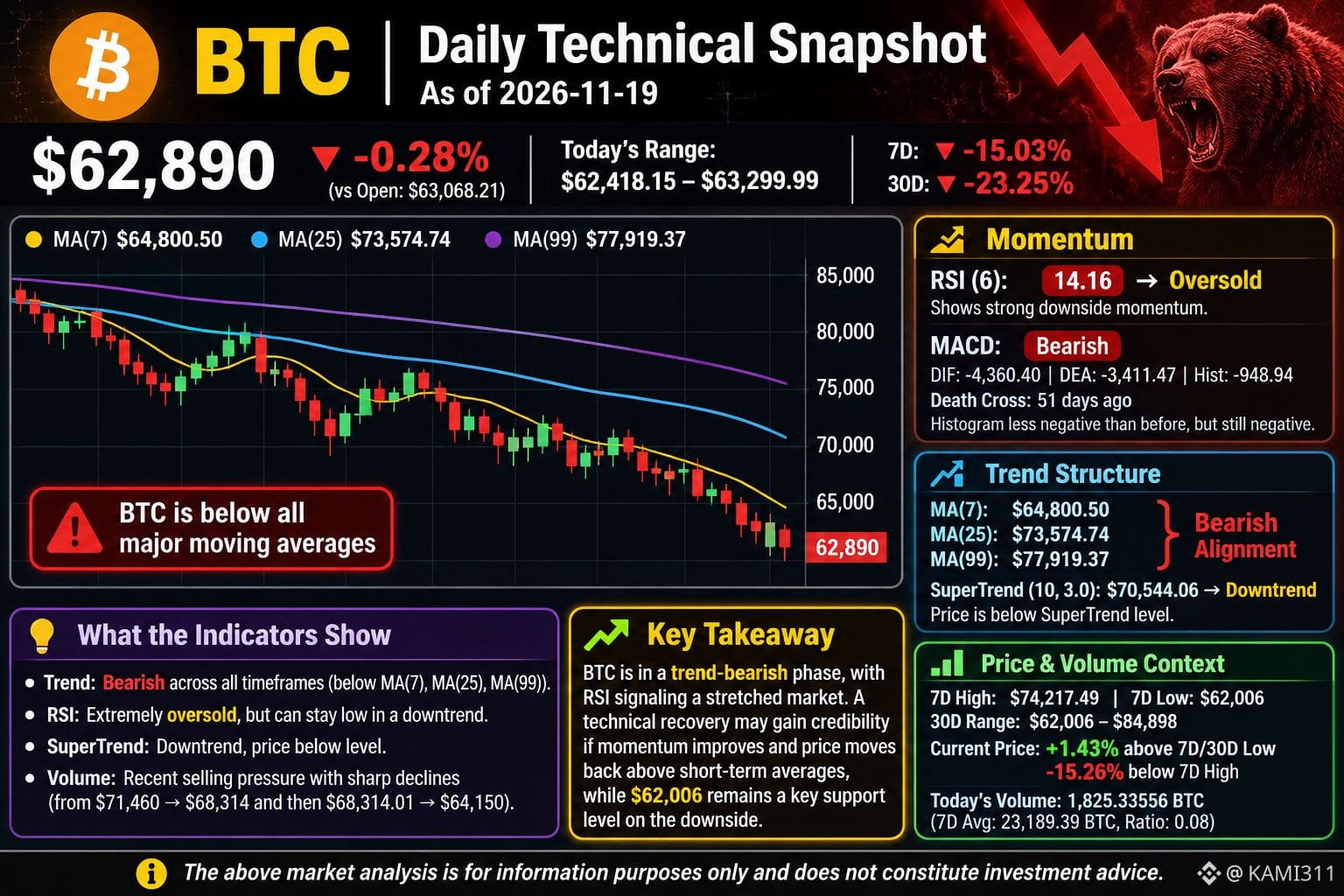
📊 BTC Daily Technical Analysis | Nov 19, 2026
$BTC
{spot}(BTCUSDT)
Price: $62,890 (-0.28%)
🔴 Market Trend: Bearish
• RSI (6): 14.16 — Oversold
• MACD: Bearish momentum
• BTC trading below MA(7), MA(25) & MA(99).
• SuperTrend: Downtrend at $70,544.
📉 Key Support: $62,006
📈 7-Day Change: -15.03%
📉 30-Day Change: -23.25%
Market Outlook: BTC remains under strong bearish pressure. RSI suggests an oversold market, but a confirmed recovery signal is still needed.
⚠️
#BTC走势分析 #BTC #CryptoAnalysis #BinanceSquareFamily #BinanceSquare
📊 BTC Daily Technical Analysis | Nov 19, 2026
$BTC
Price: $62,890 (-0.28%)
🔴 Market Trend: Bearish
• RSI (6): 14.16 — Oversold
• MACD: Bearish momentum
• BTC trading below MA(7), MA(25) & MA(99).
• SuperTrend: Downtrend at $70,544.
📉 Key Support: $62,006
📈 7-Day Change: -15.03%
📉 30-Day Change: -23.25%
Market Outlook: BTC remains under strong bearish pressure. RSI suggests an oversold market, but a confirmed recovery signal is still needed.
⚠️
#BTC走势分析 #BTC #CryptoAnalysis #BinanceSquareFamily #BinanceSquare
104
·
--
Article
What Was LiquidatedDeep Dive
What Was Liquidated
Trading positions worth $211.5 million were forcibly closed across Binance, another exchange and another exchange in the 24 hours to 00:02 UTC on 19 Nov.
Longs totaled $166.2 million against $45.3 million in shorts, across 48,380 orders. Binance saw $137.4 million in liquidations, with another exchange at $48.3 million and another exchange at $25.8 million. By asset, $BTC accounted for $77.5 million and ETH for $49.2 million, with smaller totals in $SOLna(SOL), Zcash (ZEC) and metals-linked contracts.
A liquidation is a forced closure of a leveraged position when collateral no longer covers the required margin, which turns that trader into involuntary selling (for longs) or buying (for shorts).
Leverage And Market Context
Derivatives data show total perpetual open interest at about $325 billion, down roughly 0.5 percent over 24 hours, while total crypto market cap slipped about 1.7 percent to 2.15 trillion dollars. BTC specific liquidations over the day were about $138.52 million.
Other analytics recently recorded larger waves, including around $2 billion of crypto liquidations in a prior 24 hour window, mostly long positions in $BTC and $ETH So the latest 211.5 million event is significant but smaller than the most violent recent flushes.
Sentiment is already weak, with a fear and greed index reading in “extreme fear,” which tends to make markets more vulnerable to sharp moves when leverage is high.
Cascade Risk And Key Levels
Derivatives data mapped by others show notable clusters of BTC long liquidation levels around 63,500 and further down near 60,000, meaning a break through those zones can trigger concentrated forced selling. One highlighted BTC whale long worth about $129 million faces liquidation if price falls below 63,500.
Glassnode style analyses have warned that a daily close below about 62,000 could deepen losses and push BTC toward prior realized price levels near 53,700, especially if liquidation clusters at 60,000 start to trigger.
What this means: For both leveraged traders and spot holders, the main thing to watch is BTC’s behavior around the 63,500 to 62,000 band, plus changes in open interest and funding rates that signal leverage rebuilding or continuing to unwind.
Conclusion
A 211.5 million dollar liquidation wave, dominated by longs on BTC and ETH, has shaken out some leverage but not reset the system. Leverage remains high relative to market depth, so further downside near key BTC levels could turn today’s flush into a larger cascade. Monitoring price around 63,500 to 62,000 and how quickly leverage rebuilds will help gauge whether this is a brief shakeout or part of a longer deleveraging phase.
#BTCRemainsUnderPressureAfterHawkishFOMCMinutes #AnthropicToDebutAfter$83IPOPricing #NvidiaBeatsEstimatesWith$130BQ4Outlook #Binance #BinanceSquareFamily
What Was Liquidated
Deep Dive
What Was Liquidated
Trading positions worth $211.5 million were forcibly closed across Binance, another exchange and another exchange in the 24 hours to 00:02 UTC on 19 Nov.
Longs totaled $166.2 million against $45.3 million in shorts, across 48,380 orders. Binance saw $137.4 million in liquidations, with another exchange at $48.3 million and another exchange at $25.8 million. By asset, $BTC accounted for $77.5 million and ETH for $49.2 million, with smaller totals in $SOLna(SOL), Zcash (ZEC) and metals-linked contracts.
A liquidation is a forced closure of a leveraged position when collateral no longer covers the required margin, which turns that trader into involuntary selling (for longs) or buying (for shorts).
Leverage And Market Context
Derivatives data show total perpetual open interest at about $325 billion, down roughly 0.5 percent over 24 hours, while total crypto market cap slipped about 1.7 percent to 2.15 trillion dollars. BTC specific liquidations over the day were about $138.52 million.
Other analytics recently recorded larger waves, including around $2 billion of crypto liquidations in a prior 24 hour window, mostly long positions in $BTC and $ETH So the latest 211.5 million event is significant but smaller than the most violent recent flushes.
Sentiment is already weak, with a fear and greed index reading in “extreme fear,” which tends to make markets more vulnerable to sharp moves when leverage is high.
Cascade Risk And Key Levels
Derivatives data mapped by others show notable clusters of BTC long liquidation levels around 63,500 and further down near 60,000, meaning a break through those zones can trigger concentrated forced selling. One highlighted BTC whale long worth about $129 million faces liquidation if price falls below 63,500.
Glassnode style analyses have warned that a daily close below about 62,000 could deepen losses and push BTC toward prior realized price levels near 53,700, especially if liquidation clusters at 60,000 start to trigger.
What this means: For both leveraged traders and spot holders, the main thing to watch is BTC’s behavior around the 63,500 to 62,000 band, plus changes in open interest and funding rates that signal leverage rebuilding or continuing to unwind.
Conclusion
A 211.5 million dollar liquidation wave, dominated by longs on BTC and ETH, has shaken out some leverage but not reset the system. Leverage remains high relative to market depth, so further downside near key BTC levels could turn today’s flush into a larger cascade. Monitoring price around 63,500 to 62,000 and how quickly leverage rebuilds will help gauge whether this is a brief shakeout or part of a longer deleveraging phase.
#BTCRemainsUnderPressureAfterHawkishFOMCMinutes #AnthropicToDebutAfter$83IPOPricing #NvidiaBeatsEstimatesWith$130BQ4Outlook #Binance #BinanceSquareFamily
What Was Liquidated
Trading positions worth $211.5 million were forcibly closed across Binance, another exchange and another exchange in the 24 hours to 00:02 UTC on 19 Nov.
Longs totaled $166.2 million against $45.3 million in shorts, across 48,380 orders. Binance saw $137.4 million in liquidations, with another exchange at $48.3 million and another exchange at $25.8 million. By asset, $BTC accounted for $77.5 million and ETH for $49.2 million, with smaller totals in $SOLna(SOL), Zcash (ZEC) and metals-linked contracts.
A liquidation is a forced closure of a leveraged position when collateral no longer covers the required margin, which turns that trader into involuntary selling (for longs) or buying (for shorts).
Leverage And Market Context
Derivatives data show total perpetual open interest at about $325 billion, down roughly 0.5 percent over 24 hours, while total crypto market cap slipped about 1.7 percent to 2.15 trillion dollars. BTC specific liquidations over the day were about $138.52 million.
Other analytics recently recorded larger waves, including around $2 billion of crypto liquidations in a prior 24 hour window, mostly long positions in $BTC and $ETH So the latest 211.5 million event is significant but smaller than the most violent recent flushes.
Sentiment is already weak, with a fear and greed index reading in “extreme fear,” which tends to make markets more vulnerable to sharp moves when leverage is high.
Cascade Risk And Key Levels
Derivatives data mapped by others show notable clusters of BTC long liquidation levels around 63,500 and further down near 60,000, meaning a break through those zones can trigger concentrated forced selling. One highlighted BTC whale long worth about $129 million faces liquidation if price falls below 63,500.
Glassnode style analyses have warned that a daily close below about 62,000 could deepen losses and push BTC toward prior realized price levels near 53,700, especially if liquidation clusters at 60,000 start to trigger.
What this means: For both leveraged traders and spot holders, the main thing to watch is BTC’s behavior around the 63,500 to 62,000 band, plus changes in open interest and funding rates that signal leverage rebuilding or continuing to unwind.
Conclusion
A 211.5 million dollar liquidation wave, dominated by longs on BTC and ETH, has shaken out some leverage but not reset the system. Leverage remains high relative to market depth, so further downside near key BTC levels could turn today’s flush into a larger cascade. Monitoring price around 63,500 to 62,000 and how quickly leverage rebuilds will help gauge whether this is a brief shakeout or part of a longer deleveraging phase.
#BTCRemainsUnderPressureAfterHawkishFOMCMinutes #AnthropicToDebutAfter$83IPOPricing #NvidiaBeatsEstimatesWith$130BQ4Outlook #Binance #BinanceSquareFamily
241
·
--
Market situation
Breadth: The market is mixed rather than broadly directional: most liquid pairs are lower even though $BTC and ETH are only modestly negative. The Fear & Greed Index remains at 13, unchanged from the prior reading, which points to persistent defensive sentiment.
Major-asset split: SOL at $74.63 and XRP at $0.9855 are notable exceptions among larger assets. BNB is $590.5 (-0.5% 24h), reinforcing that relative strength is selective rather than market-wide.
Relative strength
SOL +1.7%: It is one of the stronger Layer 1 / Layer 2 names, with $201.6M in 24h quote volume. The sector itself held up best despite averaging -0.9%.
XRP +1.2%: Its move is supported by comparatively active trading, with $111.3M in 24h quote volume.
NEAR +1.2%: It is another resilient Layer 1 / Layer 2 name, trading $81.1M in 24h quote volume.
Weak area: DeFi is the weakest sector at -3.1%, with ENA -6.0% among its largest laggards. ZRO is the weakest mover overall at -9.0%.
Themes
Solana institutional-product activity: U.S. spot Solana ETFs recorded net inflows, ending a prolonged outflow streak. This sits alongside SOL’s relative resilience versus BTC and $ETH
Ethereum upgrade scrutiny: Audit findings have delayed progress around Ethereum’s Glamsterdam upgrade proposals, keeping protocol implementation risk in focus.
What to re-check
Whether market breadth improves from 8 advancing pairs versus 24 declining pairs.
Whether Layer 1 / Layer 2 continues to hold up better than DeFi.
Whether the Ethereum upgrade timeline receives further clarification after the reported audit findings.
Market analysis only, not investment advice.
118
·
--
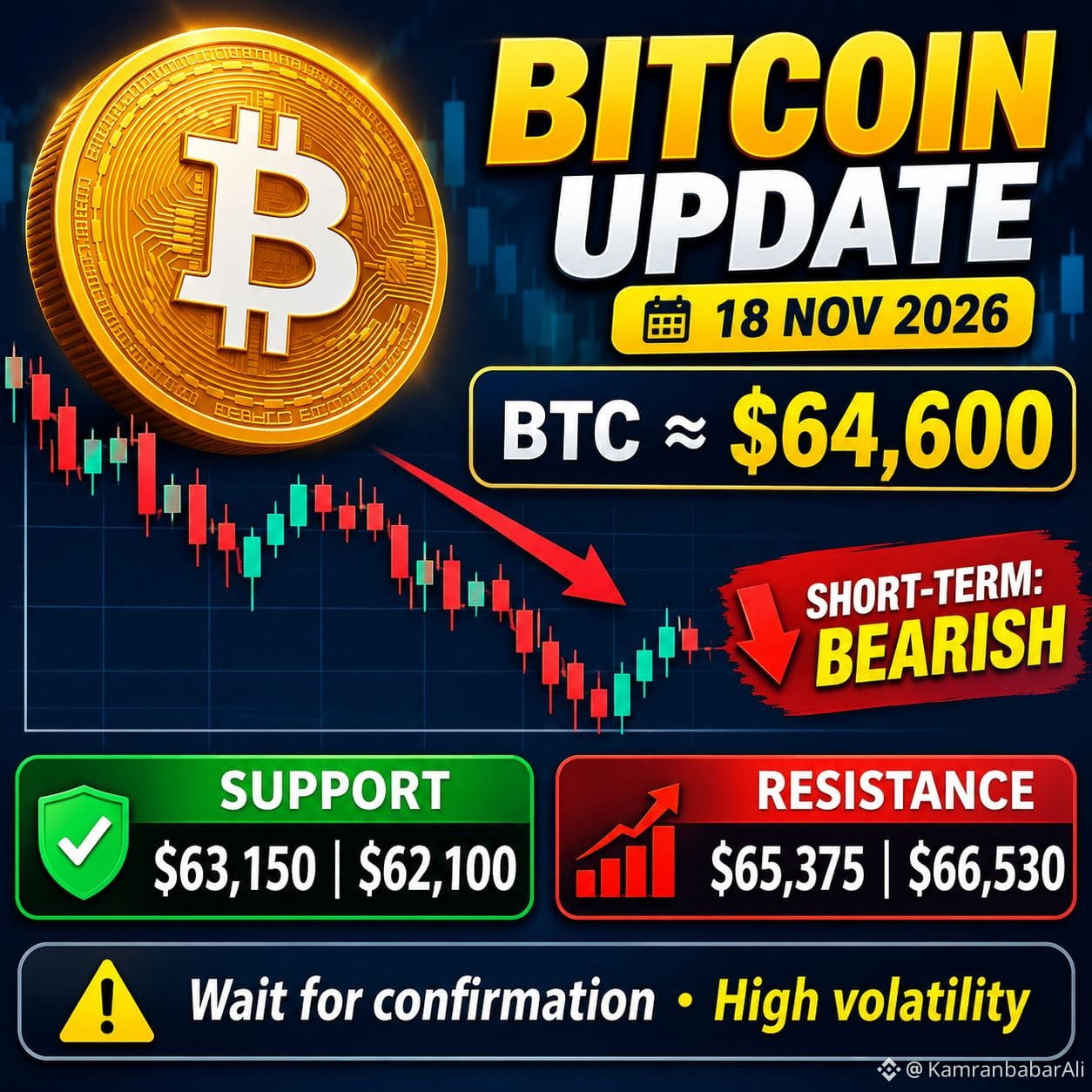
$BTC is showing short-term bearish momentum. 📉 Key support levels are $63,150 and $62,100. Resistance stands at $65,375 and $66,530. Traders should watch for a confirmed breakout or breakdown. ⚠️ Stay alert and manage your risk in this volatile market!
#CanNvidia’sDataCenterGrowthContinue? #LedgerHardwareImplantReportsExtendToDubai #NvidiaBoardNotConsideringHuang’sReturnasCEO #KOSPIFalls2.59%ToLowestCloseSinceFebruary #bitcoin
{spot}(BTCUSDT)
$BTC is showing short-term bearish momentum. 📉 Key support levels are $63,150 and $62,100. Resistance stands at $65,375 and $66,530. Traders should watch for a confirmed breakout or breakdown. ⚠️ Stay alert and manage your risk in this volatile market!
#CanNvidia’sDataCenterGrowthContinue? #LedgerHardwareImplantReportsExtendToDubai #NvidiaBoardNotConsideringHuang’sReturnasCEO #KOSPIFalls2.59%ToLowestCloseSinceFebruary #bitcoin
#CanNvidia’sDataCenterGrowthContinue? #LedgerHardwareImplantReportsExtendToDubai #NvidiaBoardNotConsideringHuang’sReturnasCEO #KOSPIFalls2.59%ToLowestCloseSinceFebruary #bitcoin
87
Log in to explore more content
Join global crypto users on Binance Square
⚡️ Get latest and useful information about crypto.
💬 Trusted by the world’s largest crypto exchange.
👍 Discover real insights from verified creators.
Email / Phone number
Trending Topics
IsAnthropic’s$1.5TMarketCapJustified?
8,056 views
71 Discussing
Anthropic Set to Open at $105 in Record Nasdaq Debut
Binance News
·10 Likes
·10.4k views
BTCRemainsUnderPressureAfterHawkishFOMCMinutes
213,048 views
2,003 Discussing
NvidiaBoardReportedlySplitOverHuang’sReturn
103,908 views
1,068 Discussing