

cRyPtO sMaRt Team
466 Posts

cRyPtO sMaRt Team
Report
Block User
Your ultimate gateway to mastering the world of cryptocurrency trading. Deep insights into market psychology, proven strategies, and disciplined risk management
Open Trade
Frequent Trader
4.6 Years
67 Following
25 Followers
14 Liked
Posts
Portfolio
All
Videos
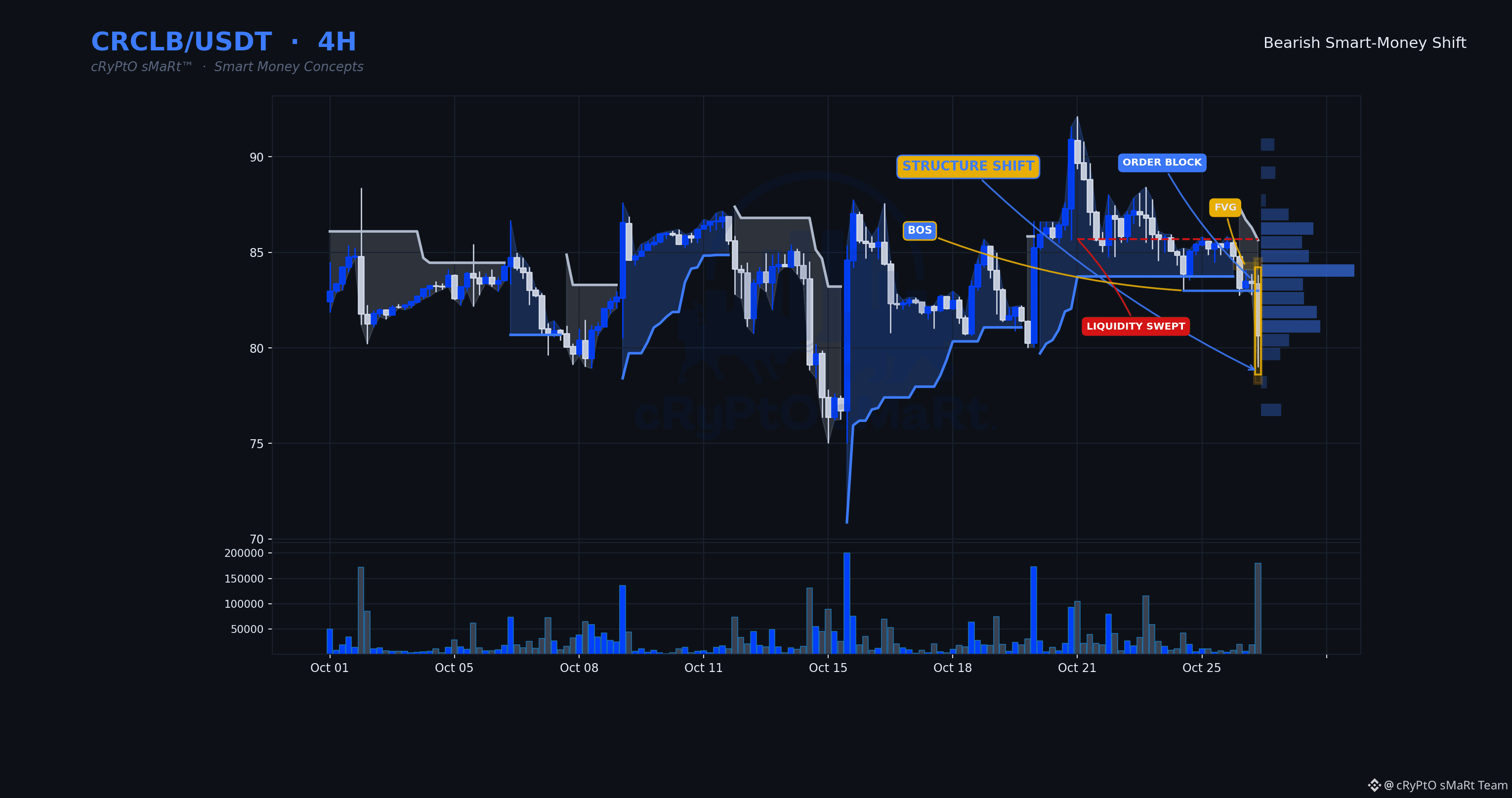
Sellers just ran the highs, grabbed the resting liquidity, and immediately turned the tape over with a clean break of structure to the downside.
🗓 Daily: Bearish — daily Supertrend down, price under the 50 EMA
⏱ 4H: Smart-Money Shift · Bearish bias
⏳ 1H: the 1H is trading below the level with its trend down — the lower timeframe confirms the setup.
✅ Daily, 4H and 1H all point bearish.
📋 WHY IT QUALIFIES
✓ Smart-Money Shift structure completed
🧭 Bias: Bearish while price holds below $83.0000
⚠️ Invalidation: 4H close back above $83.0000
🔵 Support $83.0000 🟡 Resistance $85.6900
$CRCLB $BTC #SmartMoney
Education only, not financial advice.
Sellers just ran the highs, grabbed the resting liquidity, and immediately turned the tape over with a clean break of structure to the downside.
🗓 Daily: Bearish — daily Supertrend down, price under the 50 EMA
⏱ 4H: Smart-Money Shift · Bearish bias
⏳ 1H: the 1H is trading below the level with its trend down — the lower timeframe confirms the setup.
✅ Daily, 4H and 1H all point bearish.
📋 WHY IT QUALIFIES
✓ Smart-Money Shift structure completed
🧭 Bias: Bearish while price holds below $83.0000
⚠️ Invalidation: 4H close back above $83.0000
🔵 Support $83.0000 🟡 Resistance $85.6900
$CRCLB $BTC #SmartMoney
Education only, not financial advice.
🗓 Daily: Bearish — daily Supertrend down, price under the 50 EMA
⏱ 4H: Smart-Money Shift · Bearish bias
⏳ 1H: the 1H is trading below the level with its trend down — the lower timeframe confirms the setup.
✅ Daily, 4H and 1H all point bearish.
📋 WHY IT QUALIFIES
✓ Smart-Money Shift structure completed
🧭 Bias: Bearish while price holds below $83.0000
⚠️ Invalidation: 4H close back above $83.0000
🔵 Support $83.0000 🟡 Resistance $85.6900
$CRCLB $BTC #SmartMoney
Education only, not financial advice.
49
That rush after a big win feels a lot like leaving a casino up money, then deciding to "just play a little more" with house cash in hand. The confidence feels earned, so the next trade gets sized bigger, checked less, trusted more — not because the setup is better, but because the ego is louder. That's where discipline leaks out quietly, right when you least expect to need it. Next time you close a strong win, treat the next entry like a brand new session: same checklist, same size rules, zero carryover confidence. What usually happens to your process right after a win?
$ADA $DOGE $AVAX #TradingPsychology #Mindset #Crypto #Trading
Follow for daily trading education · Education only, not financial advice.
That rush after a big win feels a lot like leaving a casino up money, then deciding to "just play a little more" with house cash in hand. The confidence feels earned, so the next trade gets sized bigger, checked less, trusted more — not because the setup is better, but because the ego is louder. That's where discipline leaks out quietly, right when you least expect to need it. Next time you close a strong win, treat the next entry like a brand new session: same checklist, same size rules, zero carryover confidence. What usually happens to your process right after a win?
$ADA $DOGE $AVAX #TradingPsychology #Mindset #Crypto #Trading
Follow for daily trading education · Education only, not financial advice.
$ADA $DOGE $AVAX #TradingPsychology #Mindset #Crypto #Trading
Follow for daily trading education · Education only, not financial advice.

65
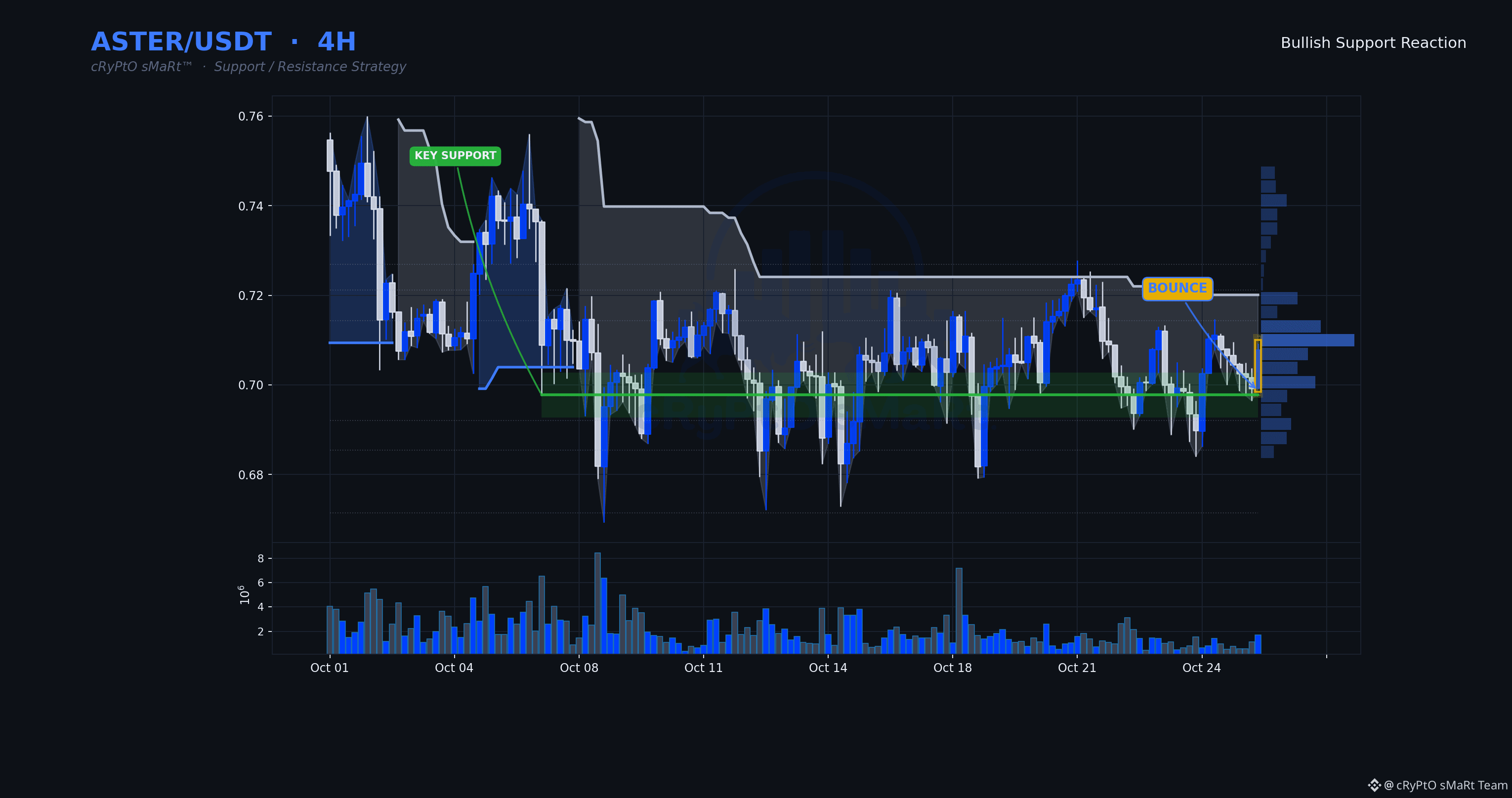
Buyers showed up right where they needed to and did it with size — this bounce came on well above average volume, not a quiet drift higher. That's the mark of real participation stepping in at an established support shelf, not just thin-book noise.
🗓 Daily: Neutral — daily is mixed — Supertrend and EMAs not aligned
⏱ 4H: Support/Resistance Reaction · Bullish bias
⏳ 1H: the 1H still needs to reclaim and hold the level before the setup is confirmed on the lower timeframe.
📋 WHY IT QUALIFIES
✓ Support/Resistance Reaction structure completed
🧭 Bias: Bullish while price holds above $0.71428
⚠️ Invalidation: 4H close back below $0.71428
🔵 Support $0.69775 🟡 Resistance $0.71428
$ASTER $BTC #SupportResistance
Education only, not financial advice.
Buyers showed up right where they needed to and did it with size — this bounce came on well above average volume, not a quiet drift higher. That's the mark of real participation stepping in at an established support shelf, not just thin-book noise.
🗓 Daily: Neutral — daily is mixed — Supertrend and EMAs not aligned
⏱ 4H: Support/Resistance Reaction · Bullish bias
⏳ 1H: the 1H still needs to reclaim and hold the level before the setup is confirmed on the lower timeframe.
📋 WHY IT QUALIFIES
✓ Support/Resistance Reaction structure completed
🧭 Bias: Bullish while price holds above $0.71428
⚠️ Invalidation: 4H close back below $0.71428
🔵 Support $0.69775 🟡 Resistance $0.71428
$ASTER $BTC #SupportResistance
Education only, not financial advice.
🗓 Daily: Neutral — daily is mixed — Supertrend and EMAs not aligned
⏱ 4H: Support/Resistance Reaction · Bullish bias
⏳ 1H: the 1H still needs to reclaim and hold the level before the setup is confirmed on the lower timeframe.
📋 WHY IT QUALIFIES
✓ Support/Resistance Reaction structure completed
🧭 Bias: Bullish while price holds above $0.71428
⚠️ Invalidation: 4H close back below $0.71428
🔵 Support $0.69775 🟡 Resistance $0.71428
$ASTER $BTC #SupportResistance
Education only, not financial advice.
80
Ever notice your worst losses rarely come from being wrong about the market?
They come from behaviour. Four patterns drain accounts faster than bad analysis ever could: overtrading because sitting still feels unproductive, skipping a stop because the setup feels "too obvious" to fail, widening a stop once price moves against you so being wrong doesn't feel real, and revenge trading to fix a loss emotionally instead of strategically. None of these are market problems. They're discipline problems wearing a market costume.
Watch for the moment you justify changing a rule mid-trade. That's the leak.
Which one of these four shows up most in your own trading?
$BNB $SOL $XRP #Trading #TradingEducation #Crypto #TA
Follow for daily trading education · Education only, not financial advice.
Ever notice your worst losses rarely come from being wrong about the market?
They come from behaviour. Four patterns drain accounts faster than bad analysis ever could: overtrading because sitting still feels unproductive, skipping a stop because the setup feels "too obvious" to fail, widening a stop once price moves against you so being wrong doesn't feel real, and revenge trading to fix a loss emotionally instead of strategically. None of these are market problems. They're discipline problems wearing a market costume.
Watch for the moment you justify changing a rule mid-trade. That's the leak.
Which one of these four shows up most in your own trading?
$BNB $SOL $XRP #Trading #TradingEducation #Crypto #TA
Follow for daily trading education · Education only, not financial advice.
They come from behaviour. Four patterns drain accounts faster than bad analysis ever could: overtrading because sitting still feels unproductive, skipping a stop because the setup feels "too obvious" to fail, widening a stop once price moves against you so being wrong doesn't feel real, and revenge trading to fix a loss emotionally instead of strategically. None of these are market problems. They're discipline problems wearing a market costume.
Watch for the moment you justify changing a rule mid-trade. That's the leak.
Which one of these four shows up most in your own trading?
$BNB $SOL $XRP #Trading #TradingEducation #Crypto #TA
Follow for daily trading education · Education only, not financial advice.

64
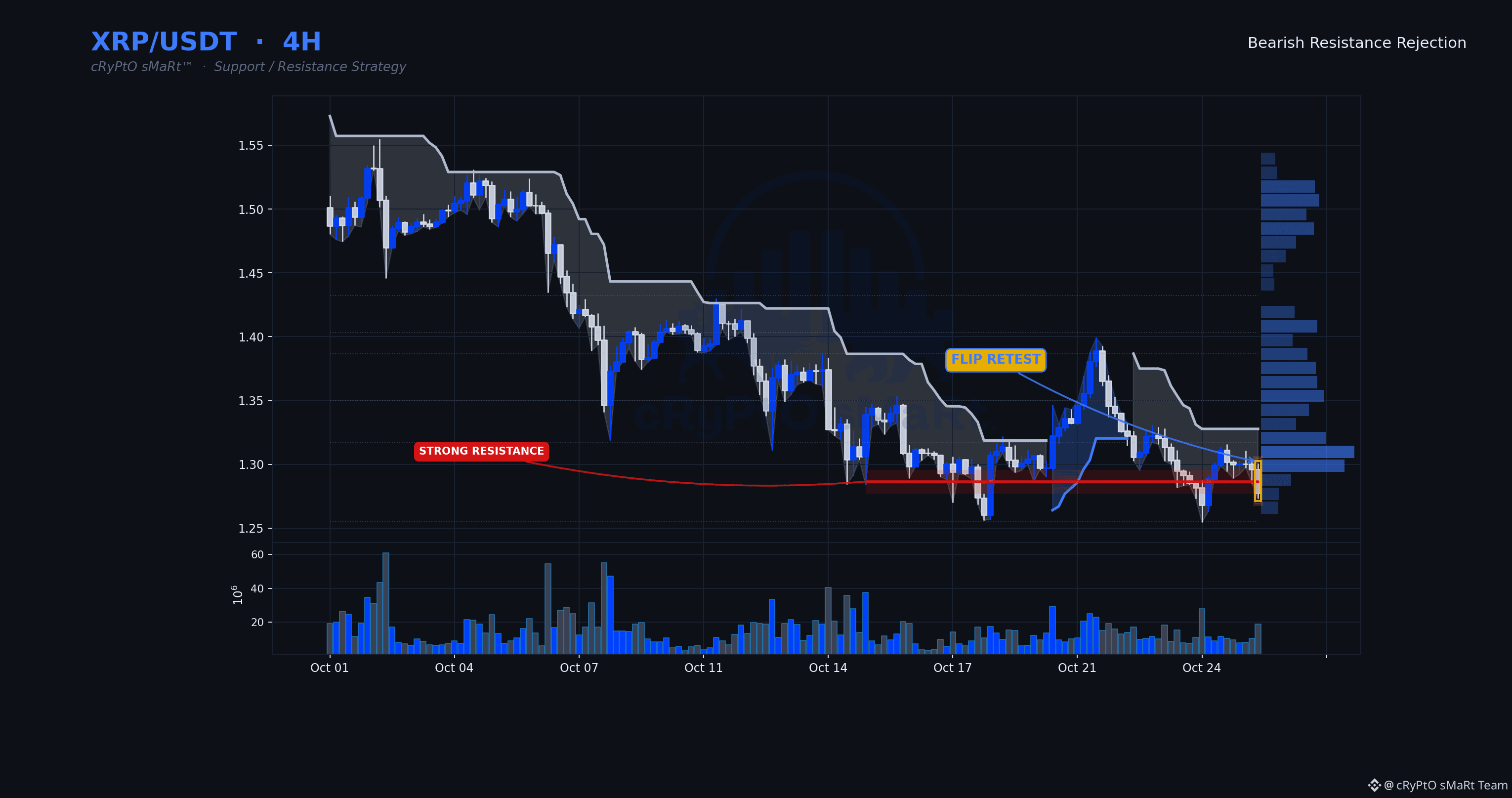
Sellers showed up exactly where they needed to, turning old support into fresh resistance on a retest that came with volume well above average. That's not a shrug-and-fade move — real size traded into this flip, which tells you the level is being defended with conviction, not just technical memory.
🗓 Daily: Bearish — daily Supertrend down, price under the 50 EMA
⏱ 4H: Support/Resistance Reaction · Bearish bias
⏳ 1H: the 1H is still above the level — the setup only triggers once it loses and holds below it.
📋 WHY IT QUALIFIES
✓ Support/Resistance Reaction structure completed
🧭 Bias: Bearish while price holds below $1.2554
⚠️ Invalidation: 4H close back above $1.2554
🔵 Support $1.2554 🟡 Resistance $1.2865
$XRP $BTC #SupportResistance
Education only, not financial advice.
Sellers showed up exactly where they needed to, turning old support into fresh resistance on a retest that came with volume well above average. That's not a shrug-and-fade move — real size traded into this flip, which tells you the level is being defended with conviction, not just technical memory.
🗓 Daily: Bearish — daily Supertrend down, price under the 50 EMA
⏱ 4H: Support/Resistance Reaction · Bearish bias
⏳ 1H: the 1H is still above the level — the setup only triggers once it loses and holds below it.
📋 WHY IT QUALIFIES
✓ Support/Resistance Reaction structure completed
🧭 Bias: Bearish while price holds below $1.2554
⚠️ Invalidation: 4H close back above $1.2554
🔵 Support $1.2554 🟡 Resistance $1.2865
$XRP $BTC #SupportResistance
Education only, not financial advice.
🗓 Daily: Bearish — daily Supertrend down, price under the 50 EMA
⏱ 4H: Support/Resistance Reaction · Bearish bias
⏳ 1H: the 1H is still above the level — the setup only triggers once it loses and holds below it.
📋 WHY IT QUALIFIES
✓ Support/Resistance Reaction structure completed
🧭 Bias: Bearish while price holds below $1.2554
⚠️ Invalidation: 4H close back above $1.2554
🔵 Support $1.2554 🟡 Resistance $1.2865
$XRP $BTC #SupportResistance
Education only, not financial advice.
27
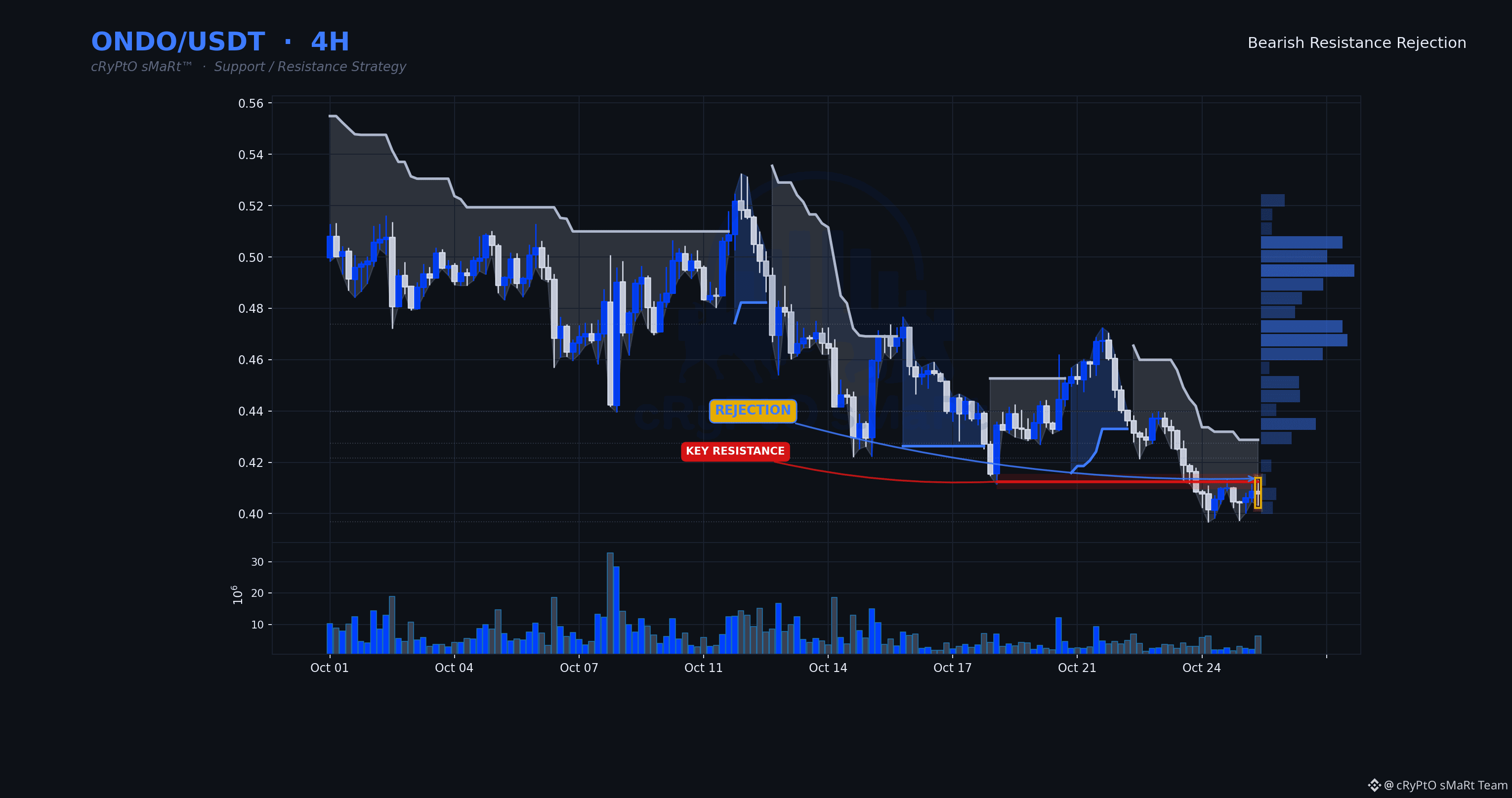
Sellers showed up right where they were supposed to, and they showed up heavy. Volume well above average on the rejection tells you this wasn't a shrug — real supply hit an established resistance shelf and took control back from whatever buyers had going.
🗓 Daily: Neutral — daily is mixed — Supertrend and EMAs not aligned
⏱ 4H: Support/Resistance Reaction · Bearish bias
⏳ 1H: the 1H is still above the level — the setup only triggers once it loses and holds below it.
📋 WHY IT QUALIFIES
✓ Support/Resistance Reaction structure completed
🧭 Bias: Bearish while price holds below $0.39690
⚠️ Invalidation: 4H close back above $0.39690
🔵 Support $0.39690 🟡 Resistance $0.41245
$ONDO $BTC #SupportResistance
Education only, not financial advice.
Sellers showed up right where they were supposed to, and they showed up heavy. Volume well above average on the rejection tells you this wasn't a shrug — real supply hit an established resistance shelf and took control back from whatever buyers had going.
🗓 Daily: Neutral — daily is mixed — Supertrend and EMAs not aligned
⏱ 4H: Support/Resistance Reaction · Bearish bias
⏳ 1H: the 1H is still above the level — the setup only triggers once it loses and holds below it.
📋 WHY IT QUALIFIES
✓ Support/Resistance Reaction structure completed
🧭 Bias: Bearish while price holds below $0.39690
⚠️ Invalidation: 4H close back above $0.39690
🔵 Support $0.39690 🟡 Resistance $0.41245
$ONDO $BTC #SupportResistance
Education only, not financial advice.
🗓 Daily: Neutral — daily is mixed — Supertrend and EMAs not aligned
⏱ 4H: Support/Resistance Reaction · Bearish bias
⏳ 1H: the 1H is still above the level — the setup only triggers once it loses and holds below it.
📋 WHY IT QUALIFIES
✓ Support/Resistance Reaction structure completed
🧭 Bias: Bearish while price holds below $0.39690
⚠️ Invalidation: 4H close back above $0.39690
🔵 Support $0.39690 🟡 Resistance $0.41245
$ONDO $BTC #SupportResistance
Education only, not financial advice.
74
You don't decide to brush your teeth each morning — you just do it, because the decision got made once, a long time ago, and now it's a routine instead of a battle. Trading without a written process puts you in a fresh negotiation with yourself every single time price moves, and tired, emotional minds lose that negotiation constantly. The cost isn't one bad trade, it's the slow erosion of trust in yourself. Write the rules down before the session starts, when you're calm, then follow them like brushing your teeth. What's one rule you keep breaking only in the heat of the moment?
$TRX $BTC $ETH #TradingPsychology #Mindset #Crypto #Trading
Follow for daily trading education · Education only, not financial advice.
You don't decide to brush your teeth each morning — you just do it, because the decision got made once, a long time ago, and now it's a routine instead of a battle. Trading without a written process puts you in a fresh negotiation with yourself every single time price moves, and tired, emotional minds lose that negotiation constantly. The cost isn't one bad trade, it's the slow erosion of trust in yourself. Write the rules down before the session starts, when you're calm, then follow them like brushing your teeth. What's one rule you keep breaking only in the heat of the moment?
$TRX $BTC $ETH #TradingPsychology #Mindset #Crypto #Trading
Follow for daily trading education · Education only, not financial advice.
$TRX $BTC $ETH #TradingPsychology #Mindset #Crypto #Trading
Follow for daily trading education · Education only, not financial advice.

95
Another week, another reminder that the market doesn't care about your opinion — only your process. The traders who stayed steady weren't the ones who called every move perfectly; they were the ones who respected their plan even when emotions screamed otherwise. Discipline isn't about being right constantly, it's about managing risk so being wrong never costs you the game. Patience also keeps quietly separating the amateurs from the pros — waiting for a setup that fits your plan beats chasing one that fits your impatience. Reflection is part of the edge too; reviewing decisions without ego teaches more than any winning streak ever could. What lesson did this week teach you about yourself as a trader?
$DOGE $AVAX $LINK #Crypto #Trading #WeeklyRecap #TA
Follow for daily trading education · Education only, not financial advice.
Another week, another reminder that the market doesn't care about your opinion — only your process. The traders who stayed steady weren't the ones who called every move perfectly; they were the ones who respected their plan even when emotions screamed otherwise. Discipline isn't about being right constantly, it's about managing risk so being wrong never costs you the game. Patience also keeps quietly separating the amateurs from the pros — waiting for a setup that fits your plan beats chasing one that fits your impatience. Reflection is part of the edge too; reviewing decisions without ego teaches more than any winning streak ever could. What lesson did this week teach you about yourself as a trader?
$DOGE $AVAX $LINK #Crypto #Trading #WeeklyRecap #TA
Follow for daily trading education · Education only, not financial advice.
$DOGE $AVAX $LINK #Crypto #Trading #WeeklyRecap #TA
Follow for daily trading education · Education only, not financial advice.

157
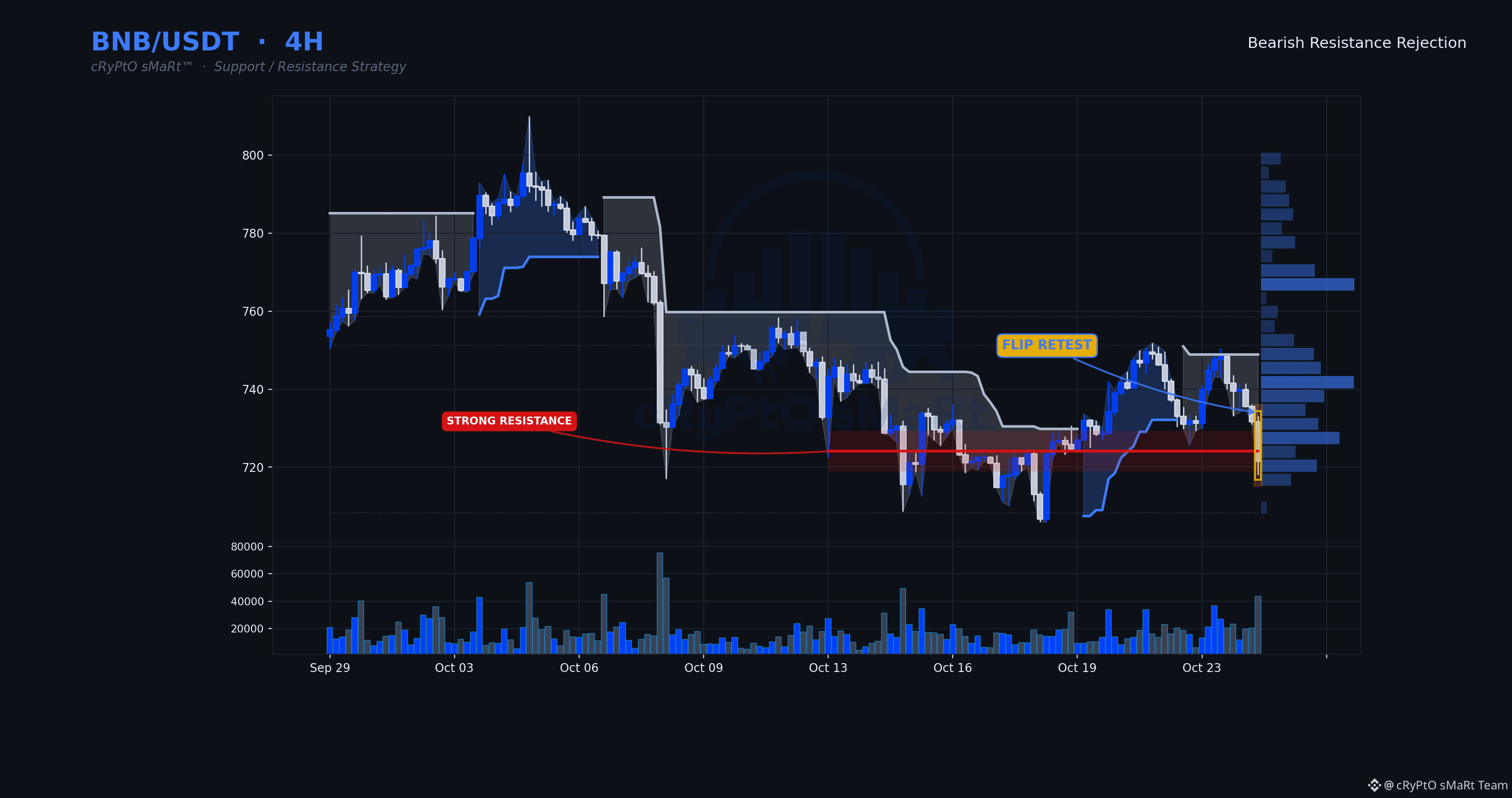
Sellers showed up right where the chart said they would — an established level flipped from support to resistance, and the retest got rejected on volume well above average. That's not noise, that's supply stepping in with conviction, confirming the flip is real rather than a one-off wick.
🗓 Daily: Neutral — daily is mixed — Supertrend and EMAs not aligned
⏱ 4H: Support/Resistance Reaction · Bearish bias
⏳ 1H: the 1H is still above the level — the setup only triggers once it loses and holds below it.
📋 WHY IT QUALIFIES
✓ Support/Resistance Reaction structure completed
🧭 Bias: Bearish while price holds below $708.2167
⚠️ Invalidation: 4H close back above $708.2167
🔵 Support $708.2167 🟡 Resistance $724.0900
$BNB $BTC #SupportResistance
Education only, not financial advice.
Sellers showed up right where the chart said they would — an established level flipped from support to resistance, and the retest got rejected on volume well above average. That's not noise, that's supply stepping in with conviction, confirming the flip is real rather than a one-off wick.
🗓 Daily: Neutral — daily is mixed — Supertrend and EMAs not aligned
⏱ 4H: Support/Resistance Reaction · Bearish bias
⏳ 1H: the 1H is still above the level — the setup only triggers once it loses and holds below it.
📋 WHY IT QUALIFIES
✓ Support/Resistance Reaction structure completed
🧭 Bias: Bearish while price holds below $708.2167
⚠️ Invalidation: 4H close back above $708.2167
🔵 Support $708.2167 🟡 Resistance $724.0900
$BNB $BTC #SupportResistance
Education only, not financial advice.
🗓 Daily: Neutral — daily is mixed — Supertrend and EMAs not aligned
⏱ 4H: Support/Resistance Reaction · Bearish bias
⏳ 1H: the 1H is still above the level — the setup only triggers once it loses and holds below it.
📋 WHY IT QUALIFIES
✓ Support/Resistance Reaction structure completed
🧭 Bias: Bearish while price holds below $708.2167
⚠️ Invalidation: 4H close back above $708.2167
🔵 Support $708.2167 🟡 Resistance $724.0900
$BNB $BTC #SupportResistance
Education only, not financial advice.
37
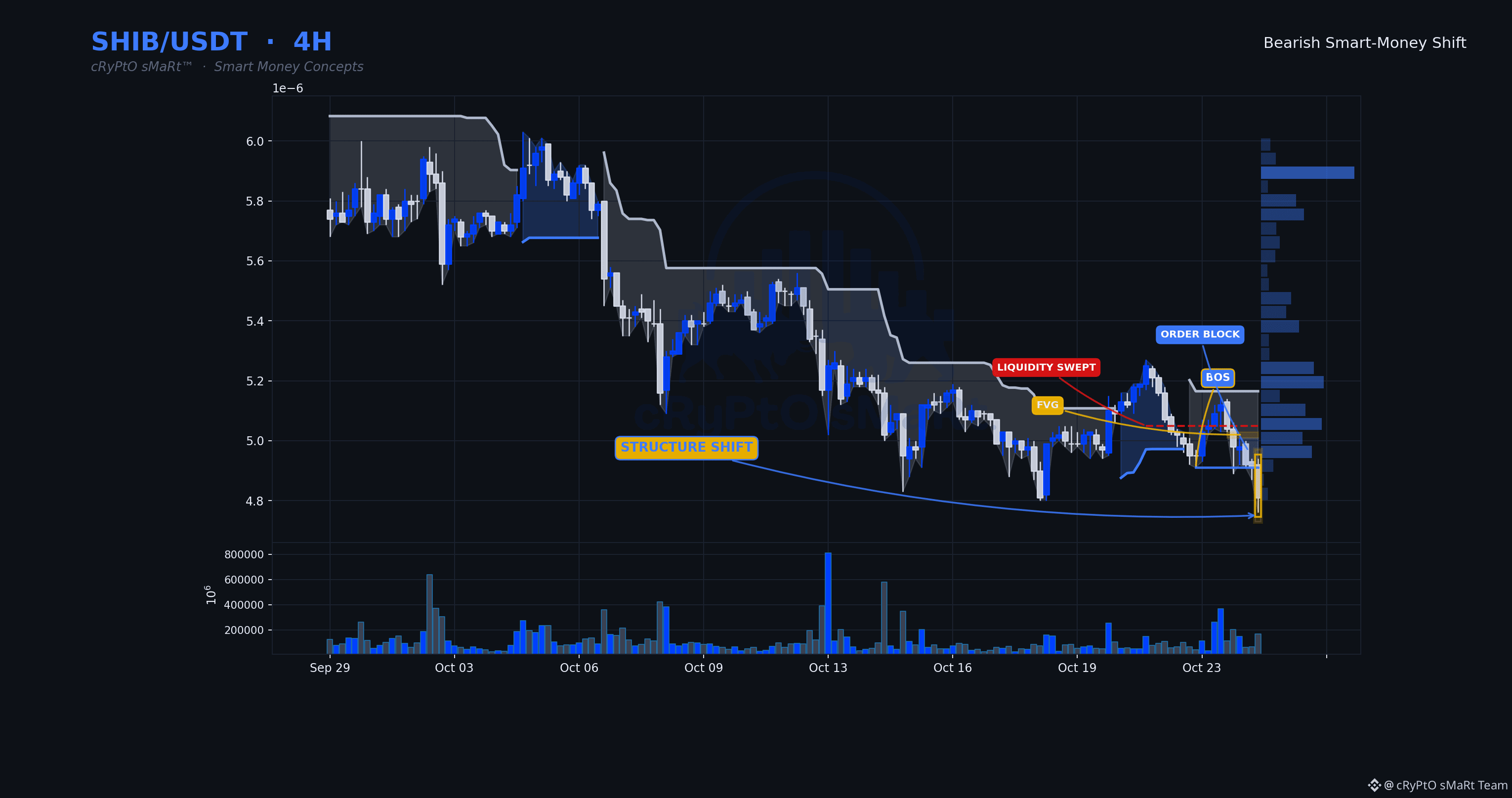
Sellers just swept the highs, grabbed the resting liquidity above, and turned it straight into a break of structure lower. That's not random chop — that's engineered, stops run and then supply stepping in with real conviction.
🗓 Daily: Bearish — price below the daily Supertrend with a falling 50/200 EMA stack
⏱ 4H: Smart-Money Shift · Bearish bias
⏳ 1H: the 1H is trading below the level with its trend down — the lower timeframe confirms the setup.
✅ Daily, 4H and 1H all point bearish.
📋 WHY IT QUALIFIES
✓ Smart-Money Shift structure completed
🧭 Bias: Bearish while price holds below $0.00000491
⚠️ Invalidation: 4H close back above $0.00000491
🔵 Support $0.00000491 🟡 Resistance $0.00000505
$SHIB $BTC #SmartMoney
Education only, not financial advice.
Sellers just swept the highs, grabbed the resting liquidity above, and turned it straight into a break of structure lower. That's not random chop — that's engineered, stops run and then supply stepping in with real conviction.
🗓 Daily: Bearish — price below the daily Supertrend with a falling 50/200 EMA stack
⏱ 4H: Smart-Money Shift · Bearish bias
⏳ 1H: the 1H is trading below the level with its trend down — the lower timeframe confirms the setup.
✅ Daily, 4H and 1H all point bearish.
📋 WHY IT QUALIFIES
✓ Smart-Money Shift structure completed
🧭 Bias: Bearish while price holds below $0.00000491
⚠️ Invalidation: 4H close back above $0.00000491
🔵 Support $0.00000491 🟡 Resistance $0.00000505
$SHIB $BTC #SmartMoney
Education only, not financial advice.
🗓 Daily: Bearish — price below the daily Supertrend with a falling 50/200 EMA stack
⏱ 4H: Smart-Money Shift · Bearish bias
⏳ 1H: the 1H is trading below the level with its trend down — the lower timeframe confirms the setup.
✅ Daily, 4H and 1H all point bearish.
📋 WHY IT QUALIFIES
✓ Smart-Money Shift structure completed
🧭 Bias: Bearish while price holds below $0.00000491
⚠️ Invalidation: 4H close back above $0.00000491
🔵 Support $0.00000491 🟡 Resistance $0.00000505
$SHIB $BTC #SmartMoney
Education only, not financial advice.
47
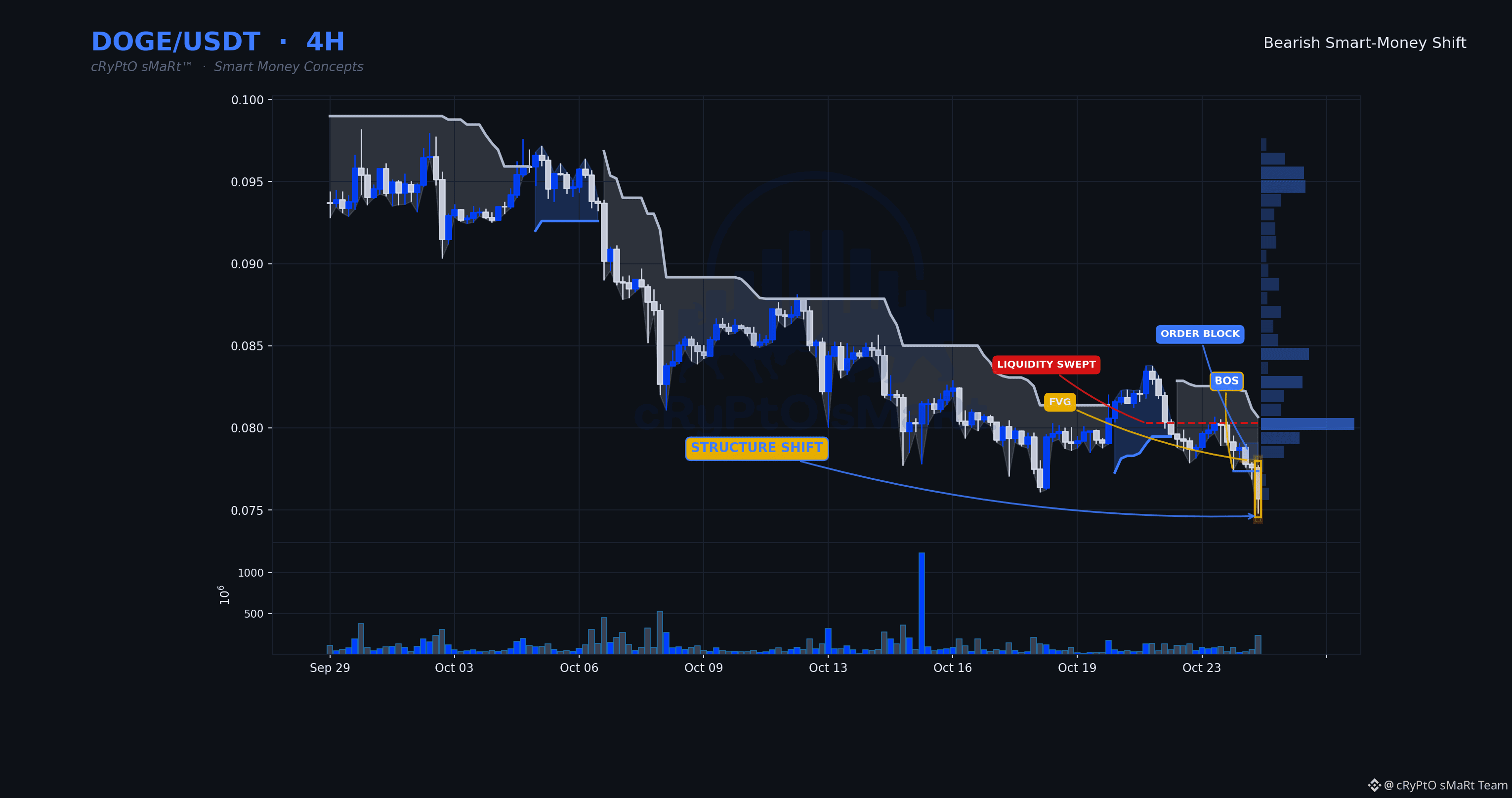
Sellers just ran the highs, grabbed the resting liquidity, and turned it into a clean break of structure lower. Strong displacement on volume well above average tells you this wasn't a shakeout — real participation stepped in on the downside.
🗓 Daily: Bearish — price below the daily Supertrend with a falling 50/200 EMA stack
⏱ 4H: Smart-Money Shift · Bearish bias
⏳ 1H: the 1H is trading below the level with its trend down — the lower timeframe confirms the setup.
✅ Daily, 4H and 1H all point bearish.
📋 WHY IT QUALIFIES
✓ Smart-Money Shift structure completed
🧭 Bias: Bearish while price holds below $0.07738
⚠️ Invalidation: 4H close back above $0.07738
🔵 Support $0.07738 🟡 Resistance $0.08029
$DOGE $BTC #SmartMoney
Education only, not financial advice.
Sellers just ran the highs, grabbed the resting liquidity, and turned it into a clean break of structure lower. Strong displacement on volume well above average tells you this wasn't a shakeout — real participation stepped in on the downside.
🗓 Daily: Bearish — price below the daily Supertrend with a falling 50/200 EMA stack
⏱ 4H: Smart-Money Shift · Bearish bias
⏳ 1H: the 1H is trading below the level with its trend down — the lower timeframe confirms the setup.
✅ Daily, 4H and 1H all point bearish.
📋 WHY IT QUALIFIES
✓ Smart-Money Shift structure completed
🧭 Bias: Bearish while price holds below $0.07738
⚠️ Invalidation: 4H close back above $0.07738
🔵 Support $0.07738 🟡 Resistance $0.08029
$DOGE $BTC #SmartMoney
Education only, not financial advice.
🗓 Daily: Bearish — price below the daily Supertrend with a falling 50/200 EMA stack
⏱ 4H: Smart-Money Shift · Bearish bias
⏳ 1H: the 1H is trading below the level with its trend down — the lower timeframe confirms the setup.
✅ Daily, 4H and 1H all point bearish.
📋 WHY IT QUALIFIES
✓ Smart-Money Shift structure completed
🧭 Bias: Bearish while price holds below $0.07738
⚠️ Invalidation: 4H close back above $0.07738
🔵 Support $0.07738 🟡 Resistance $0.08029
$DOGE $BTC #SmartMoney
Education only, not financial advice.
65
Boredom dresses itself up as instinct. The chart isn't offering anything, but the fingers want to click something anyway — so the mind invents a setup to justify the itch. That's not analysis, it's restlessness wearing a trading hat, and it quietly drains accounts that patience would've protected.
The rule disciplined traders never break: no setup, no trade, no exceptions. Boredom is not a signal. If the only reason to enter is that you've been watching too long, step away from the screen instead of the market.
What do you do in the dead hours to keep boredom from making decisions for you?
$SOL $XRP $ADA #TradingPsychology #Mindset #Crypto #Trading
Follow for daily trading education · Education only, not financial advice.
Boredom dresses itself up as instinct. The chart isn't offering anything, but the fingers want to click something anyway — so the mind invents a setup to justify the itch. That's not analysis, it's restlessness wearing a trading hat, and it quietly drains accounts that patience would've protected.
The rule disciplined traders never break: no setup, no trade, no exceptions. Boredom is not a signal. If the only reason to enter is that you've been watching too long, step away from the screen instead of the market.
What do you do in the dead hours to keep boredom from making decisions for you?
$SOL $XRP $ADA #TradingPsychology #Mindset #Crypto #Trading
Follow for daily trading education · Education only, not financial advice.
The rule disciplined traders never break: no setup, no trade, no exceptions. Boredom is not a signal. If the only reason to enter is that you've been watching too long, step away from the screen instead of the market.
What do you do in the dead hours to keep boredom from making decisions for you?
$SOL $XRP $ADA #TradingPsychology #Mindset #Crypto #Trading
Follow for daily trading education · Education only, not financial advice.

155
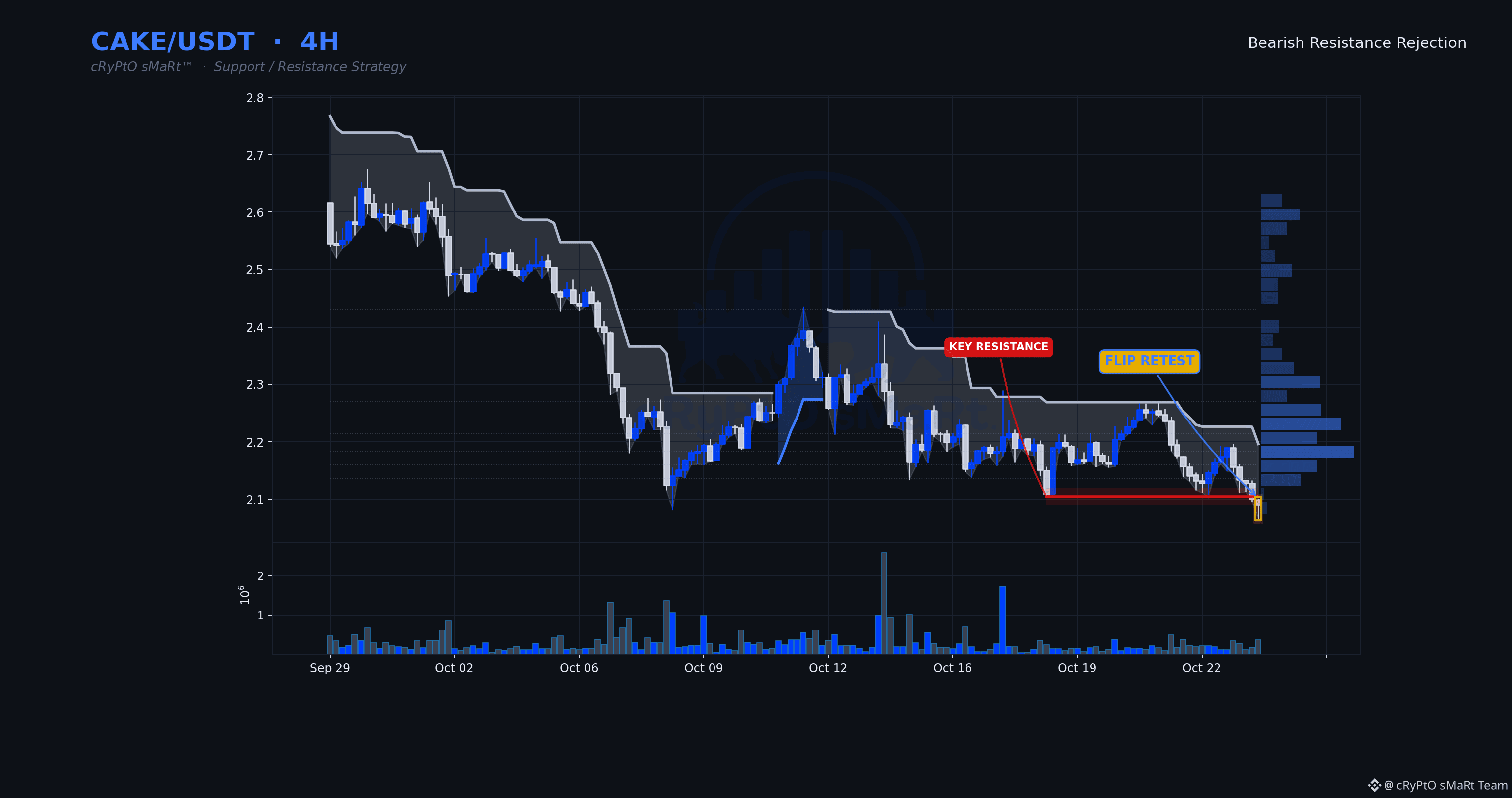
Sellers showed up right where they were supposed to — old support, now flipped resistance, getting retested on volume well above average. That's not drifty, low-conviction selling, that's participation confirming the level matters.
🗓 Daily: Bearish — daily Supertrend down, price under the 50 EMA
⏱ 4H: Support/Resistance Reaction · Bearish bias
⏳ 1H: the 1H is still above the level — the setup only triggers once it loses and holds below it.
📋 WHY IT QUALIFIES
✓ Support/Resistance Reaction structure completed
🧭 Bias: Bearish while price holds below $2.0660
⚠️ Invalidation: 4H close back above $2.0660
🔵 Support $2.0660 🟡 Resistance $2.1045
$CAKE $BTC #SupportResistance
Education only, not financial advice.
Sellers showed up right where they were supposed to — old support, now flipped resistance, getting retested on volume well above average. That's not drifty, low-conviction selling, that's participation confirming the level matters.
🗓 Daily: Bearish — daily Supertrend down, price under the 50 EMA
⏱ 4H: Support/Resistance Reaction · Bearish bias
⏳ 1H: the 1H is still above the level — the setup only triggers once it loses and holds below it.
📋 WHY IT QUALIFIES
✓ Support/Resistance Reaction structure completed
🧭 Bias: Bearish while price holds below $2.0660
⚠️ Invalidation: 4H close back above $2.0660
🔵 Support $2.0660 🟡 Resistance $2.1045
$CAKE $BTC #SupportResistance
Education only, not financial advice.
🗓 Daily: Bearish — daily Supertrend down, price under the 50 EMA
⏱ 4H: Support/Resistance Reaction · Bearish bias
⏳ 1H: the 1H is still above the level — the setup only triggers once it loses and holds below it.
📋 WHY IT QUALIFIES
✓ Support/Resistance Reaction structure completed
🧭 Bias: Bearish while price holds below $2.0660
⚠️ Invalidation: 4H close back above $2.0660
🔵 Support $2.0660 🟡 Resistance $2.1045
$CAKE $BTC #SupportResistance
Education only, not financial advice.
52
Swimming against a river looks heroic until the current wins anyway.
Most traders burn energy guessing when a trend will flip, catching maybe one real reversal while eating losses on five fake ones. The dominant trend already shows you where the path of least resistance is — price making higher highs or lower lows is the market telling you which way the current flows. Trading with it means the structure does the work for you, instead of you fighting it every candle.
Watch for this: before a trade, check the higher timeframe direction first. If you're constantly fading the obvious trend, that's worth noticing.
What's the last trade you took against the trend — and how did it actually play out?
$BTC $ETH $BNB #Trading #TradingEducation #Crypto #TA
Follow for daily trading education · Education only, not financial advice.
Swimming against a river looks heroic until the current wins anyway.
Most traders burn energy guessing when a trend will flip, catching maybe one real reversal while eating losses on five fake ones. The dominant trend already shows you where the path of least resistance is — price making higher highs or lower lows is the market telling you which way the current flows. Trading with it means the structure does the work for you, instead of you fighting it every candle.
Watch for this: before a trade, check the higher timeframe direction first. If you're constantly fading the obvious trend, that's worth noticing.
What's the last trade you took against the trend — and how did it actually play out?
$BTC $ETH $BNB #Trading #TradingEducation #Crypto #TA
Follow for daily trading education · Education only, not financial advice.
Most traders burn energy guessing when a trend will flip, catching maybe one real reversal while eating losses on five fake ones. The dominant trend already shows you where the path of least resistance is — price making higher highs or lower lows is the market telling you which way the current flows. Trading with it means the structure does the work for you, instead of you fighting it every candle.
Watch for this: before a trade, check the higher timeframe direction first. If you're constantly fading the obvious trend, that's worth noticing.
What's the last trade you took against the trend — and how did it actually play out?
$BTC $ETH $BNB #Trading #TradingEducation #Crypto #TA
Follow for daily trading education · Education only, not financial advice.

82
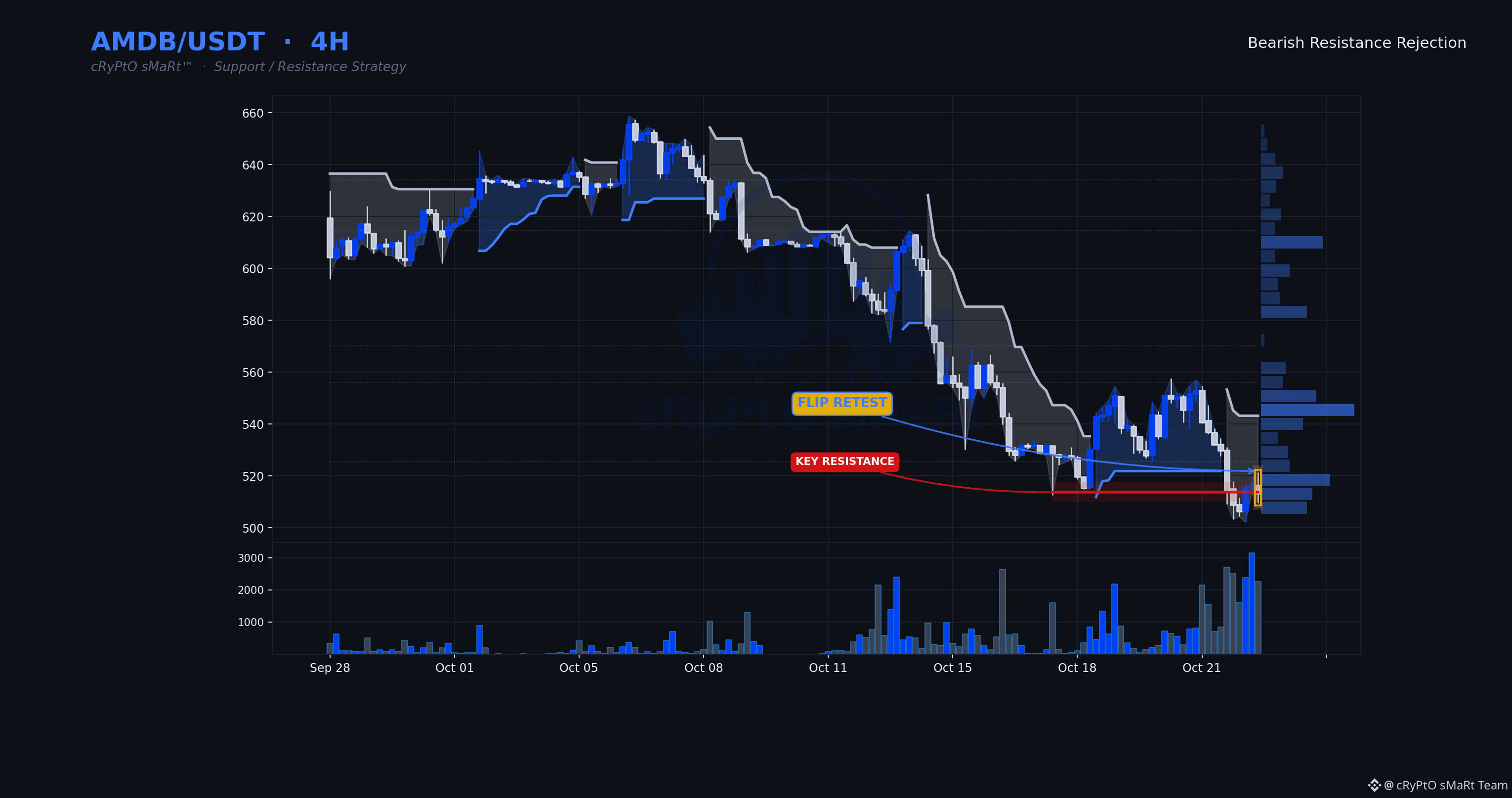
Sellers just defended an established level and flipped it back to resistance, with volume stepping up well above average on the rejection — that's not a quiet fade, that's active supply showing up where it was expected.
🗓 Daily: Bearish — daily Supertrend down, price under the 50 EMA
⏱ 4H: Support/Resistance Reaction · Bearish bias
⏳ 1H: the 1H is still above the level — the setup only triggers once it loses and holds below it.
📋 WHY IT QUALIFIES
✓ Support/Resistance Reaction structure completed
🧭 Bias: Bearish while price holds below $502.1500
⚠️ Invalidation: 4H close back above $502.1500
🔵 Support $502.1500 🟡 Resistance $513.8150
$AMDB $BTC #SupportResistance
Education only, not financial advice.
Sellers just defended an established level and flipped it back to resistance, with volume stepping up well above average on the rejection — that's not a quiet fade, that's active supply showing up where it was expected.
🗓 Daily: Bearish — daily Supertrend down, price under the 50 EMA
⏱ 4H: Support/Resistance Reaction · Bearish bias
⏳ 1H: the 1H is still above the level — the setup only triggers once it loses and holds below it.
📋 WHY IT QUALIFIES
✓ Support/Resistance Reaction structure completed
🧭 Bias: Bearish while price holds below $502.1500
⚠️ Invalidation: 4H close back above $502.1500
🔵 Support $502.1500 🟡 Resistance $513.8150
$AMDB $BTC #SupportResistance
Education only, not financial advice.
🗓 Daily: Bearish — daily Supertrend down, price under the 50 EMA
⏱ 4H: Support/Resistance Reaction · Bearish bias
⏳ 1H: the 1H is still above the level — the setup only triggers once it loses and holds below it.
📋 WHY IT QUALIFIES
✓ Support/Resistance Reaction structure completed
🧭 Bias: Bearish while price holds below $502.1500
⚠️ Invalidation: 4H close back above $502.1500
🔵 Support $502.1500 🟡 Resistance $513.8150
$AMDB $BTC #SupportResistance
Education only, not financial advice.
34
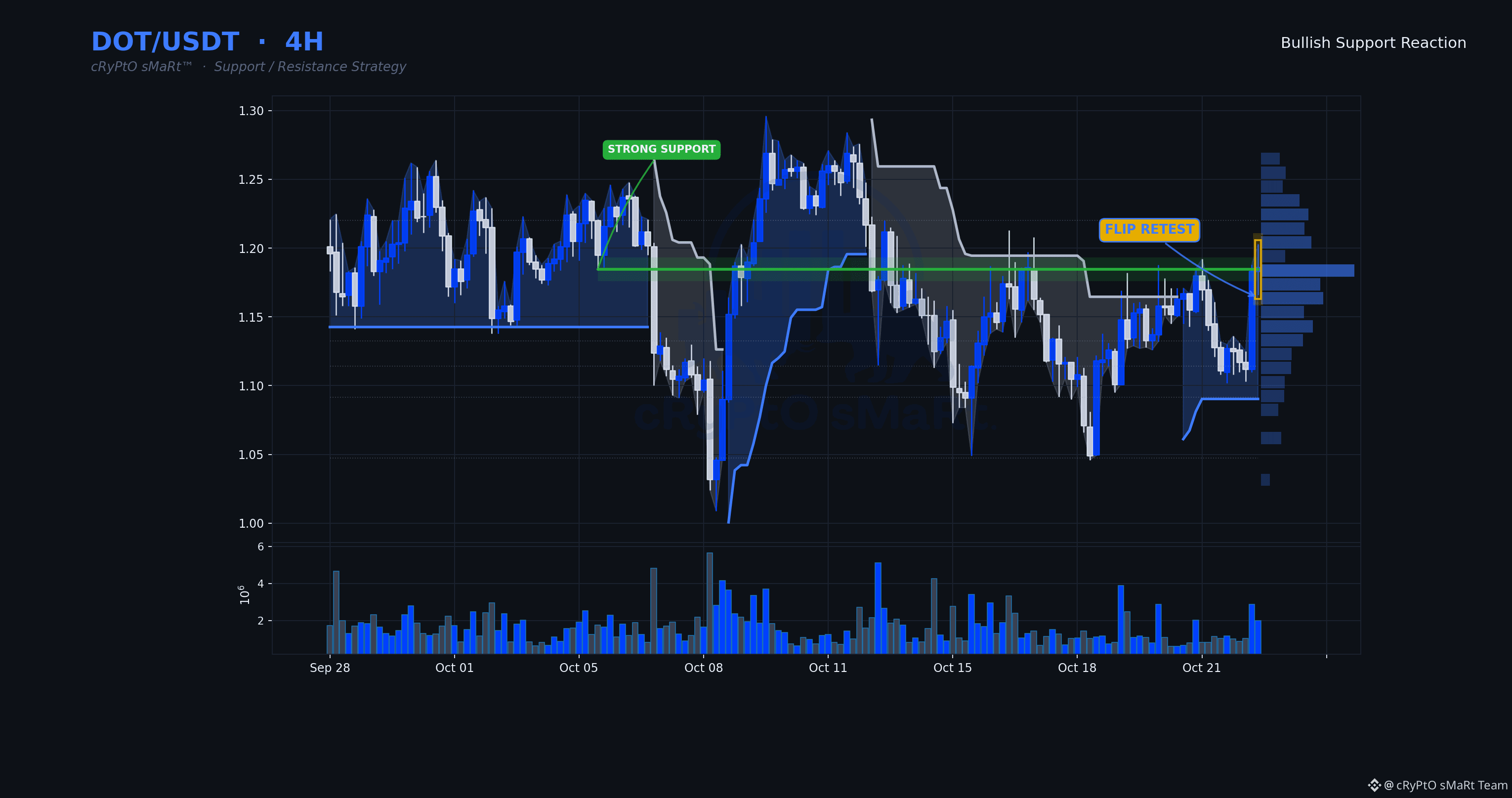
DOT flipped a well-established level and came back to retest it as support, holding clean on volume well above average. That's the tell — supply that used to cap price is now absorbing sell pressure without breaking down, which is how real structure shifts start.
🗓 Daily: Bullish — price above the daily Supertrend with a rising 50/200 EMA stack
⏱ 4H: Support/Resistance Reaction · Bullish bias
⏳ 1H: the 1H still needs to reclaim and hold the level before the setup is confirmed on the lower timeframe.
📋 WHY IT QUALIFIES
✓ Support/Resistance Reaction structure completed
🧭 Bias: Bullish while price holds above $1.2200
⚠️ Invalidation: 4H close back below $1.2200
🔵 Support $1.1847 🟡 Resistance $1.2200
$DOT $BTC #SupportResistance
Education only, not financial advice.
DOT flipped a well-established level and came back to retest it as support, holding clean on volume well above average. That's the tell — supply that used to cap price is now absorbing sell pressure without breaking down, which is how real structure shifts start.
🗓 Daily: Bullish — price above the daily Supertrend with a rising 50/200 EMA stack
⏱ 4H: Support/Resistance Reaction · Bullish bias
⏳ 1H: the 1H still needs to reclaim and hold the level before the setup is confirmed on the lower timeframe.
📋 WHY IT QUALIFIES
✓ Support/Resistance Reaction structure completed
🧭 Bias: Bullish while price holds above $1.2200
⚠️ Invalidation: 4H close back below $1.2200
🔵 Support $1.1847 🟡 Resistance $1.2200
$DOT $BTC #SupportResistance
Education only, not financial advice.
🗓 Daily: Bullish — price above the daily Supertrend with a rising 50/200 EMA stack
⏱ 4H: Support/Resistance Reaction · Bullish bias
⏳ 1H: the 1H still needs to reclaim and hold the level before the setup is confirmed on the lower timeframe.
📋 WHY IT QUALIFIES
✓ Support/Resistance Reaction structure completed
🧭 Bias: Bullish while price holds above $1.2200
⚠️ Invalidation: 4H close back below $1.2200
🔵 Support $1.1847 🟡 Resistance $1.2200
$DOT $BTC #SupportResistance
Education only, not financial advice.
80
The common thread today is caution and recalibration rather than momentum. Ethereum's decision to delay its Glamsterdam test shows developers prioritizing security over speed, a reminder that upgrades move slowly when real money and contracts are at stake. Meanwhile, macro forces like currency moves and oil prices are still tugging at bitcoin and gold, showing crypto hasn't fully decoupled from traditional markets. Add scrutiny around Tether's payments and Polymarket's internal shake-up, and it paints a market where trust and governance questions sit alongside price action. Even a16z broadening into AI signals capital spreading its bets rather than doubling down. Watch how upgrade timelines, regulatory inquiries, and venture allocation shifts unfold together. Does this signal a maturing market, or just more uncertainty ahead?
$XRP $ADA $DOGE #Crypto #News #Bitcoin #Trading
Follow for daily trading education · Education only, not financial advice.
The common thread today is caution and recalibration rather than momentum. Ethereum's decision to delay its Glamsterdam test shows developers prioritizing security over speed, a reminder that upgrades move slowly when real money and contracts are at stake. Meanwhile, macro forces like currency moves and oil prices are still tugging at bitcoin and gold, showing crypto hasn't fully decoupled from traditional markets. Add scrutiny around Tether's payments and Polymarket's internal shake-up, and it paints a market where trust and governance questions sit alongside price action. Even a16z broadening into AI signals capital spreading its bets rather than doubling down. Watch how upgrade timelines, regulatory inquiries, and venture allocation shifts unfold together. Does this signal a maturing market, or just more uncertainty ahead?
$XRP $ADA $DOGE #Crypto #News #Bitcoin #Trading
Follow for daily trading education · Education only, not financial advice.
$XRP $ADA $DOGE #Crypto #News #Bitcoin #Trading
Follow for daily trading education · Education only, not financial advice.

133
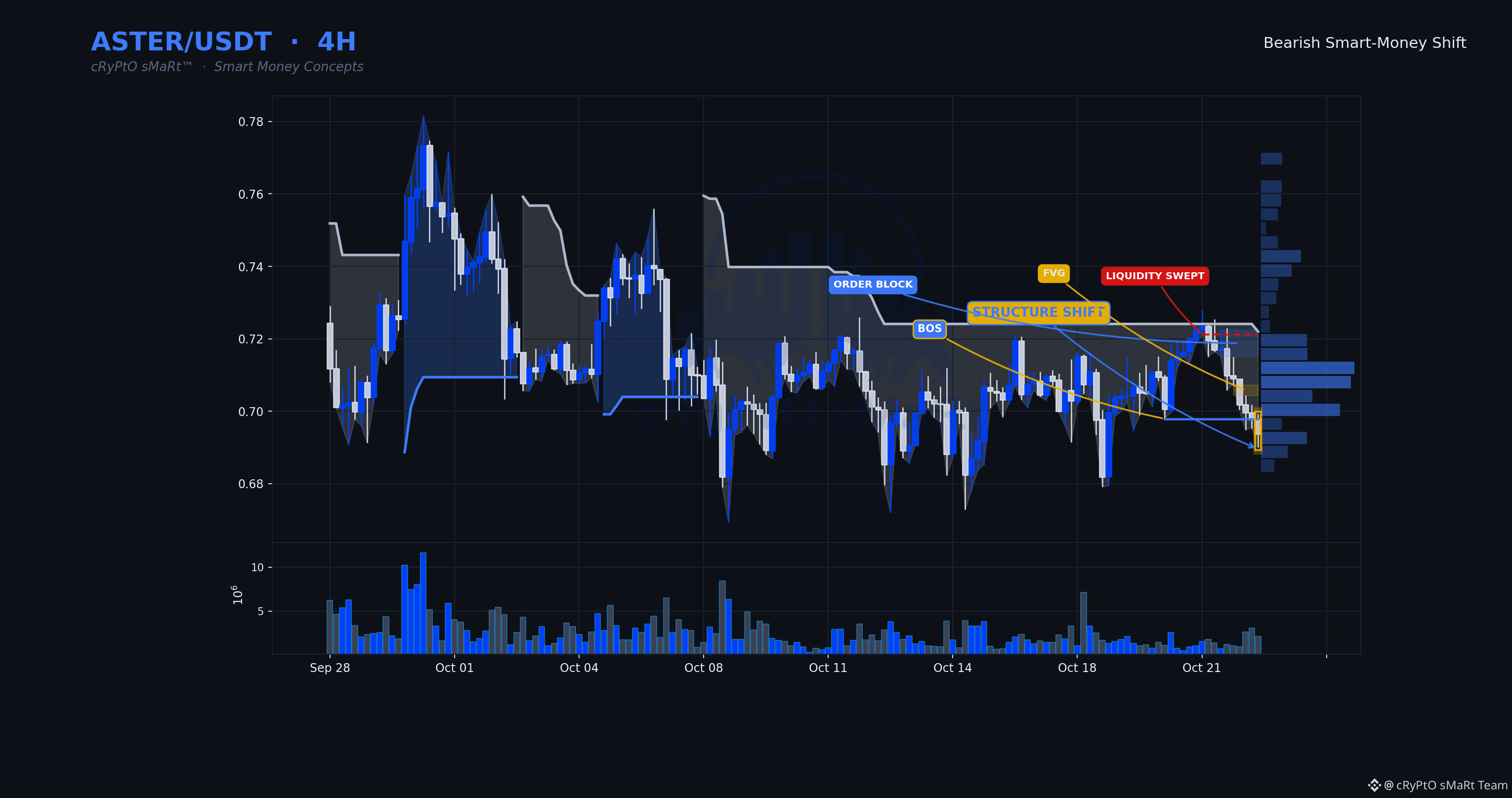
ASTER ran the highs, grabbed the liquidity sitting above, and immediately turned it into supply.
🗓 Daily: Neutral — daily is mixed — Supertrend and EMAs not aligned
⏱ 4H: Smart-Money Shift · Bearish bias
⏳ 1H: the 1H is trading below the level with its trend down — the lower timeframe confirms the setup.
📋 WHY IT QUALIFIES
✓ Smart-Money Shift structure completed
🧭 Bias: Bearish while price holds below $0.69790
⚠️ Invalidation: 4H close back above $0.69790
🔵 Support $0.69790 🟡 Resistance $0.72120
$ASTER $BTC #SmartMoney
Education only, not financial advice.
ASTER ran the highs, grabbed the liquidity sitting above, and immediately turned it into supply.
🗓 Daily: Neutral — daily is mixed — Supertrend and EMAs not aligned
⏱ 4H: Smart-Money Shift · Bearish bias
⏳ 1H: the 1H is trading below the level with its trend down — the lower timeframe confirms the setup.
📋 WHY IT QUALIFIES
✓ Smart-Money Shift structure completed
🧭 Bias: Bearish while price holds below $0.69790
⚠️ Invalidation: 4H close back above $0.69790
🔵 Support $0.69790 🟡 Resistance $0.72120
$ASTER $BTC #SmartMoney
Education only, not financial advice.
🗓 Daily: Neutral — daily is mixed — Supertrend and EMAs not aligned
⏱ 4H: Smart-Money Shift · Bearish bias
⏳ 1H: the 1H is trading below the level with its trend down — the lower timeframe confirms the setup.
📋 WHY IT QUALIFIES
✓ Smart-Money Shift structure completed
🧭 Bias: Bearish while price holds below $0.69790
⚠️ Invalidation: 4H close back above $0.69790
🔵 Support $0.69790 🟡 Resistance $0.72120
$ASTER $BTC #SmartMoney
Education only, not financial advice.
161
The costliest beginner mistake isn't missing a move. It's refusing to accept the miss and jumping in late to chase it.
A missed opportunity costs nothing. The account balance doesn't change. But chasing a move that already ran means buying into exhaustion, right when early entrants start looking for exits. The pain of regret gets swapped for real, realized loss — a trade made of emotion, not analysis.
Next time a move takes off without you, write down what your original plan actually said. If price no longer meets that setup, the trade is over before it started.
What usually convinces you to chase anyway?
$ETH $BNB $SOL #TradingPsychology #Mindset #Crypto #Trading
Follow for daily trading education · Education only, not financial advice.
The costliest beginner mistake isn't missing a move. It's refusing to accept the miss and jumping in late to chase it.
A missed opportunity costs nothing. The account balance doesn't change. But chasing a move that already ran means buying into exhaustion, right when early entrants start looking for exits. The pain of regret gets swapped for real, realized loss — a trade made of emotion, not analysis.
Next time a move takes off without you, write down what your original plan actually said. If price no longer meets that setup, the trade is over before it started.
What usually convinces you to chase anyway?
$ETH $BNB $SOL #TradingPsychology #Mindset #Crypto #Trading
Follow for daily trading education · Education only, not financial advice.
A missed opportunity costs nothing. The account balance doesn't change. But chasing a move that already ran means buying into exhaustion, right when early entrants start looking for exits. The pain of regret gets swapped for real, realized loss — a trade made of emotion, not analysis.
Next time a move takes off without you, write down what your original plan actually said. If price no longer meets that setup, the trade is over before it started.
What usually convinces you to chase anyway?
$ETH $BNB $SOL #TradingPsychology #Mindset #Crypto #Trading
Follow for daily trading education · Education only, not financial advice.

63
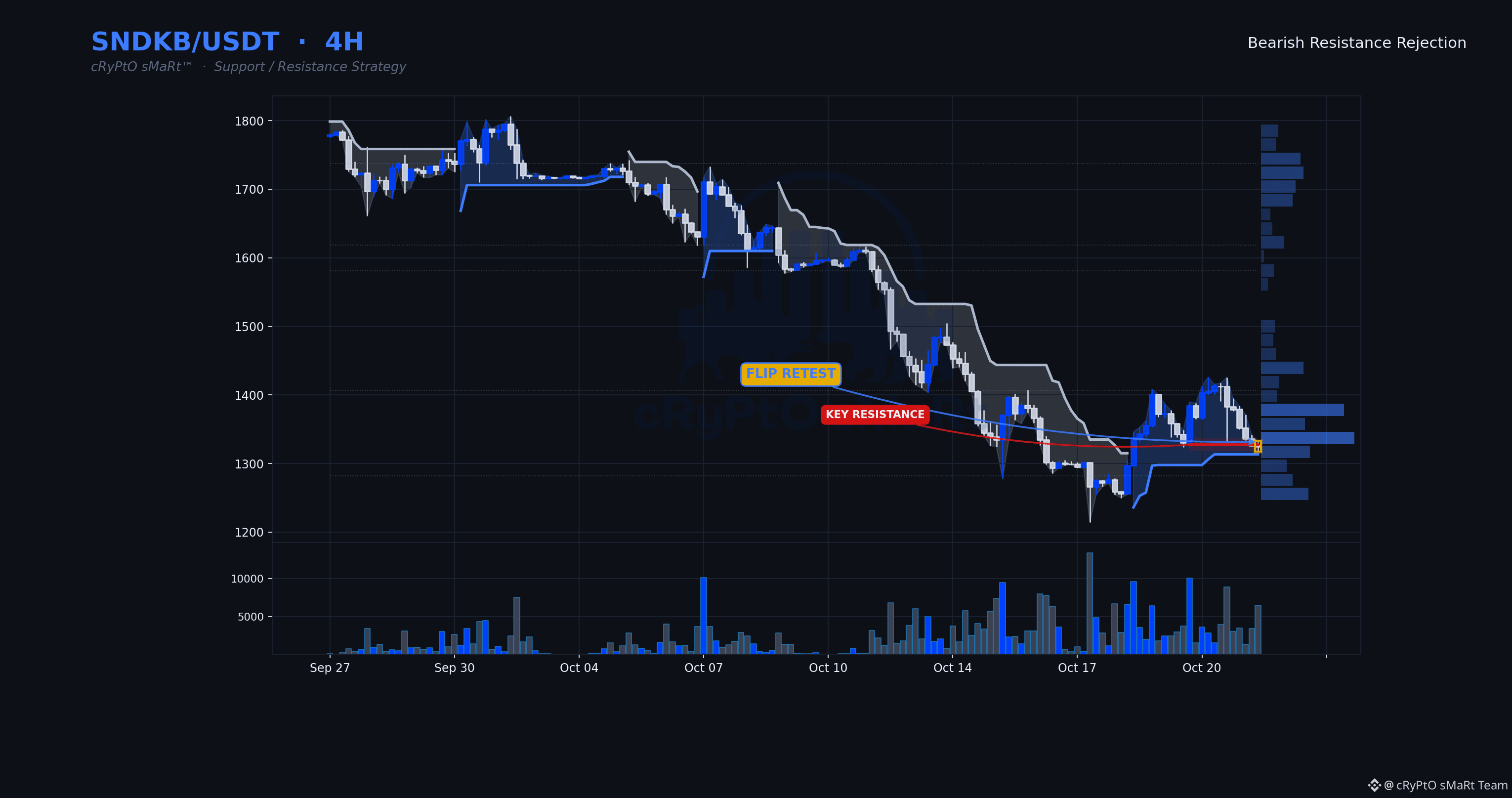
Sellers showed up right where they were supposed to — an established level flipping to resistance, and the retest got rejected on volume that's well above average. That's not drift, that's active supply defending the flip, which tells you the market still respects this ceiling.
🗓 Daily: Bearish — price below the daily Supertrend with a falling 50/200 EMA stack
⏱ 4H: Support/Resistance Reaction · Bearish bias
⏳ 1H: the 1H is still above the level — the setup only triggers once it loses and holds below it.
📋 WHY IT QUALIFIES
✓ Support/Resistance Reaction structure completed
🧭 Bias: Bearish while price holds below $1,282.05
⚠️ Invalidation: 4H close back above $1,282.05
🔵 Support $1,282.05 🟡 Resistance $1,327.51
$SNDKB $BTC #SupportResistance
Education only, not financial advice.
Sellers showed up right where they were supposed to — an established level flipping to resistance, and the retest got rejected on volume that's well above average. That's not drift, that's active supply defending the flip, which tells you the market still respects this ceiling.
🗓 Daily: Bearish — price below the daily Supertrend with a falling 50/200 EMA stack
⏱ 4H: Support/Resistance Reaction · Bearish bias
⏳ 1H: the 1H is still above the level — the setup only triggers once it loses and holds below it.
📋 WHY IT QUALIFIES
✓ Support/Resistance Reaction structure completed
🧭 Bias: Bearish while price holds below $1,282.05
⚠️ Invalidation: 4H close back above $1,282.05
🔵 Support $1,282.05 🟡 Resistance $1,327.51
$SNDKB $BTC #SupportResistance
Education only, not financial advice.
🗓 Daily: Bearish — price below the daily Supertrend with a falling 50/200 EMA stack
⏱ 4H: Support/Resistance Reaction · Bearish bias
⏳ 1H: the 1H is still above the level — the setup only triggers once it loses and holds below it.
📋 WHY IT QUALIFIES
✓ Support/Resistance Reaction structure completed
🧭 Bias: Bearish while price holds below $1,282.05
⚠️ Invalidation: 4H close back above $1,282.05
🔵 Support $1,282.05 🟡 Resistance $1,327.51
$SNDKB $BTC #SupportResistance
Education only, not financial advice.
128
Log in to explore more content
Join global crypto users on Binance Square
⚡️ Get latest and useful information about crypto.
💬 Trusted by the world’s largest crypto exchange.
👍 Discover real insights from verified creators.
Email / Phone number