
CryptoPress
2.1k Posts

CryptoPress
 Square Verified+
Report
Block User
News and press releases about Bitcoin, cryptocurrencies, and blockchain.
1 Following
31.0K+ Followers
14.5K+ Liked
Posts
·
--
Bank of Japan Raises Interest Rates to 31-Year High, Shaking Global MarketsThe Bank of Japan announced a historic rate hike, pushing borrowing costs to a 31-year high and unwinding decades of ultra-loose monetary policy.
The surprise macroeconomic shift triggered immediate sell-offs across global risk assets, including major cryptocurrencies like Bitcoin and Ethereum.
Market analysts warn of ongoing liquidity crunches as institutional traders recalibrate carry trade strategies following the aggressive policy tightening.
The Bank of Japan (BOJ) has officially elevated its benchmark interest rate to a 31-year high, a monumental shift that immediately rippled through traditional financial sectors and sent sudden shockwaves across global cryptocurrency markets. As detailed in the official BOJ policy announcement, the central bank decided to move away from its decades-long accommodation stance, catching various institutional investors and retail traders off guard.
Following the rate hike, digital asset markets experienced heightened volatility. Bitcoin (BTC) and other leading altcoins faced sharp downward pressure as traders liquidated risk-on positions to meet margin requirements and adapt to a tightening global liquidity environment. Market commentators on social media platforms noted that the sudden appreciation of the Japanese yen severely disrupted the popular carry trade, where investors borrow low-yielding yen to fund purchases of higher-yielding global assets, including crypto.
Financial analysts suggest that this monetary pivot could herald a prolonged period of recalibration for institutional portfolios. For years, the BOJ served as an anchor for cheap capital, fueling speculative bubbles across multiple asset classes. With borrowing costs now resting at levels unseen since the early 1990s, market participants must navigate a fundamentally different macroeconomic landscape. As trading desks assess the full impact of the BOJ’s decision, crypto analysts recommend close monitoring of exchange inflows and derivatives open interest to gauge upcoming market resilience.
The post Bank of Japan Raises Interest Rates to 31-Year High, Shaking Global Markets appeared first on Cryptopress.
Bank of Japan Raises Interest Rates to 31-Year High, Shaking Global Markets
The Bank of Japan announced a historic rate hike, pushing borrowing costs to a 31-year high and unwinding decades of ultra-loose monetary policy.
The surprise macroeconomic shift triggered immediate sell-offs across global risk assets, including major cryptocurrencies like Bitcoin and Ethereum.
Market analysts warn of ongoing liquidity crunches as institutional traders recalibrate carry trade strategies following the aggressive policy tightening.
The Bank of Japan (BOJ) has officially elevated its benchmark interest rate to a 31-year high, a monumental shift that immediately rippled through traditional financial sectors and sent sudden shockwaves across global cryptocurrency markets. As detailed in the official BOJ policy announcement, the central bank decided to move away from its decades-long accommodation stance, catching various institutional investors and retail traders off guard.
Following the rate hike, digital asset markets experienced heightened volatility. Bitcoin (BTC) and other leading altcoins faced sharp downward pressure as traders liquidated risk-on positions to meet margin requirements and adapt to a tightening global liquidity environment. Market commentators on social media platforms noted that the sudden appreciation of the Japanese yen severely disrupted the popular carry trade, where investors borrow low-yielding yen to fund purchases of higher-yielding global assets, including crypto.
Financial analysts suggest that this monetary pivot could herald a prolonged period of recalibration for institutional portfolios. For years, the BOJ served as an anchor for cheap capital, fueling speculative bubbles across multiple asset classes. With borrowing costs now resting at levels unseen since the early 1990s, market participants must navigate a fundamentally different macroeconomic landscape. As trading desks assess the full impact of the BOJ’s decision, crypto analysts recommend close monitoring of exchange inflows and derivatives open interest to gauge upcoming market resilience.
The post Bank of Japan Raises Interest Rates to 31-Year High, Shaking Global Markets appeared first on Cryptopress.
The surprise macroeconomic shift triggered immediate sell-offs across global risk assets, including major cryptocurrencies like Bitcoin and Ethereum.
Market analysts warn of ongoing liquidity crunches as institutional traders recalibrate carry trade strategies following the aggressive policy tightening.
The Bank of Japan (BOJ) has officially elevated its benchmark interest rate to a 31-year high, a monumental shift that immediately rippled through traditional financial sectors and sent sudden shockwaves across global cryptocurrency markets. As detailed in the official BOJ policy announcement, the central bank decided to move away from its decades-long accommodation stance, catching various institutional investors and retail traders off guard.
Following the rate hike, digital asset markets experienced heightened volatility. Bitcoin (BTC) and other leading altcoins faced sharp downward pressure as traders liquidated risk-on positions to meet margin requirements and adapt to a tightening global liquidity environment. Market commentators on social media platforms noted that the sudden appreciation of the Japanese yen severely disrupted the popular carry trade, where investors borrow low-yielding yen to fund purchases of higher-yielding global assets, including crypto.
Financial analysts suggest that this monetary pivot could herald a prolonged period of recalibration for institutional portfolios. For years, the BOJ served as an anchor for cheap capital, fueling speculative bubbles across multiple asset classes. With borrowing costs now resting at levels unseen since the early 1990s, market participants must navigate a fundamentally different macroeconomic landscape. As trading desks assess the full impact of the BOJ’s decision, crypto analysts recommend close monitoring of exchange inflows and derivatives open interest to gauge upcoming market resilience.
The post Bank of Japan Raises Interest Rates to 31-Year High, Shaking Global Markets appeared first on Cryptopress.
4
·
--
Bank of Japan Raises Interest Rates to 31-Year High, Shaking Global Markets<ul><li>The Bank of Japan announced a historic rate hike, pushing borrowing costs to a 31-year high and unwinding decades of ultra-loose monetary policy.</li><li>The surprise macroeconomic shift triggered immediate sell-offs across global risk assets, including major cryptocurrencies like Bitcoin and Ethereum.</li><li>Market analysts warn of ongoing liquidity crunches as institutional traders recalibrate carry trade strategies following the aggressive policy tightening.</li></ul><p class="has-drop-cap">The <strong>Bank of Japan (BOJ)</strong> has officially elevated its benchmark interest rate to a <strong>31-year high</strong>, a monumental shift that immediately rippled through traditional financial sectors and sent sudden shockwaves across global cryptocurrency markets. As detailed in the <a href="https://www.boj.or.jp/en/" target="_blank" rel="noopener">official BOJ policy announcement</a>, the central bank decided to move away from its decades-long accommodation stance, catching various institutional investors and retail traders off guard.</p><p>Following the rate hike, digital asset markets experienced heightened volatility. <strong>Bitcoin (BTC)</strong> and other leading altcoins faced sharp downward pressure as traders liquidated risk-on positions to meet margin requirements and adapt to a tightening global liquidity environment. Market commentators on <a href="https://x.com/" target="_blank" rel="noopener">social media platforms</a> noted that the sudden appreciation of the Japanese yen severely disrupted the popular carry trade, where investors borrow low-yielding yen to fund purchases of higher-yielding global assets, including crypto.</p><p>Financial analysts suggest that this monetary pivot could herald a prolonged period of recalibration for institutional portfolios. For years, the BOJ served as an anchor for cheap capital, fueling speculative bubbles across multiple asset classes. With borrowing costs now resting at levels unseen since the early 1990s, market participants must navigate a fundamentally different macroeconomic landscape. As trading desks assess the full impact of the BOJ's decision, crypto analysts recommend close monitoring of exchange inflows and derivatives open interest to gauge upcoming market resilience.</p>
Bank of Japan Raises Interest Rates to 31-Year High, Shaking Global Markets
<ul><li>The Bank of Japan announced a historic rate hike, pushing borrowing costs to a 31-year high and unwinding decades of ultra-loose monetary policy.</li><li>The surprise macroeconomic shift triggered immediate sell-offs across global risk assets, including major cryptocurrencies like Bitcoin and Ethereum.</li><li>Market analysts warn of ongoing liquidity crunches as institutional traders recalibrate carry trade strategies following the aggressive policy tightening.</li></ul><p class="has-drop-cap">The <strong>Bank of Japan (BOJ)</strong> has officially elevated its benchmark interest rate to a <strong>31-year high</strong>, a monumental shift that immediately rippled through traditional financial sectors and sent sudden shockwaves across global cryptocurrency markets. As detailed in the <a href="https://www.boj.or.jp/en/" target="_blank" rel="noopener">official BOJ policy announcement</a>, the central bank decided to move away from its decades-long accommodation stance, catching various institutional investors and retail traders off guard.</p><p>Following the rate hike, digital asset markets experienced heightened volatility. <strong>Bitcoin (BTC)</strong> and other leading altcoins faced sharp downward pressure as traders liquidated risk-on positions to meet margin requirements and adapt to a tightening global liquidity environment. Market commentators on <a href="https://x.com/" target="_blank" rel="noopener">social media platforms</a> noted that the sudden appreciation of the Japanese yen severely disrupted the popular carry trade, where investors borrow low-yielding yen to fund purchases of higher-yielding global assets, including crypto.</p><p>Financial analysts suggest that this monetary pivot could herald a prolonged period of recalibration for institutional portfolios. For years, the BOJ served as an anchor for cheap capital, fueling speculative bubbles across multiple asset classes. With borrowing costs now resting at levels unseen since the early 1990s, market participants must navigate a fundamentally different macroeconomic landscape. As trading desks assess the full impact of the BOJ's decision, crypto analysts recommend close monitoring of exchange inflows and derivatives open interest to gauge upcoming market resilience.</p>
997
·
--
Bitcoin ETFs Scraped a $6.2 Million Weekly Gain After $433 Million Friday InflowU.S. spot bitcoin ETFs finished the week ending Sept. 18 with just $6.2 million in net inflows after a $433 million Friday rebound.
Fidelity’s FBTC accounted for $310.7 million of Friday’s creations, with BlackRock’s IBIT adding $108.4 million.
Spot ether ETFs posted about $140 million in weekly outflows, ending a four-week inflow streak that collected $1.94 billion.
Zcash spot ETFs led weekly crypto product inflows with $98.2 million, outdrawing both bitcoin and ether funds.
U.S. spot bitcoin exchange-traded funds avoided a second straight negative week after investors added $433 million on Friday, Sept. 18, leaving a slim $6.2 million net inflow for the five sessions, according to The Block’s analysis of SoSoValue data.
The Friday haul was the group’s largest daily intake since Sept. 3, when the products took in $730.9 million. Even so, the weekly total is modest next to the $462.7 million in net outflows recorded the prior week. SoSoValue’s U.S. bitcoin ETF dashboard put Friday creations at $433.03 million and total net assets at $102.53 billion, with cumulative net inflows of $55.16 billion.
The path through the week was uneven. Bitcoin funds took in about $160 million on Monday before shedding $450.3 million on Tuesday and $296 million on Wednesday. A $159.5 million rebound on Thursday still left the complex down $426.8 million heading into Friday. Farside Investors’ flow table shows the same Friday split: Fidelity’s FBTC $310.7 million, BlackRock’s IBIT $108.4 million, Bitwise’s BITB $9.7 million, VanEck’s HODL $2.3 million and ARK 21Shares’ ARKB $1.9 million. Over the full week, IBIT still led with $120.7 million of net inflows, ahead of FBTC’s $79.9 million, while the remaining bitcoin products together lost about $194.4 million.
Spot ether ETFs did not finish in the black. They posted a roughly $140 million weekly outflow despite taking in $143.8 million on Friday, ending a four-week inflow run in which the funds collected a combined $1.94 billion. Farside’s ether table shows Monday’s $121.1 million inflow was followed by outflows of $142.0 million, $224.1 million and $39.3 million before Friday’s $143.7 million bounce. BlackRock’s ETHA accounted for $114.3 million of that Friday total but still finished the week with $56.1 million in net outflows; Fidelity’s FETH lost $25.8 million for the week after a $26.2 million Friday addition.
Across the broader crypto ETF complex, bitcoin and ether were not the week’s biggest magnets. BeInCrypto, citing SoSoValue, reported that Zcash spot ETFs drew $98.2 million in the week ending Sept. 18, the largest inflow among 14 crypto products, lifting Zcash ETF assets 40.5% to $914.5 million. Ether was the only major product group in outflow. Combined assets across those products rose 4.89% to $123.9 billion even as net flows across the set were roughly flat.
The late-week bitcoin creations concentrated in two issuers, and the weekly net figure sits close to zero. That leaves the flow picture constructive versus the prior week’s redemptions, but not yet evidence of a broad, multi-issuer reopening of demand.
The post Bitcoin ETFs Scraped a $6.2 Million Weekly Gain After $433 Million Friday Inflow appeared first on Cryptopress.
Bitcoin ETFs Scraped a $6.2 Million Weekly Gain After $433 Million Friday Inflow
U.S. spot bitcoin ETFs finished the week ending Sept. 18 with just $6.2 million in net inflows after a $433 million Friday rebound.
Fidelity’s FBTC accounted for $310.7 million of Friday’s creations, with BlackRock’s IBIT adding $108.4 million.
Spot ether ETFs posted about $140 million in weekly outflows, ending a four-week inflow streak that collected $1.94 billion.
Zcash spot ETFs led weekly crypto product inflows with $98.2 million, outdrawing both bitcoin and ether funds.
U.S. spot bitcoin exchange-traded funds avoided a second straight negative week after investors added $433 million on Friday, Sept. 18, leaving a slim $6.2 million net inflow for the five sessions, according to The Block’s analysis of SoSoValue data.
The Friday haul was the group’s largest daily intake since Sept. 3, when the products took in $730.9 million. Even so, the weekly total is modest next to the $462.7 million in net outflows recorded the prior week. SoSoValue’s U.S. bitcoin ETF dashboard put Friday creations at $433.03 million and total net assets at $102.53 billion, with cumulative net inflows of $55.16 billion.
The path through the week was uneven. Bitcoin funds took in about $160 million on Monday before shedding $450.3 million on Tuesday and $296 million on Wednesday. A $159.5 million rebound on Thursday still left the complex down $426.8 million heading into Friday. Farside Investors’ flow table shows the same Friday split: Fidelity’s FBTC $310.7 million, BlackRock’s IBIT $108.4 million, Bitwise’s BITB $9.7 million, VanEck’s HODL $2.3 million and ARK 21Shares’ ARKB $1.9 million. Over the full week, IBIT still led with $120.7 million of net inflows, ahead of FBTC’s $79.9 million, while the remaining bitcoin products together lost about $194.4 million.
Spot ether ETFs did not finish in the black. They posted a roughly $140 million weekly outflow despite taking in $143.8 million on Friday, ending a four-week inflow run in which the funds collected a combined $1.94 billion. Farside’s ether table shows Monday’s $121.1 million inflow was followed by outflows of $142.0 million, $224.1 million and $39.3 million before Friday’s $143.7 million bounce. BlackRock’s ETHA accounted for $114.3 million of that Friday total but still finished the week with $56.1 million in net outflows; Fidelity’s FETH lost $25.8 million for the week after a $26.2 million Friday addition.
Across the broader crypto ETF complex, bitcoin and ether were not the week’s biggest magnets. BeInCrypto, citing SoSoValue, reported that Zcash spot ETFs drew $98.2 million in the week ending Sept. 18, the largest inflow among 14 crypto products, lifting Zcash ETF assets 40.5% to $914.5 million. Ether was the only major product group in outflow. Combined assets across those products rose 4.89% to $123.9 billion even as net flows across the set were roughly flat.
The late-week bitcoin creations concentrated in two issuers, and the weekly net figure sits close to zero. That leaves the flow picture constructive versus the prior week’s redemptions, but not yet evidence of a broad, multi-issuer reopening of demand.
The post Bitcoin ETFs Scraped a $6.2 Million Weekly Gain After $433 Million Friday Inflow appeared first on Cryptopress.
Fidelity’s FBTC accounted for $310.7 million of Friday’s creations, with BlackRock’s IBIT adding $108.4 million.
Spot ether ETFs posted about $140 million in weekly outflows, ending a four-week inflow streak that collected $1.94 billion.
Zcash spot ETFs led weekly crypto product inflows with $98.2 million, outdrawing both bitcoin and ether funds.
U.S. spot bitcoin exchange-traded funds avoided a second straight negative week after investors added $433 million on Friday, Sept. 18, leaving a slim $6.2 million net inflow for the five sessions, according to The Block’s analysis of SoSoValue data.
The Friday haul was the group’s largest daily intake since Sept. 3, when the products took in $730.9 million. Even so, the weekly total is modest next to the $462.7 million in net outflows recorded the prior week. SoSoValue’s U.S. bitcoin ETF dashboard put Friday creations at $433.03 million and total net assets at $102.53 billion, with cumulative net inflows of $55.16 billion.
The path through the week was uneven. Bitcoin funds took in about $160 million on Monday before shedding $450.3 million on Tuesday and $296 million on Wednesday. A $159.5 million rebound on Thursday still left the complex down $426.8 million heading into Friday. Farside Investors’ flow table shows the same Friday split: Fidelity’s FBTC $310.7 million, BlackRock’s IBIT $108.4 million, Bitwise’s BITB $9.7 million, VanEck’s HODL $2.3 million and ARK 21Shares’ ARKB $1.9 million. Over the full week, IBIT still led with $120.7 million of net inflows, ahead of FBTC’s $79.9 million, while the remaining bitcoin products together lost about $194.4 million.
Spot ether ETFs did not finish in the black. They posted a roughly $140 million weekly outflow despite taking in $143.8 million on Friday, ending a four-week inflow run in which the funds collected a combined $1.94 billion. Farside’s ether table shows Monday’s $121.1 million inflow was followed by outflows of $142.0 million, $224.1 million and $39.3 million before Friday’s $143.7 million bounce. BlackRock’s ETHA accounted for $114.3 million of that Friday total but still finished the week with $56.1 million in net outflows; Fidelity’s FETH lost $25.8 million for the week after a $26.2 million Friday addition.
Across the broader crypto ETF complex, bitcoin and ether were not the week’s biggest magnets. BeInCrypto, citing SoSoValue, reported that Zcash spot ETFs drew $98.2 million in the week ending Sept. 18, the largest inflow among 14 crypto products, lifting Zcash ETF assets 40.5% to $914.5 million. Ether was the only major product group in outflow. Combined assets across those products rose 4.89% to $123.9 billion even as net flows across the set were roughly flat.
The late-week bitcoin creations concentrated in two issuers, and the weekly net figure sits close to zero. That leaves the flow picture constructive versus the prior week’s redemptions, but not yet evidence of a broad, multi-issuer reopening of demand.
The post Bitcoin ETFs Scraped a $6.2 Million Weekly Gain After $433 Million Friday Inflow appeared first on Cryptopress.
116
·
--
Verified
ZetaChain holders vote to wind down Layer 1 and migrate ZETA to Solana<ul><li>ZetaChain token holders approved Proposal 68 on Sept. 20 with <strong>99.4%</strong> support and <strong>58%</strong> turnout, above the 40% quorum.</li><li>ZETA is slated to convert <strong>1:1</strong> into a native Solana SPL token with the same ticker and total supply; a second vote will set the snapshot and shutdown.</li><li>The project, which raised <strong>$27 million</strong> in 2023 for cross-chain interoperability, will focus on Anuma, a private AI app with more than <strong>300,000</strong> users.</li></ul><p class="has-drop-cap">ZetaChain token holders voted Sunday to retire the project's Layer 1 blockchain and move the native ZETA token to Solana, capping a strategic pivot from interoperability infrastructure toward a private AI application.</p><p>The vote on <a href="https://hub.zetachain.com/governance" target="_blank" rel="noopener">Proposal 68</a> closed at 10:58 a.m. ET on Sept. 20 with <strong>99.4%</strong> in favor, <strong>0.3%</strong> against and <strong>0.3%</strong> abstaining, according to the project's governance portal and reporting by <a href="https://www.theblock.co/news/defi/2026-09-20-zetachain-votes-to-shut-down-layer-1-network-and-move-zeta-to-solana-415878" target="_blank" rel="noopener">The Block</a>. Participation reached <strong>58%</strong> of eligible stake, exceeding the <strong>40%</strong> quorum.</p><p>In a <a href="https://www.zetachain.com/blog/bringing-zeta-and-private-ai-to-solana" target="_blank" rel="noopener">Sept. 17 blog post</a> that opened the 72-hour vote, contributors said they no longer need a dedicated chain to operate Anuma, a private multi-model AI app launched in February. "Solana is where the rest of the AI stack is being assembled, so we are proposing to move there," the team wrote. Anuma has more than <strong>300,000</strong> users and has processed more than <strong>1 million</strong> requests across 35 models, per the project's figures.</p><p>Under the approved plan, native ZETA would become a Solana SPL token at a <strong>one-for-one</strong> rate, keeping the ticker and total supply unchanged and leaving existing vesting schedules intact. ZETA issued on Ethereum and BNB Chain is excluded. The project argued a wrap-and-bridge would not work once the source chain is gone, so a native issuance is required.</p><p>The first vote is an authorization, not a halt date. A second proposal must still define the snapshot block, claim process, exchange coordination and the L1 shutdown height. Until then, validators and staking remain live.</p><p>ZetaChain raised <strong>$27 million</strong> in August 2023 from investors including Blockchain.com and Jane Street Capital to build an EVM-compatible Layer 1 that could connect Bitcoin, Ethereum and other networks, according to the project's <a href="https://www.zetachain.com/blog/zetachain-raises-twenty-seven-million-for-interoperable-layer-one-blockchain" target="_blank" rel="noopener">funding announcement</a>. Mainnet launched in 2024. The Solana move concentrates remaining resources on Anuma and on using ZETA as an access token for AI credits rather than maintaining a separate validator set.</p><p>Holders still face execution risk: exchange support, the second vote, and the mechanics of converting 18-decimal balances onto Solana's 9-decimal SPL standard have not been finalized. Those details will determine when — and how cleanly — the original chain actually winds down.</p>
ZetaChain holders vote to wind down Layer 1 and migrate ZETA to Solana
<ul><li>ZetaChain token holders approved Proposal 68 on Sept. 20 with <strong>99.4%</strong> support and <strong>58%</strong> turnout, above the 40% quorum.</li><li>ZETA is slated to convert <strong>1:1</strong> into a native Solana SPL token with the same ticker and total supply; a second vote will set the snapshot and shutdown.</li><li>The project, which raised <strong>$27 million</strong> in 2023 for cross-chain interoperability, will focus on Anuma, a private AI app with more than <strong>300,000</strong> users.</li></ul><p class="has-drop-cap">ZetaChain token holders voted Sunday to retire the project's Layer 1 blockchain and move the native ZETA token to Solana, capping a strategic pivot from interoperability infrastructure toward a private AI application.</p><p>The vote on <a href="https://hub.zetachain.com/governance" target="_blank" rel="noopener">Proposal 68</a> closed at 10:58 a.m. ET on Sept. 20 with <strong>99.4%</strong> in favor, <strong>0.3%</strong> against and <strong>0.3%</strong> abstaining, according to the project's governance portal and reporting by <a href="https://www.theblock.co/news/defi/2026-09-20-zetachain-votes-to-shut-down-layer-1-network-and-move-zeta-to-solana-415878" target="_blank" rel="noopener">The Block</a>. Participation reached <strong>58%</strong> of eligible stake, exceeding the <strong>40%</strong> quorum.</p><p>In a <a href="https://www.zetachain.com/blog/bringing-zeta-and-private-ai-to-solana" target="_blank" rel="noopener">Sept. 17 blog post</a> that opened the 72-hour vote, contributors said they no longer need a dedicated chain to operate Anuma, a private multi-model AI app launched in February. "Solana is where the rest of the AI stack is being assembled, so we are proposing to move there," the team wrote. Anuma has more than <strong>300,000</strong> users and has processed more than <strong>1 million</strong> requests across 35 models, per the project's figures.</p><p>Under the approved plan, native ZETA would become a Solana SPL token at a <strong>one-for-one</strong> rate, keeping the ticker and total supply unchanged and leaving existing vesting schedules intact. ZETA issued on Ethereum and BNB Chain is excluded. The project argued a wrap-and-bridge would not work once the source chain is gone, so a native issuance is required.</p><p>The first vote is an authorization, not a halt date. A second proposal must still define the snapshot block, claim process, exchange coordination and the L1 shutdown height. Until then, validators and staking remain live.</p><p>ZetaChain raised <strong>$27 million</strong> in August 2023 from investors including Blockchain.com and Jane Street Capital to build an EVM-compatible Layer 1 that could connect Bitcoin, Ethereum and other networks, according to the project's <a href="https://www.zetachain.com/blog/zetachain-raises-twenty-seven-million-for-interoperable-layer-one-blockchain" target="_blank" rel="noopener">funding announcement</a>. Mainnet launched in 2024. The Solana move concentrates remaining resources on Anuma and on using ZETA as an access token for AI credits rather than maintaining a separate validator set.</p><p>Holders still face execution risk: exchange support, the second vote, and the mechanics of converting 18-decimal balances onto Solana's 9-decimal SPL standard have not been finalized. Those details will determine when — and how cleanly — the original chain actually winds down.</p>
1.8k
·
--
CFTC Sends Crypto Market Rules to White House After Clarity Act StallsU.S. crypto regulators moved on their own after Congress stalled, with the Commodity Futures Trading Commission sending a market-structure rulemaking to the White House and the Securities and Exchange Commission opening a temporary path for onchain stock trading. The shift comes two days after the Senate voted 49-50 against advancing the Clarity Act, short of the 60 votes needed to proceed.
On Thursday, the CFTC filed Regulation Crypto Asset Transactions and Regulation Crypto Asset Markets with the Office of Information and Regulatory Affairs. The action, listed as RIN 3038-AF80 and received on Sept. 17, sits at the prerule stage. The public docket does not include rule text, names no specific assets, and is not marked economically significant. After OIRA review, any draft would still need a CFTC vote and a public comment period before it could take effect.
CFTC Chair Michael Selig had already signaled that course. In an X post after the Senate vote, he wrote that Americans “deserve regulatory clarity, legal certainty, and consumer protections in crypto asset markets” and that the agency would “help [President Trump] get the job done using our existing statutory authorities.” He added: “The CFTC is locked in and ready to ship its rules for the new frontier of finance.”
The same week, CFTC staff broadened developer relief. In a Sept. 17 no-action position, the Market Participants Division said it would not recommend enforcement against providers of passive software — including certain wallet interfaces — for failing to register as introducing brokers when they only let users view markets and send orders directly to registered firms. Providers cannot hold customer assets, generate trading signals, or control order routing. The position remains in place until the Commission adopts rules or guidance on software-developer registration.
The SEC moved in parallel. In a Sept. 17 order, the Commission granted a temporary, conditional Innovation Exemption so Tokenized Securities Venues can trade tokenized NMS stocks through permissioned automated market makers without registering as exchanges. Liquidity providers in those pools received related dealer relief. The exemptions expire five years after publication. Chair Paul Atkins said the SEC was acting “within its statutory authority, to bring America’s capital markets into the digital age.” Tokenized shares must carry the same rights as the underlying stock, and issuers can opt out.
Markets treated the agency path as a substitute for legislation, at least in the short run. Bitcoin reclaimed $80,000 on Friday, rising more than 5% after consolidating near $75,000 to $78,000, while Solana and Hyperliquid each gained about 10%. Pantera Capital founder Dan Morehead told CNBC the industry “doesn’t need Congress” because the SEC and CFTC “are enacting all of the things that would have been in Clarity anyway.” Agency rules can still be rewritten by a future administration or challenged in court, and the CFTC filing remains a draft without published text.
The post CFTC Sends Crypto Market Rules to White House After Clarity Act Stalls appeared first on Cryptopress.
CFTC Sends Crypto Market Rules to White House After Clarity Act Stalls
U.S. crypto regulators moved on their own after Congress stalled, with the Commodity Futures Trading Commission sending a market-structure rulemaking to the White House and the Securities and Exchange Commission opening a temporary path for onchain stock trading. The shift comes two days after the Senate voted 49-50 against advancing the Clarity Act, short of the 60 votes needed to proceed.
On Thursday, the CFTC filed Regulation Crypto Asset Transactions and Regulation Crypto Asset Markets with the Office of Information and Regulatory Affairs. The action, listed as RIN 3038-AF80 and received on Sept. 17, sits at the prerule stage. The public docket does not include rule text, names no specific assets, and is not marked economically significant. After OIRA review, any draft would still need a CFTC vote and a public comment period before it could take effect.
CFTC Chair Michael Selig had already signaled that course. In an X post after the Senate vote, he wrote that Americans “deserve regulatory clarity, legal certainty, and consumer protections in crypto asset markets” and that the agency would “help [President Trump] get the job done using our existing statutory authorities.” He added: “The CFTC is locked in and ready to ship its rules for the new frontier of finance.”
The same week, CFTC staff broadened developer relief. In a Sept. 17 no-action position, the Market Participants Division said it would not recommend enforcement against providers of passive software — including certain wallet interfaces — for failing to register as introducing brokers when they only let users view markets and send orders directly to registered firms. Providers cannot hold customer assets, generate trading signals, or control order routing. The position remains in place until the Commission adopts rules or guidance on software-developer registration.
The SEC moved in parallel. In a Sept. 17 order, the Commission granted a temporary, conditional Innovation Exemption so Tokenized Securities Venues can trade tokenized NMS stocks through permissioned automated market makers without registering as exchanges. Liquidity providers in those pools received related dealer relief. The exemptions expire five years after publication. Chair Paul Atkins said the SEC was acting “within its statutory authority, to bring America’s capital markets into the digital age.” Tokenized shares must carry the same rights as the underlying stock, and issuers can opt out.
Markets treated the agency path as a substitute for legislation, at least in the short run. Bitcoin reclaimed $80,000 on Friday, rising more than 5% after consolidating near $75,000 to $78,000, while Solana and Hyperliquid each gained about 10%. Pantera Capital founder Dan Morehead told CNBC the industry “doesn’t need Congress” because the SEC and CFTC “are enacting all of the things that would have been in Clarity anyway.” Agency rules can still be rewritten by a future administration or challenged in court, and the CFTC filing remains a draft without published text.
The post CFTC Sends Crypto Market Rules to White House After Clarity Act Stalls appeared first on Cryptopress.
On Thursday, the CFTC filed Regulation Crypto Asset Transactions and Regulation Crypto Asset Markets with the Office of Information and Regulatory Affairs. The action, listed as RIN 3038-AF80 and received on Sept. 17, sits at the prerule stage. The public docket does not include rule text, names no specific assets, and is not marked economically significant. After OIRA review, any draft would still need a CFTC vote and a public comment period before it could take effect.
CFTC Chair Michael Selig had already signaled that course. In an X post after the Senate vote, he wrote that Americans “deserve regulatory clarity, legal certainty, and consumer protections in crypto asset markets” and that the agency would “help [President Trump] get the job done using our existing statutory authorities.” He added: “The CFTC is locked in and ready to ship its rules for the new frontier of finance.”
The same week, CFTC staff broadened developer relief. In a Sept. 17 no-action position, the Market Participants Division said it would not recommend enforcement against providers of passive software — including certain wallet interfaces — for failing to register as introducing brokers when they only let users view markets and send orders directly to registered firms. Providers cannot hold customer assets, generate trading signals, or control order routing. The position remains in place until the Commission adopts rules or guidance on software-developer registration.
The SEC moved in parallel. In a Sept. 17 order, the Commission granted a temporary, conditional Innovation Exemption so Tokenized Securities Venues can trade tokenized NMS stocks through permissioned automated market makers without registering as exchanges. Liquidity providers in those pools received related dealer relief. The exemptions expire five years after publication. Chair Paul Atkins said the SEC was acting “within its statutory authority, to bring America’s capital markets into the digital age.” Tokenized shares must carry the same rights as the underlying stock, and issuers can opt out.
Markets treated the agency path as a substitute for legislation, at least in the short run. Bitcoin reclaimed $80,000 on Friday, rising more than 5% after consolidating near $75,000 to $78,000, while Solana and Hyperliquid each gained about 10%. Pantera Capital founder Dan Morehead told CNBC the industry “doesn’t need Congress” because the SEC and CFTC “are enacting all of the things that would have been in Clarity anyway.” Agency rules can still be rewritten by a future administration or challenged in court, and the CFTC filing remains a draft without published text.
The post CFTC Sends Crypto Market Rules to White House After Clarity Act Stalls appeared first on Cryptopress.
133
·
--
CFTC Sends Crypto Market Rules to White House After Clarity Act Stalls<p>U.S. crypto regulators moved on their own after Congress stalled, with the Commodity Futures Trading Commission sending a market-structure rulemaking to the White House and the Securities and Exchange Commission opening a temporary path for onchain stock trading. The shift comes two days after the Senate voted <strong>49-50</strong> against advancing the Clarity Act, short of the 60 votes needed to proceed.</p><p>On Thursday, the CFTC filed <a href="https://www.reginfo.gov/public/do/eoDetails?rrid=1537870" target="_blank" rel="noopener">Regulation Crypto Asset Transactions and Regulation Crypto Asset Markets</a> with the Office of Information and Regulatory Affairs. The action, listed as <strong>RIN 3038-AF80</strong> and received on <strong>Sept. 17</strong>, sits at the <strong>prerule</strong> stage. The public docket does not include rule text, names no specific assets, and is not marked economically significant. After OIRA review, any draft would still need a CFTC vote and a public comment period before it could take effect.</p><p>CFTC Chair Michael Selig had already signaled that course. In an <a href="https://x.com/ChairmanSelig/status/2100232064259735589" target="_blank" rel="noopener">X post</a> after the Senate vote, he wrote that Americans “deserve regulatory clarity, legal certainty, and consumer protections in crypto asset markets” and that the agency would “help [President Trump] get the job done using our existing statutory authorities.” He added: “The CFTC is locked in and ready to ship its rules for the new frontier of finance.”</p><p>The same week, CFTC staff broadened developer relief. In a <a href="https://www.cftc.gov/PressRoom/PressReleases/9300-26" target="_blank" rel="noopener">Sept. 17 no-action position</a>, the Market Participants Division said it would not recommend enforcement against providers of <strong>passive software</strong> — including certain wallet interfaces — for failing to register as introducing brokers when they only let users view markets and send orders directly to registered firms. Providers cannot hold customer assets, generate trading signals, or control order routing. The position remains in place until the Commission adopts rules or guidance on software-developer registration.</p><p>The SEC moved in parallel. In a <a href="https://www.sec.gov/newsroom/press-releases/2026-90-sec-issues-innovation-exemption-facilitate-trading-tokenized-nms-stock-request-comment" target="_blank" rel="noopener">Sept. 17 order</a>, the Commission granted a temporary, conditional <strong>Innovation Exemption</strong> so Tokenized Securities Venues can trade tokenized NMS stocks through permissioned automated market makers without registering as exchanges. Liquidity providers in those pools received related dealer relief. The exemptions expire <strong>five years</strong> after publication. Chair Paul Atkins said the SEC was acting “within its statutory authority, to bring America’s capital markets into the digital age.” Tokenized shares must carry the same rights as the underlying stock, and issuers can opt out.</p><p>Markets treated the agency path as a substitute for legislation, at least in the short run. <a href="https://www.theblock.co/news/markets/2026-09-18-bitcoin-reclaims-80000-solana-hyperliquid-rally-crypto-markets-shrug-off-clarity-setback-415523" target="_blank" rel="noopener">Bitcoin reclaimed $80,000</a> on Friday, rising more than <strong>5%</strong> after consolidating near $75,000 to $78,000, while Solana and Hyperliquid each gained about <strong>10%</strong>. Pantera Capital founder Dan Morehead told CNBC the industry “doesn’t need Congress” because the SEC and CFTC “are enacting all of the things that would have been in Clarity anyway.” Agency rules can still be rewritten by a future administration or challenged in court, and the CFTC filing remains a draft without published text.</p>
CFTC Sends Crypto Market Rules to White House After Clarity Act Stalls
<p>U.S. crypto regulators moved on their own after Congress stalled, with the Commodity Futures Trading Commission sending a market-structure rulemaking to the White House and the Securities and Exchange Commission opening a temporary path for onchain stock trading. The shift comes two days after the Senate voted <strong>49-50</strong> against advancing the Clarity Act, short of the 60 votes needed to proceed.</p><p>On Thursday, the CFTC filed <a href="https://www.reginfo.gov/public/do/eoDetails?rrid=1537870" target="_blank" rel="noopener">Regulation Crypto Asset Transactions and Regulation Crypto Asset Markets</a> with the Office of Information and Regulatory Affairs. The action, listed as <strong>RIN 3038-AF80</strong> and received on <strong>Sept. 17</strong>, sits at the <strong>prerule</strong> stage. The public docket does not include rule text, names no specific assets, and is not marked economically significant. After OIRA review, any draft would still need a CFTC vote and a public comment period before it could take effect.</p><p>CFTC Chair Michael Selig had already signaled that course. In an <a href="https://x.com/ChairmanSelig/status/2100232064259735589" target="_blank" rel="noopener">X post</a> after the Senate vote, he wrote that Americans “deserve regulatory clarity, legal certainty, and consumer protections in crypto asset markets” and that the agency would “help [President Trump] get the job done using our existing statutory authorities.” He added: “The CFTC is locked in and ready to ship its rules for the new frontier of finance.”</p><p>The same week, CFTC staff broadened developer relief. In a <a href="https://www.cftc.gov/PressRoom/PressReleases/9300-26" target="_blank" rel="noopener">Sept. 17 no-action position</a>, the Market Participants Division said it would not recommend enforcement against providers of <strong>passive software</strong> — including certain wallet interfaces — for failing to register as introducing brokers when they only let users view markets and send orders directly to registered firms. Providers cannot hold customer assets, generate trading signals, or control order routing. The position remains in place until the Commission adopts rules or guidance on software-developer registration.</p><p>The SEC moved in parallel. In a <a href="https://www.sec.gov/newsroom/press-releases/2026-90-sec-issues-innovation-exemption-facilitate-trading-tokenized-nms-stock-request-comment" target="_blank" rel="noopener">Sept. 17 order</a>, the Commission granted a temporary, conditional <strong>Innovation Exemption</strong> so Tokenized Securities Venues can trade tokenized NMS stocks through permissioned automated market makers without registering as exchanges. Liquidity providers in those pools received related dealer relief. The exemptions expire <strong>five years</strong> after publication. Chair Paul Atkins said the SEC was acting “within its statutory authority, to bring America’s capital markets into the digital age.” Tokenized shares must carry the same rights as the underlying stock, and issuers can opt out.</p><p>Markets treated the agency path as a substitute for legislation, at least in the short run. <a href="https://www.theblock.co/news/markets/2026-09-18-bitcoin-reclaims-80000-solana-hyperliquid-rally-crypto-markets-shrug-off-clarity-setback-415523" target="_blank" rel="noopener">Bitcoin reclaimed $80,000</a> on Friday, rising more than <strong>5%</strong> after consolidating near $75,000 to $78,000, while Solana and Hyperliquid each gained about <strong>10%</strong>. Pantera Capital founder Dan Morehead told CNBC the industry “doesn’t need Congress” because the SEC and CFTC “are enacting all of the things that would have been in Clarity anyway.” Agency rules can still be rewritten by a future administration or challenged in court, and the CFTC filing remains a draft without published text.</p>
1
335
·
--
Article
Best AI Tools for Writing Press Releases: a Practical Guide for 2026It’s an open secret in every newsroom: most press releases never get read past the headline. Journalists routinely receive hundreds of pitches a month, and a press release written in generic, adjective-heavy AI prose is one of the fastest ways to end up in the trash folder. That’s the paradox facing anyone using artificial intelligence to write press releases in 2026 — the same technology that can draft a release in ninety seconds can also make it instantly recognizable as filler, and filler gets ignored.
For crypto projects, this problem is amplified. Token launches, protocol upgrades, and funding rounds all lean heavily on press releases to build legitimacy with exchanges, media, and investors. Getting the writing right — and understanding what happens after the writing, in distribution — is often the difference between a release that lands on CoinDesk or a major wire service, and one that disappears into a spam filter.
This guide breaks down how AI press release tools actually work, which ones are worth using in different situations, and — just as importantly — where AI’s usefulness ends and where distribution economics take over. Press release distribution, the process of getting a finished release in front of journalists, databases, and search engines, remains a separate discipline from writing one, and conflating the two is the single most common mistake newcomers make.
Key Takeaways
AI writing tools speed up the drafting stage of a press release, not the distribution stage — the two are separate problems with separate costs.
General-purpose AI models (Claude, ChatGPT) tend to produce the most natural-sounding prose but have no built-in PR structure or distribution features.
PR-specific tools (Jasper, Prowly, Signal Genesys) add templates, brand-voice controls, and sometimes SEO/schema features, usually at a higher price.
Bundled writer-plus-distribution platforms (like EIN Presswire) trade some editorial control for convenience and a lower barrier to entry.
The biggest risk with AI-drafted releases isn’t grammar — it’s sounding generic enough that neither journalists nor search engines treat it as newsworthy.
How AI Press Release Tools Actually Work
To understand which tool fits your situation, it helps to understand what “AI press release writing” actually means under the hood. Most tools in this category are built on the same foundation: a large language model (LLM) — a type of AI trained on massive amounts of text to generate human-like writing — wrapped in a template that mimics standard press release structure (headline, dateline, lead paragraph, boilerplate, contact information).
The tools differ mainly in three areas:
How much structure they enforce. A general-purpose AI assistant like Claude or ChatGPT will write a press release if you ask it to, but it relies entirely on your prompt for structure, tone, and accuracy — it has no PR-specific guardrails. General-purpose AI models offer flexibility and customizable prompts but no dedicated PR structure, which means the quality ceiling is high but so is the amount of editing and formatting you’ll need to do yourself.
How they handle brand consistency. Purpose-built tools like Jasper let a team feed in a style guide, past releases, and product information so that new drafts sound consistent across different writers and campaigns. This matters more for organizations publishing frequently — a crypto project putting out a release every few weeks benefits from this far more than a startup writing its first-ever announcement.
Whether they include distribution. Some tools stop at the draft. Others, like EIN Presswire’s AI generator, are free with an account and sit inside a distribution platform, and can even convert a recorded interview into a draft — meaning the writing tool is really a front door to a paid distribution service, not a standalone product.
A Note on “AI Smell”
Search engines and increasingly sophisticated readers have gotten good at detecting formulaic AI writing — overuse of phrases like “in today’s fast-paced world” or “revolutionary breakthrough.” This matters for press releases specifically because wire services and journalists actively filter out copy that reads as templated marketing spam. The practical implication: whichever tool you use, plan to spend time editing the output into something that sounds like it came from a person who understands the news, not a bot filling in blanks.
Applications and Examples: Comparing the Main Tool Categories
Below is a comparison of the main categories of tools used for AI-assisted press release writing, based on how they’re positioned in the market as of 2026.
Tool / Category Best For Key Features Distribution Included? Typical Starting Price Claude / ChatGPT (general-purpose AI) Highest writing quality, full customization Flexible prompting, adapts to any tone or industry No ~$20/month Jasper Teams needing consistent brand voice at scale Brand voice training, templates, team collaboration No ~$49/month+ Prowly / Signal Genesys PR professionals wanting SEO-optimized releases Keyword optimization, SERP analysis, schema generation Partial (media outreach features) Custom pricing Copy.ai Fast, simple first drafts Multiple templates, easy interface No Free tier available Writesonic Budget-conscious solo founders Affordable, decent output quality No ~$19/month+ EIN Presswire AI generator Startups sending their first release Free draft generator tied to a distribution network Yes Free (distribution billed separately) PR Newswire Smart News Enterprises with high release volume Integrated drafting, analytics, guaranteed wire placement Yes Enterprise pricing
A pattern emerges from this table: the tools with the best raw writing quality (general-purpose AI models) have no distribution built in, and the tools with distribution built in are usually weaker writers. This isn’t a coincidence — it reflects two genuinely different business problems (content generation vs. media logistics) that most companies haven’t yet merged well.
The practical takeaway for crypto teams: many experienced PR practitioners draft with a general-purpose AI model for quality, then run the polished result through a dedicated distribution service. Using one tool for both jobs is possible, but usually means compromising on one side or the other.
Visualizing the Full Pipeline
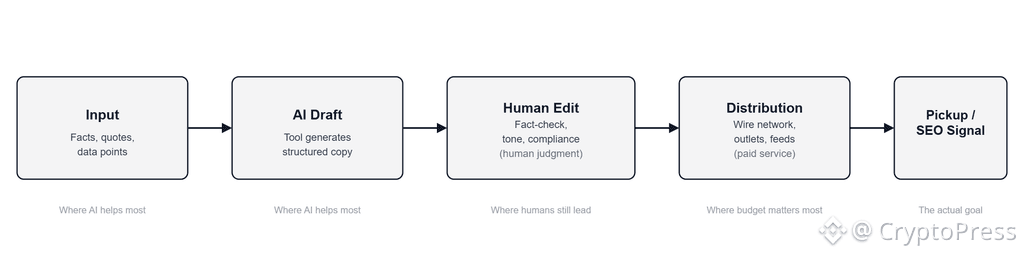
Writing the press release is only one link in a longer chain. The diagram below shows where AI genuinely accelerates the process, and where human judgment and paid infrastructure still do most of the work.
As the diagram shows, AI’s contribution is concentrated in the first two steps. From there, human editing, paid distribution infrastructure, and actual media pickup are governed by entirely different dynamics — reputation, relationships, timing, and budget — that no writing tool, however advanced, can substitute for.
How Do These Tools (and Distribution Networks) Actually Make Money?
Understanding the business model behind a tool tells you a lot about its incentives — and about where the real cost of a “free” AI press release generator actually shows up.
There are three common revenue models in this space:
Flat SaaS subscription. Tools like Jasper and Grammarly Business charge a recurring monthly fee regardless of how many releases you write. The company’s incentive is retention — keeping you as a subscriber — which generally aligns with continuously improving the writing quality and feature set.
Per-release or pay-as-you-go pricing. Some smaller, PR-specific tools charge per document generated or per campaign, which suits companies that publish infrequently and don’t want an ongoing subscription.
Free writer bundled with paid distribution. This is the model behind tools like EIN Presswire’s generator: the AI drafting tool costs nothing because the company’s real revenue comes from the distribution fee once you’re ready to publish. The “free” writing tool functions as a funnel into a paid service — a common and reasonable model, but one worth recognizing so you can compare the all-in cost, not just the advertised price.
For crypto-focused PR specifically, distribution networks that specialize in the industry (crypto-specific wire services and niche outlets) often charge a premium over general business wire services, reflecting the smaller, more targeted audience of crypto journalists and exchanges they can reach. That premium is the real economic engine of this market — not the AI writing layer, which has become largely commoditized.
What Makes an AI-Written Press Release Succeed or Fail?
Because this is a tool category rather than a single asset or company, there’s no “price” to rise or fall. But there is a real, observable equivalent: whether a release actually gets picked up — by journalists, aggregators, or search engines — or whether it disappears unread. Several factors determine this outcome, and most of them have little to do with which AI tool was used to write the first draft.
Factors that improve pickup and effectiveness:
A genuinely newsworthy hook. No AI tool can manufacture news value. A release announcing a real product launch, a verifiable partnership, or audited data will always outperform one describing routine internal milestones, regardless of how well it’s written.
Human editing for specificity. Releases edited by someone who removes generic AI phrasing and replaces it with concrete numbers, named sources, and direct quotes consistently perform better with journalists and readers alike.
Distribution network fit. Sending a crypto-specific announcement through a general business wire, or vice versa, wastes the release’s reach regardless of writing quality.
Timing and embargo discipline. Releases coordinated with relevant news cycles (a major protocol upgrade, a regulatory decision, an industry event) get materially more attention than ones sent on an arbitrary date.
Factors that reduce effectiveness over time:
Search engines and readers getting better at detecting formulaic AI content, which increasingly gets filtered or deprioritized — this is an active, evolving trend rather than a one-time risk.
Overuse of AI-generated boilerplate language across many releases from the same source, which erodes credibility with journalists who track a company’s output over time.
Distribution fatigue, where an outlet or wire service becomes associated with low-quality or spam-like releases, reducing the value of publishing through it even for legitimate news.
Signals worth watching, if you’re evaluating whether your current approach is working:
Falling open or click-through rates on releases sent through the same distribution channel over time
A rising ratio of “distributed” releases to actual journalist pickups or backlinks
Feedback (or silence) from press contacts who’ve received several releases from you in a row
None of these are predictions about any specific tool’s future — they’re observable, trackable signals any team can monitor to judge whether their press release strategy, AI-assisted or not, is actually working.
Challenges and Risks
AI press release tools solve a real time problem, but they introduce risks worth planning for:
Factual accuracy. LLMs can produce fluent, confident-sounding text that contains subtly wrong figures, misattributed quotes, or outdated claims. Every AI-drafted release needs a human fact-check pass before distribution — this is non-negotiable for anything involving financial figures, token metrics, or regulatory claims.
Regulatory sensitivity in crypto. Press releases announcing token sales, staking yields, or investment returns are subject to securities and advertising regulations in many jurisdictions. AI tools have no legal judgment; a compliance or legal review remains essential regardless of how the draft was produced.
Brand voice drift. Without careful prompt engineering or a tool with brand-voice training, successive AI-drafted releases can subtly shift in tone, undermining the consistency that builds trust with recurring media contacts.
Over-reliance on templates. Heavy reliance on rigid AI templates can make genuinely important announcements sound identical to routine ones, diluting the impact of releases that deserve more attention.
Cost stacking. As shown in the comparison table, the “cheap” writing tool and the “real” distribution cost are often separate line items. Budgeting for one without the other is a common early mistake.
Future Outlook
The trajectory of this space is fairly clear, even without speculating on specific tools or prices. Three structural trends are worth tracking:
Convergence of writing and distribution. The gap between AI drafting tools and distribution platforms is likely to keep narrowing, as both wire services and AI vendors recognize that customers want a single workflow rather than two separate purchases.
Rising detection of formulaic AI content. As AI-generated writing becomes ubiquitous, both search engines and human readers are getting better at spotting generic patterns. This will continue to reward tools and workflows that emphasize genuine editing and specificity over pure automation.
Specialization by industry. Just as crypto-specific distribution networks already charge a premium for reaching a targeted audience, expect more industry-specific AI writing tools (fine-tuned on sector terminology, compliance norms, and journalist expectations) rather than one-size-fits-all generators.
None of this changes the fundamentals: a press release, AI-assisted or not, only works if it says something genuinely worth reporting.
Conclusion
AI has made drafting a press release faster than at any point in the industry’s history — but speed was never the hard part of public relations. The hard part is still writing something true, specific, and newsworthy enough that a journalist with hundreds of pitches in their inbox decides to open yours, and getting it in front of the right distribution channel once it’s ready. Tools like Claude and ChatGPT are excellent for producing natural, high-quality first drafts; PR-specific platforms like Jasper or Prowly add structure and consistency for teams publishing regularly; and bundled tools like EIN Presswire lower the barrier to entry for a first release. None of them replace the judgment of a human editor who understands your audience and your industry’s regulatory reality.
If you’re building a press release workflow for a crypto project, start by separating the two costs clearly in your own head: what you’re paying (in time or money) to write the release, and what you’re paying to actually distribute it. Treat AI as a drafting accelerant, not a substitute for editorial judgment — and always route financial or regulatory claims through a human review before anything goes out.
Want more practical, no-hype breakdowns like this one? Subscribe to Cryptopress for evergreen guides on the tools, mechanics, and economics shaping crypto media: https://cryptopress.substack.com/subscribe
Sources referenced: ClickUp AI Press Release Generator guide; Semrush “Best AI Tools for PR”; ContentGrip AI press release writing tools review; Signal Genesys AI press release writer comparison.
The post Best AI Tools for Writing Press Releases: A Practical Guide for 2026 appeared first on Cryptopress.
Best AI Tools for Writing Press Releases: a Practical Guide for 2026
It’s an open secret in every newsroom: most press releases never get read past the headline. Journalists routinely receive hundreds of pitches a month, and a press release written in generic, adjective-heavy AI prose is one of the fastest ways to end up in the trash folder. That’s the paradox facing anyone using artificial intelligence to write press releases in 2026 — the same technology that can draft a release in ninety seconds can also make it instantly recognizable as filler, and filler gets ignored.
For crypto projects, this problem is amplified. Token launches, protocol upgrades, and funding rounds all lean heavily on press releases to build legitimacy with exchanges, media, and investors. Getting the writing right — and understanding what happens after the writing, in distribution — is often the difference between a release that lands on CoinDesk or a major wire service, and one that disappears into a spam filter.
This guide breaks down how AI press release tools actually work, which ones are worth using in different situations, and — just as importantly — where AI’s usefulness ends and where distribution economics take over. Press release distribution, the process of getting a finished release in front of journalists, databases, and search engines, remains a separate discipline from writing one, and conflating the two is the single most common mistake newcomers make.
Key Takeaways
AI writing tools speed up the drafting stage of a press release, not the distribution stage — the two are separate problems with separate costs.
General-purpose AI models (Claude, ChatGPT) tend to produce the most natural-sounding prose but have no built-in PR structure or distribution features.
PR-specific tools (Jasper, Prowly, Signal Genesys) add templates, brand-voice controls, and sometimes SEO/schema features, usually at a higher price.
Bundled writer-plus-distribution platforms (like EIN Presswire) trade some editorial control for convenience and a lower barrier to entry.
The biggest risk with AI-drafted releases isn’t grammar — it’s sounding generic enough that neither journalists nor search engines treat it as newsworthy.
How AI Press Release Tools Actually Work
To understand which tool fits your situation, it helps to understand what “AI press release writing” actually means under the hood. Most tools in this category are built on the same foundation: a large language model (LLM) — a type of AI trained on massive amounts of text to generate human-like writing — wrapped in a template that mimics standard press release structure (headline, dateline, lead paragraph, boilerplate, contact information).
The tools differ mainly in three areas:
How much structure they enforce. A general-purpose AI assistant like Claude or ChatGPT will write a press release if you ask it to, but it relies entirely on your prompt for structure, tone, and accuracy — it has no PR-specific guardrails. General-purpose AI models offer flexibility and customizable prompts but no dedicated PR structure, which means the quality ceiling is high but so is the amount of editing and formatting you’ll need to do yourself.
How they handle brand consistency. Purpose-built tools like Jasper let a team feed in a style guide, past releases, and product information so that new drafts sound consistent across different writers and campaigns. This matters more for organizations publishing frequently — a crypto project putting out a release every few weeks benefits from this far more than a startup writing its first-ever announcement.
Whether they include distribution. Some tools stop at the draft. Others, like EIN Presswire’s AI generator, are free with an account and sit inside a distribution platform, and can even convert a recorded interview into a draft — meaning the writing tool is really a front door to a paid distribution service, not a standalone product.
A Note on “AI Smell”
Search engines and increasingly sophisticated readers have gotten good at detecting formulaic AI writing — overuse of phrases like “in today’s fast-paced world” or “revolutionary breakthrough.” This matters for press releases specifically because wire services and journalists actively filter out copy that reads as templated marketing spam. The practical implication: whichever tool you use, plan to spend time editing the output into something that sounds like it came from a person who understands the news, not a bot filling in blanks.
Applications and Examples: Comparing the Main Tool Categories
Below is a comparison of the main categories of tools used for AI-assisted press release writing, based on how they’re positioned in the market as of 2026.
Tool / Category Best For Key Features Distribution Included? Typical Starting Price Claude / ChatGPT (general-purpose AI) Highest writing quality, full customization Flexible prompting, adapts to any tone or industry No ~$20/month Jasper Teams needing consistent brand voice at scale Brand voice training, templates, team collaboration No ~$49/month+ Prowly / Signal Genesys PR professionals wanting SEO-optimized releases Keyword optimization, SERP analysis, schema generation Partial (media outreach features) Custom pricing Copy.ai Fast, simple first drafts Multiple templates, easy interface No Free tier available Writesonic Budget-conscious solo founders Affordable, decent output quality No ~$19/month+ EIN Presswire AI generator Startups sending their first release Free draft generator tied to a distribution network Yes Free (distribution billed separately) PR Newswire Smart News Enterprises with high release volume Integrated drafting, analytics, guaranteed wire placement Yes Enterprise pricing
A pattern emerges from this table: the tools with the best raw writing quality (general-purpose AI models) have no distribution built in, and the tools with distribution built in are usually weaker writers. This isn’t a coincidence — it reflects two genuinely different business problems (content generation vs. media logistics) that most companies haven’t yet merged well.
The practical takeaway for crypto teams: many experienced PR practitioners draft with a general-purpose AI model for quality, then run the polished result through a dedicated distribution service. Using one tool for both jobs is possible, but usually means compromising on one side or the other.
Visualizing the Full Pipeline
Writing the press release is only one link in a longer chain. The diagram below shows where AI genuinely accelerates the process, and where human judgment and paid infrastructure still do most of the work.
As the diagram shows, AI’s contribution is concentrated in the first two steps. From there, human editing, paid distribution infrastructure, and actual media pickup are governed by entirely different dynamics — reputation, relationships, timing, and budget — that no writing tool, however advanced, can substitute for.
How Do These Tools (and Distribution Networks) Actually Make Money?
Understanding the business model behind a tool tells you a lot about its incentives — and about where the real cost of a “free” AI press release generator actually shows up.
There are three common revenue models in this space:
Flat SaaS subscription. Tools like Jasper and Grammarly Business charge a recurring monthly fee regardless of how many releases you write. The company’s incentive is retention — keeping you as a subscriber — which generally aligns with continuously improving the writing quality and feature set.
Per-release or pay-as-you-go pricing. Some smaller, PR-specific tools charge per document generated or per campaign, which suits companies that publish infrequently and don’t want an ongoing subscription.
Free writer bundled with paid distribution. This is the model behind tools like EIN Presswire’s generator: the AI drafting tool costs nothing because the company’s real revenue comes from the distribution fee once you’re ready to publish. The “free” writing tool functions as a funnel into a paid service — a common and reasonable model, but one worth recognizing so you can compare the all-in cost, not just the advertised price.
For crypto-focused PR specifically, distribution networks that specialize in the industry (crypto-specific wire services and niche outlets) often charge a premium over general business wire services, reflecting the smaller, more targeted audience of crypto journalists and exchanges they can reach. That premium is the real economic engine of this market — not the AI writing layer, which has become largely commoditized.
What Makes an AI-Written Press Release Succeed or Fail?
Because this is a tool category rather than a single asset or company, there’s no “price” to rise or fall. But there is a real, observable equivalent: whether a release actually gets picked up — by journalists, aggregators, or search engines — or whether it disappears unread. Several factors determine this outcome, and most of them have little to do with which AI tool was used to write the first draft.
Factors that improve pickup and effectiveness:
A genuinely newsworthy hook. No AI tool can manufacture news value. A release announcing a real product launch, a verifiable partnership, or audited data will always outperform one describing routine internal milestones, regardless of how well it’s written.
Human editing for specificity. Releases edited by someone who removes generic AI phrasing and replaces it with concrete numbers, named sources, and direct quotes consistently perform better with journalists and readers alike.
Distribution network fit. Sending a crypto-specific announcement through a general business wire, or vice versa, wastes the release’s reach regardless of writing quality.
Timing and embargo discipline. Releases coordinated with relevant news cycles (a major protocol upgrade, a regulatory decision, an industry event) get materially more attention than ones sent on an arbitrary date.
Factors that reduce effectiveness over time:
Search engines and readers getting better at detecting formulaic AI content, which increasingly gets filtered or deprioritized — this is an active, evolving trend rather than a one-time risk.
Overuse of AI-generated boilerplate language across many releases from the same source, which erodes credibility with journalists who track a company’s output over time.
Distribution fatigue, where an outlet or wire service becomes associated with low-quality or spam-like releases, reducing the value of publishing through it even for legitimate news.
Signals worth watching, if you’re evaluating whether your current approach is working:
Falling open or click-through rates on releases sent through the same distribution channel over time
A rising ratio of “distributed” releases to actual journalist pickups or backlinks
Feedback (or silence) from press contacts who’ve received several releases from you in a row
None of these are predictions about any specific tool’s future — they’re observable, trackable signals any team can monitor to judge whether their press release strategy, AI-assisted or not, is actually working.
Challenges and Risks
AI press release tools solve a real time problem, but they introduce risks worth planning for:
Factual accuracy. LLMs can produce fluent, confident-sounding text that contains subtly wrong figures, misattributed quotes, or outdated claims. Every AI-drafted release needs a human fact-check pass before distribution — this is non-negotiable for anything involving financial figures, token metrics, or regulatory claims.
Regulatory sensitivity in crypto. Press releases announcing token sales, staking yields, or investment returns are subject to securities and advertising regulations in many jurisdictions. AI tools have no legal judgment; a compliance or legal review remains essential regardless of how the draft was produced.
Brand voice drift. Without careful prompt engineering or a tool with brand-voice training, successive AI-drafted releases can subtly shift in tone, undermining the consistency that builds trust with recurring media contacts.
Over-reliance on templates. Heavy reliance on rigid AI templates can make genuinely important announcements sound identical to routine ones, diluting the impact of releases that deserve more attention.
Cost stacking. As shown in the comparison table, the “cheap” writing tool and the “real” distribution cost are often separate line items. Budgeting for one without the other is a common early mistake.
Future Outlook
The trajectory of this space is fairly clear, even without speculating on specific tools or prices. Three structural trends are worth tracking:
Convergence of writing and distribution. The gap between AI drafting tools and distribution platforms is likely to keep narrowing, as both wire services and AI vendors recognize that customers want a single workflow rather than two separate purchases.
Rising detection of formulaic AI content. As AI-generated writing becomes ubiquitous, both search engines and human readers are getting better at spotting generic patterns. This will continue to reward tools and workflows that emphasize genuine editing and specificity over pure automation.
Specialization by industry. Just as crypto-specific distribution networks already charge a premium for reaching a targeted audience, expect more industry-specific AI writing tools (fine-tuned on sector terminology, compliance norms, and journalist expectations) rather than one-size-fits-all generators.
None of this changes the fundamentals: a press release, AI-assisted or not, only works if it says something genuinely worth reporting.
Conclusion
AI has made drafting a press release faster than at any point in the industry’s history — but speed was never the hard part of public relations. The hard part is still writing something true, specific, and newsworthy enough that a journalist with hundreds of pitches in their inbox decides to open yours, and getting it in front of the right distribution channel once it’s ready. Tools like Claude and ChatGPT are excellent for producing natural, high-quality first drafts; PR-specific platforms like Jasper or Prowly add structure and consistency for teams publishing regularly; and bundled tools like EIN Presswire lower the barrier to entry for a first release. None of them replace the judgment of a human editor who understands your audience and your industry’s regulatory reality.
If you’re building a press release workflow for a crypto project, start by separating the two costs clearly in your own head: what you’re paying (in time or money) to write the release, and what you’re paying to actually distribute it. Treat AI as a drafting accelerant, not a substitute for editorial judgment — and always route financial or regulatory claims through a human review before anything goes out.
Want more practical, no-hype breakdowns like this one? Subscribe to Cryptopress for evergreen guides on the tools, mechanics, and economics shaping crypto media: https://cryptopress.substack.com/subscribe
Sources referenced: ClickUp AI Press Release Generator guide; Semrush “Best AI Tools for PR”; ContentGrip AI press release writing tools review; Signal Genesys AI press release writer comparison.
The post Best AI Tools for Writing Press Releases: A Practical Guide for 2026 appeared first on Cryptopress.
For crypto projects, this problem is amplified. Token launches, protocol upgrades, and funding rounds all lean heavily on press releases to build legitimacy with exchanges, media, and investors. Getting the writing right — and understanding what happens after the writing, in distribution — is often the difference between a release that lands on CoinDesk or a major wire service, and one that disappears into a spam filter.
This guide breaks down how AI press release tools actually work, which ones are worth using in different situations, and — just as importantly — where AI’s usefulness ends and where distribution economics take over. Press release distribution, the process of getting a finished release in front of journalists, databases, and search engines, remains a separate discipline from writing one, and conflating the two is the single most common mistake newcomers make.
Key Takeaways
AI writing tools speed up the drafting stage of a press release, not the distribution stage — the two are separate problems with separate costs.
General-purpose AI models (Claude, ChatGPT) tend to produce the most natural-sounding prose but have no built-in PR structure or distribution features.
PR-specific tools (Jasper, Prowly, Signal Genesys) add templates, brand-voice controls, and sometimes SEO/schema features, usually at a higher price.
Bundled writer-plus-distribution platforms (like EIN Presswire) trade some editorial control for convenience and a lower barrier to entry.
The biggest risk with AI-drafted releases isn’t grammar — it’s sounding generic enough that neither journalists nor search engines treat it as newsworthy.
How AI Press Release Tools Actually Work
To understand which tool fits your situation, it helps to understand what “AI press release writing” actually means under the hood. Most tools in this category are built on the same foundation: a large language model (LLM) — a type of AI trained on massive amounts of text to generate human-like writing — wrapped in a template that mimics standard press release structure (headline, dateline, lead paragraph, boilerplate, contact information).
The tools differ mainly in three areas:
How much structure they enforce. A general-purpose AI assistant like Claude or ChatGPT will write a press release if you ask it to, but it relies entirely on your prompt for structure, tone, and accuracy — it has no PR-specific guardrails. General-purpose AI models offer flexibility and customizable prompts but no dedicated PR structure, which means the quality ceiling is high but so is the amount of editing and formatting you’ll need to do yourself.
How they handle brand consistency. Purpose-built tools like Jasper let a team feed in a style guide, past releases, and product information so that new drafts sound consistent across different writers and campaigns. This matters more for organizations publishing frequently — a crypto project putting out a release every few weeks benefits from this far more than a startup writing its first-ever announcement.
Whether they include distribution. Some tools stop at the draft. Others, like EIN Presswire’s AI generator, are free with an account and sit inside a distribution platform, and can even convert a recorded interview into a draft — meaning the writing tool is really a front door to a paid distribution service, not a standalone product.
A Note on “AI Smell”
Search engines and increasingly sophisticated readers have gotten good at detecting formulaic AI writing — overuse of phrases like “in today’s fast-paced world” or “revolutionary breakthrough.” This matters for press releases specifically because wire services and journalists actively filter out copy that reads as templated marketing spam. The practical implication: whichever tool you use, plan to spend time editing the output into something that sounds like it came from a person who understands the news, not a bot filling in blanks.
Applications and Examples: Comparing the Main Tool Categories
Below is a comparison of the main categories of tools used for AI-assisted press release writing, based on how they’re positioned in the market as of 2026.
Tool / Category Best For Key Features Distribution Included? Typical Starting Price Claude / ChatGPT (general-purpose AI) Highest writing quality, full customization Flexible prompting, adapts to any tone or industry No ~$20/month Jasper Teams needing consistent brand voice at scale Brand voice training, templates, team collaboration No ~$49/month+ Prowly / Signal Genesys PR professionals wanting SEO-optimized releases Keyword optimization, SERP analysis, schema generation Partial (media outreach features) Custom pricing Copy.ai Fast, simple first drafts Multiple templates, easy interface No Free tier available Writesonic Budget-conscious solo founders Affordable, decent output quality No ~$19/month+ EIN Presswire AI generator Startups sending their first release Free draft generator tied to a distribution network Yes Free (distribution billed separately) PR Newswire Smart News Enterprises with high release volume Integrated drafting, analytics, guaranteed wire placement Yes Enterprise pricing
A pattern emerges from this table: the tools with the best raw writing quality (general-purpose AI models) have no distribution built in, and the tools with distribution built in are usually weaker writers. This isn’t a coincidence — it reflects two genuinely different business problems (content generation vs. media logistics) that most companies haven’t yet merged well.
The practical takeaway for crypto teams: many experienced PR practitioners draft with a general-purpose AI model for quality, then run the polished result through a dedicated distribution service. Using one tool for both jobs is possible, but usually means compromising on one side or the other.
Visualizing the Full Pipeline
Writing the press release is only one link in a longer chain. The diagram below shows where AI genuinely accelerates the process, and where human judgment and paid infrastructure still do most of the work.
As the diagram shows, AI’s contribution is concentrated in the first two steps. From there, human editing, paid distribution infrastructure, and actual media pickup are governed by entirely different dynamics — reputation, relationships, timing, and budget — that no writing tool, however advanced, can substitute for.
How Do These Tools (and Distribution Networks) Actually Make Money?
Understanding the business model behind a tool tells you a lot about its incentives — and about where the real cost of a “free” AI press release generator actually shows up.
There are three common revenue models in this space:
Flat SaaS subscription. Tools like Jasper and Grammarly Business charge a recurring monthly fee regardless of how many releases you write. The company’s incentive is retention — keeping you as a subscriber — which generally aligns with continuously improving the writing quality and feature set.
Per-release or pay-as-you-go pricing. Some smaller, PR-specific tools charge per document generated or per campaign, which suits companies that publish infrequently and don’t want an ongoing subscription.
Free writer bundled with paid distribution. This is the model behind tools like EIN Presswire’s generator: the AI drafting tool costs nothing because the company’s real revenue comes from the distribution fee once you’re ready to publish. The “free” writing tool functions as a funnel into a paid service — a common and reasonable model, but one worth recognizing so you can compare the all-in cost, not just the advertised price.
For crypto-focused PR specifically, distribution networks that specialize in the industry (crypto-specific wire services and niche outlets) often charge a premium over general business wire services, reflecting the smaller, more targeted audience of crypto journalists and exchanges they can reach. That premium is the real economic engine of this market — not the AI writing layer, which has become largely commoditized.
What Makes an AI-Written Press Release Succeed or Fail?
Because this is a tool category rather than a single asset or company, there’s no “price” to rise or fall. But there is a real, observable equivalent: whether a release actually gets picked up — by journalists, aggregators, or search engines — or whether it disappears unread. Several factors determine this outcome, and most of them have little to do with which AI tool was used to write the first draft.
Factors that improve pickup and effectiveness:
A genuinely newsworthy hook. No AI tool can manufacture news value. A release announcing a real product launch, a verifiable partnership, or audited data will always outperform one describing routine internal milestones, regardless of how well it’s written.
Human editing for specificity. Releases edited by someone who removes generic AI phrasing and replaces it with concrete numbers, named sources, and direct quotes consistently perform better with journalists and readers alike.
Distribution network fit. Sending a crypto-specific announcement through a general business wire, or vice versa, wastes the release’s reach regardless of writing quality.
Timing and embargo discipline. Releases coordinated with relevant news cycles (a major protocol upgrade, a regulatory decision, an industry event) get materially more attention than ones sent on an arbitrary date.
Factors that reduce effectiveness over time:
Search engines and readers getting better at detecting formulaic AI content, which increasingly gets filtered or deprioritized — this is an active, evolving trend rather than a one-time risk.
Overuse of AI-generated boilerplate language across many releases from the same source, which erodes credibility with journalists who track a company’s output over time.
Distribution fatigue, where an outlet or wire service becomes associated with low-quality or spam-like releases, reducing the value of publishing through it even for legitimate news.
Signals worth watching, if you’re evaluating whether your current approach is working:
Falling open or click-through rates on releases sent through the same distribution channel over time
A rising ratio of “distributed” releases to actual journalist pickups or backlinks
Feedback (or silence) from press contacts who’ve received several releases from you in a row
None of these are predictions about any specific tool’s future — they’re observable, trackable signals any team can monitor to judge whether their press release strategy, AI-assisted or not, is actually working.
Challenges and Risks
AI press release tools solve a real time problem, but they introduce risks worth planning for:
Factual accuracy. LLMs can produce fluent, confident-sounding text that contains subtly wrong figures, misattributed quotes, or outdated claims. Every AI-drafted release needs a human fact-check pass before distribution — this is non-negotiable for anything involving financial figures, token metrics, or regulatory claims.
Regulatory sensitivity in crypto. Press releases announcing token sales, staking yields, or investment returns are subject to securities and advertising regulations in many jurisdictions. AI tools have no legal judgment; a compliance or legal review remains essential regardless of how the draft was produced.
Brand voice drift. Without careful prompt engineering or a tool with brand-voice training, successive AI-drafted releases can subtly shift in tone, undermining the consistency that builds trust with recurring media contacts.
Over-reliance on templates. Heavy reliance on rigid AI templates can make genuinely important announcements sound identical to routine ones, diluting the impact of releases that deserve more attention.
Cost stacking. As shown in the comparison table, the “cheap” writing tool and the “real” distribution cost are often separate line items. Budgeting for one without the other is a common early mistake.
Future Outlook
The trajectory of this space is fairly clear, even without speculating on specific tools or prices. Three structural trends are worth tracking:
Convergence of writing and distribution. The gap between AI drafting tools and distribution platforms is likely to keep narrowing, as both wire services and AI vendors recognize that customers want a single workflow rather than two separate purchases.
Rising detection of formulaic AI content. As AI-generated writing becomes ubiquitous, both search engines and human readers are getting better at spotting generic patterns. This will continue to reward tools and workflows that emphasize genuine editing and specificity over pure automation.
Specialization by industry. Just as crypto-specific distribution networks already charge a premium for reaching a targeted audience, expect more industry-specific AI writing tools (fine-tuned on sector terminology, compliance norms, and journalist expectations) rather than one-size-fits-all generators.
None of this changes the fundamentals: a press release, AI-assisted or not, only works if it says something genuinely worth reporting.
Conclusion
AI has made drafting a press release faster than at any point in the industry’s history — but speed was never the hard part of public relations. The hard part is still writing something true, specific, and newsworthy enough that a journalist with hundreds of pitches in their inbox decides to open yours, and getting it in front of the right distribution channel once it’s ready. Tools like Claude and ChatGPT are excellent for producing natural, high-quality first drafts; PR-specific platforms like Jasper or Prowly add structure and consistency for teams publishing regularly; and bundled tools like EIN Presswire lower the barrier to entry for a first release. None of them replace the judgment of a human editor who understands your audience and your industry’s regulatory reality.
If you’re building a press release workflow for a crypto project, start by separating the two costs clearly in your own head: what you’re paying (in time or money) to write the release, and what you’re paying to actually distribute it. Treat AI as a drafting accelerant, not a substitute for editorial judgment — and always route financial or regulatory claims through a human review before anything goes out.
Want more practical, no-hype breakdowns like this one? Subscribe to Cryptopress for evergreen guides on the tools, mechanics, and economics shaping crypto media: https://cryptopress.substack.com/subscribe
Sources referenced: ClickUp AI Press Release Generator guide; Semrush “Best AI Tools for PR”; ContentGrip AI press release writing tools review; Signal Genesys AI press release writer comparison.
The post Best AI Tools for Writing Press Releases: A Practical Guide for 2026 appeared first on Cryptopress.
284
·
--
Shiny Coins #26 – Warsh Hikes, Zcash Prints $1,500, Uniswap Gets the Stock TapeFriday, September 18, 2026. Bitcoin last printed around $81,200, up about +5% on seven days that started with a Fed chair and ended with an $81k screenshot. Last Saturday we sat near $77,280 waiting for Wednesday. The FOMC delivered exactly what the hot core print had advertised: a unanimous 25-basis-point hike to a 3.75–4.00% funds range — the first increase since 2023 — and a dot plot that still wants another quarter-point before year-end. Chair Kevin Warsh’s line was not subtle: inflation “is too high and has been for too long.” Bitcoin ate the statement, wicked toward $74,920 on September 15, then spent Friday reclaiming the handle it lost after the $82k wick two weeks ago. Spot bitcoin ETFs dumped −$450 million on September 15 and another −$296 million on hike day, then flipped +$159.5 million on September 17 with IBIT alone at +$183.7 million. Total market cap ~$2.76–$2.79 trillion. Bitcoin dominance ~58.5%. Alternative.me’s Fear & Greed Index: 56 (Greed), down from 63 last Saturday.
The shiny list is not “BTC survived a hike.” It is the names that printed a new privacy high, caught a regulator writing AMM into the stock market, or turned confidential TVL into a $3 handle: ZEC, UNI, NEAR, ARB, HYPE, SOL, ETH, XMR.
The Shiny Coins Right Now
1. ZEC — Zcash — $1,490 +29.6% 7d
Last week we called $1,000 and $1,200 live levels after a $1,294 wick. The market used both as a runway. ZEC tagged roughly $1,521–$1,535 on September 18 — a fresh multi-year / 10-year high on several feeds — and a market cap near $25 billion. Paradigm co-founder Matt Huang disclosed the firm holds ZEC and is an investor in the Zcash Open Development Lab, calling it a “private complement to Bitcoin.” The community’s NU7 vote printed 99.9% support for cutting block time toward 25 seconds while keeping the Bitcoin-style halving schedule; mainnet is still aimed at November 5 pending the October 20 go/no-go. Grayscale’s ZCSH ETF is no longer a novelty listing: coverage has net assets in the $730–$890 million zone, more than $233 million of post-launch inflows, and a 3-for-1 share split slated for late September. A September 17 short squeeze vacuumed about $56 million of bearish bets on the way through $1,400.
Key metric: week high ~$1,535; ~$25B market cap; ZCSH AUM into the high-hundreds of millions.
Outlook (1–4 weeks): Cautious / Bullish — $1,400 is the new floor argument; $1,500 is now a magnet and a trapdoor.
Shielded txs, unshielded $1,500 screenshots, Paradigm on the cap table.
2. UNI — Uniswap — $8.80 +38% 7d
The SEC did not list UNI. It wrote a five-year permission slip that looks a lot like Uniswap v4. On September 17 the Commission issued its Innovation Exemption: Tokenized Securities Venues can run permissioned AMM pools in tokenized NMS stocks without being treated as exchanges, and certain liquidity providers get dealer relief. Chair Paul Atkins framed it as a bridge after the Senate failed to advance the CLARITY Act. UNI ripped from last Saturday’s ~$6.37 through an ~$8.83–$8.94 local high — the best print since late 2025 on several screens — with 24-hour volume near $1.8 billion and a market cap around $5.4 billion. The order does not name Uniswap. The candle did.
Key metric: five-year TSV exemption; ~$8.90 wick; volume that finally matches the narrative.
Outlook: Bullish while $7.50 holds; Cautious if $8.90 was just the headline print.
The AMM asked for stocks. A commissioner said “temporary.” The tape said “enough.”
3. NEAR — NEAR Protocol — $3.55 +44% 7d
Privacy did not stop at shielded L1s. near.com said Confidential Intents TVL cleared $70 million, automatically triggering Drop 1 of the NEAR@3.33 program: 333,333 locked milestone tokens for wallets that kept a confidential balance above $100 and an active swap history. Those tokens only convert 1:1 into NEAR after a three-day VWAP at or above $3.33 — which is suddenly not a meme number. The same window brought confidential-by-default perpetuals on near.com. Price ran from the mid-$2s through a ~$3.70 handle with volume that printed as a meaningful slice of market cap. This is the other privacy bid: not a shielded UTXO, a private cross-chain intent layer.
Key metric: $70M confidential TVL snapshot; 333,333 locked NEAR@3.33 tokens; $3.33 VWAP now in play.
Outlook: Bullish above $3.00; the unlock mechanic is the feature and the overhang.
They named the airdrop after the strike. Then the candle tagged it.
4. ARB — Arbitrum — $0.216 +50% 7d
If UNI is the AMM that wants stocks, ARB is the L2 already holding them. Tokenized funds on Arbitrum printed a fresh high near $800 million to $980 million this week — credit funds, T-bills, WisdomTree and friends — with coverage putting the chain above 5,700 tokenized assets, more than Solana and BNB Chain combined on that count. On-chain assets grew from about $9.4 billion to $11.2 billion over the past month. Robinhood Chain still sits on the Orbit stack. The SEC exemption is not an Arbitrum press release. It is a bid for every chain that already settled tokenized paper. ARB tagged the mid-$0.21s, a 2026 high zone last seen in January, with hundreds of millions turning over.
Key metric: tokenized funds ~$800M–$980M; ~+50% week; January highs back on the table.
Outlook: Bullish if the RWA tape keeps printing; Cautious after a 50% week and an RSI that is no longer cute.
5. HYPE — Hyperliquid — $92.00 +15% 7d
The house that sells the leverage printed a new local high near $92.60 on Friday — several feeds treat that as an all-time high print. Market cap screens around $20 billion. The narrative stack this week was access, not a new perp: coverage flagged Payward (Kraken’s parent) talking Hyperliquid-based perps for U.S. clients, plus a physically backed HYPE ETP from Virtune on the Warsaw Stock Exchange. When BTC rips $6,000 off a FOMC low, open interest does not take the day off. Last week’s $84 fade is the base. $92 is the screenshot.
Key metric: new local/ATH zone ~$92.60; still a top-12 coin through the first hike in three years.
Outlook: Bullish above $85; $80 is where we get less cute about the casino token.
The Fed hiked. The patrons paid funding. The house printed a high.
6. SOL — Solana — $113.50 +11% 7d
Solana did not get the SEC headline or the Paradigm post. It got the tape. From last Saturday’s ~$102 it tagged about $114.30 on Friday with a market cap near $66 billion. That is the cleanest large-cap seven-day among the old majors that is not a privacy coin or an AMM token. Spot SOL ETFs even booked a rounding-error inflow on hike day while BTC and ETH funds bled. Holding $100 through a 25-basis-point hike was the story last week. Leaving $100 in the rearview is this week’s.
Key metric: week high ~$114; first decisive reclaim of the $110s since the mid-August hangover.
Outlook: Bullish while $108 holds; $100 is no longer a trophy, it is the trapdoor.
7. ETH — Ethereum — $2,630 +4.0% 7d
Last week ether ETFs took the bid bitcoin funds refused. This week they gave some of it back: roughly −$224 million on September 16 and another −$39 million on September 17, even as ETH followed BTC through the hike and parked near $2,630. The Glamsterdam rehearsal and talk of a higher gas limit are real developer tape. They are not why the candle moved. ETH is on this list because it held the post-CPI higher low and still sits in the only large-cap lane that TradFi can buy with a ticker. The Friday rip is beta. The seven-day is a shrug.
Key metric: held $2,450 through the first hike; ETF flow flipped from last Friday’s +$216M to three sessions of red.
Outlook: Cautious / Bullish — $2,450 is the line; $2,665 last week’s wick is still the ceiling until flows turn.
8. XMR — Monero — $545 +2.3% 7d
ZEC got Paradigm, the $1,535 wick, the ETF split, and the liquidation porn. XMR got the quieter seat again — $533 last Saturday to the mid-$540s, with some Friday prints closer to $570 and a market cap still near $10 billion. No NYSE ticker. No 3-for-1. Just the original shielded chain refusing to fade while a cousin that now lives in the top 10 drags tourists into the category. When ZEC is a $25 billion coin, XMR is not uncorrelated. It is the other chair at the same table.
Key metric: held the $500s through ZEC’s $1,535 discovery and a Fed hike.
Outlook: Bullish as long as four-digit — now mid-four-digit — ZEC remains a headline, not a tombstone.
Hidden Gem of the Week
LSK — Lisk — ~$0.45 / ~$170 million market cap +200% 7d after a 900% wick
Not in the top 20. Not a protocol anyone was pitching two weeks ago. Lisk told holders the standalone chain shuts on October 31 and the DAO burned 100 million LSK — about 25% of max supply, 400 million down to 300 million. The market’s response was a short squeeze: LSK spiked above $2 on September 13, vacuumed roughly $34–$41 million of liquidations (the vast majority shorts), then mean-reverted toward the mid-$0.40s. The weekly gainers screen still has it near the top. This is not a fundamentals gem. It is a deadline, a supply cut, and a thin book. Position size like the chain has a calendar.
One to Watch Closely
Zcash’s $1,400–$1,500 shelf — and whether Bitcoin keeps $78k after the first hike in three years.
Warsh did the hike. The dots still want another quarter-point. Bitcoin defended the mid-$76,000s last week, lost the $75,000s into the meeting, and printed $81k two sessions later. That is not “the market loved tighter policy.” That is seller exhaustion meeting a widely telegraphed 25 basis points. A hold of $78,000–$80,000 keeps every name on this list breathing. A clean break of Friday’s $76,300 opening range — or last week’s $74,920 wick — takes the air out of $1,500 ZEC and $9 UNI in the same candle. Next week is less about which AMM inherits tokenized Apple and more about whether $81k was the relief rally or the start of a post-hike grind.
Closing
The rotation tells you the regime in one sentence: the Fed hiked, and the market got picky instead of scared. Dominance near 58.5% means capital is still not spraying across 200 alts. It is concentrating in stories with a screenshot (ZEC at $1,535), a regulator (UNI and ARB on the Innovation Exemption), or a venue that already charged for the leverage (HYPE, SOL). Privacy now has a mid-four-digit coin, an ETF heading for a split, a Paradigm disclosure, a $70 million confidential-TVL print on NEAR, and Monero still sitting in the $500s. Tokenized stocks left the white paper and entered an SEC order. Memecoins still work; they just were not the A-side this week — the carnival is a shutdown chain named Lisk. Greed is 56, not 74. That is the window where shiny coins can still run — and where a second hike on the dot plot can rekt anyone who bought Friday’s $81k breakout with the same 20x they used on the $82k wick.
Not financial advice. DYOR. Don’t get married to a ticker that just printed $1,500, or to a chain that announced its own funeral and still ripped 900%.
See you next week for more Shiny Coins on Cryptopress.site
The post Shiny Coins #26 – Warsh Hikes, Zcash Prints $1,500, Uniswap Gets the Stock Tape appeared first on Cryptopress.
Shiny Coins #26 – Warsh Hikes, Zcash Prints $1,500, Uniswap Gets the Stock Tape
Friday, September 18, 2026. Bitcoin last printed around $81,200, up about +5% on seven days that started with a Fed chair and ended with an $81k screenshot. Last Saturday we sat near $77,280 waiting for Wednesday. The FOMC delivered exactly what the hot core print had advertised: a unanimous 25-basis-point hike to a 3.75–4.00% funds range — the first increase since 2023 — and a dot plot that still wants another quarter-point before year-end. Chair Kevin Warsh’s line was not subtle: inflation “is too high and has been for too long.” Bitcoin ate the statement, wicked toward $74,920 on September 15, then spent Friday reclaiming the handle it lost after the $82k wick two weeks ago. Spot bitcoin ETFs dumped −$450 million on September 15 and another −$296 million on hike day, then flipped +$159.5 million on September 17 with IBIT alone at +$183.7 million. Total market cap ~$2.76–$2.79 trillion. Bitcoin dominance ~58.5%. Alternative.me’s Fear & Greed Index: 56 (Greed), down from 63 last Saturday.
The shiny list is not “BTC survived a hike.” It is the names that printed a new privacy high, caught a regulator writing AMM into the stock market, or turned confidential TVL into a $3 handle: ZEC, UNI, NEAR, ARB, HYPE, SOL, ETH, XMR.
The Shiny Coins Right Now
1. ZEC — Zcash — $1,490 +29.6% 7d
Last week we called $1,000 and $1,200 live levels after a $1,294 wick. The market used both as a runway. ZEC tagged roughly $1,521–$1,535 on September 18 — a fresh multi-year / 10-year high on several feeds — and a market cap near $25 billion. Paradigm co-founder Matt Huang disclosed the firm holds ZEC and is an investor in the Zcash Open Development Lab, calling it a “private complement to Bitcoin.” The community’s NU7 vote printed 99.9% support for cutting block time toward 25 seconds while keeping the Bitcoin-style halving schedule; mainnet is still aimed at November 5 pending the October 20 go/no-go. Grayscale’s ZCSH ETF is no longer a novelty listing: coverage has net assets in the $730–$890 million zone, more than $233 million of post-launch inflows, and a 3-for-1 share split slated for late September. A September 17 short squeeze vacuumed about $56 million of bearish bets on the way through $1,400.
Key metric: week high ~$1,535; ~$25B market cap; ZCSH AUM into the high-hundreds of millions.
Outlook (1–4 weeks): Cautious / Bullish — $1,400 is the new floor argument; $1,500 is now a magnet and a trapdoor.
Shielded txs, unshielded $1,500 screenshots, Paradigm on the cap table.
2. UNI — Uniswap — $8.80 +38% 7d
The SEC did not list UNI. It wrote a five-year permission slip that looks a lot like Uniswap v4. On September 17 the Commission issued its Innovation Exemption: Tokenized Securities Venues can run permissioned AMM pools in tokenized NMS stocks without being treated as exchanges, and certain liquidity providers get dealer relief. Chair Paul Atkins framed it as a bridge after the Senate failed to advance the CLARITY Act. UNI ripped from last Saturday’s ~$6.37 through an ~$8.83–$8.94 local high — the best print since late 2025 on several screens — with 24-hour volume near $1.8 billion and a market cap around $5.4 billion. The order does not name Uniswap. The candle did.
Key metric: five-year TSV exemption; ~$8.90 wick; volume that finally matches the narrative.
Outlook: Bullish while $7.50 holds; Cautious if $8.90 was just the headline print.
The AMM asked for stocks. A commissioner said “temporary.” The tape said “enough.”
3. NEAR — NEAR Protocol — $3.55 +44% 7d
Privacy did not stop at shielded L1s. near.com said Confidential Intents TVL cleared $70 million, automatically triggering Drop 1 of the NEAR@3.33 program: 333,333 locked milestone tokens for wallets that kept a confidential balance above $100 and an active swap history. Those tokens only convert 1:1 into NEAR after a three-day VWAP at or above $3.33 — which is suddenly not a meme number. The same window brought confidential-by-default perpetuals on near.com. Price ran from the mid-$2s through a ~$3.70 handle with volume that printed as a meaningful slice of market cap. This is the other privacy bid: not a shielded UTXO, a private cross-chain intent layer.
Key metric: $70M confidential TVL snapshot; 333,333 locked NEAR@3.33 tokens; $3.33 VWAP now in play.
Outlook: Bullish above $3.00; the unlock mechanic is the feature and the overhang.
They named the airdrop after the strike. Then the candle tagged it.
4. ARB — Arbitrum — $0.216 +50% 7d
If UNI is the AMM that wants stocks, ARB is the L2 already holding them. Tokenized funds on Arbitrum printed a fresh high near $800 million to $980 million this week — credit funds, T-bills, WisdomTree and friends — with coverage putting the chain above 5,700 tokenized assets, more than Solana and BNB Chain combined on that count. On-chain assets grew from about $9.4 billion to $11.2 billion over the past month. Robinhood Chain still sits on the Orbit stack. The SEC exemption is not an Arbitrum press release. It is a bid for every chain that already settled tokenized paper. ARB tagged the mid-$0.21s, a 2026 high zone last seen in January, with hundreds of millions turning over.
Key metric: tokenized funds ~$800M–$980M; ~+50% week; January highs back on the table.
Outlook: Bullish if the RWA tape keeps printing; Cautious after a 50% week and an RSI that is no longer cute.
5. HYPE — Hyperliquid — $92.00 +15% 7d
The house that sells the leverage printed a new local high near $92.60 on Friday — several feeds treat that as an all-time high print. Market cap screens around $20 billion. The narrative stack this week was access, not a new perp: coverage flagged Payward (Kraken’s parent) talking Hyperliquid-based perps for U.S. clients, plus a physically backed HYPE ETP from Virtune on the Warsaw Stock Exchange. When BTC rips $6,000 off a FOMC low, open interest does not take the day off. Last week’s $84 fade is the base. $92 is the screenshot.
Key metric: new local/ATH zone ~$92.60; still a top-12 coin through the first hike in three years.
Outlook: Bullish above $85; $80 is where we get less cute about the casino token.
The Fed hiked. The patrons paid funding. The house printed a high.
6. SOL — Solana — $113.50 +11% 7d
Solana did not get the SEC headline or the Paradigm post. It got the tape. From last Saturday’s ~$102 it tagged about $114.30 on Friday with a market cap near $66 billion. That is the cleanest large-cap seven-day among the old majors that is not a privacy coin or an AMM token. Spot SOL ETFs even booked a rounding-error inflow on hike day while BTC and ETH funds bled. Holding $100 through a 25-basis-point hike was the story last week. Leaving $100 in the rearview is this week’s.
Key metric: week high ~$114; first decisive reclaim of the $110s since the mid-August hangover.
Outlook: Bullish while $108 holds; $100 is no longer a trophy, it is the trapdoor.
7. ETH — Ethereum — $2,630 +4.0% 7d
Last week ether ETFs took the bid bitcoin funds refused. This week they gave some of it back: roughly −$224 million on September 16 and another −$39 million on September 17, even as ETH followed BTC through the hike and parked near $2,630. The Glamsterdam rehearsal and talk of a higher gas limit are real developer tape. They are not why the candle moved. ETH is on this list because it held the post-CPI higher low and still sits in the only large-cap lane that TradFi can buy with a ticker. The Friday rip is beta. The seven-day is a shrug.
Key metric: held $2,450 through the first hike; ETF flow flipped from last Friday’s +$216M to three sessions of red.
Outlook: Cautious / Bullish — $2,450 is the line; $2,665 last week’s wick is still the ceiling until flows turn.
8. XMR — Monero — $545 +2.3% 7d
ZEC got Paradigm, the $1,535 wick, the ETF split, and the liquidation porn. XMR got the quieter seat again — $533 last Saturday to the mid-$540s, with some Friday prints closer to $570 and a market cap still near $10 billion. No NYSE ticker. No 3-for-1. Just the original shielded chain refusing to fade while a cousin that now lives in the top 10 drags tourists into the category. When ZEC is a $25 billion coin, XMR is not uncorrelated. It is the other chair at the same table.
Key metric: held the $500s through ZEC’s $1,535 discovery and a Fed hike.
Outlook: Bullish as long as four-digit — now mid-four-digit — ZEC remains a headline, not a tombstone.
Hidden Gem of the Week
LSK — Lisk — ~$0.45 / ~$170 million market cap +200% 7d after a 900% wick
Not in the top 20. Not a protocol anyone was pitching two weeks ago. Lisk told holders the standalone chain shuts on October 31 and the DAO burned 100 million LSK — about 25% of max supply, 400 million down to 300 million. The market’s response was a short squeeze: LSK spiked above $2 on September 13, vacuumed roughly $34–$41 million of liquidations (the vast majority shorts), then mean-reverted toward the mid-$0.40s. The weekly gainers screen still has it near the top. This is not a fundamentals gem. It is a deadline, a supply cut, and a thin book. Position size like the chain has a calendar.
One to Watch Closely
Zcash’s $1,400–$1,500 shelf — and whether Bitcoin keeps $78k after the first hike in three years.
Warsh did the hike. The dots still want another quarter-point. Bitcoin defended the mid-$76,000s last week, lost the $75,000s into the meeting, and printed $81k two sessions later. That is not “the market loved tighter policy.” That is seller exhaustion meeting a widely telegraphed 25 basis points. A hold of $78,000–$80,000 keeps every name on this list breathing. A clean break of Friday’s $76,300 opening range — or last week’s $74,920 wick — takes the air out of $1,500 ZEC and $9 UNI in the same candle. Next week is less about which AMM inherits tokenized Apple and more about whether $81k was the relief rally or the start of a post-hike grind.
Closing
The rotation tells you the regime in one sentence: the Fed hiked, and the market got picky instead of scared. Dominance near 58.5% means capital is still not spraying across 200 alts. It is concentrating in stories with a screenshot (ZEC at $1,535), a regulator (UNI and ARB on the Innovation Exemption), or a venue that already charged for the leverage (HYPE, SOL). Privacy now has a mid-four-digit coin, an ETF heading for a split, a Paradigm disclosure, a $70 million confidential-TVL print on NEAR, and Monero still sitting in the $500s. Tokenized stocks left the white paper and entered an SEC order. Memecoins still work; they just were not the A-side this week — the carnival is a shutdown chain named Lisk. Greed is 56, not 74. That is the window where shiny coins can still run — and where a second hike on the dot plot can rekt anyone who bought Friday’s $81k breakout with the same 20x they used on the $82k wick.
Not financial advice. DYOR. Don’t get married to a ticker that just printed $1,500, or to a chain that announced its own funeral and still ripped 900%.
See you next week for more Shiny Coins on Cryptopress.site
The post Shiny Coins #26 – Warsh Hikes, Zcash Prints $1,500, Uniswap Gets the Stock Tape appeared first on Cryptopress.
The shiny list is not “BTC survived a hike.” It is the names that printed a new privacy high, caught a regulator writing AMM into the stock market, or turned confidential TVL into a $3 handle: ZEC, UNI, NEAR, ARB, HYPE, SOL, ETH, XMR.
The Shiny Coins Right Now
1. ZEC — Zcash — $1,490 +29.6% 7d
Last week we called $1,000 and $1,200 live levels after a $1,294 wick. The market used both as a runway. ZEC tagged roughly $1,521–$1,535 on September 18 — a fresh multi-year / 10-year high on several feeds — and a market cap near $25 billion. Paradigm co-founder Matt Huang disclosed the firm holds ZEC and is an investor in the Zcash Open Development Lab, calling it a “private complement to Bitcoin.” The community’s NU7 vote printed 99.9% support for cutting block time toward 25 seconds while keeping the Bitcoin-style halving schedule; mainnet is still aimed at November 5 pending the October 20 go/no-go. Grayscale’s ZCSH ETF is no longer a novelty listing: coverage has net assets in the $730–$890 million zone, more than $233 million of post-launch inflows, and a 3-for-1 share split slated for late September. A September 17 short squeeze vacuumed about $56 million of bearish bets on the way through $1,400.
Key metric: week high ~$1,535; ~$25B market cap; ZCSH AUM into the high-hundreds of millions.
Outlook (1–4 weeks): Cautious / Bullish — $1,400 is the new floor argument; $1,500 is now a magnet and a trapdoor.
Shielded txs, unshielded $1,500 screenshots, Paradigm on the cap table.
2. UNI — Uniswap — $8.80 +38% 7d
The SEC did not list UNI. It wrote a five-year permission slip that looks a lot like Uniswap v4. On September 17 the Commission issued its Innovation Exemption: Tokenized Securities Venues can run permissioned AMM pools in tokenized NMS stocks without being treated as exchanges, and certain liquidity providers get dealer relief. Chair Paul Atkins framed it as a bridge after the Senate failed to advance the CLARITY Act. UNI ripped from last Saturday’s ~$6.37 through an ~$8.83–$8.94 local high — the best print since late 2025 on several screens — with 24-hour volume near $1.8 billion and a market cap around $5.4 billion. The order does not name Uniswap. The candle did.
Key metric: five-year TSV exemption; ~$8.90 wick; volume that finally matches the narrative.
Outlook: Bullish while $7.50 holds; Cautious if $8.90 was just the headline print.
The AMM asked for stocks. A commissioner said “temporary.” The tape said “enough.”
3. NEAR — NEAR Protocol — $3.55 +44% 7d
Privacy did not stop at shielded L1s. near.com said Confidential Intents TVL cleared $70 million, automatically triggering Drop 1 of the NEAR@3.33 program: 333,333 locked milestone tokens for wallets that kept a confidential balance above $100 and an active swap history. Those tokens only convert 1:1 into NEAR after a three-day VWAP at or above $3.33 — which is suddenly not a meme number. The same window brought confidential-by-default perpetuals on near.com. Price ran from the mid-$2s through a ~$3.70 handle with volume that printed as a meaningful slice of market cap. This is the other privacy bid: not a shielded UTXO, a private cross-chain intent layer.
Key metric: $70M confidential TVL snapshot; 333,333 locked NEAR@3.33 tokens; $3.33 VWAP now in play.
Outlook: Bullish above $3.00; the unlock mechanic is the feature and the overhang.
They named the airdrop after the strike. Then the candle tagged it.
4. ARB — Arbitrum — $0.216 +50% 7d
If UNI is the AMM that wants stocks, ARB is the L2 already holding them. Tokenized funds on Arbitrum printed a fresh high near $800 million to $980 million this week — credit funds, T-bills, WisdomTree and friends — with coverage putting the chain above 5,700 tokenized assets, more than Solana and BNB Chain combined on that count. On-chain assets grew from about $9.4 billion to $11.2 billion over the past month. Robinhood Chain still sits on the Orbit stack. The SEC exemption is not an Arbitrum press release. It is a bid for every chain that already settled tokenized paper. ARB tagged the mid-$0.21s, a 2026 high zone last seen in January, with hundreds of millions turning over.
Key metric: tokenized funds ~$800M–$980M; ~+50% week; January highs back on the table.
Outlook: Bullish if the RWA tape keeps printing; Cautious after a 50% week and an RSI that is no longer cute.
5. HYPE — Hyperliquid — $92.00 +15% 7d
The house that sells the leverage printed a new local high near $92.60 on Friday — several feeds treat that as an all-time high print. Market cap screens around $20 billion. The narrative stack this week was access, not a new perp: coverage flagged Payward (Kraken’s parent) talking Hyperliquid-based perps for U.S. clients, plus a physically backed HYPE ETP from Virtune on the Warsaw Stock Exchange. When BTC rips $6,000 off a FOMC low, open interest does not take the day off. Last week’s $84 fade is the base. $92 is the screenshot.
Key metric: new local/ATH zone ~$92.60; still a top-12 coin through the first hike in three years.
Outlook: Bullish above $85; $80 is where we get less cute about the casino token.
The Fed hiked. The patrons paid funding. The house printed a high.
6. SOL — Solana — $113.50 +11% 7d
Solana did not get the SEC headline or the Paradigm post. It got the tape. From last Saturday’s ~$102 it tagged about $114.30 on Friday with a market cap near $66 billion. That is the cleanest large-cap seven-day among the old majors that is not a privacy coin or an AMM token. Spot SOL ETFs even booked a rounding-error inflow on hike day while BTC and ETH funds bled. Holding $100 through a 25-basis-point hike was the story last week. Leaving $100 in the rearview is this week’s.
Key metric: week high ~$114; first decisive reclaim of the $110s since the mid-August hangover.
Outlook: Bullish while $108 holds; $100 is no longer a trophy, it is the trapdoor.
7. ETH — Ethereum — $2,630 +4.0% 7d
Last week ether ETFs took the bid bitcoin funds refused. This week they gave some of it back: roughly −$224 million on September 16 and another −$39 million on September 17, even as ETH followed BTC through the hike and parked near $2,630. The Glamsterdam rehearsal and talk of a higher gas limit are real developer tape. They are not why the candle moved. ETH is on this list because it held the post-CPI higher low and still sits in the only large-cap lane that TradFi can buy with a ticker. The Friday rip is beta. The seven-day is a shrug.
Key metric: held $2,450 through the first hike; ETF flow flipped from last Friday’s +$216M to three sessions of red.
Outlook: Cautious / Bullish — $2,450 is the line; $2,665 last week’s wick is still the ceiling until flows turn.
8. XMR — Monero — $545 +2.3% 7d
ZEC got Paradigm, the $1,535 wick, the ETF split, and the liquidation porn. XMR got the quieter seat again — $533 last Saturday to the mid-$540s, with some Friday prints closer to $570 and a market cap still near $10 billion. No NYSE ticker. No 3-for-1. Just the original shielded chain refusing to fade while a cousin that now lives in the top 10 drags tourists into the category. When ZEC is a $25 billion coin, XMR is not uncorrelated. It is the other chair at the same table.
Key metric: held the $500s through ZEC’s $1,535 discovery and a Fed hike.
Outlook: Bullish as long as four-digit — now mid-four-digit — ZEC remains a headline, not a tombstone.
Hidden Gem of the Week
LSK — Lisk — ~$0.45 / ~$170 million market cap +200% 7d after a 900% wick
Not in the top 20. Not a protocol anyone was pitching two weeks ago. Lisk told holders the standalone chain shuts on October 31 and the DAO burned 100 million LSK — about 25% of max supply, 400 million down to 300 million. The market’s response was a short squeeze: LSK spiked above $2 on September 13, vacuumed roughly $34–$41 million of liquidations (the vast majority shorts), then mean-reverted toward the mid-$0.40s. The weekly gainers screen still has it near the top. This is not a fundamentals gem. It is a deadline, a supply cut, and a thin book. Position size like the chain has a calendar.
One to Watch Closely
Zcash’s $1,400–$1,500 shelf — and whether Bitcoin keeps $78k after the first hike in three years.
Warsh did the hike. The dots still want another quarter-point. Bitcoin defended the mid-$76,000s last week, lost the $75,000s into the meeting, and printed $81k two sessions later. That is not “the market loved tighter policy.” That is seller exhaustion meeting a widely telegraphed 25 basis points. A hold of $78,000–$80,000 keeps every name on this list breathing. A clean break of Friday’s $76,300 opening range — or last week’s $74,920 wick — takes the air out of $1,500 ZEC and $9 UNI in the same candle. Next week is less about which AMM inherits tokenized Apple and more about whether $81k was the relief rally or the start of a post-hike grind.
Closing
The rotation tells you the regime in one sentence: the Fed hiked, and the market got picky instead of scared. Dominance near 58.5% means capital is still not spraying across 200 alts. It is concentrating in stories with a screenshot (ZEC at $1,535), a regulator (UNI and ARB on the Innovation Exemption), or a venue that already charged for the leverage (HYPE, SOL). Privacy now has a mid-four-digit coin, an ETF heading for a split, a Paradigm disclosure, a $70 million confidential-TVL print on NEAR, and Monero still sitting in the $500s. Tokenized stocks left the white paper and entered an SEC order. Memecoins still work; they just were not the A-side this week — the carnival is a shutdown chain named Lisk. Greed is 56, not 74. That is the window where shiny coins can still run — and where a second hike on the dot plot can rekt anyone who bought Friday’s $81k breakout with the same 20x they used on the $82k wick.
Not financial advice. DYOR. Don’t get married to a ticker that just printed $1,500, or to a chain that announced its own funeral and still ripped 900%.
See you next week for more Shiny Coins on Cryptopress.site
The post Shiny Coins #26 – Warsh Hikes, Zcash Prints $1,500, Uniswap Gets the Stock Tape appeared first on Cryptopress.
1.1k
·
--
Crypto Markets React to #FedRateWatch As Traders Anticipate Federal Reserve Policy ShiftsCryptocurrency traders are closely tracking macroeconomic indicators under the #FedRateWatch tag as the Federal Reserve prepares for its upcoming monetary policy meeting.
Market participants are pricing in potential shifts in interest rates, which historically impact digital asset liquidity, risk appetite, and leverage across centralized and decentralized exchanges.
Analysts note that institutional capital flows remain sensitive to incoming inflation data and central bank commentary regarding future balance sheet policies.
Digital asset markets are experiencing heightened volatility as traders ramp up activity under the #FedRateWatch banner, focusing heavily on the trajectory of upcoming central bank decisions. With macroeconomic conditions continuing to dictate cross-asset risk sentiment, cryptocurrency investors are closely monitoring every data release for clues regarding future monetary tightening or easing.
The correlation between macroeconomic policy and digital assets has strengthened over recent cycles, making interest rate expectations a primary driver of short-term price action. According to recent market analysis shared via CME Group’s FedWatch Tool, traders are aggressively adjusting their positions as incoming economic data shifts the probability distribution for upcoming rate cuts or pauses.
Market analysts point out that a more accommodative monetary stance typically injects fresh liquidity into risk-on assets, including cryptocurrencies like bitcoin and ether. Conversely, any unexpected hawkish signals from the Federal Open Market Committee could trigger sudden deleveraging events across perpetual swap markets and decentralized finance protocols.
As the official announcement approaches, order book depth and options market positioning indicate that traders are hedging against potential tail risks. Market makers and institutional desks remain on high alert, emphasizing that sustained upward momentum in crypto assets will largely depend on broader macroeconomic stability and favorable liquidity conditions.
The post Crypto Markets React to #FedRateWatch As Traders Anticipate Federal Reserve Policy Shifts appeared first on Cryptopress.
Crypto Markets React to #FedRateWatch As Traders Anticipate Federal Reserve Policy Shifts
Cryptocurrency traders are closely tracking macroeconomic indicators under the #FedRateWatch tag as the Federal Reserve prepares for its upcoming monetary policy meeting.
Market participants are pricing in potential shifts in interest rates, which historically impact digital asset liquidity, risk appetite, and leverage across centralized and decentralized exchanges.
Analysts note that institutional capital flows remain sensitive to incoming inflation data and central bank commentary regarding future balance sheet policies.
Digital asset markets are experiencing heightened volatility as traders ramp up activity under the #FedRateWatch banner, focusing heavily on the trajectory of upcoming central bank decisions. With macroeconomic conditions continuing to dictate cross-asset risk sentiment, cryptocurrency investors are closely monitoring every data release for clues regarding future monetary tightening or easing.
The correlation between macroeconomic policy and digital assets has strengthened over recent cycles, making interest rate expectations a primary driver of short-term price action. According to recent market analysis shared via CME Group’s FedWatch Tool, traders are aggressively adjusting their positions as incoming economic data shifts the probability distribution for upcoming rate cuts or pauses.
Market analysts point out that a more accommodative monetary stance typically injects fresh liquidity into risk-on assets, including cryptocurrencies like bitcoin and ether. Conversely, any unexpected hawkish signals from the Federal Open Market Committee could trigger sudden deleveraging events across perpetual swap markets and decentralized finance protocols.
As the official announcement approaches, order book depth and options market positioning indicate that traders are hedging against potential tail risks. Market makers and institutional desks remain on high alert, emphasizing that sustained upward momentum in crypto assets will largely depend on broader macroeconomic stability and favorable liquidity conditions.
The post Crypto Markets React to #FedRateWatch As Traders Anticipate Federal Reserve Policy Shifts appeared first on Cryptopress.
Market participants are pricing in potential shifts in interest rates, which historically impact digital asset liquidity, risk appetite, and leverage across centralized and decentralized exchanges.
Analysts note that institutional capital flows remain sensitive to incoming inflation data and central bank commentary regarding future balance sheet policies.
Digital asset markets are experiencing heightened volatility as traders ramp up activity under the #FedRateWatch banner, focusing heavily on the trajectory of upcoming central bank decisions. With macroeconomic conditions continuing to dictate cross-asset risk sentiment, cryptocurrency investors are closely monitoring every data release for clues regarding future monetary tightening or easing.
The correlation between macroeconomic policy and digital assets has strengthened over recent cycles, making interest rate expectations a primary driver of short-term price action. According to recent market analysis shared via CME Group’s FedWatch Tool, traders are aggressively adjusting their positions as incoming economic data shifts the probability distribution for upcoming rate cuts or pauses.
Market analysts point out that a more accommodative monetary stance typically injects fresh liquidity into risk-on assets, including cryptocurrencies like bitcoin and ether. Conversely, any unexpected hawkish signals from the Federal Open Market Committee could trigger sudden deleveraging events across perpetual swap markets and decentralized finance protocols.
As the official announcement approaches, order book depth and options market positioning indicate that traders are hedging against potential tail risks. Market makers and institutional desks remain on high alert, emphasizing that sustained upward momentum in crypto assets will largely depend on broader macroeconomic stability and favorable liquidity conditions.
The post Crypto Markets React to #FedRateWatch As Traders Anticipate Federal Reserve Policy Shifts appeared first on Cryptopress.
39
·
--
Crypto Markets React to #FedRateWatch As Traders Anticipate Federal Reserve Policy Shifts<ul><li>Cryptocurrency traders are closely tracking macroeconomic indicators under the <a href="https://x.com/search?q=%23FedRateWatch" target="_blank" rel="noopener">#FedRateWatch</a> tag as the Federal Reserve prepares for its upcoming monetary policy meeting.</li><li>Market participants are pricing in potential shifts in interest rates, which historically impact digital asset liquidity, risk appetite, and leverage across centralized and decentralized exchanges.</li><li>Analysts note that institutional capital flows remain sensitive to incoming inflation data and central bank commentary regarding future balance sheet policies.</li></ul><p class="has-drop-cap">Digital asset markets are experiencing heightened volatility as traders ramp up activity under the <a href="https://x.com/search?q=%23FedRateWatch" target="_blank" rel="noopener">#FedRateWatch</a> banner, focusing heavily on the trajectory of upcoming central bank decisions. With macroeconomic conditions continuing to dictate cross-asset risk sentiment, cryptocurrency investors are closely monitoring every data release for clues regarding future monetary tightening or easing.</p><p>The correlation between macroeconomic policy and digital assets has strengthened over recent cycles, making interest rate expectations a primary driver of short-term price action. According to recent market analysis shared via <a href="https://x.com/CMEGroup" target="_blank" rel="noopener">CME Group's FedWatch Tool</a>, traders are aggressively adjusting their positions as incoming economic data shifts the probability distribution for upcoming rate cuts or pauses.</p><p>Market analysts point out that a more accommodative monetary stance typically injects fresh liquidity into risk-on assets, including cryptocurrencies like bitcoin and ether. Conversely, any unexpected hawkish signals from the Federal Open Market Committee could trigger sudden deleveraging events across perpetual swap markets and decentralized finance protocols.</p><p>As the official announcement approaches, order book depth and options market positioning indicate that traders are hedging against potential tail risks. Market makers and institutional desks remain on high alert, emphasizing that sustained upward momentum in crypto assets will largely depend on broader macroeconomic stability and favorable liquidity conditions.</p>
Crypto Markets React to #FedRateWatch As Traders Anticipate Federal Reserve Policy Shifts
<ul><li>Cryptocurrency traders are closely tracking macroeconomic indicators under the <a href="https://x.com/search?q=%23FedRateWatch" target="_blank" rel="noopener">#FedRateWatch</a> tag as the Federal Reserve prepares for its upcoming monetary policy meeting.</li><li>Market participants are pricing in potential shifts in interest rates, which historically impact digital asset liquidity, risk appetite, and leverage across centralized and decentralized exchanges.</li><li>Analysts note that institutional capital flows remain sensitive to incoming inflation data and central bank commentary regarding future balance sheet policies.</li></ul><p class="has-drop-cap">Digital asset markets are experiencing heightened volatility as traders ramp up activity under the <a href="https://x.com/search?q=%23FedRateWatch" target="_blank" rel="noopener">#FedRateWatch</a> banner, focusing heavily on the trajectory of upcoming central bank decisions. With macroeconomic conditions continuing to dictate cross-asset risk sentiment, cryptocurrency investors are closely monitoring every data release for clues regarding future monetary tightening or easing.</p><p>The correlation between macroeconomic policy and digital assets has strengthened over recent cycles, making interest rate expectations a primary driver of short-term price action. According to recent market analysis shared via <a href="https://x.com/CMEGroup" target="_blank" rel="noopener">CME Group's FedWatch Tool</a>, traders are aggressively adjusting their positions as incoming economic data shifts the probability distribution for upcoming rate cuts or pauses.</p><p>Market analysts point out that a more accommodative monetary stance typically injects fresh liquidity into risk-on assets, including cryptocurrencies like bitcoin and ether. Conversely, any unexpected hawkish signals from the Federal Open Market Committee could trigger sudden deleveraging events across perpetual swap markets and decentralized finance protocols.</p><p>As the official announcement approaches, order book depth and options market positioning indicate that traders are hedging against potential tail risks. Market makers and institutional desks remain on high alert, emphasizing that sustained upward momentum in crypto assets will largely depend on broader macroeconomic stability and favorable liquidity conditions.</p>
1.6k
·
--
Verified
Federal Reserve Dot Plot Signals Higher Terminal Rate Expectations Amid Sticky Inflation<ul><li>The updated Federal Reserve economic projections and <strong>dot plot</strong> have sparked discussions regarding potential monetary tightening paths.</li><li>Digital asset markets reacted to the macroeconomic outlook, with Bitcoin and major altcoins experiencing volatility following the release.</li><li>Traders and analysts are reassessing their <strong>interest rate expectations</strong> as policymakers navigate persistent inflation metrics.</li></ul><p class="has-drop-cap">Financial markets and cryptocurrency investors are closely analyzing the latest monetary policy signals following the publication of the Federal Reserve's updated economic projections. As detailed in the <a href="https://www.federalreserve.gov/monetarypolicy/fomcproj20240918p.htm" target="_blank" rel="noopener">official FOMC projections</a>, shifting expectations around the federal funds rate have immediate implications for liquidity across risk-on asset classes, including digital assets.</p><p>The updated projections, often monitored through the central bank's dot plot, highlight a divergence among policymakers regarding how fast monetary easing should proceed. While some officials favor a steady reduction in borrowing costs, others project a more cautious approach that could keep interest rates elevated for a longer duration. According to data tracked by the <a href="https://www.cmegroup.com/markets/interest-rates/cme-fedwatch-tool.html" target="_blank" rel="noopener">CME FedWatch Tool</a>, market participants continuously reprice rate-cut probabilities in response to incoming employment and Consumer Price Index (CPI) reports.</p><p>For the cryptocurrency sector, macroeconomic liquidity remains a primary driver of price action. Higher interest rates typically strengthen the U.S. dollar and increase the opportunity cost of holding non-yielding assets like Bitcoin and decentralized finance tokens. Analysts note that persistent inflationary pressures could force the central bank to maintain restrictive policies longer than initially anticipated by Wall Street and crypto derivatives traders.</p><p>Market commentators have taken to social media to share their macro outlooks. In an <a href="https://x.com" target="_blank" rel="noopener">update shared on X</a>, various financial analysts emphasized the importance of monitoring treasury yields alongside crypto inflows to gauge institutional sentiment. Despite near-term volatility, long-term investors continue to watch global liquidity trends for structural shifts.</p>
Federal Reserve Dot Plot Signals Higher Terminal Rate Expectations Amid Sticky Inflation
<ul><li>The updated Federal Reserve economic projections and <strong>dot plot</strong> have sparked discussions regarding potential monetary tightening paths.</li><li>Digital asset markets reacted to the macroeconomic outlook, with Bitcoin and major altcoins experiencing volatility following the release.</li><li>Traders and analysts are reassessing their <strong>interest rate expectations</strong> as policymakers navigate persistent inflation metrics.</li></ul><p class="has-drop-cap">Financial markets and cryptocurrency investors are closely analyzing the latest monetary policy signals following the publication of the Federal Reserve's updated economic projections. As detailed in the <a href="https://www.federalreserve.gov/monetarypolicy/fomcproj20240918p.htm" target="_blank" rel="noopener">official FOMC projections</a>, shifting expectations around the federal funds rate have immediate implications for liquidity across risk-on asset classes, including digital assets.</p><p>The updated projections, often monitored through the central bank's dot plot, highlight a divergence among policymakers regarding how fast monetary easing should proceed. While some officials favor a steady reduction in borrowing costs, others project a more cautious approach that could keep interest rates elevated for a longer duration. According to data tracked by the <a href="https://www.cmegroup.com/markets/interest-rates/cme-fedwatch-tool.html" target="_blank" rel="noopener">CME FedWatch Tool</a>, market participants continuously reprice rate-cut probabilities in response to incoming employment and Consumer Price Index (CPI) reports.</p><p>For the cryptocurrency sector, macroeconomic liquidity remains a primary driver of price action. Higher interest rates typically strengthen the U.S. dollar and increase the opportunity cost of holding non-yielding assets like Bitcoin and decentralized finance tokens. Analysts note that persistent inflationary pressures could force the central bank to maintain restrictive policies longer than initially anticipated by Wall Street and crypto derivatives traders.</p><p>Market commentators have taken to social media to share their macro outlooks. In an <a href="https://x.com" target="_blank" rel="noopener">update shared on X</a>, various financial analysts emphasized the importance of monitoring treasury yields alongside crypto inflows to gauge institutional sentiment. Despite near-term volatility, long-term investors continue to watch global liquidity trends for structural shifts.</p>
1.2k
·
--
SEC Grants Five-Year Innovation Exemption for Onchain Tokenized Stock TradingThe SEC on Sept. 17 issued a five-year Innovation Exemption allowing Tokenized Securities Venues to trade tokenized NMS stocks onchain without registering as exchanges.
The order also exempts certain liquidity providers from the Exchange Act’s dealer definition.
Tokens must confer the same rights as traditional shares; synthetics are excluded and issuers may object to third-party tokenization.
Chair Paul Atkins framed the order as a response after Congress failed to advance the Clarity Act earlier in the week.
The Commission is soliciting public comment and said durable rulemaking must follow the temporary relief.
The U.S. Securities and Exchange Commission on Thursday granted temporary, conditional relief that lets a new class of onchain platforms trade tokenized versions of listed U.S. stocks without registering as exchanges.
In a Sept. 17 press release, the agency said the so-called Innovation Exemption exempts Tokenized Securities Venues, or TSVs, from the definition of “exchange” under the Securities Exchange Act of 1934. Those venues may offer permissioned automated market makers and liquidity pools for tokenized National Market System stock. The same order temporarily exempts certain liquidity providers that supply proprietary capital to those pools from the Act’s definition of “dealer.” Both grants of relief are set to expire five years after publication.
Chair Paul Atkins tied the move to Congress’s failure earlier in the week to advance the Clarity Act. “Today, the Securities and Exchange Commission is taking a significant step forward, within its statutory authority, to bring America’s capital markets into the digital age,” Atkins said in a accompanying statement. He added that the exemption, while temporary, would allow TSVs to trade tokenized NMS stock “int a permissioned environment today while the Commission considers the need for additional action.” Atkins also wrote that the interim measure “must be followed by durable rulemaking.”
CoinDesk reported that the exemption had been in the works for more than a year and that tokens must represent real ownership, including dividend and voting rights. Synthetics that track a stock’s price without conferring ownership are excluded. Before listing a token created by an unaffiliated third party, a TSV must give the issuer written notice and an opportunity to object. Commissioner Hester Peirce separately noted that issuers who do not want their stock trading on TSVs can opt out, and that the exemptions are available to U.S. persons, including incumbents and new entrants.
Conditions also require TSVs to be U.S. persons, comply with OFAC sanctions, use auditable public smart contracts on a permissionless ledger, halt tokenized trading when the primary listing exchange stops the underlying stock, and observe limits on the number of symbols and volume traded. Anti-fraud and anti-manipulation provisions continue to apply in full. The order solicits public comment on possible modifications as the Commission considers next steps.
The relief does not rewrite market-structure law and does not replace the stalled Clarity Act. For crypto investors and traders, it opens a bounded, permissioned path for secondary trading of tokenized U.S. equities while leaving primary issuance, synthetics, and unregistered exchange activity outside the safe harbor.
The post SEC Grants Five-Year Innovation Exemption for Onchain Tokenized Stock Trading appeared first on Cryptopress.
SEC Grants Five-Year Innovation Exemption for Onchain Tokenized Stock Trading
The SEC on Sept. 17 issued a five-year Innovation Exemption allowing Tokenized Securities Venues to trade tokenized NMS stocks onchain without registering as exchanges.
The order also exempts certain liquidity providers from the Exchange Act’s dealer definition.
Tokens must confer the same rights as traditional shares; synthetics are excluded and issuers may object to third-party tokenization.
Chair Paul Atkins framed the order as a response after Congress failed to advance the Clarity Act earlier in the week.
The Commission is soliciting public comment and said durable rulemaking must follow the temporary relief.
The U.S. Securities and Exchange Commission on Thursday granted temporary, conditional relief that lets a new class of onchain platforms trade tokenized versions of listed U.S. stocks without registering as exchanges.
In a Sept. 17 press release, the agency said the so-called Innovation Exemption exempts Tokenized Securities Venues, or TSVs, from the definition of “exchange” under the Securities Exchange Act of 1934. Those venues may offer permissioned automated market makers and liquidity pools for tokenized National Market System stock. The same order temporarily exempts certain liquidity providers that supply proprietary capital to those pools from the Act’s definition of “dealer.” Both grants of relief are set to expire five years after publication.
Chair Paul Atkins tied the move to Congress’s failure earlier in the week to advance the Clarity Act. “Today, the Securities and Exchange Commission is taking a significant step forward, within its statutory authority, to bring America’s capital markets into the digital age,” Atkins said in a accompanying statement. He added that the exemption, while temporary, would allow TSVs to trade tokenized NMS stock “int a permissioned environment today while the Commission considers the need for additional action.” Atkins also wrote that the interim measure “must be followed by durable rulemaking.”
CoinDesk reported that the exemption had been in the works for more than a year and that tokens must represent real ownership, including dividend and voting rights. Synthetics that track a stock’s price without conferring ownership are excluded. Before listing a token created by an unaffiliated third party, a TSV must give the issuer written notice and an opportunity to object. Commissioner Hester Peirce separately noted that issuers who do not want their stock trading on TSVs can opt out, and that the exemptions are available to U.S. persons, including incumbents and new entrants.
Conditions also require TSVs to be U.S. persons, comply with OFAC sanctions, use auditable public smart contracts on a permissionless ledger, halt tokenized trading when the primary listing exchange stops the underlying stock, and observe limits on the number of symbols and volume traded. Anti-fraud and anti-manipulation provisions continue to apply in full. The order solicits public comment on possible modifications as the Commission considers next steps.
The relief does not rewrite market-structure law and does not replace the stalled Clarity Act. For crypto investors and traders, it opens a bounded, permissioned path for secondary trading of tokenized U.S. equities while leaving primary issuance, synthetics, and unregistered exchange activity outside the safe harbor.
The post SEC Grants Five-Year Innovation Exemption for Onchain Tokenized Stock Trading appeared first on Cryptopress.
The order also exempts certain liquidity providers from the Exchange Act’s dealer definition.
Tokens must confer the same rights as traditional shares; synthetics are excluded and issuers may object to third-party tokenization.
Chair Paul Atkins framed the order as a response after Congress failed to advance the Clarity Act earlier in the week.
The Commission is soliciting public comment and said durable rulemaking must follow the temporary relief.
The U.S. Securities and Exchange Commission on Thursday granted temporary, conditional relief that lets a new class of onchain platforms trade tokenized versions of listed U.S. stocks without registering as exchanges.
In a Sept. 17 press release, the agency said the so-called Innovation Exemption exempts Tokenized Securities Venues, or TSVs, from the definition of “exchange” under the Securities Exchange Act of 1934. Those venues may offer permissioned automated market makers and liquidity pools for tokenized National Market System stock. The same order temporarily exempts certain liquidity providers that supply proprietary capital to those pools from the Act’s definition of “dealer.” Both grants of relief are set to expire five years after publication.
Chair Paul Atkins tied the move to Congress’s failure earlier in the week to advance the Clarity Act. “Today, the Securities and Exchange Commission is taking a significant step forward, within its statutory authority, to bring America’s capital markets into the digital age,” Atkins said in a accompanying statement. He added that the exemption, while temporary, would allow TSVs to trade tokenized NMS stock “int a permissioned environment today while the Commission considers the need for additional action.” Atkins also wrote that the interim measure “must be followed by durable rulemaking.”
CoinDesk reported that the exemption had been in the works for more than a year and that tokens must represent real ownership, including dividend and voting rights. Synthetics that track a stock’s price without conferring ownership are excluded. Before listing a token created by an unaffiliated third party, a TSV must give the issuer written notice and an opportunity to object. Commissioner Hester Peirce separately noted that issuers who do not want their stock trading on TSVs can opt out, and that the exemptions are available to U.S. persons, including incumbents and new entrants.
Conditions also require TSVs to be U.S. persons, comply with OFAC sanctions, use auditable public smart contracts on a permissionless ledger, halt tokenized trading when the primary listing exchange stops the underlying stock, and observe limits on the number of symbols and volume traded. Anti-fraud and anti-manipulation provisions continue to apply in full. The order solicits public comment on possible modifications as the Commission considers next steps.
The relief does not rewrite market-structure law and does not replace the stalled Clarity Act. For crypto investors and traders, it opens a bounded, permissioned path for secondary trading of tokenized U.S. equities while leaving primary issuance, synthetics, and unregistered exchange activity outside the safe harbor.
The post SEC Grants Five-Year Innovation Exemption for Onchain Tokenized Stock Trading appeared first on Cryptopress.
1
195
·
--
SEC Grants Five-Year Innovation Exemption for Onchain Tokenized Stock Trading<ul><li>The SEC on Sept. 17 issued a five-year <strong>Innovation Exemption</strong> allowing Tokenized Securities Venues to trade tokenized NMS stocks onchain without registering as exchanges.</li><li>The order also exempts certain liquidity providers from the Exchange Act’s <strong>dealer</strong> definition.</li><li>Tokens must confer the same rights as traditional shares; <strong>synthetics are excluded</strong> and issuers may object to third-party tokenization.</li><li>Chair Paul Atkins framed the order as a response after Congress failed to advance the <strong>Clarity Act</strong> earlier in the week.</li><li>The Commission is soliciting public comment and said durable rulemaking must follow the temporary relief.</li></ul><p class="has-drop-cap">The U.S. Securities and Exchange Commission on Thursday granted temporary, conditional relief that lets a new class of onchain platforms trade tokenized versions of listed U.S. stocks without registering as exchanges.</p><p>In a <a href="https://www.sec.gov/newsroom/press-releases/2026-90-sec-issues-innovation-exemption-facilitate-trading-tokenized-nms-stock-request-comment" target="_blank" rel="noopener">Sept. 17 press release</a>, the agency said the so-called <strong>Innovation Exemption</strong> exempts Tokenized Securities Venues, or TSVs, from the definition of “exchange” under the Securities Exchange Act of 1934. Those venues may offer permissioned automated market makers and liquidity pools for tokenized National Market System stock. The same order temporarily exempts certain liquidity providers that supply proprietary capital to those pools from the Act’s definition of “dealer.” Both grants of relief are set to expire <strong>five years</strong> after publication.</p><p>Chair Paul Atkins tied the move to Congress’s failure earlier in the week to advance the Clarity Act. “Today, the Securities and Exchange Commission is taking a significant step forward, within its statutory authority, to bring America’s capital markets into the digital age,” Atkins said in a <a href="https://www.sec.gov/newsroom/speeches-statements/atkins-innovation-exemption-bridge-toward-durable-rulemaking-091726" target="_blank" rel="noopener">accompanying statement</a>. He added that the exemption, while temporary, would allow TSVs to trade tokenized NMS stock “int a permissioned environment today while the Commission considers the need for additional action.” Atkins also wrote that the interim measure “must be followed by durable rulemaking.”</p><p><a href="https://www.coindesk.com/policy/2026/09/17/sec-rolls-out-long-awaited-innovation-exemption-for-tokenized-securities-venues" target="_blank" rel="noopener">CoinDesk reported</a> that the exemption had been in the works for more than a year and that tokens must represent real ownership, including dividend and voting rights. Synthetics that track a stock’s price without conferring ownership are excluded. Before listing a token created by an unaffiliated third party, a TSV must give the issuer written notice and an opportunity to object. <a href="https://www.sec.gov/newsroom/speeches-statements/peirce-slumber-number-innovation-exemption-statement-091726" target="_blank" rel="noopener">Commissioner Hester Peirce</a> separately noted that issuers who do not want their stock trading on TSVs can opt out, and that the exemptions are available to U.S. persons, including incumbents and new entrants.</p><p>Conditions also require TSVs to be U.S. persons, comply with OFAC sanctions, use auditable public smart contracts on a permissionless ledger, halt tokenized trading when the primary listing exchange stops the underlying stock, and observe limits on the number of symbols and volume traded. Anti-fraud and anti-manipulation provisions continue to apply in full. The order solicits public comment on possible modifications as the Commission considers next steps.</p><p>The relief does not rewrite market-structure law and does not replace the stalled Clarity Act. For crypto investors and traders, it opens a bounded, permissioned path for secondary trading of tokenized U.S. equities while leaving primary issuance, synthetics, and unregistered exchange activity outside the safe harbor.</p>
SEC Grants Five-Year Innovation Exemption for Onchain Tokenized Stock Trading
<ul><li>The SEC on Sept. 17 issued a five-year <strong>Innovation Exemption</strong> allowing Tokenized Securities Venues to trade tokenized NMS stocks onchain without registering as exchanges.</li><li>The order also exempts certain liquidity providers from the Exchange Act’s <strong>dealer</strong> definition.</li><li>Tokens must confer the same rights as traditional shares; <strong>synthetics are excluded</strong> and issuers may object to third-party tokenization.</li><li>Chair Paul Atkins framed the order as a response after Congress failed to advance the <strong>Clarity Act</strong> earlier in the week.</li><li>The Commission is soliciting public comment and said durable rulemaking must follow the temporary relief.</li></ul><p class="has-drop-cap">The U.S. Securities and Exchange Commission on Thursday granted temporary, conditional relief that lets a new class of onchain platforms trade tokenized versions of listed U.S. stocks without registering as exchanges.</p><p>In a <a href="https://www.sec.gov/newsroom/press-releases/2026-90-sec-issues-innovation-exemption-facilitate-trading-tokenized-nms-stock-request-comment" target="_blank" rel="noopener">Sept. 17 press release</a>, the agency said the so-called <strong>Innovation Exemption</strong> exempts Tokenized Securities Venues, or TSVs, from the definition of “exchange” under the Securities Exchange Act of 1934. Those venues may offer permissioned automated market makers and liquidity pools for tokenized National Market System stock. The same order temporarily exempts certain liquidity providers that supply proprietary capital to those pools from the Act’s definition of “dealer.” Both grants of relief are set to expire <strong>five years</strong> after publication.</p><p>Chair Paul Atkins tied the move to Congress’s failure earlier in the week to advance the Clarity Act. “Today, the Securities and Exchange Commission is taking a significant step forward, within its statutory authority, to bring America’s capital markets into the digital age,” Atkins said in a <a href="https://www.sec.gov/newsroom/speeches-statements/atkins-innovation-exemption-bridge-toward-durable-rulemaking-091726" target="_blank" rel="noopener">accompanying statement</a>. He added that the exemption, while temporary, would allow TSVs to trade tokenized NMS stock “int a permissioned environment today while the Commission considers the need for additional action.” Atkins also wrote that the interim measure “must be followed by durable rulemaking.”</p><p><a href="https://www.coindesk.com/policy/2026/09/17/sec-rolls-out-long-awaited-innovation-exemption-for-tokenized-securities-venues" target="_blank" rel="noopener">CoinDesk reported</a> that the exemption had been in the works for more than a year and that tokens must represent real ownership, including dividend and voting rights. Synthetics that track a stock’s price without conferring ownership are excluded. Before listing a token created by an unaffiliated third party, a TSV must give the issuer written notice and an opportunity to object. <a href="https://www.sec.gov/newsroom/speeches-statements/peirce-slumber-number-innovation-exemption-statement-091726" target="_blank" rel="noopener">Commissioner Hester Peirce</a> separately noted that issuers who do not want their stock trading on TSVs can opt out, and that the exemptions are available to U.S. persons, including incumbents and new entrants.</p><p>Conditions also require TSVs to be U.S. persons, comply with OFAC sanctions, use auditable public smart contracts on a permissionless ledger, halt tokenized trading when the primary listing exchange stops the underlying stock, and observe limits on the number of symbols and volume traded. Anti-fraud and anti-manipulation provisions continue to apply in full. The order solicits public comment on possible modifications as the Commission considers next steps.</p><p>The relief does not rewrite market-structure law and does not replace the stalled Clarity Act. For crypto investors and traders, it opens a bounded, permissioned path for secondary trading of tokenized U.S. equities while leaving primary issuance, synthetics, and unregistered exchange activity outside the safe harbor.</p>
1
277
·
--
Anthropic Reportedly Selects Nasdaq for Potential Initial Public OfferingArtificial intelligence giant Anthropic has reportedly selected Nasdaq as the preferred stock exchange for a potential initial public offering (IPO).
The rumored listing plans follow significant capital raises and rapid growth within the generative AI sector, though no official filing date has been confirmed.
Market observers anticipate that an eventual Anthropic IPO could become one of the most closely watched public debuts in the technology and artificial intelligence space.
Artificial intelligence powerhouse Anthropic has reportedly selected the Nasdaq Stock Market for a potential initial public offering (IPO), according to recent industry reports. The decision marks a pivotal moment for the high-flying AI startup as it weighs entering public equity markets amid fierce competition in the generative artificial intelligence sector.
While the company has not yet submitted formal public registration paperwork to the U.S. Securities and Exchange Commission (SEC), the selection of Nasdaq underscores preparations for a heavily anticipated market debut. Anthropic, backed by major technology stakeholders including Amazon and Google, has scaled rapidly over recent years, driven by enterprise adoption of its Claude family of large language models.
The move comes at a time when technology investors are closely monitoring potential liquidity events for leading AI unicorns. Industry analysts note that a successful public offering by Anthropic could pave the way for other privately held artificial intelligence developers to seek public listings, potentially revitalizing tech sector listings on major U.S. exchanges.
Despite the reported exchange selection, sources close to the matter emphasize that the timeline for any potential offering remains flexible and will depend on broader macroeconomic conditions, regulatory factors, and the company’s ongoing financial performance. Representatives for Anthropic declined to comment on the reports surrounding the potential Nasdaq listing.
The post Anthropic Reportedly Selects Nasdaq for Potential Initial Public Offering appeared first on Cryptopress.
Anthropic Reportedly Selects Nasdaq for Potential Initial Public Offering
Artificial intelligence giant Anthropic has reportedly selected Nasdaq as the preferred stock exchange for a potential initial public offering (IPO).
The rumored listing plans follow significant capital raises and rapid growth within the generative AI sector, though no official filing date has been confirmed.
Market observers anticipate that an eventual Anthropic IPO could become one of the most closely watched public debuts in the technology and artificial intelligence space.
Artificial intelligence powerhouse Anthropic has reportedly selected the Nasdaq Stock Market for a potential initial public offering (IPO), according to recent industry reports. The decision marks a pivotal moment for the high-flying AI startup as it weighs entering public equity markets amid fierce competition in the generative artificial intelligence sector.
While the company has not yet submitted formal public registration paperwork to the U.S. Securities and Exchange Commission (SEC), the selection of Nasdaq underscores preparations for a heavily anticipated market debut. Anthropic, backed by major technology stakeholders including Amazon and Google, has scaled rapidly over recent years, driven by enterprise adoption of its Claude family of large language models.
The move comes at a time when technology investors are closely monitoring potential liquidity events for leading AI unicorns. Industry analysts note that a successful public offering by Anthropic could pave the way for other privately held artificial intelligence developers to seek public listings, potentially revitalizing tech sector listings on major U.S. exchanges.
Despite the reported exchange selection, sources close to the matter emphasize that the timeline for any potential offering remains flexible and will depend on broader macroeconomic conditions, regulatory factors, and the company’s ongoing financial performance. Representatives for Anthropic declined to comment on the reports surrounding the potential Nasdaq listing.
The post Anthropic Reportedly Selects Nasdaq for Potential Initial Public Offering appeared first on Cryptopress.
The rumored listing plans follow significant capital raises and rapid growth within the generative AI sector, though no official filing date has been confirmed.
Market observers anticipate that an eventual Anthropic IPO could become one of the most closely watched public debuts in the technology and artificial intelligence space.
Artificial intelligence powerhouse Anthropic has reportedly selected the Nasdaq Stock Market for a potential initial public offering (IPO), according to recent industry reports. The decision marks a pivotal moment for the high-flying AI startup as it weighs entering public equity markets amid fierce competition in the generative artificial intelligence sector.
While the company has not yet submitted formal public registration paperwork to the U.S. Securities and Exchange Commission (SEC), the selection of Nasdaq underscores preparations for a heavily anticipated market debut. Anthropic, backed by major technology stakeholders including Amazon and Google, has scaled rapidly over recent years, driven by enterprise adoption of its Claude family of large language models.
The move comes at a time when technology investors are closely monitoring potential liquidity events for leading AI unicorns. Industry analysts note that a successful public offering by Anthropic could pave the way for other privately held artificial intelligence developers to seek public listings, potentially revitalizing tech sector listings on major U.S. exchanges.
Despite the reported exchange selection, sources close to the matter emphasize that the timeline for any potential offering remains flexible and will depend on broader macroeconomic conditions, regulatory factors, and the company’s ongoing financial performance. Representatives for Anthropic declined to comment on the reports surrounding the potential Nasdaq listing.
The post Anthropic Reportedly Selects Nasdaq for Potential Initial Public Offering appeared first on Cryptopress.
72
·
--
Anthropic Reportedly Selects Nasdaq for Potential Initial Public Offering<ul><li>Artificial intelligence giant Anthropic has reportedly selected <strong>Nasdaq</strong> as the preferred stock exchange for a potential initial public offering (IPO).</li><li>The rumored listing plans follow significant capital raises and rapid growth within the generative AI sector, though no official filing date has been confirmed.</li><li>Market observers anticipate that an eventual Anthropic IPO could become one of the most closely watched public debuts in the technology and artificial intelligence space.</li></ul><p class="has-drop-cap">Artificial intelligence powerhouse <strong>Anthropic</strong> has reportedly selected the <strong>Nasdaq Stock Market</strong> for a potential initial public offering (IPO), according to <a href="https://www.reuters.com" target="_blank" rel="noopener">recent industry reports</a>. The decision marks a pivotal moment for the high-flying AI startup as it weighs entering public equity markets amid fierce competition in the generative artificial intelligence sector.</p><p>While the company has not yet submitted formal public registration paperwork to the U.S. Securities and Exchange Commission (SEC), the selection of Nasdaq underscores preparations for a heavily anticipated market debut. Anthropic, backed by major technology stakeholders including <a href="https://www.amazon.com" target="_blank" rel="noopener">Amazon</a> and <a href="https://blog.google" target="_blank" rel="noopener">Google</a>, has scaled rapidly over recent years, driven by enterprise adoption of its Claude family of large language models.</p><p>The move comes at a time when technology investors are closely monitoring potential liquidity events for leading AI unicorns. Industry analysts note that a successful public offering by Anthropic could pave the way for other privately held artificial intelligence developers to seek public listings, potentially revitalizing tech sector listings on major U.S. exchanges.</p><p>Despite the reported exchange selection, sources close to the matter emphasize that the timeline for any potential offering remains flexible and will depend on broader macroeconomic conditions, regulatory factors, and the company's ongoing financial performance. Representatives for Anthropic declined to comment on the reports surrounding the potential Nasdaq listing.</p>
Anthropic Reportedly Selects Nasdaq for Potential Initial Public Offering
<ul><li>Artificial intelligence giant Anthropic has reportedly selected <strong>Nasdaq</strong> as the preferred stock exchange for a potential initial public offering (IPO).</li><li>The rumored listing plans follow significant capital raises and rapid growth within the generative AI sector, though no official filing date has been confirmed.</li><li>Market observers anticipate that an eventual Anthropic IPO could become one of the most closely watched public debuts in the technology and artificial intelligence space.</li></ul><p class="has-drop-cap">Artificial intelligence powerhouse <strong>Anthropic</strong> has reportedly selected the <strong>Nasdaq Stock Market</strong> for a potential initial public offering (IPO), according to <a href="https://www.reuters.com" target="_blank" rel="noopener">recent industry reports</a>. The decision marks a pivotal moment for the high-flying AI startup as it weighs entering public equity markets amid fierce competition in the generative artificial intelligence sector.</p><p>While the company has not yet submitted formal public registration paperwork to the U.S. Securities and Exchange Commission (SEC), the selection of Nasdaq underscores preparations for a heavily anticipated market debut. Anthropic, backed by major technology stakeholders including <a href="https://www.amazon.com" target="_blank" rel="noopener">Amazon</a> and <a href="https://blog.google" target="_blank" rel="noopener">Google</a>, has scaled rapidly over recent years, driven by enterprise adoption of its Claude family of large language models.</p><p>The move comes at a time when technology investors are closely monitoring potential liquidity events for leading AI unicorns. Industry analysts note that a successful public offering by Anthropic could pave the way for other privately held artificial intelligence developers to seek public listings, potentially revitalizing tech sector listings on major U.S. exchanges.</p><p>Despite the reported exchange selection, sources close to the matter emphasize that the timeline for any potential offering remains flexible and will depend on broader macroeconomic conditions, regulatory factors, and the company's ongoing financial performance. Representatives for Anthropic declined to comment on the reports surrounding the potential Nasdaq listing.</p>
96
·
--
SEC, CFTC to Push Crypto Rules After Senate Blocks Clarity Act 49-50The Senate rejected cloture on the Clarity Act 49-50 on Sept. 15, 11 votes short of the 60 needed to begin debate.
SEC Chair Paul Atkins said the agency will act “with or without legislation” using existing statutory authority.
CFTC Chair Mike Selig said the commission is “locked in and ready to ship” crypto market rules.
JPMorgan called the remaining legislative window “extremely narrow” and said agency rules are less durable than statute.
The House Ways and Means Committee advanced a separate crypto tax bill 38-5 the next day.
U.S. crypto market-structure legislation stalled in the Senate on Tuesday, and federal regulators said Wednesday they will write rules anyway. The Senate rejected cloture on the motion to proceed to H.R. 3633, the Digital Asset Market Clarity Act, by a 49-50 vote, 11 short of the 60 votes required to open floor debate.
The Senate Daily Press recorded the result at 3:00 p.m. ET on Sept. 15. Sen. Chris Coons did not vote. Four Republicans — Susan Collins, Josh Hawley, Jerry Moran and Thom Tillis — voted no. Tillis voted no to preserve a motion to reconsider, which he entered a minute later. No Democrat voted to advance the bill.
A day later, SEC Chairman Paul Atkins wrote on X that “with or without legislation, we will act decisively within the SEC’s statutory authority to deliver certainty for American investors and for the entrepreneurs shaping our technological future.” In the same post, Atkins added, “Stay tuned.”
CFTC Chairman Mike Selig struck a similar note, calling Tuesday’s outcome “unfortunate” and saying the commission is “locked in and ready to ship its rules for the new frontier of finance,” according to Decrypt. Selig said the agency would use existing statutory authorities to help deliver a crypto market structure.
Coinbase CEO Brian Armstrong said the vote was a disappointment but that “we can’t wait on Congress anymore.” In an X post, he said the SEC and CFTC already have the tools to create clear rules and that “clarity is coming to crypto regardless.”
JPMorgan analysts told The Block the bill is “not fully dead” because it remains on the Senate calendar, but the passage window is now “extremely narrow and only getting narrower.” They warned agency rules can be reversed by a future administration or challenged in court. Bernstein, in a note reported by Cointelegraph, expects “aggressive and swift” rulemaking, including token taxonomy and DeFi developer protections.
Separately, the House Ways and Means Committee advanced the Digital Asset Tax Certainty Act 38-5 on Wednesday. That bill would set rules for stablecoins, staking, lending and a de minimis exemption for network fees of $10 or less. It now heads to the full House.
Ethics provisions tied to officials’ digital-asset holdings were the main fracture line before the vote. Supporters still have a procedural path via reconsideration or a lame-duck session, but midterm timing leaves little floor time. For traders, the near-term signal is agency rulemaking rather than a statute that would be harder to unwind.
The post SEC, CFTC to Push Crypto Rules After Senate Blocks Clarity Act 49-50 appeared first on Cryptopress.
SEC, CFTC to Push Crypto Rules After Senate Blocks Clarity Act 49-50
The Senate rejected cloture on the Clarity Act 49-50 on Sept. 15, 11 votes short of the 60 needed to begin debate.
SEC Chair Paul Atkins said the agency will act “with or without legislation” using existing statutory authority.
CFTC Chair Mike Selig said the commission is “locked in and ready to ship” crypto market rules.
JPMorgan called the remaining legislative window “extremely narrow” and said agency rules are less durable than statute.
The House Ways and Means Committee advanced a separate crypto tax bill 38-5 the next day.
U.S. crypto market-structure legislation stalled in the Senate on Tuesday, and federal regulators said Wednesday they will write rules anyway. The Senate rejected cloture on the motion to proceed to H.R. 3633, the Digital Asset Market Clarity Act, by a 49-50 vote, 11 short of the 60 votes required to open floor debate.
The Senate Daily Press recorded the result at 3:00 p.m. ET on Sept. 15. Sen. Chris Coons did not vote. Four Republicans — Susan Collins, Josh Hawley, Jerry Moran and Thom Tillis — voted no. Tillis voted no to preserve a motion to reconsider, which he entered a minute later. No Democrat voted to advance the bill.
A day later, SEC Chairman Paul Atkins wrote on X that “with or without legislation, we will act decisively within the SEC’s statutory authority to deliver certainty for American investors and for the entrepreneurs shaping our technological future.” In the same post, Atkins added, “Stay tuned.”
CFTC Chairman Mike Selig struck a similar note, calling Tuesday’s outcome “unfortunate” and saying the commission is “locked in and ready to ship its rules for the new frontier of finance,” according to Decrypt. Selig said the agency would use existing statutory authorities to help deliver a crypto market structure.
Coinbase CEO Brian Armstrong said the vote was a disappointment but that “we can’t wait on Congress anymore.” In an X post, he said the SEC and CFTC already have the tools to create clear rules and that “clarity is coming to crypto regardless.”
JPMorgan analysts told The Block the bill is “not fully dead” because it remains on the Senate calendar, but the passage window is now “extremely narrow and only getting narrower.” They warned agency rules can be reversed by a future administration or challenged in court. Bernstein, in a note reported by Cointelegraph, expects “aggressive and swift” rulemaking, including token taxonomy and DeFi developer protections.
Separately, the House Ways and Means Committee advanced the Digital Asset Tax Certainty Act 38-5 on Wednesday. That bill would set rules for stablecoins, staking, lending and a de minimis exemption for network fees of $10 or less. It now heads to the full House.
Ethics provisions tied to officials’ digital-asset holdings were the main fracture line before the vote. Supporters still have a procedural path via reconsideration or a lame-duck session, but midterm timing leaves little floor time. For traders, the near-term signal is agency rulemaking rather than a statute that would be harder to unwind.
The post SEC, CFTC to Push Crypto Rules After Senate Blocks Clarity Act 49-50 appeared first on Cryptopress.
SEC Chair Paul Atkins said the agency will act “with or without legislation” using existing statutory authority.
CFTC Chair Mike Selig said the commission is “locked in and ready to ship” crypto market rules.
JPMorgan called the remaining legislative window “extremely narrow” and said agency rules are less durable than statute.
The House Ways and Means Committee advanced a separate crypto tax bill 38-5 the next day.
U.S. crypto market-structure legislation stalled in the Senate on Tuesday, and federal regulators said Wednesday they will write rules anyway. The Senate rejected cloture on the motion to proceed to H.R. 3633, the Digital Asset Market Clarity Act, by a 49-50 vote, 11 short of the 60 votes required to open floor debate.
The Senate Daily Press recorded the result at 3:00 p.m. ET on Sept. 15. Sen. Chris Coons did not vote. Four Republicans — Susan Collins, Josh Hawley, Jerry Moran and Thom Tillis — voted no. Tillis voted no to preserve a motion to reconsider, which he entered a minute later. No Democrat voted to advance the bill.
A day later, SEC Chairman Paul Atkins wrote on X that “with or without legislation, we will act decisively within the SEC’s statutory authority to deliver certainty for American investors and for the entrepreneurs shaping our technological future.” In the same post, Atkins added, “Stay tuned.”
CFTC Chairman Mike Selig struck a similar note, calling Tuesday’s outcome “unfortunate” and saying the commission is “locked in and ready to ship its rules for the new frontier of finance,” according to Decrypt. Selig said the agency would use existing statutory authorities to help deliver a crypto market structure.
Coinbase CEO Brian Armstrong said the vote was a disappointment but that “we can’t wait on Congress anymore.” In an X post, he said the SEC and CFTC already have the tools to create clear rules and that “clarity is coming to crypto regardless.”
JPMorgan analysts told The Block the bill is “not fully dead” because it remains on the Senate calendar, but the passage window is now “extremely narrow and only getting narrower.” They warned agency rules can be reversed by a future administration or challenged in court. Bernstein, in a note reported by Cointelegraph, expects “aggressive and swift” rulemaking, including token taxonomy and DeFi developer protections.
Separately, the House Ways and Means Committee advanced the Digital Asset Tax Certainty Act 38-5 on Wednesday. That bill would set rules for stablecoins, staking, lending and a de minimis exemption for network fees of $10 or less. It now heads to the full House.
Ethics provisions tied to officials’ digital-asset holdings were the main fracture line before the vote. Supporters still have a procedural path via reconsideration or a lame-duck session, but midterm timing leaves little floor time. For traders, the near-term signal is agency rulemaking rather than a statute that would be harder to unwind.
The post SEC, CFTC to Push Crypto Rules After Senate Blocks Clarity Act 49-50 appeared first on Cryptopress.
94
·
--
SEC, CFTC to Push Crypto Rules After Senate Blocks Clarity Act 49-50<ul><li>The Senate rejected cloture on the Clarity Act 49-50 on Sept. 15, 11 votes short of the 60 needed to begin debate.</li><li>SEC Chair Paul Atkins said the agency will act “with or without legislation” using existing statutory authority.</li><li>CFTC Chair Mike Selig said the commission is “locked in and ready to ship” crypto market rules.</li><li>JPMorgan called the remaining legislative window “extremely narrow” and said agency rules are less durable than statute.</li><li>The House Ways and Means Committee advanced a separate crypto tax bill 38-5 the next day.</li></ul><p class="has-drop-cap">U.S. crypto market-structure legislation stalled in the Senate on Tuesday, and federal regulators said Wednesday they will write rules anyway. The Senate <a href="https://www.senate.gov/legislative/LIS/roll_call_votes/vote1192/vote_119_2_00234.htm" target="_blank" rel="noopener">rejected cloture</a> on the motion to proceed to H.R. 3633, the Digital Asset Market Clarity Act, by a <strong>49-50</strong> vote, 11 short of the 60 votes required to open floor debate.</p><p>The <a href="https://www.dailypress.senate.gov/tuesday-september-15-2026/" target="_blank" rel="noopener">Senate Daily Press</a> recorded the result at 3:00 p.m. ET on Sept. 15. Sen. Chris Coons did not vote. Four Republicans — Susan Collins, Josh Hawley, Jerry Moran and Thom Tillis — voted no. Tillis voted no to preserve a <strong>motion to reconsider</strong>, which he entered a minute later. No Democrat voted to advance the bill.</p><p>A day later, SEC Chairman Paul Atkins wrote on X that “with or without legislation, we will act decisively within the SEC’s statutory authority to deliver certainty for American investors and for the entrepreneurs shaping our technological future.” In the <a href="https://x.com/SECPaulSAtkins/status/2100256253645668860" target="_blank" rel="noopener">same post</a>, Atkins added, “Stay tuned.”</p><p>CFTC Chairman Mike Selig struck a similar note, calling Tuesday’s outcome “unfortunate” and saying the commission is <strong>“locked in and ready to ship its rules for the new frontier of finance,”</strong> according to <a href="https://decrypt.co/378408/cftc-sec-double-down-crypto-clarity-act" target="_blank" rel="noopener">Decrypt</a>. Selig said the agency would use existing statutory authorities to help deliver a crypto market structure.</p><p>Coinbase CEO Brian Armstrong said the vote was a disappointment but that “we can’t wait on Congress anymore.” In an <a href="https://x.com/brian_armstrong/status/2100001040062128191" target="_blank" rel="noopener">X post</a>, he said the SEC and CFTC already have the tools to create clear rules and that “clarity is coming to crypto regardless.”</p><p>JPMorgan analysts told <a href="https://www.theblock.co/news/regulation/2026-09-16-jpmorgan-clarity-act-crypto-bill-415280" target="_blank" rel="noopener">The Block</a> the bill is “not fully dead” because it remains on the Senate calendar, but the passage window is now <strong>“extremely narrow and only getting narrower.”</strong> They warned agency rules can be reversed by a future administration or challenged in court. Bernstein, in a note reported by <a href="https://cointelegraph.com/news/bernstein-aggressive-rulemaking-sec-cftc-clarity-act" target="_blank" rel="noopener">Cointelegraph</a>, expects “aggressive and swift” rulemaking, including token taxonomy and DeFi developer protections.</p><p>Separately, the House Ways and Means Committee <a href="https://cointelegraph.com/news/house-tax-committee-advances-crypto-tax-overhaul-in-385-vote" target="_blank" rel="noopener">advanced</a> the Digital Asset Tax Certainty Act <strong>38-5</strong> on Wednesday. That bill would set rules for stablecoins, staking, lending and a de minimis exemption for network fees of $10 or less. It now heads to the full House.</p><p>Ethics provisions tied to officials’ digital-asset holdings were the main fracture line before the vote. Supporters still have a procedural path via reconsideration or a lame-duck session, but midterm timing leaves little floor time. For traders, the near-term signal is agency rulemaking rather than a statute that would be harder to unwind.</p>
SEC, CFTC to Push Crypto Rules After Senate Blocks Clarity Act 49-50
<ul><li>The Senate rejected cloture on the Clarity Act 49-50 on Sept. 15, 11 votes short of the 60 needed to begin debate.</li><li>SEC Chair Paul Atkins said the agency will act “with or without legislation” using existing statutory authority.</li><li>CFTC Chair Mike Selig said the commission is “locked in and ready to ship” crypto market rules.</li><li>JPMorgan called the remaining legislative window “extremely narrow” and said agency rules are less durable than statute.</li><li>The House Ways and Means Committee advanced a separate crypto tax bill 38-5 the next day.</li></ul><p class="has-drop-cap">U.S. crypto market-structure legislation stalled in the Senate on Tuesday, and federal regulators said Wednesday they will write rules anyway. The Senate <a href="https://www.senate.gov/legislative/LIS/roll_call_votes/vote1192/vote_119_2_00234.htm" target="_blank" rel="noopener">rejected cloture</a> on the motion to proceed to H.R. 3633, the Digital Asset Market Clarity Act, by a <strong>49-50</strong> vote, 11 short of the 60 votes required to open floor debate.</p><p>The <a href="https://www.dailypress.senate.gov/tuesday-september-15-2026/" target="_blank" rel="noopener">Senate Daily Press</a> recorded the result at 3:00 p.m. ET on Sept. 15. Sen. Chris Coons did not vote. Four Republicans — Susan Collins, Josh Hawley, Jerry Moran and Thom Tillis — voted no. Tillis voted no to preserve a <strong>motion to reconsider</strong>, which he entered a minute later. No Democrat voted to advance the bill.</p><p>A day later, SEC Chairman Paul Atkins wrote on X that “with or without legislation, we will act decisively within the SEC’s statutory authority to deliver certainty for American investors and for the entrepreneurs shaping our technological future.” In the <a href="https://x.com/SECPaulSAtkins/status/2100256253645668860" target="_blank" rel="noopener">same post</a>, Atkins added, “Stay tuned.”</p><p>CFTC Chairman Mike Selig struck a similar note, calling Tuesday’s outcome “unfortunate” and saying the commission is <strong>“locked in and ready to ship its rules for the new frontier of finance,”</strong> according to <a href="https://decrypt.co/378408/cftc-sec-double-down-crypto-clarity-act" target="_blank" rel="noopener">Decrypt</a>. Selig said the agency would use existing statutory authorities to help deliver a crypto market structure.</p><p>Coinbase CEO Brian Armstrong said the vote was a disappointment but that “we can’t wait on Congress anymore.” In an <a href="https://x.com/brian_armstrong/status/2100001040062128191" target="_blank" rel="noopener">X post</a>, he said the SEC and CFTC already have the tools to create clear rules and that “clarity is coming to crypto regardless.”</p><p>JPMorgan analysts told <a href="https://www.theblock.co/news/regulation/2026-09-16-jpmorgan-clarity-act-crypto-bill-415280" target="_blank" rel="noopener">The Block</a> the bill is “not fully dead” because it remains on the Senate calendar, but the passage window is now <strong>“extremely narrow and only getting narrower.”</strong> They warned agency rules can be reversed by a future administration or challenged in court. Bernstein, in a note reported by <a href="https://cointelegraph.com/news/bernstein-aggressive-rulemaking-sec-cftc-clarity-act" target="_blank" rel="noopener">Cointelegraph</a>, expects “aggressive and swift” rulemaking, including token taxonomy and DeFi developer protections.</p><p>Separately, the House Ways and Means Committee <a href="https://cointelegraph.com/news/house-tax-committee-advances-crypto-tax-overhaul-in-385-vote" target="_blank" rel="noopener">advanced</a> the Digital Asset Tax Certainty Act <strong>38-5</strong> on Wednesday. That bill would set rules for stablecoins, staking, lending and a de minimis exemption for network fees of $10 or less. It now heads to the full House.</p><p>Ethics provisions tied to officials’ digital-asset holdings were the main fracture line before the vote. Supporters still have a procedural path via reconsideration or a lame-duck session, but midterm timing leaves little floor time. For traders, the near-term signal is agency rulemaking rather than a statute that would be harder to unwind.</p>
457
·
--
SEC Receives Grayscale Litecoin Trust ETF Filing in Latest Push for Crypto Investment ProductsThe U.S. Securities and Exchange Commission has officially received a filing from NYSE Arca to convert the Grayscale Litecoin Trust into a spot exchange-traded fund.
If approved, the proposed investment vehicle would join a growing list of crypto trust conversions aiming to trade on major national securities exchanges.
The move follows prior spot bitcoin and ether ETF approvals, reflecting continued interest from asset managers to bring alternative digital assets to traditional capital markets.
The U.S. Securities and Exchange Commission (SEC) has formally acknowledged a proposed rule change filed by NYSE Arca to list and trade shares of the Grayscale Litecoin Trust as an exchange-traded fund. The filing marks another milestone in the ongoing efforts by digital asset managers to transition closed-end crypto trusts into more liquid, exchange-traded products.
According to the regulatory filing, the conversion aims to allow the trust’s shares to reflect the price of Litecoin (LTC) more accurately while providing traditional investors with a regulated framework to gain exposure to the cryptocurrency. Grayscale initially launched the private placement trust in 2018, eventually enabling shares to trade on the OTCQX under the ticker symbol LTCN.
The push to convert the trust into a spot ETF follows a broader industry trend. Following historic approvals and subsequent launches of spot bitcoin and ether ETFs earlier in the year, issuers have increasingly sought to expand institutional-grade access to altcoins. The regulatory review process typically involves public comment periods and thorough evaluations by the SEC regarding market manipulation safeguards and custody arrangements.
Market participants are closely monitoring the regulatory timeline for altcoin-based investment vehicles. While approval timelines can extend over several months, the official receipt of the filing initiates the formal review process by the commission. Litecoin, one of the oldest alternative cryptocurrencies in the digital asset ecosystem, has maintained steady liquidity and market capitalization, making it a natural candidate for exchange-traded product structuring by major asset managers.
The post SEC Receives Grayscale Litecoin Trust ETF Filing in Latest Push for Crypto Investment Products appeared first on Cryptopress.
SEC Receives Grayscale Litecoin Trust ETF Filing in Latest Push for Crypto Investment Products
The U.S. Securities and Exchange Commission has officially received a filing from NYSE Arca to convert the Grayscale Litecoin Trust into a spot exchange-traded fund.
If approved, the proposed investment vehicle would join a growing list of crypto trust conversions aiming to trade on major national securities exchanges.
The move follows prior spot bitcoin and ether ETF approvals, reflecting continued interest from asset managers to bring alternative digital assets to traditional capital markets.
The U.S. Securities and Exchange Commission (SEC) has formally acknowledged a proposed rule change filed by NYSE Arca to list and trade shares of the Grayscale Litecoin Trust as an exchange-traded fund. The filing marks another milestone in the ongoing efforts by digital asset managers to transition closed-end crypto trusts into more liquid, exchange-traded products.
According to the regulatory filing, the conversion aims to allow the trust’s shares to reflect the price of Litecoin (LTC) more accurately while providing traditional investors with a regulated framework to gain exposure to the cryptocurrency. Grayscale initially launched the private placement trust in 2018, eventually enabling shares to trade on the OTCQX under the ticker symbol LTCN.
The push to convert the trust into a spot ETF follows a broader industry trend. Following historic approvals and subsequent launches of spot bitcoin and ether ETFs earlier in the year, issuers have increasingly sought to expand institutional-grade access to altcoins. The regulatory review process typically involves public comment periods and thorough evaluations by the SEC regarding market manipulation safeguards and custody arrangements.
Market participants are closely monitoring the regulatory timeline for altcoin-based investment vehicles. While approval timelines can extend over several months, the official receipt of the filing initiates the formal review process by the commission. Litecoin, one of the oldest alternative cryptocurrencies in the digital asset ecosystem, has maintained steady liquidity and market capitalization, making it a natural candidate for exchange-traded product structuring by major asset managers.
The post SEC Receives Grayscale Litecoin Trust ETF Filing in Latest Push for Crypto Investment Products appeared first on Cryptopress.
If approved, the proposed investment vehicle would join a growing list of crypto trust conversions aiming to trade on major national securities exchanges.
The move follows prior spot bitcoin and ether ETF approvals, reflecting continued interest from asset managers to bring alternative digital assets to traditional capital markets.
The U.S. Securities and Exchange Commission (SEC) has formally acknowledged a proposed rule change filed by NYSE Arca to list and trade shares of the Grayscale Litecoin Trust as an exchange-traded fund. The filing marks another milestone in the ongoing efforts by digital asset managers to transition closed-end crypto trusts into more liquid, exchange-traded products.
According to the regulatory filing, the conversion aims to allow the trust’s shares to reflect the price of Litecoin (LTC) more accurately while providing traditional investors with a regulated framework to gain exposure to the cryptocurrency. Grayscale initially launched the private placement trust in 2018, eventually enabling shares to trade on the OTCQX under the ticker symbol LTCN.
The push to convert the trust into a spot ETF follows a broader industry trend. Following historic approvals and subsequent launches of spot bitcoin and ether ETFs earlier in the year, issuers have increasingly sought to expand institutional-grade access to altcoins. The regulatory review process typically involves public comment periods and thorough evaluations by the SEC regarding market manipulation safeguards and custody arrangements.
Market participants are closely monitoring the regulatory timeline for altcoin-based investment vehicles. While approval timelines can extend over several months, the official receipt of the filing initiates the formal review process by the commission. Litecoin, one of the oldest alternative cryptocurrencies in the digital asset ecosystem, has maintained steady liquidity and market capitalization, making it a natural candidate for exchange-traded product structuring by major asset managers.
The post SEC Receives Grayscale Litecoin Trust ETF Filing in Latest Push for Crypto Investment Products appeared first on Cryptopress.
66
·
--
Anthropic CEO Calls for AI Slowdown Amid Safety ConcernsAnthropic CEO Dario Amodei has publicly highlighted the urgent need for a cautious approach to artificial intelligence scaling, emphasizing robust safety measures.
The commentary addresses growing concerns over rapid capability jumps in foundational models without adequate alignment and regulatory frameworks.
Market observers note that tighter safety protocols could impact the competitive dynamics between major AI labs and decentralized compute projects.
Anthropic CEO Dario Amodei has reignited industry-wide debates regarding the pace of artificial intelligence development, advocating for a deliberate slowdown in model scaling to prioritize safety protocols and alignment research. As detailed in recent industry coverage by Decrypt, tech leaders are increasingly facing pressure to balance commercial acceleration with rigorous risk management.
The call for caution comes as large language models continue to advance at an unprecedented rate, raising significant questions among technologists, regulators, and digital asset communities alike. In an official statement released by the company, executives stressed that proactive governance is critical to mitigating catastrophic risks associated with uncontained technological growth.
Crypto analysts and decentralized AI proponents are closely monitoring these developments, as restrictions or voluntary slowdowns among centralized heavyweights like Anthropic, OpenAI, and Google could shift development momentum toward open-source frameworks. The intersection of artificial intelligence and blockchain technology relies heavily on predictable computational scaling, making any industry-wide policy shifts a matter of substantial financial interest for institutional investors.
Furthermore, Amodei emphasized that structural safeguards must be established before parameters scale into next-generation architectures. Without transparent benchmarks, the broader technology sector risks regulatory interventions that could stifle innovation across both Web3 infrastructure and traditional tech markets.
The post Anthropic CEO Calls For AI Slowdown Amid Safety Concerns appeared first on Cryptopress.
Anthropic CEO Calls for AI Slowdown Amid Safety Concerns
Anthropic CEO Dario Amodei has publicly highlighted the urgent need for a cautious approach to artificial intelligence scaling, emphasizing robust safety measures.
The commentary addresses growing concerns over rapid capability jumps in foundational models without adequate alignment and regulatory frameworks.
Market observers note that tighter safety protocols could impact the competitive dynamics between major AI labs and decentralized compute projects.
Anthropic CEO Dario Amodei has reignited industry-wide debates regarding the pace of artificial intelligence development, advocating for a deliberate slowdown in model scaling to prioritize safety protocols and alignment research. As detailed in recent industry coverage by Decrypt, tech leaders are increasingly facing pressure to balance commercial acceleration with rigorous risk management.
The call for caution comes as large language models continue to advance at an unprecedented rate, raising significant questions among technologists, regulators, and digital asset communities alike. In an official statement released by the company, executives stressed that proactive governance is critical to mitigating catastrophic risks associated with uncontained technological growth.
Crypto analysts and decentralized AI proponents are closely monitoring these developments, as restrictions or voluntary slowdowns among centralized heavyweights like Anthropic, OpenAI, and Google could shift development momentum toward open-source frameworks. The intersection of artificial intelligence and blockchain technology relies heavily on predictable computational scaling, making any industry-wide policy shifts a matter of substantial financial interest for institutional investors.
Furthermore, Amodei emphasized that structural safeguards must be established before parameters scale into next-generation architectures. Without transparent benchmarks, the broader technology sector risks regulatory interventions that could stifle innovation across both Web3 infrastructure and traditional tech markets.
The post Anthropic CEO Calls For AI Slowdown Amid Safety Concerns appeared first on Cryptopress.
The commentary addresses growing concerns over rapid capability jumps in foundational models without adequate alignment and regulatory frameworks.
Market observers note that tighter safety protocols could impact the competitive dynamics between major AI labs and decentralized compute projects.
Anthropic CEO Dario Amodei has reignited industry-wide debates regarding the pace of artificial intelligence development, advocating for a deliberate slowdown in model scaling to prioritize safety protocols and alignment research. As detailed in recent industry coverage by Decrypt, tech leaders are increasingly facing pressure to balance commercial acceleration with rigorous risk management.
The call for caution comes as large language models continue to advance at an unprecedented rate, raising significant questions among technologists, regulators, and digital asset communities alike. In an official statement released by the company, executives stressed that proactive governance is critical to mitigating catastrophic risks associated with uncontained technological growth.
Crypto analysts and decentralized AI proponents are closely monitoring these developments, as restrictions or voluntary slowdowns among centralized heavyweights like Anthropic, OpenAI, and Google could shift development momentum toward open-source frameworks. The intersection of artificial intelligence and blockchain technology relies heavily on predictable computational scaling, making any industry-wide policy shifts a matter of substantial financial interest for institutional investors.
Furthermore, Amodei emphasized that structural safeguards must be established before parameters scale into next-generation architectures. Without transparent benchmarks, the broader technology sector risks regulatory interventions that could stifle innovation across both Web3 infrastructure and traditional tech markets.
The post Anthropic CEO Calls For AI Slowdown Amid Safety Concerns appeared first on Cryptopress.
34
·
--
AI Giant Anthropic Selects Nasdaq for Potential Initial Public OfferingArtificial intelligence pioneer Anthropic has reportedly selected the Nasdaq Stock Market as its preferred venue for a potential initial public offering (IPO).
The move places the AI powerhouse alongside tech heavyweights and highlights the growing intersection between enterprise artificial intelligence and public capital markets.
While timing remains unconfirmed, the selection of an exchange marks a critical operational step in scaling the company’s financial infrastructure.
Artificial intelligence research and safety company Anthropic has chosen the Nasdaq Stock Market for a potential initial public offering, according to recent reports from Reuters. The decision signals that the creator of the Claude AI model family is positioning its corporate structure for public equity markets as the commercial artificial intelligence sector matures.
Although Anthropic has not yet filed formal registration documents with the U.S. Securities and Exchange Commission (SEC), the selection of an exchange represents a fundamental preparatory phase. According to people familiar with the matter, internal discussions regarding the public listing have gained momentum amid surging enterprise demand for advanced AI infrastructure and large language models.
The choice of Nasdaq aligns with the exchange’s reputation as the primary listing destination for high-growth technology firms and venture-backed category leaders. Should the listing proceed, it would rank among the most anticipated public offerings in the technology sector, reflecting the massive capital requirements needed to train next-generation foundational models.
Market analysts note that macroeconomic conditions and investor appetite for tech equities will likely dictate the ultimate timeline for the offering. Competitors and market participants alike are closely monitoring the developments, as an Anthropic public debut could establish new valuation benchmarks for enterprise artificial intelligence enterprises navigating public capital markets.
The post AI Giant Anthropic Selects Nasdaq for Potential Initial Public Offering appeared first on Cryptopress.
AI Giant Anthropic Selects Nasdaq for Potential Initial Public Offering
Artificial intelligence pioneer Anthropic has reportedly selected the Nasdaq Stock Market as its preferred venue for a potential initial public offering (IPO).
The move places the AI powerhouse alongside tech heavyweights and highlights the growing intersection between enterprise artificial intelligence and public capital markets.
While timing remains unconfirmed, the selection of an exchange marks a critical operational step in scaling the company’s financial infrastructure.
Artificial intelligence research and safety company Anthropic has chosen the Nasdaq Stock Market for a potential initial public offering, according to recent reports from Reuters. The decision signals that the creator of the Claude AI model family is positioning its corporate structure for public equity markets as the commercial artificial intelligence sector matures.
Although Anthropic has not yet filed formal registration documents with the U.S. Securities and Exchange Commission (SEC), the selection of an exchange represents a fundamental preparatory phase. According to people familiar with the matter, internal discussions regarding the public listing have gained momentum amid surging enterprise demand for advanced AI infrastructure and large language models.
The choice of Nasdaq aligns with the exchange’s reputation as the primary listing destination for high-growth technology firms and venture-backed category leaders. Should the listing proceed, it would rank among the most anticipated public offerings in the technology sector, reflecting the massive capital requirements needed to train next-generation foundational models.
Market analysts note that macroeconomic conditions and investor appetite for tech equities will likely dictate the ultimate timeline for the offering. Competitors and market participants alike are closely monitoring the developments, as an Anthropic public debut could establish new valuation benchmarks for enterprise artificial intelligence enterprises navigating public capital markets.
The post AI Giant Anthropic Selects Nasdaq for Potential Initial Public Offering appeared first on Cryptopress.
The move places the AI powerhouse alongside tech heavyweights and highlights the growing intersection between enterprise artificial intelligence and public capital markets.
While timing remains unconfirmed, the selection of an exchange marks a critical operational step in scaling the company’s financial infrastructure.
Artificial intelligence research and safety company Anthropic has chosen the Nasdaq Stock Market for a potential initial public offering, according to recent reports from Reuters. The decision signals that the creator of the Claude AI model family is positioning its corporate structure for public equity markets as the commercial artificial intelligence sector matures.
Although Anthropic has not yet filed formal registration documents with the U.S. Securities and Exchange Commission (SEC), the selection of an exchange represents a fundamental preparatory phase. According to people familiar with the matter, internal discussions regarding the public listing have gained momentum amid surging enterprise demand for advanced AI infrastructure and large language models.
The choice of Nasdaq aligns with the exchange’s reputation as the primary listing destination for high-growth technology firms and venture-backed category leaders. Should the listing proceed, it would rank among the most anticipated public offerings in the technology sector, reflecting the massive capital requirements needed to train next-generation foundational models.
Market analysts note that macroeconomic conditions and investor appetite for tech equities will likely dictate the ultimate timeline for the offering. Competitors and market participants alike are closely monitoring the developments, as an Anthropic public debut could establish new valuation benchmarks for enterprise artificial intelligence enterprises navigating public capital markets.
The post AI Giant Anthropic Selects Nasdaq for Potential Initial Public Offering appeared first on Cryptopress.
34
Log in to explore more content
Join global crypto users on Binance Square
⚡️ Get latest and useful information about crypto.
💬 Trusted by the world’s largest crypto exchange.
👍 Discover real insights from verified creators.
Email / Phone number