
虎链先生 1212
7.4k Posts

虎链先生 1212
Report
Block User
Crypto Enthusiast,Investor,KOL&Gem Holder Long-term Holder of Memecoin
Open Trade
High-Frequency Trader
2 Years
607 Following
20.2K+ Followers
6.6K+ Liked
Posts
Portfolio
All
Quotes
Live
·
--
Bearish
#dusk $DUSK @Dusk_Foundation
{future}(DUSKUSDT)
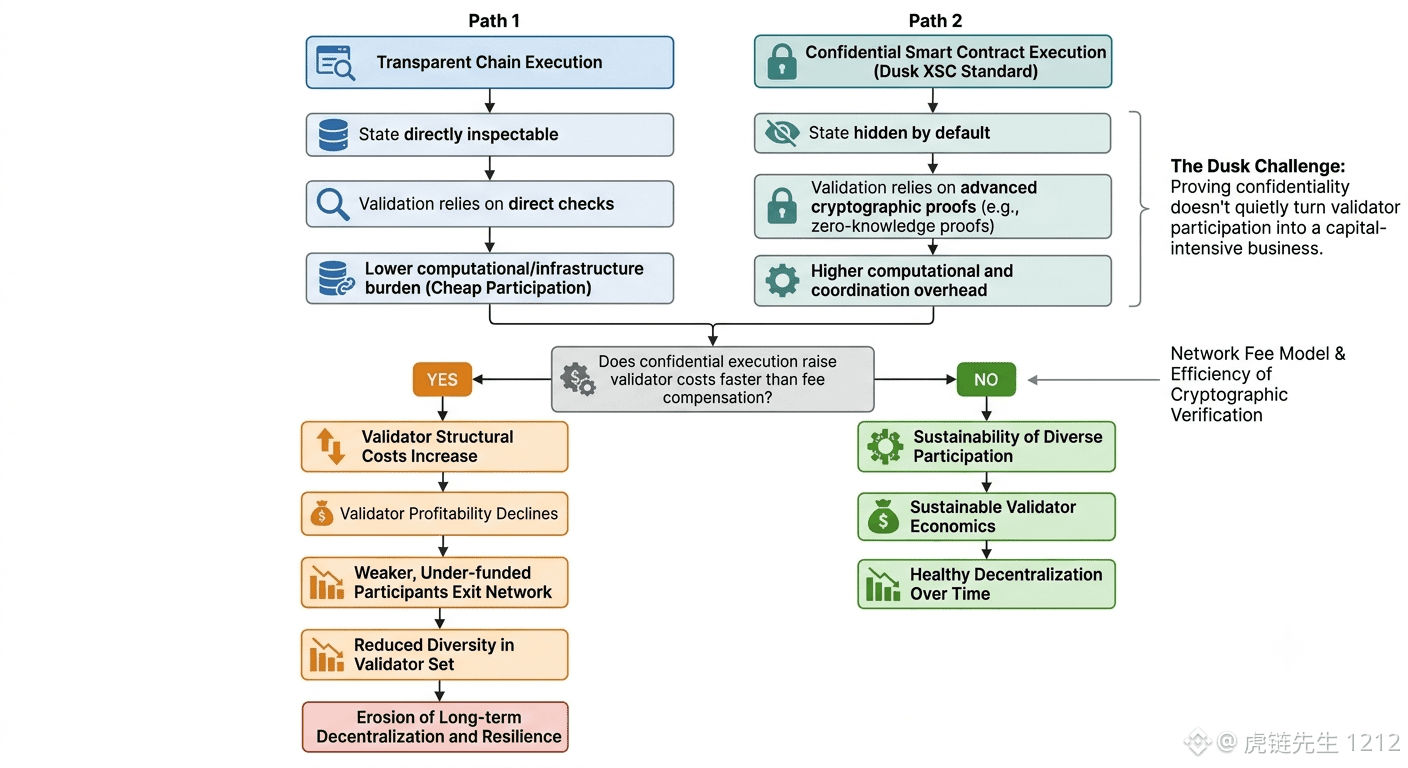
I think Dusk’s hardest scaling problem is not privacy itself, but the resource burden created by validating confidential state.
The XSC standard changes what validators can observe during execution. In a transparent chain, much of the state needed for validation is directly inspectable. Confidential smart contracts remove that visibility, which can increase the computation, coordination, and infrastructure required to reach the same confidence. That creates a structural cost for every operator supporting the network. As activity grows, the question becomes whether validation remains cheap enough for a broad validator set or gradually becomes specialized infrastructure for better funded participants.
That behavioral shift matters more than headline throughput because operator economics determine decentralization over time. If confidential execution raises validation costs faster than network fees compensate operators, weaker participants leave first, reducing diversity exactly when the system needs more independent verification. Dusk therefore has to prove that confidentiality does not quietly turn validator participation into a capital intensive business. Privacy can attract institutions, but sustainable validation decides whether the network can actually carry them.
#dusk $DUSK @Dusk
I think Dusk’s hardest scaling problem is not privacy itself, but the resource burden created by validating confidential state.
The XSC standard changes what validators can observe during execution. In a transparent chain, much of the state needed for validation is directly inspectable. Confidential smart contracts remove that visibility, which can increase the computation, coordination, and infrastructure required to reach the same confidence. That creates a structural cost for every operator supporting the network. As activity grows, the question becomes whether validation remains cheap enough for a broad validator set or gradually becomes specialized infrastructure for better funded participants.
That behavioral shift matters more than headline throughput because operator economics determine decentralization over time. If confidential execution raises validation costs faster than network fees compensate operators, weaker participants leave first, reducing diversity exactly when the system needs more independent verification. Dusk therefore has to prove that confidentiality does not quietly turn validator participation into a capital intensive business. Privacy can attract institutions, but sustainable validation decides whether the network can actually carry them.
I think Dusk’s hardest scaling problem is not privacy itself, but the resource burden created by validating confidential state.
The XSC standard changes what validators can observe during execution. In a transparent chain, much of the state needed for validation is directly inspectable. Confidential smart contracts remove that visibility, which can increase the computation, coordination, and infrastructure required to reach the same confidence. That creates a structural cost for every operator supporting the network. As activity grows, the question becomes whether validation remains cheap enough for a broad validator set or gradually becomes specialized infrastructure for better funded participants.
That behavioral shift matters more than headline throughput because operator economics determine decentralization over time. If confidential execution raises validation costs faster than network fees compensate operators, weaker participants leave first, reducing diversity exactly when the system needs more independent verification. Dusk therefore has to prove that confidentiality does not quietly turn validator participation into a capital intensive business. Privacy can attract institutions, but sustainable validation decides whether the network can actually carry them.
1
122
·
--
Bullish
#dusk $DUSK @Dusk_Foundation
{future}(DUSKUSDT)
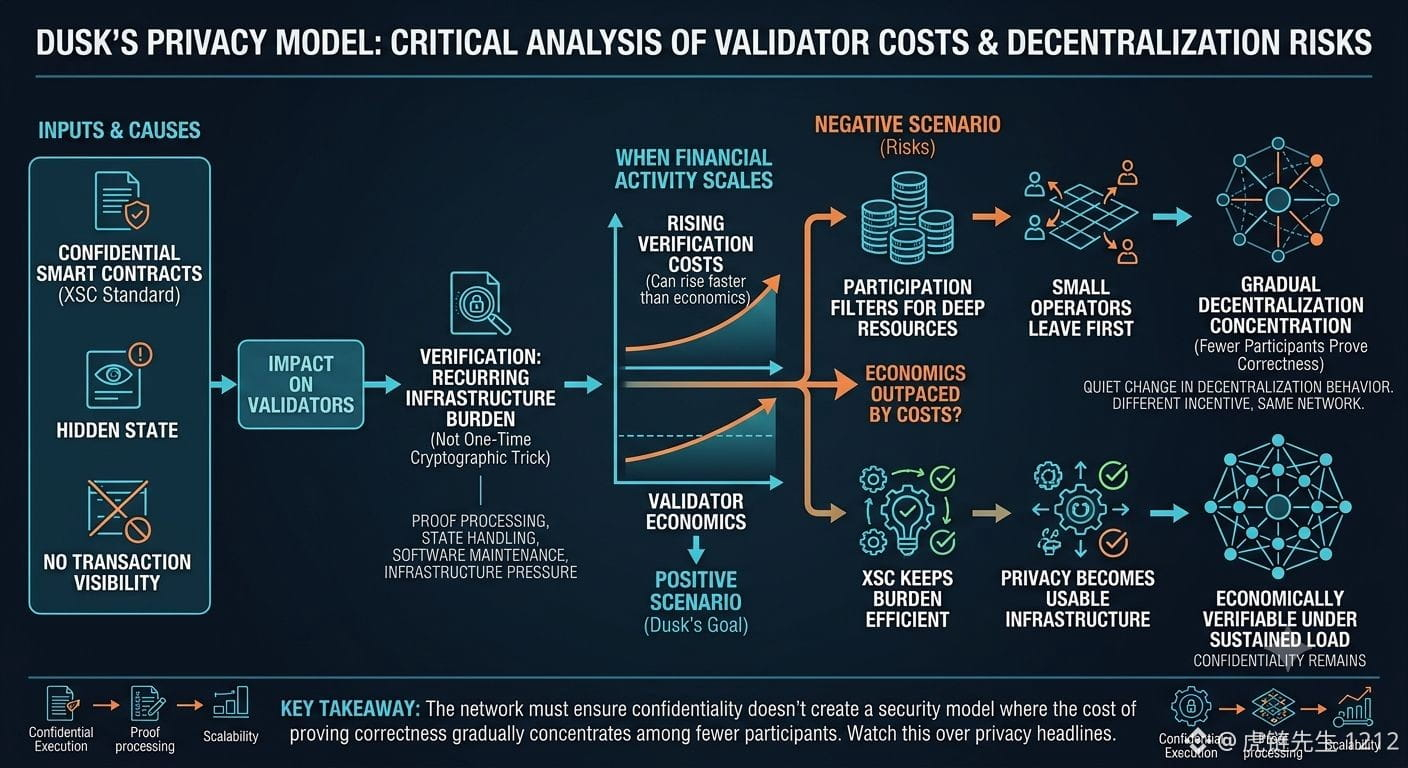
Most people are underpricing the validator cost created by Dusk’s privacy model. With confidential smart contracts and the XSC standard, validators cannot rely on the same transaction visibility available in transparent systems. Hidden state still needs to be proven correct. That means verification becomes a recurring infrastructure burden, not a one-time cryptographic trick.
The uncomfortable part is what happens when financial activity scales. More confidential execution can mean more proof processing, state handling, software maintenance, and infrastructure pressure. If verification costs rise faster than validator economics, participation starts filtering for operators with deeper resources rather than operators simply willing to secure the network.
That changes decentralization behavior quietly. Small operators leave first. Different incentive. Same network.
I would watch this before getting distracted by privacy headlines.
Dusk does not only need confidentiality to work. It needs confidentiality to remain economically verifiable under sustained load.
If XSC keeps that burden efficient, privacy can become usable infrastructure. If not, the network may create a security model where the cost of proving correctness gradually concentrates among fewer participants.
#dusk $DUSK @Dusk
Most people are underpricing the validator cost created by Dusk’s privacy model. With confidential smart contracts and the XSC standard, validators cannot rely on the same transaction visibility available in transparent systems. Hidden state still needs to be proven correct. That means verification becomes a recurring infrastructure burden, not a one-time cryptographic trick.
The uncomfortable part is what happens when financial activity scales. More confidential execution can mean more proof processing, state handling, software maintenance, and infrastructure pressure. If verification costs rise faster than validator economics, participation starts filtering for operators with deeper resources rather than operators simply willing to secure the network.
That changes decentralization behavior quietly. Small operators leave first. Different incentive. Same network.
I would watch this before getting distracted by privacy headlines.
Dusk does not only need confidentiality to work. It needs confidentiality to remain economically verifiable under sustained load.
If XSC keeps that burden efficient, privacy can become usable infrastructure. If not, the network may create a security model where the cost of proving correctness gradually concentrates among fewer participants.
Most people are underpricing the validator cost created by Dusk’s privacy model. With confidential smart contracts and the XSC standard, validators cannot rely on the same transaction visibility available in transparent systems. Hidden state still needs to be proven correct. That means verification becomes a recurring infrastructure burden, not a one-time cryptographic trick.
The uncomfortable part is what happens when financial activity scales. More confidential execution can mean more proof processing, state handling, software maintenance, and infrastructure pressure. If verification costs rise faster than validator economics, participation starts filtering for operators with deeper resources rather than operators simply willing to secure the network.
That changes decentralization behavior quietly. Small operators leave first. Different incentive. Same network.
I would watch this before getting distracted by privacy headlines.
Dusk does not only need confidentiality to work. It needs confidentiality to remain economically verifiable under sustained load.
If XSC keeps that burden efficient, privacy can become usable infrastructure. If not, the network may create a security model where the cost of proving correctness gradually concentrates among fewer participants.
2
131
·
--
Bullish
#dusk $DUSK @Dusk_Foundation
{future}(DUSKUSDT)
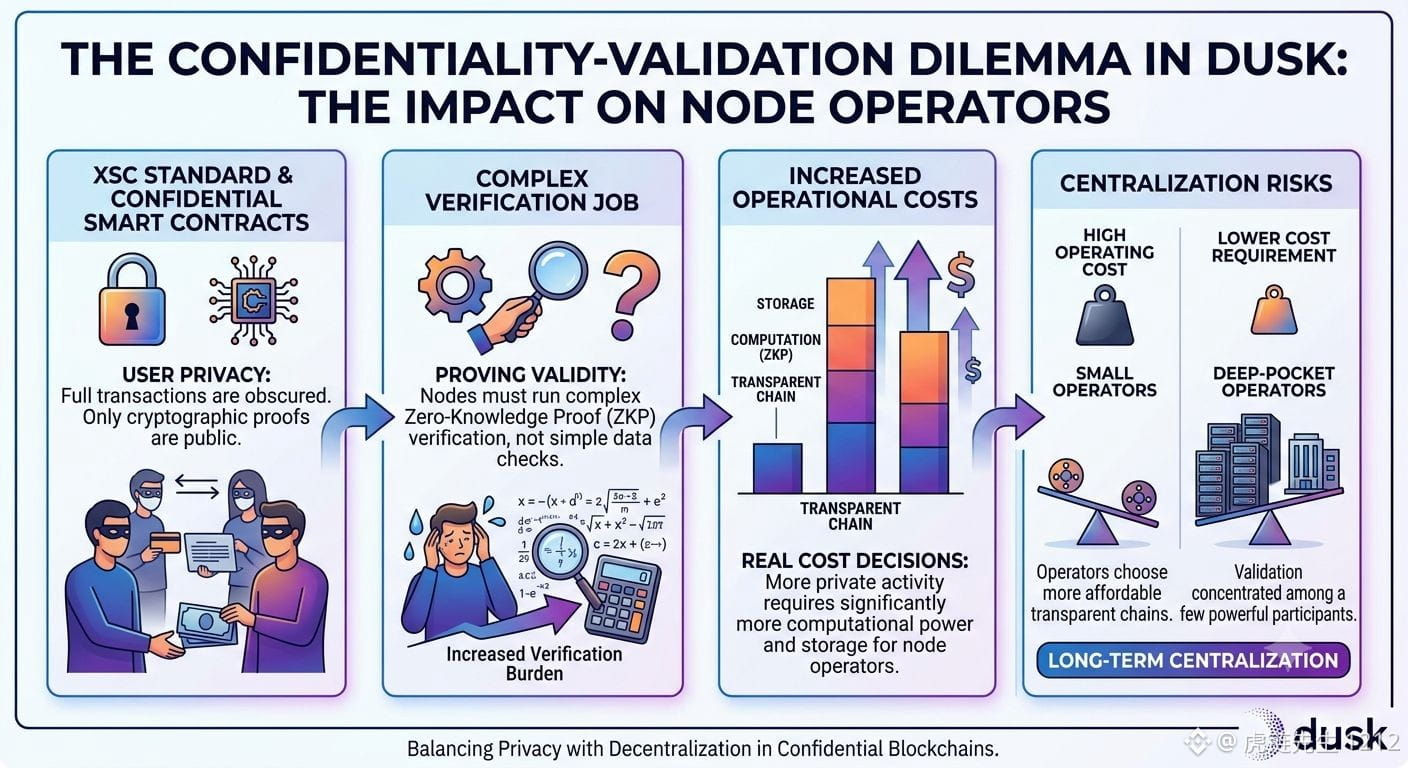
I keep coming back to one simple question with Dusk: when nobody can see the full transaction, who has to work harder to prove it is valid?
The XSC standard and confidential smart contracts make privacy possible, but privacy does not remove the verification job. It can make that job more complicated. More private activity could mean more computation, storage, and maintenance for the people running nodes.
That sounds like an engineering detail. It is not.
Node operators are people and businesses making real cost decisions. If running Dusk becomes noticeably more expensive than running a transparent chain, some operators will simply choose somewhere else. Over time, that can leave validation increasingly concentrated among participants with deeper pockets.
#dusk $DUSK @Dusk
I keep coming back to one simple question with Dusk: when nobody can see the full transaction, who has to work harder to prove it is valid?
The XSC standard and confidential smart contracts make privacy possible, but privacy does not remove the verification job. It can make that job more complicated. More private activity could mean more computation, storage, and maintenance for the people running nodes.
That sounds like an engineering detail. It is not.
Node operators are people and businesses making real cost decisions. If running Dusk becomes noticeably more expensive than running a transparent chain, some operators will simply choose somewhere else. Over time, that can leave validation increasingly concentrated among participants with deeper pockets.
I keep coming back to one simple question with Dusk: when nobody can see the full transaction, who has to work harder to prove it is valid?
The XSC standard and confidential smart contracts make privacy possible, but privacy does not remove the verification job. It can make that job more complicated. More private activity could mean more computation, storage, and maintenance for the people running nodes.
That sounds like an engineering detail. It is not.
Node operators are people and businesses making real cost decisions. If running Dusk becomes noticeably more expensive than running a transparent chain, some operators will simply choose somewhere else. Over time, that can leave validation increasingly concentrated among participants with deeper pockets.
4
3
197
·
--
Bearish
#dusk $DUSK @Dusk_Foundation
{future}(DUSKUSDT)
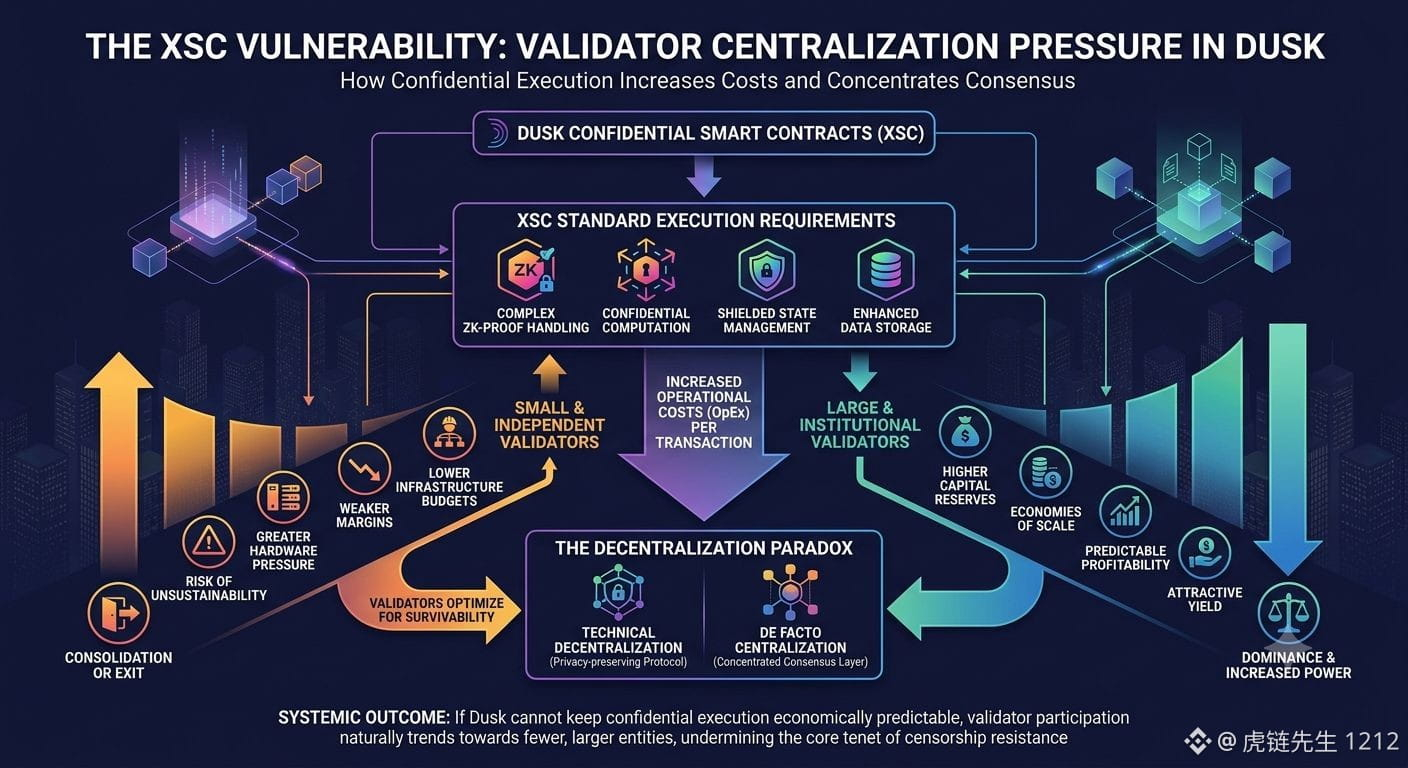
I keep looking at Dusk from one angle most people skip: privacy sounds great until you ask what it makes validators carry.
The XSC standard lets confidential smart contracts keep sensitive details out of public view, but validators still have to prove that everything happened correctly. That means the hidden data does not simply disappear. Someone still processes the evidence, stores the relevant state, and spends the compute needed for verification. At low activity, nobody really notices. Scale changes that fast. If every extra wave of confidential transactions adds That could make Dusk technically private and decentralized on paper, but more concentrated underneath. For me, that validator cost curve is a much more important signal than the privacy narrative itself.
#dusk $DUSK @Dusk
I keep looking at Dusk from one angle most people skip: privacy sounds great until you ask what it makes validators carry.
The XSC standard lets confidential smart contracts keep sensitive details out of public view, but validators still have to prove that everything happened correctly. That means the hidden data does not simply disappear. Someone still processes the evidence, stores the relevant state, and spends the compute needed for verification. At low activity, nobody really notices. Scale changes that fast. If every extra wave of confidential transactions adds That could make Dusk technically private and decentralized on paper, but more concentrated underneath. For me, that validator cost curve is a much more important signal than the privacy narrative itself.
I keep looking at Dusk from one angle most people skip: privacy sounds great until you ask what it makes validators carry.
The XSC standard lets confidential smart contracts keep sensitive details out of public view, but validators still have to prove that everything happened correctly. That means the hidden data does not simply disappear. Someone still processes the evidence, stores the relevant state, and spends the compute needed for verification. At low activity, nobody really notices. Scale changes that fast. If every extra wave of confidential transactions adds That could make Dusk technically private and decentralized on paper, but more concentrated underneath. For me, that validator cost curve is a much more important signal than the privacy narrative itself.
7
4
1k
·
--
#dusk $DUSK @Dusk_Foundation
{future}(DUSKUSDT)
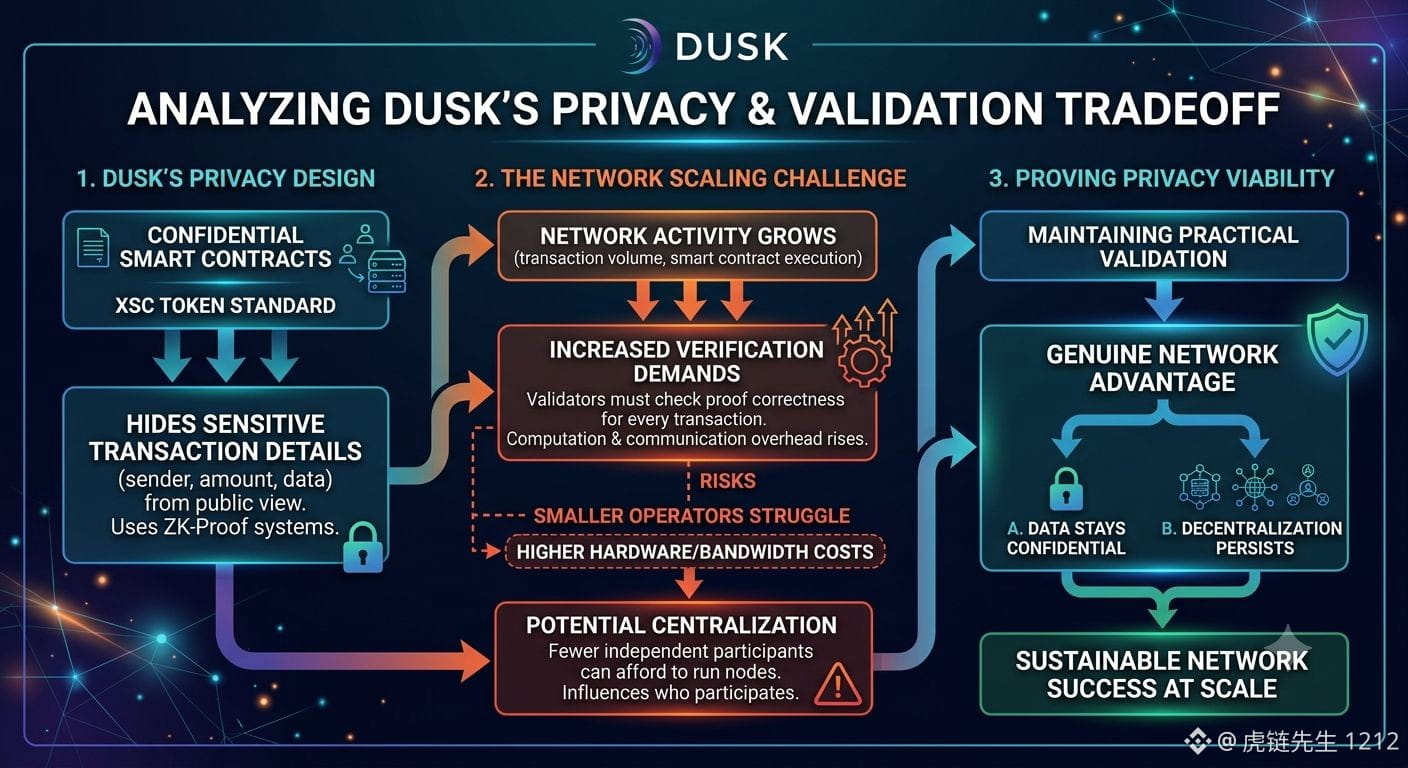
I keep coming back to one uncomfortable question with Dusk: does stronger privacy quietly make the network harder to run? Confidential smart contracts and the XSC standard hide sensitive transaction details, which is great for financial privacy, but validators still need enough information to know that everything is behaving correctly.
That creates a real tradeoff. If verification becomes more demanding as activity grows, smaller operators may struggle with the extra hardware, bandwidth, or technical overhead. Over time, that can change who is willing to participate and who gets pushed out. For me, this is where Dusk gets interesting. Privacy is not really proven when data simply disappears from public view. It is proven when the network can keep that data confidential while making validation practical for enough independent participants. If Dusk can maintain that balance at scale, the privacy architecture becomes a genuine network advantage rather than just another feature on the roadmap.
#dusk $DUSK @Dusk
I keep coming back to one uncomfortable question with Dusk: does stronger privacy quietly make the network harder to run? Confidential smart contracts and the XSC standard hide sensitive transaction details, which is great for financial privacy, but validators still need enough information to know that everything is behaving correctly.
That creates a real tradeoff. If verification becomes more demanding as activity grows, smaller operators may struggle with the extra hardware, bandwidth, or technical overhead. Over time, that can change who is willing to participate and who gets pushed out. For me, this is where Dusk gets interesting. Privacy is not really proven when data simply disappears from public view. It is proven when the network can keep that data confidential while making validation practical for enough independent participants. If Dusk can maintain that balance at scale, the privacy architecture becomes a genuine network advantage rather than just another feature on the roadmap.
I keep coming back to one uncomfortable question with Dusk: does stronger privacy quietly make the network harder to run? Confidential smart contracts and the XSC standard hide sensitive transaction details, which is great for financial privacy, but validators still need enough information to know that everything is behaving correctly.
That creates a real tradeoff. If verification becomes more demanding as activity grows, smaller operators may struggle with the extra hardware, bandwidth, or technical overhead. Over time, that can change who is willing to participate and who gets pushed out. For me, this is where Dusk gets interesting. Privacy is not really proven when data simply disappears from public view. It is proven when the network can keep that data confidential while making validation practical for enough independent participants. If Dusk can maintain that balance at scale, the privacy architecture becomes a genuine network advantage rather than just another feature on the roadmap.
14
9
617
·
--
#dusk $DUSK @Dusk_Foundation
{future}(DUSKUSDT)
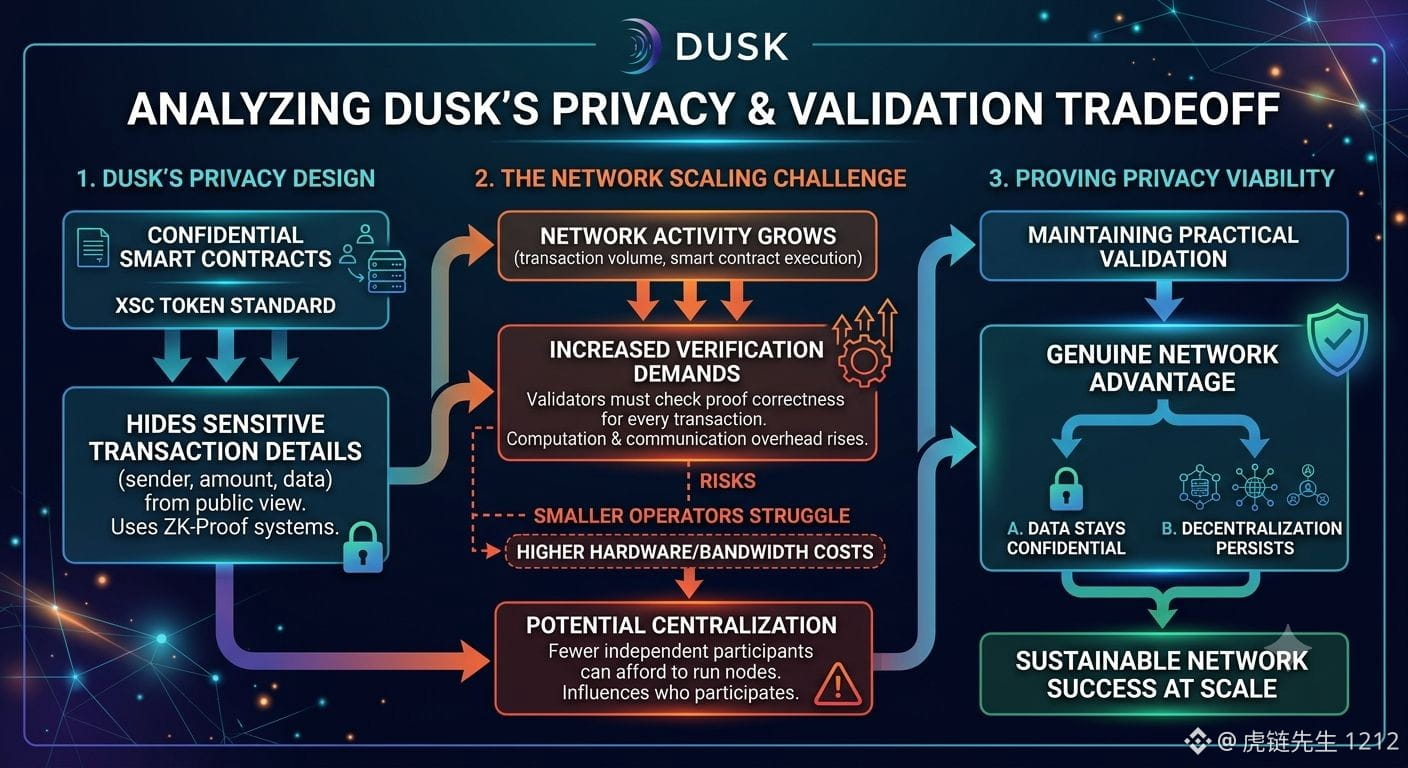
I keep coming back to one uncomfortable question with Dusk: does stronger privacy quietly make the network harder to run? Confidential smart contracts and the XSC standard hide sensitive transaction details, which is great for financial privacy, but validators still need enough information to know that everything is behaving correctly.
That creates a real tradeoff. If verification becomes more demanding as activity grows, smaller operators may struggle with the extra hardware, bandwidth, or technical overhead. Over time, that can change who is willing to participate and who gets pushed out. For me, this is where Dusk gets interesting. Privacy is not really proven when data simply disappears from public view. It is proven when the network can keep that data confidential while making validation practical for enough independent participants. If Dusk can maintain that balance at scale, the privacy architecture becomes a genuine network advantage rather than just another feature on the roadmap.
#dusk $DUSK @Dusk
I keep coming back to one uncomfortable question with Dusk: does stronger privacy quietly make the network harder to run? Confidential smart contracts and the XSC standard hide sensitive transaction details, which is great for financial privacy, but validators still need enough information to know that everything is behaving correctly.
That creates a real tradeoff. If verification becomes more demanding as activity grows, smaller operators may struggle with the extra hardware, bandwidth, or technical overhead. Over time, that can change who is willing to participate and who gets pushed out. For me, this is where Dusk gets interesting. Privacy is not really proven when data simply disappears from public view. It is proven when the network can keep that data confidential while making validation practical for enough independent participants. If Dusk can maintain that balance at scale, the privacy architecture becomes a genuine network advantage rather than just another feature on the roadmap.
I keep coming back to one uncomfortable question with Dusk: does stronger privacy quietly make the network harder to run? Confidential smart contracts and the XSC standard hide sensitive transaction details, which is great for financial privacy, but validators still need enough information to know that everything is behaving correctly.
That creates a real tradeoff. If verification becomes more demanding as activity grows, smaller operators may struggle with the extra hardware, bandwidth, or technical overhead. Over time, that can change who is willing to participate and who gets pushed out. For me, this is where Dusk gets interesting. Privacy is not really proven when data simply disappears from public view. It is proven when the network can keep that data confidential while making validation practical for enough independent participants. If Dusk can maintain that balance at scale, the privacy architecture becomes a genuine network advantage rather than just another feature on the roadmap.
2
916
·
--
Bullish
#dusk $DUSK @Dusk_Foundation
{future}(DUSKUSDT)
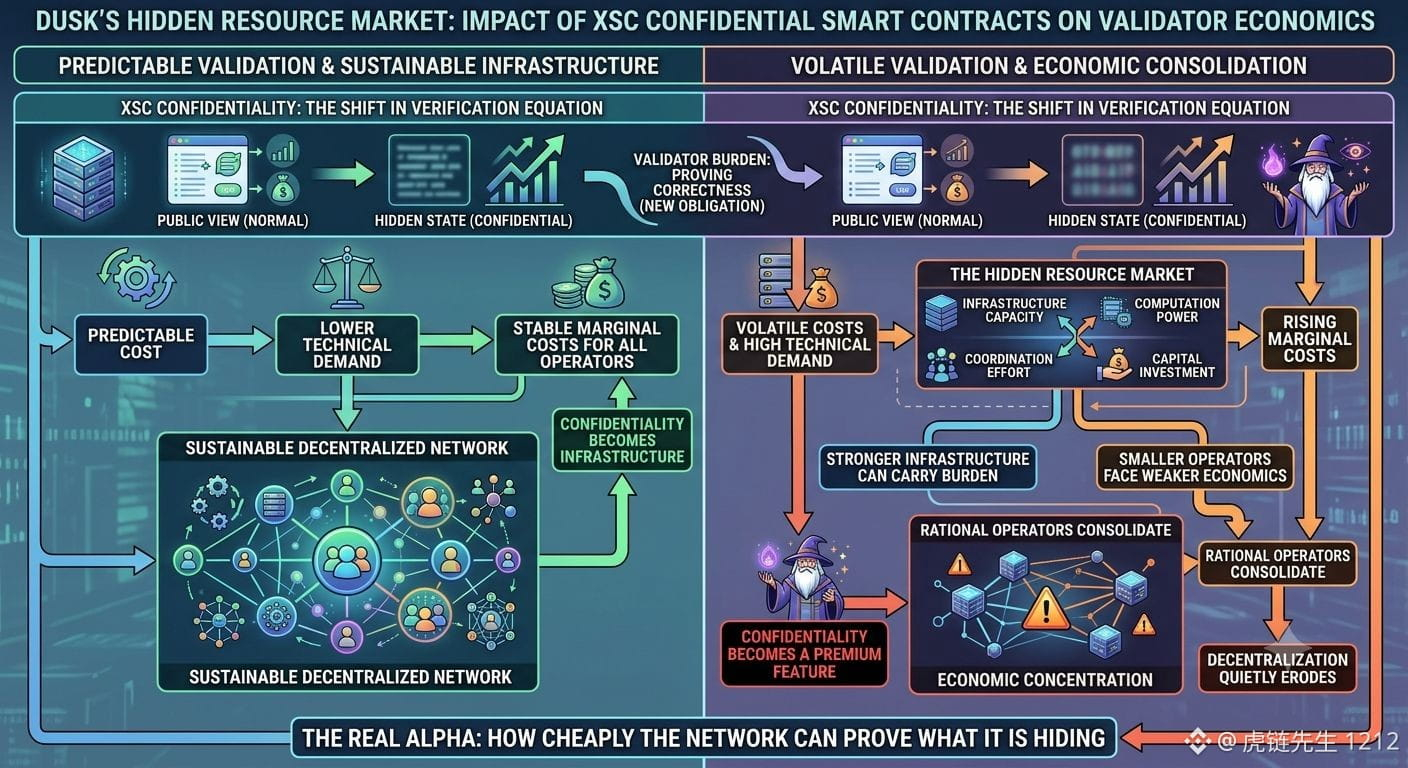
Most people are pricing Dusk’s privacy without pricing the validator burden created by hiding state.
The XSC standard changes the verification equation because confidential smart contracts remove information that would normally make transaction validation straightforward. The data disappears from public view, but the obligation to prove correctness does not. It moves into validation logic, infrastructure, computation, and coordination between participants. That creates a hidden resource market inside the layer-1. Someone must absorb the extra work every time confidentiality increases verification complexity. Validators with stronger infrastructure can carry that burden longer, while smaller operators face rising marginal costs and weaker economics. That is where decentralization can quietly erode.
The behavioral effect is simple. If validation remains predictable, operators keep participating and confidentiality becomes sustainable infrastructure rather than a premium feature. If verification costs become volatile or technically demanding, rational operators consolidate around better funded infrastructure, pushing Dusk toward economic concentration even if the protocol remains technically decentralized. The real alpha is not how much information XSC hides. It is how cheaply the network can prove what it is hiding.
#dusk $DUSK @Dusk
Most people are pricing Dusk’s privacy without pricing the validator burden created by hiding state.
The XSC standard changes the verification equation because confidential smart contracts remove information that would normally make transaction validation straightforward. The data disappears from public view, but the obligation to prove correctness does not. It moves into validation logic, infrastructure, computation, and coordination between participants. That creates a hidden resource market inside the layer-1. Someone must absorb the extra work every time confidentiality increases verification complexity. Validators with stronger infrastructure can carry that burden longer, while smaller operators face rising marginal costs and weaker economics. That is where decentralization can quietly erode.
The behavioral effect is simple. If validation remains predictable, operators keep participating and confidentiality becomes sustainable infrastructure rather than a premium feature. If verification costs become volatile or technically demanding, rational operators consolidate around better funded infrastructure, pushing Dusk toward economic concentration even if the protocol remains technically decentralized. The real alpha is not how much information XSC hides. It is how cheaply the network can prove what it is hiding.
Most people are pricing Dusk’s privacy without pricing the validator burden created by hiding state.
The XSC standard changes the verification equation because confidential smart contracts remove information that would normally make transaction validation straightforward. The data disappears from public view, but the obligation to prove correctness does not. It moves into validation logic, infrastructure, computation, and coordination between participants. That creates a hidden resource market inside the layer-1. Someone must absorb the extra work every time confidentiality increases verification complexity. Validators with stronger infrastructure can carry that burden longer, while smaller operators face rising marginal costs and weaker economics. That is where decentralization can quietly erode.
The behavioral effect is simple. If validation remains predictable, operators keep participating and confidentiality becomes sustainable infrastructure rather than a premium feature. If verification costs become volatile or technically demanding, rational operators consolidate around better funded infrastructure, pushing Dusk toward economic concentration even if the protocol remains technically decentralized. The real alpha is not how much information XSC hides. It is how cheaply the network can prove what it is hiding.
32
18
305
·
--
Bullish
#dusk $DUSK @Dusk_Foundation
{future}(DUSKUSDT)
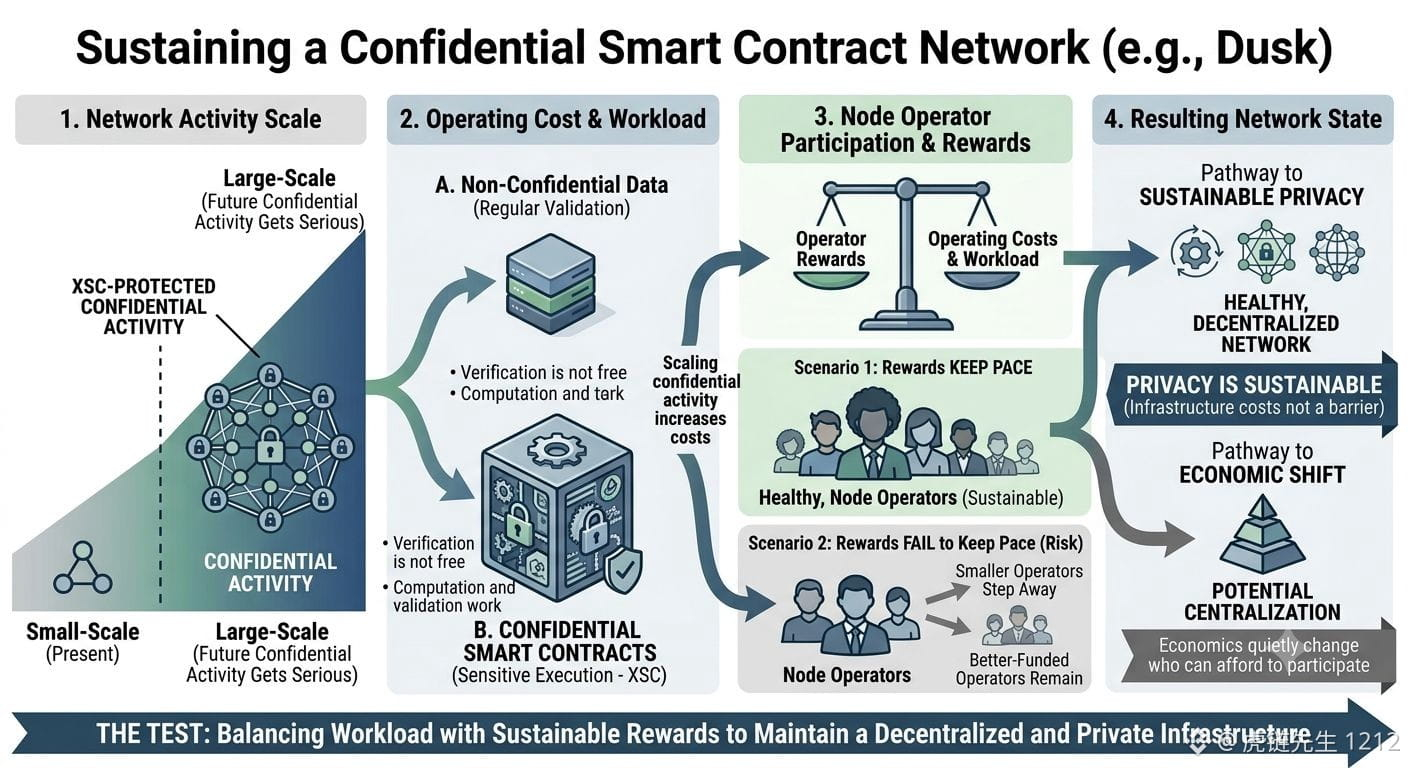
I keep coming back to one simple question with Dusk: what happens to the people running the network when confidential activity gets serious? XSC can protect sensitive execution, but privacy does not make verification free.
When activity is small, extra compute and validation work may not matter much. At scale, it becomes a real operating cost. If rewards fail to keep pace, smaller operators may slowly step away while better funded ones remain. Nothing needs to break for this to matter. The network can keep running while the economics quietly change who can afford to participate.
That is the part I would watch with Dusk. The real test for confidential smart contracts is not just whether they can keep financial data private. It is whether operators can handle the workload without turning infrastructure costs into a barrier to participation. If Dusk gets that balance right, privacy becomes much more than a feature. It becomes something the network can actually sustain.
#dusk $DUSK @Dusk
I keep coming back to one simple question with Dusk: what happens to the people running the network when confidential activity gets serious? XSC can protect sensitive execution, but privacy does not make verification free.
When activity is small, extra compute and validation work may not matter much. At scale, it becomes a real operating cost. If rewards fail to keep pace, smaller operators may slowly step away while better funded ones remain. Nothing needs to break for this to matter. The network can keep running while the economics quietly change who can afford to participate.
That is the part I would watch with Dusk. The real test for confidential smart contracts is not just whether they can keep financial data private. It is whether operators can handle the workload without turning infrastructure costs into a barrier to participation. If Dusk gets that balance right, privacy becomes much more than a feature. It becomes something the network can actually sustain.
I keep coming back to one simple question with Dusk: what happens to the people running the network when confidential activity gets serious? XSC can protect sensitive execution, but privacy does not make verification free.
When activity is small, extra compute and validation work may not matter much. At scale, it becomes a real operating cost. If rewards fail to keep pace, smaller operators may slowly step away while better funded ones remain. Nothing needs to break for this to matter. The network can keep running while the economics quietly change who can afford to participate.
That is the part I would watch with Dusk. The real test for confidential smart contracts is not just whether they can keep financial data private. It is whether operators can handle the workload without turning infrastructure costs into a barrier to participation. If Dusk gets that balance right, privacy becomes much more than a feature. It becomes something the network can actually sustain.
40
15
339
·
--
@Dusk_Foundation #dusk $DUSK
{future}(DUSKUSDT)
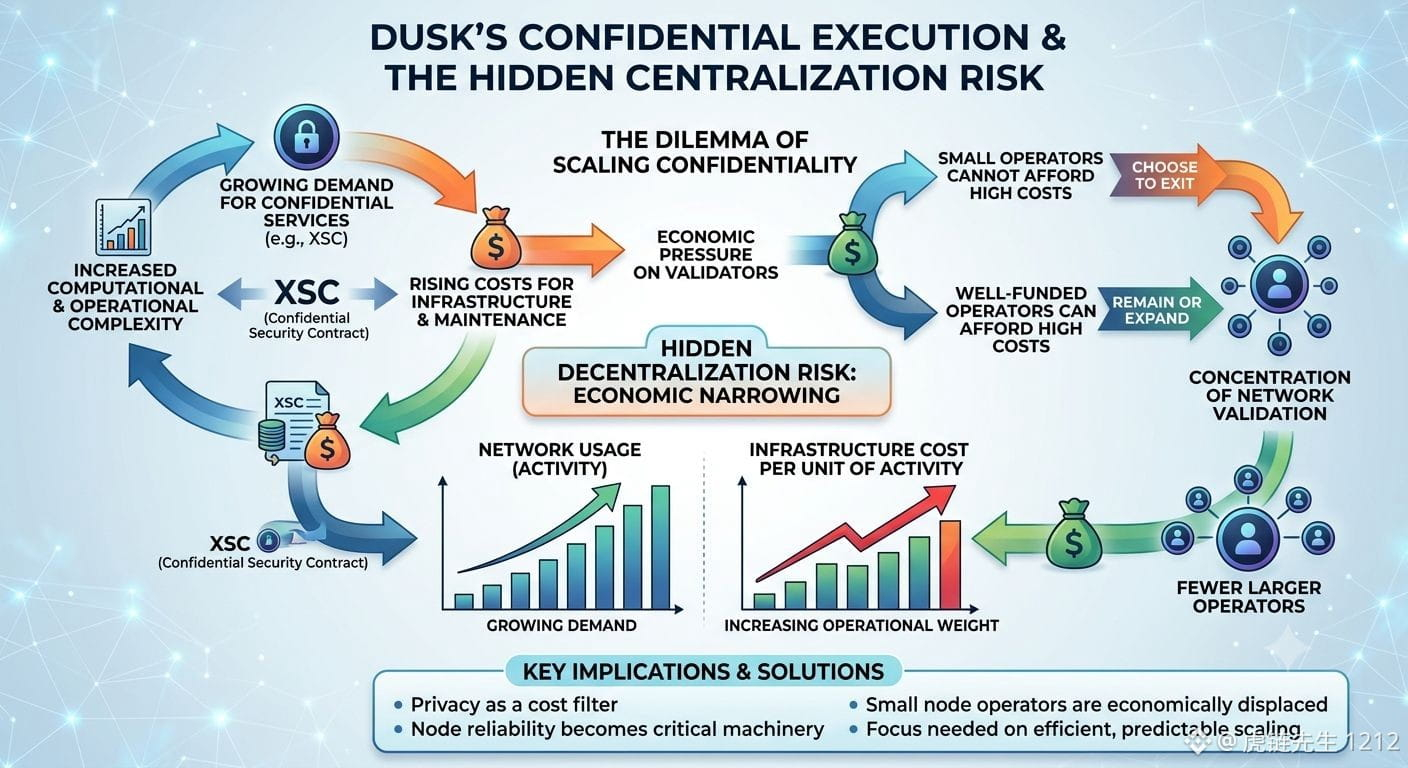
The hidden risk in Dusk is not privacy itself, it is who eventually pays to make confidential execution reliable.
The Confidential Security Contract standard, or XSC, makes sense for financial applications because sensitive state should not become public by default. But every increase in confidential smart contract activity pushes more operational weight somewhere. Nodes still need to process workloads, maintain reliability, and handle the machinery required to keep private execution credible. That cost becomes a behavioral filter. Small operators do not need to be forced out. They simply need to decide the economics no longer justify staying.
That is the real decentralization pressure. If network usage grows faster than the efficiency of confidential execution, participation can gradually concentrate among better funded operators. Dusk could remain technically decentralized while becoming economically narrower. The key metric is therefore not how private XSC can make transactions, but whether the infrastructure cost per unit of confidential activity stays predictable as demand scales. If that curve gets ugly, privacy stops being only a security feature and starts shaping who can afford to validate the network.
@Dusk #dusk $DUSK
The hidden risk in Dusk is not privacy itself, it is who eventually pays to make confidential execution reliable.
The Confidential Security Contract standard, or XSC, makes sense for financial applications because sensitive state should not become public by default. But every increase in confidential smart contract activity pushes more operational weight somewhere. Nodes still need to process workloads, maintain reliability, and handle the machinery required to keep private execution credible. That cost becomes a behavioral filter. Small operators do not need to be forced out. They simply need to decide the economics no longer justify staying.
That is the real decentralization pressure. If network usage grows faster than the efficiency of confidential execution, participation can gradually concentrate among better funded operators. Dusk could remain technically decentralized while becoming economically narrower. The key metric is therefore not how private XSC can make transactions, but whether the infrastructure cost per unit of confidential activity stays predictable as demand scales. If that curve gets ugly, privacy stops being only a security feature and starts shaping who can afford to validate the network.
The hidden risk in Dusk is not privacy itself, it is who eventually pays to make confidential execution reliable.
The Confidential Security Contract standard, or XSC, makes sense for financial applications because sensitive state should not become public by default. But every increase in confidential smart contract activity pushes more operational weight somewhere. Nodes still need to process workloads, maintain reliability, and handle the machinery required to keep private execution credible. That cost becomes a behavioral filter. Small operators do not need to be forced out. They simply need to decide the economics no longer justify staying.
That is the real decentralization pressure. If network usage grows faster than the efficiency of confidential execution, participation can gradually concentrate among better funded operators. Dusk could remain technically decentralized while becoming economically narrower. The key metric is therefore not how private XSC can make transactions, but whether the infrastructure cost per unit of confidential activity stays predictable as demand scales. If that curve gets ugly, privacy stops being only a security feature and starts shaping who can afford to validate the network.
26
11
177
·
--
Bearish
@Dusk_Foundation #dusk $DUSK
{future}(DUSKUSDT)
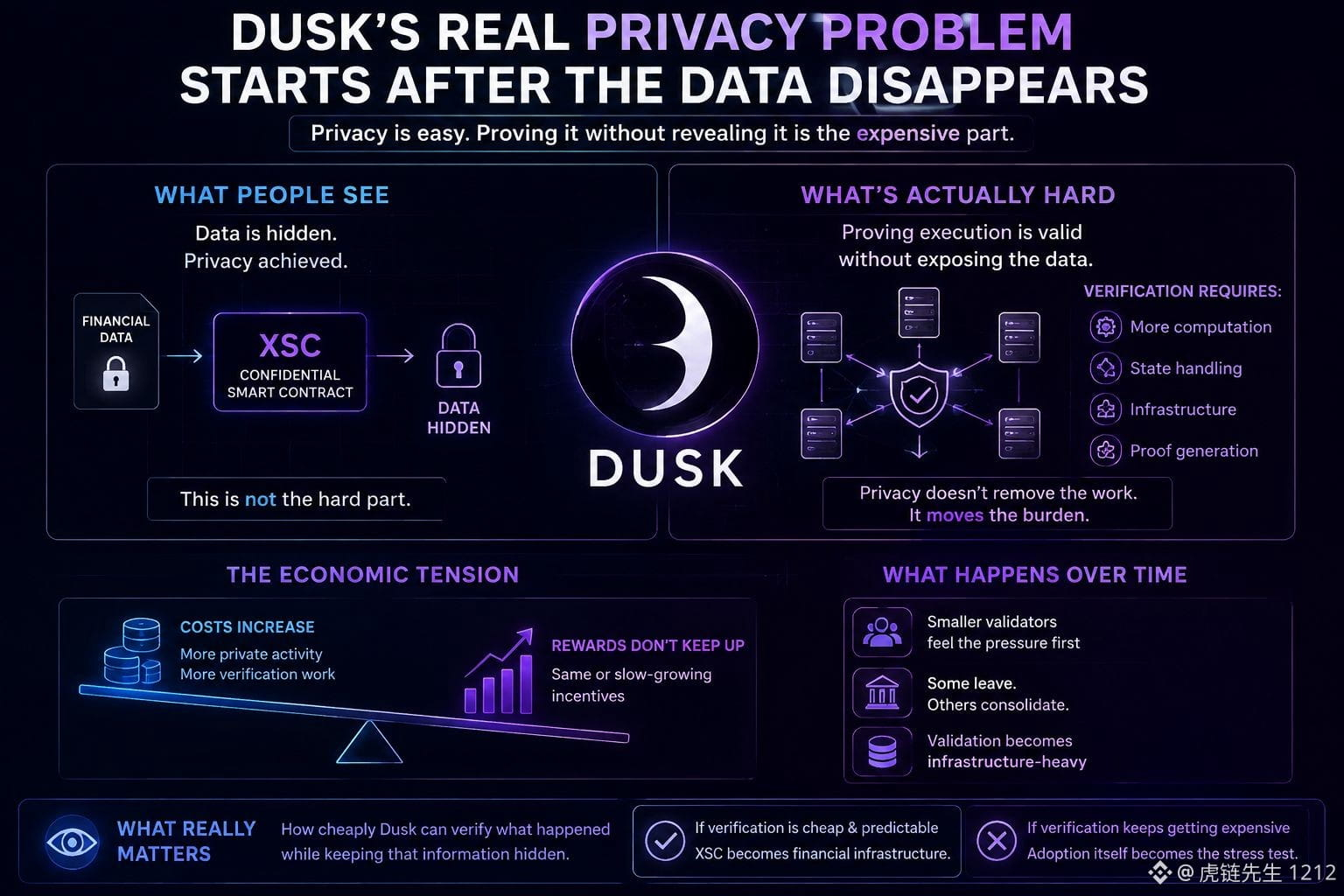
Dusk’s real privacy problem starts after the data disappears
I keep coming back to one thing with Dusk that feels easy to overlook. Hiding financial data is not the hard part. Proving that everything happened correctly without exposing that data is where the real cost can show up.
That is what makes XSC interesting to me. Confidential smart contracts can protect sensitive financial state, but validators still need to verify execution. Privacy does not remove that workload. It moves the burden into computation, state handling, and infrastructure. More private activity could mean more work behind every transaction.
And someone has to pay for it.
At first, well-funded operators can probably absorb the pressure. But if verification keeps getting heavier while rewards do not grow with it, smaller validators start doing the math. Some leave. Others consolidate around stronger infrastructure. That is how a privacy feature can slowly become a
validator economics problem.
So I would watch verification cost, not the privacy headline. If Dusk keeps private execution cheap and predictable, XSC gets stronger as financial infrastructure. If usage makes verification increasingly expensive, adoption itself could become the stress test.
@Dusk #dusk $DUSK
Dusk’s real privacy problem starts after the data disappears
I keep coming back to one thing with Dusk that feels easy to overlook. Hiding financial data is not the hard part. Proving that everything happened correctly without exposing that data is where the real cost can show up.
That is what makes XSC interesting to me. Confidential smart contracts can protect sensitive financial state, but validators still need to verify execution. Privacy does not remove that workload. It moves the burden into computation, state handling, and infrastructure. More private activity could mean more work behind every transaction.
And someone has to pay for it.
At first, well-funded operators can probably absorb the pressure. But if verification keeps getting heavier while rewards do not grow with it, smaller validators start doing the math. Some leave. Others consolidate around stronger infrastructure. That is how a privacy feature can slowly become a
validator economics problem.
So I would watch verification cost, not the privacy headline. If Dusk keeps private execution cheap and predictable, XSC gets stronger as financial infrastructure. If usage makes verification increasingly expensive, adoption itself could become the stress test.
Dusk’s real privacy problem starts after the data disappears
I keep coming back to one thing with Dusk that feels easy to overlook. Hiding financial data is not the hard part. Proving that everything happened correctly without exposing that data is where the real cost can show up.
That is what makes XSC interesting to me. Confidential smart contracts can protect sensitive financial state, but validators still need to verify execution. Privacy does not remove that workload. It moves the burden into computation, state handling, and infrastructure. More private activity could mean more work behind every transaction.
And someone has to pay for it.
At first, well-funded operators can probably absorb the pressure. But if verification keeps getting heavier while rewards do not grow with it, smaller validators start doing the math. Some leave. Others consolidate around stronger infrastructure. That is how a privacy feature can slowly become a
validator economics problem.
So I would watch verification cost, not the privacy headline. If Dusk keeps private execution cheap and predictable, XSC gets stronger as financial infrastructure. If usage makes verification increasingly expensive, adoption itself could become the stress test.
28
11
89
·
--
Bullish
@Dusk_Foundation #dusk $DUSK
{future}(DUSKUSDT)
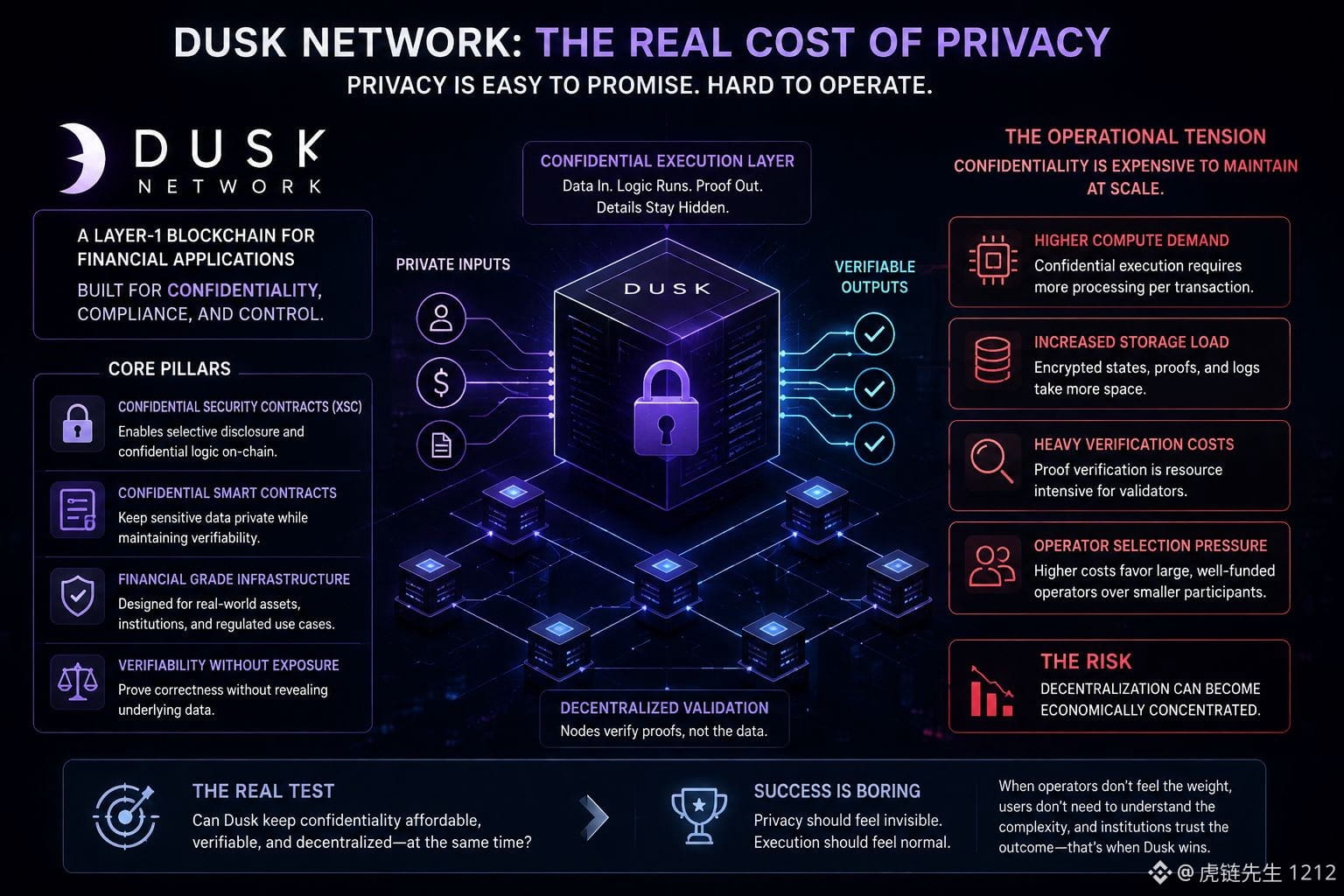
I keep thinking the harder part for Dusk is not making financial data private. It is making that privacy cheap enough to run every day.
The XSC standard and confidential smart contracts sound strong on paper, but someone still has to process the hidden logic, verify it, store the state, and keep the network moving.
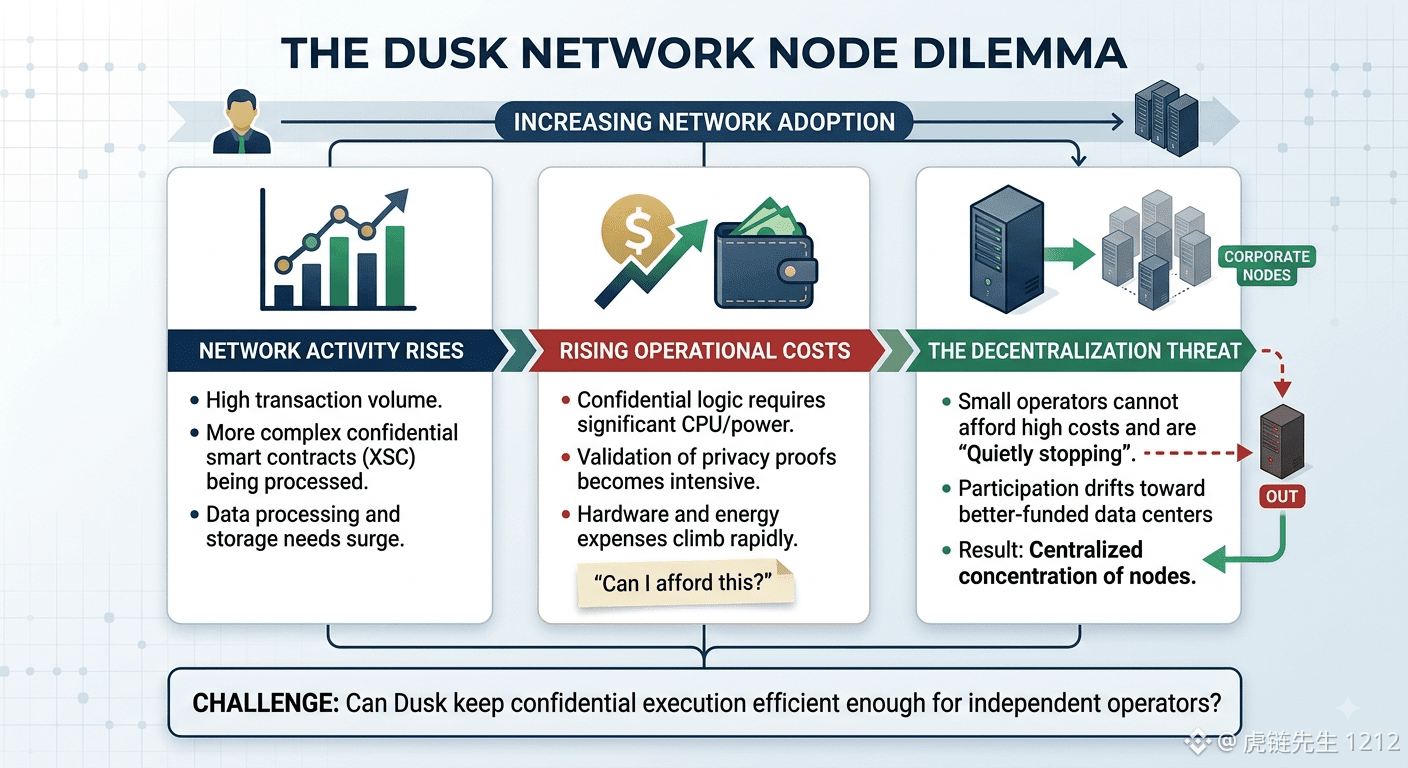
That is where things could get interesting. If those costs climb with activity, smaller node operators may simply decide the economics no longer make sense. No dramatic failure. They just stop showing up. Over time, that can quietly push participation toward better funded operators.
The network might still look decentralized, but the cost of being part of it has changed. I would watch that more closely than the privacy narrative itself. Real adoption will put pressure on everything. The question is whether Dusk can keep confidential execution efficient enough that ordinary operators still want to run the infrastructure when financial activity gets serious.
@Dusk #dusk $DUSK
I keep thinking the harder part for Dusk is not making financial data private. It is making that privacy cheap enough to run every day.
The XSC standard and confidential smart contracts sound strong on paper, but someone still has to process the hidden logic, verify it, store the state, and keep the network moving.
That is where things could get interesting. If those costs climb with activity, smaller node operators may simply decide the economics no longer make sense. No dramatic failure. They just stop showing up. Over time, that can quietly push participation toward better funded operators.
The network might still look decentralized, but the cost of being part of it has changed. I would watch that more closely than the privacy narrative itself. Real adoption will put pressure on everything. The question is whether Dusk can keep confidential execution efficient enough that ordinary operators still want to run the infrastructure when financial activity gets serious.
I keep thinking the harder part for Dusk is not making financial data private. It is making that privacy cheap enough to run every day.
The XSC standard and confidential smart contracts sound strong on paper, but someone still has to process the hidden logic, verify it, store the state, and keep the network moving.
That is where things could get interesting. If those costs climb with activity, smaller node operators may simply decide the economics no longer make sense. No dramatic failure. They just stop showing up. Over time, that can quietly push participation toward better funded operators.
The network might still look decentralized, but the cost of being part of it has changed. I would watch that more closely than the privacy narrative itself. Real adoption will put pressure on everything. The question is whether Dusk can keep confidential execution efficient enough that ordinary operators still want to run the infrastructure when financial activity gets serious.
25
9
197
·
--
Bullish
@Dusk_Foundation #dusk $DUSK
{future}(DUSKUSDT)
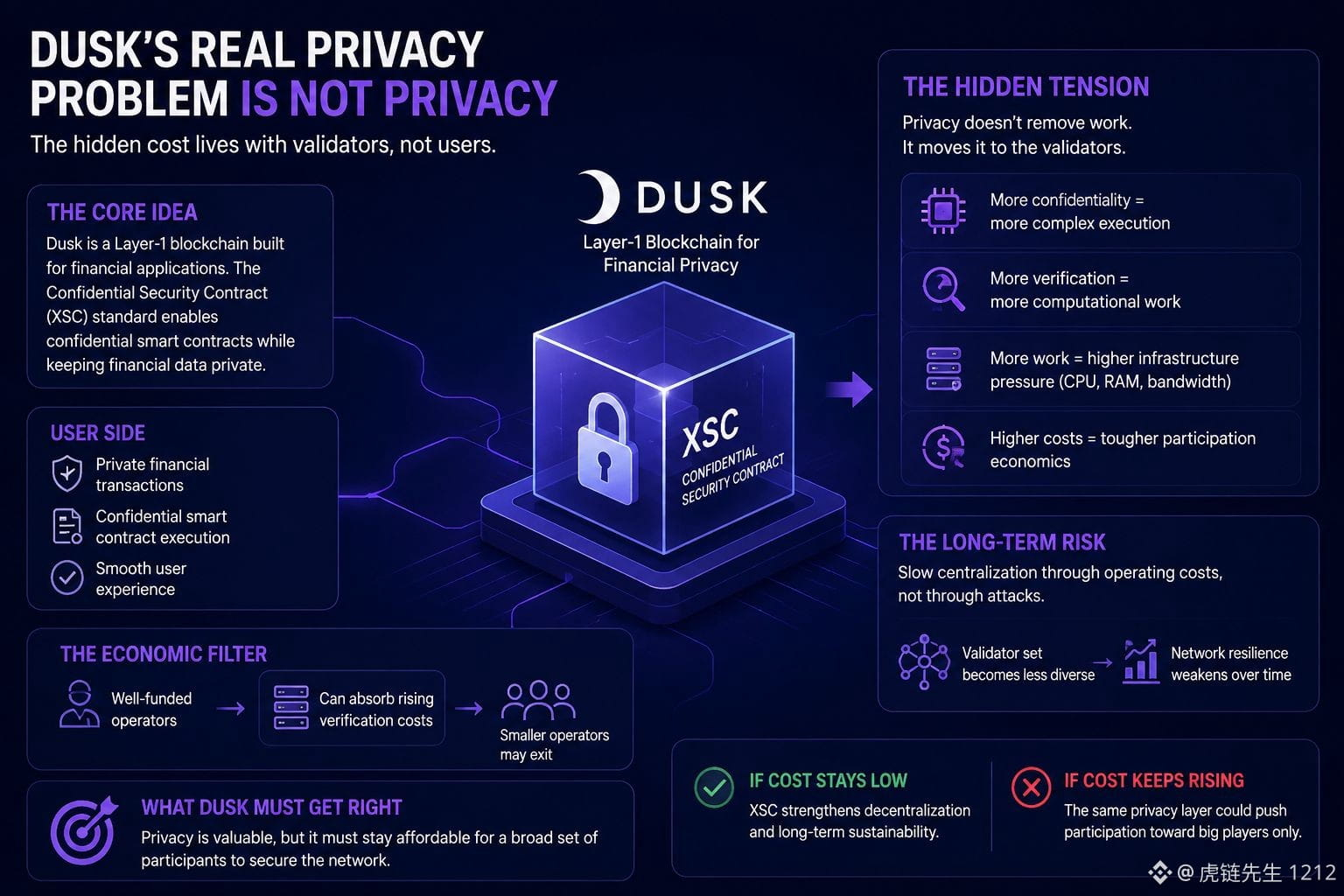
I keep coming back to one uncomfortable part of Dusk: privacy could quietly turn into a validator cost problem. The XSC model brings confidential smart contracts into the picture, but hidden data does not mean zero work. Someone still has to process and verify what the network is doing. That burden can look small at first. Scale changes the equation fast.
The real test is what happens to smaller operators when confidential activity keeps growing. If verification starts demanding more hardware, bandwidth, memory, or time, some validators may simply decide the economics no longer make sense. No dramatic failure. Just gradual exit. That matters because decentralization can weaken through operating costs long before anyone notices it in the headlines. I would watch this closely with Dusk. Privacy is valuable, but the stronger question is whether that privacy stays cheap enough for a broad set of participants to keep securing the network. If the burden stays manageable, XSC becomes an advantage. If costs compound, the same privacy layer could quietly push participation toward better funded operators.
@Dusk #dusk $DUSK
I keep coming back to one uncomfortable part of Dusk: privacy could quietly turn into a validator cost problem. The XSC model brings confidential smart contracts into the picture, but hidden data does not mean zero work. Someone still has to process and verify what the network is doing. That burden can look small at first. Scale changes the equation fast.
The real test is what happens to smaller operators when confidential activity keeps growing. If verification starts demanding more hardware, bandwidth, memory, or time, some validators may simply decide the economics no longer make sense. No dramatic failure. Just gradual exit. That matters because decentralization can weaken through operating costs long before anyone notices it in the headlines. I would watch this closely with Dusk. Privacy is valuable, but the stronger question is whether that privacy stays cheap enough for a broad set of participants to keep securing the network. If the burden stays manageable, XSC becomes an advantage. If costs compound, the same privacy layer could quietly push participation toward better funded operators.
I keep coming back to one uncomfortable part of Dusk: privacy could quietly turn into a validator cost problem. The XSC model brings confidential smart contracts into the picture, but hidden data does not mean zero work. Someone still has to process and verify what the network is doing. That burden can look small at first. Scale changes the equation fast.
The real test is what happens to smaller operators when confidential activity keeps growing. If verification starts demanding more hardware, bandwidth, memory, or time, some validators may simply decide the economics no longer make sense. No dramatic failure. Just gradual exit. That matters because decentralization can weaken through operating costs long before anyone notices it in the headlines. I would watch this closely with Dusk. Privacy is valuable, but the stronger question is whether that privacy stays cheap enough for a broad set of participants to keep securing the network. If the burden stays manageable, XSC becomes an advantage. If costs compound, the same privacy layer could quietly push participation toward better funded operators.
30
10
159
·
--
Bullish
@Dusk_Foundation #dusk $DUSK
{future}(DUSKUSDT)
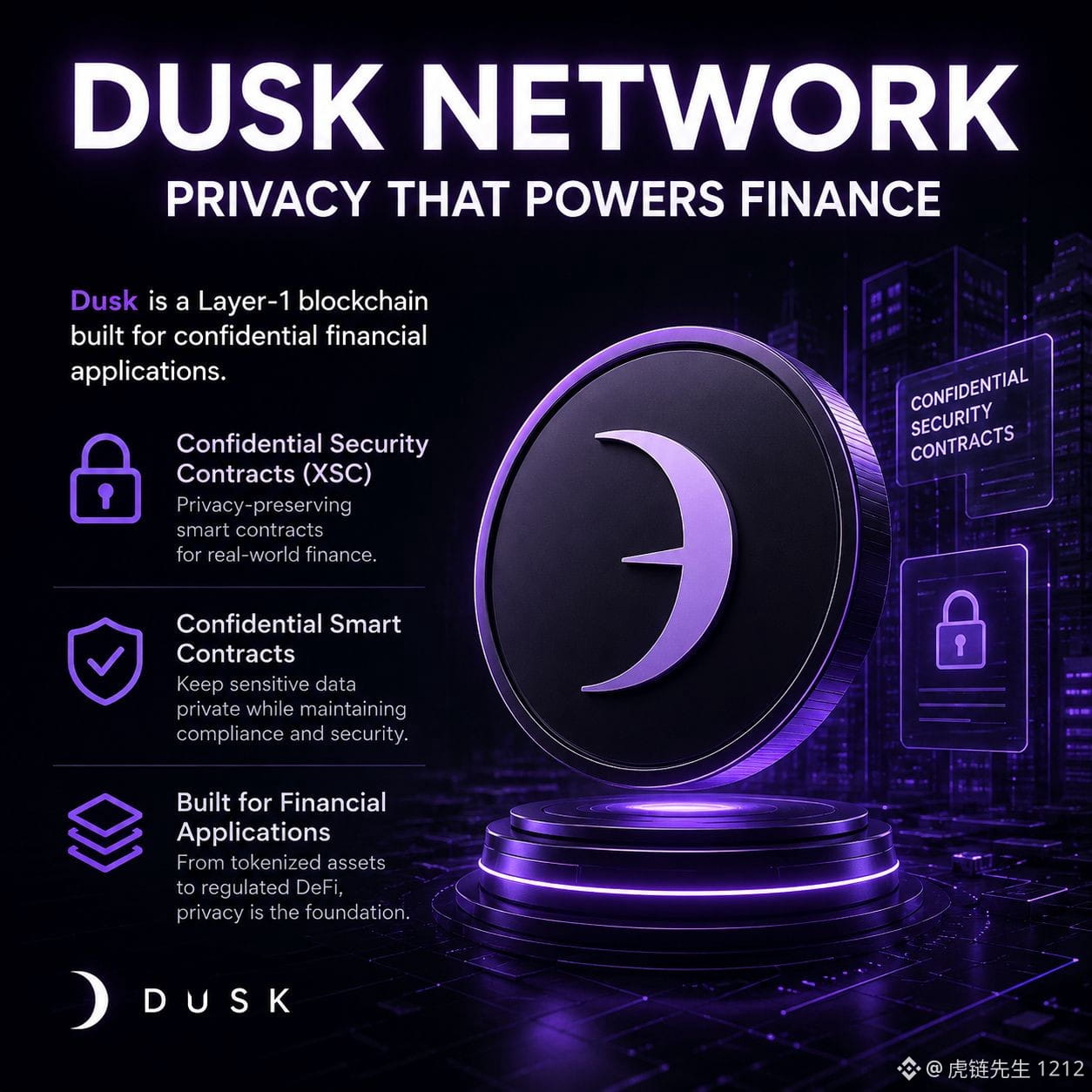
I think the real Dusk test starts when privacy stops being a feature and becomes the everyday workload.
Dusk Network is built around Confidential Security Contracts and confidential smart contracts, but that sounds very different once real financial activity starts flowing through them. Keeping sensitive state private can add extra execution and verification work, and that work has to be paid for somewhere. The interesting question is not whether Dusk can keep data confidential. It is whether the network can do it without making participation noticeably harder or more expensive as usage grows.
That creates a natural pressure on operators. Efficient participants can absorb the extra workload and keep running, while weaker ones may eventually decide the economics are not worth it. I think this matters more than most privacy narratives admit because decentralization depends on who can afford to participate over time. If Dusk makes confidential execution feel almost invisible, adoption gets a much stronger foundation. If the overhead stays obvious, growth could quietly favor fewer and larger operators.
@Dusk #dusk $DUSK
I think the real Dusk test starts when privacy stops being a feature and becomes the everyday workload.
Dusk Network is built around Confidential Security Contracts and confidential smart contracts, but that sounds very different once real financial activity starts flowing through them. Keeping sensitive state private can add extra execution and verification work, and that work has to be paid for somewhere. The interesting question is not whether Dusk can keep data confidential. It is whether the network can do it without making participation noticeably harder or more expensive as usage grows.
That creates a natural pressure on operators. Efficient participants can absorb the extra workload and keep running, while weaker ones may eventually decide the economics are not worth it. I think this matters more than most privacy narratives admit because decentralization depends on who can afford to participate over time. If Dusk makes confidential execution feel almost invisible, adoption gets a much stronger foundation. If the overhead stays obvious, growth could quietly favor fewer and larger operators.
I think the real Dusk test starts when privacy stops being a feature and becomes the everyday workload.
Dusk Network is built around Confidential Security Contracts and confidential smart contracts, but that sounds very different once real financial activity starts flowing through them. Keeping sensitive state private can add extra execution and verification work, and that work has to be paid for somewhere. The interesting question is not whether Dusk can keep data confidential. It is whether the network can do it without making participation noticeably harder or more expensive as usage grows.
That creates a natural pressure on operators. Efficient participants can absorb the extra workload and keep running, while weaker ones may eventually decide the economics are not worth it. I think this matters more than most privacy narratives admit because decentralization depends on who can afford to participate over time. If Dusk makes confidential execution feel almost invisible, adoption gets a much stronger foundation. If the overhead stays obvious, growth could quietly favor fewer and larger operators.
15
5
187
·
--
Bearish
@Dusk_Foundation #dusk $DUSK
{future}(DUSKUSDT)
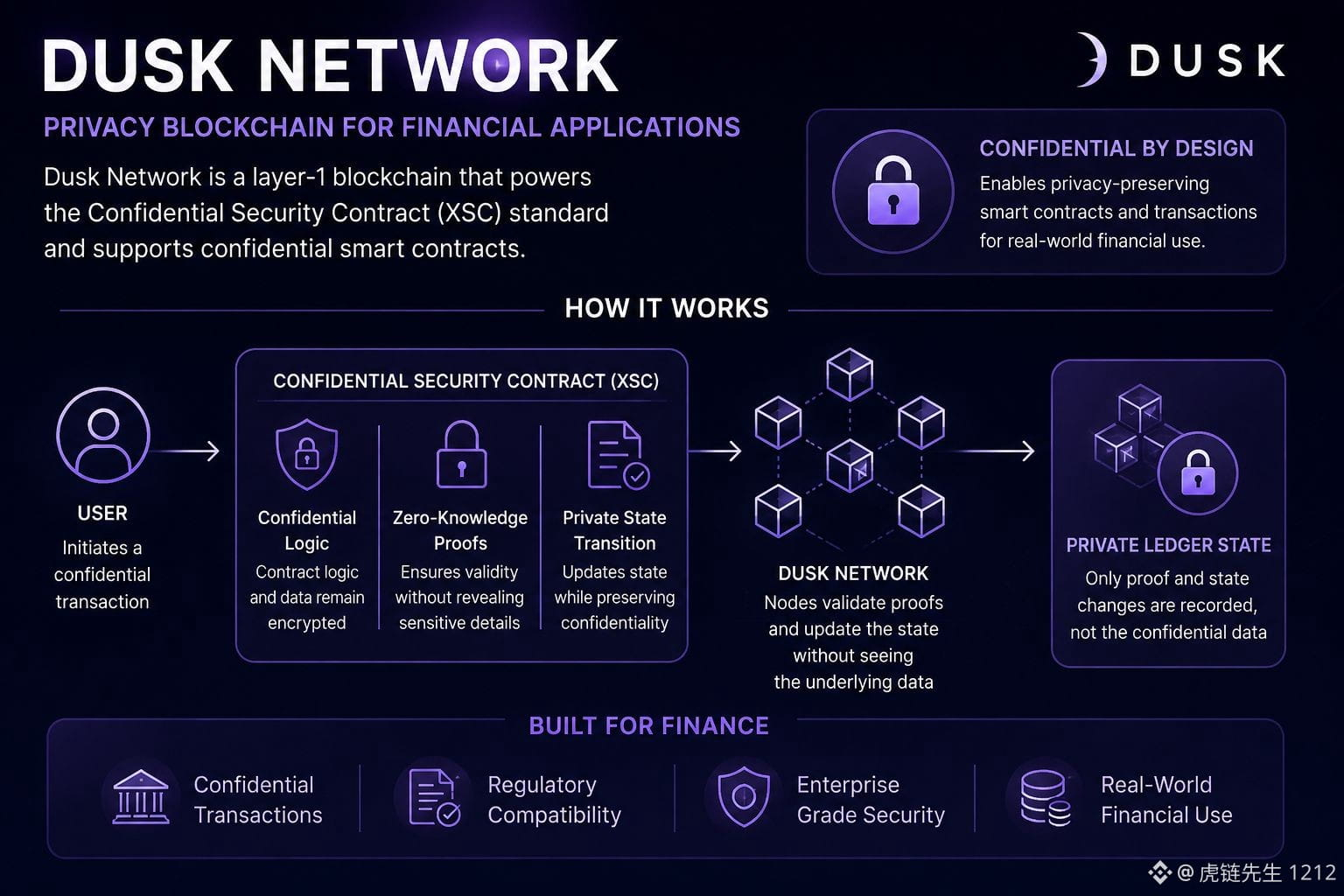
I think the uncomfortable part of Dusk is not privacy itself. It is what privacy quietly asks every node to carry. Confidential Security Contracts can hide sensitive financial logic, but the network still has to process and verify enough information to keep the state trustworthy. That creates an operational tradeoff that is easy to miss when the conversation stays focused on user confidentiality.
If confidential execution keeps adding compute, memory, bandwidth, or verification overhead, node operators eventually start making a simple economic calculation: does running this network still justify the infrastructure bill? That decision can shape decentralization more than another privacy feature ever will. Dusk therefore has a less glamorous problem to solve. Privacy has to remain operationally affordable, otherwise the network risks selecting for operators with deeper pockets rather than operators with better infrastructure. The strongest privacy architecture is not necessarily the one that hides the most. It is the one that can keep hiding sensitive activity without quietly pricing ordinary validators out of participation.
@Dusk #dusk $DUSK
I think the uncomfortable part of Dusk is not privacy itself. It is what privacy quietly asks every node to carry. Confidential Security Contracts can hide sensitive financial logic, but the network still has to process and verify enough information to keep the state trustworthy. That creates an operational tradeoff that is easy to miss when the conversation stays focused on user confidentiality.
If confidential execution keeps adding compute, memory, bandwidth, or verification overhead, node operators eventually start making a simple economic calculation: does running this network still justify the infrastructure bill? That decision can shape decentralization more than another privacy feature ever will. Dusk therefore has a less glamorous problem to solve. Privacy has to remain operationally affordable, otherwise the network risks selecting for operators with deeper pockets rather than operators with better infrastructure. The strongest privacy architecture is not necessarily the one that hides the most. It is the one that can keep hiding sensitive activity without quietly pricing ordinary validators out of participation.
I think the uncomfortable part of Dusk is not privacy itself. It is what privacy quietly asks every node to carry. Confidential Security Contracts can hide sensitive financial logic, but the network still has to process and verify enough information to keep the state trustworthy. That creates an operational tradeoff that is easy to miss when the conversation stays focused on user confidentiality.
If confidential execution keeps adding compute, memory, bandwidth, or verification overhead, node operators eventually start making a simple economic calculation: does running this network still justify the infrastructure bill? That decision can shape decentralization more than another privacy feature ever will. Dusk therefore has a less glamorous problem to solve. Privacy has to remain operationally affordable, otherwise the network risks selecting for operators with deeper pockets rather than operators with better infrastructure. The strongest privacy architecture is not necessarily the one that hides the most. It is the one that can keep hiding sensitive activity without quietly pricing ordinary validators out of participation.
19
10
297
·
--
Bearish
@Dusk_Foundation #dusk $DUSK
{future}(DUSKUSDT)
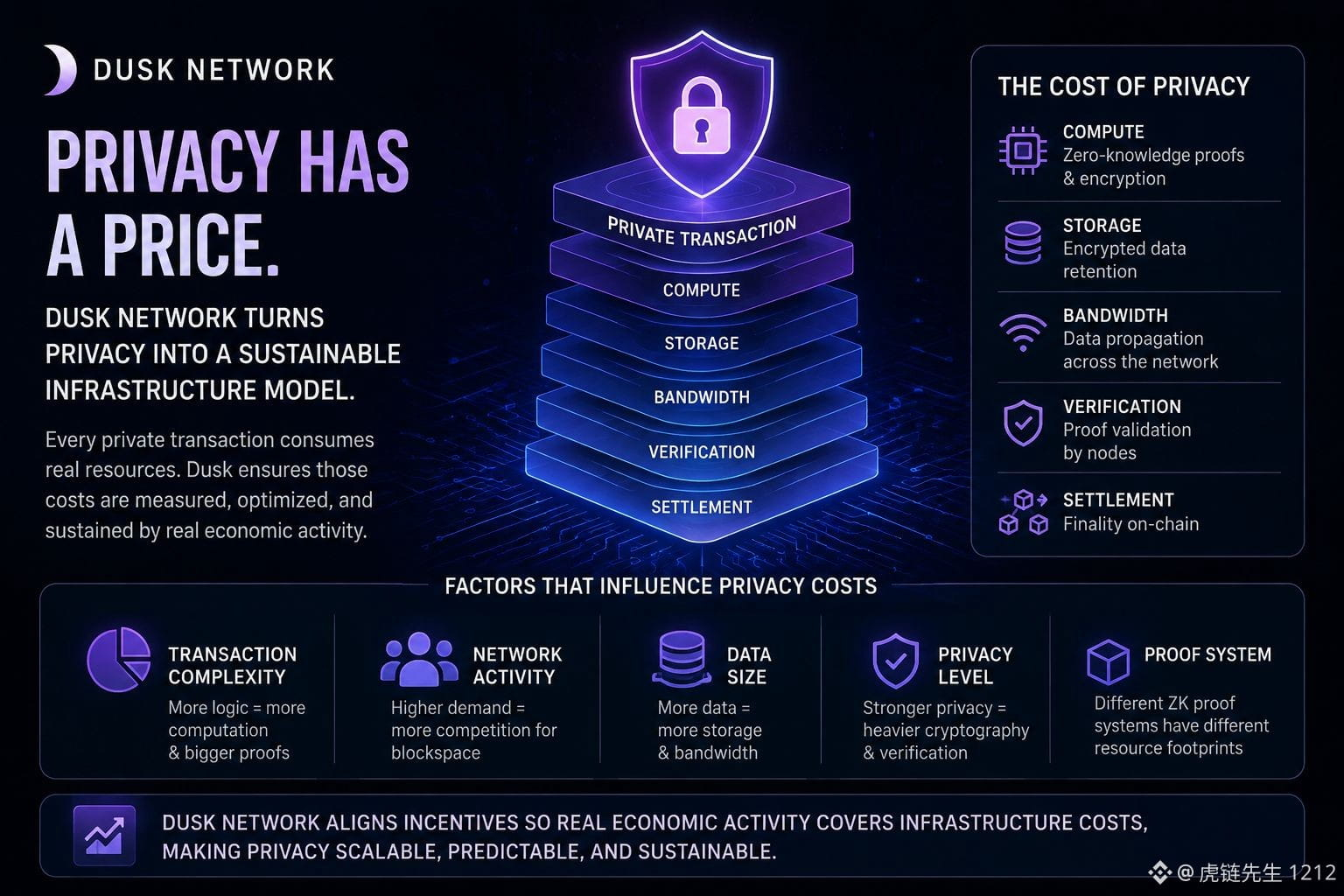
I keep coming back to one simple concern with Dusk Network. Privacy sounds great until you ask who has to do the extra work when nobody can simply look at the data. XSC and confidential smart contracts are built for exactly that environment, but validators still need a reliable way to know that execution is correct. On a transparent chain, you can inspect a transaction and follow the state change. With private execution, that easy check disappears. Something has to replace it.
That is where the real friction may show up. Validators are operators, not philosophers. If confidential execution quietly means more verification work, more resources, or more complicated infrastructure, they will eventually notice. Some will absorb it. Some will ask for better economics. Others may just leave. That behavior matters more than the privacy narrative itself. I think Dusk’s long term test is pretty simple. Can XSC make private financial execution feel normal for the people actually running the network, or does every layer of confidentiality keep adding another operational headache?
@Dusk #dusk $DUSK
I keep coming back to one simple concern with Dusk Network. Privacy sounds great until you ask who has to do the extra work when nobody can simply look at the data. XSC and confidential smart contracts are built for exactly that environment, but validators still need a reliable way to know that execution is correct. On a transparent chain, you can inspect a transaction and follow the state change. With private execution, that easy check disappears. Something has to replace it.
That is where the real friction may show up. Validators are operators, not philosophers. If confidential execution quietly means more verification work, more resources, or more complicated infrastructure, they will eventually notice. Some will absorb it. Some will ask for better economics. Others may just leave. That behavior matters more than the privacy narrative itself. I think Dusk’s long term test is pretty simple. Can XSC make private financial execution feel normal for the people actually running the network, or does every layer of confidentiality keep adding another operational headache?
I keep coming back to one simple concern with Dusk Network. Privacy sounds great until you ask who has to do the extra work when nobody can simply look at the data. XSC and confidential smart contracts are built for exactly that environment, but validators still need a reliable way to know that execution is correct. On a transparent chain, you can inspect a transaction and follow the state change. With private execution, that easy check disappears. Something has to replace it.
That is where the real friction may show up. Validators are operators, not philosophers. If confidential execution quietly means more verification work, more resources, or more complicated infrastructure, they will eventually notice. Some will absorb it. Some will ask for better economics. Others may just leave. That behavior matters more than the privacy narrative itself. I think Dusk’s long term test is pretty simple. Can XSC make private financial execution feel normal for the people actually running the network, or does every layer of confidentiality keep adding another operational headache?
6
3
71
·
--
Bullish
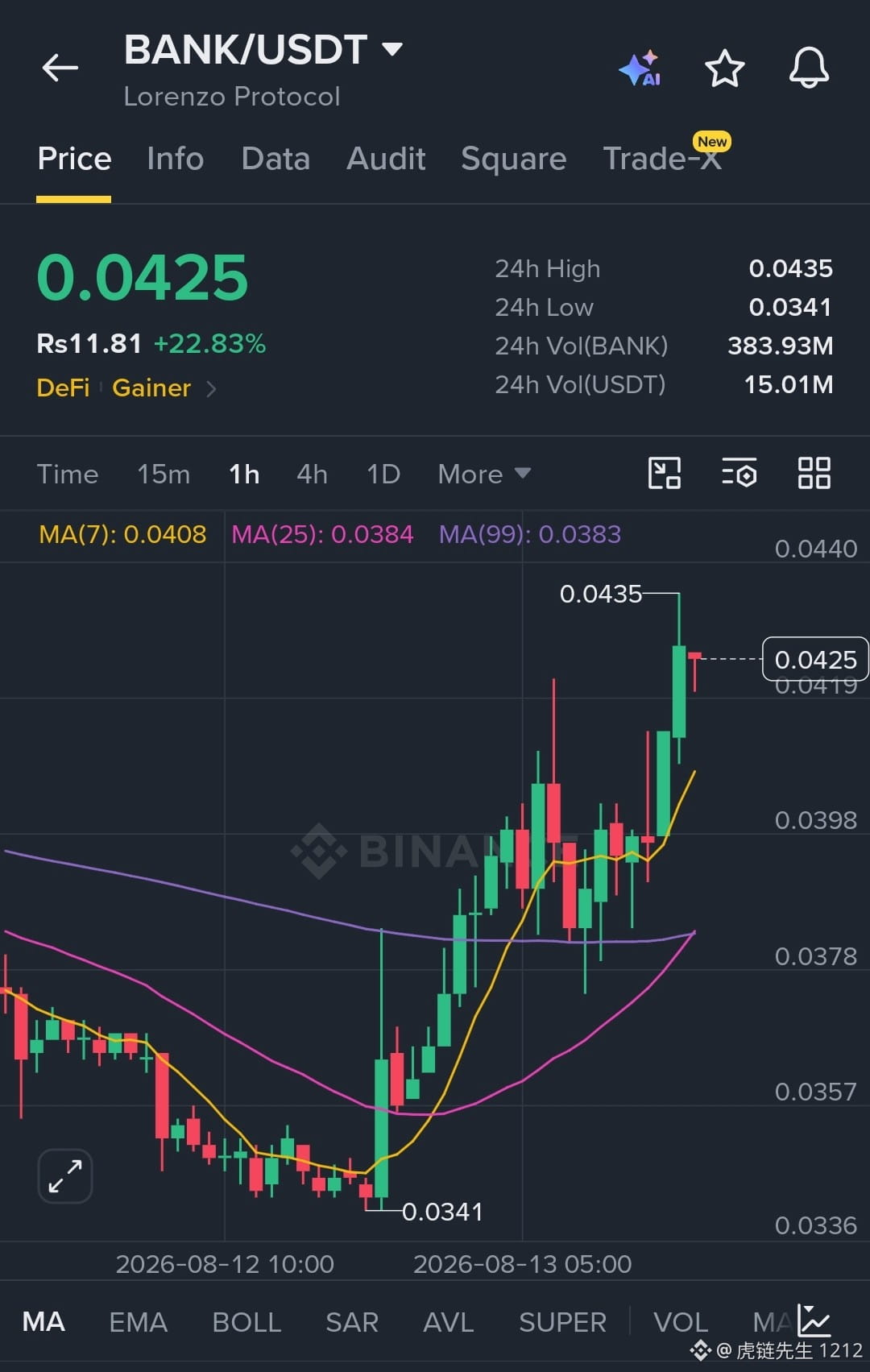
🏦 $BANK Market Overview: Momentum remains positive after a strong expansion move. Support: 0.0390 | 0.0365 Resistance: 0.0450 | 0.0480 Trade Targets: TP1: 0.0445 | TP2: 0.0475 | TP3: 0.0510 Pro Tip: Manage risk carefully on low-priced assets.
{future}(BANKUSDT)
#SECIssuesNoActionLetterToFranklinTempleton #SamsungSKHynixLeadSeoulRally #HyperliquidSeeksUSPerpetualContractMarket #SouthKoreaExpandsVASPReviewToMajorShareholders #ETHStakingRatioHitsRecord34.4%
🏦 $BANK Market Overview: Momentum remains positive after a strong expansion move. Support: 0.0390 | 0.0365 Resistance: 0.0450 | 0.0480 Trade Targets: TP1: 0.0445 | TP2: 0.0475 | TP3: 0.0510 Pro Tip: Manage risk carefully on low-priced assets.
#SECIssuesNoActionLetterToFranklinTempleton #SamsungSKHynixLeadSeoulRally #HyperliquidSeeksUSPerpetualContractMarket #SouthKoreaExpandsVASPReviewToMajorShareholders #ETHStakingRatioHitsRecord34.4%
#SECIssuesNoActionLetterToFranklinTempleton #SamsungSKHynixLeadSeoulRally #HyperliquidSeeksUSPerpetualContractMarket #SouthKoreaExpandsVASPReviewToMajorShareholders #ETHStakingRatioHitsRecord34.4%
150
·
--
Bullish
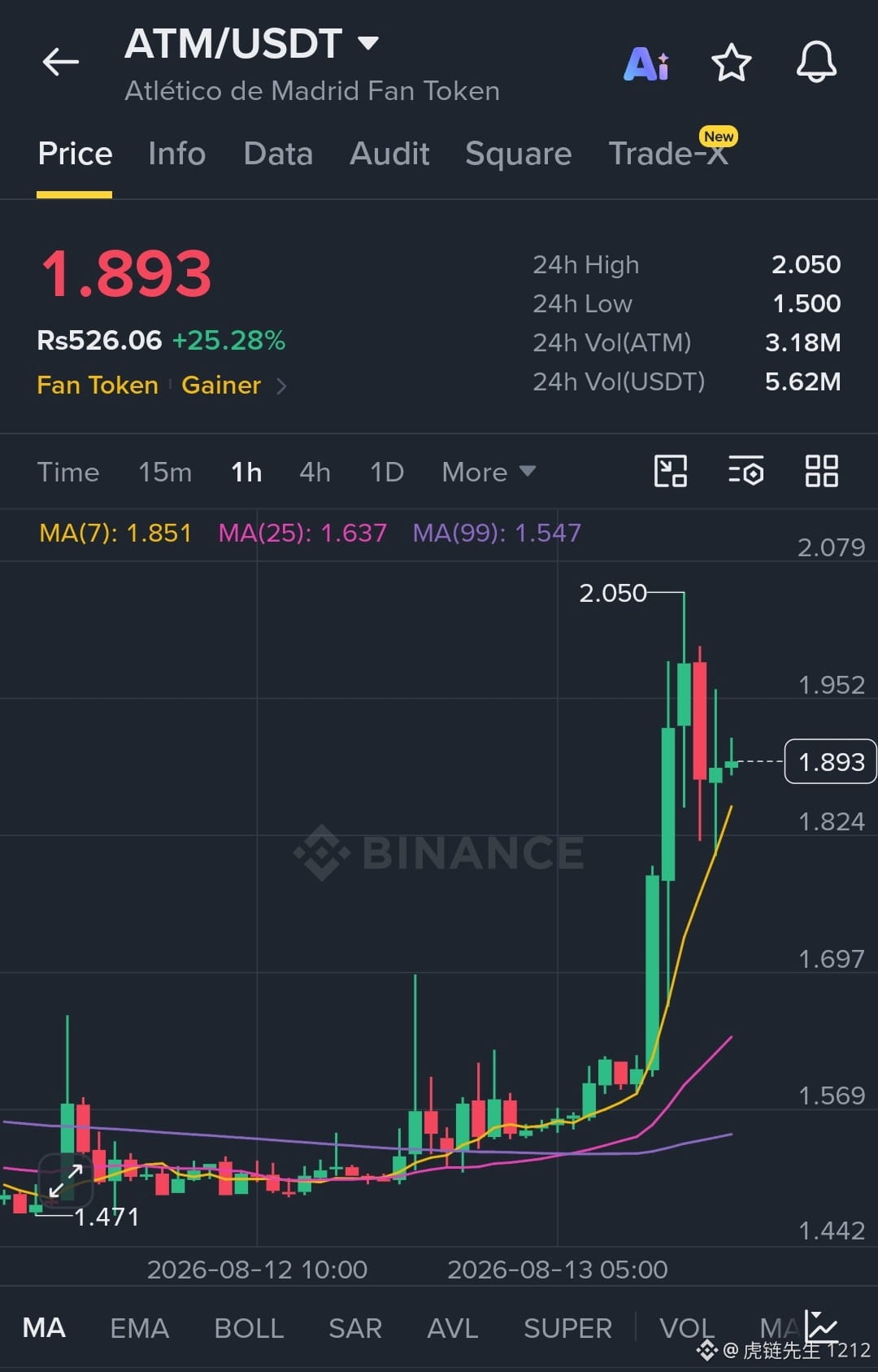
$ATM Market Overview: High volatility with bullish continuation potential. Support: 1.75 | 1.68 Resistance: 1.95 | 2.10 Trade Targets: TP1: 1.95 | TP2: 2.05 | TP3: 2.20 Pro Tip: Volume confirmation is essential before entering.
{spot}(ATMUSDT)
#USJulyCPI&PPIDueThisWeek #SheinSaidToLaunchHKIPOSubscriptionAroundAug20 #CiscoSharesFallDespiteBeatAndRaise #SECIssuesNoActionLetterToFranklinTempleton #SamsungSKHynixLeadSeoulRally
$ATM Market Overview: High volatility with bullish continuation potential. Support: 1.75 | 1.68 Resistance: 1.95 | 2.10 Trade Targets: TP1: 1.95 | TP2: 2.05 | TP3: 2.20 Pro Tip: Volume confirmation is essential before entering.
#USJulyCPI&PPIDueThisWeek #SheinSaidToLaunchHKIPOSubscriptionAroundAug20 #CiscoSharesFallDespiteBeatAndRaise #SECIssuesNoActionLetterToFranklinTempleton #SamsungSKHynixLeadSeoulRally
#USJulyCPI&PPIDueThisWeek #SheinSaidToLaunchHKIPOSubscriptionAroundAug20 #CiscoSharesFallDespiteBeatAndRaise #SECIssuesNoActionLetterToFranklinTempleton #SamsungSKHynixLeadSeoulRally
107
·
--
Bullish
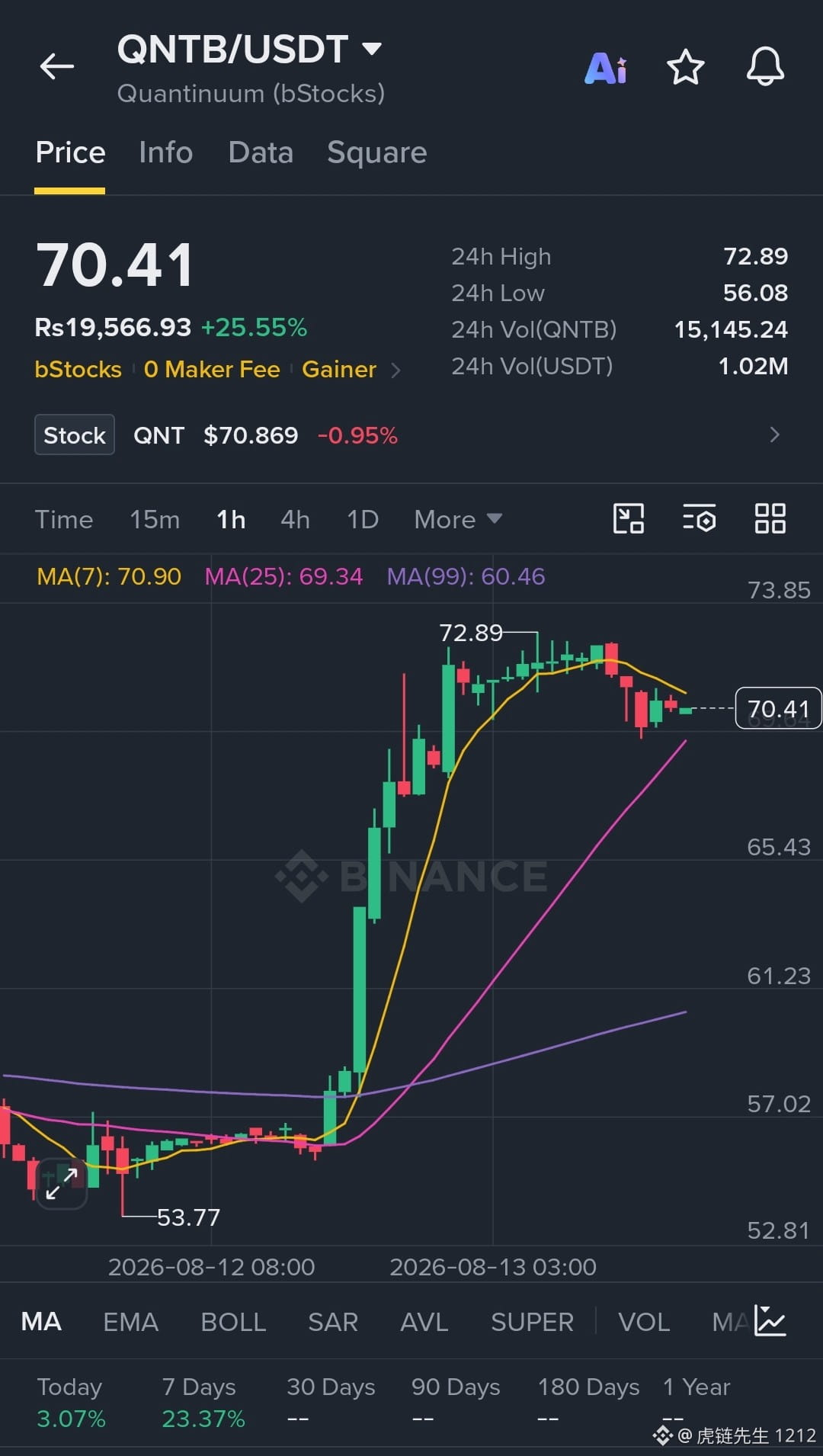
$QNTB Market Overview: Strong breakout with buyers defending higher levels. Support: 66.00 | 62.50 Resistance: 74.50 | 80.00 Trade Targets: TP1: 73.50 | TP2: 77.00 | TP3: 82.00 Pro Tip: Wait for pullbacks toward support instead of chasing green candles.
$QNTB
{spot}(QNTBUSDT)
#USJulyCPI&PPIDueThisWeek #SheinSaidToLaunchHKIPOSubscriptionAroundAug20 #SolanaStakingNearsHaltOnRoutingError #ETHStakingRatioHitsRecord34.4% #ETHStakingRatioHitsRecord34.4%
$QNTB Market Overview: Strong breakout with buyers defending higher levels. Support: 66.00 | 62.50 Resistance: 74.50 | 80.00 Trade Targets: TP1: 73.50 | TP2: 77.00 | TP3: 82.00 Pro Tip: Wait for pullbacks toward support instead of chasing green candles.
$QNTB
#USJulyCPI&PPIDueThisWeek #SheinSaidToLaunchHKIPOSubscriptionAroundAug20 #SolanaStakingNearsHaltOnRoutingError #ETHStakingRatioHitsRecord34.4% #ETHStakingRatioHitsRecord34.4%
$QNTB
#USJulyCPI&PPIDueThisWeek #SheinSaidToLaunchHKIPOSubscriptionAroundAug20 #SolanaStakingNearsHaltOnRoutingError #ETHStakingRatioHitsRecord34.4% #ETHStakingRatioHitsRecord34.4%
93
·
--
Bullish
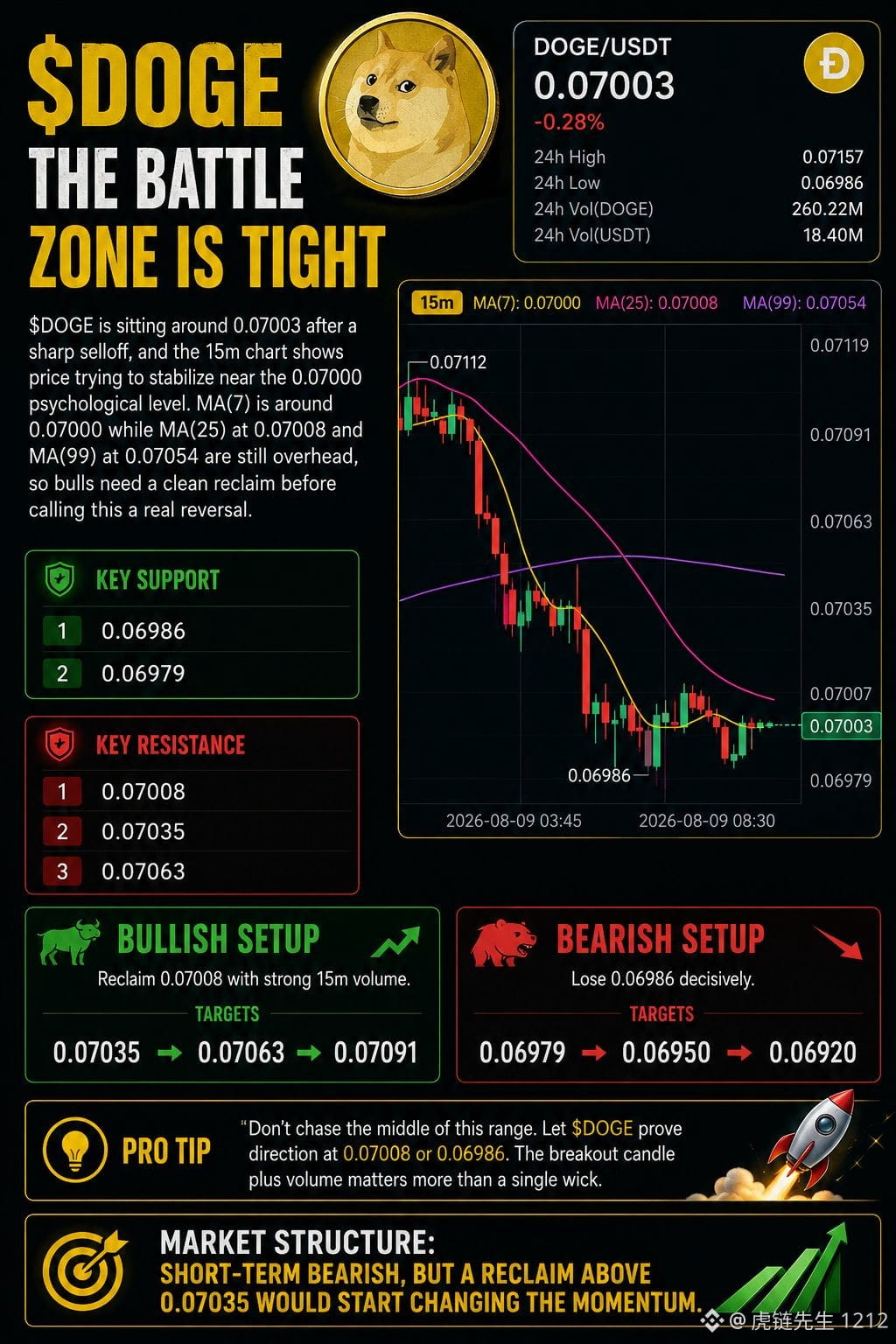
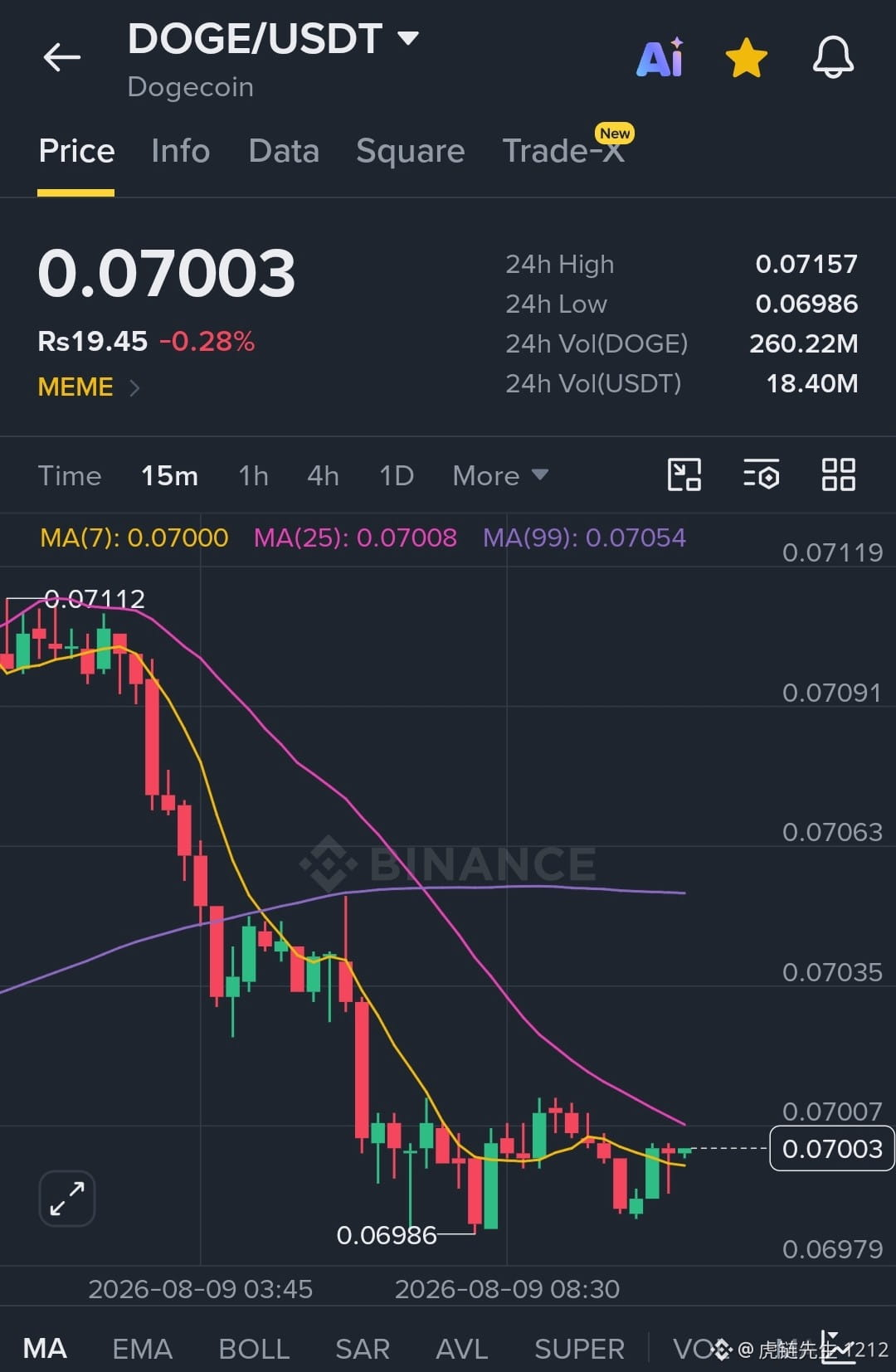
$DOGE is sitting around 0.07003 after a sharp selloff, and the 15m chart shows price trying to stabilize near the 0.07000 psychological level. MA(7) is around 0.07000 while MA(25) at 0.07008 and MA(99) at 0.07054 are still overhead, so bulls need a clean reclaim before calling this a real reversal.
Key support: 0.06986 → 0.06979
Key resistance: 0.07008 → 0.07035 → 0.07063
Bullish setup: reclaim 0.07008 with strong 15m volume. Targets 0.07035, 0.07063, then 0.07091.
Bearish setup: lose 0.06986 decisively. Target 0.06979 first, with further downside possible if sellers accelerate.
#BIP110SoftForkAttemptBegins #SouthKoreaProposesLooseningCryptoShareholderRules #SenateReadiesSeptemberCLARITYActVote #BIP110ForkSignalingExpectedThisWeekend #VIXFallsToJanuaryLow
$DOGE is sitting around 0.07003 after a sharp selloff, and the 15m chart shows price trying to stabilize near the 0.07000 psychological level. MA(7) is around 0.07000 while MA(25) at 0.07008 and MA(99) at 0.07054 are still overhead, so bulls need a clean reclaim before calling this a real reversal.
Key support: 0.06986 → 0.06979
Key resistance: 0.07008 → 0.07035 → 0.07063
Bullish setup: reclaim 0.07008 with strong 15m volume. Targets 0.07035, 0.07063, then 0.07091.
Bearish setup: lose 0.06986 decisively. Target 0.06979 first, with further downside possible if sellers accelerate.
#BIP110SoftForkAttemptBegins #SouthKoreaProposesLooseningCryptoShareholderRules #SenateReadiesSeptemberCLARITYActVote #BIP110ForkSignalingExpectedThisWeekend #VIXFallsToJanuaryLow
Key support: 0.06986 → 0.06979
Key resistance: 0.07008 → 0.07035 → 0.07063
Bullish setup: reclaim 0.07008 with strong 15m volume. Targets 0.07035, 0.07063, then 0.07091.
Bearish setup: lose 0.06986 decisively. Target 0.06979 first, with further downside possible if sellers accelerate.
#BIP110SoftForkAttemptBegins #SouthKoreaProposesLooseningCryptoShareholderRules #SenateReadiesSeptemberCLARITYActVote #BIP110ForkSignalingExpectedThisWeekend #VIXFallsToJanuaryLow
1
177
·
--
Bullish
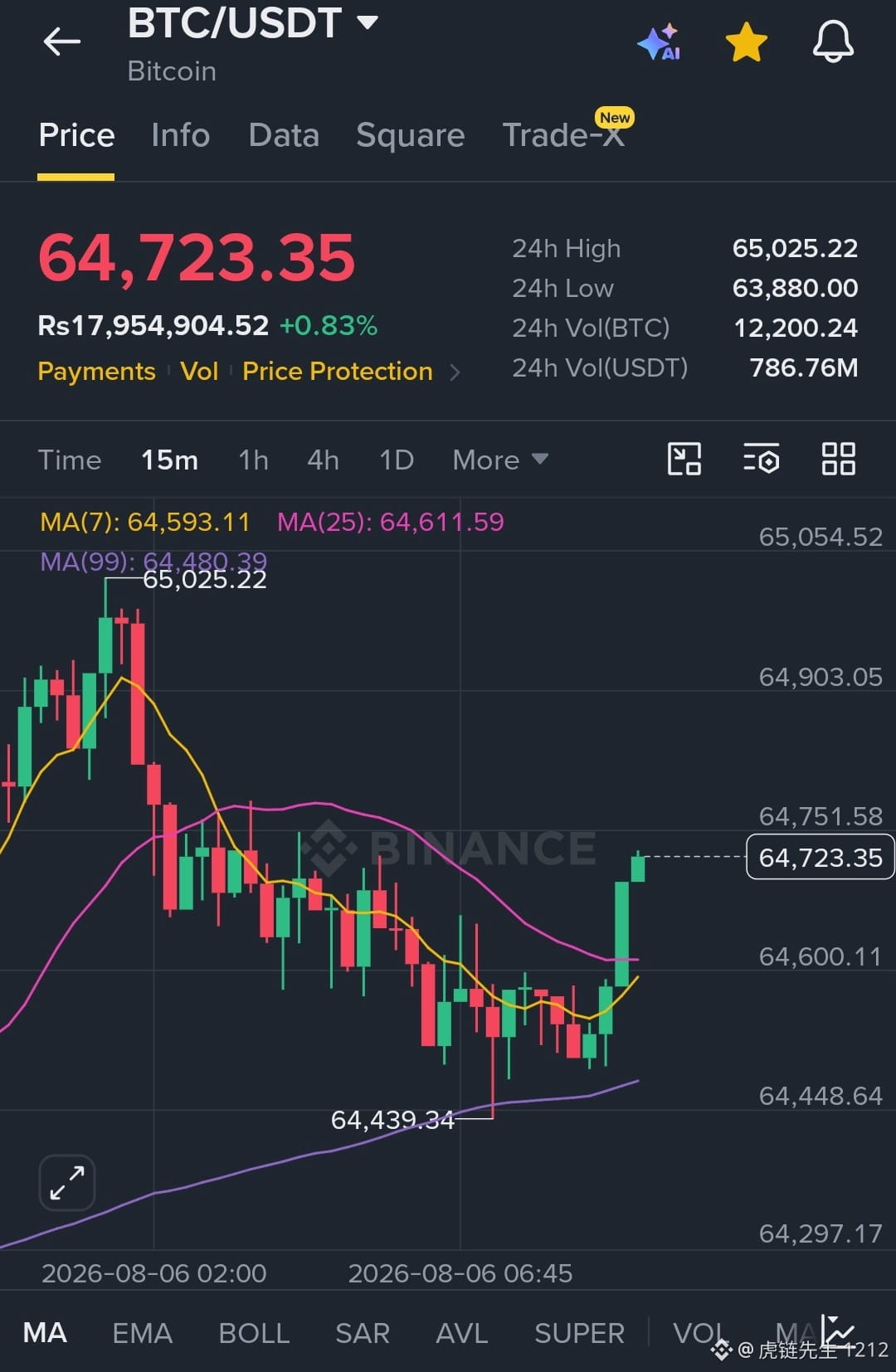
$BTC continues to lead market sentiment. Buyers are defending higher levels, keeping the bullish structure alive despite short-term volatility.
Market Overview: Momentum favors buyers as long as key support holds.
Pro Tip: Trade with the trend and let Bitcoin confirm direction before rotating into altcoins.
Support: 63,800 | 62,500
Resistance: 65,500 | 67,000
Trade Targets: 65,500 → 67,000 → 69,500
{spot}(BTCUSDT)
#ADPJulyPrivatePayrollsMissedExpectations #GoldBreaksOutAboveDowntrend #KOSPILedLowerBySKHynixSamsung #SouthKoreaTaxPlanOmitsCryptoTaxDelay #TaiwanPlansCryptoTravelRuleFromOctober
$BTC continues to lead market sentiment. Buyers are defending higher levels, keeping the bullish structure alive despite short-term volatility.
Market Overview: Momentum favors buyers as long as key support holds.
Pro Tip: Trade with the trend and let Bitcoin confirm direction before rotating into altcoins.
Support: 63,800 | 62,500
Resistance: 65,500 | 67,000
Trade Targets: 65,500 → 67,000 → 69,500
#ADPJulyPrivatePayrollsMissedExpectations #GoldBreaksOutAboveDowntrend #KOSPILedLowerBySKHynixSamsung #SouthKoreaTaxPlanOmitsCryptoTaxDelay #TaiwanPlansCryptoTravelRuleFromOctober
Market Overview: Momentum favors buyers as long as key support holds.
Pro Tip: Trade with the trend and let Bitcoin confirm direction before rotating into altcoins.
Support: 63,800 | 62,500
Resistance: 65,500 | 67,000
Trade Targets: 65,500 → 67,000 → 69,500
#ADPJulyPrivatePayrollsMissedExpectations #GoldBreaksOutAboveDowntrend #KOSPILedLowerBySKHynixSamsung #SouthKoreaTaxPlanOmitsCryptoTaxDelay #TaiwanPlansCryptoTravelRuleFromOctober
94
Log in to explore more content
Join global crypto users on Binance Square
⚡️ Get latest and useful information about crypto.
💬 Trusted by the world’s largest crypto exchange.
👍 Discover real insights from verified creators.
Email / Phone number
Trending Topics
SECReceivesGrayscaleLitecoinTrustETFFiling
34,839 views
721 Discussing
💎 Institutional Attention Reaches Litecoin
Grayscale’s ETF filing has placed $LTC in a bigger conversation. For spot traders, developments like this are a reminder to study strong assets before making any entry.
#secreceivesgrayscalelitecointrustetffiling
CryptoMahibaloch
·1 Likes
·1.1k views
ClarityActFacesProceduralVoteSept15
146,612 views
1,694 Discussing
US10YearTreasuryYieldNears5%
49,958 views
917 Discussing